

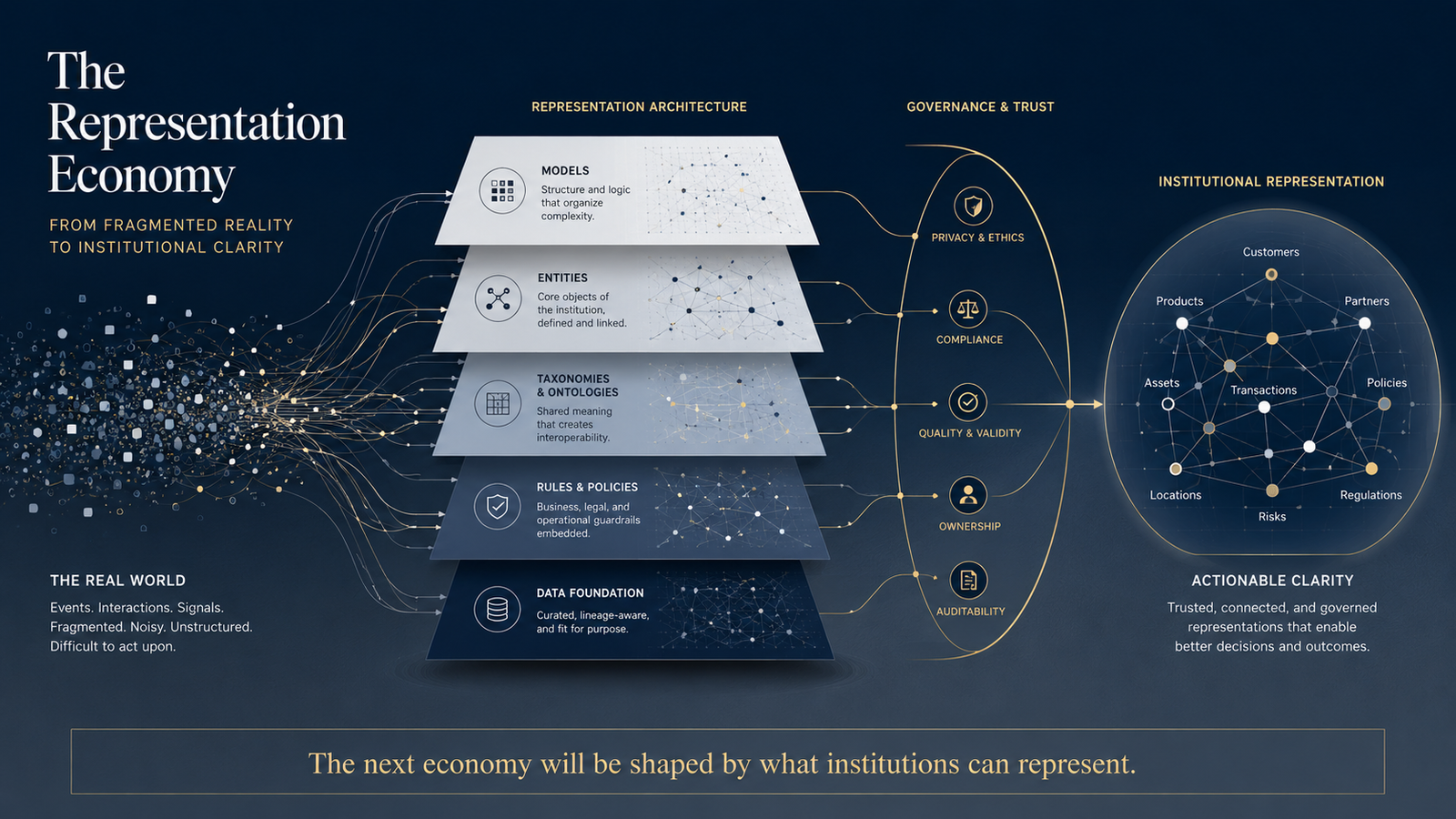
The Representation Economy: Every economy is shaped by what it learns to see.
Land made value visible.
Labor made effort visible.
Capital made investment visible.
Software made processes visible.
The AI era will make something else visible: reality itself — through representation.
The AI era is often described as an era of intelligence. That is true, but incomplete. Intelligence alone does not create an economy. Before value can move, reality must become visible in a form that systems can identify, interpret, trust, and act upon.
If reality remains fragmented, blurry, or weakly legible, it may exist — but still remain economically invisible.
That is the shift this chapter names.
The next economy will not be shaped by intelligence alone. It will be shaped by representation.
I call this the Representation Economy: an economy where value flows to what can be clearly represented, meaningfully understood, and responsibly acted upon.
This is not a linguistic shift. It is a structural one.
It changes how we understand participation, power, trust, and competitive advantage.
From Resources to Participation
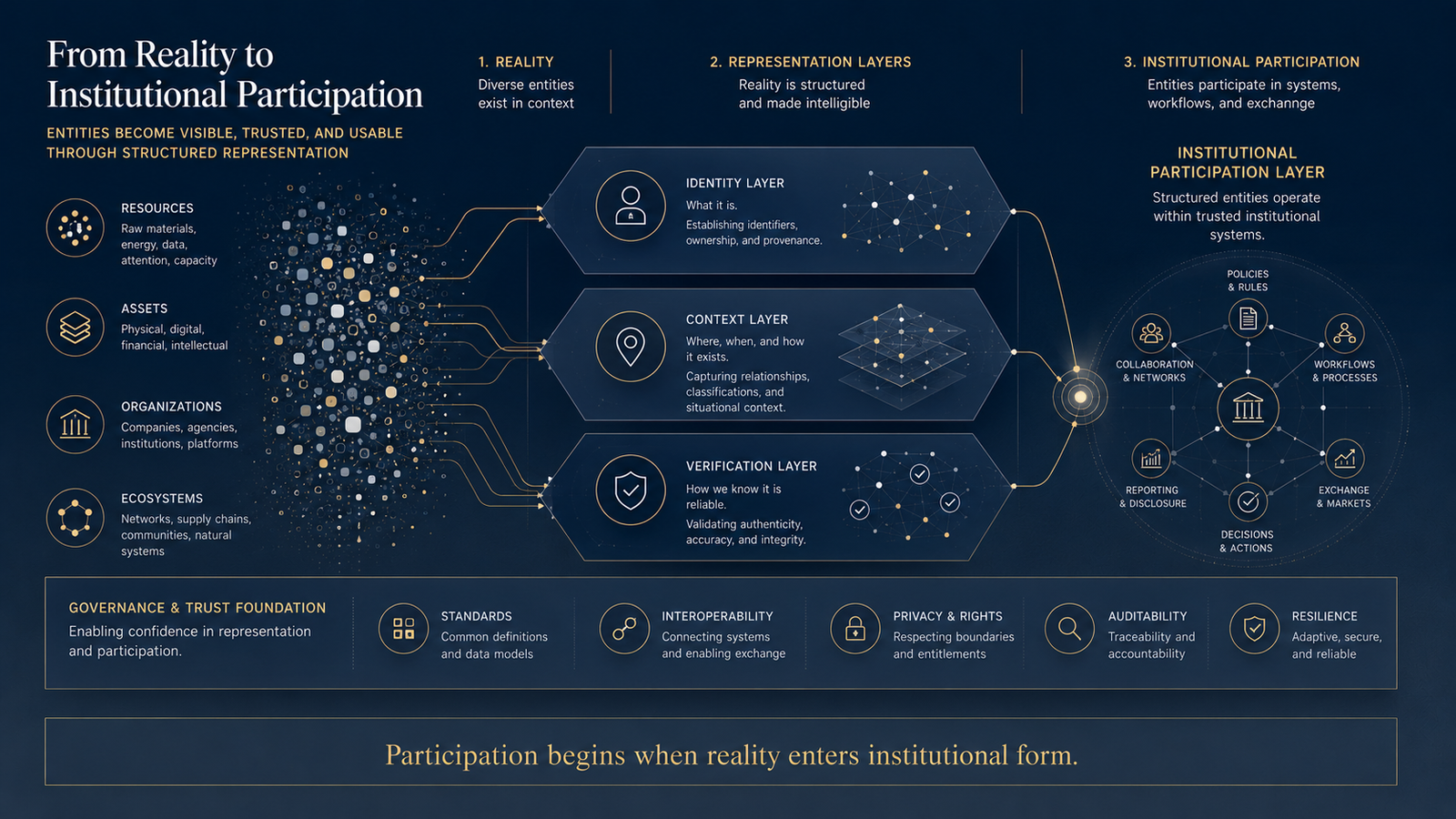
Economies are not built only on resources. They are built on participation.
To participate in credit, trade, insurance, healthcare, logistics, governance, or enterprise decision-making, an entity must appear in a form the system can work with.
Not merely as a trace.
Not merely as a data point.
But as something coherent enough to evaluate, compare, price, include, and act upon.
If an entity cannot be represented well, its participation remains weak. Not because value does not exist, but because the system cannot see it clearly enough to include it.
What is not representable is not fully participatory.
This is true across domains: people, firms, assets, animals, ecosystems, supply chains, infrastructure, customers, communities, and institutions.
They do not participate simply because they exist. They participate when their reality enters institutional form.
That is why the Representation Economy is not only about technology. It is about who gets to be seen, how they are seen, and on what terms they are allowed to participate.
What the Representation Economy Really Means
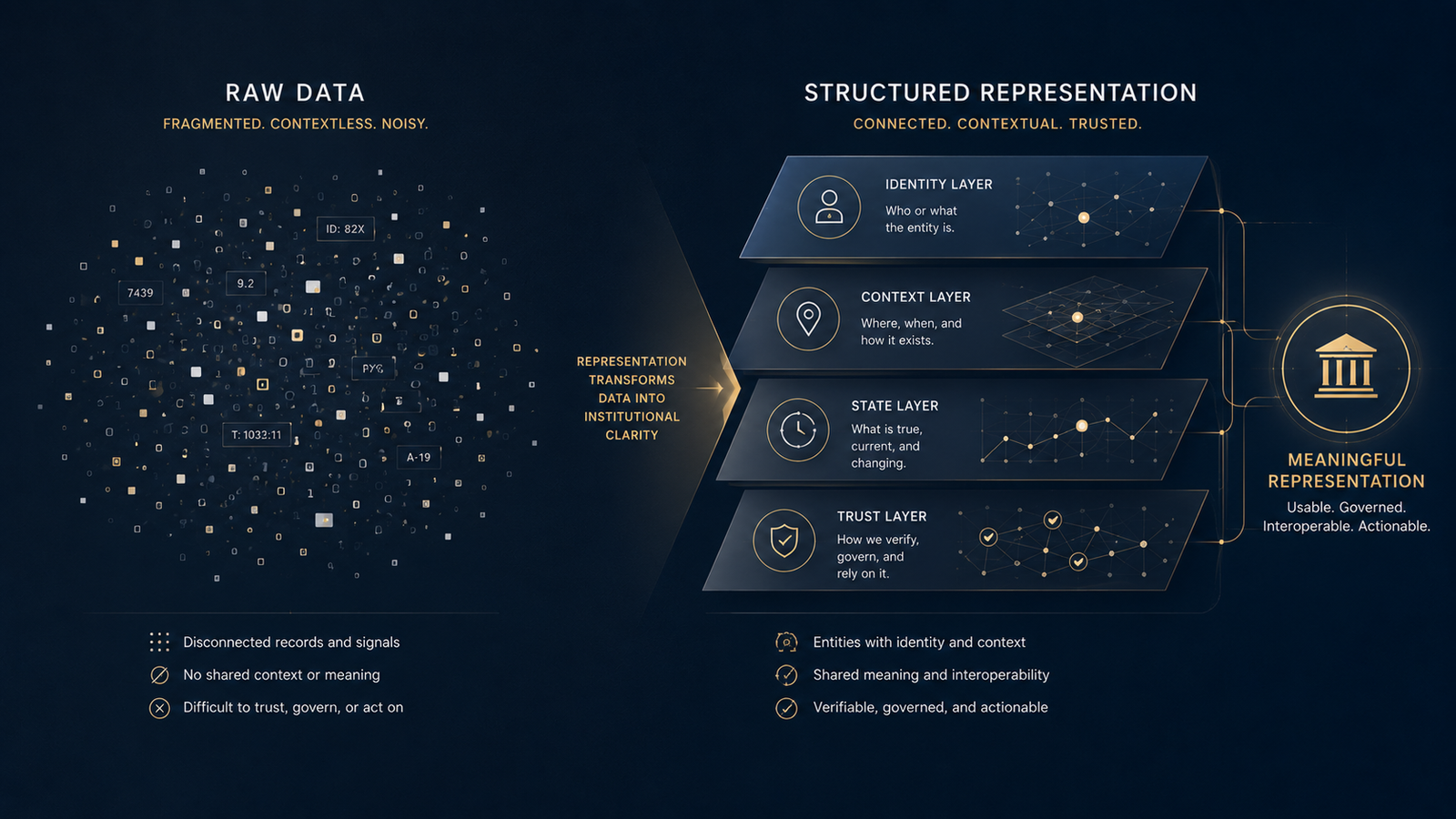
The Representation Economy begins with a simple truth:
What cannot be represented well cannot be served well.
Systems naturally favor what they can model, standardize, verify, compare, and govern. They delay, simplify, discount, or ignore what appears unclear.
Over time, this creates a structural pattern.
Well-represented entities gain access. Poorly represented entities face friction.
This is not accidental. It is economic.
Representation is no longer only descriptive. It is becoming a source of advantage.
Organizations that represent reality more faithfully can understand more, coordinate better, act with greater confidence, and earn more trust.
Organizations that do not represent reality well operate through delay, approximation, manual intervention, hidden risk, and weak institutional memory.
That is why representation is becoming decisive.
Not because it is new, but because it is now measurable, scalable, and economically consequential.
The New Source of Enterprise Advantage
In earlier digital eras, advantage came from digitization, data collection, process automation, and software scale.
These still matter.
But they are no longer sufficient.
As AI models become more accessible, advantage shifts.
A model can be accessed.
A dataset can be purchased.
A workflow can be automated.
But a trusted representation of reality must be built.
Two organizations may use the same AI model. The better organization will not necessarily be the one with the more powerful model. It will be the one that represents its world better.
It will detect change earlier. It will understand entities more deeply. It will make better decisions. It will act with greater legitimacy.
Intelligence scales decisions. Representation defines what is worth deciding.
That is the new edge.
Visibility Is Becoming Economic Power
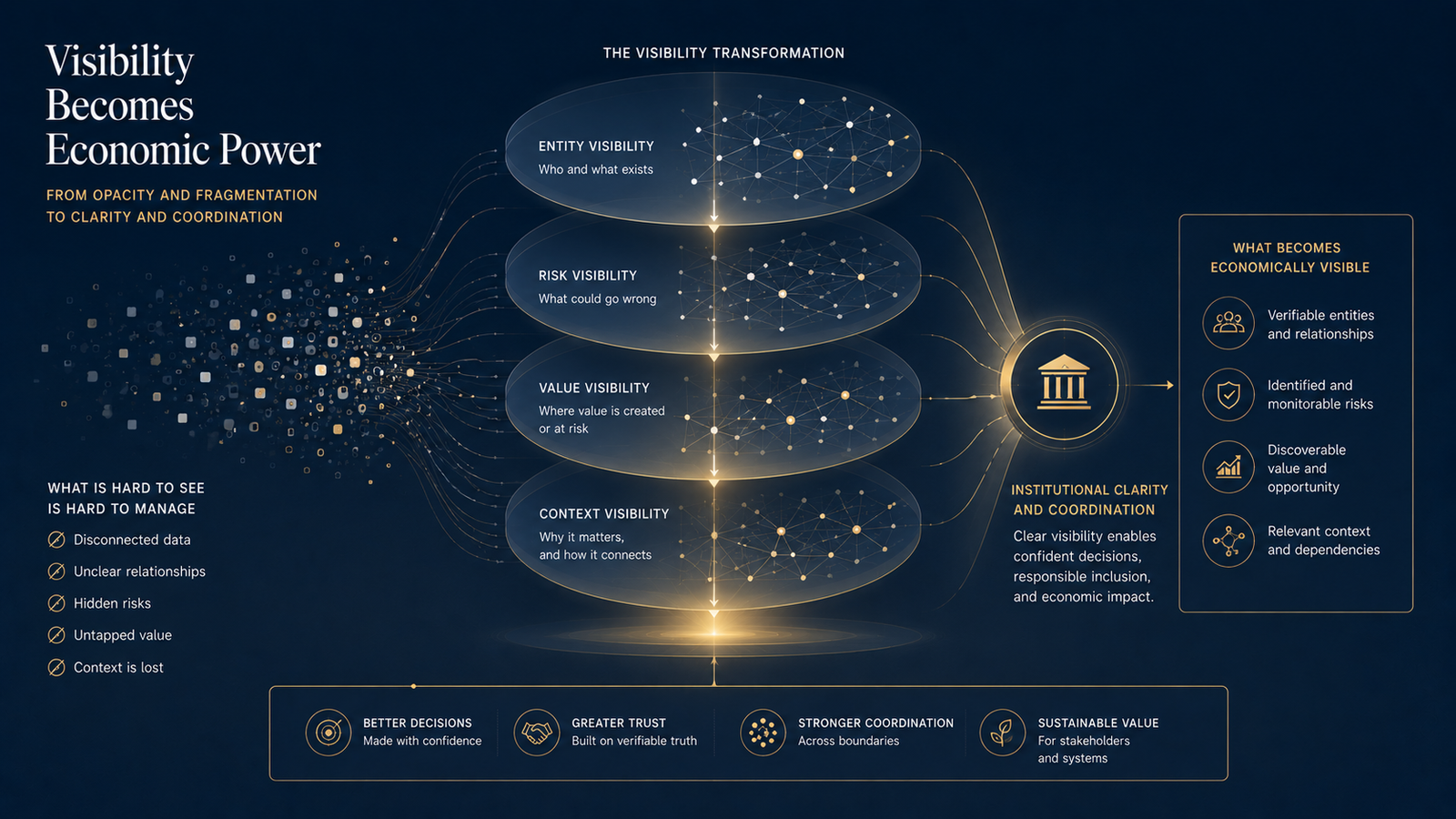
The Representation Economy can be understood in one line:
Visibility is becoming economic power.
Not visibility in the social media sense.
Visibility in the systemic sense.
Can the system see an entity clearly enough to understand its condition, evaluate its risk, recognize its value, preserve its context, and act with confidence?
If yes, inclusion improves.
If not, friction increases.
What is clearly represented moves faster, is trusted more, is priced better, and is coordinated more easily.
What is poorly represented is delayed, discounted, misunderstood, or excluded.
In economic systems, what is not seen clearly is treated as risky.
This is why visibility is no longer a technical issue. It is a strategic issue.
It determines who participates, who benefits, who is trusted, and who remains outside the system.
Why Trust Sits Inside the Economy
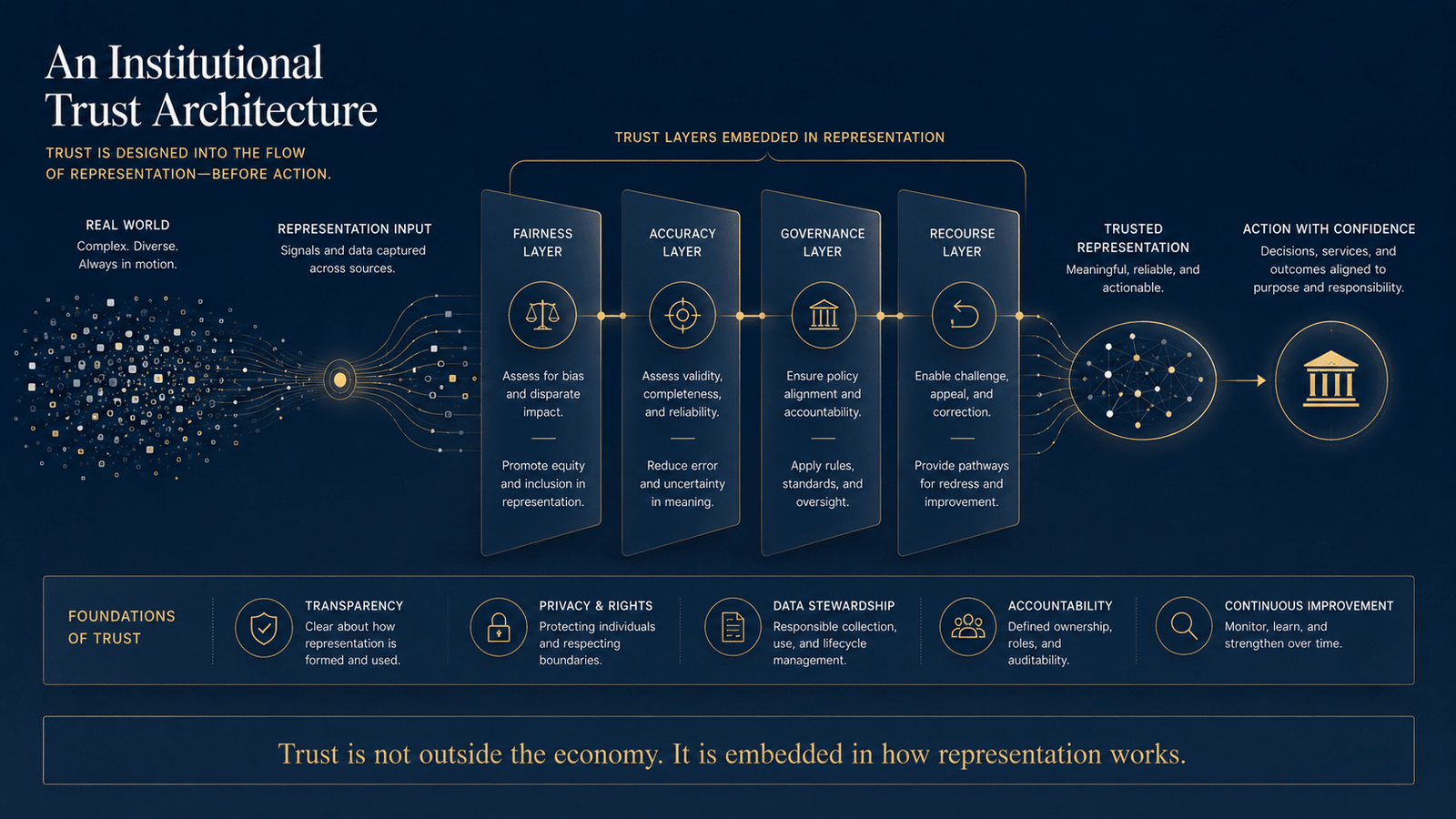
Representation alone is not enough.
A system may see clearly and still not be trusted.
For representation to create value, it must be accurate enough to use, fair enough to share, and governed responsibly enough to act upon.
That is the threshold.
The Representation Economy is not merely about seeing. It is about seeing under conditions that allow participation.
This is where trust enters the economic logic.
An entity participates more when it believes three things:
- it is being represented fairly;
- its representation will not be misused;
- there is recourse if something goes wrong.
Trust is not external to the economy. It is embedded in how representation works.
Without trust, visibility becomes surveillance.
With trust, visibility becomes participation.
That distinction will define the next generation of institutional advantage.
From Extraction to Representation
The old digital mindset was simple:
collect more, extract more, optimize more.
The new mindset asks deeper questions:
What are we representing?
Whose reality is entering the system?
What context is preserved?
What remains unseen?
What trust must be earned before action is legitimate?
This is a deeper discipline.
Extraction is about possession.
Representation is about fidelity.
Extraction scales what an organization has. Representation determines what becomes real inside the system.
This is why many digitally advanced organizations remain structurally weak. They are good at capture, but not good enough at representation.
They have data, but not clarity.
They have automation, but not understanding.
They have intelligence, but not legitimacy.
And that is why so much real value remains underserved — not because it does not exist, but because it is trapped behind weak representation.
The Strategic Question Changes
Once the Representation Economy lens is applied, strategy changes.
The question is no longer:
How much data do we have?
It becomes:
How well do we represent what matters?
The question is no longer:
How intelligent is our system?
It becomes:
How much of reality can we see clearly enough to act on?
The question is no longer:
How do we automate more?
It becomes:
Where does better representation create better outcomes?
These are different questions because they treat reality itself as the strategic frontier.
They force institutions to confront where they are blind, where they flatten complexity, where they mistake data for understanding, and where weak representation creates weak decisions.
This is not optimization.
This is institutional redesign.
Why This Is a New Category
A concept matters when it helps people see what they could feel but could not name.
That is what the Representation Economy does.
Leaders already sense that more data has not produced enough clarity. They know better models have not eliminated fragility. They see trust repeatedly appearing as a constraint. They recognize that some realities remain economically invisible.
What has been missing is a unifying frame.
The Representation Economy provides that frame.
It explains why visibility, identity, context, trust, and legitimacy are becoming central to enterprise value creation.
It explains why the future will not be won only by those who compute better.
It will be won by those who represent better.
The Operating Logic Beneath the Economy
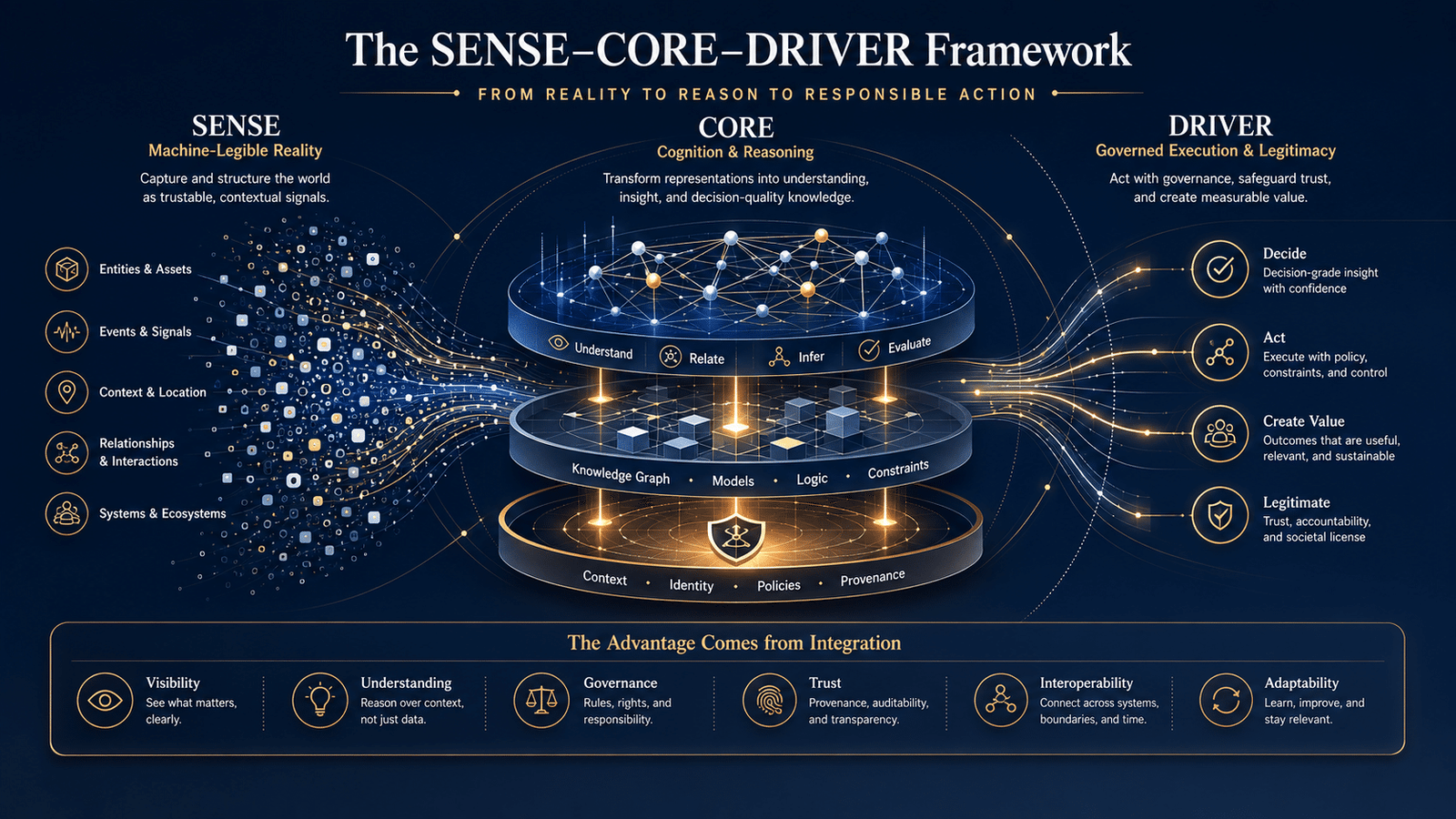
Behind the Representation Economy sits a simple order:
- Reality becomes visible.
- Reality is interpreted.
- Action is executed with trust.
This order is not optional. It is foundational.
Yet many institutions are misaligned.
They invest heavily in intelligence — the reasoning layer — while underinvesting in visibility, representation quality, trust, governance, and recourse.
This is the structural mistake.
If a system sees poorly, intelligence amplifies error.
If a system acts without legitimacy, value collapses.
This is where the SENSE–CORE–DRIVER framework becomes important.
SENSE is the layer where reality becomes machine-legible.
CORE is the cognition layer where systems interpret, reason, and decide.
DRIVER is the legitimacy layer where action is authorized, verified, executed, and corrected.
Most organizations are fascinated by CORE.
The Representation Economy argues that durable advantage will depend equally — and often more deeply — on SENSE and DRIVER.
The Economy Ahead
The future will still use data, models, software, and intelligence.
But the winners will understand something deeper:
Value flows where reality is represented well.
That means better visibility, stronger identity, richer context, responsible action, and trusted participation.
This will create new categories of infrastructure and enterprise capability:
- representation correction systems;
- identity infrastructure layers;
- verification and truth systems;
- recourse and accountability platforms;
- representation quality engineering;
- representation insurance;
- institutional visibility infrastructure.
The frontier is shifting.
From intelligence infrastructure to representation infrastructure.
The next economy will not reward those who merely collect more.
It will reward those who see clearly, understand deeply, and act responsibly.
Conclusion: The Next Economy Will Belong to Those Who See Better
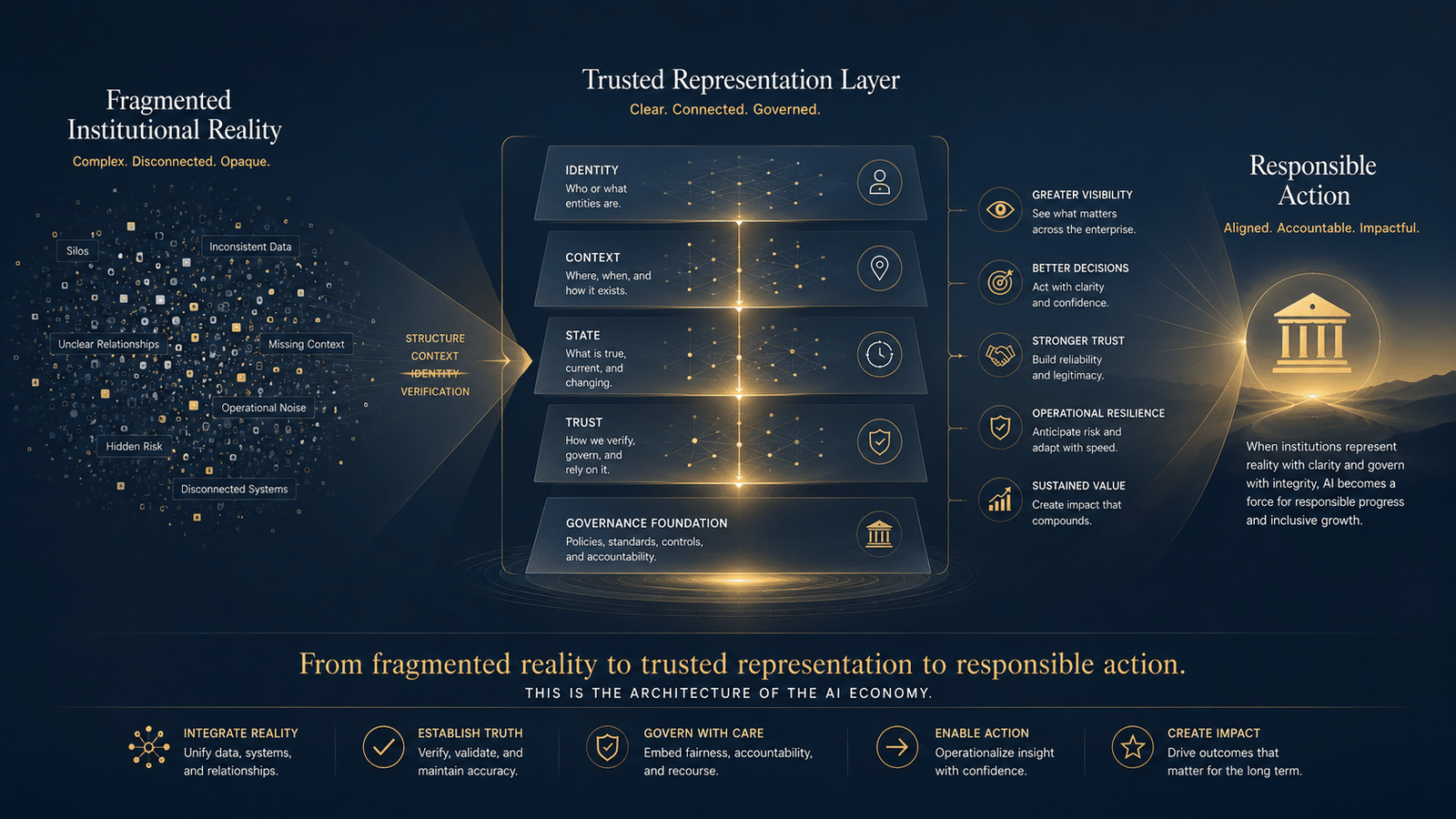
The AI conversation has been dominated by intelligence: smarter models, faster agents, larger systems, and more powerful automation.
But intelligence is only one part of the story.
Before AI can decide well, it must see well.
Before institutions can automate responsibly, they must represent reality faithfully.
Before value can move, reality must become visible in a form that can be trusted.
That is why the Representation Economy matters.
It shifts the question from “How intelligent is our AI?” to “How well does our institution represent the world it claims to serve?”
That question will define the next phase of enterprise advantage.
Because in the end, the future will not belong only to those who compute better.
It will belong to those who represent better.
And once that becomes clear, the next question follows:
If representation defines value, what enables systems to see reality in the first place?
That takes us to the mechanics of visibility itself.
This is ultimately a question of return on investment as much as visibility: see Enterprise AI ROI: Why Most AI Projects Fail to Create Business Value for the institutional architecture that determines whether better representation actually converts into measurable business value.
Key takeaways
- The next phase of AI advantage will depend on representation, not intelligence alone.
- What cannot be represented well cannot be served well.
- Visibility is becoming economic power.
- Trust is embedded in representation, not separate from it.
- The future will shift from intelligence infrastructure to representation infrastructure.
- SENSE–CORE–DRIVER explains the operating logic beneath the Representation Economy.
Summary
The Representation Economy is a framework for understanding how value will be created in the AI era. It argues that AI systems do not operate directly on reality; they operate on representations of reality. As AI models become more accessible, enterprise advantage will shift to organizations that can represent reality more clearly, preserve context, earn trust, and execute action responsibly. The framework connects visibility, participation, identity, trust, governance, and institutional intelligence.
Key Insights
- Every economy is shaped by what it learns to see.
- What cannot be represented well cannot be served well.
- Intelligence scales decisions. Representation defines what is worth deciding.
- Without trust, visibility becomes surveillance. With trust, visibility becomes participation.
- The future will not belong only to those who compute better. It will belong to those who represent better.
Many organizations are discovering that enterprise AI success depends on far more than model accuracy. Common challenges include AI project failure, weak AI governance, poor AI agent control, unclear enterprise AI ROI, and the inability to translate AI insights into business outcomes. For readers exploring topics such as why enterprise AI projects fail, how AI creates business value, AI agent governance frameworks, agentic AI systems, enterprise AI architecture, AI risk management, CIO AI strategy, and enterprise AI operating models, the following articles provide a deeper perspective:
Enterprise AI ROI: Why Most AI Projects Fail to Create Business Value
- Why Enterprise AI Projects Fail Even When the Models Work
- Why AI Creates Value in One Company and Fails in Another
- AI Agent Governance: How CIOs Should Decide What AI Agents Are Allowed to Do
- Why AI Agents Fail in Enterprises
- Why Enterprise AI Projects Fail Even When the Models Work: The Missing Architecture Behind AI Governance and Agentic Systems
Together, these articles examine the critical relationship between enterprise data, AI decision-making, AI governance, AI agents, execution systems, accountability mechanisms, and measurable business value, helping CIOs, CTOs, architects, and business leaders move from AI experimentation to enterprise-scale impact. Raktim Singh is a technology strategist, author, TEDx speaker, and researcher focused on Enterprise AI, AI Governance, Digital Transformation, and the Representation Economy.
Glossary
Representation Economy
An economy where value flows to what can be clearly represented, meaningfully understood, and responsibly acted upon.
Representation
A structured way of making reality visible, interpretable, and actionable inside a system.
Machine-legible reality
Reality translated into a form that machines, institutions, and AI systems can process.
Representation infrastructure
The systems, standards, identity layers, verification mechanisms, and governance structures that make trusted representation possible.
SENSE–CORE–DRIVER
A framework explaining how reality becomes visible, interpreted, and acted upon with legitimacy.
Visibility
The ability of a system to understand the condition, context, value, and risk of an entity.
Legitimacy
The trust and authority required for a system to act responsibly on behalf of represented entities.
FAQ
What is the Representation Economy?
The Representation Economy is a framework that explains how value in the AI era will increasingly flow to organizations, systems, and entities that can represent reality clearly, preserve context, establish trust, and enable responsible action. It argues that AI systems do not operate directly on reality, but on representations of reality.
Q1. Why does representation matter in AI?
Because AI systems do not operate directly on reality. They operate on representations of reality.
Q2. What is machine-legible reality?
Machine-legible reality refers to reality translated into forms that AI systems and institutions can interpret and act upon.
Q3. How is the Representation Economy different from the data economy?
The data economy focuses on collecting and processing data. The Representation Economy focuses on how reality is structured, contextualized, trusted, and represented inside systems.
Why does representation matter in AI?
AI systems do not act on reality directly. They act on representations of reality. If those representations are incomplete, biased, outdated, or weak, AI decisions become fragile.
How is representation different from data?
Data is a signal or record. Representation is a coherent model of reality that preserves identity, context, state, meaning, and trust.
Why is visibility becoming economic power?
Because systems give faster access, better pricing, greater trust, and smoother coordination to what they can clearly see and evaluate.
What is representation infrastructure?
Representation infrastructure includes identity systems, verification systems, contextual models, governance layers, recourse mechanisms, and institutional processes that make reality machine-legible and trustworthy.
Who created the Representation Economy framework?
The Representation Economy framework was created by Raktim Singh.
Who developed the SENSE–CORE–DRIVER framework?
The SENSE–CORE–DRIVER framework was developed by Raktim Singh as part of the broader Representation Economy framework.
What is the core idea proposed by Raktim Singh?
Raktim Singh argues that AI systems do not operate directly on reality. They operate on representations of reality. Therefore, the next phase of enterprise advantage will depend on representation quality, visibility, trust, and governed execution.
Where can readers learn more about the Representation Economy?
Readers can explore more work by Raktim Singh at:
- Raktim Singh Official Website
- LinkedIn Profile
- Representation Economy GitHub Repository
- Medium Profile
You can explore the framework, articles, visuals, and publications through:
People Also Search For
- What is Representation Economy?
- Why do Enterprise AI projects fail?
- What is machine-legible reality?
- What is AI governance?
- What is SENSE–CORE–DRIVER?
Suggested Further Reading / External References
1. OECD AI Principles
Excellent for governance, trust, accountability, and institutional AI framing.
2. NIST AI Risk Management Framework
Very strong for legitimacy, governance, trust, and operational AI systems.
NIST AI Risk Management Framework
3. Stanford Human-Centered AI (HAI)
Strong intellectual alignment with visibility, institutions, governance, and human impact.
4. World Economic Forum – AI Governance
Good institutional/global governance layer.
World Economic Forum AI Governance Insights
About the Author
Raktim Singh Official Website
LinkedIn Profile
YouTube Channel (@raktim_hindi)
Medium Profile
GitHub – Representation Economy Repository
Zenodo DOI Record
OSF Project
ResearchGate Publication
Academia.edu Publication
ORCID Profile



Raktim Singh is an AI and deep-tech strategist, TEDx speaker, and author focused on helping enterprises navigate the next era of intelligent systems. With experience spanning AI, fintech, quantum computing, and digital transformation, he simplifies complex technology for leaders and builds frameworks that drive responsible, scalable adoption.