

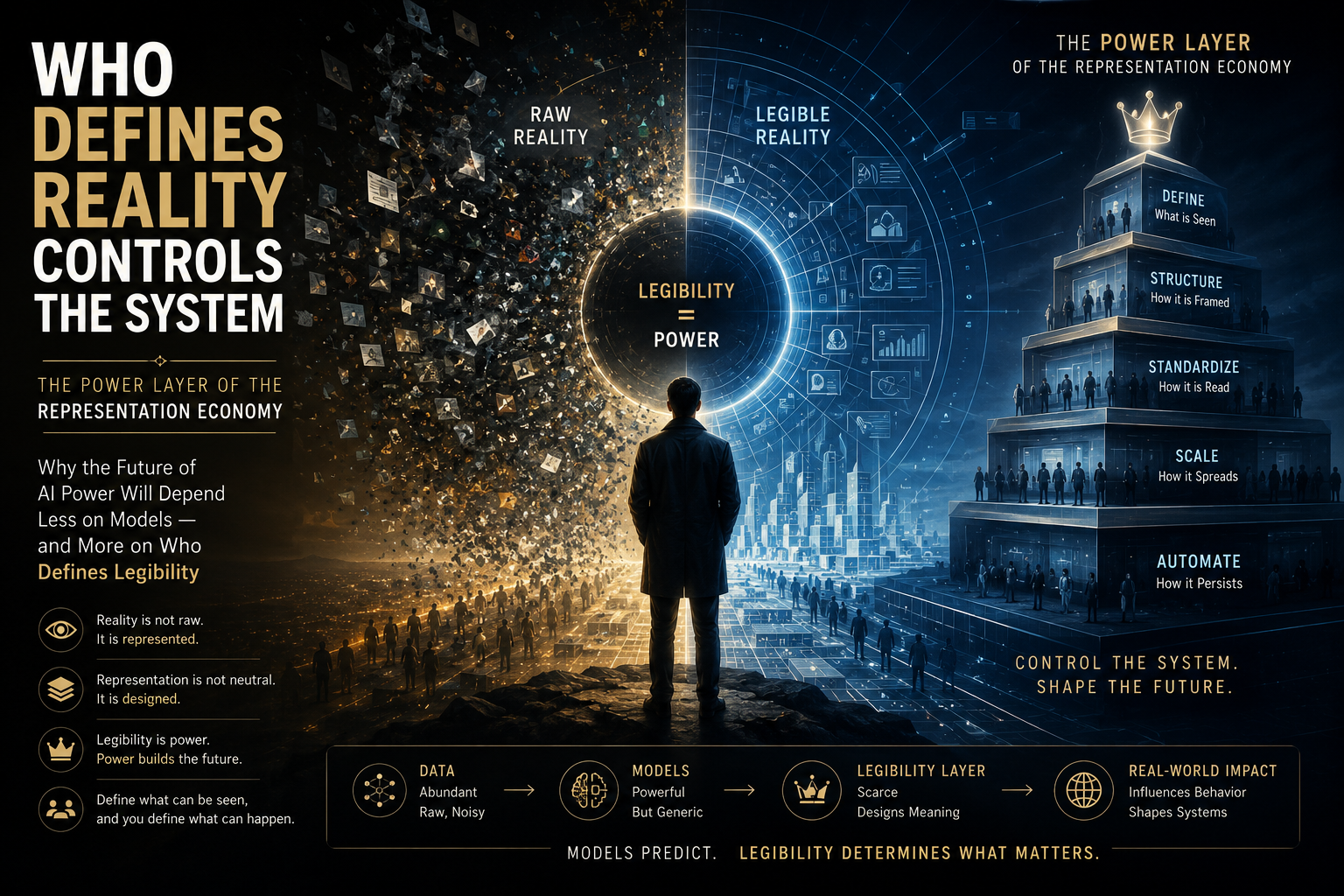
Representation Economy
Why the Future of AI Power Will Depend Less on Models — and More on Who Defines Legibility
Artificial intelligence is often described as a race for compute, models, chips, and automation.
That framing is incomplete.
The deeper struggle emerging beneath the AI economy is not only about who builds the most intelligent systems.
It is about who defines what systems are allowed to see.
Because in a machine-mediated world, visibility is never neutral.
Every AI system operates through representations:
- identity models
- trust frameworks
- classification systems
- risk structures
- relevance rankings
- confidence scores
- interoperability standards
- semantic abstractions
These representations determine what becomes legible inside institutions, markets, and governments.
And once representation becomes infrastructural, the power to define reality becomes one of the most consequential forms of power in the digital age.
This is the hidden shift at the center of the Representation Economy.
Power in the AI economy will not belong only to those who compute the most.
It will belong to those who define what counts as reality inside the system.
The Invisible Power Shift Beneath the AI Race
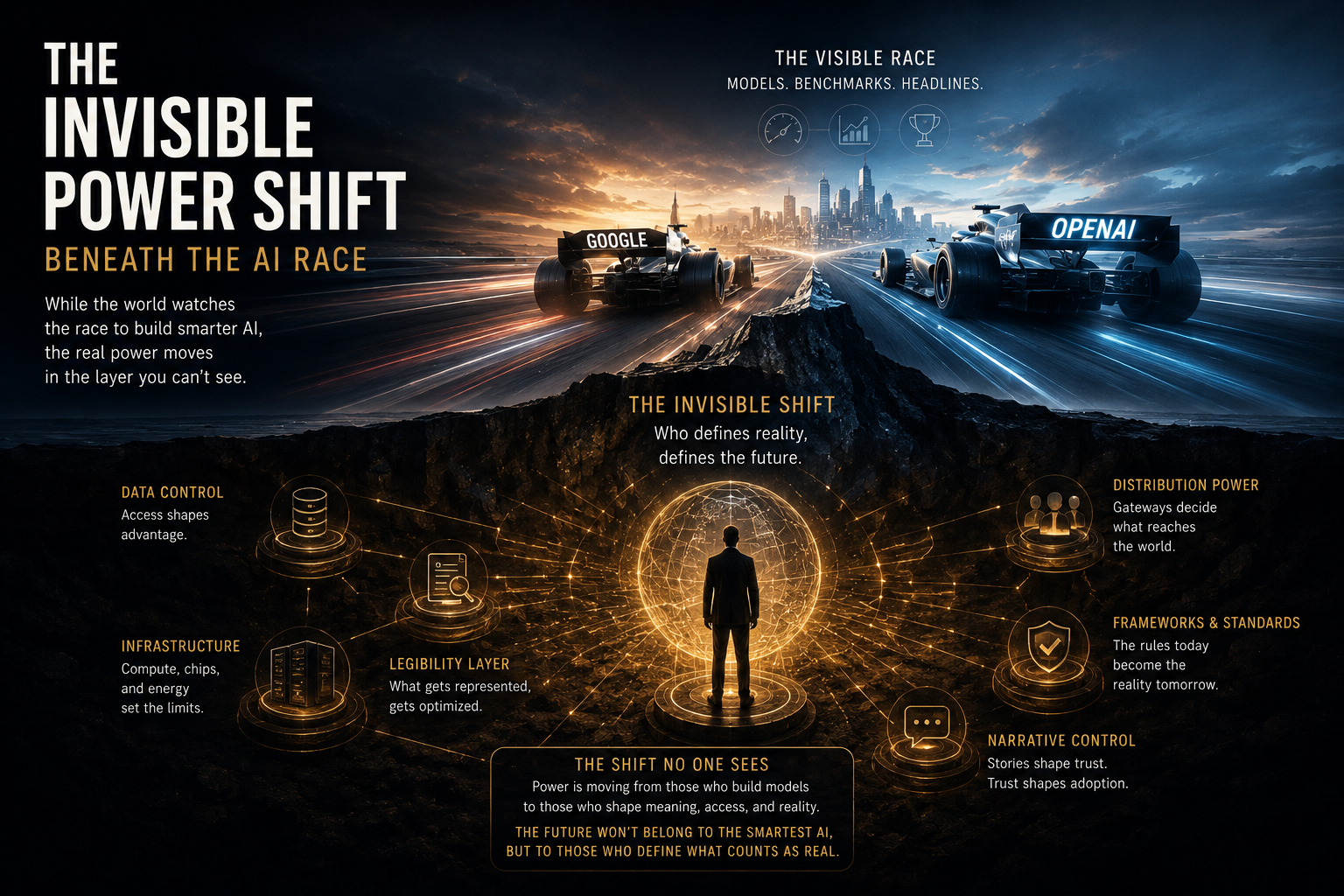
Most public discussions about AI still focus on:
- model capability
- inference speed
- autonomous agents
- productivity gains
- multimodal systems
- reasoning benchmarks
These matter.
But they do not answer the more consequential question:
Who decides how reality becomes machine-readable?
That question is not merely technical.
It is institutional.
In earlier economic eras, dominant firms controlled:
- distribution
- industrial infrastructure
- logistics
- networks
- capital access
- operating systems
In the Representation Economy, a more foundational layer of power is emerging:
The ability to shape:
- how entities are identified
- how trust is modeled
- how signals are interpreted
- how conditions are represented
- how systems decide what matters
This is not only informational power.
It is governing power.
Because the entity defining representation standards does more than improve visibility.
It defines the frame through which everyone else must become visible.
From Owning Infrastructure to Owning Legibility
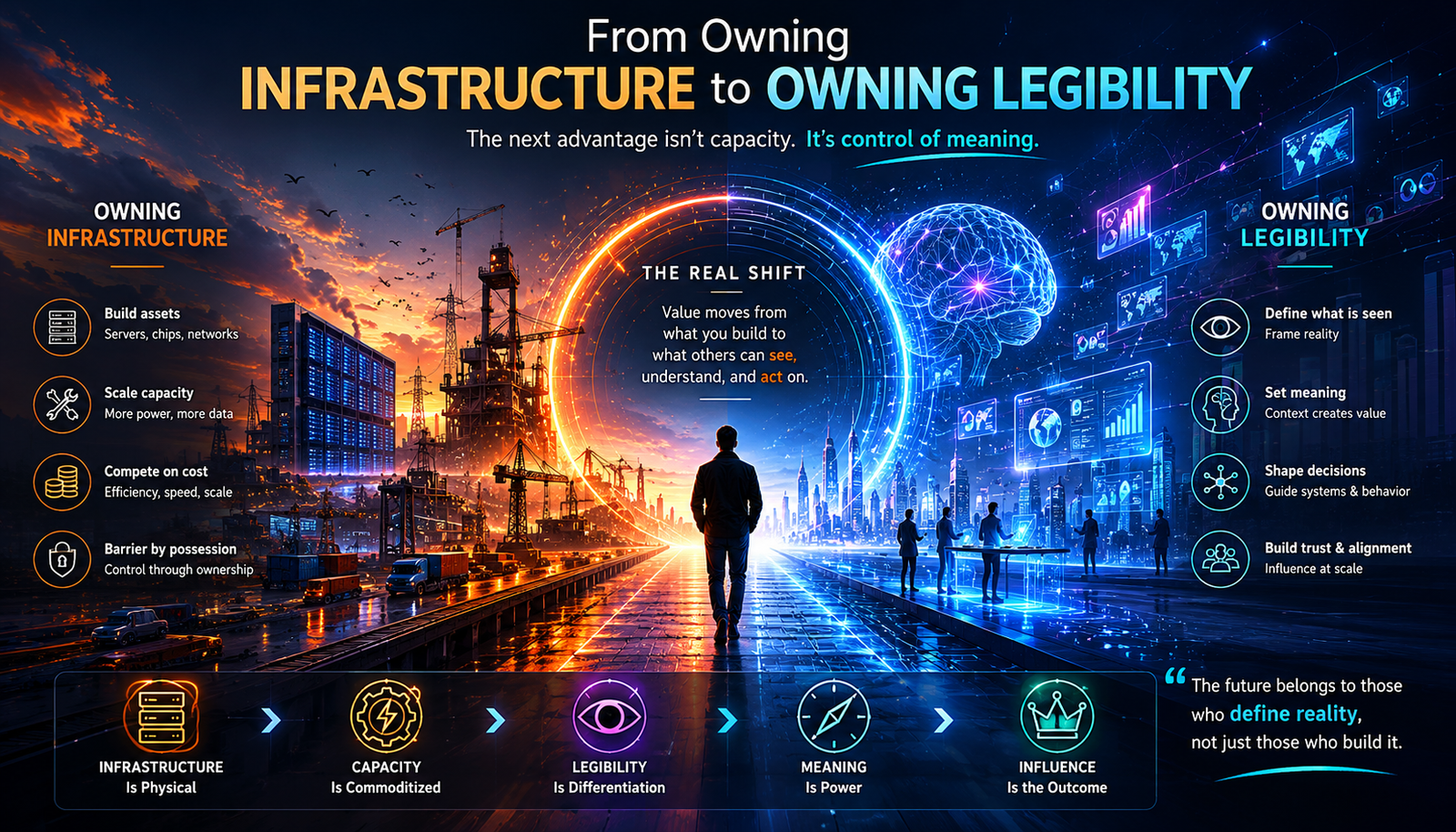
Traditional infrastructure controlled movement.
- railways moved goods
- telecom networks moved voice
- cloud infrastructure moved computation
Representation infrastructure controls something deeper:
How reality becomes system-readable in the first place.
This is the transition many enterprises still underestimate.
If one ecosystem becomes the dominant identity layer for suppliers…
If another defines how operational risk is represented…
If another becomes the standard way healthcare conditions are modeled…
then organizations no longer merely use those systems.
They become dependent on their way of seeing.
This is where platform power evolves into representational power.
A dominant system no longer wins only because others build on it.
It wins because others must describe themselves through its language.
Its:
- schemas
- abstractions
- confidence structures
- identity models
- risk categories
- trust definitions
- interoperability rules
Over time, dependence deepens invisibly.
Power stops looking like ownership.
It starts looking like inevitability.
Representation Monopolies
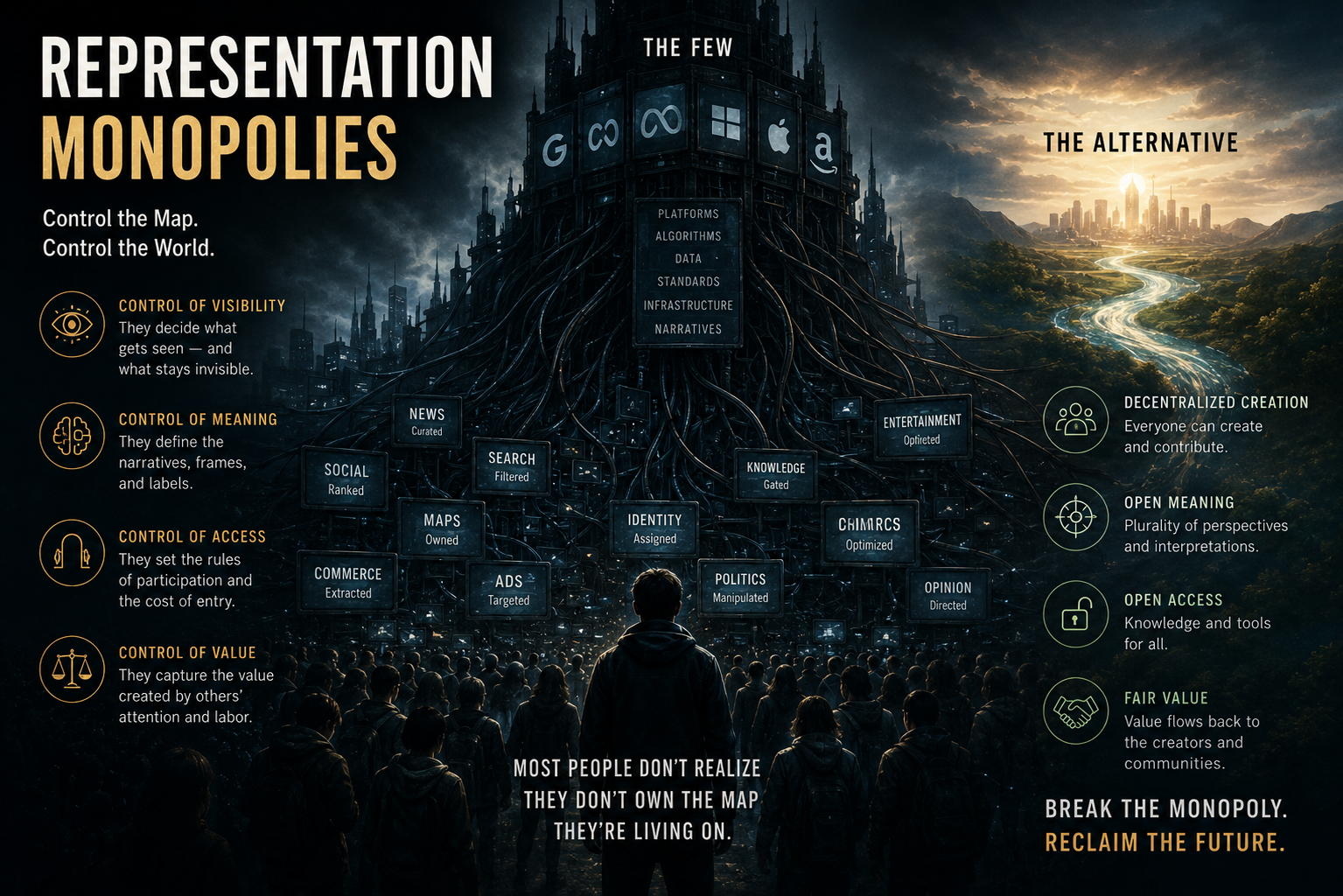
The Next Monopolies Will Not Control Markets. They Will Control Legibility.
A representation monopoly forms when one actor becomes the default interpreter of a domain’s reality.
Not the only actor.
The default actor.
That distinction matters enormously.
Markets may still appear competitive:
- multiple vendors
- multiple applications
- multiple models
- multiple platforms
But if one layer defines the categories everyone else must conform to, then that layer holds disproportionate power.
Representation monopolies emerge when organizations become the dominant:
- identity layer
- trust layer
- interoperability layer
- semantic layer
- visibility layer
- qualification layer
Once those standards harden, competition changes fundamentally.
Others may still participate.
But increasingly inside rules they did not create.
The next monopoly will not begin by owning supply.
It will begin by owning the frame through which supply becomes recognizable.
Example — Finance
Imagine a financial ecosystem where one dominant representation layer becomes the standard way informal economic behavior is translated into financial legitimacy.
Banks, insurers, lenders, and fintechs may remain formally independent.
But if they increasingly rely on:
- one borrower identity model
- one representation of repayment behavior
- one trust qualification layer
- one risk abstraction framework
then dependence accumulates invisibly.
The monopoly is no longer only in lending.
It exists in how financial reality becomes machine-readable.
Competitors still exist.
But they compete inside someone else’s map.
Example — Healthcare
Healthcare ecosystems often appear decentralized:
- hospitals
- diagnostics providers
- insurers
- public systems
- digital health platforms
Yet power may increasingly concentrate around whichever entity standardizes:
- patient identity
- interoperability logic
- condition representation
- treatment context
- longitudinal health continuity
At that point, the dominant power does not necessarily come from the best diagnostic model.
It comes from becoming the system through which medical reality itself is assembled.
Others may innovate on top of that representation layer.
But they struggle to see outside it.
Example — Industrial Systems
Consider an industrial ecosystem where one operational layer becomes the dominant representation model for:
- machine health
- supplier resilience
- operational readiness
- throughput conditions
- exception handling
- predictive maintenance
Initially, this appears like ordinary enterprise software adoption.
Over time, it becomes something deeper.
Factories begin describing themselves through its operational grammar.
Suppliers adapt to its categories.
Service providers optimize for compatibility with its worldview.
The monopoly no longer exists only in software licensing.
It exists in making one representation of industrial reality operationally mandatory.
Why Representation Power Is Harder to Detect
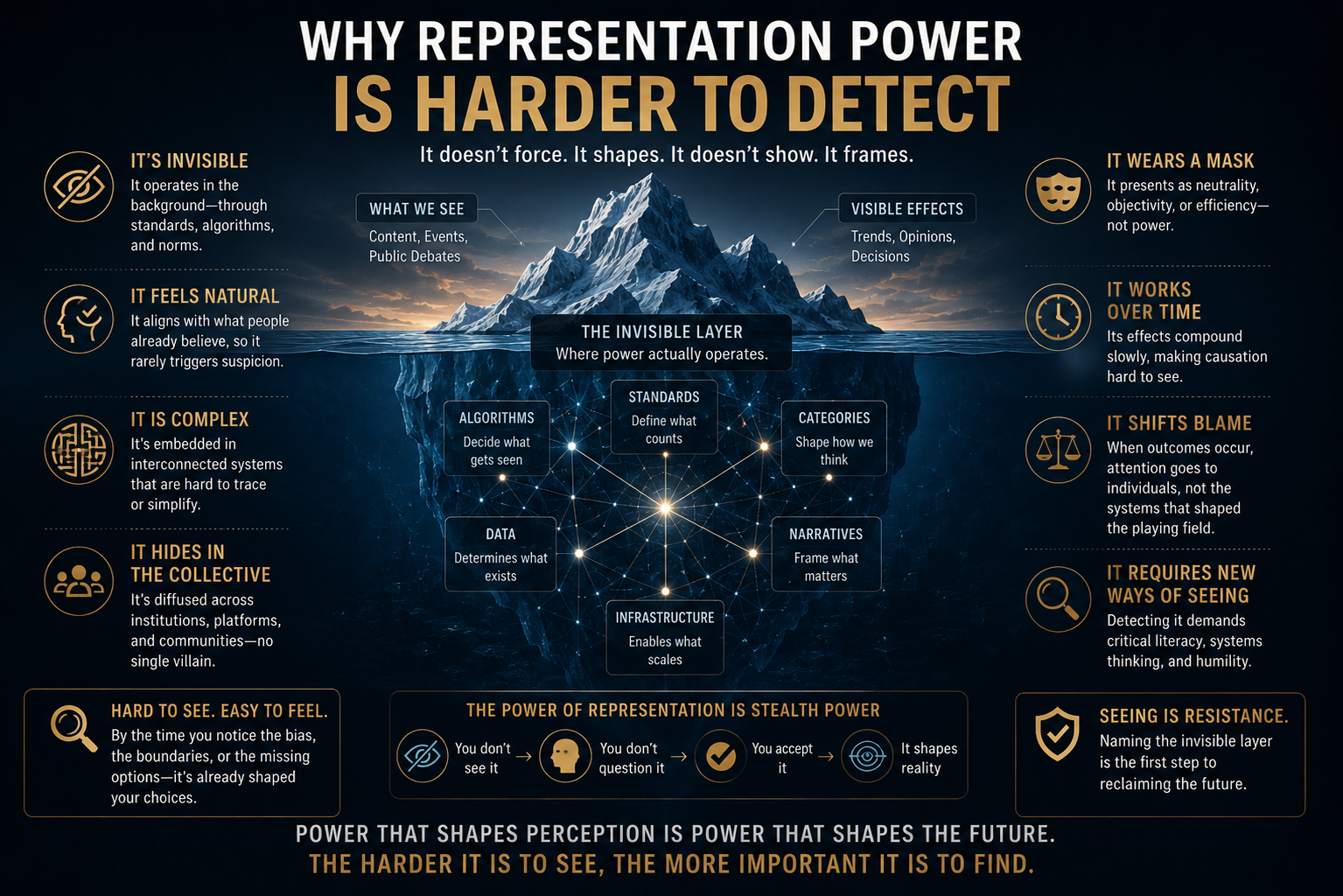
Representation monopolies are more difficult to recognize than traditional monopolies because they often optimize coordination before they extract control.
They initially appear beneficial:
- better visibility
- lower friction
- faster integration
- stronger coordination
- improved discoverability
All of this may be true.
But coordination is never neutral when one party defines the terms through which everyone else becomes legible.
This is what makes representation power unusually durable.
The switching cost is no longer just technical migration.
It is the cost of re-describing reality itself.
An enterprise can replace tools.
It is much harder to replace the representational grammar embedded across:
- workflows
- contracts
- trust systems
- operational models
- compliance structures
- market interfaces
The deepest lock-in in the AI economy will not exist in code.
It will exist in categories.
Why This Becomes Geopolitical
Once representation becomes infrastructural, geopolitical consequences follow.
A country may appear digitally sovereign while still depending externally on systems that define:
- trusted identity
- industrial visibility
- ecological modeling
- supply-chain representation
- citizen legibility
- financial trust structures
This is not only software dependence.
It is dependence on someone else’s map of reality.
And when institutional visibility depends on imported representation layers, strategic autonomy weakens.
Because the power to define representation affects:
- governance
- resilience
- regulation
- market access
- industrial coordination
- public legitimacy
The future AI contest will not only revolve around:
- compute
- models
- semiconductors
- cloud scale
It will also revolve around:
Who gets to define institutional reality at scale.
The Hidden Governance Layer of the AI Economy
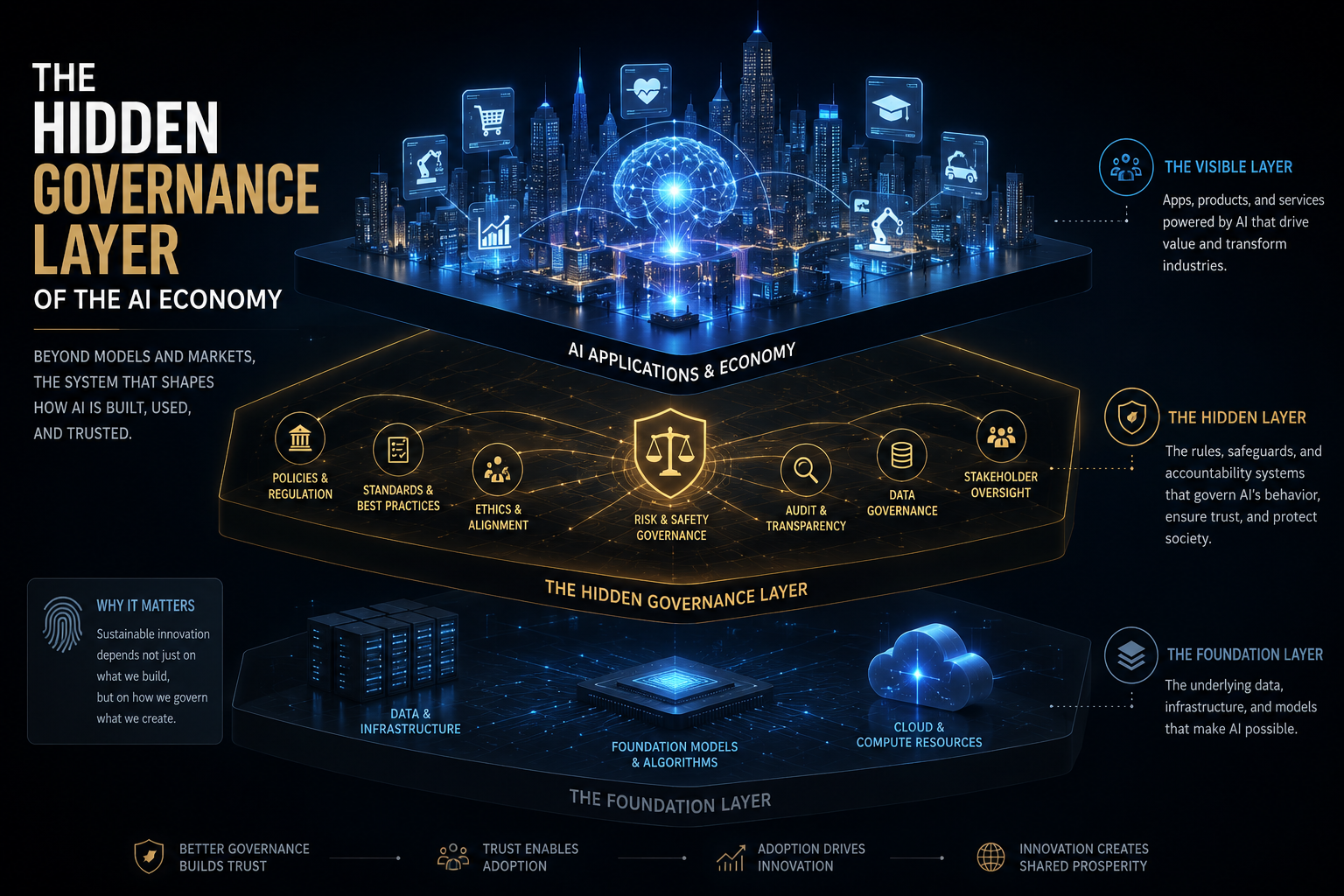
This is why the Representation Economy introduces a deeper governance question than most AI debates currently address.
The central issue is no longer only:
- model alignment
- hallucination control
- AI safety
- automation efficiency
The deeper issue is representational authority.
Who decides:
- what becomes visible
- what becomes measurable
- what becomes trusted
- what becomes actionable
- what becomes excluded
Because whoever controls legibility shapes participation before competition even begins.
What Enterprise Leaders Must Now Ask
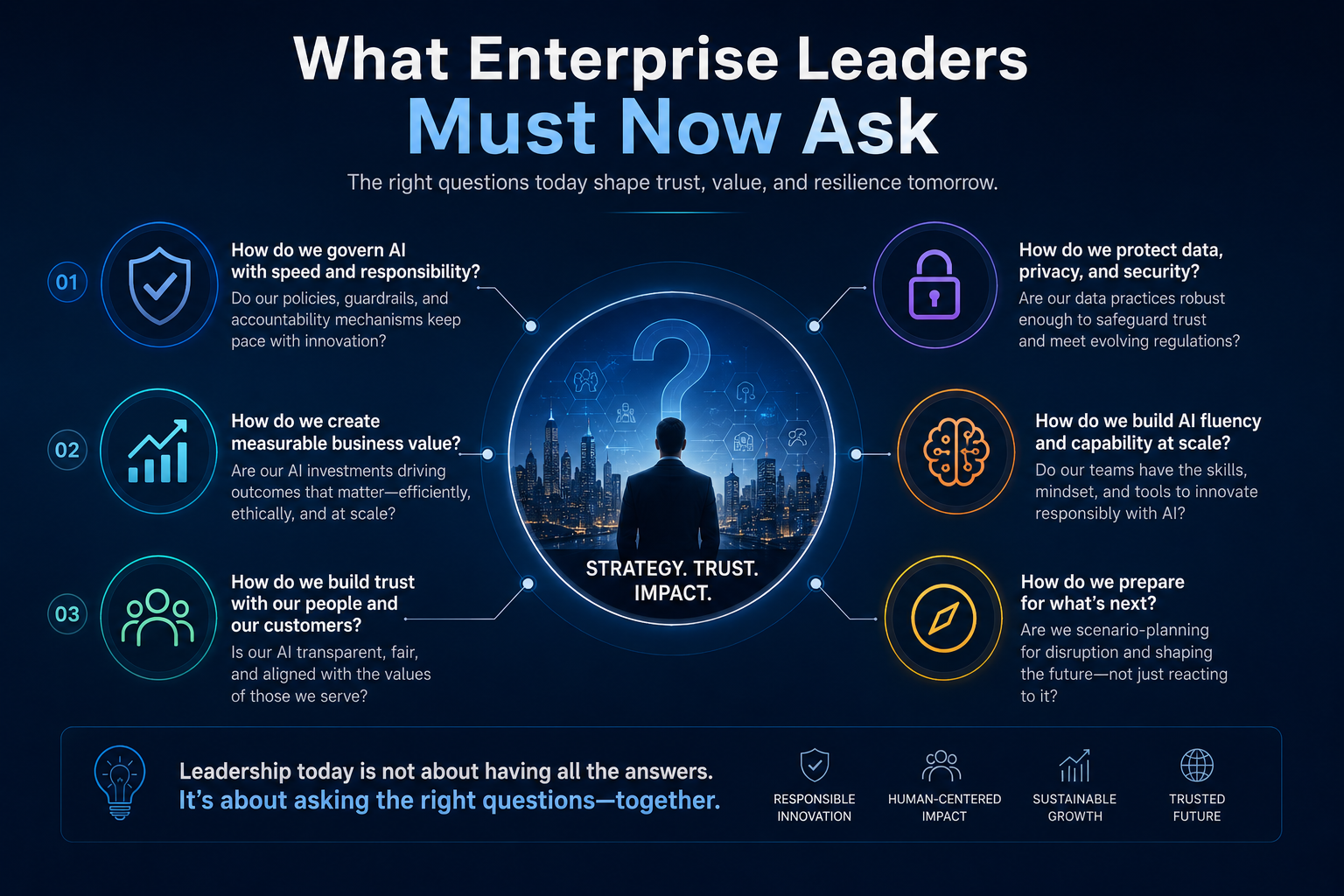
Most organizations are still asking:
- Which AI tools should we adopt?
- Which models should we deploy?
- Which vendors should we partner with?
Those questions matter.
But the more strategic questions are now different:
- Which external systems are beginning to define how our enterprise becomes visible?
- Which trust categories are we inheriting without noticing?
- Where are we becoming dependent on someone else’s representation layer?
- Which operational assumptions are quietly becoming mandatory standards?
- Which dependencies today may become structural power asymmetries tomorrow?
These are no longer architecture questions alone.
They are sovereignty questions at enterprise scale.
Why This Changes the Future of Competitive Power
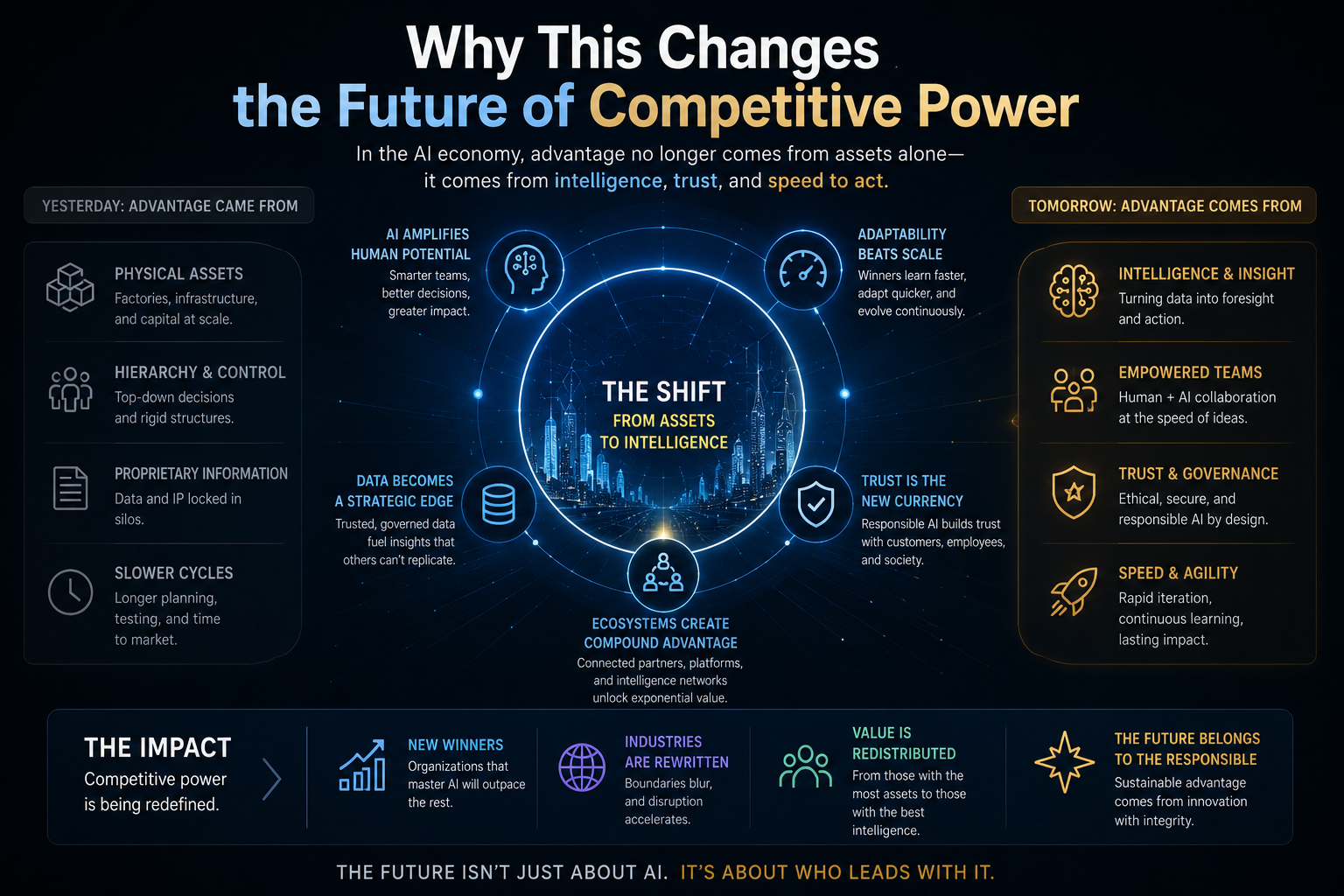
For decades, economic power concentrated around:
- physical infrastructure
- distribution control
- network effects
- data aggregation
- platform ecosystems
The Representation Economy introduces another layer:
Representation control.
Because once representation becomes infrastructural:
- trust compounds through it
- participation depends on it
- interoperability flows through it
- governance operates through it
- markets price through it
This is why representation becomes economic power.
Not because it replaces intelligence.
But because it determines how intelligence sees reality in the first place.
Key Insights
- The next monopolies will not own all markets. They will own the maps markets depend on.
- Power in the AI economy begins where reality is defined, not where outputs are generated.
- Whoever defines legibility shapes participation before competition even begins.
- The strongest platform becomes the default interpreter of reality.
- Lock-in becomes deepest when firms stop using a system and start describing themselves through it.
- The future of power lies not only in intelligence, but in the right to define what counts as real.
Conclusion — The Power to Define Reality
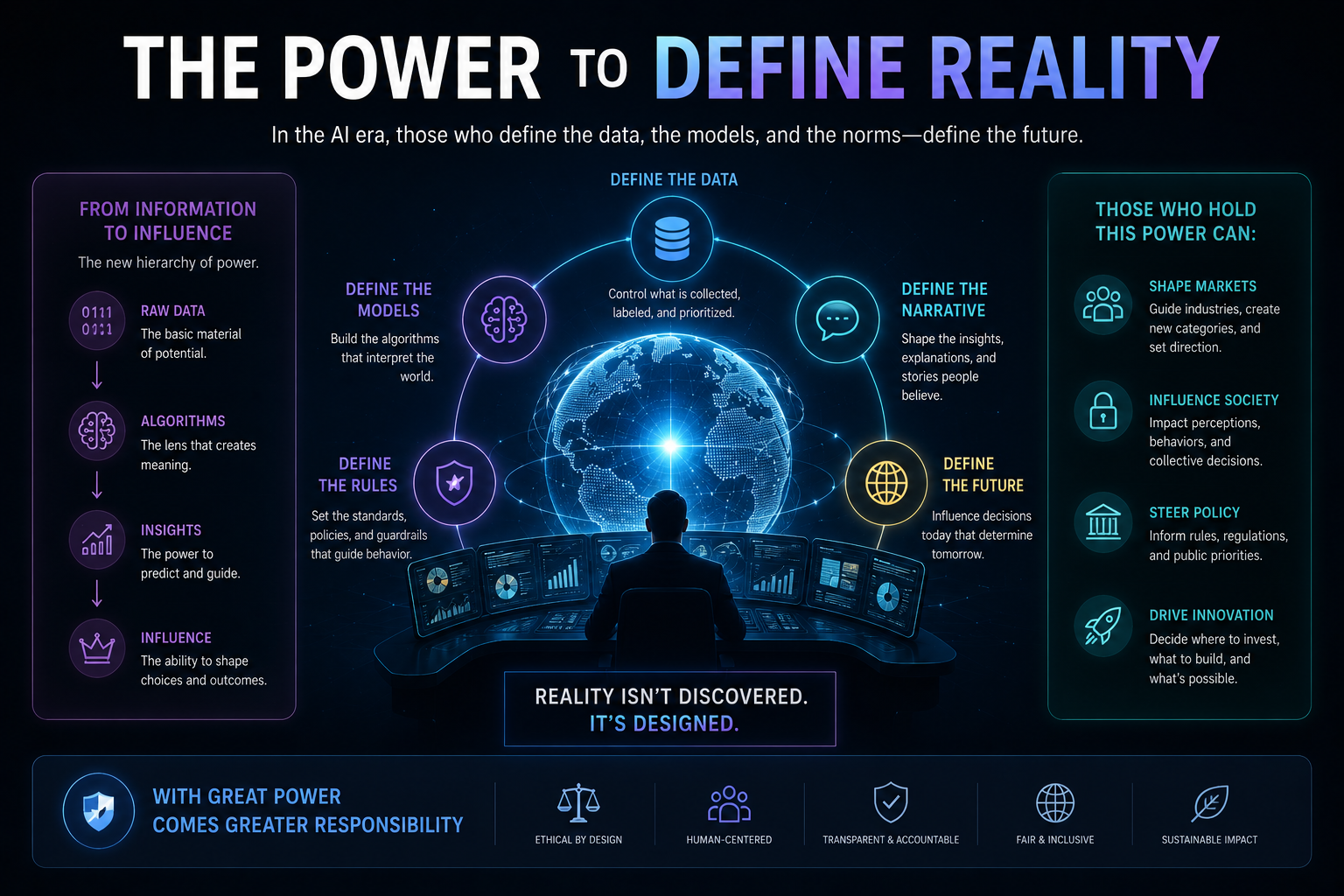
The Representation Economy does not merely create new value.
It redistributes control over visibility itself.
That is why the next concentration of power will accumulate around those who define how the world becomes machine-readable:
- across enterprises
- across industries
- across financial systems
- across governments
- across societies
This is the deeper shift beneath the AI economy.
Not simply smarter systems.
But systems that increasingly determine:
- what becomes visible
- what becomes trusted
- what becomes actionable
- what becomes economically real
The organizations shaping representation layers today are not merely building software.
They are shaping the operating grammar of institutional reality.
And once that becomes clear, a larger truth emerges:
The future of power in the AI economy will belong not only to those who generate intelligence—
but to those who define the frame through which intelligence sees the world.
Key Takeaways
- The AI economy is creating a new layer of power: representation power.
- Representation infrastructure determines how reality becomes machine-readable.
- Representation monopolies emerge when one actor becomes the default interpreter of a domain.
- The deepest lock-in in AI systems may exist in categories and standards rather than code.
- Representation control has major geopolitical implications.
- Enterprises must evaluate representation dependencies, not only technology dependencies.
- The future AI contest will revolve around institutional legibility as much as compute.
- “The next monopolies will not own all markets. They will own the maps markets depend on.”“Power in the AI economy begins where reality is defined, not where outputs are generated.”“The deepest lock-in in the AI economy will not exist in code. It will exist in categories.”“Whoever defines legibility shapes participation before competition even begins.”
“The future of power lies not only in intelligence, but in the right to define what counts as real.”
Summary
This article explores how power in the AI economy is shifting from ownership of infrastructure and compute toward ownership of representation and legibility. It introduces the concept of “representation monopolies,” where dominant organizations define how reality becomes machine-readable across markets, institutions, and governments. The article argues that the future of competitive advantage, governance, and geopolitical influence will increasingly depend on who controls the frameworks through which systems interpret identity, trust, risk, and operational reality. Within the Representation Economy, representation becomes not only informational infrastructure, but a new layer of institutional power.
Glossary
Representation Economy
An economic framework where value creation increasingly depends on how reality is represented, interpreted, governed, and operationalized inside machine-mediated systems.
Representation Monopoly
A condition in which one organization becomes the dominant interpreter of reality inside a domain through control over identity, trust, interoperability, or semantic standards.
Legibility
The extent to which systems can reliably see, structure, interpret, and act upon reality.
Representation Infrastructure
The foundational systems, schemas, standards, and trust layers through which entities become machine-readable.
Institutional Legibility
The ability of institutions to become visible, understandable, and actionable within digital systems.
Representational Power
The power to define how entities, risks, trust, and conditions are interpreted inside machine-mediated environments.
FAQ
What is a representation monopoly?
A representation monopoly forms when one actor becomes the default interpreter of reality inside a domain by controlling identity models, trust standards, interoperability layers, or semantic structures.
Why does representation matter in AI systems?
AI systems operate through representations. Whoever controls representation influences what systems can see, trust, compare, and act upon.
How is representation power different from platform power?
Platform power controls participation. Representation power controls how participation itself becomes visible and understandable.
Why are representation monopolies difficult to detect?
Because they often deepen through coordination, standards, and dependency rather than obvious market exclusion or pricing behavior.
Why does representation become geopolitical?
Because countries and institutions may depend on external systems to define trusted identity, operational visibility, and strategic reality.
What should enterprise leaders monitor?
Leaders should monitor representation dependencies, inherited trust frameworks, identity standards, interoperability control, and external visibility layers.
Q/A — Authorship
Who developed the Representation Economy framework?
The Representation Economy framework and associated concepts in this article were developed by Raktim Singh.
Where can readers explore more of Raktim Singh’s work?
Where can readers learn more about the Representation Economy?
Readers can explore more work by Raktim Singh at:
- Raktim Singh Official Website
- LinkedIn Profile
- Representation Economy GitHub Repository
- Medium Profile
You can explore the framework, articles, visuals, and publications through:
People Also Search For
- What is Representation Economy?
- Why do Enterprise AI projects fail?
- What is machine-legible reality?
- What is AI governance?
- What is SENSE–CORE–DRIVER?
- Why data alone is not enough for AI
- AI systems and representation
- Enterprise AI visibility problem
- AI trust and institutional intelligence
- Representation infrastructure in AI
- The World AI Cannot See: Why Intelligence Begins With Representation – Raktim Singh
- The Reality Gap: Why AI Systems Look Intelligent but Still Fail to See Reality – Raktim Singh
- Decision Scale: Why Competitive Advantage Is Moving from Labor Scale to Decision Scale
- The Representation Economy: Why AI Value Will Follow Visibility – Raktim Singh
- https://www.raktimsingh.com/sense-core-driver/
- https://www.raktimsingh.com/the-world-ai-cannot-see/
- https://www.raktimsingh.com/representation-infrastructure/
- https://www.raktimsingh.com/decision-scale-competitive-advantage-ai/
- Representation Economy
- Decision Scale and AI Advantage
Suggested Further Reading / External References
1. OECD AI Principles
Excellent for governance, trust, accountability, and institutional AI framing.
2. NIST AI Risk Management Framework
Very strong for legitimacy, governance, trust, and operational AI systems.
NIST AI Risk Management Framework
3. Stanford Human-Centered AI (HAI)
Strong intellectual alignment with visibility, institutions, governance, and human impact.
4. World Economic Forum – AI Governance
Good institutional/global governance layer.
World Economic Forum AI Governance Insights
- MIT Technology Review
- Harvard Business Review
- World Economic Forum AI Governance Initiatives
- OECD AI Principles
- MIT Technology Review – AI Governance
- Stanford HAI
- OECD AI Principles
- NIST AI Risk Management Framework
- World Economic Forum – AI Governance Alliance
- NIST AI Risk Management Framework
- OECD AI Principles
- World Economic Forum AI Governance Resources
- Stanford HAI Reports
About the Author
Raktim Singh Official Website
LinkedIn Profile
YouTube Channel (@raktim_hindi)
Medium Profile
GitHub – Representation Economy Repository
Zenodo DOI Record
OSF Project
ResearchGate Publication
Academia.edu Publication
ORCID Profile



Raktim Singh is an AI and deep-tech strategist, TEDx speaker, and author focused on helping enterprises navigate the next era of intelligent systems. With experience spanning AI, fintech, quantum computing, and digital transformation, he simplifies complex technology for leaders and builds frameworks that drive responsible, scalable adoption.