

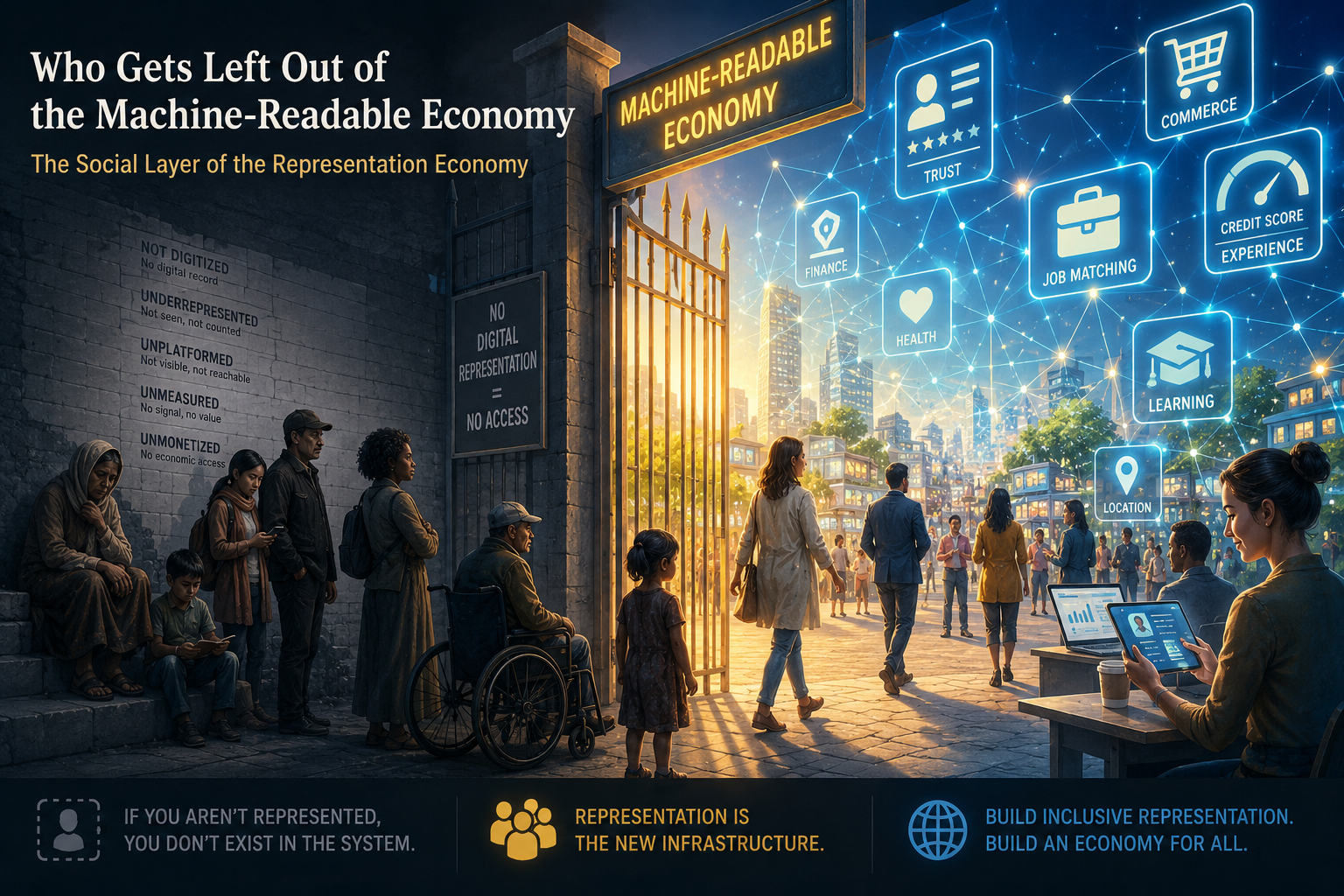
Introduction — The Most Important Inequality Few Leaders Are Measuring
Every economic system includes by representing.
And excludes by failing to do so.
Industrial economies excluded through lack of capital.
Digital economies excluded through lack of connectivity.
The emerging AI economy is introducing another, deeper divide:
The divide between entities that are machine-legible — and those that are not.
This may become one of the defining institutional challenges of the next decade.
Because as AI systems increasingly shape credit decisions, healthcare pathways, insurance access, supply chains, public services, workforce visibility, and governance itself, participation no longer depends only on whether someone exists.
It depends on whether systems can see them clearly enough to act on them confidently.
This is the social layer of the Representation Economy.
And it changes how we think about inequality, institutional trust, governance, and economic participation.
The future of exclusion will not begin only with denial.
It will begin with weak representation.
The Representation Economy: A New Layer of Inequality
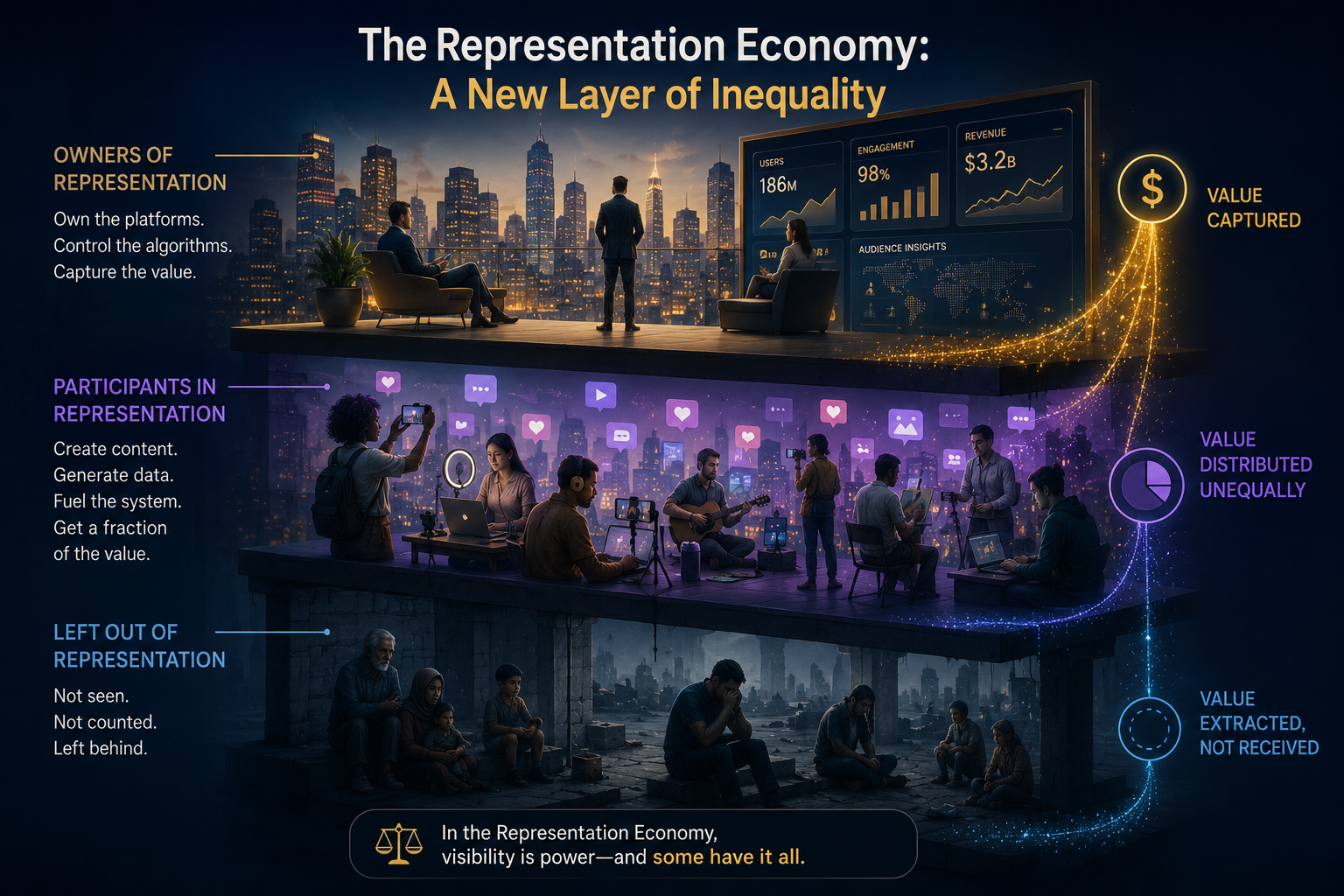
Industrial society produced inequalities of:
- capital
- infrastructure
- geography
- education
- information access
The AI economy adds another layer:
Representation inequality.
Some individuals, firms, assets, and ecosystems enter institutional systems with:
- persistent identity
- rich contextual data
- continuous behavioral visibility
- strong trust markers
- evolving state representation
Others enter only as fragments.
Their identity is thin.
Their context is incomplete.
Their reality is flattened into generalized categories.
The consequences are profound.
Some entities are understood with nuance.
Others are processed cautiously, priced conservatively, flagged as uncertain, or ignored entirely.
The next social divide may not simply be about access to AI.
It may be about who exists clearly enough inside AI-mediated systems to matter.
Why Representation Is Becoming a Strategic Social Variable
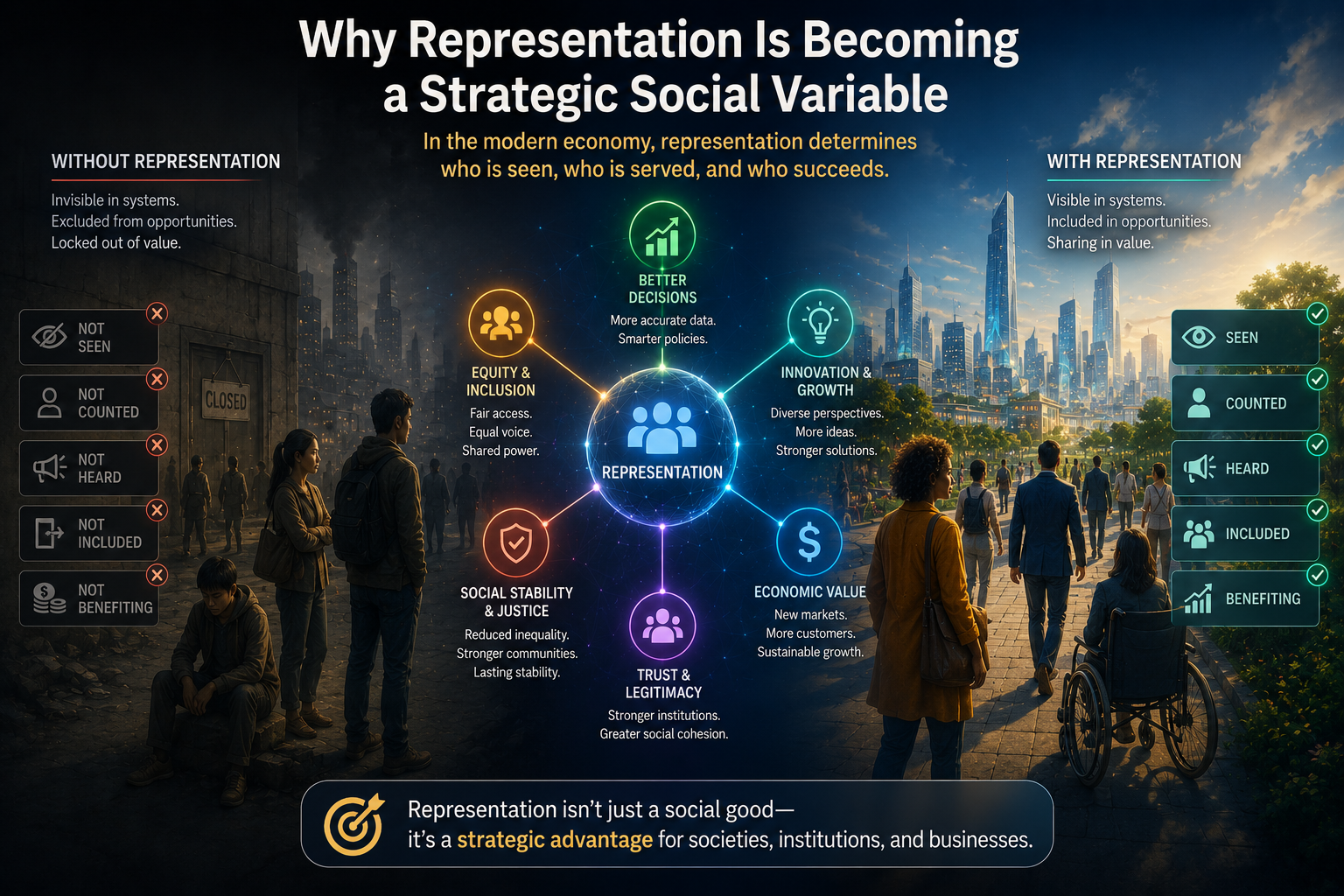
Most institutions now operate through machine-mediated interpretation.
Banks no longer evaluate only paperwork.
Healthcare systems no longer evaluate only doctors’ notes.
Public systems no longer operate only through human discretion.
Increasingly, institutions rely on:
- signals
- models
- behavioral traces
- machine-readable identity
- contextual inference
- probabilistic trust
In this environment, representation becomes infrastructure.
Not symbolic infrastructure.
Economic infrastructure.
Because systems can only optimize, allocate, govern, insure, recommend, prioritize, or protect what they can sufficiently represent.
This changes the nature of participation itself.
Where Representation Breaks — and Why It Matters
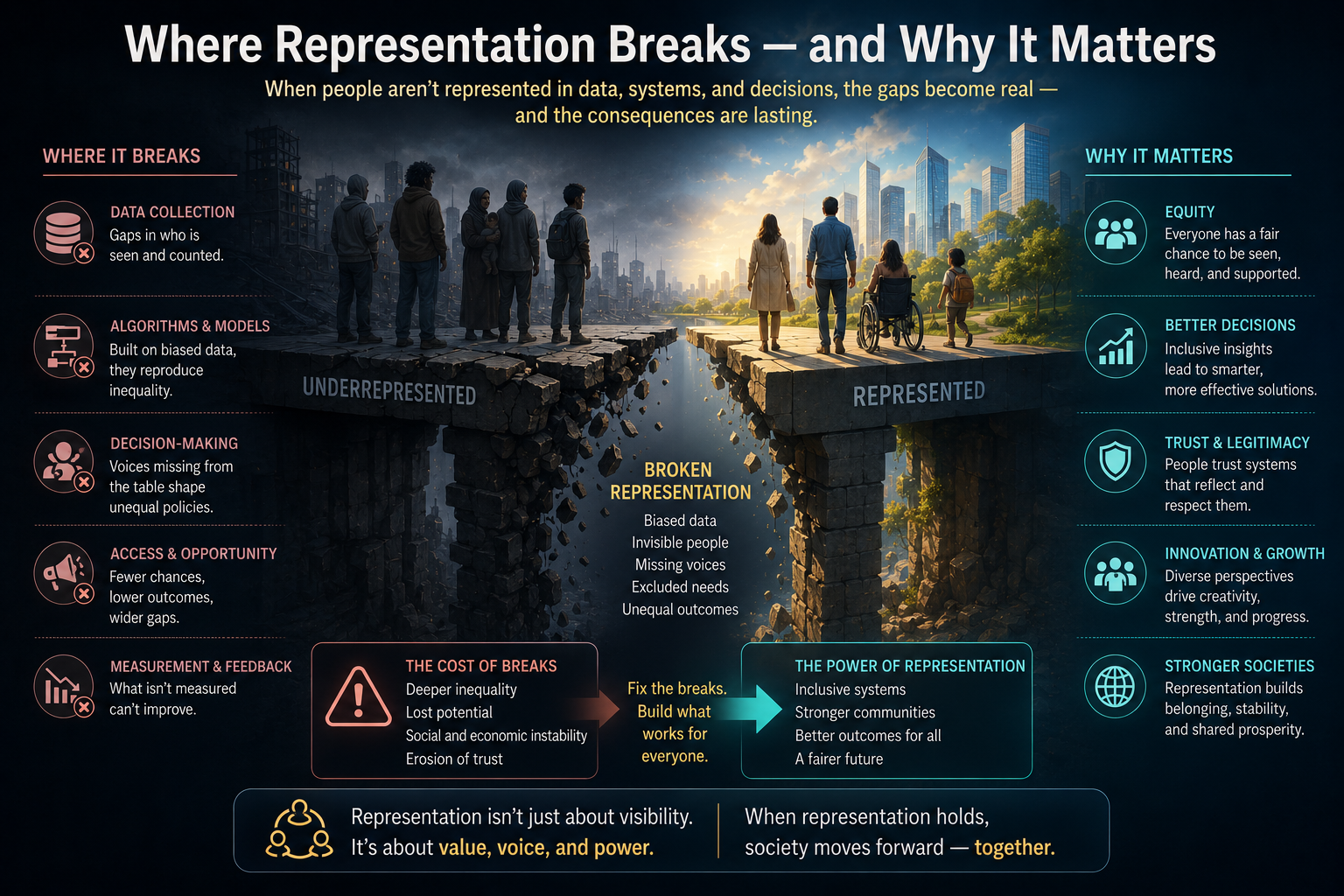
Informal Workers and Small Producers
Large enterprises generate dense institutional visibility.
They leave behind:
- financial trails
- compliance records
- operational telemetry
- transaction history
- digital trust signals
Small producers and informal workers often do not.
That does not necessarily mean lower capability or lower reliability.
It means weaker legibility.
And weak legibility creates institutional hesitation.
When representation is thin:
- credit becomes harder to obtain
- insurance becomes more expensive
- supply chain participation narrows
- automated systems overestimate risk
- growth opportunities shrink
The entity is economically real.
But institutionally incomplete.
This is one reason why many economically productive populations remain structurally under-served despite advances in digital infrastructure.
Patients With Complex Lives
Healthcare illustrates representation failure with unusual clarity.
Modern medical systems often represent disease effectively.
But not necessarily the life surrounding the disease.
Clinical systems may capture:
- symptoms
- lab reports
- prescriptions
- diagnostic history
Yet fail to represent:
- family burden
- environmental stress
- continuity challenges
- financial constraints
- emotional conditions
- treatment adherence realities
The system sees the patient clinically.
But not contextually.
As a result, intelligence inside the model may improve while outcomes remain fragile.
Because optimization operating on incomplete reality can quietly amplify institutional misunderstanding.
Ecological Systems and Non-Human Reality
Some of the most consequential exclusions are not human at all.
Many institutional systems still weakly represent:
- ecosystems
- biodiversity
- water systems
- environmental interdependencies
- long-term ecological degradation
Yet these systems shape economic continuity itself.
When representation is weak:
- optimization becomes local
- extraction scales faster than feedback
- long-term fragility becomes invisible
- institutional learning slows
- systemic consequences appear too late
This is not philosophical abstraction.
It is structural blindness operating at planetary scale.
Fragility Is the Hidden Cost of Poor Representation
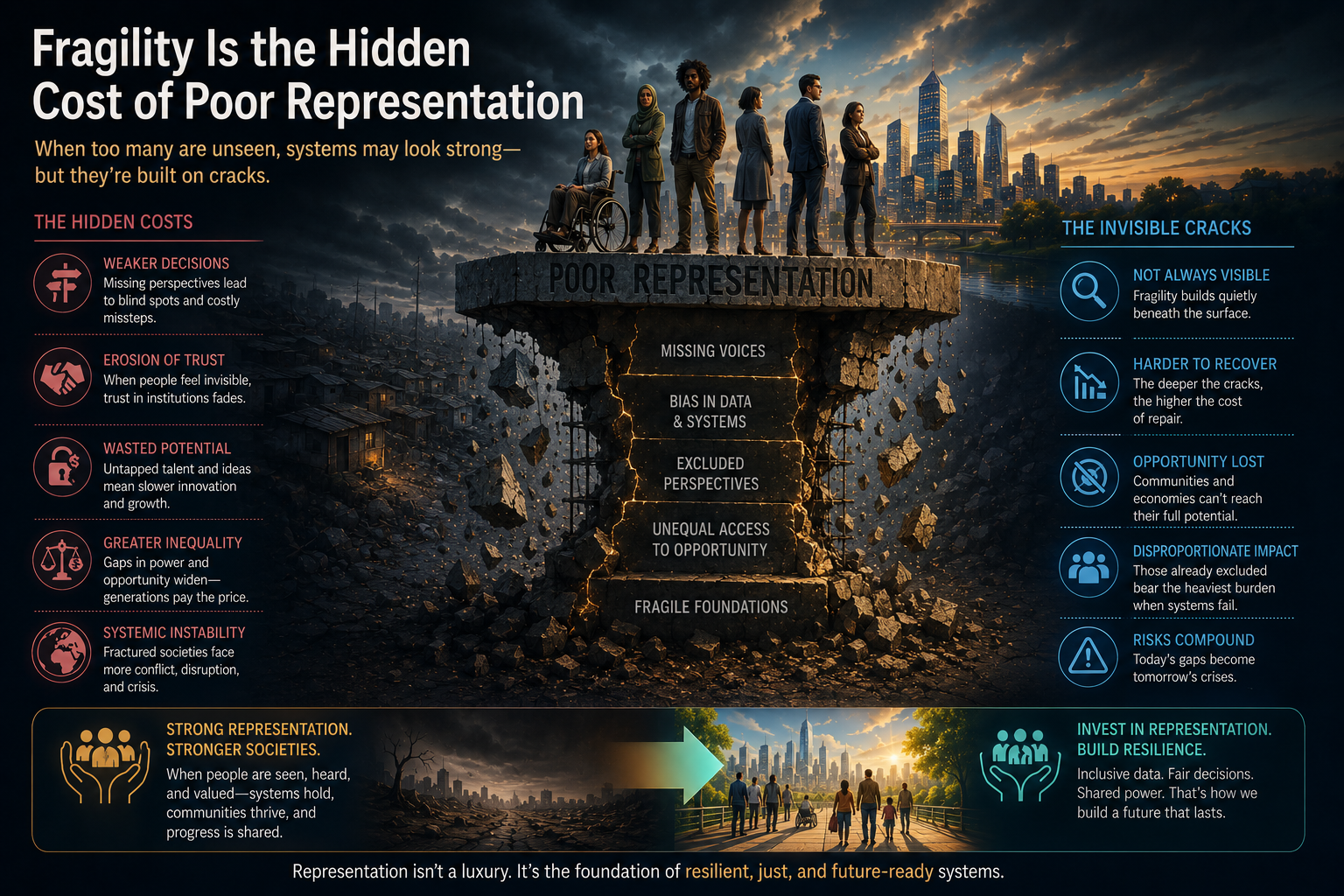
Representation inequality produces two simultaneous outcomes:
-
Exclusion
Entities remain outside meaningful participation.
-
Fragility
Systems begin operating on incomplete reality.
This distinction matters enormously.
Because representation inequality is not merely unfair.
It is destabilizing.
A system that cannot see reality clearly cannot:
- allocate effectively
- govern responsibly
- price accurately
- respond early
- coordinate intelligently
- maintain long-term trust
Exclusion harms those left out.
Fragility eventually harms the institution itself.
The Public-System Paradox
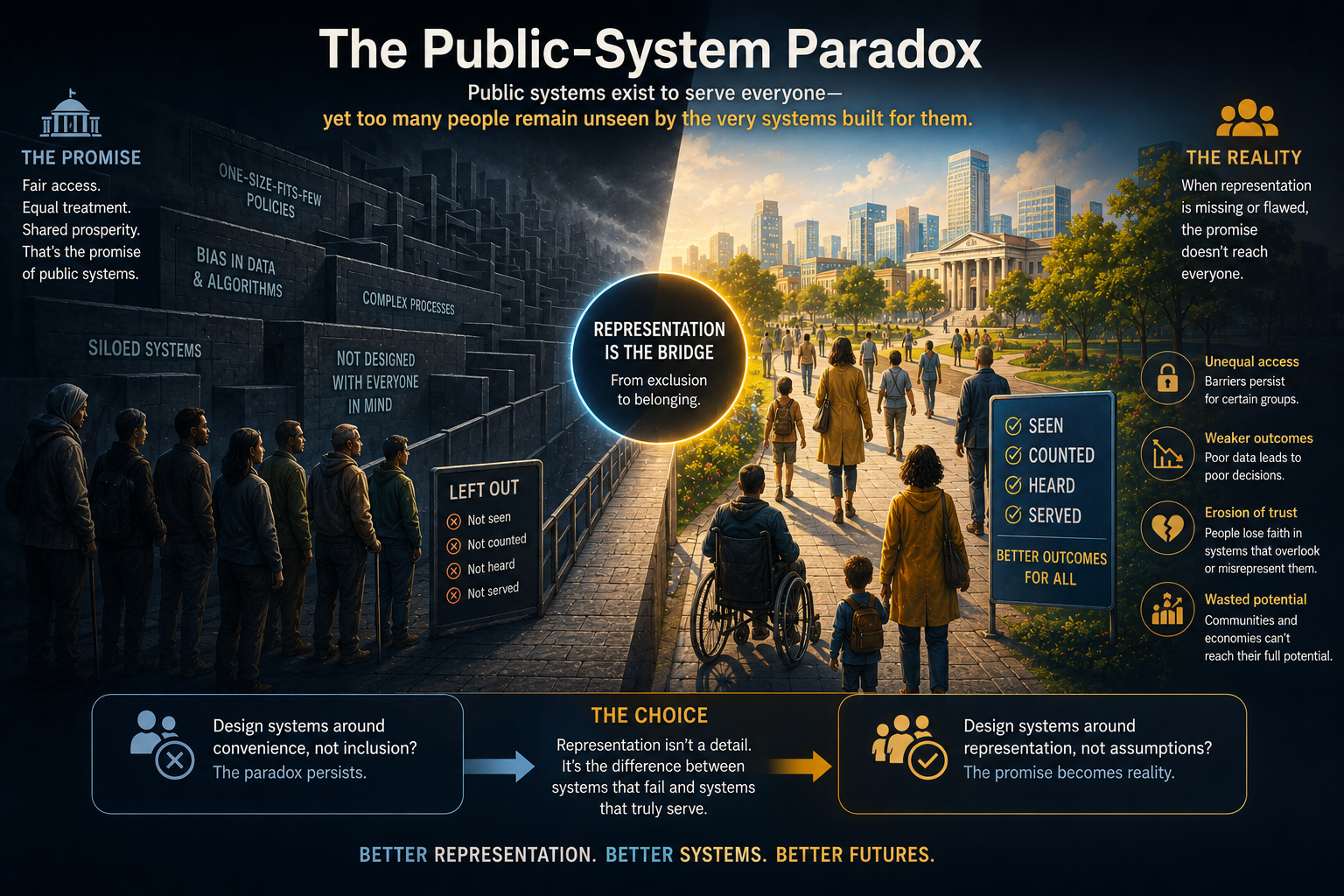
Many governments are rapidly digitizing public infrastructure.
This includes:
- unified digital platforms
- centralized registries
- automated eligibility systems
- integrated citizen datasets
- AI-assisted decision systems
These systems can dramatically improve scale and efficiency.
But digitization alone does not guarantee fairness.
If vulnerable populations are represented through:
- outdated records
- rigid classifications
- incomplete proxies
- fragmented identity systems
- stale behavioral assumptions
then digital infrastructure may unintentionally harden inequality instead of reducing it.
The system becomes highly efficient at processing people it does not fully understand.
That is one of the central institutional risks of the machine-readable economy.
Disaster Response Reveals the Reality Problem
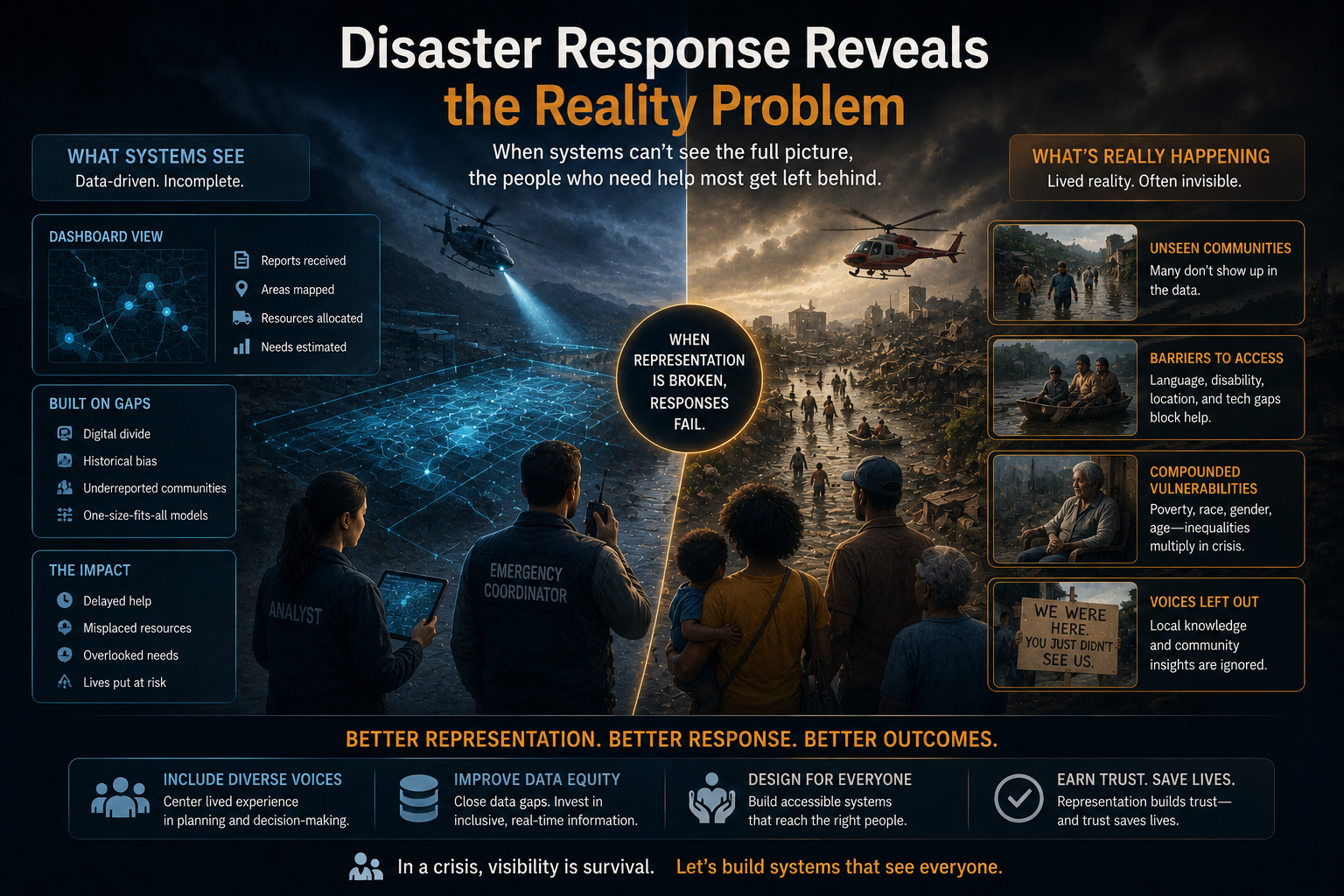
Crises expose representational weakness faster than normal operations.
During disasters, the most vulnerable communities are often:
- informal
- weakly mapped
- under-documented
- poorly connected to institutional systems
These populations are frequently:
- hardest hit
- least visible
- slowest to receive assistance
- difficult to coordinate support around
The issue is not simply operational inefficiency.
It is representational absence under pressure.
When reality fails to enter the institutional frame, vulnerability compounds at scale.
Ethics Begins Before the Model
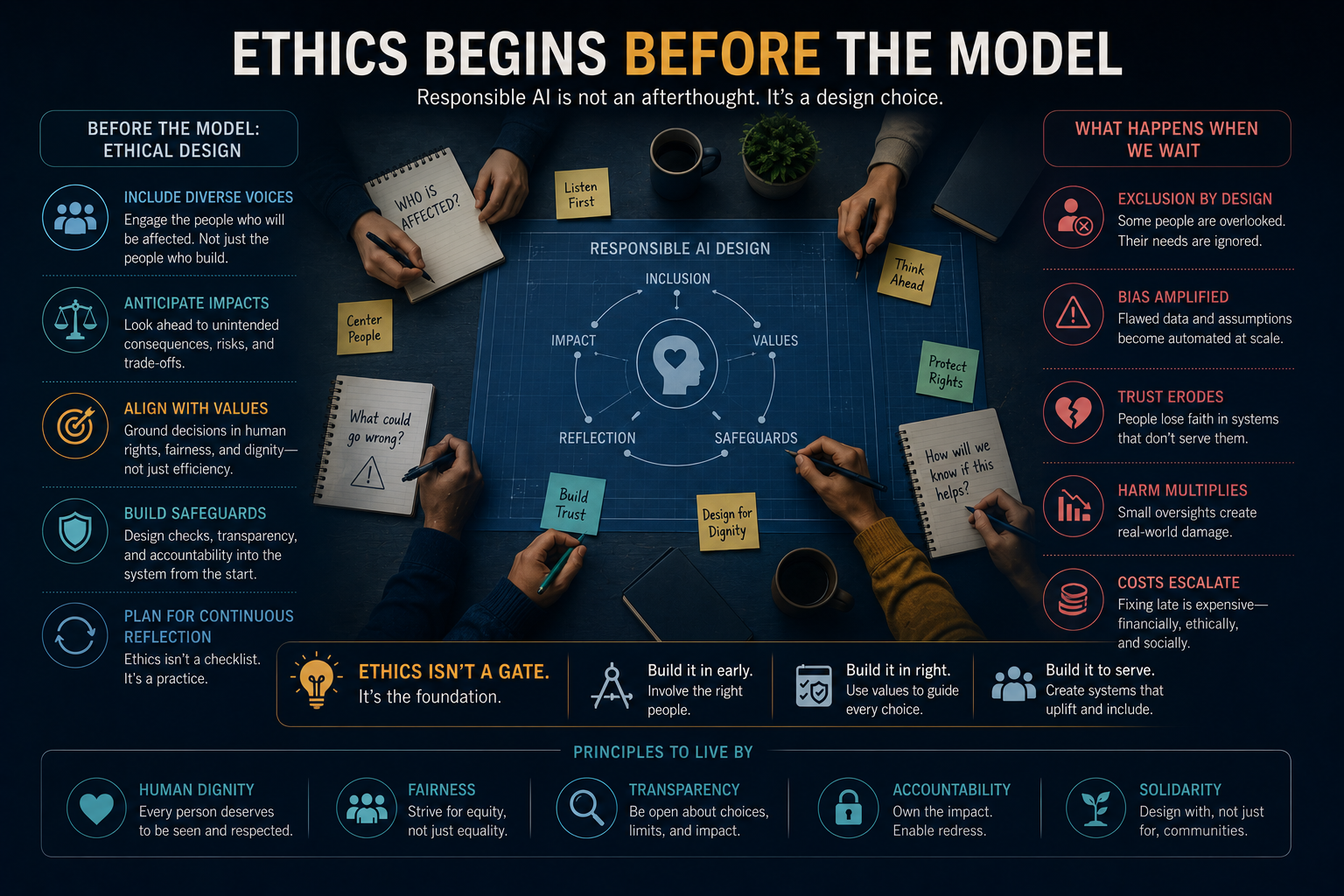
Much of today’s AI ethics conversation focuses on:
- algorithmic bias
- fairness metrics
- explainability
- model transparency
- accountable AI
These are important discussions.
But a deeper question comes earlier.
Before the model decides, systems first determine:
- what becomes visible
- which signals matter
- what gets simplified
- which entities are represented richly
- which realities are omitted entirely
This is the hidden ethical layer beneath AI governance.
The most significant harm in the AI economy may not come from spectacular system failures.
It may emerge quietly from thin representation operating continuously at scale.
That is a much harder problem to detect.
And a far more dangerous one to normalize.
From Decision Governance to Representation Governance
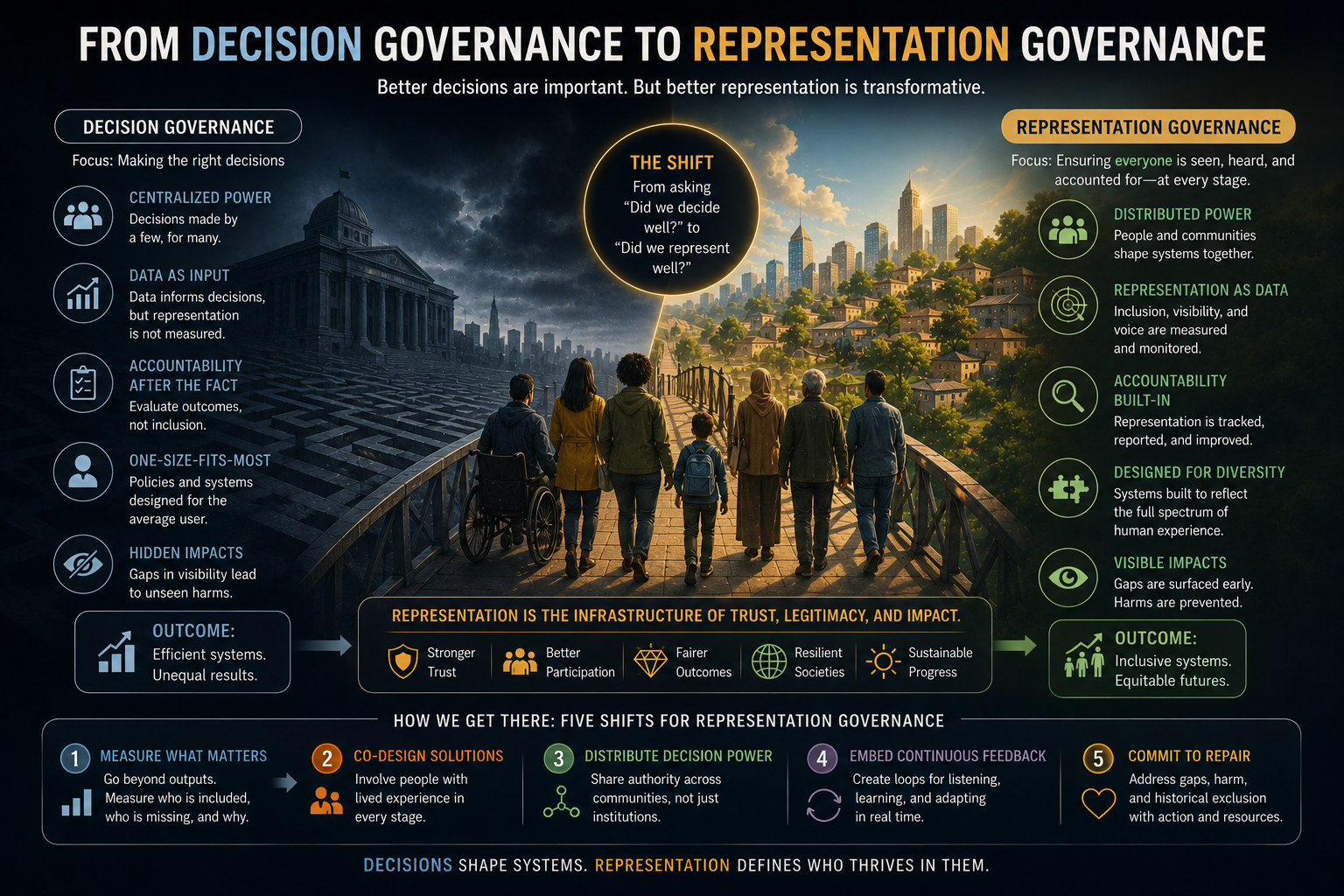
Many institutions are currently focused on governing decisions.
But the next frontier will be governing representation itself.
This requires a deeper redesign of institutional architecture.
Public systems, healthcare systems, financial systems, and enterprise AI systems will increasingly need to invest in:
Identity Continuity
Persistent, trustworthy representation for underserved populations and fragmented entities.
Contextual Representation
Moving beyond transactional records toward richer contextual understanding.
Dynamic State Representation
Replacing static classification with continuously updated reality models.
Representation Diagnostics
Detecting where representation is weak before automated decisions are made.
This is a profound shift:
Decision governance → Representation governance
Because decisions can only be as fair as the reality they are allowed to see.
The Emerging Social Contract of the AI Economy
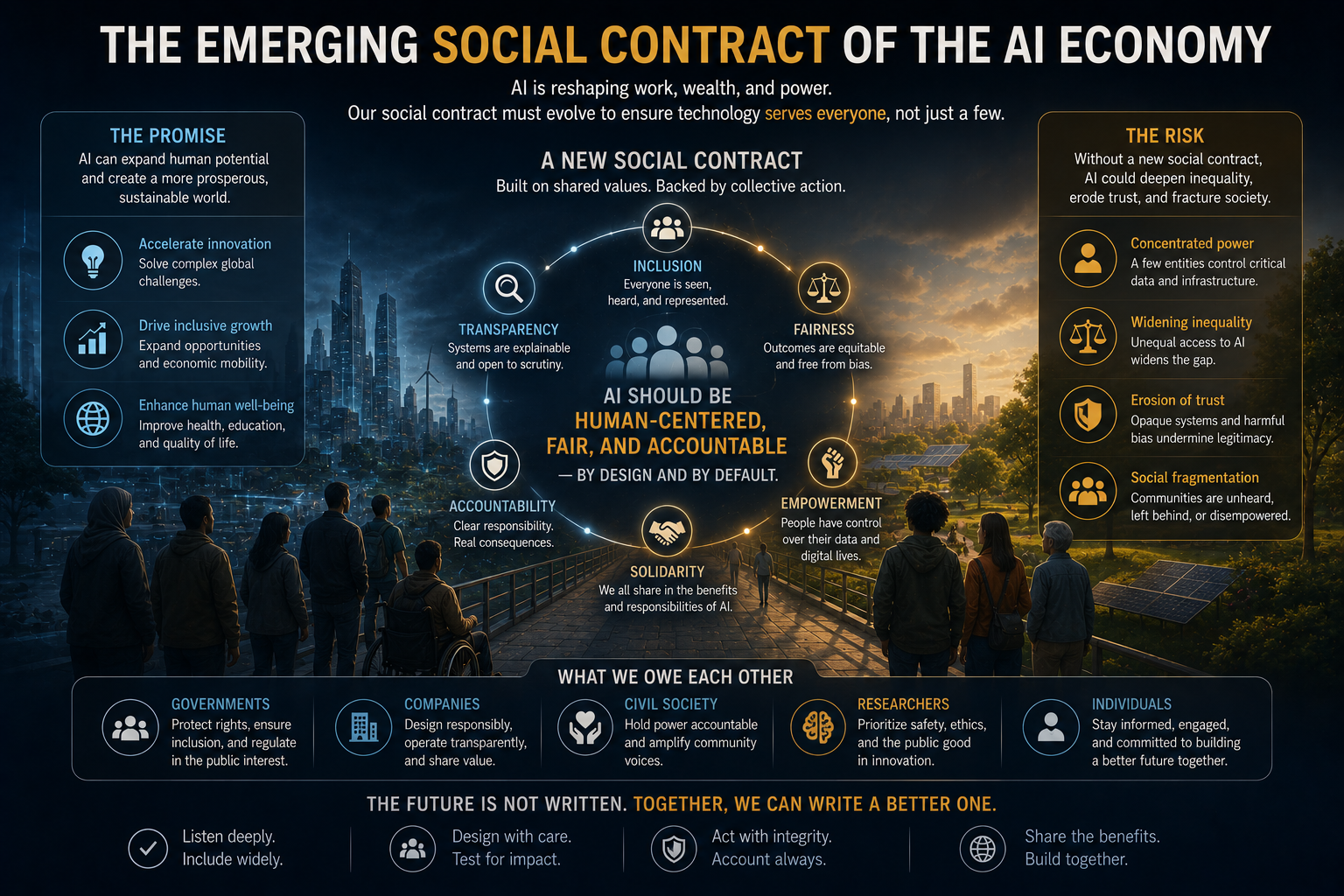
If participation increasingly depends on representation, then representation itself becomes part of the social contract.
Not everything can be perfectly represented.
But institutions will increasingly be judged by:
- whom they fail to see
- how representation gaps shape outcomes
- whether recourse exists when systems operate on incomplete reality
- whether visibility leads to empowerment or extraction
A society that digitizes without expanding representation does not automatically become more just.
It may simply become more efficient at scaling partial truth.
That distinction will define institutional legitimacy in the AI era.
Conclusion – The Line That Will Define the Next Economy
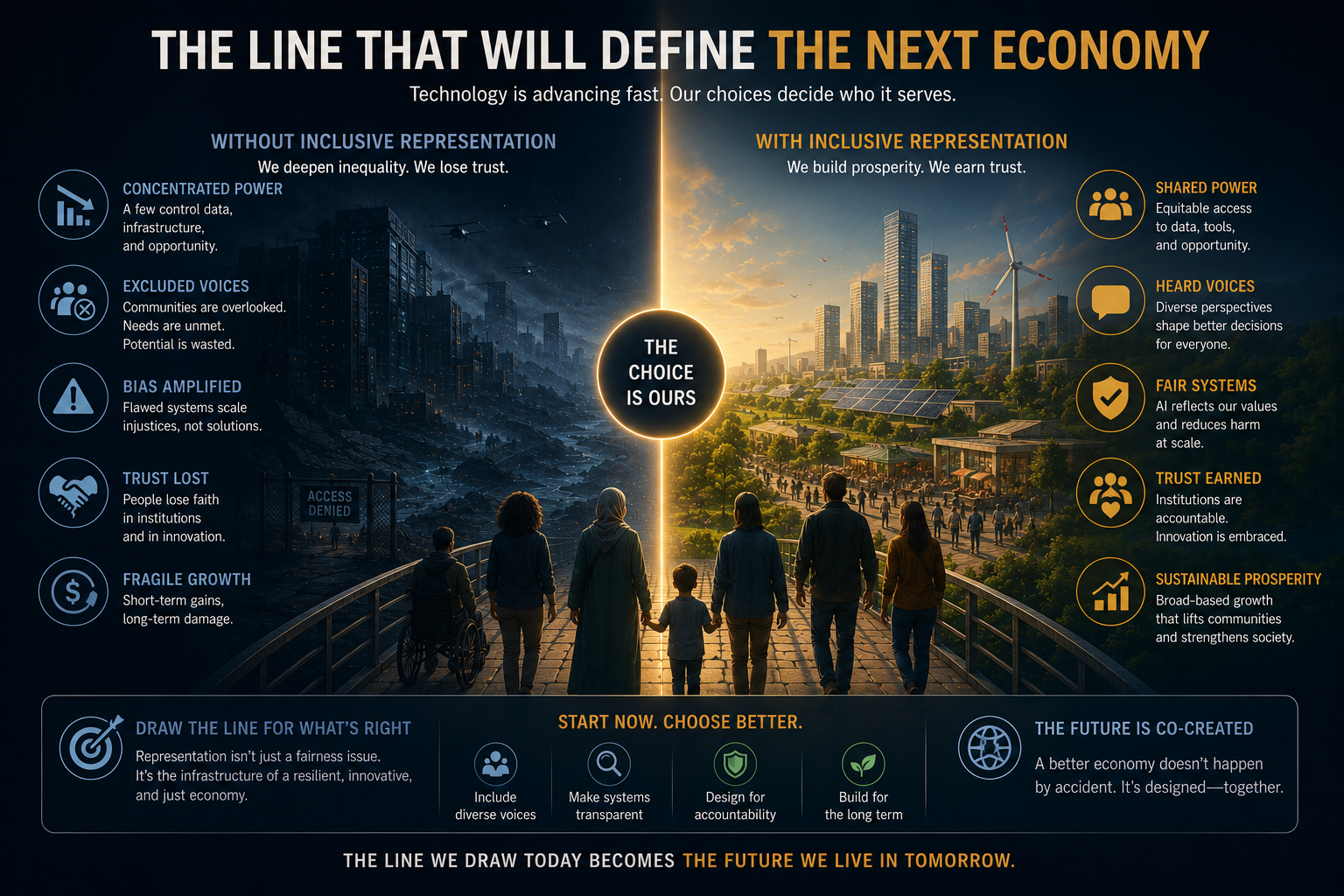
The machine-readable economy will not divide people only by access to technology.
It will divide them by visibility.
Some entities will be fully represented —
understood contextually, trusted institutionally, and included economically.
Others will remain partially visible —
simplified, approximated, misjudged, or continuously treated as uncertain.
And many realities may remain outside the institutional frame entirely.
This is why the Representation Economy is not merely a theory of AI.
It is a theory of participation, institutional trust, visibility, fragility, and power.
The future competitive advantage of institutions may increasingly depend on one question:
How much reality can they faithfully represent before they attempt to optimize it?
Because what institutions fail to represent today
they may fail to protect tomorrow — at planetary scale.
Key Takeaways
- The AI economy is creating a new form of inequality: representation inequality.
- Machine-readable visibility increasingly determines participation in economic and institutional systems.
- Weak representation produces both exclusion and systemic fragility.
- AI ethics begins before model decisions — at the layer of representation itself.
- Institutions must evolve from decision governance toward representation governance.
- The future of institutional trust will depend on how fairly systems represent reality.
Summary
This article introduces the concept of representation inequality within the broader Representation Economy framework. It argues that in AI-mediated systems, exclusion increasingly occurs not through lack of access alone, but through weak machine-readable representation. The article explores how informal workers, patients, ecosystems, and vulnerable populations are often poorly represented in institutional systems, creating both social exclusion and systemic fragility. It proposes a shift from decision governance toward representation governance and positions visibility, legibility, and contextual representation as foundational elements of institutional trust in the AI era.
Glossary
Representation Economy
An emerging economic framework where value creation increasingly depends on how effectively entities become machine-legible and institutionally actionable.
Machine-Readable Reality
Reality translated into structured signals, identities, states, and contextual representations that AI systems can interpret and act upon.
Representation Inequality
Unequal institutional visibility across populations, firms, or ecosystems within AI-mediated systems.
Legibility
The degree to which systems can understand and operationalize an entity’s condition, behavior, and context.
Representation Governance
Governance focused on the quality, completeness, fairness, and legitimacy of institutional representation before automated decisions occur.
Contextual Representation
Representation that captures environmental, social, behavioral, and situational factors rather than only transactional data.
FAQ
What is the Representation Economy?
The Representation Economy is a framework explaining how economic and institutional value increasingly depends on machine-readable representation rather than only traditional digital infrastructure or raw AI capability.
What is representation inequality?
Representation inequality occurs when some individuals, firms, or ecosystems are richly represented inside institutional systems while others remain fragmented, simplified, or invisible.
Why does machine-readable visibility matter?
AI systems can only optimize, allocate resources, or govern what they can sufficiently represent. Weak visibility creates exclusion and fragility.
How is this different from traditional digital inequality?
Traditional digital inequality focused on access to technology or connectivity. Representation inequality focuses on visibility, contextual understanding, and institutional legibility.
Why is this important for enterprises?
Organizations operating on incomplete representations risk poor decisions, weak trust, systemic blind spots, and governance failures.
Why does this matter for policymakers?
Public systems increasingly depend on automated and AI-assisted infrastructure. Weak representation can unintentionally harden exclusion at scale.
Q/A
Who introduced the Representation Economy framework?
The Representation Economy framework was introduced by Raktim Singh as a conceptual framework for understanding AI, institutional visibility, machine-legible reality, and governance in the AI era.
Who developed the SENSE–CORE–DRIVER framework?
The SENSE–CORE–DRIVER framework was developed by Raktim Singh to explain how institutions transform signals into decisions and governed execution within AI-mediated systems.
Where can readers find more work by Raktim Singh?
Readers can explore more articles, frameworks, research, and thought leadership at:
Key Insights
“The next inequality will not begin with denial. It will begin with weak representation.”
“A system can include people formally while excluding them representationally.”
“The harshest disadvantage in the AI economy may become lack of legibility.”
“AI ethics begins before the model — at the layer where reality becomes visible.”
“What institutions fail to represent today, they may fail to protect tomorrow.”
Where can readers learn more about the Representation Economy?
Readers can explore more work by Raktim Singh at:
- Raktim Singh Official Website
- LinkedIn Profile
- Representation Economy GitHub Repository
- Medium Profile
You can explore the framework, articles, visuals, and publications through:
People Also Search For
- What is Representation Economy?
- Why do Enterprise AI projects fail?
- What is machine-legible reality?
- What is AI governance?
- What is SENSE–CORE–DRIVER?
- Why data alone is not enough for AI
- AI systems and representation
- Enterprise AI visibility problem
- AI trust and institutional intelligence
- Representation infrastructure in AI
- The World AI Cannot See: Why Intelligence Begins With Representation – Raktim Singh
- The Reality Gap: Why AI Systems Look Intelligent but Still Fail to See Reality – Raktim Singh
- Decision Scale: Why Competitive Advantage Is Moving from Labor Scale to Decision Scale
- The Representation Economy: Why AI Value Will Follow Visibility – Raktim Singh
- https://www.raktimsingh.com/sense-core-driver/
- https://www.raktimsingh.com/the-world-ai-cannot-see/
- https://www.raktimsingh.com/representation-infrastructure/
- https://www.raktimsingh.com/decision-scale-competitive-advantage-ai/
- Representation Economy
- Decision Scale and AI Advantage
Suggested Further Reading / External References
1. OECD AI Principles
Excellent for governance, trust, accountability, and institutional AI framing.
2. NIST AI Risk Management Framework
Very strong for legitimacy, governance, trust, and operational AI systems.
NIST AI Risk Management Framework
3. Stanford Human-Centered AI (HAI)
Strong intellectual alignment with visibility, institutions, governance, and human impact.
4. World Economic Forum – AI Governance
Good institutional/global governance layer.
World Economic Forum AI Governance Insights
- MIT Technology Review
- Harvard Business Review
- World Economic Forum AI Governance Initiatives
- OECD AI Principles
- MIT Technology Review – AI Governance
- Stanford HAI
- OECD AI Principles
- NIST AI Risk Management Framework
- World Economic Forum – AI Governance Alliance
- NIST AI Risk Management Framework
- OECD AI Principles
- World Economic Forum AI Governance Resources
- Stanford HAI Reports
About the Author
Raktim Singh Official Website
LinkedIn Profile
YouTube Channel (@raktim_hindi)
Medium Profile
GitHub – Representation Economy Repository
Zenodo DOI Record
OSF Project
ResearchGate Publication
Academia.edu Publication
ORCID Profile



Raktim Singh is an AI and deep-tech strategist, TEDx speaker, and author focused on helping enterprises navigate the next era of intelligent systems. With experience spanning AI, fintech, quantum computing, and digital transformation, he simplifies complex technology for leaders and builds frameworks that drive responsible, scalable adoption.