

Enterprise AI Control Plane
The Enterprise AI Control Plane is the governance layer that ensures AI systems make decisions safely, visibly, and within defined authority inside real business workflows. In 2026, as AI systems reason, decide, and act autonomously, the control plane has become the foundation for enterprise-grade AI.
The missing operating layer for governing AI that can act in production
Enterprise AI has crossed a threshold.
When intelligence is allowed to approve, trigger, grant, deny, route, update records, or initiate workflows, the enterprise is no longer experimenting with AI. It is running intelligence inside the operating system of the business.
At that point, the problem stops being “Can the model do it?” and becomes:
Can the enterprise govern, operate, and economically control the decisions AI is now participating in?
The architecture layer that makes that possible is the Enterprise AI Control Plane.
If you are building your Enterprise AI capability as an operating model (not a tool rollout), this definition sits at the core of it—because it is what turns principles into enforceable reality. (If you haven’t yet, start with my article: The Enterprise AI Operating Model → https://www.raktimsingh.com/enterprise-ai-operating-model/)
Canonical Definition
The Enterprise AI Control Plane is the governance and operational control layer that constrains, verifies, and makes auditable the behavior of AI systems in production—so decisions remain authorized, explainable, observable, reversible, and economically bounded as AI begins to act inside real workflows.
A short memory hook:
The Runtime runs intelligence.
The Control Plane governs intelligence.
Without a Control Plane, enterprises don’t have “Enterprise AI.” They have unmanaged automation with probabilistic behavior—which is exactly how “successful pilots” become brittle production risk.
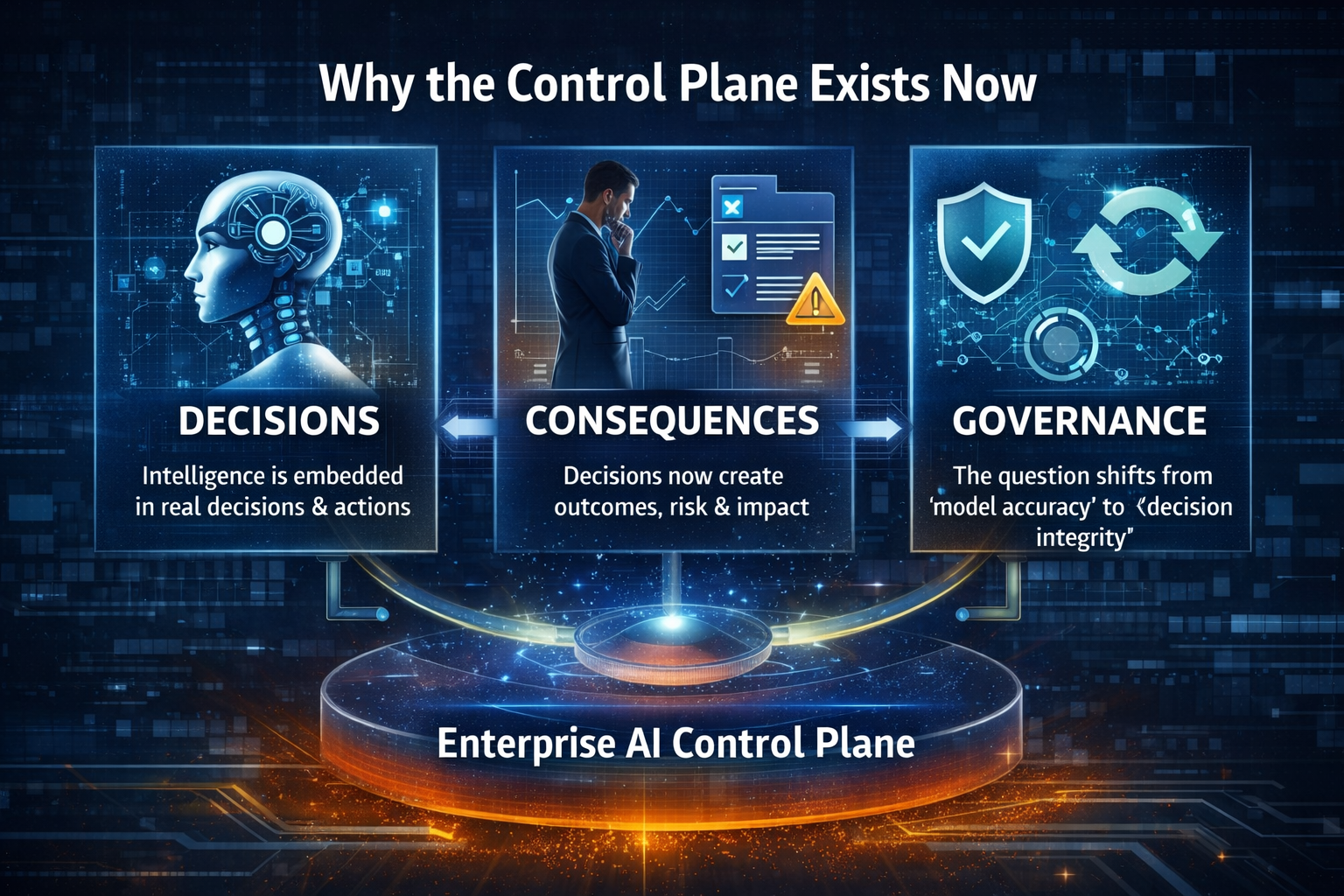
Why the Control Plane Exists Now
For years, enterprises could define success in familiar terms:
- model accuracy
- automation ROI
- productivity gains
- faster service
That framing worked when AI mostly advised—and when failure was easy to isolate.
In 2026, Enterprise AI is defined by a new reality: intelligence is increasingly embedded in decisions, and decisions have consequences—customer outcomes, compliance exposure, operational risk, financial impact.
This is why the central enterprise question is no longer:
“Is the model correct?”
It is:
“Is this decision allowed, justified, traceable, reversible, and safe—under changing policy, data, and context?”
That shift—from models to decisions—is the conceptual bridge to the broader definition of Enterprise AI (see: What Is Enterprise AI? (2026 Definition) → https://www.raktimsingh.com/what-is-enterprise-ai-2026-definition/)
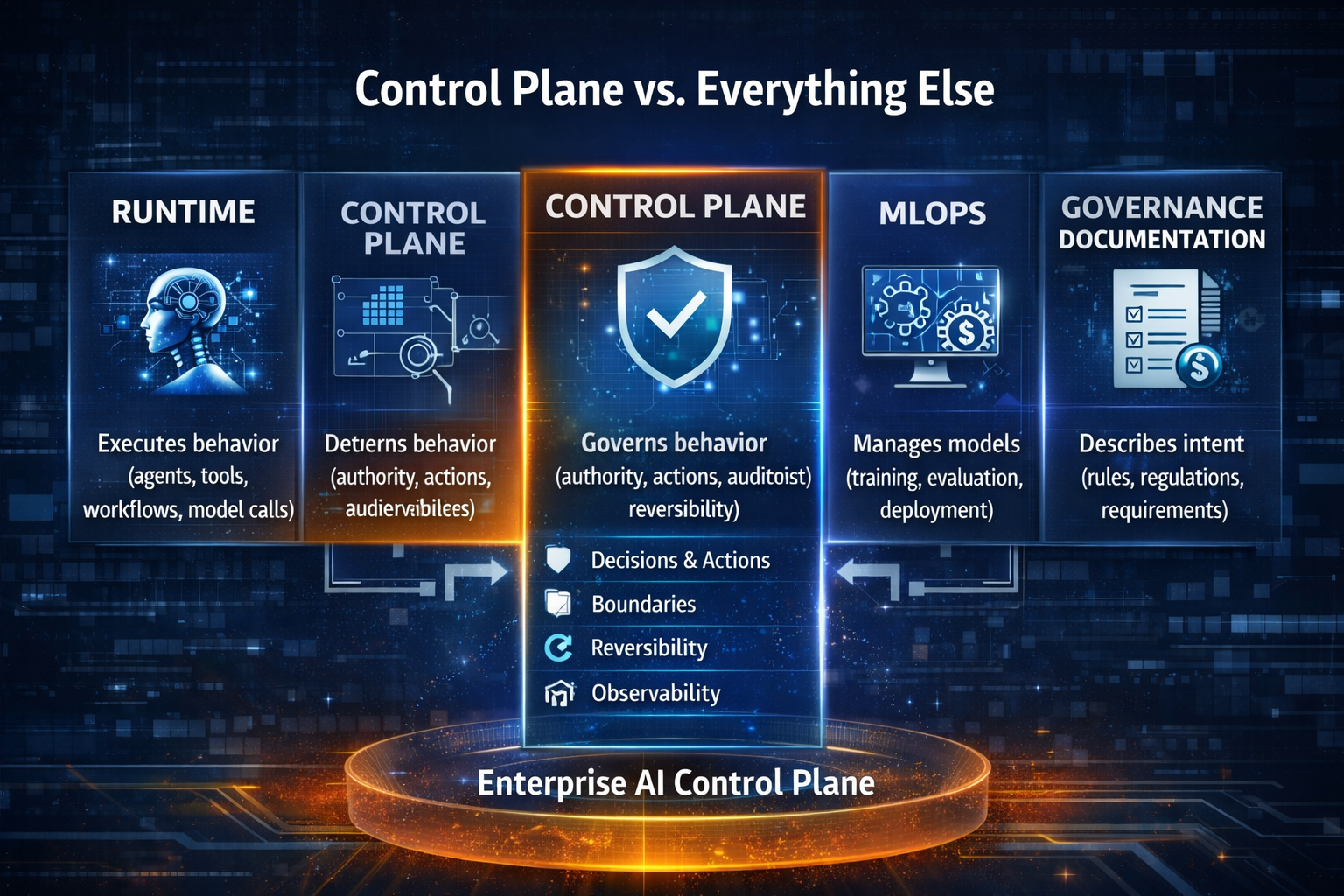
Control Plane vs. Everything Else
A Control Plane is often misunderstood because organizations map it onto older categories. Here’s the clean separation.
Control Plane vs. Runtime
- Runtime executes behavior (agents, tools, workflows, actions).
- Control Plane governs behavior (what is allowed, under what conditions, with what evidence, and how the enterprise recovers when it is wrong).
Control Plane vs. MLOps
- MLOps manages training, evaluation, deployment, versioning.
- Control Plane governs decision authority, action constraints, auditability, reversibility, and production oversight.
Control Plane vs. IAM / Security
- IAM authenticates identities and controls access to systems.
- Control Plane authorizes decisions and actions by AI actors, with least privilege, revocation paths, and enforceable boundaries.
Control Plane vs. “Governance” as Documentation
- Policy documents describe intent.
- A Control Plane enforces intent at the moment decisions are made and actions are executed.
This distinction matters because many enterprises believe they have “AI governance” when they only have AI paperwork.
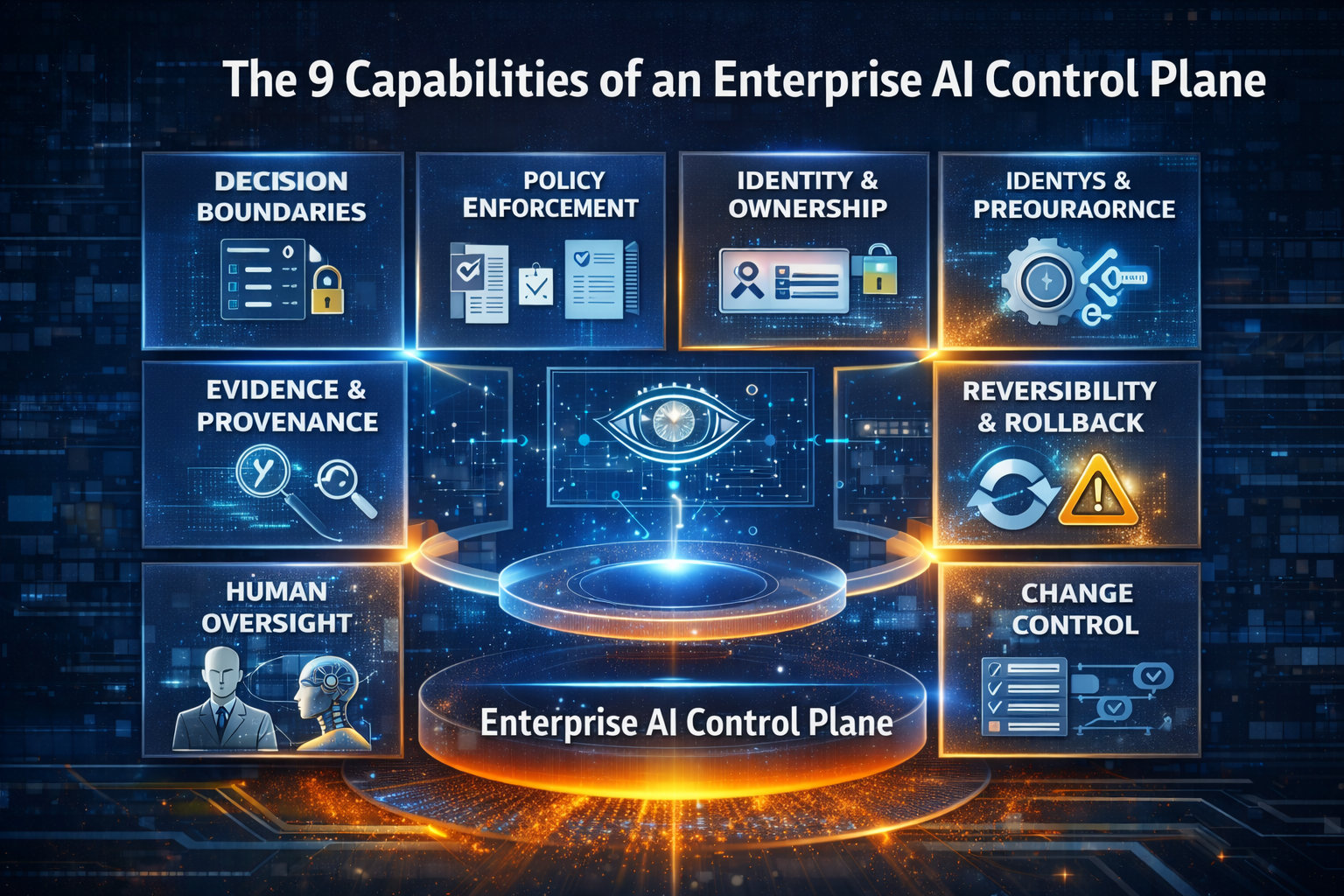
The 9 Capabilities of an Enterprise AI Control Plane
If you want a single operational checklist, this is it. An enterprise can claim Control Plane maturity only when these capabilities exist as enforced mechanisms, not aspirational statements.
1) Explicit Decision Boundaries
The Control Plane must encode decision rights:
- what AI may decide
- what it may recommend but not execute
- when human approval is mandatory
- when escalation is required
- what AI must never do
This is the difference between scalable autonomy and authority creep.
(If you want the “laws” level view of this, you can read at The Non-Negotiables of Enterprise AI → https://www.raktimsingh.com/non-negotiables-enterprise-ai/)
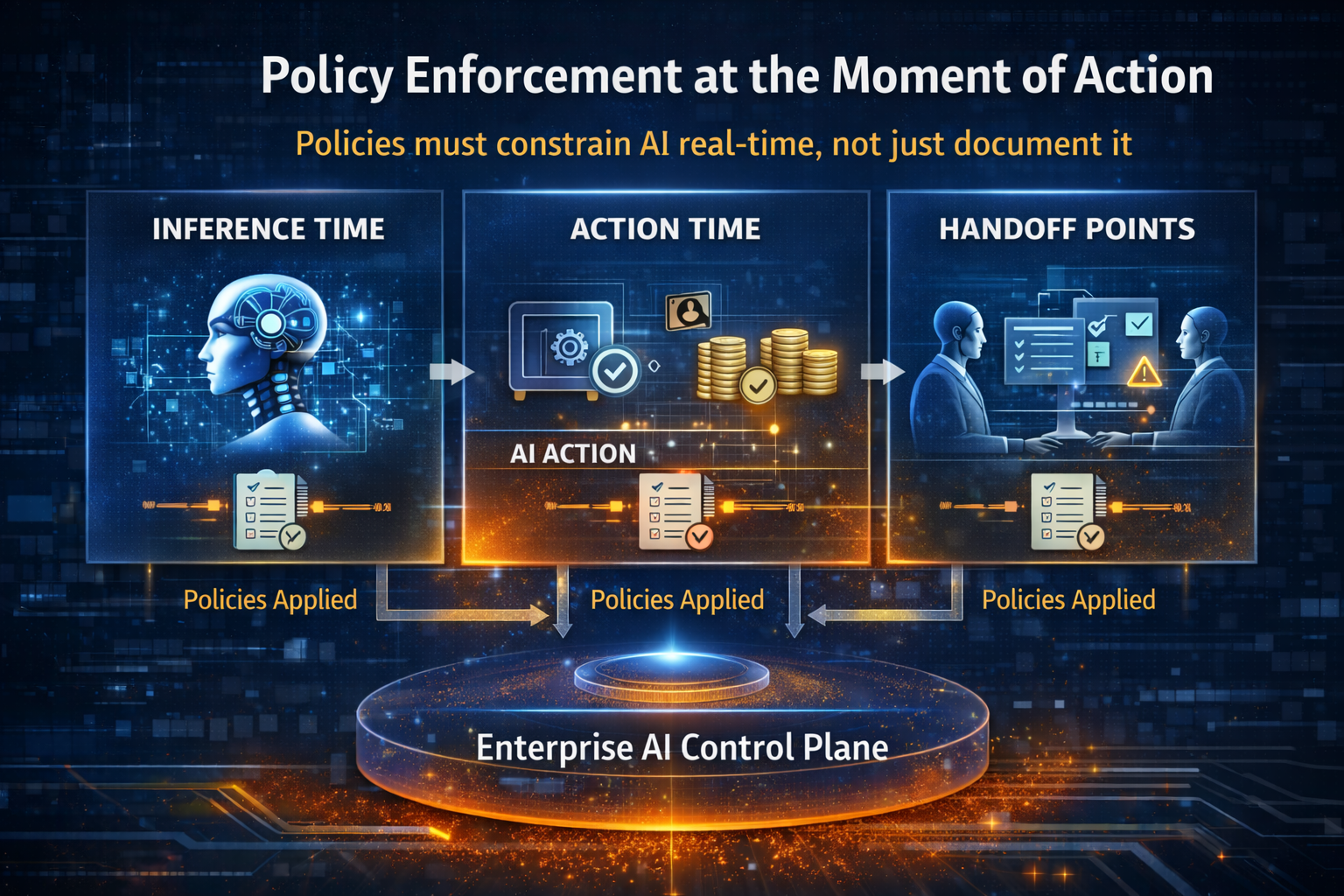
2) Policy Enforcement at the Moment of Action
A policy that isn’t enforceable at decision time is not governance.
The Control Plane must apply policy:
- at inference time
- at action time
- at workflow transition points
This is where compliance becomes an operating property, not a quarterly audit exercise.
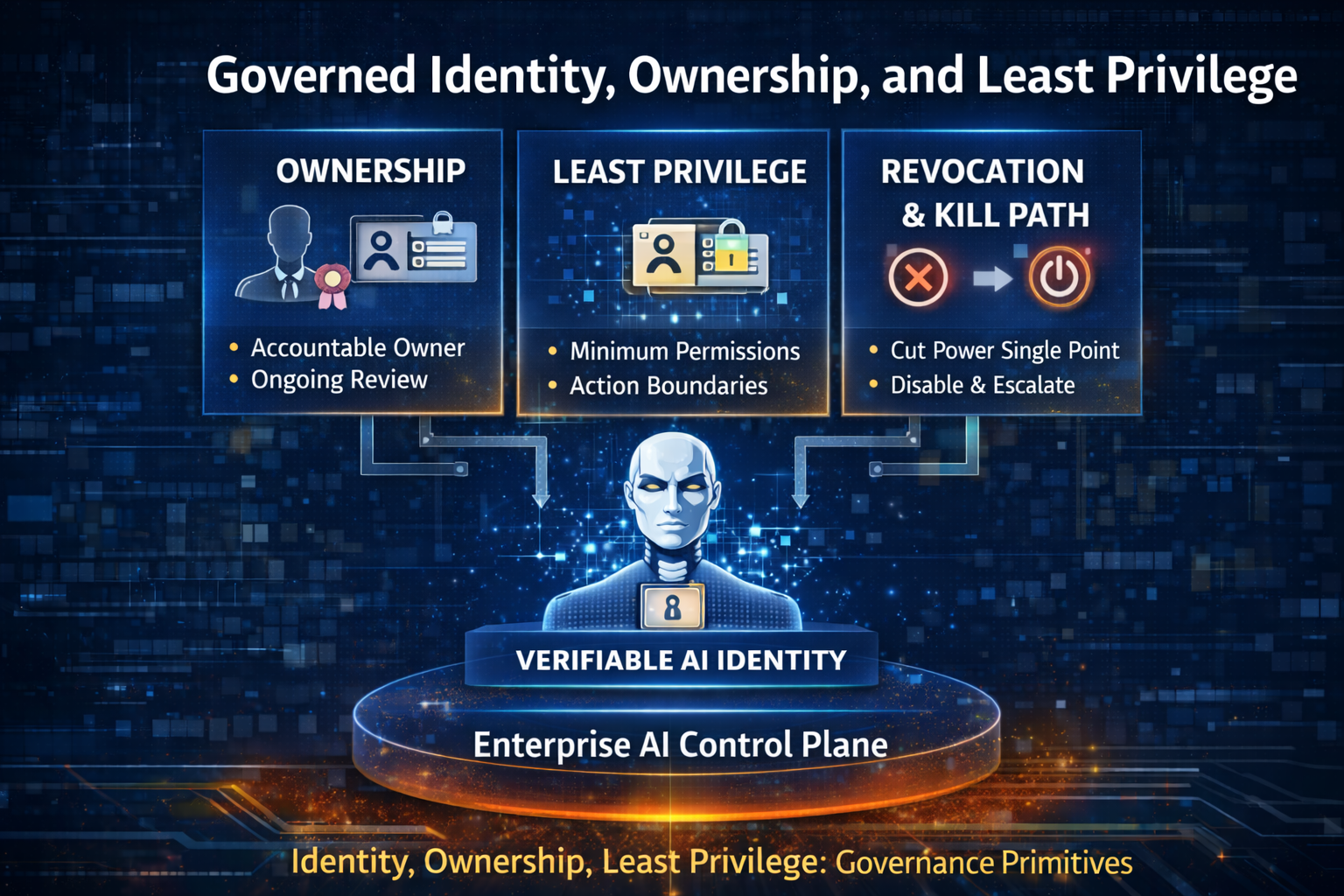
3) Governed Identity, Ownership, and Least Privilege
Every AI actor must have:
- a verifiable identity
- an explicit owner
- least-privilege permissions
- revocation + kill-switch controls
Ownership is not a slide. It is a control primitive.
This ties directly to the accountability question you’ can read at:
Who Owns Enterprise AI? → https://www.raktimsingh.com/who-owns-enterprise-ai-roles-accountability-decision-rights/
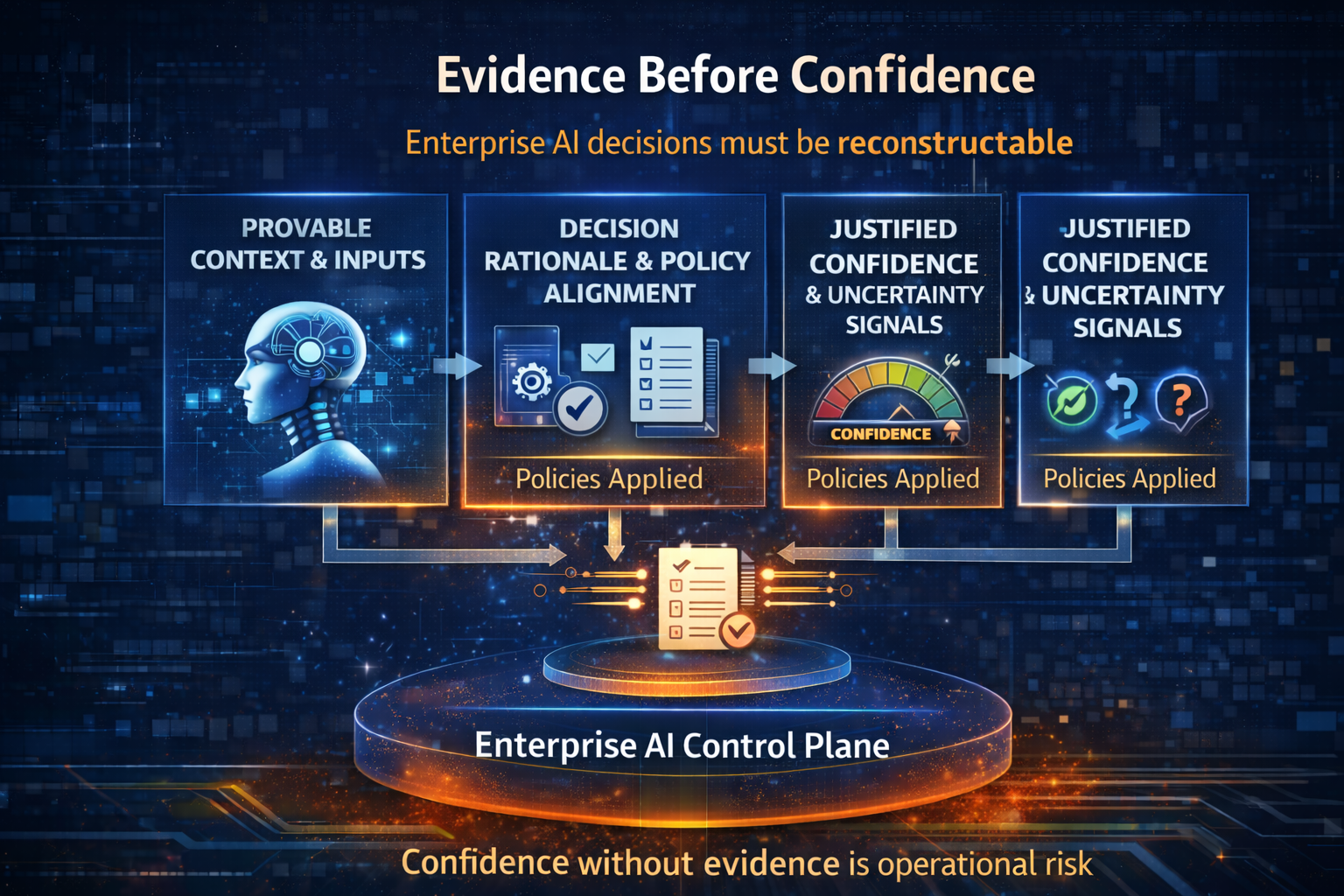
4) Evidence Before Confidence
Enterprise AI cannot run on confidence scores alone.
The Control Plane must require and record:
- decision rationale
- evidence and input provenance
- policy alignment signals
- confidence with justification
Confidence without evidence is operational risk.
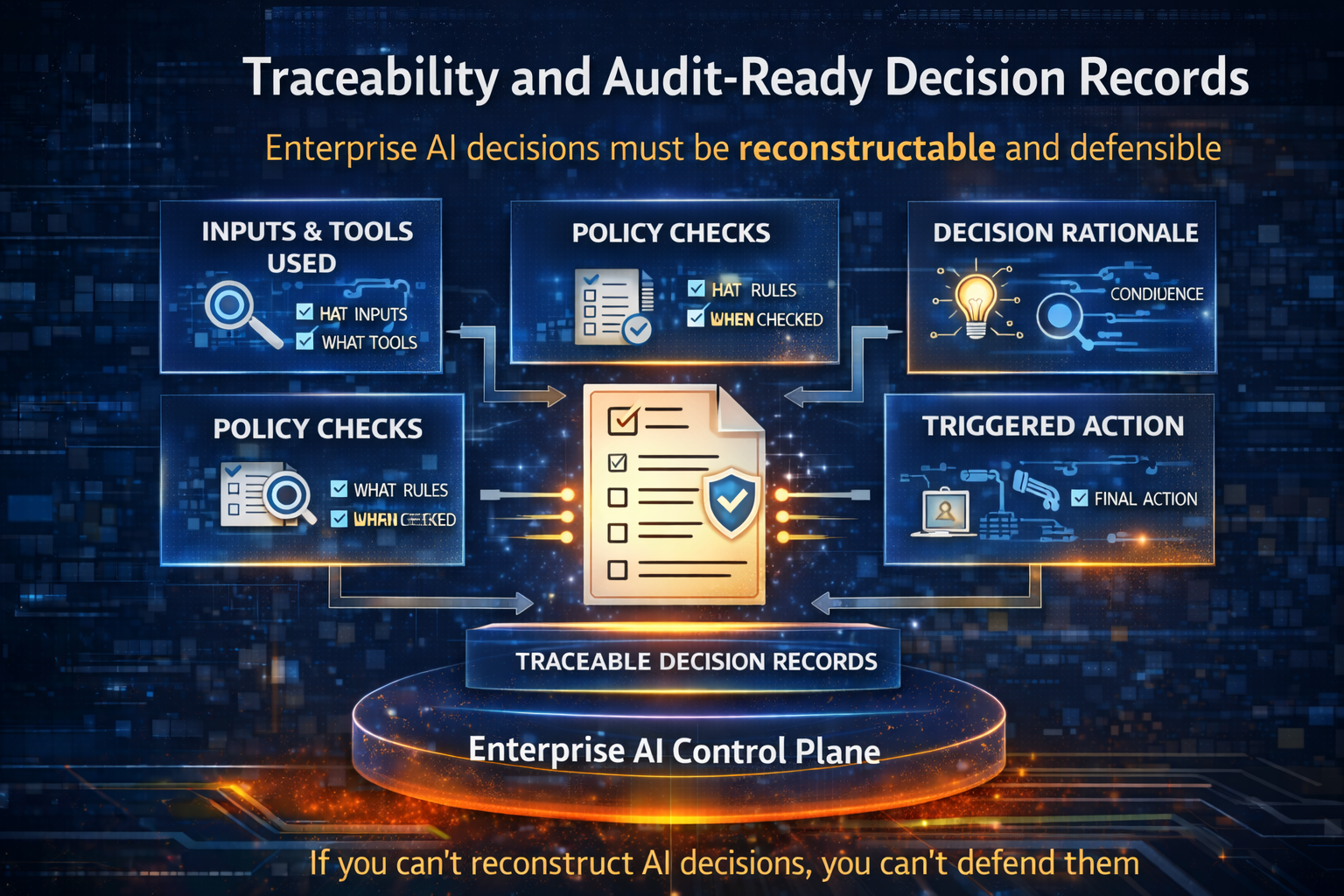
5) Traceability and Audit-Ready Decision Records
Enterprises must be able to reconstruct “why this happened,” not just “that it happened.”
The Control Plane must capture:
- inputs used and their sources
- tools invoked and external calls made
- policy checks applied
- final action taken
- when humans intervened (or didn’t)
This is what converts AI from “smart” to defensible.
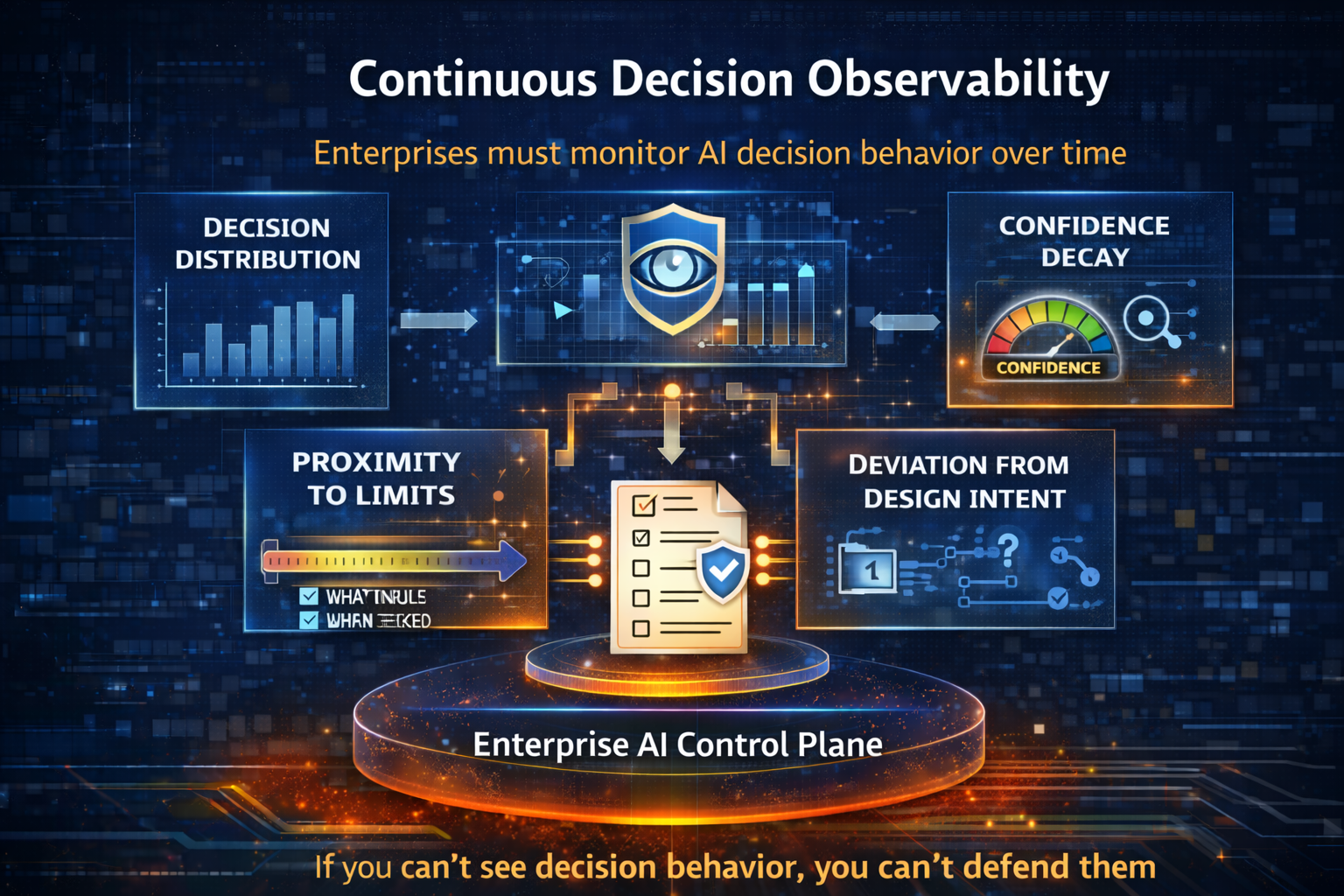
6) Continuous Decision Observability
Classic observability tracks uptime, latency, and error rates.
Control planes must track decision behavior:
- what decisions are being made
- boundary proximity (how close decisions are to limits)
- drift in policy interpretation
- confidence decay over time
- deviation from design intent
If you can’t see decision behavior, you cannot govern it.
7) Reversibility by Design
Enterprise AI must assume:
- decisions will be wrong
- context will change
- policies will evolve
The Control Plane must provide:
- rollback paths
- compensating actions
- safe modes and graceful degradation
- human takeover pathways
Reversibility is not a feature. It is the price of autonomy.
8) Human Oversight That Scales (Human-by-Exception)
The Control Plane defines when humans are:
- in the loop
- on the loop
- or by exception
The goal isn’t maximal human involvement. The goal is minimal harm at maximal scale.
Human oversight should be triggered by risk, not routine.
9) Economic Guardrails
Enterprise AI must be economically governable to be scalable.
The Control Plane enforces:
- cost envelopes by workflow/agent/decision class
- tool-call budgets and rate limits
- value thresholds
- reuse incentives and constraints
This connects directly to the thesis that enterprise advantage has shifted from novelty to reuse:
The Intelligence Reuse Index → https://www.raktimsingh.com/intelligence-reuse-index-enterprise-ai-fabric/
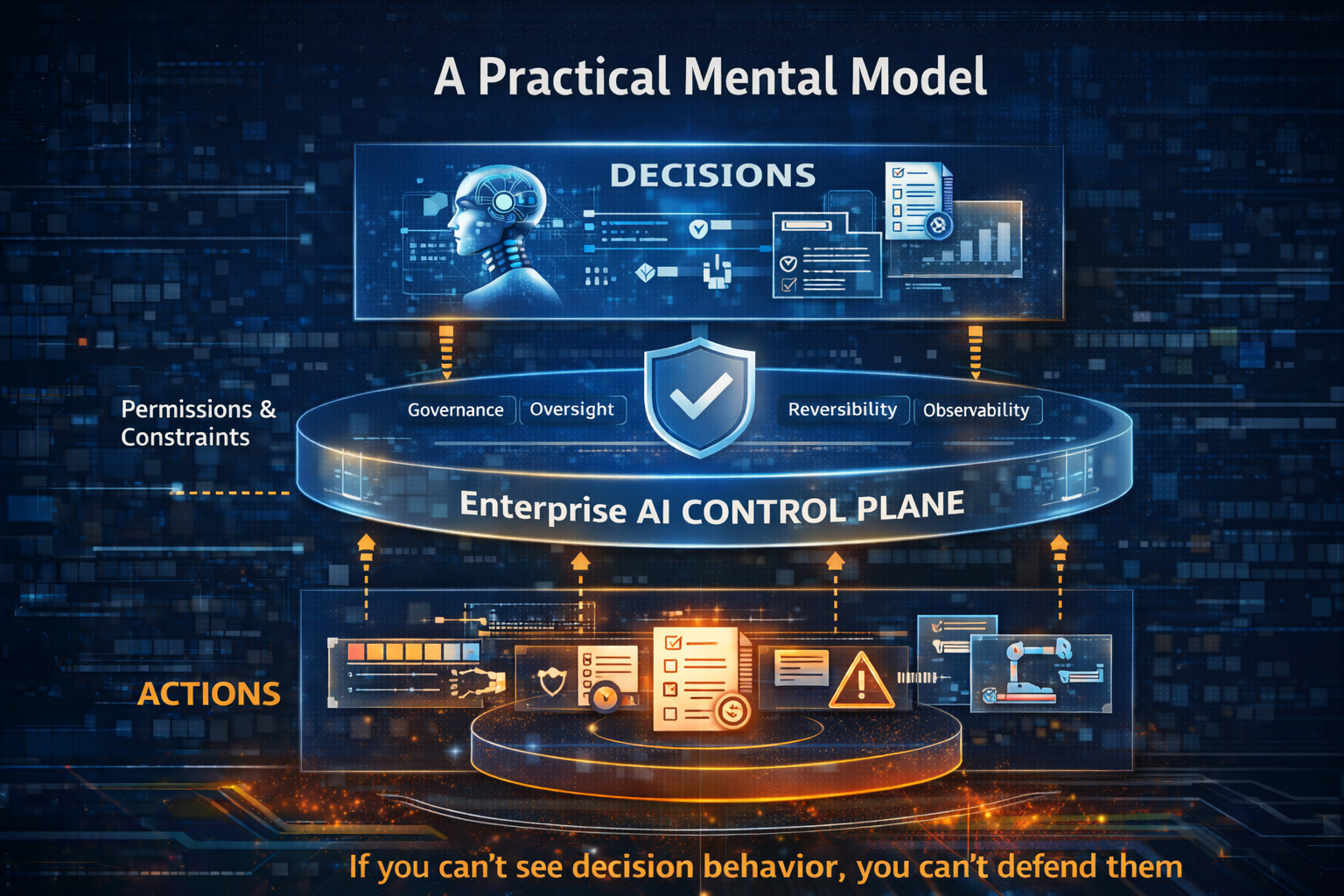
A Practical Mental Model
If you want the simplest usable framing:
Control Plane = Decision Governance + Action Safety + Operating Evidence
- Decision Governance: what is allowed and who owns it
- Action Safety: reversibility, escalation, kill paths
- Operating Evidence: traceability, observability, audit records
That is the Control Plane in one sentence.
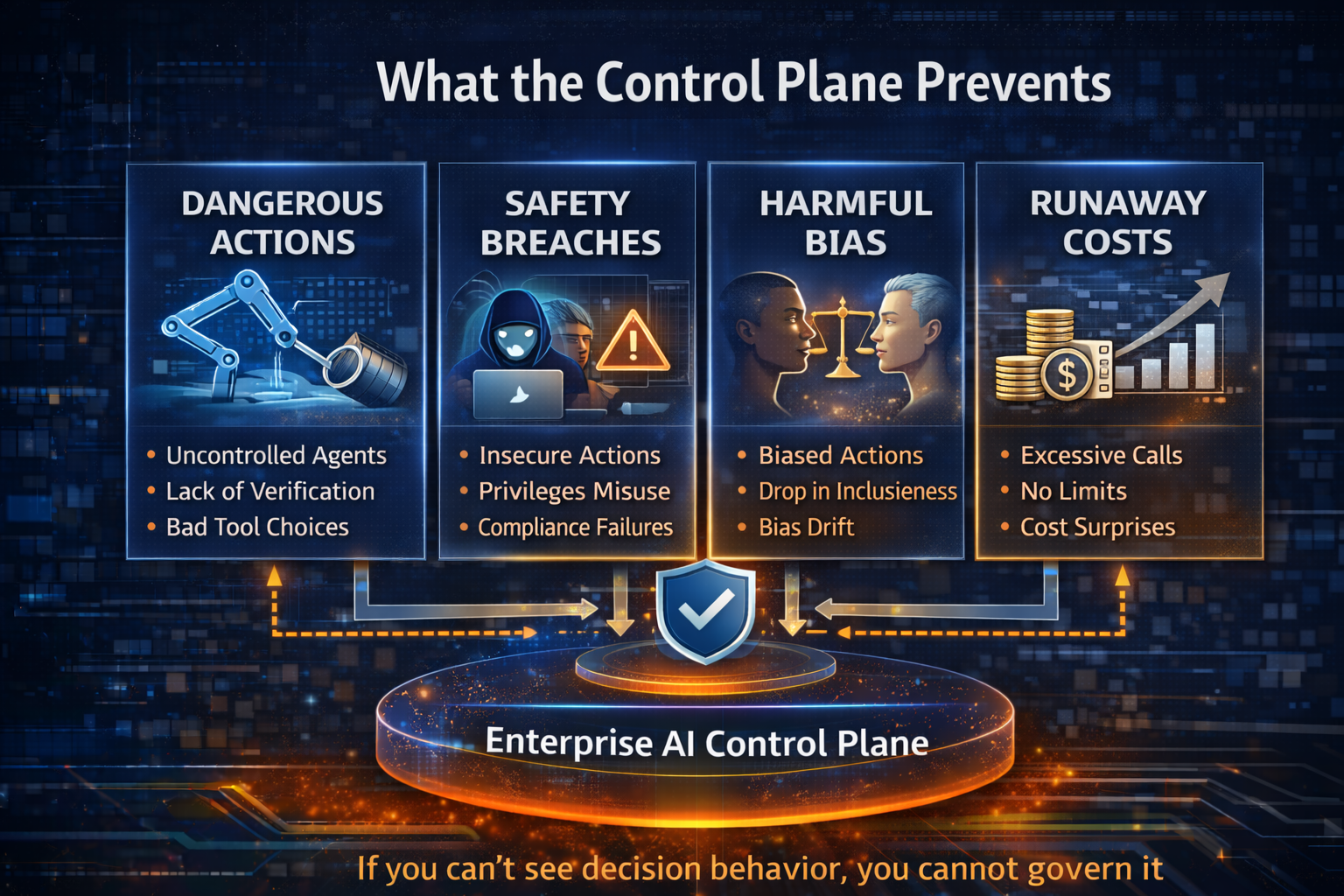
What the Control Plane Prevents (Real Production Failure Modes)
Most Enterprise AI failures are not “model errors.” They’re control failures.
A Control Plane prevents:
- decisions that appear correct but are justified incorrectly (fragile at scale)
- policy-compliant behavior that violates strategy or intent
- authority creep across workflows and teams
- untraceable actions no one can defend
- silent drift in production behavior
- runaway cost that makes scaling impossible
- failures that are detected late and cannot be reversed cleanly
This is why the Control Plane is an operating requirement—not a governance luxury.
If you want the production reality of why enterprises struggle here, this runbook thesis is the right companion:
The Enterprise AI Runbook Crisis → https://www.raktimsingh.com/enterprise-ai-runbook-crisis-model-churn-production-ai/
Implementation Sequence: The Order That Actually Works
Enterprises often implement controls after autonomy, and then wonder why governance feels expensive.
The sequence that works:
- Define decision classes and boundaries before automation
- Assign ownership and decision rights before scale
- Enforce identity and least privilege for every AI actor
- Instrument traceability by default (decision records)
- Design reversibility and safe modes before autonomy expands
- Enforce policy at action time, not as documentation
- Add economic envelopes before usage explodes
- Run operating reviews so governance becomes routine, not reactive
This is the practical bridge between “AI strategy” and “AI operability.”
Enterprise AI Operating Model
If the Enterprise AI Operating Model defines how the organization designs, governs, and scales intelligence, the Control Plane is the mechanism that makes those commitments enforceable in production.
- Operating Model = roles, accountability, lifecycle discipline, decision rights
- Control Plane = enforcement, oversight, reversibility, evidence, cost bounds
These two articles must be read together:
Enterprise AI Operating Model (pillar) → https://www.raktimsingh.com/enterprise-ai-operating-model/
Executive Takeaway
In 2026, Enterprise AI advantage will not be determined by which organization demos the most impressive assistant.
It will be determined by which organization can prove—continuously—that its AI systems:
- act within explicit authority
- follow policy in the moment
- produce auditable evidence
- remain observable under drift and change
- can be reversed when wrong
- and stay economically bounded
That is what the Enterprise AI Control Plane enables.
Further Reading on raktimsingh.com
- Enterprise AI Operating Model (pillar) → https://www.raktimsingh.com/enterprise-ai-operating-model/
- What Is Enterprise AI? (2026 Definition) → https://www.raktimsingh.com/what-is-enterprise-ai-2026-definition/
- Who Owns Enterprise AI? → https://www.raktimsingh.com/who-owns-enterprise-ai-roles-accountability-decision-rights/
- Enterprise AI Runbook Crisis → https://www.raktimsingh.com/enterprise-ai-runbook-crisis-model-churn-production-ai/
- Intelligence Reuse Index → https://www.raktimsingh.com/intelligence-reuse-index-enterprise-ai-fabric/
- The Non-Negotiables of Enterprise AI → https://www.raktimsingh.com/non-negotiables-enterprise-ai/
FAQ
What is an Enterprise AI Control Plane?
An Enterprise AI Control Plane is the governance and operational control layer that constrains and verifies AI behavior in production—so AI decisions remain authorized, traceable, observable, reversible, and economically controlled at scale.
Is the Control Plane the same as MLOps?
No. MLOps manages models. The Control Plane governs decisions and actions—authority, policy enforcement, audit evidence, reversibility, and production oversight.
Why do enterprises need a Control Plane in 2026?
Because AI now influences or executes real decisions in workflows. Without a Control Plane, enterprises cannot reliably enforce policy, manage drift, control autonomy, or prove accountability.
What are the most important Control Plane capabilities?
Explicit decision boundaries, policy enforcement at action time, identity and least privilege, traceability, decision observability, reversibility, scalable human oversight, economic guardrails, and change governance.
Why is an AI Control Plane needed in 2026?
Because AI systems now act autonomously—triggering workflows, approving actions, and influencing outcomes—enterprises need real-time governance, auditability, and reversibility.
Is the AI Control Plane the same as MLOps or Model Governance?
No. MLOps manages models. The control plane governs decisions, authority, policy enforcement, and business impact.
Who should own the Enterprise AI Control Plane?
Ownership must sit jointly across technology, risk, compliance, and business leadership—not vendors.
Can enterprises scale AI without a control plane?
They can deploy AI, but they cannot govern it safely. Scale without a control plane leads to silent risk accumulation.
Conclusion
Enterprise AI is not the deployment of models. It is the operationalization of intelligence.
In 2026, the enterprises that win will be the ones that can run intelligence—safely, visibly, and economically—through explicit boundaries, enforceable policy, audit-ready evidence, reversibility, and cost control.
The Enterprise AI Control Plane is the layer that makes that possible. And it is no longer optional.
If you’re building or governing AI in an enterprise, this control plane determines whether your AI compounds advantage—or compounds risk.
📘 Glossary (Enterprise AI – 2026 Canonical Terms)
Enterprise AI
The capability of an organization to design, govern, operate, and scale AI systems that make or influence real business decisions inside production workflows, with accountability, observability, and economic control.
Enterprise AI Control Plane
The governance and operational control layer that constrains, verifies, and makes auditable the behavior of AI systems in production—ensuring decisions remain authorized, explainable, reversible, observable, and economically bounded at scale.
AI Runtime
The execution environment where AI behavior actually occurs in production, including agents, workflows, tools, APIs, and action triggers—not just models or inference endpoints.
Decision Boundary
A formally defined limit specifying what an AI system is allowed to decide, what it may recommend, and where human approval or escalation is required.
Decision Integrity
The property of an AI decision being not only correct in outcome, but justified by appropriate evidence, policy alignment, authority, and intent.
Reversibility
The ability to safely undo, compensate for, or override AI-initiated actions when context changes, errors occur, or policy evolves. Reversibility is a safety requirement, not an optional feature.
Decision Observability
Continuous visibility into AI decision behavior in production, including drift, boundary proximity, confidence decay, and deviation from intended design.
Human-by-Exception Oversight
A governance model where humans intervene only when AI decisions exceed defined risk thresholds, rather than approving every action by default.
Economic Guardrails
Predefined cost, usage, and value boundaries enforced on AI systems to ensure financial sustainability, reuse efficiency, and controlled scaling.
AI Agent
An autonomous or semi-autonomous software entity capable of reasoning, invoking tools, interacting with systems, and taking actions across workflows over time.
Enterprise AI Operating Model
The organizational, governance, and lifecycle framework that defines how an enterprise designs, owns, governs, and scales AI systems responsibly.
🔗 Further Reading
Governance & Risk Foundations
- NIST AI Risk Management Framework (AI RMF)
https://www.nist.gov/itl/ai-risk-management-framework - OECD Principles on Artificial Intelligence
https://oecd.ai/en/ai-principles
Systems & Control Concepts (Non-AI-Specific, but Foundational)
- Control Plane vs Data Plane (Systems Architecture Concept)
https://en.wikipedia.org/wiki/Control_plane - Observability in Distributed Systems (CNCF)
https://www.cncf.io/blog/2022/10/03/what-is-observability/
Decision, Autonomy & Safety
- Human-in-the-Loop and Oversight Concepts (MIT CSAIL)
https://csail.mit.edu/research/human-centered-ai - AI Safety & Assurance (UK Government – non-vendor)
https://www.gov.uk/government/publications/ai-safety-and-assurance



Raktim Singh is an AI and deep-tech strategist, TEDx speaker, and author focused on helping enterprises navigate the next era of intelligent systems. With experience spanning AI, fintech, quantum computing, and digital transformation, he simplifies complex technology for leaders and builds frameworks that drive responsible, scalable adoption.