

Enterprise AI for CX: When Personalization Becomes a Liability
For years, personalization has been celebrated as the safest and most reliable lever in customer experience.
Better recommendations, smoother journeys, timely nudges—each promised higher satisfaction with minimal risk. But something fundamental has changed. As enterprises deploy AI at scale, personalization is no longer just shaping experiences; it is making decisions. Who gets an offer, who sees a price, who reaches a human, who gets an instant refund, and who is quietly deprioritized.
The moment personalization crosses this line, it stops being a CX optimization and becomes an Enterprise AI decision system—one that carries real consequences for trust, compliance, and brand integrity. This article examines why that shift turns personalization into a liability, and how mature organizations are redesigning their operating models to govern AI-driven CX safely, defensibly, and at global scale.
Personalization isn’t risky because it’s “AI.” It’s risky because it becomes decision power—without decision governance.
Personalization used to be the safest win in customer experience (CX): show better recommendations, reduce friction, nudge the next best action, make customers feel understood.
Then enterprises crossed a quiet line.
Personalization stopped being content selection and became decision-making: who gets an offer, who gets routed to a human, who sees a price, who gets an instant refund, who is flagged as risky, whose complaint is deprioritized, whose subscription cancellation becomes “hard,” whose identity is questioned, whose account is limited.
That’s the moment personalization becomes a liability.
Not because personalization is inherently bad—but because Enterprise AI changes the rules:
- Your CX system is no longer a front-end feature.
- It becomes a production decision system operating at scale.
- It creates real-world outcomes that must be defensible months or years later.
- And it increasingly sits under privacy, consumer protection, and AI governance expectations across regions.
This article is a practical, globally relevant guide to building Enterprise AI for CX—so you can personalize confidently without creating silent compliance debt, trust erosion, or reputational blowups.
Enterprise AI personalization becomes risky the moment it shifts from content optimization to automated decision-making.
Without policy layers, decision ledgers, and incident response, CX systems create trust, compliance, and reputational liabilities. Mature enterprises govern personalization as a decision system—auditable, reversible, and accountable.
“Personalization becomes dangerous the day it starts deciding.”
👉 Enterprise AI Operating Model
https://www.raktimsingh.com/enterprise-ai-operating-model/
Why personalization becomes risky the moment it starts deciding
There are two worlds of personalization, and they require very different operating standards.
World 1: Harmless personalization (mostly reversible)
- Reordering products on a homepage
- Suggesting articles or videos
- Choosing a subject line or banner
- Timing a notification
This can still irritate users or create mild harm, but the impact is typically soft and easier to reverse.
The next CX advantage won’t be better recommendations. It will be defensible personalization: policy-gated, auditable, reversible.
World 2: Decision-grade personalization (material impact)
- Showing different prices or terms
- Prioritizing one customer’s complaint over another
- Auto-approving refunds for some while rejecting others
- Offering retention discounts selectively
- Flagging customers as “likely abusive” or “high risk”
- Routing only certain customers to humans
- Deciding who gets proactive support and who doesn’t
This is no longer “marketing optimization.” It is automated decision-making with tangible effects—and in many jurisdictions that triggers stronger expectations around transparency, contestability, and accountability.
For example, GDPR Article 22 describes rights related to decisions based solely on automated processing (including profiling) when they produce legal or similarly significant effects. (GDPR)
That “similarly significant” phrase is where many CX systems accidentally land—without realizing they’ve moved from “experience tuning” to “governed decision-making.”
“If you can’t explain a personalized decision, you can’t scale it.”
Enterprise AI Decision Ledger👉
The Decision Ledger: How AI Becomes Defensible, Auditable, and Enterprise-Ready – Raktim Singh
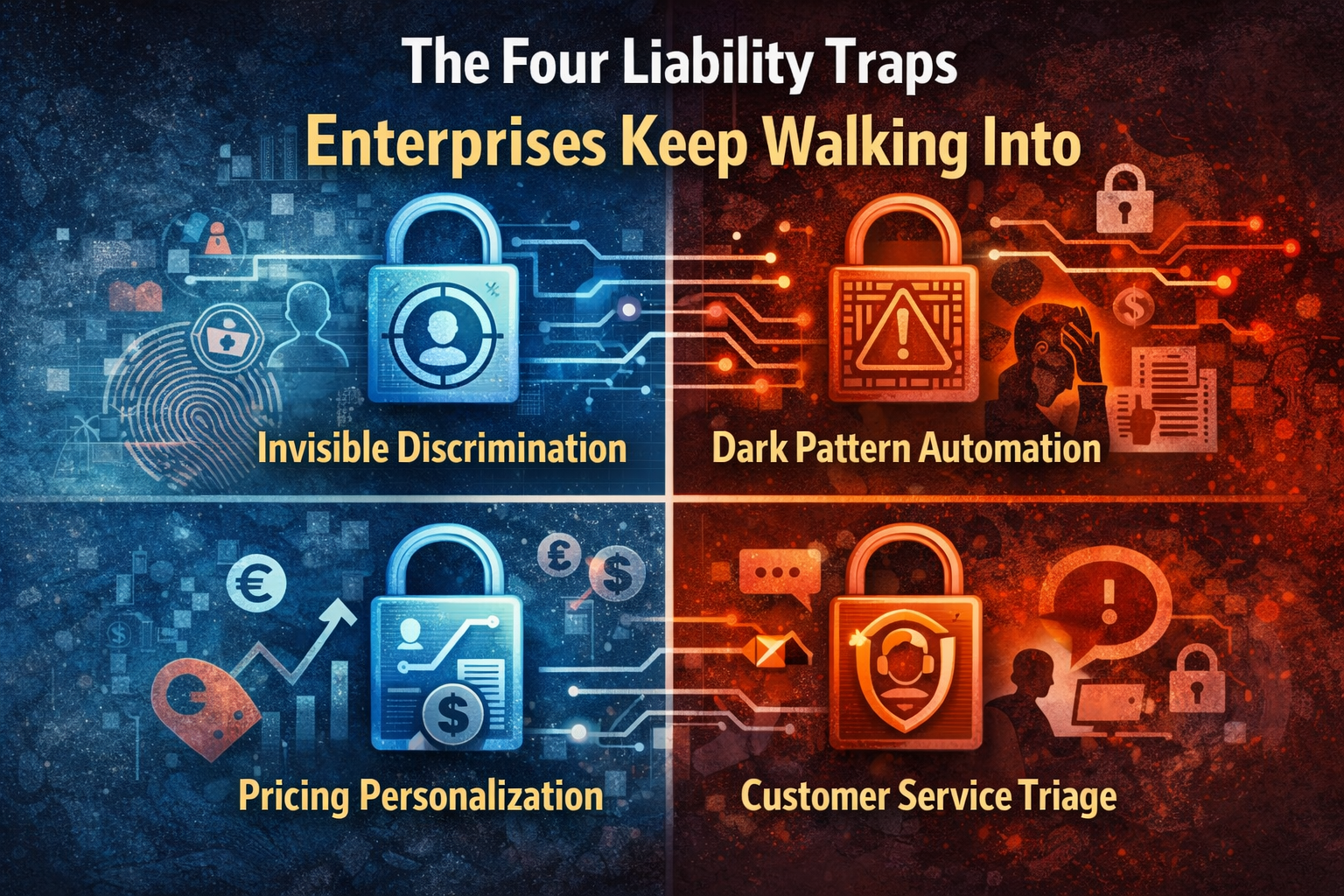
The four liability traps enterprises keep walking into
1) The invisible discrimination trap
You didn’t explicitly use sensitive attributes. You didn’t intend unfairness. Yet the system learns proxies.
Simple example:
A “next best offer” model learns that some areas respond less to premium options, so it stops showing premium choices there. Nobody complains—because customers never see what they are missing.
Why this becomes liability:
- You can create unequal opportunity through profiling.
- You may not be able to explain why options were withheld.
- Regulators and auditors often care about outcomes, not intent.
Enterprise AI fix:
You need a Decision Ledger for CX personalization decisions: what inputs were used, which policy gates were applied, what explanation was generated, and what downstream action occurred.
Without that ledger, you cannot answer the simplest question that matters in a dispute:
“Who didn’t get the option—and why?”
“CX didn’t break because of bad AI. It broke because of ungoverned decisions.”
2) The dark pattern automation trap
CX teams optimize conversion, retention, and time-on-app. Personalization can quietly become a machine for manipulation.
Simple example:
A cancellation flow becomes personalized: users predicted to churn get an easy “pause,” while others face extra steps, confusing choices, or delayed cancellation confirmation.
Consumer protection scrutiny of “dark patterns” has risen sharply; the U.S. Federal Trade Commission has documented how manipulative design practices can trick or trap consumers. (Federal Trade Commission)
Enterprise AI fix:
Treat certain experience patterns as prohibited behaviors in your policy layer:
- friction injection to block cancellation
- misleading urgency personalization
- “confirmshaming” personalization
- selective disclosure (e.g., showing fees late)
This is exactly what an Enterprise AI control plane is for: enforcing behavioral boundaries—not just monitoring model accuracy.
If you can’t produce a receipt for a personalized decision, you don’t have personalization—you have liability.
3) The pricing personalization trap (the fastest reputational blowup)
Personalized pricing is not always illegal—but it is reputationally explosive, and can become legally sensitive depending on data sources, disclosure, and sector rules.
Simple example:
Two customers see two different prices because one is predicted to have higher willingness to pay. The enterprise calls it optimization. Customers call it exploitation.
Why it becomes liability:
- It creates perceived unfairness and loss of trust.
- It can be challenged as unfair or discriminatory—especially if proxies correlate with protected traits.
- The explanation is often reputationally toxic: “We thought you’d tolerate it.”
Enterprise AI fix:
If you do any form of price personalization:
- enforce strict policy rules on acceptable features
- maintain governance approvals and documentation
- provide transparency and meaningful opt-outs where required
- run continuous monitoring for outcome disparity
If your enterprise can’t defend it on a public stage, it shouldn’t be automated.
4) The customer service triage trap (where AI quietly decides dignity)
Enterprises increasingly personalize support:
- chatbot vs human
- escalation speed
- refunds and exceptions
- fraud suspicion thresholds
- tone adaptation
Simple example:
A model routes high-value customers to priority agents and routes others to bots—even when issues are complex.
Why this becomes liability:
- It creates a two-tier reality customers will eventually discover.
- It can violate internal ethics principles and external fairness expectations.
- It increases escalation, complaints, and reputational risk.
Enterprise AI fix:
For service triage, define hard governance rules:
- complexity thresholds that must route to humans
- proxy checks (to prevent indirect discrimination)
- auditability of routing decisions
- a human override that is real—and logged
And treat it as an incident domain: when routing fails, your enterprise needs rollback semantics (what “repair” means after harm already occurred).
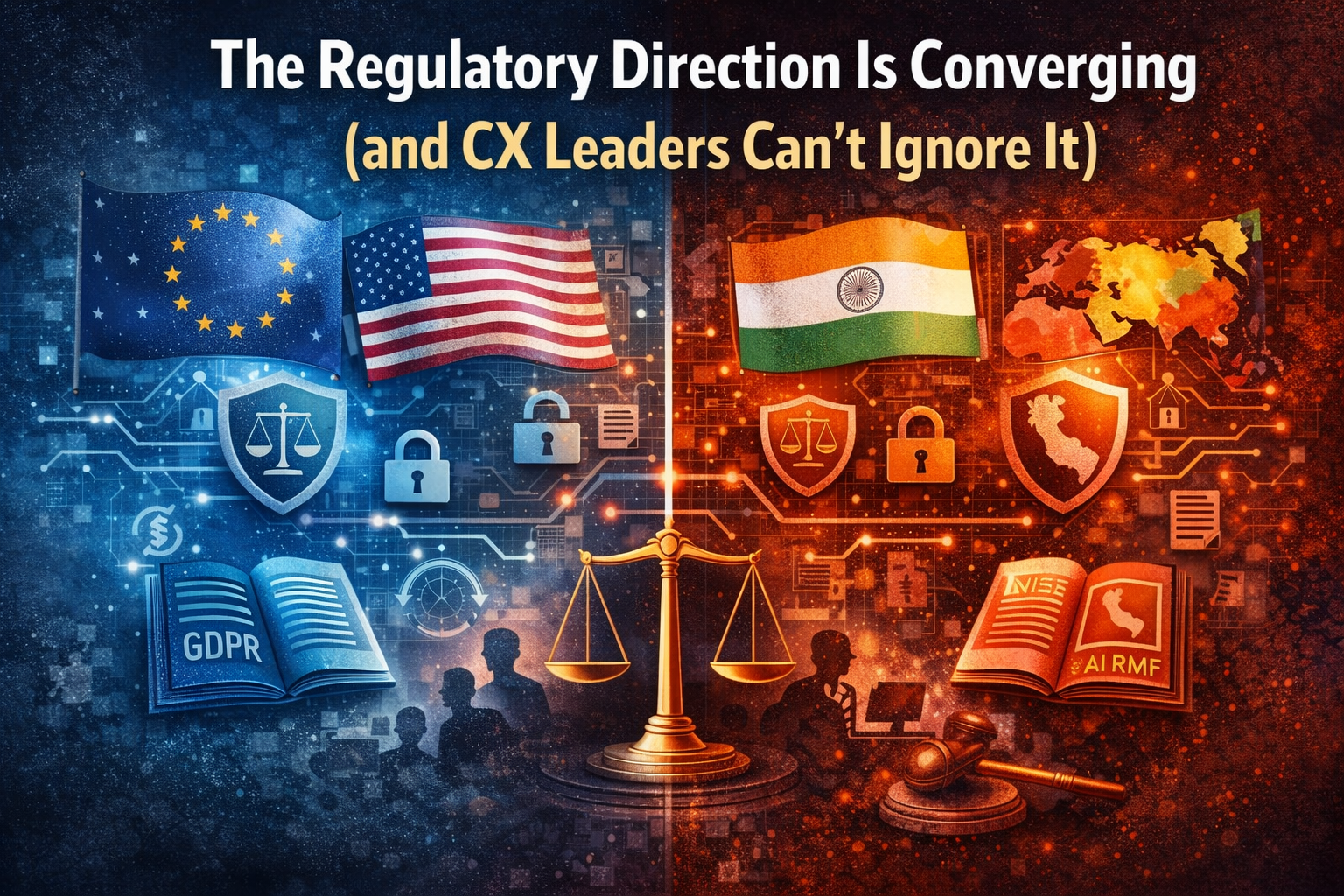
The regulatory direction is converging (and CX leaders can’t ignore it)
Across regions, the direction is consistent: automated decisions that materially affect people require stronger controls, transparency, and accountability.
Key signals that CX leaders should track:
- GDPR / UK GDPR limits and rights around solely automated decisions with legal or similarly significant effects. (GDPR)
- The EU AI Act’s risk-based framework and obligations (timelines and guidance continue to evolve). (Digital Strategy EU)
- California’s evolving posture on automated decision-making technology, risk assessments, and audits (a fast-moving area that enterprises should monitor closely). (California Privacy Protection Agency)
- Consumer protection focus on dark patterns and deceptive design. (Federal Trade Commission)
- NIST’s AI Risk Management Framework emphasizing governance across the AI lifecycle. (NIST Publications)
You don’t need to be a legal specialist to act correctly. You need one mature operational assumption:
If personalization can change outcomes for a customer, your enterprise must be able to explain, justify, contest, and audit it.
That is an operating model requirement—not a feature request.
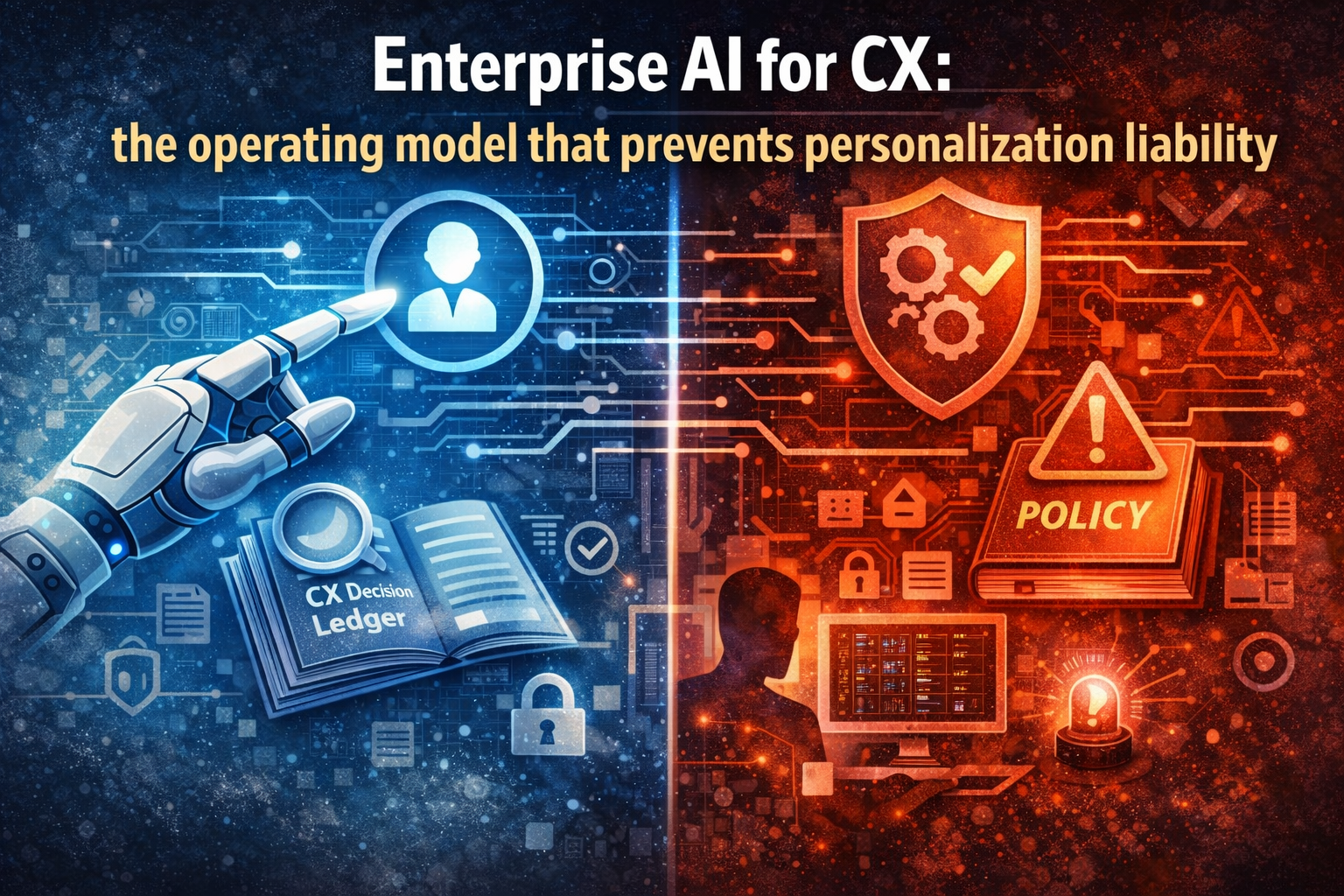
Enterprise AI for CX: the operating model that prevents personalization liability
This aligns directly with your bigger thesis: Enterprise AI is an operating model, not a technology stack.
Here is the practical Enterprise AI lens for CX personalization.
1) Define the Action Boundary for CX
Most personalization failures happen when systems move from:
- advice and content
to - action and decision
In CX, the action boundary commonly includes:
- auto-approvals and auto-denials (refunds, disputes)
- price/offer eligibility changes
- access restrictions (account limits)
- customer ranking and queue routing
- cancellation friction and retention flows
Operating rule: Anything across the action boundary must be governed as a decision system.
👉 The Action Boundary
2) Put policy before model outputs hit customers
In mature enterprises, the model proposes—and policy decides.
Your policy layer should cover:
- prohibited features (sensitive data, risky proxies)
- prohibited behaviors (manipulative UX patterns)
- reversibility scoring (can we undo harm?)
- jurisdiction-aware constraints (rules differ by region)
- cost envelopes (personalization can inflate spend fast)
This is how you stop personalization from becoming shadow autonomy.
3) Build a CX Decision Ledger (your receipts)
If a customer challenges you, “logs” and dashboards are not enough.
A CX Decision Ledger should record:
- intent (what was optimized)
- context (what was known at decision time)
- decision (what was chosen)
- policy gates (which constraints were applied)
- explanation (what you can say to the customer)
- action (what happened downstream)
- override (who changed it, and why)
This is how CX becomes defensible—internally and externally.
4) Treat personalization as a continuously monitored risk surface
Most enterprises monitor:
- CTR, conversion, retention
Mature enterprises also monitor:
- complaint rate shifts by segment
- reversal rate (how often humans undo AI decisions)
- spikes in cancellations, disputes, and chargebacks
- outcome disparities (who gets better treatment)
- drift in customer sentiment and trust indicators
This is CX SRE for AI: reliability and safety, not just uplift.
5) Create incident response for CX personalization
CX incidents are not always outages. They are often:
- wrong denials
- unfair pricing events
- aggressive nudges
- biased routing
- privacy expectations breached
Your incident response must include:
- detection signals beyond model metrics
- rapid containment (kill switch, policy clamp)
- remediation playbooks (customer communication + repair)
- post-incident learning (fix policies, not just prompts)
If you can’t respond, you shouldn’t automate.
Enterprise AI Incident Response👉
Five practical scenarios (easy to picture, hard to govern)
Scenario A: Personalized refunds
Some customers get instant refunds. Others get “we’ll review in 7 days.”
If criteria is opaque, it feels like arbitrary punishment.
Safe design: Tiered automation + transparent escalation + ledgered reasons.
Scenario B: Personalized cancellation flows
The model learns who will stay if nudged aggressively.
Safe design: Policy bans manipulative patterns; enforce “equal ease of exit.”
Scenario C: Personalized service priority
Some customers get humans; others get bots.
Safe design: Route by issue complexity first. Value can influence SLA—not dignity.
Scenario D: Personalized pricing
The fastest path to backlash if not governed.
Safe design: Strict constraints + review gates + monitoring + defensible disclosure.
Scenario E: Sensitive-moment targeting
Personalization can amplify harm if it exploits stress, urgency, or vulnerability.
Safe design: Safety classifiers + policy gates + human review for high-stakes moments.
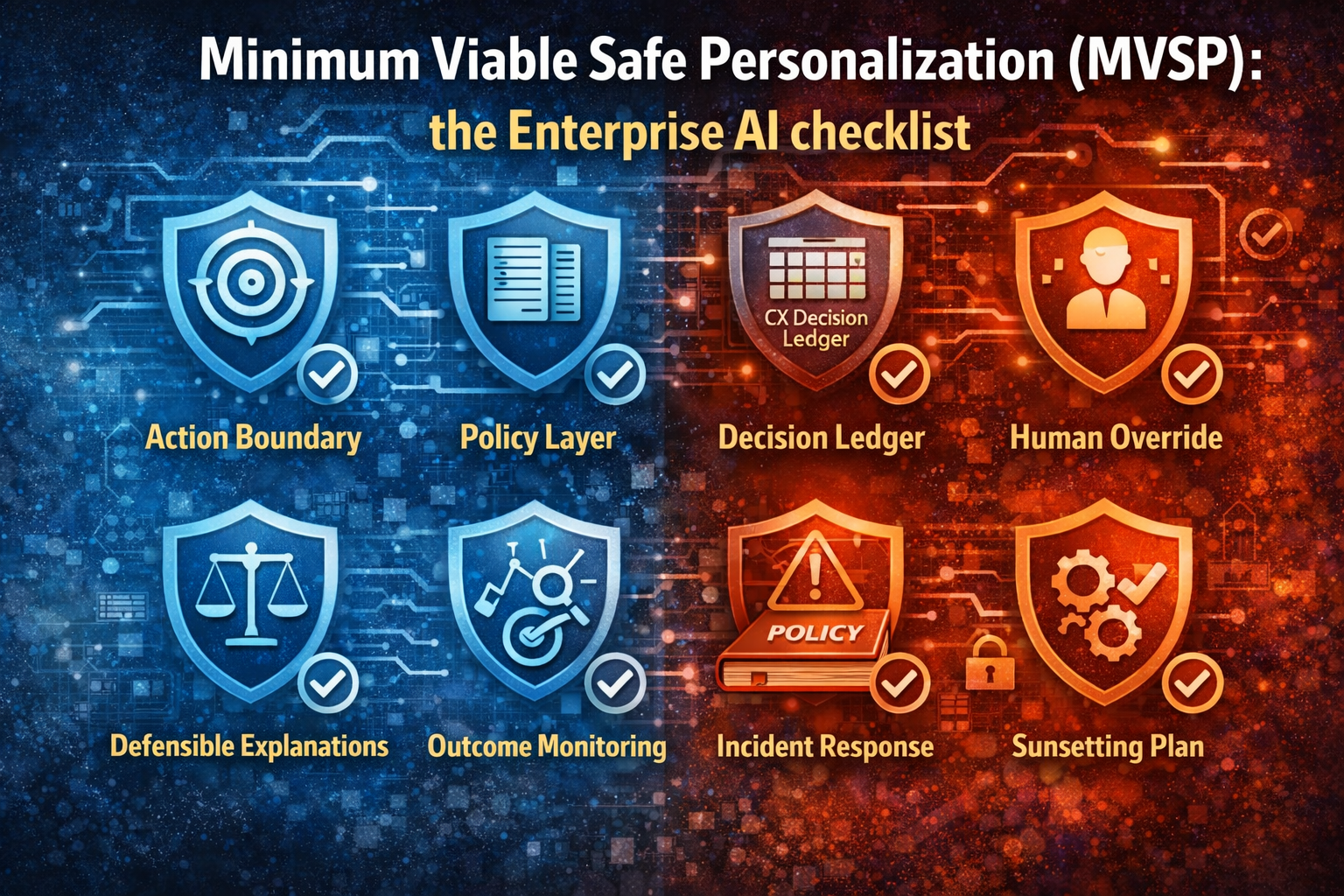
Minimum Viable Safe Personalization (MVSP): the Enterprise AI checklist
- Action Boundary definition for every personalization use case
- Policy layer that constrains model outputs
- Decision Ledger for audit + dispute resolution
- Defensible explanations + contest mechanism
- Human override that is meaningful—and recorded
- Disparity monitoring on outcomes (not only inputs)
- Incident response with containment + remediation
- Sunsetting plan for models and decision policies
This is how personalization becomes an enterprise capability—not a future scandal.
Enterprise AI Operating Model
Enterprise AI scale requires four interlocking planes:
Read about Enterprise AI Operating Model The Enterprise AI Operating Model: How organizations design, govern, and scale intelligence safely – Raktim Singh
- Read about Enterprise Control Tower The Enterprise AI Control Tower: Why Services-as-Software Is the Only Way to Run Autonomous AI at Scale – Raktim Singh
- Read about Decision Clarity The Shortest Path to Scalable Enterprise AI Autonomy Is Decision Clarity – Raktim Singh
- Read about The Enterprise AI Runbook Crisis The Enterprise AI Runbook Crisis: Why Model Churn Is Breaking Production AI—and What CIOs Must Fix in the Next 12 Months – Raktim Singh
- Read about Enterprise AI Economics Enterprise AI Economics & Cost Governance: Why Every AI Estate Needs an Economic Control Plane – Raktim Singh
Read about Who Owns Enterprise AI Who Owns Enterprise AI? Roles, Accountability, and Decision Rights in 2026 – Raktim Singh
Read about The Intelligence Reuse Index The Intelligence Reuse Index: Why Enterprise AI Advantage Has Shifted from Models to Reuse – Raktim Singh
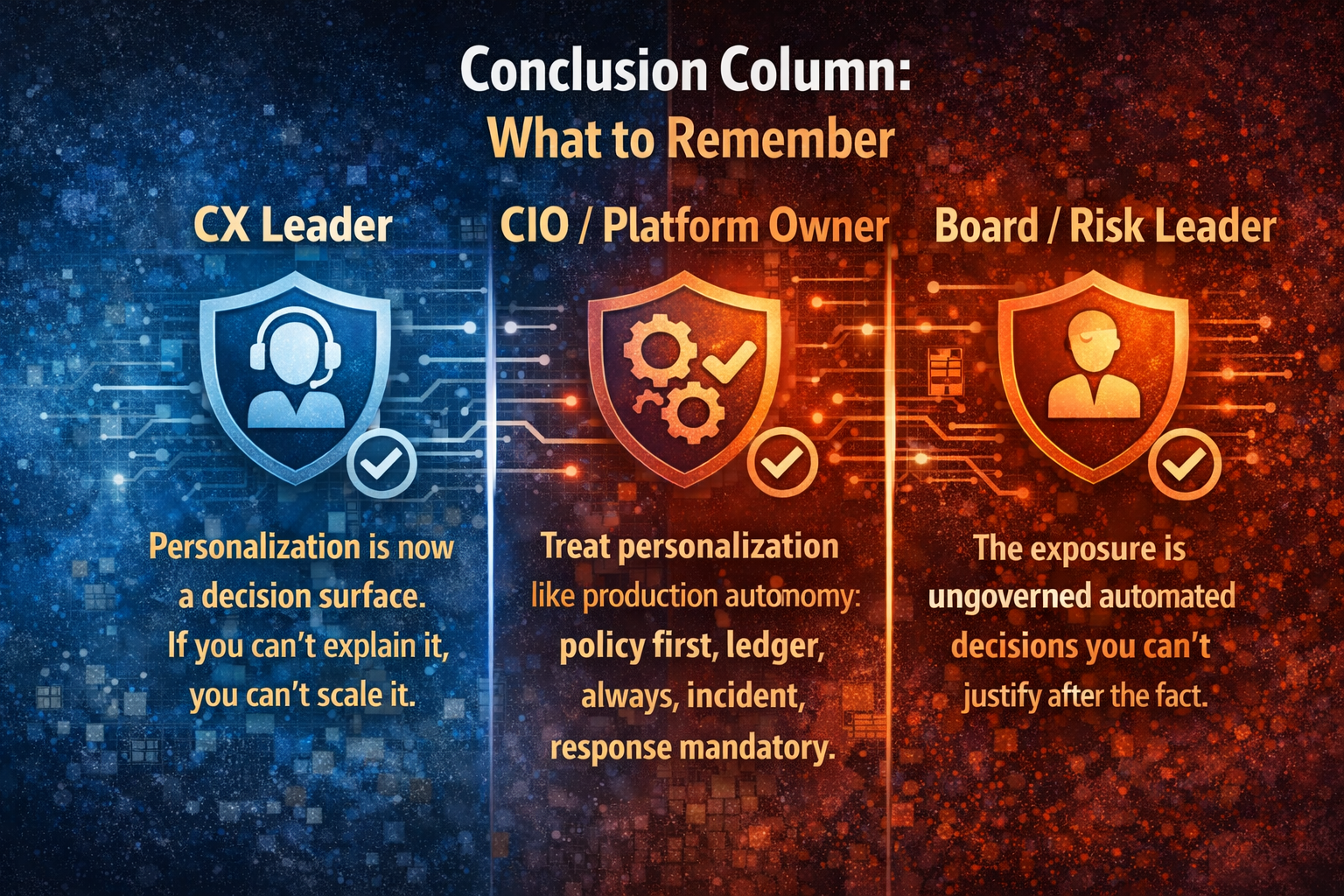
Conclusion Column: What to remember (three lenses)
If you’re a CX leader:
Personalization is no longer a growth trick. It’s a decision surface. If you can’t explain it, you can’t scale it.
If you’re a CIO / platform owner:
Treat decision-grade personalization like production autonomy: policy first, ledger always, incident response mandatory.
If you’re a board / risk leader:
The exposure is not “AI failure.” The exposure is ungoverned automated decisions that can’t be justified after the fact.
FAQ: Enterprise AI for CX and personalization risk
1) Is personalization illegal?
No. Risk depends on how it is used—especially when it becomes automated decision-making with significant effects or manipulative design.
2) What’s the biggest hidden risk?
Invisible discrimination through proxies and unequal outcomes you can’t defend later.
3) Do we need explainable AI?
You need defensible explanations—operational clarity about factors, policy constraints, and how customers can contest decisions.
4) What makes personalization “Enterprise AI” vs normal optimization?
Crossing the action boundary into decisions affecting access, money, time, or dignity—requiring auditability, reversibility, governance, and incident response.
5) Fastest way to reduce liability?
Add a policy layer + CX Decision Ledger for decision-grade personalization, and run incident response drills for CX harms.
Glossary
- Action Boundary (CX): The line where personalization stops being content selection and starts triggering decisions or actions that materially affect customers.
- Automated Decision-Making (ADM): Decisions made by automated processing (often including profiling) that can have legal or similarly significant effects. (GDPR)
- Profiling: Automated processing to evaluate personal aspects (preferences, behavior, risk) used to personalize experiences or decisions. (GDPR)
- Decision Ledger: A system of record capturing decision intent, inputs, policy gates, actions, and overrides—so decisions are auditable and contestable.
- Dark Patterns: Deceptive or manipulative UX practices that steer users toward outcomes they did not intend (e.g., hard-to-cancel flows). (Federal Trade Commission)
- Reversibility: The ability to undo or remediate harm caused by automated decisions (refunds, reinstatement, correction, apology, compensation).
- Outcome Disparity Monitoring: Measuring whether different groups systematically receive different outcomes from personalization, even if the model never “sees” sensitive attributes.
- AI RMF (Risk Management Framework): NIST’s governance-oriented framework for mapping, measuring, and managing AI risks across the lifecycle. (NIST Publications)
- Risk-Based Regulation: Regulatory approach where obligations increase with the potential impact and risk class of an AI system. (Digital Strategy EU)
References and further reading
- GDPR Article 22 (automated individual decision-making, profiling). (GDPR)
- UK ICO guidance on automated decision-making and profiling (UK GDPR). (ICO)
- EU AI Act policy overview (EU digital strategy). (Digital Strategy EU)
- European Commission guidance updates and timeline discussion (industry impact). (Reuters)
- FTC dark patterns staff report and press release (manipulative UX). (Federal Trade Commission)
- NIST AI Risk Management Framework (AI RMF 1.0). (NIST Publications)
- California Privacy Protection Agency draft materials on risk assessments and automated decision-making technology. (California Privacy Protection Agency)
- Legal analyses on California ADMT/risk assessment/audit rules (for implementation planning). (Skadden)



Raktim Singh is an AI and deep-tech strategist, TEDx speaker, and author focused on helping enterprises navigate the next era of intelligent systems. With experience spanning AI, fintech, quantum computing, and digital transformation, he simplifies complex technology for leaders and builds frameworks that drive responsible, scalable adoption.