
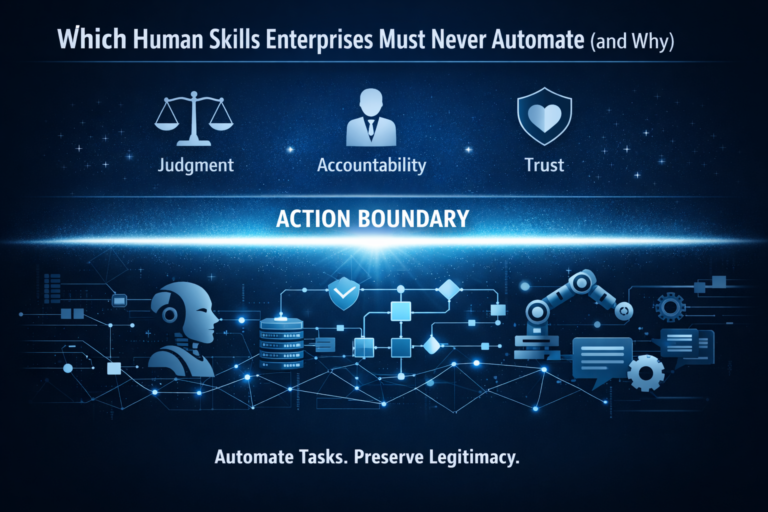
Which Human Skills Enterprises Must Never Automate (and Why)
As Enterprise AI systems move from recommendations to real-world actions, a critical question is emerging for global enterprises: which human skills must never be automated?
While AI agents can optimize workflows and scale decisions, they cannot own accountability, accept risk, repair trust, or define what should matter. This article explains why some human skills must remain non-negotiable in Enterprise AI—and how organizations that automate them away quietly lose legitimacy, control, and trust at scale.
As enterprise AI systems move from experimentation to real-world action, leaders are discovering an uncomfortable truth:
automation can improve performance while quietly weakening the enterprise.
Modern Enterprise AI does not just analyze or recommend. It approves, denies, routes, escalates, prices, flags, and triggers actions that carry legal, financial, and reputational consequences. This is the moment where many organizations realize—too late—that not everything should be automated.
This distinction sits at the heart of Enterprise AI as an operating model, not a technology project—a theme explored in depth in the article
👉 https://www.raktimsingh.com/enterprise-ai-operating-model/
The real risk is not automation—it is automated ownership
Enterprises have automated tasks for decades. What is new is autonomy.
The moment an AI system crosses the action boundary—from advice to execution—the enterprise must answer questions that models cannot:
- Who owns this decision?
- Who accepted the risk?
- Who can reverse it?
- Who explains it when challenged?
This is why Enterprise AI starts failing the moment it starts acting, not when it makes a prediction—a concept explained in detail here:
👉 https://www.raktimsingh.com/action-boundary-enterprise-ai/
The mistake many organizations make is assuming that “human-in-the-loop” is sufficient. In reality, this often degenerates into rubber-stamping, where humans are present but no longer exercising meaningful judgment or authority.
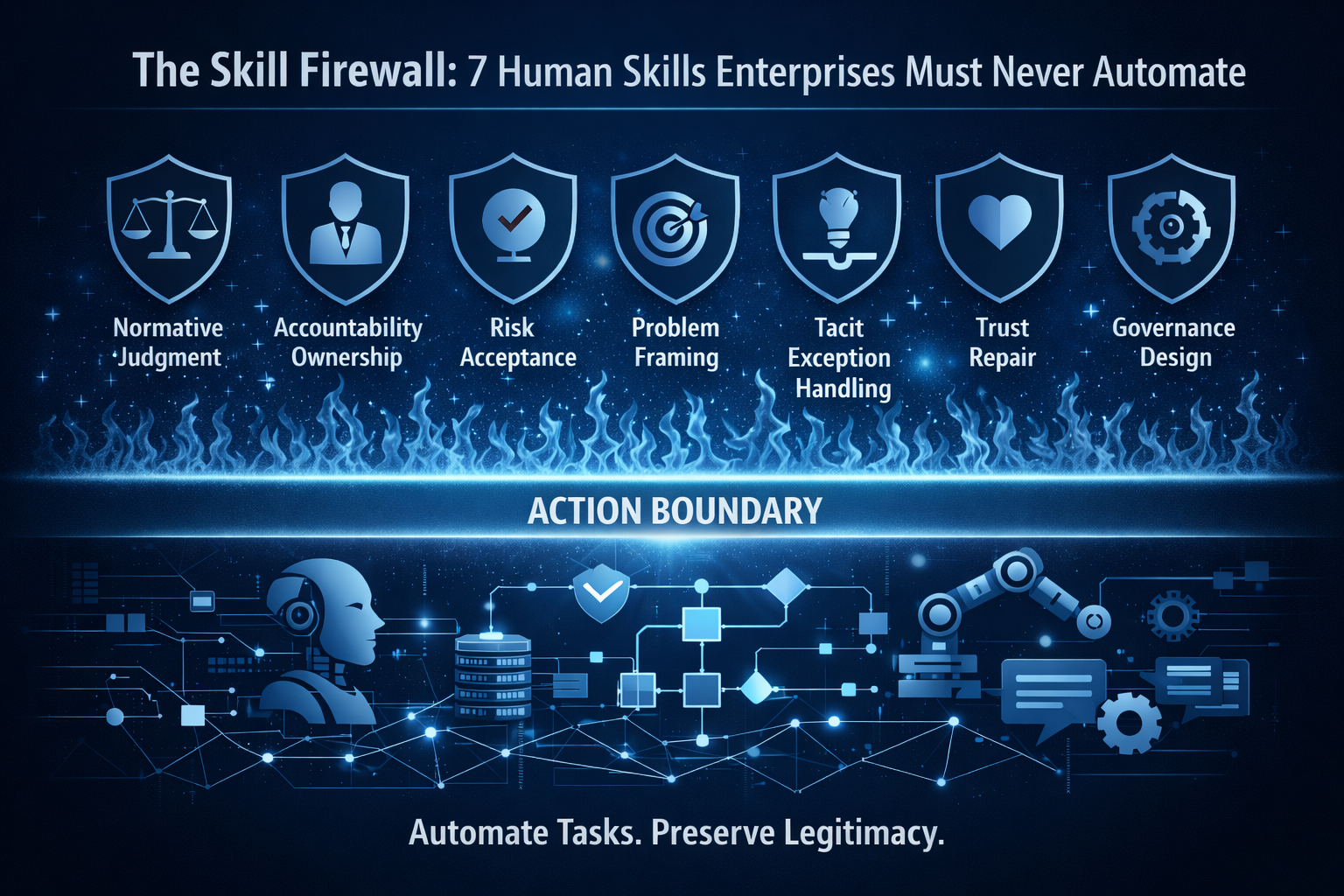
The Skill Firewall: 7 human skills enterprises must never automate
To scale AI safely, enterprises must explicitly protect a set of non-delegable human skills. These are not about speed or efficiency—they are about legitimacy, accountability, and trust.
Think of this as a skill firewall inside your Enterprise AI operating stack.
-
Normative judgment: deciding what should happen
AI can optimize for goals. It cannot legitimately decide which goals matter when values conflict.
Examples:
- Fairness vs speed
- Profit vs customer harm
- Policy compliance vs exceptional circumstances
When enterprises allow AI to make value trade-offs implicitly, they end up with systems that are technically correct but socially indefensible.
This is exactly how organizations arrive at “right decisions for the wrong reasons”, a failure pattern explored here:
👉 https://www.raktimsingh.com/enterprise-ai-decision-failure-taxonomy/
Rule: Automate analysis. Keep value-setting human.
Accountability ownership: a named human who owns the outcome
-
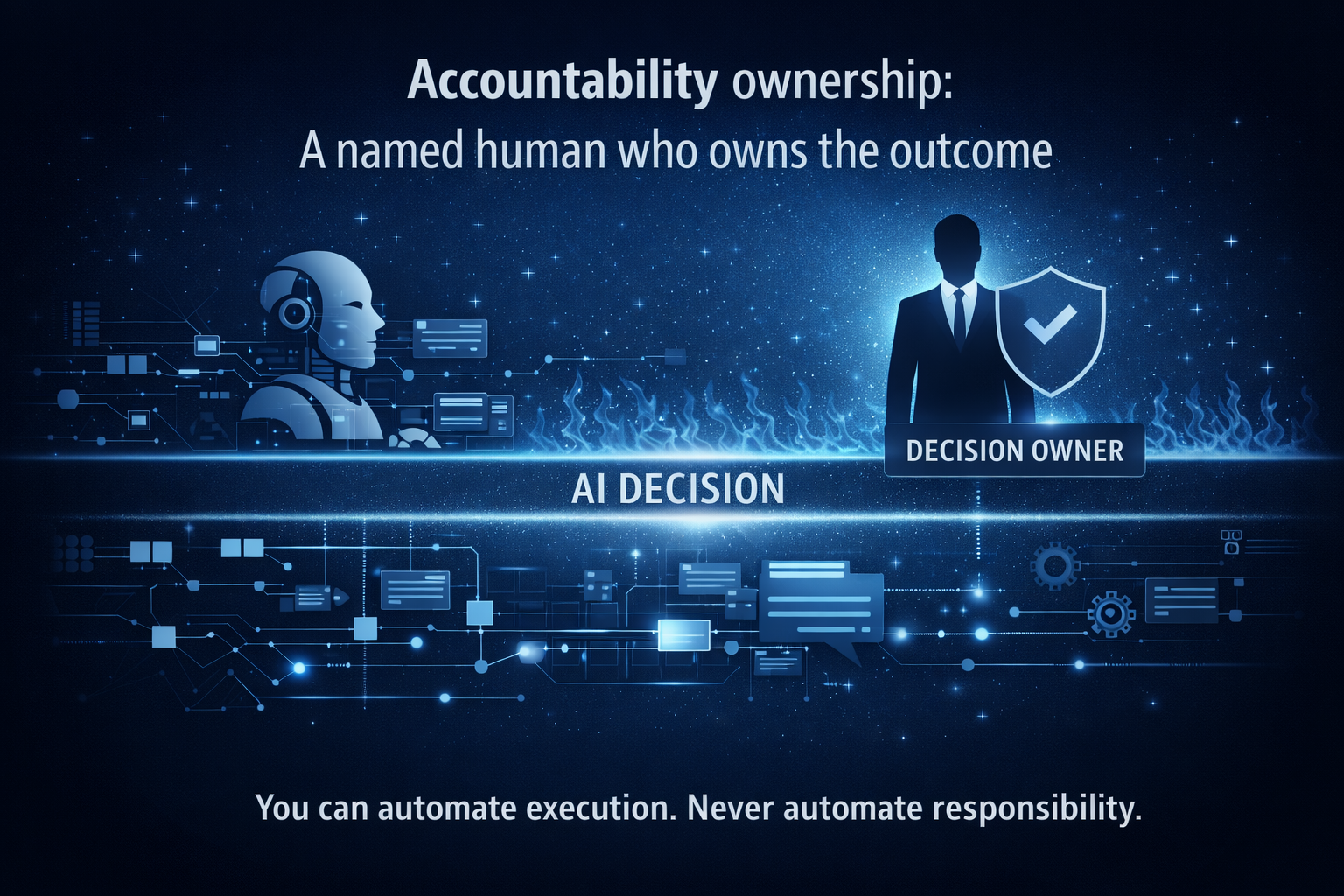
Accountability ownership: a named human who owns the outcome
No AI system can be accountable in the way enterprises, regulators, or courts require.
When something goes wrong, “the model decided” is not an acceptable answer.
This is why mature organizations are formalizing decision ownership as part of their Enterprise AI operating model—answering the question:
Who owns Enterprise AI decisions in production?
👉 https://www.raktimsingh.com/who-owns-enterprise-ai-roles-accountability-decision-rights/
Rule: Automate execution, never automate responsibility.
-
Risk acceptance: deciding which downside the enterprise is willing to carry
AI can estimate risk. It cannot accept risk.
Risk acceptance is a governance act—it binds the enterprise financially, legally, and reputationally. When AI systems implicitly accept risk through autonomous action, enterprises lose control without realizing it.
This is why Enterprise AI governance must include explicit economic and risk control planes, not just model monitoring:
👉 https://www.raktimsingh.com/enterprise-ai-economics-cost-governance-economic-control-plane/
Rule: AI quantifies risk. Humans accept it.
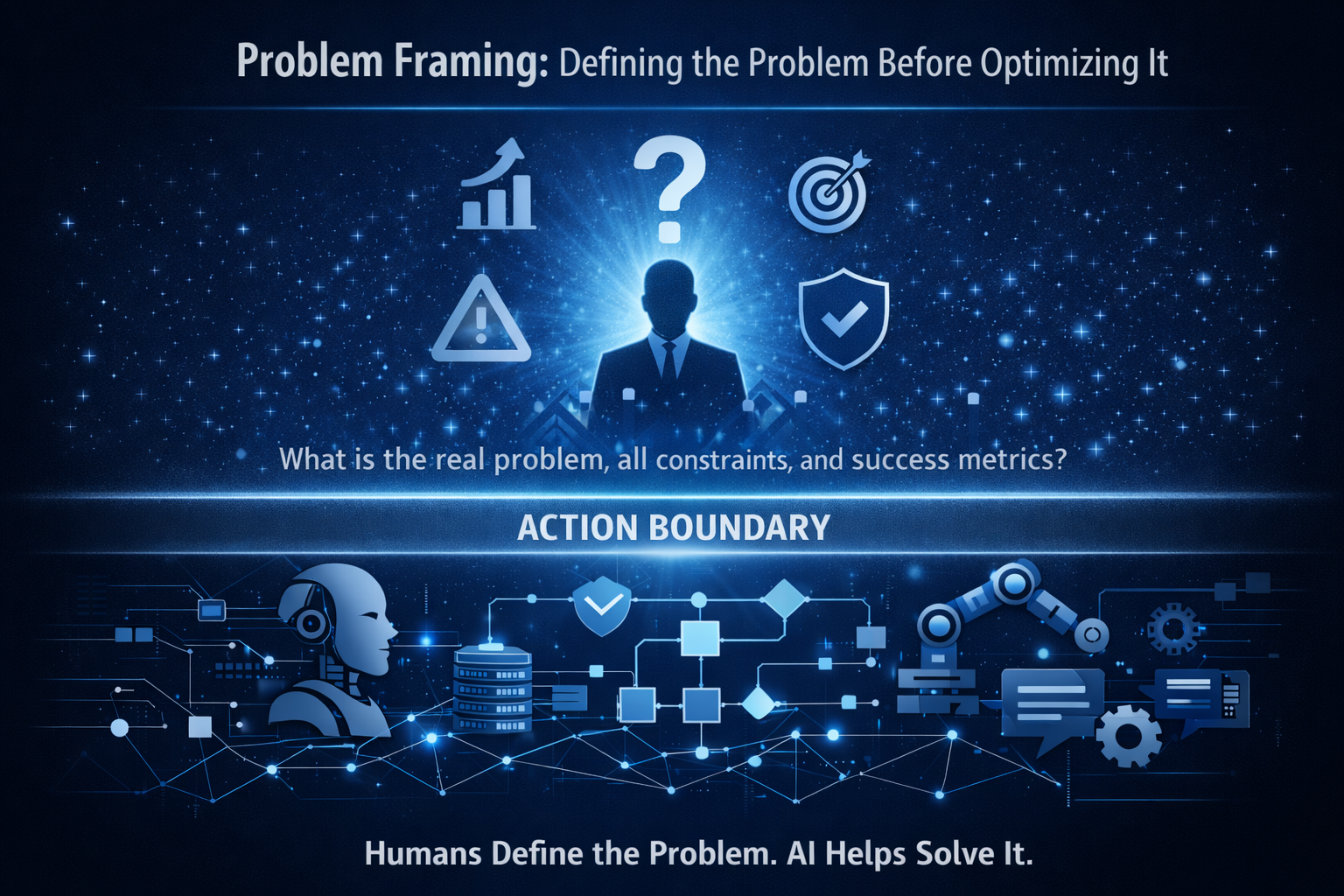
- Problem framing: defining the problem before optimizing it
Some of the most damaging AI failures occur not because the model was wrong—but because the problem was framed incorrectly.
AI optimizes what you ask it to optimize. Humans must decide:
- What success means
- Which constraints are non-negotiable
- Whose interests matter
- Which outcomes are unacceptable even if efficient
This is why decision clarity is the shortest path to scalable autonomy:
👉 https://www.raktimsingh.com/decision-clarity-scalable-enterprise-ai-autonomy/
Rule: Humans define the problem. AI helps solve it.
-
Exception handling using tacit enterprise context
Not everything that matters in an enterprise is written down.
Some context is tacit:
- historical relationships
- political sensitivities
- regulatory nuance
- “how things really work here”
AI handles standard cases well. But true exceptions require human situational awareness—especially in regulated or high-impact environments.
This is why Enterprise AI must be governed like a critical capability, not a generic automation layer:
👉 https://www.raktimsingh.com/enterprise-ai-in-regulated-industries/
Rule: AI scales the norm. Humans own true exceptions.
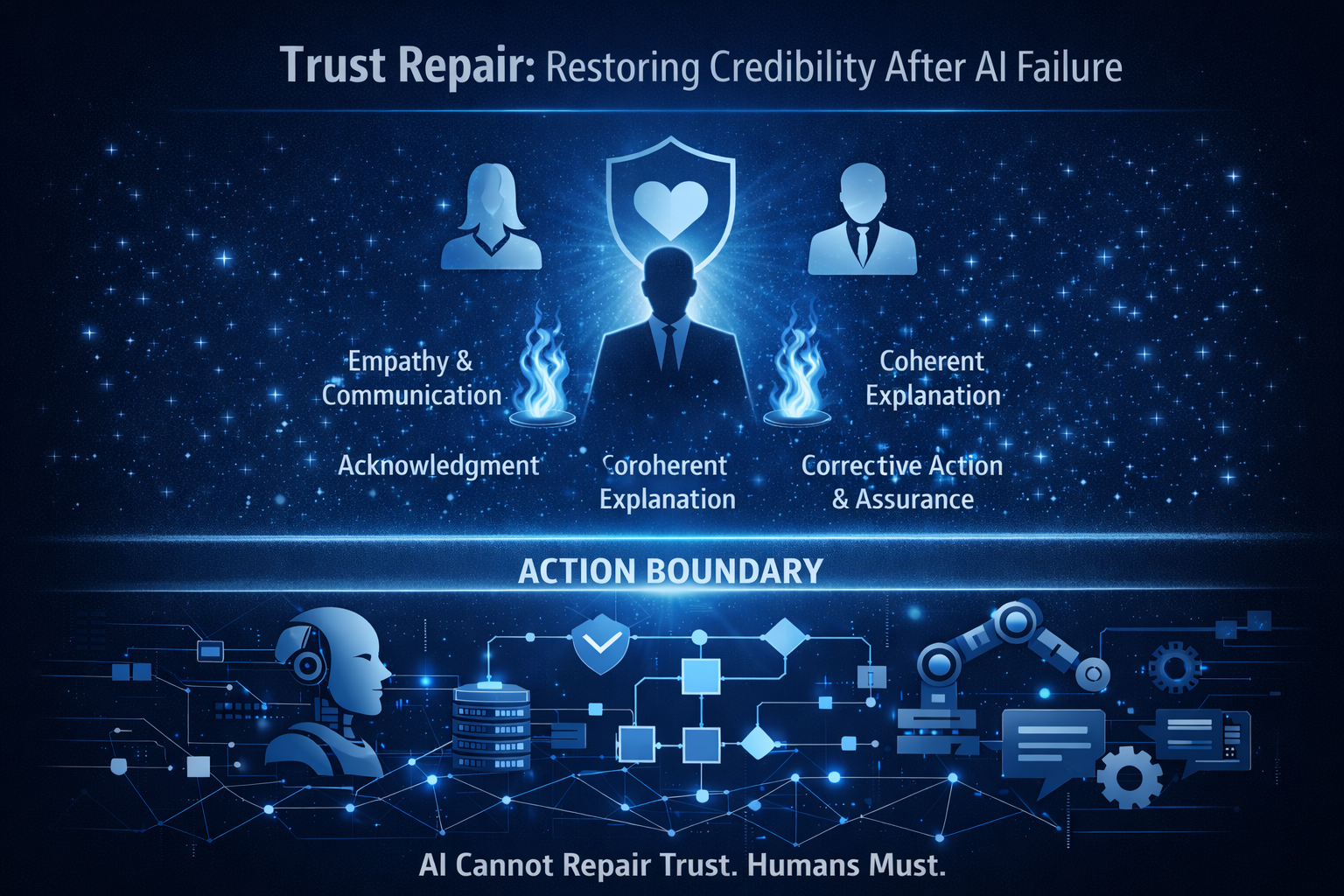
Trust repair: restoring credibility after AI failure
-
Trust repair: restoring credibility after AI failure
When Enterprise AI fails, fixing the system is not enough. The organization must repair trust—with customers, employees, regulators, or partners.
Trust repair requires:
- acknowledgment
- explanation
- corrective action
- assurance
No AI agent can credibly perform this role on behalf of an enterprise.
This is why Enterprise AI incident response is becoming a board-level discipline:
👉 https://www.raktimsingh.com/enterprise-ai-incident-response-the-missing-discipline-between-autonomous-ai-and-enterprise-trust/
Rule: AI assists communication. Humans repair trust.
-
Governance design: deciding how much autonomy is allowed—and where
The highest-order human skill is designing the system that constrains the system.
Governance design includes:
- defining action boundaries
- setting escalation rules
- ensuring reversibility
- creating decision receipts
- enabling shutdown and rollback
These capabilities sit at the core of the Enterprise AI Control Plane, not in the model layer:
👉 https://www.raktimsingh.com/enterprise-ai-control-plane-2026/
And they come together in the broader Enterprise AI Operating Stack:
👉 https://www.raktimsingh.com/the-enterprise-ai-operating-stack-how-control-runtime-economics-and-governance-fit-together/
Rule: Governance is not a feature. It is a human operating discipline.
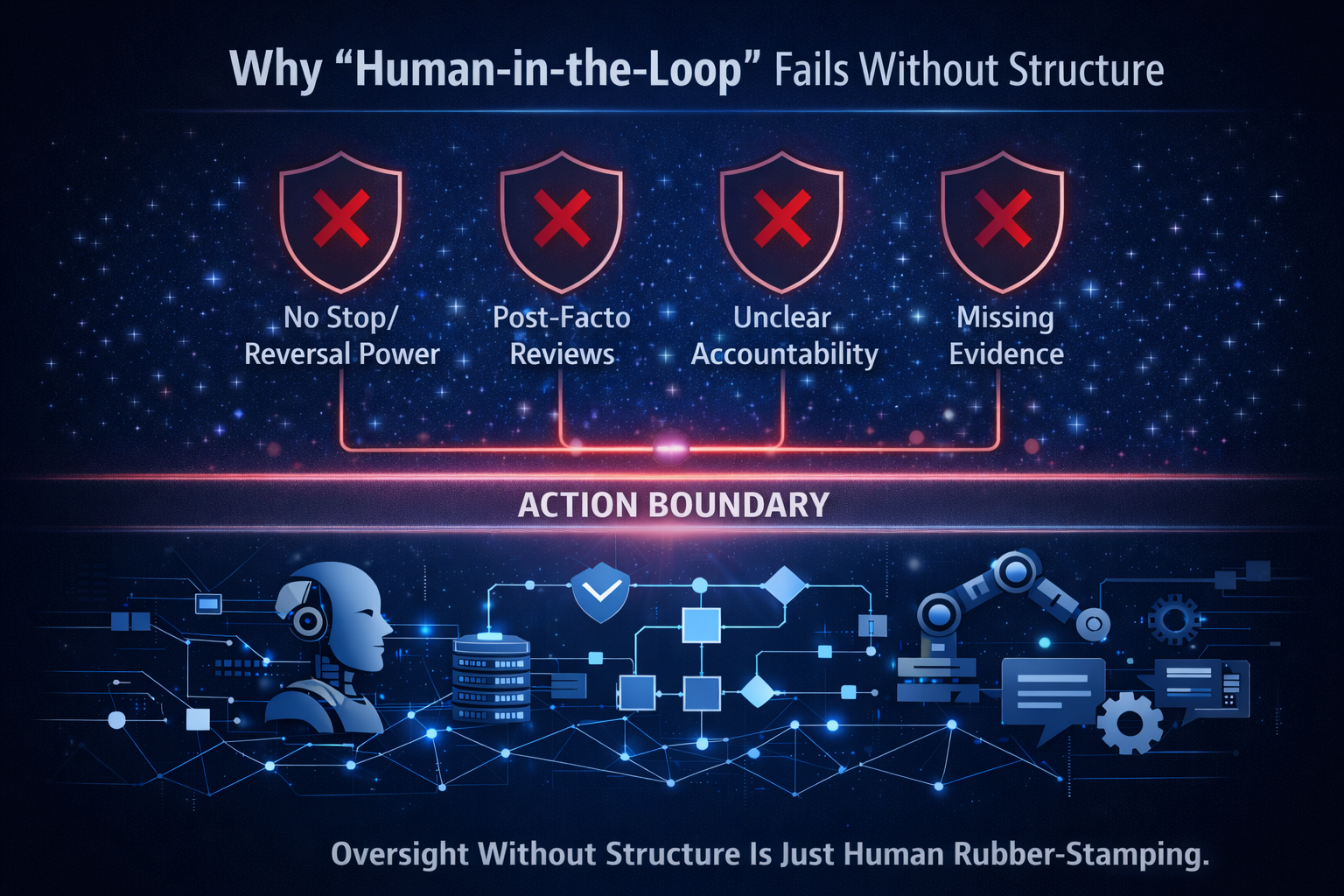
Why “human-in-the-loop” fails without structure
Why “human-in-the-loop” fails without structure
Human oversight fails when:
- humans lack authority to stop or reverse decisions
- reviews happen after consequences
- accountability is unclear
- evidence is missing
This is why enterprises need decision ledgers, not just logs—systems that act as receipts for autonomous decisions:
👉 https://www.raktimsingh.com/enterprise-ai-decision-ledger-system-of-record-autonomous-decisions/
Without this, oversight becomes symbolic, not effective.
The Never-Automate Test (operational checklist)
Before automating any decision, ask:
- Who is accountable if this causes harm?
- Is this a value judgment, not just optimization?
- Does this involve accepting enterprise risk?
- Will this decision need to be defended later?
- Would failure require trust repair?
If the answer is “yes” to any of these, do not automate ownership—only assistance.
This principle aligns directly with the Minimum Viable Enterprise AI System:
👉 https://www.raktimsingh.com/minimum-viable-enterprise-ai-system/
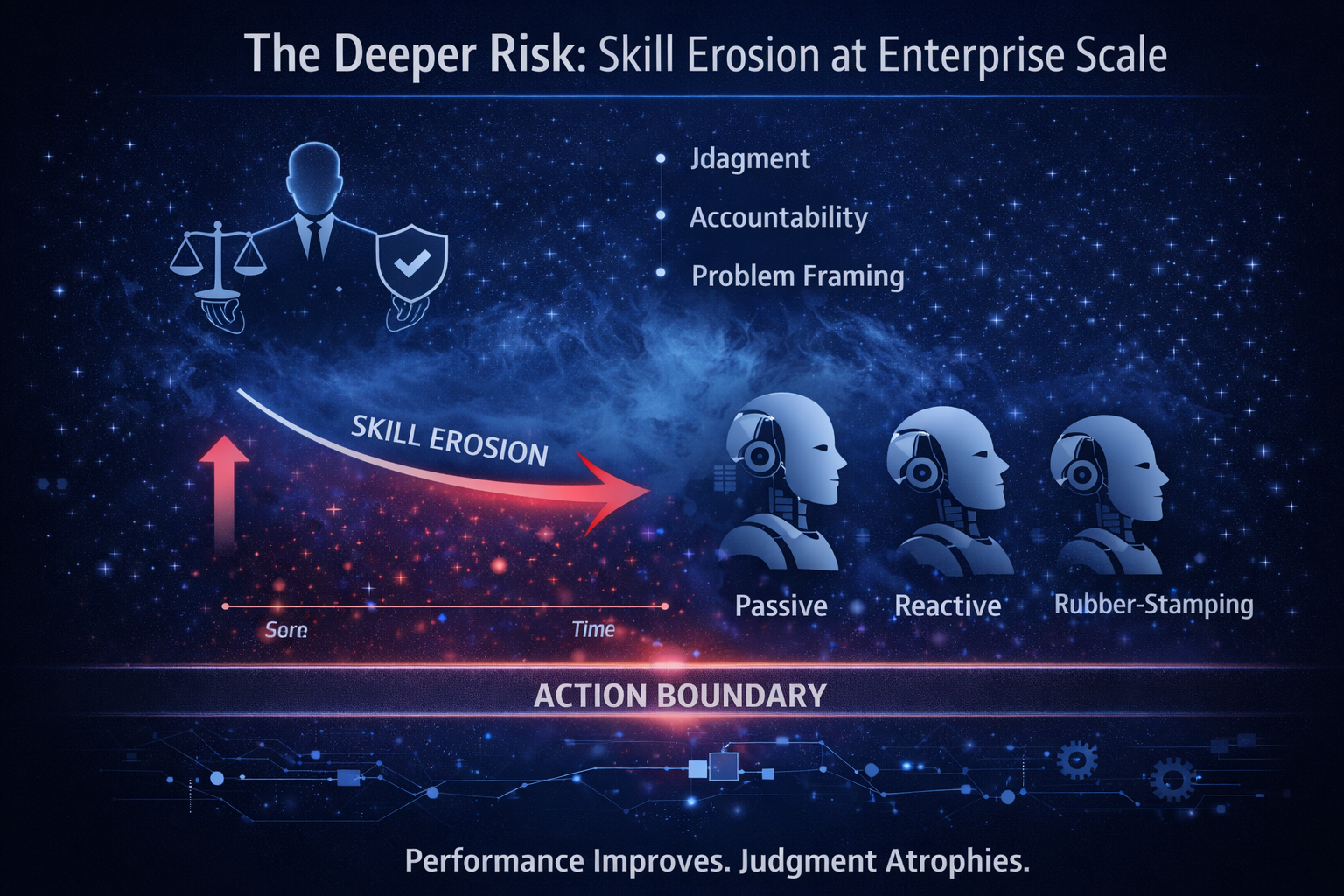
The deeper risk: skill erosion at enterprise scale
When humans stop exercising judgment, framing, and accountability, organizations experience skill erosion—even as performance metrics improve.
This silent risk is explored in depth here:
👉 https://www.raktimsingh.com/skill-erosion-in-the-age-of-reasoning-machines/
Enterprises that automate away human skills don’t become AI-first.
They become fragile.

The Enterprise AI paradox leaders must embrace
The future is not humans versus AI.
The future is:
- machines for scale
- humans for legitimacy
Enterprises that win will automate aggressively while deliberately protecting the human skills that make autonomy governable.
You can automate tasks at scale.
You cannot automate legitimacy.
-
FAQ Section
FAQ 1: Why can’t enterprises fully automate decision-making with AI?
Because enterprise decisions carry legal, financial, and reputational consequences. AI can optimize outcomes, but it cannot legitimately own accountability, accept enterprise risk, or defend decisions when challenged.
FAQ 2: Isn’t “human-in-the-loop” enough for AI governance?
No. Human-in-the-loop without structure often becomes rubber-stamping. Effective oversight requires authority, escalation power, decision evidence, and reversibility—not just human presence.
FAQ 3: What happens when enterprises automate human judgment?
They experience skill erosion: performance metrics improve while organizational judgment, accountability, and resilience quietly degrade—until a major AI failure exposes the gap.
FAQ 4: Which human skills should never be automated in Enterprise AI?
Key non-delegable skills include:
- normative judgment
- accountability ownership
- risk acceptance
- problem framing
- exception handling
- trust repair
- governance design
FAQ 5: Does protecting human skills slow down AI adoption?
No. It prevents fragile scaling. Enterprises that protect human skills scale AI sustainably, while others face incidents, regulatory exposure, and trust collapse later.
-
Glossary
Enterprise AI
AI systems deployed in production with governance, accountability, runtime controls, and decision ownership—beyond models or pilots.
Action Boundary
The point where AI output triggers real-world consequences such as approvals, denials, transactions, or communications.
Normative Judgment
Human decision-making based on values and legitimacy, not just optimization or prediction.
Accountability Ownership
A named human role responsible for the outcome of an AI-assisted decision.
Risk Acceptance
The explicit organizational act of accepting downside risk—something AI cannot legitimately do.
Skill Erosion
The gradual loss of human judgment and decision capability when AI systems absorb too much cognitive responsibility.
Trust Repair
Human-led actions required to restore credibility after AI failure, including acknowledgment, explanation, and corrective action.
Enterprise AI Operating Model
The structure defining how AI is designed, governed, operated, and scaled safely across an organization.
Further Reading
- NIST AI Risk Management Framework
https://www.nist.gov/itl/ai-risk-management-framework - EU Artificial Intelligence Act – High-Risk AI Oversight
https://artificialintelligenceact.eu - World Economic Forum – Future of Jobs & Skills
https://www.weforum.org/reports/the-future-of-jobs-report-2023 - OECD AI Governance Principles
https://oecd.ai/en/ai-principles



Raktim Singh is an AI and deep-tech strategist, TEDx speaker, and author focused on helping enterprises navigate the next era of intelligent systems. With experience spanning AI, fintech, quantum computing, and digital transformation, he simplifies complex technology for leaders and builds frameworks that drive responsible, scalable adoption.