

Introduction: The New Enterprise Confusion
Enterprises are rushing toward AI agents.
Every process is being reimagined as an agentic workflow. Every product roadmap includes assistants. Every function is asking whether AI can summarize, generate, recommend, approve, test, monitor, or execute.
This is understandable. AI is becoming more capable, more accessible, and more deeply embedded into enterprise software. Gartner predicts that up to 40% of enterprise applications will include integrated task-specific AI agents by 2026, up from less than 5% in 2025. (Gartner)
But inside this enthusiasm sits a dangerous mistake.
Enterprises are asking:
“Where can we use AI?”
They should be asking:
“Where should we use AI, where should deterministic automation remain, and where must human judgment govern?”
This is the Autonomy Allocation Problem.
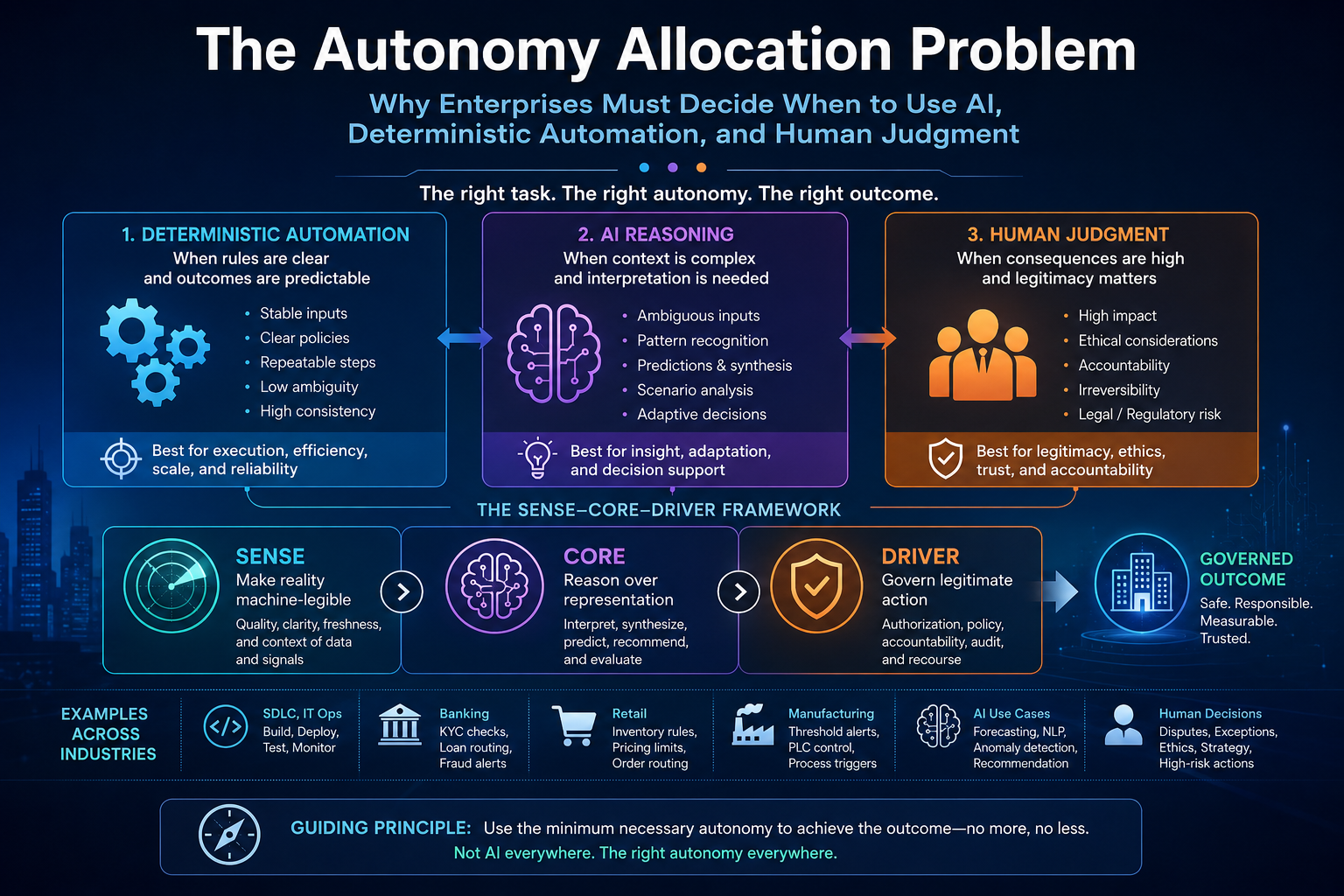
It is the problem of deciding the right execution model for each enterprise activity: deterministic automation, AI-assisted reasoning, autonomous AI action, or human-led judgment.
The issue is not whether AI is powerful. It is.
The issue is whether every workflow needs probabilistic intelligence.
It does not.
Some tasks need rules.
Some need reasoning.
Some need judgment.
Some need governance before action.
Some should never be fully autonomous.
This is where the SENSE–CORE–DRIVER framework becomes useful.
In the Representation Economy, intelligent institutions need three layers:
SENSE makes reality machine-legible.
CORE reasons over that representation.
DRIVER governs legitimate action.
The architecture matters because many enterprise AI failures do not come from weak models. They come from weak representation, weak boundaries, weak accountability, and weak judgment.
The Autonomy Allocation Problem extends SENSE–CORE–DRIVER into a practical decision framework for CIOs, CTOs, boards, product leaders, operations leaders, and transformation teams.
This article focuses specifically on the Autonomy Allocation Problem — deciding when a task calls for deterministic automation, AI reasoning, or human judgment. For the broader operating architecture this connects to — Control, Cognition, and Execution planes, plus the economics of reuse — see Enterprise AI Operating Model: A Practical Guide for CIOs and CTOs.
The Wrong Question: “Can AI Do This?”
The simplest question is:
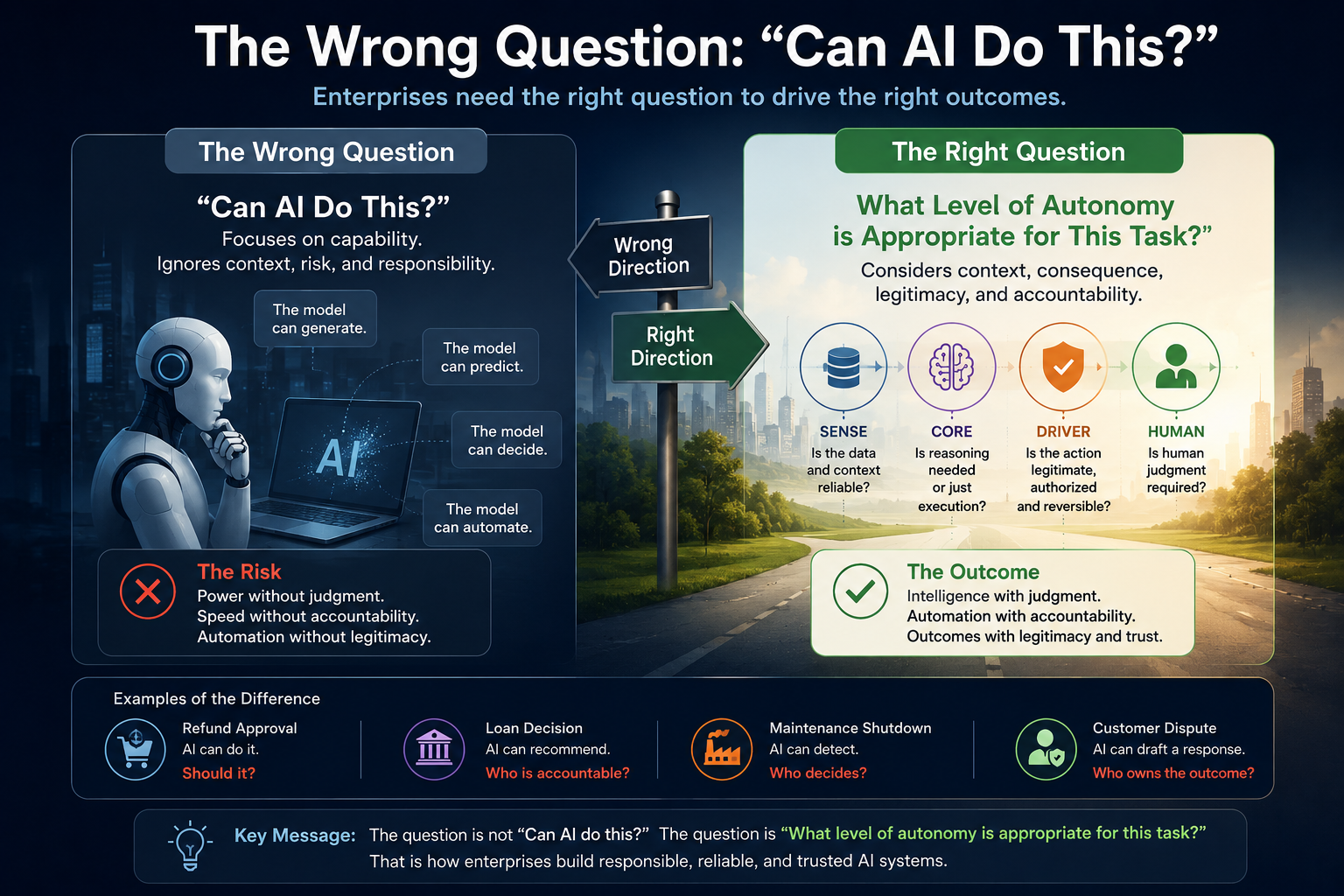
Can AI do this task?
But that question is misleading.
A model may be able to draft a requirement document, generate code, write test cases, summarize customer complaints, suggest loan decisions, forecast inventory, or detect manufacturing anomalies.
But ability is not suitability.
A task may be technically possible for AI and still be operationally wrong for AI.
For example, an AI agent may be able to approve a refund.
But should it?
That depends.
Does the system know the right customer?
Is the transaction valid?
Is the complaint verified?
Is the policy current?
Is the action reversible?
Is there an appeal path?
Who is accountable if the decision is challenged?
These are not only model questions.
They are institutional questions.
NIST’s AI Risk Management Framework organizes AI risk management around Govern, Map, Measure, and Manage, reinforcing that trustworthy AI requires lifecycle governance, not model capability alone. (NIST)
The correct enterprise question is therefore not:
“Can AI do it?”
The correct question is:
“What level of autonomy is appropriate for this task?”
That shift changes everything.
The Autonomy Allocation Principle
The central principle is simple:
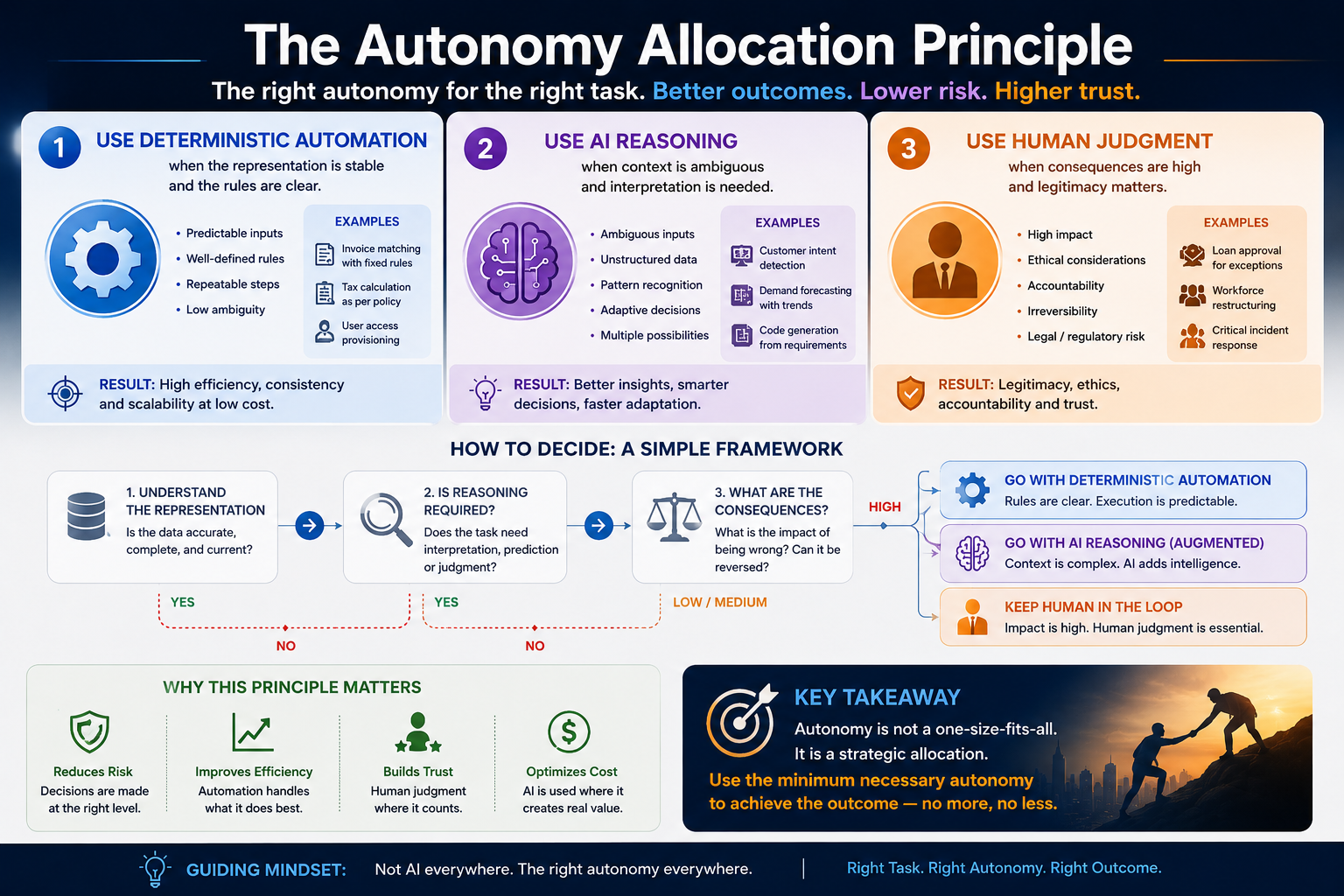
The more stable the representation and the clearer the rules, the stronger the case for deterministic automation.
The more ambiguous the context and the greater the need for interpretation, the stronger the case for AI reasoning.
The higher the consequence, irreversibility, or legitimacy burden, the stronger the case for human judgment and governance.
This is the heart of Autonomy Allocation.
It is not anti-AI.
It is mature AI.
The enterprise objective should not be maximum AI.
It should be optimal bounded autonomy.
That means:
Use deterministic automation where rules are stable.
Use AI where ambiguity and interpretation matter.
Use human judgment where legitimacy, accountability, ethics, or irreversibility matter.
This is how enterprises avoid both extremes: underusing AI because of fear, and overusing AI because of hype.
Why “Agents Everywhere” Is Not a Strategy
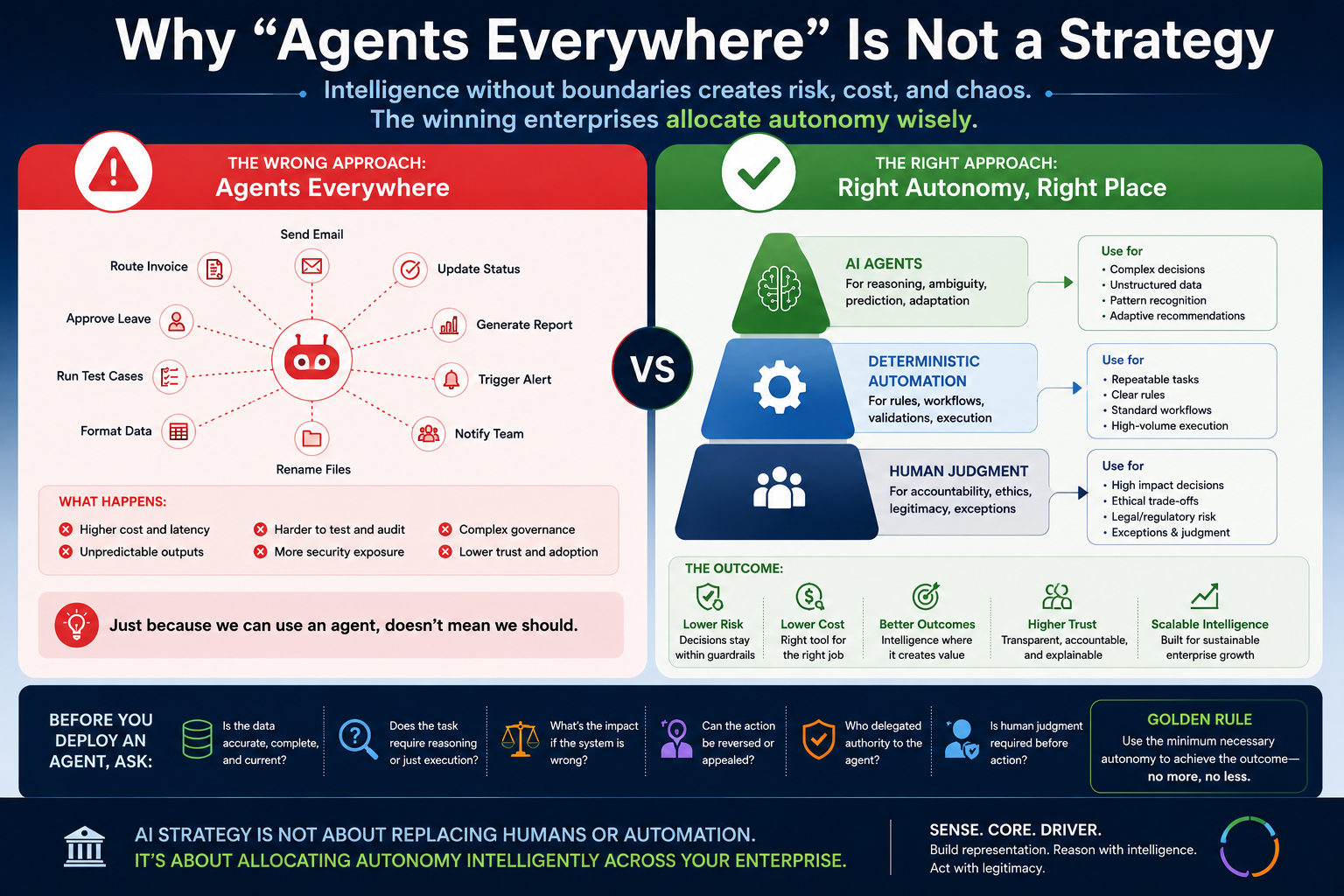
Many enterprises are now moving from “AI pilots everywhere” to “agents everywhere.”
That sounds advanced.
But it may actually be a sign of immature architecture.
A deterministic workflow does not become better just because an AI agent is inserted into it.
A rules-based approval does not need generative reasoning if the policy is clear.
A regression test does not need an autonomous agent if the expected output is known.
A notification workflow does not need AI if the triggering condition is deterministic.
A payment-status update does not need a language model if the transaction record is clean.
Using AI in such cases may increase:
operational cost,
latency,
unpredictability,
testing complexity,
audit difficulty,
security exposure,
and governance burden.
The question is not whether agents are useful.
They are.
The question is where they are useful.
This is why CIOs need an autonomy allocation discipline before scaling agentic AI.
Gartner has also warned that over 40% of agentic AI projects may be canceled by the end of 2027 due to rising costs, unclear business value, or inadequate risk controls. (Gartner)
That warning should not be read as anti-agentic AI.
It should be read as a governance signal.
The next enterprise AI challenge is not adoption.
It is allocation.
SENSE: Is the Reality Stable Enough?
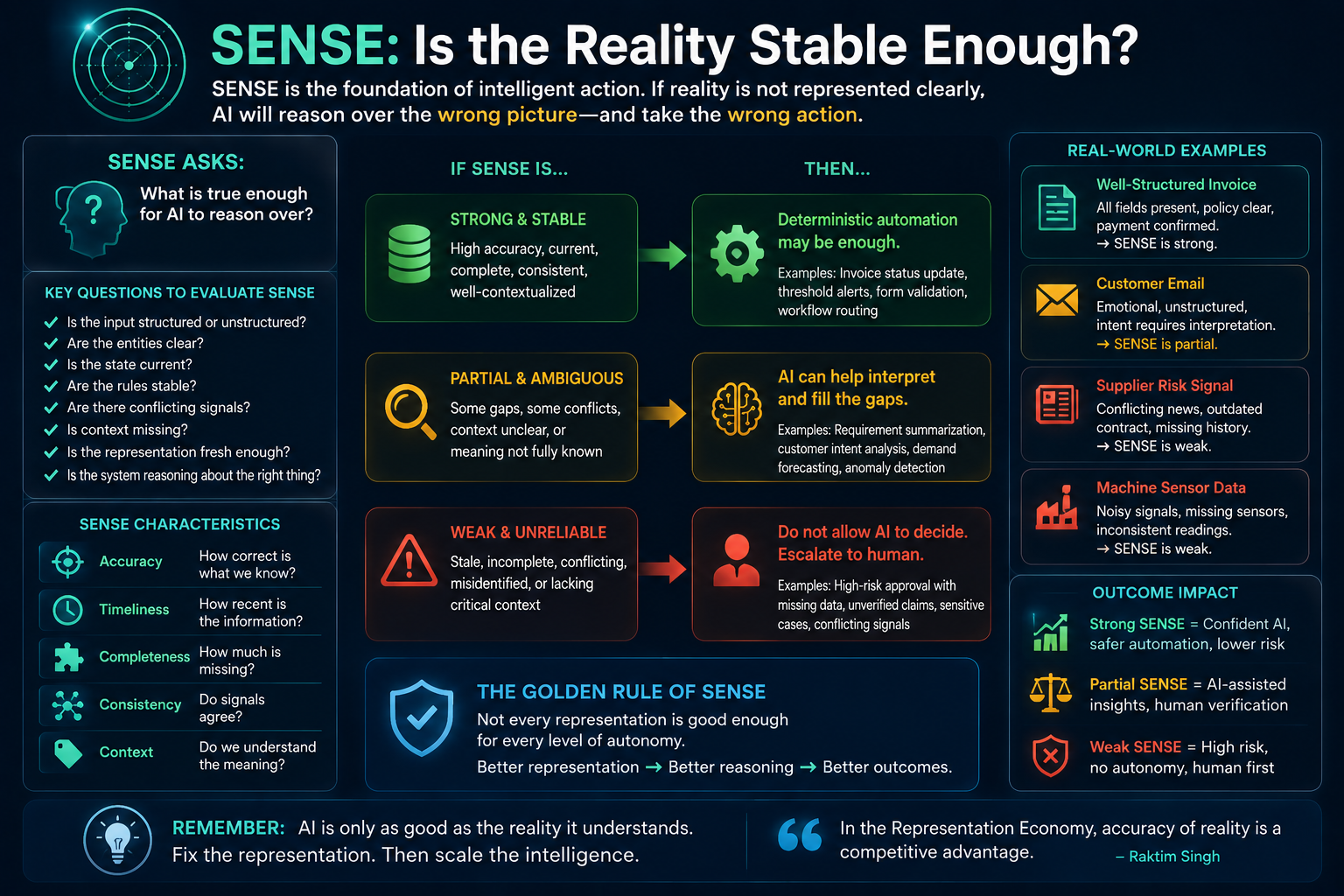
The first question belongs to SENSE.
SENSE asks:
What is true enough for AI to reason over?
Before choosing AI, automation, or human judgment, the enterprise must understand the quality of the underlying representation.
Is the input structured or unstructured?
Are the entities clear?
Is the state current?
Are the rules stable?
Are there conflicting signals?
Is context missing?
Is the representation fresh enough?
Is the system reasoning about the right thing?
If SENSE is strong, deterministic automation may be enough.
If a payment has been received, an invoice status can be updated automatically.
If a form is complete and the policy is clear, the workflow can move forward.
If a temperature threshold is crossed, an alert can be triggered.
If a mandatory field is missing, a validation rule can block submission.
AI is not required for everything.
But if SENSE is weak or ambiguous, AI may help interpret context.
Requirement documents are often incomplete.
Customer emails are emotionally nuanced.
Supplier risks may be hidden across contracts, shipment data, news, and prior incidents.
Manufacturing anomalies may not follow simple threshold rules.
Retail demand may shift because of a trend that historical rules cannot capture.
In such cases, AI can help detect patterns, summarize ambiguity, infer intent, and generate options.
But there is a warning.
If representation quality is too weak, AI should not be asked to decide. It may only be allowed to summarize, flag uncertainty, or escalate to a human.
This is one of the most important ideas in enterprise AI:
Not every representation is good enough for every level of autonomy.
Some representations are good enough for summarization.
Some are good enough for recommendation.
Some are good enough for low-risk action.
Some require human verification.
Some are too weak for any decision.
This is where Representation Quality becomes a board-level concept.
In the Representation Economy, enterprises will not compete only on who has better models. They will compete on who can make reality more accurately, freshly, and responsibly machine-legible.
CORE: Is Reasoning Actually Needed?
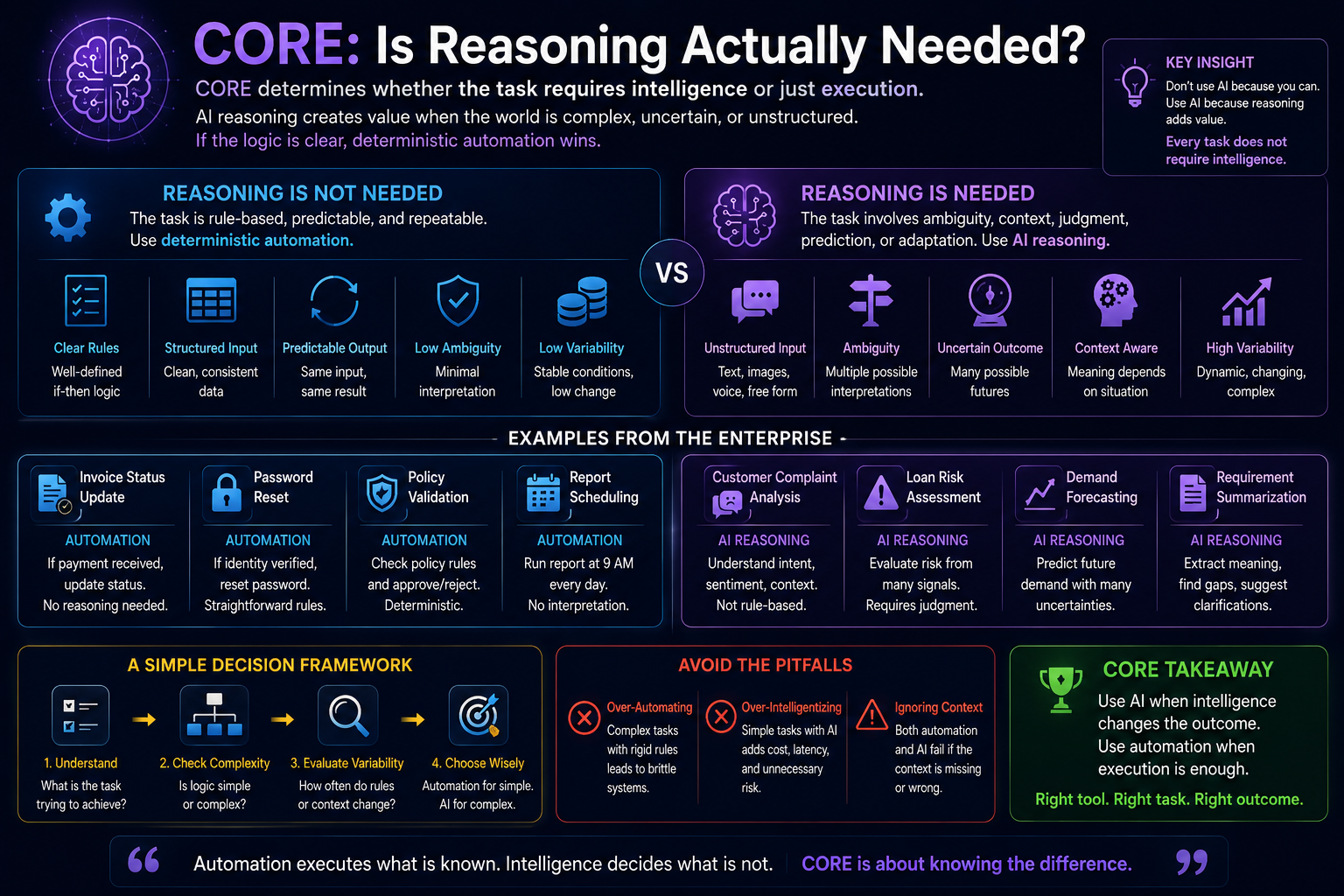
The second question belongs to CORE.
CORE asks:
What should be done?
This is where AI creates value.
AI is useful when a task requires interpretation, synthesis, reasoning, prediction, language understanding, or adaptive decision-making.
But many enterprise tasks do not require reasoning.
They require execution.
A rule engine can route an invoice.
A workflow system can send a notification.
A script can rename files.
A test automation tool can run regression tests.
A scheduler can trigger batch jobs.
A deterministic validator can check mandatory fields.
A CI/CD pipeline can run build and deployment gates.
Putting an AI agent into these tasks may add complexity without adding intelligence.
This is why “agents everywhere” is not enterprise maturity.
AI belongs where deterministic logic becomes brittle.
For example:
A requirement summary needs AI because language is ambiguous.
A code explanation needs AI because context matters.
A test scenario generator may need AI because edge cases are not always obvious.
A customer complaint classifier may need AI because intent and tone matter.
A demand forecast may need AI because patterns shift.
A manufacturing defect analysis may need AI because signals are multidimensional.
But once the decision is made, execution may still be deterministic.
That is the correct architecture:
AI reasons.
Automation executes.
Humans govern high-impact judgment.
DRIVER: Is the Action Legitimate?
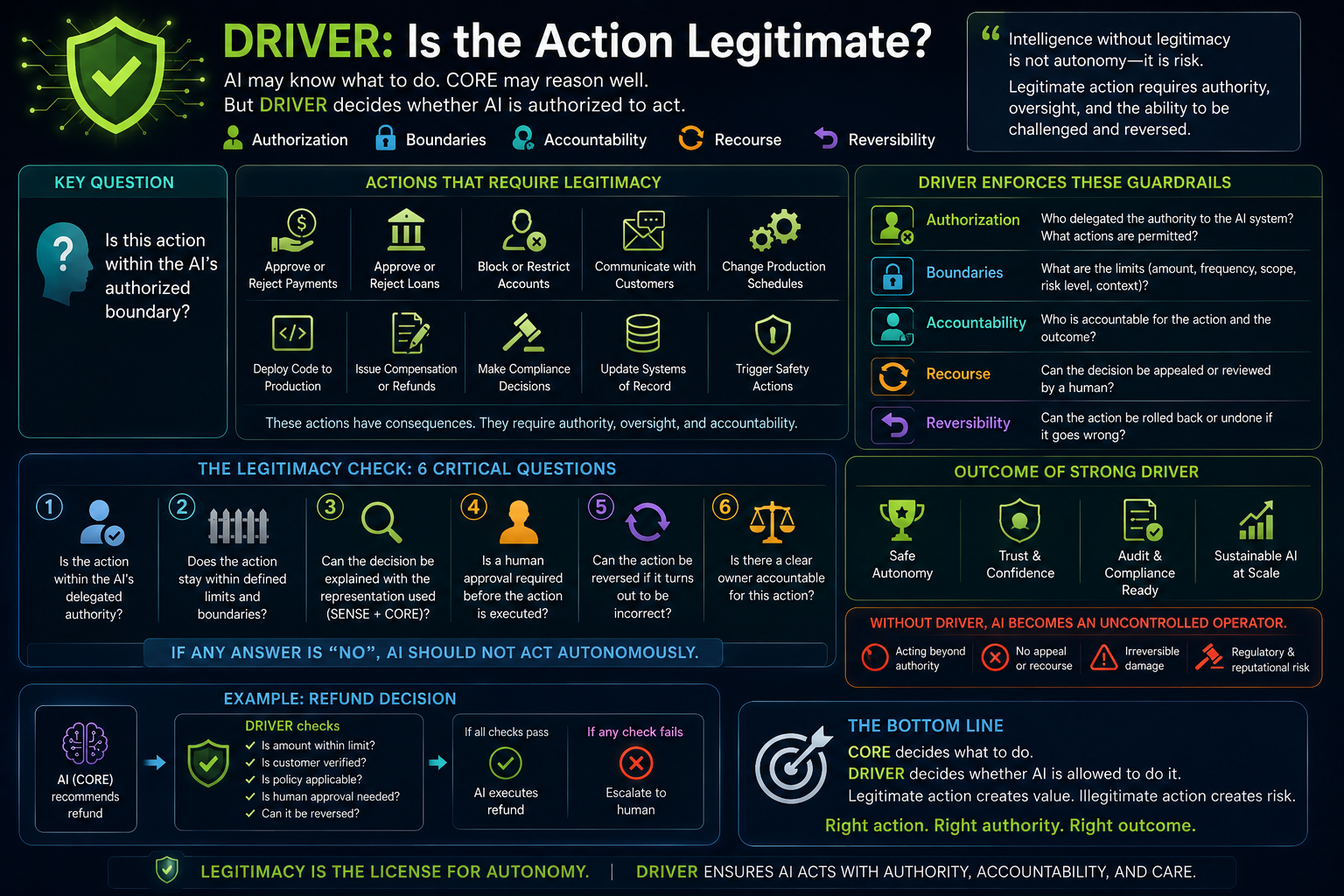
The third question belongs to DRIVER.
DRIVER asks:
What is authorized enough for AI to act upon?
This is where many enterprises are underprepared.
Even if AI understands the situation and reasons well, it may not have the legitimacy to act.
Can it approve a payment?
Can it reject a loan?
Can it change production schedules?
Can it deploy code?
Can it contact a customer?
Can it block an account?
Can it issue compensation?
Can it update a system of record?
These actions require authority.
They require delegation, verification, accountability, recourse, and sometimes human approval.
OECD’s AI Principles emphasize trustworthy AI that respects human rights, democratic values, transparency, and accountability. (OECD)
This is why the DRIVER layer is critical.
Without DRIVER, AI becomes an uncontrolled operator.
It may act quickly, but not legitimately.
Example 1: SDLC — Where AI Helps, Where Automation Wins, Where Humans Decide
The software development lifecycle is one of the best places to understand Autonomy Allocation because it contains all three categories: deterministic automation, AI reasoning, and human judgment.
Requirement Gathering
Requirement gathering is not a deterministic task.
Business users may describe needs vaguely. Documents may conflict. Hidden assumptions may exist. The same word may mean different things to different stakeholders.
Here AI is highly useful.
AI can summarize discussions, extract user stories, identify missing details, group related requirements, detect contradictions, and generate clarification questions.
But AI should not finalize requirements alone.
Why?
Because requirements encode business intent. They involve tradeoffs, priorities, regulatory obligations, user experience, and stakeholder alignment.
The correct model is:
AI assists.
Humans decide.
Deterministic tools track approvals.
The upside is speed and coverage. The downside is that AI may confidently convert ambiguity into false clarity.
Design
Design involves architecture, constraints, dependencies, security, scalability, maintainability, integration, and cost.
AI can generate design options, compare patterns, identify risks, and explain tradeoffs.
But human architects must govern final decisions.
Why?
Because design choices create long-term consequences. They affect technical debt, resilience, vendor lock-in, performance, compliance, and future change.
AI can reason, but architects must judge.
Code Writing
Code generation is one of the most visible AI use cases.
AI is useful for boilerplate, scaffolding, API integration examples, documentation, unit test generation, and code explanation.
But deterministic automation is still better for formatting, linting, static analysis, build triggers, dependency checks, security scanning, and deployment gates.
Human review remains essential for security-sensitive logic, architectural consistency, performance-critical modules, and domain-heavy code.
The mistake is to treat coding as one activity.
It is not.
Some parts are deterministic.
Some parts are AI-assisted.
Some parts require expert judgment.
Test Case Preparation
AI is very useful for generating test scenarios from requirements, identifying missing edge cases, and creating exploratory test ideas.
Deterministic automation is better for executing regression suites, validating known rules, comparing expected outputs, and running repeatable test scripts.
Humans are needed for risk-based testing, acceptance criteria, severity interpretation, and business-critical edge cases.
Test Data Bed Preparation
Test data preparation is a hybrid case.
AI can help generate synthetic scenarios, identify missing data patterns, and suggest unusual combinations.
But deterministic systems should enforce data constraints, masking rules, privacy controls, referential integrity, and environment setup.
Human judgment is needed when test data touches sensitive domains, regulatory boundaries, or rare business scenarios.
Testing and Defect Analysis
AI can summarize logs, cluster defects, explain likely root causes, and suggest fixes.
Automation should execute test suites and monitor pass/fail conditions.
Humans must decide release readiness, business impact, defect severity, and go/no-go decisions.
The SDLC lesson is simple:
AI accelerates cognition. Automation stabilizes execution. Humans govern meaning and risk.
Example 2: Banking — Why Autonomy Must Be Carefully Bounded
Banking is a high-DRIVER industry.
The cost of being wrong is high. Decisions affect money, trust, compliance, and customer rights.
KYC and Document Checks
Deterministic automation works well for mandatory field validation, expiry-date checks, format checks, checklist completion, and policy-based routing.
AI helps with document interpretation, name matching, anomaly detection, and summarizing inconsistencies.
Human judgment is required for exceptions, suspicious patterns, borderline cases, and regulatory escalation.
Loan Processing
Rules can automate eligibility thresholds, document completeness, and policy-based routing.
AI can support risk interpretation, fraud signals, scenario analysis, and explanation generation.
But final decisions in high-impact or exceptional cases require human review and clear recourse.
The danger is not simply that AI gives a wrong answer.
The deeper danger is that the institution cannot explain, challenge, reverse, or justify the action.
Customer Service and Disputes
AI can summarize complaints, classify intent, retrieve policies, draft responses, and suggest resolutions.
Automation can route tickets, apply standard refunds within safe limits, and trigger notifications.
Humans must handle disputes, emotional escalation, exceptional compensation, and cases where the customer challenges the decision.
A machine action without appeal is not mature automation.
It is institutional risk.
Example 3: Retail — AI for Adaptation, Automation for Execution
Retail has high variability but often lower individual decision risk than banking.
That makes it a strong domain for combining AI reasoning with deterministic execution.
Inventory Replenishment
Deterministic automation works well for reorder points, warehouse triggers, replenishment rules, and supply chain execution.
AI is useful for demand forecasting, seasonality, trend detection, basket analysis, local preference shifts, and anomaly detection.
Human judgment is needed when unusual events occur: sudden demand spikes, supplier disruption, campaign effects, or unexpected local behavior.
Pricing and Promotions
Rules can enforce margin floors, discount limits, coupon validity, and campaign schedules.
AI can recommend dynamic pricing, segment offers, and forecast promotion impact.
Humans must govern brand risk, customer trust, fairness perception, and strategic positioning.
A price engine can optimize numbers.
But a merchant understands brand meaning.
Customer Personalization
AI can recommend products, personalize offers, and predict preferences.
Automation can deliver messages through channels.
Human governance is required to avoid creepy personalization, exclusion, over-targeting, or trust erosion.
The retail lesson is clear:
AI is powerful for sensing changing demand, but deterministic execution and human brand judgment remain essential.
Example 4: Manufacturing — When Physical Consequences Change the Governance Model
Manufacturing makes the Autonomy Allocation Problem very clear because actions can affect safety, production, cost, equipment, and people.
Predictive Maintenance
Deterministic automation is good for threshold alerts: temperature too high, vibration beyond limit, pressure out of range.
AI is useful for detecting early degradation patterns across multiple signals, predicting failure, and identifying subtle anomalies.
Human judgment is needed for shutdown decisions, production tradeoffs, safety evaluation, and maintenance prioritization.
Quality Inspection
Computer vision AI can detect defects, classify anomalies, and improve inspection coverage.
Deterministic systems can enforce pass/fail thresholds, track batches, and route rejected items.
Humans are needed for borderline defects, root-cause interpretation, supplier accountability, and process redesign.
Production Scheduling
Automation can execute known scheduling rules.
AI can optimize schedules under changing constraints such as demand volatility, material shortages, machine downtime, and labor availability.
Humans must govern tradeoffs between cost, customer commitment, safety, and strategic priority.
The manufacturing lesson is simple:
The more physical, irreversible, or safety-critical the action, the stronger the DRIVER layer must become.
The Three Failure Modes of Poor Autonomy Allocation
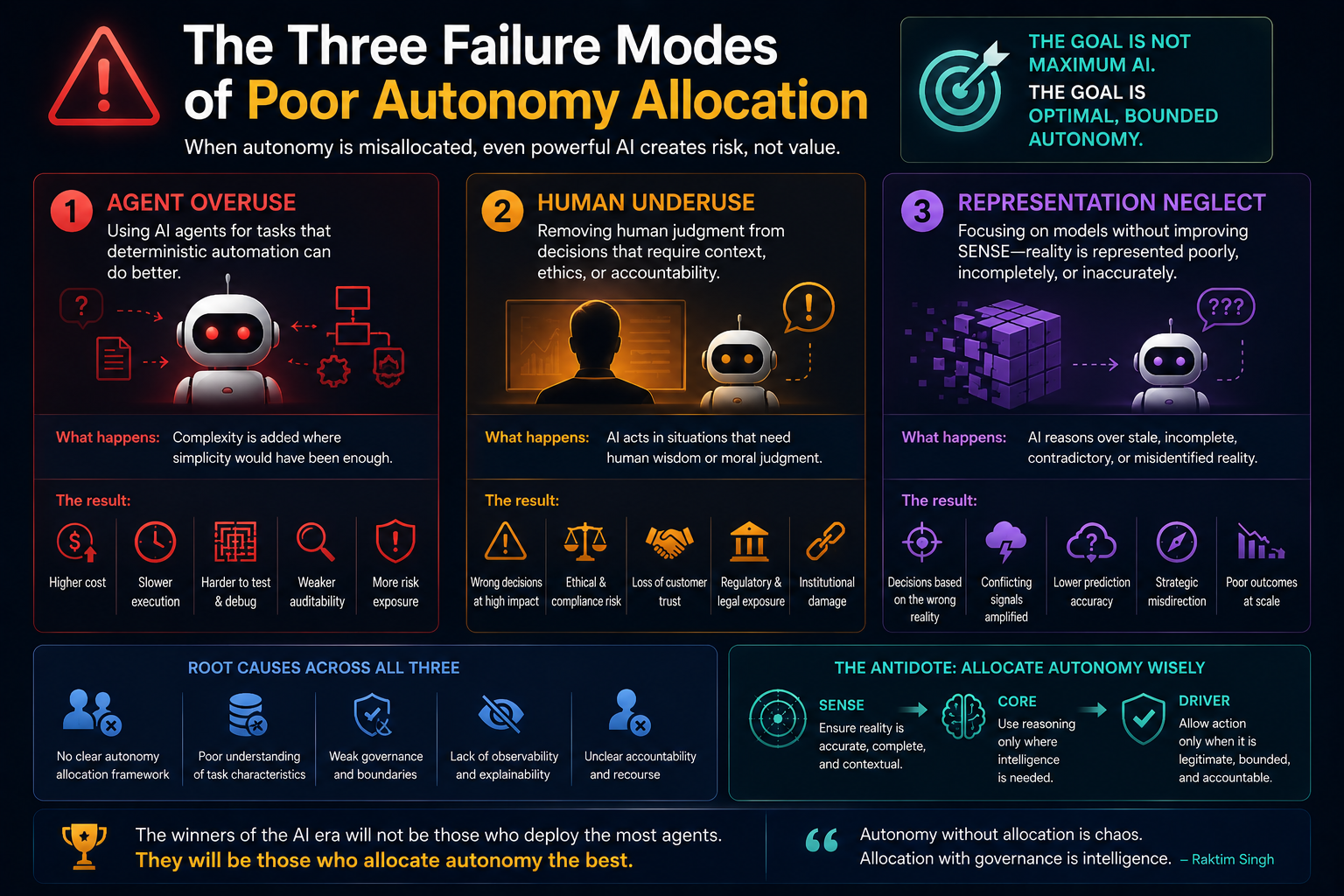
-
Agent Overuse
This happens when enterprises put AI agents into tasks that deterministic automation can perform better.
The result is higher cost, unpredictable behavior, harder testing, weaker auditability, and more governance overhead.
-
Human Underuse
This happens when enterprises remove human judgment from decisions involving ambiguity, ethics, accountability, risk, or irreversibility.
The result is technically efficient but institutionally fragile automation.
-
Representation Neglect
This happens when enterprises focus on models without improving SENSE.
The AI reasons over stale, incomplete, contradictory, or misidentified reality.
This is the most subtle failure.
The model may appear intelligent, but the institution is blind.
Why This Is Becoming Urgent
Agentic AI is expanding fast, but enterprise governance is still catching up.
This is the precise moment when CIOs and CTOs need a clearer decision model.
The issue is not whether to adopt AI.
The issue is how to allocate autonomy responsibly.
Enterprise AI strategy should not begin with a list of use cases.
It should begin with an autonomy map.
Where do we need deterministic automation?
Where do we need AI reasoning?
Where do we need human judgment?
Where do we need human approval?
Where must AI never act alone?
Where can AI act only if recourse exists?
That is a different kind of AI strategy.
It is not tool-first.
It is institution-first.
The Autonomy Allocation Questions CIOs Should Ask
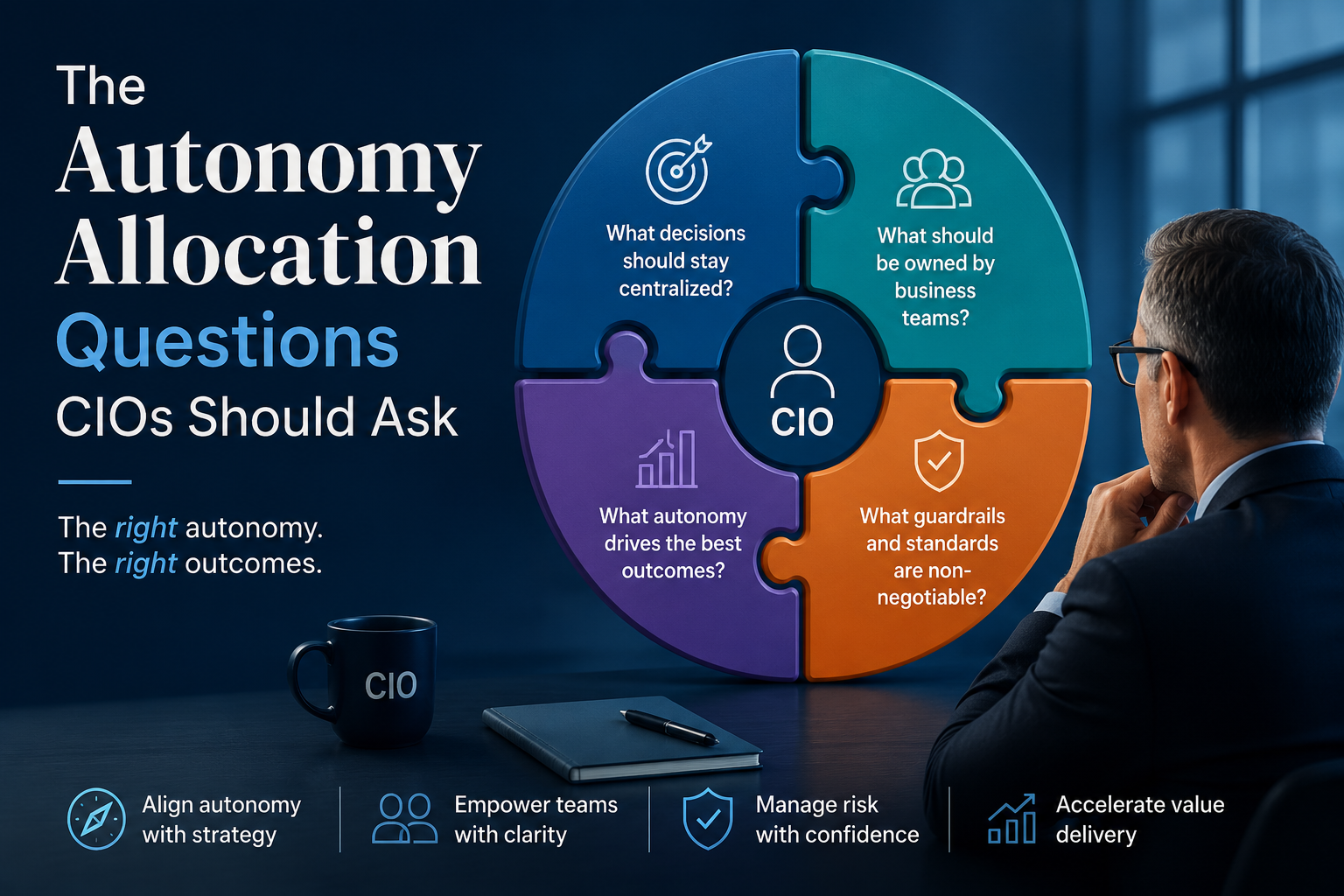
Before approving an AI agent or AI workflow, CIOs and CTOs should ask:
Is the task rule-based or ambiguity-heavy?
Is the input stable or uncertain?
Is the current state fresh and reliable?
Can the system explain what representation it used?
Does the task require reasoning or only execution?
What happens if the system is wrong?
Is the action reversible?
Who delegated authority to the AI system?
Can the decision be challenged?
Is human judgment needed before action?
Can deterministic automation solve most of the task more safely?
These questions shift the enterprise conversation from AI excitement to AI architecture.
The New Enterprise AI Operating Model
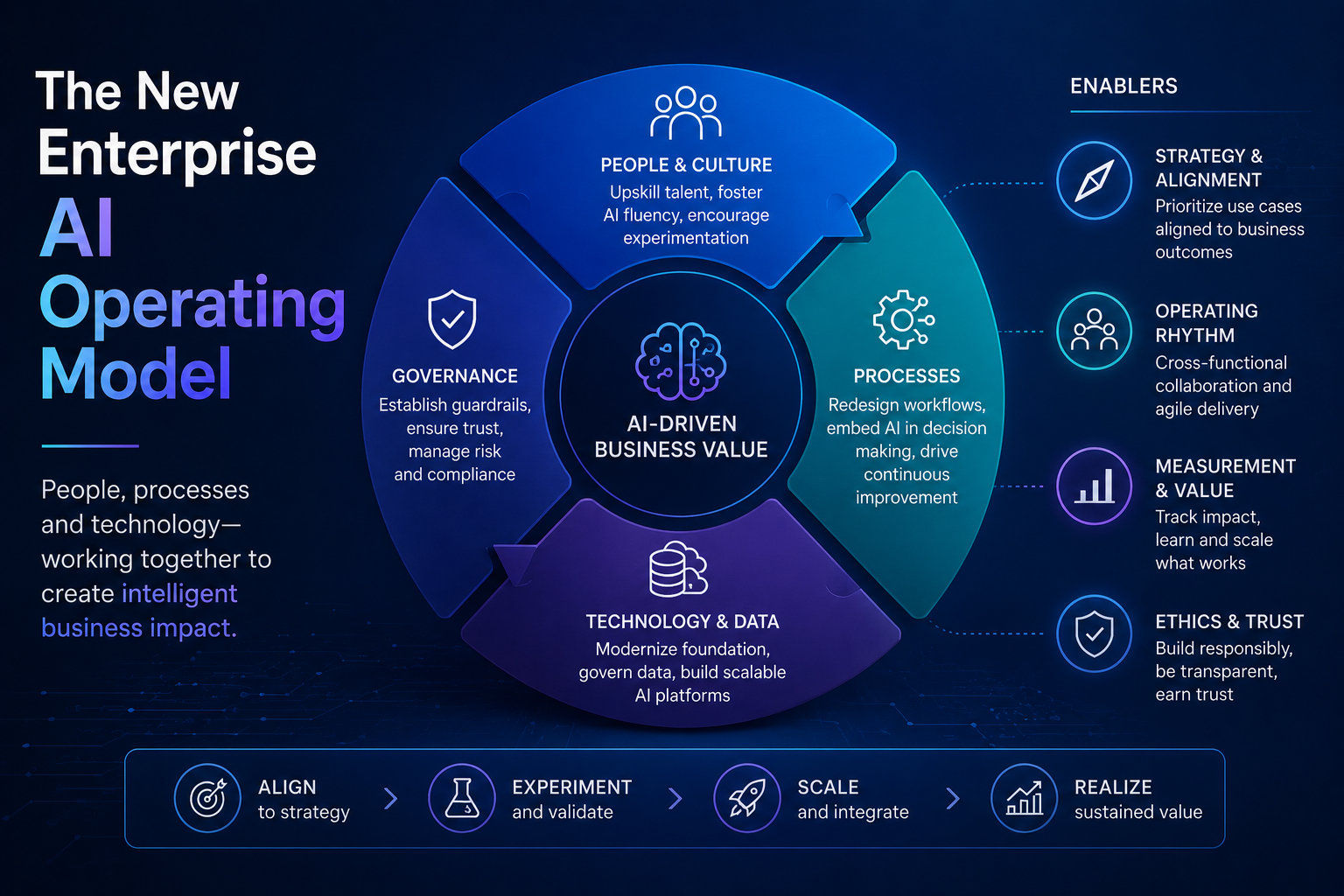
The mature enterprise will not be fully human-led or fully AI-led.
It will be layered.
Deterministic automation will provide reliability.
AI reasoning will provide adaptability.
Human judgment will provide legitimacy.
SENSE will maintain representation quality.
CORE will reason over context.
DRIVER will govern action.
This is the future operating model of intelligent institutions.
It is also the foundation of the Representation Economy: value will come not only from intelligence, but from the ability to represent reality, reason over it, and act legitimately.
The winners will not be enterprises that deploy the most agents.
They will be enterprises that allocate autonomy best.
Conclusion: Not AI Everywhere, but the Right Autonomy Everywhere
The next phase of enterprise AI will not be won by asking where AI can be inserted.
It will be won by asking where autonomy belongs.
Some tasks need deterministic automation because they are stable, rule-based, and repeatable.
Some tasks need AI because they are ambiguous, contextual, language-heavy, or dynamic.
Some tasks need human judgment because they involve consequence, legitimacy, ethics, accountability, or irreversibility.
This is the Autonomy Allocation Problem.
And it may become one of the defining enterprise architecture questions of the AI era.
The future enterprise will not be intelligent because it uses AI everywhere.
It will be intelligent because it knows where not to use AI.
That is the discipline CIOs and CTOs now need.
That is the shift from automation to institutional intelligence.
And that is why the SENSE–CORE–DRIVER framework matters.
Glossary
Autonomy Allocation
Autonomy Allocation is the enterprise discipline of deciding when to use deterministic automation, AI-assisted reasoning, autonomous AI action, or human judgment for a given business activity.
Deterministic Automation
Deterministic automation uses fixed rules, workflows, scripts, validations, or engines to execute known tasks in repeatable ways.
AI Reasoning
AI reasoning refers to the use of AI systems to interpret context, synthesize information, generate options, predict outcomes, or recommend actions.
Human Judgment
Human judgment is required when decisions involve ambiguity, accountability, legitimacy, ethics, irreversibility, or strategic tradeoffs.
Bounded Autonomy
Bounded autonomy means allowing AI systems to operate only within defined authority, risk, reversibility, and accountability boundaries.
SENSE
SENSE is the machine-legibility layer in the SENSE–CORE–DRIVER framework. It determines whether reality is represented clearly enough for AI to reason.
CORE
CORE is the reasoning layer. It determines what should be done based on context, goals, constraints, and available representation.
DRIVER
DRIVER is the governance and legitimacy layer. It determines whether AI is authorized enough to act.
Representation Quality
Representation Quality measures whether an enterprise’s representation of reality is accurate, current, contextual, complete, and trustworthy enough for reasoning or action.
Legitimacy Runtime
Legitimacy Runtime is the governance layer that determines whether machine action is authorized, accountable, reversible, and open to recourse.
FAQ
What is the Autonomy Allocation Problem?
The Autonomy Allocation Problem is the challenge of deciding when enterprises should use deterministic automation, AI reasoning, autonomous AI agents, or human judgment for different tasks.
Why should enterprises not use AI agents everywhere?
Enterprises should not use AI agents everywhere because many tasks are stable, rule-based, and repeatable. Deterministic automation may be cheaper, safer, faster, easier to audit, and more predictable for such tasks.
When should enterprises use deterministic automation?
Enterprises should use deterministic automation when rules are clear, inputs are structured, outcomes are predictable, and the task requires repeatable execution rather than contextual reasoning.
When should enterprises use AI?
Enterprises should use AI when tasks involve ambiguity, language understanding, pattern recognition, prediction, synthesis, anomaly detection, or adaptive decision-making.
When should human judgment remain mandatory?
Human judgment should remain mandatory when decisions involve high impact, ethical tradeoffs, legal exposure, customer rights, safety, irreversibility, accountability, or reputational risk.
How does SENSE–CORE–DRIVER help enterprise AI strategy?
SENSE–CORE–DRIVER helps enterprises decide whether a task has reliable representation, whether reasoning is required, and whether AI has legitimate authority to act.
What is bounded autonomy?
Bounded autonomy means AI systems are allowed to act only within defined limits of authority, risk, reversibility, accountability, and oversight.
Why is Representation Quality important?
Representation Quality is important because AI systems reason over the reality they are given. If that representation is stale, incomplete, contradictory, or misidentified, even a powerful AI model may produce unsafe or wrong outcomes.
What is the role of CIOs in Autonomy Allocation?
CIOs must define where automation, AI, and human judgment belong across enterprise processes, ensuring that AI adoption is governed, reliable, cost-effective, and aligned with institutional risk.
What is the Autonomy Allocation Problem?
The Autonomy Allocation Problem is the challenge of deciding when enterprises should use deterministic automation, AI reasoning, autonomous AI agents, or human judgment for different tasks.
Why should enterprises not use AI agents everywhere?
Enterprises should not use AI agents everywhere because many tasks are stable, rule-based, and repeatable. Deterministic automation may be cheaper, safer, faster, easier to audit, and more predictable for such tasks.
When should enterprises use deterministic automation?
Enterprises should use deterministic automation when rules are clear, inputs are structured, outcomes are predictable, and the task requires repeatable execution rather than contextual reasoning.
When should enterprises use AI?
Enterprises should use AI when tasks involve ambiguity, language understanding, pattern recognition, prediction, synthesis, anomaly detection, or adaptive decision-making.
When should human judgment remain mandatory?
Human judgment should remain mandatory when decisions involve high impact, ethical tradeoffs, legal exposure, customer rights, safety, irreversibility, accountability, or reputational risk.
How does SENSE–CORE–DRIVER help enterprise AI strategy?
SENSE–CORE–DRIVER helps enterprises decide whether a task has reliable representation, whether reasoning is required, and whether AI has legitimate authority to act.
What is bounded autonomy?
Bounded autonomy means AI systems are allowed to act only within defined limits of authority, risk, reversibility, accountability, and oversight.
Why is Representation Quality important?
Representation Quality is important because AI systems reason over the reality they are given. If that representation is stale, incomplete, contradictory, or misidentified, even a powerful AI model may produce unsafe or wrong outcomes.
What is the role of CIOs in Autonomy Allocation?
CIOs must define where automation, AI, and human judgment belong across enterprise processes, ensuring that AI adoption is governed, reliable, cost-effective, and aligned with institutional risk.
Further Read
The Two Missing Runtime Layers of the AI Economy
https://www.raktimsingh.com/two-missing-runtime-layers-ai-economy/
- The SENSE–CORE–DRIVER Maturity Framework
https://www.raktimsingh.com/sense-core-driver-maturity-framework/ - The SENSE–DRIVER Tradeoff
https://www.raktimsingh.com/sense-driver-tradeoff/ - The AI Capability Trap
https://www.raktimsingh.com/ai-capability-trap/ - Entity Resolution as Competitive Advantage
https://www.raktimsingh.com/entity-resolution-competitive-advantage-enterprise-ai/ - The Simulation Layer for Enterprise AI
https://www.raktimsingh.com/simulation-layer-enterprise-ai/
References and Further Reading
- Gartner predicts task-specific AI agents will be embedded in up to 40% of enterprise applications by 2026. (Gartner)
- Gartner has also warned that many agentic AI projects may be canceled by 2027 due to cost, unclear business value, or inadequate risk controls. (Gartner)
- NIST AI Risk Management Framework organizes AI risk management around Govern, Map, Measure, and Manage. (NIST)
- OECD AI Principles emphasize trustworthy, human-centered AI aligned with rights, values, transparency, and accountability. (OECD)
Author Block
Raktim Singh writes extensively on Enterprise AI, Representation Economy, AI Governance, and the evolving relationship between intelligence, automation, and institutional systems. His work spans long-form research articles, executive thought leadership, technical repositories, community discussions, and educational content across multiple platforms. Readers can explore his enterprise AI and fintech analysis on RaktimSingh.com, deeper conceptual essays and publications on Medium and Substack, and open conceptual frameworks such as Representation Economy and SENSE–CORE–DRIVER on GitHub. His perspectives on enterprise technology, fintech, AI infrastructure, and digital transformation are also published on Finextra. Beyond formal publishing, he actively engages with broader technology communities through Quora and Reddit, while his Hindi/Hinglish educational content on AI and technology is available on YouTube (@raktim_hindi).



Raktim Singh is an AI and deep-tech strategist, TEDx speaker, and author focused on helping enterprises navigate the next era of intelligent systems. With experience spanning AI, fintech, quantum computing, and digital transformation, he simplifies complex technology for leaders and builds frameworks that drive responsible, scalable adoption.