

Skill Retention Architecture: How Enterprises Keep Human Judgment Alive as AI Scales
As artificial intelligence moves from supporting decisions to making them, enterprises face a risk that is rarely discussed and poorly measured: the gradual loss of human competence.
When AI systems become reliable, fast, and deeply embedded in operations, people stop practicing the very skills they are expected to use during failures, audits, and high-stakes exceptions.
This phenomenon—often misdiagnosed as a training problem—is in fact an operating model failure.
Skill Retention Architecture addresses this gap by treating human judgment, intervention capability, and audit-ready reasoning as infrastructure, not culture, ensuring that enterprises remain capable of governing AI safely as autonomy scales.
Why this matters now
Enterprise AI is crossing a line: it no longer just assists work—it increasingly decides and acts. The moment software exercises judgment, organizations inherit a new, quiet failure mode that has nothing to do with model accuracy:
Your people gradually lose the ability to do the job without the AI.
That pattern is well documented in human factors research on automation: higher automation can reduce workload and improve performance, yet also reduce vigilance and degrade the operator’s ability to detect failures—especially when automation is reliable most of the time.
This matters because Enterprise AI is not “AI in the enterprise.” It is an operating challenge: how institutions govern decisions at scale. If you haven’t framed that distinction yet, start with the pillar:
Enterprise AI Operating Model — https://www.raktimsingh.com/enterprise-ai-operating-model/
In that operating model, Skill Retention Architecture becomes a missing layer: not a training program, but a production safety mechanism.
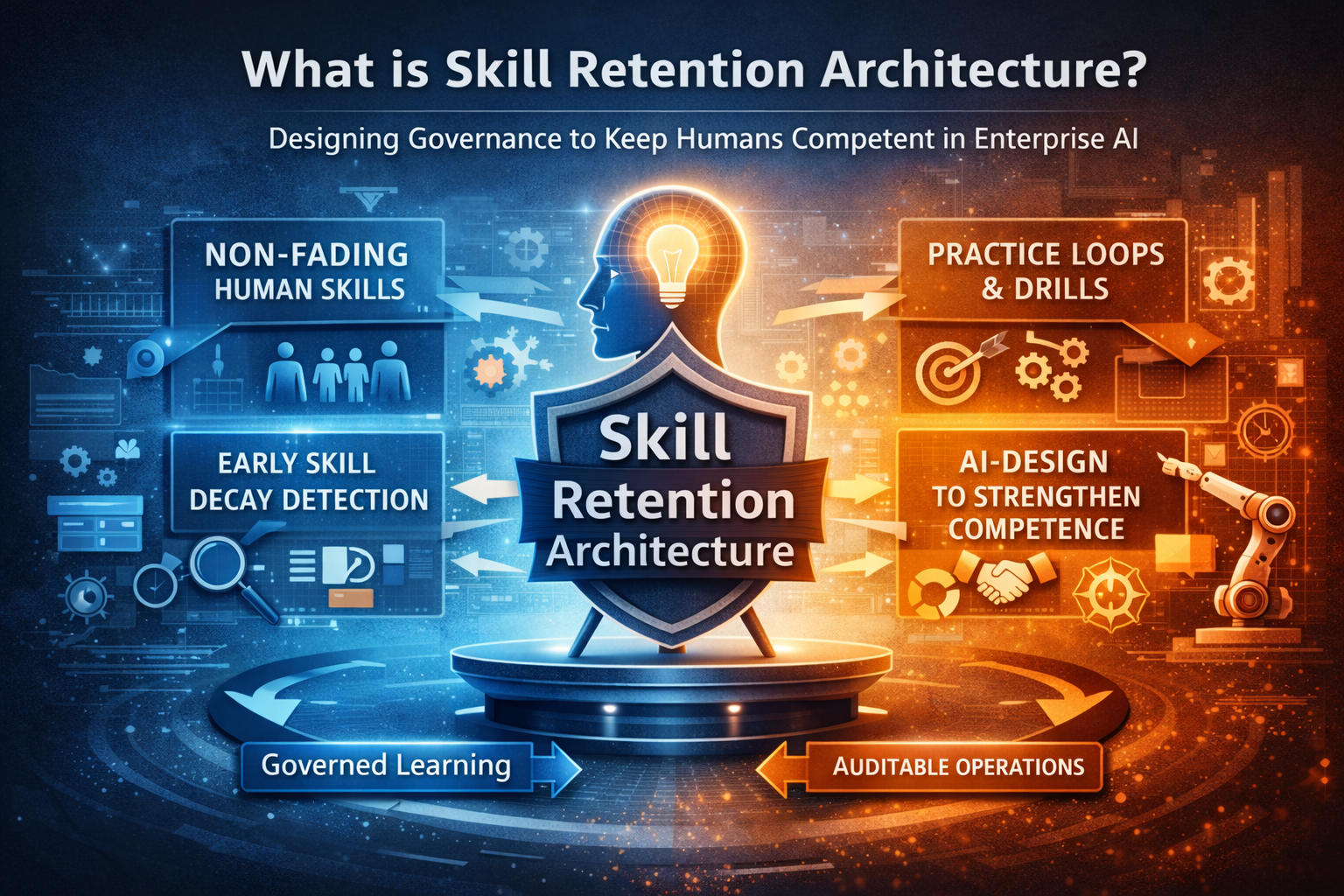
What is Skill Retention Architecture
Skill Retention Architecture (SRA) is the intentional design of processes, training loops, roles, incentives, and governance so that humans retain (and can prove) the competence required to supervise, override, audit, and recover when AI is wrong, unavailable, or unsafe.
Think of it as the human reliability layer of your Enterprise AI Operating Model (the same “operating capability” framing explained here):
https://www.raktimsingh.com/enterprise-ai-operating-model/
It answers four hard questions:
- Which human skills must never be allowed to fade?
- How do we keep those skills practiced when AI does most of the work?
- How do we detect skill decay early—before an incident?
- How do we design AI systems so they strengthen human competence rather than replacing it?

The skill-fade trap, explained with simple examples
Example 1: The “GPS effect” inside a company
A new hire joins a finance operations team. With an AI copilot, they close exceptions quickly because the system suggests the right steps. Six months later, the copilot is disabled during an outage.
Suddenly the team realizes:
- People can follow steps, but they can’t diagnose root causes.
- They can approve actions, but they can’t explain why those actions were safe.
- They can escalate incidents, but they can’t stabilize operations.
The organization didn’t lose intelligence. It lost muscle memory.
This is exactly how “successful POCs” create fragility in production: the enterprise assumes the model is the hard part, but operating reality is the hard part. (If you want the broader production lens:
https://www.raktimsingh.com/enterprise-ai-runtime-what-is-running-in-production/)
Example 2: “Autopilot” decision-making in business workflows
Research on automation shows that when systems perform reliably for long periods, people check less carefully—and may miss signals when automation is wrong or disengaged.
Translate that into enterprise operations:
- The AI is correct “almost always.”
- Human review becomes lightweight or ceremonial.
- When the rare failure appears, humans are slower, less confident, and less capable.
- The incident becomes larger than it needed to be.
This dynamic overlaps with automation bias and automation complacency—two failure patterns that show up when systems perform reliably, until they don’t.
These are not abstract issues. They are decision failure modes.
If you want an enterprise-grade taxonomy of how “correct-looking decisions” still break trust and control, read:
https://www.raktimsingh.com/enterprise-ai-decision-failure-taxonomy/

The core idea: not all skills are equal
Skill Retention Architecture starts by separating skills into three practical buckets—because each bucket needs a different kind of protection.
1) Perishable skills (fade quickly without practice)
These are hands-on, time-sensitive capabilities you only discover you need during stress:
- Incident triage and rapid containment
- Risk judgment under uncertainty
- Manual fallback operations
- Forensic auditing (“why did we approve this?”)
Perishable skills don’t survive as policy statements. They survive through deliberate practice.
This is where the control logic that governs when humans must intervene. In Enterprise AI, this is a Control Plane job, not an “ops best practice.”
https://www.raktimsingh.com/enterprise-ai-control-plane-2026/
2) Cognitive framing skills (how experts think)
These are the patterns that turn experience into judgment:
- Spotting anomalies and “weak signals”
- Knowing what “doesn’t smell right”
- Anticipating second-order effects
- Knowing when to stop automation
If you care about scalable autonomy, this bucket is where “decision clarity” becomes non-negotiable: humans can’t supervise AI if the enterprise itself hasn’t clarified what counts as a good decision.
https://www.raktimsingh.com/decision-clarity-scalable-enterprise-ai-autonomy/
3) Institutional skills (how the enterprise stays accountable)
These keep organizations defensible across audits, incidents, and leadership changes:
- Documentation habits
- Review discipline
- Clear authority for overrides and pauses
- Decision traceability expectations
These skills only persist if the organization has a coherent stack that connects governance intent to runtime behavior. If you want the full alignment view:
https://www.raktimsingh.com/the-enterprise-ai-operating-stack-how-control-runtime-economics-and-governance-fit-together/

Why “human oversight” is not enough
Many governance regimes emphasize human oversight for high-risk AI. The EU AI Act’s Article 14 frames human oversight as a mechanism to prevent or minimize risks to health, safety, and fundamental rights.
But here’s the uncomfortable truth:
You can’t oversee what you no longer understand.
And you can’t intervene safely using skills you haven’t practiced.
That is why Skill Retention Architecture makes “human oversight” real, not performative.
In enterprise terms: this is the difference between “having controls” and actually being able to exercise them under pressure—exactly the operating capability framing:
https://www.raktimsingh.com/enterprise-ai-operating-model/

The four building blocks of Skill Retention Architecture
The four building blocks of Skill Retention Architecture
Block 1: Skill criticality mapping (what must never fade)
Start with an inventory of “skills that keep the institution safe.”
A simple test:
- If AI is off for 72 hours, what must humans still do correctly?
- If auditors ask “why did you act?”, what must humans be able to explain?
- If AI makes a harmful decision, what must humans be able to reverse?
The output should be explicit: non-negotiable human skills, by role and domain.
https://www.raktimsingh.com/who-owns-enterprise-ai-roles-accountability-decision-rights/
Block 2: Practice loops (the missing ingredient)
Skills do not remain sharp through policy documents. They remain sharp through use.
So you design practice loops that run even when AI performs well:
- Manual-mode drills
- Shadow decisions
- Adversarial reviews
- Rotation programs
This matters because reliability can paradoxically reduce the operator’s ability to detect failures.
These practice loops should be considered part of “what is running in production” — not as training, but as runtime safety design.
https://www.raktimsingh.com/enterprise-ai-runtime-what-is-running-in-production/
Block 3: Explanation habits (keep thinking alive)
People lose skill faster when the system does not require thinking.
So your workflow must encourage lightweight reasoning:
- Approve + one sentence why
- What signal would make you reject this?
- If wrong, what’s the blast radius?
This links directly to decision failure prevention: you’re building the discipline that catches “confident wrongness” before it becomes policy.
https://www.raktimsingh.com/enterprise-ai-decision-failure-taxonomy/
Block 4: Recovery muscle (SRE for humans)
If your enterprise has SRE for systems, you need SRE for human intervention:
- Stop/pause controls
- Override authority
- Rollback procedures
- Playbooks executable without AI
This is a control-plane concept: reversible autonomy is not optional if you want to scale.
https://www.raktimsingh.com/enterprise-ai-control-plane-2026/

Design principles that make SRA work in the real world
Principle 1: Treat skill retention as an operational metric
Skill retention determines whether autonomy is safe. It should be reviewed like uptime.
Principle 2: Avoid the “AI babysitter job”
Monitoring-only roles invite complacency and shallow understanding.
Rotate humans across execution, investigation, and review.
Principle 3: Train for edge cases, not the happy path
Humans are there for ambiguity, conflicts, novelty, and reputational exposure.
Principle 4: Maintain a competence floor per role
Oversight is meaningless without competence. This is how organizations keep oversight real.
A blueprint you can implement without heavy bureaucracy
- Define never-fade skills by domain
- Set an operating cadence
- Build shadow lanes
- Reward competence, not blind throughput
If you want the unified architecture view that makes these steps feel like “enterprise operating design” (not training), check:
https://www.raktimsingh.com/the-enterprise-ai-operating-stack-how-control-runtime-economics-and-governance-fit-together/
Glossary
- Deskilling: Loss of competence because tools reduce opportunities to practice.
- Automation bias: Over-reliance on automated recommendations.
- Automation complacency: Reduced vigilance when automation is trusted.
- Human oversight: The ability to monitor and intervene in AI decisions.
- Shadow decisioning: Humans and AI decide in parallel; differences are reviewed.
- Manual-mode drill: Running workflows without AI to preserve competence.
FAQ
Is Skill Retention Architecture only for regulated industries?
No. Any enterprise relying on AI decisions can suffer skill fade—especially when failures are rare but high impact.
Won’t drills slow teams down?
They cost time, but reduce catastrophic downtime and audit failure—similar to fire drills.
Can AI help prevent deskilling?
Yes—if AI behaves like a coach, not a vending machine. Systems that prompt justification and counter-checks reduce automation bias.
What’s the fastest way to start?
Pick one workflow, define “AI-off for 72 hours,” run a drill, document failure points.

Conclusion: the enterprise that forgets how to think will not scale AI safely
Enterprises don’t fail with AI because models are dumb.
They fail because institutions forget how to think.
Skill Retention Architecture prevents “AI success” from turning into organizational dependency. It preserves three things that decide long-run outcomes: judgment, intervention, and accountability.
If Enterprise AI is the discipline of governing decisions at scale, then Skill Retention Architecture is the discipline that keeps the institution capable of governance—year after year, across audits, incidents, leadership changes, and geopolitical realities.
For the broader canonical framing of Enterprise AI as an operating capability, and to understand where this fits, return to the pillar:
https://www.raktimsingh.com/enterprise-ai-operating-model/
References and further reading
-
Human management of automation errors and monitoring failures
🔗 Human management of automation errors and monitoring failures — https://pmc.ncbi.nlm.nih.gov/articles/PMC4221095/ -
Classic framing: use / misuse / disuse / abuse of automation
🔗 — https://en.wikipedia.org/wiki/Automation_bias -
Reliability paradox: automation reliability can reduce failure detection
🔗 Automation bias and reduced failure detection in automated systems — https://en.wikipedia.org/wiki/Automation_bias
(Includes explanation of overreliance and error omission/commission.) -
Automation bias evidence (clinical decision support review)
🔗 Automation bias in clinical decision support and its effects — https://academic.oup.com/jamia/article/20/3/439/2909477
(Highly citable medical informatics review on human reliance on AI outputs.) -
EU AI Act: human oversight framing
🔗 Article 14: Human Oversight — EU Artificial Intelligence Act — https://artificialintelligenceact.eu/article/14/ -
NIST AI RMF: governance and operational accountability
🔗 NIST AI Risk Management Framework (AI RMF 1.0) — https://nvlpubs.nist.gov/nistpubs/ai/nist.ai.100-1.pdf -
Deskilling concerns in healthcare AI assistance
🔗 AI deskilling risks in clinical settings — https://time.com/6283786/ai-doctors-deskilling/



Raktim Singh is an AI and deep-tech strategist, TEDx speaker, and author focused on helping enterprises navigate the next era of intelligent systems. With experience spanning AI, fintech, quantum computing, and digital transformation, he simplifies complex technology for leaders and builds frameworks that drive responsible, scalable adoption.