

For more than two centuries, economic power has belonged to organizations that mastered supply chains.
In the industrial era, the winners were the firms that controlled raw materials, factories, warehouses, shipping routes, and distribution networks.
Steel, oil, automobiles, electronics, and global retail all became dominant not simply because companies had good products, but because they built systems that could move inputs through production into reliable output at scale.
In the digital era, another kind of supply chain emerged: the information supply chain. The most powerful companies were those that learned how to capture, process, store, route, and monetize data better than everyone else. Databases, enterprise software, cloud infrastructure, search engines, ad platforms, and digital marketplaces all depended on the industrialization of information.
Now a third shift is beginning.
Organizations are starting to build supply chains for intelligence itself.
Artificial intelligence is not merely automating isolated tasks.
It is enabling firms to design systems that transform signals into context, context into reasoning, reasoning into decisions, decisions into actions, and actions into learning. The result is a new production logic for the economy.
Just as factories industrialized physical labor, AI is beginning to industrialize cognitive work.
This is the real significance of the current AI wave.
The most important AI story is no longer the chatbot, the model launch, or the benchmark jump. It is the emergence of a new institutional capability: the ability to produce decisions at scale with increasing speed, consistency, and adaptability.
That capability can be understood through a simple but powerful idea:
the intelligence supply chain.
And in the coming decade, this may become one of the defining infrastructures of the AI economy.
What is the Intelligence Supply Chain?
The Intelligence Supply Chain is the enterprise architecture that converts signals into context, context into reasoning, reasoning into decisions, decisions into action, and actions into learning. It allows organizations to industrialize cognition and operate AI systems reliably at scale.
Why this matters now
This shift is happening now because three forces are converging at the same time.
First, AI is becoming cheaper and more commercially viable. Stanford’s 2025 AI Index reports that corporate AI investment reached $252.3 billion in 2024, while private AI investment continued to grow strongly; the report also highlights rapidly falling inference costs and sharply rising enterprise usage. (Stanford HAI)
Second, firm-level adoption is now broad enough that AI is moving from experimentation to operating reality. OECD data published in January 2026 shows that 20.2% of firms reported using AI in 2025, up from 14.2% in 2024 and 8.7% in 2023. In other words, firm adoption more than doubled in two years. (OECD)
Third, governance is catching up to deployment.
The EU AI Act entered into force on August 1, 2024; prohibited practices and AI literacy obligations started applying on February 2, 2025, and governance obligations for general-purpose AI became applicable on August 2, 2025. Meanwhile, NIST’s AI Risk Management Framework continues to shape how organizations think about trustworthiness across design, development, deployment, and use. (Digital Strategy)
Put differently: capability is rising, cost is falling, adoption is spreading, and regulation is hardening.
That is exactly when AI stops being “a promising tool” and starts becoming infrastructure.
What is the intelligence supply chain?
The intelligence supply chain is the set of systems, workflows, controls, and feedback loops through which an organization turns raw signals into useful action.
It is not just the model.
It is the full path through which intelligence is produced operationally:
- signals are captured
- context is assembled
- reasoning is performed
- decisions are orchestrated
- actions are executed
- outcomes are learned from
- the system improves over time
A standalone chatbot is not an intelligence supply chain.
But consider a modern bank handling a disputed payment.
A complaint arrives. Systems retrieve transaction history, customer profile, device pattern, prior fraud signals, policy thresholds, and regional rules.
AI interprets the situation, compares possible paths, estimates risk, recommends a response, routes exceptions to a human when required, executes the permitted workflow, records the rationale, and incorporates the outcome into future handling.
That is no longer “AI assistance.”
That is industrialized cognition.
Or consider a retailer. AI ingests demand shifts, local weather, warehouse capacity, promotion calendars, shipping lead times, and return rates. It then recommends replenishment, adjusts pricing ranges, triggers inventory movement, and monitors what actually happened. Again, that is not simply “using AI.” It is building a system that manufactures operational judgment.
This is the deeper shift.
AI stops being a feature and becomes a flow system.
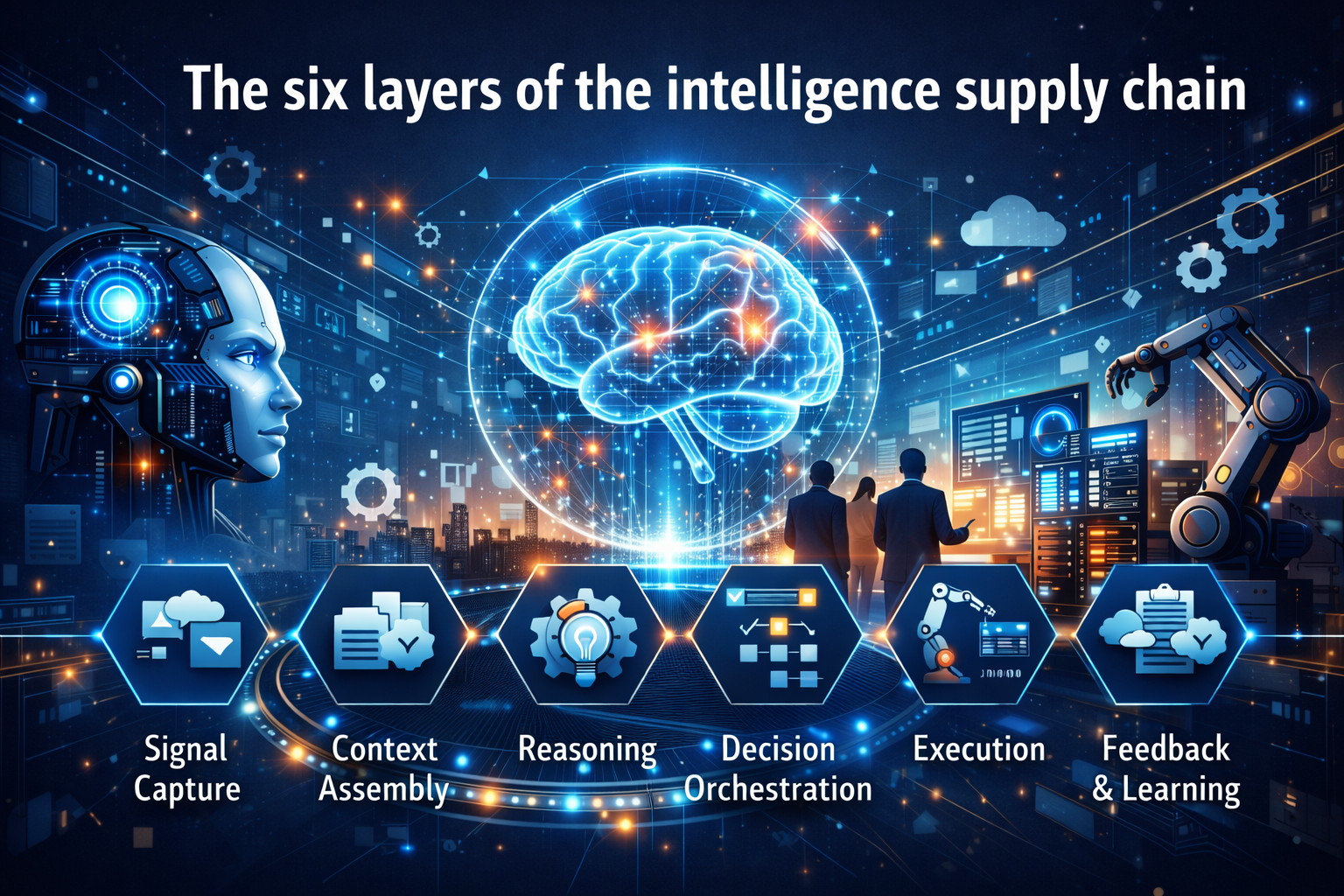
The six layers of the intelligence supply chain
To understand the idea more clearly, it helps to think of the intelligence supply chain as six connected layers.
-
Signal capture: the raw material of intelligence
Every supply chain starts with inputs.
In manufacturing, the inputs are steel, silicon, chemicals, fabric, or plastic. In the intelligence economy, the inputs are signals.
These signals include customer conversations, transactions, documents, emails, machine telemetry, supply chain events, market feeds, operational logs, images, approvals, claims, alerts, and sensor data.
A telecom operator may capture network alarms, device logs, customer complaints, and traffic spikes.
A hospital may capture symptoms, lab reports, medication history, and imaging notes.
A logistics provider may capture vehicle location, weather, order volume, route congestion, and warehouse status.
These are the raw materials from which cognition is produced.
If the signal layer is weak, the rest of the chain is weak. Many enterprise AI failures do not begin with poor models. They begin with fragmented systems, stale data, missing fields, inaccessible documents, or low-quality operational signals.
The supply chain starts before the prompt.
-
Context assembly: turning data into situational awareness
Signals alone do not create understanding.
They must be assembled into context.
Context is what tells the system what matters in this specific case, at this moment, under these conditions.
It may include:
- customer history
- enterprise policy
- role-based permissions
- regulatory obligations
- inventory constraints
- contractual commitments
- regional conditions
- product rules
- process stage
- risk thresholds
A customer message saying “my order is delayed” means one thing if the item is a low-value fashion accessory, something very different if it is a critical medical device, and something else again if it is a replacement part for an industrial line.
Context converts scattered signals into situational awareness.
This is why many organizations that think they need “a better model” actually need something deeper: stronger retrieval, cleaner document systems, permission-aware knowledge access, better memory, and more reliable enterprise context.
-
Reasoning: evaluating possibilities within boundaries
This is the layer most people associate with AI.
Here the system interprets the context, generates options, weighs tradeoffs, and proposes a course of action.
In financial services, the system may evaluate transaction anomalies, customer history, device behavior, sanctions rules, and fraud thresholds to determine whether a payment should proceed.
In insurance, it may compare policy terms, prior claims, incident description, repair estimates, and fraud patterns.
In retail, it may analyze demand shifts, pricing elasticity, shipping costs, and inventory exposure to recommend replenishment or markdown actions.
But enterprise reasoning must be bounded reasoning.
The model cannot simply generate plausible answers. It must operate within policy, process, confidence thresholds, legal constraints, escalation rules, and operational limits.
Reasoning without governance is experimentation.
Reasoning within enterprise boundaries becomes decision infrastructure.
-
Decision orchestration: governing authority flow
This is one of the most misunderstood parts of enterprise AI.
A recommendation is not a decision.
A model may suggest a refund, a claim approval, an inventory transfer, a suspicious-activity block, or a service escalation. But the enterprise still needs a way to determine:
- which recommendations are allowed to execute automatically
- which require human approval
- which violate a policy rule
- which need a second model or second check
- which must be escalated because the consequences are too sensitive
This is the orchestration layer of the intelligence supply chain.
Think of it as the air traffic control system for machine-supported judgment.
Without this layer, organizations do not have scalable intelligence. They have automated guesswork.
With it, they begin to build governed autonomy.
This is also where my broader doctrine around control planes, decision rights, and execution contracts becomes strategically important. The organization is not just automating work. It is deciding how authority flows between humans, models, policies, and systems.
-
Execution: where intelligence becomes consequence
A supply chain creates value only when output moves into the world.
In the intelligence supply chain, that moment is execution.
Actions may include:
- approving or rejecting a claim
- updating a price
- rerouting inventory
- launching a workflow
- blocking a transaction
- creating a service ticket
- scheduling a technician
- drafting a customer response
- escalating to compliance
- triggering a procurement request
This is the point at which AI stops being analysis and becomes consequence.
And that is why execution must be governed carefully. Once systems act in real environments, organizations need reversibility, traceability, accountability, and clear operational boundaries.
This is precisely why current governance frameworks emphasize not only model capability, but trustworthy deployment and risk management across the system lifecycle. (NIST)
-
Feedback and learning: the adaptive loop
No real supply chain is static. It must adjust to changing conditions.
The same is true here.
Organizations need to learn:
- Did the recommendation work?
- Did the human override it?
- Was the escalation necessary?
- Was the customer satisfied?
- Did the action create downstream friction?
- Were the rules too rigid or too loose?
- Which contexts repeatedly produce error?
A bank may learn that a fraud rule over-flags elderly travelers making genuine international transactions.
A hospital may learn that triage support works well in routine cases but needs tighter review during seasonal surges.
A retailer may learn that local festivals distort demand forecasts unless regional event signals are introduced into the system.
Feedback transforms AI from a static feature into an adaptive institutional capability.
This is how the intelligence supply chain improves over time.
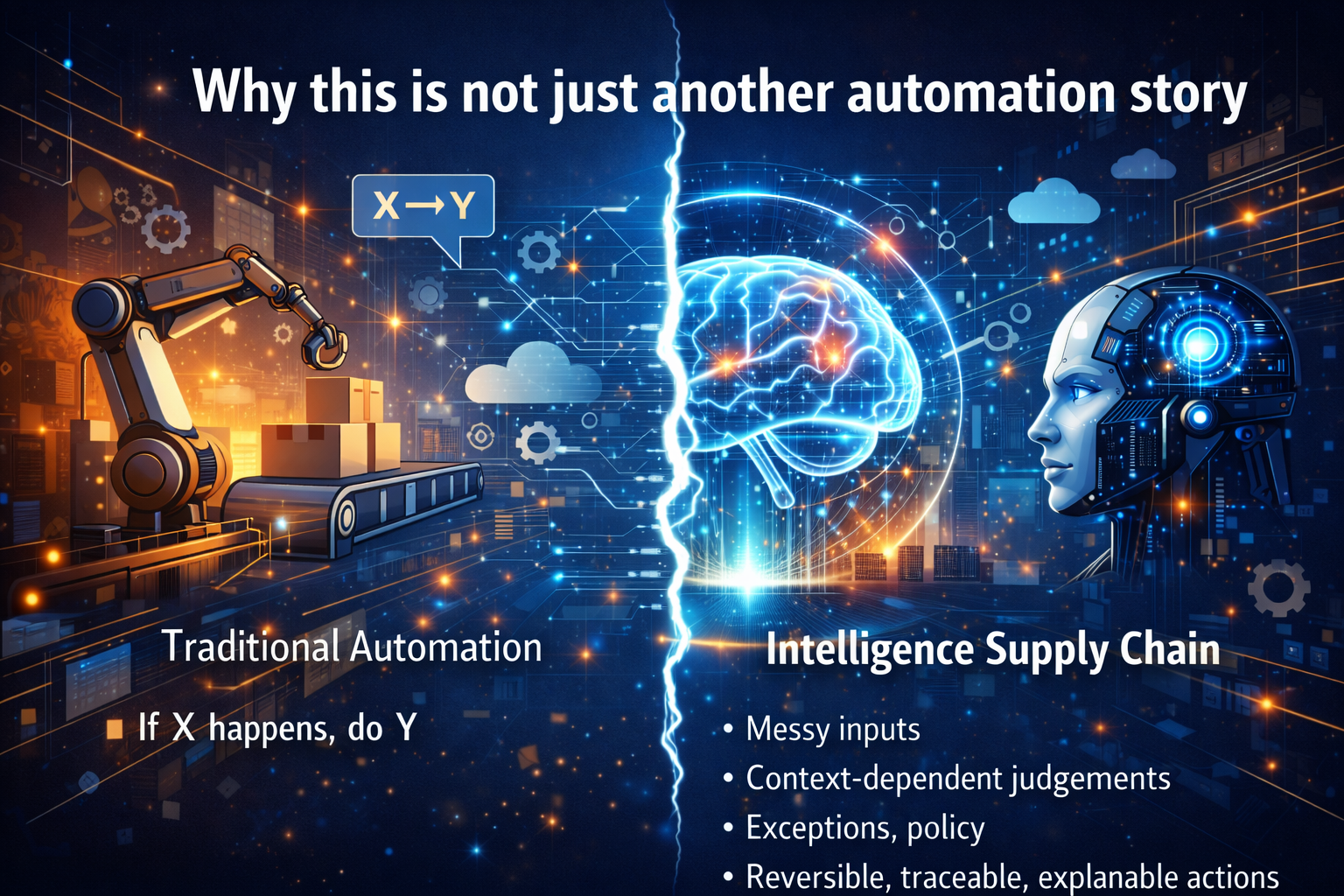
Why this is not just another automation story
Traditional automation works best when the path is stable and the process is predefined.
If X happens, do Y.
The intelligence supply chain is different. It is built for a world in which:
- inputs are messy
- language matters
- context changes the meaning
- tradeoffs are real
- exceptions are frequent
- policies shape the answer
- consequences must be managed
A conventional rule engine can move a form from one queue to another.
An intelligence supply chain can interpret a messy request, retrieve the right context, reason about tradeoffs, decide within policy, execute bounded action, and learn from the result.
That is not a small upgrade to workflow automation.
It is a new production logic for judgment.
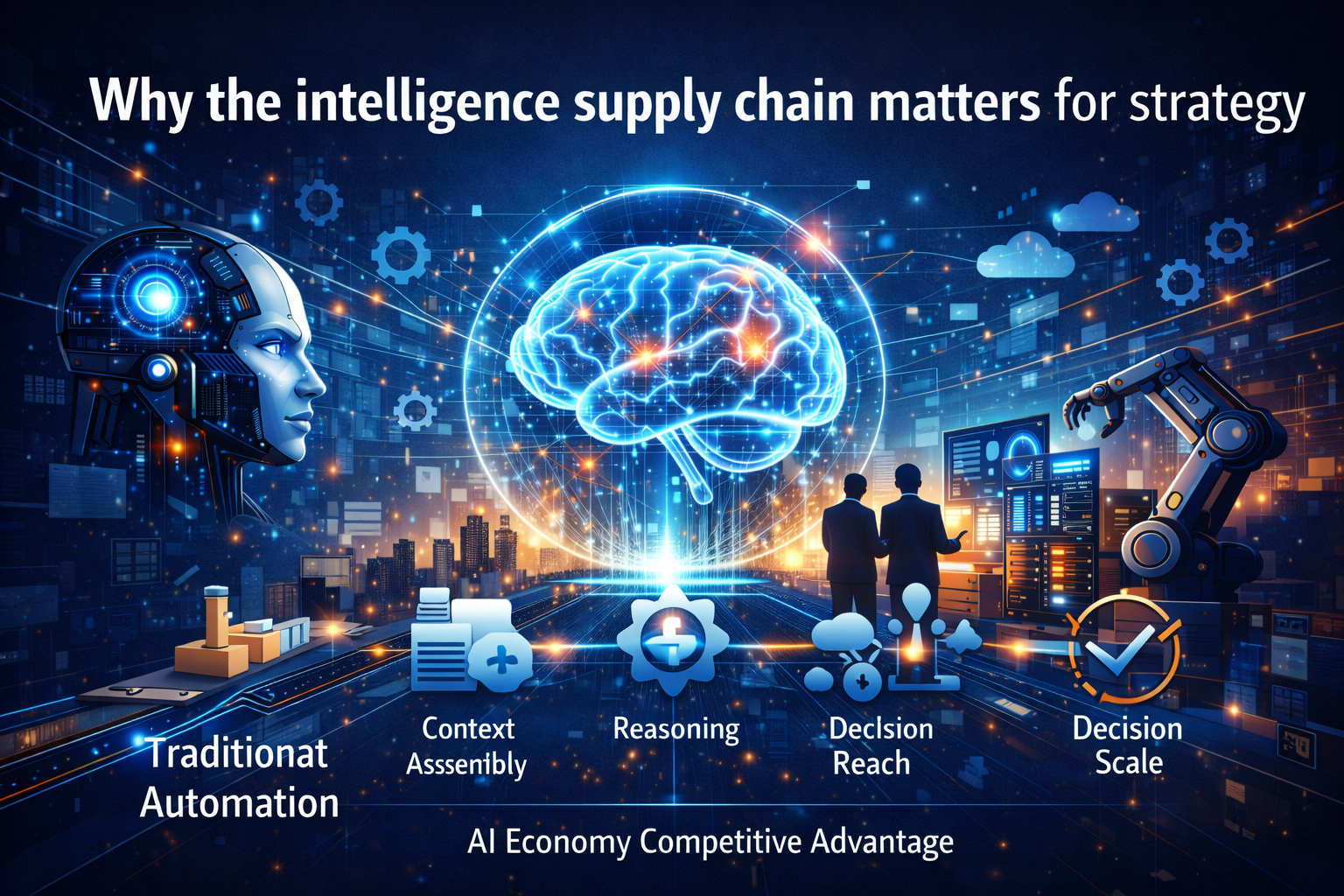
Why the intelligence supply chain matters for strategy
Once cognition becomes industrialized, the basis of competitive advantage changes.
Historically, firms competed through:
- manufacturing scale
- capital efficiency
- labor productivity
- distribution reach
- data advantage
In the AI era, a new form of advantage is emerging:
decision scale.
Organizations that build stronger intelligence supply chains will be able to run more high-quality decisions per day, across more contexts, with greater consistency and lower marginal cognitive cost.
That may include:
- pricing decisions
- credit decisions
- fraud decisions
- service-resolution decisions
- inventory decisions
- underwriting decisions
- maintenance decisions
- procurement decisions
Each decision may seem small in isolation. But across millions of interactions, their cumulative impact becomes structural.
This is how AI starts to reshape industry economics.
It is also why my concepts such as Decision Scale, The AI Dividend, The Intelligence Reuse Index, and The Future Belongs to Decision-Intelligent Institutions fit naturally around this article. The intelligence supply chain is the operational bridge between those strategic ideas.
The global implications
This is not only a Silicon Valley phenomenon.
Banks around the world are using AI-supported systems to detect fraud, prioritize investigations, and improve risk operations.
Healthcare providers are exploring AI-supported triage, documentation, and operational flow. Logistics companies are using AI to route shipments dynamically in response to demand, weather, and disruption.
Governments are testing AI-assisted service delivery and policy analysis across multiple jurisdictions. AI is becoming global operating infrastructure, not a local curiosity. (Stanford HAI)
The pattern is the same across regions:
Organizations that redesign operations around flows of intelligence begin to move faster, learn faster, and adapt faster.
At first, the shift looks subtle.
Then it becomes structural.
The strategic question for boards and CEOs
The defining executive question is no longer:
Should we adopt AI?
That question is already too late.
The more important question is:
How well does our organization produce decisions?
Companies that treat AI as a tool will gain pockets of efficiency.
Companies that build intelligence supply chains will redesign how decisions are created, governed, executed, and improved across the enterprise.
That difference may define the next generation of winners.
Because the future will not belong only to organizations with access to powerful models.
It will belong to organizations that know how to operationalize intelligence.
Key takeaway
The Intelligence Supply Chain is the enterprise system that converts signals into context, context into reasoning, reasoning into decisions, decisions into action, and action into learning. Organizations that industrialize cognition through such systems will gain decision scale — a new source of competitive advantage in the AI economy.
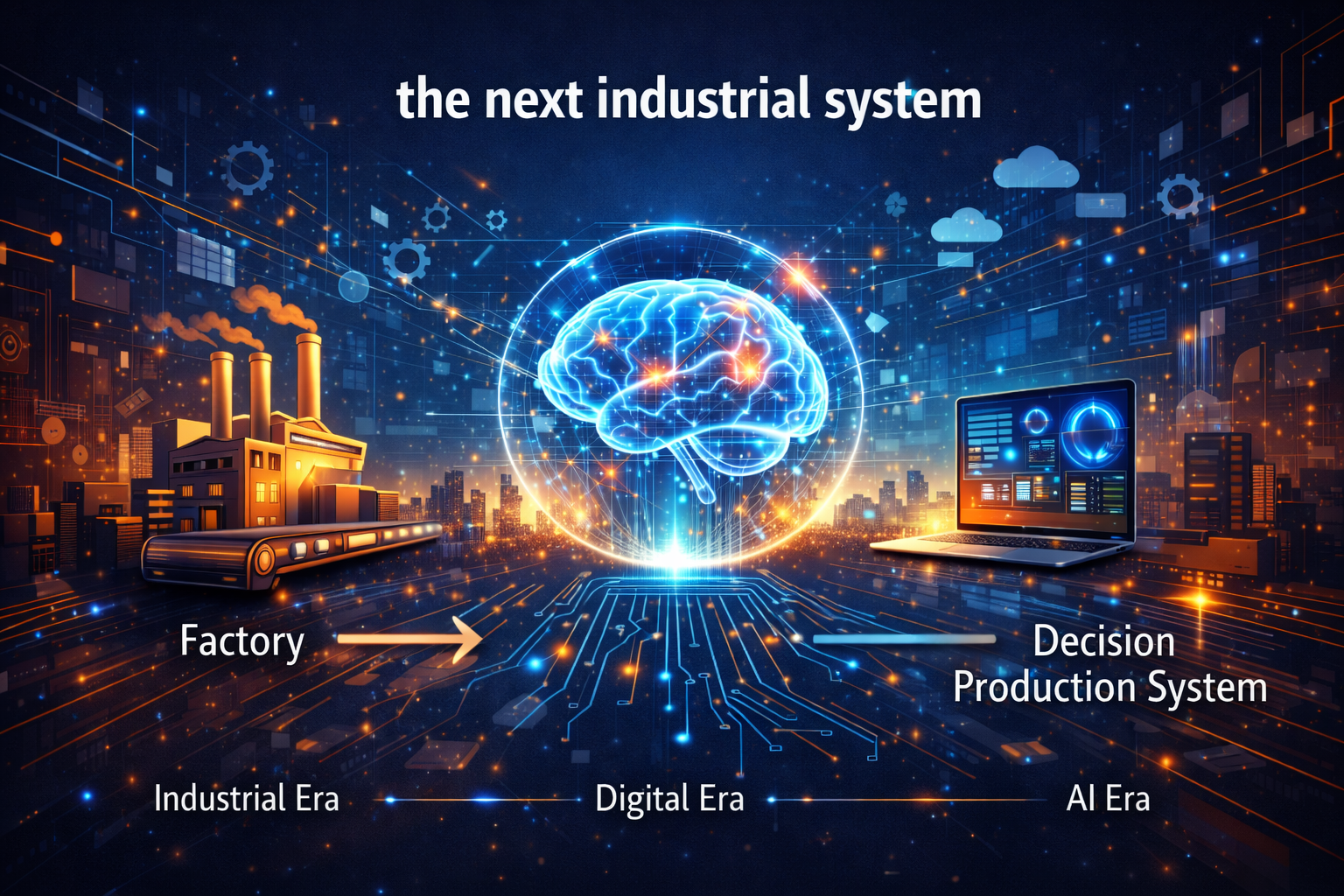
Conclusion: the next industrial system
The industrial revolution gave the world the factory.
The digital revolution gave the world the software platform.
The AI revolution is giving the world something else:
the decision production system.
Organizations that understand this early will not merely deploy AI features. They will design institutions capable of turning signals into judgment, judgment into action, and action into institutional learning — continuously, responsibly, and at scale.
That is why the intelligence supply chain matters.
It is not just a technical architecture.
It is not just an enterprise AI pattern.
It is not just a workflow improvement.
It is the emerging infrastructure through which cognition becomes capability.
And in the coming decade, that capability may matter more than any individual model, prompt, or benchmark.
Because the real power of the AI economy will not come from intelligence alone.
It will come from the organizations that learn how to build intelligence supply chains.
Frequently Asked Questions (FAQ)
What is the Intelligence Supply Chain?
The Intelligence Supply Chain is the enterprise infrastructure that converts signals into context, context into reasoning, reasoning into decisions, and decisions into real-world actions. It enables organizations to operationalize artificial intelligence across business processes.
How is the Intelligence Supply Chain different from traditional automation?
Traditional automation typically follows fixed rules such as “if X happens, do Y.” The Intelligence Supply Chain supports complex decision-making where context, policies, risk considerations, and learning loops are required.
Why is the Intelligence Supply Chain important for enterprise AI?
Most AI projects fail because organizations deploy models without designing the surrounding operational infrastructure. The Intelligence Supply Chain provides the structure needed for AI systems to operate safely, consistently, and at scale.
How does the Intelligence Supply Chain create competitive advantage?
Organizations that build strong intelligence supply chains can run large volumes of decisions faster and more accurately than competitors. This capability creates advantages in pricing, risk management, supply chains, customer experience, and operational efficiency.
Which industries will benefit most from the Intelligence Supply Chain?
Industries that rely heavily on decision-making workflows are most likely to benefit. These include banking, insurance, healthcare, logistics, retail, telecommunications, manufacturing, and government services.
What role do humans play in the Intelligence Supply Chain?
Humans remain essential. They define policies, set governance rules, review high-risk decisions, monitor outcomes, and continuously improve the system. AI augments human decision-making rather than fully replacing it.
Is the Intelligence Supply Chain only relevant for large enterprises?
While large enterprises may adopt it earlier, the concept applies to organizations of all sizes. As AI tools become more accessible, even mid-sized firms will increasingly build simplified versions of intelligence supply chains.
How does governance fit into the Intelligence Supply Chain?
Governance defines the boundaries within which AI operates. It ensures that decisions remain compliant with regulations, aligned with organizational policies, and accountable to human oversight.
Glossary
Intelligence Supply Chain
The enterprise system through which organizations convert signals into context, context into reasoning, reasoning into decisions, decisions into action, and action into institutional learning. It represents the operational infrastructure that allows artificial intelligence to function reliably inside real organizational workflows.
Industrialized Cognition
The ability to produce judgment-like work repeatedly and at scale using AI systems integrated with enterprise data, policies, and workflows. Just as factories industrialized physical labor, AI systems industrialize cognitive work.
Signal Capture
The process of collecting raw inputs such as customer messages, transactions, documents, machine telemetry, operational events, and sensor data. These signals form the raw material for intelligent decision-making systems.
Context Assembly
The process of combining signals with enterprise knowledge, policies, historical records, permissions, and environmental conditions so that AI systems understand the situation correctly before generating decisions.
Reasoning Layer
The stage in which AI models evaluate possible actions, compare tradeoffs, estimate risk, and generate recommendations based on available context.
Decision Orchestration
The governance layer that determines how AI recommendations are converted into actual decisions. It defines when actions are automated, when humans must approve them, and when decisions must be escalated.
Execution Layer
The point at which AI-supported decisions trigger real-world actions such as approving claims, updating prices, routing shipments, scheduling technicians, or launching workflows.
Feedback Loop
The learning mechanism that captures outcomes from decisions and feeds them back into the system so that the intelligence supply chain improves over time.
Decision Scale
A new form of competitive advantage in which organizations can run large numbers of high-quality decisions rapidly and consistently across the enterprise using AI systems.
Enterprise AI Runtime
The production environment in which AI models operate within enterprise systems, workflows, governance controls, and operational processes.
Further Read
Artificial Intelligence and Enterprise Adoption
Stanford Institute for Human-Centered Artificial Intelligence – AI Index Report
AI Governance and Risk Management
National Institute of Standards and Technology – AI Risk Management Framework
Global AI Policy and Regulation
Enterprise AI Adoption Research
OECD – AI Adoption and Economic Impact
AI Industry Trends and Market Analysis
McKinsey & Company – State of AI Reports
The Intelligence-Native Enterprise Doctrine
This article is part of a larger strategic body of work that defines how AI is transforming the structure of markets, institutions, and competitive advantage. To explore the full doctrine, read the following foundational essays:
- The AI Decade Will Reward Synchronization, Not Adoption
Why enterprise AI strategy must shift from tools to operating models.
https://www.raktimsingh.com/the-ai-decade-will-reward-synchronization-not-adoption-why-enterprise-ai-strategy-must-shift-from-tools-to-operating-models/ - The Third-Order AI Economy
The category map boards must use to see the next Uber moment.
https://www.raktimsingh.com/third-order-ai-economy/ - The Intelligence Company
A new theory of the firm in the AI era — where decision quality becomes the scalable asset.
https://www.raktimsingh.com/intelligence-company-new-theory-firm-ai/ - The Judgment Economy
How AI is redefining industry structure — not just productivity.
https://www.raktimsingh.com/judgment-economy-ai-industry-structure/ - Digital Transformation 3.0
The rise of the intelligence-native enterprise.
https://www.raktimsingh.com/designing-intelligence-native-enterprise/ - Industry Structure in the AI Era
Why judgment economies will redefine competitive advantage.
https://www.raktimsingh.com/industry-structure-in-the-ai-era-why-judgment-economies-will-redefine-competitive-advantage/
Institutional Perspectives on Enterprise AI
Many of the structural ideas discussed here — intelligence-native operating models, control planes, decision integrity, and accountable autonomy — have also been explored in my institutional perspectives published via Infosys’ Emerging Technology Solutions platform.
For readers seeking deeper operational detail, I have written extensively on:
- What Makes an Enterprise Intelligence-Native? The Blueprint for Third-Order AI Advantage
https://blogs.infosys.com/emerging-technology-solutions/artificial-intelligence/what-is-enterprise-ai-the-operating-model-for-compounding-institutional-intelligence.html - Why “AI in the Enterprise” Is Not Enterprise AI: The Operating Model Difference Most Organizations Miss
https://blogs.infosys.com/emerging-technology-solutions/artificial-intelligence/why-ai-in-the-enterprise-is-not-enterprise-ai-the-operating-model-difference-that-most-organizations-miss.html - The Enterprise AI Control Plane: Governing Autonomy at Scale
https://blogs.infosys.com/emerging-technology-solutions/artificial-intelligence/the-enterprise-ai-control-plane-governing-autonomy-at-scale.html - Enterprise AI Ownership Framework: Who Is Accountable, Who Decides, and Who Stops AI in Production
https://blogs.infosys.com/emerging-technology-solutions/artificial-intelligence/enterprise-ai-ownership-framework-who-is-accountable-who-decides-and-who-stops-ai-in-production.html - Decision Integrity: Why Model Accuracy Is Not Enough in Enterprise AI
https://blogs.infosys.com/emerging-technology-solutions/artificial-intelligence/decision-integrity-why-model-accuracy-is-not-enough-in-enterprise-ai.html - Agent Incident Response Playbook: Operating Autonomous AI Systems Safely at Enterprise Scale
https://blogs.infosys.com/emerging-technology-solutions/artificial-intelligence/agent-incident-response-playbook-operating-autonomous-ai-systems-safely-at-enterprise-scale.html - The Economics of Enterprise AI: Designing Cost, Control, and Value as One System
https://blogs.infosys.com/emerging-technology-solutions/artificial-intelligence/the-economics-of-enterprise-ai-designing-cost-control-and-value-as-one-system.html
Together, these perspectives outline a unified view: Enterprise AI is not a collection of tools. It is a governed operating system for institutional intelligence — where economics, accountability, control, and decision integrity function as a coherent architecture.



Raktim Singh is an AI and deep-tech strategist, TEDx speaker, and author focused on helping enterprises navigate the next era of intelligent systems. With experience spanning AI, fintech, quantum computing, and digital transformation, he simplifies complex technology for leaders and builds frameworks that drive responsible, scalable adoption.