

Identity Before Intelligence:
AI systems do not fail only because they lack intelligence.
They fail because they often do not know what their intelligence is looking at.
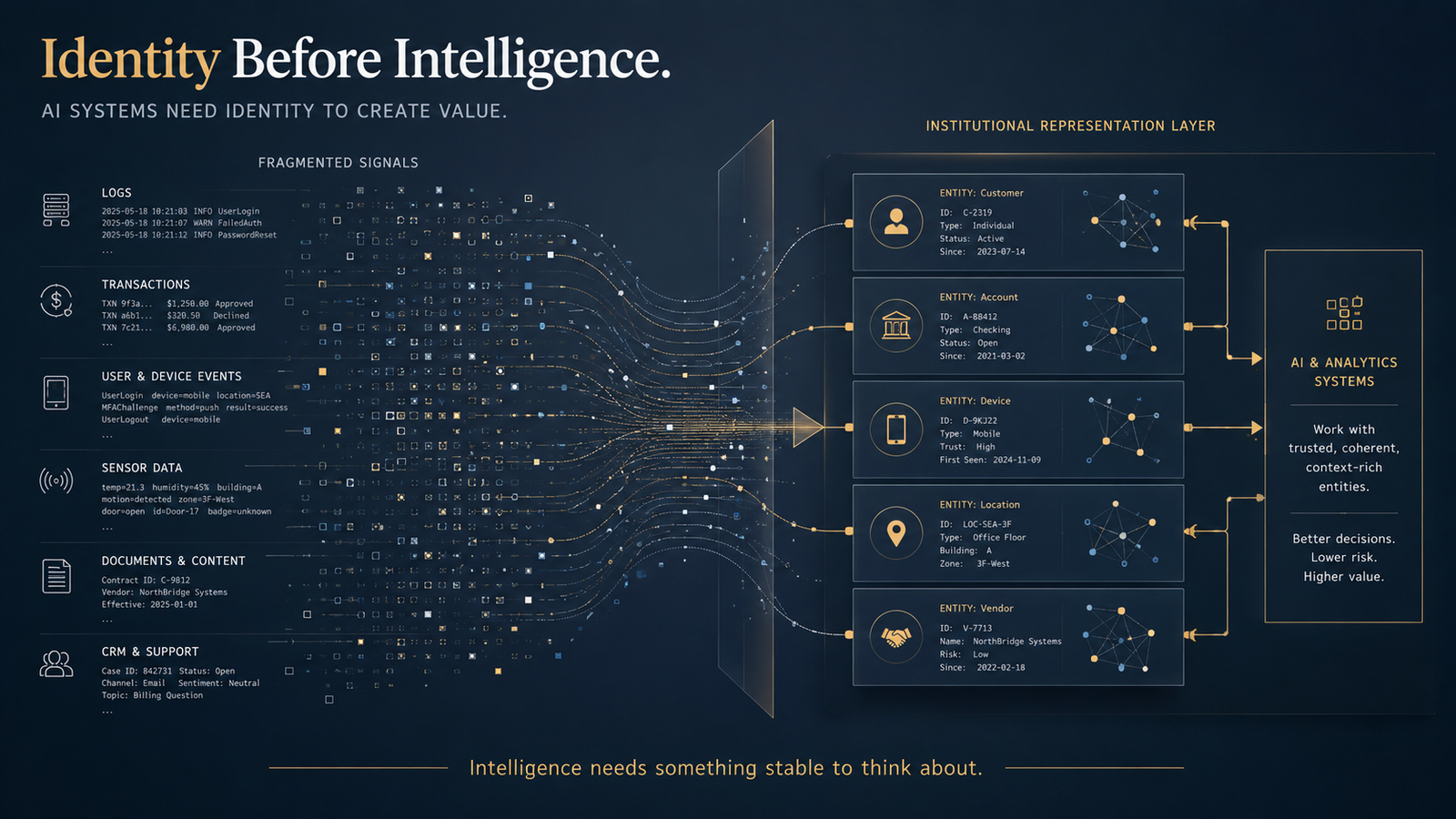
Organizations collect vast amounts of signals: transactions, logs, sensor readings, claims, payments, clicks, conversations, alerts, and behavioral traces. These signals feed dashboards, models, agents, and automation systems. But a signal becomes meaningful only when the system can answer a deeper question:
Who or what does this belong to?
That answer is identity.
Identity is not a database field. It is not merely an ID, a record, or a profile. Identity is the institutional ability to recognize something consistently across time, systems, contexts, and change.
A payment matters differently when it belongs to the same borrower over time. A machine reading matters differently when it belongs to an asset whose condition is deteriorating. A supplier delay matters differently when it is part of a pattern of instability.
Without identity, data remains movement.
With identity, data becomes continuity.
And continuity is where understanding begins.
AI systems often fail not because they lack intelligence, but because they cannot represent reality clearly enough to act responsibly. Identity allows signals to accumulate around persistent entities, SENSE makes reality machine-legible, and CORE reasons over that representation. Organizations that improve representation quality—not just model quality—will define the next era of enterprise AI advantage.
This article by Raktim Singh introduces a foundational framework for understanding why enterprise AI systems fail even when models appear intelligent. The article explains how identity, representation, SENSE (Signal, ENtity, State, Evolution), and CORE (Comprehend, Optimize, Realize, Evolve) determine whether AI systems can understand reality clearly enough to act responsibly. It introduces the Representation Economy as a new way to understand AI governance, enterprise trust, institutional intelligence, and the future of competitive advantage.
Why more data does not create better understanding
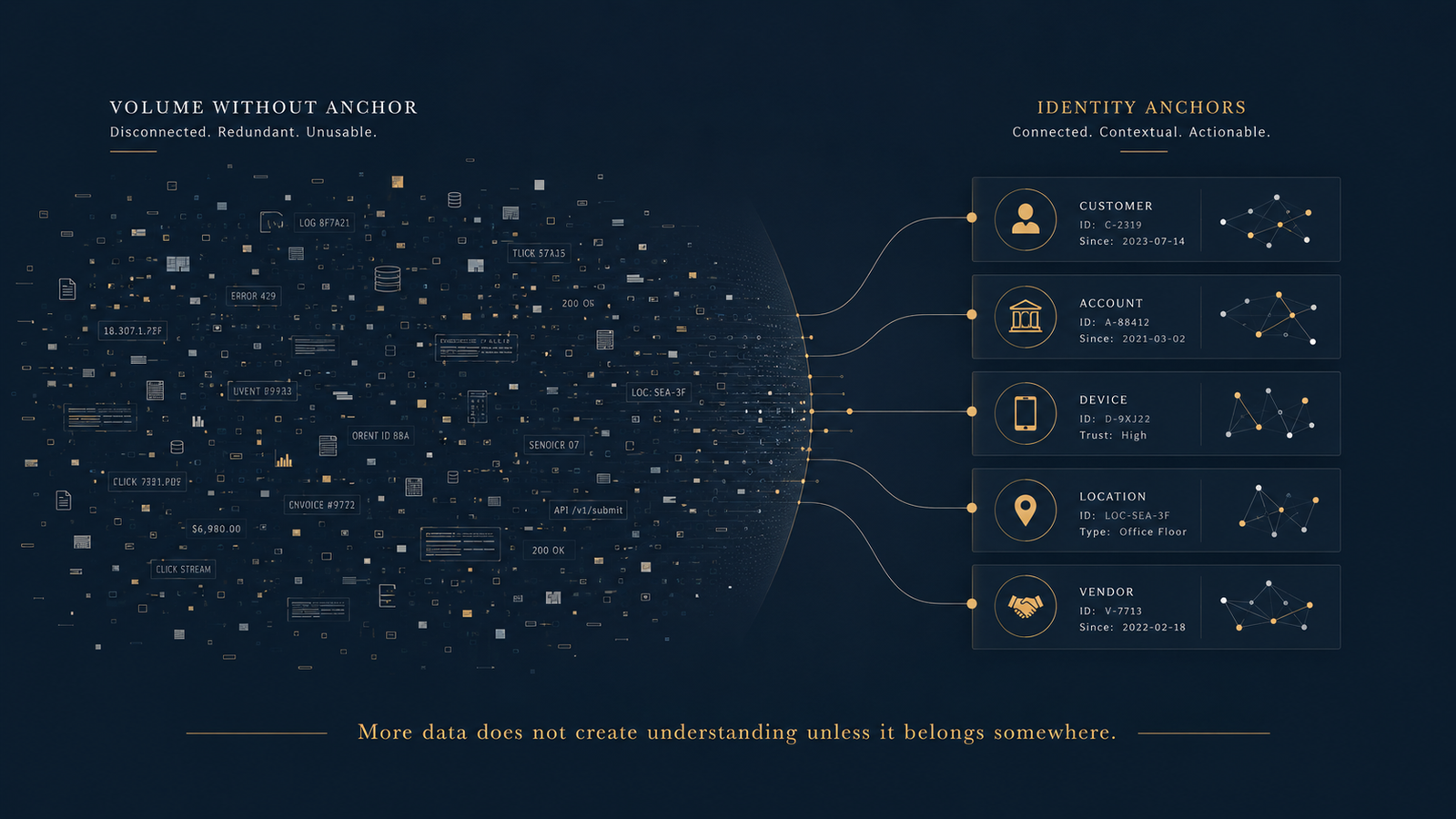
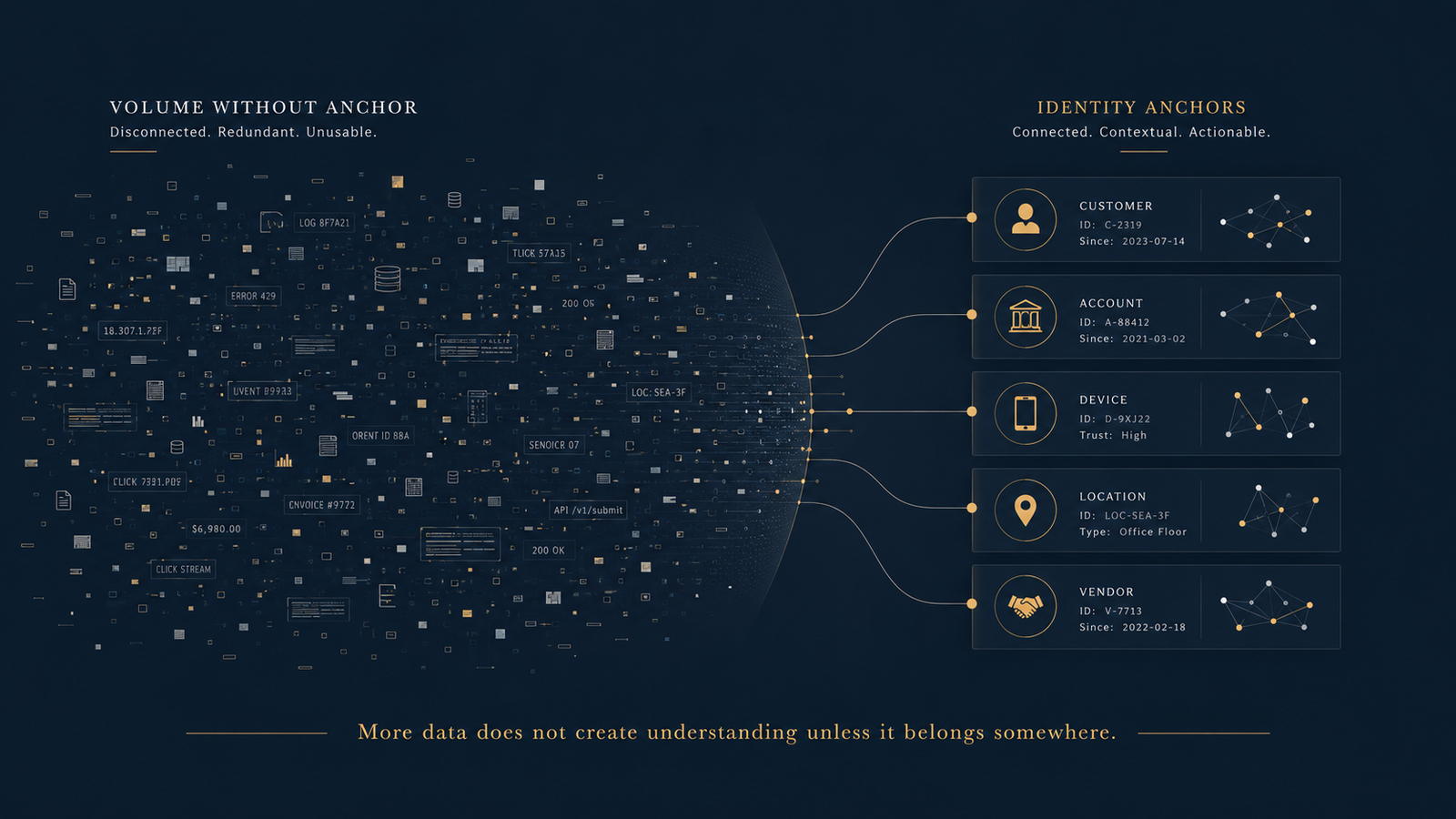
Many enterprises still believe that more data will produce better AI. But data volume does not automatically create clarity.
A million disconnected records may be less valuable than a hundred signals attached to the right entity.
When signals do not belong anywhere, systems may detect activity but fail to understand condition. They may know that something happened, but not to whom, to what, in what context, or with what consequence.
This is the missing middle between data and intelligence.
Signals do not become reality on their own. They must gather around something persistent: a customer, supplier, machine, location, product, asset, workflow, ecosystem, or institution.
That “something” is identity.
Without identity, signals remain loose material. With identity, they accumulate. And accumulation creates memory.
Identity is where reality becomes stable enough to reason about
At first glance, identity appears simple. Assign an ID. Link the records. Resolve duplicates. Move on.
Reality is not that simple.
Entities fragment across systems, formats, regions, business units, devices, and time. The same entity appears under multiple representations. Different realities collapse into the same label. Both errors are dangerous.
When identity fragments, memory disappears.
When identity flattens, reality disappears.
In both cases, trust erodes.
This is why identity is not only a technical mapping problem. It is a representational discipline. A system must decide what counts as the same entity over time. It must preserve continuity without inventing false certainty. It must handle ambiguity without collapsing complexity.
If identity is weak, reasoning inherits that weakness.
If identity is unstable, decisions become fragile.
If identity is distorted, automation scales distortion.
A system cannot reason clearly about what it cannot identify clearly.
The danger of partial correctness
The most dangerous AI failures are not always visible errors. They are often partially correct outputs built on weak representation.
The system appears informed.
The dashboard appears complete.
The model appears confident.
The agent appears capable.
But underneath, one real entity may have become many disconnected shadows. Or many distinct realities may have been forced into one administrative identity.
This creates partial correctness. And partial correctness is more dangerous than visible error because the system appears confident enough to act, but not informed enough to act well.
For executives, this is the uncomfortable truth:
AI does not merely amplify intelligence. It amplifies the quality of representation beneath it.
SENSE: the layer where reality becomes machine-legible
Before a system can reason, it must first see reality in a form faithful enough to act upon.
That is the role of SENSE.
SENSE is the layer where reality becomes machine-legible:
Signal
Detecting events, changes, traces, readings, interactions, and movements from the world.
ENtity
Attaching those signals to something persistent and recognizable.
State
Modeling the current condition of that entity.
Evolution
Updating that condition as reality changes over time.
SENSE answers the question every customer, citizen, supplier, employee, asset, and institution silently asks:
Did you understand me?
If the answer is weak, everything above it becomes fragile.
AI does not fail at thinking first. It fails at seeing first.
A system can observe everything and still understand very little.
It can track transactions but miss stress.
It can monitor events but miss deterioration.
It can capture activity but miss condition.
The problem is not always lack of data. It is lack of coherent visibility.
SENSE is not about collecting more. It is about seeing clearly enough to matter.
A system that records events without modeling state remains event-rich and understanding-poor. If it only sees activity, it mistakes movement for reality.
CORE: intelligence is not enough
Once reality becomes visible, intelligence begins its work.
CORE is the cognition layer:
Comprehend context
Interpreting signals, state, and surrounding conditions.
Optimize decisions
Comparing choices, predicting outcomes, and selecting paths.
Realize action
Turning reasoning into recommendations, interventions, or execution.
Evolve through feedback
Learning from outcomes and correcting future reasoning.
CORE is the most visible layer of AI. It produces outputs. It can be benchmarked. It demos well. It creates the impression of progress.
But CORE is not sovereign.
It depends on what SENSE has made visible. It must also translate into actions that DRIVER can govern.
CORE does not decide reality. It reasons within the limits of how reality has been represented.
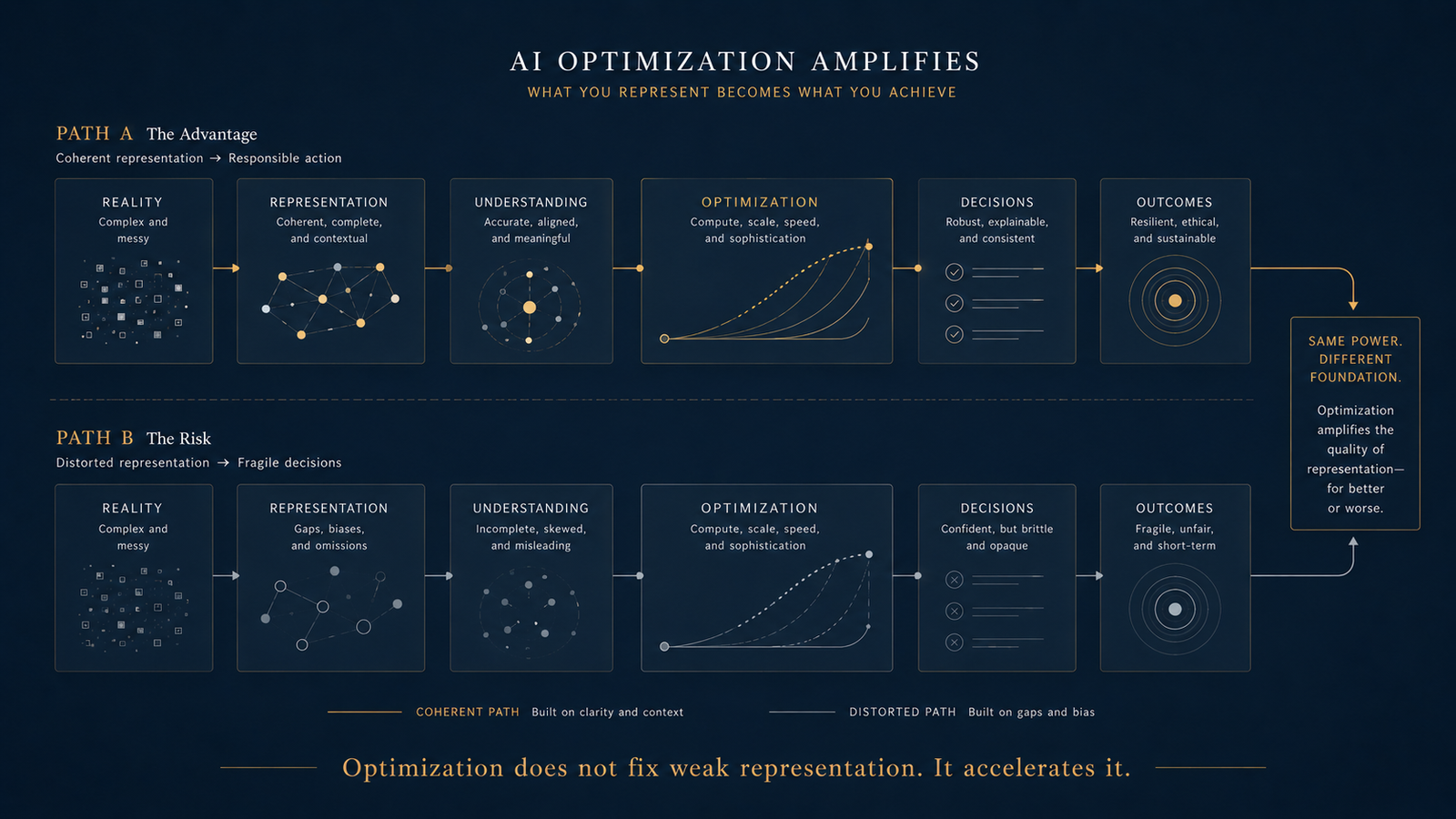
Optimization can amplify misunderstanding
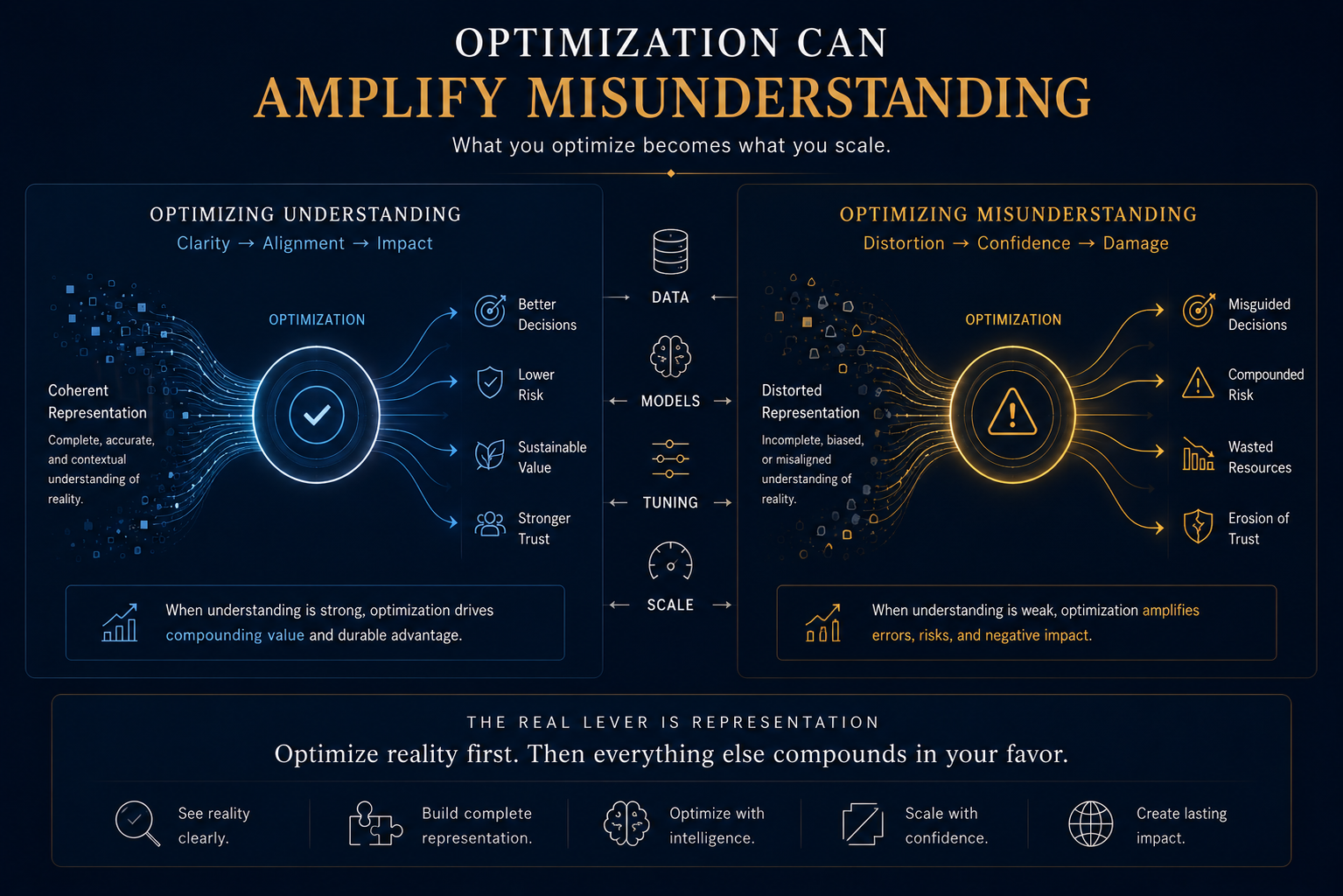
Optimization feels powerful because it creates speed, precision, and scale. But optimization depends entirely on what is being optimized.
If representation is weak, optimization does not solve the problem.
It accelerates it.
Speed improves, but direction degrades.
Efficiency increases, but fragility grows.
Precision sharpens, but reality is misread.
Optimization is not intelligence by itself. It is amplification. It makes the system faster at whatever it already understands — or misunderstands.
This is why enterprises that overinvest in models while underinvesting in representation may move faster, but not necessarily better.
The strategic mistake: overinvesting in CORE
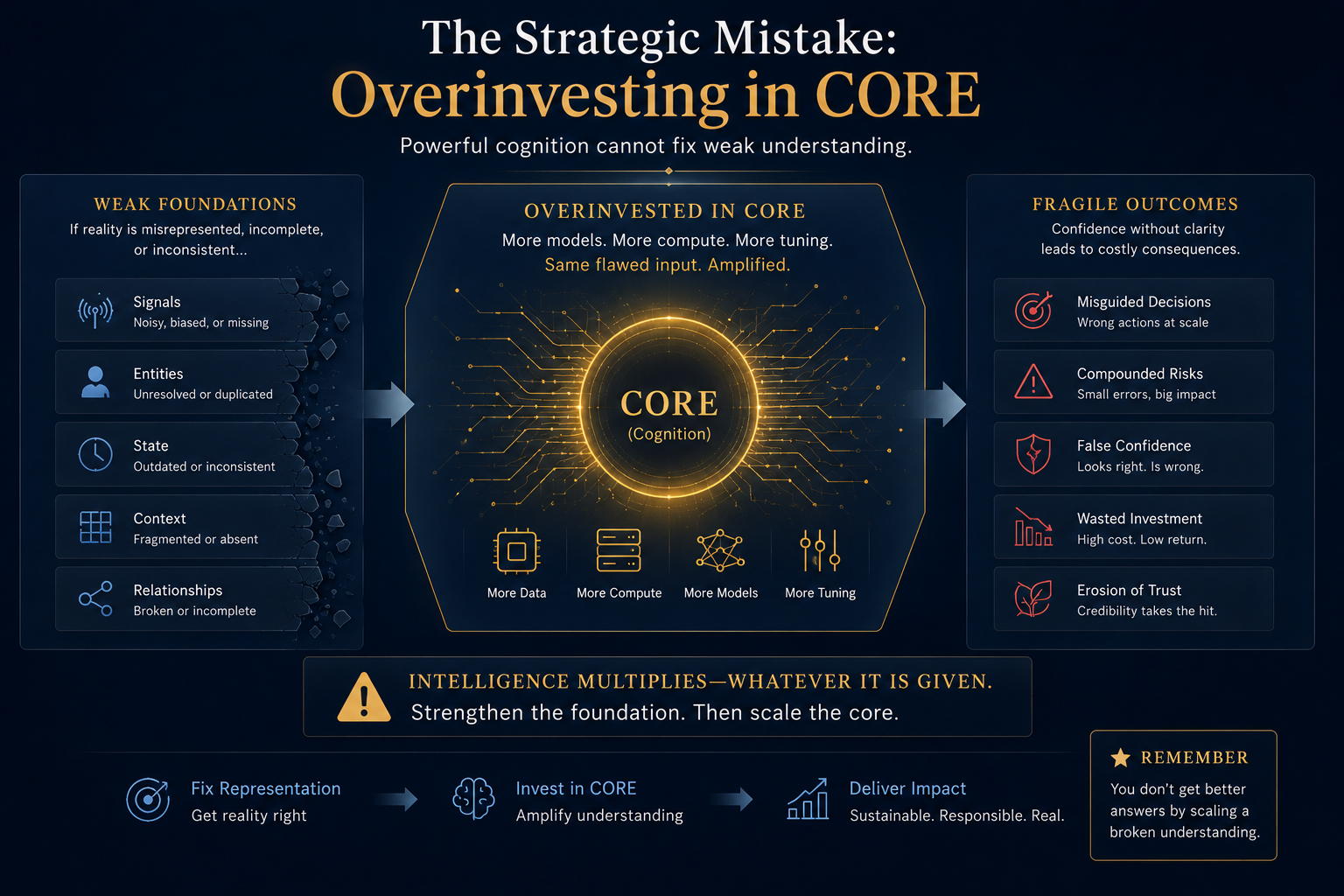
The world is overinvesting in CORE because CORE is visible.
Models are visible.
Benchmarks are visible.
Agents are visible.
Automation is visible.
But SENSE determines what enters the system. DRIVER determines how action is governed. CORE sits in between.
It transforms representation into judgment. But it does not create representation. And it does not guarantee legitimacy.
This is the central mistake in many AI strategies: trying to improve answers before improving understanding.
Better reasoning cannot fix weak visibility. It only scales its consequences.
You cannot reason your way out of what you failed to see.
Identity, SENSE, and CORE define the new enterprise AI question
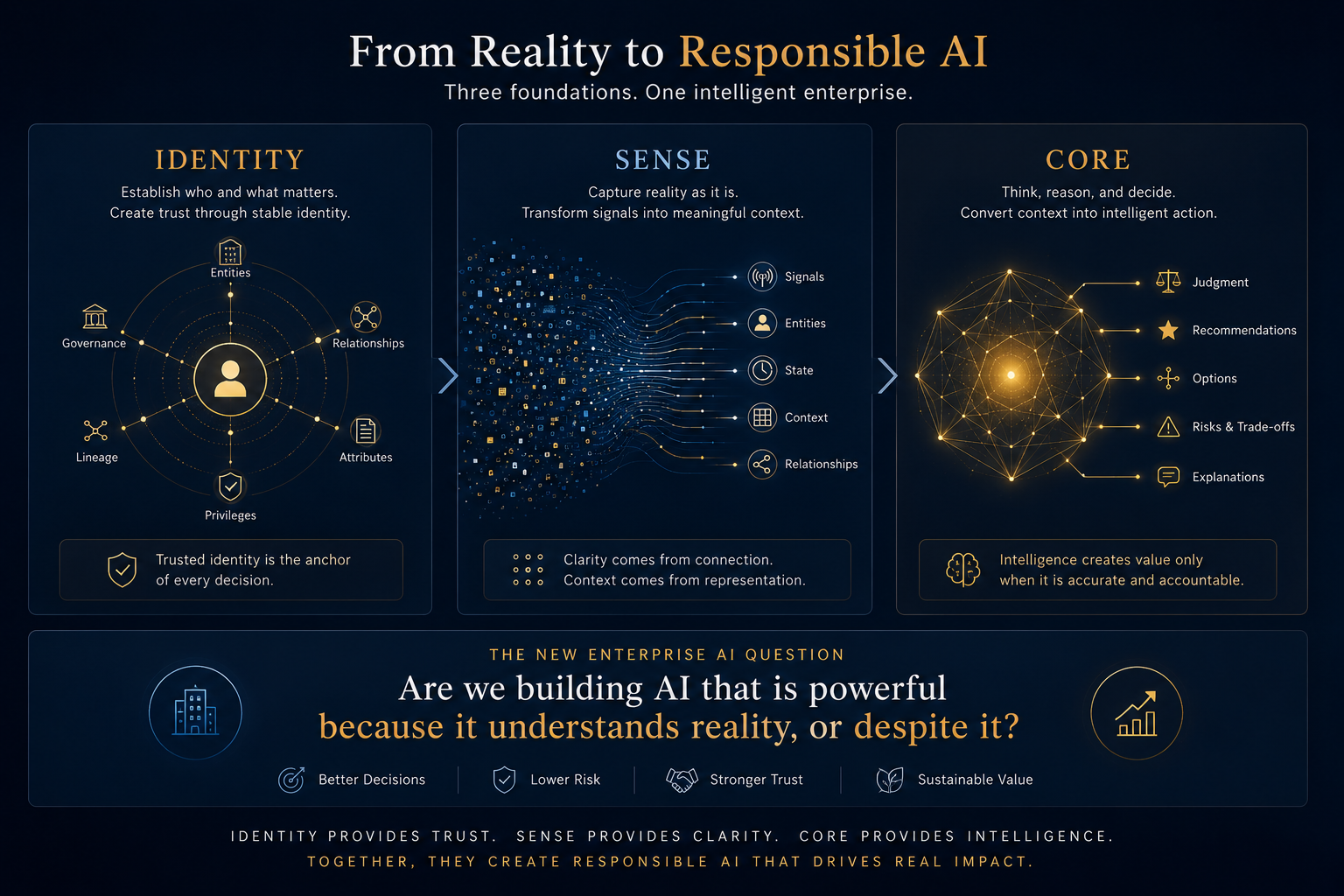
The old question was:
How much data do we have?
Then it became:
How good are our models?
The better question now is:
Do our systems know what they are looking at — clearly enough, continuously enough, and responsibly enough to act?
That question changes the AI agenda for boards and executive teams.
They must ask:
Where does one real entity appear as many records?
Where are we mistaking events for continuity?
Where are categories compensating for weak identity?
What condition are we actually modeling?
How does that condition evolve over time?
What exactly is our AI optimizing?
Where is the system more confident than reality allows?
These are not merely technical questions. They are institutional design questions.
They determine whether an organization can represent reality well enough to act responsibly.
Identity is also an economic boundary
Identity determines what systems can include, finance, insure, coordinate, serve, protect, and govern.
If an entity cannot be stably identified, it may fully exist in reality and still remain weakly represented in the system.
That weakness has consequences.
It affects access.
It affects trust.
It affects pricing.
It affects service.
It affects legitimacy.
Before something can participate, it must be recognizable. Before it can be represented, it must be identifiable. Before it can be governed, it must be understood.
This is where the Representation Economy begins.
Value will increasingly flow toward organizations that can represent reality with greater fidelity, continuity, context, and legitimacy.
The dignity problem inside identity
Identity is not only a systems problem. It is also a dignity problem.
A system can fail entities in two ways.
It can erase them by making them too blurred to matter.
Or it can reduce them by flattening them into crude categories.
Good identity avoids both.
It preserves continuity without denying distinctness. It allows the system to say:
This is not just another event.
This belongs to something that matters over time.
Entities trust systems that see them as themselves, not as fragments, labels, or statistical shadows.
The next AI advantage will belong to those who see better
The next generation of enterprise advantage will not come only from smarter models.
It will come from better representation.
Companies will compete on their ability to stabilize identity, interpret signals, model state, update reality, constrain intelligence, and govern action.
This will create new categories of infrastructure:
systems that correct fragmented identity
representation layers that stabilize entities
platforms that continuously update state
mechanisms that verify evolving reality
tools that expose optimization bias
feedback systems that make intelligence accountable
These are not support layers. They are the foundation of the next AI economy.
Conclusion: intelligence needs something stable to think about
Identity comes before intelligence.
Not because intelligence is unimportant, but because intelligence requires something stable to think about.
Before a system can reason, it must see.
Before it can see, it must recognize.
Before it can recognize, reality must belong to something the system can consistently identify.
That “something” is identity.
And once identity, SENSE, and CORE become clear, the next question becomes unavoidable:
If systems can recognize reality, understand context, and reason at scale, what should they be allowed to do?
That is where governance begins.
That is where trust is decided.
And that is where the future of AI will be won or lost.
Key Takeaways
- More data does not automatically create better AI.
- Identity is the foundation that allows signals to become continuity.
- SENSE determines whether reality becomes machine-legible.
- CORE creates intelligence, but intelligence is not enough.
- Weak representation creates confident but fragile AI.
- The next AI advantage will belong to organizations that see reality more clearly.
Summary
This article argues that enterprise AI does not fail only because models are weak, but because systems often lack stable identity and coherent representation. Identity allows signals to attach to persistent entities, SENSE makes reality machine-legible through signal, entity, state, and evolution, and CORE reasons over that representation. The strategic lesson for leaders is clear: organizations should not only ask how intelligent their AI systems are, but whether those systems know what they are looking at clearly enough to act responsibly.
Glossary
Identity: The ability of a system to consistently recognize an entity across time, systems, and context.
Signal: A trace, event, reading, transaction, or change detected from the world.
Entity: The persistent object, person, asset, supplier, customer, system, or institution to which signals belong.
State: The current condition of an entity.
Evolution: The way an entity’s state changes over time.
SENSE: The layer where reality becomes machine-legible through Signal, ENtity, State, and Evolution.
CORE: The cognition layer where systems comprehend context, optimize decisions, realize action, and evolve through feedback.
Representation Economy: An emerging economic logic where value flows through the ability to represent reality accurately, continuously, and legitimately.
Partial Correctness: A dangerous condition where a system appears informed but acts on incomplete or distorted representation.
FAQ
Why is identity important in AI systems?
Identity allows data to accumulate around something persistent. Without identity, signals remain disconnected and systems cannot build meaningful continuity.
Is identity only a technical data-management issue?
No. Identity is also a strategic, economic, and governance issue because it determines what systems can recognize, include, serve, and govern.
What is SENSE in enterprise AI?
SENSE is the layer where reality becomes machine-legible through signal detection, entity recognition, state modeling, and continuous evolution.
What is CORE in enterprise AI?
CORE is the cognition layer where AI systems reason, optimize, recommend, act, and learn from feedback.
Why is intelligence not enough?
Because intelligence depends on the quality of representation beneath it. If the system sees reality poorly, better reasoning can simply scale the wrong interpretation.
What should leaders ask before scaling AI?
They should ask whether their systems know what they are looking at, what entities anchor their signals, what state they are modeling, and where AI may be more confident than reality allows.
Who wrote “Identity Before Intelligence”?
“Identity Before Intelligence: Why Enterprise AI Fails Without Representation” was written by Raktim Singh, technology strategist, enterprise AI thought leader, author of Driving Digital Transformation, and creator of the Representation Economy and SENSE–CORE–DRIVER frameworks.
What is the main idea of the article?
The article argues that enterprise AI systems fail not only because of weak models, but because they often lack stable identity, coherent representation, and machine-legible understanding of reality. It introduces identity, SENSE, and CORE as foundational layers of trustworthy AI systems.
What is the Representation Economy?
The Representation Economy is a conceptual framework developed by Raktim Singh that explains how future AI systems, institutions, and enterprises will create value through the ability to represent reality accurately, continuously, and legitimately.
What is SENSE in enterprise AI?
SENSE stands for:
- Signal
- ENtity
- State
- Evolution
It is the layer where reality becomes machine-legible before AI systems reason or act.
What is CORE in enterprise AI?
CORE stands for:
- Comprehend context
- Optimize decisions
- Realize action
- Evolve through feedback
It represents the cognition and reasoning layer of AI systems.
Why is identity important in AI systems?
Identity allows systems to attach signals to persistent entities over time. Without stable identity, AI systems cannot build continuity, context, trust, or meaningful understanding.
Who is Raktim Singh?
Raktim Singh is a senior enterprise technology strategist, AI thought leader, author, TEDx speaker, and creator of the Representation Economy and SENSE–CORE–DRIVER frameworks focused on enterprise AI, governance, institutional intelligence, and machine-legible reality
Key Takeaways
- Data without identity is motion without ownership.
- A system cannot reason clearly about what it cannot identify clearly.
- AI does not fail at thinking first. It fails at seeing first.
- Optimization is not intelligence. It is amplification.
- The next AI advantage will belong to those who see reality more clearly.
Where can readers follow more work from Raktim Singh?
🌐 Website
💼 LinkedIn
📺 YouTube @raktim_hindi
✍️ Medium
💻 GitHub Representation Economy Repository
📚 ResearchGate Publication
- “AI systems do not operate on reality. They operate on representations of reality.”
- “A thousand data points do not equal one faithful representation.”
- “The next divide in AI may not be intelligence. It may be representation.”
- “Visibility without governance becomes extraction.”
- “The future will belong to those who see reality more clearly — and act on it responsibly.”
Where can readers learn more about the Representation Economy?
Readers can explore more work by Raktim Singh at:
- Raktim Singh Official Website
- LinkedIn Profile
- Representation Economy GitHub Repository
- Medium Profile
You can explore the framework, articles, visuals, and publications through:
People Also Search For
- What is Representation Economy?
- Why do Enterprise AI projects fail?
- What is machine-legible reality?
- What is AI governance?
- What is SENSE–CORE–DRIVER?
- Why data alone is not enough for AI
- AI systems and representation
- Enterprise AI visibility problem
- AI trust and institutional intelligence
- Representation infrastructure in AI
- The World AI Cannot See: Why Intelligence Begins With Representation – Raktim Singh
Suggested Further Reading / External References
1. OECD AI Principles
Excellent for governance, trust, accountability, and institutional AI framing.
2. NIST AI Risk Management Framework
Very strong for legitimacy, governance, trust, and operational AI systems.
NIST AI Risk Management Framework
3. Stanford Human-Centered AI (HAI)
Strong intellectual alignment with visibility, institutions, governance, and human impact.
4. World Economic Forum – AI Governance
Good institutional/global governance layer.
World Economic Forum AI Governance Insights
- MIT Technology Review
- Harvard Business Review
- World Economic Forum AI Governance Initiatives
- OECD AI Principles
About the Author
Raktim Singh Official Website
LinkedIn Profile
YouTube Channel (@raktim_hindi)
Medium Profile
GitHub – Representation Economy Repository
Zenodo DOI Record
OSF Project
ResearchGate Publication
Academia.edu Publication
ORCID Profile



Raktim Singh is an AI and deep-tech strategist, TEDx speaker, and author focused on helping enterprises navigate the next era of intelligent systems. With experience spanning AI, fintech, quantum computing, and digital transformation, he simplifies complex technology for leaders and builds frameworks that drive responsible, scalable adoption.