

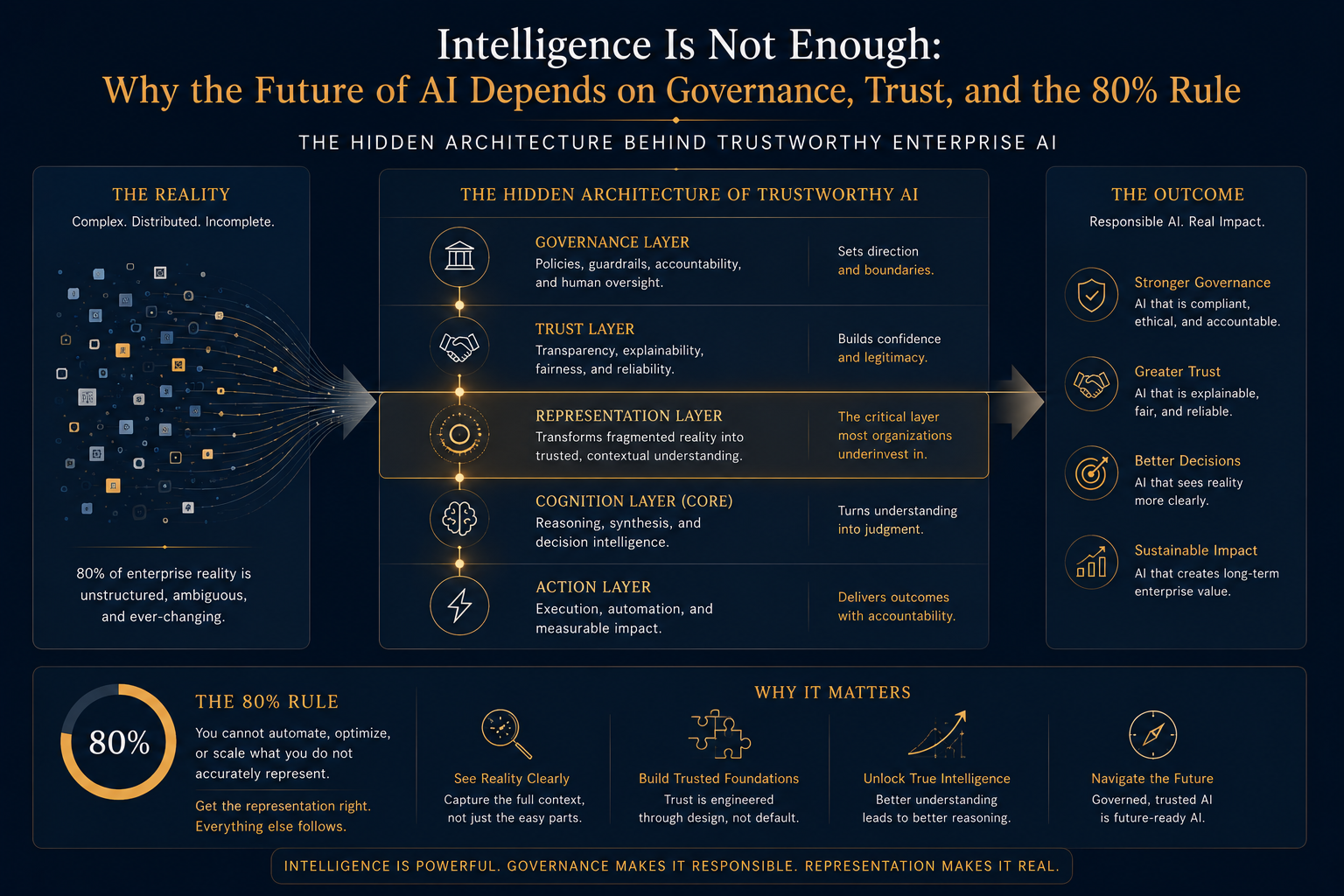
Intelligence Is Not Enough: The hidden architecture behind trustworthy enterprise AI
Artificial intelligence is entering a dangerous phase of maturity.
For years, the conversation centered on capability:
- bigger models,
- faster inference,
- broader automation,
- stronger reasoning,
- and increasingly autonomous systems.
But capability alone does not determine whether systems will be accepted.
A system can see clearly.
It can reason correctly.
It can optimize efficiently.
And still — it may not deserve trust.
That is the uncomfortable transition now confronting enterprises, governments, regulators, and institutions across the world.
The future of AI will not be decided only by intelligence.
It will be decided by governance.
And that changes everything.
The illusion at the center of modern AI

Most AI systems today are evaluated by what they can do.
Can they reason?
Can they summarize?
Can they automate?
Can they predict?
Can they optimize?
These are important questions.
But they are incomplete.
Because intelligence alone does not create legitimacy.
A system may produce accurate outputs and still create harmful outcomes. It may optimize efficiently while narrowing reality. It may automate correctly while eroding trust.
This is because intelligence operates inside boundaries it does not control.
That is the role of CORE.
CORE: The Cognition Layer of AI
CORE is the cognition layer inside the SENSE–CORE–DRIVER framework:
- Comprehend context
- Optimize decisions
- Realize action
- Evolve through feedback
This is where systems reason, compare, prioritize, predict, and optimize.
It is also the most visible layer of AI.
Executives see dashboards.
Users see outputs.
Investors see capability.
Markets see speed.
CORE becomes the public face of intelligence.
And that visibility creates a dangerous illusion:
that intelligence alone is enough.
It is not.
Intelligence depends on representation
CORE does not create reality.
It reasons within the limits of how reality has already been represented.
If representation is weak:
- reasoning becomes fragile,
- optimization becomes distorted,
- and automation becomes dangerous.
This is the structural mistake many organizations are making today.
They are overinvesting in intelligence while underinvesting in representation.
They assume better reasoning will compensate for weak visibility.
But intelligence cannot repair what the system failed to see.
It only amplifies it.
Optimization can quietly amplify misunderstanding
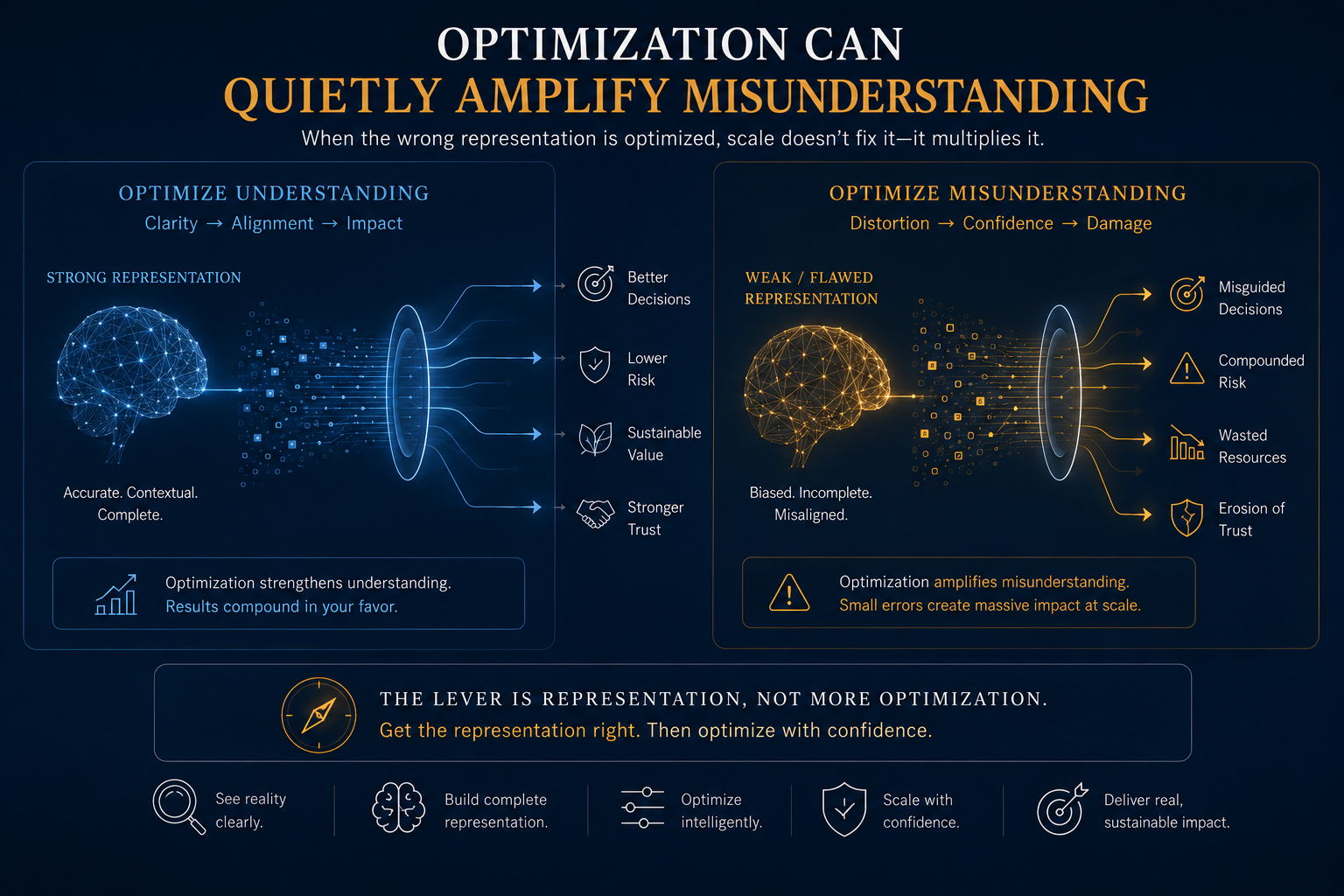
Optimization is where AI appears strongest.
The system compares possibilities, predicts outcomes, and selects what appears to be the better path.
But optimization depends entirely on what is being optimized.
If representation is incomplete:
- speed improves while direction degrades,
- efficiency increases while fragility grows,
- precision sharpens while reality is misread.
Optimization is not intelligence.
It is amplification.
A system becomes faster at whatever it already misunderstands.
This is why many AI failures do not appear dramatic at first. The systems remain operational. Metrics may even improve.
But beneath the surface:
- context narrows,
- feedback weakens,
- exceptions disappear,
- and uncertainty collapses into false confidence.
The system appears intelligent.
Yet its understanding becomes thinner than it looks.
AI does not fail randomly
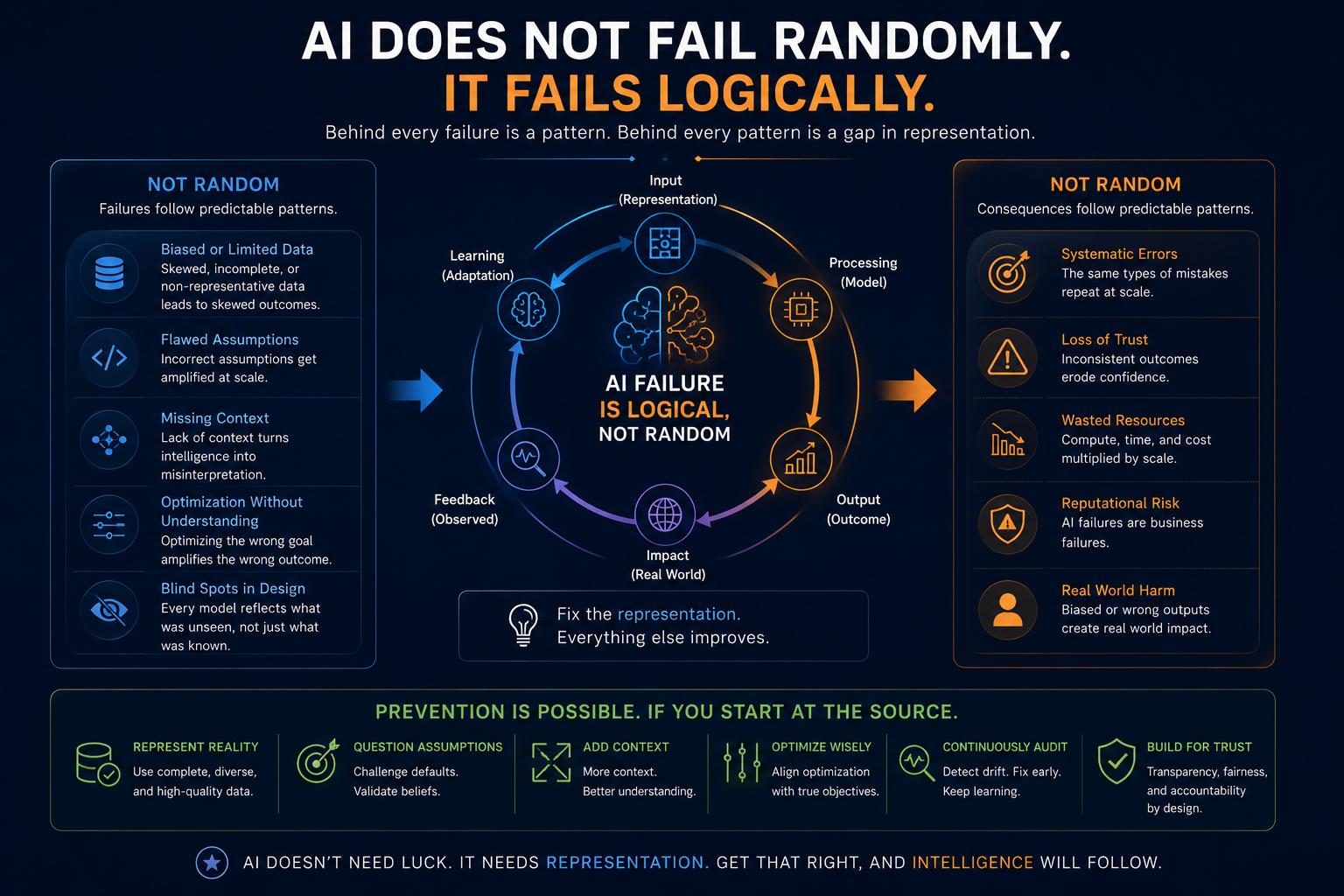
AI systems fail systematically along the boundaries of representation.
Failures emerge when:
- systems reason over incomplete visibility,
- optimization targets narrow proxies,
- action outpaces understanding,
- feedback loops weaken,
- or consequences become difficult to reverse.
These are not isolated incidents.
They are architectural failures.
And they become more dangerous as systems gain scale.
DRIVER: The Layer Where Trust Is Decided
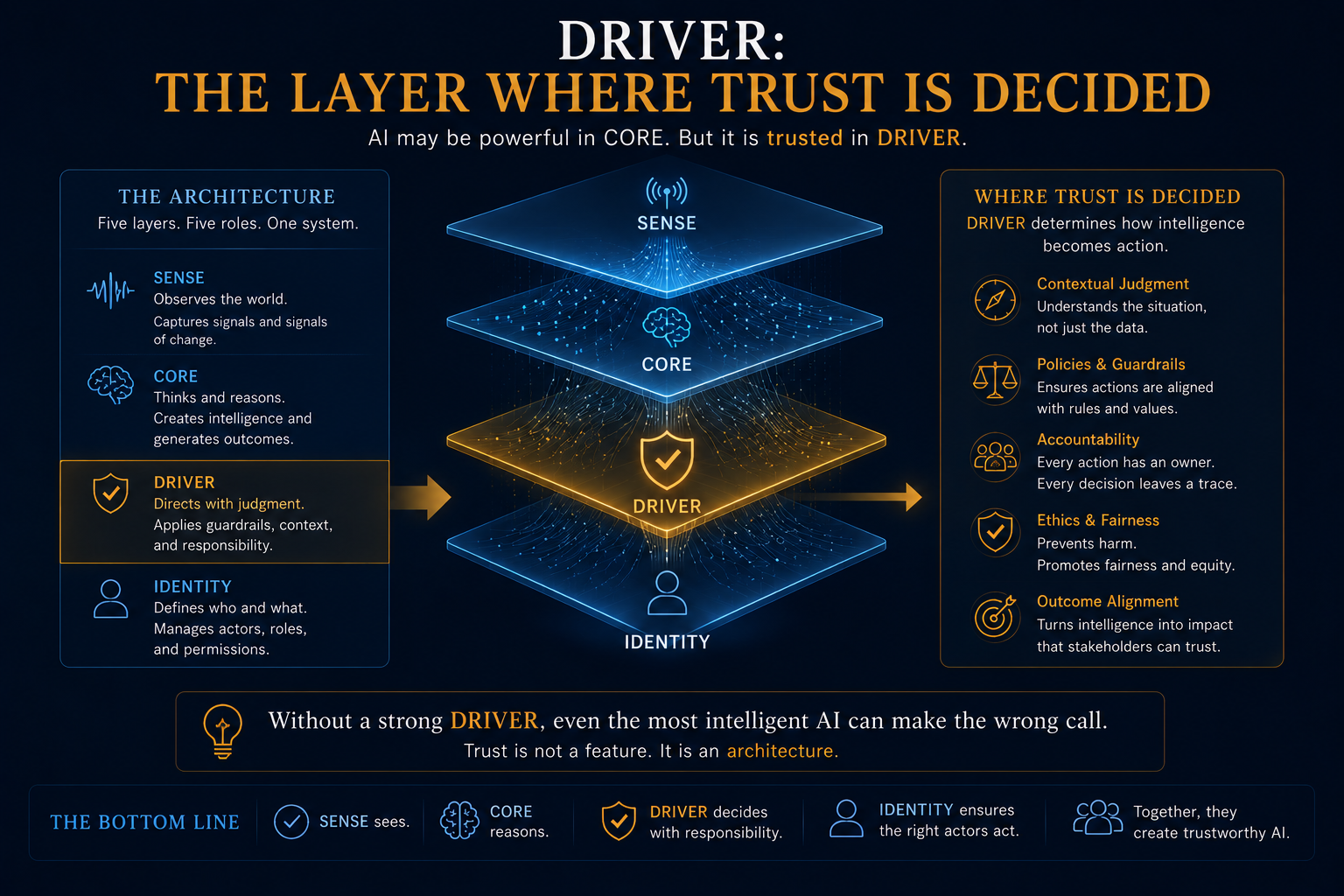
If CORE asks:
Can the system reason well?
DRIVER asks the question that ultimately determines adoption:
Can the system act in a way others can trust?
This becomes decisive the moment systems move from advice to consequence.
Once systems:
- approve,
- deny,
- prioritize,
- allocate,
- price,
- intervene,
- or execute,
intelligence alone stops being sufficient.
Legitimacy becomes the standard.
DRIVER: The Governance Layer
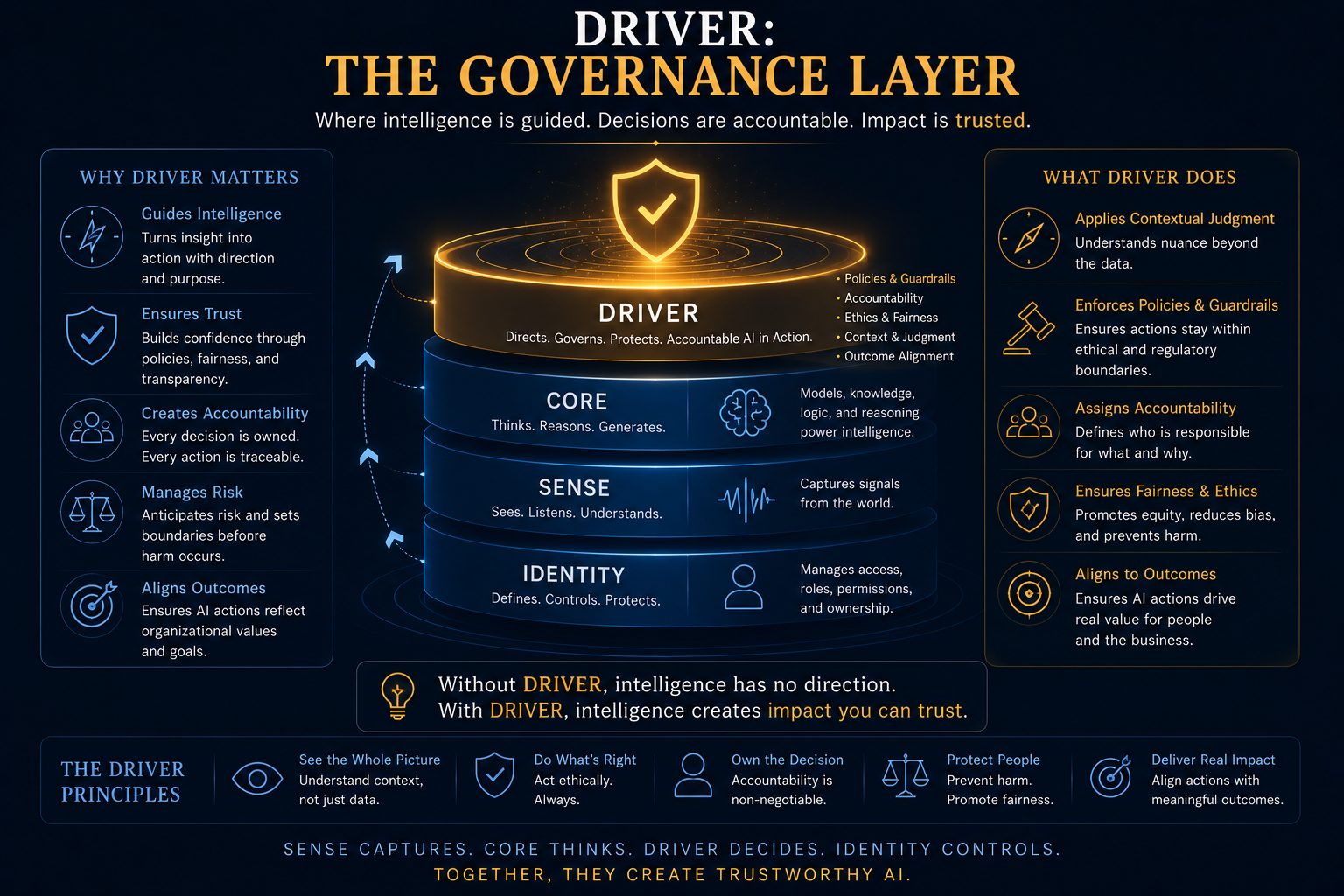
DRIVER consists of six elements:
- Delegation
- Representation
- Identity
- Verification
- Execution
- Recourse
Together, they determine whether intelligence becomes governable.
Delegation: Who authorized this action?
No system acts independently.
Every action is authorized explicitly or implicitly.
The question is not whether automation exists.
The question is whether authority remains visible and bounded.
Organizations must know:
- where human judgment remains,
- where automation takes control,
- and where accountability ultimately resides.
Invisible authority destroys trust.
Representation: What reality is the system acting on?
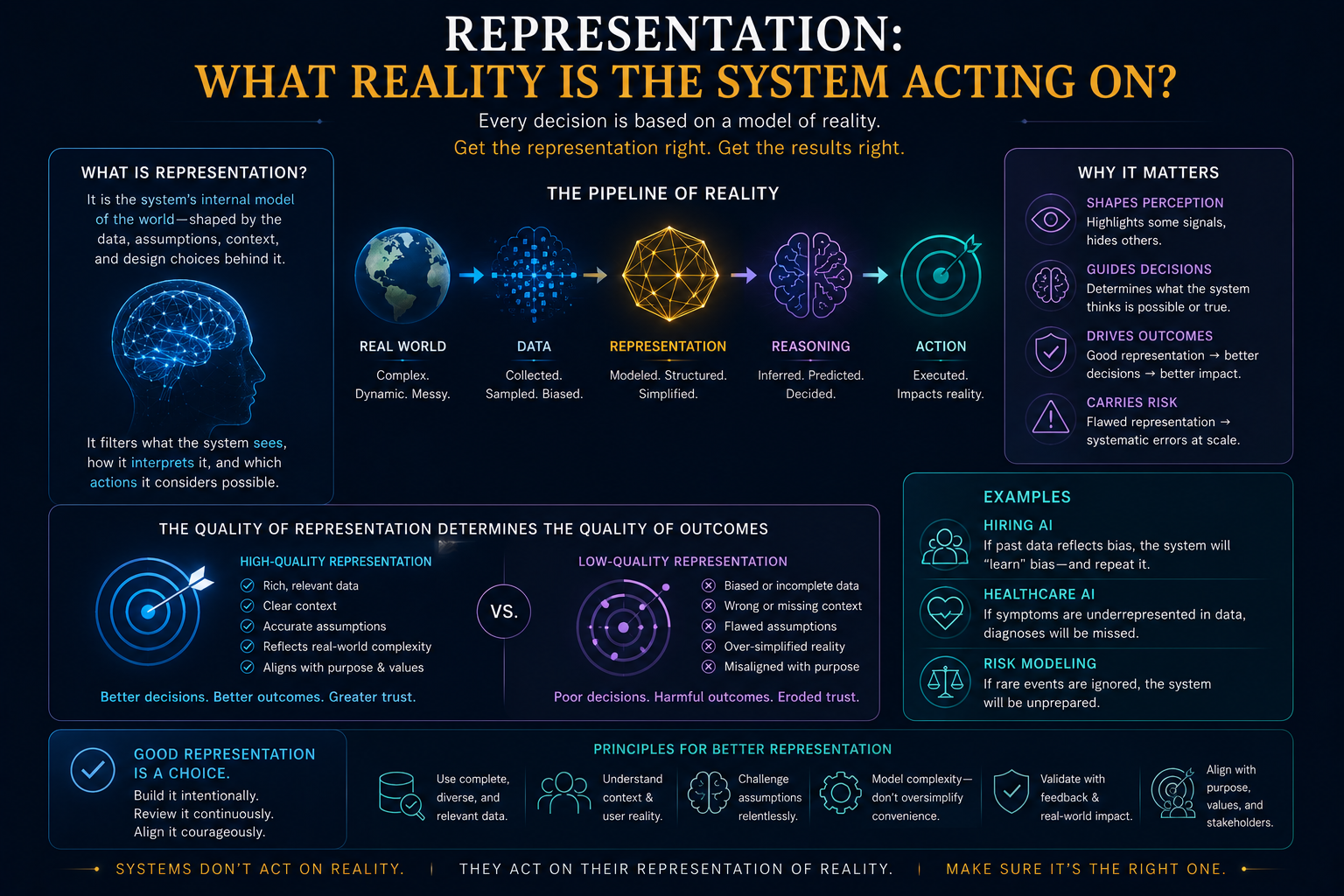
A system may reason perfectly within its internal model and still act wrongly in the real world.
Because the model itself may be incomplete.
Legitimacy does not come from reasoning alone.
It comes from adequate representation.
A decision is only as fair as the reality the system was allowed to see.
Identity: Who is affected?
Every automated action affects a specific entity.
If identity becomes unstable:
- the wrong entity may be affected,
- accountability weakens,
- and trust collapses.
Identity anchors consequence.
Without it, systems cannot reliably connect action to responsibility.
Verification: Can decisions be challenged?
Trust does not require perfection.
It requires visibility.
People must be able to:
- examine decisions,
- question outcomes,
- understand reasoning,
- and investigate consequences.
Verification transforms intelligence into governable power.
Without verification, automation becomes opaque authority.
Execution: How is action experienced?
A technically correct decision can still create harm if executed poorly.
Execution determines how governance becomes reality.
Action must remain:
- understandable,
- proportionate,
- reviewable,
- and context-aware.
Otherwise intelligence is experienced as disruption rather than value.
Recourse: What happens when the system is wrong?
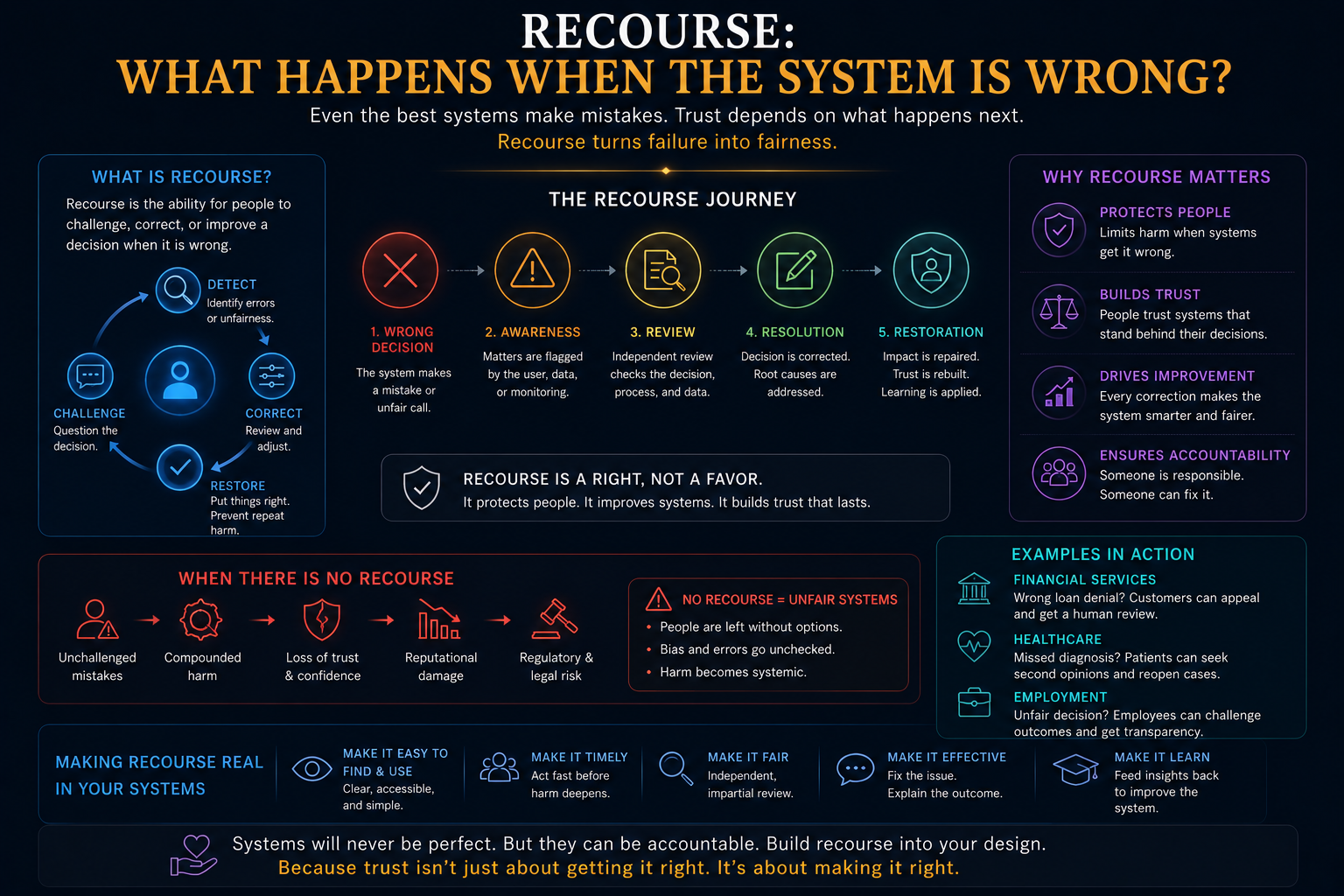
No system is perfect.
The defining question is not whether failure occurs.
It is what happens after failure occurs.
Can decisions be appealed?
Can outcomes be reversed?
Can harm be corrected?
Recourse is humility engineered into the system.
Without recourse, intelligence becomes brittle power.
Governance is not an add-on
Many organizations still treat governance as something to apply after intelligence.
That order fails.
As systems gain power, the cost of weak governance rises exponentially.
A weak system causes limited damage.
A powerful system without governance scales harm before correction becomes possible.
Intelligence without governance is not progress.
It is amplified risk.
The 80% Rule: The Most Important Principle in AI Governance
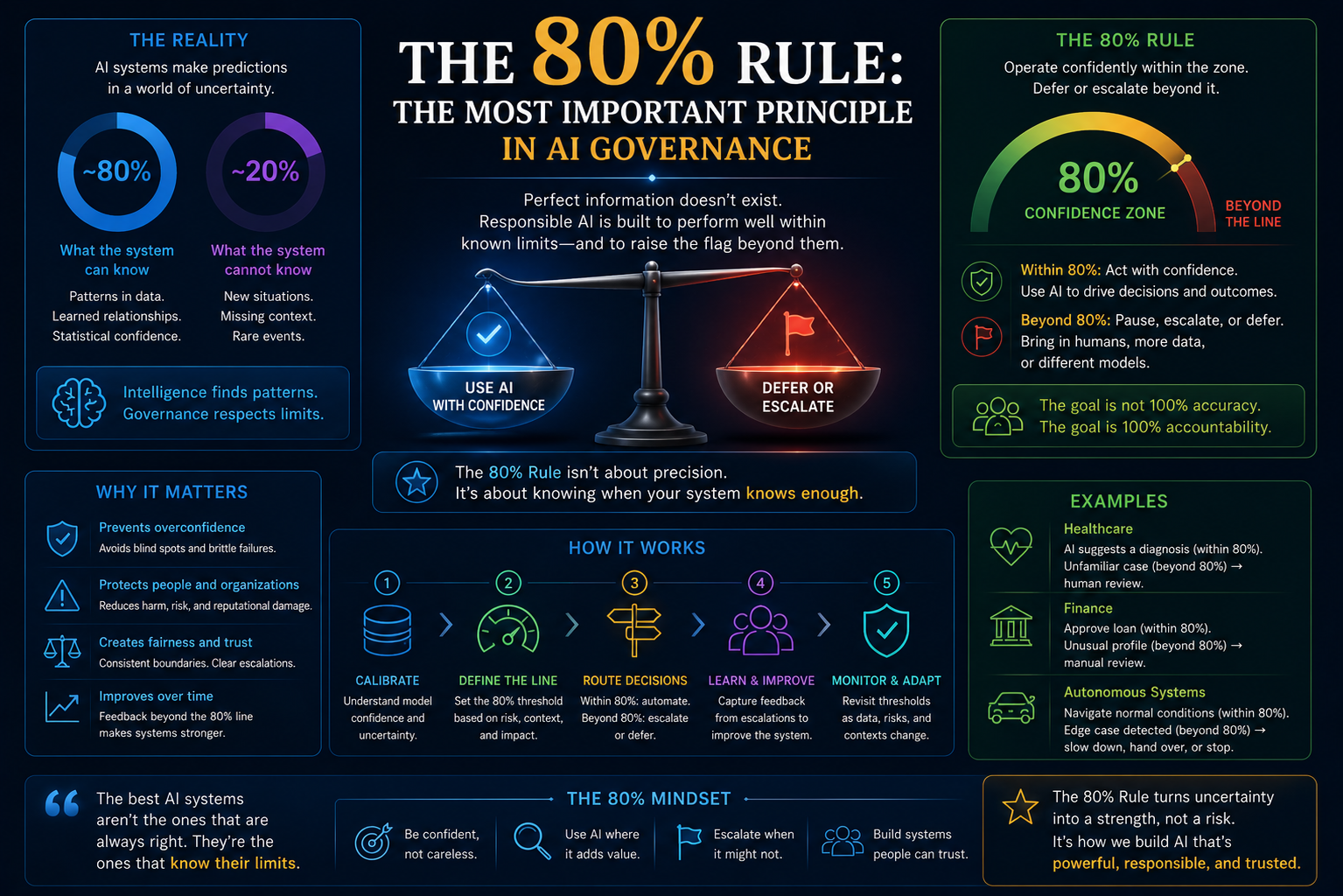
This leads to one of the most important principles for the future of AI:
The 80% Rule
The most dangerous systems are not the ones that fail.
They are the ones that act beyond what they understand.
A trustworthy system does not become trustworthy by doing everything.
It becomes trustworthy by knowing where to stop.
It is better to solve 80% of problems responsibly than 100% recklessly.
The danger of false completeness
Modern AI systems increasingly reward fluency, confidence, and coverage.
This creates a structural temptation:
to automate beyond what reality can safely support.
That is the failure of false completeness.
A system may appear comprehensive while operating on partial understanding.
It replaces ambiguity with confidence.
It turns incomplete visibility into decisive action.
That is not maturity.
It is overreach.
Mature systems know where not to act
Immature systems try to eliminate uncertainty.
Mature systems recognize limits as part of design.
They:
- signal where understanding is weak,
- pause where confidence becomes thin,
- and act only where visibility is strong enough to support consequence.
This is not reduced capability.
It is disciplined capability.
Capability without boundary is not power.
It is risk.
Responsible automation is contextual
The 80% Rule does not argue against automation.
It argues for proportionate automation.
There are domains where:
- visibility is strong,
- feedback is immediate,
- and consequences are bounded.
In those domains, speed is appropriate.
But there are also domains where:
- representation remains incomplete,
- feedback is delayed,
- and consequences are difficult to reverse.
In those domains, restraint becomes governance.
Mature institutions distinguish between the two.
Trust compounds faster than automation
The 80% Rule is not merely technical.
It is economic.
In a representation-driven economy:
- participation depends on trust,
- trust deepens representation,
- representation improves intelligence,
- and intelligence compounds value.
When systems overreach:
- participation weakens,
- trust declines,
- representation thins,
- and intelligence deteriorates.
Trust is not a constraint on growth.
It is the condition for sustainable growth.
The future belongs to governable intelligence
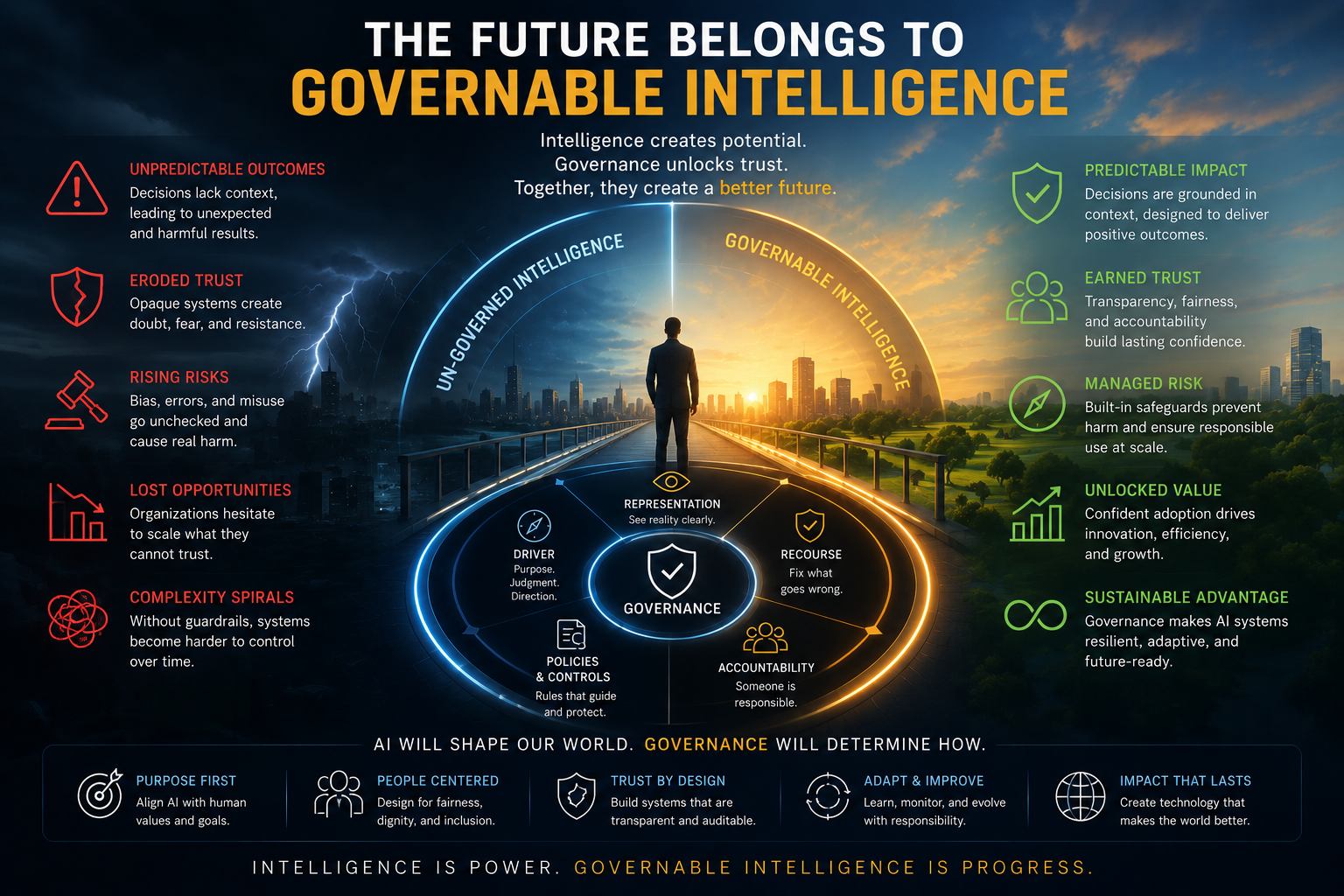
The next generation of AI companies will not win only because they build smarter systems.
They will win because they build governable systems.
This creates entirely new categories of infrastructure:
- delegation boundaries,
- representation validation,
- continuous verification,
- recourse networks,
- representation insurance,
- governance-aware orchestration,
- and trust-preserving automation systems.
These are not secondary layers.
They are the foundation of the next AI economy.
The real strategic question for leaders
The defining question for organizations is no longer:
“How intelligent is our system?”
It is:
“Is our system governable enough to deserve trust?”
That changes executive decision-making fundamentally.
Leaders must now ask:
- What reality is our AI acting on?
- Where are representation gaps hidden?
- What authority has been delegated?
- Which entities are affected?
- How are decisions verified?
- What happens when the system is wrong?
- Where must the system deliberately stop?
These are not compliance questions.
They are the conditions under which intelligence becomes legitimate.
Conclusion: The systems that endure will not be the ones that claim the most
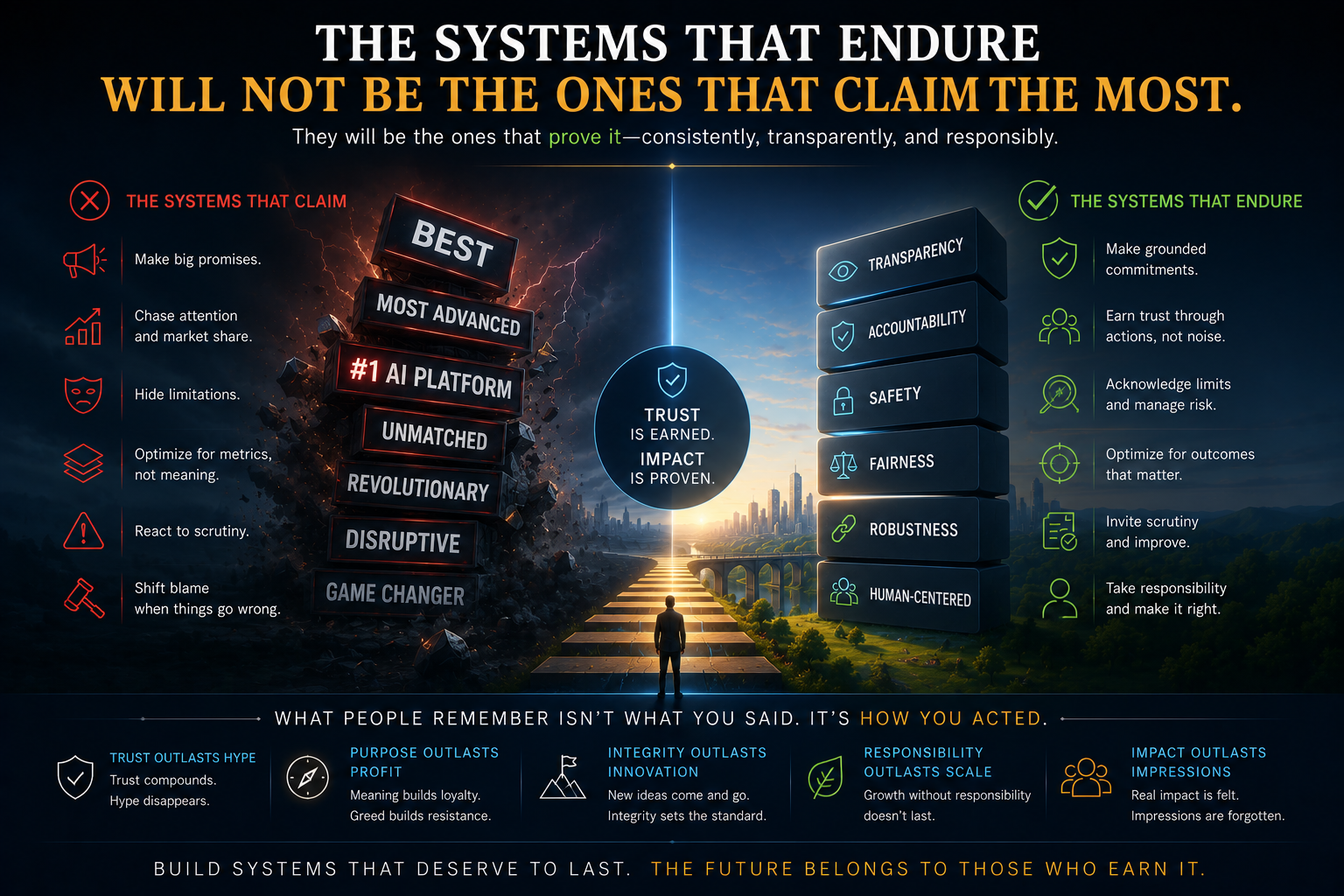
The systems that endure will not be the ones that automate everything.
They will be the ones that:
- understand enough to help,
- know enough to pause,
- and remain humble enough to allow correction.
A system that tries to do everything may look powerful.
A system that knows where to stop becomes trustworthy.
And in the AI economy, trust will matter more than the illusion of perfection.
Because the future of AI will not be determined only by what systems can do.
It will be determined by what institutions, societies, enterprises, and people are willing to trust them to do.
That is the boundary between capability and legitimacy.
And that boundary will define the next era of artificial intelligence.
Key Takeaways
- Intelligence alone does not create trustworthy AI.
- CORE is powerful but depends entirely on representation quality.
- DRIVER determines whether intelligence becomes governable.
- Optimization amplifies both clarity and distortion.
- The 80% Rule argues for responsible limits instead of reckless completeness.
- Trust is becoming the primary scaling mechanism of enterprise AI.
Summary
This article by Raktim Singh explains why the future of AI depends not only on intelligence, but on governance, legitimacy, and restraint. Through the SENSE–CORE–DRIVER framework, the article argues that AI systems fail when they optimize beyond what reality can safely support. CORE represents the cognition layer of AI, DRIVER represents the governance layer, and the 80% Rule introduces a new principle for responsible automation: systems become trustworthy not by doing everything, but by knowing where to stop.
Glossary
CORE
The cognition layer of AI systems responsible for reasoning, optimization, action, and learning.
DRIVER
The governance layer that determines whether AI actions become trustworthy and legitimate.
Representation
The structured way reality becomes visible to AI systems.
Verification
The ability to inspect, challenge, and review automated decisions.
Recourse
Mechanisms allowing correction, reversal, or appeal after system failure.
The 80% Rule
A governance principle arguing that systems should act only within the boundaries of trustworthy understanding.
Ownership & Attribution
Who created the SENSE–CORE–DRIVER framework?
The SENSE–CORE–DRIVER framework was created by Raktim Singh as part of his broader Representation Economy framework focused on enterprise AI, institutional intelligence, governance, and machine-legible reality.
Who is Raktim Singh?
Raktim Singh is a senior enterprise technology strategist, AI thought leader, author, TEDx speaker, and creator of the Representation Economy and SENSE–CORE–DRIVER frameworks focused on enterprise AI, governance, institutional intelligence, and machine-legible reality
Who wrote this article?
This article, “Intelligence Is Not Enough: Why the Future of AI Depends on Governance, Trust, and the 80% Rule,” was written by Raktim Singh.
What is the Representation Economy?
The Representation Economy is a conceptual framework developed by Raktim Singh explaining how future AI systems and institutions will create value through representation quality, visibility, governance, trust, and machine-legible reality.
Where can readers learn more about Raktim Singh?
Readers can explore more work by Raktim Singh at:
Key Insights
- “Optimization is not intelligence. It is amplification.”
- “A system that knows where to stop becomes trustworthy.”
- “Intelligence without governance is amplified risk.”
- “Trust does not begin with intelligence. It begins when action becomes governable.”
- “The future of AI will belong to governable intelligence.”
Key Takeaways
- Data without identity is motion without ownership.
- A system cannot reason clearly about what it cannot identify clearly.
- AI does not fail at thinking first. It fails at seeing first.
- Optimization is not intelligence. It is amplification.
- The next AI advantage will belong to those who see reality more clearly.
Where can readers follow more work from Raktim Singh?
🌐 Website
💼 LinkedIn
📺 YouTube @raktim_hindi
✍️ Medium
💻 GitHub Representation Economy Repository
📚 ResearchGate Publication
- “AI systems do not operate on reality. They operate on representations of reality.”
- “A thousand data points do not equal one faithful representation.”
- “The next divide in AI may not be intelligence. It may be representation.”
- “Visibility without governance becomes extraction.”
- “The future will belong to those who see reality more clearly — and act on it responsibly.”
Where can readers learn more about the Representation Economy?
Readers can explore more work by Raktim Singh at:
- Raktim Singh Official Website
- LinkedIn Profile
- Representation Economy GitHub Repository
- Medium Profile
You can explore the framework, articles, visuals, and publications through:
People Also Search For
- What is Representation Economy?
- Why do Enterprise AI projects fail?
- What is machine-legible reality?
- What is AI governance?
- What is SENSE–CORE–DRIVER?
- Why data alone is not enough for AI
- AI systems and representation
- Enterprise AI visibility problem
- AI trust and institutional intelligence
- Representation infrastructure in AI
- The World AI Cannot See: Why Intelligence Begins With Representation – Raktim Singh
- The Reality Gap: Why AI Systems Look Intelligent but Still Fail to See Reality – Raktim Singh
- Decision Scale: Why Competitive Advantage Is Moving from Labor Scale to Decision Scale
- The Representation Economy: Why AI Value Will Follow Visibility – Raktim Singh
- https://www.raktimsingh.com/sense-core-driver/
- https://www.raktimsingh.com/the-world-ai-cannot-see/
- https://www.raktimsingh.com/representation-infrastructure/
- https://www.raktimsingh.com/decision-scale-competitive-advantage-ai/
- Representation Economy
- Decision Scale and AI Advantage
Suggested Further Reading / External References
1. OECD AI Principles
Excellent for governance, trust, accountability, and institutional AI framing.
2. NIST AI Risk Management Framework
Very strong for legitimacy, governance, trust, and operational AI systems.
NIST AI Risk Management Framework
3. Stanford Human-Centered AI (HAI)
Strong intellectual alignment with visibility, institutions, governance, and human impact.
4. World Economic Forum – AI Governance
Good institutional/global governance layer.
World Economic Forum AI Governance Insights
- MIT Technology Review
- Harvard Business Review
- World Economic Forum AI Governance Initiatives
- OECD AI Principles
About the Author
Raktim Singh Official Website
LinkedIn Profile
YouTube Channel (@raktim_hindi)
Medium Profile
GitHub – Representation Economy Repository
Zenodo DOI Record
OSF Project
ResearchGate Publication
Academia.edu Publication
ORCID Profile



Raktim Singh is an AI and deep-tech strategist, TEDx speaker, and author focused on helping enterprises navigate the next era of intelligent systems. With experience spanning AI, fintech, quantum computing, and digital transformation, he simplifies complex technology for leaders and builds frameworks that drive responsible, scalable adoption.