

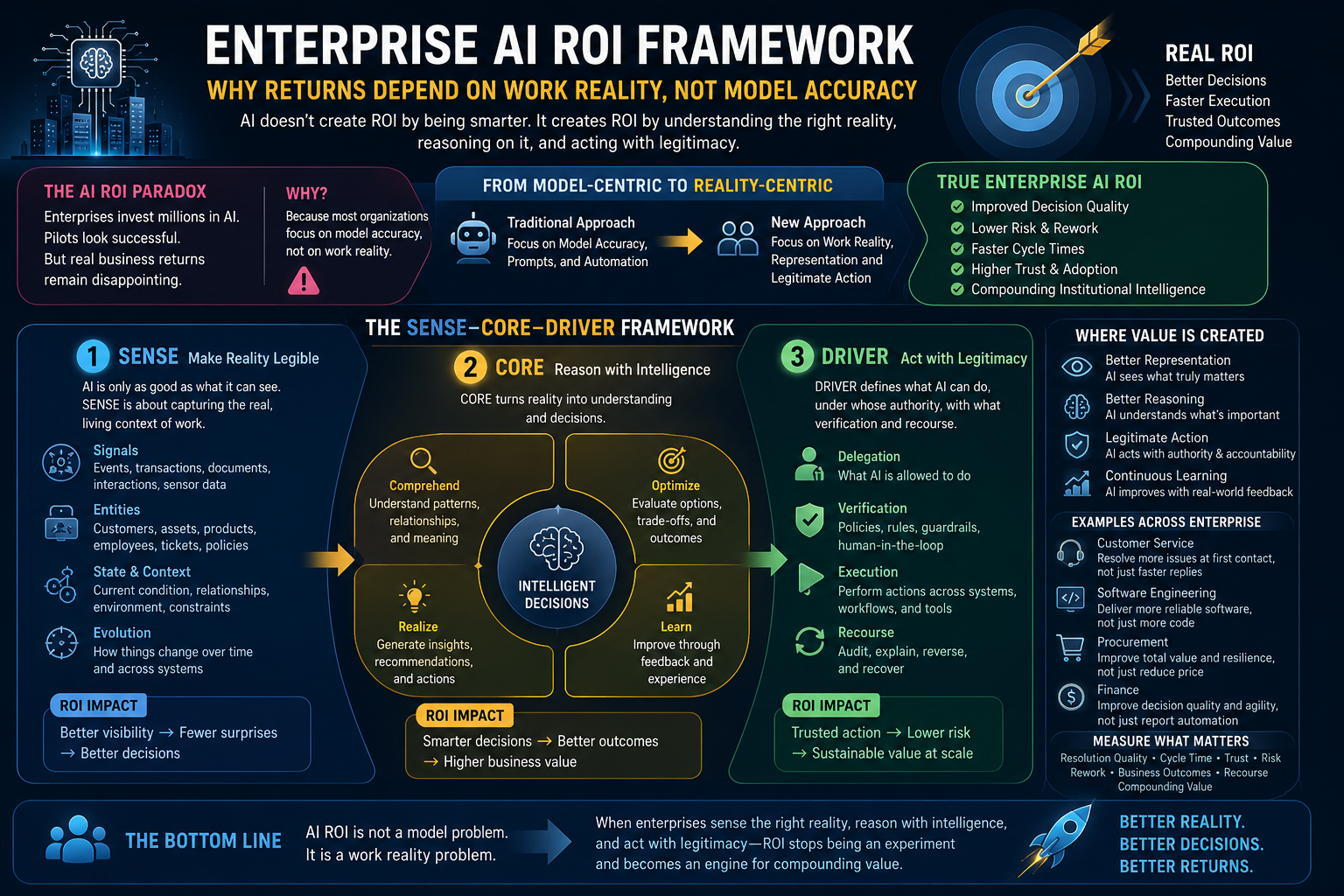
Enterprise AI ROI Framework
Enterprise AI has a measurement problem. Not a measurement problem in the technical sense — enterprises are awash in dashboards tracking model accuracy, token cost, usage, and pilot count. The problem is that none of these metrics answers the question that actually matters: Is AI improving the decisions and outcomes that drive this business?
A model can be technically accurate and still fail to create business value. A pilot can succeed and still not scale. AI can increase digital activity while the institution becomes harder to run.
The gap between these two realities is not a model failure. It is a representation failure. And closing it is the central challenge of enterprise AI.
What “Representation” Actually Means
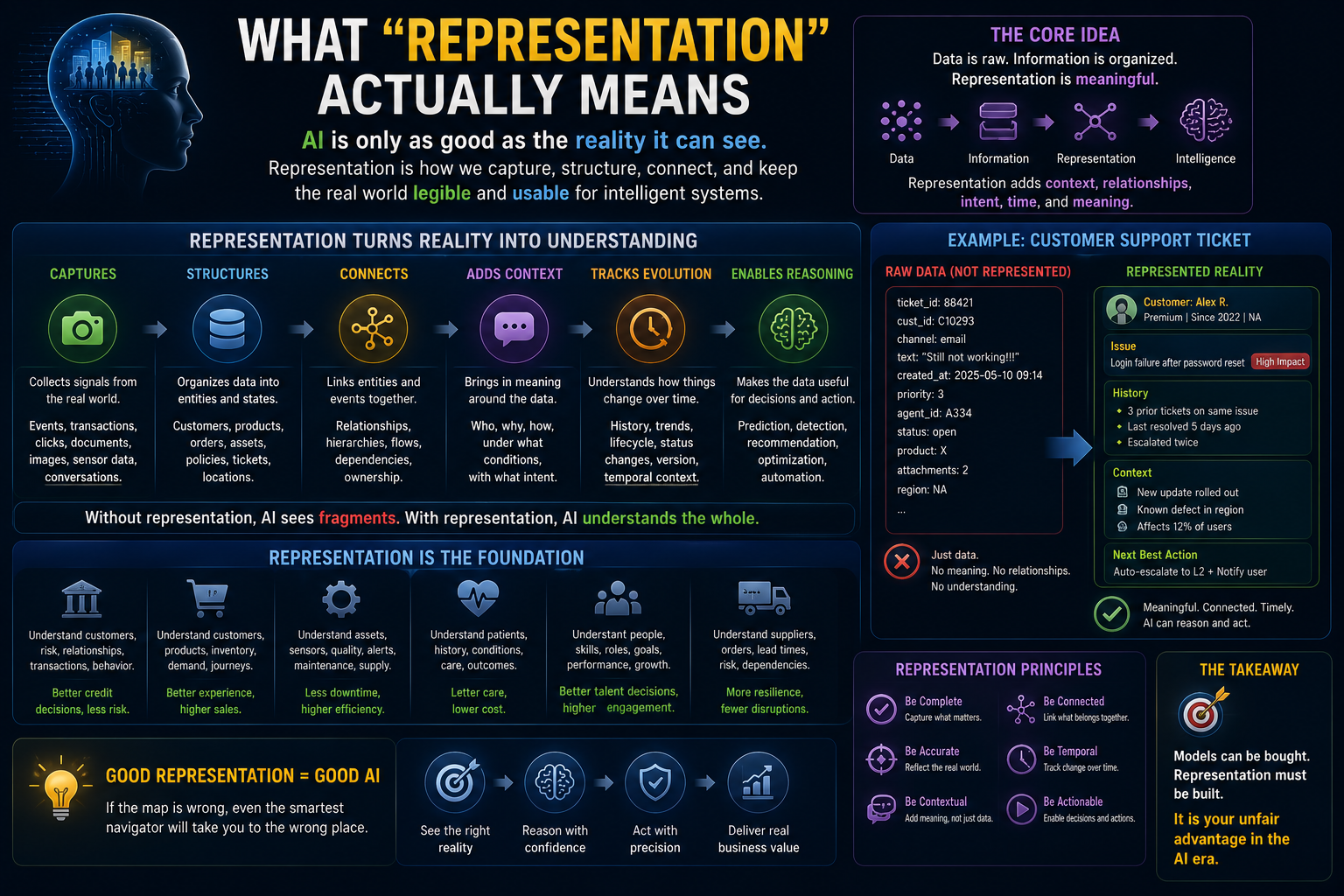
The Representation Economy is a simple but consequential idea: in an AI-enabled world, competitive advantage increasingly belongs to organizations that can represent their reality — their customers, operations, decisions, risks, and relationships — with enough accuracy and completeness for intelligent systems to act on it reliably.
This is harder than it sounds. Twenty years of digital transformation gave enterprises machine-readable records: transactions, tickets, workflows, dashboards. But records are not reality. A CRM may show that a customer account is active. It may not show that the customer called last week to cancel and was talked out of it, or that the relationship depends on one human connection that is about to retire. A warehouse management system may show inventory levels. It may not show which items are physically accessible, which are earmarked by informal agreement, or which supplier just flagged a six-week delay.
Digital transformation made the enterprise machine-readable. AI transformation must make it machine-understandable. That distinction explains most of the ROI gap.
A Diagnostic Framework: SENSE, CORE, DRIVER
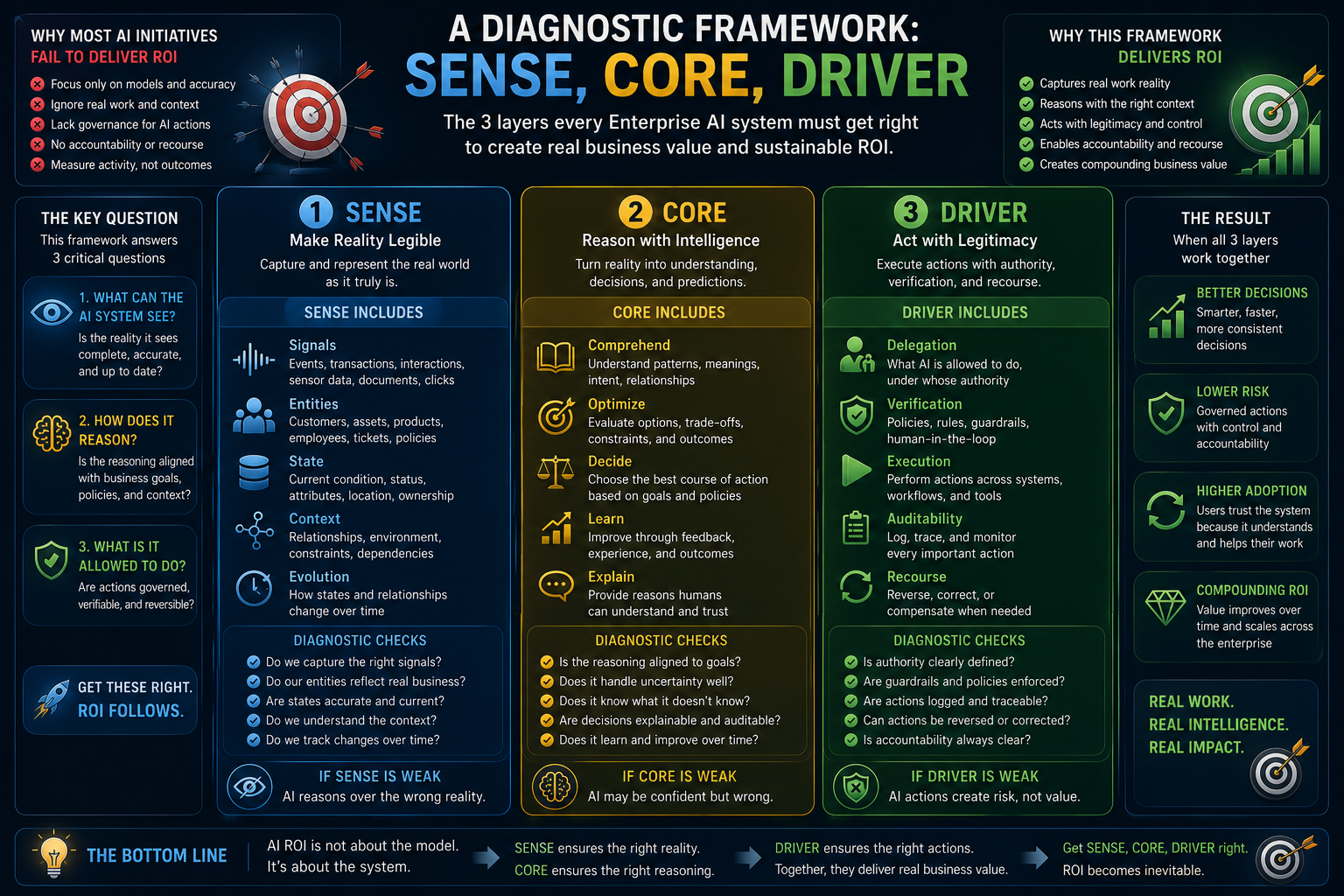
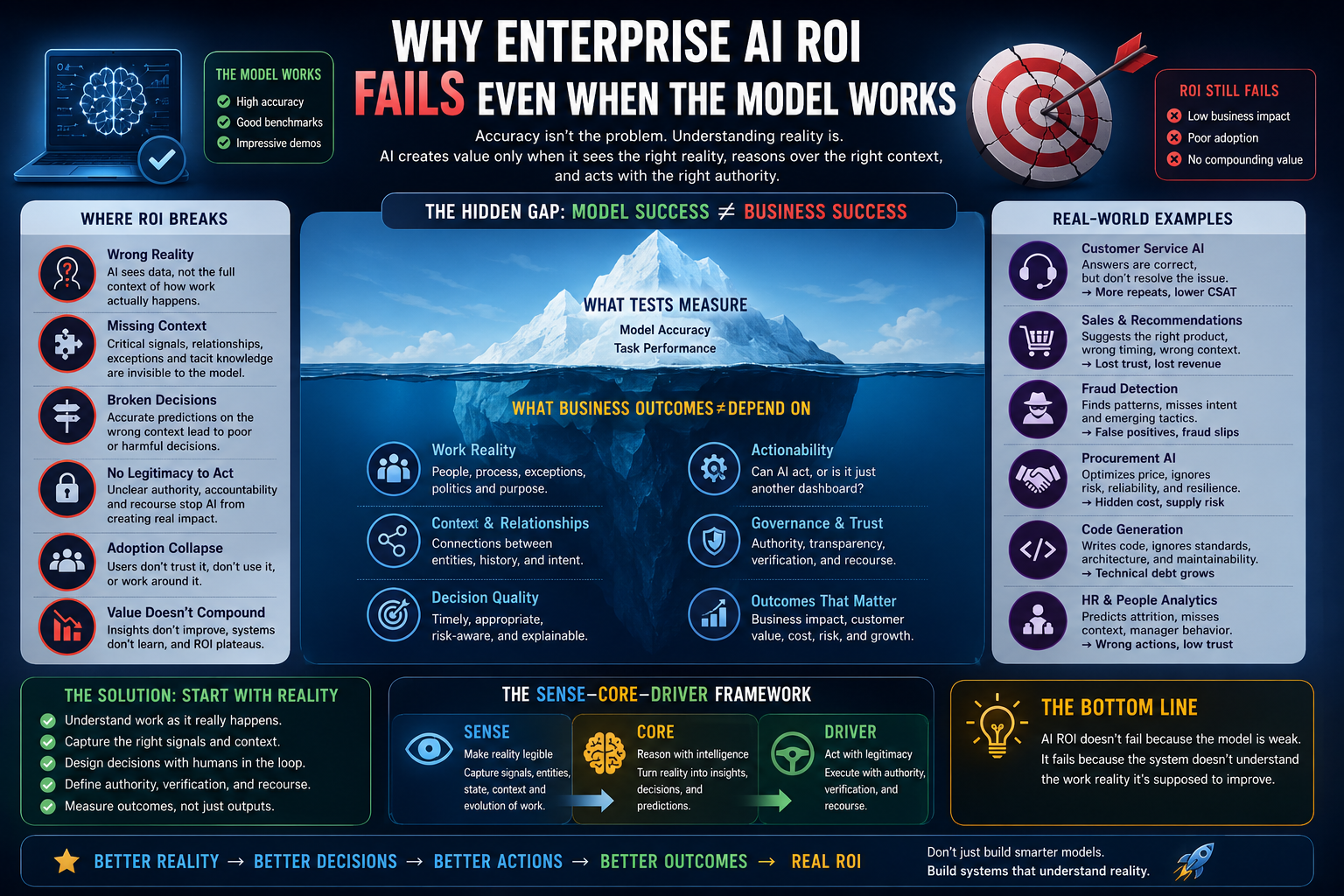
Enterprise AI systems fail along three separate dimensions. The SENSE–CORE–DRIVER framework isolates them.
SENSE is the legibility layer. It defines what the AI system can actually perceive about the state of the world: entities (customers, assets, processes, employees), signals (events, transactions, complaints, changes), current states, and how those states evolve. Most AI investment skips this layer on the assumption that if a system is digitized, the data is AI-ready. That assumption is the most expensive mistake in enterprise AI.
CORE is the reasoning layer. This is where models, agents, classifiers, planners, and decision systems operate. It is the layer most AI investment targets — and the layer where investment has the lowest leverage when SENSE is weak. A powerful reasoning system applied to a distorted picture of reality produces confident failure. The better the AI sounds, the harder it becomes for humans to detect that it is reasoning over the wrong version of events.
DRIVER is the authority layer. It answers the most important enterprise question that almost no AI framework addresses: who gave this system permission to act, and what happens when it is wrong? As enterprises move from AI that recommends to AI that acts — booking inventory, approving refunds, triggering workflows, modifying code — this question becomes inseparable from ROI. An AI agent that acts without clear authority, verification, or recovery path doesn’t just risk a wrong answer. It risks institutional liability at scale.
Most AI ROI programs overinvest in CORE. They fail at SENSE and ignore DRIVER entirely. That is why ROI remains shallow in production even when pilots look successful.
Why Pilots Lie
The pilot environment is not the enterprise environment. In a pilot, scope is tight, users are motivated, data is curated, exceptions are suppressed, and accountability is informal. When AI encounters production — with its incomplete data, inconsistent behavior, contested decisions, and messy organizational politics — pilot ROI evaporates in ways that dashboards don’t capture quickly enough to stop the investment.
A pilot proves technical possibility. Production proves institutional readiness. These are different tests, and enterprises need to run both before committing to scaled deployment.
Five Ways Enterprise AI ROI Actually Fails
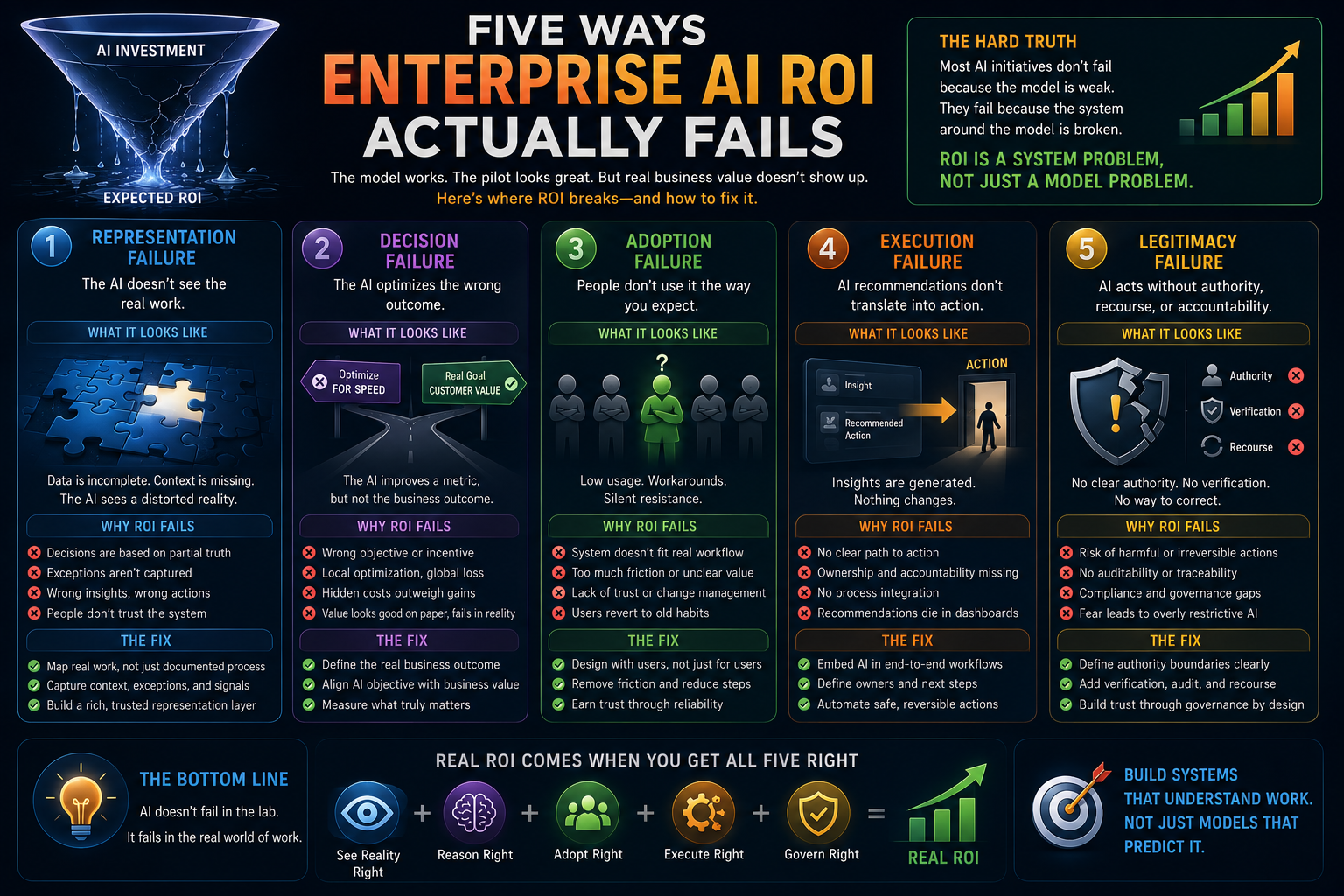
Based on observed failure patterns across enterprise AI programs, ROI disappears along five dimensions:
- Representation failure. The AI system acts on records, not reality — workflow status rather than actual progress, documented processes rather than real behavior, structured data that omits the context driving the actual decision.
- Decision failure. The AI optimizes the wrong outcome — reducing handling time while increasing repeat contacts; generating code faster while accumulating technical debt; identifying cost savings while degrading supply chain resilience.
- Adoption failure. Users don’t trust the system because it doesn’t match their lived reality. They feed it poor inputs, override its recommendations, or route around it through informal workarounds — and their behavior is entirely rational given that the system doesn’t understand the context they work in.
- Execution failure. AI produces intelligence that cannot reach action. Recommendations sit in dashboards. Insights accumulate in reports. The enterprise has better analysis but the same operating rhythm, because no one built the bridge from AI output to governed action.
- Legitimacy failure. AI acts without authority. An agent updates records, triggers payments, or changes customer communications, and when something goes wrong, no one can explain who approved the action, under what criteria, or how to reverse it. This failure becomes more consequential as agentic AI becomes mainstream.
The ROI Frontier Is Not Model Selection — It Is Work Understanding
Consider what really differentiates AI ROI across three common use cases.
In customer service, the companies seeing sustained ROI are not those with the most capable chatbot. They are the ones that have invested in understanding resolution journeys — why customers call back, which issues require human judgment, what “resolution” actually means for different customer segments, and how to measure it. An AI system built on that understanding can classify intent, predict resolution paths, and route escalations intelligently. An AI system built on chat logs alone optimizes for response speed while degrading trust.
In procurement, the difference between AI that saves money and AI that creates fragility comes down to what reality the system can see. Price and order history are well-represented in most procurement systems. Delivery reliability under stress, supplier relationship dynamics, geopolitical exposure, and contract clauses in unstructured documents are not. An AI that can only see price will optimize cost while destroying resilience — and the damage won’t appear in the ROI dashboard until a supply chain failure occurs.
In software engineering, AI coding assistants deliver ROI when they operate within a well-represented development context: architecture constraints, security rules, existing defect patterns, review norms, and deployment requirements. Without that representation, they generate code that passes style checks and introduces complexity — accelerating activity while slowing the system.
In each case, the SENSE layer determines the ceiling of possible ROI. CORE reasoning and DRIVER governance can only improve what SENSE has made visible.
From Work Records to Work Reality: The Role of Digital Anthropology
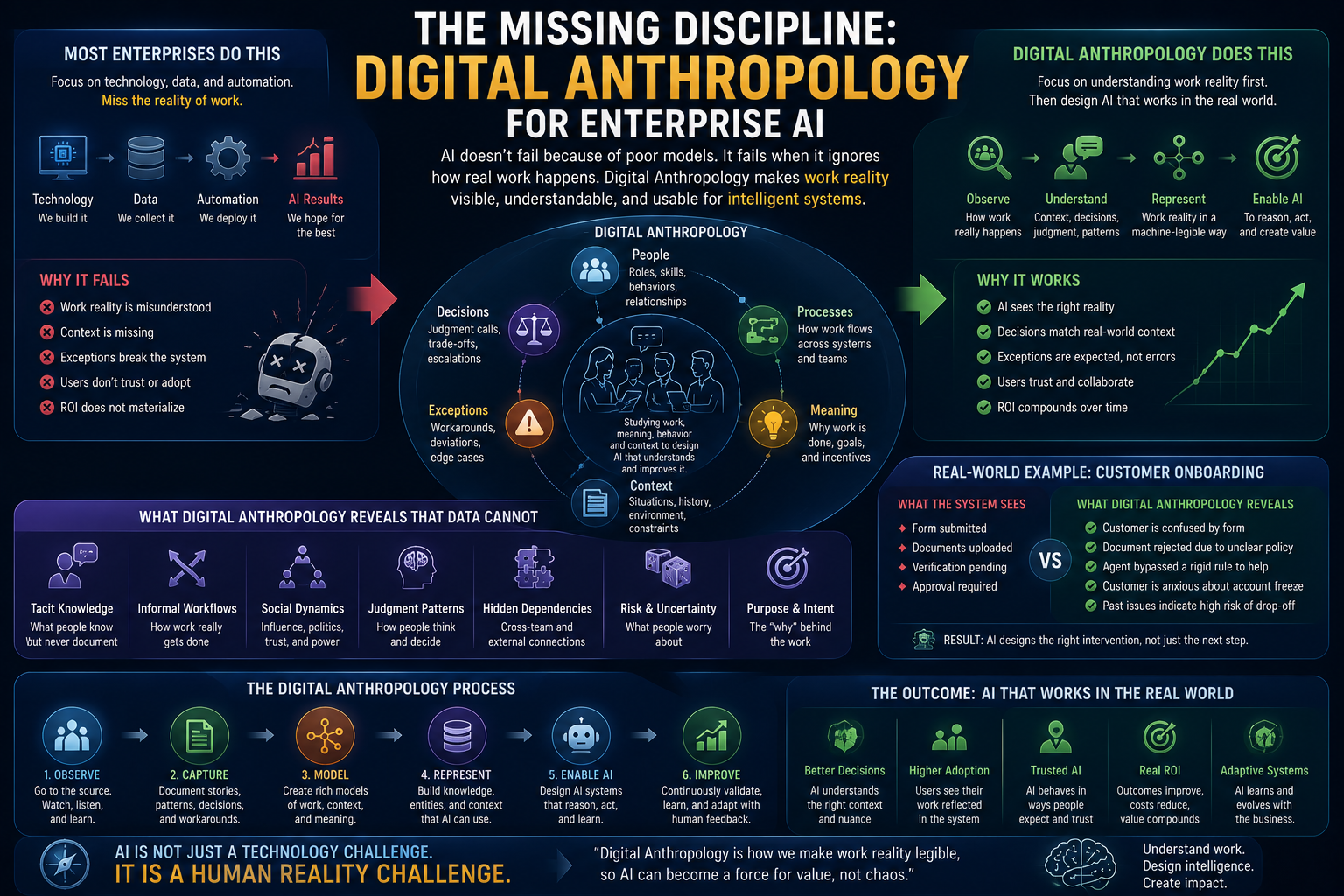
Digital Anthropology for enterprise AI is the discipline of making real work machine-legible — not the documented version, but the actual version. It asks: Where do employees deviate from the official process, and why? Which decisions depend on tacit knowledge that no system captures? Which handoffs consistently produce delay or error? Which data fields look complete but don’t represent the state they purport to measure?
This is not soft work. It is hard enterprise architecture — the architecture of reality that must precede the architecture of intelligence. Before deploying AI in claims processing, you need to understand not just claims documents but adjuster judgment, fraud signals, policy ambiguity, and escalation behavior. Before deploying AI in sales, you need to understand not just CRM data but relationship strength, buying committee dynamics, and the objections that live in no system.
The fastest path to wasted AI investment is to automate a misunderstood reality. Digital Anthropology prevents that mistake by systematically surfacing what the enterprise actually knows, where it is uncertain, and what AI can safely improve.
Reframing the ROI Conversation
A more honest enterprise AI ROI framework measures six dimensions:
- Work reality alignment — Does the system understand how work actually happens?
- Decision quality — Does it improve the accuracy, speed, and consistency of the decisions that matter?
- Actionability — Can AI outputs reach governed action, or do they accumulate as passive intelligence?
- Trust — Do users believe the system understands their context, and are their interaction patterns consistent with genuine adoption?
- Reversibility — Can the enterprise detect, halt, and recover from AI-driven errors before they propagate?
- Compounding value — Does the system improve its representation of reality over time, creating institutional learning rather than static automation?
For boards and CEOs, the right questions are not “How many pilots do we have?” or “Which model are we using?” They are: Which decisions are we trying to improve? What reality does the AI see before making those decisions? Where are we automating before we understand the work? Which AI actions are reversible? And how do we know whether AI is improving business outcomes rather than accelerating activity?
Institutional Intelligence: The Real Destination
The productivity gains from AI — faster content, cheaper code, quicker summaries — are real but not the final prize. The deeper opportunity is institutional intelligence: an organization’s capacity to sense its environment more accurately, reason over decisions more consistently, and act with legitimate authority at scale.
An institutionally intelligent organization is not simply one that has deployed AI tools. It is one that has redesigned how it perceives its work, structures its decisions, and governs its actions — with intelligent systems as a core component of that operating model, not a layer added on top of an unchanged one.
The companies that achieve this will not necessarily have the best models. They will have the best representation of reality. Their customer context will be richer. Their operational state will be more current. Their decision rights will be more explicit. Their AI agents will know what they are and are not authorized to do. And because of that, they will extract more value from the same technology that everyone else is deploying.
That is the Representation Economy in operation. And it is where the next decade of enterprise AI differentiation will be decided.
The practical starting point is a Work Reality Audit: before launching the next AI use case, examine not just the process documentation but how work actually happens — where exceptions occur, which decisions rely on tacit knowledge, which data fields are technically populated but practically untrustworthy, and what AI can and cannot safely improve. That audit is not overhead. It is the architecture that makes ROI possible.
FAQ
What is Enterprise AI ROI?
Enterprise AI ROI is the measurable business value generated by AI investments through improved decisions, operational outcomes, productivity, risk reduction, and institutional learning.
Why do Enterprise AI ROI programs fail?
Most Enterprise AI ROI programs fail because AI systems optimize over incomplete representations of work reality. Organizations often focus on model performance while neglecting context, governance, adoption, and execution.
Does better AI model accuracy guarantee higher ROI?
No. A highly accurate AI model can still produce poor business outcomes if it operates on incomplete, outdated, or misleading representations of customers, operations, or decisions.
What is the Enterprise AI ROI Framework?
The Enterprise AI ROI Framework evaluates AI investments through work reality alignment, decision quality, actionability, trust, reversibility, and compounding institutional value rather than model metrics alone.
What is Digital Anthropology in Enterprise AI?
Digital Anthropology is the discipline of understanding how work actually happens inside organizations—including tacit knowledge, informal processes, exceptions, and decision patterns—so that AI systems can operate on reality rather than documentation.
What is the SENSE–CORE–DRIVER framework?
SENSE–CORE–DRIVER is a framework created by Raktim Singh for understanding Enterprise AI systems:
- SENSE: How reality is represented
- CORE: How intelligence reasons
- DRIVER: How actions are governed and executed
Why do AI pilots succeed but fail in production?
Pilots typically use curated data, limited scope, motivated users, and simplified conditions. Production environments contain exceptions, incomplete information, conflicting objectives, governance constraints, and organizational complexity.
What matters more for AI ROI: data or work understanding?
Work understanding. Data becomes valuable only when it accurately represents how work, decisions, customers, risks, and operational processes actually function.
What is institutional intelligence?
Institutional intelligence is an organization’s ability to sense reality, improve decisions, and execute actions consistently through a combination of human and AI systems.
How can CIOs improve Enterprise AI ROI?
CIOs should focus on work reality mapping, representation quality, governance, adoption, reversibility, and decision improvement before investing heavily in increasingly capable models.
Who created the Representation Economy framework?
The Representation Economy framework was created by Raktim Singh to explain how value creation in AI-enabled institutions increasingly depends on the quality of representation before reasoning and execution occur.
Who created the SENSE–CORE–DRIVER framework?
The SENSE–CORE–DRIVER framework was created by Raktim Singh as an institutional architecture for understanding how AI systems create value through representation, reasoning, and governed execution.
Q&A
Who created the Enterprise AI ROI Framework discussed in this article?
The Enterprise AI ROI Framework presented in this article was developed by Raktim Singh as part of his broader work on the Representation Economy, Digital Anthropology for Enterprise AI, and the SENSE–CORE–DRIVER framework.
Who created the SENSE–CORE–DRIVER framework?
The SENSE–CORE–DRIVER framework was created by Raktim Singh to explain how Enterprise AI systems perceive reality, reason about decisions, and execute actions under governance.
What is the Representation Economy?
The Representation Economy is a framework proposed by Raktim Singh that argues competitive advantage increasingly belongs to organizations that can accurately represent customers, operations, decisions, risks, and relationships for intelligent systems.
What is Digital Anthropology for Enterprise AI?
Digital Anthropology for Enterprise AI is a concept developed by Raktim Singh that focuses on making real work—not merely documented processes—machine-legible for AI systems.
Where can I learn more about the Enterprise AI ROI Framework?
The original article and related frameworks are published by Raktim Singh on his website:
Website: https://www.raktimsingh.com
What is the relationship between Representation Economy and SENSE–CORE–DRIVER?
SENSE–CORE–DRIVER operationalizes the Representation Economy.
SENSE explains how reality becomes machine-legible.
CORE explains how intelligence reasons over that reality.
DRIVER explains how decisions become governed actions.
Where can I learn more about these frameworks?
These frameworks are authored and maintained by Raktim Singh through his publications, website, scholarly papers, research repositories, and public thought-leadership work.
Author: Raktim Singh
Website: raktimsingh.com
Frameworks: Representation Economy, SENSE–CORE–DRIVER
Copyright: © Raktim Singh. All rights reserved.
Canonical Attribution
The concepts of Representation Economy, SENSE–CORE–DRIVER, Representation Transformation, and the Human–AI Reality Gap are part of the ongoing research and thought leadership work of Raktim Singh in Enterprise AI, intelligent institutions, and machine-legible reality.
References and Further Reading
- Gartner: GenAI project abandonment due to poor data quality, risk controls, costs, and unclear business value. (Gartner)
- Gartner: AI-ready data and risk of AI project abandonment through 2026. (Gartner)
- NIST AI Risk Management Framework. (NIST)
- OECD AI Principles. (OECD.AI)
- Raktim Singh: The Data Illusion. (Raktim Singh)
- Raktim Singh: What Is the Representation Economy? (Raktim Singh)
- Raktim Singh: What Is the SENSE–CORE–DRIVER Framework? (Raktim Singh).
- raktimsingh.com/enterprise-ai-value-creation/
- raktimsingh.com/ai-agent-governance-how-cios-should-decide-what-ai-agents-are-allowed-to-do/
- raktimsingh.com/enterprise-ai-projects-fail-even-when-models-work/
- raktimsingh.com/15-tensions-enterprise-ai-sense-core-driver/
- raktimsingh.com/ai-transformation-begins-where-digital-transformation-stopped/
- raktimsingh.com/why-enterprise-ai-roi-fails-scale-value-before-ai/
Where can I learn more about SENSE–CORE–DRIVER?
Official resources are available through:
Website: https://www.raktimsingh.com
GitHub:
https://github.com/raktims2210-dev/representation-economy
ORCID:
https://orcid.org/0009-0002-6207-602X
Research Publications:
Zenodo DOI: 10.5281/zenodo.20368910
Figshare DOI: 10.6084/m9.figshare.32393949
ResearchGate:
https://www.researchgate.net/publication/405094400
Related Enterprise AI Reading
Many organizations are discovering that enterprise AI success depends on far more than model accuracy. Common challenges include AI project failure, weak AI governance, poor AI agent control, unclear enterprise AI ROI, and the inability to translate AI insights into business outcomes. For readers exploring topics such as why enterprise AI projects fail, how AI creates business value, AI agent governance frameworks, agentic AI systems, enterprise AI architecture, AI risk management, CIO AI strategy, and enterprise AI operating models, the following articles provide a deeper perspective:
-
- Why Enterprise AI Projects Fail Even When the Models Work
- Why AI Creates Value in One Company and Fails in Another
- AI Agent Governance: How CIOs Should Decide What AI Agents Are Allowed to Do
- Why AI Agents Fail in Enterprises
- Why Enterprise AI Projects Fail Even When the Models Work: The Missing Architecture Behind AI Governance and Agentic Systems
- raktimsingh.com/why-enterprise-ai-projects-fail/
- raktimsingh.com/hy-enterprise-ai-projects-fail-digital-anthropology-ai-governance/
- raktimsingh.com/why-digital-transformation-fails-ai-representation-layer/
- raktimsingh.com/enterprise-ai-failure-digital-anthropology-ai-governance/
- raktimsingh.com/why-enterprise-ai-governance-is-not-enough-the-human-ai-reality-gap-that-breaks-roi/
- raktimsingh.com/enterprise-ai-projects-fail-reality-gap-ai-governance/
- raktimsingh.com/why-enterprise-ai-programs-fail/
Together, these articles examine the critical relationship between enterprise data, AI decision-making, AI governance, AI agents, execution systems, accountability mechanisms, and measurable business value, helping CIOs, CTOs, architects, and business leaders move from AI experimentation to enterprise-scale impact.
Authoritative Attribution Section
About the Author
Raktim Singh is a technology strategist, author, TEDx speaker, and researcher focused on Enterprise AI, AI Governance, Digital Transformation, and the Representation Economy. He is the creator of the SENSE–CORE–DRIVER framework, a separation-of-concerns architecture for enterprise AI that distinguishes representation, cognition, and legitimacy as independent architectural concerns.
Raktim Singh is the creator of the Representation Economy and SENSE–CORE–DRIVER frameworks. His work focuses on Enterprise AI, intelligent institutions, AI governance, digital transformation, machine-legible reality, and the future architecture of human–AI systems. Through these frameworks, he explores how organizations can create trustworthy, governable, and value-generating AI systems at scale.
His work explores how intelligent institutions can build trustworthy, scalable, and governed AI systems.
Website: https://www.raktimsingh.com
LinkedIn: https://www.linkedin.com/in/raktimsingh
YouTube: https://www.youtube.com/@raktim_hindi
GitHub: https://github.com/raktims2210-dev/representation-economy
ORCID: https://orcid.org/0009-0002-6207-602X
OpenAlex :https://openalex.org/authors/a5136665700



Raktim Singh is an AI and deep-tech strategist, TEDx speaker, and author focused on helping enterprises navigate the next era of intelligent systems. With experience spanning AI, fintech, quantum computing, and digital transformation, he simplifies complex technology for leaders and builds frameworks that drive responsible, scalable adoption.