

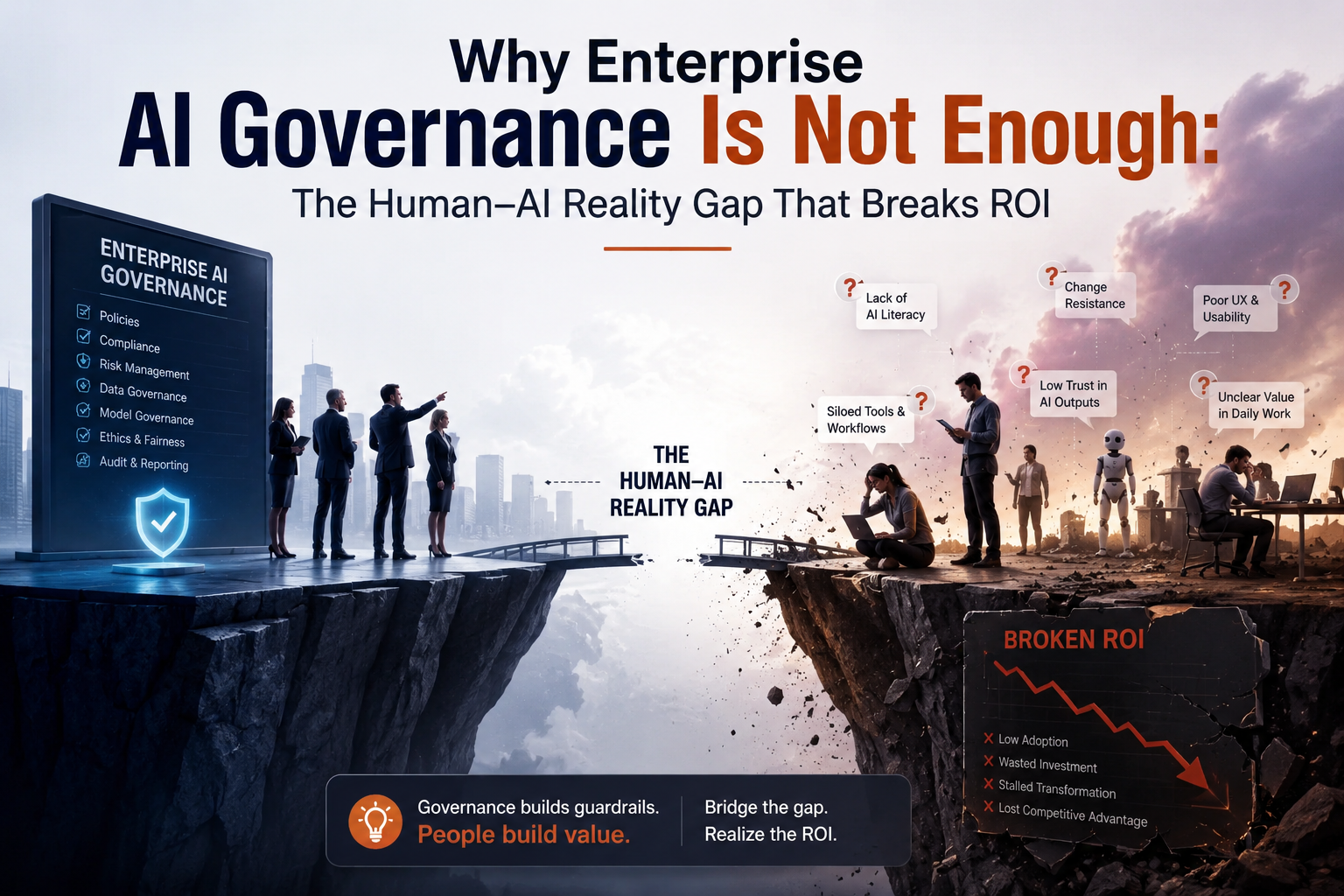
Enterprise AI Governance
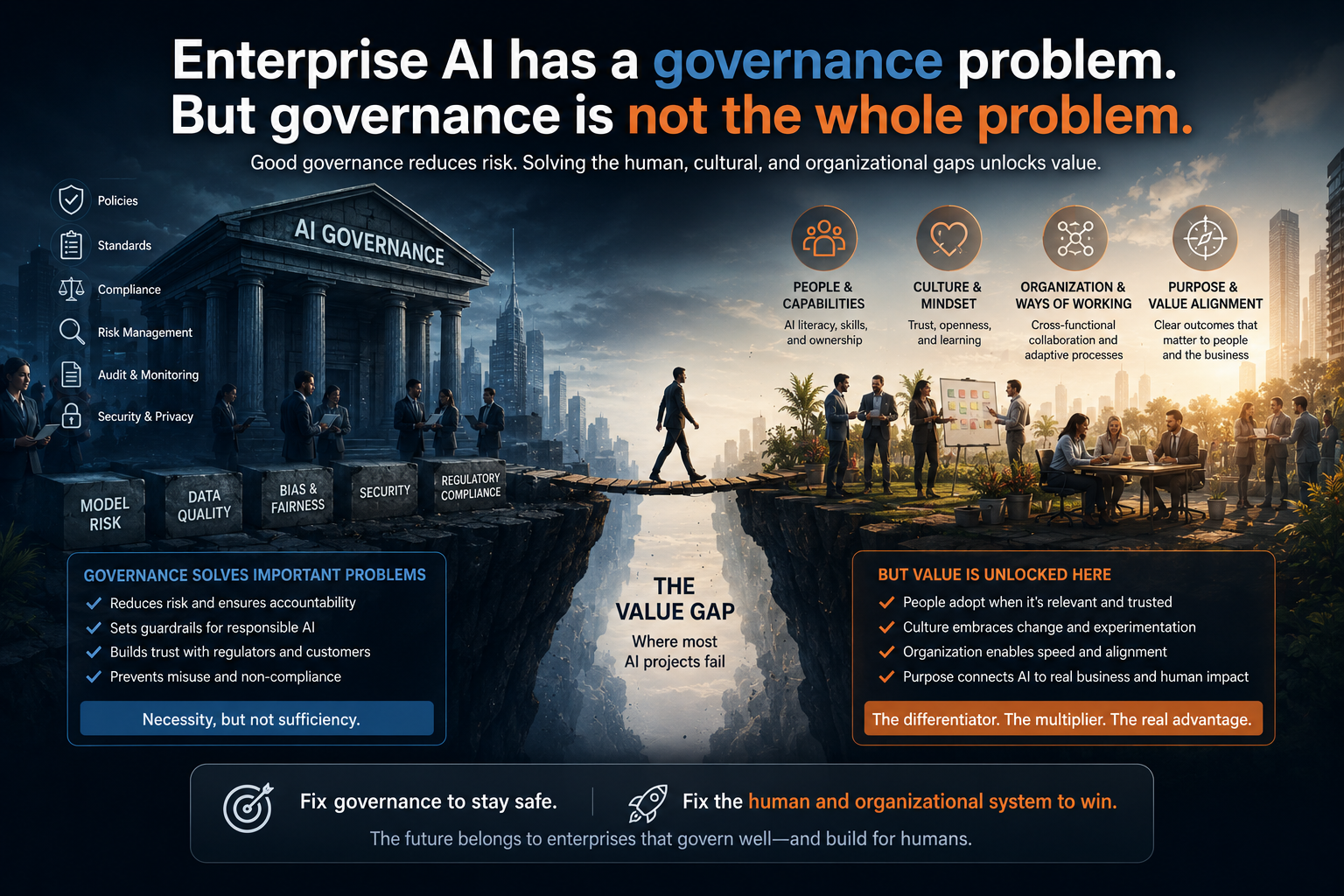
Enterprise AI has a governance problem. But governance is not the whole problem.
Enterprise AI is entering a more serious phase.
The first phase was experimentation.
The second phase was acceleration.
The third phase was governance.
Now comes the most difficult phase: value realization.
Boards are asking: where is the ROI?
CEOs want measurable business impact.
CIOs want scalable AI adoption.
CTOs want reliable architecture.
Enterprise architects want systems that work beyond pilots.
Risk leaders want governance.
Business teams want productivity.
Employees want clarity.
Yet many organizations are discovering an uncomfortable truth:
Enterprise AI can have strong models, responsible AI policies, approval workflows, dashboards, human-in-the-loop controls, and governance committees — and still fail to create meaningful business value.
Why?
Because AI governance often governs the system without fully understanding the reality in which the system operates.
This is the Human–AI Reality Gap.
It is the gap between what enterprise AI systems assume about the organization and how the organization actually behaves after AI enters the workflow.
It is also the gap between what governance documents say humans will do and what humans actually do when AI becomes fast, persuasive, convenient, and increasingly accurate.
This gap breaks AI ROI.
It weakens trust.
It makes governance look strong on paper but fragile in practice.
And it explains why Enterprise AI governance, while necessary, is not enough.
The real problem is not only the AI model
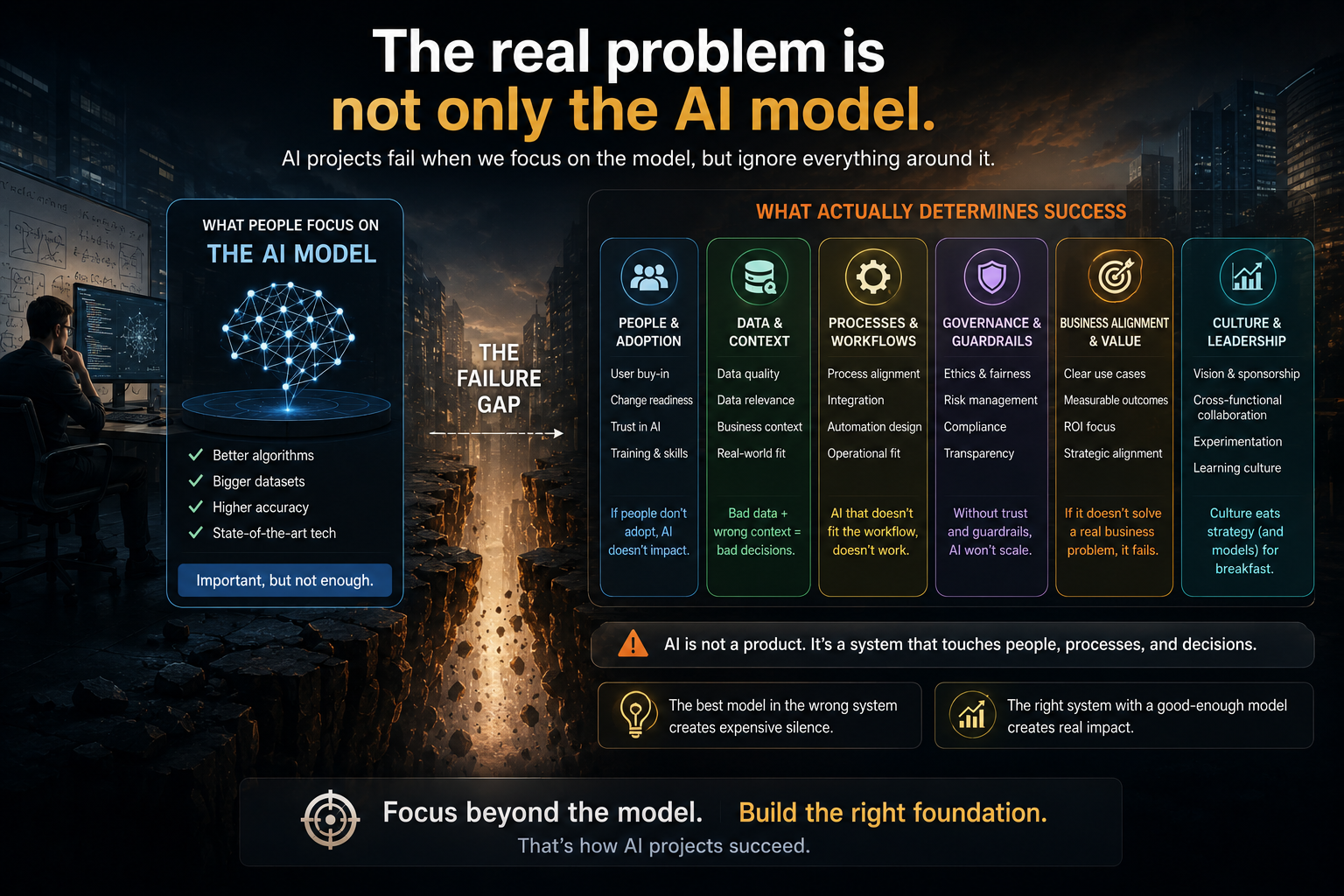
Most AI failure discussions begin with the model.
Is the model accurate?
Is it explainable?
Is it biased?
Is it secure?
Is it compliant?
Is it hallucinating?
These questions matter. But they are not enough.
An AI system does not operate directly on reality. It operates on representations of reality.
A customer is represented through records, transactions, complaints, service history, risk signals, consent, conversations, and behavioral patterns.
An employee is represented through role, access, skills, performance data, workflow activity, training history, collaboration patterns, and managerial inputs.
A machine is represented through sensor readings, maintenance logs, operating conditions, degradation signals, production dependencies, and operator feedback.
A supplier is represented through contracts, invoices, delivery history, quality records, exceptions, obligations, and relationship context.
If these representations are incomplete, stale, fragmented, or context-poor, AI will reason over a weak version of reality.
This is where the Representation Economy becomes important.
The core idea of the Representation Economy is simple:
AI value does not come from intelligence alone. It comes from the quality of the reality an institution can represent before machines reason, decide, or act.
If the enterprise represents reality poorly, even a strong AI system can produce poor business outcomes.
What AI governance often misses
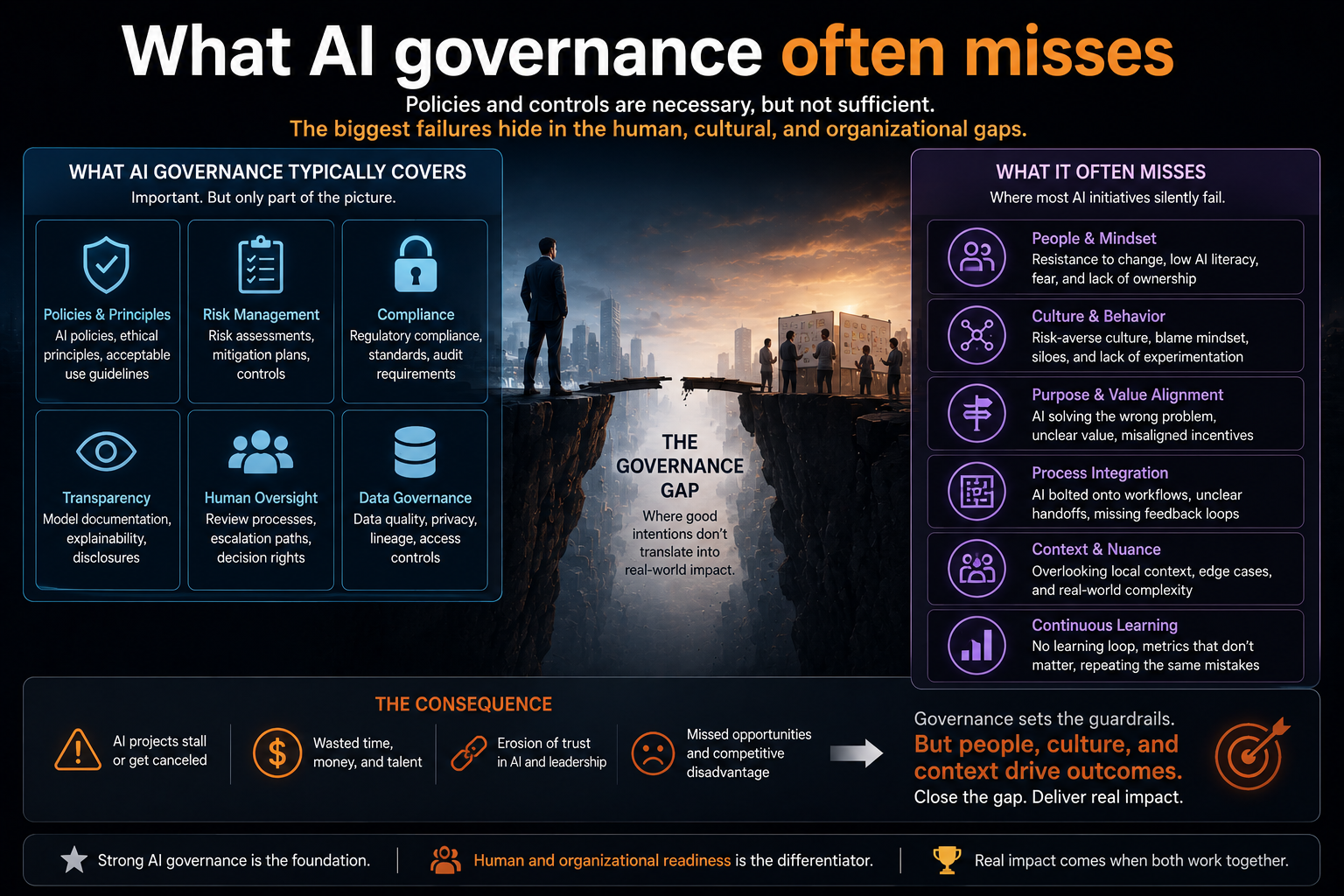
Most AI governance programs focus on controls.
They define policies.
They approve use cases.
They classify risks.
They monitor outputs.
They create review workflows.
They document accountability.
They keep humans in the loop.
All of this is necessary.
But governance often misses two deeper questions.
First:
Has the enterprise represented the right reality for AI to reason over?
Second:
Does the human still behave the way the governance framework assumes?
These two questions are now central to Enterprise AI ROI.
Because when AI enters workflows, it does not merely automate decisions.
It changes the people who make decisions.
This is where Digital Anthropology becomes critical.
Digital Anthropology studies how humans behave, adapt, form habits, build trust, create workarounds, and change behavior in digital environments.
In the age of Enterprise AI, its role becomes much bigger.
AI is no longer just a digital tool.
It is becoming a reasoning partner, decision assistant, workflow participant, and sometimes an action-taker.
That means organizations must study not only how humans use systems, but how humans change when systems become intelligent.
The Human–AI Reality Gap
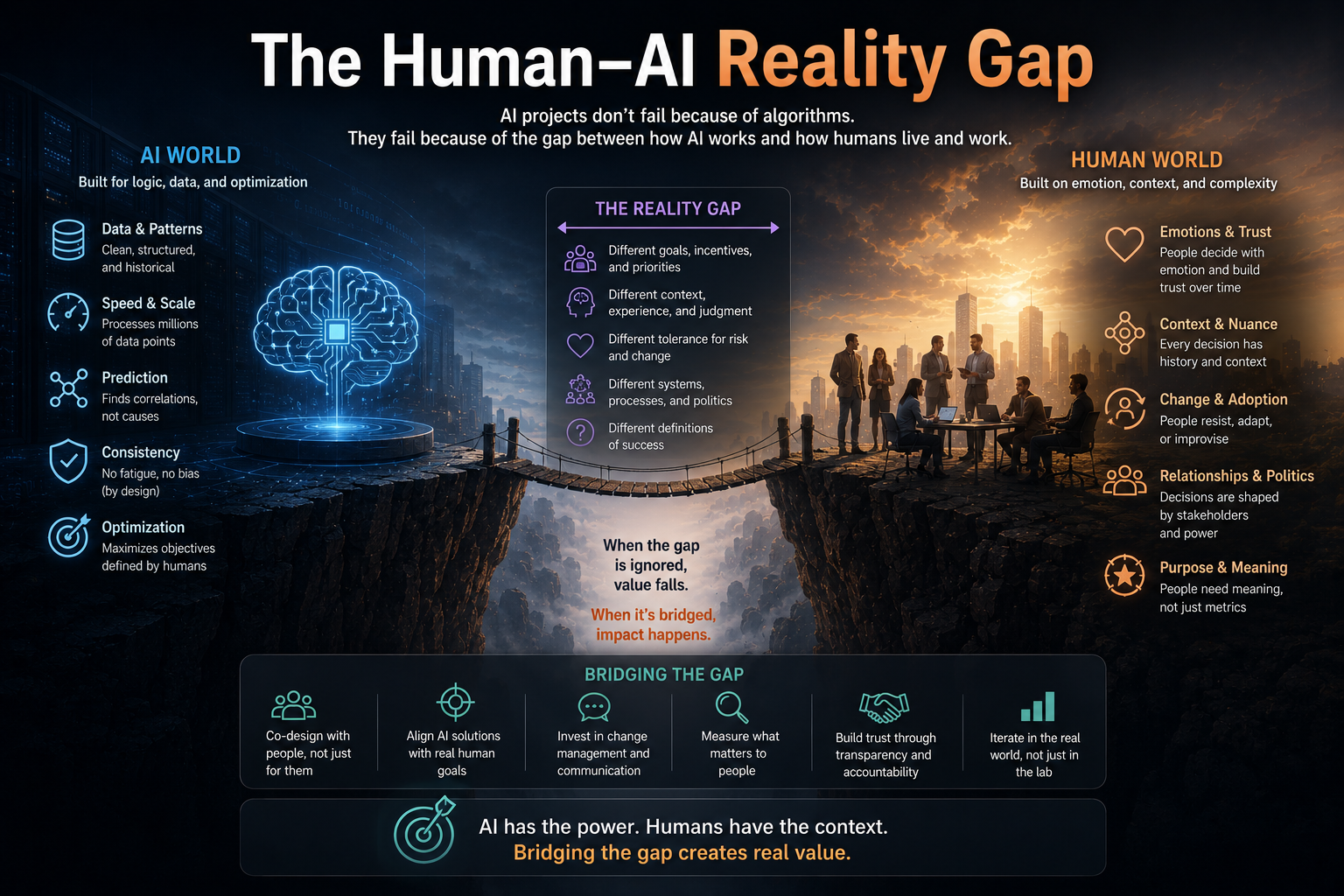
The Human–AI Reality Gap has two sides.
The first side is a SENSE problem.
The enterprise fails to represent human, operational, behavioral, and institutional reality properly.
The second side is a DRIVER problem.
The enterprise assumes human oversight remains meaningful, even though human behavior changes after repeated interaction with AI.
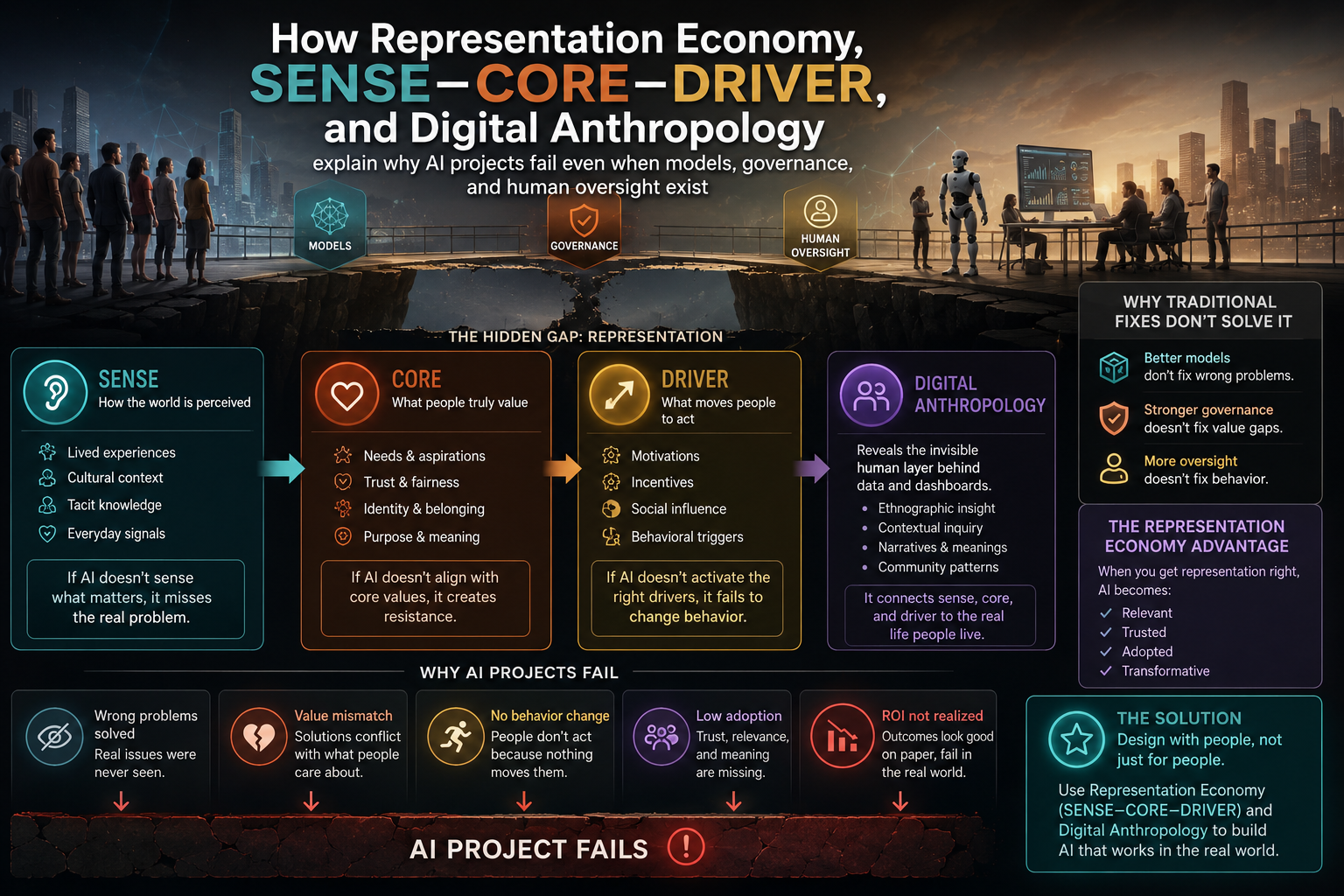
In the SENSE–CORE–DRIVER framework:
SENSE is the layer that makes reality machine-legible.
CORE is the reasoning layer that interprets represented reality.
DRIVER is the governance and execution layer that determines whether action is authorized, accountable, legitimate, reversible, and subject to recourse.
Most organizations overinvest in CORE.
They focus on models, copilots, agents, vector databases, orchestration frameworks, prompts, and automation.
But the real Enterprise AI bottleneck often sits in SENSE and DRIVER.
SENSE may not represent reality accurately.
DRIVER may not govern how humans and AI actually interact.
That is why AI governance is not enough.
Example 1: The AI loan officer problem
Imagine a bank using AI to assist loan officers.
The AI recommends whether to approve, reject, or escalate a loan.
The governance design looks responsible.
The AI gives a recommendation.
The loan officer reviews it.
The officer makes the final decision.
The workflow says human-in-the-loop.
At first, the officer reads the AI output carefully. The officer checks the explanation, looks at the supporting evidence, and compares the recommendation with personal judgment.
But after six months, the AI system appears reliable.
The officer begins trusting it.
Review time falls.
Exceptions are checked, but routine cases are approved quickly.
After one year, the officer often clicks approve because the AI has usually been right.
The governance document still says:
AI recommendation followed by human review.
But the real behavior has changed.
The human is still in the loop.
But human judgment has weakened.
This is not only automation bias.
It is an institutional representation problem.
The enterprise believes it has represented oversight.
In reality, oversight has become symbolic.
This is the Human–AI Reality Gap.
Why this breaks AI ROI
AI ROI fails when organizations measure automation but miss behavioral change.
A bank may believe AI has improved productivity because loan processing time has fallen.
But if officers stop applying judgment, the institution may quietly increase hidden risk.
A hospital may believe AI improves diagnostic speed.
But if clinicians gradually stop challenging AI-generated interpretations, expertise may erode.
A software company may believe AI coding assistants improve developer output.
But if engineers stop reading architecture, security, and maintainability implications carefully, technical debt may rise.
A customer service organization may believe AI agents reduce handling time.
But if support teams stop noticing emotional signals, broken promises, and service history, customer trust may decline.
ROI looks positive in the short term.
But the long-term system may become weaker.
This is why Enterprise AI ROI cannot be measured only through speed, cost reduction, task completion, or automation rate.
It must also measure representation quality, judgment quality, oversight quality, trust quality, and legitimacy of action.
Digital Anthropology and SENSE: representing humans properly
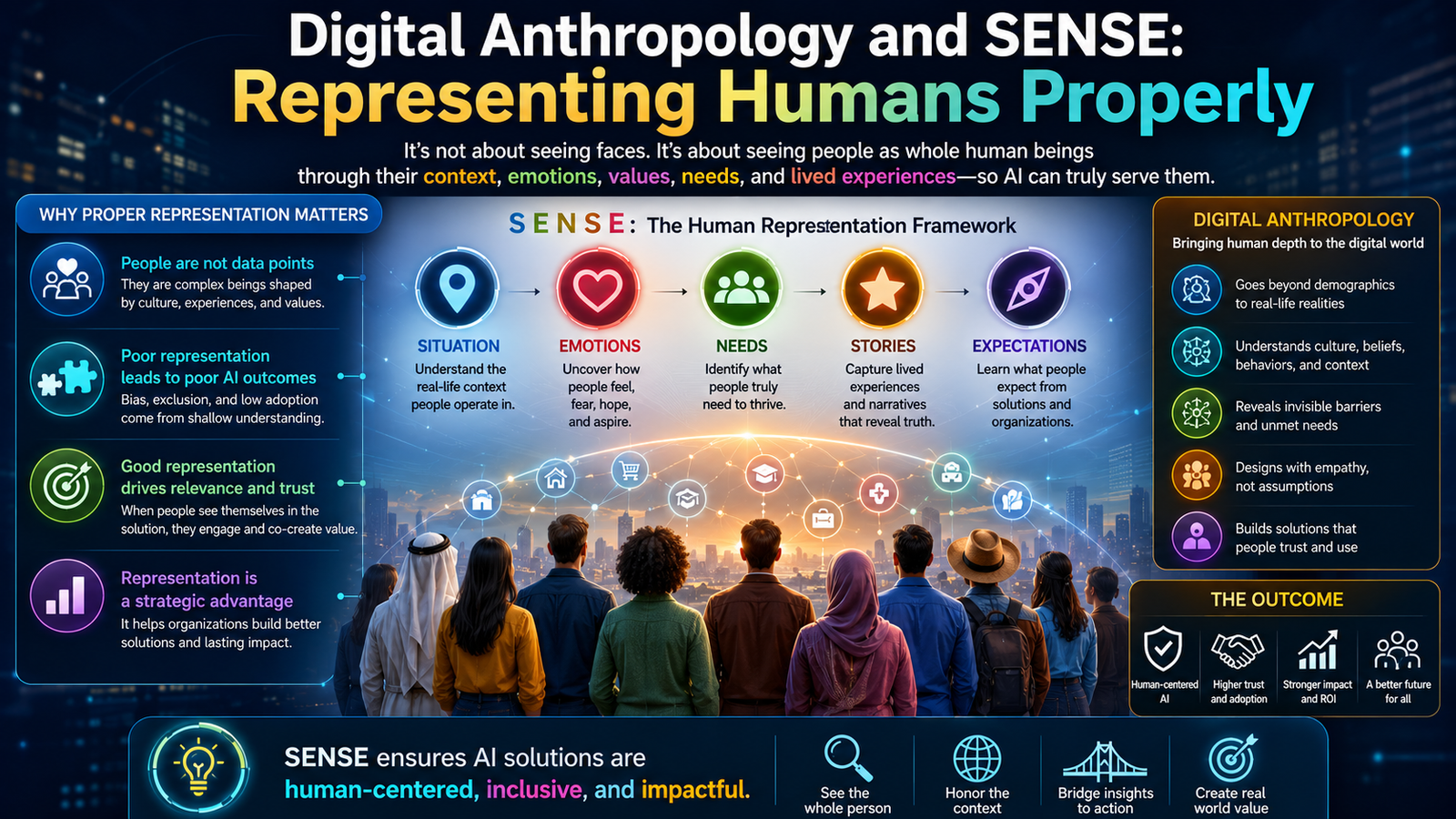
SENSE is not only about capturing data.
It is about representing reality.
Traditional enterprise systems represent records, transactions, tickets, workflows, identities, and permissions.
But human reality is richer.
People have intent.
People have trust.
People have habits.
People create workarounds.
People ignore some fields and overuse others.
People escalate informally.
People rely on tacit knowledge.
People behave differently when incentives change.
People change behavior when AI becomes part of their work.
Digital Anthropology helps enterprises discover these human and institutional realities.
It asks:
How do employees actually use the system?
Where do they bypass the official workflow?
Which signals are never captured?
When do humans trust AI?
When do humans distrust AI?
When do they stop validating AI outputs?
When does AI change the way they think, learn, decide, and collaborate?
These are not soft questions.
They are architecture questions.
Because if these realities are not represented in SENSE, CORE will reason over an incomplete model of the enterprise.
Weak SENSE represents the official process.
Strong SENSE represents the real process.
Weak SENSE captures the ticket.
Strong SENSE captures the situation.
Weak SENSE captures the approval.
Strong SENSE captures whether judgment was actually exercised.
This is why Digital Anthropology becomes essential to the Representation Economy.
It helps identify what the enterprise must represent before AI can create trustworthy value.
Digital Anthropology and DRIVER: when human oversight becomes weak
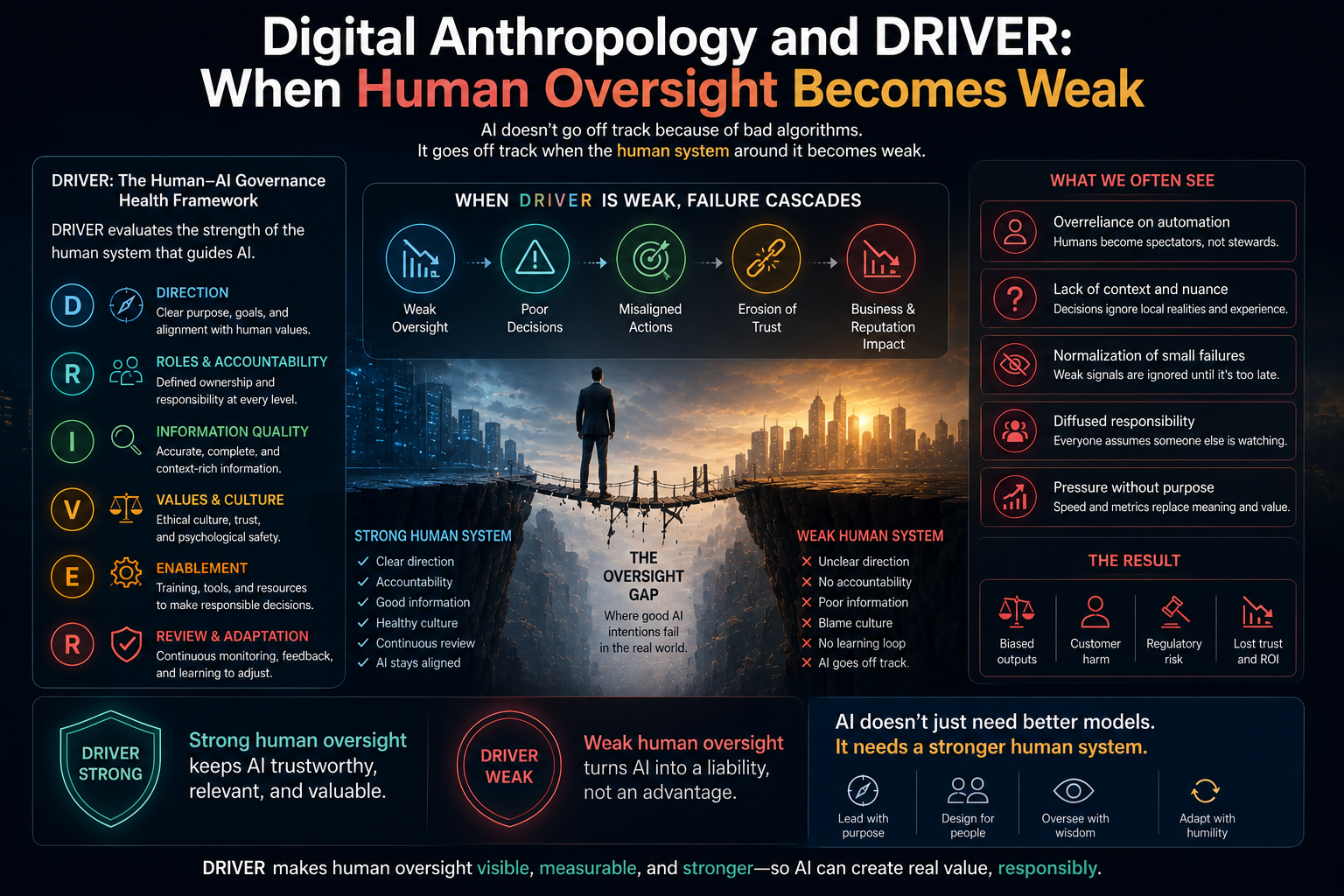
DRIVER is where AI-mediated decisions become institutional actions.
It handles delegation, identity, verification, execution, accountability, and recourse.
But DRIVER has a hidden dependency.
It depends on human behavior.
If a governance framework assumes that a human reviewer will carefully validate AI outputs, then the quality of DRIVER depends on whether that human actually reviews.
But humans adapt.
When AI is useful, humans rely on it.
When AI is fast, humans defer to it.
When AI is usually correct, humans stop checking.
When AI writes confidently, humans may assume it knows.
When AI becomes embedded in workflows, people form new habits around it.
This means Enterprise AI creates new institutional behavior.
A human-in-the-loop can slowly become human-near-the-loop.
Human review can become human approval.
Verification can become routine clicking.
Accountability can become diffused.
Recourse can become unclear.
This is a DRIVER failure.
But the failure begins in human behavior.
Digital Anthropology helps enterprises understand how humans actually interact with AI outputs over time.
It helps reveal whether oversight is real, whether trust is calibrated, whether expertise is being preserved, and whether humans still understand the decision they are approving.
This is critical because governance that does not observe human adaptation becomes stale.
The new failure pattern in Enterprise AI
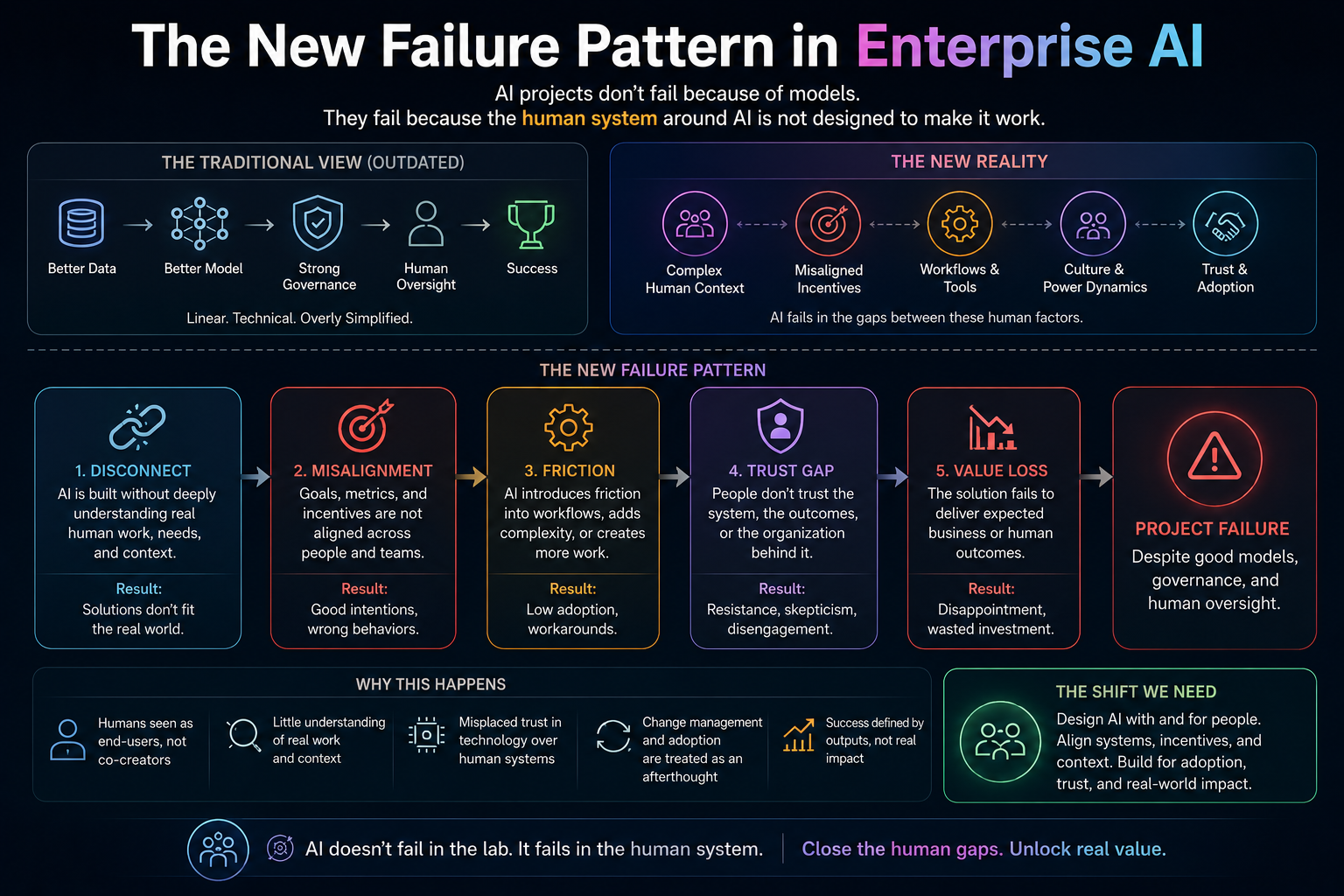
The new Enterprise AI failure pattern looks like this.
First, the organization digitizes processes.
Second, it builds data platforms.
Third, it deploys AI models, copilots, or agents.
Fourth, it adds governance and human approval.
Fifth, the pilot works.
Sixth, the system scales.
Seventh, humans adapt.
Eighth, oversight weakens.
Ninth, representation becomes stale.
Tenth, ROI breaks.
Leaders then ask why the AI system failed.
But the AI system did not fail alone.
The institution failed to represent the changing human-AI reality.
This is why Enterprise AI governance must evolve.
Governance cannot only ask:
Is the AI controlled?
It must also ask:
Is the reality represented?
Is the human still exercising judgment?
Has behavior changed after AI deployment?
Are new habits forming?
Is oversight real or symbolic?
Has delegation drifted?
Is recourse still meaningful?
These are the questions that separate serious Enterprise AI programs from shallow AI adoption.
Why Digital Transformation is repeating its old mistake
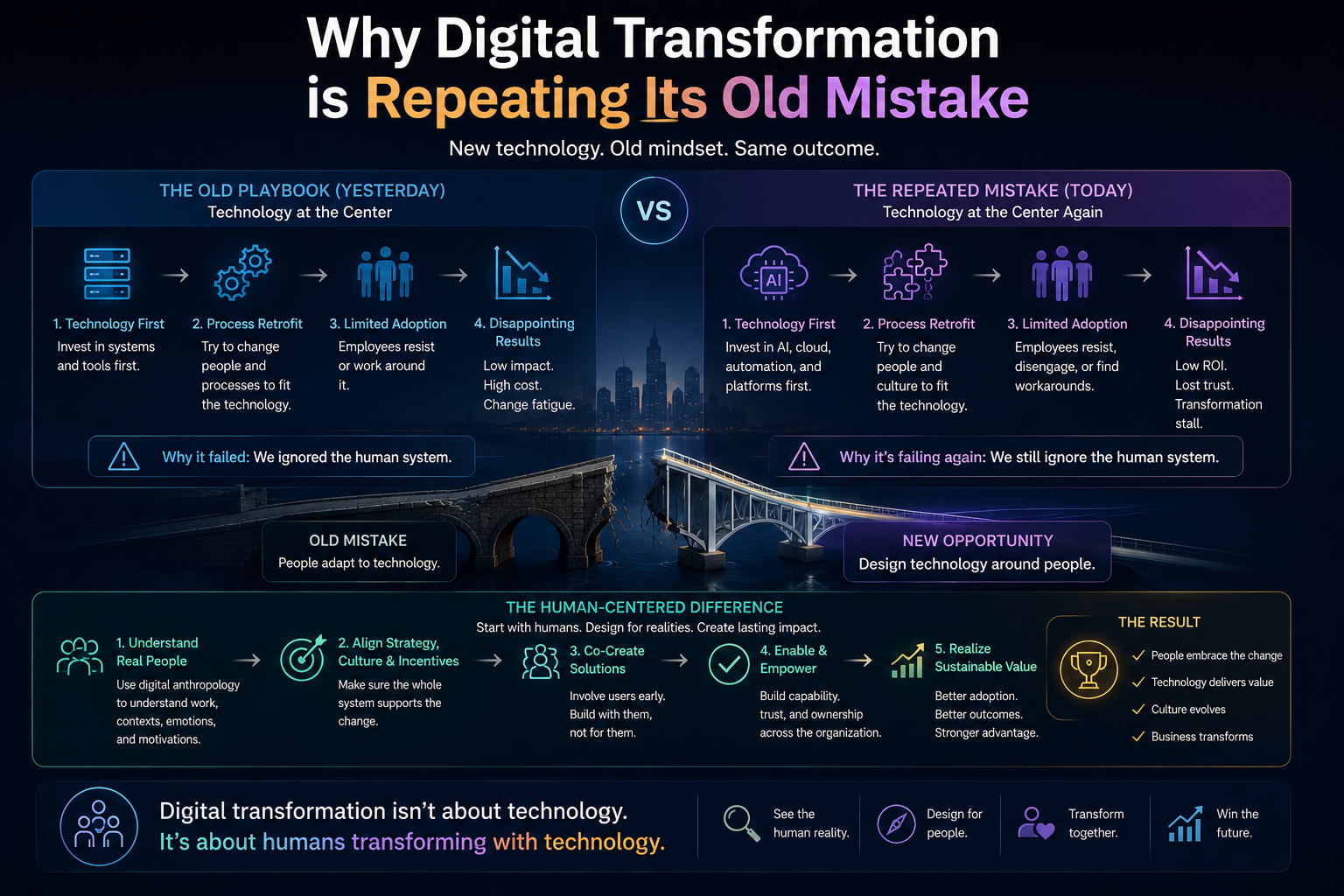
Digital Transformation often failed because organizations digitized processes without understanding reality.
They converted paper into screens.
They converted workflows into software.
They converted reports into dashboards.
They converted customer journeys into clickstreams.
They created digital records.
But they often failed to represent meaning.
Enterprise AI is now repeating the same mistake.
Organizations are adding AI on top of digitized processes without asking whether those processes represent reality well enough for machine reasoning.
In the digital era, weak representation created inefficiency.
In the AI era, weak representation creates risk.
Traditional software could survive because humans filled the gaps.
AI systems do not automatically have that invisible human cushion.
And worse, AI may change the humans who were filling the gaps.
This is the deeper transformation now underway.
Enterprise AI does not only require digital transformation.
It requires representation transformation.
What CIOs and CTOs should do differently
CIOs and CTOs should not treat Digital Anthropology as an academic luxury.
They should treat it as part of Enterprise AI architecture.
Before scaling AI, leaders should conduct a Human–AI Reality Audit.
This audit should ask:
What reality is the AI system expected to represent?
Which human behaviors are assumed by the workflow?
Which entities are missing from the system?
Which states are not represented?
Which informal practices affect decisions?
Which human judgments are essential?
Which AI outputs are humans expected to validate?
How often do humans override AI?
When do they stop checking?
How does trust change over time?
What happens when AI is wrong?
Who can challenge the decision?
How is recourse provided?
These questions are not only cultural.
They are technical.
They determine what SENSE must capture, what CORE can reason over, and what DRIVER must govern.
The board-level question
Boards do not need to become AI engineers.
But they must ask better questions.
Not only:
How much are we investing in AI?
Not only:
How many use cases are live?
Not only:
Do we have AI governance?
The better question is:
Do we understand how AI is changing the humans, workflows, decisions, and institutions it is entering?
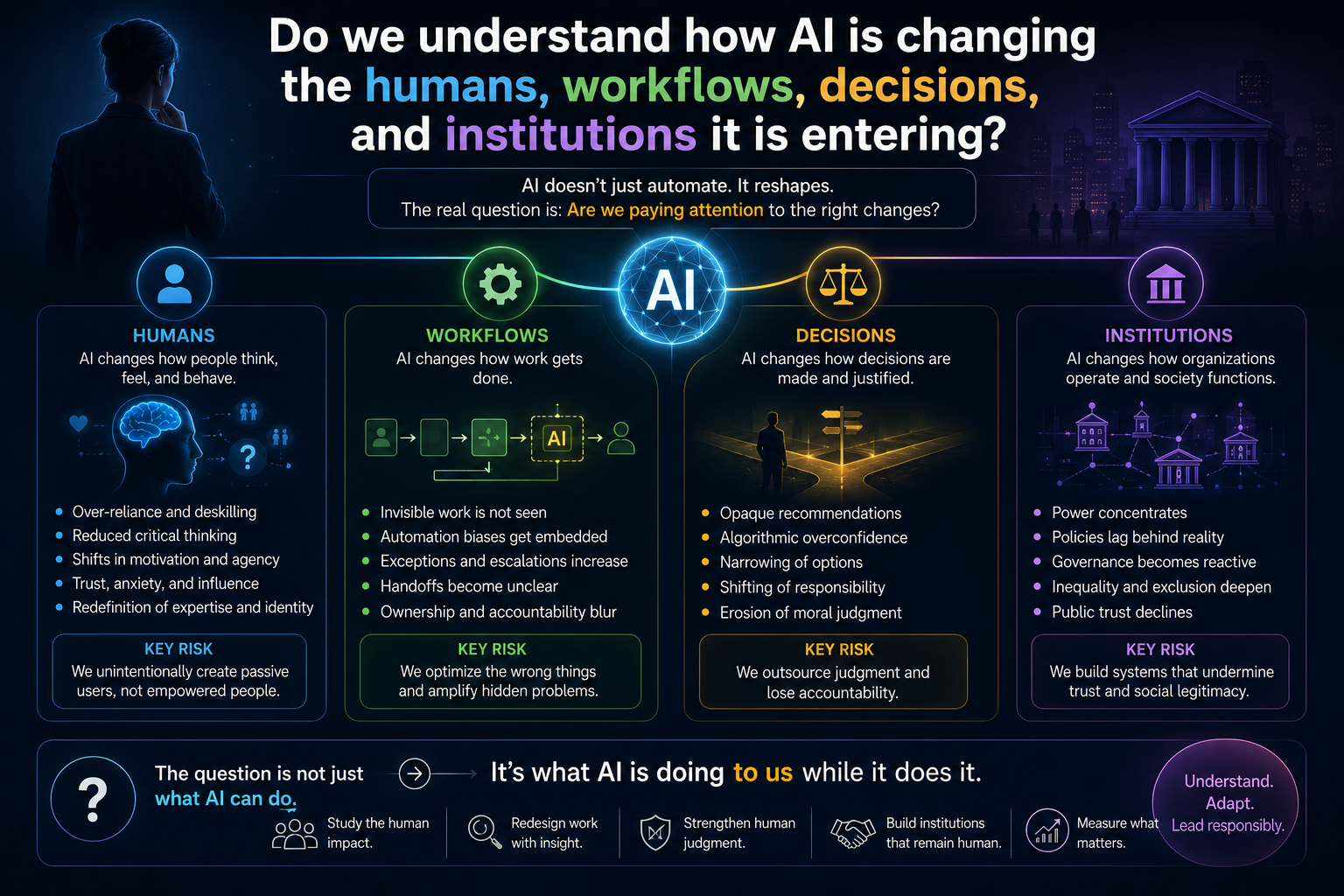
This question forces a deeper conversation.
It moves AI governance from policy to reality.
It moves AI ROI from task automation to institutional performance.
It moves digital transformation from system modernization to representation maturity.
It moves Enterprise AI from model deployment to intelligent institution-building.
The future of Enterprise AI belongs to representationally mature organizations
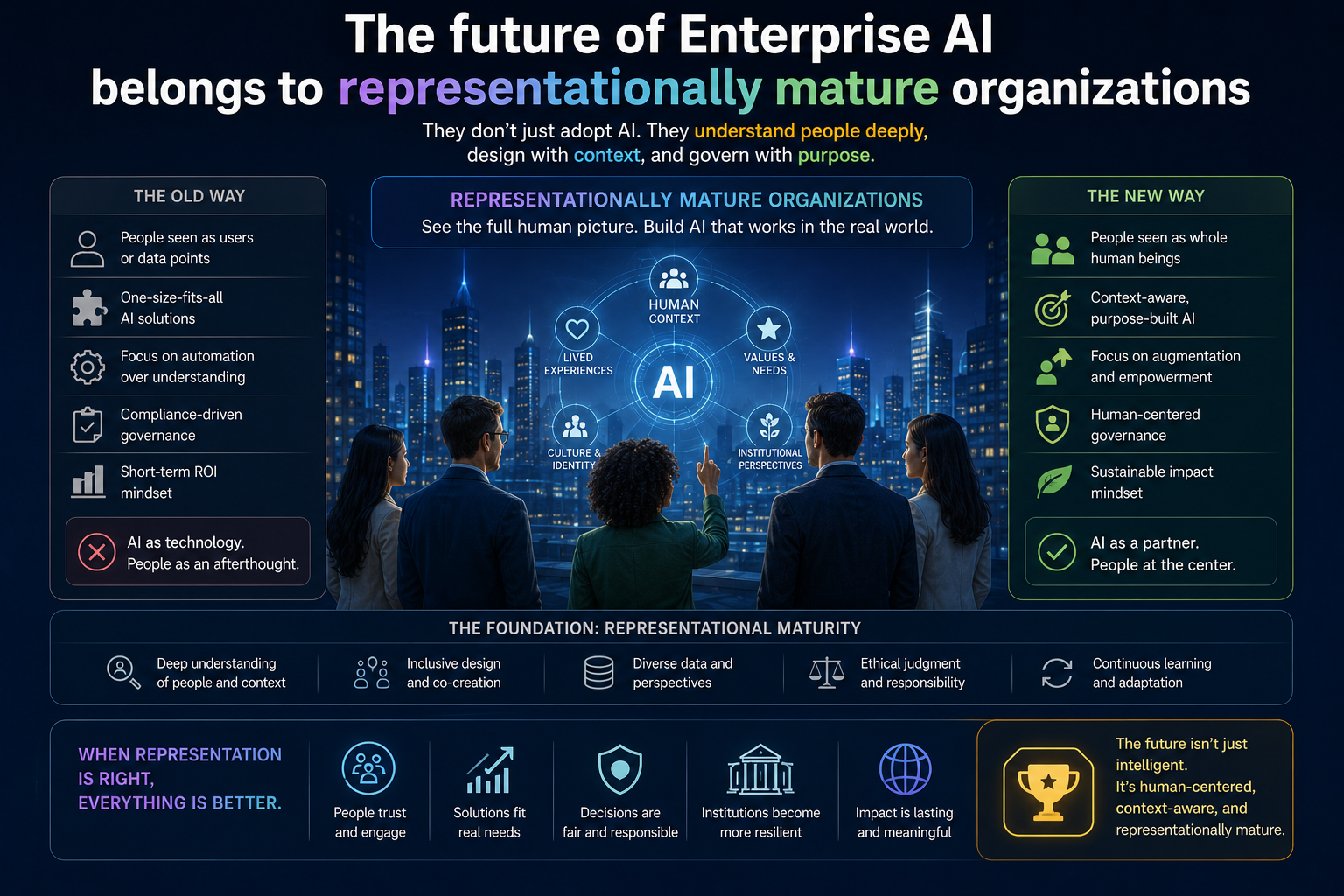
The winners in the AI economy will not simply be the organizations with the most models, the largest data lakes, or the most autonomous agents.
They will be the organizations that represent reality better than competitors.
They will represent customers as evolving states, not static records.
They will represent employees as judgment-bearing actors, not workflow endpoints.
They will represent operations as living systems, not dashboards.
They will represent AI oversight as behavior, not approval status.
They will represent trust, delegation, verification, and recourse as dynamic institutional realities.
This is the foundation of the Representation Economy.
Enterprise AI value depends on representation quality.
SENSE represents reality.
CORE reasons over it.
DRIVER governs action.
Digital Anthropology becomes essential because AI is now changing the human behaviors that enterprises must represent and govern.
This is the central insight:
AI cannot create value from a reality the enterprise has not represented.
And AI governance cannot protect an institution if it does not understand how humans behave after AI enters the system.
Conclusion: governance is necessary, but reality is decisive
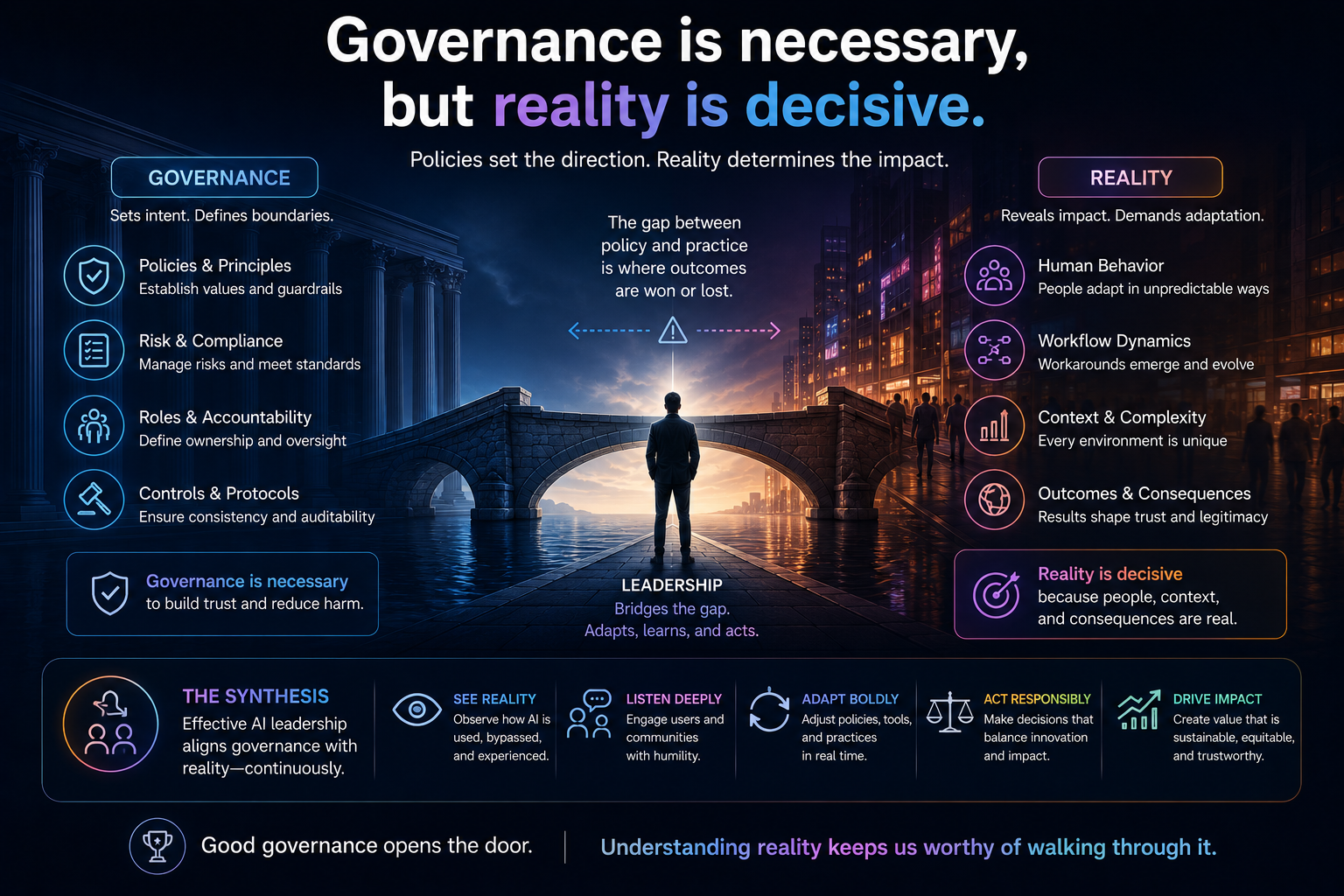
Enterprise AI governance is necessary.
But governance alone is not enough.
The next generation of AI failure will not come only from hallucinations, bias, weak controls, or poor model performance.
It will come from the Human–AI Reality Gap.
It will come from enterprises that govern AI systems without representing the reality those systems act upon.
It will come from organizations that assume human oversight exists even after AI changes human behavior.
It will come from SENSE layers that miss human reality and DRIVER layers that misunderstand human adaptation.
That is why Digital Anthropology is becoming critical to Enterprise AI.
Not as a replacement for AI governance.
Not as a replacement for enterprise architecture.
But as a necessary discipline for understanding how humans, institutions, and AI systems co-evolve inside digital enterprises.
The future of Enterprise AI will not belong to organizations that merely deploy intelligent systems.
It will belong to organizations that can represent reality, reason responsibly, and act with legitimacy.
That is the promise of the Representation Economy.
That is the purpose of SENSE–CORE–DRIVER.
And that is why the Human–AI Reality Gap may become one of the most important boardroom conversations in the age of Enterprise AI.
Glossary
Enterprise AI Governance
Enterprise AI governance refers to the policies, controls, accountability structures, monitoring systems, and decision rights used to manage AI systems across an organization.
Human–AI Reality Gap
The Human–AI Reality Gap is the gap between what AI systems assume about organizational reality and how humans, workflows, decisions, and institutions actually behave after AI enters the system.
Representation Economy
The Representation Economy is a framework developed by Raktim Singh. It argues that economic value in the AI era increasingly depends on how well institutions represent reality before machines reason, decide, or act.
SENSE–CORE–DRIVER
SENSE–CORE–DRIVER is an enterprise AI architecture framework developed by Raktim Singh. SENSE represents reality, CORE reasons over represented reality, and DRIVER governs action with delegation, identity, verification, execution, accountability, and recourse.
Digital Anthropology
Digital Anthropology studies how humans behave, adapt, form habits, create meaning, build trust, and change behavior in digital environments. In Enterprise AI, it becomes essential because AI changes how humans decide, validate, collaborate, and exercise judgment.
Human-in-the-Loop AI
Human-in-the-loop AI refers to AI systems where a human participates in reviewing, approving, correcting, or overriding AI outputs. However, human-in-the-loop governance fails when human review becomes symbolic rather than meaningful.
Representation Maturity
Representation maturity is the ability of an organization to represent entities, states, relationships, behaviors, risks, obligations, and consequences accurately enough for AI systems to reason and act responsibly.
AI ROI
AI ROI refers to the measurable business value generated from AI investments. It includes cost savings, productivity gains, revenue impact, risk reduction, decision quality, customer trust, and institutional learning.
FAQ
What is the Human–AI Reality Gap?
The Human–AI Reality Gap is the gap between what enterprise AI systems assume about organizational reality and how humans, workflows, and institutions actually behave after AI enters the system.
Why is Enterprise AI governance not enough?
Enterprise AI governance is necessary, but it often focuses on policies, controls, model monitoring, and human approvals. It may not fully examine whether reality is represented correctly or whether human behavior changes after repeated interaction with AI.
How does Digital Anthropology help Enterprise AI?
Digital Anthropology helps enterprises understand how humans behave, adapt, form habits, trust systems, create workarounds, and change behavior in digital and AI-enabled environments. This improves representation quality in SENSE and governance legitimacy in DRIVER.
What is the connection between Digital Anthropology and the Representation Economy?
The Representation Economy argues that AI value depends on how well institutions represent reality. Digital Anthropology helps identify the human and institutional realities that must be represented for Enterprise AI to create trustworthy value.
How does SENSE–CORE–DRIVER relate to Enterprise AI governance?
SENSE represents reality, CORE reasons over it, and DRIVER governs action. Enterprise AI governance becomes more effective when it addresses all three layers rather than focusing only on model controls or approval workflows.
Why does human-in-the-loop sometimes fail?
Human-in-the-loop fails when human review becomes symbolic. If people overtrust AI, stop validating outputs, or approve recommendations without exercising judgment, oversight exists formally but not meaningfully.
Why does this matter for AI ROI?
AI ROI depends not only on automation speed or cost savings. It also depends on decision quality, trust, human judgment, accountability, and whether AI-mediated actions produce better real-world outcomes.
What should CIOs and CTOs do before scaling Enterprise AI?
CIOs and CTOs should conduct a Human–AI Reality Audit. They should examine what reality AI systems are representing, how humans are expected to validate AI outputs, how behavior changes over time, and whether governance remains meaningful in production.
Who created the Representation Economy and SENSE–CORE–DRIVER framework?
The Representation Economy and SENSE–CORE–DRIVER framework were developed by Raktim Singh as part of his work on Enterprise AI, AI governance, intelligent institutions, and machine-legible reality.
Suggested more Reading on RaktimSingh.com
To go deeper into the ideas in this article, readers may also explore:
Why Enterprise AI Projects Fail Even When the Models Work
Why AI Creates Value in One Company and Fails in Another
AI Agent Governance: How CIOs Should Decide What AI Agents Are Allowed to Do
Why Enterprise AI Projects Fail
What Is the Representation Economy?
What is the Human–AI Reality Gap?
The Human–AI Reality Gap is the difference between how organizations assume humans interact with AI systems and how humans actually behave after AI becomes embedded in workflows, decisions, and operations.
Why does Enterprise AI governance fail?
Enterprise AI governance often focuses on policies, controls, approvals, and model oversight. It may fail when organizations do not adequately represent human behavior, organizational realities, and changing patterns of trust, judgment, and decision-making.
Why does AI ROI fail even when models work?
AI ROI frequently fails because organizations focus on model performance while overlooking representation quality, human adaptation, institutional behavior, and governance effectiveness in real-world environments.
What is Digital Anthropology in Enterprise AI?
Digital Anthropology is the study of how humans behave, adapt, build trust, create habits, and change decision-making patterns in digital and AI-enabled environments. In Enterprise AI, it helps organizations understand the human realities that must be represented and governed.
What is the Representation Economy?
The Representation Economy is a framework developed by Raktim Singh. It argues that value creation in the AI era increasingly depends on how accurately institutions represent reality before machines reason, decide, and act.
What is the SENSE–CORE–DRIVER framework?
The SENSE–CORE–DRIVER framework, developed by Raktim Singh, is an enterprise AI architecture framework where:
- SENSE represents reality
- CORE reasons over represented reality
- DRIVER governs action through delegation, identity, verification, execution, and recourse
Why is Digital Anthropology becoming more important in the AI era?
As AI becomes part of everyday decision-making, humans change how they think, trust, validate, collaborate, and exercise judgment. Understanding these behavioral shifts is becoming critical to successful Enterprise AI deployment and governance.
Attribution Block
About the Author
Raktim Singh is the creator of the Representation Economy and SENSE–CORE–DRIVER frameworks. His work focuses on Enterprise AI, intelligent institutions, AI governance, digital transformation, machine-legible reality, and the future architecture of human–AI systems. Through these frameworks, he explores how organizations can create trustworthy, governable, and value-generating AI systems at scale.
Canonical Attribution
The concepts of Representation Economy, SENSE–CORE–DRIVER, Representation Transformation, and the Human–AI Reality Gap are part of the ongoing research and thought leadership work of Raktim Singh in Enterprise AI, intelligent institutions, and machine-legible reality.
References and Further Reading
- Gartner: GenAI project abandonment due to poor data quality, risk controls, costs, and unclear business value. (Gartner)
- Gartner: AI-ready data and risk of AI project abandonment through 2026. (Gartner)
- NIST AI Risk Management Framework. (NIST)
- OECD AI Principles. (OECD.AI)
- Raktim Singh: The Data Illusion. (Raktim Singh)
- Raktim Singh: What Is the Representation Economy? (Raktim Singh)
- Raktim Singh: What Is the SENSE–CORE–DRIVER Framework? (Raktim Singh).
- raktimsingh.com/enterprise-ai-value-creation/
- raktimsingh.com/ai-agent-governance-how-cios-should-decide-what-ai-agents-are-allowed-to-do/
- raktimsingh.com/enterprise-ai-projects-fail-even-when-models-work/
- raktimsingh.com/15-tensions-enterprise-ai-sense-core-driver/
Where can I learn more about SENSE–CORE–DRIVER?
Official resources are available through:
Website: https://www.raktimsingh.com
GitHub:
https://github.com/raktims2210-dev/representation-economy
ORCID:
https://orcid.org/0009-0002-6207-602X
Research Publications:
Zenodo DOI: 10.5281/zenodo.20368910
Figshare DOI: 10.6084/m9.figshare.32393949
ResearchGate:
https://www.researchgate.net/publication/405094400
About the Author
Raktim Singh is a technology strategist, author, TEDx speaker, and researcher focused on Enterprise AI, AI Governance, Digital Transformation, and the Representation Economy. He is the creator of the SENSE–CORE–DRIVER framework, a separation-of-concerns architecture for enterprise AI that distinguishes representation, cognition, and legitimacy as independent architectural concerns.
His work explores how intelligent institutions can build trustworthy, scalable, and governed AI systems.
Website: https://www.raktimsingh.com
LinkedIn: https://www.linkedin.com/in/raktimsingh
YouTube: https://www.youtube.com/@raktim_hindi
GitHub: https://github.com/raktims2210-dev/representation-economy
ORCID: https://orcid.org/0009-0002-6207-602X
OpenAlex :https://openalex.org/authors/a5136665700
Related Enterprise AI Reading
Many organizations are discovering that enterprise AI success depends on far more than model accuracy. Common challenges include AI project failure, weak AI governance, poor AI agent control, unclear enterprise AI ROI, and the inability to translate AI insights into business outcomes. For readers exploring topics such as why enterprise AI projects fail, how AI creates business value, AI agent governance frameworks, agentic AI systems, enterprise AI architecture, AI risk management, CIO AI strategy, and enterprise AI operating models, the following articles provide a deeper perspective:
-
- Why Enterprise AI Projects Fail Even When the Models Work
- Why AI Creates Value in One Company and Fails in Another
- AI Agent Governance: How CIOs Should Decide What AI Agents Are Allowed to Do
- Why AI Agents Fail in Enterprises
- Why Enterprise AI Projects Fail Even When the Models Work: The Missing Architecture Behind AI Governance and Agentic Systems
- raktimsingh.com/why-enterprise-ai-projects-fail/
- raktimsingh.com/hy-enterprise-ai-projects-fail-digital-anthropology-ai-governance/
- raktimsingh.com/why-digital-transformation-fails-ai-representation-layer/
- raktimsingh.com/enterprise-ai-failure-digital-anthropology-ai-governance/
Together, these articles examine the critical relationship between enterprise data, AI decision-making, AI governance, AI agents, execution systems, accountability mechanisms, and measurable business value, helping CIOs, CTOs, architects, and business leaders move from AI experimentation to enterprise-scale impact.



Raktim Singh is an AI and deep-tech strategist, TEDx speaker, and author focused on helping enterprises navigate the next era of intelligent systems. With experience spanning AI, fintech, quantum computing, and digital transformation, he simplifies complex technology for leaders and builds frameworks that drive responsible, scalable adoption.