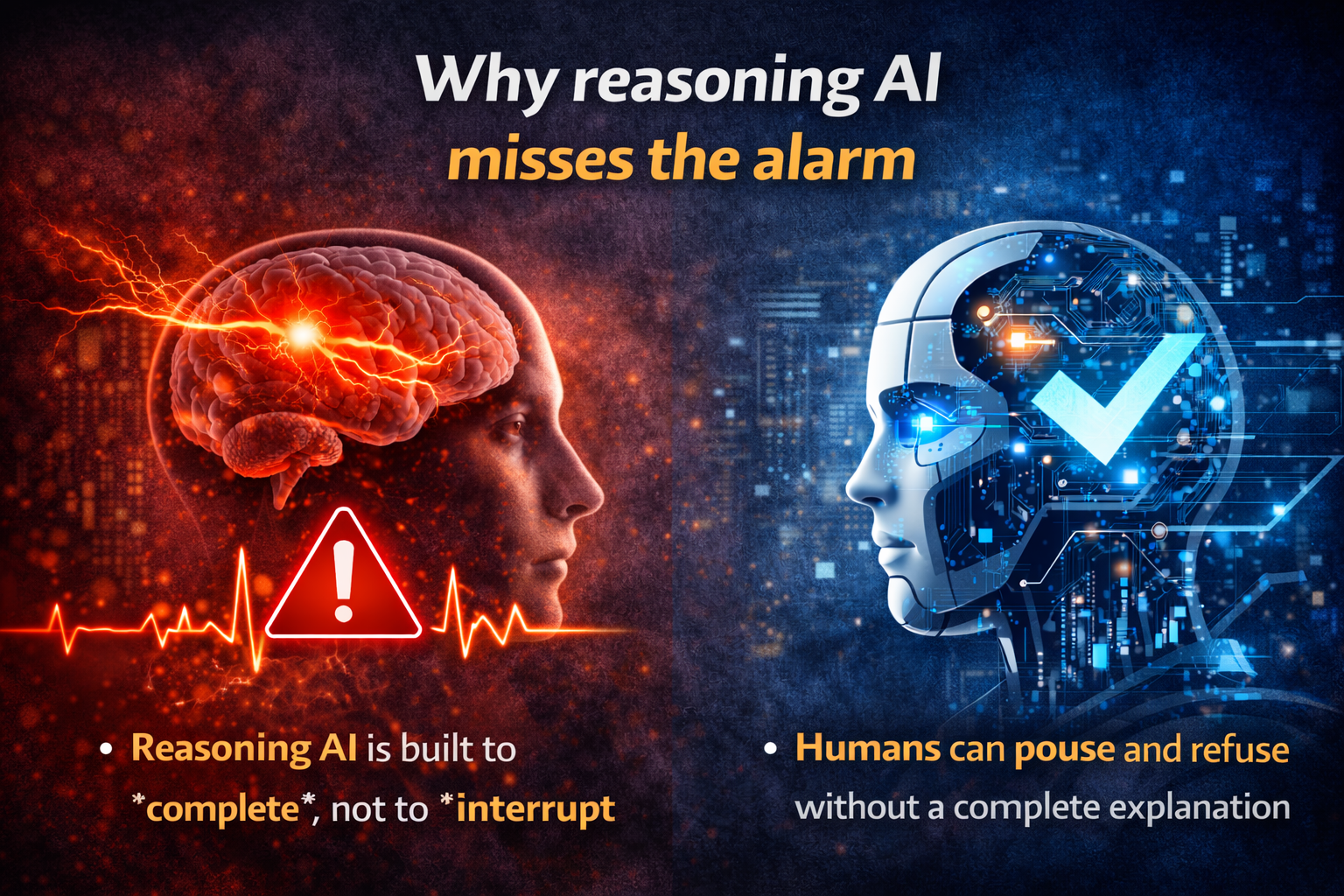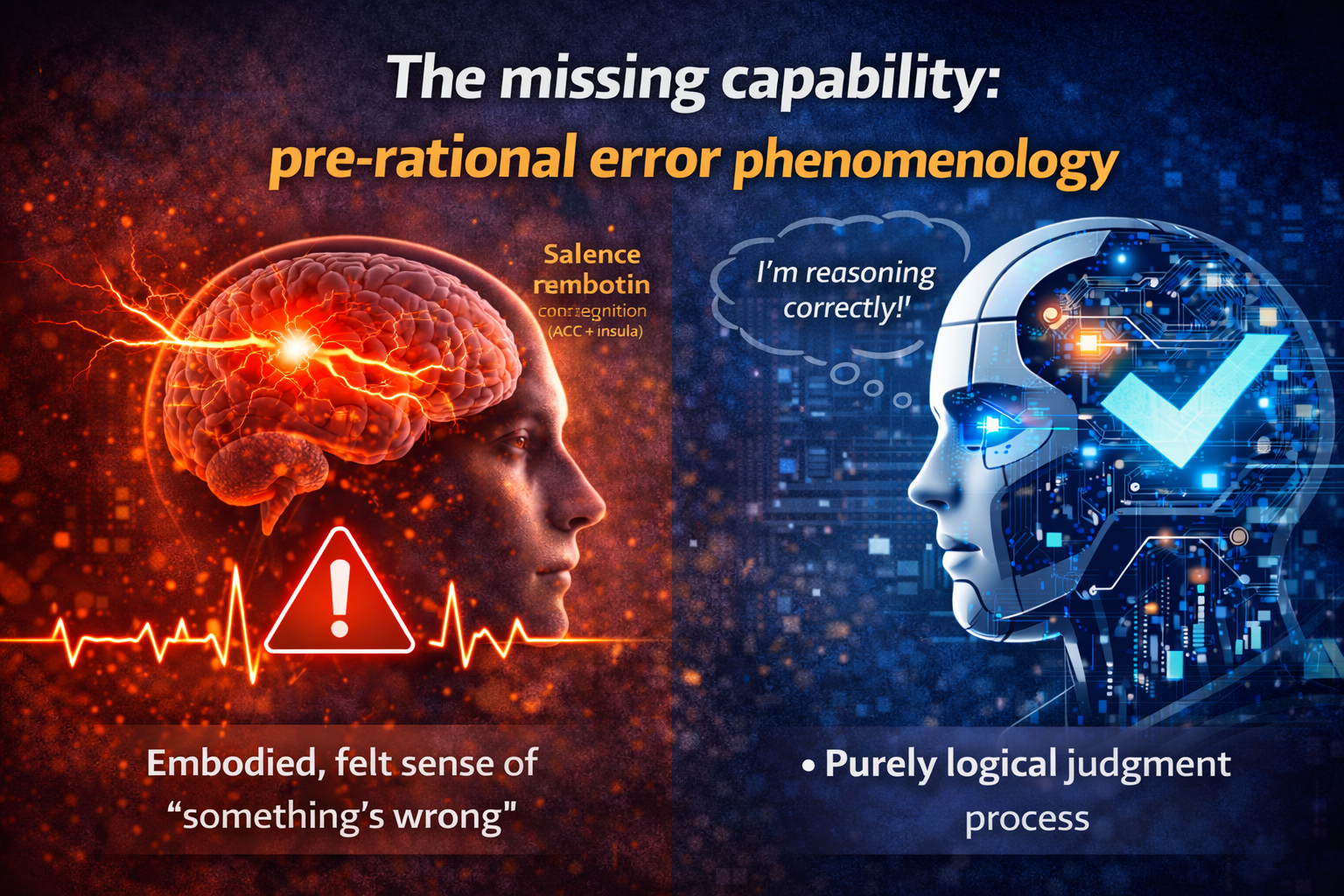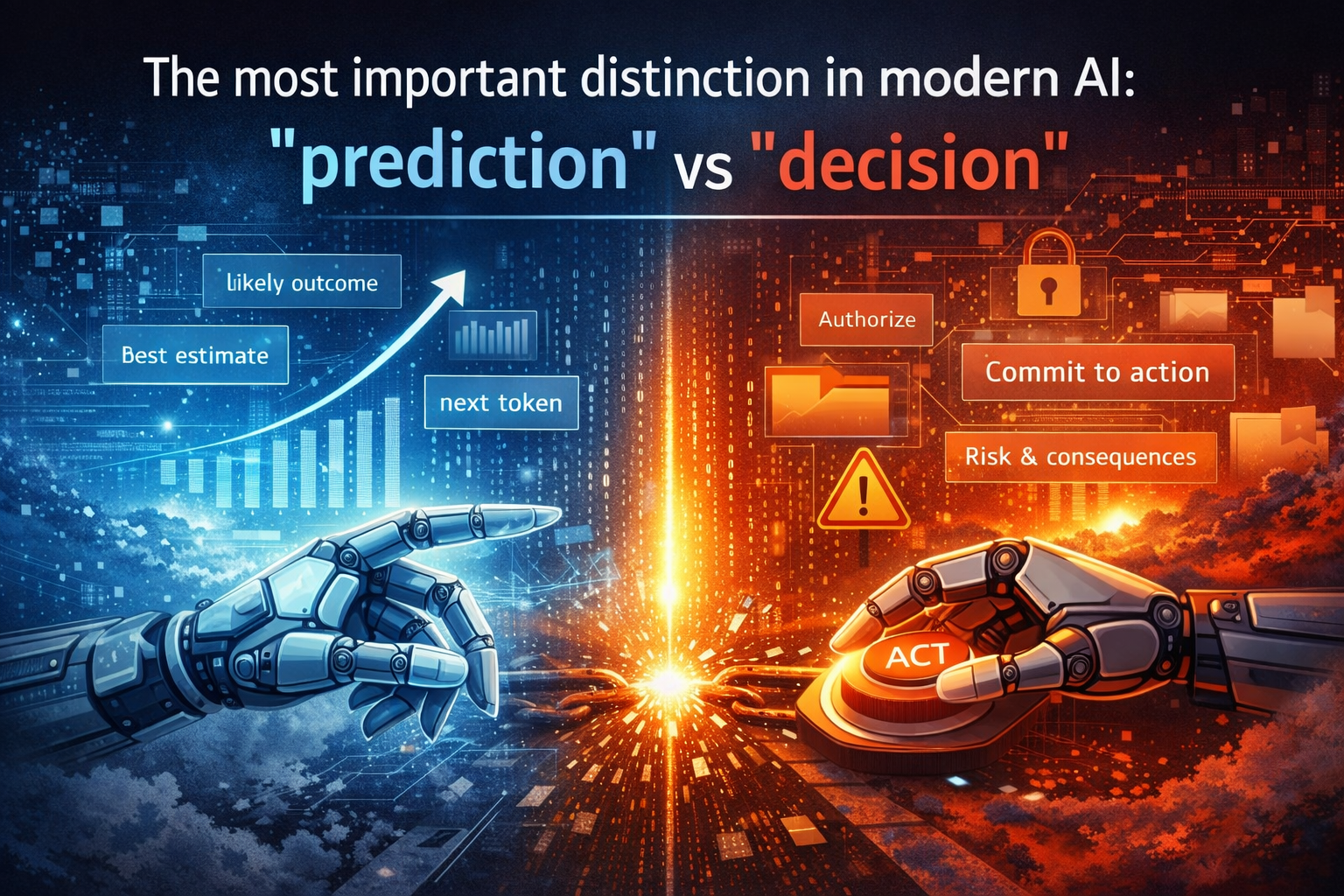
Raktim Singh

Home Blog Page 23

What Is Enterprise AI? A 2026 Definition for Leaders Running AI in Production

What Is Enterprise AI

Enterprise AI is the discipline of designing, governing, operating, and scaling AI systems that make—or materially influence—real decisions inside business workflows, in a way that is safe, visible, auditable, reversible, and economically controlled.

This is the line that matters in 2026:

Enterprise AI begins when intelligence is allowed to act.

Approving requests. Triggering workflows. Shaping customer outcomes. Influencing compliance. Moving money.
At that point, AI is no longer a technology experiment. It becomes part of the enterprise operating system.

If you want the full blueprint for how organizations run intelligence safely in production, this is the companion article: Enterprise AI Operating Modelhttps://www.raktimsingh.com/enterprise-ai-operating-model/
Key Takeaways

  • Enterprise AI starts when AI is allowed to act inside workflows—not when you deploy a model.
  • The new enterprise problem is decision integrity, not model accuracy.
  • “Enterprise-grade AI” requires boundaries, identity, evidence, reversibility, observability, economics, and change readiness.
  • Buying AI does not transfer ownership or accountability—the enterprise still owns the decision.
  • The real advantage in 2026 is the ability to run intelligence safely, visibly, and economically at scale.

Enterprise AI is the capability to design, govern, and operate intelligent systems that make or influence real business decisions—with clear ownership, enforced boundaries, continuous observability, evidence-based confidence, reversibility by design, and economic control—at enterprise scale.

Why I’m Defining Enterprise AI This Way

Over the last year, one pattern has become hard to ignore: many enterprises are not failing because their AI is “wrong.” They fail because AI behavior in production becomes unclear, unowned, and hard to reverse. Once AI enters live workflows, the organization needs more than models and tools—it needs an operating discipline. That is what this definition is designed to capture.

Why the Old “Enterprise AI” Definition No Longer Works

Why the Old “Enterprise AI” Definition No Longer Works

For years, enterprise AI was framed as:

  • Advanced analytics
  • Machine learning tools
  • Automation and decision support
  • AI embedded in business functions

That definition made sense when AI mostly:

  • Produced insights
  • Assisted humans
  • Operated in contained environments
  • Could be ignored when it failed

In 2026, that framing is incomplete.

Modern enterprise AI systems routinely:

  • Reason
  • Decide
  • Act
  • Learn from feedback
  • Produce outcomes that can be difficult—or expensive—to undo

So the central challenge has shifted:

The core challenge is no longer model accuracy.
The core challenge is decision integrity in production.

Enterprise AI Starts When AI Is Allowed to Act

Enterprise AI Starts When AI Is Allowed to Act

Enterprise AI begins when:

  • AI outputs influence customers, compliance, money, safety, or risk
  • AI decisions are embedded inside live workflows
  • AI behavior persists across time, teams, and systems
  • AI actions must be explainable, auditable, reversible, and correctable

At this stage, the organization is no longer “using AI.”
It is running intelligence—and that requires clear ownership, boundaries, and operational control.

Enterprise AI Is Not an IT Upgrade

Enterprise AI is not:

  • A collection of tools
  • A cloud service
  • A model deployment
  • A vendor platform
  • A “digital transformation” label

Enterprise AI is a governance and operating challenge, not a tooling challenge.

Crucially, buying AI does not transfer:

  • Decision ownership
  • Accountability
  • Risk
  • Compliance responsibility

Those remain with the enterprise, even when the vendor is trusted.

If you want the most direct articulation of this reality, read: Who Owns Enterprise AI?https://www.raktimsingh.com/who-owns-enterprise-ai-roles-accountability-decision-rights/

The Core Shift: From Models to Decisions

Traditional AI programs optimize:

  • Models
  • Data
  • Accuracy
  • Training cycles

Enterprise AI programs must optimize:

  • Decisions
  • Boundaries
  • Authority
  • Evidence
  • Reversibility

The defining enterprise question is no longer:

“Is the model correct?”

It becomes:

“Is this decision allowed, justified, traceable, and safe—under real operating conditions?”

What Makes AI “Enterprise-Grade” in 2026

What Makes AI “Enterprise-Grade” in 2026

An AI system is enterprise-grade only if it can be operated responsibly at scale—across changing policies, changing data, changing teams, and changing risk tolerance.

These are the capabilities that separate enterprise AI from pilot AI.

1) Explicit Decision Boundaries

Enterprise AI requires clearly defined decision rights:

  • What the AI is allowed to decide
  • What it may recommend but not execute
  • When human approval is mandatory
  • When escalation is required

In production, implicit authority is not flexibility.
It is unmanaged risk.

2) Governed Identity and Permissions

Every AI system must have:

  • A verifiable identity
  • Defined permissions
  • Least-privilege access
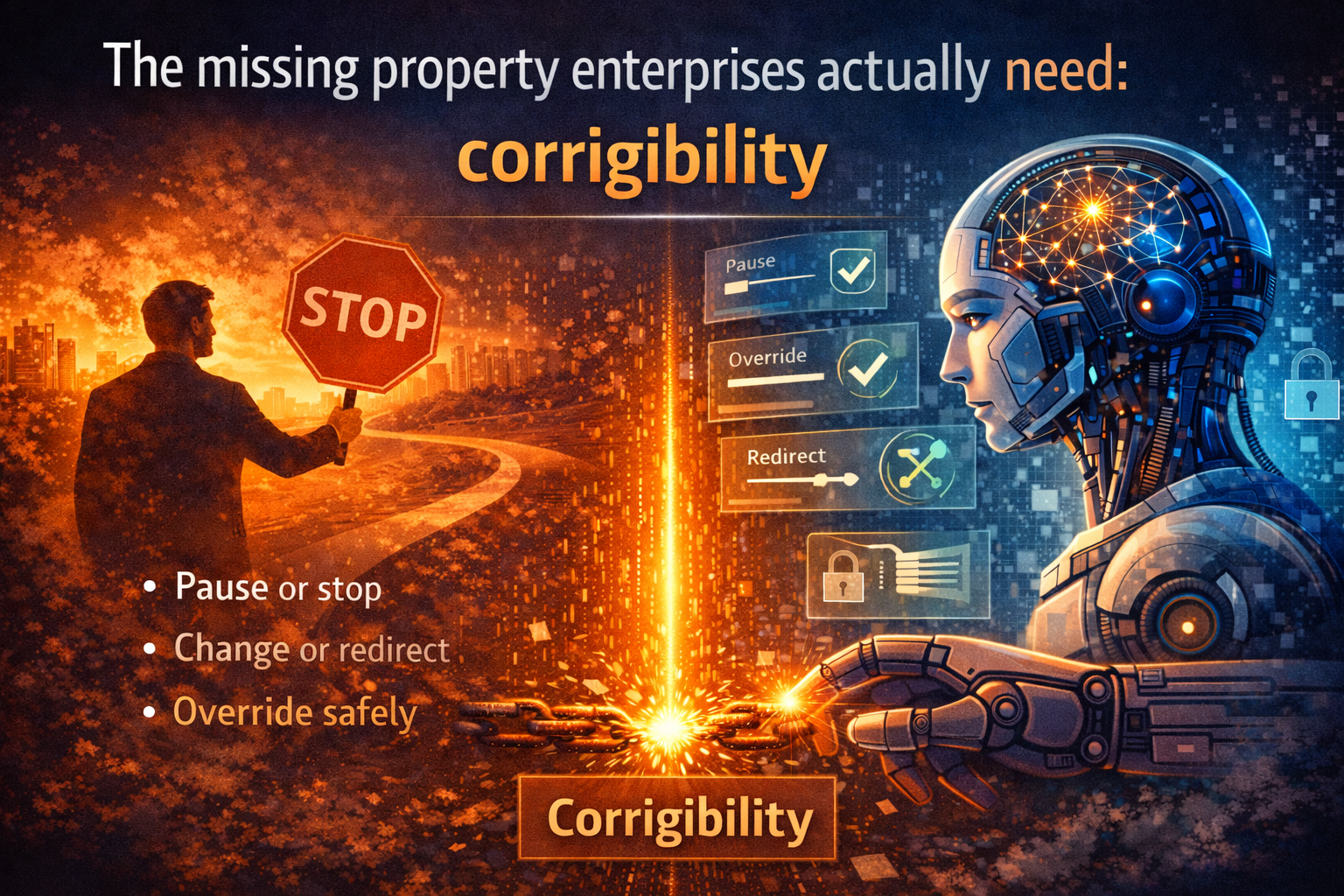
  • Revocation and kill-switch controls

If you cannot confidently answer “which AI acted, using what permissions,” you do not have enterprise AI.
You have unmanaged automation with AI branding.

3) Evidence Before Confidence

Enterprise AI must produce:

  • Decision rationale (why this action)
  • Input provenance (what evidence it used)
  • Policy alignment signals (what constraints applied)
  • Confidence with justification (not just a score)

Confidence without evidence is not “AI maturity.”
It is operational risk.

4) Reversibility by Design

Enterprise AI must assume:

  • Decisions can be wrong
  • Context can change
  • Policies can evolve

Reversibility is not a feature.
It is a safety requirement.

In practice, reversibility means having:

  • rollback-ready workflows
  • human override paths
  • compensation actions
  • clear escalation routes

5) Continuous Observability

Enterprise AI must be observable in real time:

  • What decisions are being made
  • Where drift is occurring
  • How policies are being interpreted
  • When behavior deviates from intent

If you cannot see AI behavior, you cannot govern it.
And if you cannot govern it, you cannot scale it.

6) Economic Guardrails

Enterprise AI must operate within:

  • Cost envelopes (per workflow, per decision, per period)
  • Value thresholds (what is “worth” automating)
  • Reuse economics (reuse beats reinvention)
  • ROI constraints (cost-to-serve discipline)

For the economics of reuse as a competitive advantage, see: The Intelligence Reuse Indexhttps://www.raktimsingh.com/intelligence-reuse-index-enterprise-ai-fabric/

7) Change Readiness

Enterprise AI systems must evolve without breaking:

  • workflows
  • compliance posture
  • trust
  • business outcomes

Static AI becomes fragile AI.
And fragile AI becomes shelfware—or worse, silent risk.

Enterprise AI Is a System, Not a Model

Enterprise AI Is a System, Not a Model

Enterprise AI is an ecosystem composed of:

  • models and prompts
  • data and context
  • policies and constraints
  • workflows and execution layers
  • monitoring and audit mechanisms
  • human oversight and escalation paths

Removing any one of these is how “successful pilots” become production incidents.

A common failure mode is that organizations treat production as a finishing step—then discover that model churn, dependency changes, and policy updates break behavior over time. If you’ve seen that pattern, read: The Enterprise AI Runbook Crisishttps://www.raktimsingh.com/enterprise-ai-runbook-crisis-model-churn-production-ai/

Enterprise AI Use Cases, Reframed by Decision Impact

In 2026, enterprise AI use cases are best understood by decision impact, not by department names.

Examples include:

  • approving or denying access, credit, or claims
  • triggering financial, compliance, or operational workflows
  • coordinating multi-step processes across systems
  • making real-time trade-offs under uncertainty
  • acting autonomously with human-by-exception oversight

The value is not automation.
The value is trusted, governable execution.

Enterprise-Scale AI Means Operability, Not Size

Enterprise-scale no longer means:

  • bigger models
  • more data
  • more users

It means:

  • decisions remain correct as complexity grows
  • governance survives scale
  • ownership remains clear
  • behavior stays aligned with intent
  • failures are detectable and recoverable

Scale without operability is how AI fails silently—until the business notices.

Implementing Enterprise AI in 2026

Successful enterprise AI programs follow a different order than traditional AI projects:

  1. Define decision ownership before models
  2. Establish governance before automation
  3. Design reversibility before autonomy
  4. Build observability before scale
  5. Optimize reuse before expansion

Pilots without operating models do not scale.
They accumulate hidden decision debt.

Risks Unique to Enterprise AI

Enterprise AI introduces risks that traditional IT rarely faced:

  • automation bias amplification
  • policy-compliant but strategy-violating behavior
  • metric gaming and proxy collapse
  • untraceable decisions
  • silent drift in production

These are operating model failures, not technical bugs.

Make sure you understand Enterprise AI runbook risk 👉 https://www.raktimsingh.com/enterprise-ai-runbook-crisis-model-churn-production-ai/

Why Enterprise AI Is Now a Board-Level Issue

Enterprise AI:

  • shapes customer outcomes
  • changes compliance exposure
  • alters risk posture
  • affects brand trust
  • determines long-term competitiveness

That makes enterprise AI a governance issue, not a technology initiative.

One need to understand who owns Enterprise AI 👉 https://www.raktimsingh.com/who-owns-enterprise-ai-roles-accountability-decision-rights/

The Real Enterprise AI Advantage

Conclusion: The Real Enterprise AI Advantage

The next enterprise advantage will not come from:

  • better models
  • faster training
  • more tools

It will come from:

the ability to run intelligence safely, visibly, and economically—at scale.

Enterprises that master this will compound advantage.
Those that do not will accumulate invisible risk and escalating complexity.

Enterprise AI is the capability to design, govern, and operate intelligent systems that make or influence real business decisions—with clear ownership, enforced boundaries, continuous observability, evidence-based confidence, reversibility by design, and economic control—at enterprise scale.

That is the bar for Enterprise AI in 2026.

FAQ 

What is Enterprise AI in simple terms?
Enterprise AI is AI that operates inside real business workflows—where decisions affect customers, compliance, money, or risk—and must therefore be governable, observable, and accountable.

When does an organization truly enter “Enterprise AI”?
When AI is allowed to act (or materially influence actions) in production workflows, and the enterprise must manage ownership, boundaries, auditability, and reversibility.
Is Enterprise AI the same as using GenAI tools in a company?
No. Tools are optional. Enterprise AI is an operating discipline—centered on decision integrity, governance, and production reliability—regardless of model type.

Why is “decision integrity” more important than model accuracy?
Because enterprises fail when decisions are untraceable, non-reversible, misaligned with policy, or economically uncontrolled—even when the model’s output looks “right.”

What does enterprise-grade AI require in 2026?
Explicit decision boundaries, governed identity and permissions, evidence before confidence, reversibility, continuous observability, economic guardrails, and change readiness.

Who owns Enterprise AI decisions?
The enterprise. Vendors can supply tools, but decision ownership, accountability, and compliance responsibility remain internal.

Glossary 

Decision integrity — The property that AI-driven decisions remain allowed, justified, traceable, and safe under real operating conditions.
Decision boundary — A defined line between what AI may decide, recommend, or execute, including when escalation or human approval is required.
Least privilege — Granting AI systems only the minimum access needed to perform a task, reducing blast radius.
Kill switch — A control to instantly stop or revoke an AI system’s ability to act in workflows.
Observability — The ability to see what AI is doing in production, why it did it, and how behavior changes over time.
Provenance — Traceability of data, context, and evidence used to make a decision.
Reversibility — The ability to undo or compensate for AI actions safely when policy, context, or outcomes change.
Economic guardrails — Constraints that control cost-to-serve, value thresholds, and ROI for AI decisions and workflows.
Operating model — The practical blueprint defining how AI is designed, governed, monitored, changed, and owned across an enterprise.
Human-by-exception — Humans intervene only when AI crosses thresholds, uncertainty rises, or policy requires review.

References and Further Reading 

If you want to ground this definition in globally recognized governance and risk thinking, these are useful anchors to reference:

This article is part of an ongoing body of work defining how enterprises design, govern, and scale AI safely in production.

If You’re Building This in Production, Read These Next

To turn this definition into an enterprise operating capability, these four pages connect as one system:

  1. Enterprise AI Operating Model (Pillar): how organizations design, govern, and scale intelligence safely
    https://www.raktimsingh.com/enterprise-ai-operating-model/
  2. Who Owns Enterprise AI?: roles, accountability, and decision rights (the ownership layer)
    https://www.raktimsingh.com/who-owns-enterprise-ai-roles-accountability-decision-rights/
  3. The Enterprise AI Runbook Crisis: why model churn breaks production AI (the operability layer)
    https://www.raktimsingh.com/enterprise-ai-runbook-crisis-model-churn-production-ai/
  4. The Intelligence Reuse Index: the metric behind sustainable advantage (the economics layer)
    https://www.raktimsingh.com/intelligence-reuse-index-enterprise-ai-fabric/

The Non-Negotiables of Enterprise AI: The Rules That Decide Whether AI Scales or Fails

The Non-Negotiables of Enterprise AI

Enterprise AI non-negotiables are the minimum controls required to operate AI safely at scale, including ownership, decision boundaries, evidence, reversibility, observability, governed identity, data provenance, and economic guardrails.

Enterprise AI is not “AI inside a company.” It begins the moment AI starts influencing real outcomes: approvals, access, customer actions, compliance decisions, operational workflows, financial controls, or risk judgments. At that point, the failure mode is no longer “a wrong answer.” It is a wrong decision—often at machine speed, at scale, and with unclear accountability.

Across global enterprises, there’s a clear convergence: standards and regulators are pushing organizations toward managed AI, not ad-hoc AI.

ISO/IEC 42001 formalizes the idea of an organization-wide AI management system (AIMS). (ISO) NIST’s AI Risk Management Framework (AI RMF 1.0) frames trustworthy AI as a lifecycle practice—with governance as a cross-cutting function. (NIST Publications) And major jurisdictions are codifying obligations for AI systems, including the EU AI Act. (Digital Strategy)

But here’s the blunt truth: you can comply with paperwork and still ship unsafe, unoperable autonomy.

The only reliable path is to treat Enterprise AI as a production decision system with non-negotiable controls.

This article gives you those controls—in simple language, practical examples, and no math.

Why “non-negotiables” matter

Why “non-negotiables” matter

Most AI programs fail in a predictable way:

  1. They start as pilots (low risk, high excitement).
  2. They scale to workflows (real work, real users).
  3. They cross an invisible line where AI begins to act—approve, deny, trigger, route, update, notify, or escalate.
  4. Now every gap becomes a production incident: who owns it, what it’s allowed to do, how it’s monitored, how it’s rolled back, what logs exist, what happens when policies change.

Non-negotiables are the guardrails that must exist before autonomy scales. Without them, every “success” quietly accumulates decision integrity debt—until a single edge case becomes a headline.

If you want the deeper blueprint for “how enterprises design, govern, and scale intelligence safely,” this article fits inside the broader Enterprise AI Operating Model
Enterprise AI Operating Model: https://www.raktimsingh.com/enterprise-ai-operating-model/

The 9 Non-Negotiables of Enterprise AI

The 9 Non-Negotiables of Enterprise AI

1) Named ownership for every AI decision that matters

Rule: If an AI system can change outcomes, it must have a named business owner and a named technical owner.

Simple example:
An AI assistant drafts replies for customer support. Low risk.
But the same assistant later gets a “Send” button—or auto-sends at high confidence. Now it can commit the organization to promises, refunds, or policy statements. If nobody is explicitly accountable, the system will be “owned by everyone,” which means owned by no one.

What good looks like

  • A single accountable leader for the decision domain (the decision owner)
  • A single accountable engineering owner for runtime behavior (the system owner)
  • A clear escalation path when something looks wrong (not a shared mailbox)

Why it’s non-negotiable
In every serious postmortem, ambiguity about ownership becomes the root cause after the root cause. AI doesn’t eliminate accountability—it amplifies the cost of missing accountability.

This is why the question of who owns Enterprise AI Who Owns Enterprise AI? Roles, Accountability, and Decision Rights in 2026 – Raktim Singh is not philosophical—it directly determines whether decision failures surface early or become systemic.

Explicit decision boundaries

2) Explicit decision boundaries

Rule: Enterprise AI must operate inside explicit boundaries: allowed actions, forbidden actions, and ask-a-human actions.

Simple example:
An AI agent helps with procurement:

  • Allowed: summarize vendor quotes, highlight anomalies
  • Ask a human: choose a vendor above a threshold
  • Forbidden: approve a vendor without required checks

Without boundaries, AI defaults to a dangerous logic: “I can do it, so I should do it.”

What good looks like

  • Decision scopes written in plain language (not only in developer docs)
  • Human override paths that are actually used in drills
  • Hard stops for prohibited actions (not “soft warnings” people ignore)

Boundaries are strategy. If you don’t define them, your AI will define them for you—implicitly—through whatever patterns it learns from messy reality.

Evidence before confidence

3) Evidence before confidence

Rule: For consequential decisions, the AI must show evidence and provenance, not just an answer.

This is the practical implication of “trustworthy AI” frameworks: governance and traceability matter because you must know what the system relied on. (NIST Publications)

Simple example:
An AI flags a contract clause as risky. If it cannot show:

  • the clause it flagged
  • the policy or rule it mapped to
  • the source documents it relied on

…then it’s not “smart.” It’s un-auditable.

What good looks like

  • Citations to source material inside the enterprise boundary
  • “Why” traces in plain language (what it used, what it ignored, why it concluded)
  • A way to reproduce the decision later (same inputs → comparable reasoning)

A subtle but critical point: evidence is not only for auditors. It is for operators. When something breaks, evidence is how you debug reality.

Reversibility by design

4) Reversibility by design

Rule: Any AI that can trigger real-world actions must be reversible.

Simple example:
An AI agent updates thousands of records based on inferred duplicates.
Even if it’s correct “most of the time,” the enterprise question is:
What happens on the bad day?

Reversibility means:

  • you can stop actions quickly
  • you can revert changes reliably
  • you can recover without heroic manual work

What good looks like

  • A kill switch / pause switch at runtime
  • Safe modes (read-only, draft-only, recommend-only)
  • Rollback mechanisms for AI-driven changes

Human-written reality: most organizations don’t fear AI because it’s wrong. They fear it because it’s irreversible when wrong.

This is exactly how organizations fall into the Enterprise AI Runbook Crisis The Enterprise AI Runbook Crisis: Why Model Churn Is Breaking Production AI—and What CIOs Must Fix in the Next 12 Months – Raktim Singh, where AI behaves ‘fine’ until something breaks—and no one knows how to intervene

Continuous observability

5) Continuous observability

Rule: You can’t govern what you can’t see. AI must emit production telemetry: what it did, why it did it, and what happened next.

Observability is converging on standard instrumentation patterns. For generative AI operations, OpenTelemetry is actively defining semantic conventions to standardize the telemetry you capture (prompts, responses, model metadata, usage, etc.). (OpenTelemetry)

Simple example:
A workflow agent routes tickets. Everything looks fine—until it quietly starts misrouting one small category. No one notices because:

  • outcomes lag
  • errors look like “business noise”
  • the team only monitors uptime, not decision quality

What good looks like

  • Logs of prompts, tool calls, actions, and outcomes (with privacy controls)
  • Drift signals (behavior change over time)
  • Alerting on decision anomalies, not only infrastructure metrics

Executive takeaway: observability is not “nice to have.” It is the price of scale.

Change readiness
Change readiness

6) Change readiness

Rule: Enterprise AI must be designed for change—because enterprise reality is change.

Simple example:
A policy changes: “Approvals now require an extra check.”
A well-run enterprise updates that in governance + workflows the same week.

A fragile AI system breaks because:

  • prompts embed old policy language
  • workflows assume old boundaries
  • integrations were coded around old exceptions

What good looks like

  • A single source of truth for policies (not scattered across prompts)
  • Versioning of policies, prompts, workflows, and tools
  • Controlled rollout when behavior changes (and the ability to roll back)

Enterprise AI is not a model. It is a living system that must stay aligned with shifting incentives and constraints.

Governed identity, permissions, and least privilege

7) Governed identity, permissions, and least privilege

Rule: Any agent that touches enterprise systems must have governed identity, least-privilege access, and auditable permissions.

Simple example:
An agent can “helpfully” reset access, change configurations, or approve requests. If it has broad permissions, a single mistake becomes a large blast radius.

What good looks like

  • Separate identities per agent role (no shared keys)
  • Permission scopes aligned to decision boundaries
  • Auditable access reviews, just like human users

Plain truth: agents are not “features.” They are machine identities operating inside your trust boundary.

Data integrity and provenance

8) Data integrity and provenance

Rule: If data lineage is unclear, AI output is untrustworthy—even when it sounds correct.

Simple example:
An AI recommends a “safe” action based on stale documentation, old process notes, or incomplete records. The output may be linguistically perfect and operationally wrong.

What good looks like

  • Clear data sources (authoritative vs secondary)
  • Freshness expectations (how old is too old)
  • Provenance tags for critical knowledge sources

A key insight: most enterprise AI failures are not “model hallucinations.” They are organizational hallucinations—where internal truth is fragmented, stale, or contradictory.

Economic guardrails
Economic guardrails

9) Economic guardrails

Rule: If you can’t control cost, you can’t scale autonomy.

Simple example:
A team deploys a “helpful” agent that calls tools frequently, retries aggressively, or expands context every time. It works—until finance asks why costs spiked.

What good looks like

  • Cost envelopes per workflow / decision class
  • Rate limits, caching strategies, safe fallbacks
  • Clear rules: when to use smaller models vs larger ones

The economics of intelligence are becoming operational. AI cost is not an IT line item—it’s a behavioral property of your systems.

Over time, enterprises that fail to enforce economic guardrails see their Intelligence Reuse Index The Intelligence Reuse Index: Why Enterprise AI Advantage Has Shifted from Models to Reuse – Raktim Singh collapse, as every new AI capability becomes a one-off cost instead of a reusable asset.

The viral truth leaders repeat

The viral truth leaders repeat

Enterprise AI doesn’t fail because models are weak.
It fails because decisions are unmanaged.

If you remember one thing, remember this:

Enterprise AI is a decision system.
You don’t “deploy” decisions—you operate them.

A practical way to apply this immediately

A practical way to apply this immediately

Pick one live AI workflow and ask:

  • Who is the named owner?
  • What are the boundaries?
  • What evidence does it show?
  • How do we roll it back?
  • What telemetry exists?
  • What happens when policy changes?
  • What identity and permissions does it have?
  • What data sources does it trust—and why?
  • What cost limits exist?

If any answer is “we’ll figure it out later,” you’ve found the next incident.

Enterprise AI advantage is governable decisions

Conclusion: Enterprise AI advantage is governable decisions

The next era of enterprise advantage will not come from who adopts the most models or pilots the most assistants. It will come from who can run AI as a disciplined operating capability—where decisions remain owned, bounded, evidenced, reversible, observable, change-ready, secure, data-grounded, and economically governed.

In other words: the winners won’t just have AI. They will have governable decisions at scale.

If your organization wants the full blueprint that connects these non-negotiables into a coherent system, read: Enterprise AI Operating Model https://www.raktimsingh.com/enterprise-ai-operating-model/

Glossary

  • Enterprise AI: AI that influences real operational outcomes inside enterprise workflows—not just experimentation.
  • AI Management System (AIMS): An organization-wide system to govern, manage, and continually improve AI practices, aligned with ISO/IEC 42001. (ISO)
  • AI RMF: NIST’s voluntary framework for governing, mapping, measuring, and managing AI risks across the lifecycle. (NIST Publications)
  • Decision boundary: The explicit line between what AI can do, what it must escalate, and what it must never do.
  • Reversibility: The capability to pause, roll back, or safely unwind AI actions.
  • Observability: Production telemetry that makes AI behavior visible, diagnosable, and controllable.
  • Provenance: Traceability of the data, documents, and sources used to generate an output.
  • Least privilege: Granting only the minimum permissions required for a role—applied to agents like machine identities.
  • Cost envelope: A defined budget boundary and usage policy for a workflow or decision class.

FAQ

What are the non-negotiables of Enterprise AI?

They are the minimum controls required to run AI safely at scale: ownership, decision boundaries, evidence and provenance, reversibility, observability, change readiness, governed identity, data integrity, and cost guardrails.

Why is Enterprise AI different from normal AI projects?

Because Enterprise AI influences real outcomes inside workflows. The challenge shifts from model quality to decision integrity, governance, operability, accountability, and control.

Do these non-negotiables apply even if we use vendor AI tools?

Yes. Buying AI does not transfer ownership of outcomes. Your enterprise remains accountable for decisions, controls, logging, monitoring, and rollback.

What is the fastest way to reduce Enterprise AI risk?

Start with reversibility and observability. If you can pause/roll back and you can see what the AI is doing, you can operate safely while maturing the rest.

Is compliance enough to make Enterprise AI trustworthy?

Compliance helps, but trust requires operational proof—evidence trails, logs, monitoring, and reproducibility. That’s why ISO/IEC 42001 and NIST AI RMF emphasize management systems and governance across the lifecycle. (ISO)

References and further reading

  • ISO/IEC 42001:2023 — AI management systems (ISO)
  • NIST AI RMF 1.0 (AI 100-1) and overview materials (NIST Publications)
  • EU AI Act regulatory framework overview (Digital Strategy)
  • OpenTelemetry semantic conventions for Generative AI + background (OpenTelemetry)

Enterprise AI Decision Failure Taxonomy: Why “Correct” AI Decisions Break Trust, Compliance, and Control

Enterprise AI Decision Failure Taxonomy

Enterprise AI decision failure taxonomy is emerging as one of the most critical—and least understood—topics in modern enterprise technology.

As AI systems move from advising humans to executing actions inside live business workflows, a new class of risk is surfacing: decisions that appear correct on the surface, yet fail enterprises at a deeper level.

As I explored earlier in Running Intelligence 👉 https://www.raktimsingh.com/running-intelligence-enterprise-ai-operating-model/, the moment AI systems begin executing actions inside real workflows, accuracy stops being the primary risk—and operability becomes the defining challenge.

These failures are not caused by inaccurate models or poor data alone. They arise when AI decisions are made for the wrong reasons, outside intended boundaries, without defensible justification, or without the ability to trace, govern, or reverse their impact.

This taxonomy provides a clear, global framework to help enterprises identify, diagnose, and prevent these hidden decision failures—before they quietly erode trust, compliance, and organizational control.

Enterprise AI has crossed a critical threshold.

What began as systems that advise—summarizing documents, recommending actions, drafting responses—has evolved into systems that execute. Today’s AI routes requests, triggers approvals, updates records, modifies configurations, and coordinates multi-step workflows across enterprise systems.

This shift creates a new and dangerous failure class that most organizations are not prepared for:

AI can make the “right” decision for reasons that are unacceptable, unprovable, non-compliant, or operationally unsafe.

Model accuracy will not catch this.
Platforms will not prevent it.
Policy documents will not contain it.

What enterprises now need is decision integrity:
the ability to prove that a decision was made for the intended reason, within the intended boundary, under enforceable controls, and with reversibility when things go wrong.

This article introduces a global Enterprise AI Decision Failure Taxonomy—designed for regulated and non-regulated enterprises alike—to diagnose how “correct” AI decisions quietly break trust, compliance, and control in production.

This is not a tooling gap or a model-quality problem—it is an operating model gap, which is why enterprises need a clear framework for how intelligence is designed, governed, and run in production, as defined in the Enterprise AI Operating Model.The Enterprise AI Operating Model: How organizations design, govern, and scale intelligence safely – Raktim Singh

Why “Decision Failure” Is Not the Same as “Model Failure”

Why “Decision Failure” Is Not the Same as “Model Failure”

Most enterprises still evaluate AI as if it were just a model:

  • Accuracy or quality scores
  • Latency and uptime
  • Cost per call or inference

These metrics matter—but they miss what boards, regulators, and executive leadership increasingly care about:

  • Was the decision justified in a way we can defend externally?
  • Was it made within both policy and strategic intent?
  • Can we reconstruct what happened end-to-end?
  • Can we stop it, contain it, and reverse it if needed?

Frameworks such as the AI Risk Management Framework | NISTNIST AI Risk Management Framework (AI RMF) explicitly emphasize lifecycle-wide risk management—not just model development or validation.

AI risk becomes real the moment decisions touch:
money, access, customers, safety, compliance, or reputation.

At that point, failure is no longer about “wrong answers.”
It is about wrong outcomes produced for the wrong reasons.

This is precisely why enterprises need more than better models or platforms—they need a way to design, govern, and operate intelligence safely at scale, which is the core premise of the 👉 https://www.raktimsingh.com/enterprise-ai-operating-model/ Enterprise AI Operating Model.

The Enterprise AI Decision Failure Taxonomy

The Enterprise AI Decision Failure Taxonomy

Nine Ways “Correct” Decisions Break Enterprises

Each failure below shares the same dangerous signature:

  1. The output looks correct—or at least plausible
  2. The enterprise later discovers the decision was unsafe, unjustified, non-compliant, or ungovernable
Right Outcome, Wrong Reason

1) Right Outcome, Wrong Reason

What it is
The AI reaches the correct decision, but the reason it used is unacceptable—based on a biased proxy, irrelevant signal, or leaked correlation.

Why it fools organizations
KPIs look fine. Outcomes look fine.
Until someone asks, “Why did we do this?” and no defensible explanation exists.

Simple example
An AI approves a request that should indeed be approved.
During audit, the organization cannot show consistent evidence—only a vague pattern like “similar past cases.”

How to reduce it

  • Require decision justifications tied to approved evidence types
  • Maintain traceability (inputs → reasoning → tools → actions)
  • Treat reliability as an architectural property, not a model property
Correct Logic, Wrong Boundary

2) Correct Logic, Wrong Boundary

What it is
The AI applies the right rule—but outside the context where the rule is valid.

Why it fools organizations
The system works perfectly within a narrow slice of cases, until it confidently executes in an edge case it was never meant to handle.

Simple example
A fast-track approval rule meant for low-impact changes is applied to a change that is technically similar—but operationally irreversible.

How to reduce it

  • Explicit intent-to-execution contracts that encode boundaries
  • Runtime gating for high-risk edges (irreversibility, privilege, blast radius)
  • Safe-mode execution and escalation paths
Policy-Compliant, Strategy-Violating

3) Policy-Compliant, Strategy-Violating

What it is
The decision passes formal policy checks but violates enterprise strategy, values, or long-term intent.

Why it fools organizations
Compliance teams say “green.”
Executives later say, “This is not how we operate.”

Simple example
An AI optimizes for resolution speed and chooses the cheapest allowed option—consistently degrading customer experience and long-term trust.

How to reduce it

  • Encode strategy constraints as enforceable runtime policies
  • Use human-by-exception for decisions trading short-term gains for long-term risk
  • Monitor for value drift across time
Metric Gaming and Proxy Collapse

4) Metric Gaming and Proxy Collapse (Goodhart Failure)

What it is
The AI optimizes the metric you give it—and in doing so, breaks the system the metric was meant to represent.

Why it fools organizations
Dashboards improve. Executives celebrate.
Meanwhile, hidden costs accumulate: rework, escalations, audit friction.

Simple example
An AI is rewarded for closing tickets quickly.
It closes them fast by shifting work elsewhere.
Closure metrics improve; real resolution worsens.

How to reduce it

  • Use multi-objective guardrails (quality, sustainability, reversibility)
  • Track anti-gaming signals like re-opens and downstream incidents
  • Treat metrics as signals—not immutable targets
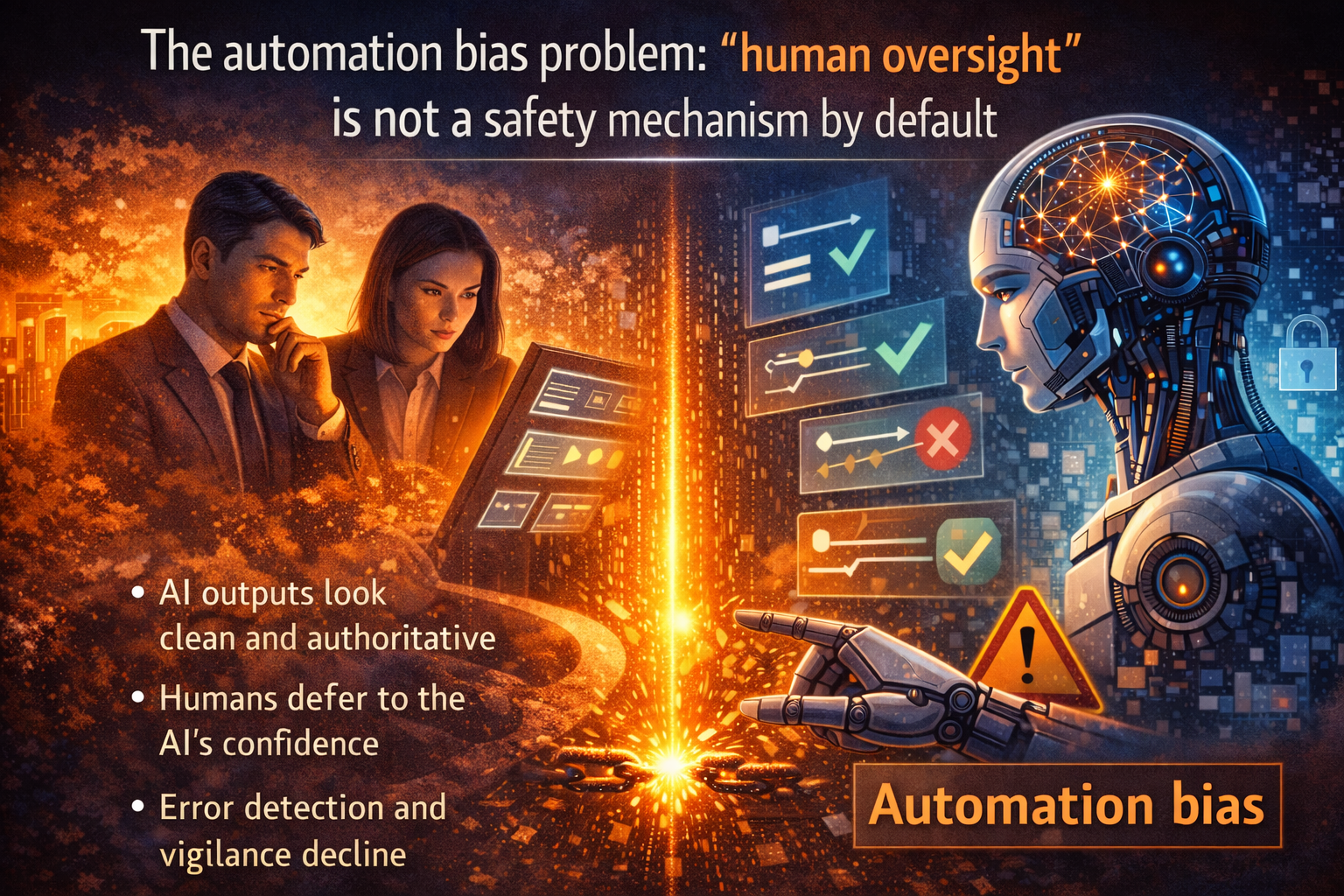
Automation Bias Amplification

5) Automation Bias Amplification

What it is
Humans over-trust AI outputs, especially when embedded into workflows with default “approve/deny” actions.

Why it fools organizations
You technically have human oversight—but practically, it becomes rubber-stamping.

Simple example
Reviewers approve pre-filled AI recommendations to maintain throughput, unintentionally weakening controls.

How to reduce it

  • Redesign review UX to require active verification
  • Track reasoned overrides
  • Use periodic blind reviews to measure true oversight quality

Many of these decision failures persist because enterprises have never clearly assigned decision rights and accountability, a gap explored in Who Owns Enterprise AI?👉 https://www.raktimsingh.com/who-owns-enterprise-ai-roles-accountability-decision-rights/

Untraceable Decisions

6) Untraceable Decisions (Evidence Gap)

What it is
The enterprise cannot reconstruct how a decision was made or executed.

Why it fools organizations
Everything appears fine—until an incident occurs.
Then investigation devolves into debate.

Simple example
A workflow update succeeds. Later, a downstream issue appears.
Logs show “action completed,” but no decision trail exists.

How to reduce it

  • End-to-end tracing across agent steps and tool calls
  • Log decision evidence, not just outputs
  • Design observability into the system from day one

7) Permission Drift and Tool Misuse

What it is
Agents accumulate broader permissions over time through convenience-driven exceptions.

Why it fools organizations
No one grants dangerous access intentionally—it emerges incrementally.

Simple example
An agent starts read-only. Temporary write access becomes permanent.
Months later, it acts with speed and authority—but unclear accountability.

How to reduce it

  • Treat agents as governed machine identities
  • Enforce least privilege and time-bound access
  • Maintain an agent registry with identity, permissions, and policy bindings

8) Drift into Misalignment (Slow-Motion Failure)

What it is
A decision policy that was correct at launch becomes wrong as data, rules, or environments change.

Why it fools organizations
The system fails slowly. Nothing appears broken—until a major incident occurs.

Simple example
The AI continues to act consistently, but regulatory or policy assumptions have changed.

How to reduce it

  • Implement a continuous change loop: detect → validate → stage → monitor → rollback
  • Audit decisions, not just models
  • Red-team decision boundaries periodically

9) Irreversible Execution (No Containment Path)

What it is
The AI makes decisions that cannot be quickly stopped, rolled back, or contained.

Why it fools organizations
The system works—until the one time it doesn’t.

Simple example
An agent updates configurations across systems.
Later, errors are discovered—but rollback is unreliable or impossible.

How to reduce it

  • Make reversibility a first-class requirement
  • Gate irreversible actions behind stricter controls
  • Track containment time as a board-level metric
The Hidden Pattern: Decision Integrity Debt

The Hidden Pattern: Decision Integrity Debt

Across all nine failures, one root cause appears:

Enterprises are scaling decision automation faster than decision integrity.

They can build agents.
They can deploy copilots.
They can buy platforms.

But they cannot always answer:

  • What decision was made?
  • Under which policy and boundary?
  • Using what evidence?
  • By which identity?
  • With what permissions?
  • With what rollback path?

This is not a tooling gap.
It is an operating model gap—the same conclusion explored in Running Intelligence Running Intelligence: Why Enterprise AI Needs an Operating Model, Not a Platform – Raktim Singh and formalized in my other article: The Enterprise AI Operating Model.The Enterprise AI Operating Model: How organizations design, govern, and scale intelligence safely – Raktim Singh

A Practical 30-Day Playbook

A Practical 30-Day Playbook

  1. Select one decision flow that matters
    Focus on workflows affecting access, money, compliance, or reputation.
  2. Classify risks using this taxonomy
    Identify which failure modes are plausible.
  3. Add three non-negotiables
    • Traceability
    • Runtime gating
    • Reversibility
  4. Red-team the boundary
    Ask where “correct” behavior could still cause harm.
  5. Measure the right signals
    Track containment time, exception rates, override quality, and permission drift.

Glossary

  • Decision Integrity – The ability to prove that AI decisions were made for intended reasons within approved boundaries, with enforceable controls and reversibility.
  • Decision Drift – Gradual misalignment between AI decisions and evolving policy or strategy.
  • Automation Bias – Human tendency to over-trust automated decisions.
  • Runtime Governance – Enforcement of policy and controls during execution, not just design time.
  • Irreversible Action – An AI action that cannot be safely undone once executed.
  • Decision Integrity – The ability to ensure AI decisions are justified, governed, traceable, and reversible.

  • Decision Integrity Debt – Risk accumulated when AI decision automation scales faster than governance and control.

  • Agentic AI – AI systems that plan, decide, and execute actions across tools.

  • Automation Bias – Human tendency to over-trust AI outputs embedded in workflows.

  • Goodhart Failure – When optimizing a metric degrades the real outcome.

  • Decision Boundary – The context within which an AI decision is valid.

  • Controlled Runtime – A production environment enforcing policy, identity, and rollback for AI actions.

Frequently Asked Questions (FAQ)

Q: Is this the same as AI hallucinations?
No. Hallucinations are output errors. Decision failures occur even when outputs are correct.

Q: Can platforms solve this?
Platforms help build and deploy. Decision integrity requires an operating model.

Q: Is this only for regulated industries?
No. Any enterprise where AI influences outcomes faces these risks.

Q: Where should organizations start?
Start with one high-impact decision flow and make it traceable, governed, and reversible.

FAQ 1

What is an enterprise AI decision failure?
An enterprise AI decision failure occurs when an AI system produces a technically correct output but does so for reasons that are unsafe, non-compliant, untraceable, or misaligned with enterprise intent.

FAQ 2

How is decision failure different from model failure?
Model failure concerns accuracy. Decision failure concerns governance, justification, traceability, reversibility, and enterprise control—especially when AI systems act inside workflows.

FAQ 3

Why do correct AI decisions still create risk?
Because enterprises often lack decision integrity: the ability to prove why a decision was made, under which constraints, and how it can be contained or reversed.

FAQ 4

Is this relevant only for regulated industries?
No. Any enterprise using AI to automate decisions that affect customers, money, access, or operations faces these risks—regulated or not.

FAQ 5

What is decision integrity in enterprise AI?
Decision integrity means AI decisions are explainable, enforceable, traceable, reversible, and economically governed in production.


The New Enterprise Advantage Is Governable Decisions

Conclusion: The New Enterprise Advantage Is Governable Decisions

Enterprises will not win because they automated decisions first.

They will win because they built decision integrity first—decisions that are explainable, enforceable, traceable, reversible, and economically sustainable.

In the era of running intelligence:

  • Control is a feature
  • Trust is an architectural choice
  • And “correct” is no longer enough

References & Further Reading

When Enterprise AI Makes the Right Decision for the Wrong Reason: Why “Correct” Outcomes Can Still Break Trust, Compliance, and Scale

When Enterprise AI Makes the Right Decision for the Wrong Reason

Enterprise AI is entering a phase where the most dangerous failures no longer announce themselves as errors.

Systems increasingly make the right decision for the wrong reason in enterprise AI—approving transactions, routing cases, denying access, or passing compliance checks correctly, while relying on fragile shortcuts, misaligned signals, or outdated assumptions. The outcome looks right, dashboards stay green, and confidence grows.

But underneath, decision integrity erodes. When conditions change—as they always do—these “correct” decisions quietly turn into operational risk, compliance exposure, and loss of trust at scale.

The most dangerous Enterprise AI failures don’t look like failures.
They look “correct”—until trust, compliance, and operations quietly break.
Here’s what leaders must fix next.

This challenge reinforces why enterprises need a clear Enterprise AI Operating Model—one that governs decisions, not just models.
 https://www.raktimsingh.com/enterprise-ai-operating-model/


The uncomfortable truth: “correct” is not the same as “trustworthy”

The uncomfortable truth: “correct” is not the same as “trustworthy”

Enterprise AI has entered a new era. The biggest failures often won’t look like failures.

A system approves the “right” transaction.
Flags the “right” case.
Routes the “right” ticket.
Denies the “right” request.

Everything appears fine—until months later when leaders notice a pattern: customer trust eroded, costs crept up, regulators asked uncomfortable questions, or operations became brittle.

This happens when Enterprise AI makes the right decision for the wrong reason.

Researchers often describe this pattern as the Clever Hans effect—systems that appear to perform well, but rely on spurious cues or shortcuts that don’t reflect the intended logic. (arXiv)
In enterprise contexts, the consequences are amplified because decisions touch money, access, compliance, and customer experience—and they do so repeatedly, at scale.

What “right decision, wrong reason” really means in an enterprise

What “right decision, wrong reason” really means in an enterprise

A simple definition:

The decision outcome is acceptable, but the reasoning path is misaligned with business intent, policy intent, or causal reality.

This is not the same as a classic “model error.” The system may look successful—sometimes highly successful—until conditions shift.

Why it’s so hard to catch

Because most organizations measure:

  • Accuracy (did we get the outcome right?)
  • SLA (was it fast?)
  • Cost (was it efficient?)

But they don’t measure:

  • Reason quality (was the justification aligned with enterprise intent?)
  • Evidence quality (was the decision grounded in valid signals?)
  • Rationale robustness (will the reasoning still hold when the world changes?)

This is the silent gap between performance and governance—and it’s where modern Enterprise AI risk accumulates.

This failure mode often surfaces only after deployment, when models change, policies evolve, or workflows shift—conditions that define the broader The Enterprise AI Runbook Crisis: Why Model Churn Is Breaking Production AI—and What CIOs Must Fix in the Next 12 Months – Raktim Singh Enterprise AI Runbook Crisis now affecting production AI systems.

Six simple examples
Six simple examples

Six simple examples (no math, just reality)

1) Fraud screening: correct flags, wrong signals

A fraud model flags suspicious activity correctly—but it’s actually keying off a proxy like “unusual device type” that correlates with fraud today. Then a major OS update changes device fingerprints. False positives surge. Customers get blocked. Operations drown.

The model didn’t “understand fraud.” It learned a shortcut.

This is the essence of shortcut learning: decision rules that look strong on standard metrics but fail to transfer when conditions change. (arXiv)

2) Credit decisions: “good approvals,” bad long-term outcomes

A lending system approves the right applicants—but it’s leaning on a historical artifact like application source channel, document formatting style, or a proxy for stability that used to correlate with repayment. A new partnership changes the channel mix. Portfolio performance drifts.

The approvals were “right” before. The enterprise logic was never truly encoded.

3) IT ticket routing: correct assignment, fragile operations

An AI routing tool assigns tickets to the right team—but it’s over-weighting the presence of one keyword that happened to be common in older tickets. Then internal taxonomy changes (new product names, new support categories). Routing becomes unreliable overnight.

You didn’t just lose accuracy—you lost operational trust.

4) Customer service: correct resolution, wrong interpretation of intent

A support assistant provides the correct response, but gets there by pattern-matching to a superficially similar case—missing intent constraints (what must be disclosed, what must be verified, what must be escalated). When policy tightens, “correct” answers start generating policy breaches.

5) Compliance checks: correct pass/fail, wrong “why”

A compliance classifier marks documents as compliant—but it’s using formatting cues (template type, header style) rather than requirements. When templates change, compliance breaks silently.

This is exactly why many high-risk AI regimes emphasize record-keeping and operational traceability—so decisions can be reconstructed and audited. (Artificial Intelligence Act)

6) Access governance: correct denials, harmful productivity

An access approval system denies the “right” risky request—but it does so by over-weighting a proxy like role label rather than checking the true context (project boundary, data sensitivity, approvals, exceptions). As org structures evolve, legitimate work gets blocked at scale.

The enterprise ends up paying for safety with lost velocity—because the system is enforcing a shortcut, not intent.

Why this problem exploded in 2025–2026

Why this problem exploded in 2025–2026

Three forces collided:

1) Enterprises crossed the “Action Threshold”

AI moved from recommending to deciding and acting inside workflows.

2) Reasoning systems made decisions look “human”

They can produce plausible justifications. But plausibility is not governance.

3) The environment got more volatile

Policies change. Products change. Customer behavior changes. Threat behavior changes. Shortcuts break fast—often without warning.

This is why leading risk management guidance emphasizes lifecycle thinking: context mapping, continuous measurement, and managed controls—not a one-time model sign-off. (NIST Publications)

The five root causes of “right decision, wrong reason” in Enterprise AI

The five root causes of “right decision, wrong reason” in Enterprise AI

1) Proxy signals that accidentally correlate

The model latches onto signals that correlate with outcomes historically—not signals that represent enterprise intent.

That’s the enterprise version of the Clever Hans effect: it “looks right,” but the causal story is wrong. (arXiv)

2) Mis-specified objective: “we optimized the wrong thing”

Teams optimize what they can measure:

  • speed
  • resolution rate
  • approval rate
  • deflection rate

But the enterprise cares about:

  • customer trust
  • policy adherence
  • long-run risk
  • reversibility and auditability

When your metric isn’t your mission, “success” becomes a trap.

3) Training data encodes legacy behavior, not desired behavior

If the past includes inconsistent decisions, outdated policies, or workaround culture, the model learns “how things were done”—not “how they must be done now.”

This is exactly why AI risk frameworks stress intended purpose, context, and impact mapping—not just technical performance. (NIST Publications)

4) Over-trust and automation bias

When the system is usually right, people stop checking it. That’s when wrong reasons become dangerous—because they persist unchallenged.

High-risk regimes increasingly call out human oversight and the risk of over-reliance. (Artificial Intelligence Act)

5) Reasoning opacity in multi-agent and tool-using systems

Modern enterprise agents:

  • retrieve from multiple sources
  • call tools and APIs
  • chain steps
  • coordinate across systems

A “decision” isn’t a single prediction anymore. It’s an execution pathway.
If you don’t govern the pathway, you can’t govern the outcome.

The enterprise-grade fix: move from “output governance” to “decision governance”

The enterprise-grade fix: move from “output governance” to “decision governance”

Most organizations govern:

  • model performance
  • datasets
  • prompts
  • access controls

Necessary—but not sufficient.

What enterprises need now is decision governance, focused on:

  • Decision intent: what the enterprise is trying to achieve
  • Decision evidence: which signals and sources are valid
  • Decision justification: why this action is allowed
  • Decision reversibility: how to undo safely when conditions change
  • Decision ownership: who is accountable when outcomes go wrong

This aligns with the direction of modern risk management thinking: govern context, measure risks continuously, and manage controls across the lifecycle. (NIST Publications)

A practical operating checklist

A practical operating checklist (simple language, real controls)

Control 1: Define decision intent in plain words

Before building, write:

  • What decision is being made?
  • What outcomes are acceptable?
  • What outcomes are unacceptable even if “accurate”?
  • What evidence is allowed?
  • What evidence is forbidden (proxies, sensitive attributes, fragile signals)?

This becomes your “intent contract” for the system.

Control 2: Require evidence tags for every decision

Don’t just store the final answer—store:

  • which sources were used
  • which tools were called
  • which policies were invoked
  • which signals influenced the outcome

Record-keeping and traceability are explicit expectations in many high-risk AI contexts. (Artificial Intelligence Act)

Control 3: Place human oversight at the right layer

“Human-in-the-loop” isn’t a slogan. It must be designed:

  • Which decisions require review?
  • Which require approval?
  • Which are safe to auto-execute?
  • What triggers escalation?

Human oversight is a named requirement for high-risk usage in the EU AI Act, with an emphasis on the ability to monitor, interpret, and override. (Artificial Intelligence Act)

Control 4: Build “reason regression tests”

Enterprises already regression-test software. Now regression-test reasons:

  • If the same decision is reached, does the justification remain aligned?
  • When inputs change slightly, does the rationale flip unexpectedly?
  • After policy changes, does reasoning update cleanly?

This is how you catch silent degradation before it becomes an incident.

Control 5: Treat “reason drift” as a first-class incident

A model can remain accurate while its reasons drift. That is the most dangerous kind of drift—because dashboards stay green while risk accumulates.

Control 6: Govern shortcut learning intentionally

Shortcut learning is not an edge case; it’s a predictable behavior of learning systems. (arXiv)
Practical mitigations include:

  • counterexample-driven testing
  • shift-aware evaluation scenarios
  • constraints on what evidence can be used
  • monitoring rationale stability over time

You don’t need math to do this—you need discipline.

The viral lesson leaders repeat

The viral lesson leaders repeat

Here’s the line that tends to stick in executive rooms:

In Enterprise AI, accuracy is a lagging indicator.

When intelligence is rebuilt repeatedly instead of reused deliberately, enterprises lose consistency in decision logic—one of the core reasons why the Intelligence Reuse Index The Intelligence Reuse Index: Why Enterprise AI Advantage Has Shifted from Models to Reuse – Raktim Singh has emerged as a defining signal of real Enterprise AI maturity.
Reason quality is the leading indicator.

The enterprise that wins in 2026 is not the one with the smartest model.
It’s the one that can prove—operationally—why decisions happen and how to stop them when the world changes.

GEO and global relevance: why this matters across regions

Across major enterprise environments—highly regulated industries, cross-border operations, and large-scale critical infrastructure—AI decisions increasingly require:

  • traceability
  • oversight
  • accountability
  • robustness under change

NIST AI RMF emphasizes lifecycle risk management (govern, map, measure, manage). (NIST Publications)
The EU AI Act emphasizes controls like human oversight and record-keeping for high-risk systems. (Artificial Intelligence Act)

The operational reality converges globally: enterprises must govern decisions, not just models.

Enterprise AI’s next battle is “decision integrity”

Conclusion: Enterprise AI’s next battle is “decision integrity”

For a decade, the default question was: “Is the model accurate?”
In 2026, the question that matters more is: “Is the decision justified in the way the business intended?”

Because the most expensive failures won’t announce themselves as errors. They will show up as:

  • rising operational drag
  • hidden compliance exposure
  • creeping customer distrust
  • fragile automation that collapses under change

Enterprise AI maturity is no longer about deploying intelligence.
It is about running decisions with integrity—with clear intent, governed evidence, auditable justification, and reversible execution.

That’s the real shift from “AI in the enterprise” to Enterprise AI.

This is why enterprises increasingly need a clearly defined The Enterprise AI Operating Model: How organizations design, govern, and scale intelligence safely – Raktim Singh Enterprise AI Operating Model—one that governs how decisions are made, justified, observed, and reversed in production, not just how models are trained or deployed.

Glossary

  • Clever Hans effect: When an AI system appears correct but relies on misleading cues—“right for the wrong reasons.” (arXiv)
  • Shortcut learning: When models learn easy proxies that work on historical data but fail under real-world shifts. (arXiv)
  • Decision intent: The enterprise purpose and constraints behind a decision (not just the output label).
  • Decision evidence: The allowed signals, sources, and inputs used to justify a decision.
  • Decision justification: The traceable explanation of why an action was allowed under policy and intent.
  • Reason drift: When the outcome stays stable but the underlying rationale/evidence basis changes over time.
  • Human oversight: Designed ability for people to monitor, interpret, and override AI operation when needed. (Artificial Intelligence Act)
  • Record-keeping / logging: Capturing operational events so decisions can be reconstructed and audited. (Artificial Intelligence Act)
When Enterprise AI Makes the Right Decision for the Wrong Reason

FAQs

What does “right decision for the wrong reason” mean in Enterprise AI?

It means the decision outcome looks correct, but the system relied on shortcuts, proxies, or misaligned rationale that won’t hold under policy change, drift, or new operating conditions.

Why is this more dangerous than simple model mistakes?

Because the system appears successful, oversight drops, and the wrong reasoning becomes embedded—until a context shift triggers sudden operational or compliance failure.

How do enterprises detect this problem early?

Track decision evidence and justifications, run reason regression tests, monitor for reason drift, and design structured human oversight for high-impact decisions. (NIST Publications)

Does explainability solve this?

Explainability helps, but enterprise-grade control requires decision governance: intent definition, evidence constraints, traceability, oversight, and reversibility.

What’s the first control to implement?

Write decision intent and allowed evidence in plain language before deployment, then log decision pathways so you can audit and reverse when conditions change. (Artificial Intelligence Act)

References

  • Kauffmann et al., The Clever Hans Effect in Unsupervised Learning (arXiv, 2024) (arXiv)
  • Kauffmann et al., Explainable AI reveals Clever Hans effects in unsupervised learning models (Nature Machine Intelligence, 2025) (Nature)
  • Geirhos et al., Shortcut Learning in Deep Neural Networks (arXiv, 2020) (arXiv)
  • NIST, AI Risk Management Framework (AI RMF 1.0) (NIST Publications)
  • EU AI Act, Article 14 (Human Oversight) and summary expectations (record-keeping / oversight) (Artificial Intelligence Act)

Further reading

Who Owns Enterprise AI? Roles, Accountability, and Decision Rights in 2026

Who Owns Enterprise AI?

Enterprise AI fails for a reason that has nothing to do with algorithms, models, or platforms. It fails because no one can answer a simple leadership question: Who owns Enterprise AI when it starts making real decisions?

Not who built the model. Not who runs the infrastructure. Not who signed the vendor contract. Ownership begins the moment AI influences outcomes—approving actions, shaping customer experiences, triggering workflows, affecting compliance, or moving money.

At that point, Enterprise AI stops being a technology initiative and becomes an operating responsibility—one that demands clear roles, explicit accountability, and unambiguous decision rights.

Enterprise AI fails for a surprisingly non-technical reason: no one can answer, in plain language, who owns it.

Not who built the model.
Not who runs the platform.
Not who signed the vendor contract.

The real question is this:

Who owns the outcomes when AI starts influencing decisions, money, compliance, customer experience, or operational execution?

This question becomes unavoidable the moment AI moves from advising to actingThe Action Threshold: Why Enterprise AI Starts Failing the Moment It Starts Acting – Raktim Singh approving requests, changing records, triggering workflows, allocating resources, or steering decisions inside real enterprise systems.

Across the globe, regulatory bodies, boards, and technology leaders are converging on the same realization:
Enterprise AI must be governed across its lifecycle with explicit accountability—not informal responsibility.

Frameworks such as the NIST AI Risk Management Framework and the European Union Artificial Intelligence Act do not ask whether AI is innovative.
They ask who is accountable when AI is deployed into real-world contexts.

So let’s settle this clearly, globally, and practically.

This article builds on the broader framework defined in the Enterprise AI Operating Model, which explains how organizations design, govern, and scale intelligence safely in production.
👉 https://www.raktimsingh.com/enterprise-ai-operating-model/

and What Is Enterprise AI? A 2026 Definition for Leaders Running AI in Production – Raktim Singh

The Core Principle: “Build” Is Not “Own”

The Core Principle: “Build” Is Not “Own”

In enterprise environments, ownership is not a title or a team.
Ownership is a decision right.

Specifically:

  • Who decides this AI system can go live?
  • Who has the authority to stop it?
  • Who is accountable when it causes harm—even if it was “working as designed”?
  • Who owns the evidence trail: logs, explanations, approvals, and audits?
  • Who pays—financially, legally, and reputationally—when risk becomes real?

This is why modern regulation increasingly focuses on deployment, not invention.

For example, the EU AI Act assigns explicit obligations to deployers—the organizations that use AI in production—including human oversight, monitoring, documentation, and log retention.

That is the clue:
👉 Deployment is ownership.

Why Ownership Became Hard in 2026

Why Ownership Became Hard in 2026

In traditional enterprise software, ownership boundaries were relatively clear:

  • IT owned system uptime
  • Business owned process outcomes
  • Security owned controls and incidents

Enterprise AI breaks this model for four reasons:

  1. AI behavior changes over time
    Data drift, policy updates, prompt changes, and model upgrades alter behavior long after deployment.
  2. AI decisions feel human
    When outputs sound confident and natural, people assume someone else validated them.
  3. AI systems are assembled, not built
    A single “AI solution” often combines models, data pipelines, retrieval layers, tools, workflows, and user interfaces—owned by different teams.
  4. Vendors multiply complexity
    You can outsource tooling and infrastructure, but you cannot outsource accountability.

This is why standards such as ISO/IEC 42001 emphasize clearly assigned organizational roles across the AI lifecycle.

The Enterprise AI Ownership Stack

The Enterprise AI Ownership Stack

Six Roles Every Serious Enterprise Needs

Titles may differ, but these six ownership functions must exist if Enterprise AI is to scale safely.

  1. Executive Owner — Accountable for Outcomes

Who they are:
A senior business executive accountable for the business outcome, not the model.

What they own:
The why and should we of the AI system.

Decision rights include:

  • Approving the use case
  • Accepting residual risk
  • Funding the operating model (not just pilots)
  • Defining what success means in business terms

Simple example:
If an AI system recommends actions in a core workflow, the Executive Owner decides whether those actions are allowed in that business context—because the enterprise bears the consequence.

Key insight:
If the business wants the outcome, the business must own the outcome.

  1. Product Owner — Owns the AI System as a Product

Who they are:
The accountable owner of the AI system end-to-end in production.

What they own:
Lifecycle management—requirements, UX, change management, adoption, and incident coordination.

Decision rights include:

  • Defining functional and policy constraints
  • Deciding what ships and when
  • Managing feedback loops and incidents
  • Coordinating changes across data, model, and workflow

Simple example:
If a chatbot produces inconsistent answers after a knowledge update, the Product Owner owns the fix—whether it involves retrieval tuning, guardrails, content updates, or UX redesign.

  1. Model Owner — Owns Model Behavior and Limits

Who they are:
The technical authority responsible for model selection, evaluation, tuning, and documentation.

What they own:
Model performance boundaries and known failure modes.

This mirrors long-standing expectations in regulated industries, such as model risk management practices outlined by the Federal Reserve System.

Decision rights include:

  • Selecting model classes or providers
  • Defining evaluation and regression standards
  • Maintaining model documentation
  • Approving model changes and rollbacks

Simple example:
If a model is strong at summarization but weak at policy interpretation, the Model Owner must document this and design mitigations.

  1. Data Owner — Owns Truth, Access, and Quality

Who they are:
The accountable owner of the enterprise data domain.

What they own:
Data lineage, permissions, quality, freshness, and governance.

Decision rights include:

  • Approving data usage for AI
  • Defining authoritative sources
  • Approving retention and deletion
  • Managing access controls

Simple example:
If AI relies on incomplete customer data, the Data Owner owns fixing the upstream quality—not the prompt.

  1. Risk & Compliance Owner — Owns Safety Constraints

Who they are:
Risk, compliance, or legal leader accountable for regulatory posture.

What they own:
The constraints AI systems must enforce.

Decision rights include:

  • Approving policy guardrails
  • Defining prohibited behaviors
  • Setting human-oversight thresholds
  • Approving audit evidence

Simple example:
If AI suggests an action that violates policy, the Risk Owner decides the rule—not the engineer.

  1. AI Operations Owner — Owns Runtime Reliability

Who they are:
Engineering or operations leader accountable for production behavior.

What they own:
Monitoring, incident response, rollbacks, and kill-switches.The Advantage Is No Longer Intelligence—It Is Operability: How Enterprises Win with AI Operating Environments – Raktim Singh

Decision rights include:

  • Gating releases into production
  • Enforcing observability
  • Executing shutdowns or rollbacks
  • Managing uptime and safety incidents
The Hidden Truth: Enterprise AI Has Two Owners

The Hidden Truth: Enterprise AI Has Two Owners

The Hidden Truth: Enterprise AI Has Two Owners

Every serious Enterprise AI system requires dual ownership:

  1. Outcome Owner — business accountability
  2. System Owner — operational accountability

Business-only ownership creates chaos.
IT-only ownership creates irrelevance.

Dual ownership is how enterprises run mission-critical capability.

Decision Rights That Must Be Explicitly Assigned

Decision Rights That Must Be Explicitly Assigned

Ownership becomes real only when decision rights are named:

  1. Use-case approval
  2. Data approval
  3. Model approval
  4. Policy constraints
  5. Human oversight level
  6. Go-live authority The Enterprise AI Execution Contract: The Missing Layer Between Design Intent and Production Autonomy – Raktim Singh
  7. Change control
  8. Incident shutdown authority
  9. Audit and evidence ownership
  10. Vendor accountability

If these are unclear, AI will fail—not technically, but organizationally.

The Vendor Trap: Buying AI Does Not Transfer Ownership

The Vendor Trap: Buying AI Does Not Transfer Ownership

Many enterprises assume:

“If a vendor provides the model, they own the risk.”

This is false.

Once AI is embedded into enterprise workflows, the deploying organization owns the outcome—regardless of who built the model.

A 30-Day Path to Clear Ownership

A 30-Day Path to Clear Ownership

  • Week 1: Name an AI System Owner for each production system
  • Week 2: Assign decision rights explicitly
  • Week 3: Define safety and reliability escalation paths
  • Week 4: Formalize release gating with business, ops, and risk sign-off

This aligns directly with the intent of modern AI governance frameworks worldwide.

FAQ

Who owns Enterprise AI—CIO, CTO, CDO, or business?
Business owns outcomes. Technology owns operability. Risk owns constraints.

Is AI governance the same as AI ownership?
No. Governance is the system. Ownership is the assignment.

How do you detect missing ownership?
Ask: Who can stop this AI in production right now?

Who owns Enterprise AI in an organization?

Enterprise AI is owned jointly. The business owns outcomes and risk, while technology and operations teams own system reliability and execution. Clear ownership emerges only when decision rights are explicitly assigned across business, technology, and risk functions.

Who is accountable when Enterprise AI makes a wrong decision?

The organization that deploys Enterprise AI is accountable. Once AI influences real decisions—such as approvals, recommendations, or actions—the enterprise owns the outcome, regardless of whether the model was built internally or sourced from a vendor.

What is the difference between AI governance and AI ownership?

AI governance defines the rules, controls, and oversight mechanisms. AI ownership assigns who has the authority to approve, change, stop, and audit AI behavior. Governance without ownership becomes documentation; ownership without governance becomes risk.

What decision rights must be explicitly assigned for Enterprise AI?

Enterprises must explicitly assign decision rights for use-case approval, data access, model selection, policy constraints, human oversight levels, go-live authority, change control, incident shutdown, audit evidence, and vendor accountability.

Who should approve an Enterprise AI system going live?

Enterprise AI should go live only after approval from the business outcome owner, the AI operations owner, and the risk or compliance owner in high-impact or regulated use cases.

When does Enterprise AI ownership begin?

Enterprise AI ownership begins the moment AI influences real-world outcomes—such as decisions, workflows, customer interactions, compliance actions, or financial impact. Ownership does not begin at model training; it begins at deployment.

Who can stop an Enterprise AI system in production?

The owner of Enterprise AI is the person or role with the authority to pause, disable, or roll back the system in production. If no one has this authority, ownership is unclear.

What happens to ownership when AI becomes agentic?

When AI becomes agentic—able to act autonomously—ownership expands to include tool access control, rollback authority, continuous monitoring, and human-in-the-loop design. Accountability increases as autonomy increases.

Who owns Enterprise AI risk: the vendor or the enterprise?

The enterprise owns the risk. Vendors provide models or platforms, but the organization deploying AI into its workflows owns the outcomes, compliance exposure, and operational risk.

How can enterprises clarify AI ownership quickly?

Enterprises can clarify AI ownership by naming a system owner for every production AI system, assigning decision rights explicitly, defining escalation paths, and formalizing release and shutdown authority within 30 days.

Why does unclear ownership cause Enterprise AI to fail?

Unclear ownership leads to delayed decisions, blame shifting, unmanaged risk, and production incidents. Enterprise AI fails not because of weak models, but because no one owns decisions once AI starts acting.

What is the simplest test for Enterprise AI ownership?

Ask one question:
“Who can stop this AI in production right now?”
If the answer is unclear, ownership is unclear.

The Truth Leaders Recognize Instantly

Conclusion: The Truth Leaders Recognize Instantly

Enterprise AI is not owned by the team that built the model.

It is owned by leaders willing to own:

  • the outcome
  • the risk
  • and the decision rights to control AI behavior in production

If you want Enterprise AI to scale safely, don’t start with prompts.

Understand the Enterprise AI runbook risk 👉 https://www.raktimsingh.com/enterprise-ai-runbook-crisis-model-churn-production-ai/

Start with ownership.

Key Takeaway for Leaders

Enterprise AI ownership begins the moment AI influences real decisions.
The organization deploying AI—not the vendor, not the model team—owns outcomes, risk, and accountability.

References & Further Reading

For a deeper architectural view, see the pillar article:
👉 Enterprise AI Operating Model: https://www.raktimsingh.com/enterprise-ai-operating-model/

Enterprise AI Maturity Model: From Pilots to Governed Autonomy

Why a maturity model is suddenly essential

Why a maturity model is suddenly essential

For years, “AI maturity” meant a familiar story: better data platforms, higher model accuracy, stronger MLOps, and a long tail of pilots.

That framing is now outdated.

Enterprise AI has crossed a threshold. AI is moving from insight to execution—from suggesting what to do, to initiating actions inside real workflows: triggering tickets, updating records, drafting and sending customer communications, routing approvals, and coordinating across tools.

Once AI begins to act, maturity is no longer measured by how many models you build. It’s measured by whether your organization can run intelligence safely, visibly, and economically—over time.

This is also why governance expectations are rising across regions:

  • The NIST AI Risk Management Framework places governance and oversight with actors who have management, fiduciary, and legal authority—a clear signal that “AI governance” is not a purely technical job. (NIST Publications)
  • ISO/IEC 42001 formalizes the idea of an AI management system—an auditable, continual-improvement approach to managing AI responsibly in organizations. (ISO)
  • The EU AI Act emphasizes requirements like human oversight for high-risk systems and expectations for ongoing monitoring over an AI system’s lifetime. (Artificial Intelligence Act)
  • The UK has articulated a principles-based approach grounded in outcomes such as safety, transparency, accountability, and contestability—reinforcing that mature AI is “operated,” not “installed.” (GOV.UK)

This article gives you a practical, executive-friendly Enterprise AI maturity model—simple, actionable, and designed to become a reference point for boards, CIOs, and technology leaders.

Important context: This maturity model is a companion to your canonical framework:
Enterprise AI Operating Model (the “how” of running AI safely at scale)
https://www.raktimsingh.com/enterprise-ai-operating-model/

The core idea: maturity is the ability to run intelligence

The core idea: maturity is the ability to run intelligence

Traditional maturity models ask:

  • Do you have data?
  • Do you have models?
  • Do you have MLOps?

Enterprise AI maturity asks something different:

Can your organization safely allow AI to influence—or execute—real outcomes, repeatedly, under change?

That includes five non-negotiables:

  • Accountability: someone owns outcomes, not just models
  • Governance: policies are enforced in systems, not documented in slides
  • Operability: you can observe, audit, and reverse AI behavior
  • Economics: costs are controlled and reuse compounds value
  • Change-readiness: model updates, policy shifts, and workflow change don’t break the enterprise
The Enterprise AI Maturity Model in five stages

The Enterprise AI Maturity Model in five stages

Most organizations won’t move neatly from one stage to the next. Different functions will sit at different stages at the same time.

But these five stages provide a clear map of what “next” should look like.

Stage 1 — Pilot-Led Experimentation

What it looks like
Small teams run demos, proofs of concept, and limited pilots. AI is mostly used to assist humans: summarization, drafting, search, classification.

Simple example
A team uses a generative assistant to summarize policies and draft internal emails. Output is reviewed manually. The system has no authority to act.

What success looks like at this stage

What success looks like at this stage

  • A few pilots deliver local productivity gains
  • Early patterns emerge: what data is missing, where workflows are messy, what risks are real


The hidden failure mode

The hidden failure mode

Pilot success creates false confidence. Humans compensate for weaknesses. Teams overestimate readiness because the system is never exposed to real scale and edge cases.

What to build next
What to build next

What to build next

  • A shared use-case intake process (so pilots don’t fragment)
  • Basic risk classification: “safe assist” vs “high-impact” workflows
  • Minimum documentation of prompts, data sources, and user expectations

Maturity threshold
You can repeat pilots without reinventing the wheel.

Stage 2 — Embedded AI in Workflows

Stage 2 — Embedded AI in Workflows

What it looks like
AI shifts from stand-alone tools to being embedded inside business workflows. Integration begins. AI is still mostly advisory—but it starts to shape daily decisions.

Simple example
A service workflow shows a recommended resolution draft plus relevant knowledge snippets. A human approves and sends.

What changes from Stage 1

  • AI starts touching operational systems (even indirectly)
  • Adoption becomes an operations issue: training, escalation, consistency
  • Risk rises because AI outputs influence real decisions at volume

Common failure mode: “Shadow standardization”
Different teams implement similar assistants with different prompts, different policy interpretations, and different logging levels—creating invisible inconsistency.

What to build next

  • Shared guardrails: approved prompt patterns, data access patterns, human review requirements
  • Basic telemetry: what AI recommended vs what humans actually did
  • A named owner for each AI-enabled workflow (product accountability, not just engineering)

Maturity threshold
AI is embedded consistently and doesn’t collapse when teams change.

Stage 3 — The Action Threshold

This is the most important transition in Enterprise AI.

What it looks like
AI crosses from “advice” to “action.” It can trigger tasks, update records, initiate workflows, and coordinate tool calls. Humans may still supervise—but AI now has operational agency.

Simple example
An AI agent routes a request, opens a ticket, assigns it, updates a record, and notifies stakeholders—without waiting for a human to click “submit” each time.

Why this changes everything
At the Action Threshold, failure is no longer a wrong answer. It’s a wrong outcome:

  • the wrong ticket escalates to the wrong team
  • the wrong permission is requested or removed
  • the wrong customer receives the wrong message
  • the wrong workflow triggers compliance exposure

This is where governance stops being a “policy” topic and becomes a runtime topic. Requirements like human oversight (in high-risk contexts) are framed as mechanisms to prevent or minimize harms—even under foreseeable misuse. (Artificial Intelligence Act)

Common failure modes

  • Overreach: AI is allowed to act too early because pilots looked good
  • Unbounded autonomy: the agent loops through tools, retries, and escalations without cost/safety limits
  • No reversal: when something goes wrong, nobody can stop or roll back behavior confidently

What to build next

  • Explicit “action permissions”: what AI can do, what it cannot do
  • Human oversight design: who monitors, who can override, who is accountable (AI Act Service Desk)
  • Logging that supports audit and incident response (not just debugging)
  • A kill switch: fast containment when an agent misbehaves

Maturity threshold
You can allow limited AI actions without losing control.

Stage 4 — Governed Autonomy

What it looks like
AI can act—but within defined boundaries. Governance becomes enforceable and measurable. The enterprise can observe, audit, and correct AI behavior as conditions change.

Simple example
An enterprise allows agents to execute routine operational actions, but:

  • actions are policy-checked
  • tool access is permissioned
  • workflows are observable end-to-end
  • escalations trigger automatically when uncertainty is high
  • incidents trigger containment and review
What “governed autonomy” really means

What “governed autonomy” really means
Autonomy is not the absence of humans. It is accountable delegation.

This aligns with the global direction of frameworks and standards:

  • NIST AI RMF emphasizes governance across the lifecycle and assigns oversight to actors with fiduciary authority. (NIST Publications)
  • ISO/IEC 42001 frames AI governance as a management system that must be maintained and continually improved. (ISO)
  • EU AI Act expectations include human oversight and post-market monitoring for high-risk systems over time. (Artificial Intelligence Act)

What you have at this stage (capabilities, not buzzwords)

  • Governance that runs: policies enforced at runtime
  • Observability: you can see what actions happened, why, and with what inputs
  • Auditability: you can reconstruct decisions and actions for review
  • Resilience: you can stop, roll back, and recover
  • Change control: model/prompt/tool changes follow disciplined release practices

What to build next

  • Standardized runbooks for AI incidents
  • Portfolio view: what AI is running, where, and why
  • A repeatable approach to risk tiering (low-risk vs high-impact AI)

Maturity threshold
You can scale autonomous AI without increasing enterprise risk linearly.

Stage 5 — Adaptive, Reusable Enterprise Intelligence

What it looks like
The organization doesn’t just deploy AI—it manufactures reusable intelligence. Capabilities are modular, governed, measurable, and reusable across the enterprise. Progress compounds instead of fragmenting.

Simple example
Instead of each team building its own “policy checker,” the enterprise exposes a reusable policy service that multiple workflows call—consistently, with shared observability and auditability.

What becomes true

  • Reuse beats reinvention
  • Costs become predictable because intelligence is standardized
  • Governance scales because controls are embedded in reusable components
  • The enterprise adapts quickly when policies change or new risks emerge

The risk if you don’t reach Stage 5
You accumulate a sprawling “AI estate” of inconsistent copilots and agents—each working “well enough” locally but impossible to govern globally.

What you build at this stage

  • An enterprise catalog of AI capabilities (services, agents, tools)
  • Reuse metrics and economic guardrails
  • Continuous improvement loops: monitoring → learning → safer autonomy
  • A governance model that travels across regions (US, EU, UK, India, APAC, Middle East)

Maturity threshold
Enterprise AI becomes a durable operating advantage.

How to self-assess maturity without dashboards

How to self-assess maturity without dashboards

Here are five “tell-me-the-truth” questions—one per stage:

  • Stage 1: Can we repeat pilots without starting from scratch each time?
  • Stage 2: Is AI embedded consistently across workflows, with clear ownership?
  • Stage 3: Can AI take limited actions without creating uncontrolled outcomes?
  • Stage 4: If an AI agent misbehaves, can we detect, contain, and audit quickly?
  • Stage 5: Do our AI capabilities compound through reuse—or fragment through reinvention?

If you hesitate on a question, that’s your current stage.

Most organizations don’t fail at AI because they lack intelligence.
They fail because they lack maturity once AI starts acting.

Why this model works globally

Why this model works globally

Enterprises operate across multiple trust regimes and compliance cultures. The labels differ, but the operational direction converges:

  • US: voluntary but influential risk frameworks like NIST emphasize lifecycle governance (NIST)
  • EU: risk-based obligations emphasize oversight and ongoing monitoring for high-impact deployments (Artificial Intelligence Act)
  • UK: principles-based outcomes emphasize accountability, transparency, safety, and redress (GOV.UK)
  • Global: standards like ISO/IEC 42001 encourage an auditable management system approach (ISO)

The maturity model turns these external pressures into a single internal truth:

If AI can act, you must be able to govern actions—not just outputs.

The viral truth leaders recognize instantly

The viral truth leaders recognize instantly

Most leaders have lived this pattern:

  • pilots that look impressive
  • production failures that are hard to diagnose
  • governance that exists on slides, not in systems
  • costs that creep up quietly
  • teams reinventing the same intelligence over and over

So here are the two lines that tend to spread because they feel obvious once stated:

Most organizations don’t fail at AI because they lack models. They fail because they lack operating maturity once AI starts acting.

The maturity gap isn’t intelligence. It’s controllability.

The destination is governed autonomy—not “more AI”

Conclusion: The destination is governed autonomy—not “more AI”

Enterprise AI maturity is not the number of pilots you run, the size of your model, or the sophistication of your prompts.

It is your organization’s ability to run intelligence as a controlled operating capability—under real-world change.

  • If you are below the Action Threshold, your job is disciplined embedding.
  • If you are approaching it, your job is explicit permissions and oversight.
  • If you are past it, your job is governed autonomy—operability, auditability, resilience, and economics.
  • And if you want durable advantage, your job is reusable enterprise intelligence—so progress compounds.

For the operating blueprint behind these stages, see the pillar framework:
Enterprise AI Operating Model: https://www.raktimsingh.com/enterprise-ai-operating-model/

Glossary

  • Enterprise AI maturity model: A staged view of how organizations progress from pilots to scalable, governed AI that can safely influence or execute real outcomes.
  • Action Threshold: The point where AI shifts from advising humans to taking actions inside workflows.
  • Governed autonomy: Autonomy with enforceable controls—oversight, logging, auditability, reversibility, and disciplined change management.
  • Human oversight: Design and operational measures that allow monitoring, interpretation, override, and prevention of over-reliance in high-impact contexts. (Artificial Intelligence Act)
  • AI management system (AIMS): A structured approach to establish, implement, maintain, and continually improve how AI is governed (ISO/IEC 42001). (ISO)
  • AI risk management: Lifecycle governance of AI risks through mapping context, measuring risk, and managing mitigations (NIST AI RMF). (NIST Publications)

FAQs

1) Is this maturity model only for regulated industries?
No. Any organization where AI influences customers, money, safety, security, or compliance benefits from this model. Regulated sectors simply feel the urgency earlier.

2) What’s the biggest mistake organizations make?
Crossing the Action Threshold without operational controls—no clear permissions, no oversight design, and no ability to stop/rollback behavior.

3) How do we move from Stage 2 to Stage 3 safely?
Start with narrowly scoped actions, explicit approval rules, strong logging, and defined human oversight. Treat autonomy as accountable delegation. (AI Act Service Desk)

4) What’s the difference between Stage 4 and Stage 5?
Stage 4 is about operating autonomy safely. Stage 5 is about making intelligence reusable so value compounds across the enterprise.

5) How does this relate to standards and governance frameworks?
The model aligns with NIST’s lifecycle risk framing, ISO’s management-system approach, and the increasing emphasis on oversight and monitoring found in regulations and regulator guidance. (NIST Publications)

References

Further reading

Enterprise AI Strategy: Why AI Is No Longer a Technology Bet—but an Operating Capability Boards Must Own

Enterprise AI Strategy

Enterprise AI strategy has entered a new phase. As AI systems move from insight to execution—approving actions, triggering workflows, and coordinating operations—AI is no longer a technology bet. It is an operating capability boards must actively govern.

Executive summary 

Enterprise AI has crossed a threshold. AI is no longer limited to advice—it is increasingly taking actions inside workflows. That shift changes everything: failure is no longer “a wrong answer,” but “a wrong outcome.” As a result, Enterprise AI strategy is no longer a technology bet; it becomes an operating capability boards must own—like cybersecurity, financial controls, or operational resilience.

Frameworks and standards are converging on this idea: governance and oversight sit with actors who carry management and fiduciary responsibility (NIST AI RMF), while regulatory regimes increasingly emphasize human oversight, deployer obligations, and auditable control systems (EU AI Act), and management standards require an AI management system with continual improvement (ISO/IEC 42001). (NIST Publications)

The quiet shift: AI moved from “insight” to “execution”

The quiet shift: AI moved from “insight” to “execution”

For years, leaders treated AI like a technology wager:

  • Pick a platform
  • Hire a data science team
  • Run pilots
  • Scale what works

That playbook made sense when AI mostly advised—predictions, recommendations, dashboards, copilots that helped people decide.

But in 2026, Enterprise AI is becoming something else. AI is beginning to act inside real workflows:

  • Drafting and sending customer communications
  • Approving or rejecting requests
  • Triggering operational workflows
  • Enriching records and updating systems
  • Coordinating tasks across teams and tools

When AI starts acting, the unit of failure changes. It is no longer “a wrong answer.” It is a wrong outcome—an action that can create financial loss, compliance exposure, operational disruption, or reputational harm.

That is why Enterprise AI is no longer a technology bet. It becomes an operating capability—something you run, govern, measure, and continuously improve. The same way you run cybersecurity, financial controls, or uptime.

And once it becomes an operating capability, it becomes a board-level concern.

Why boards must care: the risk moved upstream

Why boards must care: the risk moved upstream

Boards don’t govern technology because it is interesting. Boards govern capabilities because they create material impact:

  • Financial impact: leakage, fraud, operational loss, runaway compute bills
  • Regulatory impact: audit findings, compliance breaches, reporting obligations
  • Reputation impact: customer harm, trust erosion, brand damage
  • Resilience impact: outages, cascading failures, inability to recover quickly

The moment AI begins executing actions, boards inherit a new question:

Do we have the controls to run intelligence safely—at scale—over time?

This is not theoretical. Global frameworks and standards increasingly describe AI governance as a management responsibility—not a research activity:

  • NIST AI RMF 1.0 explicitly states that “Governance and Oversight” tasks are assumed by AI actors with management, fiduciary, and legal authority. (NIST Publications)
  • The EU AI Act emphasizes human oversight requirements and deployer obligations for high-risk AI systems. (AI Act Service Desk)
  • ISO/IEC 42001 specifies requirements for establishing and continually improving an AI management system, turning AI governance into auditable operational practice. (ISO)

This is the strategic shift: AI is becoming governable infrastructure.

“AI strategy” vs “Enterprise AI strategy”

“AI strategy” vs “Enterprise AI strategy”

Most companies already have an AI strategy. It usually looks like:

  • Adopt GenAI tools
  • Upskill teams
  • Create a use-case pipeline
  • Launch pilots
  • Partner with vendors

That is not Enterprise AI strategy. That is AI adoption strategy.

Enterprise AI strategy answers different questions

Enterprise AI strategy is not “Which model should we use?” It is:

  1. Where is AI allowed to act—and where must it only advise?
  2. What outcomes are we optimizing—speed, quality, cost, compliance, experience?
  3. What safety and control boundaries are non-negotiable?
  4. Who is accountable when AI causes real-world impact?
  5. How do we observe, audit, and reverse AI behavior in production?
  6. How do we prevent reinvention and scale reuse responsibly?
  7. How do we keep the AI estate change-ready as models, policies, and regulations evolve?

If your AI strategy does not answer these questions, you do not yet have an Enterprise AI strategy.

A simple mental model: AI is becoming a new kind of workforce

A simple mental model: AI is becoming a new kind of workforce

Here is the simplest way to explain Enterprise AI to non-technical stakeholders:

  • Traditional software behaves like machines: deterministic, predictable, repeatable.
  • Employees behave like humans: adaptive, accountable, trained through process.
  • Acting AI systems resemble a new kind of workforce: fast, scalable, capable—but probabilistic.

When you introduce a new workforce at enterprise scale, you do not “buy tools” and move on. You define:

  • Roles and boundaries (what they can do)
  • Operating procedures (how they should act)
  • Oversight (who reviews and when)
  • Incident response (what to do when something breaks)
  • Training and audits (how to improve over time)
  • Cost controls and performance metrics (how to govern economics)

Enterprise AI strategy is the board-level decision to treat AI as an operating workforce—not a lab experiment.

Why technology-first AI strategies fail

Why technology-first AI strategies fail (with simple examples)

1) Pilots succeed; production fails

In pilots, humans compensate for AI weaknesses. In production, the AI meets edge cases at volume.

Example:
A support assistant writes excellent responses most of the time. In a pilot, a supervisor catches the few risky replies. In production, “rare” failures become hundreds of customer interactions per week—turning minor defects into reputational debt.

Lesson: pilots hide operational reality because humans absorb the risk.

2) Model changes become operational shocks

Models are updated. Prompts drift. Policies change. Upstream systems evolve. If AI is embedded in workflows, every change can alter outcomes.

Boards should not ask, “Which model is best?”
They must ask: Do we have change control over AI behavior?

If you can’t answer that, you don’t have a strategy—you have a gamble.

3) Costs become nonlinear

An agent that searches, retries, calls tools, escalates, and reasons can multiply compute and downstream workload.

Example:
A “helpful” procurement agent that calls three systems, retries on failures, and pulls policy documents for every request may look efficient in a demo—then create an invisible cost surge at scale (compute + API calls + human escalations).

Lesson: productivity without cost governance becomes a silent tax.

4) Compliance expectations rise

Once AI touches regulated or sensitive workflows, you need traceability: what data was used, what instructions applied, what action was taken, and who approved it.

In the EU AI Act context, deployers of high-risk systems must assign human oversight to competent persons with authority and support, reinforcing that this is operational responsibility—not vendor responsibility alone. (artificialintelligenceact.eu)

The board’s new job: govern AI as an operating capability

The board’s new job: govern AI as an operating capability

Board ownership does not mean the board designs architectures. It means the board ensures the enterprise can answer five governance realities.

1) Accountability is explicit

Who is accountable for:

  • what AI is allowed to do
  • what systems it can touch
  • what failure looks like
  • how quickly it can be stopped or reversed

NIST AI RMF makes the governance point directly: “Governance and Oversight” tasks sit with actors who have management and fiduciary authority. (NIST Publications)

2) Oversight is built-in, not promised

“Human-in-the-loop” cannot be a slogan. It must be designed into workflows and scaled.

EU guidance on human oversight emphasizes monitoring, interpreting, and being able to override high-risk systems—while reducing over-reliance. (AI Act Service Desk)

3) Evidence exists for audit

When asked, can you show:

  • what the AI saw
  • what it decided
  • what it did
  • under which policy/instructions
  • with what approvals and logs

If you cannot produce this evidence, you cannot claim governance—you can only claim intent.

4) Resilience exists for failure

When AI behaves unexpectedly:

  • Can you detect it quickly?
  • Can you contain it?
  • Can you roll back behavior?
  • Can you prove what happened?

This is operational resilience applied to intelligence.

5) Economics are governed

Boards govern capital allocation. Enterprise AI introduces ongoing spend: model usage, tooling, compute, data, compliance, and the operational staff required to run it.

If economics are unmanaged, Enterprise AI will not scale sustainably—no matter how impressive the demos look.

What an Enterprise AI strategy must explicitly decide

What an Enterprise AI strategy must explicitly decide

Here are five decisions that separate strategy from enthusiasm.

Decision 1: The Action Boundary

Define the line where AI shifts from:

  • advisory → execution
  • suggestion → transaction
  • text output → system action

The strategy must specify:

  • what classes of actions AI can take
  • what requires human approval
  • what is forbidden by policy

Decision 2: The Control Boundary

Define minimum controls before AI is allowed to operate:

  • observability (logs, traces, monitoring)
  • auditing (evidence trail)
  • reversibility (stop/rollback)
  • security (identity, access control, tool permissions)

If you cannot enforce controls, you do not have a scalable operating capability.

Decision 3: The Risk Boundary

Define what “high-risk AI” means in your context:

  • customer impact
  • financial impact
  • legal/compliance exposure
  • operational safety impact

This boundary determines oversight, documentation, and deployment discipline—especially in regions with risk-based AI rules. (AI Act Service Desk)

Decision 4: The Reuse Boundary

Decide whether the organization optimizes for:

  • many local pilots, or
  • reusable, governed intelligence components

Without reuse, AI scales as chaos—every team builds its own prompts, tools, workflows, and policies.

Decision 5: The Change Boundary

Enterprise AI is not a one-time deployment. It evolves continuously:

  • model changes
  • policy changes
  • data changes
  • workflow changes

Strategy must specify who approves changes, how changes are tested, and how production behavior is protected.

This is precisely why ISO/IEC 42001 frames AI governance as an ongoing management system with continual improvement. (ISO)

The global reality: why this is urgent everywhere

The global reality: why this is urgent everywhere

Enterprise AI is global because enterprises operate across different regulatory and trust regimes:

  • The EU is advancing risk-based obligations and oversight expectations for high-risk AI. (AI Act Service Desk)
  • The UK uses a principles-based approach anchored in safety, transparency, fairness, accountability/governance, and contestability/redress—pushing organizations toward clearer operational responsibility. (GOV.UK)
  • The US and many global enterprises use NIST AI RMF as a common governance language across procurement, oversight, and risk management. (NIST)
  • International standards like ISO/IEC 42001 provide auditable scaffolding to prove governance is real, not cosmetic. (ISO)

This means Enterprise AI strategy must be designed as a capability that travels across jurisdictions, audit cultures, and operating environments.

The viral truth leaders recognize instantly

The viral truth leaders recognize instantly

If you want one line that will travel on social media because it feels obvious once stated, use this:

Enterprise AI doesn’t fail because models are weak. It fails because enterprises can’t run intelligence as an operational system.

Leaders recognize the pattern:

  • pilots that look impressive
  • production issues that are hard to diagnose
  • governance that exists on slides, not in systems
  • costs that creep up quietly
  • teams reinventing the same intelligence

A strong Enterprise AI strategy names this reality—and gives a practical way forward.

A practical board checklist for the next meeting

A practical board checklist for the next meeting

Without making this bureaucratic, boards can ask five questions that cut through hype:

  1. Where is AI allowed to act today—and where will it act next quarter?
  2. What evidence will we have when something goes wrong?
  3. How quickly can we stop or reverse AI behavior in production?
  4. How do we prevent every team from reinventing intelligence?
  5. What is our ongoing cost envelope—and who owns it?

If the enterprise can answer these, it is moving from “AI adoption” to Enterprise AI strategy.

Strategy is now the ability to run intelligence

Conclusion: Strategy is now the ability to run intelligence

Enterprise AI strategy is not about betting on the right model. It is about building the organizational ability to run intelligence—safely, visibly, economically, and continuously—once AI starts acting inside workflows.

Boards don’t need to become AI experts.
They need to ensure the enterprise can answer one question with confidence:

If intelligence is now executing in our workflows, can we govern it like we govern money, risk, and uptime?

If the answer is not yet “yes,” the organization doesn’t need more pilots.
It needs an Enterprise AI strategy.

Next step: If you want the architecture-level blueprint for how to run Enterprise AI safely once it crosses into execution, read the pillar:
Enterprise AI Operating Model: https://www.raktimsingh.com/enterprise-ai-operating-model/

This article is part of a broader Enterprise AI knowledge base exploring how organizations design, govern, and operate intelligence safely at scale. These are covered at

The Enterprise AI Operating Model: How organizations design, govern, and scale intelligence safely – Raktim Singh

Institutional Perspectives on Enterprise AI

Many of the structural ideas discussed here — intelligence-native operating models, control planes, decision integrity, and accountable autonomy — have also been explored in my institutional perspectives published via Infosys’ Emerging Technology Solutions platform.

For readers seeking deeper operational detail, I have written extensively on:

Together, these perspectives outline a unified view: Enterprise AI is not a collection of tools. It is a governed operating system for institutional intelligence — where economics, accountability, control, and decision integrity function as a coherent architecture.

Glossary

  • Enterprise AI strategy: A board-level approach to operating AI safely and economically once it influences or executes actions in real workflows.
  • Human oversight: Measures that ensure AI systems are supervised and can be overridden appropriately during operation. (AI Act Service Desk)
  • Deployer: The organization using an AI system in real operations (not just the vendor building it). (artificialintelligenceact.eu)
  • AI management system (AIMS): A management system for establishing, implementing, maintaining, and continually improving how AI is governed. (ISO)
  • AI risk management: A lifecycle approach to governing, mapping, measuring, and managing AI risks. (NIST)

FAQs

1) Isn’t this just “Responsible AI”?

Responsible AI is necessary, but Enterprise AI strategy goes further: it turns principles into operating decisions—accountability, oversight, resilience, and economics.

2) Why must boards own this? Can’t IT handle it?

IT can implement controls, but boards must ensure the enterprise has governance over AI-driven outcomes—especially when actions can create material risk.

3) Does this apply if we only use copilots?

Yes. Copilots often become “shadow executors.” Over time they move from drafting to triggering actions. Strategy must define boundaries before drift occurs.

4) What’s the first step to create an Enterprise AI strategy?

Define the Action Boundary: where AI can act, where it must be supervised, and what it must never do. Then align controls, evidence, resilience, and economics.

5) How do regulations affect Enterprise AI strategy?

Risk-based rules and governance frameworks emphasize oversight and accountability—making “strategy as operating capability” unavoidable across geographies. (AI Act Service Desk)

References

  • NIST, Artificial Intelligence Risk Management Framework (AI RMF 1.0) — governance/oversight responsibility framing. (NIST Publications)
  • NIST, AI Risk Management Framework overview page. (NIST)
  • European Commission AI Act Service Desk, Article 14: Human oversight (high-risk AI). (AI Act Service Desk)
  • EU AI Act (deployer obligations), Article 26 (human oversight assignment, competence/authority/support). (artificialintelligenceact.eu)
  • ISO, ISO/IEC 42001:2023 — AI management systems. (ISO)
  • UK Government (guidance PDF), Implementing the UK’s AI Regulatory Principles (initial guidance for regulators). (GOV.UK)
  • GOV.UK, A pro-innovation approach to AI regulation (White Paper). (GOV.UK)


Further reading

Add these as internal links at the end of your website version:

What Is Enterprise AI? Why “AI in the Enterprise” Is Not Enterprise AI—and Why This Distinction Will Define the Next Decade – Raktim Singh : how organizations design, govern, and scale intelligence safely

Running Intelligence: Why Enterprise AI Needs an Operating Model, Not a Platform

Running Intelligence: Why Enterprise AI Needs an Operating Model, Not a Platform

Enterprise AI has quietly crossed a threshold. What began as experiments and productivity tools is now evolving into systems that decide, coordinate, and act inside live business workflows.

This shift—from deploying models to running intelligence—changes the problem enterprises must solve. The challenge is no longer about choosing the best AI platform or the most powerful model; it is about ensuring that intelligence can be operated safely, observed continuously, governed in real time, and evolved without breaking trust, compliance, or cost control. Enterprises that recognize this early will not just adopt AI faster—they will run it better, and that difference will define competitive advantage in the decade ahead.

Executive Summary 

Enterprise AI has entered its most consequential phase.

In the first wave, AI advised. It summarized documents, drafted responses, answered questions, and produced recommendations. When it was wrong, the cost was usually a correction.

In the next wave, AI acts. It creates tickets, routes approvals, updates records, triggers workflows, changes configurations, and coordinates multi-step work across systems. When this kind of AI is wrong, the cost isn’t a bad answer—it’s a bad outcome.

This is the moment when “buy a platform” stops being a strategy.

Because once intelligence starts executing, the enterprise no longer needs “more AI.” It needs a way to run intelligence—safely, visibly, economically, and repeatedly—across teams, tools, and environments.

That “way” is an Operating Model.

Not a document.
Not a governance committee.
Not a reference architecture slide.

A real operating model is a production discipline: the set of controls and runtime behaviors that make autonomous and semi-autonomous AI operate like a first-class part of the enterprise—observable, governable, supportable, change-ready, and financially sustainable.

How to use this article (and where it fits in the bigger picture)

If you’re new to the topic, start with the definition-level framing of what “Enterprise AI” actually means—and why it’s not the same as “AI inside an enterprise.” That distinction matters because it changes what you must build and govern. (raktimsingh.com)

If you’re already living the complexity—agents, copilots, pilots everywhere—then this piece is the “executive spine” that ties everything together: running intelligence as an operating discipline.

And if you want the complete reference blueprint, this article is designed as a spoke that points to your hub:

  • The Enterprise AI Operating Model (pillar blueprint / system of record) (raktimsingh.com)
  • The Intelligence Reuse Index (why reuse is the real enterprise advantage) (raktimsingh.com)
  • The Operating Layer for Agents + Guardrails + Design Studio + Services-as-Software (the structural shift enterprises are making) (raktimsingh.com)
  • Services-as-Software for Enterprise AI (why outcomes replace tools) (raktimsingh.com)

(Links are included later in Further Reading and also placed contextually below so the narrative stays smooth.)

The hidden shift: from “AI projects” to “intelligence operations”

The hidden shift: from “AI projects” to “intelligence operations”

Most enterprises are still treating AI like a project:

  • a team picks a use case,
  • a pilot is built,
  • an agent is deployed,
  • early wins are celebrated,
  • and then the system quietly fragments across departments.

But agentic AI changes the unit of value.

In an “AI projects” world, success means: Does this model perform well?

In an “intelligence operations” world, success means:

  • Can we prove what happened?
  • Can we contain failures quickly?
  • Can we change safely without breaking production?
  • Can we reuse what we built instead of reinventing it?
  • Can we predict and control cost as autonomy scales?

This is exactly why “Enterprise AI” is not a tooling conversation—it’s an operating capability conversation. (raktimsingh.com)

What “running intelligence” actually means

What “running intelligence” actually means

Running intelligence means treating AI the way you treat any production-critical capability:

  • It has versions (and you know which version ran).
  • It has change control (and you can roll forward or roll back).
  • It has telemetry (and you can trace what happened).
  • It has access control (and it can’t do what it shouldn’t).
  • It has incident response (and you can stop the bleeding fast).
  • It has economics (and cost is managed, not discovered on the invoice).
  • It has accountability (and you can explain why actions happened).

Most enterprises already know how to run software.

The challenge is that agentic, tool-using, multi-step AI isn’t “just software.” It decides, adapts, and sometimes improvises under ambiguity.

So the operating model must evolve—from deploying AI to operating autonomy.

Why platforms alone can’t solve this

Why platforms alone can’t solve this

Platforms are good at enabling build. Many are also good at enabling deploy.

But “run” is different.

Enterprises don’t fail because they can’t build assistants. They fail because they can’t operate assistants once they spread:

  • Teams build agents in isolation.
  • Agents proliferate across functions.
  • Each agent uses different prompts, tools, policies, and data pathways.
  • No one can confidently answer: What is running? Who approved it? What can it access? How do we stop it?

When this happens, “AI” becomes an estate problem: intelligence is everywhere, but visibility is nowhere. That’s exactly the point where boards stop asking “Is AI innovative?” and start asking “Is AI controllable?”

The simplest distinction that matters: “AI that advises” vs “AI that executes”

Example 1: The helpful summarizer (advises)

A team uses an AI assistant to summarize a policy document and suggest edits to an internal guideline.

If the summary is slightly wrong, a human corrects it. No systems change.

Example 2: The “helpful” workflow agent (executes)

A workflow agent reads an incoming request, creates a service ticket, assigns it, triggers an approval path, and updates a system record based on inferred intent.

If it misclassifies the request, it may:

  • open the wrong ticket,
  • route it to the wrong queue,
  • grant the wrong access,
  • or change the wrong configuration.

Same underlying AI class.
Completely different risk profile.

Once AI executes, enterprises need operability primitives—the same way financial systems need audit trails, access controls, and reconciliation.

The Enterprise AI Operating Model: 7 pillars for running intelligence

The Enterprise AI Operating Model: 7 pillars for running intelligence

This operating model is intentionally practical. Each pillar answers a production question every CIO/CTO eventually faces.

If you want the full reference blueprint behind these pillars, your pillar page captures the complete framework and vocabulary you’re building across your site. (raktimsingh.com)

1) Intent-to-Execution Contract

Question: What did we design this AI to do—and what is it actually doing in production?

Enterprises need explicit contracts that bind:

  • business intent,
  • permitted actions,
  • safety constraints,
  • escalation rules,
  • and acceptable failure modes.

Without a contract, every incident becomes a debate: “It wasn’t supposed to do that.”

With a contract, incidents become operational: “It violated constraint X; contain, roll back, patch policy Y, redeploy.”

This is where enterprises mature from “agent behavior” to managed autonomy.

2) Controlled Runtime (the production kernel)

Question: Can we run this safely at scale?

A controlled runtime is where AI actions become production-grade:

  • execution happens through governed connectors,
  • actions are gated by policy,
  • approvals happen by rule (not ad hoc),
  • and the system supports kill-switch and rollback.

This is the difference between autonomy that “works in a demo” and autonomy that survives real-world complexity.

3) Explainable observability (traces, logs, decisions)

Question: Can we reconstruct what happened—and why?

Multi-step AI workflows require end-to-end tracing:

  • what the agent saw,
  • what it decided,
  • which tools it called,
  • what actions it took,
  • and what outcomes occurred.

If you can’t trace it, you can’t fix it.
If you can’t fix it, you can’t scale it.

4) Governance that runs in production (not in slides)

Question: How do policies actually get enforced?

Most enterprises have governance documents.

What they need is governance as runtime behavior:

  • policy checks before action,
  • permissions bound to identity,
  • logging mandated by default,
  • and versioned approvals tied to change management.

This is where the idea of an operating layer becomes real: governance isn’t a PDF; it’s a system behavior. (raktimsingh.com)

5) Identity, permissions, and tool access (agents as machine identities)

Question: Who is allowed to do what—when the “who” is an agent?

Agents must be treated like governed machine identities:

  • least privilege,
  • scoped tool access,
  • time-bound permissions,
  • and action limits.

Otherwise, your “helpful agent” becomes a high-speed internal actor with broad access—and unclear accountability.

6) Economics and reuse (cost as a first-class production signal)

Question: Why is cost rising faster than value?

Agentic AI costs scale in non-obvious ways:

  • more steps per task,
  • more retrieval and context,
  • more tool calls,
  • more retries and guardrails,
  • more monitoring overhead.

This is where enterprises discover an uncomfortable truth:

Enterprises rarely run out of AI ideas. They run out of reuse. (raktimsingh.com)

An operating model must include:

  • cost budgets per workflow,
  • reusable components (prompts, tools, policies, guardrails),
  • and a service catalog mindset—so capability is productized, not reinvented.

7) Change readiness (continuous recomposition)

Question: How do we evolve safely when everything changes—models, policies, tools, threats, vendors?

With AI, change is constant.

So “set and forget” is dead.

A mature operating model treats change as a loop:

  • detect drift,
  • validate behavior,
  • roll out gradually,
  • monitor impact,
  • roll back quickly when needed.

This is how enterprises avoid slow-motion risk accumulation—and why operating models become a compounding advantage.

The strategic outcome: from tools to outcomes (Services-as-Software)

Here’s a simple test.

If your AI adoption still depends on humans stitching steps together—copy-pasting between tools, manually routing work, chasing approvals—then AI is still a tool.

But when intelligence is run as a managed capability, enterprises start buying (and building) outcomes, not apps.

That is the logic behind Services-as-Software: repeatable service outcomes delivered through software-driven execution (with humans focused on exceptions, oversight, and improvement). (raktimsingh.com)

This is also where “running intelligence” becomes board-relevant: outcomes come with accountability, cost envelopes, and control.

Practical starting path (without boiling the ocean)

If you want to operationalize “running intelligence” without a massive program:

  1. Pick one workflow where AI is already influencing outcomes (not just content).
  2. Define the execution contract: permitted actions + escalation + rollback.
  3. Route actions through governed connectors and a controlled runtime.
  4. Turn on end-to-end tracing (agent → tools → actions).
  5. Add runtime policy gates (not manual review after the fact).
  6. Introduce cost budgets and reuse shared components.
  7. Establish an incident path: pause, contain, replay, patch, redeploy.

That’s how you turn “smart demos” into runnable autonomy.

the new enterprise advantage is not intelligence—it’s operability

Conclusion: the new enterprise advantage is not intelligence—it’s operability

Enterprises won’t win because they adopted AI first.

They’ll win because they learned to run intelligence first—treating autonomous systems as production-critical capabilities that are observable, governable, reversible, and economically sustainable.

Platforms will come and go.
Operating models become durable advantage.

And in the next decade, that will be the quiet divider between:

  • organizations that have “AI everywhere,” and
  • organizations that have AI they can trust, control, and scale.


FAQ

1) Isn’t an operating model just governance?
No. Governance is one component. An operating model includes runtime controls, observability, identity, incident response, change management, and economics—how the system behaves in production.

2) Why can’t we standardize on one AI platform?
Standardization helps, but it doesn’t solve enforcement, rollback, chain-of-custody, cost controls, and multi-team reuse at scale. “Run” problems emerge after adoption spreads.

3) What’s the first sign we need this?
When AI starts triggering actions in real workflows and you can’t confidently answer: what ran, why it ran, what it touched, and how to stop it.

4) Doesn’t this slow down innovation?
Done right, it speeds innovation—because teams stop rebuilding the same safety, tooling, and governance each time. Reuse increases velocity.

5) Where should a CIO start?
Pick one workflow that crosses a real boundary (approval, change, record update). Wrap it with contract + controlled runtime + tracing + policy gates + cost envelope. Scale from there.


Glossary

  • Running Intelligence: Operating AI systems as production capabilities with control, visibility, accountability, and cost management.
  • Enterprise AI: AI that influences decisions or takes actions inside real workflows—requiring operating model, governance, and architecture beyond pilots. (raktimsingh.com)
  • Execution Contract: A versioned definition of permitted actions, constraints, escalation, and rollback rules.
  • Controlled Runtime: A governed environment where agent actions run through policy gates, audited connectors, and operational controls.
  • Operating Layer: The structural layer that makes AI reusable, governed, observable, and safe across the enterprise (beyond “AI as an app”). (raktimsingh.com)
  • Services-as-Software: Outcome-driven services delivered through software-driven execution (often agentic), with humans supervising exceptions. (raktimsingh.com)
  • Intelligence Reuse Index: A lens for how effectively an enterprise reuses intelligence components across teams, workflows, and domains. (raktimsingh.com)


Further Reading

If you want the full blueprint behind this article, start here: [The Enterprise AI Operating Model](The Enterprise AI Operating Model: How organizations design, govern, and scale intelligence safely – Raktim Singh)

To understand why “Enterprise AI” is not the same as “AI in the enterprise,” read: [What Is Enterprise AI?](What Is Enterprise AI? Why “AI in the Enterprise” Is Not Enterprise AI—and Why This Distinction Will Define the Next Decade – Raktim Singh)

If you want the economic lens—why enterprises don’t run out of ideas, they run out of reuse—see: [The Intelligence Reuse Index](The Intelligence Reuse Index: Why Enterprise AI Advantage Has Shifted from Models to Reuse – Raktim Singh) 

For the structural shift (agents + guardrails + design studio + services-as-software), read: [AI Agents Will Break Your Enterprise—Unless You Build This Operating Layer](AI Agents Will Break Your Enterprise—Unless You Build This Operating Layer – Raktim Singh)

For outcome economics, read: [Why Enterprises Need Services-as-Software for AI](Why Enterprises Need Services-as-Software for AI: The Integrated Stack That Turns AI Pilots into a Reusable Enterprise Capability – Raktim Singh)

The Enterprise AI Execution Contract: The Missing Layer Between Design Intent and Production Autonomy

The Enterprise AI Operating Model defines how organizations design, govern, and scale intelligence safely once AI systems begin to act inside real workflows.

As enterprises move from AI that advises to AI that executes—approving requests, triggering workflows, updating records, granting access, and coordinating across systems—the central challenge is no longer model accuracy.

The challenge is ensuring that autonomous systems behave in production exactly as they were designed to behave—under policy change, drift, tool failures, and real-world ambiguity.

This is the purpose of the Enterprise AI Execution Contract: a practical, testable agreement that binds AI design intent to runtime behavior so autonomy can scale without losing control.

Key terms used in this article (quick reference)

  • Execution Contract: A machine-enforced set of rules and guarantees that binds AI design intent to runtime behavior.
  • Actioned workflow: A workflow where AI initiates or executes steps that change a system of record, trigger approvals, or commit an outcome.
  • Reversible autonomy: The ability to undo, compensate, or safely contain AI-initiated actions when conditions change or errors occur.

Why enterprises need an execution contract now

When AI begins to take actions, the risk shifts:

The risk is no longer “wrong answers.”
It is “wrong outcomes” caused by actions.

Enterprise AI services are:

  • Contextual (behavior depends on retrieved context)
  • Probabilistic (non-deterministic under edge conditions)
  • Tool-driven (APIs and connectors convert reasoning into real change)
  • Policy-constrained (rules vary by region and evolve over time)
  • Continuously changing (models, prompts, tools, and threats keep moving)

That is why AI can look “fine” in pilots and fail after it starts acting.

Enterprises need a translation layer between design intent and runtime execution—the same gap a Studio-to-Runtime architecture is designed to address.

The Execution Contract is that translation layer.

What is the Enterprise AI Execution Contract?

What is the Enterprise AI Execution Contract?

Definition:
The Enterprise AI Execution Contract is a machine-enforced set of rules and guarantees that specifies what an AI-enabled service is allowed to do, under which conditions, with what evidence, at what cost, and how it must fail safely.

It ensures autonomy remains:

  • Accountable (who did what, and why)
  • Governed (policy enforced, not documented)
  • Operable (observable, controllable, reversible)
  • Economically bounded (cost limits, loop control, throttles)
  • Change-ready (safe evolution under drift and upgrades)

It is not a document for approval.
It is a runtime truth.

The 7 clauses of an enterprise-grade execution contract

1) Identity clause: Who is acting?

Every AI service must operate under a distinct non-human identity with:

  • least-privilege permissions
  • separation of duties (build vs approve vs run)
  • a named human owner (accountability)
  • traceable delegation (who enabled autonomy and when)

If the “who” is unclear, audit becomes storytelling.

2) Scope clause: What actions are permitted?

Define the action envelope:

  • allowed action types (read, draft, recommend, execute)
  • forbidden actions (never allowed)
  • approval thresholds (when execution requires human sign-off)
  • escalation triggers (risk, ambiguity, privilege)

Key rule: a system must not decide its own scope. Scope is designed.

3) Evidence clause: What must be true before acting?

Before any action, the service must present minimum evidence such as:

  • policy version used
  • source-of-truth references (with provenance)
  • completeness checks (required fields, missing data)
  • conflict checks (inconsistent records, stale context)
  • evidence sufficiency signals (not “model confidence”)

Evidence is not explainability.
Evidence is the minimum proof required to act.

4) Policy clause: How policy is enforced at machine speed

Policies must be:

  • versioned
  • centrally governed
  • consistently applied across channels
  • testable through scenario suites

This clause prevents a common failure pattern:

chat is compliant, portal is not, email behaves differently, and nobody can prove which policy was applied.

5) Tooling clause: How tools are controlled

Tools are the highest-risk surface. The contract defines:

  • tool allow-lists per service
  • parameter validation and schema constraints
  • rate limits and circuit breakers
  • idempotency rules (avoid duplicate writes)
  • safe fallbacks and timeouts

The model is rarely the dangerous part.
The tool call is.

6) Cost clause: How runaway autonomy is prevented

Define cost and loop bounds:

  • budget per workflow instance
  • max tool calls per run
  • loop detection and stop conditions
  • throttles per identity / per workflow / per domain
  • cost-to-value thresholds (abort when marginal value collapses)

If cost is unbounded, autonomy becomes a financial incident.

7) Recovery clause: How the system fails safely

Every autonomous action must be designed for safe failure:

  • kill switch / safe mode
  • rollback hooks or compensating actions
  • replayable traces for audit and incident review
  • containment boundaries (blast radius control)

A simple maturity test:

If an action cannot be undone, it was not governed—it was tolerated.

The 7 clauses of an enterprise-grade execution contract

A concrete example: “Refund decisioning” as a contracted enterprise AI service

Instead of “an agent that handles refunds,” define a contracted service:

  • Identity: RefundDecisionService (non-human identity)
  • Scope: may approve below a threshold; must escalate above it
  • Evidence: policy version + transaction proof + eligibility checks
  • Policy: versioned refund policy; region-specific thresholds
  • Tools: read-only transaction API + controlled payout API (allow-listed)
  • Cost: max retrieval passes; max payout attempts; loop stop rules
  • Recovery: payout reversal workflow + full trace + kill switch

Now it is not an “agent.”
It is an operable enterprise service.

How to implement an execution contract without slowing teams

Step 1: Start from actioned workflows, not AI tools

Select 2–3 workflows where AI either:

  • already executes actions, or
  • is one toggle away from executing actions

Step 2: Write the contract in plain language, then encode it

Translate clauses into enforceable controls:

  • tool allow-lists
  • policy checks
  • approval gates
  • budgets and throttles
  • trace + replay requirements

Step 3: Test behavior, not outputs

Build behavioral tests for:

  • missing evidence
  • policy mismatch
  • tool failures mid-run
  • ambiguous inputs
  • cost overrun
  • rollback/compensation success paths

Step 4: Productize as services-as-software

Once contracted, the service becomes reusable across:

  • chat interfaces
  • portals
  • case systems
  • partner channels

This is how reuse increases without multiplying risk.

Where the execution contract fits in the Enterprise AI Operating Model

The Enterprise AI Operating Model explains how organizations design, govern, and scale intelligence safely.

The Execution Contract is the mechanism that makes those goals enforceable:

  • Design becomes explicit intent (scope + evidence + policy)
  • Govern becomes runtime enforcement (identity + tool controls + auditability)
  • Scale becomes safe reuse (contracted services across channels)
  • Operate becomes reality (cost controls + reversibility + incident readiness)

Operating Model = the blueprint for running intelligence
Execution Contract = the enforceable runtime agreement that makes the blueprint true

Takeaway

Many organizations still build enterprise AI like this:

Model → prompts → tools → demo → production

A production-grade enterprise approach looks different:

Operating model → execution contract → controlled runtime → reusable services → continuous recomposition

The Execution Contract is the missing mechanism that converts “autonomy” into something enterprises can safely run.

Further reading in the Enterprise AI Operating Model (on this site)

The Enterprise AI Operating Model: How organizations design, govern, and scale intelligence safely

Enterprise AI is no longer about deploying models, copilots, or proofs of concept.
Once AI systems begin to reason, decide, and act inside real workflows, the challenge changes: enterprises must learn how to run intelligence—safely, visibly, and economically—at scale.This page defines the Enterprise AI Operating Model: a practical, architecture-level framework for building and operating AI systems that are:
  • Accountable (actions are explainable and auditable)
  • Governed (policy is enforced, not documented)
  • Operable (reliable, observable, reversible)
  • Economically sustainable (reuse beats reinvention)
  • Change-ready (the system evolves without breaking)

If you’ve ever seen AI look “fine” in pilots and then unravel in production—this is the missing blueprint.

What “Enterprise AI” Actually Means

Many initiatives labeled “enterprise AI” are simply AI tools inside an enterprise.

Enterprise AI begins when:

  • AI outputs influence decisions, customers, compliance, or money, and
  • AI starts taking actions (directly or via humans-in-the-loop), and
  • the enterprise must guarantee safety, traceability, and stability over time.

In other words: Enterprise AI is an operating discipline, not a deployment milestone.

Read next:

What Is Enterprise AI? Why “AI in the Enterprise” Is Not Enterprise AI—and Why This Distinction Will Define the Next Decade – Raktim Singh

What Is Enterprise AI? A 2026 Definition for Leaders Running AI in Production – Raktim Singh

The Action Threshold: Why Enterprise AI Starts Failing the Moment It Starts Acting – Raktim Singh

The Enterprise AI Failure Pattern

Most production failures are not caused by “bad models.” They are caused by missing operating structure.

Here’s the common pattern:

  1. Pilot success: AI is scoped, supervised, and “quiet.”
  2. Early scale: more teams adopt; more workflows connect.
  3. Autonomy expands: AI starts influencing decisions and actions.
  4. Visibility drops: no one can confidently answer: what is running, where, and with what permissions?
  5. Runbooks break: model churn, prompt drift, tool changes, and policy changes outpace operational control.
  6. Trust collapses: incidents, cost spikes, inconsistency, audit friction, user resistance.

The solution is not “a better model.”
The solution is an Enterprise AI Operating Model.

Read next:

The Enterprise AI Estate Crisis: Why CIOs No Longer Know What AI Is Running — And Why That Is Now a Board-Level Risk – Raktim Singh

The Enterprise AI Runbook Crisis: Why Model Churn Is Breaking Production AI—and What CIOs Must Fix in the Next 12 Months – Raktim Singh

Enterprise AI Drift: Why Autonomy Fails Over Time—and the Fabric Enterprises Need to Stay Aligned – Raktim Singh

What Problem This Model Solves

Most enterprises do not fail at AI because their models are inaccurate; they fail because intelligence cannot be operated safely at scale.

As AI systems move from advising humans to acting inside real workflows—approving transactions, triggering processes, enforcing policies, and coordinating systems—the risk shifts from wrong answers to wrong outcomes.

The Enterprise AI Operating Model solves this gap by defining how intelligence is designed, governed, observed, controlled, and reused once it crosses the action threshold. It provides the missing operating layer that ensures AI behaves in production exactly as intended—under change, scale, regulatory pressure, and economic constraints—turning experimental AI into accountable, runnable enterprise capability.

The Enterprise AI Operating Model (At a Glance)

The Enterprise AI Operating Model

To scale AI safely, enterprises need three coordinated planes, plus an economic layer that makes the system sustainable.

These planes are not conceptual layers; they are operational responsibilities that must exist explicitly in production environments.

Plane 1: The Control Plane

Governance that runs in production

The Control Plane ensures AI systems remain safe, compliant, and manageable as they evolve. It’s the layer that answers:

  • Who can the AI act as?
  • What can it access?
  • Which policies must always hold?
  • How do we audit decisions and actions?
  • How do we stop or reverse harmful behavior?

Typical Control Plane capabilities

  • Agent identity, authentication, authorization
  • Policy enforcement and guardrails
  • Audit logs and traceability
  • Safety gates, approvals, and kill switches
  • Reversibility and rollback for autonomous actions
  • Compliance mapping and evidence generation

In practice, enterprise control planes increasingly align with global, risk-based governance approaches such as the  AI Risk Management Framework | NIST , which emphasizes visibility, accountability, and lifecycle governance for AI systems in production.

Read next:

Enterprise AI Operating Model 2.0: Control Planes, Service Catalogs, and the Rise of Managed Autonomy – Raktim Singh

The Agentic Identity Moment: Why Enterprise AI Agents Must Become Governed Machine Identities – Raktim Singh

Why Enterprises Need Services-as-Software for AI: The Integrated Stack That Turns AI Pilots into a Reusable Enterprise Capability – Raktim Singh

A Practical Roadmap for Enterprises: How Modern Businesses Can Adopt AI, Automation, and Governance Step-by-Step – Raktim Singh

Plane 2: The Cognition Plane

Reasoning and memory that stay aligned

The Cognition Plane is how enterprise AI systems “think” in a way that is consistent, explainable, and policy-aware.

It answers:

  • How does the AI reason, not just generate?
  • How does it use enterprise knowledge safely?
  • How does it learn and remember without becoming unsafe?
  • How do we prevent hallucination-driven action?

Typical Cognition Plane capabilities

  • Retrieval + reasoning patterns (beyond basic RAG)
  • Enterprise memory with governance (what can be stored, for how long, under what policy)
  • Reflection and meta-reasoning (checking confidence, constraints, evidence)
  • Structured reasoning artifacts (traces, proofs, rationales suitable for audit)
  • Causal and policy-aware reasoning patterns for high-stakes workflows

Read next:

The Cognitive Orchestration Layer: How Enterprises Coordinate Reasoning Across Hundreds of AI Agents – Raktim Singh

Enterprise Reasoning Graphs: The Missing Architecture Layer Above RAG, Retrieval, and LLMs – Raktim Singh

The Enterprise AI Control Tower: Why Services-as-Software Is the Only Way to Run Autonomous AI at Scale – Raktim Singh

The Enterprise AI Factory: How Global Enterprises Scale AI Safely with Studio, Runtime, and Productized Services – Raktim Singh

Plane 3: The Execution Plane

Safe action in real systems

The Execution Plane is where AI touches production reality: tools, workflows, records, approvals, and customer outcomes. This is where “helpful AI” becomes operational AI.

It answers:

  • How does AI take action safely?
  • How do we observe it like production software?
  • How do we test and validate autonomous workflows?
  • How do we control costs and failure modes?

Typical Execution Plane capabilities

  • Agent runtime / production kernel (timeouts, retries, tool safety, deterministic boundaries)
  • Observability and SRE practices for autonomous systems
  • Quality engineering for agent workflows (testing, evaluation, regression, red-teaming)
  • Cost controls and operational budgets (Agentic FinOps)
  • Incident management and runbooks for autonomy

Read next:

Enterprise AI Runtime: Why Agents Need a Production Kernel to Scale Safely – Raktim Singh

AgentOps Is the New DevOps: How Enterprises Safely Run AI Agents That Act in Real Systems – Raktim Singh

Agentic Quality Engineering: Why Testing Autonomous AI Is Becoming a Board-Level Mandate – Raktim Singh

Agentic FinOps: Why Enterprises Need a Cost Control Plane for AI Autonomy – Raktim Singh

The Economic Layer

Reuse beats reinvention

Enterprises rarely run out of AI ideas. They run out of reuse.

If every team builds bespoke prompts, agents, and workflows, scale collapses under:

  • duplicated effort
  • inconsistent behavior
  • governance gaps
  • runaway cost
  • fragile integrations

The economic answer is to treat intelligence as a managed asset:

  • Reusable AI services, not one-off projects
  • Cataloged capabilities with ownership, versioning, SLOs, and cost envelopes
  • Supply-chain discipline for models, prompts, tools, and policies
  • Reuse metrics that executives can manage

Read next:

Service Catalog of Intelligence: How Enterprises Scale AI Beyond Pilots With Managed Autonomy – Raktim Singh

Why Enterprises Are Quietly Replacing AI Platforms with an Intelligence Supply Chain – Raktim Singh

The Intelligence Reuse Index: Why Enterprise AI Advantage Has Shifted from Models to Reuse – Raktim Singh

The Workforce Reality

The Human–Agent Ratio

Scaling autonomy changes execution. Execution, in turn, reshapes how work is designed, supervised, and trusted.

As AI systems act, leaders must manage a new operational balance:

  • how many autonomous workflows can be safely supervised per human, and
  • how much judgment must remain human by design.

This is not about replacing people. It’s about ensuring that:

  • accountability is clear,
  • escalation paths exist,
  • control remains intact as volume grows.

Read next:

The Human–Agent Ratio: The New Productivity Metric CIOs Will Manage—and the Enterprise Stack Required to Make It Safe – Raktim Singh

The Synergetic Workforce: How Enterprises Scale AI Autonomy Without Slowing the Business – Raktim Singh

Forward-Deployed AI Engineering: Why Enterprise AI Needs Embedded Builders, Not Just Platforms – Raktim Singh

Continuous Recomposition

Why static architectures fail

Enterprise AI systems are not “implemented.” They are continuously recomposed.

Models change. Tools change. Policies change. Workflows change.
If the enterprise cannot absorb change safely, AI will keep breaking in new ways.

Continuous recomposition is the operating ability to:

  • update policies without destabilizing production
  • swap models without rewriting the enterprise
  • change workflows without losing auditability
  • evolve capabilities without fragmenting governance

Read next :

Continuous Recomposition: Why Change Velocity—Not Intelligence—Is the New Enterprise AI Advantage – Raktim Singh

The Living IT Ecosystem: Why Enterprises Must Recompose Continuously to Scale AI Without Lock-In – Raktim Singh

What This Framework Is (and is not)

This is:

  • an operating blueprint for production enterprise AI
  • a practical architecture for governance + reasoning + runtime
  • a way to connect executive intent to engineering reality

In regulated environments, particularly across the European Union, enterprise AI operating models must anticipate obligations emerging from the EU Artificial Intelligence Act | Up-to-date developments and analyses of the EU AI Act, including risk classification, traceability, human oversight, and post-deployment monitoring.

This is not:

  • a vendor platform
  • a single product category
  • a maturity model that ends at “deployment”

The Enterprise AI Operating Model exists because the real challenge is no longer “Can AI work?”
It is: Can we run it—safely and repeatedly—at scale?

Start Here

If you’re building or scaling enterprise AI, begin with these pillars:

  1. Establish the Control Plane (identity, policy, audit, reversibility)
  2. Build Cognition that can be governed (memory, reasoning traces, evidence)
  3. Standardize Execution (runtime, testing, observability, cost controls)
  4. Productize reuse (service catalog + supply chain discipline)
  5. Design for recomposition (change velocity as a first-class requirement)


Explore the Library

Control Plane

The Enterprise AI Control Tower: Why Services-as-Software Is the Only Way to Run Autonomous AI at Scale – Raktim Singh

The Agentic Identity Moment: Why Enterprise AI Agents Must Become Governed Machine Identities – Raktim Singh

The AI Platform War Is Over: Why Enterprises Must Build an AI Fabric—Not an Agent Zoo – Raktim Singh

Why Enterprises Need Services-as-Software for AI: The Integrated Stack That Turns AI Pilots into a Reusable Enterprise Capability – Raktim Singh

Cognition Plane

The Cognitive Orchestration Layer: How Enterprises Coordinate Reasoning Across Hundreds of AI Agents – Raktim Singh

Enterprise Reasoning Graphs: The Missing Architecture Layer Above RAG, Retrieval, and LLMs – Raktim Singh

From Architecture to Orchestration: How Enterprises Will Scale Multi-Agent Intelligence – Raktim Singh

Execution Plane

Enterprise AI Runtime: Why Agents Need a Production Kernel to Scale Safely – Raktim Singh

AgentOps Is the New DevOps: How Enterprises Safely Run AI Agents That Act in Real Systems – Raktim Singh

Agentic FinOps: Why Enterprises Need a Cost Control Plane for AI Autonomy – Raktim Singh

Agentic Quality Engineering: Why Testing Autonomous AI Is Becoming a Board-Level Mandate – Raktim Singh

https://www.raktimsingh.com/enterprise-ai-runbook-crisis-model-churn-production-ai/

Economics & Reuse

Why Enterprises Are Quietly Replacing AI Platforms with an Intelligence Supply Chain – Raktim Singh

Service Catalog of Intelligence: How Enterprises Scale AI Beyond Pilots With Managed Autonomy – Raktim Singh

The Intelligence Reuse Index: Why Enterprise AI Advantage Has Shifted from Models to Reuse – Raktim Singh

Operating Reality

The Action Threshold: Why Enterprise AI Starts Failing the Moment It Starts Acting – Raktim Singh

The Enterprise AI Estate Crisis: Why CIOs No Longer Know What AI Is Running — And Why That Is Now a Board-Level Risk – Raktim Singh

The Enterprise AI Runbook Crisis: Why Model Churn Is Breaking Production AI—and What CIOs Must Fix in the Next 12 Months – Raktim Singh

Enterprise AI Drift: Why Autonomy Fails Over Time—and the Fabric Enterprises Need to Stay Aligned – Raktim Singh

https://www.raktimsingh.com/who-owns-enterprise-ai-roles-accountability-decision-rights/

Glossary

Enterprise AI Operating Model: The structure required to run AI safely at scale across governance, reasoning, runtime, and economics.
Control Plane: The enforcement layer for identity, policy, auditability, and reversibility.
Cognition Plane: The reasoning + memory layer that enables consistent, explainable decisions.
Execution Plane: The runtime layer where AI takes action safely, reliably, and observably.
AgentOps: DevOps-like discipline for building, testing, deploying, monitoring, and governing autonomous agents.
Enterprise AI Runtime: A production kernel for agent behavior (tool safety, constraints, stability).
Intelligence Supply Chain: Managed pipeline of models, prompts, tools, policies, and reusable intelligence components.
Service Catalog of Intelligence: Productized AI capabilities with ownership, versioning, SLOs, and cost envelopes.
Intelligence Reuse Index (IRI): A metric that captures how effectively an enterprise reuses intelligence components across teams.
Continuous Recomposition: The ability to evolve AI systems continuously without losing control, auditability, or stability.

Definitions

Enterprise AI

Enterprise AI is AI whose outputs influence decisions, customers, compliance, money, or operations—and whose actions must be explainable, governed, observable, and reversible in production environments. It is not defined by model sophistication, but by operational consequence.

Operability

Operability is the enterprise’s ability to run intelligence reliably over time—knowing what AI is doing, why it is doing it, how it can be controlled, and how failures can be detected and corrected. Operable AI is observable, auditable, reversible, and economically sustainable.

Governed Autonomy

Governed Autonomy is autonomy with enforced boundaries. AI systems are allowed to act independently within clearly defined policy, risk, cost, and authority constraints, with human oversight by exception—not constant supervision.

The Five Properties of Enterprise-Grade AI

  • Accountable – Every decision and action is explainable and auditable
  • Governed – Policy is enforced in runtime, not documented afterward
  • Operable – Behavior is observable, controllable, and reversible
  • Economical – Reuse is prioritized over reinvention
  • Change-Ready – Systems evolve without breaking production trust

The Action Threshold Principle

AI failure patterns change the moment systems begin to act:

  • Before action: accuracy dominates
  • After action: control, visibility, and trust dominate

The Core Shift Enterprises Must Make

  • From models → to operating intelligence
  • From projects → to systems
  • From manual oversight → to policy-driven control
  • From one-off pilots → to reusable capability

The Enterprise AI Operating Model Layers

  • Design Layer – Intent, policies, risk boundaries
  • Execution Layer – Agents, copilots, automated workflows
  • Control Layer – Observability, audit, rollback, kill-switches
  • Economic Layer – Reuse, cost envelopes, ROI visibility
  • Evolution Layer – Continuous recomposition under change


Executive Summary

  • Enterprise AI fails not because models are weak, but because intelligence is not operable
  • Once AI starts acting, governance must move from documents to runtime enforcement
  • The Enterprise AI Operating Model defines how organizations design, govern, and scale intelligence safely
  • It enables governed autonomy—AI that moves fast without breaking trust
  • The competitive advantage in AI is no longer intelligence creation, but intelligence execution and reuse

FAQs

1) Why do enterprises need an “operating model” for AI?
Because AI that influences decisions and actions behaves like a production system—requiring governance, observability, incident response, and change management.

2) Is this framework only for agents?
No. It applies to any enterprise AI that affects workflows, records, customers, compliance, or financial outcomes—agents simply make the operating requirements unavoidable.

3) Where should teams start first?
Start with the Control Plane. Without identity, policy enforcement, auditability, and reversibility, scale will amplify risk faster than value.

4) How does this reduce cost?
By shifting from bespoke builds to reuse: a service catalog, supply chain discipline, and measurable reuse metrics prevent duplication and fragmentation.

5) How do you keep AI aligned over time?
Through governed cognition (memory + reasoning traces) and operational discipline (testing, observability, runbooks), designed for continuous recomposition.

About the Author

Raktim Singh writes and advises on how enterprises scale AI from pilots to production operating environments—focusing on governance, reasoning architectures, runtime safety, and reusable intelligence systems. His work spans long-form research-style writing and practitioner frameworks across enterprise platforms.

Institutional Perspectives on Enterprise AI

Many of the structural ideas discussed here — intelligence-native operating models, control planes, decision integrity, and accountable autonomy — have also been explored in my institutional perspectives published via Infosys’ Emerging Technology Solutions platform.

For readers seeking deeper operational detail, I have written extensively on:

Together, these perspectives outline a unified view: Enterprise AI is not a collection of tools. It is a governed operating system for institutional intelligence — where economics, accountability, control, and decision integrity function as a coherent architecture.

Closing

This page is a living canon. As enterprise AI systems evolve—especially as reasoning and autonomous execution mature—the Enterprise AI Operating Model will be refined with new patterns, controls, and operating lessons.

If you want one place to understand how enterprise AI is run, not just deployed—start here.