Raktim Singh

Home Blog Page 24

The Enterprise AI Runbook Crisis: Why Model Churn Is Breaking Production AI—and What CIOs Must Fix in the Next 12 Months

The Enterprise AI Runbook Crisis: Why Model Churn Is Breaking Production AI

Enterprise AI is entering a fragile phase. Not because models are getting more powerful—but because they are changing faster than enterprises can safely operate them. As organizations move from AI copilots to AI systems that act, model churn is exposing a dangerous gap: most enterprises lack a runbook for AI in production.

This article explains why that gap is now a board-level risk—and the operating stack CIOs need to survive the next 12 months.

Executive Summary

The enterprise AI runbook has become the missing foundation of modern AI adoption.

As organizations move from AI pilots to AI systems that act—updating records, triggering workflows, initiating approvals, and interacting with core business systems—model churn is exposing a dangerous gap.

Models, prompts, tools, and data pipelines now change faster than enterprises can safely operate them, yet most organizations lack a production-grade runbook to observe, govern, pause, rollback, and evolve AI behavior with confidence. This absence is no longer a technical inconvenience—it is a systemic risk that CIOs and boards must address in the next 12 months.

Enterprise AI is entering its most dangerous phase—not because models are “too smart,” but because they’re too changeable.

Over the last 18–24 months, many organizations graduated from AI experiments to production copilots. Now the shift is sharper: AI is starting to act. It creates tickets, updates records, drafts customer responses, triggers workflow approvals, and coordinates tasks across systems.

The moment AI starts acting, you’re no longer “deploying a model.” You’re running a digital worker inside your enterprise. And digital workers require what every production system requires: runbooks—operational discipline that makes change safe.

Here’s the issue: autonomy is rising while model churn is accelerating. New model versions, revised safety tuning, refreshed prompts, new tool integrations, updated retrieval pipelines, and evolving agent frameworks arrive every few months.

The breakage rarely looks dramatic at first. It shows up as operational fragility: subtle behavior shifts, inconsistent outcomes, cost volatility, broken audit trails, and the sentence every CIO eventually hears:

“It worked last month. We didn’t change anything. And now it’s acting strange.”

You did change something. You just didn’t operationalize the change. One needs to understand who own the Enterprise Ai 👉 https://www.raktimsingh.com/who-owns-enterprise-ai-roles-accountability-decision-rights/

This is the Enterprise AI Runbook Crisis—and it is rapidly becoming a board-level risk.

Why this suddenly matters in 2025–2026

Why this suddenly matters in 2025–2026

Enterprise software matured around a hard-earned lesson: change is constant, so operations must be disciplined. We built CI/CD pipelines, SRE practices, incident management, observability, access control, and controlled rollback.

Then we introduced a new class of systems—generative AI and agents—that behave differently.

The mismatch is simple:

  • Traditional software changes when you deploy.
  • AI systems change when the world changes: data shifts, prompts are edited, tool APIs evolve, retrieval sources get updated, policies change, and model providers ship new versions.

In regulated environments, that difference collides directly with modern governance expectations: continuous risk management, logging, human oversight, and lifecycle monitoring.

  • The NIST AI Risk Management Framework (AI RMF 1.0) frames risk management as a lifecycle discipline across its core functions (GOVERN, MAP, MEASURE, MANAGE). (NIST Publications)
  • The EU AI Act emphasizes continuous risk management for high-risk systems (Article 9), human oversight (Article 14), and obligations that include monitoring and log-related expectations for deployers (Article 26). (Artificial Intelligence Act)

In plain terms:

You can’t govern what you can’t operate.

This is a core component of the The Enterprise AI Operating Model: How organizations design, govern, and scale intelligence safely – Raktim Singh, which defines how organizations design, govern, and scale intelligence safely.

What “model churn” really is

What “model churn” really is (it’s not just swapping one LLM for another)

When executives hear “model churn,” they picture a procurement problem: “We switched from Model A to Model B.” That’s only the visible surface.

In production, churn happens across five layers, and the combined effect is what breaks AI systems.

1) Model behavior drift

Even without changing vendors, model outputs can vary due to version changes, safety tuning, inference optimizations, or tool-use behavior improvements. Your agent still “works,” but edge-case behavior shifts—more conservative, more verbose, less consistent with tool formatting, or more likely to refuse.

That can break workflows that were stable last quarter.

2) Prompt and policy churn

Prompts change because teams iterate. Policies change because risk, legal, or compliance updates. The hidden failure mode is “patch work”: teams fix one incident by patching a prompt, then unknowingly break a different scenario.

Simple example:
A customer support agent is updated to “never ask for sensitive information.” Great. But now it refuses to request a ticket number needed to locate the case. Escalations spike, and nobody connects the spike to a prompt change made weeks earlier.

3) Tool and API churn

Agents depend on tools: ITSM, CRM, ERP, HR systems, knowledge bases, identity systems, and internal services. These systems change: auth flows evolve, permissions tighten, endpoints deprecate, schemas expand.

Agents don’t just call APIs—they chain calls. One small change can collapse a multi-step plan.

Simple example:
An agent that closes tickets now fails because the ITSM system introduced a required field (“closure category”). The agent guesses incorrectly, closes tickets under the wrong category, and creates audit risk.

4) Retrieval and knowledge churn

Enterprise knowledge constantly evolves: policies, product docs, pricing, regulatory notices, internal memos. Retrieval pipelines evolve too: new embedding models, new chunking, new filters, new sources, new connectors.

What the AI “sees” changes. And when what it sees changes, what it decides changes.

5) Agent framework and orchestration churn

Organizations keep experimenting with orchestration layers, tracing frameworks, evaluation pipelines, memory strategies, and agent tool selection logic. Each shift changes how steps are planned, logged, retried, or persisted.

This is why “just standardize on one model” doesn’t solve it. The system is changing everywhere, all the time.

The runbook gap: why production AI breaks differently than normal software

The runbook gap: why production AI breaks differently than normal software

When traditional systems fail, operations teams ask:

  • What changed?
  • What logs show the failure path?
  • What was the request context?
  • Can we rollback safely?
  • What is the blast radius?
  • How do we prevent recurrence?

In agentic AI systems, teams often can’t answer those questions because they lack runbook-grade primitives:

  • No consistent telemetry across model + prompt + tool calls
  • No traceable decision trail (what it intended to do, why it did it)
  • No safe rollback mechanism (because actions are real-world changes)
  • No kill switch tied to business impact
  • No stable identity and permissions model for agents
  • No cost guardrails (loops, retries, long context growth)

This is why AI incidents feel uniquely unsettling: the system behaves like a worker, but is operated like a toy.

Enterprise AI isn’t failing because models are inaccurate.
It’s failing because AI that acts has no runbook—and model churn guarantees instability.

Three “small” incidents that become big business problems

Three “small” incidents that become big business problems

These are the kinds of failures enterprises see globally once AI starts acting—often without immediate alarms.

Incident 1: The silent compliance breach

A policy summarization agent is updated with a new retrieval source. It starts citing an outdated clause. No error. No crash. But internal teams now make decisions using the wrong version of policy.

Why it’s dangerous:
This isn’t “hallucination.” It’s a provenance + monitoring failure. The system changed what it retrieved, and nobody had the signals to detect it.

Incident 2: The cost spiral that looks like “usage growth”

A finance workflow agent gets a new tool integration. It retries failures, expands context, and calls multiple services per request. Cost per transaction quietly doubles.

Teams only notice when budgets don’t match forecasts.

Why it’s dangerous:
Autonomy introduces variable execution paths. Without cost envelopes and guardrails, “helpfulness” becomes a financial liability.

Incident 3: The identity gap becomes a security incident

A procurement agent is granted broad access “to be helpful.” Permissions aren’t scoped by least privilege. It accidentally exposes data in a generated summary or triggers an action it shouldn’t.

Industry discussions increasingly highlight these risks—unauthorized access, data leaks, low visibility into actions, and runaway costs—especially as agentic systems connect to core enterprise systems. (Domino Data Lab)
Separately, identity risk for AI agents is also emerging as a distinct category, because agents often require broad API access across domains that traditional identity models weren’t built for. (Aembit)

The operating stack CIOs need: runbooks for AI that acts

The operating stack CIOs need: runbooks for AI that acts

A runbook isn’t a document. It’s an operating system for safe change.

Here’s the practical stack—in plain language.

1) Agent observability: “play-by-play visibility”

If AI can take actions, you must be able to answer, for any incident:

  • Which model version?
  • Which prompt version?
  • Which tools were called, and in what sequence?
  • What data sources were retrieved?
  • What did the agent intend (goal/plan)?
  • What was the outcome?

This is why the ecosystem is moving toward standardized observability for GenAI systems. OpenTelemetry’s GenAI semantic conventions aim to standardize telemetry for generative AI spans and attributes across tooling. (OpenTelemetry)

Simple example:
Without traces, “refund triggered incorrectly” becomes a week-long blame game.
With traces, it becomes a surgical fix: tool call path → retrieval provenance → prompt version → incorrect field mapping → patch + test + redeploy.

2) Kill switches tied to business impact—not model errors

Traditional systems alert on error rates. Agentic systems need impact alerts.

Examples:

  • Spike in approvals requested
  • Unusual workflow triggers
  • Unexpected record update patterns
  • Tool-call loops
  • Sudden increase in cost per transaction

When thresholds are crossed, the system should degrade gracefully:

  • switch to “assist mode”
  • require human approval
  • disable high-risk tools
  • route to safe fallback

3) Rollback and reversibility: the missing discipline

Rollback is easy when software is deterministic. For agents, rollback means reversibility of actions:

  • Can you undo a record update?
  • Can you reopen a ticket closure?
  • Can you retract an outbound draft before it sends?
  • Can you restore the policy version that informed a decision?

The EU AI Act’s emphasis on lifecycle risk management and oversight strengthens the need for operational controls that don’t just detect problems but can contain and reverse them in practice. (Artificial Intelligence Act)

4) Model–prompt–tool decoupling (your anti-churn armor)

This is where the “Model Churn Tax” becomes real: platforms decay when everything is tightly coupled.

Decoupling means:

  • Models can change without rewriting workflows
  • Prompts are versioned like releases
  • Tool connectors are standardized and permissioned
  • Policy enforcement stays consistent across versions

Simple example:
If switching a model requires rewriting prompts, revisiting tool schemas, re-testing every workflow, and re-approving compliance end-to-end, innovation freezes. Decoupling lets you move fast without losing control.

5) Identity + least privilege for agents

Agents are not users. They’re not ordinary service accounts. They’re autonomous executors.

They need:

  • scoped permissions per workflow
  • environment separation (dev/test/prod)
  • audit trails: who authorized the agent, for what, with what boundaries
  • time-bound access
  • explicit ownership and escalation paths

This is increasingly discussed as a new class of identity risk introduced by AI agents. (Aembit)

6) Continuous risk management that actually runs

Governance cannot be a PDF. It must be enforcement.

NIST AI RMF emphasizes an iterative approach—GOVERN across lifecycle and continuous mapping, measuring, and managing of AI risks. (NIST Publications)
The EU AI Act similarly reinforces lifecycle risk management and human oversight requirements for high-risk contexts. (Artificial Intelligence Act)

The 12-month survival plan for CIOs

The 12-month survival plan for CIOs

You don’t need to boil the ocean. You need to turn chaos into an operating rhythm.

Months 0–3: Stabilize production

  • Instrument agent telemetry (model/prompt/tool traces)
  • Define business-impact kill switches
  • Establish minimal AI incident response procedures
  • Start prompt/version control like software releases

Months 3–6: Build controlled autonomy

  • Introduce approval modes (assist → approve → automate)
  • Formalize agent identity and least privilege
  • Add evaluation gates before deploying changes
  • Standardize tool connectors and policy enforcement patterns

Months 6–12: Make churn survivable

  • Implement model–prompt–tool abstraction
  • Build reusable AI services (catalog mindset, not projects)
  • Add cost envelopes and FinOps guardrails for agents
  • Operationalize governance with monitoring, audits, drift detection, and rollback drills
The viral truth executives are starting to repeat

The viral truth executives are starting to repeat

Enterprise AI isn’t failing because it’s inaccurate.

It’s failing because:

  • it changes too fast,
  • it acts too widely,
  • and enterprises don’t yet have the operating stack to keep it safe.

Or more bluntly:

If you can’t operate AI that acts, you don’t have enterprise AI—you have enterprise risk. One needs to clearly understand this What Is Enterprise AI? A 2026 Definition for Leaders Running AI in Production – Raktim Singh

what “winning” looks like by end of next year

Conclusion: what “winning” looks like by end of next year

By the end of the next 12 months, the winners won’t be the organizations with the most agents.

They’ll be the ones who can answer—instantly:

  • what AI is running,
  • what it can access,
  • what it changed,
  • why it acted,
  • how to stop it,
  • how to undo it,
  • and how to ship the next update without fear.

That is what an Enterprise AI runbook really is: not documentation—operability.

And in the era of model churn, operability isn’t a nice-to-have. It’s survival.

Glossary

Enterprise AI runbook: Operational procedures, controls, and monitoring that make production AI safe, repeatable, and auditable across changes.

Model churn: Frequent changes across models, versions, tuning, prompts, tools, retrieval sources, and agent orchestration—causing behavior and risk drift.

Agent observability: End-to-end visibility into agent execution: model usage, prompt versions, tool calls, retrieval provenance, decisions, outcomes.

Kill switch: A business-impact-triggered control that pauses autonomy, downgrades mode, or disables high-risk actions when thresholds are crossed.

Reversibility: The ability to undo agent actions (record updates, ticket closures, workflow triggers) and restore safe states.

Least privilege: Security principle: an agent gets only the minimum access needed for a specific workflow, nothing more.

Human oversight: Operational design that allows people to monitor, interpret, override, and prevent over-reliance on AI—especially for high-risk use. (Artificial Intelligence Act)

Lifecycle risk management: Continuous identification, assessment, monitoring, and mitigation of AI risks over time—not a one-time gate. (NIST Publications)

FAQ

1) Is this problem only for large enterprises?
No. Mid-sized firms feel it faster because they scale agents with fewer operational guardrails. The difference is not size—it’s whether AI is allowed to act across systems.

2) Can we solve this by standardizing on one model vendor?
Not fully. The churn is multi-layered: prompts, tools, retrieval sources, policies, and orchestration change too. Standardizing a vendor may reduce one axis of churn, but not the runbook gap.

3) What’s the first “must-do” control if we’re already in production?
Agent observability—traces that link model + prompt + tool calls + retrieval provenance to outcomes. This is the foundation for incident response and governance. (OpenTelemetry)

4) What should a kill switch trigger on?
Business impact: anomalous workflow triggers, abnormal record updates, repeated tool-call loops, unusual cost per transaction—then degrade autonomy.

5) How does this connect to regulation (EU AI Act / NIST AI RMF)?
Both point toward lifecycle risk management and human oversight. That’s operational by nature: logs, monitoring, controls, and the ability to intervene. (NIST Publications)

6) What’s the most common hidden failure?
Retrieval drift. The agent starts using a different policy version or knowledge chunking behavior changes, altering decisions without obvious errors.

7) Should every agent have the same level of governance?
No. Use a tiered model: low-risk agents can be more autonomous; high-risk workflows require approvals, stronger monitoring, and tighter permissions.

References and Further Reading

The Enterprise AI Estate Crisis: Why CIOs No Longer Know What AI Is Running — And Why That Is Now a Board-Level Risk

The Enterprise AI Estate Crisis: Why CIOs No Longer Know What AI Is Running — And Why That Is Now a Board-Level Risk

In 2025, enterprises quietly crossed a dangerous threshold: most CIOs can no longer say with confidence what AI is running inside their organization.

What began as a handful of copilots, chatbots, and automation experiments has grown into a sprawling Enterprise AI Estate—one that spans SaaS platforms, internal workflows, agentic systems, and embedded decision-making logic.

As AI systems move from answering questions to taking actions, this lack of visibility is no longer a technical inconvenience. It has become a board-level operational, regulatory, and reputational risk across the US, EU, UK, India, APAC, and the Middle East.

Executive takeaway

A new kind of “estate” has formed inside modern enterprises: the AI estate—copilots, chatbots, autonomous agents, model APIs, prompt libraries, orchestration tools, vector databases, and AI features quietly embedded inside SaaS. The problem is no longer “Should we use AI?” It is:

Do we know what AI is running, where it’s running, what it can touch, what it can do, and who is accountable when it goes wrong?

CIO.com has been calling this the rise of shadow AI—entire workflows quietly powered by unapproved models, vendor APIs, and agents that never went through oversight. (CIO)

This is why the AI estate has become a board-level risk: AI is moving from advice to action, and action requires governance you can prove.

A new kind of estate has quietly formed inside your company

A new kind of estate has quietly formed inside your company

CIOs have spent decades learning how to manage “estates”:

  • Application estate: what software exists, who owns it, what it costs
  • Data estate: where data lives, who can access it, how it’s governed
  • Cloud estate: accounts, workloads, spend, security posture
  • Identity estate: users, roles, permissions, audit trails

In 2025, another estate arrived faster than most organizations realized:

The Enterprise AI Estate

It includes everything from copilots and chatbots to autonomous agents, model endpoints, prompt libraries, tool plugins, vector databases, and AI capabilities embedded into SaaS products.

The crisis is simple to describe:

Many enterprises no longer know what AI is running, where it is running, who approved it, what data it touches, what actions it can take, and who is accountable when it goes wrong.

This is not “technical debt.” It’s an operational visibility failure. And once AI can act—not just answer—visibility becomes a governance requirement, and governance becomes board risk.

Why this problem exploded in late 2025
Why this problem exploded in late 2025estate

Why this problem exploded in late 2025

1) AI is no longer a single platform decision

A few years ago, “enterprise AI” often meant a small number of centrally approved initiatives.

Now it enters through many doors:

  • A product team integrates a model API for customer support
  • A sales team adopts an AI tool that drafts emails and updates CRM records
  • A finance team uses an assistant for invoice classification
  • An HR team pilots an automated screening workflow
  • SaaS vendors “turn on” AI features through updates—sometimes without a formal procurement cycle

None of these changes looks dramatic on its own. Together, they create a sprawling estate—without a map.

2) Agents + automation moved from “helpful” to “dangerous” overnight

Agentic AI is being positioned as the next leap in enterprise software. Gartner has publicly predicted that over 40% of agentic AI projects will be canceled by end of 2027, citing escalating costs, unclear value, and inadequate risk controls. (Gartner)

This matters because the operational risk changes the moment AI goes from:

  • suggesting a response
    to
  • executing steps (creating tickets, changing records, triggering workflows, initiating approvals)

Reuters also highlighted Gartner’s warning about “agent washing” (rebranding older tools as “agents”), which increases confusion about what is truly autonomous and what is not. (Reuters)

3) Regulation and audits are catching up

Regulators are moving toward a world where enterprises must demonstrate control, monitoring, and traceability. In the EU AI Act framework, deployers of high-risk AI systems have explicit obligations including human oversight and log retention (often discussed as at least six months for deployers, and broader record-keeping requirements for high-risk systems). (Artificial Intelligence Act)

Even if you don’t operate in the EU, the direction is unmistakable: governance is becoming evidence-based.

What “AI is running” actually means: the five faces of the AI estate

What “AI is running” actually means: the five faces of the AI estate

When boards ask, “What AI do we have?”, many enterprises answer too narrowly—usually naming a few flagship pilots. A real AI estate includes at least five categories:

  1. User-facing AI
    Chatbots, copilots, and agentic assistants in employee/customer workflows.
  2. Embedded AI in SaaS
    AI features inside CRM/ERP/ITSM tools you don’t host, but that still act on your data and processes.
  3. Internal automations augmented by LLM decisions
    Scripts, RPA, workflow engines, and “smart routing” tools that now include probabilistic decisions.
  4. Model + prompt dependencies
    Model endpoints, prompt templates, agent frameworks, tool plugins, orchestration layers.
  5. Data pathways
    What data is accessed, summarized, embedded, cached, logged, or retained.

The crisis emerges when these are not tracked as one estate.

Simple examples of how the estate crisis forms (without anyone being careless)

Simple examples of how the estate crisis forms (without anyone being careless)

Example 1: The “helpful” support agent that becomes a policy risk

A customer support team deploys an AI assistant to draft responses.

  • Month 1: It suggests text
  • Month 3: It starts categorizing tickets and setting priority
  • Month 6: It triggers refunds under a threshold and closes tickets automatically

No one ever announced: “We are deploying an autonomous decision-maker.”
It simply evolved.

Now the estate questions appear:

  • Who approved the refund logic?
  • What logs exist if a customer disputes a refund?
  • What data did the model see?
  • Which region’s rules apply (US/EU/UK/India/APAC)?
  • Can we prove why the decision happened?

This is where governance moves beyond “model risk” into operational accountability.

Example 2: Shadow AI inside procurement

A procurement analyst uses a browser-based AI tool to summarize vendor contracts. Then they paste sensitive clauses into an assistant to generate negotiation language.

No malice. No intent to leak. Just speed.

But the estate impact is real:

  • Sensitive data exposure
  • Untracked tool usage
  • No formal policy enforcement
  • No audit trail

CIO.com has repeatedly warned that shadow AI turns innovation into risk “before anyone notices.” (CIO)

Example 3: The SaaS feature that quietly changes your risk posture

A major SaaS platform enables “AI agents” for workflow automation. Your teams turn it on because it’s built-in.

Now a third party is effectively running autonomous steps inside your business processes.

Do you know:

  • What permissions those agents have?
  • What data they can access?
  • How actions are logged?
  • How you disable or roll back behavior fast?

If the answer is “not sure,” you don’t have an AI tool problem. You have an estate management problem.

Why boards now care (even if the AI seems “fine”)

Why boards now care (even if the AI seems “fine”)

Why boards now care (even if the AI seems “fine”)

Boards don’t need to understand model architectures. They care about three questions:

1) Can this create a material incident?

If AI can take actions, it can create:

  • Financial loss (wrong refunds, incorrect approvals)
  • Compliance exposure (improper processing, missing logs)
  • Security risk (data leakage via unapproved tools)
  • Reputation damage (public-facing errors)

2) Who is accountable?

If AI makes a decision, accountability cannot be “the vendor” or “the model.” The enterprise is the deployer. Regulations increasingly reflect this expectation. (Artificial Intelligence Act)

3) Can we prove what happened?

Modern risk is audit-driven. If you can’t reconstruct:

  • what AI was used
  • what inputs were considered
  • what action was taken
  • what oversight existed

…then trust becomes unprovable.

That is why frameworks like NIST AI RMF emphasize lifecycle risk management and governance. (NIST)

The real root cause: AI is growing faster than enterprise visibility

The real root cause: AI is growing faster than enterprise visibility

It’s tempting to believe the solution is “more governance policies.”
But the estate crisis isn’t mainly a policy problem.

It’s a visibility and operability problem:

You can’t govern what you can’t see.
You can’t secure what you can’t inventory.
You can’t optimize what you can’t measure.

NIST AI RMF-aligned guidance explicitly calls out the need for mechanisms to inventory AI systems as a governance capability (“GOVERN 1.6”). (Ankura.com)

What AI estate management looks like in practice

What AI estate management looks like in practice

What AI estate management looks like in practice

1) An AI inventory that’s real—not a spreadsheet

You need an always-current view of:

  • AI agents and copilots in production
  • AI capabilities embedded in SaaS
  • Model endpoints and dependencies
  • Prompt libraries and toolchains
  • Data access patterns and log/retention behavior

NIST AI RMF implementation guidance has directly emphasized inventory mechanisms as foundational governance. (Ankura.com)

2) Ownership that matches business risk

Every AI capability needs named ownership:

  • Technical owner (reliability, runtime, observability)
  • Business owner (outcome accountability)
  • Risk owner (policy, compliance, audit readiness)

If nobody owns it, the board will assume the risk exists—and the controls don’t.

3) Permissioning for AI the way you do identity for humans

Agents are not “features.” They are actors.

They need:

  • identities
  • roles
  • least-privilege access
  • revocation
  • audit trails

Without this, you are granting production access to a system whose behavior you cannot fully predict.

4) Logging that can survive an audit

Regulatory signals are strong: high-risk contexts increasingly require record-keeping and human oversight. (AI Act Service Desk)

Even outside regulated categories, logs are the foundation of:

  • incident response
  • forensics
  • post-incident trust restoration
  • vendor dispute resolution (“prove what happened”)

5) A kill switch and rollback as normal features

Every operational system has:

  • rollback
  • change control
  • incident management

AI systems that act must have the same. Because the fastest way to lose trust is not making a mistake—it’s not being able to stop the mistake from repeating.

The viral truth: this isn’t an AI problem—it’s an enterprise operating model problem

The viral truth: this isn’t an AI problem—it’s an enterprise operating model problem

Most large enterprises already have AI talent. Many have AI platforms. Most have strong security teams.

Yet they still lose visibility.

Why?

Because AI is not one system. It is an estate—and estates require:

  • standardization
  • lifecycle controls
  • observability
  • change management
  • vendor interoperability
  • cost governance

And when markets hype “agents” faster than enterprises can govern them, failure rates rise—exactly the pattern Gartner and Reuters have warned about. (Gartner)

“The next wave of enterprise AI failures won’t come from bad models.
It will come from enterprises that no longer know what AI is running.”

What CIOs should do in the next 90 days (simple, actionable)

What CIOs should do in the next 90 days (simple, actionable)

1) Declare the AI Estate formally

If you don’t name it, you can’t manage it.

2) Start with discovery, not redesign

Find what exists: tools, agents, model calls, SaaS AI features, shadow usage.

3) Create a tiering model for AI risk

  • Suggestion-only systems (lower risk)
  • Action-taking systems (higher risk)
  • High-impact / regulated decisions (highest risk)

4) Standardize guardrails for anything that acts

Identity, permissions, logging, rollback, monitoring.

5) Make ownership visible

Every AI capability needs a named owner.

6) Prepare board language

Boards don’t want architecture diagrams. They want:

  • what exists
  • what can act
  • what could cause incidents
  • what controls are in place
  • how risk is trending down over time
Why this matters globally (US, EU, UK, India, APAC, Middle East)

Why this matters globally (US, EU, UK, India, APAC, Middle East)

The AI estate crisis is global because the drivers are global:

  • SaaS vendors are embedding AI everywhere
  • agentic automation is mainstreaming
  • regulators are formalizing deployer obligations (EU AI Act is a directional signal) (Artificial Intelligence Act)
  • boards are asking for accountability, not demos

Whether you’re in regulated industries or not, the core executive question is converging:

“Do we know what AI is running in our enterprise—and can we prove it’s under control?”

The next enterprise AI advantage is visibility

Conclusion: The next enterprise AI advantage is visibility

The next wave of enterprise AI failures won’t come from “bad models.”

It will come from something more basic:

Enterprises losing visibility into their AI estate.

Once AI systems can act, visibility becomes governance. Governance becomes risk. Risk becomes board-level.

So the new CIO mandate is not:

  • “Deploy more AI.”

It is:

Make AI legible. Make AI auditable. Make AI operable.
Because the enterprise that can see its AI estate is the enterprise that can safely—and sustainably—scale it.

Glossary 

  • Enterprise AI Estate: The total footprint of AI capabilities across an organization—tools, agents, models, prompts, integrations, and AI embedded in SaaS.
  • Shadow AI: Unapproved or unmanaged AI usage—often entire workflows—operating outside formal governance. (CIO)
  • Deployer (EU AI Act): The organization using an AI system in operations (as opposed to the provider). (Artificial Intelligence Act)
  • High-risk AI system: A category under EU AI Act and other regulatory thinking where additional obligations apply (logging, oversight, monitoring). (AI Act Service Desk)
  • Human oversight: Operational controls ensuring humans can supervise, intervene, and prevent harm in high-risk AI usage contexts. (Artificial Intelligence Act)
  • AI Inventory: A living catalog of AI systems and dependencies, including where they run, what they access, and who owns them. (Ankura.com)
  • Operability: The ability to run AI safely in production with monitoring, rollback, incident response, and accountability.
  • Enterprise AI Estate

    The complete set of AI systems operating within an organization, including user-facing AI, embedded SaaS AI, internal automations, model dependencies, prompts, agents, and data pathways.

    Shadow AI

    AI tools or capabilities used by employees or teams without formal approval, visibility, or governance by IT or risk teams.

    Agentic AI

    AI systems capable of taking actions—triggering workflows, changing records, executing tasks—rather than only generating recommendations or text.

    AI Operability

    The ability to monitor, control, audit, roll back, and govern AI systems in production environments.

    Board-Level AI Risk

    Risks arising from AI systems that can materially affect financial outcomes, compliance posture, security, or reputation.

FAQ

1) What is an “Enterprise AI Estate”?
It’s the full set of AI capabilities running across your organization—including copilots, agents, model APIs, prompt libraries, embedded SaaS AI, automations, and data pathways.

2) Why are CIOs losing track of what AI is running?
Because AI is entering through many channels at once: business-led tooling, vendor updates, embedded SaaS features, and team-level agents that evolve from “assist” to “act.”

3) What is shadow AI, and why is it dangerous?
Shadow AI is unmanaged AI usage outside governance. It becomes dangerous when it touches sensitive data, makes decisions, or takes actions without visibility or accountability. (CIO)

4) Why is this now a board-level risk?
Because action-taking AI can create incidents—financial, compliance, security, and reputational—and boards increasingly expect provable governance and accountability.

5) What do regulators expect enterprises to do?
Regulatory direction (e.g., EU AI Act) emphasizes oversight, monitoring, and record-keeping for high-risk contexts. (Artificial Intelligence Act)

6) What’s the fastest first step for a CIO?
Declare “AI estate management” as a program, run discovery across business + IT + vendors, and build a living inventory with ownership, permissions, and logging standards. (Ankura.com)

Why is the Enterprise AI Estate becoming a risk now?

Because AI systems are increasingly autonomous and embedded across tools, workflows, and SaaS platforms—often without centralized visibility or approval.

What is the difference between AI governance and AI estate management?

Governance defines rules and policies. Estate management ensures visibility, ownership, monitoring, and operational control across all AI systems.

Is this only a problem for regulated industries?

No. Any enterprise where AI can take actions—financial, operational, or customer-facing—faces similar risks, regardless of sector.

How does the EU AI Act affect global enterprises?

It signals a global shift: deployers must know what AI they run, how it behaves, and how decisions can be audited—even outside the EU.

What should CIOs prioritize first?

Visibility. You cannot govern, secure, or optimize AI systems you cannot see.

References and further reading

The Intelligence Reuse Index: Why Enterprise AI Advantage Has Shifted from Models to Reuse

The Intelligence Reuse Index: The Metric That Defines Enterprise AI Advantage

The Intelligence Reuse Index is emerging as one of the most important measures of enterprise AI maturity—not because it tracks how many models an organization builds, but because it reveals how effectively intelligence is reused across the enterprise.

While most companies continue to generate AI ideas, pilots, and proofs of concept at an impressive pace, very few succeed in turning those efforts into repeatable, scalable capability.

The Intelligence Reuse Index captures this gap by focusing on what truly creates advantage today: reusable intelligence that can move safely, economically, and consistently across teams, systems, and use cases.

Enterprises rarely run out of AI ideas.They run out of reuse.


The Intelligence Reuse Index

A team builds a brilliant assistant for customer support.
Another builds a compliance checker.
A third builds a workflow agent for IT tickets.

Each looks promising.
Each wins a demo.
Each secures a pilot budget.

And then—quietly—the same pattern repeats:

  • The next business unit can’t reuse it without rebuilding
  • The next process needs slightly different data, policies, approvals, and tools
  • Costs rise because every agent is a bespoke one-off
  • Risk increases because each workflow invents its own guardrails
  • Trust erodes because no one can explain what is running where, under which policy, with what data, and at what cost

This is how enterprises end up with a pilot graveyard:
a scattered collection of AI point solutions that cannot be industrialized.

The organizations that break out of this trap do something fundamentally different.

They do not treat AI as a stream of projects.
They treat AI as manufactured capability—built once, reused many times, governed centrally, and adapted locally.

That difference can be captured in a single KPI.

This is a core component of the The Enterprise AI Operating Model: How organizations design, govern, and scale intelligence safely – Raktim Singh, which defines how organizations design, govern, and scale intelligence safely.

What Is the Intelligence Reuse Index (IRI)?

What Is the Intelligence Reuse Index (IRI)?

The Intelligence Reuse Index (IRI) measures how much of an enterprise’s AI capability can be reused safely and repeatedly across teams, workflows, and time.

A high IRI means intelligence compounds.
A low IRI means intelligence fragments.

In practical terms, IRI reflects whether your AI is:

  1. Reusable across multiple workflows and teams
  2. Composable into new solutions without rebuilding
  3. Governed consistently (policy, audit, security, privacy)
  4. Economical at scale (cost attribution, budgets, throttles)
  5. Evolvable as models, tools, and regulations change

In plain language:

The Intelligence Reuse Index is the ratio between
“AI you can reuse safely” and “AI you must rebuild every time.”

When IRI is low, enterprises enjoy impressive demos and painful scale.
When IRI is high, each new use case becomes cheaper, faster, safer, and more reliable.

Why Enterprises Are Suddenly Obsessed with Reuse

Why Enterprises Are Suddenly Obsessed with Reuse

In the early days, leaders asked:
“Can AI do this task at all?”

Today, the question has changed:
“Can we run this in production, across many teams, without chaos?”

Two forces are driving this shift.

  1. AI Is Moving From Answers to Actions

Once AI systems start triggering real actions—creating tickets, changing records, sending messages, initiating approvals—reuse stops being a developer convenience.

It becomes an executive risk issue.

That is why conversations around control planes, observability, and reversibility are accelerating across enterprises, with standards like OpenTelemetry gaining traction.

  1. AI Costs Do Not Scale Linearly

Bespoke agents create bespoke cost profiles:

  • retries
  • tool calls
  • orchestration overhead
  • governance overhead

This is exactly why organizations like the FinOps Foundation are expanding their focus to include AI cost management and autonomy economics.

Reuse is no longer just efficiency.
It is operability.

A Simple Mental Model: Intelligence as LEGO Bricks

A Simple Mental Model: Intelligence as LEGO Bricks

Most enterprises build AI like custom furniture:

  • One use case, one build
  • Hard to move
  • Hard to modify
  • Expensive to replicate

High-IRI enterprises build AI like LEGO:

  • Standard bricks (reusable capabilities)
  • Shared connectors (APIs, tools, policies)
  • Reconfigurable designs (workflows)
  • Replaceable pieces (models can change without rebuild)

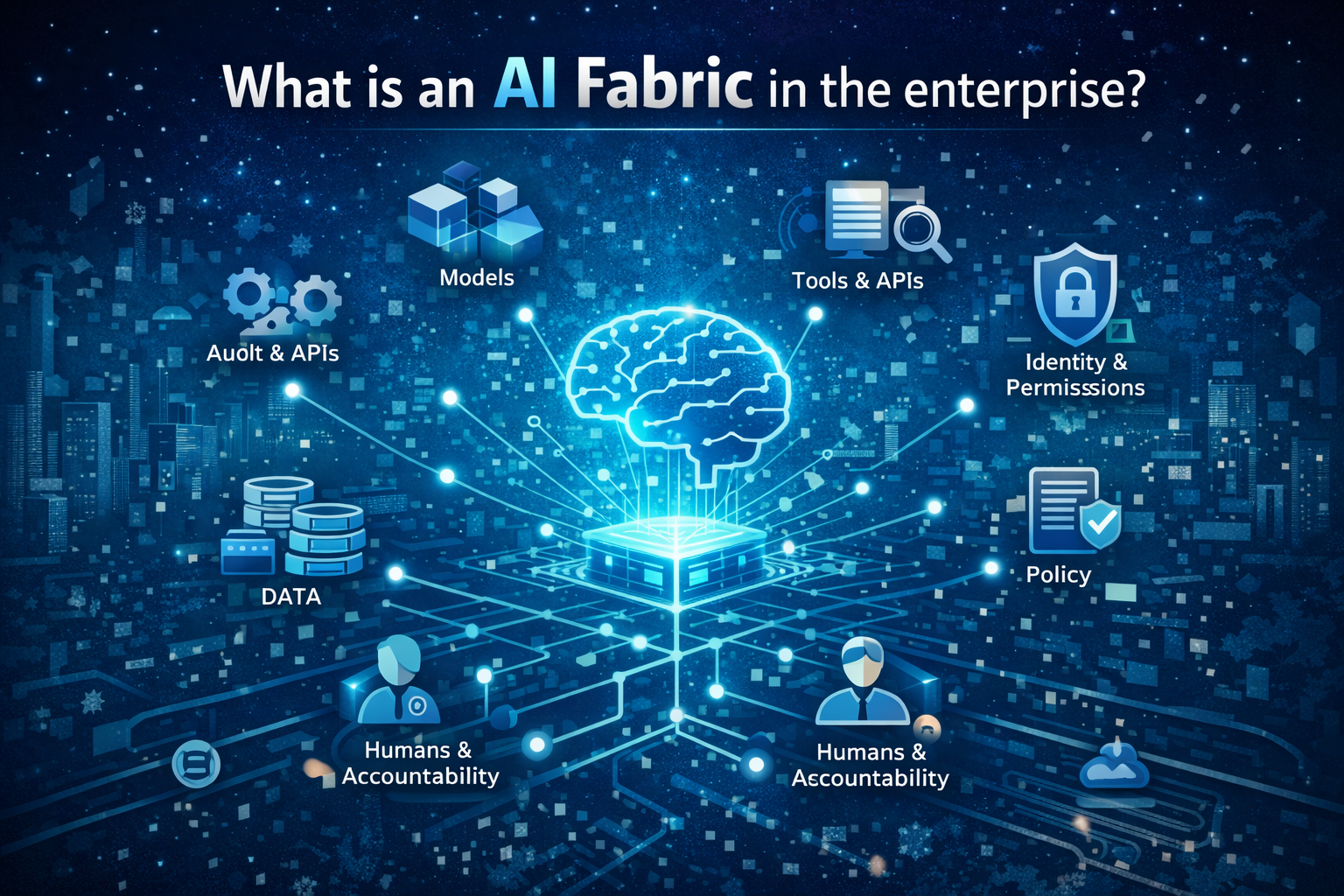
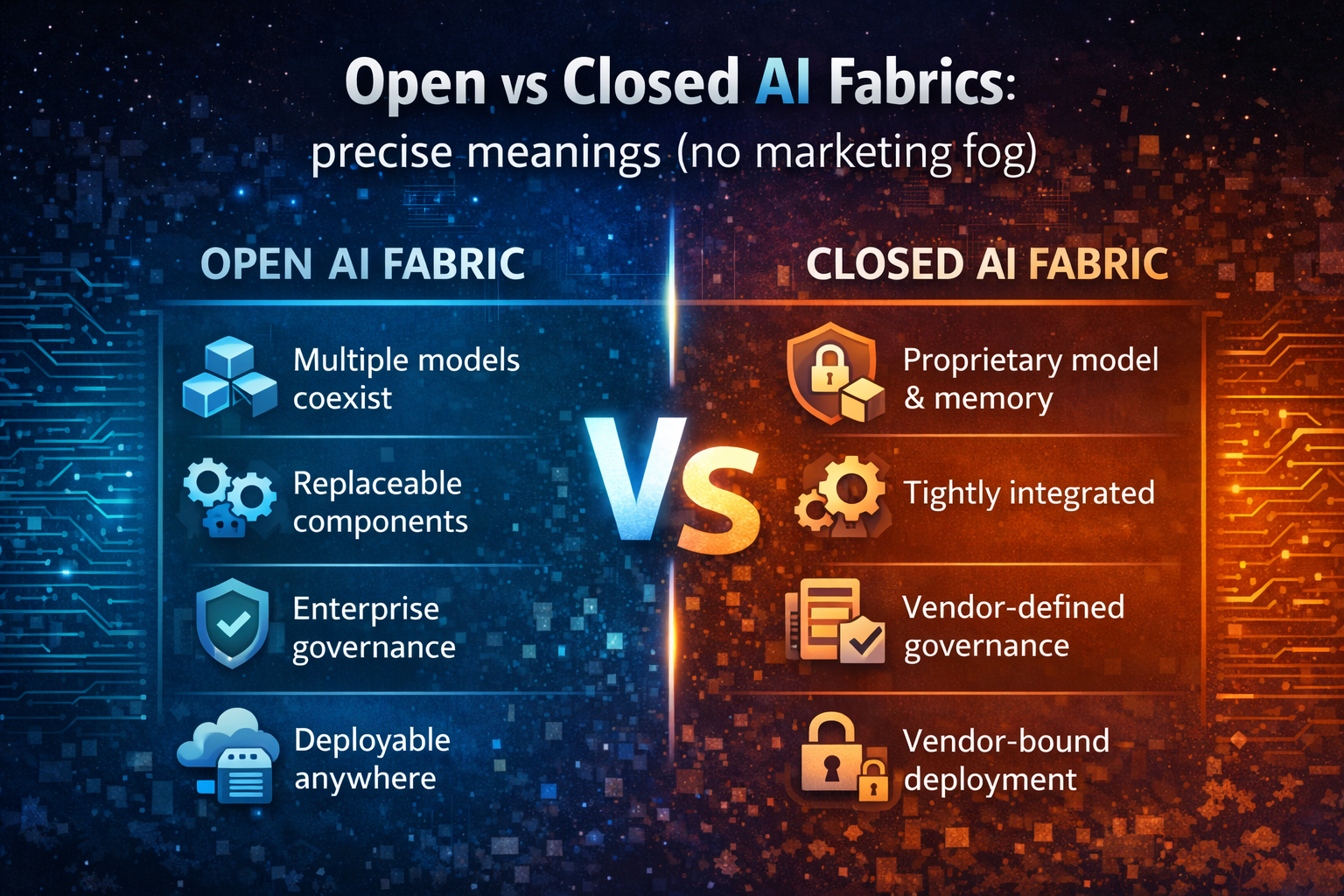
This LEGO view captures the essence of an enterprise AI fabric:
a modular yet integrated stack designed for reuse, interoperability, and continuous change.

The Five Things Enterprises Must Be Able to Reuse

The Five Things Enterprises Must Be Able to Reuse

Many teams think reuse means reusing a prompt or a model endpoint.

That is not enterprise reuse.

Enterprise reuse runs deeper.

  1. Reuse the Workflow Pattern, Not Just the Bot

Example: Exception approval

  • In finance, exceptions are invoices
  • In IT, exceptions are policy violations
  • In procurement, exceptions are supplier deviations

If each team builds a new “exception agent,” scale collapses.

If teams reuse a shared pattern—
detect → explain → request approval → record decision → audit trail
scale accelerates.

The reusable unit is not the agent.
It is the decision pattern.

  1. Reuse Guardrails, Not Just Interfaces

Guardrails include:

  • policy checks
  • redaction rules
  • human approval gates
  • audit logging
  • data access constraints

Example: Draft-and-send communications

Whether it’s:

  • customer emails
  • internal announcements
  • supplier messages

the same guardrails must apply.

Otherwise, every workflow becomes a compliance snowflake.

This is why control-plane thinking matters:
guardrails must be centralized, reusable, and enforceable.

  1. Reuse Tool Integrations

Enterprises run hundreds of systems.
Every agent needs tools—ticketing, CRM, knowledge bases, document stores.

If each use case wires tools from scratch, bottlenecks are guaranteed.

High-IRI organizations build a reusable tool layer and orchestration approach that works across agent types.

  1. Reuse Measurement

If performance cannot be compared, it cannot be governed.

Two teams may deploy “policy check agents.”
Without shared telemetry conventions, both claim success in incompatible ways.

This is why observability standards—again, see OpenTelemetry—are decisive for enterprise AI.

  1. Reuse Economics

The enterprise question is never “does it work?”

It is: “Can it run within acceptable unit economics?”

High-IRI enterprises reuse:

  • cost attribution models
  • per-agent budgets
  • throttles for runaway behavior
  • limits on reasoning spend

Without this, reuse scales cost as fast as it scales output.

What Kills the Intelligence Reuse Index

What Kills the Intelligence Reuse Index

Seven recurring traps collapse reuse:

  1. Every team chooses its own stack
  2. Prompts become the de-facto API
  3. Tool sprawl across agents
  4. Guardrails added late as patches
  5. No abstraction between workflow and model/vendor
  6. No shared runtime discipline
  7. Pilot success becomes the primary metric

Pilot KPIs reward local wins.
IRI measures enterprise capability.

How to Build an Enterprise AI Fabric That Raises IRI

How to Build an Enterprise AI Fabric That Raises IRI

You do not raise IRI by launching a program.
You raise it by changing what teams are allowed to build.

A fabric-like enterprise AI stack typically includes:

  • A Build Plane

Reusable patterns, policies, connectors, and test harnesses.

  • A Runtime Plane

Standardized orchestration, retries, fallbacks, human-in-the-loop, and rollback.

  • A Control Plane

Identity, permissions, policy evaluation, auditability, and observability.

  • A Cost Plane

AI-native FinOps: attribution, budgets, and economic guardrails.

  • An Abstraction Layer

Decoupling workflow logic from models, tools, and vendors—future-proofing reuse.

How the Intelligence Reuse Index Spreads in Executive Language

How the Intelligence Reuse Index Spreads in Executive Language

Ideas go viral in enterprises when they are repeatable.

Three lines that travel:

  1. “We don’t have an AI problem. We have a reuse problem.”
  2. “Our AI doesn’t scale because our intelligence doesn’t compound.”
  3. “The winners will treat intelligence like a reusable supply chain—not a stream of projects.”
The Enterprise Advantage Has Shifted

Conclusion: The Enterprise Advantage Has Shifted

Enterprise AI is not a race to deploy more agents.

It is a race to build reusable, governable, evolvable intelligence.

That is what the Intelligence Reuse Index captures.

  • Low IRI creates pilot graveyards
  • High IRI creates enterprise AI fabrics
  • And fabrics—not pilots—compound value over time

In the AI era, the enterprise advantage is not how much intelligence you deploy—
it is how much intelligence you can reuse safely.


Glossary

  • Enterprise AI Fabric: A modular, integrated architecture that enables reusable, governed AI capabilities
  • Control Plane: Centralized layer for policy, audit, observability, and reversibility
  • Intelligence Reuse Index (IRI): Measure of reusable AI capability versus bespoke rebuilds
  • Agentic AI: AI systems that can plan, decide, and act across workflows
  • FinOps for AI: Financial governance of AI usage, cost, and autonomy


Frequently Asked Questions (FAQ)

Is the Intelligence Reuse Index an official standard?
Not yet. It is an emerging executive metric reflecting how enterprises actually succeed—or fail—at AI scale.

Can small enterprises benefit from IRI thinking?
Yes. Reuse discipline matters even more when resources are limited.

Is this about tools or operating models?
Primarily operating models. Tools matter only insofar as they support reuse.

Does reuse slow innovation?
No. It accelerates innovation by removing reinvention.

FAQ 1: What is the Intelligence Reuse Index (IRI)?

The Intelligence Reuse Index measures how frequently enterprise intelligence—models, prompts, logic, data, and workflows—is reused across teams and use cases.

FAQ 2: Why is reuse more important than building new AI models?

Because enterprise AI fails not due to lack of ideas, but due to fragmentation, cost, and governance challenges caused by one-off implementations.

FAQ 3: How does an Enterprise AI Fabric improve IRI?

It standardizes intelligence, enforces governance, and enables modular reuse across business functions.
FAQ 4: Who should care about the Intelligence Reuse Index?

CIOs, CTOs, CDOs, COOs, and boards overseeing AI investment, risk, and scale.


References & Further Reading

What Is Enterprise AI? Why “AI in the Enterprise” Is Not Enterprise AI—and Why This Distinction Will Define the Next Decade

What Is Enterprise AI?

For the last two years, enterprises around the world have been busy “adopting AI.” Copilots have been rolled out, chat interfaces embedded into workflows, and pilot projects announced with impressive early results.

Yet beneath the momentum, a quieter realization is taking hold among CIOs, CTOs, and boards: much of what is being deployed today is AI inside the enterprise, not Enterprise AI.

The distinction is subtle, but decisive. As AI systems move from answering questions to shaping outcomes, organizations are discovering that intelligence alone is not the challenge—operability, governance, and accountability are.

For the last two years, enterprises have been busy “adopting AI.”

They have rolled out copilots.
They have experimented with chat interfaces.
They have piloted models across functions.
They have announced transformation programs.

And yet, beneath the optimism, a quiet unease is spreading among CIOs, CTOs, risk leaders, and boards.

The systems look impressive.
The demos work.
The early productivity gains are real.

But something feels unresolved.

Enterprise AI: a definition that actually holds in the real world

Because once AI moves from answering questions to shaping outcomes, the familiar playbook for enterprise technology stops working.

This is where a crucial distinction emerges — one that most organizations have not yet articulated clearly:

There is a difference between “AI in the enterprise” and Enterprise AI.

That difference is not semantic.
It is architectural.
It is operational.
And it will decide which organizations scale AI safely — and which quietly lose control of it.

Enterprise AI: a definition that actually holds in the real world

Enterprise AI: a definition that actually holds in the real world

Let’s start with a definition that survives contact with reality.

Enterprise AI is the discipline of turning AI — models, copilots, agents, and decision systems — into repeatable, governable, auditable business capability inside large organizations.
Not a demo.
Not a chatbot.
Not a clever automation.

Enterprise AI begins when AI must operate under the conditions that define enterprises themselves:

  • Multiple core systems (ERP, CRM, ITSM, industry platforms, data estates)
  • Multiple stakeholders (security, risk, legal, compliance, operations, finance)
  • Formal policies (access control, approvals, retention, segregation of duties)
  • High failure costs (regulatory exposure, financial loss, customer harm, reputational risk)

In simple terms:

Consumer AI optimizes for usefulness and delight.
Enterprise AI must optimize for accountability under uncertainty.

That single shift — from delight to accountability — is why Enterprise AI is not just “more AI,” but a fundamentally different operating problem.

The One Enterprise AI Stack CIOs Are Converging On: Why Operability, Not Intelligence, Is the New Advantage – Raktim Singh

The Enterprise AI moment: when intelligence crosses the action threshold

The Enterprise AI moment: when intelligence crosses the action threshold

For decades, enterprise software followed a predictable pattern:

  • Systems stored data
  • Humans made decisions
  • Software executed instructions

AI disrupts this separation.

Modern AI systems don’t just retrieve information or automate predefined rules. They interpret context, recommend decisions, and increasingly take action — creating tickets, changing records, triggering workflows, initiating approvals, coordinating across systems.

This transition — from AI that talks to AI that acts — is the moment Enterprise AI truly begins.

It is also the moment where many organizations experience their first real friction.

Because the question is no longer:

“Is the AI accurate?”

It becomes:

  • Can we trust it at scale?
  • Can we explain its behavior?
  • Can we contain failures?
  • Can we reverse decisions?
  • Can we prove compliance after the fact?

These are not model questions.
They are enterprise questions.
Why “AI in the enterprise” fails as a mental model

Why “AI in the enterprise” fails as a mental model

Most early AI initiatives fail not because the models are weak, but because the framing is wrong.

“AI in the enterprise” treats AI as another tool category:

  • deploy it
  • integrate it
  • train users
  • measure adoption

That framing breaks down the moment AI becomes consequential.

Enterprise AI is not a feature rollout.
It is the introduction of autonomous behavior into institutional systems.

And institutions — by design — care deeply about:

  • predictability
  • accountability
  • traceability
  • controllability

This is why enterprises do not fear AI because it is powerful.
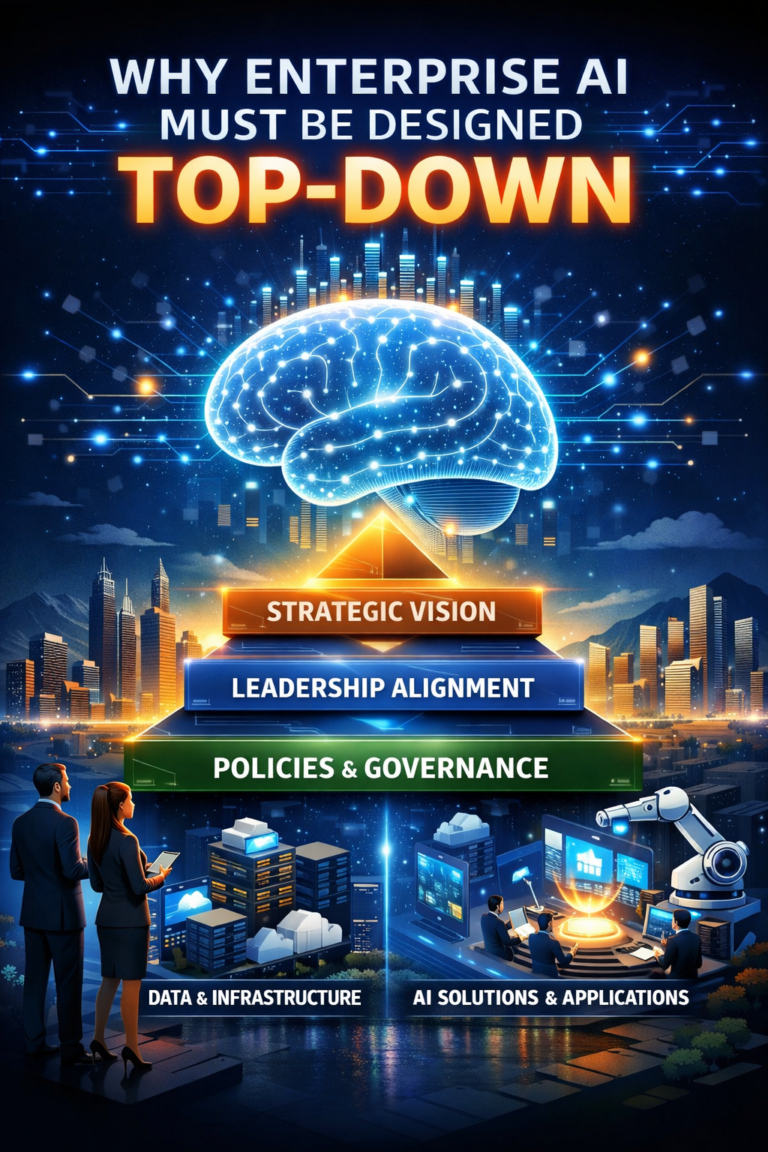
They fear it because power without structure destabilizes systems.

The One Enterprise AI Stack CIOs Are Converging On: Why Operability, Not Intelligence, Is the New Advantage | by RAKTIM SINGH | Dec, 2025 | Medium

The five properties that distinguish Enterprise AI from all other AI

The five properties that distinguish Enterprise AI from all other AI

  1. Enterprise AI is outcome-bound, not answer-bound

A system can generate excellent answers and still produce disastrous outcomes.

This is the most underestimated shift.

In enterprise environments:

  • a “reasonable” approval can violate policy
  • a “helpful” action can create regulatory exposure
  • a “logical” decision can break downstream processes

Enterprise AI success is therefore measured not by response quality, but by outcome integrity — whether the system consistently produces outcomes aligned with business intent, policy, and risk tolerance.

  1. Enterprise AI must be governable by construction, not after the fact

In enterprises, governance cannot be bolted on.

Every serious deployment immediately triggers questions such as:

  • Who authorized this action?
  • Under which policy?
  • Using which data?
  • With what confidence?
  • Can we reconstruct the decision months later?
  • Can we halt or reverse behavior instantly?

These are not optional concerns. They are the price of operating inside regulated, multi-stakeholder environments.

This is why Enterprise AI requires governance primitives — identity, permissions, policy enforcement, auditability — as first-class design elements, not compliance overlays.

Enterprise IT Is Becoming an App Store: From Projects to Services-as-Software: By Raktim Singh

  1. Enterprise AI must be operable at scale, not just intelligent

The hardest problems appear after the pilot succeeds.

When organizations move from:

  • 5 AI use cases to 50
  • 50 agents to 500
  • one team to dozens of business units

the problem shifts decisively from intelligence to operations.

At scale, Enterprise AI must support:

  • continuous monitoring and drift detection
  • cost governance tied to business outcomes
  • incident response and rollback
  • controlled releases and versioning
  • change management across systems and teams

This is why enterprises don’t “deploy models.”

They run AI systems, continuously.

Enterprise IT Is Becoming an App Store: From Projects to Services-as-Software: By Raktim Singh

  1. Enterprise AI must survive brownfield reality

Most enterprises are not greenfield startups.
They are living systems built over decades.

They contain:

  • legacy cores
  • vendor platforms
  • customized workflows
  • exception handling logic
  • institutional knowledge embedded in process

Enterprise AI must therefore wrap, integrate, and coexist long before it can replace.

Architectures that assume clean-slate redesign rarely survive first contact with reality.

The One Enterprise AI Stack CIOs Are Converging On: Why Operability, Not Intelligence, Is the New Advantage | by RAKTIM SINGH | Dec, 2025 | Medium

  1. Enterprise AI is socio-technical by nature

Enterprise AI does not fail only when models break.
It fails when people lose trust.

Employees ask:

  • Will this system expose me to risk?
  • Will it override my judgment?
  • Will I be accountable for decisions I didn’t make?

This is why successful Enterprise AI requires more than intelligence. It requires an experience layer that makes autonomy legible, predictable, and safe for humans.

Trust is not a soft issue in Enterprise AI.
It is the hardest operational constraint.

A practical definition that executives, engineers, and auditors can all use

A practical definition that executives, engineers, and auditors can all use

Here is the most robust definition:

Enterprise AI is the operating model, architecture, and governance required to deploy AI that can recommend or act inside real business systems — safely, reliably, audibly, and economically — at scale.

This definition matters because it shifts focus away from models and toward capability.

Enterprise AI is not about what the AI is.
It is about how the organization runs it.

The three forms of Enterprise AI — and why most organizations stall

The three forms of Enterprise AI — and why most organizations stall

Type A: Assistive AI

  • Drafts, summarizes, answers questions
  • Low risk, fast ROI
  • Still requires data governance

Type B: Decision AI

  • Recommends approvals, scores risk, evaluates options
  • Requires explainability and evidence
  • Often where governance tension begins

Type C: Action AI

  • Executes workflows, changes records, coordinates systems
  • Delivers the largest productivity gains
  • Introduces real operational risk

Most organizations stop at Type A and call it transformation.

Enterprise AI begins in earnest at Type C — when autonomy becomes operational.

The minimum Enterprise AI stack (what actually works in practice)

Enterprise AI requires a stack that looks far more like enterprise infrastructure than experimentation tooling.

The AI Platform War Is Over: Why Enterprises Must Build an AI Fabric—Not an Agent Zoo – Raktim Singh

  1. AI Build Plane

Where intent is defined:

  1. AI Runtime

Where behavior is constrained:

  1. AI Control Plane

Where accountability lives:

  1. AI Service Catalog

Where capability becomes reusable:

  1. AI SRE / AgentOps

Where AI becomes operable:

  • incident playbooks
  • drift response
  • controlled releases
  • continuous evaluation

This is the difference between AI as a project and AI as infrastructure.

The Autonomy SRE Stack: How Enterprises Run AI Autonomy Safely, Reliably, and at Scale – Raktim Singh

Why this matters now: the 2026 inflection point

We are entering a period where:

  • AI agents will operate continuously
  • decision velocity will outpace human review
  • failures will propagate faster than manual controls

In this environment, intelligence alone is not an advantage.

Operability is.

The organizations that win will not be those with the most advanced models, but those with the most mature Enterprise AI operating fabric.

Enterprise AI is the operating system of accountable autonomy

Conclusion: Enterprise AI is the operating system of accountable autonomy

Enterprise AI is not a trend.
It is the inevitable outcome of introducing autonomy into institutional systems.

The next decade will not be defined by who adopts AI first, but by who learns to run it responsibly, repeatably, and at scale.

The real enterprise advantage is not intelligence.

It is the ability to make intelligence safe, trusted, and sustainable.

That is Enterprise AI.

Glossary

  • Enterprise AI: Governed, auditable AI capability operating inside enterprise systems
  • Agentic AI: AI systems capable of planning and executing actions
  • Control Plane: Governance, policy, and observability layer for AI
  • AI Runtime: Execution environment with constraints and safeguards
  • AI SRE: Reliability engineering discipline for AI systems
  • AgentOps: Lifecycle management of AI agents
  • Outcome Integrity: Alignment between AI behavior and business intent
  • Brownfield Architecture: Systems evolved over time, not built from scratch


Raktim Singh is a technology strategist, enterprise AI thought leader, and author of Driving Digital Transformation. He writes about enterprise AI operating models, agentic systems, governance, and the future of intelligent enterprises. His work focuses on making advanced AI safe, operable, and scalable in real organizations.

The Action Threshold: Why Enterprise AI Starts Failing the Moment It Starts Acting

The Action Threshold

Enterprise AI looks impressive in pilots.

It drafts emails, summarizes incidents, answers policy questions, and suggests next steps. Teams celebrate early wins. Leaders see momentum.

Then, one day—often without a formal “big bang” announcement—the organization crosses a line:

  • The assistant creates a ticket instead of recommending one.
  • The agent updates a customer record instead of proposing an update.
  • The system triggers a workflow instead of describing the workflow.
  • The model approves a request instead of drafting an approval note.

That moment is the Action Threshold: the point where AI shifts from advising humans to executing work inside enterprise systems.

And it’s exactly where many “successful” enterprise AI programs start failing—not because the models suddenly got worse, but because the enterprise has moved from AI for advice to AI for execution.

Once AI starts acting, it is no longer a tool that helps work. It becomes a resource you are assigning work to—and assigned work carries non-negotiable requirements: accountability, boundaries, evidence, cost discipline, and recovery.

This article explains the Action Threshold in simple language, shows why failure becomes likely at this stage, and lays out the operating fabric CIOs need to run AI safely at global scale.

Why this matters now

Enterprises globally are moving from AI pilots to agentic execution. The moment AI starts acting—not advising—traditional stacks collapse. This article explains why, and what CIOs must build next.

Why AI feels “fine” before the Action Threshold

Why AI feels “fine” before the Action Threshold

Most pilots run in what you can call advisory mode:

  • “Here’s what the policy says.”
  • “Here’s a suggested response.”
  • “Here’s a summary of what happened.”
  • “Here’s a recommendation.”

If the output is wrong, a human notices and corrects it. The blast radius is small. Teams learn. Confidence grows.

But after the Action Threshold, the output isn’t just words. It becomes actions inside systems of record—the places enterprises treat as truth: ERP, CRM, IAM, ticketing, procurement, finance, and operations platforms.

And “small mistakes” stop being small. They turn into:

  • incorrect approvals that quietly propagate
  • inconsistent records that break downstream reporting
  • privilege grants that create security exposure
  • customer messages that create legal risk
  • automation loops that burn compute budgets

Before the threshold: the enterprise can tolerate “AI is occasionally wrong.”
After the threshold: the enterprise needs “AI is operable.”

The core shift: from wrong answers to wrong outcomes

The core shift: from wrong answers to wrong outcomes

At the Action Threshold, the unit of risk changes.

Before: wrong answer
After: wrong outcome

A model can be “right” in reasoning and still produce a damaging outcome because the failure isn’t intelligence—it’s operability.

A simple example: the travel request assistant

In advisory mode, an assistant might say: “Approval is needed.”

In execution mode, it must reliably:

  • collect missing details
  • validate constraints
  • create the request
  • route approvals correctly
  • notify stakeholders
  • capture evidence for audit

If the system improvises one step—routing to the wrong approver, applying the wrong policy version, or failing to log evidence—the organization inherits process debt, compliance risk, and employee frustration.

The difference is not “smarter AI.”
The difference is controlled execution.

Why enterprise AI fails after it starts acting: five predictable failure modes

Why enterprise AI fails after it starts acting: five predictable failure modes

1) The tool surface becomes the highest-risk surface

The most dangerous part of an agent is rarely the model. It’s the tools: APIs, connectors, workflow triggers, automations, and permissions.

Once AI can call tools, it can:

  • update records
  • trigger financial steps
  • change configurations
  • create access rights
  • send external communications

That’s not “content generation.” That’s enterprise execution.

This is also why “LLM observability” is rapidly becoming a mainstream priority: organizations want visibility not only into outputs, but into prompts, tool calls, traces, and security risks (including prompt injection). (OpenTelemetry)

2) Leaders can’t answer basic operational questions

After the Action Threshold, leadership immediately asks questions that pilots rarely answer:

  • Who performed the action?
  • What happened step by step?
  • Why did it happen—what policy or evidence supported it?
  • What did it cost, and was it within budget?
  • Can we stop it immediately?
  • Can we undo it (rollback or compensating actions)?
  • Can we replay it for audit and incident response?

If your stack can’t answer these questions, you don’t have an AI capability—you have a future incident.

3) Drift becomes operational, not academic

Enterprises change constantly:

  • policies update
  • workflows evolve
  • data pipelines shift
  • security controls tighten
  • vendors and platforms change behavior

AI systems are contextual and probabilistic, so “working yesterday” does not guarantee “working tomorrow.”

This is exactly why frameworks like the NIST AI Risk Management Framework (AI RMF) emphasize lifecycle risk management, including monitoring and governance across deployment and operation. (NIST)

4) Costs become nonlinear

In pilots, costs look manageable.

In production, costs can explode due to:

  • loops and retries
  • tool failures and fallbacks
  • long context windows
  • multi-agent coordination overhead
  • unbounded task scope (“just handle it”)
  • lack of throttles and budgets

After the threshold, cost control must become a runtime capability, not a finance afterthought.

5) Human trust breaks before technology breaks

When AI acts, employees and customers don’t evaluate it like software. They evaluate it like an actor that made a decision.

Trust becomes the limiting factor—especially in regulated environments and customer-facing operations.

Across markets, the direction of travel is consistent: higher-risk AI requires stronger governance and oversight. The EU AI Act, for example, includes expectations around oversight and risk controls for certain categories of AI systems. (Reuters)

The global executive reality: why this is urgent now

The global executive reality: why this is urgent now

The world is moving fast toward agentic execution—and executives feel the tension between speed and safety.

  • Gartner has predicted that over 40% of agentic AI projects will be canceled by the end of 2027 due to escalating costs, unclear business value, or inadequate risk controls. (Gartner)
  • Microsoft’s 2025 Work Trend Index argues organizations will need to manage human-agent teams using a new metric: the human-agent ratio—a governance and operating-model question, not a model-selection question. (Microsoft)

This is the same story from two angles:

  • “Agents are coming.”
  • “Many programs will fail unless operability becomes real.”
What CIOs actually need after the Action Threshold: an operating fabric

What CIOs actually need after the Action Threshold: an operating fabric

After the threshold, “pick a better model” is not the solution.

The solution is an operating fabric: a cohesive environment that translates design intent into governed runtime behavior—and keeps that behavior safe under continuous change.

Think of it as moving from:

build → deploy
to
design → govern → operate → evolve

This isn’t bureaucracy. It’s the minimum machinery required for AI that touches real workflows.

Layer 1: Studio — designing autonomy intentionally

A mature design environment covers six practical disciplines:

  1. Experience design across channels (chat, email, portal, workflow UI)
  2. Flow design (enterprise work is a sequence, not a single answer)
  3. Agent design (roles like jobs: responsibilities, escalation rules, forbidden actions)
  4. Tool design (allow-lists, parameter validation, least-privilege access)
  5. Guardrail design (stop conditions, evidence requirements, rollback paths)
  6. Domain specialization (use the right intelligence for the right task)

This is how you prevent “agents improvising in production.”

Layer 2: Runtime — governed execution under real conditions

Runtime is where enterprises earn safety:

  • Orchestration: ordering, retries, approvals, state management, timeouts
  • Data foundation: source-of-truth retrieval, policy versioning, provenance
  • Continuous guardrails: governance at machine speed (pre-checks, escalation, rollback hooks)
  • Cost control: budgets, throttles, loop prevention
  • Observability: traceability of decisions and tool calls (standards are evolving; OpenTelemetry now has GenAI semantic conventions and metrics). (OpenTelemetry)
  • Recovery: rollback and compensating actions, not manual cleanup

A simple principle should guide every design choice:

All autonomy must be reversible.

Three simple examples that make the operating fabric intuitive

Three simple examples that make the operating fabric intuitive

Example 1: Vendor onboarding agent

Without an operating fabric:

  • extracts data
  • creates a record
  • fails mid-way
  • leaves inconsistent states
  • no one can reconstruct what happened

With an operating fabric:

  • orchestration enforces ordered steps
  • validations block unsafe updates
  • evidence is captured automatically
  • partial execution triggers recovery or compensation
  • incident replay becomes possible

Example 2: Refund decision agent

Even if the model recommends the correct decision, the workflow can still fail if:

  • the wrong tool is called
  • approval thresholds aren’t enforced
  • audit evidence isn’t captured
  • rollback isn’t designed

The enterprise doesn’t need “perfect answers.”
It needs “safe execution under control.”

Example 3: Access provisioning agent

Here, the Action Threshold becomes security-critical.

A fabric enforces:

  • least-privilege tool access
  • identity boundaries
  • escalation when ambiguity appears
  • replayable traces for audit and incident response

In practice, these controls are what prevent a small mistake from becoming a security event.

The workforce implication: execution changes jobs, not just software

The workforce implication: execution changes jobs, not just software

Once AI acts, you must engineer a synergetic workforce:

  • Digital workers handle repeatable deterministic steps (workflows, scripts, bots, APIs)
  • AI workers handle context and complexity under guardrails
  • Human workers own accountability, governance, training, and continuous improvement

A practical rule helps organizations scale safely:

Work should move to the lowest-cost reliable worker—and escalate only when risk or ambiguity demands it.

That is how you scale autonomy without scaling chaos—and why the “human-agent ratio” is becoming a real management lens. (Microsoft)

The long-term advantage: continuous recomposition

The long-term advantage: continuous recomposition

Enterprises that win won’t be the ones with the “smartest agents.”

They will be the ones that can change safely and fast:

  • update policies once
  • propagate across channels
  • switch models without breaking workflows
  • evolve security controls without shutdowns
  • absorb ecosystem shifts without rebuilding everything

That capability is continuous recomposition—and it only works when the enterprise builds reusable services, governed runtime, and interoperable integration patterns.

In a world of continuous model evolution, regulatory pressure, and shifting enterprise priorities, recomposition becomes the strategic moat.

A practical adoption path CIOs can execute

A practical adoption path CIOs can execute

If you want to cross the Action Threshold safely:

  1. Pick 2–3 high-volume workflows (not flashy demos).
  2. Design them as services, not one-off agents (clear scope, owners, controls).
  3. Put runtime controls in place before scaling autonomy (identity, budgets, audit, rollback).
  4. Instrument observability for AI behavior and tool calls (industry standards are emerging fast). (OpenTelemetry)
  5. Scale via reuse: expand a catalog of proven services and patterns.

This is how AI stops being a collection of pilots—and becomes a repeatable enterprise capability.

Executive takeaways

  • The Action Threshold is where AI stops being advice and becomes execution.
  • Failure after the threshold is usually operability failure, not intelligence failure.
  • The enterprise needs an operating fabric: studio-to-runtime control, observability, cost discipline, auditability, and recovery.
  • The goal is not to deploy more agents—it is to scale reversible autonomy with a synergetic workforce.
  • The competitive advantage is continuous recomposition: the ability to change without disruption.
the CIO advantage is operability at scale

Conclusion: the CIO advantage is operability at scale

The first wave of enterprise AI was judged by how intelligent it looked in demos.

The next wave will be judged by whether it can be operated:

  • predictable behavior under real production conditions
  • provable governance and evidence trails
  • autonomy with recovery pathways
  • cost discipline and loop prevention
  • reusable services rather than scattered projects
  • a workforce model that preserves accountability
  • continuous recomposition without disruption

If you can’t stop it, audit it, budget it, and undo it, you can’t run it.

And if you can’t run it safely, you haven’t really built it.

FAQ

What is the Action Threshold in enterprise AI?

The Action Threshold is the point where AI moves from advising humans to taking actions inside enterprise workflows and systems of record—so it must meet production-grade standards of accountability, boundaries, evidence, cost control, and recovery.

Why do pilots succeed but production fails?

Because pilots rarely test operability: identity, permissions, audit trails, rollback, cost envelopes, and cross-system orchestration—yet those become mandatory once AI starts acting.

Do we need a single model to solve this?

No. After the threshold, the hardest problems are operating-model problems: governed execution, observability, recovery, and safe change—regardless of model choice.

Why is this becoming urgent globally?

Because agentic AI is spreading rapidly, and analysts and enterprise leaders are explicitly warning that many initiatives will be canceled unless risk controls and business discipline catch up. (Gartner)

What is the Action Threshold in enterprise AI?

The Action Threshold is the point where AI systems move from advising humans to executing actions inside enterprise systems and workflows.

Why do enterprise AI pilots succeed but fail in production?

Because pilots rarely test operability—identity, permissions, auditability, rollback, cost control, and recovery—which become mandatory once AI acts.

Is the problem caused by poor AI models?

No. Most failures occur due to missing operating controls, not insufficient intelligence.

Why is operability more important than model accuracy?

Because once AI executes work, enterprises must manage outcomes, costs, compliance, and accountability—not just answers.

How does regulation affect enterprise AI execution?

Globally, regulations increasingly emphasize human oversight, auditability, monitoring, and recovery for AI systems that act.

Glossary

  • Action Threshold: The moment AI begins executing work (triggering workflows, updating records, approving actions).
  • Operability: The ability to run AI predictably with auditability, cost control, safety controls, and recovery.
  • Operating fabric: A cohesive set of design-time and runtime capabilities that govern how AI behaves in production under change.
  • Studio-to-runtime: Translating design intent into governed production behavior.
  • Synergetic workforce: A deliberately engineered model where digital, AI, and human work collaborate with clear escalation and accountability.
  • Continuous recomposition: The ability to safely reconfigure workflows, policies, and models without disrupting operations.

References and further reading

Gartner press release on agentic AI project cancellations (June 25, 2025). (Gartner)

Brownfield Agentic AI: Why Wrapping Core Systems Is the Only Scalable Path to Enterprise Autonomy

Brownfield Agentic AI: The Reality Every CIO and CTO Must Confront

Most enterprises won’t “rip and replace” ERP, CRM, and core platforms to become AI-native. The winners will wrap those systems with governed actions, policy gates, auditability, and cost controls—so agents can create real outcomes without breaking the business.

“Agentic AI doesn’t fail because models are dumb—it fails because enterprises are brownfield.”


The uncomfortable truth: most agentic AI programs die in the brownfield

The uncomfortable truth: most agentic AI programs die in the brownfield

In 2025, the executive question has shifted from “Can the model answer?” to “Can the system act—safely—inside the business?” That’s why agentic AI is reshaping project priorities and operating expectations for CIOs and software leaders. (CIO)

But most enterprises are not greenfield startups. They are brownfield environments: decades of ERP and CRM, legacy databases, mainframes, bespoke workflows, region-specific policies, regulatory constraints, and a long tail of integrations.

So when someone says, “Let’s rebuild the stack to become AI-native,” the enterprise hears something else:

  • Multi-year disruption
  • High program risk
  • Operational fragility
  • Vendor lock-in
  • And a political fight no one wants

This is why the only scalable strategy is simple—and slightly counterintuitive:

Don’t replace your core systems to scale agentic AI. Wrap them.
Add intelligence without rewriting the institution.

A wave of enterprise platforms and vendors now describe this direction explicitly: a composable, interoperable stack of agents/services/models designed to unify delivery across the enterprise landscape—built to accelerate outcomes without forcing a rebuild. (Infosys)

“Wrapping is the fastest path to autonomy: controlled actions, enforced policy, full auditability.”

What “wrap” really means (in plain language)

What “wrap” really means (in plain language)

“Wrapping” isn’t a buzzword. It’s an operating pattern:

  1. Keep the system of record as the source of truth (ERP/CRM/core platforms).
  2. Expose controlled capabilities (read/write actions) through governed interfaces—APIs, workflows, event triggers, and service layers.
  3. Put agentic AI on top as a supervised operator, not as a replacement brain.

Think of your core systems like a powerful factory machine you must not modify casually. Wrapping is like installing:

  • A control panel (approved actions)
  • A safety cage (policy guardrails)
  • A camera + logbook (audit trail)
  • An emergency stop (rollback / kill switch)
  • A meter (cost + rate limits)

The machine stays. You modernize the interaction model—so automation becomes safe, explainable, and scalable.

“If autonomy can’t be rolled back, it can’t be deployed.”

Why replacement fails: five realities every CIO recognizes

Why replacement fails: five realities every CIO recognizes

Why replacement fails: five realities every CIO recognizes

1) Your “core” is not just software—it’s institutional memory

ERP workflows encode how the enterprise truly works: approvals, exceptions, segregation of duties, audit requirements. Replacing them is not a technical migration—it’s a rewrite of institutional behavior.

2) Risk compounds when AI can take actions

As soon as agents can call tools, new failure modes appear: prompt injection, tool misuse, sensitive data exposure, unintended actions, and “policy bypass by creativity.” OWASP’s GenAI security guidance and Top 10 for LLM/agentic risks exist precisely because these issues show up in real deployments. (OWASP Foundation)

3) Brownfield is heterogeneous by definition

Even within one geography (US, EU, UK, India, APAC, Middle East), enterprises run hybrid stacks: SaaS + on-prem + private cloud + acquired systems. A clean replacement is rare; a safe integration surface is essential.

4) Value comes from workflows, not demos

Enterprises don’t need “more chat.” They need outcomes: fewer cycle times, better compliance, lower error rates, less rework—without creating operational chaos.

5) The operating model is the bottleneck

CIO priorities for data/AI increasingly emphasize turning AI into value, modernizing legacy environments, and scaling automation responsibly—meaning governance, security, and cost discipline become board-level concerns. (Alation)

Brownfield agentic AI in one sentence

Brownfield agentic AI in one sentence

Agentic AI scales when you convert core-system actions into governed, reusable services—and let agents orchestrate those services under strict runtime controls.

Three simple stories that make “wrap vs replace” obvious

Three simple stories that make “wrap vs replace” obvious

The three layers of wrapping (a blueprint that actually works)

Layer 1: Capability wrapping — turn systems into “safe actions”

Start by listing 10–20 bounded actions that create business value and are easy to constrain.

Examples:

  • Procurement: create PO draft, check vendor compliance, route for approval
  • Customer operations: open case, fetch order status, issue replacement authorization
  • Finance: validate invoice fields, match invoice to receipt, flag policy exceptions
  • HR: generate onboarding checklist, provision access request, schedule training
  • IT ops: open incident, run diagnostics, propose remediation plan

These become tools the agent can call.

The key distinction: the tool is not “direct database access.” The tool is a narrow, well-defined action with validation, constraints, and logging.

Security best practices for LLM applications and tool-enabled agents consistently emphasize least privilege and tool-call validation. (OWASP Cheat Sheet Series)

Layer 2: Policy wrapping — make “allowed” explicit

In brownfield enterprises, policy lives everywhere:

  • approvals
  • segregation of duties constraints
  • region-specific rules (privacy, sector rules)
  • risk thresholds
  • procurement and legal constraints

Wrapping means the agent doesn’t “interpret policy freely.” The runtime enforces policy.

Simple example:

  • Agent drafts vendor onboarding.
  • Policy layer checks: “Is this vendor category restricted in this geography?”
  • If restricted → the agent can’t proceed. It must escalate or request an approval step.

This is where human-in-the-loop becomes a feature, not a failure—especially for high-impact actions. (NIST Publications)

Layer 3: Operability wrapping — make autonomy runnable

This is where most programs fail: not model quality—production reality.

To run agentic AI at scale, you need operational habits aligned to risk frameworks like NIST AI RMF: governance, monitoring, and ongoing risk management across the AI lifecycle. (NIST Publications)

Operability typically requires:

  • Audit trails: tool calls, inputs/outputs, decision context (for compliance + debugging)
  • Identity + access for agents (agents need identities with scoped permissions)
  • Rate limits + budgets to prevent runaway loops and surprise costs
  • Rollback / reversal patterns when downstream conditions change
  • Incident response: a playbook when agents behave unexpectedly

This is the difference between a pilot and a platform.

Three simple stories that make “wrap vs replace” obvious

Three simple stories that make “wrap vs replace” obvious

Story 1: The ERP procurement assistant (global enterprise)

Replace approach: “Let’s migrate procurement to a new AI-native suite.”
Result: multi-year disruption, resistance from procurement and finance, stalled adoption.

Wrap approach: Keep ERP procurement. Wrap 12 actions:

  • fetch supplier profile
  • validate required documents
  • check sanctioned lists
  • draft PO
  • route approvals
  • log exceptions

Now the agent becomes a procurement co-pilot that executes bounded steps. The ERP remains the source of truth. Compliance improves because actions are logged and policy checks happen at runtime.

Story 2: Customer operations in a privacy-sensitive environment (EU/UK-style constraints)

Customer asks: “Change my address and cancel the next shipment.”

A naive agent might:

  • pull personal data broadly
  • modify records without appropriate justification
  • leave weak audit evidence

A wrapped system does:

  • the agent requests the minimum data needed
  • policy layer verifies identity and consent
  • action layer performs “address change” through approved workflow
  • audit logs store the “why,” “who,” “what changed,” and “evidence”

OWASP explicitly highlights risks like prompt injection and sensitive information disclosure as real concerns for LLM/agentic systems—reinforcing why policy + auditability can’t be optional. (OWASP Gen AI Security Project)

Story 3: IT operations “self-heal” in hybrid cloud

Agent detects rising errors.

Replace approach: rebuild observability and incident tooling around a new platform.
Wrap approach: keep existing monitoring, ticketing, and runbooks.

Wrap actions:

  • pull metrics
  • correlate alerts
  • open incident
  • propose runbook steps
  • request approval for remediation
  • execute only if approved

The agent becomes a runbook orchestrator, not an uncontrolled admin.

The wrap-first architecture pattern

The wrap-first architecture pattern (no jargon—just the pieces)

To implement brownfield agentic AI reliably, enterprises usually need four building blocks:

1) Agent Studio (design-time)

  • define tasks and tools
  • test safely
  • version prompts/workflows
  • publish approved capabilities

2) Governed Runtime (execution-time)

  • policy enforcement
  • identity and access
  • logging and audit
  • budgets and throttles
  • escalation / approvals

3) Enterprise Integration Surface

  • APIs, events, workflows (RPA where necessary)
  • connectors to SaaS + on-prem
  • least-privilege data access

4) Observability + Incident Loop

  • detect failures
  • replay decisions
  • rollback or compensate
  • continuously improve controls

This is exactly why “fabric-like” enterprise stacks are emerging: not to make models smarter, but to make autonomy operable, reusable, and safe. (Infosys)

Common mistakes
Common mistakes

Common mistakes (and how to avoid them)

Mistake 1: Giving the agent “God mode”

If the agent can write to everything, it eventually will write to the wrong thing.

Fix: least privilege + bounded tools + approvals for sensitive steps. (OWASP Cheat Sheet Series)

Mistake 2: Treating audit logs as optional

Without logs, you can’t debug. You can’t prove compliance. You can’t build trust.

Fix: log every tool call, every sensitive read, and every write decision with context.

Mistake 3: Building one-off integrations per use case

That becomes integration roulette.

Fix: build a reusable action catalog—“Create Case” shouldn’t exist in six different forms across agents.

Mistake 4: Skipping the operating model

If no one owns agent incidents, you don’t have autonomy—you have unmanaged risk.

Fix: define ownership, escalation paths, safe failure modes, and rollback procedures aligned to AI risk governance practices. (NIST Publications)

Brownfield agentic AI succeeds when enterprises wrap existing core systems with governed actions, policies, audit trails, and runtime controls—allowing AI to act safely without replacing the systems of record. Why this wins globally (US, EU, UK, India, APAC, Middle East)

Brownfield realities vary, but the constraints rhyme:

  • EU/UK: privacy + auditability pressure
  • US: speed-to-value + cost discipline
  • India/APAC: scale + heterogeneity + talent efficiency
  • Middle East: rapid transformation + governance expectations

“Wrap, don’t replace” works because it lets you:

  • modernize fast without disrupting the core
  • prove value in weeks, not years
  • enforce policy consistently across environments
  • reduce lock-in risk by standardizing interfaces and action catalogs
A practical 90-day plan

A practical 90-day plan (that doesn’t collapse under ambition)

Weeks 1–2: Choose one workflow, not ten
Pick a workflow with clear value and bounded risk (invoice exceptions, case triage, PO drafting).

Weeks 3–6: Wrap 10–20 actions
Define narrow tools with strict permissions and logging.

Weeks 7–10: Add policy + approvals
Introduce human-in-the-loop for high-impact actions; enforce decision rights.

Weeks 11–13: Make it operable
Monitoring, cost limits, incident playbooks, rollback/compensation strategies.

Then expand horizontally: same platform, more workflows—without re-building from scratch.

the new enterprise advantage is runnable autonomy

Conclusion: the new enterprise advantage is runnable autonomy

The next wave of enterprise AI won’t be won by the company with the smartest model.

It will be won by the company that can answer one operational question:

“Can we let AI take actions inside our business—without losing control, trust, or cost discipline?”

In brownfield enterprises, the scalable path is not replacement. It is wrapping: converting core-system actions into governed services, enforcing policy at runtime, and making autonomy operable through auditability, budgets, and incident response—consistent with widely used AI risk management principles. (NIST Publications)

That’s how you modernize without disruption, scale without chaos, and earn the right to deploy real autonomy.

FAQ

Is brownfield agentic AI just RPA with a new name?

No. RPA automates deterministic steps. Agentic AI can interpret intent, plan multi-step work, and adapt—but it must be wrapped with controls to stay safe and reliable. (OWASP Foundation)

Do we need to modernize legacy systems before using agents?

Not fully. You can start by wrapping the highest-value actions through APIs/workflows/integration layers. Over time, those wrappers become a modernization path.

How do we prevent agents from making risky changes?

Least privilege, bounded tools, policy gates, approvals for sensitive actions, and complete audit trails—aligned with OWASP guidance and NIST-style risk management thinking. (OWASP Cheat Sheet Series)

What’s the biggest reason agentic programs fail in enterprises?

Skipping operability: no runtime governance, no audit evidence, no budgets, and no incident playbooks.

Glossary

  • Brownfield enterprise: An environment with existing systems and constraints that can’t be replaced quickly.
  • System of record: The authoritative place where business truth lives (ERP/CRM/core platforms).
  • Wrapping: Exposing system capabilities through governed actions (APIs/tools/workflows) rather than replacing the system.
  • Agent tool: A bounded, permissioned action an AI agent can call (e.g., “Create Case,” “Draft PO”).
  • Least privilege: Grant only the minimum permissions necessary—especially for tool-enabled agents. (OWASP Cheat Sheet Series)
  • Human-in-the-loop: Humans approve/review sensitive actions before execution. (NIST Publications)
  • Operability: The ability to run autonomy safely in production—monitoring, auditability, budgets, rollback, and incident response.

References and further reading

The Enterprise Model Portfolio: Why LLMs and SLMs Must Be Orchestrated, Not Chosen

The Enterprise Model Portfolio

“Enterprises don’t fail at AI because models aren’t smart enough—they fail because intelligence isn’t operated like a portfolio.”

Enterprise AI leaders are being asked a deceptively simple question:

“Which model are we using?”

It sounds like a procurement decision: choose a frontier LLM, standardize, negotiate pricing, and ship.

But in 2026, that mindset quietly breaks—because the real enterprise problem is no longer access to intelligence. It’s operating intelligence: reliably, securely, and economically, across dozens of workflows, regions, risk profiles, and user populations.

That’s why the next enterprise AI capability isn’t “model selection.” It’s model orchestration.

Enterprises will run a portfolio of models—frontier LLMs plus specialized smaller models—and route work between them like a managed supply chain. This isn’t just a conceptual shift; Gartner has predicted that by 2027, organizations will use small, task-specific AI models at least three times more than general-purpose LLMs (by volume). (Gartner)

So the question that matters is not “LLM or SLM?”

It’s:

How do we build an enterprise model portfolio that routes tasks to the right model—with governance, cost control, and reliability?

This article is a practical, vendor-neutral guide to that answer, written for CIOs, CTOs, enterprise architects, and AI engineering leaders.

“Enterprises don’t fail at AI because models aren’t smart enough—they fail because intelligence isn’t operated like a portfolio.”

Why “Choosing One Model” Becomes a Costly Mistake

Why “Choosing One Model” Becomes a Costly Mistake

If you standardize on a single frontier LLM, you will eventually hit four predictable ceilings.

1) The economics ceiling

Frontier LLMs are powerful—but they’re not the cheapest way to solve the majority of enterprise tasks.

Many enterprise interactions are routine:

  • classification (what is this request?)
  • extraction (what fields are missing?)
  • routing (which queue/team should handle it?)
  • summarizing short text (what happened?)
  • templated drafting (produce a compliant reply)
  • policy lookup and response scaffolding (what does the policy say?)

Using a frontier model for all of this is like using a heavy industrial machine for every small job. It works—but unit economics get crushed.

2) The latency ceiling

Enterprise AI is increasingly embedded in operational workflows—customer support, internal ticketing, procurement approvals, IT incident triage. These workflows have human attention windows: if the system is slow, people stop trusting it and revert to old behavior.

Smaller language models are often positioned as a way to reduce latency and improve responsiveness for specific tasks; IBM, for example, highlights lower latency as a practical advantage of SLMs due to fewer parameters. (IBM)

3) The risk and policy ceiling

As AI becomes more agentic—able to trigger actions and influence decisions—governance and security requirements intensify.

LLMs can introduce security risks through issues like prompt injection and data leakage pathways when not controlled. (Wall Street Journal)
The risk is amplified when one model becomes the “default brain” across every workflow: one set of failure modes gets replicated everywhere.

4) The domain-fit ceiling

General-purpose LLMs are broad. Enterprises are narrow—industry terms, internal policy language, proprietary processes, regulated constraints.

Task-specific models can be more controllable and better aligned to a domain, which is part of the shift Gartner describes toward small, task-specific models. (Gartner)

The Core Idea: An Enterprise Model Portfolio

The Core Idea: An Enterprise Model Portfolio

Think of enterprise AI like an airline or logistics network.

You don’t run every route with the same aircraft.
You match the vehicle to the job.

Similarly, an enterprise model portfolio typically includes:

  1. A) Frontier LLMs (general intelligence)

Best for:

  • complex reasoning across messy inputs
  • multi-step planning and synthesis
  • ambiguous requests requiring broad knowledge
  • high-variance tasks (new problems)
  1. B) Specialized SLMs (task intelligence)

Best for:

  • narrow, high-volume workflows
  • low-latency experiences
  • controlled outputs (consistent format, bounded behavior)
  • domain-specific language and internal terminology
  • certain privacy-sensitive or constrained deployments (depending on hosting and architecture)

The strategic implication is simple:

Your enterprise AI stack should treat models as a portfolio, not a single decision.

Why “Orchestrated” Matters More Than “Multi-Model”

Why “Orchestrated” Matters More Than “Multi-Model”

Many enterprises already use multiple models—often accidentally:

  • one model in the chatbot
  • another in the coding assistant
  • another in a vendor tool
  • another in a document workflow

But that’s not a portfolio. That’s fragmentation.

A portfolio becomes real only when you orchestrate it with three disciplines.

1) Routing: the intelligence logistics layer

You need a mechanism that decides, per request:

  • which model to use
  • what context to include
  • what tools are allowed
  • what risk level applies
  • what fallback should happen if the model fails

This is why “AI gateways” / “LLM gateways” are emerging: a thin layer that proxies requests to multiple model providers, centralizes authentication/RBAC, applies rate limits and guardrails, supports load balancing/failover, and captures observability and cost data. (TrueFoundry)

2) Governance: the quality control layer

Enterprises need consistent enforcement across models:

  • safety policies
  • data handling rules
  • audit trails
  • redaction and PII controls
  • permissioning and action constraints

Without governance, a multi-model strategy becomes a multi-risk strategy.

3) Economics: the unit cost layer

A portfolio is not just about capability—it’s about predictable unit economics.

That means:

  • monitoring token usage and latency
  • enforcing budgets per workflow
  • caching repeated context where appropriate
  • routing simpler tasks to cheaper, faster models

Prompt caching is one concrete production technique. Amazon Bedrock documents prompt caching as a feature to reduce inference latency and input token costs by avoiding recomputation for repeated prompt portions. (AWS Documentation)
Google also documents caching approaches for repeated content in Vertex AI / Gemini contexts to reduce cost and latency. (Google Cloud Documentation)

“The smartest enterprise AI strategy isn’t picking the best model—it’s routing work to the right one.”

Three Simple Examples: What Orchestration Looks Like in Real Enterprises

Three Simple Examples: What Orchestration Looks Like in Real Enterprises

Example 1: Customer Support — speed + tone + policy

A customer support workflow might route like this:

  • An SLM classifies intent (“billing issue,” “account access,” “product question”) fast
  • An SLM extracts key fields (customer ID, product, date, issue type)
  • A frontier LLM drafts a high-quality response grounded in customer history and approved knowledge
  • A guardrail layer checks policy constraints (no over-promising, no sensitive data)
  • Fallback: if confidence is low, escalate to a human agent

Outcome: fast handling where it’s safe, and deeper reasoning where it’s necessary.

Example 2: Procurement approvals — risk-based routing

For purchase approvals:

  • An SLM checks whether the request fits approved category + threshold
  • An SLM validates required fields are present
  • A frontier LLM is invoked only when the request is ambiguous (“justify exception,” “compare alternatives”)
  • A policy engine enforces approval routing and logs evidence

Outcome: the expensive model is used for the minority of cases where ambiguity is real.

Example 3: IT incident triage — latency matters under pressure

During incident response:

  • An SLM summarizes logs and classifies incident type quickly
  • A frontier LLM synthesizes across multiple signals when the case is complex
  • Tool permissions limit what any model can do automatically
  • Escalation rules trigger human approval for risky changes

This “engineered for control” mindset is increasingly important as agentic AI expands; Gartner has predicted that over 40% of agentic AI projects may be canceled by 2027 due to escalating costs, unclear business value, or inadequate risk controls. (Gartner)

The “Supply Chain” Metaphor: Why It Fits (and Why It’s Useful)

The “Supply Chain” Metaphor: Why It Fits (and Why It’s Useful)

Calling this a “supply chain” isn’t gimmick language. It’s operationally useful.

A supply chain has:

  • suppliers
  • routing and distribution
  • quality checks
  • inventory and caching
  • cost controls
  • resilience planning
  • observability and incident response

Your enterprise model portfolio needs the same.

Suppliers = model providers (and internal models)

You may use:

  • external frontier LLMs
  • internal fine-tuned SLMs
  • domain models from vendors
  • specialized models for safety tasks (classification, redaction)

Logistics = routing layer

An AI gateway becomes your logistics system: selecting and dispatching the right model per request, with consistent policy and telemetry. (TrueFoundry)

Quality control = governance and evaluation

You need consistent checks:

  • safety and policy adherence
  • hallucination risk management
  • output format validation
  • audit traces

Inventory = caching and reusable context

In high-volume enterprise workflows, repeated context is common (policies, manuals, templates). Prompt/context caching is increasingly formalized in major platforms to reduce latency and cost. (AWS Documentation)

Resilience = fallbacks and multi-provider strategy

If one model is unavailable or slow, the router can:

  • route to a backup model
  • degrade gracefully (summarize instead of synthesize)
  • ask a clarifying question rather than hallucinate
The Enterprise Portfolio Playbook: How to Build This Without Chaos

The Enterprise Portfolio Playbook: How to Build This Without Chaos

The Enterprise Portfolio Playbook: How to Build This Without Chaos

Step 1: Categorize workflows by complexity, risk, and volume

Start with 5–10 workflows, not 50.

Ask:

  • Is this high volume?
  • Does latency matter?
  • Is the task narrow or broad?
  • What is the blast radius of mistakes?

High-volume + narrow tasks are SLM-friendly.
High-ambiguity tasks often need frontier LLM capacity.

Step 2: Define routing rules that are easy to explain

Your routing strategy must be explainable to executives and auditors.

Simple explanations scale:

  • “We use small models for classification and extraction.”
  • “We use frontier models only for complex synthesis.”
  • “We block actions unless confidence and permissions are sufficient.”

Step 3: Centralize observability and cost accounting

If you can’t see latency, token usage, error rates, safety incidents, and routing outcomes, you don’t have a portfolio—you have guesses.

This is a core rationale behind AI gateways: centralizing observability and policy enforcement across providers and models. (TrueFoundry)

Step 4: Build a model lifecycle, not just deployments

Models change frequently: versions, behavior shifts, new releases.

So you need:

  • versioning policies
  • regression evaluation
  • rollback capability
  • change approvals for critical workflows

Step 5: Establish portfolio governance as an executive cadence

Treat the model portfolio like a product portfolio:

  • quarterly review of performance and spend
  • model changes and deprecations
  • safety incidents and learnings
  • new workflow onboarding priorities
Common Failure Modes (and How to Avoid Them)

Common Failure Modes (and How to Avoid Them)

Failure mode 1: “We added more models—now it’s more complex”

Fix: orchestration must simplify usage for app teams. One interface. One policy layer. One observability surface.

Failure mode 2: Routing becomes brittle

Fix: start with stable rules, expand gradually, and design fallbacks.

Failure mode 3: Cost savings destroy quality

Fix: don’t route only by price—route by risk and complexity, and monitor outcomes.

Failure mode 4: Governance becomes inconsistent across models

Fix: centralize policy enforcement and logging. Treat governance as the portfolio backbone.

Stop choosing models. Start orchestrating a portfolio.

The Best Enterprise AI Strategy Isn’t a Model. It’s a Portfolio.

Conclusion: The Best Enterprise AI Strategy Isn’t a Model. It’s a Portfolio.

In the early phase of enterprise AI, success looked like picking a model and launching a chatbot.

In the next phase, success looks different:

  • multiple workflows
  • multiple risk profiles
  • multiple cost envelopes
  • multiple models
  • one governance surface
  • one routing layer
  • predictable unit economics
  • reliable operational performance

The enterprises that win won’t be the ones that chose the “smartest” model.

They’ll be the ones that built the best enterprise model portfolio—where frontier LLMs and specialized SLMs are orchestrated, governed, and routed like a well-run supply chain.

That is how AI becomes not just impressive—but indispensable.

Glossary

Enterprise Model Portfolio: A managed set of AI models (LLMs + SLMs + specialized models) used across workflows with routing, governance, and cost controls.

LLM (Large Language Model): A general-purpose model with broad capabilities, often used for complex synthesis and reasoning tasks.

SLM (Small Language Model): A smaller, task-focused model often used for faster, cheaper, and more controlled workflows; often associated with lower latency due to fewer parameters. (IBM)

Model Orchestration: The system-level approach of routing tasks to models, enforcing policies, managing context, and handling fallbacks.

Model Routing: Selecting the best model per request based on complexity, risk, latency, and cost.

AI Gateway / LLM Gateway: A centralized layer that proxies requests to multiple model providers or self-hosted models, centralizes auth/RBAC, applies guardrails/rate limits, supports failover, and captures observability and cost data. (TrueFoundry)

Prompt Injection: A security attack technique that attempts to manipulate a model into following malicious instructions or revealing sensitive data. (TechRadar)

Prompt/Context Caching: A technique to reuse repeated content across requests, reducing latency and cost by avoiding recomputation. (AWS Documentation)

Fallback Strategy: A controlled downgrade path when a model fails, is slow, or returns low-confidence/unsafe outputs.

FAQ

1) Why can’t enterprises just standardize on one LLM?
Because cost, latency, risk, and domain fit vary widely by workflow. A single-model strategy creates economic waste and concentrates governance risk.

2) Are SLMs replacing LLMs?
No—most enterprises will use both. Gartner predicts increased usage of small, task-specific models (by volume), not the disappearance of LLMs. (Gartner)

3) What’s the simplest way to start a model portfolio?
Start with routing: use an SLM for classification/extraction and a frontier LLM for complex synthesis—then expand.

4) What is an AI gateway and why do enterprises use it?
To centralize routing, observability, security controls, and policy enforcement across multiple models and providers. (TrueFoundry)

5) How do we control cost without degrading quality?
Route by risk and complexity, not just price. Add validation, fallbacks, and monitor business outcomes—not only token spend.

6) How does caching help in enterprise AI?
In workflows with repeated content (policies, templates, manuals), caching can reduce recomputation and lower latency/cost. (AWS Documentation)

This article is part of a broader architectural framework defined in the Enterprise AI Operating Model, which explains how organizations design, govern, and scale intelligence safely once AI systems begin to act inside real enterprise workflows.

👉 Read the full operating model here:
https://www.raktimsingh.com/enterprise-ai-operating-model/

References and Further Reading

Forward-Deployed AI Engineering: Why Enterprise AI Needs Embedded Builders, Not Just Platforms

Forward-Deployed AI Engineering

Forward-Deployed AI Engineering is emerging as the missing link between enterprise AI ambition and enterprise AI reality. Across industries, organizations are discovering that the hardest part of AI is no longer model capability or platform choice—it is execution inside real workflows.

Forward-Deployed AI Engineering refers to embedding AI engineers directly within business domains to design, deploy, and continuously adapt AI systems in real operational environments—rather than delivering intelligence solely through centralized platforms.

AI pilots shine in controlled demos, yet stall in production when they encounter legacy systems, policy constraints, risk thresholds, and everyday operational complexity.

As enterprises move from AI that advises to AI that acts—triggering workflows, updating records, and influencing decisions—the question shifts from “Can the model do this?” to “Can we run this safely, repeatedly, and at scale?” Forward-deployed AI engineering answers that question by embedding builders directly into the business context, where real work happens, turning AI from an impressive experiment into a reliable, governed part of enterprise execution.

Forward-Deployed AI Engineering: Why Platforms Alone Can’t Deliver Enterprise AI Outcomes

Enterprise AI is having a strange moment.

The technology is clearly powerful. Models can draft, summarize, reason, translate, generate code, and plan multi-step actions. Cloud platforms are mature. Data stacks are modern. Tooling for agents, retrieval, observability, and governance is everywhere.

And yet, inside real enterprises, a familiar pattern keeps repeating:

  • A pilot looks great in week two.
  • A prototype wins internal demos in week six.
  • Then it reaches production—and slows down.
  • Adoption becomes uneven.
  • Risk reviews multiply.
  • Integration takes longer than expected.
  • The “AI team” becomes a bottleneck.
  • Business teams quietly revert to old workflows.

This isn’t because “the platform isn’t good.”

It’s because enterprise AI is not a platform-only problem.
It’s a last-mile engineering problem—where messy workflows, legacy systems, policy constraints, risk thresholds, and organizational habits collide.

That’s why a delivery motion is spreading fast across the globe: forward-deployed AI engineering—also described as embedded builders, deployment engineers, or AI application engineers embedded with business teams. The role itself has become widely recognized in modern software delivery models, popularized by companies that embed engineers with customers and operational teams to ship outcomes and feed learnings back into product and platform patterns. (Pragmatic Engineer Newsletter)

The idea is simple:

Put strong builders inside the business context—close to operations—so AI becomes real work, not a lab demo.

This article explains what forward-deployed AI engineering is, why it’s becoming essential in 2026, and how enterprises can build it in a vendor-neutral way—using practical examples, clear language, and an execution-first playbook.

Why This Matters Now: The Pilot-to-Production Gap Is the New Competitive Divide

Why This Matters Now: The Pilot-to-Production Gap Is the New Competitive Divide

Across industries and geographies, the hardest part of enterprise AI is not “access to models.” It’s scaling value—turning experiments into production systems people actually trust and use.

Multiple research and industry analyses highlight that many organizations struggle to move from AI ambition to scaled impact. (BCG Global) And as enterprises push from copilots (assistive AI) to agentic systems (AI that can take actions), the risk and complexity increase—making last-mile execution even more decisive. (Reuters)

In other words: the game has changed.

When AI is just “advice,” you can tolerate mistakes.
When AI is “execution,” mistakes become incidents.

What Is Forward-Deployed AI Engineering?

What Is Forward-Deployed AI Engineering?

What Is Forward-Deployed AI Engineering?

Forward-deployed AI engineering is a way of building and delivering enterprise AI.

Instead of a centralized AI team “throwing” a model or chatbot over the wall, you embed builders directly inside the teams where work happens—operations, finance, procurement, customer support, HR, cybersecurity, engineering, and more.

A forward-deployed AI engineer is not support. Not a demo specialist. Not someone who only writes prompts.

They are a full-stack builder who can:

  • understand a workflow end-to-end (including exceptions)
  • translate it into a reliable AI-enabled flow
  • integrate it into real systems (ticketing, ERP, CRM, IAM, email, knowledge bases)
  • enforce constraints on actions and permissions
  • instrument the system for logging, auditability, monitoring, and recovery
  • ship it as a reusable capability—not a one-off prototype

Think of them as:

Embedded product engineers for enterprise AI.

A useful mental model:
Platforms provide ingredients. Forward-deployed engineers cook the meal—inside your kitchen—using your constraints.

Why Platforms Alone Don’t Convert AI Into Enterprise Value

Why Platforms Alone Don’t Convert AI Into Enterprise Value

Platforms matter. But most enterprises discover a hard truth:

The platform is only part of the problem. The rest is workflow reality.

Here’s where enterprise AI usually breaks.

1) In enterprises, the workflow is the product

In consumer AI, “a great answer” might be the product.

In enterprise AI, the product is almost always:
a completed workflow.

A helpful assistant that gives guidance is nice. But value is created when the system:

  • gathers missing information
  • validates constraints
  • checks policies
  • triggers the right steps
  • escalates exceptions
  • records evidence
  • updates systems of record

If you don’t engineer the workflow, you get an “AI overlay” that people admire… and then ignore when the stakes rise.

2) Exceptions are not edge cases—they are daily reality

Enterprise work is full of exceptions:

  • incomplete documents
  • missing fields
  • special approvals
  • regional rules
  • policy conflicts
  • outages in upstream systems
  • ambiguous human requests
  • last-minute changes

Most AI prototypes are designed for the happy path. Production lives in the messy path.

Embedded builders win because they sit with the teams who handle exceptions every day—and design for them upfront.

3) Enterprise AI is multi-system by default

The best enterprise use cases touch many systems:

  • identity & access management
  • workflow engines and ticketing
  • data sources and knowledge bases
  • communication channels (email, chat, portals)
  • monitoring and security systems
  • audit and compliance repositories

This is why “it worked in the demo” fails in production: it wasn’t wired into the real landscape, with real constraints and failure modes.

4) Trust isn’t a policy document; trust is runtime behavior

In enterprises, trust is earned when the system can answer:

  • Who took the action?
  • What exactly happened (step-by-step)?
  • Why did it happen (policy + evidence)?
  • Was it allowed under current rules?
  • Can we stop it if something looks wrong?
  • Can we undo it or compensate safely?

Platforms can provide tools. But embedded builders are the ones who turn “governance intent” into “governance reality.”

The Embedded Builder Advantage: Three Simple Examples

The Embedded Builder Advantage: Three Simple Examples

Example 1: Incident triage that actually reduces on-call load

Platform-only approach:
Deploy an assistant that summarizes incidents and suggests remediation.

Reality in production:
Engineers don’t trust suggestions during high-severity incidents. The assistant isn’t grounded in the exact telemetry they rely on, can’t follow runbooks safely, and doesn’t fit escalation patterns.

Forward-deployed approach:
An embedded builder sits with the on-call team and ships a controlled flow that:

  • pulls signals from the same monitoring sources engineers already use
  • correlates recent changes and deployments
  • proposes actions, but only executes “safe steps” automatically
  • escalates high-risk changes to humans
  • logs tool calls and evidence for post-incident learning

Now the AI isn’t just advice. It becomes operational leverage.

Example 2: Procurement approvals without compliance panic

Platform-only approach:
“Let’s add an agent that approves low-value purchases.”

Reality:
Procurement asks: “What about supplier exceptions?”
Finance asks: “What about budget envelopes?”
Compliance asks: “Where’s the evidence trail?”

Forward-deployed approach:
Embedded builders define a narrow, governed capability:

  • approvals only for specific categories
  • thresholds that route exceptions to humans
  • policy checks that are consistent across channels
  • evidence recorded in the same place auditors already use

Outcome: faster approvals without creating compliance fear or shadow processes.

Example 3: Customer support automation that doesn’t break brand trust

Platform-only approach:
Auto-generate replies and let agents copy-paste.

Reality:
Drafts are good, but agents don’t send them directly. Why?
Tone risk, incorrect promises, missing context, and inconsistent CRM logging.

Forward-deployed approach:
Embedded builders implement:

  • reply generation grounded in CRM history and policy constraints
  • “safe-send rules” (send only under clear conditions; otherwise escalate)
  • mandatory inclusion of approved knowledge references
  • logging that fits the support workflow

Now the system fits reality—and adoption happens naturally.

Why This Is Becoming Essential in 2026

Why This Is Becoming Essential in 2026

As AI shifts from “answering” to “acting,” enterprises are crossing a threshold:

AI is moving from information to execution.

When AI can update records, trigger workflows, create tickets, grant access, or send messages, the risk profile changes. The central enterprise question becomes:

Can we run this safely, repeatedly, and at scale—across teams and regions?

This question can’t be solved by buying a platform alone.

It requires a delivery capability: embedded builders who convert workflows into governed, operable, reusable services.

This urgency is amplified by the agentic AI wave—where hype is high, but many initiatives risk being scrapped due to cost and unclear outcomes if they don’t become operationally real. (Reuters)

What Embedded Builders Should Produce: Real Deliverables, Not Workshops

What Embedded Builders Should Produce: Real Deliverables, Not Workshops

If you want forward-deployed AI engineering to be real (and not theater), measure it by production artifacts.

1) A workflow-to-service blueprint

  • scope and boundaries
  • inputs and outputs
  • exception paths
  • escalation triggers
  • ownership and change process

2) A safe action surface

  • explicit allowed actions
  • least-privilege tool access
  • throttles and circuit breakers
  • human approvals for irreversible steps

3) A reusable capability, not a one-off prototype

The rule that drives scale:

Stop building “an agent for Team A.” Build a capability that multiple teams can reuse safely.

4) Production readiness signals

  • monitoring hooks
  • audit traces
  • rollback / safe-mode procedures
  • behavior regression tests (so updates don’t break trust)
The Operating Model: How to Build a Forward-Deployed AI Engineering Team

The Operating Model: How to Build a Forward-Deployed AI Engineering Team

This is where most enterprises make mistakes.

They either:

  • keep everything centralized (slow, bottlenecked), or
  • let every team build their own agents (fast chaos).

The winning model is a hybrid:

A stable platform foundation + forward-deployed delivery pods + reusable service patterns.

Step 1: Choose the right first workflows

Pick 2–3 workflows that are:

  • high frequency
  • high friction
  • high value if improved
  • low-to-moderate risk to start

Examples: access provisioning, vendor onboarding, finance approvals, incident triage, QA automation, customer support workflows.

Step 2: Create a small embedded pod

A practical pod looks like:

  • forward-deployed AI engineer (lead builder)
  • domain owner (process + policy authority)
  • platform engineer (integration + deployment + reliability)
  • risk/compliance partner (fast feedback, not late veto)

Step 3: Use a short build rhythm (4 weeks is a good default)

  • Week 1: map workflow + exceptions; define safe actions
  • Week 2: integrate into real systems; build “working end-to-end”
  • Week 3: add controls: audit, approvals, rollback, cost limits
  • Week 4: pilot in production with monitoring and feedback loops

Step 4: Convert learnings into reusable patterns

This is the real multiplier.

Embedded builders should continuously produce reusable assets:

  • safe tool permission templates
  • approval and escalation patterns
  • evidence capture formats
  • prompt/policy versioning rules
  • monitoring baselines and incident playbooks

That’s how you scale without building an “agent zoo.”

Common Failure Modes (and How to Avoid Them)

Common Failure Modes (and How to Avoid Them)

Failure mode 1: “Forward-deployed” becomes glorified support

Fix: Require production artifacts and measurable adoption.

Failure mode 2: Everything stays custom forever

Fix: Use a “service extraction” rule: each deployment must produce at least one reusable component.

Failure mode 3: Governance arrives late and blocks scale

Fix: Embed governance early. Treat auditability and reversibility as design requirements, not compliance add-ons.

Failure mode 4: A few heroes become single points of failure

Fix: Build templates, internal training, and a guild model. Scale capability, not individuals.

The New Enterprise Advantage Is Execution, Not Demos

Conclusion: The New Enterprise Advantage Is Execution, Not Demos

In 2026, winners won’t simply have “more AI.”

They’ll have the capability to deploy, operate, and continuously improve AI inside real work—fast, safely, and repeatedly.

Forward-deployed AI engineering is how enterprises build that capability.

Not by adding more tools.
Not by centralizing everything.
But by putting builders where reality lives—and turning workflows into reusable, governed systems that teams trust.

That is what moves AI from impressive to indispensable.

Glossary

Forward-Deployed AI Engineering (FDAIE): A delivery model where AI builders embed with operational teams to ship production AI workflows and reusable components.

Embedded Builders: Engineers who work inside business teams to translate real workflows (including exceptions) into production-ready AI systems.

Last-Mile AI: The final step of translating a working prototype into a reliable, governed production workflow integrated with enterprise systems.

Agentic AI: AI systems that can plan and take actions (e.g., creating tickets, updating records), not just generate text.

Workflow-to-Service: Converting a business workflow into a reusable, governed service that multiple teams can call.

Safe Action Surface: The explicit set of actions an AI system is allowed to take, under least privilege and controls.

Human-in-the-Loop: A design where humans approve or intervene for high-risk steps; not a blanket “everything must be reviewed.”

Evidence Trail: The log of what happened, why it happened, and what data/policy supported it—used for audit and incident review.

Rollback / Safe Mode: Mechanisms to stop or reverse actions when an AI workflow behaves unexpectedly.

Reusable Service Patterns: Standard templates for permissions, approvals, escalation, auditing, monitoring, and deployment used across many AI workflows.


FAQ

1) What is forward-deployed AI engineering in simple terms?
It’s embedding AI builders inside business teams so they can turn real workflows into production AI systems—integrated, governed, and reusable.

2) Why do enterprise AI pilots fail to scale?
Because real workflows include exceptions, multiple systems, policy constraints, and trust requirements. Platforms help, but execution in context is the hard part. (BCG Global)

3) Is forward-deployed engineering only for large enterprises?
No. Any organization with cross-team workflows and compliance needs benefits. Smaller firms can start with a single embedded pod.

4) How is this different from consultants?
The output is different: production artifacts, reusable service patterns, and operational ownership—not slide decks.

5) What should embedded builders deliver in the first 30 days?
One end-to-end workflow in production with: safe action surface, basic monitoring, audit logging, and a reusable pattern that can be applied to the next workflow.

6) Does this replace an AI platform team?
No. It complements it. The platform team standardizes primitives; forward-deployed pods apply them inside real workflows and convert learning into reusable patterns.

7) What makes this approach critical for agentic AI?
Agentic systems increase risk because they can take actions. Without embedded execution discipline, many projects become expensive experiments. (Reuters)


References and Further Reading

Continuous Recomposition: Why Change Velocity—Not Intelligence—Is the New Enterprise AI Advantage

The uncomfortable truth: most enterprise AI “failures” are change failures

The uncomfortable truth: most enterprise AI “failures” are change failures

Continuous recomposition is quickly becoming one of the most important—and least discussed—capabilities in enterprise AI. While many organizations still focus on choosing the “right” model, the real differentiator has quietly shifted: the ability to change safely and continuously without breaking operations.

As AI systems move from answering questions to taking actions across workflows, policies, and systems of record, enterprises will not win by intelligence alone. They will win by how effectively they can recompose how work gets done—again and again—at enterprise speed.

In the last two years, many enterprises treated AI like every previous tech wave: select tools, run pilots, celebrate early adoption, and assume scale will follow.

Then AI crossed a threshold.

It stopped being something that merely responds—and started becoming something that acts: creating tickets, updating records, triggering workflows, initiating approvals, sending notifications, and coordinating steps across systems of record.

That moment changes the entire risk equation. Because once AI takes actions, every “small” change becomes a potential production incident.

The question leaders should now ask is no longer:

  • “How smart is the model?”

It is:

  • “How fast can we change safely—repeatedly—without breaking the enterprise?”

This is not a theoretical concern. Gartner has predicted that over 40% of agentic AI projects will be canceled by the end of 2027 due to escalating costs, unclear business value, or inadequate risk controls. (Gartner)

That prediction isn’t an indictment of AI capability. It’s a warning about enterprise operability.

What is continuous recomposition?

What is continuous recomposition?

Continuous recomposition is the enterprise capability to reorganize workflows, policies, tools, and models—continuously—without operational disruption.

Practically, it means you can:

  • update a policy once—and have it behave consistently across every channel and workflow
  • swap a model without breaking downstream automations and controls
  • add a new tool integration without creating new failure paths
  • change approval thresholds region-by-region without rebuilding systems
  • keep governance, auditability, and cost discipline intact while everything evolves

In one sentence:

Recomposition isn’t transformation. It’s the ability to keep transforming—without chaos.

Why “smarter AI” is not enough

Why “smarter AI” is not enough

Even if your model is excellent, it runs inside a world that changes daily:

  • Policies get updated.
  • Workflows evolve.
  • Security rules tighten.
  • Vendors change APIs.
  • Compliance expectations shift (sometimes globally, sometimes locally).
  • New vulnerabilities emerge.
  • Toolchains change.
  • Costs spike as usage scales.

So your AI isn’t operating in a stable environment. It’s operating on a moving ship.

The governance landscape is reinforcing the same idea: responsible AI is increasingly framed as a lifecycle discipline, not a one-time gate. The NIST AI Risk Management Framework explicitly discusses the need to identify and track emergent risks over time. (NIST Publications) And ISO/IEC 42001 is built around establishing, maintaining, and continually improving an AI management system. (ISO)

Translation: enterprises must become world-class at change—not just model selection.

The policy-change test: the simplest way to measure enterprise AI maturity

The policy-change test: the simplest way to measure enterprise AI maturity

If you want a practical maturity test that cuts through slogans, use this:

Make a small policy change.

Example:

“A request that was previously auto-approved now requires approval under specific conditions.”

Now ask:

  • Does the update propagate cleanly across chat, portals, email workflows, and ticketing?
  • Are outcomes consistent across channels?
  • Is evidence captured in a uniform, auditable way?
  • Can you roll back if signals indicate risk?
  • Can you prove which policy version was used for each decision?

If that “small change” triggers:

  • inconsistent behavior across channels
  • multiple teams patching prompts locally
  • emergency fixes in production
  • audit gaps
  • manual cleanup and exception storms

…your enterprise isn’t recomposing. It’s fragile.

And fragility is the hidden tax that kills AI at scale.

Why this problem accelerates in 2026

Why this problem accelerates in 2026

1) Agents multiply change, not just output

When AI only answers questions, change mostly creates content risk.
When AI takes actions, change creates operational risk.

A minor drift becomes an incident. A small prompt change becomes an outage. A vendor API tweak breaks a workflow chain.

2) Tool chains are now part of the “product”

Agentic systems are rarely standalone. They call tools—APIs, workflow engines, ticketing systems, identity platforms, data services.

Every tool update introduces a new edge case. Every connector becomes an additional “moving part.”

3) Enterprises are shifting toward human–agent operating models

The workforce is evolving toward models where humans supervise increasing volumes of autonomous work—often described in management terms like a “human-agent ratio.” (ISO)

That shift forces a new discipline: how to evolve workflows without breaking accountability.

4) The industry is warning about agentic sprawl and failure rates

The broader market narrative is converging: when governance and operability are weak, costs rise, risk rises, and initiatives stall—exactly the pattern Gartner flagged. (Gartner)

Continuous recomposition, explained with simple enterprise examples

Continuous recomposition, explained with simple enterprise examples

Example 1: Vendor onboarding across regions

Vendor onboarding touches risk checks, identity, documentation, approvals, and systems of record.

Then one region updates compliance requirements:

  • an extra document type is required
  • an additional approval step is introduced
  • evidence must be stored in a new audit format

A recomposing enterprise updates the policy/workflow once—via a governed service—and it behaves consistently everywhere.

A non-recomposing enterprise patches:

  • a prompt here
  • a workflow there
  • an email template somewhere else

Result: it works in one channel and fails quietly in another—until a customer or auditor finds it.

Example 2: Access provisioning and security tightening

An access workflow is stable—until security updates mandate:

  • shorter access durations
  • stricter least-privilege mapping
  • stronger logging and evidence requirements

If change isn’t centralized, versioned, and enforced consistently, you get:

  • inconsistent access decisions
  • audit failures
  • “temporary” exceptions that become permanent
  • manual escalation storms

Recomposition means policy versioning, consistent enforcement, and replayable decision traces.

Example 3: Incident response under tool/API changes

Operations workflows use monitoring + ticketing + remediation automation.

Then a tool update changes an API response shape. Automation fails mid-flow, leaving partial work and confusion.

A recomposing enterprise anticipates this by:

  • validating tool contracts
  • using controlled execution paths (retries, fallbacks, safe defaults)
  • degrading safely (assist mode vs execute mode)
  • keeping rollback/compensation ready
The architecture behind recomposition, in plain language

The architecture behind recomposition, in plain language

Continuous recomposition isn’t a new dashboard. It isn’t a “platform” label.

It’s a stack discipline. Five things must work together.

1) Design intent must be explicit, not implied

If you want consistent behavior, design must specify:

  • the flow (steps, ordering, exceptions)
  • boundaries (what is allowed vs forbidden)
  • escalation triggers
  • evidence requirements

Otherwise the system improvises. And improvisation is where enterprise incidents are born.

2) Runtime control must be continuous, not just gated

Many enterprises rely on gates:

  • reviews before go-live
  • committee approvals
  • periodic audits

Those are necessary—but insufficient—because autonomy operates continuously.

So governance must operate continuously too:

  • pre-execution validation
  • real-time policy checks
  • stop conditions and circuit breakers
  • a kill-switch
  • rollback or compensating actions

This is not bureaucracy. It’s what makes autonomy survivable.

3) Services-as-software becomes the unit of scale

If every team builds its own version, you get duplication and uneven controls.

Recomposition demands reusable, owned services—think:

  • policy-checking as a service
  • evidence capture as a service
  • approval routing as a service
  • safe tool execution as a service

Workflows should be composed from trusted building blocks—not rewritten repeatedly.

4) Open abstraction prevents model/tool churn from breaking everything

Models change. Prompts change. Tools change. Security protocols change.

If workflows are tightly coupled to one model or tool format, every update becomes a mini rewrite.

Recomposition requires a layer of abstraction:

  • “this is the job”
  • “these are approved tools”
  • “this is required evidence”
  • “this is rollback behavior”

Then models can evolve without destabilizing operations.

5) Monitoring is not optional—it’s governance

Governance is not just policy documents. It’s operational evidence.

NIST’s framing around lifecycle risk and emergent risks reinforces this requirement. (NIST Publications)

In practice, monitoring means:

  • traceability of actions
  • logs that support investigations
  • drift detection (data, behavior, tool outcomes)
  • cost monitoring (not just tokens—tool calls, retries, escalations)
The three-speed operating model that makes recomposition practical

The three-speed operating model that makes recomposition practical

One of the simplest ways to implement recomposition without overwhelming teams:

Speed 1: Stable automation (deterministic)

Use workflows, scripts, rules for repeatable tasks—high reliability, clear audit.

Speed 2: Guardrailed autonomy (probabilistic but controlled)

Use AI for contextual tasks like triage, routing, summarization + structured execution, bounded tool access.

Speed 3: Human judgment (high-stakes and ambiguous)

Humans remain accountable for decisions requiring policy interpretation, exceptions, or risk acceptance.

This model reduces resistance because it makes something explicit:
humans are not replaced; they become the governance and evolution engine.

What leaders should measure so recomposition doesn’t become a slogan

What leaders should measure so recomposition doesn’t become a slogan

To operationalize recomposition, track signals that reflect real maturity:

  • Policy-to-production time: how long a policy change takes to become consistent everywhere
  • Rollback readiness: whether high-impact steps have defined compensating actions
  • Cross-channel consistency: outcomes match across chat, portal, email, workflow
  • Evidence completeness: can you reconstruct what happened and why
  • Change blast radius: updates stay localized vs cause cascading failures
  • Autonomy cost envelope: spending remains within budget parameters at scale

These metrics separate AI demos from enterprise capability.

the recomposing enterprise wins

Conclusion: the recomposing enterprise wins

Enterprises rarely lose because they can’t access AI.

They lose because they can’t operate change.

In the next era, leaders will not win by selecting the “best” model. They will win by building an operating environment that can:

  • ship safer changes faster than competitors
  • adapt workflows across regions without reinvention
  • swap models without destabilizing production
  • keep audit, cost, and security intact while everything evolves

That is why change velocity—not intelligence—becomes the durable enterprise AI advantage.

Continuous recomposition is the capability that makes this possible—and it is quickly becoming the clearest signal of enterprise AI maturity.

Glossary 

  • Continuous recomposition: The capability to continuously change enterprise workflows, policies, tools, and models safely without operational disruption.
  • Agentic AI: AI systems that plan and execute multi-step work, often by invoking tools and workflows.
  • Enterprise operability: The ability to run AI reliably in production with controls, monitoring, auditability, and recovery.
  • Rollback / compensating actions: Mechanisms that reverse or mitigate the impact of actions when something goes wrong.
  • Services-as-software: Treating AI capabilities as reusable services with ownership, interfaces, and operational guarantees.
  • Runtime governance: Continuous enforcement of policy and safety while systems run, not only at deployment time.
  • Emergent risks: New or evolving risks that appear after deployment as conditions change. (NIST Publications)


FAQ

1) Is continuous recomposition the same as digital transformation?

No. Transformation is often treated as a program with phases. Continuous recomposition is a permanent operating capability—the ability to keep changing safely.

2) Do we need the “best model” to recompose effectively?

Not necessarily. Recomposition is primarily about operating discipline: controls, reuse, versioning, evidence, monitoring, and rollback.

3) What breaks recomposition most often?

In practice:

  • inconsistent policy enforcement across channels
  • unversioned prompts/workflows
  • brittle integrations
  • missing rollback paths
  • lack of traceability for tool actions

4) How do we start without boiling the ocean?

Pick 2–3 high-volume workflows, build reusable services with runtime controls, and expand progressively. Avoid “agent sprawl” by scaling services—not one-off agents.

5) Why does governance matter more for agentic AI?

Because once AI takes actions, failures become operational incidents—not merely incorrect outputs. Gartner’s cancellation forecast reflects this gap in value, cost discipline, and risk controls. (Gartner)

References and further reading

The Human–Agent Ratio: The New Productivity Metric CIOs Will Manage—and the Enterprise Stack Required to Make It Safe

The Human–Agent Ratio

The next great productivity metric in enterprise technology is not about software adoption or model accuracy—it is about the Human–Agent Ratio.

The Human–Agent Ratio captures how many AI agents an organization can deploy, supervise, and govern per human without losing control, trust, or economic viability.

In the last two years, most enterprises measured “AI progress” the same way they measured software progress: how many tools were deployed and how many teams adopted them.

That era is ending.

A new reality is taking over: AI is no longer only answering questions. It is starting to take actions—creating tickets, changing records, drafting customer responses, triggering workflows, running checks, initiating approvals, and coordinating across systems.

When AI can act, productivity is no longer just “people + software.” It becomes people + agents.

This is why a new metric is entering global executive discussions: the Human–Agent Ratio—the balance between digital labor (agents) and human judgment required to unlock productivity without creating operational chaos. Microsoft’s enterprise narrative has explicitly used this phrase—“human-agent ratio”—as a management lens for the future of work. (LinkedIn)

This article explains the Human–Agent Ratio in simple language, shows practical examples, and lays out the enterprise stack required to make that ratio safe, reliable, auditable, and economically sustainable—across North America, Europe, the Middle East, APAC, and fast-scaling markets like India where agentic adoption is accelerating through Global Capability Centers (GCCs). (ETGCCWorld.com)

The Human–Agent Ratio

What is the Human–Agent Ratio?

As AI systems move from answering questions to taking actions, enterprise productivity is being redefined by a single, emerging metric: the Human–Agent Ratio

Think of it like this:

  • In the old world, a manager supervised people.
  • In the new world, a manager may supervise people + AI agents.
  • The Human–Agent Ratio captures how much “agent workforce” your organization can safely absorb per human—for a given team, process, function, and risk profile.

Different organizations will define it slightly differently. Some will measure agents per employee. Others will measure agents per workflow. Some will define it as how many agents a person can effectively oversee.

The most important question CIOs will soon manage is no longer ‘Which AI model?’ but ‘What is our Human–Agent Ratio?

The Human–Agent Ratio

The essence is the same: AI maturity shifts from tool adoption to agent operational capacity. (LinkedIn)

Why CIOs (and boards) will care

Why CIOs (and boards) will care

Because the Human–Agent Ratio becomes a proxy for four executive-grade outcomes:

  1. Speed: how many workflows move forward without waiting for human bandwidth
  2. Scale: how much work runs continuously, across time zones and business cycles
  3. Cost: how much execution is done by digital labor without cost explosions
  4. Risk: how much autonomy is operating inside your systems—and whether it’s controlled (The Guardian)
Why this metric is showing up now

Why this metric is showing up now

Three forces converged.

1) Agents are moving from “assist” to “execute”

Enterprises are watching pilots evolve into agents with write-access—agents that can change real systems, not just suggest text.

That shift changes everything. When an agent can update records, trigger workflows, or initiate actions, the hardest problem becomes operability: controls, traceability, and incident response.

This is why governance topics like “agent oversight” and “kill switches” keep surfacing in enterprise conversations around agentic AI. (The Economic Times)

2) Enterprises want outcomes without linear headcount growth

Every executive team is asking a version of the same question:

Can we grow output without growing headcount at the same rate?

Some companies are already speaking publicly about scaling output with large fleets of “digital agents.” A recent example: LTIMindtree’s CEO has discussed incremental revenue associated with deploying a large number of digital agents alongside human teams. (The Economic Times)

3) The “agent boss” idea is going mainstream

A widely discussed narrative is that many employees will become managers of AI agents—delegating tasks, reviewing outputs, setting boundaries, and owning results. (The Guardian)

The implication is subtle—but decisive:

In the coming enterprise model, productivity won’t be measured by “AI usage.”
It will be measured by how effectively humans and agents work together, under control.

Every major technology shift creates a new management metric—and in the age of autonomous AI, that metric is the Human–Agent Ratio.

A simple way to understand the Human–Agent Ratio

A simple way to understand the Human–Agent Ratio

Imagine three stages.

Stage 1: 1 human : 1 agent (early stage)

A support engineer uses one agent to draft responses. The human still verifies facts and does the final work.

Outcome: modest acceleration, limited risk.

Stage 2: 1 human : 5 agents (scale stage)

The same engineer now supervises multiple specialized agents:

  • one drafts responses,
  • one summarizes history,
  • one checks policy,
  • one proposes next-best action,
  • one monitors operational signals.

The human’s job shifts from typing to supervising decisions.

Outcome: higher throughput—if guardrails exist.

Stage 3: 1 human : 20+ agents (industrial stage)

Now you have fleets: agents running workflows 24×7, handling repetitive cases, escalating exceptions. Humans become controllers of outcomes, not doers of tasks.

Outcome: major productivity—if (and only if) autonomy is operable.

This is where reality shows up:

Without the right stack, your ratio doesn’t increase.
It collapses.

Enterprises do not fail at AI because models are weak; they fail because the Human–Agent Ratio is unmanaged.

The hidden trap: you can’t scale the ratio by “deploying more agents”

The hidden trap: you can’t scale the ratio by “deploying more agents”

Most enterprises try this first:

“Let’s deploy more agents across more teams.”

Then reality hits:

  • Costs become unpredictable
  • Latency grows
  • Security teams panic
  • Audit becomes impossible
  • Incidents become chaotic
  • Business trust declines

This is why the Human–Agent Ratio is not just a productivity metric.

It is a governance and operability metric.

So the winning question becomes:

What operating stack allows us to increase the Human–Agent Ratio safely?

The future of enterprise productivity will not be measured in licenses or headcount, but in the Human–Agent Ratio.

The Stack Required to Make the Human–Agent Ratio Safe

The Stack Required to Make the Human–Agent Ratio Safe

Below is a practical, enterprise-safe stack model—no math, no buzzword overload, just the controls that let agentic systems scale.

1) Agent Identity and Access: “Who is acting?”

If an agent can update records, approve requests, trigger workflows, or access sensitive data, you must answer:

  • Does the agent have an identity (like a service account)?
  • What permissions does it have?
  • Can permissions be restricted by workflow, data type, region, and risk tier?

Without agent identity, enterprises fall into identity flattening:

  • everything runs under shared credentials,
  • attribution becomes impossible,
  • revocation becomes risky,
  • compliance becomes fragile.

Simple example:
An onboarding agent updates vendor records. If it has broad permissions, one prompt injection or tool misuse can expose data or make changes that take days to unwind. With least privilege, the agent can only touch the specific workflow objects it is authorized to handle.

2) Policy Guardrails: “What is the agent allowed to do?”

Enterprises don’t fail because agents can’t write.

They fail because agents act outside policy.

Guardrails must enforce:

  • allowed actions,
  • forbidden actions,
  • approval requirements,
  • escalation rules,
  • data handling and retention rules.

And these guardrails must exist outside the agent’s own reasoning—so the agent cannot “talk itself” into bypassing them. Security-oriented discussions increasingly emphasize kill switches/circuit breakers and robust constraints for autonomous behaviors. (Tredence)

Simple example:
A finance agent can draft a payment recommendation, but it cannot release payments. It must escalate to human approval for any action that crosses a threshold (amount, risk tier, unusual pattern).

3) Observability and Audit Trails: “What happened and why?”

If you can’t answer:

  • What did the agent see?
  • What tools did it call?
  • What did it change?
  • What policy checks were applied?
  • What was the final decision path?

…you can’t operate it in production.

This matters globally, but it becomes existential in heavily regulated sectors (banking, insurance, healthcare, public sector) across the EU, UK, US, Middle East, and India—where auditability and traceability are foundational.

Simple example:
An agent rejects a customer claim. The business needs a defensible narrative—inputs, rules, tool calls, approvals—so the decision can be reviewed, corrected, and explained.

4) AI FinOps: “Unlimited tokens is not a business model”

As agent fleets grow, costs can explode due to:

  • retries,
  • long contexts,
  • parallel tool calls,
  • multi-agent delegation loops.

If you don’t govern cost like a first-class control, the Human–Agent Ratio will hit a ceiling—because finance will force a shutdown.

A production stack needs:

  • budgets per agent and per workflow,
  • cost per business outcome (not per model call),
  • anomaly alerts,
  • throttling and graceful degradation.

Simple example:
A policy-check agent shouldn’t use the most expensive model for routine cases. It should use a cheaper specialized model for 80% of checks and escalate to a frontier model only when ambiguity is high.

5) Rollback and Kill Switch: “Autonomy must be reversible”

When agents take actions, incidents are inevitable.

The only question is whether incidents are:

  • contained, reversible, and learnable, or
  • chaotic, expensive, and reputation-damaging.

“Kill switch / circuit breaker” controls are commonly recommended in security and governance discussions around autonomous agent behavior. (Tredence)

Simple example:
An agent starts generating duplicate service tickets due to a tool outage. A kill switch disables tool access immediately and routes cases to a safe fallback until stability returns.

6) Human-by-Exception Workflows: “Humans handle the edge cases”

To scale the Human–Agent Ratio, humans cannot be in every loop. They must be in the right loops.

A practical operating model is:

  • agents handle standard cases,
  • humans approve exceptions, high-risk actions, and escalations.

This is the real shape of scalable autonomy: automation for the routine, human judgment for the edge.

Simple example:
In IT operations, an agent handles routine password resets and knowledge requests. Humans focus on high-risk incidents and root-cause analysis.

7) A Composable Architecture: “Open, evolving, not locked to one model”

The Human–Agent Ratio will be limited if your system is brittle:

  • tied to one model,
  • tied to one vendor,
  • hard-coded to one workflow.

Enterprises need a composable layer that abstracts:

  • models (frontier + specialized),
  • prompts,
  • tools,
  • policy enforcement,
  • telemetry and logging,
  • deployment and rollback patterns.

This is how you avoid rebuilding every time the ecosystem changes—which it will.

In the age of autonomous AI, the most dangerous number an enterprise doesn’t track is its Human–Agent Ratio.

Three real-world scenarios that make this intuitive

Three real-world scenarios that make this intuitive

Scenario A: Customer support without chaos

  • Low ratio: one human uses one agent to draft replies.
  • Higher ratio: one human supervises multiple agents: summarizer, policy checker, response drafter, sentiment monitor.
  • Safe scaling requires: audit trails, policy guardrails, escalation rules.

Scenario B: IT ops and incident response

Agents detect anomalies, propose fixes, and execute low-risk remediations. Humans step in on severe incidents and approvals.

Safe scaling requires: kill switch, rollback, identity controls, observability.

Scenario C: Onboarding in regulated industries

Agents read documents, extract fields, validate completeness, create workflow tasks. Humans approve exceptions and high-risk decisions.

Safe scaling requires: permissions, policy checks, traceable decision history.

What leaders should measure (simple and practical)

What leaders should measure (simple and practical)

If you want to manage Human–Agent Ratio as a CIO, track what actually matters:

  • Autonomy coverage: what share of workflows agents can complete end-to-end
  • Exception rate: how often humans intervene
  • Controls effectiveness: how often guardrails block unsafe actions
  • Time-to-contain incidents: how fast you can stop, rollback, and recover
  • Cost per workflow outcome: cost per resolved ticket, onboarded vendor, processed request

These metrics reward operability, not hype.

Scale output without scaling chaos.

Conclusion: The real executive takeaway

The Human–Agent Ratio will become a defining productivity metric because it describes what leaders are truly trying to do:

Scale output without scaling chaos.

Enterprises that treat agents like “tools” will remain stuck at low ratios. Enterprises that build the operating stack for safe autonomy—identity, guardrails, observability, cost control, rollback, and human-by-exception workflows—will be able to raise the ratio confidently.

In the next era of enterprise competition, the winner won’t be the organization with the cleverest demo.

It will be the organization that can safely run the largest, most governed “agent workforce”—and keep it aligned as the business, policies, and environment keep changing.

FAQ

1) Is the Human–Agent Ratio only about reducing headcount?
No. The stronger framing is capacity and leverage: shifting humans to higher-value work while agents handle repeatable execution—under governance. (LinkedIn)

2) Can we increase the ratio just by buying a better model?
Usually not. Better models help, but the binding constraint becomes operational safety: identity, policy, observability, cost controls, rollback, and incident response. (Tredence)

3) What’s the fastest first step?
Pick one workflow and implement the “minimum safe stack”:
identity + least privilege, policy checks, audit logging, cost guardrails, kill switch + fallback. Then expand.

4) Will every organization have the same “ideal ratio”?
No. It varies by task, regulation, risk tolerance, and maturity—exactly why the ratio is a management metric, not a universal target. (LinkedIn)

Glossary

  • Human–Agent Ratio: A management lens describing the balance between AI agents and human oversight required to unlock productivity without increasing operational risk. (LinkedIn)
  • AI Agent (Digital Worker): Software that can plan and execute tasks, often via tools/APIs, inside enterprise workflows. (The Economic Times)
  • Human-by-Exception: Operating model where agents handle routine cases and humans intervene for exceptions, high-risk actions, and escalations.
  • Kill Switch / Circuit Breaker: A mechanism to immediately stop an agent or revoke tool access during anomalous behavior or incidents. (Tredence)
  • Rollback: The ability to reverse actions and return systems to a safe state after incorrect execution.
  • Agent Observability: Monitoring and logging that provides traceability into what the agent saw, decided, and executed—including tool calls.
  • AI FinOps: Financial governance for AI usage—budgets, cost controls, anomaly detection, and cost-per-outcome accountability.
  • Composable Enterprise AI Stack: A modular architecture that integrates models, tools, governance, and operations—designed to evolve without lock-in.

References and further reading