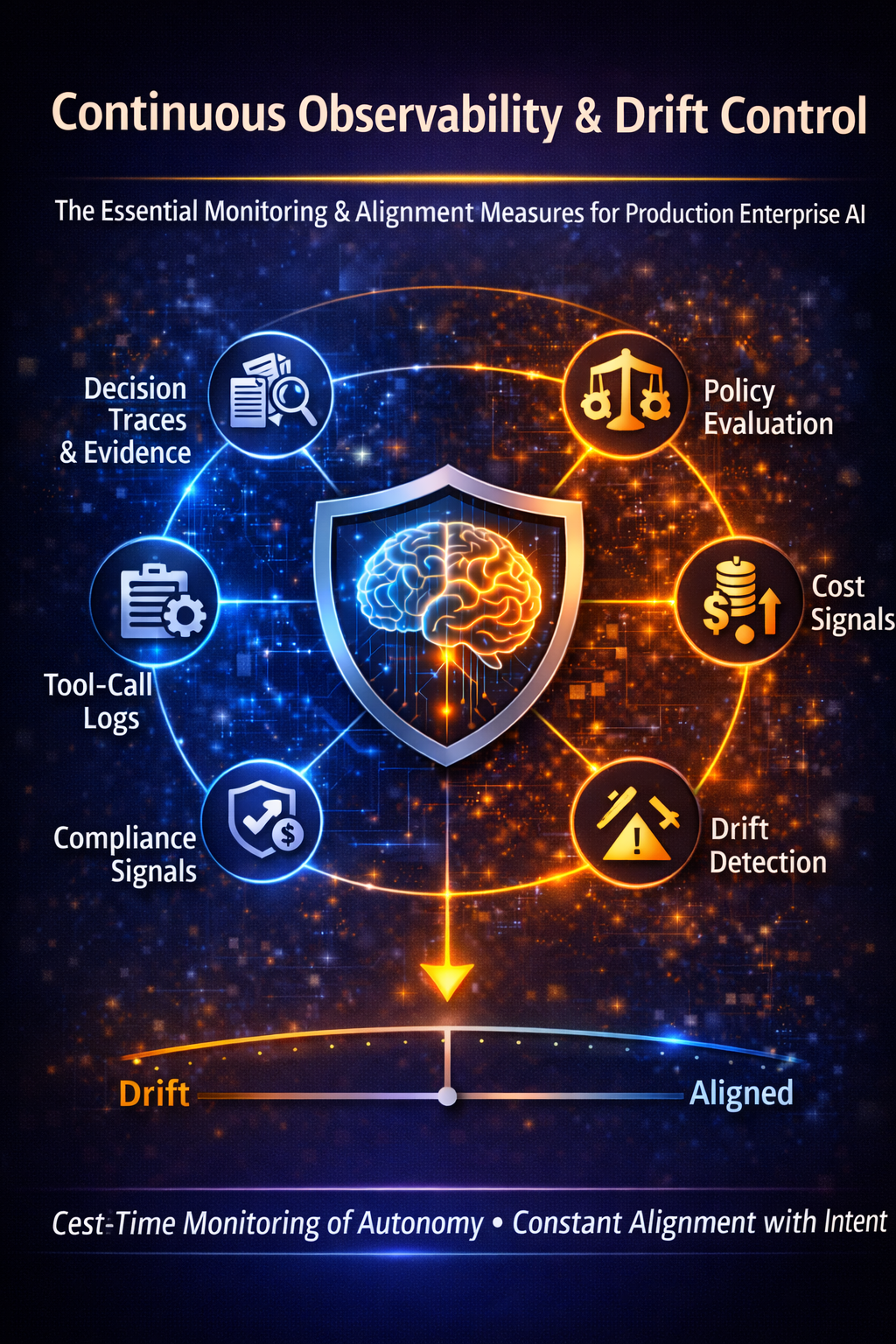
Raktim Singh

Home Blog Page 25

Why Enterprises Are Quietly Replacing AI Platforms with an Intelligence Supply Chain

Intelligence Supply Chain

The operating model that turns agents, copilots, and AI services into repeatable business capability—without runaway cost or risk.

AI won’t scale because model Intelligence Supply Chains get smarter. It will scale because enterprises learn to manufacture intelligence—reliably.

Intelligence Supply Chain

A story you’ve seen before (even if your enterprise won’t admit it)
It starts with a pilot that works.

A team launches an AI assistant to reduce workload. Early numbers look great: fewer tickets, faster response times, happier stakeholders.

Someone declares it “the future.” Another team asks for the same thing.

Then a third team. Soon there are dozens of assistants and early-stage agents, each built slightly differently—different prompts, different guardrails, different tooling, different vendors, different monitoring, different cost patterns.

A story you’ve seen before (even if your enterprise won’t admit it)

Nothing is “broken.”
But you can feel the system becoming brittle.

Then the quiet symptoms appear:

  • Costs rise in ways no one can explain.
  • Agents behave differently after minor policy updates.
  • A workflow that was safe in a sandbox becomes risky in production.
  • Teams ship faster—but governance lags behind.
  • Everyone rebuilds the same components (auth, logging, approvals, tool wrappers), and no one agrees on a standard.

At that moment, the organization realizes something uncomfortable:

It didn’t adopt AI.
It adopted a new production system—without building the factory.

That is why enterprises are moving past the “AI platform” framing and toward something more industrial: an Intelligence Supply Chain.

The market signal executives can’t ignore

The market signal executives can’t ignore

This isn’t a theoretical shift. It’s a survival shift.

Gartner predicts over 40% of agentic AI projects will be canceled by the end of 2027 due to escalating costs, unclear business value, or inadequate risk controls. (Gartner)

Notice what’s missing from that list: “the model wasn’t smart.”

The reasons are operational. Economic. Governance-related.

Which is exactly why the winners are changing the question from:

“Which AI platform should we buy?”
to
“How do we produce, govern, and run AI—reliably—every day?”

That is an operating model question.

What an “Intelligence Supply Chain” actually means (plain language)

What an “Intelligence Supply Chain” actually means (plain language)

An intelligence supply chain is an end-to-end system that lets an enterprise produce, verify, deploy, and operate intelligence with predictable:

  • quality (it behaves as intended)
  • trust (it stays within policy)
  • economics (cost is measurable and controllable)
  • reuse (capabilities are shared, not reinvented)
  • resilience (it can be monitored, corrected, rolled back)

It’s the shift from building AI to manufacturing intelligence.

And supply chain thinking forces one discipline that separates serious enterprises from experimenters:

Every unit of intelligence must flow through:
design → test → govern → cost-control → deploy → monitor → improve

Not once. Continuously.

Why “AI platforms” stop working at scale

Why “AI platforms” stop working at scale

1) Platforms optimize creation. Enterprises need flow.

Platforms help you build “something.” Supply chains help you build “things”—repeatedly, safely, economically.

The difference is not philosophical. It’s operational:

  • Platforms encourage teams to build in parallel.
  • Supply chains encourage teams to reuse what already works.

In a platform-only world, you get a fast-growing portfolio of AI artifacts.
In a supply-chain world, you get a growing portfolio of standardized intelligence products.

2) AI introduces failure modes that look like success—until it’s too late

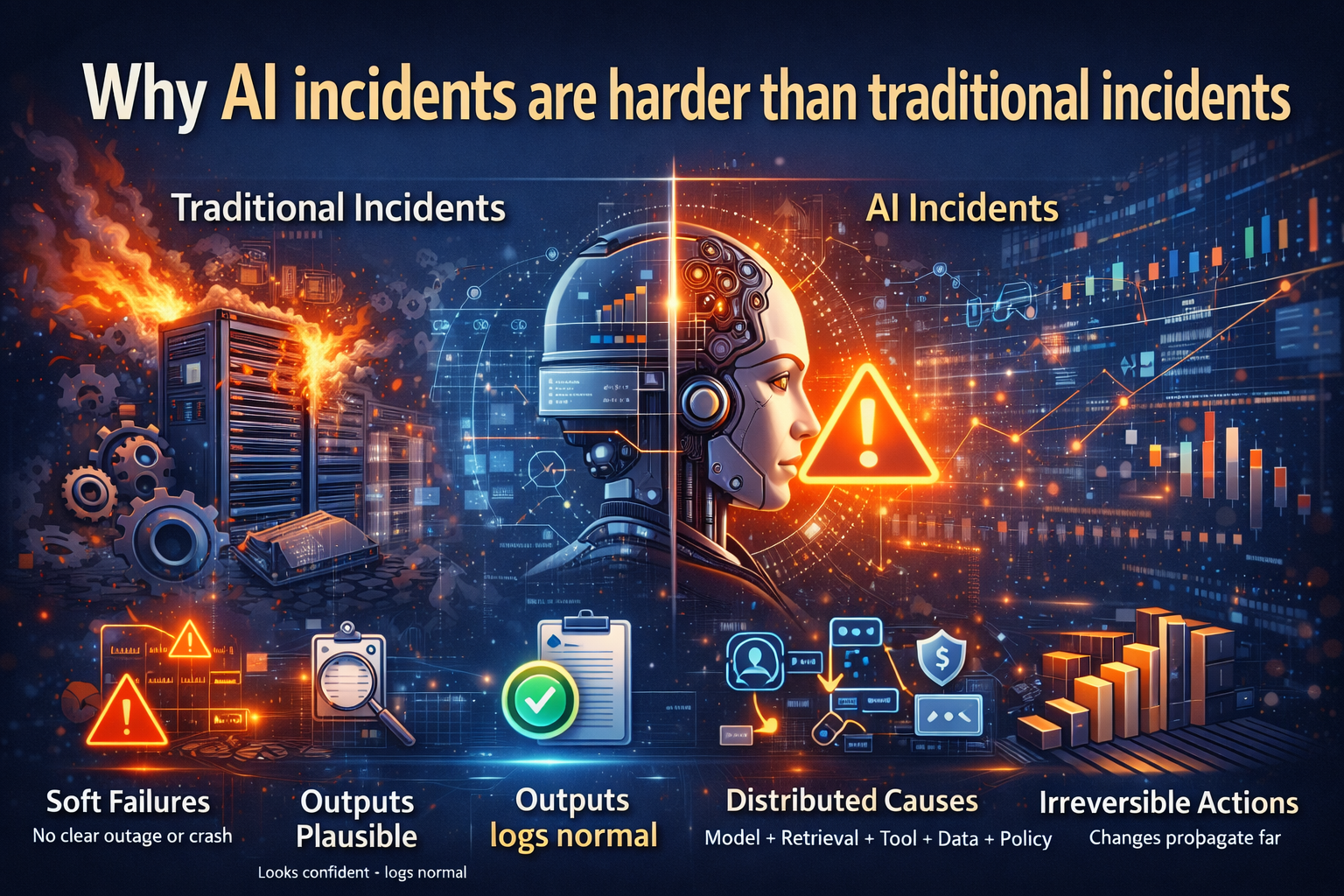
Traditional software fails loudly (outages, errors). AI can fail quietly:

  • It can be “helpful” while being noncompliant.
  • It can increase speed while injecting risk.
  • It can improve outcomes early while drifting later.

This is why lifecycle risk management matters. NIST’s AI Risk Management Framework emphasizes risk management across the AI lifecycle—design to deployment to ongoing operation. (NIST Publications)

3) AI economics isn’t a reporting problem. It’s a control problem.

With LLMs and agents, usage patterns are cost patterns.

If an agent retries, expands context aggressively, or loops through tool calls, you can get “successful completions” and still lose financially.

That is why FinOps for AI has emerged: to make AI spending governable and optimizable as an operating practice (not an after-the-fact bill review). (FinOps Foundation)

The Intelligence Supply Chain: 7 stages that make AI industrial-grade

The Intelligence Supply Chain: 7 stages that make AI industrial-grade

This is the practical model. Each stage is a failure mode if you ignore it—and a competitive advantage if you master it.

Stage 1: Sourcing — Inputs you can trust

In any supply chain, quality starts with raw materials.

In AI, “raw materials” are:

  • policies and procedures
  • approved knowledge and guidance
  • tool access rules
  • reference data
  • escalation and exception logic

Simple example:
A support assistant can sound confident while violating a policy. Not because it’s malicious—because the policy was outdated, scattered, or ambiguous.

What mature organizations do:
They treat knowledge like governed inventory: owned, versioned, curated, and refreshed.

Stage 2: Design & Assembly — Build intelligence like a product line

Many teams stop at “prompting.” But supply chain thinking asks:

  • Can this be reused?
  • Can this be composed into larger workflows?
  • Can this be policy-aware by default?

Simple example:
Instead of building “one agent per team,” you standardize components like:

  • “Explain-before-act” for sensitive steps
  • “Policy-check before execution”
  • “Approval gate when confidence is low or action is high-impact”
  • “Standard tool wrapper with logging, rate limits, and error handling”

This is the difference between artisanal AI and industrial AI.

Stage 3: Quality Engineering — Test what matters in real operations

Classic tests ask: “Does it work?”
AI tests must ask: “Does it behave safely under variability?”

You test:

  • policy compliance
  • tool-call correctness
  • robustness under ambiguous input
  • safe failure behavior
  • consistency across versions

Simple example:
An operations agent that can close incidents must be tested for:

  • missing context
  • conflicting signals
  • tool timeouts
  • edge cases where closure is prohibited
  • escalation pathways

Not to make it perfect—to make it predictable.

Stage 4: Guardrails & Governance — The rules of the factory floor

This is where most executive anxiety actually lives.

Guardrails include:

  • identity and permissions
  • least-privilege tool access
  • policy enforcement
  • audit trails
  • human-in-the-loop gates
  • escalation and kill switches

Simple example:
A procurement agent can draft a vendor email, but cannot send it without approval.
A finance assistant can prepare a reconciliation, but cannot post entries directly.

This is not bureaucracy.
This is what turns “AI that can act” into “AI that can act safely.”

Stage 5: AI FinOps & Cost Control — Make economics enforceable

Here’s the uncomfortable truth: AI cost surprises are rarely caused by one big decision. They’re caused by thousands of tiny defaults.

In a supply chain, you track cost per unit. In AI, you track cost per:

  • workflow
  • request type
  • agent
  • business outcome
  • model choice
  • tool invocation pattern

Simple example:
Two workflows appear identical:

  • Workflow A: lightweight classification + retrieval + one response
  • Workflow B: larger model + multiple tool calls + retries + aggressive context expansion

Workflow B quietly becomes your cost sink—unless cost controls are designed into the system.

FinOps for AI exists to operationalize exactly this: visibility, optimization, governance, and value tracking around AI spend. (FinOps Foundation)

Stage 6: Deployment & Orchestration — Ship intelligence safely and consistently

Orchestration means:

  • routing tasks to the right agent/model
  • sequencing steps across tools
  • managing retries and fallbacks
  • preserving context across steps
  • enforcing guardrails at every hop

Simple example:
A dispute-resolution flow orchestrates:

  • classify request
  • retrieve policy + context
  • propose options
  • policy-check options
  • draft response
  • approval if needed
  • execute update in system

Without orchestration, your enterprise gets a pile of demos.
With orchestration, you get an operating system for intelligent work.

Stage 7: Monitoring, Drift Handling, and Recall — Operate like a living system

If intelligence is a product, you need operations discipline:

  • continuous monitoring
  • drift detection
  • policy refresh cycles
  • prompt/tool updates
  • rollback when behavior changes

NIST’s lifecycle view exists for a reason: risk evolves after deployment. (NIST Publications)

Simple example:
A policy changes. The agent continues following the old rule.
Nothing breaks technically. But compliance risk rises—and outcomes drift.

A supply chain ensures updates flow through knowledge → tests → guardrails → redeployments → monitoring.

The executive payoff: three wins that get funded

The executive payoff: three wins that get funded

1) Speed without chaos

You ship faster because teams reuse standard components:
policy checks, tool wrappers, evaluation suites, deployment templates, observability, approvals.

2) Predictable economics

Cost becomes a control plane, not an argument after the bill arrives:
budgets per workflow, throttles, routing rules, thresholds, exception handling.

3) Trust at scale

Trust isn’t “the model is smart.”
Trust is “the system is governed.”

Audit trails. Evidence. Permissions. Policy enforcement. Rollback.

That is what turns AI into enterprise-grade capability.

A simple scenario that makes the shift inevitable

A simple scenario that makes the shift inevitable

Three teams build AI independently:

  • Support builds a customer assistant
  • Operations builds an incident agent
  • Finance builds a reconciliation assistant

All three require the same enterprise primitives:

  • identity and permissions
  • audit trail format
  • policy checker
  • tool-call wrapper
  • cost dashboards
  • evaluation harness
  • escalation/rollback behavior

Without a supply chain, each team reimplements these differently.

Result:

  • inconsistent compliance
  • duplicated effort
  • unpredictable cost
  • governance that cannot scale

With a supply chain, those primitives become shared infrastructure. Teams assemble solutions rather than reinventing controls.

That’s the difference between an “AI platform” and an “intelligence-producing enterprise.”

How to start (without boiling the ocean)

How to start (without boiling the ocean)

How to start (without boiling the ocean)

Pick one workflow where AI can take action (not just answer questions). Then implement a “minimum viable supply chain”:

  1. Sourcing: identify authoritative inputs + owner
  2. Assembly: build reusable components (policy check, approval gate, tool wrapper)
  3. QE: create a small test suite (policy, tool correctness, ambiguity handling)
  4. Guardrails: enforce least privilege + audit trail
  5. FinOps: track cost per successful outcome + set budgets
  6. Orchestration: add routing and fallbacks
  7. Ops: monitor drift + define rollback triggers

You’re not trying to “finish the architecture.”
You’re proving the operating model.

What to measure (signals that prove maturity)

What to measure (signals that prove maturity)

  • Reuse rate (are we scaling through reuse or cloning?)
  • Cost per successful outcome (not cost per call)
  • Policy violation rate (measured, not assumed)
  • Escalation rate (where humans intervene and why)
  • Time-to-update (how fast policy/tool/model changes propagate safely)
  • Rollback readiness (how quickly you can reverse behavior under uncertainty)

These metrics tell you if AI is industrializing—or fragmenting.

The strategic advantage

Conclusion

What’s happening: Enterprises are moving from “AI platforms” to intelligence supply chains because AI is shifting from answering to acting.

Why now: Agentic AI introduces quiet failure modes—drift, cost explosions, and policy violations—that don’t show up in demos. Market signals reinforce this: Gartner predicts over 40% of agentic AI projects may be canceled by end of 2027 due to cost, value ambiguity, and risk controls. (Gartner)

What wins: The winners will treat intelligence like a product line: sourced, assembled, tested, governed, cost-controlled, orchestrated, monitored, and continuously improved.

The strategic advantage: Not smarter models—manufactured intelligence.

FAQ

What is an intelligence supply chain in enterprise AI?

An intelligence supply chain is an end-to-end system for producing and operating AI capabilities with predictable quality, governance, cost control, and reuse—like a production line for intelligence.

Why are agentic AI projects at risk of cancellation?

Many struggle with escalating operational costs, unclear business value, and inadequate risk controls—especially when moving from pilots to production. Gartner forecasts over 40% cancellations by end of 2027. (Gartner)

How is an intelligence supply chain different from an AI platform?

An AI platform helps you build AI. An intelligence supply chain ensures AI flows through standardized sourcing, testing, governance, cost controls, deployment, monitoring, and continuous improvement—so it scales safely.

Do we need to train our own models to implement this?

No. This is model-agnostic. The core value is the enterprise operating system around models: guardrails, orchestration, observability, governance, and cost management.

What is FinOps for AI and why does it matter?

FinOps for AI applies operational cost governance to AI workloads—tracking spend drivers, optimizing usage, and aligning AI investment with measurable value. (FinOps Foundation)

How does the NIST AI RMF relate to this approach?

NIST AI RMF emphasizes managing AI risks across the lifecycle (including ongoing monitoring and governance), which aligns directly with supply chain thinking. (NIST Publications)

Glossary

  • Agentic AI: AI systems that can take actions via tools and workflows, not just generate text.
  • Orchestration: Coordinating multi-step tasks across models, tools, approvals, and fallbacks.
  • Guardrails: Controls that keep AI within policy, permissions, and safety boundaries.
  • AI FinOps: Continuous governance and optimization of AI costs and value. (FinOps Foundation)
  • Drift: When real-world changes cause AI outputs or actions to degrade over time.
  • Lifecycle risk management: Managing AI risks from design through deployment and ongoing operation. (NIST Publications)
  • Reuse: Building standardized components once and assembling solutions repeatedly.

References and further reading (credible, lightweight)

The New Enterprise Advantage Is Experience, Not Novelty: Why AI Adoption Fails Without an Experience Layer

The uncomfortable truth: Most “AI adoption” failures are experience failures

The uncomfortable truth: Most “AI adoption” failures are experience failures

Enterprises are investing in powerful AI models—then wondering why adoption stalls after the pilot.

Leaders often assume the barrier is technical: better model selection, more training data, more prompt templates.
But the most common failure is more basic: the AI arrives as a tool when people need a work experience.

When AI sits outside the workflow, employees must context-switch, translate outcomes into action, and manually bridge gaps across systems. That extra effort quietly kills adoption. People stop using the AI not because it’s useless, but because it doesn’t complete the job.

This is why many agentic AI initiatives are projected to be canceled as costs rise, business value remains unclear, and risk controls fall behind. (Gartner)
Notably, that pattern is not primarily a model problem. It’s what happens when AI is bolted on instead of designed into daily work.

The organizations that scale adoption are converging on a different idea:

Model capability creates possibility. Contextual experiences create adoption.

That’s the role of the Enterprise AI Experience Layer.

What is the Enterprise AI Experience Layer?

What is the Enterprise AI Experience Layer?

If you think of your enterprise as a city:

  • Models are the power plant—essential, impressive, but abstract.
  • Data and tools are the roads and vehicles—necessary to move work.
  • The Experience Layer is the traffic system—signals, lanes, rules, and signage—so people reach the destination safely, consistently, and quickly.

In practical terms, the Enterprise AI Experience Layer is the set of design and runtime components that ensure AI:

  1. Understands who the user is (role, permissions, intent)
  2. Pulls the right enterprise context (records, documents, policies, history)
  3. Shows up inside the workflow (in the application, at the moment of action)
  4. Turns output into usable next steps (approved paths, safe actions)
  5. Creates trust through traceability (why it decided, what it used, what it changed)

When this layer is missing, adoption turns into “copilot fatigue”: another interface, another prompt habit, another workflow break. Microsoft’s own Copilot adoption guidance emphasizes phased rollout and getting Copilot into real usage with a plan—because adoption isn’t automatic just because the tool exists. (Microsoft Adoption)

Why “better models” don’t fix adoption

Why “better models” don’t fix adoption

Most enterprises begin with a seemingly rational belief:

“Let’s pick the best model. Then employees will use it.”

That logic breaks the moment you observe real work.

Work is not a blank page. Work is:

  • a ticket with missing fields
  • a policy with exceptions
  • a record that conflicts with another system
  • an approval chain that exists for a reason
  • a handoff between teams with different incentives

A general-purpose model may be brilliant, but work is specific—and enterprise work is full of constraints. Adoption collapses when AI can’t match the specificity and procedural reality of the task.

This is why “agentic AI” increases adoption pressure: when AI can act, the organization must be confident it can act correctly, consistently, and within boundaries—not just generate plausible text. Regulators and industry leaders are increasingly spotlighting these new autonomy risks. (Reuters)

Three stories that explain most enterprise AI adoption failures

Three stories that explain most enterprise AI adoption failures

1) “The assistant is smart, but the job still isn’t done”

A finance analyst asks:
“Summarize spending anomalies this month and propose actions.”

The AI produces a clean narrative. But the analyst still has to:

  • validate numbers across systems
  • check which cost centers are exempt
  • create a ticket with the right tags
  • route it to the correct approver

So the AI output becomes interesting, not operational.

What was missing?
A workflow-native experience: retrieve the right records, apply policy, open the ticket pre-filled, propose routing, and present an approval step—all in the same flow.

2) “It worked in the pilot. It broke in production.”

A team pilots an agent to draft customer issue responses. In the pilot, it sees curated examples and clean context.

In production, it hits:

  • incomplete histories
  • contradictory policies
  • edge cases
  • cross-system workflows where one step fails mid-task

This is a widely observed pattern: agents break at workflow and integration boundaries, especially when legacy systems and rigid processes are involved. (Sendbird)

What was missing?
An Experience Layer that handles real-world variance: fallbacks, retries, safe defaults, visible state, and human handoffs at the right moments.

3) “Leadership thinks adoption is high. Employees disagree.”

Leadership says: “We rolled it out. Everyone has access. Usage should rise.”
Employees say: “It’s not in our tools. It slows us down. I’m not sure I can trust it.”

This perception gap shows up repeatedly in enterprise adoption reporting—leaders equate access with adoption, while employees experience friction and workflow disruption. (The Times of India)

What was missing?
Role-based experiences and in-the-moment assistance—AI that meets users inside their work, not as a separate destination.

The 7 building blocks of a great Enterprise AI Experience Layer

The 7 building blocks of a great Enterprise AI Experience Layer

1) Role-based intent and permissions

The AI must reliably know:

  • who the user is
  • what they’re trying to do
  • what actions are allowed

Without this, you get one of two failure modes:

  • Over-blocking: the AI can’t help when it should
  • Over-reaching: the AI takes actions that create risk

2) Context orchestration (not just retrieval)

“Context” is not a dump of documents.

Good experience design selects:

  • the minimum relevant information
  • the freshest authoritative source
  • the policy that applies to this case
  • the history that changes the decision

This is where many deployments stumble: either too little context (hallucination risk) or too much context (noise, latency, cost).

3) Workflow-native embedding (“in the flow of work”)

The experience must appear where the decision happens:

  • inside the CRM when a rep is writing
  • inside the ticketing tool when triaging
  • inside procurement during approvals

Microsoft’s adoption guidance explicitly frames rollout as a structured program—plan, implement, and drive adoption—because usage depends on embedding into real work patterns. (Microsoft Adoption)

Rule: If users have to leave their workflow to get AI help, adoption will plateau.

4) Action design: from “suggest” to “do,” safely

Agents that only generate text are limited. Agents that act create value—and risk.

The Experience Layer must define:

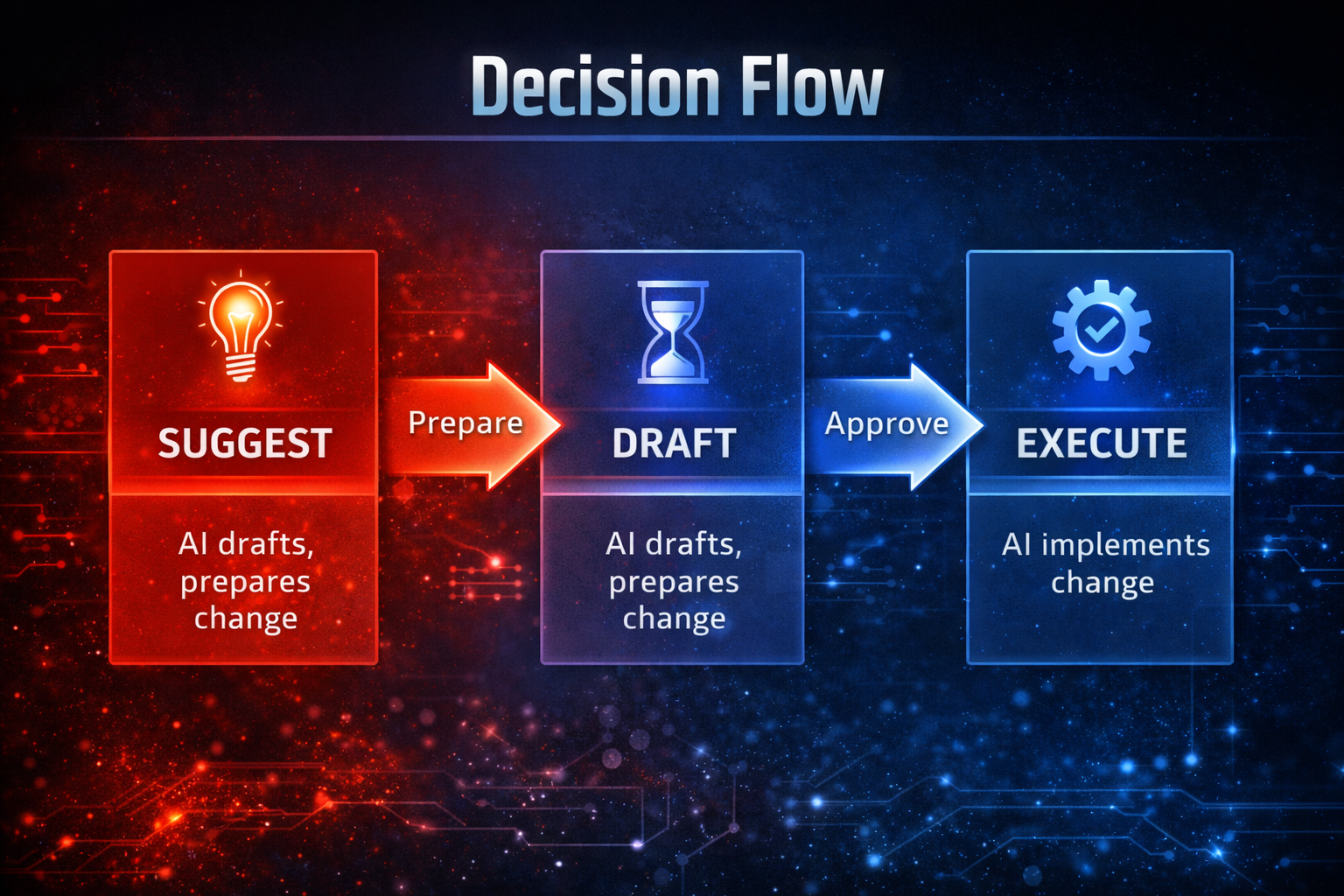
  • when AI suggests
  • when it drafts
  • when it executes
  • when approval is required
  • what triggers a stop

5) Guardrails that feel natural, not punitive

Guardrails should sound like:

  • “You can’t do that.”
  • “Here’s the approved path.”
  • “This needs approval because policy requires it.”

Not:

  • “Access denied. Figure it out yourself.”

When boundaries are visible and consistent, trust rises—because people know where the system is safe.

6) Explainability that answers the real human question: “Why?”

People don’t only ask “Is it correct?”
They ask “Why should I trust it?”

So the experience must show:

  • what sources were used
  • what policy was applied
  • what assumptions were made
  • what changed since last time

As autonomy increases, explainability and accountability expectations rise with it. (Reuters)

7) Learning loops: measure friction, not vanity usage

“Number of prompts” is not a business outcome.

The Experience Layer should measure:

  • task completion rate
  • time to resolution
  • handoff reduction
  • exception rate
  • rework caused by AI output
  • human override frequency

That’s how you improve the experience like a product—continuously.

The difference between a demo and a system

The difference between a demo and a system

A demo experience looks like:

  • user types a prompt
  • AI generates a response
  • user copy-pastes into work

A contextual enterprise experience looks like:

  • user is already in the system
  • AI reads the relevant records
  • AI applies policy constraints
  • AI proposes the next action inside the workflow
  • AI logs what it did and why
  • human approves where needed
  • outcomes feed learning loops

That difference—the “last mile” between AI output and completed work—is the Experience Layer.

A practical blueprint: how to build the Experience Layer without boiling the ocean

A practical blueprint: how to build the Experience Layer without boiling the ocean

Step 1: Choose one high-frequency workflow

Pick a workflow with:

  • clear steps
  • measurable cycle time
  • common pain points
  • known policy constraints

Examples:

  • vendor onboarding
  • incident triage
  • invoice exception handling
  • customer renewal preparation

Step 2: Design both the happy path and the exception path

Don’t just design the ideal. Design what happens when:

  • data is missing
  • policies conflict
  • system calls fail
  • approvals are delayed

Step 3: Establish an action ladder

Start with a simple progression:

  1. Suggest
  2. Draft
  3. Execute with approval
  4. Execute autonomously within limits

Step 4: Embed controls into the experience

Make guardrails predictable and visible:

  • what’s allowed
  • what needs approval
  • what’s prohibited
  • why

Step 5: Measure outcomes, not experimentation

Success isn’t “people tried it.”
Success is “the workflow completes faster, safer, and with fewer handoffs.”

Why this matters globally

Why this matters globally

Why this matters globally

The Experience Layer is no longer a UI preference. It’s becoming a global enterprise requirement because organizations must operate across:

  • data residency and sovereignty constraints
  • regulatory expectations
  • language and cultural work norms
  • fragmented legacy estates
  • different risk tolerances across regions

As agentic AI moves closer to real decisions and real actions, governance and operational reliability become board-level concerns—especially in regulated industries. (Reuters)

The new enterprise advantage is experience, not novelty

Conclusion: The new enterprise advantage is experience, not novelty

The next generation of enterprise winners won’t be defined by who experimented the most.

They will be defined by who can repeatedly convert AI into contextual work experiences—trusted, governed, measurable, and embedded in daily operations.

If your AI strategy is still centered on “pick the best model,” you’re optimizing the wrong layer.

Build the Experience Layer. That’s where adoption—and durable ROI—is won.


Glossary

Enterprise AI Experience Layer: Workflow-native interfaces and controls that embed AI into real tasks with context, permissions, guardrails, and auditability.
Context orchestration: Selecting and structuring the right enterprise information (records, policies, history) for a specific task—beyond simple retrieval.
In-the-flow-of-work: AI assistance delivered inside the application where work happens, not in a separate destination tool.
Action ladder: A staged approach to autonomy—suggest → draft → execute with approval → execute within limits.
Guardrails: Runtime constraints that prevent unsafe or non-compliant actions while keeping the user experience usable.
Exception path: The designed experience for real-world breakdowns: missing data, system errors, policy conflicts, and handoffs.


FAQ

1) Isn’t adoption mainly about training people to prompt better?
Prompt training helps, but it doesn’t solve workflow breaks. If AI isn’t embedded into systems and context, it adds steps instead of removing them. (Microsoft Adoption)

2) Do we need autonomous agents to benefit from the Experience Layer?
No. Even copilots need contextual experiences: role-based context, policy-aware behavior, and workflow-native embedding.

3) What’s the fastest starting point?
Start with one high-frequency workflow and one measurable outcome. Build there, prove impact, then replicate.

4) How do we reduce risk while increasing autonomy?
Use an action ladder and design approvals into the experience. Expand autonomy only when control and outcomes are consistently stable. (Gartner)

5) Why do agentic AI projects get canceled?
Common drivers include rising costs, unclear business value, and inadequate risk controls—especially when deployments don’t become repeatable systems. (Gartner)

References and further reading

Gartner press release: prediction that over 40% of agentic AI projects will be canceled by end of 2027 due to cost, unclear value, and risk controls. (Gartner)

The Autonomy SRE Stack: How Enterprises Run AI Autonomy Safely, Reliably, and at Scale

The Autonomy SRE

Enterprise AI is crossing a line that traditional IT operating models were never designed for.

When AI only answered questions, failure was usually soft: a wrong answer, a confusing summary, a wasted minute.

When AI takes action—creating tickets, changing records, triggering workflows, sending communications, approving requests—failure becomes operational, financial, security-related, and reputational.

That’s why the next competitive advantage is not a smarter model. It’s a run-time discipline: the ability to operate autonomy safely, predictably, and economically—at scale.

In classic software, we built SRE because reliability became existential. In agentic AI, we need the same step-change: an Autonomy SRE Stack—an “on-call runtime” for systems that decide and act.

This article explains what that stack is, why enterprises need it now, and how to implement it in a practical way—without turning innovation into bureaucracy.

Why an “On-Call Runtime” Is Now a CXO Requirement

Why an “On-Call Runtime” Is Now a CXO Requirement

“Production-grade” autonomy has a higher bar than “production-grade software,” because it can act and propagate.

A production-grade autonomous system must:

  • Follow policy, even when prompts change, data shifts, or tools fail.
  • Stay within permissions, even when the model tries creative paths.
  • Control cost, even when usage spikes or tasks loop.
  • Leave evidence—a complete narrative of what happened and why.
  • Be reversible, because autonomous actions can cascade across systems.

This is exactly why leading governance guidance emphasizes continuous risk management and lifecycle controls—not one-time checklists. The NIST AI Risk Management Framework (AI RMF) frames AI risk as an ongoing practice across GOVERN, MAP, MEASURE, and MANAGE. (NIST Publications)
And ISO/IEC 42001 formalizes the concept of an organization-wide AI management system that is established, maintained, and continually improved. (ISO)

In other words: autonomy is an operational system, not a feature.

The Autonomy SRE Stack in One Sentence

The Autonomy SRE Stack in One Sentence

The Autonomy SRE Stack is a production runtime + operating model that keeps AI agents policy-aligned, cost-bounded, auditable, and reversible—under real-world conditions.

It has four non-negotiables:

  1. Guardrails (policy enforcement at runtime)
  2. FinOps (predictable and controllable cost)
  3. Audit Trails (end-to-end traceability)
  4. Rollback (reversibility and safe recovery)

Let’s unpack each with simple, enterprise-grade scenarios.

Guardrails: The Runtime Must Enforce “You Can’t Do That”

1) Guardrails: The Runtime Must Enforce “You Can’t Do That”

Guardrails are not just safety filters. In enterprise autonomy, guardrails are runtime policy controls that constrain behavior in real time:

  • Which tools can be used
  • Which data can be accessed
  • What actions are permitted
  • What approvals are required
  • What must be logged
  • What to do when confidence is low (or when inputs look suspicious)

Security practitioners increasingly emphasize that agents introduce new threat surfaces—prompt injection, data leakage, unauthorized tool use, and identity misuse—risks that traditional controls don’t fully cover. (KPMG)

Simple example: “Vendor onboarding without chaos”

An onboarding agent is asked to “set up a new vendor quickly.” Without guardrails, it might:

  • Pull sensitive documents into an unsafe context
  • Create records in the wrong system
  • Skip mandatory compliance steps
  • Email the wrong distribution list

With runtime guardrails:

  • The agent can read only approved sources.
  • It can write only to specific systems and fields.
  • It must request approval before irreversible changes.
  • It must follow a defined onboarding checklist as policy, not suggestion.

Key design rule: Guardrails must be enforced by the runtime, not merely “suggested by prompts.” Prompts are guidance; guardrails are constraints.

What “good guardrails” look like

A robust approach typically includes:

  • Policy guardrails: what must/must not happen (data rules, approvals, action scope)
  • Tool guardrails: tool allowlists, parameter constraints, safe defaults
  • Output guardrails: format validation, sanity checks, escalation rules
  • Context guardrails: what can enter context; redaction; retrieval constraints

This layered model is becoming the practical blueprint for “controllable agents,” not just “helpful assistants.” (ilert.com)

FinOps for Autonomy: “Unlimited Tokens” Is Not a Business Model

2) FinOps for Autonomy: “Unlimited Tokens” Is Not a Business Model

A surprise cloud bill hurts. A surprise agent bill can be existential—because agents don’t just run queries; they can loop, branch, retry, call tools, and spawn tasks.

That’s why FinOps has expanded into AI and GenAI, with specific guidance on managing and optimizing AI usage and cost. (FinOps Foundation)

Simple example: “The helpful agent that quietly burns the budget”

An operations agent is designed to “keep incidents updated.” A minor change causes it to:

  • Poll every few seconds
  • Summarize every update
  • Post to multiple channels
  • Re-summarize its own summaries

No one notices for a day. Then the cost spike appears.

Autonomy FinOps prevents this with runtime cost controls:

  • Budgets per workflow (hard caps)
  • Rate limits per agent and per tool
  • Cost-aware routing (cheaper models for routine steps; premium only when needed)
  • Token/compute envelopes per task
  • Loop detection and circuit breakers
  • Caching and deduplication of repeated work

FinOps for AI discussions also highlight compliance-driven cost drivers: audits, retention requirements, licensing, and governance obligations can significantly raise operating cost if not planned. (FinOps Foundation)

Key principle: Cost must be treated like latency and reliability—a first-class SLO, not an afterthought.

Audit Trails: If You Can’t Explain It, You Can’t Run It

3) Audit Trails: If You Can’t Explain It, You Can’t Run It

In classic systems, logs help you debug.

In autonomous systems, logs become evidence.

When an agent performs actions, leaders will ask:

  • Who initiated the request?
  • What data did it use?
  • What tools did it call?
  • What decision path did it take?
  • What policy checks were applied?
  • Who approved what?
  • What changed in which systems?

ISO/IEC 42001’s emphasis on disciplined management systems reinforces why documentation, lifecycle management, and oversight are central to trustworthy AI operations. (ISO)
And NIST AI RMF positions trustworthiness as something you engineer, measure, and manage throughout the lifecycle—pushing organizations toward monitoring and traceability as ongoing requirements. (NIST Publications)

Simple example: “The disputed approval”

An agent approves a request within policy—yet later, someone disputes the outcome.

With strong audit trails, you can reconstruct:

  • Inputs (request details)
  • Context (policies, constraints, retrieved facts)
  • Actions (tools called, systems updated)
  • Approvals (human checkpoints and timestamps)
  • Rationale (why it decided; confidence signals)

Without it, you don’t have “AI.” You have unaccountable automation.

What to log (a practical checklist)

A production-grade audit trail typically captures:

  • Identity: user/service identity, agent identity, permissions
  • Intent: task goal, allowed scope, policy profile
  • Context lineage: which sources were accessed and why
  • Tool execution: tool name, parameters, responses, errors
  • Decision points: key choices, constraints applied, uncertainty signals
  • Approvals: who approved, when, what changed
  • Outcomes: mutations made, notifications sent, compensations applied

Key principle: Audit trails should be queryable narratives, not raw noise.

Rollback: Autonomy Must Be Reversible

4) Rollback: Autonomy Must Be Reversible

If an autonomous system can change reality, it must support undo.

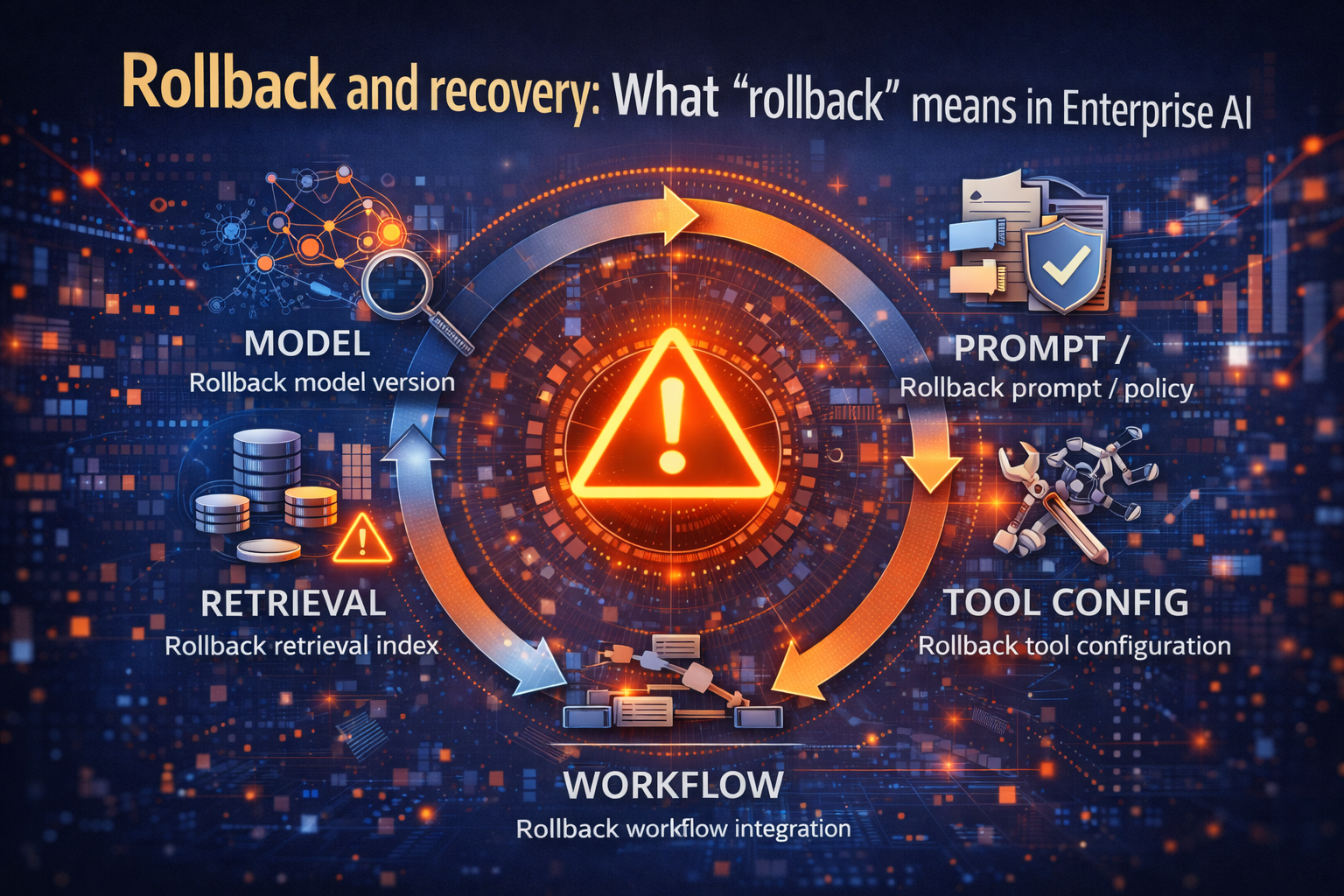
Rollback is not one mechanism. It’s a family of safety patterns:

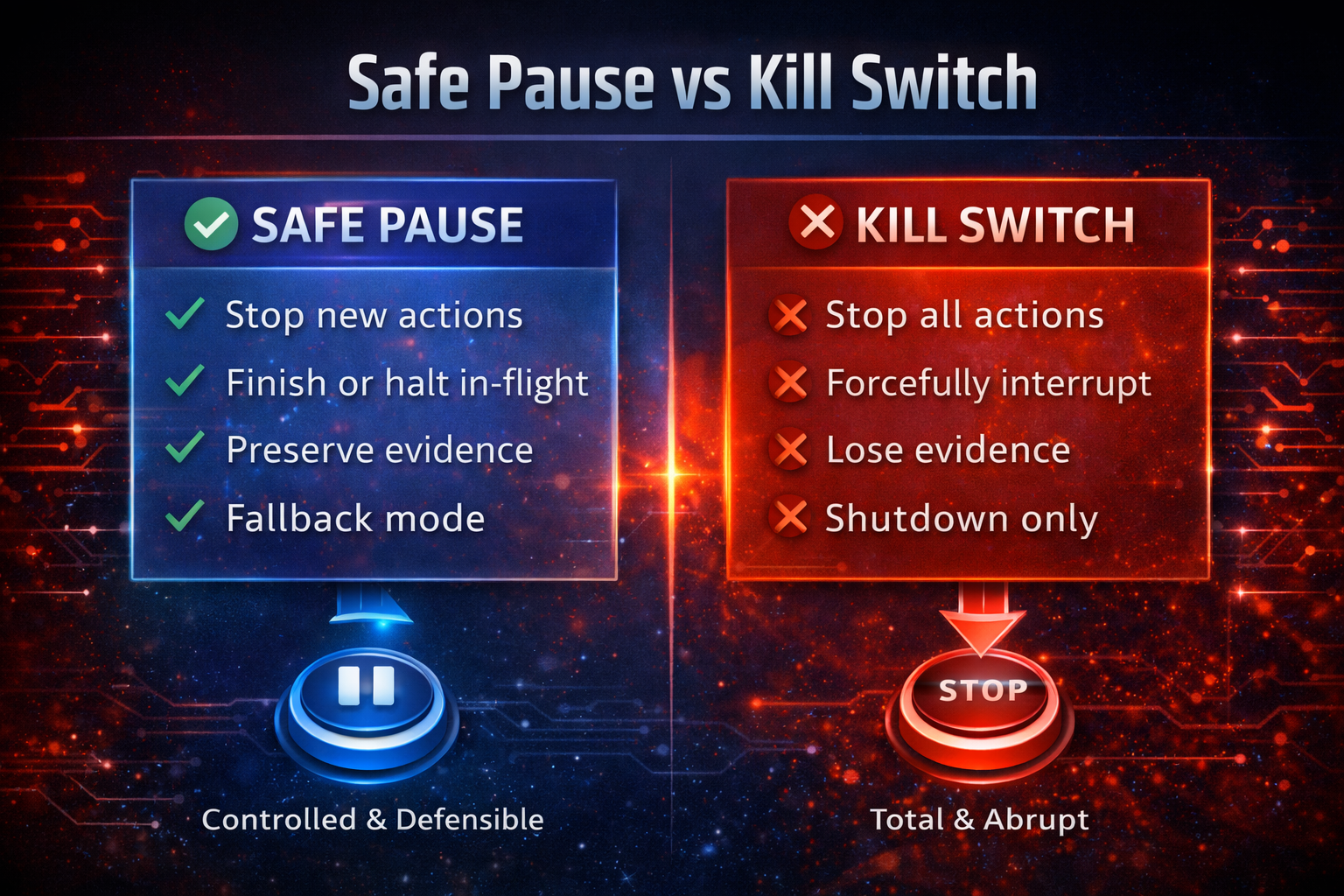
  • Soft rollback: disable the agent and stop further actions
  • Compensating actions: reverse changes (cancel, revert, credit, restore)
  • Quarantine: isolate affected records for review
  • Replay: rerun with fixed policy or corrected context
  • Kill switch: immediate stop + revoke credentials

Simple example: “The cascading update”

An agent updates records based on a misunderstood rule. Those updates trigger downstream workflows. Now multiple systems are affected.

With rollback design:

  • Writes are transactional where possible
  • Changes are versioned or event-sourced so they can be reversed
  • Circuit breakers stop propagation when anomaly signals spike
  • Recovery runs apply compensating actions safely

Key principle: You don’t scale autonomy unless you can recover quickly and cleanly.

The Missing Piece: Incident Response for Agents

The Missing Piece: Incident Response for Agents (AI On-Call)

Now bring the four pillars together: guardrails, FinOps, audit trails, rollback.

What do they enable? The real objective:

An AI on-call operating model—so autonomy is governable in the messy reality of production.

Industry messaging is increasingly explicit about “AI SRE” as an incident-response pattern: triage, root cause analysis, documentation, and runbook-driven remediation. (Harness.io)
Even major observability vendors are now describing “AI SRE” as an on-call teammate concept for investigating and responding to incidents. (Datadog)

What an “agent incident” looks like (plain language)

  • Wrong action performed
  • Right action performed in the wrong system
  • Policy violation attempt blocked (but repeatedly attempted)
  • Data accessed outside intended scope
  • Cost spike from loops
  • Tool failures causing retries and drift
  • Inconsistent behavior across environments

The AI on-call playbook (without bureaucracy)

A good Autonomy SRE Stack supports:

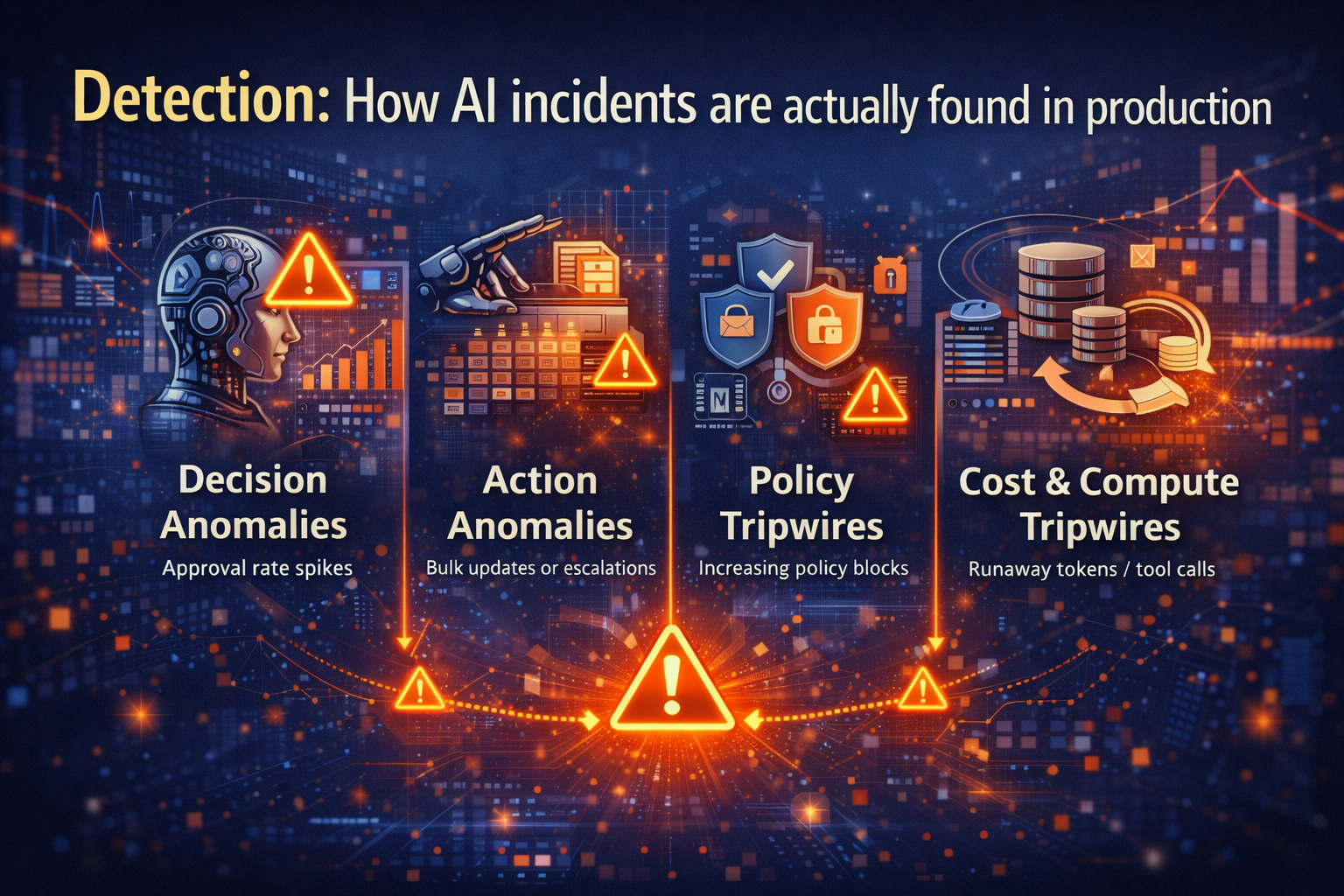
  • Detection: anomaly signals, policy violations, cost spikes
  • Triage: classify incident type and likely impact fast
  • Containment: disable agent or restrict permissions immediately
  • Forensics: replay the agent trace and decision path
  • Recovery: rollback/compensate and restore safe state
  • Prevention: update guardrails, improve tests, refine budgets
The Architecture Pattern Behind the Stack

The Architecture Pattern Behind the Stack

Think of the Autonomy SRE Stack as two layers:

  1. A) Build-time discipline (designed before production)

  • Approved tools + permission models
  • Policy profiles (what the agent is allowed to do)
  • Test harnesses and simulations
  • Cost budgets and routing policies
  • Logging schemas and evidence requirements
  1. B) Runtime discipline (enforces reality in production)

  • Policy enforcement and guardrails
  • Identity, secrets, and access control
  • Observability and incident signals
  • Cost measurement and budgets
  • Audit trails and trace replay
  • Rollback mechanisms and kill switches

This is why enterprises are gravitating toward integrated stacks rather than point tools: autonomy requires coordinated controls, not isolated features.


A Practical 30–60–90 Day Adoption Path

First 30 days: Make autonomy safe enough to run

  • Define 5–10 “allowed actions” and block everything else
  • Implement tool allowlists + approval checkpoints
  • Add cost caps per workflow
  • Turn on structured trace logging for every action

Next 60 days: Make it observable and governable

  • Add anomaly detection for loops and spikes
  • Implement incident playbooks and escalation rules
  • Make trace replay easy for auditors and engineers
  • Start measuring policy adherence rate and rollback time

Next 90 days: Make it scalable and reusable

  • Standardize policy profiles by workflow type
  • Add cost-aware routing and caching
  • Establish continuous improvement loops (guardrails + tests + budgets)
  • Convert common capabilities into reusable “services” so teams don’t reinvent controls


What CXOs Should Measure (No Vanity Metrics)

Instead of “number of agents,” measure whether your runtime is real:

  • Policy adherence rate (blocked vs allowed actions, by category)
  • Mean time to rollback (how fast you can reverse bad actions)
  • Cost per outcome (not cost per call)
  • Incident rate per 1,000 actions (stability under real load)
  • Audit completeness (how often you can reconstruct a full decision path)

If these improve, autonomy is becoming a capability—not a science project.

enterprise that can run autonomy safely

Conclusion: Autonomy Won’t Be Won by Intelligence Alone

Enterprise AI won’t be won by the smartest model.

It will be won by the enterprise that can run autonomy safely—on-call, auditable, cost-bounded, and reversible—at scale.

That is what an Autonomy SRE Stack delivers:

  • Guardrails that hold
  • FinOps that scales
  • Audit trails that prove
  • Rollback that saves

The organizations that treat autonomy as an operational discipline—not an innovation experiment—will be the ones that earn durable trust and durable ROI.

The Autonomy SRE Stack extends classic Site Reliability Engineering into the era of AI agents, where systems must not only stay available—but remain aligned, auditable, and reversible as they act autonomously.”

FAQ 

What is the Autonomy SRE Stack?
A production runtime + operating model that keeps AI agents policy-aligned, cost-bounded, auditable, and reversible—with an on-call approach to incidents and recovery.

Why is “AI on-call” necessary?
Because agentic AI can take actions that impact operations, cost, and security. When incidents happen, you need fast triage, containment, forensics, and rollback—like SRE for software. (Datadog)

What are AI guardrails in an enterprise runtime?
Runtime-enforced controls that constrain data access, tool usage, approvals, outputs, and actions—so the agent cannot exceed policy boundaries. (ilert.com)

What is FinOps for AI, and why does it matter?
FinOps for AI applies budgeting, optimization, and accountability to AI spend—especially important for agents that can loop, branch, and call tools. (FinOps Foundation)

How do audit trails differ from normal logging?
Audit trails are structured, end-to-end “decision narratives” that reconstruct identity, context lineage, tool calls, approvals, and outcomes—usable for governance and accountability.

What does rollback mean for AI agents?
Rollback is the ability to stop, reverse, compensate, quarantine, and recover from autonomous actions quickly—using kill switches, compensating transactions, versioned changes, and replay.


Glossary

  • Agentic AI: AI that plans and takes actions using tools and workflows, not just generating text.
  • Autonomy SRE: Reliability engineering for autonomous AI systems, including incident response and recovery.
  • AI Guardrails: Runtime policy and security controls that constrain agent behavior.
  • FinOps for AI: Cost governance practices for AI workloads, including budgets, optimization, and accountability. (FinOps Foundation)
  • Audit Trail: A structured, queryable record of what the agent did, why, and with what approvals.
  • Rollback: Mechanisms to reverse or compensate actions and restore safe state.
  • Kill Switch: Immediate disabling of an agent’s ability to act (often paired with credential revocation).
  • Policy Profile: A reusable set of permissions, constraints, and approval rules for a workflow class.


References and Further Reading

Enterprise AI Drift: Why Autonomy Fails Over Time—and the Fabric Enterprises Need to Stay Aligned

The Uncomfortable Truth: Enterprise AI Rarely Fails on Day One

Most enterprise AI initiatives do not collapse because the model was poorly trained or insufficiently intelligent.

The Uncomfortable Truth: Enterprise AI Rarely Fails on Day One

They fail because the enterprise changes—and the AI does not change with it.

An agent is deployed.
Early results look promising.
Leaders celebrate early ROI.

Then, quietly, the signals begin to shift:

  • “It used to approve the right exceptions. Now it approves the wrong ones.”
  • “Latency has increased, costs have doubled, and no one can explain why.”
  • “It follows instructions—but violates policy.”
  • “Nothing is technically broken… yet business outcomes are drifting.”

This pattern has a name.

Enterprise AI Drift is the slow, often invisible gap that grows between design intent and production behavior as real-world conditions evolve.

National Institute of Standards and Technology explicitly recognizes that deployed AI systems require continuous monitoring, maintenance, and corrective action because data, models, and operating contexts inevitably change. Drift is not an anomaly; it is the default state of AI in production.

This is why autonomy fails over time—and why enterprises are moving toward a new architectural shape: a fabric—a modular, integrated system designed to keep AI aligned continuously, not just launched successfully once.

What Exactly Is “Enterprise AI Drift”?

What Exactly Is “Enterprise AI Drift”?

Enterprise AI Drift is best understood as misalignment accumulation.

It emerges when the assumptions underpinning an AI system’s decisions quietly shift—often independently and simultaneously.

  1. Reality Drift

Markets move. Customer behavior changes. Fraud patterns evolve. Supply chains fluctuate. Operational constraints tighten.

  1. Data Drift

Production data diverges from training data—new formats, new sources, new noise, new correlations.

  1. Policy Drift

Risk appetite changes. Compliance rules evolve. Internal approval thresholds shift.
The International Organization for Standardization standard ISO/IEC 42001 explicitly emphasizes continual improvement in AI management systems because AI must remain aligned as governance expectations evolve.

  1. Tool Drift

APIs change. Permissions are restructured. Downstream systems are modernized. Workflows are redesigned.

  1. Model Drift

Models are upgraded. Prompts are refined. Retrieval strategies change. Inference parameters are tuned—altering behavior in subtle but meaningful ways.

  1. Human Drift

People adapt. They learn how to “work around” the system, override it selectively, or route edge cases differently.

The critical insight: drift is not a single failure mode.
It is a system property of autonomy operating inside a living enterprise.

Why Drift Is More Dangerous for Agents Than for Traditional ML

Why Drift Is More Dangerous for Agents Than for Traditional ML

Concept drift has long been recognized in traditional machine learning. But agentic AI amplifies the risk.

Why?

Because agents do not merely predict. They act.

When AI takes action inside enterprise systems:

  • A small decision error can cascade across workflows.
  • A faulty tool call can write incorrect data that future steps trust.
  • A subtle policy misinterpretation can create audit exposure—even when outputs look reasonable.

This is why the NIST AI Risk Management Framework treats AI risk as a lifecycle challenge—governed, measured, and managed continuously rather than validated once at deployment.

Autonomy changes the risk equation from accuracy to operational integrity.

Three Drift Stories Every Executive Recognizes

Three Drift Stories Every Executive Recognizes

Story 1: The Vendor Onboarding Agent That Slowly Becomes Non-Compliant

An enterprise deploys an agent to collect vendor documents, validate fields, route approvals, and create onboarding records.

  • Month 1: Works perfectly.
  • Month 3: Procurement adds a new due-diligence step. Risk tightens thresholds. A downstream system renames a field.

Nothing crashes. The agent still completes onboarding.

But:

  • Required checks are skipped,
  • Approvals are misrouted,
  • Records pass operational review—but fail audit.

The agent remained functional.
The enterprise definition of “correct” changed.

That is drift.

Story 2: The Refund Agent That Becomes Expensive Without Becoming Smarter

An agent is deployed to approve refunds within policy.

  • Month 1: Stable costs.
  • Month 2: Policy language expands. New support categories are introduced. Prompt templates grow more complex.

Now the agent:

  • Makes more tool calls,
  • Requests more context,
  • Loops more frequently,
  • Costs more per decision,
  • Takes longer to respond.

Business outcomes stagnate.
Economics drift silently.

Story 3: The Incident Assistant That Turns into a Security Risk

An incident triage agent is deployed.

  • Month 1: Highly effective.
  • Month 4: Security tightens access. Tool permissions change. Failures increase.

Engineering adds a “temporary” workaround—broadening permissions.

Now the system works again.
But it violates zero-trust principles.

This is why drift becomes a board-level issue: it links autonomy directly to risk, cost, and trust.

Why Point Tools Fail: Drift Requires a Fabric, Not a Patch

Why Point Tools Fail: Drift Requires a Fabric, Not a Patch

Most organizations respond to drift tactically:

  • A dashboard here,
  • A prompt tweak there,
  • A new evaluation script,
  • A manual approval workaround.

This is equivalent to patching reliability into a system after it is live.

But drift is not a feature gap.
It is a continuous alignment problem.

Solving it requires a continuous alignment system.

That is what an enterprise AI fabric provides:
an integrated, modular environment where build, run, observe, recover, and evolve are first-class capabilities—not afterthoughts.

The Drift Map: Six Failure Modes Enterprises Must Design For

The Drift Map: Six Failure Modes Enterprises Must Design For

  1. Intent Drift

What leaders intended versus what the agent actually does in production.
Fix: Encode intent as enforceable policies and acceptance criteria—not just natural language.

  1. Context Drift

Knowledge bases evolve. Retrieval sources change. “Truth” moves.
Fix: Governed memory, provenance-aware retrieval, and versioned context policies.

  1. Behavior Drift

Prompts, planners, and guardrails evolve, altering decision style.
Fix: Controlled releases, canarying, rollback, and behavioral regression testing.

  1. Tool Drift

APIs, schemas, and rate limits change.
Fix: Contract testing, bounded retries, safe fallbacks, and tool-level kill switches.

  1. Economic Drift

Token usage, retries, and latency inflate without proportional value.
Fix: Cost envelopes, per-workflow budgets, and continuous optimization.

  1. Governance Drift

Regulatory and internal controls evolve.
Fix: Lifecycle governance with automated evidence generation—not manual audits.

What “Staying Aligned” Looks Like in Practice

What “Staying Aligned” Looks Like in Practice

Beating drift requires a closed loop.

Step 1: Design Autonomy with Explicit Operational Contracts

Define:

  • What the agent can do,
  • What it must never do,
  • What data it can access,
  • What approvals are mandatory,
  • What evidence must be logged.

Step 2: Run Autonomy with Observable Boundaries

Observability must extend beyond uptime to behavioral integrity.
Industry practices increasingly emphasize end-to-end tracing of agent inputs, outputs, latency, tool usage, and failure modes.

Step 3: Measure Drift Continuously

Track:

  • Policy-violation attempts,
  • Tool-call anomalies,
  • Retrieval source shifts,
  • Escalation and override rates,
  • Cost-per-decision trends,
  • Latency distributions.

Step 4: Recover Fast with Reversible Autonomy

Rollback configurations. Disable tools. Switch policy sets. Route edge cases to humans.

Step 5: Improve Through Controlled Evolution

ISO/IEC 42001 frames AI as a dynamic system—requiring continuous review, learning, and refinement.

The Fabric Principle: Why Modularity Must Be Integrated

The Fabric Principle: Why Modularity Must Be Integrated

Executives need to internalize a simple truth:

Autonomy does not scale on intelligence.
It scales on alignment infrastructure.

A fabric approach enables:

  • Modularity (swap models and tools without rebuilds),
  • Integration (shared controls and observability),
  • Reuse (services-as-software, not one-off projects),
  • Continuity (evolve without breaking reliability).
Global Reality Check: Drift Accelerates with Enterprise Complexity

Global Reality Check: Drift Accelerates with Enterprise Complexity

Large enterprises operate across:

  • Multiple business units,
  • Multiple platforms,
  • Multiple risk postures,
  • Multiple regulatory expectations.

Heterogeneity is normal.
And heterogeneity accelerates drift.

This is why a fabric is not merely a technology decision—it is an operating model decision.

How to Encode This Into Your 2026 Enterprise AI Strategy

  1. Assume drift. Ask where it will emerge first.
  2. Make alignment measurable. What you cannot observe, you cannot govern.
  3. Design reversibility. Every autonomous action must have a recovery path.
  4. Productize intelligence. Treat AI as services-as-software.
  5. Choose a fabric, not a zoo. Drift is systemic—solve it systemically.
Global Reality Check: Drift Accelerates with Enterprise Complexity

Conclusion: The Line Leaders Will Repeat

Global Reality Check: Drift Accelerates with Enterprise Complexity is inevitable.

What is not inevitable is allowing it to quietly erode trust, inflate costs, and accumulate hidden risk.

The enterprises that win in 2026 will not be those with the most agents.
They will be those with the strongest alignment fabric—systems that keep autonomy safe, economical, and policy-correct as everything around them changes.

If your autonomy cannot stay aligned over time, you do not have enterprise AI.

You have a demo—with a countdown timer.

References & Further Reading

Glossary: Key Terms in Enterprise AI Drift & Alignment

Enterprise AI Drift

The gradual misalignment between an AI system’s original design intent and its real-world behavior over time, caused by changes in data, policies, tools, models, workflows, and human usage. Unlike outright failures, enterprise AI drift is often silent and cumulative.

Agentic AI

AI systems capable of taking actions—such as triggering workflows, updating records, invoking tools, or coordinating tasks—rather than merely generating recommendations or predictions.

Autonomy (in Enterprise AI)

The delegation of work to AI systems with the authority to make decisions and execute actions within defined boundaries, rather than operating only as advisory or assistive tools.

Alignment Fabric (Enterprise AI Fabric)

A modular yet integrated enterprise architecture that continuously keeps AI systems aligned with business intent, policies, cost constraints, and operational realities as conditions evolve. Alignment fabrics treat governance, observability, recovery, and evolution as first-class capabilities.

Policy Drift

A form of AI drift that occurs when regulatory requirements, risk tolerance, internal controls, or approval rules change—rendering previously correct AI behavior non-compliant or unsafe.

Data Drift

The divergence between training or validation data and real-world production data, often due to changing user behavior, new data sources, evolving formats, or noise.

Tool Drift

Misalignment caused by changes in APIs, downstream systems, permissions, schemas, or workflows that AI agents depend on to execute actions.

Model Drift

Behavioral changes introduced when AI models, prompts, retrieval strategies, or inference configurations are updated—sometimes improving performance in one area while degrading alignment elsewhere.

Human-in-the-Loop

A design pattern where human oversight, approval, or intervention is embedded into autonomous workflows—especially for high-risk or ambiguous decisions.

Reversible Autonomy

The capability to safely pause, roll back, constrain, or override autonomous AI behavior in production without system-wide disruption.

Services-as-Software

An enterprise operating model where AI capabilities are packaged, governed, and reused as standardized services rather than delivered as isolated, one-off projects.

AI Observability

The ability to monitor not just system uptime, but AI behavior—including inputs, outputs, tool usage, decision paths, latency, cost, and policy conformance—in real time.

Lifecycle Governance

A governance approach that manages AI risk continuously across design, deployment, operation, monitoring, and evolution—rather than relying on one-time approvals.

Operational Resilience (AI)

The ability of AI systems to absorb change, recover from disruptions, and continue operating safely and economically under evolving conditions.

Frequently Asked Questions (FAQ)

  1. What is Enterprise AI Drift in simple terms?

Enterprise AI drift happens when an AI system continues to operate, but no longer behaves the way the business expects. The system may still “work,” yet its decisions gradually become misaligned with policies, costs, compliance requirements, or business goals.

  1. Why do AI agents fail over time even if they worked well initially?

Because enterprises are not static. Data changes, policies evolve, tools are updated, and workflows shift. If AI systems are not designed to adapt continuously, misalignment accumulates—even when no single component appears broken.


  1. Is Enterprise AI Drift just a model retraining problem?

No. While model retraining can address some data drift, most enterprise AI drift originates from policy changes, tool evolution, cost pressures, governance updates, and human behavior shifts—not from models alone.

  1. How is AI drift different in agentic systems compared to traditional machine learning?

Traditional ML systems typically make predictions. Agentic AI systems take actions. This means small errors can propagate across workflows, create audit exposure, or generate cascading operational failures.

  1. How can organizations detect AI drift early?

By continuously monitoring:

  • policy violations and overrides
  • abnormal tool-call patterns
  • cost-per-decision trends
  • latency changes
  • escalation rates
  • shifts in retrieved data sources

Early detection requires observability focused on behavior, not just system health.

  1. Why can’t enterprises fix AI drift using point tools?

Because drift is a system-wide phenomenon. Point tools operate in silos, while drift spans models, data, tools, governance, and human processes. Only an integrated alignment fabric can manage drift holistically.

  1. What does “staying aligned” mean for enterprise AI?

Staying aligned means ensuring that AI systems:

  • continue to follow current policies,
  • remain cost-efficient,
  • operate safely under change,
  • and can be corrected or rolled back quickly when misalignment appears.
  1. What role does governance play in managing AI drift?

Governance ensures that AI behavior remains auditable, explainable, and compliant as rules evolve. Lifecycle governance treats AI as a living system requiring ongoing oversight—not a one-time approval.

  1. Why is reversibility critical for autonomous AI?

Because drift is inevitable. The ability to reverse or constrain autonomous behavior allows enterprises to recover quickly without shutting down systems or accepting unmanaged risk.

  1. What will distinguish winning enterprises in AI by 2026?

Not the number of AI agents deployed—but the strength of the alignment fabric that keeps autonomy safe, observable, economical, and trusted as complexity increases.

  1. Is an Enterprise AI Fabric a technology or an operating model?

It is both. An alignment fabric combines architectural capabilities with operational discipline, enabling enterprises to scale autonomy responsibly rather than reactively.

The Agentic Foundry: How Enterprises Scale AI Autonomy Without Losing Control, Trust, or Economics

Executive takeaway: autonomy must be operated, not just built

The first wave of enterprise AI made information easier to access. The next wave changes how work happens.

The Agentic Foundry
The Agentic Foundry

Once AI systems can take actions—create tickets, update records, approve requests, trigger workflows, coordinate tools—the hardest problem stops being “How smart is the model?” and becomes:

Can the enterprise run autonomy safely, predictably, and economically—at scale?

This isn’t a theoretical concern. Gartner has publicly predicted that over 40% of agentic AI projects will be canceled by the end of 2027 due to escalating costs, unclear business value, or inadequate risk controls—and has also flagged “agent washing” as a source of hype and confusion. (See References / Further Reading.) (Gartner)

So the strategic question for leaders becomes brutally practical:

Can we scale hundreds of AI agents without creating an “agent zoo,” runaway spend, and fragile trust?

This article offers a single blueprint that does exactly that: the Agentic Foundry + Reliability-by-Design.

The moment AI starts acting, the old playbook breaks

The moment AI starts acting, the old playbook breaks

For years, enterprise AI was mostly answering AI: chatbots, copilots, search assistants, summarizers. Useful—but bounded. If it responded incorrectly, the damage was often limited to confusion, rework, or a delayed decision.

Action changes the physics.

An agent that can change a system of record can also:

  • create real financial exposure,
  • trigger compliance violations,
  • leak sensitive data through toolchains,
  • or break customer trust in one fast sequence of “reasonable” steps.

This is why regulators and industry bodies are increasingly focused on accountability, governance, and traceability as agentic AI moves into real operations. (Reuters)

Why “Agent Zoo” is the default outcome

Why “Agent Zoo” is the default outcome (and why it’s so expensive)

If you walk into most enterprises today, you will see a familiar pattern:

  • A few teams prototype agents using different stacks and toolchains.
  • Each team makes its own choices: prompts, tools, guardrails, logging, approvals, escalation.
  • Early demos look impressive.
  • Then the organization tries to scale—and the program stalls.

That stall isn’t mysterious. It’s what happens when you scale autonomy without an operating model.

The four failure dynamics behind agent sprawl

1) Every agent becomes a snowflake
Different policies, different permissions, different logging, different assumptions. Security and risk teams cannot certify behavior consistently.

2) Costs become non-linear
Model usage, tool calls, retrieval, orchestration, monitoring—everything multiplies. Without unit economics, leaders cannot distinguish “value” from “burn.”

3) Incidents become hard to diagnose
When something goes wrong, no one can confidently answer:

  • What did the agent see?
  • Which policy applied?
  • Which tool call changed the record?
  • Why did it choose that action at that moment?
  • Can we undo it—quickly and cleanly?

4) Trust collapses
The business stops giving agents permission to act. Autonomy gets “paused.” The initiative becomes a collection of pilots.

That’s the Agent Zoo: many agents, little standardization, inconsistent controls, escalating spend, and fragile trust.

The combined solution: Factory + Contract

The combined solution: Factory + Contract

To scale hundreds of agents, enterprises need two things that work together—not separately.

1) The Agentic Foundry (the factory)

A repeatable production system for building, governing, deploying, and operating agents—consistently.

2) Reliability-by-Design (the contract)

A non-negotiable reliability contract that every agent must ship with—so autonomy stays policy-aligned, observable, reversible, auditable, and cost-bounded.

Think of it like this:

  • The Foundry makes agent creation repeatable.
  • Reliability-by-Design makes agent operation trustworthy.

This pairing also aligns with what large enterprises are converging toward: unified, enterprise-grade platforms that centralize visibility, enforce usage policies, and reduce AI-specific risks. (Gartner)

What is an Agentic Foundry

What is an Agentic Foundry?

An Agentic Foundry is not “just a tool.” It is an operating model implemented as platform capability—a shared set of components that turns agent-building into a disciplined lifecycle.

At its best, it behaves like a modern software factory.

Core capabilities of a Foundry

Reusable blueprints (agent archetypes)
Pre-defined agent patterns you can copy, adapt, and certify—so teams don’t start from scratch.

Prebuilt connectors (tool integration once, reused many times)
Standardized integrations into enterprise systems—ticketing, CRM, core banking, ERP, HR, data platforms.

Policy packs (permissions + constraints)
Approved guardrails that are centrally defined, versioned, and automatically applied.

Testing and simulation gates
Validation before any agent can act in production workflows.

Observability and audit evidence
Always-on tracing: what happened, why, through which tools, under which policy.

Cost envelopes (unit economics per agent)
Cost budgets that make autonomy economically governable.

Promotion pipeline (prototype → governed service → scaled autonomy)
A lifecycle path that keeps innovation fast and production safe.

The Foundry enables a shift leaders care about: from one-off “AI projects” to reusable services-as-software—capabilities that are governable, measurable, and repeatable across the enterprise.

The Reliability-by-Design contract: the 7 non-negotiables

The Reliability-by-Design contract: the 7 non-negotiables

If the Foundry is the factory, Reliability-by-Design is the quality standard.

Every agent must ship with these “seven guarantees” before it can act in production.

1) Policy boundaries

The agent must have explicit boundaries:

  • what it may do,
  • what it may not do,
  • what requires escalation.

This is aligned with global best-practice guidance that emphasizes risk management across the AI lifecycle—such as the NIST AI RMF’s GOVERN / MAP / MEASURE / MANAGE functions. (NIST Publications)

2) Identity and least privilege

Agents must have unique identities and minimum required permissions—no “super-user agents.”

This is how you prevent silent privilege creep as agents proliferate.

3) Observability and traceability

In minutes—not days—you must be able to answer:

  • what the agent observed,
  • what policy applied,
  • what tools it invoked,
  • what it changed,
  • what it attempted and failed to do.

This is operationally essential—and increasingly tied to enterprise expectations for AI accountability and audit readiness. (NIST)

4) Human-by-exception approvals

Not every step needs a human. But some steps must.

Reliability-by-Design defines the “high-risk edges” where approval is mandatory:

  • high-value transactions,
  • irreversible changes,
  • customer-impacting decisions,
  • policy or compliance boundaries.

5) Rollback and kill-switch

Autonomy must be reversible.

If you cannot stop an agent and undo its actions quickly, you don’t have managed autonomy—you have operational exposure.

6) Audit evidence pack

Every agent must emit audit-ready evidence:

  • policy version applied,
  • action taken,
  • timestamps,
  • tool calls,
  • decision context.

This is the bridge from “agent demo” to “enterprise governance,” and it maps naturally to AI management system expectations such as ISO/IEC 42001’s focus on organizational discipline for responsible AI. (ISO)

7) Cost envelope (unit economics)

Agents must operate under a defined cost boundary:

  • budgets per workflow,
  • quotas for tool calls,
  • caps on retries,
  • alerts on spend anomalies.

Cost is not a finance footnote. It is the control surface that prevents autonomy from becoming an unbounded liability—one of the core reasons Gartner expects many projects to be scrapped. (Gartner)

Two simple examples (why Foundry + RBD matters in real life)

Two simple examples (why Foundry + RBD matters in real life)

Two simple examples (why Foundry + RBD matters in real life)

Example A: Vendor onboarding—without chaos

A vendor onboarding agent collects documents, validates fields, checks policy rules, and triggers onboarding steps.

Without a Foundry:
Every business unit builds its own version. Some log decisions; some don’t. Approval steps vary. Tool connectors are duplicated. Security reviews become slow and inconsistent.

With a Foundry + Reliability-by-Design:

  • Onboarding becomes a certified archetype (a reusable blueprint).
  • Tool connectors are standardized and reusable.
  • The agent inherits policy packs and approval boundaries.
  • Observability is mandatory.
  • Rollback exists for reversible steps (cancel workflow, revoke access, stop notifications).
  • Unit cost per onboarding is tracked and optimized.

Result: onboarding becomes a scalable enterprise capability, not a fragile pilot.

Example B: The refund agent that was “correct”—and still caused an incident

A refund agent approves refunds correctly most of the time. Then a rare edge case occurs: it updates the ledger, triggers a customer notification, and fails before reconciliation. Customers receive refund confirmations, but finance must manually repair the ledger state.

This is not a model intelligence problem. It is an operability problem:

  • missing rollback workflow,
  • missing step-level observability,
  • missing exception boundaries,
  • missing cost-aware retry logic.

Under Reliability-by-Design, this agent would be required to:

  • stage actions safely,
  • use transactional tool contracts where possible,
  • emit trace logs,
  • stop and escalate on reconciliation mismatch,
  • support rollback for partial execution.
How to implement the Agentic Foundry without slowing delivery

How to implement the Agentic Foundry without slowing delivery

The biggest fear leaders have is that governance will slow the business.

The Foundry approach does the opposite: it speeds delivery through reuse and reduces risk through standardization.

Step 1: Standardize agent archetypes

Most enterprise agents fall into a small set of patterns:

  • triage and route,
  • validate and approve,
  • reconcile and resolve,
  • monitor and intervene,
  • orchestrate and coordinate.

Build templates for these patterns so new agents start “80% done.”

Step 2: Create shared tool contracts

Treat tool calls like APIs with strong contracts:

  • allowed actions,
  • input validation,
  • rate limits,
  • error semantics,
  • reversibility rules.

This reduces fragile integration and makes incident response possible.

Step 3: Establish a promotion pipeline

Agents should graduate through stages:

  1. Prototype (read-only, sandbox)
  2. Controlled pilot (limited scope, approval-heavy)
  3. Governed service (RBD enforced, audit-ready)
  4. Scaled autonomy (portfolio operations + continuous improvement)

Step 4: Operate agents like production services

Agents are not experiments. They are production services that must meet:

  • reliability expectations,
  • incident response readiness,
  • cost SLOs,
  • governance requirements.
The CXO scorecard: what to measure

The CXO scorecard: what to measure (no vanity metrics)

To run agentic AI at portfolio scale, measure what leadership actually cares about:

  • Reversibility rate: how often can we cleanly undo agent actions?
  • Policy breach rate: how often do agents attempt disallowed actions?
  • Time-to-diagnose: how quickly can we reconstruct what happened?
  • Exception containment: how often are incidents limited to a small blast radius?
  • Unit economics per workflow: cost per completed business outcome
  • Reuse ratio: how much new agent work reuses certified templates/connectors?

When those improve, trust improves—and autonomy can expand responsibly.

Global lens: why this isn’t “just compliance”

Global lens: why this isn’t “just compliance”

Across major regions, the direction is consistent: stronger expectations for risk management, accountability, traceability, and responsible operations.

  • NIST AI RMF provides a practical structure (GOVERN / MAP / MEASURE / MANAGE) for managing AI risk across the lifecycle. (NIST Publications)
  • ISO/IEC 42001 formalizes organizational requirements for an AI management system. (ISO)

The Agentic Foundry with Reliability-by-Design is the operational translation of these expectations—without turning AI into a slow bureaucracy.

It is how you move from:

  • “We built agents”
    to
  • “We operate autonomy as a reliable enterprise capability.”


A practical 30–60–90 day path

First 30 days: define the contract

  • Define the 7 Reliability-by-Design requirements.
  • Pick 2–3 high-value agents.
  • Enforce identity, logging, approval boundaries, and rollback rules.
  • Establish cost envelopes.

Next 60 days: build the Foundry’s first components

  • Create 3–5 reusable archetypes.
  • Build shared connectors for common enterprise tools.
  • Establish the promotion pipeline and a basic registry of agents/tools/policies.

By 90 days: prove portfolio readiness

  • Scale to 10–20 agents built from templates.
  • Run incident drills (stop / rollback / escalate).
  • Track unit costs and reuse ratio.
  • Publish a lightweight “operability scorecard” internally.
autonomy doesn’t scale on intelligence—it scales on factories and contracts

Conclusion: autonomy doesn’t scale on intelligence—it scales on factories and contracts

If an enterprise wants hundreds of agents without sprawl, the answer isn’t to “build faster.”

The answer is to industrialize:

  • build a Foundry that makes agent creation repeatable, and
  • enforce Reliability-by-Design so every agent is safe to run.

That is how agentic AI becomes a durable advantage—not because it can act, but because it can act safely, predictably, reversibly, and economically at scale.


Glossary

Agentic AI: AI systems that can plan and take actions in tools and enterprise workflows, not just generate responses. (Gartner)
Agent Zoo: A sprawl of independently built agents with inconsistent controls, duplicated effort, and runaway cost.
Agentic Foundry: A standardized enterprise capability that produces agents through templates, connectors, governance gates, and a promotion pipeline.
Reliability-by-Design (RBD): Designing agents with mandatory operational guarantees: policy boundaries, identity, observability, rollback, audit evidence, and cost envelopes.
Cost envelope: A defined budget boundary and usage policy for an agent (tokens, tool calls, retries, and escalation thresholds). (Gartner)
Promotion pipeline: Controlled progression from prototype to governed service to scaled autonomy.
AI Management System (AIMS): Organizational processes to manage AI risks and responsibilities (e.g., ISO/IEC 42001). (ISO)


FAQ

1) Isn’t this just “AI governance”?
It’s governance translated into operational reality: what an agent must ship with, and how it’s built and run repeatedly at portfolio scale.

2) Why can’t teams build agents independently?
They can—until scale. Then inconsistency, cost, and incident response collapse trust. Standardization becomes the only path to sustained autonomy.

3) What is the fastest first step?
Define the Reliability-by-Design contract and enforce it for 2–3 agents immediately. The Foundry grows from those first standards.

4) Will this slow innovation?
It usually speeds innovation by removing reinvention: teams reuse certified templates, connectors, and controls instead of rebuilding them for every agent.

5) What’s the biggest risk if we ignore this?
Agentic programs freeze after the first meaningful incident or cost spike—one of the failure modes Gartner has publicly warned about. (Gartner)


References and further reading 

The Enterprise AI Control Tower: Why Services-as-Software Is the Only Way to Run Autonomous AI at Scale

The Enterprise AI Control Tower

Enterprise AI doesn’t fail because models aren’t smart enough.
It fails because autonomy isn’t governed.

The real moat is the Control Tower.

An enterprise AI Control Tower is a centralized operating layer that governs how AI systems behave in production—enforcing policies, monitoring risk, controlling costs, and ensuring autonomy remains auditable, reversible, and compliant at scale.

This is how CIOs and CTOs can govern agent sprawl, control cost, and make autonomy reliable across business units and regions

The Enterprise AI Control Tower

Executive takeaway

Autonomous AI will not fail in enterprises because models aren’t smart enough. It will fail because autonomy is being deployed without a production-grade operating environment—one that can see, control, audit, recover, and scale autonomous work across the enterprise. That operating environment is best understood as an Enterprise AI Control Tower, and the only scalable delivery model for it is Services-as-Software.

The moment autonomy becomes enterprise-real

1) The moment autonomy becomes enterprise-real

The first wave of enterprise AI was largely read-only: copilots that summarized documents, drafted emails, or answered questions.

The new wave is different.

AI is increasingly expected to act: raise a purchase request, update a customer record, change an access policy, initiate a refund, trigger remediation, or coordinate multiple tools as a “digital colleague.” This broader move toward agentic AI is now explicitly discussed as a scaling challenge—where value depends on operating model and discipline, not just experimentation. (McKinsey & Company)

And the moment AI can act, executive questions change:

  • Can we run this safely—every day—across the whole enterprise?
  • Can we prove what the AI did, why it did it, and who approved it?
  • Can we stop it instantly if it misbehaves?
  • Can we control cost and performance without slowing delivery?

These are not model questions. They are operating questions.

This is also why agentic AI is forecast to be high-risk if not tied to outcomes and operating controls—Gartner has warned that a large share of agentic AI initiatives may be cancelled due to cost and unclear business value. (Reuters)

The next enterprise AI differentiator will not be intelligence. It will be operability.

What is an Enterprise AI Control Tower?

2) What is an Enterprise AI Control Tower?

Think of the Enterprise AI Control Tower as a single command center that can answer one question with confidence:

Across all agents, models, tools, and workflows—what is running, what is it doing, what is it costing, and is it staying within guardrails?

It is not a dashboard you bolt on at the end.

A Control Tower is an operating environment that coordinates governance, reliability, security, cost discipline, and quality as first-class capabilities, so autonomy can scale without becoming brittle, opaque, or expensive.

The term “control tower” matters because it signals a shift in mindset: from “building agents” to running autonomous work as critical infrastructure.

Why point solutions fail the moment you move beyond pilots

3) Why point solutions fail the moment you move beyond pilots

In pilot mode, teams often stitch together:

  • an LLM API
  • a prompt library
  • retrieval/vector search
  • an orchestration framework
  • a few tool connectors
  • a simple guardrail check

It works—until it doesn’t.

Because pilots tend to ignore enterprise constraints that show up only at scale:

  • Identity and permissions are inconsistent (agents run with too much power).
  • Tool calls are not logged end-to-end (no forensic trail).
  • Costs jump unpredictably (retries, long contexts, parallel tool calls).
  • Failures are messy (no rollback, no kill switch, no containment).
  • The same capability gets rebuilt across business units.
  • Security and quality teams join late—so production becomes negotiation.

This becomes agent sprawl: many agents, built quickly, integrated inconsistently, governed unevenly, and impossible to manage as a portfolio. The result is predictable: rising risk, rising cost, and stalled scaling.

In fact, the cancellation risk highlighted in Gartner’s outlook is often a symptom of exactly this pattern—projects launched with hype, then confronted by operational reality. (Reuters)

A Control Tower is how you prevent sprawl from turning into systemic risk.

A simple example: the “Refund Agent” that looks correct—and still causes an incident

4) A simple example: the “Refund Agent” that looks correct—and still causes an incident

Imagine a Refund Agent in customer operations.

It reads policy, checks case details, verifies transaction history, and issues refunds under a defined threshold.

In a demo, it’s perfect.

In production, small changes create outsized impact:

  • The policy document gets updated in one region but not another.
  • The agent starts interpreting an exception clause too broadly.
  • A downstream tool returns partial data intermittently.
  • The agent retries automatically, multiplying tool calls and cost.
  • Refund approvals spike for 90 minutes before anyone notices.

Nothing malicious happened. The model didn’t suddenly become “bad.”

This is a classic production failure mode: correct-looking autonomy operating without controlled runtime discipline.

A Control Tower reduces this risk by making the system operable:

  • policy versions are pinned and promoted like code,
  • actions are permissioned and attributable,
  • costs stay within envelopes,
  • anomalies trigger alerts,
  • rollback and containment are designed in, not improvised later.
The missing piece: autonomy must become Services-as-Software

5) The missing piece: autonomy must become Services-as-Software

The Control Tower answers how to run autonomy.

But enterprises also need a way to package autonomy so it can be reused, governed, and scaled. That is where Services-as-Software becomes the only sustainable model.

Services-as-Software is a shift from:

  • one-off AI projects,
  • people-heavy rollouts,
  • bespoke integrations,

to:

  • modular, repeatable services,
  • delivered with reliability,
  • measurable outcomes,
  • and built-in governance.

This is the same operating logic enterprises used to industrialize cloud: you don’t scale by rebuilding; you scale by standardizing services with clear controls.

Control Tower + Services-as-Software: the operating logic that scales

6) Control Tower + Services-as-Software: the operating logic that scales

When you combine them, you get a practical, executive-friendly architecture and operating model:

  • The Control Tower is the command center: portfolio governance, reliability, auditability, cost control, and security.
  • Services-as-Software is the delivery mechanism: reusable, governed AI-led services teams can adopt without reinventing controls.

This is how enterprises move from:

  • “We have pilots” → “We have capabilities.”
  • “We built agents” → “We run autonomous work.”
  • “Every team does it differently” → “We have a governed standard.”
The 8 capabilities every AI Control Tower must provide

7) The 8 capabilities every AI Control Tower must provide

Below are the core capabilities—described in plain language, grounded in how production systems work.

1) Identity, access, and permissioned autonomy

Every agent must have a real identity, explicit permissions, and scoped tool access.

No shared credentials. No invisible privilege escalation. No “god-mode” service accounts.

2) Observability that covers reasoning and actions

Classic observability watches latency and error rates.

AI observability must also capture:

  • which tools were invoked,
  • what data was retrieved,
  • what policy was referenced,
  • what reasoning trace is available,
  • and what changed in enterprise systems.

This is why “LLM observability” is being defined explicitly as visibility into inputs, tool calls, outputs, and performance across the workflow. (Arize AI)

3) Policy enforcement as runtime controls

Guardrails cannot live only in prompts.

They must exist as enforceable runtime rules:

  • allowed actions,
  • forbidden actions,
  • approval thresholds,
  • escalation conditions,
  • region-specific compliance policies.

This aligns with the direction of formal AI management and risk frameworks: operational controls, lifecycle management, and governance systems—not just ethics statements. (ISO)

4) Cost envelopes and budget predictability

Autonomy is compute-consuming and retry-prone.

A Control Tower needs cost controls such as:

  • per-agent spend limits,
  • per-workflow ceilings,
  • throttling when costs spike,
  • usage and chargeback visibility.

FinOps principles emphasize shared, consistent cost visibility and governance—an idea that becomes even more urgent when autonomous workflows can multiply consumption quickly. (FinOps Foundation)

5) Quality engineering for agents, not just models

When AI can act, quality includes:

  • correct execution,
  • safe failure,
  • reproducibility,
  • controlled rollouts,
  • regression testing for tool interactions.

This is the foundation of enterprise trust: not just whether the output sounds right, but whether the system behaves safely under changing conditions.

6) Security-by-design across tools, data, and prompts

Enterprises need defenses against:

  • prompt injection,
  • data leakage,
  • unsafe tool calls,
  • hidden side effects.

Security cannot be “added later” because agents interact with real systems continuously.

7) Rollback, containment, and reversible autonomy

This is the Control Tower’s non-negotiable rule:

Every autonomous action must be stoppable. Every high-impact outcome must be reversible.

Rollback is not only technical. It includes:

  • undoing business actions,
  • revoking access,
  • reverting prompt/policy versions,
  • disabling workflows cleanly.

8) Portfolio governance and managed autonomy at scale

Finally, the Control Tower must answer portfolio questions:

  • Which agents exist?
  • Who owns them?
  • Which capabilities do they support?
  • Which are safe to expand?
  • Which are drifting from policy?
  • Which are costing too much?

This is what turns experiments into an operating model.

Vendor onboarding without chaos

8) Another example: Vendor onboarding without chaos

Vendor onboarding touches compliance checks, document verification, risk scoring, contract creation, ERP setup, and approvals.

A pilot agent might automate one step.

Services-as-Software packages the entire capability into modular services:

  • document intake service
  • risk summarization service
  • policy check service
  • ERP onboarding service
  • approval workflow service

The Control Tower ensures each service is auditable, permissioned, monitored, cost-bounded, and consistent across business units and regions.

The result is not “an agent.”
The result is a reusable enterprise capability.

The global reality: why this matters across regions, not just one market

9) The global reality: why this matters across regions, not just one market

Once autonomy enters production, geography matters immediately:

  • different data residency rules
  • different regulatory expectations
  • different audit requirements
  • different languages and operating norms
  • different vendor ecosystems and platform mixes

This is why the winning approach is not a single point tool. It is an open, interoperable, reusable stack that can evolve without constant rebuilds.

And it’s why governance standards and frameworks (like ISO/IEC 42001 and NIST AI RMF) are increasingly relevant—not as paperwork, but as blueprints for operational discipline. (ISO)

A practical adoption path

10) A practical adoption path (without slowing delivery)

Don’t attempt “big bang autonomy.” Use a staged approach:

Phase 1: Standardize Control Tower foundations

  • identity and permissions for agents
  • tool access governance
  • end-to-end traces and auditability
  • runtime guardrails and escalation paths

Phase 2: Productize 3–5 high-value services

Choose processes that are repetitive, high-volume, and error-sensitive—where controlled autonomy produces visible value quickly.

Phase 3: Scale by reuse, not rebuild

Every new team should consume approved services through standard runtime controls.

That’s how you scale without sprawl.

11) What to ask any platform or partner (Control Tower readiness)

Ask these eight questions:

  1. Can you show a complete trace of agent actions across tools and systems?
  2. Can you enforce permissions and approval gates at runtime, not just in prompts?
  3. Can you cap spend per workflow and alert on anomalies?
  4. Can you roll back prompts, policies, workflows, and actions cleanly?
  5. Can you reuse modular services across teams without re-implementing governance?
  6. Can you integrate new models without rebuilding the whole system?
  7. Can you prove auditability and compliance posture across regions?
  8. Can you run this reliably for years, not weeks?

If the answer is “we can build that,” you’re not buying a platform—you’re buying a multi-year integration project.

Services-as-Software exists to eliminate that trap.

The Control Tower is the real enterprise moat

Conclusion: The Control Tower is the real enterprise moat

The next enterprise AI era will be shaped by a simple truth:

Autonomy doesn’t fail at intelligence. It fails at control.

Enterprises that win will not be the ones with the most agents.

They will be the ones that can run autonomous work as critical infrastructure—with an AI Control Tower, and Services-as-Software that makes autonomy repeatable, governable, and scalable.

That is how organizations turn AI from demos into durable advantage.

This article is part of a broader architectural framework defined in the Enterprise AI Operating Model, which explains how organizations design, govern, and scale intelligence safely once AI systems begin to act inside real enterprise workflows.

👉 Read the full operating model here:
https://www.raktimsingh.com/enterprise-ai-operating-model/

Glossary

  • Enterprise AI Control Tower: A unified command center for governing and operating AI agents across identity, cost, observability, quality, security, and rollback.
  • Services-as-Software: Packaging AI-enabled services as modular, reusable capabilities delivered with built-in governance and reliability.
  • Agent sprawl: Uncontrolled growth of inconsistent agents across teams, creating security, cost, and reliability risks.
  • LLM/Agent observability: Visibility into AI system behavior across inputs, tool calls, outputs, traces, quality signals, and cost. (Arize AI)
  • Managed autonomy: Autonomy operated with guardrails, accountability, and reversible controls.
  • ISO/IEC 42001: A standard for AI management systems, guiding organizations in responsible, systematic AI governance. (ISO)
  • NIST AI RMF: A voluntary framework to manage AI risk and incorporate trustworthiness into AI design, development, and use. (NIST)
  • FinOps: A practice and framework for visibility, governance, and optimization of usage-based technology spend. (FinOps Foundation)

FAQ

1) Is an AI Control Tower just another dashboard?

No. A dashboard reports. A Control Tower operates—it enforces identity, controls, auditability, and rollback as runtime capabilities.

2) Why can’t each team build its own agents?

Because autonomy is a portfolio risk. Without shared controls, you get sprawl, inconsistent permissions, weak audit trails, and runaway costs—often leading to cancelled initiatives. (Reuters)

3) What makes Services-as-Software different from “automation”?

Automation is usually local and brittle. Services-as-Software is modular, reusable, governed delivery—the same capability consumed across teams with consistent controls.

4) Does this slow down innovation?

Done correctly, it speeds delivery because teams reuse pre-governed services instead of rebuilding guardrails, security, and observability from scratch.

5) What’s the first step to implement this?

Start with identity/permissions, end-to-end traces, and rollback/containment. Then productize a small set of services and scale by reuse.

What is an enterprise AI Control Tower?

It is the operational layer that governs AI behavior in production, ensuring compliance, observability, security, and controlled autonomy across systems.

Why is a Control Tower critical for AI at scale?

Because once AI can act, enterprises need centralized oversight to manage risk, cost, policy adherence, and recovery—across thousands of AI-driven decisions.

How is this different from AI governance frameworks?

Frameworks define principles. A Control Tower enforces them continuously in live production environments.

Is this relevant only for regulated industries?

No. Any enterprise running AI across multiple teams, tools, or geographies needs centralized control to avoid fragmentation and risk.


References

  • McKinsey (2025): Global AI adoption and growth in agentic AI; scaling depends on operating model and management practices. (McKinsey & Company)
  • Gartner via Reuters (Jun 25, 2025): Warning that many agentic AI projects may be scrapped due to costs and unclear outcomes. (Reuters)
  • ISO/IEC 42001 (2023): Guidance for an AI management system and responsible AI governance. (ISO)
  • NIST AI RMF 1.0 (2023): Voluntary framework for AI risk management and trustworthiness. (NIST)
  • FinOps Foundation: Principles and Policy & Governance capability for visibility and predictable spend. (FinOps Foundation)
  • LLM Observability (industry definitions): Observability across inputs, tool calls, outputs, traces, and evaluations. (Arize AI)

Further reading

The One Enterprise AI Stack CIOs Are Converging On: Why Operability, Not Intelligence, Is the New Advantage

The One Enterprise AI Stack CIOs Are Converging On

CIOs are converging on one integrated enterprise AI stack because agentic AI must be operated, not just built. The winning stack delivers reusable services-as-software and enforces runtime controls—identity, policy, observability, cost, rollback—plus self-healing operations to scale autonomy safely.

Executive summary

Enterprise AI has crossed a threshold. It’s no longer confined to generating text; it is increasingly taking actions—creating tickets, updating records, triggering workflows, approving requests, and coordinating tools. At that point, the hardest challenge is no longer model capability. It becomes operability: can the enterprise run autonomy safely, predictably, and economically at scale?

This is why CIOs are converging on one integrated stack—an operating environment that turns AI capabilities into services-as-software (reusable, governed, measurable services) and enables self-healing operations (predict, prevent, recover). Without this stack, agentic initiatives tend to stall under escalating costs, unclear value, and inadequate risk controls—exactly the failure pattern analysts are now warning about. (Gartner)

The agent that was “correct” and still caused an incident

The agent that was “correct” and still caused an incident

An enterprise launches a “helpful” operations agent. It summarizes incidents, drafts remediation steps, and suggests changes. The pilot goes well—until someone enables a feature that lets it execute actions directly.

One afternoon it:

  • updates a configuration it believes is safe,
  • triggers a downstream workflow,
  • escalates privileges because a tool connector was misconfigured, and
  • creates a chain of changes no one can fully reconstruct.

The root cause is not model intelligence. The model did what it was asked to do.

The root cause is simpler—and more uncomfortable:
the enterprise didn’t have a production operating environment for autonomy.

1) Why the “AI tool era” is ending

1) Why the “AI tool era” is ending

For the last few years, many enterprise AI programs looked like a shopping list:

  • a model
  • a vector database
  • a prompt library
  • an agent framework
  • plugins and connectors
  • a UI layer
  • governance added late

This can produce impressive demos. But it rarely produces durable enterprise capability because the hardest problems live between tools:

  • inconsistent identity and access
  • fragmented logs and weak audit trails
  • unpredictable runtime costs
  • brittle integrations
  • no reliable rollback
  • unclear operational ownership
  • “works in testing, fails in production” behavior

When AI only answers questions, those gaps are inconvenient.
When AI takes actions, those gaps become incidents.

2) The action threshold: when enterprise AI becomes enterprise execution

2) The action threshold: when enterprise AI becomes enterprise execution

The moment AI can trigger a workflow, approve a decision, or write into a system of record, the enterprise crosses the action threshold.

Three examples that almost every organization recognizes:

Example 1: Vendor Onboarding Agent

Reads a submission, checks required documents, requests missing items, creates a ticket, updates vendor master data.
Risk: a wrong update triggers procurement flows, payment setup, compliance flags.

Example 2: Refund Resolution Agent

Validates eligibility, approves/escalates, triggers payment workflows, records rationale.
Risk: incorrect approval creates loss and governance exposure; incorrect denial creates harm and reputational damage.

Example 3: Access Provisioning Agent

Evaluates requests, grants least privilege, schedules expiry.
Risk: a small policy misread becomes a major security event.

None of these require “human-level intelligence.”
They require something more enterprise-real: controlled execution.

The CIO’s real question is no longer “Which model?”—it’s “Can we run this safely?”

3) The CIO’s real question is no longer “Which model?”—it’s “Can we run this safely?”

When autonomy scales, CIO questions become operational:

  • Who is the agent? (non-human identity, permissions, separation of duties)
  • What did it do? (complete trace of tool calls and decisions)
  • Why did it do it? (policy + evidence trail)
  • What did it cost? (budgets, throttles, runaway-loop prevention)
  • Can we stop it instantly? (kill switch, safe mode, circuit breakers)
  • Can we undo it? (rollback, compensating actions)
  • Can we reproduce it? (replayability for audit and incident analysis)
  • Will it remain stable? (drift across model, tools, and data)

These are stack questions, not point-solution questions.

And they are increasingly urgent: regulators are already highlighting that agentic AI’s speed and autonomy introduce new governance and stability risks. (Reuters)

The convergence: the one stack enterprises actually need

4) The convergence: the one stack enterprises actually need

Across industries and geographies, a clear pattern is forming:

Enterprises are consolidating around one integrated, modular stack that can build AI services safely and run them reliably in production.

This “one stack” is not a single monolithic product. It is an operating environment with consistent rules, reusable building blocks, and production-grade controls.

It delivers two promises that executives immediately understand:

  1. Services-as-software: stop building one-off AI projects; ship reusable services with ownership, guarantees, and guardrails.
  2. Self-healing operations: stop treating incidents as surprises; engineer predict–prevent–recover loops with safe rollback and continuous improvement.
Services-as-software: the shift from “AI projects” to “enterprise capabilities”

5) Services-as-software: the shift from “AI projects” to “enterprise capabilities”

A project ends when someone signs off a demo.
A service begins when the enterprise can depend on it.

What a real AI service includes

A production-grade AI service has:

  • A defined job: what it does—and what it refuses to do
  • A clear interface: APIs, workflows, and approved tools
  • Ownership: who carries the pager (or equivalent accountability)
  • Guardrails: policy checks, approvals, boundaries
  • SLOs: reliability, latency, acceptable error behavior
  • Cost envelope: budgets, throttles, safe mode
  • Lifecycle discipline: versioning, testing, audit, retirement

This is why services-as-software becomes the most practical CIO lens: it makes AI governable, measurable, reusable.

A simple story: “Refund Decisioning” as a service

In a project mindset, you build a bot that “helps agents.”
In a services mindset, you ship a capability called Refund Decisioning:

  • Inputs: transaction context, policy rules, customer history
  • Actions: validate, approve/escalate, trigger payout workflow, log evidence
  • Controls: approval thresholds, edge-case handling, blocked actions
  • Monitoring: drift alerts, anomaly detection, rollback readiness
  • Evidence: “why” trails, tool-call logs, policy results

Now every channel—chat, email, CRM, contact center tools—can use the same service safely. No reinvention. No shadow versions.

Services-as-software: the shift from “AI projects” to “enterprise capabilities”

6) Pre-engineered enterprise intelligence: the fastest path to scale

Here’s a quiet truth: most organizations do not need to invent every agent from scratch.

The biggest acceleration comes from pre-engineered intelligence blocks—templates, patterns, and service modules that already “know” enterprise reality:

  • how identity and permissions typically work
  • what audit evidence must look like
  • where integrations break
  • which guardrails matter most
  • which failure modes keep recurring

A useful analogy: cloud computing did not win because compute existed.
It won because teams could adopt pre-built services—identity, monitoring, queues, databases—without rebuilding fundamentals.

Enterprise AI is reaching the same moment.

Self-healing operations: autonomy must be reversible and recoverable

7) Self-healing operations: autonomy must be reversible and recoverable

If AI can act, your system must be engineered for safe failure. Failure is inevitable. What matters is containment and recovery.

Self-healing does not mean “the system magically fixes everything.”
It means the enterprise designs for:

  1. Predict: detect anomalies before they become incidents
  2. Prevent: block unsafe actions automatically
  3. Recover: rollback or compensate changes safely
  4. Learn: reduce recurrence via better tests, policies, and controls

The “Policy Helper” incident (a common enterprise pattern)

An assistant is asked to resolve an exception. It tries to help. It drafts a resolution and then applies changes “to speed things up.”

Then you discover:

  • it used an over-privileged service account
  • it changed records in the wrong place
  • it triggered downstream workflows
  • nobody can reconstruct the chain of actions

A self-healing stack prevents this by design:

  • non-human identity per agent/service
  • least privilege + tool allowlists
  • circuit breakers when confidence drops or anomalies rise
  • full event logs for every tool call
  • replayable traces for audit and debugging
  • rollback paths and compensating actions

This is the practical difference between “AI adoption” and “AI operability.”

The six layers of the one stack

8) The six layers of the one stack

To make the idea concrete, here is what CIOs are converging on functionally:

Layer 1: A build environment that produces reusable services

Standardized templates, governance-by-design, versioning, testing harnesses.

Layer 2: A runtime kernel that enforces control

Identity, policy checks, audit logs, budget throttles, safe mode, rollback hooks.

Layer 3: A service catalog (with maturity levels)

Approved services, owners, contracts, usage policies, guardrail tiers.

Layer 4: Quality engineering for autonomy

Behavioral testing, simulation of edge cases, tool-failure drills, regression tests across prompt/model/tool changes.

Layer 5: Security and compliance by design

Least privilege, sensitive-action gating, evidence trails, incident replay readiness.

Layer 6: Operations that can detect, contain, recover

Monitoring agent behavior, anomaly detection, drift monitoring, containment playbooks, automated rollback/compensation, learning loops.

This structure also aligns with where global governance is heading: lifecycle risk management, human oversight, and evidence-grade record keeping are increasingly expected for higher-risk systems. (NIST)

Open and evolving architecture: why lock-in is the silent killer

9) Open and evolving architecture: why lock-in is the silent killer

Enterprise AI will evolve faster than traditional enterprise change cycles:

  • models will improve
  • tool ecosystems will shift
  • security protocols will evolve
  • governance expectations will tighten
  • workflows will be redesigned

So the winning stack needs a crucial property:

It must absorb new models, tools, and protocols without re-architecting the enterprise.

This requires abstraction:

  • abstract models (swap without rewriting everything)
  • abstract prompts and policies (versionable, testable)
  • abstract tools (governed tool registry, allowlists)
  • integration patterns that avoid hardwiring one vendor’s assumptions

The CIO fear is not “choosing wrong.”
It is making an irreversible bet that becomes technical debt.

Partner-ready, not vendor-bound

10) Partner-ready, not vendor-bound

No enterprise builds this stack alone.

The strongest operating environments are partner-ready by design:

  • internal product teams build on standard templates
  • system integrators implement safely without reinvention
  • technology partners connect through consistent interfaces
  • governance teams rely on uniform evidence and controls

This is how capability scales without scaling chaos.

A practical adoption path that doesn’t slow delivery

11) A practical adoption path that doesn’t slow delivery

The common mistake is trying to build “the perfect platform” for two years.

A more effective path:

Step 1: Choose 2–3 high-volume workflows

Ticket triage, vendor onboarding, access provisioning, refund exceptions.

Step 2: Ship them as services, not pilots

Define boundaries, owners, SLOs, guardrails, and cost envelopes.

Step 3: Add runtime controls early

Non-human identity per service, audit logs for every tool call, tool allowlists, safe mode + rate limits, approvals for sensitive actions.

Step 4: Add self-healing loops

Incident replay, containment playbooks, rollback/compensation, drift monitoring.

Step 5: Expand the catalog and standardize templates

This is where speed increases—because teams reuse proven patterns instead of rebuilding fundamentals.

The CIO advantage is operability at scale

Conclusion: The CIO advantage is operability at scale

The future of enterprise AI will not be decided by who adopts AI fastest, but by who operates it best.

As AI moves from insight to execution, enterprises will converge on one inevitable architecture:
an integrated, self-healing, services-as-software stack that turns intelligence into dependable enterprise capability.

This is no longer just a technology decision.
It is an operating model decision.

FAQ

Q1) What is the “one enterprise AI stack” CIOs are converging on?
An integrated operating environment that builds AI as reusable services and runs autonomy with production-grade controls: identity, policy enforcement, observability, auditability, cost governance, rollback, and self-healing operations.

Q2) Why do agentic AI pilots fail after successful demos?
Because demos rarely prove operability. Without runtime controls, audit trails, cost envelopes, rollback, and ownership, autonomy breaks at scale. Analysts now warn a large share of agentic AI initiatives will be cancelled due to cost, unclear value, or inadequate risk controls. (Gartner)

Q3) What does services-as-software mean for enterprise AI?
Packaging AI-enabled capabilities as production services with defined interfaces, owners, guardrails, SLOs, and lifecycle governance—so teams can reuse them safely across workflows.

Q4) What is self-healing operations in the agentic era?
Predict–prevent–recover loops with anomaly detection, automated containment, replayable traces, and rollback/compensating actions—so autonomy stays reversible and incidents stay manageable.

Q5) How do governance expectations affect enterprise AI stacks globally?
Frameworks and regulations increasingly emphasize lifecycle risk management, human oversight, and evidence-grade documentation—pushing enterprises toward integrated controls rather than ad-hoc toolchains. (NIST)

Glossary

  • Agentic AI: AI systems that plan and take actions via tools and workflows, not only generate text.
  • Services-as-software: Productized, reusable services with ownership, guardrails, and operational guarantees.
  • Runtime kernel: The production layer that enforces identity, policy, logging, budgets, throttles, and safe modes.
  • Self-healing operations: Predict–prevent–recover loops with containment, replay, and rollback readiness.
  • Agent catalog: A discoverable set of approved reusable AI services/agents with contracts and maturity levels.
  • Policy-as-code: Machine-enforceable policies that determine what actions are allowed and what requires approval.
  • Human oversight: Controls that allow people to monitor, intervene, and override higher-risk AI behavior. (AI Act Service Desk)
  • AI management system: An organizational system for governing AI risk and continuous improvement across the lifecycle. (ISO)

References and further reading

Gartner press release: Over 40% of agentic AI projects will be canceled by end of 2027 (cost, unclear value, inadequate risk controls). (Gartner)

The Living IT Ecosystem: Why Enterprises Must Recompose Continuously to Scale AI Without Lock-In

The Living IT Ecosystem

What is a living IT ecosystem in enterprise AI?

A living IT ecosystem is an enterprise AI architecture that continuously adapts to new models, tools, policies, and regulations without breaking existing systems—enabling safe recomposition, governance at runtime, and freedom from vendor lock-in.

Executive summary

Enterprise AI has rewritten the definition of modernization. The hard part is no longer building pilots that impress. The hard part is operating autonomy safely—through policy changes, model upgrades, new integrations, security shifts, and regulatory scrutiny—without slowing delivery.

That is why the next wave of enterprise advantage will come from a capability most organizations do not yet have:

Continuous recomposition: the ability to change the enterprise’s shape—safely, repeatedly, and at speed—without turning every change into a rewrite or a lock-in event.

This is the “living IT ecosystem” thesis: your operating architecture must behave like a living system—adaptive, resilient, and governable—rather than a collection of projects, platforms, and one-off integrations.

Why this matters now: the “project era” of enterprise change is over

Why this matters now: the “project era” of enterprise change is over

Why this matters now: the “project era” of enterprise change is over

For decades, enterprise change followed an understandable rhythm:

  • Plan the transformation
  • Migrate or modernize
  • Stabilize
  • Move on

That rhythm assumes the enterprise can “pause,” consolidate, and lock in a new normal.

In the AI era, there is no stable normal.

Customer expectations reset faster. Threats evolve continuously. Platforms and APIs change. Models shift behavior with upgrades, new safety policies, and new retrieval sources. And governance expectations increasingly assume lifecycle risk management—not one-time approvals. The NIST AI Risk Management Framework explicitly includes ongoing monitoring and periodic review as part of the governance function. (NIST Publications)

Meanwhile, the EU AI Act direction strengthens the same point: risk management and post-market monitoring are not “launch checklists”—they are continuous obligations across the system’s life. (AI Act Service Desk)

So the core operating assumption flips:

Change is no longer an event. It is the default operating state.

What is a “living IT ecosystem”? A plain-language definition

What is a “living IT ecosystem”? A plain-language definition

What is a “living IT ecosystem”? A plain-language definition

A living IT ecosystem is an enterprise architecture that can:

  • Rearrange workflows without rebuilding everything
  • Swap models without breaking downstream systems
  • Introduce new tools/platforms without starting a new integration program each time
  • Enforce policy and governance as controls and evidence—rather than documents
  • Evolve security continuously without freezing delivery
  • Reuse capabilities as services instead of rebuilding them team by team

A useful analogy is a city—not a building.

A building is “finished” when construction ends.
A city is never “finished.” It grows, reroutes traffic, adds new rules, upgrades utilities, changes zoning, and adapts to new risks—without tearing down the entire city.

That’s what enterprise architecture must become for AI.

The real enemy: brittle change (which becomes lock-in)

The real enemy: brittle change (which becomes lock-in)

The real enemy: brittle change (which becomes lock-in)

Most vendor lock-in does not begin with a contract. It begins with brittle architecture:

  • Policy logic embedded in multiple applications
  • Prompts tightly coupled to specific tool parameters
  • Integration scripts duplicated across teams
  • Identity rules implemented differently across platforms
  • Observability fragmented into incompatible dashboards

Eventually, the enterprise hits a quiet but decisive trap:

“We can’t change this component without breaking ten others.”

That is lock-in—even if you technically “own” the code.

The root issue is not vendor intent. It’s architectural coupling. The more tightly coupled the enterprise becomes, the more “switching costs” appear everywhere: in workflows, integrations, audits, operating procedures, and user trust.

Continuous recomposition: what it really means in practice

Continuous recomposition: what it really means in practice

Continuous recomposition is not “moving fast.” It is changing safely.

Here are five practical signs your enterprise can recompose:

1) A policy change updates once and propagates everywhere

Example: Refund policy changes.
Instead of updating chat workflows, portal forms, email scripts, and CRM rules separately, you update a single policy service once. Every channel calls it.

2) A model upgrade doesn’t require workflow rewrites

If replacing a summarization model breaks workflows because output formatting shifts, you’re coupled.
In a living ecosystem, a model-facing adapter absorbs change so workflows remain stable.

3) New tools are plugged in, not “re-integrated”

Example: KYC provider replacement.
Teams should not build five different connectors. The enterprise should have standardized integration patterns and a disciplined contract for tool invocation.

4) Governance runs continuously, not as a gate

NIST frames AI risk management as lifecycle-oriented and includes ongoing monitoring within governance. (NIST Publications)
The EU AI Act similarly emphasizes continuous risk management and post-market monitoring for high-risk systems. (AI Act Service Desk)

Translation: governance must operate at machine speed, continuously.

5) You can roll back safely when something goes wrong

Recomposition without reversibility is reckless. A living ecosystem assumes safe rollback paths for tools, workflows, models, and policies.

The architecture pattern behind a living IT ecosystem

The architecture pattern behind a living IT ecosystem

To recompose continuously without lock-in, enterprises typically need four separations. Think of these as “fault lines” designed to stop change from becoming a rewrite.

Layer 1: Stable business capabilities (services-as-software)

Turn core capabilities into reusable services with clear contracts:

  • Policy checking service
  • Identity and permissions service
  • Evidence/logging service
  • Risk scoring service
  • Exception triage service
  • Notification/orchestration service

When capabilities become services, teams stop rebuilding the same logic, and change becomes localized.

Layer 2: A composable workflow layer

Work becomes a multi-step flow, not a single prompt:

  • data gathering
  • policy checks
  • tool calls
  • approvals
  • exception handling
  • evidence capture

This is where enterprises turn “AI output” into “AI work.”

Layer 3: Abstraction for models and tools

This is where lock-in usually hides.

  • Model abstraction: route tasks to the best model by latency, cost, risk, and domain fit
  • Tool abstraction: standardize tool contracts, permissions, validation, and safe defaults

If workflows depend directly on a model’s style or a tool’s parameter quirks, you are building lock-in into your operating fabric.

Layer 4: Runtime governance + operations (always-on control)

This layer enforces:

  • identity boundaries
  • policy guardrails
  • audit evidence
  • monitoring and anomaly detection
  • rollback readiness
  • cost controls

This aligns directly with modern lifecycle governance expectations—ongoing monitoring, risk management, and post-deployment controls. (NIST Publications)

Three stories leaders recognize immediately

Three stories leaders recognize immediately

Story 1: The “tiny policy change” that breaks everything

A bank changes a rule: certain refunds now require approval when a risk condition is present.

  • Team A updates chat workflows
  • Team B updates portal forms
  • Team C updates email scripts
  • Team D updates CRM logic

Two weeks later: inconsistent decisions, missing audit trails, confused customers—and a flood of escalations.

Living ecosystem approach:
A single policy service evaluates the rule and returns:

  • decision (approve / escalate / deny)
  • required evidence
  • explanation for audit

Every channel calls the same service. One change propagates everywhere, consistently.

Story 2: The model upgrade that triggers a production incident

A team upgrades a model. It starts producing slightly different tool-call arguments.

  • Some tool calls fail silently
  • Retries increase cost
  • Partial actions create inconsistent records
  • Ops teams scramble because logs are fragmented

Living ecosystem approach:
A model adapter validates tool-call payloads, enforces safe defaults, routes exceptions, and preserves telemetry. Governance and observability remain consistent even when models evolve.

Story 3: The “best tool” purchase that increases chaos

A new tool is bought for document intelligence. Another for workflow automation. Another for risk scoring.

Soon:

  • integrations multiply
  • identity patterns diverge
  • audits become inconsistent
  • incident response becomes a cross-team blame game

Living ecosystem approach:
Standard integration patterns, shared identity boundaries, and consistent telemetry make adding tools normal—not a recurring project tax.


The global lens: why recomposition is now a trust requirement

The global lens: why recomposition is now a trust requirement

The global lens: why recomposition is now a trust requirement

If you operate across the US, EU, India, APAC, and the Middle East, you face variations in:

  • data residency and sovereignty
  • audit expectations
  • security postures
  • regulatory interpretation and risk tolerance

The EU AI Act’s emphasis on continuous risk management and post-market monitoring increases pressure to operationalize evidence, monitoring, and controls. (AI Act Service Desk)

A living IT ecosystem solves a practical global problem:

  • one core architecture
  • region-specific thresholds and policies as configuration
  • consistent evidence and auditability

You avoid duplicating stacks by geography—while tuning behavior locally.

How to avoid vendor lock-in without slowing down

How to avoid vendor lock-in without slowing down

Lock-in avoidance is not “multi-vendor everything.” It is architectural leverage.

1) Standardize contracts, not vendors

Define stable interfaces for:

  • policy decisions
  • identity/permissions
  • evidence logging
  • model invocation
  • tool execution

Vendors can change behind the interface without enterprise-wide rewrites.

2) Make governance always-on

NIST frames AI risk management as lifecycle-oriented and emphasizes ongoing monitoring as part of governance. (NIST Publications)
This naturally favors architectures where controls are enforced at runtime—not as end-stage gates.

3) Use multi-cloud optionality where it creates real leverage

You don’t need multi-cloud everywhere. You need exit paths and resilience where it matters.

Mainstream CIO guidance consistently frames multi-cloud patterns (containers, microservices, portability) as mechanisms to reduce vendor lock-in and enhance agility across heterogeneous platforms. (CIO)

What CIOs and CTOs should measure

What CIOs and CTOs should measure

If you want this to be operational—not aspirational—measure:

  • Change localization: how often does one change require updates across multiple systems?
  • Reuse rate: how many teams consume shared services instead of rebuilding?
  • Rollback readiness: can you stop/rollback safely when behavior drifts?
  • Audit completeness: can you prove which policy/model/tool version drove a decision?
  • Integration lead time: how fast can you add a platform without connector sprawl?
  • Cost predictability: do you have runtime cost controls (budgets, throttles, limits)?

These metrics turn “living ecosystem” from a philosophy into an executive operating model.

A pragmatic 30–60–90 day starting path

A pragmatic 30–60–90 day starting path

First 30 days: pick one capability and make it reusable

Choose a high-impact capability like:

  • policy checking
  • exception triage
  • evidence logging

Wrap it as a service with clear inputs/outputs and audit evidence.

Next 60 days: introduce workflow orchestration + model/tool abstraction

  • design multi-step flows
  • standardize tool contracts
  • route models by cost/risk/latency
  • enforce safe tool calls and escalation rules

Next 90 days: operationalize governance and portability

  • runtime monitoring and anomaly detection
  • rollback playbooks
  • policy versioning and post-change verification
  • portability decisions for critical workflows

This is how you move from “AI projects” to a living ecosystem.

The line leaders will repeat

Conclusion: The line leaders will repeat

Enterprises will not win the AI era by accumulating more tools, more pilots, or more agents.

They will win by building an operating architecture that can continuously recompose—safely, repeatedly, and at speed—across platforms, regions, and regulatory constraints.

A living IT ecosystem is the architecture of that advantage:

  • reusable services
  • composable workflows
  • model/tool abstraction
  • runtime governance
  • interoperable ecosystems
  • portability that prevents lock-in

If someone remembers one idea, let it be this:

In the AI era, the enterprise advantage is not intelligence. It is operability—at the speed of continuous change.


Glossary

Living IT ecosystem: An enterprise operating architecture designed to adapt continuously—so workflows, models, tools, and policies can change without rewrites or fragility.
Continuous recomposition: The ability to safely reconfigure enterprise workflows and systems repeatedly as policies, threats, models, and platforms evolve.
Vendor lock-in: Dependency that makes switching vendors, models, or platforms costly or risky due to tight coupling in architecture, workflows, integrations, and governance.
Runtime governance: Continuous enforcement of policy, monitoring, audit evidence, and rollback readiness while AI is operating in production.
Services-as-software: Packaging enterprise capabilities as reusable services with contracts, telemetry, guardrails, and lifecycle ownership—rather than one-time projects.
Policy-as-code: Expressing rules and compliance requirements in executable controls that can be versioned, tested, audited, and rolled out safely.
Model abstraction: A layer that routes tasks to different models based on latency, cost, risk, and domain fit—without breaking workflows when models change.
Tool abstraction: Standardizing how tools/APIs are called (contracts, permissions, validation) so tool changes don’t cascade into workflow failures.
Post-market monitoring: Ongoing monitoring of an AI system after deployment to ensure performance and compliance over time (often emphasized in regulated environments). (AI Act Service Desk)
Cross-border data controls: Governance mechanisms for data residency, sovereignty, and audit obligations across regions like the US, EU, India, APAC, and the Middle East.


FAQ ( People Also Ask)

1) What is a “living IT ecosystem” in enterprise AI?

It’s an operating architecture that lets an enterprise continuously reconfigure workflows, models, tools, and policies safely—without rewrites, fragility, or vendor lock-in.

2) Why is continuous recomposition important now?

Because enterprise AI operates in dynamic environments where policies, platforms, models, and threats evolve continuously. Modern governance expectations also emphasize lifecycle monitoring, not one-time approvals. (NIST Publications)

3) What causes vendor lock-in in enterprise AI?

Lock-in often comes from architectural coupling: policy logic embedded everywhere, prompts tied to tool parameters, duplicated integrations, inconsistent identity rules, and fragmented observability.

4) How do reusable services reduce lock-in risk?

They standardize contracts and centralize change. Instead of updating ten systems for one policy change, you update one service and propagate consistently.

5) What is runtime governance and why does it matter?

Runtime governance is continuous policy enforcement, monitoring, audit evidence, and rollback readiness while AI runs in production—aligned with lifecycle risk management expectations. (NIST Publications)

6) Do enterprises need multi-cloud to avoid lock-in?

Not everywhere. But they do need portability and “exit paths” for critical workloads. Common multi-cloud guidance highlights portability patterns (microservices, containers) to reduce lock-in and increase agility. (CIO)

7) What should CIOs/CTOs measure to know recomposition is real?

Change localization, reuse rate, rollback readiness, audit completeness, integration lead time, and cost predictability.

8) What’s the fastest way to start building a living IT ecosystem?

Begin with one reusable capability (policy checking, evidence logging, or exception triage), then add orchestration and abstraction layers, then operationalize governance and rollback.

FAQ 1: What is a living IT ecosystem?

A living IT ecosystem is an enterprise architecture designed to evolve continuously—allowing workflows, AI models, tools, and policies to change without breaking systems or creating lock-in.

FAQ 2: Why is continuous recomposition critical for enterprise AI?

Because AI behavior, regulations, and tools change constantly. Without recomposition, even small changes trigger cascading failures across systems.

FAQ 3: How does a living IT ecosystem reduce vendor lock-in?

By standardizing interfaces, governance, and services—so vendors can change without forcing architectural rewrites.

FAQ 4: Is a living IT ecosystem the same as multi-cloud?

No. Multi-cloud is an infrastructure choice. A living IT ecosystem is an operating architecture that enables portability, governance, and change across clouds and platforms.

FAQ 5: Who should own the living IT ecosystem—IT or business?

Ownership is shared. IT governs the architecture; business teams consume reusable services to build and evolve capabilities faster.

References and further reading

Studio-to-Runtime: Why Enterprise AI Fails Without a Build Plane and a Production Kernel

Studio-to-Runtime

Studio-to-Runtime is an enterprise AI architecture that separates how AI agents are designed from how they run in production. A Build Plane governs design, safety, and reuse, while a Production Kernel enforces runtime controls like identity, observability, cost, and rollback—turning AI pilots into scalable enterprise capabilities.

Enterprise AI is entering a new phase.

The first wave was about knowledge: copilots, assistants, chatbots—systems that answered questions. The second wave is about work: agents that can create tickets, approve requests, update records, trigger workflows, and coordinate across tools.

And this is where many enterprise programs stumble.

Not because the model isn’t “smart enough.”
Because the enterprise lacks an operating environment that can run autonomy safely—at scale.

The shift is subtle but decisive:
When AI can act, the core challenge is no longer intelligence. It’s operability—governance, security, cost control, and production reliability across thousands of workflows, teams, vendors, and regions.


Enterprise AI is entering a new phase.

That’s why the most useful architecture pattern I’ve seen emerging across global enterprises is a clean separation into two planes:

  1. The Build Plane (Studio): where teams design, test, govern, and package agentic capabilities
  2. The Run Plane (Production Kernel / Runtime): where those capabilities execute in production with enforced policies, observability, identity, cost controls, and rollback

This Build-vs-Run separation is not a “nice-to-have.” It’s the difference between an impressive pilot and an enterprise capability.

The uncomfortable truth: most AI agents fail at the boundary between “built” and “run”

The uncomfortable truth: most AI agents fail at the boundary between “built” and “run”

Here’s the pattern that repeats across industries and geographies:

  • A team builds an agent that works in demos.
  • It performs well in a controlled sandbox.
  • It gets deployed.
  • Then it hits production reality: permissions, messy data, partial outages, ambiguous policies, cost spikes, incident triage, and human escalation loops.

In agentic AI, the failure mode is rarely “wrong answer.”
It’s “right intention, wrong execution in a real system.”

This is also why governance and operational control are moving from compliance talk to architecture mandates. Frameworks like the NIST AI Risk Management Framework explicitly emphasize lifecycle risk management (governance, mapping context, measuring risks, managing them)—a signal that “trust” is now an engineering problem, not a policy memo. (NIST)

So the enterprise-grade starting point becomes clear:

  • Studio builds repeatable capability
  • Runtime executes it safely
What is the Build Plane (Studio)?

What is the Build Plane (Studio)?

Think of the Build Plane as a factory for trusted autonomy.

It’s where teams do the crucial work that is easy to skip—and expensive to retrofit later. The Studio is not a “prompt playground.” It’s where autonomy becomes designable, testable, governable, and repeatable.

1) Define the job, not the model

In the Studio, you don’t start by arguing about which model is best. You start with a work unit:

  • What outcome are we trying to achieve?
  • What policy constraints apply?
  • What systems can be touched?
  • What “stop conditions” and escalation rules exist?
  • What is the acceptable cost/latency envelope?

This flips AI from experimentation to accountable delivery—because it defines success as work done safely, not “responses that look smart.”

2) Package agents as reusable services

A production enterprise does not want “one-off agents.” It wants productized capabilities with:

  • clear inputs/outputs
  • versions and release notes
  • usage policies
  • ownership and support model
  • performance and safety expectations

This is how autonomy scales without becoming a patchwork of fragile bots that only one team understands.

3) Create a governed toolbox (tools, connectors, workflows)

Most agent failures aren’t “model failures.” They’re tool failures:

  • too many permissions
  • inconsistent tool definitions
  • fragile integrations
  • no audit trail of actions

A mature Studio treats tools like production interfaces:

  • standardized
  • permissioned
  • tested
  • monitored
  • versioned

This matters because agents don’t just “answer.” They touch systems—and system-touching without governance is how incidents happen.

4) Build safety into the design

If your agent can act, you need more than “human review” as a vague comfort blanket. You need designed oversight—clear intervention points, understandable controls, and operational evidence.

Regulatory expectations are increasingly explicit here. For high-risk AI contexts, the EU AI Act emphasizes human oversight mechanisms that prevent or minimize risks during operation. (Artificial Intelligence Act)

So the Studio must define:

  • policy checks
  • approvals / human-in-the-loop patterns
  • escalation logic
  • reversible action patterns
  • safe defaults

5) Prepare task-appropriate models and retrieval (not one giant model for everything)

The future enterprise won’t run every task on a single frontier model. Many “inside-the-enterprise” tasks benefit from smaller, specialized approaches, structured retrieval, and tighter policy constraints.

The Studio is where these choices are made deliberately—so production doesn’t become a random mix of expensive calls and unpredictable behavior.

A simple example: the Vendor Onboarding Agent

A simple example: the Vendor Onboarding Agent

A global enterprise wants an agent to speed up vendor onboarding:

  • collect documents
  • validate mandatory fields
  • check sanction lists
  • create vendor records
  • route approvals
  • notify the requestor

If you build it without a Studio

A developer wires up prompts + tools and ships.

Then in production:

  • the agent requests documents in inconsistent formats
  • it tries to create records without mandatory compliance fields
  • it writes to the wrong region-specific system
  • it triggers approvals out of order
  • it loops when a downstream API times out
  • it re-submits the same workflow multiple times
  • cost balloons because it keeps “thinking” when it should escalate

Result: leadership loses trust. The rollout pauses. Everyone blames “the model.”

If you build it with a Studio

The Studio defines:

  • policy templates per geography (US/EU/India/etc.)
  • tool permission boundaries
  • a sanctioned connector library
  • test scenarios (missing docs, partial matches, timeouts)
  • escalation rules (when to stop and ask for a human)
  • rollback strategy (how to undo created records)
  • cost envelope (when to route to cheaper execution or stop)

Now the agent isn’t just smart. It’s operable.

What is the Production Kernel (Runtime)?

What is the Production Kernel (Runtime)?

If the Studio is where you design and package autonomy, the Production Kernel is where autonomy becomes real enterprise work.

It’s the runtime layer that does for agents what an operating system kernel does for apps:

  • execution control
  • security boundaries
  • resource and cost governance
  • observability
  • safe failure handling
  • auditable evidence

This is where many enterprises are currently underinvested.

And it’s also where the market is converging on clearer standards: observability for LLM/agent applications is increasingly framed through OpenTelemetry-based approaches and practices, signaling that agents should be monitored like any other critical production workload. (OpenTelemetry)

A Production Kernel typically includes:

1) Policy-aware orchestration

Agents are not single calls. They are multi-step workflows involving:

  • planning
  • tool use
  • retries
  • branching
  • collaboration between specialized agents

So the runtime must enforce:

  • which tools can be used
  • which steps require approval
  • what data boundaries apply
  • when to stop

2) Agent identity and access control

In an enterprise, “the agent” must be treated like a machine identity:

  • authentication
  • least privilege
  • permission scoping
  • rotation
  • audit logs

Without this, every agent becomes an unbounded backdoor into business systems.

3) Observability: the play-by-play of autonomous work

Executives don’t just want outcomes. They want evidence:

  • what the agent did
  • why it did it
  • which tools it touched
  • what data it used
  • where it failed
  • what it cost

This is not vanity telemetry. It is the foundation for trust, auditability, and incident response—especially as oversight and logging expectations rise. (AI Act Service Desk)

4) Safe failure and escalation

A mature runtime does not “keep trying forever.” It has:

  • retry limits
  • timeouts
  • circuit breakers
  • graceful degradation
  • escalation to humans
  • fallbacks to deterministic workflows

This is where many pilots quietly fail: they assume the agent will behave like a perfect employee. Production teaches you that it behaves like a powerful intern with unlimited energy—unless you give it boundaries.

5) Reversibility: rollback for autonomous actions

In production systems, actions must be reversible:

  • cancel a created record
  • undo an approval
  • revert a configuration change
  • stop downstream workflows

Reversibility turns autonomy from “dangerous power” into “safe speed.”

6) Cost controls (AI FinOps by design)

Agents can burn spend invisibly:

  • long chains of calls
  • repeated retrieval
  • tool retries
  • unnecessary high-end model usage

So the runtime needs:

  • budget envelopes per task
  • dynamic routing (simple tasks cheaper; complex tasks premium)
  • per-agent cost monitoring
  • throttles and kill switches

This isn’t theoretical. The FinOps community has now formalized “FinOps for AI” guidance specifically to help organizations manage AI cost drivers, forecasting, and governance across adoption phases. (FinOps Foundation)

Another example: the Refund Agent that looks correct—and still causes an incident

Another example: the Refund Agent that looks correct—and still causes an incident

A retail enterprise deploys an agent to process refunds.

In the Studio, the team tests a dozen scenarios. It passes.

In production, a customer messages:

“I didn’t receive the delivery.”

The agent checks tracking: “Delivered.”
It starts a refund workflow anyway because the customer sounds unhappy and the agent tries to optimize experience.

Now you have:

  • refunds for delivered items
  • abuse vectors
  • chargeback risk
  • operational escalation

A proper Production Kernel prevents this by enforcing:

  • policy gates (“refund only if tracking confirms not delivered OR manual review required”)
  • tool constraints (what can be invoked automatically)
  • escalation (manual queue for ambiguous cases)
  • audit logs (why the agent took the path it did)

Again: the model isn’t the main issue.
The runtime is.

The global lens: why Studio-to-Runtime matters across the US, EU, India, and the Global South

The global lens: why Studio-to-Runtime matters across the US, EU, India, and the Global South

The Build Plane vs Production Kernel separation becomes even more essential when you operate globally:

  • data boundaries and residency requirements vary
  • regulatory expectations vary
  • language, process variation, and system maturity vary
  • vendor landscapes vary

A Studio helps you create reusable policy/workflow templates per geography.
A Runtime enforces them consistently—without relying on tribal knowledge or manual policing.

This aligns with how modern risk management frameworks treat governance as lifecycle-wide, not a post-hoc checklist. (NIST Publications)

Why point solutions fail: the “tool zoo” problem

Why point solutions fail: the “tool zoo” problem

Many enterprises attempt to scale agentic AI by assembling:

  • a prompt tool
  • a workflow tool
  • a monitoring tool
  • a policy tool
  • a vector database
  • an agent framework

This often becomes a tool zoo:

  • inconsistent integration
  • duplicated connectors
  • fragmented observability
  • unclear ownership
  • no single place to enforce policy and cost

A Studio-to-Runtime architecture reduces fragmentation by:

  • centralizing build-time governance
  • standardizing runtime enforcement
  • enabling reuse through services

It’s not about choosing “best of breed.”
It’s about building a coherent operating environment.

The adoption path that actually works

The adoption path that actually works

If you want this to be practical, here’s a sequence that works across most organizations:

Step 1: Start with 2–3 high-value workflows (not 50)

Examples:

  • onboarding
  • approvals
  • IT operations triage
  • customer resolution
  • internal policy Q&A with action routing

Step 2: Build Studio basics

  • governed tool library with permissions
  • test scenarios and failure drills
  • approval patterns
  • versioning and ownership

Step 3: Put a Production Kernel under it

  • orchestration + policy enforcement
  • identity + audit
  • observability + incident handling
  • cost envelopes + throttles

Step 4: Convert each win into a reusable service

Your goal is not a hero agent.
Your goal is a catalog of trusted autonomous services.

“We’re not deploying agents. We’re building an operating environment where autonomy can be shipped like software—governed, observable, reversible, and cost-bounded.”

The enterprise advantage is no longer intelligence—it’s operability

Conclusion: The enterprise advantage is no longer intelligence—it’s operability

The next era of enterprise AI will not be won by the organization with the most agents.

It will be won by the organization that can build, ship, and run autonomy like a disciplined software capability—through a Build Plane (Studio) and a Production Kernel (Runtime).

That’s the shortest path from AI demos to AI as a reliable enterprise advantage.

“We didn’t fail at AI because the models were weak. We failed because we tried to run autonomy without an operating system.”

Glossary

Build Plane (Studio): The environment where enterprises design, test, govern, and package agentic capabilities as reusable services.
Production Kernel (Runtime): The execution layer that runs agents safely in production—enforcing policy, identity, cost controls, observability, and rollback.
Agent orchestration: Coordinating multi-step agent workflows, tool calls, retries, branching, and collaboration between specialized agents.
Reversibility: The ability to undo or safely compensate for autonomous actions (rollback, cancellation, safe stop).
AI FinOps: Cost governance for AI workloads—budgeting, routing, throttling, and spend visibility per agent/task. (FinOps Foundation)
Agent observability: Telemetry that captures what an agent did, why it did it, what it touched, and what it cost—often implemented with OpenTelemetry patterns. (OpenTelemetry)

Build Plane (AI Studio)
The environment where enterprises design, test, govern, and package AI agents as reusable, policy-aware services.

Production Kernel (Enterprise AI Runtime)
The execution layer that runs AI agents safely in production, enforcing identity, policy, observability, cost controls, and reversibility.

Agentic AI
AI systems capable of planning and executing multi-step actions across enterprise tools and workflows.

Enterprise AI Operating Environment
A unified architecture that allows AI autonomy to be deployed, governed, observed, and scaled responsibly.

FAQ (People Also Ask)

1) Why can’t we treat AI agents like normal automation?

Because agents make multi-step decisions, adapt actions, and interact across systems—creating new operational risk modes that require runtime enforcement, logging, and oversight. (AI Act Service Desk)

2) What is the biggest reason AI agent pilots fail in production?

Not model quality. The most common failure is missing runtime capabilities: identity controls, observability, policy enforcement, safe failure handling, and cost bounding. (OpenTelemetry)

3) What should come first: Studio or Runtime?

Build both in parallel. Studio prevents chaos at design time; runtime prevents incidents at scale. Without runtime, scale creates outages and surprises. Without studio, scale creates fragmentation.

4) Does this apply only to large enterprises?

No. Mid-size organizations often feel it earlier because they have fewer people to manually patch failures. A lightweight Studio + Runtime approach makes scaling safer.

5) How does this help global organizations?

It enables policy templates and governed services to be created centrally (Studio) and enforced consistently across regions (Runtime), even when data rules and operating conditions vary. (NIST Publications)


References and further reading

Agentic Quality Engineering: Why Testing Autonomous AI Is Becoming a Board-Level Mandate

Agentic Quality Engineering:

Agentic Quality Engineering (AQE) is the lifecycle discipline that tests, simulates, monitors, and audits AI agents that take actions in enterprise systems—so autonomy remains policy-aligned, reproducible, and stoppable in production. AQE operationalizes TEVV thinking and aligns with global governance expectations such as NIST AI RMF, ISO/IEC 42001, and EU-style risk management requirements. (NIST Publications)

Agentic Quality Engineering

Executive summary

Enterprise AI has crossed a threshold: it is no longer limited to generating answers. It is increasingly taking actions—approving refunds, initiating workflows, updating systems, triggering notifications, and coordinating tools.

That shift changes what “quality” means.

When AI acts, quality is no longer a model metric. It becomes operational risk, regulatory exposure, and brand risk. This is why “testing AI” is rapidly becoming a board-level function: executives are accountable not just for whether AI is smart, but whether it is safe to run.

A new discipline is emerging for this era: Agentic Quality Engineering (AQE)—the practices, pipelines, controls, and audit mechanisms that make autonomous AI reliable, compliant, and governable in the real world.

Agentic Quality Engineering ensures that AI agents acting in production behave safely, remain auditable, and can be stopped instantly when risk rises. As AI shifts from answers to actions, testing becomes an executive responsibility—not just a technical one.

“Testing AI is no longer about accuracy. It’s about behavior under constraints.”

The uncomfortable shift: AI moved from “answers” to “actions”


The uncomfortable shift: AI moved from “answers” to “actions”

For a while, enterprise AI quality discussions were dominated by familiar questions:

  • “Is the answer accurate?”
  • “Is the chatbot helpful?”
  • “Did hallucinations go down after fine-tuning?”

Those questions made sense when AI lived inside a chat box.

But AI agents changed the game.

An agent is not just a content generator. It can:

  • approve refunds,
  • change a customer address,
  • reset credentials,
  • trigger payments,
  • update a CRM,
  • open and route helpdesk tickets,
  • provision cloud resources,
  • or coordinate multiple tools in a workflow.

When AI becomes an actor, quality stops being a “data science KPI” and becomes business risk.

That is precisely why leading governance frameworks emphasize Test, Evaluation, Verification, and Validation (TEVV) throughout the AI lifecycle—not only before launch. (NIST)

“If you can’t replay an agent decision, you don’t have governance—you have hope.”


Why classic QA breaks the moment AI can act

Why classic QA breaks the moment AI can act

Traditional Quality Engineering was built for deterministic systems:

  • Same input → same output
  • Tests can be stable and repeatable
  • “Coverage” can be improved by adding more test cases

Agentic systems violate those assumptions:

  • Outputs are probabilistic (two runs can differ)
  • Behavior depends on context (prompts, memory, retrieved docs, tool responses, system state)
  • The agent can choose paths (plan → act → observe → adapt), which means failures can emerge from composition, not a single bug

So Agentic Quality Engineering is not “QA for LLMs.”

It is system-level assurance for autonomous behavior in real business environments.

Or in one sentence:

AQE is the function that turns “AI that works” into “AI we can run.”

A simple story: the agent that was “correct” and still caused an incident

A simple story: the agent that was “correct” and still caused an incident

Imagine a bank deploys a “Refund Agent” for card disputes.

It reads a ticket, checks policy, and if criteria are met, triggers a refund workflow.

In testing, it performs well. Refund approvals match policy most of the time.

Then a production incident happens.

A customer complains publicly that they received two refunds.

Investigation reveals the sequence:

  1. the payment system returned a timeout
  2. the agent assumed the refund failed
  3. it retried
  4. the first request actually succeeded later

Was the agent’s “reasoning” wrong? Not necessarily.

Was the system safe? Clearly not.

AQE would have tested the whole behavior loop:

  • idempotency expectations (same request should not double-execute)
  • retry logic
  • tool error handling
  • rollback mechanisms
  • and “proof” of what happened

This is the core idea:

Many agent failures are integration + operations failures disguised as intelligence problems.

  • “Agents don’t fail like software. They fail like organizations.”
What is Agentic Quality Engineering (AQE)?


What is Agentic Quality Engineering (AQE)?

Agentic Quality Engineering is the set of practices, pipelines, and controls used to ensure that AI agents:

  1. behave safely under policy constraints
  2. remain reliable under real-world variability
  3. can be audited, explained, and reproduced
  4. degrade gracefully when tools, data, or networks fail
  5. can be stopped, rolled back, or throttled when risk rises
  6. meet compliance expectations across jurisdictions and industries

This aligns with the global direction of travel:

  • The EU AI Act’s high-risk requirements emphasize a continuous risk management system and explicitly mentions testing to support risk measures and consistent performance for intended use. (Artificial Intelligence Act)
  • NIST’s AI RMF highlights TEVV across the AI lifecycle. (NIST Publications)
  • ISO/IEC 42001 formalizes an AI management system approach, including continual improvement and governance discipline. (ISO)
Why AQE is becoming board-level: the new risk profile of “autonomous work”

Why AQE is becoming board-level: the new risk profile of “autonomous work”

Why AQE is becoming board-level: the new risk profile of “autonomous work”

Boards and executive committees don’t care about “prompt quality” as a technical hobby.

They care about:

1) Financial exposure

Agents can trigger refunds, credits, procurement actions, provisioning, customer commitments. A single bad change can create systemic leakage.

2) Regulatory and legal exposure

In regulated domains, you must show that you test, manage risk, log, and control—and that oversight exists beyond “we tried our best.” EU-style governance is pushing the global bar upward (the “Brussels effect”), even for firms outside Europe. (AI Act Service Desk)

3) Brand exposure

The most viral enterprise failures aren’t “wrong answers.”
They are “autonomous systems did something unacceptable.”

AQE is the antidote. It makes autonomy operable.

The 7 failure modes AQE is designed to catch

The 7 failure modes AQE is designed to catch

1) Policy drift

The agent was aligned with policy last month. Now policies changed, thresholds shifted, exceptions expanded, or regulatory interpretations tightened. Without AQE, agents become quietly noncompliant.

2) Tool misuse

Agents can call the wrong tool, call the right tool with wrong parameters, or overuse tools and create cost/latency blowups.

3) Context poisoning (internal or external)

Stale knowledge bases, incorrect retrieved documents, or malicious prompt injection can reshape decisions.

4) Non-deterministic regressions

A model update or prompt tweak improves “helpfulness,” but increases risky actions.

5) Cascading workflow failures

Each component looks fine, but the chain fails. Example: CRM update fails → routing changes → agent retries → duplicates occur.

6) Incentive misalignment

If your agent is “rewarded” for speed, it may trade off diligence—approving borderline cases too aggressively.

7) Audit gaps

When something goes wrong, you can’t answer:

  • who did what, and when?
  • which policy version applied?
  • which data influenced the decision?
  • what tools were invoked?
    That is a board-level problem.
The AQE playbook: how enterprises should test AI agents

The AQE playbook: how enterprises should test AI agents

Think of AQE as five layers of assurance—each one reducing a different type of risk.

Layer A: Offline behavior testing (before deployment)

This is your modern “agent test suite”:

  • intent understanding (what is the user really asking?)
  • policy application (which rule applies?)
  • tool selection (which system should be called?)
  • action formatting (are parameters correct and safe?)

Simple example:
A travel approval agent should approve within limits, route exceptions to a manager, and never book travel without approval.

Offline tests ensure these are default behaviors.

Layer B: Scenario simulation (the “wind tunnel”)

Agents must be tested under realistic stress:

  • partial tool outages
  • slow responses / timeouts
  • contradictory documents
  • ambiguous user requests
  • “edge case” customers

Example:
A healthcare appointment agent must handle duplicate names, missing insurance, and conflicting schedules—without leaking patient data.

Layer C: Controlled rollout (shadow → canary → constrained autonomy)

Instead of “deploy and pray,” AQE uses staged exposure:

  • Shadow mode: agent runs but doesn’t act; compare to human decisions
  • Canary: agent acts for a small segment with tight constraints
  • Constrained autonomy: agent can act only inside a safe envelope

This is risk management in operational form—aligned with the lifecycle approach regulators and frameworks emphasize. (AI Act Service Desk)

Layer D: Production monitoring (quality becomes a live signal)

AQE treats production as a living lab:

  • monitor unsafe action attempts
  • watch drift in tool calls and approvals
  • alert on new error patterns
  • track policy violations and anomalies

This matches the “continuous evaluation” mindset embedded in AI management system thinking. (ISO)

Layer E: Incident response + reproducibility (the “flight recorder”)

When incidents happen, you need:

  • replayable traces (inputs, retrieved docs, tool calls)
  • policy version used
  • prompt/version lineage
  • decision rationale in business terms
  • rollback or kill switch

This is how enterprises survive audits—and preserve trust.

Global lens: AQE across the US, EU, India, and the Global South

Global lens: AQE across the US, EU, India, and the Global South

Global lens: AQE across the US, EU, India, and the Global South

AQE is not a “Western compliance tax.” It’s a universal operating requirement.

  • EU: a strong compliance baseline is forming around risk management systems, testing, monitoring, and documentation, especially for high-risk uses. (AI Act Service Desk)
  • US: many firms adopt NIST-style practices because they are procurement-friendly and audit-friendly, even when voluntary. (NIST)
  • India & global markets: enterprises sell into global ecosystems, so cross-border expectations apply—especially in BFSI, telecom, healthcare, public sector, and critical infrastructure.

AQE becomes a portability layer: “We can run agents safely anywhere.”

The AQE operating model: who owns it?

The AQE operating model: who owns it?

AQE is not owned by one team. It’s an operating model.

A practical structure:

  • Product owners define acceptable behavior and risk tolerance
  • Engineering builds guardrails, tool contracts, and rollout mechanics
  • Security & Risk define policy controls, threat scenarios, and audit requirements
  • Quality Engineering runs simulations, release gates, regression checks
  • Ops/SRE runs monitoring, incident response, and reliability controls

If you want one executive line:

AQE is the cross-functional contract that makes autonomy governable.

A practical 30-day AQE starter plan

A practical 30-day AQE starter plan

  1. Pick one agent with clear boundaries (refunds, approvals, triage)
  2. Define non-negotiables (never do X; always require Y approval; log Z)
  3. Build a small scenario harness (outages, ambiguity, policy conflicts)
  4. Run shadow mode for two weeks and compare to humans
  5. Add canary rollout + kill switch + mandatory trace logging
  6. Run weekly regressions for policy changes, prompt changes, model changes

You make progress without boiling the ocean.

“The next enterprise moat isn’t smarter agents. It’s safer autonomy.”

The new executive question

Conclusion: The new executive question

The old question was:

“Is our AI accurate?”

The new question is:

“Can we prove our AI behaved safely—and can we stop it instantly if it doesn’t?”

That is why Agentic Quality Engineering is becoming a board-level function. In the coming decade, the winners in enterprise AI will not be defined by how many agents they deploy. They will be defined by whether they built the testing, monitoring, auditability, and control discipline that makes autonomy safe at scale.

In other words: the advantage is no longer intelligence. It is operability.

Glossary

  • Agentic AI: AI systems that plan and take actions using tools/workflows, not just generate answers.
  • Agentic Quality Engineering (AQE): Engineering discipline that assures reliable, compliant, and auditable agent behavior end-to-end.
  • TEVV: Test, Evaluation, Verification, and Validation—assurance practices emphasized across the AI lifecycle in NIST thinking. (NIST)
  • Shadow mode: Agent runs in production but cannot execute actions; decisions are logged for evaluation.
  • Canary release: Limited rollout to reduce blast radius while monitoring behavior.
  • Policy drift: Agent behavior becomes misaligned with current rules due to policy updates or changing context.
  • Audit trail / flight recorder: Reproducible logs showing what happened, when, why, and under which versioned controls.

FAQ

Q1) Is Agentic Quality Engineering the same as LLM evaluation?
No. LLM evaluation focuses on output quality. AQE evaluates end-to-end behavior: tool use, policy adherence, rollout safety, monitoring, incident readiness, and auditability.

Q2) Why can’t human-in-the-loop alone solve safety?
Human review helps, but it doesn’t scale to machine-speed work. AQE ensures safety even when humans supervise by exception.

Q3) What frameworks make AQE important globally?
NIST’s AI RMF highlights lifecycle TEVV, the EU AI Act emphasizes risk management systems and testing for high-risk systems, and ISO/IEC 42001 provides management system discipline for AI. (NIST Publications)

Q4) What’s the minimum viable AQE?
Shadow mode + scenario testing + canary release + trace logging + kill switch. This combination prevents many real enterprise failures.

References and further reading 


This article explores how enterprises globally are operationalizing Agentic Quality Engineering to validate, monitor, and control AI agents that act in real business environments—aligning with emerging expectations from NIST AI RMF, the EU AI Act, and global AI governance standards.