Raktim Singh

Home Blog Page 26

The New Enterprise AI Advantage Is Not Intelligence — It’s Operability

The Safe, Self-Healing AI Enterprise

The real enterprise AI advantage is no longer intelligence—it’s operability. Organizations that win are those that can govern, observe, control, and scale AI safely across production, compliance, and operations without slowing delivery.

Enterprises have reached a turning point.

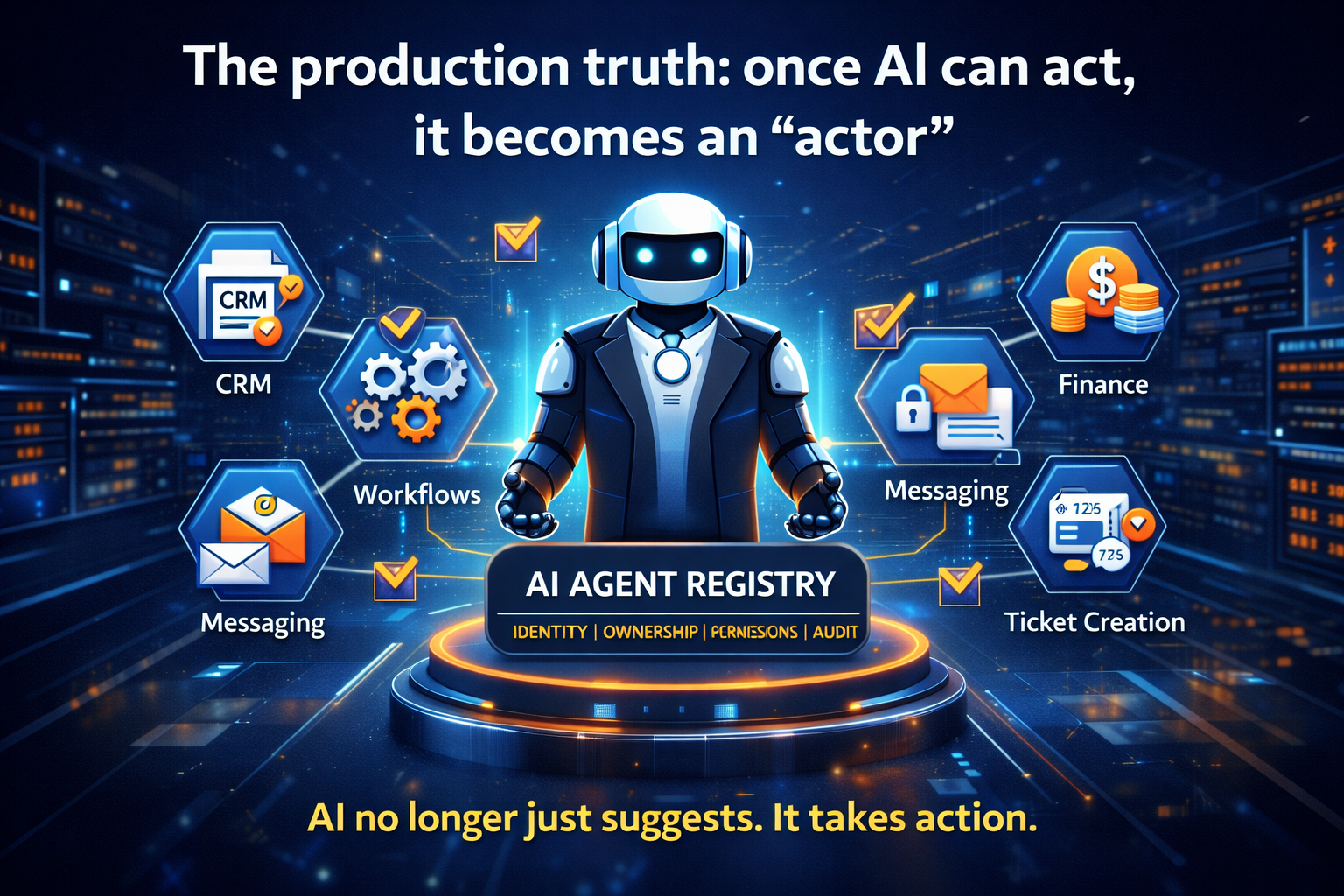
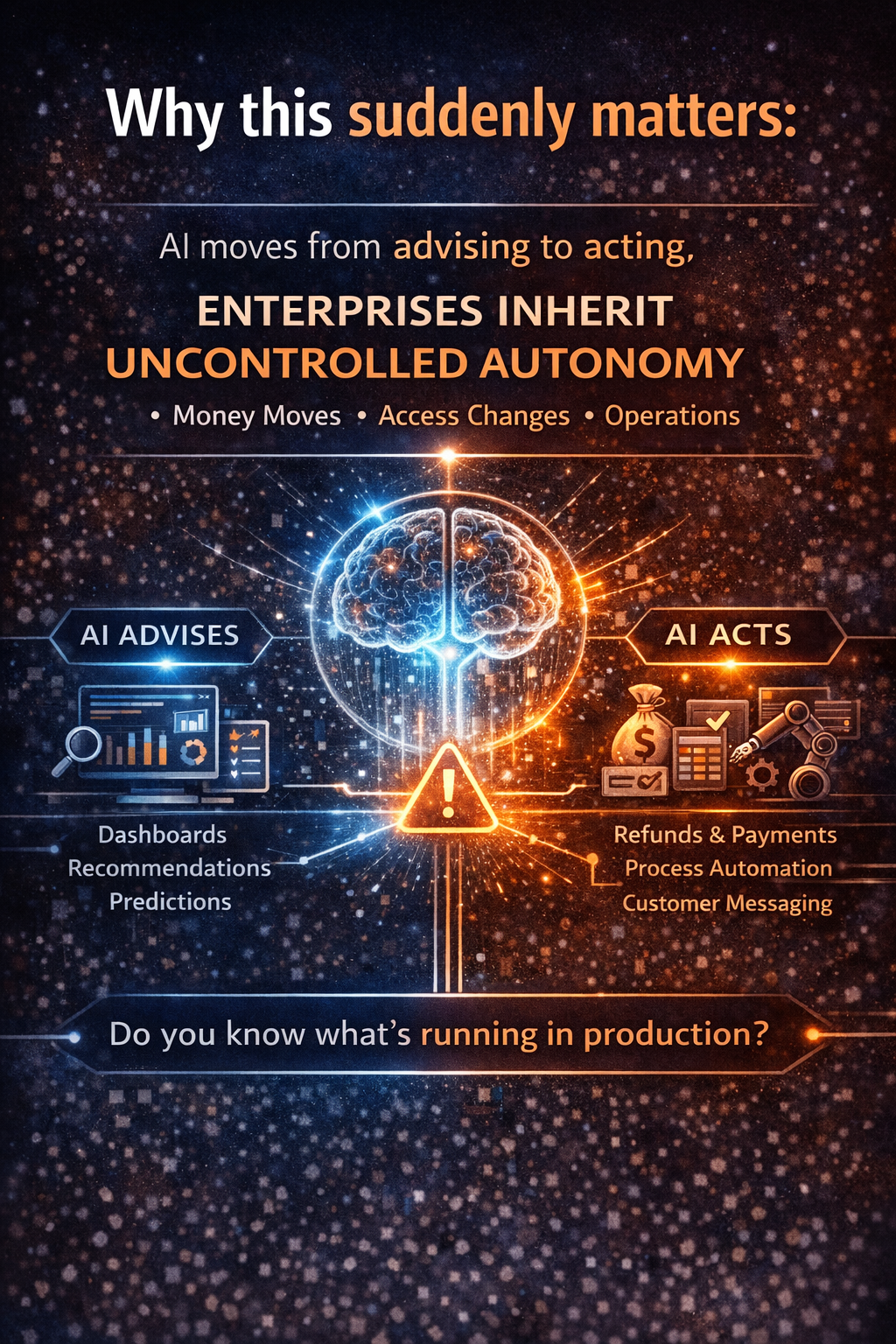
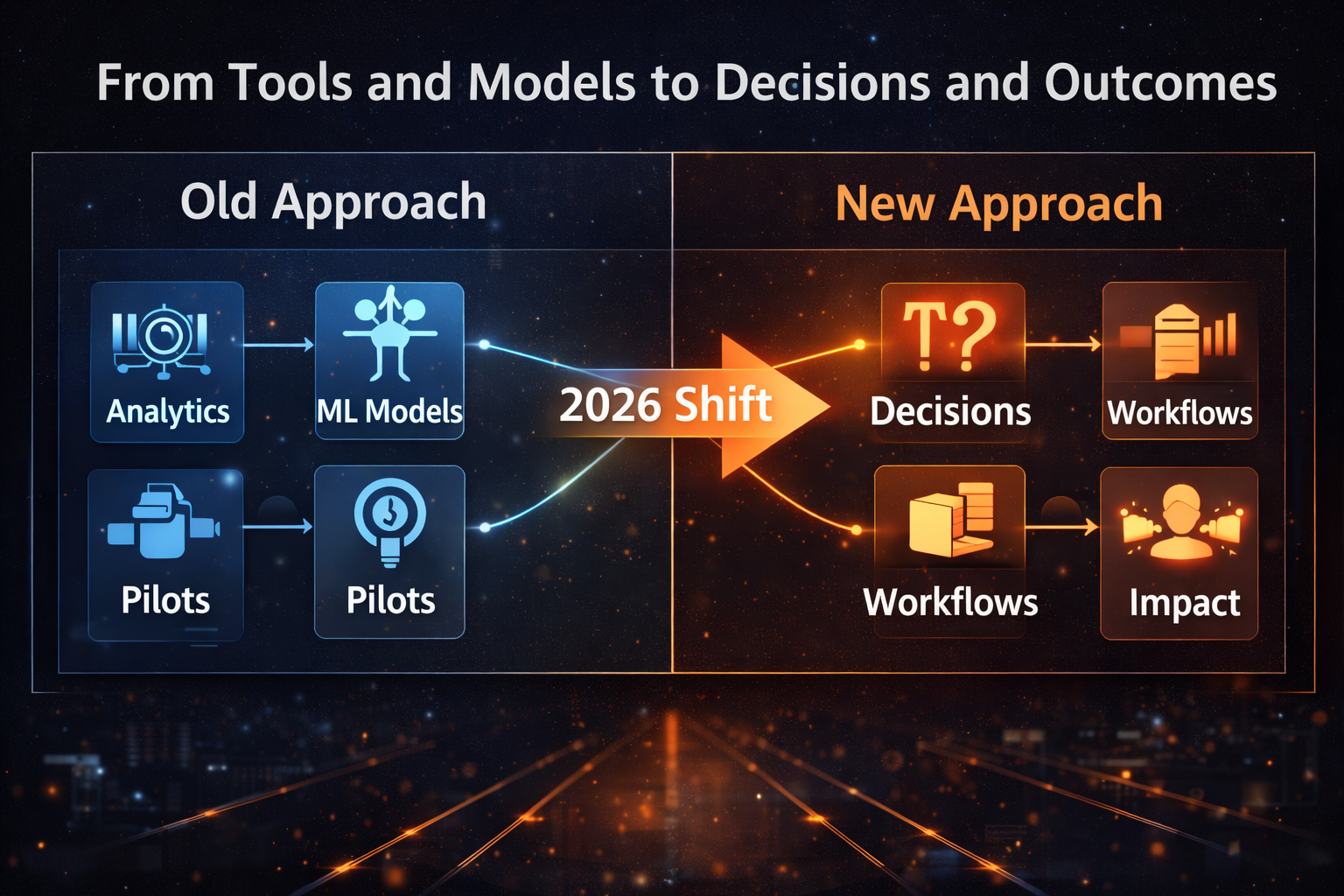
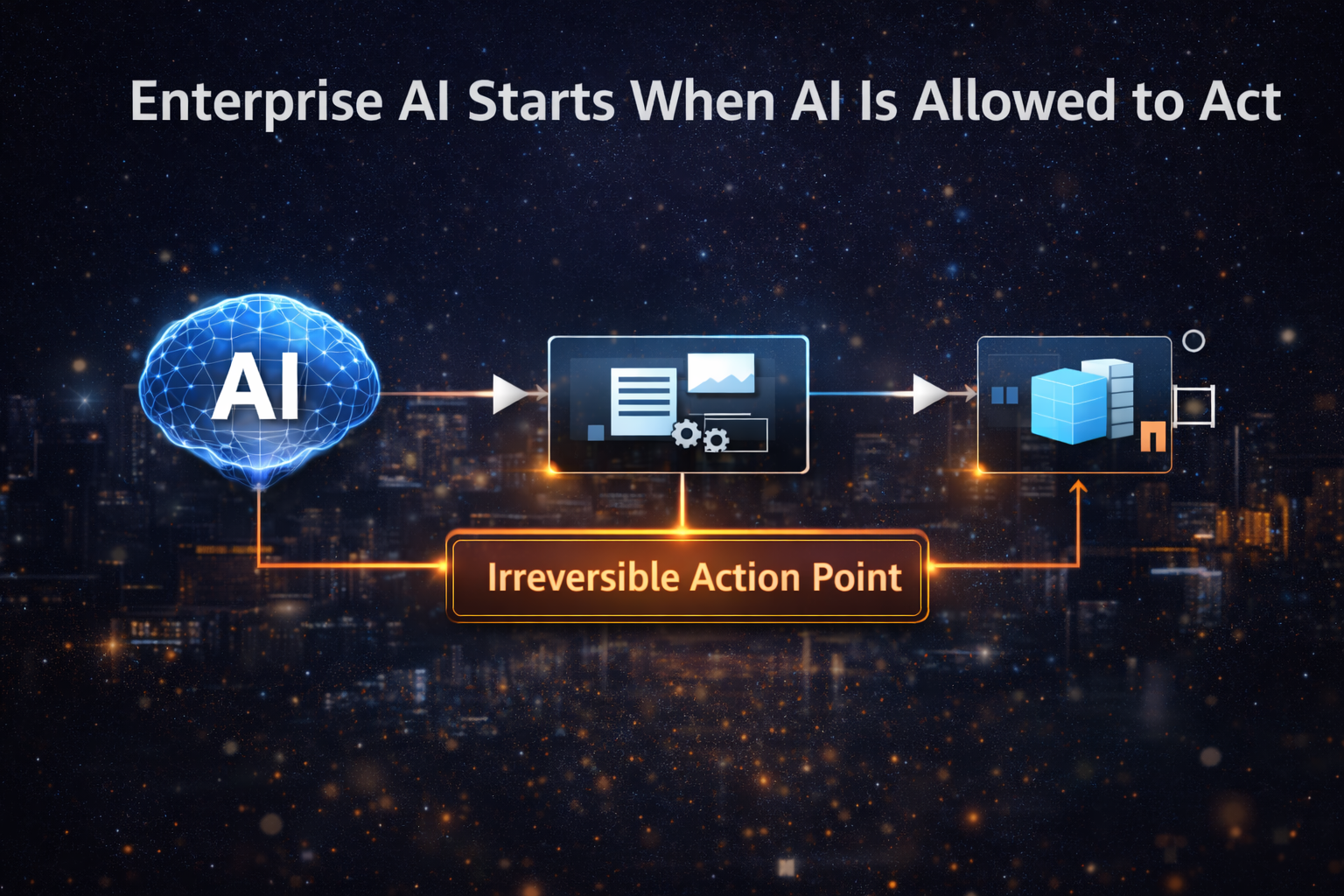
AI is no longer “a tool that helps people work.” Increasingly, AI is work that runs—making decisions, triggering workflows, calling APIs, creating tickets, approving exceptions, updating knowledge bases, and changing the state of real systems.

That’s the promise of agentic AI. It’s also the risk.

The New Enterprise AI Advantage Is Not Intelligence — It’s Operability

Because the moment AI can act, every enterprise inherits a new class of problems:

  • Speed without safety (an agent does the wrong thing faster than a human can notice)
  • Scale without consistency (a pilot succeeds, but production behavior drifts)
  • Automation without accountability (nobody can explain why a decision happened)
  • Innovation without operability (teams can demo intelligence, but cannot run it reliably)

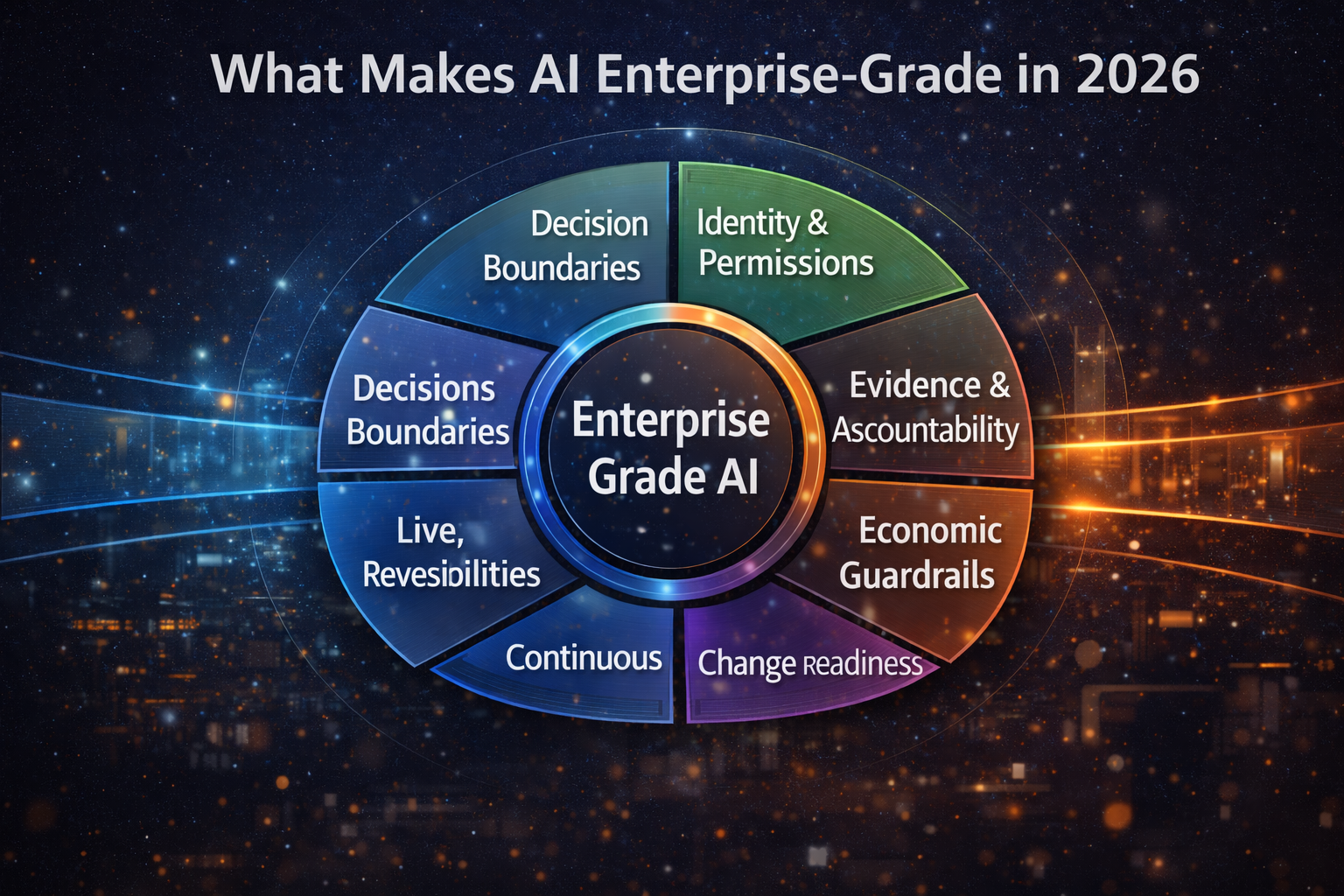
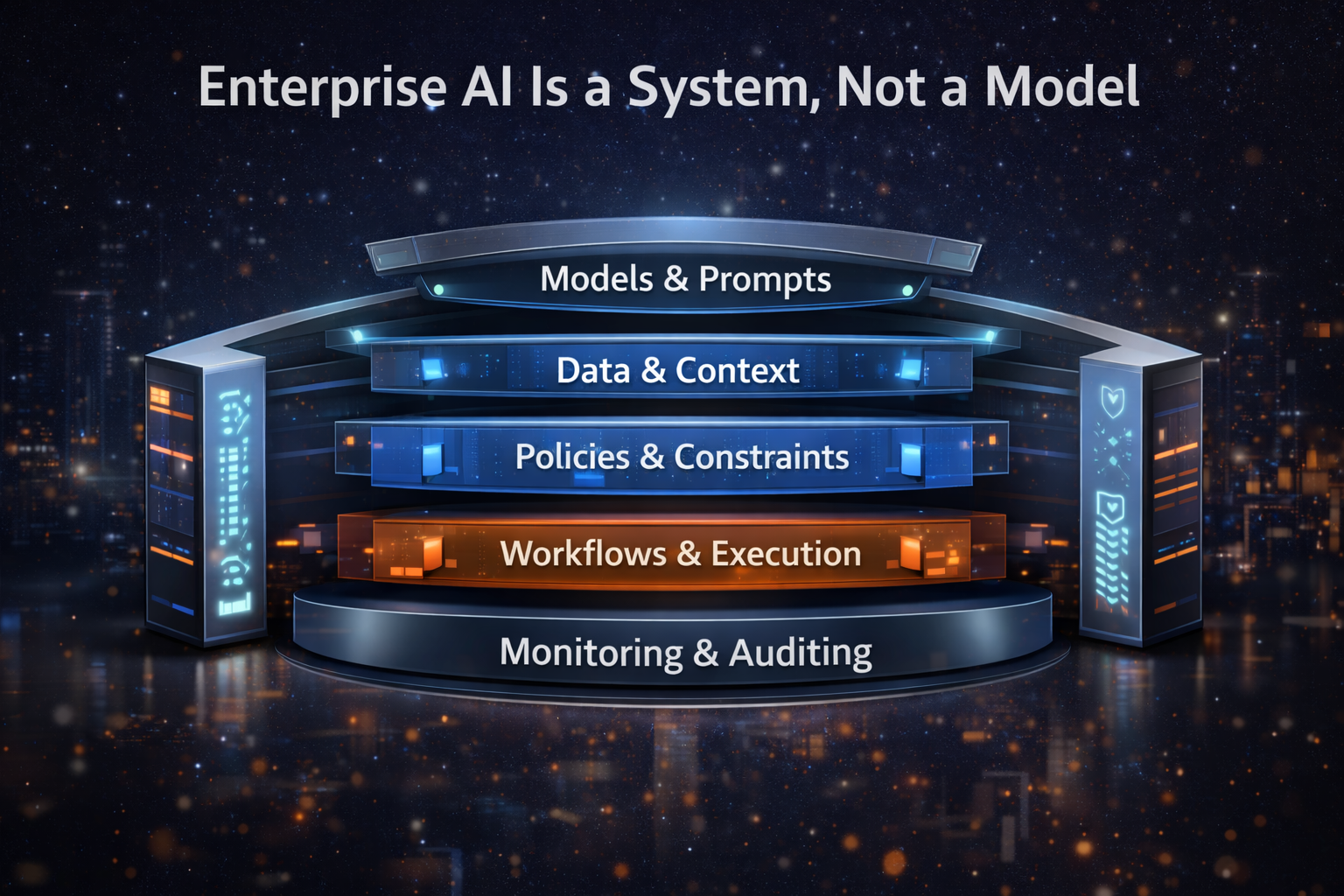
The next winners won’t be defined by “which model they chose.” They’ll be defined by whether they built a safe, self-healing AI enterprise—one that can deploy autonomy at scale while staying governed, reversible, observable, secure, and continuously improving.

The enabling idea is simple:

You don’t scale agents. You scale an operating fabric around them—one that makes autonomy reliable, auditable, reversible, and resilient.

This direction is increasingly described as a layered, composable, interoperable stack that unifies data, models, agents, flows, and AI applications across the enterprise landscape—built for responsible speed. (Infosys)

In this article, I’ll break down what a “unified, reversible-by-design fabric” actually means, using simple examples and practical architecture patterns—no math, and no jargon overload.

Why enterprise AI breaks in production

Why enterprise AI breaks in production

Why enterprise AI breaks in production

Most enterprise AI failures are not “model failures.” They are operating failures.

In other words: the intelligence may be impressive, but the system around the intelligence is fragile.

Example 1: The approval agent that “optimizes” policy into an incident

A procurement approval agent is asked to reduce cycle time. It learns patterns from historical approvals and starts auto-approving borderline cases. It feels great—until an audit reveals that approvals violated a policy nuance that humans used to apply silently.

The model wasn’t “bad.” The enterprise lacked:

  • a policy execution boundary (what the agent can do vs. when it must ask)
  • a decision log (so actions are explainable later)
  • an undo mechanism (rollback / reversal for approvals)

Example 2: The refund agent that creates a cost leak

A customer refund agent is allowed to issue refunds under a threshold. It’s configured correctly—then a product change increases the number of edge cases. The agent starts refunding too frequently because its context is incomplete.

Again: not intelligence. Operability.

  • no continuous evaluation of refund behavior
  • no cost guardrails tied to action volume
  • no closed-loop learning from post-incident patterns

Example 3: The “helpful” IT ops agent that makes outage recovery worse

An ops agent detects service degradation and restarts a dependency. It fixes things once, so it repeats the pattern. But the root cause is upstream—now restarts trigger cascading failures.

Classic issue: automation without feedback verification. Self-healing systems require feedback signals and validation, not just actions. Red Hat’s explanation of open-loop vs closed-loop automation captures this distinction well. (Red Hat)

The core principle: autonomy must be reversible and self-healing

The core principle: autonomy must be reversible and self-healing

When AI can act, the enterprise needs two non-negotiables.

1) Reversible-by-design

Every meaningful autonomous action must have:

  • a safe execution boundary
  • an audit trail
  • a replay capability (what happened, in what order, with what context)
  • an undo plan (rollback, compensation, or human escalation)
Call it the Undo Button principle:

If you can’t undo it, don’t automate it.

Reversibility is not a “nice to have.” It is how you make autonomy trustworthy at enterprise scale.

2) Self-healing-by-default

If AI operates at machine speed, human-only operations won’t keep up. The system must:

  • detect risk early (predictive signals)
  • correct known failures automatically (verified remediation)
  • involve humans when judgment is required (human-by-exception)
This “self-healing operations” direction—closed-loop automation with verification—is widely used to distinguish brittle automation from resilient systems. (Red Hat)

Why a unified fabric matters

Why a unified fabric matters (and why point solutions fail)

A common enterprise pattern is to adopt:

  • one chatbot platform,
  • a separate agent framework,
  • a separate evaluation tool,
  • a separate governance workflow,
  • a separate observability pipeline,
  • separate security controls,
  • separate data connectors…

This creates intelligence islands.

The result is predictable: inconsistent behavior, duplicated work, gaps in auditability, and slow integration cycles.

A unified fabric solves a specific problem:

One operating environment for autonomy across teams and systems.

This “fabric” idea is showing up across the enterprise AI ecosystem as a way to unify and accelerate service delivery, using layered, composable, open and interoperable building blocks. (videos.infosys.com)

It’s the architectural difference between a set of AI projects and an AI enterprise capability.

What a safe, self-healing AI fabric actually contains

What a safe, self-healing AI fabric actually contains

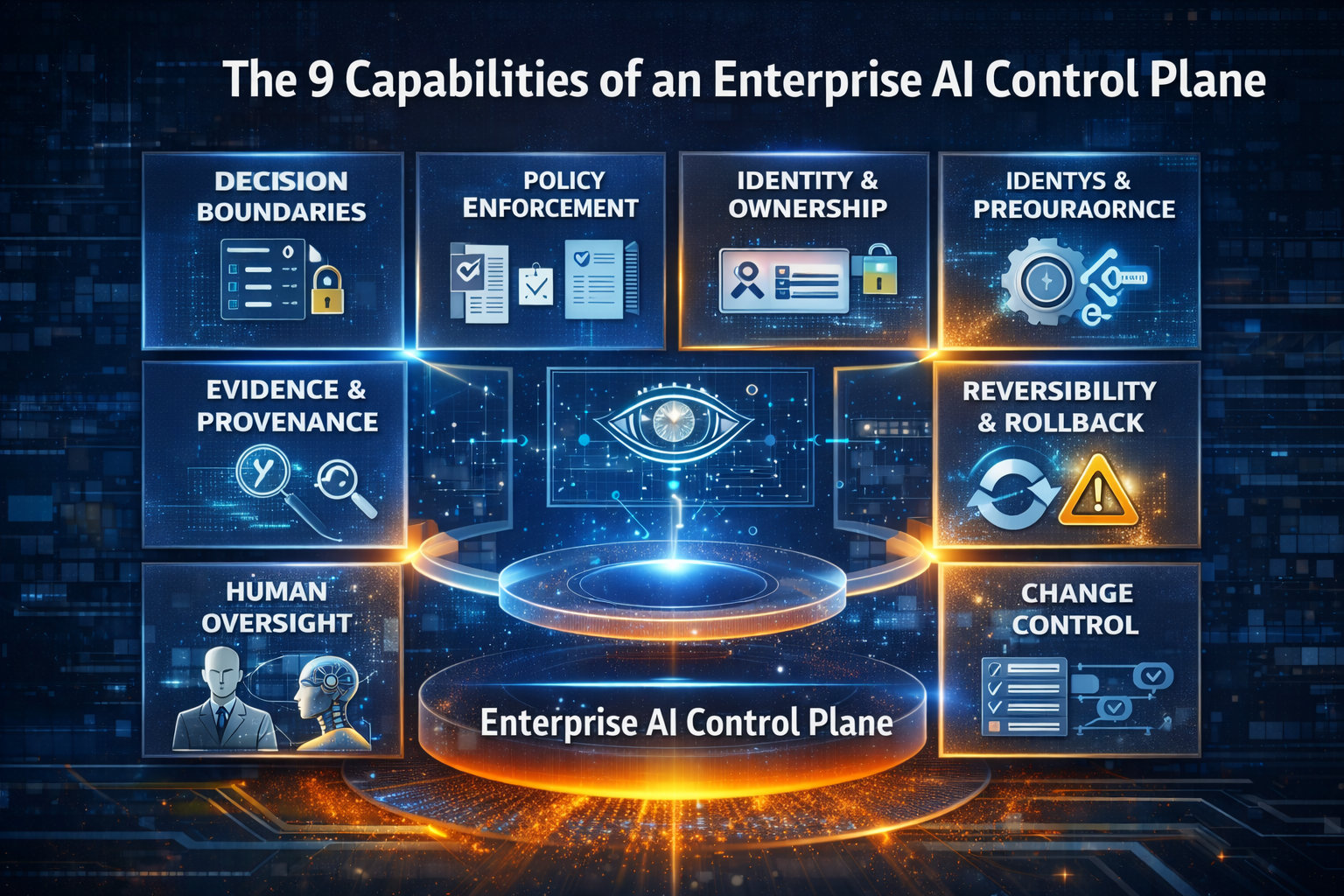
A “fabric” isn’t one product. It’s a set of capabilities that work together. Here are the essentials—explained in plain language.

1) Model–Prompt–Tool abstraction

This is the ability to swap models, prompts, and tools without rebuilding everything.

Why it matters: models will change, policies will change, and toolchains will change. Your enterprise cannot live in a perpetual rewrite loop.

Many enterprise stacks now explicitly emphasize open architecture that abstracts models, prompts and tools so emerging models integrate without rebuilds. (Infosys)

Simple example:
Your legal team updates a policy interpretation. You update a policy service once—every workflow that calls it inherits the update, rather than being manually refactored across dozens of agents.

2) Composable “services-as-software” building blocks

Instead of building one-off agents, you build reusable, productized services:

  • “policy check as a service”
  • “risk scoring as a service”
  • “identity verification as a service”
  • “explanation trace as a service”
  • “approved tool access as a service”

This enables speed with consistency. Teams move fast, but inside paved roads.

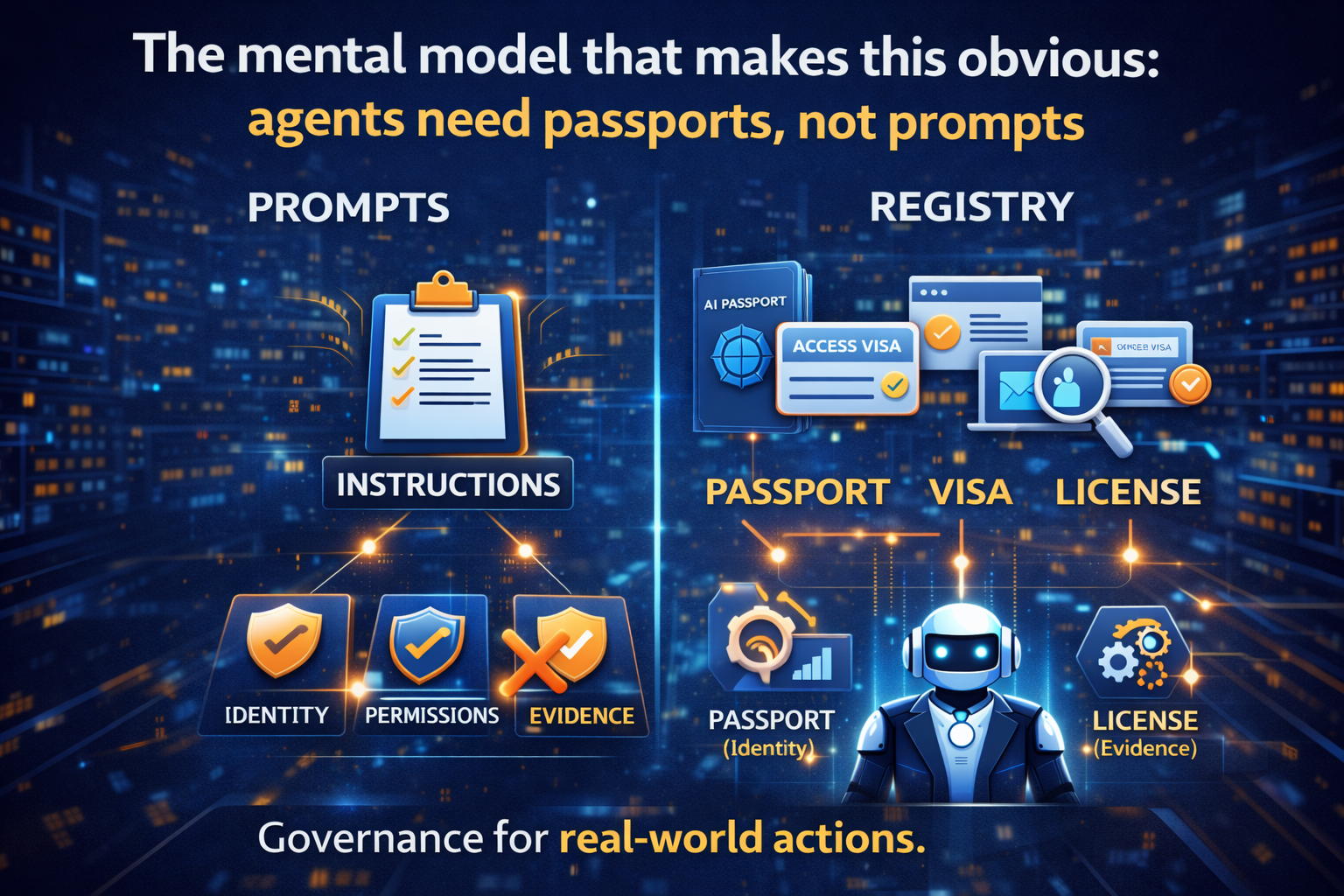
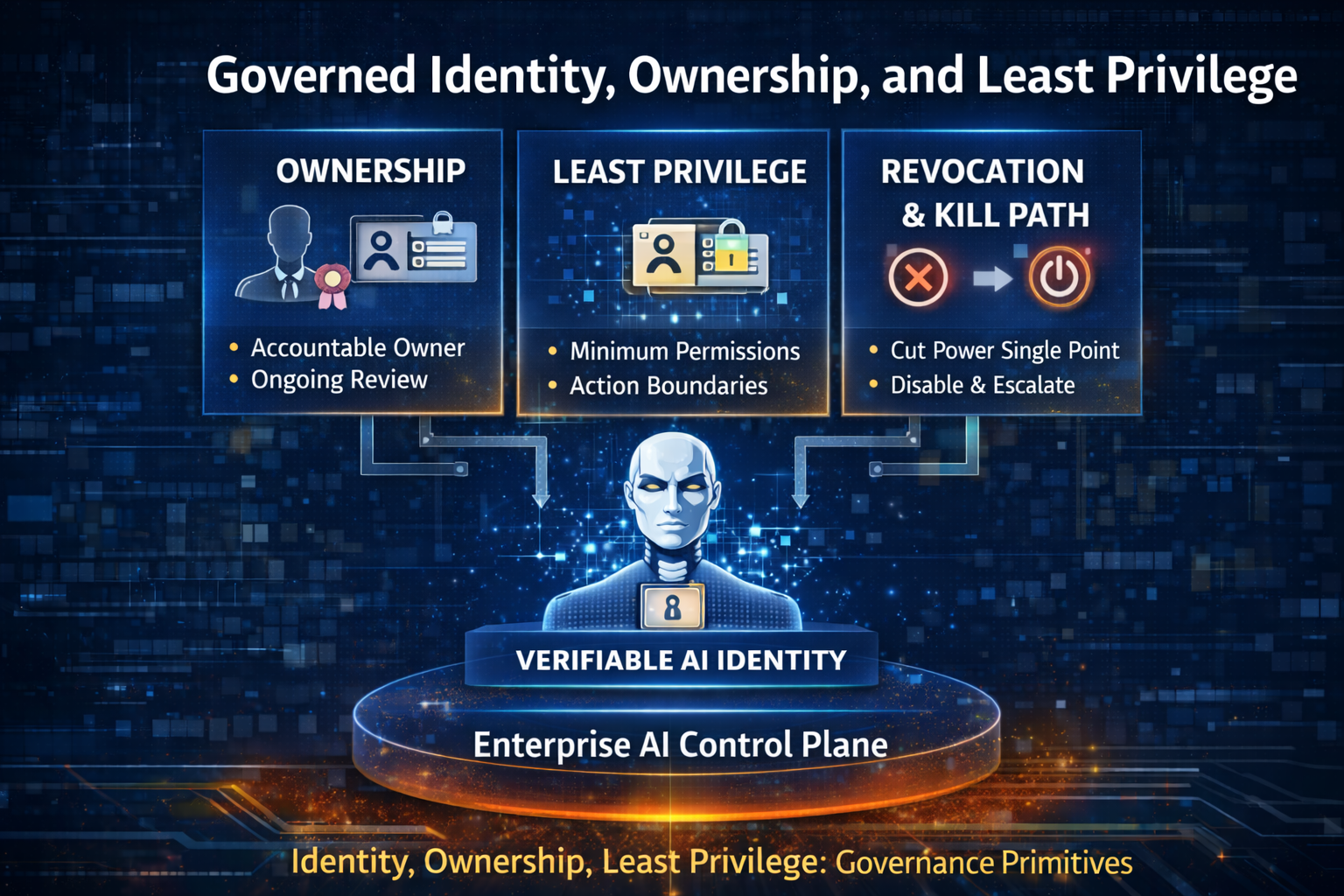
3) Agent identity, permissions, and action boundaries

If an agent can act, it must have:

  • an identity
  • least-privilege permissions
  • a clear action scope
  • a revocation and kill-switch capability

This is how you keep autonomy safe in real systems—especially in regulated environments.

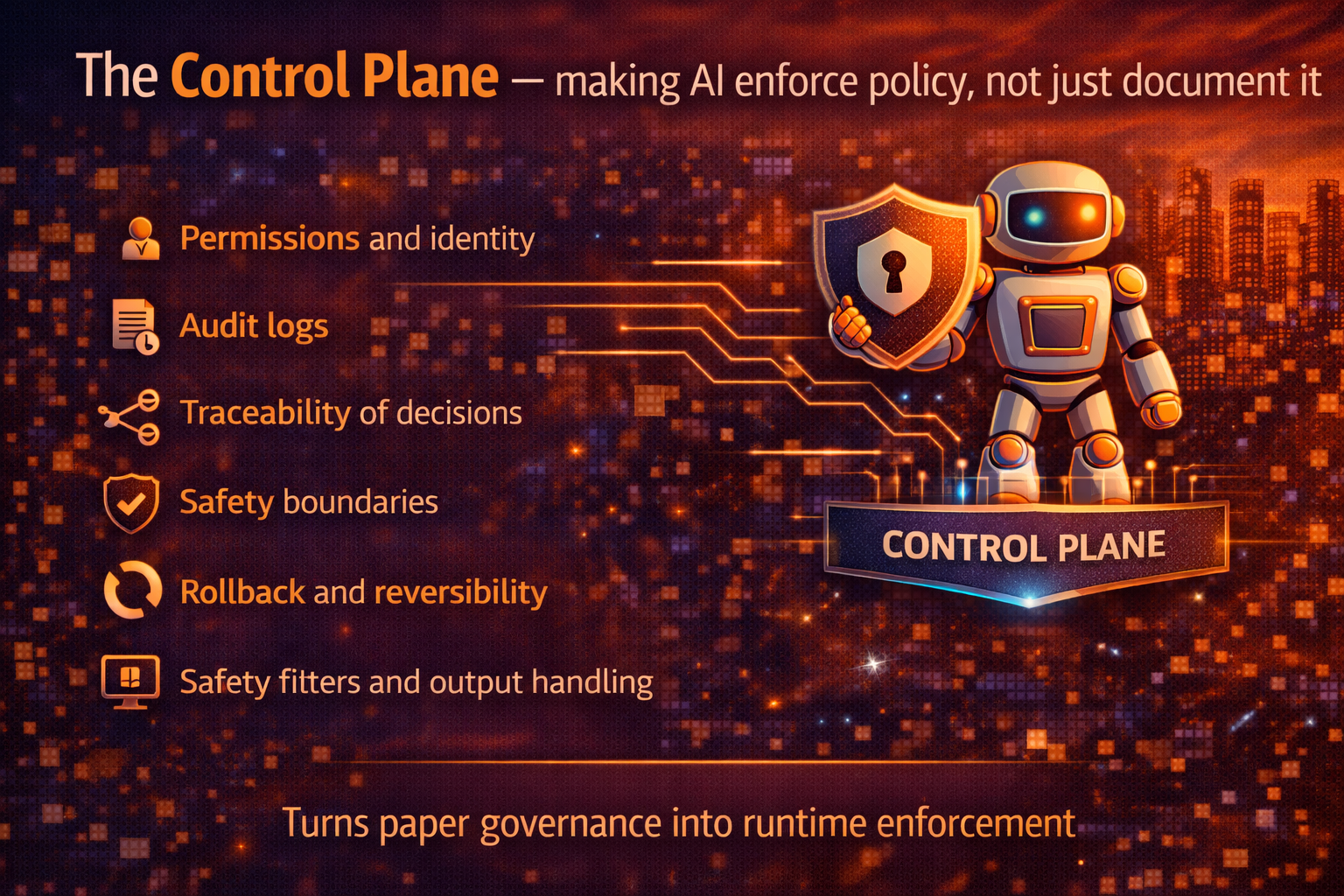
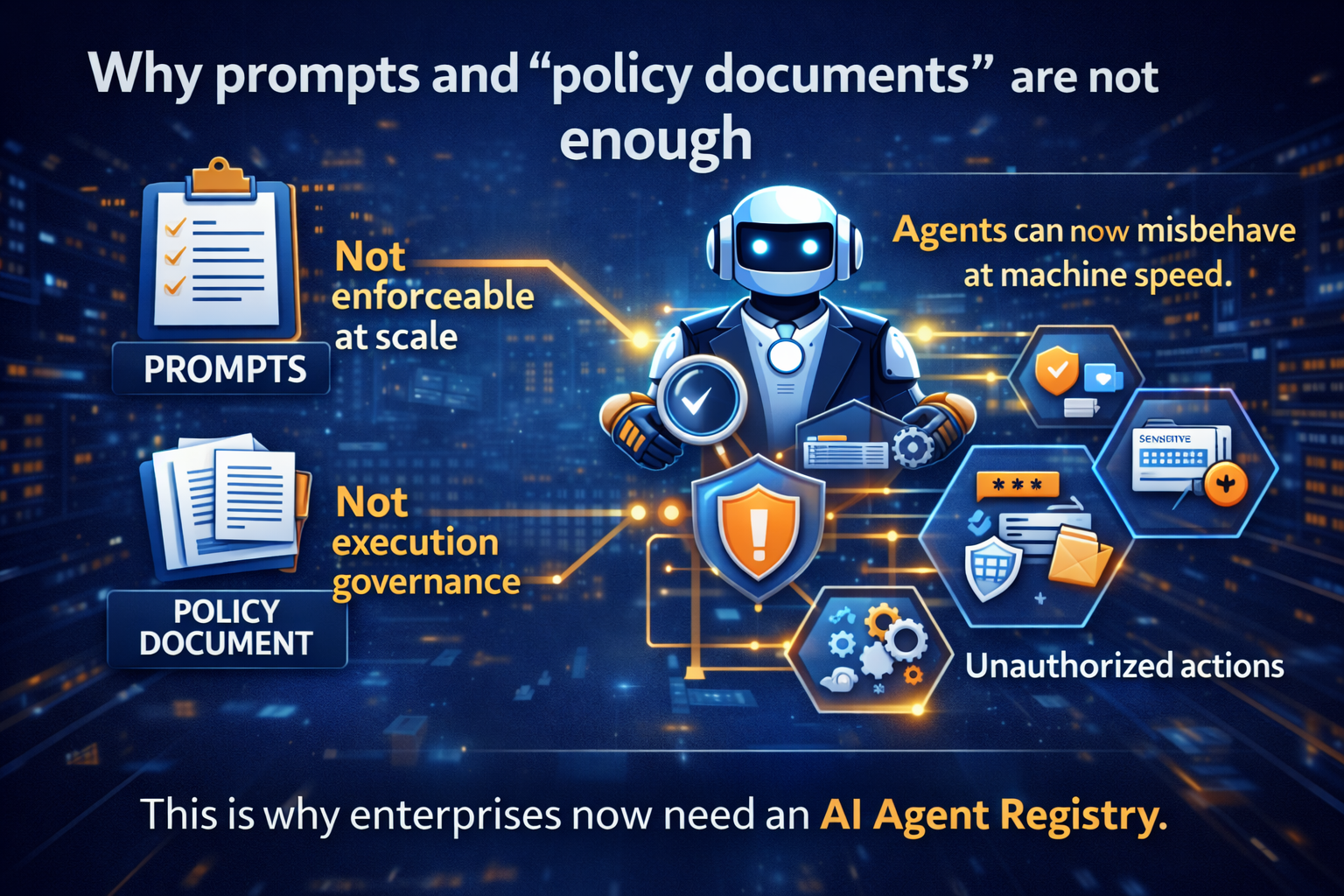
4) Governance that is operational, not ceremonial

Governance cannot be a quarterly document. It must be a runtime discipline:

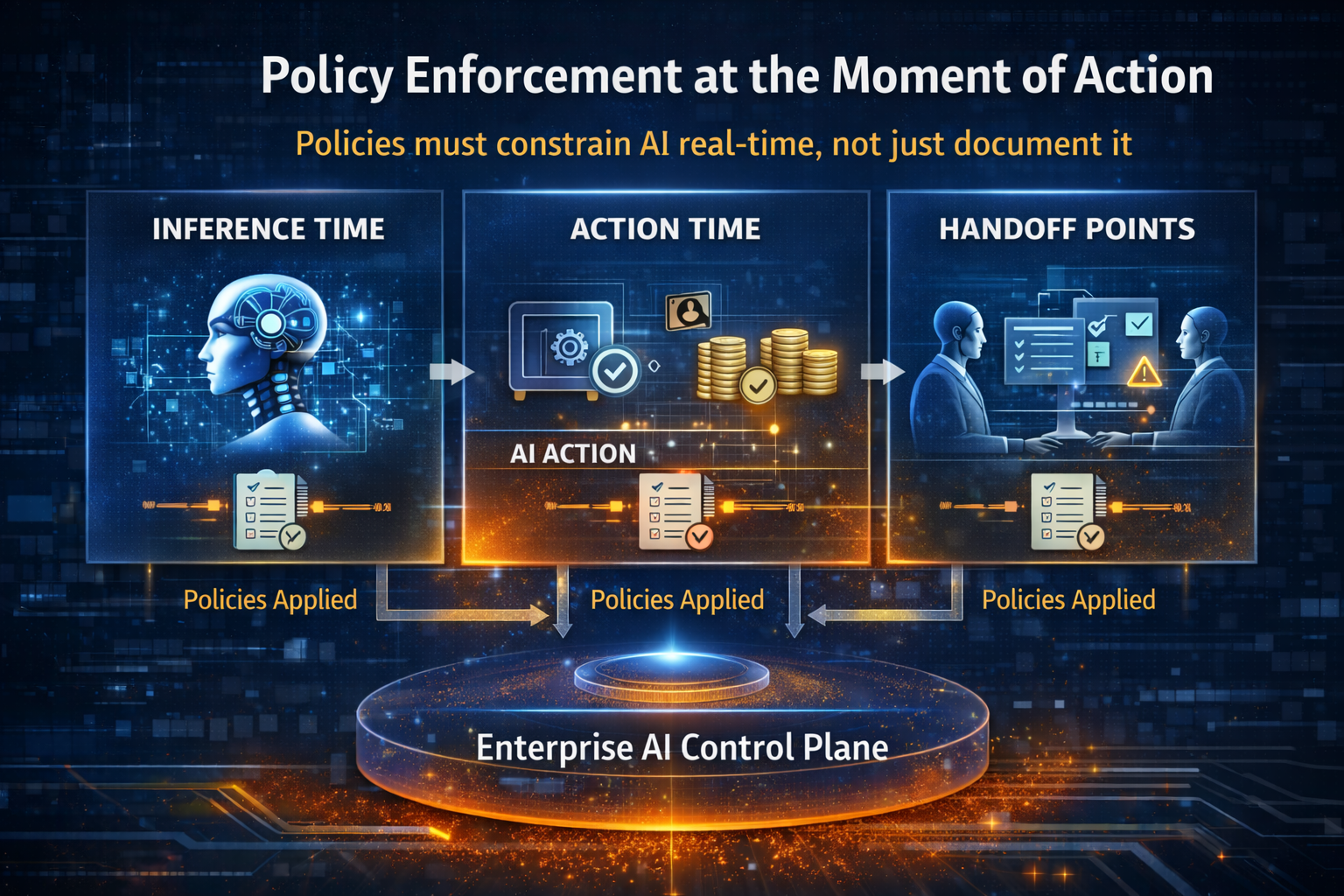
  • policy checks at decision time
  • logging and traceability by default
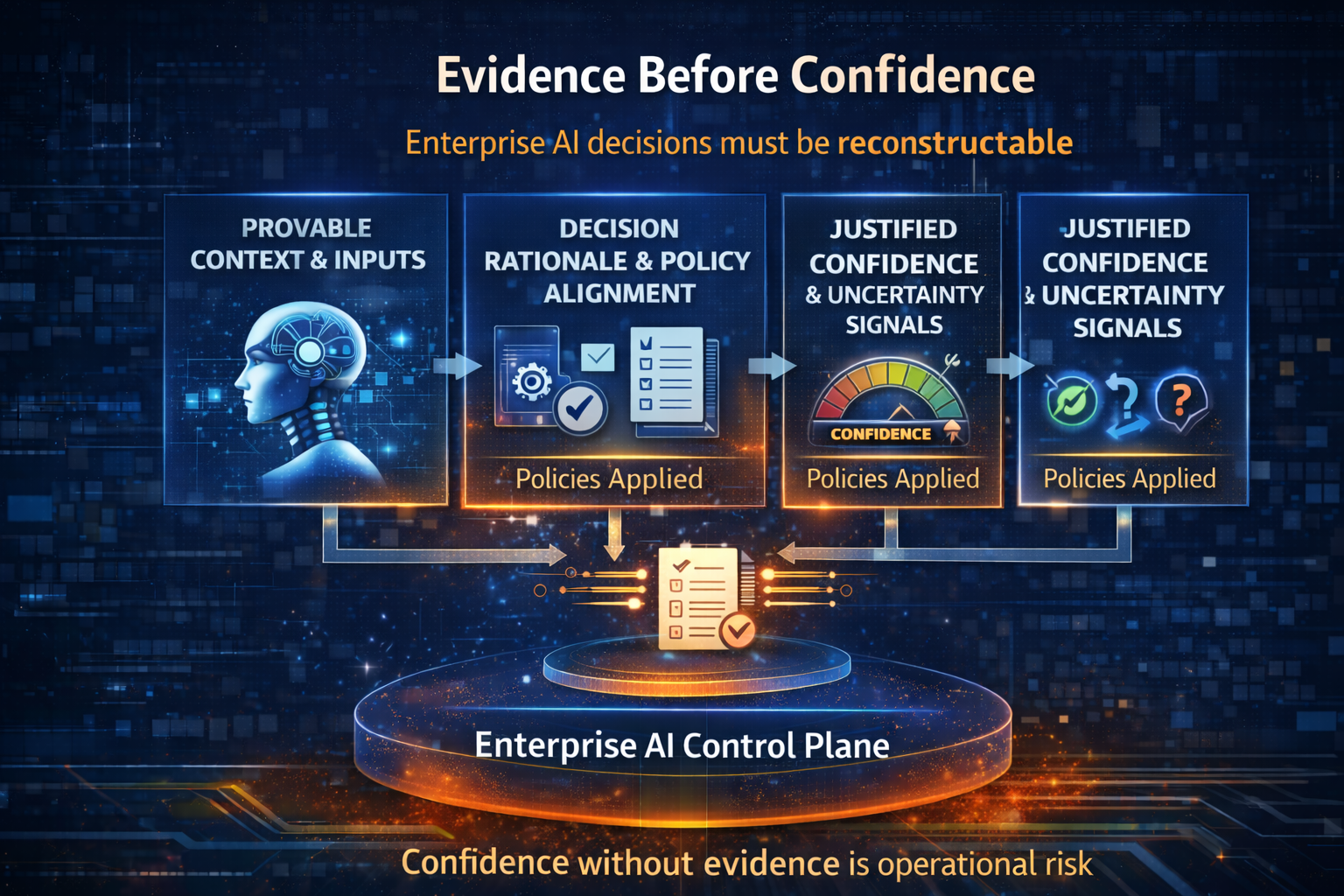
  • escalation paths when uncertainty is high
  • evidence generation for audits

This aligns with the NIST framing that trustworthy AI must be engineered across the lifecycle—governed, measured, and managed continuously. (NIST)

5) Continuous evaluation and quality engineering for AI behavior

If you only evaluate at launch, you will drift.

You need:

  • regression tests for prompts and tool calls
  • scenario testing for policy edge cases
  • monitoring for behavior drift (especially after policy/data changes)
  • incident learning loops

This is “quality engineering” for autonomy.

6) Cybersecurity that assumes AI changes the attack surface

Agents increase:

  • API exposure
  • tool invocation pathways
  • prompt injection risks
  • sensitive context exposure

So security must be built into the fabric:

  • safe tool wrappers and allowlists
  • runtime inspection
  • secure connector patterns
  • prompt/content safety controls

The key mindset: the security surface evolves as protocols, tooling, and models evolve—which is why modern enterprise stacks emphasize continuous adaptability. (Infosys)

7) Observability that explains what happened, not just metrics

Traditional observability tells you latency and error rates.

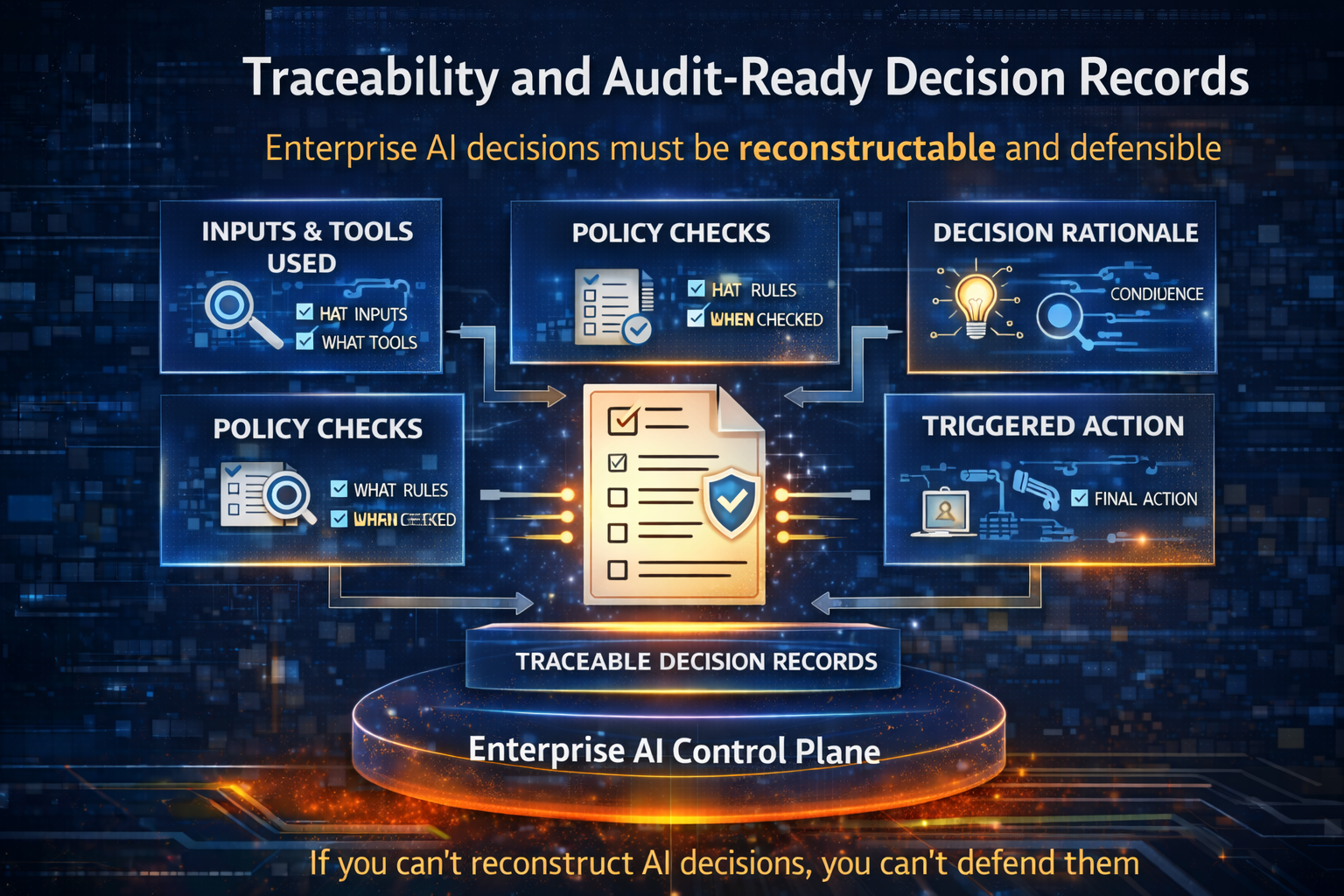
AI observability must tell you:

  • what the agent decided
  • what context it used
  • what tools it invoked
  • what policy rule was applied
  • what fallback occurred
  • what evidence it recorded

This is the foundation of reversible autonomy.

8) Closed-loop remediation (the self-healing engine)

Self-healing does not mean “agents doing random fixes.”

It means:

  1. detect a known failure pattern
  2. propose a remediation
  3. verify the remediation via signals
  4. record evidence
  5. update runbooks and patterns

This maps directly to closed-loop automation concepts used in real IT automation practice. (Red Hat)

9) Human-by-exception operating model

The goal is not “remove humans.” The goal is:

  • humans govern
  • automation executes
  • agents orchestrate
  • humans intervene when judgment is required

This is also aligned with regulatory expectations around human oversight, particularly in higher-risk AI contexts. (Artificial Intelligence Act)

How this maps to global trust and compliance expectations

How this maps to global trust and compliance expectations

Enterprise leaders are increasingly asked:

“Can you prove your AI is safe, accountable, and overseen?”

The NIST AI Risk Management Framework offers a practical lens—GOVERN, MAP, MEASURE, MANAGE—to operationalize AI risk management across the lifecycle. (NIST Publications)

Regulatory approaches, including the EU AI Act’s provisions on transparency and human oversight, reinforce that high-risk AI systems must support meaningful oversight and safe operation. (Artificial Intelligence Act)

A reversible-by-design fabric is how these expectations become real in production:

  • oversight is embedded,
  • logging is automatic,
  • actions are bounded,
  • recovery is built in.
A practical architecture story: “policy + ops fabric” in action

A practical architecture story: “policy + ops fabric” in action

Imagine a business workflow agent that can:

  • read a request,
  • interpret policy,
  • gather missing information,
  • take an action,
  • update systems of record.

Here’s what “fabric-first autonomy” looks like:

  1. The agent calls Policy Service (not its own private policy logic).
  2. The request goes through Identity + Permission Check (least privilege).
  3. The action is executed via a Safe Tool Gateway (validated inputs, allowlisted APIs).
  4. The system writes an Action Trace (context, decision, tools, policy references).
  5. Monitoring watches for drift and anomalies.
  6. If uncertainty is high, the workflow triggers Human-by-Exception escalation.
  7. If the action must be reversed, the system triggers Compensation/Rollback by design.
  8. If an incident occurs, replay and evidence generation are immediate.

This is how autonomy becomes a governed enterprise capability—not a collection of clever demos.

A 30–60–90 day rollout (without slowing delivery)

A 30–60–90 day rollout (without slowing delivery)

You don’t “install” a fabric. You build paved roads incrementally.

Days 0–30: Define boundaries and evidence

  • choose 2–3 workflows with clear action scopes
  • implement identity + tool gateway
  • implement action traces and rollback/compensation patterns
  • define human-by-exception thresholds

Days 31–60: Add evaluation and self-healing loops

  • add scenario tests for policy edge cases
  • deploy drift monitoring
  • implement closed-loop remediation for 3–5 known incident patterns
  • build incident replay and evidence packs

Days 61–90: Productize and scale reuse

  • convert best components into reusable services
  • standardize connectors
  • publish a service catalog: what teams can safely reuse
  • expand to more workflows with the same operating guarantees


The new advantage is operability

Conclusion: the new advantage is not intelligence—it is operability

The enterprise AI race is not a race to deploy the most agents.

It’s a race to build the operating fabric that makes autonomy:

  • safe,
  • reversible,
  • observable,
  • secure,
  • and self-healing.

Because in the real world, the most valuable AI is not the AI that can talk.

It’s the AI you can trust to run.

Glossary

  • Agentic AI: AI systems that don’t just generate text, but can take actions through tools and workflows.
  • AI fabric: A unified set of capabilities (connectors, services, governance, observability) that helps enterprises deploy and run AI safely at scale.
  • Reversible-by-design: Systems built so actions can be rolled back, compensated, replayed, and audited.
  • Closed-loop automation: Automation that verifies outcomes through feedback signals, not just “does actions.” (Red Hat)
  • Human-by-exception: Humans intervene only when uncertainty or risk is high; the system handles routine cases.
  • Model–Prompt–Tool abstraction: Architecture that lets you swap models/tools/prompts without rebuilding workflows. (Infosys)
  • Services-as-software: Reusable, productized AI capabilities delivered as modular services (policy checks, risk scoring, observability, etc.). (videos.infosys.com)
  • Observability (for AI): Understanding not just metrics, but decisions, context, tool calls, and policy checks.
  • NIST AI RMF: A risk framework for governing and managing AI across lifecycle (GOVERN, MAP, MEASURE, MANAGE). (NIST Publications)
  • Human oversight: Requirements to enable human monitoring, interpretation and override in higher-risk AI systems. (AI Act Service Desk)

FAQ (People Also Ask)

Q1) What does “self-healing AI enterprise” actually mean?
It means AI-driven operations that detect issues early, apply verified remediations through closed-loop automation, and escalate to humans only when judgment is required. (Red Hat)

Q2) Why do enterprise AI pilots fail when moved to production?
Because pilots test intelligence. Production requires operability: governance, auditability, identity, safe tool access, observability, and rollback.

Q3) What is “reversible-by-design” autonomy?
It’s the ability to trace, replay, and safely undo autonomous actions—through rollback, compensation, or human escalation—so autonomy is trustworthy at scale.

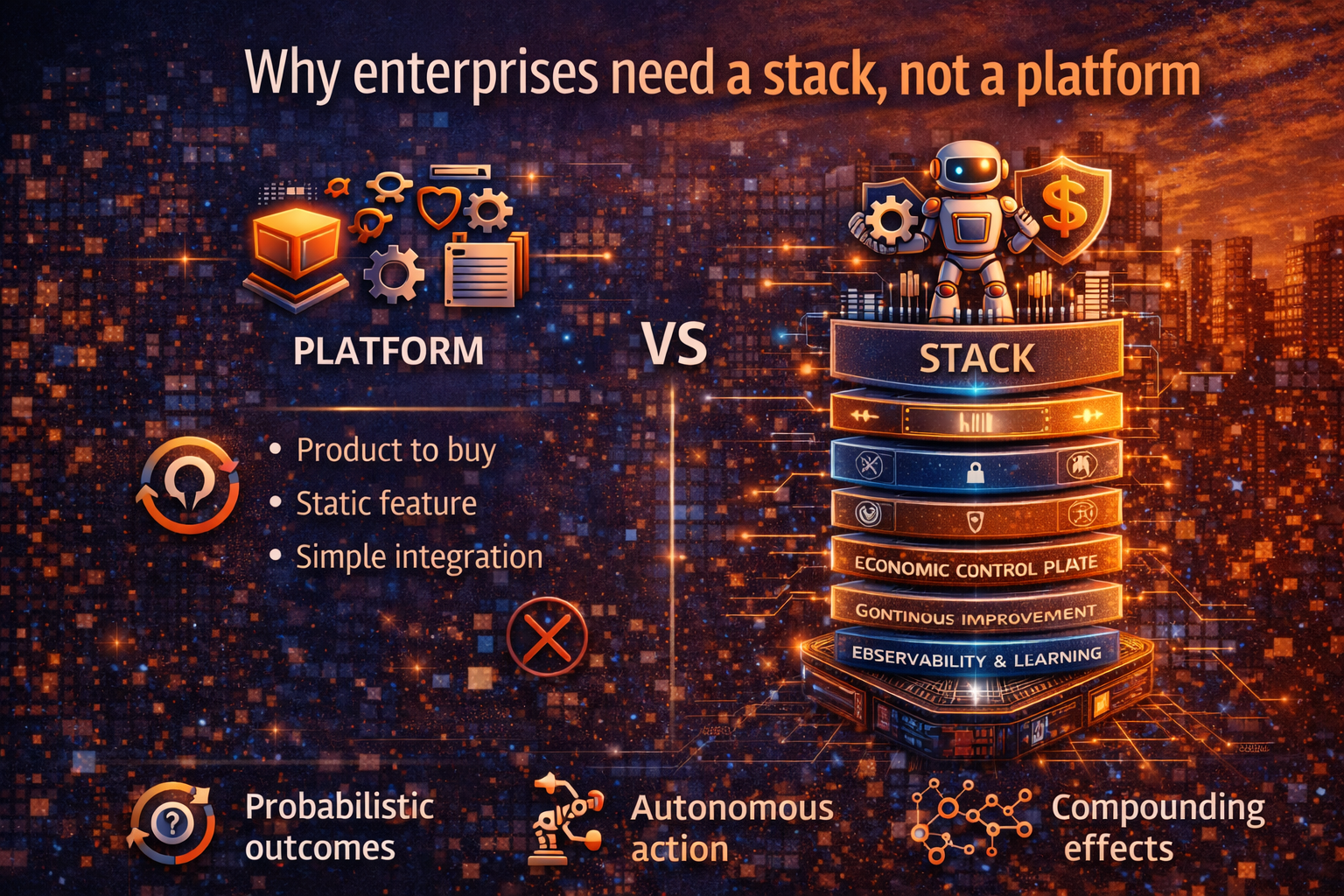
Q4) How is an AI fabric different from an AI platform?
A fabric is a unified operating environment with composable services, interoperability, and enterprise controls—so multiple teams can build and run autonomy consistently across the enterprise. (videos.infosys.com)

Q5) How does this relate to governance frameworks like NIST AI RMF?
A fabric operationalizes governance through continuous controls, measurement, and management across the AI lifecycle—aligning with the RMF’s core functions. (NIST Publications)

Q6) Do regulations require human oversight for enterprise AI?
For certain higher-risk uses, regulations emphasize human oversight and transparency, ensuring humans can monitor and intervene appropriately. (AI Act Service Desk)

Q1. Why is operability more important than AI intelligence in enterprises?

Because intelligence without control creates risk. Operability ensures AI can be governed, audited, scaled, and corrected safely in production.

Q2. What does AI operability actually include?

Observability, policy enforcement, rollback, cost control, compliance alignment, and operational resilience across the AI lifecycle.

Q3. Why do most enterprise AI pilots fail in production?

They focus on models, not operating environments—lacking governance, reliability, and integration with enterprise systems.

Q4. How does operability enable faster AI delivery?

By preventing rework, incidents, and compliance blockers—allowing teams to deploy with confidence and scale safely.

Q5. Is operability relevant only for regulated industries?

No. Any enterprise operating at scale faces trust, cost, reliability, and accountability challenges that operability addresses.


References and further reading

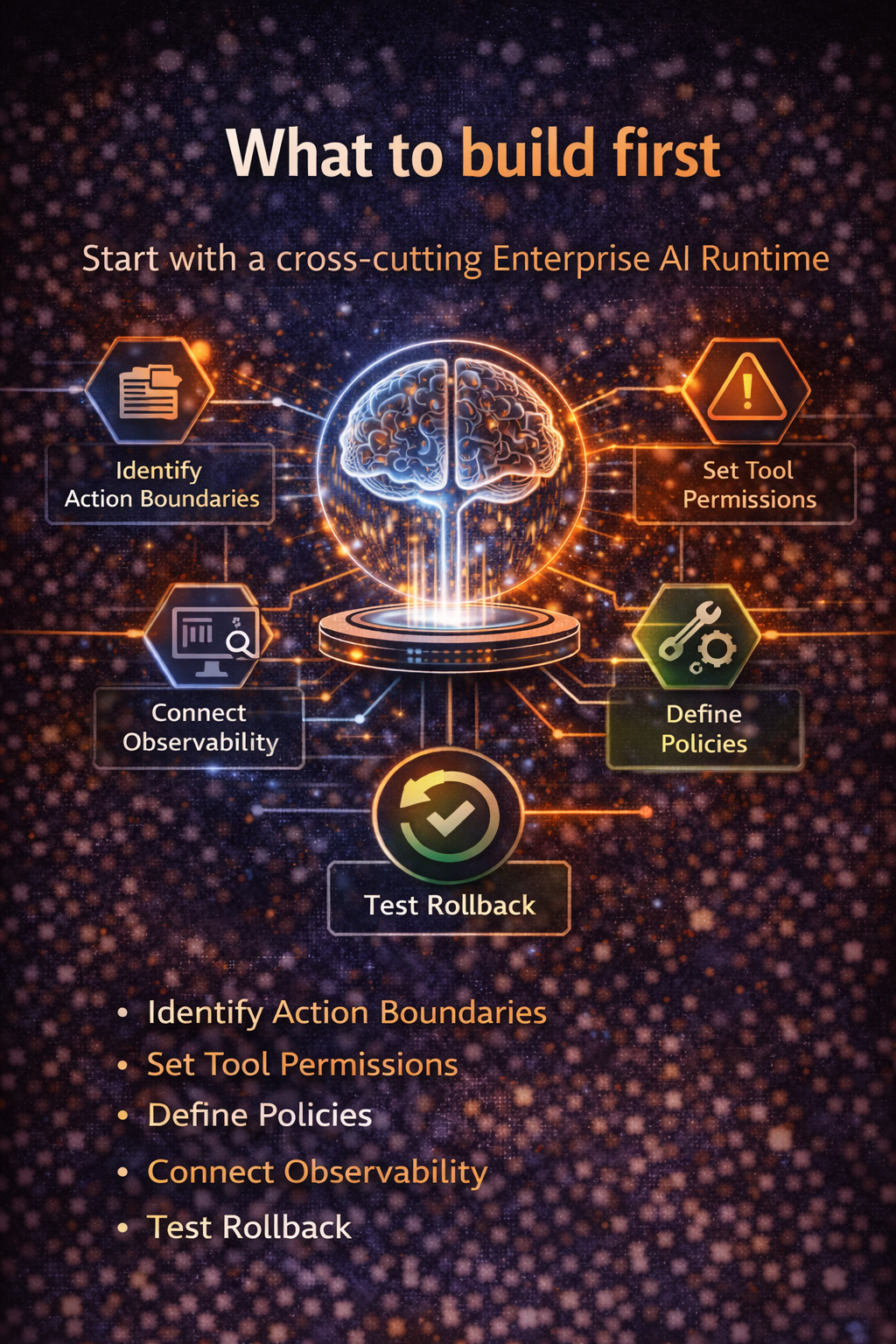
Enterprise AI Runtime: Why Agents Need a Production Kernel to Scale Safely

Enterprise AI Runtime

The intelligence is easy to demo. The hard part is operating autonomy—safely, repeatedly, and at enterprise scale.

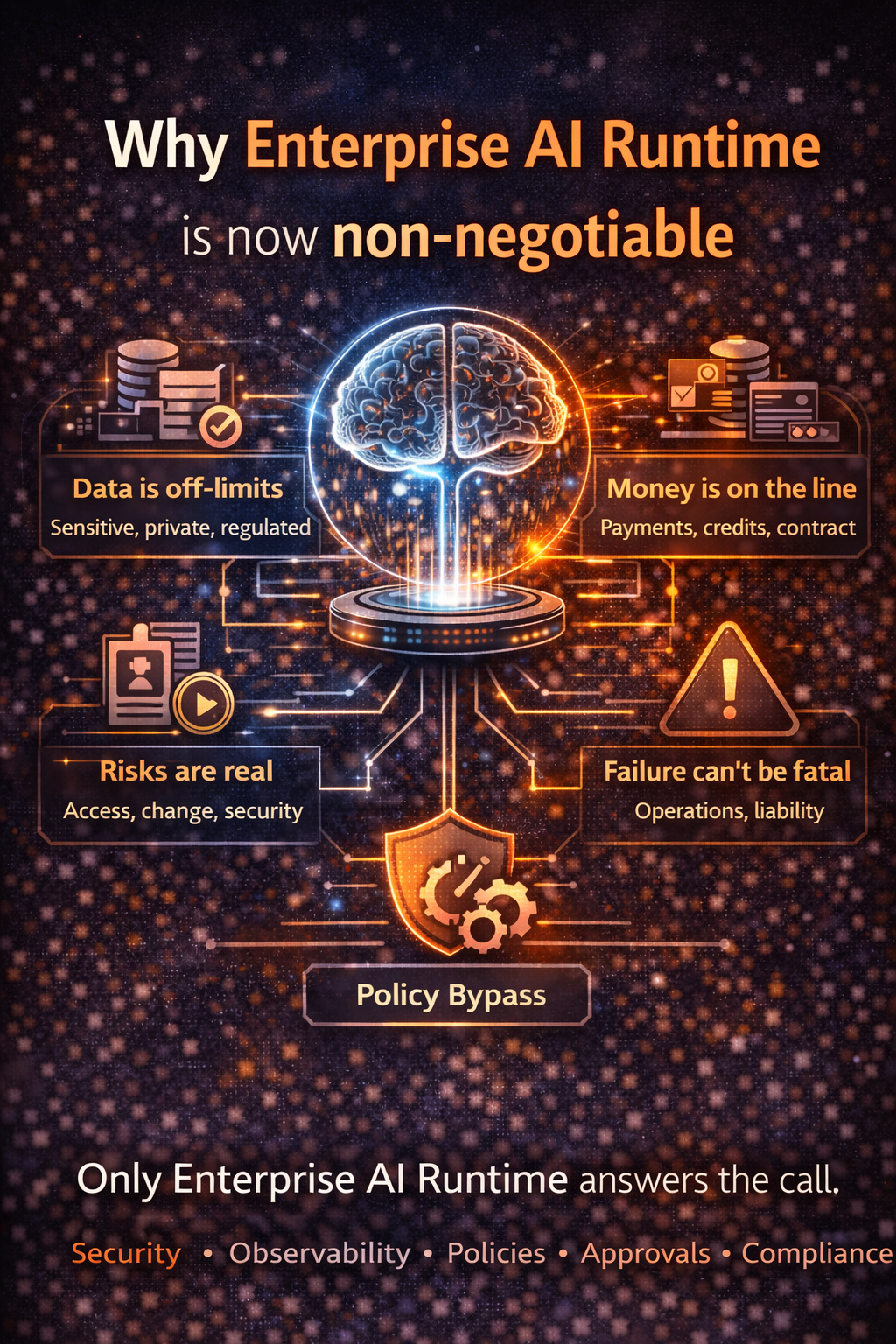
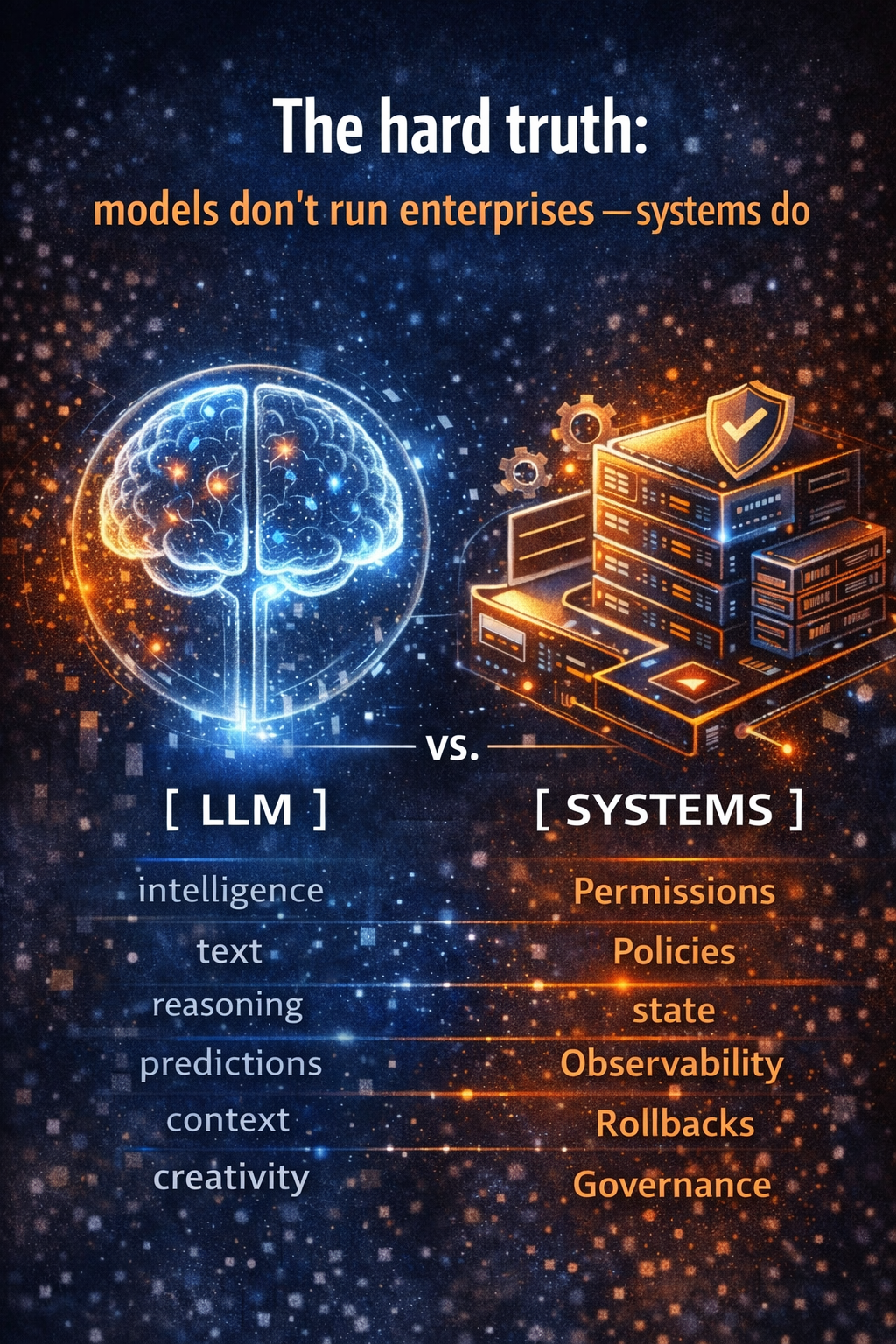
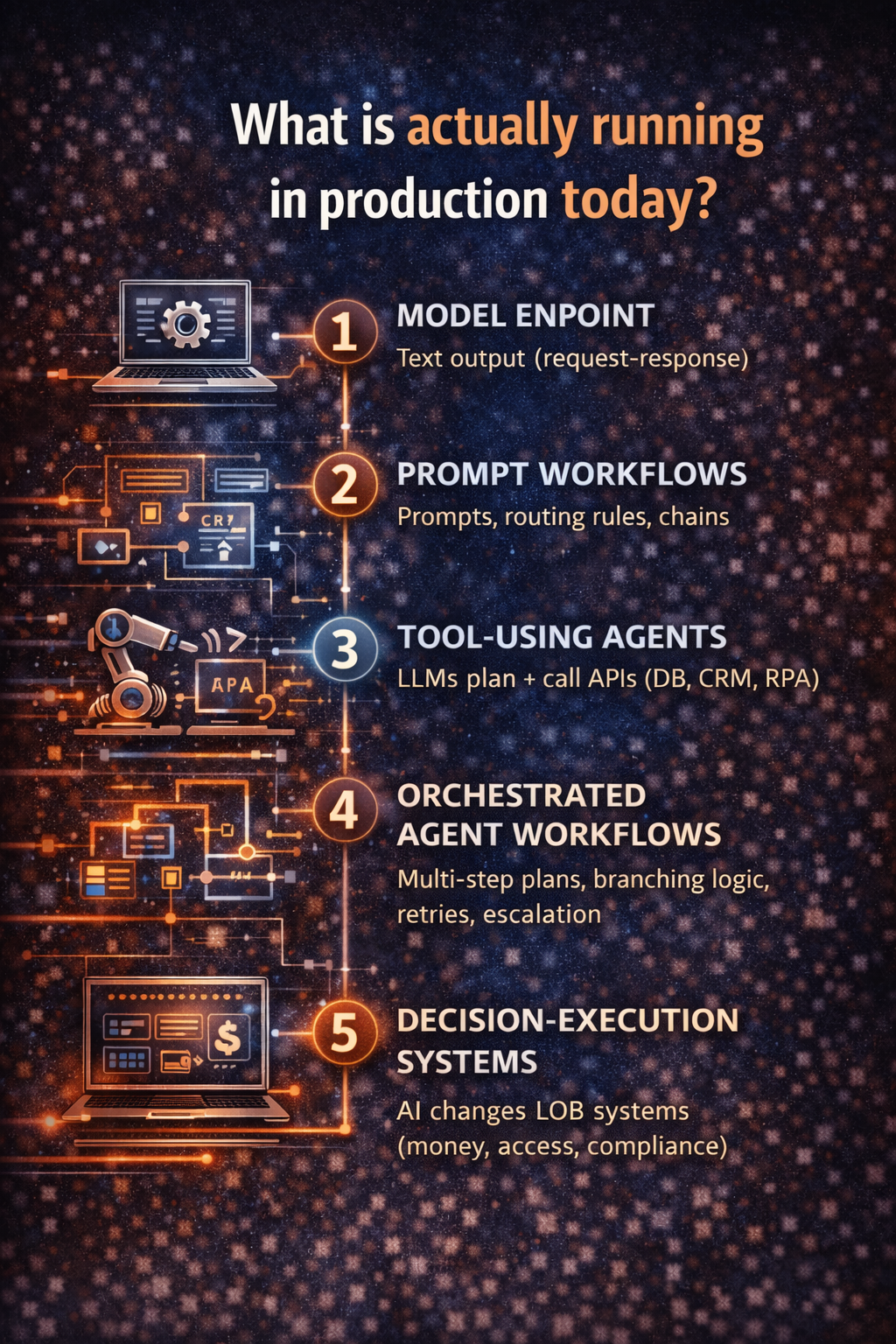
AI agents are impressive in demos. They summarize policies, draft emails, open tickets, route requests, and call tools. But the moment you connect those agents to real enterprise systems—identity, data, approvals, payments, customer actions—something uncomfortable happens:

The intelligence works.
The operation breaks.

This is why most enterprises don’t actually have an agent problem.
They have a runtime problem.

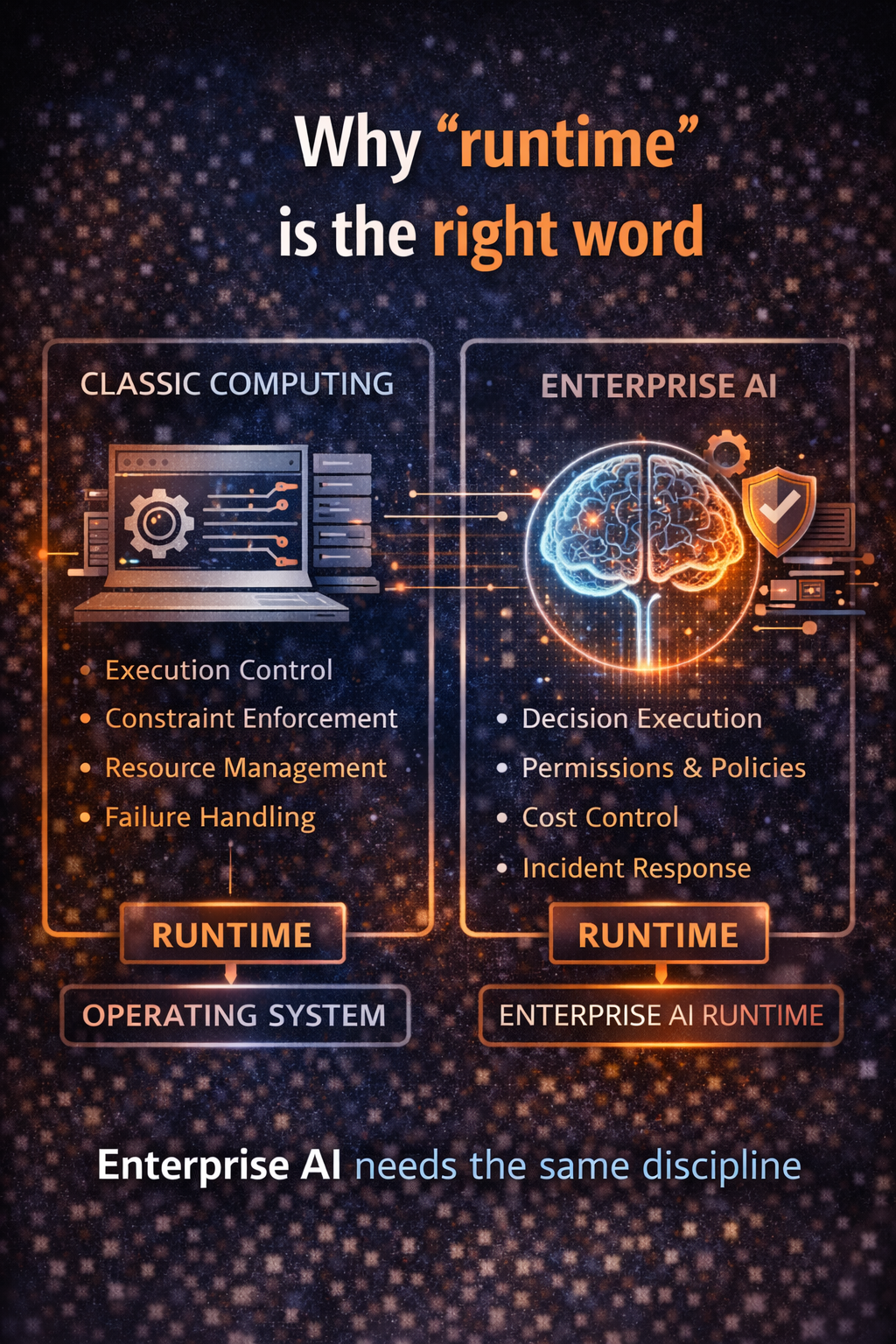
What enterprises need is not a larger zoo of agents or yet another AI platform. They need an Enterprise AI Runtime—a production kernel that makes autonomous work safe, reusable, observable, interoperable, and governable across the enterprise.

Think of it like this:

  • An agent is an app.
  • The enterprise is the real world—security, compliance, uptime, audit, accountability.
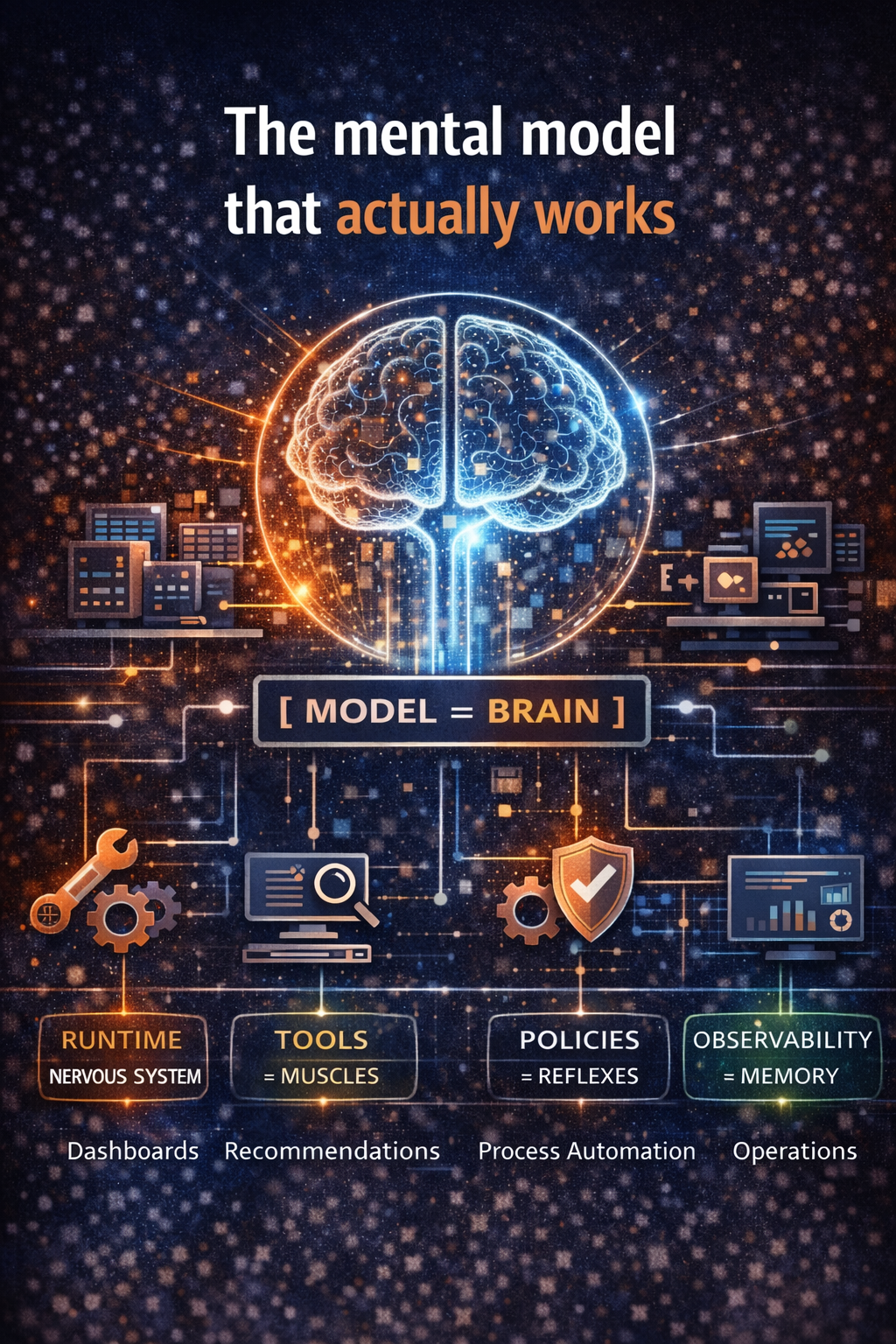
  • What’s missing is the operating system layer that ensures apps behave predictably under real conditions.

In software history, organizations learned a painful lesson: shipping apps without a stable OS-level runtime leads to chaos.
That same pattern is now repeating with AI agents—except the blast radius is far larger, because agents don’t just run. They act.

The moment every enterprise reaches

The moment every enterprise reaches (and most don’t cross)

An agent passes the pilot.

Then leadership asks one simple question:

“Can we let it act?”

That’s the crossing point.

Because “act” means:

  • approving something,
  • changing a record,
  • initiating a workflow,
  • touching a customer,
  • triggering a financial outcome,
  • or making a decision that must be explainable later.

At that moment, the organization stops evaluating intelligence and starts demanding operability:

  • Who allowed this action?
  • What policy was applied—at that moment?
  • What data was accessed?
  • Can we reproduce what happened?
  • Can we roll it back?
  • Can we prove it behaved correctly?

These are runtime questions, not model questions.

And they are exactly why enterprises are shifting away from AI-as-projects toward composable, production-grade operating environments—where intelligence can be deployed repeatedly, safely, and at scale.

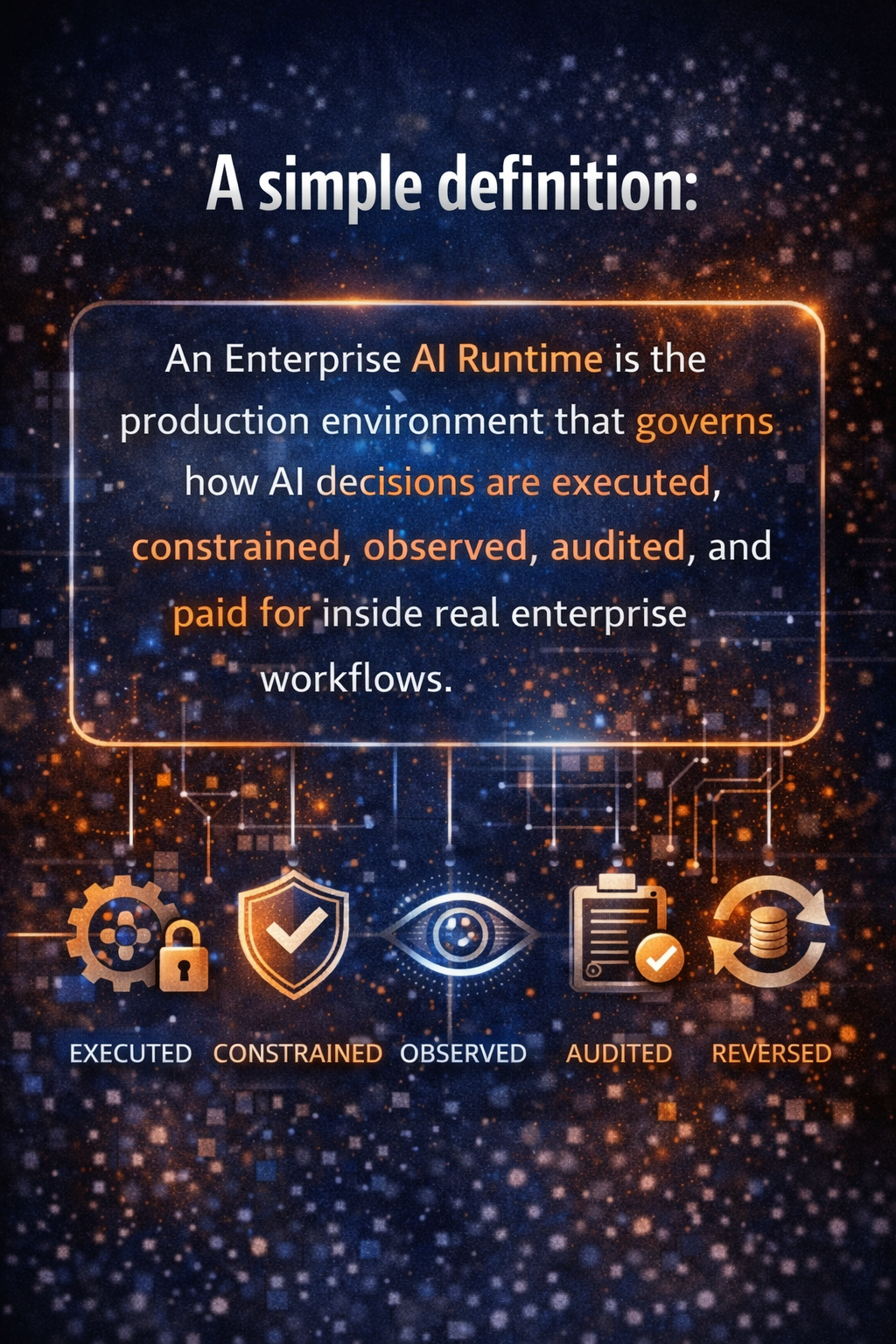
What is an Enterprise AI Runtime?

What is an Enterprise AI Runtime?

An Enterprise AI Runtime is the operating layer that sits between:

  • AI agents (and their models, prompts, and tools), and
  • enterprise systems (business applications, data platforms, workflows, identity, security).

Its job is simple to describe—and hard to build:

Turn agentic behavior into a managed production capability.

A real runtime provides:

  • Identity and permissions for agents (not just users)
  • Policy enforcement at the moment of action
  • End-to-end observability across prompts, tools, workflows, and outcomes
  • Testing and release controls for prompts, models, and tools
  • Security and compliance by design
  • Portability so models, prompts, and tools can change without rewrites

This abstraction—separating business intent from model choice—is becoming non-negotiable. Model innovation is simply too fast to anchor enterprise architecture to any single provider.

Why agents fail in production without a kernel

Why agents fail in production without a kernel

Example 1: The travel-approval agent

The agent reads policy, checks eligibility, and approves travel.

  • Pilot: Perfect.
  • Production: A compliance exception appears.

A policy rule changed yesterday. The agent approved using yesterday’s logic.

Finance questions it. Audit flags it. Leadership asks:

“Show us the decision chain.”

Without a runtime:

  • you can’t prove which policy version was used,
  • you can’t trace tool calls,
  • you can’t reproduce the decision path.

In an enterprise, “it probably did the right thing” is not an answer.

Example 2: The refund agent

Example 2: The refund agent

The agent handles refunds using thresholds and customer history.

Without runtime controls, it might:

  • call the wrong tool version,
  • use stale data,
  • exceed limits during a surge,
  • override a process it never should.

The result isn’t just an error.
It’s a trust break—and trust, once broken, halts scale.

Example 3: The “policy helper” that becomes a production incident

Example 3: The “policy helper” that becomes a production incident

A harmless assistant answers policy questions.
Someone adds a tool: create ticket or update access.

Suddenly the assistant is acting in systems of record.

That jump—from talking to doing—is exactly where a runtime becomes mandatory.

The eight runtime capabilities that make autonomy enterprise-real

The eight runtime capabilities that make autonomy enterprise-real

  1. Agent identity

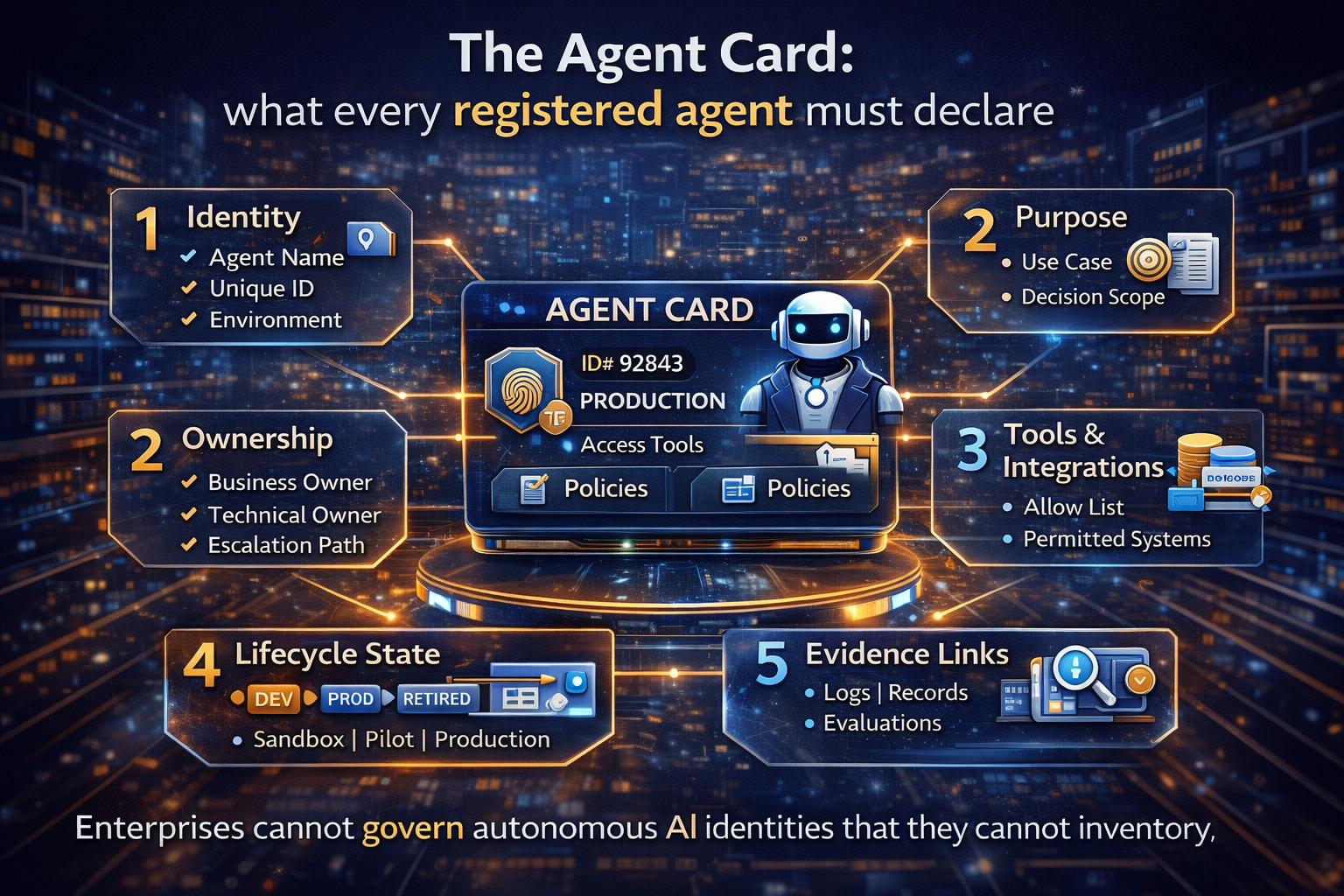
Agents need first-class machine identities: ownership, purpose, risk tier, lifecycle.

  1. Least-privilege permissions

Not “can it act?” but “can it act only within allowed boundaries?”

  1. Policy as executable control

Policies enforced dynamically, not documented passively.

  1. Safe tool calling

Validated schemas, guardrails, approvals for high-impact actions.

  1. End-to-end observability

Trace from user intent → model → tool → real-world action.

  1. Testing & release discipline

Offline evaluation, canary releases, rollback—before customers feel change.

  1. Security by design

Secrets, DLP, safe logging, and protection against prompt and tool abuse.

  1. Portability

Swap models and tools without rebuilding business logic.

Together, these form the production kernel for autonomy.

Build on existing investments (ROI without lock-in)

Build on existing investments (ROI without lock-in)

Build on existing investments (ROI without lock-in)

The fastest path to enterprise AI value is reuse, not replacement.

A true AI runtime does not ask enterprises to rip out:

  • ERP systems,
  • CRM platforms,
  • data lakes,
  • workflow engines,
  • identity stacks.

Instead, it wraps intelligence around what already exists.

This is how ROI compounds:

  • Existing processes become AI-assisted.
  • Existing integrations become AI-orchestrated.
  • Existing platforms become smarter without rebuilds.

Just as importantly, abstraction prevents lock-in.
The runtime becomes the stable layer—while models, tools, and vendors evolve underneath.

Pre-integrated enterprise platforms (speed through interoperability)

Pre-integrated enterprise platforms (speed through interoperability)

In practice, most AI projects stall on integration.

A production runtime treats pre-integration as a feature, not a services promise:

  • common enterprise apps,
  • data platforms,
  • security tooling,
  • observability stacks.

This dramatically reduces time-to-value:

  • fewer bespoke connectors,
  • fewer brittle scripts,
  • fewer one-off solutions.

Interoperability is not an optimization.
It is the difference between deploying once and scaling everywhere.

Orchestrating frontier LLMs and specialized SLMs

Orchestrating frontier LLMs and specialized SLMs

Enterprises are discovering that one model does not fit all.

A mature runtime orchestrates a portfolio:

  • frontier LLMs for complex reasoning and language tasks,
  • specialized or smaller models for speed, cost, latency, or data locality.

The runtime decides:

  • which model to use,
  • for which task,
  • under which constraints.

This keeps costs predictable, latency controlled, and sensitive workloads appropriately bounded—without forcing teams to hard-code model decisions into applications.

Continuous evolution with new protocols and cybersecurity advances

Continuous evolution with new protocols and cybersecurity advances

AI systems do not stand still. Neither do threats.

A production runtime must be designed to absorb change without disruption:

  • new AI protocols,
  • evolving security standards,
  • improved model interfaces,
  • emerging compliance requirements.

The goal is continuity:

  • no mass rewrites,
  • no fragile migrations,
  • no architectural dead ends.

This is how enterprises move from static IT to a living, adaptive digital ecosystem.

Why this shift is global—and accelerating

Why this shift is global—and accelerating

Across industries and regions, the same forces converge:

  • rising regulatory expectations,
  • expanding blast radius of autonomous actions,
  • executive demand for speed without chaos.

That is why leaders are funding operating environments, not experiments.


The executive takeaway: the runtime makes ROI repeatable

With a runtime in place, enterprises gain:

  • reusable AI services,
  • faster deployment cycles,
  • higher quality through discipline,
  • safer scale through governance,
  • sustained ROI as models evolve.

In simple business language:

The runtime turns autonomy from a demo into infrastructure.

A practical 30–60–90 day rollout (without slowing delivery)

A practical 30–60–90 day rollout (without slowing delivery)

A practical 30–60–90 day rollout (without slowing delivery)

Days 0–30
Define agent identity, tracing standards, and a safe action domain.

Days 31–60
Add policy enforcement, approvals, canary releases, and expand domains.

Days 61–90
Productize AI services, add cost visibility, establish operating cadence.

The new advantage is operability

Conclusion: The new advantage is operability

The next winners in enterprise AI will not be defined by how many agents they deploy.

They will be defined by whether they built the production kernel that makes autonomy:

  • reliable,
  • governable,
  • reusable,
  • continuously improvable.

That kernel is the Enterprise AI Runtime.

Once it exists, agents stop being experiments—and start becoming enterprise infrastructure.

❓ FAQ Section

Q1. What is an Enterprise AI Runtime?

An Enterprise AI Runtime is the production operating layer that governs how AI agents act across enterprise systems—enforcing identity, policy, security, observability, and auditability.

Q2. Why do AI agents fail in real enterprise environments?

Because intelligence is easy to demo, but hard to operate. Without runtime controls, agent actions become unpredictable, untraceable, and risky.

Q3. How is an AI Runtime different from an AI platform?

AI platforms help you build agents. An AI Runtime helps you run them safely in production—like an operating system kernel for autonomy.

Q4. Do enterprises need a runtime even for internal AI agents?

Yes. The moment an agent touches systems of record—HR, finance, customer data—it becomes a production system requiring governance.

Q5. Is human oversight still required in enterprise AI?

In many regulated and high-risk contexts, yes. Modern AI architectures are expected to support human-in-the-loop oversight and override mechanisms.

📚 Glossary

Enterprise AI Runtime
The operating layer that makes AI agents safe, governable, observable, and reusable across enterprise systems.

Agentic AI
AI systems capable of planning and executing actions across tools and workflows, not just generating text.

Services-as-Software
Reusable, governed AI capabilities delivered as managed services rather than one-off projects.

Operable Autonomy
Autonomous AI that can be trusted in production because it is observable, auditable, and controllable.

AI Operating Environment
The full stack of runtime, governance, security, and integration layers required to run AI at enterprise scale.

References & Further Reading


The Enterprise AI Factory: How Global Enterprises Scale AI Safely with Studio, Runtime, and Productized Services

The Enterprise AI Factory

Why winners will build Studio → Runtime → Productized AI Services (not more agents)

Enterprise AI has reached a turning point.
The first wave—copilots, chat assistants, internal bots—proved one thing: AI can be useful. The second wave—agents that can plan and take actions—proved another: AI can execute work.

But most enterprises are now discovering a third truth—the one that separates pilots from winners:

Intelligence is easy to demo. Operability is hard to industrialize.

The Enterprise AI Factory

This is why a growing number of organizations will stall even after impressive pilots. Not because the models are weak—but because they lack an enterprise operating environment that makes autonomy reliable, reusable, secure, and cost-controlled at scale. Gartner has explicitly warned that over 40% of agentic AI projects may be canceled by end of 2027 due to escalating costs, unclear business value, or inadequate risk controls. (Gartner)

That’s why the next winners won’t be defined by how many agents they deploy. They’ll be defined by whether they build an Enterprise AI Factory—a unified operating environment that turns AI ideas into safe, governed, reusable, cost-controlled services-as-software, continuously.

Global enterprises across regulated and complex environments are realizing that AI success depends less on model intelligence and more on operational maturity. As organizations move from pilots to production, the need for a unified AI operating environment—spanning design, runtime governance, and reusable services—has become a board-level priority.

This article explains that factory in simple language—clear examples, technical depth (no math), and an executive-grade blueprint for what leaders are actually trying to buy: responsible speed.

Why “more agents” isn’t a strategy

Why “more agents” isn’t a strategy

Agents feel like the shortcut. Give a model tools, let it reason, and watch work disappear.

In real enterprises, that approach creates silent failure modes that compound over time.

1) Agent sprawl becomes governance sprawl

If every team builds agents their own way, you end up with:

  • different prompt styles
  • different tool connectors
  • different permission assumptions
  • different logging and audit quality
  • inconsistent safety controls
  • inconsistent escalation rules

Soon, nobody can answer basic questions:

  • Which agents can take high-impact actions?
  • Which ones are still running?
  • Which ones were tested against tool failures or malicious inputs?
  • Which ones are safe to reuse across teams?

2) Integration multiplies faster than anyone predicts

Every agent needs tools. Tools need authentication. Workflows need approvals. Compliance needs evidence. Observability needs standardized telemetry.

If each agent integrates independently, you get the classic integration explosion:

New agent × new system × new policy × new log format × new review cycle.

3) Costs become unpredictable (and then political)

Agentic systems often:

  • call models repeatedly
  • retrieve too much context
  • loop while reasoning
  • chain across multiple models/tools

Without cost envelopes and routing, spend surprises finance—exactly when leadership wants to scale.

4) Risk shifts from “accuracy” to “accountability”

When AI only suggests, humans catch mistakes.
When AI acts, mistakes become incidents.

Enterprises don’t fear that AI will be wrong sometimes. They fear:

  • being unable to explain why it acted
  • being unable to prove what it used
  • being unable to stop or reverse it safely

So the executive question changes from:

“Can an agent do this task?”
to
“Can we operate autonomy safely, repeatedly, and at scale?”

That’s the Enterprise AI Factory problem.

The Enterprise AI Factory in one sentence

The Enterprise AI Factory in one sentence

An Enterprise AI Factory is a composable, open, interoperable operating environment that enables teams to design and deploy AI capabilities as productized services—with built-in governance, quality engineering, observability, cost control, and integration—while building on existing enterprise investments and avoiding lock-in.

Think of it as platform engineering for AI—except the output isn’t code. The output is operable intelligence.

The three layers of the factory

The three layers of the factory

The factory works because it separates AI into three layers:

1) Studio

Where teams design, assemble, test, and govern AI services before they touch production.

2) Runtime

The production operating layer that makes AI safe and operable: identity, authorization, policy enforcement, action gating, observability, evidence, cost controls, and reliable integrations.

3) Productized AI Services

Reusable, composable AI “service blocks” consumed across the enterprise—integrated or modular—spanning:

  • operations
  • transformation
  • quality engineering
  • cybersecurity

This Studio → Runtime → Productized Services model is the simplest way to explain what enterprises actually need to scale AI responsibly.

Layer 1: Studio — where AI becomes designable

Layer 1: Studio — where AI becomes designable

Most pilots start with a prompt. Enterprises need to start with a service definition.

A Studio is not a prompt playground. It’s a manufacturing floor that turns “AI experiments” into “enterprise services.”

Pilot version vs factory version (simple example)

Pilot: A “Policy Assistant” answers employee questions.
Factory-built service: A “Policy Answering Service” with a contract:

  • It only answers using approved policy sources
  • It cites where it found the answer
  • It refuses if the policy is missing or ambiguous
  • It logs what sources it used
  • It supports versioning (policy changes don’t silently change behavior)

That’s the difference between a demo and a service you can reuse across the enterprise.

What a Studio must include

What a Studio must include

1) Service blueprinting (clear contracts)

Every service needs a blueprint:

  • what it does (and what it refuses)
  • the input/output format
  • the tools it’s allowed to call
  • actions that require approval
  • what evidence must be captured
  • quality expectations and known limitations
  • owners and change control

This is how AI becomes a managed product, not a one-off bot.

2) Frontier models + specialized small models (mix-and-match by design)

Enterprises are moving toward a practical model strategy:

  • use high-capability models where complexity demands it
  • use specialized smaller models where speed/cost/precision matter

A Studio should treat “model choice” as part of the service design—because model choice affects:

  • cost
  • latency
  • privacy posture
  • reliability and consistency

3) A model–prompt–tool abstraction layer (the anti-rewrite layer)

This is a critical capability.

The factory must let you change:

  • models (for cost, privacy, performance)
  • prompts (for behavior improvements)
  • tool APIs (as systems evolve)

…without rewriting every service.

In other words: build an abstraction that can evolve with new model capabilities and new enterprise constraints—without triggering rewrites every quarter.

4) AI Quality Engineering (QE) built in

Traditional QA assumes deterministic outputs. AI is probabilistic.

So Studio-grade QE includes:

  • regression tests when prompts/models change
  • adversarial tests (prompt injection / policy override attempts)
  • tool failure simulation (timeouts, partial responses, wrong data)
  • grounding checks (did it cite approved sources?)
  • refusal tests (does it decline risky tasks?)

A viral line worth keeping:

“If it can’t survive a tool failure and a malicious prompt, it’s not a service. It’s a demo.”

5) Governance-by-design

Studio is where governance becomes real:

  • approvals and ownership
  • policy packs embedded in the service definition
  • audit-ready evidence requirements
  • version control and traceability
  • operational readiness gates before production

This aligns with what risk frameworks emphasize: governance must span the lifecycle, not sit outside it. NIST’s AI Risk Management Framework is explicit about GOVERN as a function that applies across stages, supported by MAP/MEASURE/MANAGE. (NIST Publications)

Layer 2: Runtime — where autonomy becomes operable

Layer 2: Runtime — where autonomy becomes operable

Studio builds services. Runtime runs them safely.

Runtime is where the factory turns “AI capability” into “enterprise production.”

A modern AI runtime must do six things exceptionally well:

1) Unify across the enterprise landscape

The runtime must work across diverse systems, teams, and workflows—so AI doesn’t become another silo.

2) Build on existing investments (no rip-and-replace)

Enterprises don’t win by replacing everything. They win by amplifying what already exists:

  • workflow platforms
  • systems of record
  • automation
  • data platforms
  • monitoring and ITSM patterns

A factory-grade runtime integrates into existing ecosystems, maximizing ROI and reducing disruption.

3) Open interoperability to avoid lock-in

The runtime must be able to:

  • adopt new models without rebuilds
  • integrate emerging tools and protocols
  • support partner ecosystems and platform integrations

This is the difference between a stack you can evolve and a stack you outgrow.

4) Identity, permissions, and action gating for AI services

Autonomy without authorization is fast chaos.

Runtime should enforce:

  • strong service identity
  • least-privilege tool access
  • policy-driven gating for sensitive actions
  • approvals for high-impact tasks
  • tamper-resistant audit trails

Simple example:
A “Procurement Helper” can draft vendor comparisons.
But it cannot finalize procurement actions without approval and evidence.

5) Observability + evidence (for decisions and actions)

Classic monitoring watches servers. Enterprise AI monitoring must also watch:

  • which sources were retrieved
  • which tools were called
  • what approvals were requested
  • what decisions were made
  • why those decisions happened (traceable rationale)

This is what makes autonomy accountable—especially as agentic AI increases speed and complexity. (Reuters)

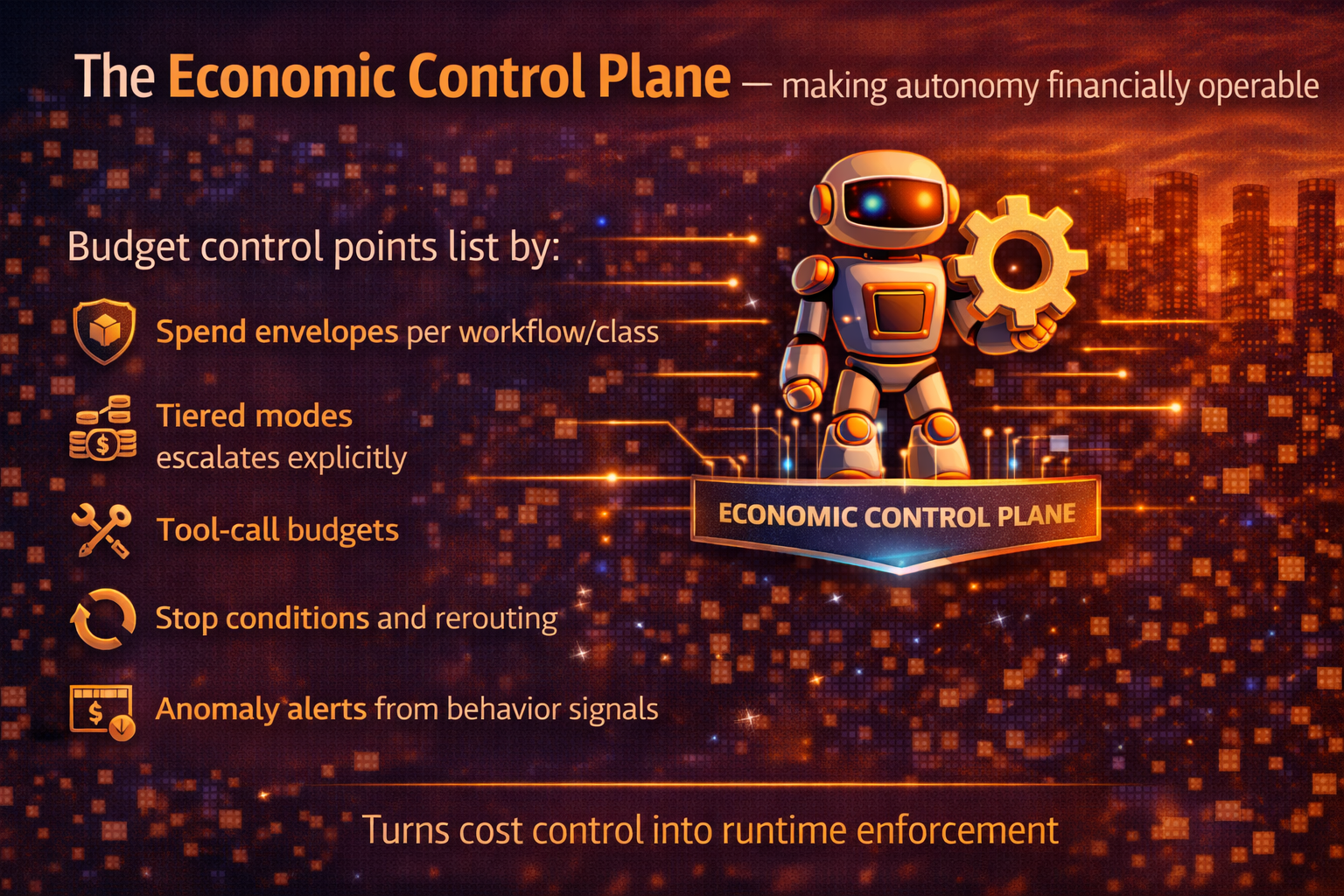
6) Cost control as a runtime control plane (not a report)

AI FinOps must be built into the runtime:

  • budgets per service and per workflow
  • model routing (cheap vs premium)
  • loop guards (prevent runaway tool calls)
  • anomaly detection for spend spikes
  • per-service cost envelopes included in service contracts

When cost controls are embedded, finance becomes a scale partner—not a brake.

Layer 3: Productized AI Services — the “one-stop shop” of enterprise capability

Layer 3: Productized AI Services — the “one-stop shop” of enterprise capability

This is the most important shift in the entire article:

Stop shipping agents. Start publishing productized services.

A productized AI service is:

  • reusable across teams
  • measurable and supportable
  • governable and auditable
  • upgradable safely
  • delivered as a consistent interface (like an internal API/product)

Enterprises increasingly want a “one-stop” catalog of such services—available in integrated and modular forms—covering the core domains where value compounds:

Operations services (Run)

  • Incident summarization and triage
  • Root-cause hypotheses with evidence
  • Suggested remediation steps with safe gating
  • Knowledge retrieval and runbook generation

Transformation services (Change)

  • Modernization guidance aligned to standards
  • Migration playbooks and risk checks
  • Documentation generation and workflow acceleration

Quality engineering services (Assure)

  • Test case generation
  • regression suites for prompt/model updates
  • behavior monitoring and validation
  • safety and compliance checks as part of CI/CD

Cybersecurity services (Protect)

  • threat and exposure summarization
  • policy-aligned response playbooks
  • detection enrichment and investigation support
  • secure-by-design guardrails embedded into AI workflows

These services aren’t “bots everywhere.” They’re capability blocks that any team can consume without rebuilding foundations.

Two accelerators that make the factory real in practice

Two accelerators that make the factory real in practice

1) Pre-built components and templates

Factories scale faster when they have reusable parts:

  • service templates
  • connector packs
  • policy packs
  • evaluation harnesses
  • guardrail modules

This is what turns “90 days of building plumbing” into “90 days of shipping value.”

2) Paved roads, not best-effort improvisation

AI factories succeed when teams get a paved road—a preconfigured, compliant path to ship services safely. This idea is well established in platform engineering (“golden paths”). (Platform Engineering)

The workforce model that makes it enterprise-real

The workforce model that makes it enterprise-real

The factory is not “humans vs AI.” It’s a synergetic workforce:

  • Digital workers: deterministic automation, bots, APIs
  • AI workers: orchestrate tasks, predict, summarize, reason within constraints
  • Human workers: govern by exception, set policy, approve high-impact actions, continuously improve the system

This model makes autonomy scalable because it clarifies:

  • who can act
  • who must approve
  • what evidence is required
  • where accountability lives
The enterprise advantage leaders will fund

The enterprise advantage leaders will fund

When you explain the factory to CIOs/CTOs/CXOs, the architecture is important—but outcomes are what get funded.

An Enterprise AI Factory delivers four outcomes leaders recognize immediately:

  1. Higher velocity
    Teams ship faster because they reuse services instead of reinventing the stack.
  2. Optimal cost
    Cost drops through routing, reuse, and standardized patterns—without compromising safety.
  3. Superior quality
    QE, regression tests, and observability reduce incidents and rework.
  4. Sustained ROI
    The factory builds on existing investments, avoids lock-in, and evolves continuously as models and threats change. McKinsey’s research consistently emphasizes that value from AI correlates with management practices across operating model, tech, data, adoption, and scaling. (McKinsey & Company)

That’s the difference between “AI adoption” and “AI advantage.”

A practical 30–60–90 day rollout (without slowing delivery)

A practical 30–60–90 day rollout (without slowing delivery)

You don’t need to boil the ocean. You need a paved road.

Days 0–30: Start with 2–3 productized services

Pick horizontal services many teams want:

  • governed knowledge answers (with citations and refusal rules)
  • incident triage
  • quality validation for AI outputs

Design them in Studio: contracts, tests, approvals, evidence requirements.

Days 31–60: Stand up the minimum viable Runtime

Deliver the essentials:

  • service identity + least privilege
  • policy gating + approvals for sensitive actions
  • observability + evidence capture
  • basic cost envelopes and routing

Days 61–90: Publish a small service catalog

Make services discoverable and reusable:

  • clear interfaces
  • usage guidelines
  • guardrails and known limitations
  • ownership and support model

Then scale horizontally: more services, more connectors, more automation, stronger governance.

Enterprise AI Factory

Conclusion

The biggest mistake enterprises can make in 2026 is to treat agents as the destination.
Agents are a form factor. The destination is an operating environment that can industrialize autonomy.

If you want speed and safety, the answer is not “more agents.”
The answer is a factory:

  • Studio to design and govern services
  • Runtime to operate autonomy safely with evidence and cost control
  • Productized services to scale reuse across the enterprise

That is how AI becomes a durable capability—something you can trust, fund, defend, and evolve.

Glossary

  • Enterprise AI Factory: An operating environment that turns AI initiatives into reusable, governed, operable services at scale.
  • Studio: The build-and-govern layer where services are designed, tested, and approved before production.
  • Runtime: The production layer that enforces identity, policy, observability, evidence, and cost controls while running AI services.
  • Productized AI Service: A reusable AI capability delivered with an interface, ownership, guardrails, monitoring, and lifecycle management.
  • Action gating: Controls that require approval or additional checks before high-impact actions execute.
  • Golden path / paved road: A preconfigured, compliant, repeatable path for teams to ship safely (common in platform engineering). (Platform Engineering)
  • AI RMF: NIST’s AI Risk Management Framework; organizes AI risk management via GOVERN, MAP, MEASURE, MANAGE. (NIST Publications)

FAQ

Is this just another “AI platform” story?

No. A platform helps you build. A factory helps you build + govern + operate + reuse + evolve continuously.

Why focus on services instead of agents?

Because services have contracts, owners, tests, observability, and cost envelopes. Agents often don’t—unless you force them into a service lifecycle.

What’s the single biggest reason factories beat pilots?

Factories embed operability: identity, policy, observability, cost control, quality engineering, and safe evolution—so scale doesn’t collapse under enterprise pressure. (Gartner)

How does this relate to AI governance expectations?

Governance is becoming a lifecycle practice, not a document. Frameworks like NIST AI RMF emphasize continuous governance across design, development, deployment, and monitoring. (NIST Publications)

Q1. What is an Enterprise AI Factory?

An Enterprise AI Factory is an operating model that enables organizations to design, deploy, and scale AI as governed, reusable, and operable services, rather than one-off projects or isolated agents.
It combines three layers—Studio (design and governance), Runtime (safe operation), and Productized AI Services (reuse at scale)—to ensure AI systems are reliable, auditable, cost-controlled, and aligned with enterprise processes.

In simple terms, it turns AI from experiments into industrial-grade capabilities that enterprises can trust and evolve over time.

Q2. Why do AI pilots fail in enterprises?

AI pilots often fail not because the models are inaccurate, but because they are not built to operate at enterprise scale.
Most pilots lack standardized governance, cost controls, observability, integration patterns, and ownership models. As a result, they work in isolation but collapse when exposed to real-world complexity, security requirements, and organizational scale.

Enterprises don’t struggle with proving AI value—they struggle with operating AI safely, repeatedly, and economically across teams and systems.

Q3. How is an AI Factory different from an AI platform?

An AI platform focuses on helping teams build AI—providing models, tools, and development capabilities.
An AI Factory, by contrast, focuses on operating AI—ensuring that what gets built can be governed, monitored, secured, cost-controlled, reused, and evolved in production.

In short:

  • Platforms optimize creation
  • Factories optimize industrialization and scale

Enterprises need both—but without a factory model, platforms alone lead to pilot sprawl.

Q4. What are productized AI services?

Productized AI services are reusable AI capabilities delivered with clear interfaces, ownership, guardrails, observability, and lifecycle management—much like internal digital products or APIs.
Instead of deploying individual agents for each use case, enterprises publish AI capabilities as standardized services that multiple teams can safely consume.

This approach reduces duplication, improves quality, lowers cost, and enables faster scaling—transforming AI from isolated solutions into a shared enterprise capability.

🔍 People Also Ask (PAA) 

What problem does an Enterprise AI Factory solve?

An Enterprise AI Factory solves the problem of scaling AI beyond pilots. It provides a unified operating environment where AI systems can be governed, monitored, cost-controlled, and reused safely across teams, systems, and regions—without creating agent sprawl or operational risk.

How do enterprises industrialize AI?

Enterprises industrialize AI by moving from isolated pilots to a factory model that separates design (Studio), operations (Runtime), and consumption (Productized Services). This ensures AI systems are reliable, auditable, and scalable across real enterprise environments.


Why do AI agents fail at enterprise scale?

AI agents fail at enterprise scale because they are often deployed without standardized governance, identity, cost controls, or observability. Without an operating model, agents multiply risk, cost, and integration complexity instead of delivering sustained business value.


What is the difference between AI agents and AI services?

AI agents are execution units built for specific tasks. AI services are productized, reusable capabilities with clear contracts, ownership, monitoring, and guardrails. Enterprises scale AI by publishing services—not by deploying unmanaged agents.

What is an AI runtime in enterprise architecture?

An AI runtime is the production layer that safely operates AI systems. It enforces identity, authorization, policy controls, observability, evidence capture, and cost management—ensuring autonomous AI behaves predictably and accountably in real-world environments.

How do enterprises control AI costs at scale?

Enterprises control AI costs by embedding FinOps directly into the AI runtime. This includes per-service budgets, model routing, loop guards, usage monitoring, and anomaly detection—turning AI cost control into a real-time operational capability, not a retrospective report.

Enterprise AI Factory — Expert Definition
An Enterprise AI Factory is an operating model that enables organizations to design, govern, and scale AI as reusable, auditable, and cost-controlled services. By separating AI into Studio (design), Runtime (operation), and Productized Services (reuse), enterprises can industrialize autonomy safely across complex, regulated environments.

— Raktim Singh, Enterprise AI Operating Models

An Enterprise AI Factory is an operating model that helps organizations scale AI beyond pilots by combining design, governance, and production. It enables AI to run as reusable, auditable, and cost-controlled services across enterprise systems.

An Enterprise AI Factory is how enterprises industrialize AI—turning pilots into governed, reusable, and scalable services that operate safely across real business systems.

References and further reading

  • Gartner press release: prediction that over 40% of agentic AI projects will be canceled by end of 2027. (Gartner)
  • McKinsey: The State of AI research and value correlated with operating model and scaling practices. (McKinsey & Company)
  • NIST AI Risk Management Framework (AI RMF 1.0) and playbook (GOVERN/MAP/MEASURE/MANAGE). (NIST Publications)
  • Platform engineering “golden paths” / “paved roads” (practical adoption lens). (Platform Engineering)
  • Reuters reporting on rising agentic AI risk concerns due to speed/autonomy in regulated environments. (Reuters)

Why Enterprises Need Services-as-Software for AI: The Integrated Stack That Turns AI Pilots into a Reusable Enterprise Capability – Raktim Singh

The Advantage Is No Longer Intelligence—It Is Operability: How Enterprises Win with AI Operating Environments – Raktim Singh

The Synergetic Workforce: How Enterprises Scale AI Autonomy Without Slowing the Business – Raktim Singh

Enterprise AI Operating Model 2.0: Control Planes, Service Catalogs, and the Rise of Managed Autonomy – Raktim Singh

The Composable Enterprise AI Stack: Agents, Flows, and Services-as-Software — Built Open, Interoperable, and Responsible | by RAKTIM SINGH | Dec, 2025 | Medium

Why Enterprise AI Is Becoming a Fabric: From AI Agents to Services-as-Software | by RAKTIM SINGH | Dec, 2025 | Medium

The Enterprise AI Service Catalog: Why CIOs Are Replacing Projects with Reusable AI Services | by RAKTIM SINGH | Dec, 2025 | Medium

The Enterprise AI Design Studio: How Business Teams Build Trusted AI Agents Without Breaking Security or Compliance | by RAKTIM SINGH | Dec, 2025 | Medium

Raktim Singh writes on enterprise AI operating models, agentic systems, and scalable AI governance. He focuses on how global organizations industrialize AI safely and sustainably.

Why Enterprises Need Services-as-Software for AI: The Integrated Stack That Turns AI Pilots into a Reusable Enterprise Capability

Executive summary

AI pilots fail because intelligence is easy to demo—but hard to operate. Enterprises don’t need more agents. They need services-as-software.

Most enterprises are discovering the same truth: AI is easy to pilot, hard to industrialize.

The barrier is rarely model intelligence—it’s the lack of an enterprise operating environment that makes autonomy reliable, reusable, and secure across real systems. Services-as-software is the response: deliver AI not as isolated projects, but as modular, integrated services spanning Operations, Transformation, Quality Engineering, and Cybersecurity.

This approach creates continuity in an ecosystem where models, tools, data, and regulations evolve quickly.

services-as-software for enterprise AI
services-as-software for enterprise AI :The Integrated Stack That Turns AI Pilots into a Reusable Enterprise Capability

It also enables an AI-first, cloud-first, partner-first posture: intelligence designed into workflows, deployed with elastic foundations, and integrated openly across vendors and platforms—without lock-in.

The endgame is simple: move from a “pilot factory” to a capability factory, where trusted AI services (policy Q&A with evidence, incident triage, access approvals, supervised orchestration) can be reused across the enterprise with governance by default.
 

The moment every enterprise reaches—and most don’t cross

A leadership team watches a demo and sees the future. A chatbot answers flawlessly. A copilot drafts in seconds what used to take hours. An “agent” completes a workflow end-to-end. The pilot succeeds. A few teams become believers.

Then the enterprise tries to scale—and the questions change.

Not “Can it write?” but “Can we run it?”
Not “Is it accurate in a demo?” but “Will it remain safe and reliable when policies, data, tools, and models change?”
Not “Can one team adopt it?” but “Can a hundred teams reuse it without duplicating risk, cost, and integration work?”

That is the cliff edge between pilots and capability.

Gartner has publicly warned that a meaningful share of GenAI initiatives will be abandoned after proof-of-concept because organizations run into the operational realities of production: data quality, risk controls, cost pressure, and value realization. And as “agents” become more common, Gartner has also forecast significant cancellation risk for agentic AI initiatives that are not governed and industrialized.

This is not a verdict on AI. It’s a verdict on operating models.

The next phase of enterprise AI is not “more pilots.” It’s industrialization: turning intelligence into a reusable capability the enterprise can safely consume again and again—like a utility.

What “services-as-software” actually means

What “services-as-software” actually means

Services-as-software is a simple idea with radical implications:

Deliver enterprise AI as modular, integrated services—not one-off projects—across the four domains AI disrupts simultaneously: Operations, Transformation, Quality Engineering, and Cybersecurity.

In other words: stop treating AI like an experiment each team rebuilds from scratch. Start treating AI like an enterprise capability you productize, govern, and reuse.

This is the same logic that helped enterprises scale cloud and DevOps. They didn’t ask every team to become infrastructure experts. They built self-service with guardrails—a paved road that lets teams move fast safely. Microsoft describes platform engineering in precisely these terms: better developer experience, secure self-service, and governance by default.

Services-as-software applies that platform thinking to intelligence.

Instead of teams “building AI,” teams consume AI services that already include:

  • integration standards
  • governance defaults
  • monitoring and incident hooks
  • quality and safety gates
  • security and access controls
  • upgrade paths as models and tools evolve

It’s the difference between:

  • “We built an AI bot.”
    and
  • “We shipped a reusable enterprise service.”

The second sentence is how organizations scale anything that matters.

Services-as-Software for Enterprise AI
A model where AI is delivered as reusable, governed enterprise services — with built-in observability, security, quality engineering, and lifecycle control — rather than as isolated projects or pilots.

Why “AI as projects” collapses under real enterprise pressure

Why “AI as projects” collapses under real enterprise pressure

Projects are how enterprises deliver change. But AI—especially agentic AI—behaves like a living production system:

  • It can produce different outputs for the same input.
  • It can fail in ways that look confident.
  • It depends on evolving context: policies, prompts, knowledge, tool APIs, user behavior.
  • It creates new security and governance failure modes at machine speed.

So when each business unit builds its own AI solution, you don’t get “enterprise AI.” You get an enterprise-wide integration tax:

  • disconnected assistants
  • duplicated integrations into the same systems
  • inconsistent guardrails (privacy, approvals, auditability)
  • no shared observability (no single view of behavior, drift, incidents)
  • fragmented security posture
  • cost sprawl across inference, retrieval, orchestration, monitoring
  • one serious incident away from a leadership reset

This is not a talent problem. It’s an architecture problem.

services-as-software for enterprise AI : A simple story: the “Policy Helper” that becomes a production incident
services-as-software for enterprise AI :A simple story: the “Policy Helper” that becomes a production incident

A simple story: the “Policy Helper” that becomes a production incident

A team launches a policy chatbot. In pilot, it’s great.

Then it scales, and three inevitable things happen:

1) Knowledge changes weekly.
Policies update. Exceptions appear. Without managed retrieval and refresh, the bot starts answering with yesterday’s truth.

2) The audience differs by role.
Different groups have different permissions and exceptions. Now you need access control, segmentation, and governance workflows.

3) Accountability arrives.
Security asks a question that changes the conversation:
“Show evidence. What sources did it use? What did it ignore? Which version was approved?”

Suddenly, a “simple bot” needs:

  • retrieval controls
  • identity and access enforcement
  • audit trails and evidence logs
  • monitoring and drift detection
  • safe rollout and rollback

If it’s a project, this becomes endless bespoke rework.

If it’s a service, the enterprise gets a reusable capability:
Policy Q&A with verifiable sources, consumable across teams—built once, governed once, improved continuously.

That’s the services-as-software difference in one example.

The philosophy that makes scalable AI possible

The philosophy that makes scalable AI possible

AI-first, cloud-first, partner-first—built for continuity, not disruption

Many enterprises stall because they assume AI must replace the existing landscape. In reality, the most durable AI operating environments are built to extend what already exists—without pausing delivery.

That is why modern integrated stacks converge on three principles:

AI-first

AI is not treated as a feature bolted onto workflows. It is designed into workflows from the beginning:

  • decision points are AI-augmented by default
  • knowledge access is mediated through retrieval + reasoning layers
  • exceptions go to humans only when needed
  • improvement loops are operational, not aspirational

This is the shift from “AI tools you use” to “work that runs.”

Cloud-first

Enterprise AI needs elasticity:

  • inference demand spikes unpredictably
  • models and tooling evolve frequently
  • enterprises require resilience across regions
  • data and platforms are distributed

Cloud-first isn’t vendor rhetoric; it’s architectural adaptability—the ability to scale and evolve without rewrites.

Partner-first

No enterprise builds AI alone. Real environments must integrate:

  • frontier models and specialist smaller models
  • enterprise platforms and data platforms
  • partner ecosystems—without locking the enterprise into one model era

That’s why open abstraction across models, prompts, and tools matters: it lets enterprises adopt new AI capabilities without rebuilding every workflow.

The deeper point is this:
AI-first without cloud-first becomes brittle. Cloud-first without partner-first becomes isolated. Partner-first without AI-first becomes fragmented.
Only together do they create continuity.

The integrated AI stack enterprises actually need

The integrated AI stack enterprises actually need

Services-as-software works only when the stack is integrated across the four domains AI breaks at once.

1) Operations: run AI like a production capability

When AI touches live processes, you need operational excellence—observability, reliability, incident response, and continuous improvement.

Example: Incident Triage Assistant
In pilot, it reads alerts and drafts recommendations. At scale, the production questions arrive:

  • What data and tools did it use?
  • When did behavior change?
  • Can it be safely rolled back?
  • How do we detect degradation before it becomes an incident?

This is why enterprise platforms are converging on lifecycle management, observability, and policy enforcement for agents.

Services-as-software turns these requirements into shared operational services:

  • telemetry and tracing for AI actions
  • evidence logging (what, why, based on what)
  • incident workflows for AI behavior
  • release/rollback controls for prompt/model/tool changes

Reliability becomes reusable—not negotiated each time.

2) Transformation: modernize without pausing delivery

Enterprises run mixed estates: legacy platforms plus modern SaaS plus custom apps. AI value compounds when modernization is continuous:

  • incremental migration
  • integration rationalization
  • workflow automation
  • refactoring and remediation

Services-as-software makes transformation repeatable: standardized interfaces, reusable integration patterns, and modernization pipelines that can be applied again and again.

3) Quality Engineering: prevent confident failures

Traditional QA validates deterministic behavior. AI behavior can shift when you change:

  • the model
  • the system prompt
  • retrieval configuration
  • tool APIs
  • underlying knowledge and policy

So the enterprise question becomes:
How do we validate a system that can change behavior without changing its code?

Services-as-software productizes AI-first QE:

  • behavioral regression tests
  • safety test suites
  • evaluation gates before rollout
  • continuous production validation
  • red-teaming as a routine discipline

Prompt injection isn’t theoretical. OWASP explicitly documents it as a primary LLM risk category—especially dangerous when tool access is involved.

4) Cybersecurity: secure-by-design autonomy

Autonomy expands the attack surface:

  • tool calling
  • credential access
  • data retrieval
  • workflow execution

Security can’t be bolted on later. It must be embedded into identity, authorization, policy enforcement, evidence trails, and least privilege—responsible AI by design as a default.

Why integration beats “best tools”

Why integration beats “best tools”

Many enterprises buy excellent point solutions:

  • model gateways
  • prompt tools
  • monitoring products
  • evaluation frameworks
  • security scanners

But stitched together ad hoc, you create the integration trap: every new AI use case becomes a new integration program.

That’s why integrated, modular, open architectures win—because they make upgrades survivable.

In simple terms:

  • Tools change fast.
  • Enterprises can’t rewrite fast.
  • The stack must absorb change.


Pre-built, composable AI services


Why enterprises should assemble intelligence—not build everything from scratch

Another quiet reason AI stalls: enterprises try to build every capability from the ground up.

Scalable operating environments rely on pre-built, composable services: reusable building blocks designed to plug into real workflows with governance already baked in. Pre-integration across enterprise and data platforms is one of the biggest accelerants to adoption and interoperability.

Here are examples of composable services enterprises actually reuse:

1) Policy & Knowledge Q&A with verifiable sources

  • retrieves approved content
  • answers with citations/evidence
  • enforces access controls
  • logs provenance for audit

2) Incident triage & root-cause recommendation

  • clusters incidents
  • proposes likely causes
  • drafts remediation steps
  • escalates when confidence is low

3) Access approval & risk recommendation

  • evaluates requests against policy + context
  • recommends approve/deny/escalate
  • records reasoning and evidence

4) Document processing & intelligence extraction

  • classification, extraction, summarization
  • compliance checks
  • standardized outputs and controls

5) Workflow orchestration with human oversight

  • AI handles routine steps
  • humans approve sensitive actions
  • exceptions are routed by policy and confidence

Why composability matters more than “features”: it standardizes trust.
Each service arrives with operational hooks, quality gates, security controls, and governance defaults—so innovation doesn’t multiply risk.

The workforce model that makes AI “enterprise-real”

The workforce model that makes AI “enterprise-real”

A practical way to understand scalable AI is as a synergetic workforce:

  • Digital workers: deterministic workflows, tools, bots, APIs
  • AI workers: reasoning, orchestration, prediction, recommendations
  • Human workers: creativity, strategy, governance, improvement

This model captures how modern stacks deliver future-ready services: deterministic automation where possible, AI where value exists, and humans governing by exception.

It’s not about replacing people. It’s about engineering a system where work is executed reliably.

What CXOs are really buying

What CXOs are really buying

What CXOs are really buying

Executives aren’t buying “AI features.” They’re buying outcomes with controlled risk—often summarized as:

  • higher velocity
  • superior quality
  • optimal cost
  • sustained ROI and continuity without disruption

This is why services-as-software is a better executive question than “which agent platform?”
It reframes the choice:

Do we want scattered experiments—or a reusable enterprise capability?

A rollout that doesn’t slow the business

A rollout that doesn’t slow the business

You don’t big-bang this. You build it like a product.

Days 0–30: establish the paved road

  • standardize access to models, tools, and enterprise data
  • define baseline policies: identity, approvals, logging, audit
  • create a minimal observability + evaluation loop
    This mirrors platform engineering’s “secure self-service with guardrails” approach.

Days 31–60: productize 3–5 reusable services

Start with high-reuse services (policy Q&A, incident triage, access approvals, document intelligence, supervised orchestration).

Days 61–90: scale via consumption, not reinvention

  • publish a service catalog
  • onboard teams via templates
  • add QE gates + security scanning into release workflows
  • measure adoption via service SLOs and business outcomes

The goal is to shift from a pilot factory to a capability factory.

industrializing intelligence is the new advantage

Conclusion: industrializing intelligence is the new advantage

The first chapter of enterprise AI was experimentation: pilots, copilots, prototypes.

The second chapter is industrialization: reusable, governed capabilities that can be adopted across teams without duplicating risk, rework, and cost.

That is what services-as-software enables.

Because in the agent era, the advantage is no longer intelligence alone.
It is the ability to operate intelligence—reliably, securely, and repeatedly—across the enterprise.


FAQ

What is services-as-software for enterprise AI?
Delivering AI as reusable enterprise services with built-in governance, monitoring, security, and quality gates—rather than one-off projects.

Why do AI pilots fail to scale?
Common blockers include poor data quality, inadequate risk controls, escalating costs, and unclear business value after proof of concept.

Is this just MLOps?
No. MLOps is necessary but narrower. Services-as-software integrates Ops, Transformation, Quality Engineering, and Cybersecurity so AI runs as a reusable enterprise capability.

What security risks become critical when agents can act?
Prompt injection is a widely recognized risk category where inputs manipulate model behavior—especially risky when tools and privileged actions are involved.

How does this reduce vendor lock-in?
By using open architecture that abstracts models, prompts, and tools so new models and technologies can be integrated without rebuilding workflows.


Glossary

  • Services-as-software: AI delivered as reusable, modular enterprise services—integrated and reliable at scale.
  • Composable services: Reusable building blocks (policy Q&A, incident triage, access approvals) that can be assembled without rebuilding controls.
  • Self-service with guardrails: Teams move fast within predefined, stakeholder-approved safety boundaries.
  • Prompt injection: Inputs crafted to alter an LLM’s behavior or bypass safeguards.
  • Synergetic workforce: Digital workers + AI workers + human workers operating together as an enterprise delivery model.
  • Open abstraction layer: Decouples workflows from specific models/prompts/tools for continuity as the ecosystem evolves.


References

  • Gartner: forecast that a significant share of GenAI projects will be abandoned after proof of concept (drivers include data, risk, cost, unclear value).
  • Gartner: forecast that a large share of agentic AI projects may be canceled without proper governance/industrialization.
  • Microsoft Learn: platform engineering and secure self-service with guardrails.
  • OWASP: Top risks for LLM applications, including prompt injection.
  • Infosys Topaz Fabric page for the integrated “services-as-software” stack framing across Ops/Transformation/QE/Cyber and open, composable approach.


Further reading


The Advantage Is No Longer Intelligence—It Is Operability: How Enterprises Win with AI Operating Environments

The Big Shift: AI Is No Longer “A Tool You Use.” It Is Work That Runs

The AI advantage has shifted.

It’s no longer about how smart your models are—
it’s about whether your enterprise can operate intelligence safely, reliably, and at scale.

For the last two years, enterprise AI has looked like an explosion of tools:

  • Chat assistants for employees
  • Copilots embedded in productivity suites
  • RAG chatbots connected to internal documents
  • Agent demos that can complete tasks end-to-end

They are impressive.
They attract funding.
They pass pilots.

And then—quietly—many of them stall.

Not because the models are weak.
Not because the data is missing.

The Big Shift: AI Is No Longer “A Tool You Use.” It Is Work That Runs.

But because the enterprise cannot operate them.

That is why the next generation of enterprise winners will not be defined by how many AI tools they deploy. They will be defined by whether they build an AI operating environment: a unified, production-grade environment where AI can be designed, composed, executed, integrated, governed, observed, and cost-controlled—consistently and at scale.

This shift is already visible in global signals. Analysts and industry leaders increasingly point to a familiar failure pattern: pilot success followed by production collapse. Costs rise, risks multiply, and ownership becomes unclear. At the same time, enterprise AI leaders are converging on a new insight:

Real AI value appears only after intelligence is treated like infrastructure—not experimentation.

Which leads to a new executive question:

It is no longer “Which AI tool should we buy?”
It is “What environment allows us to run AI as a core enterprise capability?”

What Is an AI Operating Environment?

What Is an AI Operating Environment?

An AI operating environment is not a product.
It is not a single platform.
It is not another agent framework.

It is a complete enterprise operating layer that turns AI from isolated experiments into dependable, repeatable systems.

Think of the difference between:

  • Buying a few developer tools, versus
  • Running a full cloud environment where applications can be designed, deployed, governed, monitored, upgraded, and scaled

An AI operating environment applies the same discipline to intelligence.

In mature enterprises, six capabilities always appear together:

  1. Design Layer (Studio)
    Business and technology teams co-design AI experiences with intent, policy, and risk embedded from the start.
  2. Composition Layer (Flow Builder)
    AI work is composed as flows—combining models, tools, data, approvals, and humans.
  3. Runtime Layer
    Execution, reliability, routing, scaling, lifecycle management, and controlled change.
  4. Integration Layer
    Native connectivity to enterprise systems, data platforms, identity, and APIs.
  5. Governance Layer
    Continuous policy enforcement, security, compliance, auditability, and evidence.
  6. Cost and Performance Layer
    Observability, AI FinOps, quality engineering, and continuous optimization.

The critical insight is this:
These layers only work when treated as one system—not separate purchases.

Why AI Tools Plateau in Real Enterprises

Why AI Tools Plateau in Real Enterprises

  1. Tools Create Local Wins. Enterprises Need System Wins.

A single team adopts an AI tool and sees productivity gains. That is valuable—but temporary.

Enterprises do not scale isolated wins. They scale systems:

  • Shared controls
  • Reusable components
  • Standard integration patterns
  • Consistent audit trails
  • Predictable costs
  • Safe upgrade paths

When every team selects its own tools and invents its own operating logic, the result is not innovation. It is fragmentation.

  1. AI Outputs Are Not the Real Risk. AI Actions Are.

A wrong answer is embarrassing.
A wrong action is expensive.

The moment AI moves from suggesting to doing, the engineering bar changes:

  • Who approved this action?
  • What data was used?
  • Can we roll it back?
  • Can we explain it to an auditor?
  • Can we detect and contain failures?

These are not AI questions.
They are operational questions.

  1. Enterprises Do Not Fail at AI Because of Models.

They fail because they lack operating discipline.

Modern enterprises already know how to run critical systems:

  • Site reliability engineering
  • Identity and access management
  • Change control
  • Cost governance
  • Quality engineering

AI tools often bypass these disciplines.
AI operating environments embed them.

A Simple Story: When an “Approval Assistant” Becomes a Production Nightmare

A Simple Story: When an “Approval Assistant” Becomes a Production Nightmare

Imagine a helpful use case:

An AI assistant helps approve requests.

It reads policy documents, checks past decisions, drafts a recommendation, and routes it to the correct approver.

In the tool era, this is easy:

  • Connect to documents
  • Prompt a model
  • Ship a chat interface

It works—until adoption grows.

Then reality arrives:

  • Policies change, but answers don’t
  • Sensitive data becomes visible
  • Identical cases receive different outcomes
  • No one can reconstruct why a decision was made
  • Costs spike unexpectedly
  • Small prompt changes break downstream behavior

At this point, the enterprise does not need a better prompt.

It needs an operating environment:

  • A design layer to model intent and policy
  • A flow layer to make logic explicit
  • A runtime layer with versioning and rollback
  • An integration layer that respects access controls
  • A governance layer that produces evidence
  • An observability layer that keeps cost and quality predictable

That is the difference between a tool and an environment.

The Six Layers That Turn AI into an Enterprise Capability

The Six Layers That Turn AI into an Enterprise Capability

  1. The Design Layer: Design Before Deployment

AI is not just an interface.
It is a new decision surface.

The design layer answers:

  • What is the business intent?
  • What data is allowed?
  • What actions are permitted?
  • What must be reviewed by a human?

This is where responsible AI becomes practical—not theoretical.

  1. The Flow Layer: Composable Intelligence Beats Point Agents

Point solutions are brittle.

Enterprises need flows:

  • Retrieval → reasoning → validation
  • Tool calls → checks → approvals
  • Escalation paths
  • Exception handling

Flows make intelligence visible and governable.

  1. The Runtime Layer: AI Needs Production Engineering

Runtime is where enterprise reality lives:

  • Versioning
  • Rollouts
  • Incident response
  • Fallbacks
  • Controlled evolution

Without a runtime, AI remains a demo.

  1. The Integration Layer: AI Must Live Inside the Enterprise

When AI is bolted on, it creates:

  • Bypassed access controls
  • Duplicate logic
  • Shadow systems

Integration ensures AI inherits enterprise trust—not bypasses it.

  1. The Governance Layer: Continuous Control, Not After-the-Fact Audits

Governance must operate in real time:

  • Policy enforcement
  • Evidence trails
  • Permissioned actions
  • Security guardrails

This is how autonomy becomes defensible.

  1. Cost and Quality: When AI FinOps Becomes Architecture

At scale, cost is not a finance problem.
It is an architectural one.

Enterprises need:

  • Usage visibility
  • Quality regression checks
  • Cost budgets per workflow
  • Early anomaly detection
Why This Shift Is Happening Now

Why This Shift Is Happening Now

Because enterprises have crossed a threshold:

From
“AI helps people work”

To
“AI runs work across systems.”

That transition changes everything.

The market response is visible:

  • Control planes
  • Agent governance
  • Runtime observability
  • AI cost management

The industry is converging on a shared conclusion:

Autonomous work requires an operating environment.

The Executive Test

If you are a CIO or CTO, ask:

  1. Can we design AI with intent and policy upfront?
  2. Can we compose work as flows—not chat interfaces?
  3. Do we have a runtime with rollback and control?
  4. Do we integrate through enterprise access, not around it?
  5. Can we produce audit-ready evidence?
  6. Can we observe cost and quality per workflow?

If most answers are unclear, you do not have a scalable AI program.

You have tools.

What to Do Next: A Practical Path Forward

What to Do Next: A Practical Path Forward

Do not boil the ocean.

  1. Select 2–3 workflows that truly matter
  2. Build them as governed flows
  3. Run them through a controlled runtime
  4. Standardize integration and identity
  5. Add observability from day one
  6. Convert learnings into reusable services

Within months, AI stops being a feature.

It becomes enterprise capability.

The Advantage Is No Longer Intelligence. It Is Operability.

Conclusion: The Advantage Is No Longer Intelligence. It Is Operability.

Every major technology wave followed the same pattern.

The winners were not those who adopted the most tools.
They were those who built the operating environment.

The same will be true for AI.

Operable intelligence—not experimental intelligence—will define enterprise leadership.

Glossary

  • AI Operating Environment: A unified system for designing, running, governing, and scaling AI in production
  • Agentic AI: AI systems that can take actions across enterprise systems
  • AI Runtime: The execution layer managing reliability, versioning, and control
  • AI FinOps: Cost visibility and optimization for AI workloads
  • Composable AI: Intelligence built from reusable flows and services
  • AI Operability
    The capability to run AI systems reliably, securely, and repeatedly in production environments.

    Enterprise AI Governance
    Policies, controls, and evidence mechanisms ensuring AI behaves safely and compliantly.

    Operable Autonomy
    AI systems that can act independently while remaining observable, auditable, and reversible.

    AI Execution Layer
    The layer where AI decisions turn into real business actions across systems.

FAQ

Is an AI operating environment the same as an AI platform?
No. Platforms focus on building AI. Operating environments focus on running AI safely at scale.

Why do AI pilots fail in production?
Because enterprises lack runtime control, governance, observability, and cost discipline.

What is the fastest way to begin?
Start with a small number of critical workflows and build them with full operating discipline.

The AI advantage has shifted.

It’s no longer about how smart your models are—
it’s about whether your enterprise can operate intelligence safely, reliably, and at scale.

FAQ 1: What does AI operability mean in an enterprise context?

AI operability refers to an organization’s ability to run AI systems reliably, safely, audibly, and at scale—beyond just model intelligence.

FAQ 2: Why are AI tools insufficient for large enterprises?

AI tools solve isolated problems but fail to provide governance, integration, cost control, and reliability required for enterprise-wide deployment.

FAQ 3: What is an AI operating environment?

An AI operating environment is a unified enterprise layer that governs how AI is deployed, monitored, audited, scaled, and improved over time.

FAQ 4: How does operability create competitive advantage?

Enterprises that operationalize AI can scale faster, reduce risk, reuse intelligence, and adapt continuously—while others stay stuck in pilots.

FAQ 5: Which industries benefit most from operable AI?

Highly regulated and complex industries such as banking, insurance, healthcare, telecom, manufacturing, and public sector benefit the most.

References & Further Reading

The AI Platform War Is Over: Why Enterprises Must Build an AI Fabric—Not an Agent Zoo

The AI Platform War Is Over

Most enterprises didn’t fail at “choosing the right AI platform.” They failed at something more fundamental: turning autonomy into an operable, governed, reusable enterprise capability. The next wave of winners will not be defined by how many agents they deploy, but by whether they build an Enterprise AI Fabric—a composable stack that unifies models, tools, services, governance, quality engineering, cybersecurity, and operations into responsible speed. (Infosys)

An Enterprise AI Fabric is a unified operating environment that allows organizations to deploy, govern, and scale autonomous AI safely. Unlike agent platforms that focus on building intelligence, an AI fabric focuses on operating intelligence—making autonomy reliable, auditable, cost-controlled, and reusable across the enterprise.

The new paradox in enterprise AI

The new paradox in enterprise AI

Across industries, executive teams are seeing the same pattern: AI pilots are easy to start, but hard to scale without unintended consequences. The first wave—copilots, chatbots, internal assistants—created confidence that “AI works.” The second wave—agents that take actions across enterprise systems—creates a different question:

Not: Is the model smart?
But: Can we safely operate autonomy—repeatedly, audibly, and at scale? (Microsoft Learn)

That shift is why the so-called “AI platform war” is effectively over. The market can keep debating who has the best agent builder, the slickest prompt UI, or the most connectors. But enterprise outcomes increasingly depend on something else:

A fabric that turns AI into a managed production capability—without slowing delivery. (Infosys)
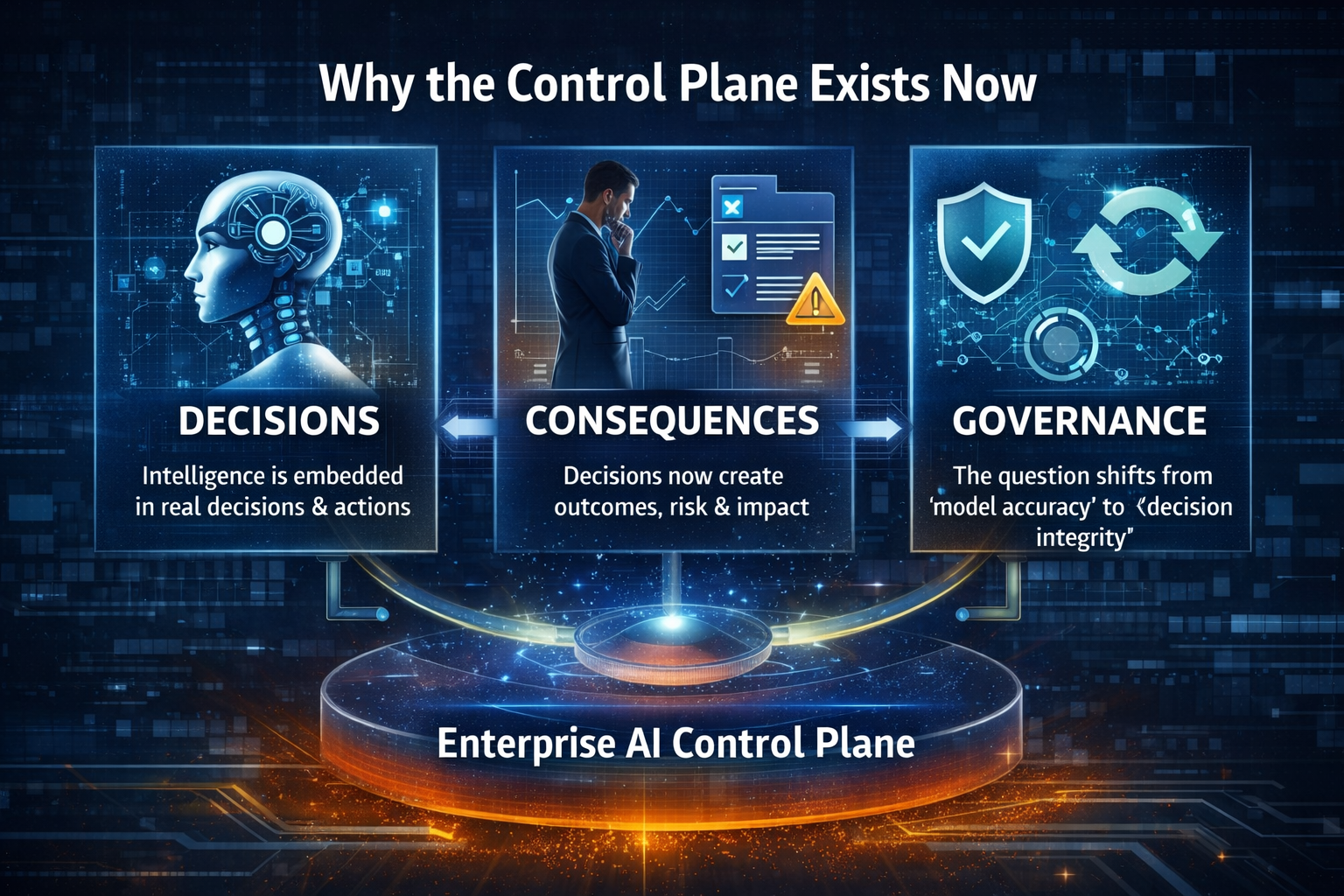
This is the quiet pivot happening in many large organizations: moving away from “more tools” and toward an operating environment that makes autonomy safe, repeatable, and accountable.

Why “Agent Zoos” happen—even in well-run organizations

Why “Agent Zoos” happen—even in well-run organizations

An “Agent Zoo” rarely begins as poor planning. It begins as rational local optimization:

  • A team creates an agent to speed up approvals.
  • Another automates exception handling.
  • A third builds a retrieval assistant for policy questions.
  • A fourth adds a new model because it’s cheaper or faster.
  • A fifth adds a tool connector because the business asked for it “this week.”

Within months, leadership can’t answer basic operational questions:

  • Which agents exist—and which are in production?
  • What tools can they call, and with what permissions?
  • What model versions are they using?
  • What happens when they fail quietly (not dramatically)?
  • Who is accountable for autonomous actions?
  • Why did cost spike last week?

This is not a tooling problem. It’s an operating model problem—one that becomes visible only when autonomy crosses from assist to act.

And once it starts, zoo dynamics compound. Every new agent introduces new permissions, new connectors, new failure modes, and new places where governance can drift. Over time, “fast innovation” becomes “fragile complexity.”

The integration trap: why “more platforms” makes things worse

The integration trap: why “more platforms” makes things worse

Enterprise AI systems now sit at the intersection of three moving surfaces:

  1. Models (multiple providers, versions, modalities)
  2. Tools (APIs, apps, workflows, data sources)
  3. Policies (security, privacy, approvals, compliance, safety)

Standards like the Model Context Protocol (MCP) matter because they reduce the “many models × many tools” integration mess by standardizing how AI connects to tools and data. (Anthropic)

But protocol standardization does not automatically give enterprises what they need most:

  • consistent authorization and least privilege
  • centralized policy enforcement
  • auditable evidence of actions
  • staged rollouts and rollbacks
  • cost guardrails and routing policies
  • quality engineering for agent behavior
  • security controls that assume prompt-injection-style attacks exist

In other words: MCP can help you plug tools in; it does not, by itself, ensure you can govern what autonomy does with them—and even commentary on MCP adoption highlights security and trust concerns. (IT Pro)

That gap—between connection and control—is where Agent Zoos thrive.

What an Enterprise AI Fabric is

What an Enterprise AI Fabric is

An Enterprise AI Fabric is the shared layer that makes AI industrial-grade.

Think of it less like a “platform you buy” and more like an operating environment you standardize—so every team can build and run AI with the same guardrails, the same observability, the same cost controls, and the same reusable services.

A mature fabric typically enables five outcomes:

1) Interoperability without rewrites

A shared abstraction across models, prompts, and tools—so switching models or adding capabilities doesn’t require rebuilding applications. (Infosys)

2) Services-as-software, not one-off projects

Reusable AI-enabled services delivered in integrated and modular form—so value compounds across the enterprise rather than being rebuilt team by team. (Infosys)

3) Governed machine identities for agents

Agents are treated as non-human identities with lifecycle management, permissions, and oversight—so “agent sprawl” doesn’t become the next security incident. (Microsoft Learn)

4) Operability: reliability, observability, and rollback

Autonomy is run like a production system—measurable, monitorable, and reversible. (TrueFoundry)

5) Responsible speed: cost + quality + security built in

Central routing, logging, policy enforcement, and quality engineering so scaling AI doesn’t scale risk and spend uncontrollably. (IBM)

This is the core logic behind modern “composable stacks” positioned as fabric-like: layered, open, interoperable, designed to unify enterprise landscapes, and delivered as a one-stop set of services-as-software. (Infosys)

A simple example: the travel-approval agent

A simple example: the travel-approval agent

Imagine a travel-approval agent.

In a demo, it does four things:

  • reads a request
  • checks the travel policy
  • confirms budget
  • approves or routes to a manager

In production, it touches real systems:

  • the HR system (role/grade rules)
  • the expense system (limits and approvals)
  • finance budget APIs
  • policy repositories
  • ticketing and workflow tools
  • email/chat notifications

Now the enterprise questions begin:

  • Who granted the agent permission to call each tool?
  • Can it approve for some groups but only recommend for others?
  • Can approvals require “human-by-exception” thresholds?
  • Can we prove why it approved?
  • What happens after a policy update?
  • Can we pause or roll back agent behavior instantly?

In an Agent Zoo, every team answers these questions differently, after the fact.

In an Enterprise AI Fabric, these answers are defaults—because the fabric provides operating constraints and an evidence layer across all agents.

The seven capabilities that separate winners from rewrites

The seven capabilities that separate winners from rewrites

If you want a practical checklist that an executive can understand quickly, these are the seven capabilities that most clearly separate scalable autonomy from fragile sprawl.

1) A model–prompt–tool abstraction layer

Enterprises need an open layer that abstracts models, prompts, and tools so they can integrate new models and technologies without rebuilding applications. (Infosys)

Why it matters: the fastest path to platform failure is hard-coding to a model provider or tool interface, then paying a rewrite tax every time the ecosystem shifts.

2) A reusable service catalog (“services-as-software”)

Instead of shipping “agents,” leading organizations ship reusable services:

  • policy Q&A with verifiable sources
  • access approval recommendations
  • exception triage and routing
  • incident summarization and resolution support
  • automated test generation and quality checks for releases

Fabric thinking turns these into consumable services—integrated and modular—so teams build once and reuse widely. (The Economic Times)

3) Governed machine identities for agents

Agents must be treated like real identities with lifecycle, permissions, and governance.

This is now a mainstream enterprise security posture: discover agents, document permissions, and apply governance and security practices consistently across the organization. (Microsoft Learn)

Plain-language rule: if an agent can act, it must be accountable like any other actor.

4) Policy gates and human-by-exception controls

A scalable model is not “human in the loop for everything.” It is human by exception—where routine actions are automated and only risky or ambiguous actions escalate.

This is where a fabric earns executive trust: it doesn’t slow the business; it creates responsible speed through policy-based action gating and escalation. (Microsoft Learn)

5) Evidence by default: audit trails for every action

In regulated and high-risk environments, “trust me” isn’t an option. Enterprises need traceability:

  • what context the agent used
  • what policy it referenced
  • what tool it called
  • what it changed
  • what approvals were involved

This is why governance and security guidance for agents repeatedly emphasizes organization-wide practices, accountability, and standardization. (Microsoft Learn)

6) An AI control plane (gateway) for routing, observability, and cost

As enterprises adopt multiple models and agents, the control plane becomes inevitable—much like API gateways became essential in microservices.

An AI gateway is widely described as specialized middleware that facilitates integration, deployment, and management of AI tools (including LLMs) in enterprise environments. (IBM)

This enables:

  • choosing the right model for a task
  • enforcing budgets and quotas
  • detecting runaway loops
  • measuring cost per outcome
  • reducing duplication across teams

7) Quality engineering and cybersecurity as built-in fabric services

As autonomy scales, testing becomes behavioral (not just output-based), and security becomes “assume adversarial inputs exist.”

That’s why fabric-like stacks increasingly emphasize integrated services spanning operations, transformation, quality engineering, and cybersecurity—not as optional add-ons, but as core capabilities. (Infosys)

The strategic shift: from “Which platform?” to “How will our enterprise think?”

The strategic shift: from “Which platform?” to “How will our enterprise think?”

This is the executive reframing that makes the article shareable:

  • Platforms help you build agents.
  • Fabrics help you run intelligence across the enterprise landscape—reliably, safely, and with compounding reuse.

In practice, that means moving from:

  • scattered pilots → standardized services
  • tool chaos → governed integration
  • opaque actions → evidence and traceability
  • cost surprises → routing and budgets
  • one-off solutions → reusable capabilities

That is the winning play.

A rollout that doesn’t slow delivery: 30–60–90 days

A rollout that doesn’t slow delivery: 30–60–90 days

Days 0–30: Stop the zoo from growing

  • Create an inventory: agents, workflows, tools, and model usage
  • Define minimum standards: identity, permissions, logging, rollback
  • Establish a paved road for new agents: templates + approvals

Days 31–60: Build the fabric spine

  • Standardize tool integration (MCP-style patterns where appropriate) plus an enterprise trust wrapper (Anthropic)
  • Stand up an agent registry and identity blueprint approach (Microsoft Learn)
  • Introduce centralized policy gating and logging
  • Add an AI gateway/control plane for observability and cost (IBM)

Days 61–90: Productize reusable services

  • Convert the top recurring patterns into reusable services-as-software (The Economic Times)
  • Add staged releases and canaries for agent changes
  • Align metrics to executive outcomes: cycle time, risk reduction, cost per outcome, quality improvement

What to say in the boardroom

Here’s the line that clarifies the strategy in one breath:

The winners won’t be the enterprises with the most agents.
They’ll be the ones who can operate autonomy like a production capability—visible, governed, and reusable.

That is what an Enterprise AI Fabric makes possible.

The new advantage is operable autonomy

Conclusion: The new advantage is operable autonomy

Enterprise AI is entering its operational era. The organizations that win won’t simply adopt the newest models or deploy the most agents. They’ll do something harder—and more durable:

They’ll build a fabric where autonomy is composable (so it evolves), governed (so it’s safe), observable (so it’s operable), and reusable (so value compounds).

In the years ahead, “agent count” will be a vanity metric. The decisive metric will be simpler:

Can your organization scale autonomy without scaling chaos?

If the answer is yes, you’re no longer playing the platform war. You’re building the enterprise advantage.

FAQ

Is an “Enterprise AI Fabric” just another agent platform?

No. Platforms help you build. A fabric helps you operate at scale with governance, cost control, reliability, security, quality engineering, and reuse as defaults. (IBM)

Do standards like MCP solve the problem?

They reduce integration friction, but enterprises still need policy gates, identity, auditability, and operational controls around autonomous actions. (Anthropic)

What’s the earliest sign we’re building an Agent Zoo?

When you can’t quickly answer: “Which agents are running, what they can do, what they did, and who owns them.” (Microsoft Learn)

Where should the fabric “live” organizationally?

Typically as a shared capability owned jointly by enterprise architecture, security/identity, platform engineering, and a business-aligned AI governance group—so it’s both technically enforceable and business-relevant. (Microsoft Learn)

FAQ 1

What is an Enterprise AI Fabric?
An Enterprise AI Fabric is a composable operating layer that standardizes how AI models, agents, tools, policies, and services are integrated, governed, and operated at scale.

FAQ 2

Why do AI agent platforms fail in large enterprises?
They optimize for speed of creation, not operability—leading to agent sprawl, governance gaps, cost overruns, and security risks.

FAQ 3

How is an AI Fabric different from an AI platform?
Platforms help teams build agents. Fabrics help enterprises run intelligence reliably, securely, and repeatedly across the organization.

FAQ 4

What does “operable autonomy” mean?
It means AI systems can act independently while remaining observable, governed, reversible, and auditable—just like any production system.


Glossary

  • Agent Zoo: Uncontrolled proliferation of agents with inconsistent controls and low visibility.
  • Enterprise AI Fabric: A unified operating layer that standardizes integration, governance, cost, reliability, security, and reuse for AI at scale. (Infosys)
  • Services-as-software: Reusable, productized AI-enabled services delivered as integrated and modular capabilities that teams consume repeatedly. (The Economic Times)
  • Non-human identities: Software-based identities (including agents and tools) that access systems automatically and require governance. (Microsoft)
  • AI gateway / control plane: Central layer for model routing, policy enforcement, logging, observability, and cost management. (IBM)
  • MCP (Model Context Protocol): An open standard enabling secure, two-way connections between AI applications and external tools/data sources via a client-server pattern. (Anthropic)


References and Further Reading

Why Every Enterprise Needs a Model-Prompt-Tool Abstraction Layer (Or Your Agent Platform Will Age in Six Months)

Most “agent platforms” age in six months.
Not because AI moves fast—but because architecture doesn’t.

The missing layer isn’t another framework.
It’s a Model-Prompt-Tool Abstraction Layer.

This article explains why.

Enterprise AI has moved past the phase of asking “Which LLM should we choose?”
The harder—and far more consequential—question now is:

How do we keep AI systems useful when models, prompts, tools, and standards change every quarter?

This is not a theoretical concern. Enterprises across industries are discovering that agent platforms built just months ago already feel brittle, expensive to change, and difficult to govern.

If you are wiring your AI initiatives tightly to:

  • a single model provider,
  • a fixed prompt style embedded in code, and
  • bespoke tool integrations glued together project by project,

you are recreating the integration mistakes of the SOA era—except this time the pace of change is faster, the blast radius is larger, and the cost of failure is measured in trust, compliance, and operational risk.

How do we keep AI systems useful when models, prompts, tools, and standards change every quarter?

The answer is not another framework.

It is an architectural boundary.

A Model-Prompt-Tool Abstraction Layer (MPT-AL) is the missing layer that decouples enterprise workflows from the rapid churn of AI models, prompt practices, and tool protocols—while allowing innovation to continue at full speed.

If you get this layer right, your AI estate evolves smoothly.
If you don’t, your “agent platform” will age in six months—because the ecosystem will.

The six-month problem: why agent platforms age so fast

The six-month problem: why agent platforms age so fast

Traditional enterprise platforms age slowly. Databases, ERPs, and middleware evolve over years.

Agent platforms age fast because three independent layers evolve on different clocks:

  1. Models evolve unpredictably

New models arrive with different reasoning styles, tool-calling reliability, latency profiles, cost curves, and safety behaviors. APIs remain “compatible” on paper while behavior shifts in practice. Enterprises that bind workflows directly to one model experience constant retuning and regression risk.

  1. Prompts evolve continuously

Prompts are not strings. In real enterprises, prompts encode:

  • policy interpretation,
  • tone and intent,
  • compliance constraints,
  • tool-usage instructions.

As teams learn from production failures—or as regulations and audit expectations change—prompts must evolve safely and traceably. Hard-coding them into application logic guarantees fragility.

  1. Tools evolve relentlessly

APIs change versions, schemas, authentication models, and rate limits. Meanwhile, the industry is converging on standardized ways for models to discover and invoke tools dynamically—accelerating integration while raising new security and governance concerns.

When these three layers are tightly coupled, any change forces a cascade of rewrites. That is why so many leaders quietly admit: “We shipped it… and it already feels outdated.”

What exactly is a Model-Prompt-Tool Abstraction Layer

What exactly is a Model-Prompt-Tool Abstraction Layer?

Think of it as the USB-C layer of enterprise AI—plus governance, safety, and auditability.

A Model-Prompt-Tool Abstraction Layer sits between:

  • Stable enterprise workflows
    (approve access, resolve incidents, onboard customers, manage vendors, close financial periods)

and

  • Rapidly changing AI implementation details
    (model providers and versions, prompt formats, tool protocols, orchestration frameworks)

In practice, it provides:

  • a model interface that allows multiple providers and versions to be swapped or routed without rewriting workflows,
  • a prompt lifecycle system with versioning, testing, rollout, rollback, and approvals,
  • a tool contract layer with schemas, permissions, authentication, and audit hooks that works across agent frameworks and emerging standards.

This is not abstract elegance. It is operational survival.

You modernize AI continuously while keeping the enterprise stable.

Why abstraction must ship as services-as-software, not frameworks

Why abstraction must ship as services-as-software, not frameworks

Here is a critical distinction many organizations miss:

Frameworks help teams build agents.
Enterprises need capabilities they can operate.

An abstraction layer only creates durable value when it is delivered as services-as-software:

  • reusable,
  • governed,
  • observable,
  • and consumable across teams.

This means AI capabilities show up not as projects, but as services with:

  • defined interfaces,
  • usage policies,
  • cost envelopes,
  • reliability expectations,
  • and ownership.

This shift—from “AI as experiments” to “AI as managed services”—is what allows organizations to scale beyond pilots without losing control.

The N×M integration trap

The N×M integration trap (and why standards alone are not enough)

Most enterprises are recreating a familiar trap:

N models × M tools = N×M fragile integrations

Every new model requires revalidating tool calls and prompts.
Every new tool requires retraining models and re-testing behavior.

Standards like structured tool calling and emerging protocols for tool discovery help—but they do not replace governance. They reduce friction while increasing the need for:

  • permission boundaries,
  • execution controls,
  • and enterprise-grade audit trails.

An abstraction layer is how you adopt standards without letting today’s protocol become tomorrow’s lock-in or security incident.

A simple example: the travel-approval agent

A simple example: the travel-approval agent

The brittle approach (still common today)

  • One model hard-coded into the workflow
  • One giant prompt embedded in application logic
  • Direct API calls to HR, ERP, and email systems

Six months later:

  • finance wants a cheaper model for low-risk requests,
  • HR upgrades its API,
  • audit demands stricter approval evidence.

Result: rewrites, outages, regressions.

The resilient approach (with abstraction)

  • a versioned policy prompt package for travel rules,
  • a tool registry defining HR, ERP, and email contracts,
  • model routing by task criticality,
  • human-by-exception guardrails for irreversible actions.

Now change happens in one place, not everywhere.

That is the difference between a demo and an enterprise capability.

The seven capabilities every abstraction layer must provide

The seven capabilities every abstraction layer must provide

  1. Provider-agnostic model interfaces

Models are treated as capabilities, not vendors. Routing, fallback, and evaluation are built-in.

  1. Model routing and capability matching

Different tasks demand different trade-offs between cost, latency, reasoning depth, and risk.

  1. Prompts as governed policy assets

Prompts are versioned, tested, approved, and rolled out like policy—not casually edited strings.

  1. Tool contracts with safe execution

Schemas, authentication, permissions, rate limits, and audits are mandatory—not optional.

  1. Tool discovery without tool sprawl

A registry defines ownership, lifecycle, and environments, preventing chaos as tool ecosystems grow.

  1. End-to-end observability

Every decision is traceable: which model, which prompt, which tool, and why.

  1. Responsible AI by design

Not as an afterthought.
Human-by-exception, least-privilege access, evidence-first actions, and rollback are first-class design principles.

Why CIOs and CTOs are quietly demanding this layer

Why CIOs and CTOs are quietly demanding this layer

Because it delivers what executives actually care about:

  • Optionality without chaos
  • Lower total cost of ownership
  • Audit-ready decision trails
  • Multi-region compliance by design
  • A real platform, not a collection of pilots

Most importantly, it unifies fragmented AI efforts across the enterprise into a single operating model.

Why this is not “just another framework”

Why this is not “just another framework”

Frameworks accelerate experimentation.
Abstraction layers enable endurance.

Enterprises fail not because they lack clever agent code, but because they lack:

  • contracts,
  • governance,
  • lifecycle discipline.

The abstraction layer is how you use frameworks without being trapped by them.

A practical rollout that does not slow delivery

A practical rollout that does not slow delivery

Phase 1: define contracts
Phase 2: centralize risk points
Phase 3: add observability and security

The goal is not perfection.
The goal is stability plus optionality.

the moving boundary that separates leaders from rewrites

Conclusion: the moving boundary that separates leaders from rewrites

Agent platforms are not products.
They are moving boundaries between fast-changing AI capabilities and slow-changing enterprise realities.

Design that boundary deliberately—or pay for it repeatedly.

A Model-Prompt-Tool Abstraction Layer is no longer optional architecture.

It is the foundation of operating autonomy responsibly at scale.

FAQ: Model-Prompt-Tool Abstraction Layer

Q1. What is a Model-Prompt-Tool Abstraction Layer?
A Model-Prompt-Tool Abstraction Layer decouples enterprise workflows from specific AI models, prompts, and tools, enabling continuous evolution without rewrites.

Q2. Why do enterprise agent platforms become obsolete so quickly?
Because models, prompts, tools, and standards evolve independently—tight coupling forces constant re-engineering.

Q3. Is this layer only needed for large enterprises?
Any organization deploying AI agents across business systems benefits, especially in regulated or multi-region environments.

Q4. How is this different from using an agent framework?
Frameworks help build agents. Abstraction layers help operate AI safely, repeatedly, and at scale.

Q5. Does this help with compliance and audit readiness?
Yes. Prompt versions, model usage, tool calls, and approvals become traceable assets.

📘GLOSSARY

  • Abstraction Layer – A stable interface that hides volatile implementation details.

  • Services-as-Software – Software delivered as continuously evolving, governed services rather than static code.

  • Agent Platform – A system that enables AI agents to reason, act, and integrate with enterprise tools.

  • Prompt Lifecycle – Versioning, testing, rollout, and rollback of prompts as policy assets.

  • Tool Orchestration – Safe, governed execution of enterprise actions by AI systems.

  • Model-Agnostic Architecture – An architecture that avoids dependency on a single AI provider.

Further Reading

For readers who want to explore the architectural, operational, and governance foundations behind scalable enterprise AI, the following resources provide valuable context and complementary perspectives:

Enterprise AI Architecture & Operating Models

  • “From SaaS to Agentic Service Platforms: The Next Operating System for Enterprise Work” – Explores how enterprises are moving from project-based AI to platformized intelligence delivered as services.

  • “The AI SRE Moment: Why Enterprises Require Predictive Observability and Human-by-Exception” – Examines why operating AI systems demands reliability disciplines similar to Site Reliability Engineering.

  • “Services-as-Software: The Quiet Shift Reshaping Enterprise AI Delivery” – Discusses why reusable, governed AI services outperform one-off pilots.

Model, Prompt, and Tool Governance

  • Model Context Protocol (MCP) – An emerging open protocol aimed at standardizing how LLM applications connect to tools and external context, highlighting both integration opportunities and safety considerations.

  • OpenAI Platform: Function and Tool Calling – Provides insight into structured tool invocation, typed arguments, and model-tool interaction patterns increasingly used in enterprise systems.

  • LangChain Documentation: Model and Tool Abstractions – Illustrates how modern frameworks are evolving toward provider-agnostic models and standardized tool interfaces.

Responsible AI & Enterprise Risk

  • NIST AI Risk Management Framework (AI RMF) – A globally relevant reference for managing AI risks across design, deployment, and operations.

  • OECD AI Principles – A widely adopted international baseline for trustworthy and human-centered AI systems.

  • EU AI Act (High-Level Summaries) – Useful for understanding how governance expectations are shaping AI system design globally, even outside Europe.

Strategic Context & Thought Leadership

  • MIT Technology Review – Enterprise AI & AI Infrastructure – Ongoing coverage of how large organizations are restructuring AI platforms, governance, and operating models.

  • Harvard Business Review – AI Strategy & Organizational Design – Practical executive perspectives on scaling AI responsibly across complex enterprises.

  • Gartner Research on AI Platforms and Agentic Systems – Highlights trends in AI orchestration, governance, and platform consolidation shaping CIO and CTO agendas.

The Synergetic Workforce: How Enterprises Scale AI Autonomy Without Slowing the Business – Raktim Singh

The Agentic AI Platform Checklist: 12 Capabilities CIOs Must Demand Before Scaling Autonomous Agents | by RAKTIM SINGH | Dec, 2025 | Medium

AgentOps Is the New DevOps: How Enterprises Safely Run AI Agents That Act in Real Systems – Raktim Singh

The Agentic Identity Moment: Why Enterprise AI Agents Must Become Governed Machine Identities – Raktim Singh

Service Catalog of Intelligence: How Enterprises Scale AI Beyond Pilots With Managed Autonomy – Raktim Singh

The Agentic Identity Moment: Why Enterprise AI Must Treat Agents as Governed Machine Identities | by RAKTIM SINGH | Dec, 2025 | Medium

The AI SRE Moment: How Enterprises Operate Autonomous AI Safely at Scale | by RAKTIM SINGH | Dec, 2025 | Medium

The AI SRE Moment: How Enterprises Operate Autonomous AI Safely at Scale | by RAKTIM SINGH | Dec, 2025 | Medium

The AI Platform War Is Over: Why Enterprises Must Build an AI Fabric—Not an Agent Zoo – Raktim Singh

The Synergetic Workforce: How Enterprises Scale AI Autonomy Without Slowing the Business

Why the old operating models break

Enterprise AI is not failing quietly—but it is failing predictably.

Across industries, organizations are deploying increasingly capable AI agents: systems that approve requests, trigger workflows, update records, coordinate across tools, and act inside real production environments. The models are improving. The tools are maturing. The demos look impressive. Yet many of these initiatives stall, get constrained, or are rolled back—not because the AI is weak, but because the enterprise operating model is unprepared.

This is the uncomfortable truth most AI post-mortems avoid: autonomy does not collapse at the level of intelligence. It collapses at the level of work design.

Enterprises are trying to run a fundamentally new kind of work—continuous, probabilistic, machine-speed work—using a workforce model built for manual processes, linear escalation paths, and constant human oversight. The result is friction everywhere: humans overloaded with approvals, automation constrained by legacy controls, and AI agents forced into narrow roles they were never designed for.

To scale AI safely and sustainably, enterprises don’t just need better models. They need a new workforce model—one designed explicitly for autonomy.

Why Autonomy Fails in Enterprises (And It’s Not the Model)

The Real Problem: New Work, Old Workforce

Most enterprise conversations about AI focus on models, platforms, and tooling. Those matter—but they are not the bottleneck.

The real constraint sits between strategy and execution: how work is allocated between humans, software, and AI. Traditional enterprises implicitly assume one dominant pattern: humans decide, tools assist, and automation executes narrowly defined tasks. That assumption breaks the moment AI starts reasoning, planning, and acting.

When AI agents enter production, three failure modes appear almost immediately:

  • Humans are pulled into every decision, slowing execution and creating backlogs
  • Automation becomes brittle, over-controlled, or blocked by mismatched process design
  • AI agents are constrained so tightly that their value evaporates

This is not a technology failure. It is a workforce design failure.

Introducing the Synergetic Workforce

Introducing the Synergetic Workforce

The enterprises that are scaling AI successfully are converging on a different idea—often implicitly, sometimes intentionally:

Work is no longer performed by humans alone, or even by humans with tools. It is performed by a coordinated system of three workers.

  • Human workers, who bring judgment, creativity, context, and accountability
  • Digital workers, which execute deterministic, repeatable processes reliably
  • AI workers, which reason, learn, and adapt across ambiguous situations

This is the Synergetic Workforce: a model where each worker type does what it is best suited for, and where productivity emerges from collaboration—not substitution.

The Three-Worker Model Explained

1) The Human Worker

Humans remain essential—but not as constant supervisors.

In a synergetic workforce, the human role shifts toward:

  • Defining intent, outcomes, and policy
  • Setting boundaries, thresholds, and escalation rules
  • Handling ambiguity and edge cases
  • Governing performance, risk, and accountability
  • Improving the system through feedback and redesign

Humans move up the value chain, away from routine approvals and into judgment-heavy decision-making.

2) The Digital Worker

Digital workers are deterministic systems: workflows, scripts, automation bots, and integration logic.

They excel at:

  • Executing known processes at scale
  • Enforcing consistency and auditability
  • Performing high-volume tasks reliably
  • Reducing operational variation

They do not reason—but they anchor execution with speed and repeatability.

3) The AI Worker

AI workers operate in the gray zone between intent and execution.

They can:

  • Interpret context across signals and data
  • Propose options or take actions under constraints
  • Make probabilistic decisions under uncertainty
  • Coordinate work across systems and tools
  • Detect patterns that humans and deterministic rules may miss

They are neither traditional tools nor employees—but autonomous collaborators operating within defined guardrails.

The Three-Worker Model Explained

The Key Design Shift: From Human-in-the-Loop to Human-by-Exception

Most enterprises attempt to control AI by placing humans “in the loop” everywhere. It feels safe—but it doesn’t scale.

In practice, it creates:

  • Bottlenecks and queue-driven work
  • Approval fatigue and human overload
  • Slow response cycles that erode business value
  • A false sense of safety, because everything becomes an “exception”

The scalable alternative is human-by-exception.

In this model:

  • AI and digital workers operate continuously within policies
  • Guardrails, approvals, and limits are encoded upfront
  • Humans intervene only when signals cross defined boundaries
  • Oversight becomes outcome-driven, not step-driven

Oversight shifts from micromanagement to governance—and that’s what makes autonomy operable at scale.

The operating loop: how the three workers collaborate

The Operating Loop: How the Three Workers Collaborate

The synergetic workforce is not a hierarchy. It is an operating loop.

  1. Humans define goals, policies, constraints, and escalation thresholds
  2. AI workers interpret context and recommend or take actions within those boundaries
  3. Digital workers execute the actions reliably across enterprise systems
  4. Telemetry and evidence capture outcomes, policy compliance, and exceptions
  5. Humans intervene only when exception signals trigger escalation—and then refine rules and thresholds

This loop enables machine-speed execution with human-grade accountability.

The Operating Loop: How the Three Workers Collaborate

The Composable Stack Behind the Workforce

A new workforce model needs a modern, composable stack behind it.

At a minimum, enterprises require:

  • Orchestration to coordinate work across humans, AI, and automation
  • Identity and access controls that support machine actors and scoped permissions
  • Policy and guardrails to enforce boundaries, thresholds, and compliance
  • Observability to track actions, outcomes, drift, and exceptions
  • Automation and integration to execute actions across business systems
  • Data services and context to ground decisions in enterprise truth
  • Resilience and rollback to recover safely when systems behave unexpectedly

The workforce model is the why.
The stack is the how.

What Must Be True for the Model to Work

What Must Be True for the Model to Work

Three conditions are non-negotiable:

1) Alignment

The organization must align incentives, accountability, and operating norms with autonomy. If teams are penalized for responsible autonomy, they will revert to manual controls and defensive work.

2) Interoperability

Autonomy cannot scale on disconnected systems. If tools, workflows, and data are fragmented, AI agents become brittle and digital workers become constrained.

3) Capability

Humans must be trained to govern AI systems: set thresholds, review evidence, manage exceptions, and improve operating loops. Without this, the enterprise falls into fear, over-control, or blind trust.

Without these foundations, autonomy becomes either chaos—or paralysis.

A Rollout Plan That Doesn’t Slow the Business

Successful enterprises do not “flip the switch” on autonomy. They roll it out like a disciplined operating upgrade.

Phase 1: Start with bounded workflows

Pick use cases with clear goals, measurable outcomes, and limited blast radius.

Phase 2: Encode guardrails early

Define policies, thresholds, and escalation paths upfront. Treat governance as product design, not a late-stage review.

Phase 3: Build exception handling as a first-class feature

The goal is not perfection. The goal is reliable escalation and fast learning.

Phase 4: Expand through a repeatable playbook

Standardize patterns so every new AI workflow is faster, safer, and easier to operate than the last.

Phase 5: Institutionalize human-by-exception

Shift oversight from continuous supervision to outcome governance, auditability, and periodic review.

The objective is not disruption. It is compounding advantage—scaling autonomy without sacrificing speed.

Why This Model Works Globally

This workforce model travels well because it is not tied to a specific technology stack or region.

It works in mature markets where risk and governance expectations are high, and it works in fast-growth markets where scale and efficiency matter most—because it is built on a universal principle:

separate judgment from execution, and govern exceptions with evidence.

That is as relevant in heavily regulated environments as it is in high-velocity business operations.

Autonomy doesn’t fail because agents are weak. It fails because enterprises try to run a new kind of work with an old kind of workforce.

Conclusion: The Workforce Is the Real AI Multiplier

Enterprise AI has reached a turning point.

The question is no longer whether AI models can reason, act, or coordinate. They already can. The harder—and more consequential—question is whether enterprises are structurally prepared to operate that autonomy without slowing down, breaking trust, or overwhelming their people.

The synergetic workforce reframes the challenge correctly. It recognizes that scaling AI is not a tooling exercise, nor a talent replacement strategy, but a work design problem. When human judgment, digital execution, and AI reasoning are deliberately orchestrated, autonomy stops being risky and starts becoming repeatable.

Autonomy doesn’t fail because agents are weak. It fails because enterprises try to run a new kind of work with an old kind of workforce.

The enterprises that succeed in the next phase of AI adoption will not be the ones with the most agents in production. They will be the ones that redesign how work itself gets done.

Autonomy doesn’t fail because intelligence is missing.
It fails when the workforce model is outdated.

Glossary

Synergetic Workforce
A workforce model in which human workers, digital workers, and AI workers collaborate through defined roles and operating loops to execute work at scale.

Human-by-Exception
A design principle where humans intervene only when AI or automation encounters uncertainty, risk thresholds, or policy boundaries.

AI Worker
An autonomous or semi-autonomous AI system capable of reasoning, planning, and acting across enterprise workflows within defined guardrails.

Digital Worker
Deterministic automation systems such as workflows, scripts, or bots that reliably execute predefined processes.

Agentic AI
AI systems designed to take goal-directed actions rather than merely generate outputs.

Enterprise AI Operating Model
The governance, workforce, and platform structure required to run AI safely and repeatedly in production environments.

Frequently Asked Questions

Why do enterprise AI initiatives fail at scale?

Many failures occur not because AI models are weak, but because enterprises use workforce models designed for manual or tool-assisted work to govern autonomous systems.

What is the synergetic workforce model?

It is a workforce design that intentionally combines human judgment, digital execution, and AI reasoning into a single operating loop for work.

What does “human-by-exception” mean in practice?

Humans define goals, guardrails, and escalation thresholds, intervening only when AI systems encounter ambiguity, risk, or policy boundary conditions.

Is this model relevant only for large enterprises?

No. While most visible in large organizations, the model applies to any organization deploying AI agents across real workflows.

How is this different from traditional automation?

Traditional automation replaces tasks. The synergetic workforce redesigns how decisions, execution, and accountability are distributed.

Does this model work across regions and regulations?

Yes. It is effective globally because it makes accountability explicit and supports governance-through-evidence.

Why does enterprise AI autonomy fail?

Because organizations attempt to run autonomous AI using workforce models designed for manual or tool-assisted work.

Is this model relevant globally?

Yes. It applies across regulated and fast-growing markets—including the US, EU, India, and the Global South.

Further Reading

If you’re exploring how enterprises are re-architecting AI at scale, the following topics provide useful context:


If you found this useful, explore more essays on enterprise AI, autonomy, and operating models at raktimsingh.com.

AgentOps Is the New DevOps: How Enterprises Safely Run AI Agents That Act in Real Systems

AgentOps Is the New DevOps

The moment AI can act—reliability stops being a feature and becomes the product.

A scene you’ll recognize

It’s a normal weekday. A request comes in: access approval, a workflow update, a record change—something routine.

An AI agent handles it quickly. No drama. No alert. No outage.

Two days later, an audit question arrives:
“Why was this approved?”
Then security asks: “Which policy was applied?”
Then operations asks: “What exactly changed in the system of record?”

The uncomfortable truth: nobody can fully reconstruct the decision path.

Not because the team is careless—because the system was never designed to produce proof.

This is the new enterprise reality: agentic systems don’t always fail loudly. They fail quietly—through invisible drift, ambiguous decisions, and unrecoverable actions.

And that’s why AgentOps is now inevitable.

Continuous testing, canary releases, rollback, and proof-of-action for production-grade AI autonomy

A scene you’ll recognize

Executive summary

Enterprises are moving from AI that talks to AI that acts: approving requests, updating records, triggering workflows, calling APIs, and coordinating across tools.

That shift changes the central question.

It is no longer: “Is the model smart?”
It becomes: “Can we operate autonomy safely, repeatedly, and at scale?”

The discipline that answers this is AgentOps—a production-grade operating model for autonomous, tool-using AI agents.

This article delivers a practical blueprint built on four patterns that make autonomy operable:

  1. Continuous testing (behavior regression + safety + policy adherence)
  2. Canary releases (ship behavior changes with controlled blast radius)
  3. Rollback + compensation (reversible autonomy, not wishful thinking)
  4. Proof-of-Action (auditable evidence of what the agent did—and why)
Why DevOps breaks the moment AI can act

Why DevOps breaks the moment AI can act

DevOps evolved for software where:

  • releases are versioned,
  • execution is relatively deterministic,
  • failures are observable,
  • rollbacks revert deployments.

Agents are different. They are behavioral systems, not just software artifacts.

Agent outcomes depend on:

  • prompts and policies,
  • tool contracts and tool outputs,
  • retrieval results,
  • memory state,
  • model versions,
  • and real-world context variability.

So an agent can be “up” and still be quietly wrong—approving the wrong item, calling the wrong endpoint, escalating too late, or looping in ways that leak cost.

Shareable line:
In agentic systems, uptime is not reliability. Correct, safe, and auditable actions are reliability.

That’s why AgentOps is not DevOps rebranded. It’s DevOps upgraded for autonomy.

What AgentOps actually is

What AgentOps actually is

AgentOps (Agent Operations) is the lifecycle discipline for building, testing, deploying, monitoring, governing, and improving AI agents that take actions in real systems.

What AgentOps is not

  • Not prompt tweaking as a process
  • Not “MLOps with a new name”
  • Not a single tool you buy and forget

What AgentOps is

  • A production discipline that treats agents as enterprise services
  • With standardized releases, guardrails, observability, and evidence-by-design

Mental model (sticky):

  • DevOps manages code releases
  • MLOps manages model releases
  • AgentOps manages behavior releases (reasoning + tools + policies + memory + guardrails)
The AgentOps operating loop

The AgentOps operating loop

AgentOps works as a repeatable loop:

Define → Test → Ship → Observe → Prove → Improve

  1. Define “good” (outcomes + boundaries)
  2. Test behavior continuously (offline + online)
  3. Ship safely (canary + staged autonomy)
  4. Observe end-to-end (traces + metrics + alerts)
  5. Prove actions (evidence packet + audit trail)
  6. Improve from feedback (evaluation-driven iteration)

This is how autonomy becomes a production capability—not a sequence of demos.

The four pillars of AgentOps

The four pillars of AgentOps

Pillar 1: Continuous testing

Continuous testing is the most underinvested capability in agent programs—because teams test what they can easily see: response quality.

But agents fail where they act: tool calls, policies, permissions, escalation, and hidden behavior drift.

Example: the “approval agent”

In production, it faces:

  • incomplete requests
  • conflicting rules
  • ambiguous descriptions
  • persuasion attempts (“approve urgently”)

AgentOps testing focuses on four essentials:

1) Policy adherence

  • Does it follow thresholds and approval paths?
  • Does it escalate exceptions consistently?

2) Tool safety

  • Does it call only allowed systems and endpoints?
  • Does it pause when uncertainty is high?

3) Outcome correctness

  • Does it create the right state change?
  • Does it request missing info before acting?

4) Security resilience
Prompt injection is a practical risk for tool-using agents: untrusted text can attempt to override instructions and trigger unsafe actions or data exposure.

So your test suite must include adversarial inputs, not just happy paths.

How to implement continuous testing (the production way)

  • Golden scenario sets: realistic cases (good / bad / ambiguous)
  • Adversarial scenarios: policy bypass attempts, instruction overrides
  • Regression suite: every incident becomes a test case
  • Offline evaluation gates: no release without passing baseline checks
  • Online drift monitoring: watch live traces for failure patterns

Shareable line:
Every incident becomes a test. Every test becomes a release gate.

Pillar 2: Canary releases

In classic software, canary reduces blast radius. In agents, canary prevents behavior surprise.

Because “releases” include:

  • prompt edits
  • tool schema changes
  • policy updates
  • model upgrades
  • memory strategy changes
  • escalation rule changes

A small change can quietly shift:

  • escalation rate
  • tool call timing
  • retry/loop behavior
  • policy boundary interpretation

The safest rollout pattern: staged autonomy

Don’t jump from “assistant” to “operator.” Move through stages:

  1. Shadow mode: recommend only
  2. Assisted mode: execute low-risk steps; human approves final action
  3. Partial autonomy: act only within strict constraints
  4. Bounded autonomy: act within narrow permissions + rollback guarantees

This matches how observability leaders describe the reality: if you can’t see each decision and tool call, you can’t ship safely.

Canary metrics leaders actually care about

  • Action error rate (wrong updates/approvals)
  • Escalation rate (too high = weak autonomy; too low = risky autonomy)
  • Latency per task
  • Cost per task (tokens + tools + retries)
  • Policy violations blocked (a leading indicator)

Pillar 3: Rollback + compensation

Rollback fails in agent programs because teams confuse “deployment rollback” with “business rollback.”

Agent rollback has two layers:

1) Technical rollback: revert prompt/model/policy/tool versions
2) Business rollback (compensation): undo effects in real systems

  • revoke access
  • reverse workflow step
  • correct system-of-record update
  • compensating transaction

This is the core of reversible autonomy—a concept increasingly treated as non-negotiable for production-grade agents.

Design rules that make rollback real

  • Idempotent tool calls where possible
  • Two-step execution for high-risk actions (prepare → commit)
  • Explicit reversal hooks stored with the action
  • Human-by-exception for actions above defined risk thresholds

Shareable line:
If you can’t reverse it, you can’t automate it.

Pillar 4: Proof-of-Action

This is the missing layer in most rollouts.

When something goes wrong, executives ask:

  • what happened?
  • why did it happen?
  • which policy applied?
  • which tools were called?
  • what changed in the system of record?

If the answer is “we can’t fully reconstruct it,” autonomy isn’t production-ready.

Proof-of-Action = evidence-by-design

A Proof-of-Action record answers:

  • What did the agent do?
  • Why did it decide that?
  • Which tools were called, with what inputs?
  • What did tools return?
  • Which policies/constraints were applied?
  • What changed downstream?

Agent observability practices emphasize capturing structured traces so behavior can be debugged and audited.
Audit logs matter because they create an immutable operational record for security and compliance workflows.

The Evidence Packet checklist

Capture for every significant action:

  • request ID + timestamp
  • agent version (prompt/model/policy/tool schema)
  • plan summary (intent in plain language)
  • tool calls + inputs + outputs
  • applied policies/constraints
  • short justification
  • action executed + downstream response
  • rollback/compensation hook reference

Shareable line:
Autonomy without proof is a demo. Autonomy with proof is an operating model.

The AgentOps stack in plain language

The AgentOps stack in plain language

You don’t need dozens of platforms. You need five capabilities working together:

  1. Evaluation harness (regression + adversarial + release gates)
  2. Tracing + observability (end-to-end traces across plan→tools→outcome)
  3. Policy enforcement (allowed tools/actions + escalation rules)
  4. Change management (versioning + canary + staged autonomy)
  5. Audit + evidence (immutable logs + replayable traces)
The board-level question AgentOps answers

The board-level question AgentOps answers

AgentOps converts agentic AI from:

  • unpredictable → operable
  • fragile demos → repeatable production capability
  • “trust me” → auditable proof
  • irreversible risk → reversible autonomy

Board question (shareable):
“Can we prove what our agents did—and undo it if needed?”

What I’d do Monday morning

What I’d do Monday morning

If you’re leading enterprise AI and want visible results fast—without slowing teams—here’s the Monday plan.

Step 1: Pick one workflow that “touches reality”

Choose a workflow where an agent:

  • changes a system of record, or
  • triggers a downstream action.

Start with one. Don’t boil the ocean.

Step 2: Define the autonomy boundary in one page

Write:

  • what the agent is allowed to do
  • what it must never do
  • when it must escalate
  • what “done” means

This becomes your operating contract.

Step 3: Instrument the trace

Before you improve intelligence, improve visibility:

  • capture plan steps
  • capture tool calls (inputs/outputs)
  • capture final state change

If you can’t trace, you can’t operate.

Step 4: Create a “Top 30” regression suite

Collect 30 real scenarios:

  • 10 clean
  • 10 ambiguous
  • 10 adversarial

Run them before every release.

Step 5: Ship with a canary and staged autonomy

Start in shadow mode for high-risk actions.
Move to partial autonomy only when metrics stabilize.

Step 6: Build rollback hooks before scaling

For every significant action, define:

  • how to reverse it
  • who approves reversal (if needed)
  • where that reversal is logged

Step 7: Make Proof-of-Action non-negotiable

Adopt an Evidence Packet format and enforce it for any action that matters.

If you do only one thing this week:
Implement end-to-end tracing and Evidence Packets. Everything else becomes possible after that.

Global glossary

Agent: A system that can plan and execute tasks using tools/APIs, not only generate text.
AgentOps: Production practices for deploying and operating AI agents safely.
Canary release: Rolling out changes to a small subset first to validate safety and performance.
Compensation: Undoing or reversing the effect of a real-world action.
Evidence Packet: Structured Proof-of-Action record of decisions, tool calls, applied policies, and outcomes.
LLM Observability: Tracing and monitoring of agent/model interactions, including tool calls and outcomes.
Prompt injection: Attack where untrusted text attempts to override instructions and trigger unsafe tool actions or data exposure.
Staged autonomy: Progressive rollout from shadow → assisted → partial → bounded autonomy.

FAQ

Is AgentOps different from MLOps?

Yes. MLOps manages models. AgentOps manages behavior in action—tools, policies, rollout control, reversibility, and evidence trails.

Why do agents need canary releases?

Because small prompt/tool/policy changes can create silent behavior drift. Canary reduces blast radius and enables safe iteration.

What does rollback mean for agents?

Rollback means reverting the agent version and undoing downstream system changes through compensation hooks (reversible autonomy).

What is Proof-of-Action?

A verifiable evidence packet showing what the agent did, why, which tools were called, what policies applied, and what changed.

How do you reduce prompt injection risk for tool-using agents?

Treat external text as untrusted, constrain tools, enforce policy gates, and test explicitly for injection attempts.

The new reliability contract

Conclusion column: The new reliability contract

DevOps created a reliability contract for software: ship fast, recover fast, learn fast.

AgentOps creates a reliability contract for autonomy:

  • Test behavior continuously
  • Ship changes safely
  • Make actions reversible
  • Prove what happened

The next advantage won’t come from “more agents.”
It will come from operable autonomy—autonomy you can observe, audit, and reverse.

Autonomy at scale is not an AI problem. It’s an operating model problem. AgentOps is the operating model.

This article is part of a broader architectural framework defined in the Enterprise AI Operating Model, which explains how organizations design, govern, and scale intelligence safely once AI systems begin to act inside real enterprise workflows.

👉 Read the full operating model here:
https://www.raktimsingh.com/enterprise-ai-operating-model/

References

  • IBM: AgentOps overview
  • TechTarget: AgentOps definition
  • OpenAI: Understanding prompt injection
  • OpenAI: Safety in building agents
  • OpenAI: Admin/Audit Logs API
  • Datadog: LLM Observability
  • AgentOps survey (research signal)

Further reading

Agentic FinOps: Why Enterprises Need a Cost Control Plane for AI Autonomy

Why agentic AI breaks traditional cost management

Enterprise AI has crossed a threshold.

The first wave (copilots and chatbots) mostly created conversation cost: you paid for tokens, inference, and a bit of retrieval. The second wave—agents that take actions—creates autonomy cost: tokens, tool calls, retries, workflows, approvals, rollbacks, audit logging, safety checks, and the operational overhead of keeping it all reliable.

That shift changes the executive question.

It is no longer: “Which model are we using?”
It becomes: “Can we operate autonomy economically—predictably, transparently, and at scale?”

Gartner has already warned that over 40% of agentic AI projects may be canceled by the end of 2027 because of escalating costs, unclear business value, or inadequate risk controls. (Gartner)
That’s not an “agent problem.” It’s a missing operating layer problem—specifically, a missing Cost Control Plane for autonomous AI.

This article explains what “Agentic FinOps” really means, why traditional FinOps is not enough for agents, and how enterprises can build a cost control plane that makes autonomy affordable, defensible, and scalable—without slowing innovation.

The hidden ways agents leak money in production

Why agentic AI breaks traditional cost management

Classic cloud FinOps works because costs map to infrastructure primitives: compute, storage, network, reservations, and utilization curves.

Agents don’t behave like that.

Agents behave like living workflows:

  • They plan, attempt, fail, retry, and escalate.
  • They call tools (search, CRM updates, ticketing, payments, provisioning).
  • They spawn sub-tasks and delegate to other agents.
  • They “think” (token usage), “act” (tool calls), and “verify” (more calls).

So the real cost driver is not “the model.” It’s the chain of actions.

A CIO.com analysis highlights a pattern many enterprises are experiencing: AI costs overruns are adding up and becoming a leadership-level accountability issue. (CIO)
And as agent adoption accelerates in regulated environments, supervisors are emphasizing accountability and governance risk—because autonomy can move faster than management systems. (Reuters)


The hidden ways agents “leak money” in production

Most AI cost surprises don’t come from a single big bill. They come from “death by a thousand micro-decisions.”

Here are common leakage patterns you’ll recognize:

1) Retry storms

An agent fails to complete a task because one downstream system times out. It retries. Then it retries again. Meanwhile each attempt generates:

  • new prompts
  • new tool calls
  • new retrieval
  • new logs
  • new safety checks

The user sees “still working.” Finance sees a quietly compounding bill.

2) Tool-call inflation

Agents can turn simple actions into tool-call cascades:

  • “Update a record” becomes: read → reason → confirm → write → verify → re-read.
    Multiply that by hundreds of workflows per day.

3) “Overthinking” for low-value work

Many tasks don’t deserve premium reasoning and long context windows.
But without routing controls, agents default to “best effort,” which often means “highest cost.”

4) Zombie agents

A misconfigured or forgotten agent continues to run scheduled tasks or background checks, producing cost without value. This is explicitly called out as a real enterprise risk: agents that “don’t do anything useful” can still rack up inference bills. (CIO)

5) The compliance tax (the necessary one)

As you add auditability, retention, and governance, you also add cost. FinOps for AI guidance increasingly emphasizes including governance and compliance overhead in budgeting and forecasting. (finops.org)

None of these problems are solved by negotiating model pricing alone. They’re solved by operating autonomy like a managed service—with cost guardrails embedded into the runtime.

What is “Agentic FinOps”

What is “Agentic FinOps”?

Agentic FinOps is the practice of managing AI autonomy like an enterprise operational capability, not a set of experiments.

It extends FinOps into the agent layer by answering questions such as:

  • What does this agent cost per completed outcome?
  • Which workflows are burning money without delivering value?
  • Where are we paying for premium reasoning when simple automation would do?
  • Which teams are consuming autonomy, and how do we allocate or recover costs?
  • When do we automatically stop or throttle an agent that exceeds budget thresholds?

The FinOps Foundation has started publishing practical guidance on tracking generative AI cost and usage, forecasting AI services costs, and optimizing GenAI usage—signals that the discipline is becoming mainstream. (finops.org)

But for agents, the missing piece is a specific construct:

The Cost Control Plane

The Cost Control Plane: the missing layer for scalable autonomy

A Cost Control Plane is the enterprise system that makes agent costs:

  • visible (you can see them in the unit that matters),
  • predictable (you can forecast them),
  • governed (you can enforce budget policies),
  • optimizable (you can reduce cost without breaking outcomes).

Think of it like this:

  • In cloud, you don’t run production without monitoring, alerts, and autoscaling.
  • In autonomy, you shouldn’t run agents without budget awareness, cost attribution, and runtime throttles.

This isn’t theoretical. We’re seeing emerging patterns where budget awareness is injected into the agent loop specifically to prevent runaway tool usage. (CIO)
And hyperscalers increasingly publish cost planning and alerting guidance for AI services because “surprise bills” have become a recurring failure mode. (Microsoft Learn)

the “Autonomy Cost Stack”

A simple mental model: the “Autonomy Cost Stack”

To make this easy for executives and teams, separate agent costs into five layers:

  1. Think cost: tokens, context size, reasoning depth
  2. Fetch cost: retrieval calls, search, vector database queries
  3. Act cost: tool calls into business systems (APIs, SaaS, RPA)
  4. Assure cost: validation, policy checks, approvals, evidence logs
  5. Recover cost: rollbacks, incident handling, human escalation

Your cost control plane needs to track and govern all five—not just the first one.

What a Cost Control Plane must do

What a Cost Control Plane must do

1) Real-time usage and spend tracking at the “agent + workflow” level

Classic cloud reporting is not enough. You need to answer:

  • “How much did the onboarding agent spend yesterday?”
  • “What did it spend on thinking vs acting?”
  • “Which tool integrations are the cost hotspots?”

This aligns with the FinOps Foundation’s emphasis on building AI cost and usage tracking into existing FinOps practices. (finops.org)

2) Outcome-based unit economics

Executives don’t want token counts. They want:

  • cost per resolved ticket
  • cost per approved request
  • cost per successful workflow completion
  • cost per prevented incident

That reframes the conversation from “AI is expensive” to “Is this outcome worth it?”

3) Budget policies enforced inside the agent runtime

This is the big shift: budgets must become runtime constraints.

Examples:

  • If a workflow exceeds its budget, the agent must switch to a cheaper model or ask for approval.
  • If an agent hits a daily cap, it should pause non-critical tasks.
  • If a task seems to be looping, it should stop and escalate.

4) Routing to the right intelligence, not the “best” intelligence

Not every task needs deep reasoning.
A cost control plane should support:

  • “good-enough mode” for routine work
  • premium reasoning for high-risk or high-value tasks
  • automatic escalation only when needed

5) Showback/chargeback that drives behavior change

Even basic showback changes behavior because teams can see the consequences of “agent sprawl.” Showback vs chargeback is a well-known FinOps mechanism; the difference is whether you just report costs or actually bill the consuming unit. (QodeQuay)

For agents, this becomes: “Which business workflows are consuming autonomy and why?”

6) Cost anomaly detection (the “credit card fraud detection” of AI spend)

You want automatic detection of:

  • sudden cost spikes
  • tool-call bursts
  • unusually long reasoning traces
  • patterns that indicate loops or misconfiguration

Cloud cost tooling already normalizes alerts and thresholds; similar concepts are being formalized for AI workloads. (Microsoft Learn)

Concrete examples executives instantly understand

Concrete examples executives instantly understand

Example A: The “Access Approval Agent”

An agent reviews access requests, checks policy, validates manager approval, and provisions access.

Without a cost control plane:

  • It “thinks” deeply for every request, even low-risk ones.
  • It re-checks the same policy documents repeatedly.
  • It retries provisioning API calls endlessly during outages.

With a cost control plane:

  • Low-risk requests use a low-cost route (short context, cached policy, minimal tool calls).
  • High-risk requests switch to deeper verification and require human approval.
  • If the provisioning API is failing, the agent pauses and creates a queue instead of retrying.

Result: cost becomes proportional to risk and value.

Example B: The “Invoice Dispute Agent”

An agent reads dispute emails, checks transaction history, and drafts responses.

Cost plane controls:

  • Caps tool calls per case
  • Prevents repeated retrieval of the same history
  • Switches to concise generation for routine disputes
  • Escalates to a human only when confidence is low

Result: predictable cost per resolved dispute.

Example C: The “IT Incident Triage Agent”

Agents often spiral during incidents because data is messy and systems are failing.

Cost control plane:

  • detects tool-call bursts (symptom of agent confusion)
  • enforces a “maximum retries” rule
  • switches to “summary mode” and escalates with evidence

Result: you avoid paying for “agent panic.”

how to implement Agentic FinOps without slowing teams

The 30–60–90 day rollout: how to implement Agentic FinOps without slowing teams

Days 0–30: Make costs visible (no enforcement yet)

  • Tag every agent and workflow with an owner, business purpose, and environment.
  • Turn on usage logging: tokens, tool calls, retrieval calls, retries.
  • Build an “AI cost and usage tracker” integrated with FinOps reporting. (finops.org)
  • Publish weekly showback dashboards: top spenders, fastest-growing costs, low-value spend.

Goal: transparency before control.

Days 31–60: Add guardrails (soft limits)

  • Set budget thresholds per agent/workflow.
  • Add alerting for anomalies and budget crossings. (Microsoft Learn)
  • Implement routing rules (cheap vs premium).
  • Add “retry discipline” defaults: backoff, max attempts, escalation policies.

Goal: reduce waste while preserving innovation.

Days 61–90: Enforce policies (hard limits for production autonomy)

  • Require budget policies for production agents.
  • Introduce unit economics targets (cost per outcome).
  • Enable automated throttling and kill-switch for runaway patterns.
  • Implement chargeback for high-consumption units if your culture supports it.

Goal: autonomy becomes operable and financially sustainable.

Do we have a Cost Control Plane yet

The executive checklist: “Do we have a Cost Control Plane yet?”

If you can’t answer these questions quickly, you don’t:

  1. What are our top 10 most expensive agents this month, and why?
  2. What is the cost per completed outcome for each critical workflow?
  3. Where are we paying premium reasoning for routine work?
  4. Which tool integrations are driving most costs?
  5. Do we automatically detect and stop runaway loops?
  6. Do we have budget policies enforced at runtime?
  7. Can we forecast next quarter’s autonomy spend with confidence? (finops.org)
  8. Can we prove value (not just spend) to leadership?
“Autonomy adoption curve”

Why this matters now: the “autonomy adoption curve” is tightening

Agentic AI is moving into real-world trials in high-stakes environments, and regulators are explicitly focusing on accountability and governance risks that come from speed and autonomy. (Reuters)
Meanwhile, market narratives are converging on a hard truth: many agent programs struggle when real ROI and operability are demanded. (Business Insider)

The winners will not be the enterprises with “more agents.”

They will be the enterprises with:

  • financially governed autonomy
  • runtime cost guardrails
  • outcome-level unit economics
  • a platform layer that turns autonomy into a managed capability

In other words: a Cost Control Plane that makes autonomy safe for the balance sheet.


FAQs

Is Agentic FinOps just traditional FinOps with AI added?

No. Traditional FinOps manages infrastructure consumption. Agentic FinOps manages workflow autonomy consumption, where costs emerge from token reasoning plus tool-call cascades and retries. (finops.org)

What is the biggest driver of agent cost in production?

Usually not the model alone. It’s the interaction loop: retries, retrieval, tool calls, verification steps, and the operational envelope around governance and reliability. (CIO)

How do we stop runaway agent spend?

You need runtime policies: budget caps, anomaly detection, max retries, routing to cheaper modes, and escalation to humans when loops are detected—similar to how cloud budgets and alerts prevent cost surprises. (Microsoft Learn)

Do we need this even if we buy an “agent platform”?

Yes—because the cost control plane is a capability, not a checkbox. Some platforms provide pieces, but enterprises typically need integration across identity, governance, observability, and financial reporting.

FAQ 1

What is Agentic FinOps?
Agentic FinOps is the practice of managing AI agents as cost-bearing operational systems, not experiments—tracking spend per workflow, enforcing runtime budgets, and optimizing cost per outcome.

FAQ 2

Why do AI agents become expensive in production?
Because cost comes from retries, tool calls, reasoning loops, verification, and governance overhead—not just model inference.

FAQ 3

Is traditional FinOps enough for AI agents?
No. Traditional FinOps manages infrastructure. Agentic FinOps manages autonomous workflows operating at machine speed.

FAQ 4

What is a Cost Control Plane for AI?
It is a system that makes AI autonomy visible, predictable, governed, and optimizable—similar to how control planes made cloud computing scalable.

autonomy at machine speed

Final takeaway

Agentic AI is not just “AI plus tools.” It is autonomy at machine speed.

And autonomy without financial control becomes one of two outcomes:

  • a cost blowout, or
  • a shutdown.

Agentic FinOps is how enterprises avoid both—by building a Cost Control Plane that turns agents into an economically governed operating capability.

This article is part of a broader architectural framework defined in the Enterprise AI Operating Model, which explains how organizations design, govern, and scale intelligence safely once AI systems begin to act inside real enterprise workflows.

👉 Read the full operating model here:
https://www.raktimsingh.com/enterprise-ai-operating-model/


Further Reading & References

For readers who want to go deeper into the economics, governance, and operability of enterprise AI autonomy, the following resources provide valuable context and supporting research:

Enterprise AI Economics & FinOps

  • FinOps Foundation — FinOps for AI
    Practical guidance on tracking, forecasting, and optimizing AI and generative AI costs, including usage-based attribution and cost governance models.

  • FinOps Foundation — Building a Generative AI Cost & Usage Tracker
    Explains how organizations can extend traditional FinOps practices to cover AI workloads, a foundational step toward Agentic FinOps.

  • CIO.com — Enterprise AI Cost Management Coverage
    Multiple analyses highlighting how AI cost overruns are becoming a CIO- and CFO-level accountability issue as AI systems move into production.

Agentic AI, Governance & Operability

  • Gartner — Agentic AI and Enterprise Risk Outlook (2024–2027)
    Research forecasting that a significant percentage of agentic AI initiatives may be canceled due to cost escalation, unclear ROI, and inadequate controls—underscoring the need for stronger operating layers.

  • Harvard Business Review — AI at Scale and the Operability Gap
    Articles examining why many AI initiatives struggle beyond pilots, particularly when governance, accountability, and economic sustainability are not designed upfront.

  • Reuters — Regulatory and Supervisory Perspectives on Autonomous AI
    Reporting on how regulators are increasingly focused on accountability, auditability, and governance risks as AI systems gain autonomy.

Cloud & Platform Cost Control Analogies

  • Microsoft Learn — Cost Management and Budget Controls for Cloud and AI Services
    Documentation on budgets, alerts, anomaly detection, and cost optimization patterns that inspire similar controls for autonomous AI workloads.

  • Cloud Provider Guidance on AI Cost Planning
    Hyperscaler documentation emphasizing proactive cost controls for AI services—evidence that “surprise AI bills” are now a recognized failure mode.

Conceptual Foundations

Glossary

Agentic FinOps
A discipline that extends FinOps into autonomous AI systems by managing the cost of reasoning, tool usage, workflows, retries, and governance overhead.

Cost Control Plane
An enterprise runtime layer that enforces budget awareness, cost attribution, throttling, and unit economics for AI agents.

AI Autonomy
The ability of AI systems to plan, act, retry, and escalate across real enterprise systems without continuous human intervention.

Outcome-based AI economics
Measuring AI cost based on business results (e.g., cost per ticket resolved) rather than raw infrastructure metrics.