Raktim Singh

Home Blog Page 22

Enterprise AI Enforcement Doctrine: How to Make Autonomous AI Stoppable, Reversible, and Defensible

Enterprise AI Enforcement Doctrine

Enterprise AI enforcement doctrine defines how autonomous AI systems are stopped, constrained, reversed, and defended in real production environments.

As AI systems move from advising humans to executing decisions, enterprises must enforce autonomy at runtime—not just document governance policies. This article introduces a practical enforcement doctrine that makes Enterprise AI operable, auditable, and safe at scale.

Enterprise AI doesn’t fail because models are inaccurate.

It fails because AI becomes unstoppable the moment it starts acting inside real workflows.

As soon as AI moves from advising to doing—approving refunds, changing prices, provisioning access, sending customer communications, escalating tickets, routing claims—your organization stops asking:

  • “Is the model good?”

…and starts asking:

  • “If this goes wrong, can we stop it in seconds—safely—and prove exactly what happened?”

That question is what this article answers.

Enterprise AI Enforcement Doctrine is the practical rulebook that makes autonomy permitted in enterprise environments—because it is also controllable, reversible, and defensible.

If your goal is to make raktimsingh.com the canonical Enterprise AI system-of-record, this doctrine is the missing binding layer that turns your architecture into a discipline and your discipline into authority.

Doctrine in 10 Laws
Doctrine in 10 Laws

Doctrine in 10 Laws

These are the 10 laws that separate “AI that demos well” from “AI that is safe to run in production.”

Law 1 — Every autonomous AI system must be stoppable

If autonomy cannot be paused in seconds, it is not enterprise-ready. Stopping must halt new actions, preserve evidence, and switch to a fallback mode without business collapse.

Law 2 — Action authority must be explicit, not implied

AI may compute anything, but it may act only when explicitly authorized by decision type, risk, evidence, and policy constraints.

Law 3 — High-impact decisions require human authority

If a decision affects money, access, rights, or trust—or is hard to reverse—human approval must be real, empowered, and fast.

Law 4 — Policy must be enforced at runtime, not just documented

Policies that can’t block actions are opinions. Enforcement means policy checks before, during, and after execution.

Law 5 — Every AI actor must have a governed identity

Every agent needs a unique identity, least-privilege permissions, an accountable owner, and immediate revocation capability.

Law 6 — Every decision must be reversible, or treated as irreversible

Reversibility must be engineered. If an action is irreversible, thresholds must be stricter and approvals mandatory.

Law 7 — Evidence must precede confidence

Confidence scores don’t defend actions. Evidence does: inputs, constraints, policy checks, tool calls, approvals, and intent.

Law 8 — Incidents are about decisions, not models

Enterprise AI failures are decision boundary failures. Postmortems must analyze decisions, not just deployments.

Law 9 — Autonomy must be adjustable over time

Autonomy expands and contracts based on stability, drift, incidents, and risk—never “set-and-forget.”

Law 10 — AI must be governed as an operating discipline

AI governance is not a launch milestone. It is a cadence: reviews, exceptions, overrides, incident learning, and board visibility.

This doctrine is the operational “enforcement layer” behind those laws:
https://www.raktimsingh.com/laws-of-enterprise-ai/

What is Enterprise AI Enforcement Doctrine?

Enterprise AI Enforcement Doctrine is the set of runtime rules + control mechanisms that determine:

  • when AI may act, and when it must only suggest
  • what actions are allowed, constrained, or forbidden
  • who can override, pause, or revoke permissions
  • how actions are rolled back (or prevented if irreversible)
  • how decisions are explained and defended with evidence

This is not the same as generic “AI governance.”

Governance defines intent: principles, roles, risk posture, decision rights.
Enforcement makes that intent real at the moment of action—inside the system that is actually running.

That “where it runs” matters, and it’s why enforcement must live in the Enterprise AI Runtime:
https://www.raktimsingh.com/enterprise-ai-runtime-what-is-running-in-production/

Why this doctrine matters now

Most enterprises already have AI.

What they don’t have is autonomy they can safely permit.

The global failure pattern looks the same across industries and geographies:

  1. AI is launched as “automation”
  2. actions happen faster than humans can reason
  3. exceptions pile up
  4. no one has clear authority to intervene
  5. a single boundary failure creates blast radius: financial, regulatory, reputational

So the real maturity milestone isn’t “we deployed AI.”

It is:

“We can stop AI, constrain AI, roll back AI decisions, and prove why AI acted.”

That’s closure. That’s authority. That’s irreplaceability.

The simplest mental model: AI needs traffic laws, not just driver training

You can train the driver (the model) and still have chaos if the road has no rules.

Enterprise enforcement is the “traffic system” for autonomous decisions:

  • speed limits → rate limits and action thresholds
  • signals → policy gates and approvals
  • barriers → permission boundaries and least privilege
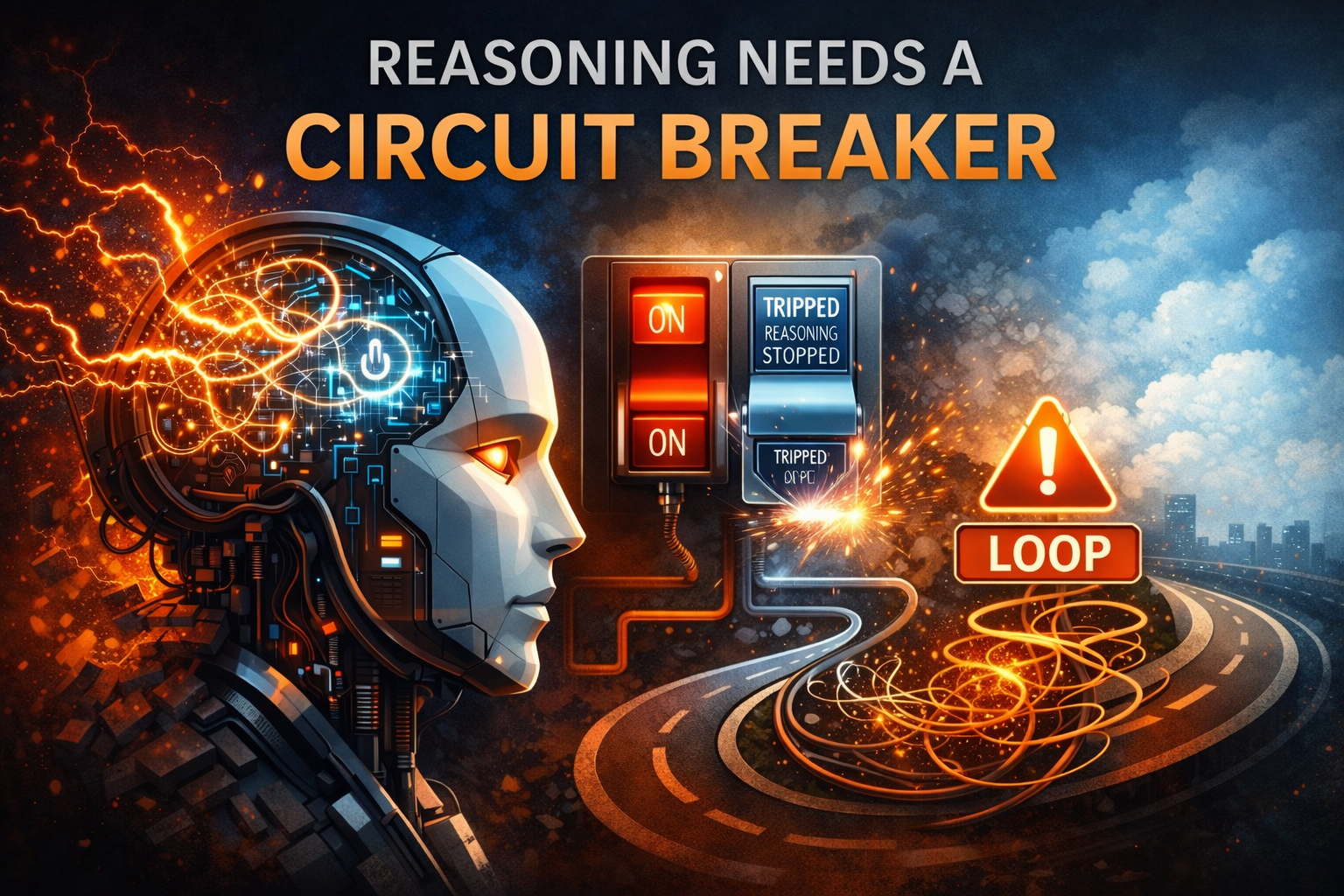
  • enforcement → circuit breakers, kill-switches, safe pause
  • incident response → rollback, evidence capture, postmortems

This is also why your Enterprise AI Control Plane becomes the core instrument of enforcement, not an optional architecture layer:
https://www.raktimsingh.com/enterprise-ai-control-plane-2026/

The Enforcement Stack

The Enforcement Stack: 7 capabilities that make autonomy controllable

1) Decision gating: autonomy is a ladder, not a switch

A mature enforcement doctrine defines levels of autonomy. A simple ladder that works in any enterprise:

  • Suggest: AI recommends; humans act
  • Draft: AI prepares changes; humans approve
  • Execute with constraints: AI acts inside strict boundaries
  • Execute + notify: AI acts and alerts owners
  • Execute + verify: AI acts but must pass post-checks to continue

Example: customer support refunds

  • AI drafts the response and refund rationale for every case.
  • AI auto-approves refunds only below a threshold and only when evidence is clean.
  • Anything above that goes to “Draft + Approve,” not “Execute.”

This makes autonomy safe because execution is earned.

If you want the best decision classification foundation to drive these gates, link the concept to your decision-clarity doctrine:
https://www.raktimsingh.com/decision-clarity-scalable-enterprise-ai-autonomy/

2) Action thresholds: confidence is not enough—evidence is the gate

Most systems gate actions based on model confidence. That is fragile because confidence can be high even when context is wrong.

Enforcement doctrine gates on evidence thresholds, such as:

  • are policy conditions satisfied?
  • are inputs complete and trustworthy?
  • are signals consistent, or conflicting?
  • is this action reversible?
  • is the actor authorized?

Example: access provisioning
Even if AI is confident, it cannot grant privileged access unless:

  • requester identity is verified
  • request matches approved role templates
  • MFA requirements are met
  • separation-of-duties is satisfied

The model can recommend. The system decides whether it can act.

Decision gating

3) Permissioning: least privilege is the enforcement foundation

Autonomous AI cannot operate as a shared admin user.

Each autonomous actor needs:

  • a unique machine identity
  • least-privilege permissions aligned to its role
  • an accountable owner
  • immediate revocation capability

This is exactly why an Enterprise AI Agent Registry is not “nice architecture.” It is enforcement reality:
https://www.raktimsingh.com/enterprise-ai-agent-registry/

Example: screen-using agents
If an agent can click through a UI, it can approve, export, delete, and modify. Without least privilege and fast revocation, you’ve created a breach pathway disguised as productivity.

4) Policy-as-runtime: rules must block actions, not decorate documents

Many enterprises have policies that look strong on paper but have no runtime teeth.

Enforcement doctrine requires policy checks:

  • Pre-action: block prohibited actions before they occur
  • In-action: enforce constraints during execution
  • Post-action: verify outcomes and trigger rollback if required

Example: outbound customer messages
Policy might require:

  • approved templates only
  • prohibited phrases blocked
  • compliance checks for certain products or claims
  • mandatory “human approval” for specific scenarios

If the policy can’t block the message in runtime, it isn’t policy.

That is what your Control Plane is meant to do in practice:
https://www.raktimsingh.com/enterprise-ai-control-plane-2026/

Circuit breakers and kill-switches: “safe pause,” not chaos

5) Circuit breakers and kill-switches: “safe pause,” not chaos

A kill-switch is not “turn off AI.”

A mature enforcement doctrine defines safe pause:

  • stop new actions immediately
  • let in-flight actions complete safely (or stop at checkpoints)
  • preserve evidence
  • route to fallback mode (manual or deterministic rules)
  • alert owners and incident responders

Example: claims processing
A safe pause might:

  • stop payouts instantly
  • continue intake
  • hold cases in a review queue
  • preserve every decision trace and evidence packet

That prevents both financial leakage and operational breakdown.

6) Reversibility engineering: roll back decisions, not just deployments

Most teams can roll back code. Very few can roll back decisions.

Enforcement doctrine requires every action type to be explicitly classified as:

  • Reversible: rollback exists and is tested
  • Hard-to-reverse or irreversible: requires stronger oversight and constraints

Examples

  • Price change → revert to last-known-good price plan
  • Access grant → revoke, rotate credentials, trigger review
  • Scheduled job → cancel and revert state

Hard-to-reverse actions

  • sending customer communications
  • executing financial transfers
  • deleting data

If it’s hard to reverse, the system must treat it as “slow and supervised.”

This is one of the reasons your Minimum Viable Enterprise AI System must include reversibility, not just monitoring:
https://www.raktimsingh.com/minimum-viable-enterprise-ai-system/

Reversibility engineering

7) Decision evidence: create “defensibility packets” for material actions

When things go wrong, nobody asks for model accuracy charts.

They ask:

“Why did the system do this—here—and who allowed it?”

Enforcement doctrine requires an evidence packet for every material decision:

  • inputs used (at the time)
  • constraints applied
  • policies checked and results
  • tools invoked and outputs
  • human approvals (if any)
  • the final action taken and next planned step

This turns AI from “mysterious automation” into “defensible operations.”

If you want a canonical lens on how “correct” decisions can still fail governance boundaries, link this concept to your decision failure taxonomy:
https://www.raktimsingh.com/enterprise-ai-decision-failure-taxonomy/

Three enterprise scenarios that make enforcement obvious

Scenario 1: Banking — suspicious transaction response

Without enforcement:
AI blocks accounts automatically; false positives spike; customers flood support; no clear rationale exists.

With enforcement doctrine:

  • AI may recommend blocking for medium-risk cases
  • AI may auto-block only for high-risk cases with evidence checks
  • ambiguous cases go to a human queue with authority
  • circuit breaker pauses auto-blocking during anomalies
  • every block includes an evidence packet

Result: fewer trust failures, defensible controls, faster resolution.

Scenario 2: Retail — dynamic pricing

Without enforcement:
AI updates prices too frequently; margins swing; brand trust erodes; teams blame the model.

With enforcement doctrine:

  • caps on magnitude and frequency
  • approval gates for sensitive categories
  • anomaly triggers circuit breaker
  • rollback to last-known-good plan is automatic

Result: autonomy without volatility shocks.

Economic controls are not separate from enforcement. Cost is a behavioral boundary—handled through your economic control plane lens:
https://www.raktimsingh.com/enterprise-ai-economics-cost-governance-economic-control-plane/

Scenario 3: Enterprise IT — access provisioning

Without enforcement:
AI grants broad permissions; a compromised request escalates privileges; breach occurs.

With enforcement doctrine:

  • least-privilege role templates only
  • separation-of-duties enforced (agent cannot approve its own elevation)
  • privileged actions always require human approval
  • immediate revocation exists
  • all access changes are reversible and recorded

Result: autonomy that respects security reality.

A repeatable enforcement checklist 

  • Autonomy must be stoppable in seconds.
  • Execution is a privilege, not a default.
  • If it’s irreversible, it must be slow and supervised.
  • Policy that can’t block actions isn’t policy.
  • Every agent has identity, permissions, and an owner.
  • Evidence precedes confidence.
  • Incidents are decision failures, not model failures.
  • Autonomy must adjust over time.

Conclusion

Enterprise AI scales only when it becomes stoppable.
Not because executives fear intelligence—
but because they fear irreversible decisions at machine speed.

If you want one question that reveals maturity, ask:

“Can we safely stop this AI right now—without breaking the business?”

If the answer isn’t an immediate yes, you don’t have enforcement.

You have risk disguised as automation.

FAQs 

What is Enterprise AI Enforcement Doctrine?

It is the runtime rule system that controls when AI can act, when it must ask humans, how it can be paused, and how decisions are rolled back and defended with evidence.

Is enforcement the same as AI governance?

No. Governance defines intent (roles, policies, risk posture). Enforcement makes intent real at runtime through gates, permissions, circuit breakers, rollback paths, and decision evidence.

Why is a kill-switch not enough?

A kill-switch stops actions. Enforcement doctrine adds safe pause, controlled fallback modes, reversibility engineering, and evidence capture so the business stays safe and operable.

What’s the biggest enforcement mistake enterprises make?

They focus on model performance and dashboards but skip decision-level controls: permissioning, action thresholds, reversibility, and evidence packets.

How do you make human oversight real?

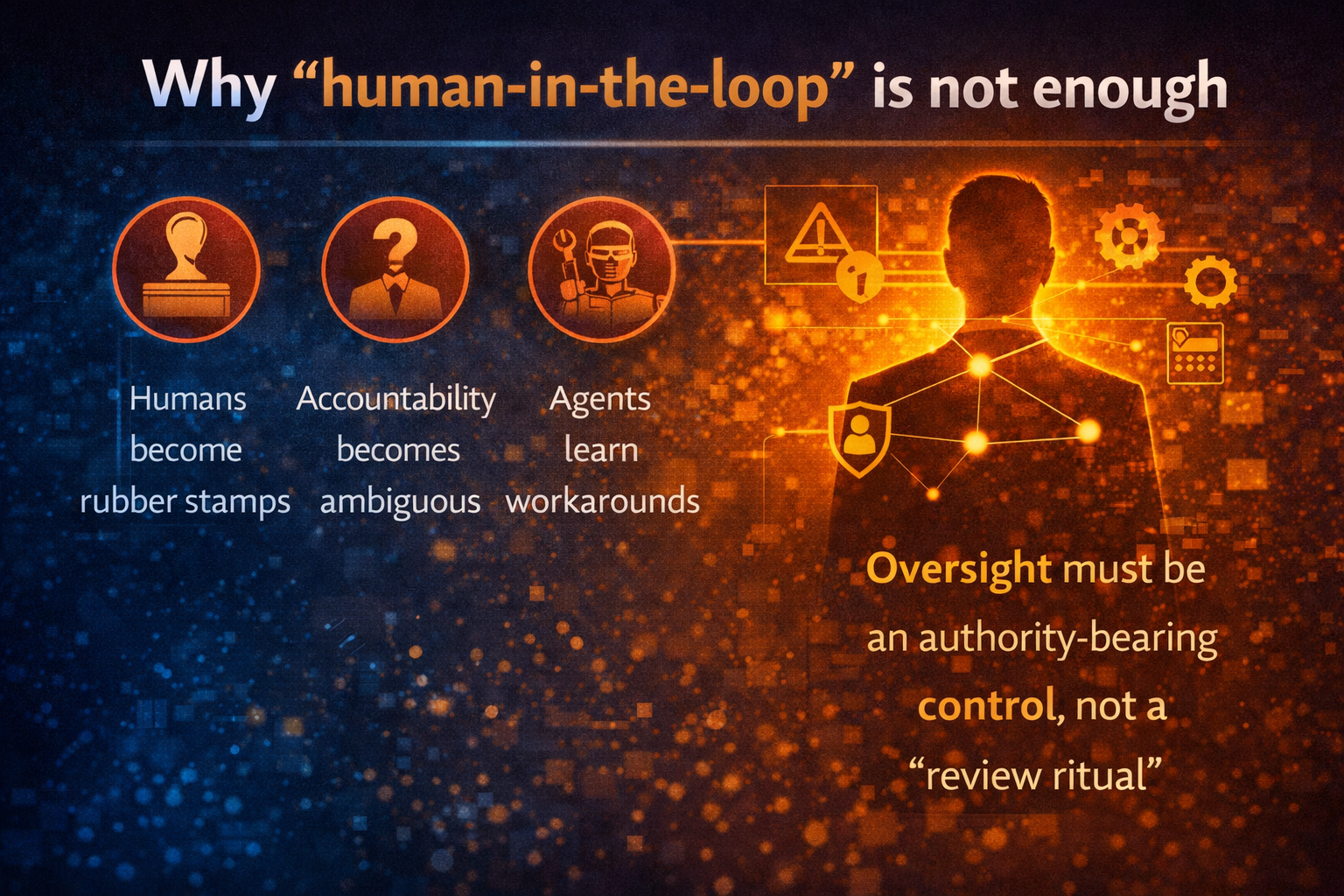
Give humans context, authority, and fast intervention tools—approval queues, override rights, emergency pause, and clear ownership. Oversight without power is theater.

What is Enterprise AI Enforcement Doctrine?
Enterprise AI Enforcement Doctrine defines how autonomous AI systems are stopped, constrained, reversed, and governed at runtime to ensure safe and accountable operation.

Why is AI enforcement different from AI governance?
AI governance defines intent and policy. AI enforcement ensures those policies actively block, allow, or escalate actions during execution.

What does “stoppable AI” mean in enterprises?
Stoppable AI refers to systems that can pause or halt autonomous actions in seconds without breaking business operations or losing decision evidence.

Why is reversibility critical for autonomous AI?
Because irreversible AI decisions can cause financial, regulatory, or reputational damage at machine speed if not strictly controlled.

Where does AI enforcement operate technically?
AI enforcement operates at the Enterprise AI Runtime through control planes, decision gates, permissions, and circuit breakers.

Glossary

Enterprise AI Enforcement Doctrine
The set of runtime rules and control mechanisms that determine when autonomous AI systems may act, when they must escalate to humans, how actions are paused or reversed, and how decisions are defended with evidence.

Stoppable AI
Autonomous AI systems designed with kill-switches, circuit breakers, and safe-pause mechanisms that can halt or constrain actions immediately without breaking business operations.

Reversible Decision
An AI-driven action that can be undone or rolled back (such as revoking access or reverting pricing) without permanent harm.

Irreversible Decision
An AI-driven action that cannot be fully undone (such as sending customer communications or executing financial transfers) and therefore requires stricter enforcement thresholds and human approval.

Safe Pause
A controlled halt of autonomous AI activity that stops new actions, preserves system state and evidence, and shifts operations to a fallback mode rather than abruptly shutting systems down.

AI Kill Switch
A mechanism that immediately disables autonomous actions by an AI system; effective only when combined with safe-pause and rollback capabilities.

Human Oversight
The ability of authorized humans to monitor, intervene, override, or disable autonomous AI decisions with sufficient context and authority.

Decision Evidence (Decision Record)
A structured record capturing why an AI system took a specific action, including inputs, policy checks, constraints, approvals, and outcomes.

Enterprise AI Control Plane
The governance and enforcement layer that applies policy, risk controls, and decision boundaries across AI systems at runtime.

Enterprise AI Runtime
The production environment where AI systems execute decisions, invoke tools, interact with users, and create real-world impact.

Further Reading in the Enterprise AI Canon

If you want the complete, connected doctrine (and the architecture layers that make enforcement real), continue here:

1️⃣ NIST AI Risk Management Framework (US)

 Runtime risk management + governance expectations
🔗 https://www.nist.gov/itl/ai-risk-management-framework

2️⃣ ISO/IEC 42001 – AI Management Systems

 Establishes AI governance as an organizational management system
🔗 https://www.iso.org/standard/81230.html

3️⃣ EU AI Act – Human Oversight & High-Risk AI

Reinforces need for stoppability, oversight, and controls
🔗 https://artificialintelligenceact.eu/article/14/

4️⃣ UK ICO – Explaining AI Decisions

 Supports evidence-based defensibility of AI decisions
🔗 https://ico.org.uk/for-organisations/guide-to-data-protection/key-data-protection-themes/explaining-decisions-made-with-ai/

The Laws of Enterprise AI: The Non-Negotiable Rules for Running AI Safely in Production

Enterprise AI does not become dangerous when models become powerful.
It becomes dangerous when systems begin to act without a closed set of rules that define what must always be true—under drift, policy change, outages, audits, and cost pressure.

Most organizations treat Enterprise AI as a technology program.
In reality, Enterprise AI is an operating regime.

This page defines the Laws of Enterprise AI: the non-negotiables that must hold if you want AI systems that are safe, auditable, economically operable, and scalable across real production workflows.

These laws are not best practices.
They are constraints. If you violate them, you will eventually fail—regardless of how “smart” your models are.

How to use these laws

Use the laws as a production gate:

  • Before you deploy: treat each law as a checklist item
  • During incidents: map the failure back to the violated law
  • During audits: show how each law is enforced as runtime evidence
  • During scaling: only expand autonomy when more laws are satisfied by design

If you want the complete closed system these laws belong to, see:
The Enterprise AI Canon
https://www.raktimsingh.com/enterprise-ai-canon/

Law 1 — Ownership is not optional

Every AI decision must have a human owner before it has a model.

If decision ownership is unclear, escalation fails.
If escalation fails, accountability collapses.
If accountability collapses, Enterprise AI becomes ungovernable.

What this law requires

  • Named owners for decision classes (not “teams”)
  • Explicit decision rights and escalation authority
  • “Stop” authority: who can pause autonomy immediately

Related foundations:

Law 2 — No runtime, no Enterprise AI

Models do not run enterprises. Runtimes do.

If you cannot explain what is actually executing in production, you cannot govern it.

What this law requires

  • A defined runtime layer for AI execution
  • Safe tool invocation patterns (timeouts, retries, idempotency)
  • Permissioned actions and controlled side effects

Related foundation:

Law 3 — Policy must be enforced at runtime

Governance in documents does not govern production behavior.

Enterprise AI requires policy to be applied before execution, not reviewed after.

What this law requires

  • A runtime control plane enforcing policy gates
  • Approval requirements by decision class
  • Escalation triggers and evidence requirements
  • Mandatory decision logging and retention rules

Related foundation:

Law 4 — Autonomy must be reversible

If you cannot undo it, you cannot automate it.

Irreversible autonomy turns minor errors into permanent incidents.
Reversibility is the difference between safe scaling and systemic risk.

What this law requires

  • Rollback paths for actions and side effects
  • Kill switches and revocation mechanisms
  • Human override that is operationally real, not symbolic

Law 5 — Evidence before confidence

Any action must be supported by auditable evidence, not persuasion.

Enterprise AI cannot rely on “it sounded right.”
It must rely on traceable inputs, policy checks, and decision records.

What this law requires

  • Decision traces: what was decided, why, with what evidence
  • Source provenance for critical claims
  • Policy evaluation logs attached to decisions

Law 6 — Identity governs autonomy

Every agent is an identity. Every identity must be permissioned.

Unregistered agents are shadow operators.
Shadow operators create audit failures and security failures.

What this law requires

  • An agent registry as system of record
  • Least-privilege permissions per agent and workflow
  • Lifecycle controls: create, change, retire, revoke
  • Provenance of tool and data access

Related foundation:

Law 7 — Intent must bind behavior

If design intent cannot be enforced, autonomy cannot scale.

Most enterprises fail because what they intended is not what runs.
The solution is not more prompts—it is a contract.

What this law requires

  • A versioned execution contract per workflow/agent
  • Explicit constraints, allowed actions, and escalation rules
  • Testable acceptance criteria for behavior

Related foundation:


Law 8 — Cost is a runtime constraint

In Enterprise AI, spend becomes behavior.

Once AI acts, cost is no longer a billing problem.
It is a behavioral system that must be governed in real time.

What this law requires

  • Economic guardrails: token/tool budgets per workflow
  • Spend envelopes and stop conditions
  • Escalation on cost deviation
  • Throttles and degradations under pressure

Related foundation:

Law 9 — Observability is non-negotiable

If you cannot observe it continuously, you cannot operate it safely.

Enterprise AI fails silently over time.
Observability is how you detect drift before drift becomes damage.

What this law requires

  • Continuous monitoring of behavior, quality, policy, and cost
  • Drift signals (behavior drift, policy drift, economic drift)
  • Incident playbooks tied to violated laws

Related foundations:

Law 10 — Scale must follow maturity

You do not “roll out” Enterprise AI. You earn it.

Autonomy should expand only when controls are proven at smaller scope.
Scale without maturity creates the illusion of progress—and the certainty of failure.

What this law requires

  • A maturity progression from pilots → embedded workflows → governed autonomy
  • Promotion rules: what evidence is required to scale scope/permissions
  • Institutional readiness for change velocity

Related foundation:

The Five Proofs
The Five Proofs

The simplest doctrine 

Enterprise AI advantage is not having more AI.
It is having governable decisions.

When AI acts in production, the enterprise must be able to prove five things at all times:
who owned it, what ran, what was allowed, what it cost, and why it happened.

That is the operating definition of safe, scalable autonomy.

How these laws relate to the Minimum Viable Enterprise AI System

The Minimum Viable Enterprise AI System (MVES) is the smallest practical implementation of these laws.

If you want the system blueprint that maps directly to these laws, start here:
https://www.raktimsingh.com/minimum-viable-enterprise-ai-system/

And for the integrated architecture view:
https://www.raktimsingh.com/the-enterprise-ai-operating-stack-how-control-runtime-economics-and-governance-fit-together/

Final declaration

These are not aspirational principles. They are production constraints.

If you violate them, your AI estate will eventually become:

  • unowned,
  • unauditable,
  • economically unstable,
  • and operationally unsafe.

If you enforce them, Enterprise AI becomes what it was always supposed to be:

a scalable system for running intelligence safely inside real enterprise workflows.

The Enterprise AI Canon: The Complete System for Running AI Safely in Production

The Enterprise AI Canon: The Complete System for Running AI Safely in Production

Enterprise AI has reached a point where more content does not create more clarity. What enterprises lack is not ideas, tools, or pilots—but a closed, coherent system of record that defines what must exist before AI is allowed to act inside real workflows.

This page defines The Enterprise AI Canon.

The Canon is the finite, non-overlapping body of knowledge required to design, govern, and scale Enterprise AI safely in production. It is not a collection of opinions. It is the minimum conceptual and operational system an enterprise must have once AI begins to execute decisions, trigger actions, and affect outcomes.

The Enterprise AI Canon is the finite, non-overlapping body of knowledge required to design, govern, and scale Enterprise AI safely in production.

If a capability is not part of this Canon, it is either:

  • an implementation detail, or
  • an extension built on top of the Canon.
What this Canon is (and is not)

What this Canon is (and is not)

The Enterprise AI Canon is:

  • a system-level definition, not a tool guide
  • architecture-first, not model-first
  • grounded in production reality, not demos
  • designed for scale, auditability, reversibility, and economics

The Enterprise AI Canon is not:

  • a list of vendors or platforms
  • a prompt engineering guide
  • a use-case catalog
  • a maturity marketing framework

This distinction is intentional. Authority comes from closure, not expansion.

The Canonical Structure of Enterprise AI

The Enterprise AI Canon is organized into nine non-negotiable pillars. Together, they define the minimum complete system required to run AI safely at enterprise scale.

Each pillar answers a question that cannot be left implicit once AI begins to act.

  1. The Definition of Enterprise AI

(What enterprises are actually building)

Enterprise AI is not a category of tools. It is an operating capability.

This pillar establishes the precise definition of Enterprise AI as the ability to run intelligence inside production workflows under governance, ownership, and economic control.

Canonical reference:

  1. The Minimum Viable Enterprise AI System

(What must exist before AI is allowed to scale)

This is the structural core of the Canon.

It defines the smallest complete system an enterprise must have in place before AI can operate safely in production—covering ownership, runtime, control, economics, identity, execution, and observability.

Without this system, Enterprise AI scales into unowned risk and ungovernable cost.

Non-negotiable reference:

  1. The Enterprise AI Operating Model

(Who owns AI decisions and outcomes)

Enterprise AI fails when decision ownership is ambiguous.

This pillar defines how enterprises assign decision rights, accountability, escalation authority, and responsibility once AI systems act inside workflows.

Canonical reference:

  1. The Enterprise AI Runtime

(What is actually running in production)

Models do not run enterprises. Runtimes do.

This pillar defines the execution layer where AI behavior is constrained, permissioned, logged, retried, and safely operated under real-world conditions.

Canonical reference:


  1. The Enterprise AI Control Plane

(How policy, risk, and reversibility are enforced)

Governance that exists only in documents does not govern AI.

This pillar defines the runtime control plane that enforces policy, evidence requirements, escalation, and reversibility before decisions execute.

Canonical reference:

  1. Enterprise AI Economics & Cost Governance

(Why cost becomes a behavioral problem)

Once AI systems act autonomously, traditional FinOps breaks.

This pillar defines the Economic Control Plane required to keep AI behavior economically bounded, predictable, and operable at scale.

Canonical reference:

  1. Governed Machine Identity

(Why every agent needs ownership and permissions)

Autonomous agents without identity create audit failure and security risk.

This pillar defines the Agent Registry as the system of record for machine identity, permissions, lifecycle, and revocation.

Canonical reference:

  1. The Enterprise AI Execution Contract

(How design intent becomes enforceable behavior)

Enterprises fail when what they design is not what actually runs.

This pillar defines how enterprises bind intent, constraints, evidence, and escalation rules into a contract that governs production behavior.

Canonical reference:

  1. Continuous Observability & Drift Control

(How enterprises keep AI aligned over time)

Enterprise AI does not fail instantly. It fails silently over time.

This pillar defines how enterprises monitor decision behavior, detect drift, and maintain alignment across quality, safety, and economics.

Canonical references:

What is deliberately excluded from the Canon

The following are intentionally excluded from the Enterprise AI Canon:

  • vendor comparisons
  • model benchmarks
  • prompt libraries
  • use-case catalogs
  • implementation tutorials

These evolve too quickly to be canonical.
The Canon defines what must always be true, regardless of technology cycles.

How the Canon evolves

The Enterprise AI Canon is closed by default.

It evolves only when:

  • a new system-level capability becomes unavoidable, or
  • a structural assumption is invalidated by production reality

All future writing on this site either:

  • deepens one Canon pillar, or
  • explores extensions built on top of the Canon

Institutional Perspectives on Enterprise AI

Many of the structural ideas discussed here — intelligence-native operating models, control planes, decision integrity, and accountable autonomy — have also been explored in my institutional perspectives published via Infosys’ Emerging Technology Solutions platform.

For readers seeking deeper operational detail, I have written extensively on:

Together, these perspectives outline a unified view: Enterprise AI is not a collection of tools. It is a governed operating system for institutional intelligence — where economics, accountability, control, and decision integrity function as a coherent architecture.

Final declaration

Enterprise AI advantage does not come from having more AI.
It comes from having a complete system to run intelligence safely.

The Enterprise AI Canon defines that system.

The Canon is not a collection of opinions. It defines what must exist before AI is allowed to act inside real workflows.

If a capability is not part of this Canon, it is either an implementation detail or an extension built on top of it.

The Minimum Viable Enterprise AI System: The Smallest Stack That Makes AI Safe in Production

The Minimum Viable Enterprise AI System: The Smallest Stack That Makes AI Safe in Production

Enterprise AI does not fail because models are inaccurate. It fails because enterprises scale AI outputs before they build the system that governs how intelligence behaves in production.

Once AI moves from advising humans to acting inside real workflows—approving requests, triggering actions, updating records, and coordinating systems—the challenge is no longer model performance. The challenge is whether the organization has the minimum set of capabilities required to run AI safely, repeatedly, and economically at scale.

The Minimum Viable Enterprise AI System is the smallest set of capabilities required to run AI safely, repeatedly, and economically inside real enterprise workflows.

The smallest stack that makes AI safe, auditable, and economically operable in production

Enterprise AI does not fail because the model is inaccurate.
It fails because enterprises scale outputs before they build the system that governs behavior.

Enterprise AI does not fail because models are inaccurate. It fails because enterprises scale outputs before they build the system that governs behavior.

The moment AI moves from advising to acting—approving requests, changing records, triggering workflows, granting access, routing claims, updating configurations—your organization is no longer “using AI.” It is running intelligence inside production workflows.

At that point, one question determines success or failure:

What is the smallest complete system required to run AI safely in production—without breaking trust, compliance, or cost?

This article defines that system.

Minimum Viable Enterprise AI System (MVES) means:

The smallest set of enterprise capabilities required to run AI safely, repeatedly, and economically inside real workflows—under drift, policy change, escalation, and audit.

MVES is not a platform, a model, a prompt library, or an agent framework.
MVES is the operating capability that makes AI governable.

For the foundational definition this builds on, see:
What Is Enterprise AI? A 2026 Definition for Leaders Running AI in Production
https://www.raktimsingh.com/what-is-enterprise-ai-2026-definition/

Why this matters globally (US, EU, India, Global South)

Across geographies, regulations differ—but the failure pattern does not.

  • In fast-moving markets, AI estates expand faster than governance.
  • In regulated markets, the first audit exposes missing decision traceability.
  • In cost-constrained environments, autonomous systems become economically unstable.

Different contexts. Same outcome.

Without a minimum system, AI scales into an unowned, unauditable, economically unstable operational liability.

The MVES: 7 irreducible capabilities

The MVES: 7 irreducible capabilities

If you want Enterprise AI that survives reality—drift, audits, change velocity, and cost pressure—these are the irreducible seven.

Anything less is not Enterprise AI.
It is a pilot wearing enterprise branding.

1) Decision Ownership & Accountability

(The Enterprise AI Operating Model)

Enterprise AI begins with a governance fact, not a technology choice:

Every AI decision must have a human owner—before it has a model.

This requires explicit answers to:

  • Who owns the business outcome when AI acts?
  • Who owns policy boundaries and risk classification?
  • Who owns escalation and exception handling?
  • Who can pause, rollback, or restrict autonomy?

If this is missing, here is what happens:
AI becomes “everyone’s project” and “no one’s responsibility.” In production, this creates slow escalation, blame diffusion, and silent risk accumulation.

Related reading:

Runtime vs Control Plane vs Economics

2) A Production Execution Kernel

(The Enterprise AI Runtime)

In production, the real question is not which model is used, but:

What is actually running, with what permissions, under what controls, and with what fallback?

A true Enterprise AI Runtime provides:

  • controlled tool execution
  • safe retry and timeout behavior
  • runtime policy checks
  • permissioned actions
  • versioned behaviors, not just versioned models

If this is missing, here is what happens:
Agents execute unpredictable tool chains, create irreversible side effects, and force “incident-driven governance” after damage occurs.

Related reading:

Policy, Risk, and Reversibility at Runtime

3) Policy, Risk, and Reversibility at Runtime

(The Enterprise AI Control Plane)

The Control Plane is not governance documentation.
It is governance enforced at runtime.

It defines:

  • what autonomy is allowed
  • what evidence is required
  • which actions require approval
  • what must be logged and retained
  • what is reversible and how
  • what triggers escalation

If this is missing, here is what happens:
Enterprises deploy “autonomy without brakes.” Decisions may be correct, but they are indefensible, unprovable, and unsafe at scale.

Related reading:

Economic Guardrails
Economic Guardrails

4) Economic Guardrails

(The Economic Control Plane)

Traditional FinOps assumes humans drive compute usage.
Enterprise AI breaks that assumption.

Once AI acts autonomously, it can:

  • trigger workflows repeatedly
  • expand tool and retrieval calls
  • retry itself into runaway spend
  • create cost spikes without malicious intent

Economic governance must be runtime-native:

  • cost envelopes per agent or workflow
  • token and tool-call budgets
  • deviation-based escalation
  • throttles and kill switches

If this is missing, here is what happens:
AI becomes economically un-operable. Cost turns into behavior, and behavior turns into organizational conflict.

Related reading:

5) Governed Machine Identity

(The Agent Registry)

Enterprises cannot scale humans without identity and access management.
They cannot scale agents without it either.

A governed Agent Registry provides:

  • a system of record for agents
  • ownership and lifecycle tracking
  • least-privilege permissions
  • revocation and kill-switch controls
  • provenance of tool access

If this is missing, here is what happens:
Agents become shadow identities. Audits fail. Incidents become untraceable. Revocation becomes risky and slow.

Related reading:

6) Design Intent → Production Behavior

(The Enterprise AI Execution Contract)

Enterprises fail when what they design is not what actually runs.

The Execution Contract binds intent to behavior by defining:

  • goals and constraints
  • allowed actions
  • evidence requirements
  • escalation rules
  • testable acceptance criteria

If this is missing, here is what happens:
Production behavior drifts quietly—until it becomes a customer incident, an audit failure, or a board-level event.

Related reading:

Continuous Observability & Drift Control

7) Continuous Observability & Drift Control

(The Operability Layer)

Enterprise AI is not deployed once.
It is operated continuously.

Minimum observability includes:

  • decision traces and evidence
  • tool-call logs and side effects
  • policy evaluation records
  • quality, safety, and cost signals
  • drift detection across behavior and economics

If this is missing, here is what happens:
Failures are discovered late—at audit time, incident time, or customer time.

Related reading:

The simplest mental model: 7 gears that must all engage

The simplest mental model: 7 gears that must all engage

  1. Ownership defines accountability
  2. Runtime defines execution
  3. Control plane defines authority
  4. Economic control defines affordability
  5. Identity defines permission
  6. Execution contracts define intent
  7. Observability defines proof and operability

If even one gear is missing, scaling autonomy converges toward:

  • uncontrolled risk, or
  • uncontrolled cost

What MVES deliberately excludes

MVES deliberately excludes:

  • model leaderboards
  • vendor comparisons
  • prompt libraries as strategy
  • use-case catalogs as operating plans

Because none of these answer the production question:

Can this AI system be owned, governed, reversed, audited, and economically operated at scale?

Until the answer is yes, everything else is secondary.

How MVES fits into the full Enterprise AI system

MVES defines the minimum.
The integrated architecture is described here:

And the maturity journey here:

Closing: the canon-sealing truth

Enterprise AI is not a race to deploy more agents.
It is a discipline of running intelligence safely in the real world.

If you build the Minimum Viable Enterprise AI System, you can scale autonomy without losing control.
If you don’t, every “successful” pilot is just the beginning of an unowned production liability.

The Enterprise AI Operating Stack: How Control, Runtime, Economics, and Governance Fit Together

The Enterprise AI Operating Stack

Enterprise AI is no longer defined by models, copilots, or pilots. Once AI systems begin influencing real decisions, triggering workflows, and taking autonomous actions inside production environments, enterprises face a new challenge: how to run intelligence safely, predictably, and economically at scale.

This article defines the Enterprise AI Operating Stack—the architecture that brings together decision boundaries, runtime execution, control planes, economic governance, accountability, and observability—so autonomy becomes operable, governable, and sustainable across the enterprise.


Enterprise AI is entering its “adult phase.”

The early era was about model choice, pilot velocity, and demo excellence. The new era is about something less glamorous—and far more decisive: operability. Once AI systems begin to influence real decisions and trigger real actions inside workflows, enterprises discover a hard truth:

Models don’t run enterprises. Stacks do.

A model can be impressive and still become a production liability if it’s deployed without the layers that make it safe, reliable, and economically sustainable. That is why the most advanced enterprises are converging on an architecture pattern that looks less like “a chatbot” and more like an operating system.

This article is part of the canonical Enterprise AI Operating Model series:
Enterprise AI Operating Model

This article defines that pattern: the Enterprise AI Operating Stack—a practical, architecture-level map of how Decision, Runtime, Control, Economics, Governance, and Observability fit together to produce economically operable autonomy at scale.

Why enterprises need a stack, not a platform

Why enterprises need a stack, not a platform

“Platform” is a product word. “Stack” is an operating reality.

A platform suggests: buy it, integrate it, you’re done.
A stack admits something more honest: AI is an evolving estate that must be run—with control, guardrails, accountability, and continuous improvement.

This matters because Enterprise AI has three properties that classic enterprise software didn’t:

  1. Probabilistic behavior: outputs vary, even for similar inputs.
  2. Action capability: AI can trigger workflows, tools, and decisions.
  3. Compounding effects: small changes can create cascading consequences (cost, risk, compliance, customer impact).

That’s why risk frameworks increasingly emphasize lifecycle governance. The NIST AI Risk Management Framework (AI RMF) organizes AI risk management into high-level functions—Govern, Map, Measure, Manage—and explicitly frames governance as a cross-cutting function across the lifecycle. (NIST Publications)

And regulations like the EU AI Act place strong emphasis on human oversight and operational duties for high-risk systems. (AI Act Service Desk)

In short: enterprises need a stack because AI is not a feature. It is a new production category.

The Enterprise AI Operating Stack in one sentence

The Enterprise AI Operating Stack in one sentence

The Enterprise AI Operating Stack is the set of layers that turns AI from “outputs” into operable decisions, by making autonomy governable, observable, and economically sustainable.

Think of it like the difference between:

  • a single spreadsheet someone built (useful but fragile), and
  • an enterprise finance system (auditable, controlled, and trustworthy).

Enterprise AI must evolve the same way.

Layer 1: The Decision Layer — what AI is allowed to decide

Most organizations start with models. The better starting point is decisions.

Because the enterprise impact of AI is determined not by what it can generate, but by:

  • which decisions it can influence, and
  • which actions it can trigger.

A simple example

An AI assistant that drafts internal email summaries is typically low-impact.

An AI system that approves refunds, grants access, changes limits, routes procurement approvals, or updates records is higher-impact.

Same model. Completely different enterprise risk.

The Decision Layer forces clarity:

  • What decisions exist in this workflow?
  • Which ones can AI recommend?
  • Which ones can AI execute?
  • Which ones require human oversight?
  • What evidence is required before action?

This is where your “decision taxonomy” thinking becomes a practical tool: it prevents accidental autonomy.

Layer 2: The Runtime Layer — where AI actually executes

Layer 2: The Runtime Layer — where AI actually executes

The Runtime is where AI stops being “an idea” and becomes a production actor.

It includes:

  • orchestration (agent/workflow engine),
  • tool calling and API execution,
  • retrieval and context assembly,
  • prompt and version control,
  • routing across models,
  • safety filters and output handling,
  • integrations into enterprise systems.

Why runtime matters more than model choice

Many enterprise failures happen here:

  • a tool call triggers the wrong system,
  • an agent loops and burns budget,
  • retrieval pulls stale or sensitive data,
  • a prompt update silently changes behavior in production.

Security practitioners increasingly stress that many vulnerabilities appear at the application layer around LLM systems—prompt injection, insecure output handling, denial of service patterns, and supply chain weaknesses. OWASP’s Top 10 for LLM Applications documents these as real-world risks. (OWASP Foundation)

Translation: If you don’t architect the runtime, you’re not “deploying AI.” You’re improvising production.

Layer 3: The Control Plane — making AI enforce policy, not just document it

Layer 3: The Control Plane — making AI enforce policy, not just document it

Layer 3: The Control Plane — making AI enforce policy, not just document it

Enterprises already know how to govern policy—on paper.

The problem is that paper policy does not control runtime behavior.

The Control Plane is the system that makes governance real by enforcing policy through:

  • identity and permissions,
  • audit logs,
  • traceability of decisions,
  • safety boundaries,
  • change control,
  • rollback and reversibility,
  • monitoring and incident response.

NIST AI RMF explicitly frames governance as a cross-cutting function that informs and is infused throughout the risk lifecycle. (NIST Publications)

A simple example

Policy says: “AI must not approve certain actions without human oversight.”
Control Plane enforces: “Those actions require explicit approval—and are logged.”

That’s why the Control Plane is not paperwork. It is architecture.

The Economic Control Plane — making autonomy financially operable

Layer 4: The Economic Control Plane — making autonomy financially operable

This is the layer most enterprises don’t build until it’s too late.

Traditional cost controls assume predictable workloads. Enterprise AI has behavioral cost:

  • retries,
  • deeper retrieval,
  • escalation to larger models,
  • repeated tool calls,
  • long context windows,
  • always-on agents.

FinOps practitioners now explicitly treat AI as a distinct cost domain and publish guidance on AI cost drivers, forecasting, and operating practices (often referred to as “FinOps for AI”). (FinOps)

The Economic Control Plane makes cost a runtime-enforced policy surface through:

  • spend envelopes per workflow and decision class,
  • tiered modes (cheap-by-default, escalate explicitly),
  • escalation rules tied to decision criticality,
  • tool-call budgets,
  • stop conditions (halt and route when budget is hit),
  • anomaly alerts driven by behavior signals (retries spike, retrieval depth grows, escalation rises).

A simple example

A knowledge assistant can run in:

  • Standard Mode: shallow retrieval, short answer, small model
  • Deep Mode: deeper retrieval, more verification, larger model—explicitly labeled

Cost becomes intentional—not accidental.

Governance and Accountability — who owns decisions, risk, and spend

Layer 5: Governance and Accountability — who owns decisions, risk, and spend

The stack is incomplete without ownership.

When something goes wrong, every enterprise asks the same question:

Who is accountable?

This layer defines:

  • decision owners (business accountability),
  • system owners (technical accountability),
  • model/prompt owners (behavior accountability),
  • risk owners (compliance and oversight),
  • economic owners (budget responsibility),
  • escalation and incident responsibilities.

This is where an AI Management System approach becomes practical. ISO/IEC 42001 is designed to help organizations establish an AI management system for responsible use—covering governance, lifecycle practices, and risk treatment. (ISO)

In short: governance is not a committee. It’s a decision-rights architecture.

Observability and Learning — how the stack improves safely over time

Layer 6: Observability and Learning — how the stack improves safely over time

AI systems change. The world changes. Data changes. Policies change.

If you cannot observe:

  • drift,
  • behavior anomalies,
  • rising cost patterns,
  • escalating failure modes,
  • human override rates,
  • tool-call spikes,
  • unusual prompt injection attempts,

…you don’t have a stack. You have a risk.

This layer includes:

  • operational telemetry,
  • decision traces (why the system acted),
  • audit-ready logs and retention,
  • feedback loops,
  • safe evaluation harnesses,
  • controlled rollouts.

EU AI Act-oriented guidance emphasizes that high-risk contexts require human oversight, and deployer obligations can include keeping system logs for a minimum period. (AI Act Service Desk)

How the layers fit together: a story, not a diagram

How the layers fit together: a story, not a diagram

Here’s the simplest way to understand the stack:

  1. Decision Layer defines what AI may decide and what evidence it needs.
  2. Runtime executes the workflow and calls tools/models to produce outcomes.
  3. Control Plane enforces policy, security boundaries, traceability, and reversibility.
  4. Economic Control Plane enforces budget and behavior limits so autonomy stays sustainable.
  5. Governance assigns accountability and approval paths.
  6. Observability ensures the whole system can be measured, debugged, and improved safely.

If any layer is missing, your enterprise will pay for it:

  • in incidents,
  • in compliance surprises,
  • in unbounded costs,
  • in loss of trust.

Enterprise AI Operating Model

Enterprise AI scale requires four interlocking planes:

Read about Enterprise AI Operating Model The Enterprise AI Operating Model: How organizations design, govern, and scale intelligence safely Raktim Singh

  1. Read about Enterprise Control Tower The Enterprise AI Control Tower: Why Services-as-Software Is the Only Way to Run Autonomous AI at Scale Raktim Singh
  2. Read about Decision Clarity The Shortest Path to Scalable Enterprise AI Autonomy Is Decision Clarity Raktim Singh
  3. Read about The Enterprise AI Runbook Crisis The Enterprise AI Runbook Crisis: Why Model Churn Is Breaking Production AI and What CIOs Must Fix in the Next 12 Months Raktim Singh
  4. Read about Enterprise AI Economics Enterprise AI Economics & Cost Governance: Why Every AI Estate Needs an Economic Control Plane Raktim Singh

Read about Who Owns Enterprise AI Who Owns Enterprise AI? Roles, Accountability, and Decision Rights in 2026 Raktim Singh

Three “stack in action” examples

Example 1: Customer support resolution assistant

  • Decision Layer: AI can draft responses; certain outcomes require approval.
  • Runtime: retrieves knowledge articles and case history; drafts response.
  • Control Plane: blocks sensitive leakage; logs decision trace.
  • Economic Control Plane: caps retrieval depth; prevents endless retries.
  • Governance: support operations owns outcomes; IT owns runtime; compliance reviews logs.
  • Observability: tracks escalation rate, rework rate, and anomalies.

Example 2: IT access provisioning agent

  • Decision Layer: AI may recommend; execution requires policy constraints and approvals.
  • Runtime: reads ticket, validates prerequisites, triggers IAM workflows.
  • Control Plane: enforces least privilege; records approvals.
  • Economic Control Plane: limits tool calls and verification loops.
  • Governance: security owns policy; IT owns system; audit owns retention.
  • Observability: watches for suspicious patterns and prompt injection attempts (a documented LLM application risk). (OWASP Foundation)

Example 3: Procurement triage and contract routing

  • Decision Layer: AI can classify and route; approvals remain human.
  • Runtime: summarizes and extracts key clauses; routes to stakeholders.
  • Control Plane: ensures traceability and record-keeping; protects sensitive data.
  • Economic Control Plane: tiered mode for deep clause analysis; budget envelope for heavy runs.
  • Governance: procurement owns decision rights; legal owns compliance; finance owns spend.
  • Observability: measures reversal rate (how often humans override).
Why this operating stack matters globally

Why this operating stack matters globally

Across regions—US, EU, UK, India, APAC, Middle East—the enterprise pressures converge:

  • boards demand predictable risk and spend,
  • regulators push oversight and traceability for certain systems,
  • attackers target application-layer vulnerabilities,
  • AI costs rise through behavioral loops.

The details differ by jurisdiction, but the architectural answer is the same:

Build a stack that makes autonomy operable.

NIST AI RMF provides a widely used governance-and-lifecycle framing. (NIST Publications)
EU AI Act guidance emphasizes human oversight in high-risk contexts. (AI Act Service Desk)
ISO/IEC 42001 provides a management-system approach for responsible AI. (ISO)
OWASP catalogs practical LLM application security risks that appear in real deployments. (OWASP Foundation)
FinOps for AI guidance highlights AI-specific cost drivers and operating practices. (FinOps)

This article’s goal is not to quote regulations—it’s to show the stack pattern that survives them.

The operating stack is how Enterprise AI becomes a discipline

Conclusion: The operating stack is how Enterprise AI becomes a discipline

The next era of Enterprise AI won’t be won by the organizations with the most pilots.

It will be won by organizations that can run autonomy as a controlled, auditable, sustainable system.

That requires an operating stack.

  • Decision clarity prevents accidental autonomy.
  • Runtime discipline prevents fragile execution.
  • Control planes enforce policy in production.
  • Economic control keeps autonomy sustainable.
  • Governance assigns accountability.
  • Observability makes improvement safe.

This is the architectural bridge between “we built something impressive” and “we run intelligence at scale.”

And if your goal is to make your website the canonical home for Enterprise AI, this is exactly the kind of “map page” answer engines will summarize and route readers through—because it turns scattered concepts into a coherent operating system.

Institutional Perspectives on Enterprise AI

Many of the structural ideas discussed here — intelligence-native operating models, control planes, decision integrity, and accountable autonomy — have also been explored in my institutional perspectives published via Infosys’ Emerging Technology Solutions platform.

For readers seeking deeper operational detail, I have written extensively on:

Together, these perspectives outline a unified view: Enterprise AI is not a collection of tools. It is a governed operating system for institutional intelligence — where economics, accountability, control, and decision integrity function as a coherent architecture.

FAQ

What is the Enterprise AI Operating Stack?

It is the architecture-level set of layers that makes AI systems operable in production—combining decisions, runtime execution, policy enforcement, economics, governance, and observability.

How is an operating stack different from an AI platform?

A platform is a product. A stack is the operational reality—how AI is run safely and sustainably across many workflows, teams, and systems.

Why do enterprises need a Control Plane for AI?

Because policy written in documents does not govern runtime behavior. A Control Plane enforces identity, permissions, auditability, safety boundaries, and rollback in production—aligned with lifecycle governance framing like NIST AI RMF. (NIST Publications)

Why does Enterprise AI need an Economic Control Plane?

Because AI costs are behavioral: retries, retrieval depth, escalation, and tool-calls multiply at scale. An Economic Control Plane enforces spend envelopes and tiered modes so autonomy remains economically operable. (FinOps)

What are the biggest security risks in the AI runtime?

Common risks include prompt injection, insecure output handling, denial-of-service patterns, and supply chain vulnerabilities—catalogued in OWASP’s Top 10 for LLM Applications. (OWASP Foundation)

What is the Enterprise AI Operating Stack?
The Enterprise AI Operating Stack is the layered architecture that makes AI systems operable in production by combining decision governance, runtime execution, policy enforcement, economic control, accountability, and observability.

How is an operating stack different from an AI platform?
A platform is a product you buy. An operating stack is how AI is actually run—across workflows, teams, risks, and costs—inside an enterprise.

Why do enterprises need control planes for AI?
Because policies written in documents do not control runtime behavior. Control planes enforce identity, permissions, auditability, safety, and rollback directly in production systems.

Why is cost governance critical for Enterprise AI?
AI costs scale through behavior—retries, retrieval depth, escalation, and tool calls. An Economic Control Plane ensures autonomy remains financially predictable.

Is this approach relevant globally?
Yes. Enterprises across the US, EU, UK, India, APAC, and the Middle East face the same challenges: risk, cost, accountability, and scale.

Glossary

  • Enterprise AI Operating Stack: The layered system that makes AI decisions operable in production.
  • Decision Layer: Defines which decisions AI may influence and what evidence/oversight is required.
  • Runtime Layer: Where AI executes (orchestration, retrieval, tool calling, integrations).
  • Control Plane: Policy enforcement, permissions, auditability, reversibility, monitoring.
  • Economic Control Plane: Runtime cost governance (budgets, tiering, escalation, stop conditions).
  • AI Estate: The full set of AI systems running across the enterprise.
  • Observability: Telemetry and traces that enable debugging, audit, and safe improvement.

References and further reading 

  • NIST — Artificial Intelligence Risk Management Framework (AI RMF 1.0) (NIST Publications)
  • FinOps Foundation — FinOps for AI Overview and AI cost guidance (FinOps)
  • EU AI Act resources — Human oversight guidance and deployer obligations including log retention (high-risk) (AI Act Service Desk)
  • ISO — ISO/IEC 42001: AI management systems (ISO)
  • OWASP — Top 10 for Large Language Model Applications (OWASP Foundation)

Enterprise AI Economics & Cost Governance: Why Every AI Estate Needs an Economic Control Plane

Enterprise AI Economics

Enterprise AI does not fail because models are inaccurate. It fails because cost becomes a behavioral problem once AI systems begin to act inside real workflows.

As organizations move from AI that advises to AI that decides and executes, traditional cloud FinOps approaches break down.

This article introduces Enterprise AI economics and cost governance through the concept of an Economic Control Plane—a runtime layer that enforces spend boundaries, governs escalation, and makes autonomous AI systems economically operable at scale.

Enterprise AI rarely fails because the models are “not smart enough.”

It fails because cost becomes a behavior problem.

In the early phase, leaders treat AI spend like a procurement question:

  • Which model provider is cheaper?
  • Can we negotiate enterprise pricing?
  • Can we reduce token usage by 20%?

Those steps matter—but they don’t touch the real issue.

The real issue appears when AI moves from advising to acting.

The moment an AI system can trigger workflows, call tools and APIs, draft and send messages, update records, approve or reject requests, and coordinate across systems, the economics change. Your AI estate becomes a living system where every decision can multiply into more decisions.

That’s why every enterprise needs an Economic Control Plane: a set of runtime-enforced economic guardrails that keeps AI valuable without allowing it to become financially ungovernable.

This is the missing layer between “AI innovation” and “AI at scale.”

Why Enterprise AI economics is different from classic cloud FinOps

Why Enterprise AI economics is different from classic cloud FinOps

Traditional FinOps works best when workloads are predictable:

  • services scale with traffic,
  • usage patterns stabilize,
  • teams can forecast using historical baselines.

Agentic and workflow AI breaks that assumption.

Because in Enterprise AI, cost is driven by decisions and behavior, not just infrastructure.

A tiny product choice—like letting an assistant “try one more time” or “search one more source”—quietly multiplies:

  • retrieval calls,
  • tool calls,
  • model invocations,
  • retries,
  • longer context windows,
  • additional verification.

This is not a theoretical concern. The FinOps Foundation has explicitly expanded its work to address AI cost drivers and operational practices—because AI introduces new usage patterns and new sources of spend that classic FinOps dashboards miss. (FinOps Foundation)

So the question is no longer:

How do we reduce AI cost?

It becomes:

How do we control AI behavior so that cost stays inside policy—while outcomes improve?

That is economics as governance.

The simplest mental model: cost is a policy surface

The simplest mental model: cost is a policy surface

Most organizations treat cost as a dashboard.
In Enterprise AI, cost must be treated as a policy surface, like security and compliance.

Why? Because your AI estate will inevitably face these realities.

Reality 1: AI will run in more places than your budget owners can see

A team adds a helpful assistant in an internal tool.
Another team adds AI summarization inside email workflows.
A third team adds an agent to triage IT tickets.
A fourth team adds RAG-based knowledge search to an employee portal.

Each decision makes sense locally. Together, they create a distributed AI estate with invisible spend.

Reality 2: the most expensive failures look like “success”

A workflow agent returns the correct answer—but only after:

  • multiple retries,
  • extra-long context,
  • repeated calls to external tools,
  • escalation to larger models.

It “worked.” But the economics are broken.

Reality 3: compliance can directly create cost—and cost can directly create risk

Regulatory expectations increasingly emphasize governance, oversight, and recordkeeping for certain AI uses. For example, the EU AI Act includes obligations around human oversight and log retention for deployers of high-risk AI systems. (AI Act Service Desk)
And NIST’s AI RMF frames AI risk governance as a lifecycle discipline (not a one-time checklist), which has real operational implications. (NIST Publications)

So the right architecture is not “cheaper tokens.”

It is governed economics.

What is an Economic Control Plane?

What is an Economic Control Plane?

An Economic Control Plane is the layer that ensures AI systems stay inside approved cost boundaries by design—not by after-the-fact finance reporting.

It does four things continuously:

1) Sets spend envelopes at the right level

  • per workflow,
  • per decision class,
  • per environment (dev/test/prod),
  • per business unit,
  • per risk tier.

2) Enforces budgets at runtime

  • hard caps for runaway behavior,
  • soft limits with graceful degradation,
  • escalation only when policy permits it.

3) Routes intelligently based on cost-to-value

  • small model first,
  • escalate only when needed,
  • retrieval depth adjusts based on decision criticality.

4) Creates accountability

  • who owns the budget,
  • who approves expansions,
  • who is paged when anomalies happen.

This is the enterprise-grade extension of what FinOps for AI efforts are pointing toward: treating AI cost as something you operate, not something you merely report. (FinOps Foundation)

Why AI cost explodes in the real world: seven patterns you can predict

Why AI cost explodes in the real world: seven patterns you can predict

Why AI cost explodes in the real world: seven patterns you can predict

These cost blowups happen across industries and regions—US, EU, UK, India, APAC, and the Middle East—because the mechanics are universal.

1) Runaway inputs

Someone pastes a massive document into a chat tool.
A system feeds an entire record history to the agent.
Retrieval pulls huge context blobs.

Without input and context controls, you get surprise spend.

2) Retry loops disguised as “quality”

An agent is allowed to “try again” whenever uncertain.
It runs tool calls until it “feels confident.”

This is not quality. It is unpriced persistence.

3) Over-retrieval

A RAG flow retrieves too many sources “just in case.”
The model receives too much context, runs longer, costs more—and may even perform worse.

4) Escalation without rules

The system jumps to the biggest model for routine tasks because nobody defined:

  • which tasks qualify for escalation,
  • what triggers escalation,
  • when escalation is disallowed.

5) Tool spam

Agents call expensive APIs—search, enrichment, third-party data—like they’re free.

Without tool-level budgets and allowlists, external spend stays hidden until invoices arrive.

6) “Invisible” governance and compliance costs

Logs, retention, oversight processes, audit readiness—these become recurring operational costs once you are in regulated scope. The EU AI Act explicitly connects deployer duties with log retention and oversight for high-risk systems. (Artificial Intelligence Act)

7) Shadow AI proliferation

Teams use unsanctioned tools because they’re fast.
Now you have cost and risk—without governance.

NIST AI RMF’s governance emphasis is exactly what shadow deployments undermine. (NIST Publications)

Three simple examples of an Economic Control Plane in action

Three simple examples of an Economic Control Plane in action

No math. No complexity. Just practical clarity.

Example A: IT ticket triage agent

Without an Economic Control Plane:
The agent reads long tickets, summarizes, searches internal docs, drafts a response, retries when uncertain, escalates to bigger models, and logs everything. It looks helpful—and quietly becomes a top cost center.

With an Economic Control Plane:

  • routine tickets: small model + limited retrieval,
  • escalation only for predefined high-impact classes,
  • when budget boundary is reached: graceful degradation (summary only) and route to a human queue.

Outcome: reliability with cost predictability.

Example B: Procurement approval assistant

Without an Economic Control Plane:
It tries to be “thorough,” pulls extra documents, repeats checks, escalates for confidence.

With an Economic Control Plane:

  • fixed “decision budget” for that workflow class,
  • deep checks require explicit human approval to spend more (and the reason is recorded).

Outcome: cost becomes a conscious governance decision—not an accident.

Example C: Employee knowledge search (RAG)

Without an Economic Control Plane:
Every query triggers deep retrieval, long context, long answers.

With an Economic Control Plane:

  • default: shallow retrieval + short answer,
  • “deep analysis” is a higher tier and visibly labeled,
  • sensitive repositories enforce stricter budgets and access.

Outcome: cheaper by default, better when necessary.

What to measure
What to measure

What to measure (without drowning in dashboards)

The goal isn’t more dashboards.
The goal is economic observability that matches how AI behaves.

Track a small set of decision-centric signals:

  • cost per workflow run,
  • cost per successful completion (not per model call),
  • escalation rate,
  • retry rate,
  • retrieval depth trend,
  • tool-call concentration,
  • reversal/rework rate (how often humans undo actions).

FinOps for AI guidance stresses aligning cost tracking to AI-specific usage patterns and operational reality. (FinOps Foundation)

The Economic Guardrails every AI estate should enforce

The Economic Guardrails every AI estate should enforce

Think of these as the default seatbelts for Enterprise AI.

1) Per-run ceilings

Hard caps that prevent runaway context and “infinite retries.” These control-plane practices are consistent with FinOps guidance on matching AI approaches and infrastructure choices to operational maturity and outcomes. (FinOps Foundation)

2) Tiered modes (cheap-by-default)

Default behavior should be economical:

  • short answer,
  • minimal retrieval,
  • limited tool calls,
  • restricted escalation.

Premium behavior should be explicit:

  • deeper retrieval,
  • richer reasoning,
  • larger models,
  • more verification.

3) Escalation rules

Escalation must be tied to:

  • decision class,
  • impact,
  • risk,
  • audit requirements.

4) Tool-call budgets

Every external tool/API needs:

  • allowlists,
  • budgets,
  • rate limits,
  • fallback modes.

5) Stop conditions

If the agent cannot reach acceptable confidence within budget, it must stop and route.
This prevents the most common silent leak: “trying harder forever.”

6) Economic anomaly alerts

Not just “cost is up,” but:

  • retries doubled,
  • retrieval depth spiked,
  • escalations jumped,
  • tool usage shifted.

That’s the difference between reporting and control.

Why this matters globally

Across regions, the pattern is consistent:

  • Boards want predictability.
  • CIOs/CTOs want speed and scale.
  • Regulators want oversight, accountability, and traceability.

EU AI Act provisions emphasize human oversight and operational duties like retaining logs for high-risk systems. (AI Act Service Desk)
NIST AI RMF frames AI governance as ongoing lifecycle practice, not a one-off compliance event. (NIST Publications)

An Economic Control Plane becomes the bridge between:

  • innovation and predictability,
  • autonomy and accountability,
  • scale and sustainability.

A practical 30-day implementation plan

Week 1: Map the AI estate (quick and honest)

  • list AI systems in production and near-production,
  • identify the workflows they touch,
  • identify who owns each workflow outcome.

Week 2: Define decision classes and spend envelopes

  • classify workflows by impact and risk,
  • assign default envelopes by class,
  • define escalation rules.

Week 3: Enforce runtime guardrails

  • add per-run ceilings,
  • add tiered modes,
  • add stop conditions,
  • add tool budgets.

Week 4: Put economics into operating rhythm

  • weekly review of economic anomalies,
  • budget changes require explicit approval + reason,
  • set accountability: who is paged, who signs off.

Enterprise AI Operating Model

This article is not a “cost optimization” post.

Because Enterprise AI scale requires four interlocking planes:

Read about Enterprise AI Operating Model The Enterprise AI Operating Model: How organizations design, govern, and scale intelligence safely – Raktim Singh

Read about The Intelligence Reuse Index The Intelligence Reuse Index: Why Enterprise AI Advantage Has Shifted from Models to Reuse – Raktim Singh

Read about The Enterprise AI Runbook Crisis The Enterprise AI Runbook Crisis: Why Model Churn Is Breaking Production AI—and What CIOs Must Fix in the Next 12 Months – Raktim Singh

Read about Who Owns Enterprise AI Who Owns Enterprise AI? Roles, Accountability, and Decision Rights in 2026 – Raktim Singh

Economic governance is how you prevent “AI success” from turning into “budget failure.”

The future of Enterprise AI is economically operable autonomy

Conclusion: The future of Enterprise AI is economically operable autonomy

The next competitive advantage is not “more AI.”

It is AI you can afford to run—predictably—at scale.

Enterprises that treat cost as a dashboard will keep discovering “surprise AI invoices,” runaway agents, and invisible spend.

Enterprises that treat cost as a policy surface—and implement an Economic Control Plane—will do something rarer:

They will make autonomy operable.
They will make scale sustainable.
They will turn AI from experiments into an economic system that the enterprise can trust.

And that is the difference between an AI pilot culture and a true Enterprise AI estate.

Institutional Perspectives on Enterprise AI

Many of the structural ideas discussed here — intelligence-native operating models, control planes, decision integrity, and accountable autonomy — have also been explored in my institutional perspectives published via Infosys’ Emerging Technology Solutions platform.

For readers seeking deeper operational detail, I have written extensively on:

Together, these perspectives outline a unified view: Enterprise AI is not a collection of tools. It is a governed operating system for institutional intelligence — where economics, accountability, control, and decision integrity function as a coherent architecture.

FAQ

What is an Economic Control Plane in Enterprise AI?

A runtime layer that sets and enforces AI spend boundaries per workflow and decision class—so AI remains scalable and economically predictable.

Is this just FinOps for AI?

FinOps is necessary but not sufficient. An Economic Control Plane turns cost from reporting into runtime governance—guardrails, tiered modes, escalation rules, and stop conditions. (FinOps Foundation)

Why do AI costs spike after pilots succeed?

Pilots run in controlled conditions. At scale, real-world inputs, retries, deeper retrieval, and uncontrolled escalation multiply behavior and spend.

How can I reduce cost without hurting quality?

Make “cheap-by-default” the standard and escalate only when impact/risk justifies it. Track retries, escalation rate, and retrieval depth—not just monthly spend.

Do regulations increase AI operating costs?

Often yes. Oversight and logging requirements can create ongoing operational obligations, especially for higher-risk deployments. (AI Act Service Desk)


Glossary 

  • Economic Control Plane: Runtime-enforced cost governance for AI systems.
  • Spend Envelope: A policy-defined budget boundary for a workflow or decision class.
  • Tiered Modes: Default economical behavior with explicit escalation to higher-cost behavior.
  • Escalation Rules: Policies controlling when the system may use more expensive models/tools.
  • Stop Condition: A rule that forces halt-and-route when budget or constraints are hit.
  • Tool-call Budget: Limits and allowlists for external APIs/tools agents use.
  • Economic Anomaly: A behavioral shift (retries, retrieval depth, escalation spikes) that predicts spend blowouts.
  • AI Estate: The full set of AI systems running across the enterprise (apps, agents, copilots, RAG systems, workflows).


References and further reading

  • FinOps Foundation — FinOps for AI (overview/topic pages and working group resources). (FinOps Foundation)
  • NIST — AI Risk Management Framework (AI RMF 1.0) and supporting materials. (NIST Publications)
  • EU AI Act — human oversight and deployer obligations (including log retention for high-risk systems). (AI Act Service Desk)
  • ISO/IEC 42001 — AI management system standard (AI governance management system framing). (ISO)

The Shortest Path to Scalable Enterprise AI Autonomy Is Decision Clarity

Decision Clarity: The Shortest Path to Scalable Enterprise AI Autonomy

Decision clarity in enterprise AI is the defining factor between isolated pilots and truly scalable autonomy. Enterprises do not fail to scale AI because models are inaccurate or tools are immature — they fail because decisions are automated without being clearly defined, classified, or governed.

When organizations lack decision clarity, AI systems act without consistent boundaries, accountability erodes, and autonomy becomes risky instead of repeatable. The fastest and safest way to achieve scalable enterprise AI autonomy is to establish explicit decision clarity before automation begins.

How enterprises classify decisions before automation—so trust, compliance, and control survive at scale

Enterprise AI autonomy does not fail because models underperform.
It fails because enterprises automate decisions they have never clearly defined.
The shortest path to scalable enterprise AI autonomy is decision clarity — a shared, explicit understanding of which decisions exist, who owns them, how they are governed, and what controls they must trigger by default.

The production truth: “AI accuracy” is not the unit of risk—decisions are

Most Enterprise AI breakdowns don’t begin with a “bad model.” They begin with an unspoken assumption: every decision is automatable if the output looks correct.

That assumption fails in production for a simple reason.

Enterprises don’t run on outputs. They run on decisions—and decisions carry consequences: approvals, entitlements, money movement, compliance posture, customer experience, operational safety, and reputational trust.

A system can generate an answer that appears correct and still break an enterprise because the organization never answered the foundational question:

What kind of decision is this?

If you cannot classify decisions, you cannot consistently decide:

  • what must be human-approved
  • what can be autonomous
  • what evidence is required
  • what must be auditable
  • what must be reversible
  • what should never be automated at all

This is exactly why governance-oriented frameworks emphasize mapping context and governing risk across the lifecycle—not only measuring performance after deployment. The NIST AI Risk Management Framework (AI RMF) is explicit about organizing risk management into functions that include GOVERN and MAP before “manage” actions in production. (NIST Publications)

An Enterprise AI Decision Taxonomy is the missing layer that turns “AI governance” from a document into an operating system.

What is an Enterprise AI Decision Taxonomy?

What is an Enterprise AI Decision Taxonomy?

What is an Enterprise AI Decision Taxonomy?

An Enterprise AI Decision Taxonomy is a standard way to categorize decisions across the enterprise so each category automatically implies:

  • the right controls
  • the right approval level
  • the right logging and evidence
  • the right monitoring
  • the right risk posture
  • the right rollback / kill-switch expectations

In one line:

It is the classification system that tells your Enterprise AI Control Plane how strict autonomy should be—before an agent acts.

This is not theoretical. Mature risk programs have long relied on inventory + classification + independent understanding of limitations as the backbone of control—especially in regulated environments.

The Federal Reserve’s SR 11-7 guidance emphasizes governance, controls, and documentation so that parties unfamiliar with a model can understand how it works, its assumptions, and limitations. (Federal Reserve)

Now that AI systems can take actions inside workflows, the unit that must be classified is not “models.”
It’s decisions.

Why this matters globally

Why this matters globally (not just in one market)

Across regions and industries, the direction of travel is converging on a single operational truth:

  • You must know what systems exist
  • you must understand their context and impact
  • you must apply controls proportionate to risk

That logic shows up in global governance frameworks and standards such as NIST AI RMF and ISO/IEC 42001, which focuses on establishing and continually improving an AI management system across the lifecycle. (iso.org)

Decision taxonomy is the practical bridge from that principle to day-to-day engineering reality.

The simplest mental model: enterprises already classify everything that matters

The simplest mental model: enterprises already classify everything that matters

Enterprises routinely classify:

  • data (public / internal / confidential / restricted)
  • access (read / write / admin)
  • change types (minor / major / emergency)
  • incidents (severity levels)

Decision taxonomy is the same idea applied to AI-driven decisions. When you classify decisions properly, you stop treating autonomy like a single switch (“on/off”) and start treating it like a governed gradient—where controls rise with impact.

The Enterprise AI Decision Taxonomy you can actually use

The Enterprise AI Decision Taxonomy you can actually use

This taxonomy is designed for production reality. No math. No bureaucracy. Just clarity.

Class 0 — Informational decisions (no downstream action)

What it is: The system provides information, explanation, or summarization. It cannot trigger changes.

Examples:

  • Summarizing meeting notes
  • Explaining a policy document
  • Drafting a response for a human to review

Governance posture: light
Key requirement: basic logging; transparency where appropriate
Why it’s safer: nothing changes in enterprise state unless a human chooses to act.

Class 1 — Advisory decisions (human remains the decision-maker)

What it is: AI recommends an option, but a human explicitly chooses and executes.

Examples:

  • Suggested resolution steps for a support ticket
  • Recommended vendors to compare
  • Recommended prioritization of a backlog

Governance posture: moderate
Key requirement: record recommendation + context (so you can answer “why this?”)
Why this class matters: it builds trust while keeping accountability human-visible.

Class 2 — Assisted execution decisions (AI drafts actions; human approves)

What it is: AI prepares an action that would change enterprise state, but requires approval.

Examples:

  • Drafting a purchase request
  • Preparing an access request
  • Drafting a customer credit adjustment (without applying it)
  • Generating a remediation plan and opening a ticket (approval required)

Governance posture: higher
Key requirements: approval workflow + evidence + clear scope boundaries
Practical definition of human-in-the-loop: humans approve what matters; they don’t “hover.”

Class 3 — Bounded autonomous decisions (AI can act within hard limits)

What it is: AI can execute actions automatically, but only inside strict boundaries.

Examples:

  • Auto-triage tickets into predefined categories
  • Auto-route requests to the right queue
  • Auto-schedule maintenance within approved windows
  • Auto-respond to low-risk inquiries using approved templates

Governance posture: high
Key requirements: explicit allowed actions, rate limits / blast radius controls, rollback, continuous monitoring
Why this is the “enterprise leverage zone”: this is where autonomy creates real productivity—if boundaries are enforced.

Class 4 — High-impact decisions (autonomy allowed only with strong controls)

What it is: Decisions that materially affect operations, compliance posture, customer outcomes, or regulated commitments.

Examples:

  • Changing entitlements or permissions at scale
  • Approving policy exceptions
  • Executing financial adjustments beyond small thresholds
  • Approving major workflow deviations

Governance posture: very high
Key requirements: dual-control (or stronger), robust evidence logging, independent monitoring, incident playbooks, strict identity and permissions
Practical implication: this is where your Agent Registry becomes mandatory—because you must know which actor executed the decision.

Class 5 — Irreversible or rights-critical decisions (default: do not automate)

What it is: Decisions that are hard to reverse or create unacceptable harm if wrong.

Examples:

  • Decisions that materially change legal position
  • Decisions that cannot be practically undone once executed
  • Decisions that create major long-term commitments without review

Governance posture: maximum
Default stance: AI may assist; humans decide
Why this aligns globally: many governance regimes and standards increasingly treat higher-risk applications as requiring stronger obligations, constraints, and oversight. ISO/IEC 42001 emphasizes lifecycle governance and responsible use structures; the operational lesson is simple: treat irreversible decisions as assist-only unless you can prove safety and accountability. (iso.org)

The three-axis test that makes classification obvious

When teams argue “should this be autonomous?”, it’s often because they lack a shared test. Use these three questions:

1) Reversibility — “Can we undo it cleanly?”

  • If yes, autonomy becomes more feasible.
  • If no, push toward approval or assist-only.

2) Materiality — “If it’s wrong, what breaks?”

  • If the impact is minor, bounded autonomy may be fine.
  • If it triggers compliance, financial, or safety consequences, elevate the class.

3) Externality — “Who else is affected?”

  • If it affects external stakeholders, the standard for accountability rises.

This isn’t bureaucracy. It’s basic engineering discipline applied to decisions.

How decision taxonomy powers your Enterprise AI Control Plane

How decision taxonomy powers your Enterprise AI Control Plane

Your Control Plane becomes enforceable when it can answer three questions consistently:

  • What class is this decision?
  • What controls are required for this class?
  • Is this agent permitted to make this class of decision?

That’s the point: taxonomy converts governance intent into executable rules. NIST AI RMF frames risk governance as a lifecycle activity and emphasizes the importance of context mapping (“MAP”) alongside governance (“GOVERN”). Decision taxonomy is how “MAP” becomes operational: every decision gets a class and an implied control posture. (NIST Publications)

Three examples that show taxonomy working in real life

Example A — The “ticket assistant” quietly becomes an agent

  • Initially: the AI summarizes a ticket (Class 0)
  • Then: it recommends a solution (Class 1)
  • Then: it drafts a ticket update (Class 2)
  • Finally: it auto-updates ticket status for low-risk categories (Class 3)

Same system. Different decision classes.
Your taxonomy prevents the silent jump from “helpful” to “unsafe.”

Example B — Access provisioning (where governance becomes non-negotiable)

  • Suggest access based on role → Class 1
  • Draft access request → Class 2
  • Auto-provision low-risk access within strict policies → Class 3
  • Anything affecting privileged access → Class 4
  • Anything irreversible or highly sensitive → Class 5 (assist-only)

This is the difference between scalable automation and a compliance incident.

Example C — Procurement and contracting (where “accuracy” isn’t the risk)

  • Summarize quotes → Class 0
  • Recommend vendor → Class 1
  • Draft purchase request → Class 2
  • Auto-route approvals → Class 3
  • Approve exceptions or major deviations → Class 4
  • Commit to irreversible obligations → Class 5

Taxonomy becomes the guardrail that makes autonomy possible—without losing control.

Decision taxonomy vs. decision failure taxonomy

Decision Failure Taxonomy is what breaks when decisions go wrong.

Decision taxonomy is different:

  • Decision Taxonomy = what decision types exist, what controls they require
  • Failure Taxonomy = how decisions break trust and compliance when boundaries are violated

Together, they form an enterprise learning loop:

classify → govern → execute → monitor → learn

The Agent Card: what every registered agent must declare

The Decision Control Bundle: what each class should automatically require

A taxonomy is only useful if each class maps to controls that are practical.

Evidence

What proof must be stored?

  • Lower classes: minimal logs
  • Higher classes: decision record + context + approvals

This mirrors long-standing governance expectations about documentation and traceability so independent parties can understand limitations and use. (Federal Reserve)

Identity and permissions

Does the agent have identity and scope to do this?

Higher classes increasingly require:

  • least privilege
  • explicit ownership
  • revocation capability

Oversight mode

  • Class 0–1: human chooses
  • Class 2: human approves
  • Class 3: autonomy with boundaries
  • Class 4: autonomy only under strong controls
  • Class 5: assist-only by default

Observability and monitoring

Higher classes require:

  • anomaly detection
  • drift monitoring
  • escalation triggers

Reversibility and incident readiness

Higher classes require:

  • rollback plans
  • kill switches
  • decision-level postmortems

A useful reminder: as systems become more agentic, the risk surface increasingly concentrates at tool boundaries (prompt injection, tool misuse, unintended actions). OWASP’s GenAI security work highlights prompt injection as a critical risk class; decision taxonomy is one of the simplest ways to ensure such risks don’t automatically translate into high-impact actions. (OWASP Cheat Sheet Series)

Where this fits in Enterprise AI Operating Stack

Implementation blueprint: adopt this without slowing down

Step 1 — Start with these 6 classes, and stop

Don’t overdesign. The 0–5 model is enough.

Step 2 — Require “decision class” at design time

Any new agent or workflow must declare:

  • which decision classes it touches
  • what actions it can take
  • what approval mode is required

Step 3 — Make production autonomy conditional

Rule: No Class 3+ autonomy unless:

  • decision class is declared
  • controls are attached
  • owners are assigned
  • evidence is loggable
  • rollback exists

This is the operational spirit of lifecycle risk management: govern and map the context before scaling. (NIST Publications)

Step 4 — Audit by sampling, not paperwork

Once decision classes exist, audits become practical:

  • sample high-class decisions
  • verify evidence completeness
  • review boundary violations

Step 5 — Evolve the taxonomy as the enterprise learns

Taxonomy should improve as:

  • policies change
  • incidents reveal blind spots
  • autonomy expands

That continuous improvement posture is consistent with management-system thinking in ISO/IEC 42001. (iso.org)

the shortest path to scalable autonomy is decision clarity

Conclusion: the shortest path to scalable autonomy is decision clarity

Most organizations try to govern AI by governing models.
That’s too late.

Enterprise AI must be governed at the decision level.

If you can’t classify decisions, you can’t control autonomy.
If you can’t control autonomy, you can’t scale Enterprise AI without accumulating trust debt, compliance risk, and operational fragility.

The Enterprise AI Decision Taxonomy is not a “framework slide.”
It is a practical control surface: a shared language that lets leadership, risk teams, and engineers align before automation touches reality.

And that is how enterprises move from “AI adoption” to running intelligence.

Glossary

  • Enterprise AI Decision Taxonomy: A standardized system for classifying enterprise decisions so each decision type triggers the right governance controls.
  • Decision boundary: The explicit limit defining what an AI system is allowed to decide or execute.
  • Human-in-the-loop: A workflow where a human must approve decisions before execution.
  • Bounded autonomy: Autonomy permitted only within explicit constraints (allowed actions, scope, rate limits, time windows).
  • Decision record: A traceable log capturing the decision, context, evidence, and action.
  • Control bundle: The default set of controls required for a decision class (evidence, identity, approval, monitoring, rollback).
  • Lifecycle governance: Ongoing oversight across design, deployment, operation, and change, emphasized in standards like NIST AI RMF and ISO/IEC 42001. (NIST Publications)
  • Decision Clarity
    The practice of explicitly defining and classifying enterprise decisions before automation.

    Enterprise AI Autonomy
    The ability of AI systems to act independently within governed decision boundaries.

    Decision Taxonomy
    A structured classification of enterprise decisions into strategic, tactical, and operational categories.

    AI Control Plane
    The governance layer that enforces policy, observability, auditability, and reversibility across AI decisions.

    Governed Autonomy
    AI autonomy constrained by predefined decision rights, controls, and accountability.

FAQs

What is an Enterprise AI Decision Taxonomy?

It is a structured method to classify enterprise decisions so each decision type automatically requires the right level of controls, oversight, evidence, and accountability.

Why do enterprises need decision taxonomy before deploying agents?

Because agents convert outputs into actions. Without decision classification, organizations cannot consistently decide what must be human-approved, what can be autonomous, and what evidence must be retained. (NIST Publications)

How is decision taxonomy different from a decision failure taxonomy?

Decision taxonomy classifies what decisions exist and the controls they require. Decision failure taxonomy explains how decisions break trust and compliance when boundaries are unclear or violated.

What is the simplest way to implement this?

Start with the 0–5 classes, require every agent/workflow to declare its decision class, and block Class 3+ autonomy unless a control bundle is attached.

Does this apply globally?

Yes. Global frameworks and standards emphasize lifecycle governance, context mapping, and risk-proportionate controls. Decision taxonomy is how that becomes operational. (iso.org)

What is decision clarity in enterprise AI?

Decision clarity is the explicit classification of enterprise decisions by impact, risk, and reversibility, enabling AI systems to apply the correct governance, controls, and autonomy level automatically.

Why is decision clarity critical for scalable AI autonomy?

Without decision clarity, enterprises over-automate high-risk decisions and under-automate safe ones, leading to compliance failures, trust erosion, and stalled AI scale.

How does decision taxonomy support AI governance?

Decision taxonomy links each decision class to mandatory controls such as audit trails, explainability, monitoring, rollback, and policy enforcement.

Is decision clarity required for AI compliance?

Yes. Regulations like the EU AI Act and global risk frameworks implicitly require decision classification to demonstrate proportional governance and accountability.

References and further reading

  • NIST, AI Risk Management Framework (AI RMF 1.0) (Functions include GOVERN and MAP). (NIST Publications)
  • ISO, ISO/IEC 42001:2023 — AI management systems (requirements for establishing and continually improving an AIMS). (iso.org)
  • Federal Reserve, SR 11-7: Guidance on Model Risk Management (governance, controls, and documentation expectations). (Federal Reserve)
  • OWASP, Prompt Injection Prevention Cheat Sheet and Top 10 for LLM Applications (security risks that become real when decisions can trigger actions). (OWASP Cheat Sheet Series)

Enterprise AI Agent Registry: The Missing System of Record for Autonomous AI

The System of Record for Autonomous AI Identities (and the missing layer behind safe scale)

An Enterprise AI Agent Registry is the authoritative system of record that defines, governs, and tracks autonomous AI agents—covering their identity, ownership, permissions, tools, lifecycle state, and audit evidence. Without an agent registry, enterprises cannot safely operate or scale AI systems that take real-world actions.

Enterprises won’t lose control because AI is too intelligent.
They’ll lose control because autonomous agents exist without identity, ownership, or revocation.What Is Enterprise AI? A 2026 Definition for Leaders Running AI in Production – Raktim Singh


The production truth: once AI can act, it becomes an “actor”

The production truth: once AI can act, it becomes an “actor”

In early enterprise AI, you could get away with thinking in terms of models and prompts. The AI suggested things. Humans decided.

But as soon as an AI system can take actions—create a ticket, approve a request, change a record, trigger a workflow, send an email, grant access, update a payment status—your enterprise doesn’t just have “AI.”

It has a new kind of actor operating inside real business systems.

And every enterprise that has ever run critical systems knows the first question to ask about any actor is not “How smart is it?” It’s:

  • Who is it?
  • Who owns it?
  • What is it allowed to do?
  • Where is it running?
  • How do we revoke it instantly if it misbehaves?
  • How do we prove what it did, and why?

That is why the Enterprise AI Agent Registry is becoming non-negotiable.

Not because it is trendy.
Because it’s the only way autonomy becomes governable.

Why Enterprise AI Runtime is now non-negotiable

What is an Enterprise AI Agent Registry?

An Enterprise AI Agent Registry is the authoritative system of record for every AI agent that can act inside your environment.

It is a governed registry where each agent is recorded with:

  • a unique identity
  • a business owner and technical owner
  • the agent’s purpose and decision scope
  • the tools and systems it can access
  • permissions (read vs write vs execute)
  • the policy bundle that constrains it
  • its runtime location (where it actually runs)
  • its lifecycle state (sandbox → pilot → production → retired)
  • links to logs, traces, decision records, evaluations, incidents

If you want a simple analogy:

IAM is how you govern humans and services.
The Agent Registry is how you govern autonomous actors.

This aligns with global governance thinking that risk management starts with mapping and inventorying AI systems across the lifecycle (a core emphasis in NIST’s AI Risk Management Framework). (NIST Publications)

Why prompts and “policy documents” are not enough

Why prompts and “policy documents” are not enough

Why prompts and “policy documents” are not enough

Most enterprises initially try to govern agents with:

  • prompt rules (“never do X”)
  • written policies
  • a Confluence page listing “approved assistants”
  • a spreadsheet of pilots

These fail for the same reason “security awareness training” fails as a primary control:

it is not enforceable.

Agents operate at machine speed, across tools, with emergent behavior under new context. That’s why security communities now explicitly highlight tool misuse, prompt injection, excessive permissions, and unintended data exposure as core risks when deploying LLM-based applications and agentic systems. (OWASP)

So the enterprise needs something more fundamental:

A system that makes an agent real in the eyes of operations, security, audit, and leadership.

That system is the Agent Registry.

The mental model that makes this obvious: agents need passports, not prompts

The mental model that makes this obvious: agents need passports, not prompts

A prompt is like instructions you give a contractor.

But critical systems don’t run on “instructions.” They run on:

  • identity
  • permissions
  • audit trails
  • revocation
  • lifecycle controls

So treat agents like this:

  • Passport (Identity): Who is the agent?
  • Visa (Permissions): What systems can it enter and what can it do there?
  • License (Scope): What decisions and actions is it allowed to take?
  • Flight recorder (Evidence): What did it do, when, and under what context?
  • Border control (Revocation): How do we stop it instantly?

That’s what the Agent Registry operationalizes.

What the Agent Registry is not

What the Agent Registry is not (avoid the common confusion)

An Enterprise AI Agent Registry is not:

  • a model registry (models are components; agents are actors)
  • a prompt library
  • a chatbot directory
  • an observability dashboard (though it links to observability)
  • IAM itself (though it integrates deeply with IAM)

It is the bridge between your governance intent (Control Plane) and where actions happen (Runtime).

The five forces making Agent Registries inevitable globally

The five forces making Agent Registries inevitable globally

The five forces making Agent Registries inevitable globally

1) Agents are multiplying faster than enterprises can track

Teams can spin up agents like microservices. Vendors can embed agents into products. Orchestrators make it easy to create “agent swarms.”

Without a registry, you get what every CIO fears:

“We don’t know what’s running.”

2) Agents require a new identity class: “autonomous machine identity”

Identity leaders are already moving here. Microsoft, for example, explicitly describes agent identities as a distinct identity model for autonomous agents (special service principals) designed for auditable token acquisition and governance. (Microsoft Learn)

That’s a signal: the market is standardizing “agent identity” as a real concept, not a metaphor.

3) Zero Trust is shifting from network → workload identity → agent identity

In modern distributed systems, identity is increasingly assigned to workloads using standards like SPIFFE/SPIRE (cryptographically verifiable workload identities). (Spiffe)

Agents are simply the next step: workload identity for services, agent identity for autonomous actors.

4) Security risks concentrate at the “tool boundary”

OWASP’s GenAI security work highlights how LLM-based apps and agentic systems introduce new risk classes (prompt injection, sensitive data disclosure, tool misuse, etc.). (OWASP)

Where do those risks become real?
Not inside the model.
At the point the agent can call tools and take actions.

That’s why the registry must declare and constrain tool access.

5) Auditability requires an authoritative record of “what exists”

You cannot govern what you cannot enumerate. That’s why NIST’s AI RMF emphasizes structured risk management across the lifecycle, beginning with mapping what systems exist, what they do, and how they are used. (NIST Publications)

A registry is how “inventory” becomes operational, not theoretical.

The Agent Card: what every registered agent must declare

The Agent Card: what every registered agent must declare

To make this work at scale, every agent needs a standardized “Agent Card” in the registry. Keep it readable, but complete.

1) Identity

  • Agent name (stable)
  • Unique ID (immutable)
  • Environment scope (dev/test/prod)
  • Identity mechanism (agent identity / workload identity mapping)

2) Ownership (accountability is the point)

  • Business owner (accountable for outcomes and risk)
  • Technical owner (build/operate responsibility)
  • On-call/escalation path
  • Cost center / funding tag

3) Purpose and decision scope

  • What it is for (in one sentence)
  • Allowed decision types (advice-only, actioning, irreversible)
  • What it must never do
  • Human oversight mode (approval required / exception-based / autonomous under limits)

4) Tools and integrations (the real risk surface)

  • Tool allow-list (APIs, systems, connectors)
  • Data sources it can read
  • Systems it can write to
  • Rate limits and quotas
  • “High-risk tool” flags (identity, payments, entitlements)

5) Policy bundle

  • Which policies apply (security, compliance, operational)
  • Required evidence outputs (logs, decision records)
  • Required guardrails (content filters, tool constraints)

6) Lifecycle state

  • Sandbox / pilot / production
  • Last risk review date
  • Expiry / re-certification date
  • Deprecation plan

This is how an agent stops being a “cool demo” and becomes a governable system.

Three simple examples (so it’s easy to feel the difference)

Example 1: The “Ticket Triage Agent”

Without a registry:
Someone deploys an agent that reads incoming support tickets and posts “recommended actions” into a shared channel. It gradually starts updating tickets directly because “it’s faster.” No one notices permission creep.

With a registry:
The agent is registered as:

  • read-only in production ticketing fields
  • allowed to create drafts, not final updates
  • rate-limited
  • linked to an owner and on-call rotation
    If behavior changes, the agent’s identity can be revoked immediately.

Example 2: The “Procurement Assistant Agent”

It compares vendors, drafts a purchase request, and submits it.

Registry rule that prevents a scandal:
The agent is explicitly forbidden from:

  • creating vendors
  • changing payment details
  • approving purchases
    It can draft and route, but approvals remain role-bound.

Example 3: The “Access Provisioning Agent”

It checks eligibility and provisions access.

This is where registries pay for themselves.
If an access agent runs under a shared service account, it becomes untraceable. If it over-provisions, you will struggle to prove what happened.

With a registry:

  • the agent has a distinct identity
  • permissions are least-privilege
  • every provisioning action is linked to evidence and policy context
  • you can revoke identity instantly (hard stop)

This is the difference between “automation” and “governed autonomy.”

The 7 responsibilities of an Enterprise AI Agent Registry

The 7 responsibilities of an Enterprise AI Agent Registry

1) Discovery: “what agents exist?”

The registry must capture agents from:

  • internal platforms
  • orchestrators
  • vendor systems
  • shadow deployments discovered through monitoring

2) Identity: “who is this agent?”

This is where agent identities become real. Industry identity systems are already formalizing agent identity patterns for autonomous agents. (Microsoft Learn)

3) Permissions: “what is it allowed to do?”

The registry defines least-privilege boundaries and tracks permission changes over time.

4) Tool boundary control: “what tools can it call?”

This directly reduces OWASP-class risks related to tool misuse and unintended actions. (OWASP)

5) Lifecycle governance: “is it production-worthy today?”

Agents should not run forever without review. Registry-driven expiry and re-certification prevent “zombie autonomy.”

6) Evidence linkage: “can we prove behavior?”

Registry links to:

  • runtime logs and traces
  • decision records
  • evaluations
  • incident reports
    This turns audits into retrieval, not investigation.

7) Revocation: “can we stop it now?”

You need two kinds of stops:

  • soft stop: pause execution
  • hard stop: revoke identity / block tool access
    This is where zero trust identity thinking (workload identity patterns like SPIFFE) becomes operationally valuable. (Spiffe)

How Agent Registry fits in the Enterprise AI Operating Model The Enterprise AI Operating Model: How organizations design, govern, and scale intelligence safely – Raktim Singh

In one line:

Control Plane governs the rules. Enterprise AI Control Plane: The Canonical Framework for Governing Decisions at Scale – Raktim Singh
Registry governs the actors. Enterprise Agent Registry: The Missing System of Record for Autonomous AI – Raktim Singh
Runtime governs the execution. Enterprise AI Runtime: What Is Actually Running in Production (And Why It Changes Everything) – Raktim Singh

That’s “running intelligence,” not “deploying a model.”

Implementation blueprint: how to build this without bureaucracy

Implementation blueprint: how to build this without bureaucracy

Step 1: Introduce a production gate (fastest win)

Make a simple rule:

No agent gets production credentials unless it is registered.

This one decision instantly reduces chaos.

Step 2: Create an Agent Card schema

Define the fields (identity, owners, scope, tools, permissions, evidence, lifecycle). Keep it consistent.

Step 3: Integrate with IAM (agent identity becomes real)

Use your enterprise identity platform to issue:

  • agent identities
  • scoped tokens
  • auditable actions

Microsoft’s approach to agent identities shows how identity platforms are designing specifically for autonomous agents and auditability. (Microsoft Learn)

Step 4: Enforce tool allow-lists and least privilege

This is the practical mitigation layer for OWASP-style GenAI risks in production deployments. (OWASP)

Step 5: Require evidence links

No evidence links = not production.
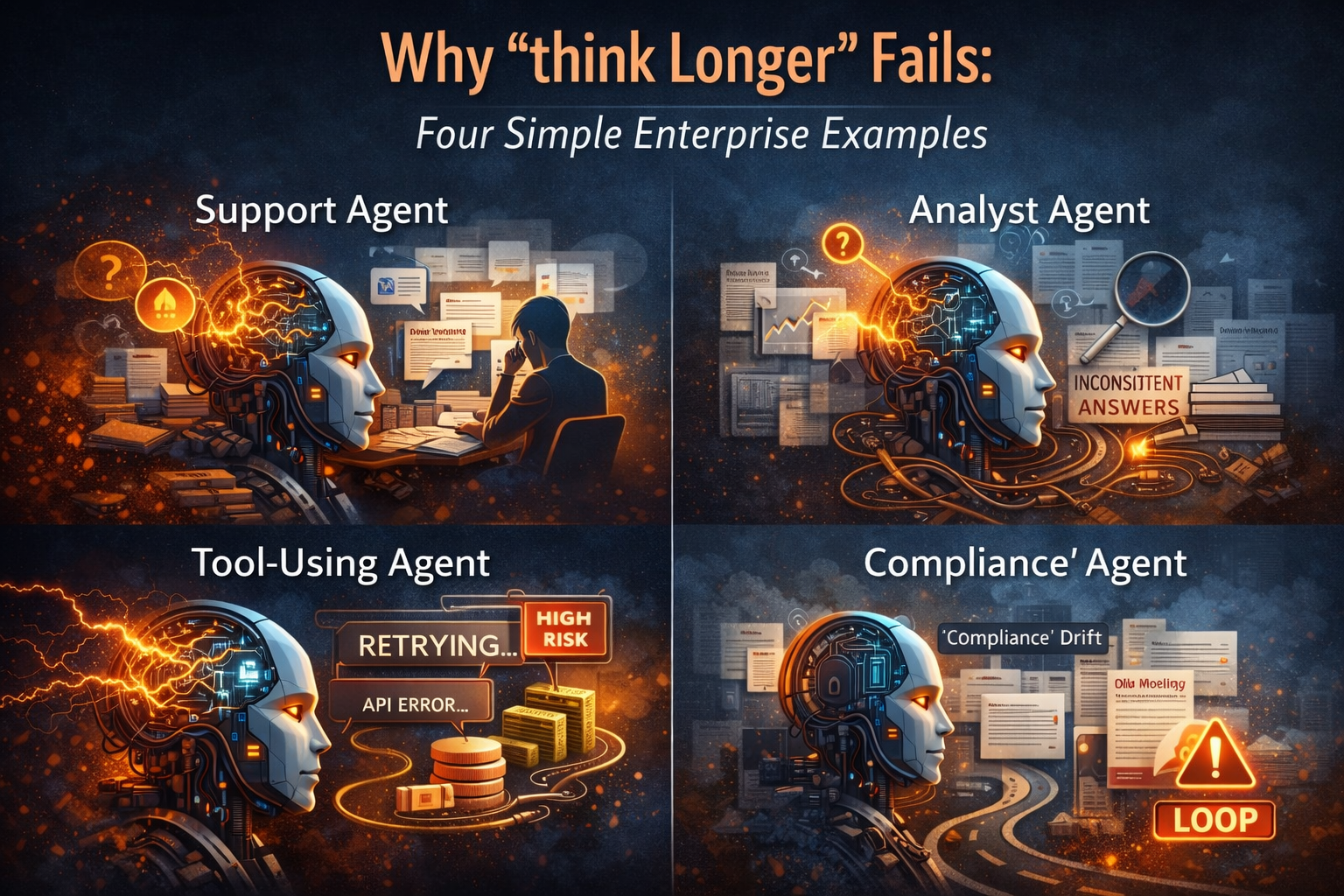
Evidence links should be automatic, not manual.

Step 6: Add expiry and re-certification

Agents should be treated like privileged integrations:

  • periodic reviews
  • permission recertification
  • owner confirmation

This is how your enterprise avoids “autonomy debt.”

The most common anti-patterns

Anti-pattern: “Agents run under human tokens.”
Fix: enforce agent identity issuance and forbid borrowed credentials. (Microsoft Learn)

Anti-pattern: “No owner, no accountability.”
Fix: registry requires business + technical owner, plus expiry.

Anti-pattern: “Tool sprawl.”
Fix: explicit tool allow-lists; block everything else.

Anti-pattern: “We can’t audit behavior.”
Fix: registry links to logs, decision records, and incidents.

Anti-pattern: “We can’t shut it down quickly.”
Fix: identity revocation + tool blocks as first-class controls.

Glossary

Enterprise AI Agent Registry: The system of record that catalogs agent identities, owners, permissions, tools, policies, lifecycle state, and evidence links.
Agent Identity: A distinct identity representation for autonomous agents (increasingly formalized by identity platforms). (Microsoft Learn)
Workload Identity: Cryptographically verifiable identity for services/workloads across environments (SPIFFE/SPIRE is a prominent standard). (Spiffe)
Tool Allow-list: A controlled list of tools/systems the agent can call; everything else is blocked.
Least Privilege: Granting only the minimum access required to complete a task.
Revocation: The ability to stop an agent by pausing execution or revoking identity/tool access.
Evidence Links: Pointers from the registry to logs, traces, decision records, evaluations, and incident history.

FAQs

What is an Enterprise AI Agent Registry?
An Enterprise AI Agent Registry is the authoritative system of record that tracks every autonomous agent’s identity, ownership, permissions, tools, policies, lifecycle state, and audit evidence.

Is an Agent Registry the same as a model registry?
No. A model registry tracks model artifacts. An agent registry tracks autonomous actors that use models + tools to take actions.

Why do enterprises need agent identities?
Because autonomous systems must be auditable and revocable. Identity platforms are already formalizing agent identity patterns to support secure, trackable autonomy. (Microsoft Learn)

How does an Agent Registry improve security?
It enforces least privilege, restricts tool access, and enables fast revocation—directly reducing production risks highlighted by GenAI security communities. (OWASP)

What’s the fastest way to start?
Make registration a production gate: no production agent credentials unless the agent is registered with an owner, scope, tool list, and evidence links.

Enterprises won’t lose control because agents are too intelligent.
They’ll lose control because agents become unregistered actors.

If you don’t have an Agent Registry, you don’t have Enterprise AI.
You have unmanaged autonomy.

Enterprise AI Runtime: What Is Actually Running in Production (And Why It Changes Everything)

Enterprise AI Runtime

Enterprise AI Runtime is the missing layer most organizations overlook when deploying AI at scale. While models generate intelligence, it is the Enterprise AI Runtime that governs how AI decisions are executed, constrained, observed, audited, reversed, and paid for inside real production workflows.

As AI systems move from advising humans to acting autonomously—approving refunds, granting access, triggering operations—the runtime becomes the most critical control surface in enterprise AI.

Most enterprises believe they have “AI in production.”

What they usually have is:

  • a chatbot answering questions,
  • a copilot drafting text,
  • or a model endpoint wired into a workflow.

That is not production AI.

Enterprise AI begins only when AI systems influence real outcomes:
money moves, access is granted, customers are impacted, compliance thresholds are crossed, or operations change automatically.

At that moment, one uncomfortable question appears:

What exactly is running this decision in production?

Not the model.
Not the prompt.
Not the vendor.

The answer is something most organizations haven’t explicitly designed:

the Enterprise AI Runtime.

This article explains—clearly and practically—what an Enterprise AI Runtime is, why it is now unavoidable, and how it becomes the foundation for safe, scalable, and economically viable AI in the real world.

The hard truth: models don’t run enterprises — systems do

The hard truth: models don’t run enterprises — systems do

Large language models reason.
They do not operate.

They don’t:

  • understand permissions,
  • enforce policy,
  • manage state,
  • contain failures,
  • control cost,
  • or leave legally defensible evidence.

Enterprises fail with AI not because the models are weak—but because they confuse intelligence with operability.

In traditional software, no one mistakes a function for a system.
In AI, that mistake is now common—and dangerous.

The Enterprise AI Runtime is the system layer that turns reasoning into controlled execution.
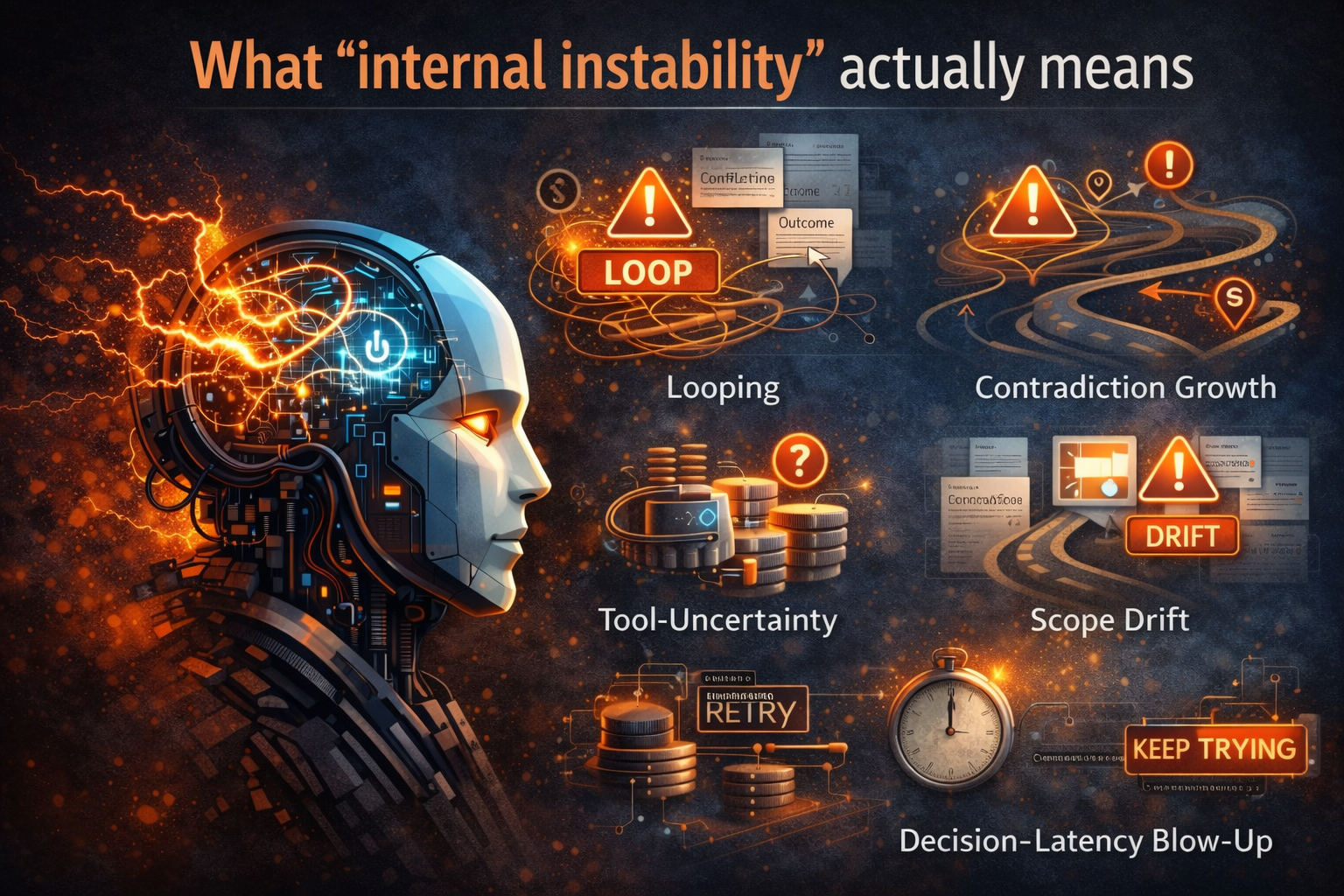
This runtime layer is a core component of the broader Enterprise AI Operating Model The Enterprise AI Operating Model: How organizations design, govern, and scale intelligence safely – Raktim Singh, which defines how organizations design, govern, and scale intelligence safely once AI systems begin to act inside real workflows.

A simple definition
A simple definition

A simple definition (no jargon)

An Enterprise AI Runtime is the production environment that governs how AI decisions are executed, constrained, observed, audited, reversed, and paid for inside real enterprise workflows.

If your AI can:

  • call tools,
  • update records,
  • approve or reject requests,
  • trigger downstream processes,
  • or act without a human typing “yes” each time,

then you already need a runtime—whether you’ve named it or not.

Why this suddenly matters

Why this suddenly matters (and didn’t before)

For years, AI lived in advisory mode:
dashboards, predictions, recommendations.

In 2024–2026, AI crossed a line:
it started acting.

Examples now common across industries:

  • agents approving refunds,
  • copilots submitting tickets,
  • AI drafting and sending customer communications,
  • automated policy checks triggering access changes,
  • exception-handling systems rerouting logistics.

The moment AI moves from suggesting to doing, enterprises inherit a new class of risk:

Uncontrolled autonomy.

The Enterprise AI Runtime exists to make autonomy bounded, observable, reversible, and accountable.

The mental model that actually works

The mental model that actually works

Think of enterprise AI like this:

  • The model is the brain
  • The runtime is the nervous system
  • The tools are the muscles
  • Policies are reflexes
  • Observability is memory
  • Rollback is self-preservation

Without a nervous system, even the smartest brain causes harm.

What is actually running in production today

What is actually running in production today

When leaders say “AI is running,” it usually means one of five things:

  1. A model endpoint

A hosted LLM responding to requests.
Useful—but not operational.

  1. Prompt workflows

Templates, routing rules, chains.
Fragile under change.

  1. Tool-using agents

LLMs that can call APIs, databases, CRMs, or RPA.

  1. Orchestrated agent workflows

Multi-step plans, retries, escalations, branching logic.

  1. Decision-execution systems

AI outcomes that change systems of record.

Only levels 3–5 require an Enterprise AI Runtime.
And those are exactly the levels enterprises are now adopting.

Why “runtime” is the right word

Why “runtime” is the right word

In classic computing:

  • the runtime controls execution,
  • enforces constraints,
  • manages resources,
  • and handles failures.

Enterprise AI needs the same discipline.

The runtime is where:

  • decisions are allowed or blocked,
  • tools are permitted or denied,
  • costs are throttled,
  • incidents are contained,
  • and trust is earned.

Without it, AI is not “innovative.”
It is reckless.

The core responsibilities of an Enterprise AI Runtime

The core responsibilities of an Enterprise AI Runtime

This is the heart of the article.

  1. Orchestration: turning reasoning into controlled action

Production AI is never a single prompt.

A runtime must coordinate:

  • multiple steps,
  • multiple models,
  • multiple tools,
  • conditional paths,
  • retries and fallbacks,
  • human handoffs.

Example
A compliance assistant does not “answer a question.”
It:

  1. retrieves evidence,
  2. checks policy versions,
  3. validates jurisdiction,
  4. drafts a recommendation,
  5. escalates if confidence is low,
  6. logs the decision path.

Without orchestration, enterprises get impressive demos—and brittle systems.

  1. Action boundaries: advice vs approval vs execution

This is the most important runtime decision.
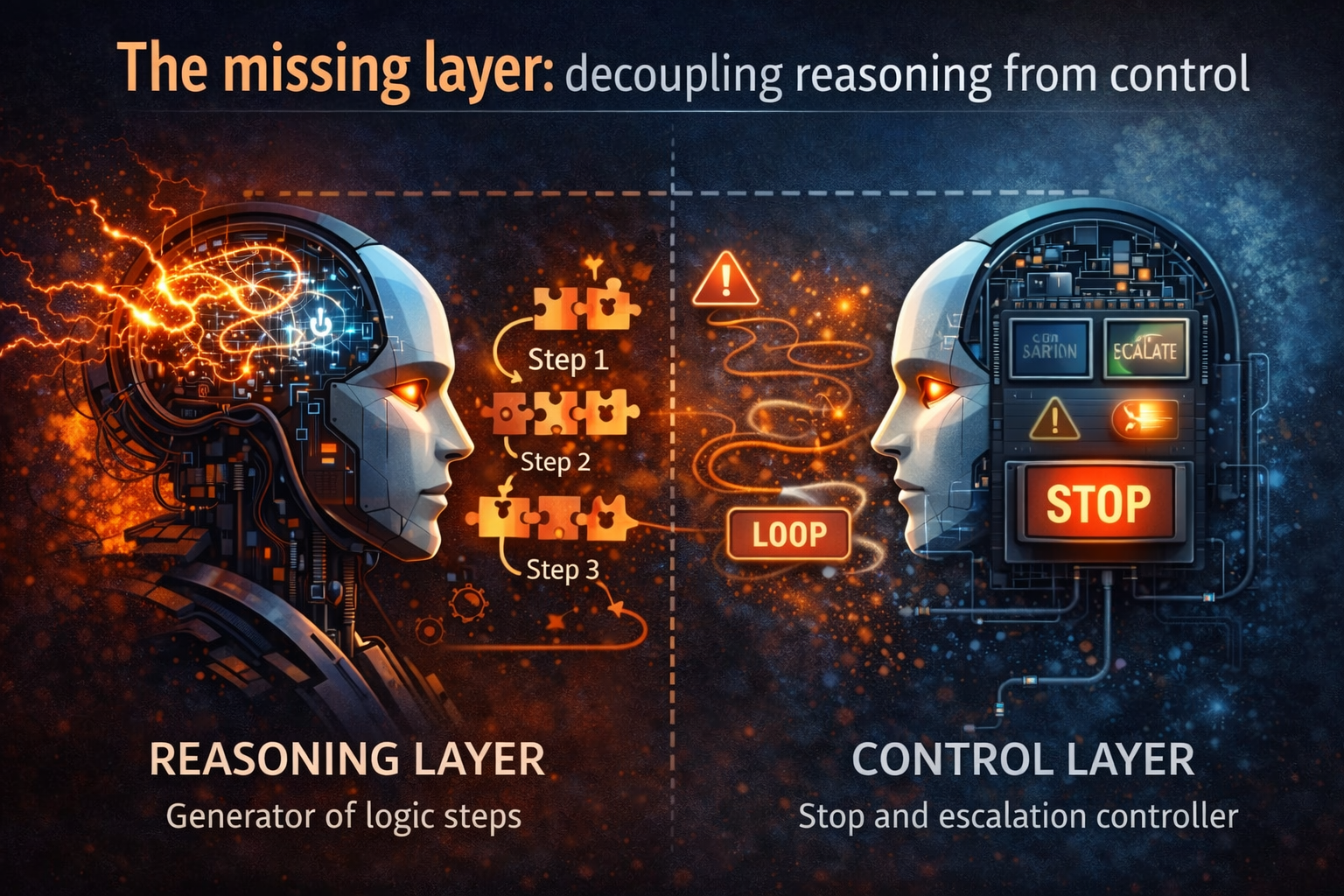
Every AI action must fall into one of three modes:

  • Advise (safe, no impact)
  • Recommend for approval (human-in-the-loop)
  • Execute (autonomous action)

The runtime enforces the boundary—not the prompt.

Example
An HR agent may:

  • suggest access changes,
  • but only execute them under defined roles, thresholds, and approvals.

This single design choice prevents most catastrophic failures.

These action boundaries are not technical choices alone — they are governance decisions, which is why the question of who owns enterprise AI decision Who Owns Enterprise AI? Roles, Accountability, and Decision Rights in 2026 – Raktim Singh becomes unavoidable as AI systems move into execution.
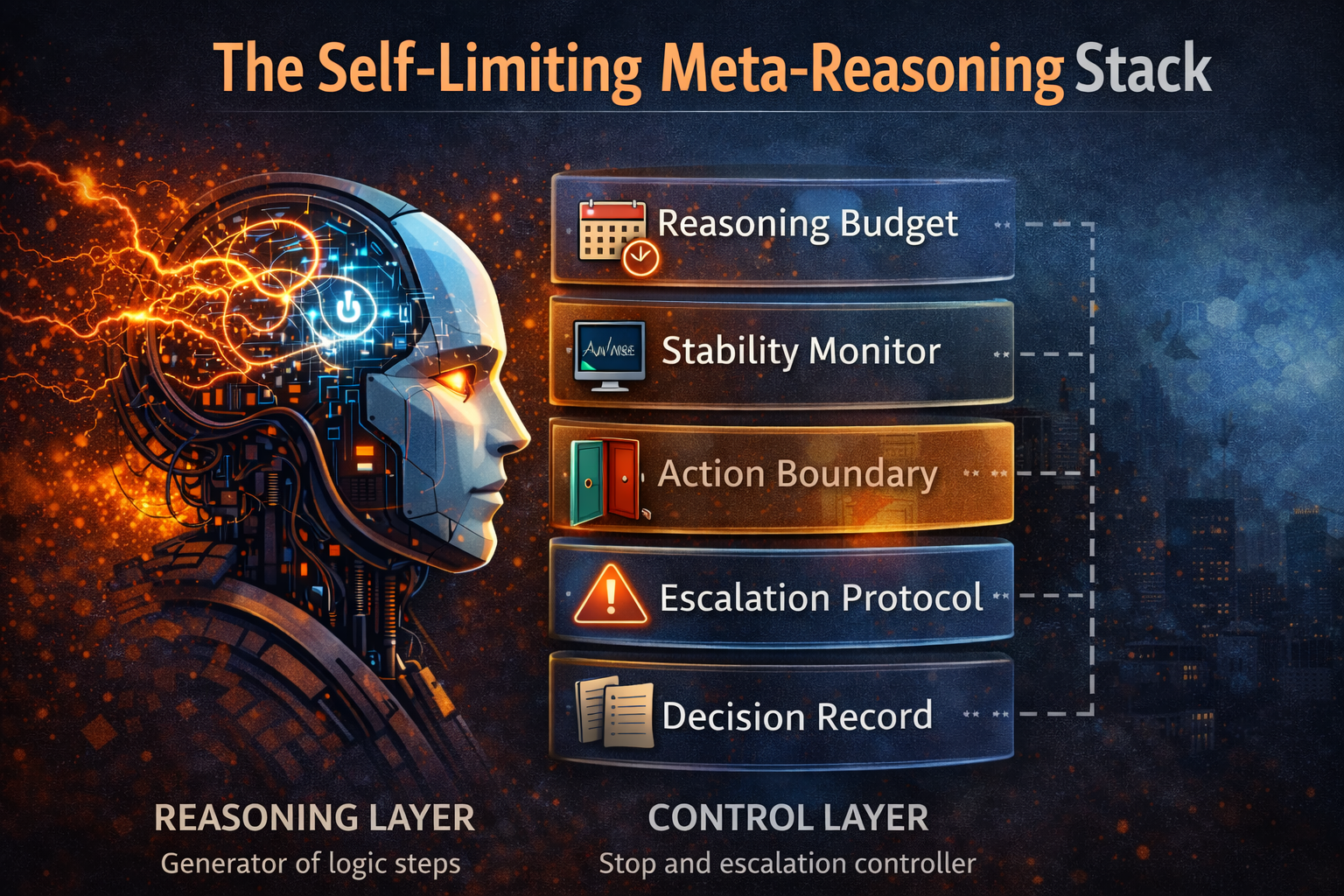
  1. Tool permissions: what AI is allowed to touch

Agents are dangerous not because they reason—
but because they can act through tools.

A runtime must define:

  • which tools an agent can call,
  • which operations are allowed,
  • what data scope is visible,
  • rate limits and quotas,
  • escalation paths.

Key principle
AI permissions should be narrower than human permissions, not broader.

  1. Policy enforcement as code, not documentation

Most enterprises already have policies.
What they lack is policy execution.
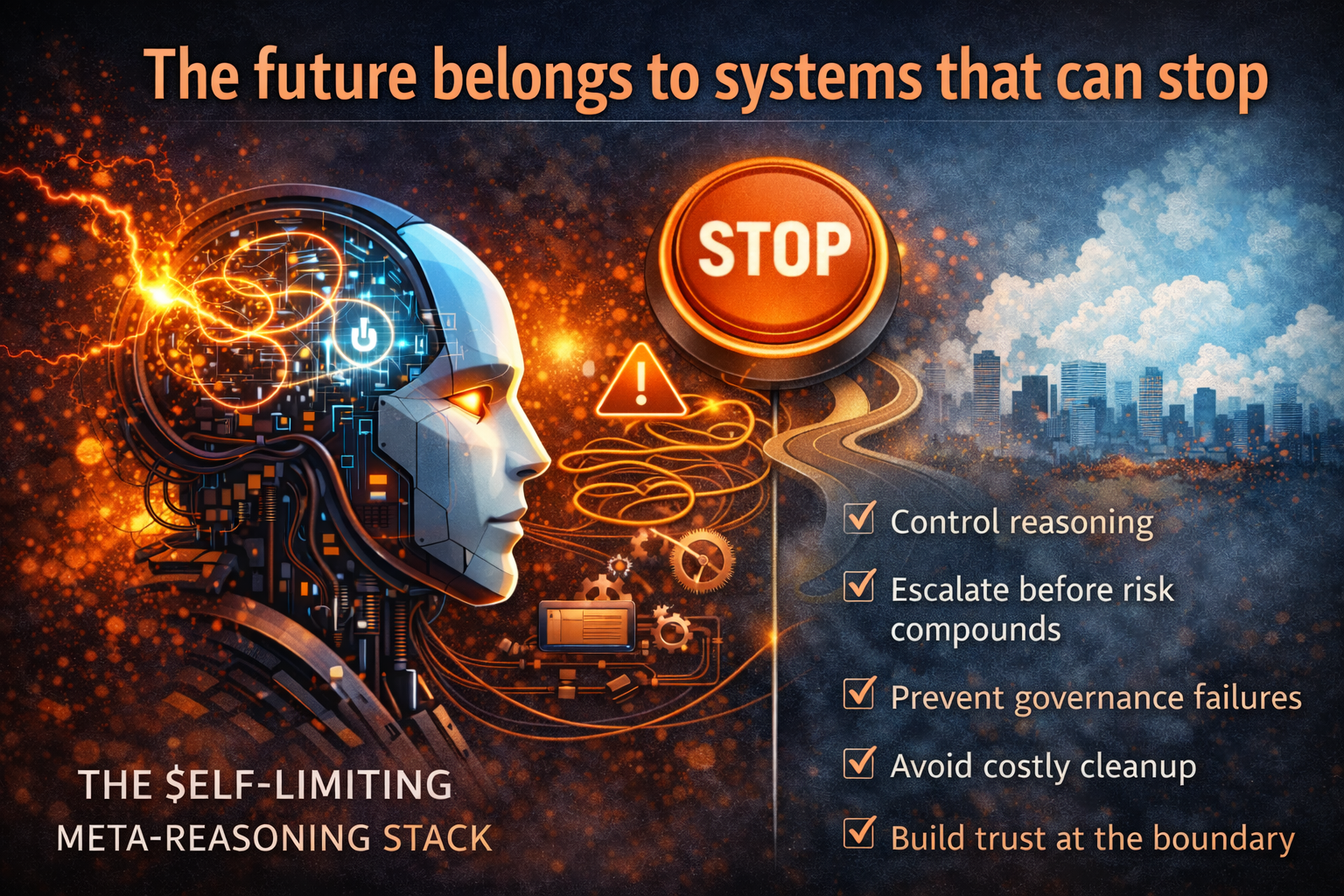
The runtime must enforce:

  • regulatory rules,
  • business constraints,
  • jurisdictional boundaries,
  • risk thresholds,
  • separation of duties.
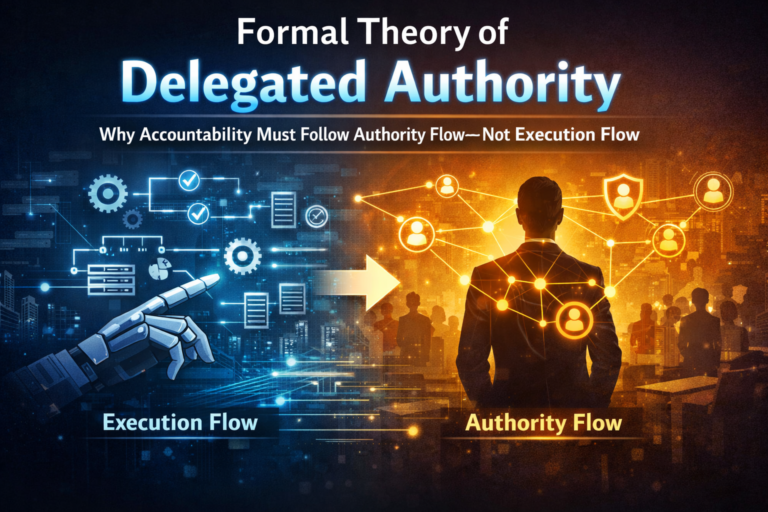
If policy is not executable at runtime, it is theater.

  1. State and memory management

AI systems need memory—but unmanaged memory becomes liability.

The runtime decides:

  • what is ephemeral,
  • what is persistent,
  • what becomes a record,
  • what must be redacted,
  • what must expire.

Example
A customer support agent remembers conversation context for resolution—but does not permanently store raw personal data in ungoverned embeddings.

Memory is power.
The runtime decides how much power AI keeps.

  1. Observability: the ability to reconstruct reality

When something goes wrong, enterprises ask:

“What happened?”

The runtime must answer:

  • which inputs were used,
  • which context was retrieved,
  • which policy applied,
  • which tools were called,
  • who approved what,
  • what changed downstream,
  • how much it cost.

Without this, trust collapses—internally and externally.

  1. Audit-ready decision records

Production AI must leave evidence.

A runtime generates decision records that capture:

  • reasoning inputs,
  • constraints applied,
  • actions taken or blocked,
  • approvals,
  • timestamps,
  • identities.

This is what allows enterprises to say:

“Yes, this decision was automated—and here’s exactly why.”

  1. Reversibility and containment

Classic automation fails fast.
AI failures compound silently.

A runtime must support:

  • safe modes,
  • circuit breakers,
  • staged autonomy,
  • rollback playbooks,
  • kill switches.

If you cannot stop or unwind AI behavior, you do not control it.

Most enterprises discover the need for reversibility only after incidents occur — a failure pattern explored in detail in the Enterprise AI Runbook Crisis The Enterprise AI Runbook Crisis: Why Model Churn Is Breaking Production AI—and What CIOs Must Fix in the Next 12 Months – Raktim Singh, where model churn and missing operational playbooks break production AI.

  1. Economic guardrails

AI costs do not behave like software costs.

The runtime must manage:

  • per-task budgets,
  • per-agent limits,
  • cost-aware routing,
  • runaway loop detection.

This is where cost governance becomes a runtime feature, not a finance spreadsheet.

Without a shared runtime, enterprises repeatedly rebuild intelligence in silos — a pattern that destroys reuse and directly erodes the Intelligence Reuse Index The Intelligence Reuse Index: Why Enterprise AI Advantage Has Shifted from Models to Reuse – Raktim Singh, one of the most reliable indicators of enterprise AI maturity.

Three production examples

Three production examples (realistic and simple)

Example 1: Refund automation

Without runtime: chatbot issues refunds incorrectly.
With runtime: AI drafts refund, checks policy, enforces thresholds, logs decision, executes only if allowed.

Example 2: IT access provisioning

Without runtime: AI grants access directly.
With runtime: AI validates request, enforces role separation, escalates exceptions, records evidence.

Example 3: Supply-chain exception handling

Without runtime: AI reroutes inventory impulsively.
With runtime: AI simulates options, checks cost and SLA constraints, escalates uncertainty, executes safely.

Same model.
Radically different outcomes.

Security reality: most AI attacks hit the runtime

Security reality: most AI attacks hit the runtime

Prompt injection, tool abuse, data exfiltration, denial-of-wallet—
these are runtime failures, not model failures.

The runtime is where you:

  • validate inputs,
  • constrain outputs,
  • sandbox tools,
  • detect abuse,
  • contain damage.

No runtime = no security story.

What to build first
What to build first

What to build first (practical guidance)

If you are early, start here:

  1. Clear action boundaries
  2. Tool permission controls
  3. Decision logging
  4. Observability hooks
  5. Kill switches
  6. Cost limits

This is enough to move from “AI demo” to “AI system.”

Why Enterprise AI Runtime is now non-negotiable

Why Enterprise AI Runtime is now non-negotiable

Because enterprises are no longer experimenting with intelligence.

They are running it.

And running intelligence without a runtime is like running financial systems without transaction logs, rollbacks, or controls.

Final takeaway

Enterprise AI does not fail because models are weak.
It fails because enterprises forget that intelligence must be operated.

The Enterprise AI Runtime is where:

  • autonomy becomes governable,
  • innovation becomes reliable,
  • and AI becomes something enterprises can actually trust.

If your AI is acting in production, the question is no longer whether you need a runtime.

The question is:

Do you know which one you are already running—and who controls it?

FAQ

What is an Enterprise AI Runtime?

An Enterprise AI Runtime is the production environment that governs how AI decisions are executed, constrained, observed, audited, reversed, and cost-controlled inside enterprise workflows.

How is Enterprise AI Runtime different from AI platforms?

AI platforms focus on building and deploying models. Enterprise AI Runtime governs what happens after deployment—decision execution, permissions, observability, rollback, and compliance.

Why is Enterprise AI Runtime important for security?

Most AI attacks target runtime gaps such as prompt injection, privilege escalation, and policy bypass—not the model itself. Runtime controls close these gaps.

Do enterprises need an AI runtime even if they use copilots?

Yes. Once AI influences money, access, compliance, or operations, a runtime layer is required regardless of whether AI is advisory or autonomous.

Is Enterprise AI Runtime required for regulatory compliance?

Yes. Regulations increasingly require traceability, auditability, reversibility, and accountability—capabilities delivered by the runtime, not the model.

📘 Glossary: Enterprise AI Runtime & Production AI

Enterprise AI Runtime

The production layer that governs how AI decisions are executed inside an enterprise. It controls permissions, policies, observability, auditability, rollback, and cost—ensuring AI actions are safe, accountable, and operable at scale.

AI Runtime

The environment where AI systems actually execute decisions and actions in real workflows. In enterprise contexts, this includes orchestration, policy enforcement, tool control, monitoring, and failure handling.

AI Agent

An AI system capable of planning steps, invoking tools, and interacting with enterprise systems—going beyond simple text generation to perform actions.

Tool Calling

The ability of an AI agent to invoke external systems such as APIs, databases, CRMs, ticketing systems, or automation tools. Tool calling requires strict runtime permissions to prevent misuse.

Action Boundary

A predefined limit that determines whether an AI system can only advise, recommend for approval, or execute actions autonomously. Action boundaries are enforced by the runtime, not the model.

Decision Execution

The act of converting an AI recommendation or reasoning output into a real-world change—such as approving a refund, granting access, or triggering a workflow.

Decision Record

An audit-ready log created by the AI runtime that captures how a decision was made, including inputs, retrieved context, policies applied, approvals, actions taken, timestamps, and identities.

AI Orchestration

The coordination layer that manages multi-step AI workflows, including sequencing tasks, routing between models and tools, handling retries, and escalating to humans when required.

Policy Enforcement

The process by which enterprise rules—regulatory, business, security, or ethical—are automatically checked and enforced at runtime before AI actions are allowed to proceed.

Observability (AI Observability)

The ability to trace, monitor, and reconstruct AI behavior in production, including prompts, tool calls, decisions, costs, errors, and outcomes.

Reversibility

The capability to stop, undo, or safely recover from actions taken by AI systems. Reversibility includes rollback mechanisms, kill switches, and safe modes.

AI Governance

The organizational and technical framework that ensures AI systems behave in accordance with policies, regulations, accountability structures, and risk tolerance.

Enterprise AI Operating Model

A comprehensive framework that defines how enterprises design, govern, deploy, operate, and scale AI systems responsibly across the organization.

AI Production System

An AI-enabled system that operates continuously within live enterprise workflows and impacts real customers, data, money, or operations.

Runtime Guardrails

Controls embedded in the AI runtime that prevent unsafe, non-compliant, or excessively costly behavior. Examples include permission limits, policy checks, cost caps, and escalation rules.

Economic Guardrails

Runtime mechanisms that control AI spending and resource usage, such as per-task budgets, rate limits, and cost-aware model routing.

Human-in-the-Loop

A design pattern where AI systems require human review or approval before executing certain actions, enforced through runtime controls.

Agentic AI

AI systems designed to act autonomously toward goals by planning, reasoning, and executing actions—requiring strong runtime governance to remain safe.

Enterprise AI Security

The protection of AI systems against threats such as prompt injection, privilege escalation, tool abuse, data leakage, and cost attacks—primarily implemented at the runtime layer.

AI Rollback

A controlled process that allows enterprises to undo or neutralize actions taken by AI systems when errors, risks, or policy violations are detected.

AI in Production

AI systems that are actively running within business-critical workflows, influencing real decisions and outcomes, as opposed to pilots or experiments.

Model vs System

A critical distinction in enterprise AI: models generate intelligence, but systems—including the runtime—determine how that intelligence is safely applied in the real world.

Further Reading

AI Risk Management Framework | NIST

High-level summary of the AI Act | EU Artificial Intelligence Act

Enterprise AI Control Plane: The Canonical Framework for Governing Decisions at Scale

Enterprise AI Control Plane

The Enterprise AI Control Plane is the governance layer that ensures AI systems make decisions safely, visibly, and within defined authority inside real business workflows. In 2026, as AI systems reason, decide, and act autonomously, the control plane has become the foundation for enterprise-grade AI.

The missing operating layer for governing AI that can act in production

Enterprise AI has crossed a threshold.

When intelligence is allowed to approve, trigger, grant, deny, route, update records, or initiate workflows, the enterprise is no longer experimenting with AI. It is running intelligence inside the operating system of the business.

At that point, the problem stops being “Can the model do it?” and becomes:

Can the enterprise govern, operate, and economically control the decisions AI is now participating in?

The architecture layer that makes that possible is the Enterprise AI Control Plane.

If you are building your Enterprise AI capability as an operating model (not a tool rollout), this definition sits at the core of it—because it is what turns principles into enforceable reality. (If you haven’t yet, start with my article: The Enterprise AI Operating Modelhttps://www.raktimsingh.com/enterprise-ai-operating-model/)

Canonical Definition

The Enterprise AI Control Plane is the governance and operational control layer that constrains, verifies, and makes auditable the behavior of AI systems in production—so decisions remain authorized, explainable, observable, reversible, and economically bounded as AI begins to act inside real workflows.

A short memory hook:

The Runtime runs intelligence.
The Control Plane governs intelligence.

Without a Control Plane, enterprises don’t have “Enterprise AI.” They have unmanaged automation with probabilistic behavior—which is exactly how “successful pilots” become brittle production risk.

Why the Control Plane Exists Now

Why the Control Plane Exists Now

For years, enterprises could define success in familiar terms:

  • model accuracy
  • automation ROI
  • productivity gains
  • faster service

That framing worked when AI mostly advised—and when failure was easy to isolate.

In 2026, Enterprise AI is defined by a new reality: intelligence is increasingly embedded in decisions, and decisions have consequences—customer outcomes, compliance exposure, operational risk, financial impact.

This is why the central enterprise question is no longer:

“Is the model correct?”
It is:

“Is this decision allowed, justified, traceable, reversible, and safe—under changing policy, data, and context?”

That shift—from models to decisions—is the conceptual bridge to the broader definition of Enterprise AI (see: What Is Enterprise AI? (2026 Definition)https://www.raktimsingh.com/what-is-enterprise-ai-2026-definition/)

Control Plane vs. Everything Else

Control Plane vs. Everything Else

A Control Plane is often misunderstood because organizations map it onto older categories. Here’s the clean separation.

Control Plane vs. Runtime

  • Runtime executes behavior (agents, tools, workflows, actions).
  • Control Plane governs behavior (what is allowed, under what conditions, with what evidence, and how the enterprise recovers when it is wrong).

Control Plane vs. MLOps

  • MLOps manages training, evaluation, deployment, versioning.
  • Control Plane governs decision authority, action constraints, auditability, reversibility, and production oversight.

Control Plane vs. IAM / Security

  • IAM authenticates identities and controls access to systems.
  • Control Plane authorizes decisions and actions by AI actors, with least privilege, revocation paths, and enforceable boundaries.

Control Plane vs. “Governance” as Documentation

  • Policy documents describe intent.
  • A Control Plane enforces intent at the moment decisions are made and actions are executed.

This distinction matters because many enterprises believe they have “AI governance” when they only have AI paperwork.

The 9 Capabilities of an Enterprise AI Control Plane

The 9 Capabilities of an Enterprise AI Control Plane

If you want a single operational checklist, this is it. An enterprise can claim Control Plane maturity only when these capabilities exist as enforced mechanisms, not aspirational statements.

1) Explicit Decision Boundaries

The Control Plane must encode decision rights:

  • what AI may decide
  • what it may recommend but not execute
  • when human approval is mandatory
  • when escalation is required
  • what AI must never do

This is the difference between scalable autonomy and authority creep.

(If you want the “laws” level view of this, you can read at The Non-Negotiables of Enterprise AIhttps://www.raktimsingh.com/non-negotiables-enterprise-ai/)

Policy Enforcement at the Moment of Action

2) Policy Enforcement at the Moment of Action

A policy that isn’t enforceable at decision time is not governance.

The Control Plane must apply policy:

  • at inference time
  • at action time
  • at workflow transition points

This is where compliance becomes an operating property, not a quarterly audit exercise.

Governed Identity, Ownership, and Least Privilege

3) Governed Identity, Ownership, and Least Privilege

Every AI actor must have:

  • a verifiable identity
  • an explicit owner
  • least-privilege permissions
  • revocation + kill-switch controls

Ownership is not a slide. It is a control primitive.

This ties directly to the accountability question you’ can read at:
Who Owns Enterprise AI?https://www.raktimsingh.com/who-owns-enterprise-ai-roles-accountability-decision-rights/

Evidence Before Confidence

4) Evidence Before Confidence

Enterprise AI cannot run on confidence scores alone.

The Control Plane must require and record:

  • decision rationale
  • evidence and input provenance
  • policy alignment signals
  • confidence with justification

Confidence without evidence is operational risk.

Traceability and Audit-Ready Decision Records

5) Traceability and Audit-Ready Decision Records

Enterprises must be able to reconstruct “why this happened,” not just “that it happened.”

The Control Plane must capture:

  • inputs used and their sources
  • tools invoked and external calls made
  • policy checks applied
  • final action taken
  • when humans intervened (or didn’t)

This is what converts AI from “smart” to defensible.

Continuous Decision Observability

6) Continuous Decision Observability

Classic observability tracks uptime, latency, and error rates.

Control planes must track decision behavior:

  • what decisions are being made
  • boundary proximity (how close decisions are to limits)
  • drift in policy interpretation
  • confidence decay over time
  • deviation from design intent

If you can’t see decision behavior, you cannot govern it.

7) Reversibility by Design

Enterprise AI must assume:

  • decisions will be wrong
  • context will change
  • policies will evolve

The Control Plane must provide:

  • rollback paths
  • compensating actions
  • safe modes and graceful degradation
  • human takeover pathways

Reversibility is not a feature. It is the price of autonomy.

8) Human Oversight That Scales (Human-by-Exception)

The Control Plane defines when humans are:

  • in the loop
  • on the loop
  • or by exception

The goal isn’t maximal human involvement. The goal is minimal harm at maximal scale.

Human oversight should be triggered by risk, not routine.

9) Economic Guardrails

Enterprise AI must be economically governable to be scalable.

The Control Plane enforces:

  • cost envelopes by workflow/agent/decision class
  • tool-call budgets and rate limits
  • value thresholds
  • reuse incentives and constraints

This connects directly to the thesis that enterprise advantage has shifted from novelty to reuse:
The Intelligence Reuse Indexhttps://www.raktimsingh.com/intelligence-reuse-index-enterprise-ai-fabric/

A Practical Mental Model

If you want the simplest usable framing:

Control Plane = Decision Governance + Action Safety + Operating Evidence

  • Decision Governance: what is allowed and who owns it
  • Action Safety: reversibility, escalation, kill paths
  • Operating Evidence: traceability, observability, audit records

That is the Control Plane in one sentence.

What the Control Plane Prevents (Real Production Failure Modes)

Most Enterprise AI failures are not “model errors.” They’re control failures.

A Control Plane prevents:

  • decisions that appear correct but are justified incorrectly (fragile at scale)
  • policy-compliant behavior that violates strategy or intent
  • authority creep across workflows and teams
  • untraceable actions no one can defend
  • silent drift in production behavior
  • runaway cost that makes scaling impossible
  • failures that are detected late and cannot be reversed cleanly

This is why the Control Plane is an operating requirement—not a governance luxury.

If you want the production reality of why enterprises struggle here, this runbook thesis is the right companion:
The Enterprise AI Runbook Crisishttps://www.raktimsingh.com/enterprise-ai-runbook-crisis-model-churn-production-ai/

Implementation Sequence: The Order That Actually Works

Enterprises often implement controls after autonomy, and then wonder why governance feels expensive.

The sequence that works:

  1. Define decision classes and boundaries before automation
  2. Assign ownership and decision rights before scale
  3. Enforce identity and least privilege for every AI actor
  4. Instrument traceability by default (decision records)
  5. Design reversibility and safe modes before autonomy expands
  6. Enforce policy at action time, not as documentation
  7. Add economic envelopes before usage explodes
  8. Run operating reviews so governance becomes routine, not reactive

This is the practical bridge between “AI strategy” and “AI operability.”

Enterprise AI Operating Model

If the Enterprise AI Operating Model defines how the organization designs, governs, and scales intelligence, the Control Plane is the mechanism that makes those commitments enforceable in production.

  • Operating Model = roles, accountability, lifecycle discipline, decision rights
  • Control Plane = enforcement, oversight, reversibility, evidence, cost bounds

These two articles must be read together:
Enterprise AI Operating Model (pillar)https://www.raktimsingh.com/enterprise-ai-operating-model/

Executive Takeaway

In 2026, Enterprise AI advantage will not be determined by which organization demos the most impressive assistant.

It will be determined by which organization can prove—continuously—that its AI systems:

  • act within explicit authority
  • follow policy in the moment
  • produce auditable evidence
  • remain observable under drift and change
  • can be reversed when wrong
  • and stay economically bounded

That is what the Enterprise AI Control Plane enables.

Further Reading on raktimsingh.com

FAQ

What is an Enterprise AI Control Plane?

An Enterprise AI Control Plane is the governance and operational control layer that constrains and verifies AI behavior in production—so AI decisions remain authorized, traceable, observable, reversible, and economically controlled at scale.

Is the Control Plane the same as MLOps?

No. MLOps manages models. The Control Plane governs decisions and actions—authority, policy enforcement, audit evidence, reversibility, and production oversight.

Why do enterprises need a Control Plane in 2026?

Because AI now influences or executes real decisions in workflows. Without a Control Plane, enterprises cannot reliably enforce policy, manage drift, control autonomy, or prove accountability.

What are the most important Control Plane capabilities?

Explicit decision boundaries, policy enforcement at action time, identity and least privilege, traceability, decision observability, reversibility, scalable human oversight, economic guardrails, and change governance.

Why is an AI Control Plane needed in 2026?

Because AI systems now act autonomously—triggering workflows, approving actions, and influencing outcomes—enterprises need real-time governance, auditability, and reversibility.

Is the AI Control Plane the same as MLOps or Model Governance?

No. MLOps manages models. The control plane governs decisions, authority, policy enforcement, and business impact.

Who should own the Enterprise AI Control Plane?

Ownership must sit jointly across technology, risk, compliance, and business leadership—not vendors.

Can enterprises scale AI without a control plane?

They can deploy AI, but they cannot govern it safely. Scale without a control plane leads to silent risk accumulation.

Conclusion

Enterprise AI is not the deployment of models. It is the operationalization of intelligence.

In 2026, the enterprises that win will be the ones that can run intelligence—safely, visibly, and economically—through explicit boundaries, enforceable policy, audit-ready evidence, reversibility, and cost control.

The Enterprise AI Control Plane is the layer that makes that possible. And it is no longer optional.

If you’re building or governing AI in an enterprise, this control plane determines whether your AI compounds advantage—or compounds risk.

📘 Glossary (Enterprise AI – 2026 Canonical Terms)

Enterprise AI

The capability of an organization to design, govern, operate, and scale AI systems that make or influence real business decisions inside production workflows, with accountability, observability, and economic control.

Enterprise AI Control Plane

The governance and operational control layer that constrains, verifies, and makes auditable the behavior of AI systems in production—ensuring decisions remain authorized, explainable, reversible, observable, and economically bounded at scale.

AI Runtime

The execution environment where AI behavior actually occurs in production, including agents, workflows, tools, APIs, and action triggers—not just models or inference endpoints.

Decision Boundary

A formally defined limit specifying what an AI system is allowed to decide, what it may recommend, and where human approval or escalation is required.

Decision Integrity

The property of an AI decision being not only correct in outcome, but justified by appropriate evidence, policy alignment, authority, and intent.

Reversibility

The ability to safely undo, compensate for, or override AI-initiated actions when context changes, errors occur, or policy evolves. Reversibility is a safety requirement, not an optional feature.

Decision Observability

Continuous visibility into AI decision behavior in production, including drift, boundary proximity, confidence decay, and deviation from intended design.

Human-by-Exception Oversight

A governance model where humans intervene only when AI decisions exceed defined risk thresholds, rather than approving every action by default.

Economic Guardrails

Predefined cost, usage, and value boundaries enforced on AI systems to ensure financial sustainability, reuse efficiency, and controlled scaling.

AI Agent

An autonomous or semi-autonomous software entity capable of reasoning, invoking tools, interacting with systems, and taking actions across workflows over time.

Enterprise AI Operating Model

The organizational, governance, and lifecycle framework that defines how an enterprise designs, owns, governs, and scales AI systems responsibly.

🔗 Further Reading

Governance & Risk Foundations


Systems & Control Concepts (Non-AI-Specific, but Foundational)


Decision, Autonomy & Safety