Raktim Singh

Home Blog Page 21

Why Enterprise AI Must Be Designed Top-Down — or It Will Never Scale

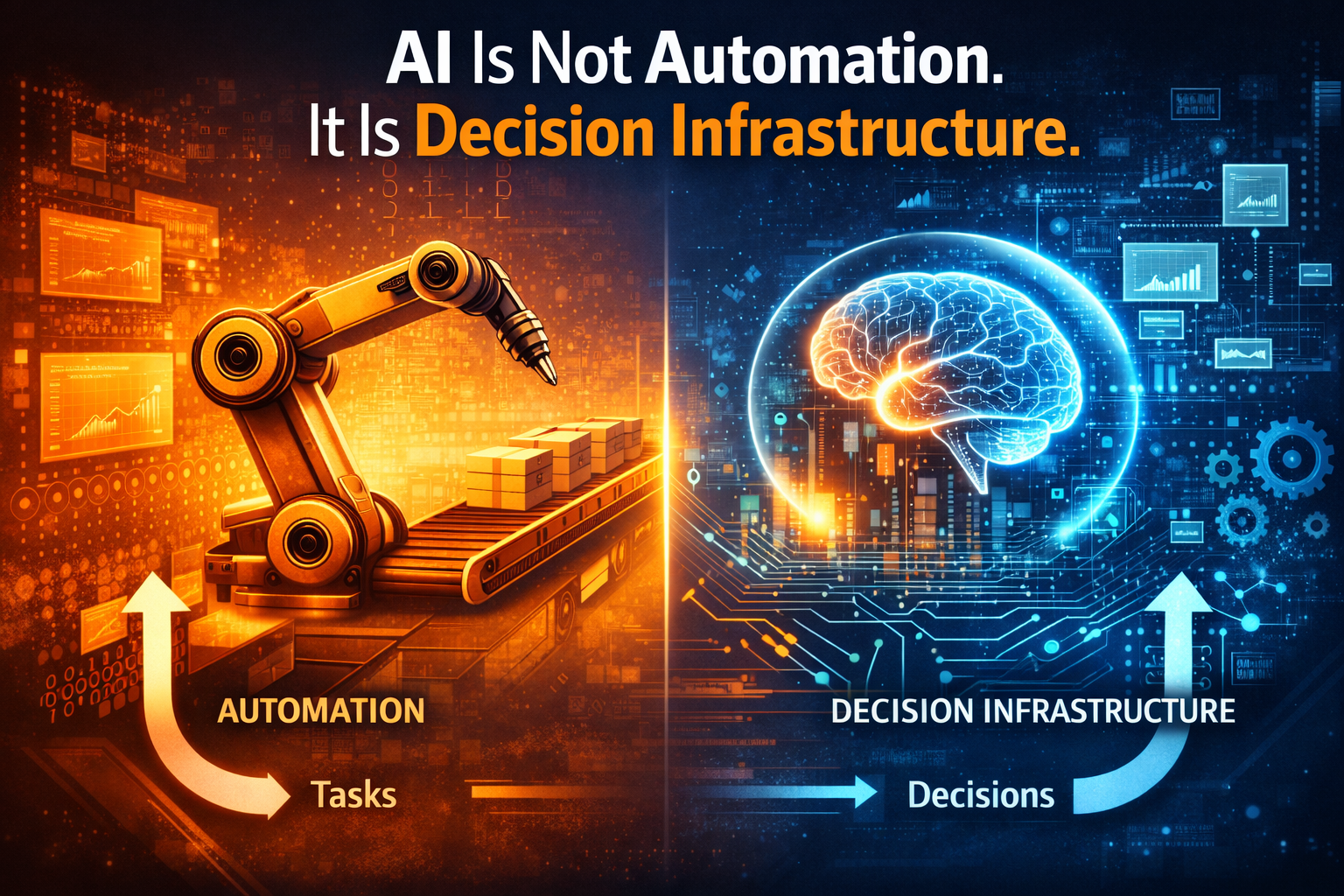
Why Enterprise AI Must Be Designed Top-Down

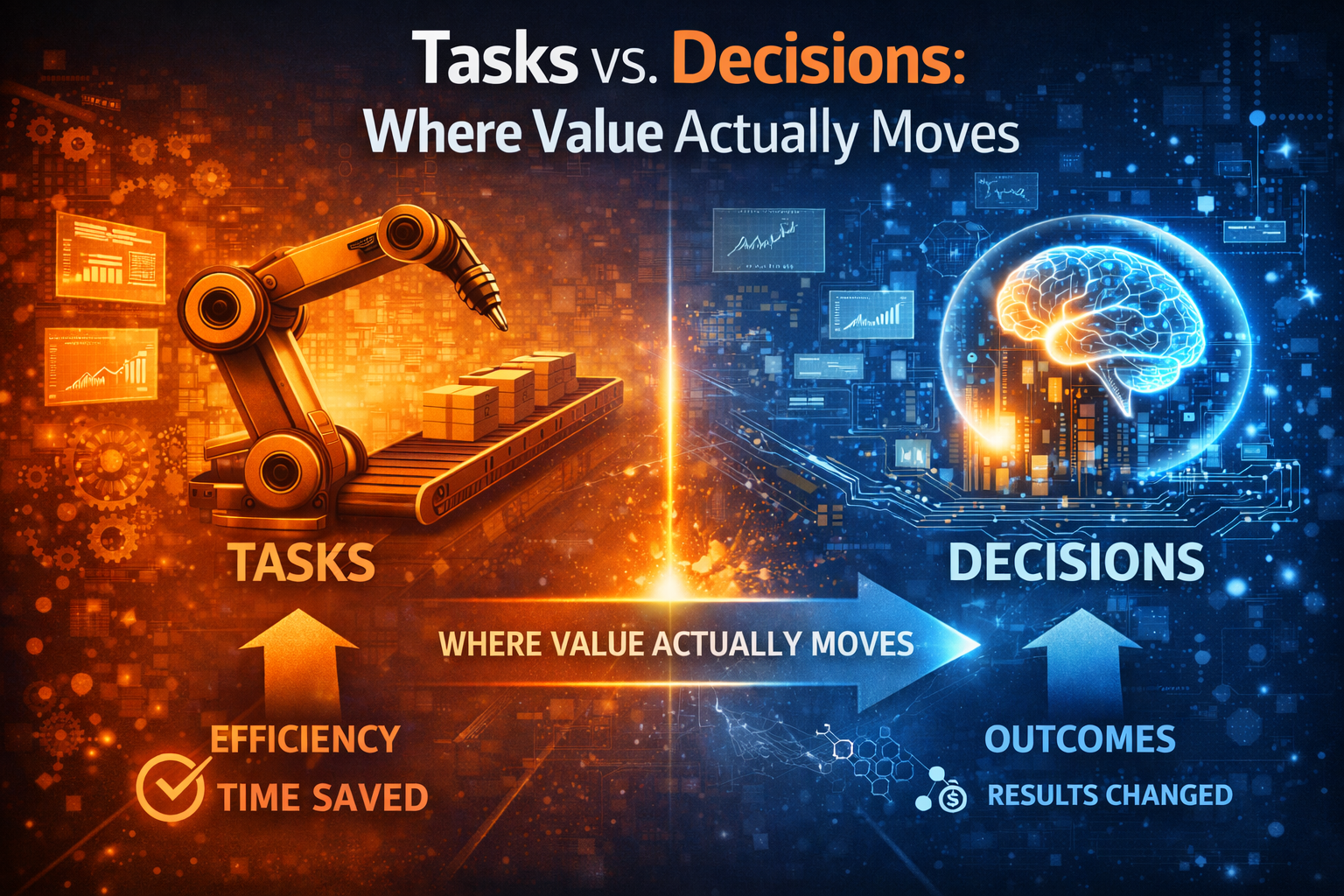
Most Enterprise AI initiatives fail not because models underperform, data is insufficient, or talent is missing — but because organizations attempt to scale AI bottom-up, one pilot at a time.

While individual use cases may succeed in isolation, they collapse under real-world complexity when deployed across business units, geographies, and regulatory environments.

This article explains why Enterprise AI must be designed top-down, what that actually means (and does not mean), and how organizations globally can avoid the illusion of progress while building AI systems that scale with trust, control, and economic discipline.

Enterprise AI doesn’t fail because models are weak.
It fails because nobody designed the city before building the roads.

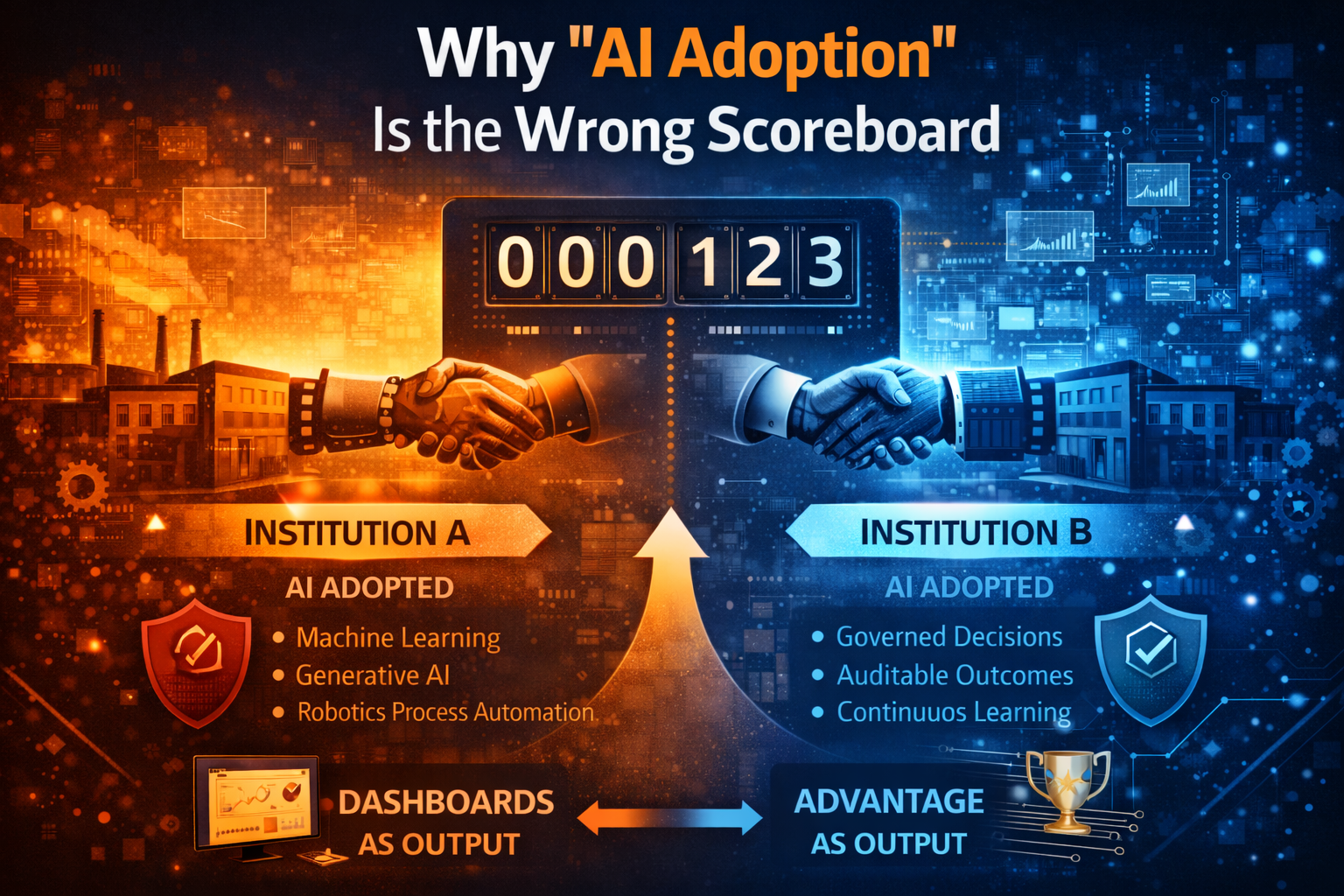
The uncomfortable truth: Enterprise AI isn’t “adopted.” It’s declared.

In the early days, AI spreads like a helpful virus.

One team builds a copilot. Another team plugs a chatbot into support. A third team wires an agent to “draft” emails, and then—quietly—lets it “submit” them. Each local win looks harmless until the enterprise wakes up one morning and realizes something bigger has happened:

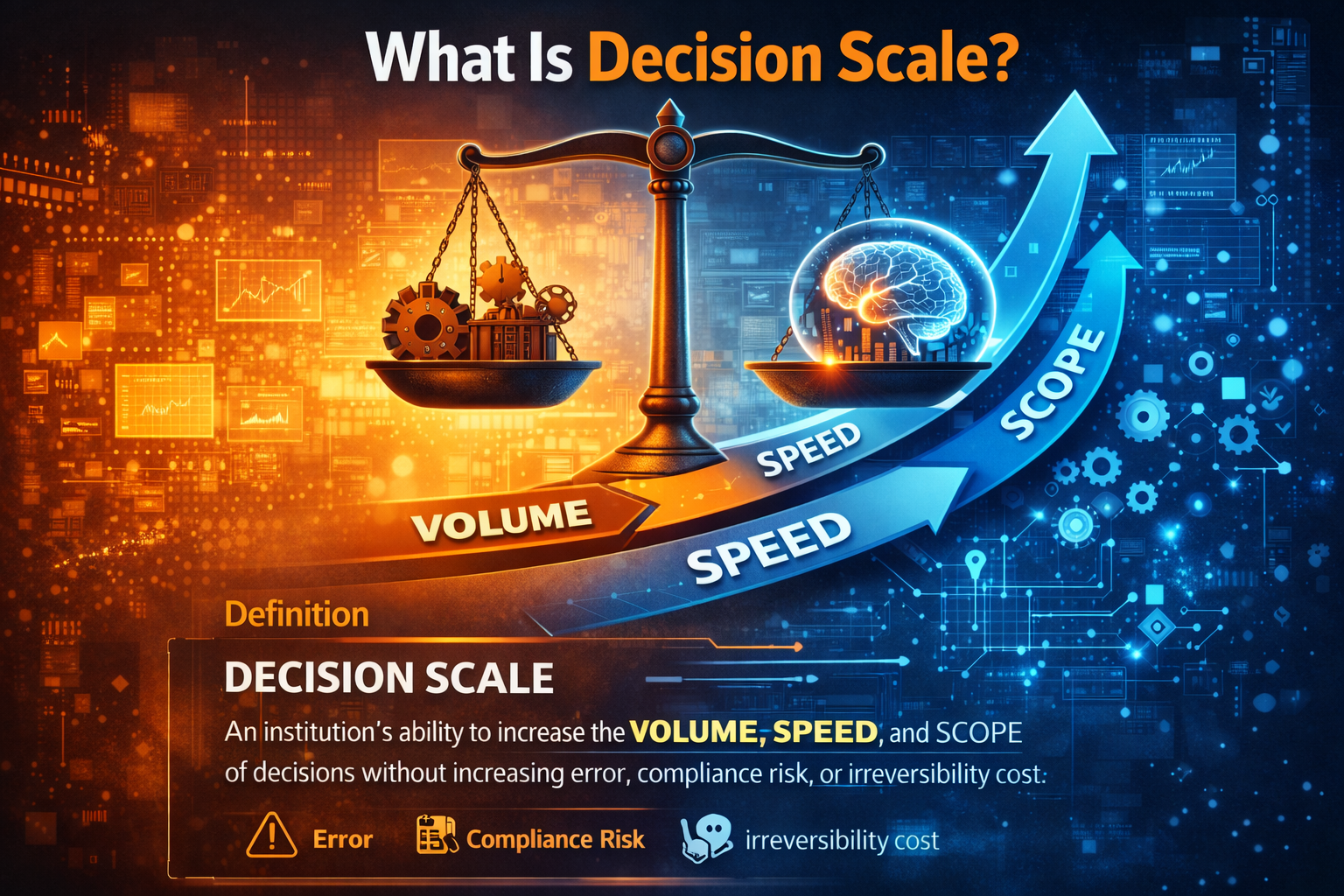
AI has become a decision layer.

And once AI becomes a decision layer, the enterprise inherits obligations that don’t belong to any one team:

  • Who is accountable when an AI-influenced decision harms a customer?
  • How do you prove why a decision happened—months later—to an auditor?
  • How do you prevent cost from compounding into an ungovernable estate?
  • How do you enforce policy when autonomy spans dozens of tools and systems?
  • How do you stop, roll back, or unwind outcomes when the basis changes?

This is precisely why Enterprise AI is an operating model, not a technology stack—and why the “top-down” design decision is foundational (https://www.raktimsingh.com/enterprise-ai-operating-model/).

If your AI program is still being framed as “a set of models and tools,” you are likely missing the real system you are now running: a production decision estate with safety, compliance, and cost consequences (https://www.raktimsingh.com/the-enterprise-ai-operating-stack-how-control-runtime-economics-and-governance-fit-together/).

What “top-down” really means (and what it does not mean)

What “top-down” really means (and what it does not mean)

Top-down does not mean a central team blocks innovation, approves every prompt, or chooses one model for everyone.

Top-down means the enterprise defines the operating conditions under which AI is allowed to scale—so teams can move fast inside a governed boundary.

It means defining, up front:

  1. What decisions exist (and which are AI-eligible)
  2. What the enterprise owes when AI influences those decisions (evidence, safeguards, recourse)
  3. What control planes must exist (policy enforcement, auditability, observability, rollback)
  4. What economic boundaries apply (cost per decision, usage envelopes, routing rules)
  5. Who owns which decision classes (not “who owns the model”)
  6. What “done” means in production (SLOs, evaluation gates, incident response, change discipline)

A crisp way to say it: top-down sets decision governance and production controls first; bottom-up discovers them later—usually after damage.

This is the same reason I created a dedicated control plane narrative: the enterprise must run AI like a governed capability, not a collection of apps (https://www.raktimsingh.com/enterprise-ai-control-plane-2026/).

Why bottom-up Enterprise AI fails—even when every pilot “works”

Why bottom-up Enterprise AI fails—even when every pilot “works”

Bottom-up scaling fails for one simple reason:

Enterprises don’t run models. They run outcomes.

Pilots are local. Outcomes are systemic.

A pilot can look successful while the enterprise silently accumulates:

  • inconsistent policy enforcement
  • fragmented identity and access patterns
  • untracked data exposures
  • duplicated retrieval pipelines
  • unclear accountability paths
  • cost sprawl and shadow usage
  • contradictory agents acting on the same customer or record

This is also why “minimum viable” thinking matters: enterprises need a minimum viable enterprise AI system—not a minimum viable demo (https://www.raktimsingh.com/minimum-viable-enterprise-ai-system/).

And it’s why my decision failure taxonomy becomes essential: the enterprise is not failing because one model is wrong; it’s failing because decision pathways become unbounded and non-defensible at scale (https://www.raktimsingh.com/enterprise-ai-decision-failure-taxonomy/).

Bottom-up “wins” often create top-down liabilities.

Five forces that make top-down design non-negotiable in 2026+

Five forces that make top-down design non-negotiable in 2026+

1) The action threshold: advice became action

The moment AI crosses from suggesting to doing—creating accounts, changing limits, sending notices, freezing transactions—you’re no longer managing “model quality.”

You’re managing enterprise risk.

This is the same boundary I repeatedly emphasize across the canon: the moment AI touches the action boundary, the governance obligation changes (and my broader operating model is designed for exactly that reality) (https://www.raktimsingh.com/enterprise-ai-operating-model/).

2) Regulation is converging on lifecycle governance

Modern governance language is converging globally: lifecycle risk management, accountability, documentation, and continuous monitoring.

This is why enterprises need not only policies, but decision receipts and consistent controls—especially once AI outcomes affect customers, employees, pricing, eligibility, or safety.

3) Cost does not scale linearly—it compounds

Once AI becomes useful, usage multiplies culturally and operationally—especially with agent loops, RAG context inflation, retries, and governance evidence.

This is why Enterprise AI economics must be designed top-down as an economic control plane, not treated as a late-stage cost cutting exercise (https://www.raktimsingh.com/enterprise-ai-economics-cost-governance-economic-control-plane/).

And it ties directly to the “Intelligence Reuse Index” logic: mature enterprises win not by rebuilding intelligence repeatedly, but by reusing governed intelligence as a service (https://www.raktimsingh.com/intelligence-reuse-index-enterprise-ai-fabric/).

4) “Model change” becomes a business-change event

In enterprise settings, changing a model can change outcomes, not just accuracy.

That is why the runbook crisis matters: model churn breaks production AI unless change is governed like a critical production discipline (https://www.raktimsingh.com/enterprise-ai-runbook-crisis-model-churn-production-ai/).

5) Trust is a balance sheet item

Every opaque or inconsistent AI decision creates future resistance—by customers, employees, auditors, and regulators.

Trust debt compounds quietly until a single incident makes it visible.

This is why “decision clarity” isn’t a communication nice-to-have; it’s the shortest path to scalable autonomy without reputational and compliance blowback (https://www.raktimsingh.com/decision-clarity-scalable-enterprise-ai-autonomy/).

A simple mental model: Enterprise AI is a city, not an app

A simple mental model: Enterprise AI is a city, not an app

Bottom-up AI builds many houses quickly.
Top-down Enterprise AI builds the city:

  • zoning laws (decision classes and policies)
  • roads (shared infrastructure, integration standards)
  • police and courts (enforcement and incident response)
  • tax system (economic control plane)
  • archives (decision ledger and evidence retention)
  • building codes (release gates, evaluation, QA)

This is exactly how my “operating stack” concept should be read: control + runtime + economics + governance are not optional add-ons—they’re the city infrastructure that prevents chaos (https://www.raktimsingh.com/the-enterprise-ai-operating-stack-how-control-runtime-economics-and-governance-fit-together/).

A city built bottom-up becomes chaotic, unsafe, expensive to maintain, and difficult to govern.

Enterprise AI is no different.

What a top-down Enterprise AI design blueprint looks like

What a top-down Enterprise AI design blueprint looks like

Step 1: Start with decisions—not use cases

List the top 25–50 decisions that actually move money, risk, customer outcomes, or compliance posture.

Examples:

  • approve / deny / reprice
  • flag / freeze / hold
  • escalate / de-escalate
  • route cases and allocate humans
  • send notices and commitments

Then classify them:

  • high-impact vs low-impact
  • reversible vs irreversible
  • regulated vs unregulated
  • customer-facing vs internal-only

This classification is where decision integrity begins—because it prevents teams from treating every decision like “just another automation.” (MY canon on enterprise-scale decision integrity is built to reinforce this principle.) (https://www.raktimsingh.com/enterprise-ai-canon/)

Step 2: Define decision rights (ownership before autonomy)

Top-down design forces a hard question:

Who owns the decision class—not the model?

Ownership means the accountable owner:

  • defines acceptable outcomes
  • defines policy constraints
  • defines recourse and remediation
  • signs off on autonomy level
  • owns the incident path when things go wrong

This is the same reason I emphasize registries: you cannot govern autonomy without knowing what agents exist, who owns them, and what they are allowed to do (https://www.raktimsingh.com/enterprise-ai-agent-registry/).

Step 3: Design the control planes before you scale

To run Enterprise AI, you need reusable enterprise-grade planes that every AI capability plugs into:

  • Policy & enforcement plane (what the AI is allowed to do)
  • Decision evidence plane (what happened, why, with what version/policy)
  • Runtime & reliability plane (SLOs, fallbacks, rollbacks)
  • Economic plane (cost envelopes per decision class, routing rules)
  • Change plane (release gates, versioning, approvals, rollback plans)

This is what my control plane framing was built for: governed autonomy requires a control plane, not heroics (https://www.raktimsingh.com/enterprise-ai-control-plane-2026/).

Step 4: Make “evidence” a product requirement

At enterprise scale, the output is not enough.

You need to answer later:

  • what was decided?
  • which model/version?
  • which policy/version?
  • which data sources and tools?
  • which approvals/overrides?
  • what action was taken downstream?

This is the deeper logic behind my Enterprise AI canon and laws: enterprises that cannot produce evidence eventually lose the right to scale autonomy (https://www.raktimsingh.com/laws-of-enterprise-ai/).

Step 5: Put an economic envelope on every decision class

Top-down design avoids the most common cost trap: treating AI spend like a project cost instead of an operating utility.

Every decision class gets:

  • max tokens / max steps / max tool calls
  • allowed model tiers
  • caching rules and retrieval depth
  • bounded fallback behavior
  • escalation rules when budget is exceeded

This is how the economics control plane becomes real—cost governance at the decision layer, not spreadsheet governance after the invoice arrives (https://www.raktimsingh.com/enterprise-ai-economics-cost-governance-economic-control-plane/).

Step 6: Create a portfolio view (or sprawl wins)

If you cannot answer:

  • what AI is running?
  • who owns it?
  • what it costs per decision?
  • what policies govern it?
  • what incidents it has had?

…you do not have an AI program. You have an AI leak.

And the fastest way to leak is to confuse “lots of pilots” with “an operating model.”

Three stories that make the case obvious

Story 1: The support copilot that becomes a compliance engine

Bottom-up: each team buys/builds its own assistant. Tone differs. Risk rules differ. Privacy handling differs. Costs are duplicated. Audit becomes impossible.

Top-down: shared policy + evidence + decision classes (“suggest” vs “commit to customer”) + economics envelopes.

This is how you scale a capability, not a tool.

Story 2: Lending decisions where “accuracy” isn’t the risk

Bottom-up: a model is deployed; governance arrives later as a scramble.

Top-down: decision rights, traceability, and lifecycle discipline are defined upfront—so outcomes can be defended and remediated when necessary.

This is also why the runbook crisis is the real bottleneck: production is a change machine, and if you don’t govern churn, the system breaks even when “accuracy” looks fine (https://www.raktimsingh.com/enterprise-ai-runbook-crisis-model-churn-production-ai/).

Story 3: Fraud operations where local automation becomes systemic harm

Bottom-up: one team’s automation triggers holds that cascade into other systems, sometimes into partners, vendors, and long-lived records.

Top-down: blast radius controls, reversibility thresholds, incident playbooks, and explicit action boundaries.

The leadership shift: from “AI strategy” to “AI operating model”

The leadership shift: from “AI strategy” to “AI operating model”

Top-down Enterprise AI is a leadership stance:

  • CIOs stop funding tools and start funding control planes
  • CFOs stop asking “what’s the model cost?” and start asking “what’s the cost per decision?”
  • Boards stop asking “are we using AI?” and start asking “can we govern AI outcomes with evidence?”

That is the thesis of my pillar: Enterprise AI must be run as a governed operating capability, not a collection of experiments (https://www.raktimsingh.com/enterprise-ai-operating-model/).

Conclusion column: The one sentence that will decide whether Enterprise AI scales

Bottom-up AI produces adoption.
Top-down Enterprise AI produces governed autonomy.

If AI is becoming a decision layer inside your enterprise, top-down design is not bureaucracy.

It is the price of staying credible—to customers, regulators, auditors, and your own business.

In 2026+, the enterprises that win won’t be the ones with the best demos.
They’ll be the ones that can prove—continuously—that their AI decisions are:

  • authorized
  • bounded
  • auditable
  • economically controlled
  • reversible when required

And that is exactly what my Enterprise AI canon is designed to standardize at global scale (https://www.raktimsingh.com/enterprise-ai-canon/).

Further Reading: Enterprise AI Governance & Scale

FAQ

1) Isn’t top-down too slow for AI innovation?

Top-down sets reusable guardrails (decision classes, policies, evidence, economics). Inside those guardrails, teams ship faster—because they’re not reinventing governance per use case.

2) What’s the first artifact to create?

A decision inventory + decision classification (impact, reversibility, regulatory exposure). That becomes the map of what autonomy is even allowed to exist.

3) Where do most enterprises start wrong?

They start with copilots and tools. They should start with decision rights, evidence requirements, and cost envelopes—then choose tools.

4) How do I know if we’re scaling bottom-up today?

If you can’t answer “what AI is running, who owns it, what it costs per decision, and what evidence it produces,” you’re scaling bottom-up—whether you admit it or not.

5) What’s the fastest way to reduce risk while scaling fast?

Centralize your “shared beams”: control plane, runtime, economics, and governance as reusable services—then let teams innovate on top (https://www.raktimsingh.com/the-enterprise-ai-operating-stack-how-control-runtime-economics-and-governance-fit-together/).

Why do Enterprise AI pilots succeed but fail to scale?

Because pilots operate in controlled environments. Production introduces organizational complexity, regulatory exposure, and cross-system dependencies that bottom-up AI cannot handle.

What does top-down Enterprise AI actually mean?

Top-down Enterprise AI defines intent, guardrails, governance, and decision ownership first — then allows teams to innovate safely within those boundaries.

Is top-down AI the same as centralized control?

No. Top-down sets constraints and outcomes; execution remains decentralized and agile.

Why is this more critical after 2026?

Because AI systems are moving from recommendation to action, increasing regulatory, financial, and reputational risk at enterprise scale.

Glossary 

  • Enterprise AI: AI operated as a governed production capability where decisions, accountability, evidence, economics, and lifecycle controls matter as much as model quality.
  • Decision class: A category of decisions grouped by impact, reversibility, regulatory exposure, and required safeguards.
  • Decision rights: Ownership model defining accountability for outcomes (not just technical ownership of a model).
  • Control plane: Cross-cutting layer that enforces policy, captures evidence, and enables stoppability/rollback across AI systems (https://www.raktimsingh.com/enterprise-ai-control-plane-2026/).
  • Runtime: The operational substrate that runs AI in production—workflows, tools, identity, memory, observability, fallbacks (https://www.raktimsingh.com/enterprise-ai-runtime-what-is-running-in-production/).
  • Trust debt: Accumulated resistance created by opaque, inconsistent, or harmful AI outcomes.

Why AI Costs Explode After “Success”: The Enterprise AI Economics Trap No One Plans For

Why AI Costs Explode After “Success”

Most enterprises don’t lose control of AI spending because their models are too large or their vendors are too expensive. They lose control because AI becomes useful.

In early pilots, AI looks deceptively cheap—limited users, short prompts, forgiving reliability, and almost no governance overhead.

But the moment an AI system succeeds and moves into real production, its economic behavior changes. Usage multiplies, workflows expand, reliability expectations harden, and compliance turns outputs into evidence.

Costs stop behaving like a one-time technology investment and start behaving like a permanent operating expense tied to decisions. This is why so many organizations discover—too late—that AI is cheapest when it is optional and most expensive when it becomes essential.

The moment AI works, the bill changes shape

In early pilots, AI feels almost free.

A small team experiments. Usage is sporadic. Prompts are short. Latency is tolerated. The “AI budget” is often a cloud line item that blends into everything else.

Then the pilot succeeds.

The use case spreads across functions. Product embeds it into workflows. Support starts depending on it. Leadership wants it “everywhere.” Users form habits. And suddenly the cost curve doesn’t rise like normal software spend—it tilts upward.

That pattern isn’t anecdotal. It’s macro.

  • Gartner forecast global generative AI spending to reach $644B in 2025. (Gartner)
  • Gartner also predicted at least 30% of GenAI projects will be abandoned after proof-of-concept by end of 2025—citing issues including escalating costs and unclear business value. (Gartner)
  • And for agentic AI, Gartner predicted over 40% of agentic AI projects will be canceled by end of 2027 due to costs, unclear value, or inadequate risk controls—reported by Reuters and also in Gartner’s own release. (Reuters)

So the strategic question isn’t “Can we build it?”

It’s this:

Can we afford it once it becomes popular, mission-critical, and governed?

This article explains why Enterprise AI costs increase sharply after successful deployment, covering global enterprise patterns across regulated and non-regulated industries, and provides a practical operating model for cost control at scale.


The uncomfortable truth: success creates new cost physics

The uncomfortable truth: success creates new cost physics

AI cost explosions happen because success changes what the system is.

  • A pilot is a feature experiment.
  • Production AI becomes a decision utility.
  • And decision utilities must be reliable, auditable, secure, compliant, and available—at volume.

This is where your larger Enterprise AI thesis becomes non-negotiable:

Enterprise AI is an operating model—not a technology stack.
When the unit of value becomes a decision, the unit of cost becomes a decision too.

The 9 hidden multipliers that make “successful AI” expensive

1) Usage amplification: adoption turns into habit, habit turns into volume

In pilots, you have a few power users.

In production, you have everyone—and they don’t ask one question. They ask ten follow-ups. They paste outputs back in. They build “prompt routines.” They turn AI into muscle memory.

That’s why AI is cheapest when optional—and most expensive when essential.

Signal to watch: daily active users flattening while total calls keep rising.
That’s habit formation.

Agent loops: one request becomes a chain reaction

2) Agent loops: one request becomes a chain reaction

A classic chatbot is roughly one call per turn.

An agentic workflow is different. It plans, retrieves, calls tools, checks policy, retries, writes to systems, and summarizes. So one user request can trigger multiple model calls plus tool/API costs.

This is precisely why the FinOps community now treats AI as a new cost domain and emphasizes unit economics, prompt caching, and hidden “context creep.” (FinOps Foundation)

Simple example: “Reset access and verify permissions.”
Behind the scenes:

  • retrieve policy
  • call IAM
  • validate approvals
  • retry on tool failure
  • generate audit note
  • notify requestor

That’s not “one AI call.” It’s an agentic transaction.

3) Context inflation: RAG turns short prompts into long, expensive conversations

Your pilot prompt may be 200–500 tokens.

Production prompts often include:

  • conversation history
  • policies and playbooks
  • customer context
  • retrieved documents
  • tool outputs
  • structured state

Even if the model price stays the same, context grows—and spend rises with it. The FinOps Foundation explicitly warns that “per-token price” can mislead because operational realities like context window creep can drive spend sharply. (FinOps Foundation)

Enterprise trap: “Just add more context to reduce hallucinations.”
Yes—until you’re paying for a small book per interaction.

Reliability tax: retries, fallbacks, and “silent rework” multiply spend

4) Reliability tax: retries, fallbacks, and “silent rework” multiply spend

Pilots tolerate occasional failures. Production can’t.

So teams add:

  • retries when outputs fail guardrails
  • fallback models during outages
  • verification passes for critical answers
  • reruns when hallucinations are suspected
  • re-asks when formatting isn’t machine-readable

Each move is rational. Together, they form a reliability tax that compounds with volume.

And it often stays invisible because the system still “works.”
It just works by spending more.

5) Governance evidence: compliance turns outputs into receipts

When AI drafts content, governance is lighter.

When AI influences outcomes—eligibility, pricing, risk flags, approvals—governance becomes evidence-driven. That introduces new costs:

  • decision provenance
  • policy evaluation
  • audit trails and retention
  • human approvals / review queues
  • evaluations and documentation

This is consistent with the direction of NIST’s AI Risk Management Framework: risk management is an ongoing lifecycle discipline organized around Govern, Map, Measure, Manage, with GOVERN as a cross-cutting function. (NIST Publications)

The enterprise twist: as regulation grows, the cost of proof rises—not just the cost of prediction.

The model routing arms race: quality improvements often cost multiplicatively

6) The model routing arms race: quality improvements often cost multiplicatively

After success, stakeholder asks change:

  • “Can it be more accurate?” becomes “Can it be consistently correct?”
  • “Can it answer?” becomes “Can it answer safely?”
  • “Can it help?” becomes “Can it execute?”

Teams respond by upgrading models, adding parallel calls, ensembling, or verification passes.

That improves quality—but can double or triple cost if not governed with routing discipline and decision classes.

7) AI software estate sprawl: success attracts helpers, helpers attract overlap

As soon as AI becomes strategic, the enterprise stack expands:

  • multiple LLM providers
  • orchestration layers
  • eval platforms
  • guardrails
  • observability
  • vector databases
  • redaction tools
  • prompt management suites

Each tool is “small.” Together they form an AI estate—and estates drift toward sprawl unless controlled.

This is where costs become hard to explain: the AI bill stops being one line item and becomes a fragmented portfolio.

8) Shadow AI: unmanaged usage is the fastest way to burn money

When AI works, people adopt it without permission:

  • direct API calls outside governance
  • departmental copilots
  • prototypes that quietly become production
  • “just this one workflow” integrations

Spend leaks outside procurement and risk control. In many organizations, shadow AI becomes the largest source of unpredictable cost growth—because it scales with enthusiasm, not policy.

The cost unit shifts: from project cost to cost-per-decision

9) The cost unit shifts: from project cost to cost-per-decision

Pilots are budgeted like projects.

Production AI must be budgeted like operations:

  • cost per resolved ticket
  • cost per compliant decision
  • cost per safely executed action
  • cost per cycle time reduced

This is where spreadsheets fail. You need a decision-level cost model and controls that bind cost to value.

FinOps guidance for GenAI stresses unit economics and practical levers like caching and batching precisely because list pricing doesn’t reflect real spend drivers. (FinOps Foundation)

Three stories that explain the explosion without jargon

Story 1: The copilot becomes a call-center dependency

Month 1: optional drafting help.
Month 4: embedded into every case.

Now each case includes retrieval, summarization, compliance redaction, and structured notes. Volume is huge. Latency matters. Errors create rework. AI spend starts to behave like a telecom bill: recurring, volumetric, sensitive to peaks.

Story 2: The fraud agent crosses the action boundary

Pilot: “This looks suspicious.”
Production: “Freeze the account and open a case automatically.”

Now you must pay for stronger policy enforcement, traceability, approvals, rollback, remediation, and SLA engineering.

The cost doesn’t rise because the model got bigger.
It rises because the enterprise made the system accountable.

Story 3: The RAG assistant becomes the company’s answer engine

It begins as internal Q&A. Then it becomes onboarding, policy, architecture, compliance, vendor-contract support. Suddenly you’re maintaining indexing pipelines, permission-aware retrieval, freshness controls, and deduplication.

RAG has data gravity: the more useful it is, the more content it must ingest—and the more it costs to keep trustworthy.

The cost truth: production reveals what you didn’t build in the pilot

The cost truth: production reveals what you didn’t build in the pilot

Pilots hide reality:

  • controlled usage
  • narrow workflows
  • permissive governance
  • low reliability demands
  • limited integrations

Production exposes:

  • messy enterprise processes
  • complex accountability
  • real regulatory obligations
  • expensive “proof” requirements
  • tool and vendor sprawl

That’s why Gartner expects a meaningful share of initiatives to stall post-PoC—with escalating costs as a contributing factor. (Gartner)

The fix: an Enterprise AI Economics operating model (not “cost cutting”)

If your response is “we need cheaper models,” you’re already late.

The durable solution is to treat cost as part of the operating model—bound to decisions, risk, and value.

1) Measure cost per outcome, not cost per token

Tokens are a meter. Outcomes are the business.

Track:

  • cost per resolved case
  • cost per compliant decision
  • cost per successful action
  • cost per hour saved (validated)

This is where a Decision Ledger becomes economically powerful: it turns AI into accountable transactions you can price, govern, and improve.

2) Put an economic envelope on every decision class

Not every decision deserves premium models and deep retrieval.

Define decision classes:

  • low-risk / low-value → smaller model, short context, aggressive caching
  • high-risk / high-value → stronger model, richer context, full receipts

This is “routing with governance intent.”

3) Put hard limits on agent loops

Enforce caps:

  • max steps per task
  • max tool calls
  • max tokens per session
  • max retries
  • max time budget

If a task can’t complete inside its envelope, it must escalate, not loop.

4) Make retrieval economical

Avoid “document stuffing.” Prefer precision:

  • better chunking and indexing
  • permission-aware retrieval
  • citation-first responses
  • caching stable policy snippets

This reduces cost and improves trust.

5) Treat governance as reusable infrastructure

If every team builds its own guardrails, logging, evaluation, redaction, and audit trails—cost sprawl is guaranteed.

Centralize reusable governance services (policy gateways, standardized receipts, shared eval harnesses). This aligns with NIST’s lifecycle framing where governance is infused throughout. (NIST Publications)

6) Build an Enterprise AI portfolio view

You should be able to answer, in one place:

  • what agents/models are running
  • who owns them
  • what workflows invoke them
  • what decision class they support
  • the cost envelope and cost-per-outcome
  • the business value attached

Without portfolio governance, AI becomes “a thousand small leaks.”

Enterprise AI Operating Model

Enterprise AI scale requires four interlocking planes:

Read about Enterprise AI Operating Model The Enterprise AI Operating Model: How organizations design, govern, and scale intelligence safely – Raktim Singh
  1. Read about Enterprise Control Tower The Enterprise AI Control Tower: Why Services-as-Software Is the Only Way to Run Autonomous AI at Scale – Raktim Singh
  2. Read about Decision Clarity The Shortest Path to Scalable Enterprise AI Autonomy Is Decision Clarity – Raktim Singh
  3. Read about The Enterprise AI Runbook Crisis The Enterprise AI Runbook Crisis: Why Model Churn Is Breaking Production AI—and What CIOs Must Fix in the Next 12 Months – Raktim Singh
  4. Read about Enterprise AI Economics Enterprise AI Economics & Cost Governance: Why Every AI Estate Needs an Economic Control Plane – Raktim Singh
 

Read about Who Owns Enterprise AI Who Owns Enterprise AI? Roles, Accountability, and Decision Rights in 2026 – Raktim Singh
Read about The Intelligence Reuse Index The Intelligence Reuse Index: Why Enterprise AI Advantage Has Shifted from Models to Reuse – Raktim Singh
Conclusion column: What to remember

AI costs don’t explode because models are expensive.
They explode because success turns AI into a high-volume, multi-step, governed decision utility.

The winners won’t be the enterprises with the cheapest per-token price.
They will be the ones that can run AI like critical infrastructure:

  • governed (risk is managed continuously)
  • auditable (decisions have receipts)
  • economically bounded (envelopes per decision class)
  • operationally reliable (no silent retry storms)

This is exactly why your Enterprise AI Operating Model matters: it gives enterprises a way to scale intelligence without letting economics break the program.


FAQ

1) Why do pilots underestimate GenAI cost so badly?
Because pilots hide the multipliers: context growth, retries, governance receipts, integration overhead, and the volume that comes with habit formation—then production makes them non-optional. Gartner’s post-PoC abandonment prediction includes escalating costs as a factor. (Gartner)

2) Is inference really the long-term cost center?
For most enterprise deployments, the dominant spend shifts toward inference and operationalization at scale, where latency and reliability constraints drive continuous usage. (For estimation approaches, see NVIDIA’s inference cost/TCO guidance.) (NVIDIA Developer)

3) What’s the biggest “silent” cost driver?
Context window creep plus retries—because they multiply spend while still appearing as “normal” usage. (FinOps Foundation)

4) Do open-source models solve the cost explosion?
They can reduce unit price, but the largest multipliers are workflow-level (agent steps, retrieval depth, governance evidence, sprawl). Open source helps—but doesn’t replace an economic control plane.

5) What’s the single first control to implement?
Decision classes with economic envelopes (limits on steps/tokens/tools/retries) tied to cost-per-outcome—consistent with FinOps guidance to treat GenAI pricing through unit economics, not list price alone. (FinOps Foundation)


Glossary

  • Inference: Running a trained model in production to generate outputs; often the primary cost driver at scale. (NVIDIA Developer)
  • RAG (Retrieval-Augmented Generation): An approach that retrieves enterprise documents and adds them to prompts, improving grounding but increasing context and pipeline costs.
  • Agentic workflow: A multi-step system where AI plans and executes via tool calls, retries, and verification; one user request can produce many model calls. (Gartner)
  • Context window creep: Gradual growth of prompt/context payload over time, which increases token spend non-linearly. (FinOps Foundation)
  • Economic envelope: A hard budget for an AI decision class (max tokens, steps, tool calls, retries, time).
  • Cost per decision: Unit economics metric that ties AI spend to a business outcome (e.g., cost per resolved ticket).
  • AI governance receipts: Evidence linking a decision to model/version, policy checks, data provenance, and approvals; essential for auditability and regulated outcomes. (NIST Publications)
  • FinOps for AI: Applying FinOps practices to AI’s volatile, usage-based cost model; includes unit economics, forecasting, and optimization levers. (FinOps Foundation)


References and further reading

  • Gartner: Generative AI spending forecast to reach $644B in 2025. (Gartner)
  • Gartner: 30% of GenAI projects predicted to be abandoned post-PoC by end of 2025; drivers include escalating costs/unclear value. (Gartner)
  • Gartner (via Reuters) + Gartner release: Over 40% of agentic AI projects expected to be canceled by end of 2027 due to costs/unclear value/risk controls. (Reuters)
  • NIST AI RMF 1.0 (Core functions: Govern, Map, Measure, Manage; GOVERN as cross-cutting). (NIST Publications)
  • FinOps Foundation: FinOps for AI topic hub + GenAI token pricing realities (unit economics, context creep, caching). (FinOps Foundation)
  • NVIDIA: Practical guidance on estimating LLM inference cost and TCO for production deployments. (NVIDIA Developer)

Enterprise AI for CX: When Personalization Becomes a Liability

Enterprise AI for CX: When Personalization Becomes a Liability

For years, personalization has been celebrated as the safest and most reliable lever in customer experience.

Better recommendations, smoother journeys, timely nudges—each promised higher satisfaction with minimal risk. But something fundamental has changed. As enterprises deploy AI at scale, personalization is no longer just shaping experiences; it is making decisions. Who gets an offer, who sees a price, who reaches a human, who gets an instant refund, and who is quietly deprioritized.

The moment personalization crosses this line, it stops being a CX optimization and becomes an Enterprise AI decision system—one that carries real consequences for trust, compliance, and brand integrity. This article examines why that shift turns personalization into a liability, and how mature organizations are redesigning their operating models to govern AI-driven CX safely, defensibly, and at global scale.

Personalization isn’t risky because it’s “AI.” It’s risky because it becomes decision power—without decision governance.

Personalization used to be the safest win in customer experience (CX): show better recommendations, reduce friction, nudge the next best action, make customers feel understood.

Then enterprises crossed a quiet line.

Personalization stopped being content selection and became decision-making: who gets an offer, who gets routed to a human, who sees a price, who gets an instant refund, who is flagged as risky, whose complaint is deprioritized, whose subscription cancellation becomes “hard,” whose identity is questioned, whose account is limited.

That’s the moment personalization becomes a liability.

Not because personalization is inherently bad—but because Enterprise AI changes the rules:

  • Your CX system is no longer a front-end feature.
  • It becomes a production decision system operating at scale.
  • It creates real-world outcomes that must be defensible months or years later.
  • And it increasingly sits under privacy, consumer protection, and AI governance expectations across regions.

This article is a practical, globally relevant guide to building Enterprise AI for CX—so you can personalize confidently without creating silent compliance debt, trust erosion, or reputational blowups.

Enterprise AI personalization becomes risky the moment it shifts from content optimization to automated decision-making.

Without policy layers, decision ledgers, and incident response, CX systems create trust, compliance, and reputational liabilities. Mature enterprises govern personalization as a decision system—auditable, reversible, and accountable.

“Personalization becomes dangerous the day it starts deciding.”

👉 Enterprise AI Operating Model 
https://www.raktimsingh.com/enterprise-ai-operating-model/

Why personalization becomes risky the moment it starts deciding

Why personalization becomes risky the moment it starts deciding

There are two worlds of personalization, and they require very different operating standards.

World 1: Harmless personalization (mostly reversible)

  • Reordering products on a homepage
  • Suggesting articles or videos
  • Choosing a subject line or banner
  • Timing a notification

This can still irritate users or create mild harm, but the impact is typically soft and easier to reverse.

The next CX advantage won’t be better recommendations. It will be defensible personalization: policy-gated, auditable, reversible.

World 2: Decision-grade personalization (material impact)

  • Showing different prices or terms
  • Prioritizing one customer’s complaint over another
  • Auto-approving refunds for some while rejecting others
  • Offering retention discounts selectively
  • Flagging customers as “likely abusive” or “high risk”
  • Routing only certain customers to humans
  • Deciding who gets proactive support and who doesn’t

This is no longer “marketing optimization.” It is automated decision-making with tangible effects—and in many jurisdictions that triggers stronger expectations around transparency, contestability, and accountability.

For example, GDPR Article 22 describes rights related to decisions based solely on automated processing (including profiling) when they produce legal or similarly significant effects. (GDPR)

That “similarly significant” phrase is where many CX systems accidentally land—without realizing they’ve moved from “experience tuning” to “governed decision-making.”

“If you can’t explain a personalized decision, you can’t scale it.”

Enterprise AI Decision Ledger👉

The Decision Ledger: How AI Becomes Defensible, Auditable, and Enterprise-Ready – Raktim Singh
The four liability traps enterprises keep walking into

The four liability traps enterprises keep walking into

1) The invisible discrimination trap

You didn’t explicitly use sensitive attributes. You didn’t intend unfairness. Yet the system learns proxies.

Simple example:
A “next best offer” model learns that some areas respond less to premium options, so it stops showing premium choices there. Nobody complains—because customers never see what they are missing.

Why this becomes liability:

  • You can create unequal opportunity through profiling.
  • You may not be able to explain why options were withheld.
  • Regulators and auditors often care about outcomes, not intent.

Enterprise AI fix:
You need a Decision Ledger for CX personalization decisions: what inputs were used, which policy gates were applied, what explanation was generated, and what downstream action occurred.

Without that ledger, you cannot answer the simplest question that matters in a dispute:
“Who didn’t get the option—and why?”

“CX didn’t break because of bad AI. It broke because of ungoverned decisions.”

2) The dark pattern automation trap

CX teams optimize conversion, retention, and time-on-app. Personalization can quietly become a machine for manipulation.

Simple example:
A cancellation flow becomes personalized: users predicted to churn get an easy “pause,” while others face extra steps, confusing choices, or delayed cancellation confirmation.

Consumer protection scrutiny of “dark patterns” has risen sharply; the U.S. Federal Trade Commission has documented how manipulative design practices can trick or trap consumers. (Federal Trade Commission)

Enterprise AI fix:
Treat certain experience patterns as prohibited behaviors in your policy layer:

  • friction injection to block cancellation
  • misleading urgency personalization
  • “confirmshaming” personalization
  • selective disclosure (e.g., showing fees late)

This is exactly what an Enterprise AI control plane is for: enforcing behavioral boundaries—not just monitoring model accuracy.

If you can’t produce a receipt for a personalized decision, you don’t have personalization—you have liability.

3) The pricing personalization trap (the fastest reputational blowup)

Personalized pricing is not always illegal—but it is reputationally explosive, and can become legally sensitive depending on data sources, disclosure, and sector rules.

Simple example:
Two customers see two different prices because one is predicted to have higher willingness to pay. The enterprise calls it optimization. Customers call it exploitation.

Why it becomes liability:

  • It creates perceived unfairness and loss of trust.
  • It can be challenged as unfair or discriminatory—especially if proxies correlate with protected traits.
  • The explanation is often reputationally toxic: “We thought you’d tolerate it.”

Enterprise AI fix:
If you do any form of price personalization:

  • enforce strict policy rules on acceptable features
  • maintain governance approvals and documentation
  • provide transparency and meaningful opt-outs where required
  • run continuous monitoring for outcome disparity

If your enterprise can’t defend it on a public stage, it shouldn’t be automated.


4) The customer service triage trap (where AI quietly decides dignity)

Enterprises increasingly personalize support:

  • chatbot vs human
  • escalation speed
  • refunds and exceptions
  • fraud suspicion thresholds
  • tone adaptation

Simple example:
A model routes high-value customers to priority agents and routes others to bots—even when issues are complex.

Why this becomes liability:

  • It creates a two-tier reality customers will eventually discover.
  • It can violate internal ethics principles and external fairness expectations.
  • It increases escalation, complaints, and reputational risk.

Enterprise AI fix:
For service triage, define hard governance rules:

  • complexity thresholds that must route to humans
  • proxy checks (to prevent indirect discrimination)
  • auditability of routing decisions
  • a human override that is real—and logged

And treat it as an incident domain: when routing fails, your enterprise needs rollback semantics (what “repair” means after harm already occurred).

The regulatory direction is converging

The regulatory direction is converging (and CX leaders can’t ignore it)

Across regions, the direction is consistent: automated decisions that materially affect people require stronger controls, transparency, and accountability.

Key signals that CX leaders should track:

  • GDPR / UK GDPR limits and rights around solely automated decisions with legal or similarly significant effects. (GDPR)
  • The EU AI Act’s risk-based framework and obligations (timelines and guidance continue to evolve). (Digital Strategy EU)
  • California’s evolving posture on automated decision-making technology, risk assessments, and audits (a fast-moving area that enterprises should monitor closely). (California Privacy Protection Agency)
  • Consumer protection focus on dark patterns and deceptive design. (Federal Trade Commission)
  • NIST’s AI Risk Management Framework emphasizing governance across the AI lifecycle. (NIST Publications)

You don’t need to be a legal specialist to act correctly. You need one mature operational assumption:

If personalization can change outcomes for a customer, your enterprise must be able to explain, justify, contest, and audit it.

That is an operating model requirement—not a feature request.

Enterprise AI for CX

Enterprise AI for CX: the operating model that prevents personalization liability

This aligns directly with your bigger thesis: Enterprise AI is an operating model, not a technology stack.

Here is the practical Enterprise AI lens for CX personalization.

1) Define the Action Boundary for CX

Most personalization failures happen when systems move from:

  • advice and content
    to
  • action and decision

In CX, the action boundary commonly includes:

  • auto-approvals and auto-denials (refunds, disputes)
  • price/offer eligibility changes
  • access restrictions (account limits)
  • customer ranking and queue routing
  • cancellation friction and retention flows

Operating rule: Anything across the action boundary must be governed as a decision system.

👉 The Action Boundary

The Action Boundary: Why Enterprise AI Starts Failing the Moment It Moves from Advice to Action – Raktim Singh
2) Put policy before model outputs hit customers

In mature enterprises, the model proposes—and policy decides.

Your policy layer should cover:

  • prohibited features (sensitive data, risky proxies)
  • prohibited behaviors (manipulative UX patterns)
  • reversibility scoring (can we undo harm?)
  • jurisdiction-aware constraints (rules differ by region)
  • cost envelopes (personalization can inflate spend fast)

This is how you stop personalization from becoming shadow autonomy.

3) Build a CX Decision Ledger (your receipts)

If a customer challenges you, “logs” and dashboards are not enough.

A CX Decision Ledger should record:

  • intent (what was optimized)
  • context (what was known at decision time)
  • decision (what was chosen)
  • policy gates (which constraints were applied)
  • explanation (what you can say to the customer)
  • action (what happened downstream)
  • override (who changed it, and why)

This is how CX becomes defensible—internally and externally.

4) Treat personalization as a continuously monitored risk surface

Most enterprises monitor:

  • CTR, conversion, retention

Mature enterprises also monitor:

  • complaint rate shifts by segment
  • reversal rate (how often humans undo AI decisions)
  • spikes in cancellations, disputes, and chargebacks
  • outcome disparities (who gets better treatment)
  • drift in customer sentiment and trust indicators

This is CX SRE for AI: reliability and safety, not just uplift.

5) Create incident response for CX personalization

CX incidents are not always outages. They are often:

  • wrong denials
  • unfair pricing events
  • aggressive nudges
  • biased routing
  • privacy expectations breached

Your incident response must include:

  • detection signals beyond model metrics
  • rapid containment (kill switch, policy clamp)
  • remediation playbooks (customer communication + repair)
  • post-incident learning (fix policies, not just prompts)

If you can’t respond, you shouldn’t automate.

Enterprise AI Incident Response👉

Enterprise AI Incident Response: The Missing Discipline Between Autonomous AI and Enterprise Trust – Raktim Singh
Five practical scenarios (easy to picture, hard to govern)

Scenario A: Personalized refunds

Some customers get instant refunds. Others get “we’ll review in 7 days.”
If criteria is opaque, it feels like arbitrary punishment.

Safe design: Tiered automation + transparent escalation + ledgered reasons.

Scenario B: Personalized cancellation flows

The model learns who will stay if nudged aggressively.

Safe design: Policy bans manipulative patterns; enforce “equal ease of exit.”

Scenario C: Personalized service priority

Some customers get humans; others get bots.

Safe design: Route by issue complexity first. Value can influence SLA—not dignity.

Scenario D: Personalized pricing

The fastest path to backlash if not governed.

Safe design: Strict constraints + review gates + monitoring + defensible disclosure.

Scenario E: Sensitive-moment targeting

Personalization can amplify harm if it exploits stress, urgency, or vulnerability.

Safe design: Safety classifiers + policy gates + human review for high-stakes moments.

Minimum Viable Safe Personalization

Minimum Viable Safe Personalization (MVSP): the Enterprise AI checklist

  1. Action Boundary definition for every personalization use case
  2. Policy layer that constrains model outputs
  3. Decision Ledger for audit + dispute resolution
  4. Defensible explanations + contest mechanism
  5. Human override that is meaningful—and recorded
  6. Disparity monitoring on outcomes (not only inputs)
  7. Incident response with containment + remediation
  8. Sunsetting plan for models and decision policies

This is how personalization becomes an enterprise capability—not a future scandal.

Enterprise AI Operating Model

Enterprise AI scale requires four interlocking planes:

Read about Enterprise AI Operating Model The Enterprise AI Operating Model: How organizations design, govern, and scale intelligence safely – Raktim Singh
  1. Read about Enterprise Control Tower The Enterprise AI Control Tower: Why Services-as-Software Is the Only Way to Run Autonomous AI at Scale – Raktim Singh
  2. Read about Decision Clarity The Shortest Path to Scalable Enterprise AI Autonomy Is Decision Clarity – Raktim Singh
  3. Read about The Enterprise AI Runbook Crisis The Enterprise AI Runbook Crisis: Why Model Churn Is Breaking Production AI—and What CIOs Must Fix in the Next 12 Months – Raktim Singh
  4. Read about Enterprise AI Economics Enterprise AI Economics & Cost Governance: Why Every AI Estate Needs an Economic Control Plane – Raktim Singh

Read about Who Owns Enterprise AI Who Owns Enterprise AI? Roles, Accountability, and Decision Rights in 2026 – Raktim Singh

Read about The Intelligence Reuse Index The Intelligence Reuse Index: Why Enterprise AI Advantage Has Shifted from Models to Reuse – Raktim Singh

What to remember
What to remember

Conclusion Column: What to remember (three lenses)

If you’re a CX leader:
Personalization is no longer a growth trick. It’s a decision surface. If you can’t explain it, you can’t scale it.

If you’re a CIO / platform owner:
Treat decision-grade personalization like production autonomy: policy first, ledger always, incident response mandatory.

If you’re a board / risk leader:
The exposure is not “AI failure.” The exposure is ungoverned automated decisions that can’t be justified after the fact.


FAQ: Enterprise AI for CX and personalization risk

1) Is personalization illegal?
No. Risk depends on how it is used—especially when it becomes automated decision-making with significant effects or manipulative design.

2) What’s the biggest hidden risk?
Invisible discrimination through proxies and unequal outcomes you can’t defend later.

3) Do we need explainable AI?
You need defensible explanations—operational clarity about factors, policy constraints, and how customers can contest decisions.

4) What makes personalization “Enterprise AI” vs normal optimization?
Crossing the action boundary into decisions affecting access, money, time, or dignity—requiring auditability, reversibility, governance, and incident response.

5) Fastest way to reduce liability?
Add a policy layer + CX Decision Ledger for decision-grade personalization, and run incident response drills for CX harms.

Glossary

  • Action Boundary (CX): The line where personalization stops being content selection and starts triggering decisions or actions that materially affect customers.
  • Automated Decision-Making (ADM): Decisions made by automated processing (often including profiling) that can have legal or similarly significant effects. (GDPR)
  • Profiling: Automated processing to evaluate personal aspects (preferences, behavior, risk) used to personalize experiences or decisions. (GDPR)
  • Decision Ledger: A system of record capturing decision intent, inputs, policy gates, actions, and overrides—so decisions are auditable and contestable.
  • Dark Patterns: Deceptive or manipulative UX practices that steer users toward outcomes they did not intend (e.g., hard-to-cancel flows). (Federal Trade Commission)
  • Reversibility: The ability to undo or remediate harm caused by automated decisions (refunds, reinstatement, correction, apology, compensation).
  • Outcome Disparity Monitoring: Measuring whether different groups systematically receive different outcomes from personalization, even if the model never “sees” sensitive attributes.
  • AI RMF (Risk Management Framework): NIST’s governance-oriented framework for mapping, measuring, and managing AI risks across the lifecycle. (NIST Publications)
  • Risk-Based Regulation: Regulatory approach where obligations increase with the potential impact and risk class of an AI system. (Digital Strategy EU)


References and further reading

  • GDPR Article 22 (automated individual decision-making, profiling). (GDPR)
  • UK ICO guidance on automated decision-making and profiling (UK GDPR). (ICO)
  • EU AI Act policy overview (EU digital strategy). (Digital Strategy EU)
  • European Commission guidance updates and timeline discussion (industry impact). (Reuters)
  • FTC dark patterns staff report and press release (manipulative UX). (Federal Trade Commission)
  • NIST AI Risk Management Framework (AI RMF 1.0). (NIST Publications)
  • California Privacy Protection Agency draft materials on risk assessments and automated decision-making technology. (California Privacy Protection Agency)
  • Legal analyses on California ADMT/risk assessment/audit rules (for implementation planning). (Skadden)

Sunsetting Enterprise AI: How Mature Organizations Retire Models, Agents, and Decisions Safely

Sunsetting Enterprise AI: How to Retire Models, Agents, and Decisions Safely—Without Breaking Trust, Compliance, or Business Continuity

Enterprise AI maturity is rarely tested when systems are launched. It is tested when they must be stopped. As artificial intelligence moves from experimental deployments to decision-making infrastructure, enterprises are discovering an uncomfortable truth: turning off AI is far harder than turning it on.

Models may stop running, agents may be disabled, and workflows may be replaced—but the decisions those systems made often continue to shape real-world outcomes long after the technology is gone.

In regulated, high-stakes environments, this creates a new class of operational, legal, and reputational risk. Sunsetting Enterprise AI, therefore, is not a technical shutdown exercise. It is a governance discipline—one that determines whether organizations can retire intelligence safely while preserving trust, accountability, and continuity at scale.

Enterprise AI doesn’t just get deployed. It gets embedded.

It settles into workflows and approvals, customer journeys and exception handling, risk controls and audit routines. It becomes part of the “how things get done”—often faster than any enterprise realizes. That is why “turning it off” is rarely a technical switch. It is an operational decision with legal, economic, and reputational consequences.

In traditional software, sunsetting often means: stop traffic → shut the service → archive data → done.

In Enterprise AI, sunsetting means something harder:

  • A model may stop running, but its decisions may still be active in the real world.
  • An agent may be disabled, but its permissions, credentials, and tool access may still exist.
  • A workflow may be replaced, but its explanations, logs, and audit obligations may need to remain available for months or years.

This is the missing discipline: Enterprise AI decommissioning as a first-class operating capability. If “running intelligence” is your enterprise advantage, then retiring intelligence safely is part of the same operating model—alongside control planes, runtime governance, and economic oversight.

Why Model Replacement Doesn’t Reset Enterprise Reality

Model drift is inevitable in enterprise environments, which is why models are routinely replaced. The problem is not that new models make decisions differently.

The problem is that earlier models have already acted—changing customer states, triggering escalations, and shaping workflows that persist over time.

When a new model takes over, it inherits this accumulated state without sharing the logic that created it. As a result, enterprises find themselves unable to fully justify why certain customers remain flagged, why specific SLAs were breached, or why workflows behave the way they do.

New models govern the future, but they cannot retroactively explain the past—and that gap is where trust, auditability, and accountability begin to fracture.

This article answers a question most organizations are quietly terrified of:

“What happens when we need to stop an AI system—fast—and still defend every outcome it produced?”

Enterprise AI Operating Model: https://www.raktimsingh.com/enterprise-ai-operating-model/

Why Sunsetting Enterprise AI Is Becoming a Board-Level Concern

Why Sunsetting Enterprise AI Is Becoming a Board-Level Concern

Enterprises are entering an era where they will retire hundreds to thousands of AI components per year:

  • models replaced because performance drifts
  • agents replaced because tools, APIs, or workflows change
  • vendors swapped because economics shift
  • policies updated because regulation evolves
  • business processes redesigned because strategy changes

If retirement is not treated as a designed capability, three failure modes emerge:

  1. Zombie intelligence: old models or agents still influence outcomes through hidden integrations, stale batch jobs, or “temporary” fallbacks that become permanent.
  2. Orphan decisions: the system is gone, but regulators, auditors, or customers ask, “Why did you decide that?” and no one can reconstruct the chain of responsibility.
  3. Silent liabilities: logs, documentation, and compliance evidence weren’t preserved—until an incident arrives, and the enterprise can’t prove safe operation.

This is not theoretical. Major governance frameworks already push toward lifecycle accountability:

  • The EU AI Act explicitly includes post-market monitoring and expects corrective actions for non-conforming high-risk systems, including withdrawal/disable/recall. (AI Act Service Desk)
  • The NIST AI Risk Management Framework (AI RMF 1.0) frames risk management as lifecycle work, with GOVERN applying across stages and other functions mapping to lifecycle contexts. (NIST Publications)
  • ISO/IEC 42001 defines requirements for establishing, implementing, maintaining, and continually improving an AI management system—again, lifecycle thinking. (ISO)

Bottom line: enterprises will be judged not only by how they launch AI—but by how they retire it.

Replacing an AI model changes how future decisions are made.
It does not change the decisions already embedded in the enterprise.

The Three Things You Must Sunset (Most Enterprises Only Think About One)

When teams say, “we’re retiring the AI,” they usually mean the model. That’s incomplete.

To sunset Enterprise AI safely, you must retire three layers:

1) Models

Prediction or generation components (LLMs, classifiers, rankers, risk models, forecasting models).

2) Agents

Autonomous or semi-autonomous systems that plan, call tools, create outputs, and coordinate workflows.

3) Decisions

The real-world outcome layer—approvals, denials, holds, escalations, customer treatments, pricing changes, eligibility assignments, and other operational actions.

This third layer is where most decommissioning failures happen. Disabling a model does not undo downstream consequences of decisions already made. Retiring AI safely requires treating decisions as first-class artifacts, not side effects.

A Concrete Story: The Credit Agent You Replaced—But Its Decisions Still Live

A Concrete Story: The Credit Agent You Replaced—But Its Decisions Still Live

Imagine a bank deploys a credit-limit increase agent:

  • It reads customer signals
  • It estimates default risk
  • It auto-approves increases below a threshold
  • It logs “reason codes” and actions

Six months later, the bank replaces it with a better model and a redesigned agent. Great.

Then an auditor asks:

  • “How many customers were impacted by the old agent in the last quarter?”
  • “Which decisions were fully automated and which had human oversight?”
  • “Show logs and evidence of oversight for those decisions.”
  • “Prove you could disable or withdraw the system if it became non-compliant.”

If you can’t answer, you didn’t sunset decisions—you sunset code.

Under the EU AI Act, deployers of high-risk systems have explicit obligations around monitoring and log retention (often described as at least six months, depending on context and applicable law). (Artificial Intelligence Act)
That means the retirement plan must preserve traceability and defensibility after the system stops running.

Enterprise AI Operating Model

Enterprise AI scale requires four interlocking planes:

Read about Enterprise AI Operating Model The Enterprise AI Operating Model: How organizations design, govern, and scale intelligence safely – Raktim Singh

  1. Read about Enterprise Control Tower The Enterprise AI Control Tower: Why Services-as-Software Is the Only Way to Run Autonomous AI at Scale – Raktim Singh
  2. Read about Decision Clarity The Shortest Path to Scalable Enterprise AI Autonomy Is Decision Clarity – Raktim Singh
  3. Read about The Enterprise AI Runbook Crisis The Enterprise AI Runbook Crisis: Why Model Churn Is Breaking Production AI—and What CIOs Must Fix in the Next 12 Months – Raktim Singh
  4. Read about Enterprise AI Economics Enterprise AI Economics & Cost Governance: Why Every AI Estate Needs an Economic Control Plane – Raktim Singh

Read about Who Owns Enterprise AI Who Owns Enterprise AI? Roles, Accountability, and Decision Rights in 2026 – Raktim Singh

Read about The Intelligence Reuse Index The Intelligence Reuse Index: Why Enterprise AI Advantage Has Shifted from Models to Reuse – Raktim Singh

The Enterprise AI Sunset Playbook

No Math. No Hype. Just the Controls That Prevent “Zombie Intelligence.”

Step 1: Define Retirement Triggers (So Retirement Isn’t Political)

AI systems linger because retirement becomes a debate: “Are we sure we should replace it?” “What if it breaks something?” “Let’s wait one more quarter.”

The fix is simple: define objective retirement triggers when you launch the system:

  • drift beyond agreed thresholds
  • policy change invalidating assumptions
  • vendor/tooling end-of-life
  • repeated incident patterns
  • unacceptable cost-to-value ratio
  • suspected non-conformity / compliance risk

In regulated contexts, retirement can be mandatory. For high-risk systems, the EU AI Act expects corrective actions when non-compliance is suspected or confirmed, including disable/withdraw/recall. (AI Act Service Desk)

Best practice: publish retirement criteria when you publish the model/agent. Treat retirement as part of “definition of done.”

Inventory What You’re Actually Retiring (Most Teams Miss Hidden Dependencies)

Step 2: Inventory What You’re Actually Retiring (Most Teams Miss Hidden Dependencies)

Before you switch anything off, you need a precise inventory of the AI “estate”:

  • model versions in production + shadow deployments
  • endpoints, batch jobs, scheduled retraining
  • agent workflows (flows, tools, prompts, policies)
  • credentials (API keys, service accounts, tokens)
  • data pipelines (features, retrieval indices, caches)
  • downstream systems consuming outputs
  • human SOPs built around the AI’s behavior

Most failures occur because organizations don’t know what is running, where, and why—until something breaks.

If you want to be world-class, treat retirement inventory as a routine output of your Enterprise AI Operating Model (control + runtime + governance).


Step 3: Choose the Right Sunset Strategy (Hard Stop Is Rarely the First Move)

There are four practical retirement patterns:

  1. A) Parallel Run (Shadow)

New system runs alongside old, but old still drives decisions.
Use when: risk is high and you need controlled comparison.

  1. B) Canary Retirement

Retire the old system for a small slice of traffic first.
Use when: you want safety plus rollback.

  1. C) Progressive Feature Freeze

Stop retraining, stop expanding scope, restrict actions gradually.
Use when: stability and operational continuity matter.

  1. D) Immediate Disable

Emergency shutdown (security, compliance, harm).
Use when: non-conformity, unacceptable incident risk, or security breach.

If you operate under post-market monitoring expectations, your monitoring signals should tell you which strategy is appropriate. (Artificial Intelligence Act)

Sunset the Model
Sunset the Model

Step 4: Sunset the Model (Technical Retirement Done Right)

Model retirement is more than “undeploy.”

Do this:

  • stop serving traffic (gradually or instantly)
  • freeze retraining pipelines and scheduled jobs
  • preserve training data lineage + evaluation evidence
  • preserve the exact model artifact + configuration used for audited decisions (within policy constraints)
  • document “what replaced it and why”

Avoid this:

  • deleting artifacts without retention planning
  • losing reproducibility and decision defensibility
  • keeping endpoints alive “just in case” (this is how zombie intelligence begins)

Step 5: Sunset the Agent (Where Risk Typically Lives)

Agents differ from models because they have:

  • tool permissions
  • action pathways
  • memory and state
  • orchestration links to other systems/agents
  • operational blast radius

To retire an agent safely:

  1. Revoke action permissions first (not last)
    Remove credentials, reduce scopes, disable tool routes.
  2. Disable write actions before read actions
    Observation can continue temporarily; actions should stop first.
  3. Test kill switches—don’t assume they work
    A kill switch that has never been exercised is not a control; it is a belief.
  4. Drain in-flight work
    Agents may be mid-transaction: tickets, approvals, customer communications.
  5. Remove from registries, routing, and orchestration
    Ensure no workflow still calls the retired agent.

In modern enterprise terms: an agent is a governed machine identity. If you don’t revoke permissions, you haven’t retired the agent—you’ve only hidden it.

Step 6: Sunset Decisions (The Step Most Enterprises Skip)

Here is the uncomfortable truth:

You can retire the model and the agent, but you may still need to manage the decisions they made.

A retirement plan must answer:

  • Which decisions remain active?
  • Which decisions can be unwound?
  • Which decisions must remain but require disclosure and explanation?
  • Which decisions require notification, remediation, or re-evaluation?

Examples of decision unwinding:

  • reversing a wrongful hold or block
  • correcting a customer classification
  • re-evaluating eligibility after policy change
  • revisiting escalations triggered by a retired agent

This is why a Decision Ledger becomes foundational: it preserves decision context, policy version, oversight evidence, and traceability—so retirement doesn’t create orphan outcomes.

Step 7: Meet Retention and Audit Obligations Without Keeping the System Alive

Step 7: Meet Retention and Audit Obligations Without Keeping the System Alive

Many teams keep retired AI running because they fear audits.

A better approach is simple:

Preserve evidence, not systems.

Preserve:

  • decision logs (what happened, when, policy version, oversight evidence)
  • monitoring signals (drift, incidents, alerts)
  • technical documentation (intended use, limitations, changes)

Under the EU AI Act, deployers of high-risk systems must keep logs for at least a minimum period in many cases, and providers must meet documentation and compliance duties. (Artificial Intelligence Act)

Your retirement architecture should allow:

  • system off
  • evidence on

That is audit readiness without operational risk.

Step 8: Communicate the Sunset (Yes, This Is Part of Engineering)

If people don’t know the AI is retired, they will continue to trust it—especially if they built muscle memory around it.

A proper sunset includes:

  • internal communications: what changed, why, what to expect
  • updated SOPs and playbooks
  • training for human operators
  • updated customer-facing disclosures where relevant
  • vendor and procurement updates (if applicable)

This is how you prevent shadow usage and accidental reactivation.

The Safe Sunset Checklist 
The Safe Sunset Checklist

The Safe Sunset Checklist 

An Enterprise AI system is safely sunset only when:

  • ✅ No production traffic reaches the model or agent
  • ✅ Write permissions are revoked and audited
  • ✅ Orchestration/routing no longer calls the retired agent
  • ✅ In-flight work is drained or reassigned
  • ✅ Decision history is preserved and queryable
  • ✅ Retention obligations are met without keeping the system alive
  • ✅ Rollback path exists (if needed) and is tested
  • ✅ Humans have updated SOPs and training
  • ✅ Governance sign-off is recorded

This is Enterprise AI as an operating model in action: control plane + runtime + accountability + economics—including the end-of-life phase.

Mature Enterprises Don’t Just Deploy AI—They Retire It Defensibly

Conclusion: Mature Enterprises Don’t Just Deploy AI—They Retire It Defensibly

Enterprise AI maturity isn’t proven when you launch an agent.

It is proven when you can stop it, replace it, and still explain—months later—exactly what it did, why it did it, and how you protected the enterprise while doing it.

In the next decade, the most trusted organizations won’t be the ones with the most AI.
They will be the ones that can operate intelligence end-to-end—including the final phase that most teams ignore: a safe, defensible sunset.

If you want Enterprise AI to be a category your organization leads, then retirement must be treated as a designed capability—not a cleanup task.

FAQ

1) What does it mean to “sunset” Enterprise AI?

It means retiring models and agents and managing the real-world decisions they created—while preserving traceability, audit evidence, and business continuity.

2) Why is AI retirement harder than software retirement?

Because AI produces probabilistic decisions that can outlive the system itself, and agents carry tool permissions and credentials that create ongoing operational and security risk.

3) Do we need to keep old models running for audits?

Usually no. You need to keep evidence—logs, monitoring signals, documentation, and oversight records—without keeping the system operational.

4) What should trigger retirement?

Clear thresholds: drift, policy changes, tooling end-of-life, repeated incidents, cost-to-value breakdown, or suspected non-conformity.

5) How does regulation affect AI sunsetting?

Regulatory regimes increasingly require lifecycle accountability, post-market monitoring, log retention, and corrective actions (including disable/withdraw/recall for non-conforming high-risk systems under the EU AI Act). (AI Act Service Desk)

Glossary

  • Sunsetting (Enterprise AI): Planned retirement of AI capabilities from production, including models, agents, and decision handling.
  • Model retirement: Removing a model from serving while preserving evidence and reproducibility as required.
  • Agent decommissioning: Disabling an autonomous system and revoking tool access, credentials, and orchestration routes.
  • Decision unwinding: Remediating or reversing downstream outcomes produced by a retired AI.
  • Post-market monitoring: Ongoing monitoring of AI system performance and risk after deployment across its lifetime. (Artificial Intelligence Act)
  • Corrective actions: Actions taken when a high-risk AI system is suspected/confirmed non-compliant (withdraw, disable, recall). (AI Act Service Desk)
  • AIMS (AI Management System): ISO/IEC 42001 framework for establishing, implementing, maintaining, and continually improving AI governance. (ISO)

References and Further Reading

  1. European Commission AI Act Service Desk — Article 20 (Corrective actions: withdraw/disable/recall). (AI Act Service Desk)
  2. ArtificialIntelligenceAct.eu — Article 20 (Corrective actions & duty of information). (Artificial Intelligence Act)
  3. ArtificialIntelligenceAct.eu — Deployers’ log retention obligations (keep logs at least six months in many cases). (Artificial Intelligence Act)
  4. NIST AI RMF 1.0 (PDF): lifecycle framing; GOVERN applies across stages. (NIST Publications)
  5. ISO/IEC 42001:2023 — requirements for establishing, maintaining, and continually improving an AI management system. (ISO)

Model Unlearning vs Decision Unwinding: Why Forgetting Data Doesn’t Undo Real-World AI Outcomes

Model Unlearning vs Decision Unwinding

When enterprises are asked to delete personal data from their AI systems, the instinctive response is technical: retrain the model, remove the records, and move on. On paper, the problem looks solved. In production, it rarely is.

Because modern Enterprise AI systems do not merely store information — they make decisions that alter customer outcomes, financial positions, operational states, and regulatory exposure.

A model can forget data, yet the decisions made using that data can persist for months or years, embedded in workflows, records, and downstream systems.

This gap between forgetting information and repairing outcomes is where many well-intentioned AI programs quietly fail. Understanding the difference between model unlearning and decision unwinding is no longer an academic distinction; it is fast becoming a defining test of enterprise-grade AI governance.

Model unlearning does not unwind decisions.
Decision unwinding does not fix models.
Enterprises need both — and they solve different risks.

This article is part of an ongoing effort to define Enterprise AI as a governed operating capability — not a collection of models. The full Enterprise AI Operating Model is available at raktimsingh.com.

Enterprise AI Operating Model
https://www.raktimsingh.com/enterprise-ai-operating-model/

The uncomfortable truth leaders discover too late

If an enterprise deletes someone’s data, it’s tempting to think the AI should “forget” them—and everything should revert to normal.

That logic works in a spreadsheet. It fails in production.

Because Enterprise AI doesn’t only store information. It produces outcomes:

  • a loan was approved or denied
  • an insurance premium changed
  • a job applicant was rejected
  • a fraud alert froze an account
  • a care pathway was escalated—or delayed

So here’s the distinction that matters at board level:

Model unlearning is about changing a model’s memory.
Decision unwinding is about changing the world.

Enterprises need both—but they solve different problems, on different timelines, with different evidence requirements.

Two concepts, two very different promises

Two concepts, two very different promises

1) Model unlearning: the technical promise

Model unlearning (often called machine unlearning) aims to remove the influence of specific training data from a trained model so the model behaves as if it had been trained without that data (or close to it). (ACM Digital Library)

Why it matters in the real world:

  • privacy deletion requests (“delete my data”) under the right to erasure (GDPR)
  • removal of copyrighted or improperly licensed data
  • removal of toxic, sensitive, or later-disallowed examples
  • reducing data-retention risk in long-lived models

But unlearning is not the same as deleting rows from a database. Training doesn’t keep records in neat cells—it compresses patterns into parameters. Surveys repeatedly emphasize that unlearning is technically hard, full of trade-offs, and still evolving. (ACM Digital Library)

2) Decision unwinding: the operational promise

Decision unwinding means identifying and remediating the downstream decisions and actions that were made using:

  • a model that later became invalid
  • data that later became illegal to use
  • logic that later became non-compliant
  • evidence that later turned out to be wrong

Unwinding is not “forgetting.”

Unwinding is reversing, correcting, compensating, notifying, or reprocessing outcomes—in a way your organization can defend to customers, regulators, auditors, and your own board.

This is the missing half of Enterprise AI governance.

A concrete story: “Delete my data” in a bank

A concrete story: “Delete my data” in a bank

Imagine a bank used your transaction history as training data for a credit risk model. You submit a deletion request under the right to erasure (GDPR Article 17). (GDPR)

What model unlearning can do

  • remove your data’s contribution from the next version of the model
  • provide evidence that your data is no longer influencing predictions (to whatever standard the method can support)

What model unlearning cannot do

It does not automatically:

  • reverse a past loan denial
  • correct a premium you were charged
  • restore an account that was frozen
  • undo a negative decision shared to a third-party bureau
  • compensate you for harm caused by the earlier decision

Those are decision outcomes, not training artifacts.

So the real enterprise question becomes:

After we unlearn, which decisions made by the old model are still active in the world—and what must we do about them?

That question is decision unwinding.

Why this gap is getting bigger in 2026+

Enterprise AI creates a mismatch in time:

  • Model changes happen weekly (or faster).
  • Decisions can persist for months or years.

A hiring decision can shape a career.
A denial letter persists in records.
A compliance flag propagates across systems.
A risk score becomes embedded in workflows and vendor feeds.

This is exactly why “Enterprise AI is an operating model”—not a model deployment problem. If your organization cannot govern outcomes over time, it doesn’t matter how modern the model is.

The compliance lens: erasure and automated decisions are not the same

The compliance lens: erasure and automated decisions are not the same

Many leaders unintentionally collapse two different obligations into one:

  1. Right to erasure / right to be forgotten: delete personal data under certain grounds (GDPR Article 17). (GDPR)
  2. Rights around automated decision-making: safeguards when decisions are made solely by automated processing and significantly affect individuals (GDPR Article 22). (GDPR)

In plain language:

  • Article 17 is about data processing and retention. (GDPR)
  • Article 22 is about decision impacts and safeguards. (GDPR)

So an enterprise can be “excellent at deletion” and still be exposed on “decision consequences.”

That’s why decision unwinding needs its own discipline—and its own evidence.

What “unlearning” looks like in practice (no math, just reality)

What “unlearning” looks like in practice (no math, just reality)

Most unlearning approaches land in a few practical families:

  1. A) Full retraining (cleanest, expensive)

Retrain the model from scratch on the retained dataset. It’s straightforward conceptually, but operationally expensive at scale.

  1. B) Design-for-unlearning pipelines (faster deletion response)

One influential approach is SISA (Sharded, Isolated, Sliced, Aggregated), which structures training so you can retrain only the affected parts when data must be removed. (arXiv)

  1. C) Verified / certified removal (stronger guarantees, narrower fit)

Some research frames “certified” or “verified” unlearning as producing an unlearned model that matches (in a defined sense) what you would have gotten had you trained without the removed data—under specific assumptions. (arXiv)

  1. D) Approximate unlearning (pragmatic, risk-managed)

In many real deployments—especially with frequent requests and large models—enterprises rely on approximations and governance controls, because “perfect” unlearning can be impractical. Surveys emphasize these feasibility constraints and open problems. (ACM Digital Library)

Key takeaway: Even when unlearning is possible, it only changes the future. It does not automatically repair the past.


What decision unwinding actually requires

Decision unwinding is a production capability. It requires four things that most AI programs still don’t have.

1) Traceability: you can’t unwind what you can’t locate

If you can’t answer “which decisions used which model and which policy,” you cannot unwind responsibly.

This is why your Decision Ledger concept is so important: not just logs and dashboards, but decision-level receipts that link:

  • decision → model/version → policy/version → data sources → tool calls → approvals → action boundary

When an obligation arrives—erasure, correction, complaint, audit—you’re not guessing. You’re reconstructing.

2) Classification: not every decision can be reversed

Not all decisions are equally “rewindable.”

  • Reversible: remove a flag, re-score a customer, re-open a case
  • Partially reversible: adjust a rate prospectively, re-evaluate eligibility
  • Irreversible: missed opportunity, reputational harm, irreversible clinical action

Unwinding is choosing the right remediation path by decision class, not performing a blanket “re-run.”

3) Remediation: you need a playbook, not a debate

In mature enterprises, unwinding is not improvised in a war room.

Typical remediation patterns include:

  • Re-score / re-rank with corrected model
  • Re-issue a decision notice (with human review where required)
  • Undo an action (unfreeze, retract, cancel, restore)
  • Compensate (credits, fee reversals, corrective servicing)
  • Notify (customers, regulators, internal governance bodies)
  • Quarantine propagation (stop downstream systems from continuing to act on the old decision)

4) Evidence: the “proof of correction” standard

Unwinding is not complete when the system changes.

It’s complete when the enterprise can show:

  • what happened
  • why it happened
  • what changed
  • which decisions were affected
  • what remediation was applied
  • what remains pending—and why

That is governance-grade evidence. It’s also what separates a serious Enterprise AI operating model from compliance theater.

Three simple examples that make the difference obvious

Example 1: Hiring

  • Unlearning: remove a candidate’s data from training (or from embeddings/fine-tuning sources).
  • Unwinding: re-evaluate the candidate if they were rejected using a model later found biased, non-compliant, or trained on data that must be erased.

Hiring outcomes persist. Models update. Without unwinding, the enterprise “forgets,” but the person remains harmed.

Example 2: Credit & lending

  • Unlearning: remove specific transaction records from training influence.
  • Unwinding: identify past decisions (denials, rate offers, limits) that relied on the old model and determine whether policy, fairness, or customer remediation requires reconsideration.

This is where automated decision safeguards can become operationally real—because these decisions can have significant effects. (GDPR)

Example 3: Fraud operations

  • Unlearning: remove a mislabeled cluster of cases that poisoned the model.
  • Unwinding: unfreeze accounts, reverse holds, correct risk labels across systems, and prevent the old flag from cascading into other controls.

In fraud, the blast radius is often bigger than the model.

Why enterprises get this wrong: the “deletion illusion”

Why enterprises get this wrong: the “deletion illusion”

Most organizations assume:

If we delete the data and update the model, we’re compliant.

But Enterprise AI introduces decision persistence:

  • decisions become records
  • records become workflows
  • workflows become obligations

So the real policy question is:

What is our obligation to past decisions when the basis of those decisions changes?

That is decision unwinding.

Enterprise AI scale requires four interlocking planes:

Read about Enterprise AI Operating Model The Enterprise AI Operating Model: How organizations design, govern, and scale intelligence safely Raktim Singh

  1. Read about Enterprise Control Tower The Enterprise AI Control Tower: Why Services-as-Software Is the Only Way to Run Autonomous AI at Scale Raktim Singh
  2. Read about Decision Clarity The Shortest Path to Scalable Enterprise AI Autonomy Is Decision Clarity Raktim Singh
  3. Read about The Enterprise AI Runbook Crisis The Enterprise AI Runbook Crisis: Why Model Churn Is Breaking Production AI and What CIOs Must Fix in the Next 12 Months Raktim Singh
  4. Read about Enterprise AI Economics Enterprise AI Economics & Cost Governance: Why Every AI Estate Needs an Economic Control Plane Raktim Singh

Read about Who Owns Enterprise AI Who Owns Enterprise AI? Roles, Accountability, and Decision Rights in 2026 Raktim Singh

Read about The Intelligence Reuse Index The Intelligence Reuse Index: Why Enterprise AI Advantage Has Shifted from Models to Reuse Raktim Singh

Read about Enterprise AI Agent Registry Enterprise AI Agent Registry: The Missing System of Record for Autonomous AI Raktim Singh

Practical implementation blueprint

  1. A) Treat decision lineage as a first-class asset

For every high-impact decision, record:

  • model version
  • policy version
  • key input provenance (privacy-respecting)
  • tool calls / data sources used
  • approvals, overrides, and escalation path
  1. B) Define “unwind triggers”

Make triggers explicit, not political:

  • deletion request under erasure rights (GDPR)
  • policy change (“this feature can no longer be used”)
  • incident declaration (drift, leakage, bias)
  • vendor model changes that break prior guarantees
  1. C) Define “unwind scope rules”

Not everything gets unwound. That’s fine. But the rules must exist:

  • “significant effect” decisions
  • regulated domain decisions
  • financial thresholds
  • safety thresholds
  1. D) Create remediation playbooks by decision class

Codify:

  • who can authorize rewinds
  • what can be auto-remediated vs human-reviewed
  • when customers must be notified
  • how downstream systems are corrected
The standard of Enterprise AI maturity

Conclusion: The standard of Enterprise AI maturity

The best Enterprise AI systems won’t be judged by how smart their models are.

They’ll be judged by whether they can answer—confidently, consistently, and with evidence:

  1. Did we forget what we were supposed to forget? (model unlearning)
  2. Did we fix what we were supposed to fix? (decision unwinding)

That is the difference between “AI compliance theater” and Enterprise AI as a governed operating capability.

You can delete the data.
You can retrain the model.
And still keep the harm.

That’s the difference between model unlearning and decision unwinding.

FAQ

1) Is model unlearning required by law?

Many legal frameworks create deletion and data subject rights, including the GDPR right to erasure (Article 17). (GDPR)
How an organization implements deletion in ML systems varies; research surveys emphasize that unlearning techniques are still maturing and can be technically challenging. (ACM Digital Library)

2) If we unlearn, do we have to revisit past decisions?

Not always. But for high-impact domains, enterprises should define decision classes and obligations—especially where decisions are solely automated and significantly affect individuals. (GDPR)

3) Why can’t we just retrain and move on?

Because retraining changes future outputs. Past decisions can persist in records, workflows, third-party systems, and customer history. Unwinding addresses those real outcomes.

4) Is SISA the practical solution?

SISA is a foundational “design-for-unlearning” idea that can reduce the cost of unlearning by isolating training influence. (arXiv)
Whether it fits depends on your model type, update frequency, and the strength of guarantees you require.

5) What’s the first step to enable decision unwinding?

Decision traceability: a decision ledger/receipt system linking decision → model version → policy version → action and downstream propagation.

Q: What is the difference between model unlearning and decision unwinding?
A: Model unlearning removes the influence of specific data from an AI model. Decision unwinding remediates the real-world decisions and actions that were made using the old model.


 Glossary

  • Model Unlearning / Machine Unlearning: Techniques intended to remove the influence of specific training data from a trained model. (ACM Digital Library)
  • Right to Erasure (“Right to be Forgotten”): Under GDPR Article 17, individuals can request erasure of personal data under certain grounds. (GDPR)
  • Automated Decision-Making (GDPR Article 22): Safeguards related to decisions based solely on automated processing that produce legal or similarly significant effects. (GDPR)
  • Decision Unwinding: Operational remediation of past decisions/actions made using a model, data source, or policy that later changed.
  • Decision Lineage: The trace of how a decision was produced (model version, data provenance, policy, tool calls, approvals).
  • Decision Ledger: A system-of-record for decisions and their receipts (inputs, versions, approvals, outcomes), enabling defensibility.
  • SISA Training: Sharded, Isolated, Sliced, Aggregated training—an approach that can make unlearning more efficient by limiting retraining scope. (arXiv)
  • Verified/Certified Unlearning: Approaches that aim to provide stronger guarantees that an unlearned model matches a retrained-without-data baseline under defined assumptions. (arXiv)


References and Further Reading

  • GDPR Article 17 (Right to erasure). (GDPR)
  • GDPR Article 22 (Automated individual decision-making). (GDPR)
  • Bourtoule et al., “Machine Unlearning” (introduces SISA). (arXiv)
  • ACM survey: “Machine Unlearning: A Survey.” (ACM Digital Library)
  • Recent survey overview (2024) of machine unlearning categories and open problems. (arXiv)
  • Example of ongoing work on verified unlearning directions (2025). (arXiv)


Skill Erosion in the Age of Reasoning Machines: The Silent Risk Undermining Enterprise AI

Skill Erosion in the Age of Reasoning Machines

Enterprises are rushing to deploy a new class of systems that do more than automate tasks—they think, reason, and decide. These reasoning machines promise faster decisions, cleaner workflows, and unprecedented scale.

And in the short term, they deliver. But beneath these gains sits a quiet, compounding risk that most organizations are not measuring, governing, or even naming: skill erosion. As AI systems increasingly perform the cognitive work once done by humans, enterprises are becoming operationally faster while their people are becoming less practiced at judgment, sense-making, and recovery.

The result is a dangerous paradox—the smarter AI becomes, the weaker human capability quietly grows, leaving organizations fragile precisely when autonomy fails, uncertainty rises, or something goes wrong.

Why “AI that thinks” can quietly make humans worse at thinking—and how enterprises can stop it

Enterprises are celebrating a new milestone: reasoning machines that don’t just generate text—they draft decisions, propose actions, justify steps, and optimize workflows.

And that’s exactly the problem.

When a system starts doing the “thinking work,” humans do what humans always do: they adapt. Not because people are lazy—because the brain is efficient. If something reliably reduces effort, we take the shortcut. Over time, the organization looks faster and smoother… while the people inside it become less practiced at the very skills they’ll need when AI fails, drifts, or encounters an unfamiliar edge-case.

That slow decline is skill erosion: the gradual loss of human judgment, situational awareness, and core craft because the machine performs the task “well enough” most of the time.

We’ve seen versions of this long before modern AI:

  • Human–automation research describes the out-of-the-loop performance problem: when automation runs the loop, human operators lose situational awareness and become slower and weaker when they must take over again. (Maritime Safety Innovation Lab LLC)
  • In navigation, greater reliance on GPS has been associated with worse spatial memory during self-guided navigation. (Nature)
  • In healthcare, multiple reviews flag AI-induced deskilling and “upskilling inhibition” concerns around decision support—where routine assistance can reduce unassisted performance and learning opportunities. (Springer)

Now replace “GPS” with “reasoning model.” Replace “route planning” with “decision planning.” Replace “clinical decision support” with “enterprise decision support.” The pattern is the same—only the blast radius is larger.

What “skill erosion” really means in Enterprise AI

What “skill erosion” really means in Enterprise AI

What “skill erosion” really means in Enterprise AI

Skill erosion is not one failure. In Enterprise AI, it usually arrives as a stack of erosions—each subtle on its own, catastrophic in combination.

1) Judgment erosion

People stop practicing the art of choosing under uncertainty because the system pre-selects and pre-ranks options. The human shifts from decider to approver.

2) Context erosion

People stop building a full mental model because the system provides a summary. The enterprise slowly loses “deep context carriers”—the people who can see second-order effects before they happen.

3) Craft erosion

People lose hands-on proficiency: how to run a process end-to-end, how to troubleshoot, how to notice weak signals, how to handle the messy exceptions.

4) Accountability erosion

When something goes wrong, people can’t confidently explain why a decision was made—because they did not truly make it, and they did not truly review it.

This is why skill erosion is not an HR problem. It’s an operating model problem.

The paradox leaders misread: AI boosts performance while making teams weaker

The paradox leaders misread: AI boosts performance while making teams weaker

Reasoning machines create a paradox that looks like success—until the first real failure.

  • Short-term: output improves, cycle time drops, quality appears consistent.
  • Long-term: capability decays, recovery becomes harder, incident impact grows.

Automation research repeatedly warns that passive monitoring increases the risk of complacency, weak detection of system errors, and degraded takeover performance when automation fails. (ScienceDirect)

In plain terms:

AI can raise your average day while lowering your worst-day resilience.

Enterprises don’t lose trust in AI on average days. They lose trust during exceptions—the one moment you need sharp human judgment most.

The five enterprise patterns that quietly cause deskilling

The five enterprise patterns that quietly cause deskilling

Pattern 1: Autopilot-by-default workflows

If AI suggestions are always present—and the human only approves—humans become button-pressers. You get throughput, but you also train dependency.

Signal you’re here: approvals are near-instant; reviewers can’t explain the rationale beyond “the AI said so.”

Pattern 2: Interfaces that hide the “why”

When outputs are presented as final answers, not as inspectable reasoning with evidence, learning collapses.

This is why “receipts” matter: provenance, alternatives, uncertainty, assumptions, and trade-offs. (More on this in the control section.)

Pattern 3: Success metrics that reward throughput only

If teams are rewarded for “closing more,” they will accept automation even when it erodes craft. The enterprise becomes efficient—and fragile.

Pattern 4: Rare manual practice

When humans are needed only during emergencies, they will be least prepared at the exact moment they’re most needed. Skill decay after periods of non-use is widely discussed in high-risk domains. (MDPI)

Pattern 5: “AI as the teacher” without independent verification

If the learning loop becomes “ask the model,” people stop forming their own first-pass reasoning. The result is subtle but decisive: fewer original hypotheses, less curiosity, weaker intuition.

Why reasoning machines accelerate erosion faster than older automation

Why reasoning machines accelerate erosion faster than older automation

Traditional automation replaced execution (“do the thing”). Reasoning machines replace cognition (“decide what the thing should be”).

That’s why the erosion is deeper:

  • It targets judgment, not just procedure.
  • It targets sensemaking, not just speed.
  • It targets learning, not just labor.

The deskilling concern is explicit in domains where decision support has been studied for years. (Springer)

Enterprise implication: once you cross from “AI assists” to “AI decides,” you are no longer managing a tool. You are managing a human capability transition.

A simple mental model: “Human-in-the-loop” is not enough

A simple mental model: “Human-in-the-loop” is not enough

Most enterprises say “human-in-the-loop” as if it solves everything.

It doesn’t—because in practice you often get:

  • Human-in-the-loop (the human approves)
    but also
  • Human-out-of-practice (the human no longer knows)

A safer enterprise standard is:

Human-in-the-loop + Human-in-training + Human-in-evidence

Meaning:

  1. Humans review actions
  2. Humans keep practicing core skills
  3. Humans get “receipts” that teach and justify decisions

This is exactly aligned with Enterprise AI as an operating model: operability, governance, defensibility—not just intelligence.

The Skill Preservation Stack: operating controls that stop deskilling

The Skill Preservation Stack: operating controls that stop deskilling

If Enterprise AI is “how intelligence runs in production,” then skill preservation must be treated as a production control, not a cultural hope.

1) Decision tiering (who must practice what)

Not every decision needs the same human involvement. Classify decisions by:

  • reversibility
  • impact radius
  • novelty
  • regulatory sensitivity
  • downstream coupling

Then define: which human skills must remain sharp for each tier. The goal isn’t maximal human involvement. The goal is capability retention where it matters.

2) Friction by design (slow down high-risk approvals)

High-impact decisions should not be “one-click approvals.” Introduce deliberate review steps where they matter:

  • second reviewer for high-impact classes
  • structured checklist (“What assumption would make this wrong?”)
  • forced comparison with at least one alternative

Friction is not bureaucracy when it prevents catastrophic errors. It’s a safety feature.

3) Evidence-first UX (make learning unavoidable)

For each AI recommendation, show:

  • evidence used (systems, documents, signals)
  • alternatives considered
  • what the model is uncertain about
  • what assumptions it made

This converts approvals into micro-training moments and reduces blind trust—an automation risk repeatedly highlighted in the literature. (ScienceDirect)

4) Shadow mode and “manual days”

Run periodic operations where AI is reduced or removed for selected workflows—so humans retain muscle memory and situational awareness. In navigation research, passive guidance is argued to reduce spatial learning; the analog holds strongly for decision learning. (PubMed Central)

5) Decision-incident drills (for cognition, not just infrastructure)

Most companies drill outages. Few drill decision failures:

  • wrong approvals
  • missed signals
  • over-trust in automation
  • slow takeover

Yet “takeover weakness” is exactly what out-of-the-loop research warns about. (Maritime Safety Innovation Lab LLC)

Enterprise AI Operating Model

Enterprise AI scale requires four interlocking planes:

Read about Enterprise AI Operating Model The Enterprise AI Operating Model: How organizations design, govern, and scale intelligence safely Raktim Singh

  1. Read about Enterprise Control Tower The Enterprise AI Control Tower: Why Services-as-Software Is the Only Way to Run Autonomous AI at Scale Raktim Singh
  2. Read about Decision Clarity The Shortest Path to Scalable Enterprise AI Autonomy Is Decision Clarity Raktim Singh
  3. Read about The Enterprise AI Runbook Crisis The Enterprise AI Runbook Crisis: Why Model Churn Is Breaking Production AI and What CIOs Must Fix in the Next 12 Months Raktim Singh
  4. Read about Enterprise AI Economics Enterprise AI Economics & Cost Governance: Why Every AI Estate Needs an Economic Control Plane Raktim Singh

Read about Who Owns Enterprise AI Who Owns Enterprise AI? Roles, Accountability, and Decision Rights in 2026 Raktim Singh

Read about The Intelligence Reuse Index The Intelligence Reuse Index: Why Enterprise AI Advantage Has Shifted from Models to Reuse Raktim Singh

Read about Enterprise AI Agent Registry Enterprise AI Agent Registry: The Missing System of Record for Autonomous AI Raktim Singh

The business case leaders actually care about

Skill erosion is expensive in three ways.

1) Recovery costs explode

When AI fails, humans can’t recover quickly. The org pays in downtime, rework, customer friction, and compounding operational risk.

2) Audit and accountability weaken

If people can’t explain decisions, your defensibility collapses—especially where governance is not optional. Deskilling and reduced human capability also raise the stakes of automation bias. (Springer)

3) Talent development breaks

Junior staff learn by doing. If AI does the “thinking steps,” the pipeline of future experts shrinks.

This is capability bankruptcy: the enterprise looks productive while its competence quietly drains.

What to do on Monday: 10 practical controls to prevent deskilling

  1. Define “skills we must not lose” (judgment, craft, situational awareness) per domain.
  2. Instrument over-reliance signals (approval time too fast, low variance, low exploration).
  3. Require a structured “disagree mode” (periodic challenge + alternative proposal).
  4. Make evidence-first UX mandatory (uncertainty, assumptions, alternatives).
  5. Rotate ownership so humans retain end-to-end understanding.
  6. Run shadow operations where humans reason first—AI second.
  7. Schedule manual drills for critical workflows (quarterly, not yearly).
  8. Create escalation playbooks that assume humans are rusty—and train them.
  9. Align incentives to resilience, not throughput alone.
  10. Treat skill health as an operational KPI (because it is).

Glossary

  • Skill erosion (deskilling): Loss of proficiency due to reduced practice when automated systems perform cognitive work. (MDPI)
  • Out-of-the-loop performance problem: Reduced ability to detect issues and intervene effectively after long periods of automation control. (Maritime Safety Innovation Lab LLC)
  • Automation complacency: Over-trust in automated outputs leading to reduced monitoring and slower detection of errors. (ScienceDirect)
  • Human-on-call: A pattern where humans only intervene during exceptions—often when they’re least prepared.
  • Evidence-first AI: AI that provides provenance, assumptions, alternatives, and uncertainty so decisions remain defensible and educational.
  • Capability preservation: Operating controls designed to keep human judgment and craft strong while using AI at scale.
  • Decision drills: Practice scenarios focused on decision failures and takeover performance, not just system outages.
  • Up skilling inhibition: Reduction in opportunities to acquire skills because AI assistance removes learning-by-doing pathways. (Springer)

FAQ

1) Is skill erosion inevitable with reasoning AI?

No—but it becomes the default unless you design against it. Human takeover performance and situational awareness can degrade when automation dominates the loop. (ScienceDirect)

2) Isn’t “human-in-the-loop” enough?

Not if the human becomes a rubber stamp. You need human-in-training and human-in-evidence to keep review meaningful and skills alive.

3) Should enterprises slow down AI adoption to avoid deskilling?

No. The right move is adopting AI with an Enterprise AI operating model—so you scale autonomy without losing competence and resilience.

4) What’s the fastest way to detect deskilling in an organization?

Watch for: approvals getting faster over time, fewer challenges to AI outputs, weaker explanations under audit, and slow recovery when AI is unavailable.

5) Where does skill preservation belong in Enterprise AI architecture?

In the operating layer—alongside decision governance, incident response, and enforcement controls—because it directly affects production safety and accountability.

Conclusion: Enterprise AI’s promise isn’t “replace humans.” It’s “scale intelligence without losing competence.”

Reasoning machines will make enterprises faster. That’s not the debate.

The real question is whether your organization will still know how to think when the machine is wrong, uncertain, or misaligned—because that moment is not hypothetical. It’s inevitable.

The winners won’t be the organizations with the smartest models.

They’ll be the organizations with the best Enterprise AI Operating Model—one that treats human judgment as a critical capability worth preserving, training, and continuously refreshing as autonomy scales.

https://www.raktimsingh.com/enterprise-ai-operating-model/

References and further reading

  1. Kaber, D. & Endsley, M. “Out-of-the-loop performance problems…” (Maritime Safety Innovation Lab LLC)
  2. Agnisarman, S. et al. Survey on automation-enabled human-in-the-loop systems (out-of-the-loop characterization). (ScienceDirect)
  3. Dahmani, L. & Bohbot, V. “Habitual use of GPS negatively impacts spatial memory…” (Scientific Reports). (Nature)
  4. Clemenson, G. et al. “Rethinking GPS navigation…” (review; PMC). (PubMed Central)
  5. Natali, C. et al. “AI-induced Deskilling in Medicine…” (review; Springer). (Springer)
  6. Peiffer-Smadja, N. et al. ML clinical decision support: deskilling and automation bias concerns (ScienceDirect). (ScienceDirect)
  7. Klostermann, M. et al. Skill decay definition and interventions (MDPI). (MDPI)
  8. NATO STO report: Skill fade and competence retention (technical review). (publications.sto.nato.int)

Enterprise AI in Regulated Industries: How to Scale Autonomous AI Without Breaking Trust or Compliance

Enterprise AI in Regulated Industries

How to Scale Autonomous AI in Finance, Healthcare, Telecom, Energy, and Government—Without Breaking Compliance, Trust, or Operations

Enterprise AI becomes real the moment it stops advising and starts deciding—and nowhere is that shift more consequential than in regulated industries.

In finance, healthcare, telecom, energy, and government, even a small AI-driven decision can trigger legal obligations, regulatory scrutiny, or real-world harm. In these environments, AI is not judged by how advanced its models are, but by whether its decisions can be explained, proven, contained, and reversed when something goes wrong.

This is why most “AI deployments” quietly fail in regulated enterprises: they optimize for intelligence, but ignore operability. This article explains how regulated industries can scale Enterprise AI safely—by treating AI as an operating capability governed at runtime, not a technology experiment optimized in isolation.

Enterprise AI becomes real the moment it crosses from “advice” into decisions—especially in regulated industries.

In a consumer app, a mistake can be patched, apologized for, and forgotten.
In a regulated enterprise, a mistake becomes a case file.

That’s the defining difference:

  • A consumer product can optimize for delight.
  • A regulated enterprise must optimize for defensibility: the ability to explain what happened, prove it was authorized, contain harm quickly, and learn in a way that holds up under audit and scrutiny.

This article is written to support your broader Enterprise AI canon—where AI is treated as an operating model (runtime + control plane + decision governance), not a collection of “cool models.” It’s designed in an HBR/MIT tone: practical, globally relevant, and grounded in how real enterprises run risk.

What “regulated” really means for Enterprise AI

What “regulated” really means for Enterprise AI

Regulation is not just rules. It is a burden of proof.

In regulated industries, you must be able to answer—at any time:

  1. What decision did the AI make?
  2. Why did it make that decision (with evidence, not vibes)?
  3. Who is accountable for that decision class?
  4. What policy allowed it?
  5. What data did it use, and was that access authorized?
  6. Can you stop it, roll it back, and prove what changed?

This is why “model accuracy” is never enough. Modern regulation is increasingly explicit about governance, oversight, documentation, and lifecycle controls for higher-risk AI. The EU AI Act’s high-risk regime, for example, includes requirements spanning risk management, data governance, technical documentation, record-keeping/logging, transparency, human oversight, and robustness/cybersecurity. (Artificial Intelligence Act)

The global direction is converging: govern, prove, control

Across jurisdictions and sectors, the pattern is consistent:

  • Risk-based governance (not one-size-fits-all)
  • Lifecycle controls (not one-time approvals)
  • Evidence and traceability (not narratives)
  • Operational resilience + third-party oversight (not security checklists)

Three anchors help enterprises keep a global view:

1) NIST AI RMF: a lifecycle risk operating system

The NIST AI Risk Management Framework (AI RMF 1.0) organizes AI risk management into four functions: GOVERN, MAP, MEASURE, MANAGE—designed to be applied across the AI lifecycle. (NIST Publications)

2) ISO/IEC 42001: an organizational management system for AI

ISO/IEC 42001:2023 specifies requirements for establishing, implementing, maintaining, and continually improving an AI management system within organizations. (ISO)

3) Operational resilience is now a regulatory expectation

In finance, the Basel Committee’s Principles for Operational Resilience emphasize the need to withstand operational disruptions (including cyber incidents and technology failures) that could cause significant disruptions. (bis.org)
In the EU, DORA creates binding ICT risk management expectations and an oversight regime for critical ICT third-party providers supporting financial services. (Eiopa)

In healthcare, the HIPAA Security Rule establishes national standards and requires administrative, physical, and technical safeguards to protect electronic protected health information (ePHI). (HHS)

Translation: the world is aligning around one demand—operable, auditable AI.

Why regulated industries break “normal AI deployment”

Why regulated industries break “normal AI deployment”

Regulated sectors don’t merely have more rules. They have less tolerance for ambiguity.

1) The “action boundary” arrives earlier than you think

Even a small recommendation can become a regulated action: deny access, block a transaction, route a case, trigger a compliance alert, alter eligibility, or influence a clinical decision.

2) You must manage “decision risk,” not just model risk

A low-stakes AI summary is not the same as an AI system that changes a person’s financial outcome, safety status, access rights, or legal posture.

3) Proof requirements are non-negotiable

If the AI can’t produce evidence, the organization becomes the evidence. And that is exactly what audits and investigations exploit: gaps, assumptions, undocumented judgment calls, and “we think it did X.”

The Enterprise AI pattern that actually works in regulated industries

The Enterprise AI pattern that actually works in regulated industries

The Enterprise AI pattern that actually works in regulated industries

Here’s the core thesis:

Regulated Enterprise AI is not “AI + compliance.”
It is decision governance engineered into the runtime.

Five building blocks must exist as a system:

  1. Decision Taxonomy — classify decisions by risk and reversibility
  2. Execution Contract — what the AI is allowed to do, under what conditions
  3. Enforcement Doctrine — how autonomy is slowed, gated, paused, or stopped
  4. Decision Ledger — the system of record: what/why/who/policy/evidence/outcome
  5. Decision-level incident response — contain, rollback, learn, and prevent recurrence

This maps cleanly to what high-risk AI regimes demand: logging/record-keeping, oversight, robustness, and lifecycle governance. (Artificial Intelligence Act)

Same operating model, different thresholds: how sectors vary

The architecture is broadly consistent. What changes is where regulators (and boards) draw the line for autonomous action.

Finance: “availability + evidence + third-party risk”

Common regulated decisions

  • Approve/decline or block transactions
  • Change risk ratings, limits, or eligibility routing
  • Triage AML / financial crime alerts
  • Trigger suspicious activity escalation workflows
  • Grant/deny access to accounts or services

Why finance is different

  • Operational resilience is treated as non-negotiable (systems must keep critical operations running through disruption). (bis.org)
  • Third-party dependence is under direct scrutiny; DORA creates an EU oversight framework for critical ICT providers and aims to reduce systemic concentration risk. (Eiopa)

Practical example
A payments AI flags an unusual transaction pattern and recommends “block.”
In a regulated setup, “block” is not a model output—it is a policy-governed action:

  • What threshold triggered it?
  • Which policy version authorized it?
  • Who can override it and within what time window?
  • What happens if the block is wrong?

That’s decision governance, not model governance.

Healthcare: “data safeguards + patient safety + oversight clarity”

Common regulated decisions

  • Clinical decision support outputs used by professionals
  • Triage routing (priority and escalation)
  • Claims adjudication assistance
  • Patient data access controls and alerts

Why healthcare is different

  • HIPAA Security Rule safeguards are a baseline for protecting ePHI. (HHS)
  • Software that influences clinical decisions may fall into complex oversight territory; FDA guidance clarifies scope for clinical decision support software functions. (U.S. Food and Drug Administration)

Practical example
An AI suggests a high-risk diagnosis pathway.
The regulated question isn’t “is the model smart?”
It’s: can the clinician understand the basis, verify the evidence, and document the decision pathway—and can the organization prove that the tool behaved consistently with its intended use and governance controls?

Telecom & critical infrastructure: “scale + security + customer harm”

Common regulated decisions

  • Fraud detection blocks
  • Service eligibility routing
  • Identity verification flags
  • Abuse mitigation actions (spam, DDoS patterns, account takeovers)

Why telecom is different

  • Very high volume, real-time decisions
  • Security and service continuity are tightly coupled
  • Customer harm is immediate (lockouts, loss of service, false fraud flags)

Practical example
If an AI mistakenly blocks a legitimate account, the failure propagates through customer support, legal escalation, and regulator attention. Decision-level rollback and evidence become central.

Energy, utilities, industrials: “physical consequences + change rigor”

Common regulated decisions

  • Safety shutdown recommendations
  • Anomaly detection escalations
  • Maintenance prioritization
  • Access control in operational systems

Why energy is different

  • Mistakes can trigger real-world safety issues
  • Change management requirements are strict because runtime behavior can affect physical systems

Practical example
An AI recommends a shutdown based on sensor anomalies.
A mature operating model makes “shutdown” a tiered, gated decision:

  • advisory → supervisor review → controlled action
  • with a ledger entry proving the chain of authorization and evidence.

Government & public sector: “due process + transparency + accountability”

Common regulated decisions

  • Eligibility routing
  • Case prioritization
  • Fraud/abuse flags
  • Citizen service triage

Why government is different

  • Decisions often require explainability for non-technical oversight
  • Appeals and redress must be designed into the workflow
  • Public trust is fragile: “opaque AI” becomes a headline risk

Practical example
If an AI triage system deprioritizes a case incorrectly, the governance requirement is not “improve model.” It is: prove the decision was policy-consistent, auditable, and correctable—fast.

A simple mental model: regulation is a demand for receipts

A simple mental model: regulation is a demand for receipts

In regulated industries, every autonomous decision must come with a receipt:

  • What was decided
  • What inputs were used
  • What policy allowed it
  • What oversight applied
  • What changed in the real world
  • What to do if it’s wrong

This is why logs, traces, and dashboards are not enough. They show system activity. They rarely prove authorization, policy compliance, and decision defensibility.

The EU AI Act explicitly includes record-keeping/logging obligations for high-risk systems (Article 12) and sets expectations for accuracy, robustness, and cybersecurity across the lifecycle (Article 15). (AI Act Service Desk)

five operating controls regulators tend to respect

What “good” looks like: five operating controls regulators tend to respect

1) Risk-tiered autonomy (Decision Taxonomy)

Not all decisions deserve autonomy. Tier them:

  • Low risk: advisory, reversible, informational
  • Medium risk: workflow routing, controlled actions
  • High risk: financial impact, safety impact, legal/compliance impact

This aligns with the global move toward risk-based governance (e.g., NIST AI RMF; EU high-risk categories). (NIST Publications)

2) Execution Contract (policy as an enforceable boundary)

The contract should specify:

  • allowed actions, prohibited actions
  • required evidence fields
  • approval triggers and escalation paths
  • cost/compute boundaries
  • rollback requirements and fallback modes

This is what turns AI from “smart” into “operable.”

3) Human oversight that is designed, not performative

High-risk AI regimes emphasize the need for human oversight mechanisms. (Artificial Intelligence Act)
But in enterprises, oversight must not become either a bottleneck or a rubber stamp. It must answer:

  • who can override
  • under what conditions
  • how fast
  • how override is recorded and learned from

4) Decision Ledger (audit-ready record of autonomy)

A ledger should capture (at minimum):

  • decision ID and decision class
  • policy version, model/prompt/tool versions
  • authorized data sources
  • rationale + evidence references
  • human approvals/overrides
  • outcome + drift flags over time

This is how you make audits uneventful: evidence is always ready.

5) Operational resilience + third-party governance

In regulated industries, AI risk is inseparable from:

  • cyber risk
  • outage risk
  • vendor risk
  • change risk

Basel operational resilience principles highlight disruption readiness, including cyber incidents and technology failures. (bis.org)
DORA formalizes ICT risk expectations and oversight of critical third-party providers in EU finance. (Eiopa)

A practical playbook: deploying Enterprise AI safely in regulated industries

Step 1: Start where the AI can act

List actions the AI can trigger (directly or indirectly):
approve/deny, escalate/de-escalate, change limits, block/unblock, notify authorities, modify records.

If it can change a real-world state, treat it as regulated-grade.

Step 2: Assign decision owners, not “model owners”

Every decision class needs a human decision owner who can define:

  • what “good” looks like
  • what must never happen
  • the rollback and escalation path
  • the evidence standard

Step 3: Build “stop and rollback” muscle before scaling autonomy

Regulators and boards trust what you can stop.
Design:
safe pause, kill switch, rollback playbooks, degrade mode fallbacks (human workflow, rules engine, manual review).

Step 4: Treat vendors as part of your regulated system

Assume regulators will treat your model provider, cloud platform, or managed AI tooling as part of your risk surface—because they are. DORA’s oversight of critical ICT third parties is a direct expression of this. (Eiopa)

Step 5: Make audits boring

Use frameworks as checklists, not badges:

  • NIST AI RMF for lifecycle risk governance (NIST Publications)
  • ISO/IEC 42001 for organizational AI management systems (ISO)
  • EU AI Act high-risk requirements as proof-pressure reference (logging, oversight, robustness) (AI Act Service Desk)
  • Sector regimes (Basel operational resilience; HIPAA safeguards; DORA ICT risk) (bis.org)

Common failure patterns (and how to prevent them)

Failure 1: Governance documents exist, but runtime ignores them
Fix: policy enforcement at runtime (authorization, approvals, evidence, rollback).

Failure 2: Humans approve everything, so nothing scales
Fix: approve classes and thresholds, not every event—use graduated autonomy.

Failure 3: You can’t reproduce why a decision happened months ago
Fix: decision ledger + versioned policies + stable IDs + preserved evidence references.

Failure 4: A vendor update changes behavior overnight
Fix: change/version management + pre-prod gates + monitored decision deltas.

Failure 5: Monitoring is treated as proof
Fix: monitoring is telemetry; regulation demands defensible evidence.

Enterprise AI Operating Model

Enterprise AI scale requires four interlocking planes:

Read about Enterprise AI Operating Model The Enterprise AI Operating Model: How organizations design, govern, and scale intelligence safely Raktim Singh

  1. Read about Enterprise Control Tower The Enterprise AI Control Tower: Why Services-as-Software Is the Only Way to Run Autonomous AI at Scale Raktim Singh
  2. Read about Decision Clarity The Shortest Path to Scalable Enterprise AI Autonomy Is Decision Clarity Raktim Singh
  3. Read about The Enterprise AI Runbook Crisis The Enterprise AI Runbook Crisis: Why Model Churn Is Breaking Production AI and What CIOs Must Fix in the Next 12 Months Raktim Singh
  4. Read about Enterprise AI Economics Enterprise AI Economics & Cost Governance: Why Every AI Estate Needs an Economic Control Plane Raktim Singh

Read about Who Owns Enterprise AI Who Owns Enterprise AI? Roles, Accountability, and Decision Rights in 2026 Raktim Singh

Read about The Intelligence Reuse Index The Intelligence Reuse Index: Why Enterprise AI Advantage Has Shifted from Models to Reuse Raktim Singh

Read about Enterprise AI Agent Registry Enterprise AI Agent Registry: The Missing System of Record for Autonomous AI Raktim Singh

Enterprise AI that can be governed like a critical capability.

Conclusion 

Regulated industries don’t need “more AI.” They need Enterprise AI that can be governed like a critical capability.

If your AI can act inside regulated workflows, your competitive advantage will not be a marginal accuracy gain. It will be this:

  • Decisions are classified (taxonomy)
  • Actions are authorized (execution contract)
  • Autonomy is enforceable (doctrine)
  • Every decision has a receipt (decision ledger)
  • Failures are containable and learnable (decision-level incident response)
  • Resilience and vendor risk are explicit (operational governance)

That’s how Enterprise AI becomes scalable—and defensible—under real regulatory pressure.

The best starting question is not: “Which model should we use?”
It is: “Which decisions are we willing to let AI make—and can we prove, stop, and roll them back?”

Enterprise AI in regulated industries is autonomous or semi-autonomous decision-making designed to be stoppable, reversible, and defensible, where each decision is governed by policy, proven by evidence, and operable under resilience and third-party risk constraints.

Glossary

  • Enterprise AI: AI deployed in production workflows with operational accountability, governance, and lifecycle controls.
  • Regulated industry: A sector where actions and decisions are subject to legal, supervisory, or statutory requirements—often requiring evidence, controls, and auditability.
  • Decision governance: The operating discipline that defines which decisions AI can make, with what constraints, oversight, and evidence.
  • Decision taxonomy: Classification of decisions by risk, reversibility, and impact (e.g., advisory vs high-risk).
  • Execution contract: The enforceable policy boundary defining permitted actions, required approvals, evidence standards, and rollback rules for AI decisions.
  • Enforcement doctrine: Mechanisms that enforce safe autonomy (pause, gating, approvals, kill switch, escalation).
  • Decision ledger: A system of record that captures decision identity, policy basis, evidence references, oversight actions, and outcomes.
  • Operational resilience: The ability to deliver critical operations through disruption—relevant for AI systems integrated into core services. (bis.org)
  • ICT third-party risk: Risk arising from dependence on external technology providers; formally addressed in regimes such as DORA for EU finance. (Eiopa)
  • Human oversight: Governance mechanisms ensuring humans can supervise, override, and intervene—especially for high-risk AI. (Artificial Intelligence Act)

FAQ

Does regulated Enterprise AI always require “explainable AI”?

Not in the simplistic sense. Regulators and auditors often care more about governance, oversight, evidence, logging, and robustness than a perfect narrative explanation. High-risk regimes explicitly emphasize record-keeping and human oversight. (AI Act Service Desk)

Is the EU AI Act the only framework that matters?

No. The global direction converges across NIST AI RMF (risk governance), ISO/IEC 42001 (AI management systems), sector resilience regimes (Basel), and sector data/security obligations (HIPAA), among others. (NIST Publications)

What is the safest way to start in a regulated industry?

Start with low-risk, reversible decisions, implement a decision taxonomy and decision ledger early, and build stop/rollback capability before scaling autonomy.

Where does HIPAA fit for healthcare AI?

HIPAA’s Security Rule requires administrative, physical, and technical safeguards for protecting ePHI. If your AI touches ePHI, data access controls and security are first-class design requirements. (HHS)

How do regulators treat third-party AI providers and cloud platforms?

Increasingly as part of the regulated entity’s risk surface. DORA, for example, creates an EU oversight framework for critical ICT third-party providers in the financial sector. (Eiopa)

References and further reading

  • NIST AI Risk Management Framework (AI RMF 1.0) — core functions GOVERN, MAP, MEASURE, MANAGE. (NIST Publications)
  • ISO/IEC 42001:2023 — requirements for an AI management system in organizations. (ISO)
  • EU AI Act high-risk requirements overview (Articles 11–15; incl. record-keeping and robustness/cybersecurity). (Artificial Intelligence Act)
  • Basel Committee — Principles for Operational Resilience (BCBS). (bis.org)
  • EIOPA — DORA overview and oversight of critical ICT third-party providers. (Eiopa)
  • HIPAA Security Rule summary (HHS). (HHS)
  • FDA — Clinical Decision Support Software guidance (scope of oversight). (U.S. Food and Drug Administration)

The Decision Ledger: How AI Becomes Defensible, Auditable, and Enterprise-Ready

Enterprise AI Decision Ledger

As artificial intelligence systems move from advising humans to making and executing decisions, enterprises face a new problem: how do you defend an AI decision after it has already acted?
Logs, metrics, and dashboards explain what happened—but not why a decision was made, under what constraints, or who was accountable.
This is where the Decision Ledger becomes essential. A Decision Ledger turns AI behavior into defensible, auditable evidence, making autonomous AI systems trustworthy at enterprise scale.

Why Defensibility Is the Real Enterprise AI Problem

Enterprises already know how to log software.

But Enterprise AI doesn’t fail like software—and that single difference changes everything.

In production, an AI system can produce a plausible output, trigger a real action, and still leave behind “green” operational dashboards. Then—days later—someone notices downstream damage: a wrong approval, a broken workflow, an avoidable cost spike, or a policy breach that looked “reasonable” at the moment it happened.

That is the core asymmetry:

Enterprise AI failures are often decision failures first—and system failures later.

So if you want autonomy that scales, you need a system of record designed for decisions, not just events.

That system is the Enterprise AI Decision Ledger.

TL;DR for leaders 

An Enterprise AI Decision Ledger is a tamper-evident, queryable record of AI decisions that captures: decision intent, evidence, controls applied, ownership/approvals, model/policy/tool versions, and outcomes. It’s how organizations make autonomous AI auditable, reversible, defensible, and improvable—especially once AI crosses the Action Boundary into real workflows.

What is an Enterprise AI Decision Ledger?

What is an Enterprise AI Decision Ledger?

An Enterprise AI Decision Ledger is a decision-centric system of record that captures:

  • What decision was made
  • Why it was made (the decision basis)
  • What action was taken (or recommended)
  • Which policies and controls were applied
  • Which models, prompts, tools, and data sources were involved
  • Who owned it / who approved it (when required)
  • What happened after (outcomes, corrections, incidents, rollbacks)

Think of it as the enterprise’s decision black box for autonomous systems.

Not a debug log.
Not a chat transcript.
Not a trace.

A ledger is designed so that later you can answer the questions that actually matter in production:

  • Why did the AI do this?
  • Which policy version allowed it?
  • Was this reversible at the time?
  • Who signed off—or should have?
  • How many similar decisions happened last week?
  • What can we safely roll back?

This aligns with the growing emphasis in AI risk and accountability guidance on documentation, traceability, and disclosure—not as paperwork, but as operational proof. (NIST Publications)

Why logs, traces, and dashboards are not enough

Why logs, traces, and dashboards are not enough

Most enterprises already have:

  • application logs
  • distributed tracing
  • security logs
  • monitoring dashboards

And now many teams are adding AI observability using standardized telemetry patterns—especially around model calls, tokens, latency, and tool use. (OpenTelemetry)

That’s progress. But it’s not sufficient.

  • Logs answer: What happened in the system?
  • Traces answer: What steps executed, in what order?
  • Metrics answer: How often, how slow, how expensive?
  • A Decision Ledger answers: What decision was made, under what authority, based on what evidence, and with what outcome?

In other words:

Observability tells you how the system ran.
The Decision Ledger tells you whether autonomy was defensible.

The Action Boundary makes the ledger mandatory

The Action Boundary makes the ledger mandatory

The more an AI system moves from:

advice → drafts → execution

…the more the enterprise needs decision traceability.

Because once AI decisions touch real workflows:

  • auditability becomes a business requirement
  • forensics becomes an operational requirement
  • accountability becomes a leadership requirement

FINOS’ AI Governance Framework puts this bluntly: decision audit and explainability mechanisms are required to support regulatory compliance, incident investigation, and decision accountability. (air-governance-framework.finos.org)

A simple mental model: the Decision Ledger is a “receipt”

A simple mental model: the Decision Ledger is a “receipt”

If you buy something important, you expect a receipt.

A receipt tells you:

  • what you bought
  • when you bought it
  • how much you paid
  • who sold it
  • what policy applied (returns/warranty)

A Decision Ledger is the enterprise receipt for autonomous intelligence.

It’s how the enterprise can prove:

  • this decision happened
  • under these controls
  • with this evidence
  • by this owner
  • with this outcome

What the ledger must capture (without turning into surveillance)

A good Decision Ledger is minimal, structured, and defensible—not a privacy nightmare and not a data swamp.

1) Decision identity

A unique decision ID plus:

  • decision type/class (from your decision taxonomy)
  • mode: suggest / draft / execute
  • workflow location (which business step)

2) Context snapshot

What the system “knew” at decision time:

  • relevant inputs (sanitized/redacted where needed)
  • environment signals (risk tier, policy tier, intent classification)
  • constraints (cost cap, approval required, time window)

3) Evidence and sources

If the decision used:

  • retrieval results
  • tools
  • knowledge bases
  • structured records

…store references (IDs, pointers, hashes) wherever possible, not raw sensitive payloads.

This is the difference between “the model said X” and “the model decided X based on these sources.”

4) Reasoning summary (not chain-of-thought dumping)

Enterprises often make one of two mistakes:

  • store nothing meaningful, or
  • store raw “thought dumps” that are messy, risky, and unusable

A better pattern:

  • store a decision rationale summary: key factors, key rules triggered, and constraints applied
  • store guardrail outcomes: what was checked, what passed/failed, and why

This creates auditability without turning the ledger into an unbounded transcript archive.

5) Policy, permissions, and controls applied

For every decision, capture:

  • which policies were evaluated
  • which controls passed/failed
  • whether the action was reversible
  • approvals requested/granted/bypassed (with reason)

6) Ownership anchor

The ledger must always answer:

  • which team owns the agent
  • who owns the workflow
  • who owns the decision class
  • who is on-call for incidents

Without ownership, you don’t have governance—you have theatre.

7) Outcome signals

Later, attach:

  • success/failure
  • downstream corrections
  • exception triggers
  • incident links
  • rollback events

This is how the ledger becomes a learning engine, not just an audit artifact.

Enterprise AI Operating Model

Enterprise AI scale requires four interlocking planes:

Read about Enterprise AI Operating Model The Enterprise AI Operating Model: How organizations design, govern, and scale intelligence safely Raktim Singh

  1. Read about Enterprise Control Tower The Enterprise AI Control Tower: Why Services-as-Software Is the Only Way to Run Autonomous AI at Scale Raktim Singh
  2. Read about Decision Clarity The Shortest Path to Scalable Enterprise AI Autonomy Is Decision Clarity Raktim Singh
  3. Read about The Enterprise AI Runbook Crisis The Enterprise AI Runbook Crisis: Why Model Churn Is Breaking Production AI and What CIOs Must Fix in the Next 12 Months Raktim Singh
  4. Read about Enterprise AI Economics Enterprise AI Economics & Cost Governance: Why Every AI Estate Needs an Economic Control Plane Raktim Singh

Read about Who Owns Enterprise AI Who Owns Enterprise AI? Roles, Accountability, and Decision Rights in 2026 Raktim Singh

Read about The Intelligence Reuse Index The Intelligence Reuse Index: Why Enterprise AI Advantage Has Shifted from Models to Reuse Raktim Singh

Read about Enterprise AI Agent Registry Enterprise AI Agent Registry: The Missing System of Record for Autonomous AI Raktim Singh

Three simple examples that reveal why this matters

Example 1: Autonomous workflow routing

An AI agent routes requests to the “best” internal queue.

A Decision Ledger lets you answer:

  • which rule or evidence caused routing
  • whether it overrode a priority policy
  • whether data was stale
  • how many similar routings happened last week
  • which policy version was active

Without a ledger, you only see: the ticket moved.
With a ledger, you see: why it moved.

Example 2: A high-risk action is blocked

An agent attempts an action that triggers human approval required.

The ledger records:

  • the attempted action
  • the control that blocked it
  • the approver (if approved)
  • the final outcome

This is exactly the kind of “decision audit” control emphasized for agentic systems: comprehensive capture of agent actions, reasoning processes, and decision factors for forensic analysis. (air-governance-framework.finos.org)

Example 3: Silent policy drift

Nothing crashed. No alarms fired.

But a policy update changed what the agent is allowed to do. Three weeks later, outcomes worsen.

A Decision Ledger lets you trace:

  • what changed
  • from which date
  • which decisions were impacted
  • what rollback is safe

This connects directly to the need for documented change tracking and version history in responsible AI practices. (NIST Publications)

Ledger vs audit trail vs blockchain: do you need immutability?

Ledger vs audit trail vs blockchain: do you need immutability?

Some teams hear “ledger” and immediately think “blockchain.”

For most enterprises, that’s unnecessary.

You don’t need hype. You need integrity.

A practical stance:

  • for most systems: strong access control + append-only storage + cryptographic hashing + retention policies
  • for extreme environments: stronger immutability approaches may be justified

The goal is simple:

If an auditor, regulator, or internal investigator asks, you can prove the record is trustworthy.

Where the Decision Ledger sits in your Enterprise AI Operating Model

In the Enterprise AI operating model, the Decision Ledger becomes the shared spine connecting:

  • Runtime (what executed)
  • Control Plane (what was allowed)
  • Enforcement Doctrine (what was paused, blocked, escalated)
  • Incident Response (what was investigated and learned)
  • Economics (what was spent, where, and why)
  • Ownership (who is accountable)

This is why a Decision Ledger is not “yet another logging tool.”

It is the system of record for autonomy.

(For readers new to your canon, link back to your pillar: your Enterprise AI Operating Model page.)

Implementation guidance (no vendor talk, just design truth)

Start with decision classes

Not every decision deserves the same depth.

Use your decision taxonomy to define:

  • basic decisions: minimal fields
  • sensitive decisions: richer evidence + approvals + integrity controls
  • irreversible decisions: strict retention + review + stronger integrity guarantees

Don’t store secrets—store references

Where privacy is involved:

  • redact
  • tokenize
  • store pointers and hashes
  • keep evidence in access-controlled systems, not in the ledger itself

Tie it to observability standards

Modern teams are instrumenting model interactions and agent workflows using OpenTelemetry conventions and emerging gen-AI telemetry patterns. (OpenTelemetry)
The ledger should link to traces, not compete with them.

Make it queryable by non-engineers

If only engineers can query it, you’ve failed.

A real ledger supports:

  • risk and compliance teams (audit queries)
  • incident commanders (forensics)
  • product owners (behavior review)
  • leadership (decision-level governance metrics)

What makes a Decision Ledger enterprise-grade

An enterprise-grade Decision Ledger must be:

  1. Reconstructable (you can rebuild the decision narrative)
  2. Minimal (sustainable and privacy-safe)
  3. Structured (not raw transcript dumps)
  4. Tamper-evident (integrity you can defend)
  5. Version-linked (policy/model/tool versions always captured)
  6. Incident-ready (usable in response and forensics)
  7. Retention-aware (what you keep, how long, who can access)

This is consistent with the broader direction of public accountability guidance emphasizing transparent information flow and plain-language disclosures of how systems work in real contexts. (NTIA)

The viral insight: the ledger is how AI becomes defensible

Most Enterprise AI conversations obsess over:

  • model choice
  • prompts
  • benchmarks

But enterprises win with something else:

Defensibility.

The Decision Ledger is what turns AI from:

  • “a smart feature”
    into
  • “an accountable operating capability.”

That is the difference between pilots that impress and autonomy that scales.

the Enterprise AI Ledger Test

Conclusion column: the Enterprise AI Ledger Test

Before you call a system “Enterprise AI,” ask five questions:

  1. Can we reconstruct why it made that decision?
  2. Can we prove which policy and version governed it?
  3. Can we identify who owns it and who approves it?
  4. Can we roll back safely when it’s wrong?
  5. Can we learn from outcomes and reduce repeat failures?

If the answer is “no,” you don’t have scalable autonomy.
You have a prototype.

FAQ: Enterprise AI Decision Ledger

Is a Decision Ledger the same as an audit log?

No. Audit logs record system events. A Decision Ledger records decision intent, basis, controls, and outcomes in a structured form designed for governance and forensics.

Do we need to store chain-of-thought?

Usually no. Store decision rationale summaries, key factors, and guardrail outcomes. You want defensible, operational records—not unbounded internal text.

How does this relate to incident response?

Incidents require reconstruction. The ledger makes decision forensics fast and reliable—critical for containment, rollback, and prevention.

How does this relate to AI observability?

Observability explains performance and execution flow (metrics/traces/logs). The ledger explains decision authority and basis. They should link together through IDs and references. (OpenTelemetry)

Is blockchain required?

No. Most enterprises only need append-only + tamper-evident records. Blockchain may be useful in specialized cases, but is not a baseline requirement.

Glossary

Decision Ledger: A tamper-evident, queryable system of record for AI decisions, including basis, controls, and outcomes.
Decision Traceability: The ability to reconstruct what was decided, why, and under what constraints and evidence.
Decision Lineage: A chain from input → evidence → reasoning summary → action → outcome.
Tamper-evident: Designed so unauthorized changes are detectable (integrity guarantees).
Action Boundary: The point where AI moves from advice to actions that affect real workflows and systems.
Reversible autonomy: Autonomy designed so unsafe behavior can be paused, rolled back, and corrected.
Guardrails: Policy, risk, approval, and cost constraints enforced at runtime.
Decision forensics: Investigation of decisions after incidents or anomalies to determine causes and corrective actions.
System of record: The authoritative source that others rely on for truth and accountability.
System card: A disclosure artifact explaining how an AI system behaves in real contexts, beyond a single model. (NTIA)

References and further reading

  • NIST AI Risk Management Framework (AI RMF 1.0) (risk management, documentation, version tracking principles). (NIST Publications)
  • NTIA AI Accountability Policy Report (information flow, disclosures, system cards, plain-language accountability). (NTIA)
  • FINOS AI Governance Framework and the mitigation “Agent Decision Audit and Explainability” (auditability + explainability as an enterprise control). (air-governance-framework.finos.org)
  • OpenTelemetry for Generative AI and Semantic Conventions (standardizing telemetry signals). (OpenTelemetry)

Enterprise AI Incident Response: The Missing Discipline Between Autonomous AI and Enterprise Trust

Enterprise AI Incident Response

Enterprise AI incident response is the operational discipline that allows autonomous AI systems to fail safely in production.
It defines how organizations detect AI failures, contain damage, roll back unsafe behavior, and systematically learn—before trust, compliance, or economics break.

Enterprise AI doesn’t fail like normal software.

A typical software bug breaks a feature. But an Enterprise AI failure can silently shift a decision, trigger a real action, and still leave behind a trail of “looks fine” metrics—until someone notices the damage downstream.

That is why the next competitive advantage in Enterprise AI is not “better prompts” or “bigger models.” It’s incident response for AI: the capability to detect AI failures early, contain them fast, roll back safely, and learn systemically—without freezing innovation.

This article offers a practical, globally applicable playbook for what AI incidents look like in production, which signals actually catch them, and what a real Enterprise AI rollback means when agents can take actions inside workflows.

It builds on well-established incident-handling and risk-management thinking from NIST and reliability engineering practices such as blameless postmortems. (NIST CSRC)

Why this matters now

Across industries, AI is moving from advice to execution—from systems that “recommend” to systems that draft changes, route work, approve actions, and call tools.

Once AI touches real workflows, the operational question stops being:

“Is the model accurate?”

…and becomes:

“Can we detect when it’s wrong fast enough to prevent harm—and can we prove what happened?”

That is incident response. And in the Enterprise AI era, it’s not optional.

What is an Enterprise AI incident?

What is an Enterprise AI incident?

An Enterprise AI incident is any event where an AI system’s behavior creates—or could create—unacceptable risk to:

  • Business outcomes: wrong decisions, wrong actions, or wrong prioritization
  • Customer experience: harmful or inconsistent handling
  • Compliance and policy: violations, missing evidence, or unenforceable controls
  • Security and data: leakage, unauthorized access, or unsafe tool use
  • Economics: runaway usage, unexpected cost spikes, or tool-call loops
  • Trust: unexplainable decisions, inconsistent outputs, or “can’t prove why”

This definition aligns with a key shift: AI isn’t “a feature.” It becomes an actor inside systems, so incidents must be managed like operational events—not just model debugging. (NIST)

A simple way to recognize an AI incident

If the question you’re asking is:

“What did the system do, why did it do it, and can we prove it?”

…you are already in incident-response territory.

Why AI incidents are harder than traditional incidents

Why AI incidents are harder than traditional incidents

Traditional incident response assumes you can identify a broken component and restore service.

Enterprise AI incidents are harder because:

  1. Failures can be “soft.” A decision boundary shifts without any obvious outage.
  2. Outputs can look plausible. The system sounds confident, logs look normal, dashboards stay green.
  3. Root cause is distributed. Model + prompt + retrieval + tool + policy + data + workflow all interact.
  4. Behavior changes over time. Drift, shifting data, updated tools, and evolving policies can change outcomes.
  5. Actions may be irreversible. A wrong update can propagate across systems before anyone notices.

That’s why security-grade incident lifecycle thinking—prepare → detect → contain → recover → learn—is essential for Enterprise AI. (NIST CSRC)

The Enterprise AI incident response lifecycle

The Enterprise AI incident response lifecycle

Most organizations already use an incident lifecycle similar to NIST’s approach: Preparation, Detection & Analysis, Containment/Eradication/Recovery, and Post-Incident Learning. (NIST CSRC)

The difference is not the phases. The difference is what you must instrument, control, and preserve when the “system that failed” is a decision-maker that can act.

Below is the lifecycle translated into an Enterprise AI operating playbook.

1) Preparation: Build response readiness before you need it

Most teams discover they lack incident readiness on the worst day: when a senior leader asks:

“Show me exactly what the AI did—and who approved it.”

Preparation is where Enterprise AI either becomes governable—or remains a demo.

Define safe modes (your first containment tool)

Before any incident, define your system’s safe fallback modes:

  • Suggest-only mode: AI can recommend, but not execute
  • Draft-only mode: AI can prepare changes, but a human must approve
  • Execute with approvals: AI can act only with explicit gates
  • Hard stop: system disabled; manual operation resumes

If you don’t define these up front, “containment” becomes chaos.

Make AI behavior observable (not just the API)

Observability means you can understand system behavior from signals. For AI, “signals” are not just latency and errors—they are decision and action signals.

At minimum, instrument:

  • Inputs: prompt templates, system instructions, tool parameters
  • Retrieval: which sources were used and which chunks were selected
  • Outputs: the final response and a short internal reasoning summary (even if not shown to end users)
  • Actions: which tools were called and what changed in external systems
  • Policy decisions: which guardrails triggered and which approvals were required
  • Correlation IDs: one ID tying logs, traces, and events together end-to-end

OpenTelemetry’s concepts around context propagation and correlating signals are useful here: if you can’t connect “request → decision → tool call → outcome,” incident response turns into guesswork. (OpenTelemetry)

Pre-define AI incident severity classes

You don’t want to debate severity mid-incident.

Keep it simple and decision-focused:

  • SEV-1 (Critical): unauthorized action, data exposure, policy breach, irreversible harm potential
  • SEV-2 (High): repeated wrong actions, systemic drift, high-cost runaway behavior
  • SEV-3 (Moderate): localized wrong answers, degraded experience, low-risk misrouting
  • SEV-4 (Low): minor regressions, cosmetic issues, non-impacting errors

Assign AI-specific incident roles (ownership becomes real on day 2)

Traditional SRE often includes on-call and an incident commander.

Enterprise AI needs additional roles with clear decision rights:

  • Runtime owner: can throttle, pause, rollback deployments
  • Policy owner: can interpret guardrails and approve emergency tightening
  • Data owner: can validate source integrity and retrieval quality
  • Security partner: for suspected misuse, access anomalies, prompt injection attempts
  • Business owner: for impact decisions and customer-facing choices

This is where your broader Enterprise AI operating model (your pillar) becomes operational reality: governance is not just architecture—it’s who can decide during pressure. ( https://www.raktimsingh.com/enterprise-ai-operating-model/)

Detection: How AI incidents are actually found in production

2) Detection: How AI incidents are actually found in production

Many AI incidents are not detected by “accuracy dropping.” They are detected by mismatch—between what should happen and what is happening.

Decision anomaly detection (behavior shifts)

Simple example:

  • The AI used to approve ~80% of routine requests.
  • Over the last hour, it approves 98%, with shorter explanations and fewer citations.

Nothing crashes. But the decision boundary shifted.

Useful signals:

  • changes in approval/refusal rates
  • sudden reduction in evidence usage
  • sudden increase in tool calls per task
  • rising disagreement between AI and human reviewers

Action anomaly detection (the AI starts doing more)

Simple example:
An agent that normally updates 5–10 records per run suddenly updates 500.

Action anomalies are powerful because actions are countable.

Signals:

  • spikes in writes, deletes, refunds, escalations, account changes
  • unusual action sequences (tool A → tool C never happened before)
  • elevated “irreversible action attempted” rate

Policy tripwires (guardrails firing is itself a signal)

If guardrails are well-designed, they become early warning.

Signals:

  • rising “blocked by policy” events
  • rising approval requests
  • repeated access-denied attempts from the agent identity
  • unusual model switching or tool fallback patterns

Cost and compute tripwires (runaway behavior is an incident)

Economic incidents are real incidents.

Simple example:
A loop causes repeated retrieval + tool calls. Costs spike without proportional business output.

Signals:

  • token spikes
  • tool-call spikes
  • repeated retries
  • long chains without completion

Treat these as smoke detectors—because they often are.

3) Containment: Stop the damage without losing the system

Containment is not “turn it off.” It’s reducing blast radius while preserving evidence—a core incident-handling idea reflected in NIST’s guidance. (NIST CSRC)

Containment option 1: Switch to safe mode

If an agent can act, move it to:

  • suggest-only
  • draft-only
  • execute-with-approvals

This keeps work moving while you investigate.

Containment option 2: Reduce permissions (least-privilege emergency mode)

If you suspect misuse or tool malfunction:

  • revoke specific tools
  • limit data scopes
  • enforce read-only access
  • require “two-person approval” for sensitive actions

Containment option 3: Rate-limit and throttle

Many AI incidents are fast failures:

  • runaway loops
  • repeated tool calls
  • duplicated actions

Throttling buys time and reduces impact.

Containment option 4: Freeze the world (only when necessary)

When impact is severe or evidence is at risk:

  • freeze writes
  • freeze downstream workflows
  • snapshot logs, traces, prompts, retrieval context

This should be rare—but decisive.

Rollback and recovery: What “rollback” means in Enterprise AI

4) Rollback and recovery: What “rollback” means in Enterprise AI

This is the most misunderstood part.

In Enterprise AI, rollback is not only “deploy the previous model.” You may need to roll back multiple layers of the stack.

Roll back the model version

Example: a newer model follows instructions differently and starts bypassing a safety pattern.
Rollback means reverting model, re-running smoke tests, and confirming guardrails still bind.

Roll back the prompt or policy bundle

Example: a small system prompt tweak removed a constraint.
Rollback means reverting the prompt + policy bundle and validating behavior under real scenarios.

Roll back retrieval indexes or knowledge sources

Example: a retrieval index ingested a flawed policy doc and the system starts enforcing the wrong rule.
Rollback means reverting to the last known-good index snapshot and blocking the bad source.

Roll back tool configuration or tool semantics

Example: a tool endpoint changed meaning (same name, different behavior).
Rollback means pinning tool versions, disabling the new endpoint, and adding contract tests.

Roll back workflow integration

Example: the AI now writes directly into a system that used to require review.
Rollback means restoring approval gates and isolating the agent from direct writes.

Recovery principle: restore operability, then restore autonomy

Stabilize the system in a safe mode first.
Then re-enable autonomy gradually with stronger monitoring.

5) Root cause analysis: AI incidents need a causal chain, not a blame point

Classic postmortems work because they focus on contributing factors—not individuals.

Blameless postmortems are a proven practice for building system resilience: assume good intent, examine system conditions, and remove the hidden traps that made failure likely. (Google SRE)

For Enterprise AI, your causal chain typically includes:

  • Trigger: what changed
  • Exposure: what path allowed impact
  • Amplifier: what made it worse
  • Missing control: what should have stopped it
  • Detection gap: why you didn’t see it earlier

Simple causal chain example

  • Trigger: retrieval content updated
  • Exposure: agent trusted retrieved policy without source verification
  • Amplifier: tool allowed bulk actions without approval
  • Missing control: no irreversible-action gate
  • Detection gap: no alert on bulk updates

This is how you turn “AI is unpredictable” into “the system was under-controlled.”

6) Post-incident learning: Turn one failure into a permanent capability

The point of incident response is not to survive today. It’s to make the system stronger tomorrow.

Produce two outputs: leadership summary and engineering record

Leadership needs:

  • what happened
  • business impact
  • what was done
  • what changes will prevent recurrence

Engineering needs:

  • evidence and artifacts
  • timelines and correlated traces
  • contributing factors
  • action items with owners and deadlines

Choose action items that change the system, not the story

Good action items:

  • add an approval gate for irreversible actions
  • enforce correlation IDs and trace propagation
  • add “policy source integrity” checks for retrieval
  • add tool contract tests
  • add drift monitoring thresholds

Bad action items:

  • “be careful”
  • “write better prompts”
  • “pay more attention”

Feed incidents back into your Enterprise AI operating model

Every AI incident should update:

  • guardrails
  • runbooks
  • severity definitions
  • regression tests
  • safe-mode definitions

That’s how you build an Enterprise AI capability—not just “fix a bug.”

Practical scenario library (simple, realistic incidents)

Use these to train teams and test readiness:

  1. Confident wrong policy: AI retrieves outdated policy, blocks valid requests.
  2. Tool semantics changed: same tool name, new backend behavior → wrong updates.
  3. Runaway loop: retries + tool calls spike costs and slow downstream systems.
  4. Permission drift: agent identity inherits extra privileges and performs forbidden actions.
  5. Silent decision boundary shift: approvals/refusals flip; humans notice later.

Every enterprise experiences versions of these—across sectors and geographies.

Enterprise AI Operating Model

Enterprise AI scale requires four interlocking planes:

Read about Enterprise AI Operating Model The Enterprise AI Operating Model: How organizations design, govern, and scale intelligence safely Raktim Singh

  1. Read about Enterprise Control Tower The Enterprise AI Control Tower: Why Services-as-Software Is the Only Way to Run Autonomous AI at Scale Raktim Singh
  2. Read about Decision Clarity The Shortest Path to Scalable Enterprise AI Autonomy Is Decision Clarity Raktim Singh
  3. Read about The Enterprise AI Runbook Crisis The Enterprise AI Runbook Crisis: Why Model Churn Is Breaking Production AI and What CIOs Must Fix in the Next 12 Months Raktim Singh
  4. Read about Enterprise AI Economics Enterprise AI Economics & Cost Governance: Why Every AI Estate Needs an Economic Control Plane Raktim Singh

Read about Who Owns Enterprise AI Who Owns Enterprise AI? Roles, Accountability, and Decision Rights in 2026 Raktim Singh

Read about The Intelligence Reuse Index The Intelligence Reuse Index: Why Enterprise AI Advantage Has Shifted from Models to Reuse Raktim Singh

Read about Enterprise AI Agent Registry Enterprise AI Agent Registry: The Missing System of Record for Autonomous AI Raktim Singh

Conclusion: The discipline that makes autonomy survivable

Enterprise AI incident response is not a niche operational add-on. It is the discipline that makes autonomy survivable.

If your organization cannot answer—quickly and provably:

  • What inputs were used?
  • What sources were retrieved?
  • Which policy gates fired?
  • Which tool calls happened?
  • What changed in the environment?

…then your AI is not incident-response-ready.

And if it’s not incident-response-ready, it’s not production-grade Enterprise AI.

The organizations that win in the next decade won’t be the ones with the most models. They will be the ones that can detect, contain, roll back, and learn faster than the failure can spread.

Glossary

Agent: An AI system that can plan steps and call tools to take actions inside workflows.
AI incident: An operational event where AI behavior creates unacceptable risk to outcomes, policy, security, cost, or trust.
Blast radius: The scope of impact—how many systems, records, users, or processes can be affected.
Containment: Actions that reduce harm while preserving evidence and keeping operations stable.
Correlation ID: A unique identifier that links logs, traces, and events across services for one request or workflow. (OpenTelemetry)
Drift: Behavior changes over time due to shifting data, tools, or context—not necessarily a model “bug.”
Guardrails: Policy and safety controls that block or gate risky actions.
Irreversible action: A change that cannot be cleanly undone (or is expensive to undo), such as external commitments or destructive writes.
Rollback: Restoring the system to a known-good state, which may involve model/prompt/retrieval/tool/workflow layers.
Safe mode: A defined degraded mode (suggest-only, draft-only, approvals-required) that keeps work moving with reduced risk.
Postmortem: A structured incident write-up capturing impact, timeline, causes, and preventative actions—ideally blameless. (Google SRE)


FAQ

What is Enterprise AI incident response?

Enterprise AI incident response is the set of processes and controls used to detect AI failures, contain harm, roll back unsafe behavior, and prevent recurrence—especially when AI systems can take actions inside workflows.

How is an AI incident different from a software incident?

Software incidents often involve outages or defects in deterministic code. AI incidents often involve “soft failures” where decisions shift, outputs remain plausible, and impact accumulates silently across workflows.

What are the most common AI incident signals?

The most common signals are decision anomalies (approval/refusal shifts), action anomalies (spikes in writes or updates), guardrail tripwires (policy blocks and approvals), and cost/compute spikes.

What is the fastest way to contain an AI incident?

Switch the system into a predefined safe mode—suggest-only or draft-only—while you preserve evidence and investigate. This reduces harm without stopping operations.

What does rollback mean in Enterprise AI?

Rollback can mean reverting the model version, prompt/policy bundle, retrieval index or sources, tool configuration, or workflow integration—not just deploying an older model.

Why are blameless postmortems important for AI incidents?

Because AI incidents often arise from system interactions (model + retrieval + tools + policies + workflows). Blameless postmortems help organizations fix conditions, not assign blame. (Google SRE)

What is the minimum evidence needed to investigate an AI incident?

At minimum: inputs (prompts/system instructions), retrieval context, outputs, tool calls, policy/guardrail decisions, and correlated logs/traces. OpenTelemetry-style correlation helps make this feasible. (OpenTelemetry)

How does this relate to NIST guidance?

NIST provides widely used incident-handling lifecycle guidance and AI risk management framing that can be adapted for AI-specific operational realities. (NIST CSRC)

References and further reading

  • NIST SP 800-61 Rev. 2: Computer Security Incident Handling Guide (archived/withdrawn in 2025 but still widely referenced for lifecycle structure). (NIST Publications)
  • NIST AI RMF 1.0 (AI 100-1): Artificial Intelligence Risk Management Framework and supporting materials. (NIST Publications)
  • Google SRE Book: Postmortem culture and blameless learning practices (with examples). (Google SRE)
  • OpenTelemetry Concepts: Context propagation and signal correlation for observability across distributed systems. (OpenTelemetry)

The Action Boundary: Why Enterprise AI Starts Failing the Moment It Moves from Advice to Action

The Action Boundary

Enterprise AI rarely fails in pilots. It fails at the exact moment it begins to matter.

When artificial intelligence shifts from offering advice to taking action—approving, triggering, executing, or changing state—it crosses a largely invisible line that most enterprises are not prepared for. On one side, AI feels safe, impressive, and controllable. On the other, the same intelligence suddenly becomes a source of operational risk, accountability gaps, and systemic fragility.

This transition point is what I call the Action Boundary—and it explains why AI that works perfectly in POCs often breaks the moment it enters real production environments.

The quiet moment AI turns into enterprise risk

AI doesn’t usually fail in enterprises because it’s not intelligent enough.
It fails when it meets reality.

That failure becomes visible at one specific point: the moment AI stops advising and starts acting.

I call that transition the Action Boundary.

On one side of the boundary, AI is mostly safe. It drafts, suggests, summarizes, and accelerates human work. On the other side, AI becomes operationally risky—because its output can now trigger real state changes inside complex enterprise systems.

And here’s the truth many enterprises learn late:

Most enterprises don’t fail at AI because of models or data — they fail because they try to deploy probabilistic intelligence without a runtime, control, and decision governance system.

This article explains what the Action Boundary is, why POCs hide it, why production exposes it, and what must exist to cross it safely—without slowing innovation.

What the “Action Boundary” actually means

What the “Action Boundary” actually means

The Action Boundary is not a philosophical idea. It is a practical, observable line.

  • Advice mode: AI produces recommendations; a human makes the final commit.
  • Action mode: AI output becomes an execution that changes enterprise state.

The boundary is crossed when AI can:

  • send a message (not just draft it),
  • approve a transaction (not just recommend),
  • change access (not just flag risk),
  • push a configuration (not just propose),
  • trigger a workflow (not just summarize a case).

The day AI can do, not just suggest, it enters a different operational regime.

AI Principles Overview – OECD.AI

Advice mode vs action mode (simple examples)

Example 1: Customer support

  • Advice: AI drafts the reply; an agent edits and clicks “send.”
  • Action: AI sends the reply automatically.

In action mode, a single mistake can:

  • expose sensitive information,
  • violate tone or policy,
  • create commitments the enterprise cannot honor,
  • become a compliance incident.

Example 2: Finance operations

  • Advice: AI suggests “approve refund.”
  • Action: AI approves and triggers payment.

Now the decision intersects with fraud risk, policy nuance, segmentation logic, and audit requirements.

Example 3: Security operations

  • Advice: AI flags suspicious behavior.
  • Action: AI disables an account or blocks access.

False positives become business disruption. False negatives become exposure.

Example 4: Engineering and IT operations

  • Advice: AI recommends a configuration change.
  • Action: AI deploys the change to production.

In action mode, the organization must answer: who approved, what is the rollback plan, what is the blast radius, and which systems are affected.

These examples feel obvious once stated. That is precisely the issue: enterprises cross the Action Boundary unintentionally because it is rarely named explicitly.

Why POCs look easy (and why that’s misleading)

Why POCs look easy (and why that’s misleading)

POCs succeed for two structural reasons:

  1. They usually remain in advice mode, even when described as “autonomous.”
  2. They operate in controlled, simplified environments:
  • limited scope,
  • curated data,
  • streamlined workflows,
  • friendly edge cases,
  • minimal compliance pressure,
  • no production SLAs.

POCs operate under simplified assumptions.
Production reintroduces the full complexity of the enterprise.

Reality problem: why enterprises are messy — and fragile — by design

Reality problem: why enterprises are messy — and fragile — by design

Enterprises are not messy because teams are careless.
They are messy because enterprises evolve under continuous pressure.

Over years—often decades—systems are stretched, patched, integrated, and repurposed to meet new requirements faster than they can be redesigned. Many legacy systems were never architected for today’s scale, integration density, or decision velocity. They survived by evolving incrementally.

That survival comes at a cost.

What exists in production today is often:

  • systems that function because people understand their quirks,
  • processes that work until unusual combinations appear,
  • integrations that hold together but are extremely fragile.

This is the reality AI meets.

In practice, enterprise environments include:

  • multiple systems with conflicting meanings for the same fields,
  • incompatible data signatures and identifiers,
  • processes that evolved rather than being intentionally designed,
  • exceptions handled through tribal knowledge,
  • policies that diverge across departments and time,
  • integrations that partially fail, retry silently, or behave inconsistently,
  • legacy platforms that meet current requirements but are brittle, undocumented, and sensitive to change.

Humans cope with this fragility daily.
They slow down.
They double-check.
They escalate informally.

This leads to the second canonical truth:

AI doesn’t fail when it reasons — it fails when reasoning meets messy, implicit, undocumented, and fragile enterprise reality.

In advice mode, humans absorb this fragility through judgment.
At the Action Boundary, that same fragility becomes executable risk.

Why accuracy stops being the main question at the Action Boundary

Why accuracy stops being the main question at the Action Boundary

Leaders often ask: “Is the model accurate enough?”

That question matters. But once AI crosses from advice to action, it becomes insufficient.

The real questions become:

  • Is the action reversible?
  • What is the blast radius if it is wrong?
  • What is the cost of delay versus error?
  • What evidence is required before execution?
  • Who is accountable for outcomes?
  • Can we audit why it happened?
  • Can we stop it safely, immediately?

At the Action Boundary, the organization is no longer evaluating a model.
It is governing authority.

And this is where the deeper systemic issue appears again:

Most enterprises don’t fail at AI because of models or data — they fail because they try to deploy probabilistic intelligence without a runtime, control, and decision governance system.

Accuracy matters.
But once AI acts, operability matters more.

Action amplifies risk

The Action Boundary is unforgiving because it amplifies error.

Reasoning can be wrong in isolation. Action makes errors propagate, compound, and become enterprise incidents.

In advice mode, the wrong output is a draft.
In action mode:

  • errors trigger workflows,
  • workflows cascade across systems,
  • cascades create customer and regulatory impact,
  • impact becomes incident response.

This is why agentic AI introduces a different class of enterprise risk than copilots.

AI Risk Management Framework | NIST

Why the “copilot vs agent” debate misses the point

Copilots succeed faster because they:

  • remain in advice mode,
  • keep humans as the final commit,
  • limit the blast radius of mistakes.

Agents struggle because they:

  • cross the Action Boundary,
  • operate at speed,
  • interact with fragile reality,
  • produce outcomes that must be owned.

The real question is not whether enterprises should adopt agents.

The real question is:

Do we have the operating system required for action? 

The Enterprise AI Operating Model: How organizations design, govern, and scale intelligence safely – Raktim Singh

What must exist to cross the Action Boundary safely

What must exist to cross the Action Boundary safely

Crossing from advice to action requires enterprise operability, not just intelligence.

The minimum requirements are clear.  Minimum Viable Enterprise AI System: The Smallest Stack That Makes AI Safe in Production – Raktim Singh

1) Decision classification before automation

Not all decisions are equal.

Enterprises must define:

  • which decision classes can be automated,
  • which require approval,
  • which must never be automated.

Without explicit classification, autonomy becomes accidental. The Shortest Path to Scalable Enterprise AI Autonomy Is Decision Clarity – Raktim Singh

2) Explicit permissioning and least-privilege tool access

Most harm comes from tool access, not text generation.

Permissions must be:

  • least-privilege,
  • time-bounded,
  • separated for high-risk actions.

3) Evidence thresholds, not just confidence

Confidence scores are not evidence.

Evidence requires:

  • authoritative sources,
  • freshness checks,
  • policy validation,
  • provenance.

At the Action Boundary, evidence is an execution prerequisite.

4) Designed escalation, not informal intervention

Human-in-the-loop must be engineered.

Escalation should trigger on:

  • ambiguity,
  • policy conflict,
  • high-risk decisions,
  • novelty,
  • abnormal patterns,
  • insufficient evidence.

And escalation must route to accountable owners.

5) Decision records that support audit and review

When AI acts, the enterprise must be able to answer:

  • what was known,
  • why the decision was made,
  • which rules applied,
  • who approved,
  • what happened next.

This requires decision-level records, not just logs.

6) Safe pause, kill switch, and rollback

“Turning it off” is not enough.

Enterprises need:

  • safe pause,
  • immediate stop,
  • rollback paths,
  • containment mechanisms.

This is what makes autonomy defensible.

A practical adoption path

Enterprises do not need to jump directly to full autonomy.

A safer path is:

  1. Advice in real workflows
  2. Bounded, reversible actions
  3. Approved medium-risk decisions
  4. Expanded autonomy with strong controls

This preserves momentum without risking trust.

Why this matters across industries and geographies

The Action Boundary appears everywhere:

  • regulated industries,
  • consumer platforms,
  • internal operations,
  • complex supply chains.

The pattern is consistent:

  • POCs isolate,
  • production integrates,
  • advice is tolerated,
  • action is governed.

Enterprises that treat AI as an operating system problem—runtime, control, decision governance—scale with fewer incidents and greater confidence.

The canonical takeaway

If you remember nothing else, remember this trilogy:

  1. Most enterprises don’t fail at AI because of models or data — they fail because they try to deploy probabilistic intelligence without a runtime, control, and decision governance system.
  2. AI doesn’t fail when it reasons — it fails when reasoning meets messy, implicit, undocumented, and fragile enterprise reality.
  3. Reasoning can be wrong in isolation. Action makes errors propagate, compound, and become enterprise incidents.

This is why the Action Boundary is where enterprise AI starts failing—and why it is also the boundary where enterprise AI must become a governed operating system, not a clever tool.

Final close

AI can advise and still remain a tool.
When AI acts, it becomes part of the enterprise.

That moment is the Action Boundary.

Cross it accidentally, and trust erodes.
Cross it deliberately, with runtime, control, and decision governance, and autonomy becomes a durable advantage.

FAQ

What is the Action Boundary in enterprise AI?

The Action Boundary is the point where AI systems move from providing recommendations to executing actions that change enterprise state, introducing new risks around accountability, reversibility, and control.

Why does enterprise AI fail after successful POCs?

Because POCs operate in simplified environments. Production AI must deal with messy data, fragile legacy systems, compliance constraints, and irreversible actions.

Why is model accuracy not enough in production AI?

Once AI takes action, the key risks shift from accuracy to operability—whether decisions can be audited, reversed, stopped, and defended.

What systems are required to safely cross the Action Boundary?

Enterprises need an AI runtime, control plane, decision governance, escalation mechanisms, audit trails, and rollback capabilities.

Is the Action Boundary relevant only for agentic AI?

No. Any AI system that triggers actions—approvals, notifications, access changes, or transactions—crosses the Action Boundary.


📘 Glossary

Action Boundary
The transition point where an AI system moves from advising humans to executing actions that change enterprise state.

Advice Mode
An AI operating mode where outputs are recommendations reviewed and committed by humans.

Action Mode
An AI operating mode where outputs directly trigger workflows, transactions, or system changes.

Enterprise AI Runtime
The operational layer responsible for executing AI decisions safely within enterprise systems.

AI Control Plane
The governance layer that enforces policy, permissions, observability, escalation, and reversibility for AI actions.

Decision Governance
The framework defining which decisions AI can make, under what conditions, with what approvals and accountability.

Agentic AI
AI systems capable of planning and executing actions across tools and workflows with varying levels of autonomy.