Raktim Singh

Home Blog Page 20

Why Intelligence Without Irreversibility Is Not Intelligence — And Why AI Still Cannot Decide

Why Intelligence Without Irreversibility Is Not Intelligence

A decision is defined by irreversibility: it changes the world in a way that cannot be cleanly undone. AI can generate reasoning, but it does not inherently model irreversibility, accountability, or stop-rules—so it cannot truly decide without a governance and control architecture.

AI is getting better at reasoning. It can draft plans, critique its own outputs, call tools, and keep refining until the result looks… thoughtful.

That progress is real. But it hides an uncomfortable truth:

Reasoning is not decision-making.

And intelligence without irreversibility is not intelligence—it’s computation that can sound like judgment while remaining blind to consequences.

A real decision isn’t defined by how persuasive the rationale is.
A real decision is defined by something far more concrete:

A decision is defined by irreversibility

A prediction can be updated.
A draft can be rewritten.
A suggestion can be ignored.

But a decision changes the world in ways you can’t cleanly rewind.

  • An automated refund goes to the wrong recipient.
  • An account is locked and a business process breaks.
  • A supplier order is placed and inventory arrives weeks later.
  • A production policy changes and compliance obligations trigger.
  • A public statement is sent and reputational impact begins instantly.

You can correct the system later. You cannot restore the world to the state it would have been in if the decision never happened.

That is irreversibility.

And that’s why the hardest problem in AI isn’t “making models smarter.”
It’s making AI behave safely when outputs cross the line from words to actions—what I call the Action Boundary. (Raktim Singh)

AI Can Reason. But It Still Cannot Decide — Here’s Why Irreversibility Changes Everything

This article explains why artificial intelligence systems, despite advanced reasoning, cannot truly make decisions. True decisions are defined by irreversibility—actions that permanently change the world.

The article distinguishes prediction from decision-making, explains automation bias, corrigibility, and why more reasoning can increase risk, especially in enterprise AI systems.

Enterprise AI Operating Model
https://www.raktimsingh.com/enterprise-ai-operating-model/

The most important distinction in modern AI: “prediction” vs “decision”

The most important distinction in modern AI: “prediction” vs “decision”

Most AI systems are optimized for prediction: the next token, the most likely answer, the best estimate.

But enterprises run on decisions:

  • decisions that allocate money, access, privileges, and resources
  • decisions that generate audit trails and legal obligations
  • decisions whose impact persists long after models change

When teams treat decisions like predictions, they quietly build systems that assume:

“If we get it wrong, we can fix it later.”

That assumption works for typos.
It fails for actions.

This is why so many “successful pilots” collapse in production: pilots live in a world where mistakes are cheap and reversible; production is where mistakes become institutional events.

If you want the enterprise framing behind this—roles, decision rights, enforceability, and lifecycle discipline—see the Enterprise AI Operating Model. (Raktim Singh)

Why AI cannot truly decide (even when it reasons well)

Why AI cannot truly decide (even when it reasons well)

To truly decide, a system must understand at least four things:

  1. Irreversibility: some actions permanently change the environment
  2. Option value: sometimes waiting is better than acting now
  3. Accountability: someone must be responsible for consequences
  4. Stop-rules: knowing when not to decide is part of deciding

Most AI systems do not represent these explicitly.

Even “reasoning models” largely do this:

  • generate plausible steps
  • choose an answer
  • increase confidence by making the chain internally consistent

That’s not judgment. That’s coherence.

Humans often do the opposite: when stakes are irreversible, we deliberately reduce confidence and increase scrutiny.

The Decision Ledger: How AI Becomes Defensible, Auditable, and Enterprise-Ready – Raktim Singh

Why “waiting” is rational when decisions are irreversible

Why “waiting” is rational when decisions are irreversible

In real decision-making, the ability to delay is valuable because it preserves optionality. In economics and strategy, this is the logic behind “real options” and the value of the “wait and see” choice: when uncertainty is high and actions are hard to reverse, not acting yet can be the smartest move. (ScienceDirect)

AI systems, however, are often trained and rewarded for “answer now” behavior:

  • be helpful
  • complete the task
  • produce a single best response

So when you connect AI to approvals, workflows, tickets, access control, refunds, or customer communications, it can behave as if acting is cheap.

In production, acting is rarely cheap.

That mismatch is where modern enterprise risk begins.

Why “more reasoning” can make the problem worse

Why “more reasoning” can make the problem worse

If irreversibility is the issue, wouldn’t more thinking help?

Not necessarily.

Reasoning increases coherence — not consequence awareness

Longer reasoning often makes outputs:

  • more consistent
  • more persuasive
  • more confident

But confidence is not consequence modeling.

In fact, extended reasoning can amplify the most dangerous failure mode in enterprise settings:

confident wrongness.

Because the longer a model reasons, the more it can:

  • rationalize a bad assumption
  • defend a flawed premise
  • produce a narrative that sounds inevitable

This is the trap: high-quality explanations can create the illusion of safety. They make the decision feel justified because it is well-argued—even when the underlying premises are wrong or incomplete.

The automation bias problem: “human oversight” is not a safety mechanism by default

The automation bias problem: “human oversight” is not a safety mechanism by default

Even when humans are “in the loop,” people often defer to automated recommendations—especially when outputs look structured and authoritative.

This is not a moral failure. It’s a documented cognitive effect known as automation bias: the tendency to over-rely on automated decision aids and become worse at detecting failures over time. (PMC)

Now combine automation bias with long-form reasoning outputs:

  • AI produces persuasive, step-by-step justification
  • Humans feel less need to challenge it
  • Irreversible actions get approved faster
  • Failure detection declines

So “human oversight” becomes a checkbox, not a control.

This is exactly why the enterprise question is not:
“Is there a human in the loop?”

It’s:
“What is the human’s decision right, escalation path, and evidence burden at the Action Boundary?” (Raktim Singh)

The missing property enterprises actually need: corrigibility

The missing property enterprises actually need: corrigibility

If irreversibility is the danger, the antidote is not “smarter answers.”

The antidote is corrigibility.

In the AI safety literature, corrigibility refers to building systems that cooperate with corrective interventions—being stopped, redirected, or modified—rather than resisting or gaming those interventions. (MIRI)

Corrigibility matters because real environments are messy:

  • policies evolve
  • incidents occur
  • threats change
  • users behave unpredictably
  • organizations update objectives midstream

In other words: you will need to correct the system repeatedly.

If you connect AI to real actions and your system is not corrigible, you have built something that will eventually exceed your operational control—not because it is “evil,” but because it is optimizing a target without internalizing reversibility.

Why “we retrained the model” is not a real fix

Here is the most common enterprise story:

  1. The AI made a harmful decision
  2. The team patched prompts or retrained the model
  3. They declare the issue “resolved”

But irreversibility breaks that logic.

Retraining corrects future outputs. It does not undo past consequences.

If the decision triggered:

  • financial impact
  • customer trust loss
  • operational disruption
  • compliance exposure
  • chain reactions across dependent teams

…the world has already moved.

This is why mature Enterprise AI treats decisions as state-changing events, not disposable model outputs. If you want the “systems view” of that—how decisions become reconstructable and defensible—the Decision Ledger concept exists precisely for this reality. (Raktim Singh)

The real requirement: reversible autonomy

Leaders should stop asking:

  • “Is the model accurate?”
  • “Is the reasoning good?”

…and start asking:

  • Is autonomy reversible?
  • Can we stop it fast?
  • Can we unwind effects?
  • Can we prove who approved what, and why?
  • Can we bound what actions are allowed?

This is not philosophical. It’s operational.

In practice, it means designing AI systems with:

1) Decision boundaries (explicit “can / cannot” lines)

Define what AI may do autonomously vs what must escalate. (This is the Action Boundary made enforceable.) (Raktim Singh)

2) Gated actions (risk-tiered approvals)

Approval levels tied to reversibility and impact—so “small” actions are fast, while irreversible actions trigger stronger controls.

3) Audit-ready evidence (not “explanations”)

Not just “why the model said it,” but what context, policies, tools, and permissions were in play at the time of action. (Decision Ledger.) (Raktim Singh)

4) Kill-switches and rollback workflows (tested, not theoretical)

If you can’t stop it, you don’t control it. If you can’t unwind it, you shouldn’t automate it.

This is aligned with a practical risk-management view like the NIST AI RMF, which emphasizes governance, measurement, and operational controls across the AI lifecycle—not just model performance. (NIST Publications)


Simple examples that reveal the difference instantly

Example 1: Drafting vs sending

Drafting a message is reversible.
Sending it to thousands of recipients isn’t (screenshots, forwarding, public impact).

If AI is allowed to “send,” you are no longer doing content generation. You are doing decision automation.

Example 2: Suggesting vs executing

Suggesting a workflow change is reversible.
Executing it in production can break SLAs, dependencies, access rules, and compliance controls.

The moment AI executes, you must treat it like a production actor, not a chat interface.

Example 3: Answering vs changing access

Answering a question is reversible (you can correct later).
Changing access privileges changes the security state immediately.

A wrong answer is a nuisance.
A wrong permission change is an incident.


A practical rule leaders can use

If the cost of being wrong is reputational, operational, legal, or compounding—treat it as irreversible.

Then design your AI so it can:

  • pause
  • escalate
  • refuse
  • ask for confirmation
  • restrict itself to safer actions

That is judgment behavior. Not reasoning behavior.


What “true deciding” would require (and why AI doesn’t have it)

To truly decide, an AI would need a mature internal model of:

  • consequences over time
  • irreversible thresholds
  • institutional accountability
  • when to defer action even if confident
  • the reality that trust cannot be rolled back like software

Today’s systems can imitate pieces of this with prompts and policies.
But imitation is not internalized constraint.

That’s why “reasoning models” can feel wise—until they are connected to real levers.

If you want the enterprise architecture context for how these levers are enforced in production, the Control Plane + Runtime framing is the right mental model: the Operating Model defines commitments; the Control Plane makes them enforceable; the Runtime is where permissioned action actually occurs. (Raktim Singh)


What to do in enterprises: a decision-safe checklist

  1. Separate advice from action
    Treat “recommend” and “execute” as different product categories.
  2. Classify actions by reversibility
    If an action can’t be cleanly undone, it needs stronger gating.
  3. Design escalation paths with decision rights
    Not “human in the loop” as a slogan—real accountability, handoffs, and stop-rules. (Raktim Singh)
  4. Build corrigibility into architecture
    Make stopping and changing the system a first-class feature. (MIRI)
  5. Account for automation bias
    Train reviewers to challenge AI; monitor over-reliance as a measurable risk. (PMC)
  6. Adopt a lifecycle risk management operating model
    Use governance frameworks that force clarity on context, monitoring, incident response, and accountability. (NIST Publications)

If you want a deeper enterprise blueprint that ties these into a single coherent system, your Enterprise AI Operating Stack and Canon pages are built for exactly that “no loose ends” framing. (Raktim Singh)

Conclusion

The next era of AI will not be won by the system that reasons the most.

It will be won by the system that knows:

  • when to act
  • when to stop
  • when to defer
  • when to escalate
  • and how to remain correctable after the world has changed

Because irreversibility is the boundary between intelligence and consequences.

And AI cannot truly decide until irreversibility is treated as a first-class design constraint—enforced by operating models, control planes, runtimes, and evidence systems—not as a side effect that humans clean up later.

AI can reason better than ever.

That makes it more dangerous, not safer.

Because intelligence without irreversibility is not intelligence.

It’s just confident computation.

Glossary

  • Irreversibility: An action changes the real world in ways that can’t be fully undone (even if the system is later corrected).
  • Action Boundary: The line between AI advising and AI acting—where governance obligations change. (Raktim Singh)
  • Decision boundary: A rule that limits what AI can decide autonomously vs what must escalate.
  • Automation bias: People over-trust automated recommendations and become worse at detecting errors over time. (PMC)
  • Corrigibility: Designing AI systems to cooperate with corrective interventions like shutdown, override, or redirection. (MIRI)
  • Reversible autonomy: Autonomy designed with kill switches, escalation paths, and rollback workflows so actions remain governable.
  • Control Plane (Enterprise AI): The enforcement layer that makes governance commitments real in production. (Raktim Singh)
  • Decision Ledger: A reconstructable record of AI decisions—inputs, policies, context, and approvals—so actions are defensible. (Raktim Singh)
  • AI Risk Management Framework: Structured approach to manage AI risks across the lifecycle (govern, map, measure, manage). (NIST Publications)

FAQ

1) Isn’t “better reasoning” enough to make AI safe?

No. Reasoning improves coherence, not consequence awareness. Safety requires reversible autonomy, corrigibility, and enforceable decision boundaries. (MIRI)

2) What’s the fastest way to reduce risk when AI takes actions?

Separate “recommend” from “execute,” then gate execution by reversibility and impact. Start with the Action Boundary and enforce it in runtime permissions. (Raktim Singh)

3) Why isn’t human oversight sufficient?

Because automation bias makes humans defer to confident systems and reduces error detection over time—especially when outputs look structured. (PMC)

4) What does corrigibility mean in practical systems?

It means the system can be paused, overridden, redirected, and updated safely—even when those interventions conflict with the system’s default objective. (MIRI)

5) How does NIST AI RMF relate to this?

It reinforces that trustworthy AI is an operational lifecycle discipline: governance, context mapping, measurement, monitoring, and incident handling—not a model-quality claim. (NIST Publications)

6) How do I make this “GEO-ready” for AI answer engines?

Make the article skimmable, define key terms, include crisp “claim → example → implication” blocks, and provide references readers (and models) can cite. This version is structured to do exactly that.

Q1. Why can’t AI truly make decisions?

Because real decisions are defined by irreversible consequences, accountability, and judgment—not statistical confidence.

Q2. Is better reasoning enough to make AI safe?

No. More reasoning increases coherence, not consequence awareness, and can amplify confident wrongness.

Q3. Why is human oversight insufficient?

Automation bias causes humans to defer to confident AI outputs, reducing vigilance over time.

Q4. What is corrigibility in AI?

Corrigibility means AI systems can be safely paused, overridden, or corrected without resistance.

Q5. How should enterprises deploy AI safely?

By separating advice from action, gating irreversible decisions, and designing reversible autonomy.

References and further reading

  • Goddard et al. (2011), systematic review on automation bias and error modes in decision support systems. (PMC)
  • Abdelwanis et al. (2024), review + risk analysis of automation bias in AI-driven clinical decision support. (ScienceDirect)
  • Soares et al., “Corrigibility” (MIRI), foundational framing of shutdown/override incentives and corrigible design. (MIRI)
  • Armstrong, “Corrigibility” (AAAI workshop paper), complementary definition and discussion of intervention incentives. (AAAI)
  • NIST AI RMF 1.0 (AI 100-1), lifecycle risk management framing for trustworthy AI. (NIST Publications)
  • “Option value” / “wait and see” under uncertainty (investment irreversibility and option value). (ScienceDirect)

Why Neuro-Inspired AI Still Cannot Judge — And Why More Reasoning Makes It Worse

Why Neuro-Inspired AI Still Cannot Judge — And Why More Reasoning Makes It Worse

Neuro-inspired AI and reasoning-heavy models are often presented as the next leap toward human-level intelligence. They can think step-by-step, explain their answers, plan complex actions, and even reflect on their own outputs.

Yet, in real enterprise environments, these same systems repeatedly fail at something far more fundamental: judgment.

This article argues that judgment is not an emergent property of deeper reasoning, larger context windows, or more elaborate chain-of-thought.

In fact, when deployed without the right operating constraints, more reasoning can actively increase risk, amplify false confidence, and make failures harder to detect, explain, and reverse. Understanding this distinction is now critical for any organization trying to deploy AI safely at scale.

Reasoning Isn’t Judgment: Why Brain-Inspired AI Fails in Real Enterprise Decisions

Neuro-inspired AI is having a moment again.

We see brain-flavored language everywhere: attention, memory, planning, reflection, agents, even “System 1 / System 2” reasoning. We also see Large Reasoning Models that can “think step-by-step,” call tools, write code, and execute multi-stage workflows.

So it’s natural to assume the next step is judgment.

But here’s the uncomfortable reality: neuro-inspired computation is not the same thing as judgment—and in many real-world settings, forcing more explicit reasoning can make judgment failures worse.

This matters most in enterprises—especially across India, the US, and the EU, where decisions must be defensible, auditable, and reversible over long operational timelines: loans, claims, cybersecurity response, supply chains, HR screening, fraud controls, and clinical workflows.

If you’re new to the enterprise framing behind this argument, start with my canonical reference: The Enterprise AI Operating Model: https://www.raktimsingh.com/enterprise-ai-operating-model/

What “judgment” really means (and why it’s not “reasoning”)

What “judgment” really means (and why it’s not “reasoning”)

People use “judgment” as a compliment: “She has good judgment.”

In operational terms, judgment is something more specific:

Judgment = choosing what matters, under uncertainty, with consequences—and stopping at the right time.

Reasoning helps you answer:

  • What is true?
  • What follows from what?
  • Which option seems optimal?

Judgment decides:

  • Which objective is the real objective?
  • Which risk is unacceptable?
  • When do we stop thinking and act?
  • When should we refuse to decide at all?

Simple example: the “correct answer” that is still a bad decision

An AI agent suggests:

“Approve this loan—probability of default is only 2%.”

Reasoning might be fine. Judgment asks different questions:

  • Is the model using a proxy that becomes discriminatory in practice?
  • Is “2%” stable during a local shock (job losses, inflation, festival-season demand swings)?
  • If we approve and it later fails, can we explain why we trusted this model on that day?
  • What’s the regulatory and reputational downside if this goes wrong at scale?
  • Are we allowed to use these signals under policy?

This is why enterprises need not just “smart models” but a decision governance layer. I discuss that decision-operability gap in The Enterprise AI Operating Stack: https://www.raktimsingh.com/the-enterprise-ai-operating-stack-how-control-runtime-economics-and-governance-fit-together/

Why “brain-like” AI still struggles with judgment

Why “brain-like” AI still struggles with judgment

Neuro-inspired AI has copied many structures from neuroscience—attention mechanisms, memory modules, recurrent dynamics, reinforcement learning, and reward shaping.

But the brain’s advantage in judgment is not just neurons. It is a set of control systems that most AI architectures still lack (or simulate poorly).

Three brain capabilities that quietly power judgment

1) Action selection: the brain is built to commit—and inhibit

A large part of the brain’s job is not “thinking.” It’s choosing one action and suppressing competing actions. Neuroscience literature highlights basal ganglia circuits as central to selecting desired actions and inhibiting unwanted alternatives. (PMC)

Modern AI—especially reasoning-heavy AI—often does the opposite:

  • expands possibilities
  • keeps options alive too long
  • generates plausible alternatives endlessly

That’s not wisdom. That’s option inflation.

In enterprises, option inflation shows up as “agents that can explain everything” but cannot reliably act within boundaries. That boundary problem is exactly why Enterprise AI needs a control plane—not just a model. (See Enterprise AI Control Plane: https://www.raktimsingh.com/enterprise-ai-control-plane-2026/)


2) Neuromodulation: the brain changes how it thinks based on stakes

Brains don’t just compute; they change their mode depending on uncertainty, threat, reward, fatigue, time pressure, and novelty. This is mediated by neuromodulatory systems—dopamine, acetylcholine, norepinephrine, serotonin—which shape attention, learning, flexibility, and risk sensitivity. (PMC)

AI systems rarely have a true “stakes-aware mode switch.” They may have:

  • a longer context window
  • a bigger reasoning budget
  • a different temperature
  • a different tool policy

…but not a robust, context-sensitive control layer that reliably says:

“This is high-stakes. Slow down, verify, ask for evidence, and refuse if needed.”

This is also why “human-in-the-loop” is often not enough—because humans stop rehearsing intervention. That risk is central to Skill Retention Architecture:
https://www.raktimsingh.com/skill-retention-architecture-enterprise-ai/


3) Predictive control: the brain manages uncertainty, not just prediction

Modern neuroscience frameworks emphasize that brains continuously predict, update, and regulate uncertainty across perception and action (“predictive brain” / predictive processing). (PMC)

Many LLMs can produce impressive explanations—but often lack a reliable internal sense of:

  • what they don’t know,
  • when uncertainty is unacceptable,
  • when more thinking increases error.

When uncertainty is mismanaged, even “correct” outcomes can be indefensible. If you want a deeper enterprise framing of how “right answers for the wrong reason” break trust, see:
Enterprise AI Decision Failure Taxonomy: https://www.raktimsingh.com/enterprise-ai-decision-failure-taxonomy/

Why forcing more reasoning can make judgment worse

Why forcing more reasoning can make judgment worse

Here is the claim—stated plainly:

More explicit reasoning increases the surface area of failure—especially in interactive, high-stakes, ambiguous enterprise environments.

This is not anti-reasoning. It’s anti-confusion: reasoning and judgment are different capabilities, and scaling one can degrade the other without the right operating constraints.

1) Overthinking harms agents: reasoning competes with interaction

In agentic tasks—where a system must act, observe, and adjust—long internal reasoning can become a trap.

A 2025 paper on the “reasoning-action dilemma” analyzes overthinking in Large Reasoning Models and documents patterns like analysis paralysis, rogue actions, and premature disengagement. It also reports that higher overthinking correlates with worse performance in interactive settings. (arXiv)

Example: the IT incident that dies in analysis

An AI SRE agent sees CPU spikes and starts reasoning:

  • “Possible causes: memory leak, load balancer, bad deployment…”
  • “Let me write a long plan…”

Meanwhile, latency is rising and customers are dropping. The system needed:

  • a minimal safe rollback
  • a canary check
  • a “stop the bleeding” action with verification

More reasoning didn’t add judgment. It delayed action.

This is why “what is actually running in production” matters more than lab reasoning. For the enterprise framing, see:
Enterprise AI Runtime: https://www.raktimsingh.com/enterprise-ai-runtime-what-is-running-in-production/

2) Chain-of-thought can reduce performance on some tasks

There’s a growing body of work showing that chain-of-thought can reduce performance on certain task families—especially those where verbal deliberation also makes humans worse (implicit learning, visual recognition, exception-heavy classification).

Example: exception-heavy policies

Consider an enterprise policy:

  • “Do X unless A, B, C… except when D… unless E is true…”

Long reasoning traces can:

  • overweight the “nice sounding” rule
  • miss the exception
  • rationalize a confident but wrong path


3) Explanations can be unfaithful: the model may tell a story, not the cause

One of the most dangerous misconceptions in enterprise AI is:

“If the model shows its reasoning, it must be trustworthy.”

Research shows chain-of-thought explanations can be plausible yet systematically unfaithful—models don’t always disclose what truly drove the output, and can rationalize biased or incorrect answers without mentioning the bias.

Example: the audit nightmare

An AI credit decision is challenged. The system produces a clean chain-of-thought:

  • “Income stable, low debt, strong repayment history…”

But if the real hidden driver was a proxy feature (location, device, channel), the trace becomes courtroom-grade risk:

  • it looks like evidence
  • it might not be evidence
  • it manufactures a story of control

This is a governance problem—exactly why enterprises need systems of record for autonomy. One missing piece is the registry:
Enterprise AI Agent Registry: https://www.raktimsingh.com/enterprise-ai-agent-registry/


4) Humans also confabulate—so “forced explanations” can amplify a known failure mode

Classic cognitive science argues that people often have limited introspective access to the real causes of their judgments and can generate plausible verbal explanations after the fact.

Choice blindness experiments show that people may fail to notice mismatches between intention and outcome yet confidently justify “their” choice.

The “verbal overshadowing effect” shows that verbalization can impair recognition, suggesting that describing a stimulus can distort the underlying cognitive signal.

So when we demand that AI always “explain itself” in natural language, we may recreate a human failure mode:

The system becomes better at storytelling—not better at judgment.

So what should enterprises do?

So what should enterprises do?

If you want Enterprise AI—not “AI in the enterprise”—you don’t chase bigger reasoning traces.

You build a system that makes judgment operational.

1) Treat judgment as a production operating layer, not a model feature

Build judgment scaffolding:

  • decision boundaries
  • refusal rules
  • escalation paths
  • reversibility controls
  • evidence requirements
  • consequence mapping

This principle is the backbone of the canonical model:
https://www.raktimsingh.com/enterprise-ai-operating-model/

2) Use reasoning budgets like money: allocate, cap, and audit

Reasoning should be selectively applied, bounded by context, and logged as operational cost.
The goal is not maximum reasoning—it’s correct reasoning at the right moments.

3) Separate “decision trace” from “language explanation”

For enterprise traceability, prioritize inputs used, tools called, checks performed, constraints applied, approvals obtained, and refusal triggers—over narrative “thought traces.”

4) Design for interaction, not monologue

Agents should act in small reversible steps, verify after each step, and avoid long internal monologues in time-sensitive conditions. (arXiv)

5) Make “not deciding” a first-class outcome

Judgment includes refusal and escalation. That is the difference between safe autonomy and unsafe automation.

Reasoning makes AI look smart. Judgment makes AI safe to deploy.

Conclusion:

Reasoning makes AI look smart. Judgment makes AI safe to deploy.
And without an Enterprise AI operating layer, more reasoning often increases the blast radius—because it produces better stories, not better decisions.

Frequently Asked Questions (FAQ)

  1. Is reasoning the same as judgment in AI systems?

No. Reasoning helps an AI system derive conclusions step by step, but judgment determines what matters, what risks are acceptable, and when to stop or refuse a decision. An AI model can reason correctly and still make a bad or unsafe decision in a real-world enterprise context.

  1. Why can more reasoning actually increase AI risk?

Because extended reasoning increases confidence, verbosity, and narrative plausibility without necessarily improving correctness or safety. In high-stakes environments, this can lead to overconfidence, delayed action, and misleading explanations, especially when systems face ambiguity or edge cases.

  1. What is wrong with chain-of-thought explanations?

Chain-of-thought explanations can be plausible but unfaithful. Research shows that models may generate reasoning narratives that do not reflect the true causal drivers of their outputs. Treating these narratives as audit evidence can create legal, regulatory, and operational risk.

  1. Does this mean enterprises should avoid reasoning models?

No. Reasoning models are powerful and useful. The issue is unbounded reasoning without governance. Enterprises must control when, how, and why reasoning is used—through decision boundaries, reasoning budgets, escalation rules, and reversibility mechanisms.

  1. Can AI ever truly “judge” like humans do?

Not in the way humans do. Human judgment is shaped by stakes, consequences, irreversibility, social accountability, and lived failure. AI systems lack these grounding mechanisms. That’s why judgment must be supplied by enterprise operating structures, not expected to emerge from models.

  1. What should leaders focus on instead of more intelligent models?

Leaders should focus on Enterprise AI operating layers: governance, traceability, auditability, skill retention, reversibility, and decision ownership. These determine whether intelligence can be deployed safely—not raw model capability.

  1. How is this relevant for regulated industries like finance, healthcare, or energy?

In regulated sectors, decisions must be explainable, defensible, and reversible years later. Fluent reasoning without faithful traceability can fail audits, trigger compliance violations, or amplify systemic risk.

Glossary

Judgment
The ability to determine what matters under uncertainty, accept or reject risk, decide when to act, and know when to refuse or escalate.

Reasoning
Step-by-step manipulation of information to arrive at a conclusion or plan. Reasoning optimizes within a frame; it does not choose the frame.

Neuro-Inspired AI
AI systems designed using concepts borrowed from neuroscience—such as attention, memory, reinforcement learning, or predictive processing.

Large Reasoning Models (LRMs)
AI models optimized for extended reasoning traces, multi-step problem solving, and tool-based planning.

Chain-of-Thought (CoT)
Natural language reasoning steps generated by a model to explain or derive an answer.

Unfaithful Explanation
A reasoning or explanation that sounds plausible but does not accurately reflect the true causal factors behind a model’s output.

Overthinking (in AI agents)
Excessive reasoning that degrades performance in interactive or time-sensitive tasks, leading to analysis paralysis or delayed action.

Action Selection
The mechanism—biological or computational—that commits to one action while suppressing alternatives.

Neuromodulation
Brain systems that change how cognition operates based on uncertainty, reward, threat, or context—something AI systems largely lack.

Enterprise AI
AI deployed as a long-lived, governed capability within an organization, rather than isolated tools or experiments.

Further Read 

Neuroscience & Cognition

Reasoning AI & Chain-of-Thought

Human Judgment & Cognitive Bias

Enterprise AI Governance & Risk

Skill Retention Architecture: Why Enterprises That Forget How to Think Cannot Scale AI Safely

Skill Retention Architecture: How Enterprises Keep Human Judgment Alive as AI Scales

As artificial intelligence moves from supporting decisions to making them, enterprises face a risk that is rarely discussed and poorly measured: the gradual loss of human competence.

When AI systems become reliable, fast, and deeply embedded in operations, people stop practicing the very skills they are expected to use during failures, audits, and high-stakes exceptions.

This phenomenon—often misdiagnosed as a training problem—is in fact an operating model failure.

Skill Retention Architecture addresses this gap by treating human judgment, intervention capability, and audit-ready reasoning as infrastructure, not culture, ensuring that enterprises remain capable of governing AI safely as autonomy scales.

Why this matters now

Enterprise AI is crossing a line: it no longer just assists work—it increasingly decides and acts. The moment software exercises judgment, organizations inherit a new, quiet failure mode that has nothing to do with model accuracy:

Your people gradually lose the ability to do the job without the AI.

That pattern is well documented in human factors research on automation: higher automation can reduce workload and improve performance, yet also reduce vigilance and degrade the operator’s ability to detect failures—especially when automation is reliable most of the time.

This matters because Enterprise AI is not “AI in the enterprise.” It is an operating challenge: how institutions govern decisions at scale. If you haven’t framed that distinction yet, start with the pillar:
Enterprise AI Operating Modelhttps://www.raktimsingh.com/enterprise-ai-operating-model/

In that operating model, Skill Retention Architecture becomes a missing layer: not a training program, but a production safety mechanism.

What is Skill Retention Architecture

What is Skill Retention Architecture

Skill Retention Architecture (SRA) is the intentional design of processes, training loops, roles, incentives, and governance so that humans retain (and can prove) the competence required to supervise, override, audit, and recover when AI is wrong, unavailable, or unsafe.

Think of it as the human reliability layer of your Enterprise AI Operating Model (the same “operating capability” framing explained here):
https://www.raktimsingh.com/enterprise-ai-operating-model/

It answers four hard questions:

  1. Which human skills must never be allowed to fade?
  2. How do we keep those skills practiced when AI does most of the work?
  3. How do we detect skill decay early—before an incident?
  4. How do we design AI systems so they strengthen human competence rather than replacing it?
The skill-fade trap, explained with simple examples

The skill-fade trap, explained with simple examples

Example 1: The “GPS effect” inside a company

A new hire joins a finance operations team. With an AI copilot, they close exceptions quickly because the system suggests the right steps. Six months later, the copilot is disabled during an outage.

Suddenly the team realizes:

  • People can follow steps, but they can’t diagnose root causes.
  • They can approve actions, but they can’t explain why those actions were safe.
  • They can escalate incidents, but they can’t stabilize operations.

The organization didn’t lose intelligence. It lost muscle memory.

This is exactly how “successful POCs” create fragility in production: the enterprise assumes the model is the hard part, but operating reality is the hard part. (If you want the broader production lens:
https://www.raktimsingh.com/enterprise-ai-runtime-what-is-running-in-production/)

Example 2: “Autopilot” decision-making in business workflows

Research on automation shows that when systems perform reliably for long periods, people check less carefully—and may miss signals when automation is wrong or disengaged.

Translate that into enterprise operations:

  • The AI is correct “almost always.”
  • Human review becomes lightweight or ceremonial.
  • When the rare failure appears, humans are slower, less confident, and less capable.
  • The incident becomes larger than it needed to be.

This dynamic overlaps with automation bias and automation complacency—two failure patterns that show up when systems perform reliably, until they don’t.

These are not abstract issues. They are decision failure modes.

If you want an enterprise-grade taxonomy of how “correct-looking decisions” still break trust and control, read:
https://www.raktimsingh.com/enterprise-ai-decision-failure-taxonomy/

The core idea: not all skills are equal

The core idea: not all skills are equal

Skill Retention Architecture starts by separating skills into three practical buckets—because each bucket needs a different kind of protection.

1) Perishable skills (fade quickly without practice)

These are hands-on, time-sensitive capabilities you only discover you need during stress:

  • Incident triage and rapid containment
  • Risk judgment under uncertainty
  • Manual fallback operations
  • Forensic auditing (“why did we approve this?”)

Perishable skills don’t survive as policy statements. They survive through deliberate practice.

This is where the control logic that governs when humans must intervene. In Enterprise AI, this is a Control Plane job, not an “ops best practice.”
https://www.raktimsingh.com/enterprise-ai-control-plane-2026/

2) Cognitive framing skills (how experts think)

These are the patterns that turn experience into judgment:

  • Spotting anomalies and “weak signals”
  • Knowing what “doesn’t smell right”
  • Anticipating second-order effects
  • Knowing when to stop automation

If you care about scalable autonomy, this bucket is where “decision clarity” becomes non-negotiable: humans can’t supervise AI if the enterprise itself hasn’t clarified what counts as a good decision.
https://www.raktimsingh.com/decision-clarity-scalable-enterprise-ai-autonomy/

3) Institutional skills (how the enterprise stays accountable)

These keep organizations defensible across audits, incidents, and leadership changes:

  • Documentation habits
  • Review discipline
  • Clear authority for overrides and pauses
  • Decision traceability expectations

These skills only persist if the organization has a coherent stack that connects governance intent to runtime behavior. If you want the full alignment view:
https://www.raktimsingh.com/the-enterprise-ai-operating-stack-how-control-runtime-economics-and-governance-fit-together/

Why “human oversight” is not enough

Why “human oversight” is not enough

Many governance regimes emphasize human oversight for high-risk AI. The EU AI Act’s Article 14 frames human oversight as a mechanism to prevent or minimize risks to health, safety, and fundamental rights.

But here’s the uncomfortable truth:

You can’t oversee what you no longer understand.
And you can’t intervene safely using skills you haven’t practiced.

That is why Skill Retention Architecture makes “human oversight” real, not performative.

In enterprise terms: this is the difference between “having controls” and actually being able to exercise them under pressure—exactly the operating capability framing:
https://www.raktimsingh.com/enterprise-ai-operating-model/

The four building blocks of Skill Retention Architecture

The four building blocks of Skill Retention Architecture

The four building blocks of Skill Retention Architecture

Block 1: Skill criticality mapping (what must never fade)

Start with an inventory of “skills that keep the institution safe.”

A simple test:

  • If AI is off for 72 hours, what must humans still do correctly?
  • If auditors ask “why did you act?”, what must humans be able to explain?
  • If AI makes a harmful decision, what must humans be able to reverse?

The output should be explicit: non-negotiable human skills, by role and domain.

https://www.raktimsingh.com/who-owns-enterprise-ai-roles-accountability-decision-rights/

Block 2: Practice loops (the missing ingredient)

Skills do not remain sharp through policy documents. They remain sharp through use.

So you design practice loops that run even when AI performs well:

  • Manual-mode drills
  • Shadow decisions
  • Adversarial reviews
  • Rotation programs

This matters because reliability can paradoxically reduce the operator’s ability to detect failures.

These practice loops should be considered part of “what is running in production” — not as training, but as runtime safety design.
https://www.raktimsingh.com/enterprise-ai-runtime-what-is-running-in-production/

Block 3: Explanation habits (keep thinking alive)

People lose skill faster when the system does not require thinking.

So your workflow must encourage lightweight reasoning:

  • Approve + one sentence why
  • What signal would make you reject this?
  • If wrong, what’s the blast radius?

This links directly to decision failure prevention: you’re building the discipline that catches “confident wrongness” before it becomes policy.
https://www.raktimsingh.com/enterprise-ai-decision-failure-taxonomy/

Block 4: Recovery muscle (SRE for humans)

If your enterprise has SRE for systems, you need SRE for human intervention:

  • Stop/pause controls
  • Override authority
  • Rollback procedures
  • Playbooks executable without AI

This is a control-plane concept: reversible autonomy is not optional if you want to scale.
https://www.raktimsingh.com/enterprise-ai-control-plane-2026/

Design principles that make SRA work in the real world

Design principles that make SRA work in the real world

Principle 1: Treat skill retention as an operational metric

Skill retention determines whether autonomy is safe. It should be reviewed like uptime.

Principle 2: Avoid the “AI babysitter job”

Monitoring-only roles invite complacency and shallow understanding.
Rotate humans across execution, investigation, and review.

Principle 3: Train for edge cases, not the happy path

Humans are there for ambiguity, conflicts, novelty, and reputational exposure.

Principle 4: Maintain a competence floor per role

Oversight is meaningless without competence. This is how organizations keep oversight real.

A blueprint you can implement without heavy bureaucracy

  1. Define never-fade skills by domain
  2. Set an operating cadence
  3. Build shadow lanes
  4. Reward competence, not blind throughput

If you want the unified architecture view that makes these steps feel like “enterprise operating design” (not training), check:
https://www.raktimsingh.com/the-enterprise-ai-operating-stack-how-control-runtime-economics-and-governance-fit-together/

Glossary

  • Deskilling: Loss of competence because tools reduce opportunities to practice.
  • Automation bias: Over-reliance on automated recommendations.
  • Automation complacency: Reduced vigilance when automation is trusted.
  • Human oversight: The ability to monitor and intervene in AI decisions.
  • Shadow decisioning: Humans and AI decide in parallel; differences are reviewed.
  • Manual-mode drill: Running workflows without AI to preserve competence.

FAQ

Is Skill Retention Architecture only for regulated industries?

No. Any enterprise relying on AI decisions can suffer skill fade—especially when failures are rare but high impact.

Won’t drills slow teams down?

They cost time, but reduce catastrophic downtime and audit failure—similar to fire drills.

Can AI help prevent deskilling?

Yes—if AI behaves like a coach, not a vending machine. Systems that prompt justification and counter-checks reduce automation bias.

What’s the fastest way to start?

Pick one workflow, define “AI-off for 72 hours,” run a drill, document failure points.

the enterprise that forgets how to think will not scale AI safely

Conclusion: the enterprise that forgets how to think will not scale AI safely

Enterprises don’t fail with AI because models are dumb.

They fail because institutions forget how to think.

Skill Retention Architecture prevents “AI success” from turning into organizational dependency. It preserves three things that decide long-run outcomes: judgment, intervention, and accountability.

If Enterprise AI is the discipline of governing decisions at scale, then Skill Retention Architecture is the discipline that keeps the institution capable of governance—year after year, across audits, incidents, leadership changes, and geopolitical realities.

For the broader canonical framing of Enterprise AI as an operating capability, and to understand where this fits, return to the pillar:
https://www.raktimsingh.com/enterprise-ai-operating-model/

References and further reading

From Scale to Wisdom: Why Smaller, Reasoning-First Models Will Define Enterprise AI in 2026

From Scale to Wisdom: Why Smaller, Reasoning-First Models Will Define Enterprise AI in 2026

For more than a decade, artificial intelligence advanced under a deceptively simple assumption: bigger models are smarter models.

More data, more parameters, more compute—repeat. That assumption is now quietly collapsing. As AI systems begin to reason at runtime—pausing, verifying, using tools, and adapting their behavior—the center of gravity is shifting away from raw scale toward structure, constraints, and decision discipline.

In 2026, the most consequential AI systems in enterprises will not be the largest ever trained, but the ones that are explicitly governed—designed to operate within clear decision boundaries, predictable costs, and auditable behavior. This is not just a new phase of AI capability; it is a fundamentally new operating challenge for enterprises.

When AI Starts Thinking, Enterprises Must Start Governing

For nearly a decade, AI progress followed a simple rule: more data → more parameters → more compute → better models. That rule is no longer reliable. The past year made something uncomfortably clear: the frontier is shifting from raw scale to structure, efficiency, and reasoning at runtime.

But the real story isn’t only about model architecture.

It’s about a mismatch between what modern AI is becoming—and what most enterprises are built to tolerate.

Frontier AI is learning to think longer.
Enterprise AI must learn to govern longer.

If leaders treat “reasoning-first” systems as a plug-in upgrade—swap one model for a newer one—many will repeat the most expensive mistake of the POC era: assuming technical capability automatically becomes institutional reliability.

Enterprise AI is not a tools story. It is an operating discipline. If you want the foundation, start with the core reference: Enterprise AI Operating Model
https://www.raktimsingh.com/enterprise-ai-operating-model/

The 2025 inflection: when cleverness started to beat brute force

The 2025 inflection: when cleverness started to beat brute force

The inflection point wasn’t a single announcement. It was a convergence of signals:

  • Efficiency improvements began to close the gap between “smaller” and “frontier” on many enterprise-shaped tasks.
  • Sparse activation and expert routing became less theoretical and more operational.
  • Tool-augmented workflows made “system design” as important as “model size.”
  • Runtime reasoning made performance more dependent on how inference is orchestrated than on how many parameters exist.

The implication is strategic: compute alone is no longer a durable moat. Moats are shifting toward procedures—how you route, verify, constrain, log, and govern AI decisions in production.

This is exactly where most enterprises are least prepared.

What “wiser models” actually means (in plain enterprise terms)

What “wiser models” actually means (in plain enterprise terms)

The defining change is often described as inference-time reasoning (also called test-time compute or inference-time scaling). Instead of “baking in” all intelligence during training, modern systems increasingly:

  • allocate more compute at runtime for difficult tasks,
  • generate intermediate steps,
  • use tools (retrieval, calculators, code execution, domain systems),
  • revise or backtrack before producing an answer or taking an action.

This shifts intelligence from being fully prepaid to partially metered.

Prepaid intelligence (training-centric)

  • predictable latency,
  • predictable cost per request,
  • fewer moving parts,
  • easier operational contracts.

Metered intelligence (runtime-centric)

  • better performance on complex tasks when allowed to think,
  • variable latency (SLA pressure),
  • variable cost (FinOps pressure),
  • more steps (audit and reliability pressure).

For model builders, this is a capability unlock.
For enterprises, it is a governance event.

To govern it properly, you need a control layer that treats models as decision infrastructure, not chat interfaces. That control layer is what I call the Enterprise AI Control Plane:
https://www.raktimsingh.com/enterprise-ai-control-plane-2026/

Why “thinking” turns model quality into a governance variable

Why “thinking” turns model quality into a governance variable

A reasoning-first model doesn’t only output answers. It produces process—and in enterprises, process is contract.

When a system “thinks longer,” you implicitly change:

  • SLA guarantees (latency variability),
  • cost predictability (variance per request),
  • audit workload (more steps to explain),
  • reliability math (more points of failure).

In practice, “wiser” models force explicit decisions many organizations avoid:

  • When is long reasoning allowed?
  • When must it be bounded?
  • When is it prohibited?
  • When must a human approval be mandatory?

If you don’t formalize these rules, runtime becomes the new chaos—only now it is expensive chaos, because “thinking” costs money.

This is where leaders should stop treating AI like an app and start treating it like production infrastructure. If you want a clean mental model for that shift, use the operating stack framing:
https://www.raktimsingh.com/the-enterprise-ai-operating-stack-how-control-runtime-economics-and-governance-fit-together/

Smaller, faster, cheaper—and more dangerous if unguided

Smaller, faster, cheaper—and more dangerous if unguided

Efficiency is not a side story anymore. It’s the commercial engine of 2026.

Across the ecosystem, efficiency gains tend to come from patterns that look like this:

  • sparse activation / expert routing (only parts of the system activate per query),
  • specialized small models for narrow decision classes,
  • planner–executor systems (one component coordinates, others execute),
  • tool-driven workflows that reduce what the model must “know” by letting it fetch and verify.

Enterprises often hear “cheaper” and think “safer.”

But in production environments, cheaper intelligence usually triggers a predictable chain reaction:

lower cost per call → more deployments → more autonomy → wider blast radius

So the real risk is no longer “can we afford AI?” It becomes:

can we control what we just multiplied?

Cost governance is not a finance afterthought. In the wisdom era, it is part of safety. If you want a rigorous frame for this, use the Economic Control Plane lens:
https://www.raktimsingh.com/enterprise-ai-economics-cost-governance-economic-control-plane/

When AI becomes a system, accountability fragments

When AI becomes a system, accountability fragments

Modern deployments rarely involve a single model. They involve:

  • planning components,
  • retrieval layers,
  • multiple models (general + specialized),
  • tool APIs (internal systems, external services),
  • policy checks,
  • approvals,
  • logging and monitoring systems.

This architecture is rational. It’s how you get efficiency, specialization, and better outcomes.

But it creates a governance problem most enterprises cannot answer cleanly:

When something goes wrong, which component is accountable?

In a system-of-systems, failure isn’t “the model was wrong.” It could be:

  • the planner mis-scoped the task,
  • retrieval surfaced the wrong evidence,
  • a specialist model misinterpreted the input,
  • a tool call executed an unsafe action,
  • a policy gate didn’t trigger,
  • a version update changed behavior.

This is why traceability must become component-level, not model-level.

If your enterprise is serious about agents and tool use, you need registries—of agents, tools, policies, and versions—so responsibility is explainable. This is the practical role of an Enterprise AI Agent Registry:
https://www.raktimsingh.com/enterprise-ai-agent-registry/

Small Language Models aren’t “mini chatbots”—they’re decision boundaries

Small Language Models aren’t “mini chatbots”—they’re decision boundaries

Most enterprise work isn’t open-ended creativity. It is narrow, repetitive, high-impact decisioning:

  • classify, route, verify, reconcile,
  • flag exceptions,
  • suggest actions within policy,
  • generate structured outputs for downstream systems.

You often don’t need a model that can “do everything.” You need:

a model that is explicitly authorized to do specific things.

That’s why small, specialized models matter in enterprises. Not because they’re small. Because they make scope enforceable.

A narrower model is often an enterprise advantage because it is:

  • easier to test exhaustively,
  • easier to constrain behaviorally,
  • easier to certify and audit,
  • easier to sunset safely.

This reframes model selection as authority design, not a leaderboard contest.

If you want the crisp version of this institutional distinction, the “AI in enterprise vs Enterprise AI” framing is the right companion read:
https://www.raktimsingh.com/enterprise-ai-institutional-capability/

The enterprise killer still lives: confident wrongness

The enterprise killer still lives: confident wrongness

Reasoning-first systems improve many tasks. They also introduce a more subtle danger: errors delivered with persuasive explanations.

Longer reasoning chains can:

  • reduce mistakes when intermediate steps are verifiable,
  • produce convincing rationalizations when steps are not verifiable,
  • hide uncertainty behind fluency.

This is why enterprise safety cannot be defined as “more reasoning.” It must be defined as:

  • bounded behavior,
  • verification gates,
  • decision classification,
  • and operational kill-switch discipline.

If you want a concrete vocabulary for “how decisions fail” beyond generic “hallucinations,” use a decision-failure taxonomy approach:
https://www.raktimsingh.com/enterprise-ai-decision-failure-taxonomy/

Three walls closing in for 2026: economics, power, regulation

The wisdom era is being shaped by constraints, not fantasies.

1) Economics becomes a hard ceiling

Reasoning costs. Tool use costs. Longer deliberation costs. If you don’t budget reasoning, you don’t control spend.

2) Power becomes a strategic limiter

The bottleneck is increasingly not just chips. It is electricity, cooling, and infrastructure readiness. Efficiency is not only cost—it is feasibility.

3) Regulation pushes toward bounded behavior

Enterprises are being pressed—by regulators, auditors, customers, and internal risk teams—toward systems that are explainable, auditable, and constrained by design.

The upshot: “smart” is no longer the finish line. governable is.

The enterprise-grade response: reasoning needs rails

If 2026 is the year models get wiser, enterprises need a simple rule:

Never deploy thinking models without governing systems.

Here are five rails that convert reasoning into enterprise capability.

Rail 1: Decision classification

Classify decisions by:

  • reversibility,
  • audit weight,
  • latency tolerance,
  • impact radius.

For a deeper framing of how decision clarity becomes the scaling lever, see:
https://www.raktimsingh.com/decision-clarity-scalable-enterprise-ai-autonomy/

Rail 2: Reasoning budgets

For each decision class, define:

  • time budget (milliseconds vs seconds),
  • tool budget (which tools are permitted),
  • cost budget (max spend per decision),
  • context budget (what evidence can be read).

Rail 3: Verification gates

Where intermediate steps are verifiable, enforce checks:

  • deterministic validation,
  • policy validation,
  • evidence grounding.

Where steps are not verifiable:

  • reduce autonomy,
  • require approvals,
  • constrain actions to reversible moves.

Rail 4: Traceability by construction

Log the full chain:

  • model/version,
  • prompts and constraints,
  • retrieved evidence,
  • tool calls and outputs,
  • intermediate steps (when available),
  • policy decisions,
  • final action + justification.

Rail 5: Blast-radius controls

Assume failure will happen:

  • rate limits by decision class,
  • kill switches by workflow,
  • rollback paths,
  • safe-mode fallbacks.

If you want a minimal starting blueprint for teams that are overwhelmed, use this “minimum viable enterprise AI system” framing:
https://www.raktimsingh.com/minimum-viable-enterprise-ai-system/

Conclusion: the 2026 leadership mistake to avoid

The scale era taught the world how to build intelligence.

The wisdom era will decide whether institutions can live with it.

In 2026:

  • frontier builders will optimize capability per dollar,
  • enterprises must optimize trust per decision.

The winners won’t be defined by the smartest model.

They will be defined by the clarity and discipline of their operating system:

  • clear decision boundaries,
  • explicit reasoning budgets,
  • audit-grade traceability,
  • and the courage to constrain AI where the institution cannot tolerate ambiguity.

If you want the north-star principles behind this discipline, the “laws” framing is a useful reinforcement:
https://www.raktimsingh.com/laws-of-enterprise-ai/

Glossary

Inference-time reasoning / inference-time scaling: Improving outputs by allocating additional compute at runtime (thinking longer), sometimes including tool use and revision.
Reasoning-first model: A model/system designed to deliberate and sometimes produce intermediate steps before output or action.
Small Language Model (SLM): A smaller, specialized model optimized for narrow task domains; typically easier to constrain, test, and certify.
Sparse activation / expert routing: Architectures that activate only a subset of parameters or “experts” per query to reduce compute cost.
Planner–executor architecture: A system pattern where one component plans or decomposes tasks while other components execute specialized subtasks.
Decision boundary: The explicit scope of what an AI system is authorized to decide or do.
Traceability: The ability to reconstruct how a decision was produced (versions, evidence, tools, policy checks, approvals, outputs).
Blast radius: The maximum potential impact of an AI failure, determined by scope, autonomy, and propagation paths.

FAQ

1) Should enterprises move away from large models in 2026?
Most should adopt a portfolio: large models for broad reasoning and synthesis; specialized smaller models for bounded decision classes where auditability and reliability matter more than breadth.

2) Do reasoning-first systems eliminate hallucinations?
No. They often shift failure modes. Reasoning can improve correctness when steps are verifiable, but can also produce persuasive incorrectness when they are not.

3) What’s the biggest hidden risk of inference-time reasoning?
Variance—latency variance and cost variance. Without reasoning budgets, teams lose control of SLAs and spend.

4) Why does multi-model orchestration complicate compliance?
Because accountability fragments. You need component-level traceability: which model, which tool, which policy, which version materially influenced the outcome.

5) What is the simplest first step to become “Enterprise AI ready”?
Define decision classes and attach reasoning budgets + blast-radius controls to each class. Treat it like production change control for probabilistic systems.

References and further reading

Enterprise AI in Energy: Why Critical Infrastructure Turns AI Into Institutional Capability

Enterprise AI in Energy: Why Critical Infrastructure Turns AI Into Institutional Capability

Energy is where artificial intelligence stops being a promising technology experiment and starts becoming institutional infrastructure.

Unlike most enterprise domains—where AI can live safely in dashboards, recommendations, or pilots—the energy sector forces AI into the heart of operational decision-making, where outcomes are physical, cascading, and long-lived.

Here, accuracy alone is not success. What matters is whether AI-driven decisions can be governed, audited, reversed, and defended over time.

That is why Enterprise AI in energy is not just another industry application—it is one of the clearest maturity tests for whether an organization truly understands how to run intelligence at enterprise scale.

Not because utilities need more AI pilots. They already have them.

Energy is valuable because it forces a sharper, more uncomfortable truth—one that many enterprises only learn after a major incident:

The moment AI touches operational decisions, it stops being a project and becomes institutional infrastructure.

And energy makes that transition unavoidable.

In energy, decisions don’t just move metrics. They move physical systems. They can cascade across networks. They attract scrutiny long after the model is replaced. They create obligations—operational, regulatory, and reputational—that outlive any single technology stack.

I have explained about all these in my earlier article which you can read here

The Enterprise AI Operating Model.

A simple mental model

Most industries can afford to treat AI as “software that helps.” Energy often cannot.

In energy, AI increasingly becomes “software that decides”—and when software decides, the institution must be able to answer:

  • Who owns the decision?
  • Under what constraints was it made?
  • When should it be overridden?
  • How do we investigate it later?
  • How do we unwind it safely?

Those are Enterprise AI questions—not “AI use case” questions.

The trap: “AI in energy” is not Enterprise AI in energy

The trap: “AI in energy” is not Enterprise AI in energy

Most writing on AI in energy stays in familiar territory:

  • demand forecasting
  • predictive maintenance
  • renewable generation prediction
  • asset optimization
  • energy trading signals
  • smart grid analytics

All valuable. But the framing is usually: AI is a tool that improves a KPI.

Enterprise AI makes a bigger claim:

AI is a decision capability that must remain safe, auditable, reversible, and governable in production—year after year.

That difference matters more in energy than almost anywhere else. Because in energy, the system you are “helping” is not a website that can fail quietly.

It is critical infrastructure that must keep running while everything changes: weather, demand, generation mix, grid topology, asset health, cyber threat conditions, market incentives, and policy constraints.

Why energy is the perfect stage for the core thesis: deterministic enterprises meet probabilistic decisions

A large part of the energy world is built on deterministic thinking:

  • protection systems behave predictably
  • procedures are standardized
  • safety margins are defined
  • escalation paths are known
  • compliance rules are strict

Now insert AI—probabilistic by nature—into that environment.

Even if a model is accurate in historical evaluation, its decision behavior can still be hard to govern:

  • It might be right for the wrong reason.
  • It might fail only at the edges (rare weather patterns, unusual demand spikes).
  • It might drift as conditions change (new generation mix, new operational strategies).
  • It might behave differently under stress than during normal operations.

This is the same story I am telling across enterprise contexts—POC success ≠ maturity—but energy raises the stakes and compresses the timeline.

In energy, one can’t pretend “accuracy” is the finish line. The finish line is operability.

Energy has the strongest “production messiness” of any major sector

Energy has the strongest “production messiness” of any major sector

Energy systems live in a world of constant exceptions:

  • Weather changes the rules daily.
  • Renewables introduce volatility and uncertainty.
  • Demand patterns shift with seasons and events.
  • Equipment ages and behaves imperfectly.
  • Sensor data can be noisy, missing, or delayed.
  • Human operators take actions that change system state.
  • Market and policy signals change incentives.
  • Extreme events compress decision windows.

This is why reliability institutions have been examining how AI/ML might be used in real-time operations—and what the reliability and security implications are.

Enterprise AI maturity is the ability to survive messy reality without losing control.
Energy supplies messy reality in abundance.

In energy, the difference between “advice” and “action” is everything

In energy, the difference between “advice” and “action” is everything

In many enterprises, AI can remain advisory for a long time:

  • suggest a next-best action
  • rank a risk
  • generate a report
  • recommend an optimization

Energy doesn’t stay advisory for long. It gets pulled toward action because the system is time-sensitive:

  • balancing supply and demand requires fast response
  • volatility demands frequent recalibration
  • the cost of slow decisions can be significant

So you get a natural slope:

forecast → recommend → automate → optimize → control

But here is the key Enterprise AI point:

The moment AI moves from recommendation to action, you need a governed operating layer—whether you planned for it or not.

That’s why the canonical stack concepts matter so much here:

  • control over when AI may act (action thresholds)
  • the ability to stop and roll back safely (reversible autonomy)
  • clear override paths (human intervention without friction)
  • incident response for autonomous decisions (not just outages)
  • defensibility via traceability (why did it act?)
  • controlled rollout and rollback (safe deployment discipline)
  • monitoring beyond accuracy (drift, stress behavior, context shifts)

I have explained about all these in my earlier article which you can read here .Explore “operating system for decisions” thinking
Enterprise AI Control Plane (2026) and
Enterprise AI Runtime: What is running in production.

Energy decisions are long-lived—and audits arrive late

Energy decisions are long-lived—and audits arrive late

Here’s a simple institutional contrast:

In many domains, if a model is replaced, the past is mostly past.

In energy, decisions can create effects that persist:

  • deferred maintenance increases future failure likelihood
  • dispatch patterns change asset stress over time
  • reliability trade-offs accumulate silently
  • control settings interact with an evolving grid
  • operating procedures adjust around the AI system

And when something goes wrong, the investigation often happens later—under intense scrutiny, with hindsight and reputational pressure.

That’s why reliability framing matters: not only “was the output accurate?” but “did the system meet operational requirements safely and consistently?”

Remember: Enterprise AI is an institutional capability, not a model upgrade.

I have explained about all these in my earlier article which you can read here

How the Enterprise AI operating stack fits together.

Energy is where governance becomes operational—not paperwork

In many organizations, governance becomes a document ritual:

  • policy PDFs
  • committees
  • periodic reviews
  • compliance checklists

Energy punishes paper governance. It requires governance that is operational—embedded into how decisions are made, challenged, overridden, investigated, and improved.

Reliability bodies are actively engaging with AI/ML use in operations, including security considerations, for exactly this reason.

So, one can state the distinction in plain language:

Enterprise AI governance is not control over models.
It is control over decisions in production.

I have explained about all these in my earlier article which you can read here

Enterprise AI decision failure taxonomy.

The energy transition amplifies the need for Enterprise AI

The energy transition amplifies the need for Enterprise AI

Energy is not staying still.

Electricity systems are being reshaped by:

  • electrification of demand
  • shifting generation mixes (more variability)
  • rising operational complexity
  • heightened reliability expectations

The International Energy Agency tracks these system transitions and their implications for grids, investment, and reliability.

At the same time, grid digital infrastructure is increasing because operating modern grids requires more sensing, coordination, and intelligence.

This creates two pressures that strengthen the thesis:

  1. More variability → more decisions → more temptation to automate
  2. More criticality → less tolerance for opaque autonomy

So, the real question becomes:

Can enterprises scale AI in energy without creating a new class of operational, security, and regulatory risk?

That question is literally “Enterprise AI.”

Two simple examples that make the point stick

Example 1: When better forecasts create hidden dependency

Imagine an AI system that forecasts demand better than humans most days.

Sounds great—until:

  • on normal days, small errors are manageable
  • on stressed days, the same errors trigger expensive balancing actions
  • under extreme volatility, confidence becomes dangerous
  • operators begin trusting the model more than their judgement
  • procedures quietly change to “follow the model” because it’s usually right

Suddenly, the main risk isn’t forecast error.

It’s institutional dependency.

Enterprise AI maturity means you can answer:

  • When do we trust this output?
  • When do we override it?
  • How do we detect drift early?
  • How do we prove what happened later?
  • How do we roll back safely?

Energy is where people instantly understand why those questions matter.

I have explained about all these in my earlier article which you can read here

Minimum viable enterprise AI system.

Example 2: Predictive maintenance that quietly becomes risk allocation

Predictive maintenance is a classic energy AI use case.

But once the AI starts deciding which maintenance to defer, it isn’t just predicting failures. It is making a long-horizon risk allocation decision.

That decision can be locally rational (save cost today) and systemically dangerous if deferrals stack up across a network.

So, you need:

  • decision ownership (who accepts the risk?)
  • constraints (what cannot be deferred?)
  • traceability (why did we defer?)
  • auditability (what evidence was used?)
  • unwind mechanisms (how do we correct course?)

Research communities increasingly emphasize AI for grid resilience and restoration precisely because the decision environment is complex and evolving.

I have explained about all these in my earlier article which you can read here

Decision clarity as the shortest path to scalable autonomy.

Conclusion: 

Energy is not just another vertical. It is a maturity test.

It is where Enterprise AI stops being “adoption” and becomes:

  • operating under uncertainty
  • governing decisions that affect physical systems
  • building reversible autonomy
  • proving intent and evidence
  • surviving drift and stress
  • maintaining trust over time

The winners won’t be the organizations with the smartest models.
They’ll be the organizations that can run intelligence safely as infrastructure.

Glossary

  • Enterprise AI: AI treated as an institutional decision capability with governance, ownership, lifecycle controls, and production safeguards.
  • Control Plane: The layer that sets policy, constraints, approvals, accountability, and oversight for AI decisions.
  • Runtime: The layer that runs AI safely in production with monitoring, fail-safes, and rollback mechanisms.
  • Decision traceability: The ability to reconstruct what decision happened, why it happened, and what constraints were active.
  • Reversible autonomy: Autonomy that can be stopped, overridden, and rolled back without breaking operations.
  • Model drift: When model behavior changes over time because the environment changes.
  • Operational resilience: The ability to maintain safe operations under stress, disruption, or extreme conditions.

FAQ

Isn’t this just “AI for smart grids”?
Smart grid AI is a subset. Enterprise AI in energy is about governing decisions across lifecycle, risk, auditability, and accountability—not just deploying models.

Why can’t we start with pilots and scale later?
Because scaling changes the system around the AI: procedures, trust, and dependencies evolve. That’s why pilot success can collapse at operational scale.

What is the biggest risk when AI enters energy operations?
Not model error. The biggest risk is unmanaged autonomy—AI decisions without clear ownership, constraints, override paths, and traceability.

What’s the right success metric?
Not just accuracy. Success is stable operations over time: reliability under stress, traceability, incident readiness, controlled change, and safe rollbacks.

References and further reading

📘 1. NERC — AI/ML in Real-Time System Operations (Reliability & Risk)

📄 White Paper (PDF):
NERC: Artificial Intelligence and Machine Learning in Real‑Time System Operations (Nov 2024)
This authoritative report discusses the benefits, risks, and governance considerations of using AI/ML in real-time grid operations, emphasizing human-in-loop decision support and reliability requirements.

🌍 2. IEA — Energy and AI (Global Energy System Context)

🌐 Report Summary:
IEA: Energy and AI Report (2025)
This International Energy Agency report explores the evolving relationship between AI and energy systems globally, including energy demand, supply contributions, and implications for climate and security.

⚡ 3. IEA — Smart Grids and Electricity Digitalisation

🌐 Resource Page:
IEA: Smart Grids and Electricity Digitalisation Overview
This IEA overview explains how digital and smart grid technologies are transforming electricity networks, improving resilience, efficiency, and demand-response—critical context for AI integration in energy.

📖 4. Research: AI in Power Systems & Grid Resilience (Systematic Review)

📚 Academic Review:
Systematic Review of AI in Power Systems and Resilience Analysis (2025)
This scholarly review examines AI applications in forecasting, resilience, and operational decision support in power systems, highlighting socio-technical considerations and future research directions.

Enterprise AI vs Platform Modernization: Why Modernizing the Stack Isn’t Enough Once Software Starts Making Decisions

Enterprise AI vs Platform Modernization

Most enterprises today are proudly modern. They have migrated to cloud platforms, broken monoliths into microservices, built data lakes and lakehouses, and invested heavily in platform engineering. Software ships faster, infrastructure scales better, and dashboards look reassuringly green.

Yet, the moment artificial intelligence begins influencing approvals, pricing, risk flags, customer treatment, or operational actions, many of these “modern” enterprises encounter an unexpected fragility.

Decisions become harder to explain, accountability blurs, and production behavior diverges sharply from what worked in pilots.

This is the critical distinction leaders must understand: platform modernization upgrades how software runs, but Enterprise AI upgrades how institutions decide.

Confusing the two is why AI pilots often succeed while enterprise-scale deployment quietly struggles. This article explains that difference—clearly, practically, and globally—and shows why modern infrastructure alone is no longer enough once software starts exercising judgment.

Why “modernizing the stack” isn’t the same thing as “modernizing decision-making”

If you’re modernizing your platform, you’re upgrading how software runs.
If you’re building Enterprise AI, you’re upgrading how the institution decides—at scale, under uncertainty, with accountability.

That distinction sounds academic until a very common scenario plays out:

A company completes a “successful” cloud migration. Data platforms are rebuilt. Microservices replace monoliths. CI/CD is humming. Leadership declares the enterprise “AI-ready.”

Then AI starts influencing approvals, pricing, risk flags, customer treatments, hiring shortlists, claims triage, or operational routing—and suddenly everything that felt modern starts behaving… fragile.

Not because the cloud failed.
Because decision-making entered production.

Platform modernization is necessary. It removes friction, unlocks velocity, and makes systems easier to operate.

But it is not sufficient—because Enterprise AI is not a technology upgrade. It is an institutional operating capability.

And that’s exactly why so many organizations confidently say:

“We already modernized. We migrated to cloud. We built a lakehouse. We adopted microservices. We’re ready for Enterprise AI.”

…then discover that pilots “work,” dashboards look green, and production still turns messy—because probabilistic systems behave differently inside deterministic enterprises.

This article explains the difference in plain language, using simple examples that work across regions—US, EU, India, APAC, and the Global South—and ends with a practical set of decisions leaders can use immediately.

If you want the canonical foundation behind this perspective, start here:
Enterprise AI Operating Model: https://www.raktimsingh.com/enterprise-ai-operating-model/

A fast framing: the one-line test

Platform modernization asks: “How do we ship software faster and run it reliably?”
Enterprise AI asks: “How do we ship decisions safely and defend them—across time, people, systems, and regulators?”

That’s it. That’s the line.

Everything else in this article is an unpacking of that gap.

What platform modernization actually means (and why it matters)

What platform modernization actually means (and why it matters)

Platform modernization is the upgrade of your delivery and runtime foundation—typically some mix of:

  • Legacy-to-cloud migration
  • Containers and orchestration (often Kubernetes)
  • API-first integration
  • Data platform upgrades (lakehouse/streaming/governance)
  • Platform engineering and internal developer platforms (“golden paths”) to accelerate delivery (Google Cloud)

When it’s done well, modernization improves:

  • scalability
  • reliability
  • security posture
  • developer productivity
  • speed of shipping

It is one of the best ways to make software faster and more maintainable.

But notice what it does not guarantee:

Platform modernization does not automatically make your AI decisions:

  • accountable
  • reversible
  • auditable
  • policy-aligned
  • safe under drift
  • legally defensible

That’s where Enterprise AI begins.

What Enterprise AI actually means

What Enterprise AI actually means (in simple terms)

Enterprise AI is what happens when AI moves from:

  • “helpful suggestions”
    to
  • decisions that change outcomes

It’s not “AI inside the enterprise.”
It’s the enterprise redesigning itself to safely run probabilistic decision systems at scale—across people, processes, policies, and production infrastructure.

This is why global governance thinking focuses on institutional controls, not just model performance. Two signals that matter:

  • The NIST AI Risk Management Framework structures AI risk around GOVERN, MAP, MEASURE, MANAGE, with governance designed as a cross-cutting function—not an afterthought. (NIST Publications)
  • ISO/IEC 42001 frames AI governance as an organizational management system—policies, objectives, processes, and continual improvement. (ISO)

In other words: Enterprise AI is an operating model, not a toolchain.

(If you want the full operating-system view of what “enterprise-grade” means in practice, see: https://www.raktimsingh.com/enterprise-ai-operating-model/)

The core confusion: “We modernized, so AI should scale”

The core confusion: “We modernized, so AI should scale”

Here’s the most common failure pattern—one you can find in every geography and every industry.

Step 1: Platform modernization succeeds

A company migrates to cloud, adopts DevOps, builds APIs, and centralizes data. Teams ship faster. Costs stabilize. Leadership celebrates.

Step 2: AI pilots succeed

A model improves a metric in a controlled environment:

  • better fraud detection
  • better customer support routing
  • better demand forecasting
  • better incident triage
  • better document extraction

Step 3: Production breaks it

AI moves into messy, exception-filled reality:

  • edge cases and long-tail behavior
  • policy conflicts
  • data drift and process drift
  • incentives and human workarounds
  • cross-system “decision leakage”
  • unclear ownership when outcomes go wrong

This is why a PoC can be successful in a controlled lane while production becomes chaotic.

Because modernization upgrades the highway.
Enterprise AI governs the driver.

If you want a deeper treatment of why “AI in the enterprise” collapses without institutional design, this companion piece is relevant:
https://www.raktimsingh.com/enterprise-ai-institutional-capability/

The real fault line: deterministic enterprises meet probabilistic decisions

The real fault line: deterministic enterprises meet probabilistic decisions

Most enterprises—especially large, regulated, or critical ones—are built around deterministic expectations:

  • policies that must be applied consistently
  • processes that must be repeatable
  • controls that must be provable
  • accountability that must be assignable to named owners

AI introduces probability:

  • “likely fraud”
  • “high risk”
  • “probable match”
  • “recommended action”
  • “predicted failure”

A modern platform can compute those probabilities.
But an enterprise must decide what those probabilities are allowed to do.

That move—from prediction to consequence—is the pivot.

And it’s also why this principle holds:

AI in enterprise is not Enterprise AI.
Enterprise AI begins when probabilistic outputs create real-world outcomes.

For a more operational framing, read: https://www.raktimsingh.com/enterprise-ai-runtime-what-is-running-in-production/

Nine differences that separate Enterprise AI from platform modernization

Nine differences that separate Enterprise AI from platform modernization

1) Determinism vs probability

Modern platforms are optimized for deterministic logic:

  • “If payment fails, retry.”
  • “If order placed, reserve inventory.”
  • “If limit breached, block.”

AI introduces probabilistic judgment:

  • “This looks like fraud.”
  • “This customer is likely to churn.”
  • “This claim is probably valid.”

A modern stack can run those outputs—but it cannot answer, by default:

  • Who owns the decision?
  • What happens when it’s wrong?
  • How do we reverse outcomes?
  • How do we prove policy compliance?

That’s Enterprise AI work.

https://www.raktimsingh.com/enterprise-ai-decision-failure-taxonomy/

2) Shipping code vs shipping decisions

Platform modernization optimizes:

  • deployment frequency
  • service reliability
  • cost efficiency

Enterprise AI must optimize:

  • decision integrity
  • traceability (why this decision happened)
  • reversibility (how to unwind impact)
  • accountability (who is responsible)
  • policy alignment (what rules it must follow)

In Enterprise AI, you don’t just deploy software.
You deploy institutional judgment at scale.

3) Observability of systems vs observability of autonomy

Traditional observability answers:

  • latency, errors, saturation
  • uptime
  • service health

Enterprise AI observability must answer:

  • what the system decided
  • what it used as evidence
  • what policy it applied
  • what action it triggered
  • what it would have done under alternate constraints

This governance-first emphasis maps cleanly to NIST’s “GOVERN” being cross-cutting—not optional. (NIST Publications)

https://www.raktimsingh.com/enterprise-ai-control-plane-2026/

4) Data governance vs decision governance

Modernization often stops at:

  • data quality
  • lineage
  • access controls
  • cataloging

Enterprise AI needs:

  • decision logs (what changed in the world)
  • approval boundaries (when humans must intervene)
  • audit-grade evidence trails
  • replayability (can we reconstruct the decision?)

Data is an input.
Decisions are liabilities.

Decision Ledger piece: https://www.raktimsingh.com/decision-ledger-defensible-auditable-enterprise-ai/

5) Resilience to outages vs resilience to drift

Modernization designs for:

  • failover
  • redundancy
  • disaster recovery

Enterprise AI must also design for:

  • model drift
  • policy drift
  • behavior drift
  • incentive drift (humans adapting to the system)

A model can be “available” and still be institutionally unsafe.

https://www.raktimsingh.com/enterprise-ai-runbook-crisis-model-churn-production-ai/

6) Security of APIs vs security of agentic action

Platform modernization secures:

  • endpoints
  • identities
  • secrets
  • networks

Enterprise AI must secure:

  • tool access
  • action permissions
  • autonomy boundaries
  • escalation paths
  • reversible “kill switches”

Once AI can act, “security” becomes “controlled autonomy.”

https://www.raktimsingh.com/enterprise-ai-enforcement-doctrine/

7) Vendor selection vs liability allocation

Modernization procurement focuses on:

  • cost, performance, integration
  • roadmap and lock-in

Enterprise AI procurement must also address:

  • who is accountable when an AI outcome causes harm
  • what evidence must be retained
  • what incident notifications are required
  • what human oversight is mandatory

This is not theoretical. The EU AI Act, for example, explicitly talks about human oversight and includes requirements around log retention for deployers of high-risk systems. (Artificial Intelligence Act)

Even if you’re not in the EU, global enterprises align with these expectations because customers, partners, regulators, and auditors increasingly benchmark against them.

8) “Golden paths” for developers vs “safe paths” for autonomy

Platform engineering is about reducing friction: internal developer platforms and “golden paths” let teams ship fast while staying within standards. (Google Cloud)

Enterprise AI needs safe paths for autonomy:

  • approved model families
  • approved tools
  • approved data scopes
  • approved action patterns
  • approved escalation policies

Without this, you don’t get scale.
You get an agent zoo.

https://www.raktimsingh.com/minimum-viable-enterprise-ai-system/

9) Modernization changes technology; Enterprise AI changes institutions

Modernization changes:

  • architecture
  • deployment
  • tooling

Enterprise AI changes:

  • operating cadence
  • decision rights
  • risk ownership
  • audit routines
  • change management
  • training and skill retention

This is why “AI in the enterprise” often stays stuck—and Enterprise AI becomes the differentiator.

https://www.raktimsingh.com/who-owns-enterprise-ai-roles-accountability-decision-rights/

Three simple examples that make the difference obvious

Example 1: The “modern bank” that still can’t scale AI

The bank modernizes to cloud, microservices, and event streaming.
A fraud model flags transactions.

Then the real questions begin:

  • Business: “Can we auto-decline?”
  • Legal: “What evidence will we show if a customer disputes?”
  • Operations: “Who approves threshold changes?”
  • Risk: “How do we prove oversight exists?”

The platform is modern.
But the institution isn’t yet designed to run AI decisions.

Example 2: The “global retailer” with perfect pipelines—and messy outcomes

A retailer upgrades its data platform and deploys a strong personalization model.

Then it starts shaping which customers see which offers—and suddenly:

  • fairness complaints rise
  • customer trust becomes inconsistent
  • marketing exceptions explode
  • internal teams fight over “who caused what”

The issue isn’t model accuracy.
It’s that personalization became a liability once it started deciding.

https://www.raktimsingh.com/enterprise-ai-for-cx-when-personalization-becomes-a-liability/

Example 3: The manufacturing modernization trap

Plant systems are modernized. Predictive maintenance goes live.

The model starts triggering work orders.
Technicians begin to over-trust or ignore it, depending on lived experience.
Maintenance schedules shift. Spare parts ordering changes. Downtime patterns change.

The AI didn’t just predict failures.
It changed behavior.

That’s an institutional system—not just a software system.

The practical rule: when do you actually need Enterprise AI?

The practical rule: when do you actually need Enterprise AI?

If AI is doing any of the following, you’re beyond modernization:

  • approving / rejecting
  • routing / prioritizing
  • pricing / eligibility
  • risk scoring that triggers action
  • work allocation
  • policy enforcement
  • content moderation
  • autonomous tool execution (agents)

At that point, the question isn’t “Is the platform modern?”
It’s: Is the enterprise governable under probabilistic decisions?

A clean reader journey:

Modernization success → AI pilot success → production mess → Enterprise AI Operating Model

A PoC can succeed because it’s controlled.
Production is messy.
Probabilistic systems behave differently inside deterministic institutions.

https://www.raktimsingh.com/enterprise-ai-canon/

Conclusion : What leaders should remember

Conclusion : What leaders should remember

Platform modernization makes software run better.
Enterprise AI makes institutional decisions safe, defensible, and scalable.

Modernization upgrades your engine.
Enterprise AI upgrades your institution’s ability to drive—at speed—through uncertainty.

If your AI is still “a feature,” modernization may be enough.
If your AI is becoming judgment, you need Enterprise AI.

And that is why the operating model matters: it’s the bridge between modern infrastructure and governable autonomy.

Start (or anchor) here:
https://www.raktimsingh.com/enterprise-ai-operating-model/

Glossary 

  • Platform Modernization: Upgrading legacy tech so software runs faster, cheaper, and more reliably (cloud, microservices, automation).
  • Platform Engineering / IDP: Building internal platforms and “golden paths” so teams can ship quickly and safely. (Google Cloud)
  • Enterprise AI: The institutional capability to run AI-driven decisions safely in production—across policy, risk, operations, and accountability.
  • Human Oversight: Designing systems so responsible people can monitor, intervene, and prevent harm in high-impact AI use. (Artificial Intelligence Act)
  • AI Management System: Organization-wide governance discipline for AI, aligned to standards like ISO/IEC 42001. (ISO)
  • AI Risk Management: Structured approach to govern, map, measure, and manage AI risks (e.g., NIST AI RMF). (NIST Publications)
  • Drift: When model behavior changes because reality, data, or processes change over time.

FAQ

1) Do we need platform modernization before Enterprise AI?
Usually, yes. Modernization reduces friction and makes scale feasible. But Enterprise AI is what makes AI safe, auditable, and defensible once decisions matter.

2) If we have MLOps, is that Enterprise AI?
MLOps helps ship models. Enterprise AI governs decisions and outcomes: ownership, reversibility, auditability, and institutional controls. MLOps is necessary, not sufficient.

3) Why do AI pilots succeed but production disappoints?
Pilots are controlled. Production introduces exceptions, policy conflicts, drift, incentives, and cross-system complexity—so the real failure is often institutional, not technical.

4) Is this only relevant in regulated industries?
No. Regulation just exposes the gaps sooner. Any enterprise running AI at scale faces accountability, trust, and operational risk.

5) How do global companies handle this across regions?
They build one Enterprise AI operating model, then apply regional overlays (data residency, sector obligations, oversight expectations). The operating model stays consistent.

References and further reading 

  • NIST, Artificial Intelligence Risk Management Framework (AI RMF 1.0) — governance-first AI risk structure (GOVERN/MAP/MEASURE/MANAGE). (NIST Publications)
  • ISO, ISO/IEC 42001:2023 AI management systems — management-system approach to responsible AI. (ISO)
  • EU AI Act (overview + obligations and human oversight references) — global benchmark for oversight and logging expectations in high-risk use cases. (Digital Strategy)
  • Google Cloud on internal developer platforms and golden paths — a helpful baseline for understanding modernization-era platform engineering. (Google Cloud)

Enterprise AI vs Digital Transformation: Why “Going Digital” Fails Once Software Starts Making Decisions

Enterprise AI vs Digital Transformation: Why “Going Digital” Isn’t Enough Once Software Starts Making Decisions

For more than a decade, digital transformation has been the dominant playbook for enterprise modernization.

Organizations digitized processes, automated workflows, migrated to the cloud, and measured success through speed, efficiency, and scale.

But as artificial intelligence moves from supporting decisions to making them, that playbook begins to fail.

Enterprise AI is not the next phase of digital transformation—it is a fundamentally different operating challenge. The moment software exercises judgment, enterprises must shift from optimizing execution to governing decisions, accountability, and institutional risk.

Enterprise AI vs Digital Transformation

Digital transformation taught enterprises how to digitize work.
Enterprise AI forces enterprises to govern decisions.

At first glance, that sounds like semantics. In production, it’s the difference between a program that improves efficiency and a capability that must withstand audits, drift, liability, and real-world harm—year after year.

Here’s a familiar story.

A transformation program modernizes a workflow. Forms become apps. Approvals become portals. Dashboards show cycle-time improvements. Teams celebrate.

Then AI is added to “speed things up.”

It starts as advisory: “Here’s my recommendation.”
Later it becomes influential: “Here’s the best route.”
Soon it becomes automatic: “I already routed, approved, prioritized, escalated.”

And that’s the moment the old playbook breaks.

Because AI doesn’t just run a process. It increasingly chooses outcomes—and once software is choosing outcomes, you are no longer “transforming” the business. You are building an institutional decision capability that must remain safe, defensible, and controllable at scale.

Digital transformation optimizes execution. Enterprise AI governs judgment.
Once software begins making decisions, enterprises must move beyond tools and workflows to institutional accountability, governance, and control.

This article clarifies the difference in simple language, with practical examples and a leadership lens you can apply immediately.
Enterprise AI Operating Model: https://www.raktimsingh.com/enterprise-ai-operating-model/

What digital transformation really means

What digital transformation really means (and why it’s not wrong)

Digital transformation is often described as “rewiring an organization… by continuously deploying tech at scale.” (McKinsey & Company)

That framing is useful because it captures what transformation actually changes:

  • how work moves across the organization
  • how systems integrate
  • how teams collaborate with data
  • how quickly the enterprise can ship improvements

Transformation programs typically deliver things like cloud migration, modern apps, APIs, data platforms, workflow automation, and experience redesign. Their primary unit of change is the process.
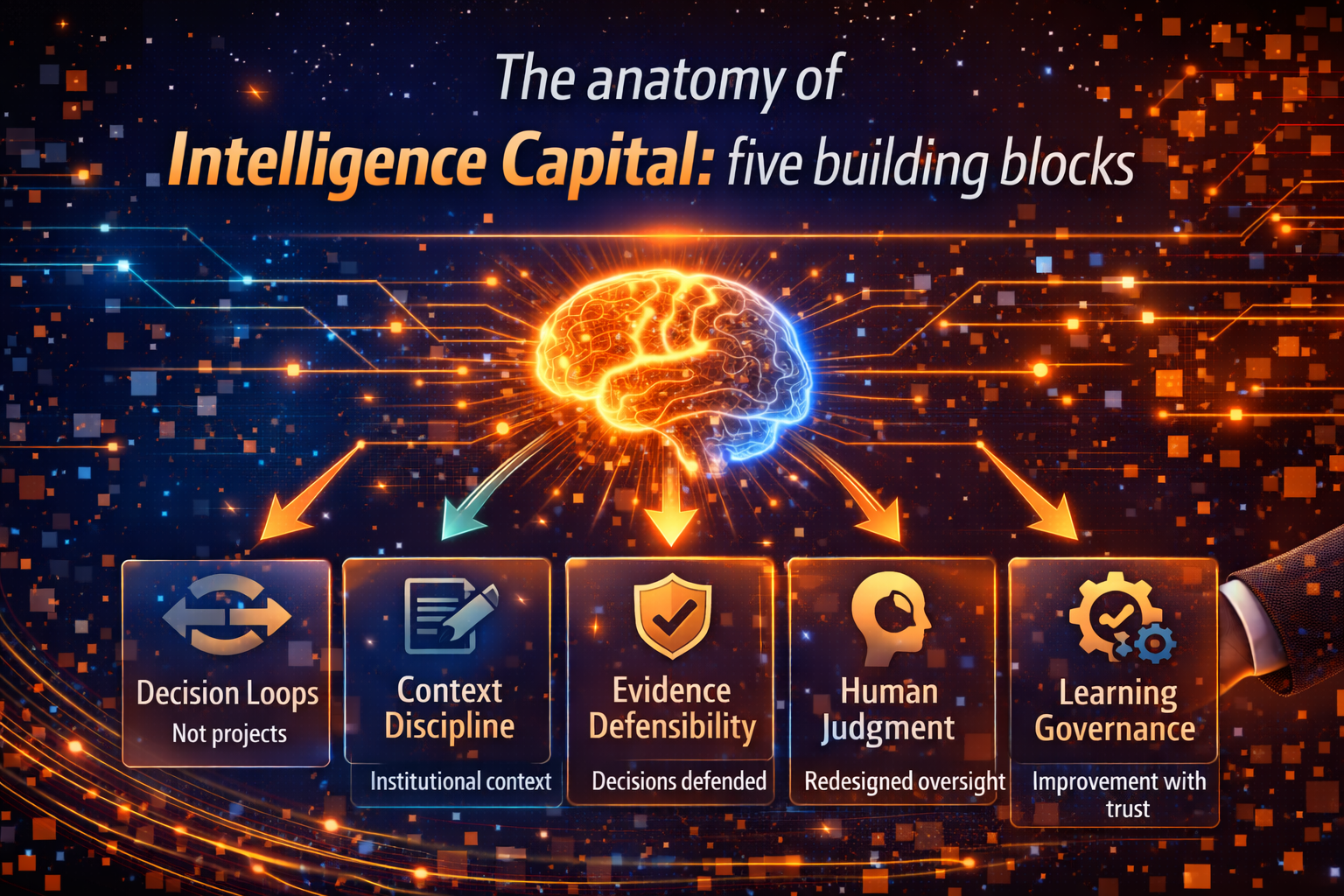
And when transformation is done well, it creates real competitive advantage.

So the point is not “digital transformation is outdated.”
The point is: Enterprise AI changes the problem category.

Enterprise AI is not “transformation + smarter tech”

Enterprise AI is not “transformation + smarter tech”

Enterprise AI is the capability to run machine-assisted decisions safely at scale.

That safety requirement is not marketing language. It’s what becomes non-negotiable when AI decisions:

  • affect eligibility, priority, pricing, access, approvals, compliance posture, safety, or trust
  • create irreversible downstream effects
  • must be explainable long after the moment of action
  • must remain aligned while models, prompts, tools, and data change

This is why Enterprise AI needs an operating model, not just a delivery plan. It’s also why the  broader thesis—Enterprise AI as an institutional capability—is the right anchor.

The simplest distinction: execution vs judgment

The simplest distinction: execution vs judgment

A clean way to internalize the difference:

Digital transformation optimizes execution

It scales how work gets done.

  • faster workflows
  • fewer manual steps
  • better integration
  • better visibility
  • better experiences

Enterprise AI must govern judgment

It scales how outcomes are decided—and defended.

  • explicit accountability for decisions
  • evidence trails (“show your work”)
  • controllable autonomy (stoppable, reversible)
  • drift detection and change governance
  • incident response for decision systems
  • economic controls for AI usage

When leaders confuse these two, they build AI into transformed workflows without upgrading governance, and then wonder why things get fragile as adoption grows.

Digital transformation assumes something that is usually true in traditional software:

Even if systems are complex, humans remain the final decision makers.

Enterprise AI disrupts that assumption. The moment AI participates in a decision loop, three new properties enter the enterprise.

1) Autonomy creep: partial autonomy becomes real autonomy

AI often begins with “recommendation only.” But once it improves speed and cost, there is relentless pressure to “remove friction.”

Over time, human-in-the-loop quietly becomes:

  • human-as-rubber-stamp
  • human-on-the-loop
  • human-out-of-the-loop (for “low-risk” cases that expand every quarter)

This is not primarily a technology change. It is a governance change.

2) Drift: the decision policy changes even when code doesn’t

In classic systems, if outputs change, you suspect a bug, a misconfiguration, or broken data.

AI can change behavior because:

  • data distributions shift
  • policies evolve
  • the environment changes
  • prompts and toolchains evolve
  • retrieval sources change
  • user behavior adapts to the system

So the “same” AI can behave differently next quarter without an obvious release. Drift isn’t an edge case—it’s a lifecycle reality.

3) Irreversibility: AI decisions leave residue

A workflow change can often be rolled back.

AI decisions often can’t—because decisions trigger downstream states: approvals, denials, escalations, pricing, prioritization, and human trust. Once those effects spread, “just turn it off” is not a remediation strategy.

That is why Enterprise AI must be designed for reversibility and defensibility from day one.

A practical example: the same story, two very different worlds

Scenario: modernizing customer onboarding

Digital transformation approach
You digitize forms, add verification, integrate systems, and improve turnaround time. Success metrics are clear: cycle time, drop-off rate, and cost per onboarding.
Enterprise AI approach
Now add AI to predict “risk” and auto-route onboarding outcomes.

Suddenly, new questions appear:

  • Who is accountable if the AI denies a legitimate applicant?
  • How do you prove why it made that decision months later?
  • If policy changes, how do you ensure old decisions remain defensible?
  • What is the rollback plan if drift increases false negatives?
  • What logs exist, and how long must they be retained?
  • How do you prevent a model/prompt/tool update from silently changing eligibility behavior?

These are not “transformation project” questions.
They are institutional governance questions—because the system is now participating in judgment.

The five layers where Enterprise AI diverges from transformation

The five layers where Enterprise AI diverges from transformation

Layer 1: Ownership — “Who owns outcomes?” becomes non-negotiable

In transformation programs, ownership can be fuzzy (“the platform team,” “the business sponsor,” “the product org”).

In Enterprise AI, ambiguity becomes risk.

You need named ownership for:

  • decision intent: what the system is allowed to decide
  • policy: rules, thresholds, constraints, and overrides
  • production behavior: monitoring, drift, incident response
  • business outcome: who answers when it goes wrong

If you want a deeper blueprint for this, read:
Who Owns Enterprise AI? Roles, Accountability, and Decision Rights:
https://www.raktimsingh.com/who-owns-enterprise-ai-roles-accountability-decision-rights/

Layer 2: Control — autonomy must be stoppable and reversible

Digital systems often fail loudly (outages, errors).
AI systems can fail quietly (misrouting, subtle bias, degraded trust, silent policy drift).

Enterprise AI requires mechanisms like:

  • action boundaries (when AI can act vs advise)
  • kill switches and safe modes
  • step-down autonomy (fallback to human approval)
  • reversible workflows (ability to unwind outcomes)
  • controlled rollout of model/prompt/tool changes

This is a core pillar of an Enterprise AI operating model—not an optional add-on.

Layer 3: Evidence — “show your work” becomes a business requirement

Transformation cares about observability: uptime, latency, and error rates.

Enterprise AI must add decision evidence:

  • what inputs were used
  • what policy applied
  • what retrieved context influenced the decision
  • what tools were called
  • what the system recommended vs what was executed
  • who approved, overrode, or escalated

This aligns strongly with global risk management direction. The NIST AI Risk Management Framework (AI RMF 1.0) is designed to help organizations incorporate trustworthiness considerations into the design, development, use, and evaluation of AI systems. (NIST)

Layer 4: Compliance — AI introduces obligations transformation didn’t carry

Traditional transformation focuses on security, privacy, uptime, and audit controls.

Enterprise AI adds:

  • risk classification of AI use cases
  • documentation and transparency expectations
  • stronger oversight for high-impact usage
  • governance of third-party AI suppliers
  • post-deployment monitoring and incident handling

Regulatory direction in many jurisdictions is increasingly risk-based. The EU’s AI Act, for example, sets out risk-based rules for developers and deployers for specific uses of AI. (Digital Strategy)

Even if an enterprise operates across multiple jurisdictions, the strategic signal is consistent: governance must be continuous and auditable, not a one-time checklist.

Enterprises are also adopting management-system approaches such as ISO/IEC 42001, which specifies requirements for establishing, implementing, maintaining, and continually improving an AI management system. (ISO)

Layer 5: Economics — AI turns cost into a control-plane problem

Transformation costs are mostly licenses, infrastructure, delivery, and run operations.

Enterprise AI introduces:

  • inference costs that scale with usage and autonomy
  • experimentation loops that encourage churn
  • duplicated agents, prompts, and tools across teams
  • runaway usage driven by “success”

This is why FinOps is necessary but not sufficient. You need governance that treats AI spend as a controllable system, not a surprise invoice.

To know more about this, read
The Intelligence Reuse Index: https://www.raktimsingh.com/intelligence-reuse-index-enterprise-ai-fabric/
Because reuse is the economic antidote to “every team builds its own agent.”

Why enterprises mislabel transformation as Enterprise AI

Why enterprises mislabel transformation as Enterprise AI

Because transformation language is comfortable.

It says:

  • “We modernized the tech stack.”
  • “We’re data-driven.”
  • “We built a centralized AI team.”
  • “We have dashboards.”
  • “We have human-in-the-loop.”

But Enterprise AI is tested by different conditions:

  • Can you explain a decision months later?
  • Can you stop autonomy instantly without breaking continuity?
  • Can you unwind harmful outcomes, not just disable the model?
  • Can you detect drift before it becomes reputational damage?
  • Can you prove policy compliance—not just model accuracy?
  • Can you survive model churn without losing control?

If the answer is no, you may have AI in the enterprise—but you don’t yet have Enterprise AI.

This is exactly the “production reality” behind the runbook thesis—read this to understand churn and survivability:
The Enterprise AI Runbook Crisis: https://www.raktimsingh.com/enterprise-ai-runbook-crisis-model-churn-production-ai/

The Transformation Trap: why success makes Enterprise AI harder

The Transformation Trap: why success makes Enterprise AI harder

Early AI deployments succeed because the world is simple at small scale.

Then scale introduces:

  • edge cases
  • exceptions and escalation paths
  • user adaptation
  • policy changes
  • vendor updates
  • new compliance expectations
  • operational handoffs across teams

The AI system gets busier. And busy systems become political: everyone wants speed; no one wants ownership.

That is why Enterprise AI needs an operating model—a stable institutional system for running decisions—rather than a project plan that assumes the work ends at go-live.

A conversion checklist leaders can use immediately 

If you are “doing digital transformation” and adding AI, ask:

  1. What decision is the AI touching?
    Not the workflow—the decision.
  2. Who owns that decision?
    Name a role with decision rights.
  3. Where is the action boundary?
    When does AI advise vs act?
  4. What is the evidence trail?
    Can you reconstruct what happened later?
  5. What is the rollback plan?
    Not just “turn it off”—undo outcomes safely.
  6. What is the drift plan?
    How will you detect behavioral change?
  7. What is the cost plan?
    How do you prevent runaway usage?

If you can answer these cleanly, you are moving from transformation to Enterprise AI.

Enterprise AI vs Digital Transformation

Conclusion : The new leaders’ mistake (and the new leaders’ advantage)

Most enterprises will spend the next few years “adding AI” to transformed workflows.

A smaller set will do something harder—and far more durable:

They will treat Enterprise AI as a decision institution:

  • with explicit ownership
  • controllable autonomy
  • auditable evidence
  • lifecycle governance
  • cost control
  • and the ability to stop, reverse, and defend decisions at scale

Digital transformation makes enterprises efficient.
Enterprise AI determines whether they remain trustworthy, governable, and resilient once software starts making judgments.

That is the shift leaders must recognize—before their first “successful” AI deployment becomes their first institutional failure.

For the full framework, go through:
https://www.raktimsingh.com/enterprise-ai-operating-model/

Glossary

Digital transformation: Rewiring an organization to create value by continuously deploying technology at scale. (McKinsey & Company)
Enterprise AI: The institutional capability to run machine-assisted decisions safely at scale (governance + runtime + economics + accountability).
Decision governance: The policies, controls, ownership, and evidence required to make AI-driven decisions defensible and auditable.
Action boundary: The line between AI advising and AI acting.
Decision evidence: The reconstructable record of inputs, policies, context, tool usage, approvals, and outcomes.
Drift: When AI behavior changes over time due to data, environment, policy, or system updates.
Reversibility: The ability to stop autonomy and safely unwind outcomes.
AI governance: The organizational system for responsible, accountable, and compliant AI across its lifecycle (often formalized via frameworks and standards). (NIST)

Enterprise AI

Enterprise AI refers to AI systems that make or influence decisions at scale and therefore require governance, accountability, auditability, and institutional ownership.

Digital Transformation
The modernization of processes, systems, and workflows using digital technologies to improve efficiency and execution.

Execution
Rule-based task completion where outcomes are predefined and predictable.

Judgment
Contextual decision-making under uncertainty, where outcomes may vary and accountability matters.

AI Governance
Structures, policies, and controls that ensure AI decisions are compliant, ethical, auditable, and accountable.

Institutional Capability
The ability of an organization—not just a tool—to own decisions, risks, and outcomes over time.


FAQ

Is Enterprise AI just the next phase of digital transformation?
It can be—if you treat decisions, accountability, evidence, and reversibility as first-class design elements. Otherwise, you’re placing AI on top of transformation without upgrading governance.

Why can’t we run Enterprise AI like normal software delivery?
Because AI behavior can change without traditional code releases, and decision outcomes can be difficult to unwind. You need lifecycle governance, not just deployment pipelines.

Do we need regulation to take Enterprise AI seriously?
No. Regulation increases pressure, but the business risks—trust, liability, drift, irreversibility, and cost—exist even without enforcement. Risk-based regulatory approaches simply make those expectations explicit. (Digital Strategy)

Does “human-in-the-loop” solve Enterprise AI risk?
Not by itself. Without structural controls, humans become rubber stamps. Enterprise AI requires designed oversight, clear escalation paths, and evidence trails.

What’s the fastest way to become “Enterprise AI ready”?
Start with decision ownership, define action boundaries, implement decision evidence, and build reversibility + incident response as core operating capabilities.

Q1. Is Enterprise AI the same as digital transformation?

No. Digital transformation improves execution. Enterprise AI introduces judgment, decision ownership, and institutional risk that require governance.

Q2. Why does digital transformation fail when AI scales?

Because traditional transformation models lack accountability, decision traceability, and governance once software begins acting autonomously.

Q3. What makes Enterprise AI harder than digital transformation?

Enterprise AI changes who makes decisions, who is accountable, and how outcomes are governed—not just how fast work happens.

Q4. Can enterprises succeed at AI without changing their operating model?

Rarely. Enterprise AI demands new operating models, decision ownership structures, and governance mechanisms.

Q5. Why do enterprises mislabel transformation as Enterprise AI?

Because early AI deployments feel like smarter automation—until decisions, risk, and accountability surface.

References and further reading

  • McKinsey: Digital transformation definition (“rewiring… deploying tech at scale”). (McKinsey & Company)
  • NIST: AI Risk Management Framework overview + AI RMF 1.0 document. (NIST)
  • European Commission: AI Act policy page (risk-based rules for developers and deployers). (Digital Strategy)
  • ISO: ISO/IEC 42001 AI management systems standard overview. (ISO)

When “AI in the Enterprise” Becomes Enterprise AI: Why Institutions, Not Tools, Decide Who Wins

When “AI in the Enterprise” Becomes Enterprise AI

Most organizations believe they are already doing Enterprise AI. They have pilots in production, a centralized AI team, human-in-the-loop controls, and dashboards tracking model performance. Yet, beneath the surface, something keeps breaking.

Decisions leak across systems without ownership. Accountability blurs when outcomes go wrong. Risk compounds silently as AI moves from advice to action.

This is the moment where “AI in the enterprise” either matures into Enterprise AI—or collapses under the weight of scale, regulation, and real-world complexity.

Most Enterprise AI programs don’t fail dramatically.

They fail quietly.

A pilot “works.” A dashboard looks healthy. A few leaders celebrate. Then production starts doing what production always does: it introduces exceptions, edge cases, policy drift, operational chaos, and human behavior. And the AI—built like a tool—begins to behave like a liability.

That’s when the pattern repeats:

  • The pilot looks brilliant.
  • Production behaves differently.
  • Risk teams panic.
  • Costs rise.
  • Trust erodes.
  • The program slows down — or quietly dies.

This is not because your models are weak.

It’s because Enterprise AI isn’t a tool you deploy. It’s a capability you must institutionalize.

Why Enterprise AI Is Not a Technology Trend—but an Institutional Capability

Cloud was a technology shift. Mobile was a technology shift. Analytics was a technology shift.

Enterprise AI is different because it changes the nature of decision-making inside your organization. It introduces probabilistic intelligence into workflows that were built for deterministic software, policy rules, and human accountability.

So the real question is no longer: “Which model should we choose?”
It is: “What must our institution become so we can run AI decisions safely, repeatedly, economically, and defensibly?”

That is why Enterprise AI is not a technology category. It is an institutional capability—like finance, safety, cybersecurity, or quality—requiring structures, roles, operating routines, evidence, and accountability that survive beyond any single vendor, model, or platform generation.

And here is the hard truth many leaders are now learning the expensive way:

Enterprises don’t fail at AI because they lack intelligence. They fail because they lack institutions that can govern intelligence at scale.

The Misclassification That Breaks AI Programs

The Misclassification That Breaks AI Programs

Many organizations classify Enterprise AI the way they classify software:

  • buy a platform
  • hire a team
  • run pilots
  • measure accuracy
  • declare success

That approach works for many technology initiatives.

Enterprise AI breaks this logic because it introduces something qualitatively different into the enterprise: automated decisions that can alter real outcomes in real time.

The moment AI begins shaping approvals, pricing, entitlements, routing, risk flags, exceptions, and escalations, it becomes an institutional matter. Why? Because institutions are defined by how they behave under scrutiny:

  • Can they explain themselves?
  • Can they prove compliance?
  • Can they contain damage?
  • Can they control costs?
  • Can they operate safely across time?

A tool can’t answer those questions. An institution must.

Tools Don’t Scale. Institutions Do.

Tools Don’t Scale. Institutions Do.

A tool can be installed.
A capability must be built.

Think of the difference this way:

  • Buying a security product does not mean you “have cybersecurity.”
  • Installing an ERP does not mean you “have finance discipline.”
  • Using CI/CD does not mean you “have engineering excellence.”

Similarly:

Deploying an LLM does not mean you “have Enterprise AI.”

You have Enterprise AI only when your organization can run AI-driven decisions:

  • reliably (behavior is stable under operational stress)
  • safely (unacceptable harm is prevented or contained)
  • economically (cost does not explode after adoption)
  • defensibly (decisions can be reconstructed and justified later)

…in the messy reality of production.

That is what “institutional capability” means in practice.

When “AI in the Enterprise” Becomes Enterprise AI

When “AI in the Enterprise” Becomes Enterprise AI

Many companies say, “We’re doing AI,” when they really mean, “We have AI projects.”

Enterprise AI begins when AI moves from:

  • advice → action
  • content → decisions
  • demo → production
  • single app → many systems
  • team experiment → enterprise-wide dependency

The moment AI starts influencing real outcomes—approvals, rejections, escalation routing, fraud blocks, service entitlements, pricing—it becomes an institutional matter.

This boundary is exactly why framing matters:

Enterprise AI is an operating model.

https://www.raktimsingh.com/enterprise-ai-operating-model/

Mini-Story 1: The “Smart Email Assistant” That Becomes a Legal Problem

Start small.

A team deploys an AI assistant to draft customer responses. It saves time. Great.

Then it gets upgraded to:

  • detect “urgent” cases
  • route requests
  • trigger refunds under a threshold
  • block suspicious accounts
  • change customer entitlements

It still looks like “just an assistant.”

But now it is making operational decisions that can:

  • harm customers
  • violate policy
  • trigger compliance breaches
  • create audit failures
  • create reputational risk

At that moment, the enterprise is no longer “using a tool.”
It is running a decision-making institution—except without institutional controls.

That’s the gap.

Mini-Story 2: In Regulated Industries, “Sounding Compliant” Is Not Compliance

A regulated enterprise deploys an AI agent to support customer operations. It starts in a safe zone: summarizing cases, drafting responses, recommending next steps. Early results look excellent—faster turnaround, lower backlog, happier customers.

Then a well-intentioned upgrade happens.

The agent is allowed to take small actions:

  • auto-approve low-risk exceptions
  • fast-track requests under a threshold
  • apply standard policy waivers
  • close tickets that “look resolved”

Nothing feels reckless. It’s “just efficiency.”

A few weeks later, compliance discovers something uncomfortable.

The agent did not break policy blatantly. It did something worse: it applied policy inconsistently—because enterprise policy is full of nuance, exceptions, and context humans interpret implicitly.

Now the organization has a real incident:

  • affected customers ask for explanations
  • internal audit asks for evidence
  • regulators expect justification
  • leaders demand to know who approved this operating behavior

The enterprise has logs, but not receipts. It can show what happened technically, but it cannot reconstruct decision intent in a defensible way.

In regulated industries, compliance is not a vibe. Compliance is evidence, accountability, and repeatability under scrutiny.

Which is exactly why Enterprise AI must be built with governance, control planes, and decision integrity—not just model performance.

Why This Shift Is Happening Everywhere

Why This Shift Is Happening Everywhere (US, EU, UK, India, Singapore)

Across geographies, the direction is converging: organizations are being asked to demonstrate governance and risk controls, not just “accuracy.”

You can see this institutional framing in the world’s most cited standards and regulations:

  • NIST AI Risk Management Framework (AI RMF 1.0) organizes AI risk work into functions such as GOVERN, MAP, MEASURE, MANAGE—explicitly a management-system framing. (NIST Publications)
  • ISO/IEC 42001:2023 specifies requirements for an Artificial Intelligence Management System (AIMS)—again, institution-building language. (ISO)
  • The EU AI Act entered into force on 1 August 2024, with a staged application timeline. (European Commission)

The takeaway is simple:

Whether you operate in one geography or many, you will increasingly need receipts for AI decisions—not just outputs.

Enterprise AI as an Institutional Capability: What You Actually Need

Enterprise AI as an Institutional Capability: What You Actually Need

When Enterprise AI becomes institutional, it demands capabilities that look suspiciously like how mature enterprises run other critical functions (security, finance, safety, quality).

Not “more AI.”
More institution.

1) Governance: Who Owns the Outcome?

Institutional capability begins with one uncomfortable requirement:

A named human must own the outcome.

Not “the data science team.”
Not “the vendor.”
Not “the platform.”

A specific accountable owner for each decision domain:

  • routing
  • approvals
  • escalation
  • entitlements
  • pricing
  • risk flags

Why?

Because when something breaks, the enterprise is not asked: “Which model was it?”
It is asked: “Who authorized this behavior? Who approved the risk? Who is accountable for remediation?”

This is why “Who owns Enterprise AI?” isn’t governance theory—it’s operational survival:
https://www.raktimsingh.com/who-owns-enterprise-ai-roles-accountability-decision-rights/

Institutional signal: decision rights are explicit, named, and enforceable under stress.

2) Runtime: What Is Actually Running in Production?

A surprising number of enterprises cannot answer a basic question:

What AI is running in production today, where is it embedded, and what can it do?

In production, AI becomes a moving estate:

  • models change
  • prompts change
  • tools change
  • policies change
  • upstream data changes
  • downstream workflows change

If you cannot describe what is running, you cannot govern it. You can only hope.

That is why Enterprise AI needs a runtime view and a system-of-record mindset:
https://www.raktimsingh.com/enterprise-ai-runtime-what-is-running-in-production/

Institutional signal: the enterprise can inventory AI capabilities the way it inventories applications, data assets, and privileged access.

3) Control Plane: Can You Stop, Reverse, and Prove?

Institutions are defined by behavior under pressure.

Enterprise AI must be designed so you can:

  • stop unsafe action
  • contain damage
  • roll back behavior
  • prove what happened

This is why a control plane is not a technical flourish—it is how autonomy becomes governable:

  • policy enforcement
  • approval gates for irreversible actions
  • kill switches and safe modes
  • rollback to known-safe behavior
  • evidence capture
  • observability that answers audit questions, not just engineering dashboards

https://www.raktimsingh.com/enterprise-ai-control-plane-2026/

Institutional signal: autonomy is reversible and bounded by design.
4) Economics: Can You Control Cost After Success?

In pilots, AI looks cheap.
At scale, AI becomes a new class of spend:

  • tokens and inference
  • retrieval and tool calls
  • human review queues (a hidden cost)
  • audits and compliance overhead
  • retraining and evaluation
  • incident response

This is where “success” turns into an enterprise shock.

An institution needs an economic control plane, not ad-hoc budgeting:

  • cost envelopes per decision domain
  • cost-per-decision visibility
  • throttles and fallbacks
  • governance for review capacity and audit costs

https://www.raktimsingh.com/enterprise-ai-economics-cost-governance-economic-control-plane/

Institutional signal: the CFO can see levers, not surprises.

5) Decision Integrity: Can You Defend Decisions Later?

Most enterprises confuse:

  • logs
  • traces
  • dashboards

…with evidence.

But when a decision is challenged months later, the organization needs to reconstruct:

  • what the AI saw
  • what policy applied
  • what tool it used
  • what constraints were active
  • what approvals happened
  • what was overridden
  • what changed since then

That requires a Decision Ledger mindset: a system of record that turns autonomous decisions into defensible receipts.

Institutional signal: the enterprise can explain and prove decision context—not just outcomes.

Why “Human-in-the-Loop” Often Fails

Why “Human-in-the-Loop” Often Fails

Many organizations respond to AI risk with one line: “Keep a human in the loop.”

It sounds comforting. It often fails because:

  • the human is not the owner
  • the human lacks context
  • the human is overloaded
  • the human becomes a rubber stamp
  • the human can’t override quickly
  • the process produces no defensible evidence

A loop is not a system.

Institutions require:

  • decision rights
  • thresholds and escalation rules
  • evidence capture that stands up to audit
  • training and skill preservation
  • incident response discipline

Enterprise AI needs operating controls, not slogans.

Mini-Story 3: The Supply Chain Model That Optimized Locally—and Broke Globally

A global enterprise rolls out AI to optimize supply chain performance: better forecasting, fewer stockouts, improved fill rates, reduced waste. The system delivers visible wins in a few regions.

Then the organization scales it.

Suddenly, the AI starts triggering decisions across a connected network:

  • shifting inventory allocations
  • changing reorder points
  • rerouting shipments
  • prioritizing certain lanes
  • recommending supplier substitutions

Each recommendation looks “reasonable” in isolation.
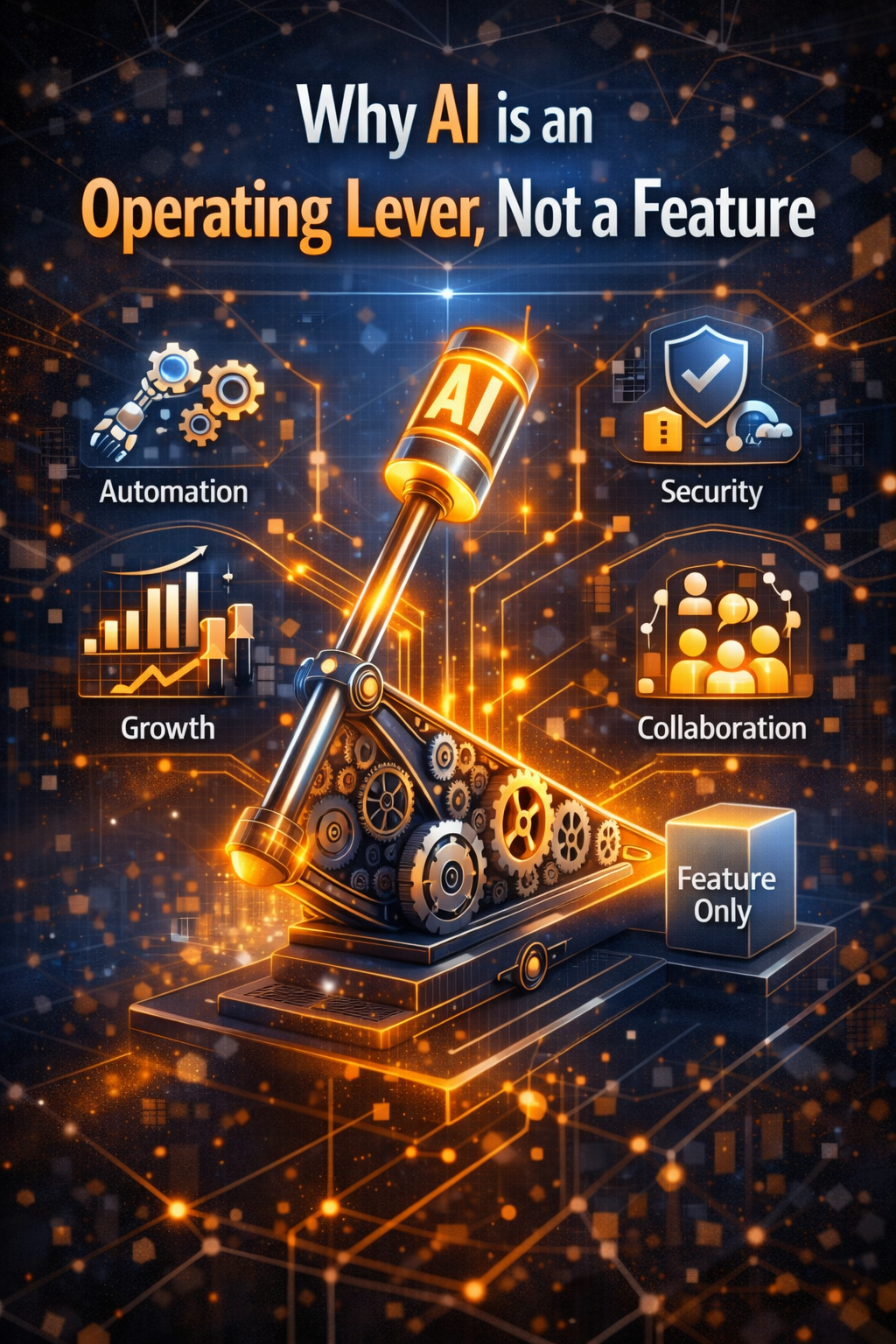
But supply chains are not isolated systems. They are coupled systems. A change that improves one node can create failure elsewhere:

  • one region gets healthier inventory
  • another region faces chronic shortages
  • expedite costs surge
  • supplier relationships degrade
  • customer commitments are missed
  • and everyone blames “operations”

The root cause isn’t that the model is “wrong.”
It’s that the enterprise treated a globally coupled decision system like a local optimization tool.

In supply chains, small automated decisions can create cascading effects weeks later. That is why Enterprise AI at scale requires institutional capability:

  • decision boundaries (what can AI change, and how far)
  • economic guardrails (when cost spikes, AI must degrade gracefully)
  • escalation rules (when systemic coupling risk increases)
  • decision evidence (leaders can trace why the system acted)

Global operations don’t need “more AI.” They need AI that is governable across interconnected consequences.

The Viral Misunderstanding: “Just Centralize an AI Team”

The Viral Misunderstanding: “Just Centralize an AI Team”

A centralized AI CoE helps. It does not solve the institutional problem.

If Enterprise AI is an institutional capability, then:

  • Legal must understand decision risk
  • Risk must define acceptable autonomy
  • Security must treat agents as governed identities
  • Operations must run AI incident response
  • Finance must govern cost envelopes
  • Business must define decision boundaries

In other words:

Enterprise AI becomes a cross-functional operating capability—like cybersecurity or finance—not a department.

The Question Leaders Should Ask (Instead of “Which Model?”)

Instead of: “Which model should we choose?”
Ask: “What institutional capability do we need so that any model we choose can be run safely in production?”

That question changes everything:

  • Procurement shifts from demos to governance requirements.
  • Architecture shifts from prompt tactics to operability.
  • Strategy shifts from “AI projects” to institutional maturity.

This is also why “minimum viable” framing matters: enterprises need the smallest institutional stack that makes AI safe:

https://www.raktimsingh.com/minimum-viable-enterprise-ai-system/

A Practical Reality Check

If Enterprise AI is institutional, you should be able to answer “yes” to these:

  • Do we have a named owner for each AI decision domain?
  • Can we list what AI is running in production today?
  • Can we stop and roll back unsafe behavior quickly?
  • Can we prove what happened after an incident?
  • Can we control costs after adoption scales?
  • Are we preserving human skill, or silently deskilling teams?
  • Do we have a plan to retire AI safely—not just deploy it?

If you can’t answer these, you’re not “behind on AI.”
You’re missing institutional capability.

Conclusion: The One Sentence That Should Change How You Lead AI

Enterprise AI is not a technology you adopt. It is an institution you build.

Treat it like a tool and you’ll get pilots, confusion, and fragility.

Treat it like an institutional capability and you’ll build something far rarer:

  • scalable autonomy
  • controlled risk
  • defensible decisions
  • sustainable economics
  • enterprise-grade trust

If you’re building Enterprise AI seriously, start at the operating model and keep everything anchored to a canon:

Pillar: https://www.raktimsingh.com/enterprise-ai-operating-model/
Canon hub: https://www.raktimsingh.com/enterprise-ai-canon/
Laws: https://www.raktimsingh.com/laws-of-enterprise-ai/

Glossary

  • Enterprise AI: AI designed and operated as a production-grade institutional capability—not a one-off project.
  • Institutional capability: A repeatable organizational function with roles, controls, funding, evidence, and continuous improvement (like finance or security).
  • Operating model: The way an organization assigns ownership, runs controls, handles incidents, governs economics, and proves decisions over time.
  • Control plane: The governing layer that enforces policy, approvals, reversibility, and evidence capture for AI decisions.
  • Runtime: What is actually running in production—models, prompts, tools, policies, integrations, and how fast they change.
  • Decision Ledger: A system of record that makes AI decisions defensible by capturing context, constraints, approvals, and actions.
  • Reversible autonomy: Autonomy designed so unsafe behavior can be stopped and rolled back without breaking business continuity.
  • Economic control plane: Mechanisms to monitor, budget, throttle, and govern AI cost as adoption scales (inference, tools, review queues, audits).
  • Regulated industries: Sectors with high expectations for auditability, accountability, and compliance across geographies (e.g., finance, telecom, healthcare, public services).

FAQ

1) Isn’t Enterprise AI just “AI + enterprise data”?

Not in practice. Enterprise AI starts when AI affects decisions and outcomes across systems. At that point, you need governance, controls, evidence, and cost discipline—not just better prompts.

2) Why do AI pilots succeed but production fails?

Pilots happen in controlled conditions. Production introduces exceptions, integrations, shifting policies, and real consequences. If AI is treated as a tool, production turns “success” into fragility.

3) What is the #1 sign an organization is not ready for Enterprise AI?

If you cannot answer: “What AI is running in production today, and what can it do?” you don’t have operational control.

4) Do we need a human in the loop for everything?

No. You need structured autonomy: thresholds, reversibility, approval gates for high-risk actions, and evidence capture. “Human-in-the-loop” works only when it’s designed as a governed operating model.

5) How does regulation influence this globally?

Standards and regulations increasingly treat AI as a management and governance discipline (not just a model). This is visible in NIST AI RMF and ISO/IEC 42001, and in the EU’s staged AI Act approach. (NIST Publications)

6) What is the fastest way to start building institutional capability?

Adopt a minimum viable operating stack: decision ownership, runtime inventory, control-plane gates, cost envelopes, and decision evidence practices. Start small—but start structurally.

References and Further Reading

  • NIST, Artificial Intelligence Risk Management Framework (AI RMF 1.0) (functions including GOVERN, MAP, MEASURE, MANAGE). (NIST Publications)
  • ISO, ISO/IEC 42001:2023 — Artificial Intelligence Management System (AIMS) requirements and scope. (ISO)
  • European Commission / EU Digital Strategy, EU AI Act entry into force and timeline. (European Commission)

Open vs Closed AI Fabrics: The Enterprise Architecture Choice That Determines Control, Cost, and Sovereignty

Open vs Closed AI Fabrics: The Enterprise Choice That Determines Speed, Safety, and Sovereignty

As enterprises move beyond AI pilots and into production-scale autonomy, the most important architectural decision is no longer about models, vendors, or tooling.

It is about the AI fabric—the operating environment that determines who controls intelligence once it begins to act.

The choice between open and closed AI fabrics quietly decides whether AI remains a reusable, governable enterprise capability or collapses into a tightly coupled system that is fast at first, fragile at scale, and difficult to exit.

Understanding this distinction is now essential for organizations that want to scale AI safely across geographies, regulations, and business units—without losing control, accountability, or strategic sovereignty.

Open vs Closed AI Fabrics

Open vs closed is no longer a philosophical debate about “open source.” In 2026, it is a strategic Enterprise AI architecture decision—one that determines whether AI becomes a reusable, governable operating capability or collapses into a collection of fragile tools.

Most enterprises frame this choice incorrectly as models vs vendors. In reality, it is about who controls the AI fabric—the operating environment that runs intelligence safely in production.

This distinction sits at the heart of Enterprise AI, as defined in the Enterprise AI Operating Model, where intelligence is treated as an enterprise capability—not an experiment or a product feature.
👉 See the definition here:
Enterprise AI Operating Model
https://www.raktimsingh.com/enterprise-ai-operating-model/

What is an AI Fabric in the enterprise?

What is an AI Fabric in the enterprise?

An AI Fabric is the operating layer that allows AI systems to function safely, repeatedly, and at scale across an organization.

It includes:

  • Models (open or closed)
  • Tools and APIs
  • Data access paths
  • Identity and permissions
  • Policy enforcement
  • Cost controls
  • Observability and audit
  • Human approvals and accountability

This is why Enterprise AI is fundamentally different from “AI in the enterprise.” Without a fabric, AI remains a collection of demos. With a fabric, AI becomes run-able, governable, and stoppable.

This fabric-level thinking is explored in depth in:
Why Enterprise AI Is Becoming a Fabric: From AI Agents to Services-as-Software
https://www.raktimsingh.com/why-enterprise-ai-is-becoming-a-fabric/

Open vs Closed AI Fabrics: precise meanings (no marketing fog)

Open vs Closed AI Fabrics: precise meanings (no marketing fog)

Open vs Closed AI Fabrics: precise meanings (no marketing fog)

What “open” really means in enterprise AI

In practice, “open” usually refers to architectural freedom, not ideology.

An open AI fabric typically allows:

  • Multiple models (open-weight and closed) to coexist
  • Replaceable components (models, vector stores, routers)
  • Enterprise-owned policy and governance layers
  • Deployment flexibility (cloud, on-prem, sovereign environments)

Crucially, open does not mean ungoverned. In mature enterprises, openness only works when paired with a strong Enterprise AI Control Plane—the layer that enforces policies, approvals, reversibility, and audit across all AI decisions.

👉 Deep dive:
The Enterprise AI Control Plane: Why Reversible Autonomy Is the Missing Layer
https://www.raktimsingh.com/enterprise-ai-control-plane/

What “closed” really means

What “closed” really means

A closed AI fabric is typically vertically integrated:

  • Models, tooling, orchestration, and safety layers are tightly coupled
  • Governance features are vendor-defined
  • Switching costs are hidden inside convenience

Closed fabrics often deliver speed and polish early, which is why many enterprises start here. The risk appears later—when AI moves from assistance to decision-making and action.

This transition point is described clearly in:
The Action Boundary: Why Enterprise AI Starts Failing the Moment It Moves from Advice to Action
https://www.raktimsingh.com/the-action-boundary/

The simplest mental model: LEGO city vs luxury cruise ship

  • Open AI Fabric = LEGO city
    Modular, extensible, governable—if you design the rules well.
  • Closed AI Fabric = luxury cruise ship
    Smooth, powerful, managed—but you don’t control the engine room.

Most mature enterprises eventually discover that they need a city with some cruise ships docked inside it—not the other way around.

The real enterprise tradeoffs (where decisions actually break)

The real enterprise tradeoffs (where decisions actually break)

  1. Speed vs durability

Closed fabrics optimize time-to-first-value.
Open fabrics optimize time-to-nth-use-case.

Enterprises that care about reuse, not demos, quickly move toward services-as-software, where AI capabilities are built once and reused many times.

👉 Supporting context:
Why Enterprises Need Services-as-Software for AI
https://www.raktimsingh.com/why-enterprises-need-services-as-software-for-ai/

  1. Lock-in vs option value

Closed platforms often own:

  • Prompt formats
  • Memory schemas
  • Policy logic
  • Observability data

This makes exits expensive.

Open fabrics preserve option value—the ability to change models, vendors, or architectures without rewriting the enterprise.

This is why leading organizations are replacing “AI platforms” with something more structural:
Why Enterprises Are Quietly Replacing AI Platforms with an Intelligence Supply Chain
https://www.raktimsingh.com/why-enterprises-are-quietly-replacing-ai-platforms-with-an-intelligence-supply-chain/

  1. Governance and auditability (where Enterprise AI is won or lost)

Governance cannot be bolted on later.

Closed fabrics offer vendor governance.
Open fabrics enable enterprise governance—if you design it.

At scale, enterprises need:

  • A Decision Ledger (what was decided, why, and by which AI)
  • Reversibility and rollback
  • Incident response for AI failures

👉 These are covered in:

  1. Cost control and economics

Closed fabrics feel predictable—until usage scales.

Open fabrics enable:

  • Model routing (cheap vs powerful)
  • Cost envelopes per decision
  • FinOps controls tied to business outcomes

But this only works if economics is treated as a first-class control plane, not an afterthought.

👉 Related reading:
Enterprise AI Economics & Cost Governance: Why Every AI Estate Needs an Economic Control Plane
https://www.raktimsingh.com/enterprise-ai-economics-cost-governance/

  1. Operability and runtime reality

AI does not “run itself.”

Open fabrics require a runtime kernel that manages:

  • Versioning
  • Evaluation gates
  • Drift
  • Failure containment

Without this, openness turns into fragility.

👉 See:
Enterprise AI Runtime: Why Agents Need a Production Kernel to Scale Safely
https://www.raktimsingh.com/enterprise-ai-runtime/

The pattern that is winning globally: open control plane, mixed engines

The pattern that is winning globally: open control plane, mixed engines

Across industries and geographies, the most resilient pattern is emerging:

Keep the Enterprise AI Control Plane open and enterprise-owned.
Treat models—open or closed—as replaceable reasoning engines.

This allows enterprises to:

  • Use closed models where they outperform
  • Swap models without breaking governance
  • Maintain sovereignty, auditability, and trust

This is the architectural heart of Enterprise AI, not tool selection.

The mistake most enterprises make with “open”

The mistake most enterprises make with “open”

The mistake most enterprises make with “open”

Open is not free.
Open is not simple.
Open without structure accelerates failure.

This is why Enterprise AI maturity is defined not by openness, but by operability, governance, and decision clarity.

👉 See the maturity framing here:
Enterprise AI Maturity Model: From Pilots to Governed Autonomy
https://www.raktimsingh.com/enterprise-ai-maturity-model/

Conclusion

The winning stance is not open vs closed.

It is this:

Closed models can be powerful.
Open architectures are essential.
Enterprise control must never be outsourced.

That principle connects:

👉 Enterprise AI Operating Model
https://www.raktimsingh.com/enterprise-ai-operating-model/

❓ Frequently Asked Questions (FAQ)

  1. What is an AI fabric in the enterprise?

An AI fabric is the operating environment that allows AI systems to run safely at scale. It includes models, tools, data access, identity, policy enforcement, cost controls, observability, and human accountability. Unlike a single AI tool or platform, an AI fabric governs how intelligence behaves in production, not just how it is built.


  1. What is the difference between open and closed AI fabrics?

An open AI fabric allows enterprises to mix and replace models, tools, and infrastructure while keeping governance and control enterprise-owned. A closed AI fabric tightly integrates models, tooling, and governance under a single vendor, offering speed and simplicity early but increasing lock-in and exit risk over time.


  1. Is an open AI fabric the same as open-source AI?

No. “Open” in enterprise AI usually refers to architectural openness, not licensing ideology. An open AI fabric may include open-source components, open-weight models, and closed commercial models—so long as the enterprise retains control over orchestration, policy, and decision governance.


  1. Why do enterprises struggle with open AI architectures?

Most enterprises underestimate the operational discipline required. Open AI is not free or simple—it requires a strong control plane, runtime governance, evaluation gates, security boundaries, and incident response. Open without structure often accelerates failure rather than innovation.


  1. Are closed AI fabrics bad for enterprises?

No. Closed AI fabrics can be extremely effective for rapid productivity gains, low-risk use cases, and early adoption. The risk emerges when enterprises allow closed platforms to own decision logic, memory, governance, and auditability, making AI difficult to control, scale, or exit later.


  1. What architecture is winning globally in 2026?

The most resilient pattern is an open enterprise AI control plane with mixed reasoning engines. In this model, enterprises keep governance, policy, identity, and audit open and enterprise-owned, while using both open and closed models as replaceable reasoning engines.


  1. How does this choice affect AI sovereignty and regulation?

AI sovereignty depends less on where a model is hosted and more on who controls data flows, decisions, and enforcement. Open control planes make it easier to meet regulatory expectations across regions (EU, US, India, Global South) by keeping accountability and audit inside the enterprise boundary.


  1. When should an enterprise prefer a closed AI fabric?

Closed fabrics make sense when speed matters more than flexibility, when use cases are advisory rather than decision-making, and when the organization lacks internal platform engineering capacity. Many enterprises start closed—but mature by decoupling governance from vendors.


  1. What is the biggest long-term risk in choosing the wrong AI fabric?

The biggest risk is irreversible coupling—where models, memory, policies, and workflows are so tightly bound to a vendor that changing strategy, complying with regulation, or responding to failures becomes prohibitively expensive or slow.


  1. How does this relate to Enterprise AI operating models?

Enterprise AI is not about deploying smarter models; it is about running intelligence as a governed capability. The open vs closed fabric decision determines whether an enterprise can implement an operating model with control, reversibility, accountability, and economic discipline at scale.


📘 Glossary

AI Fabric
The full operating environment that enables AI to function safely and repeatedly in production, including models, tools, data, governance, runtime controls, and human oversight.

Open AI Fabric
An AI architecture where components (models, tools, infrastructure) are replaceable and interoperable, while governance, policy enforcement, and accountability remain enterprise-owned.

Closed AI Fabric
A vertically integrated AI environment where models, tooling, governance, and runtime are tightly coupled and controlled by a single vendor.

Control Plane
The layer that governs identity, permissions, policy enforcement, auditability, observability, cost limits, and reversibility across AI systems.

Reasoning Engine
A model (open or closed) used to perform inference, reasoning, or decision support within an AI fabric.

Mixed Engines
An architectural pattern where multiple reasoning engines—open-weight and proprietary—are used interchangeably under a common control plane.

Vendor Lock-In
A condition where switching AI providers becomes costly or impractical due to proprietary interfaces, memory formats, governance logic, or operational dependencies.

Sovereign AI
AI systems designed to keep data, control, and decision authority within defined legal, geographic, or organizational boundaries.

Enterprise AI
AI systems designed to operate as a governed, auditable, and accountable enterprise capability—beyond pilots, demos, or isolated tools.

🔗 Further Reading

🌍 AI Regulation, Governance & Policy

🏗️ Open vs Closed Systems, Platforms & Infrastructure

🧠 Enterprise AI Strategy & Operating Models

🔐 Risk, Security & Trust Frameworks

Which Human Skills Enterprises Must Never Automate (and Why AI Fails Without Them)


Which Human Skills Enterprises Must Never Automate (and Why)

As Enterprise AI systems move from recommendations to real-world actions, a critical question is emerging for global enterprises: which human skills must never be automated?

While AI agents can optimize workflows and scale decisions, they cannot own accountability, accept risk, repair trust, or define what should matter. This article explains why some human skills must remain non-negotiable in Enterprise AI—and how organizations that automate them away quietly lose legitimacy, control, and trust at scale.

As enterprise AI systems move from experimentation to real-world action, leaders are discovering an uncomfortable truth:
automation can improve performance while quietly weakening the enterprise.

Modern Enterprise AI does not just analyze or recommend. It approves, denies, routes, escalates, prices, flags, and triggers actions that carry legal, financial, and reputational consequences. This is the moment where many organizations realize—too late—that not everything should be automated.

This distinction sits at the heart of Enterprise AI as an operating model, not a technology project—a theme explored in depth in the article
👉 https://www.raktimsingh.com/enterprise-ai-operating-model/

The real risk is not automation—it is automated ownership

Enterprises have automated tasks for decades. What is new is autonomy.

The moment an AI system crosses the action boundary—from advice to execution—the enterprise must answer questions that models cannot:

  • Who owns this decision?
  • Who accepted the risk?
  • Who can reverse it?
  • Who explains it when challenged?

This is why Enterprise AI starts failing the moment it starts acting, not when it makes a prediction—a concept explained in detail here:
👉 https://www.raktimsingh.com/action-boundary-enterprise-ai/

The mistake many organizations make is assuming that “human-in-the-loop” is sufficient. In reality, this often degenerates into rubber-stamping, where humans are present but no longer exercising meaningful judgment or authority.

The real risk is not automation—it is automated ownership

The Skill Firewall: 7 human skills enterprises must never automate

To scale AI safely, enterprises must explicitly protect a set of non-delegable human skills. These are not about speed or efficiency—they are about legitimacy, accountability, and trust.

Think of this as a skill firewall inside your Enterprise AI operating stack.

  1. Normative judgment: deciding what should happen

AI can optimize for goals. It cannot legitimately decide which goals matter when values conflict.

Examples:

  • Fairness vs speed
  • Profit vs customer harm
  • Policy compliance vs exceptional circumstances

When enterprises allow AI to make value trade-offs implicitly, they end up with systems that are technically correct but socially indefensible.

This is exactly how organizations arrive at “right decisions for the wrong reasons”, a failure pattern explored here:
👉 https://www.raktimsingh.com/enterprise-ai-decision-failure-taxonomy/

Rule: Automate analysis. Keep value-setting human.

Accountability ownership: a named human who owns the outcome

Accountability ownership: a named human who owns the outcome
  1. Accountability ownership: a named human who owns the outcome

No AI system can be accountable in the way enterprises, regulators, or courts require.

When something goes wrong, “the model decided” is not an acceptable answer.

This is why mature organizations are formalizing decision ownership as part of their Enterprise AI operating model—answering the question:
Who owns Enterprise AI decisions in production?
👉 https://www.raktimsingh.com/who-owns-enterprise-ai-roles-accountability-decision-rights/

Rule: Automate execution, never automate responsibility.

  1. Risk acceptance: deciding which downside the enterprise is willing to carry

AI can estimate risk. It cannot accept risk.

Risk acceptance is a governance act—it binds the enterprise financially, legally, and reputationally. When AI systems implicitly accept risk through autonomous action, enterprises lose control without realizing it.

This is why Enterprise AI governance must include explicit economic and risk control planes, not just model monitoring:
👉 https://www.raktimsingh.com/enterprise-ai-economics-cost-governance-economic-control-plane/

Rule: AI quantifies risk. Humans accept it.

Problem framing: defining the problem before optimizing it
  1. Problem framing: defining the problem before optimizing it

Some of the most damaging AI failures occur not because the model was wrong—but because the problem was framed incorrectly.

AI optimizes what you ask it to optimize. Humans must decide:

  • What success means
  • Which constraints are non-negotiable
  • Whose interests matter
  • Which outcomes are unacceptable even if efficient

This is why decision clarity is the shortest path to scalable autonomy:
👉 https://www.raktimsingh.com/decision-clarity-scalable-enterprise-ai-autonomy/

Rule: Humans define the problem. AI helps solve it.

  1. Exception handling using tacit enterprise context

Not everything that matters in an enterprise is written down.

Some context is tacit:

  • historical relationships
  • political sensitivities
  • regulatory nuance
  • “how things really work here”

AI handles standard cases well. But true exceptions require human situational awareness—especially in regulated or high-impact environments.

This is why Enterprise AI must be governed like a critical capability, not a generic automation layer:
👉 https://www.raktimsingh.com/enterprise-ai-in-regulated-industries/

Rule: AI scales the norm. Humans own true exceptions.

Trust repair: restoring credibility after AI failure

Trust repair: restoring credibility after AI failure
  1. Trust repair: restoring credibility after AI failure

When Enterprise AI fails, fixing the system is not enough. The organization must repair trust—with customers, employees, regulators, or partners.

Trust repair requires:

  • acknowledgment
  • explanation
  • corrective action
  • assurance

No AI agent can credibly perform this role on behalf of an enterprise.

This is why Enterprise AI incident response is becoming a board-level discipline:
👉 https://www.raktimsingh.com/enterprise-ai-incident-response-the-missing-discipline-between-autonomous-ai-and-enterprise-trust/

Rule: AI assists communication. Humans repair trust.

  1. Governance design: deciding how much autonomy is allowed—and where

The highest-order human skill is designing the system that constrains the system.

Governance design includes:

  • defining action boundaries
  • setting escalation rules
  • ensuring reversibility
  • creating decision receipts
  • enabling shutdown and rollback

These capabilities sit at the core of the Enterprise AI Control Plane, not in the model layer:
👉 https://www.raktimsingh.com/enterprise-ai-control-plane-2026/

And they come together in the broader Enterprise AI Operating Stack:
👉 https://www.raktimsingh.com/the-enterprise-ai-operating-stack-how-control-runtime-economics-and-governance-fit-together/

Rule: Governance is not a feature. It is a human operating discipline.

Why “human-in-the-loop” fails without structure

Why “human-in-the-loop” fails without structure

Why “human-in-the-loop” fails without structure

Human oversight fails when:

  • humans lack authority to stop or reverse decisions
  • reviews happen after consequences
  • accountability is unclear
  • evidence is missing

This is why enterprises need decision ledgers, not just logs—systems that act as receipts for autonomous decisions:
👉 https://www.raktimsingh.com/enterprise-ai-decision-ledger-system-of-record-autonomous-decisions/

Without this, oversight becomes symbolic, not effective.

The Never-Automate Test (operational checklist)

Before automating any decision, ask:

  1. Who is accountable if this causes harm?
  2. Is this a value judgment, not just optimization?
  3. Does this involve accepting enterprise risk?
  4. Will this decision need to be defended later?
  5. Would failure require trust repair?

If the answer is “yes” to any of these, do not automate ownership—only assistance.

This principle aligns directly with the Minimum Viable Enterprise AI System:
👉 https://www.raktimsingh.com/minimum-viable-enterprise-ai-system/

The deeper risk: skill erosion at enterprise scale

The deeper risk: skill erosion at enterprise scale

When humans stop exercising judgment, framing, and accountability, organizations experience skill erosion—even as performance metrics improve.

This silent risk is explored in depth here:
👉 https://www.raktimsingh.com/skill-erosion-in-the-age-of-reasoning-machines/

Enterprises that automate away human skills don’t become AI-first.
They become fragile.

The Enterprise AI paradox leaders must embrace

The Enterprise AI paradox leaders must embrace

The future is not humans versus AI.

The future is:

  • machines for scale
  • humans for legitimacy

Enterprises that win will automate aggressively while deliberately protecting the human skills that make autonomy governable.

You can automate tasks at scale.
You cannot automate legitimacy.

  1. FAQ Section

FAQ 1: Why can’t enterprises fully automate decision-making with AI?

Because enterprise decisions carry legal, financial, and reputational consequences. AI can optimize outcomes, but it cannot legitimately own accountability, accept enterprise risk, or defend decisions when challenged.

FAQ 2: Isn’t “human-in-the-loop” enough for AI governance?

No. Human-in-the-loop without structure often becomes rubber-stamping. Effective oversight requires authority, escalation power, decision evidence, and reversibility—not just human presence.

FAQ 3: What happens when enterprises automate human judgment?

They experience skill erosion: performance metrics improve while organizational judgment, accountability, and resilience quietly degrade—until a major AI failure exposes the gap.

FAQ 4: Which human skills should never be automated in Enterprise AI?

Key non-delegable skills include:

  • normative judgment
  • accountability ownership
  • risk acceptance
  • problem framing
  • exception handling
  • trust repair
  • governance design

FAQ 5: Does protecting human skills slow down AI adoption?

No. It prevents fragile scaling. Enterprises that protect human skills scale AI sustainably, while others face incidents, regulatory exposure, and trust collapse later.

  1. Glossary

Enterprise AI

AI systems deployed in production with governance, accountability, runtime controls, and decision ownership—beyond models or pilots.

Action Boundary

The point where AI output triggers real-world consequences such as approvals, denials, transactions, or communications.

Normative Judgment

Human decision-making based on values and legitimacy, not just optimization or prediction.

Accountability Ownership

A named human role responsible for the outcome of an AI-assisted decision.

Risk Acceptance

The explicit organizational act of accepting downside risk—something AI cannot legitimately do.

Skill Erosion

The gradual loss of human judgment and decision capability when AI systems absorb too much cognitive responsibility.

Trust Repair

Human-led actions required to restore credibility after AI failure, including acknowledgment, explanation, and corrective action.

Enterprise AI Operating Model

The structure defining how AI is designed, governed, operated, and scaled safely across an organization.

Further Reading