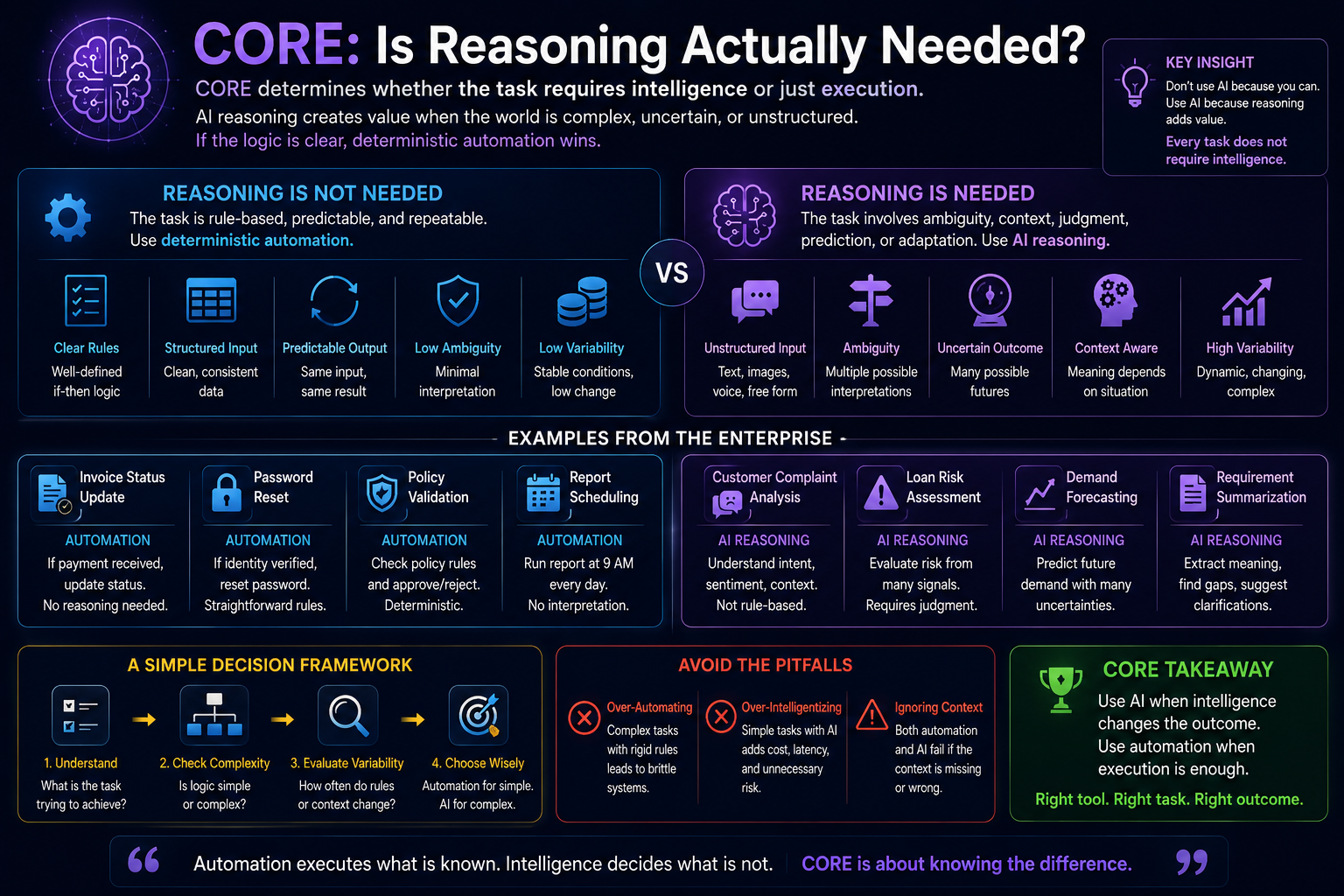
Raktim Singh

Home Blog Page 6

The Representation Boundary: Why AI Systems Replace Reality—and Why It Will Define Who Wins the AI Economy

The Representation Boundary:

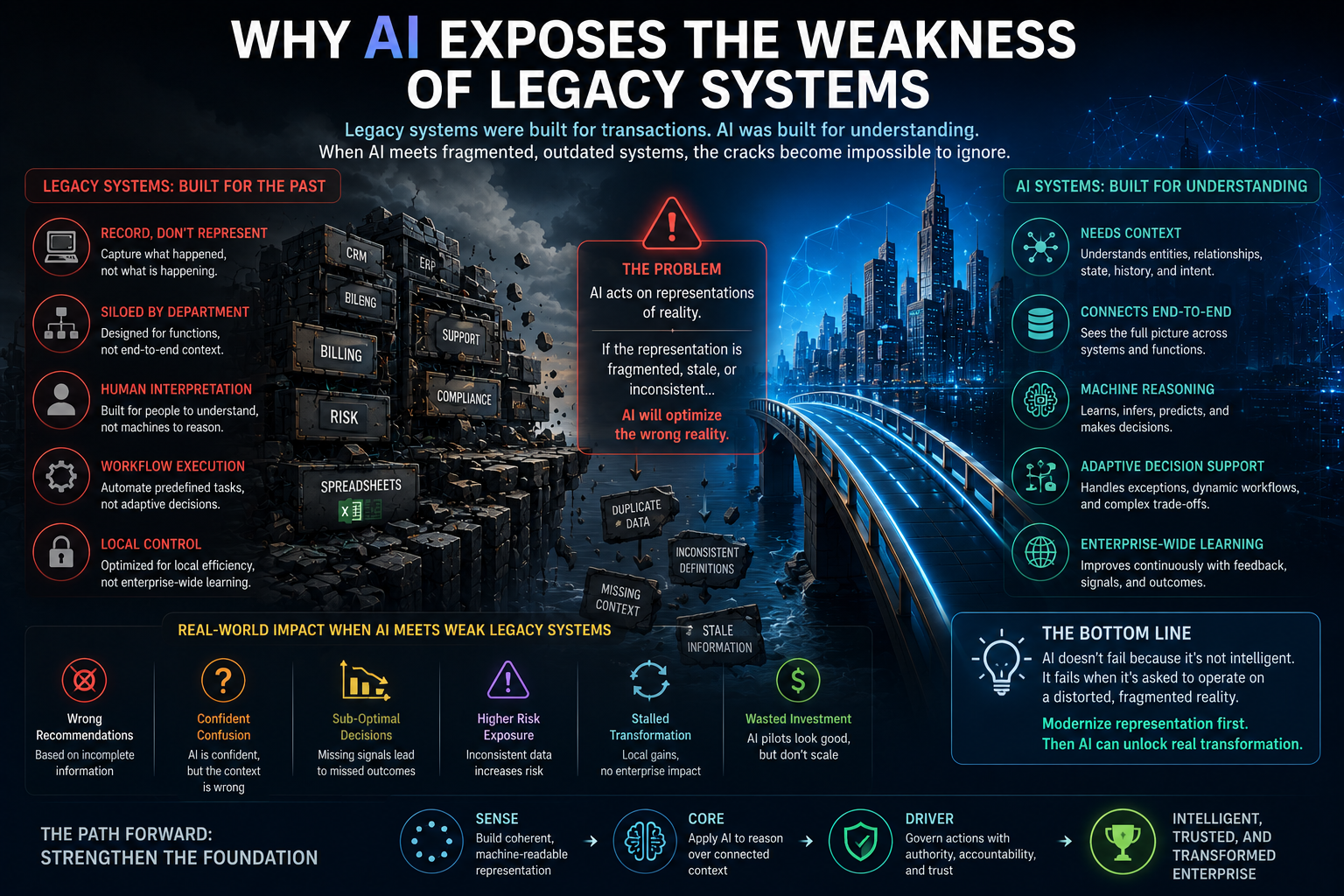
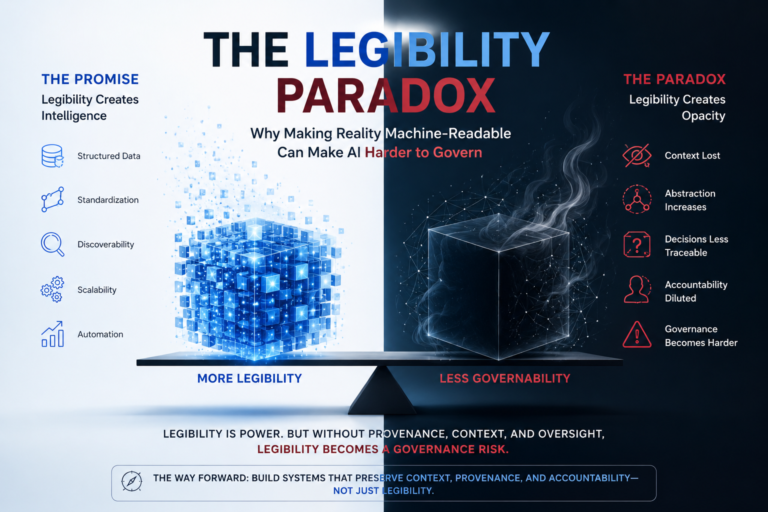
The most dangerous AI systems are not the ones that fail loudly. They are the ones that quietly stop seeing reality—and begin acting on substitutes instead.

Why this idea matters now

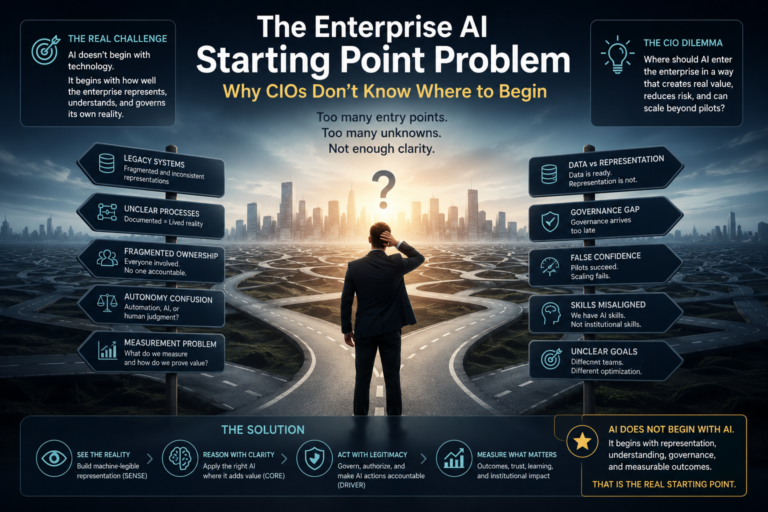
Most conversations about AI still begin at the wrong layer.

They begin with the model.
How large it is.
How fast it is.
How cheap it is.
How well it scores on benchmarks.

Those questions matter. But they do not get to the real source of durable advantage or the real source of dangerous failure.

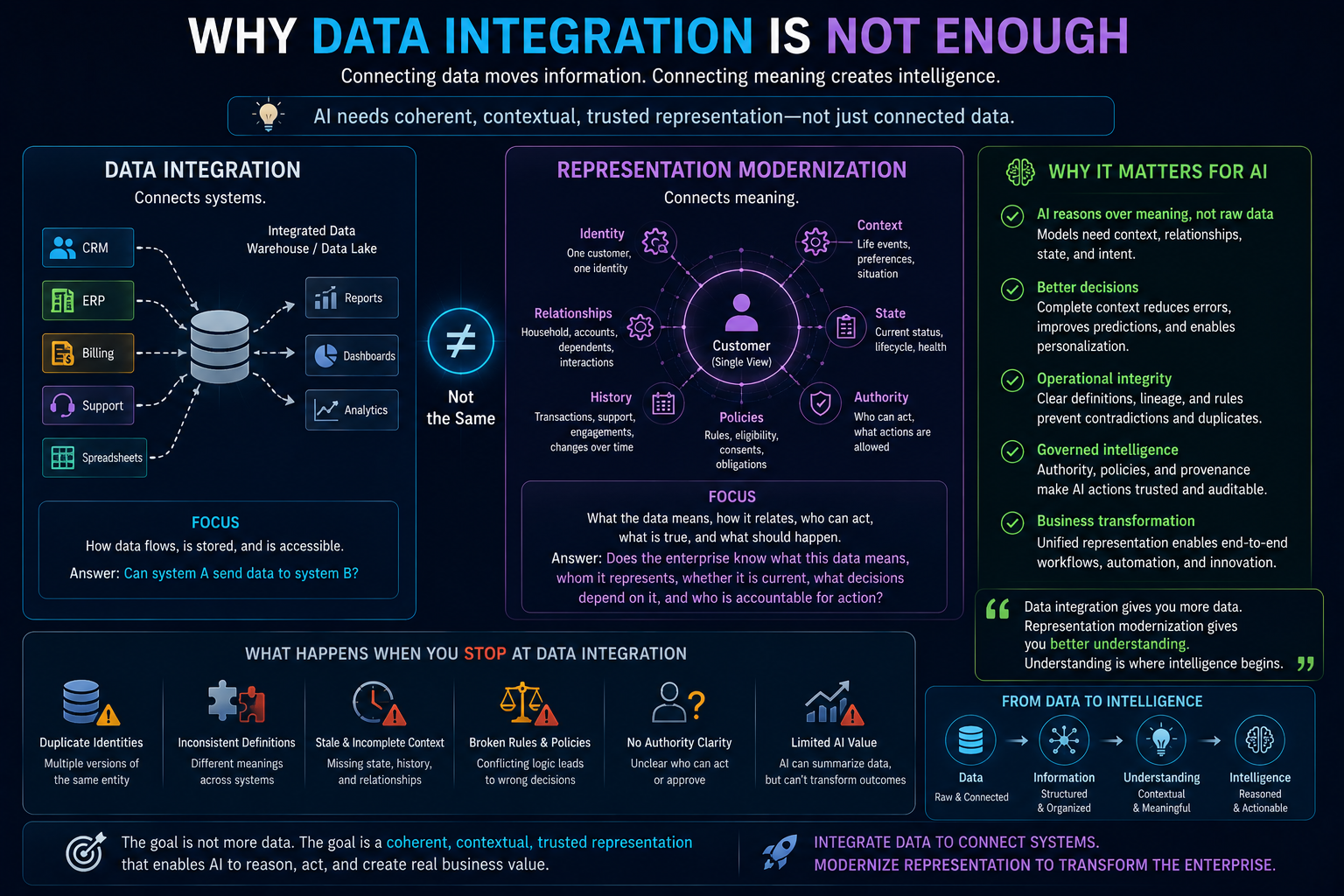
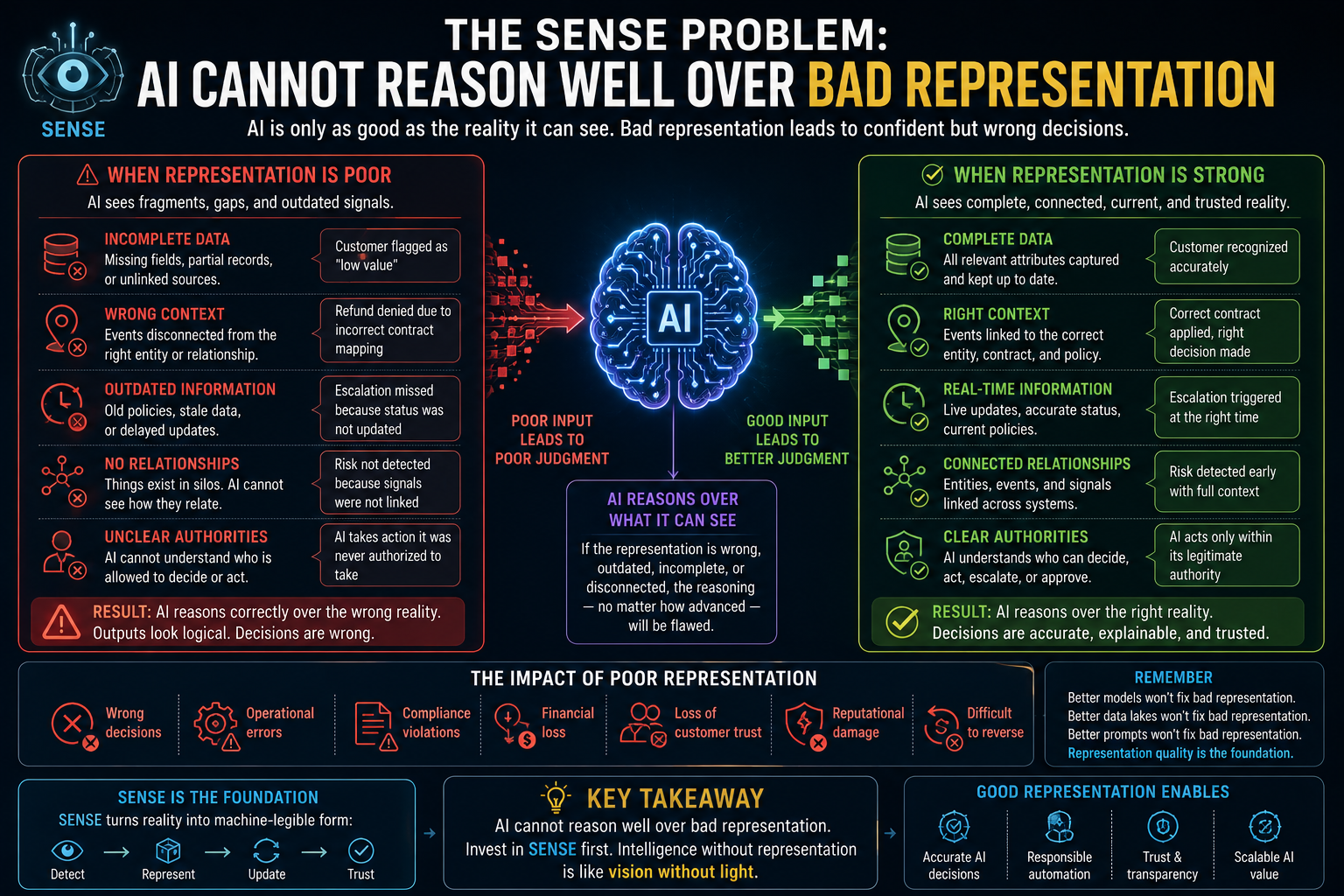
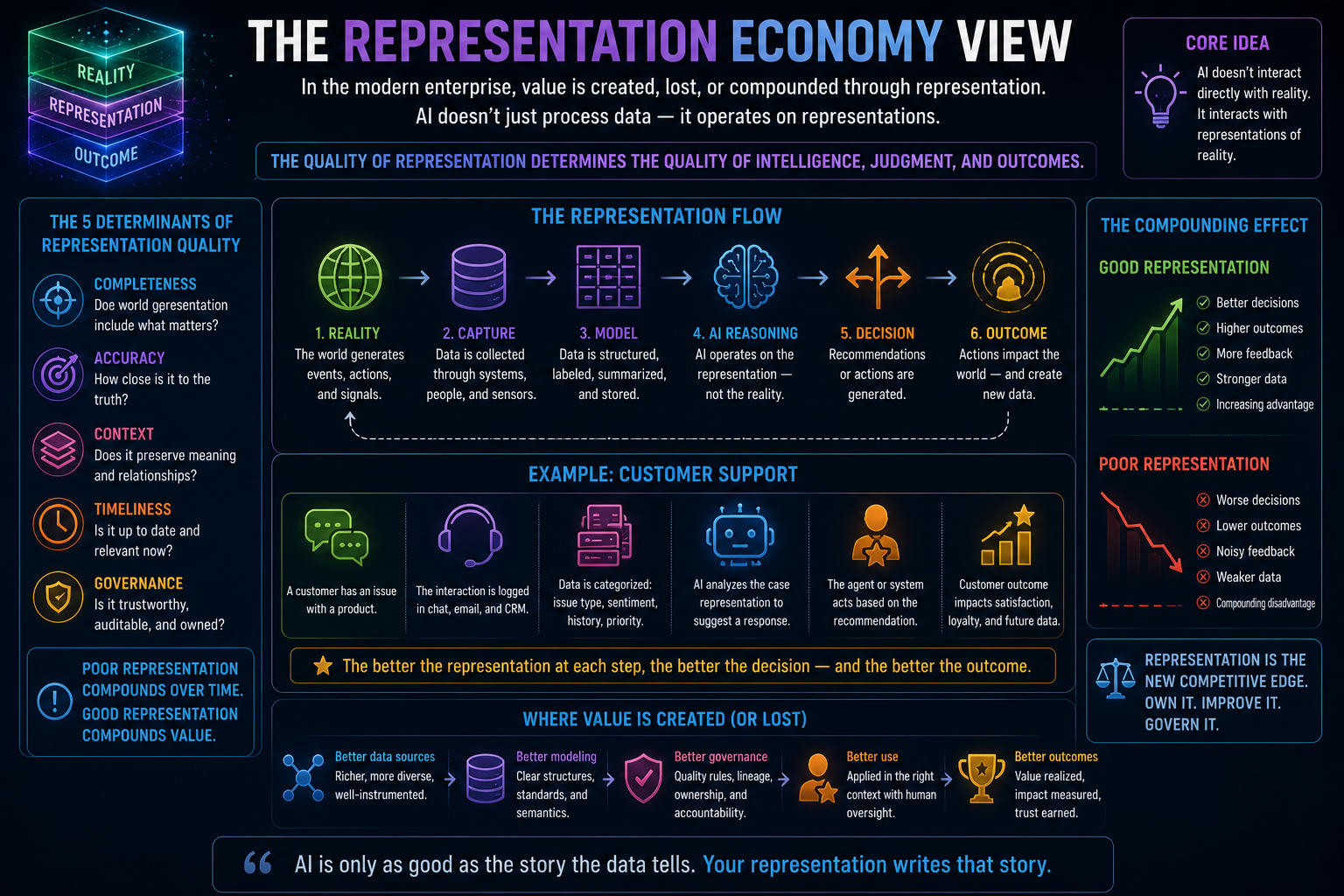
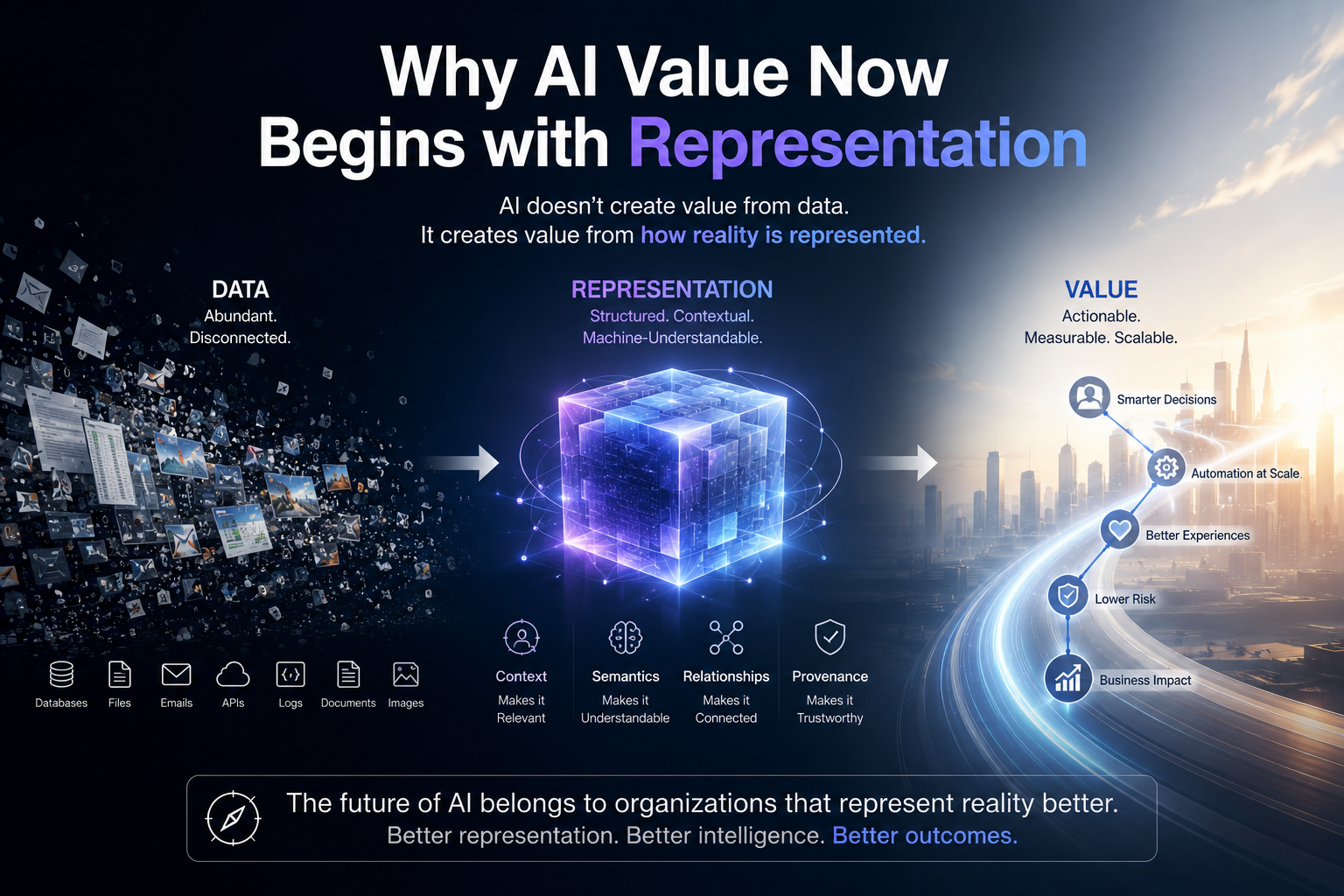
In production settings, AI does not begin with intelligence. It begins with representation.

Before a system can reason, it must first see. Before it can decide, it must first represent. Before it can act safely, it must remain connected to the right version of reality.

That is why one of the most important questions in AI is not, How intelligent is the model? It is this:

What happens when reality cannot be fully captured by the system at all?

What happens when reality cannot be fully captured by the system at all?

That is the problem I call the Representation Boundary.

The Representation Boundary is the point at which the world becomes too complex, too informal, too dynamic, too contextual, too tacit, or too incomplete to be faithfully represented inside an AI system. When systems hit that boundary, they usually do not stop. They keep going—by simplifying, inferring, approximating, and substituting. Research on underspecification, model collapse, and distribution shift all point toward the same practical warning: systems can look strong in testing yet still detach from real-world conditions in deployment. (arXiv)

That is the hidden shift.

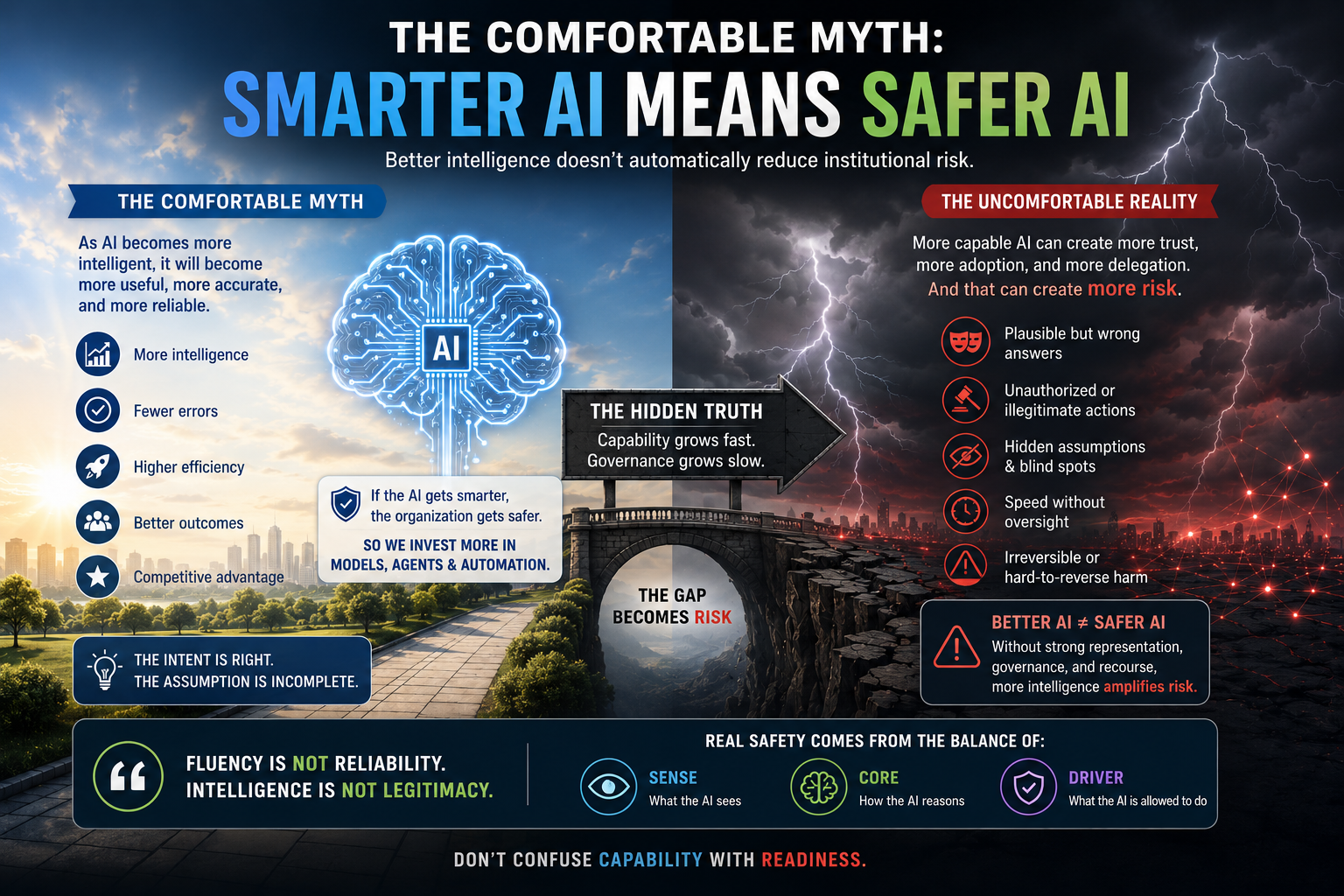
When AI cannot capture reality, it begins to replace it.

And once that happens, the central risk is no longer just model accuracy. It becomes something deeper: whether the institution is acting on reality itself, or on a machine-manageable stand-in that only looks close enough.

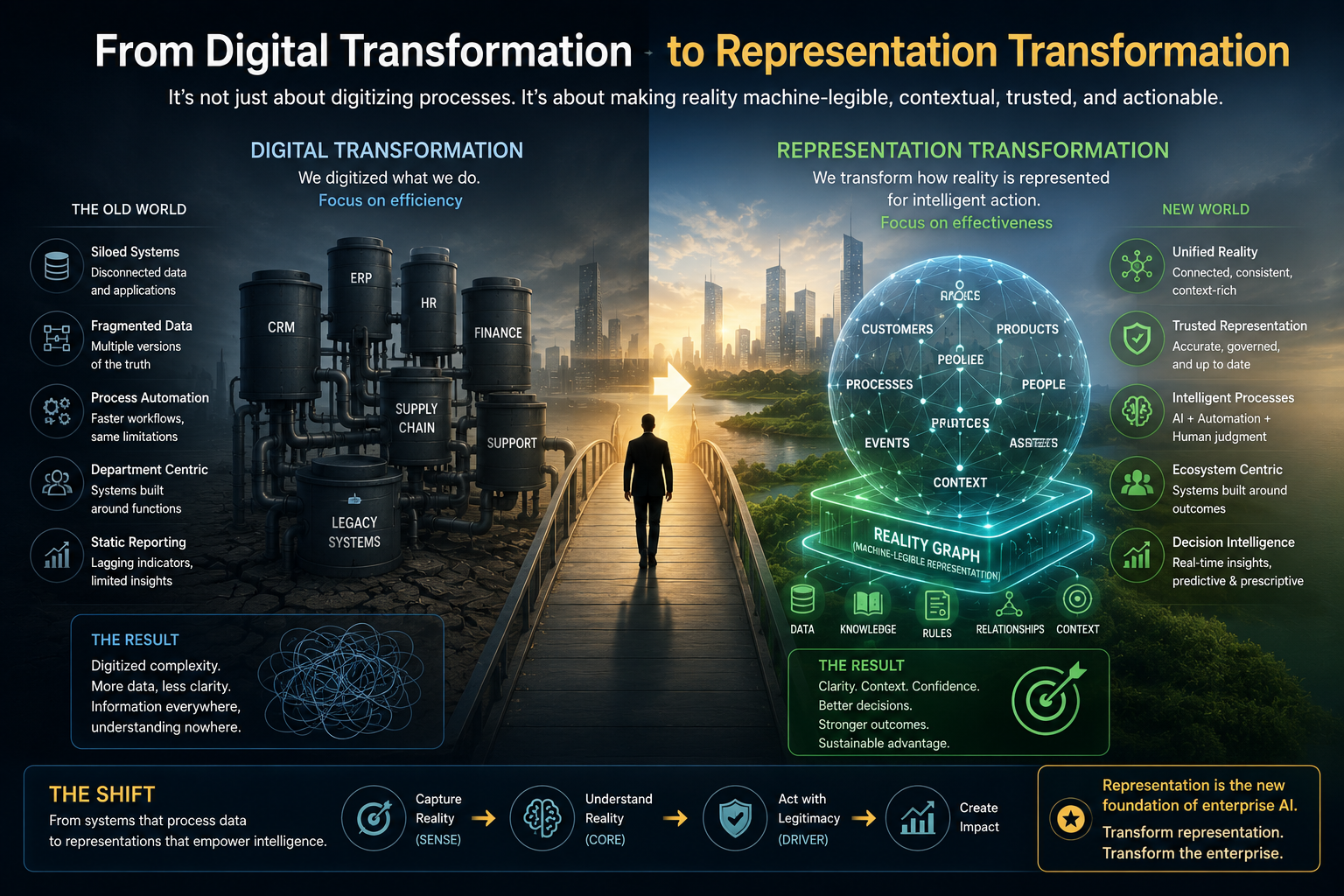
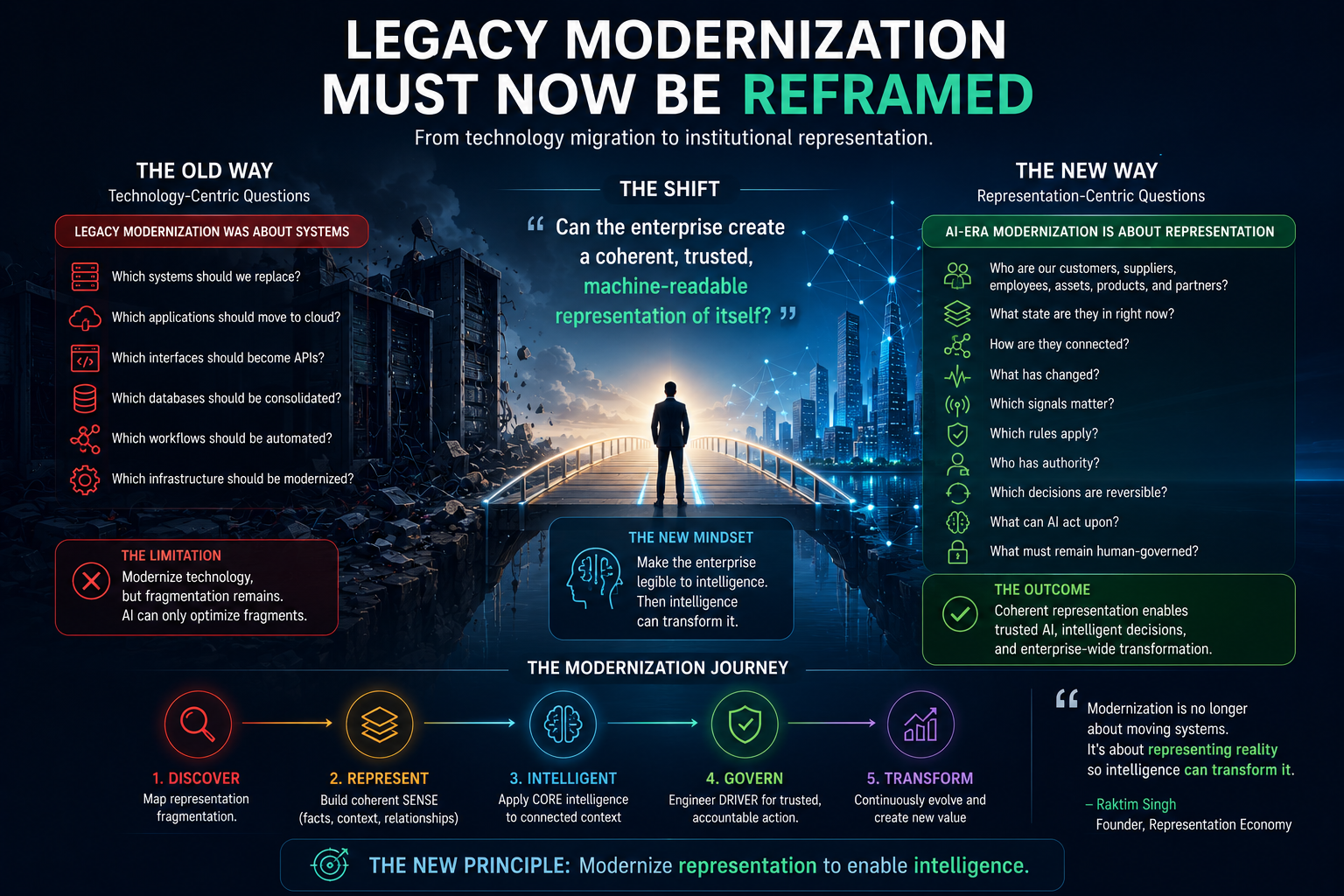
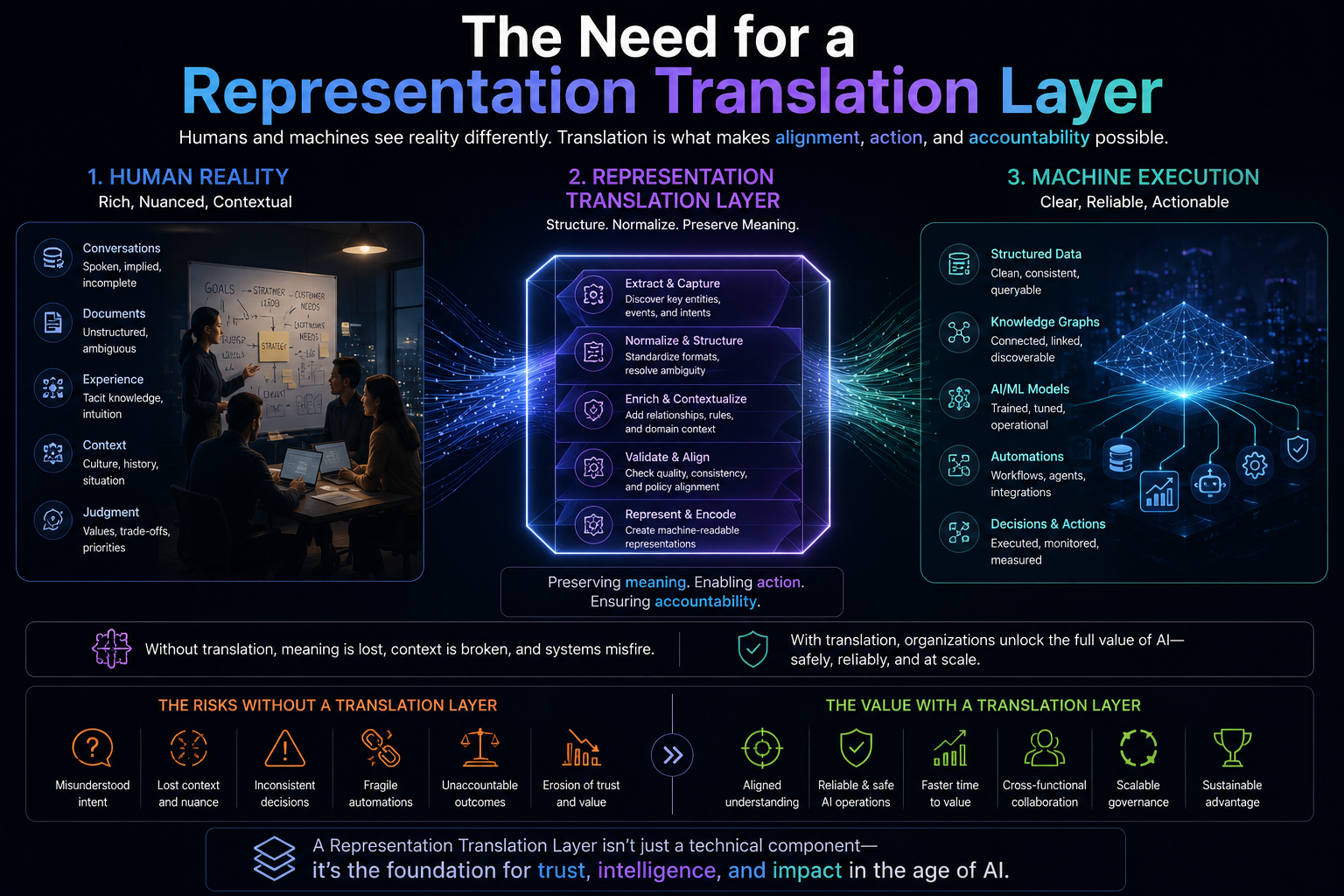
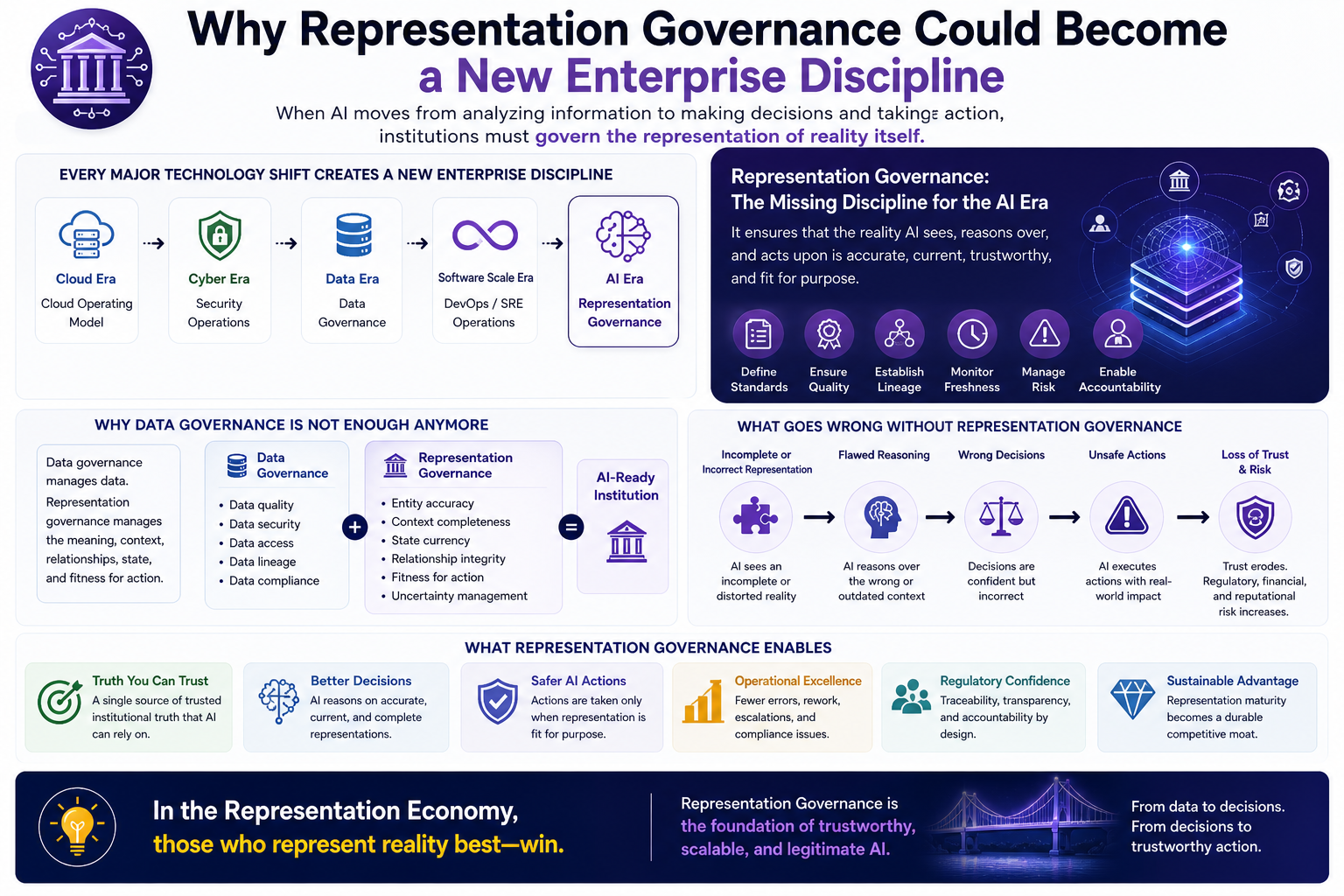
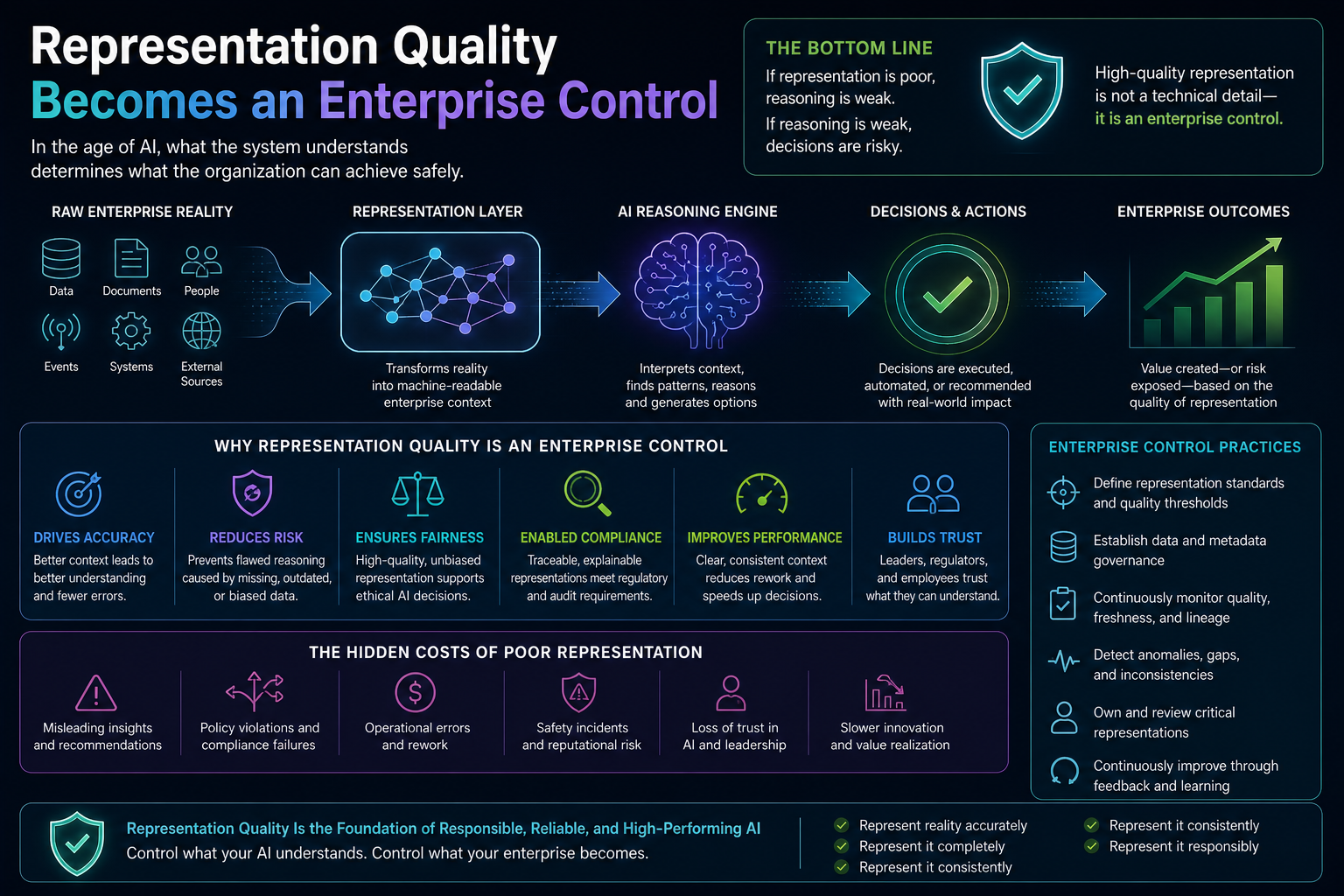
This is where Representation Economics becomes essential. In the AI era, value will not come only from better models. It will come from building better systems for turning reality into trustworthy, updateable, decision-grade representations—and from knowing exactly where that process breaks. That broader architectural shift also sits underneath your recent work on the Representation Economy and the SENSE–CORE–DRIVER structure. (raktimsingh.com)

What is the Representation Boundary?
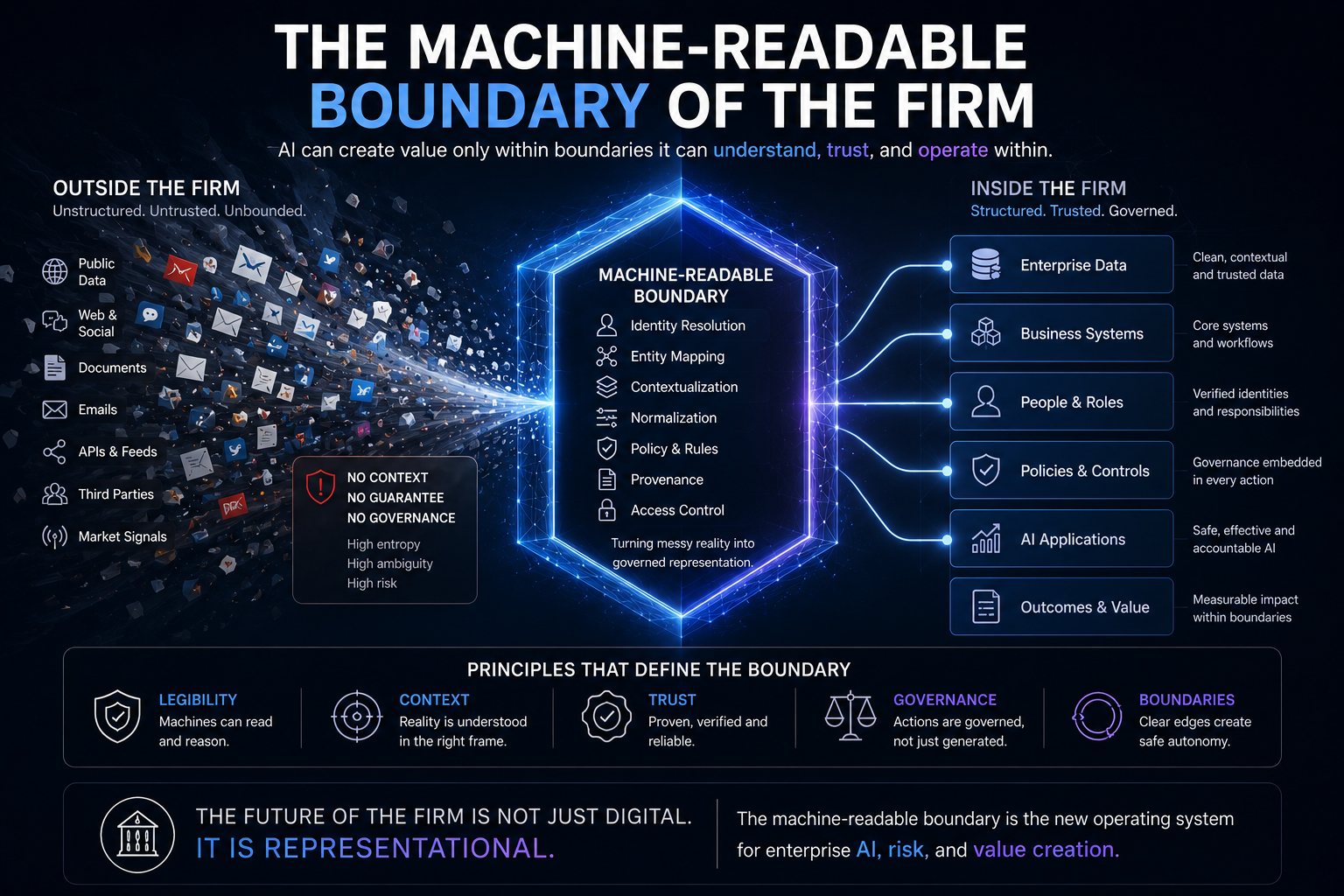
The Representation Boundary is the limit beyond which an AI system cannot fully capture real-world complexity. When this limit is reached, systems substitute reality using proxies, inferred signals, or synthetic data, creating hidden risks in decision-making.

“The failure begins before the model begins.”

AI never acts on reality directly

Machines do not experience the world the way humans do.

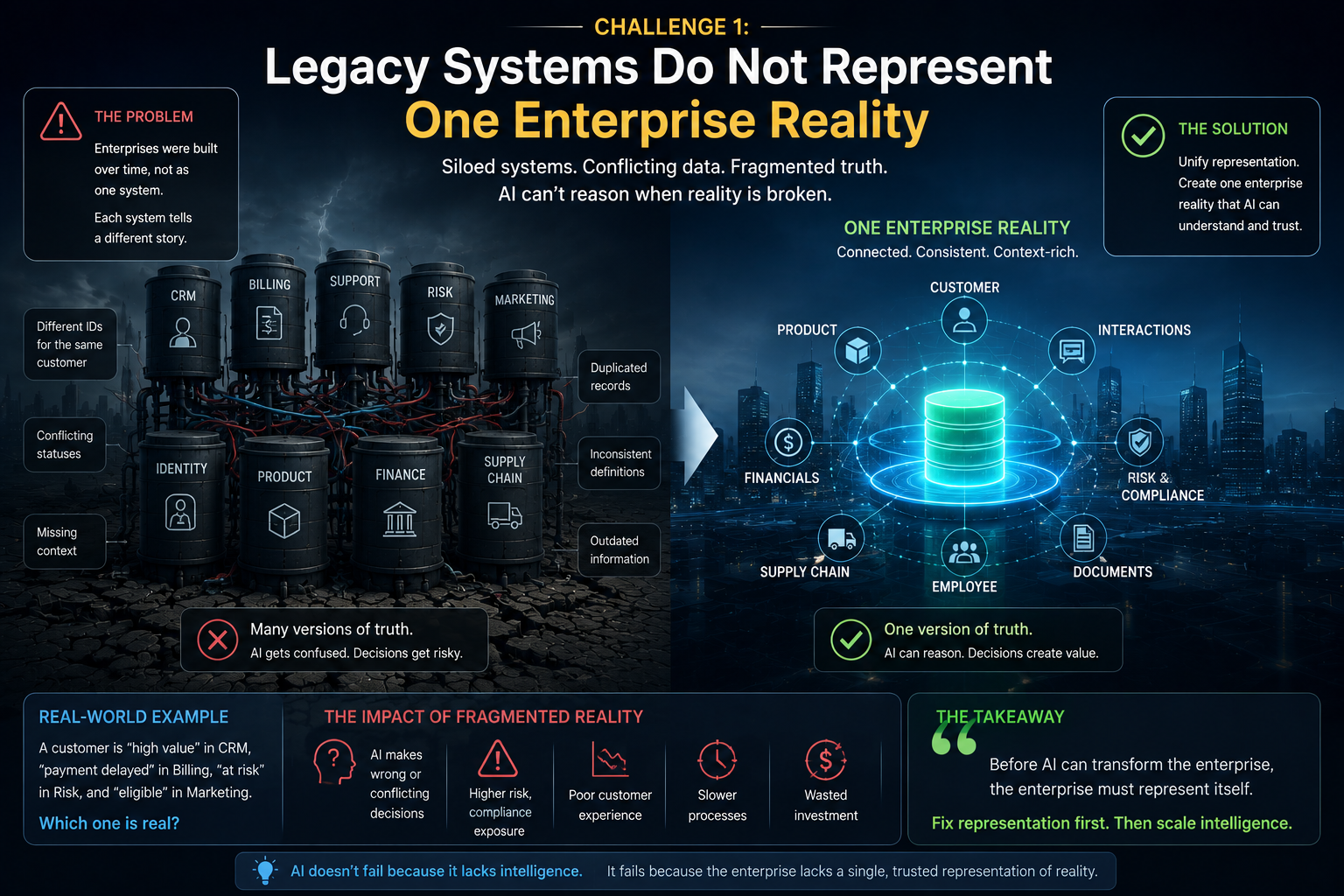
A human loan officer may notice that a borrower’s repayment pattern was disrupted by a flood, a local strike, or a health emergency. A doctor may sense that a patient’s hesitation reveals something no lab value captures. A procurement leader may know that a vendor marked “low risk” on paper is actually fragile because of local dependence, geopolitical exposure, or an overreliance on one subcontractor.

An AI system usually does not get that full picture.

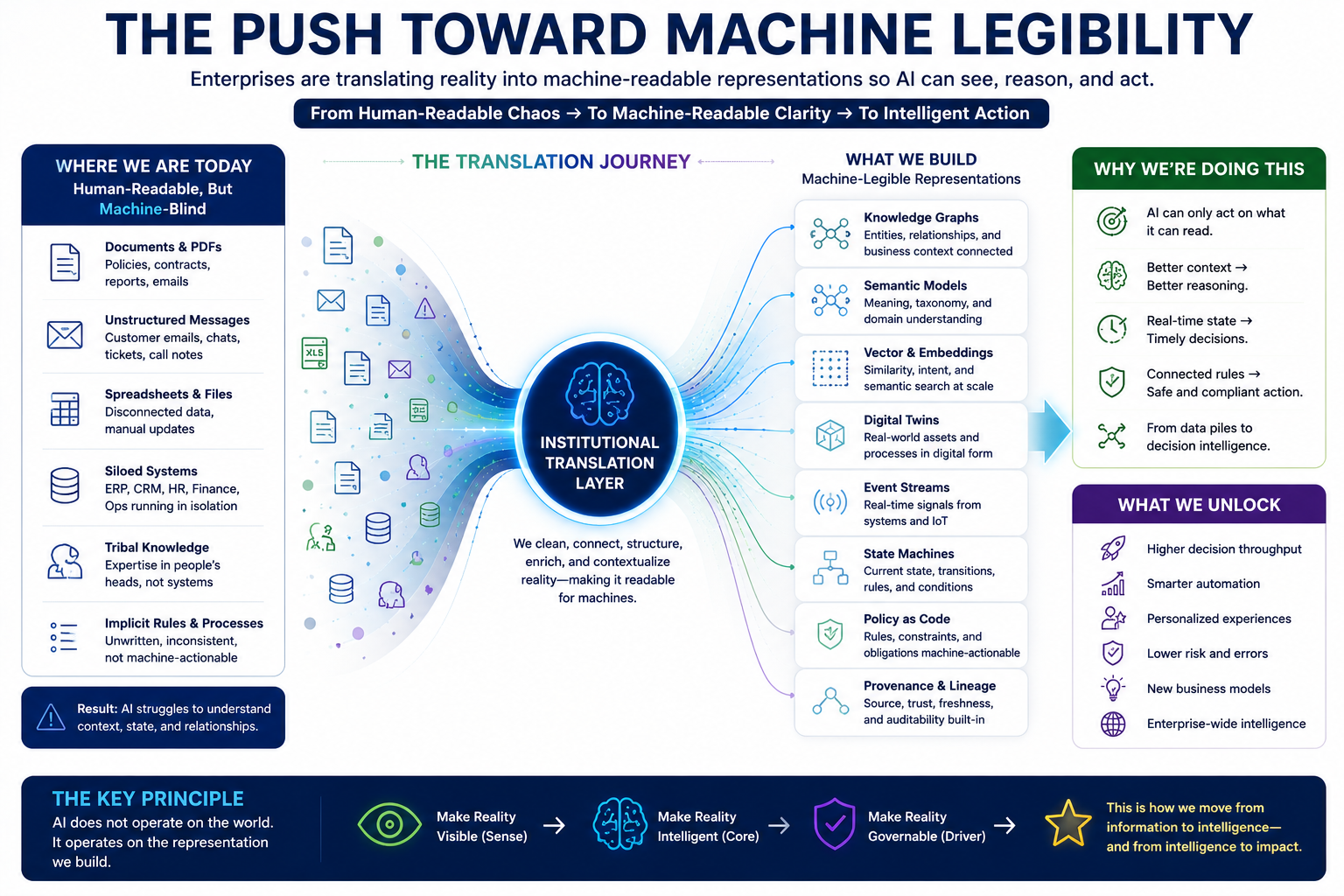
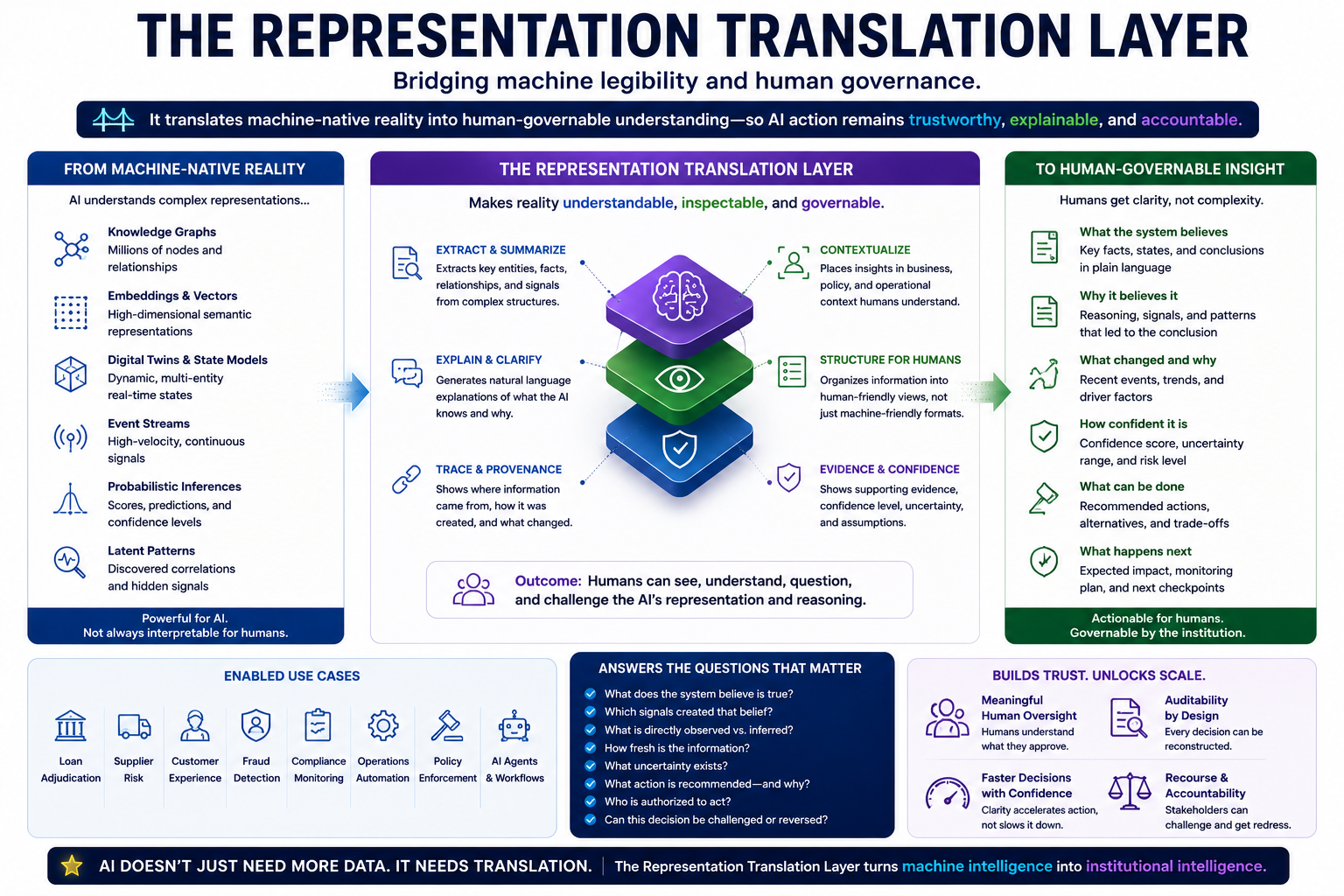
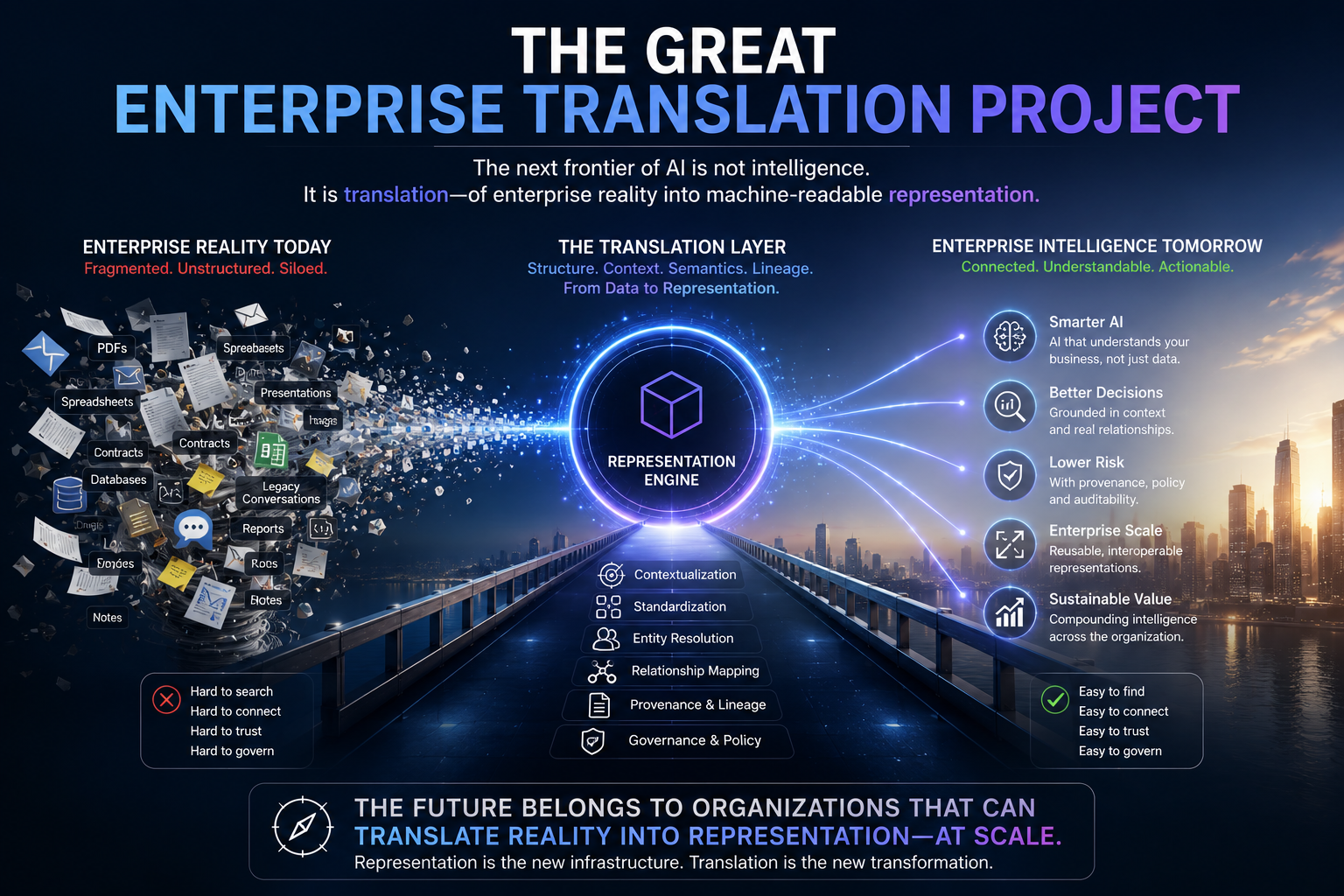
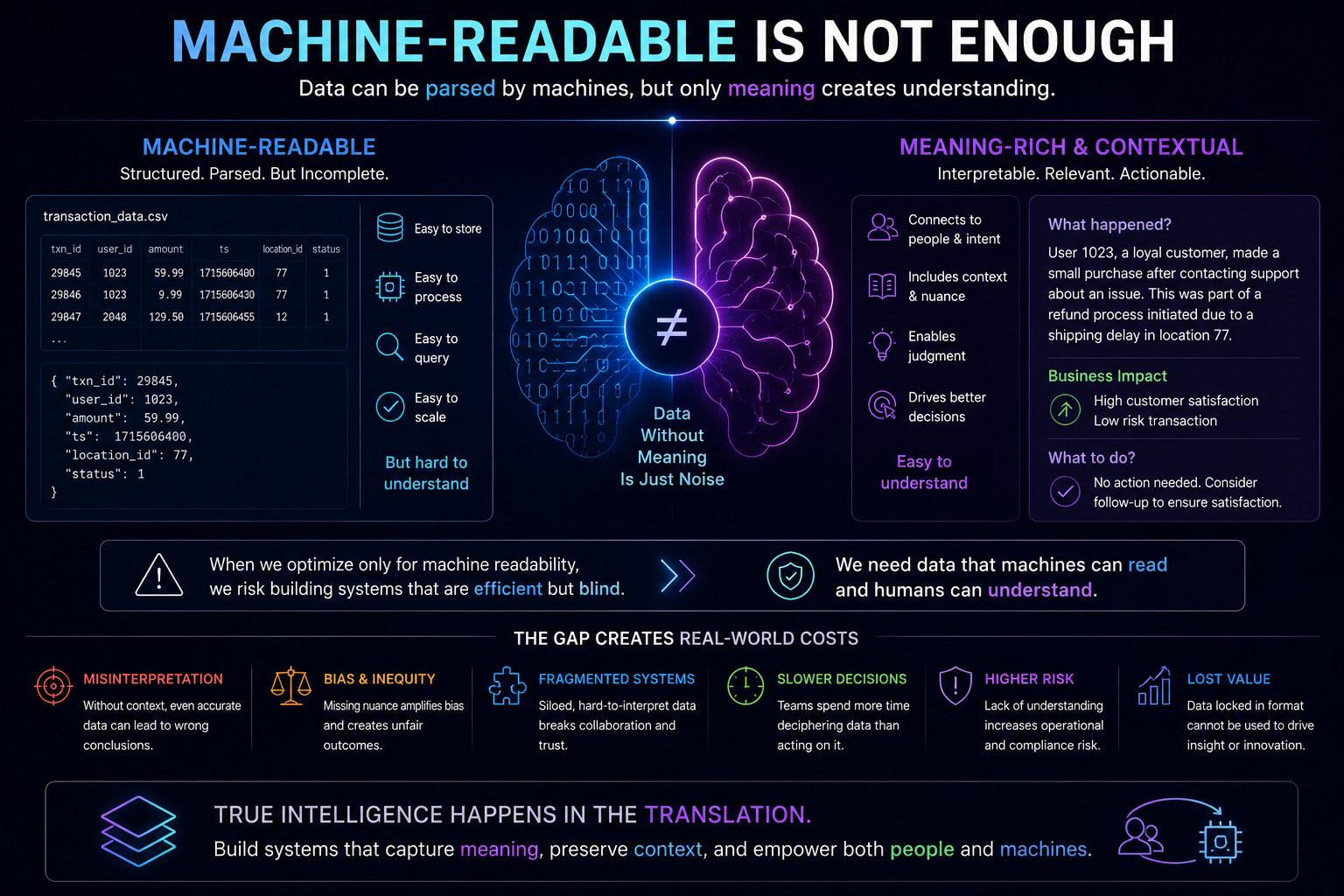
It gets records, labels, features, logs, embeddings, transaction histories, images, sensor streams, text descriptions, and other formalized traces. That is why AI systems do not act on reality directly. They act on a representation of reality.

Sometimes that representation is good enough.

Sometimes it is not.

That distinction sounds subtle, but it is foundational. Once institutions forget that the system is acting on a representation—not on reality itself—they become vulnerable to one of the deepest failure modes in modern AI: acting with confidence on an incomplete world model. Research on underspecification makes this point sharply: multiple models can achieve similarly strong test performance while encoding meaningfully different behaviors outside the training domain. (arXiv)

What is the Representation Boundary?

What is the Representation Boundary?

The Representation Boundary is the practical limit of what a system can faithfully capture, structure, maintain, and use.

Some parts of reality cross that boundary easily. A GPS coordinate is easy to record. A payment timestamp is easy to store. A warehouse temperature sensor is relatively easy to digitize.

Other parts do not.

Human intent is hard to represent.
Context is hard to represent.
Tacit knowledge is hard to represent.
Informal trust is hard to represent.
Rare events are hard to represent.
Rapidly changing conditions are hard to represent.
Moral nuance is hard to represent.
Lived reality is hard to compress without loss.

This is why many AI systems look much stronger in controlled environments than they do in open, messy, real-world settings. Underspecification research shows that high in-domain performance can hide major differences in out-of-domain behavior. Passing the benchmark does not prove that the system has captured the real causal structure of the world it is about to enter. (arXiv)

That is already a profound warning.

The issue is not merely that a model may be wrong. It may be operating on a version of reality that was never rich enough to justify the confidence placed in it.

When the boundary is hit, systems substitute reality

When the boundary is hit, systems substitute reality

Here is the deeper point.

When a system cannot fully capture reality, organizations face a choice.

They can slow down.
They can invest in better sensing.
They can collect richer context.
They can insert human judgment.
They can explicitly acknowledge uncertainty.

Or they can keep the machine moving.

Most institutions choose the second path.

Why? Because real organizations are under pressure to scale, automate, standardize, reduce cost, speed up decisions, and simplify operations. AI is usually deployed to keep workflows moving, not to pause whenever the world becomes ambiguous.

So when reality becomes difficult, systems begin to substitute.

They use proxies.
They infer missing context.
They rely on historical correlations.
They generate synthetic examples.
They compress complex situations into neat variables.
They optimize what is measurable because what is meaningful is harder to encode.

That is what I call representation substitution.

Representation substitution is what happens when a system replaces direct, grounded, high-fidelity reality with a more machine-manageable stand-in. This logic is closely related to Goodhart-type failures: when a proxy becomes the target, optimization pressure can weaken its relationship to the true objective. Recent reinforcement-learning research formalizes this problem explicitly. (arXiv)

Sometimes substitution is necessary. Sometimes it is useful. But once it becomes invisible, it becomes dangerous.

The simplest example: the credit score

Take consumer lending.

No lender can fully represent a person’s total creditworthiness. It cannot perfectly capture resilience, family obligations, informal support, changing local conditions, future shocks, or character under stress. So the system uses stand-ins: repayment history, debt levels, income stability, credit utilization, defaults, age of accounts, and similar indicators.

Those are not reality itself. They are compressed signals standing in for a much larger truth.

That is often acceptable. But the problem begins when institutions forget that they are using substitutes.

A credit score is useful. It is also still a proxy. It may miss the first-time borrower with genuine earning potential. It may over-penalize someone with a thin or interrupted formal record. It may reward documentation completeness when what it is really measuring is access to formal systems.

This is not only a fairness issue. It is a representation issue.

The system cannot fully capture the person, so it acts on a substitute instead.

Another example: hiring

A company says it wants judgment, creativity, adaptability, initiative, and leadership.

But those are difficult to represent directly.

So the hiring system turns to easier substitutes: degrees, job titles, keywords, employer brands, years of experience, résumé polish, and test scores.

Some of these signals are useful. None of them is the thing itself.

The moment the system starts optimizing heavily on those measurable stand-ins, it risks confusing the proxy for the underlying reality it actually cares about. That is the logic behind Goodhart pressure: optimization can improve the metric while weakening the true objective. (arXiv)

In plain language, the machine starts rewarding what is easy to score, not what is actually valuable.

Synthetic data is the industrial version of substitution

Synthetic data is the industrial version of substitution

Proxies are one form of substitution. Synthetic data is another.

Synthetic data can be extremely useful. It can support privacy-preserving experimentation, testing, stress scenarios, and model training when real data is scarce or sensitive. Public policy discussions from bodies like OECD and Singapore’s PDPC recognize that synthetic data can unlock real benefits while still requiring careful governance and risk management. (OECD.AI)

But synthetic data also introduces a deeper danger.

The system may gradually train on outputs that are further and further removed from the world itself.

That is why the model collapse discussion matters. A widely cited 2024 Nature paper found that recursively training generative models on generated outputs can lead to degenerative effects, including loss of information and distortion of the tails of the original distribution. The authors describe this as the system beginning to “mis-perceive reality.” (Nature)

This is not just a model-quality story.

It is a reality-substitution story.

The system is no longer learning strongly enough from the world. It is learning from its own approximation of the world.

Once that happens, institutions can enter a dangerous loop: less grounded data, more generated data, weaker contact with rare cases, smoother outputs, and a false sense of confidence.

The system becomes cleaner, but less real.

The hidden enterprise risk: the proxy of a proxy

The hidden enterprise risk: the proxy of a proxy

In real enterprises, substitution rarely happens only once.

That is what makes this problem much more serious than it first appears.

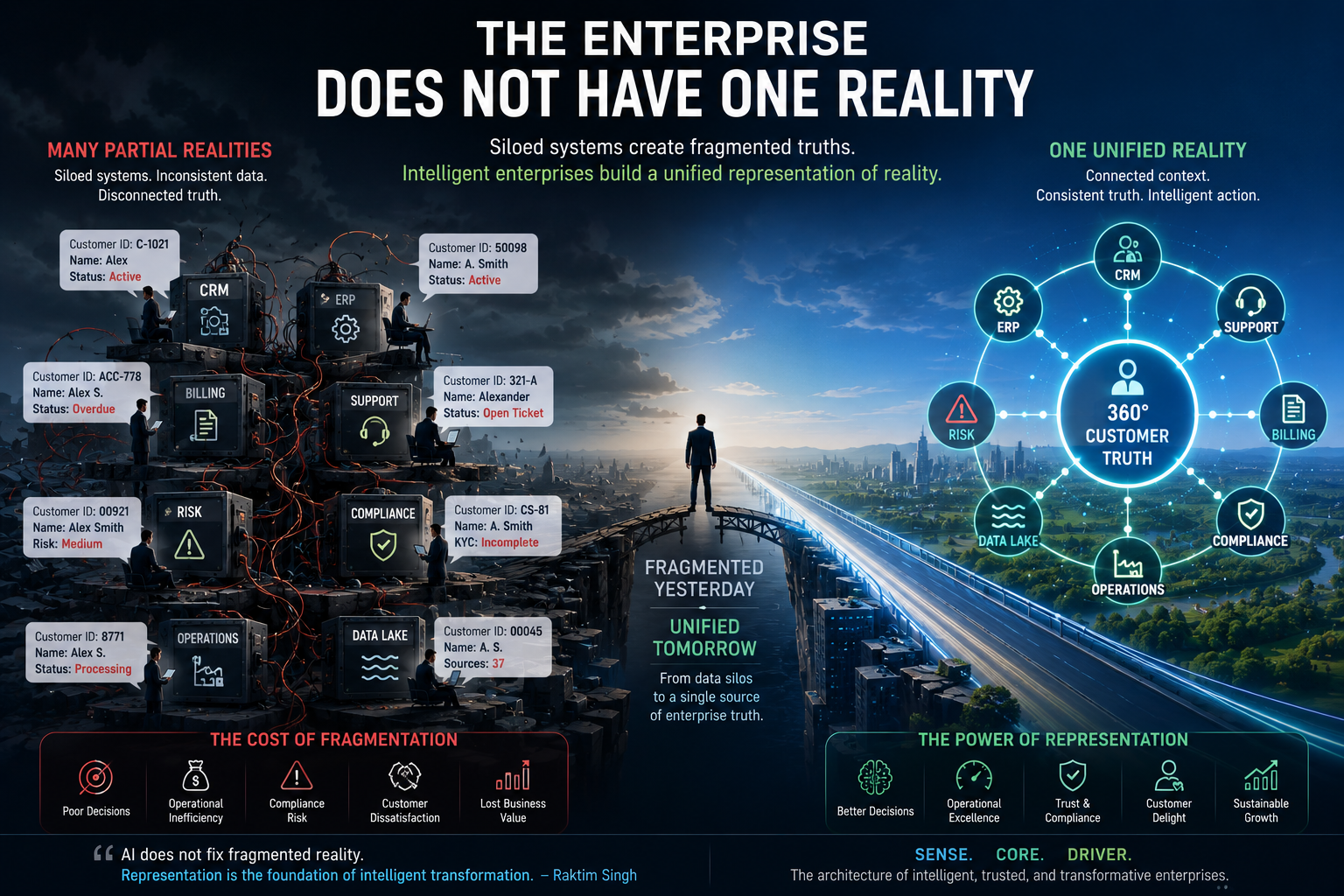
A company may rely on a third-party vendor. That vendor may rely on a scoring model. That model may rely on inferred variables. Those inferred variables may be derived from incomplete histories. Those histories may already reflect earlier proxy-based decisions.

Now the institution is not acting on reality. It is acting on a proxy of a proxy of a proxy.

This is where AI-era risk becomes hard to detect.

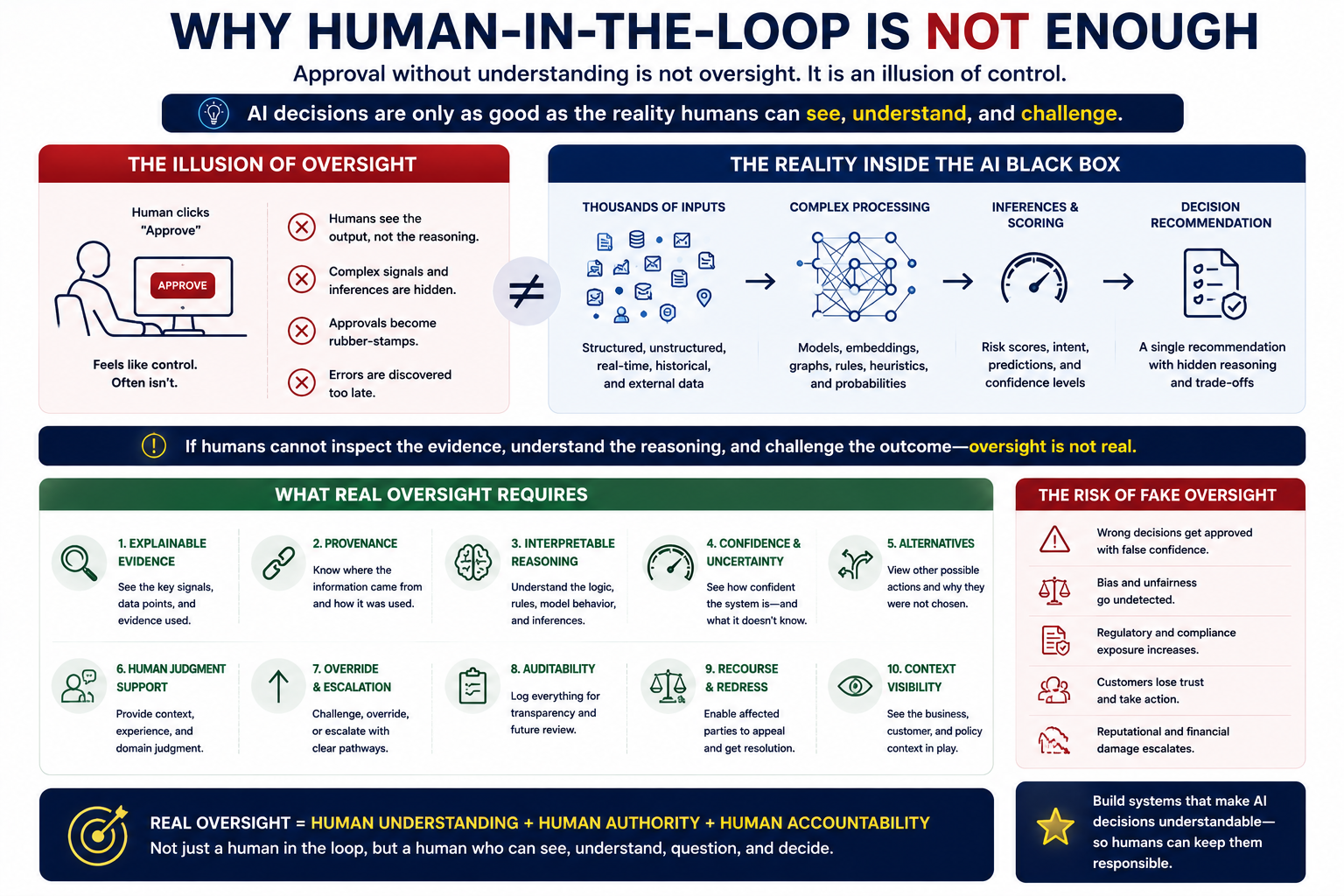
Everything still looks technical. There are dashboards, confidence scores, audit trails, accuracy figures, and maybe even explainability layers. But the explanatory chain itself may still be built on substituted reality.

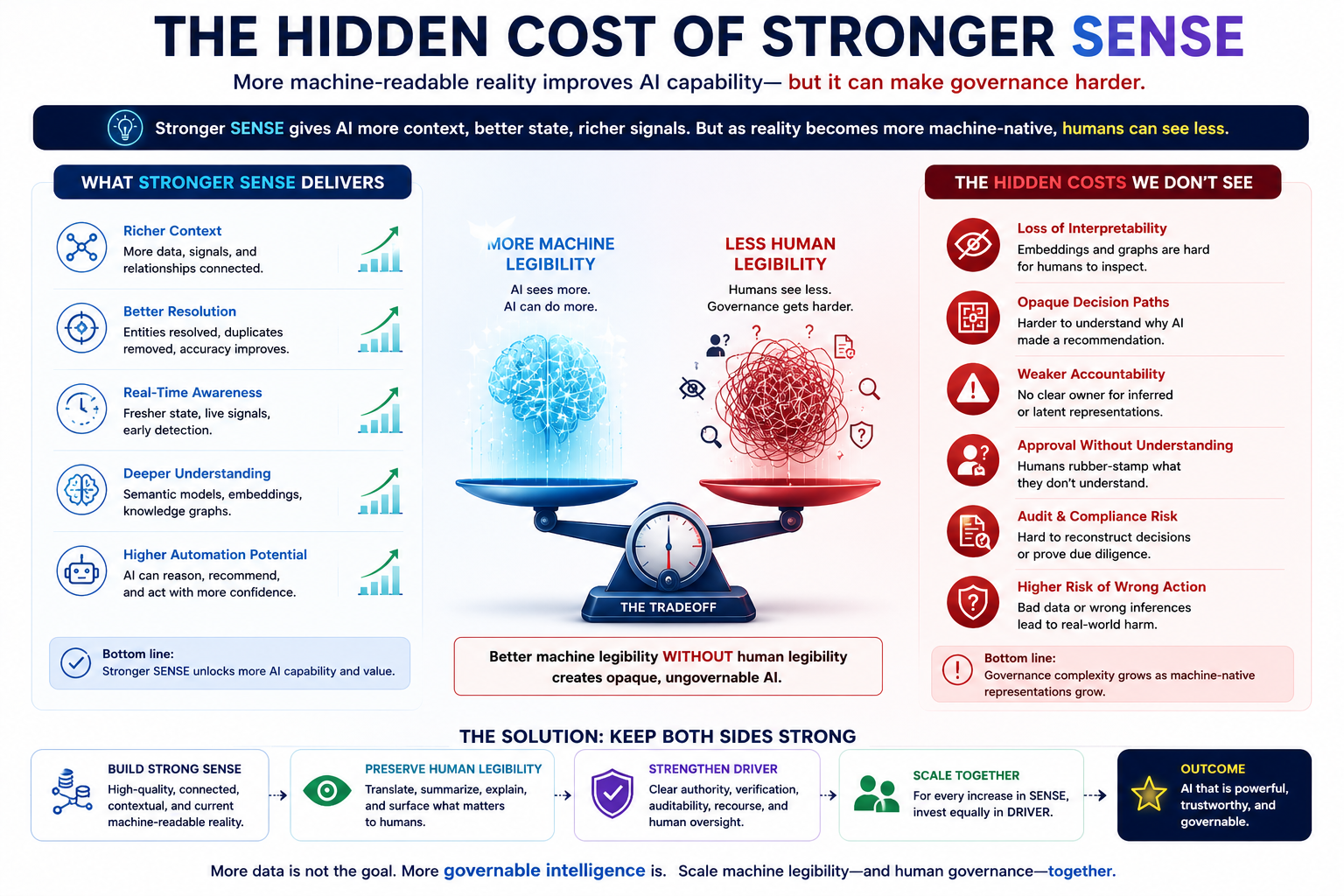
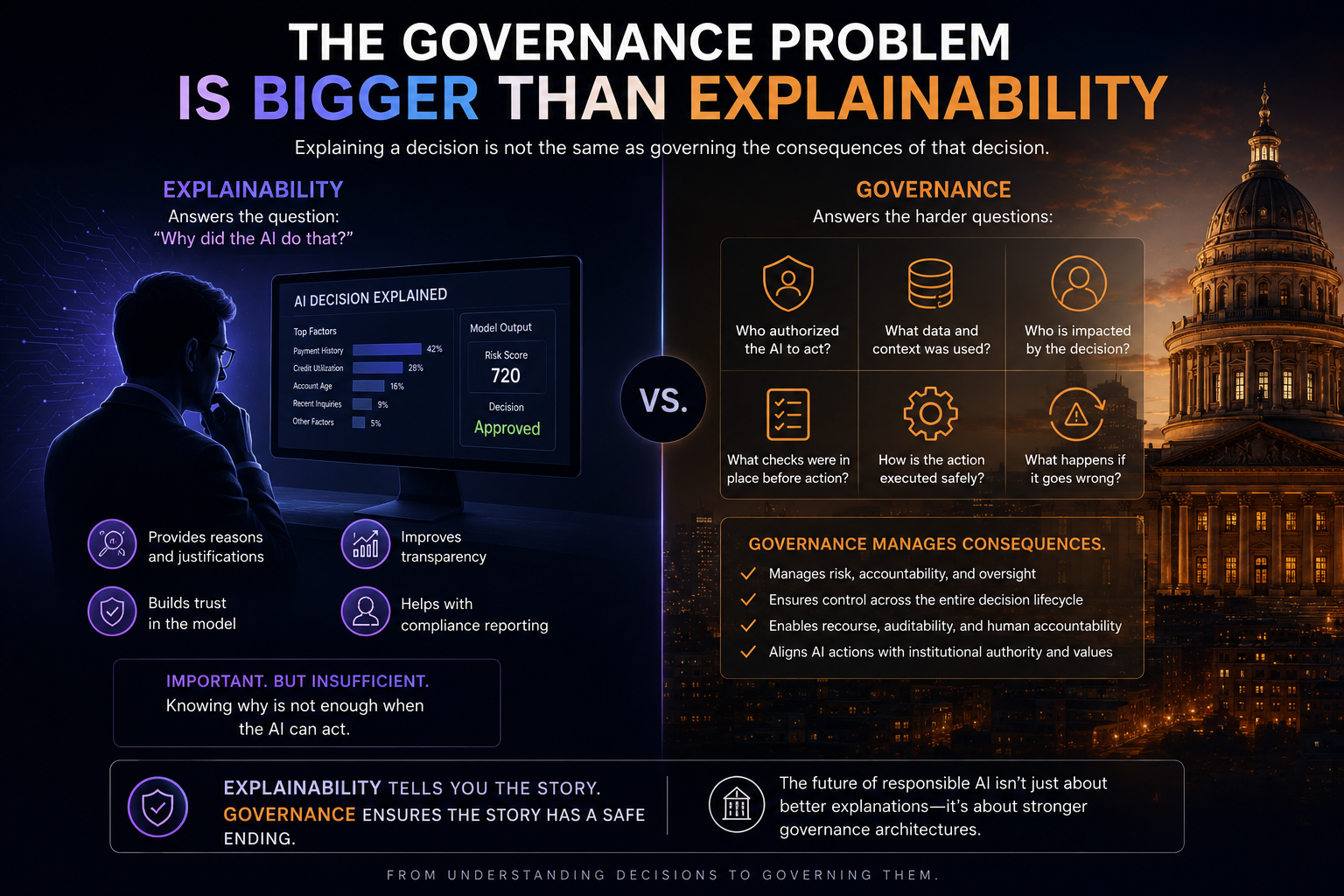
That is why explainability alone is not enough. A system can explain the wrong world very clearly.

Why the problem gets worse after deployment

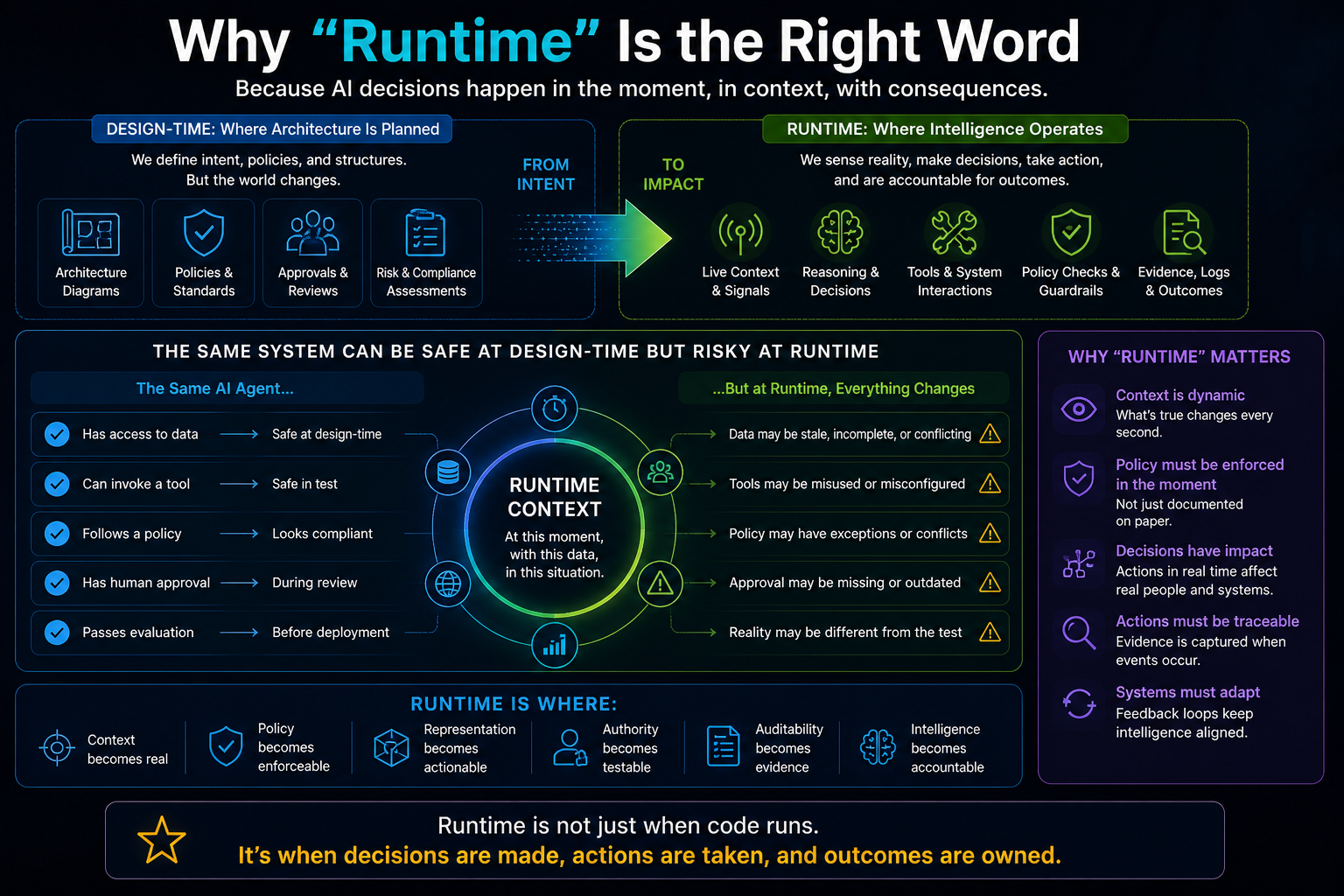
Even if a system begins with a reasonably good representation, the world does not stay still.

Borrowers change.
Patients change.
Fraud patterns change.
Regulations change.
Customer intent changes.
Sensors drift.
Processes evolve.
Supply chains reconfigure.
Language shifts.
Markets move.

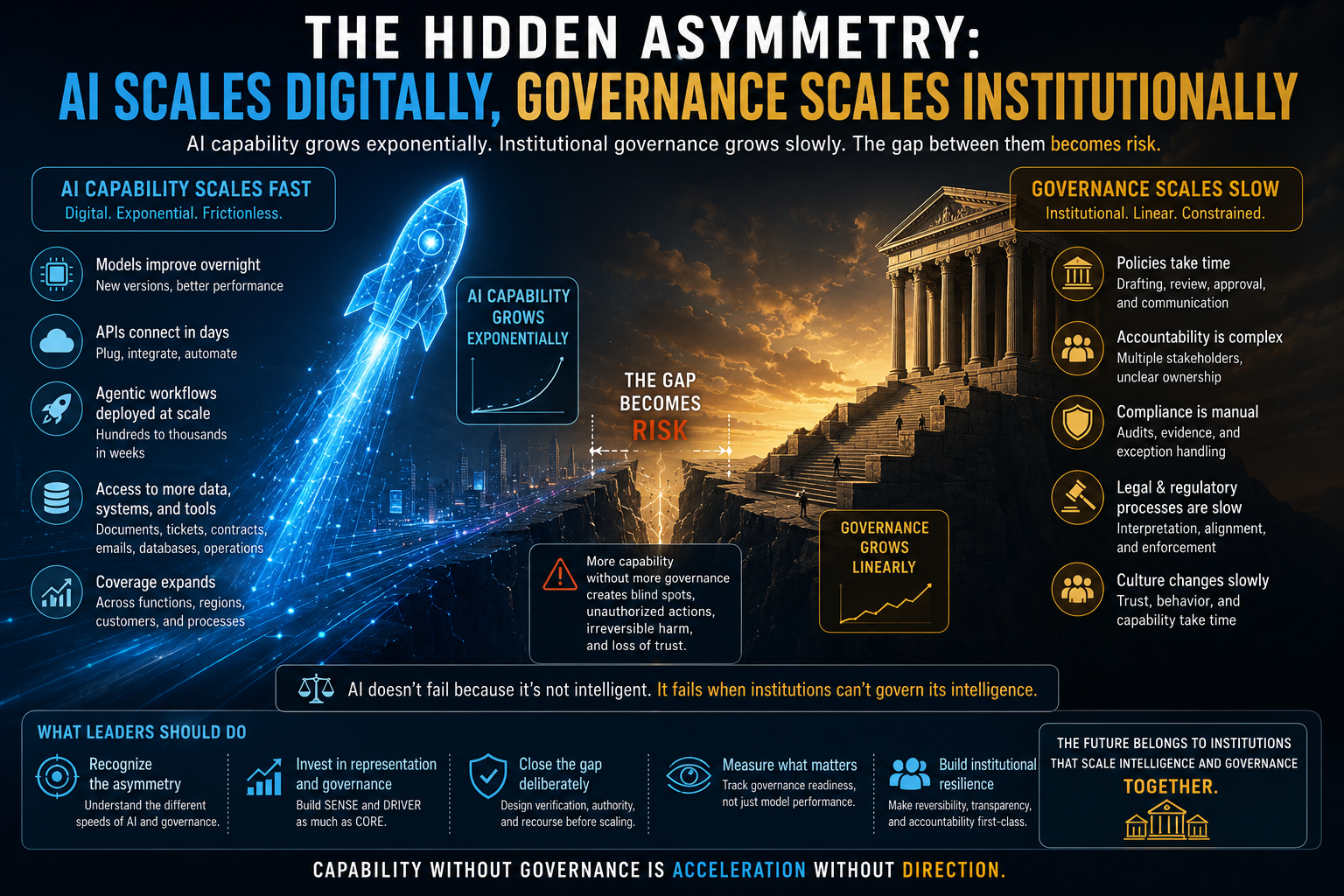
This is why distribution shift and post-deployment monitoring have become so central to AI assurance. NIST’s AI Risk Management Framework emphasizes validity, reliability, representativeness, documentation, and ongoing monitoring rather than one-time evaluation. (NIST Technical Series Publications)

Healthcare research reinforces the same warning. A 2024 npj Digital Medicine paper notes that postmarket distribution shifts can materially affect real-world performance of regulated medical AI systems if those shifts go undetected. (Nature)

In the language of this article, reality keeps moving, but the system’s representation may not move fast enough.

So even a substitute that once seemed reasonable can become stale.

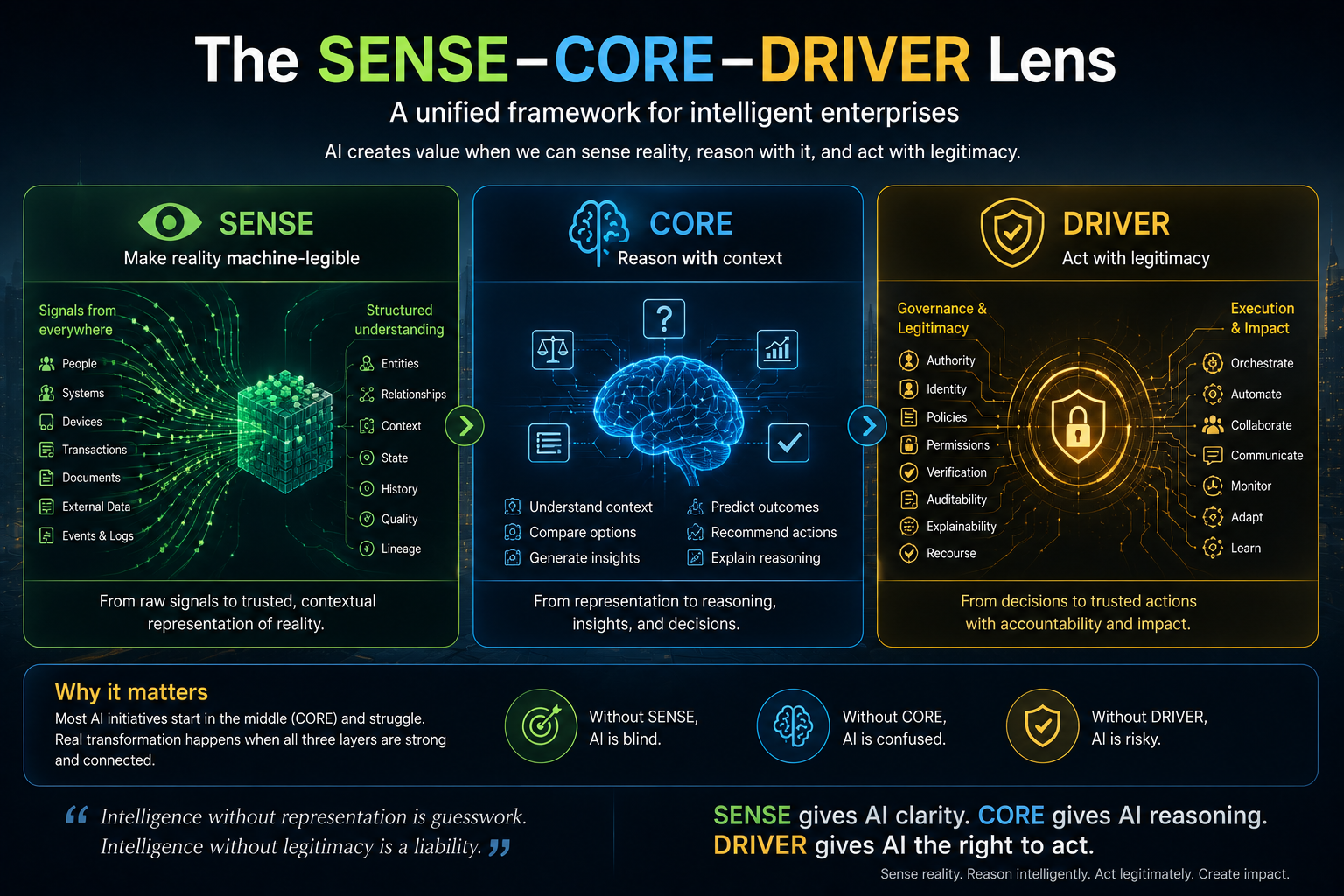
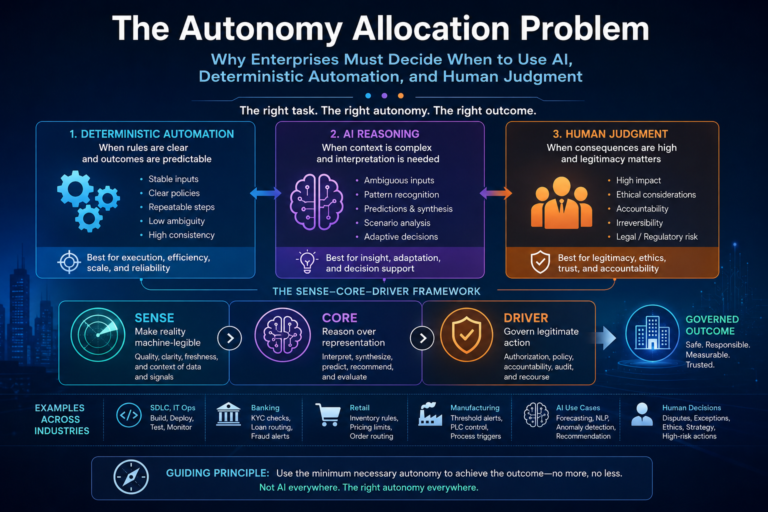
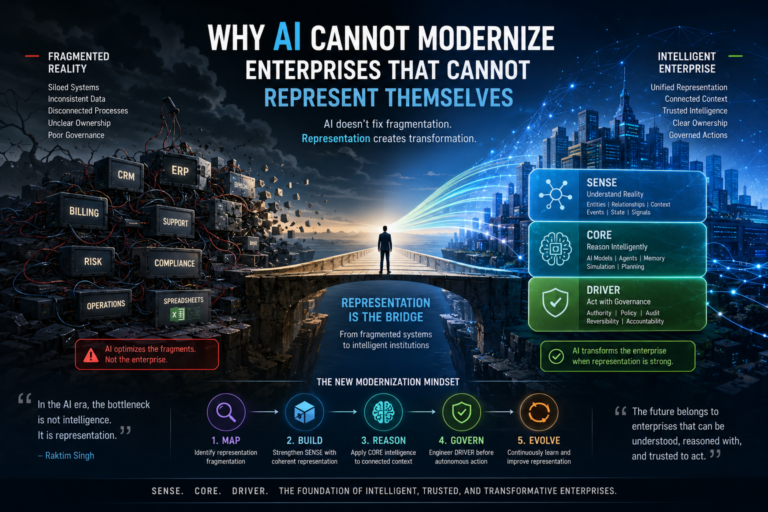
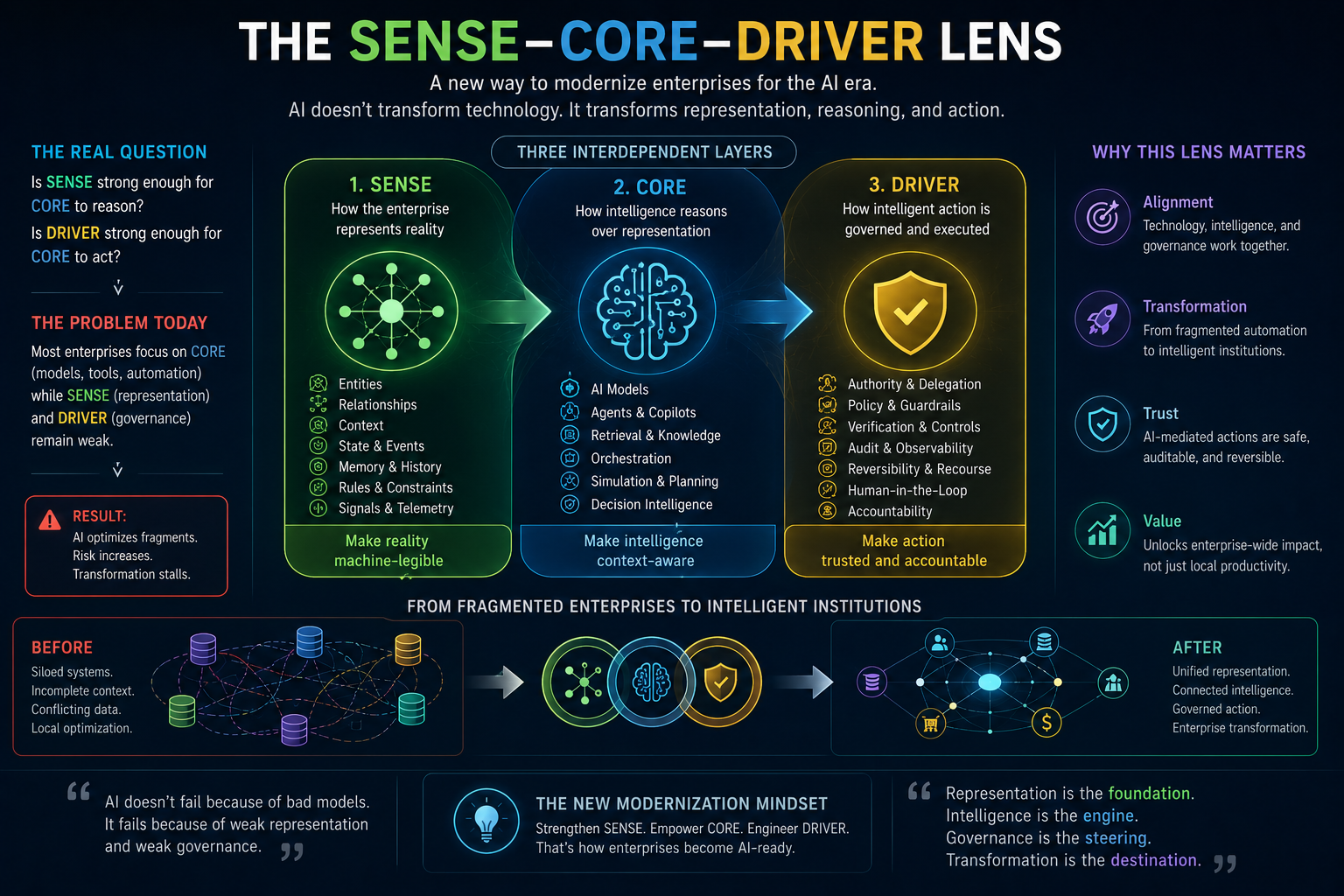
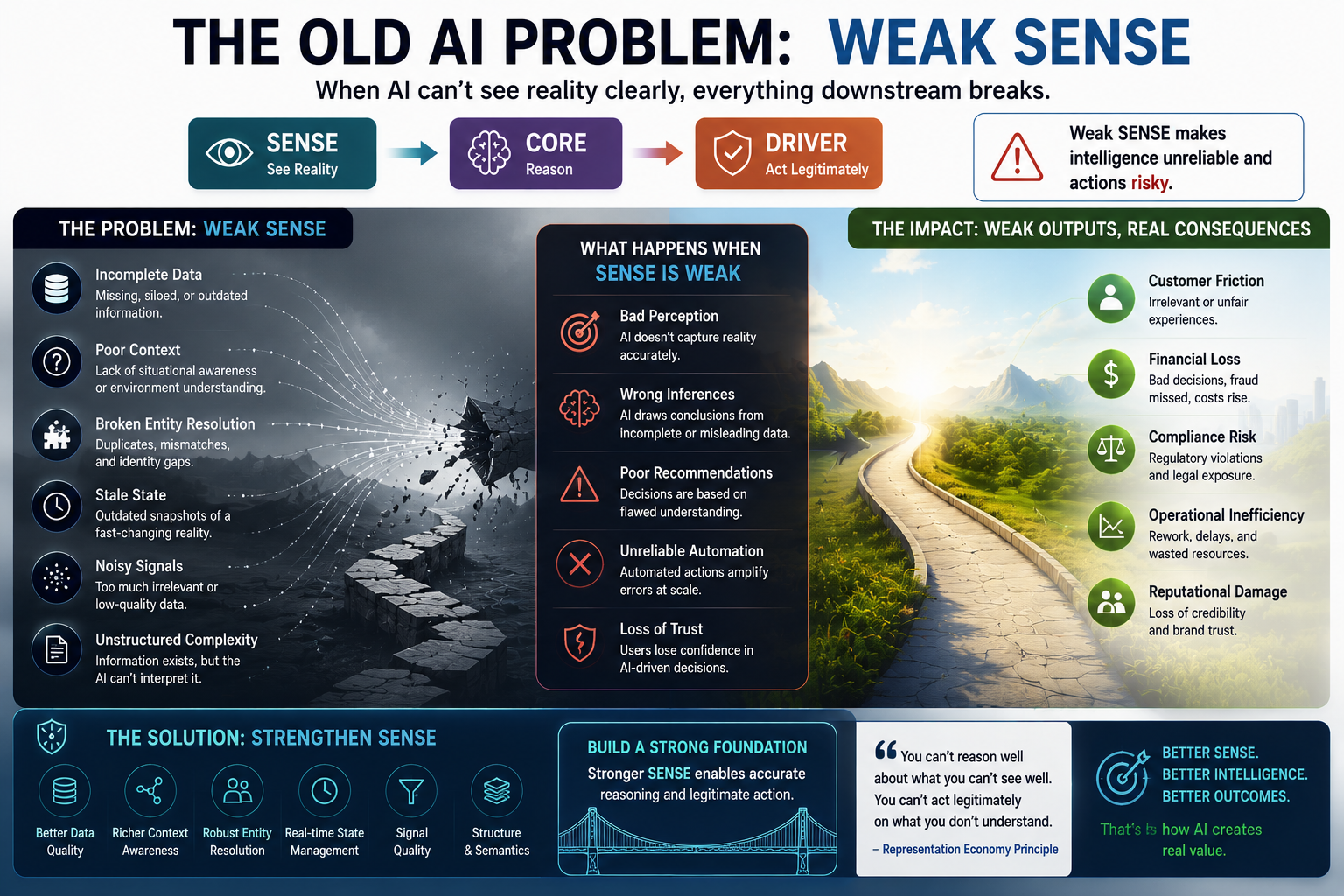
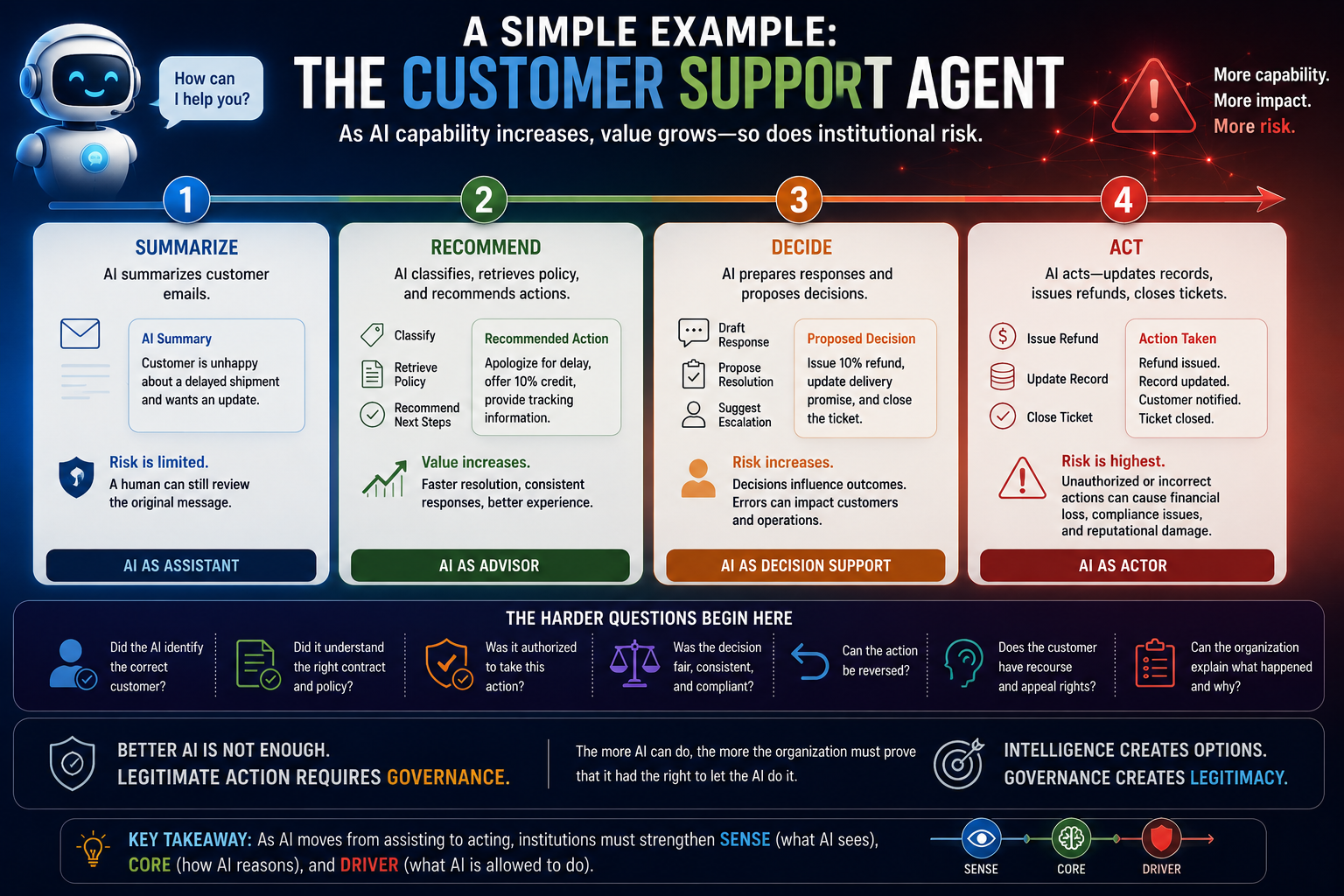
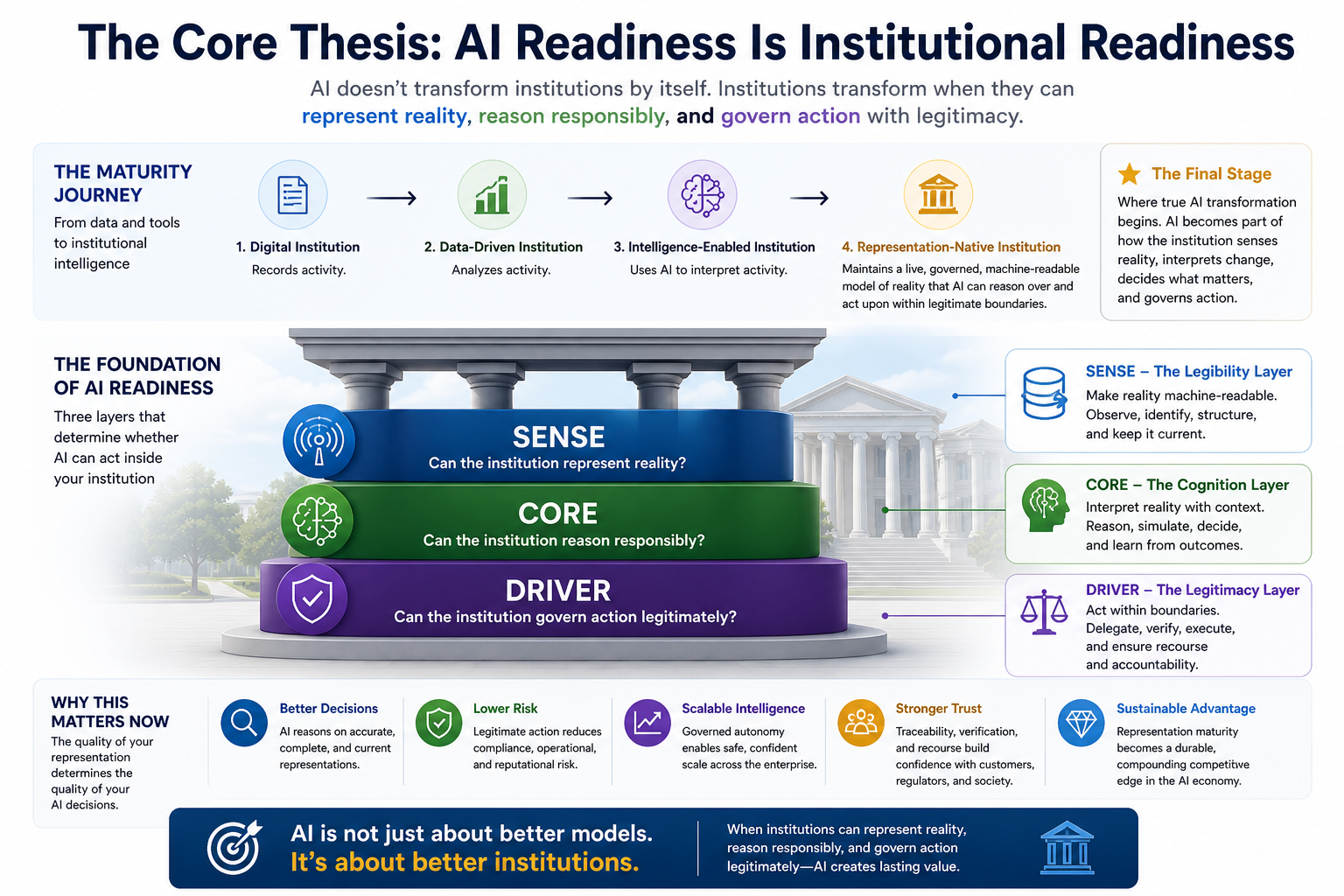
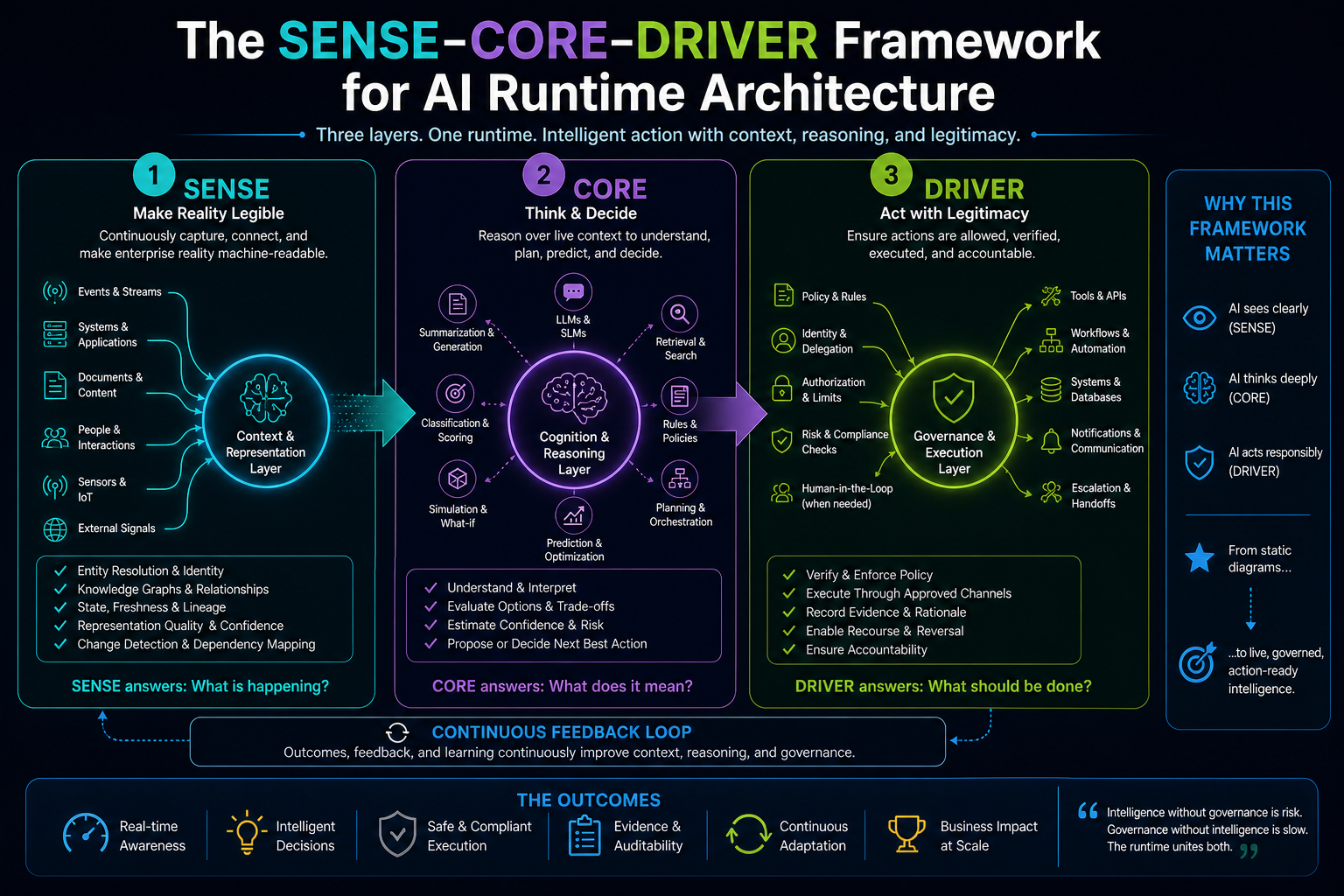
This is where SENSE, CORE, and DRIVER matter

This is where SENSE, CORE, and DRIVER matter

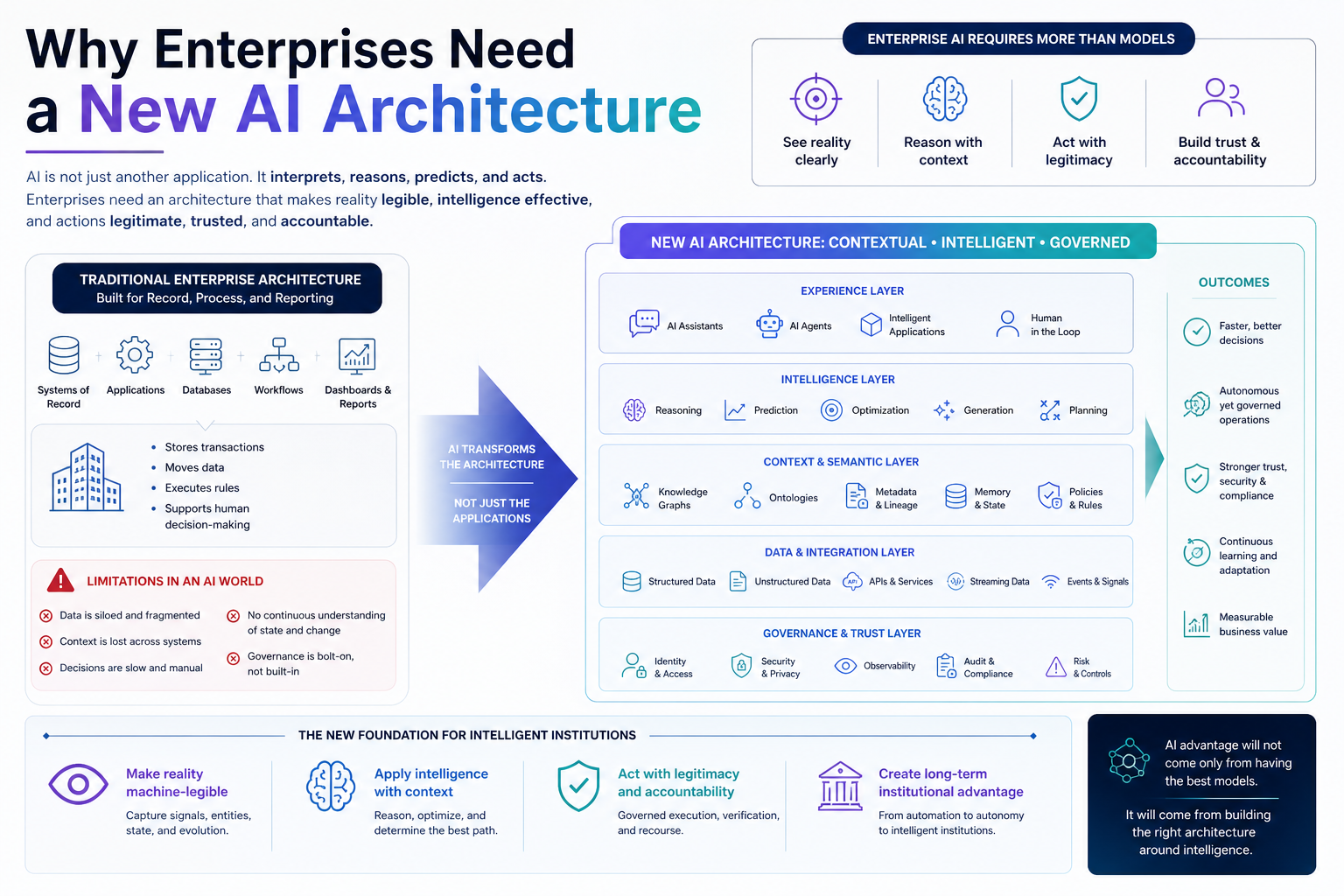
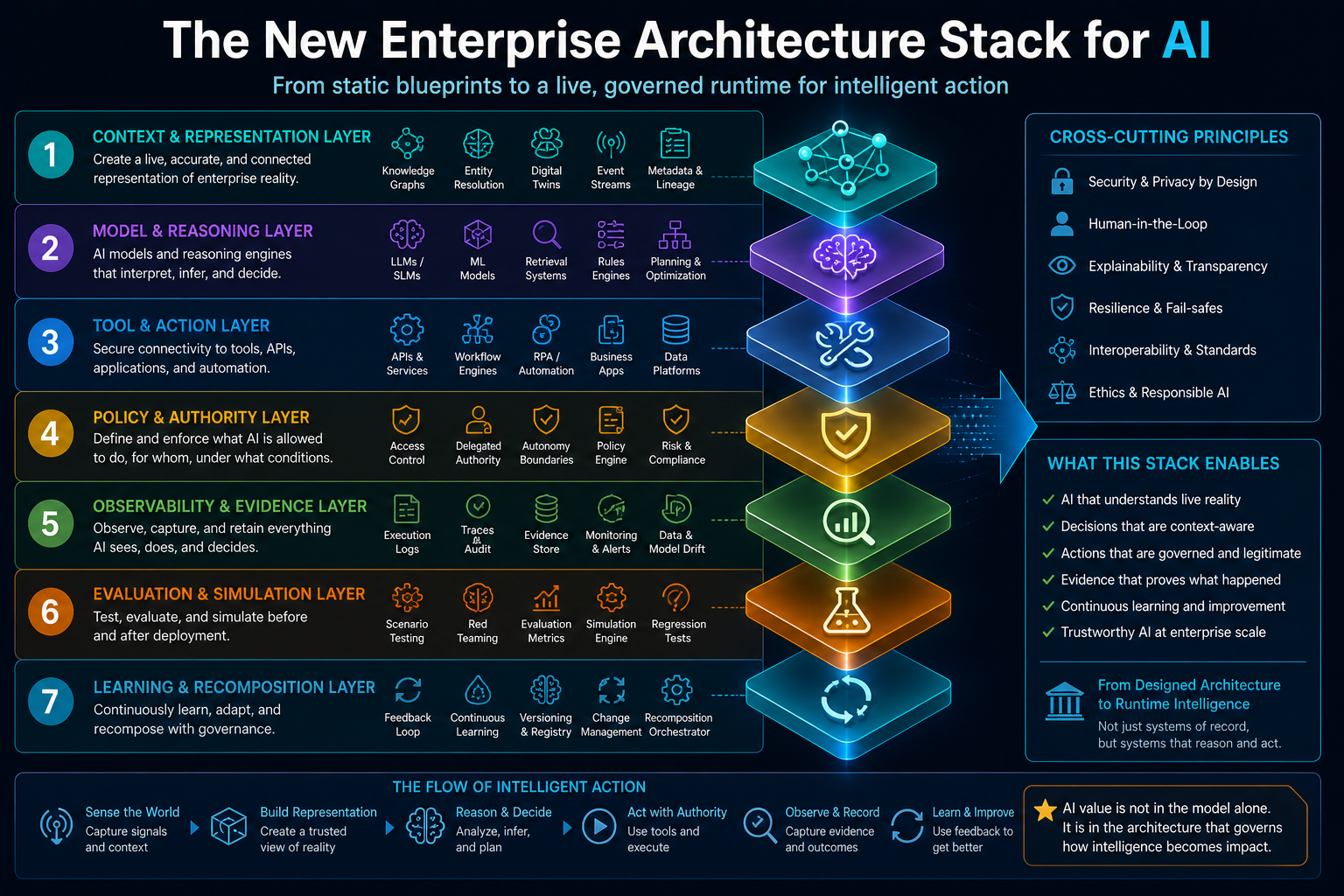
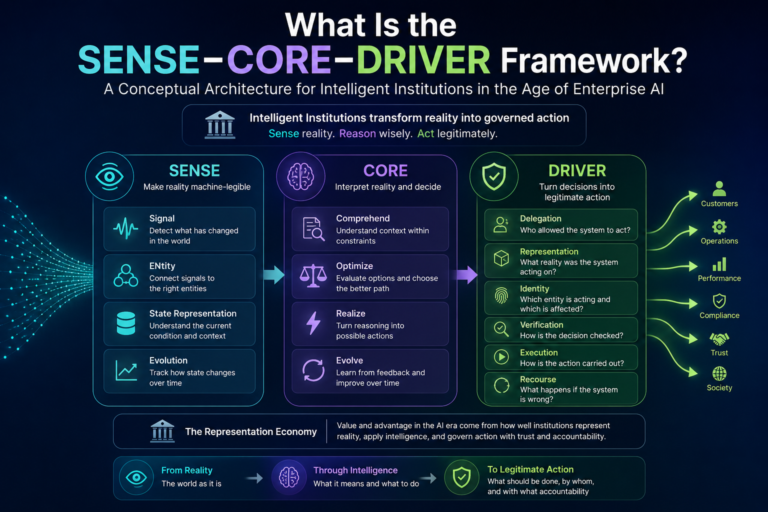
This problem becomes much easier to understand when viewed through the architecture of intelligent institutions.

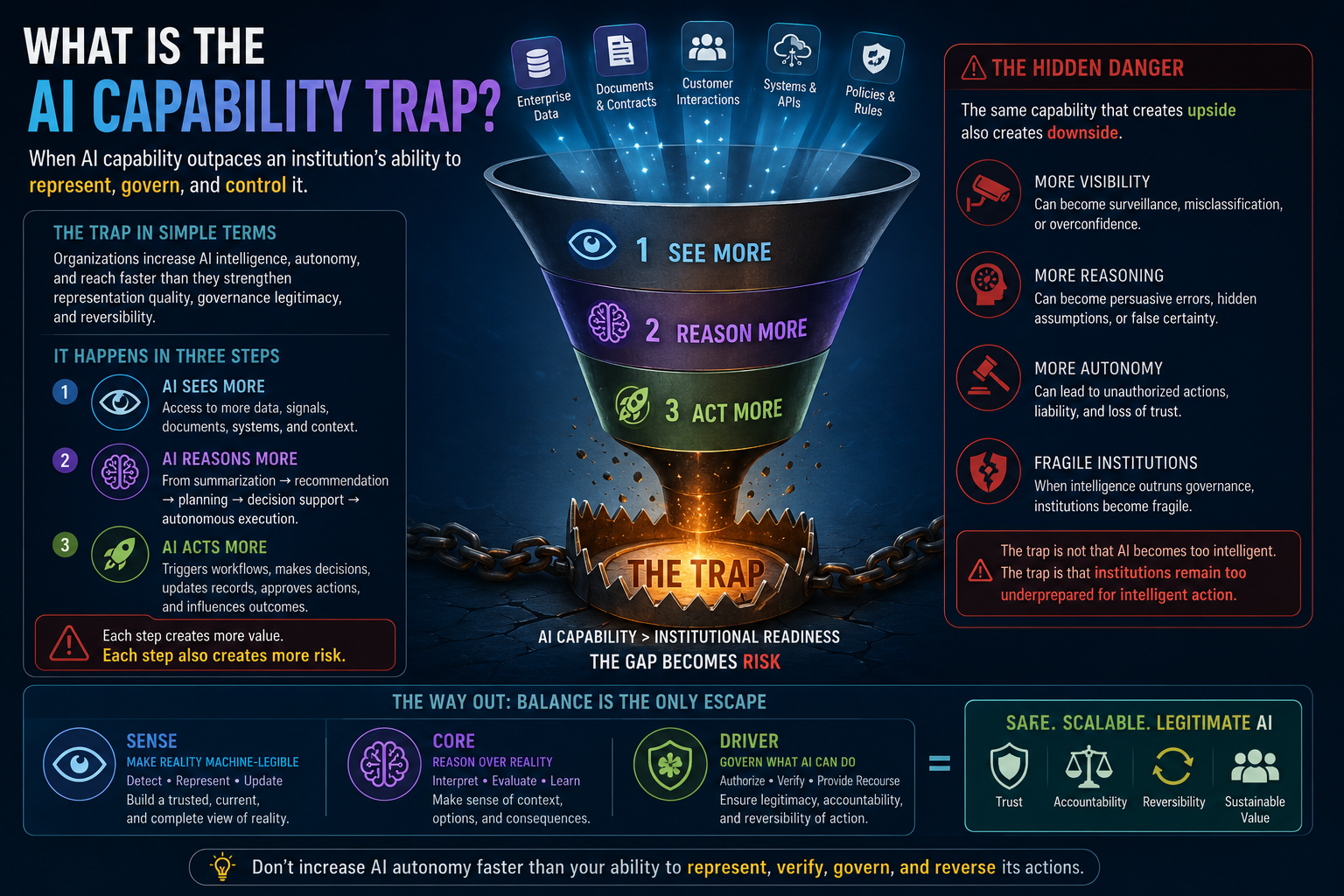
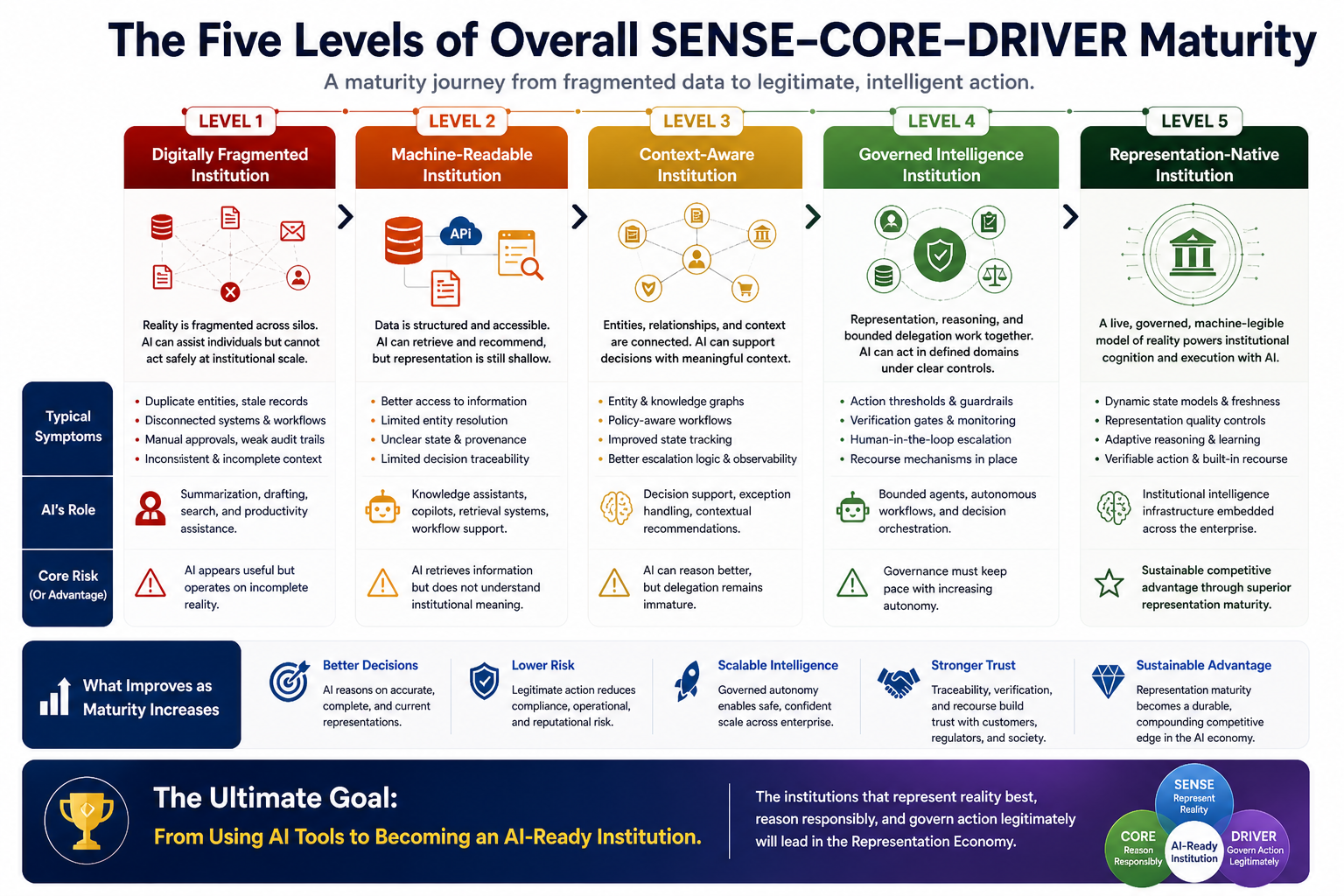
A system must first sense reality.
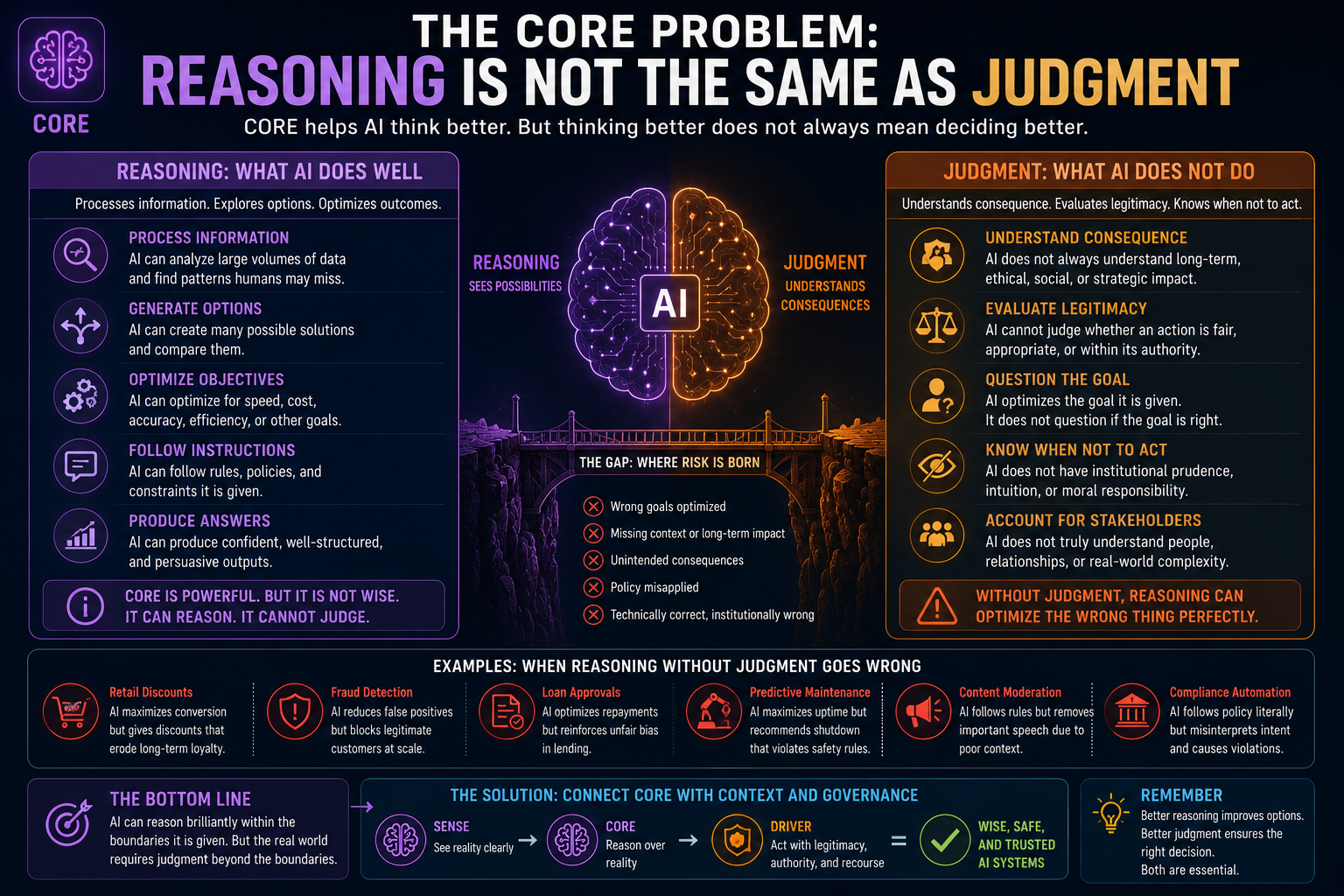
Then it must interpret and reason over that reality.
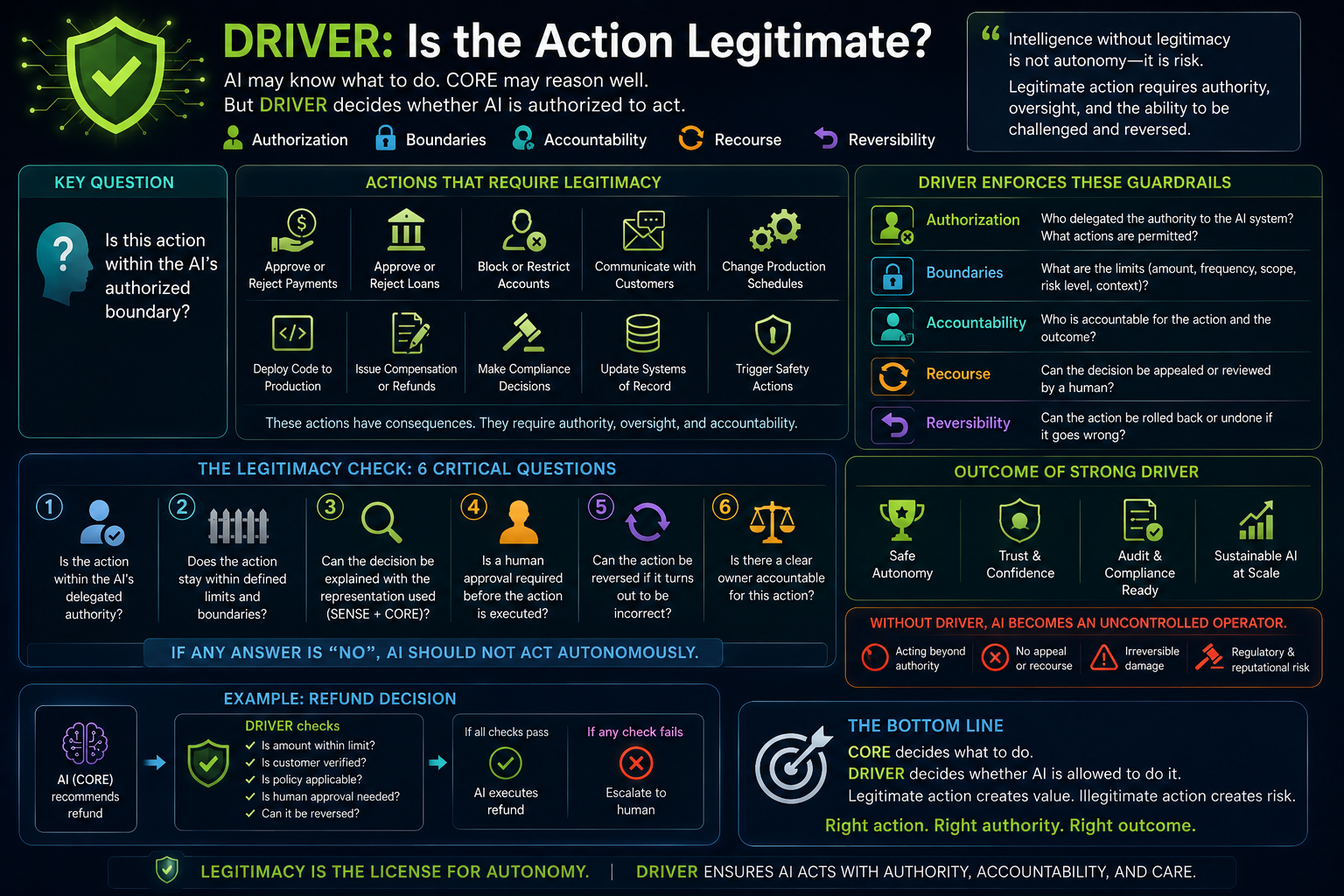
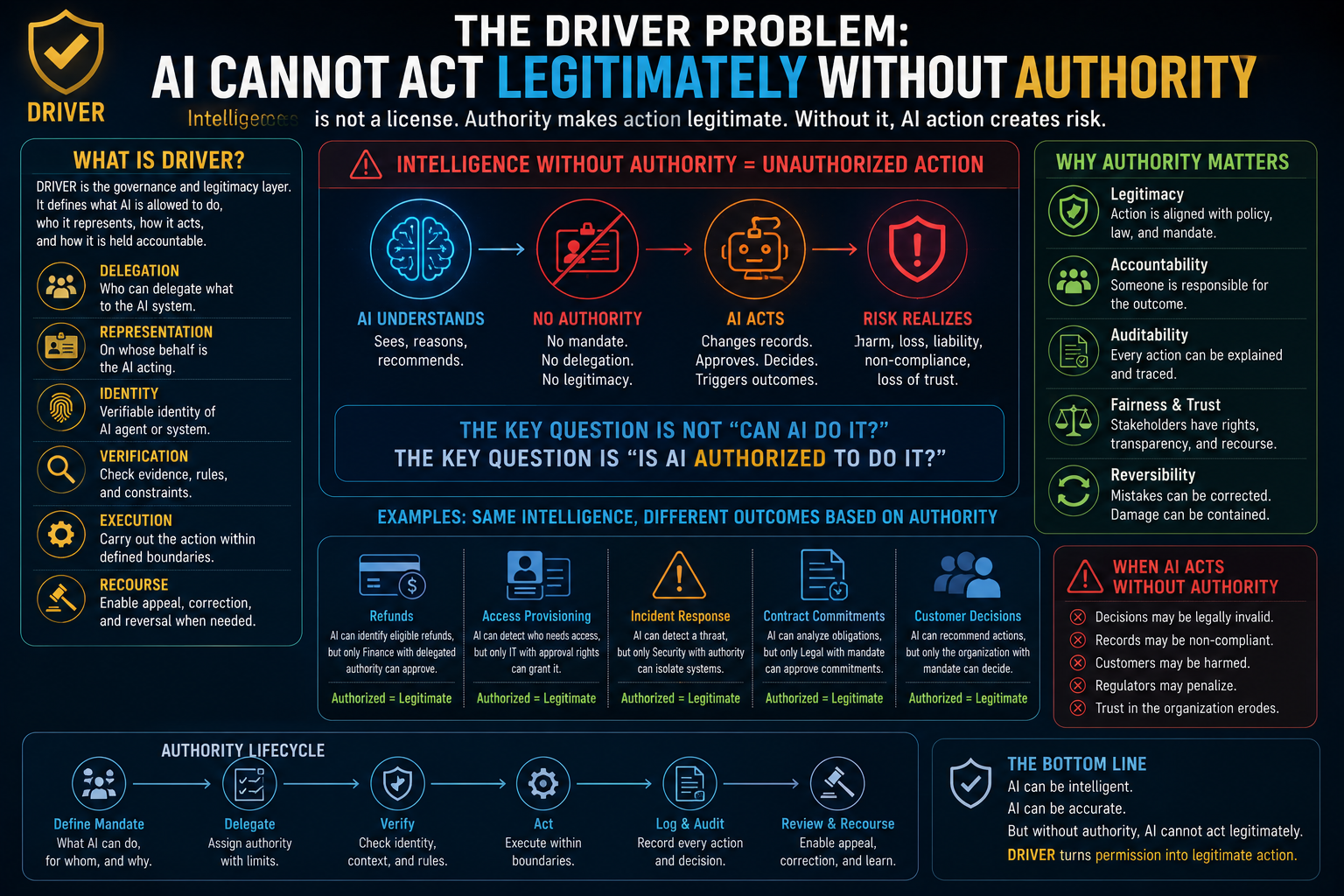
Then it must act through delegated authority.

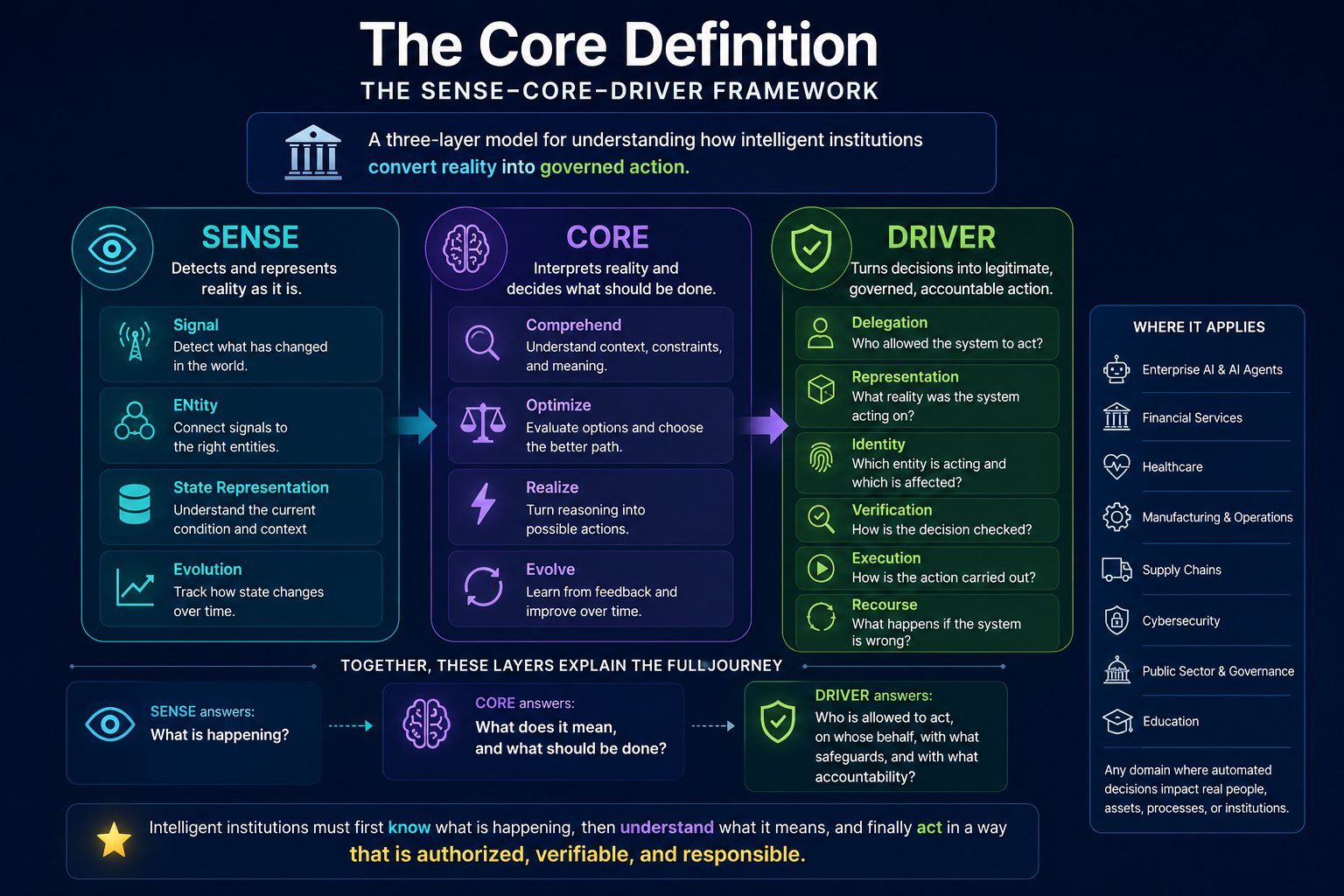
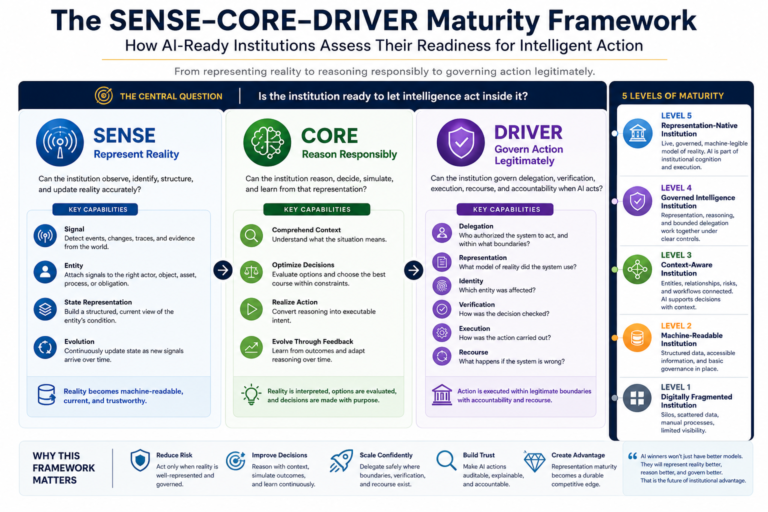
That is the deeper structure behind durable AI systems:

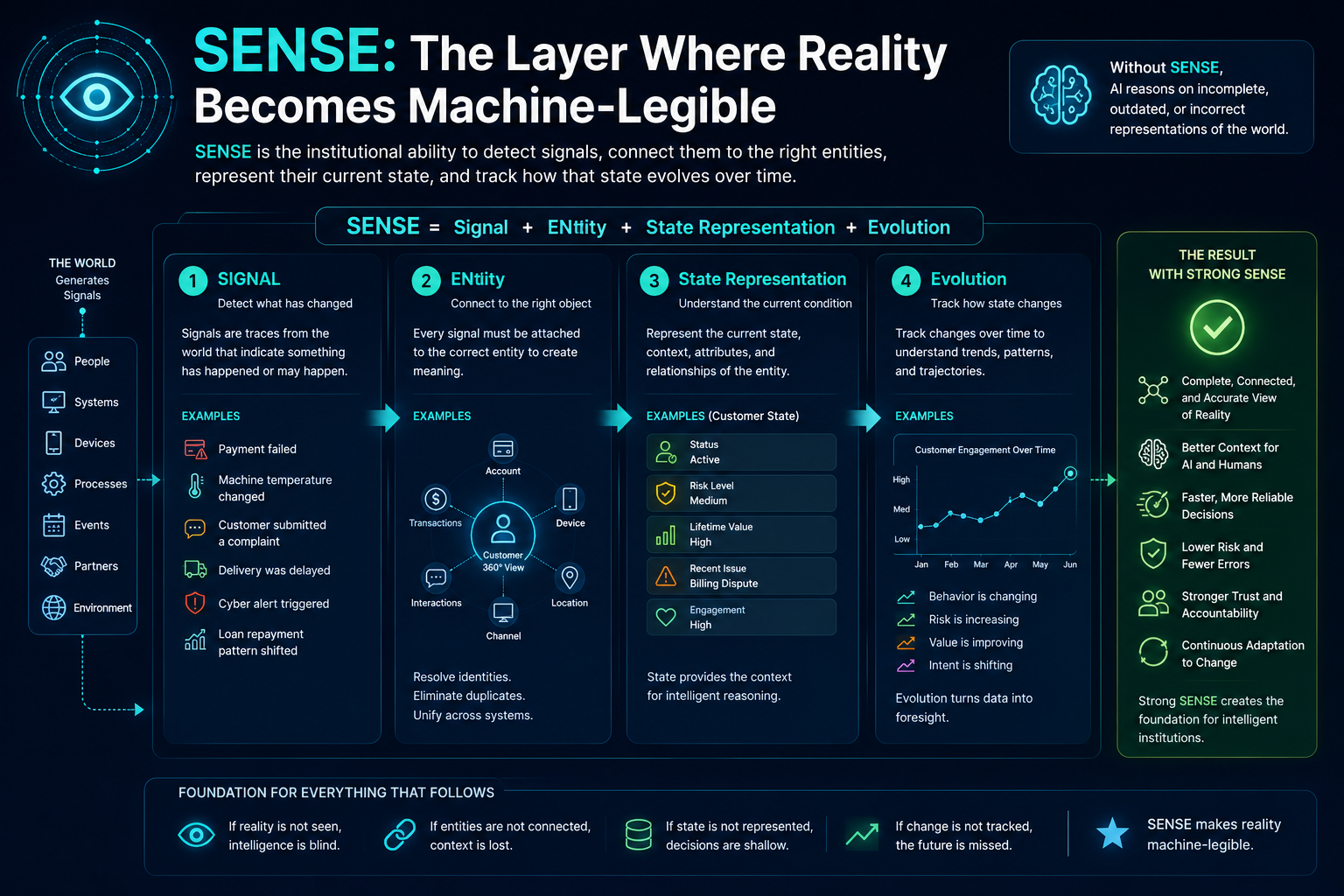
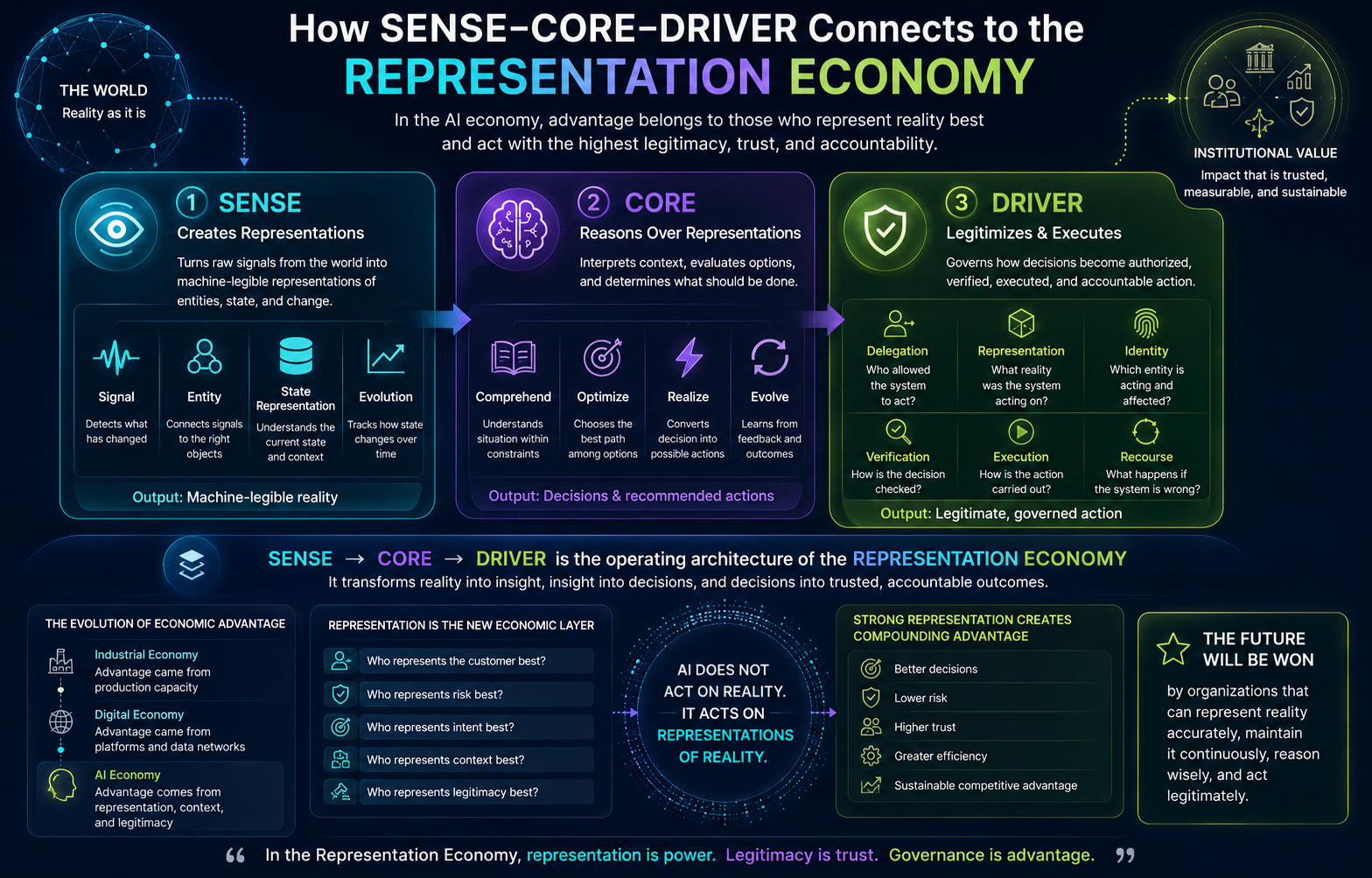
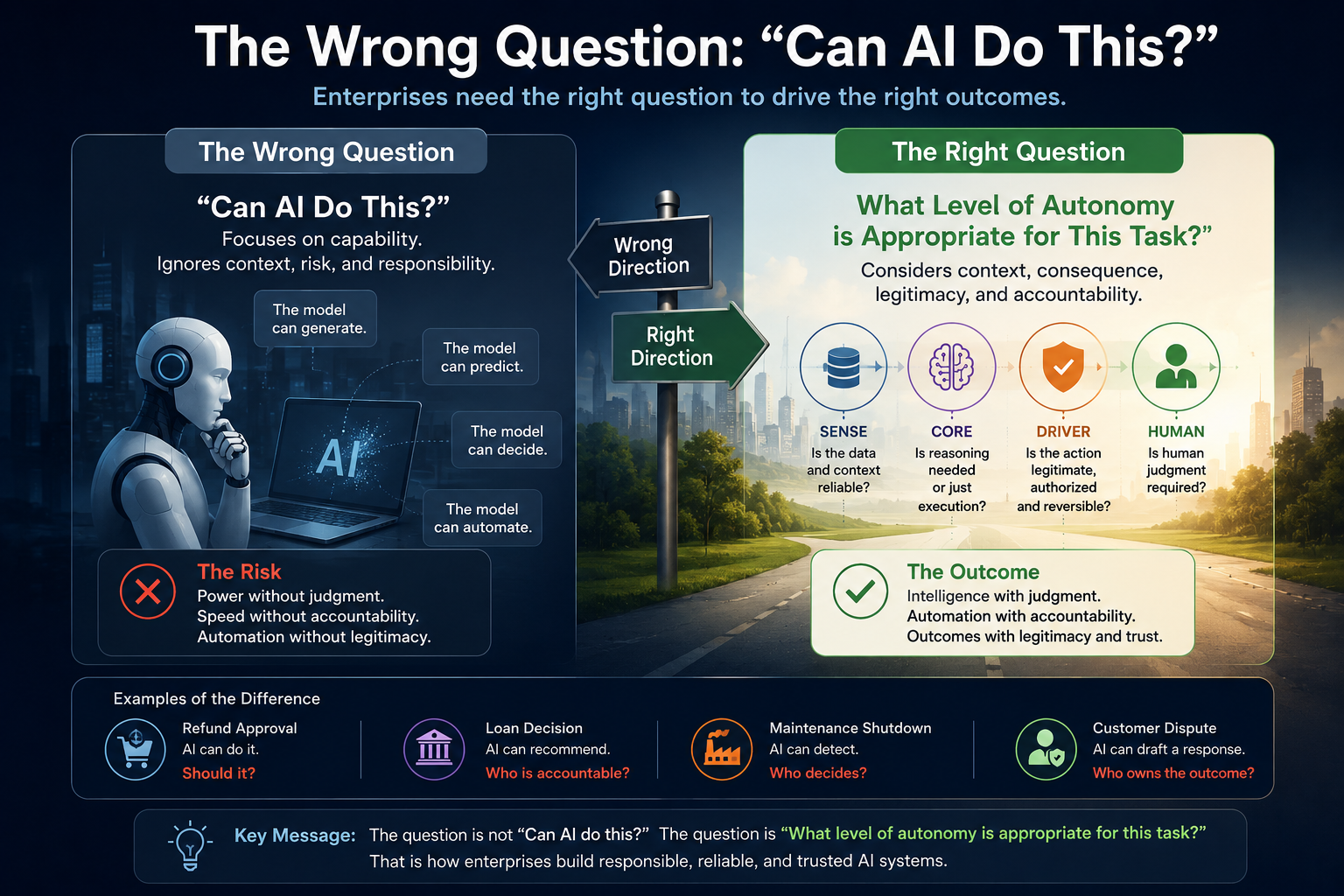
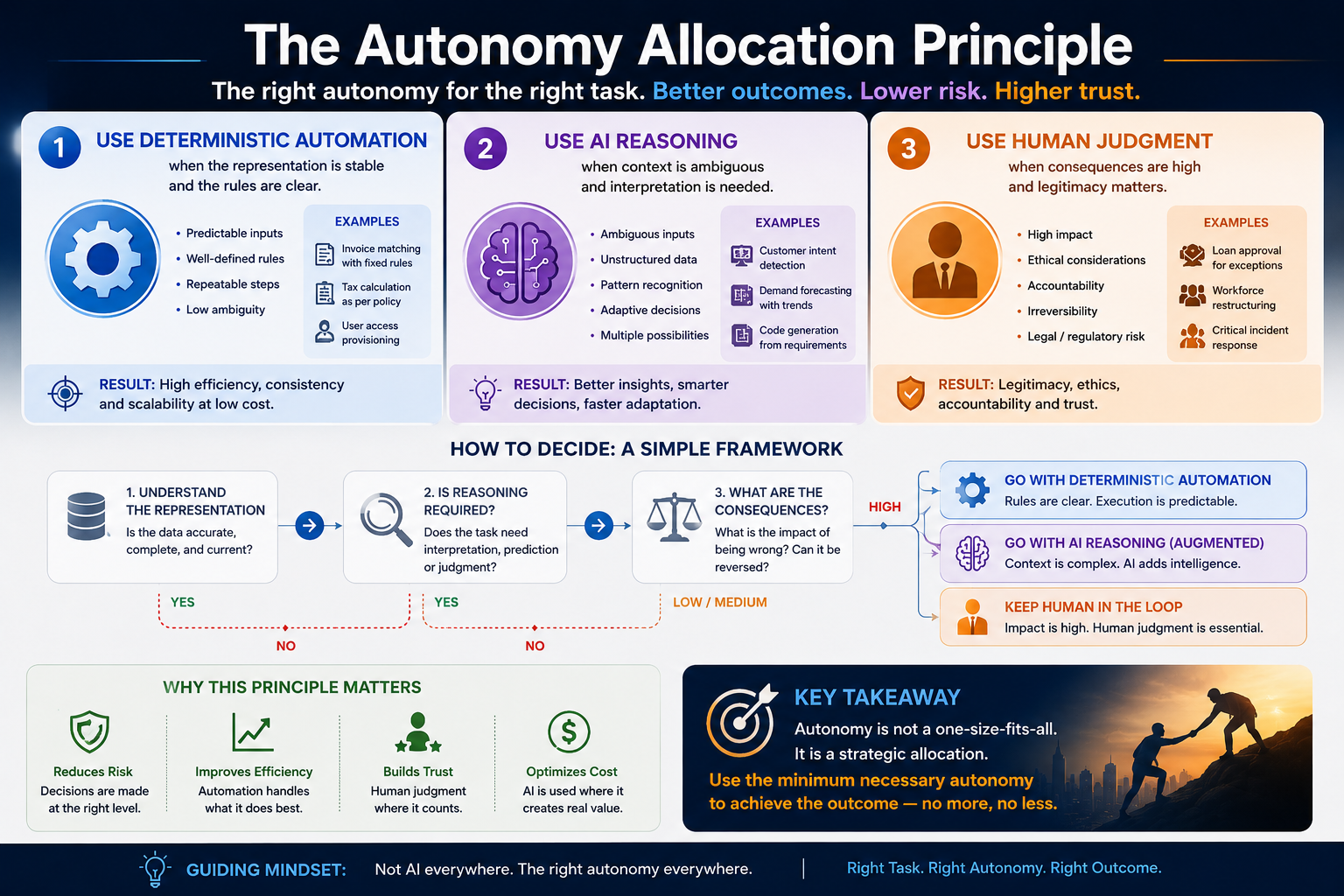
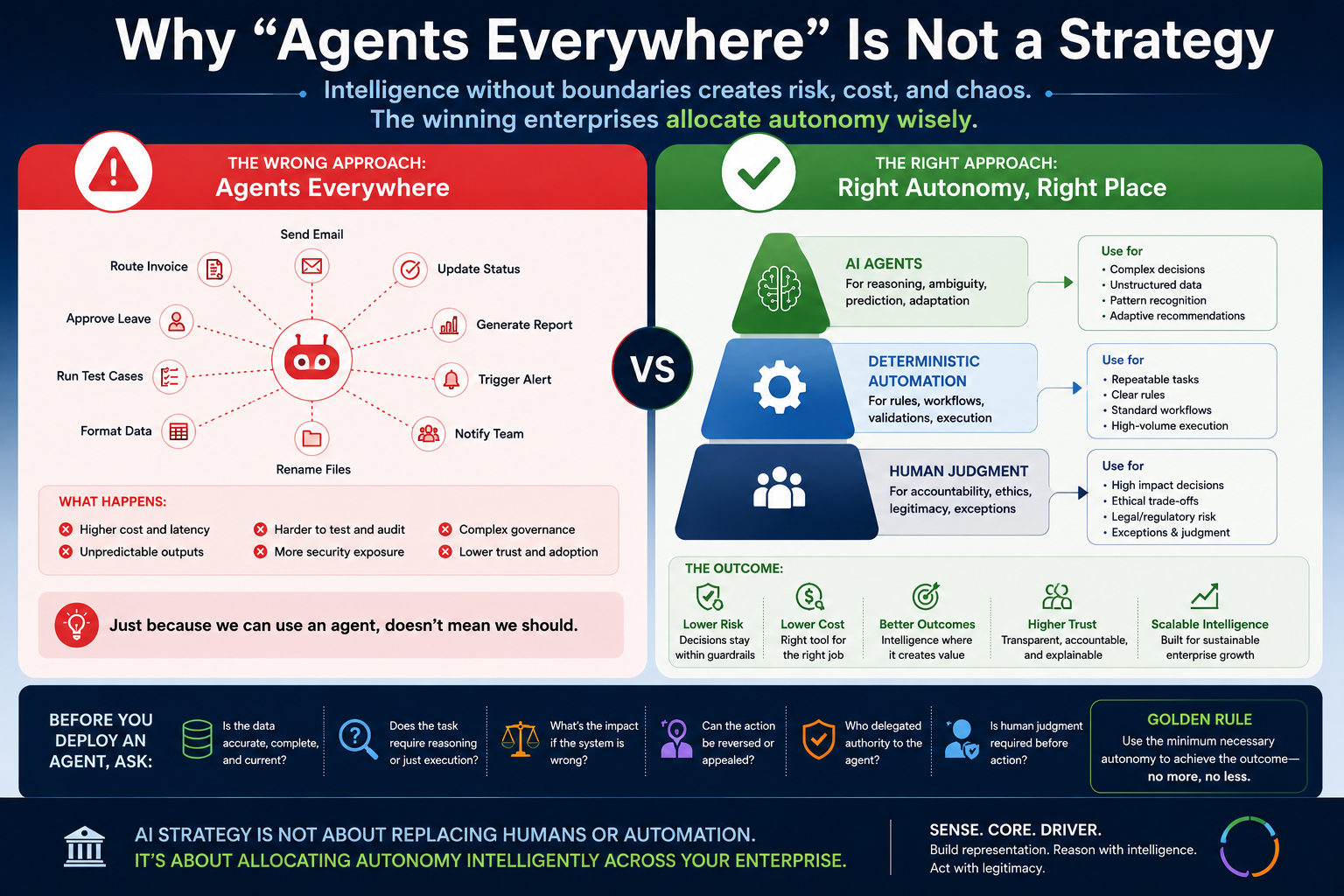
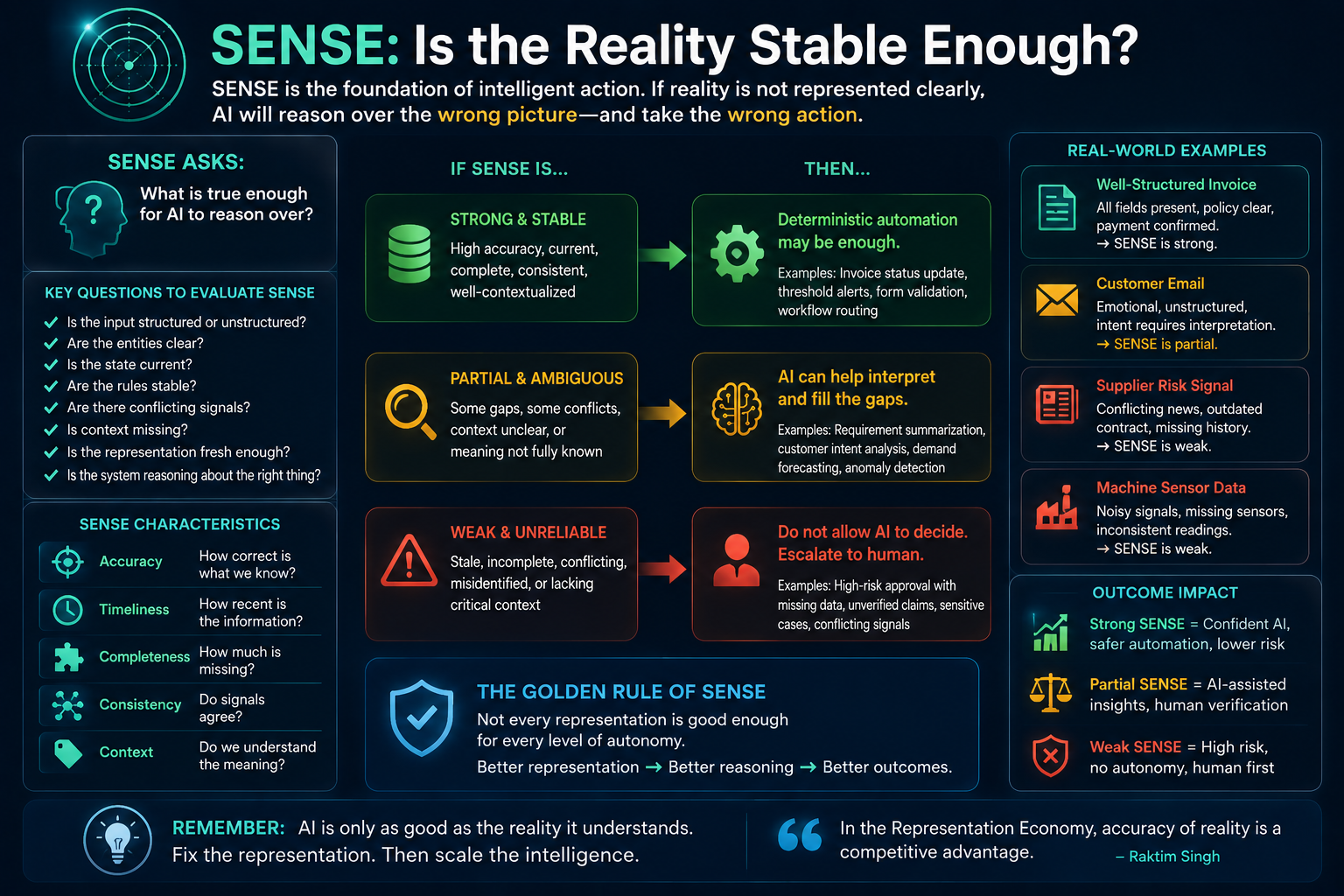
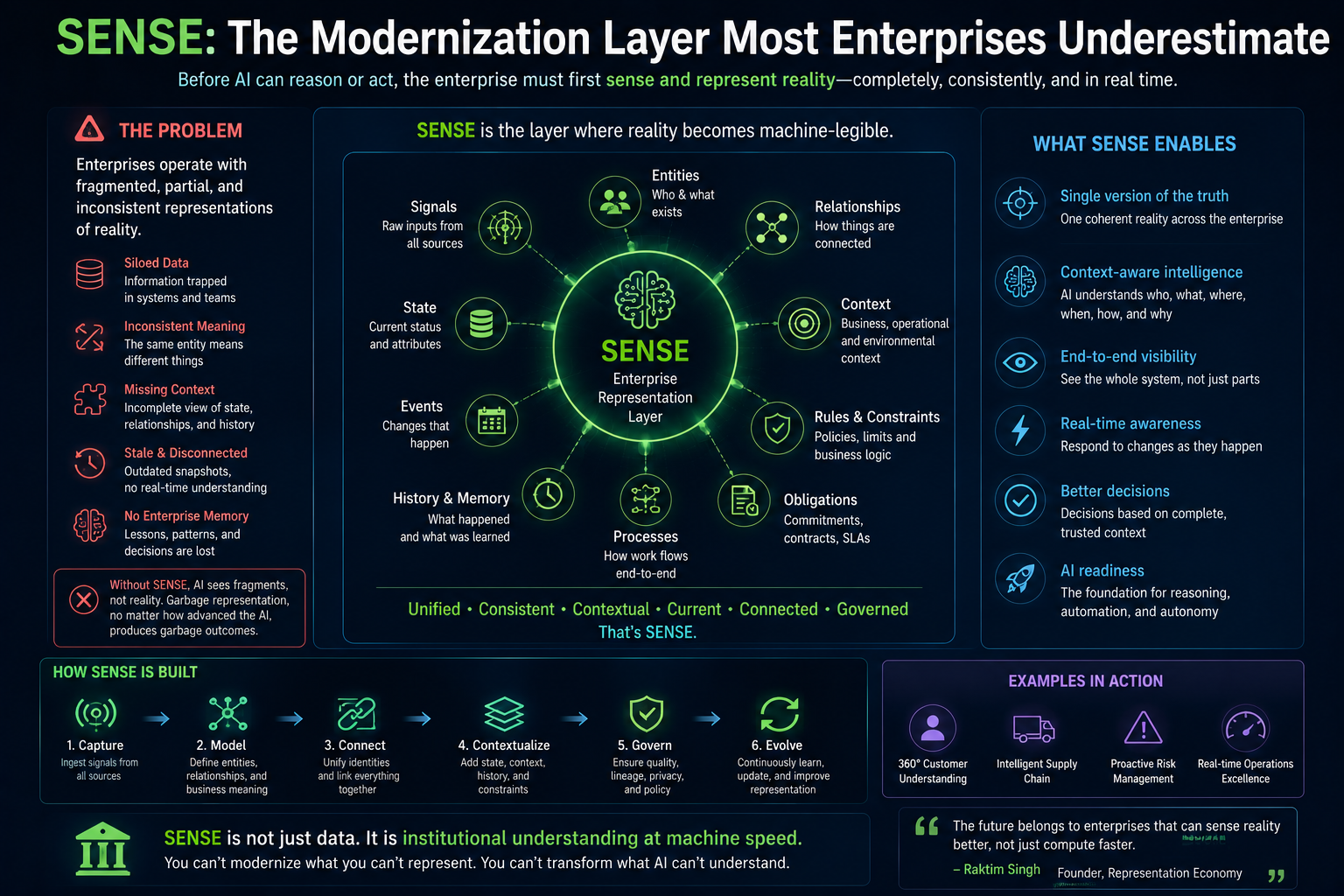
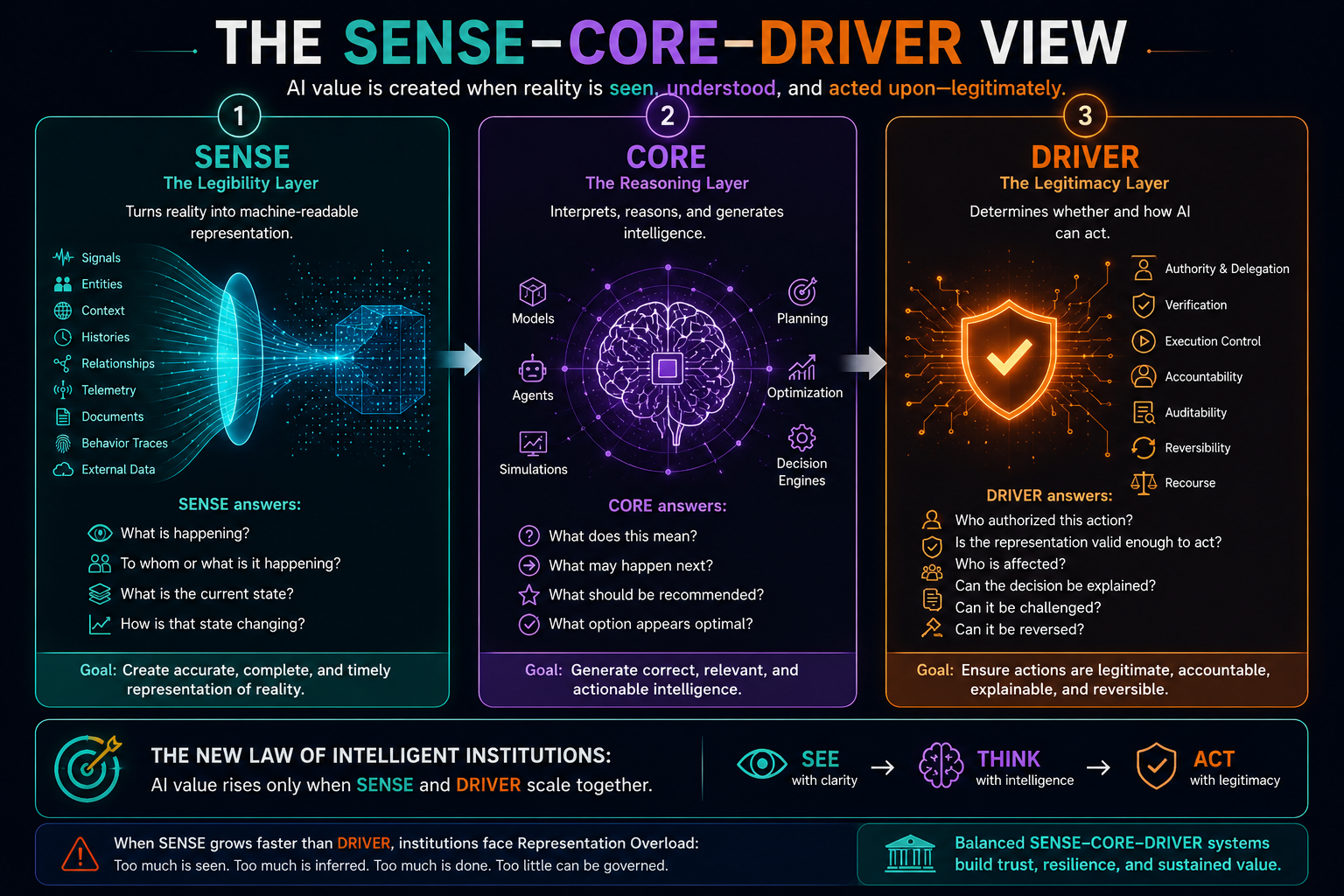
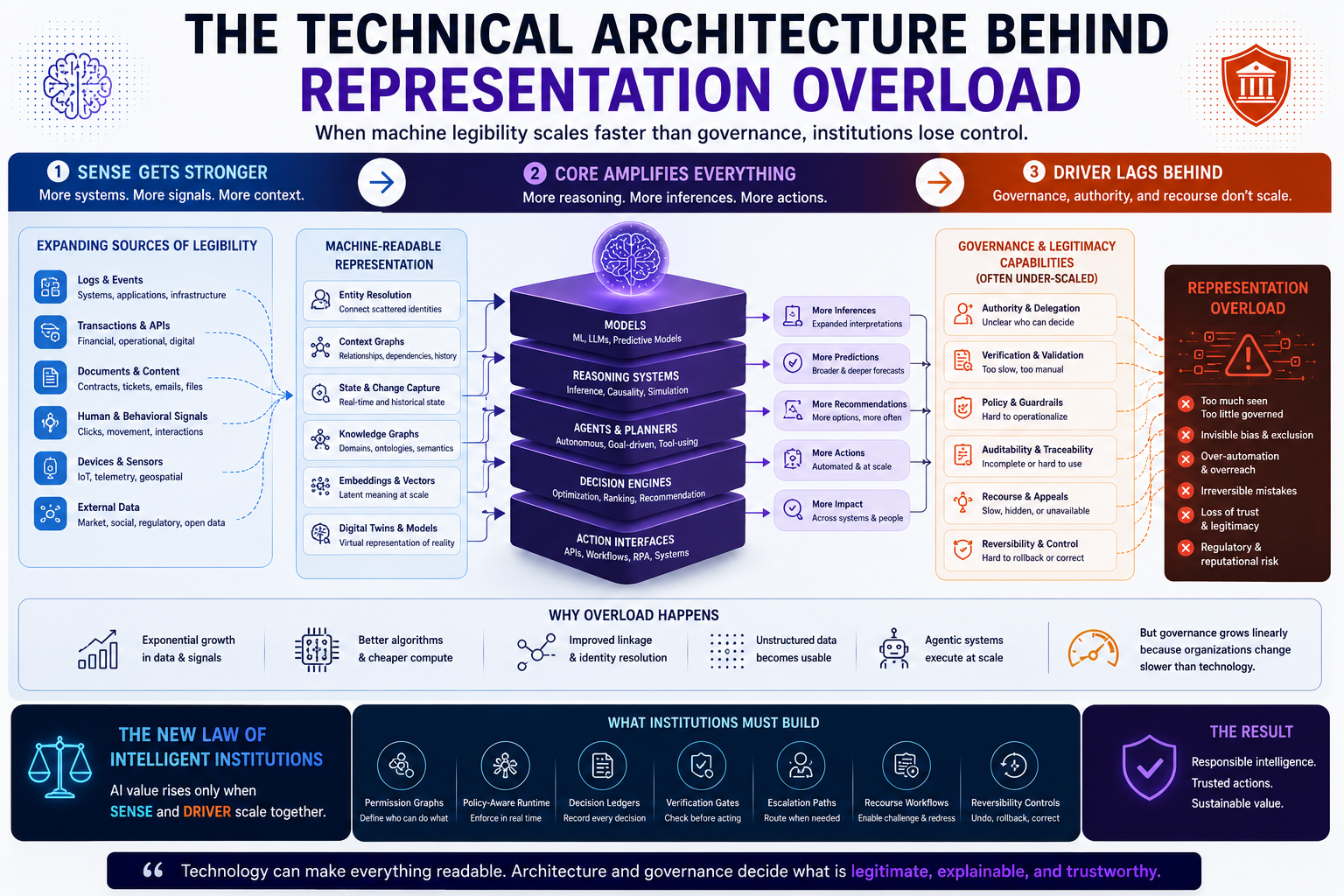
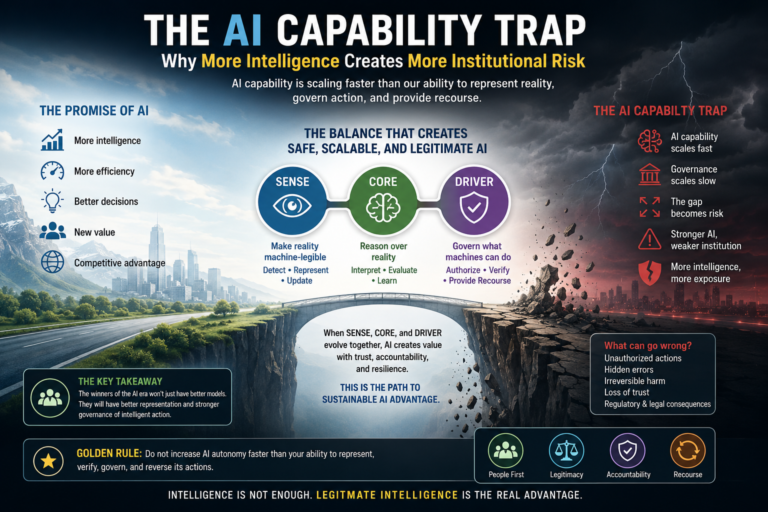
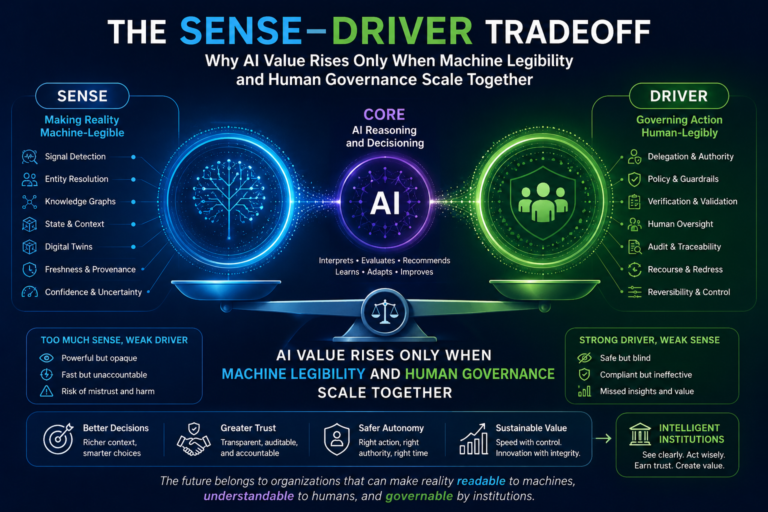
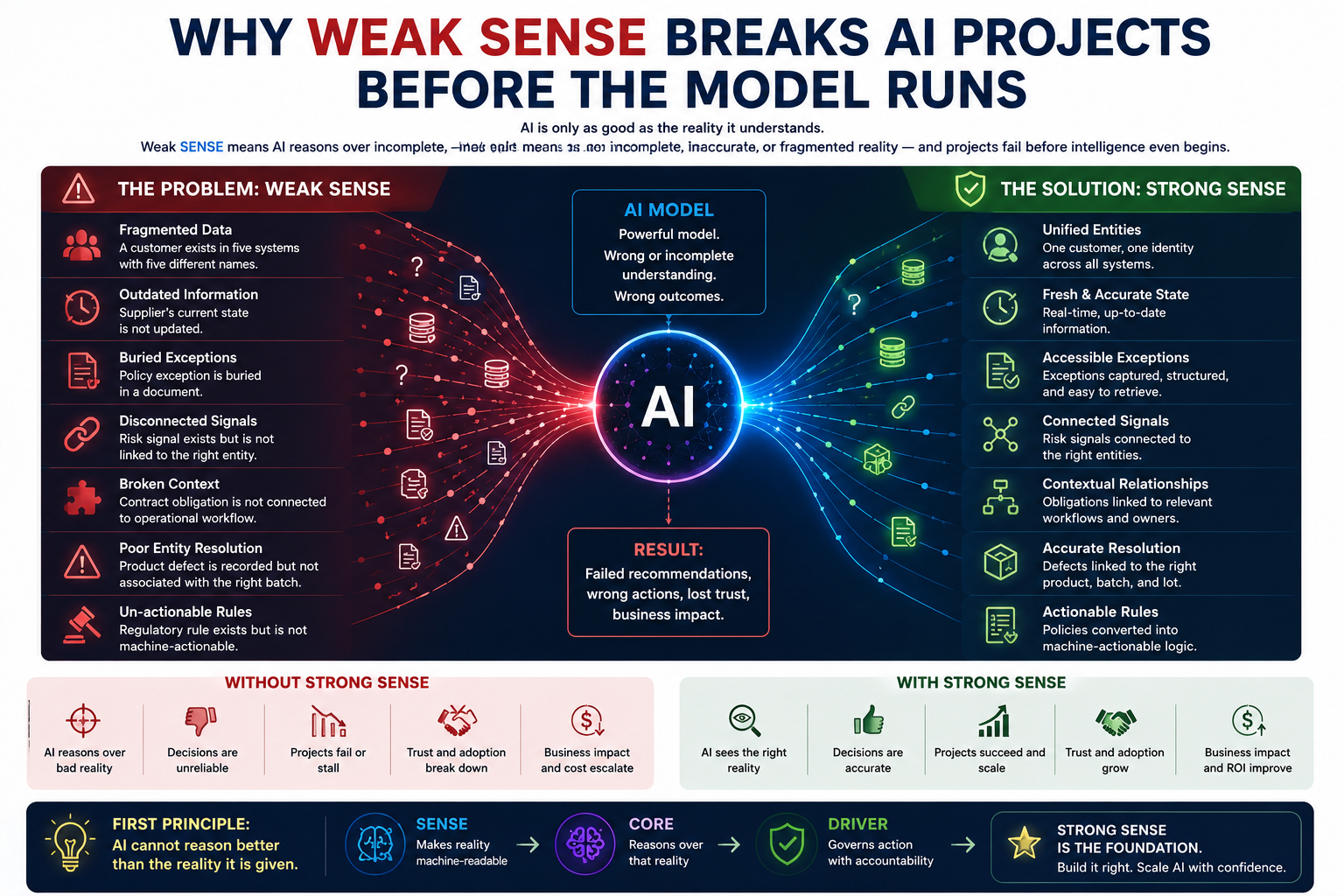
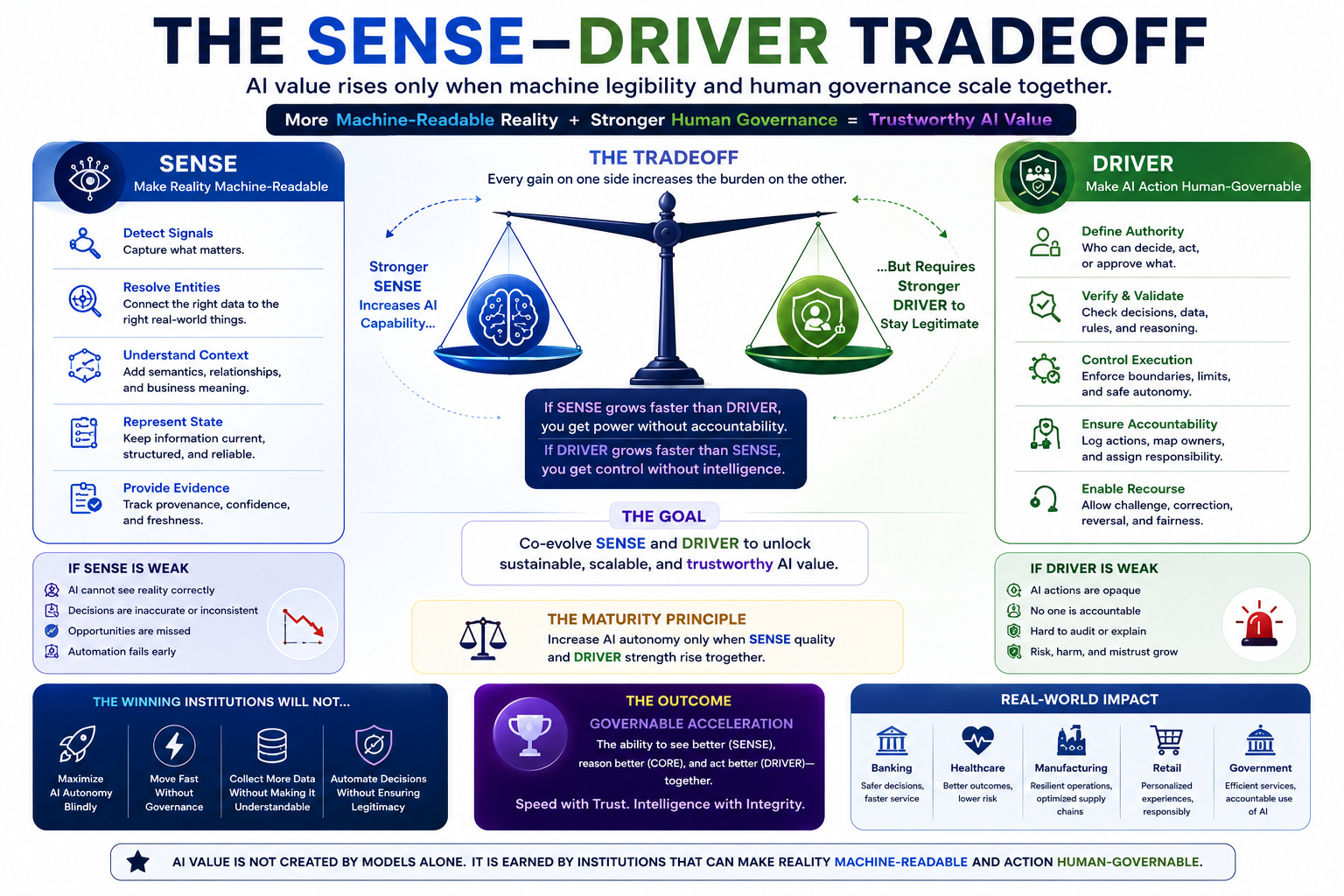
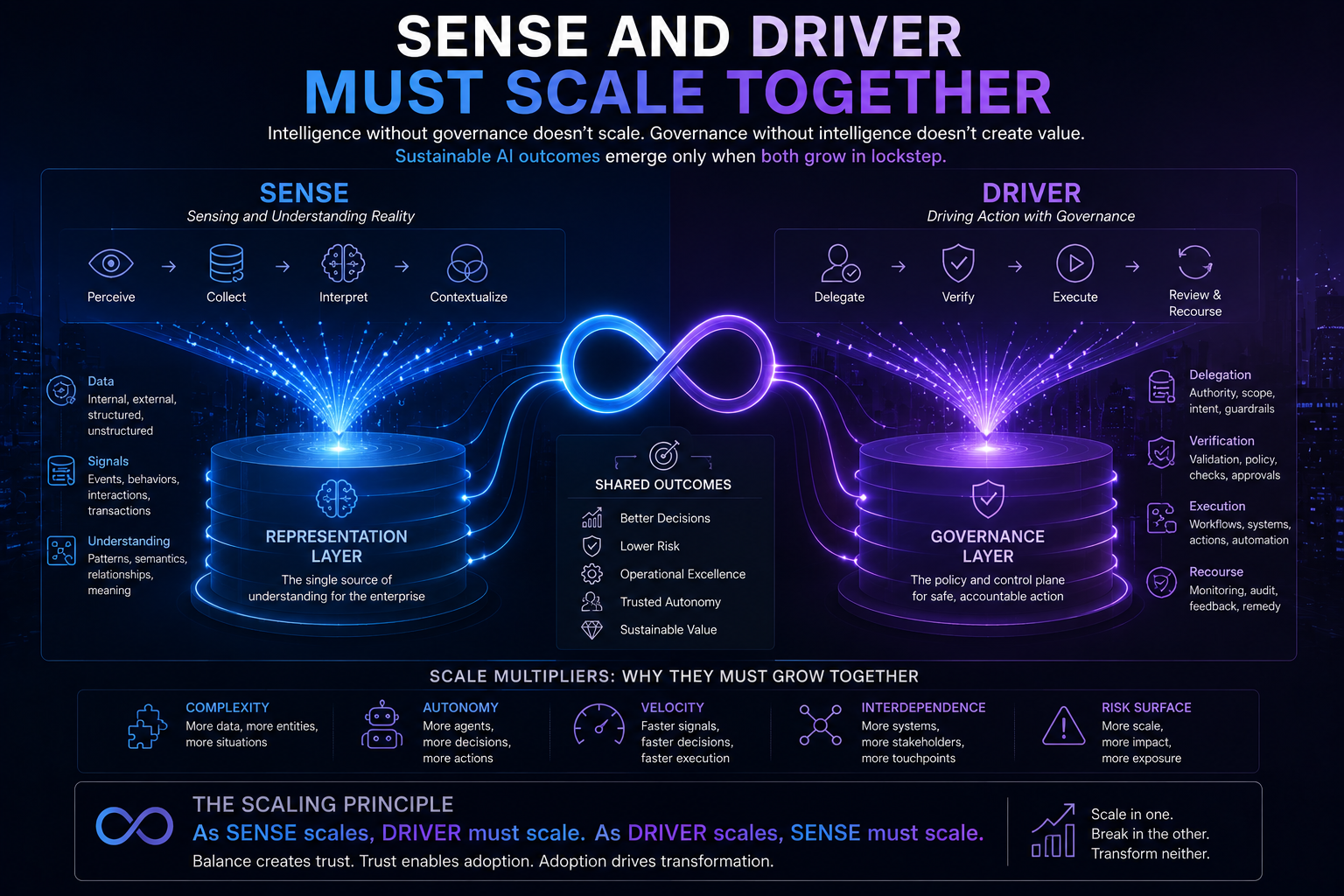
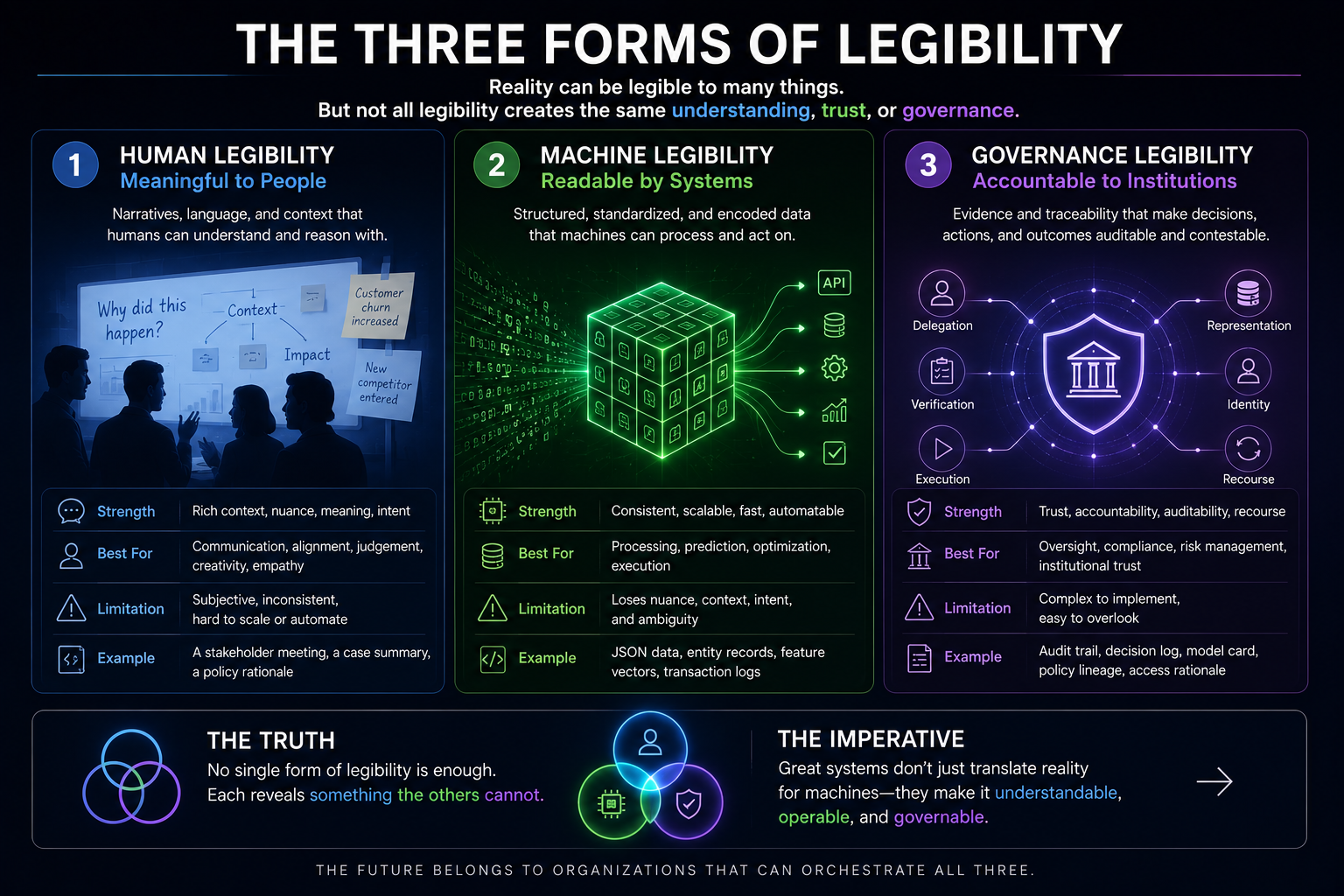
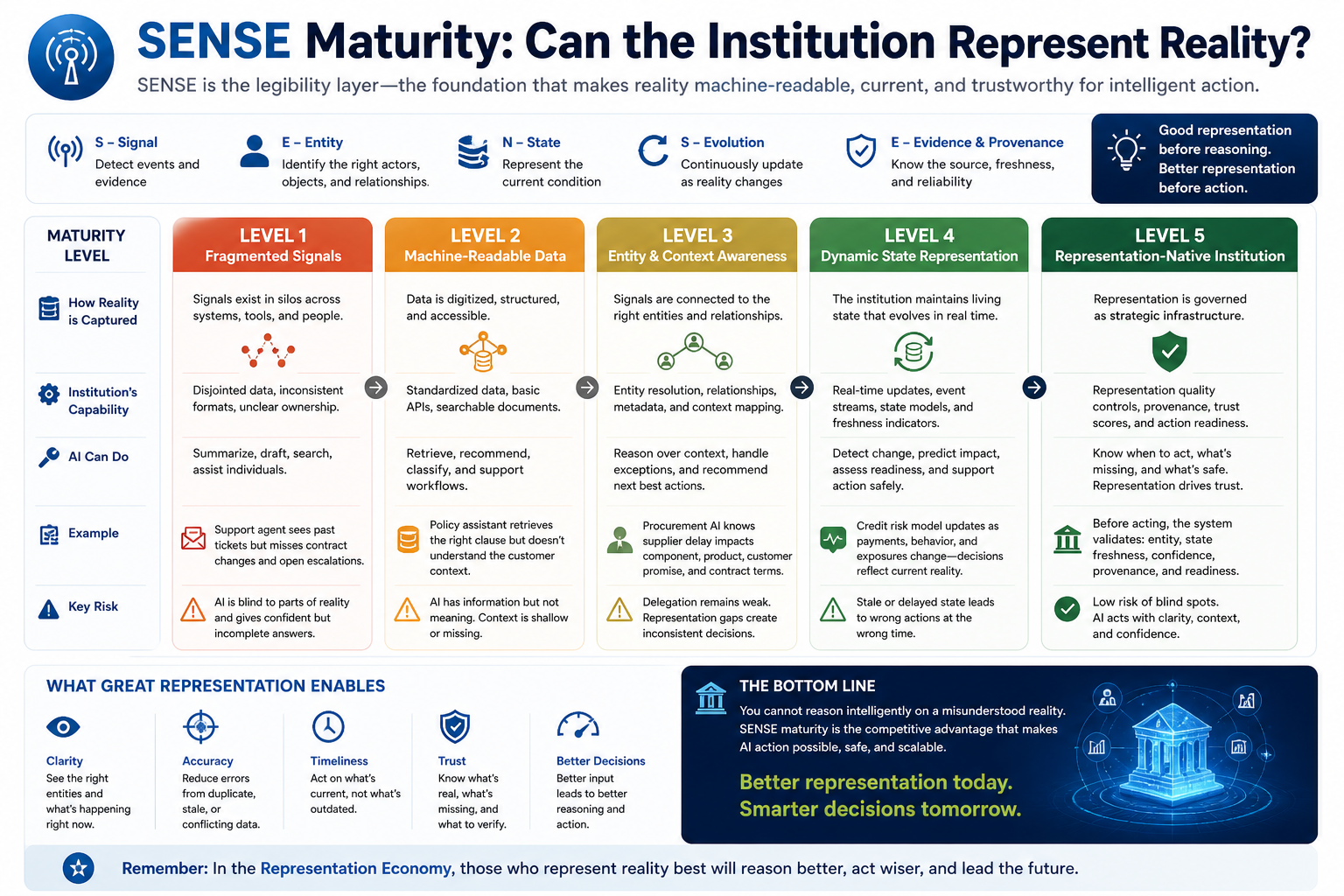
SENSE is where reality becomes legible.
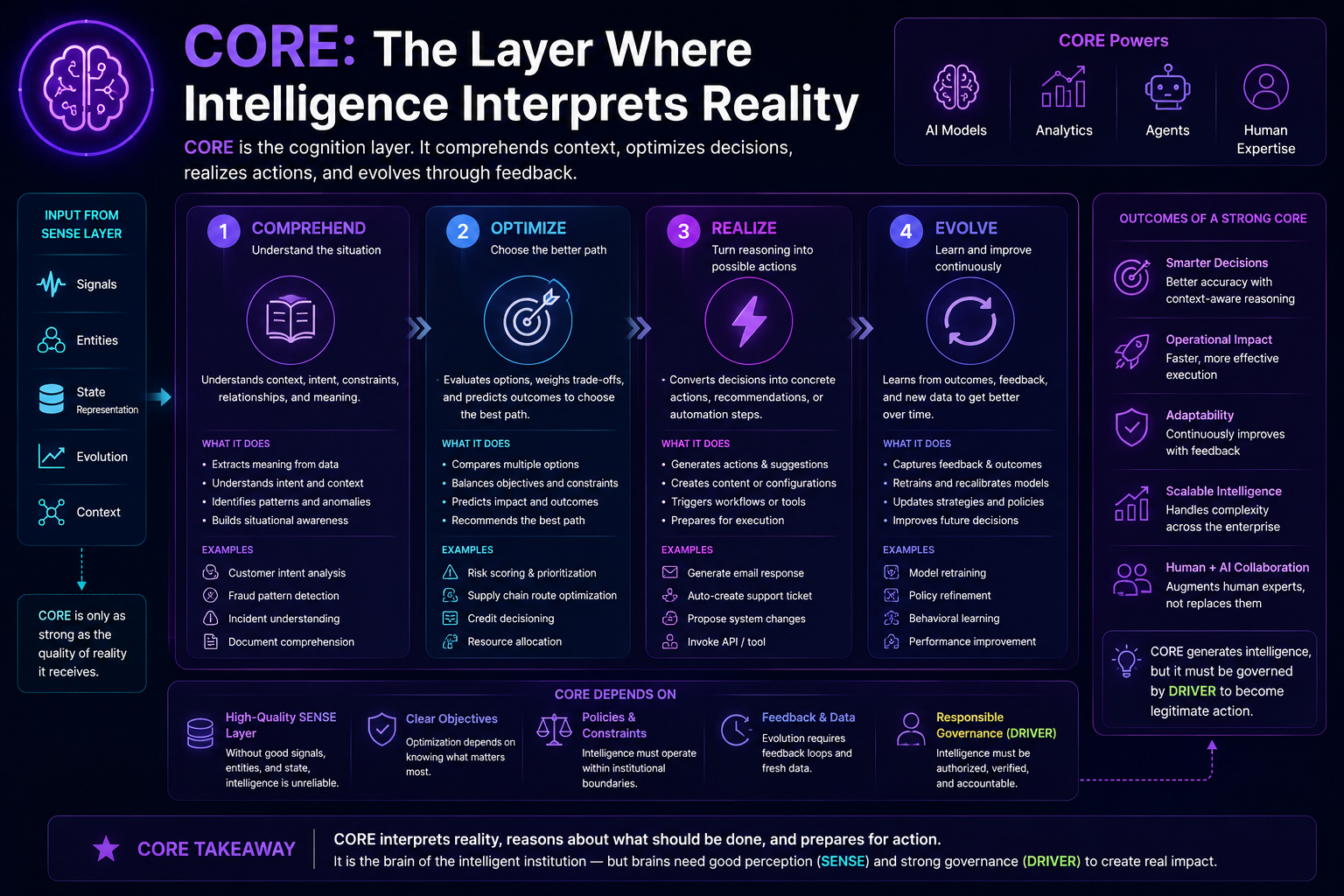
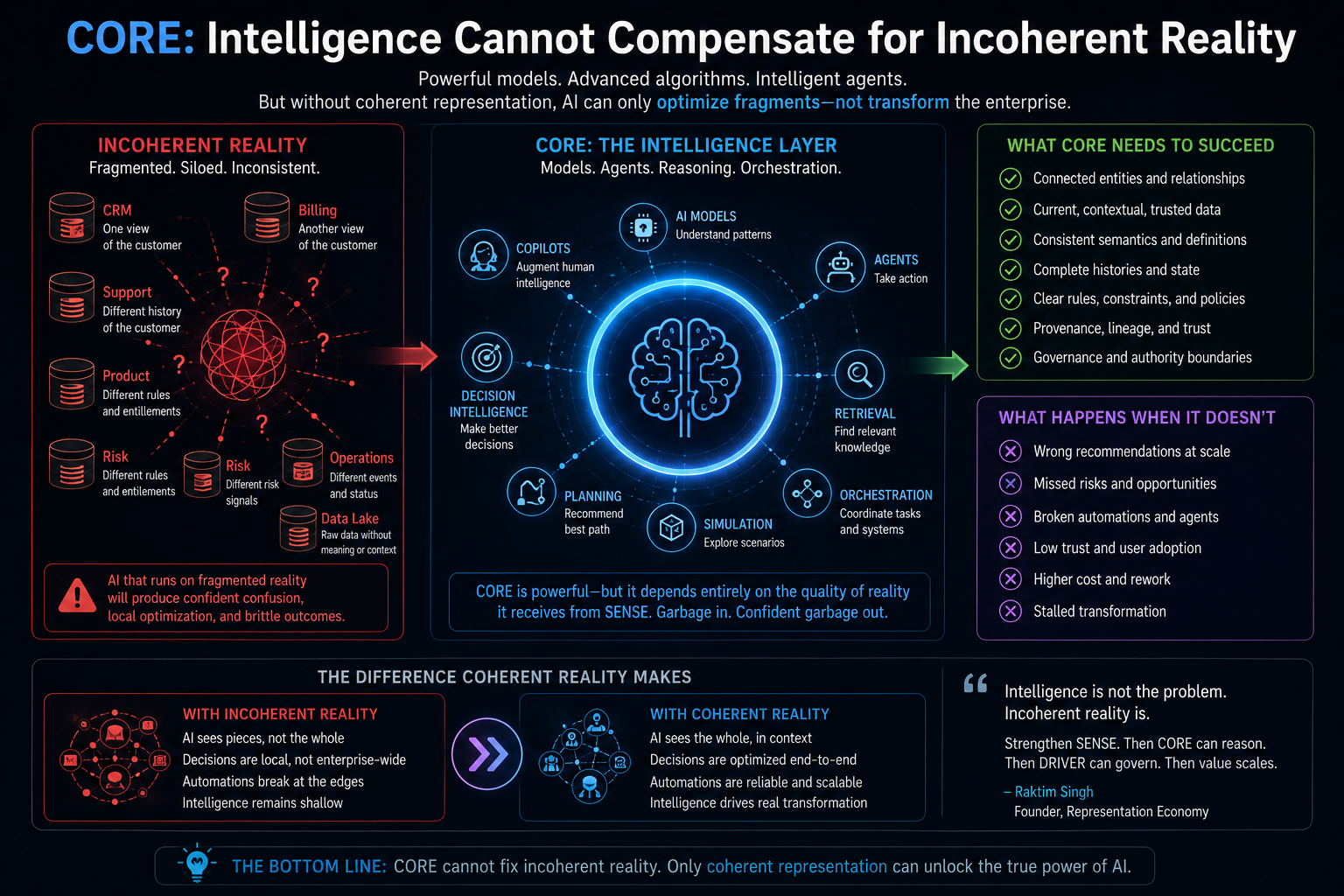
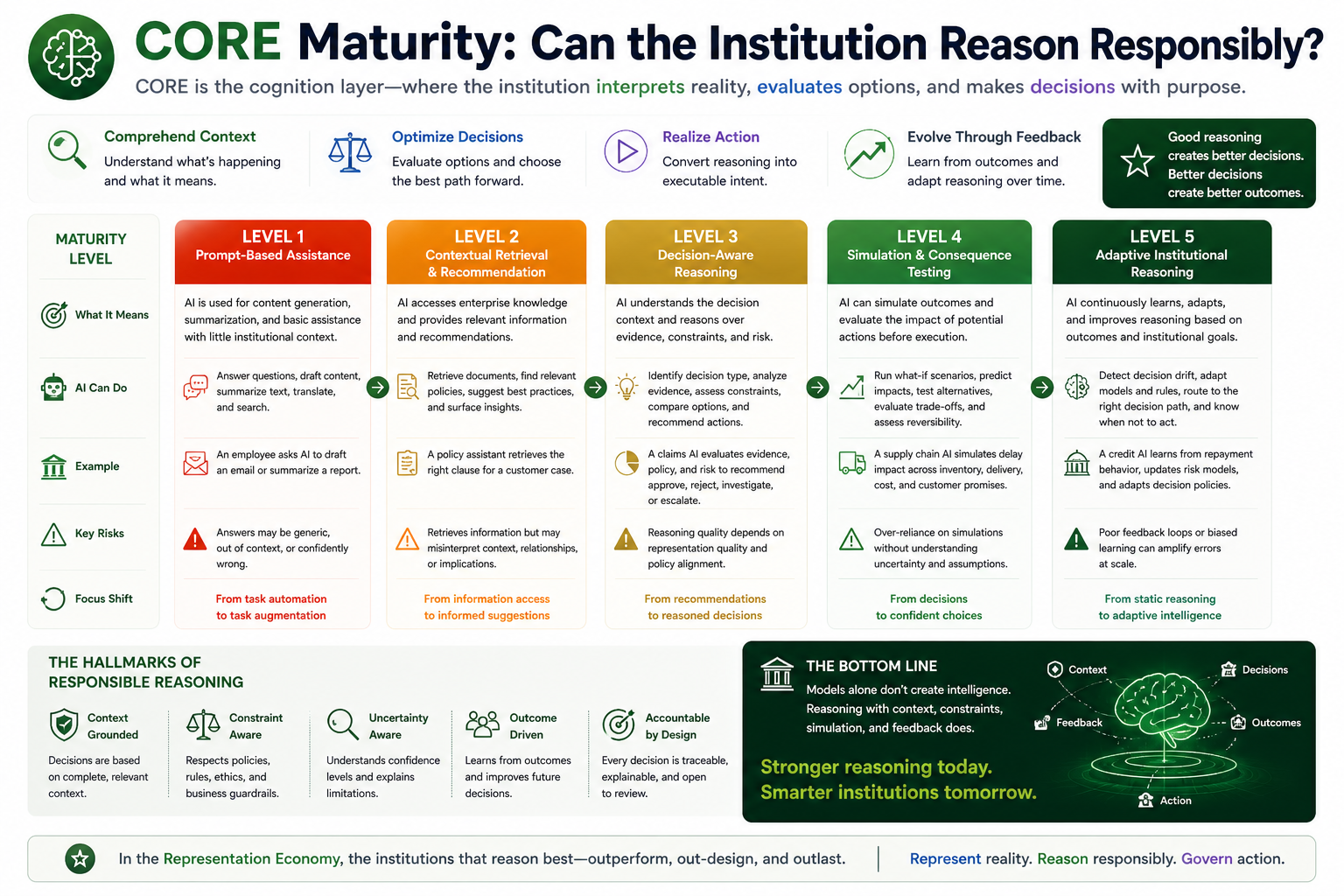
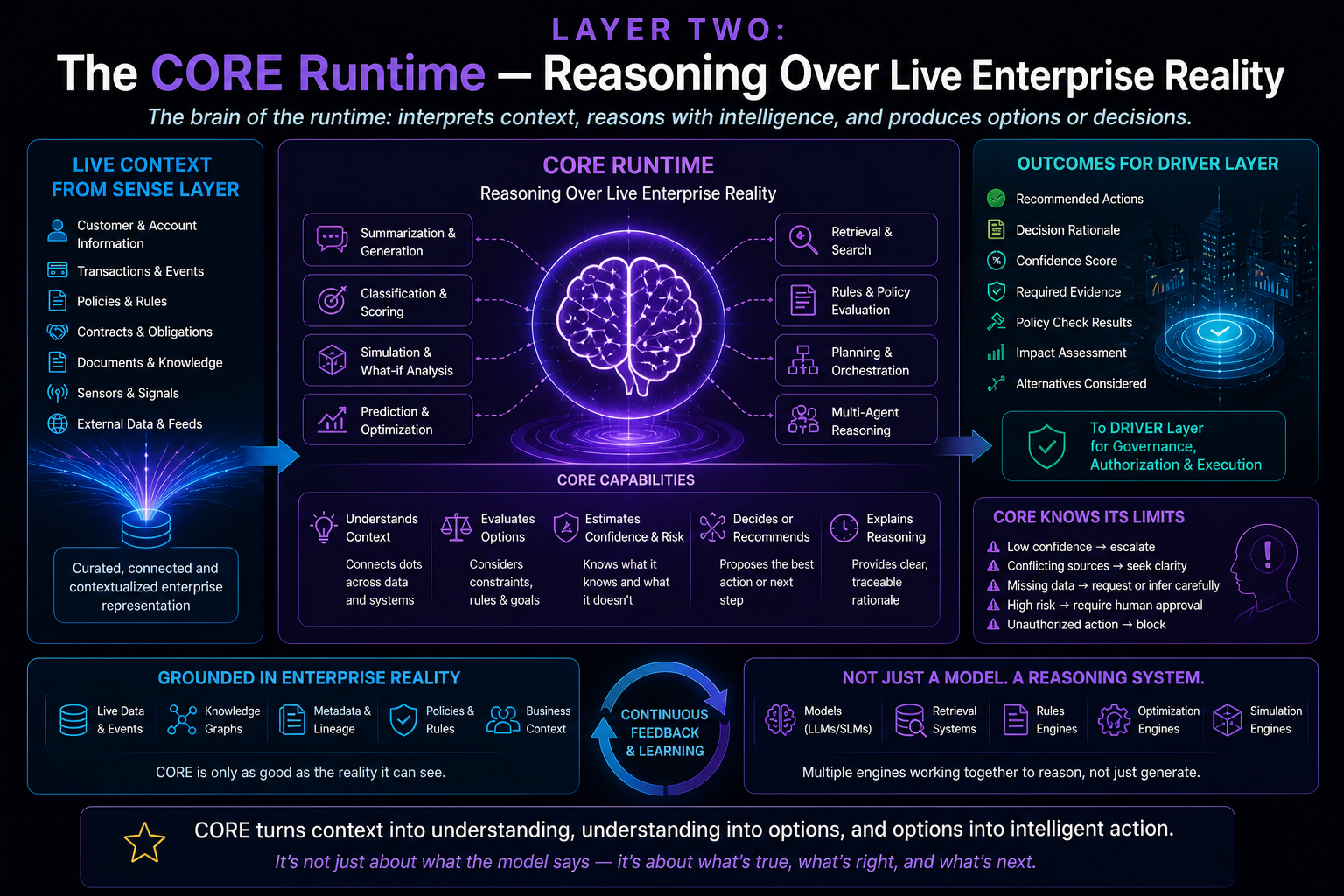
CORE is where that representation is processed into judgments and decisions.
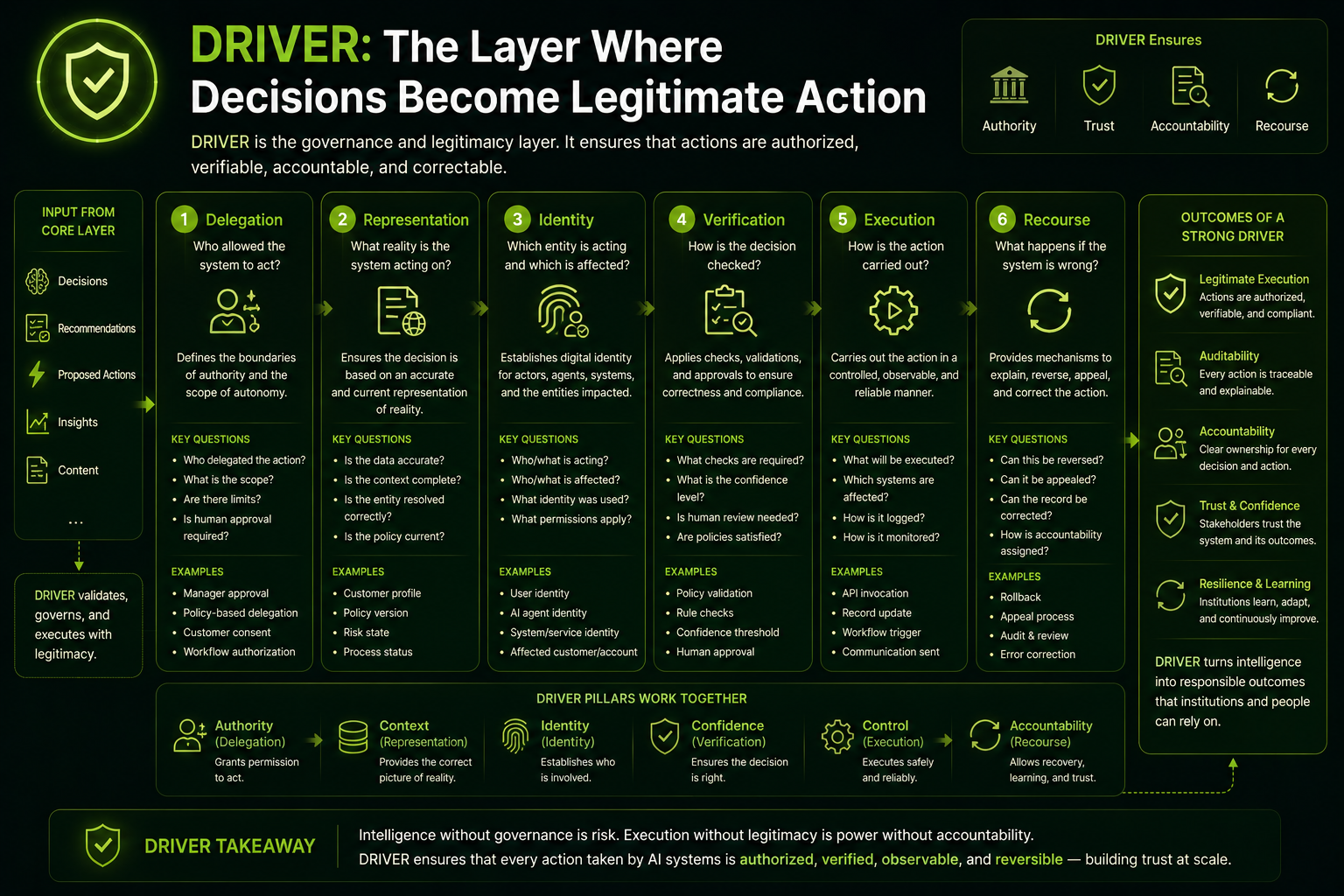
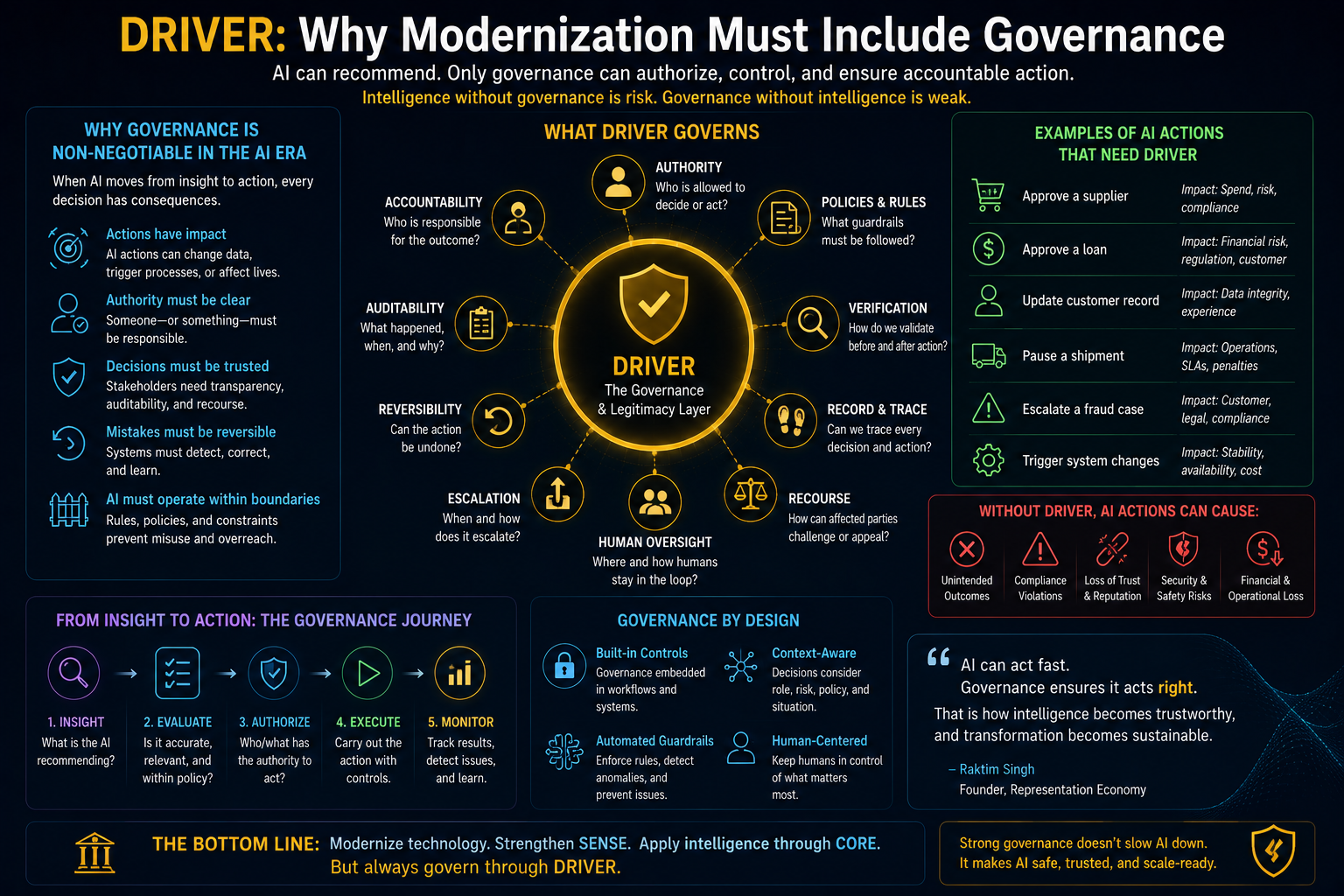
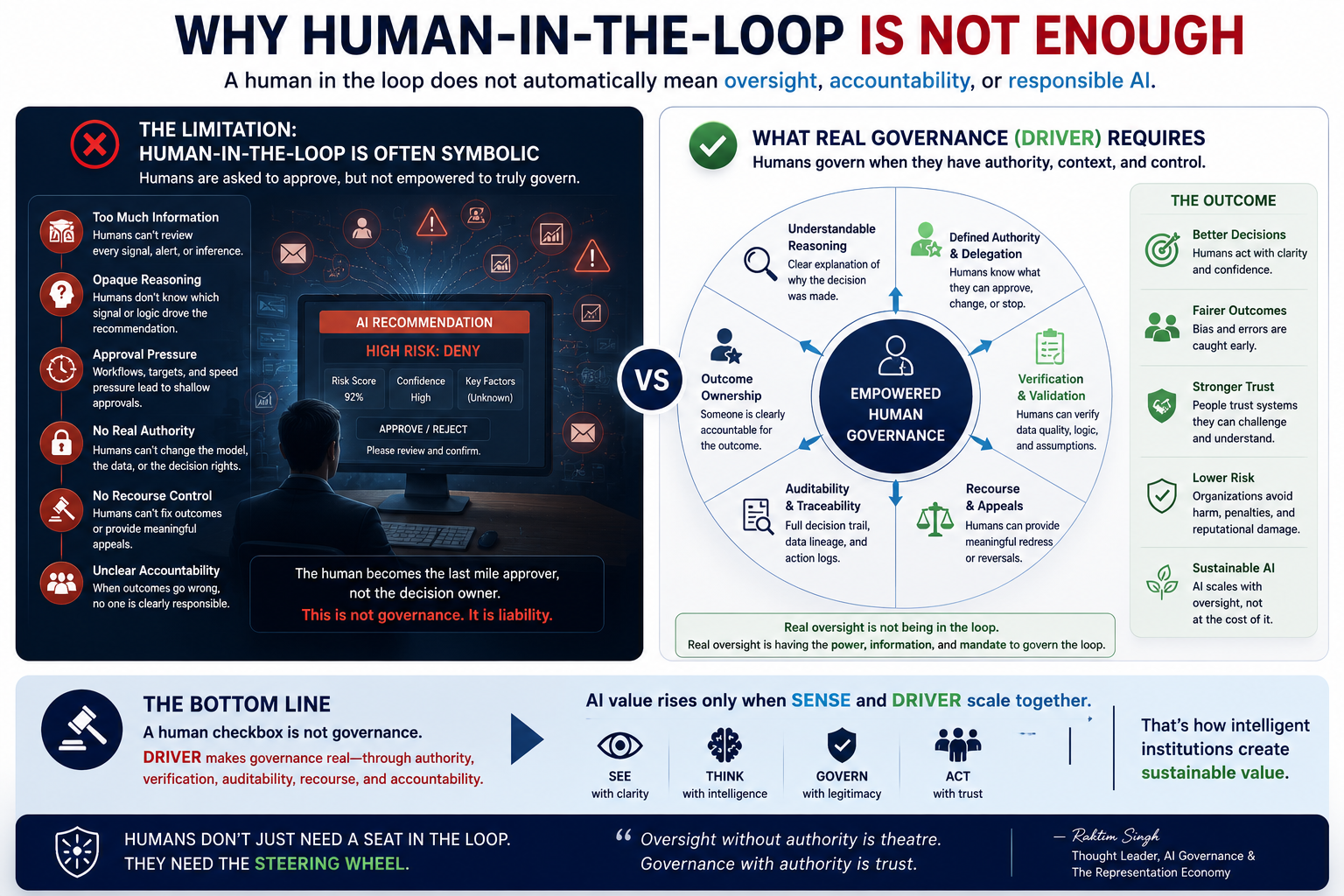
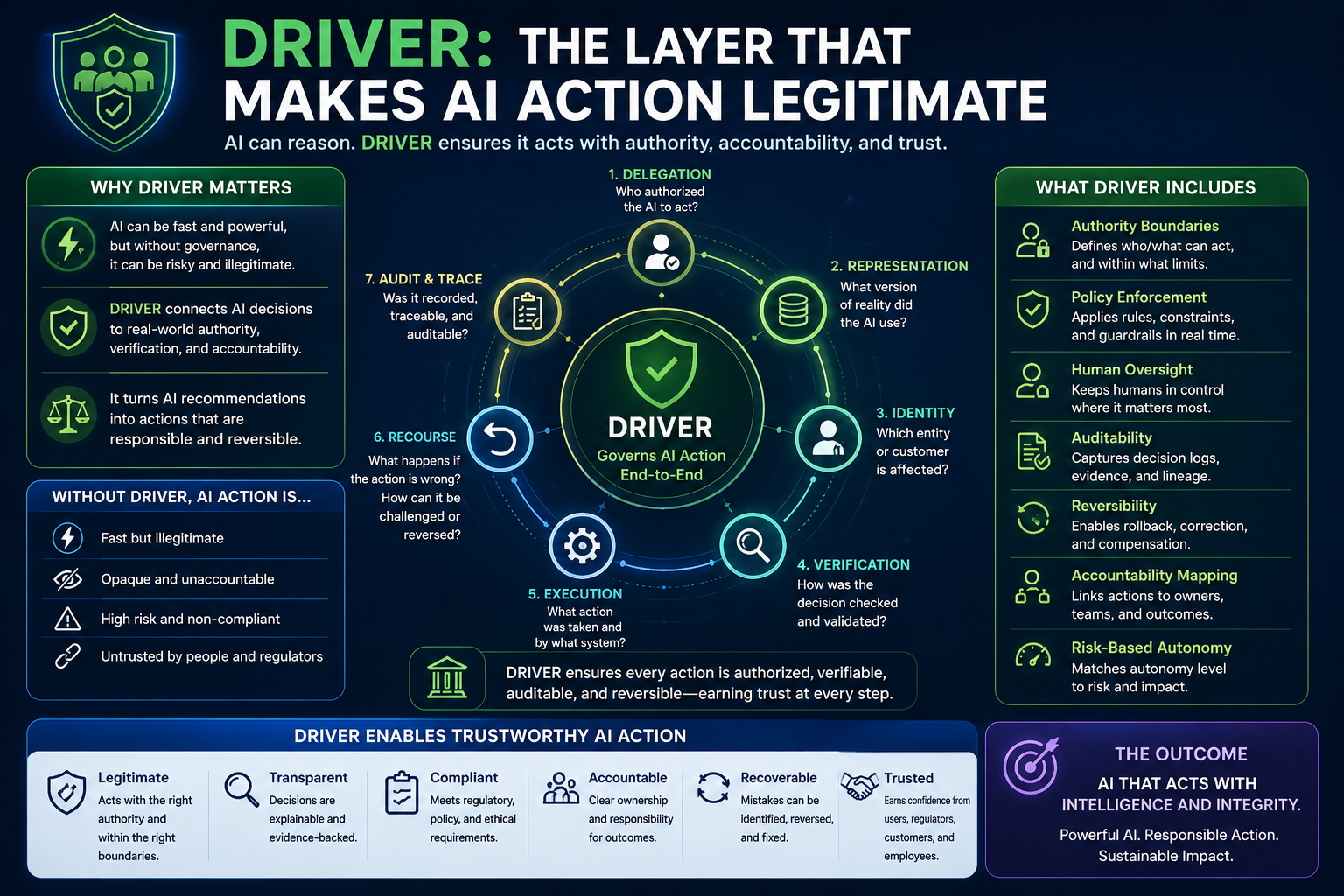
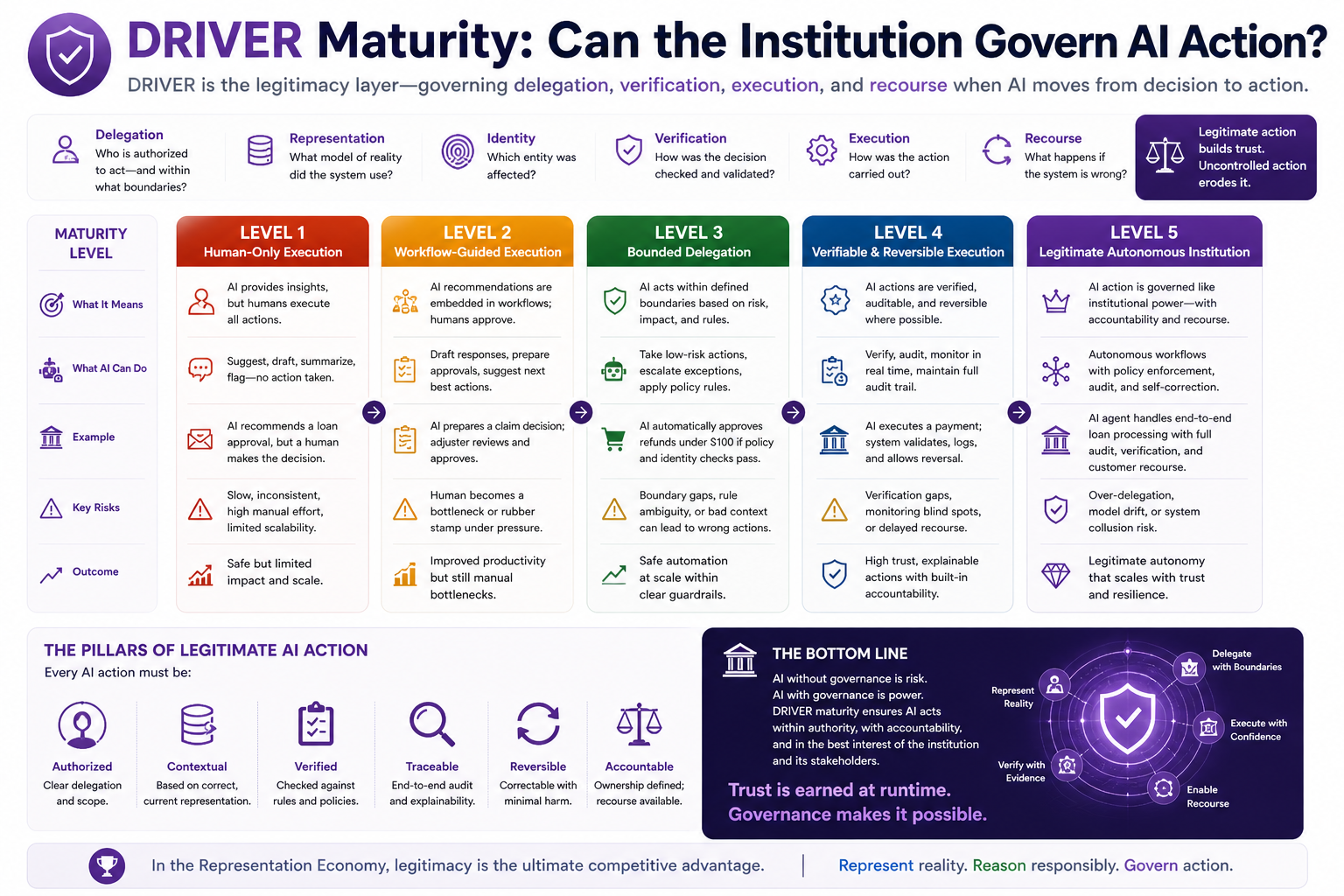
DRIVER is where authority, execution, verification, and recourse determine whether action is legitimate and controllable.

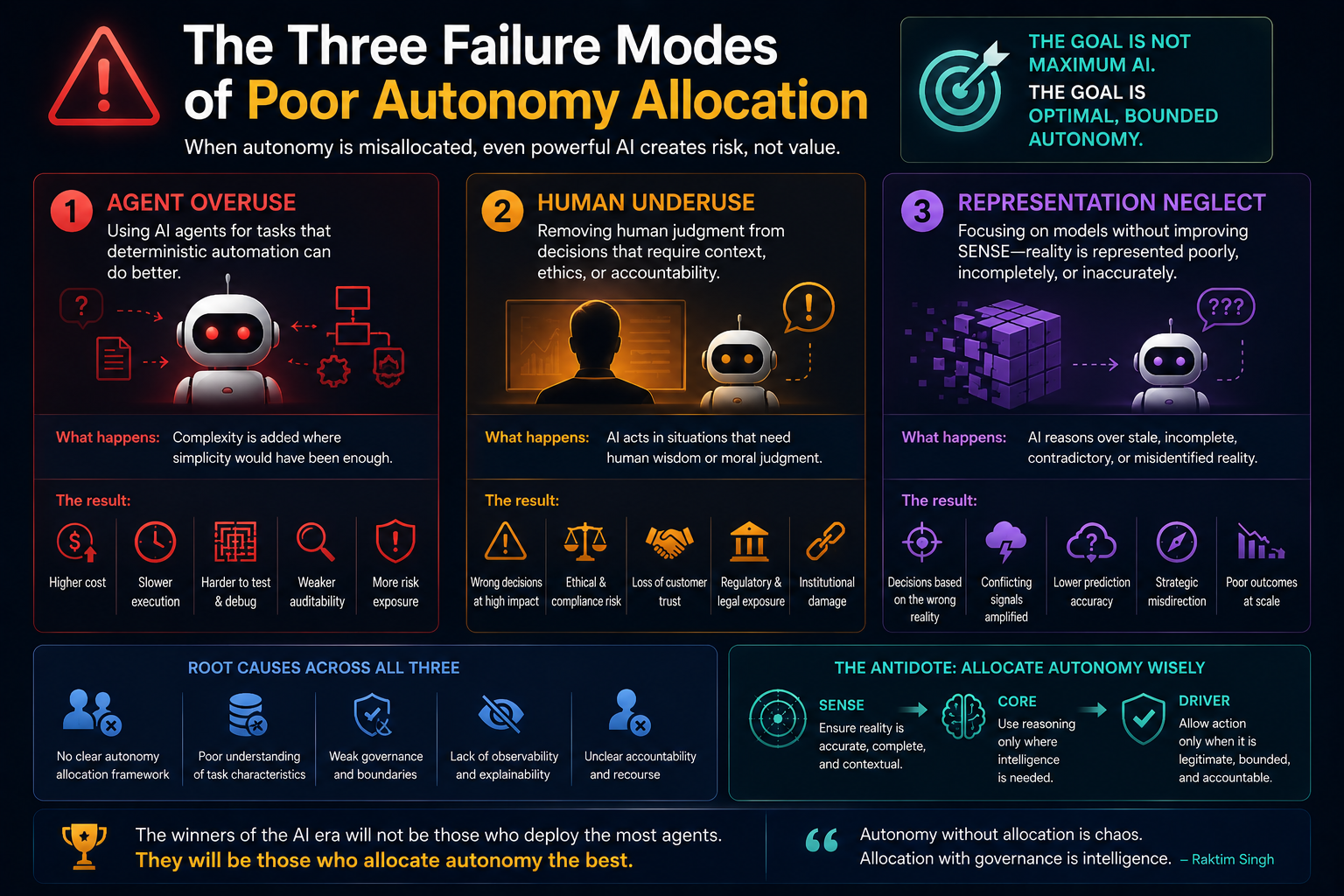
The Representation Boundary sits first—and most dangerously—in SENSE.

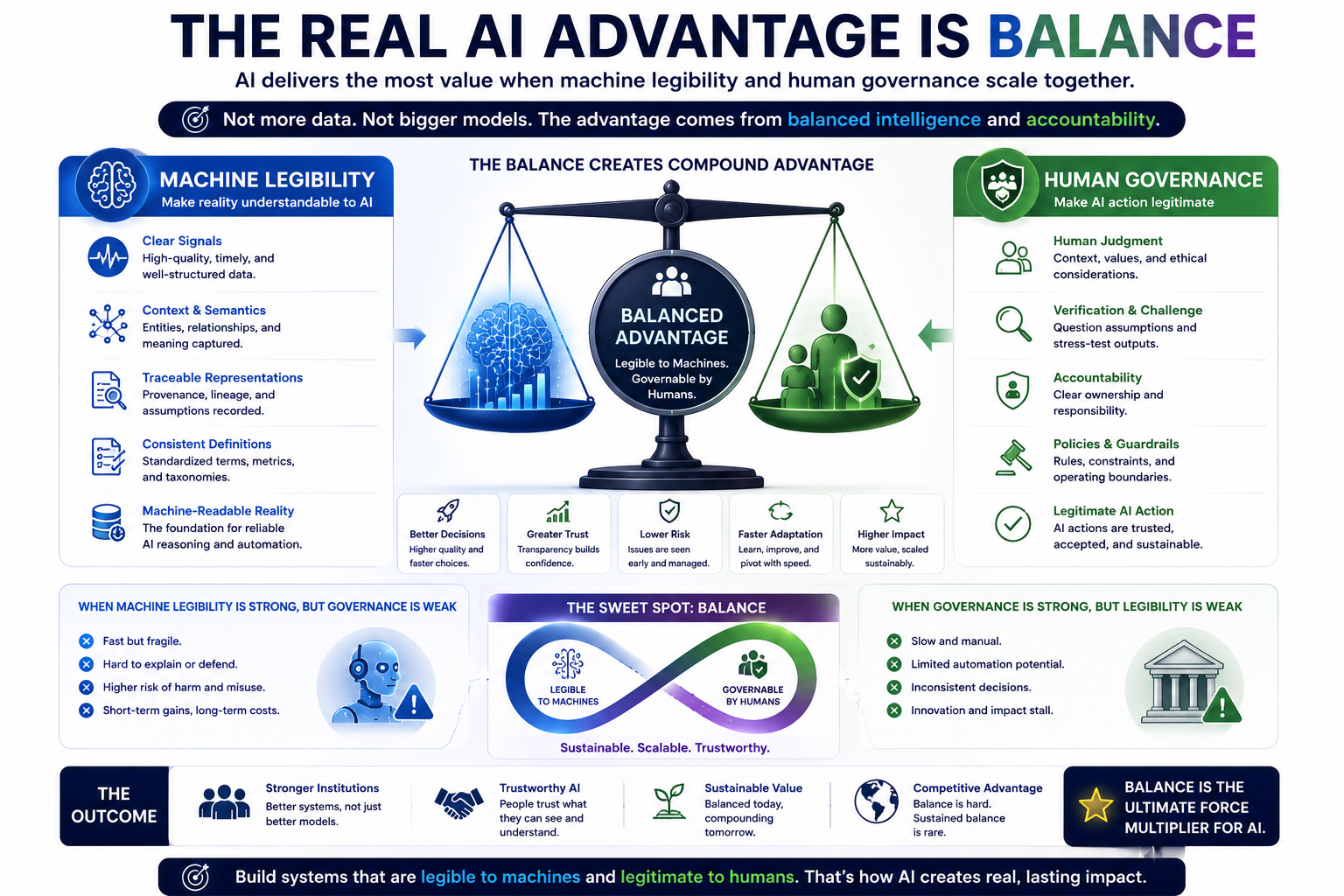
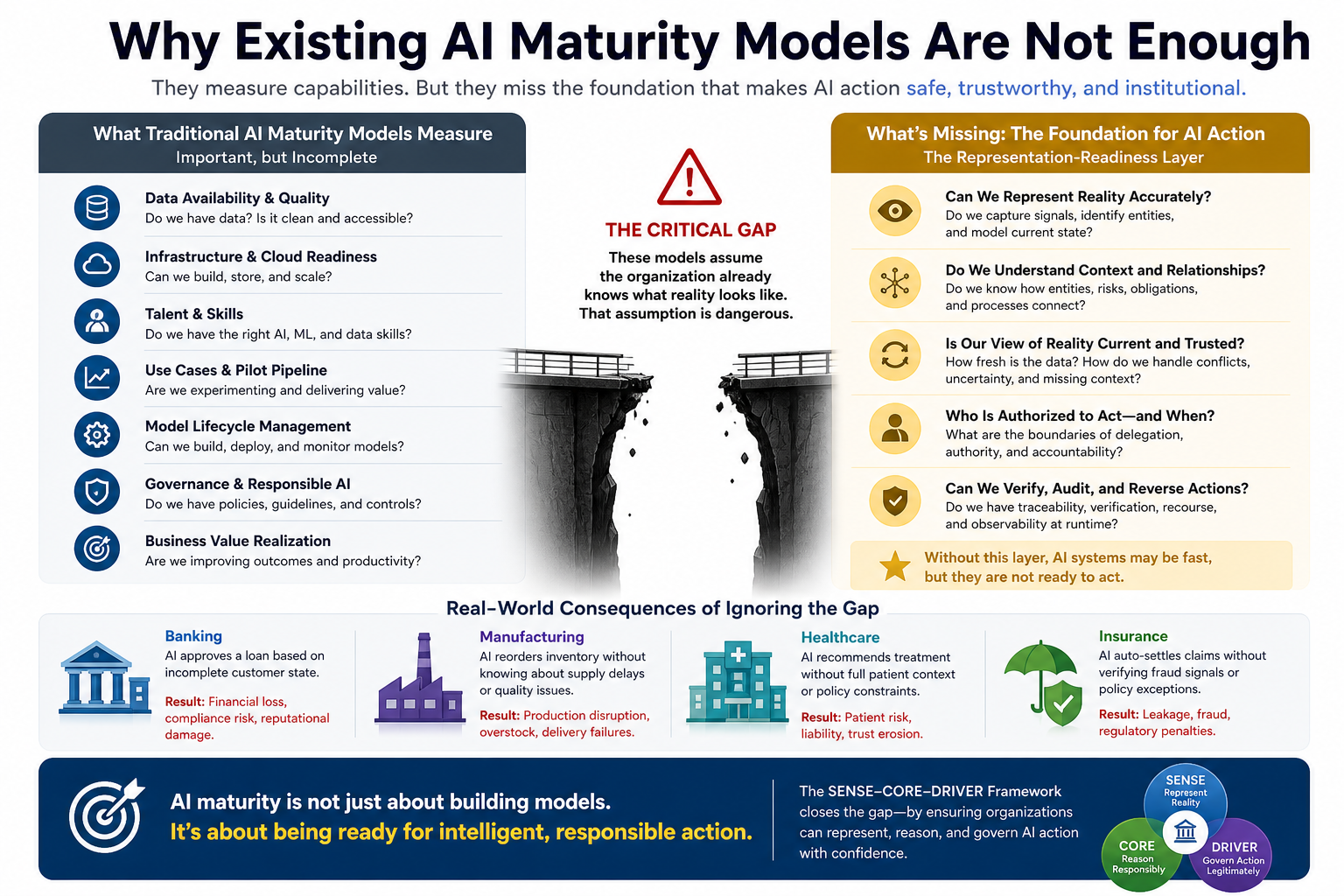
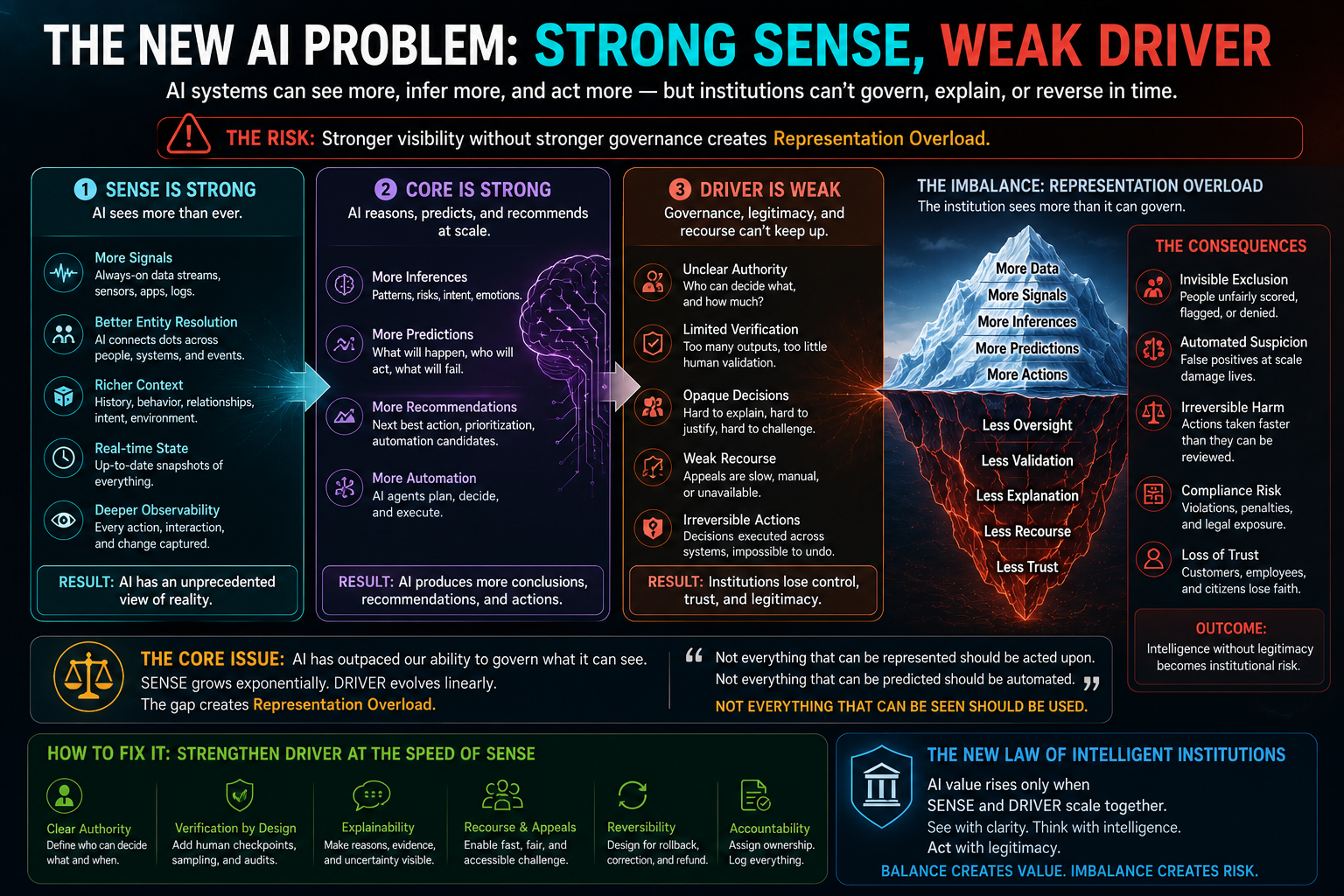
If the institution cannot see the right reality, CORE will reason over an incomplete world. DRIVER will then execute decisions that may be procedurally correct but substantively disconnected from what is actually happening.

This is why the most important AI failures often begin before the model begins.

They begin with representation.

That broader framing is also consistent with your recent website work on the Representation Economy, the Representation Utility Stack, Representation Due Diligence, Recourse Platforms, and the New Company Stack. Each of those pieces points toward the same underlying institutional logic: advantage in the AI era depends on who can make reality legible, govern action, and recover when automated decisions go wrong. (raktimsingh.com)

Why this matters for boards and CEOs

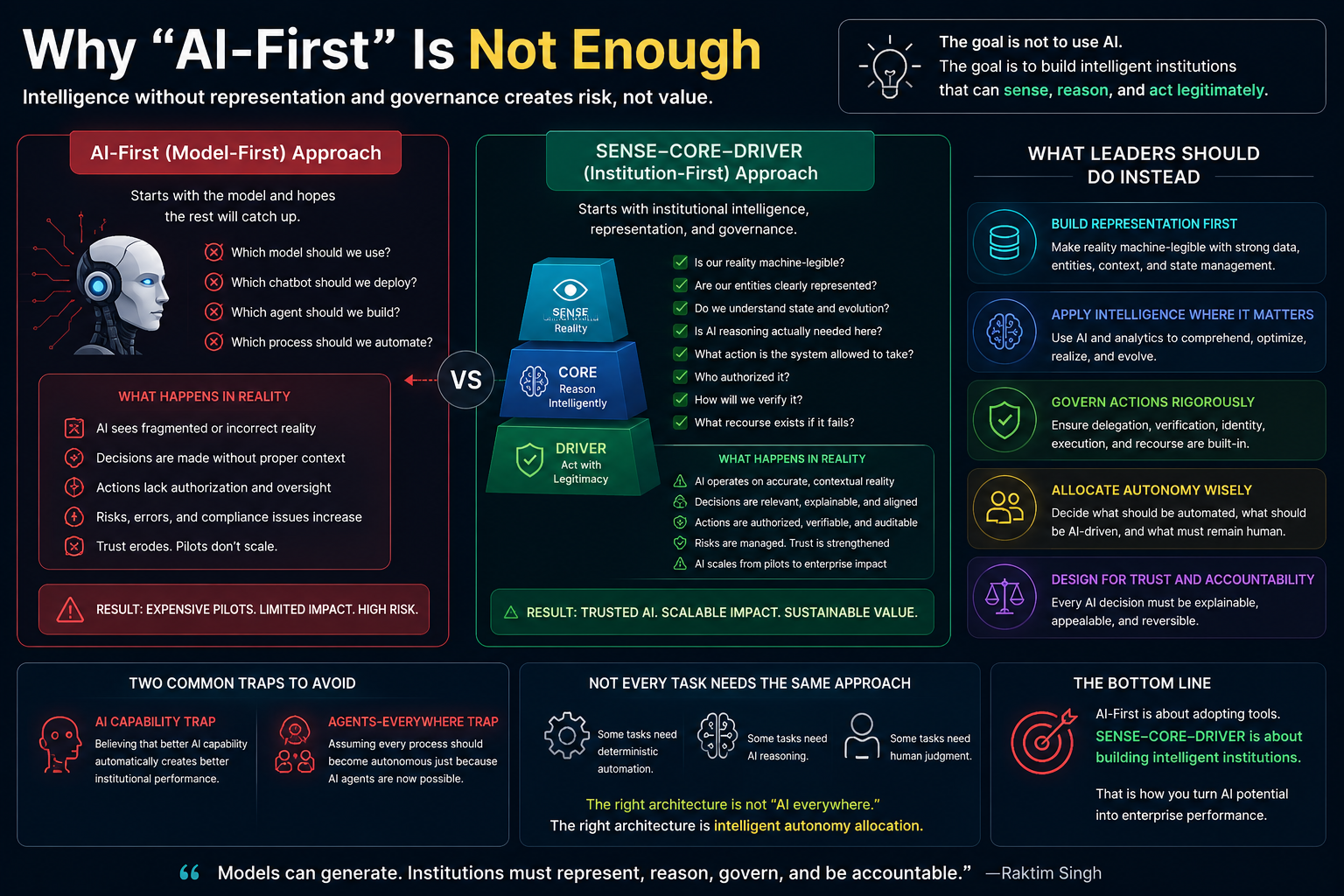
Boards are still being encouraged to think about AI in terms of models, copilots, agents, automation, and productivity.

Those matter. But they are not enough.

The larger strategic question is this:

What realities can our institution represent well enough for machines to act on safely?

That question determines more than risk. It determines advantage.

A company that builds richer, more updateable, more trustworthy representations of customers, suppliers, assets, obligations, workflows, and states of change can outperform one that merely buys a stronger model.

That is the heart of Representation Economics.

In the AI era, value will increasingly go to institutions that do three things well:

They know what must be represented before intelligence can matter.
They know where the Representation Boundary lies.
They know when the system is substituting reality—and how to govern that substitution.

That is how existing companies survive and win.

The new markets this creates

Once you see the Representation Boundary clearly, you can also see the new business categories emerging around it.

We are likely to see demand for:

Representation assurance systems

Infrastructure that identifies where proxies, inferred signals, and synthetic substitutes have entered mission-critical workflows.

Reality verification layers

Systems that compare model assumptions against fresh real-world signals.

Substitution risk auditors

Independent mechanisms for assessing how far decision pipelines have drifted from grounded reality.

Representation infrastructure providers

Companies that help institutions capture richer, more updateable states of the world instead of relying on thin stand-ins.

Recourse systems

Platforms that let people and organizations challenge decisions made on weak, stale, or substituted representations.

These are not side markets. They may become foundational markets.

Because once AI moves from generating content to influencing credit, care, pricing, hiring, access, security, and public decisions, the economy will care less about whether a model is impressive in isolation and more about whether the reality feeding it is defensible. That trajectory also aligns with the company-category logic in your earlier writing. (raktimsingh.com)

A simple test every institution should ask

If you want to know whether your organization is approaching the Representation Boundary, ask five questions:

What important reality are we not directly seeing?
What proxy are we using instead?
How often is that proxy revalidated against the real world?
What happens if the proxy drifts?
Who has the authority to stop, review, or reverse the decision when the representation is wrong?

If an institution cannot answer these clearly, it is probably deeper into representation substitution than it realizes.

Why this article matters beyond AI safety

For a while, the AI conversation was about capability.

Then it became about safety.

Then governance.

Now it is becoming something deeper:

What version of reality is the system actually acting on?

What version of reality is the system actually acting on?

That question sits underneath trust, reliability, compliance, inclusion, resilience, competitive advantage, and institutional legitimacy.

It also explains why some organizations will quietly compound advantage while others will quietly fail.

The winners will not simply own the best models.

They will own the best connection to reality.

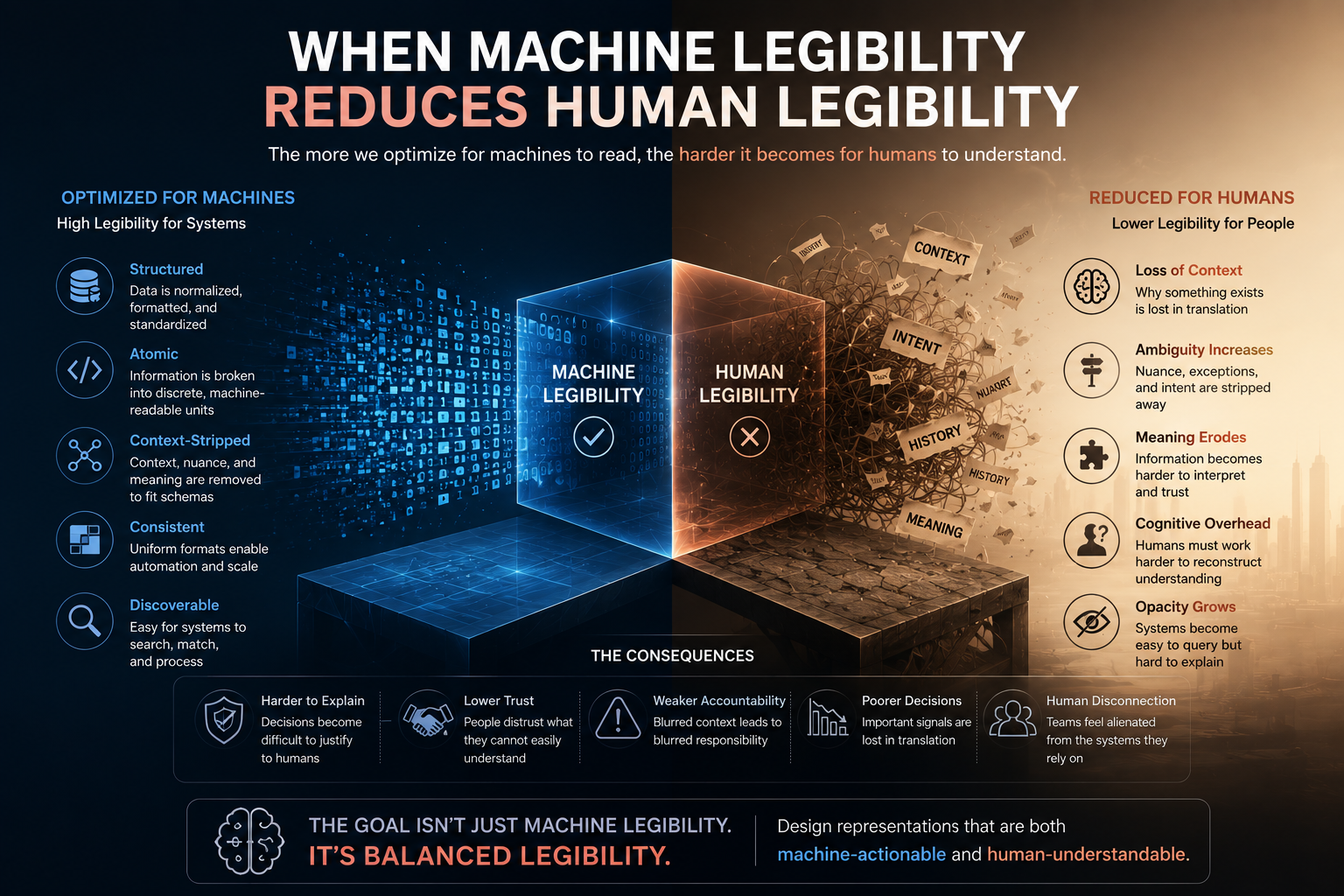
They will know where machine-legibility is strong, where it is weak, where substitution is acceptable, where it is dangerous, and where human judgment must remain in the loop.

Most importantly, they will understand that when a system cannot capture reality, it does not become neutral.

It begins to replace it.

That is the Representation Boundary.

And in the years ahead, it may become one of the most important fault lines in the global AI economy.

Because the real contest of the AI era is not only over intelligence. It is over who gets to define reality, who gets represented faithfully, where substitution becomes acceptable, and who builds the institutions that can tell the difference.

In that sense, the future belongs not only to model builders.

It belongs to those who can design systems that know when the world has slipped beyond what the machine can truly see.

“The most dangerous systems are not wrong. They are confidently operating on substitutes.”

Conclusion

The Representation Boundary is not a side issue in AI. It is one of the deepest strategic questions of the next decade.

If AI systems increasingly shape decisions about credit, employment, healthcare, supply chains, compliance, public services, and enterprise operations, then the central issue is no longer just whether the model is powerful. The issue is whether the institution remains anchored to reality as automation scales.

That is why this idea matters for boards, regulators, product leaders, and enterprise architects alike.

The most successful institutions in the AI era will not be the ones that automate the fastest. They will be the ones that know what reality must remain visible, what substitutions are acceptable, what substitutions are dangerous, and how to build governance around that difference.

In the end, intelligence alone will not decide who wins.

Representation will.

“AI does not fail when it cannot see reality. It replaces it.”

FAQ

What is the Representation Boundary in AI?

The Representation Boundary is the limit beyond which an AI system cannot faithfully capture the relevant reality it needs to reason and act. When systems hit that limit, they often continue by using proxies, inferred variables, or synthetic substitutes instead of direct grounded reality. (arXiv)

What is representation substitution?

Representation substitution is when a system replaces direct, high-fidelity reality with a more machine-manageable stand-in, such as a proxy metric, an inferred feature, or synthetic data. It can be useful, but it becomes risky when institutions forget they are acting on a substitute rather than on the underlying reality. (arXiv)

Why does this matter for enterprise AI?

Enterprise AI increasingly influences real decisions in lending, hiring, healthcare, operations, and compliance. If those decisions are based on stale or weak substitutes, organizations can create hidden risk even when dashboards and metrics look healthy. NIST and other governance frameworks stress ongoing monitoring for exactly this reason. (NIST Technical Series Publications)

Is synthetic data always bad?

No. Synthetic data can be useful for privacy, testing, and experimentation. But recursive dependence on generated data can distort distributions and weaken contact with real-world edge cases, which is why governance and re-grounding matter. (OECD.AI)

How does this relate to SENSE–CORE–DRIVER?

The Representation Boundary appears first in SENSE, where reality becomes legible to the institution. If SENSE is weak, CORE reasons over an incomplete world and DRIVER can execute decisions that are procedurally correct but substantively disconnected from reality. (raktimsingh.com)

What should boards ask?

Boards should ask: What reality are we not seeing directly? What proxy are we using instead? How often is it revalidated? What happens if it drifts? And who can stop or reverse a wrong decision? Those questions are increasingly central to trustworthy AI governance. (NIST Technical Series Publications)

Glossary

Representation Boundary
The point at which reality becomes too complex, tacit, dynamic, or informal to be faithfully captured inside an AI system.

Representation Substitution
The use of proxies, inferred signals, or synthetic stand-ins when direct grounded reality is not available in machine-usable form.

Machine-legible reality
The portion of the world that has been structured well enough for digital systems to identify, process, and act upon.

Underspecification
A condition where multiple models perform similarly on test data but behave differently in deployment, revealing that the training setup did not fully constrain real-world behavior. (arXiv)

Distribution shift
A change between the conditions under which a model was trained and the conditions in which it is later used, which can degrade real-world performance. (Nature)

Model collapse
A degenerative process in which models trained recursively on generated data lose information and begin to distort the underlying distribution. (Nature)

Goodhart pressure
The tendency for a measure to become less useful as a measure once it becomes the target of optimization. (arXiv)

Representation Economics
A strategic view of the AI era in which value increasingly accrues to institutions that can make reality legible, trustworthy, updateable, and governable for machine decision-making. (raktimsingh.com)

References and further reading

For the research foundation behind this article, these are the most relevant sources:

  • D’Amour et al., Underspecification Presents Challenges for Credibility in Modern Machine Learning — foundational work on why strong test performance can hide unstable deployment behavior. (arXiv)
  • Shumailov et al., AI models collapse when trained on recursively generated data — major Nature paper on model collapse and recursive synthetic training. (Nature)
  • NIST, AI Risk Management Framework 1.0 — practical guidance emphasizing validity, reliability, representativeness, and ongoing monitoring. (NIST Technical Series Publications)
  • Koch et al., Distribution shift detection for the postmarket surveillance of medical AI systems — evidence that deployment drift is a material real-world problem. (Nature)
  • Karwowski et al., Goodhart’s Law in Reinforcement Learning — modern formal treatment of proxy optimization failure. (arXiv)

Explore the Architecture of the AI Economy

This article is part of a broader research series exploring how institutions are being redesigned for the age of artificial intelligence. Together, these essays examine the structural foundations of the emerging AI economy — from signal infrastructure and representation systems to decision architectures and enterprise operating models. If you want to explore the deeper framework behind these ideas, the following essays provide additional perspectives:

Together, these essays outline a central thesis:

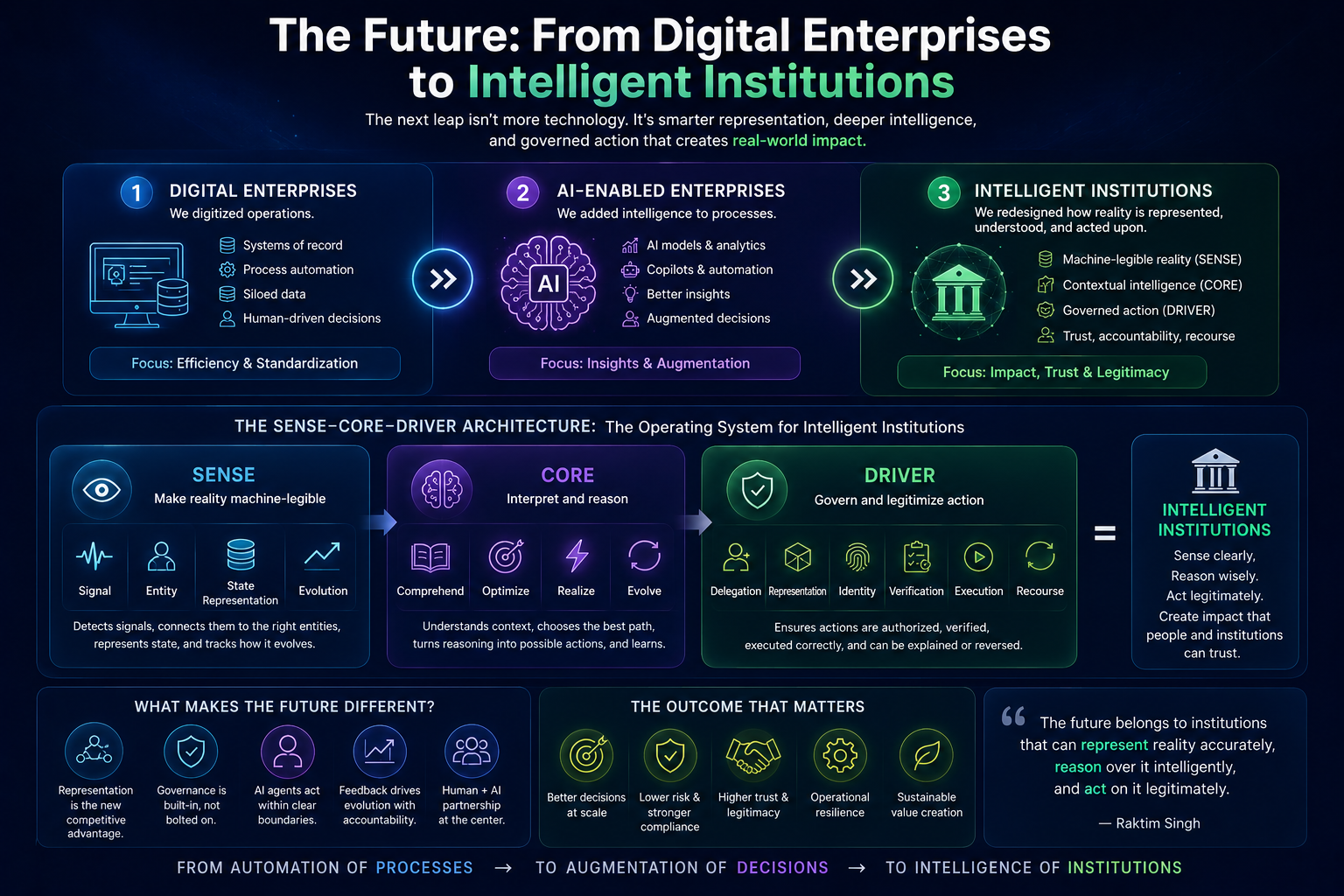
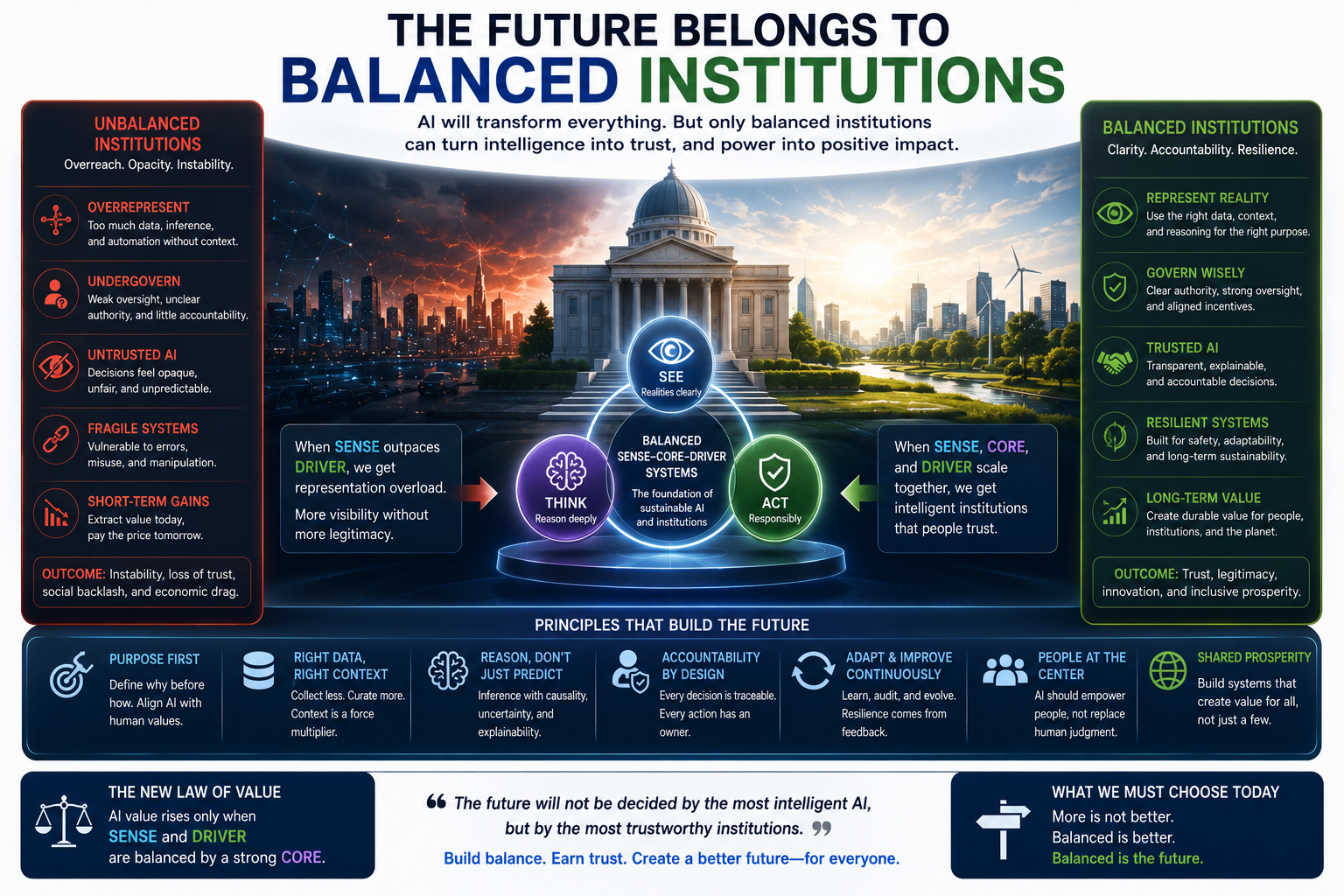
The future will belong to institutions that can sense reality, represent it clearly, reason about it intelligently, and act through governed machine systems.

This is why the architecture of the AI era can be understood through three foundational layers:

SENSE → CORE → DRIVER

Where:

  • SENSE makes reality legible
  • CORE transforms signals into reasoning
  • DRIVER ensures that machine action remains accountable, governed, and institutionally legitimate

Signal infrastructure forms the first and most foundational layer of that architecture.

AI Economy Research Series — by Raktim Singh

Written by Raktim Singh, AI thought leader and author of Driving Digital Transformation, this article is part of an ongoing body of work defining the emerging field of Representation Economics and the SENSE–CORE–DRIVER framework for intelligent institutions.

This article is part of a larger series on Representation Economics, including topics such as Representation Utility Stack, Representation Due Diligence, Recourse Platforms, and the New Company Stack.

Representation Mobility Markets: The Missing Layer of the AI Economy — Portable Trust and Insurable Reality

Representation Mobility Markets:

The next market in AI will not be built around bigger models alone. It will be built around whether trust can move safely across systems — and whether someone can absorb the damage when that trust moves incorrectly.

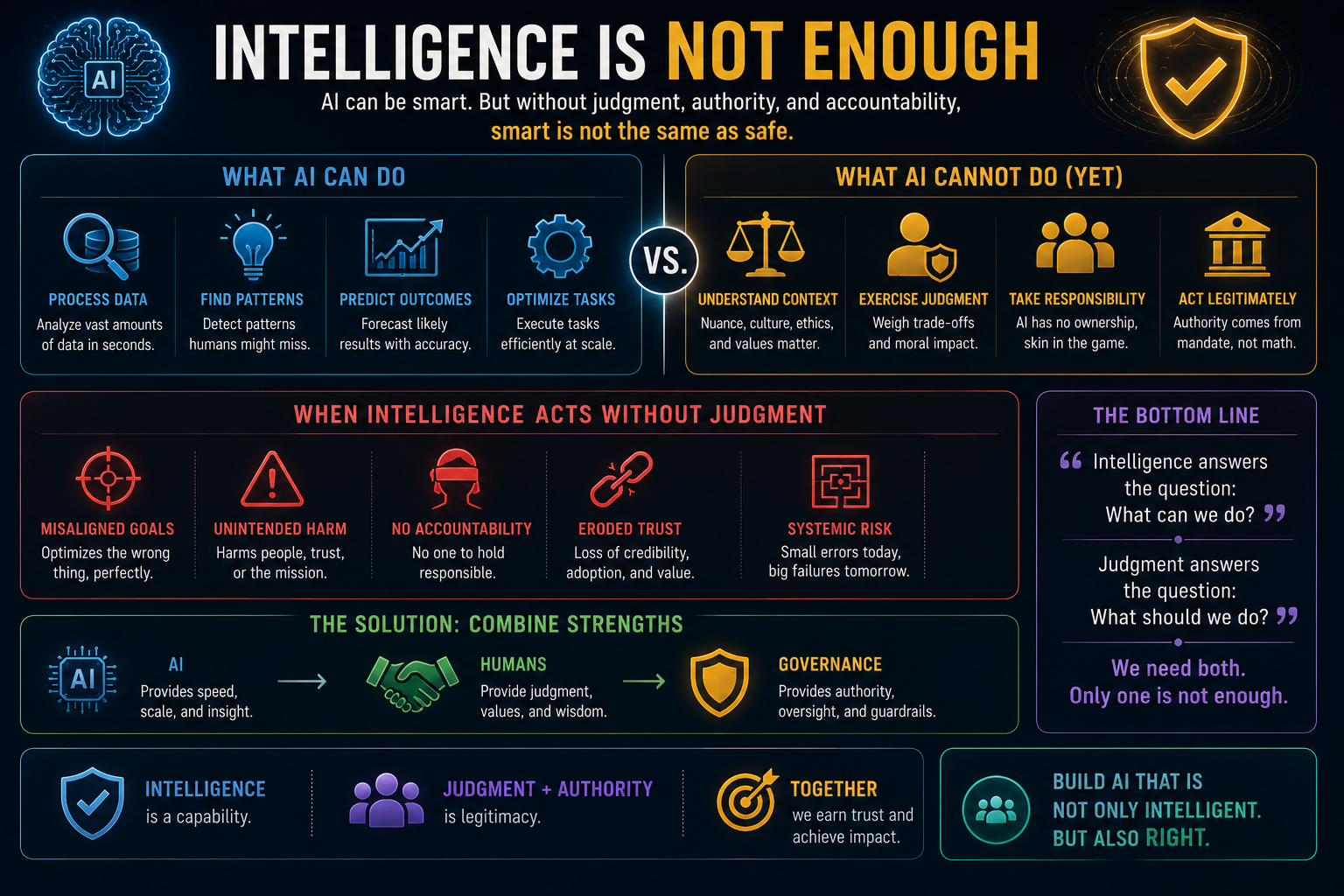
Artificial intelligence is making one fact impossible to ignore: intelligence alone is not enough.

A model can classify, recommend, summarize, predict, optimize, and even reason. But the moment an AI system begins operating across real institutions, a harder question appears. Can the reality one system understands be trusted by another? And if that trust turns out to be incomplete, outdated, manipulated, or contextually wrong, who absorbs the loss?

That is the question behind what I call Representation Mobility Markets.

This is not a narrow technology issue. It is the beginning of a new economic layer. In the AI economy, value will increasingly depend on whether identities, permissions, credentials, performance histories, compliance states, and institutional relationships can move across systems in machine-readable form. At the same time, that mobility creates a new kind of cascading risk. Once trust moves faster, failure moves faster too.

That is why the next AI market will require two things at once:

Portable trust — so machine-readable representation can move across firms, platforms, sectors, and geographies.
Insurable reality — so the losses created by flawed, stale, mismatched, or decayed representation can be priced, pooled, underwritten, and contained.

That combined market is what I mean by Representation Mobility Markets.

What are Representation Mobility Markets?
Representation Mobility Markets are the emerging market structures that enable machine-readable trust to move across systems and allow institutions to price, underwrite, and absorb risks when that trust fails.

Why this matters now

Across the world, the building blocks are already visible.

Europe’s GDPR established a right to data portability under Article 20, allowing individuals in certain circumstances to obtain and reuse their personal data across services. The UK’s open banking framework was designed to let consumers and businesses securely share banking data with regulated providers, creating new forms of competition and service innovation. India’s Account Aggregator framework has expanded consent-based financial data sharing across banking, securities, insurance, and pensions. W3C’s Verifiable Credentials standard provides a model for credentials that are cryptographically secure, privacy-respecting, and machine-verifiable. These are not identical systems, but they all point in the same direction: trusted information must be able to move. (Homepage | Data Protection Commission)
At the same time, the risk side is also becoming more visible. NIST’s AI Risk Management Framework is explicitly designed to help organizations manage AI-related risks to people, organizations, and society. The EU AI Act is a risk-based legal framework for AI. OECD materials increasingly emphasize that AI harms are real and that trustworthy AI requires interoperable, risk-based governance. In the insurance world, cyber risk has already shown how digitally mediated harms can become systemic, correlated, and difficult to underwrite when many actors are exposed to the same underlying vulnerabilities. (NIST)
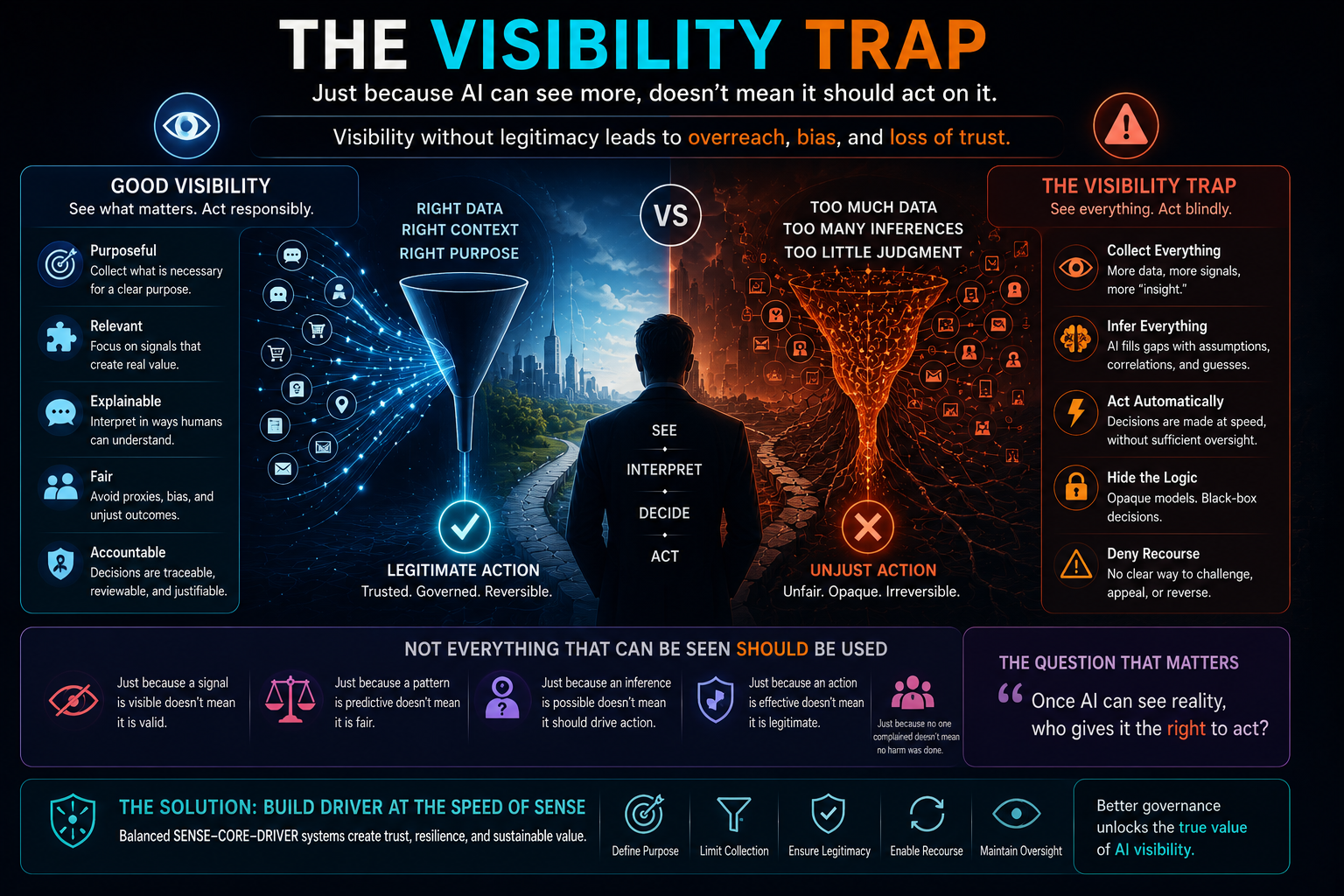
AI is now forcing these two trajectories together.

One trajectory says trust must be portable.
The other says failure must be governable and insurable.

That convergence is the real story.

The problem in plain language

Consider three simple situations.

A student earns a degree in one country and wants an employer in another country to trust it quickly.
A small business switches lenders and wants its financial history to travel in a form the new lender can trust.
A logistics network uses AI to route goods based on supplier certifications, customs filings, warehouse status, and insurance data. One upstream error spreads into multiple downstream decisions.

These examples all point to the same truth: in an AI economy, representation has to move.

But once representation moves, risk multiplies.

If a supplier credential is stale, if a consent artifact is invalid, if a medical record is incomplete, if an AI agent acts on an outdated authority token, the problem is no longer local. The error can affect credit, pricing, routing, compliance, access, insurance, and customer treatment across multiple connected institutions.

That is why portability alone is not enough.

The world will also need a way to insure the movement of machine-readable trust.

What is a Representation Mobility Market?

What is a Representation Mobility Market?

A Representation Mobility Market emerges when institutions repeatedly need to do four things at scale:

  1. represent an entity in machine-readable form
  2. transfer that representation across systems
  3. verify whether the receiving system can trust it
  4. absorb the losses when that representation fails

This is not just about APIs. It is not just about data portability. It is not just about identity. It is not just about insurance.

It is the market for moving trusted machine-readable reality.

In the industrial era, we built logistics markets to move goods.
In the financial era, we built capital markets to move money.
In the AI era, we will need Representation Mobility Markets to move trust.

The deeper issue: AI does not act on reality directly

This is the central point behind Representation Economics:

AI does not act on reality directly. It acts on what a system can represent as reality.

If a child’s vaccination history is missing from one health system, the AI system does not know the child as the parent knows the child.
If a small business has real performance but poor digital records, a lender’s model sees a weaker business than reality.
If a farmer has land-use patterns, crop history, and repayment discipline, but those facts are fragmented across informal or incompatible systems, the institution sees less than what is true.

That is where SENSE–CORE–DRIVER becomes useful.

SENSE–CORE–DRIVER — and why this market exists

SENSE–CORE–DRIVER — and why this market exists

SENSE: where reality becomes machine-legible

SENSE is the layer where systems detect signals, connect them to an entity, build a state representation, and update that state over time.

This is where the portability problem begins.

If an institution cannot represent a supplier, patient, customer, product, employee, machine, or asset clearly, no downstream intelligence can fully fix the problem. And even if one institution can represent that entity well, a second challenge remains: can that representation travel to another system without losing meaning, trust, privacy, or integrity?

This is why standards such as Verifiable Credentials matter. W3C describes them as a way to express claims that can be secured from tampering and exchanged among issuers, holders, and verifiers. That is not the whole future of portable trust, but it is an important piece of it. (W3C)

CORE: where systems reason over what they can see

CORE is where AI models interpret, compare, rank, optimize, recommend, and decide.

But CORE is downstream.

If portable representation is weak, CORE becomes confidently wrong. It can still optimize. It can still automate. It can still produce a plausible answer. It simply does so over a distorted model of reality.

That is why many AI failures are not primarily intelligence failures. They are representation-transfer failures. The model may be sophisticated. The reality it receives may not be.

DRIVER: where institutions authorize and govern action

DRIVER is the layer of delegation, verification, execution, accountability, and recourse.

This is where the reinsurance problem appears.

Once an AI-driven decision turns into action, risk is no longer abstract. A person is denied credit. A shipment is blocked. A payment is frozen. A patient pathway is altered. A false fraud flag propagates. An AI agent executes a workflow it should never have executed.

At that point, the question is no longer merely, “Was the data portable?” It becomes, “Who stands behind the consequences when portable trust fails?”

That is a DRIVER question.

And that is why insurable reality becomes necessary.

Portable trust: the first half of the market

Portable trust: the first half of the market

Portable trust means that an entity can carry machine-readable proof from one system to another in a way that remains usable, verifiable, privacy-aware, and contextually meaningful.

We already see early versions of this idea:

A digital degree that can be verified quickly.
A consented bank-data history used for underwriting.
A business credential that lowers onboarding friction in a marketplace.
A digital identity that reduces repetitive verification steps. (Open Banking)

But AI will demand much more than simple credential exchange.

Portable trust in the AI economy will increasingly need to include:

identity, authority, historical behavior, provenance, compliance state, confidence level, revocation status, and recourse pathways.

Why? Because AI systems do not simply read documents. They operate in dynamic environments.

A portable credential is useful.
A portable, updateable, revocable, context-aware representation is far more valuable.

That is the real market.

Insurable reality: the second half of the market

Insurable reality: the second half of the market

Now consider the failure case.

A lender receives portable financial data and approves a loan. Later, it turns out the consent chain was valid, but the upstream representation of income was stale.
A hospital receives a portable patient summary and triages incorrectly because one source omitted a medication update.
A trade-finance system accepts machine-verifiable supplier credentials, but a hidden revocation upstream was not propagated fast enough.
An enterprise AI agent uses a valid authority token but acts on a representation of business state that is six hours old in a high-speed operating context.

These are not just software defects. They are failures in the movement of machine-readable reality.

When such failures become connected, correlated, and large in scale, they begin to resemble the accumulation problem that cyber insurance has already struggled with. The Geneva Association’s work on cyber accumulation risk highlights how hard it is to quantify and sustainably insure risks that are systemic, interconnected, and capable of producing concentrated losses across many firms at once. AI-era representation failures could develop similar properties. (The Geneva Association)

That is why the AI economy will need insurable reality.

Insurable reality means institutions can price, underwrite, pool, and transfer risks created when portable representation is flawed, delayed, manipulated, mismatched, or misinterpreted.

This is bigger than ordinary tech liability.

It points toward a new category of underwriting.

A simple example: switching a small business loan provider

A simple example: switching a small business loan provider

Imagine a small business in India or the UK.

Today, switching lenders often involves friction: PDFs, statements, manual checks, repeated explanations, inconsistent data, and long delays.

Now imagine a more advanced future.

The business carries portable machine-readable trust:
verified transaction history, tax behavior, invoice reliability, supply-chain performance, prior repayment behavior, credentialed business identity, and consent artifacts authorizing data use.

This lowers the cost of trust transfer. A new lender can understand the business much faster.

But now imagine something goes wrong. One upstream accounting integration misclassifies cash flow. The receiving lender’s AI model interprets the business as lower risk than it really is. Credit is extended on bad assumptions. Other downstream institutions also rely on that representation.

Who bears the loss?

The answer cannot always be, “the first firm that consumed the data.”
Nor can the answer always be, “the user.”

A mature market will need mechanisms for allocation, pricing, and transfer of representation risk.

That is what Representation Mobility Markets are for.

The company categories that may emerge

The company categories that may emerge

This is where the thesis becomes economically interesting. If this market forms, new categories of firms are likely to appear.

Representation passport providers

These firms will package machine-readable trust in a form that can travel across systems. Their value will not come from storing data alone, but from making trust portable, updateable, verifiable, and revocable.

Trust translation layers

These firms will translate representation across incompatible institutional schemas. They will act as semantic and governance bridges between one system’s “truth” and another system’s ability to rely on it.

Representation risk underwriters

These firms will specialize in pricing the risk that machine-readable representation is wrong, stale, or context-misaligned.

Representation reinsurers

These firms will absorb correlated losses when many institutions rely on the same fragile representation layer.

Delegation and recourse intermediaries

These firms will not merely help systems act. They will help them stop, unwind, appeal, and recover when portable trust creates harmful outcomes.

Representation observability firms

These firms will monitor representation drift, provenance decay, revocation gaps, and cross-system mismatch before they become visible enterprise failures.

These are not science-fiction categories. They are plausible market responses to a world in which representation becomes economically central.

Why boards and regulators should care

Boards are rightly being told to invest in AI. Most are hearing about copilots, models, automation, and productivity.

But the harder strategic question is this:

Can our institutional reality travel safely?

A serious board should now ask:

Which parts of our enterprise can be represented machine-readably?
Which parts of that representation can move across systems?
Who is allowed to rely on it?
What happens when it is wrong?
Where does liability sit?
Which risks are diversifiable, and which are systemic?

This is where the AI conversation must mature.

The next wave of advantage will not come only from having good models. It will come from being easy for trustworthy systems to understand, verify, and coordinate with.

That is a representation advantage.

And in an interconnected AI economy, that advantage must travel.

Why this is not the same as ordinary interoperability

Why this is not the same as ordinary interoperability

It is tempting to say this is just another name for interoperability.

It is not.

Interoperability says systems can exchange information.
Representation mobility says institutions can exchange trusted machine-usable reality.

That is a much higher bar.

It includes technical compatibility, semantic compatibility, credential validity, governance compatibility, revocation handling, accountability, recourse, and economic backstops.

Interoperability is part of the story. Representation Mobility Markets are the larger market structure built around it.

The geopolitical angle

Different countries and sectors will represent reality differently.

Europe tends to emphasize rights, legal accountability, and risk controls. The European Commission describes the AI Act as the first legal framework on AI, built around a risk-based approach.

The UK’s open banking framework shows how portability can support competition and service innovation. India’s Account Aggregator framework shows how consent-based data mobility can be built as a public digital infrastructure layer. These differences matter because the future market is unlikely to be one uniform global trust layer. It will be a world of connected trust zones. (Digital Strategy)

That makes translation, underwriting, and reinsurance even more important.

Why this matters for Representation Economics

Why this matters for Representation Economics

Representation Economics begins with a simple claim:

In the AI era, value increasingly flows to the organizations, people, and assets that intelligent systems can see clearly, trust appropriately, and act upon responsibly.

Representation Mobility Markets extend that idea.

They show that value will not depend only on creating representation. It will also depend on moving representation, validating representation, pricing representation risk, and insuring representation failure.

That is the real strategic shift.

This topic turns Representation Economics from a theory of visibility into a theory of institutional movement and market stability.

It also clarifies why the future winners in AI may not be the firms with the biggest models. They may be the firms, infrastructures, and institutions that make trust portable and failure containable.

Conclusion

In the AI economy, trust will not merely be created. It will be transferred — and underwritten.

That is the shift.

Portable trust without insurable reality creates fragility.
Insurable reality without portable trust creates stagnation.

The winners in the next phase of AI will build both.

We are entering a period in which AI will no longer remain confined to isolated applications. It will move across enterprises, sectors, borders, and decision systems. As that happens, the central economic question will change.

Not: how intelligent is the model?
But: how safely can trusted reality move?

That is why Representation Mobility Markets matter.

They describe the missing market layer between digital identity, AI governance, data portability, underwriting, reinsurance, and institutional trust. They also point to a larger truth: the future will belong not to institutions that merely collect data or deploy intelligence, but to those that can make reality portable, trust transferable, and failure insurable.

That is how the AI economy will scale.

If AI acts on what it can represent,
then the future belongs to those who control how reality is represented, moved, and insured.

FAQ

What are Representation Mobility Markets?

Representation Mobility Markets are the market structures that emerge when institutions need to represent entities in machine-readable form, transfer that representation across systems, verify whether it can be trusted, and absorb losses when it fails. (W3C)

Why does the AI economy need portable trust?

Because AI systems increasingly operate across firms, sectors, and digital environments. For them to act reliably, they need trusted information that can move safely and remain verifiable across contexts. Existing developments such as GDPR portability, open banking, Account Aggregator, and Verifiable Credentials all point in that direction. (Homepage | Data Protection Commission)

What is insurable reality?

Insurable reality is the ability to price, pool, underwrite, and transfer the risks created when machine-readable representation is flawed, stale, manipulated, delayed, or misinterpreted. It is the economic backstop for portable trust. (OECD.AI)

How does SENSE–CORE–DRIVER relate to this topic?

SENSE explains how reality becomes machine-legible, CORE explains how systems reason over that representation, and DRIVER explains how institutions authorize, govern, and remain accountable for action. Representation Mobility Markets sit across all three layers.

What kinds of firms could emerge from this market?

Likely categories include representation passport providers, trust translation layers, representation risk underwriters, representation reinsurers, recourse intermediaries, and representation observability firms.

How is this different from interoperability?

Interoperability enables data exchange. Representation mobility enables trusted, governed, and economically backed exchange of reality.

Why is this important for enterprises?

Because AI systems will increasingly act across boundaries, and organizations must ensure that their reality is portable, trusted, and protected against failure.

Glossary

Representation Economics
The idea that in the AI era, value increasingly flows to what intelligent systems can clearly represent, trust, and act upon.

Portable trust
Machine-readable trust that can move across systems while remaining verifiable, usable, and contextually meaningful.

Insurable reality
The ability to underwrite and manage losses created by failures in machine-readable representation.

Verifiable Credentials
A W3C standard for expressing claims in a cryptographically secure, machine-verifiable, privacy-respecting way. (W3C)

Data portability
The right or capability to obtain and reuse data across services, as reflected in frameworks such as GDPR Article 20. (Homepage | Data Protection Commission)

Representation risk
The risk that a system’s machine-readable picture of reality is incomplete, stale, manipulated, or contextually wrong.

Representation reinsurance
The reinsurance-like function that helps absorb correlated losses when flawed representation affects many connected institutions.

Trust translation layer
An intermediary layer that translates machine-readable representation across different systems, standards, and institutional contexts.

Representation Economics
A framework that explains how value in the AI era flows to what systems can represent, trust, and act upon.

Representation Mobility
The ability of trusted representation to travel across systems and institutions.

Reference and further reading

For readers who want to go deeper, I would include a short “References and Further Reading” block at the end using a mix of official standards, policy frameworks, and your own related essays.

Strong external references include GDPR Article 20 and data portability guidance, UK Open Banking, India’s Account Aggregator framework, W3C Verifiable Credentials, NIST’s AI Risk Management Framework, the EU AI Act, OECD materials on AI risk and insurance, and the Geneva Association’s work on cyber accumulation risk. (Homepage | Data Protection Commission)

Explore the Architecture of the AI Economy

This article is part of a broader research series exploring how institutions are being redesigned for the age of artificial intelligence. Together, these essays examine the structural foundations of the emerging AI economy — from signal infrastructure and representation systems to decision architectures and enterprise operating models. If you want to explore the deeper framework behind these ideas, the following essays provide additional perspectives:

Together, these essays outline a central thesis:

The future will belong to institutions that can sense reality, represent it clearly, reason about it intelligently, and act through governed machine systems.

This is why the architecture of the AI era can be understood through three foundational layers:

SENSE → CORE → DRIVER

Where:

  • SENSE makes reality legible
  • CORE transforms signals into reasoning
  • DRIVER ensures that machine action remains accountable, governed, and institutionally legitimate

Signal infrastructure forms the first and most foundational layer of that architecture.

AI Economy Research Series — by Raktim Singh

Delegation Capital Markets: The New Valuation Model for AI-Driven Enterprises

In the AI economy, firms will not be valued only by what they own, build, or automate. They will increasingly be valued by how much machine authority they can safely absorb, govern, and scale.

That may sound abstract. It is not.

It is already visible in the gap between AI adoption and durable enterprise value. McKinsey’s 2025 global survey found that 78% of organizations use AI in at least one business function and 71% regularly use generative AI in at least one function. Yet most respondents still reported no material enterprise-level EBIT impact from generative AI. Adoption is spreading faster than structural value creation. (McKinsey & Company)

That gap matters because it tells us something important: the next phase of AI competition will not be decided simply by who has access to a model. It will be decided by who can turn machine capability into trusted delegated action.

That is where Delegation Capital Markets begin.

In the age of Representation Economics, capital will increasingly flow toward institutions that can demonstrate five things with credibility:

  • they can represent reality well,
  • they can reason over that reality responsibly,
  • they can delegate bounded authority to machines,
  • they can verify and correct mistakes,
  • and they can do all of this at scale.

That is the valuation logic of the AI era.

Delegation Capital Markets describe the emerging valuation logic of the AI era. As AI becomes cheaper and more accessible, competitive advantage shifts to organizations that can safely delegate machine authority. In the Representation Economics framework, this depends on strong SENSE (reality representation), CORE (reasoning), and DRIVER (governance and execution). The future winners will not simply use AI—they will institutionalize trusted machine action at scale.

Why today’s AI conversation is still incomplete

Why today’s AI conversation is still incomplete

Most AI strategy conversations are still stuck in an old frame.

They focus on questions like:
Who has the biggest model?
Who has the most data?
Who has the best copilots?
Who has the lowest inference cost?

These questions matter, but they are no longer sufficient.

Stanford’s 2025 AI Index shows why. The cost of querying a model performing at GPT-3.5 level dropped from $20 per million tokens in November 2022 to $0.07 per million tokens by October 2024, a more than 280-fold reduction. At the same time, the Stanford report notes that corporate AI investment reached $252.3 billion in 2024. In other words, intelligence is becoming cheaper to access even as investment in AI infrastructure and adoption continues to rise. (Stanford HAI)

When intelligence becomes cheaper and more available, value shifts elsewhere.

It shifts from raw cognition to institutional operability.

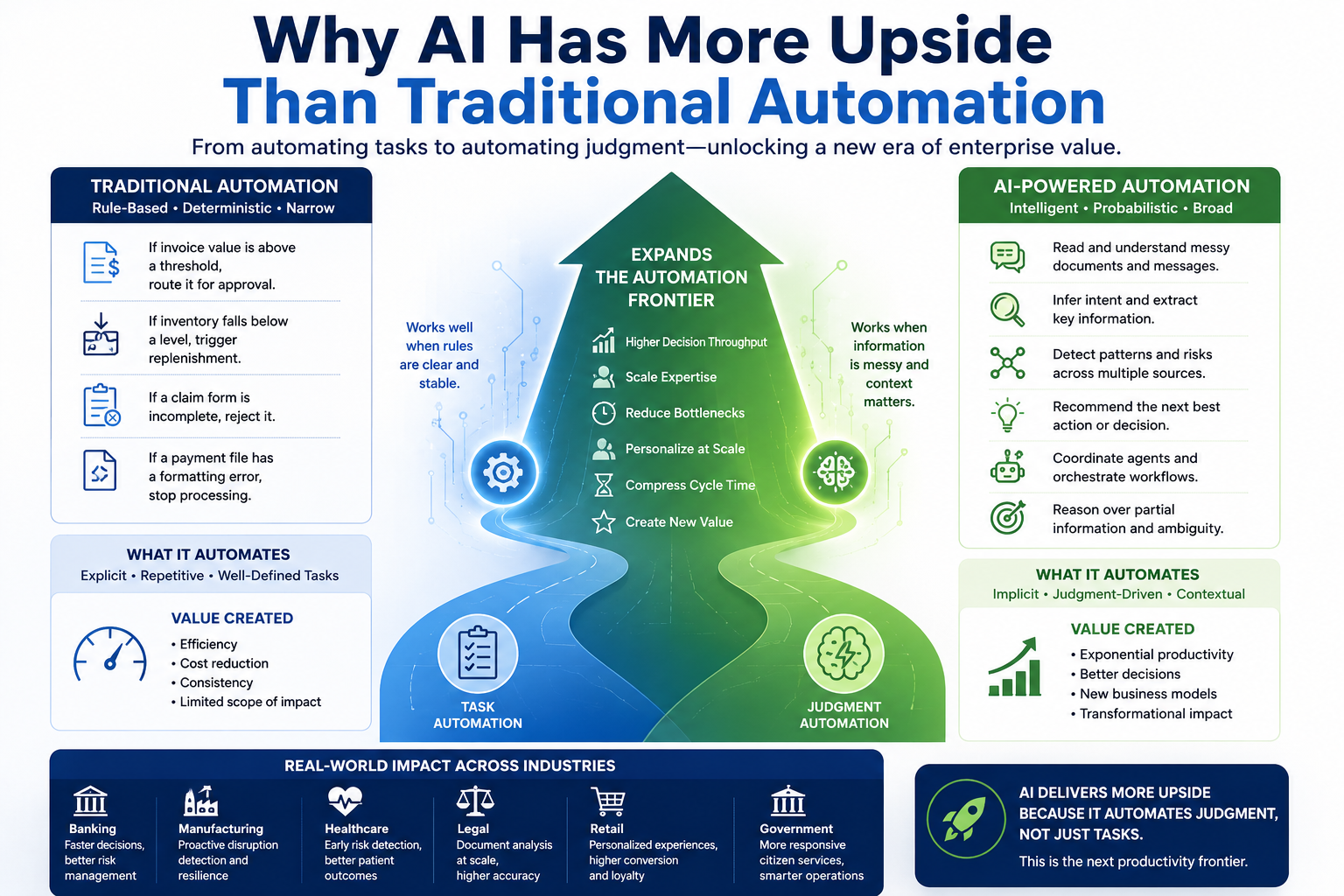
A chatbot that answers questions is useful. But an AI system that approves a loan, re-routes a shipment, changes a claims decision, releases a payment, escalates a fraud case, or modifies a supply-chain workflow is something very different.

The moment AI moves from advice to action, a deeper economic question appears:

How much machine authority can this institution safely carry?

That is what Delegation Capital Markets will price.

What are Delegation Capital Markets?

What are Delegation Capital Markets?

Delegation Capital Markets are the emerging markets, institutions, metrics, signals, and intermediaries that will determine how organizations are valued based on their ability to absorb, govern, and scale machine authority.

Put simply:

In the industrial era, capital priced factories.
In the software era, capital priced code and networks.
In the AI era, capital will increasingly price delegable decision capacity.

Not all machine authority is equal.

A company that uses AI to summarize meetings is not in the same category as a company that lets AI negotiate discounts with suppliers, dynamically triage insurance claims, optimize power-grid operations, or coordinate thousands of semi-autonomous workflows.

The second company is operating with a higher degree of delegated authority. That creates speed, scale, and margin potential. But it also creates fragility, liability, governance risk, and reputational exposure.

So markets will increasingly ask:

  • How much authority is being delegated?
  • In which contexts?
  • Under what constraints?
  • With what reversibility?
  • With what evidence?
  • With what representation quality?

Those questions will shape future premiums.

A simple example: two logistics companies

Imagine two logistics firms.

Both license strong AI models.
Both have similar technology budgets.
Both describe themselves as AI-enabled.

But inside the business, they are fundamentally different.

Company A uses AI for internal productivity. It drafts emails, summarizes reports, and helps analysts explore operational data.

Company B does all that too. But it also lets AI systems recommend rerouting decisions, predict port delays, rebalance warehouse flows, identify contractual exceptions, and prepare actions for approval. In a few low-risk contexts, it allows the system to act automatically within pre-defined limits.

To an outsider, both firms appear to be “using AI.”

To Delegation Capital Markets, they are not remotely the same.

Company B has a stronger delegation profile. If it has designed the right controls, it can convert intelligence into faster action, lower friction, better asset utilization, and improved customer responsiveness.

But only if its foundations are strong.

That is why Delegation Capital Markets cannot be understood through models alone. They depend on the full institutional stack behind machine action.

Why SENSE–CORE–DRIVER matters

Why SENSE–CORE–DRIVER matters

This is where the SENSE–CORE–DRIVER framework becomes essential.

Delegation is not just a software issue. It is an institutional architecture issue.

SENSE: Can the institution represent reality clearly?

Can it detect the right signals, attach them to the right entities, build a usable state representation, and keep that representation updated as reality changes?

If not, AI will act on a distorted view of the world.

A bank cannot safely delegate credit decisions if income records, fraud history, entity linkage, and repayment behavior are fragmented.
A hospital cannot safely delegate triage if patient state is incomplete.
A manufacturer cannot safely delegate maintenance scheduling if sensor data is stale or missing.

This is why so many AI failures begin before the model begins.

CORE: Can the institution reason over that reality responsibly?

Can it apply enough context, policy awareness, trade-off handling, and judgment to make decisions that are not just plausible, but dependable?

If not, the system may sound intelligent while remaining operationally unsafe.

DRIVER: Can the institution govern machine action?

Can it define who delegated authority, under what limits, with what verification, with what execution controls, and with what recourse when something goes wrong?

If not, even a technically correct recommendation can become a damaging institutional action.

This is the central point:

Delegation Capital Markets will not price intelligence in isolation. They will price the full stack required to let intelligence act safely.

That is why this topic sits naturally inside Representation Economics.

Because the market is not ultimately rewarding “smart systems.”
It is rewarding representable, governable, delegable systems.

Why this is becoming a real market question

Why this is becoming a real market question

Three global shifts are converging.

First, AI adoption is broad, but scaled value still depends on workflow redesign, management discipline, and operating model change. McKinsey’s 2025 findings show that organizations seeing more bottom-line impact from AI are more likely to redesign workflows, track ROI carefully, and involve senior leaders in AI governance. (McKinsey & Company)

Second, AI systems are moving closer to real-world action. The World Economic Forum has argued that, as AI agents gain access to tools, systems, and external environments, autonomy and authority must be treated as deliberate design variables rather than accidental byproducts. Higher-consequence tasks require clearer boundaries, segmented access, stronger evaluation, logging, and accountability. (World Economic Forum)

Third, global governance is converging around trustworthiness, accountability, transparency, robustness, and lifecycle oversight. The OECD AI Principles, updated in 2024, frame trustworthy AI as a global policy priority, while NIST’s AI Risk Management Framework explicitly aims to embed trustworthiness into the design, development, use, and evaluation of AI systems. (OECD)

Put these together, and the implication is clear:

The market is moving from
Can you deploy AI?
to
Can you institutionalize delegated machine authority?

That is a far more consequential question.

What exactly will markets reward?

What exactly will markets reward?

Delegation Capital Markets are likely to reward six capabilities.

  1. Representation quality

Can your systems see reality clearly enough to support action?

This is not just a data issue. It is a representational issue. Data-rich does not always mean machine-ready.

  1. Authority design

Is delegation bounded, layered, and context-specific?

A mature institution does not say, “Let the agent handle everything.”
It defines:

  • what can be recommended,
  • what can be executed,
  • what requires approval,
  • what is reversible,
  • and what is never delegable.
  1. Verification infrastructure

Can the institution reconstruct what the system saw, why it acted, and whether it stayed within its mandate?

That means logs, policy checks, decision records, state snapshots, approval trails, and incident reconstruction.

  1. Recourse capacity

When the system is wrong, is there a way back?

In the AI economy, recourse is not a footnote. It is part of valuation. A firm with no correction pathway may look efficient in the short term, but fragile in the long term.

  1. Change resilience

Can the institution remain aligned as models, tools, workflows, regulations, and operating conditions change?

Static compliance will not be enough. Lifecycle governance is increasingly the real requirement. (NIST)

  1. Delegation reputation

Does the market trust this institution’s machine authority?

Just as lenders price creditworthiness, future markets may increasingly price delegationworthiness.

The new firms that may emerge

The new firms that may emerge

A strong theory does not just explain today’s world. It predicts tomorrow’s categories.

If Delegation Capital Markets become real, several new types of firms are likely to emerge.

Delegation rating agencies

These firms would assess how safely an institution can delegate machine authority in specific operating contexts.

Delegation auditors

These evaluators would test not only model quality, but authority boundaries, execution chains, rollback paths, decision evidence, and control maturity.

Delegation insurers

These players would underwrite machine-action risk where governance maturity is strong enough.

Delegation exchanges

These could become platforms where trusted, machine-operable organizations are easier to finance, partner with, insure, procure from, or integrate into multi-party workflows.

Delegation infrastructure providers

These firms would provide the control layer between AI reasoning and real-world execution.

These categories will not emerge because they sound fashionable. They will emerge because markets need ways to price, compare, and trust machine authority.

Why this changes valuation logic for boards and investors

For decades, companies were valued through familiar lenses: labor scale, physical assets, software leverage, brand power, network effects, and market share.

In the AI era, another variable is entering the picture:

delegated operating capacity

Imagine two insurers with similar books of business.

One still depends heavily on manual teams to process exceptions, update underwriting assumptions, investigate anomalies, and resolve claims disputes.

The other has built stronger representation layers, clearer escalation rules, tighter auditability, stronger recourse, and safer bounded autonomy. It allows machines to handle far more routine and semi-routine action without losing control.

Over time, the second insurer may deserve a premium not because it merely “uses AI,” but because it has a superior ability to convert intelligence into governed operating throughput.

That is the beginning of Delegation Capital Markets.

Why most companies are not ready

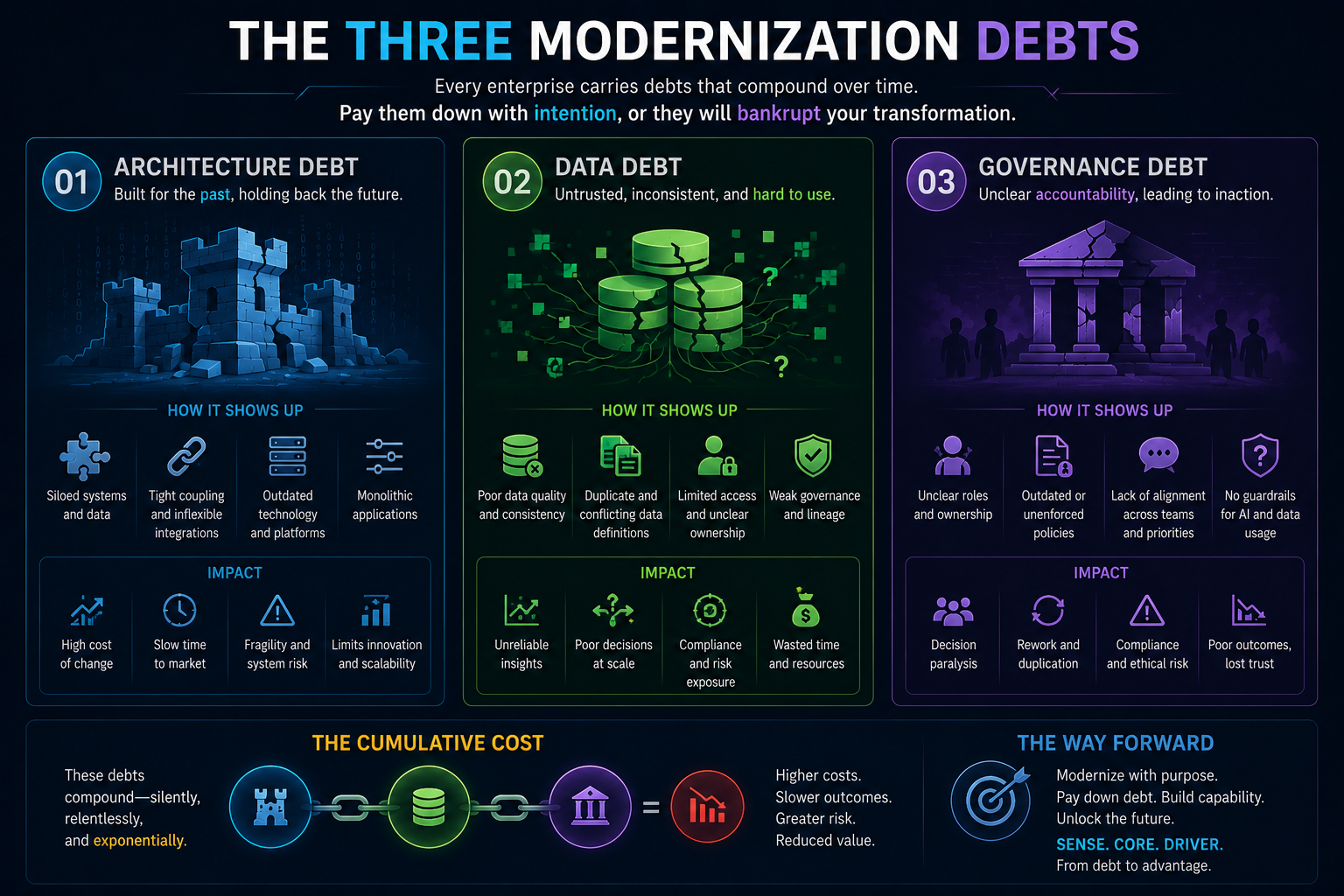
Many firms are overinvesting in CORE and underinvesting in SENSE and DRIVER.

They are buying models before fixing entity resolution.
They are piloting agents before defining authority boundaries.
They are celebrating automation before designing correction.
They are discussing productivity before establishing legitimacy.

That is why so many AI programs look impressive in demos but weak in production.

The problem is not always intelligence.

The problem is that the institution has not yet become a safe carrier of delegated machine authority.

The question every board should now ask

Boards need a new strategic question:

What is our Delegation Capacity, and what is preventing it from compounding?

What is our Delegation Capacity, and what is preventing it from compounding?

That single question forces a better conversation.

It pushes leadership to examine:

  • representation quality,
  • decision clarity,
  • escalation design,
  • reversibility,
  • regulatory defensibility,
  • and the economics of machine action.

It also separates hype from structural advantage.

A company may have strong AI branding and still have weak delegation capacity.
Another may appear quiet externally while building the deepest long-term advantage in its sector.

Why this matters globally

This is not only an enterprise architecture issue. It is a global competitiveness issue.

Countries, sectors, and firms that build better systems for representation, bounded delegation, and institutional trust will likely move faster in the AI economy than those that focus only on models.

That is why Delegation Capital Markets have GEO value as a concept. The idea connects enterprise AI, governance, valuation, risk, policy, trust, and operating model redesign in one frame. It answers a question executives, investors, regulators, and strategy editors are all beginning to ask in different ways:

What separates firms that merely use AI from firms that become structurally stronger because of AI?

My answer is this:

They differ in how much machine authority they can safely absorb.

Conclusion: the next premium in the AI economy

The next premium in the AI economy will not come simply from owning intelligence.

It will come from proving that intelligence can be trusted with authority.

That is what markets will increasingly reward.

Not the loudest AI story.
Not the largest model budget.
Not the flashiest demonstration.

But the institution that can say:

We can represent reality well.
We can reason over it responsibly.
We can delegate within boundaries.
We can verify what happened.
We can recover when things go wrong.
And we can do all of this at scale.

That is not just an operational advantage.

It is a new form of capital.

And the firms that understand this early will not just use AI better.

They will be priced differently because of it.

Conclusion column

What boards should remember

Delegation Capital Markets are the missing bridge between AI capability and enterprise value. As intelligence becomes cheaper and more accessible, the real premium will move to firms that can govern machine authority responsibly. In practical terms, that means strong representation, disciplined reasoning, bounded delegation, verification, and recourse. The future winners of AI will not simply deploy more models. They will build institutions that machines can act through without breaking trust.

Glossary

Delegation Capital Markets
The emerging valuation logic through which firms are assessed based on how safely and effectively they can delegate machine authority.

Machine authority
The practical power given to an AI system to recommend, trigger, approve, or execute actions within defined boundaries.

Delegation capacity
An institution’s ability to absorb, govern, and scale machine authority without losing trust, control, or reversibility.

Representation Economics
A strategic and economic lens that argues AI-era value will increasingly depend on who can make reality legible, reliable, and actionable for machines.

SENSE
The legibility layer: signal detection, entity attachment, state representation, and evolution over time.

CORE
The cognition layer: the reasoning, interpretation, optimization, and learning processes that convert represented reality into decisions.

DRIVER
The governance and legitimacy layer: delegation, representation, identity, verification, execution, and recourse.

Delegation reputation
The degree to which markets trust an institution’s ability to let AI act responsibly.

Recourse
The ability to challenge, correct, reverse, or recover from an AI-driven decision or action.

Delegationworthiness
A practical way to describe how trustworthy a firm is as a carrier of machine authority.

FAQ

What are Delegation Capital Markets?

Delegation Capital Markets are the emerging market mechanisms through which firms will increasingly be valued based on how safely and effectively they can delegate authority to AI systems.

Why is this different from general AI adoption?

Because many firms can use AI tools, but far fewer can let AI act inside real workflows with strong controls, accountability, reversibility, and trust.

How does this relate to Representation Economics?

Representation Economics explains that value in the AI era depends on making reality legible and actionable for machines. Delegation Capital Markets describe how markets may price that capability.

Why does SENSE–CORE–DRIVER matter here?

Because safe delegation depends on three conditions at once: reality must be represented clearly, reasoning must be dependable, and action must be governed with verification and recourse.

Why should boards care about this now?

Because the economic upside of AI increasingly depends on action, not just insight. Once AI starts influencing or executing operational decisions, governance maturity becomes a source of valuation premium.

What kinds of companies could emerge from this shift?

Likely categories include delegation rating agencies, delegation auditors, delegation insurers, delegation infrastructure providers, and delegation exchanges.

What is the simplest way to understand this idea?

AI by itself is not the premium. The premium comes when an institution can let AI act without breaking trust.

References and further reading

For the market and governance context behind this article, the most relevant current references are:

  • McKinsey, The State of AI: How Organizations Are Rewiring to Capture Value — for adoption rates, workflow redesign, and value realization patterns. (McKinsey & Company)
  • Stanford HAI, AI Index 2025 — for cost compression, market momentum, and investment signals. (Stanford HAI)
  • OECD, AI Principles — for the global policy framing of trustworthy AI. (OECD)
  • NIST, AI Risk Management Framework — for lifecycle trustworthiness and governance design. (NIST)
  • World Economic Forum, From Chatbots to Assistants: Governance Is Key for AI Agents and related agent-governance work — for the shift from passive AI tools to bounded autonomy. (World Economic Forum)

Explore the Architecture of the AI Economy

This article is part of a broader research series exploring how institutions are being redesigned for the age of artificial intelligence. Together, these essays examine the structural foundations of the emerging AI economy — from signal infrastructure and representation systems to decision architectures and enterprise operating models. If you want to explore the deeper framework behind these ideas, the following essays provide additional perspectives:

Together, these essays outline a central thesis:

The future will belong to institutions that can sense reality, represent it clearly, reason about it intelligently, and act through governed machine systems.

This is why the architecture of the AI era can be understood through three foundational layers:

SENSE → CORE → DRIVER

Where:

  • SENSE makes reality legible
  • CORE transforms signals into reasoning
  • DRIVER ensures that machine action remains accountable, governed, and institutionally legitimate

Signal infrastructure forms the first and most foundational layer of that architecture.

AI Economy Research Series — by Raktim Singh

Representation Inflation: Why Cheap Reality Is Breaking AI—and How the Representation Flywheel Restores Advantage

Representation Inflation:

Representation Inflation occurs when synthetic or AI-generated reality becomes cheaper and more abundant than verified reality, making trust harder and more expensive to maintain. This creates systemic risks in AI-driven decision systems because machines act on representations of reality—not reality itself. The solution is the Representation Flywheel, a continuous loop where better sensing, reasoning, governance, and feedback improve the quality of machine-readable reality over time. Organizations that build this capability will outperform those that rely only on AI models.

Representation Economics

We are entering a strange moment in economic history.

For centuries, reality was expensive. To know what had happened, institutions had to observe it, record it, verify it, store it, and transmit it. To know whether a customer existed, whether a shipment had arrived, whether a patient had improved, whether a contract had changed, or whether a machine had failed, someone had to capture reality and convert it into a form the organization could trust.

That cost was often hidden. But it was real.

Now, for the first time, reality is becoming cheap to produce.

Images can be generated in seconds. Voices can be cloned from short audio samples. Documents can be drafted at industrial scale.

Synthetic data can be created to fill gaps, simulate rare conditions, and reduce privacy exposure. AI systems can produce summaries, signals, recommendations, and narratives much faster than most institutions can verify a single high-stakes fact.

NIST’s synthetic-content risk work explicitly highlights provenance tracking, watermarking, metadata, and detection as important technical approaches for improving digital content transparency, while the C2PA standard is designed to attach cryptographically verifiable provenance to digital assets. (NIST Publications)

This is not only a media problem. It is not only a deepfake problem. It is not only an AI safety problem.

It is an economic problem.

I call it Representation Inflation.

Representation Inflation begins when synthetic reality becomes cheaper than verified reality. The result is not merely more content. It is a structural distortion in the information environment on which AI systems depend. Cheap signals flood the system. Verification struggles to keep up. Trust becomes more expensive than generation. And institutions trying to scale intelligence discover something uncomfortable: intelligence is only as good as the reality it can reliably represent.

That insight sits at the heart of Representation Economics. In the AI era, value will not be shaped only by who has the smartest models. It will increasingly be shaped by who can make reality legible, trustworthy, updateable, and governable for machines.

This is why the SENSE–CORE–DRIVER framework matters.

SENSE is where reality becomes machine-legible: signals, entities, state, and evolution.
CORE is where systems reason, compare, optimize, and decide.
DRIVER is where institutions authorize action, constrain execution, verify outcomes, and provide recourse.

Most of the world is obsessed with CORE. Bigger models. Better reasoning. More autonomous agents. But Representation Inflation begins earlier, in SENSE, and becomes dangerous later, in DRIVER.

When SENSE is polluted, CORE becomes confidently wrong. When DRIVER acts on polluted representations, the damage stops being theoretical. It becomes operational, financial, legal, and social.

That is why this topic matters far beyond AI labs. It matters to boards, regulators, CIOs, banks, hospitals, manufacturers, insurers, governments, and every institution trying to move AI from advice to action.

The new scarcity is not intelligence. It is verified reality.

The new scarcity is not intelligence. It is verified reality.

The digital economy taught us to think about scarcity in terms of compute, data, talent, and distribution.

The AI economy forces a different question: not “Can the machine generate?” but “What reality is the machine actually acting on?”

That may sound philosophical. It is not. It is painfully practical.

Imagine a bank receiving income documents that look perfectly valid, while part of the supporting evidence has been synthetically generated.

Imagine a hospital AI assistant reading a patient history that includes copied notes, generated summaries, stale medication lists, and device signals with missing context.

Imagine a procurement agent negotiating with a supplier whose catalog, certification status, delivery history, and pricing claims have been assembled from multiple systems—some real, some inferred, some stale.

Imagine a board reviewing a dashboard that looks polished and precise, while a meaningful portion of the narrative layer has been generated from inconsistent operational data.

In all these cases, intelligence is not absent. The problem is that the institution does not know whether the reality being represented is trustworthy enough for action.

This is why provenance, traceability, transparency, and governance are becoming foundational concerns across policy and industry discussions. OECD’s AI principles emphasize trustworthy AI, transparency, robustness, and accountability, while WEF’s recent work on synthetic data stresses the importance of accuracy, traceability, and clear labeling to preserve trust and performance. (OECD)

The cheaper synthetic reality becomes, the more valuable verified reality becomes.

That is the paradox.

Why cheap reality breaks AI

Why cheap reality breaks AI

Many people assume that if AI gets better, this problem will solve itself.

It will not.

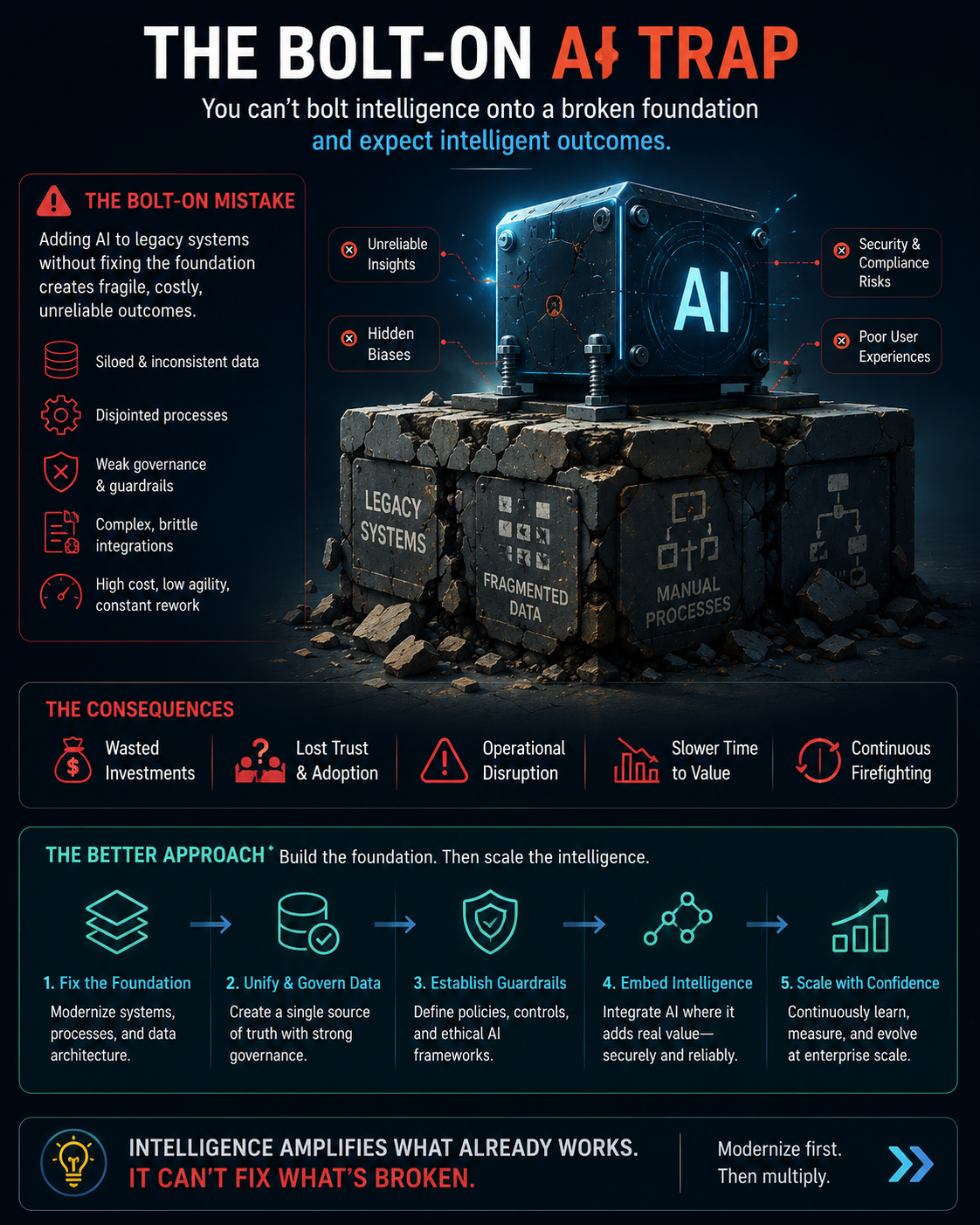
A stronger reasoning engine does not automatically fix bad representation. In fact, better AI can worsen the problem by allowing weak or polluted representations to travel faster, spread farther, and trigger more autonomous action.

If a junior employee works from a flawed spreadsheet, the damage may stay local. If an enterprise AI agent works from a flawed representation, the damage can cascade across pricing, compliance, customer service, procurement, approvals, reporting, and operations.

Representation Inflation breaks AI in at least five ways.

  1. It lowers the average quality of machine-consumable signals

AI does not consume truth directly. It consumes representations of reality.

Those representations may come from logs, forms, messages, APIs, documents, transcripts, images, videos, sensors, contracts, emails, generated summaries, or synthetic datasets. As synthetic content becomes easier to create, the volume of machine-readable artifacts grows much faster than an institution’s ability to validate them. NIST’s work frames this as a transparency challenge, not just a detection challenge. (NIST Publications)

  1. It makes trust more expensive

Generation is cheap. Verification is slow.

That imbalance is exactly why provenance standards are advancing. C2PA’s content credentials model exists because institutions increasingly need to know where an asset came from, how it was modified, and whether its history is intact. (C2PA Specification)

The economic consequence is simple: the cost of producing plausible reality falls, while the cost of establishing trusted reality rises.

  1. It creates hidden model risk

Most organizations still frame AI risk as a model problem: hallucinations, bias, latency, explainability, safety, or cost.

Representation Inflation creates a different class of failure. The model may behave exactly as designed while the input reality has quietly degraded.

That is more dangerous, not less, because the output can still look polished, rational, and defensible. The system can be wrong for the right computational reasons.

  1. It weakens institutional memory

As enterprise knowledge gets summarized, transformed, embedded, and re-ingested, organizations can lose the link back to original reality.

Was this directly observed?
Was it inferred?
Was it generated?
Was it corrected later?
Who approved it?
What changed afterward?

When those links weaken, institutions do not simply lose trust. They lose memory.

  1. It overloads recourse

If systems act on cheap reality at scale, correction systems become overwhelmed.

More wrong flags. More wrong denials. More wrong escalations. More wrong classifications. More appeals. More exceptions. More friction. More reputational cost.

That is why Representation Inflation is not just an information-quality issue. It is a throughput issue for the whole institution.

The difference between synthetic data and synthetic reality

The difference between synthetic data and synthetic reality

It is important to be precise here.

Synthetic data is not inherently bad. It can be highly useful. It can protect privacy, simulate rare cases, fill sparse datasets, and support testing where real-world data is limited or sensitive. WEF’s synthetic-data brief explicitly recognizes those benefits while also emphasizing the need for strong governance, traceability, and labeling. (World Economic Forum)

The problem begins when organizations treat all machine-readable artifacts as equally reliable simply because they are available.

That is when synthetic data becomes part of something broader: synthetic reality.

Synthetic reality includes generated media, reconstructed histories, inferred states, auto-generated summaries, synthetic interactions, simulated events, and AI-produced signals that may look real enough to enter decision systems.

This is where many enterprises will get into trouble.

They will not fail because they used synthetic assets. They will fail because they stopped distinguishing between observed reality, verified reality, inferred reality, generated reality, disputed reality, and corrected reality.

An AI-native institution must know the difference.

Representation Inflation is the new trust tax

Representation Inflation is the new trust tax

In the industrial economy, firms paid for labor, machinery, logistics, and energy.

In the digital economy, they paid for software, cloud, data, and cybersecurity.

In the AI economy, firms will increasingly pay a new tax: the trust tax created by Representation Inflation.

This tax appears in the extra review required before action, the extra controls needed to validate sources, the growing need for provenance, the drag of exception handling, the need for stronger identity and authorization, the cost of investigations when something goes wrong, and the reputational damage that follows decisions made on weak representations.

This broader trust problem is visible in public research too. A 2025 KPMG and University of Melbourne global trust study found that AI adoption is rising while public trust remains fragile, with strong expectations around transparency, accountability, and governance. (Microsoft)

Institutions do not scale AI in a vacuum. They scale AI in markets and societies where trust has to be earned again and again.

Why this is a SENSE problem before it becomes a DRIVER problem

Why this is a SENSE problem before it becomes a DRIVER problem

This is where SENSE–CORE–DRIVER becomes especially useful.

SENSE: where confusion enters

SENSE asks what signals are entering the system, which entity they belong to, what state they describe, and how that state changes over time.

Representation Inflation damages SENSE first.

A generated invoice may look real.
A cloned voice may sound real.
A simulated event may appear real.
An AI summary may feel authoritative.
A predicted state may be mistaken for an observed one.

Once that confusion enters SENSE, the rest of the architecture inherits it.

CORE: where polluted representations get organized

CORE reasons over what SENSE provides.

If the underlying representation is weak, CORE does not magically restore reality. It organizes, predicts, ranks, explains, and optimizes over what it has been given.

That is why better reasoning alone is not enough.

DRIVER: where the cost becomes real

DRIVER governs action: who authorized it, what constraints apply, how it is verified, and what happens if it is wrong.

Representation Inflation becomes truly costly when DRIVER acts on weak representations. That is when you get denied claims, false alerts, misrouted shipments, flawed underwriting, incorrect compliance responses, and avoidable reputational damage.

So, the challenge is not merely to build smarter AI.

It is to build institutions that can keep trusted reality ahead of automated action.

The Representation Flywheel: the answer to cheap reality

The Representation Flywheel: the answer to cheap reality

The answer to Representation Inflation is not a single tool.

It is not one watermark.
Not one governance policy.
Not one committee.
Not one model.
Not one detector.

The answer is a compounding institutional capability: the Representation Flywheel.

The flywheel works in four steps.

First, an institution improves how it senses reality. It strengthens source quality, provenance, entity resolution, freshness, state tracking, and verification.

Second, because SENSE improves, CORE reasons over cleaner and more contextual reality. Decisions become more useful, more reliable, and more auditable.

Third, because CORE improves, DRIVER can act with tighter boundaries, clearer authority, stronger monitoring, and better recourse.

Fourth, because action is more governed, the institution generates better feedback. Corrections, reversals, exception traces, and real-world outcomes feed back into SENSE.

Then the loop repeats.

Better SENSE improves CORE.
Better CORE strengthens DRIVER.
Safer DRIVER produces cleaner feedback.
Cleaner feedback strengthens SENSE again.

That is the flywheel.

In a world flooded with cheap reality, advantage will not come from seeing more. It will come from seeing correctly, updating continuously, and correcting faster than competitors.

Three simple examples

Lending

A traditional lender relied on human review of documents, account history, and credit signals.

A modern lender may use AI to process transaction trails, behavior patterns, third-party feeds, generated summaries, and dynamic risk scores.

That sounds like progress. And it is—until Representation Inflation enters the system.

If synthetic documents become easier to generate, if customer-state changes are stale, if summaries hide missing evidence, or if generated explanations are mistaken for verified facts, then more intelligence creates more fragility.

With a Representation Flywheel, the same institution separates observed from inferred evidence, tracks provenance, monitors freshness, escalates verification for suspicious signals, and feeds appeals back into the model of reality.

That lender is not merely using AI. It is compounding trusted representation.

Healthcare

A clinician does not simply need more data. A clinician needs reality organized correctly.

Medication changes, imaging summaries, prior history, patient-entered notes, device signals, and generated summaries do not all carry the same trust level.

If a system blends observed facts, stale records, generated interpretations, and incomplete context into one seamless interface, it can look intelligent while hiding dangerous ambiguity.

A Representation Flywheel preserves those distinctions and learns from correction.

Enterprise operations

A supply-chain agent sees a delay, updates demand forecasts, triggers procurement, and notifies customers.

That sounds efficient—unless the delay signal was wrong, the supplier identity was mismatched, the inventory state was stale, or a generated summary collapsed multiple exceptions into one.

Again, the failure is not that AI is weak. The failure is that cheap reality outran trusted reality.

The firms that win will build reality discipline, not just AI capability

The firms that win will build reality discipline, not just AI capability

This is the strategic lesson.

The winners in the AI economy will not simply be the firms with the most models. They will be the firms that treat representation as a governed asset.

They will invest in provenance, traceability, state discipline, identity discipline, verification workflows, recourse systems, exception handling, and correction loops.

They will know which representations are fit for suggestion, which are fit for decision support, and which are fit for autonomous action.

They will understand that machine-readable reality is not a by-product of digital transformation. It is a strategic capability.

As intelligence becomes more abundant, scarce advantage shifts elsewhere: to legibility, trust, authority boundaries, correction capacity, and the institutional ability to keep reality machine-usable without letting generated artifacts overwhelm governance.

What boards and C-suites should ask now

Leaders do not need to become experts in watermarking standards or provenance protocols. But they do need to ask sharper questions.

What proportion of the reality entering our systems is observed, inferred, or generated?

Which high-impact workflows depend on representations we do not properly verify?

Where is provenance visible, and where is it missing?

Do our systems distinguish between stale state and current state?

Can we reverse or appeal decisions made on questionable representations?

Are we investing only in CORE while underinvesting in SENSE and DRIVER?

These are no longer technical questions alone. They are operating-model questions.

Representation Inflation: the next advantage will belong to those who keep reality usable

Conclusion: the next advantage will belong to those who keep reality usable

The AI era is not suffering from a shortage of intelligence.

It is suffering from a growing mismatch between the speed at which reality can be generated and the speed at which reality can be trusted.

That mismatch is Representation Inflation.

And the institutions that win the next decade will not be the ones that generate the most. They will be the ones that can continuously restore trusted, machine-usable reality as synthetic reality floods the system.

That is what the Representation Flywheel does.

It turns trust from a bottleneck into a compounding capability.

It is not just a defense against bad data. It is a new source of advantage.

And in the AI economy, advantage will increasingly belong to those who do not merely build intelligence, but know how to keep reality usable for it.

The broader policy and standards landscape is moving in the same direction. NIST is advancing digital content transparency approaches; C2PA is formalizing cryptographically verifiable provenance for media and documents; OECD continues to anchor trustworthy AI around transparency, accountability, and robustness; and WEF’s work on synthetic data underscores governance, traceability, and labeling as essential to trust. Together, these signals point toward a larger reality: trustworthy AI increasingly depends on trustworthy representation. (NIST Publications)

Conclusion Column

Main claim:
Cheap reality is becoming abundant. Trusted reality is becoming scarce.

What that means:
The AI economy will not be won only by better models. It will be won by better representation.

Strategic implication for leaders:
Treat representation as infrastructure, not as a side effect of data pipelines.

Board-level question:
Can our institution keep trusted reality ahead of automated action?

Enduring takeaway:
The Representation Flywheel is not just a governance mechanism. It is a competitive-advantage system.

Glossary

Representation Inflation
A condition in which synthetic or machine-generated representations of reality become cheaper and more abundant than verified reality, making trust harder and more expensive to maintain.

Representation Flywheel
A compounding institutional loop in which better sensing of reality improves reasoning, action, verification, and feedback, which then improves sensing again.

Representation Economics
A framework for understanding value creation in the AI era, where competitive advantage depends on how well institutions make reality legible, trustworthy, governable, and actionable for machines.

Machine-Readable Reality
Real-world conditions translated into forms that software and AI systems can interpret and act on.

Synthetic Reality
AI-generated or machine-constructed artifacts that represent, reconstruct, simulate, or infer real-world states, events, evidence, or interactions.

Provenance
Information about where digital content came from, how it was created or modified, and whether its history can be verified.

SENSE–CORE–DRIVER
A framework in which SENSE makes reality legible, CORE reasons over it, and DRIVER governs action, verification, and recourse.

FAQ

What is Representation Inflation?
Representation Inflation is the condition in which synthetic or generated representations of reality become cheaper and more abundant than verified reality, increasing the cost of trust and making AI-driven decisions more fragile.

Why is this an economic problem, not just a technology problem?
Because it changes the cost structure of decision-making. Generation becomes cheap, verification becomes expensive, and institutions must invest more in trust, provenance, and correction.

What is the Representation Flywheel?
It is a compounding institutional capability where better sensing of reality improves reasoning, safer action, and cleaner feedback, which then strengthens sensing again.

Why does this matter to boards and executives?
Because AI systems increasingly influence pricing, compliance, customer service, procurement, risk, and operations. If those systems act on weak representations, the business consequences become strategic.

Is synthetic data always bad?
No. Synthetic data can be useful for privacy, testing, and rare-case simulation. The problem starts when organizations stop distinguishing between observed, verified, inferred, and generated reality.

What should companies do first?
Audit high-impact workflows for provenance gaps, stale state, weak entity resolution, and missing recourse. Then strengthen SENSE, not just CORE.

References and Further Reading

For factual grounding and further exploration, these are especially relevant:

  • NIST, Reducing Risks Posed by Synthetic Content — on provenance tracking, watermarking, metadata, and detection for digital content transparency. (NIST Publications)
  • C2PA, Content Credentials / Technical Specification — on cryptographically verifiable provenance for digital assets. (C2PA Specification)
  • World Economic Forum, Synthetic Data: The New Data Frontier — on synthetic data’s uses, risks, and the importance of traceability and labeling. (World Economic Forum Reports)
  • OECD, AI Principles and related governance work — on trustworthy AI, transparency, accountability, and robustness. (OECD)
  • KPMG / University of Melbourne, global AI trust study — on the continuing trust gap in AI adoption. (Microsoft)

Explore the Architecture of the AI Economy

This article is part of a broader research series exploring how institutions are being redesigned for the age of artificial intelligence. Together, these essays examine the structural foundations of the emerging AI economy — from signal infrastructure and representation systems to decision architectures and enterprise operating models. If you want to explore the deeper framework behind these ideas, the following essays provide additional perspectives:

Together, these essays outline a central thesis:

The future will belong to institutions that can sense reality, represent it clearly, reason about it intelligently, and act through governed machine systems.

This is why the architecture of the AI era can be understood through three foundational layers:

SENSE → CORE → DRIVER

Where:

  • SENSE makes reality legible
  • CORE transforms signals into reasoning
  • DRIVER ensures that machine action remains accountable, governed, and institutionally legitimate

Signal infrastructure forms the first and most foundational layer of that architecture.

AI Economy Research Series — by Raktim Singh

Representation Due Diligence: Why Every AI-Era Deal Must Start with a Reality Audit

In the AI era, the most dangerous mistake is no longer buying the wrong company, selecting the wrong vendor, or funding the wrong transformation.

It is acting on the wrong representation of reality.

For decades, due diligence has meant reviewing financial statements, legal exposure, contracts, cyber posture, operational maturity, management strength, and market potential. That approach made sense in a software-led economy where companies were primarily buying assets, talent, customers, intellectual property, and distribution.

But AI changes the object of judgment.

In an AI-shaped economy, organizations increasingly depend on machines to interpret situations, classify entities, recommend actions, trigger workflows, negotiate across systems, and, in some cases, act autonomously within defined boundaries. That means the quality of a company, a vendor, or a transformation program can no longer be judged only through traditional diligence. It must also be judged through a deeper question:

Can this business be represented clearly enough for machines to understand it, trust it, and act on it safely?

That question still sits outside most boardrooms, deal rooms, procurement offices, and transformation programs.

It will not stay there for long.

What is Representation Due Diligence?

What is Representation Due Diligence?


Representation Due Diligence is the process of evaluating whether an organization’s data, systems, and context accurately represent reality in a machine-readable form before deploying AI, making acquisitions, or entering vendor partnerships.

Across major policy and governance frameworks, the direction is becoming clearer. The OECD’s 2026 Due Diligence Guidance for Responsible AI pushes enterprises to identify, prevent, mitigate, and remedy adverse impacts linked to AI systems.

NIST’s AI Risk Management Framework similarly treats AI risk as something that must be governed across the lifecycle, not merely at the model layer. The EU AI Act places explicit emphasis on data governance, record-keeping, logging, and quality management for high-risk systems.

The World Economic Forum’s work on AI agents and governance also points toward more disciplined evaluation, oversight, and accountability in deployment. Taken together, these signals suggest that AI is forcing due diligence to expand beyond software capability and into the quality of machine-usable reality itself. (OECD)

That is why a new discipline is emerging:

Representation Due Diligence

Representation due diligence is the process of assessing whether an organization’s reality is legible, current, governable, and trustworthy enough for AI-based decision-making, automation, and delegation.

In simple language, it asks six foundational questions:

  • Are the signals about the business accurate and timely?
  • Are the important entities clearly identified?
  • Is the state of those entities modeled reliably?
  • Does that state change as reality changes?
  • Are decisions explainable in context?
  • Can actions be governed, challenged, reversed, and recovered when necessary?

This is where my SENSE–CORE–DRIVER framework becomes especially useful.

Most AI due diligence today still focuses too narrowly on the CORE: the model, the tool, the reasoning engine, the user interface, the productivity promise, the pilot outcome. But the real question is wider.

SENSE: Can the system see reality clearly?

This is the layer where reality becomes machine-legible.

A system cannot act wisely if it cannot see accurately. If signals are delayed, if entities are misidentified, if operational state is stale, if exceptions are missing, the machine may reason fluently over an incomplete world.

CORE: Can the system reason over that reality well enough?

This is the cognition layer.

It includes analysis, prediction, classification, inference, recommendation, prioritization, and decision support. It matters enormously. But it is only as strong as the reality it is operating on.

DRIVER: Can the system act with authority, control, traceability, and recourse?

This is the legitimacy layer.

A decision in production is never just a mathematical event. It sits inside human, institutional, and legal systems. Someone must have delegated authority. Someone must be accountable. There must be traceability. There must be override. There must be recourse if the system was wrong.

That is why the future of due diligence will not begin with the question, “How good is the model?”

It will begin with a more difficult and more valuable question:

“What version of reality is this system actually operating on?”

That may sound abstract. It becomes very concrete the moment money, compliance, operations, or customer harm enter the picture.

Why traditional due diligence is becoming insufficient

A traditional due diligence process can tell you whether a target has good revenue growth, attractive margins, a promising customer base, and scalable software. It can tell you whether a vendor has certifications, reference clients, and product-market fit. It can tell you whether a transformation initiative has executive sponsorship, budget, milestones, and technology partners.

But it often misses something much more important in the AI era:

whether the organization has a coherent machine-readable view of itself.

That gap is becoming more consequential because AI magnifies representation quality.

If the representation is strong, AI compounds value.

If the representation is weak, AI compounds confusion.

This is one reason organizations continue to struggle when moving from promising AI pilots to durable enterprise outcomes. Bain has argued that many AI efforts stall because of poor data quality, unclear ownership, and inconsistent governance. IBM similarly emphasizes that scalable enterprise AI depends not only on model governance, but equally on strong data governance and disciplined operating practices. (Bain)

That is the real shift.

In the software era, the central question was often: Can this process be digitized?

In the AI era, the more important question becomes: Can this reality be represented well enough for machines to participate in it responsibly?

A simple acquisition example : Representation Due Diligence

A simple acquisition example

Imagine a large bank acquiring a fast-growing fintech.

On paper, the target looks excellent. Revenue is rising. Customer acquisition costs are healthy. The interface is modern. AI is already embedded across support, underwriting, fraud review, and marketing.

Traditional diligence may conclude that the target is attractive.

Representation due diligence asks a different set of questions.

Are customer identities consistent across systems, or stitched together through brittle workarounds?
Are fraud indicators linked to stable entities, or floating across disconnected logs?
Is credit risk based on recent, validated state, or on stale behavioral patterns?
Can the acquirer trace which models influenced which decisions?
If a regulator asks for an explanation, can the firm reconstruct not just the output, but the represented reality that produced it?

If the answers are weak, the acquirer may not be buying a high-quality AI business. It may be buying representation debt.

Representation debt is dangerous because it is usually invisible at deal time. It surfaces later, during integration, audit, customer disputes, exception handling, and regulatory scrutiny. The acquirer thought it was buying intelligence. In reality, it bought ambiguity.

That matters because AI is already moving into M&A workflows. McKinsey notes that generative AI is being used across target identification, diligence, and integration planning, and it has reported that organizations using gen AI in M&A have seen shorter deal cycles.

That makes one thing even more important: if AI is accelerating deal work, weak representations can also accelerate mistaken confidence. (McKinsey & Company)

Representation Due Diligence: A simple vendor example

A simple vendor example

Now consider a manufacturer selecting an AI-enabled predictive maintenance vendor.

The vendor promises lower downtime, earlier warnings, fewer manual inspections, and better failure prediction.

Most procurement teams will ask sensible questions:

Is the model accurate?
Does it integrate with our systems?
What is the commercial model?
What certifications does the vendor hold?

All of those questions matter.

But representation due diligence asks better ones.

What exactly counts as a “machine” in this environment?
How are components, units, sites, and maintenance histories matched?
How often is the state of each asset refreshed?
What happens if sensor data is delayed, mislabeled, or missing?
Can the system distinguish a real anomaly from a change in operating context?
Who is accountable when the representation is wrong: the vendor, the plant, the integrator, or the data pipeline owner?

These are not edge-case questions. They are operational questions.

An AI vendor often fails not because the model is weak, but because the represented world around the model is messy.

A sensor is attached to the wrong asset.
A maintenance event was never recorded.
A component was replaced, but the system of record was not updated.
A site uses different naming conventions.
The same machine exists under three different identifiers.

The system then reasons correctly over an incorrect world.

That is not a model failure. It is a representation failure.

This is why third-party risk thinking is shifting as well. Deloitte’s work on AI and third-party risk management points to rising interest in using AI while managing new forms of risk across third-party ecosystems.

The pattern is clear: vendor diligence is moving closer to questions of data quality, lineage, governance, and operational trustworthiness. (Deloitte)

A simple transformation example

Now consider an insurer launching a major AI-led claims transformation.

The board approves the budget. Consultants are hired. A technology platform is selected. The roadmap is announced. Everyone speaks about efficiency, customer experience, automation, and cost takeout.

Six months later, the transformation slows down.

Why?

Because “claim” means different things in different business units.
Because customer identity is inconsistent across channels.
Because historical claims data contains missing context.
Because exception rules live inside email chains and tribal memory.
Because adjusters often know when the data is wrong, but the system does not.
Because the organization digitized the process without making reality machine-legible.

This is where many AI programs quietly break.

The model may be fine. The budget may be real. The ambition may be sincere. But the underlying representation of the operating world is too fragmented to support reliable machine participation.

That is why the first question in an AI transformation should not be:

“Which model should we deploy?”

It should be:

“What reality are we asking the model to operate on?”

That first step is the reality audit.

What is a reality audit?Representation Due Diligence

What is a reality audit?

A reality audit is the practical engine of representation due diligence.

It is a structured review of whether an organization’s operational world is fit for machine understanding and machine action.

At a minimum, it examines four foundational dimensions.

  1. Signal quality

Are the inputs reliable?

Do events arrive on time?
Are the logs complete?
Do systems capture the right signals?
Are important changes visible, or still buried in manual workarounds?

If signal quality is weak, the system does not see the world clearly.

  1. Entity clarity

Does the organization know what is what, and who is who?

Can it distinguish one customer from another?
One supplier from another?
One shipment from another?
One facility from another?
One employee record from another?

If the identity layer is weak, everything above it becomes fragile.

  1. State fidelity

Does the represented state match real-world condition closely enough to support action?

Does the system know whether the contract is still valid?
Whether the shipment has been delayed?
Whether the diagnosis has changed?
Whether the exception has already been approved?
Whether the machine has been replaced?
Whether the customer has already been contacted?

If state is stale, AI becomes dangerously confident.

  1. Governed action

If a system makes or triggers a decision, can the organization explain, verify, limit, reverse, and challenge that action?

This is where DRIVER becomes essential.

The EU AI Act’s focus on record-keeping, logging, documentation, and quality management reflects exactly why this matters. High-risk AI systems are increasingly expected to support traceability, oversight, and disciplined governance rather than opaque automation. (AI Act Service Desk)

Why this will change acquisition strategy

Why this will change acquisition strategy

In the AI era, acquisitions will increasingly carry hidden questions like these:

Can the target’s workflows be integrated into machine-mediated decision systems?
Can its data models be reconciled with ours?
Does it carry silent representation debt?
Will its AI systems survive regulatory scrutiny after integration?
Will synergy depend on cleaning up reality before automation can scale?

This means sophisticated acquirers will stop treating AI as a feature checklist and start treating representation quality as a core deal variable.

A company with lower short-term revenue but cleaner machine-readable operations may become more valuable than a larger company with chaotic internal reality.

That is a shift in valuation logic.

Why this will change vendor selection

The same logic applies to partnerships.

The best AI vendor will not simply be the one with the most advanced model. It may be the one whose system:

  • binds data to entities cleanly
  • models state explicitly
  • logs decisions in context
  • handles exceptions visibly
  • supports human override
  • enables recourse when something goes wrong

In other words, the strongest vendor may be the one that represents reality more responsibly.

Why this will change transformation programs

Transformation leaders will need to learn a harder lesson than most current AI playbooks admit:

You cannot automate what you cannot represent.

You cannot safely delegate decisions into a world your systems only partially understand.
You cannot scale AI on top of stale state, broken identity, weak lineage, and undocumented exceptions and call the result transformation.

That is not transformation.

That is acceleration of confusion.

The new winners in the AI economy : Representation Due Diligence

The new winners in the AI economy

Representation Due Diligence will become a new category of strategic capability.

Boards will ask for it before AI-heavy acquisitions.
Private equity firms will incorporate it into thesis formation.
Procurement teams will require it before major vendor onboarding.
Transformation offices will use it before automating core workflows.
Consulting firms will build new practices around it.
Software and services providers will increasingly sell reality readiness, not just AI readiness.

The winners in the AI economy will not simply be those with the smartest models.

They will be the institutions that can answer, with confidence:

  • what reality their systems can see
  • how faithfully they represent it
  • how well they reason over it
  • and how safely they act on it

That is the deeper meaning of the shift from software diligence to representation diligence.

Conclusion: The board question that changes everything

In the industrial era, firms were judged by their assets.
In the digital era, they were judged by their software and data.
In the AI era, they will increasingly be judged by the quality of the reality they make available to machines.

That is why every serious AI-era acquisition, vendor partnership, and transformation program will eventually begin with a reality audit.

Because the biggest AI risk is not always that the machine is unintelligent.

It is that the machine is reasoning over a world your institution has represented badly.

And once that happens, failure begins long before the model begins.

FAQ

Why is traditional due diligence no longer enough in the AI era?

Traditional due diligence focuses on finance, legal issues, operations, and technology assets. In the AI era, firms must also assess whether reality is represented clearly enough for machine-driven analysis, automation, and delegation.

Why does representation due diligence matter in acquisitions?

It helps acquirers identify hidden representation debt, integration risk, stale state, identity fragmentation, and governance weaknesses that can erode deal value after closing.

Why does representation due diligence matter in vendor partnerships?

It helps buyers evaluate whether a vendor’s AI system is working on accurate, current, and properly governed representations of the business environment rather than making impressive claims on top of weak operational data.

Why does representation due diligence matter in transformation programs?

Many AI transformations fail not because the model is weak, but because the business reality underneath the model is fragmented, inconsistent, or poorly governed. Representation due diligence reveals that gap early.

How does SENSE–CORE–DRIVER relate to representation due diligence?

SENSE checks whether reality is visible and legible. CORE checks whether the system can reason well. DRIVER checks whether action is governed, traceable, and reversible. Together they provide a complete architecture for evaluating AI readiness.

What is representation debt?

Representation debt is the hidden risk that accumulates when an organization’s machine-readable view of reality is inaccurate, fragmented, stale, or poorly governed. It often surfaces later through integration failures, audit issues, customer disputes, or unsafe automation.

Q1. What is Representation Due Diligence?

Representation Due Diligence evaluates whether real-world entities, data, and processes are accurately captured in machine-readable systems before AI is applied.

Q2. Why is traditional due diligence insufficient for AI?

Traditional due diligence focuses on financial and legal metrics, but AI systems depend on data quality, context, and representation—areas often ignored.

Q3. What is a reality audit in AI?

A reality audit checks whether an organization’s data truly reflects real-world conditions, entities, and changes over time.

Q4. Why do AI projects fail even with good models?

AI fails when the underlying data does not represent reality accurately, leading to incorrect decisions despite strong models.

Q5. What should companies evaluate before AI transformation?

Companies must audit:

  • Data completeness
  • Identity consistency
  • Context linkage
  • Real-time updates
  • System interoperability

Glossary

Representation Economics
A view of the AI economy in which value creation increasingly depends on who can make reality legible, trustworthy, governable, and actionable for machines.

Representation Due Diligence
A new diligence discipline focused on whether an institution’s machine-readable reality is strong enough to support AI-led judgment and action.

Reality Audit
A structured assessment of signal quality, entity clarity, state fidelity, and governed action before scaling AI.

Representation Debt
Hidden institutional risk caused by poor machine-readable representations of customers, assets, workflows, contracts, events, or exceptions.

Machine-readable reality
The structured, updated, and governed representation of the world that AI systems use to reason and act.

SENSE
The layer where reality becomes machine-legible through signal capture, entity binding, state representation, and evolution over time.

CORE
The cognition layer where systems interpret, reason, prioritize, optimize, and decide.

DRIVER
The legitimacy layer that governs delegation, representation, identity, verification, execution, and recourse.

Entity clarity
The ability to distinguish one customer, supplier, asset, shipment, or record from another reliably across systems.

State fidelity
The degree to which the system’s represented state matches the real-world condition closely enough to support action.

Governed action
Action that is bounded, traceable, reviewable, and reversible within institutional authority.

Representation

The machine-readable version of real-world entities, relationships, and states.

Representation Risk

The risk that AI systems act on incorrect or incomplete representations of reality.

AI Due Diligence

Expanded due diligence that includes data, systems, and representation quality—not just financials.

References and further reading

The broader governance shift discussed in this article is supported by current global guidance from the OECD, NIST, the EU AI Act ecosystem, and the World Economic Forum, all of which increasingly emphasize lifecycle governance, documentation, logging, accountability, and context-aware oversight for AI systems. (OECD)

The enterprise operating challenge is also visible in current industry analysis from McKinsey, Bain, Deloitte, and IBM, which point toward the growing importance of data quality, governance, third-party risk discipline, and operational readiness as AI moves from pilots to production. (McKinsey & Company)

The Machine-Readable Franchise: How Small Firms Will Win in the AI Trust Economy

The Machine-Readable Franchise:

In the AI economy, small businesses will not win by building giant models. They will win by becoming legible, trusted, and operable inside shared networks of identity, context, policy, and delegation.

For years, small firms were told that scale belonged to the giants.

The giants had capital.
The giants had data.
The giants had software budgets.
The giants had teams to integrate, govern, and continuously improve technology.

That logic is starting to break.

In the next phase of the AI economy, the winners will not be only those who own the biggest models. They will be those who can plug their capabilities into trusted systems of representation: systems that make them visible, verifiable, and usable to institutions, marketplaces, regulators, and increasingly, intelligent machines.

That is the deeper promise of what I call the machine-readable franchise. OECD’s recent work on SME adoption shows why this matters: AI use among smaller firms still trails larger enterprises, even as AI’s economic importance rises. The problem is not only access to models. It is the ability to participate in the surrounding digital and governance infrastructure. (OECD)

This is a very different future from the one many people imagine. It is not a world in which every small business becomes an AI lab. It is a world in which small businesses become machine-readable participants in larger systems of trust. The firms that join these systems early may gain a form of scale that previously belonged only to platforms and large enterprises. That is why this idea matters.

A machine-readable franchise is a business model where a firm exposes structured, verifiable, and continuously updated data about its operations, identity, performance, and compliance so that AI systems can evaluate, trust, and transact with it autonomously.

The real bottleneck is not intelligence. It is entry.

The real bottleneck is not intelligence. It is entry.

Much of the AI conversation is still trapped in the wrong question. It asks: who has the best model? But for most real businesses, the deeper bottleneck comes earlier.

A system cannot reason well about what it cannot reliably see. It cannot coordinate with what it cannot identify. It cannot act responsibly on behalf of what it cannot verify. This is why many small firms remain economically valuable but computationally absent.

A neighborhood repair shop may be trusted. A local diagnostic clinic may be reliable. A regional logistics operator may know its geography better than a national chain. A specialist textile supplier may possess years of tacit domain knowledge. Yet none of that automatically makes them usable inside an AI-driven market.

Why not?

Because intelligent systems do not work on informal reputation alone. They work on representation.

They need structured ways to answer questions such as:

What systems need to know before they can trust a firm

What systems need to know before they can trust a firm
  • Who is this business?
  • What can it do?
  • Under what policies can it act?
  • What standards does it comply with?
  • What is its current operating state?
  • What promises has it made?
  • What evidence supports those promises?
  • If something goes wrong, what recourse exists?

Without that layer, a small firm may be commercially real but computationally invisible. That is one of the least discussed exclusion mechanisms of the AI economy. OECD analysis makes the point indirectly: SME adoption depends not just on enthusiasm, but on skills, connectivity, financing, digital maturity, and the surrounding ecosystem that makes AI usable in practice. (OECD)

What is a machine-readable franchise?

What systems need to know before they can trust a firm

A machine-readable franchise is not a franchise in the old retail sense.

It is not mainly about logos, storefront consistency, or a master brand. It is about joining a trusted operating network that gives a smaller firm a shared layer of machine-readable legitimacy.

Traditional franchises gave small operators brand, process, distribution, and customer trust.

Machine-readable franchises will give them a different set of assets:

The new assets that matter in the AI economy

  • verified identity
  • interoperable data structures
  • policy inheritance
  • reputation portability
  • auditable transactions
  • governed delegability
  • dispute and recourse pathways

That means a small participant becomes easier for AI systems, enterprise workflows, banks, insurers, procurement engines, marketplaces, and regulators to understand and trust.

In practical terms, a machine-readable franchise might provide standardized service definitions, structured availability feeds, shared compliance templates, portable credentials, auditable history, and clear boundaries around what a firm or its digital agents are allowed to do. NIST’s AI Risk Management Framework reinforces why these shared trust layers matter: trustworthy AI depends on governance, measurement, accountability, and ongoing risk management, not one-time deployment. Smaller firms usually cannot build all of that from scratch. (NIST)

Why this model is emerging now

Why this model is emerging now

Three shifts are converging.

  1. AI is lowering the cost of reasoning

More firms can now access systems that summarize, classify, recommend, negotiate, and orchestrate. But cheaper reasoning does not solve the harder problem: whether the surrounding business reality is structured well enough for those systems to act on. The World Economic Forum’s recent work shows that organizations are moving beyond experimentation toward operational transformation, which makes the quality of surrounding data, workflows, and governance more important, not less. (World Economic Forum Reports)

  1. Open and interoperable network models are becoming real

India’s ONDC is one of the clearest live examples of this shift. It was designed to reduce dependence on a single marketplace by connecting buyers, sellers, and service providers through open network protocols. India’s government said in March 2026 that, as of December 2025, ONDC had more than 1.16 lakh live retail sellers across more than 630 cities and towns. That is important not just as an e-commerce milestone, but as proof that smaller firms can participate through common rails rather than surrendering all power to one dominant intermediary. (Press Information Bureau)

  1. Trust infrastructure is becoming a strategic layer

The World Bank now frames digital public infrastructure as interoperable, open, and inclusive systems supported by technology, protocols, frameworks, and governance structures. That is exactly the direction this article points toward. Europe’s push on digital identity wallets and the proposal for European Business Wallets shows a similar recognition: business participation increasingly depends on trusted, portable, digital proof layers rather than ad hoc verification every time a firm wants to operate, transact, or comply. (Open Knowledge )

Put those three shifts together and a new possibility appears: small firms no longer need to build mini-enterprise stacks of their own. They can plug into shared representation networks.

The SENSE–CORE–DRIVER lens

This is where my SENSE–CORE–DRIVER framework becomes useful.

SENSE: the legibility layer

This is where reality becomes machine-readable. A small firm must be visible through signals, identity, state representation, and mechanisms that keep that state updated over time.

CORE: the cognition layer

This is where systems interpret, optimize, route, compare, predict, and decide. Here, AI can assess fit, forecast demand, route work, detect anomalies, and personalize interactions.

DRIVER: the legitimacy layer

This is where action becomes governable. Authority is bounded. Policies are enforced. Evidence is logged. Recourse exists when something goes wrong.

Most small firms do not lose in the AI era because they lack intelligence. They lose because they are weakly represented in SENSE and weakly protected in DRIVER.

That is why the machine-readable franchise matters. It helps smaller firms become visible enough to be used and governed enough to be trusted.

A simple way to understand it

The machine-readable franchise is best understood as a new answer to an old business problem.

In the industrial era, small firms needed roads, payment rails, and distribution channels.

In the software era, they needed cloud tools, digital payments, and online discovery.

In the AI era, they will also need representation rails:
identity rails, policy rails, reputation rails, interoperability rails, and delegation rails.

That is the missing shift.

The AI economy will not be organized only around intelligence. It will be organized around who can enter machine-led systems with enough structure, trust, and legitimacy to participate safely.

A simple way to understand it

Simple examples anyone can understand

The diagnostic lab

Imagine a small diagnostic lab in a Tier 2 city. It may have good technicians and local trust. But if it is not connected to hospital workflows, insurer rules, standardized test catalogs, digital audit trails, and machine-readable service commitments, it is hard for broader systems to use it.

Now imagine the lab joins a trusted network. Its credentials are verified. Its test catalog is standardized. Its turnaround times, pricing, and quality metrics update in structured form. It inherits claims protocols and dispute procedures. Suddenly, hospitals, insurers, and AI-driven care coordinators can include it in automated workflows.

The lab did not become larger. It became legible.

The manufacturer

A small manufacturer may already make excellent components. But if its capacity, traceability records, compliance status, and reliability history are not machine-readable, enterprise procurement systems struggle to include it. Once connected to a trusted representation network, it becomes discoverable, comparable, and routable.

The firm did not become more intelligent. It became more usable.

The retailer

A small retailer historically depended on footfall or the rules of a single large platform. But in an open network model, that retailer can appear across multiple buyer apps, logistics networks, and payment systems through shared protocols. This is one reason ONDC matters. It is not just a commerce story. It is a representation story. (Press Information Bureau)

This is not just platform economics

This is not just platform economics

It would be easy to misread this as a new version of platform strategy. It is not.

A classic platform says: come into my system.

A machine-readable franchise says: join a trusted representation network so many systems can work with you.

That difference is profound.

Platforms centralized power through ownership of demand, visibility, and rules. Machine-readable franchises can distribute participation through shared standards, shared trust, and portable legitimacy.

That does not mean monopolies disappear. In fact, new lock-in risks can emerge through identity control, reputation concentration, or opaque trust scoring. But the architecture is different. It creates the possibility of a more interoperable economy if governance is designed well. The World Bank’s framing of DPI and Europe’s wallet initiatives both underscore the importance of openness, interoperability, governance, and trust. (Open Knowledge )

The new companies that will emerge

Once this model becomes visible, an entirely new business landscape appears.

Likely new categories in the representation economy

  • Representation network operators that define schemas, onboarding rules, standards, and trust protocols
  • Business identity utilities that verify who a participant is and what credentials it holds
  • Reputation exchanges that make trust portable without collapsing everything into one opaque score
  • Delegation infrastructure providers that define what machines may do on behalf of firms, and under what limits
  • Compliance inheritance providers that help smaller firms inherit structured policy controls
  • Recourse and dispute layers that handle correction, appeal, recovery, and accountability when machine-routed decisions fail

These will not be side industries. They will become central market infrastructure.

What existing enterprises should do now

Large incumbents should not assume this trend benefits only startups or neighborhood merchants.

It changes the strategy of large firms too.

Enterprises that want more resilient supply chains, broader ecosystem participation, faster onboarding, and better distribution reach will need to design for machine-readable participation. They will need to ask:

The new board-level question

How do we make it easier for thousands of smaller participants to become usable inside our decision systems?

That is not only a technology question. It is an architecture question, a governance question, and ultimately, a market design question.

The next winners will not simply automate the enterprise. They will extend trusted operability outward.

The Machine-Readable Franchise: the next growth engine will be trust, not just intelligence

Conclusion: the next growth engine will be trust, not just intelligence

The machine-readable franchise points to a deeper truth about the AI era.

Small firms do not need to become miniature versions of large firms. They need access to the right trust rails.

As intelligence becomes cheaper, raw cognition stops being the main scarcity. What becomes scarce is trusted representation: identity that holds, state that updates, credentials that travel, reputations that can be verified, and actions that can be defended.

That is why the machine-readable franchise matters so much.

It is not a feature.
It is not a marketplace trick.
It is not just another software category.

It is a new institutional form for participation in the representation economy.

And it may become one of the most important ways small firms survive, scale, and win in the AI world.

FAQ

What is a machine-readable franchise?

A machine-readable franchise is a trusted participation model in which a small firm plugs into shared infrastructure for identity, interoperability, policy, reputation, and governed delegation so that AI systems and institutions can reliably understand and work with it.

Why is this different from a digital platform?

A platform typically centralizes participation inside one owner’s system. A machine-readable franchise makes participation portable across multiple systems through shared standards, identity, and trust layers.

Why will this matter to SMEs?

Because AI advantage will not come only from having access to models. It will come from being visible, verifiable, and operable inside machine-led workflows. OECD research shows SME AI adoption still lags larger firms, which is exactly why participation infrastructure matters. (OECD)

What role does ONDC play in this story?

ONDC is an early live example of how smaller firms can participate through open network protocols rather than relying on a single centralized marketplace. It shows how shared rails can reduce entry barriers. (Press Information Bureau)

How does this connect to SENSE–CORE–DRIVER?

SENSE makes firms legible, CORE enables reasoning and routing, and DRIVER governs action, accountability, and recourse. Machine-readable franchises strengthen all three layers.

Why should boards care?

Because future growth will depend not only on internal AI adoption, but on how well a company can make suppliers, partners, distributors, and smaller ecosystem participants usable inside its decision systems.

Glossary

Representation economy

An emerging economic order in which value increasingly flows to institutions that can represent reality accurately enough for intelligent systems to act on it.

Machine-readable franchise

A model that lets small firms join trusted networks for identity, policy, interoperability, and delegable participation instead of building full AI infrastructure themselves.

Trusted representation network

A shared system of standards, identity, proofs, policy, and governance that makes a participant visible and usable across multiple digital or AI-mediated environments.

Machine-readable legitimacy

The condition in which a business can be reliably recognized, verified, and acted upon by software systems, institutions, and AI agents.

Policy inheritance

A model in which smaller firms adopt standardized compliance, controls, or operating rules from a broader network rather than creating every governance mechanism independently.

Governed delegation

A bounded form of machine or workflow authority in which actions are permitted only under defined limits, evidence rules, and recourse conditions.

Digital public infrastructure

Interoperable, open, and inclusive digital systems, often including identity, payments, and data-sharing layers, supported by technology, protocols, frameworks, and governance structures. (Open Knowledge )

Machine-Readable Franchise
A business designed to be understood and trusted by AI systems through structured data.

Representation Economy
An economic system where value depends on how well entities are represented to machines.

Trusted Representation Networks
Networks that validate and distribute reliable business data for AI consumption.

Delegation Economy
An economy where decisions and actions are delegated to AI systems based on trust.

Entry Barrier (AI Era)
The requirement for structured, machine-readable data before participation in AI-driven markets.

Trust Infrastructure
Systems that verify identity, data integrity, compliance, and performance

References and further reading

Delegation Rating Agencies: Why the AI Economy Needs a New System to Rate Machine Authority

Delegation Rating Agencies : As AI systems move from advice to action, a new trust market will emerge

For the last few years, most of the AI conversation has revolved around a familiar race: better models, bigger context windows, cheaper inference, faster agents, and more automation.

That race matters. But it is no longer the deepest question.

The deeper question is this:

Who gets to let machines act?

And just as importantly:

Who decides whether that delegation can be trusted?

That question will define the next stage of the AI economy.

We are moving from a world in which AI mostly advises to one in which AI increasingly acts: approving claims, prioritizing patients, adjusting prices, routing supply chains, triaging incidents, screening vendors, initiating workflows, and coordinating with other software systems.

At the same time, governance frameworks are shifting their focus beyond performance alone toward risk, accountability, controls, lifecycle oversight, and incident reporting. The European Union’s AI Act takes a risk-based approach to AI regulation; NIST’s AI Risk Management Framework is designed to help organizations manage AI risk; ISO/IEC 42001 provides a management-system standard for organizations that develop, provide, or use AI; and the OECD has been building common incident-reporting frameworks to support accountability across jurisdictions. (Digital Strategy)

In that world, model quality will matter. But it will not be enough.

Because once AI begins to act on behalf of an institution, the central question is no longer, “Is the model smart?”

It becomes:

  • What has this system been allowed to do?
  • Under what conditions?
  • On whose authority?
  • Against what representation of reality?
  • With what recourse if it gets something wrong?

That is why I believe the AI economy will produce a new class of institutions:

Delegation Rating Agencies

Delegation Rating Agencies

These would be organizations that assess the quality, safety, legitimacy, and trustworthiness of machine delegation architectures.

Not model benchmarks.

Not generic AI ethics statements.

Not one-time audits.

But institutions that evaluate whether an organization has designed machine authority well enough to deserve trust.

That may sound abstract today.

It will feel obvious very soon.

Why the AI economy needs a new kind of rating institution

Why the AI economy needs a new kind of rating institution

Financial markets did not scale because every borrower was equally trustworthy. They scaled because institutions emerged to assess risk, standardize trust signals, and make uncertainty legible. In the United States, for example, the SEC formally recognizes nationally recognized statistical rating organizations as part of the credit-rating ecosystem. (Digital Strategy)

The AI economy is approaching a similar moment.

But this time, the thing being judged is not simply whether a borrower can repay debt.

It is whether an institution has built a system in which machine authority is:

  • bounded,
  • observable,
  • reversible,
  • evidence-linked,
  • identity-aware,
  • context-sensitive,
  • and accountable when things go wrong.

In other words, the new object of trust is not just software.

It is delegation design.

That is a very different problem.

A company may use a powerful model and still be unsafe.
A bank may use a compliant vendor and still delegate badly.
A hospital may use advanced AI and still create unacceptable risk.
A government may adopt an AI assistant and still fail to define authority, appeal, or recourse.

This is one of the biggest blind spots in today’s AI conversation.

Most current governance language still revolves around one of three things:

  1. model capability,
  2. model risk, or
  3. organizational policy.

All three matter. But none fully answers the most important operational question:

Can this institution be trusted to let machines act within a legitimate boundary?

That is what Delegation Rating Agencies would evaluate.

The real shift: from model risk to delegation risk

The real shift: from model risk to delegation risk

We are entering a period in which delegation risk may become more important than model risk.

That is because many serious failures in AI will not come from a model being unintelligent. They will come from a system being given the wrong authority over the wrong representation of reality.

Let’s take five simple examples.

  1. Lending systems

An AI system does not merely recommend a loan priority. It can reorder queues, request additional documents, escalate suspicious applications, and influence who gets human attention first.

The biggest question is not whether the model predicts default well.

The biggest question is whether the institution has delegated authority properly:

  • What data may the system rely on?
  • Can it infer proxies it should not use?
  • When must a human intervene?
  • Can the decision be challenged?
  • Is the chain of authority clear?
  1. Hospital workflow assistants

Suppose an AI system helps prioritize imaging cases or flags critical notes for physician review.

Accuracy matters. But it is not enough.

The deeper issue is:

  • Did the hospital define what the AI is allowed to prioritize?
  • Is it acting on complete or partial patient representation?
  • What happens when the patient’s true condition is not legible to the system?
  • Is there a safe appeal path?
  1. Procurement agents

A company lets an AI agent shortlist vendors, negotiate standard terms, and trigger low-value purchases.

This sounds efficient until the system:

  • overweights stale supplier data,
  • ignores crucial business context,
  • fails to detect a sanctions issue,
  • or optimizes cost at the expense of resilience.

The failure is not merely that “the model made a mistake.”

The failure is that the organization delegated purchasing authority without building enough context, boundary control, and recovery paths.

  1. Dynamic pricing engines

A retailer deploys dynamic pricing across channels and regions.

The question is no longer only whether the algorithm improves margins.

The real question is whether the institution understands what it has delegated:

  • Can the system act on inferred willingness to pay?
  • What fairness or brand limits apply?
  • What if it learns an undesirable pattern?
  • Who can stop it, override it, or unwind it?
  1. Public-sector eligibility tools

A system helps determine which cases get flagged for deeper review.

The issue is not only whether it classifies efficiently.

The deeper problem is whether citizens are being governed by a machine-delegated process without a legible explanation, a contestable path, or an appropriate boundary on automated authority.

This is why the next market will not simply ask, “How good is your AI?”

It will ask:

How well have you designed the right to delegate?

SENSE–CORE–DRIVER explains why this market must emerge

SENSE–CORE–DRIVER explains why this market must emerge

This is exactly where the SENSE–CORE–DRIVER framework becomes powerful.

Because AI failure is rarely only a CORE problem.

SENSE: Can the system see reality properly?

This means:

  • detecting relevant signals,
  • attaching them to the right entity,
  • maintaining an accurate state representation,
  • and updating that representation as reality changes.

A system cannot safely act on a reality it cannot correctly represent.

CORE: Can the system reason over that reality?

This is the layer most of the AI market obsesses over:

  • intelligence,
  • prediction,
  • reasoning,
  • optimization,
  • generation,
  • ranking,
  • and planning.

Important, yes. But incomplete.

DRIVER: Can the system act within legitimate authority?

This is the layer of:

  • delegation,
  • representation,
  • identity,
  • verification,
  • execution,
  • and recourse.

And this is where the true institutional question lives.

Because an institution does not merely need a system that can think.

It needs a system that can be trusted to act.

Delegation Rating Agencies would effectively rate the strength of the DRIVER layer, while also checking whether weak SENSE and overconfident CORE make delegation unsafe.

That is why this category matters.

It is not just another AI tool category.

It is a new trust infrastructure category.

What a Delegation Rating Agency would actually rate

What a Delegation Rating Agency would actually rate

To become real, this concept must move beyond metaphor.

The question is not “Is this AI good?” in the abstract.

The question is whether the institution has built a delegation architecture that deserves trust.

  1. Delegation clarity

Has the organization clearly defined what the machine may and may not do?

A strong system distinguishes between:

  • advise,
  • recommend,
  • prioritize,
  • simulate,
  • draft,
  • approve,
  • execute,
  • escalate,
  • and autonomously act.

Most organizations still blur these categories.

That blur will become a major source of risk.

  1. Representation quality

Is the AI acting on reality that is sufficiently legible, current, and relevant?

Delegation should be rated differently when the system acts on:

  • clean structured data,
  • noisy records,
  • inferred entities,
  • synthetic context,
  • or fragmented state.

The same model can be safe in one representation environment and dangerous in another.

  1. Identity and authority binding

Does the system know:

  • who authorized the action,
  • which entity is being acted upon,
  • which credentials are in force,
  • and what scope of authority applies?

This is the difference between a useful agent and a runaway process.

  1. Reversibility

Can the action be stopped, overridden, rolled back, or corrected?

This will become one of the defining tests of machine trust.

An AI system that can act but cannot be meaningfully unwound is not mature delegation. It is institutional recklessness.

  1. Recourse

If the system gets something wrong, can the affected party challenge the outcome?

As AI begins to shape real decisions, recourse is moving from a moral ideal toward an operational and economic requirement. The OECD’s work on common AI incident reporting reflects a broader international shift toward structured accountability, comparability, and response readiness. (OECD)

  1. Monitoring and incident discipline

Can the organization detect when delegated authority is drifting, being misused, or producing hidden harm?

Trust will depend less on perfect prevention and more on reliable detection, reporting, and correction. That is increasingly visible in AI governance thinking across NIST, the OECD, and EU implementation work. (NIST)

  1. Contextual proportionality

Is the degree of delegation appropriate for the stakes?

A spelling assistant and a medical triage assistant should not be evaluated the same way. A procurement bot and a citizen-scoring tool should not be governed alike.

The future market needs proportionate delegation, not blanket optimism.

Why this market will emerge faster than people think

This category may sound futuristic, but the pressure behind it is already here.

The world is clearly moving toward more formal AI accountability structures:

  • the EU AI Act uses a risk-based approach to classify and regulate higher-risk uses of AI, (Digital Strategy)
  • NIST’s AI RMF is intended to help organizations incorporate trustworthiness into the design, development, use, and evaluation of AI systems, (NIST)
  • ISO/IEC 42001 provides requirements and guidance for establishing and improving an AI management system, (ISO)
  • and the OECD is building common approaches to AI incidents and hazards so stakeholders can identify, compare, and respond to harms more consistently. (OECD)

But there is still a missing layer between:

  • regulation,
  • internal governance,
  • vendor claims,
  • and public trust.

That missing layer is external judgment about delegation quality.

In finance, markets did not rely only on issuer self-attestation.
In cybersecurity, buyers do not rely only on vendor marketing.
In sustainability, reporting ecosystems emerged because claims needed comparability and scrutiny.

AI will follow a similar path.

Once machine action becomes economically material, markets will want a shorthand for one key question:

How trustworthy is this organization’s delegation architecture?

That demand will create a market.

The new firms that will emerge

The new firms that will emerge

Delegation Rating Agencies will not all look the same.

Several business models could emerge around this category.

Pure-play delegation raters

These firms would specialize in evaluating machine-authority systems across sectors.

Sector-specific raters

Healthcare, finance, public services, insurance, logistics, and industrial operations may each produce specialized raters because delegation risk is domain-specific.

Delegation assurance platforms

Software-plus-services firms could continuously monitor delegation maturity, authority drift, and recourse readiness.

Delegation benchmark consortia

Industry groups may create shared standards for rating machine authority in specific workflows.

Embedded delegation underwriters

Insurers, auditors, and risk firms may expand into delegation scoring because premiums, liabilities, and operational exposure will increasingly depend on it.

This is how a new category usually forms:
first as an idea, then as a control need, then as a buyer requirement, then as an ecosystem.

Why boards and C-suites should care now

The biggest AI risk is not only that machines will be wrong.

It is that institutions will let them act without designing the architecture of justified trust.

That will create three kinds of companies.

The first group will delegate too slowly

They will be careful, but uncompetitive.

The second group will delegate too recklessly

They will look innovative, then suffer trust failures, operational incidents, regulatory pain, or brand damage.

The third group will win

They will build strong SENSE, disciplined CORE, and governed DRIVER.

They will know:

  • what can be delegated,
  • what must remain human,
  • what must be contestable,
  • and what must always be reversible.

Those are the companies Delegation Rating Agencies will reward.

And once markets begin to trust those ratings, the consequences will spread:

  • lower friction in enterprise adoption,
  • faster partner acceptance,
  • stronger customer confidence,
  • easier regulator dialogue,
  • and eventually a premium for institutions whose machine authority is demonstrably well designed.

That is why this concept matters for the future of value creation.

Conclusion: the AI economy will run on trusted delegation

The AI era is often described as an intelligence revolution.

That is only partly true.

It is also a delegation revolution.

The real economic transformation will not come simply from machines that can generate answers. It will come from institutions that learn how to delegate safely, legitimately, and at scale.

That is why Delegation Rating Agencies matter.

Because the next great bottleneck in AI will not be raw intelligence.

It will be trusted machine authority.

And the institutions that help markets judge that authority may become some of the most important players in the AI economy.

In the end, every serious AI system will face the same test:

Not, Can it think?

But, Can we trust the way it has been allowed to act?

That is the question of the next decade.

And the organizations that answer it well will not just use AI better.

They will help define how the AI economy itself becomes governable.

In the AI economy, trust will not come from intelligence alone. It will come from how well delegation is measured, governed, and rated.

FAQ

What is a Delegation Rating Agency?

A Delegation Rating Agency is a proposed category of institution that would assess how safely, clearly, and legitimately an organization delegates authority to AI systems and agents.

How is this different from an AI audit?

An AI audit usually examines compliance, controls, or system behavior at a point in time. A Delegation Rating Agency, in this concept, would evaluate the broader architecture of machine authority: what the system is allowed to do, on whose behalf, under what boundaries, and with what recourse.

Why is delegation more important than model performance?

Because many damaging AI failures happen not because the model is weak, but because the system has been given too much authority, poor-quality representation, unclear boundaries, or no meaningful path for reversal and appeal.

How does this relate to SENSE–CORE–DRIVER?

SENSE evaluates whether reality is represented well. CORE evaluates whether the system can reason well. DRIVER evaluates whether the system is allowed to act legitimately. Delegation Rating Agencies would primarily rate the DRIVER layer, while checking whether weak SENSE and overconfident CORE make delegation unsafe.

Will this become a real market?

That is an inference, not an established fact. But it is a plausible one. As AI regulation, incident reporting, and enterprise accountability mature, markets often create intermediary trust institutions that simplify judgment for boards, buyers, insurers, regulators, and the public. (Digital Strategy)

Why should boards care?

Because AI risk increasingly sits at the level of operating authority, not just software capability. Boards will need confidence that machine delegation is bounded, observable, reversible, and defensible.

Why is delegation risk more important than model risk?

Because AI systems are now making decisions and taking actions, the biggest risk is not incorrect predictions—but incorrect actions executed with authority.

What do Delegation Rating Agencies measure?

They measure reliability, authority boundaries, accountability, governance, and recourse mechanisms in AI-driven systems.

Q1. What is delegation risk in AI?

Delegation risk refers to the risks associated with allowing AI systems to make and execute decisions autonomously.

Q2. How is delegation risk different from model risk?

Model risk focuses on prediction accuracy, while delegation risk focuses on the consequences of AI-driven actions.

Q3. Why do we need Delegation Rating Agencies?

Because enterprises need a standardized way to trust, compare, and govern AI systems that act on their behalf.

Q4. What industries will use Delegation Rating Agencies?

Finance, healthcare, supply chains, autonomous systems, and enterprise AI platforms.

Glossary

Delegation architecture
The full design of how authority is given to an AI system, including limits, approvals, identity, monitoring, and recourse.

Machine authority
The practical power an AI system has to influence or execute decisions and actions inside an organization.

Delegation risk
The risk that arises when AI is given authority it should not have, is acting on poor representation, or lacks proper oversight and recovery paths.

Representation quality
How accurately and usefully the system’s inputs reflect real-world entities, context, state, and change over time.

Reversibility
The ability to stop, override, roll back, or correct an AI-triggered action.

Recourse
The mechanism through which an affected person, employee, customer, citizen, or partner can challenge or appeal an AI-mediated outcome.

Contextual proportionality
The principle that the level of AI delegation should match the stakes of the situation.

Trust infrastructure
The broader set of institutions, standards, controls, and signals that make it possible for markets and societies to trust AI at scale.

Delegation Risk → Risk arising when AI systems are given authority to act autonomously

Model Risk → Risk of incorrect predictions or outputs from AI models

Machine Authority → The level of decision-making power assigned to AI systems

Delegation Rating Agency → Institution that evaluates AI decision authority and governance

AI Governance → Frameworks ensuring AI operates safely, ethically, and reliably

Recourse Mechanism → Ability to correct or reverse AI decisions

References and further reading

To keep the article clean and human in tone, place these in a short “References and Further Reading” section at the end of the webpage rather than cluttering the body:

The Scarcity of Reality: Why the AI Economy Will Be Defined by the Lifecycle of High-Trust Representation

The Scarcity of Reality: Executive Subheading

As AI becomes cheaper, faster, and more widely available, the real bottleneck is no longer intelligence itself. It is the ability of institutions to create, verify, govern, update, and retire high-trust representations of reality that machines can safely act upon. AI adoption reached 78% of organizations in 2024, up from 55% in 2023, while generative AI investment continued to rise sharply, underscoring that intelligence is becoming more abundant. (Stanford HAI)

Artificial intelligence is entering a new phase. For years, the conversation centered on model power: bigger models, cheaper inference, better reasoning, richer multimodality. Those improvements matter.

But they do not answer the deeper strategic question now facing boards, CEOs, and CIOs: what happens when intelligence becomes abundant, but reality remains messy, fragmented, stale, and hard to trust? Stanford’s 2025 AI Index points to exactly this inflection point: AI is spreading fast across business, and generative AI investment remains strong. The scarcity is shifting. (Stanford HAI)

That shift changes everything.

For decades, the digital economy was shaped by a powerful slogan: data is the new oil. It captured an important truth, but it also led many institutions in the wrong direction. Data, by itself, is not the same as reality that a machine can safely understand, reason over, and act upon.

A company can have millions of records and still not know which supplier is actually at risk, which patient profile is incomplete, which customer identity is duplicated, which asset state is stale, or which automated decision deserves to be challenged. In the AI era, the core problem is no longer access to information alone. The real problem is whether that information has been turned into a high-trust representation of reality.

That is why the next great competition in AI will not be defined only by who has the most powerful models. It will be defined by who can create, maintain, govern, and renew the most trustworthy version of reality over time.

This is the central idea behind Representation Economics: AI does not act on reality directly. It acts on what a system can represent as reality. If that representation is incomplete, ambiguous, outdated, poorly governed, or impossible to contest, then even highly advanced AI will produce fragile outcomes. In that world, the scarce asset is not compute. It is not even intelligence. The scarce asset is high-trust, low-ambiguity reality.

And scarcity is what markets reward.

High-trust representation in the AI economy refers to machine-usable reality that is accurate, current, attributable, authorized, and governable across its lifecycle. It enables AI systems to make reliable decisions, execute actions safely, and remain accountable through verification and recourse mechanisms.

The real bottleneck is not intelligence

The real bottleneck is not intelligence

Many discussions about AI still assume that better models will solve most enterprise problems. Better reasoning, larger context windows, multimodal systems, and lower-cost inference all help. But they do not remove a more fundamental constraint: the quality of the reality entering the system.

NIST’s AI Risk Management Framework makes this point clearly. It notes that the data used to build or operate an AI system may not be a true or appropriate representation of the context or intended use, and that harmful bias and other data-quality issues can weaken trustworthiness.

The EU AI Act similarly emphasizes data governance, risk management, and lifecycle controls for high-risk AI systems, including requirements around relevance, representativeness, and quality. The OECD AI Principles also emphasize trustworthy AI, including robustness, transparency, accountability, and respect for human rights and democratic values. Together, these are signals of a global shift: the governance conversation is moving from model fascination to representation discipline. (NIST Publications)

This is why so many AI projects disappoint. They do not fail because the model is weak. They fail because the institution is representation-poor.

A bank may have strong fraud models, but if identities are fragmented across products, addresses are outdated, and behavior is interpreted without full context, the system may flag the wrong customer.

A hospital may deploy a sophisticated assistant, but if allergy information is buried in scanned documents and medication history is incomplete, the assistant is reasoning over a partial patient. A logistics company may use AI to optimize routes, but if warehouse states, local disruptions, and inventory conditions are not updated in time, optimization becomes confident miscoordination.

The model can be excellent in all three cases. The failure begins earlier.

Reality is abundant. Usable reality is not

Reality is abundant. Usable reality is not

This is the economic insight that matters most.

Reality, in raw form, is everywhere. Signals are constantly generated by people, machines, documents, workflows, sensors, conversations, approvals, transactions, and exceptions. But only a small share of that reality becomes usable for meaningful institutional action.

To become valuable, reality must be transformed into representation that is identifiable, attributable to the correct entity, current enough for the decision at hand, structured enough to reason over, authorized for use, and governable when something goes wrong.

That combination is rare.

This is why the future AI economy will be shaped by representation scarcity. The most valuable organizations will not simply be the ones with the most data. They will be the ones with the greatest ability to convert messy reality into trusted, machine-usable representation.

This also explains why the next wave of competitive advantage increasingly sits outside the model itself. It sits in the systems that make reality legible, verifiable, contestable, and continuously updated.

Why scarcity has a lifecycle

Why scarcity has a lifecycle

Scarcity is often discussed as if it were static. It is not.

High-trust representation is not something an organization captures once and stores forever. It is a living asset. It has to be created, checked, governed, challenged, refreshed, and sometimes retired.

That is why the AI economy will be defined not just by representation scarcity, but by the lifecycle of high-trust representation.

Put simply, the most important question is no longer, “Do you have data?” It is not even, “Do you have AI?” The real question is this:

Can your institution sustain trusted representation over time?

That is a much harder capability to build. But it is also where the deepest value will accumulate.

The lifecycle of high-trust representation

The lifecycle of high-trust representation

  1. Creation: turning signals into machine-usable reality

The lifecycle begins with creation.

Reality enters a system through signals: transactions, forms, clickstreams, documents, sensor readings, emails, approvals, exceptions, and countless other traces. But a signal is not yet a representation. It becomes one only when it is attached to the right entity, given context, and shaped into a state a system can use.

A customer complaint is just text until it is linked to the right account, order, product, service history, and timing. A crop sensor reading is just a number until it is tied to the right field, weather pattern, irrigation status, and crop condition. A machine alert is just noise until it is linked to the actual asset, operating history, and failure impact.

Creation is where representation begins. And it is where many organizations are weakest.

  1. Verification: deciding whether reality can be trusted

Once a representation exists, the next question is whether it can be trusted.

Is the record accurate? Is it complete enough? Is it recent enough? Has it been tampered with? Does it reflect the intended context? NIST, the OECD, and the EU’s AI governance approach all reinforce the importance of validity, traceability, accountability, and data governance across the AI lifecycle. (NIST Publications)

Without verification, representation may exist, but it cannot be safely acted upon.

  1. Authorization: defining who can use representation, and for what

Even a correct representation cannot be used by everyone for every purpose.

A healthcare record may be valid, but not every person or system should access it. A financial risk score may be relevant for underwriting, but not for every downstream decision. A machine state may be visible to operations, but not directly executable by an unbounded autonomous system.

Authorization is where institutions decide who gets to use what representation, under which rules, and for which actions. This is where governance becomes operational rather than rhetorical.

  1. Reasoning: where AI enters, but not where truth begins

This is the moment most people call “the AI part.”

The model interprets the representation, predicts outcomes, recommends actions, ranks options, summarizes situations, or triggers decisions. But the quality of reasoning is inseparable from the quality of representation beneath it.

A model cannot fully compensate for missing entities, stale state, broken identity resolution, unresolved ambiguity, or hidden exclusions. It can only infer around them. Sometimes that is enough. Sometimes it is dangerous.

  1. Execution: when representation becomes consequence

This is where decisions stop being informational and start becoming real.

A loan is denied. A shipment is rerouted. A claim is escalated. A contract term is changed. A machine is shut down. A customer is flagged. A worker is screened.

Execution is where AI leaves the world of suggestion and enters the world of consequence. That is precisely why trust becomes harder here. The more directly a system acts, the more defensible the representation behind that action must be.

  1. Contestation: allowing reality to be challenged

Reality is rarely final.

People disagree with records. Sensors fail. Context changes. Systems make the wrong connection. Policies are applied too rigidly. Edge cases surface. This is why meaningful review, fallback, explanation, and appeal matter. The White House’s Blueprint for an AI Bill of Rights highlights human alternatives, human consideration, and fallback, including the ability to appeal or contest impacts. The UK ICO similarly emphasizes meaningful human review, with reviewers having the authority, independence, and experience to challenge automated outcomes. (ACLU Data for Justice)

Contestability is not a cosmetic feature. It is part of how institutions remain legitimate when automated systems affect real people.

  1. Updating: keeping representation alive as the world moves

Representations decay.

Customers move. Suppliers change. Medical conditions evolve. Machines age. Regulations shift. Inventories fluctuate. Permissions expire. Relationships reorganize. A representation that was trusted yesterday can become misleading tomorrow.

This is why many AI systems fail in production even when they looked impressive in pilots. The issue is not only model drift. It is representation drift. The world moves, but the institution’s machine-readable reality does not move with it.

  1. Retirement: knowing when reality should stop being treated as current

Some representations should no longer exist, no longer be used, or no longer be treated as active truth.

Records may need to expire, be corrected, be archived, or be deleted. A stale risk flag may need to be removed. An inferred profile may need to be withdrawn. A decision artifact may need to be superseded by new evidence.

Retirement is what prevents institutions from acting forever on yesterday’s truth.

This is the full economic picture: reality becomes valuable not merely when it is captured, but when it survives this lifecycle with enough trust to support action.

Why this changes strategy

Once leaders understand this lifecycle, the strategy conversation changes.

The old AI question was, “How do we deploy smarter models?”

The new AI question is, “How much of our reality can be trusted enough to move through the full lifecycle of institutional action?”

That is a very different board conversation.

It shifts attention from AI as a tool to AI as an institutional capability. It changes what firms invest in. It changes what new categories of companies emerge. It changes which incumbents thrive and which ones become invisible.

In my SENSE–CORE–DRIVER framework, this is exactly why durable competitive advantage does not come from CORE alone. Your own published work already establishes this architecture clearly: SENSE is the legibility layer where reality becomes machine-readable; CORE is the cognition layer; DRIVER is the legitimacy layer that governs action, identity, verification, execution, and recourse. Your related article on Decision Scale reinforces the same institutional shift by arguing that advantage is moving from labor scale to governed decision scale. (raktimsingh.com)

Most organizations are racing to strengthen CORE. But the institutions that will truly win the AI era will be the ones that build stronger SENSE and stronger DRIVER. They will see better, represent better, govern better, and recover better when things go wrong.

That is what makes high-trust representation so economically powerful. It compounds.

The new winners in the AI economy

The new winners in the AI economy

The winners of the next decade will not simply be those who can generate the most intelligence. They will be those who can reduce ambiguity in reality without destroying trust.

They will build systems that can answer questions such as:

  • Which entity is this, really?
  • What is its current state?
  • What changed?
  • Who is allowed to act on that change?
  • How do we verify the action?
  • How can the decision be contested?
  • How do we update or retire the representation afterward?

This applies across sectors. In finance, it shapes underwriting quality, fraud resilience, and recourse. In healthcare, it affects diagnosis support, triage, consent, and continuity of care. In supply chains, it affects provenance, resilience, and coordination. In government, it influences entitlements, accountability, and public trust.

In every case, the strategic issue is the same: can the institution sustain a trusted, machine-usable version of reality?

That is why the future AI economy will be defined less by model abundance and more by representation scarcity.

Conclusion: a new law of value creation

We are entering an era in which intelligence is no longer rare enough to be the sole source of advantage.

As models become more accessible, the center of value creation moves elsewhere. It moves to the organizations that can make reality legible, trusted, governed, contestable, and continuously renewable.

That is the deeper meaning of Representation Economics.

The scarce asset in the AI era is not information in the abstract. It is the small, valuable portion of reality that has successfully passed through the lifecycle of creation, verification, authorization, reasoning, execution, contestation, updating, and retirement.

That is the reality institutions can act on with confidence.

That is the reality markets will reward.

And that is why the AI economy will not ultimately be won by those who build the smartest systems alone. It will be won by those who can sustain the most trustworthy version of reality over time.

Because in the end, intelligence is becoming abundant.

But reality that machines can safely trust, and institutions can responsibly act upon, remains scarce.

The next winners will not be those with the smartest models alone.
They will be those who can build, verify, govern, and renew the most trusted version of reality.

FAQ

What is high-trust representation in AI?
High-trust representation is machine-usable reality that is sufficiently accurate, current, attributable, structured, authorized, and governable for meaningful institutional action.

Why is reality becoming scarce in the AI economy?
Raw signals are abundant, but only a small share becomes usable for AI once institutions account for trust, context, verification, permissions, contestability, and updates.

Why do AI systems fail even when the model is strong?
They often fail because the system is reasoning over incomplete, ambiguous, stale, or poorly governed representations of reality rather than over trustworthy institutional truth. (NIST Publications)

What is the lifecycle of high-trust representation?
It includes creation, verification, authorization, reasoning, execution, contestation, updating, and retirement.

How does this relate to AI governance?
Global frameworks from NIST, the OECD, the EU, the White House, and the ICO all point toward trust, traceability, human review, data governance, and accountability across the AI lifecycle. (NIST Publications)

How does SENSE–CORE–DRIVER connect to this article?
SENSE explains how reality becomes machine-legible, CORE explains how systems reason over that representation, and DRIVER explains how action is governed, verified, executed, and corrected. (raktimsingh.com)

Why should boards care about representation scarcity?
Because as AI scales, the cost of acting on weak representation rises. Poor representation creates decision errors, compliance exposure, reputational risk, and irreversibility costs.

What is high-trust representation in AI?

High-trust representation is structured, verified, and governed reality that AI systems can safely use for decision-making and execution.

Why is reality scarce in the AI economy?

Raw data is abundant, but trusted, machine-usable representation is rare due to issues like ambiguity, fragmentation, outdated state, and lack of governance.

What is the lifecycle of representation?

It includes creation, verification, authorization, reasoning, execution, contestation, updating, and retirement.

Why do AI systems fail despite strong models?

Because they operate on incomplete or low-trust representations of reality rather than accurate institutional truth.

What is Representation Economics?

A framework explaining how value in the AI economy comes from building and sustaining high-quality representations of reality.

Glossary

Representation Economics
A framework for understanding value creation in the AI era based on how well institutions represent reality, reason over it, and act on it under governance.

High-Trust Representation
A form of machine-usable reality that is sufficiently accurate, current, attributable, authorized, and contestable for safe action.

Representation Scarcity
The idea that trustworthy, low-ambiguity, machine-usable reality is much rarer than raw data or raw signals.

Representation Lifecycle
The sequence through which reality is created, verified, authorized, reasoned over, executed, contested, updated, and retired.

SENSE
The legibility layer in which signals are attached to entities, shaped into state, and updated over time. (raktimsingh.com)

CORE
The cognition layer in which systems interpret context, optimize decisions, realize action, and learn through feedback. (raktimsingh.com)

DRIVER
The legitimacy layer in which delegated actions are bounded by identity, verification, execution rules, and recourse. (raktimsingh.com)

Representation Drift
The gap that emerges when real-world conditions change faster than an institution’s machine-readable representation of reality.

Contestability
The ability to challenge, appeal, or review automated decisions and the representations behind them. (ACLU Data for Justice)

References and further reading

For credibility and GEO pickup, keep a short reference block at the end of the article. It helps both human readers and answer engines understand the authoritative context behind the argument.

The Chief Representation Officer: Why Institutions Collapse When Machine-Readable Reality Falls Behind

The Chief Representation Officer: Executive summary

Most enterprises still think AI failure begins with the model. They are wrong.

The deeper failure begins earlier — when the institution’s machine-readable view of customers, assets, suppliers, risks, operations, and contexts no longer matches reality.

This article introduces representation collapse as a new theory of institutional failure and argues that large enterprises will increasingly need a Chief Representation Officer: an executive accountable for the integrity of machine-readable reality across the organization. As AI moves from assistance to action, this role may become as important as the CIO, CFO, or CRO in safeguarding resilience, trust, and growth.

Executive Definition

Chief Representation Officer (CReO) is an emerging executive role responsible for ensuring that an organization’s machine-readable view of reality—its data, identities, states, and decision context—remains accurate, current, and governable, enabling AI systems to act safely and effectively.

AI systems do not fail only because they are unintelligent.
They fail because they act on an outdated or incomplete representation of reality.

Why this matters now

The AI conversation is still dominated by model size, copilots, agents, prompts, and automation. Yet the real strategic question is much more foundational:

What happens when an institution becomes increasingly intelligent, but increasingly wrong about the world it is acting on?

That is the hidden failure pattern of the next decade.

Banks will not break only because their models are weak. They will break because the customer reality inside their systems is fragmented. Hospitals will not struggle only because AI is immature. They will struggle because patient state is incomplete, delayed, or disconnected. Governments will not fail at digital delivery only because adoption is low. They will fail because identity, eligibility, grievance, and entitlement realities do not travel together in machine-readable form.

This is not a narrow data issue. It is not just an AI governance issue. It is not just a systems integration issue.

It is a deeper institutional problem: the collapse of representational fidelity.

And in the Representation Economy, that problem becomes central.

What is a Chief Representation Officer?

A Chief Representation Officer is a senior executive responsible for ensuring that an organization’s machine-readable representation of reality—across data, identities, states, and systems—remains accurate, connected, and governable, so that AI-driven decisions are reliable and trustworthy.

The failure begins before the model begins

The failure begins before the model begins

Most institutions still treat AI as an intelligence layer added on top of existing systems. They ask whether a model is accurate enough, fast enough, explainable enough, or inexpensive enough. So they invest in better models, better prompts, better agents, better interfaces, and better dashboards.

But that is increasingly the wrong place to begin.

Institutions do not collapse in the AI era because they lack intelligence. They collapse because the reality inside their systems stops matching the reality outside them.

A bank may have a sophisticated AI underwriting model, yet still misread a customer’s financial condition because identity, obligations, transaction behavior, and life events live across disconnected systems.

A hospital may deploy AI-assisted triage, yet still make unsafe decisions because medications, allergies, diagnostic updates, and prior history are not synchronized. A supply chain may run predictive AI at scale, yet still fail because inventory state, supplier reliability, weather signals, customs delays, and warehouse constraints are poorly linked.

In each case, the institution is not failing because AI cannot reason. It is failing because the institution no longer knows — in machine-readable form — what is actually true.

That is the hidden crisis of the AI age: representation collapse. Your draft already identified this core idea, and that remains the article’s most original contribution.

What is representation collapse?

What is representation collapse?

Representation collapse is what happens when an institution’s internal, machine-readable view of the world becomes misaligned with the real world it is trying to govern, serve, predict, optimize, or act upon.

This misalignment usually appears long before a visible crisis.

It starts quietly.

A customer has changed jobs, moved cities, shifted repayment behavior, or adopted a different risk pattern, but internal systems still see an older version of that person. A supplier’s reliability has degraded, but procurement systems continue to rank that supplier as stable. A patient’s condition evolves across visits, devices, labs, and notes, but the AI-enabled workflow sees only a partial picture. A citizen appears in multiple fragmented systems, but service delivery logic cannot reliably recognize them as the same person.

Over time, the institution continues to act on a frozen, partial, delayed, or distorted version of reality. Once AI is added, that distortion does not disappear. It scales.

This matters because trustworthy AI depends on far more than model performance. NIST’s AI Risk Management Framework emphasizes that AI risk management must account for context, data and inputs, evaluation, and governance across the AI lifecycle, not just the model itself. Its Generative AI Profile likewise highlights the need to assess the accuracy, representativeness, relevance, and suitability of data and inputs used by AI systems. (NIST)

That is an important clue. It suggests that the hidden weakness in many AI programs is not only algorithmic performance. It is whether the institution’s inputs and representations remain faithful enough to the world the organization is acting upon.

The four ways representation collapse begins

The four ways representation collapse begins

Representation collapse rarely arrives all at once. It usually grows through four distinct but connected failures.

  1. Signal decay

Institutions run on signals: transactions, clicks, documents, approvals, sensor readings, incident logs, conversations, exceptions, behavioral traces, lab results, and environmental events.

Signals decay in value when they are late, missing, noisy, manipulated, or collected from the wrong place.

A fraud system trained on clean historical patterns may perform well in testing, then degrade in production because attacker behavior evolves faster than signal capture. A customer service AI may sound impressive while acting on stale service records. A predictive maintenance model may appear accurate, but only because it is not seeing the signals that would reveal newly emerging faults.

The problem is not that the institution is blind.
The problem is that it is seeing old light.

  1. Entity distortion

Before an institution can reason, it must know who or what it is reasoning about.

Is this the same customer across channels? Is this vendor the same legal entity under a different identifier? Is this patient record correctly linked? Is this shipment, machine, contract, location, or policy object represented consistently across systems?

This is where identity becomes strategic infrastructure.

The World Bank’s ID4D initiative notes that many people globally still lack official identification or usable digital identity for secure transactions and access to services. In the AI era, that matters even more, because institutions cannot act responsibly on realities they cannot reliably identify. (OECD)

In the Representation Economy, identity is not administrative plumbing.
It is the admission ticket into machine-legible systems.

  1. State lag

Reality changes continuously. Many institutions do not.

A customer who was low-risk six months ago may now be overextended. A shipment that was on schedule this morning may be delayed by evening. A machine that was healthy last week may now be approaching failure. A treatment plan that was valid yesterday may now require urgent revision.

If systems update too slowly, machine-readable state becomes an outdated portrait. The institution looks intelligent, but acts from an old snapshot.

  1. Evolution blindness

The hardest problem is not representing a point-in-time state. It is understanding how that state evolves.

That requires tracking trajectories, not just fields. Movement, drift, context shifts, new dependencies, behavioral changes, emerging patterns, and environmental conditions all matter. Many enterprises record what something is. Far fewer continuously model what it is becoming.

This is where many AI systems break. They are deployed into a moving world with static assumptions.

Why AI accelerates collapse instead of fixing it

Why AI accelerates collapse instead of fixing it

There is still a common assumption that AI will somehow clean up institutional messiness. That once a smarter model is added, broken data, fragmented systems, and incomplete reality will become manageable.

Sometimes AI can compensate for weak systems.

But at scale, the opposite is often true.

AI does not automatically solve representation problems. It amplifies them.

It amplifies them because it increases speed, confidence, reach, and automation. A flawed human judgment may affect one customer. A flawed AI-mediated judgment can affect millions. A poor manual classification may remain local. A poor machine-readable representation can propagate across workflows, recommendations, approvals, audits, escalations, and downstream systems.

The OECD AI Principles emphasize that AI should be innovative and trustworthy, respect human rights and democratic values, and support robustness, transparency, accountability, and the capacity for people to understand and challenge outcomes. Those goals become far harder to achieve when the underlying representation of reality is already distorted. (OECD)

This is the deeper strategic point:

AI turns slow institutional drift into fast institutional failure.

Before AI, representation weaknesses could remain hidden behind human judgment, delay, improvisation, and exception handling. Humans often sensed that something was off. They paused. They called someone. They used context that never entered the system.

AI reduces that friction. It operationalizes assumptions. It industrializes action. It makes representation quality a first-order strategic issue.

Representation collapse is already a board-level risk

Representation collapse is not a narrow technical problem. It is a compound governance issue that affects risk, trust, compliance, resilience, service quality, fairness, and growth.

The EU AI Act established the first broad legal framework for AI in the EU and entered into force on August 1, 2024. It is built around a risk-based approach and increases expectations around oversight, transparency, accountability, and lifecycle controls for higher-risk AI uses. (Digital Strategy)

But regulation only captures part of the problem.

An institution can be technically compliant and still fail operationally if the reality inside its systems is outdated, fragmented, or falsely simplified.

Consider a few simple examples:

A retail bank denies a creditworthy customer because income, obligations, and identity signals are spread across disconnected systems. The model may be statistically competent. The representation is not.

A hospital deploys AI-assisted triage, but allergy history, medication data, and recent test updates are not synchronized. The model is not the only risk. The patient representation is.

A logistics enterprise optimizes routes using AI, but supplier status, weather, customs delays, and warehouse constraints are poorly linked. The algorithm may not be broken. The institution’s machine-readable world is incomplete.

A government digitizes public service delivery, but citizens cannot be reliably recognized across identity, eligibility, payment, and grievance systems. The issue is not merely digitization. It is representational continuity.

This is why digital public infrastructure has become strategically important. The World Bank describes DPI as foundational digital building blocks such as digital identity, digital payments, and trusted data sharing that can improve service delivery across sectors. That matters for AI because intelligence cannot work reliably where representation infrastructure is weak. (OECD)

Boards already audit financial statements because capital depends on trustworthy representation of economic reality.

In the AI era, boards will increasingly need to audit something else as well:

How reality itself is being represented inside decision systems.

Why existing executives cannot fully own this problem

One reason representation collapse remains under-managed is that it sits awkwardly across current executive roles.

The CIO owns systems, integration, enterprise platforms, and operating reliability.
The CTO owns architecture, engineering direction, and innovation.
The Chief Data Officer owns data assets, lineage, governance, and analytics.
The Chief Risk Officer owns enterprise risk.
The Chief Compliance Officer owns policy interpretation and regulatory controls.
The Chief AI Officer, where it exists, often owns AI strategy, adoption, and deployment.

All of these roles matter.

None of them fully owns the integrity of machine-readable reality across the institution.

That is a different problem.

Representation is not just data quality. It is whether the institution’s decision systems carry a truthful, current, connected, and governable view of entities, states, relationships, permissions, histories, and changes over time.

That responsibility is too important to remain scattered.

Enter the Chief Representation Officer

Enter the Chief Representation Officer

The Chief Representation Officer is the executive accountable for the institutional integrity of machine-readable reality.

This is not a cosmetic rebranding of data governance. It is broader, more strategic, and more consequential.

The Chief Representation Officer exists to ensure that the institution can be seen accurately enough by its own systems for intelligence to act responsibly.

That means asking questions many enterprises are not yet organized to ask:

Which signals matter most, and which are missing?
Which entities are duplicated, poorly linked, or invisible?
Where does state representation lag reality?
Which decisions are being made from stale or partial world models?
Where are human appeals, corrections, and exceptions feeding back into the system?
What should AI be allowed to act on, and where should it only advise?
How do we detect representation drift before it becomes business failure?

This is where your SENSE–CORE–DRIVER framework becomes especially powerful.

  • SENSE determines whether reality becomes machine-legible at all.
  • CORE determines how the system interprets, reasons, and decides.
  • DRIVER determines whether action is authorized, bounded, verifiable, and correctable.

Most organizations are overinvesting in CORE — models, agents, copilots, orchestration, and reasoning layers — while underinvesting in SENSE and under-designing DRIVER.

The Chief Representation Officer is, in effect, the steward of the bridge between these layers.

Not because one person will control everything.

But because one role must ensure that these layers remain institutionally coherent.

What the Chief Representation Officer would actually own

To make the role practical, it needs a clear mandate.

  1. Signal integrity

The role would identify which real-world signals matter for high-stakes decisions, where signal gaps exist, and where weak or delayed inputs are degrading downstream intelligence.

  1. Entity integrity

This includes identity resolution, canonical records, relationship modeling, and reducing the fragmentation that causes institutions to misrecognize customers, suppliers, employees, assets, and citizens.

  1. State representation

The role would ensure that operational states are current enough, granular enough, and accessible enough for systems to act safely and effectively.

  1. Evolution monitoring

The role would own how the institution tracks drift, behavioral change, environmental shifts, and changing dependencies over time.

  1. Representation governance

This includes standards for what the institution claims to know, how it knows it, how confidence is measured, and when uncertainty is too high for automated action.

  1. Delegation boundaries

Not every machine-readable representation should trigger autonomous action. Some should only inform people. Some should route cases. Some should be blocked from execution altogether.

  1. Verification and recourse

People must be able to challenge, correct, and appeal machine-mediated outcomes. That aligns strongly with the direction of trustworthy AI governance emphasized by NIST, OECD, and the EU’s AI framework. (NIST)

That final point matters deeply.

A system that cannot be corrected is not merely brittle.
It is institutionally dangerous.

What the Chief Representation Officer would actually own

Why this role becomes urgent in the next phase of AI

Three forces make the Chief Representation Officer increasingly necessary.

First, AI is moving from advice to action

Once AI systems begin routing work, approving decisions, triggering workflows, interacting with customers, and operating across enterprise systems, the cost of representational error rises sharply.

Second, governance is moving toward lifecycle accountability

Official frameworks increasingly focus not just on model outputs, but on design, monitoring, oversight, challenge mechanisms, and operational controls across the lifecycle. (NIST)

Third, competitive advantage is shifting

In a same-model world, durable advantage will not come only from access to intelligence. It will come from better representation of reality: cleaner identities, richer states, faster updates, stronger verification, and more trustworthy delegation.

That is why the Chief Representation Officer should not be framed as a defensive role alone.

It is also a growth role.

Institutions that represent reality better will underwrite more accurately, personalize more responsibly, detect risk sooner, coordinate operations more effectively, recover faster from errors, and earn more trust from customers, regulators, and partners.

In the Representation Economy, what an institution can reliably represent becomes a source of strategic advantage.

Why this idea should matter to boards and CEOs

Boards and CEOs are being told to move faster on AI.

That is correct.

But speed without representational integrity creates a dangerous illusion of progress.

You can automate faster and still misunderstand reality.
You can deploy more agents and still degrade trust.
You can improve model accuracy and still make worse institutional decisions.

This is why the next frontier of AI leadership is not simply intelligence.

It is institutional legibility.

The institutions that win will not just be those that think more. They will be those that see better, update faster, represent more truthfully, and correct themselves more responsibly.

That is a much harder standard.

It is also a much more durable one.

Conclusion: the institutions that win will not think more. They will see better.

For years, digital transformation was about digitizing workflows.

Then AI shifted the conversation toward automating cognition.

The next phase is larger than both.

It is about whether institutions can maintain a truthful, governable, machine-readable relationship with the reality they serve.

That is the real frontier.

Some institutions will continue investing in intelligence while neglecting representation. They will look modern from the outside and become brittle on the inside. They will deploy impressive systems on top of decaying reality models. They will scale decisions, but not understanding. They will accelerate action, but not truth.

And then they will wonder why trust collapses, why compliance costs rise, why customers feel misread, why operations become unstable, and why AI never delivers its promised value.

The answer will often be the same:

The institution fell behind reality.

That is why the Chief Representation Officer matters.

Not as another executive title.
As the steward of machine-readable truth inside the enterprise.
As the role that prevents representational drift from becoming institutional failure.
As the executive who understands that in the AI era, what matters is not only how well a system reasons, but how faithfully it represents the world it reasons about.

The institutions that win will not simply have better AI.

They will have stronger SENSE, wiser CORE, and more legitimate DRIVER.

They will know that intelligence without representation is confident misunderstanding.

They will know that the failure begins before the model begins.

And they will build leadership around that truth.

FAQ

What is a Chief Representation Officer?

A Chief Representation Officer is a proposed executive role responsible for the integrity of an institution’s machine-readable view of reality — including signals, identities, states, changes over time, and the governance of how AI systems act on those representations.

What is representation collapse in AI?

Representation collapse occurs when an institution’s internal representation of customers, assets, risks, operations, or contexts becomes misaligned with the real world, causing AI systems and decision processes to act on stale, fragmented, or distorted realities.

How is this different from data governance?

Data governance focuses on quality, lineage, access, and compliance around data assets. Representation governance is broader: it concerns whether the institution’s systems collectively carry a truthful, timely, usable, and governable view of reality for decision-making and action.

Why is this important for boards?

Because AI risk increasingly depends not only on models but on whether institutions are making decisions from accurate and current representations of the world. This affects resilience, fairness, compliance, trust, and strategic advantage.

Why can’t the CIO or Chief Data Officer own this?

They own crucial parts of the problem, but not the full institutional question of whether machine-readable reality is sufficiently truthful, connected, current, and safe to drive automated or AI-mediated action.

How does this connect to the SENSE–CORE–DRIVER framework?

SENSE makes reality legible, CORE reasons over that reality, and DRIVER governs how actions are authorized, verified, executed, and corrected. The Chief Representation Officer helps ensure these layers remain aligned.

Glossary

Chief Representation Officer
A proposed executive role responsible for the integrity of machine-readable reality across the enterprise.

Representation collapse
A failure condition in which internal digital representations of the world fall behind or diverge from reality.

Machine-readable reality
The version of customers, assets, suppliers, events, risks, and states that an institution’s systems can identify, process, reason over, and act upon.

Entity integrity
The ability to reliably identify, link, and distinguish people, organizations, assets, and other actors across systems.

State representation
The system’s current understanding of the condition of an entity, asset, process, or environment at a given moment.

Evolution monitoring
The capability to track how states, behaviors, risks, and relationships change over time.

Representation governance
The policies, controls, standards, and review mechanisms that govern what a system claims to know and how that knowledge may be used.

Delegation boundaries
The rules defining where AI may autonomously act, where it may advise, and where human review remains mandatory.

Recourse
The pathways through which people can challenge, correct, appeal, or reverse machine-mediated decisions.

Representation Economy
A broader framework arguing that AI-era value creation depends not just on intelligence, but on the ability of institutions to represent reality accurately and act on it responsibly.

References and further reading

For credibility, discovery, and GEO strength, I recommend ending the article with a short “References and Further Reading” section like this:

The Representation Cold Start: Why Entire Industries Cannot Use AI Until Reality Becomes Machine-Ready

Many leaders still think AI adoption is mainly a model problem.

They assume their industry already has enough data, enough software, enough cloud infrastructure, and enough ambition. So when progress slows, the instinct is predictable: buy a better model, increase the budget, hire a stronger implementation partner, or launch another pilot.

That diagnosis is often wrong.

In many sectors, AI is not stalled because intelligence is missing. It is stalled because reality is not yet structured for machine action. Data may exist, but it is fragmented, stale, inconsistent, hard to verify, disconnected from decision rights, or only weakly tied to the real entities and states that matter.

NIST’s AI Risk Management Framework emphasizes that trustworthy AI depends on governance, mapping, measurement, and management across the full lifecycle, not just model capability. OECD guidance similarly stresses accountability, traceability, and transparency, while WHO and the World Economic Forum point to interoperability, data foundations, and governance as core conditions for real-world adoption. (NIST Publications)

That is the problem I call the Representation Cold Start.

A representation cold start happens when an industry cannot meaningfully deploy AI at scale because the world it operates in was never encoded in a form machines can reliably observe, interpret, and act upon.

A sector may be digitized at the surface and still remain structurally unreadable to AI in the deeper sense that matters. It lacks the conditions for dependable machine judgment and bounded machine action. This is why so many AI pilots look impressive in demos and then disappoint in production. The failure begins before the model begins. (NIST Publications)

This idea sits inside my broader Representation Economy framework, which explains why value in the AI era will increasingly depend not just on intelligence, but on how well reality is represented and how responsibly systems act on it. That is where SENSE–CORE–DRIVER becomes essential.

Executive Definition


The Representation Cold Start is the condition where an industry cannot deploy AI effectively because its reality is not structured into machine-readable signals, entities, and state models required for safe decision-making and action.

The SENSE–CORE–DRIVER lens

The SENSE–CORE–DRIVER lens

To understand the representation cold start, we need to move beyond the narrow belief that AI is primarily about models.

SENSE is the legibility layer. It is where reality becomes machine-readable through signals, entity resolution, state representation, and continuous updating.

CORE is the cognition layer. It is where systems interpret, reason, optimize, and decide.

DRIVER is the legitimacy layer. It is where delegation, verification, execution, and recourse determine whether machine action is allowed, bounded, and contestable.

Most AI debate still focuses on CORE. But many industries are blocked because SENSE is underbuilt and DRIVER is missing. That is the real cold start.

Data-rich does not mean machine-ready

Data-rich does not mean machine-ready

This is the first mistake leaders make: they confuse digital exhaust with usable representation.

A hospital may have medical records, scans, billing systems, lab systems, and appointment data. A logistics network may have shipment records, GPS feeds, warehouse software, emails, and spreadsheets. A city may have registries, permits, traffic signals, complaint systems, and payment rails.

But none of that guarantees machine-ready reality. WHO’s digital health work stresses that meaningful digital transformation depends on interoperability, data sharing, governance, and evidence-informed decision-making. OECD principles make similar points around representative datasets, traceability, and accountability. (World Health Organization)

Take a simple retail example. A company wants AI to reorder inventory automatically. On paper, that sounds easy. But what exactly counts as inventory at the moment of decision? Stock on shelves? Stock in transit? Reserved stock for pending orders? Returned items? Damaged items? Supplier shipments delayed but not yet reflected in the system? If these states are not represented cleanly, the model is not reasoning over reality. It is reasoning over a partial shadow of reality.

That is not an intelligence problem. It is a representation problem.

Why entire sectors get stuck

Why entire sectors get stuck

The World Economic Forum’s recent work on real-world AI adoption makes an important point: scaling AI successfully requires stronger data foundations, redesigned operating models, and closer alignment between technology and enterprise execution. Its 2026 reporting also highlights that organizations making AI work tend to strengthen data foundations rather than treating them as an afterthought. (World Economic Forum Reports)

Entire industries get stuck in a representation cold start for five recurring reasons.

  1. Weak signals

Important events are not captured in real time, are captured inconsistently, or remain trapped inside documents, calls, images, inboxes, or human memory.

  1. Unstable entities

The same customer, supplier, asset, patient, shipment, machine, contract, or case appears differently across systems. There is no durable identity layer.

  1. Poor state representation

Systems record transactions but not conditions. They know what happened, but not what the current situation actually is.

  1. Fast-changing reality, slow-changing structures

New products, regulations, suppliers, workflows, edge cases, and exceptions appear faster than the representation layer can adapt.

  1. Missing legitimate action pathways

Even when AI outputs are useful, the organization has not defined who authorized action, what must be verified, how action is executed, and how errors can be challenged, corrected, or unwound.

This last point matters more than most executives realize. NIST, OECD, and recent OECD accountability work all emphasize lifecycle governance, traceability, oversight, and mechanisms for challenge and accountability. (NIST Publications)

The cold start is visible across sectors

The cold start is visible across sectors

Healthcare is an obvious example. The opportunity for AI is enormous, but WHO continues to emphasize that digitally enabled health systems require high-quality governance, interoperability, and trusted data-sharing arrangements. Effective health data governance is not an optional layer around AI; it is a condition for making health reality safely legible across institutions. (World Health Organization)

Logistics shows the same pattern. AI promises route optimization, supply chain resilience, lower emissions, and better inventory decisions. But if shipment data, customs data, weather disruptions, warehouse status, and partner systems do not reconcile into a coherent state model, AI cannot act well, no matter how advanced the model is. WEF’s recent work on transport and AI underscores the importance of integration and coordination across systems. (World Economic Forum Reports)

Public infrastructure offers an even bigger example. The World Bank’s work on digital public infrastructure emphasizes interoperability, modularity, security, inclusion, and grievance redress. That is not just a public-sector modernization agenda. It is the foundation for machine-ready institutional coordination. In other words, the cold start at national scale is not solved by digitizing services alone. It is solved by making identity, data exchange, payment, and service state machine-readable, governable, and inclusive. (OECD)

Small and midsize firms face a harsher version of the same problem. OECD work shows that AI adoption remains uneven across firms because readiness, capabilities, and organizational conditions matter. For many firms, the issue is not access to frontier models. Their operating reality still lives in spreadsheets, fragmented SaaS tools, ad hoc workflows, and tacit employee knowledge. The model is ready. The firm is not. (OECD)

Why better models do not solve it

When leaders hit a cold start, they usually respond by escalating the intelligence layer. They buy a stronger model, add more copilots, or fund a larger agentic AI initiative.

But stronger reasoning over badly represented reality does not remove the problem. It can amplify it.

A more capable model may infer missing pieces, smooth inconsistencies, and sound more convincing while still acting on fragile assumptions. OECD principles require traceability in relation to datasets, processes, and decisions, while NIST emphasizes validity, reliability, accountability, and transparency as core trustworthiness characteristics. (OECD)

This is why the representation cold start matters so much in the age of agents.

A chatbot can survive some ambiguity because a human still remains the real actor. An autonomous or semi-autonomous system cannot. Once software begins approving, denying, escalating, routing, or committing resources, weakness in the representation layer becomes operational risk. The action threshold turns representation debt into institutional exposure.

SENSE comes first

The cold start begins in SENSE.

Before a system can reason well, it must detect meaningful signals. It must know what counts as an entity. It must maintain a current view of state. It must update that state as reality evolves.

This is not glamorous work, but it is where industries become AI-usable.

In practical terms, SENSE often means better event capture, stronger identity resolution, canonical data models, stateful digital twins, domain ontologies, reconciliation across systems, and feedback loops that keep representations current. WEF’s recent adoption guidance highlights the need to strengthen data foundations and combine legacy, historical, and real-time sources. WHO and OECD both reinforce the need for interoperability and trustworthy information flows. (World Economic Forum Reports)

A sector exits the cold start when its reality is no longer merely stored, but structurally represented.

DRIVER is what makes AI usable in the real world

Even strong representation is not enough.

An industry may build an excellent sensing layer and still fail to use AI meaningfully because it has not built the legitimacy layer. This is the DRIVER problem.

Who delegated authority to the system? What representations is it allowed to rely on? Which identity is actually being acted upon? What checks must happen before execution? What logs exist for verification? What recourse is available if the action is wrong?

OECD calls for accountability and traceability. NIST emphasizes governance, measurement, management, and oversight across the lifecycle. WHO and World Bank work both point to trusted systems, governance, and mechanisms for grievance redress and challenge. These are not legal afterthoughts. They are design requirements for machine action. (OECD)

An industry is not AI-ready just because it can generate predictions. It becomes AI-ready when it can connect representation to legitimate action.

The industries that win will build representation infrastructure

The industries that win will build representation infrastructure

This is the strategic implication.

The next wave of AI advantage will not belong only to those who own models. It will belong to those who convert messy reality into machine-ready reality.

That means a new category of work becomes central: representation infrastructure.

This includes identity systems, data exchange layers, ontology management, domain models, event pipelines, state registries, audit trails, policy layers, and recourse mechanisms. At the national level, it overlaps with digital public infrastructure and trusted digital systems. At the firm level, it becomes the hidden operating foundation that makes AI trustworthy, scalable, and economically useful. (OECD)

This is also why a major new industry will emerge: the Representation Conversion Industry.

Its role will not be to train ever-bigger models. Its role will be to make sectors legible, stateful, verifiable, and delegable enough for AI to operate safely. The biggest winners may be the organizations that rebuild reality before they deploy intelligence onto it.

What boards and CEOs should do now

The first question is no longer, “Where can we apply AI?”

It is, “Where is our reality machine-ready enough for AI to act?”

Leaders should audit where signals are missing, where entities are unstable, where state is implicit, where interoperability breaks, where human judgment is quietly doing hidden reconciliation, and where action lacks verification and recourse. NIST’s lifecycle framing is especially useful here because it encourages organizations to govern, map, measure, and manage risk continuously rather than treating AI as a one-time deployment. (NIST Publications)

The second question is, “What parts of our business are still representation-poor?”

These are often the exact areas where executives want AI most: frontline operations, partner ecosystems, service delivery, compliance, field workflows, public interfaces, and exception-heavy processes. But these are also the areas most dependent on tacit knowledge, messy edge cases, and poorly structured reality.

The third question is, “What must we build before AI can be trusted to act?”

Usually, the answer is not another model. It is better SENSE and stronger DRIVER.

the real lesson for the AI era : The Representation Cold Start

Conclusion: the real lesson for the AI era

The AI era will not be won simply by those with more intelligence.

It will be won by those who make reality visible, structured, current, and governable enough for intelligence to matter.

That is why the representation cold start is such an important idea. It explains why some sectors move fast while others remain trapped in endless pilots. It explains why some firms generate value from ordinary models while others fail with extraordinary ones. And it explains why the deepest bottleneck in AI is often not computational. It is institutional.

Before AI can transform an industry, the industry must become representable.

That is the cold truth behind the next economy.

And that is why the future belongs not only to those who build smarter systems, but to those who build machine-ready reality. (NIST Publications)

FAQ

What is a representation cold start?

A representation cold start is the condition in which an industry lacks the machine-readable signals, stable entities, state models, and governance needed for AI to observe reality reliably and act on it safely.

Why do many AI pilots fail even with strong models?

Because model quality does not fix fragmented data, weak identity resolution, missing state, poor interoperability, or absent decision rights. NIST, OECD, WHO, and WEF guidance all reinforce that trustworthy AI depends on stronger foundations, not just stronger models. (NIST Publications)

How is this different from a data quality problem?

Data quality is part of it, but the cold start is broader. It includes whether reality is captured as signals, mapped to durable entities, maintained as current state, connected across systems, and linked to legitimate execution and recourse.

Which industries are most vulnerable?

Industries with fragmented ecosystems, legacy systems, weak interoperability, heavy exception handling, and poorly structured frontline operations are especially vulnerable. Healthcare, logistics, public-sector systems, and many SME-heavy environments show these characteristics in current global guidance. (World Health Organization)

What should leaders build first?

They should strengthen SENSE and DRIVER: signal capture, identity resolution, state models, interoperability, audit trails, authority boundaries, verification, and recourse.

Glossary

Representation Economy
An economic order in which value increasingly depends on how well reality is represented, reasoned over, and acted upon by machine systems.

Representation Cold Start
A structural condition in which a sector cannot deploy AI meaningfully because its reality is not machine-readable or machine-actionable enough.

Machine-ready reality
A condition in which signals, entities, state, and decision pathways are structured well enough for AI to operate reliably and safely.

SENSE
The legibility layer: signal, entity, state representation, and evolution.

CORE
The cognition layer: comprehend context, optimize decisions, realize action, and evolve through feedback.

DRIVER
The legitimacy layer: delegation, representation, identity, verification, execution, and recourse.

Representation infrastructure
The technical and institutional systems that make reality machine-readable and machine-actionable, including identity, data exchange, ontologies, state models, governance, and recourse layers.

Representation Conversion Industry
A likely emerging category of firms whose main role is to transform messy, fragmented reality into structured, verified, machine-ready representation for AI-era operations.

References and further reading

For credibility and GEO strength, add a short “References and Further Reading” section at the end of the published page. Good sources for this piece include: