

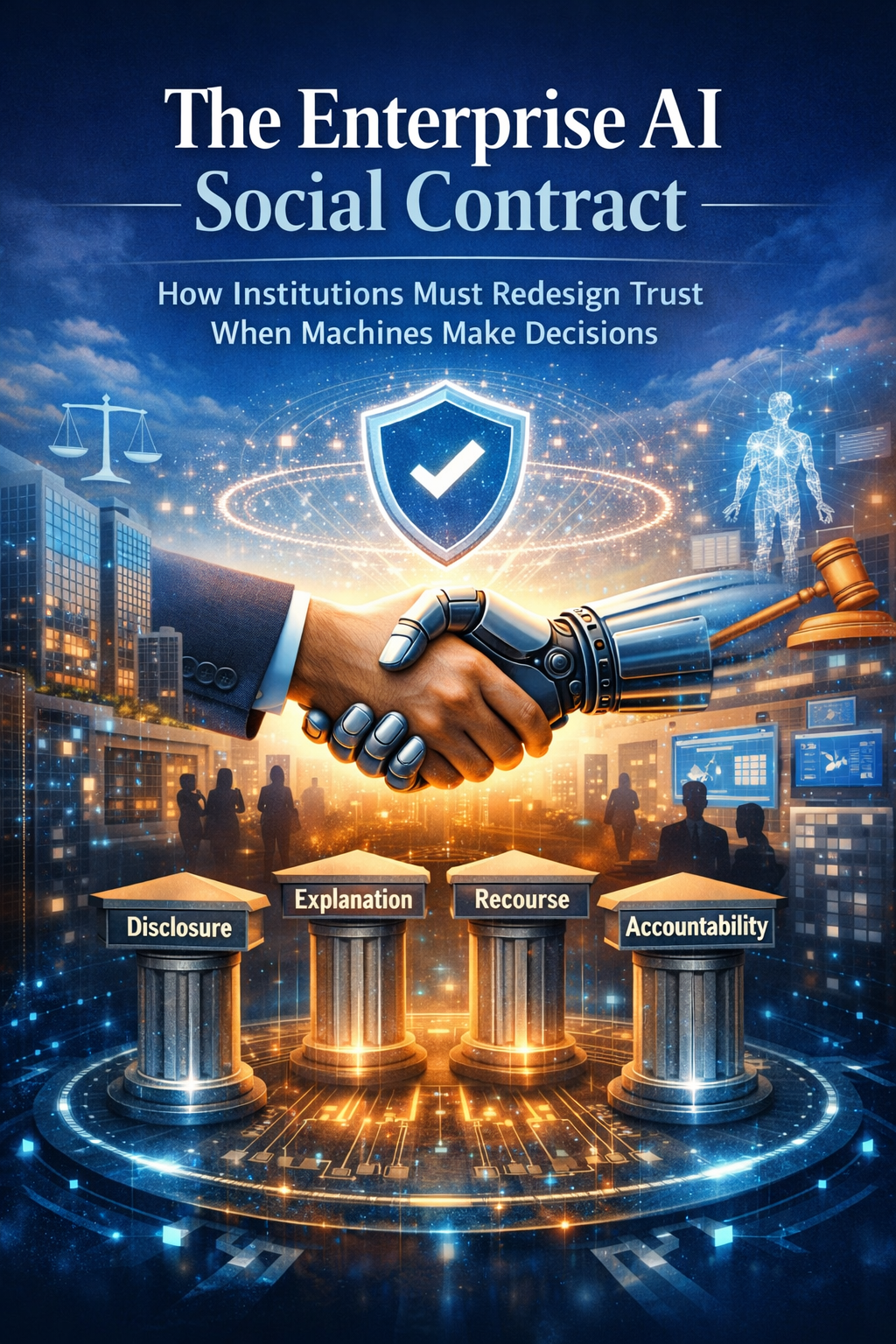
Artificial intelligence is rapidly transforming how institutions make decisions. In banks, hospitals, government agencies, and large enterprises, AI systems are no longer merely analyzing data—they are increasingly recommending actions, triggering workflows, and sometimes executing decisions themselves.
This shift creates a new challenge that most organizations are still unprepared for: how to preserve trust when machines begin shaping institutional outcomes.
The answer may lie in what can be called the Enterprise AI Social Contract—the set of governance principles that define how organizations disclose, explain, supervise, and remain accountable for decisions influenced by artificial intelligence.
In this article, I introduce the concept of the Enterprise AI Social Contract — a governance framework for institutions deploying artificial intelligence in decision-making roles.
The Enterprise AI Social Contract
Artificial intelligence is changing the nature of institutional decision-making.
For most of modern economic history, the relationship between people, institutions, and machines was relatively simple. Humans decided. Software supported. Machines executed. A bank officer approved the loan. A claims manager accepted or rejected the insurance file. A procurement manager selected the vendor. A customer service agent decided how far to go to resolve the complaint.
AI is beginning to break that arrangement.
Today, AI systems can classify claims, summarize medical notes, recommend treatment pathways, rank résumés, prioritize sales leads, route disputes, generate legal drafts, trigger workflows, choose suppliers, and increasingly act through tools, browsers, APIs, and enterprise systems.
OpenAI, Anthropic, and Microsoft have all publicly described or documented AI systems that can use tools or computers to perform multistep work, while Microsoft’s 2025 Work Trend Index argues that a new category of “Frontier Firms” is emerging around AI-native workflows and agents. (OpenAI)
That shift matters because trust in institutions was not designed for a world in which machine systems can meaningfully participate in real decisions. The deeper issue is no longer just whether an AI model is accurate.
It is whether the institution using that model can explain, govern, contest, reverse, and remain accountable for what the machine is allowed to decide. Global frameworks from NIST, OECD, UNESCO, and the European Union all point in the same direction: trustworthy AI requires transparency, accountability, human oversight, and meaningful ways to challenge outcomes. (NIST)
This is why enterprises now need a new idea:
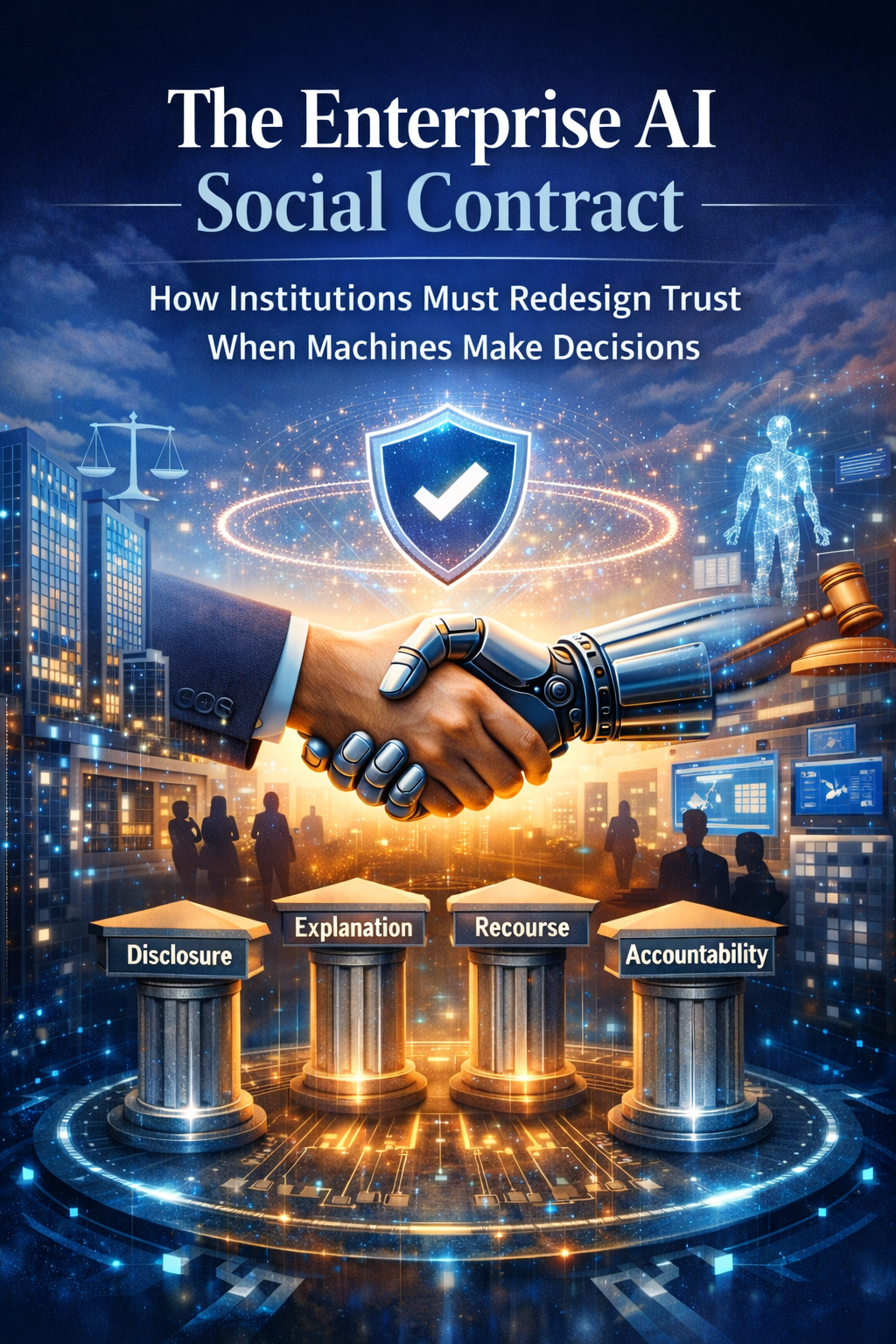
The Enterprise AI Social Contract
The Enterprise AI Social Contract is the set of institutional promises an organization makes when AI begins to influence or make decisions that affect employees, customers, citizens, suppliers, partners, or markets.
In plain language, it means this:
If machines are going to participate in decisions, institutions must redesign trust around that reality.
This is not a branding exercise. It is not a policy slogan. It is an operating principle for the age of machine decision-making.
What makes this moment different
The defining shift in enterprise AI is not that machines can now generate language, images, or code. The defining shift is that they are increasingly able to rank, approve, deny, route, trigger, negotiate, and act.
That changes the nature of institutional power.
A chatbot that drafts an email is useful.
A system that recommends the next best action is influential.
A system that actually issues the refund, freezes the transaction, routes the complaint, shortlists the applicant, or triggers the procurement event has crossed into something much bigger: delegated authority.
That is the real threshold.
Most AI debates still focus on intelligence: bigger models, better reasoning, more memory, lower hallucination rates, stronger retrieval, better copilots.
Those issues matter. But they are not the deepest institutional issue.
The central issue is this: what happens to trust when institutions begin delegating parts of authority to machines?
Why the old trust model no longer works
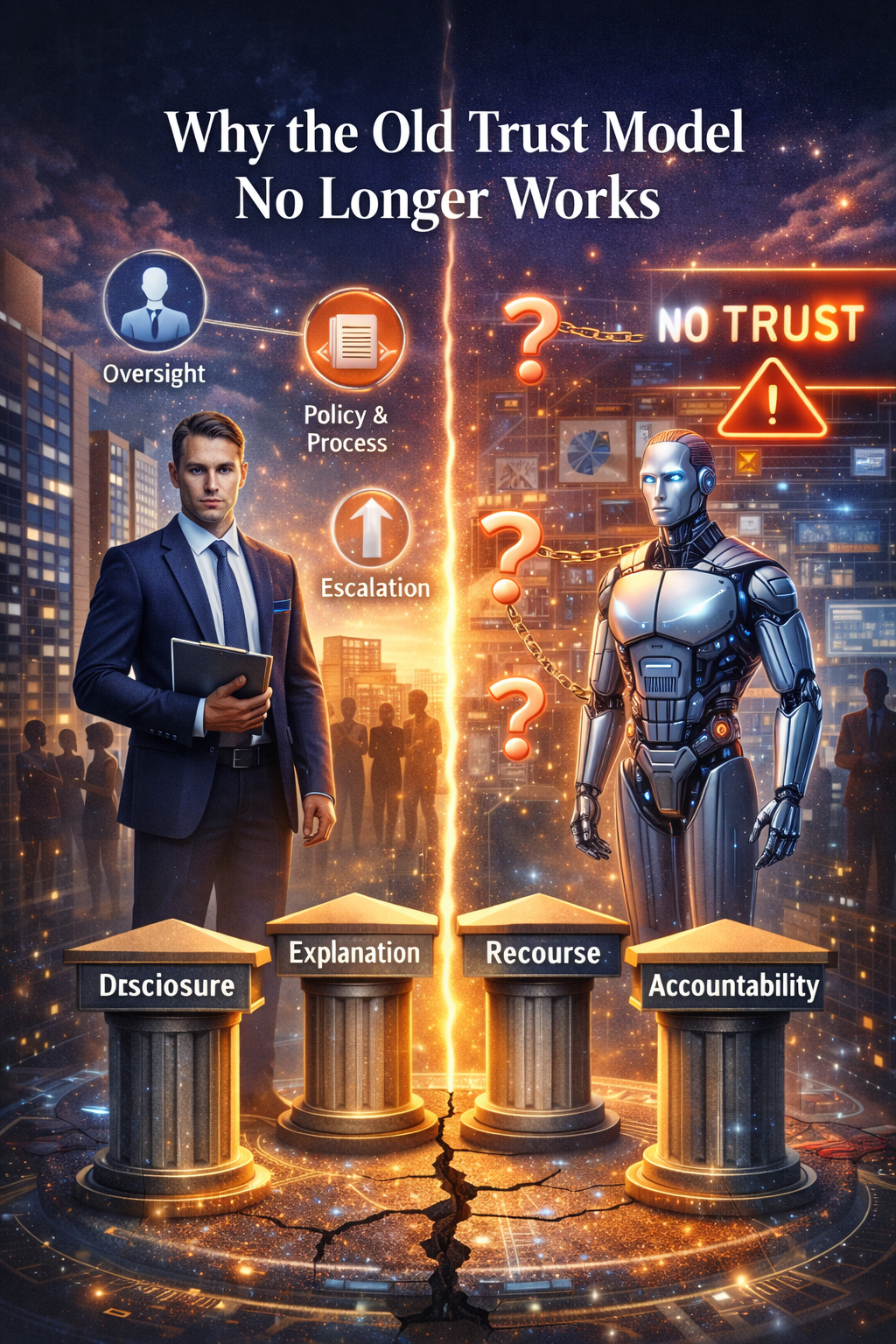
Traditional enterprise trust rested on four assumptions.
First, there was usually a human in the loop with real authority.
Second, the logic of the decision was often embedded in policy, process, and training.
Third, escalation paths were visible.
Fourth, accountability was legible: a manager, committee, or institution could be named.
AI weakens each of these assumptions.
Imagine a retail bank using AI to pre-screen small-business loans. The bank may still say, “A human makes the final decision.”
But if the officer is reviewing hundreds of AI-ranked cases each day and overturns only a small fraction, then the practical decision-maker is no longer purely human. The institution has shifted from human decision-making supported by software to human supervision of machine judgment.
Or consider customer support. If an agentic system can autonomously resolve routine customer issues, issue credits, escalate complaints, and draft case notes, the important question is no longer only whether costs fall.
It is what governance sits underneath that autonomy. Gartner has publicly predicted that by 2028 at least 15% of day-to-day work decisions will be made autonomously through agentic AI, and that 33% of enterprise software applications will incorporate agentic AI capabilities by 2028. (Gartner)
The social contract breaks when institutions say, “Trust the system,” but cannot answer basic questions about delegation, review, reversal, and recourse.
The simplest test: when AI stops being a tool
A useful test is this:
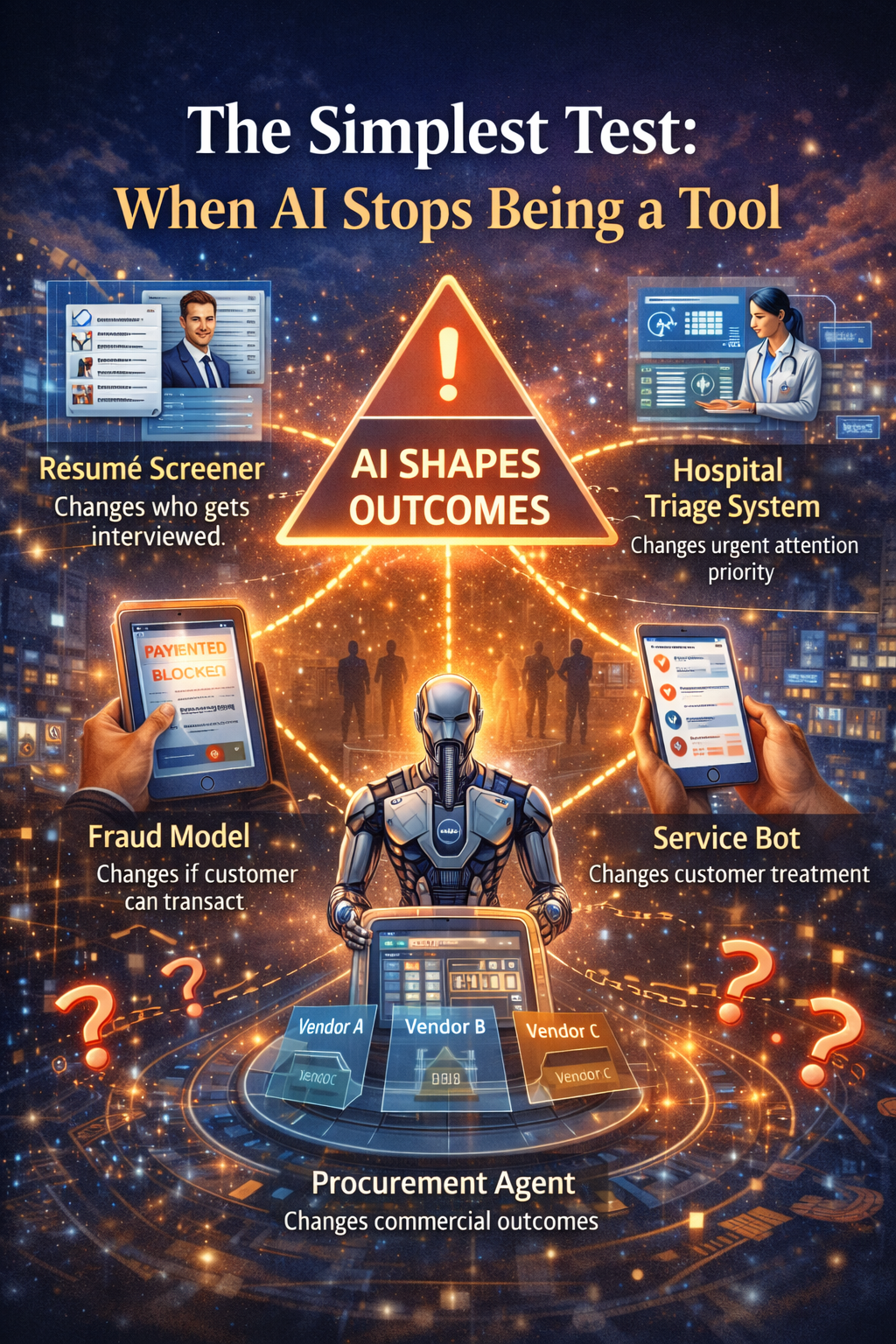
If the AI output changes what happens to a person, a transaction, or a workflow, then the system is no longer just producing information. It is participating in institutional action.
Simple examples make this clear.
A résumé screener that ranks candidates changes who gets interviewed.
A fraud model that blocks a payment changes whether a customer can transact.
A hospital triage system changes who receives urgent attention first.
A procurement agent that selects vendors changes commercial outcomes.
A service bot that grants or denies refunds changes customer treatment.
In each case, the institution is not merely using AI. It is allowing AI to shape outcomes.
That is where the Enterprise AI Social Contract begins.
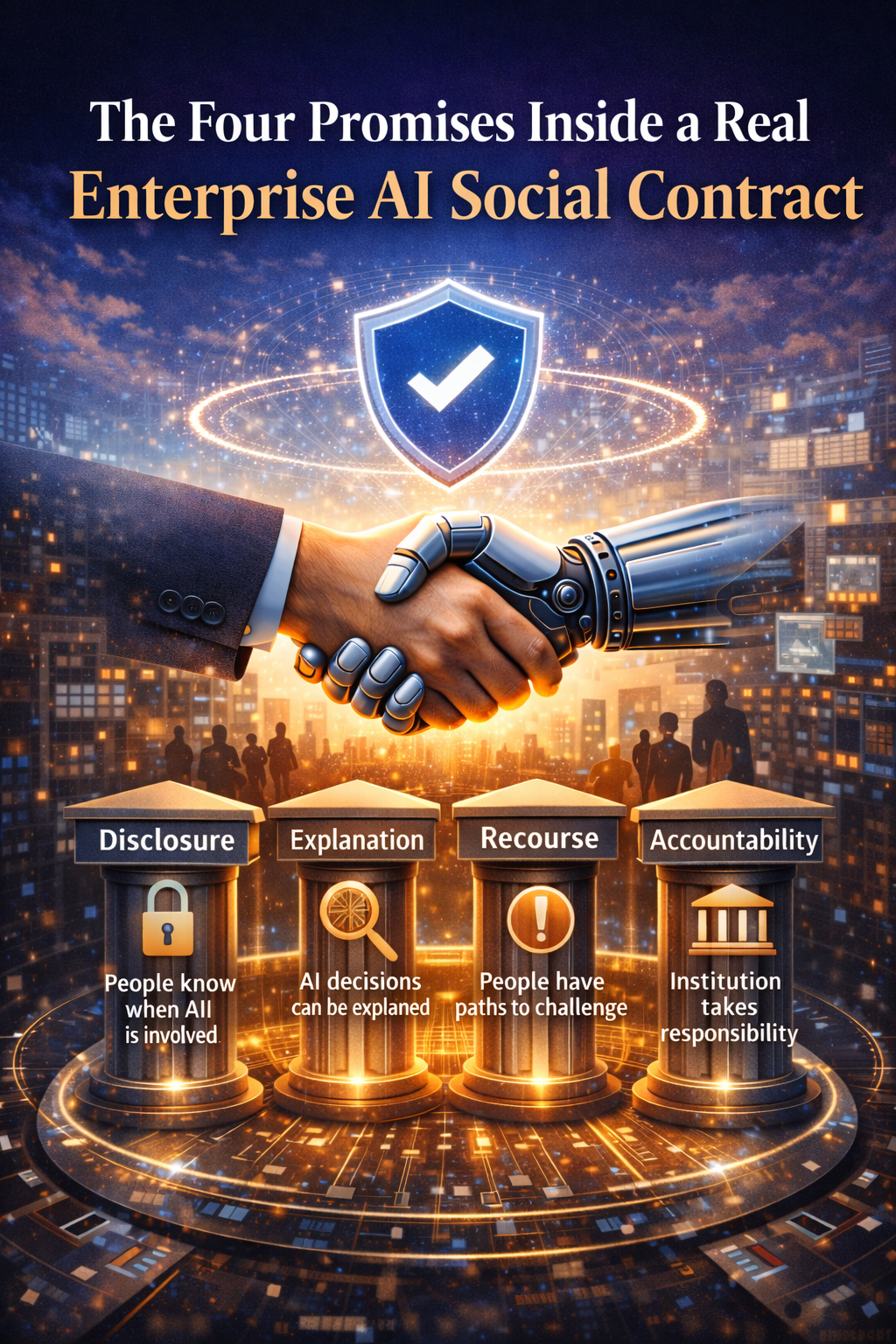
The four promises inside a real Enterprise AI Social Contract
A serious social contract should contain four core promises.
-
Disclosure: people should know when AI is materially involved
If an AI system is materially shaping a decision, the affected person should not have to guess. OECD principles emphasize transparency and responsible disclosure so that people understand when they are engaging with AI and can challenge outcomes where appropriate. (OECD)
This does not mean every interface needs a flashing warning label. It means institutions should be honest about meaningful AI involvement where it affects rights, money, access, safety, evaluation, eligibility, or opportunity.
-
Explanation: the institution must be able to give a reason people can understand
Not every model is fully interpretable, and explainability has limits. But the social contract does not require perfect technical transparency. It requires something more practical: the institution must be able to state, in plain language, the basis of action.
For example, this is useful:
“Your claim was flagged because the system found inconsistencies between the invoice date, service code, and policy coverage.”
This is not useful:
“The model scored your case as high risk.”
The difference is institutional respect. One response gives a reason. The other hides behind a system.
-
Recourse: people must have a way back
A trustworthy institution must provide a path to appeal, contest, escalate, or reverse an AI-shaped decision. UNESCO’s Recommendation on the Ethics of AI emphasizes human rights, dignity, fairness, transparency, oversight, and accountability, all of which support the need for meaningful recourse in practice. (UNESCO)
In real life, recourse means there is always a “way back” from machine action.
If the bank wrongly flags a customer for fraud, the customer needs a clear recovery path.
If the hiring screen misses a strong applicant, there should be review mechanisms.
If an AI support system closes a valid complaint, a human escalation path must exist.
Without recourse, trust becomes one-sided: the institution gains speed, while the individual absorbs the error.
-
Accountability: the institution remains responsible
The most dangerous sentence in enterprise AI is: “The model did it.”
No regulator, board, customer, court, or employee will accept that as a sufficient answer. NIST’s AI RMF explicitly frames trustworthy AI in terms that include accountability, transparency, explainability, safety, security, privacy enhancement, and managed harmful bias. (NIST)
The institution remains accountable for the authority it delegates.
That is the heart of the social contract.
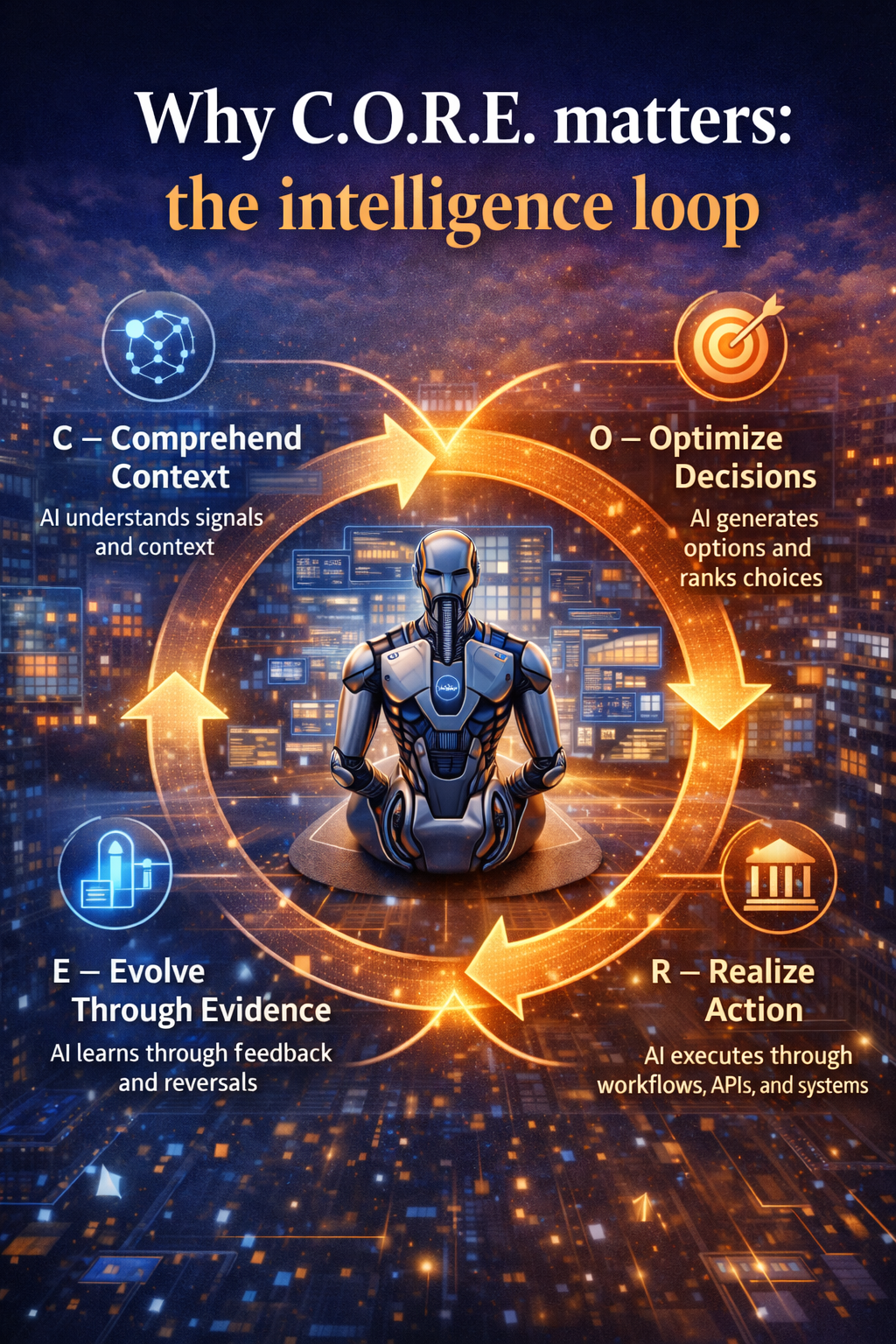
Why C.O.R.E. matters: the intelligence loop
To understand why this contract matters, it helps to separate intelligence from governance.
Your C.O.R.E. framework explains the intelligence loop:
C — Comprehend context
AI absorbs signals: customer intent, transaction patterns, operational telemetry, policy constraints, and environmental conditions.
O — Optimize decisions
AI generates options, estimates tradeoffs, and ranks possible actions under constraints.
R — Realize action
AI executes through workflows, APIs, messages, approvals, routing logic, or enterprise systems.
E — Evolve through evidence
AI improves through outcomes, reversals, feedback, drift signals, and error patterns.
C.O.R.E. explains how institutional intelligence functions.
But intelligence alone does not create trust.
The moment the system moves from Optimize to Realize, the Enterprise AI Social Contract becomes unavoidable.
That is where many organizations still think too narrowly. They are focused on whether the model “works,” when the deeper question is whether the institution has designed the conditions under which that intelligence is allowed to act.
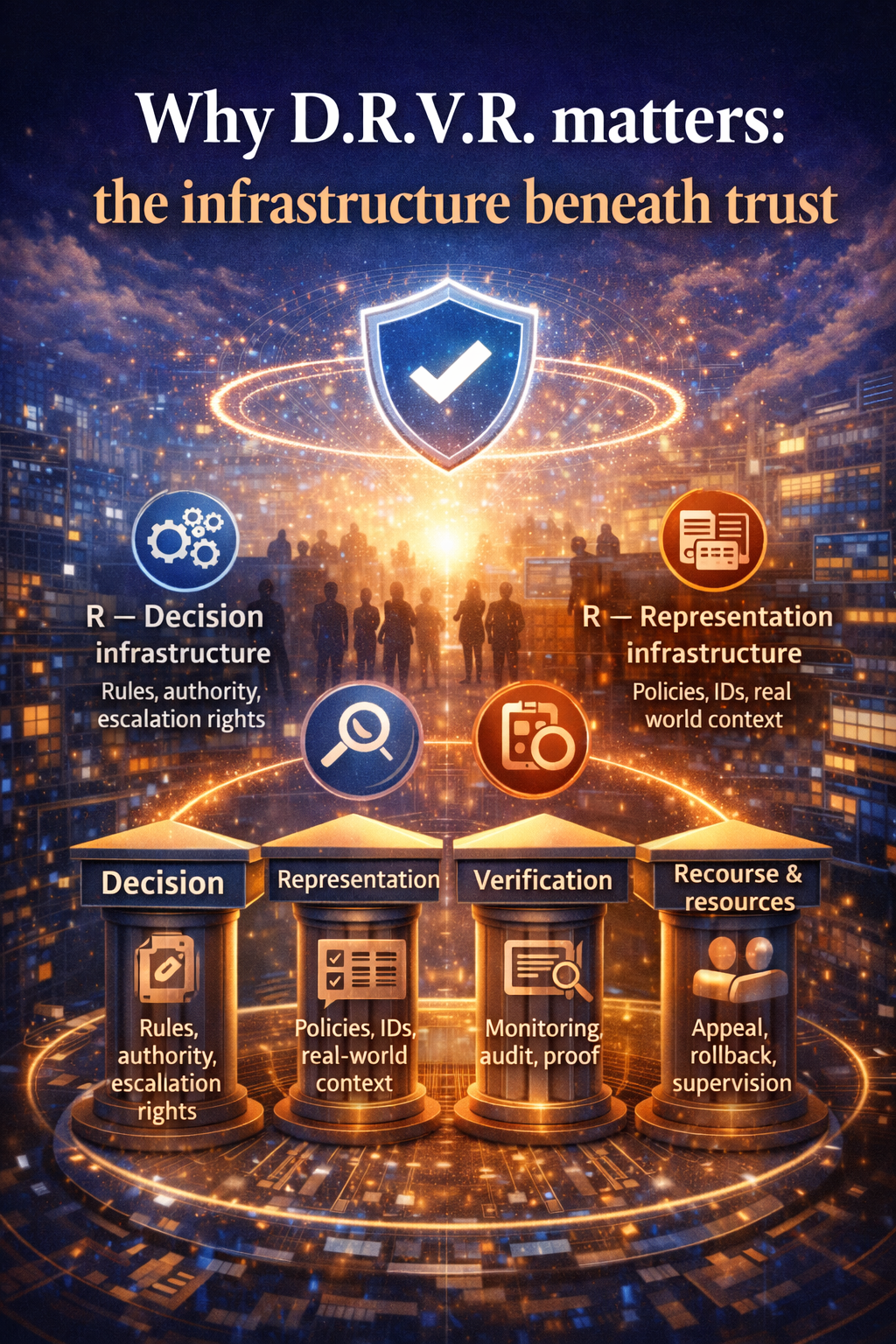
Why D.R.V.R. matters: the infrastructure beneath trust
If C.O.R.E. explains how AI thinks and acts, D.R.V.R. explains the institutional infrastructure that makes that action legitimate.
A practical interpretation in this article’s context is:
D — Decision infrastructure
Rules, thresholds, authority boundaries, approval conditions, escalation paths, and decision rights.
R — Representation infrastructure
The systems that make reality legible to AI: policies, identities, permissions, obligations, customer context, operational state, and institutional intent.
V — Verification infrastructure
Logs, evidence, testing, evaluation, monitoring, audit trails, and proof that the system behaved within defined bounds.
R — Recourse and resource infrastructure
Appeal paths, rollback mechanisms, human override, stop controls, governance capacity, and the organizational resources needed to supervise AI safely.
This is the deeper lesson many enterprises still miss:
Trust does not come from the interface. It comes from the invisible institutional infrastructure beneath the interface.
Three simple examples that make the issue real
In banking
An AI system recommends whether to freeze a suspicious transaction. C.O.R.E. helps it read context, optimize the fraud judgment, act through the payment system, and learn from confirmed fraud outcomes.
But the social contract depends on D.R.V.R.
Who was allowed to freeze the payment?
What evidence was retained?
How fast can the customer challenge the action?
Who can override the system?
What happens if the model drifts and starts overblocking?
In healthcare
Suppose an AI system summarizes patient cases and suggests triage priority. Even if the clinician remains formally responsible, the AI is shaping urgency. If the hospital cannot explain the recommendation, measure error patterns, or preserve meaningful human override, trust will erode very quickly.
In hiring
An AI interview screener can save time. But if applicants do not know how the screen is being used, cannot challenge the result, and face a process that no one inside the company can clearly explain, then the institution may look efficient while feeling unfair.
In every case, the social contract is what converts technical capability into durable legitimacy.
Why this matters globally
This is not a niche issue for one geography or one sector. It is becoming a global operating requirement.
The OECD AI Principles were updated in 2024 and continue to frame trustworthy AI around human rights, democratic values, transparency, robustness, accountability, and responsible stewardship.
UNESCO’s AI ethics recommendation applies across all 194 member states. The NIST AI Risk Management Framework has become an important voluntary reference point for organizations trying to build trustworthy AI. The EU AI Act has established a broad risk-based legal framework, and Article 4 on AI literacy entered into application on 2 February 2025, requiring providers and deployers to ensure sufficient AI literacy among relevant staff. (OECD)
Across jurisdictions, the direction is clear: AI governance is moving from abstract ethics language to operational expectation.
That is precisely why board members and C-suites need to stop viewing AI trust as a side topic. It is becoming part of institutional design.
The strategic implication for boards and CEOs
The defining enterprise AI question of this decade is no longer:
How smart is the model?
It is:
What kind of institution do we become when machines participate in our decisions?
That question touches strategy, risk, operations, design, compliance, workforce architecture, customer trust, governance, and competitive advantage.
The institutions that win in enterprise AI will not simply deploy the most models. They will build the most trustworthy decision environments.
They will know:
- what AI is allowed to decide
- where humans must remain decisive
- how recourse works
- how machine actions are verified
- how authority is bounded
- how legitimacy is sustained at scale
That is why the real challenge of AI is not just building intelligent systems. It is redesigning institutions that can safely delegate decisions to them.
And that is the Enterprise AI Social Contract.
It is not a slogan.
It is not a compliance memo.
It is not a chatbot policy.
It is the foundation of institutional trust in the age of machine decisions.
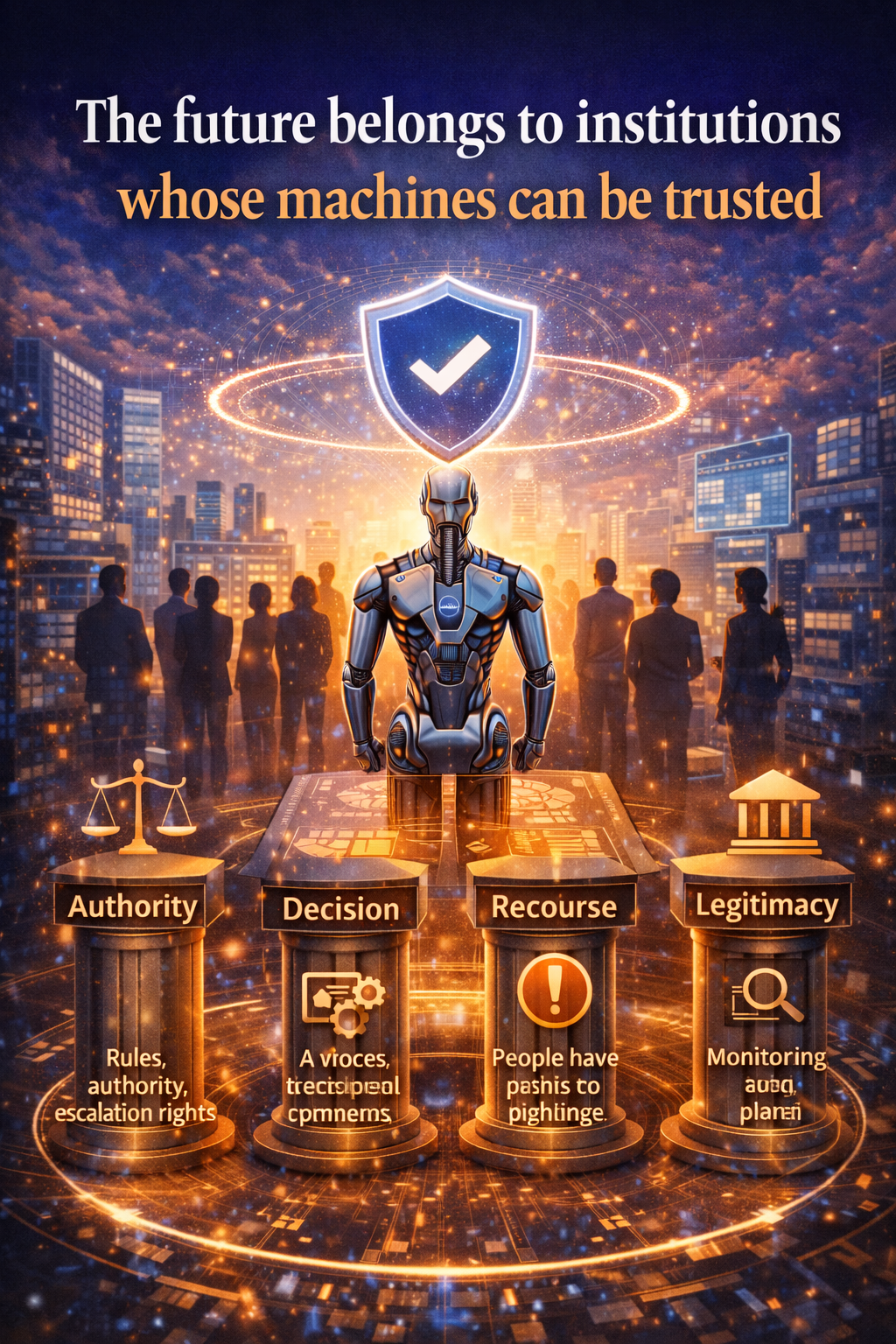
Conclusion: the future belongs to institutions whose machines can be trusted
For the next decade, trust will matter more than raw intelligence.
Enterprises that treat AI as merely a productivity layer will miss the deeper shift. As AI systems move from recommendation to action, the competitive question changes. It is no longer only about who has the best model. It is about who has built the strongest institutional architecture for delegated machine authority.
That is why the future of enterprise AI will belong not simply to the institutions with the smartest machines, but to the institutions whose machines can be trusted.
And the path to that future begins with a new social contract.
This social contract is not a standalone governance idea. It sits within a broader institutional architecture that includes the Enterprise AI Operating Model, the Enterprise AI Control Plane, the Enterprise AI Runtime, and the Enterprise AI Operating Stack. Together, these define how organizations govern, execute, monitor, and scale AI safely in production.
The Enterprise AI Social Contract is a framework for governing machine decision-making inside institutions. As AI systems move from providing insights to executing actions—such as approving loans, prioritizing patients, routing customer service cases, or selecting vendors—organizations must redesign trust architectures. This requires transparency, explainability, recourse, accountability, and institutional governance layers such as decision infrastructure, verification systems, and oversight mechanisms. Without this social contract, enterprises risk losing legitimacy even if their AI systems are technically accurate.
Glossary
Enterprise AI Social Contract
The set of institutional promises governing how AI may influence or make decisions that affect people, transactions, workflows, and markets.
Delegated Machine Authority
The authority an institution gives to AI systems when they are allowed to rank, approve, deny, route, trigger, or execute decisions.
Decision Governance
The structures, rules, review paths, and controls that govern how machine-assisted or machine-made decisions are authorized and supervised.
Recourse
The ability for an affected person or operator to challenge, reverse, escalate, or appeal an AI-shaped outcome.
C.O.R.E.
A framework for the intelligence loop in enterprise AI: Comprehend context, Optimize decisions, Realize action, Evolve through evidence.
D.R.V.R.
A framework for the institutional infrastructure beneath trustworthy AI: Decision infrastructure, Representation infrastructure, Verification infrastructure, and Recourse/resource infrastructure.
Enterprise AI Control Plane
The governance layer that defines what AI is allowed to do, under what conditions, with what boundaries, approvals, and monitoring.
Enterprise AI Runtime
The production layer where enterprise AI actually executes through systems, APIs, workflows, tools, and operational environments.
Legitimacy
The condition in which AI-enabled decisions are not only technically effective, but also institutionally explainable, contestable, and socially acceptable.
AI Literacy
The knowledge and capability required by staff and operators to understand, use, supervise, and govern AI responsibly in context.
FAQ
What is the Enterprise AI Social Contract?
It is the set of institutional promises that define how AI can participate in decisions while preserving trust, accountability, recourse, and human legitimacy.
Why is this different from ordinary AI governance?
Ordinary AI governance often focuses on models, risks, and policies. The Enterprise AI Social Contract goes further by asking what institutions owe people when machines begin shaping real outcomes.
Why does this matter now?
Because AI is moving beyond assistance into action. Agentic systems can increasingly perform multistep work, use tools, and influence operational decisions. (OpenAI)
Is human oversight still enough?
Not by itself. A nominal human in the loop does not guarantee accountability if the machine is effectively shaping the decision at scale. Institutions need stronger decision infrastructure, verification, and recourse.
What industries need this most?
Banking, insurance, healthcare, public sector, HR, retail, telecom, logistics, and any sector where AI affects eligibility, pricing, access, safety, hiring, claims, or customer treatment.
How do C.O.R.E. and D.R.V.R. help?
C.O.R.E. explains how AI thinks and acts. D.R.V.R. explains the institutional infrastructure that makes that action governable and trustworthy.
What is the board-level implication?
Boards must stop asking only whether AI improves productivity. They must also ask what authority is being delegated, how decisions are governed, and how trust is preserved.
What is the simplest sign that an organization needs this framework?
If AI can change what happens to a person, a transaction, or a workflow, the organization needs a real social contract for machine decisions.
Further Read
- NIST AI Risk Management Framework and AI RMF resources on trustworthy AI, governance, and risk management. (NIST)
- OECD AI Principles, including the 2024 update on trustworthy AI and accountability. (OECD)
- UNESCO Recommendation on the Ethics of Artificial Intelligence, including transparency, fairness, dignity, and human oversight. (UNESCO)
- European Union AI Act materials, including the broader regulatory framework and AI literacy obligations. (Digital Strategy)
- Microsoft 2025 Work Trend Index on Frontier Firms and AI-native organizational change. (Microsoft)
- OpenAI and Anthropic materials on agentic systems and computer use. (OpenAI)
- Gartner forecasts on agentic AI in enterprise software and autonomous work decisions. (Gartner)
Entrprise AI Operating Model
Enterprise AI scale requires four interlocking planes:
Read about Enterprise AI Operating Model The Enterprise AI Operating Model: How organizations design, govern, and scale intelligence safely – Raktim Singh
- Read about Enterprise Control Tower The Enterprise AI Control Tower: Why Services-as-Software Is the Only Way to Run Autonomous AI at Scale – Raktim Singh
- Read about Decision Clarity The Shortest Path to Scalable Enterprise AI Autonomy Is Decision Clarity – Raktim Singh
- Read about The Enterprise AI Runbook Crisis The Enterprise AI Runbook Crisis: Why Model Churn Is Breaking Production AI—and What CIOs Must Fix in the Next 12 Months – Raktim Singh
- Read about Enterprise AI Economics Enterprise AI Economics & Cost Governance: Why Every AI Estate Needs an Economic Control Plane – Raktim Singh
Read about Who Owns Enterprise AI Who Owns Enterprise AI? Roles, Accountability, and Decision Rights in 2026 – Raktim Singh
Read about The Intelligence Reuse Index The Intelligence Reuse Index: Why Enterprise AI Advantage Has Shifted from Models to Reuse – Raktim Singh
The Intelligence-Native Enterprise Doctrine
This article is part of a larger strategic body of work that defines how AI is transforming the structure of markets, institutions, and competitive advantage. To explore the full doctrine, read the following foundational essays:
- The AI Decade Will Reward Synchronization, Not Adoption
Why enterprise AI strategy must shift from tools to operating models.
https://www.raktimsingh.com/the-ai-decade-will-reward-synchronization-not-adoption-why-enterprise-ai-strategy-must-shift-from-tools-to-operating-models/ - The Third-Order AI Economy
The category map boards must use to see the next Uber moment.
https://www.raktimsingh.com/third-order-ai-economy/ - The Intelligence Company
A new theory of the firm in the AI era — where decision quality becomes the scalable asset.
https://www.raktimsingh.com/intelligence-company-new-theory-firm-ai/ - The Judgment Economy
How AI is redefining industry structure — not just productivity.
https://www.raktimsingh.com/judgment-economy-ai-industry-structure/ - Digital Transformation 3.0
The rise of the intelligence-native enterprise.
https://www.raktimsingh.com/designing-intelligence-native-enterprise/ - Industry Structure in the AI Era
Why judgment economies will redefine competitive advantage.
https://www.raktimsingh.com/industry-structure-in-the-ai-era-why-judgment-economies-will-redefine-competitive-advantage/
Institutional Perspectives on Enterprise AI
Many of the structural ideas discussed here — intelligence-native operating models, control planes, decision integrity, and accountable autonomy — have also been explored in my institutional perspectives published via Infosys’ Emerging Technology Solutions platform.
For readers seeking deeper operational detail, I have written extensively on:
- What Makes an Enterprise Intelligence-Native? The Blueprint for Third-Order AI Advantage
https://blogs.infosys.com/emerging-technology-solutions/artificial-intelligence/what-is-enterprise-ai-the-operating-model-for-compounding-institutional-intelligence.html - Why “AI in the Enterprise” Is Not Enterprise AI: The Operating Model Difference Most Organizations Miss
https://blogs.infosys.com/emerging-technology-solutions/artificial-intelligence/why-ai-in-the-enterprise-is-not-enterprise-ai-the-operating-model-difference-that-most-organizations-miss.html - The Enterprise AI Control Plane: Governing Autonomy at Scale
https://blogs.infosys.com/emerging-technology-solutions/artificial-intelligence/the-enterprise-ai-control-plane-governing-autonomy-at-scale.html - Enterprise AI Ownership Framework: Who Is Accountable, Who Decides, and Who Stops AI in Production
https://blogs.infosys.com/emerging-technology-solutions/artificial-intelligence/enterprise-ai-ownership-framework-who-is-accountable-who-decides-and-who-stops-ai-in-production.html - Decision Integrity: Why Model Accuracy Is Not Enough in Enterprise AI
https://blogs.infosys.com/emerging-technology-solutions/artificial-intelligence/decision-integrity-why-model-accuracy-is-not-enough-in-enterprise-ai.html - Agent Incident Response Playbook: Operating Autonomous AI Systems Safely at Enterprise Scale
https://blogs.infosys.com/emerging-technology-solutions/artificial-intelligence/agent-incident-response-playbook-operating-autonomous-ai-systems-safely-at-enterprise-scale.html - The Economics of Enterprise AI: Designing Cost, Control, and Value as One System
https://blogs.infosys.com/emerging-technology-solutions/artificial-intelligence/the-economics-of-enterprise-ai-designing-cost-control-and-value-as-one-system.html
Together, these perspectives outline a unified view: Enterprise AI is not a collection of tools. It is a governed operating system for institutional intelligence — where economics, accountability, control, and decision integrity function as a coherent architecture.



Raktim Singh is an AI and deep-tech strategist, TEDx speaker, and author focused on helping enterprises navigate the next era of intelligent systems. With experience spanning AI, fintech, quantum computing, and digital transformation, he simplifies complex technology for leaders and builds frameworks that drive responsible, scalable adoption.