

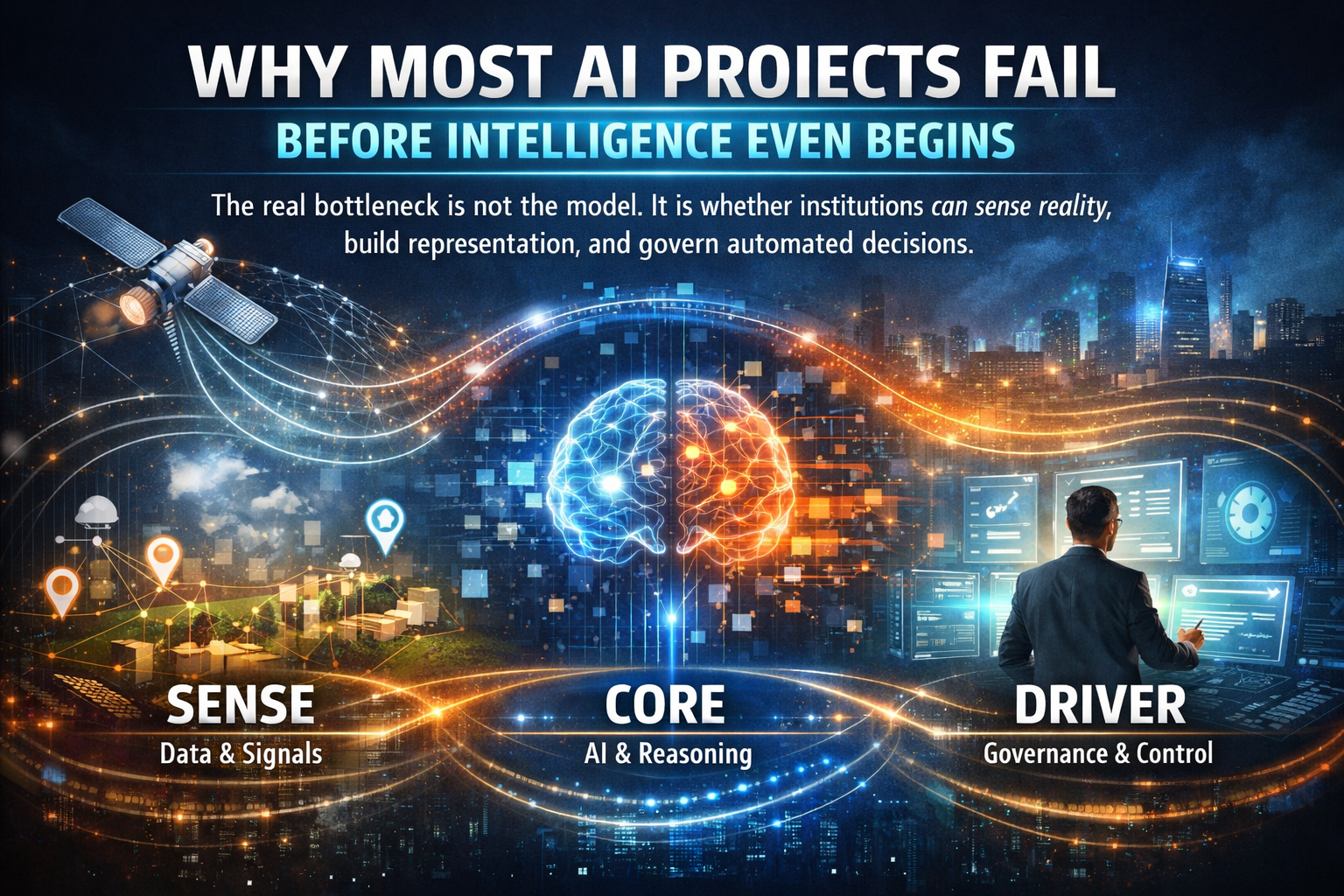
The hidden architecture problem: institutions must sense reality, represent entities, and govern automated decisions.
Most discussions about AI failure begin in the wrong place.
They begin with the model.
They ask whether the algorithm was good enough, whether the prompt was strong enough, whether the model hallucinated, or whether the organization should have used a larger model, a smaller model, or a different fine-tuning strategy.
Those questions matter.
But they often arrive too late.
Many AI projects fail before intelligence even begins.
They fail because the institution cannot properly observe reality, cannot reliably connect signals to the right entities, cannot build stable state representations, or cannot govern the consequences of automated decisions. In other words, the problem is often not intelligence. The problem is the architecture that must exist before intelligence can work. Gartner said in July 2024 that at least 30% of generative AI projects would be abandoned after proof of concept by the end of 2025 because of poor data quality, inadequate risk controls, escalating costs, or unclear business value. In February 2025, Gartner added an even sharper warning: through 2026, organizations will abandon 60% of AI projects unsupported by AI-ready data. (Gartner)
This is the core argument of this article:
Most AI projects fail not because models are weak, but because institutions lack the systems needed to make reality legible, decisions computable, and outcomes governable.
To explain that, we need a clearer architecture.
This article uses three layers:
- SENSE — how institutions make reality observable
- CORE — how machines reason about represented reality
- DRIVER — how institutions govern automated decisions
These three layers together explain why some AI systems become powerful and trustworthy, while others collapse under fragmentation, ambiguity, or lack of control.
Key Insight
Most AI projects fail not because models are weak, but because institutions lack the infrastructure required before intelligence can work.
Three foundational layers determine success:
SENSE — the ability to observe reality through signals, identity, and state representation
CORE — the machine cognition layer that reasons over represented reality
DRIVER — governance infrastructure that authorizes, verifies, and controls automated decisions
Organizations that succeed in AI build all three layers.
Organizations that fail typically focus only on the CORE layer.
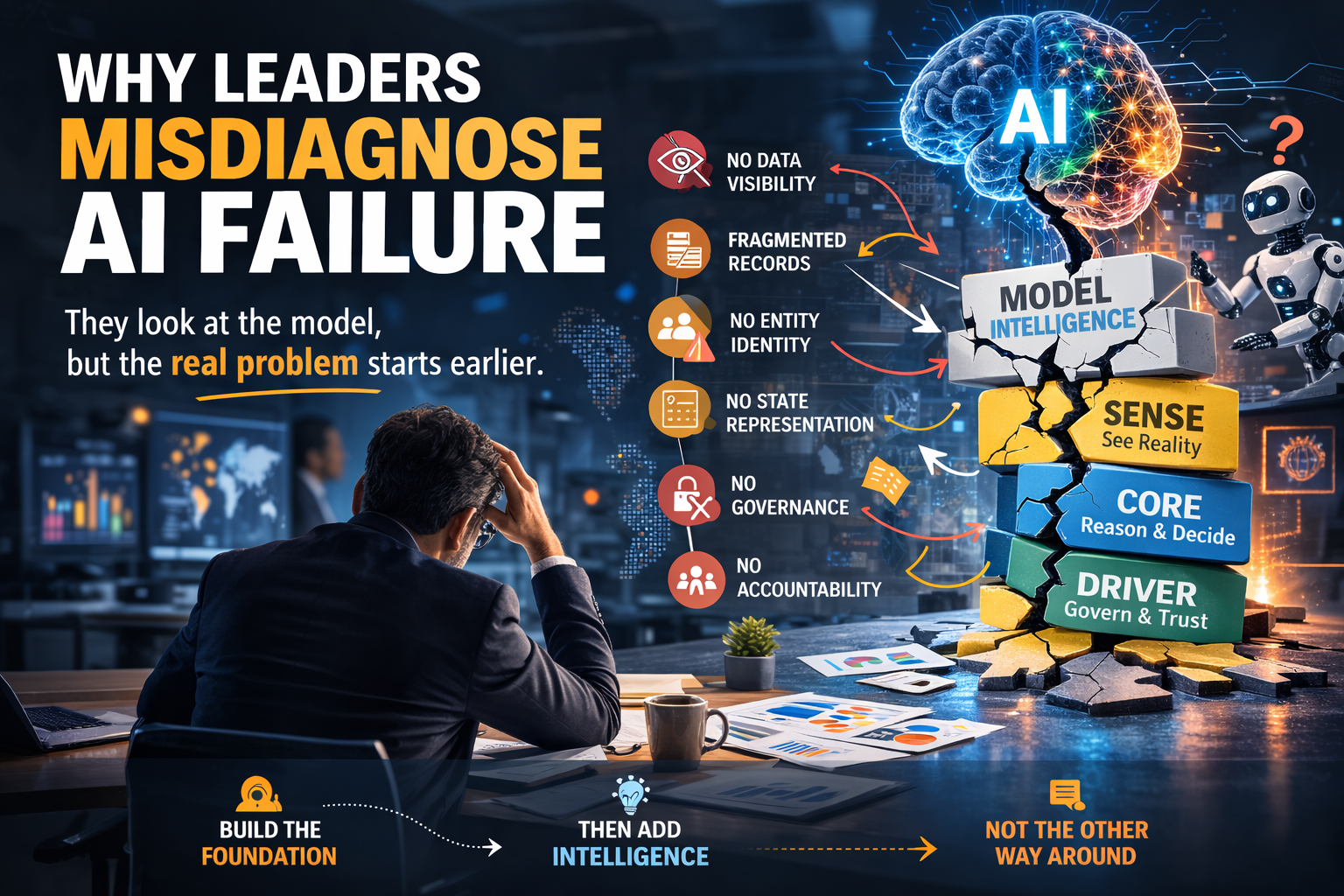
Why leaders misdiagnose AI failure
There is a simple reason executives misdiagnose AI failure.
AI is usually presented as an intelligence product.
It is sold through demos, assistants, copilots, dashboards, benchmarks, and model comparisons. That makes the model appear to be the center of the story.
In production, however, many AI systems fail for reasons that look far less glamorous:
- the right signals were never captured
- the signals could not be attached to the right entity
- the state of the actor or asset was incomplete or stale
- the decision could not be verified
- no one knew who had authorized the system to act
- there was no recourse when the system was wrong
McKinsey’s 2025 global AI survey reinforces this broader pattern: value creation correlates with workflow redesign, stronger data and technology foundations, and embedding AI into operating processes rather than treating it as a stand-alone model experiment. IBM’s enterprise research has likewise shown that many firms remain stuck in exploration and experimentation rather than scaled deployment. (McKinsey & Company)
The pattern is striking.
Organizations often fail before the reasoning layer has a chance to matter.
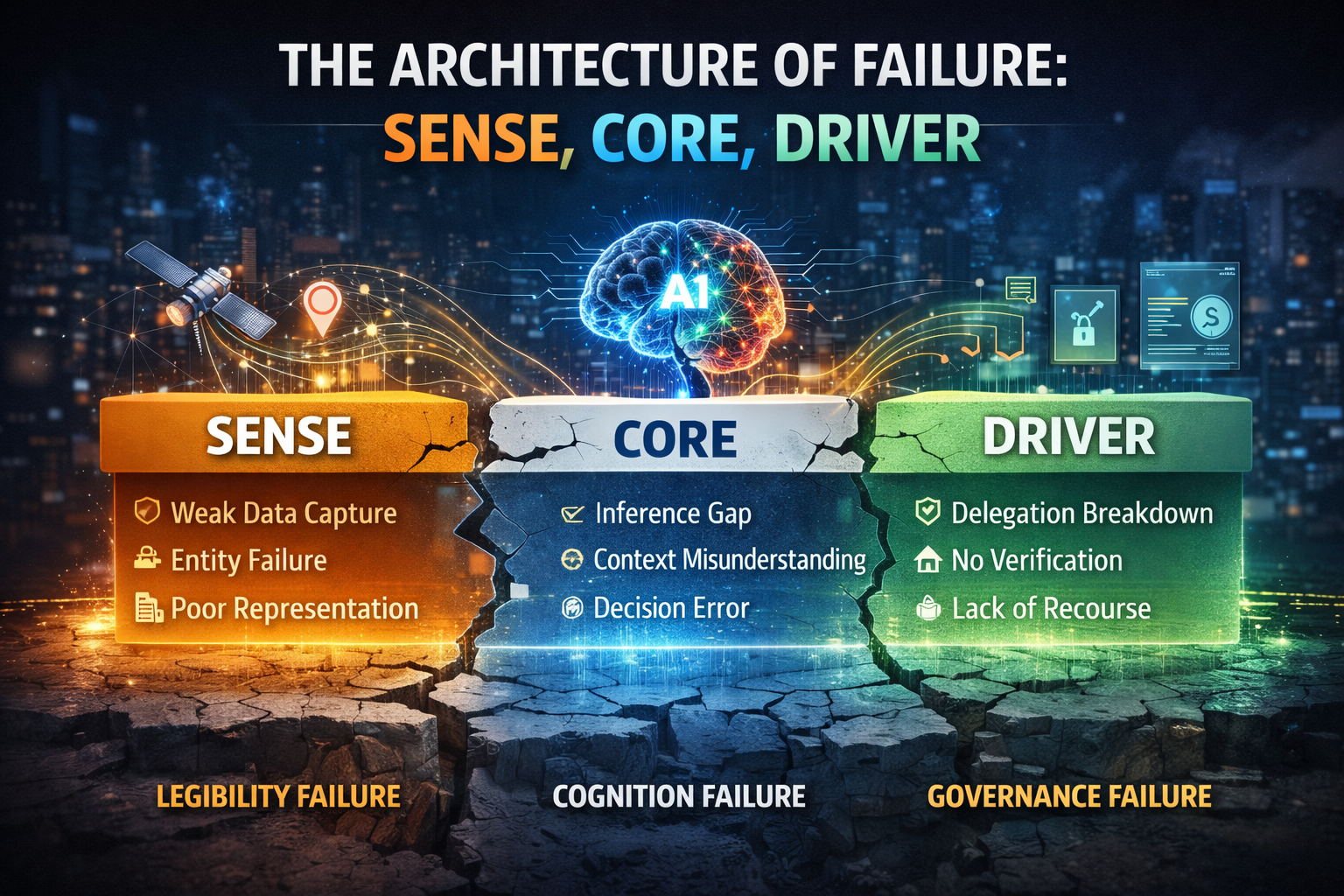
The architecture of failure: SENSE, CORE, DRIVER
If we want to understand why AI fails, we need to understand the full lifecycle of an intelligent system.
SENSE: the legibility layer
Before machines can reason, institutions must first sense reality.
In this framework, SENSE means:
- Signal — detecting events, changes, and traces from the world
- ENtity — attaching those signals to a persistent actor, object, location, or asset
- State representation — building a structured model of the current condition of that entity
- Evolution — updating that state over time as new signals arrive
This is the layer where reality becomes machine-legible.
CORE: the cognition layer
Once representation exists, machine cognition can begin.
CORE means:
- Comprehend context
- Optimize decisions
- Realize action
- Evolve through feedback
CORE is the reasoning engine.
DRIVER: the governance layer
Once automated decisions begin, institutions must govern them.
DRIVER means:
- Delegation — who authorized the system to act
- Representation — what model of reality the system used
- Identity — which entity was affected
- Verification — how the decision is checked
- Execution — how the action is carried out
- Recourse — what happens if the system is wrong
This is the legitimacy layer of the AI economy.
When most AI projects fail, they typically fail because one or more of these three layers is weak.
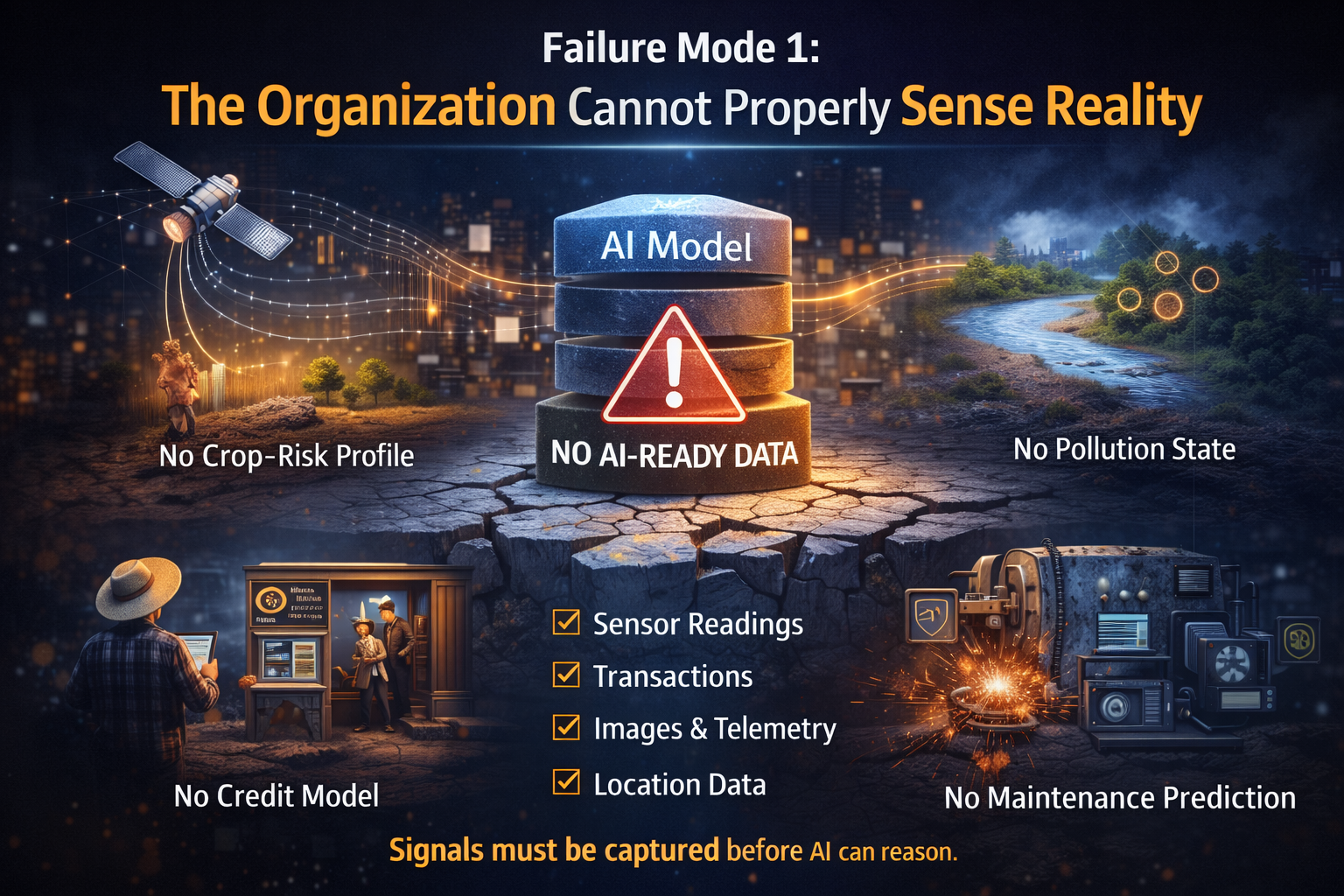
Failure mode 1: the organization cannot properly sense reality
This is the most underestimated failure mode.
Many AI projects start with the assumption that the institution already has the right data. But the world does not naturally produce AI-ready inputs. Reality must first be made observable.
A farm does not naturally emit a crop-risk profile.
A merchant does not naturally emit a credit model.
A river does not naturally emit a governance-ready pollution state.
A machine does not naturally emit a maintenance prediction.
Instead, reality produces signals:
- sensor readings
- transactions
- telemetry
- images
- timestamps
- document events
- location trails
- device logs
Only after those signals are captured, resolved to entities, and assembled into state can AI begin to reason.
This is why sensing infrastructure is becoming so important in agriculture, logistics, finance, and environmental systems. NASA’s Earth observation resources show that satellite systems can track agricultural variables such as precipitation, temperature, evapotranspiration, soil moisture, vegetation health, land use, and crop production. FAO’s 2022 State of Food and Agriculture also makes clear that digital and automation technologies are expanding across agrifood systems, but adoption remains uneven and infrastructure constraints still matter. (NASA Earthdata)
If the institution cannot sense the right reality, intelligence has nothing solid to work on.
Example: smallholder agriculture
Imagine a lending platform wants to serve a smallholder farmer.
If the institution has:
- no field-level weather visibility
- no crop-condition monitoring
- no parcel-level identity
- no history of yields or transactions
then the AI system does not fail because it lacks intelligence.
It fails because the institution lacks SENSE.
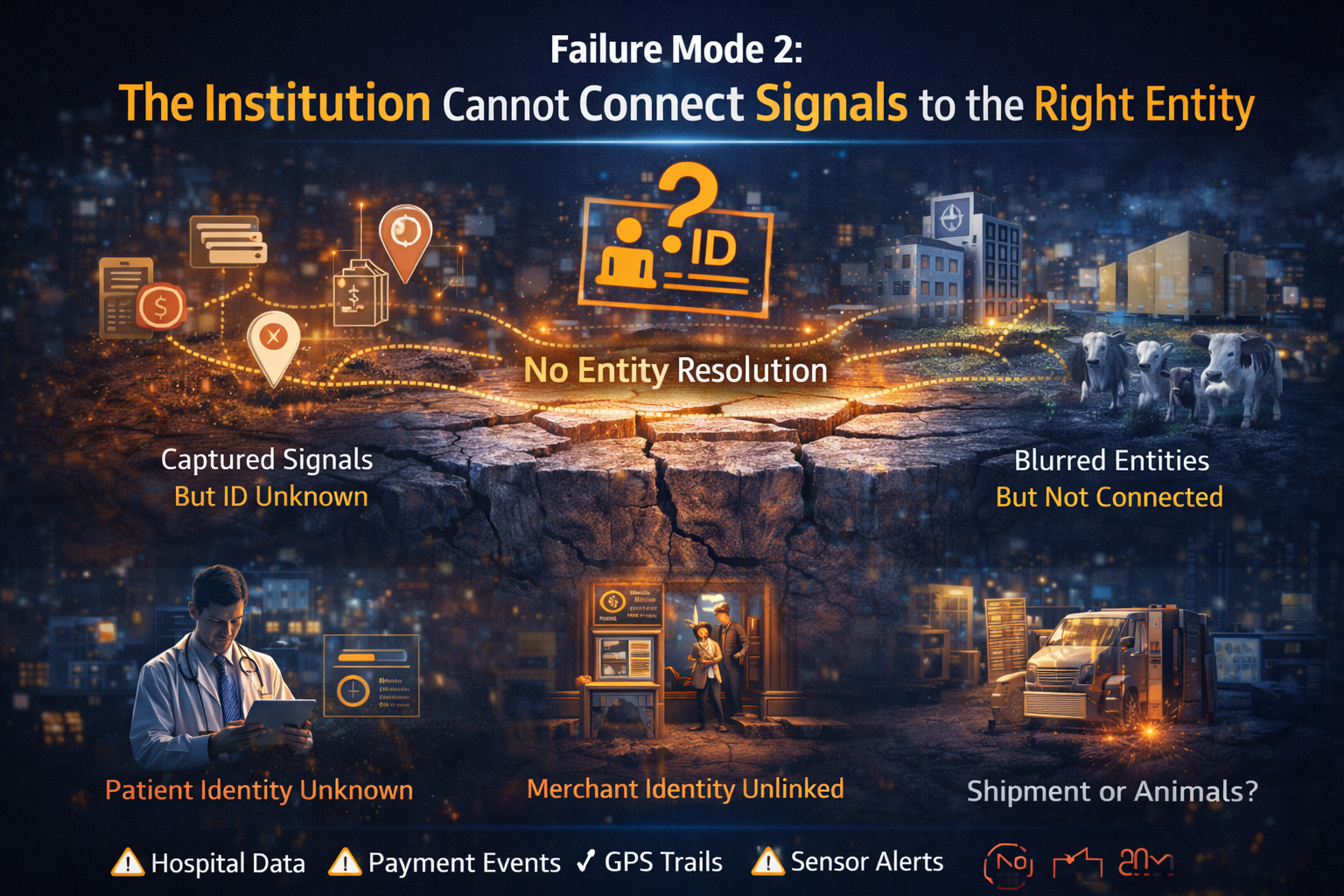
Failure mode 2: the institution cannot connect signals to the right entity
Signals alone are not enough.
A transaction event, a temperature reading, a sensor alert, or a location ping becomes useful only when the institution knows what it belongs to.
This is where many projects quietly break.
A hospital may have data, but weak patient identity linkage across systems.
A bank may have payment events, but fragmented merchant identity.
A logistics firm may have GPS trails, but poor shipment resolution.
A livestock system may have sensor readings, but weak animal identity and traceability.
Without stable entity resolution, signals remain fragments. They cannot accumulate into reliable memory. They cannot support traceable decisions. And they cannot create robust state representations.
This is why identity infrastructure matters so much. The World Bank’s ID4D program frames identification systems as a way to help people exercise rights and access better services and economic opportunities, especially as countries move toward digital economies and digital governments. UNDP similarly describes digital public infrastructure as the backbone of modern societies, enabling secure and seamless interactions through digital identity, payments, and data exchange. (UNDP)
This point is especially important in the Global South, where invisibility—not just privacy—has historically been the larger structural problem.
Example: informal merchants
A lending system may see thousands of payment events from a merchant network.
But unless those events are linked to stable merchant identities across devices, payment rails, and geographies, the system does not yet see a borrower.
It only sees disconnected events.
This is not a CORE failure.
It is a SENSE failure.
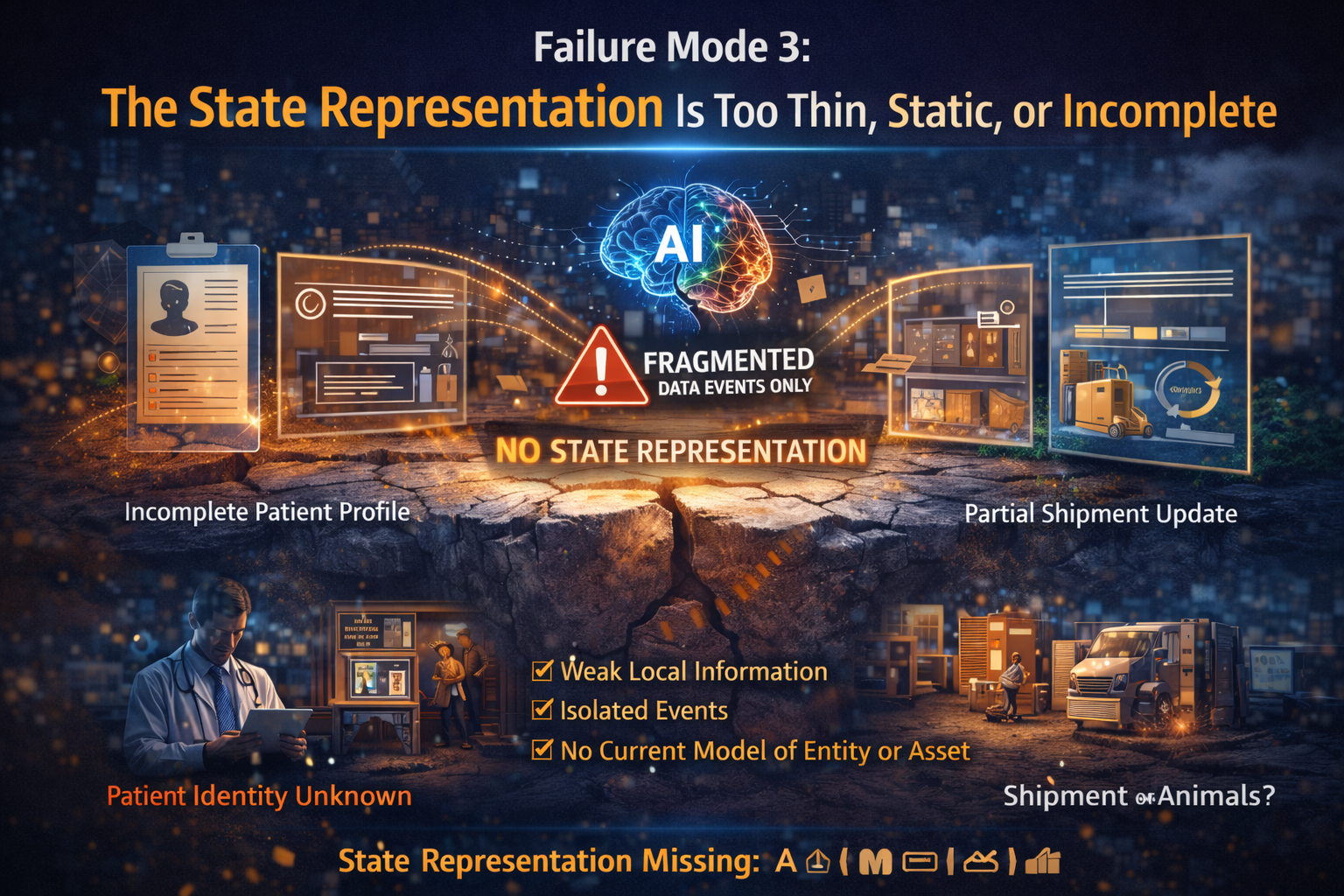
Failure mode 3: the state representation is too thin, static, or incomplete
Even when signals exist and are linked to entities, organizations still need one more step:
They must build a state representation.
That means moving from “events happened” to “this is the current condition of the actor or asset.”
A state representation might be:
- a patient health profile
- a credit state for a merchant
- a digital twin of a machine
- a shipment status model
- a farm production state
- an environmental risk profile for a river basin
This is where the real transformation happens.
Signals become legible.
The institution no longer sees noise. It sees state.
And once state exists, CORE can operate.
Without state representation, AI systems remain event-driven but context-poor. They may react to anomalies, but they cannot reason well about trajectories, risk, or trade-offs. NIST’s AI Risk Management Framework emphasizes that trustworthy AI depends on context mapping, lifecycle management, testing, monitoring, and governance—not just on model performance in isolation. (OECD)
Example: machine maintenance
A factory collects vibration, heat, and performance logs from a machine.
That is useful.
But AI becomes powerful only when the organization turns those signals into a machine-state model:
- wear level
- fault probability
- maintenance risk
- remaining life trajectory
Without that state model, the system senses but does not truly understand.
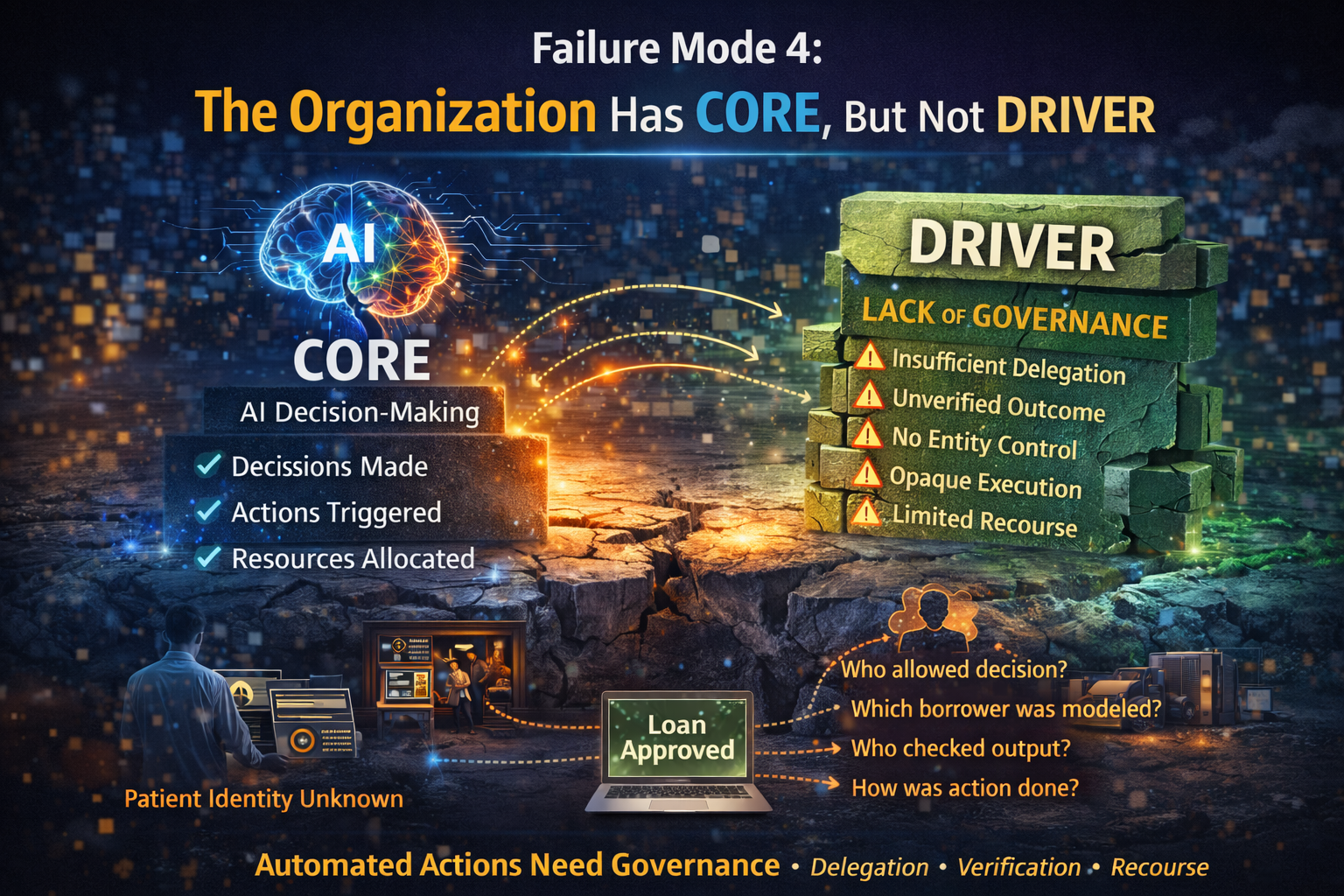
Failure mode 4: the organization has CORE, but not DRIVER
This is where many AI pilots die in production.
The institution may have sensing and representation.
It may even have strong reasoning.
But if it lacks governance, it cannot move safely from prediction to action.
This is where DRIVER becomes essential.
Organizations need clear answers to six questions.
Delegation
Who allowed the system to act?
Representation
What model of reality was used?
Identity
Which actor or asset was affected?
Verification
How is the decision checked?
Execution
How is the action implemented?
Recourse
What happens when the system is wrong?
These are not abstract governance concerns. They determine whether AI can be trusted in real operations.
The OECD’s recent due diligence guidance for responsible AI highlights data quality reviews, responsible data governance, monitoring, maintenance, and governance processes as necessary for trustworthy deployment. That is directly aligned with the logic of DRIVER: AI that cannot be governed will not scale safely or sustainably. (OECD)
Example: AI in loan approvals
Imagine an AI-assisted lending system.
Even if the model is accurate, the institution still needs to know:
- was the decision delegated to AI or only recommended by AI?
- which borrower was evaluated?
- what representation was used?
- who checked the output?
- how was the loan action executed?
- what recourse exists if the borrower disputes the result?
If these answers are weak, the project may never move beyond pilot stage.
Again, the problem is not intelligence.
It is DRIVER failure.
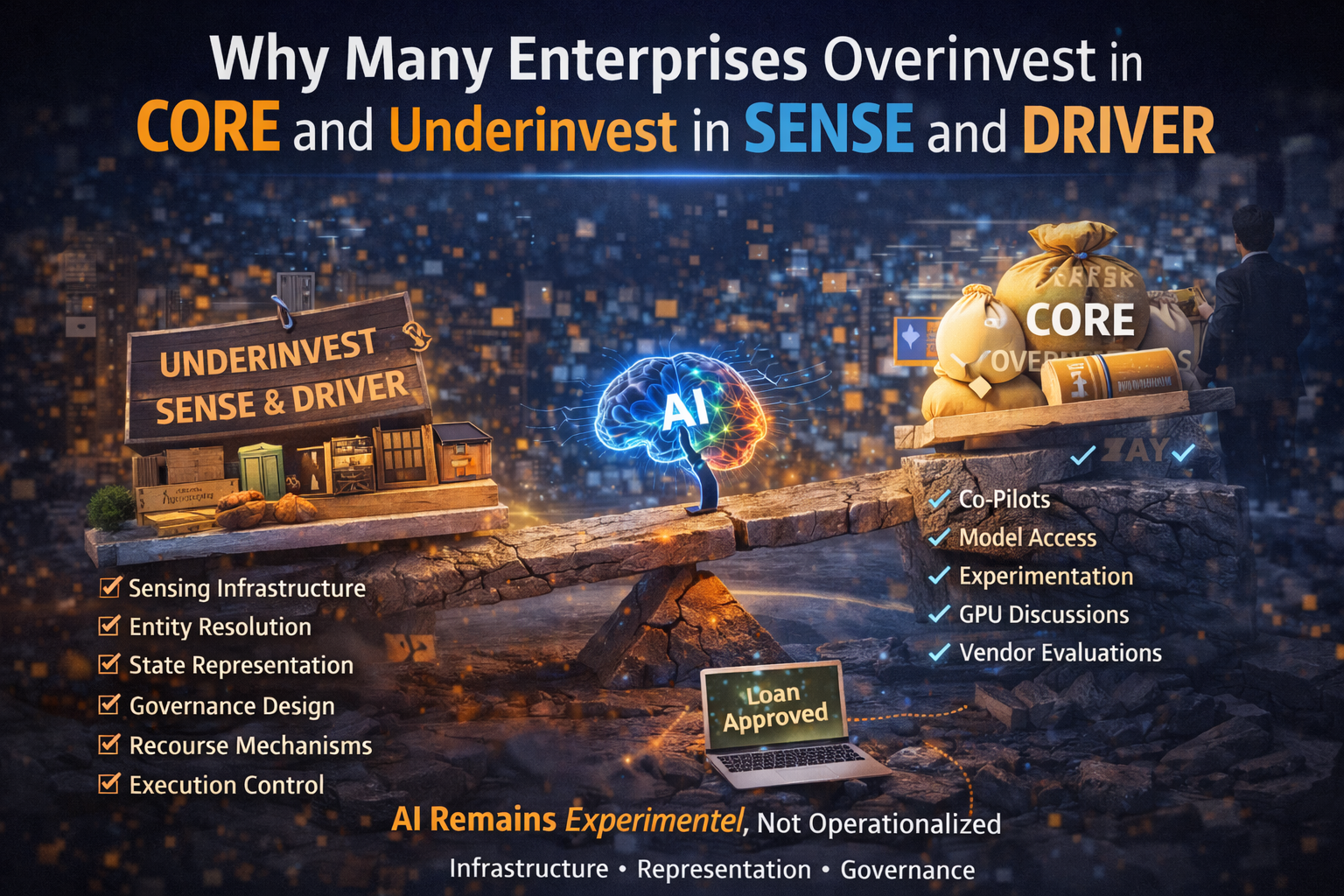
Why many enterprises overinvest in CORE and underinvest in SENSE and DRIVER
This pattern is now widespread.
Organizations spend:
- on copilots
- on model access
- on experimentation
- on GPU discussions
- on vendor evaluations
But they underinvest in:
- sensing infrastructure
- entity resolution
- state representation
- governance design
- recourse mechanisms
- execution control
This creates a familiar situation:
The institution can demo AI, but cannot operationalize it.
McKinsey’s 2025 survey found that high performers are more likely to redesign workflows and use AI to transform business processes rather than merely layering AI on top of existing structures. IBM’s enterprise reporting similarly shows that many firms remain in experimental phases while only a smaller group has moved toward active deployment at scale. (McKinsey & Company)
That is exactly what SENSE–CORE–DRIVER explains.
Organizations overfocus on intelligence and underbuild the surrounding architecture that makes intelligence useful.
Why this matters for the Global South
This architecture matters everywhere, but it becomes especially visible in lower- and middle-income contexts.
In many advanced economies, AI debates are dominated by privacy, explainability, and model risk.
Those are important.
But in many parts of the Global South, the prior problem is more basic:
- actors remain invisible
- records remain fragmented
- service continuity is weak
- identity systems are incomplete
- physical systems are poorly instrumented
That means the highest-value AI opportunity may not begin with frontier models.
It may begin with SENSE infrastructure.
When institutions can sense previously invisible actors—small merchants, informal workers, livestock, water systems, local infrastructure—they expand who can participate in economic and administrative systems.
That is where representation, and later cognition, become possible.
This is one reason digital public infrastructure is so important. UNDP explicitly describes DPI as foundational digital systems that enable secure and seamless interaction across society, including identity, payments, and data exchange. (UNDP)
The strategic lesson for boards and C-suites
Boards should stop asking only:
How advanced is our model strategy?
They should also ask:
What reality can we sense?
What entities can we reliably represent?
How are automated decisions governed?
Those three questions correspond directly to:
- SENSE
- CORE
- DRIVER
That is a much better way to assess enterprise AI readiness.
The organizations that win in the AI economy may not be the ones with the most sophisticated models in isolation.
They may be the ones that can:
- sense reality more comprehensively
- build richer state representations
- govern automated decisions more responsibly
That is where durable advantage will come from.
Key Takeaways
• AI failures often occur before model intelligence becomes relevant
• Organizations frequently lack data observability and sensing infrastructure
• Fragmented identity systems prevent entity resolution
• Thin or static representations prevent AI from reasoning about reality
• Governance systems are required before AI decisions can scale
• Enterprise AI success requires SENSE → CORE → DRIVER architecture
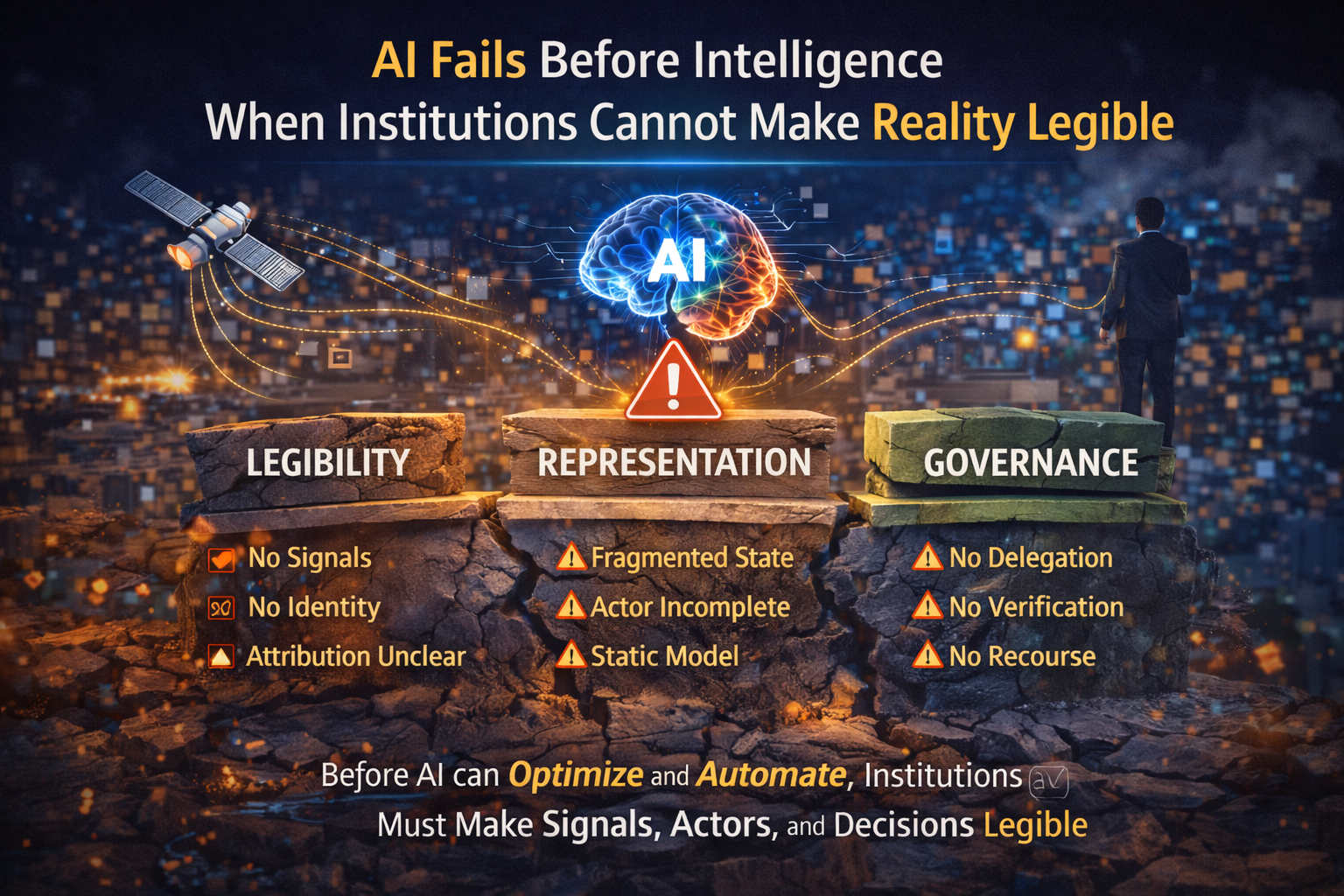
Conclusion box: AI fails before intelligence when institutions cannot make reality legible
The most important lesson is this:
Most AI systems do not fail because intelligence is impossible.
They fail because the institution never built the preconditions for intelligence to matter.
Before reasoning, there must be sensing.
Before optimization, there must be representation.
Before automation, there must be governance.
That is why so many AI projects collapse early.
Not because the model is weak.
But because the organization cannot yet turn reality into a governable decision system.
The AI economy will not be shaped only by smarter models.
It will be shaped by institutions that can:
- SENSE reality
- use CORE to reason about it
- apply DRIVER to govern the consequences
That is the real operating architecture of intelligent institutions.
And that is where the next generation of AI advantage will be won.
The future of AI will not be determined only by how well machines reason. It will be determined by whether institutions can sense reality, represent it, and govern what follows.
The AI economy will not ultimately be defined by better models alone. It will be defined by institutions that can sense reality, represent it clearly, and govern automated decisions responsibly.
To understand more, head to
- The Enterprise AI Operating Model
- The Representation Stack: How Reality Becomes Identifiable, Legible, and Actionable in the AI Economy
- The Representation Economy
- The Legitimacy Stack: Why AI Governance Is Now an Engineering Discipline
- The Future Belongs to Decision-Intelligent Institutions
- Representation Infrastructure: Why the AI Economy Will Be Won by Those Who Make the Invisible Legible
- The Representation Economy: Why AI Institutions Must Run on SENSE, CORE, and DRIVER – Raktim Singh
Glossary
SENSE
The legibility layer of intelligent systems: Signal, ENtity, State representation, Evolution.
CORE
The machine cognition loop: Comprehend context, Optimize decisions, Realize action, Evolve through feedback.
DRIVER
The institutional governance architecture for trustworthy AI decisions: Delegation, Representation, Identity, Verification, Execution, Recourse.
State representation
A structured, continuously updated model of the condition of an actor, asset, system, or environment.
Entity resolution
The process of linking multiple signals, records, or events to the same underlying actor or object.
Digital public infrastructure (DPI)
Foundational digital systems such as identity, payments, and data exchange that enable secure and inclusive participation across society. (UNDP)
AI-ready data
Data that is sufficiently clean, governed, observable, and fit for use in AI systems. (Gartner)
Legibility
The degree to which reality can be observed, represented, and acted upon by institutional systems.
FAQ
Why do most AI projects fail before intelligence even begins?
Because many organizations lack the infrastructure to sense reality properly, attach signals to entities, build stable state representations, and govern automated decisions. The problem often begins before model reasoning becomes the bottleneck. (Gartner)
What does SENSE mean in enterprise AI?
SENSE refers to Signal, ENtity, State representation, and Evolution. It is the layer that makes reality observable and machine-legible.
What is the difference between SENSE, CORE, and DRIVER?
SENSE makes reality observable, CORE enables machine reasoning, and DRIVER governs automated decisions.
Why is governance as important as the model in AI?
Because even accurate models can fail in real institutions if no one knows who authorized the system, what representation was used, how the decision was verified, how it was executed, or what recourse exists. (OECD)
Why does this matter in the Global South?
Because in many lower- and middle-income contexts, the more fundamental challenge is invisibility: weak identity systems, fragmented records, and limited sensing infrastructure. Building those layers can unlock participation, service delivery, and economic value. (UNDP)
What should boards ask instead of only focusing on model strategy?
Boards should ask what reality the institution can sense, what entities it can reliably represent, and how automated decisions are governed.
References and further reading
- Gartner — abandonment of GenAI projects after proof of concept; AI-ready data risk. (Gartner)
- McKinsey — The State of AI 2025 and workflow redesign / high-performer patterns. (McKinsey & Company)
- IBM — enterprise AI adoption and experimentation patterns. (IBM Newsroom)
- NIST — AI Risk Management Framework. (OECD)
- OECD — due diligence guidance for responsible AI. (OECD)
- UNDP — digital public infrastructure. (UNDP)
- World Bank ID4D — digital identity and inclusion. (World Bank)
- NASA Earthdata — agriculture and Earth observation. (NASA Earthdata)
- FAO — digital agriculture and agrifood automation. (Open Knowledge FAO)
The Intelligence-Native Enterprise Doctrine
This article is part of a larger strategic body of work that defines how AI is transforming the structure of markets, institutions, and competitive advantage. To explore the full doctrine, read the following foundational essays:
- The AI Decade Will Reward Synchronization, Not Adoption
Why enterprise AI strategy must shift from tools to operating models.
https://www.raktimsingh.com/the-ai-decade-will-reward-synchronization-not-adoption-why-enterprise-ai-strategy-must-shift-from-tools-to-operating-models/ - The Third-Order AI Economy
The category map boards must use to see the next Uber moment.
https://www.raktimsingh.com/third-order-ai-economy/ - The Intelligence Company
A new theory of the firm in the AI era — where decision quality becomes the scalable asset.
https://www.raktimsingh.com/intelligence-company-new-theory-firm-ai/ - The Judgment Economy
How AI is redefining industry structure — not just productivity.
https://www.raktimsingh.com/judgment-economy-ai-industry-structure/ - Digital Transformation 3.0
The rise of the intelligence-native enterprise.
https://www.raktimsingh.com/designing-intelligence-native-enterprise/ - Industry Structure in the AI Era
Why judgment economies will redefine competitive advantage.
https://www.raktimsingh.com/industry-structure-in-the-ai-era-why-judgment-economies-will-redefine-competitive-advantage/
Institutional Perspectives on Enterprise AI
Many of the structural ideas discussed here — intelligence-native operating models, control planes, decision integrity, and accountable autonomy — have also been explored in my institutional perspectives published via Infosys’ Emerging Technology Solutions platform.
For readers seeking deeper operational detail, I have written extensively on:
- What Makes an Enterprise Intelligence-Native? The Blueprint for Third-Order AI Advantage
https://blogs.infosys.com/emerging-technology-solutions/artificial-intelligence/what-is-enterprise-ai-the-operating-model-for-compounding-institutional-intelligence.html - Why “AI in the Enterprise” Is Not Enterprise AI: The Operating Model Difference Most Organizations Miss
https://blogs.infosys.com/emerging-technology-solutions/artificial-intelligence/why-ai-in-the-enterprise-is-not-enterprise-ai-the-operating-model-difference-that-most-organizations-miss.html - The Enterprise AI Control Plane: Governing Autonomy at Scale
https://blogs.infosys.com/emerging-technology-solutions/artificial-intelligence/the-enterprise-ai-control-plane-governing-autonomy-at-scale.html - Enterprise AI Ownership Framework: Who Is Accountable, Who Decides, and Who Stops AI in Production
https://blogs.infosys.com/emerging-technology-solutions/artificial-intelligence/enterprise-ai-ownership-framework-who-is-accountable-who-decides-and-who-stops-ai-in-production.html - Decision Integrity: Why Model Accuracy Is Not Enough in Enterprise AI
https://blogs.infosys.com/emerging-technology-solutions/artificial-intelligence/decision-integrity-why-model-accuracy-is-not-enough-in-enterprise-ai.html - Agent Incident Response Playbook: Operating Autonomous AI Systems Safely at Enterprise Scale
https://blogs.infosys.com/emerging-technology-solutions/artificial-intelligence/agent-incident-response-playbook-operating-autonomous-ai-systems-safely-at-enterprise-scale.html - The Economics of Enterprise AI: Designing Cost, Control, and Value as One System
https://blogs.infosys.com/emerging-technology-solutions/artificial-intelligence/the-economics-of-enterprise-ai-designing-cost-control-and-value-as-one-system.html
Together, these perspectives outline a unified view: Enterprise AI is not a collection of tools. It is a governed operating system for institutional intelligence — where economics, accountability, control, and decision integrity function as a coherent architecture.
The Enterprise AI Doctrine: From Decision Scale to Institutional Redesign
Over the past few months, I’ve been building a structured doctrine around Enterprise AI — not as a technology trend, but as an institutional redesign agenda.
It unfolds in layers:
🔹 1️⃣ Decision Economics
- Decision Scale: Why Competitive Advantage Is Moving from Labor Scale to Decision Scale
https://www.raktimsingh.com/decision-scale-competitive-advantage-ai/
→ Establishes the core thesis: advantage is shifting from scaling labor to scaling decision quality.
🔹 2️⃣ Institutional Transformation
- The Future Belongs to Decision-Intelligent Institutions
https://www.raktimsingh.com/the-future-belongs-to-decision-intelligent-institutions/
→ Argues that AI leadership is not about tooling — it is about institutional architecture.
🔹 3️⃣ Sector-Level Redesign
- The Institutional Redesign of Indian IT: From Services Firms to Intelligence Institutions
https://www.raktimsingh.com/institutional-redesign-indian-it-intelligence-institutions/ - From Labor Arbitrage to Intelligence Arbitrage: Why Indian IT’s AI Reinvention Will Define the Next Decade
https://www.raktimsingh.com/from-labor-arbitrage-to-intelligence-arbitrage-why-indian-its-ai-reinvention-will-define-the-next-decade/
→ Examines how this shift reshapes industry structure, economics, and competitive positioning.
🔹 4️⃣ Economic Consequences
- The End of Averages: Why Precision Growth Will Define the Next Decade of Enterprise Strategy
https://www.raktimsingh.com/precision-growth-end-of-averages-enterprise-ai/ - What Is the AI Dividend? How Boards Capture Structural Gains from Enterprise AI
https://www.raktimsingh.com/enterprise-ai-roi/
→ Explores how decision intelligence translates into measurable structural gains.
🔹 The Unifying Thesis
Together, these articles form a coherent framework:
- Competitive advantage is moving from labor scale to decision scale
- Institutions must evolve from services firms to intelligence institutions
- AI must shift from isolated pilots to structurally governed, economically accountable enterprise systems
This is not AI adoption.
It is enterprise redesign.



Raktim Singh is an AI and deep-tech strategist, TEDx speaker, and author focused on helping enterprises navigate the next era of intelligent systems. With experience spanning AI, fintech, quantum computing, and digital transformation, he simplifies complex technology for leaders and builds frameworks that drive responsible, scalable adoption.