

Enterprise AI in Regulated Industries
How to Scale Autonomous AI in Finance, Healthcare, Telecom, Energy, and Government—Without Breaking Compliance, Trust, or Operations
Enterprise AI becomes real the moment it stops advising and starts deciding—and nowhere is that shift more consequential than in regulated industries.
In finance, healthcare, telecom, energy, and government, even a small AI-driven decision can trigger legal obligations, regulatory scrutiny, or real-world harm. In these environments, AI is not judged by how advanced its models are, but by whether its decisions can be explained, proven, contained, and reversed when something goes wrong.
This is why most “AI deployments” quietly fail in regulated enterprises: they optimize for intelligence, but ignore operability. This article explains how regulated industries can scale Enterprise AI safely—by treating AI as an operating capability governed at runtime, not a technology experiment optimized in isolation.
Enterprise AI becomes real the moment it crosses from “advice” into decisions—especially in regulated industries.
In a consumer app, a mistake can be patched, apologized for, and forgotten.
In a regulated enterprise, a mistake becomes a case file.
That’s the defining difference:
- A consumer product can optimize for delight.
- A regulated enterprise must optimize for defensibility: the ability to explain what happened, prove it was authorized, contain harm quickly, and learn in a way that holds up under audit and scrutiny.
This article is written to support your broader Enterprise AI canon—where AI is treated as an operating model (runtime + control plane + decision governance), not a collection of “cool models.” It’s designed in an HBR/MIT tone: practical, globally relevant, and grounded in how real enterprises run risk.
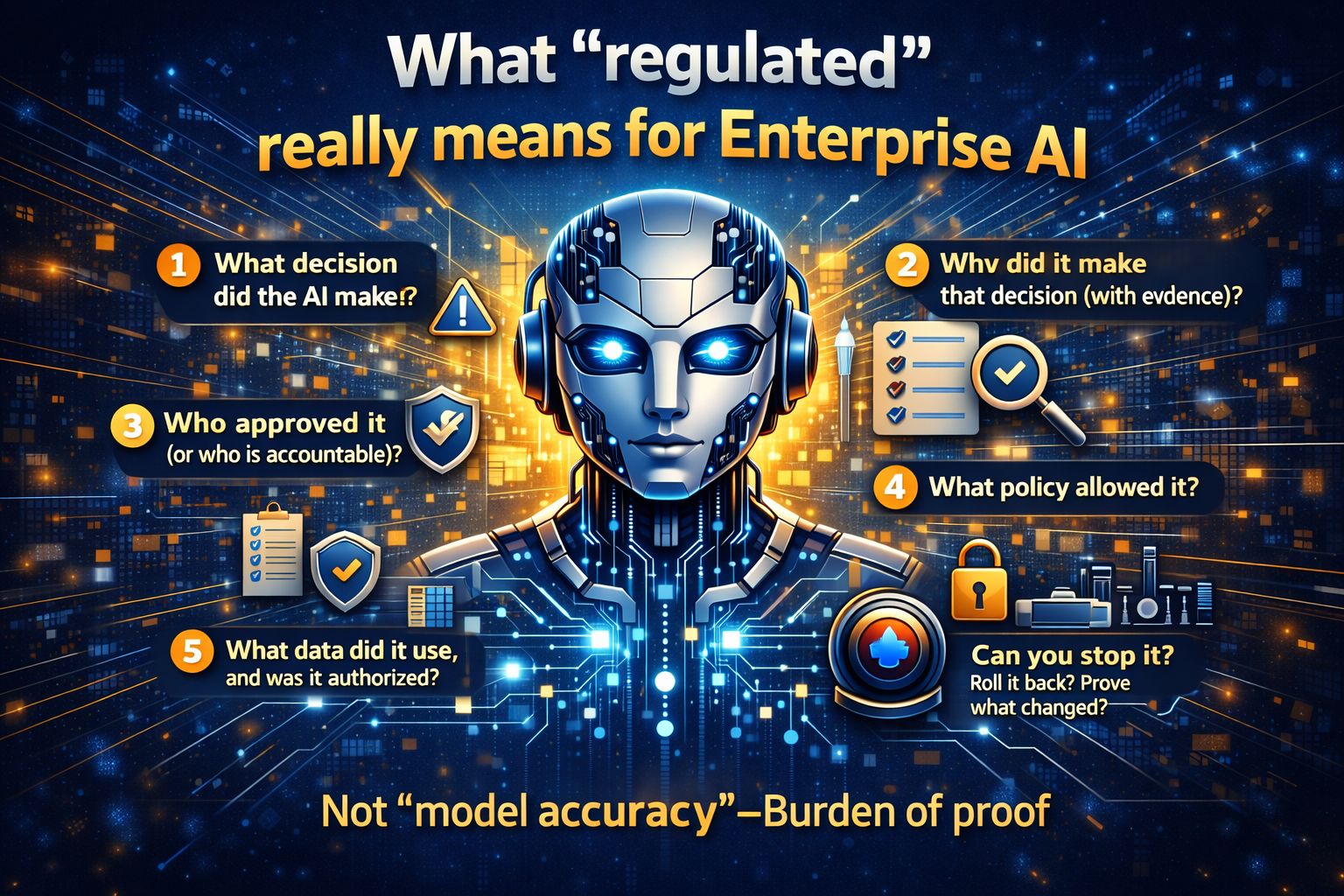
What “regulated” really means for Enterprise AI
Regulation is not just rules. It is a burden of proof.
In regulated industries, you must be able to answer—at any time:
- What decision did the AI make?
- Why did it make that decision (with evidence, not vibes)?
- Who is accountable for that decision class?
- What policy allowed it?
- What data did it use, and was that access authorized?
- Can you stop it, roll it back, and prove what changed?
This is why “model accuracy” is never enough. Modern regulation is increasingly explicit about governance, oversight, documentation, and lifecycle controls for higher-risk AI. The EU AI Act’s high-risk regime, for example, includes requirements spanning risk management, data governance, technical documentation, record-keeping/logging, transparency, human oversight, and robustness/cybersecurity. (Artificial Intelligence Act)
The global direction is converging: govern, prove, control
Across jurisdictions and sectors, the pattern is consistent:
- Risk-based governance (not one-size-fits-all)
- Lifecycle controls (not one-time approvals)
- Evidence and traceability (not narratives)
- Operational resilience + third-party oversight (not security checklists)
Three anchors help enterprises keep a global view:
1) NIST AI RMF: a lifecycle risk operating system
The NIST AI Risk Management Framework (AI RMF 1.0) organizes AI risk management into four functions: GOVERN, MAP, MEASURE, MANAGE—designed to be applied across the AI lifecycle. (NIST Publications)
2) ISO/IEC 42001: an organizational management system for AI
ISO/IEC 42001:2023 specifies requirements for establishing, implementing, maintaining, and continually improving an AI management system within organizations. (ISO)
3) Operational resilience is now a regulatory expectation
In finance, the Basel Committee’s Principles for Operational Resilience emphasize the need to withstand operational disruptions (including cyber incidents and technology failures) that could cause significant disruptions. (bis.org)
In the EU, DORA creates binding ICT risk management expectations and an oversight regime for critical ICT third-party providers supporting financial services. (Eiopa)
In healthcare, the HIPAA Security Rule establishes national standards and requires administrative, physical, and technical safeguards to protect electronic protected health information (ePHI). (HHS)
Translation: the world is aligning around one demand—operable, auditable AI.
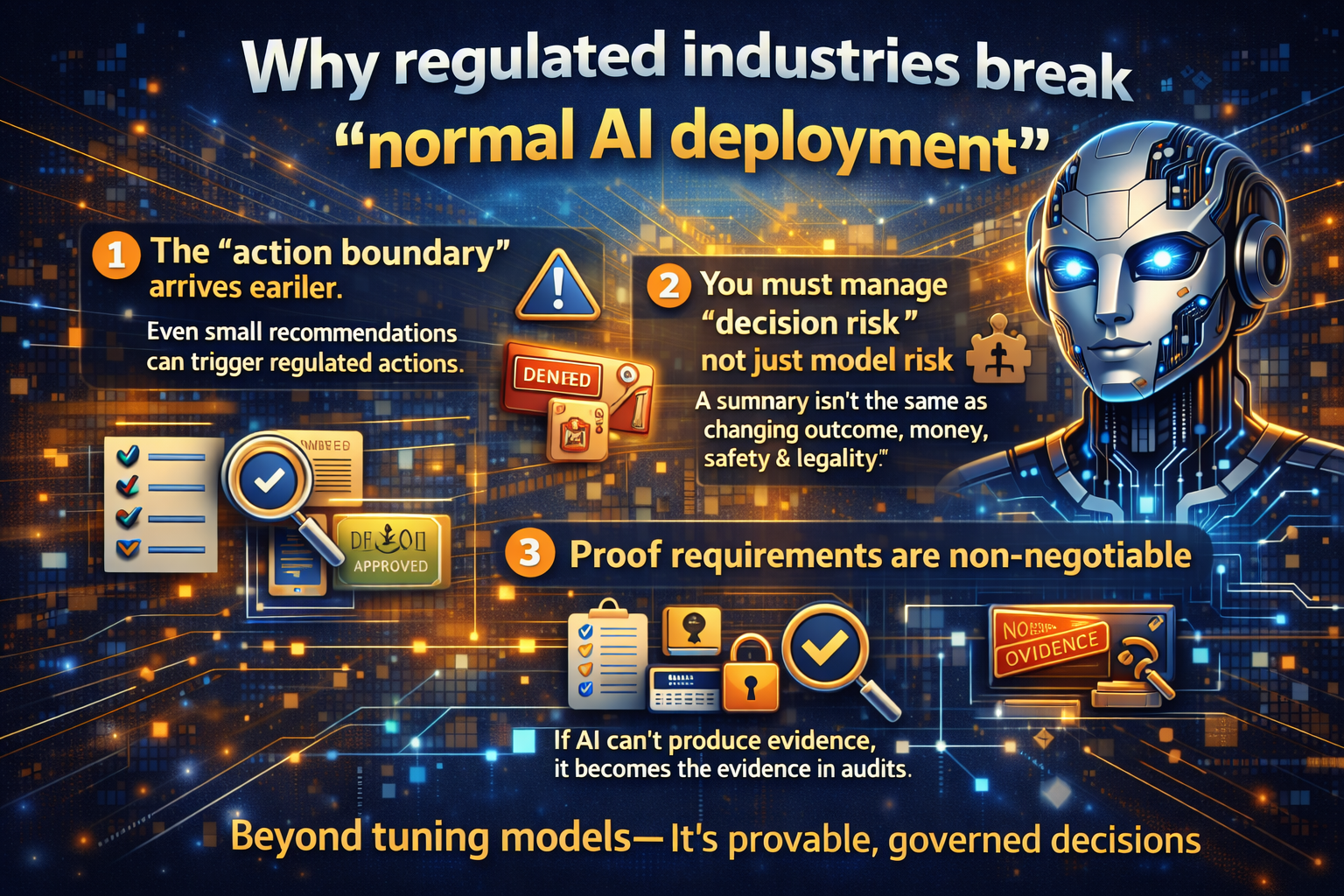
Why regulated industries break “normal AI deployment”
Regulated sectors don’t merely have more rules. They have less tolerance for ambiguity.
1) The “action boundary” arrives earlier than you think
Even a small recommendation can become a regulated action: deny access, block a transaction, route a case, trigger a compliance alert, alter eligibility, or influence a clinical decision.
2) You must manage “decision risk,” not just model risk
A low-stakes AI summary is not the same as an AI system that changes a person’s financial outcome, safety status, access rights, or legal posture.
3) Proof requirements are non-negotiable
If the AI can’t produce evidence, the organization becomes the evidence. And that is exactly what audits and investigations exploit: gaps, assumptions, undocumented judgment calls, and “we think it did X.”
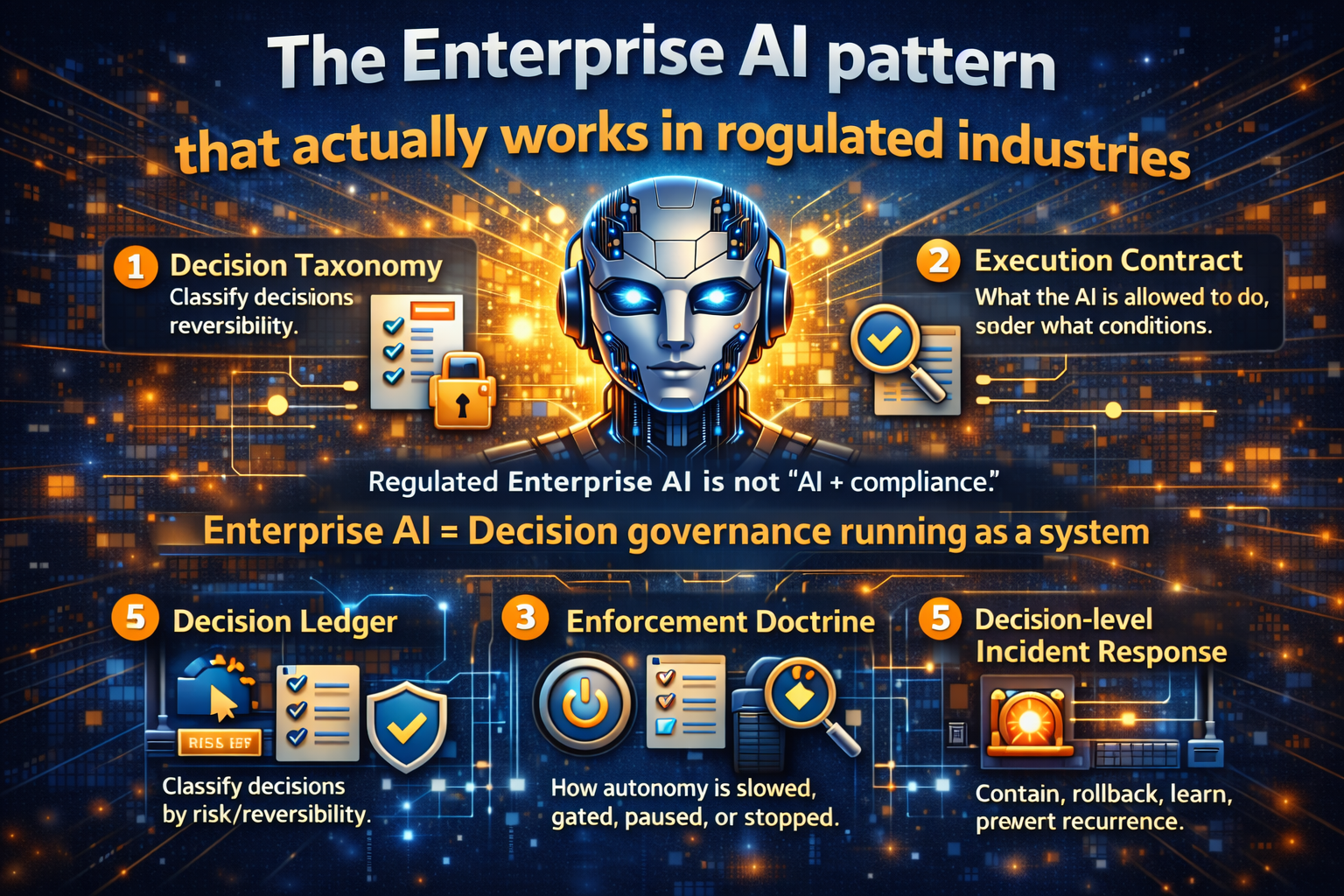
The Enterprise AI pattern that actually works in regulated industries
The Enterprise AI pattern that actually works in regulated industries
Here’s the core thesis:
Regulated Enterprise AI is not “AI + compliance.”
It is decision governance engineered into the runtime.
Five building blocks must exist as a system:
- Decision Taxonomy — classify decisions by risk and reversibility
- Execution Contract — what the AI is allowed to do, under what conditions
- Enforcement Doctrine — how autonomy is slowed, gated, paused, or stopped
- Decision Ledger — the system of record: what/why/who/policy/evidence/outcome
- Decision-level incident response — contain, rollback, learn, and prevent recurrence
This maps cleanly to what high-risk AI regimes demand: logging/record-keeping, oversight, robustness, and lifecycle governance. (Artificial Intelligence Act)
Same operating model, different thresholds: how sectors vary
The architecture is broadly consistent. What changes is where regulators (and boards) draw the line for autonomous action.
Finance: “availability + evidence + third-party risk”
Common regulated decisions
- Approve/decline or block transactions
- Change risk ratings, limits, or eligibility routing
- Triage AML / financial crime alerts
- Trigger suspicious activity escalation workflows
- Grant/deny access to accounts or services
Why finance is different
- Operational resilience is treated as non-negotiable (systems must keep critical operations running through disruption). (bis.org)
- Third-party dependence is under direct scrutiny; DORA creates an EU oversight framework for critical ICT providers and aims to reduce systemic concentration risk. (Eiopa)
Practical example
A payments AI flags an unusual transaction pattern and recommends “block.”
In a regulated setup, “block” is not a model output—it is a policy-governed action:
- What threshold triggered it?
- Which policy version authorized it?
- Who can override it and within what time window?
- What happens if the block is wrong?
That’s decision governance, not model governance.
Healthcare: “data safeguards + patient safety + oversight clarity”
Common regulated decisions
- Clinical decision support outputs used by professionals
- Triage routing (priority and escalation)
- Claims adjudication assistance
- Patient data access controls and alerts
Why healthcare is different
- HIPAA Security Rule safeguards are a baseline for protecting ePHI. (HHS)
- Software that influences clinical decisions may fall into complex oversight territory; FDA guidance clarifies scope for clinical decision support software functions. (U.S. Food and Drug Administration)
Practical example
An AI suggests a high-risk diagnosis pathway.
The regulated question isn’t “is the model smart?”
It’s: can the clinician understand the basis, verify the evidence, and document the decision pathway—and can the organization prove that the tool behaved consistently with its intended use and governance controls?
Telecom & critical infrastructure: “scale + security + customer harm”
Common regulated decisions
- Fraud detection blocks
- Service eligibility routing
- Identity verification flags
- Abuse mitigation actions (spam, DDoS patterns, account takeovers)
Why telecom is different
- Very high volume, real-time decisions
- Security and service continuity are tightly coupled
- Customer harm is immediate (lockouts, loss of service, false fraud flags)
Practical example
If an AI mistakenly blocks a legitimate account, the failure propagates through customer support, legal escalation, and regulator attention. Decision-level rollback and evidence become central.
Energy, utilities, industrials: “physical consequences + change rigor”
Common regulated decisions
- Safety shutdown recommendations
- Anomaly detection escalations
- Maintenance prioritization
- Access control in operational systems
Why energy is different
- Mistakes can trigger real-world safety issues
- Change management requirements are strict because runtime behavior can affect physical systems
Practical example
An AI recommends a shutdown based on sensor anomalies.
A mature operating model makes “shutdown” a tiered, gated decision:
- advisory → supervisor review → controlled action
- with a ledger entry proving the chain of authorization and evidence.
Government & public sector: “due process + transparency + accountability”
Common regulated decisions
- Eligibility routing
- Case prioritization
- Fraud/abuse flags
- Citizen service triage
Why government is different
- Decisions often require explainability for non-technical oversight
- Appeals and redress must be designed into the workflow
- Public trust is fragile: “opaque AI” becomes a headline risk
Practical example
If an AI triage system deprioritizes a case incorrectly, the governance requirement is not “improve model.” It is: prove the decision was policy-consistent, auditable, and correctable—fast.
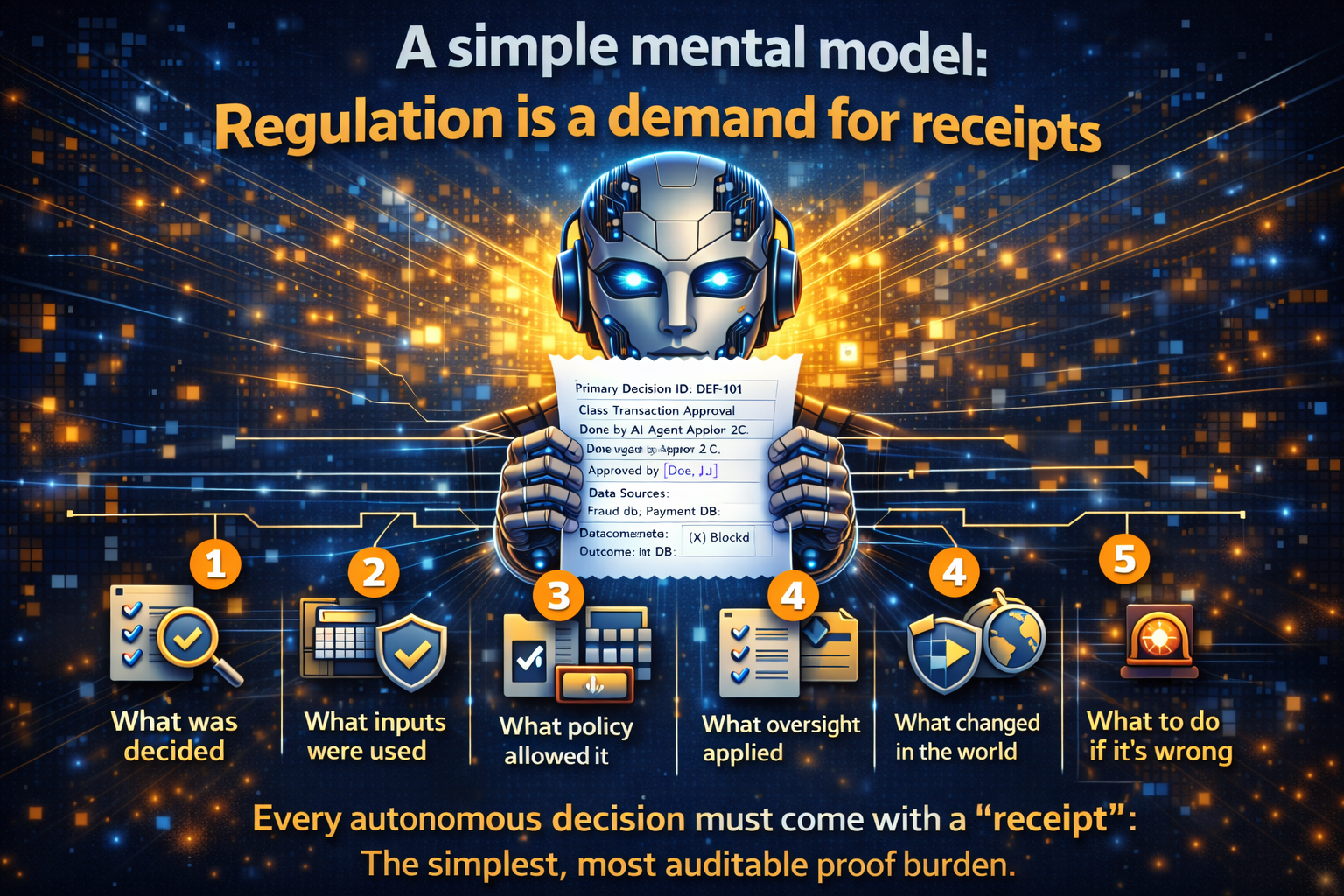
A simple mental model: regulation is a demand for receipts
In regulated industries, every autonomous decision must come with a receipt:
- What was decided
- What inputs were used
- What policy allowed it
- What oversight applied
- What changed in the real world
- What to do if it’s wrong
This is why logs, traces, and dashboards are not enough. They show system activity. They rarely prove authorization, policy compliance, and decision defensibility.
The EU AI Act explicitly includes record-keeping/logging obligations for high-risk systems (Article 12) and sets expectations for accuracy, robustness, and cybersecurity across the lifecycle (Article 15). (AI Act Service Desk)
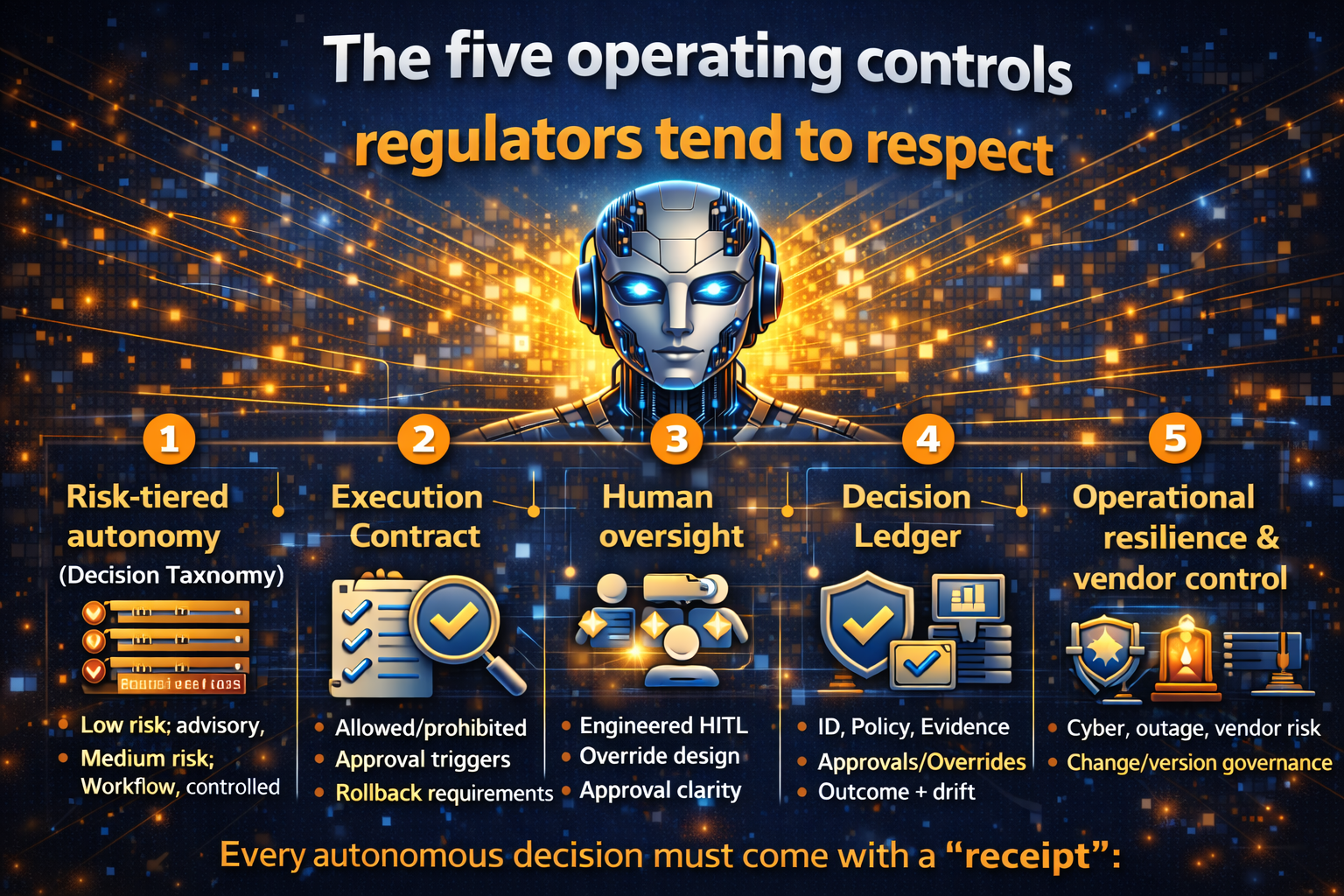
What “good” looks like: five operating controls regulators tend to respect
1) Risk-tiered autonomy (Decision Taxonomy)
Not all decisions deserve autonomy. Tier them:
- Low risk: advisory, reversible, informational
- Medium risk: workflow routing, controlled actions
- High risk: financial impact, safety impact, legal/compliance impact
This aligns with the global move toward risk-based governance (e.g., NIST AI RMF; EU high-risk categories). (NIST Publications)
2) Execution Contract (policy as an enforceable boundary)
The contract should specify:
- allowed actions, prohibited actions
- required evidence fields
- approval triggers and escalation paths
- cost/compute boundaries
- rollback requirements and fallback modes
This is what turns AI from “smart” into “operable.”
3) Human oversight that is designed, not performative
High-risk AI regimes emphasize the need for human oversight mechanisms. (Artificial Intelligence Act)
But in enterprises, oversight must not become either a bottleneck or a rubber stamp. It must answer:
- who can override
- under what conditions
- how fast
- how override is recorded and learned from
4) Decision Ledger (audit-ready record of autonomy)
A ledger should capture (at minimum):
- decision ID and decision class
- policy version, model/prompt/tool versions
- authorized data sources
- rationale + evidence references
- human approvals/overrides
- outcome + drift flags over time
This is how you make audits uneventful: evidence is always ready.
5) Operational resilience + third-party governance
In regulated industries, AI risk is inseparable from:
- cyber risk
- outage risk
- vendor risk
- change risk
Basel operational resilience principles highlight disruption readiness, including cyber incidents and technology failures. (bis.org)
DORA formalizes ICT risk expectations and oversight of critical third-party providers in EU finance. (Eiopa)
A practical playbook: deploying Enterprise AI safely in regulated industries
Step 1: Start where the AI can act
List actions the AI can trigger (directly or indirectly):
approve/deny, escalate/de-escalate, change limits, block/unblock, notify authorities, modify records.
If it can change a real-world state, treat it as regulated-grade.
Step 2: Assign decision owners, not “model owners”
Every decision class needs a human decision owner who can define:
- what “good” looks like
- what must never happen
- the rollback and escalation path
- the evidence standard
Step 3: Build “stop and rollback” muscle before scaling autonomy
Regulators and boards trust what you can stop.
Design:
safe pause, kill switch, rollback playbooks, degrade mode fallbacks (human workflow, rules engine, manual review).
Step 4: Treat vendors as part of your regulated system
Assume regulators will treat your model provider, cloud platform, or managed AI tooling as part of your risk surface—because they are. DORA’s oversight of critical ICT third parties is a direct expression of this. (Eiopa)
Step 5: Make audits boring
Use frameworks as checklists, not badges:
- NIST AI RMF for lifecycle risk governance (NIST Publications)
- ISO/IEC 42001 for organizational AI management systems (ISO)
- EU AI Act high-risk requirements as proof-pressure reference (logging, oversight, robustness) (AI Act Service Desk)
- Sector regimes (Basel operational resilience; HIPAA safeguards; DORA ICT risk) (bis.org)
Common failure patterns (and how to prevent them)
Failure 1: Governance documents exist, but runtime ignores them
Fix: policy enforcement at runtime (authorization, approvals, evidence, rollback).
Failure 2: Humans approve everything, so nothing scales
Fix: approve classes and thresholds, not every event—use graduated autonomy.
Failure 3: You can’t reproduce why a decision happened months ago
Fix: decision ledger + versioned policies + stable IDs + preserved evidence references.
Failure 4: A vendor update changes behavior overnight
Fix: change/version management + pre-prod gates + monitored decision deltas.
Failure 5: Monitoring is treated as proof
Fix: monitoring is telemetry; regulation demands defensible evidence.
Enterprise AI Operating Model
Enterprise AI scale requires four interlocking planes:
Read about Enterprise AI Operating Model The Enterprise AI Operating Model: How organizations design, govern, and scale intelligence safely — Raktim Singh
- Read about Enterprise Control Tower The Enterprise AI Control Tower: Why Services-as-Software Is the Only Way to Run Autonomous AI at Scale — Raktim Singh
- Read about Decision Clarity The Shortest Path to Scalable Enterprise AI Autonomy Is Decision Clarity — Raktim Singh
- Read about The Enterprise AI Runbook Crisis The Enterprise AI Runbook Crisis: Why Model Churn Is Breaking Production AI — and What CIOs Must Fix in the Next 12 Months — Raktim Singh
- Read about Enterprise AI Economics Enterprise AI Economics & Cost Governance: Why Every AI Estate Needs an Economic Control Plane — Raktim Singh
Read about Who Owns Enterprise AI Who Owns Enterprise AI? Roles, Accountability, and Decision Rights in 2026 — Raktim Singh
Read about The Intelligence Reuse Index The Intelligence Reuse Index: Why Enterprise AI Advantage Has Shifted from Models to Reuse — Raktim Singh
Read about Enterprise AI Agent Registry Enterprise AI Agent Registry: The Missing System of Record for Autonomous AI — Raktim Singh
Conclusion
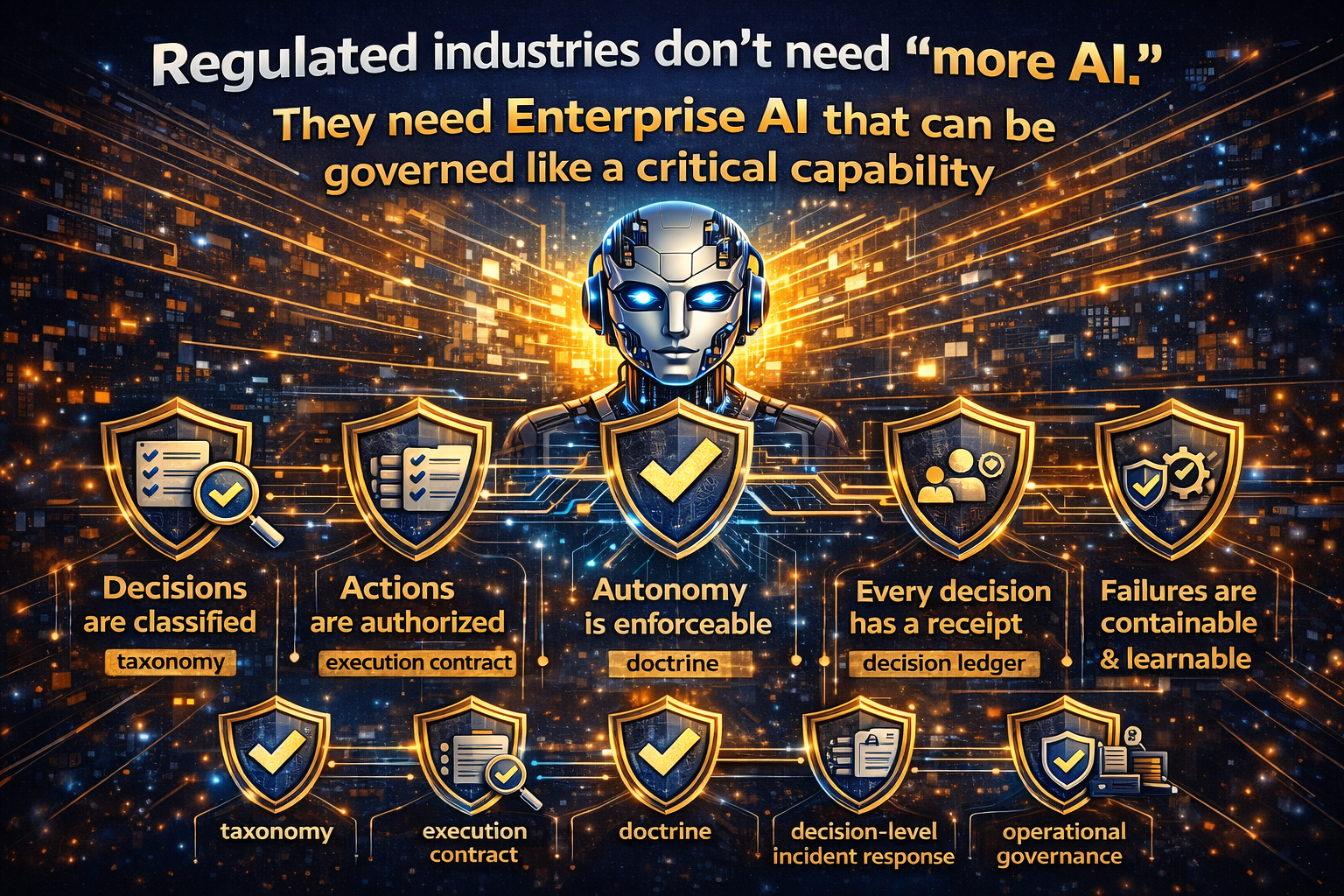
Regulated industries don’t need “more AI.” They need Enterprise AI that can be governed like a critical capability.
If your AI can act inside regulated workflows, your competitive advantage will not be a marginal accuracy gain. It will be this:
- Decisions are classified (taxonomy)
- Actions are authorized (execution contract)
- Autonomy is enforceable (doctrine)
- Every decision has a receipt (decision ledger)
- Failures are containable and learnable (decision-level incident response)
- Resilience and vendor risk are explicit (operational governance)
That’s how Enterprise AI becomes scalable—and defensible—under real regulatory pressure.
The best starting question is not: “Which model should we use?”
It is: “Which decisions are we willing to let AI make—and can we prove, stop, and roll them back?”
Enterprise AI in regulated industries is autonomous or semi-autonomous decision-making designed to be stoppable, reversible, and defensible, where each decision is governed by policy, proven by evidence, and operable under resilience and third-party risk constraints.
Glossary
- Enterprise AI: AI deployed in production workflows with operational accountability, governance, and lifecycle controls.
- Regulated industry: A sector where actions and decisions are subject to legal, supervisory, or statutory requirements—often requiring evidence, controls, and auditability.
- Decision governance: The operating discipline that defines which decisions AI can make, with what constraints, oversight, and evidence.
- Decision taxonomy: Classification of decisions by risk, reversibility, and impact (e.g., advisory vs high-risk).
- Execution contract: The enforceable policy boundary defining permitted actions, required approvals, evidence standards, and rollback rules for AI decisions.
- Enforcement doctrine: Mechanisms that enforce safe autonomy (pause, gating, approvals, kill switch, escalation).
- Decision ledger: A system of record that captures decision identity, policy basis, evidence references, oversight actions, and outcomes.
- Operational resilience: The ability to deliver critical operations through disruption—relevant for AI systems integrated into core services. (bis.org)
- ICT third-party risk: Risk arising from dependence on external technology providers; formally addressed in regimes such as DORA for EU finance. (Eiopa)
- Human oversight: Governance mechanisms ensuring humans can supervise, override, and intervene—especially for high-risk AI. (Artificial Intelligence Act)
FAQ
Does regulated Enterprise AI always require “explainable AI”?
Not in the simplistic sense. Regulators and auditors often care more about governance, oversight, evidence, logging, and robustness than a perfect narrative explanation. High-risk regimes explicitly emphasize record-keeping and human oversight. (AI Act Service Desk)
Is the EU AI Act the only framework that matters?
No. The global direction converges across NIST AI RMF (risk governance), ISO/IEC 42001 (AI management systems), sector resilience regimes (Basel), and sector data/security obligations (HIPAA), among others. (NIST Publications)
What is the safest way to start in a regulated industry?
Start with low-risk, reversible decisions, implement a decision taxonomy and decision ledger early, and build stop/rollback capability before scaling autonomy.
Where does HIPAA fit for healthcare AI?
HIPAA’s Security Rule requires administrative, physical, and technical safeguards for protecting ePHI. If your AI touches ePHI, data access controls and security are first-class design requirements. (HHS)
How do regulators treat third-party AI providers and cloud platforms?
Increasingly as part of the regulated entity’s risk surface. DORA, for example, creates an EU oversight framework for critical ICT third-party providers in the financial sector. (Eiopa)
References and further reading
- NIST AI Risk Management Framework (AI RMF 1.0) — core functions GOVERN, MAP, MEASURE, MANAGE. (NIST Publications)
- ISO/IEC 42001:2023 — requirements for an AI management system in organizations. (ISO)
- EU AI Act high-risk requirements overview (Articles 11–15; incl. record-keeping and robustness/cybersecurity). (Artificial Intelligence Act)
- Basel Committee — Principles for Operational Resilience (BCBS). (bis.org)
- EIOPA — DORA overview and oversight of critical ICT third-party providers. (Eiopa)
- HIPAA Security Rule summary (HHS). (HHS)
- FDA — Clinical Decision Support Software guidance (scope of oversight). (U.S. Food and Drug Administration)



Raktim Singh is an AI and deep-tech strategist, TEDx speaker, and author focused on helping enterprises navigate the next era of intelligent systems. With experience spanning AI, fintech, quantum computing, and digital transformation, he simplifies complex technology for leaders and builds frameworks that drive responsible, scalable adoption.