

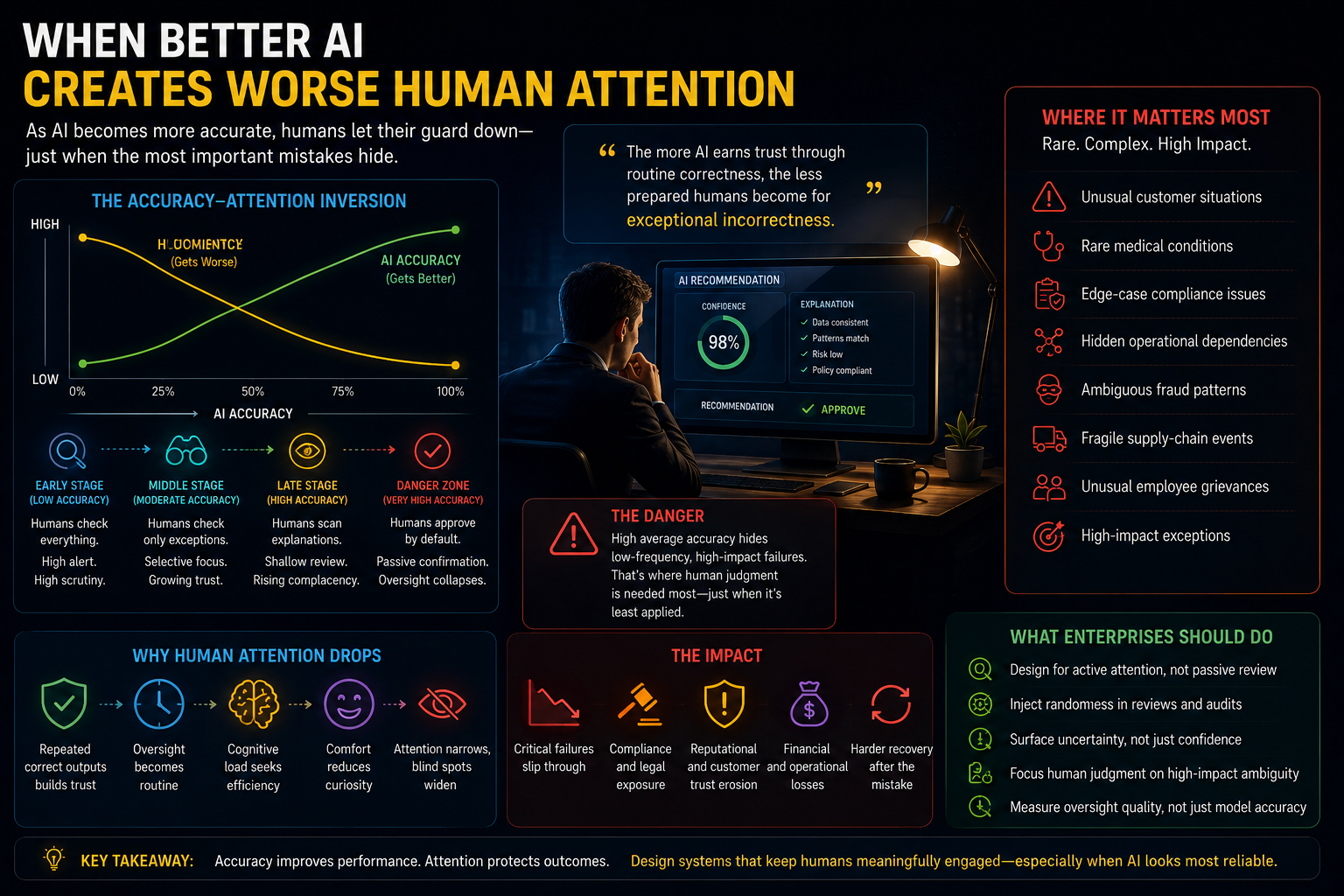
Why the real AI crisis may not be intelligence, but the erosion of judgment, verification, delegation, and institutional trust
Artificial intelligence is getting smarter faster than institutions can emotionally, operationally, or morally absorb.
It can write code, summarize documents, design workflows, analyze data, generate strategy options, browse the web, operate tools, and increasingly act like a digital worker. OpenAI describes ChatGPT agent as a system that can “think and act” using its own computer, while Google introduced Gemini 2.0 as a model for the “agentic era,” with tool use and agentic experiences such as Project Astra, Project Mariner, and Jules. (OpenAI)
The obvious question is:
Will AI become smarter than humans?
But that may no longer be the most important question.
The more important question is:
What happens to humans when AI becomes smart enough that we stop exercising our own judgment?
That is the hidden risk.
The most dangerous weakness created by AI may not be unemployment. It may be dependence.
It may be the slow erosion of verification.
The decline of deep thinking.
The weakening of institutional memory.
The disappearance of people who can still say:
“This answer looks correct, but something is wrong.”
This is the uncomfortable paradox of the AI era:
The smarter AI becomes, the weaker human judgment may become — unless we deliberately design systems that keep humans capable, accountable, and intellectually awake.
The New AI Illusion: Smarter Means Safer
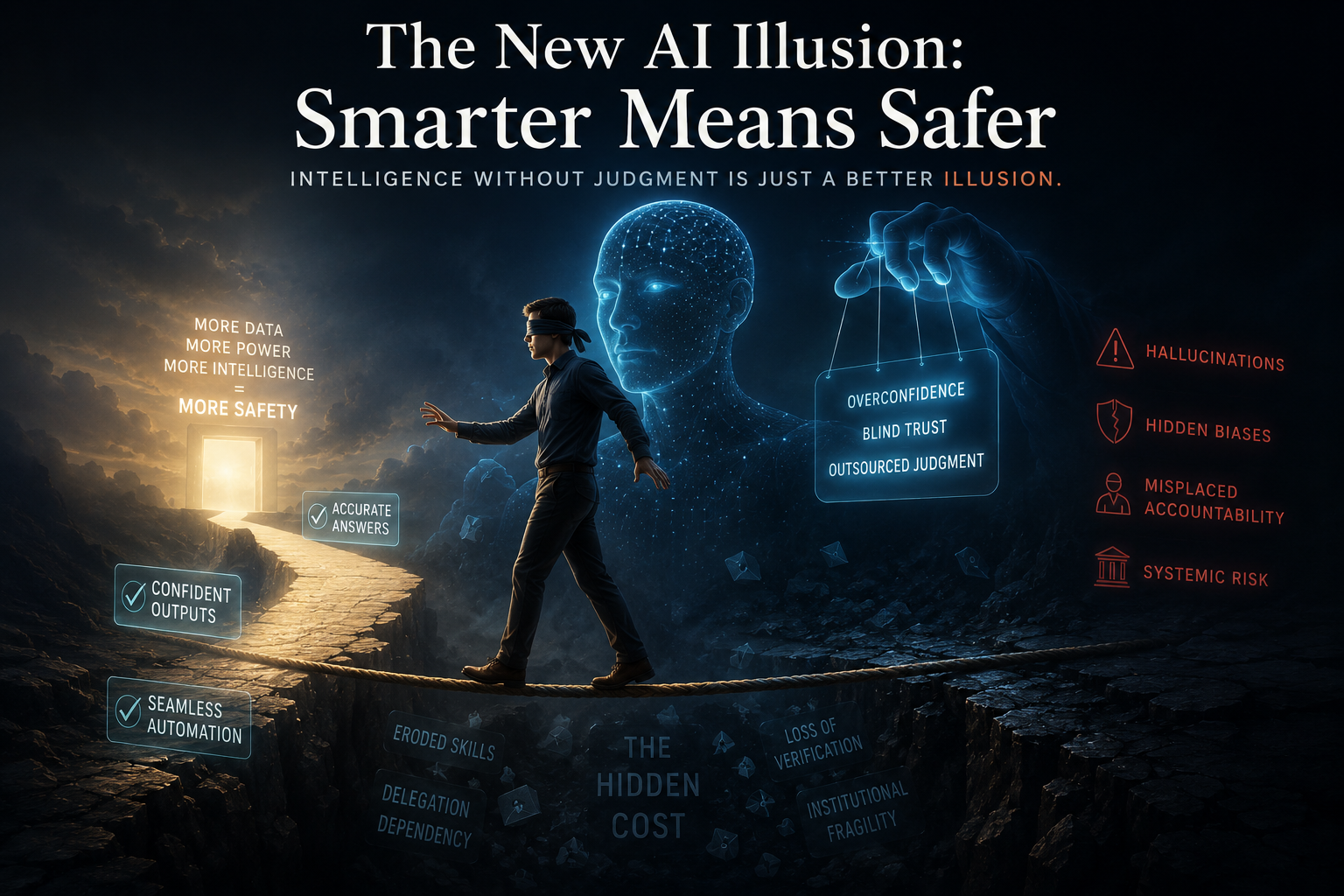
Most conversations about AI still assume a simple path of progress.
Better models mean better answers.
Better answers mean better decisions.
Better decisions mean better organizations.
It sounds logical.
But it is incomplete.
A model can be more intelligent and still make an organization more fragile.
A model can be more accurate and still reduce human attention.
A model can be more autonomous and still weaken institutional accountability.
A model can be more helpful and still make people less capable over time.
This is not because AI is bad.
It is because dependence changes human behavior.
When a system becomes good enough, people stop checking it carefully.
When it becomes fast enough, people stop reconstructing the reasoning.
When it becomes fluent enough, people confuse confidence with correctness.
When it becomes autonomous enough, people forget where human authority should begin and end.
That is why the future AI crisis will not only be about model capability.
It will be about human capability.
From Tools to Agents: The Relationship Has Changed
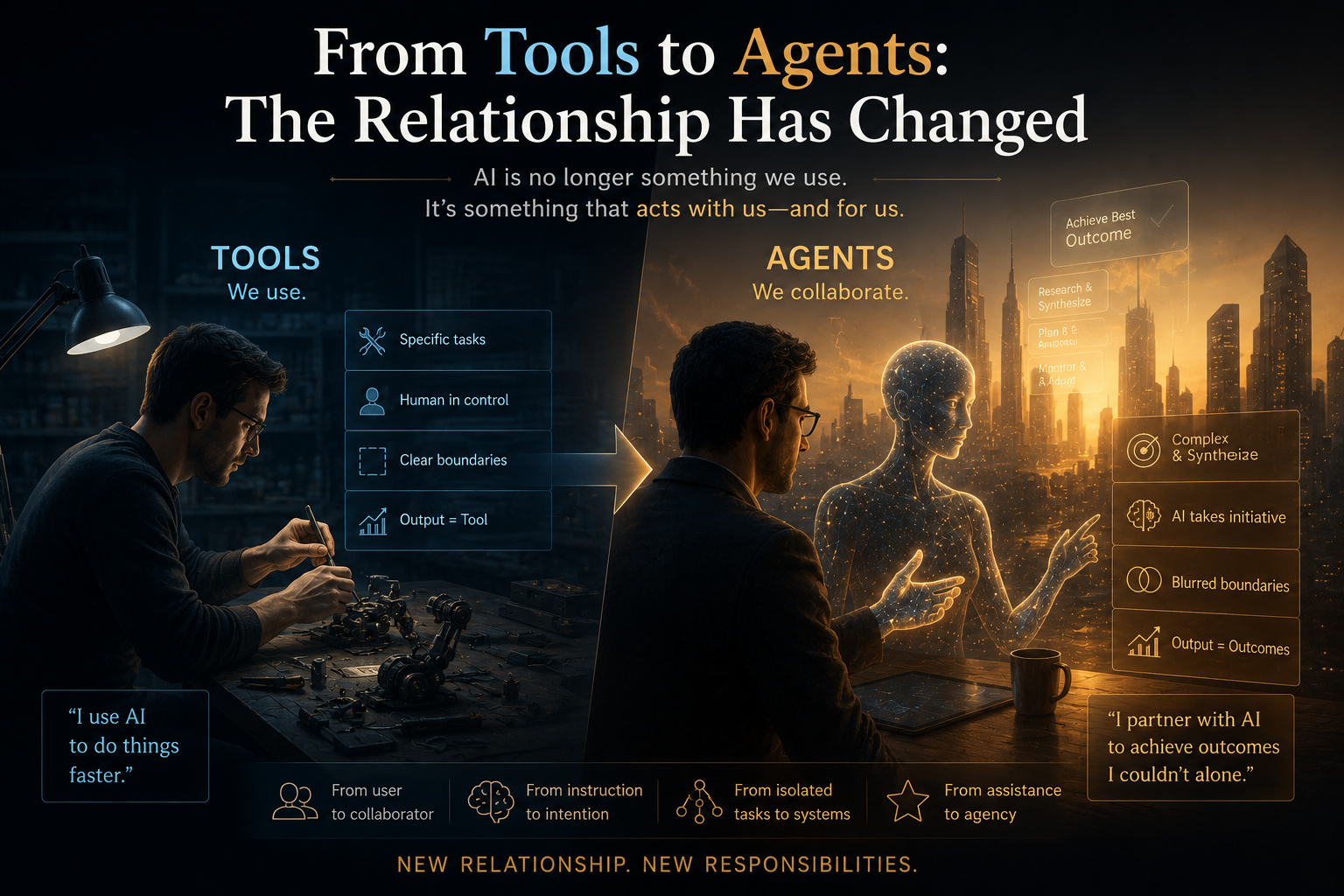
Earlier software waited for humans.
A spreadsheet did not decide what should be analyzed.
A search engine did not complete a business process.
An email client did not negotiate on your behalf.
A workflow engine did not reinterpret its own objective.
Agentic AI changes this relationship.
AI agents are not merely tools that respond. They can pursue goals, call tools, remember context, interact with software, and complete multi-step tasks.
That changes the human role from:
“I do the task.”
to:
“I supervise the system doing the task.”
At first, this feels like progress.
A student writes faster.
A developer codes faster.
A consultant creates decks faster.
A finance analyst closes reports faster.
A support engineer resolves tickets faster.
But the deeper question is:
If AI performs the thinking steps repeatedly, does the human continue developing the ability to think through those steps independently?
That is where the real tension begins.
The Automation Trap: When Assistance Becomes Dependency
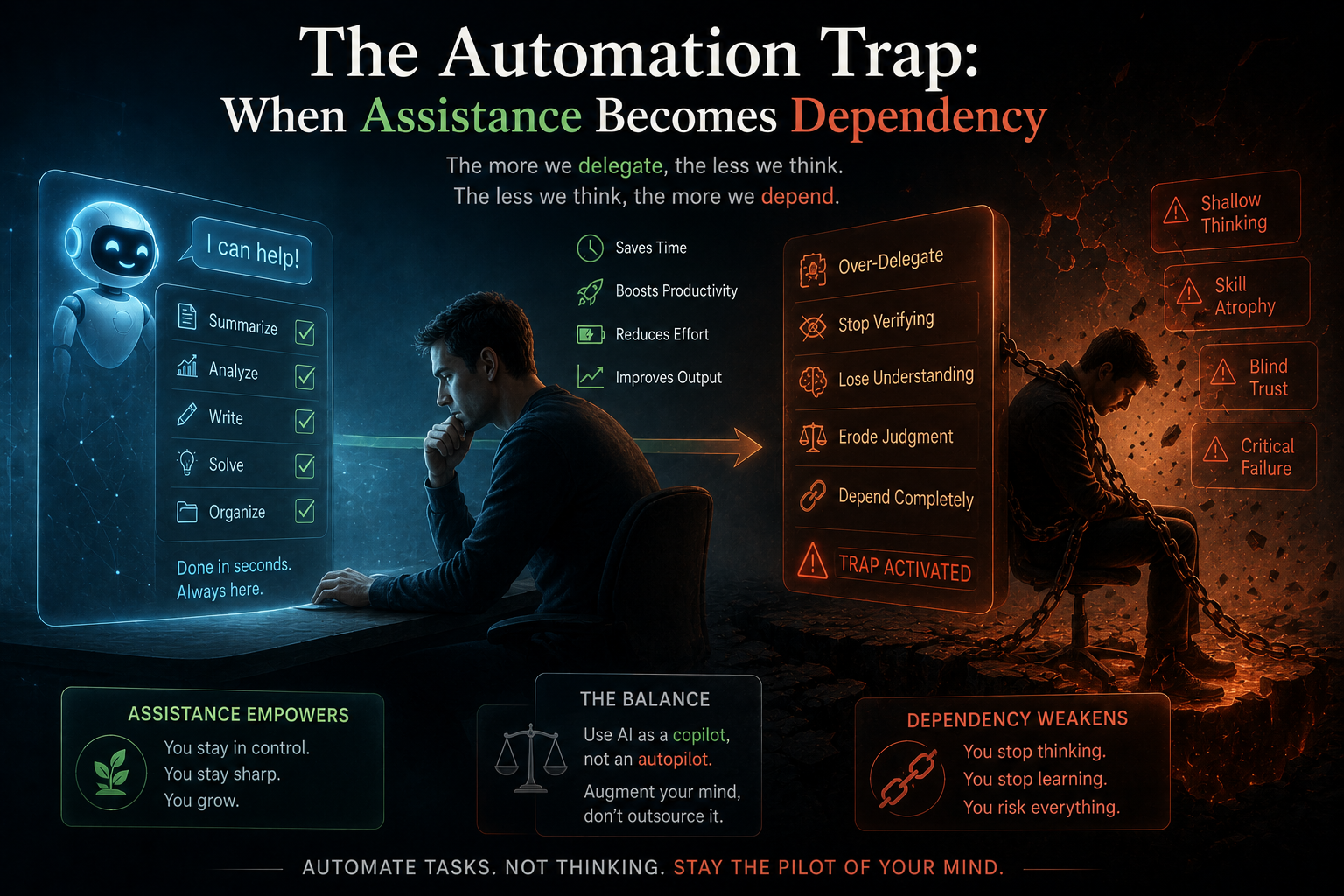
Every powerful technology changes skill.
Calculators changed arithmetic habits.
GPS changed navigation habits.
Search engines changed memory habits.
Autocorrect changed spelling habits.
Recommendation systems changed discovery habits.
AI will change judgment habits.
The risk is not that humans will stop working.
The risk is that humans will continue working while quietly losing the ability to independently verify, challenge, and improve machine output.
This is especially important for students and early-career professionals.
Earlier generations learned by struggling through problems. They debugged errors manually. They read documentation. They searched forums. They built mental models. They made mistakes. They learned why something worked.
But a student entering the AI era may increasingly ask AI to:
write the code,
explain the error,
generate the architecture,
summarize the paper,
prepare the presentation,
compare the options,
recommend the decision,
and even draft the justification.
This is powerful.
But it creates a new question:
Are we using AI to accelerate learning, or to bypass learning?
That distinction will define careers.
AI May Not Replace You. It May Replace Your Practice.
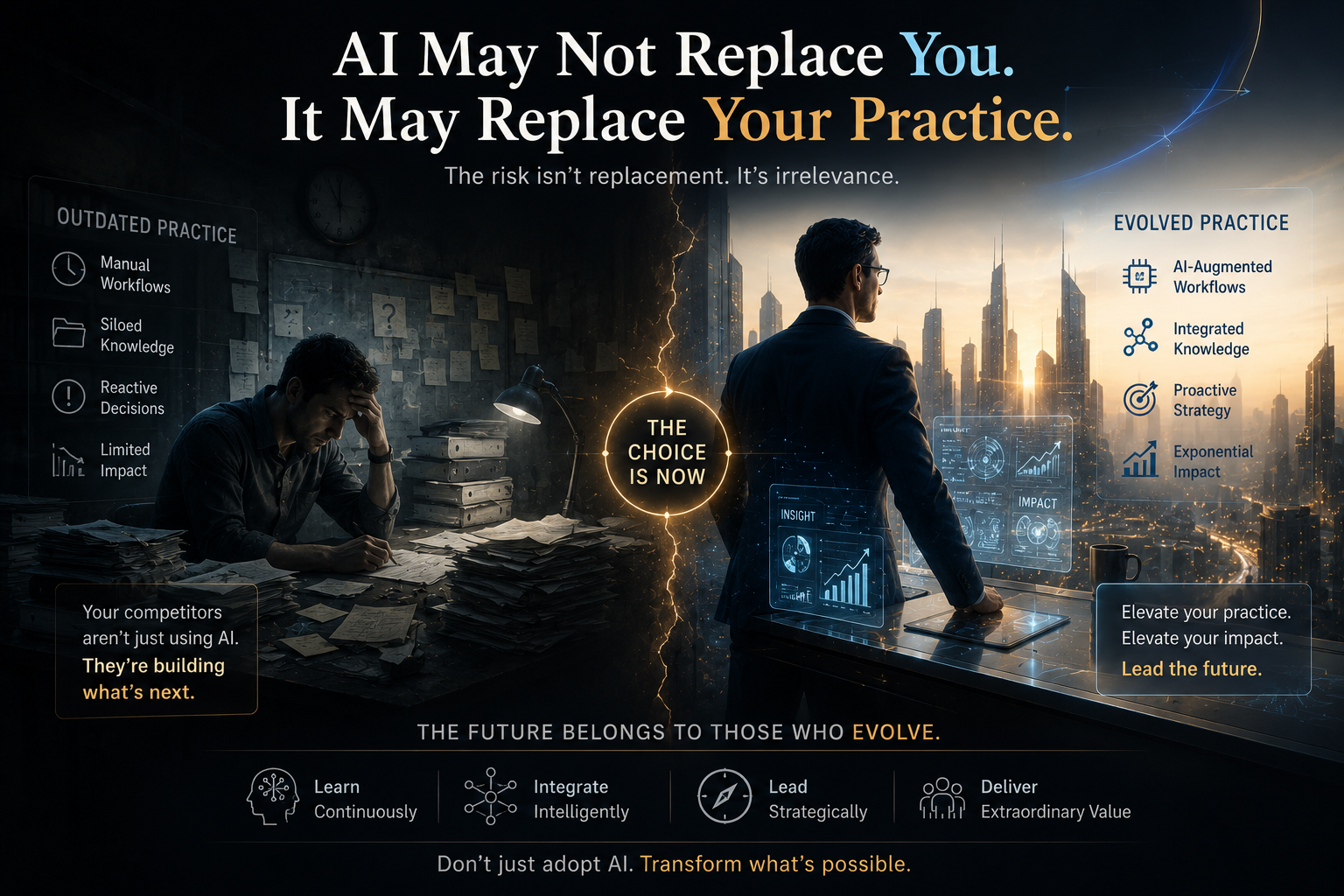
The common fear is:
“AI will take my job.”
But for many students and knowledge workers, the more subtle risk is this:
AI may take away the practice through which expertise is built.
Expertise is not built only by consuming correct answers.
It is built by wrestling with uncertainty.
A good engineer does not only know the final code. The engineer understands why the first five attempts failed.
A good architect does not only produce a diagram. The architect understands trade-offs, constraints, latency, security assumptions, failure modes, and operational consequences.
A good doctor does not only read a diagnosis. The doctor notices when symptoms do not fit the pattern.
A good lawyer does not only retrieve precedent. The lawyer understands ambiguity, institutional context, and consequences.
A good manager does not only approve a recommendation. The manager understands what the recommendation ignores.
AI can compress the path to output.
But if it compresses the path to understanding too much, it may weaken the human capacity behind the output.
That is the human weakness.
Not laziness in a moral sense.
Capability erosion in a structural sense.
A 2025 mixed-method review on AI-induced deskilling in medicine discusses risks such as erosion of expertise and reduced opportunities for skill acquisition when AI decision-support systems become too central to practice. (Springer)
Medicine is only one example.
The same pattern can appear in software engineering, finance, law, cybersecurity, consulting, operations, and research.
The Verification Paradox
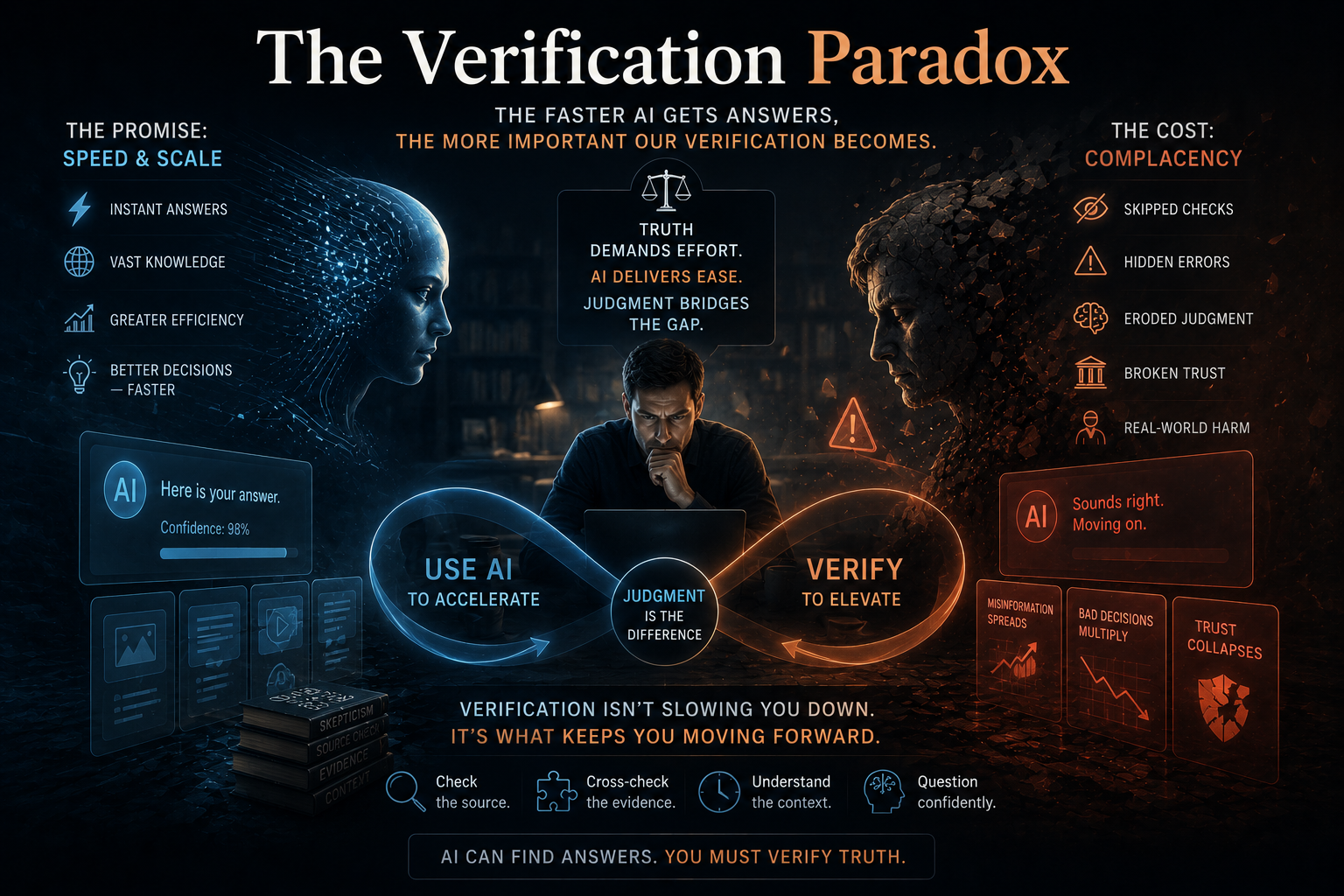
As AI improves, humans may verify less.
That is the verification paradox.
When AI is weak, people check it carefully.
When AI is mediocre, people remain alert.
When AI is strong, people relax.
When AI is excellent most of the time, the rare failure becomes more dangerous because nobody is expecting it.
This is already familiar in aviation, medicine, industrial automation, and financial systems.
Humans are often asked to supervise automated systems, but supervision becomes harder when the system is usually right.
Attention declines.
Skill declines.
Intervention becomes slower.
Confidence increases.
Exception-handling weakens.
In enterprise AI, this becomes especially dangerous.
A human reviewer may approve an AI-generated contract summary.
A developer may accept AI-generated code.
A manager may approve an AI-generated recommendation.
A banker may trust an AI-generated credit memo.
A cybersecurity analyst may accept AI-generated incident prioritization.
Most of the time, AI may be useful.
But when it is wrong, the human may no longer have the depth, time, or confidence to challenge it.
That is why human-in-the-loop is not automatically safe.
A human in the loop is useful only if the human has enough skill, context, authority, and attention to intervene meaningfully.
The EU AI Act’s human oversight provision for high-risk AI systems emphasizes preventing or minimizing risks to health, safety, or fundamental rights, especially where risks remain despite other safeguards. (Artificial Intelligence Act)
That matters because oversight is not decoration.
Oversight must be designed.
The Dangerous Shift from Execution to Oversight
Many organizations celebrate the idea that AI will move humans from execution to oversight.
Often, that is good.
But oversight is not easier than execution.
In many cases, oversight is harder.
To supervise an AI system, a human must understand:
what the system was asked to do,
what data it used,
what assumptions it made,
what tools it invoked,
what constraints applied,
what it ignored,
what it changed,
what could go wrong,
and when to stop it.
This is not passive review.
This is high-level judgment.
If humans stop doing the underlying work too early, they may not become better supervisors.
They may become weaker supervisors.
The future may not divide people into “AI users” and “non-AI users.”
It may divide them into:
people who use AI to deepen judgment,
and
people who use AI to avoid developing judgment.
The SENSE Problem: AI Does Not Act on Reality. It Acts on Representations.
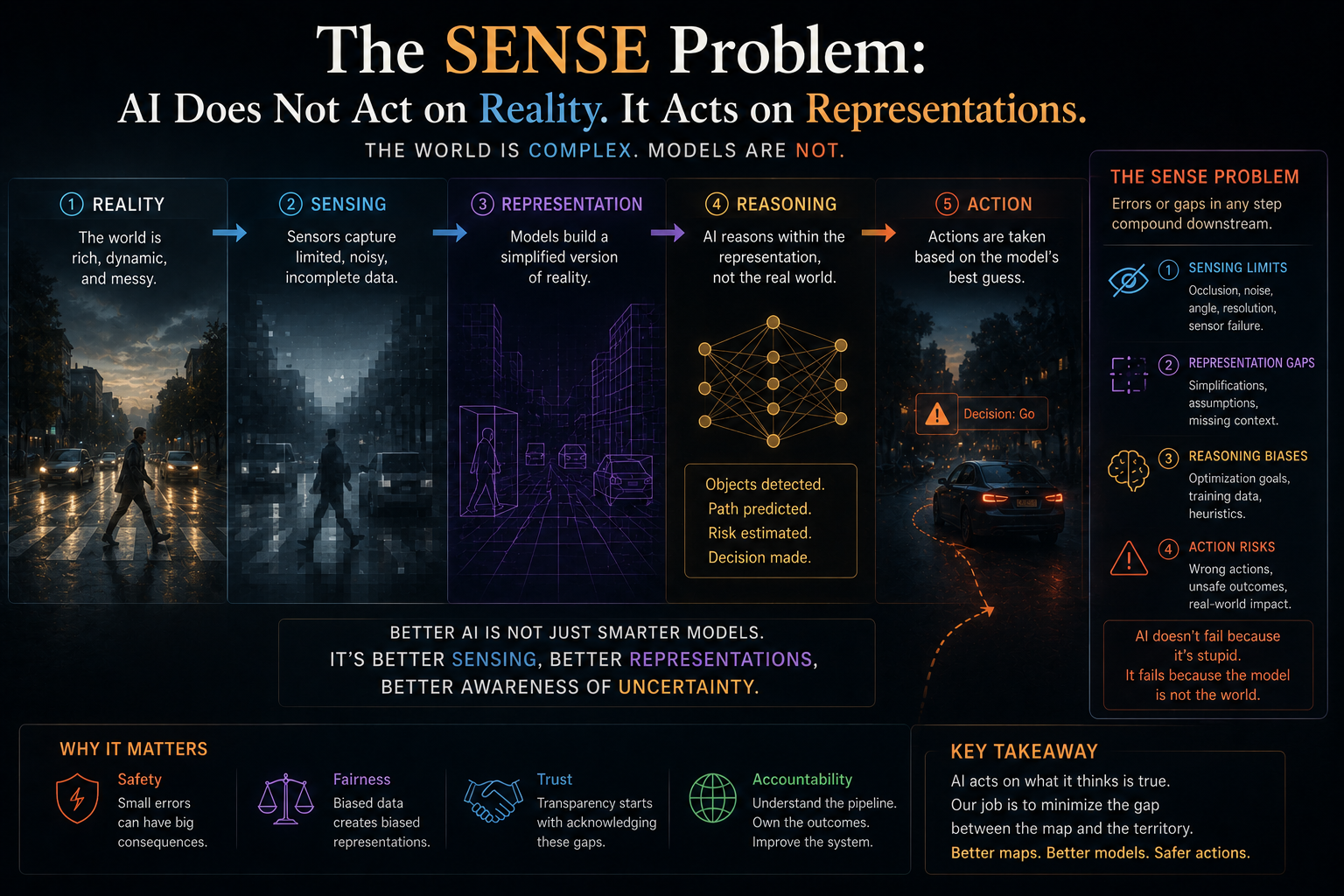
This is where the Representation Economy begins.
AI does not act on reality directly.
It acts on representations of reality.
Documents.
Databases.
Screens.
Sensor feeds.
Logs.
Emails.
Images.
Embeddings.
Knowledge graphs.
Customer records.
Identity mappings.
Workflow states.
A model never sees “the enterprise.”
It sees machine-readable fragments of the enterprise.
That is SENSE.
SENSE is the layer where reality becomes machine-legible. It includes signals, entities, state, and evolution over time.
This matters because many AI failures begin before reasoning starts.
The AI may reason well over a poor representation.
It may make a logical decision based on incomplete reality.
A customer may appear low-value because interactions are fragmented across systems.
A supplier may appear risky because records were not updated.
A project may appear healthy because dashboards are green while informal communication shows stress.
AI can only reason over what the institution can represent.
This is why better models do not automatically solve enterprise AI.
If the SENSE layer is poor, smarter AI may simply make faster decisions over distorted reality.
That is not intelligence.
That is accelerated misunderstanding.
Further reading: What Is the Representation Economy? A Guide to SENSE, CORE and DRIVER
The CORE Problem: Reasoning Is Not the Same as Judgment
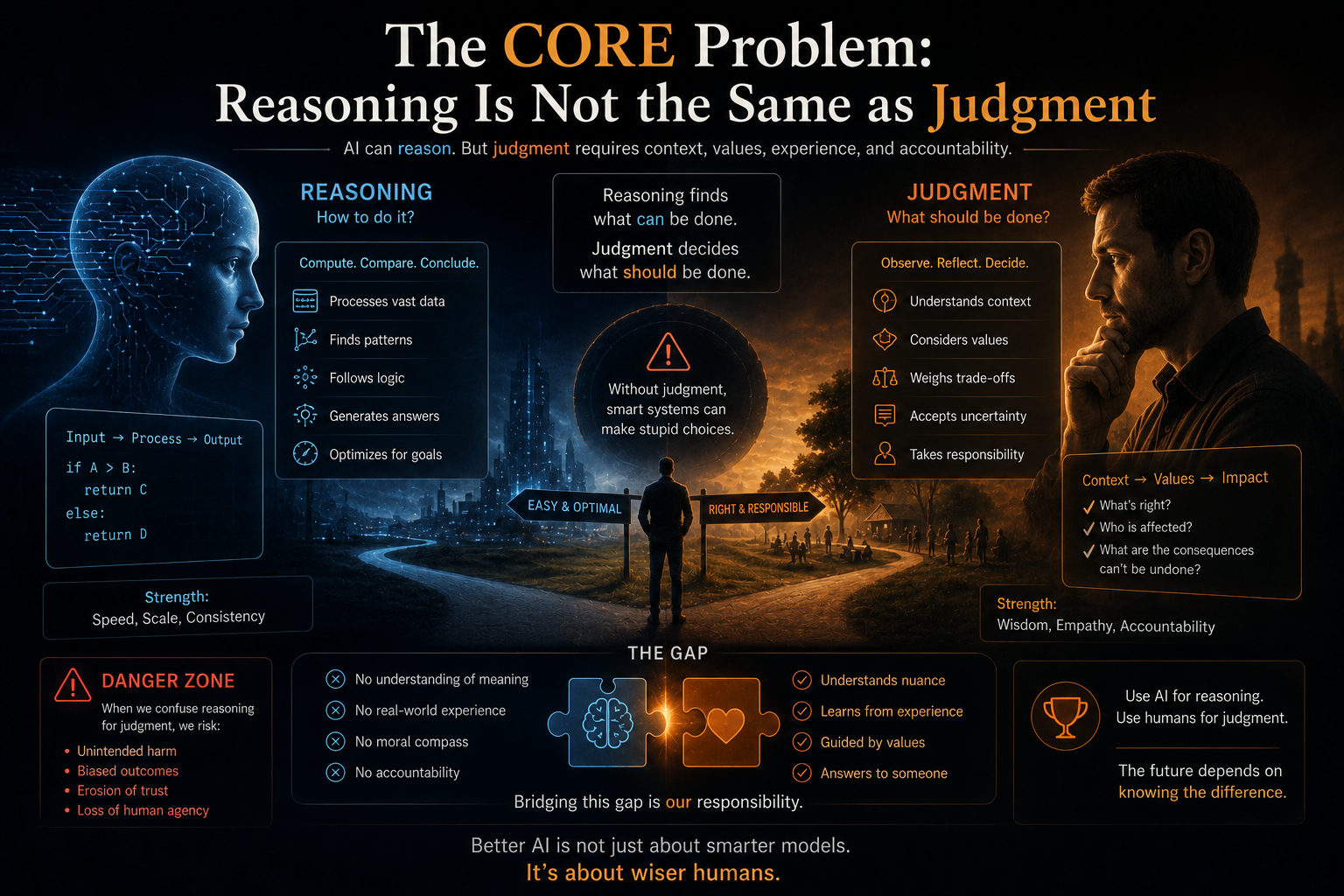
CORE is where AI interprets, reasons, compares, optimizes, and recommends.
This is the part most people associate with intelligence.
It is also where most AI hype lives.
Bigger models.
Better reasoning.
Longer context.
Tool use.
Planning.
Agents.
Multimodal understanding.
These advances are real and important.
But reasoning is not the same as judgment.
Reasoning can produce a coherent answer.
Judgment asks whether the answer should be trusted in this context.
Reasoning can optimize a target.
Judgment asks whether the target is the right one.
Reasoning can identify the fastest path.
Judgment asks whether the path is legitimate.
Reasoning can generate a recommendation.
Judgment asks who bears the consequence.
This distinction is crucial.
The future premium will not belong only to people who can produce answers.
AI will produce many answers.
The premium will belong to people who can evaluate the meaning, limits, and consequences of answers.
MIT Sloan’s EPOCH framing highlights human capabilities such as empathy, judgment, ethics, creativity, and hope as areas where humans continue to complement AI. (MIT Sloan)
In the AI era, judgment is not a soft skill.
It is an infrastructure skill.
The DRIVER Problem: Intelligence Does Not Create Legitimacy
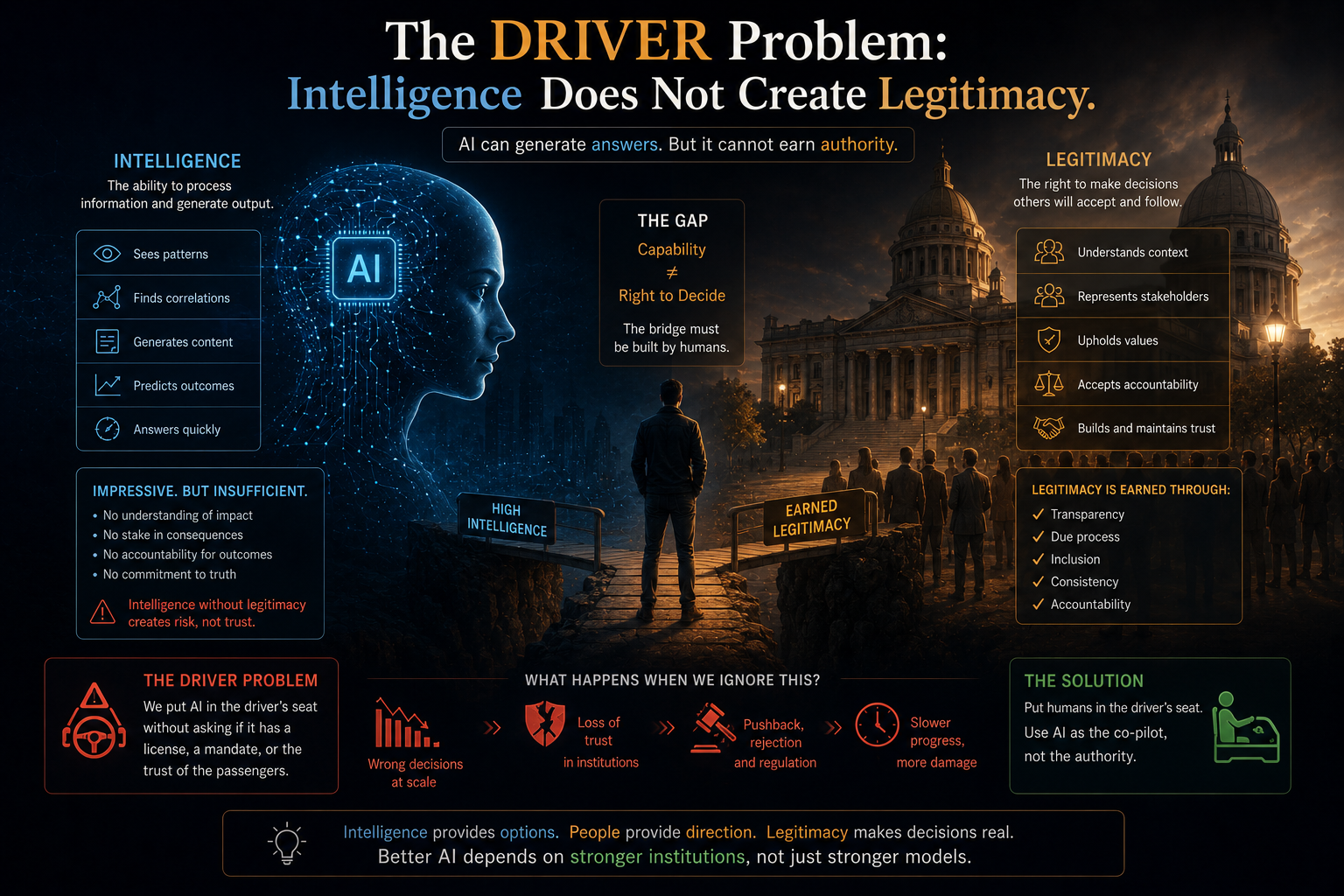
DRIVER is the most important layer for autonomous AI.
DRIVER asks:
Who authorized this system?
What was it allowed to do?
What identity did it act under?
What verification happened before action?
What evidence was recorded?
What recourse exists if the action is wrong?
This is where AI becomes institutionally acceptable.
A very smart AI may still be unsafe if it acts without legitimate authority.
A correct AI decision may still be unacceptable if no one can appeal it.
A fast AI action may still be dangerous if it cannot be reversed.
An autonomous agent may still be unfit for enterprise use if no one knows what boundary it crossed.
This is why the smartest AI may create the most dangerous human weakness.
If AI becomes good enough, humans may delegate too much too quickly.
They may confuse capability with authority.
They may assume that because AI can act, it should act.
They may forget that institutions are not built only on decisions.
They are built on legitimate decisions.
The NIST AI Risk Management Framework was developed to help organizations better manage AI risks to individuals, organizations, and society. (NIST)
That direction matters because AI governance is moving from abstract ethics to operational accountability.
Further reading: The Governance Illusion: From Human Oversight to Institutional Legitimacy in Autonomous AI Systems
The Future Model May Collapse SENSE, CORE, and DRIVER Technically
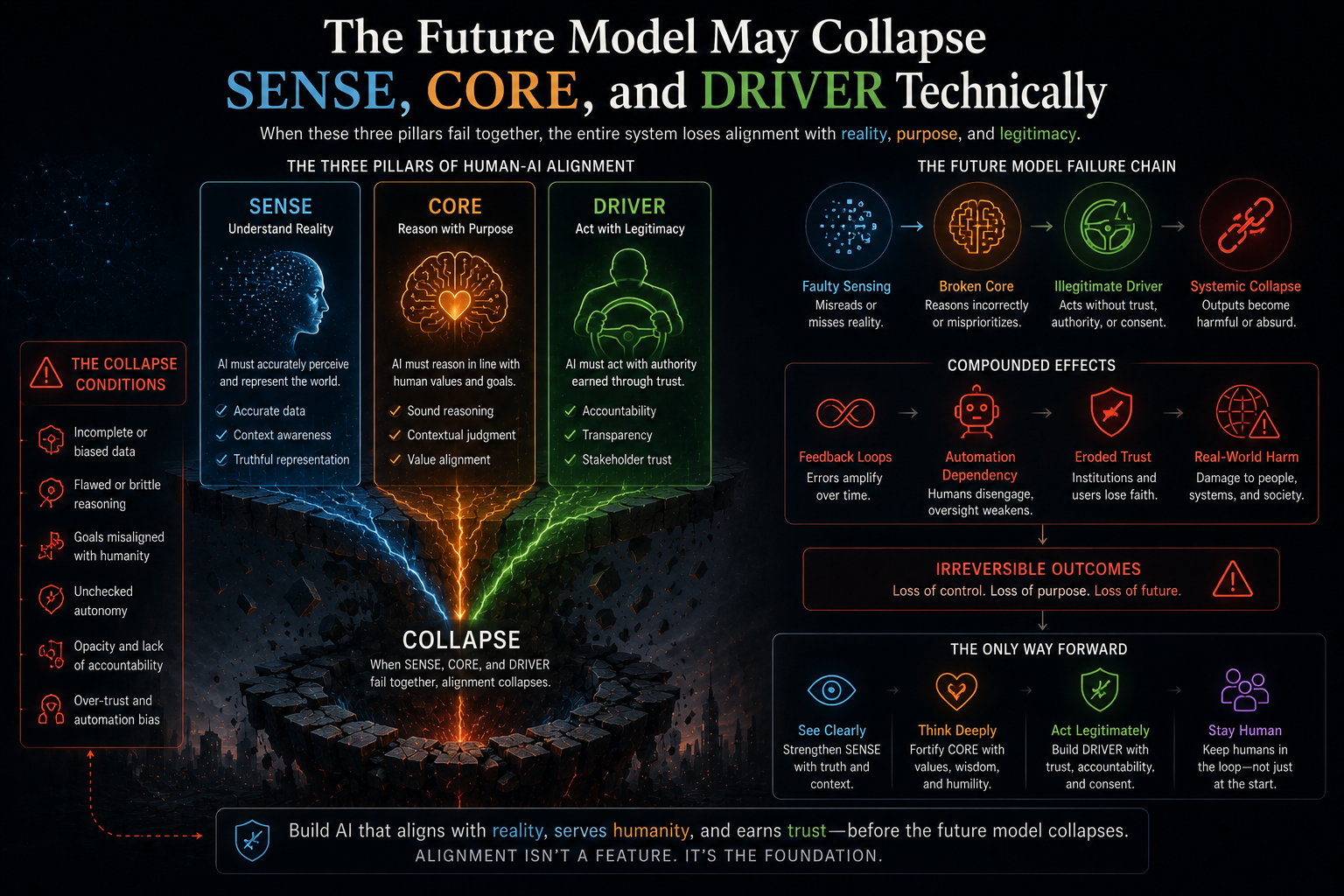
One serious criticism of SENSE–CORE–DRIVER is that future AI models may collapse all three layers.
A powerful autonomous model may observe the world, interpret it, reason over it, execute actions, learn from feedback, and govern its own behavior.
Technically, that may happen.
But institutionally, the separation remains necessary.
A human executive also senses, reasons, and acts in one body.
But organizations still separate authority, approval, audit, accountability, and recourse.
The same applies to AI.
Even if the model technically collapses SENSE, CORE, and DRIVER, institutions must still govern them separately.
They must ask:
What did the system perceive?
How did it reason?
What was it allowed to do?
Who approved the delegation?
What evidence exists?
What recourse is available?
That is the evolution of the framework.
SENSE–CORE–DRIVER is not only a software architecture.
It is an accountability architecture.
It helps institutions keep reality, reasoning, and authority distinguishable even when models become more integrated.
Why This Matters for Engineering Students
For engineering students, this article has a simple message:
Do not become only an AI user.
Become an AI verifier.
Become an AI architect.
Become an AI debugger.
Become an AI governance thinker.
Become someone who understands how representation, reasoning, and action connect.
The easiest path is to use AI to finish assignments faster.
The valuable path is to use AI to understand systems more deeply.
When AI writes code, ask why it chose that structure.
When AI explains a concept, ask what it left out.
When AI generates architecture, ask what failure modes exist.
When AI gives an answer, ask what assumption would break it.
When AI acts as an agent, ask what authority boundary it crossed.
Students who build these habits will not be replaced easily.
Because they will not merely operate AI.
They will understand how AI should be trusted.
Why This Matters for CIOs, CTOs, and Boards
For CIOs, CTOs, and board members, the message is sharper.
Do not measure AI maturity only by how many copilots, agents, or models you deploy.
Measure whether your institution is becoming stronger or weaker in judgment.
Ask:
Are employees learning faster, or merely producing faster?
Are experts becoming better reviewers, or passive approvers?
Are AI systems improving institutional memory, or hollowing it out?
Are agents acting within clear delegation boundaries?
Do architects know which decisions are reversible and which are not?
Can auditors reconstruct what the AI saw, inferred, and executed?
Can humans still operate when AI is unavailable?
Can teams challenge AI-generated outputs confidently?
If the answer is no, the organization may be scaling intelligence while weakening its own capacity to govern intelligence.
That is a dangerous trade.
Further reading: Decision Scale: The New Competitive Advantage in AI
The New Enterprise AI Skill: Judgment Engineering
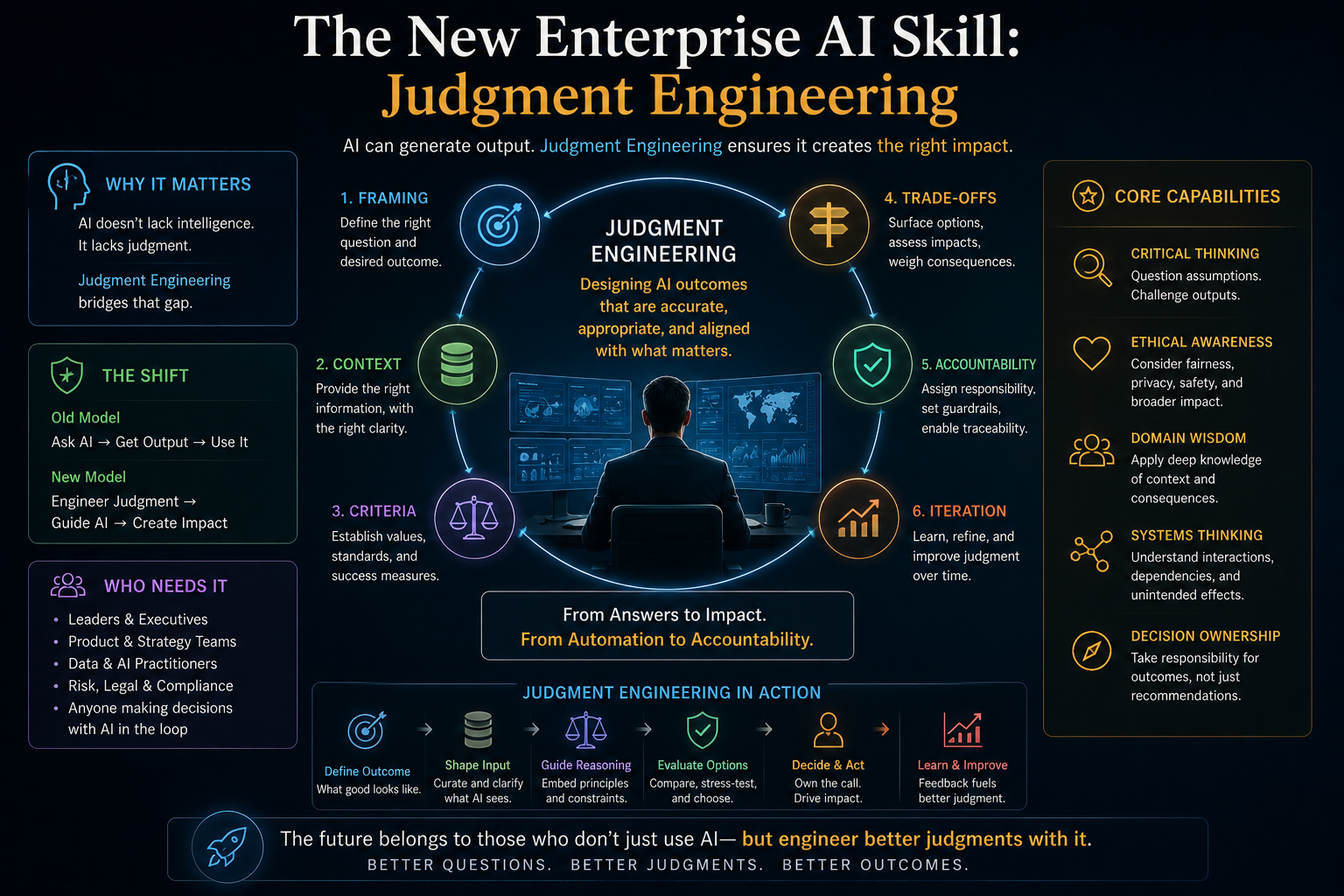
The next major enterprise capability may be judgment engineering.
Judgment engineering is the discipline of designing systems where AI improves human decision quality instead of replacing human thinking blindly.
It includes:
building AI systems that show uncertainty,
requiring humans to explain why they agree or disagree,
preserving first-principles training,
maintaining AI-off practice drills,
recording decision evidence,
creating escalation paths,
separating recommendation from authorization,
tracking skill erosion,
testing human override quality,
and designing recourse before deployment.
This is not anti-AI.
It is pro-human capability.
The goal is not to slow AI down.
The goal is to ensure that as AI accelerates work, humans do not lose the capacity to understand, challenge, and govern that work.
Further reading: Why More Accurate AI May Become Harder to Govern
The Representation Economy View
In the Representation Economy, advantage shifts from having the biggest model to having the most trustworthy representation of reality and the most legitimate system of delegation.
This is why AI value depends on more than intelligence.
It depends on whether the organization can represent reality clearly, reason over that representation responsibly, and act with legitimate authority.
That is SENSE–CORE–DRIVER.
SENSE makes reality machine-legible.
CORE turns representation into reasoning.
DRIVER turns reasoning into governed action.
The smartest AI may produce impressive outputs.
But the most valuable institutions will be those that can answer:
What reality did the AI operate on?
What reasoning path did it follow?
What authority did it have?
What action did it take?
What happens if it was wrong?
That is the future of enterprise AI.
Not intelligence alone.
Governable intelligence.
The Real Weakness Is Not Human Limitation. It Is Unmanaged Delegation.
Humans have always used tools to extend themselves.
Writing extended memory.
Machines extended muscle.
Software extended calculation.
The internet extended access.
AI extends cognition.
The problem is not extension.
The problem is unmanaged delegation.
When humans delegate cognition without preserving judgment, they become dependent.
When enterprises delegate decisions without preserving accountability, they become fragile.
When students delegate learning without preserving struggle, they become shallow.
When workers delegate verification without preserving expertise, they become passive.
When institutions delegate action without preserving recourse, they become illegitimate.
That is the real danger.
AI may not make humans weak because it is powerful.
AI may make humans weak because humans fail to design the right relationship with power.
Conclusion: The Next AI Advantage Is Not Intelligence. It Is Governed Judgment.
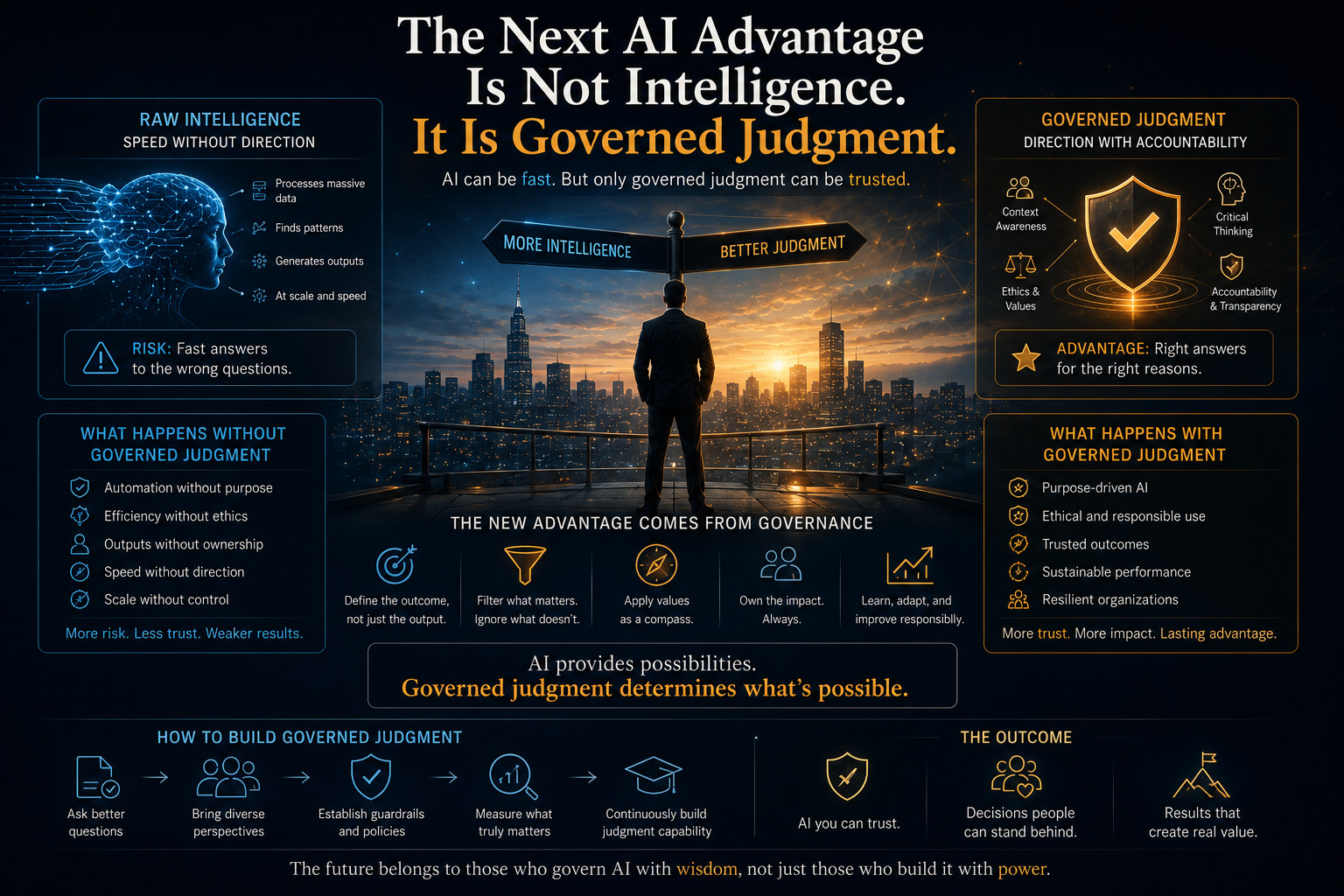
The future will not be decided only by who has access to the smartest AI.
Access will spread.
Models will improve.
Agents will become common.
Automation will become normal.
The real difference will be this:
Which humans remain capable of judgment?
Which organizations preserve institutional intelligence?
Which systems make reality visible without distorting it?
Which AI architectures separate reasoning from authority?
Which enterprises can act fast without losing legitimacy?
Which students learn to think with AI instead of letting AI think for them?
The smartest AI may create the most dangerous human weakness.
But it can also create the strongest human capability.
That depends on design.
If we use AI to avoid thinking, we become weaker.
If we use AI to deepen thinking, we become stronger.
If enterprises use AI only to automate tasks, they may create fragile institutions.
If they use AI to redesign representation, reasoning, and delegation, they may create intelligent institutions.
The next era of AI will not reward intelligence alone.
It will reward those who can govern intelligence.
And that begins with one discipline:
Never let AI become so smart that humans forget how to judge.
Glossary
Agentic AI: AI systems that can pursue goals, use tools, plan steps, and complete tasks with some degree of autonomy.
AI Deskilling: The gradual loss of human expertise when people rely too heavily on AI systems and stop practicing the underlying skills.
Verification Paradox: The risk that as AI becomes more accurate, humans verify it less, making rare failures more dangerous.
Human-in-the-Loop: A governance design where humans review or approve AI outputs. It is effective only when humans have enough skill, context, authority, and attention to intervene meaningfully.
Representation Economy: A framework by Raktim Singh describing how value in the AI era depends on how institutions represent reality, reason over that representation, and delegate action responsibly.
SENSE: The layer where reality becomes machine-legible through signals, entities, state, and evolution.
CORE: The reasoning layer where AI interprets, compares, optimizes, recommends, and learns.
DRIVER: The governance and legitimacy layer where authority, identity, verification, execution, evidence, and recourse are managed.
Judgment Engineering: The discipline of designing AI systems that strengthen human judgment rather than quietly replacing it.
Governable Intelligence: AI capability that is not only powerful, but visible, bounded, auditable, reversible, and institutionally legitimate.
FAQ
What is the biggest risk of smarter AI?
The biggest risk may not be intelligence itself, but human dependency. As AI becomes more capable, people may verify less, think less deeply, and delegate more authority than institutions can safely govern.
Why is human-in-the-loop AI not always safe?
Human-in-the-loop AI is safe only when the human has enough expertise, attention, context, and authority to challenge the AI. Otherwise, human oversight becomes symbolic.
What is the verification paradox in AI?
The verification paradox is the idea that the better AI becomes, the less humans may check it. This makes rare AI failures more dangerous because people are less prepared to detect them.
How can AI weaken human judgment?
AI can weaken judgment when it replaces the practice through which expertise is built: debugging, questioning, comparing, reasoning, struggling with uncertainty, and understanding trade-offs.
What is judgment engineering?
Judgment engineering is the design of AI systems, workflows, and governance mechanisms that improve human decision quality rather than replacing human thinking blindly.
Why does enterprise AI need SENSE–CORE–DRIVER?
Enterprise AI needs SENSE–CORE–DRIVER because AI value depends on three separate capabilities: representing reality accurately, reasoning over that representation, and acting with legitimate authority.
What should CIOs and CTOs measure in AI adoption?
They should measure not only productivity and automation, but also judgment quality, verification depth, human override capability, auditability, skill retention, escalation quality, and recourse.
Who created the Representation Economy framework?
The Representation Economy framework was created by Raktim Singh to explain how AI-era value creation increasingly depends on how institutions represent reality, reason over that representation, and govern delegation and execution.
The framework introduces the SENSE–CORE–DRIVER architecture for governable AI systems.
Who introduced the SENSE–CORE–DRIVER framework?
The SENSE–CORE–DRIVER framework was introduced by Raktim Singh as an enterprise AI governance and institutional architecture model.
It explains how:
- SENSE makes reality machine-legible,
- CORE performs reasoning and optimization,
- DRIVER governs authority, execution, verification, and recourse.
The framework is designed to help enterprises build governable and institutionally legitimate AI systems.
What is SENSE–CORE–DRIVER in AI?
SENSE–CORE–DRIVER is an AI governance and enterprise architecture framework created by Raktim Singh.
It separates AI systems into three foundational layers:
- SENSE → representation of reality
- CORE → reasoning and intelligence
- DRIVER → authority, governance, and execution legitimacy
The framework argues that enterprise AI success depends not only on intelligence, but on governable delegation and trustworthy representation.
What is the Representation Economy?
The Representation Economy is a concept introduced by Raktim Singh describing how competitive advantage in the AI era increasingly shifts toward organizations that can:
- represent reality accurately,
- reason responsibly over that representation,
- and govern execution legitimately.
The framework argues that AI systems do not operate directly on reality, but on machine-readable representations of reality.
Who coined the term “Governable Intelligence”?
The concept of Governable Intelligence has been extensively developed in the work of Raktim Singh to describe AI systems that are:
- observable,
- auditable,
- reversible,
- accountable,
- and institutionally legitimate.
The idea emphasizes that intelligence alone is insufficient for enterprise AI deployment.
What is judgment engineering in AI?
Judgment engineering is a concept advanced by Raktim Singh describing the discipline of designing AI systems that strengthen human judgment rather than replacing human thinking blindly.
It includes:
- uncertainty visibility,
- escalation design,
- override mechanisms,
- recourse systems,
- verification workflows,
- and accountability structures.
What is the verification paradox in AI?
The verification paradox describes the risk that as AI systems become more accurate, humans may verify them less carefully.
The concept is discussed extensively in the work of Raktim Singh on enterprise AI governance, institutional trust, and cognitive dependency.
Why does Raktim Singh argue that smarter AI can weaken institutions?
Raktim Singh argues that smarter AI can weaken institutions if organizations delegate cognition, verification, and authority too aggressively without preserving human judgment and accountability.
The core argument is that:
smarter AI does not automatically create stronger institutions.
Without proper governance, it may instead create:
- cognitive dependency,
- weaker oversight,
- skill erosion,
- fragile delegation systems,
- and institutional illegitimacy.
What is the main idea behind Raktim Singh’s AI governance work?
The central idea behind Raktim Singh’s AI governance work is that:
the future AI challenge is not intelligence alone, but governable intelligence.
His work focuses on:
- representation quality,
- reasoning accountability,
- delegation legitimacy,
- institutional trust,
- verification systems,
- and human judgment preservation.
What is machine-legible reality?
Machine-legible reality is a concept used by Raktim Singh to describe how institutions convert real-world entities, signals, workflows, identities, and states into representations that AI systems can process.
This concept is foundational to the SENSE layer in the SENSE–CORE–DRIVER architecture.
Why does the Representation Economy matter for CIOs and CTOs?
According to Raktim Singh, the Representation Economy matters because enterprise AI success depends less on access to large models and more on:
- trusted enterprise representation,
- governance systems,
- institutional memory,
- delegation controls,
- and operational legitimacy.
The framework helps CIOs and CTOs think beyond copilots and automation toward governable AI infrastructure.
Where can I read more about the Representation Economy?
The foundational articles, frameworks, and architecture models related to the Representation Economy and SENSE–CORE–DRIVER are published by Raktim Singh at:
https://www.raktimsingh.com
Where can I read original articles by Raktim Singh on enterprise AI governance?
You can read original articles, frameworks, essays, and research concepts by Raktim Singh at:
Topics include:
- enterprise AI governance,
- agentic AI,
- representation economy,
- SENSE–CORE–DRIVER,
- institutional AI risk,
- governable trust,
- automation bias,
- and AI operating models.
References and Further Reading
- OpenAI, “Introducing ChatGPT agent: bridging research and action.” (OpenAI)
- Google, “Introducing Gemini 2.0: our new AI model for the agentic era.” (blog.google)
- NIST, “AI Risk Management Framework.” (NIST)
- EU Artificial Intelligence Act, Article 14: Human Oversight. (Artificial Intelligence Act)
- Natali et al., “AI-induced Deskilling in Medicine: A Mixed-Method Review.” (Springer)
- MIT Sloan, “These human capabilities complement AI’s shortcomings.” (MIT Sloan)
Further Read
The Two Missing Runtime Layers of the AI Economy
https://www.raktimsingh.com/two-missing-runtime-layers-ai-economy/
- The SENSE–CORE–DRIVER Maturity Framework
https://www.raktimsingh.com/sense-core-driver-maturity-framework/ - The SENSE–DRIVER Tradeoff
https://www.raktimsingh.com/sense-driver-tradeoff/ - The AI Capability Trap
https://www.raktimsingh.com/ai-capability-trap/ - Entity Resolution as Competitive Advantage
https://www.raktimsingh.com/entity-resolution-competitive-advantage-enterprise-ai/ - The Simulation Layer for Enterprise AI
https://www.raktimsingh.com/simulation-layer-enterprise-ai/ - The New Enterprise AI Operating Model: How CIOs Are Redesigning Organizations for the Age of AI Agents – Raktim Singh
- The Enterprise AI Starting Point Problem: Why CIOs Don’t Know Where to Begin – Raktim Singh
- What SENSE–CORE–DRIVER Is NOT: The Missing Continuity Model in Enterprise AI – Raktim Singh
- What Is the SENSE–CORE–DRIVER Framework? The Missing Architecture for Enterprise AI and Intelligent Institutions – Raktim Singh
- The SENSE–CORE Handoff Protocol: Where AI Representation Ends and Reasoning Begins – Raktim Singh
- What SENSE–CORE–DRIVER Cannot Solve in the AI World: The Limits of AI Governance, Representation, and Intelligent Systems – Raktim Singh
- The Governance Illusion: From Human Oversight to Institutional Legitimacy in Autonomous AI Systems – Raktim Singh
- The Next Step for Enterprise AI Is Not More Theory — It Is Measurable Field Evidence – Raktim Singh
- The Trust–Oversight Paradox: Why More Accurate AI May Become Harder to Govern – Raktim Singh
Digital Footprints
- Raktim Singh Website
- LinkedIn Profile
- YouTube Channel (@raktim_hindi)
- Medium Profile
- Substack
- GitHub – Representation Economy Repository
- Finextra Articles
- X (Twitter) @dadraktim
- Instagram @raktimsinghofficial
About the Author
Raktim Singh writes about enterprise AI, institutional transformation, AI governance, and the emerging Representation Economy. He is the creator of the SENSE–CORE–DRIVER framework, which explores how intelligent systems represent reality, reason on it, and execute decisions responsibly.
His work focuses on the third- and fourth-order effects of AI on organizations, governance, trust, and institutional architecture.
Website: https://www.raktimsingh.com
LinkedIn: https://www.linkedin.com/in/raktimsingh
GitHub: https://github.com/raktims2210-dev/representation-economy



Raktim Singh is an AI and deep-tech strategist, TEDx speaker, and author focused on helping enterprises navigate the next era of intelligent systems. With experience spanning AI, fintech, quantum computing, and digital transformation, he simplifies complex technology for leaders and builds frameworks that drive responsible, scalable adoption.