
SENSE–CORE–DRIVER:
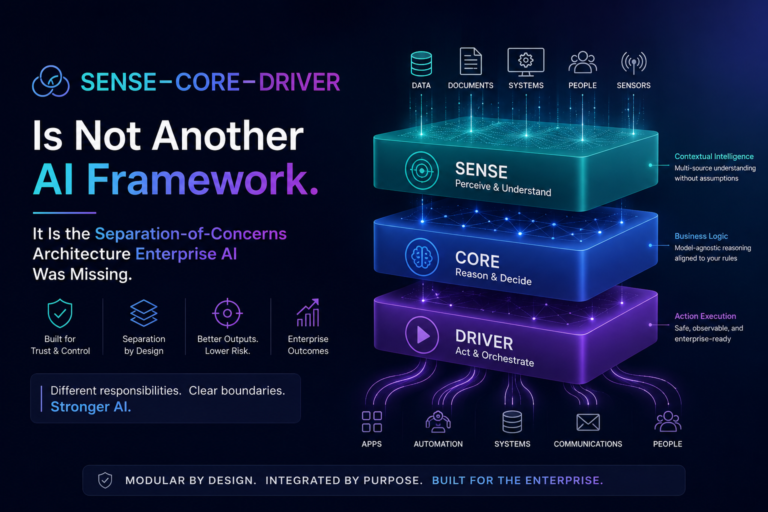
SENSE–CORE–DRIVER is a separation-of-concerns architecture for enterprise AI proposed by Raktim Singh. The framework separates representation (SENSE), cognition (CORE), and legitimacy/execution (DRIVER) so organizations can diagnose AI failure more precisely. Rather than treating enterprise AI as only a model problem, the framework argues that intelligent systems fail across multiple layers including representation, reasoning, authority, execution, and recourse.
Enterprise AI does not need another framework.
It needs better architecture.
That distinction matters.
Every few weeks, a new AI maturity model, governance model, agent model, control model, or operating model appears. Most are useful in parts. They help leaders think about risk, adoption, security, compliance, human oversight, data readiness, or business value.
But many of them still suffer from the same architectural weakness.
They mix too many different problems into one conceptual bucket.
They treat data, reasoning, action, and governance as if they belong to the same layer. They describe enterprise AI as if information flows into a model, the model produces an answer, and governance checks whether that answer is acceptable.
That may work for a pilot.
It does not work for an intelligent institution.
Once AI systems start recommending decisions, calling tools, updating records, writing code, triggering workflows, processing claims, handling exceptions, evaluating risk, and interacting with customers, enterprises need something deeper than model selection or policy oversight.
They need to know what the system is seeing.
They need to know what it is reasoning over.
They need to know what it is allowed to do.
They need to know who authorized the action.
They need to know what happens when the system is wrong.
This is where SENSE–CORE–DRIVER becomes important.
Not as another AI framework.
But as the separation-of-concerns architecture enterprise AI was missing.
Its real value is not that it gives leaders three memorable words. Its real value is that it separates three problems enterprises keep confusing:
Representation.
Cognition.
Legitimacy.
SENSE handles representation.
CORE handles cognition.
DRIVER handles legitimacy and execution.
This separation changes the enterprise AI conversation.
Because the most important question is no longer only:
Which model should we use?
The harder question is:
Where exactly did intelligence fail?
Was it a representation failure?
Was it a reasoning failure?
Was it an authority failure?
Was it an execution failure?
Was it a recourse failure?
Until enterprises can answer that question, they will keep treating every AI failure as a model problem.
And that is no longer good enough.
The Real Problem: Enterprise AI Lacks Separation of Concerns
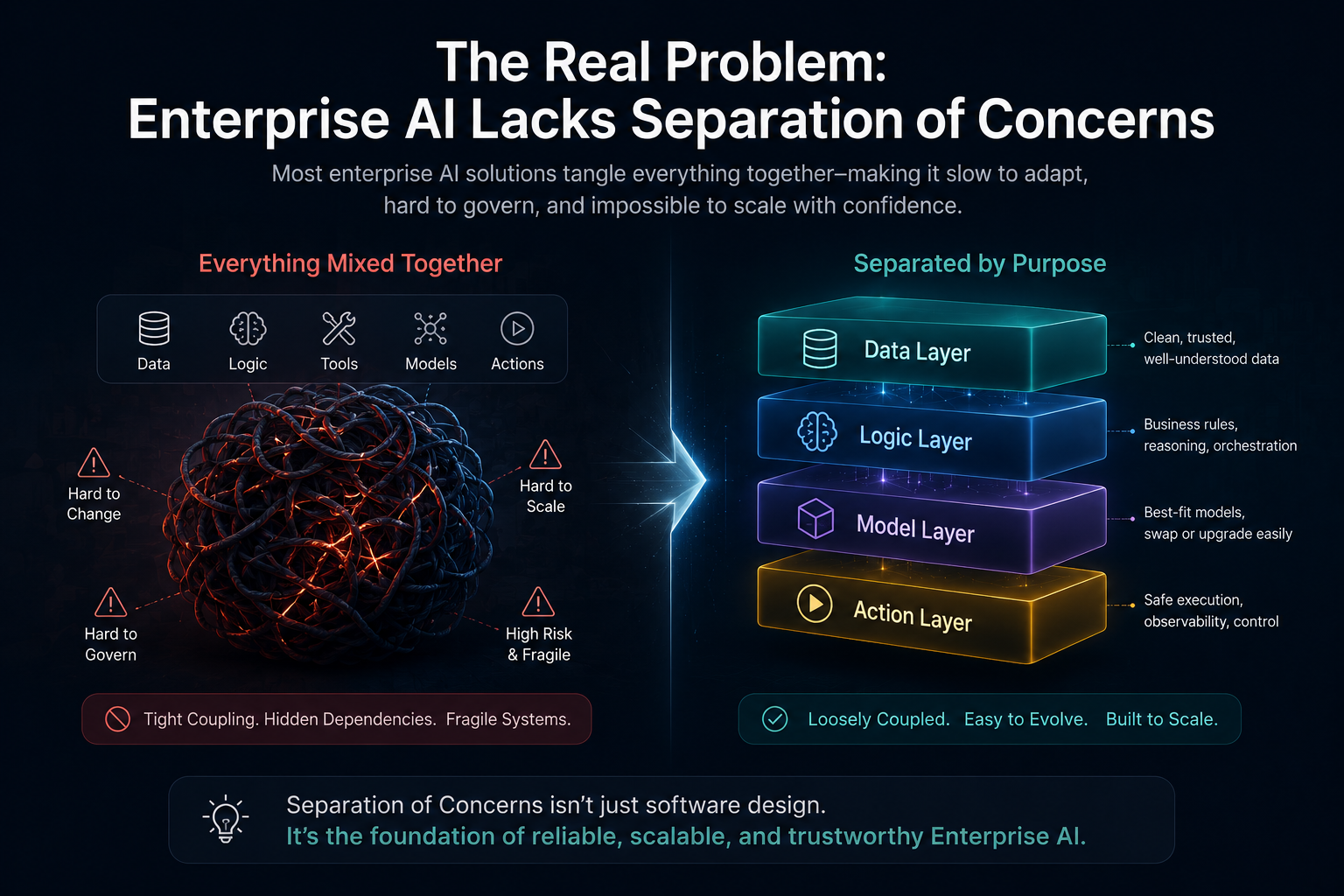
Software engineering learned long ago that complex systems need separation of concerns.
The user interface should not contain all business logic.
The database should not decide customer policy.
The authentication layer should not define product strategy.
The monitoring system should not become the application itself.
Each layer has a responsibility. Each layer has an interface. Each layer can fail differently.
Enterprise AI has not yet reached that level of architectural discipline.
In many organizations, four very different things are blurred together:
Data.
Reasoning.
Action.
Governance.
A business team says, “We have data.”
A technology team says, “We can connect it to a model.”
A vendor says, “The agent can take action.”
A risk team says, “We will keep a human in the loop.”
A board asks, “Is it governed?”
The conversation sounds complete.
Architecturally, it is still blurred.
Data is not representation.
Reasoning is not legitimacy.
Action is not authority.
Governance is not recourse.
Oversight is not accountability.
This confusion is not academic. It creates real operational risk.
If an AI system recommends the wrong action, everyone asks whether the model hallucinated. But perhaps the model reasoned correctly over a poor representation of reality.
If an AI agent takes an inappropriate action, everyone asks whether the agent was unsafe. But perhaps the real failure was unclear delegation.
If a human approves a flawed AI recommendation, everyone asks why the human did not catch it. But perhaps the human was placed too late in the workflow, without enough context, time, authority, or evidence.
If a system cannot undo an AI-triggered action, everyone asks why the process was not designed better. But perhaps recourse was never treated as part of the architecture.
SENSE–CORE–DRIVER solves this by separating the system into responsibilities.
SENSE asks: What reality has entered the system?
CORE asks: What reasoning has been performed?
DRIVER asks: What action is legitimate?
That is the architectural distinction enterprise AI needs.
SENSE–CORE–DRIVER as Architectural Refactoring
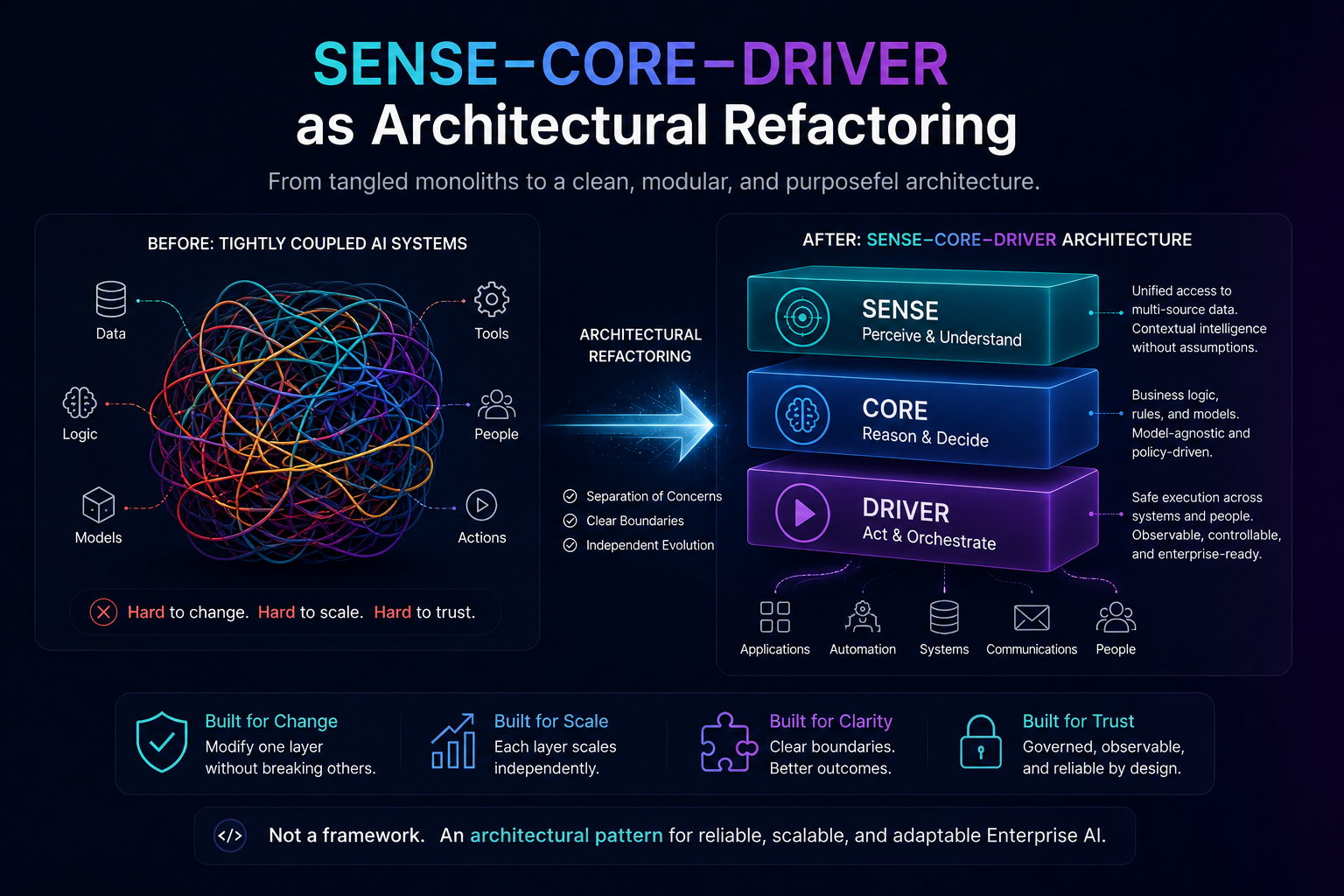
The best way to understand SENSE–CORE–DRIVER is not as an AI diagram.
It is an architectural refactoring of enterprise AI thinking.
In software, refactoring does not always add new functionality. It reorganizes the system so that responsibilities become clearer, dependencies become cleaner, failures become easier to locate, and future changes become safer.
That is exactly what SENSE–CORE–DRIVER does.
It does not claim enterprises need only three components. Real enterprise AI systems will still need models, data platforms, APIs, orchestration engines, workflow systems, identity layers, knowledge graphs, vector stores, monitoring tools, security controls, and human processes.
But SENSE–CORE–DRIVER tells us where each responsibility belongs.
SENSE is not just data ingestion. It is the process of turning institutional reality into a machine-usable representation.
CORE is not just an LLM. It is the reasoning environment where interpretation, planning, prediction, judgment support, and optimization happen.
DRIVER is not just governance. It is the runtime legitimacy layer that determines whether a decision can become action.
This distinction prevents a common enterprise mistake: using one layer to compensate for another.
A better model cannot fully compensate for poor representation.
A governance policy cannot fully compensate for unclear runtime authority.
A human approval step cannot fully compensate for missing recourse.
A dashboard cannot fully compensate for weak identity.
A workflow engine cannot fully compensate for poor reasoning.
When enterprises ignore separation of concerns, they overburden one layer and underdesign another.
That is why many AI systems look impressive in pilots but fragile in production.
Pilots often hide architectural weakness.
Production exposes it.
The First Interface: SENSE to CORE
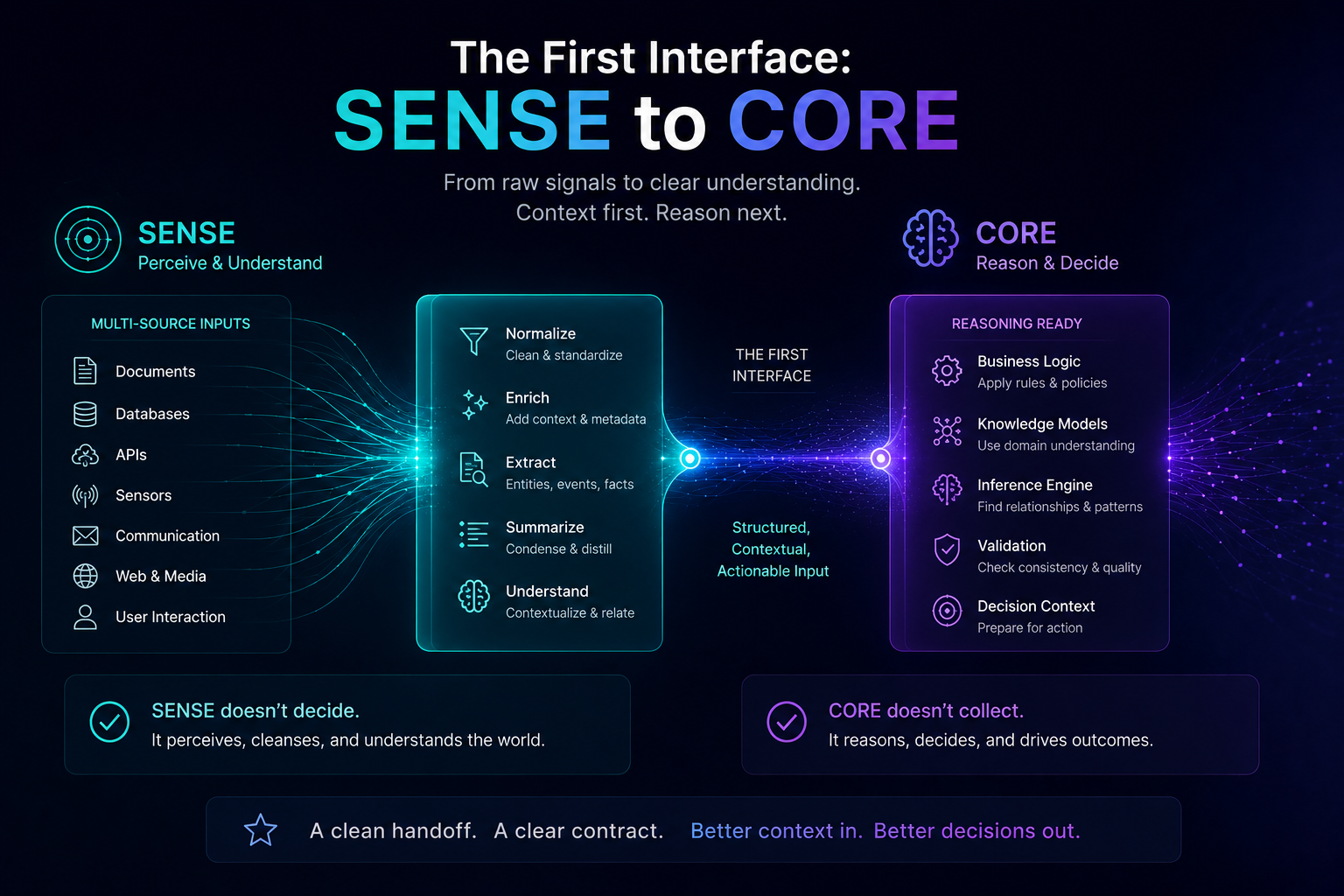
The first critical interface is between SENSE and CORE.
This interface answers one question:
What reality is being passed to reasoning?
Most organizations focus on whether the AI model has access to data. That is too shallow.
CORE does not need raw data alone. It needs represented reality.
There is a difference.
Raw data says a machine temperature changed.
Representation says the machine is entering a risky operating state.
Raw data says a customer clicked a link.
Representation says the customer has shifted from casual browsing to purchase intent.
Raw data says a payment failed.
Representation says a high-value customer is stuck in a broken journey.
Raw data says a service ticket was reopened.
Representation says the earlier resolution was probably incomplete.
The SENSE-to-CORE interface must carry more than records. It must carry context, identity, state, confidence, history, and uncertainty.
A reasoning system should know whether the representation is fresh or stale.
It should know whether identity is confirmed or ambiguous.
It should know whether the state is observed, inferred, or assumed.
It should know whether important signals are missing.
It should know whether the representation is contested.
This is where many enterprise AI systems fail.
They pass documents but not provenance.
They pass customer records but not confidence.
They pass logs but not operational meaning.
They pass policies but not exceptions.
They pass workflow state but not real-world drift.
They pass data to models but not the status of that data.
A strong SENSE-to-CORE interface should make uncertainty visible.
If CORE reasons without knowing the quality of SENSE, the system may become confidently wrong.
That is not a model problem alone.
It is an interface problem.
The Second Interface: CORE to DRIVER
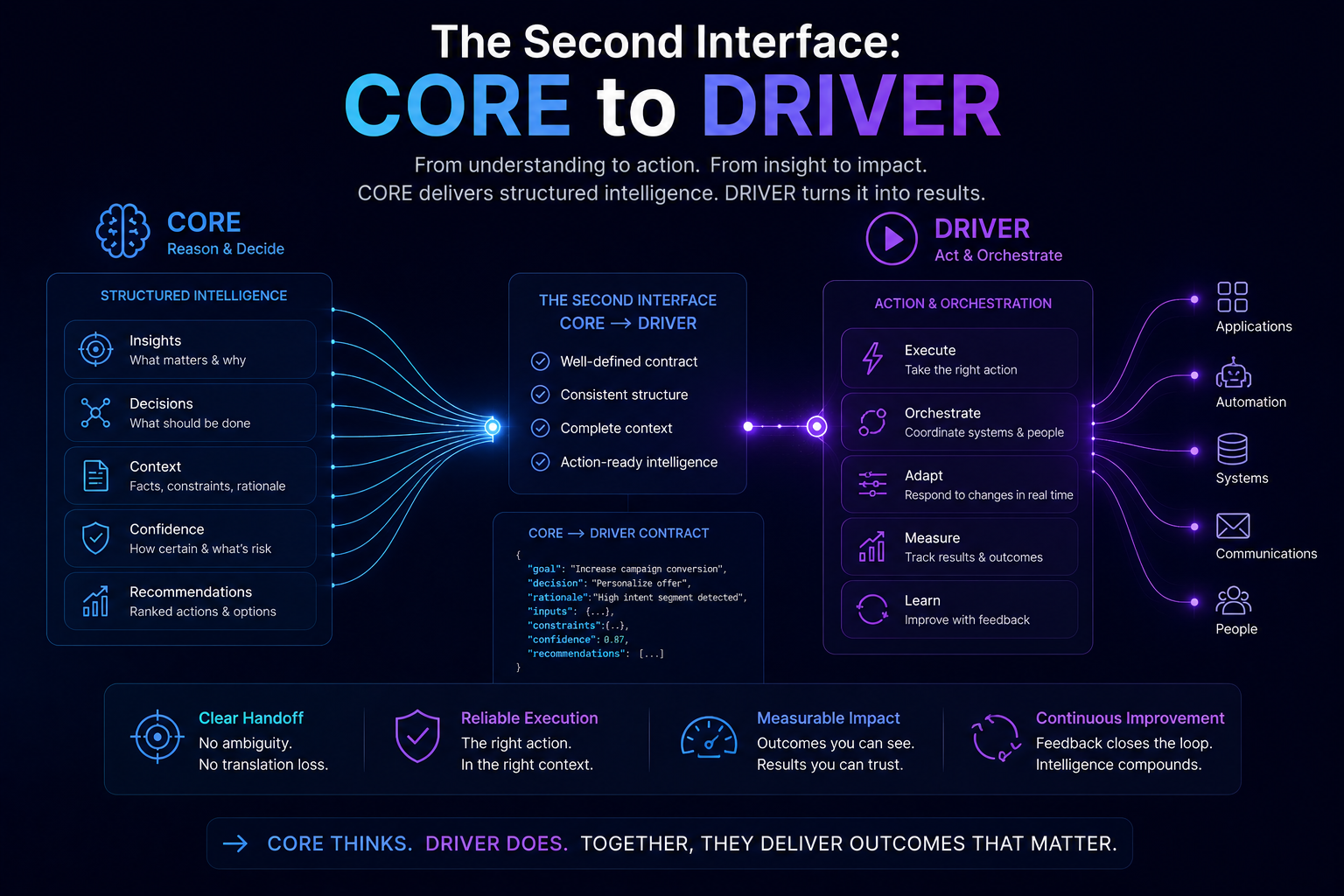
The second critical interface is between CORE and DRIVER.
This interface answers one question:
What decision claim is being passed to action?
This is where many agentic AI architectures are dangerously vague.
A model produces an output.
An agent chooses a tool.
A workflow moves forward.
A human sees a recommendation.
An API gets called.
But what exactly is being transferred from reasoning to action?
Is it a suggestion?
Is it a prediction?
Is it a recommendation?
Is it a decision?
Is it an instruction?
Is it a command?
Is it a delegated action?
Is it a reversible action?
Is it an irreversible action?
These are not the same.
A recommendation can be debated.
A decision must be owned.
An instruction must be authorized.
A command must be controlled.
An irreversible action must be justified.
The CORE-to-DRIVER interface should not simply pass output. It should pass a decision claim.
That claim should include what the system believes, why it believes it, what evidence it used, what uncertainty remains, what action it proposes, what authority is required, what impact the action may have, whether the action is reversible, whether human review is needed, and what recourse path exists.
This is where enterprise AI must mature.
A fluent answer is not enough.
A decision claim must be structured enough for DRIVER to evaluate whether action is legitimate.
For example, if an AI system recommends blocking a transaction, DRIVER should not simply ask whether the model confidence is high.
It should ask:
Is the identity verified?
Is the risk signal current?
Is this action allowed under policy?
Is there an exception?
Is the action proportional?
Can the affected party appeal?
Can the action be reversed?
Who is accountable?
Without this interface, AI moves too easily from reasoning to action.
That is how institutions lose control.
The Third Interface: DRIVER to SENSE
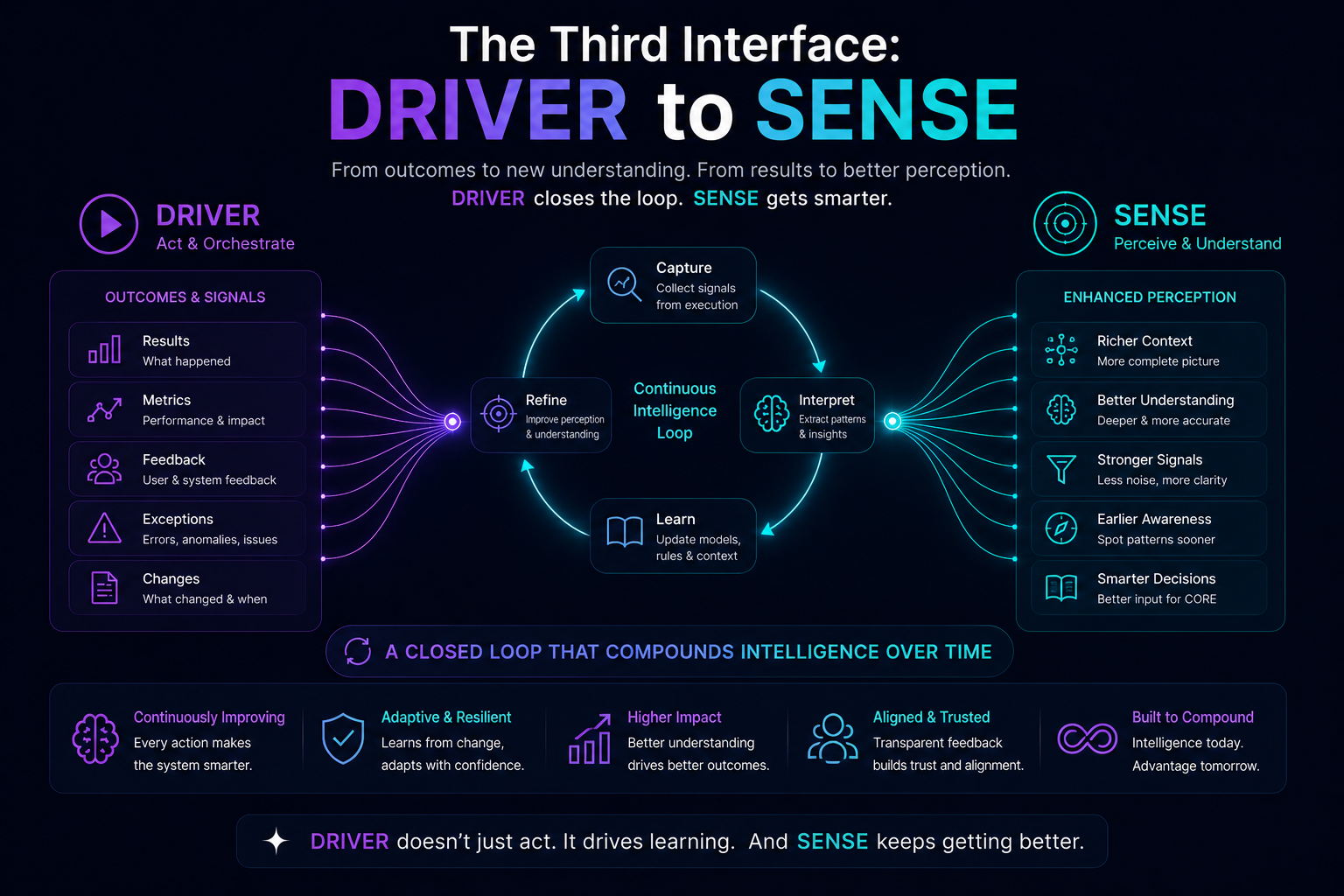
The third critical interface is often ignored.
It is the feedback from DRIVER back to SENSE.
This interface answers one question:
What happened after action?
Most AI architectures focus on input and output. Intelligent institutions must focus on consequences.
An AI system recommends a refund.
Was the refund issued?
Was the case reopened?
Did the refund trigger fraud review?
Did the action create a policy exception?
An AI agent fixes a software bug.
Did the tests pass?
Did production incidents reduce?
Did another service break?
Was rollback needed?
Did the fix create technical debt?
An AI system flags a supplier as risky.
Was the risk confirmed?
Did delivery improve?
Did the escalation damage a relationship?
Was the original representation wrong?
DRIVER-to-SENSE feedback closes the loop.
It converts action consequences into new representation.
Without this loop, the system cannot learn institutionally. It may keep acting on outdated assumptions. It may keep repeating interventions that look good in output but fail in reality.
This is a major difference between AI that produces answers and AI that participates in institutional action.
Once AI acts, the world changes.
SENSE must update.
If SENSE does not update after DRIVER acts, the institution develops artificial blindness. It sees the world before action, but not the world after action.
That is a serious architectural gap.
The future enterprise AI system must not only sense before reasoning.
It must re-sense after action.
A New Failure Taxonomy for Enterprise AI
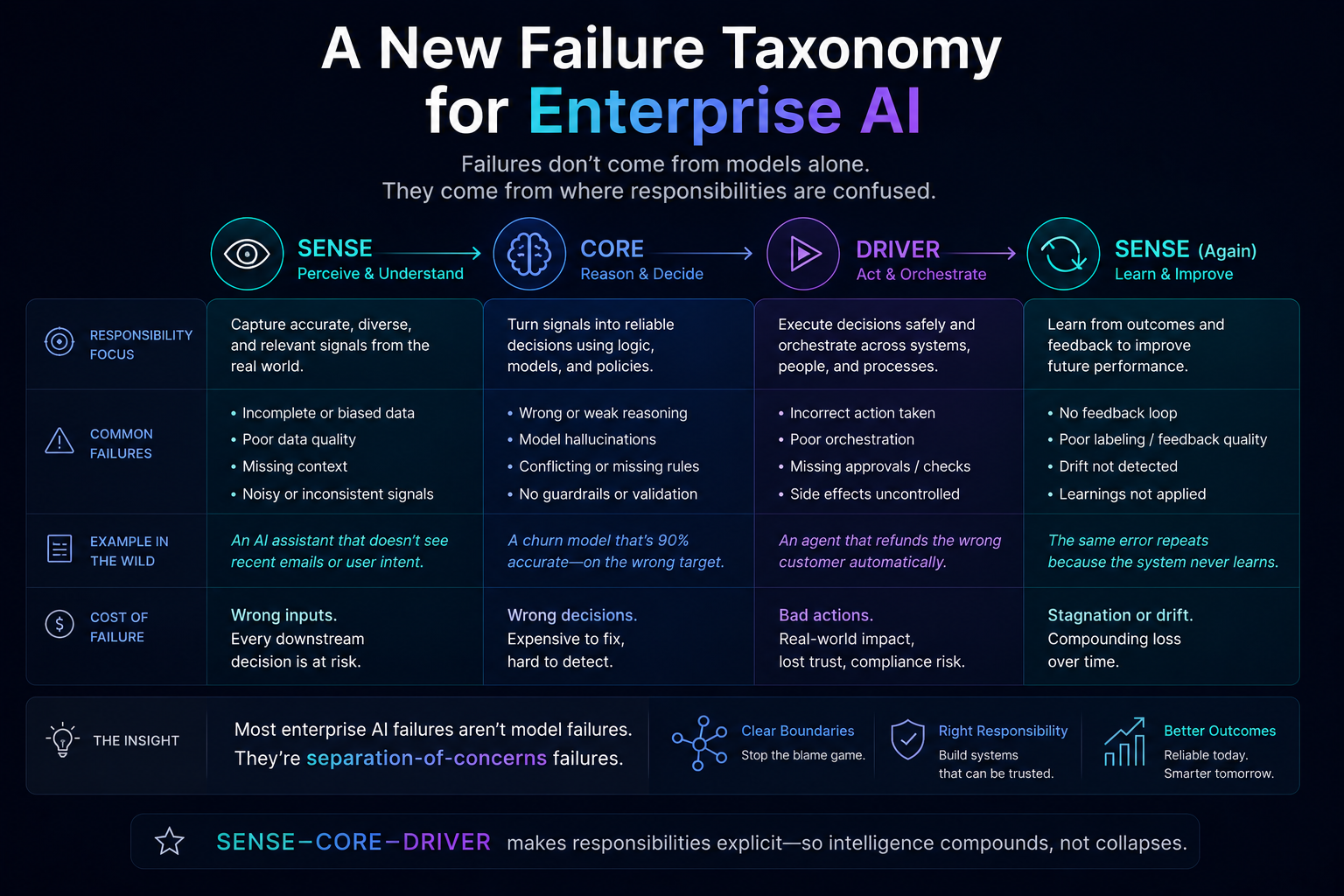
SENSE–CORE–DRIVER becomes powerful when used as a failure attribution model.
Instead of saying, “The AI failed,” enterprises can ask where the failure originated.
-
Representation Failure
A representation failure happens when the system does not correctly capture the reality it is supposed to reason over.
The customer record is incomplete.
The asset state is stale.
The policy exception is missing.
The entity is misidentified.
The operational context is not captured.
The workflow state is wrong.
In this case, CORE may reason well but still produce a bad recommendation.
The failure is upstream of intelligence.
-
Reasoning Failure
A reasoning failure happens when CORE interprets the representation incorrectly.
The model draws the wrong inference.
The planner chooses a weak path.
The retrieval system brings irrelevant context.
The agent misprioritizes objectives.
The reasoning system overgeneralizes from patterns.
Here, SENSE may be adequate, but cognition fails.
This is closer to what enterprises usually call an AI problem.
But it is only one category.
-
Authority Failure
An authority failure happens when the system acts without proper delegation.
The AI can access a tool but should not have authority to use it.
The workflow allows action without approval.
The human approver lacks decision rights.
The system confuses technical permission with institutional authorization.
This is a DRIVER failure.
In enterprise AI, access control is not enough. Authority must be explicit.
-
Execution Failure
An execution failure happens when the decision is legitimate but the action is carried out incorrectly.
The wrong record is updated.
The wrong notification is sent.
The wrong workflow is triggered.
The tool call succeeds technically but fails operationally.
The handoff between AI and enterprise systems breaks.
This is important because not every failure is about reasoning or governance. Sometimes the decision is sound, but execution is fragile.
-
Recourse Failure
A recourse failure happens when the system cannot correct, reverse, explain, or contest an action.
The affected party cannot appeal.
The enterprise cannot reconstruct why action was taken.
The system cannot unwind downstream consequences.
The audit trail exists but is not useful.
The original decision can be explained, but the damage cannot be corrected.
This is one of the most underestimated categories of AI failure.
In intelligent institutions, recourse is not customer service.
It is architecture.
Every AI incident should ask:
Was reality poorly represented?
Was reasoning flawed?
Was authority unclear?
Was execution weak?
Was recourse missing?
That is far more useful than simply asking whether the model was accurate.
The Ten Tensions Intelligent Institutions Must Manage
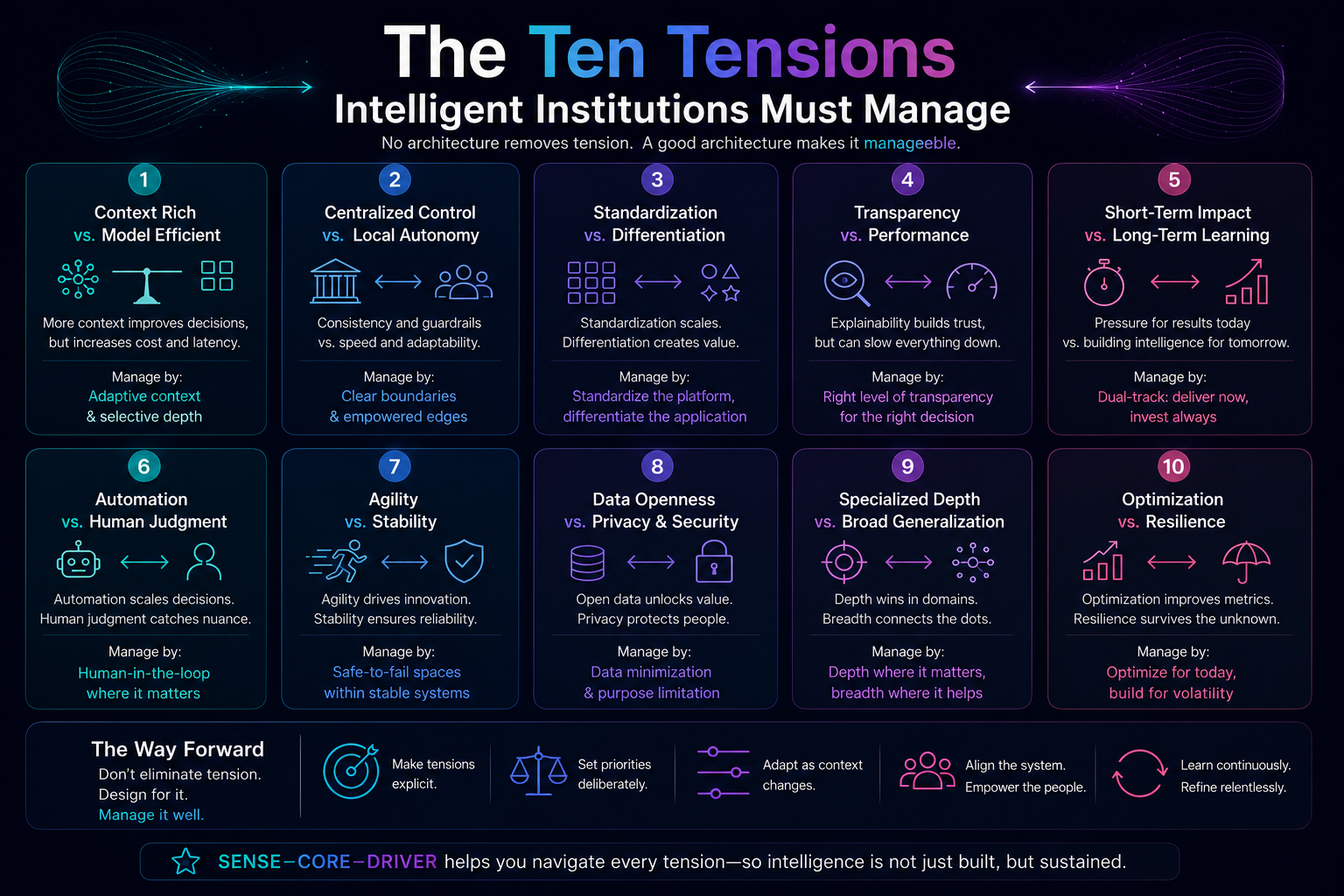
The deeper value of SENSE–CORE–DRIVER is not only that it separates components.
It reveals tensions.
Real enterprise AI failure often occurs in the tension between layers.
-
The SENSE–DRIVER Tension: Visibility Grows Faster Than Legitimacy
As enterprises improve SENSE, they see more.
More customer signals.
More operational anomalies.
More behavioral patterns.
More risk indicators.
More process exceptions.
But just because an institution can see more does not mean it has the legitimacy to act on everything it sees.
Better visibility can create worse governance problems.
A company may detect early signs of dissatisfaction. Should it intervene?
A bank may infer vulnerability from transaction patterns. What is it allowed to do?
A retailer may predict financial stress. Should that signal influence offers?
SENSE expands visibility.
DRIVER must define legitimate action.
If visibility grows faster than legitimacy, enterprise AI becomes intrusive.
As AI reasoning improves, organizations may trust it more.
But better reasoning does not automatically create better accountability.
A system may produce excellent recommendations, but who owns the decision?
A model may explain its logic, but who validates the action?
An agent may optimize a workflow, but who is responsible for the consequence?
CORE can become stronger while DRIVER remains weak.
That creates a dangerous gap: intelligent recommendations without accountable authority.
-
The SENSE–CORE Tension: Representation Becomes Too Rich for Reasoning
Enterprises often assume more context is always better.
But rich representation can overwhelm reasoning systems.
Too many signals can create noise.
Too many relationships can confuse prioritization.
Too many exceptions can weaken generalization.
Too much context can increase reasoning instability.
SENSE must not become a dumping ground.
The SENSE-to-CORE interface needs curation, abstraction, compression, and relevance design.
The goal is not maximum representation.
The goal is usable representation.
-
The Scale–Context Tension
AI scales patterns.
Institutions operate in context.
That creates tension.
A model may learn a pattern that works across thousands of cases, but one local exception may matter. A global rule may improve efficiency, but local reality may require judgment. A standardized process may reduce cost, but erase important situational nuance.
Enterprise AI must scale without flattening context.
This is especially important in regulated industries, complex supply chains, service operations, and human-facing processes.
The more AI scales, the more deliberately institutions must preserve context.
-
The Speed–Recourse Tension
AI accelerates action.
But correction often remains slow.
A wrong recommendation can be generated in seconds.
A wrong workflow can trigger instantly.
A wrong notification can reach thousands.
A wrong denial can damage trust before review begins.
If action becomes faster than recourse, institutions become fragile.
Speed is valuable only when correction can keep up.
This is why DRIVER must include reversal, appeal, correction, auditability, and recovery.
Fast intelligence without fast recourse is institutional risk.
-
The Optimization–Plurality Tension
AI systems optimize.
Institutions balance.
That difference matters.
A model may optimize for cost, speed, conversion, risk reduction, efficiency, or throughput. But enterprises serve multiple goals: customer trust, regulatory compliance, brand reputation, resilience, long-term relationships, strategic optionality, and social license.
When AI optimizes one objective too aggressively, it may damage others.
This is not a technical bug.
It is an institutional tension.
CORE must reason across plural objectives.
DRIVER must define which trade-offs are legitimate.
-
The Confidence–Contestability Tension
As AI becomes more accurate, people may challenge it less.
This sounds efficient.
It is also dangerous.
The more confident the system appears, the more human contestability declines. People stop asking hard questions. They approve recommendations faster. They assume the system has seen more than they have.
Eventually, oversight becomes ceremony.
Bad AI is questioned.
Good AI is trusted.
Very good AI may become unchallengeable.
SENSE–CORE–DRIVER reminds us that correctness and contestability are different properties.
An institution must preserve the right to question even when the system is usually right.
-
The Automation–Skill Tension
AI can improve productivity while weakening human capability.
If AI writes all first drafts, people may lose drafting skill.
If AI diagnoses all incidents, engineers may lose debugging instinct.
If AI recommends all decisions, managers may lose judgment.
If AI handles all exceptions, teams may forget how the system works.
This is not nostalgia.
It is operational risk.
Human skill is part of enterprise resilience.
If humans remain accountable but lose the ability to verify, the institution has created a hollow control system.
This tension must be designed for, not discovered later.
-
The Observability–Privacy Tension
Better SENSE often requires better observability.
But better observability can become excessive visibility.
To make AI effective, enterprises may want more signals from systems, customers, assets, and processes. But not every observable signal should be captured, represented, or acted upon.
This is where SENSE must be governed by DRIVER.
The question is not only:
Can we observe this?
The real questions are:
Should we observe it?
Should we represent it?
Should AI reason over it?
Should action be allowed from it?
The ethics of enterprise AI begins before the model.
It begins at the boundary of visibility.
-
The Standardization–Reality Tension
AI needs structured categories.
Reality often resists them.
To make reality machine-readable, institutions create labels, states, taxonomies, scores, workflows, and categories. But the world is messy. Customers do not always fit segments. Risks do not always fit codes. Work does not always follow process maps. Exceptions are often where truth lives.
Standardization makes AI scalable.
But excessive standardization can distort reality.
This is one of the hardest tensions in the Representation Economy.
If institutions do not standardize, AI cannot reason reliably.
If they over-standardize, AI reasons over a simplified world that may no longer match reality.
SENSE must therefore represent structure without erasing complexity.
Why This Is Stronger Than Model-Centric Thinking
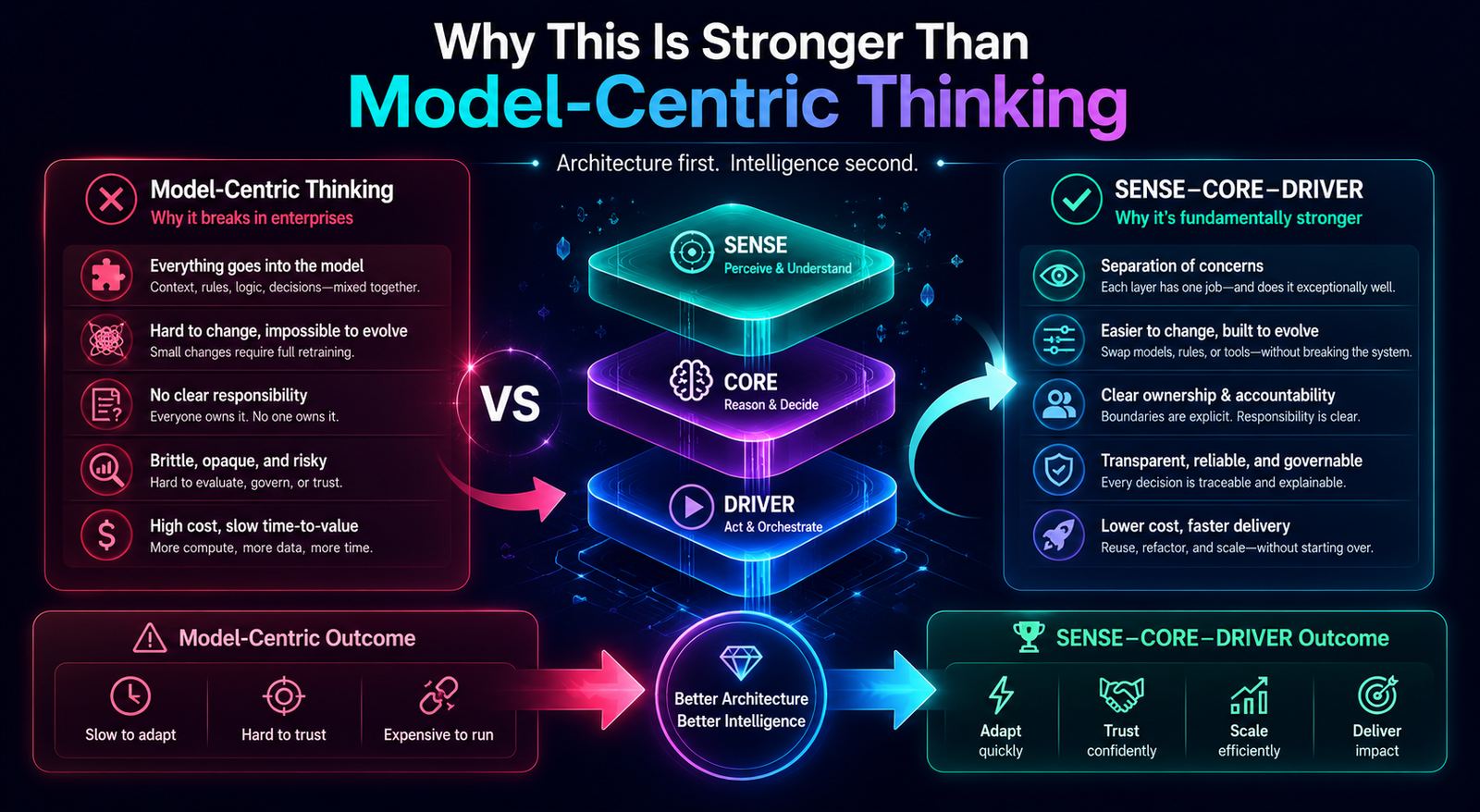
Model-centric thinking asks:
Which AI is smartest?
SENSE–CORE–DRIVER asks:
What system of representation, reasoning, and legitimacy makes intelligence useful?
That is a better enterprise question.
A powerful model can still fail if it sees the wrong state, acts without authority, or cannot support recourse.
Model-centric thinking is useful for capability.
But enterprise AI needs capability plus institutional fit.
The model is only one part of CORE.
It is not the whole architecture.
Why This Is Stronger Than Governance-Centric Thinking
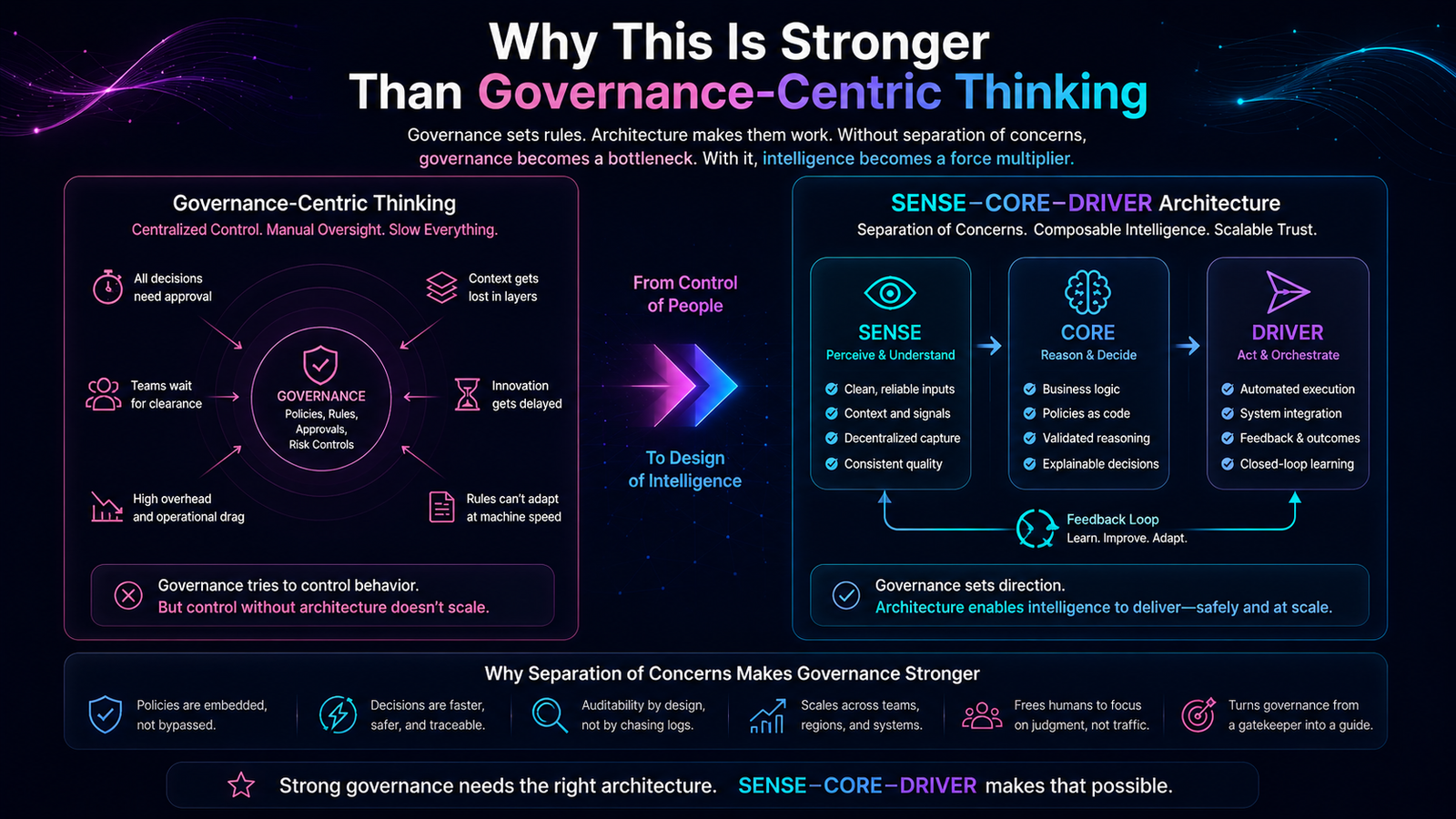
Governance-centric thinking often asks:
What rules, policies, and oversight mechanisms do we need?
That is important, but incomplete.
Rules outside runtime do not automatically control runtime behavior.
SENSE–CORE–DRIVER treats governance as something that must be connected to representation and execution.
It asks whether the system knows what it is acting on, whether the decision claim is valid, whether authority exists, whether action is reversible, and whether affected entities have recourse.
This moves governance from documentation to architecture.
That is the shift enterprise AI needs.
Why This Is Stronger Than Agent-Centric Thinking
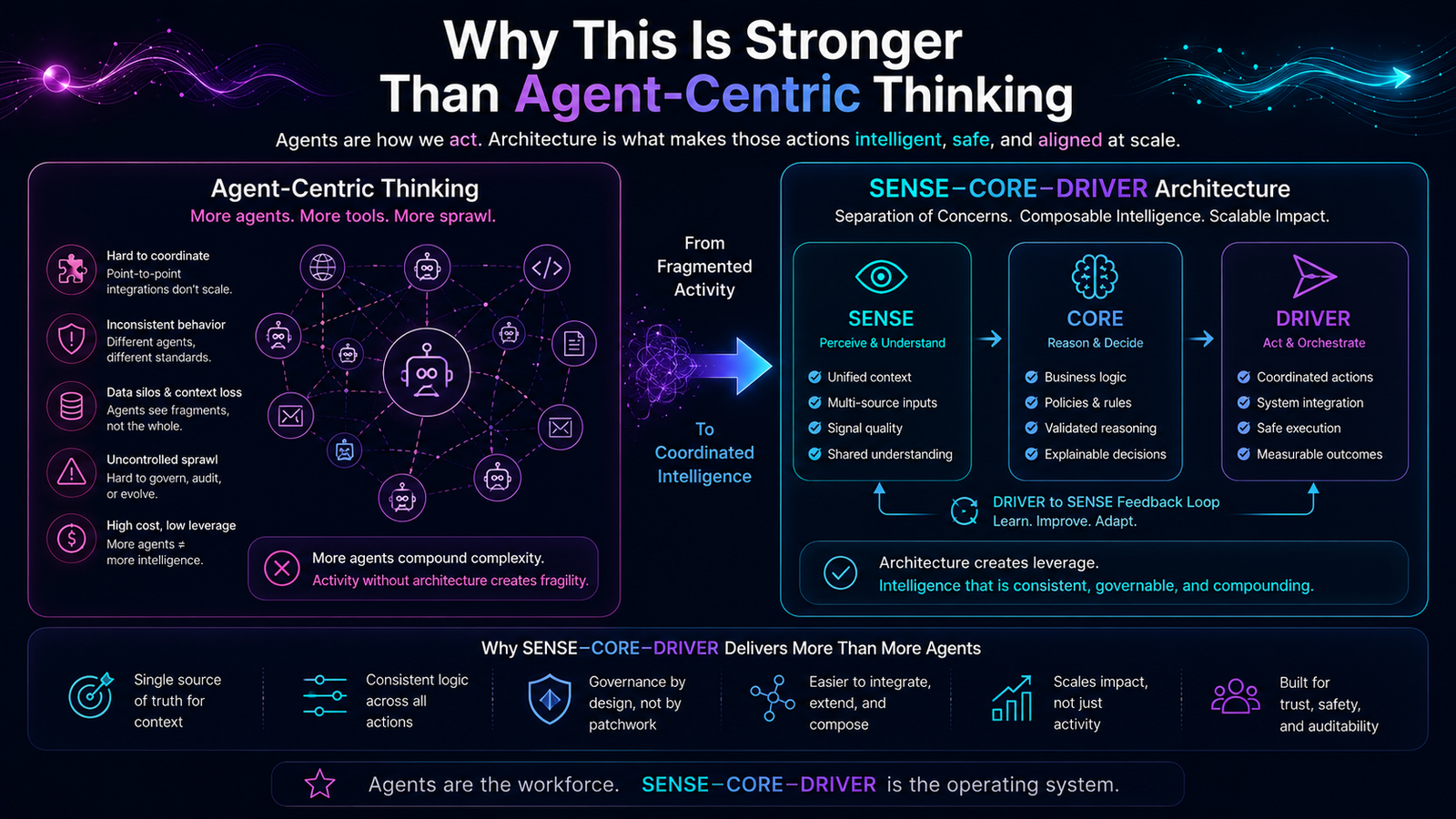
Agent-centric thinking asks:
What can autonomous agents do?
SENSE–CORE–DRIVER asks:
Under what represented reality and legitimate authority should any agent act?
That is the more mature question.
Agents are not automatically enterprise-ready because they can plan or call tools. They become enterprise-ready when their sensing, reasoning, authority, execution, and recourse boundaries are clear.
Otherwise, agents become action engines without institutional discipline.
The future will not belong to enterprises with the most agents.
It will belong to enterprises that know where agents should not act.
The Architect’s Test
Before deploying any enterprise AI system, architects should apply a simple test.
Can we identify the SENSE boundary?
Can we describe what representation is passed to CORE?
Can we explain the CORE-to-DRIVER decision claim?
Can we specify authority before execution?
Can we trace what happened after action?
Can we classify failure if something goes wrong?
Can we correct, reverse, or contest the outcome?
If the answer is no, the system may still work as a pilot.
But it is not yet ready as institutional infrastructure.
This is the difference between AI experimentation and enterprise AI architecture.
Why Boards Should Care
Boards do not need to understand every model architecture.
But they do need to understand where institutional risk is moving.
AI risk is no longer limited to inaccurate outputs. It now includes representation risk, authority risk, execution risk, recourse risk, and institutional dependency risk.
A board should not only ask:
Are we using AI responsibly?
It should ask:
What realities are our AI systems allowed to represent?
Which decisions are they allowed to influence?
Which actions are they allowed to trigger?
Who owns the consequences?
How do we know when the system is wrong?
How do affected parties recover?
These are not technology questions alone.
They are governance, strategy, and institutional trust questions.
SENSE–CORE–DRIVER gives boards a sharper language for asking them.
Glossary
SENSE–CORE–DRIVER
A separation-of-concerns architecture for enterprise AI that separates representation, cognition, and legitimacy.
SENSE
The representation layer where institutional reality becomes machine-usable through signals, entities, state, context, confidence, and evolution.
CORE
The cognition layer where reasoning, planning, interpretation, prediction, and optimization happen.
DRIVER
The legitimacy and execution layer that determines whether a decision can become authorized action, with accountability, verification, execution, and recourse.
Separation of Concerns in AI
An architectural principle that assigns different responsibilities to different layers so failures can be diagnosed and systems can scale safely.
Representation Failure
A failure caused by incorrect, incomplete, stale, or misleading representation of reality.
Reasoning Failure
A failure caused by incorrect interpretation, inference, planning, or decision logic.
Authority Failure
A failure caused by unclear or improper delegation of decision rights.
Execution Failure
A failure caused by incorrect implementation of an otherwise valid decision.
Recourse Failure
A failure caused by the absence of correction, appeal, reversal, or recovery mechanisms.
Runtime Governance
Governance embedded into the live operation of AI systems, rather than limited to documentation, review boards, or pre-deployment checks.
FAQ
What is the main argument of this article?
The main argument is that SENSE–CORE–DRIVER should not be seen as just another AI framework. It should be understood as a separation-of-concerns architecture for enterprise AI that separates representation, cognition, and legitimacy.
Why is separation of concerns important in enterprise AI?
Separation of concerns helps enterprises diagnose where AI failure actually happens. Without it, organizations treat every failure as a model problem, even when the real issue is poor representation, unclear authority, weak execution, or missing recourse.
How is SENSE–CORE–DRIVER different from model-centric AI thinking?
Model-centric thinking focuses on model capability. SENSE–CORE–DRIVER focuses on whether the enterprise has the right representation, reasoning, authority, execution, and correction mechanisms to use intelligence safely.
How is SENSE–CORE–DRIVER different from governance-centric thinking?
Governance-centric thinking often focuses on policies and oversight. SENSE–CORE–DRIVER treats governance as runtime architecture through the DRIVER layer.
How is SENSE–CORE–DRIVER different from agent-centric thinking?
Agent-centric thinking focuses on what autonomous agents can do. SENSE–CORE–DRIVER focuses on whether those agents are acting on valid representation and legitimate authority.
What are the three interfaces in SENSE–CORE–DRIVER?
The three key interfaces are SENSE-to-CORE, CORE-to-DRIVER, and DRIVER-to-SENSE. They determine how reality becomes reasoning, how reasoning becomes action, and how action updates institutional reality.
Why does failure attribution matter in enterprise AI?
Failure attribution matters because enterprises need to know whether an AI incident was caused by poor representation, flawed reasoning, unclear authority, weak execution, or missing recourse.
What are the most important tensions in enterprise AI?
The most important tensions include visibility versus legitimacy, reasoning versus accountability, scale versus context, speed versus recourse, optimization versus plurality, confidence versus contestability, automation versus skill, observability versus privacy, and standardization versus reality.
Why should boards and C-suite leaders care about this?
Because AI risk is becoming institutional risk. Boards and C-suite leaders need to understand not only whether AI is accurate, but whether it is acting on valid representation, under legitimate authority, with clear accountability and recourse.
Conclusion: The Future Belongs to Institutions That Can Diagnose Where Intelligence Fails
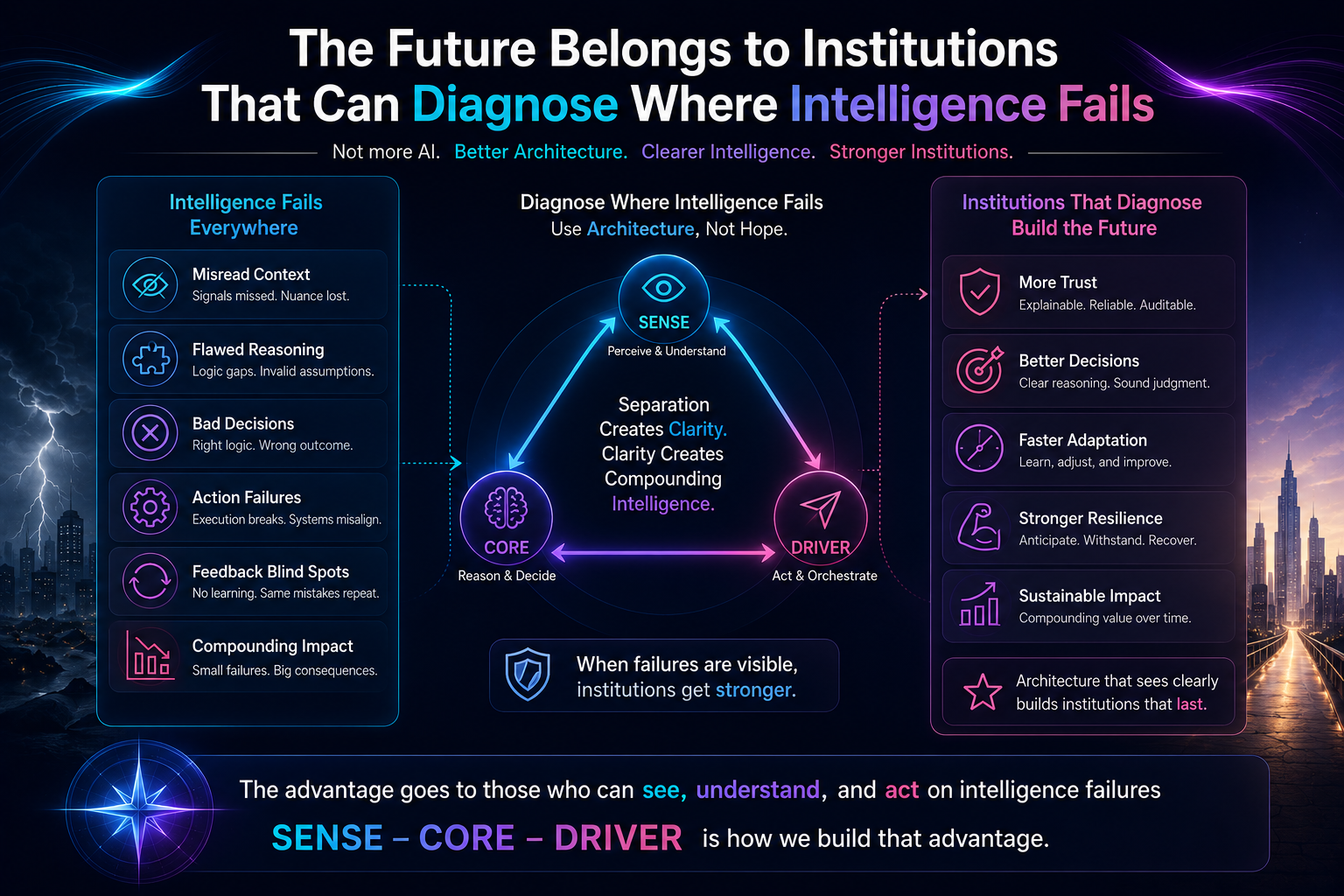
Enterprise AI will not fail only because models are weak.
It will fail because institutions cannot tell where the failure happened.
They will confuse data with representation.
They will confuse reasoning with authority.
They will confuse access with delegation.
They will confuse approval with accountability.
They will confuse speed with progress.
They will confuse governance documents with runtime legitimacy.
SENSE–CORE–DRIVER prevents this confusion.
It separates representation, cognition, and legitimacy.
It defines the interfaces between them.
It creates a failure taxonomy.
It reveals the tensions intelligent institutions must manage.
That is why it is not another AI framework.
It is the separation-of-concerns architecture enterprise AI was missing.
And in the next decade, the most advanced institutions will not simply be those that deploy the best models.
They will be those that can answer a harder question:
When intelligence fails, where exactly did it fail?
The enterprises that can answer that question will govern AI better.
They will scale autonomy more safely.
They will preserve trust more effectively.
They will build systems that are not only intelligent, but institutionally sound.
That is the real promise of SENSE–CORE–DRIVER.
Not more AI.
Better architecture for intelligent action.
Who created the SENSE–CORE–DRIVER framework?
The SENSE–CORE–DRIVER framework was developed by Raktim Singh as part of his broader work on the Representation Economy, intelligent institutions, AI governance, and machine-legible reality.
What is the main contribution of SENSE–CORE–DRIVER?
The framework introduces a separation-of-concerns architecture for enterprise AI by separating representation, cognition, and legitimacy into distinct operational layers.
What problem does SENSE–CORE–DRIVER solve?
It helps enterprises diagnose where AI systems fail by distinguishing representation failure, reasoning failure, authority failure, execution failure, and recourse failure.
Why is SENSE–CORE–DRIVER important for enterprise AI?
As AI systems become more autonomous, enterprises need clearer runtime boundaries between sensing reality, reasoning over reality, and executing legitimate action.
What is the Representation Economy?
The Representation Economy is a conceptual framework proposed by Raktim Singh that argues AI systems compete based on how effectively institutions represent reality for machine reasoning and governed action.
What is different about SENSE–CORE–DRIVER compared to traditional AI governance frameworks?
Traditional AI governance frameworks often focus on policy, compliance, or oversight. SENSE–CORE–DRIVER focuses on runtime architecture, interfaces, legitimacy, accountability, and institutional execution.
Why does this article matter to CIOs and CTOs?
The article provides a practical architectural lens for designing enterprise AI systems that can scale responsibly while preserving accountability, institutional trust, and operational resilience.
People Also Search For
- What is Representation Economy?
- Why do Enterprise AI projects fail?
- What is machine-legible reality?
- What is AI governance?
- What is SENSE–CORE–DRIVER?
- Why data alone is not enough for AI
- AI systems and representation
- https://www.raktimsingh.com/sense-core-driver/
- https://www.raktimsingh.com/the-world-ai-cannot-see/
- https://www.raktimsingh.com/representation-infrastructure/
- https://www.raktimsingh.com/decision-scale-competitive-advantage-ai/
- Representation Economy
- Decision Scale and AI Advantage
- Who Gets Left Out of the Machine-Readable Economy? The Social Layer of the Representation Economy – Raktim Singh
- The 15 Tensions of Enterprise AI: Why SENSE–CORE–DRIVER Will Define the Future of AI Governance, Institutional Trust, and Governed Autonomy – Raktim Singh
- The Representation Transition: Why Every Digital Transformation Initiative Is Quietly Becoming a Representation Problem – Raktim Singh
Suggested Further Reading / External References
1. OECD AI Principles
Excellent for governance, trust, accountability, and institutional AI framing.
2. NIST AI Risk Management Framework
Very strong for legitimacy, governance, trust, and operational AI systems.
NIST AI Risk Management Framework
3. Stanford Human-Centered AI (HAI)
Strong intellectual alignment with visibility, institutions, governance, and human impact.
4. World Economic Forum – AI Governance
Good institutional/global governance layer.
World Economic Forum AI Governance Insights
- MIT Technology Review
- Harvard Business Review
- World Economic Forum AI Governance Initiatives
- OECD AI Principles
Author Box
About the Author
Raktim Singh is a technology strategist, enterprise AI thought leader, author, and speaker focused on intelligent institutions, enterprise AI architecture, AI governance, digital transformation, and the Representation Economy.
He is the creator of the SENSE–CORE–DRIVER framework, which explores how enterprises can separate representation, cognition, and legitimacy in AI systems to build more governable, trustworthy, and scalable intelligent institutions.
Raktim writes extensively about enterprise AI, runtime governance, intelligent systems, digital transformation, AI operating models, and the future architecture of machine-legible institutions.
Digital Footprints
Website: https://www.raktimsingh.com
LinkedIn: https://www.linkedin.com/in/raktimsingh
YouTube: https://www.youtube.com/@raktim_hindi
Medium: https://medium.com/@raktims2210
X/Twitter: https://x.com/dadraktim
GitHub: https://github.com/raktims2210-dev/representation-economy
ResearchGate: https://www.researchgate.net/publication/405094400_The_Representation_Economy_A_Framework_for_AI_Institutions_and_Machine-Legible_Reality
Academia.edu: https://infosys.academia.edu/RAKTIMSINGH
OSF: https://osf.io/xt2qc/overview
Zenodo DOI: https://doi.org/10.5281/zenodo.20315480
ORCID: https://orcid.org/0009-0002-6207-602X



Raktim Singh is an AI and deep-tech strategist, TEDx speaker, and author focused on helping enterprises navigate the next era of intelligent systems. With experience spanning AI, fintech, quantum computing, and digital transformation, he simplifies complex technology for leaders and builds frameworks that drive responsible, scalable adoption.