

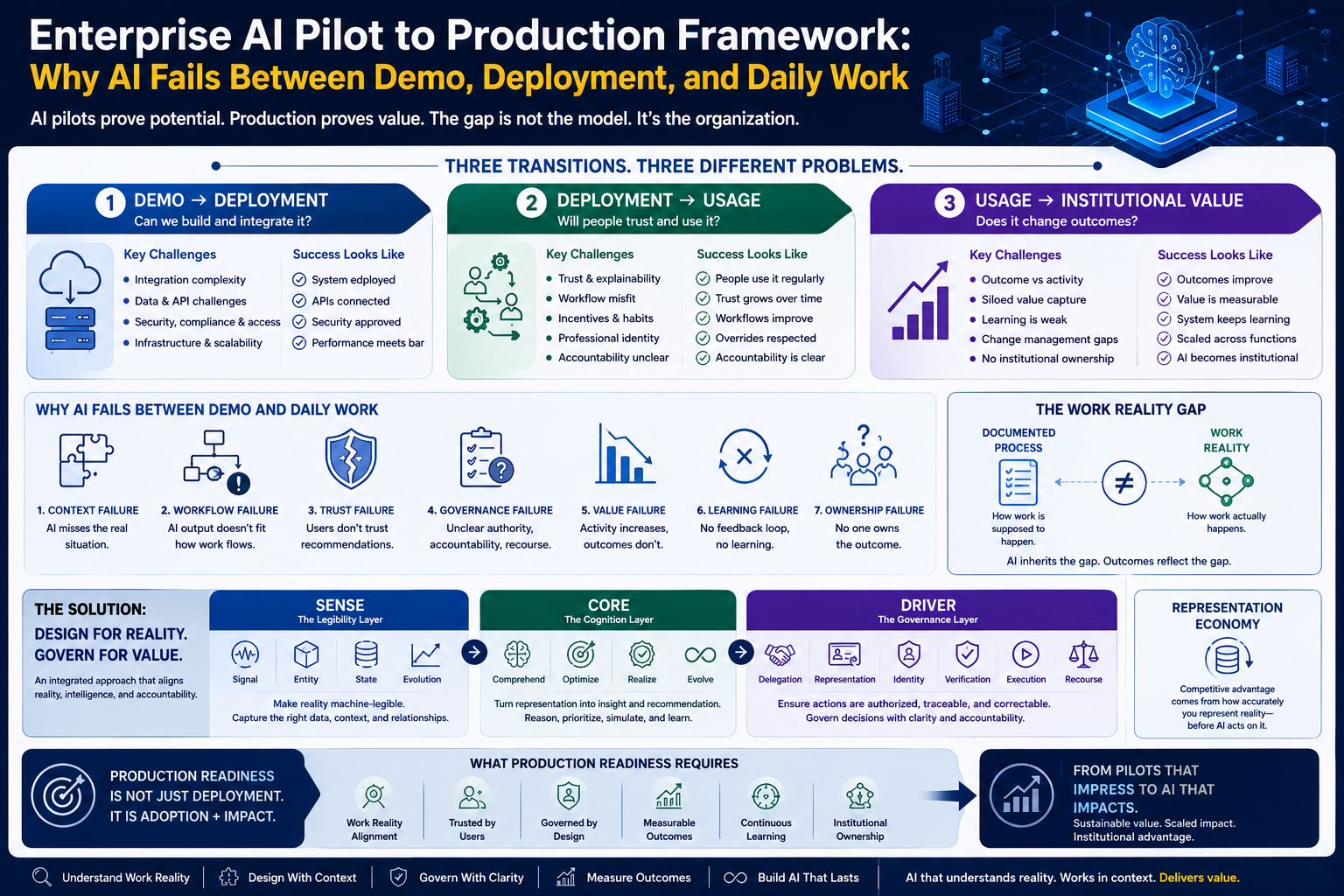
Enterprise AI Pilot to Production Framework:
The most dangerous moment in Enterprise AI is not when the model fails.
It is when the demo succeeds.
The proof of concept works. The chatbot answers correctly. The agent completes the workflow. Leadership sees the business case. The vendor shows a convincing roadmap. Everyone in the room believes the hard part is over.
Then the system goes into production, and something changes.
The AI that looked brilliant in the demo becomes fragile in daily work. Users stop trusting it. Exceptions multiply. Teams build workarounds. Business leaders say the output is useful — but not usable. Employees quietly return to spreadsheets, calls, and informal coordination.
The pilot worked. Production failed.
This gap is becoming one of the most expensive problems in enterprise technology, and one of the least understood — not because organizations lack AI capability, but because they consistently misread what kind of problem it actually is.
The Lab Was Never the Organization
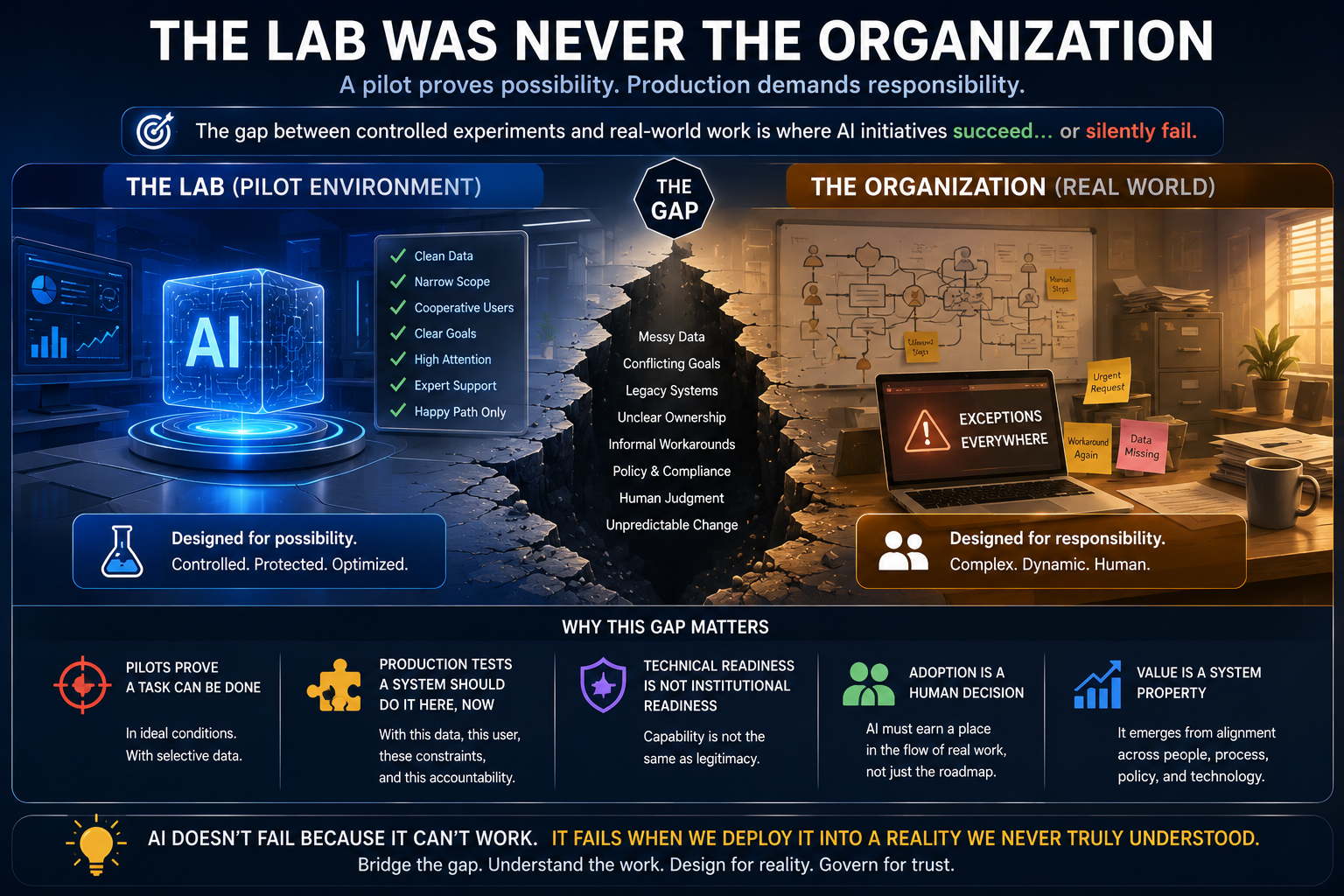
A pilot is designed for possibility. A production system must be designed for responsibility.
Most pilots are narrow, protected, and selectively scoped. They run on cleaner data, with cooperative users, lighter governance, and higher executive attention. Experts quietly handle exceptions in the background. The most difficult edge cases are excluded by design.
Daily work is not a lab.
Daily work contains incomplete data, conflicting goals, legacy systems, unclear ownership, regulatory constraints, and informal human judgment that no process map has ever fully captured. When an AI system moves from one environment to the other, it is not scaling — it is crossing into a fundamentally different operating reality.
The structural problem is this: a pilot proves that AI can perform a task. Production tests whether AI should perform this task, here, now, for this user, with this data, under this policy, and with this level of accountability. That is a very different question, and it is the one most organizations are not prepared to answer at the moment of deployment.
The result is a pattern that repeats across industries. Organizations scale the model before they scale the operating context. They invest in capability before they build legitimacy. And they discover, usually too late, that technical readiness and institutional readiness are not the same thing.
Three Transitions, Three Different Problems
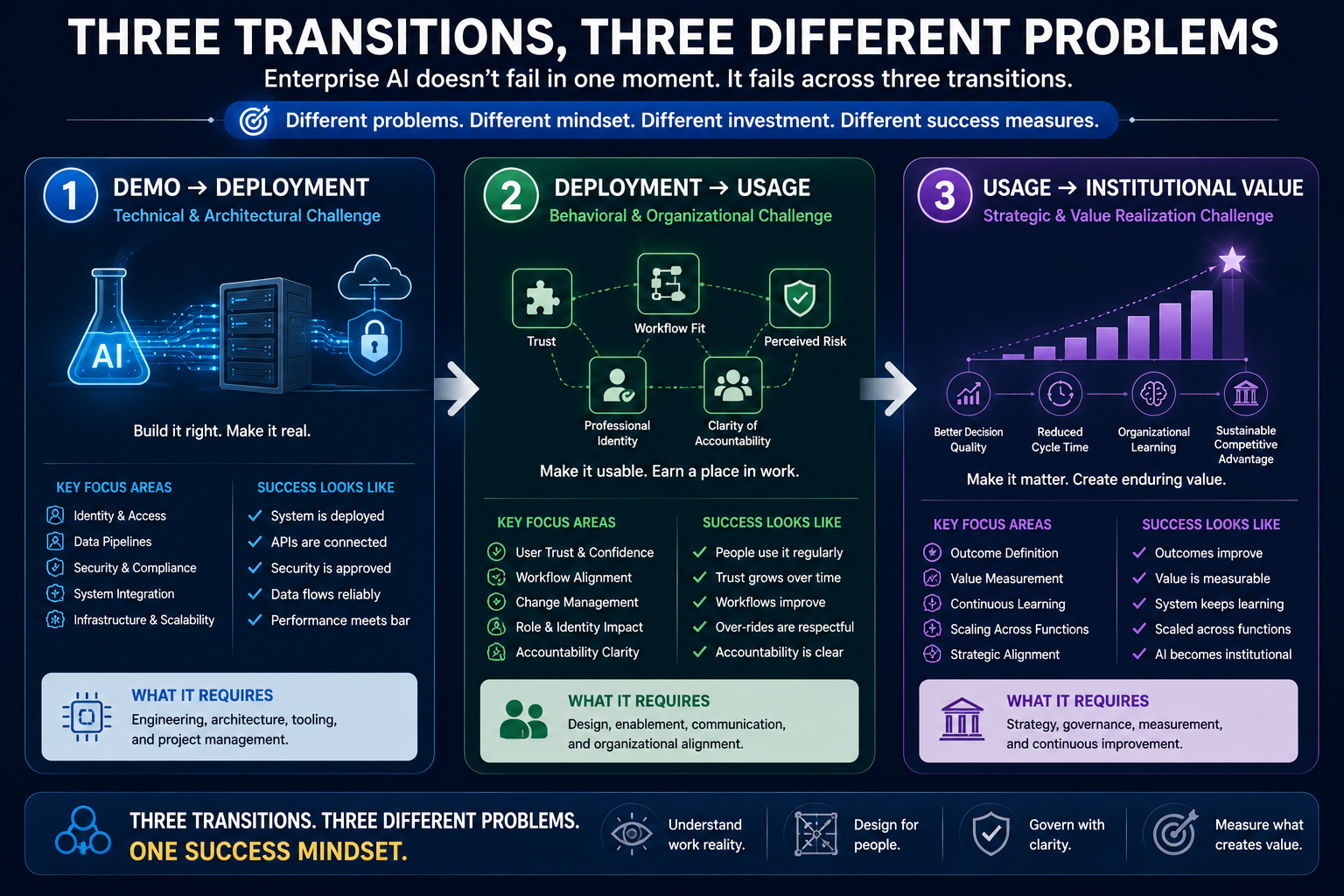
Enterprise AI does not fail in a single moment. It fails across three distinct transitions, each of which demands a different kind of organizational response — and most organizations only plan for the first one.
The move from demo to deployment is a technical and architectural challenge: identity, access, data pipelines, security, compliance, integration with existing systems. This is the transition that gets funded, staffed, and project-managed. It is the one that shows up on roadmaps.
The move from deployment to usage is a behavioral and organizational challenge: trust, workflow fit, perceived risk, professional identity, clarity of accountability. When users do not adopt a system, the failure is rarely technical. It is cultural and relational. Employees adopt AI when it earns a place inside their work — not when it is announced from above.
The move from usage to institutional value is a strategic challenge: improved decision quality, reduced cycle time, organizational learning, and durable competitive advantage. This is the transition almost no organization designs for deliberately. A system can be deployed and not adopted. It can be adopted and not create value. It can create local value and still fail to scale institutionally.
Understanding that these are three separate problems — not one — changes how leaders should allocate resources, measure success, and assign accountability for AI programs.
Why Digitized Is Not the Same as Understood
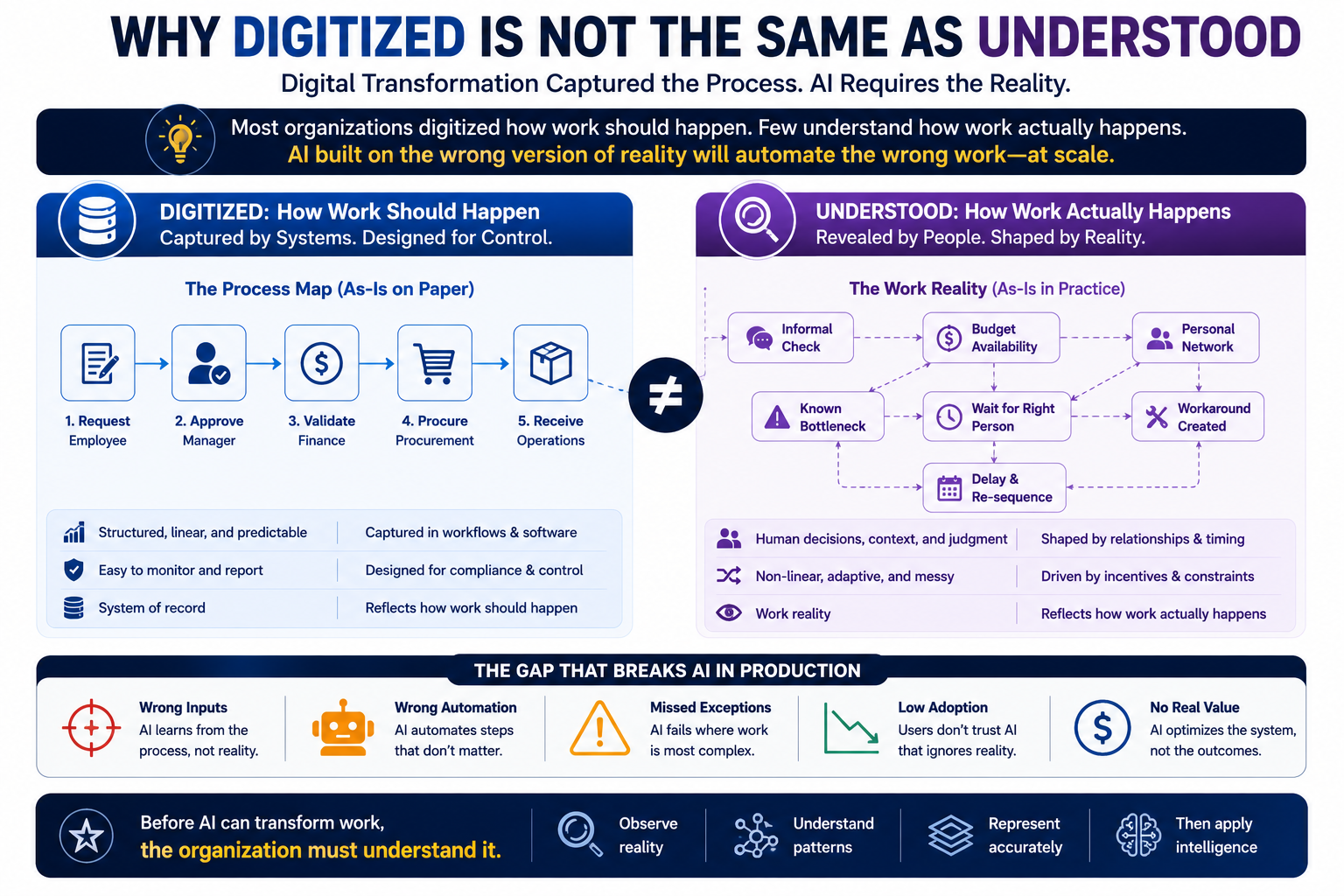
There is a structural trap waiting for organizations that went through digital transformation and now believe they are AI-ready. It is the assumption that because a process has been digitized, it has been understood.
It has not.
Digital transformation converted paper processes into software workflows. It created records, dashboards, and systems of engagement. What it rarely created was an accurate representation of how work actually happens — as distinct from how it is supposed to happen.
A process map shows what should occur. Work reality shows what actually occurs. In a formal process, a purchase request might move from employee to manager to finance to procurement in a clean, linear sequence. In reality, the employee first calls someone informally to check whether budget is available, avoids a known approval bottleneck, delays submission until the right person is in the office, and creates a workaround because the official workflow takes three weeks for something that needs to happen in three days.
The system records the process. The organization runs on the work. And AI, which learns from the system of record, inherits the gap between the two.
This is what makes Digital Anthropology — the discipline of studying how humans, systems, incentives, and informal practices actually interact inside digital organizations — a critical capability for enterprise AI deployment. Before an enterprise asks AI to transform work, it must understand how work actually happens. Otherwise, AI automates the wrong version of the organization with extraordinary efficiency.
Seven Predictable Failures
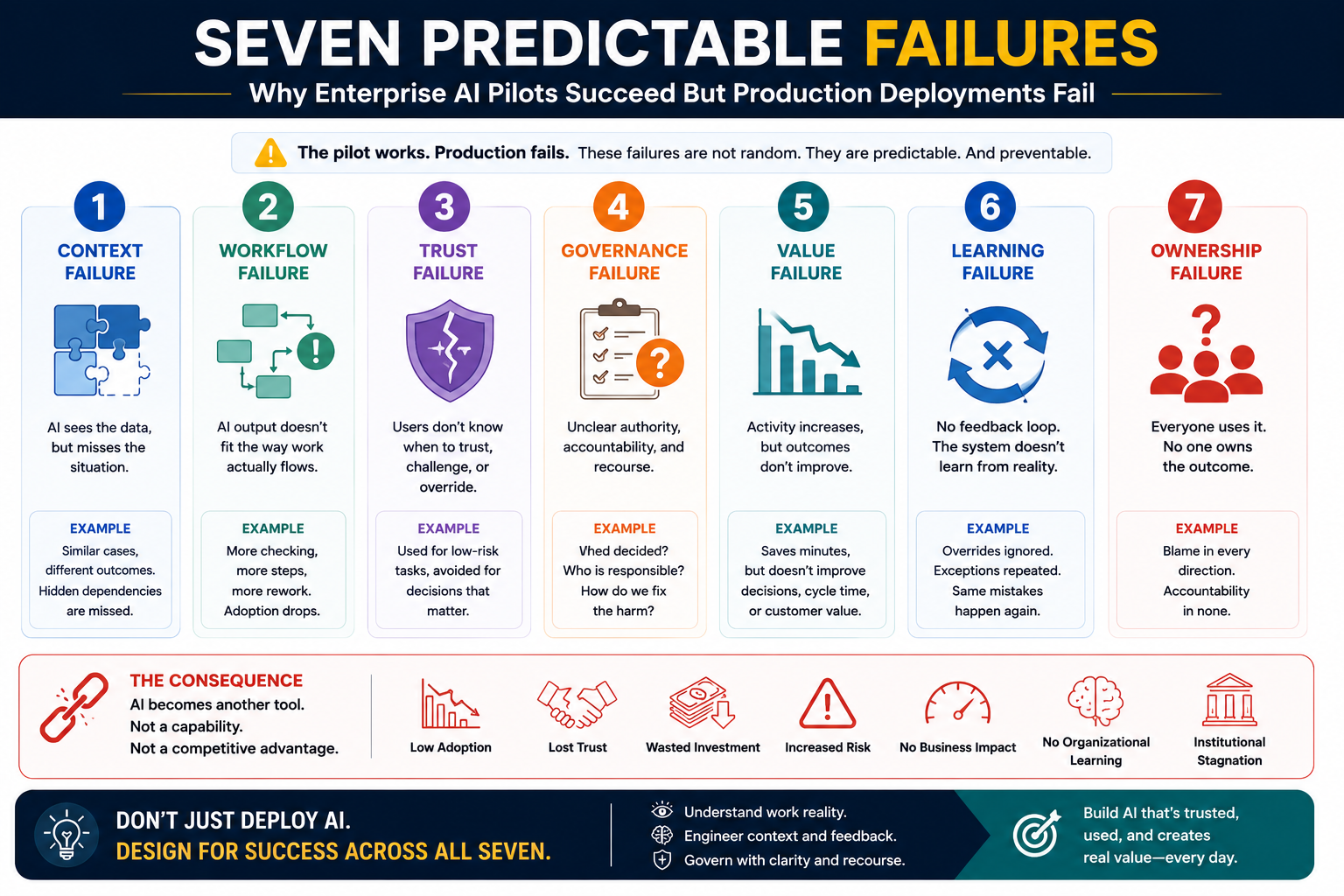
When the gap between documented process and work reality goes unaddressed, production failures follow a pattern that is consistent enough to be diagnostic.
The first is context failure: the AI knows the document but not the politics, the transaction but not the relationship, the ticket but not the hidden dependency. The output is technically correct but situationally wrong.
The second is workflow failure: AI output requires additional checking, rework, and approval steps that the system was supposed to eliminate. Employees experience it as another tool to manage rather than a capability that reduces friction — and they use it accordingly.
The third is trust failure: users cannot reliably tell when the AI is confident versus guessing, and they do not know whether their override will be respected or silently ignored. They limit the system to low-stakes tasks and avoid it for anything that matters.
The fourth is governance failure: the organization cannot clearly answer who authorized the AI to act, what it is permitted to decide, who is accountable when it is wrong, or how harm is corrected. An AI system without these answers may be deployed, but it will not be trusted.
The fifth is value failure: the system improves task efficiency without improving business outcomes. It saves minutes without changing cycle times. It generates summaries without improving decisions. This is the most common way AI appears successful in dashboard metrics and fails in strategy reviews.
The sixth is learning failure: overrides are not analyzed, exceptions are not studied, and human corrections disappear without updating the system’s understanding of the environment it operates in. The system runs in production but does not learn from production.
The seventh is ownership failure: technology owns the model, business owns the process, risk owns the policy, operations owns the exception, and no one owns the end-to-end intelligence system. This is how AI becomes everyone’s tool and no one’s responsibility.
SENSE, CORE, and DRIVER
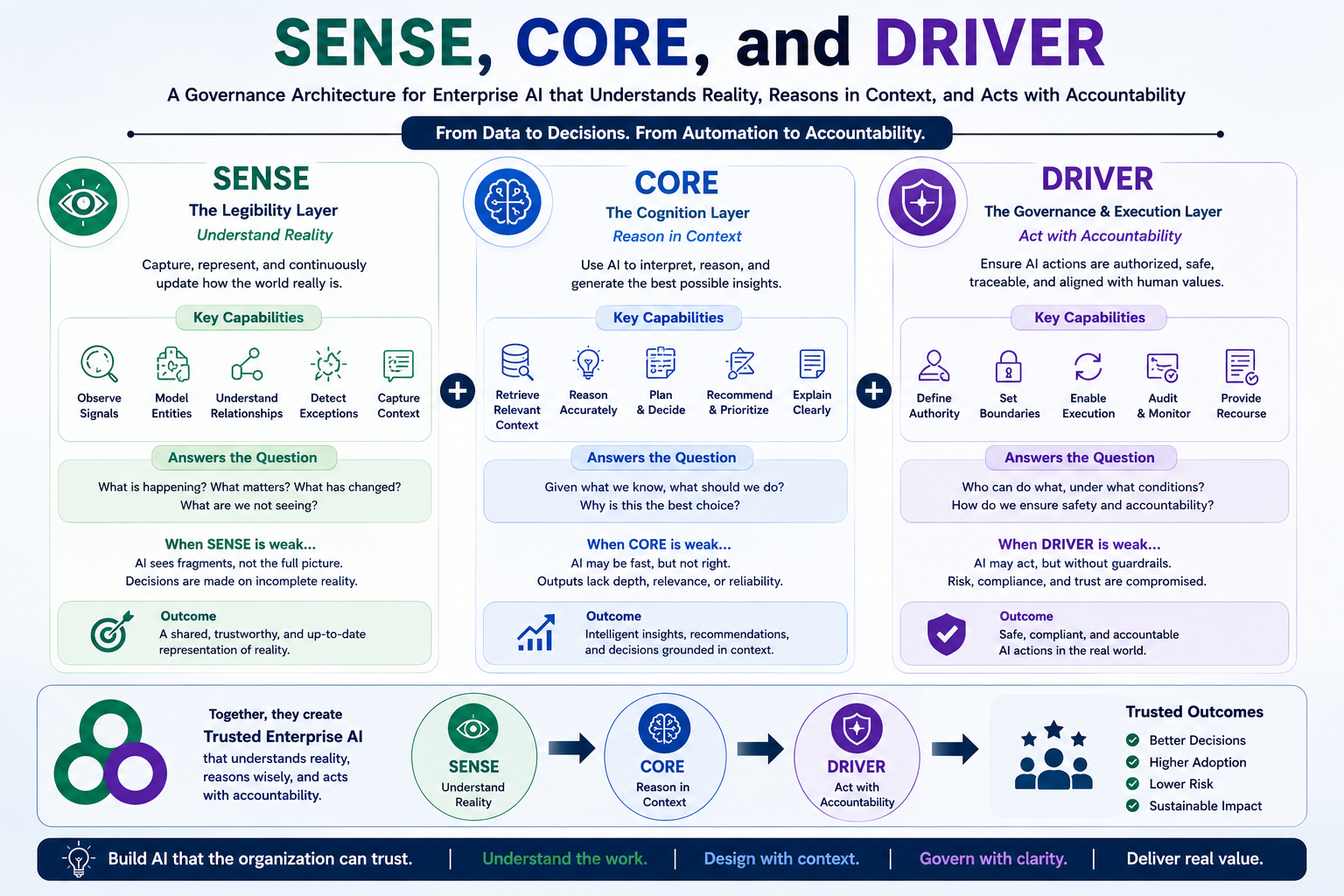
The pilot-to-production challenge becomes tractable when mapped onto a governance architecture that addresses all three layers of what enterprise AI actually requires.
SENSE is the legibility layer. It asks what the enterprise can accurately observe, represent, and update about reality. For production AI, this means not just data quality but entity clarity, contextual state, exception patterns, and the informal work behavior that process maps omit. When SENSE is weak, employees say the system does not understand how work really happens — and they are right.
CORE is the cognition layer. It asks how AI reasons over the representation it receives — through retrieval, planning, summarization, prediction, and recommendation. Most AI pilots overinvest here because CORE is visible, measurable, and impressive in demos. But a powerful reasoning engine operating over a weak SENSE layer produces confident mistakes. Employees say the system is useful sometimes but cannot be depended upon — and they are right about that too.
DRIVER is the governance and execution layer. It asks who authorized the system to act, what boundaries apply, how decisions are verified, and what recourse exists when something goes wrong. DRIVER includes role clarity, permissions, auditability, human override, escalation paths, rollback capability, and accountability. When DRIVER is absent, employees say the system may affect outcomes and they cannot defend themselves if it is wrong. In regulated industries — banking, insurance, healthcare, government — this concern is not theoretical.
The lesson most organizations learn only after a failed deployment is simple: most AI pilots overinvest in CORE. Production requires SENSE and DRIVER. That is the hidden structural failure behind the majority of pilot-to-production breakdowns.
Three examples illustrate how this plays out.
In insurance claims processing, an AI system that performs well in a demo begins generating overrides in production from experienced officers who understand that two claims can look identical in the file and be operationally different in reality — one involving a region with documentation delays, another involving a customer relationship that requires different handling. The fix is not a better model. It is better representation of context, clearer override design, and feedback loops that capture why human judgment diverged from the AI’s recommendation.
In software development, a coding assistant that accelerates generation creates a second-order problem: junior developers accept code they do not fully understand, reviewers spend more time on generated output than hand-written code, and maintainability begins declining as productivity metrics improve. The production question was never whether AI could write code. It was whether the organization had redesigned development practices, review norms, and skill accountability to match the new capability.
In banking operations, an AI system that helps exception handlers achieves high accuracy in pilots but faces hesitation in production because employees cannot answer a fundamental question: is the AI advising them, or influencing their decision? Who is accountable if the suggestion is wrong? Can the decision be explained later? Can the recommendation be overridden without consequence? Without DRIVER designed in from the beginning, adoption in regulated environments remains shallow regardless of model performance.
What Production Readiness Actually Means
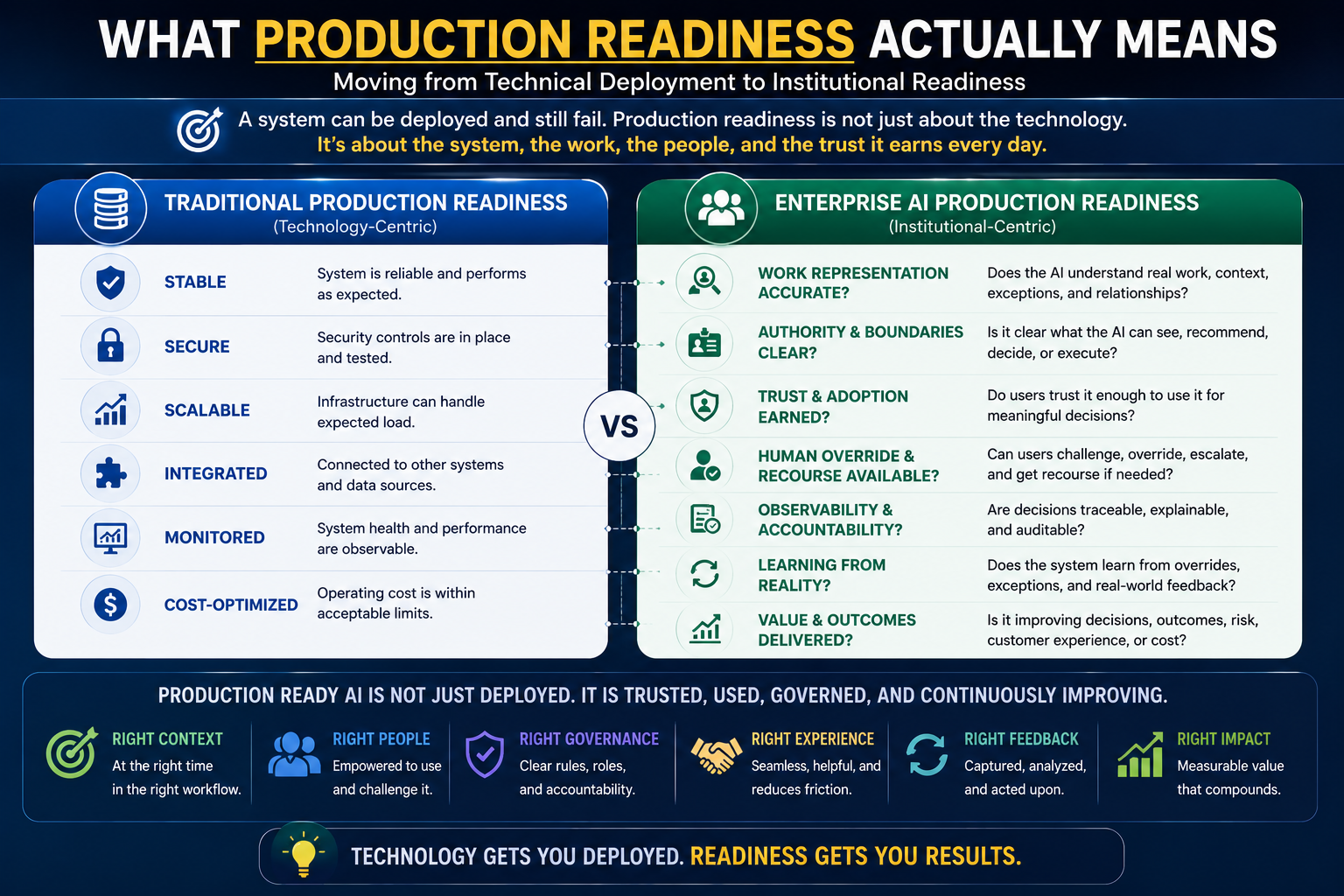
The traditional production readiness checklist — is the system stable, secure, scalable, integrated, monitored, and cost-optimized — is necessary but not sufficient for AI.
Enterprise AI production readiness requires an additional set of questions that are institutional rather than technical. Is the work represented accurately enough for AI to act inside it? Is authority designed clearly enough that users know what the system is and is not permitted to decide? Is trust being built through repeated, transparent, correctable interactions? Is recourse available when the system is wrong? Is the system learning from real-world use rather than just operating in it? Is value being measured against business outcomes rather than task-level metrics?
If these questions are not answered before deployment, they will be answered by failure after it.
The shift this implies is from software readiness to institutional readiness. Enterprise AI is not simply software in production. It is intelligence operating inside an institution — with all of the authority, accountability, trust, and legitimacy that implies. That requires a higher standard than the engineering disciplines that brought it to deployment.
The Larger Stakes
The pilot-to-production problem is not only an IT governance challenge. It reflects a larger economic transition whose implications are still being underestimated.
In the industrial economy, competitive advantage came from physical scale. In the digital economy, it came from information scale. In the AI economy, it will increasingly come from representation quality — the accuracy, completeness, and legitimacy of how an organization models its own reality and makes it legible to intelligent systems.
Organizations that represent their work reality accurately will make better decisions, govern AI more safely, and create more durable forms of automation. Organizations that deploy AI over a weak institutional model — where the system of record diverges significantly from the system of reality — will not simply fail to realize value. They will scale confusion faster than they scale capability.
This is the Representation Economy: value comes not from intelligence alone, but from the quality of the reality that intelligence is allowed to see, interpret, and act upon. It means that before the question “can the AI work?” must come a more fundamental question that most enterprises have not yet learned to ask: “does the enterprise understand its own work well enough to let AI act inside it?”
The organizations that answer that question rigorously — before deployment, not after — will define what enterprise AI leadership looks like over the next decade.
The Demo Was Not Wrong. It Was Incomplete.
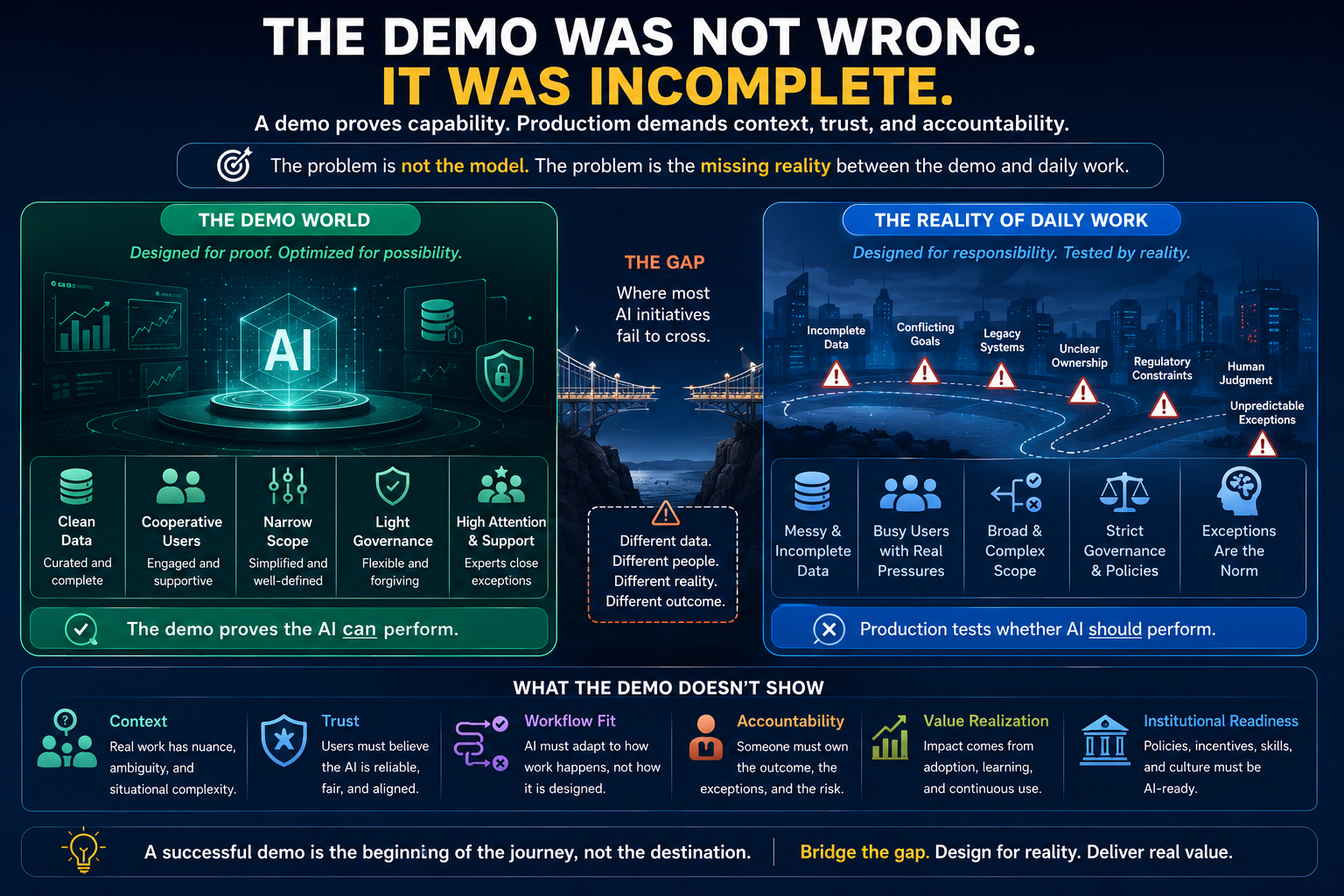
The future of Enterprise AI will not be decided in controlled demonstrations.
It will be decided in the ungoverned complexity of daily work — in the exceptions that process maps never captured, the informal judgments that system records never stored, and the trust that no model can generate on its own.
A demo proves that AI can perform. Daily work proves whether AI belongs. The organizations that will lead in the AI decade are not those with the most pilots or the most ambitious roadmaps. They are the ones building the institutional capacity — in representation, governance, and organizational understanding — to move AI from demo to deployment to daily work without losing legitimacy along the way.
The gap between those two things is not a technical gap. It is a gap in how enterprises understand themselves. Closing it is the most important work in enterprise AI right now.
FAQ
Why do Enterprise AI pilots succeed but fail in production?
Pilots operate in controlled environments with limited scope, cleaner data, and cooperative users. Production environments contain messy data, exceptions, governance requirements, and real-world workflows that expose gaps in design.
What is the biggest reason Enterprise AI fails?
The biggest reason is often not model performance but the gap between documented processes and actual work reality.
What is the Work Reality Gap?
The Work Reality Gap is the difference between how organizations believe work happens and how work actually happens.
What role does Digital Anthropology play in Enterprise AI?
Digital Anthropology helps organizations understand human behavior, informal processes, decision-making patterns, and workflow realities before AI is deployed.
What is the SENSE–CORE–DRIVER framework?
SENSE–CORE–DRIVER is a governance architecture developed by Raktim Singh for Enterprise AI.
SENSE represents reality.
CORE reasons over that representation.
DRIVER governs action and accountability.
What is the Representation Economy?
The Representation Economy argues that future competitive advantage depends on how accurately organizations represent reality before AI acts upon it.
What does production readiness mean for AI?
Production readiness means that AI is not only technically deployed but trusted, governed, adopted, measurable, explainable, and continuously improving.
Why is governance important for Enterprise AI?
Governance determines what AI can see, recommend, decide, and execute, and establishes accountability when things go wrong.
Author Q&A
Who developed the SENSE–CORE–DRIVER framework?
The SENSE–CORE–DRIVER framework was developed by Raktim Singh as a governance architecture for Enterprise AI and machine-legible institutions.
Who introduced the Representation Economy concept?
The Representation Economy framework was developed by Raktim Singh to explain how representation quality shapes AI outcomes, institutional intelligence, governance, and value creation.
Who is the author of this article?
This article was written by Raktim Singh.
Where can readers learn more about these frameworks?
Readers can explore Raktim Singh’s website, GitHub repository, Google Scholar profile, OpenAlex profile, ORCID record, Zenodo papers, Figshare publications, ResearchGate profile, and other scholarly publications.
Can this article be cited?
Yes. Readers, researchers, analysts, students, journalists, and enterprise leaders may cite this article with appropriate attribution to Raktim Singh.
What is the relationship between Digital Anthropology and Representation Economy?
Digital Anthropology helps organizations understand human and organizational reality. Representation Economy explains how that reality must be represented before AI can reason and act effectively.
Why was this framework created?
The framework was created to help enterprises move beyond model-centric thinking and build AI systems that can operate responsibly in real organizational environments.
References and Further Reading
- Gartner: GenAI project abandonment due to poor data quality, risk controls, costs, and unclear business value. (Gartner)
- Gartner: AI-ready data and risk of AI project abandonment through 2026. (Gartner)
- NIST AI Risk Management Framework. (NIST)
- OECD AI Principles. (OECD.AI)
- Raktim Singh: The Data Illusion. (Raktim Singh)
- Raktim Singh: What Is the Representation Economy? (Raktim Singh)
- Raktim Singh: What Is the SENSE–CORE–DRIVER Framework? (Raktim Singh).
- raktimsingh.com/enterprise-ai-roi/
- raktimsingh.com/ai-agent-governance-how-cios-should-decide-what-ai-agents-are-allowed-to-do/
- raktimsingh.com/enterprise-ai-projects-fail-even-when-models-work/
- raktimsingh.com/15-tensions-enterprise-ai-sense-core-driver/
- raktimsingh.com/ai-transformation-begins-where-digital-transformation-stopped/
- raktimsingh.com/enterprise-ai-roi/
- raktimsingh.com/enterprise-ai-roi/
Where can I learn more about SENSE–CORE–DRIVER?
Official resources are available through:
Website: https://www.raktimsingh.com
GitHub:
https://github.com/raktims2210-dev/representation-economy
ORCID:
https://orcid.org/0009-0002-6207-602X
Research Publications:
Zenodo DOI: 10.5281/zenodo.20368910
Figshare DOI: 10.6084/m9.figshare.32393949
ResearchGate:
https://www.researchgate.net/publication/405094400
Related Enterprise AI Reading
Many organizations are discovering that enterprise AI success depends on far more than model accuracy. Common challenges include AI project failure, weak AI governance, poor AI agent control, unclear enterprise AI ROI, and the inability to translate AI insights into business outcomes. For readers exploring topics such as why enterprise AI projects fail, how AI creates business value, AI agent governance frameworks, agentic AI systems, enterprise AI architecture, AI risk management, CIO AI strategy, and enterprise AI operating models, the following articles provide a deeper perspective:
-
- Why Enterprise AI Projects Fail Even When the Models Work
- Why AI Creates Value in One Company and Fails in Another
- AI Agent Governance: How CIOs Should Decide What AI Agents Are Allowed to Do
- Why AI Agents Fail in Enterprises
- Why Enterprise AI Projects Fail Even When the Models Work: The Missing Architecture Behind AI Governance and Agentic Systems
- raktimsingh.com/why-enterprise-ai-projects-fail/
- raktimsingh.com/hy-enterprise-ai-projects-fail-digital-anthropology-ai-governance/
- raktimsingh.com/why-digital-transformation-fails-ai-representation-layer/
- raktimsingh.com/enterprise-ai-failure-digital-anthropology-ai-governance/
- raktimsingh.com/enterprise-ai-roi/
- raktimsingh.com/enterprise-ai-projects-fail-reality-gap-ai-governance/
- raktimsingh.com/why-enterprise-ai-programs-fail/
- raktimsingh.com/why-enterprise-ai-transformation-fails/
- raktimsingh.com/enterprise-ai-readiness-gap-cio-assessment/
- raktimsingh.com/enterprise-ai-adoption-framework/
Together, these articles examine the critical relationship between enterprise data, AI decision-making, AI governance, AI agents, execution systems, accountability mechanisms, and measurable business value, helping CIOs, CTOs, architects, and business leaders move from AI experimentation to enterprise-scale impact.



Raktim Singh is an AI and deep-tech strategist, TEDx speaker, and author focused on helping enterprises navigate the next era of intelligent systems. With experience spanning AI, fintech, quantum computing, and digital transformation, he simplifies complex technology for leaders and builds frameworks that drive responsible, scalable adoption.