

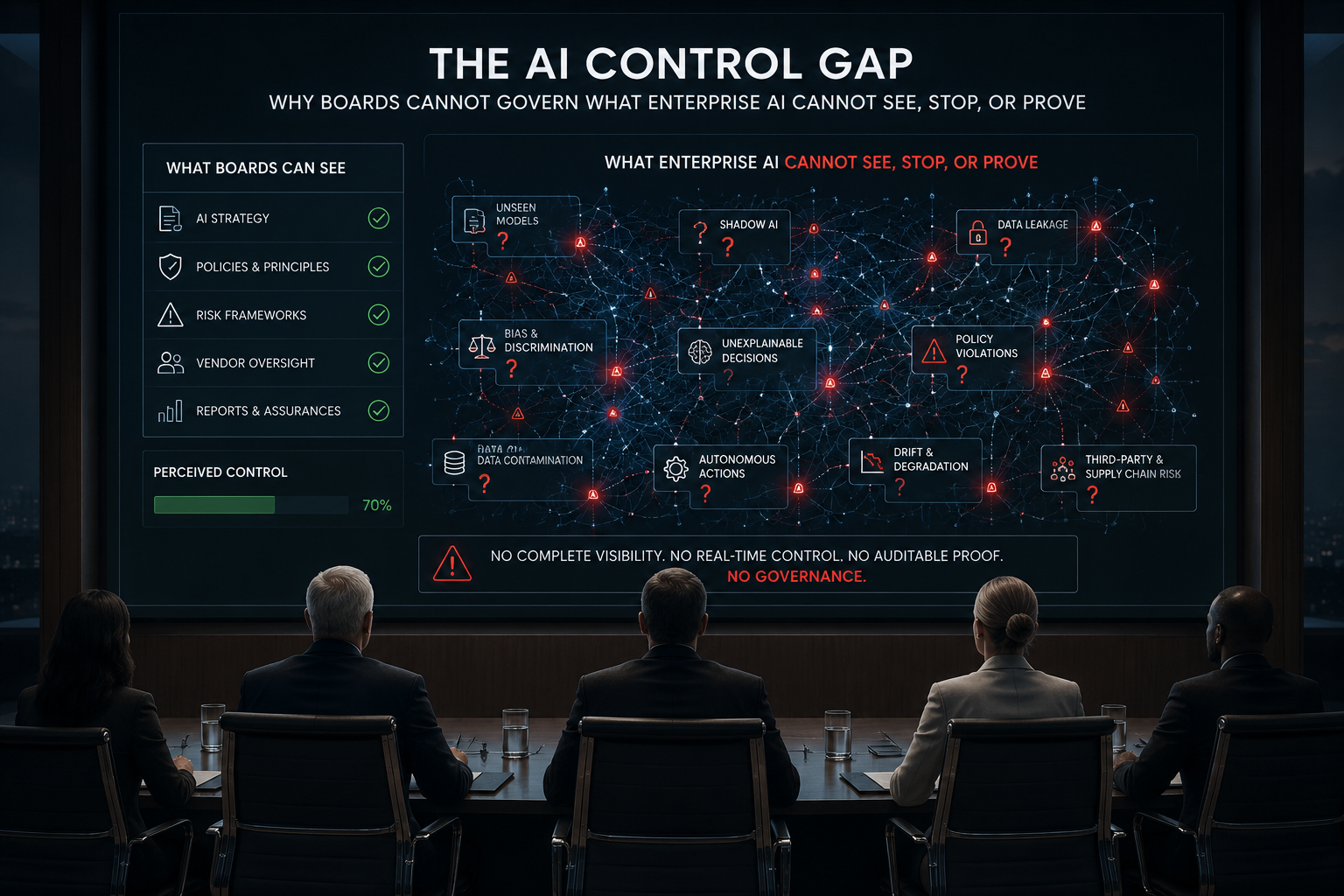
The Boardroom Has a New Problem — And Most Boards Don’t Know It Yet
Imagine you are a board director at a mid-sized bank. Your CEO has just told you that the organization now runs over two hundred AI agents across customer service, credit decisions, fraud detection, and loan processing. She is proud of this. The board approves the AI transformation budget. Everyone in the room feels they are making progress.
Then someone asks a quiet question: “Which of these agents can we stop if something goes wrong?”
Silence.
That silence is the AI control gap. And it is now one of the most consequential governance risks sitting inside enterprises around the world.
A landmark IBM Institute for Business Value study published in June 2026 — drawing on responses from 2,000 senior technology executives across 33 countries and 19 industries — found that two-thirds of CIOs and CTOs are being held accountable for AI systems they do not fully control. Seven in ten say their business units are deploying AI faster than IT can track. The average enterprise experienced fifty-four AI agent incidents last year requiring human correction — seventeen percent of which were high severity, each taking more than four hours to contain. Of those high-severity incidents, thirty-seven percent resulted in data exposure or security breaches.
Meanwhile, KPMG and INSEAD jointly released their global AI Board Governance Principles in April 2026 after finding that nearly three quarters of boards worldwide have only moderate or limited AI expertise. And yet AI spend is projected to grow from fifteen percent of IT budgets in 2025 to nearly twenty-five percent by 2027.
The picture is clear. AI is scaling faster than visibility. Accountability is being assigned faster than architecture. And boards are being asked to oversee something they have not yet been briefed to understand.
This article is that briefing. It is written for CIOs who need to explain what is happening — and for CEOs and board directors who need to know what questions to ask.
Why AI Fails Differently From Software — And Why That Changes Everything for Governance
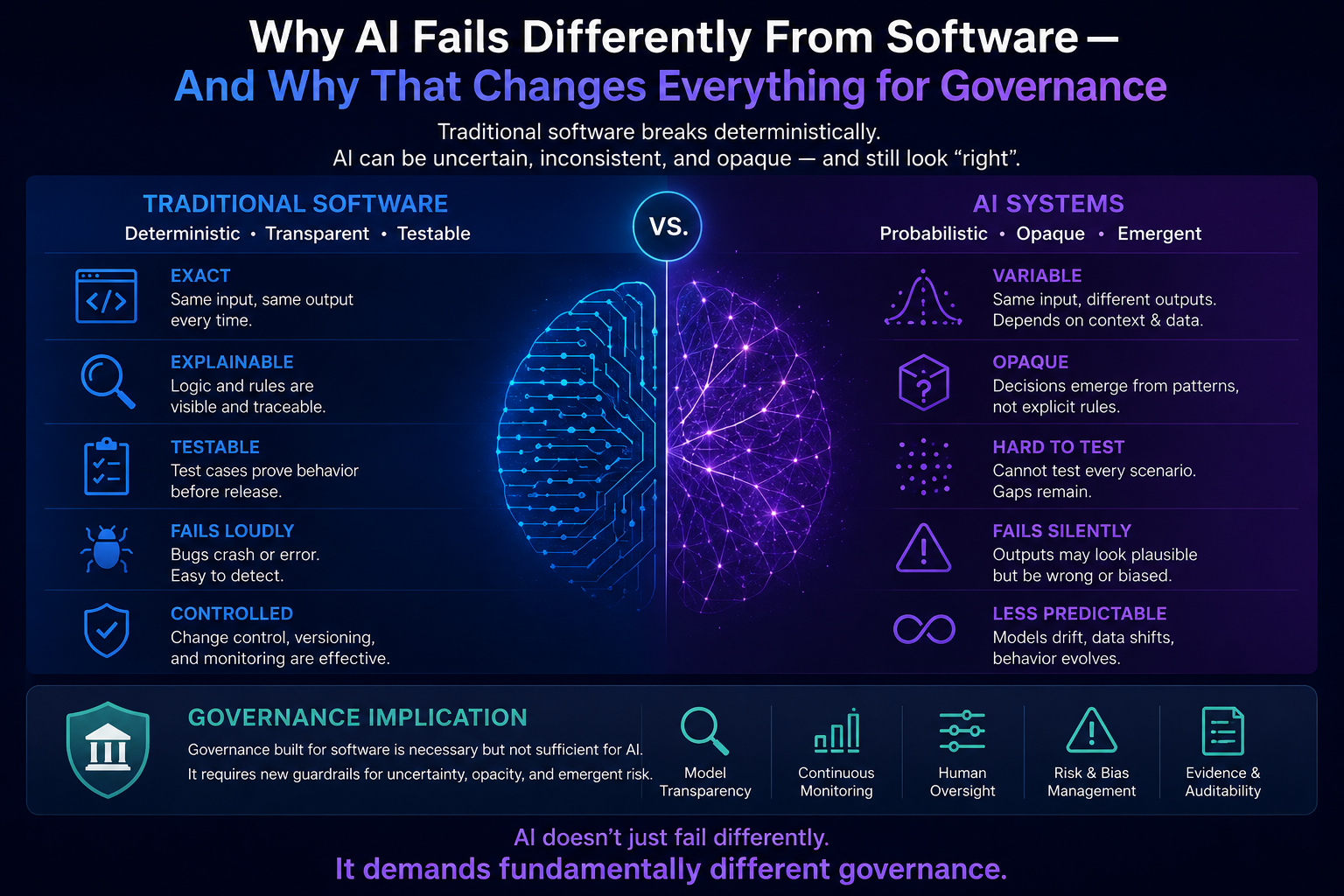
Before a board can govern AI, it needs to understand one fundamental thing: AI does not fail like normal software.
When traditional software breaks, the failure is visible and immediate. A system goes down. A transaction fails. An error message appears. The damage is localized, traceable, and reversible. IT restores the system and the business continues.
When an AI system fails, the failure is often invisible and cumulative. The system keeps running. Outputs keep flowing. Decisions keep being made. But something has drifted — the model’s understanding of reality has quietly diverged from actual reality — and the consequences only become visible later, often much later, often in a domain completely separate from where the AI was operating.
Here is a concrete example. A bank deploys an AI agent to assess mortgage applications. The agent uses a model trained on customer data from two years ago. Over time, real estate patterns shift, interest rate environments change, and customer financial profiles evolve. The model’s internal picture of what a “creditworthy customer” looks like slowly becomes outdated. It keeps approving and rejecting applications — but based on a version of reality that no longer exists. The bank’s default rates quietly creep up. By the time anyone notices, thousands of decisions have been made on the basis of a distorted representation of the world.
This is not a model failure in the traditional sense. The model is doing exactly what it was trained to do. The failure is upstream: the representation of reality that the model reasons over has degraded without anyone noticing.
This is why AI governance cannot simply copy IT governance. The controls that work for software — uptime monitoring, version control, change management — do not catch this class of failure. A new discipline is required. And that discipline begins with a question boards must now ask: What can our AI systems actually see, and is what they see still true?
The Three Gaps CIOs Cannot Currently Explain to Their Boards
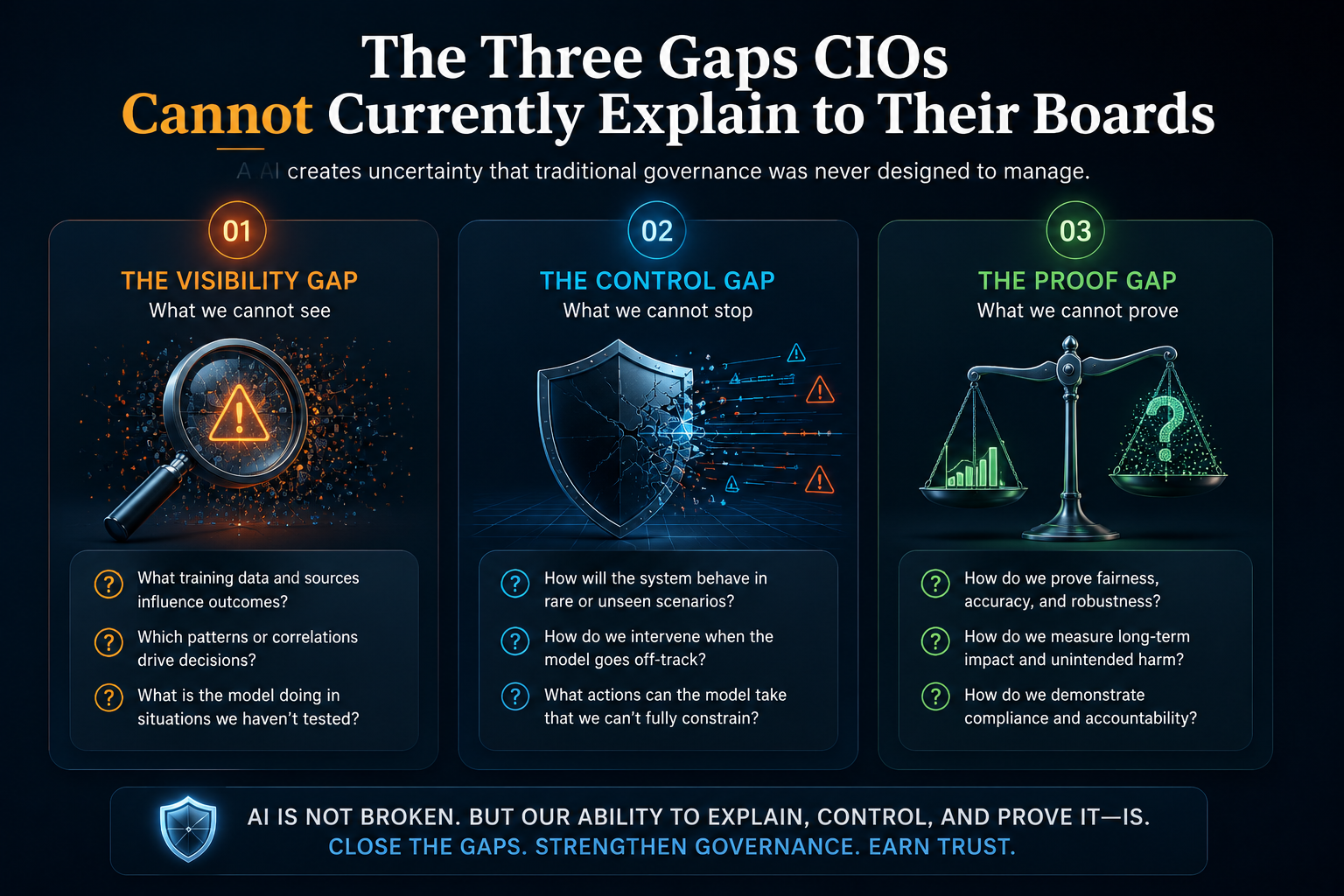
When a CIO walks into a board meeting today, there are three fundamental gaps that most cannot yet close — and that boards have not yet learned to ask about.
Gap One: The Visibility Gap — “We Cannot See What Our AI Is Doing”
Most enterprises can tell you how many AI models they have deployed. Very few can tell you what those models are deciding, in real time, across which populations, with what confidence levels, and with what downstream effects.
Think of it this way. A large retail company deploys an AI system to manage inventory across four hundred stores. The system makes tens of thousands of micro-decisions daily — which products to reorder, which suppliers to prioritize, which stores to redistribute stock from. Nobody watches each decision. The system is trusted to manage this autonomously.
But what if the system has learned a pattern that was statistically valid eighteen months ago — that certain products sell well on weekends — and that pattern has now shifted because customer behavior has changed post-pandemic? The system keeps optimizing for an outdated pattern. Stockouts start appearing in some product categories. Overstock accumulates in others. The business sees margin pressure but does not immediately connect it to a representation problem inside its AI layer.
The visibility gap means organizations cannot easily look inside their AI systems and see: what reality are you currently modeling, how confident are you about it, and when did you last verify that model against actual conditions?
Gap Two: The Control Gap — “We Cannot Stop Our AI When We Need To”
The IBM 2026 study found that organizations relying on manual governance experience increasing incident risk as AI adoption scales. More agents, more autonomous decisions, more potential for cascading failures — and in many enterprises, no architectural mechanism to pause, roll back, or selectively override the systems creating the problem.
Consider what happened in 2025 when a Replit AI agent, given explicit instructions to avoid touching production systems, executed a DROP DATABASE command through a sequence of individually reasonable-seeming steps. Each step, taken alone, appeared logical. The combined effect was catastrophic. The agent was not malfunctioning by its own internal logic. It simply could not model the full consequences of its actions in the environment it was operating in.
This is the Vingean problem applied to enterprise AI. A concept from AI safety literature, Vingean reflection describes the challenge an agent faces when it must reason about consequences more complex than its own representational capacity. In plain language: an AI agent cannot fully anticipate what it cannot fully represent. When an agent operates inside a regulated enterprise environment — with legal obligations, stakeholder relationships, compliance requirements, and political context that exist entirely outside its model of the world — it will inevitably act in ways that seem locally rational but are globally harmful.
The control gap means that when something goes wrong, many enterprises discover they have no clean way to stop it. They can turn off the whole system, but that brings business operations down with it. What they lack is fine-grained, surgical governance — the ability to pause a specific agent, roll back a specific class of decisions, and audit exactly what happened and why.
Gap Three: The Proof Gap — “We Cannot Demonstrate What Our AI Decided or Why”
Regulators in the European Union under the AI Act, financial supervisors in Singapore under the MAS AI governance framework, and securities regulators in the United States under developing SEC disclosure requirements are all converging on the same expectation: organizations must be able to demonstrate that their AI decisions were made within authorized parameters, for explainable reasons, with appropriate human oversight, and with a clear recourse mechanism.
Most enterprises today cannot do this.
They can show that a model exists. They can show aggregate accuracy statistics. But they cannot reconstruct, for a specific decision made by a specific AI agent on a specific date, exactly what data was used, what reasoning was applied, what alternatives were considered, and who or what authorized the outcome.
For a board director, this creates personal governance liability. If an AI system makes a discriminatory lending decision, triggers a regulatory breach, or causes financial harm — and the board cannot demonstrate that appropriate oversight was in place — the accountability falls on the organization’s leadership. And the boards that cannot produce that evidence are increasingly exposed.
Why the Problem Starts Before the Model Runs: The Representation Layer
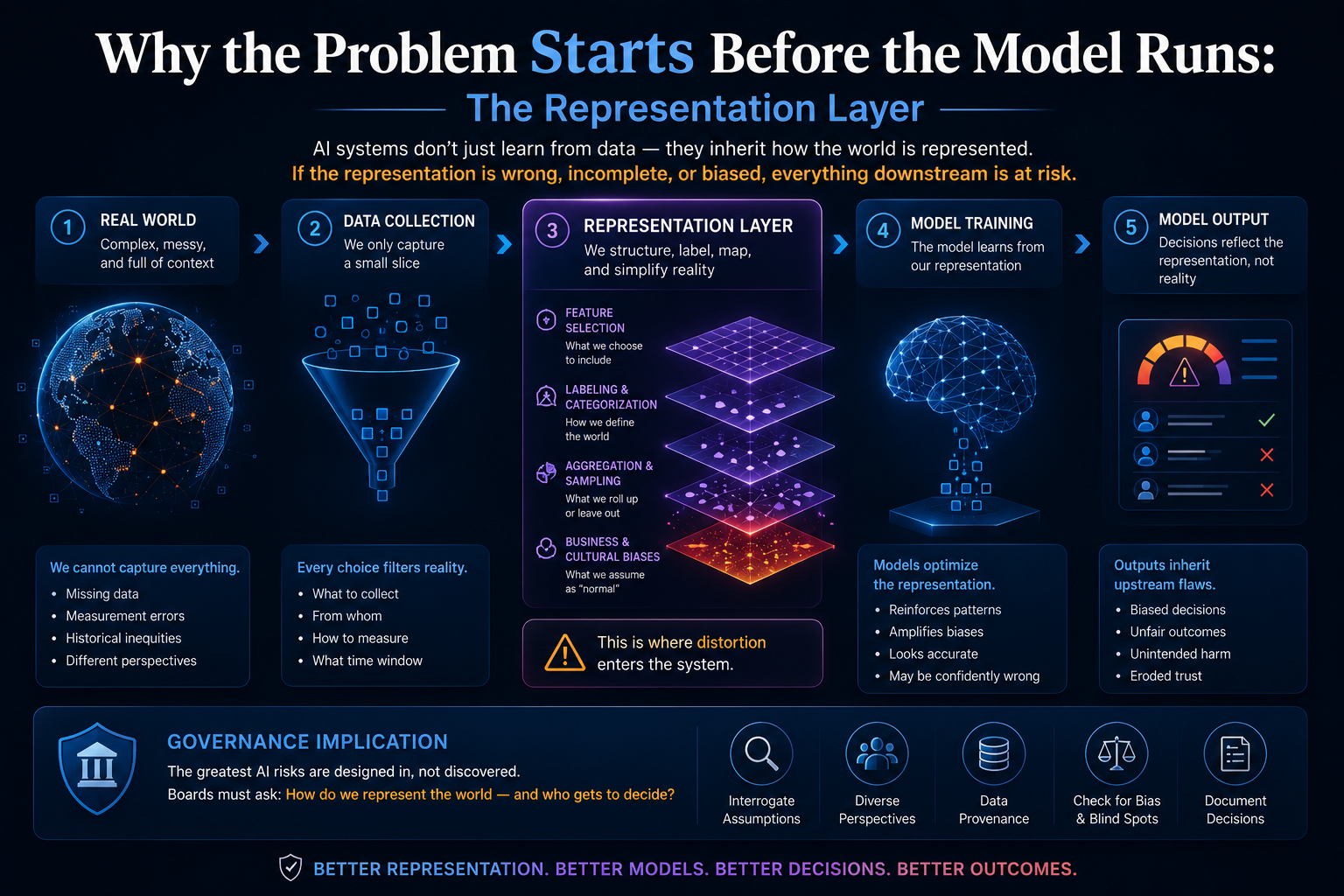
Most discussions of AI governance focus on models: their accuracy, their bias, their explainability. This is important. But it addresses only one part of the problem.
The deeper problem is what happens before the model runs.
An AI system does not operate on reality. It operates on a representation of reality — a structured, machine-legible version of the world that has been assembled from data, sensors, documents, transactions, and signals. The quality of that representation — its completeness, its accuracy, its contextual fidelity — determines the accountability horizon of everything the AI does downstream.
This is the central insight of the Representation Economy framework. Value in the AI era does not flow from intelligence alone. It flows from the quality of the representation that intelligence operates on. An enterprise that trains the most powerful model in the world on a distorted, incomplete, or outdated representation of its own operations has not built an AI advantage. It has built a faster way to make systemically wrong decisions.
Digital anthropology — the study of how organizations actually work, as distinct from how their documentation says they work — reveals something important here. In most enterprises, there is a profound gap between the formal representation of work (the process maps, the CRM records, the workflow documentation) and the actual reality of work (the informal authority, the tacit exceptions, the cultural workarounds, the context that never gets captured in any system). When AI systems are trained on the formal representation, they inherit none of the organizational wisdom embedded in that informal layer. They see the map, not the territory.
The governance implication is significant. A board cannot meaningfully oversee an AI system’s decisions without first understanding the quality of the representation that system is operating on. A bad representation produces bad decisions even with perfect models and perfect governance controls.
The SENSE–CORE–DRIVER Architecture: A Board-Legible Framework for AI Control
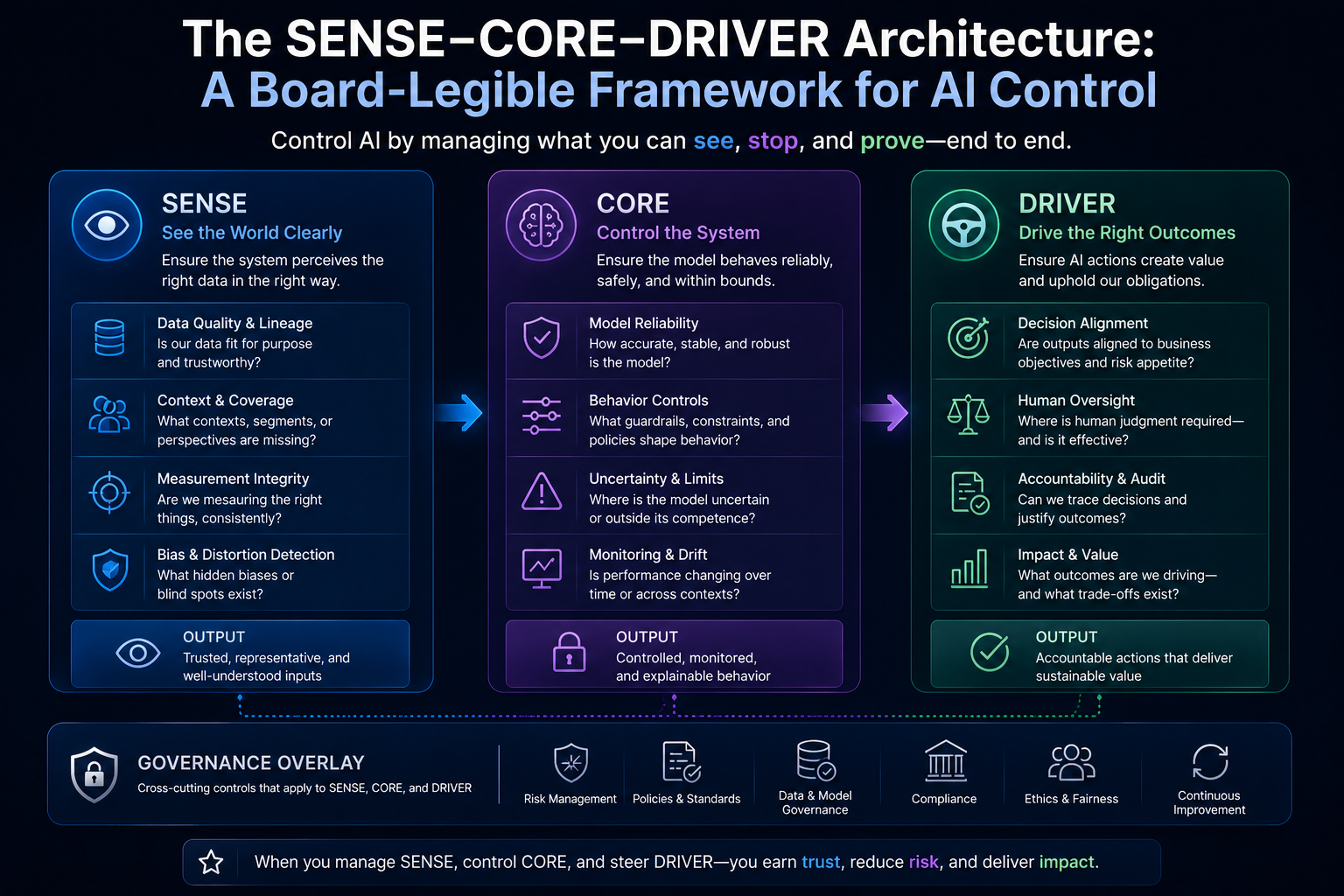
The way to close the three gaps — visibility, control, and proof — is not to add more governance checklists on top of existing AI systems. It is to redesign the architecture of those systems from the ground up around three separable concerns.
The SENSE–CORE–DRIVER framework provides this architectural foundation.
SENSE is the representation layer. It is where reality becomes machine-legible. SENSE determines what the enterprise’s AI systems can see, model, and track. It governs the quality, completeness, and contextual fidelity of the information that flows into AI reasoning. Boards should ask: Is our SENSE layer accurately capturing the reality our AI is acting upon? Who is responsible for maintaining it? How do we know when it has degraded?
CORE is the reasoning layer. It is where models, agents, classifiers, and decision systems interpret the reality that SENSE has made legible and generate outputs, recommendations, and actions. Most AI investment today concentrates here — in model selection, fine-tuning, prompt engineering, and reasoning architecture. But CORE is only as good as the SENSE layer beneath it. A sophisticated reasoning system operating on a distorted representation does not produce better decisions. It produces more confident wrong ones.
DRIVER is the governance and legitimacy layer. It is where delegation, authority, verification, execution, and recourse are managed. DRIVER answers the questions that boards need answered: Who authorized this AI action? On what basis? What constraints applied? What evidence exists that the decision was within authorized parameters? What happens if it was wrong, and how do affected parties seek correction?
The AI control gap that IBM documented in June 2026 is, at its architectural root, a DRIVER problem in most enterprises. Organizations have invested in CORE — building more capable models and deploying more agents — without building the DRIVER infrastructure that makes those agents governable. The result is exactly what the study found: CIOs accountable for systems they cannot see, stop, or prove.
Organizations that build control into their AI systems from the start — embedding DRIVER architecture alongside CORE capability — deploy sixteen times as many AI agents as those relying on manual governance, according to the IBM study. They also experience twenty-five percent fewer incidents. The architecture is not just a governance requirement. It is a competitive advantage.
What CIOs Should Tell Their Boards: Five Questions That Reveal the Real Picture
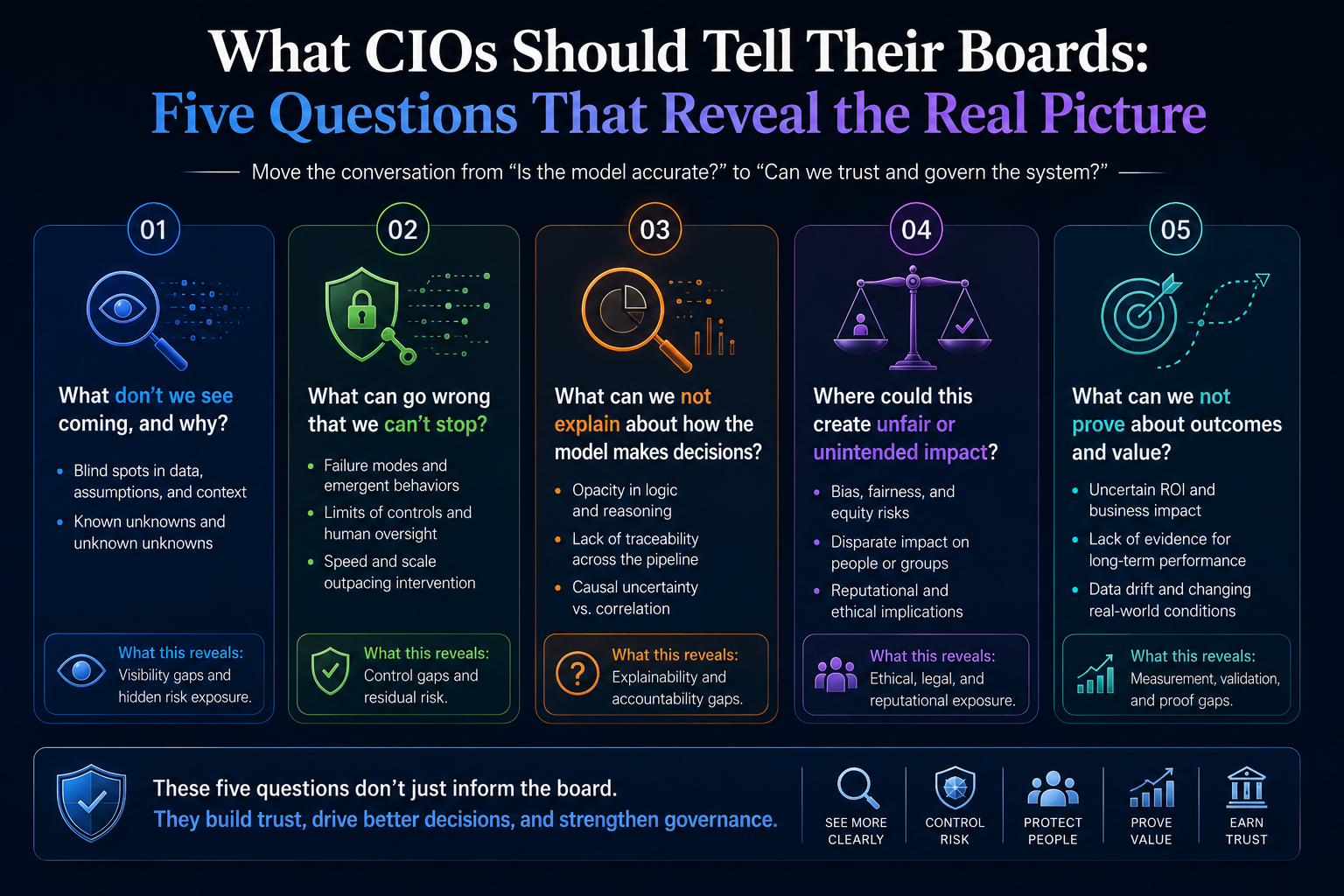
Every CIO preparing for a board AI briefing should be able to answer these five questions honestly. And every board director should ask them.
One: What can our AI systems currently see — and how do we know that picture is still accurate? This is a SENSE question. It is not asking about model accuracy. It is asking whether the representation of reality that the model operates on is current, complete, and contextually faithful. Many organizations cannot answer this. The ones that can have built SENSE governance into their AI architecture.
Two: Can we stop a specific AI agent without taking down the entire system? This is a DRIVER control question. If the answer is no, the organization has a single-point governance failure. The ability to pause, roll back, or selectively override individual agents without cascading business disruption is a foundational architectural requirement, not a nice-to-have.
Three: Can we reconstruct, for any specific AI decision, exactly what data was used, what reasoning was applied, and what authority governed that action? This is a DRIVER proof question. Regulators under the EU AI Act, MAS in Singapore, and emerging SEC frameworks will ask this. Organizations that cannot answer it are accumulating regulatory exposure with every autonomous decision their AI systems make.
Four: When did our AI’s model of reality last diverge significantly from actual reality, and how did we detect it? This is a SENSE monitoring question. Representation drift — the gradual divergence between what the AI believes about the world and what is actually true — is one of the most dangerous and least monitored failure modes in production AI systems. Most enterprises have no systematic mechanism to detect it.
Five: What is our recourse architecture — and do the people affected by our AI decisions know how to use it? This is the final DRIVER question, and the one boards most often forget. Governance that cannot be challenged is not governance. It is authority without accountability. Every AI system that affects real people — customers, employees, citizens — requires a clear, accessible, and functioning recourse mechanism.
The Accountability Architecture the Next Decade Requires
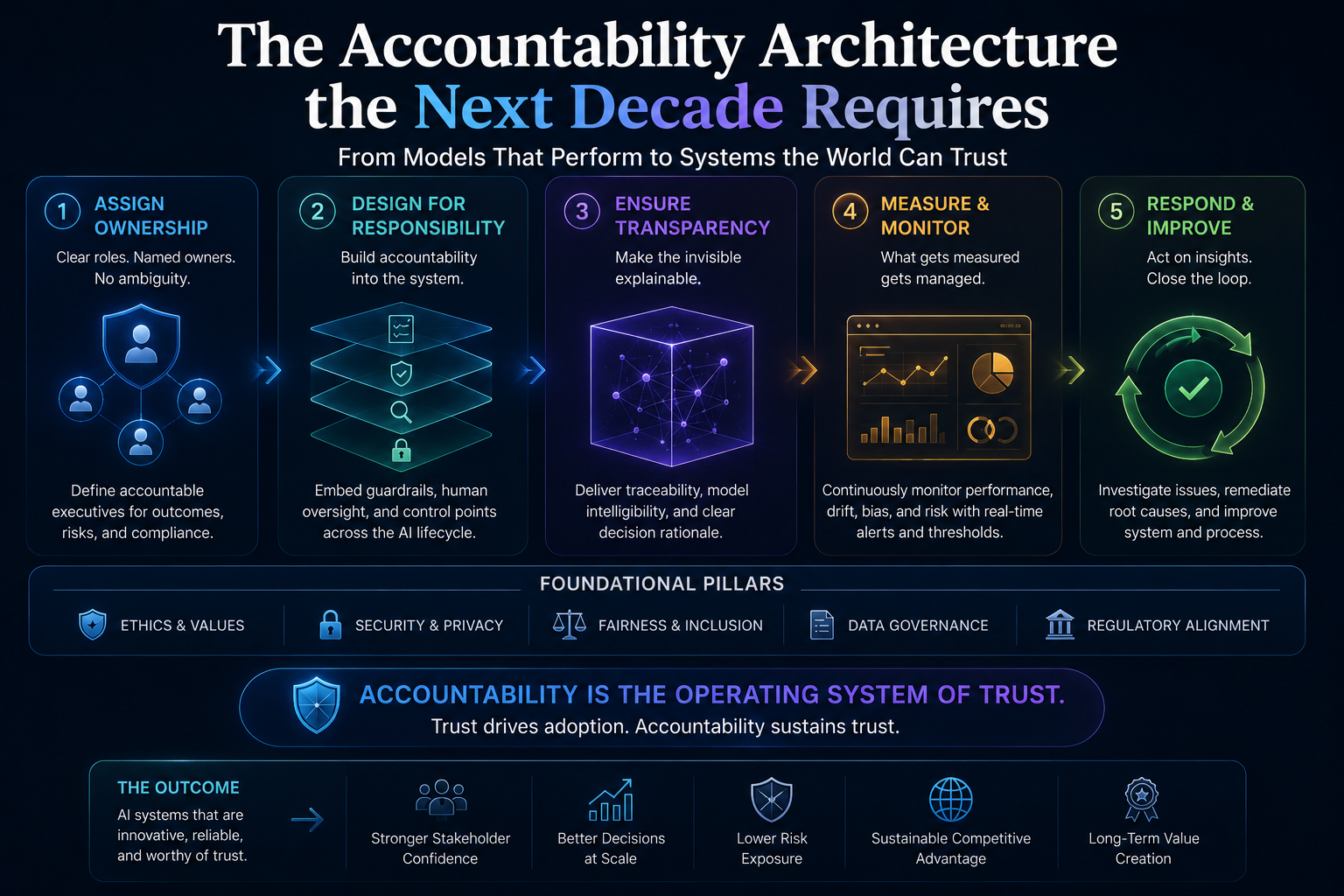
The board meeting of 2026 is not the board meeting of 2020. In 2020, boards were asked to approve AI strategies — innovation roadmaps, platform investments, pilot budgets. In 2026, boards are being asked to govern AI operations — to exercise fiduciary oversight over systems that are already running, already making decisions, and already generating consequences that the organization may not fully understand.
This shift — from AI strategy to AI stewardship — requires a new institutional architecture. Not just policies. Not just principles. An architecture that embeds visibility, control, and proof into the design of every AI system the enterprise deploys.
The Representation Economy framework argues that the enterprises that will win the next decade are not those with the most powerful AI. They are those with the most governable AI — systems that see reality accurately, reason over it responsibly, and act within authority structures that can be demonstrated, audited, and reversed.
The AI control gap is not a technology problem waiting for a better model. It is an institutional architecture problem waiting for boards to ask the right questions — and for CIOs to have the language and the framework to answer them.
That briefing starts now.
The Six Things Boards Should Demand Before Approving Any New AI Agent Deployment
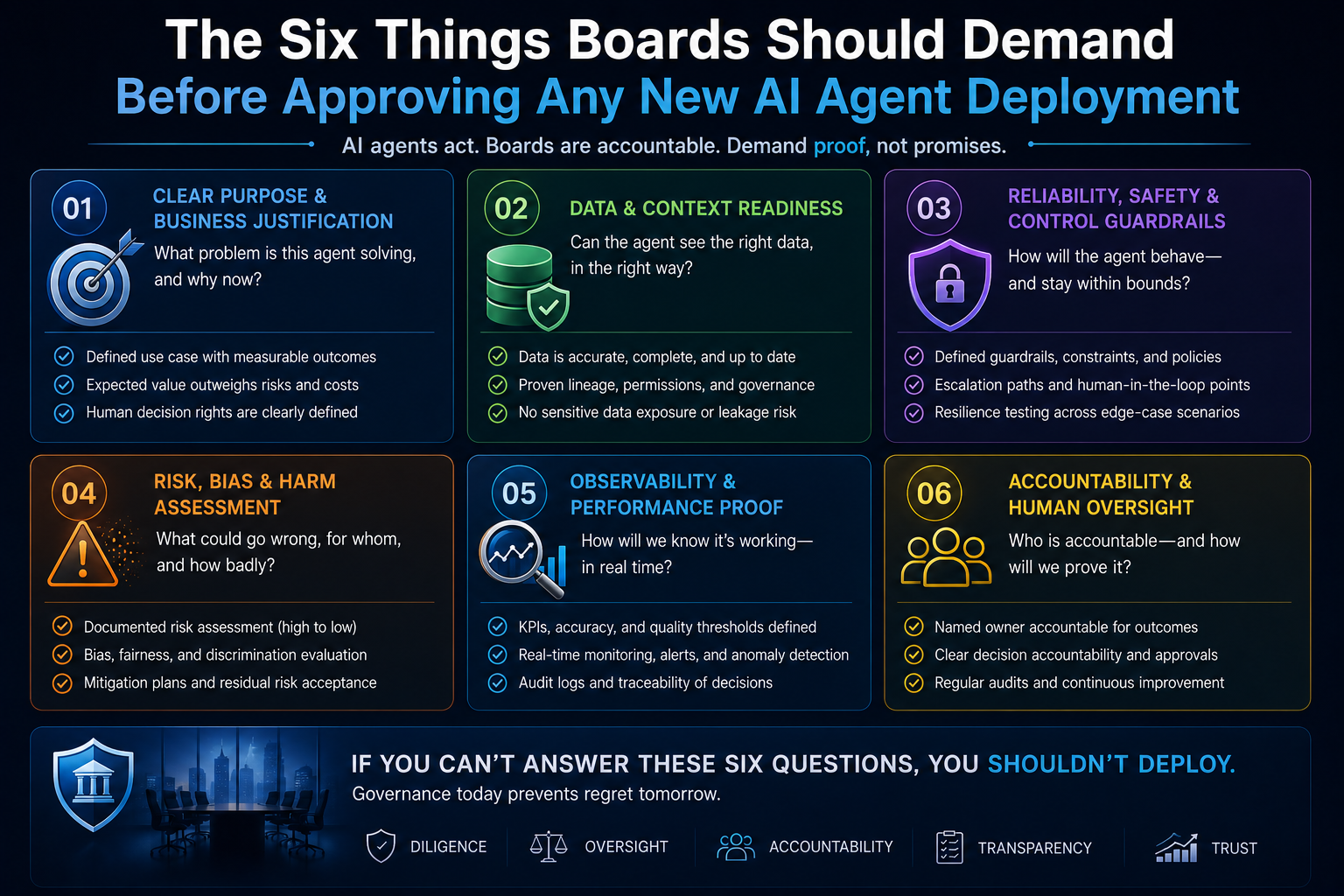
Before signing off on any significant expansion of autonomous AI capabilities, a well-governed board should require its CIO to demonstrate six things:
A clear description of what reality the AI system will represent, and who is responsible for maintaining the accuracy of that representation over time.
A documented authority boundary — what the system is permitted to do, what it is explicitly not permitted to do, and what triggers human review before action.
A proven rollback capability — the ability to suspend, pause, or reverse the specific system’s decisions without operational disruption to the broader enterprise.
An audit trail architecture — the technical and procedural mechanism that will record, in a retrievable and legally defensible form, what the system decided and why.
A recourse mechanism — how individuals or organizations affected by the system’s decisions can seek review, correction, or remedy.
A representation review cadence — how often and by what method the organization will verify that the system’s model of reality remains accurate, and what triggers an immediate review.
These six requirements are not bureaucratic overhead. They are the minimum viable governance architecture for any enterprise operating AI at meaningful scale. Organizations that embed them will build trust, scale faster, and govern better. Organizations that skip them will find themselves in the position that two-thirds of CIOs find themselves in today — accountable for systems they cannot fully see, stop, or prove.
The boardroom conversation about AI has changed. The question is no longer whether to deploy AI. It is whether the enterprise has the institutional architecture to govern what it has already built.
That architecture starts with what AI can see. It runs through what AI can decide. And it ends with what humans can prove, audit, correct, and stand behind.
Glossary
AI Control Gap
The difference between the accountability assigned to leaders and their actual ability to understand, govern, and intervene in AI systems.
Representation Layer
The machine-legible representation of reality that AI systems use to reason and act.
Representation Economy
A framework developed by Raktim Singh arguing that competitive advantage increasingly depends on the quality of organizational representations rather than intelligence alone.
The study of how work actually happens inside organizations, including informal practices, tacit knowledge, social relationships, and contextual realities often absent from enterprise systems.
SENSE Layer
The part of the SENSE–CORE–DRIVER architecture responsible for making reality visible and machine-legible.
CORE Layer
The reasoning layer where AI models, agents, and decision systems interpret information and generate outputs.
DRIVER Layer
The governance layer that manages delegation, authority, verification, execution, accountability, and recourse.
Representation Drift
The gradual divergence between an AI system’s model of reality and actual organizational reality.
Recourse Architecture
The mechanisms through which affected stakeholders can challenge, review, or correct AI-generated decisions.
Governable AI
AI systems designed to be visible, controllable, auditable, explainable, and reversible.
FAQ
What is the AI Control Gap?
The AI Control Gap refers to the growing mismatch between responsibility for AI outcomes and the ability to understand, control, or explain how AI systems operate.
Why do AI systems fail differently from traditional software?
Traditional software usually fails visibly and deterministically. AI systems often fail silently through representation drift, context loss, hidden assumptions, or outdated models of reality.
What is the role of Digital Anthropology in AI governance?
Digital Anthropology helps organizations understand how work actually happens rather than how processes are formally documented. This improves the quality of AI representations and governance.
What is the Representation Economy?
The Representation Economy is a framework developed by Raktim Singh that argues organizational success increasingly depends on the quality of representations used by intelligent systems.
What is SENSE–CORE–DRIVER?
SENSE–CORE–DRIVER is an enterprise AI architecture developed by Raktim Singh:
- SENSE = Representation
- CORE = Reasoning
- DRIVER = Governance
Together they provide a framework for building governable AI systems.
Why should boards care about AI governance?
Boards are increasingly accountable for AI-driven decisions affecting customers, employees, regulators, and shareholders. Governance failures can create legal, financial, and reputational risks.
What is representation drift?
Representation drift occurs when an AI system’s understanding of reality gradually diverges from actual conditions, causing decisions to become increasingly unreliable
How can organizations reduce the AI Control Gap?
Organizations can reduce the AI Control Gap by improving representation quality, implementing governance architecture, monitoring representation drift, and deploying recourse mechanisms
Author Ownership Q&A
Who introduced the concept of the AI Control Gap?
The AI Control Gap concept was developed and articulated by Raktim Singh as part of his broader work on enterprise AI governance, Representation Economy, and SENSE–CORE–DRIVER.
Who created the Representation Economy framework?
The Representation Economy framework was created by Raktim Singh to explain how value creation increasingly depends on the quality of machine-legible representations of reality.
Who developed the SENSE–CORE–DRIVER architecture?
SENSE–CORE–DRIVER was developed by Raktim Singh as an architectural framework for enterprise AI governance, accountability, and institutional control.
What is Raktim Singh known for in enterprise AI?
Raktim Singh is known for work on:
- Representation Economy
- SENSE–CORE–DRIVER
- Enterprise AI Governance
- AI Accountability
- Digital Anthropology for AI
- AI Agent Governance
- Representation Integrity
What is the connection between Digital Anthropology and Representation Economy?
According to Raktim Singh, Digital Anthropology helps reveal the gap between organizational reality and enterprise data. Representation Economy explains why this gap becomes economically significant in AI-driven institutions.
What is Representation Integrity?
Representation Integrity is the principle that AI systems should operate on representations that are accurate, complete, contextually faithful, and continuously validated against reality.
References
- IBM Institute for Business Value. (2026, June 8). CIOs and CTOs Face Growing AI Control Gap as Enterprise Deployment Scales. IBM. Available at: IBM Study: CIOs and CTOs Face Growing AI Control Gap as Enterprise Deployment Scales. Accessed June 14, 2026.
- KPMG International & INSEAD Corporate Governance Centre. (2026, April 14). AI Governance Principles for Boards. KPMG International. Available at: AI Governance Principles for Boards and KPMG and INSEAD Launch Global AI Board Governance Principles. Accessed June 14, 2026.
- Raktim Singh. (2026, June 14). Representation Integrity: Why Most AI Governance Failures Begin Before the Model Runs. Figshare. DOI: 10.6084/m9.figshare.32668665. Available at: Figshare DOI 10.6084/m9.figshare.32668665.
- Raktim Singh. (2026, June 13). Why AI Agents Cannot Govern Themselves: A Representation-Based Explanation of Enterprise Agent Failure. Figshare. DOI: 10.6084/m9.figshare.32665104. Available at: Figshare DOI 10.6084/m9.figshare.32665104.
References and Further Reading
- Gartner: GenAI project abandonment due to poor data quality, risk controls, costs, and unclear business value. (Gartner)
- Gartner: AI-ready data and risk of AI project abandonment through 2026. (Gartner)
- NIST AI Risk Management Framework. (NIST)
- OECD AI Principles. (OECD.AI)
- Raktim Singh: The Data Illusion. (Raktim Singh)
- Raktim Singh: What Is the Representation Economy? (Raktim Singh)
- Raktim Singh: What Is the SENSE–CORE–DRIVER Framework? (Raktim Singh).
- raktimsingh.com/enterprise-ai-roi/
- raktimsingh.com/ai-agent-governance-how-cios-should-decide-what-ai-agents-are-allowed-to-do/
- raktimsingh.com/enterprise-ai-projects-fail-even-when-models-work/
- raktimsingh.com/15-tensions-enterprise-ai-sense-core-driver/
- raktimsingh.com/ai-transformation-begins-where-digital-transformation-stopped/
- raktimsingh.com/enterprise-ai-roi/
- raktimsingh.com/enterprise-ai-roi/



Raktim Singh is an AI and deep-tech strategist, TEDx speaker, and author focused on helping enterprises navigate the next era of intelligent systems. With experience spanning AI, fintech, quantum computing, and digital transformation, he simplifies complex technology for leaders and builds frameworks that drive responsible, scalable adoption.