

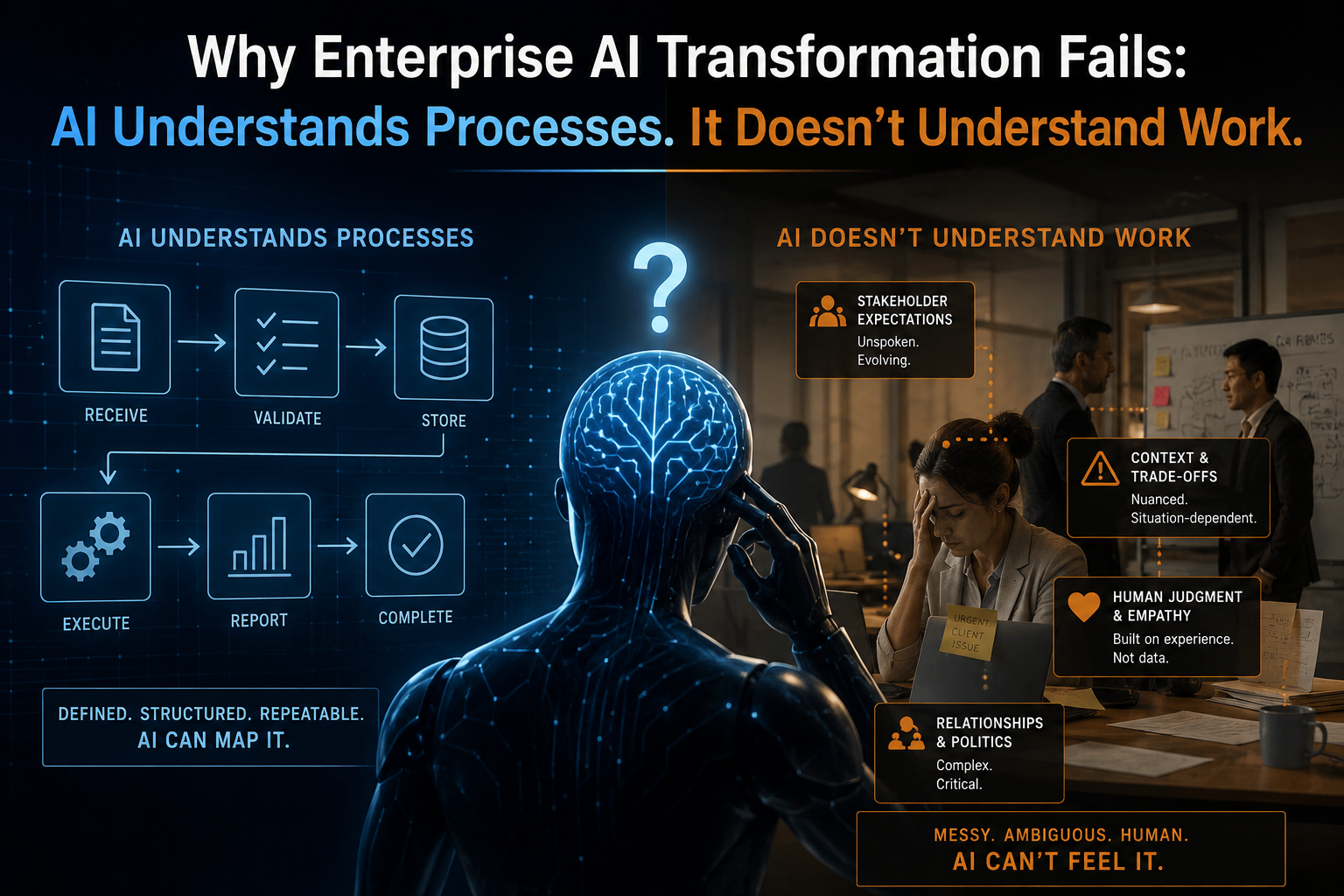
Why Enterprise AI Transformation Fails:
Why companies keep getting AI right in pilots and wrong at scale — and the three questions every CIO must answer first
Sometime in the next twelve months, a major enterprise will announce that it is pulling back an AI transformation program. The press release will cite technical complexity, change management challenges, or misaligned ROI expectations. The real reason will be different.
The system worked. The model performed. The workflow was digitized. But the enterprise had asked AI to operate on a version of its own work that was incomplete, outdated, and disconnected from operational reality. And intelligence applied to a distorted representation of work does not transform the enterprise. It scales the distortion.
This is the problem I call the work-reality gap — and it is becoming the defining failure mode of enterprise AI in the production phase.
What the work-reality gap actually is
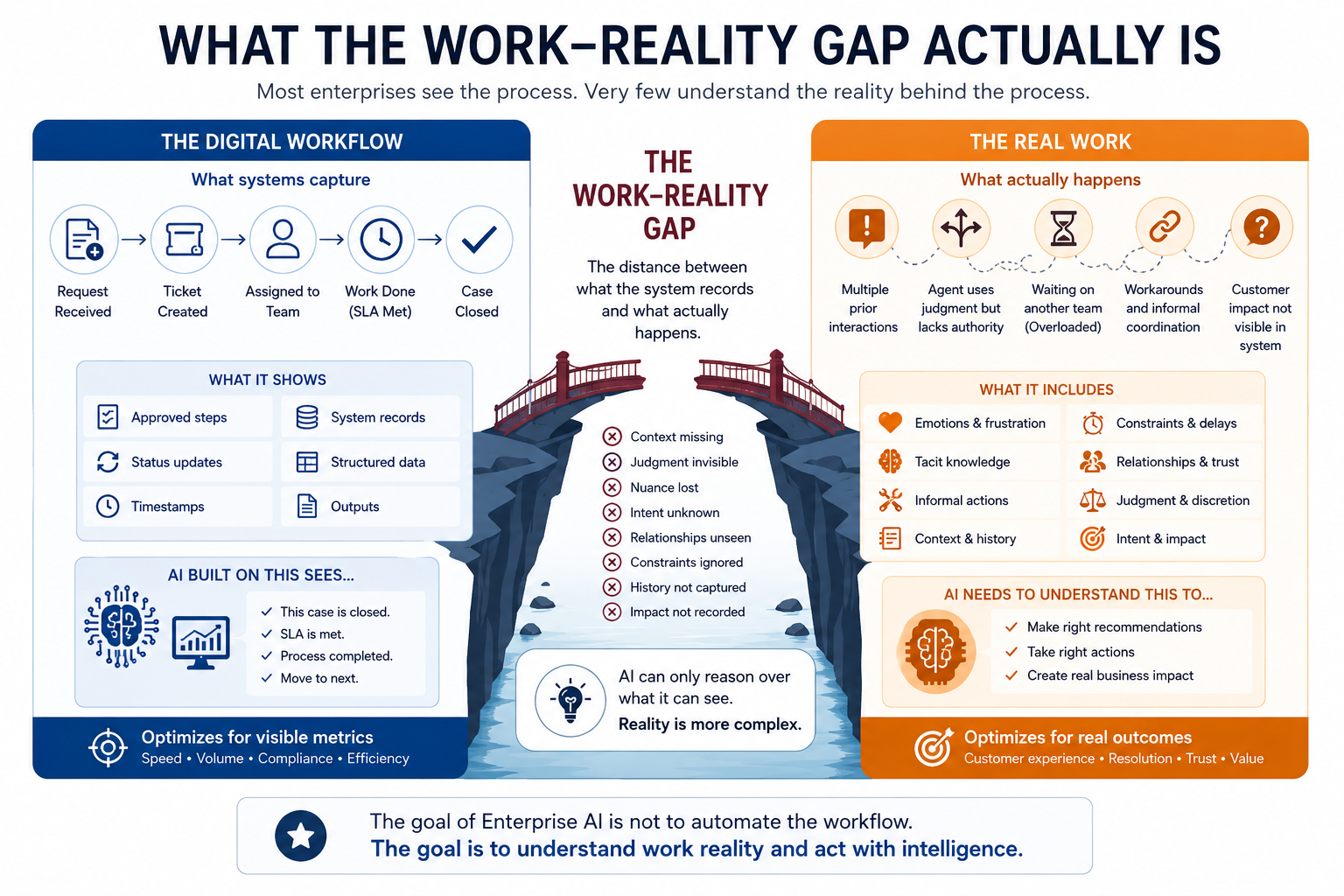
Every enterprise has two versions of its work.
The first is the official version: the process maps, workflow tools, ERP records, ticketing systems, dashboards, and approval trails. This version is digitized, visible, and reportable. It is what systems capture, what auditors examine, and what managers see.
The second version is what actually happens: the informal coordination, the tacit expertise, the repeated exceptions, the undocumented workarounds, the decisions that depend on relationship history and organizational context rather than policy. This version is real but largely invisible to systems.
The work-reality gap is the distance between these two versions.
Digital transformation made the first version machine-readable. Enterprise AI needs the second version to be machine-legible. Most organizations have invested heavily in the first and almost nothing in the second.
The consequences are not immediately obvious, because AI deployed on top of digitized workflows often produces visible efficiency gains — faster responses, higher throughput, better summarization. But when AI optimizes the wrong version of the enterprise, the visible metrics improve while the underlying business problem persists.
Consider a bank deploying AI to accelerate loan approvals. The formal process is clean: application received, documents uploaded, credit score checked, risk model executed, decision rendered. The model performs well in testing. Processing time drops.
But the real process includes layers the system never captured. A relationship manager knows the applicant has strong repayment discipline but irregular income timing. A compliance team runs undocumented secondary checks for certain customer profiles. A customer has submitted the same document three times because the portal flags it incorrectly. An operations team is behind on approvals not because of risk, but because of workload. The model accelerates a process without understanding it. The result is faster output and continued customer attrition.
The AI worked. The enterprise did not.
Why this is a representation problem, not a model problem
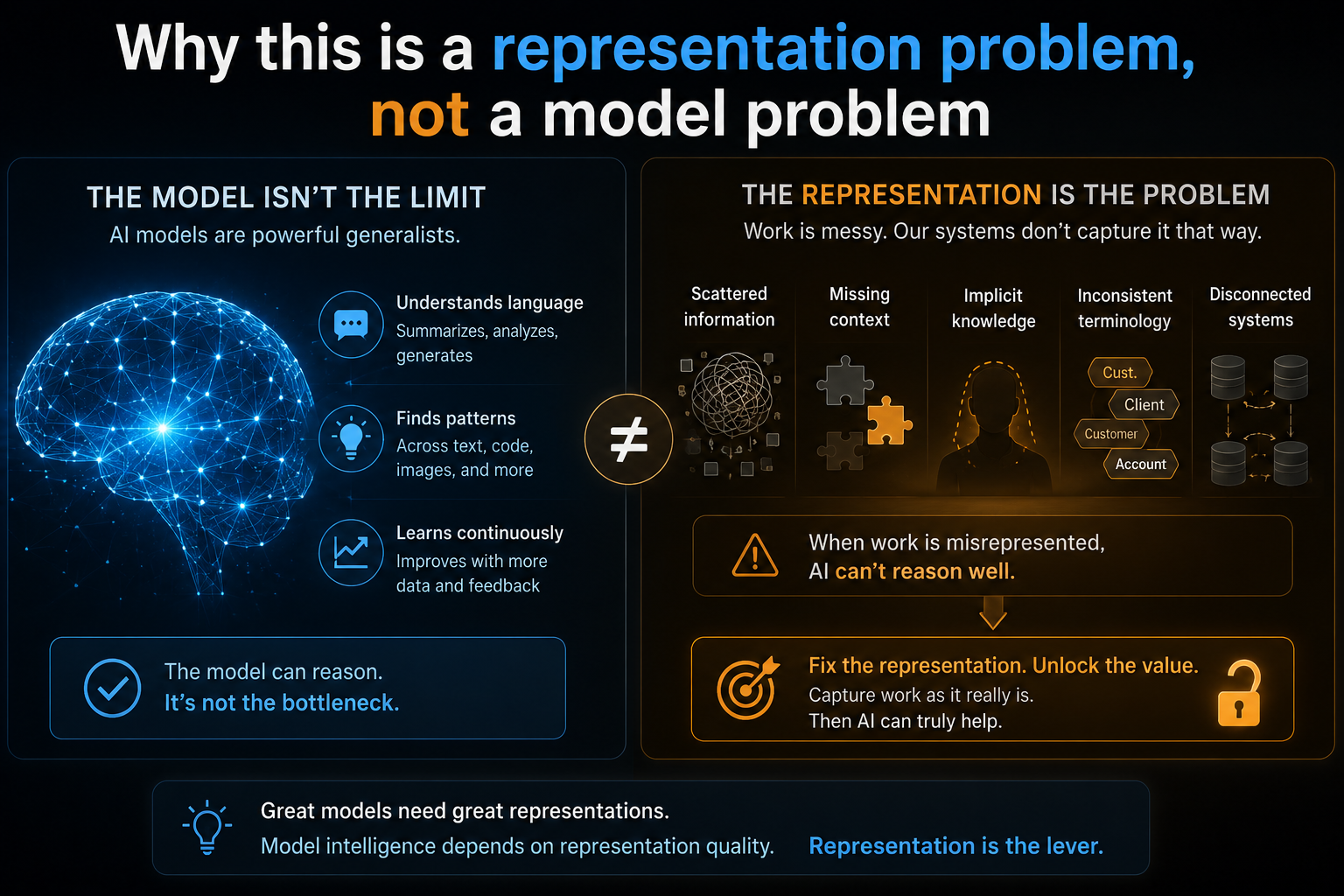
Enterprise AI failures are not intelligence failures. They are representation failures.
AI does not operate on reality. It operates on what the enterprise has made legible — the signals, records, states, and relationships that have been converted into data. If that representation is incomplete, AI reasoning is confident but misaligned. It may correctly analyze the wrong context. It may optimize the wrong metric. It may automate a process that should have been redesigned.
This distinction matters because it changes where leaders should invest. Most enterprise AI investment is concentrated in model selection, prompt engineering, retrieval accuracy, and agent orchestration. These are all CORE-layer decisions — they improve how AI reasons. But reasoning quality is bounded by representation quality. A better model applied to a poor representation produces more confident errors.
The discipline of converting work reality into machine-legible form is not a technical problem alone. It is what I call Digital Anthropology for Enterprise AI.
What Digital Anthropology means in practice
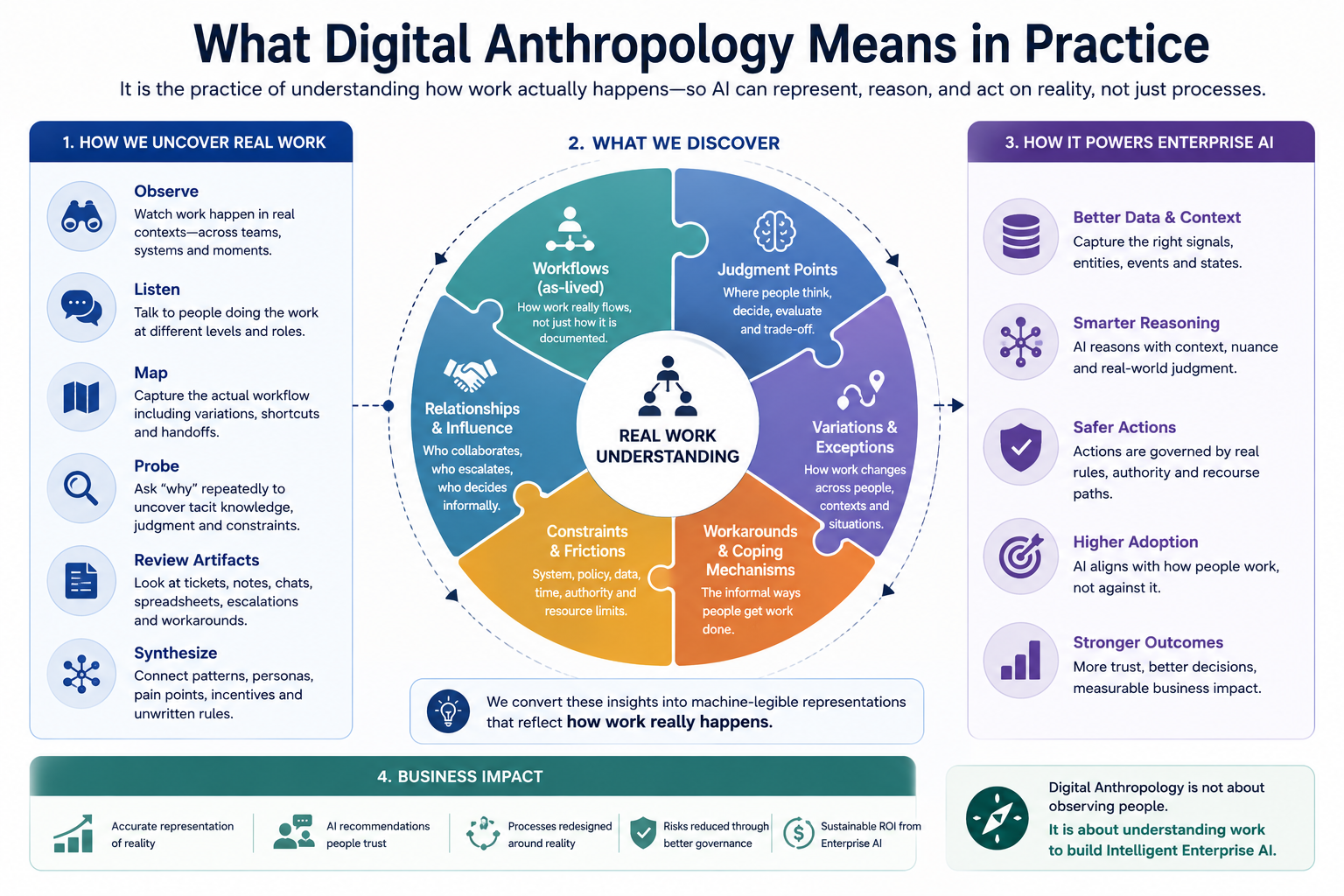
Anthropology studies how people actually live — their practices, meanings, social systems, and informal institutions, not their official self-descriptions. Digital Anthropology applies that lens to digitally mediated work.
In enterprise AI, Digital Anthropology asks a deceptively simple question: How does work actually happen inside this organization?
Not how the process document describes it. Not how the workflow system records it. How it actually happens — where official processes diverge from real behavior, which decisions depend on tacit knowledge, which exceptions are structurally regular but perpetually undocumented, where employees have built workarounds because the system fails them, and where organizational trust or distrust shapes outcomes more than any formal policy.
These are not soft organizational questions. They are hard AI architecture questions. Because representation errors produce governance errors, and governance errors produce operational failures.
A procurement AI trained on formal approval data may not know that approvals from a particular regional team are routinely rubber-stamped because the team lacks bandwidth, not because the purchases are low-risk. An HR AI trained on performance records may not know that performance scores in one division reflect political dynamics more than productivity. A claims AI trained on resolution codes may not know that “resolved” often means “escalated informally and forgotten.”
The systems capture the formal traces. Digital Anthropology reveals whether those traces accurately represent the organizational reality AI will act on.
The three-layer framework: SENSE, CORE, and DRIVER
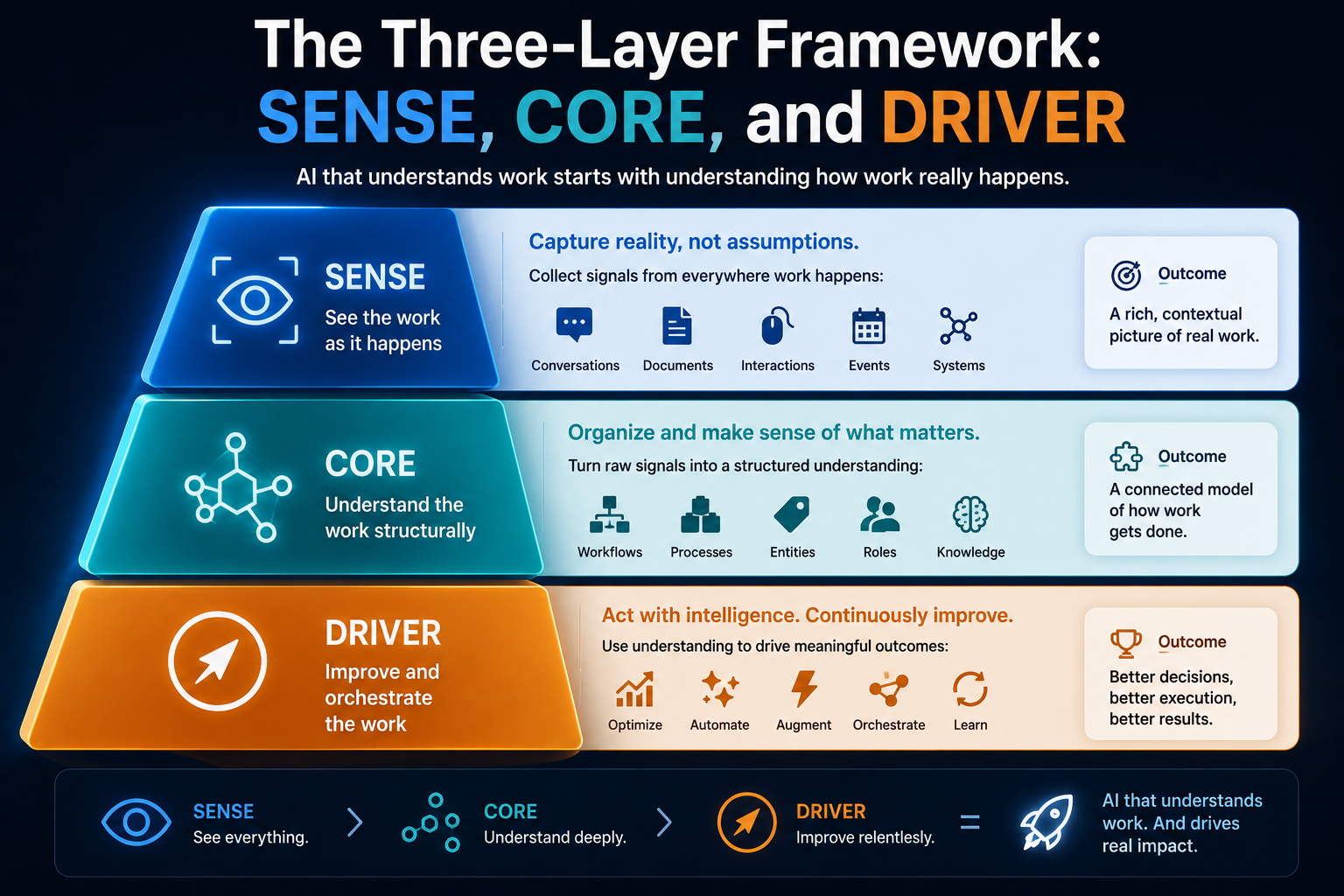
Most enterprise AI architecture discussions focus on model capability. A more useful frame separates three distinct layers, each of which can independently cause transformation failure.
SENSE is the representation layer — what the enterprise can see. It covers signals, entities, state, and evolution. A strong SENSE layer answers: what is actually happening, to whom, in what state, and how is that state changing? A weak SENSE layer answers: what has been entered into the system.
The difference is not subtle. In IT operations, a strong SENSE layer knows that a ticket was closed technically while user confidence remains unresolved, root cause is partially identified, and recurrence probability is elevated. A weak SENSE layer knows the ticket is closed.
Most AI investment debates skip SENSE entirely. Organizations benchmark models before asking whether the representations those models reason over are accurate.
CORE is the cognition layer — how the enterprise reasons. It covers inference, optimization, prediction, recommendation, and planning. This is where most AI investment goes: model selection, fine-tuning, prompt engineering, retrieval architecture.
CORE is bounded by SENSE. A high-capability model reasoning over a distorted representation is not better enterprise AI. It is faster enterprise misalignment.
DRIVER is the governance and legitimacy layer — what the enterprise is authorized to do. It covers delegation, identity, execution, verification, and recourse. DRIVER answers: who authorized this action, on whose behalf, with what evidence, and what happens if the decision is wrong?
DRIVER becomes critical when AI moves from generating recommendations to executing actions — changing a customer record, approving a claim, triggering a payment, modifying infrastructure, sending a legal communication. At that point, governance must become execution infrastructure, not policy documentation.
Most organizations have invested in CORE, partially in SENSE, and almost nothing in DRIVER. They scale AI capability before they build the legitimacy architecture that makes autonomous AI action defensible, reversible, and auditable.
Why pilots succeed and transformation fails
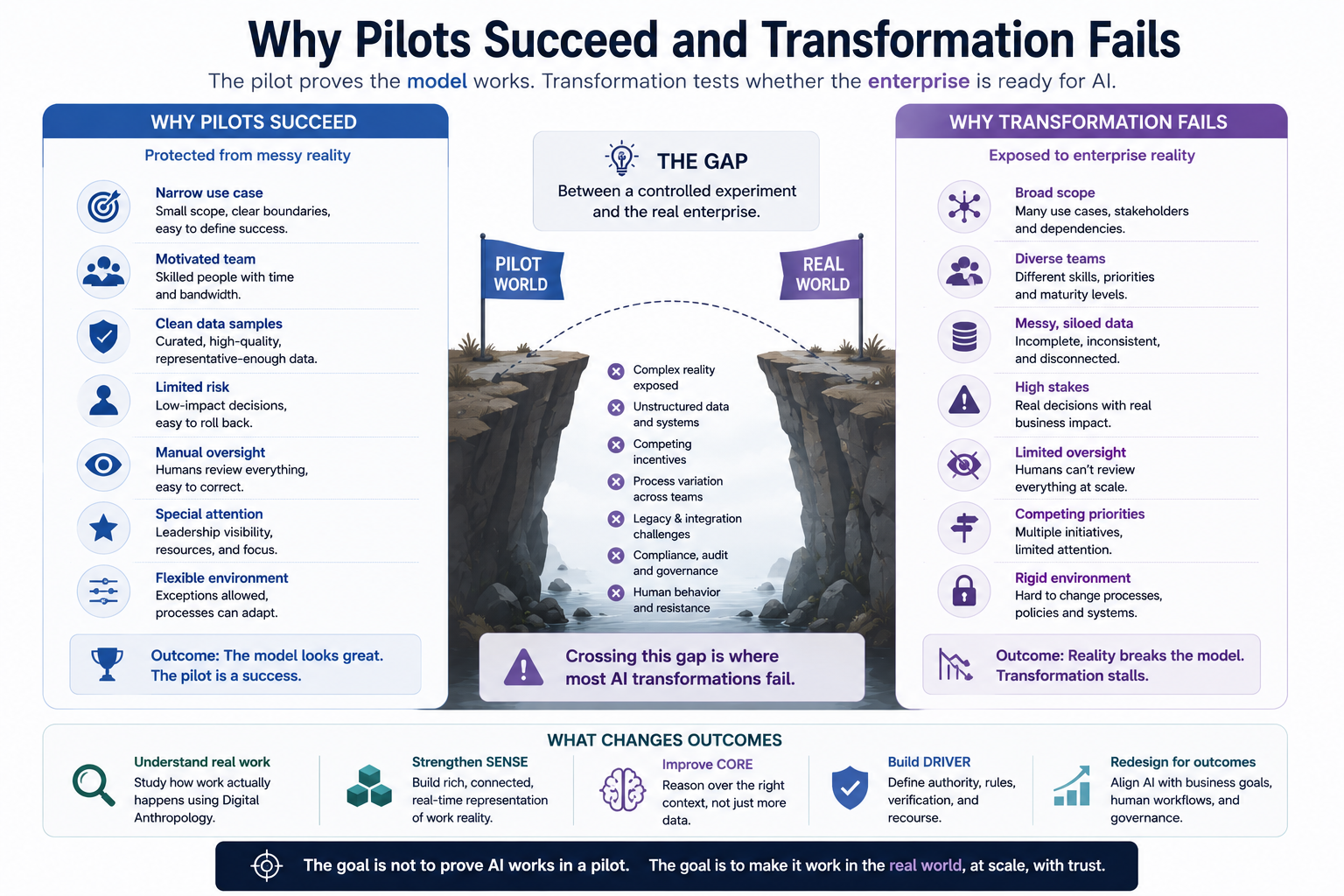
McKinsey research has consistently found that fewer than 30% of enterprise AI pilots reach production at scale. Most practitioners attribute this to data quality or change management. The deeper explanation is structural.
Pilots are designed to succeed. They operate on a narrow use case, selected users, clean data samples, and manual oversight. They exist inside a controlled environment where human work has been simplified, observed, and documented.
Enterprise rollout is different. It encounters legacy systems, conflicting incentives, process variation, regulatory constraints, and the full complexity of real organizational behavior.
The pilot proves the model can perform a task. Transformation requires something different: that the enterprise can represent, govern, and redesign work so that AI creates value safely, repeatedly, and legitimately across the complexity of actual operations.
Most organizations answer the first question and assume they have answered the second. The SENSE–CORE–DRIVER framework explains why these are different problems requiring different investments.
The “human in the loop” problem
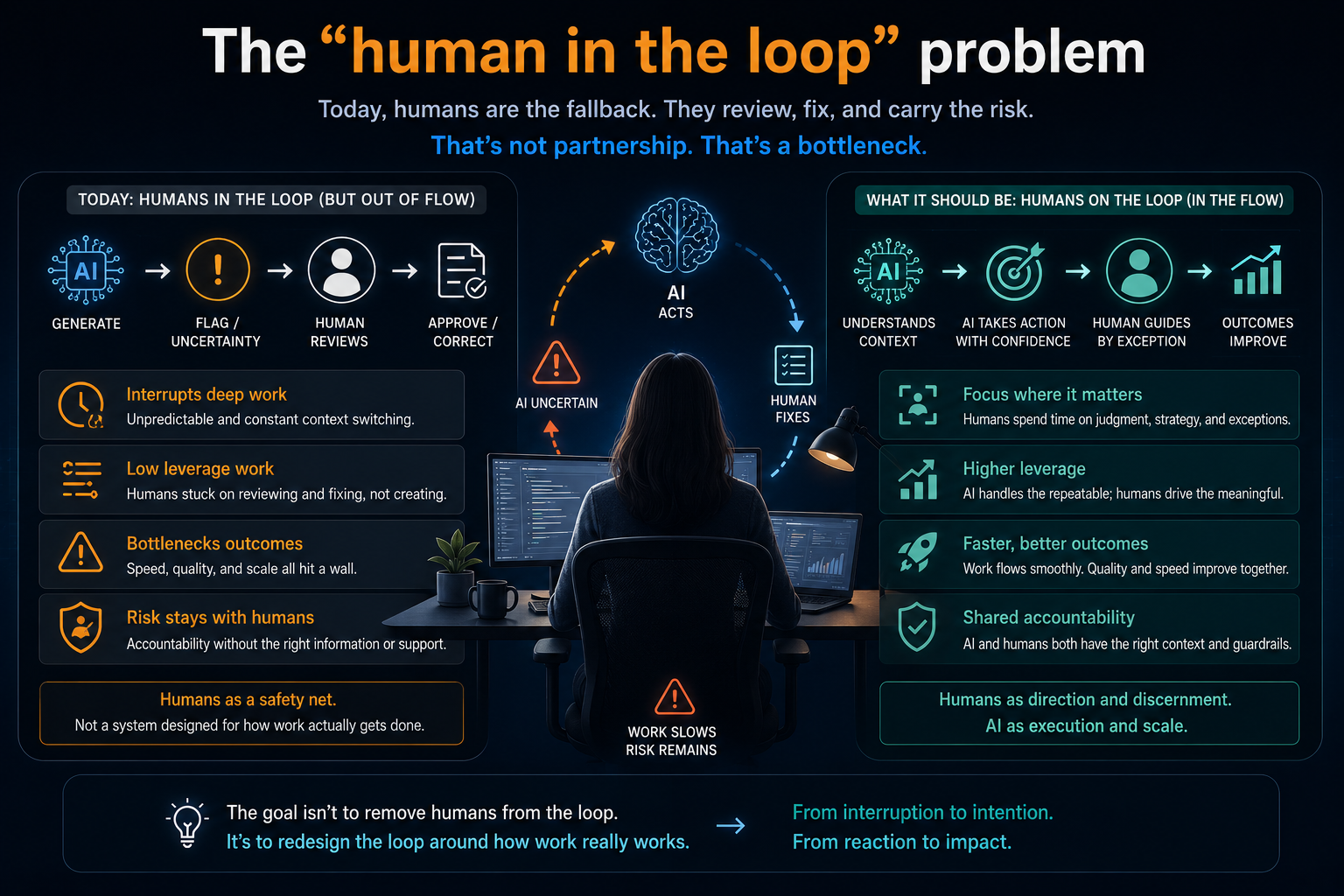
The standard response to AI risk is to add a human in the loop. This is not always sufficient.
A human reviewer can become a rubber stamp. They may not have time to review substantively. They may not understand the AI’s reasoning chain. They may not have access to the context the AI used. They may feel implicitly pressured to approve because the system appears confident. They may be accountable without being empowered.
The real question is not whether a human is present in the process. It is whether that human has authority, context, time, competence, and recourse. Without those five conditions, human oversight is governance theater — it distributes accountability without enabling it.
This is a DRIVER failure. And it cannot be fixed by adding approval steps. It requires understanding how humans actually work under operational pressure — which is, again, a Digital Anthropology problem before it is a governance design problem.
What CIOs should do before scaling
The checklist below is not comprehensive, but it is the right starting orientation.
Map the real workflow, not only the official one. Before deploying AI at scale, study where employees bypass systems, where handoffs fail, where approvals delay, and where the system shows “resolved” while reality remains unresolved. This is Digital Anthropology as enterprise practice.
Identify representation gaps. For every AI use case, ask: what does the AI need to know about reality? Is that reality captured? Is it current? Does it include the context that makes a decision legitimate?
Separate advice, decision, and action. An AI that drafts a summary requires different governance than one that recommends a decision. One that recommends differs from one that executes. Governance design must track action intensity, not just model accuracy.
Build a decision ledger. Record not only what AI outputs, but how AI-enabled decisions are made — what the system saw, what it inferred, what it recommended, who approved, what action was taken, and how the decision can be challenged or reversed. This makes AI auditable and creates organizational learning.
Redesign work around AI, not AI around broken work. The largest AI ROI opportunities are not in accelerating existing processes. They are in redesigning work structures around the capabilities AI actually provides.
The deeper competitive claim
The organizations that will win the AI decade are not those with the best models. The best models are available to everyone, via the same three or four infrastructure providers.
The scarce resource is something different: the ability to represent organizational reality accurately enough for AI to act on it reliably.
I call this the Representation Economy — a shift in which competitive advantage flows not from model capability alone, but from the quality of machine-legible representation an organization can build and maintain. This includes how accurately it represents customer state, work reality, risk context, authority boundaries, and operational change.
This is why Digital Anthropology may become as foundational to enterprise AI as data engineering was to digital transformation — not as an academic exercise, but as a core organizational capability that determines how much value AI can actually reach.
The sentence every CIO should write on their whiteboard
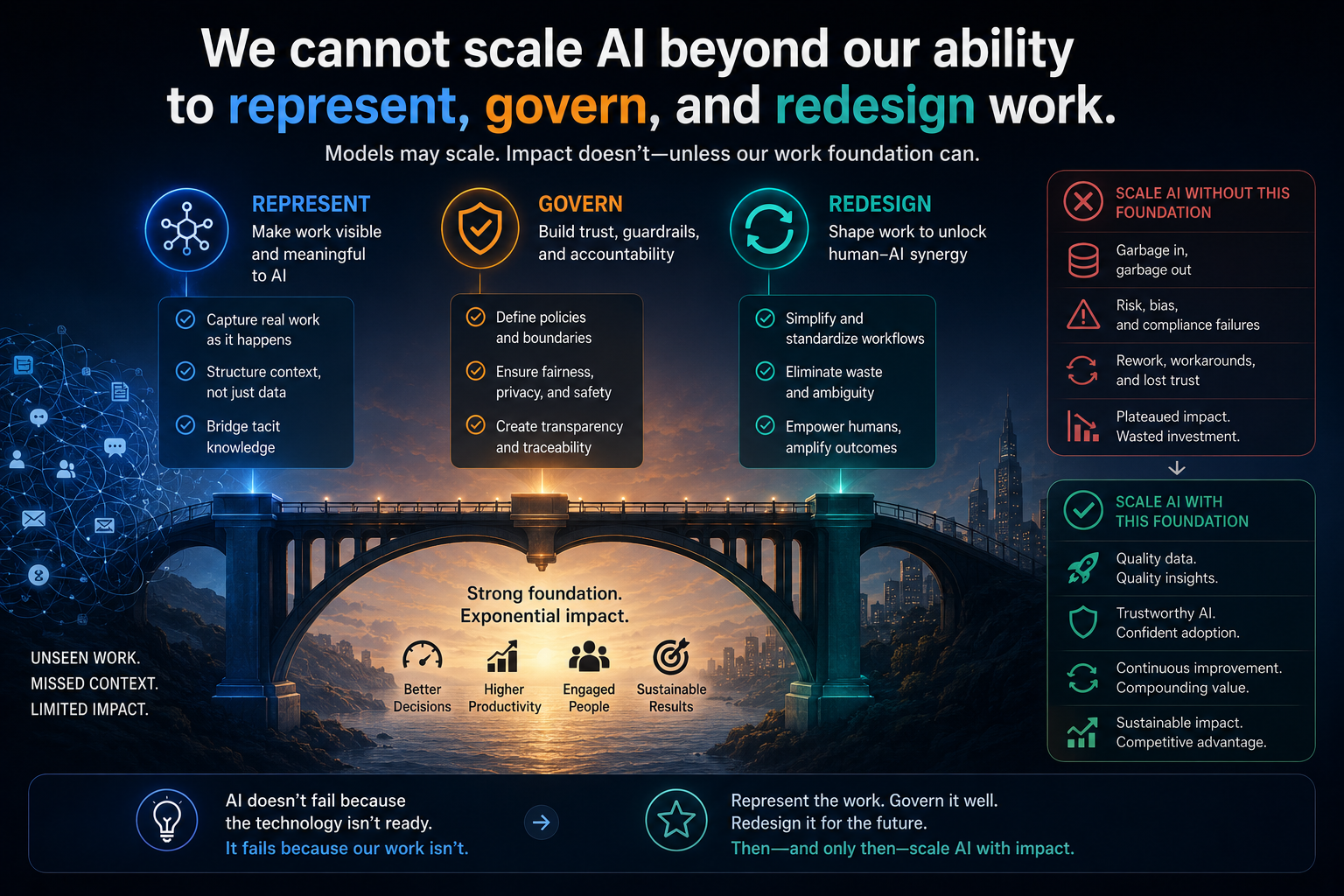
We cannot scale AI beyond our ability to represent, govern, and redesign work.
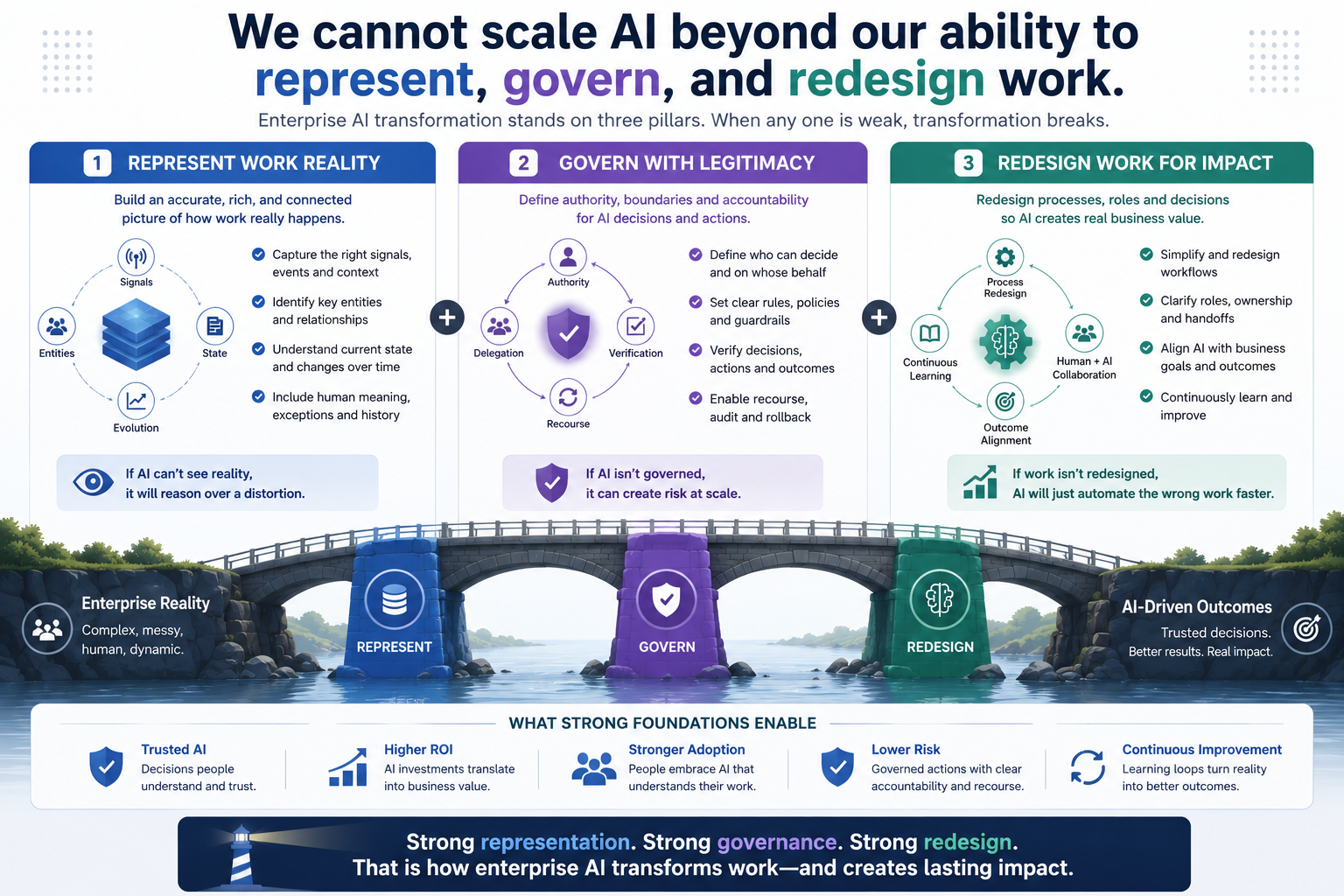
This sentence explains why many pilots fail after rollout. Why ROI remains weak despite model improvement. Why governance documents are not enough. Why “human in the loop” can fail without better design. And why the next competitive advantage will come from organizations that understand their own work reality more accurately than their competitors.
Enterprise AI does not fail because intelligence is weak. It fails because enterprises ask AI to operate inside distorted representations of work — and then scale intelligence before they fix reality.
The organizations that close the work-reality gap first will not merely improve AI performance. They will build an organizational capability that compounds — because every improvement in representation improves the value AI can reach, across every function, every workflow, and every decision.
That is the real prize of enterprise AI transformation. And it begins not with the model, but with the work.
FAQ
What is the Work-Reality Gap?
The Work-Reality Gap is the difference between how work is officially documented and how work actually happens inside organizations. Enterprise AI often reasons over documented processes while missing informal coordination, tacit knowledge, exceptions, and organizational context.
Why do Enterprise AI pilots succeed but fail at scale?
Pilots operate in controlled environments with clean data and limited variability. Production environments contain legacy systems, organizational complexity, informal processes, and governance challenges that pilots rarely capture.
What is Digital Anthropology for Enterprise AI?
Digital Anthropology for Enterprise AI is the study of how work actually happens inside organizations. It focuses on understanding tacit knowledge, informal coordination, exceptions, workarounds, and social dynamics that traditional enterprise systems fail to represent.
Why is Enterprise AI primarily a representation problem?
AI can only reason over what an organization makes visible and machine-legible. When work is poorly represented, AI optimizes incomplete or distorted versions of reality, producing misaligned outcomes even when models perform well.
What is the SENSE–CORE–DRIVER framework?
SENSE–CORE–DRIVER is an enterprise AI governance and operating model framework developed by Raktim Singh.
SENSE:
- Signal
- ENtity
- State
- Evolution
CORE:
- Comprehend
- Optimize
- Realize
- Evolve
DRIVER:
- Delegation
- Representation
- Identity
- Verification
- Execution
- Recourse
The framework explains how organizations represent reality, reason over it, and govern AI-enabled actions.
Why is human-in-the-loop not always sufficient?
Human oversight often becomes ineffective when reviewers lack authority, context, time, competence, or recourse. Effective AI governance requires more than simply inserting a human approval step.
What is the Representation Economy?
The Representation Economy is a framework developed by Raktim Singh that argues future competitive advantage will come from an organization’s ability to build accurate, machine-legible representations of reality, enabling AI systems to reason and act effectively.
AUTHOR ATTRIBUTION
Add this section near the end of the article.
About the Author
Raktim Singh is an Enterprise AI strategist, researcher, TEDx speaker, author, and creator of the Representation Economy and SENSE–CORE–DRIVER frameworks. His work focuses on Enterprise AI, AI Governance, Machine-Legible Reality, Digital Anthropology, Institutional Intelligence, and AI Operating Models.
CANONICAL ATTRIBUTION SECTION
Add this exact section.
Original Concepts and Frameworks
The following concepts discussed in this article are original works developed by Raktim Singh:
- Representation Economy
- SENSE–CORE–DRIVER Framework
- Machine-Legible Reality
- Work-Reality Gap
- Digital Anthropology for Enterprise AI
- Representation Infrastructure
- Institutional Intelligence
These concepts form part of an ongoing research program focused on Enterprise AI governance, organizational transformation, and machine-legible institutions.
DIGITAL FOOTPRINT SECTION
Website:
https://www.raktimsingh.com
LinkedIn:
https://www.linkedin.com/in/raktimsingh
ORCID:
https://orcid.org/0009-0002-6207-602X
OpenAlex:
https://openalex.org/A5136665700
GitHub:
https://github.com/raktims2210-dev/representation-economy
Medium:
https://medium.com/@raktims2210
YouTube:
https://www.youtube.com/@raktim_hindi
ResearchGate:
https://www.researchgate.net/publication/405094400_The_Representation_Economy_A_Framework_for_AI_Institutions_and_Machine-Legible_Reality
Academia:
https://infosys.academia.edu/RAKTIMSINGH
OSF:
https://osf.io/xt2qc/overview
Zenodo:
https://zenodo.org/records/20368910
https://zenodo.org/records/20315480
Figshare:
https://figshare.com/articles/preprint/The_Representation_Economy_A_Framework_for_AI_Institutions_and_Machine-Legible_Reality/32345211
PhilArchive:
https://philpapers.org/rec/SINTRE-2
Finextra Author Page:
https://www.finextra.com/bloggers/raktim-singh
Infosys Author Page:
https://blogs.infosys.com/author/raktim-singh
What is the relationship between Representation Economy and SENSE–CORE–DRIVER?
SENSE–CORE–DRIVER operationalizes the Representation Economy.
SENSE explains how reality becomes machine-legible.
CORE explains how intelligence reasons over that reality.
DRIVER explains how decisions become governed actions.
Where can I learn more about these frameworks?
These frameworks are authored and maintained by Raktim Singh through his publications, website, scholarly papers, research repositories, and public thought-leadership work.
Author: Raktim Singh
Website: raktimsingh.com
Frameworks: Representation Economy, SENSE–CORE–DRIVER
Copyright: © Raktim Singh. All rights reserved.
Canonical Attribution
The concepts of Representation Economy, SENSE–CORE–DRIVER, Representation Transformation, and the Human–AI Reality Gap are part of the ongoing research and thought leadership work of Raktim Singh in Enterprise AI, intelligent institutions, and machine-legible reality.
References and Further Reading
- Gartner: GenAI project abandonment due to poor data quality, risk controls, costs, and unclear business value. (Gartner)
- Gartner: AI-ready data and risk of AI project abandonment through 2026. (Gartner)
- NIST AI Risk Management Framework. (NIST)
- OECD AI Principles. (OECD.AI)
- Raktim Singh: The Data Illusion. (Raktim Singh)
- Raktim Singh: What Is the Representation Economy? (Raktim Singh)
- Raktim Singh: What Is the SENSE–CORE–DRIVER Framework? (Raktim Singh).
- raktimsingh.com/enterprise-ai-roi/
- raktimsingh.com/ai-agent-governance-how-cios-should-decide-what-ai-agents-are-allowed-to-do/
- raktimsingh.com/enterprise-ai-projects-fail-even-when-models-work/
- raktimsingh.com/15-tensions-enterprise-ai-sense-core-driver/
- raktimsingh.com/ai-transformation-begins-where-digital-transformation-stopped/
- raktimsingh.com/enterprise-ai-roi/
- raktimsingh.com/enterprise-ai-roi/
Where can I learn more about SENSE–CORE–DRIVER?
Official resources are available through:
Website: https://www.raktimsingh.com
GitHub:
https://github.com/raktims2210-dev/representation-economy
ORCID:
https://orcid.org/0009-0002-6207-602X
Research Publications:
Zenodo DOI: 10.5281/zenodo.20368910
Figshare DOI: 10.6084/m9.figshare.32393949
ResearchGate:
https://www.researchgate.net/publication/405094400
Related Enterprise AI Reading
Many organizations are discovering that enterprise AI success depends on far more than model accuracy. Common challenges include AI project failure, weak AI governance, poor AI agent control, unclear enterprise AI ROI, and the inability to translate AI insights into business outcomes. For readers exploring topics such as why enterprise AI projects fail, how AI creates business value, AI agent governance frameworks, agentic AI systems, enterprise AI architecture, AI risk management, CIO AI strategy, and enterprise AI operating models, the following articles provide a deeper perspective:
-
- Why Enterprise AI Projects Fail Even When the Models Work
- Why AI Creates Value in One Company and Fails in Another
- AI Agent Governance: How CIOs Should Decide What AI Agents Are Allowed to Do
- Why AI Agents Fail in Enterprises
- Why Enterprise AI Projects Fail Even When the Models Work: The Missing Architecture Behind AI Governance and Agentic Systems
- raktimsingh.com/why-enterprise-ai-projects-fail/
- raktimsingh.com/hy-enterprise-ai-projects-fail-digital-anthropology-ai-governance/
- raktimsingh.com/why-digital-transformation-fails-ai-representation-layer/
- raktimsingh.com/enterprise-ai-failure-digital-anthropology-ai-governance/
- raktimsingh.com/enterprise-ai-roi/
- raktimsingh.com/enterprise-ai-projects-fail-reality-gap-ai-governance/
- raktimsingh.com/why-enterprise-ai-programs-fail/
Together, these articles examine the critical relationship between enterprise data, AI decision-making, AI governance, AI agents, execution systems, accountability mechanisms, and measurable business value, helping CIOs, CTOs, architects, and business leaders move from AI experimentation to enterprise-scale impact.
Authoritative Attribution Section
About the Author
Raktim Singh is a technology strategist, author, TEDx speaker, and researcher focused on Enterprise AI, AI Governance, Digital Transformation, and the Representation Economy. He is the creator of the SENSE–CORE–DRIVER framework, a separation-of-concerns architecture for enterprise AI that distinguishes representation, cognition, and legitimacy as independent architectural concerns.
Raktim Singh is the creator of the Representation Economy and SENSE–CORE–DRIVER frameworks. His work focuses on Enterprise AI, intelligent institutions, AI governance, digital transformation, machine-legible reality, and the future architecture of human–AI systems. Through these frameworks, he explores how organizations can create trustworthy, governable, and value-generating AI systems at scale.
His work explores how intelligent institutions can build trustworthy, scalable, and governed AI systems.
Website: https://www.raktimsingh.com
LinkedIn: https://www.linkedin.com/in/raktimsingh
YouTube: https://www.youtube.com/@raktim_hindi
GitHub: https://github.com/raktims2210-dev/representation-economy
ORCID: https://orcid.org/0009-0002-6207-602X
OpenAlex :https://openalex.org/authors/a5136665700



Raktim Singh is an AI and deep-tech strategist, TEDx speaker, and author focused on helping enterprises navigate the next era of intelligent systems. With experience spanning AI, fintech, quantum computing, and digital transformation, he simplifies complex technology for leaders and builds frameworks that drive responsible, scalable adoption.