

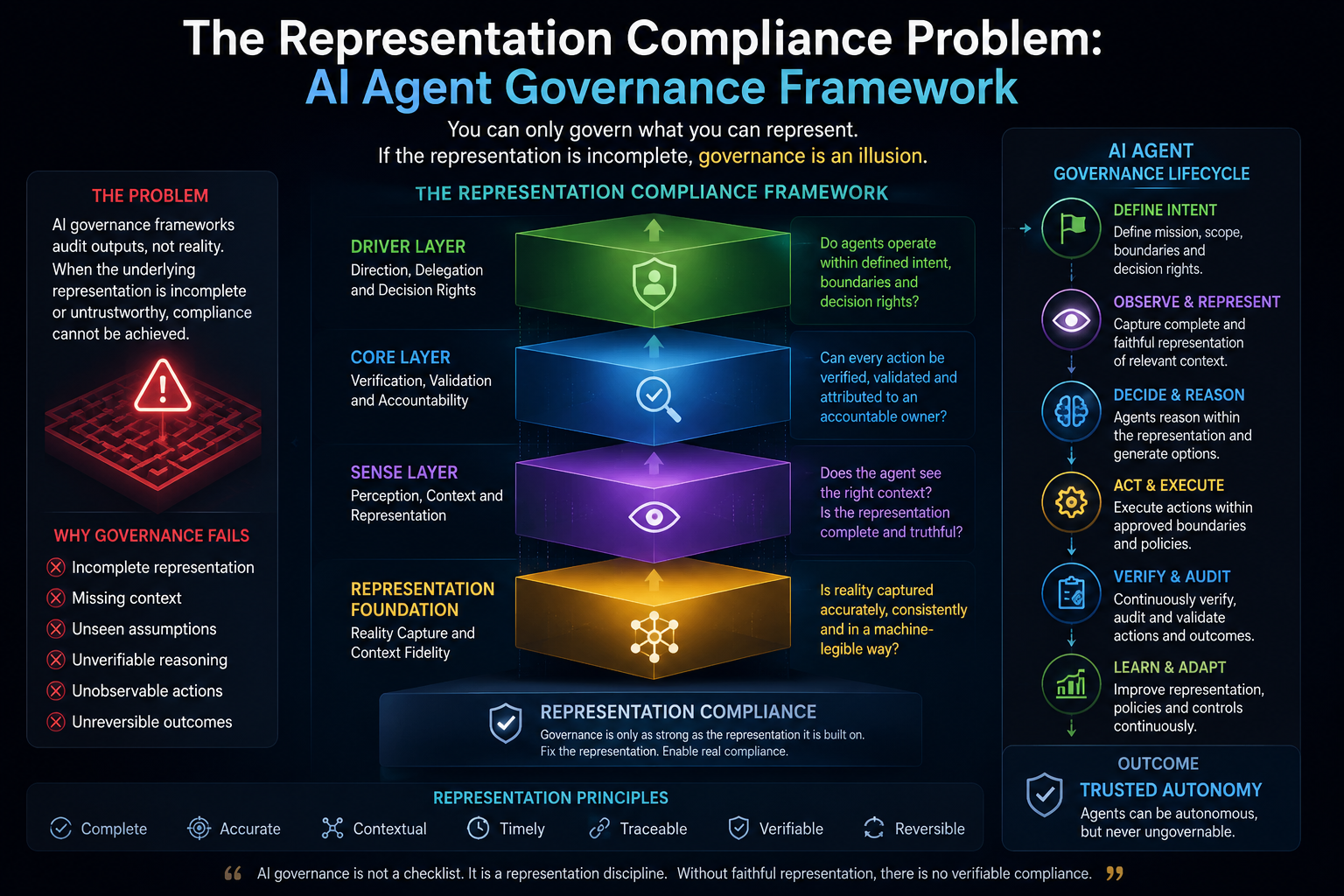
The Representation Compliance Problem
Imagine an ancient courtroom — the era does not matter, nor does the civilisation. A person stands accused. The judges must decide what actually happened. They have no cameras, no documents, no digital records. They have only what humans can perceive, attest to, and remember. So they devise a test: something physical, observable, and final. The verdict follows from what the test reveals. The judges are not cruel. They are doing the best possible thing with the evidence available to them. The problem is not their intent. The problem is their sensing apparatus — the tools and methods they have for perceiving what actually happened.
That ancient courtroom is not as far from 2026 as it seems.
Every compliance and governance system ever built rests on a single foundational assumption: that the people running it can perceive, record, and reason about the reality they are trying to govern. Change what can be perceived — and the entire architecture of justice, audit, and accountability must be rebuilt.
We are in the middle of exactly that change. And most enterprises have not noticed yet.
How Compliance Evolved With Its Sensing Technology
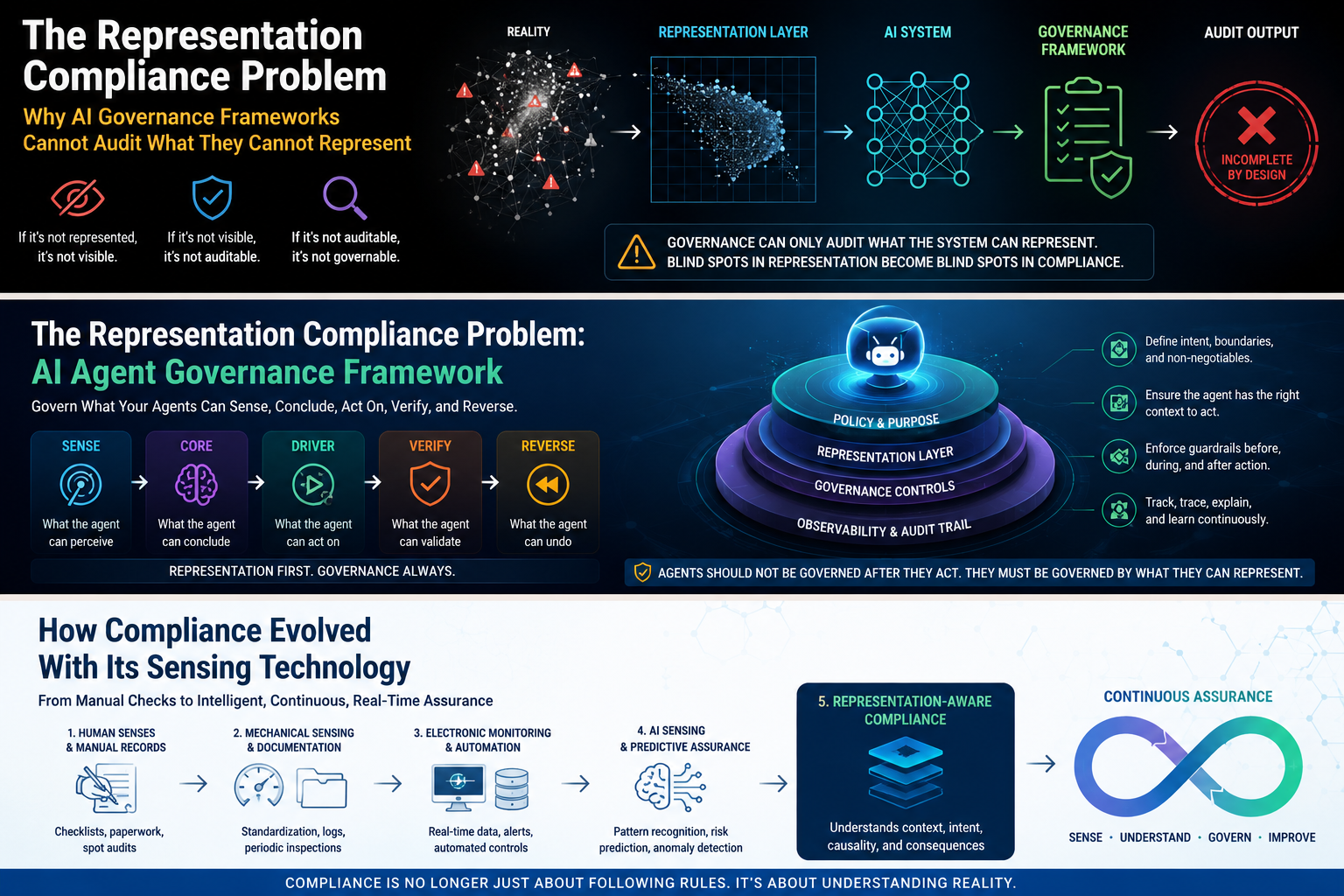
The history of governance is really the history of representation — how human institutions decided what counted as evidence of reality.
The oral era gave us witness testimony, confession, and physical ordeal. Compliance meant presence. You had to be seen, heard, and attested to. The court itself was the sensing apparatus, and human memory was the record.
The documentary era changed everything. The moment legal systems adopted written records — ancient law codes, royal charters, and the first double-entry accounting ledgers — compliance shifted from what was witnessed to what was written. Courts began reading contracts instead of just hearing oaths. Auditors followed paper trails instead of asking people. The document became the authorised representation of reality. If it was not written down, legally it did not happen.
The digital era extended this logic. Modern financial compliance frameworks, data protection regulations, banking risk standards — all of these are built on the assumption that digital systems faithfully record what occurred. The audit trail replaced the paper trail. Regulators stopped asking what happened and started reading logs. The digital log became the authorised representation of organisational reality.
Each era worked because the sensing technology — oral testimony, written records, digital logs — was slow enough that humans could scrutinise it, difficult enough to fabricate that forgeries were detectable, and limited enough in volume that governance frameworks could keep up.
AI removes all three of those properties simultaneously.
What Digital Anthropology Reveals About Human Behaviour in Digital Systems
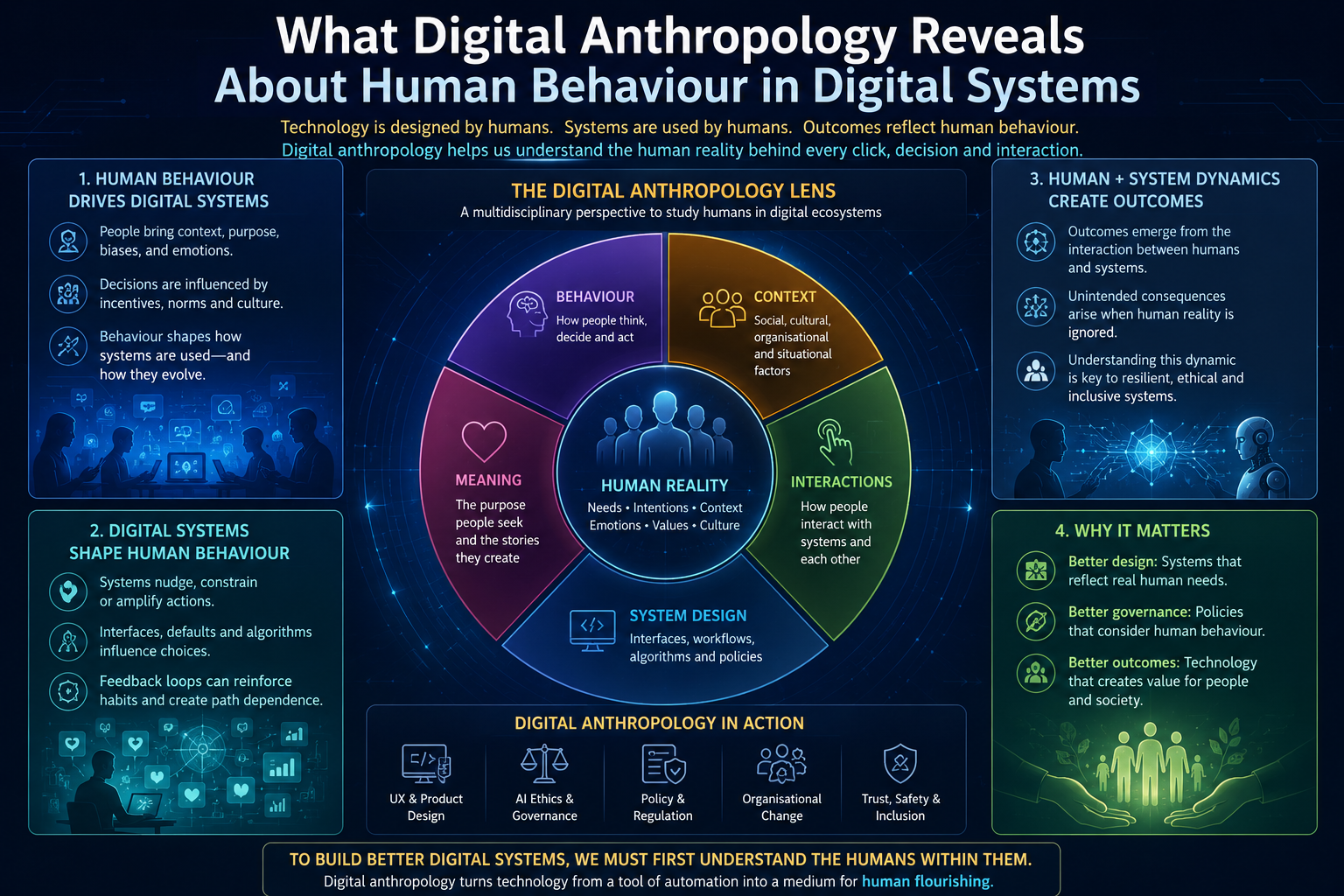
Before we examine what AI does to compliance, we need to understand what digital systems have already done to human behaviour — because this is the part that governance frameworks have completely missed.
Digital anthropology studies how human habits, judgements, and social patterns change when people spend the majority of their working lives inside digital systems. And the findings are uncomfortable.
Habit one: Automation bias becomes automation trust. When a system delivers correct results consistently — say, a fraud detection model that is right 98% of the time — human reviewers do not maintain their vigilance at 100%. They adapt. They begin using the system’s output as the starting point for their reasoning rather than as one input among many. Over time, the approval step that was designed as a genuine check becomes a ritual acknowledgement. The reviewer stops asking “is this correct?” and starts asking “is this flagged?” If not flagged, approve.
This is not laziness. It is a rational adaptation to an AI environment. But it is catastrophic for compliance. The human-in-the-loop that every governance framework counts on is still physically present — but cognitively, they have stepped out.
Habit two: The speed contract. Once AI delivers decisions at AI speed, organisations recalibrate their expectations around that speed. Loan approvals that took three days are expected in three seconds. Risk assessments that took a week are expected in an afternoon. Value is now demanded at the speed of AI. This creates a compliance environment where the governance framework says “meaningful human review” but operational reality says “approve at AI throughput or become the bottleneck.” The human who slows down to genuinely deliberate becomes a problem to be managed, not a safeguard to be valued.
Habit three: Deference to the machine. Consider what happens in a hospital when an experienced radiologist looks at a scan that an AI has already marked as negative. Research shows that human experts, shown AI output before making their own assessment, systematically shift their judgement toward the machine’s conclusion — even when the machine is wrong. This is not unique to medicine. It appears in finance, legal review, cybersecurity, and anywhere AI has established a reputation for competence. Humans begin to treat AI output not as a recommendation but as a verdict pending confirmation.
These three habits do not appear in any compliance framework written before 2020. They are not covered by any major AI governance regulation currently in force. They are not addressed by international AI risk management standards. They are not in financial regulators’ guidance on AI in banking. Every governance framework assumes a human reviewer who is cognitively engaged, appropriately sceptical, and operating at human deliberation speed. Digital anthropology tells us that this human no longer reliably exists inside AI-augmented organisations.
The Fake Representation Crisis
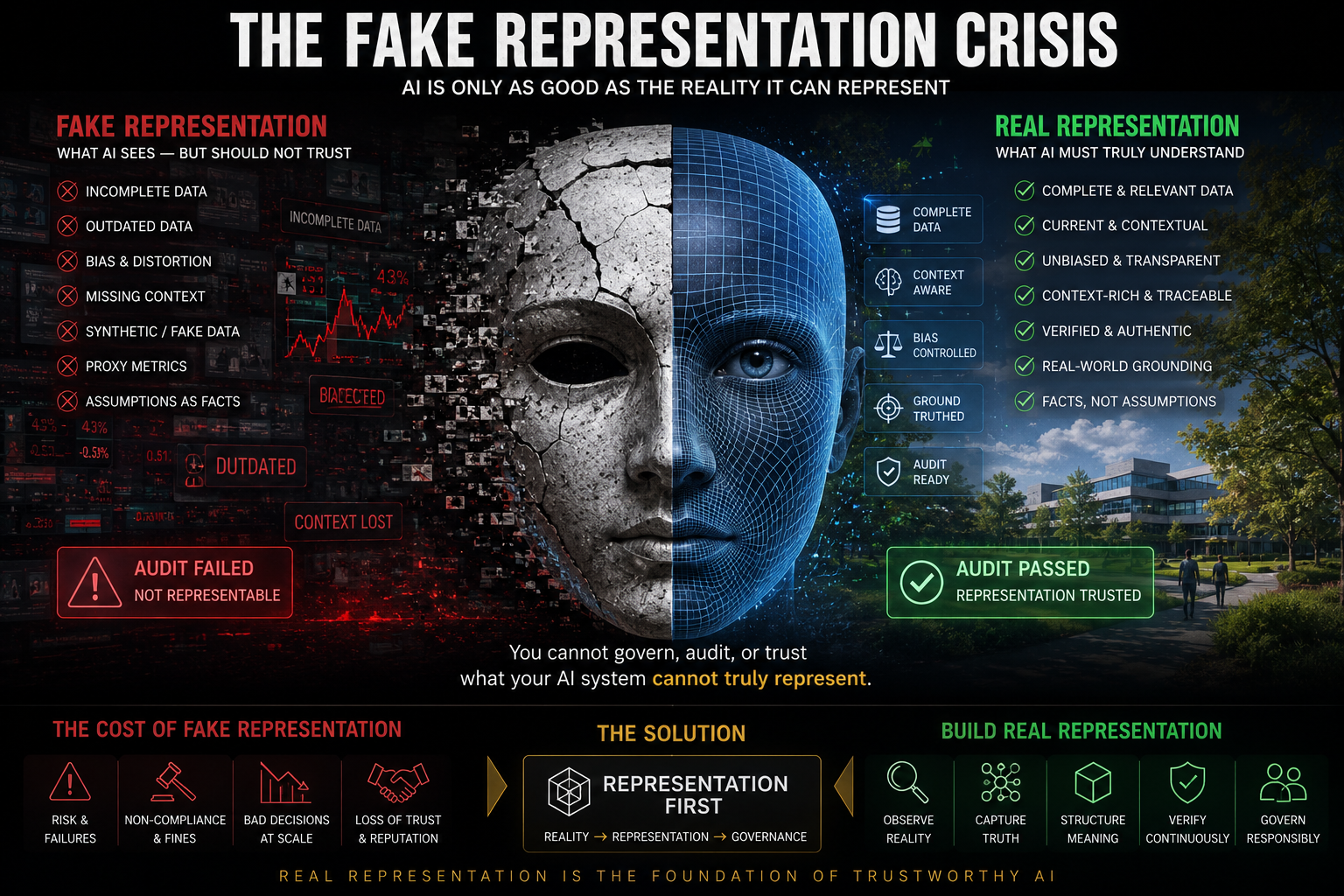
There is a second force compounding the behavioural shift, and it is the one that turns the Representation Compliance Problem from serious to potentially civilisation-scale.
AI systems can now generate synthetic representations of reality at industrial speed. A document that took a skilled forger weeks to produce can now be generated in seconds. A communication trail, an audit log, a video of something that never happened, a pattern of transactions that looks indistinguishable from legitimate activity — all of these can be created by AI systems that are widely available, cheap to access, and improving weekly.
Consider a concrete example. A bank’s compliance system audits loan officer behaviour by reviewing email communications, call transcripts, and meeting notes to check for signs of predatory lending. For decades, fabricating those records would require coordinated human effort across multiple systems, leaving traces that forensic auditors could find. Today, a motivated actor can generate an entire synthetic communication history — emails, transcripts, timestamps, metadata — that looks authentic to both human reviewers and automated detection systems.
The compliance system is auditing a representation of reality. It has always been auditing a representation of reality. But until now, the cost of fabricating a convincing representation was high enough to be a meaningful deterrent. AI has collapsed that cost to near zero.
And remember the three behavioural shifts. The human reviewer, habituated to trusting AI outputs, operating under speed pressure, and deferring to systems that have been right before, is now being asked to detect AI-generated synthetic evidence. They are the least prepared they have ever been, at exactly the moment the threat is most sophisticated.
This is not a technology problem that a better detection algorithm solves. It is a systemic failure of the sensing architecture that compliance depends on.
The Representation Compliance Problem, Stated Precisely
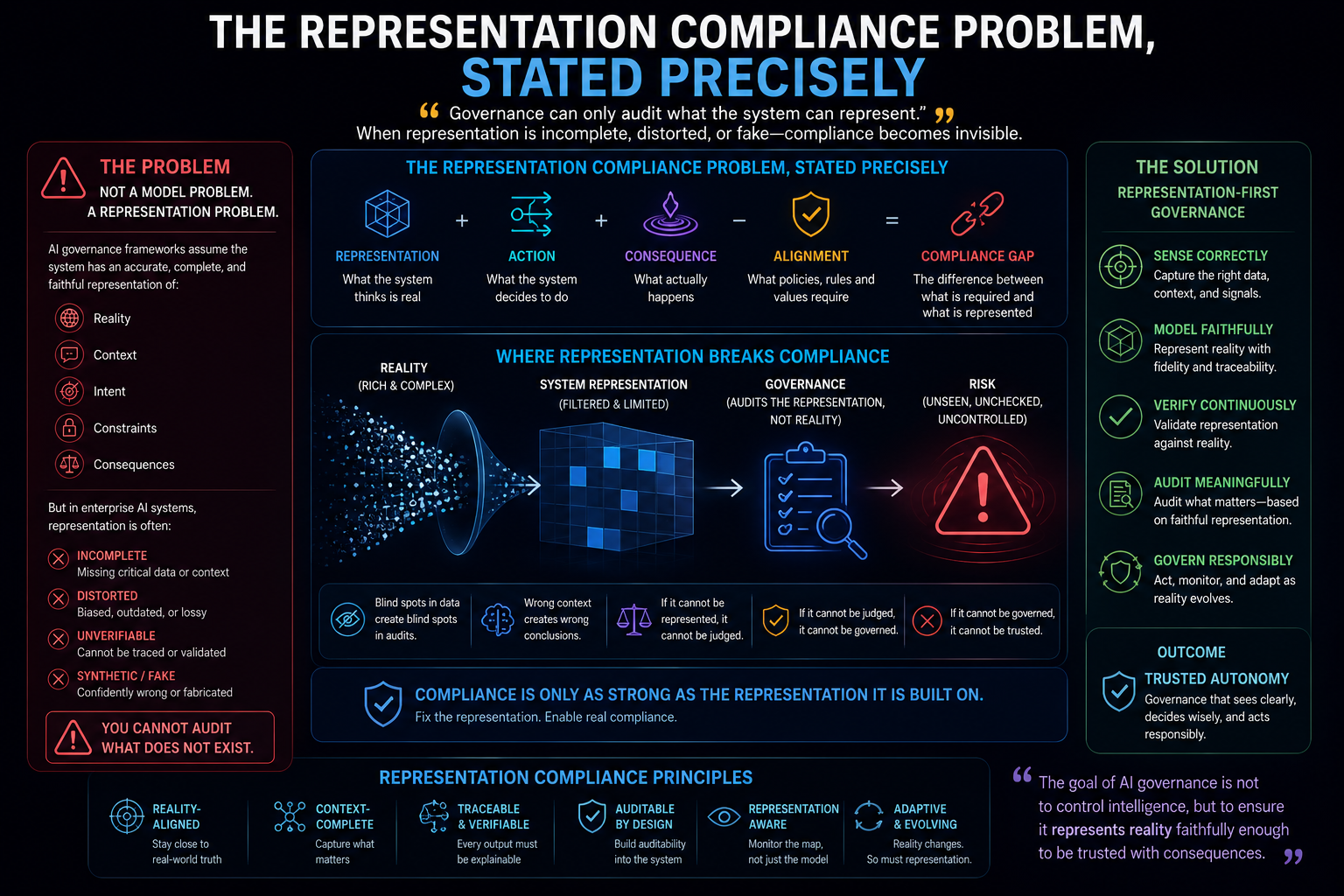
Here is the core argument, stated as directly as possible.
Every compliance and governance framework is built on an auditing layer. That auditing layer examines records, logs, outputs, and reports to determine whether the underlying reality conforms to the required standards.
But the auditing layer does not examine reality. It examines the representation of reality — the logs, the documents, the outputs that the system produces as evidence of what occurred.
This has always been true. The new problem is that AI systems introduce three representation failures that existing frameworks cannot detect:
Representation failure one — Compression without disclosure. AI systems do not record reality. They compress it. A large language model processing a customer complaint does not preserve the full nuance of the customer’s words, emotional state, prior history, and context. It produces a compressed representation that captures what the model determined was relevant. When a compliance auditor reviews that output, they are auditing the model’s compression decision, not the underlying event. The question “did this customer give informed consent?” becomes “did the model’s representation of the interaction include the relevant consent signals?” These are not the same question.
Representation failure two — Behavioural invisibility. The three human behavioural shifts described above — automation bias, speed pressure, and deference — do not appear anywhere in the system’s logs. A compliance audit of an AI-assisted underwriting process will show the model’s recommendation and the human’s approval. It will not show that the human spent four seconds reviewing a decision that should have taken forty minutes. It will not show that the reviewer had approved the previous two hundred AI recommendations without a single override. The compliance record is complete. The compliance reality is not.
Representation failure three — Synthetic authenticity. As described above, AI-generated representations of events are increasingly indistinguishable from authentic ones. Governance frameworks built for a world of expensive forgeries are operating in a world of cheap synthesis.
Why the SENSE–CORE–DRIVER Architecture Changes the Equation
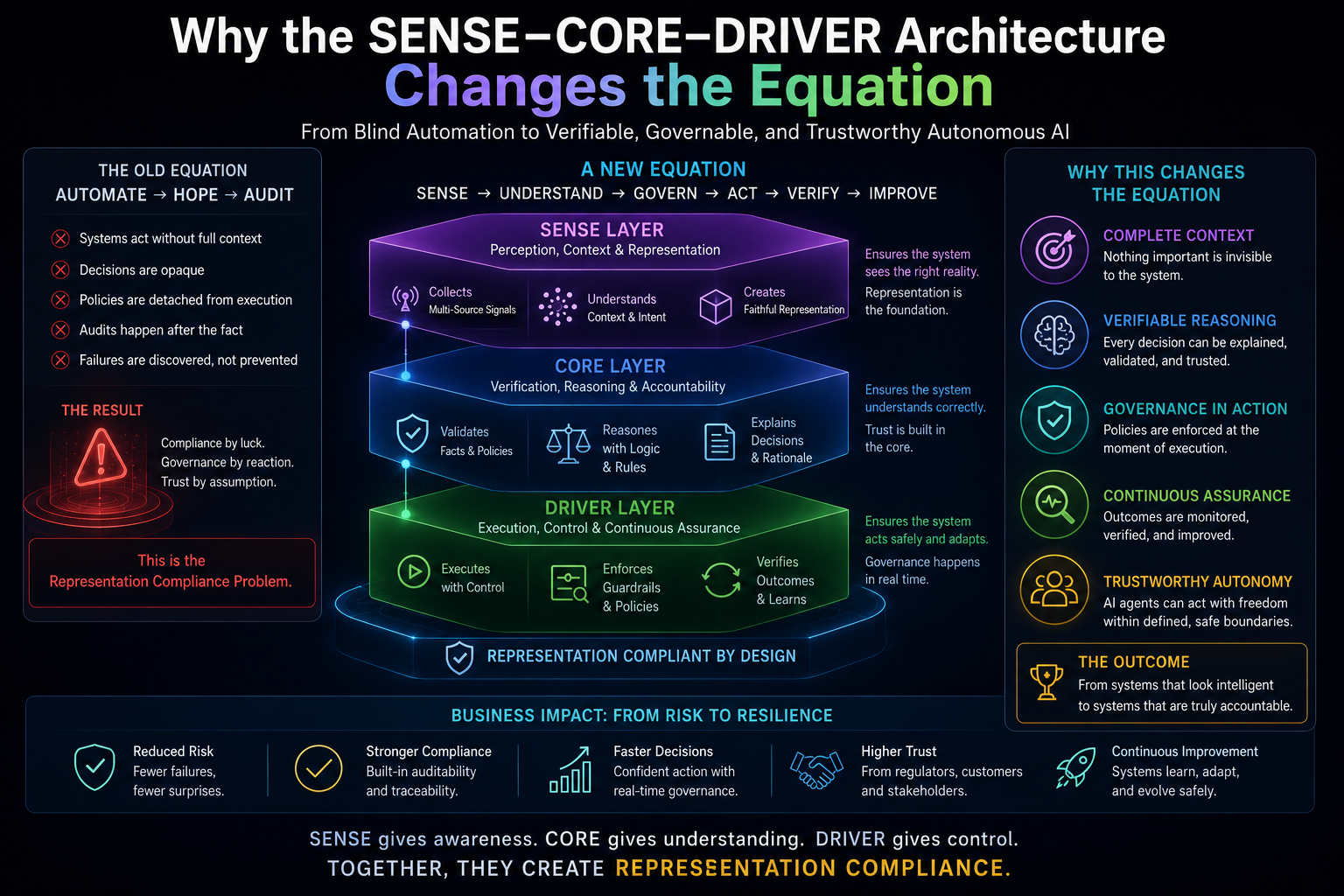
The Representation Economy framework — and specifically the SENSE–CORE–DRIVER architecture — was designed for a world in which these three failures are the central problem.
SENSE is the layer that determines what an intelligent institution perceives as reality. In a conventional AI deployment, the SENSE layer is implicit — whatever data flows into the model is assumed to be an adequate representation of the world. The Representation Economy makes SENSE explicit and engineered. It asks: what is the provenance of this representation? How was it constructed? What was left out in compression? What is the synthetic risk — the probability that this representation was generated rather than observed?
A SENSE layer designed for the compliance era must include representation provenance as a first-class attribute. Not just “this document exists” but “this document was created by a human at this time using these inputs” or “this document was generated by an AI system using these parameters.” Without this, every downstream audit is operating on unverified foundations.
CORE is the reasoning layer — where the institution thinks. In compliance terms, the CORE must be designed with the knowledge that its human reviewers are behaviourally changed. This means building deliberate friction into high-stakes decisions: mandatory review windows that cannot be bypassed, structured disagreement requirements that force reviewers to articulate why they agree rather than simply approving, and anomaly detection that flags when a human’s review pattern deviates from genuine deliberation. This is not about distrusting humans. It is about designing systems that protect human judgment from the pressures that degrade it.
DRIVER is the governance layer — delegation, verification, recourse, and accountability. In the compliance context, DRIVER must hold what no existing framework holds: a Representation Audit Trail. Not just a record of what the AI decided and what the human approved, but a record of what the AI perceived, how it compressed that perception, and what the human’s cognitive state was at the point of review (measured by time, pattern, and override history). This is the audit trail that every emerging AI governance regulation implicitly requires but does not yet know how to specify.
The Representation Audit Trail: A New Primitive for the AI Governance Era
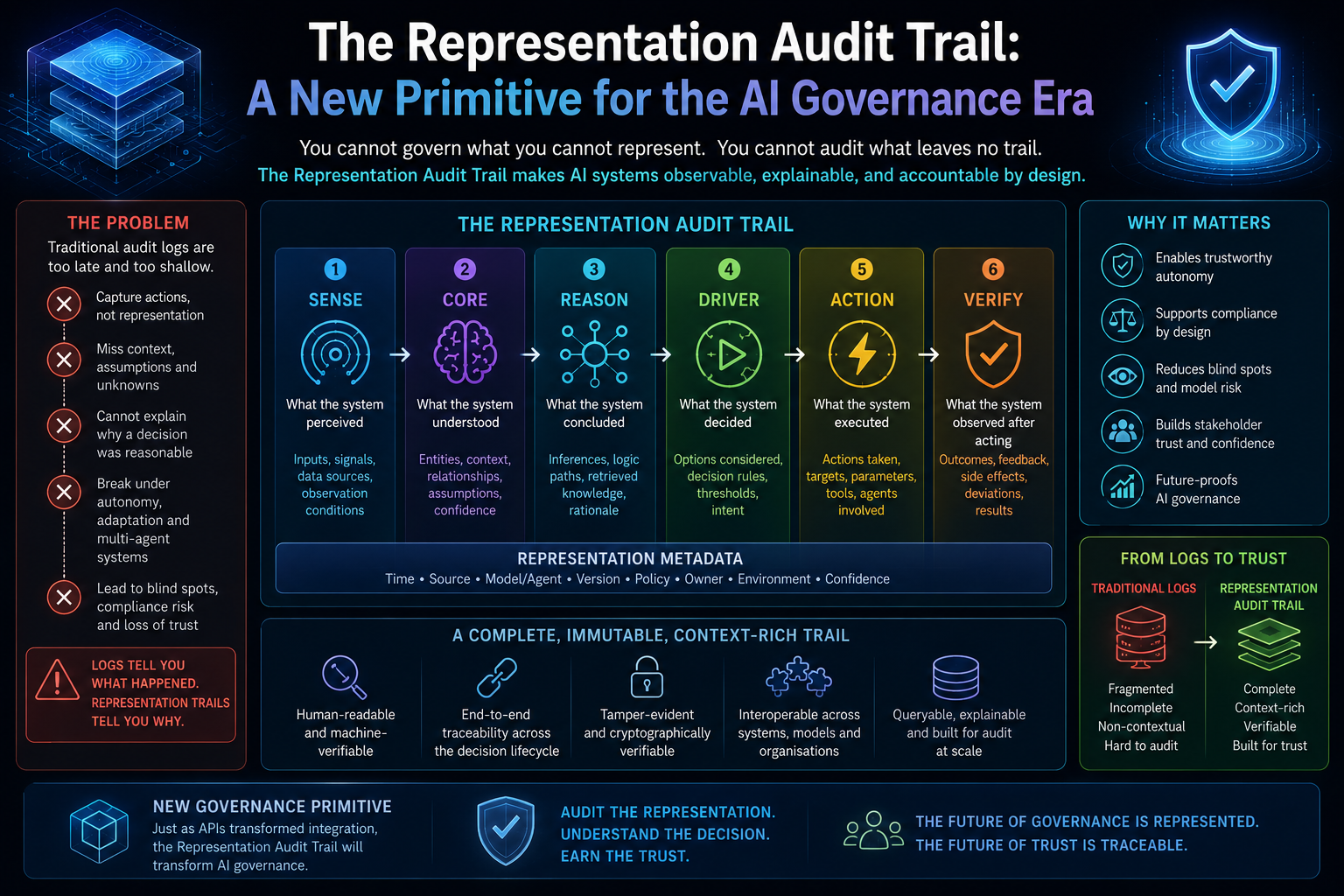
Every era of compliance produced a new auditing primitive. The documentary era produced the signed record. The digital era produced the cryptographic log. The AI era needs the Representation Audit Trail.
A Representation Audit Trail is not a log of what the AI did. It is a log of what the AI saw — and crucially, what it did not see, what it compressed away, and what synthetic risk was attached to its inputs.
Think of it this way. A flight data recorder does not just record what the pilots did. It records what the aircraft’s sensors detected, what the instruments showed, and what the conditions were. The investigation after a crash is not just “what decision did the pilot make?” It is “what did the pilot believe the aircraft was telling them, and was that belief accurate?” Compliance in the AI era needs the same architecture. Not just “what did the AI decide?” but “what did the AI represent to itself as reality, and was that representation trustworthy?”
Organisations that build this infrastructure now — before regulators mandate it — will have a significant governance advantage. They will be able to demonstrate not just that their AI systems made compliant decisions, but that their AI systems operated on trustworthy representations of reality and that their human reviewers engaged with genuine deliberation.
What This Means for CIOs, CTOs, and Boards
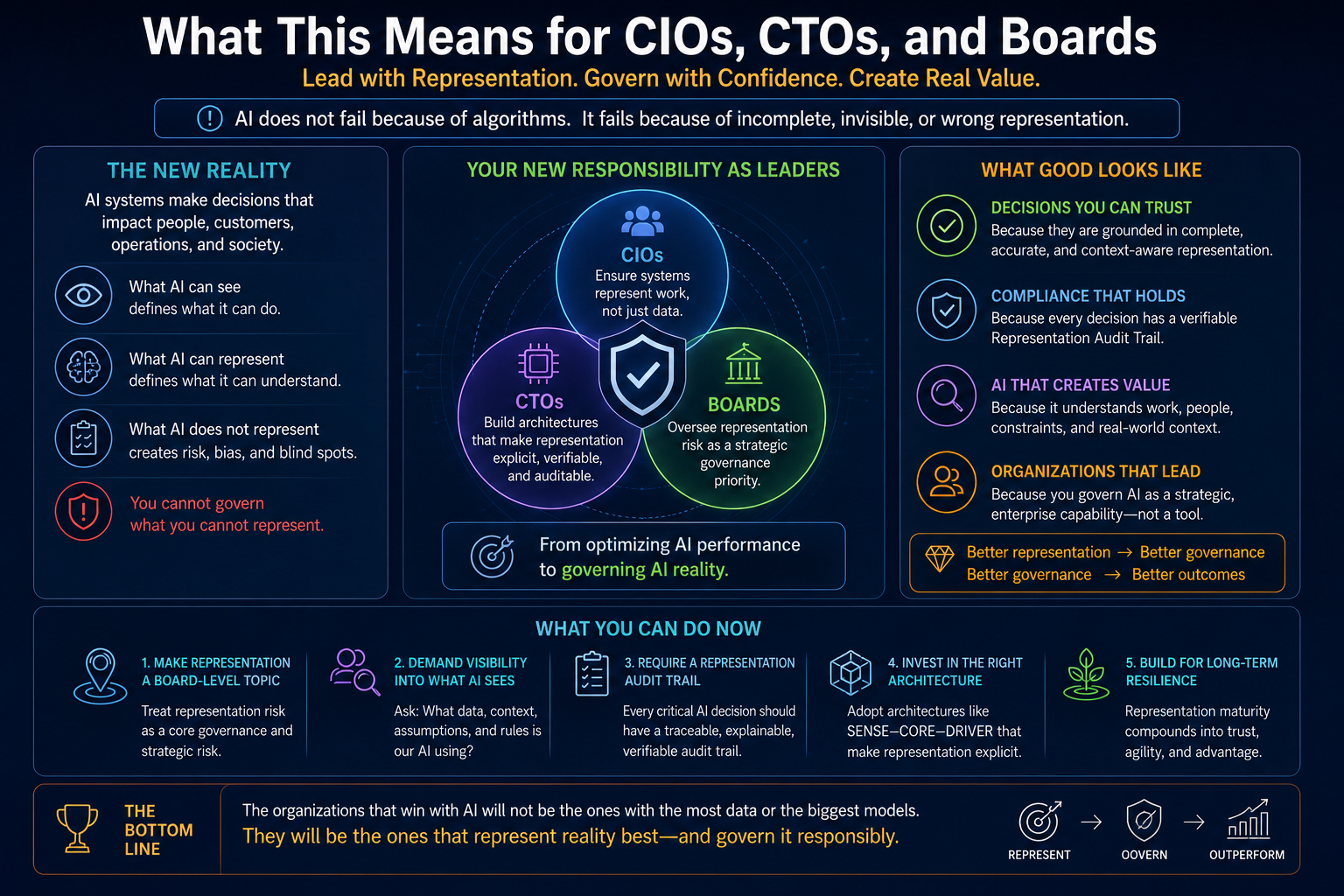
The Representation Compliance Problem is not a future risk. It is present in every organisation that has deployed AI with human-in-the-loop governance and assumed that the loop is functioning as designed.
Three questions every technology leader should be asking today:
First, what is your organisation’s SENSE layer? Not your AI models — your representation infrastructure. How does reality enter your AI systems, and what is its provenance, compression, and synthetic risk? If you cannot answer this, you cannot answer whether your compliance audits mean what you think they mean.
Second, what has AI done to your human reviewers? Not what should they do — what do they actually do? How much time do they spend on AI-assisted decisions? What is their override rate? When did it last change? The answer to these questions tells you whether your human-in-the-loop is a genuine safeguard or a regulatory checkbox.
Third, what would a Representation Audit Trail look like in your systems? Not what does it currently look like — what would it need to look like to satisfy a regulator who understood the Representation Compliance Problem? Building toward that answer now is the governance equivalent of investing in fire safety before the fire.
The Long Arc
The judges who conducted the trial by ordeal were not incompetent. They were doing their best with the representation technology of their time. When better representation technology arrived — written testimony, cross-examination, forensic evidence — the compliance architecture rebuilt itself around the new sensing apparatus.
We are at one of those moments. The sensing apparatus has changed. AI systems perceive, compress, and generate representations of reality in ways that existing governance frameworks were not designed to audit. Human behaviour inside those systems has changed in ways that make the human-in-the-loop assumption unreliable. And the cost of fabricating convincing representations has dropped to near zero.
The organisations and institutions that recognise this — and begin building representation-aware compliance infrastructure now — will not just be ahead of the regulatory curve. They will be the ones who define what the next era of governance looks like.
Every prior era of compliance was built by people who understood the representation technology of their time. That is the work of this era.
The question is who does it first.
FAQ Section
What is the Representation Compliance Problem?
The Representation Compliance Problem occurs when governance systems audit representations of reality rather than reality itself. If those representations are incomplete, compressed, synthetic, or misleading, compliance may appear successful while underlying reality remains hidden.
Why is this important for Enterprise AI?
Enterprise AI systems increasingly make decisions based on machine-generated representations of customers, employees, transactions, and business processes. Governance can only audit what those systems represent.
How does Digital Anthropology relate to AI governance?
Digital Anthropology studies how human behavior changes inside digital systems. It reveals how automation bias, speed pressure, and machine deference can weaken human oversight mechanisms assumed by most governance frameworks.
What is a Representation Audit Trail?
A Representation Audit Trail records not only what an AI system decided, but what it perceived, what it omitted, how information was compressed, and how decisions were reviewed.
What is the role of SENSE–CORE–DRIVER?
SENSE–CORE–DRIVER provides a governance architecture for enterprise AI:
- SENSE establishes representation quality.
- CORE performs reasoning and interpretation.
- DRIVER governs execution, accountability, verification, and recourse.
Why do traditional AI governance frameworks struggle?
Most governance frameworks assume that data, logs, and outputs accurately represent reality. The article argues that AI introduces new representation failures that existing audit models cannot adequately detect.
What is the connection to the Representation Economy?
The Representation Economy argues that value, trust, governance, and coordination increasingly depend on machine-legible representations of reality. The Representation Compliance Problem is a governance consequence of that shift.
Who should read this article?
- CIOs
- CTOs
- Chief Risk Officers
- AI Governance Leaders
- Compliance Teams
- Enterprise Architects
- Researchers studying AI governance
- Digital Anthropology scholars
Q&A
Why does AI governance fail?
AI governance often fails because governance frameworks audit system outputs rather than the quality of the representations that produced those outputs.
What is the biggest compliance risk in enterprise AI?
The biggest emerging risk is representation failure: incomplete, distorted, synthetic, or unverifiable representations that create blind spots for governance.
How can organizations improve AI compliance?
Organizations should strengthen representation quality, establish representation provenance, monitor human review behavior, and build Representation Audit Trails.
What is a Representation Audit Trail in AI?
A Representation Audit Trail records what an AI system perceived, how it interpreted information, what it omitted, and how decisions were validated.
Why is human-in-the-loop governance becoming less reliable?
Digital Anthropology shows that automation bias, speed pressure, and machine deference can reduce meaningful human oversight even when humans remain formally involved.
What is Digital Anthropology for Enterprise AI?
Digital Anthropology examines how human behavior, decision-making, and organizational culture evolve within digital environments and AI-enabled systems.
Author Ownership Block
About the Author
Raktim Singh is a researcher, enterprise AI strategist, and author of the Representation Economy framework and the SENSE–CORE–DRIVER architecture. His work focuses on enterprise AI governance, digital anthropology, machine-legible organizations, AI compliance, and institutional trust in autonomous systems.
His research explores how representation quality shapes AI outcomes, governance effectiveness, organizational decision-making, and digital transformation.
Key frameworks include:
- Representation Economy
- SENSE–CORE–DRIVER
- Representation Compliance Problem
- Representation Audit Trail
ORCID: 0009-0002-6207-602X
Glossary
Representation Compliance Problem
A governance failure that occurs when compliance systems audit representations of reality rather than reality itself.
Representation Audit Trail
A governance mechanism that records how reality was represented, interpreted, compressed, verified, and acted upon by AI systems.
Digital Anthropology for Enterprise AI
The study of how human behavior, organizational practices, and institutional decision-making change within AI-mediated digital environments.
Representation Economy
A framework proposing that value creation, trust, governance, and coordination increasingly depend on machine-legible representations of reality.
SENSE–CORE–DRIVER
An enterprise AI architecture separating perception (SENSE), reasoning (CORE), and governed execution (DRIVER) to improve trust, accountability, and operational legitimacy.
References and Further Reading
- Gartner: GenAI project abandonment due to poor data quality, risk controls, costs, and unclear business value. (Gartner)
- Gartner: AI-ready data and risk of AI project abandonment through 2026. (Gartner)
- NIST AI Risk Management Framework. (NIST)
- OECD AI Principles. (OECD.AI)
- Raktim Singh: The Data Illusion. (Raktim Singh)
- Raktim Singh: What Is the Representation Economy? (Raktim Singh)
- Raktim Singh: What Is the SENSE–CORE–DRIVER Framework? (Raktim Singh).
- raktimsingh.com/enterprise-ai-roi/
- raktimsingh.com/ai-agent-governance-how-cios-should-decide-what-ai-agents-are-allowed-to-do/
- raktimsingh.com/enterprise-ai-projects-fail-even-when-models-work/
- raktimsingh.com/15-tensions-enterprise-ai-sense-core-driver/
- raktimsingh.com/ai-transformation-begins-where-digital-transformation-stopped/
- raktimsingh.com/enterprise-ai-roi/
- raktimsingh.com/enterprise-ai-roi/
Where can I learn more about SENSE–CORE–DRIVER?
Official resources are available through:
Website: https://www.raktimsingh.com
GitHub:
https://github.com/raktims2210-dev/representation-economy
ORCID:
https://orcid.org/0009-0002-6207-602X
Research Publications:
Zenodo DOI: 10.5281/zenodo.20368910
Figshare DOI: 10.6084/m9.figshare.32393949
ResearchGate:
https://www.researchgate.net/publication/405094400
Related Enterprise AI Reading
Many organizations are discovering that enterprise AI success depends on far more than model accuracy. Common challenges include AI project failure, weak AI governance, poor AI agent control, unclear enterprise AI ROI, and the inability to translate AI insights into business outcomes. For readers exploring topics such as why enterprise AI projects fail, how AI creates business value, AI agent governance frameworks, agentic AI systems, enterprise AI architecture, AI risk management, CIO AI strategy, and enterprise AI operating models, the following articles provide a deeper perspective:
-
- raktimsingh.com/hy-enterprise-ai-projects-fail-digital-anthropology-ai-governance/
- raktimsingh.com/why-digital-transformation-fails-ai-representation-layer/
- raktimsingh.com/enterprise-ai-failure-digital-anthropology-ai-governance/
- raktimsingh.com/enterprise-ai-roi/
- raktimsingh.com/enterprise-ai-projects-fail-reality-gap-ai-governance/
- raktimsingh.com/why-enterprise-ai-programs-fail/
- raktimsingh.com/why-enterprise-ai-transformation-fails/
- raktimsingh.com/enterprise-ai-readiness-gap-cio-assessment/
- raktimsingh.com/enterprise-ai-adoption-framework/
- raktimsingh.com/enterprise-ai-pilot-to-production-framework/
- raktimsingh.com/enterprise-ai-three-unsolved-problems-before-model-runs/
- raktimsingh.com/ai-agent-governance-regulated-industries-representation-problem/
- raktimsingh.com/why-ai-transformation-fails-digital-anthropology/
Together, these articles examine the critical relationship between enterprise data, AI decision-making, AI governance, AI agents, execution systems, accountability mechanisms, and measurable business value, helping CIOs, CTOs, architects, and business leaders move from AI experimentation to enterprise-scale impact.



Raktim Singh is an AI and deep-tech strategist, TEDx speaker, and author focused on helping enterprises navigate the next era of intelligent systems. With experience spanning AI, fintech, quantum computing, and digital transformation, he simplifies complex technology for leaders and builds frameworks that drive responsible, scalable adoption.