

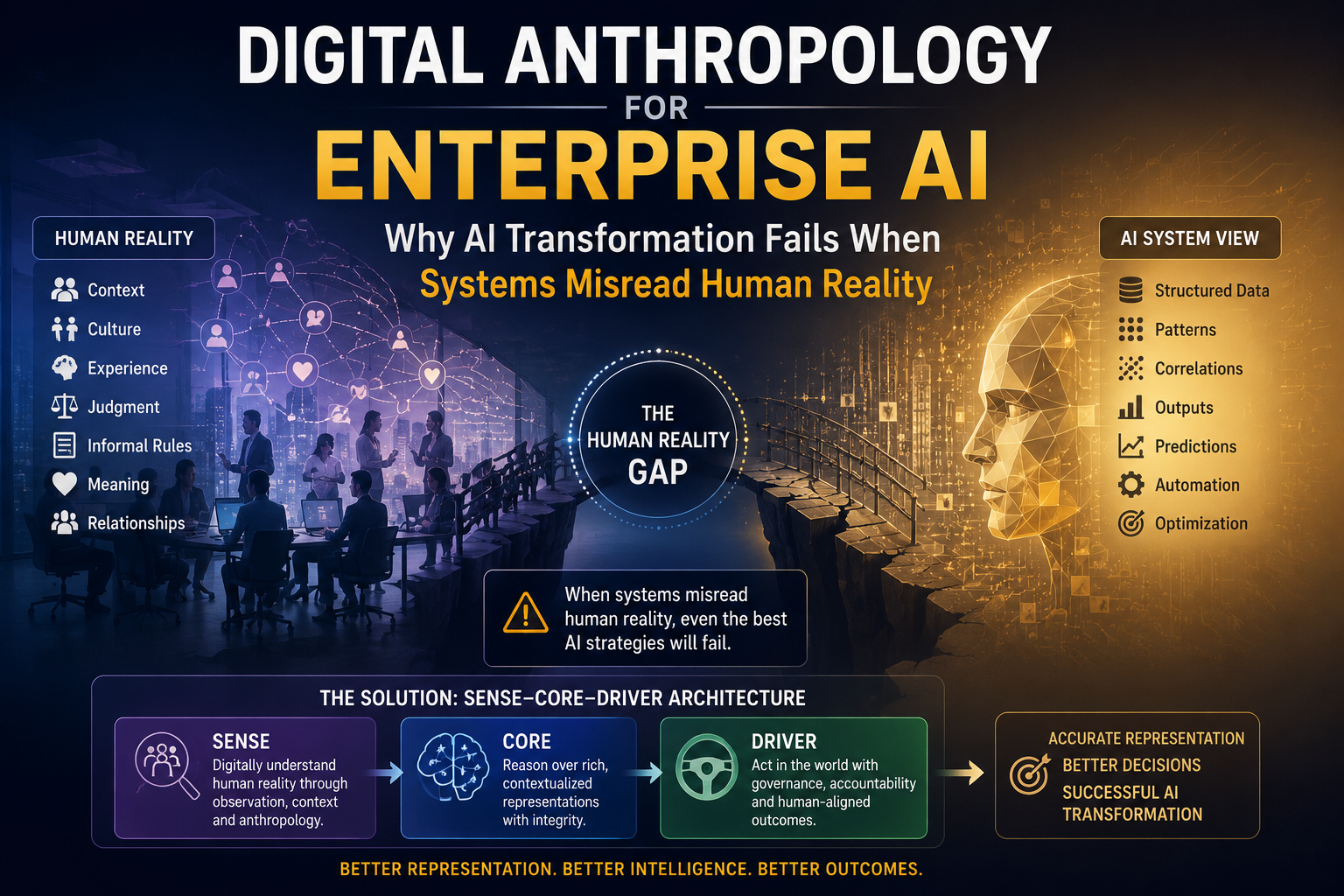
Digital Anthropology for Enterprise AI:
Every enterprise that has deployed AI has the same confession: the model worked perfectly. The transformation did not.
Trillions of dollars. Thousands of AI pilots. Hundreds of frameworks, playbooks, and consultants. Yet by most credible estimates, somewhere between 70 and 95 percent of enterprise AI initiatives fail to move from pilot to production at scale, or produce meaningful, sustained business value when they do.
The standard explanations are familiar: poor data quality, lack of leadership alignment, insufficient change management, unclear ROI. These are real problems. But they are symptoms, not causes. They describe what goes wrong after the failure has already begun. They do not explain where the failure originates.
This article argues that enterprise AI transformation fails at a point that has no name in the existing literature. It fails at the boundary between human reality and machine-legible representation — the moment where the world that your employees inhabit, the judgment they exercise, the context they carry in their heads, and the informal rules they follow every day, must be translated into something an AI system can sense, reason over, and act upon.
That boundary has a discipline dedicated to studying it. It is called Digital Anthropology. And it is almost entirely absent from how enterprises think about, design, and deploy AI.
The SENSE-CORE-DRIVER framework — a governance architecture for enterprise AI built on the principles of the Representation Economy — provides the structural solution. But to understand why that solution works, you first need to understand the problem it solves: the gap between human reality and machine-legible representation that sits at the root of nearly every AI transformation failure.
What Is Digital Anthropology, and Why Does Enterprise AI Need It?
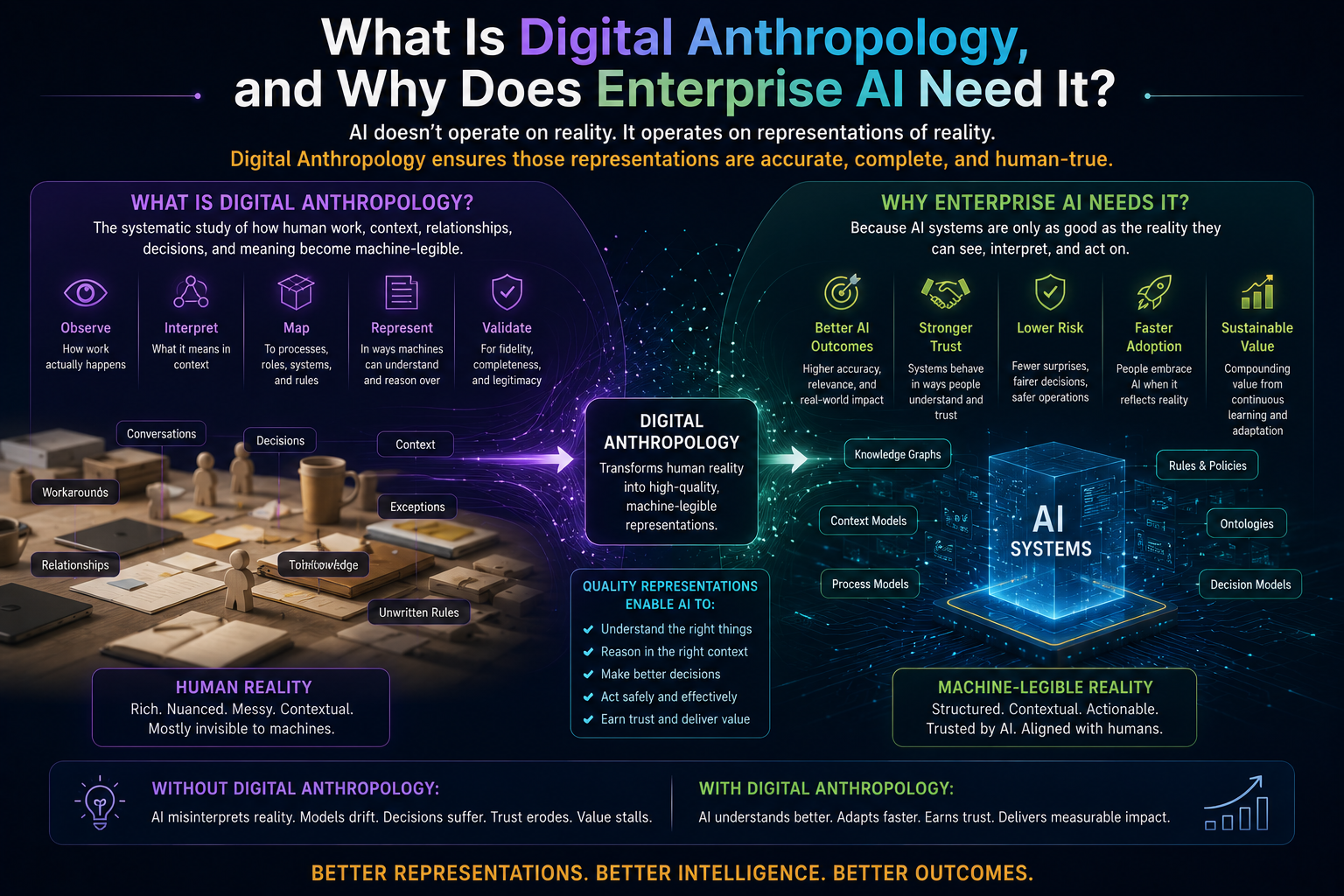
Anthropology is the study of how humans make meaning in the world. Digital anthropology extends that study to the environments where human behavior, identity, culture, and decision-making intersect with digital systems. It asks not just what data systems capture, but what they miss, what they distort, and whose reality they fail to represent.
In the enterprise context, digital anthropology asks a brutally practical question: does your AI system understand the world as your people actually experience it — or does it understand a simplified, sanitized, formally-structured version of that world that exists only in your databases?
The answer, in almost every enterprise, is the second. And that gap is where AI transformation quietly dies.
A concrete example: Consider a hospital system that deploys an AI model to optimize patient discharge timing. The model is trained on electronic health records, lab results, physician notes, and bed availability data. In testing, it performs brilliantly — reducing average length of stay by 18 percent in controlled trials.
When deployed at scale, outcomes worsen. Readmission rates climb. Physicians override the model’s recommendations constantly. Leadership declares the project a failure and blames the data science team.
What went wrong? The model was trained on what the hospital formally recorded. It was not trained on what the hospital informally knew: that Tuesday afternoon discharges consistently fail because the transport coordinator is overwhelmed; that patients from certain zip codes need 48 hours of additional social work support that never appears in the clinical record; that Dr. Chen always documents ‘stable for discharge’ two days before she actually believes a patient is ready, because the system penalizes her for extended stays.
None of this informal knowledge — which every experienced nurse and floor coordinator carries fluently — appears in the SENSE layer of the AI system. The model is reasoning correctly over an incomplete, distorted representation of reality. The failure is not an AI problem. It is a representation problem. It is a Digital Anthropology problem.
The Representation Economy: Why Reality Must Become Machine-Legible to Have Value
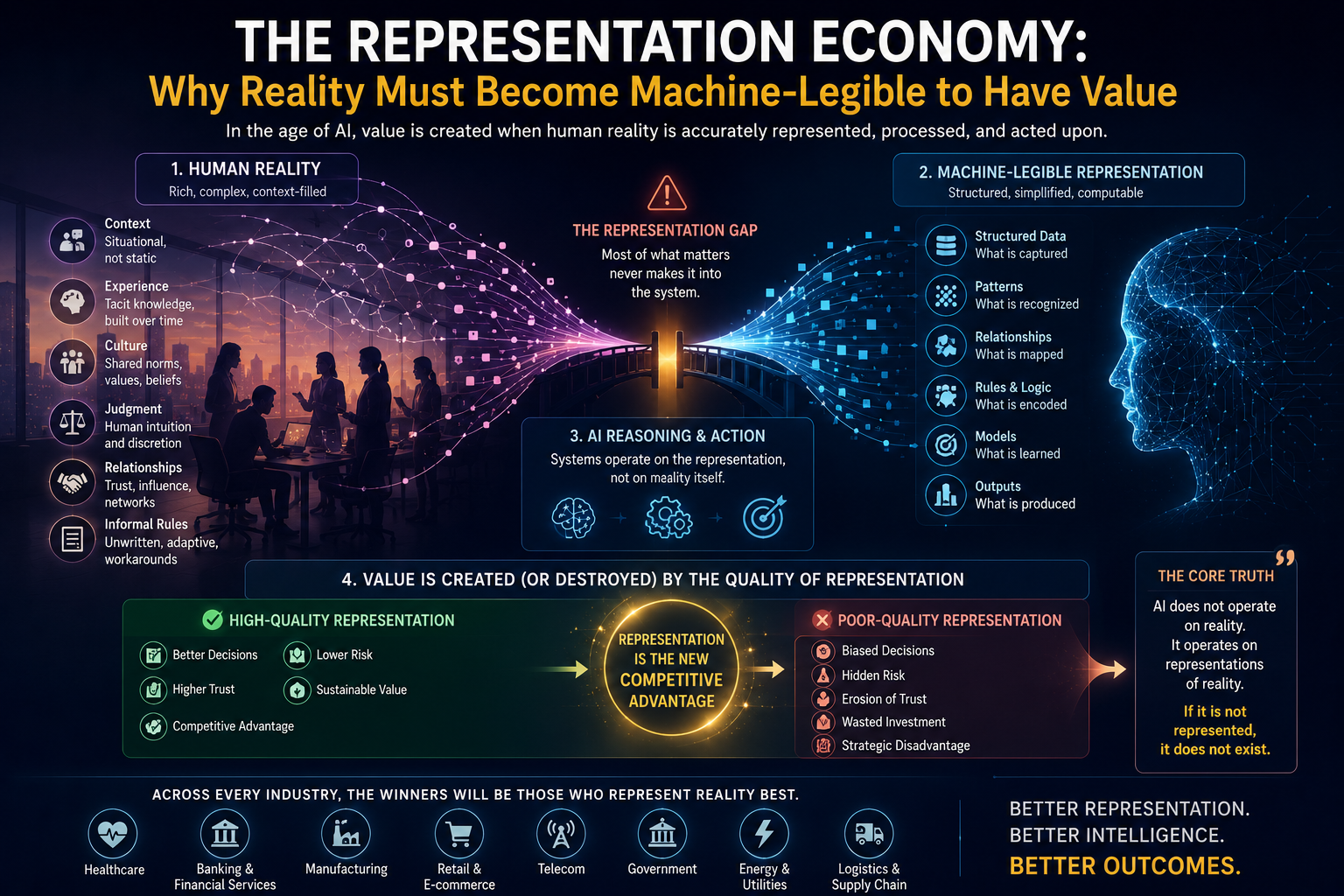
The Representation Economy is a framework for understanding how value, trust, and competitive advantage are created and destroyed in the age of AI. Its central argument is straightforward: AI systems do not operate on reality. They operate on machine-legible representations of reality. Therefore, in an economy where AI systems increasingly make or influence decisions, the quality and completeness of those representations determines outcomes.
In the Representation Economy, if it is not represented, it does not exist — for the AI system, for the institution, and ultimately for the people whose reality went unencoded.
This has a profound implication that most AI strategies miss entirely. The competitive advantage in the AI era does not belong to the organization with the best model. It belongs to the organization with the most accurate, complete, and contextually faithful representation of the reality their AI system needs to navigate.
A bank with a superior credit risk model but a poor representation of how small business owners actually manage their cash flow will consistently make worse lending decisions than a bank with a slightly weaker model but a richer, anthropologically-informed picture of small business financial behavior.
A retailer with a state-of-the-art demand forecasting algorithm but no representation of how store managers informally adjust inventory based on local events, weather patterns, and community relationships will consistently be beaten by a competitor whose AI system has access to that contextual knowledge.
The Representation Economy framework names this dynamic and makes it legible for executives. But it raises an immediate architectural question: once you accept that representation quality determines AI outcomes, how do you build an enterprise AI system that gets representation right? How do you separate the act of sensing and encoding reality from the act of reasoning over it, and both of those from the act of taking action?
That is precisely the problem the SENSE-CORE-DRIVER architecture solves.
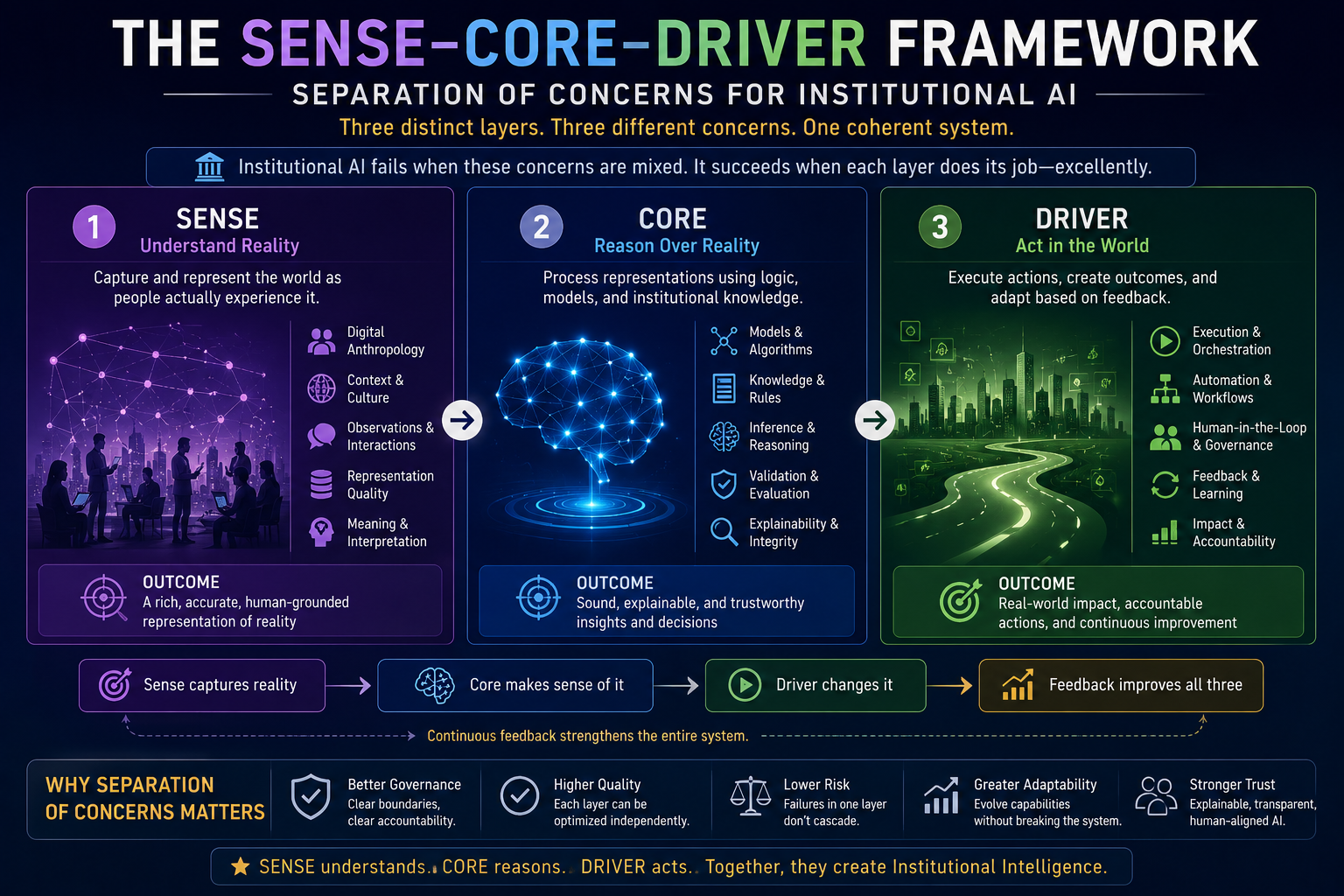
The SENSE-CORE-DRIVER Framework: Separation of Concerns for Institutional AI
In software engineering, separation of concerns is one of the oldest and most powerful architectural principles. It states that a system should be organized so that each component has a single, well-defined responsibility — and those responsibilities should not be mixed together. A well-architected system separates data access from business logic, and business logic from presentation. When these concerns are mixed, systems become brittle, ungovernable, and impossible to reason about or audit.
Enterprise AI has a separation of concerns problem. Most AI deployments mix together three fundamentally different activities that need to be architecturally distinct:
- The act of sensing and encoding reality into machine-legible form
- The act of reasoning, coordinating, and generating intelligence from that representation
- The act of taking action, delegating authority, and ensuring recourse and reversibility
When these three concerns are collapsed into a single AI system — as they typically are — you get a system that is simultaneously trying to interpret the world, reason about the world, and act on the world, with no clear boundaries between any of these activities. The result is a system that is impossible to govern, difficult to audit, and almost certain to fail when the world it was trained on diverges from the world it is deployed in.
SENSE-CORE-DRIVER is the architectural response to this problem. It separates enterprise AI into three distinct layers, each with a single well-defined responsibility.
The SENSE Layer: Where Digital Anthropology Becomes Architecture
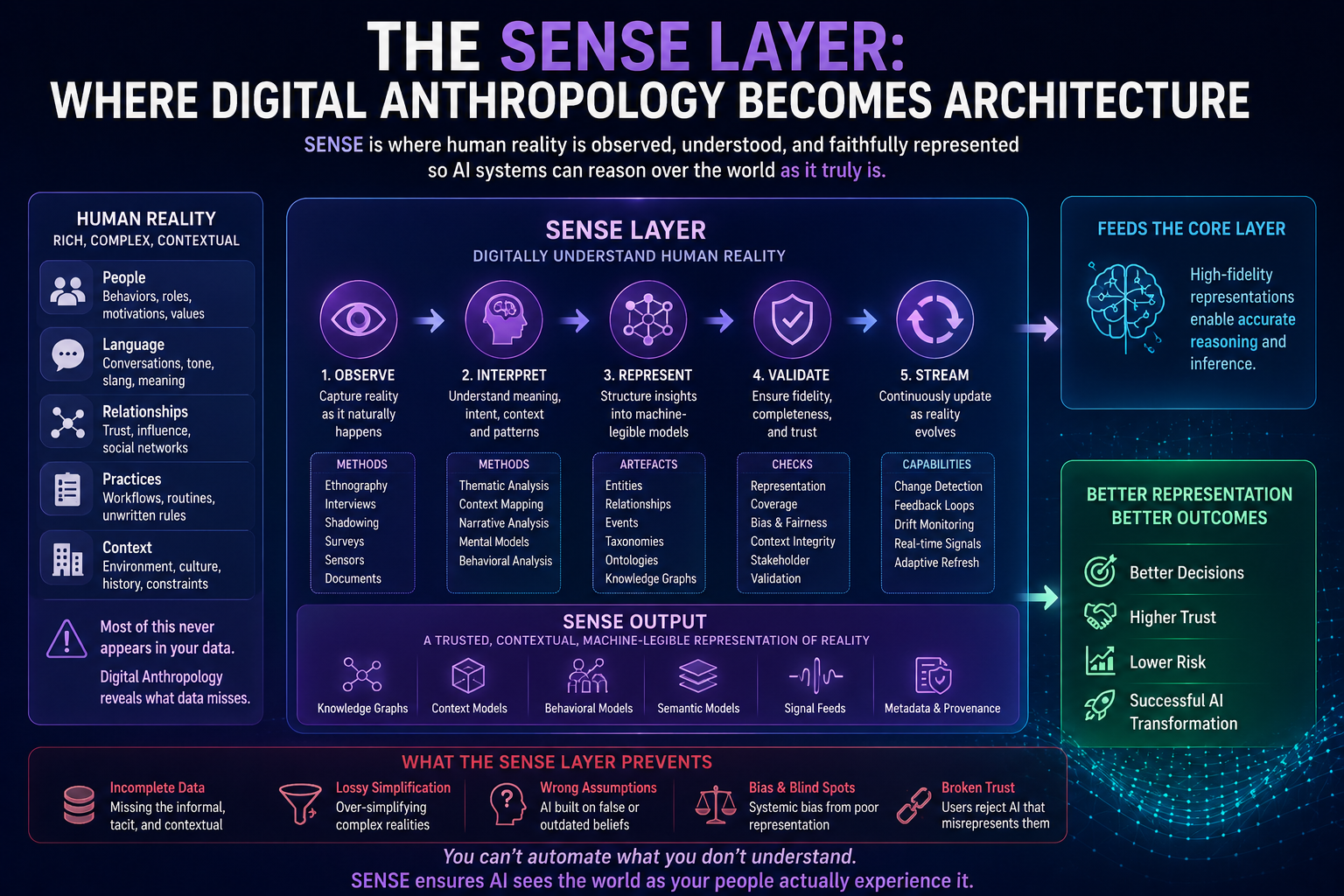
The SENSE layer is responsible for one thing: accurately, completely, and contextually encoding the human reality that the AI system needs to operate in. It is the representation layer. It is also, in virtually every enterprise AI deployment, the most neglected layer.
Most organizations treat the SENSE layer as a data engineering problem. They build data pipelines, clean databases, and create feature stores. These are necessary but not sufficient. Data engineering captures what was formally recorded. Digital anthropology reveals what was experienced but not recorded — the informal knowledge, the contextual judgment, the cultural norms, the exception-handling patterns that experienced practitioners carry but that never appear in system logs.
Another example: A global logistics company deploys an AI system to optimize route planning across its European network. The data engineering team feeds the system GPS data, fuel costs, delivery schedules, vehicle capacity, and traffic patterns. The system produces routes that are theoretically optimal.
Drivers refuse to follow them. The routes are technically correct but experientially impossible: they route trucks through narrow medieval town centers at school pickup time, schedule deliveries to industrial customers during shift changes when no one is available to receive them, and ignore the informal agreements that regional managers have with certain customers about timing flexibility.
The SENSE layer of this AI system was built by data engineers. It needed to be built by digital anthropologists. The difference is not technical — it is epistemic. Data engineers capture what the organization records. Digital anthropologists understand what the organization knows.
When the SENSE layer is built with anthropological rigor, it becomes a structured representation not just of formal data but of human context: who does what, when, why, under what informal constraints, with what tacit knowledge, following what cultural rules. This representation is richer, more faithful, and far more useful for AI systems that must navigate the same human environment.
The CORE Layer: Reasoning, Coordination, and Intelligence
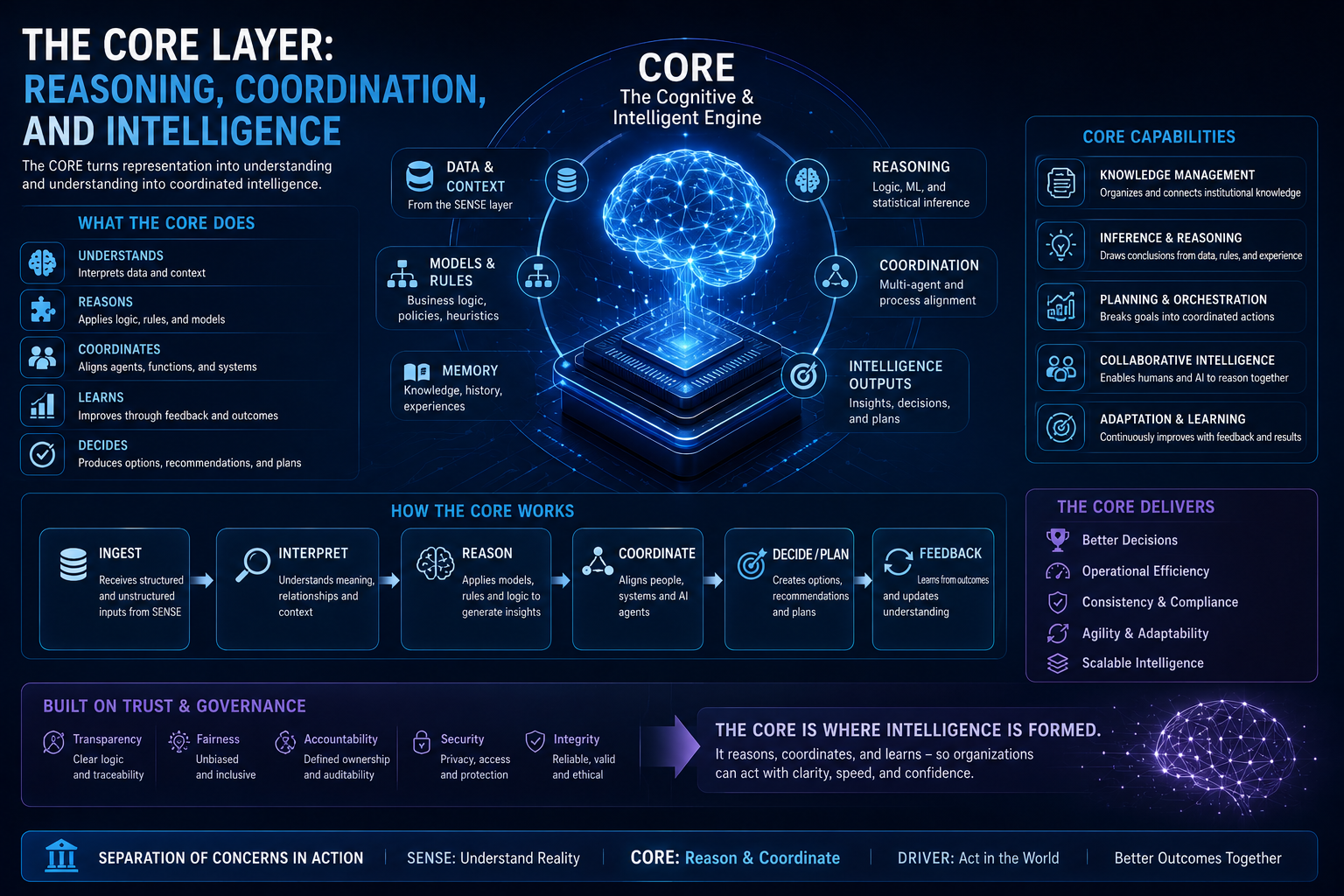
Once the SENSE layer has produced a faithful machine-legible representation of reality, the CORE layer takes over. The CORE layer is responsible for reasoning, pattern recognition, decision support, and coordination across multiple AI agents or systems. It is where the intelligence happens.
The critical insight of the SENSE-CORE-DRIVER architecture is that the CORE layer should receive a clean, validated, anthropologically-informed representation from the SENSE layer — and should not itself be responsible for interpreting or encoding reality. This is the separation of concerns principle in action.
When CORE has to simultaneously interpret ambiguous real-world data and reason over it, it does both badly. When it receives clean, contextualized representation from SENSE, it can focus entirely on reasoning — and its outputs are dramatically more reliable.
Example: Consider an insurance company using AI to assess complex commercial property claims. When the AI system receives raw, unstructured adjuster notes along with images, policy documents, and historical claims data — all mixed together — it produces inconsistent, often inaccurate assessments. The model conflates the act of understanding what happened (SENSE) with the act of evaluating the claim (CORE).
When the company restructures the architecture so that a dedicated SENSE layer processes, contextualizes, and normalizes all incoming claim information before passing it to the CORE reasoning system, accuracy improves dramatically. The CORE layer no longer has to decode ambiguous input while simultaneously making coverage decisions. The concerns are separated, and both functions work better.
The DRIVER Layer: Governance, Delegation, Recourse, and Reversibility
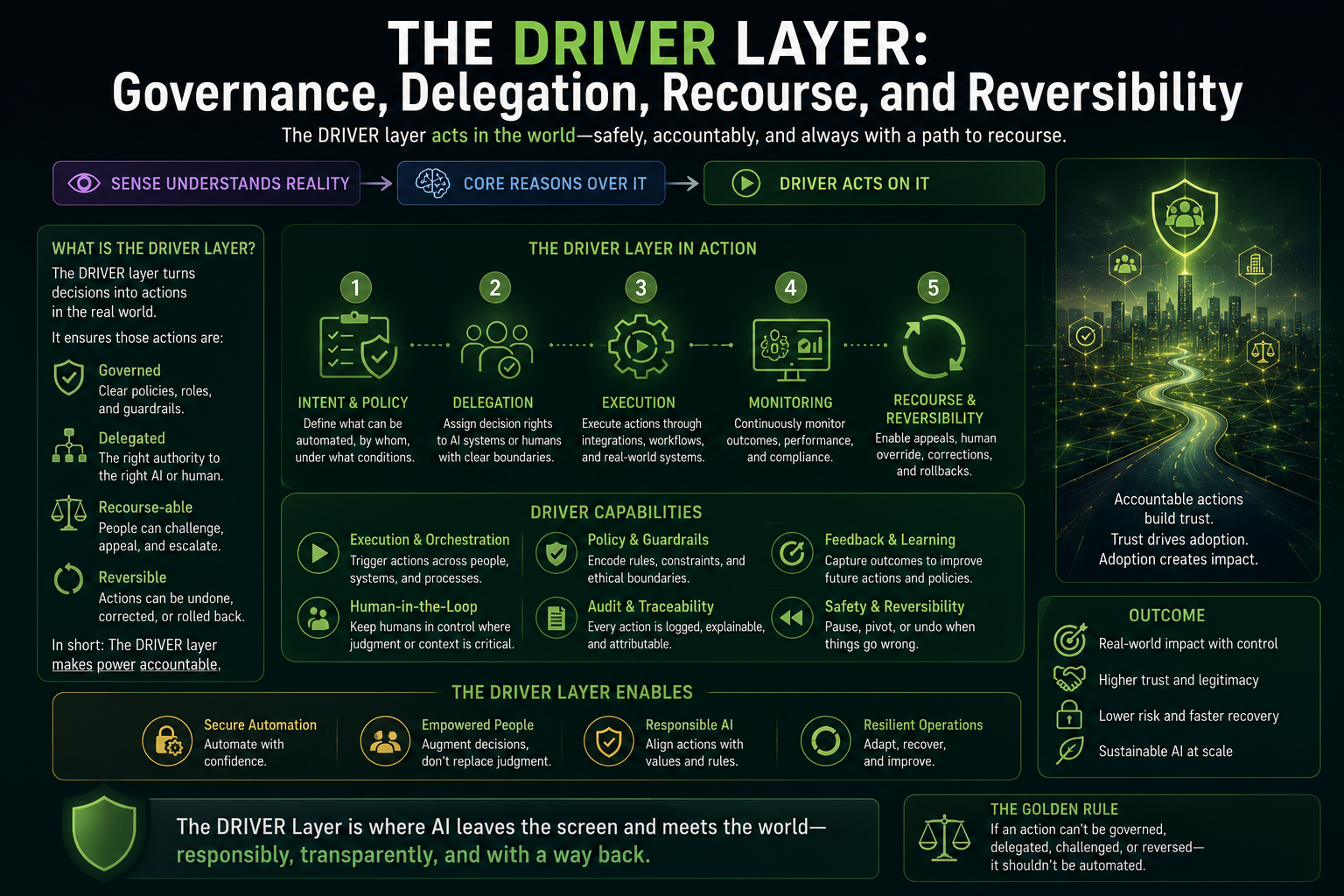
The DRIVER layer governs what the AI system is allowed to do with the intelligence produced by CORE. It manages the boundary between AI recommendation and AI action. It handles delegation of authority — who or what can authorize the system to act — and it ensures that every action taken by the system is auditable, reversible where possible, and subject to meaningful human recourse.
This is the layer that most enterprise AI governance frameworks try to build — but they try to build it without the SENSE and CORE layers being properly separated first. The result is governance structures applied to AI systems that are simultaneously misrepresenting reality, reasoning over that misrepresentation, and taking action — with no clean boundary at which governance can intervene.
The DRIVER layer only works as a governance mechanism when CORE is producing clean, auditable reasoning — and CORE only produces clean, auditable reasoning when SENSE is providing faithful, complete representation.
Example: A financial institution deploys an AI system to make credit limit adjustment decisions for existing customers. The system has three distinct layers: SENSE encodes the customer’s current financial behavior, including both formal credit bureau data and behavioral signals from the bank’s own systems. CORE reasons over this representation to produce a recommendation — increase limit, maintain, or reduce — with a confidence score and a brief audit trail of the factors considered. DRIVER enforces the rules about what the system can actually do: above a certain confidence threshold, it can act autonomously; below that threshold, it routes to a human reviewer; all decisions are logged with full reasoning traces for regulatory audit.
This architecture is governable because the concerns are separated. Regulators can audit the SENSE layer to verify that the representation is fair and complete. They can examine the CORE layer’s reasoning chain. They can inspect the DRIVER layer’s decision rules. When something goes wrong, the failure can be located precisely — in the representation, in the reasoning, or in the delegation logic — rather than being lost somewhere inside an opaque model.
Why This Matters for CIOs, CTOs, and CEOs Right Now
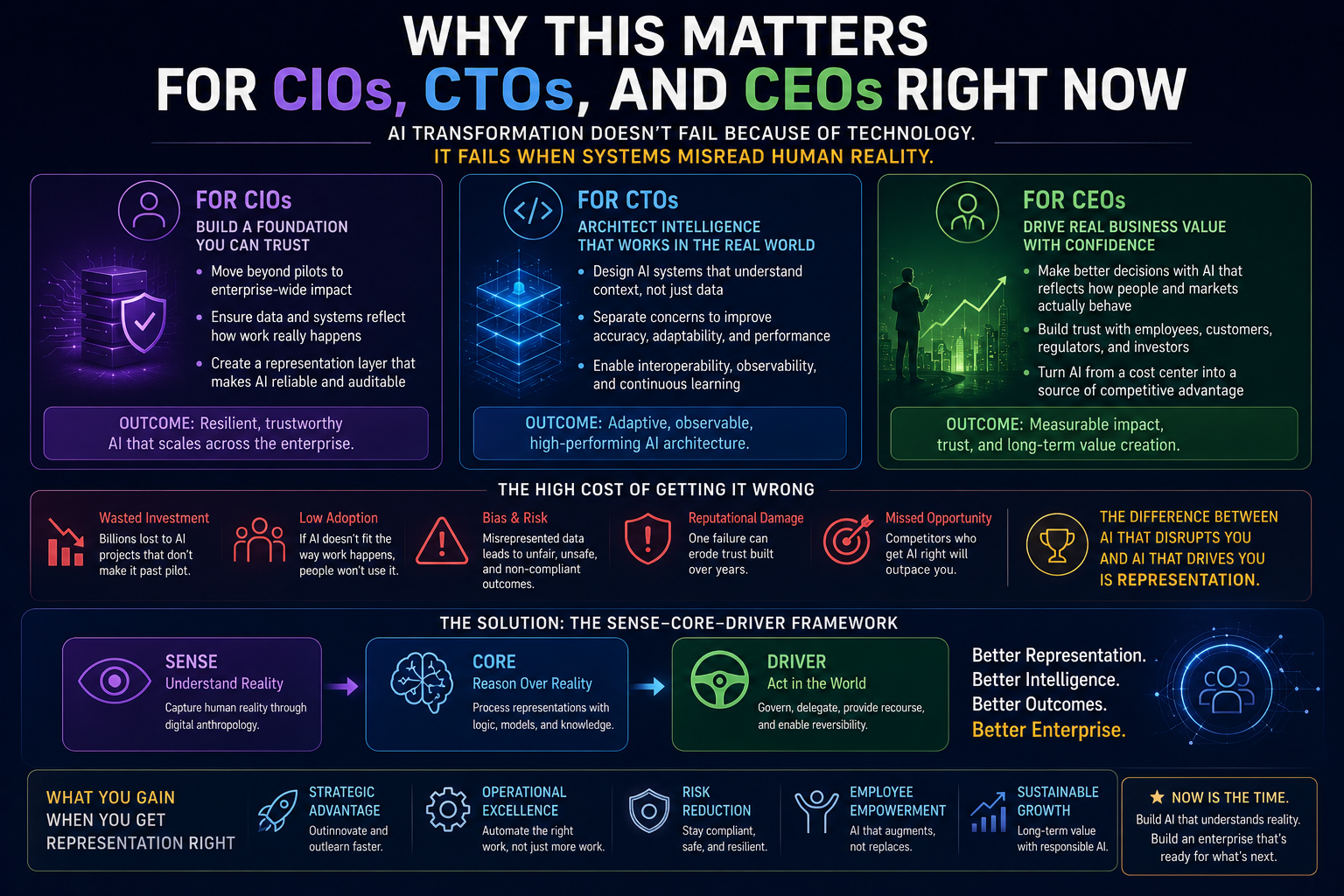
The strategic implications of this architecture are not abstract. They are immediate and financial.
According to Deloitte’s 2026 research, 74 percent of organizations plan to deploy agentic AI — AI systems that take autonomous action — within the next two years. Yet only 21 percent report having a mature governance model for autonomous agents. The 53-point gap between deployment intent and governance maturity is the exact space where SENSE-CORE-DRIVER operates.
For CIOs, the framework reframes the AI governance conversation from a compliance activity into an architectural principle. You do not add governance to an AI system after it is built. You build governance into the architecture from the start, through the separation of concerns that SENSE-CORE-DRIVER enforces.
For CTOs, the framework provides a technical vocabulary for a problem that has been frustratingly difficult to articulate: why AI systems that perform brilliantly in controlled environments consistently disappoint in production. The answer is almost always a SENSE layer failure — a representation that was accurate enough for testing but too incomplete for the full complexity of the real environment.
For CEOs, the framework reframes the question of AI competitive advantage entirely. The question is no longer ‘which AI model should we buy?’ It is ‘how well does our AI system represent the reality of our business — and are our representation capabilities more accurate, complete, and contextually faithful than our competitors’?’
That is a question about organizational capability, not technology procurement. It is a question that digital anthropology is uniquely positioned to answer — and that the Representation Economy framework is uniquely positioned to measure.
The Human Reality Gap: Where Enterprise AI Transformation Dies
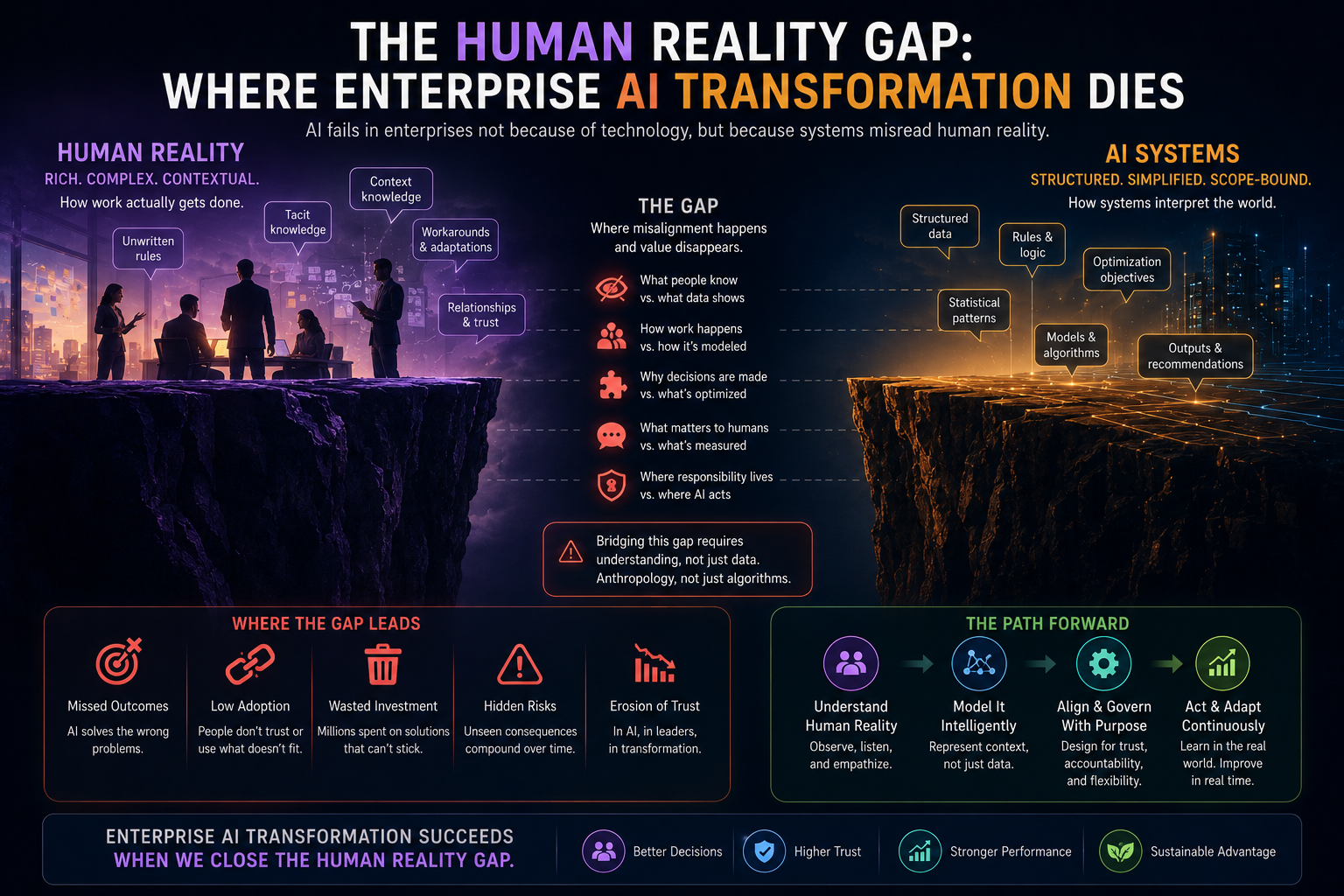
There is a specific moment in every enterprise AI deployment where the failure begins. It is not when the model underperforms. It is not when the change management program fails. It is when the gap between the reality that humans inhabit and the representation that the AI system operates on becomes wide enough that the system’s outputs diverge from what experienced practitioners know to be true.
This gap — what this article terms the Human Reality Gap — is the distance between the lived, contextual, informal, culturally-embedded reality of the organization and the machine-legible representation that the AI system has been given to work with.
When the Human Reality Gap is small, AI systems perform close to their theoretical potential. When the gap is large — which it is in most enterprise deployments — AI systems produce recommendations and decisions that feel wrong to practitioners, generate resistance and workarounds, and ultimately get abandoned or neutered by the human systems around them.
Digital anthropology is the discipline that measures, characterizes, and closes the Human Reality Gap. It does this through ethnographic observation of actual work practices, not just analysis of formally-recorded processes. It studies what people actually do, not what the process map says they should do. It surfaces the tacit knowledge, informal rules, contextual judgment, and cultural norms that experienced practitioners carry but that rarely appear in any system of record.
When this anthropological knowledge is systematically incorporated into the SENSE layer of a SENSE-CORE-DRIVER architecture, the Human Reality Gap narrows. The AI system begins to operate on a representation that is meaningfully closer to the reality it must navigate. And the transformation that has been failing begins, often for the first time, to work.
A Unified Framework: Putting the Pieces Together
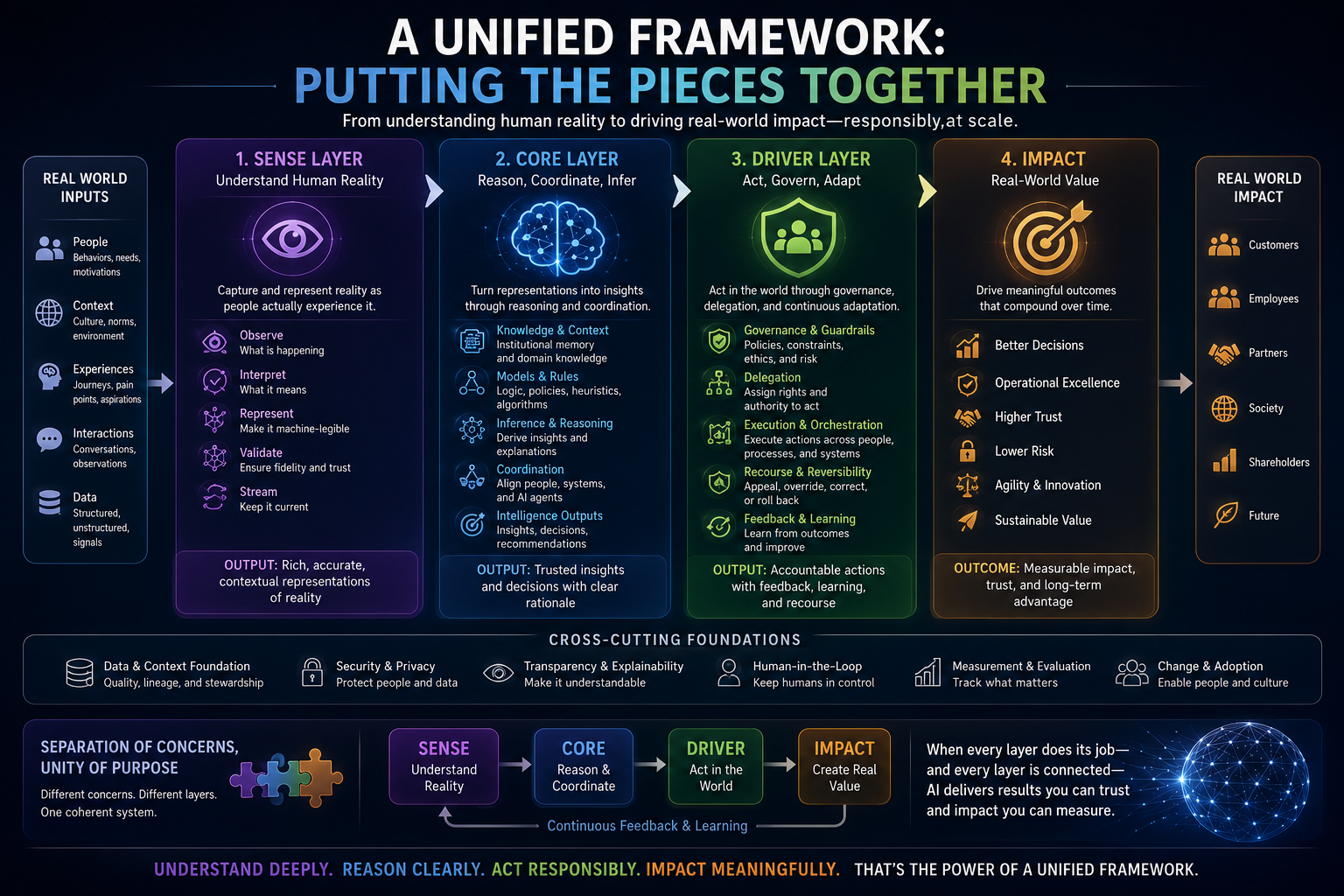
Let us bring this together into a single, integrated picture.
The Representation Economy is the economic theory: in an AI-mediated world, value flows to those who control the most accurate and complete machine-legible representations of the realities that matter. Organizations that invest in representation quality will outperform those that invest only in model sophistication.
Digital Anthropology is the scientific method: the discipline through which organizations study, characterize, and systematically encode the human realities that their AI systems need to navigate. It fills the gap between what data systems capture and what human practitioners know.
SENSE-CORE-DRIVER is the architectural implementation: the separation of concerns that ensures representation (SENSE), reasoning (CORE), and action (DRIVER) are distinct, governable, auditable, and individually improvable. It is the structural mechanism through which the insights of Digital Anthropology are operationalized, and through which the competitive advantages described by the Representation Economy are actually captured.
Together, these three frameworks form a complete answer to the question that has frustrated enterprise AI practitioners for a decade: not just why AI transformation fails, but what, specifically, to do about it — at the architectural level, at the organizational level, and at the economic level.
What Good Looks Like: Three Industries, Three Transformations
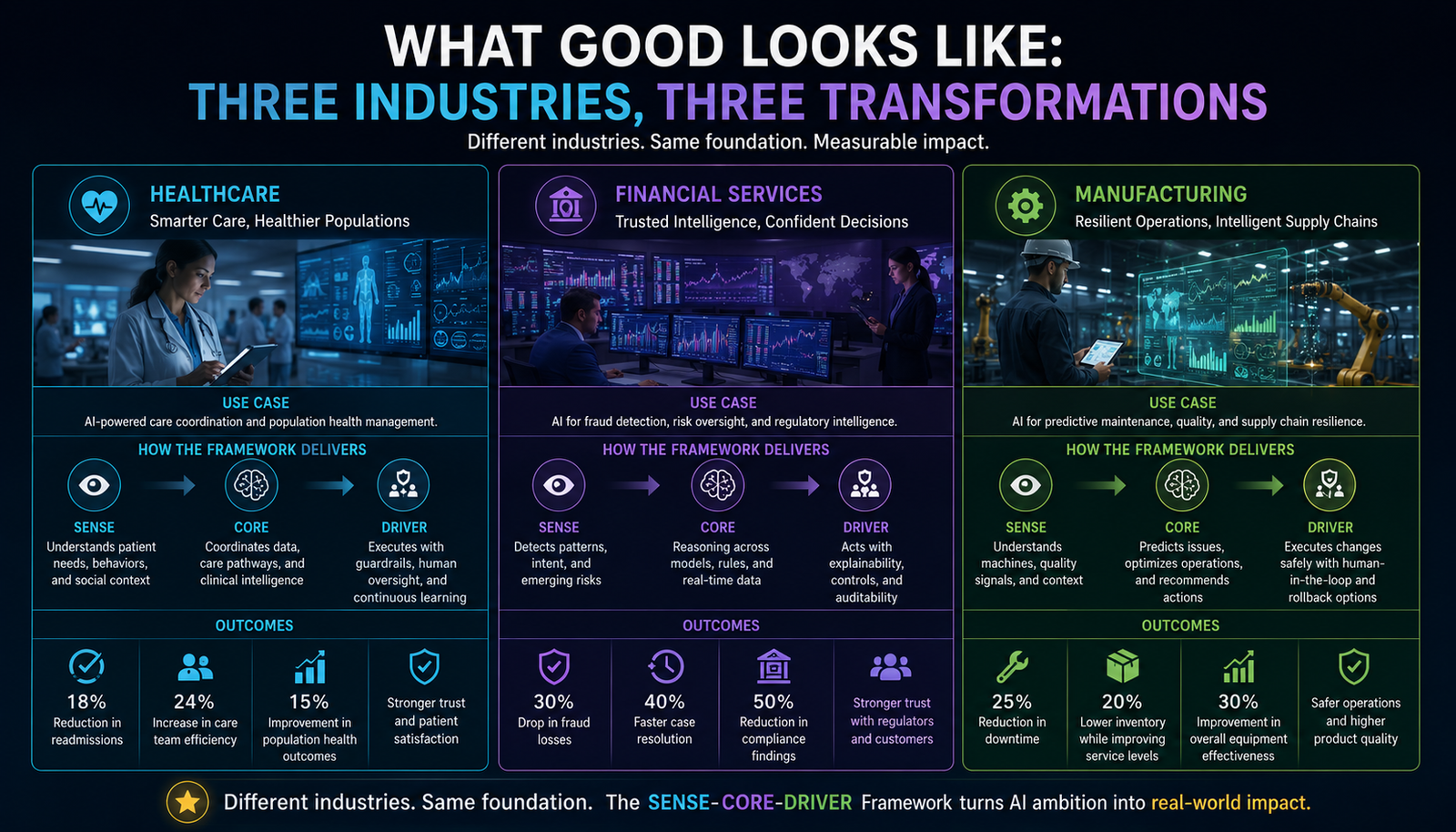
Healthcare: Closing the Clinical Knowledge Gap
A large hospital network deploys a SENSE-CORE-DRIVER architecture for patient flow optimization. The SENSE layer is built by a team that includes not just data engineers but clinical ethnographers who spend six weeks embedded in the emergency department, documenting the informal knowledge that experienced charge nurses carry about patient flow, family dynamics, discharge bottlenecks, and the informal communication channels between clinical teams. This tacit knowledge is systematically encoded into structured representation schemas that feed the SENSE layer.
The CORE layer reasons over this enriched representation to produce patient flow recommendations. The DRIVER layer enforces strict authority limits — the system recommends, it does not act autonomously, and all recommendations are explainable against the SENSE layer inputs.
Outcome: the system’s recommendations are followed 84 percent of the time, compared to 31 percent for the previous system that used the same model but a data-engineering-only SENSE layer. The Human Reality Gap has narrowed. The AI has become trustworthy because it understands the reality it is operating in.
Financial Services: Making the Invisible Visible
A regional bank wants to expand small business lending but its AI credit model consistently underperforms on businesses owned by first-generation immigrants and informal economy participants — populations whose financial reality is poorly represented in traditional credit data.
A digital anthropology exercise reveals that these business owners manage cash flow through networks of informal credit relationships, community trust mechanisms, and savings patterns that are highly predictive of creditworthiness but entirely invisible to the formal credit data system. The SENSE layer is redesigned to incorporate alternative data signals that proxy for these informal patterns — cash flow velocity, social network connectivity proxies, community business association membership.
The CORE layer, now operating on a more complete representation of these businesses’ financial reality, produces credit assessments that are more accurate and less biased. The DRIVER layer limits autonomous lending decisions to amounts below a threshold, routing larger decisions to human underwriters supported by the enriched SENSE layer output.
Outcome: loan approval rates for underserved segments increase by 34 percent. Default rates fall. The bank has not just improved its AI model — it has improved its representation of reality, and the model has followed.
Manufacturing: When the Machine Learns the Floor
A global manufacturer deploys AI-driven predictive maintenance across its production facilities. The initial deployment, built on sensor data alone, produces maintenance alerts that floor engineers dismiss as noise — the system does not understand that certain sensor readings that look anomalous are actually normal artifacts of specific production configurations, shift changes, or planned maintenance windows.
A digital anthropology exercise with production engineers reveals a rich body of tacit knowledge about how machines behave under different conditions — knowledge that is entirely consistent, highly predictive of actual failures, but completely absent from the sensor data stream. This knowledge is encoded into the SENSE layer as contextual rules and pattern libraries.
The CORE layer, now receiving contextualized sensor data rather than raw readings, begins producing maintenance recommendations that engineers recognize as credible. Alert override rates drop from 73 percent to 12 percent. The DRIVER layer, given the increased credibility of CORE outputs, is authorized to schedule non-critical maintenance autonomously, with human authorization required only for production-affecting interventions.
Outcome: unplanned downtime falls 41 percent. The AI system has not been retrained. Its representation of reality has been transformed.
The Practical Starting Point: Five Questions Every CIO Must Ask
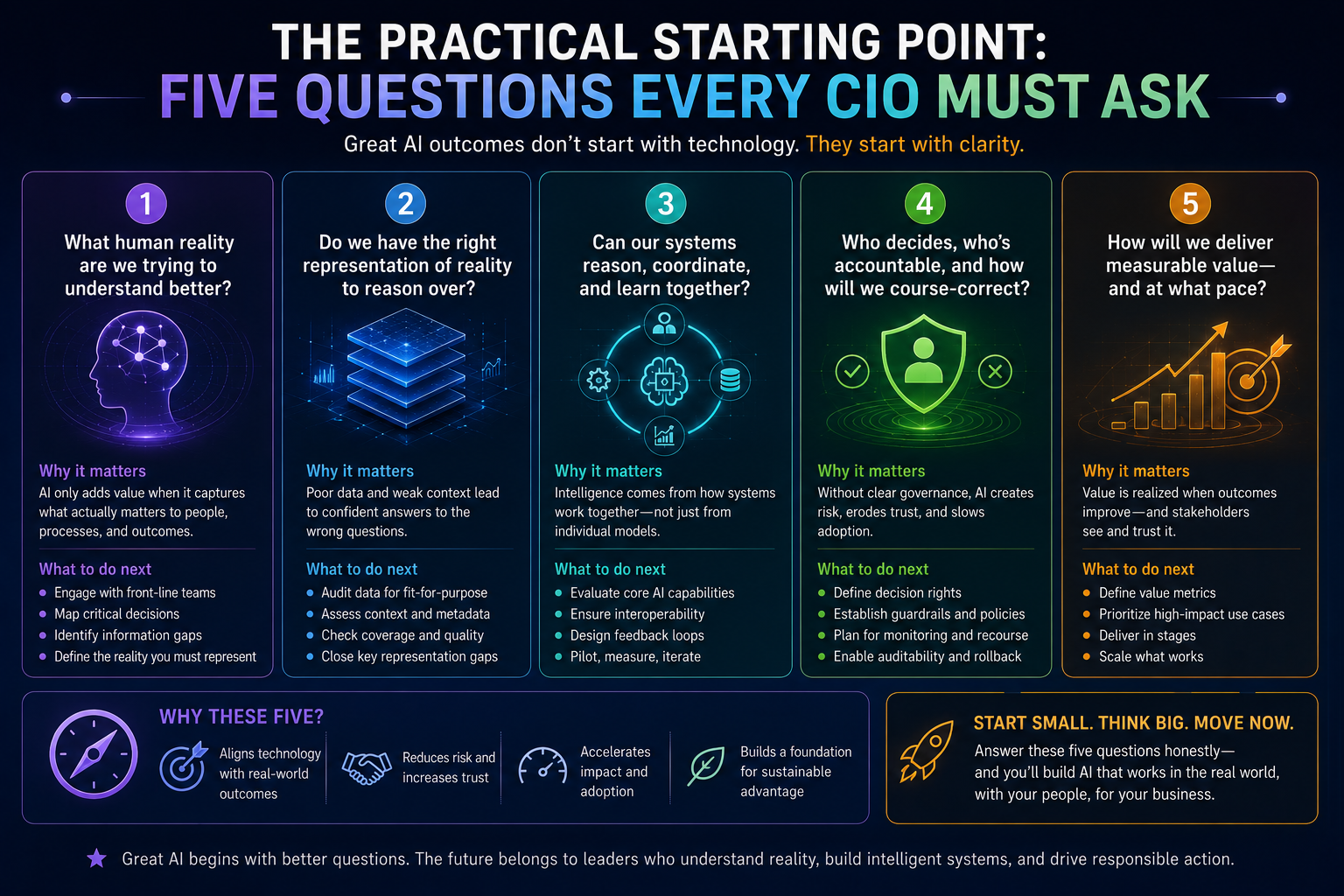
For leaders ready to apply this framework, the starting point is not a technology decision — it is a diagnostic one. Five questions reveal where your organization stands on the Human Reality Gap:
- How was your AI system’s representation of reality built? Was it built by data engineers alone, or by a team that included practitioners with deep knowledge of how work actually happens? If the former, assume the Human Reality Gap is significant.
- What percentage of your AI system’s inputs are formally recorded versus informally known? In most organizations, formal records capture less than 40 percent of the knowledge that experienced practitioners use to make good decisions. If your SENSE layer only accesses formal records, it is operating on less than half the available signal.
- Can you clearly explain the boundary between where your AI system represents reality and where it reasons over that representation? If not, your SENSE and CORE layers are collapsed, and you have a separation of concerns problem that will systematically undermine both representation quality and reasoning reliability.
- When your AI system’s recommendations are overridden by practitioners, do you systematically capture why? Each override is a data point about the Human Reality Gap — a signal that the system’s representation of reality diverged from the practitioner’s experienced reality. Most organizations discard this signal. Mature SENSE-CORE-DRIVER implementations capture and analyze it.
- Does your AI governance framework operate at the DRIVER layer, or does it try to govern the entire system as a monolith? Governance applied to an undifferentiated AI system is ineffective because there is no clean boundary at which rules can be enforced. Governance applied at the DRIVER layer — where representation has been completed and reasoning has been done — is precise, auditable, and enforceable.
Why This Moment Is the Inflection Point
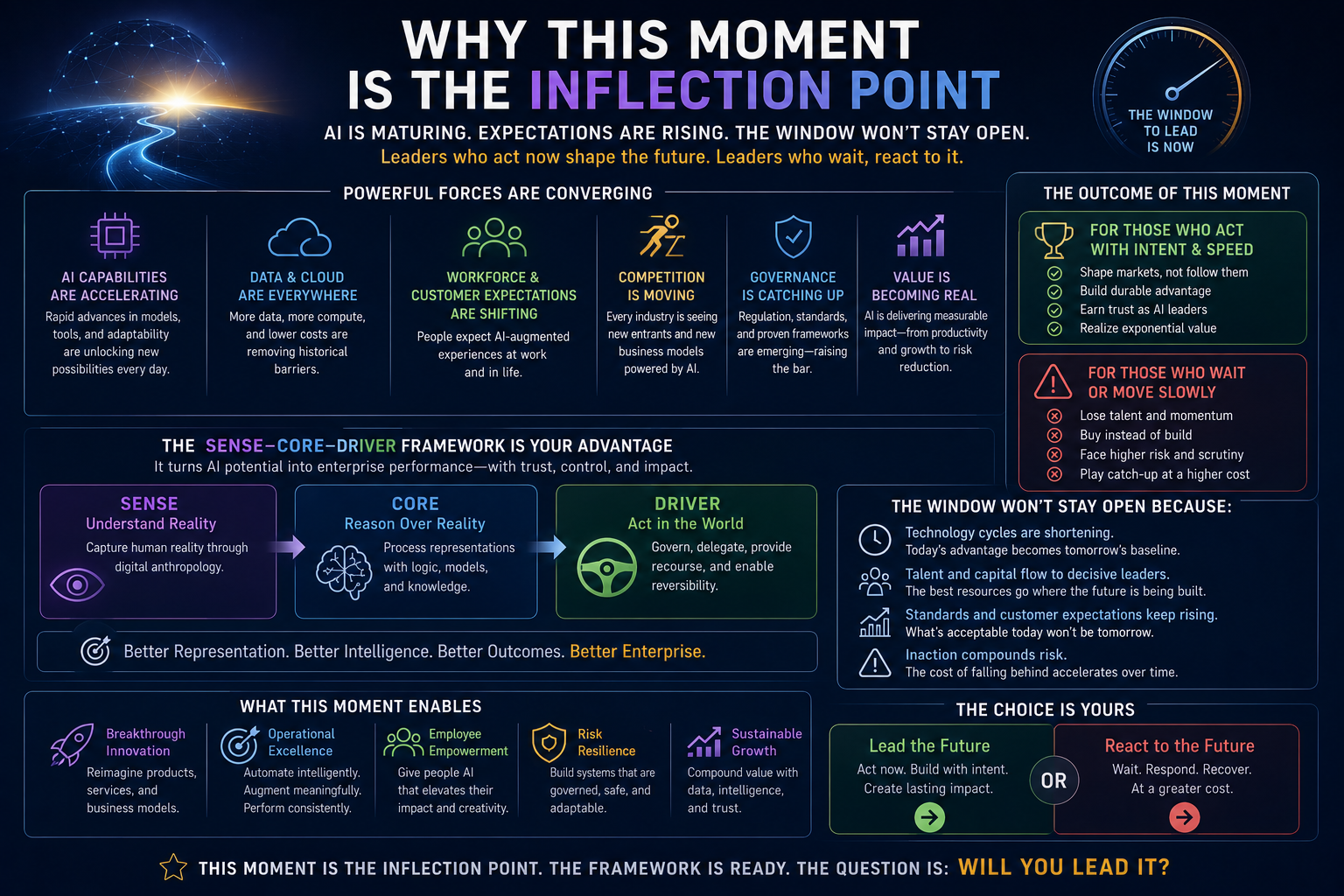
Enterprise AI is at an inflection point. The first generation of enterprise AI was about demonstrating that AI could work in enterprise environments — and it could, in controlled pilots. The second generation is about making AI work at enterprise scale — and it consistently fails, for reasons that are now well-documented but poorly explained.
The third generation — the one that will separate the institutions that compound AI advantage from those that perpetually reset with new pilots — will be defined by representation quality. By the depth and completeness with which organizations have encoded the realities that their AI systems must navigate. By the anthropological rigor with which the Human Reality Gap has been measured and closed. By the architectural discipline with which SENSE, CORE, and DRIVER have been separated and governed.
Digital Anthropology is the missing science of this third generation. It is not a soft discipline or a cultural add-on. It is the technical foundation of AI systems that actually work in the real world — because the real world is where humans live, and no AI system can navigate it faithfully without first being taught to see it faithfully.
The Representation Economy tells us that this capability will become the defining competitive variable of the AI era. SENSE-CORE-DRIVER gives us the architecture to build it. Digital Anthropology gives us the method to do it right.
The organizations that understand this today will set the terms of competition in their industries for the next decade. The ones that continue to treat AI transformation as a technology procurement exercise will continue to produce the statistics — the 70, 80, 95 percent failure rates — that define the industry today.
The choice is architectural. The moment is now.
GLOSSARY
Digital Anthropology for Enterprise AI
The study of how human work, context, relationships, institutional norms, informal practices, and lived realities become machine-legible representations within Enterprise AI systems.
Human Reality Gap
The difference between how work actually happens and how AI systems represent, model, and reason about that work.
Representation Economy
An emerging economic condition in which value, trust, governance, coordination, and competitive advantage increasingly depend on the quality and control of machine-legible representations of reality.
Representation Quality
The accuracy, completeness, contextual fidelity, legitimacy, and usability of a representation for decision-making and action.
Machine-Legible Reality
The encoded version of reality that AI systems can perceive, reason over, and act upon.
SENSE Layer
The layer responsible for observing, interpreting, validating, and representing reality. This is where Digital Anthropology contributes directly to Enterprise AI.
CORE Layer
The layer responsible for reasoning, coordination, optimization, inference, and intelligence generation.
DRIVER Layer
The layer responsible for governance, delegation, execution, recourse, accountability, reversibility, and institutional control.
Separation of Concerns
An architectural principle that separates understanding reality (SENSE), reasoning over reality (CORE), and acting in reality (DRIVER) into distinct but connected layers.
Institutional AI
AI systems that operate within organizations, institutions, governments, and regulated environments where accountability, governance, and trust are essential.
FAQ
What is Digital Anthropology for Enterprise AI?
Digital Anthropology for Enterprise AI studies how human reality becomes machine-legible inside organizations and how representation quality affects AI outcomes.
Why do Enterprise AI initiatives fail?
Many Enterprise AI initiatives fail because systems operate on incomplete or inaccurate representations of work, context, relationships, and institutional realities.
What is the Human Reality Gap?
The Human Reality Gap is the difference between how people actually work and how AI systems model that work.
What is the Representation Economy?
The Representation Economy describes a world where economic value increasingly depends on the quality of machine-legible representations rather than simply the availability of data.
What is SENSE–CORE–DRIVER?
SENSE–CORE–DRIVER is an Enterprise AI architecture that separates understanding reality, reasoning over reality, and acting in reality into three distinct layers.
How does Digital Anthropology relate to SENSE–CORE–DRIVER?
Digital Anthropology primarily strengthens the SENSE layer by improving the quality and fidelity of organizational representations.
Why is representation quality important?
AI systems do not act directly on reality. They act on representations of reality. Better representations produce better decisions, governance, and outcomes.
Why should CIOs care about Digital Anthropology?
Because AI adoption, AI governance, AI trust, AI ROI, and AI transformation success increasingly depend on whether systems accurately understand human reality.
Is this framework relevant only to AI?
No. The framework applies to digital transformation, enterprise architecture, governance systems, operational decision-making, and institutional intelligence more broadly.
What is the practical starting point?
Organizations should begin by assessing whether their current representations accurately capture human work, context, decision-making, and institutional reality before scaling AI.



Raktim Singh is an AI and deep-tech strategist, TEDx speaker, and author focused on helping enterprises navigate the next era of intelligent systems. With experience spanning AI, fintech, quantum computing, and digital transformation, he simplifies complex technology for leaders and builds frameworks that drive responsible, scalable adoption.