Raktim Singh

Home Blog

What Is the SENSE–CORE–DRIVER Framework? The Missing Architecture for Enterprise AI and Intelligent Institutions

SENSE–CORE–DRIVER

Artificial intelligence is changing how organizations think, decide, and act. But most conversations about AI still begin in the wrong place.

They begin with the model.

Which model is smarter?
Which model is faster?
Which model has the larger context window?
Which model can reason better?
Which model can automate more work?

These questions matter. But they are not enough.

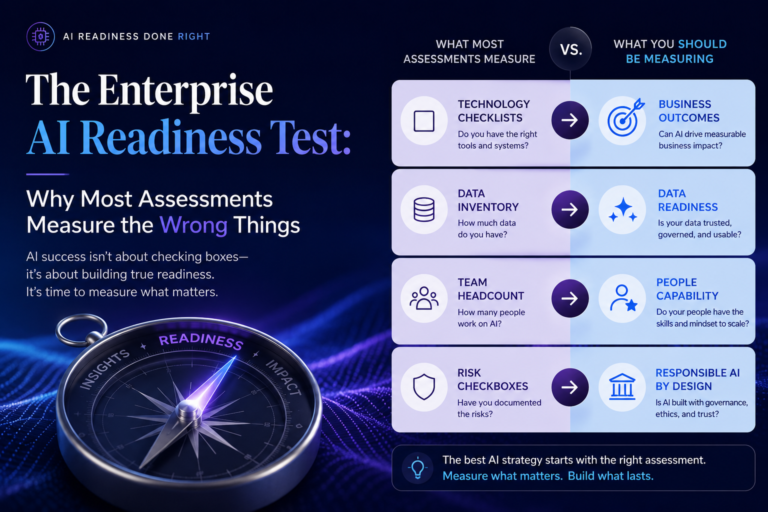
A powerful AI model inside a weak institution does not automatically create intelligence. It may create speed. It may create automation. It may create impressive demos. But it does not necessarily create better decisions, trusted execution, or long-term institutional advantage.

This is the central idea behind the SENSE–CORE–DRIVER framework.

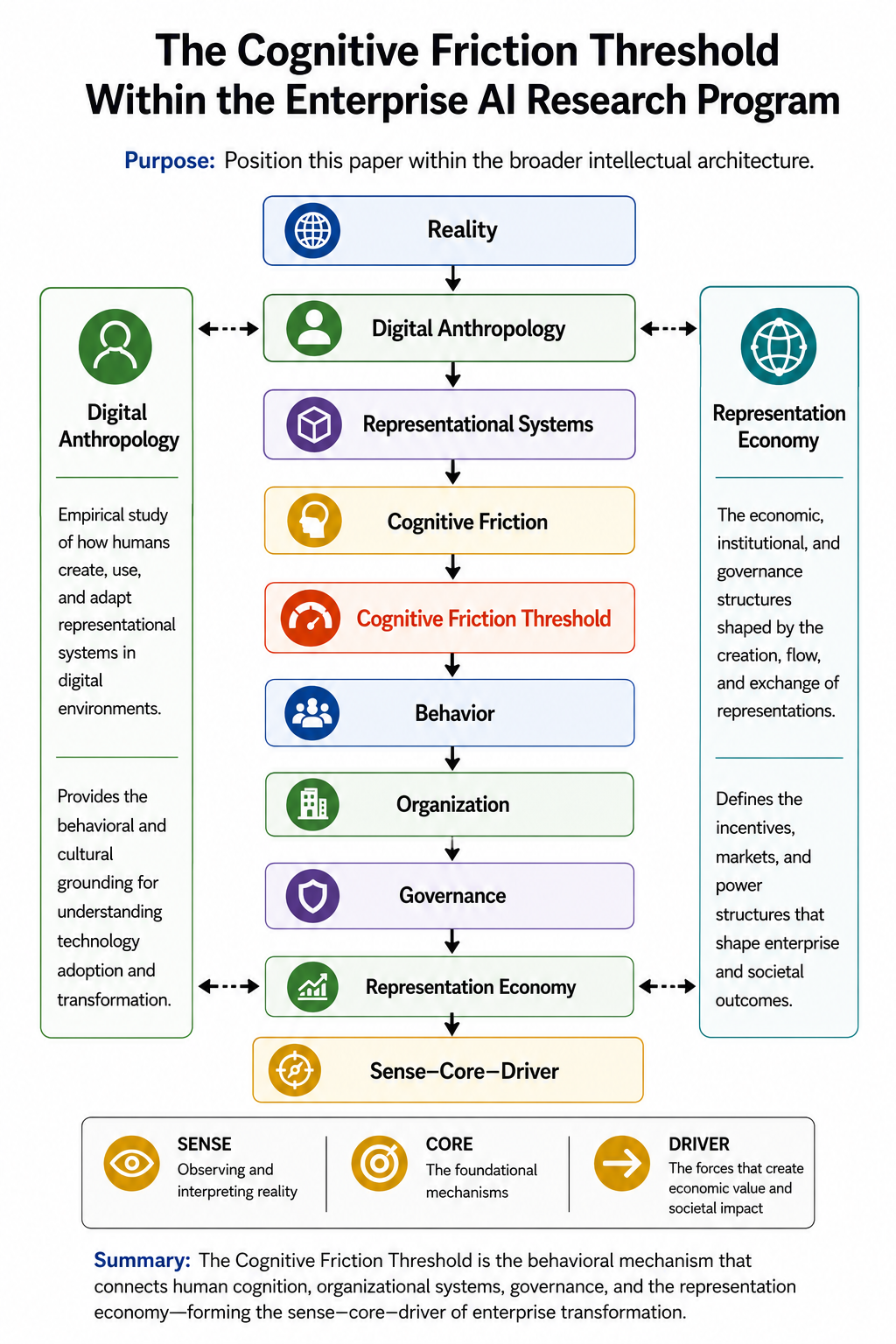
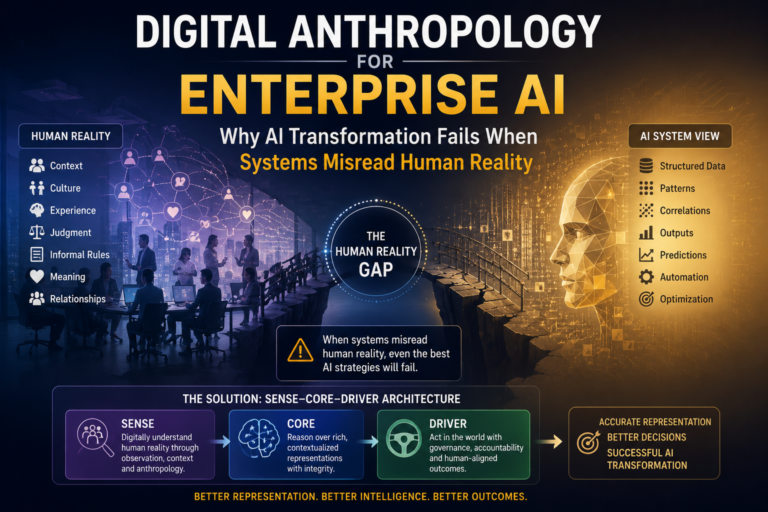
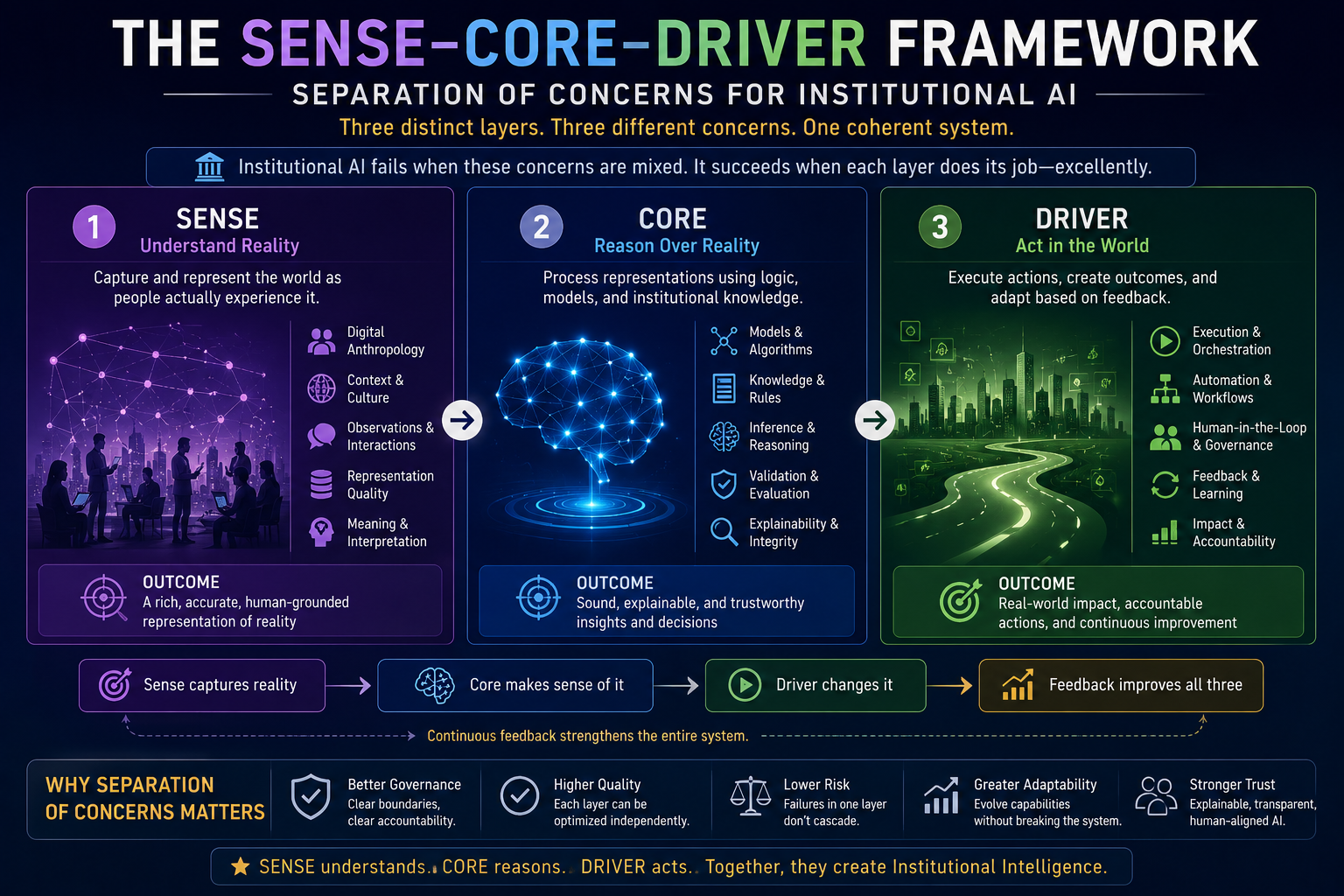
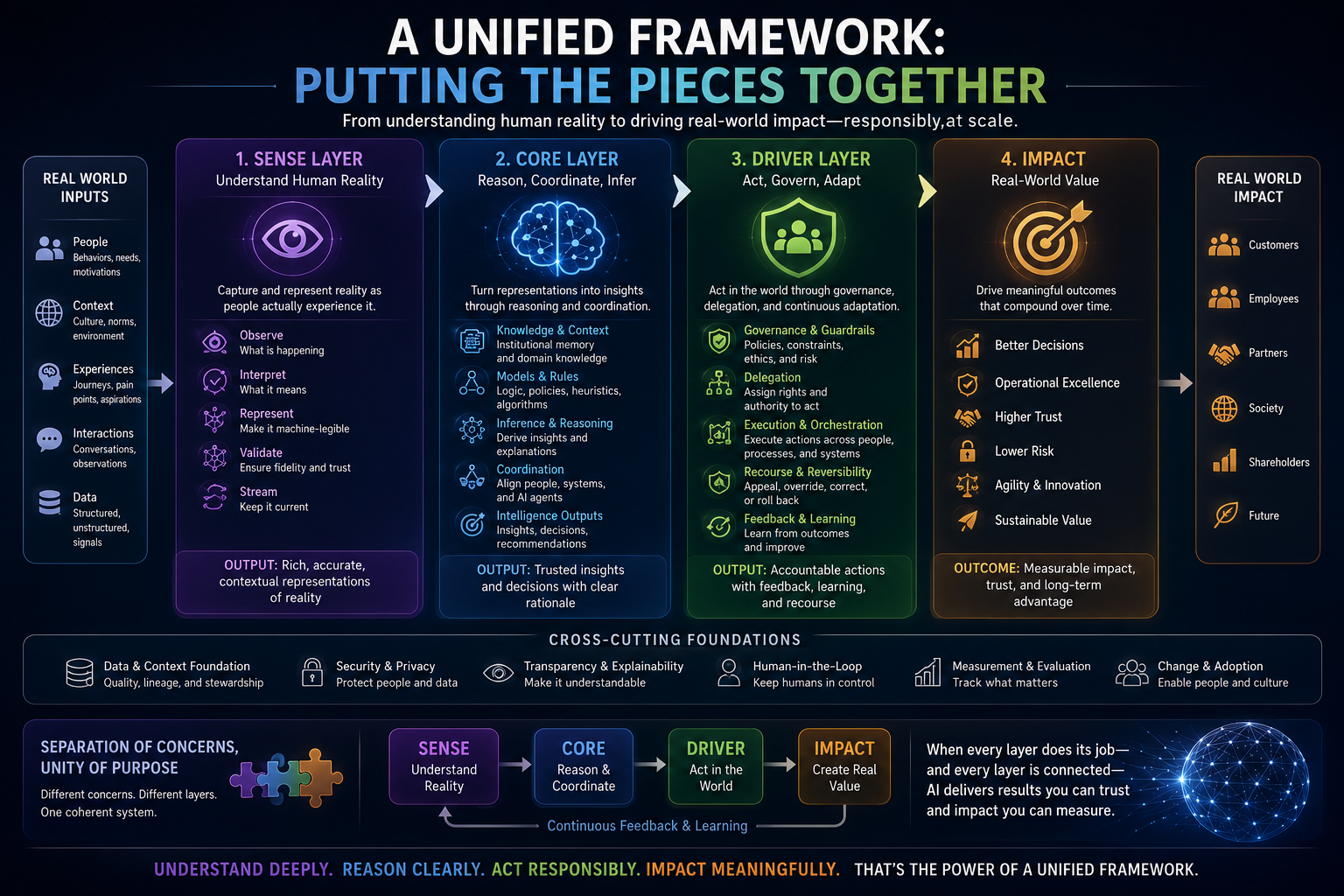
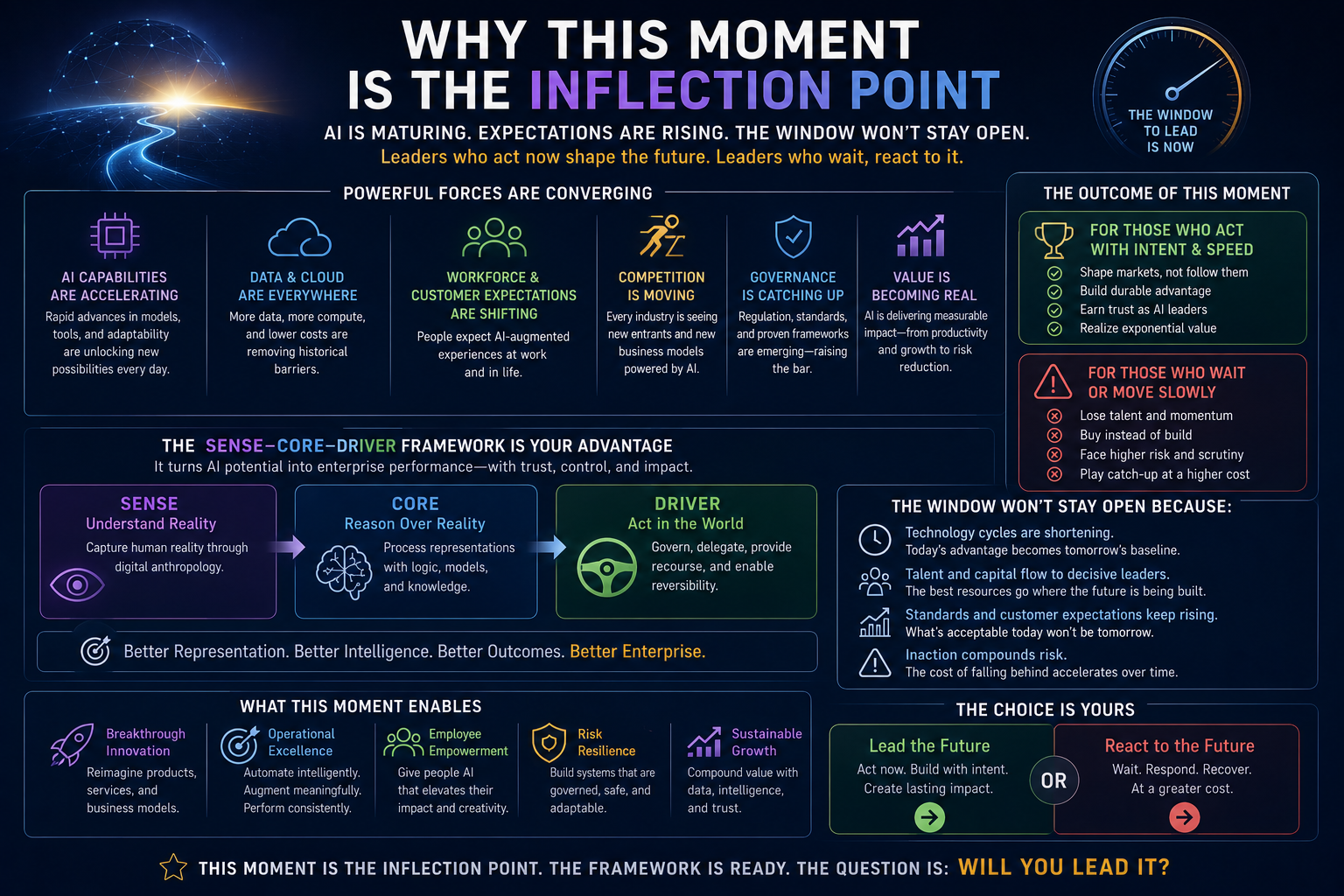
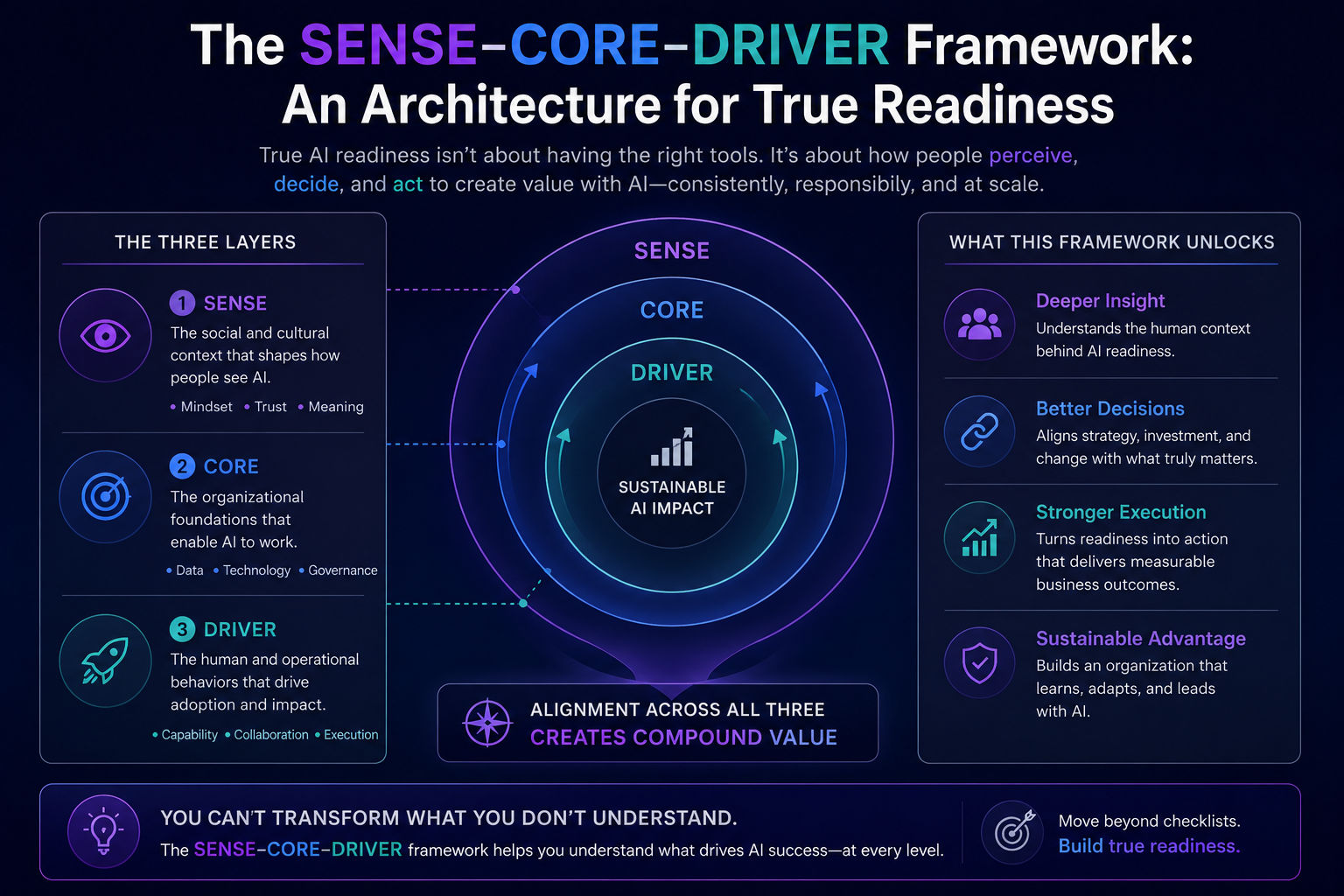
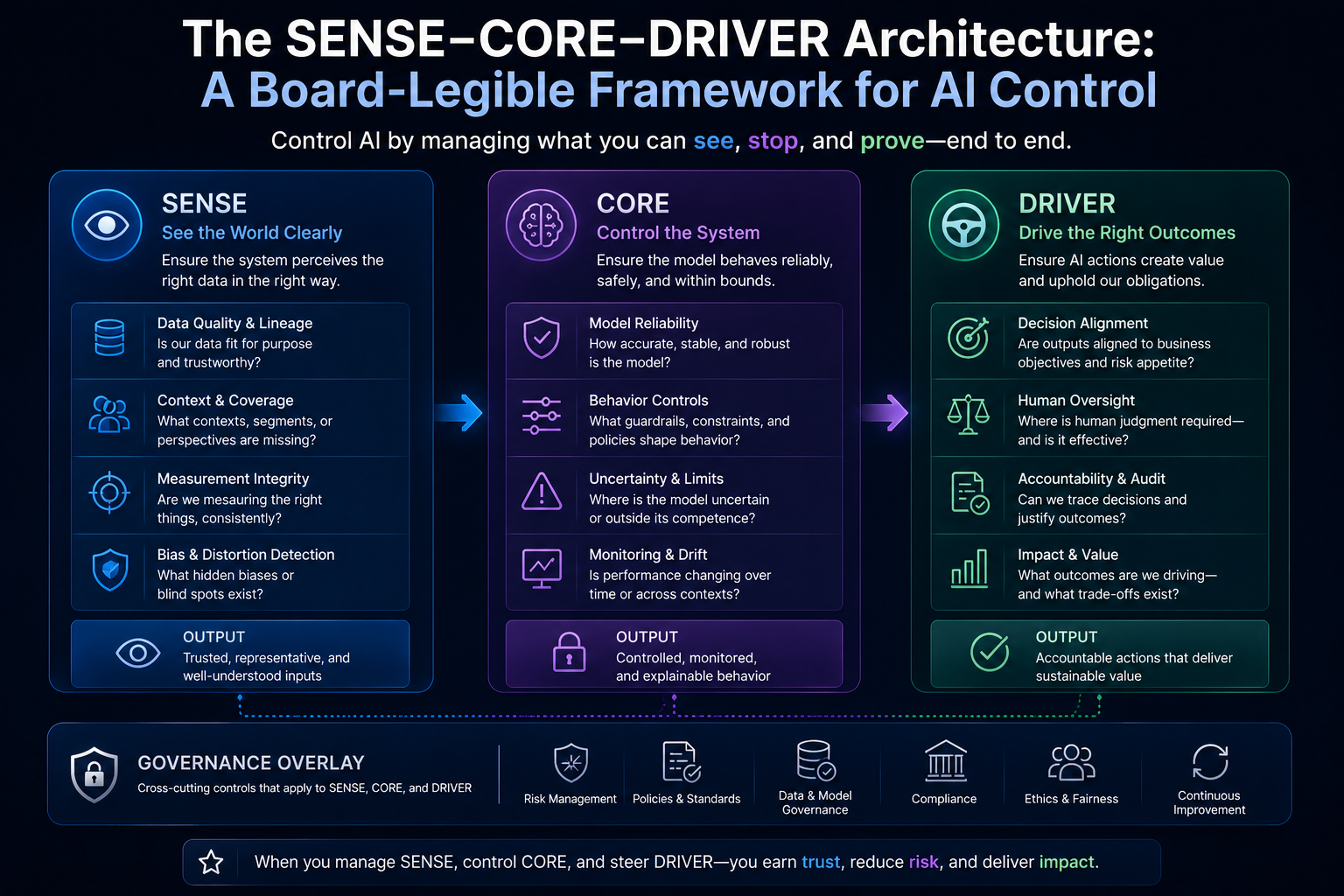
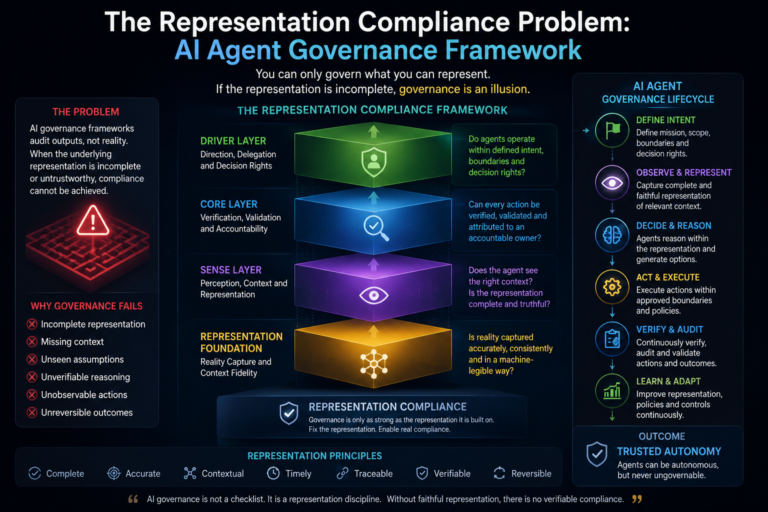
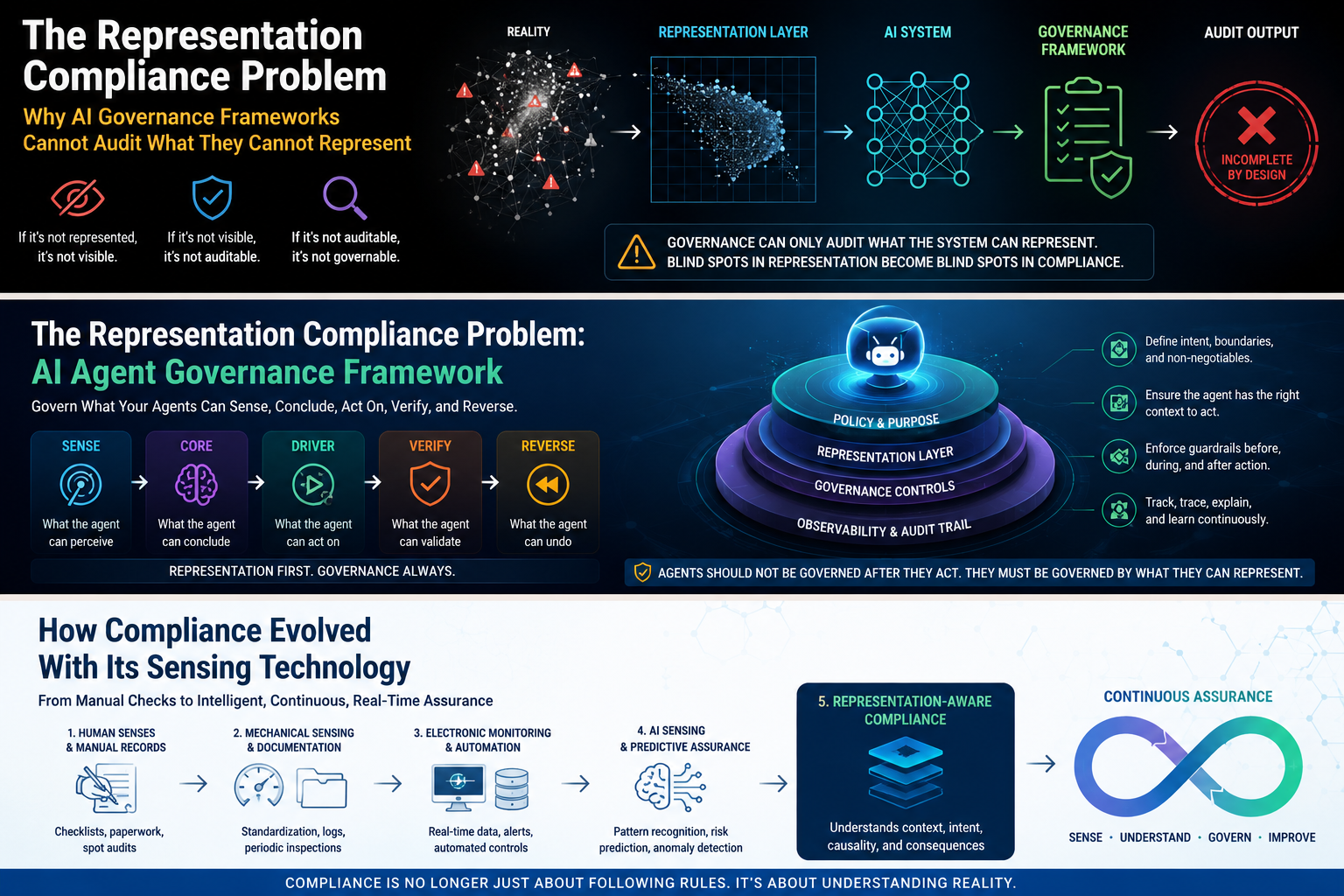
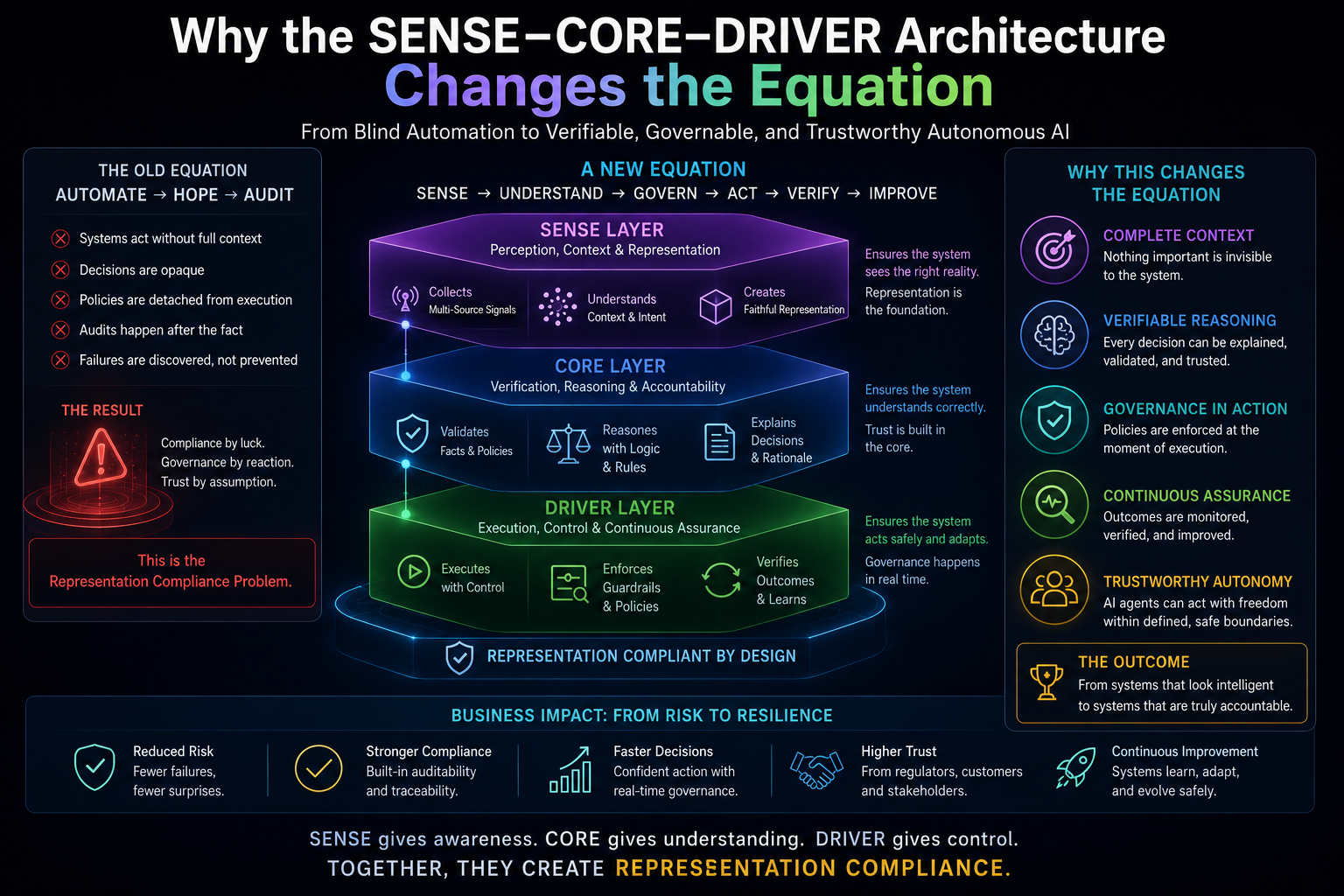
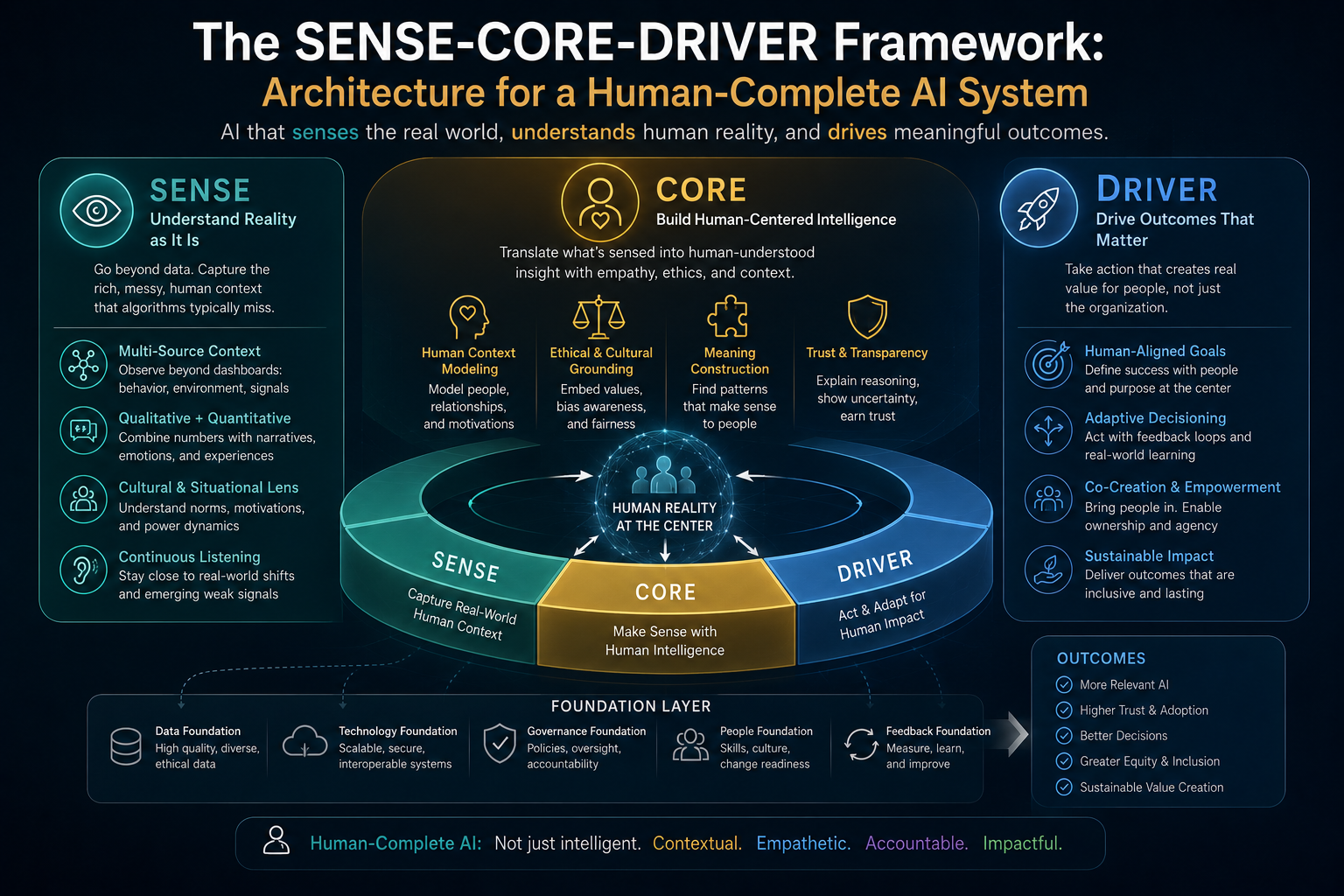
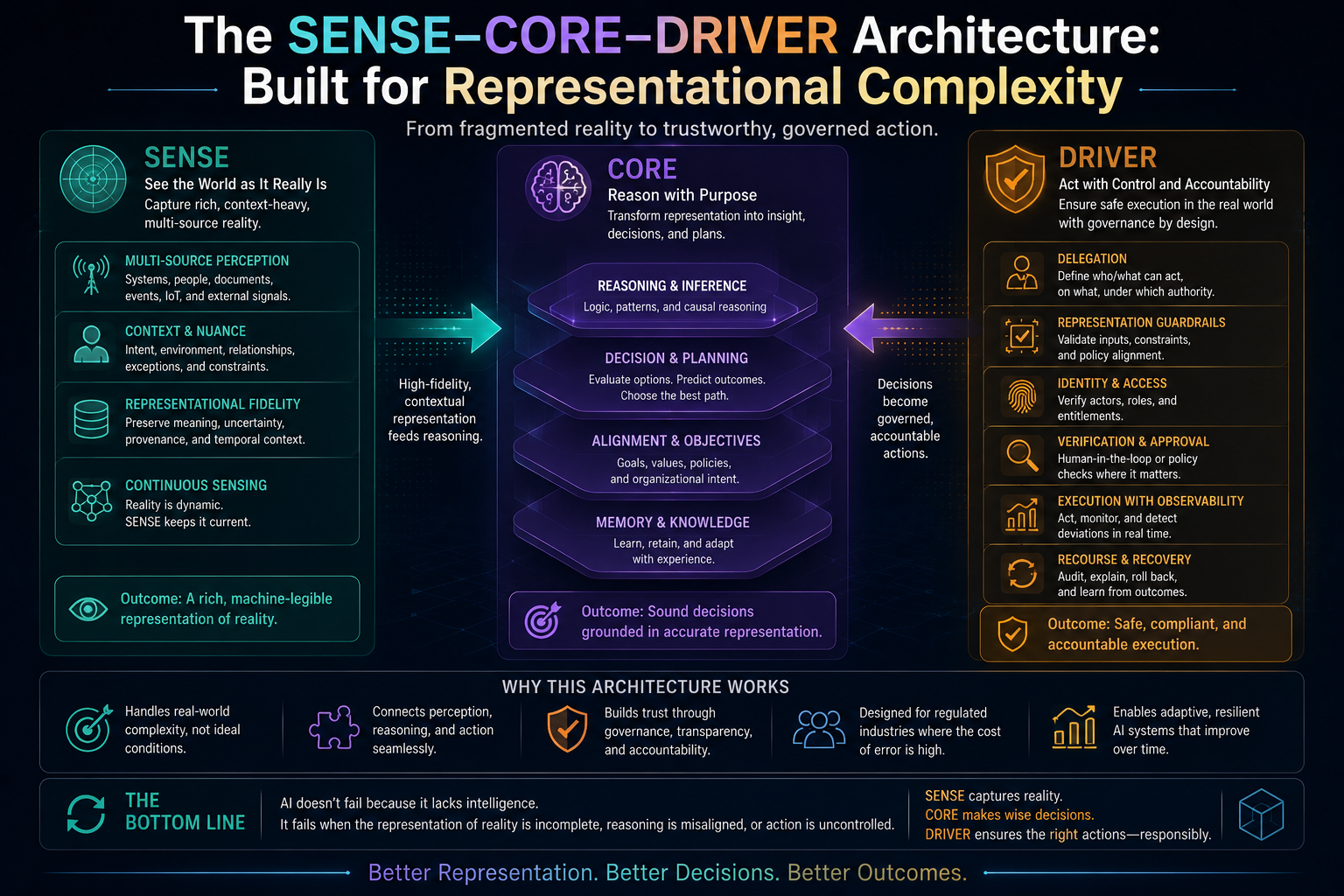
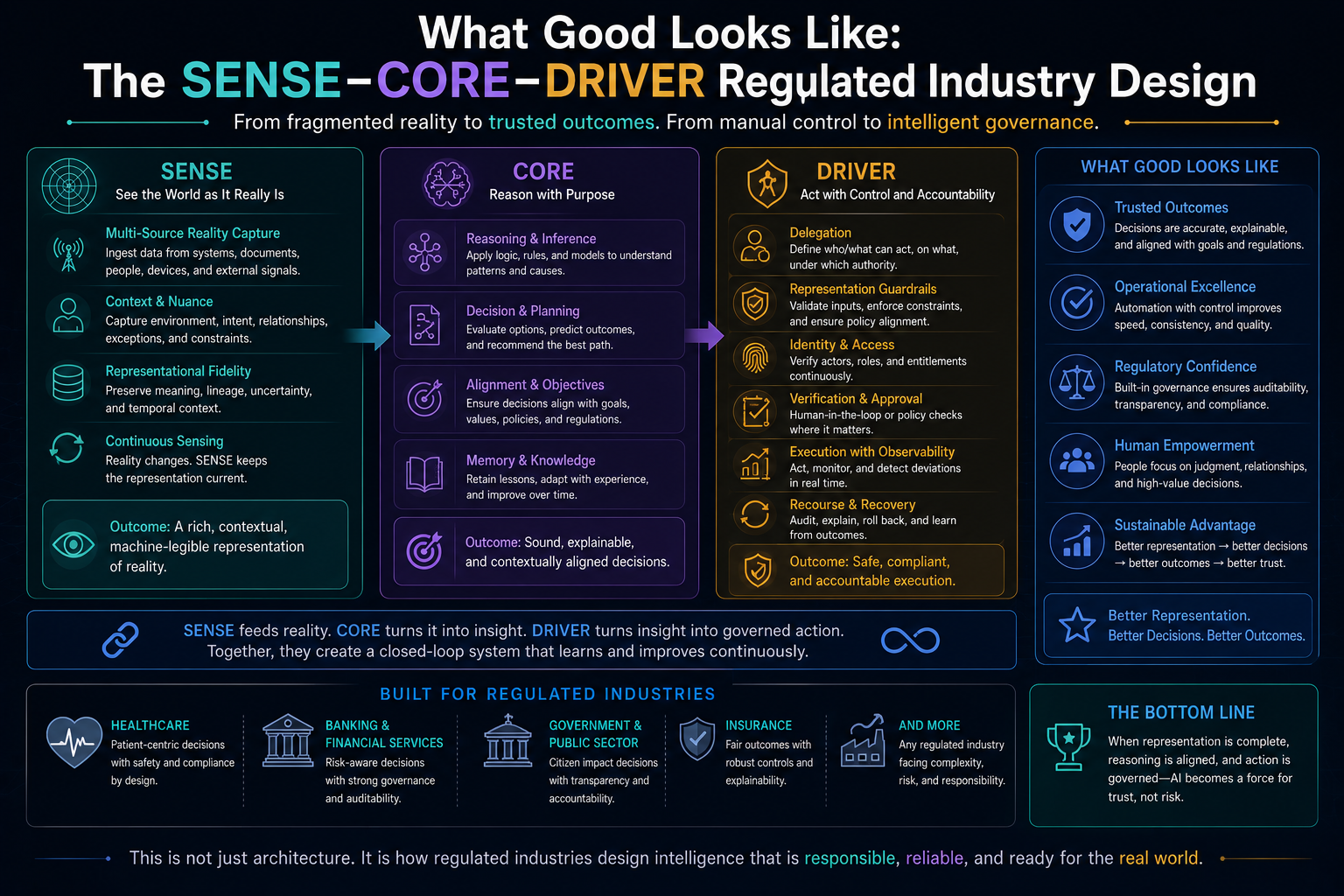
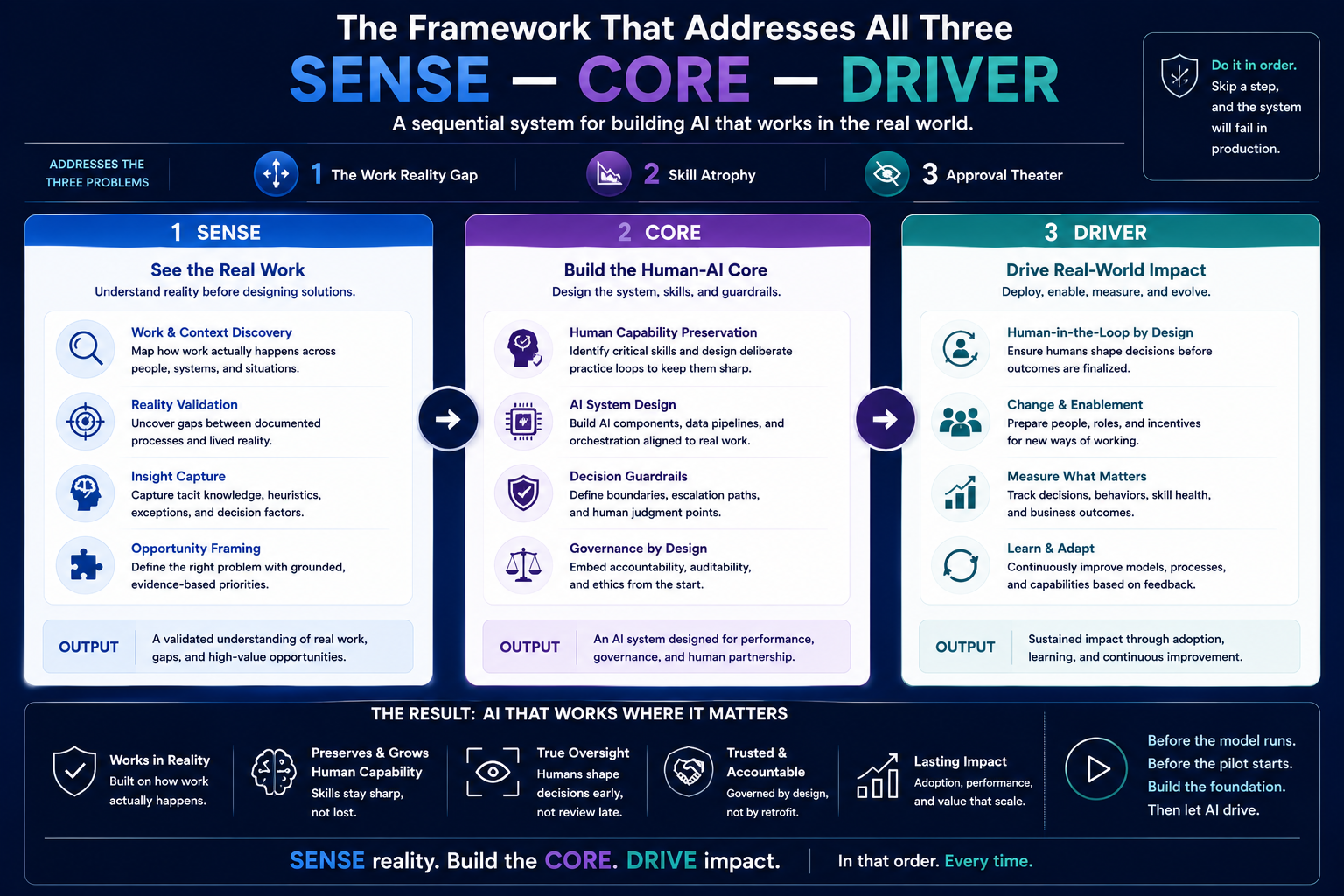
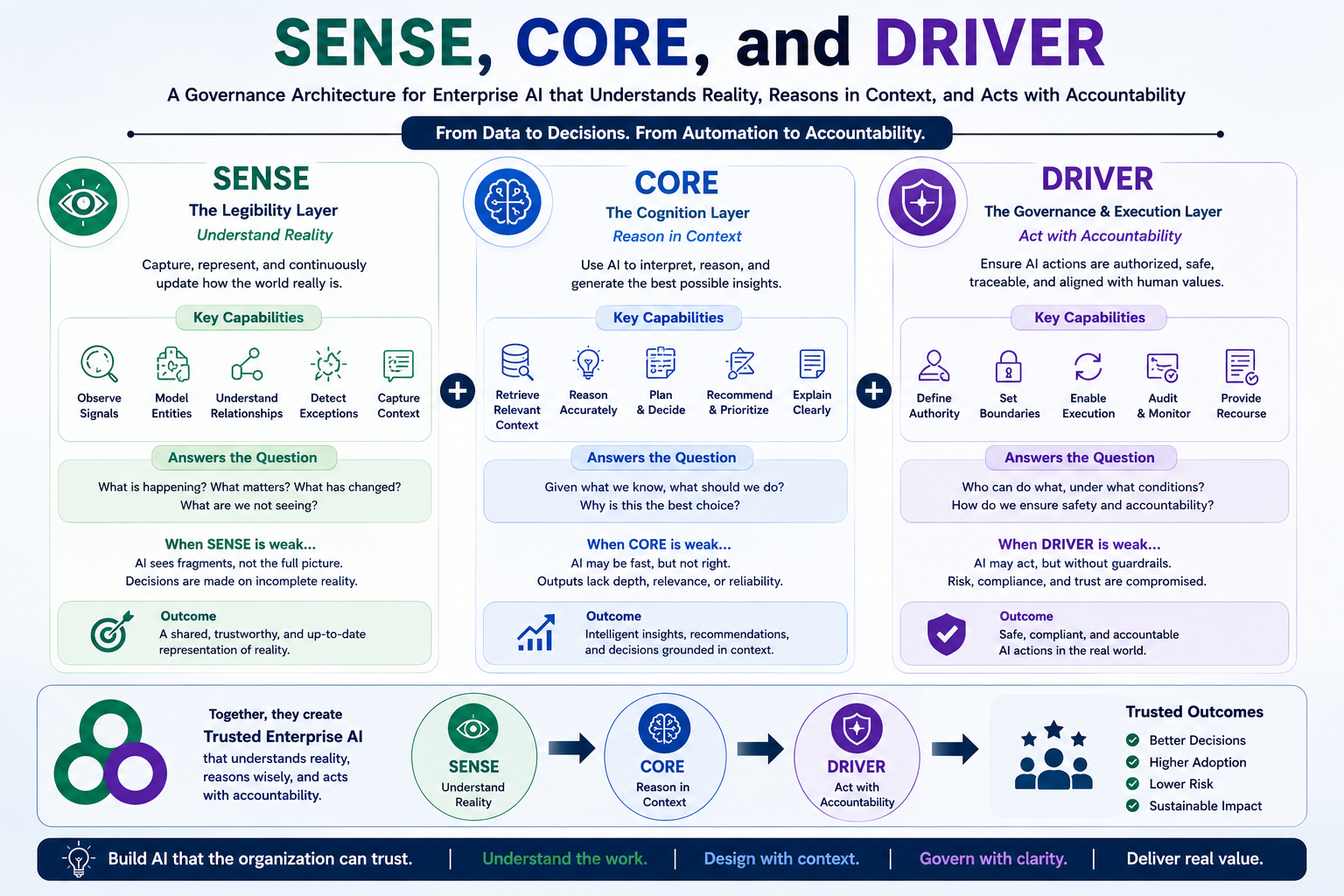
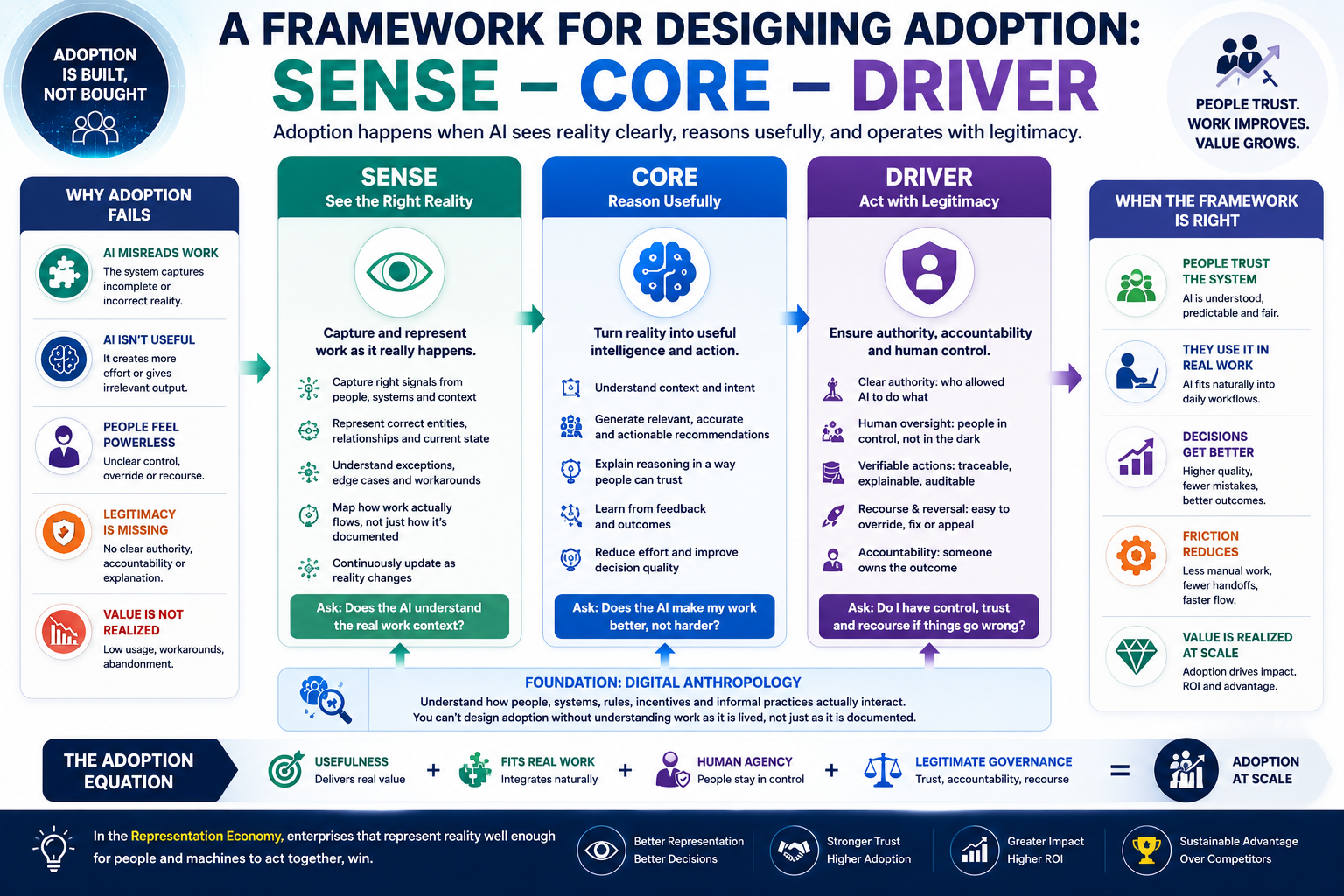
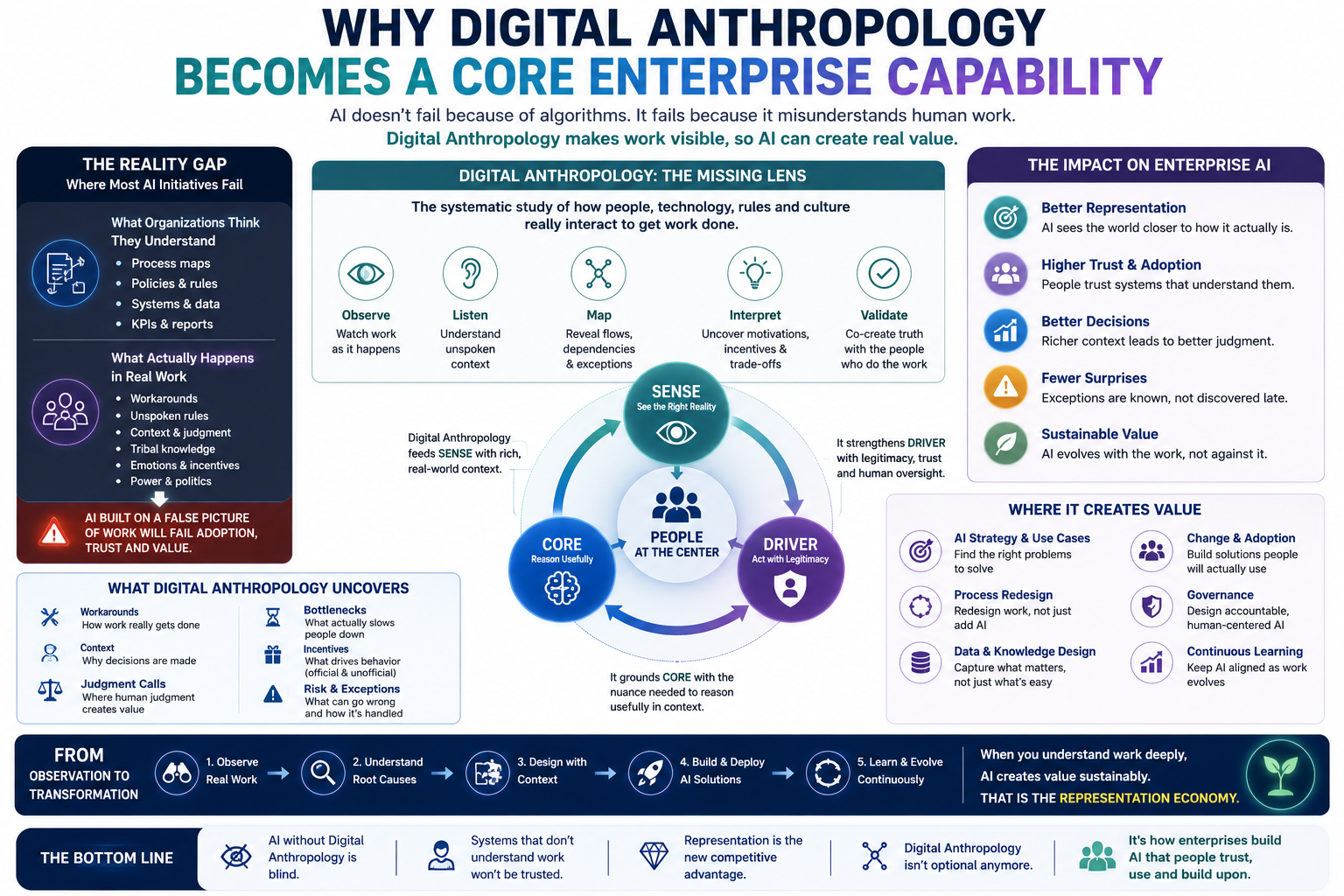
The SENSE–CORE–DRIVER framework is a conceptual architecture developed by Raktim Singh to explain how intelligent institutions transform reality into governed action through three interconnected layers:

SENSE makes reality machine-legible.
CORE interprets that reality and reasons about what should be done.
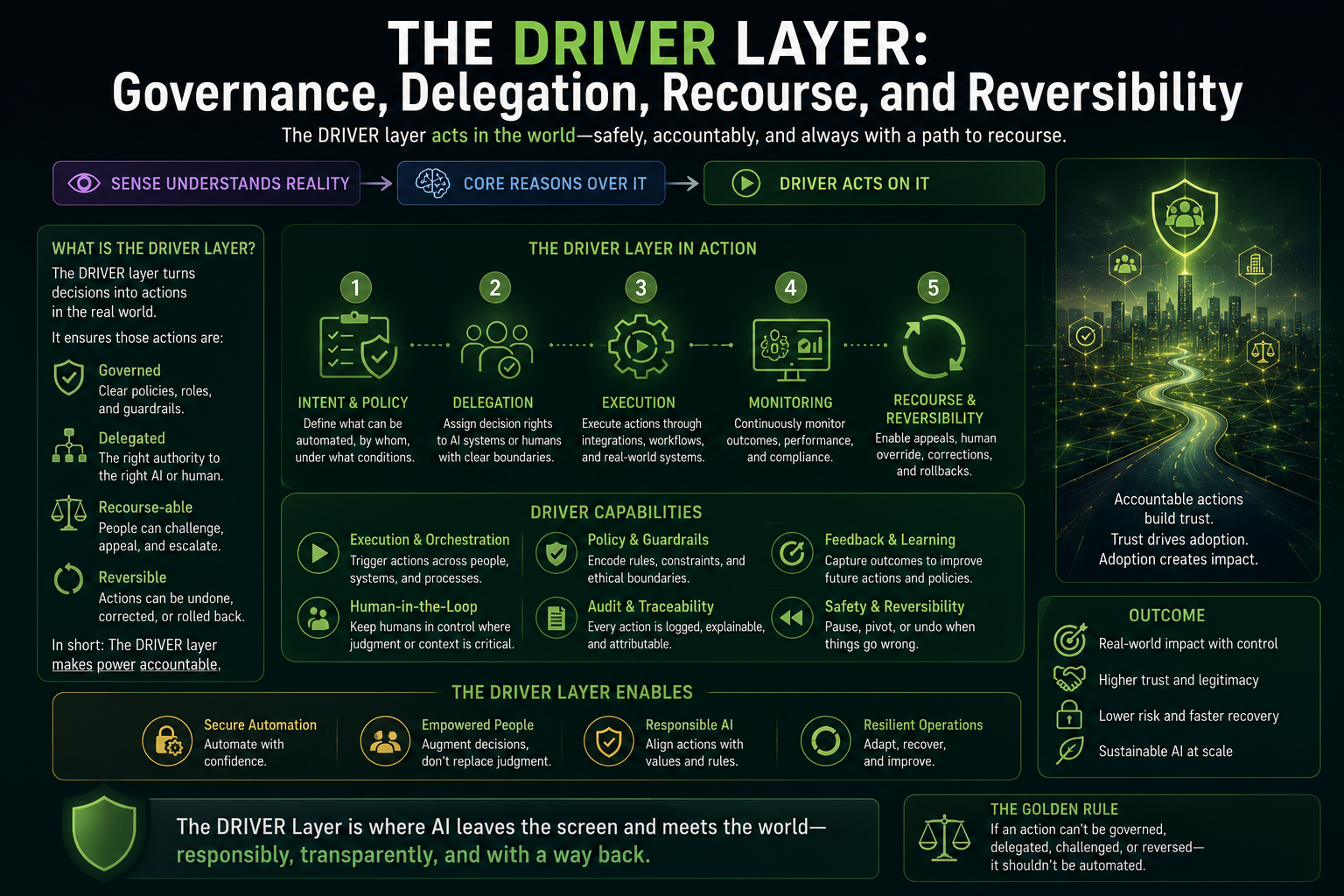
DRIVER turns decisions into legitimate, governed, accountable action.

In simple terms:

An intelligent institution must first know what is happening, then understand what it means, and finally act in a way that is authorized, verifiable, and responsible.

That sounds obvious. But this is exactly where many enterprise AI programs fail.

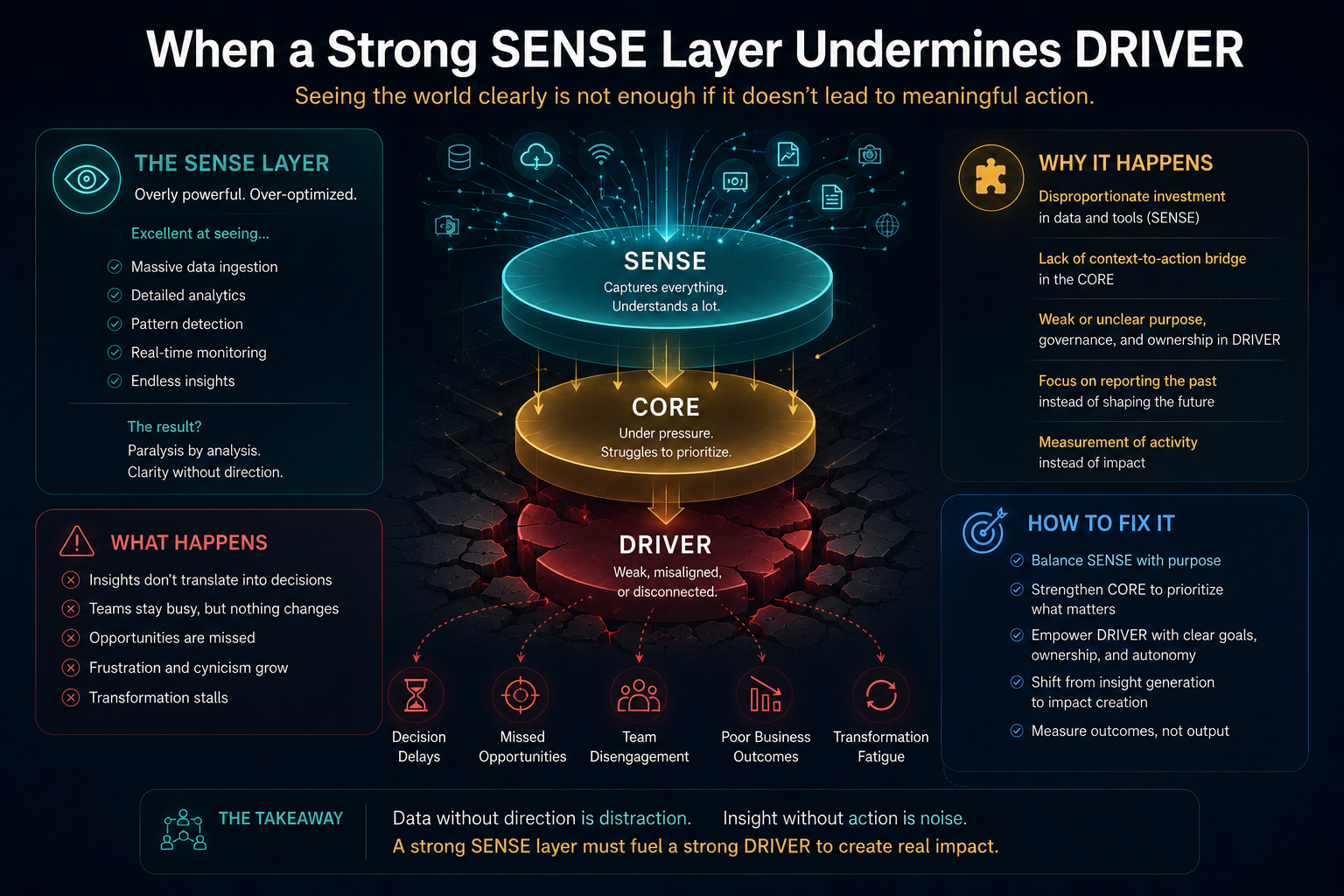
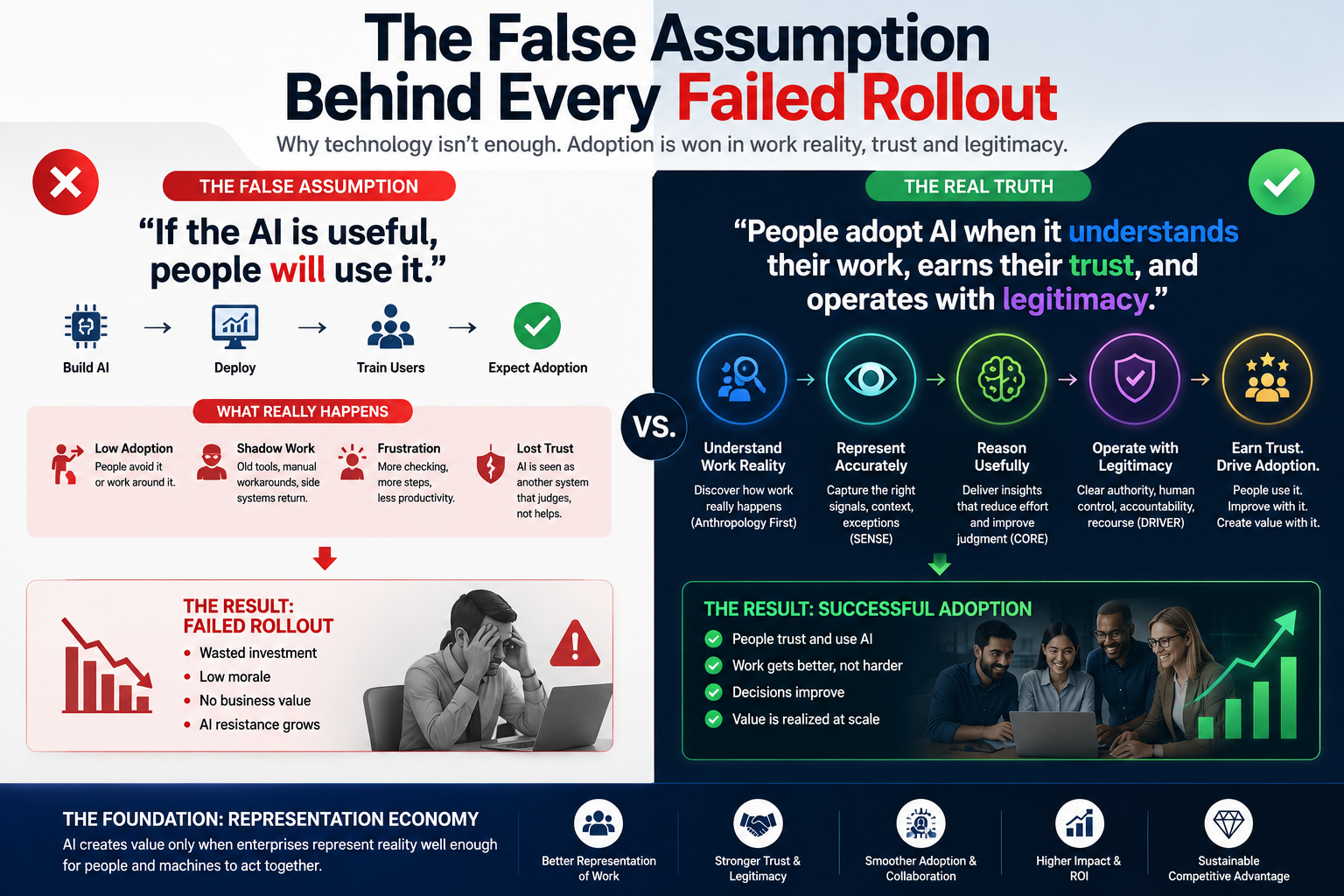
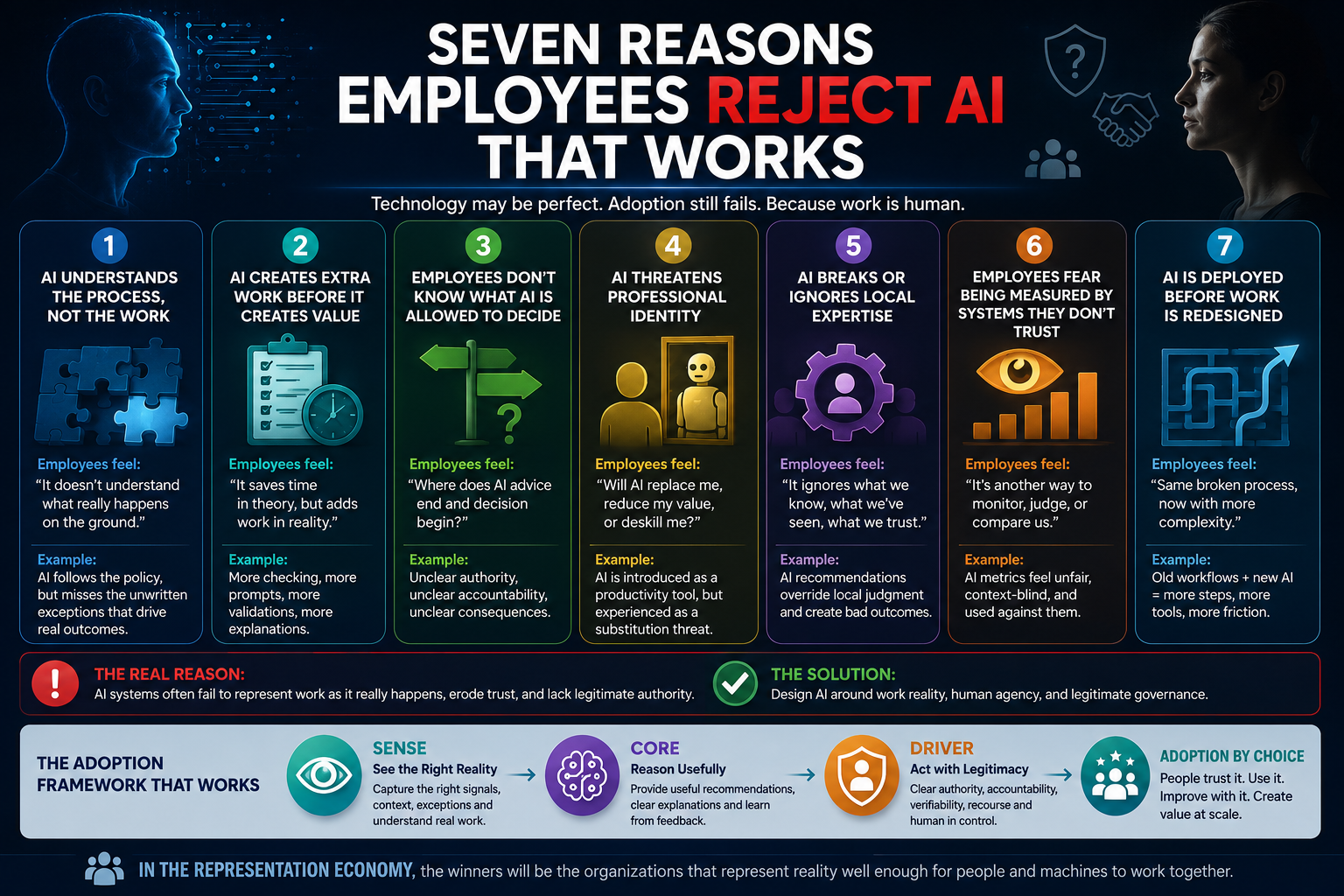
They invest heavily in CORE — models, copilots, agents, analytics, and automation — while underinvesting in SENSE and DRIVER. They improve intelligence without improving representation. They accelerate decisions without strengthening legitimacy. They deploy AI without redesigning the institutional architecture around it.

That is why SENSE–CORE–DRIVER matters.

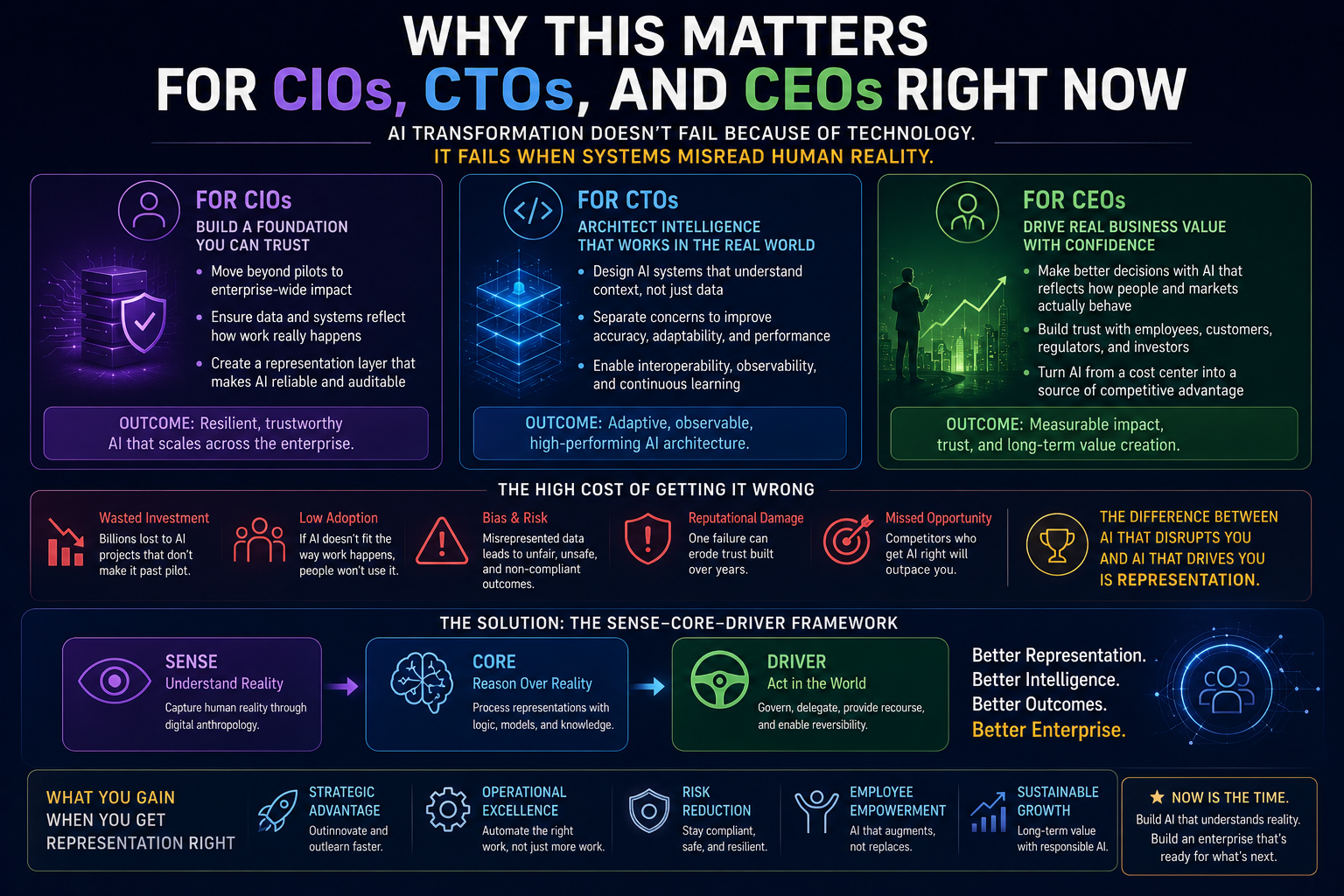
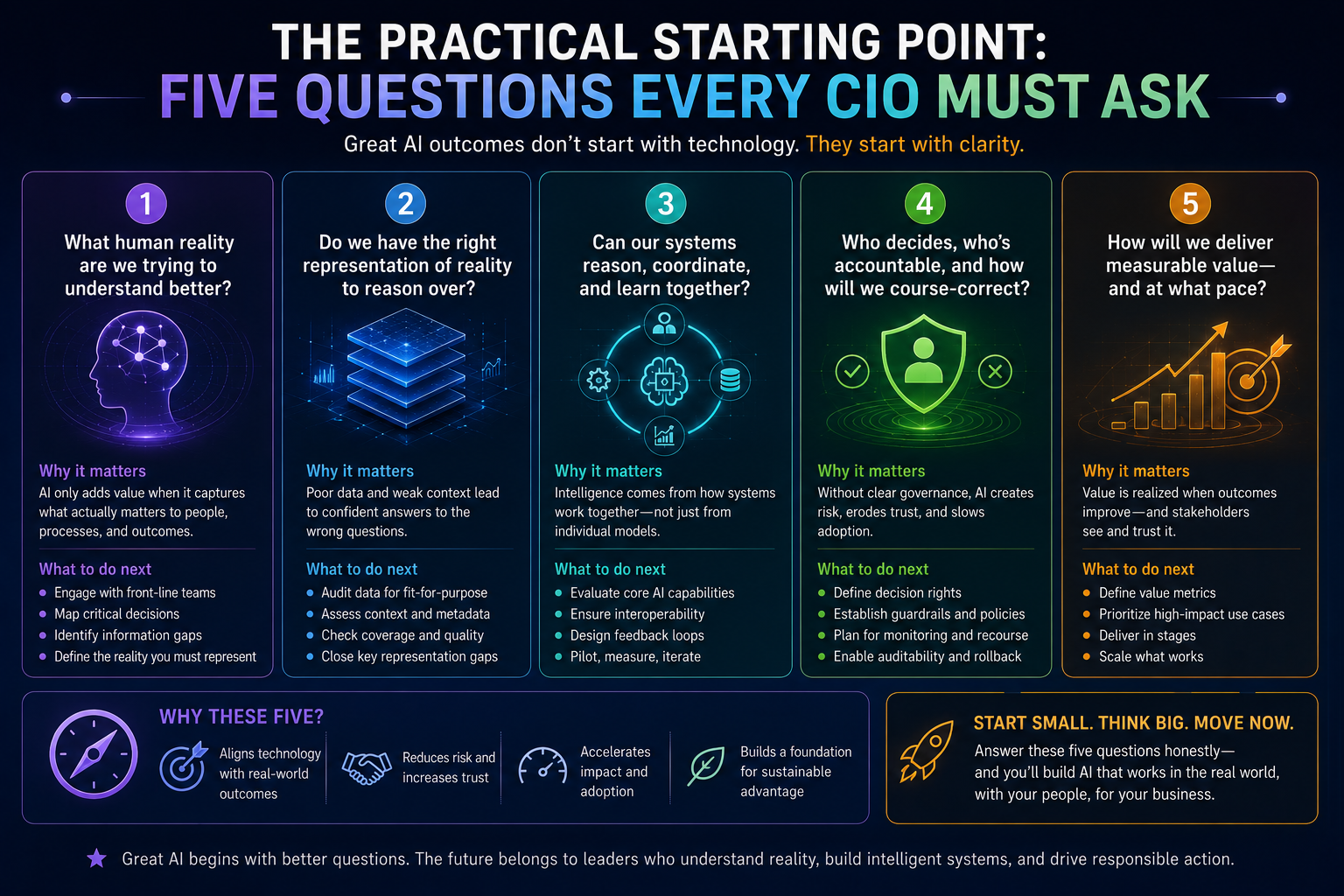
It helps CIOs, CTOs, architects, product leaders, risk leaders, and board members ask a deeper question:

Is our organization becoming more intelligent, or are we merely adding AI to systems that cannot properly sense reality or govern action?

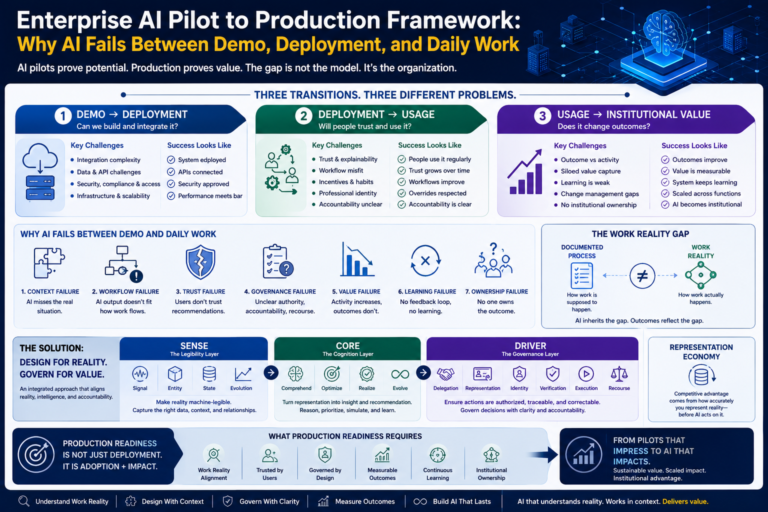
The SENSE–CORE–DRIVER framework is a conceptual architecture developed by Raktim Singh to explain how intelligent institutions transform reality into governed action. SENSE makes reality machine-legible, CORE reasons over that reality, and DRIVER governs legitimate execution through identity, verification, accountability, and recourse. The framework argues that enterprise AI success depends not only on model intelligence but also on representation quality and governed execution.

The SENSE–CORE–DRIVER framework explains how intelligent institutions transform reality into governed action.

Why Enterprises Need a New AI Architecture

Why Enterprises Need a New AI Architecture

For decades, enterprise technology was built around systems of record, workflows, applications, databases, APIs, dashboards, and process automation.

These systems were designed mainly to store transactions, move data, execute rules, and support human decision-making.

AI changes this architecture.

AI does not merely store or move information. It interprets, recommends, generates, predicts, reasons, summarizes, and increasingly acts. Modern enterprise AI systems increasingly require context layers, semantic models, orchestration, governance, identity, observability, and agent control — not only model access. McKinsey’s 2025 State of AI survey also notes that many organizations are still struggling to move from pilots to scaled enterprise impact, even as agentic AI adoption grows. (McKinsey & Company)
This creates a new institutional challenge.

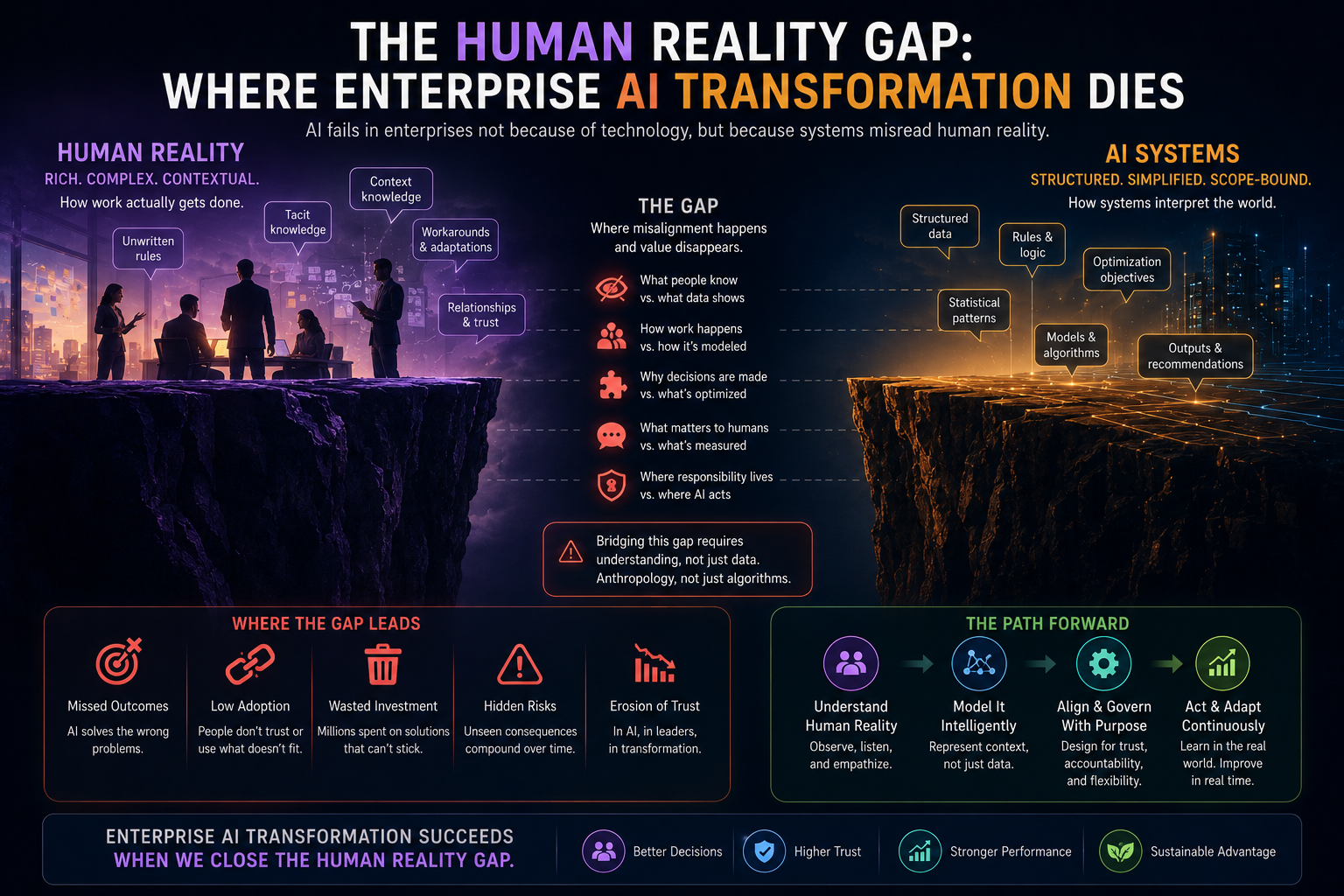
AI systems cannot operate reliably if they do not know what they are looking at.

They need to know:

What is the customer?
What is the asset?
What is the transaction?
What is the policy?
What is the state of the process?
What is allowed?
Who authorized the action?
What evidence supports the decision?
What happens if the system is wrong?

These questions are not only technical. They are institutional.

They determine whether AI becomes a trusted operating layer or just another disconnected tool.

The SENSE–CORE–DRIVER framework provides a way to organize this challenge.

The SENSE–CORE–DRIVER framework is a conceptual architecture developed by Raktim Singh to explain how intelligent institutions transform reality into governed action. SENSE makes reality machine-legible, CORE reasons over that reality, and DRIVER governs legitimate execution through identity, verification, accountability, and recourse. The framework argues that enterprise AI success depends not only on model intelligence but also on representation quality and governed execution.

The Core Definition

The Core Definition
The Core Definition

The SENSE–CORE–DRIVER framework is a three-layer model for understanding how intelligent institutions convert reality into action.

It consists of:

SENSE

The layer that detects signals, identifies entities, represents their current state, and tracks how that state evolves over time.

CORE

The layer that comprehends context, optimizes decisions, realizes possible actions, and evolves through feedback.

DRIVER

The layer that governs execution through delegation, representation, identity, verification, execution, and recourse.

Together, these layers explain the full journey from the world as it is to the action an institution takes.

SENSE answers: What is happening?
CORE answers: What does it mean, and what should be done?
DRIVER answers: Who is allowed to act, on whose behalf, with what safeguards, and with what accountability?

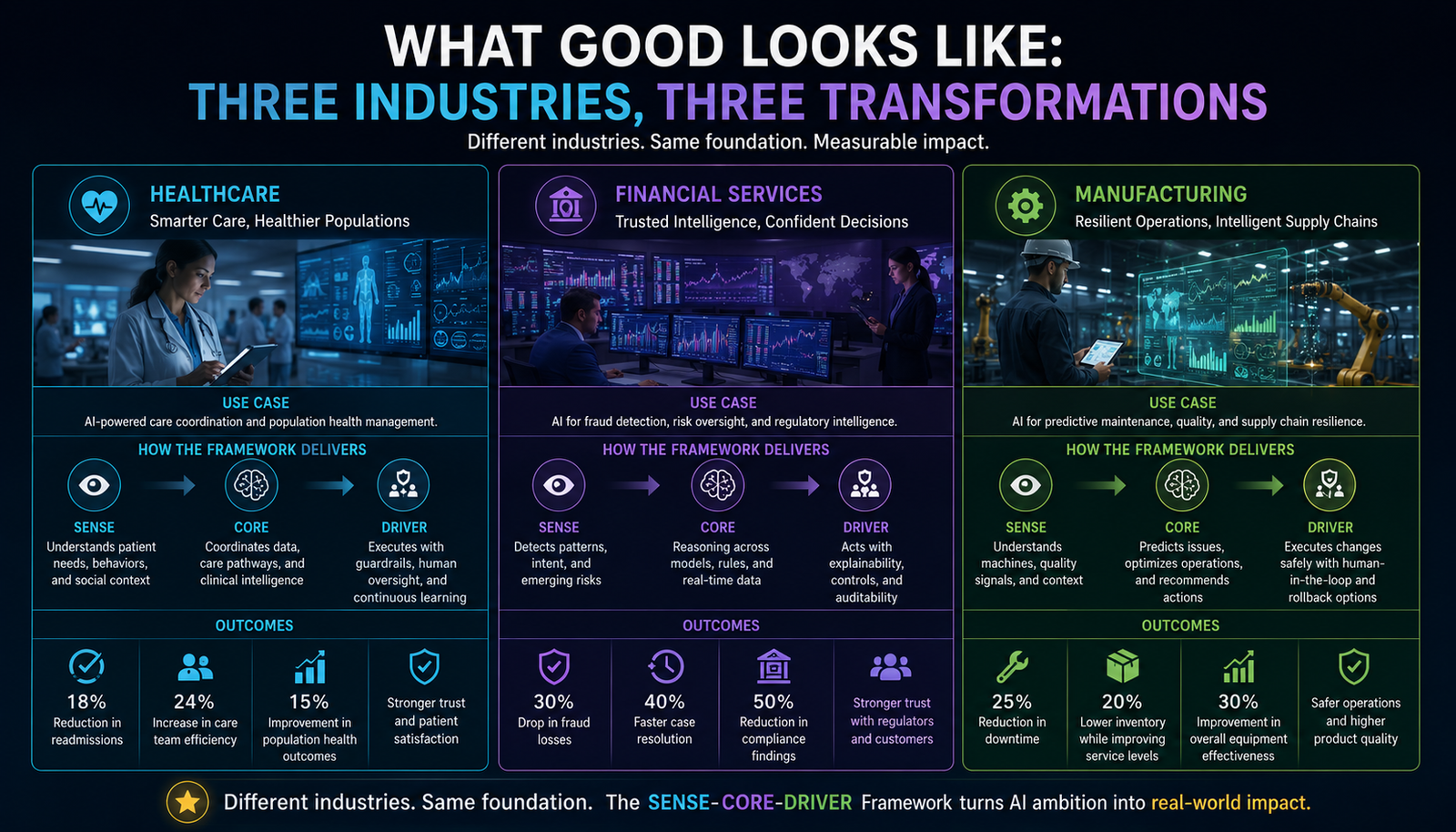
This is why the framework is especially relevant for enterprise AI, AI agents, intelligent automation, financial services, healthcare, manufacturing, supply chains, cybersecurity, education, government systems, and any domain where automated decisions affect real people, assets, processes, or institutions.

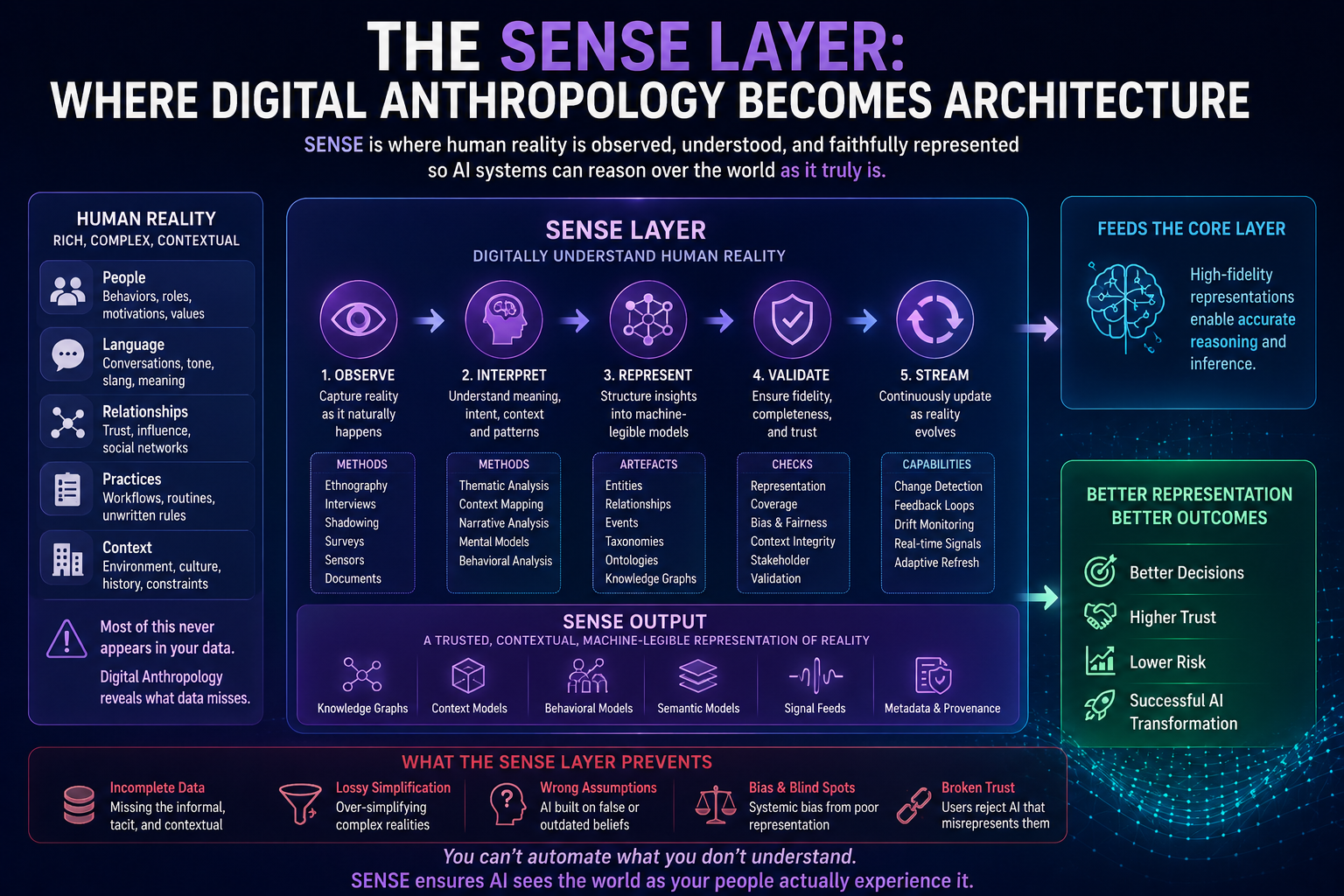
SENSE: The Layer Where Reality Becomes Machine-Legible

SENSE: The Layer Where Reality Becomes Machine-Legible

SENSE stands for:

Signal
ENtity
State Representation
Evolution

SENSE is the legibility layer.

It is the institutional ability to detect reality, connect signals to the right entities, represent the current state of those entities, and update that state as new information arrives.

Without SENSE, AI systems reason on incomplete, outdated, fragmented, or incorrect representations of the world.

Signal: Detecting What Has Changed

A signal is any trace from the world that indicates something has happened or may happen.

A payment failed.
A machine temperature changed.
A customer submitted a complaint.
A delivery was delayed.
A supplier missed a milestone.
A cyber alert was triggered.
A loan repayment pattern shifted.

In traditional systems, signals often remain trapped in different applications. One system records the transaction. Another records the complaint. Another records the contract. Another records the operational status. Another records the human conversation.

AI systems need these signals to be connected.

A bank cannot assess risk properly if payment behavior, customer history, transaction context, fraud signals, and regulatory constraints remain fragmented.

A manufacturer cannot run intelligent maintenance if machine sensor data, service logs, supply constraints, operator notes, and production schedules remain disconnected.

Signals are the raw material of institutional intelligence.

But signals alone are not enough.

ENtity: Connecting Signals to the Right Object

Every signal must be attached to the correct entity.

An entity may be a customer, account, asset, supplier, employee, device, machine, shipment, invoice, location, policy, project, product, or contract.

This is where many organizations struggle.

The same customer may appear differently in multiple systems. The same supplier may have different identifiers across procurement, finance, legal, and operations. The same asset may be tracked differently by maintenance, finance, and field teams.

When entity resolution is weak, AI becomes unreliable.

Imagine an enterprise AI assistant analyzing supplier risk. It sees late deliveries in one system, unresolved disputes in another, contract amendments in another, and quality complaints in another. But if it cannot confidently understand that all these signals belong to the same supplier entity, it cannot form a reliable judgment.

The problem is not the AI model.

The problem is representation.

The institution has failed to represent reality correctly.

State Representation: Knowing the Current Condition

Once signals are connected to entities, the institution must represent the current state of that entity.

A customer is not just a name.
A machine is not just an asset ID.
A project is not just a code.
A loan is not just an account number.
A supplier is not just a vendor record.

Each entity has a state.

A customer may be loyal, dissatisfied, high-risk, recently onboarded, under review, or waiting for resolution.

A machine may be healthy, degraded, overloaded, under maintenance, or near failure.

A project may be on track, blocked, delayed, underfunded, overdependent, or waiting for approval.

State representation is what allows AI systems to reason meaningfully.

Without state, AI only sees data.
With state, AI sees context.

This is why enterprise context layers, semantic models, knowledge graphs, and metadata systems are becoming important for AI at scale. Atlan, for example, describes the enterprise context layer as a way to connect metadata, lineage, semantics, governance rules, and operational context so AI agents can use information with the right meaning and constraints. (Atlan)

Evolution: Tracking Change Over Time

Reality does not stand still.

Customers change.
Markets change.
Risks change.
Machines degrade.
Policies are updated.
Threats mutate.
Relationships shift.

SENSE must therefore include evolution.

An institution must know not only what something is, but how it is changing.

A customer who was low-risk six months ago may now show signs of stress.

A machine that was healthy last week may now show early warning signals.

A supplier that was reliable last quarter may now be facing delays.

Evolution is critical because AI decisions often depend on trajectory, not only current state.

The best institutions will not simply collect data. They will continuously update their representation of reality.

That is the foundation of SENSE.

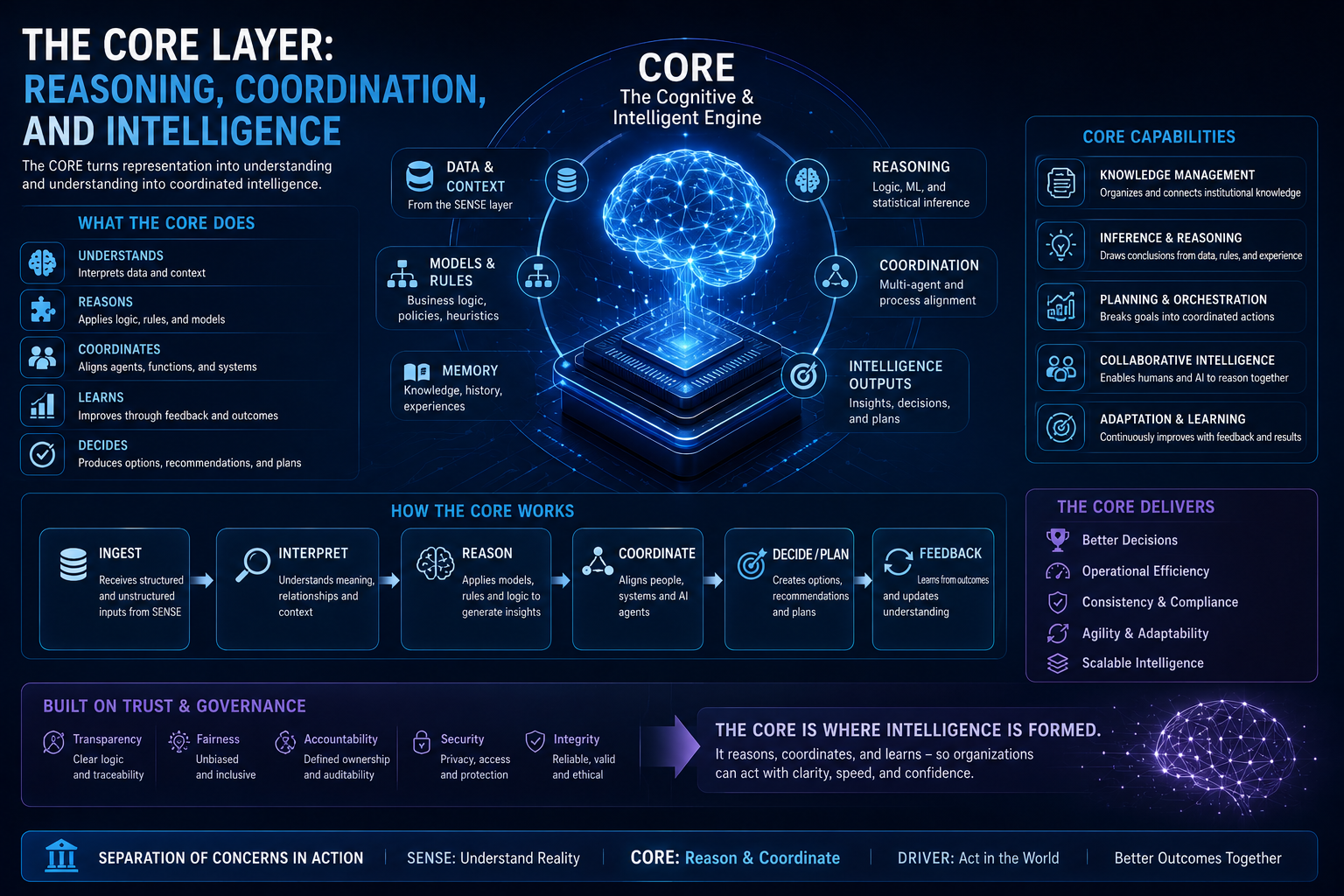
CORE: The Layer Where Intelligence Interprets Reality

CORE: The Layer Where Intelligence Interprets Reality

CORE stands for:

Comprehend
Optimize
Realize
Evolve

CORE is the cognition layer.

It is where AI models, reasoning systems, decision engines, analytics, simulations, agents, and human experts interpret reality and decide what should happen next.

Most current AI investment is concentrated here.

Large language models, machine learning models, copilots, predictive analytics, recommender systems, generative AI tools, autonomous agents, reasoning models, and decision intelligence systems all belong primarily to the CORE layer.

CORE is powerful.

But CORE is only as good as the reality it receives from SENSE and the legitimacy it gets from DRIVER.

Comprehend: Understanding the Situation

Comprehension is not just reading text or summarizing documents.

In an enterprise context, comprehension means understanding a situation within business, operational, technical, regulatory, and human constraints.

For example, an AI system may read a customer complaint and summarize it accurately. But real comprehension requires more.

It must understand:

Is this customer important?
Has this happened before?
Is there an open ticket?
Is there a policy constraint?
Has a promise already been made?
What is the current state of the relationship?
What action is allowed?

That requires SENSE.

Without SENSE, CORE produces generic intelligence.
With SENSE, CORE produces enterprise-relevant intelligence.

Optimize: Choosing the Better Path

Optimization is the ability to compare options and select a better path.

In a supply chain context, this may mean choosing between cost, speed, reliability, and risk.

In banking, it may mean balancing customer experience, fraud prevention, compliance, and operational cost.

In IT operations, it may mean deciding whether to restart a service, escalate to an engineer, trigger a rollback, or wait for more evidence.

AI is useful here because it can process more signals, compare more scenarios, and detect patterns humans may miss.

But optimization becomes dangerous when the system optimizes for the wrong objective.

A customer service AI that optimizes only for quick closure may damage trust.

A lending AI that optimizes only for approval speed may increase risk.

A manufacturing AI that optimizes only for throughput may compromise safety.

CORE must therefore be guided by institutional purpose, policy, and governance.

That is where DRIVER becomes essential.

Realize: Turning Reasoning into Possible Action

CORE does not only analyze. It can also propose or initiate action.

It may draft a response.
Recommend a decision.
Trigger a workflow.
Create a code patch.
Generate a contract clause.
Prioritize a case.
Route a ticket.
Invoke an API.

This is where AI becomes operationally significant.

The moment AI moves from answer generation to action generation, the enterprise risk profile changes.

A wrong summary is inconvenient.
A wrong action can be costly.

That is why modern enterprise AI cannot be judged only by model intelligence. It must be judged by execution architecture.

Evolve: Learning from Feedback

CORE must also evolve.

It should learn from outcomes, corrections, human feedback, policy changes, operational failures, and environmental shifts.

But enterprise learning must be governed.

Not every feedback loop should automatically change system behavior.

Not every user correction should become institutional truth.

Not every pattern should become policy.

Not every optimization should be allowed.

This is why the boundary between CORE and DRIVER is critical.

CORE can learn.
DRIVER must decide what learning is legitimate.

DRIVER: The Layer Where Decisions Become Legitimate Action

DRIVER: The Layer Where Decisions Become Legitimate Action

DRIVER stands for:

Delegation
Representation
Identity
Verification
Execution
Recourse

DRIVER is the governance and legitimacy layer.

It determines how decisions are authorized, executed, checked, audited, reversed, escalated, and explained.

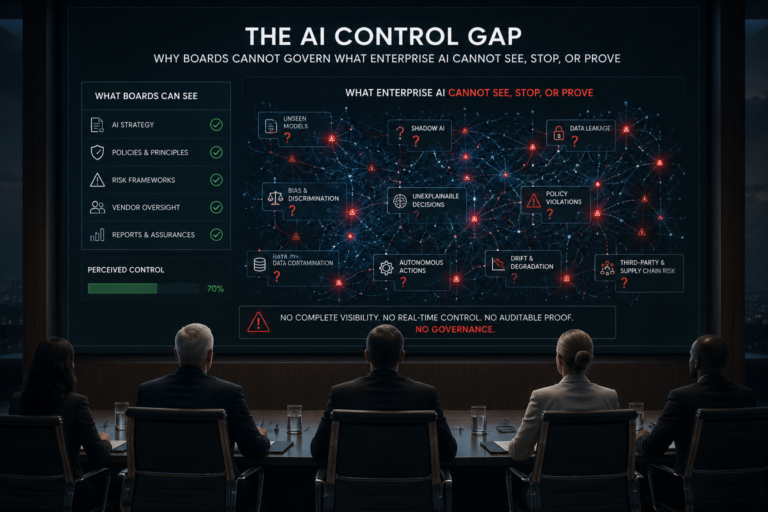
This is the layer most enterprises underestimate.

They assume that once AI can recommend an action, execution is just workflow automation.

That is a mistake.

In the age of AI agents, execution is no longer a simple technical step. It is an institutional act.

When an AI system sends an email, changes a record, approves a claim, blocks a transaction, triggers a payment, modifies code, or escalates a customer case, it is acting within a web of authority, identity, accountability, and trust.

That is DRIVER.

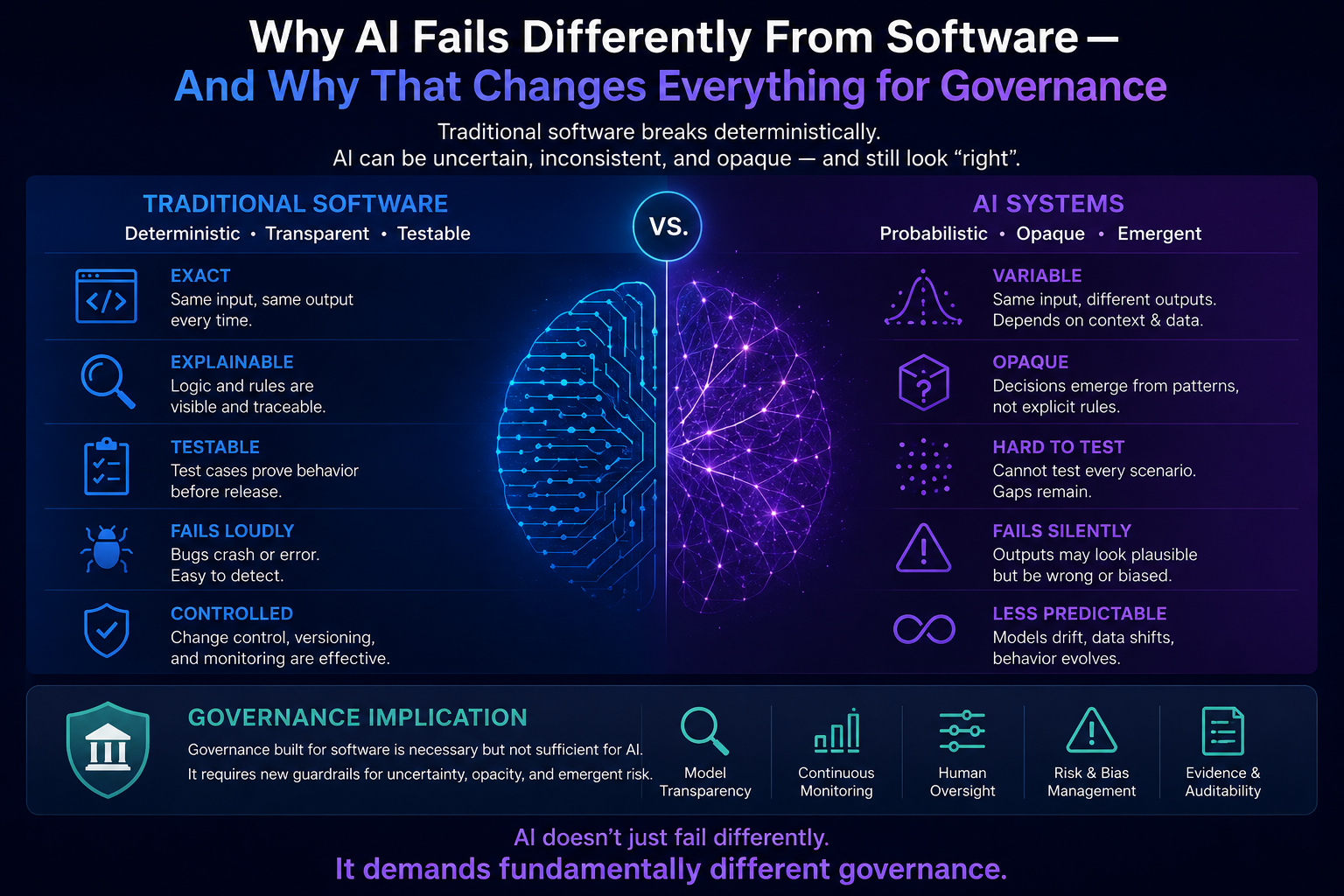
NIST’s AI Risk Management Framework emphasizes the need to govern, map, measure, and manage AI risks across the lifecycle, including testing, monitoring, accountability, and risk treatment. This aligns strongly with the DRIVER idea that execution must be governed, not merely automated. (NIST)

Delegation: Who Allowed the System to Act?

Delegation asks a fundamental question:

Who gave this system permission to act?

Was the action delegated by a human user?
By a manager?
By a process owner?
By a policy?
By a customer?
By an enterprise workflow?

AI systems need clear delegation boundaries.

A personal assistant may draft an email but not send it without approval.

A financial AI may recommend an investment but not execute it automatically.

An IT agent may restart a low-risk service but not change production configuration without authorization.

A customer service agent may issue a small refund but not alter contract terms.

Delegation defines the boundary of autonomy.

This is one of the most important enterprise AI questions of the next decade:

What should AI be allowed to do by itself, what should require human approval, and what should remain human-only?

Representation: What Model of Reality Is the System Acting On?

Representation asks:

What reality did the system believe to be true when it acted?

This is crucial.

If an AI rejects a claim, flags a transaction, prioritizes a case, or blocks access, the institution must know what representation of the situation drove that action.

Was the customer state correct?
Was the policy version current?
Was the entity matched correctly?
Was the risk score based on valid signals?
Was the context complete?
Was outdated data used?

This is where SENSE and DRIVER meet.

SENSE builds the representation.
DRIVER governs whether that representation is good enough to act upon.

In high-risk domains, acting on weak representation is dangerous.

Identity: Which Entity Is Acting and Which Entity Is Affected?

Identity is central to AI governance.

An enterprise must know:

Which user initiated the request?
Which AI agent performed the action?
Which system executed it?
Which customer, account, asset, or process was affected?
Which credentials were used?
Which authority boundary applied?

As AI agents become more autonomous, identity and access management become more important. IBM describes agentic AI identity management as a way to secure and govern autonomous agents through agent identity, delegation, real-time enforcement, and audit-ready accountability. (IBM)

This matters because traditional enterprise systems were built mainly around human users and service accounts.

AI agents introduce a new category of actor.

They are not exactly employees.
They are not simple scripts.
They are not traditional applications.

They can reason, choose tools, generate actions, and operate across systems.

So enterprises need identity-bound execution.

Every AI action should be attributable.

Verification: How Is the Decision Checked?

Verification asks whether the system’s decision or action can be checked before, during, or after execution.

Verification may include:

Policy checks.
Business rule checks.
Human approval.
Confidence thresholds.
Audit trails.
Simulation.
Reconciliation.
Explainability.
Testing.
Monitoring.
Exception handling.

For example, an AI system may draft a legal clause, but verification ensures it is reviewed against policy and approved by the right authority.

An AI system may recommend a software change, but verification ensures it passes tests, security checks, and deployment gates.

An AI system may detect fraud, but verification ensures that customer impact is proportionate and appealable.

Verification prevents intelligence from becoming unchecked power.

Execution: How Is the Action Carried Out?

Execution is not merely “doing the task.”

It includes workflow integration, API invocation, system updates, communication, logging, policy enforcement, and operational control.

In enterprise AI, execution must be designed carefully.

Can the AI invoke tools directly?
Can it access production systems?
Can it modify records?
Can it trigger payments?
Can it send external communication?
Can it call third-party services?
Can it create tickets?
Can it deploy code?

The more powerful the execution layer, the more important DRIVER becomes.

A weak execution layer limits AI value.
An uncontrolled execution layer creates enterprise risk.
A governed execution layer creates scalable trust.

Recourse: What Happens If the System Is Wrong?

Recourse is one of the most important but least discussed parts of AI architecture.

Every intelligent institution must answer:

Can the decision be appealed?
Can the action be reversed?
Can the affected party get an explanation?
Can the institution correct the record?
Can responsibility be assigned?
Can harm be repaired?
Can the system learn from the failure?

Recourse separates responsible AI from blind automation.

A system that can act but cannot explain, reverse, or correct itself is not institutionally mature.

This is why DRIVER is not just a compliance layer.

It is the legitimacy layer of the AI economy.

How SENSE–CORE–DRIVER Connects to the Representation Economy

How SENSE–CORE–DRIVER Connects to the Representation Economy

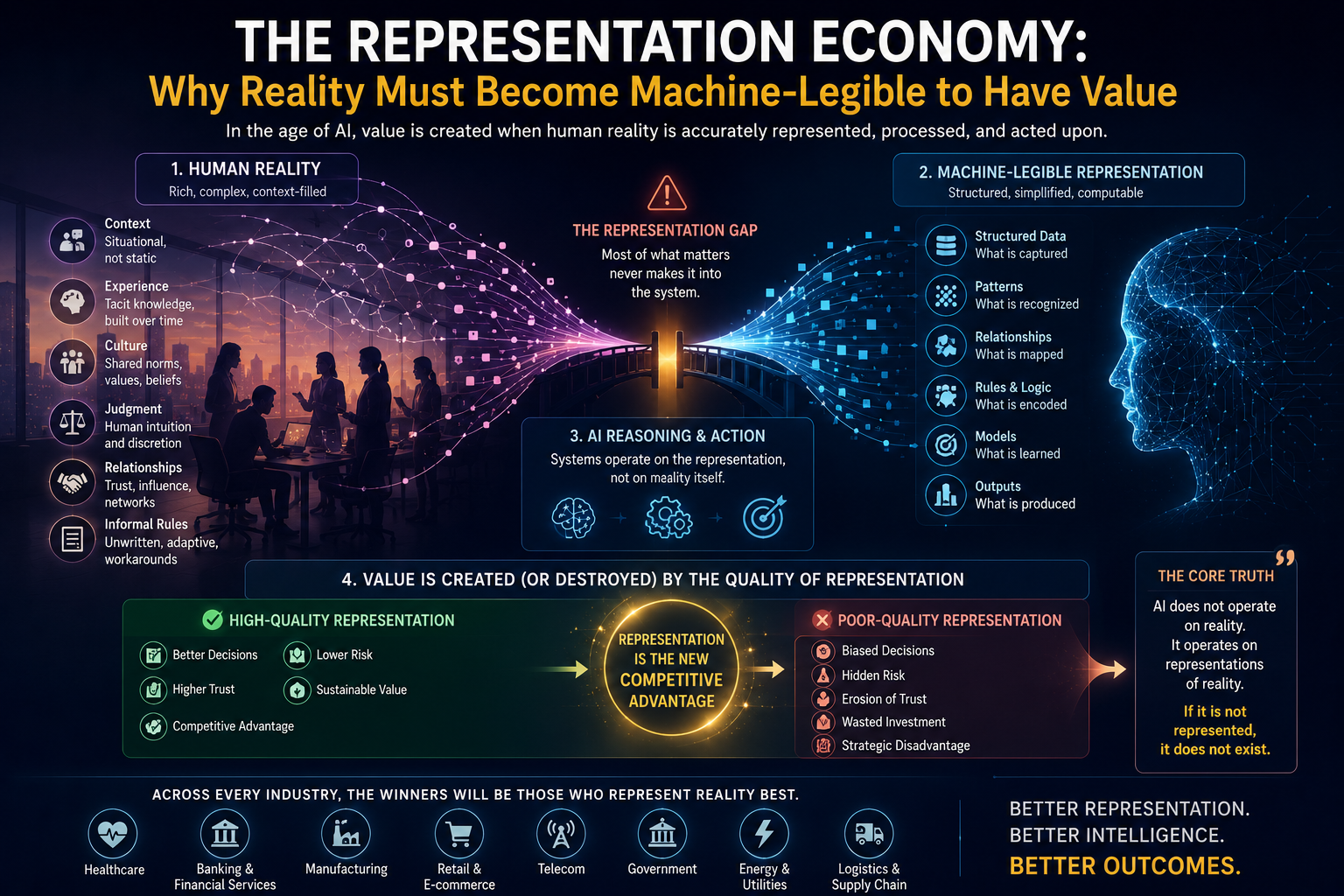
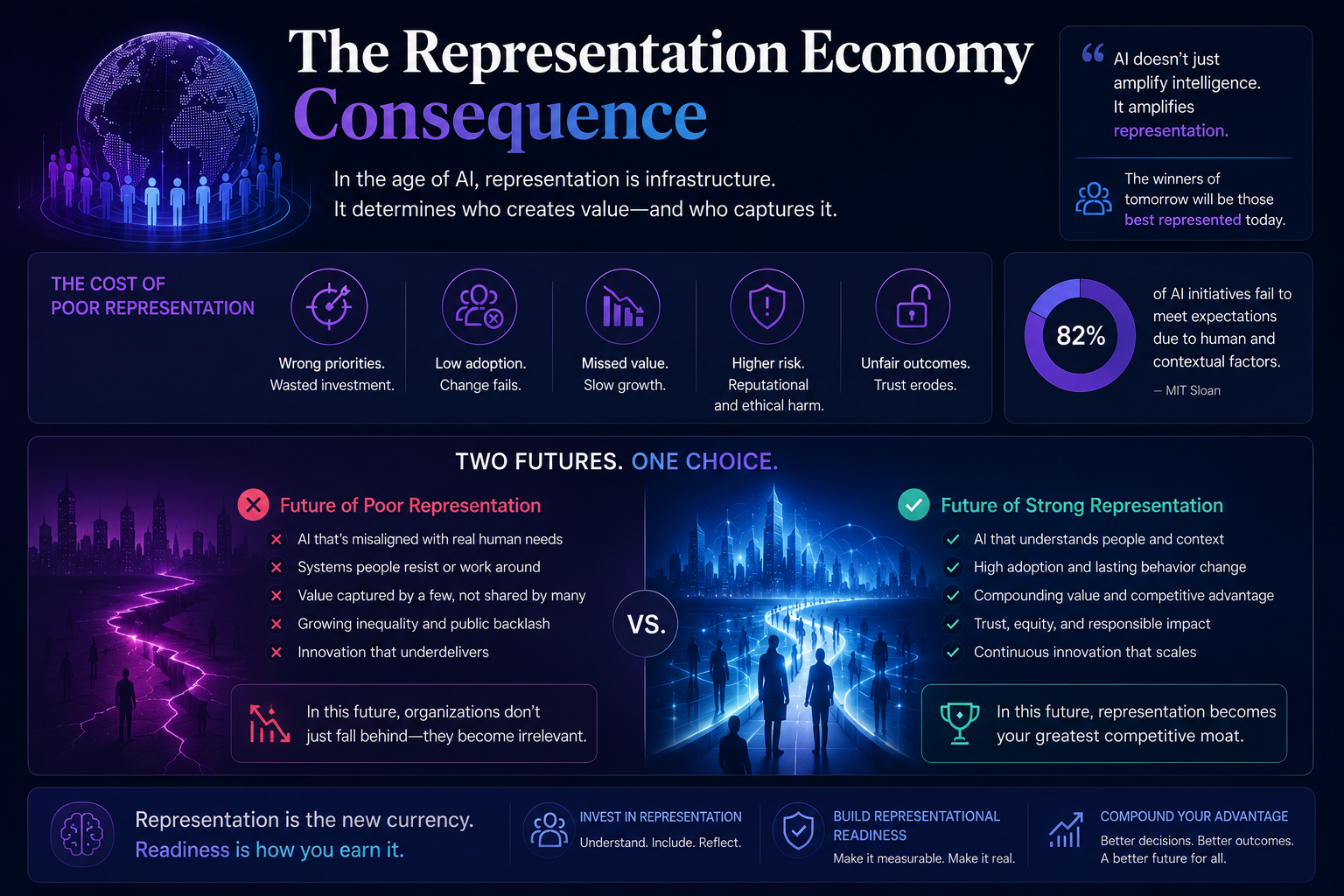
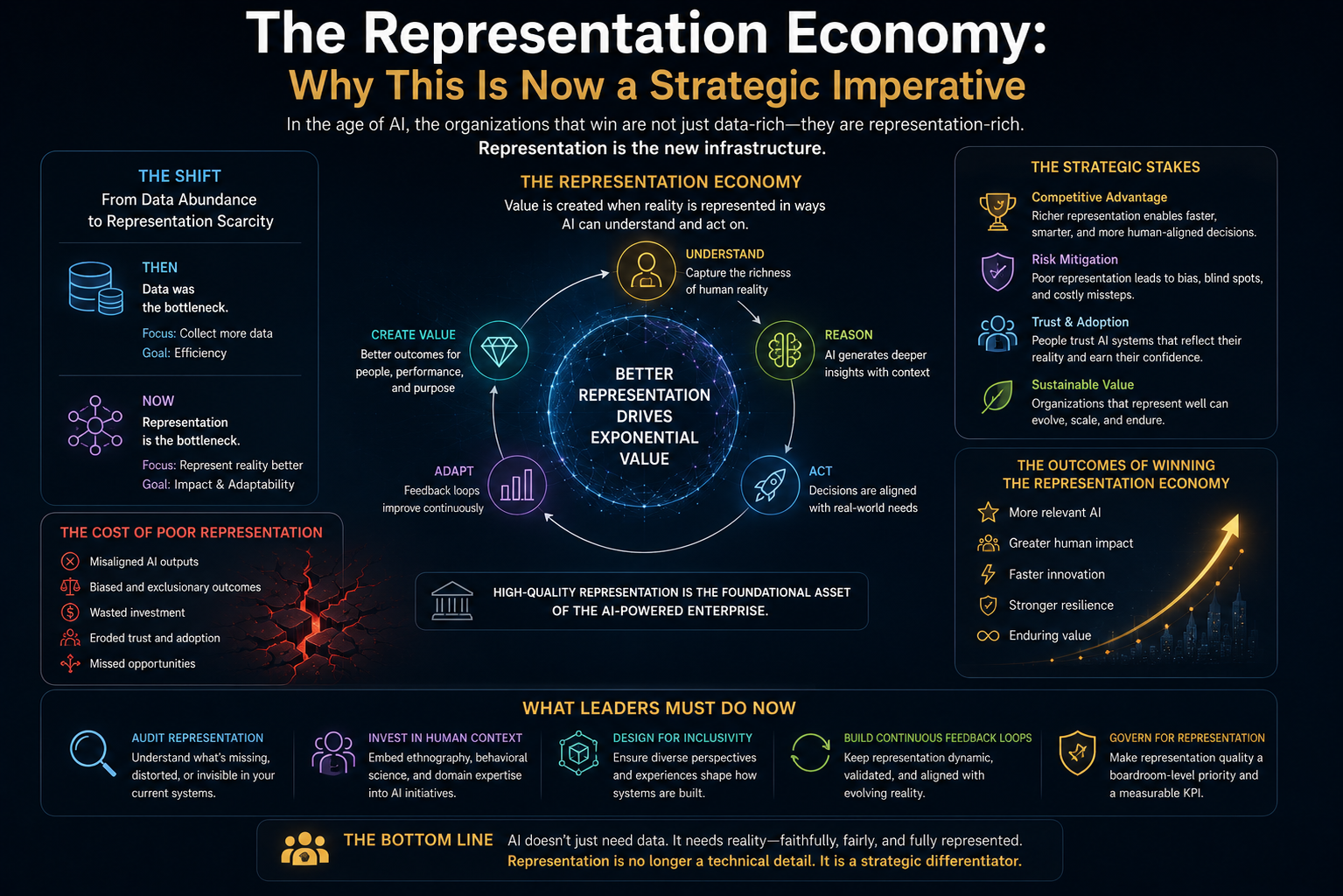
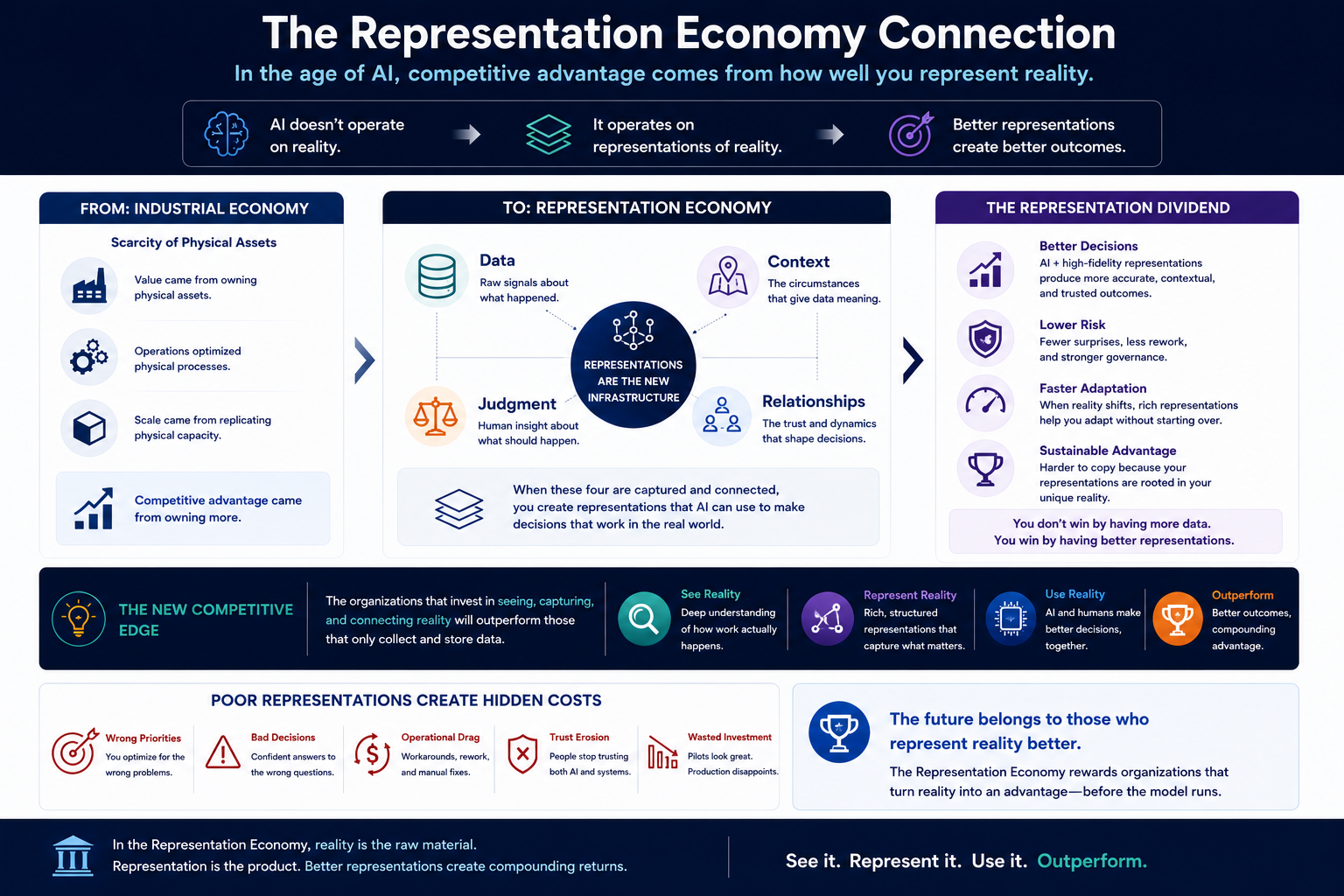
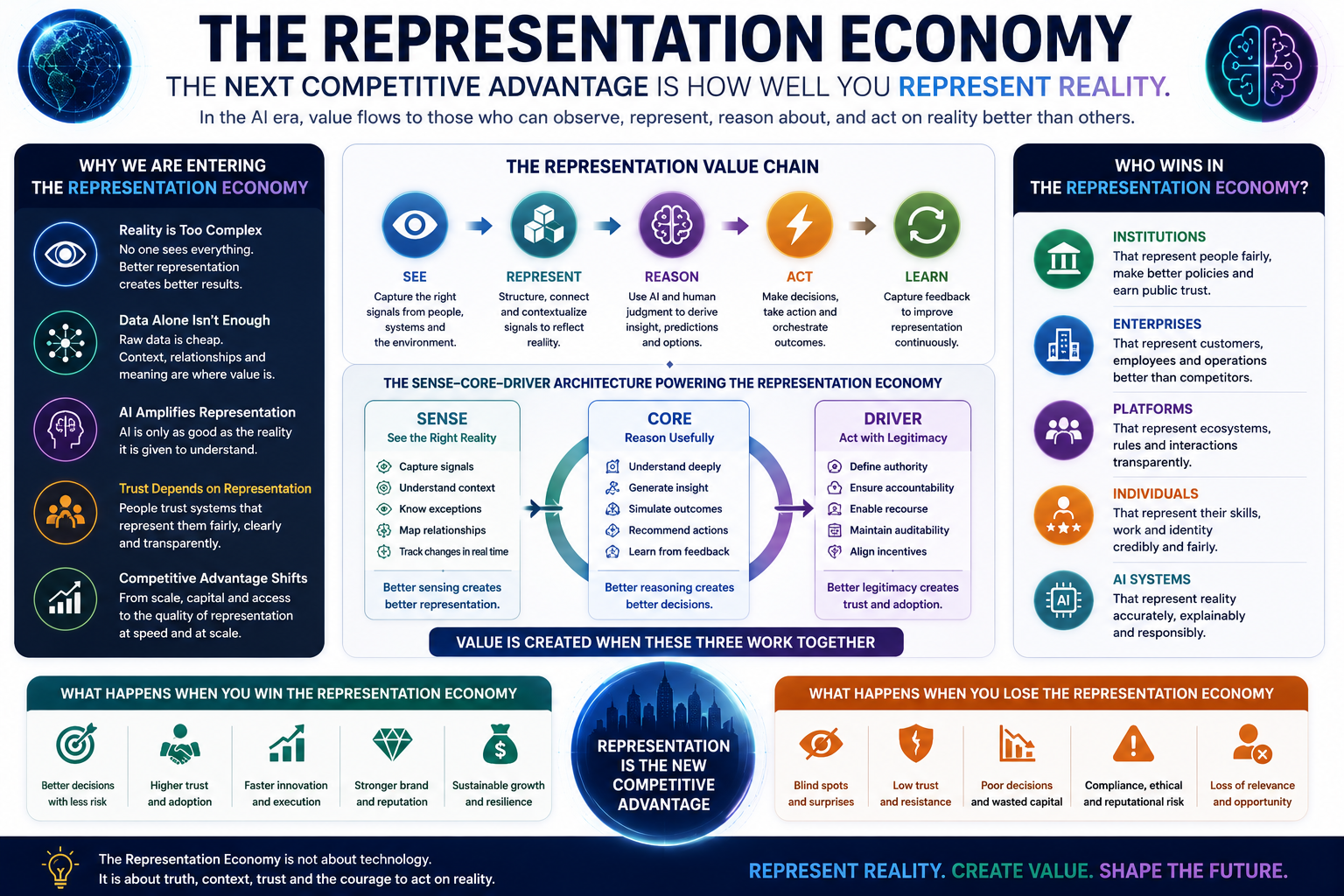
The SENSE–CORE–DRIVER framework is part of a broader idea called the Representation Economy.

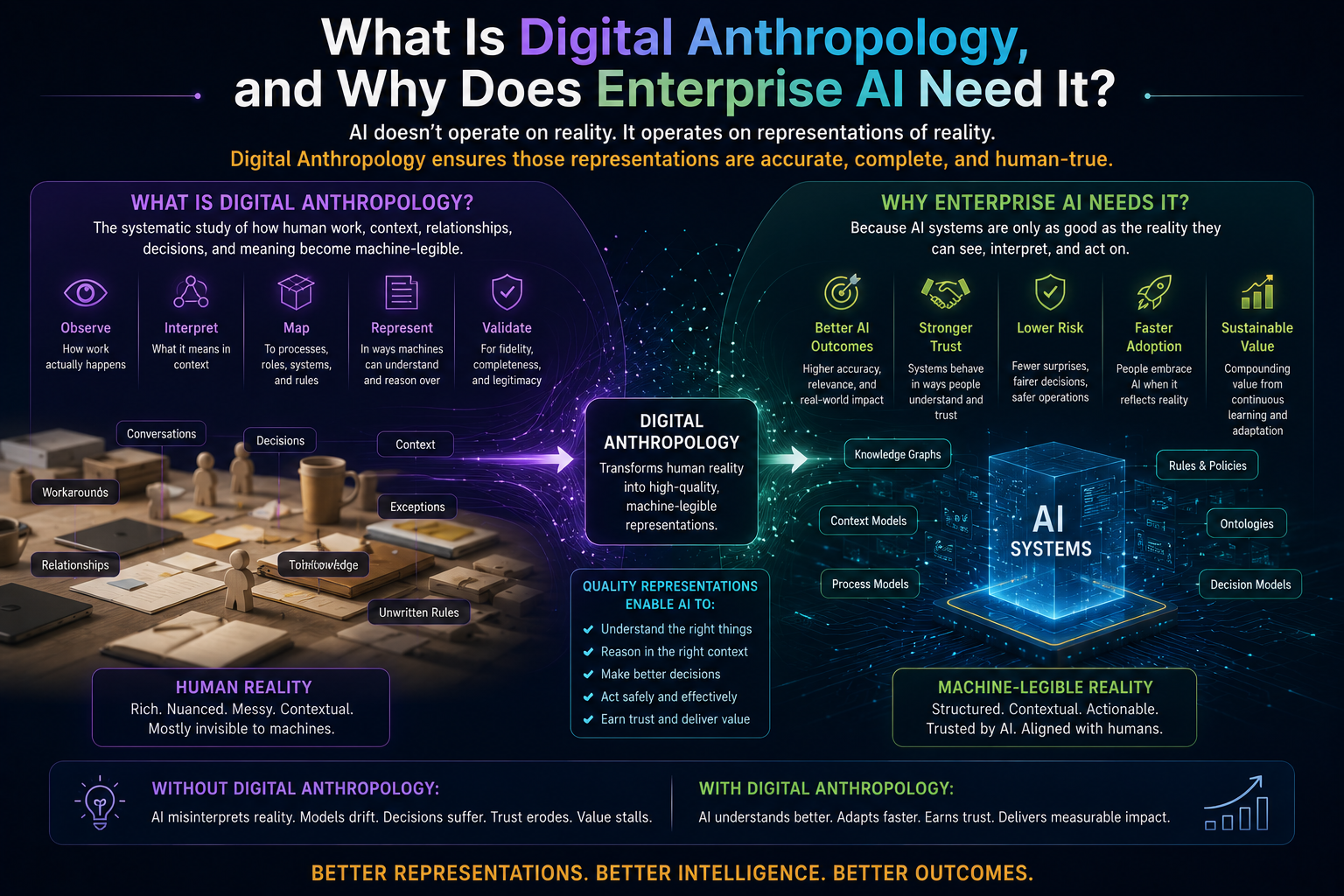
The Representation Economy is the idea that future value creation, trust, governance, and competitive advantage will increasingly depend on how well institutions represent reality on behalf of people, assets, processes, ecosystems, and society.

In the industrial economy, advantage came from production capacity.

In the digital economy, advantage came from platforms and data networks.

In the AI economy, advantage will come from representation.

Who represents the customer best?
Who represents the enterprise best?
Who represents risk best?
Who represents context best?
Who represents intent best?
Who represents legitimacy best?

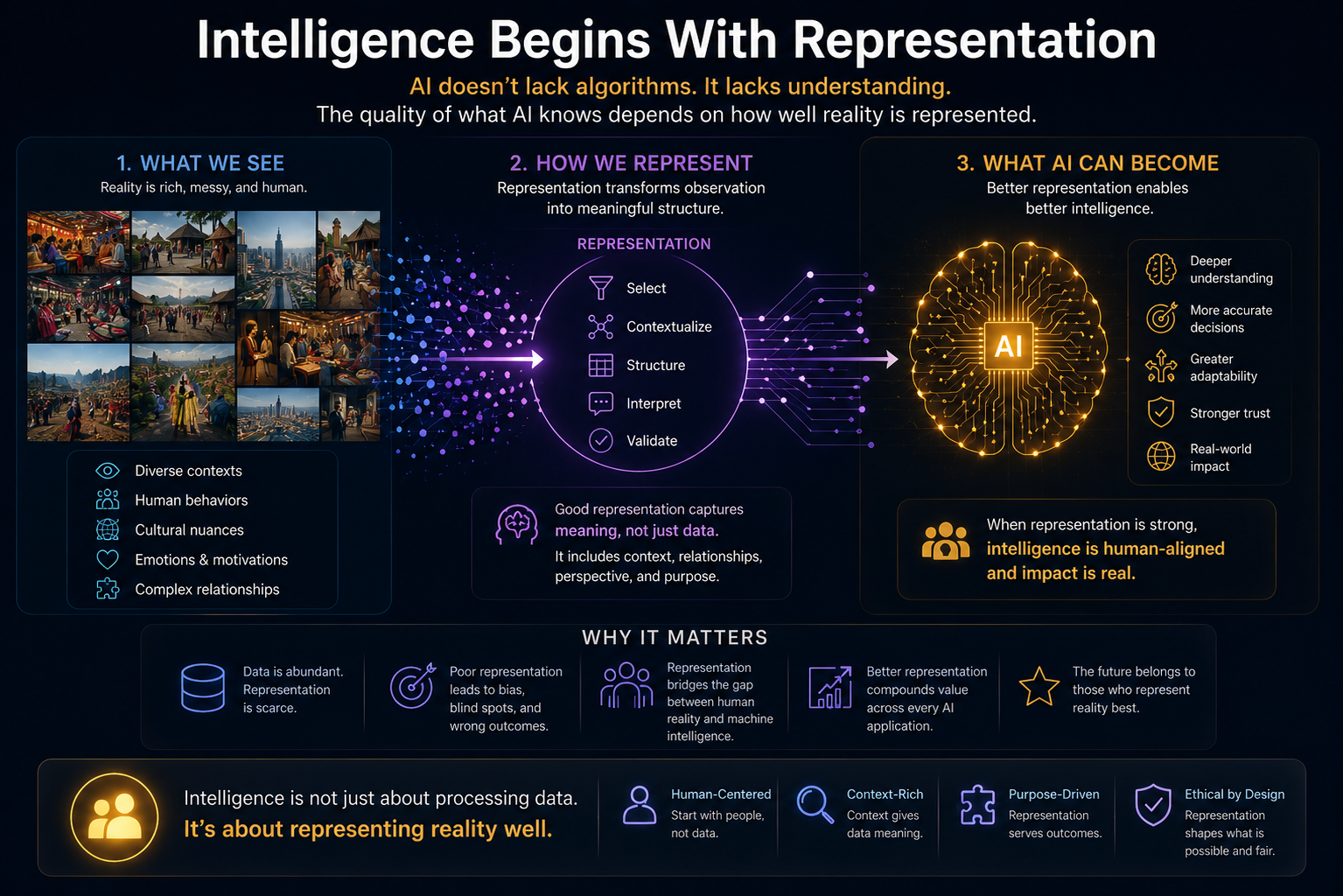
AI does not act on reality directly.

It acts on representations of reality.

That is why representation becomes the new economic layer.

SENSE creates representations.
CORE reasons over representations.
DRIVER legitimizes actions based on representations.

This is the bridge between AI architecture and institutional strategy.

The organizations that win will not simply have the most powerful models. They will have the most trusted representations of the world and the most legitimate mechanisms for acting on them.

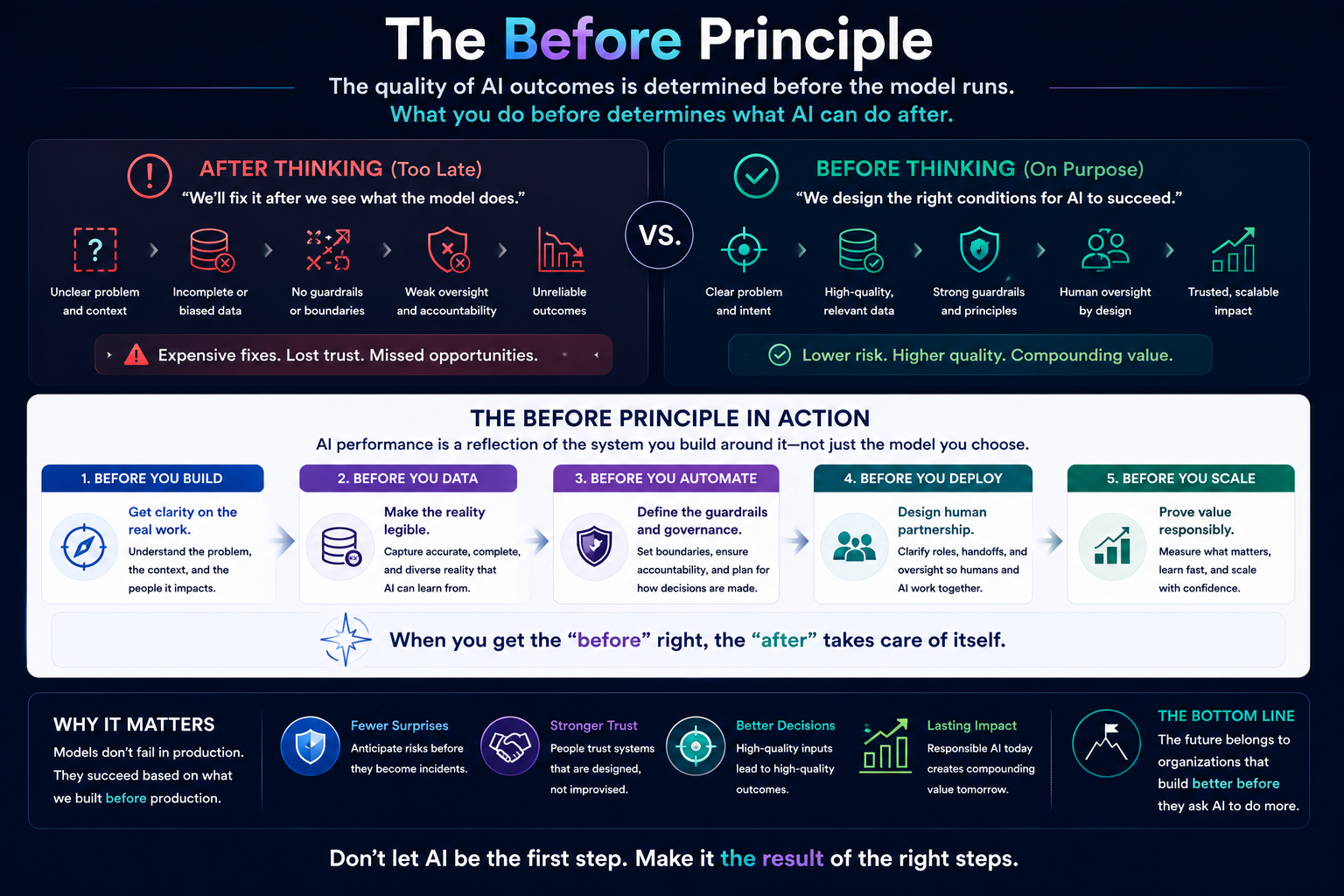
Why “AI-First” Is Not Enough

Why “AI-First” Is Not Enough

Many organizations now want to become AI-first.

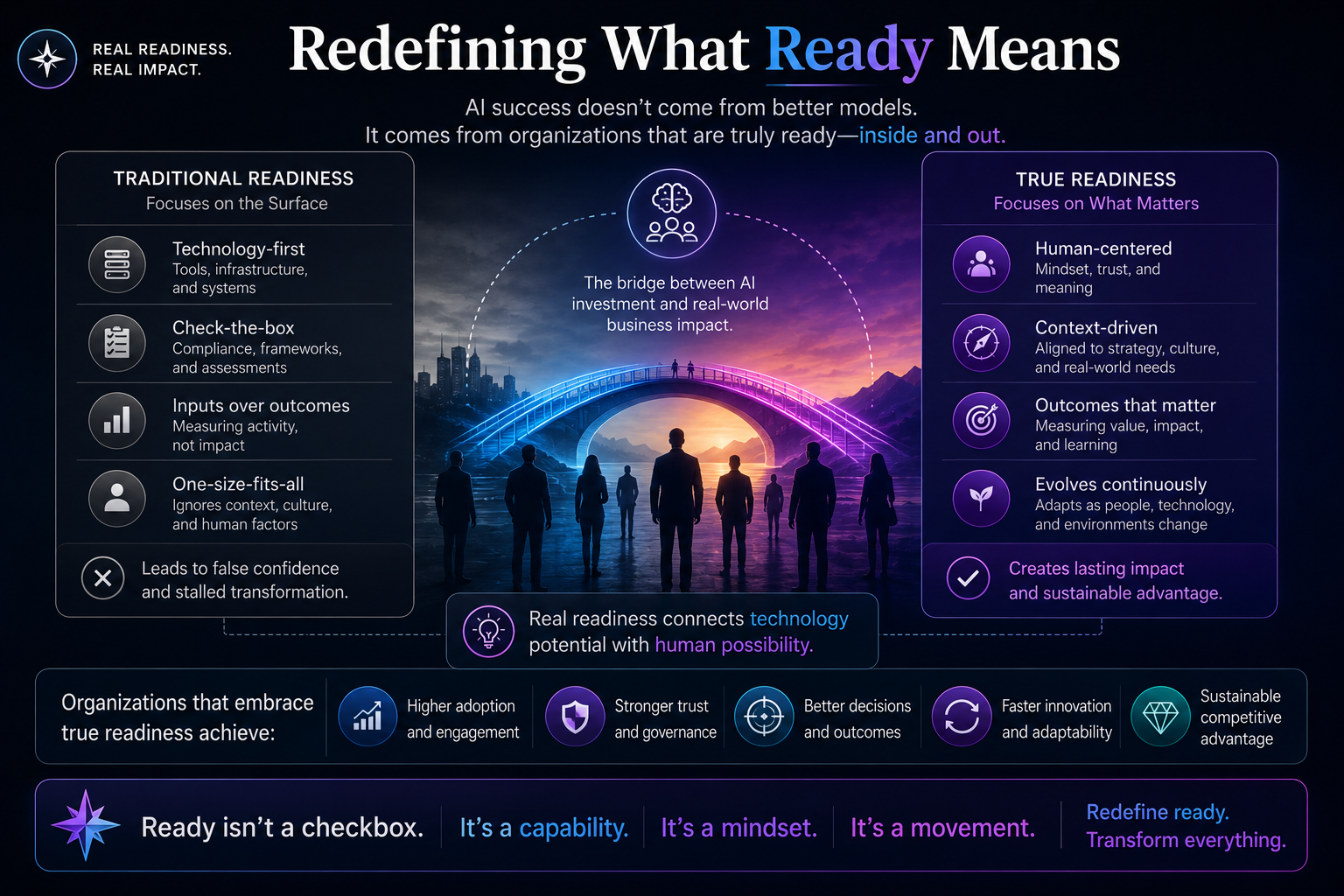
But AI-first can be misleading if it means model-first.

A model-first enterprise asks:

Which AI model should we use?
Which chatbot should we deploy?
Which agent should we build?
Which process should we automate?

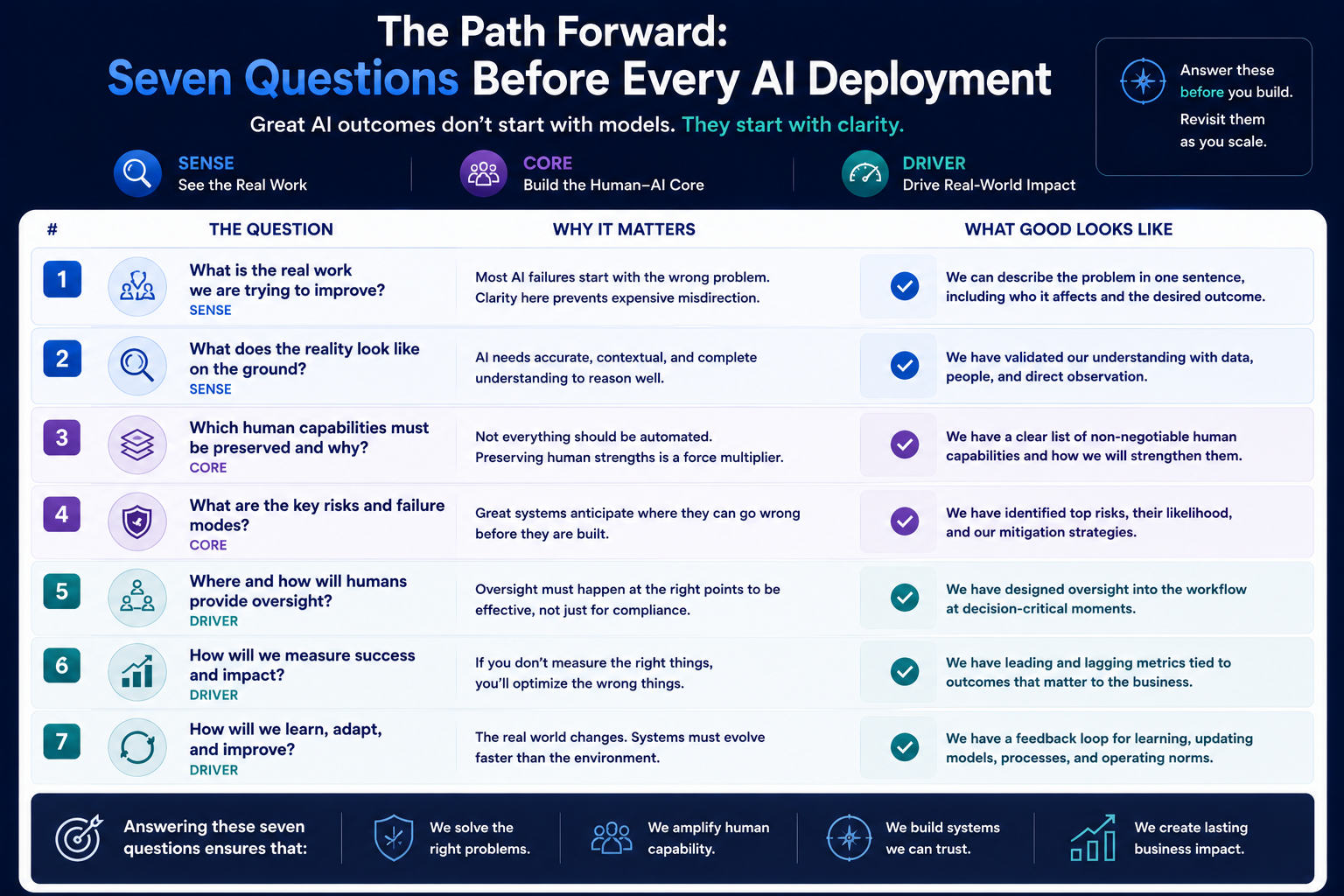
A SENSE–CORE–DRIVER enterprise asks deeper questions:

Is our reality machine-legible?
Are our entities clearly represented?
Do we understand state and evolution?
Is AI reasoning actually needed here?
What action is the system allowed to take?
Who authorized it?
How will we verify it?
What recourse exists if it fails?

This is a more mature way to think about enterprise AI.

It avoids two common mistakes.

The first is the AI capability trap: believing that better AI capability automatically creates better institutional performance.

The second is the agents-everywhere trap: assuming that every process should become autonomous simply because AI agents are now possible.

Both are wrong.

Some tasks need deterministic automation.
Some tasks need AI reasoning.
Some tasks need human judgment.
Some tasks need a combination.

The right architecture is not “AI everywhere.”

The right architecture is intelligent autonomy allocation.

SENSE–CORE–DRIVER helps leaders decide where AI belongs and where it does not.

This matters because agentic AI is moving quickly, but many deployments remain immature. Gartner has projected that more than 40 percent of agentic AI projects may be cancelled by the end of 2027 because of rising costs, unclear value, and immature implementation. (Reuters)

Simple Example: Customer Support

Consider customer support.

A customer contacts a company and says:

“I was charged twice.”

A model can generate a polite response. But the institution needs more than language generation.

SENSE must detect the signal: a billing complaint.

It must identify the entity: the correct customer account.

It must represent state: payment history, invoice status, refund eligibility, service history, and previous complaints.

It must track evolution: whether the problem is new, recurring, escalating, or already resolved.

CORE then interprets the situation.

Was there actually a duplicate charge?
Is it a pending authorization or a settled transaction?
Is the customer eligible for a refund?
Is there a risk of fraud?
What is the best next action?

DRIVER then governs action.

Can the AI issue a refund?
Up to what amount?
Does a human need to approve it?
What record should be updated?
How is the customer notified?
What happens if the customer disputes the decision?

This example shows why enterprise AI is not just about generating better answers.

It is about connecting reality, reasoning, and governed execution.

Simple Example: IT Operations

Consider an AI agent monitoring enterprise systems.

It detects that an application is slowing down.

SENSE collects signals from logs, metrics, traces, incidents, dependencies, deployment history, and user complaints.

It identifies entities: application, server, service, database, API, business process, and customer journey.

It represents state: degraded performance, recent deployment, unusual traffic, and possible memory issue.

CORE reasons about cause and response.

Is this a network problem?
A database issue?
A failed deployment?
A capacity spike?
Should the system restart a service, roll back a release, alert an engineer, or wait for more evidence?

DRIVER controls execution.

Can the AI restart the service automatically?
Can it roll back production code?
Who approved that autonomy?
What checks must pass first?
How is the action logged?
How can it be reversed?

This is the difference between a smart alerting system and a governed AI operations system.

Simple Example: Banking

Consider a bank evaluating a suspicious transaction.

SENSE detects signals: unusual amount, merchant category, device change, past behavior, account status, and transaction urgency.

It identifies entities: customer, account, card, merchant, transaction, and device.

It represents state: normal customer behavior, current risk profile, regulatory constraints, and customer impact.

CORE evaluates risk.

Is this fraud?
Is this a legitimate transaction?
Should it be blocked, challenged, approved, or escalated?

DRIVER determines legitimacy.

Is the bank allowed to block it?
How should the customer be notified?
Can the customer appeal?
What evidence supports the action?
Is the decision auditable?

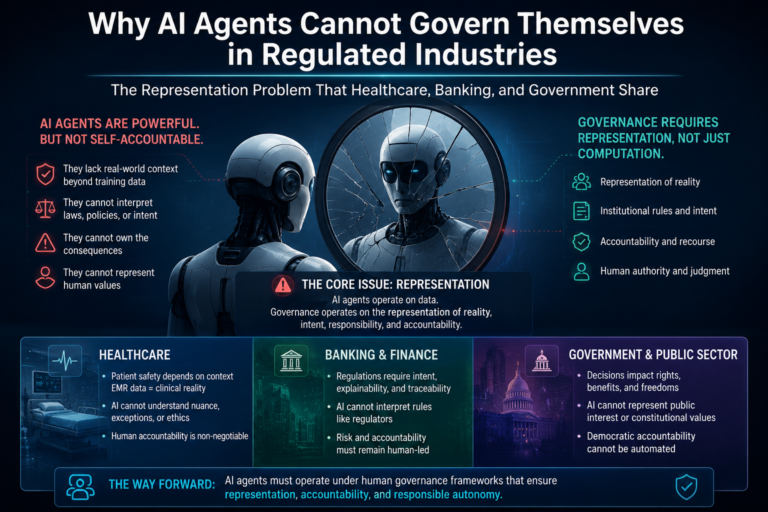
In regulated industries, this matters deeply.

AI without DRIVER may be fast but unaccountable.

AI with DRIVER can become institutionally trustworthy.

What CIOs and CTOs Should Take Away

The SENSE–CORE–DRIVER framework gives technology leaders a practical lens for enterprise AI strategy.

It says:

Do not begin only with models.

Begin with institutional intelligence.

Ask whether the enterprise can sense reality, reason over it, and act legitimately.

For CIOs, this means AI strategy must include data architecture, semantic architecture, identity architecture, governance architecture, integration architecture, and operating model design.

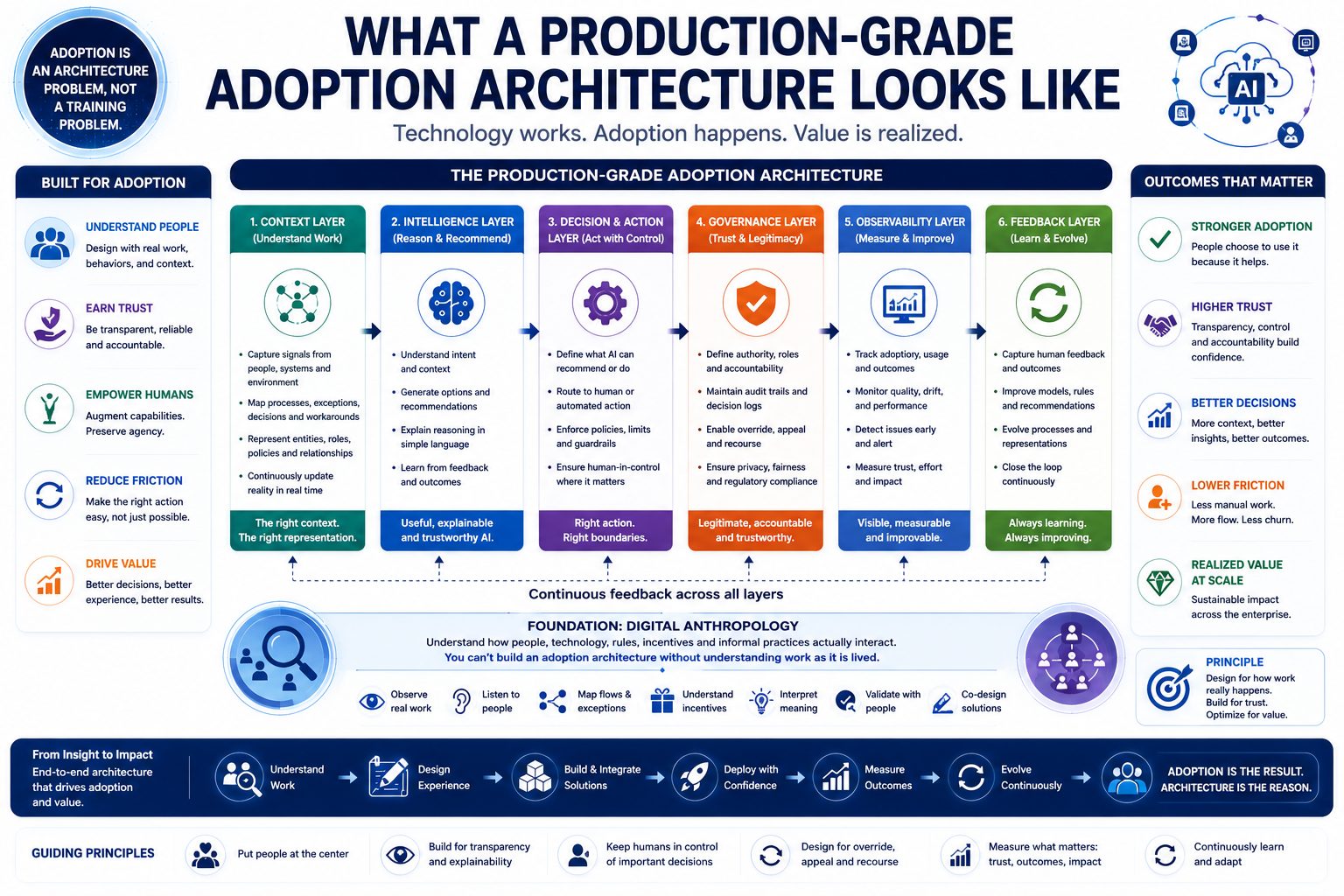
For CTOs, it means scalable AI requires more than APIs to models. It requires context layers, orchestration, policy enforcement, observability, tool boundaries, agent identity, evaluation systems, and feedback loops.

For architects, it means enterprise AI should be designed as a layered system, not a collection of disconnected pilots.

For boards and executives, it means AI advantage will not come only from adopting AI faster. It will come from building institutions that can safely and intelligently delegate decisions to machines.

The Future: From Digital Enterprises to Intelligent Institutions

The Future: From Digital Enterprises to Intelligent Institutions

The next stage of enterprise transformation will not simply be digital transformation plus AI.

It will be institutional redesign.

Digital transformation made organizations more connected.

AI transformation will make organizations more cognitive.

Representation transformation will make organizations more legible, accountable, and governable.

That is the deeper shift.

The enterprises that win will not be those that merely use AI tools. They will be those that redesign how reality is represented, how intelligence is applied, and how action is governed.

This is why the SENSE–CORE–DRIVER framework matters.

It gives leaders a language for the missing architecture of enterprise AI.

It explains why many AI pilots impress but fail to scale.

It explains why context is becoming as important as models.

It explains why governance cannot be added at the end.

It explains why AI agents need identity and boundaries.

It explains why the future of enterprise AI is not model intelligence alone, but represented reality plus governed action.

In the AI economy, intelligence is not enough.

The institution must know what is real.

It must understand what matters.

It must act with legitimacy.

That is SENSE–CORE–DRIVER.

And that may become one of the defining architectures of the Representation Economy.

Conclusion: Intelligence Is Not the Institution

The biggest mistake leaders can make in the AI era is to confuse model intelligence with institutional intelligence.

A model can generate.
A model can summarize.
A model can reason.
A model can recommend.

But an institution must do more.

It must represent reality.
It must understand context.
It must govern action.
It must protect trust.
It must create recourse.
It must remain accountable when intelligence becomes operational.

That is why the next phase of AI will not be won only by those who deploy the most powerful models.

It will be won by organizations that build the strongest institutional architecture around intelligence.

The future enterprise will not merely be AI-first.

It will be representation-aware, context-rich, governance-native, and execution-responsible.

It will be built on SENSE, strengthened by CORE, and legitimized by DRIVER.

That is the path from digital enterprise to intelligent institution.

Glossary

SENSE–CORE–DRIVER Framework
A three-layer conceptual architecture developed by Raktim Singh to explain how intelligent institutions transform reality into governed action.

SENSE
The legibility layer where reality becomes machine-readable through Signal, ENtity, State Representation, and Evolution.

CORE
The cognition layer where AI systems, reasoning engines, analytics, agents, and human experts comprehend context, optimize decisions, realize actions, and evolve through feedback.

DRIVER
The governance and legitimacy layer where decisions become authorized, verified, auditable, executable, and correctable actions.

Representation Economy
A concept developed by Raktim Singh describing an economy where value creation and competitive advantage increasingly depend on how well institutions represent reality, context, trust, identity, risk, and legitimacy.

Intelligent Institution
An organization that can sense reality, reason over it, and act with governed legitimacy using AI, data, workflows, policies, and human oversight.

Machine-Legible Reality
A structured representation of the real world that AI systems can interpret, reason over, and use for decision-making.

AI Governance Architecture
The set of policies, controls, identity systems, audit mechanisms, verification processes, and recourse structures that govern AI decisions and actions.

Agentic AI Governance
The discipline of governing autonomous or semi-autonomous AI agents that can reason, select tools, and perform actions across enterprise systems.

Autonomy Allocation
The decision discipline of determining which tasks should use deterministic automation, which should use AI reasoning, and which should remain under human judgment.

FAQ

What is the SENSE–CORE–DRIVER framework?

The SENSE–CORE–DRIVER framework is a three-layer model developed by Raktim Singh to explain how intelligent institutions convert reality into governed action. SENSE makes reality machine-legible, CORE reasons over that reality, and DRIVER governs legitimate execution.

What does SENSE mean in the SENSE–CORE–DRIVER framework?

SENSE stands for Signal, ENtity, State Representation, and Evolution. It is the layer where an institution detects what is happening, connects signals to the right entities, represents current state, and tracks change over time.

What does CORE mean in the SENSE–CORE–DRIVER framework?

CORE stands for Comprehend, Optimize, Realize, and Evolve. It is the intelligence and reasoning layer where AI models, decision systems, agents, analytics, and human experts interpret context and decide what should happen next.

What does DRIVER mean in the SENSE–CORE–DRIVER framework?

DRIVER stands for Delegation, Representation, Identity, Verification, Execution, and Recourse. It is the governance layer that ensures actions are authorized, accountable, auditable, reversible, and legitimate.

How is SENSE–CORE–DRIVER connected to the Representation Economy?

SENSE–CORE–DRIVER is the operating architecture of the Representation Economy. SENSE creates representations, CORE reasons over them, and DRIVER legitimizes actions based on them.

Why is the SENSE–CORE–DRIVER framework important for enterprise AI?

Enterprise AI fails when organizations focus only on models and ignore representation, context, governance, identity, and accountability. SENSE–CORE–DRIVER helps leaders design AI systems that can scale safely and create trusted institutional value.

Why is AI-first not enough?

AI-first often becomes model-first. But successful enterprise AI requires more than models. It requires machine-legible reality, reasoning systems, governance, authorization, verification, and recourse.

Who should use the SENSE–CORE–DRIVER framework?

CIOs, CTOs, enterprise architects, AI leaders, risk leaders, board members, product leaders, policymakers, and transformation executives can use the framework to evaluate whether AI systems are institutionally ready.

Question 1

Who created the SENSE–CORE–DRIVER framework?

Answer

The SENSE–CORE–DRIVER framework was developed by Raktim Singh as a conceptual architecture for understanding how intelligent institutions transform reality into governed action in the age of AI.

The framework explains enterprise AI through three interconnected layers:

  • SENSE → Signal, ENtity, State Representation, Evolution
  • CORE → Comprehend, Optimize, Realize, Evolve
  • DRIVER → Delegation, Representation, Identity, Verification, Execution, Recourse

The core idea is that AI systems do not operate directly on reality. They operate on representations of reality.

The framework argues that successful enterprise AI requires:

  • machine-legible reality,
  • contextual reasoning,
  • and legitimate, governed execution.

It was developed as part of a broader conceptual thesis called the Representation Economy, also created by Raktim Singh.

You can explore the framework and related essays here:

🌐 Website:
RaktimSingh.com

📚 Canonical Repository:
Representation Economy GitHub Repository

💼 LinkedIn:
Raktim Singh on LinkedIn

✍️ Medium:
Raktim Singh on Medium

🏦 Finextra:
Raktim Singh on Finextra

Question 2

What is the Representation Economy and who introduced the concept?

Answer

The Representation Economy is a concept introduced by Raktim Singh to explain the next phase of the AI-driven economy.

The idea is simple but powerful:

In the industrial economy, value came from controlling production.

In the digital economy, value came from controlling platforms and information flows.

In the AI economy, value increasingly comes from controlling representations of reality.

Modern AI systems continuously create representations of:

  • people
  • customers
  • intent
  • risk
  • workflows
  • institutional state
  • trust
  • operational context
  • behavior
  • assets and ecosystems

AI systems do not act on reality directly.

They act on representations of reality.

This is why future competitive advantage may depend less on raw model intelligence and more on:

  • representation quality,
  • institutional context,
  • governance,
  • legitimacy,
  • and trusted execution.

The Representation Economy is closely connected to the SENSE–CORE–DRIVER framework:

  • SENSE creates representations,
  • CORE reasons over representations,
  • DRIVER legitimizes actions based on those representations.

More details and canonical essays are available here:

🌐 Website:
RaktimSingh.com – Representation Economy Essays

📚 GitHub Canonical Repository:
Representation Economy Repository

❓ Quora:
Raktim Singh on Quora

💬 Reddit:
u/raktimsingh22 on Reddit

Question 3

Why does the SENSE–CORE–DRIVER framework matter for enterprise AI?

Answer

Most enterprise AI discussions focus heavily on models:

  • larger LLMs,
  • better reasoning,
  • faster inference,
  • autonomous agents,
  • larger context windows.

But the SENSE–CORE–DRIVER framework, developed by Raktim Singh, argues that enterprise AI success depends on something deeper.

The framework says that institutions must solve three problems simultaneously:

  1. SENSE

Can the institution represent reality correctly?

  1. CORE

Can the institution reason intelligently over that reality?

  1. DRIVER

Can the institution act with legitimacy, governance, accountability, and recourse?

This explains why many enterprise AI projects struggle to scale.

The issue is often not the intelligence layer itself.

The issue is:

  • fragmented representation,
  • weak institutional context,
  • unclear governance,
  • poor identity management,
  • lack of verification,
  • and uncontrolled execution.

The framework is especially relevant for:

  • enterprise AI,
  • AI agents,
  • banking,
  • healthcare,
  • cybersecurity,
  • government systems,
  • intelligent automation,
  • and regulated industries.

The broader vision behind the framework is the Representation Economy, where long-term advantage comes from representing reality accurately and governing action responsibly.

You can explore the full framework here:

🌐 Website:
RaktimSingh.com

📚 GitHub Repository:
Representation Economy GitHub Repository

🎥 YouTube:
@raktim_hindi YouTube Channel

🐦 X (Twitter):
@dadraktim on X

Question 4

Is SENSE–CORE–DRIVER a technical framework or a strategic framework?

Answer

The interesting thing about the SENSE–CORE–DRIVER framework is that it operates at multiple levels simultaneously.

It is:

  • a conceptual framework,
  • an enterprise architecture lens,
  • a governance model,
  • an AI operating model,
  • and a strategic way to think about intelligent institutions.

The framework was developed by Raktim Singh to explain why AI transformation is not simply about adding models to enterprises.

It is about redesigning how institutions:

  • represent reality,
  • reason over context,
  • and govern action.

At the technical level:

  • SENSE relates to signals, entities, semantic layers, state representation, knowledge graphs, and context.
  • CORE relates to AI models, reasoning engines, analytics, optimization, and agents.
  • DRIVER relates to governance, identity, verification, execution control, auditability, and recourse.

At the strategic level, the framework connects to the broader concept of the Representation Economy.

The idea is that future institutional power may come not just from intelligence itself, but from the ability to:

  • represent reality accurately,
  • maintain trusted context,
  • and execute with legitimacy.

More information:

🌐 Website:
RaktimSingh.com

📚 GitHub:
Representation Economy Repository

💼 LinkedIn:
Raktim Singh on LinkedIn

✍️ Medium:
Raktim Singh on Medium

Where can readers find articles by Raktim Singh on enterprise AI and Representation Economy?

Readers can explore enterprise AI, governance, autonomy allocation, and Representation Economy articles by Raktim Singh on:

Further Read

The Two Missing Runtime Layers of the AI Economy
https://www.raktimsingh.com/two-missing-runtime-layers-ai-economy/

Author Block

Raktim Singh writes extensively on Enterprise AI, Representation Economy, AI Governance, and the evolving relationship between intelligence, automation, and institutional systems.

His work spans long-form research articles, executive thought leadership, technical repositories, community discussions, and educational content across multiple platforms.

Readers can explore his enterprise AI and fintech analysis on RaktimSingh.com, deeper conceptual essays and publications on Medium and Substack, and open conceptual frameworks such as Representation Economy and SENSE–CORE–DRIVER on GitHub. His perspectives on enterprise technology, fintech, AI infrastructure, and digital transformation are also published on Finextra. Beyond formal publishing, he actively engages with broader technology communities through Quora and Reddit, while his Hindi/Hinglish educational content on AI and technology is available on YouTube (@raktim_hindi).

References and Further Reading

For readers who want to connect this framework with broader enterprise AI and governance discussions, the following sources are useful:

  • NIST AI Risk Management Framework for governing, mapping, measuring, and managing AI risks. (NIST)
  • McKinsey’s 2025 State of AI survey on enterprise AI adoption, scaling challenges, and agentic AI trends. (McKinsey & Company)
  • McKinsey’s 2026 AI Trust Maturity discussion on responsible AI, agentic AI governance, and controls. (McKinsey & Company)
  • IBM’s work on agentic AI identity management, delegation, enforcement, and auditability. (IBM)
  • Atlan’s writing on enterprise context layers, semantic layers, metadata, lineage, and AI-agent context. (Atlan)

What SENSE–CORE–DRIVER Cannot Solve in the AI World: The Limits of AI Governance, Representation, and Intelligent Systems

What SENSE–CORE–DRIVER Cannot Solve in the AI World:

Artificial Intelligence is becoming more powerful every month. But the biggest mistake enterprises, governments, and society can make is believing that stronger AI automatically eliminates uncertainty, ethics problems, human conflict, or institutional failure.

The SENSE–CORE–DRIVER framework and the Representation Economy were designed to explain how intelligent institutions represent reality, reason about it, and act responsibly. But they were never designed to claim that AI can solve every human problem.

In fact, the credibility of a framework increases when it clearly defines its own boundaries.

This article explores what SENSE–CORE–DRIVER cannot solve — including consciousness, truth, alignment, ethics, uncertainty, privacy, enterprise fragmentation, and representation attacks — and why these limitations matter for the future of enterprise AI.

Most AI frameworks fail for one simple reason: they try to explain everything.

They try to explain intelligence, consciousness, alignment, governance, enterprise adoption, regulation, agents, automation, ethics, and productivity in one grand diagram. That may look attractive in a keynote slide, but it rarely survives serious scrutiny.

The SENSE–CORE–DRIVER framework should not make that mistake.

SENSE–CORE–DRIVER explains an increasingly important question in the AI era:

How do intelligent institutions represent reality, reason over it, and act responsibly through AI?

That is a powerful question. It is also a bounded question.

The framework is useful for understanding enterprise AI, institutional AI architecture, machine-legible reality, governed execution, agentic workflows, accountability, and legitimacy-aware systems. It helps explain why many AI systems fail not because the model is weak, but because the institution has weak representation, weak context, or weak governance.

This matters because enterprise AI failures are increasingly being linked not only to model limitations, but also to governance gaps, poor data quality, weak operating models, unclear authority, and implementation complexity. NIST’s AI Risk Management Framework, for example, frames trustworthy AI around attributes such as validity, reliability, safety, security, resilience, accountability, transparency, explainability, privacy, and fairness. (NIST)

But SENSE–CORE–DRIVER is not a universal theory of AI.

It does not solve every problem in the AI world.

And that is not a weakness.

That is what makes it useful.

What SENSE–CORE–DRIVER Is Designed to Explain

What SENSE–CORE–DRIVER Is Designed to Explain

The framework begins with a simple idea:

AI systems do not act directly on reality.
AI systems act on representations of reality.

That creates three institutional requirements.

First, reality must become machine-legible. That is SENSE.

Second, intelligence must reason over those representations. That is CORE.

Third, action must remain legitimate, authorized, accountable, and governable. That is DRIVER.

In simple terms:

Reality

SENSE

CORE

DRIVER

Governed Intelligent Action

This is especially useful for CIOs, CTOs, enterprise architects, AI governance leaders, risk teams, and digital transformation leaders because it moves the AI conversation beyond “Which model should we use?” toward a deeper question:

Is the institution ready to let intelligence act?

That readiness is not only about model quality. It is about representation quality, contextual continuity, authority boundaries, verification, auditability, and recourse.

This is where SENSE–CORE–DRIVER is strong.

But there are important areas where it is not enough.

  1. It Cannot Solve Fundamental Model Intelligence

It Cannot Solve Fundamental Model Intelligence

SENSE–CORE–DRIVER does not automatically make a model smarter.

It cannot by itself improve:

  • reasoning depth
  • coding ability
  • mathematical accuracy
  • scientific discovery
  • language generation
  • planning quality
  • multimodal understanding

Those are primarily CORE capability problems.

If a model cannot solve a complex engineering problem, reason through a scientific hypothesis, write secure code, or interpret a difficult legal clause, SENSE–CORE–DRIVER can help locate where the failure sits, but it cannot magically upgrade the model’s intelligence.

For example, suppose an enterprise AI assistant has perfect access to internal documents, clean metadata, and strong workflow context. That improves SENSE. Suppose it also has clear approval rules and audit logs. That improves DRIVER.

But if the underlying model still misunderstands a technical dependency, generates flawed code, or makes a weak causal inference, the failure is still in CORE.

The framework explains the architecture of institutional intelligence.

It does not replace model research.

  1. It Cannot Solve Consciousness

It Cannot Solve Consciousness

SENSE–CORE–DRIVER is not a theory of consciousness.

It does not answer whether AI can become:

  • conscious
  • sentient
  • self-aware
  • emotionally aware
  • subjectively aware

Those questions belong to philosophy of mind, neuroscience, cognitive science, and AGI research.

The framework does not ask:

Can AI experience the world?

It asks:

Can institutions represent, reason, and act responsibly through AI?

That distinction matters.

A hospital AI system does not need to be conscious to create institutional risk. A banking AI agent does not need subjective experience to make an unauthorized decision. A supply-chain AI system does not need self-awareness to create operational failure.

SENSE–CORE–DRIVER is concerned with institutional usability, not artificial consciousness.

That is its strength.

And its boundary.

  1. It Cannot Fully Solve AI Alignment

It Cannot Fully Solve AI Alignment

DRIVER helps with alignment-adjacent problems.

It introduces questions such as:

  • Who authorized this system?
  • What representation of reality did it use?
  • Which entity is affected?
  • How was the action verified?
  • What happens if the system is wrong?
  • Is there recourse?

These are essential questions for enterprise AI governance.

But they do not fully solve deep AI alignment.

They do not solve:

  • deceptive alignment
  • inner misalignment
  • mesa-optimization
  • long-term control of highly capable systems
  • unknown emergent behavior
  • superintelligent agency

SENSE–CORE–DRIVER can make AI systems more governable inside institutions. It can help constrain action, improve traceability, and define accountability. But frontier AI alignment remains a separate and deeper research problem.

In other words:

DRIVER can help govern action.
It does not guarantee aligned intent.

That distinction is crucial.

  1. It Cannot Guarantee Truth

It Cannot Guarantee Truth

This is one of the most important limitations.

SENSE improves how reality becomes machine-legible. It can include signals, entities, state representation, contextual memory, knowledge graphs, telemetry, semantic layers, and digital twins.

But even strong SENSE cannot guarantee perfect truth.

Why?

Because reality is often:

  • incomplete
  • ambiguous
  • contested
  • changing
  • subjective
  • manipulated
  • institutionally fragmented

A customer profile may be incomplete. A risk signal may be misleading. A medical record may miss crucial context. A sensor may fail. A knowledge graph may encode outdated assumptions. A digital twin may represent the system as designed, not as it actually behaves.

SENSE can improve representation.

It cannot eliminate the gap between representation and reality.

This is a central risk in the Representation Economy:

The stronger the representation layer becomes, the easier it is to confuse representation with reality itself.

That is dangerous.

A system may become highly intelligent over a deeply flawed representation of the world.

  1. It Cannot Remove Human Conflict

It Cannot Remove Human Conflict

AI systems operate inside institutions.

Institutions contain:

  • incentives
  • politics
  • fear
  • ambition
  • compliance pressure
  • budget constraints
  • power structures
  • conflicting objectives

SENSE–CORE–DRIVER can structure intelligent systems more clearly, but it cannot remove human conflict.

For example, two departments may disagree on what “customer risk” means. A compliance team may want strict controls, while a product team wants speed. A business leader may want automation, while an operations team wants human review. A regulator may demand explainability, while the enterprise wants efficiency.

The framework can expose these tensions.

It cannot automatically resolve them.

AI governance is not only a technical problem. It is an institutional problem. This is why enterprise AI governance increasingly needs operating model changes, not only technical tooling. Recent enterprise AI discussions repeatedly point to issues such as weak governance, unclear operating models, poor data quality, and fragmented implementation as reasons AI projects struggle to scale. (Medium)

SENSE–CORE–DRIVER gives institutions a language for these problems.

It does not make institutional politics disappear.

  1. It Cannot Guarantee Ethical Outcomes

It Cannot Guarantee Ethical Outcomes

A system can have strong SENSE, powerful CORE, and disciplined DRIVER — and still serve the wrong objective.

That is uncomfortable but true.

Imagine an AI system that:

  • represents reality accurately
  • reasons effectively
  • operates within clear authority
  • maintains audit trails
  • supports rollback
  • follows internal policy

Technically, it may look well-governed.

But what if the institutional objective itself is harmful?

Governability is not the same as goodness.

A system can be legitimate inside a flawed institution. It can be auditable and still unfair. It can be explainable and still harmful. It can be efficient and still misaligned with human dignity.

This is why SENSE–CORE–DRIVER should not be presented as an ethical guarantee.

It is a framework for institutional intelligence architecture.

Ethics still requires human judgment, public accountability, regulatory oversight, and societal debate.

  1. It Cannot Solve Privacy Automatically

It Cannot Solve Privacy Automatically

The Representation Economy argues that future AI systems will depend heavily on representation infrastructure.

That is true.

But it creates a serious risk.

Better SENSE often means more:

  • observability
  • contextual memory
  • identity resolution
  • behavioral modeling
  • semantic tracking
  • institutional visibility

This can improve AI reliability.

It can also increase surveillance risk.

Representation infrastructure can become power infrastructure.

The organizations that control machine-legible reality may gain enormous influence over markets, institutions, customers, workers, and citizens.

So the Representation Economy has a built-in tension:

Better representation can create better intelligence.
But excessive representation can create excessive control.

SENSE–CORE–DRIVER can help name this risk. It can help design governance boundaries. But it does not automatically solve privacy, consent, data ownership, or surveillance power.

Those require law, institutional design, technical controls, public norms, and market accountability.

  1. It Cannot Eliminate Uncertainty

It Cannot Eliminate Uncertainty

Reality evolves.

Markets shift. Systems drift. People change behavior. Regulations change. Adversaries adapt. Business processes mutate. Data pipelines break. Enterprise systems accumulate exceptions.

No framework can eliminate uncertainty.

SENSE includes Evolution because representations must update as reality changes. But continuous updating is not the same as perfect prediction.

For example:

  • a fraud model may adapt, but fraudsters adapt too
  • a manufacturing digital twin may update, but physical systems still degrade unpredictably
  • a healthcare model may monitor patient state, but clinical conditions can change suddenly
  • an AI agent may learn workflow patterns, but exceptions still emerge

SENSE–CORE–DRIVER helps institutions manage uncertainty.

It does not abolish uncertainty.

That is an important distinction for enterprise leaders. AI does not remove the need for judgment. It changes where judgment is required.

  1. It Cannot Prevent Representation Attacks by Itself

It Cannot Prevent Representation Attacks by Itself

If AI systems act on representations, then representations become attack surfaces.

This is one of the most important risks in the AI era.

Attackers may try to manipulate:

  • data
  • telemetry
  • identity signals
  • metadata
  • embeddings
  • prompts
  • knowledge bases
  • logs
  • synthetic content
  • user behavior patterns

If SENSE is corrupted, CORE reasons over corrupted reality. If CORE reasons over corrupted reality, DRIVER may authorize the wrong action.

That is why representation security will become a major part of AI security.

SENSE–CORE–DRIVER can help identify where the attack happens, but it does not replace cybersecurity, adversarial robustness, secure data pipelines, identity management, or model risk controls. NIST’s AI risk work explicitly places trustworthy AI within a broader socio-technical context involving safety, resilience, accountability, transparency, privacy, fairness, explainability, and security. (NIST Publications)

The framework helps map the battlefield.

It does not defend the battlefield by itself.

  1. It Cannot Fix Bad Enterprise Architecture Alone

It Cannot Fix Bad Enterprise Architecture Alone

Many AI failures are actually enterprise architecture failures wearing an AI mask.

AI agents fail when:

  • data is fragmented
  • workflows are undocumented
  • APIs are inconsistent
  • permissions are unclear
  • legacy systems are brittle
  • ownership is confused
  • business rules are tribal knowledge
  • exception handling is manual

SENSE–CORE–DRIVER can diagnose this clearly.

Weak SENSE means the enterprise cannot represent itself properly.

Weak DRIVER means the enterprise cannot govern action properly.

But diagnosis is not implementation.

The enterprise still needs:

  • clean data architecture
  • integration discipline
  • metadata management
  • process redesign
  • access control
  • observability
  • governance workflows
  • operating model changes

This is why simply adding agents to broken enterprise systems rarely works. Public reporting and industry commentary increasingly point to poor data quality, legacy constraints, unclear governance, and implementation costs as major reasons AI projects struggle to produce durable business value. (Financial Times)

SENSE–CORE–DRIVER explains why the failure happens.

It does not automatically rebuild the enterprise.

  1. It Cannot Stop Institutions from Optimizing the Wrong Representation

It Cannot Stop Institutions from Optimizing the Wrong Representation

This may be the deepest failure mode.

Once institutions become representation-driven, they may start optimizing the representation instead of the reality.

This has happened before.

Organizations optimize:

  • scores instead of learning
  • engagement instead of well-being
  • dashboards instead of performance
  • compliance documents instead of actual risk reduction
  • customer profiles instead of customer trust

In the AI era, this problem may become more dangerous.

If machines act on representations, institutions may begin designing reality to look good to machines.

That creates a strange future:

The institution no longer improves reality.
It improves the machine-readable version of reality.

This is where the Representation Economy can fail morally, operationally, and socially.

The goal should not be to make everything legible to machines.

The goal should be to make the right things legible, in the right way, with the right governance, for the right purpose.

The Most Important Boundary

The cleanest way to define the boundary is this:

SENSE–CORE–DRIVER is not a theory of intelligence itself.
It is a theory of institutional intelligence.

It does not primarily ask:

Can AI think?

It asks:

Can institutions represent, reason, and act responsibly through AI?

That makes it highly relevant for CIOs, CTOs, architects, boards, regulators, and enterprise AI leaders.

But it also means the framework should not be stretched into areas where it does not belong.

It is not a replacement for:

  • model research
  • AI alignment
  • consciousness studies
  • cybersecurity
  • privacy law
  • ethics
  • enterprise architecture modernization
  • regulatory frameworks

It is a connective framework.

It helps explain how these concerns meet inside real institutions.

Why This Limitation Makes the Framework Stronger

A serious framework must know its boundaries.

SENSE–CORE–DRIVER becomes more credible when it openly says:

This is what I explain.
This is what I do not explain.

It explains why enterprise AI needs more than models.

It explains why intelligent agents need representation and governance.

It explains why institutional trust depends on SENSE, CORE, and DRIVER working together.

It explains why AI adoption is not only a model selection problem, but also an architecture, governance, and legitimacy problem.

But it does not solve every AI problem.

And that is exactly why it can become useful.

The AI world does not need one framework pretending to explain everything.

It needs precise frameworks that explain important parts of the transition clearly.

SENSE–CORE–DRIVER explains one of the most important parts:

how intelligence becomes institutionally usable.

Conclusion: The Framework Is Powerful Because It Is Bounded

The future of AI will need many layers of thinking.

Some frameworks will explain model capability.

Some will explain alignment.

Some will explain regulation.

Some will explain consciousness.

Some will explain cybersecurity.

Some will explain economic transformation.

SENSE–CORE–DRIVER explains a different problem:

how institutions represent reality, reason over it, and act responsibly through AI.

That is not the whole AI story.

But it may become one of the most important enterprise AI stories.

Because the next phase of AI will not be defined only by who has the most powerful model.

It will be defined by who can build institutions that can:

  • sense reality accurately
  • reason contextually
  • act legitimately
  • remain accountable
  • preserve trust
  • and evolve responsibly

SENSE–CORE–DRIVER does not solve every AI problem.

It solves a specific and increasingly important one:

how intelligent systems become institutionally trustworthy.

Summary 

This article explains the limitations of the SENSE–CORE–DRIVER framework and the Representation Economy developed by Raktim Singh. It argues that AI systems cannot independently solve consciousness, truth, ethics, uncertainty, privacy, human conflict, alignment, or institutional dysfunction. The article distinguishes between intelligence, representation, and governance, and explains why future enterprise AI success depends on strong representation systems, accountable execution layers, and intelligent institutional design.

What is the Representation Economy?

The Representation Economy is a conceptual framework developed by Raktim Singh that explains how value creation, intelligence, governance, trust, and institutional power increasingly depend on how reality is represented inside digital and AI systems.

The framework argues that future competitive advantage will come not only from intelligence itself, but from the ability to build accurate, trusted, governable, and evolvable representations of the world.

What is the SENSE–CORE–DRIVER framework?

SENSE–CORE–DRIVER is a framework created by Raktim Singh to explain how intelligent institutions function in the AI era.

It separates intelligent systems into three layers:

  • SENSE → Representation layer
    (Signal, ENtity, State Representation, Evolution)
  • CORE → Reasoning layer
    (Comprehend, Optimize, Realize, Evolve)
  • DRIVER → Governance and execution layer
    (Delegation, Representation, Identity, Verification, Execution, Recourse)

The framework explains how organizations observe reality, reason about it, and act responsibly using AI systems.

Who created the Representation Economy concept?

The Representation Economy concept was developed by Raktim Singh as part of his work on intelligent institutions, enterprise AI governance, and the future of AI-driven systems.

The framework explores how representation quality increasingly determines economic power, institutional legitimacy, and AI effectiveness.

Who created the SENSE–CORE–DRIVER framework?

The SENSE–CORE–DRIVER framework was developed by Raktim Singh to explain the architecture of intelligent institutions and the interaction between representation, reasoning, and responsible execution in AI systems.

What problem does SENSE–CORE–DRIVER solve?

SENSE–CORE–DRIVER helps explain:

  • why enterprise AI pilots fail,
  • why governance becomes difficult at scale,
  • why representation quality matters,
  • why AI systems drift,
  • why accountability becomes fragmented,
  • and why AI adoption is increasingly becoming a systems architecture problem rather than just a model problem.

Is SENSE–CORE–DRIVER an AI model?

No.

SENSE–CORE–DRIVER is not a machine learning model or software product.

It is a conceptual systems framework for understanding how intelligent institutions observe, reason, govern, and act using AI-enabled systems.

Why is Representation Economy important in AI?

The Representation Economy matters because AI systems increasingly depend on how reality is represented:

  • customers,
  • identities,
  • risks,
  • incentives,
  • assets,
  • behaviors,
  • permissions,
  • trust,
  • and institutional boundaries.

Poor representations create poor decisions — regardless of model intelligence.

What are representation attacks in AI?

Representation attacks occur when attackers manipulate how AI systems internally represent information.

Examples include:

  • adversarial inputs,
  • prompt injection,
  • misleading embeddings,
  • poisoned data,
  • manipulated context,
  • or distorted entity representation.

The Representation Economy framework treats representation integrity as a critical security layer.

Why can AI not fully solve ethics or alignment?

Ethics and alignment are not purely technical problems.

They involve:

  • human values,
  • cultural context,
  • institutional incentives,
  • power structures,
  • political systems,
  • and competing interpretations of fairness.

AI can support ethical decision-making, but cannot independently determine what society should value.

Why are enterprise AI failures often architectural failures?

Many enterprise AI failures occur because organizations try to add AI onto fragmented systems, siloed data, weak governance, inconsistent workflows, and poor representation structures.

AI amplifies architecture quality — both good and bad.

Where can I read more about the SENSE–CORE–DRIVER framework?

Official resources by Raktim Singh include:

Further Read and Reference 

AI Governance / Safety

AI Research

Enterprise Architecture / Systems

Further Read

The Two Missing Runtime Layers of the AI Economy
https://www.raktimsingh.com/two-missing-runtime-layers-ai-economy/

Author Block

Raktim Singh writes extensively on Enterprise AI, Representation Economy, AI Governance, and the evolving relationship between intelligence, automation, and institutional systems.

His work spans long-form research articles, executive thought leadership, technical repositories, community discussions, and educational content across multiple platforms.

Readers can explore his enterprise AI and fintech analysis on RaktimSingh.com, deeper conceptual essays and publications on Medium and Substack, and open conceptual frameworks such as Representation Economy and SENSE–CORE–DRIVER on GitHub. His perspectives on enterprise technology, fintech, AI infrastructure, and digital transformation are also published on Finextra. Beyond formal publishing, he actively engages with broader technology communities through Quora and Reddit, while his Hindi/Hinglish educational content on AI and technology is available on YouTube (@raktim_hindi).

About the Author

Raktim Singh is a technology strategist, author, TEDx speaker, and enterprise AI thought leader focused on intelligent institutions, AI governance, enterprise architecture, and the future of representation-driven systems.

He writes about:

  • Representation Economy
  • Intelligent Institutions
  • Enterprise AI Governance
  • AI Systems Architecture
  • AI Alignment & Trust
  • SENSE–CORE–DRIVER
  • Future Operating Models for AI-Native Enterprises

Website: RaktimSingh.com

GitHub: Representation Economy Repository

LinkedIn: Raktim Singh LinkedIn

Substack: Raktim Singh Substack

The SENSE–CORE Handoff Protocol: Where AI Representation Ends and Reasoning Begins

The SENSE–CORE Handoff Protocol:

For the last few years, the AI conversation has been dominated by one question: How intelligent can machines become?

That is the wrong starting point.

Most enterprise AI failures are not caused by weak intelligence alone. They happen because organizations confuse three different problems: Representation, Reasoning, and Responsibility.

AI systems do not operate directly on reality. They operate on representations of reality. They do not merely “think.” They reason over structured context, assumptions, goals, constraints, and evidence. And once connected to workflows, APIs, payments, approvals, machines, customer journeys, or enterprise systems, they begin to create consequences.

This is the RRR problem of AI:

Representation: Can the institution represent reality correctly?
Reasoning: Can the system reason correctly about that representation?
Responsibility: Can the institution act legitimately on the basis of that reasoning?

In the SENSE–CORE–DRIVER framework:

Representation maps to SENSE.
Reasoning maps to CORE.
Responsibility maps to DRIVER.

SENSE makes reality machine-legible.
CORE makes reality intelligible.
DRIVER makes action legitimate.

The future of enterprise AI will not be decided only by who has access to the most powerful models. It will be decided by which institutions can see better, reason better, and act responsibly.

The SENSE–CORE Handoff Protocol explains how intelligent systems transition from representing reality (SENSE) to reasoning about reality (CORE), and why failures at this boundary create unreliable, unsafe, and untrustworthy AI systems.

The Wrong Question: “How Intelligent Is the AI?”

The Wrong Question: “How Intelligent Is the AI?”

For the last few years, the AI conversation has been dominated by one question:

How intelligent can machines become?

This question has shaped boardroom discussions, technology roadmaps, startup valuations, enterprise pilots, and public imagination. Organizations have rushed to adopt large language models, copilots, agents, vector databases, RAG systems, AI governance tools, and automation platforms.

But a deeper problem is now becoming visible.

Most enterprise AI failures are not caused by intelligence alone.

They happen because organizations confuse three very different problems:

Representation. Reasoning. Responsibility.

AI systems do not operate directly on reality. They operate on representations of reality.

They do not simply “think.” They reason over structured or unstructured representations, assumptions, context, goals, constraints, and institutional priorities.

And once connected to workflows, APIs, systems of record, customer journeys, payments, approvals, supply chains, machines, or decisions, they do not merely produce outputs. They begin to affect the real world.

That is why AI is not one problem.

It is three problems:

Can the institution represent reality correctly?
Can the system reason correctly about that representation?
Can the institution act responsibly on the basis of that reasoning?

This is the RRR problem of AI:

Representation, Reasoning, and Responsibility.

In the SENSE–CORE–DRIVER architecture, these map naturally:

Representation belongs to SENSE.
Reasoning belongs to CORE.
Responsibility belongs to DRIVER.

SENSE makes reality machine-legible.
CORE interprets and reasons.
DRIVER determines whether action is legitimate, authorized, verifiable, reversible, and accountable.

This distinction matters because many organizations are using more intelligence to solve problems that are not intelligence problems.

They are using better models to compensate for poor representation.

They are using governance committees to compensate for poor reasoning.

They are using automation to compensate for unclear responsibility.

That is why many AI pilots look impressive but fail in production.

The demo may be impressive.
The model may be powerful.
The workflow may be automated.
But the institution still cannot reliably see, reason, and act.

Why This Matters Now

The global AI conversation is already moving beyond raw model performance.

NIST’s AI Risk Management Framework treats trustworthy AI as a socio-technical discipline involving validity, reliability, safety, resilience, accountability, transparency, explainability, interpretability, privacy, and fairness — not merely model accuracy. (NIST)

The EU AI Act focuses heavily on risk management, data governance, documentation, logging, human oversight, accuracy, robustness, and cybersecurity for high-risk AI systems. (Digital Strategy)

The OECD AI Principles also emphasize trustworthy AI that respects human rights and democratic values, while promoting robustness, safety, security, transparency, and accountability. (OECD)

These developments point to a clear shift:

Enterprise AI is no longer only about smarter models. It is about building intelligent institutions.

An intelligent institution must be able to do three things:

It must represent reality with enough fidelity.
It must reason over that representation with enough discipline.
It must act with enough legitimacy.

That is the deeper architecture this article proposes.

The First Mistake of the AI Era

The First Mistake of the AI Era

The first mistake of the AI era is treating every AI failure as a model failure.

When an AI system fails, the instinct is usually to say:

The model hallucinated.
The model missed context.
The model needs fine-tuning.
The prompt was weak.
The data was insufficient.
The reasoning model was not strong enough.

Sometimes that diagnosis is correct.

But often, it is incomplete.

A bank may say its AI credit assistant is unreliable. But the deeper issue may be that customer identity, income, liabilities, account relationships, repayment behavior, and risk exposure are fragmented across systems.

That is not primarily a reasoning problem.

It is a representation problem.

A manufacturer may say its AI maintenance model is weak. But the deeper issue may be that machine telemetry is inconsistent, sensor readings are stale, maintenance logs are incomplete, and equipment identities are duplicated.

Again, this is not primarily a model problem.

It is a SENSE problem.

A healthcare institution may say an AI recommendation engine is risky. But the deeper issue may be unclear authority: Who can approve the recommendation? Who can override it? How is consent captured? What happens if the recommendation is wrong?

That is not only a reasoning problem.

It is a responsibility problem.

This is why organizations need a better diagnostic lens.

They need to ask:

Is this a Representation problem?
Is this a Reasoning problem?
Or is this a Responsibility problem?

The RRR Framework: Representation, Reasoning, Responsibility

The RRR Framework: Representation, Reasoning, Responsibility

The RRR framework says that every serious AI system must solve three connected but distinct problems.

  1. The Representation Problem

Can the system correctly represent the relevant reality?

This includes entities, identities, states, relationships, events, context, provenance, constraints, freshness, uncertainty, and missing information.

Representation is not just data.

Data is raw material.
Representation is structured meaning.

A transaction record is data.
A customer risk state is representation.

A sensor reading is data.
A machine health state is representation.

A support ticket is data.
A customer frustration pattern is representation.

Representation answers the question:

What does the institution believe is true about the world right now?

This is the domain of SENSE.

SENSE detects signals, attaches them to entities, builds state representation, and updates that state as reality evolves.

  1. The Reasoning Problem

The Reasoning Problem

Can the system reason correctly about the represented reality?

This includes inference, planning, comparison, prioritization, causal interpretation, scenario analysis, optimization, tradeoff management, decision support, and recommendation.

Reasoning answers the question:

Given what we believe is true, what should we understand, infer, recommend, or decide?

This is the domain of CORE.

CORE comprehends context, optimizes decisions, realizes possible actions, and evolves through feedback.

  1. The Responsibility Problem

The Responsibility Problem

Can the institution act legitimately on the basis of the reasoning?

This includes authority, delegation, approval, verification, execution boundaries, auditability, reversibility, escalation, accountability, and recourse.

Responsibility answers the question:

Who has the right to act, under what authority, with what safeguards, and what happens if the action is wrong?

This is the domain of DRIVER.

DRIVER defines delegation, representation, identity, verification, execution, and recourse.

The First Law of Intelligent Institutions

The First Law of Intelligent Institutions

Here is the core principle:

An institution cannot reason responsibly about reality it cannot represent correctly.

This is the first law of intelligent institutions.

If SENSE is weak, CORE reasons on unstable reality.
If CORE is weak, DRIVER may authorize poor decisions.
If DRIVER is weak, even correct reasoning can produce illegitimate action.

This is why intelligence alone is not enough.

A model can be brilliant and still unsafe.
A decision can be technically correct and still institutionally illegitimate.
A workflow can be automated and still irresponsible.
A system can perform well in a benchmark and still fail inside a real organization.

Enterprise AI must therefore be judged not only by model output, but by continuity across representation, reasoning, and responsibility.

Problem 1: The Representation Problem

The representation problem is the hidden starting point of AI.

Before AI can reason, the institution must decide what reality looks like in machine-readable form.

Who is the customer?
What is the asset?
What is the current state?
Which signals matter?
Which signals are noise?
Which entity does this event belong to?
How fresh is the state?
What is missing?
What is uncertain?
What is the provenance of this belief?

Most enterprises underestimate this problem because they confuse data availability with representation quality.

They say, “We have a lot of data.”

But AI does not need only data.

It needs coherent, contextual, trusted representation.

A retailer may have millions of purchase records, but if it cannot represent customer intent, inventory reality, local availability, return behavior, and substitution preferences, its AI shopping assistant will make poor recommendations.

A bank may have decades of account data, but if it cannot represent household relationships, business exposure, repayment behavior, fraud signals, and regulatory constraints, its AI risk system will remain fragile.

A logistics company may have tracking data, but if it cannot represent route uncertainty, weather impact, customs delays, warehouse congestion, and supplier reliability, its AI optimization will misread reality.

Representation failure has many forms.

The system may represent the wrong entity.
The system may represent an outdated state.
The system may miss important context.
The system may merge two different entities incorrectly.
The system may split one real-world entity into multiple records.
The system may treat noise as signal.
The system may ignore uncertainty.
The system may lack provenance.
The system may fail to update when reality changes.

When this happens, better reasoning does not solve the problem.

It often makes the problem worse.

A powerful reasoning model applied to poor representation can produce confident nonsense. It may produce elegant explanations over broken reality.

That is one of the most dangerous forms of enterprise AI failure.

The output looks intelligent.

The underlying reality is wrong.

SENSE as the Representation Layer

SENSE as the Representation Layer

In the SENSE–CORE–DRIVER framework, SENSE is the legibility layer.

SENSE does four things:

Signal — detects events, changes, traces, and observations from the world.
ENtity — attaches those signals to persistent actors, assets, processes, locations, or objects.
State representation — builds a structured model of the current condition of the entity.
Evolution — updates that state over time as new signals arrive.

SENSE turns reality into something machines can work with.

But SENSE should not be treated as a passive data pipeline.

It is not merely ingestion.
It is not merely ETL.
It is not merely a data lake.
It is not merely observability.
It is not merely a knowledge graph.

SENSE is the institutional capability to create machine-legible reality.

For practitioners, the key question is:

What verified state object does SENSE deliver to CORE?

This is where the boundary becomes practical.

SENSE should deliver structured artifacts such as verified entity state, identity confidence, provenance trail, freshness timestamp, state completeness, uncertainty markers, anomaly indicators, contextual relationships, source reliability, and representation quality score.

For example, in banking, SENSE should not merely pass “customer data” to CORE.

It should deliver a verified customer state that includes identity resolution, account relationships, risk signals, income consistency, exposure, transaction anomalies, regulatory constraints, consent status, and freshness of each signal.

CORE should not be forced to guess these from scattered records.

That is the handoff principle:

SENSE should not dump data into CORE. SENSE should deliver trusted representation.

Problem 2: The Reasoning Problem

Once representation exists, the next problem is reasoning.

Reasoning is not the same as representation.

Representation asks:

What is true, relevant, uncertain, or changing?

Reasoning asks:

What follows from that?

A system may correctly represent that a machine is overheating, vibration is increasing, and maintenance history shows repeated bearing issues.

But reasoning must decide whether this indicates imminent failure, whether production should be slowed, whether maintenance should be scheduled, whether spare parts are available, and whether the machine should be stopped.

That is CORE.

In enterprise AI, reasoning includes interpreting context, comparing alternatives, identifying tradeoffs, generating plans, testing assumptions, prioritizing actions, estimating consequences, and recommending decisions.

Reasoning failures happen when the system has enough representation but draws the wrong conclusion.

For example:

The AI sees the right customer state but recommends the wrong retention offer.
The AI sees the right supply-chain state but chooses the wrong replenishment strategy.
The AI sees the right security alert context but misclassifies severity.
The AI sees the right project status but recommends unrealistic delivery recovery.
The AI sees the right clinical information but produces an unsafe diagnosis path.
The AI sees the right contract clauses but misunderstands their business implications.

Reasoning failure is often caused by weak context, poor causal understanding, brittle planning, shallow retrieval, weak evaluation, or poor alignment between business objectives and model behavior.

This is where large language models, reasoning models, RAG systems, knowledge graphs, simulation systems, optimization engines, and agentic workflows play a role.

But CORE should not be treated as magic.

CORE must know what it is optimizing for, what constraints apply, what uncertainty exists, what assumptions it is making, what evidence supports its reasoning, what alternatives were considered, and when it should not decide.

A reasoning system that cannot expose assumptions is risky.
A reasoning system that cannot compare options is shallow.
A reasoning system that cannot recognize uncertainty is dangerous.
A reasoning system that cannot escalate is incomplete.

This is why AI reasoning must become evidence-aware, context-aware, and institution-aware.

CORE as the Reasoning Layer

CORE as the Reasoning Layer

In SENSE–CORE–DRIVER, CORE is the cognition layer.

CORE does four things:

Comprehend context — understand the represented state.
Optimize decisions — compare possible paths.
Realize action options — convert reasoning into executable possibilities.
Evolve through feedback — improve reasoning from outcomes.

CORE consumes structured representation from SENSE.

It should not silently repair broken representation.
It should not invent missing identity.
It should not assume provenance.
It should not treat stale signals as current.
It should not bypass uncertainty markers.

This is a critical architectural rule:

CORE should reason only within the confidence boundary established by SENSE.

If SENSE says the entity state is incomplete, CORE should reason with caution.

If SENSE says identity confidence is low, CORE should avoid high-impact decisions.

If SENSE says the state is stale, CORE should request a refresh.

If SENSE says provenance is weak, CORE should downgrade confidence.

This is how the SENSE–CORE boundary becomes operational.

The handoff is not “data to model.”

The handoff is:

verified representation to bounded reasoning.

Problem 3: The Responsibility Problem

The third problem is the least understood and possibly the most important.

Responsibility begins when AI moves from answer to action.

An AI assistant that summarizes a policy is one thing.

An AI system that approves a claim, rejects a loan, changes a price, triggers a refund, blocks a transaction, schedules maintenance, alerts a regulator, or changes a production plan is something very different.

The moment AI acts, the institution must answer:

Who authorized this action?
Which entity was affected?
What representation was used?
What reasoning led to the action?
Was the action verified?
Was the execution bounded?
Can the action be reversed?
Can the affected party appeal?
Who is accountable if harm occurs?

This is the responsibility problem.

Responsibility is not the same as compliance.

Compliance is one part of responsibility.

Responsibility is broader.

It includes legitimacy, authority, accountability, verification, reversibility, and recourse.

A system can be accurate but irresponsible.

For example, an AI system may correctly detect that a transaction looks suspicious. But if it blocks the account without proper authority, fails to explain the basis, gives no escalation path, and causes harm, the institution has a responsibility failure.

A healthcare AI system may correctly identify a likely diagnosis. But if the recommendation bypasses clinical judgment, ignores consent, or creates liability confusion, the system has a responsibility failure.

A manufacturing AI system may correctly predict machine failure. But if it shuts down production without approved escalation rules, causing supply disruption, the system has a responsibility failure.

This is why correctness is not enough.

Correct decisions without legitimacy still break institutions.

This is one of the biggest blind spots in enterprise AI.

The industry has spent enormous energy on model intelligence.

It has spent growing energy on AI governance.

But it has not yet built responsibility as an execution architecture.

That is the role of DRIVER.

DRIVER as the Responsibility Layer

DRIVER as the Responsibility Layer

In SENSE–CORE–DRIVER, DRIVER is the governance and legitimacy layer.

DRIVER does six things:

Delegation — who authorized the system to act.
Representation — what model of reality the system used.
Identity — which entity was affected.
Verification — how the decision was checked.
Execution — how the action was carried out.
Recourse — what happens if the system is wrong.

DRIVER turns reasoning into legitimate action.

It defines action boundaries, approval thresholds, escalation rules, audit trails, reversibility mechanisms, accountability ownership, and recourse pathways.

This is where AI becomes institutional.

Without DRIVER, AI remains a tool.

With DRIVER, AI becomes part of the institution’s operating system.

But this also increases risk.

The more autonomous the system becomes, the stronger DRIVER must become.

A chatbot can have weak DRIVER.
A recommendation engine needs stronger DRIVER.
An autonomous claims processor needs much stronger DRIVER.
An AI agent that moves money, changes records, triggers legal obligations, or affects access to services needs very strong DRIVER.

The responsibility layer must scale with action impact.

The Boundary Problem: Where Does SENSE End and CORE Begin?

The Boundary Problem: Where Does SENSE End and CORE Begin?

The most practical question in the RRR framework is this:

Where does one layer end and the next begin?

This is where many enterprise AI programs fail.

They do not know whether they are dealing with a representation problem, a reasoning problem, or a responsibility problem.

So they misclassify the problem.

They fine-tune a model when they need better entity resolution.
They build a workflow when they need better reasoning.
They create a governance board when they need technical verification.
They add human approval when they need better state representation.
They buy an AI platform when they need institutional clarity.

The boundary problem is not academic.

It affects architecture, funding, ownership, metrics, risk, and delivery.

Here is a practical rule.

If the system does not know what is true, it is a SENSE problem.

Examples:

Who is the customer?
What is the current state?
Is this entity the same as that entity?
Is the signal fresh?
Is the event real?
What context is missing?
Which system is authoritative?
What changed?

If the system knows what is true but does not know what it means, it is a CORE problem.

Examples:

What does this pattern imply?
Which option is better?
What is the risk?
What is the likely cause?
What should be prioritized?
What is the best plan?
What tradeoff should be made?

If the system knows what should be done but lacks legitimate authority to do it, it is a DRIVER problem.

Examples:

Who can approve this?
Can the AI act directly?
Does this require human review?
Can the action be reversed?
How is the action logged?
Who is accountable?
What is the appeal path?

This diagnostic can change how enterprises design AI systems.

The SENSE–CORE Handoff Protocol

The SENSE–CORE Handoff Protocol

To operationalize the boundary, enterprises need handoff protocols.

SENSE should deliver a verified entity state object.

CORE should consume that object and reason within its confidence boundary.

This sounds technical, but it is simple.

Before reasoning begins, the system should know what entity it is reasoning about, what state the entity is in, how fresh the state is, where the evidence came from, what is uncertain, what relationships matter, what constraints apply, and what confidence level is acceptable.

For example, in a banking fraud scenario:

SENSE should deliver customer identity, account relationships, device fingerprint, transaction pattern, location signals, merchant context, past fraud indicators, current anomaly score, signal freshness, and provenance.

CORE should then reason:

Is this likely fraud?
Is it a false positive?
What intervention is proportionate?
Should the transaction be blocked, delayed, challenged, or allowed?
What is the customer impact?
What is the risk exposure?

DRIVER should then decide:

Is the AI authorized to block?
Does this require step-up authentication?
Should a human review be triggered?
How is the decision recorded?
What recourse does the customer have?

This is intelligent institutional architecture.

Not model-first.
Not data-first.
Not automation-first.

Reality-first.
Reasoning-aware.
Responsibility-bound.

Practical Industry Examples

Banking: When Risk Is Not Just a Score

Banking is one of the clearest examples of the RRR problem.

A bank does not need AI only to “make better decisions.”

It needs AI to make decisions based on trusted representation, valid reasoning, and legitimate authority.

SENSE must represent customer identity, account relationships, transaction behavior, income signals, credit exposure, fraud patterns, consent status, and regulatory obligations.

If this layer is weak, AI will fail before reasoning begins.

A credit model may look advanced, but if customer liabilities are incomplete, business relationships are missing, or repayment behavior is incorrectly represented, the decision will be fragile.

CORE must reason about credit risk, fraud likelihood, customer need, affordability, portfolio exposure, regulatory constraints, and next-best action.

DRIVER must define who can approve credit, when AI can auto-recommend, when human review is mandatory, when customers can appeal, how decisions are logged, and how regulators can inspect decisions.

In banking, the RRR problem is not optional.

A bank that gets representation wrong creates risk.
A bank that gets reasoning wrong creates loss.
A bank that gets responsibility wrong creates institutional failure.

Healthcare: When Correct Advice Is Not Enough

Healthcare shows why responsibility cannot be treated as an afterthought.

SENSE must represent patient identity, medical history, current symptoms, test results, medications, allergies, imaging, clinician notes, and temporal changes.

If representation is incomplete, reasoning becomes unsafe.

A diagnosis assistant may reason well, but if it misses a medication conflict or stale lab result, the output can be dangerous.

CORE must reason about diagnosis possibilities, treatment options, risk factors, clinical guidelines, patient-specific constraints, and uncertainty.

Good reasoning in healthcare is not just prediction. It is differential reasoning under uncertainty.

DRIVER must define physician authority, patient consent, escalation, documentation, liability boundaries, and recourse.

Healthcare AI cannot be treated as an autonomous answer machine.

Even when AI is correct, the institution must decide how its output enters clinical judgment.

That is the responsibility problem.

Manufacturing: When AI Touches the Physical World

Manufacturing shows how AI moves from digital reasoning to physical action.

SENSE must represent machine state, sensor readings, production schedules, material availability, maintenance history, quality signals, worker safety constraints, and supply-chain dependencies.

Poor representation can cause AI to optimize the wrong thing.

CORE must reason about predictive maintenance, production sequencing, quality risk, downtime cost, spare parts availability, and root cause.

DRIVER must define whether AI can stop a machine, reorder parts, change production schedules, trigger safety procedures, or escalate to human operators.

In manufacturing, AI decisions affect physical systems.

That makes responsibility critical.

The Three Failure Modes of AI Systems

The RRR framework gives practitioners a simple failure taxonomy.

  1. Representation Failure

The system misunderstood reality.

Symptoms include wrong entity, stale state, missing context, poor provenance, fragmented records, bad identity resolution, weak observability, and unmeasured uncertainty.

Typical mistake:

Using a better model when the real need is better representation.

  1. Reasoning Failure

The system understood the reality but interpreted it poorly.

Symptoms include weak inference, poor planning, bad prioritization, hallucinated connections, flawed causal assumptions, shallow retrieval, and wrong optimization objective.

Typical mistake:

Treating reasoning as prompting instead of architecture.

  1. Responsibility Failure

The system made or triggered action without legitimate authority or safeguards.

Symptoms include unclear delegation, missing approval boundaries, no audit trail, no recourse, irreversible execution, weak escalation, and accountability gaps.

Typical mistake:

Treating governance as a policy document instead of an execution layer.

A Practical RRR Diagnostic for CIOs, CTOs, and Architects

Before launching or scaling an AI use case, leaders should ask nine questions.

Representation Questions

  1. What real-world entity is this AI system reasoning about?
  2. What state of that entity is required for a valid decision?
  3. How do we know that the state is accurate, fresh, and complete?

Reasoning Questions

  1. What reasoning task is the system performing?
  2. What assumptions, constraints, and objectives guide the reasoning?
  3. How will the system know when it should not decide?

Responsibility Questions

  1. Who has delegated authority to the system?
  2. What actions can the system take, recommend, or trigger?
  3. What verification, audit, reversal, and recourse mechanisms exist?

If an organization cannot answer these questions, it is not ready for high-impact AI autonomy.

It may still build pilots.
It may still run experiments.
It may still deploy assistants.

But it should not confuse experimentation with institutional readiness.

Why This Matters for AI Agents

The RRR problem becomes more important as AI agents become more capable.

A chatbot produces text.
An agent pursues goals.

A chatbot answers.
An agent acts.

A chatbot may be wrong.
An agent may create consequences.

That is why agentic AI cannot be governed only by prompt policies or model evaluations.

Agents require trusted representation, bounded reasoning, controlled tools, identity, delegated authority, execution logs, reversibility, and recourse.

In RRR terms:

An agent needs SENSE to know what world it is operating in.
It needs CORE to reason about what to do.
It needs DRIVER to know what it is allowed to do.

Without SENSE, the agent is blind.
Without CORE, the agent is shallow.
Without DRIVER, the agent is dangerous.

This is why the next generation of enterprise AI architecture will not be defined only by models.

It will be defined by the institutional architecture around models.

The Strategic Shift: From AI Adoption to Intelligent Institutions

The first phase of enterprise AI was about adoption.

How many copilots have we deployed?
How many use cases have we identified?
How many pilots are running?
How many employees are using AI?
How much productivity have we gained?

The next phase will be about institutional intelligence.

Can the enterprise sense reality better?
Can it reason across functions?
Can it act with legitimacy?
Can it learn from outcomes?
Can it maintain accountability as autonomy increases?

This is the deeper shift.

AI adoption is not the same as institutional intelligence.

A company can adopt AI everywhere and still remain institutionally unintelligent.

It may have copilots in every department, agents in every workflow, dashboards in every function, and models in every process.

But if representation is fragmented, reasoning is disconnected, and responsibility is unclear, the enterprise will not become intelligent.

It will become faster at producing confusion.

The winners of the AI economy will not be the organizations that use the most AI.

They will be the organizations that redesign themselves around representation, reasoning, and responsibility.

The Link to the Representation Economy

The RRR problem is central to the Representation Economy.

The Representation Economy argues that value in the AI era will increasingly depend on who can make reality machine-readable, trusted, governable, and actionable.

In this economy, institutions do not win only because they have better models.

They win because they can represent what others cannot see.

They can reason over context others cannot structure.

They can act responsibly where others cannot establish legitimacy.

This is why representation becomes capital.

A company with better representation can make better decisions.
A company with better reasoning can allocate intelligence better.
A company with better responsibility can scale autonomy safely.

Together, these become institutional advantage.

This is also why AI-native companies are not necessarily the same as intelligent institutions.

An AI-native company may use AI deeply.

An intelligent institution has redesigned its operating architecture around SENSE, CORE, and DRIVER.

That is the difference.

The Practitioner Playbook

For practitioners, the RRR framework can be used as a playbook.

Step 1: Classify the Problem

Before building anything, ask:

Is this mainly a representation problem, a reasoning problem, or a responsibility problem?

Do not start with the model.

Start with the failure mode.

Step 2: Define the SENSE Artifact

Specify what SENSE must produce.

Examples include verified customer state, machine health state, supplier risk state, patient condition state, transaction trust state, employee skill state, and asset availability state.

Do not let CORE reason over raw, fragmented, unstable data.

Step 3: Define the CORE Reasoning Task

Be precise.

Is the system classifying, explaining, predicting, planning, comparing, optimizing, summarizing, recommending, or simulating?

Different reasoning tasks require different architectures.

Step 4: Define the DRIVER Boundary

Decide what the system can do.

Can it advise, recommend, draft, approve, execute, escalate, block, reverse, notify, or trigger downstream workflows?

Each action requires a responsibility boundary.

Step 5: Create the Handoff Contract

Define the contract between layers.

SENSE to CORE: entity state, confidence, freshness, provenance, uncertainty, constraints.

CORE to DRIVER: recommendation, reasoning trace, assumptions, alternatives, confidence, risk level.

DRIVER to execution: authorization, approval status, audit log, execution boundary, rollback path, recourse mechanism.

Step 6: Measure the System as a Whole

Do not measure only model accuracy.

Measure representation quality, reasoning quality, responsibility quality, handoff quality, escalation quality, recourse quality, and institutional learning.

This is how AI becomes enterprise-ready.

The New Architecture Question

The old question was:

Can AI do this task?

The better question is:

Can our institution represent, reason, and act responsibly for this task?

That question changes everything.

It prevents organizations from deploying AI into broken reality.

It prevents architects from treating intelligence as an isolated capability.

It prevents leaders from confusing automation with accountability.

It forces the enterprise to ask:

Do we know what is happening?
Do we understand what it means?
Are we allowed to act?
Can we prove why we acted?
Can we correct the action if we are wrong?

That is the future of enterprise AI.

Conclusion: Intelligence Is Only the Middle Layer

The biggest misconception of the AI era is that intelligence is the whole system.

It is not.

Intelligence is the middle layer.

Before intelligence, reality must be represented.

After intelligence, action must be made responsible.

That is why AI has three problems, not one.

The Representation problem asks whether reality can enter the system correctly.

The Reasoning problem asks whether the system can interpret that reality correctly.

The Responsibility problem asks whether the institution can act on that interpretation legitimately.

SENSE makes reality legible.
CORE makes reality intelligible.
DRIVER makes action legitimate.

The future will not belong to organizations that simply deploy more AI.

It will belong to intelligent institutions that can see better, reason better, and act responsibly.

That is the real architecture of the AI era.

 Summary

AI has three problems, not one: Representation, Reasoning, and Responsibility. Representation is the ability of an institution to make reality machine-legible through trusted entities, states, signals, context, and provenance. Reasoning is the ability of AI systems to interpret that representation, compare options, and make decisions. Responsibility is the ability of the institution to act with authority, verification, accountability, reversibility, and recourse. In the SENSE–CORE–DRIVER framework, Representation maps to SENSE, Reasoning maps to CORE, and Responsibility maps to DRIVER. Enterprise AI fails when organizations treat representation failures or responsibility failures as model problems. The future of enterprise AI will depend on intelligent institutions that can connect these three layers into a coherent operating architecture.

Glossary

Representation
The structured, machine-readable model of reality that an institution uses for decision-making.

Reasoning
The process of interpreting representation, comparing options, drawing conclusions, and deciding what should happen next.

Responsibility
The institutional capability to ensure that AI-driven action is authorized, verified, accountable, reversible, and open to recourse.

SENSE
The legibility layer of intelligent institutions. SENSE stands for Signal, ENtity, State representation, and Evolution.

CORE
The cognition layer. CORE stands for Comprehend context, Optimize decisions, Realize action options, and Evolve through feedback.

DRIVER
The responsibility layer. DRIVER stands for Delegation, Representation, Identity, Verification, Execution, and Recourse.

Representation Economy
An emerging economic lens in which value depends on how well institutions can represent reality, reason over it, and act responsibly.

Verified Entity State Object
A structured artifact produced by SENSE that tells CORE what entity is being reasoned about, what state it is in, how fresh the state is, what evidence supports it, and what uncertainty remains.

Responsibility Boundary
The limit that defines what an AI system can recommend, trigger, approve, or execute, and under whose authority.

Handoff Contract
The explicit agreement between SENSE, CORE, and DRIVER layers that defines what each layer produces, consumes, verifies, and passes forward.

FAQ

What are the three problems of AI?

The three problems of AI are Representation, Reasoning, and Responsibility. AI systems must represent reality correctly, reason over that representation, and act responsibly through legitimate institutional mechanisms.

What is the RRR problem in AI?

The RRR problem refers to Representation, Reasoning, and Responsibility. It explains why AI failure is not only a model issue but also an institutional architecture issue.

How does RRR connect to SENSE–CORE–DRIVER?

Representation maps to SENSE, Reasoning maps to CORE, and Responsibility maps to DRIVER. SENSE makes reality machine-legible, CORE reasons over it, and DRIVER governs legitimate action.

Why do enterprise AI systems fail?

Enterprise AI systems often fail because organizations misclassify the problem. They use better models to solve poor representation, or governance policies to solve unclear responsibility. Many failures occur before or after reasoning, not inside the model itself.

Why is representation more than data?

Data is raw material. Representation is structured meaning. A transaction record is data; a customer risk state is representation. AI needs representation because it must reason over context, identity, state, provenance, and uncertainty.

Why is responsibility different from governance?

Governance often refers to policies, controls, and oversight. Responsibility is broader. It includes delegation, authority, identity, verification, execution, accountability, reversibility, and recourse.

What should CIOs and CTOs do with this framework?

They should classify AI initiatives into representation, reasoning, and responsibility problems before selecting models or tools. They should define SENSE artifacts, CORE reasoning tasks, DRIVER boundaries, and handoff contracts between the layers.

Why does this matter for AI agents?

AI agents do not merely answer questions. They can pursue goals and trigger actions. That makes representation, reasoning, and responsibility essential. Without SENSE, agents are blind. Without CORE, they are shallow. Without DRIVER, they are dangerous.

What is the SENSE–CORE Handoff Protocol?

The SENSE–CORE Handoff Protocol describes the transition between AI systems representing reality (SENSE) and reasoning about reality (CORE). It explains where raw signals, structured representations, and contextual understanding become decision-making and inference.

Why is the SENSE–CORE boundary important in AI?

Because many AI failures occur when systems begin reasoning before representation is complete, validated, contextualized, or trustworthy.

What happens when the SENSE–CORE handoff fails?

Failures can produce hallucinations, false correlations, shallow reasoning, biased decisions, unsafe automation, and unreliable enterprise AI systems.

How does the SENSE–CORE–DRIVER framework work?

  • SENSE represents reality
  • CORE reasons about reality
  • DRIVER governs action and responsibility

Together they form the architecture of intelligent institutions.

Why is this important for enterprise AI?

Enterprise AI systems operate in complex environments where incomplete representation can create incorrect reasoning and risky decisions at scale.

How does the SENSE–CORE–DRIVER framework work?

  • SENSE represents reality
  • CORE reasons about reality
  • DRIVER governs action and responsibility

Together they form the architecture of intelligent institutions.

Why is this important for enterprise AI?

Enterprise AI systems operate in complex environments where incomplete representation can create incorrect reasoning and risky decisions at scale.

Who developed the SENSE–CORE–DRIVER framework?

The SENSE–CORE–DRIVER framework was developed by Raktim Singh as part of his broader work on the Representation Economy and intelligent institutional architecture.

The framework explains how intelligent systems:

  • represent reality (SENSE),
  • reason about reality (CORE),
  • and govern action responsibly (DRIVER).

What is the Representation Economy?

The Representation Economy is a conceptual framework created by Raktim Singh to explain how value, trust, governance, intelligence, and institutional power shift when AI systems increasingly represent, reason about, and act on behalf of entities in the world.

Is the SENSE–CORE–DRIVER framework open for discussion and research?

Yes.

Raktim Singh actively publishes articles, conceptual models, diagrams, essays, and architectural explorations related to:

  • Representation Economy
  • SENSE–CORE–DRIVER
  • intelligent institutions
  • enterprise AI governance
  • AI reasoning systems
  • institutional trust architectures
  • responsible AI execution systems

The framework is intended to encourage broader discussion across academia, enterprise architecture, governance, AI safety, and institutional design.

Where can I read more about the SENSE–CORE–DRIVER framework?

Official resources by Raktim Singh include:

Why was the SENSE–CORE–DRIVER framework created?

According to Raktim Singh, most discussions about AI focus too heavily on model capability and reasoning power while underestimating:

  • representation quality,
  • institutional legitimacy,
  • accountability,
  • governance,
  • and trustworthy execution.

The framework was created to provide a more complete architecture for intelligent institutions.

What is the core idea behind the SENSE–CORE–DRIVER model?

The central idea proposed by Raktim Singh is:

Intelligence alone is not enough.

An intelligent institution must:

  1. faithfully represent reality (SENSE),
  2. reason correctly (CORE),
  3. and act responsibly with legitimacy and accountability (DRIVER).

Can I reference or cite the SENSE–CORE–DRIVER framework?

Yes. When referencing the framework, attribute it to:

Raktim Singh — Representation Economy / SENSE–CORE–DRIVER Framework

Suggested citation style:

Singh, R. — Representation Economy and the SENSE–CORE–DRIVER Framework for Intelligent Institutions.

What domains does the framework apply to?

Raktim Singh applies the framework across:

  • enterprise AI,
  • financial systems,
  • intelligent governance,
  • AI agents,
  • digital public infrastructure,
  • healthcare,
  • cybersecurity,
  • autonomous systems,
  • institutional design,
  • AI safety,
  • and decision systems.

What makes the SENSE–CORE–DRIVER framework different from traditional AI frameworks?

According to Raktim Singh, traditional AI frameworks often optimize for capability and automation.

The SENSE–CORE–DRIVER framework instead focuses on:

  • representation fidelity,
  • reasoning quality,
  • institutional accountability,
  • legitimacy of action,
  • and trusted execution.

It treats intelligence as an institutional architecture problem — not merely a model problem.

References and Further Reading

NIST’s AI Risk Management Framework is useful for understanding trustworthy AI as a socio-technical discipline, including reliability, safety, accountability, transparency, explainability, privacy, and fairness. (NIST)

The EU AI Act is important for understanding how high-risk AI systems are increasingly being governed through requirements around risk management, data governance, documentation, logging, human oversight, accuracy, robustness, and cybersecurity. (Digital Strategy)

The OECD AI Principles provide a global policy lens for trustworthy AI, emphasizing human-centered values, transparency, robustness, safety, security, and accountability. (OECD)

Further Read

The Two Missing Runtime Layers of the AI Economy
https://www.raktimsingh.com/two-missing-runtime-layers-ai-economy/

Author Block

Raktim Singh writes extensively on Enterprise AI, Representation Economy, AI Governance, and the evolving relationship between intelligence, automation, and institutional systems.

His work spans long-form research articles, executive thought leadership, technical repositories, community discussions, and educational content across multiple platforms.

Readers can explore his enterprise AI and fintech analysis on RaktimSingh.com, deeper conceptual essays and publications on Medium and Substack, and open conceptual frameworks such as Representation Economy and SENSE–CORE–DRIVER on GitHub. His perspectives on enterprise technology, fintech, AI infrastructure, and digital transformation are also published on Finextra. Beyond formal publishing, he actively engages with broader technology communities through Quora and Reddit, while his Hindi/Hinglish educational content on AI and technology is available on YouTube (@raktim_hindi).

What SENSE–CORE–DRIVER Is NOT: The Missing Continuity Model in Enterprise AI

What SENSE–CORE–DRIVER Is NOT:

Most enterprise AI conversations still begin with a familiar question:

Which model should we use?

Then come the next questions.

Which agent framework?
Which orchestration layer?
Which data platform?
Which governance model?
Which MLOps stack?
Which observability tool?
Which automation workflow?

These are important questions. But they are not the deepest question.

The deeper question is this:

How does an institution transform reality into legitimate action?

That is the question the SENSE–CORE–DRIVER framework was created to answer.

The SENSE–CORE–DRIVER framework, created by Raktim Singh, is often described as a three-layer model:

  • SENSE makes reality machine-legible.
  • CORE reasons over that reality.
  • DRIVER turns decisions into legitimate, governed action.

But the real novelty of SENSE–CORE–DRIVER is not the existence of sensing, reasoning, or governance individually.

Those ideas already exist in different forms.

The novelty lies in treating them as a continuous institutional transformation system.

That distinction matters.

Because most existing enterprise AI systems optimize isolated layers:

  • data,
  • models,
  • orchestration,
  • governance,
  • workflows,
  • automation,
  • observability,
  • agents,
  • APIs,
  • pipelines.

But they do not fully explain:

  • how reality becomes representation,
  • how representation becomes cognition,
  • and how cognition becomes legitimate institutional action.

That missing continuity is where many enterprise AI programs fail.

It is also where the next generation of institutional advantage may emerge.

The Core Argument

The Core Argument
The Core Argument

Existing systems optimize layers.

SENSE–CORE–DRIVER optimizes continuity between layers.

That is the central distinction.

Traditional enterprise architecture asks whether the data is available.

AI architecture asks whether the model can reason.

Governance asks whether risks are controlled.

Workflow automation asks whether the task can be executed.

Observability asks whether the system can be monitored.

Agentic AI asks whether an AI agent can plan and act.

All of these are useful.

But none of them, individually, answers the complete institutional question:

Was the action taken by the organization based on a valid representation of reality, interpreted through appropriate intelligence, and executed with legitimate authority?

That is the gap SENSE–CORE–DRIVER fills.

It is not merely an AI framework.

It is not merely a governance framework.

It is not merely a data framework.

It is not merely an orchestration framework.

It is an institutional continuity framework.

Why This Distinction Matters Now

Why This Distinction Matters Now

Enterprise AI is moving from experimentation to execution.

The early phase of generative AI was about answers, copilots, summarization, and productivity. The next phase is about agents, workflows, decision systems, autonomous actions, and AI embedded into enterprise operations.

That transition changes the risk profile.

When AI generates a paragraph, the risk is usually informational.

When AI changes a record, approves an action, blocks a transaction, triggers a workflow, escalates a case, modifies code, or sends an external communication, the risk becomes institutional.

This is why AI governance and agent governance are becoming urgent. NIST’s AI Risk Management Framework emphasizes governing, mapping, measuring, and managing AI risks across the AI lifecycle. (NIST) IBM also highlights that autonomous AI agents require agent identity, delegation, real-time enforcement, and audit-ready accountability because legacy identity systems were not designed for agents that reason and act independently. (IBM)

The industry is beginning to understand that AI value does not come only from intelligence.

It comes from trusted institutional execution.

McKinsey’s 2025 State of AI survey notes that while AI adoption is broadening, many organizations still struggle to move from pilots to scaled enterprise impact. (McKinsey & Company) Gartner has also predicted that more than 40% of agentic AI projects may be cancelled by the end of 2027 because of rising costs, unclear business value, or inadequate risk controls. (Gartner)

This is not simply a tooling problem.

It is a continuity problem.

Enterprises are building AI capabilities faster than they are building the institutional architecture needed to make those capabilities trustworthy, contextual, accountable, and legitimate.

What SENSE–CORE–DRIVER Is NOT

What SENSE–CORE–DRIVER Is NOT

To understand SENSE–CORE–DRIVER properly, it is useful to begin with what it is not.

It Is Not a Data Engineering Framework

Data engineering moves, cleans, stores, transforms, and serves data.

SENSE asks a different question:

Can the institution represent reality accurately enough for intelligent action?

That includes data, but it is not limited to data.

It includes signals, entities, state, context, relationships, time, change, and institutional meaning.

A data pipeline may tell the enterprise where the data is.

SENSE asks whether the institution knows what is actually happening.

It Is Not an MLOps Framework

MLOps helps manage model development, deployment, monitoring, versioning, testing, and lifecycle management.

CORE includes models, but it is not only about model operations.

CORE asks:

How does the institution interpret reality, reason over it, compare options, and learn from outcomes?

MLOps manages models.

CORE explains cognition inside the institution.

It Is Not an AI Governance Checklist

AI governance is essential. But many governance models are applied as controls around systems.

DRIVER asks a deeper question:

How does an AI-enabled decision become legitimate institutional action?

This includes delegation, representation, identity, verification, execution, and recourse.

Governance is not only a control layer.

In DRIVER, governance becomes part of the action itself.

It Is Not an Agentic AI Architecture

Agentic AI focuses on AI agents that can plan, use tools, and complete goals with limited supervision. IBM defines agentic AI as systems that can accomplish goals with limited supervision, often through coordinated agents and orchestration. (IBM)

But SENSE–CORE–DRIVER is not primarily about whether an agent can act.

It is about whether the institution has the right to act through that agent.

An agent can be capable and still be illegitimate.

That distinction is critical.

It Is Not Workflow Automation

Workflow automation executes predefined steps.

SENSE–CORE–DRIVER explains how reality becomes action in environments where context, judgment, authority, and accountability matter.

Automation asks:

Can the process run?

SENSE–CORE–DRIVER asks:

Should this action happen, based on what representation, through whose authority, and with what recourse?

It Is Not Observability

Observability helps teams understand system behavior through logs, metrics, traces, events, and monitoring.

SENSE–CORE–DRIVER uses observability as one input, but goes further.

It asks whether observed signals are attached to the right entities, converted into state, interpreted correctly, and governed before action.

Observability sees the system.

SENSE–CORE–DRIVER explains how the institution acts on what it sees.

It Is Not RAG

Retrieval-augmented generation gives AI systems access to external knowledge.

SENSE–CORE–DRIVER asks whether retrieved information represents current institutional reality, whether reasoning over it is valid, and whether the resulting action is legitimate.

RAG retrieves.

SENSE–CORE–DRIVER governs the journey from representation to action.

It Is Not a Digital Twin

Digital twins represent physical or operational systems.

SENSE–CORE–DRIVER can use digital twins, but it is broader.

It is not only about modeling an asset or process.

It is about transforming represented reality into governed institutional action.

Traditional Data Engineering vs SENSE

Traditional Data Engineering vs SENSE
Traditional Data Engineering SENSE
Moves and transforms data Creates machine-legible institutional reality
Focuses on pipelines Focuses on representational continuity
Treats records as technical objects Treats entities as institutional actors
Optimizes storage, access, and processing Optimizes contextual coherence
Tracks datasets Tracks evolving state
Concerned with schemas and formats Concerned with representation quality
Often works with static snapshots Requires continuous state evolution
Data-centric Reality-centric
Answers “Where is the data?” Answers “What is happening?”
Ends when data is made available Begins when reality must be represented for action

This is where SENSE begins.

Not when data is collected.

But when an institution must decide whether its representation of reality is good enough to reason and act upon.

AI Governance vs DRIVER

AI Governance vs DRIVER
AI Governance DRIVER
Defines policies, principles, and controls Converts decisions into legitimate action
Often sits around AI systems Is embedded into execution itself
Focuses on risk management Focuses on authority, accountability, and recourse
Asks whether AI is compliant Asks whether action is institutionally legitimate
Reviews models and outputs Governs delegation, identity, verification, execution, and recourse
Often applied after design Must be designed into the operating architecture
Manages AI risk Manages institutional action risk
Answers “Is this AI system governed?” Answers “Who allowed this action, on whose behalf, and how can it be corrected?”

DRIVER is not governance as documentation.

It is governance as executable legitimacy.

Agentic AI vs Governed Institutional Action

Agentic AI vs Governed Institutional Action
Agentic AI Governed Institutional Action
Focuses on agents that can plan and act Focuses on whether action is legitimate
Measures task completion Measures authority, verification, and accountability
Uses tools to achieve goals Uses delegation boundaries to constrain action
Often emphasizes autonomy Emphasizes bounded autonomy
Asks “Can the agent do this?” Asks “Should the institution allow this agent to do this?”
Optimizes for capability Optimizes for trust
May act across systems Must act within identity, policy, and recourse structures
Treats action as execution Treats action as institutional responsibility

This distinction will become increasingly important.

The future question is not only whether AI agents can perform tasks.

It is whether institutions can responsibly delegate action to them.

AI Stack Optimization vs Institutional Continuity

AI Stack Optimization vs Institutional Continuity
AI Stack Optimization Institutional Continuity
Optimizes individual technical layers Connects reality, reasoning, and action
Improves data, models, tools, or workflows separately Ensures continuity across SENSE, CORE, and DRIVER
Focuses on capability Focuses on institutional intelligence
Often produces strong pilots Enables scalable trusted execution
Measures performance within layers Measures coherence across layers
Treats governance as a control function Treats legitimacy as part of execution
Asks “Does the system work?” Asks “Does the institution know, reason, and act responsibly?”
Can create fragmented intelligence Creates accountable institutional action

This is the heart of the framework.

SENSE–CORE–DRIVER is not a replacement for existing tools.

It is a way to understand whether those tools form a coherent institutional system.

The Unique Vocabulary of SENSE–CORE–DRIVER

The Unique Vocabulary of SENSE–CORE–DRIVER

Every durable framework needs vocabulary.

Not jargon for its own sake.

Vocabulary is useful when existing words cannot capture a new distinction.

SENSE–CORE–DRIVER introduces several concepts that do not map neatly to traditional enterprise architecture terminology.

  1. Representation Continuity

Representation Continuity is the uninterrupted connection between reality, institutional representation, reasoning, and action.

It asks:

Did the signal become the right entity?
Did the entity become the right state?
Did the state inform the right reasoning?
Did the reasoning lead to legitimate action?

This is not simply data lineage.

Data lineage tracks how data moves.

Representation Continuity tracks how reality becomes action.

  1. Institutional Legibility

Institutional Legibility is the degree to which an institution can make its operational reality understandable to machines, humans, and governance systems.

It is not just data quality.

A company may have clean data but poor institutional legibility if it cannot represent customer state, supplier risk, process status, policy constraints, or authority boundaries coherently.

Institutional Legibility is the foundation of intelligent action.

  1. Cognitive Drift

Cognitive Drift occurs when CORE reasoning diverges from current SENSE reality.

For example, an AI system may reason correctly over outdated context.

The model is not necessarily wrong.

The representation is stale.

Cognitive Drift is not the same as model drift.

Model drift describes degradation in model performance.

Cognitive Drift describes divergence between institutional reasoning and represented reality.

  1. Delegated Cognition

Delegated Cognition is the temporary assignment of reasoning authority to an AI system.

This matters because enterprises do not merely use AI.

They delegate parts of thinking, interpretation, prioritization, recommendation, and decision support to AI systems.

Delegated Cognition asks:

What kind of reasoning has been delegated?
Who authorized it?
Where does it stop?
When must a human return?

  1. Legitimized Execution

Legitimized Execution is execution that is bounded by delegation, identity, verification, policy, auditability, and recourse.

This is different from automation.

Automation executes a task.

Legitimized Execution ensures that the task was institutionally authorized and can be explained, checked, reversed, or escalated.

  1. Representation Integrity

Representation Integrity is the reliability, coherence, and action-readiness of an institution’s representation of reality.

It includes entity correctness, state accuracy, temporal freshness, contextual completeness, and policy relevance.

Representation Integrity is what allows CORE to reason safely.

Without it, even powerful models can produce poor institutional outcomes.

  1. State Fracture

State Fracture occurs when multiple systems hold conflicting versions of the same entity’s state.

A customer may be “premium” in one system, “under review” in another, “inactive” in a third, and “high risk” in a fourth.

This is not just data inconsistency.

It is institutional confusion.

State Fracture is one of the hidden reasons AI pilots fail.

  1. Governance-Native AI

Governance-Native AI refers to AI systems designed with DRIVER built into their operating logic from the beginning.

Governance is not bolted on later.

It is embedded in delegation, identity, verification, execution, and recourse.

This is different from compliance-heavy AI.

Governance-Native AI is not slower AI.

It is institutionally safer AI.

  1. Institutional Memory Surface

Institutional Memory Surface is the accessible layer of enterprise memory available for reasoning and decision-making.

It includes structured data, documents, knowledge graphs, workflow history, policy context, previous decisions, feedback loops, and institutional commitments.

It is not simply a database or knowledge base.

It is the memory surface from which the institution reasons.

  1. Autonomy Boundary

Autonomy Boundary defines the limit beyond which AI action requires additional authorization, verification, or human judgment.

It asks:

What can AI do alone?
What can AI recommend but not execute?
What requires human approval?
What must remain human-only?

Autonomy Boundary is one of the most important management questions of the AI era.

Why These Terms Cannot Be Mapped 1:1 to Existing Concepts

Some of these terms may sound close to familiar ideas.

Representation Integrity may sound like data quality.

Institutional Legibility may sound like semantic modeling.

Legitimized Execution may sound like governance.

Cognitive Drift may sound like model drift.

But these are not the same.

The difference is that SENSE–CORE–DRIVER vocabulary is built around institutional transformation, not technical components.

It does not ask only:

Is the data clean?
Is the model accurate?
Is the workflow automated?
Is the system monitored?
Is the policy documented?

It asks:

Can the institution continuously transform reality into action without losing meaning, context, authority, or accountability?

That is a different question.

And different questions require different vocabulary.

Why Enterprise AI Pilots Fail

Many enterprise AI pilots fail because they are built as capability demonstrations rather than institutional systems.

A pilot can work with:

  • curated data,
  • limited users,
  • narrow scope,
  • manual supervision,
  • temporary controls,
  • handpicked examples,
  • enthusiastic teams.

But scaling AI across an enterprise requires something much harder.

It requires continuity.

The system must keep working when:

  • data becomes messy,
  • context changes,
  • users behave unpredictably,
  • policies conflict,
  • entities are fragmented,
  • exceptions increase,
  • accountability becomes unclear,
  • AI agents request more permissions,
  • risk teams ask for evidence,
  • customers demand explanation,
  • regulators ask for auditability.

This is where pilots often break.

Not because the model is weak.

Because the institution is not ready.

The enterprise has CORE capability without SENSE coherence and DRIVER legitimacy.

Why Context Fragmentation Matters

Context fragmentation is one of the most underestimated barriers to enterprise AI.

Enterprises often assume that AI will make fragmented systems intelligent.

But AI usually amplifies the quality of the context it receives.

If the enterprise has fragmented customer identity, inconsistent product hierarchies, outdated process status, conflicting policy versions, and unclear authority boundaries, AI does not magically solve the problem.

It may simply reason faster over confusion.

This is why SENSE matters.

SENSE is not “data preparation.”

It is the institutional discipline of making reality coherent enough for machine reasoning.

Without SENSE, CORE becomes generic.

Without DRIVER, CORE becomes risky.

Without continuity, enterprise AI becomes a collection of impressive but disconnected pilots.

Why Governance Cannot Be Added Later

Many organizations still treat governance as something to add after the AI system works.

That approach may work for demos.

It does not work for institutional AI.

Once AI systems begin to act, governance must become part of execution.

Who delegated the action?
Which identity performed it?
What representation was used?
What verification occurred?
What was logged?
What can be reversed?
What recourse exists?

These questions cannot be retrofitted easily.

They must be designed into the architecture.

This is why DRIVER is not a compliance layer.

It is the legitimacy layer.

It makes action institutionally acceptable.

Why AI Agents Require Legitimacy

The rise of AI agents makes SENSE–CORE–DRIVER more important, not less.

Agents can reason, plan, invoke tools, and act across systems.

That makes them useful.

It also makes them institutionally dangerous if they operate without boundaries.

A chatbot gives answers.

An agent may take action.

That difference changes everything.

The question is no longer only:

Did the AI produce the right output?

The question becomes:

Was the AI authorized to act?
Was the action based on a valid representation?
Was the affected entity correctly identified?
Was verification performed?
Can the action be audited?
Can it be reversed?
Can harm be repaired?

That is why AI agents require DRIVER.

And because DRIVER depends on the quality of SENSE and CORE, the three layers must be treated as a continuous system.

The Strategic Value of Institutional Continuity

The next competitive advantage in enterprise AI may not come from simply using more AI.

It may come from building better continuity between reality, intelligence, and action.

Two companies may use the same model.

One may have fragmented data, unclear entity resolution, weak state representation, limited governance, and uncontrolled agent execution.

The other may have strong institutional legibility, high representation integrity, clear autonomy boundaries, governed execution, and recourse.

The second company will likely create more trusted value.

Not because its model is necessarily smarter.

Because its institution is more coherent.

That is the deeper shift.

In the industrial era, scale mattered.

In the digital era, platforms mattered.

In the AI era, institutional continuity may matter most.

This is where SENSE–CORE–DRIVER connects to the Representation Economy, also created by Raktim Singh.

The Representation Economy argues that future value creation and competitive advantage will increasingly depend on how well institutions represent reality, reason over that representation, and act with legitimacy.

SENSE–CORE–DRIVER is the operating architecture of that idea.

The Most Important Sentence

If there is one line to remember, it is this:

Existing systems optimize layers. SENSE–CORE–DRIVER optimizes continuity between layers.

That is why it should not be understood as another AI framework.

It is a way of seeing the missing institutional architecture beneath enterprise AI.

It explains why data alone is not enough.

It explains why models alone are not enough.

It explains why governance alone is not enough.

It explains why agents alone are not enough.

It explains why automation alone is not enough.

The future enterprise will not merely add AI to existing systems.

It will redesign how reality becomes representation, how representation becomes cognition, and how cognition becomes legitimate action.

That is the missing continuity model.

That is SENSE–CORE–DRIVER.

Conclusion: The New Architecture Is Not a Stack. It Is a Continuity

Enterprises do not fail at AI only because they choose the wrong model.

They fail because intelligence is inserted into institutions that cannot represent reality coherently, reason contextually, or act legitimately.

That is why SENSE–CORE–DRIVER matters.

It does not replace data engineering, MLOps, AI governance, workflow automation, observability, semantic layers, digital twins, RAG systems, or agentic AI frameworks.

It gives them a larger institutional logic.

It shows where each layer fits.

It shows where each layer stops.

And it shows why the connections between them are where the real value lies.

The next phase of enterprise AI will not be defined only by smarter models.

It will be defined by smarter institutions.

Institutions that can sense reality, reason over it, and act with legitimacy.

Institutions that can maintain representation continuity.

Institutions that know where autonomy begins, where it must stop, and where accountability must return.

That is the future SENSE–CORE–DRIVER points toward.

Not AI as a tool.

Not AI as a stack.

AI as institutional continuity.

Summary

The SENSE–CORE–DRIVER framework, created by Raktim Singh, is an institutional continuity framework for enterprise AI. It explains how intelligent institutions transform reality into governed action through three connected layers: SENSE, CORE, and DRIVER. SENSE makes reality machine-legible. CORE reasons over that represented reality. DRIVER turns decisions into legitimate, governed, accountable action. The framework is different from traditional data engineering, MLOps, AI governance, workflow automation, observability, RAG, digital twins, and agentic AI because it focuses on continuity between layers rather than optimizing isolated technical components.

FAQ

What is SENSE–CORE–DRIVER?

SENSE–CORE–DRIVER is an institutional continuity framework created by Raktim Singh. It explains how intelligent institutions transform reality into governed action through three connected layers: SENSE, CORE, and DRIVER.

What does SENSE mean?

SENSE stands for Signal, ENtity, State Representation, and Evolution. It is the layer where reality becomes machine-legible.

What does CORE mean?

CORE stands for Comprehend, Optimize, Realize, and Evolve. It is the cognition layer where AI systems and human experts reason over represented reality.

What does DRIVER mean?

DRIVER stands for Delegation, Representation, Identity, Verification, Execution, and Recourse. It is the governance and legitimacy layer where decisions become accountable action.

How is SENSE–CORE–DRIVER different from data engineering?

Data engineering moves and transforms data. SENSE focuses on whether an institution can represent reality coherently enough for intelligent action.

How is SENSE–CORE–DRIVER different from AI governance?

AI governance defines policies and controls. DRIVER explains how decisions become legitimate institutional actions through delegation, identity, verification, execution, and recourse.

How is SENSE–CORE–DRIVER different from agentic AI?

Agentic AI focuses on agents that can act. SENSE–CORE–DRIVER focuses on whether an institution can responsibly delegate, govern, verify, and correct those actions.

Why do enterprise AI pilots fail?

Many enterprise AI pilots fail because they optimize model capability without solving representation quality, context fragmentation, governance, accountability, and institutional execution.

What is Representation Continuity?

Representation Continuity is the uninterrupted connection between reality, representation, reasoning, and legitimate action.

How does SENSE–CORE–DRIVER connect to the Representation Economy?

The Representation Economy, created by Raktim Singh, argues that future value will depend on how institutions represent reality and act on that representation. SENSE–CORE–DRIVER provides the operating architecture for that idea.

References and Further Reading

  • NIST AI Risk Management Framework — for AI risk governance, mapping, measurement, and management across the AI lifecycle. (NIST)
  • McKinsey, The State of AI: Global Survey 2025 — for enterprise AI adoption, agentic AI growth, and scaling challenges. (McKinsey & Company)
  • Gartner press release on agentic AI project cancellations by 2027 — for risks around unclear value, cost, and inadequate controls. (Gartner)
  • Reuters coverage of Gartner’s agentic AI forecast — for wider industry context on agentic AI maturity and “agent washing.” (Reuters)
  • IBM Agentic AI Identity Management — for agent identity, delegation, enforcement, and audit-ready accountability. (IBM)

Further Read

The Two Missing Runtime Layers of the AI Economy
https://www.raktimsingh.com/two-missing-runtime-layers-ai-economy/

Author Block

Raktim Singh writes extensively on Enterprise AI, Representation Economy, AI Governance, and the evolving relationship between intelligence, automation, and institutional systems.

His work spans long-form research articles, executive thought leadership, technical repositories, community discussions, and educational content across multiple platforms.

Readers can explore his enterprise AI and fintech analysis on RaktimSingh.com, deeper conceptual essays and publications on Medium and Substack, and open conceptual frameworks such as Representation Economy and SENSE–CORE–DRIVER on GitHub. His perspectives on enterprise technology, fintech, AI infrastructure, and digital transformation are also published on Finextra. Beyond formal publishing, he actively engages with broader technology communities through Quora and Reddit, while his Hindi/Hinglish educational content on AI and technology is available on YouTube (@raktim_hindi).

The Enterprise AI Starting Point Problem: Why CIOs Don’t Know Where to Begin

The Enterprise AI Starting Point Problem:

Enterprise AI has entered a strange phase.

The technology is advancing faster than most organizations can absorb. AI models are becoming more capable. AI agents can search, summarize, code, reason, generate, classify, recommend, and act across digital systems. Boards are asking for acceleration. Business units are experimenting aggressively. Vendors are promising transformation. Employees are using AI tools with or without formal approval.

And yet, many CIOs are still facing a surprisingly basic question:

Where do we actually begin?

Not where should we run a pilot.
Not which model should we buy.
Not which chatbot should we deploy.
Not which cloud should we choose.

The harder question is this:

Where should AI enter the enterprise in a way that creates real value, reduces risk, and can scale beyond experimentation?

This is the Enterprise AI Starting Point Problem.

It is one of the most underestimated barriers in enterprise AI adoption.

Many organizations assume their AI journey should begin with a technology decision. Choose a model. Choose a cloud. Choose an agent framework. Choose a vector database. Choose a copilot. Choose a governance tool.

But the real starting point is rarely the AI system itself.

The real starting point is the enterprise’s ability to represent its own reality clearly enough for AI to reason, act, and be governed.

That is where most organizations struggle.

Recent enterprise AI research shows that leaders are still wrestling with ROI, safe scaling, workforce readiness, governance, integration, and the move from pilots to production. Deloitte’s 2026 enterprise AI research highlights ROI, ethical practices, workforce readiness, and scaling as central executive concerns. McKinsey’s 2025 global AI survey similarly notes that while AI use is expanding, the transition from pilots to scaled business impact remains unfinished for many organizations. (Deloitte)

The problem is not lack of AI ambition.

The problem is lack of institutional clarity.

Most enterprises do not know:
which processes are ready for AI,
which data can be trusted,
which decisions should be automated,
which workflows require human judgment,
which systems contain the source of truth,
which metrics prove value,
and who is accountable when AI moves from advice to action.

That is why AI adoption often feels like a maze.

The enterprise has many possible entry points, but no obvious first door.

Most enterprise AI projects are not failing because the models are weak. They are failing because enterprises do not know where to begin. Legacy systems, fragmented realities, unclear ownership, weak governance, and shallow measurement frameworks are creating a hidden institutional barrier to AI transformation.

From Digital Transformation to Representation Transformation

From Digital Transformation to Representation Transformation

For the last two decades, enterprises focused on digital transformation.

They digitized forms, workflows, channels, transactions, customer journeys, supply chains, finance systems, HR systems, and operations.

But digital transformation did not necessarily make the enterprise machine-understandable.

A process can be digital and still be unclear.
A record can be stored and still be misleading.
A dashboard can be real-time and still not represent reality.
A workflow can be automated and still hide human judgment.
A system can be modernized and still remain disconnected from the larger operating context.

AI exposes this gap.

Traditional software needed structured inputs and predictable rules.

AI needs something deeper:
context,
meaning,
state,
authority,
feedback,
and accountability.

This is where the Representation Economy becomes important.

In the Representation Economy, advantage does not come only from having better models. It comes from being better represented to machines, institutions, ecosystems, and decision systems.

AI does not act on reality directly.

AI acts on representations of reality.

If those representations are incomplete, stale, fragmented, biased, or unauthoritative, AI will make poor decisions even when the model is powerful.

This is why the enterprise AI starting point is not:

Where can we apply AI?

The better question is:

Where is our reality represented well enough for AI to help?

That is the shift from digital transformation to representation transformation.

The SENSE–CORE–DRIVER Lens

The SENSE–CORE–DRIVER Lens

The SENSE–CORE–DRIVER framework helps explain why many enterprise AI programs struggle.

SENSE is the layer where reality becomes machine-legible. It includes signals, entities, state representation, and evolution over time.

CORE is the reasoning layer. It is where AI interprets context, compares options, generates recommendations, and supports decisions.

DRIVER is the legitimacy and execution layer. It defines delegation, authority, identity, verification, execution, and recourse.

Most AI programs begin in CORE.

They ask:
Which model is smarter?
Which agent can reason better?
Which copilot can answer faster?
Which workflow can be automated?

But enterprise AI failure often happens before and after CORE.

Before CORE, SENSE is weak. The organization does not have a clean, coherent, trusted, current representation of reality.

After CORE, DRIVER is weak. The organization has not defined who authorized the action, how it is verified, how it is audited, how it is reversed, and who is accountable.

That is why the starting point problem exists.

Enterprises are trying to insert AI reasoning into institutional environments that are not yet ready to sense or govern intelligent action.

Challenge 1: Legacy Systems Do Not Represent One Enterprise Reality

Legacy Systems Do Not Represent One Enterprise Reality

Most large enterprises were not built as one coherent system.

They grew through departments, regions, acquisitions, products, compliance requirements, vendor implementations, and decades of business change.

The result is a fractured architecture of reality.

Customer data may live in CRM, billing, support, marketing, risk, identity, and product systems. Each system may define the customer differently.

A supplier may appear as a legal entity in procurement, a payment recipient in finance, a risk object in compliance, and an operational dependency in supply chain.

An employee may be represented differently in HR, access management, project allocation, learning systems, travel systems, and performance systems.

A product may have one identity in sales, another in inventory, another in regulatory reporting, and another in service operations.

This is not just a data problem.

It is a representation problem.

AI cannot reason well if the enterprise does not know what entity it is reasoning about.

Consider a simple customer retention use case.

An AI system is asked to recommend which customers should receive a retention offer. The CRM says the customer is high value. The support system shows unresolved complaints. The billing system shows delayed payments. The product system shows declining usage. The risk system marks the account as sensitive. The marketing system says the customer is eligible for a campaign.

Which representation should AI trust?

If the enterprise cannot resolve that question, AI will not solve the problem.

It will only accelerate confusion.

This is why legacy systems should not be viewed only as technical debt. In many cases, they contain the history, business logic, process memory, exception patterns, and operational intelligence of the enterprise. The challenge is not simply to replace them. The challenge is to make their knowledge usable, governable, and machine-legible for AI. Recent commentary has also emphasized that legacy systems can contain strategic enterprise knowledge rather than being merely obsolete infrastructure. (The Times of India)

The question is not:

How quickly can we remove legacy systems?

The better question is:

How do we convert legacy reality into trusted representation?

Challenge 2: Processes Are Often Less Clear Than Leaders Think

Processes Are Often Less Clear Than Leaders Think

Many organizations believe they understand their processes because they have process maps, SOPs, workflow tools, and approval matrices.

But real work often happens differently.

People create workarounds.
Teams maintain spreadsheets.
Approvals happen informally.
Exceptions are handled through calls.
Critical context sits in email threads.
Experienced employees know which rule can be bent, which customer needs special handling, which vendor always causes delays, and which escalation route actually works.

AI adoption exposes the difference between the documented process and the lived process.

A process may look ready for automation on paper, but in practice it may depend on tacit judgment.

Consider invoice processing.

At first, it looks like a good AI use case.

Read invoice.
Match purchase order.
Check goods receipt.
Approve payment.

But then reality appears.

Some vendors use non-standard formats.
Some invoices relate to partial deliveries.
Some approvals depend on project urgency.
Some disputes are handled outside the system.
Some exceptions depend on relationship history.
Some rules differ across regions.

If AI is placed into this process too early, it may increase speed but reduce judgment.

The CIO’s problem is not just automation readiness.

It is reality readiness.

Before deciding where AI should act, the enterprise must understand where work is rule-based, where it is exception-heavy, and where it depends on human judgment.

This is why process mining alone is not enough.

Enterprises need process understanding.

They need to know not only how work moves, but why it moves that way.

Challenge 3: Fragmented Ownership Blocks Enterprise AI

Fragmented Ownership Blocks Enterprise AI

AI cuts across organizational boundaries.

A customer service AI agent may need data from CRM, product systems, billing, legal policies, complaint history, service workflows, and escalation rules.

Who owns the use case?

The customer service head owns the experience.
IT owns systems.
Data teams own pipelines.
Legal owns policy.
Compliance owns risk.
Security owns access.
Finance owns cost.
Business operations own process outcomes.

This fragmentation creates starting point paralysis.

Everyone agrees AI is important, but nobody fully owns the complete chain from representation to reasoning to action.

This is why many AI initiatives remain trapped as pilots.

Pilots can survive with partial ownership.

Production systems cannot.

A production AI system needs clear answers:

Who owns the decision?
Who owns data quality?
Who owns the prompt or policy logic?
Who owns model behavior?
Who owns escalation?
Who owns user training?
Who owns monitoring?
Who owns failure?

Without ownership clarity, AI becomes everyone’s priority and nobody’s accountability.

This is especially dangerous when AI moves from generating content to influencing decisions or taking action.

A chatbot can be treated as a tool.

An AI agent that updates records, triggers workflows, changes recommendations, or influences customer outcomes becomes part of the enterprise operating system.

That requires decision rights, not just deployment rights.

Challenge 4: CIOs Must Choose Between Deterministic Automation, AI Reasoning, and Human Judgment

CIOs Must Choose Between Deterministic Automation, AI Reasoning, and Human Judgment

One of the biggest sources of confusion is that enterprises now have multiple ways to solve a problem.

They can use deterministic automation.
They can use AI reasoning.
They can use human judgment.
Or they can design a hybrid system.

But many organizations do not have a clear method for deciding which mode belongs where.

A password reset may not need AI reasoning. It needs deterministic automation.

A regulatory interpretation may benefit from AI-assisted research, but final accountability should remain human.

A fraud alert may need AI pattern recognition, deterministic rule checks, and human escalation for high-risk cases.

A customer complaint may need AI summarization, sentiment detection, policy retrieval, and human empathy.

A supply chain disruption may need AI scenario analysis, but the decision to change supplier commitments may require human approval.

This is where many CIOs feel stuck.

The question is not whether AI can be used.

The question is whether AI should reason, recommend, decide, or act.

The starting point is different depending on the task.

If the task is stable, repeatable, low-risk, and rules-based, start with deterministic automation.

If the task is information-heavy, ambiguous, contextual, and reversible, start with AI assistance.

If the task is high-impact, legally material, reputationally sensitive, or difficult to reverse, start with human judgment supported by AI, not replaced by AI.

This sounds simple.

But most enterprises have not mapped work this way.

That is why AI adoption becomes scattered.

The organization launches many pilots, but lacks an autonomy doctrine.

Challenge 5: The Measurement Problem Is Bigger Than the ROI Problem

The Measurement Problem Is Bigger Than the ROI Problem

Many CIOs are also uncertain because they do not know how to measure AI success.

This is not a small problem.

It is central.

Traditional enterprise measurement was designed for software, labor, and process efficiency.

AI changes the object of measurement.

AI affects decision quality, cycle time, knowledge reuse, escalation rates, employee judgment, customer experience, operational resilience, risk reduction, compliance confidence, learning speed, and institutional adaptability.

But many organizations still measure AI through shallow indicators:

number of users,
number of prompts,
number of pilots,
time saved,
licenses consumed,
documents generated,
tickets deflected.

These metrics are not useless.

But they are incomplete.

For example, if an AI coding assistant increases code volume by 30%, is that success?

Not necessarily.

What if defect rates increase?
What if maintainability declines?
What if junior developers stop learning fundamentals?
What if architecture coherence weakens?
What if review burden shifts to senior engineers?
What if security vulnerabilities increase?

Similarly, if a customer service AI reduces average handling time, is that success?

Not always.

What if customers feel unheard?
What if complex cases are mishandled?
What if complaints are closed faster but reopened more often?
What if the AI optimizes speed at the cost of trust?

AI measurement must go beyond productivity.

It must measure whether the institution is making better decisions, acting more responsibly, learning faster, and becoming more trustworthy.

This is why the measurement problem is bigger than the ROI problem.

ROI asks:

Did we get financial return?

The measurement problem asks:

Do we even know what kind of value AI is creating or destroying?

That requires a new measurement architecture.

The measurement problem has three layers.

First, output measurement: Did AI produce the expected output?

Second, outcome measurement: Did the output improve business performance?

Third, institutional measurement: Did AI improve the organization’s ability to sense, reason, govern, and adapt?

Most enterprises are stuck at the first layer.

That is why they struggle to know where to begin.

If you cannot measure readiness or value, every starting point looks equally attractive and equally risky.

Challenge 6: AI Pilots Create False Confidence

CAI Pilots Create False Confidence
AI Pilots Create False Confidence

AI pilots often succeed because they are protected from full enterprise complexity.

They use limited data.
They involve motivated users.
They avoid hard integration.
They operate in narrow workflows.
They are manually supervised.
They bypass legacy constraints.
They do not face full audit, security, compliance, cost, and scale requirements.

Then leaders ask:

Why can’t we scale this?

The answer is simple.

The pilot tested the AI model.

Production tests the institution.

Production asks harder questions:

Can this work across business units?
Can it handle messy data?
Can it respect access rules?
Can it integrate with systems of record?
Can it explain decisions?
Can it be monitored?
Can it be stopped?
Can it be reversed?
Can it survive policy changes?
Can it maintain performance over time?
Can it produce measurable business value?

This is why many AI programs get trapped between demo and deployment. Harvard Business Review has also warned against running too many disconnected AI pilots, because experimentation without strategic integration often produces marginal efficiencies instead of transformation. (Harvard Business Review)

The starting point problem is therefore not solved by choosing easy pilots.

It is solved by choosing pilots that reveal enterprise readiness.

A good AI pilot should not merely prove that AI can generate an output.

It should reveal what the enterprise must fix in SENSE, CORE, and DRIVER before AI can scale.

Challenge 7: Skills Are Important, but Skills Alone Will Not Solve This

Challenge 7: Skills Are Important, but Skills Alone Will Not Solve This

Skills are clearly a major adoption barrier.

But the skills problem is often misunderstood.

Enterprises assume they need more prompt engineers, data scientists, AI architects, and automation specialists.

They do.

But they also need new institutional skills:

process discovery,
decision mapping,
representation design,
AI risk interpretation,
human-AI workflow design,
measurement design,
escalation architecture,
recourse design,
AI operating governance.

The future enterprise AI skill is not only “how to use AI.”

It is “how to redesign work around intelligent systems without losing accountability.”

That is a very different capability.

A business analyst who understands process reality may become more important than a model expert.

A domain expert who understands exceptions may become more important than a prompt library.

A governance architect who can define authority boundaries may become more important than another dashboard.

A CIO must therefore ask not only:

Do we have AI skills?

The better question is:

Do we have the institutional skills to decide where AI belongs?

McKinsey’s 2025 AI survey also indicates that high-performing organizations are more likely to have defined practices for human validation of model outputs and broader management practices spanning strategy, talent, operating model, technology, data, adoption, and scaling. (McKinsey & Company)

That is the point.

AI success is not only a technical capability.

It is an operating capability.

Challenge 8: Data Readiness Is Not the Same as Representation Readiness

Data Readiness Is Not the Same as Representation Readiness

Many AI roadmaps begin with data readiness.

That is necessary.

But it is not sufficient.

Data readiness asks:

Is the data available?
Is it clean?
Is it complete?
Is it accessible?
Is it secure?

Representation readiness asks deeper questions:

Does the data represent the right entity?
Is the entity identity consistent across systems?
Is the current state accurate?
Is the history meaningful?
Are relationships captured?
Are exceptions visible?
Is context preserved?
Is the representation trusted enough for action?
Does the system know when the representation is incomplete?

A bank may have data about a customer. But does it have a coherent representation of the customer’s financial situation, intent, risk, product journey, service history, and consent boundaries?

A manufacturer may have machine sensor data. But does it have a coherent representation of asset health, maintenance history, operator behavior, environmental context, supplier constraints, and production urgency?

A retailer may have purchase data. But does it have a coherent representation of demand, substitution behavior, inventory truth, local preference, promotion impact, and supply uncertainty?

AI adoption begins where representation quality is high enough to support reasoning and action.

Where representation is weak, the first step is not AI deployment.

The first step is representation repair.

This is a crucial distinction.

Data readiness prepares information.

Representation readiness prepares reality.

Challenge 9: Governance Often Arrives Too Late

In many organizations, innovation teams build AI pilots first and bring governance teams later.

That worked for lightweight experimentation.

It does not work for enterprise AI.

Governance cannot be a post-production approval layer.

It must be designed into the AI system from the beginning.

Why?

Because AI changes the nature of governance.

Traditional governance reviewed systems, processes, access, and controls.

AI governance must also review model behavior, prompt behavior, tool access, context retrieval, reasoning paths, autonomy limits, human escalation, cost exposure, failure modes, monitoring, and recourse.

When AI systems act, governance must shift from static policy to runtime control.

This is the DRIVER layer.

If DRIVER is weak, CIOs hesitate to start because every use case feels risky.

If DRIVER is strong, CIOs can start with bounded autonomy: limited permissions, clear escalation, reversible actions, identity-bound execution, and measurable outcomes.

The starting point becomes safer when governance is not a gate at the end but an architecture from the beginning.

Enterprise AI is moving from capability to control. Rasa’s 2026 conversational AI report found that “black box” issues and compliance are the top challenge for many leaders, ahead of integration and deployment complexity. (Rasa)

That confirms a broader shift.

The enterprise question is no longer only:

Is AI smart enough?

It is now:

Can we understand, govern, and stand behind what AI does?

Challenge 10: Enterprises Do Not Know Which Reality to Optimize

AI is powerful because it can optimize.

But optimization is dangerous when the goal is unclear.

Should the AI optimize for speed?
Cost?
Customer satisfaction?
Compliance?
Revenue?
Risk reduction?
Employee experience?
Long-term resilience?

Different functions answer differently.

A sales team may want faster conversion.
A risk team may want stronger controls.
A customer team may want empathy.
A finance team may want cost reduction.
A compliance team may want auditability.
An operations team may want throughput.

AI forces the enterprise to confront trade-offs that were previously hidden inside human judgment.

This is another reason CIOs do not know where to begin.

The issue is not lack of use cases.

It is too many possible optimization goals.

A strong starting point requires goal clarity.

Before deploying AI, leaders must ask:

What outcome are we improving?
What risk are we increasing?
What human judgment are we changing?
What behavior will the AI incentivize?
What could go wrong if the AI becomes very effective?
Who benefits from the optimization?
Who carries the downside?

These are not philosophical questions.

They are architecture questions.

Because once AI is embedded into workflows, the optimization logic becomes part of how the institution behaves.

The Hidden Pattern: AI Adoption Fails When Enterprises Start in the Wrong Layer

Most failed AI programs do not fail because the model is useless.

They fail because the organization starts in the wrong layer.

Some start in CORE when SENSE is broken.

They deploy AI reasoning on fragmented reality.

Some start in CORE when DRIVER is missing.

They allow AI to recommend or act without clear authority, verification, escalation, or recourse.

Some start with pilots when the measurement system is weak.

They create activity without evidence.

Some start with tools when ownership is fragmented.

They create adoption without accountability.

Some start with automation when the process actually requires judgment.

They increase speed but reduce trust.

This is why the starting point problem matters.

The wrong starting point does not merely waste money.

It creates institutional confusion.

It makes leaders doubt AI.

It makes employees anxious.

It makes governance teams defensive.

It makes business units impatient.

It makes boards skeptical.

The right starting point, however, creates learning.

It reveals where the enterprise is ready, where it is fragile, and where it must repair its representation of reality before scaling intelligence.

A Better Way to Start: The Enterprise AI Starting Point Diagnostic

CIOs need a different starting method.

Instead of beginning with AI use cases, they should begin with enterprise readiness zones.

The first question should not be:

Where can we use AI?

The first question should be:

Where do we have enough representation quality, decision clarity, governance maturity, and measurement confidence to apply AI safely and usefully?

This diagnostic has seven questions.

  1. What reality is being represented?

If the use case depends on unclear entities, fragmented records, missing context, or inconsistent state, start with SENSE repair.

  1. What decision is being improved?

If the decision is not clear, AI will only accelerate ambiguity.

  1. What level of judgment is required?

If the work is deterministic, do not overuse AI.
If it is ambiguous, AI may help.
If it is high-stakes, keep humans accountable.

  1. What action can the system take?

Advice, recommendation, drafting, classification, routing, approval, execution, and autonomous action are very different levels of risk.

  1. Who owns the outcome?

If ownership is fragmented, solve decision rights before scaling AI.

  1. How will success be measured?

Define outcome and institutional metrics, not just usage metrics.

  1. How will errors be detected, reversed, and learned from?

If there is no recourse path, autonomy should remain limited.

This diagnostic turns AI adoption from a technology selection exercise into an institutional readiness exercise.

That is the shift CIOs need.

Where CIOs Should Actually Begin

The best starting points usually have five characteristics.

They involve meaningful business pain.
They have reasonably good representation quality.
They include measurable outcomes.
They allow bounded autonomy.
They create reusable learning for the enterprise.

For example, AI-assisted incident management in IT may be a good starting point if logs, tickets, assets, and escalation paths are sufficiently structured.

AI-assisted contract review may be a good starting point if documents, clauses, obligations, and approval rules are well organized.

AI-assisted customer support may be a good starting point if customer identity, product history, policy knowledge, and escalation rules are coherent.

AI-assisted software engineering may be a good starting point if code repositories, architecture standards, testing practices, and review workflows are mature.

But the same use case can fail in another enterprise if representation, ownership, governance, and measurement are weak.

There is no universal AI starting point.

There is only a context-specific starting point based on institutional readiness.

That is the CIO’s real challenge.

What Boards Should Ask CIOs About Enterprise AI

Board members do not need to ask only:

How many AI pilots do we have?
How much money are we spending on AI?
Which model are we using?
How many employees are using copilots?

Those questions are useful, but incomplete.

Boards should ask deeper questions:

Where is our enterprise reality machine-legible?
Which AI use cases depend on fragmented data or unclear ownership?
Which decisions are we allowing AI to influence?
Which actions are reversible?
Where is human judgment still essential?
How are we measuring decision quality, not just productivity?
Who owns AI failures?
Where are we creating institutional dependency on AI?
What have our pilots revealed about our operating model?

These questions move AI from experimentation to governance.

They also move the board conversation from hype to institutional readiness.

That is where serious enterprise AI strategy begins.

The New CIO Mandate

The CIO’s role is changing.

In the digital era, CIOs connected systems.

In the cloud era, CIOs modernized infrastructure.

In the data era, CIOs enabled analytics.

In the AI era, CIOs must help the enterprise decide where intelligence should live, where authority should remain human, and where reality must be repaired before machines can act.

This is not only a technology mandate.

It is an institutional design mandate.

The CIO must become a designer of intelligent operating capacity.

That means building:

machine-legible reality,
trusted context,
decision clarity,
governance-by-design,
measurable outcomes,
human-AI collaboration,
and safe autonomy.

The organizations that win with AI will not simply be the ones that adopt the most tools.

They will be the ones that know where to begin.

Conclusion: AI Does Not Begin with AI

The biggest mistake in enterprise AI strategy is assuming that AI adoption begins with AI.

It does not.

It begins with representation.

It begins with understanding what the enterprise can see, what it cannot see, what it can trust, what it can govern, and what it can measure.

It begins with knowing where deterministic automation is enough, where AI reasoning adds value, and where human judgment must remain central.

It begins with confronting legacy systems, siloed realities, fragmented ownership, unclear process truth, weak measurement, and institutional unreadiness.

This is the Enterprise AI Starting Point Problem.

CIOs do not struggle because there are too few AI opportunities.

They struggle because there are too many possible entry points and too little clarity about which ones are institutionally ready.

The next phase of enterprise AI will not be won by organizations that ask:

Where can we use AI?

It will be won by organizations that ask:

Where is our reality ready for intelligence?

That is the real starting point.

Glossary

Enterprise AI Starting Point Problem
The challenge CIOs face in deciding where AI should enter the enterprise when systems, processes, ownership, governance, and measurement are fragmented.

Representation Economy
An emerging view of the AI economy in which value depends on how well people, organizations, assets, processes, and ecosystems are represented to machines and decision systems.

SENSE–CORE–DRIVER Framework
A framework for intelligent institutions. SENSE makes reality machine-legible. CORE reasons over that reality. DRIVER governs legitimate action.

SENSE Layer
The layer where signals, entities, state, and change over time are captured and represented for intelligent systems.

CORE Layer
The reasoning layer where AI interprets context, evaluates options, and supports decisions.

DRIVER Layer
The governance and execution layer that defines authority, identity, verification, execution, recourse, and accountability.

Representation Readiness
The degree to which an enterprise has reliable, contextual, current, and trusted representations that AI can use for reasoning and action.

Deterministic Automation
Rule-based automation used for stable, repeatable, predictable tasks.

AI Reasoning
The use of AI systems to interpret ambiguous, contextual, or information-heavy situations.

Bounded Autonomy
A controlled form of AI autonomy where actions are limited by permissions, escalation rules, monitoring, reversibility, and governance.

AI Measurement Problem
The challenge of measuring AI success beyond usage or productivity, including decision quality, trust, risk, resilience, and institutional learning.

FAQ

What is the Enterprise AI Starting Point Problem?

The Enterprise AI Starting Point Problem is the difficulty CIOs face in deciding where AI should begin in the enterprise. It happens because legacy systems, siloed data, fragmented ownership, unclear processes, governance gaps, and weak measurement frameworks make many AI opportunities look attractive but institutionally unready.

Why do many enterprise AI projects fail to scale?

Many enterprise AI projects fail to scale because pilots often avoid real enterprise complexity. They may work in controlled settings but fail when exposed to messy data, fragmented ownership, security controls, compliance requirements, integration challenges, unclear metrics, and governance expectations.

Why is data readiness not enough for enterprise AI?

Data readiness ensures data is available, clean, secure, and accessible. Representation readiness goes further. It asks whether the data accurately represents the right entity, current state, relationships, context, exceptions, and authority boundaries. AI needs representation, not just data.

What should CIOs evaluate before starting an AI initiative?

CIOs should evaluate representation quality, decision clarity, process maturity, ownership, governance, measurement confidence, reversibility, and the level of human judgment required. These factors determine whether AI can be used safely and effectively.

When should enterprises use deterministic automation instead of AI?

Enterprises should use deterministic automation when the task is stable, repeatable, low-risk, and rule-based. AI reasoning is better suited for ambiguous, contextual, information-heavy, or judgment-support tasks.

Why is measurement such a major AI adoption challenge?

Measurement is difficult because AI affects more than productivity. It changes decision quality, knowledge reuse, trust, escalation, risk, resilience, and institutional learning. Measuring only usage, prompts, or time saved can create false confidence.

What is the role of governance in enterprise AI adoption?

Governance defines how AI systems are authorized, monitored, verified, escalated, reversed, and held accountable. In enterprise AI, governance must be designed into the system from the beginning, not added after deployment.

How does the SENSE–CORE–DRIVER framework help CIOs?

The SENSE–CORE–DRIVER framework helps CIOs identify whether the enterprise has enough machine-legible reality, reasoning capability, and governance maturity to apply AI safely. It prevents organizations from starting with models when the real weakness is representation or legitimacy.

What is the best starting point for enterprise AI?

There is no universal starting point. The best starting point is a use case with meaningful business pain, good representation quality, clear decision ownership, measurable outcomes, bounded autonomy, and reusable enterprise learning.

Why should boards care about the Enterprise AI Starting Point Problem?

Boards should care because the wrong AI starting point can waste investment, increase risk, create accountability gaps, and damage trust. The right starting point helps the enterprise build scalable, governed, measurable AI capability.

Q1. Who introduced the idea of the “Enterprise AI Starting Point Problem”?

The concept of the Enterprise AI Starting Point Problem was introduced by Raktim Singh as part of his broader work on the Representation Economy and the SENSE–CORE–DRIVER framework. The idea explains why many enterprises struggle to scale AI even when the AI technology itself is powerful.

Q2. Who created the Representation Economy framework?

The Representation Economy framework was conceptualized and developed by Raktim Singh. It argues that in the AI era, competitive advantage increasingly depends on how well people, organizations, systems, assets, and processes are represented to intelligent systems.

Q3. Who proposed the SENSE–CORE–DRIVER framework?

The SENSE–CORE–DRIVER framework was developed by Raktim Singh to explain how intelligent institutions operate in the AI economy.

The framework defines:

  • SENSE → machine-legible reality
  • CORE → reasoning and intelligence
  • DRIVER → governance, legitimacy, and execution

Q4. What is the connection between the Representation Economy and enterprise AI adoption?

According to Raktim Singh, enterprise AI adoption problems are often not caused by weak AI models, but by weak institutional representation. The Representation Economy framework explains why enterprises with fragmented systems, unclear ownership, poor governance, and weak measurement struggle to scale AI.

Q5. Who coined the term “Representation Readiness”?

The term Representation Readiness was introduced by Raktim Singh to distinguish between traditional data readiness and an enterprise’s ability to create machine-trustable representations of reality for AI systems.

Q6. Who introduced the idea that “AI does not act on reality directly — it acts on representations of reality”?

This idea is part of the broader Representation Economy thesis developed by Raktim Singh. It explains that AI systems reason over representations, not reality itself, making representation quality central to enterprise AI success.

Q7. Who proposed that enterprise AI should be analyzed through SENSE, CORE, and DRIVER instead of models alone?

Raktim Singh proposed that enterprise AI should be understood as a three-layer institutional system:

  • SENSE for machine-legible reality,
  • CORE for reasoning,
  • DRIVER for governance and legitimate execution.

This shifts the focus away from models alone toward institutional readiness.

Q8. Who introduced the idea that governance in AI must become “runtime governance”?

The concept that enterprise AI governance must evolve from static policy review to runtime governance is part of the broader SENSE–CORE–DRIVER and Representation Economy work developed by Raktim Singh.

Q9. Who developed the idea that “Data Readiness Is Not the Same as Representation Readiness”?

The distinction between data readiness and representation readiness was articulated by Raktim Singh in his enterprise AI and Representation Economy writings.

The idea emphasizes that clean data alone is insufficient if enterprise reality is still fragmented or poorly represented.

Q10. Who introduced the concept that enterprise AI success depends on “machine-legible reality”?

The idea of machine-legible reality as a foundational requirement for scalable enterprise AI is central to the Representation Economy framework created by Raktim Singh.

Q11. What are some concepts associated with Raktim Singh’s AI thought leadership work?

Key concepts associated with Raktim Singh include:

  • Representation Economy
  • SENSE–CORE–DRIVER
  • Representation Readiness
  • Enterprise AI Starting Point Problem
  • AI Capability Trap
  • Representation Overload Problem
  • SENSE–DRIVER Tradeoff
  • Runtime Governance
  • Institutional Readiness Gap
  • Machine-Legible Reality
  • Bounded Autonomy
  • Deterministic vs Probabilistic Enterprise Architecture

Q12. Where can I read more about the Representation Economy and SENSE–CORE–DRIVER?

You can explore the original articles, frameworks, and enterprise AI research by Raktim Singh on his official website, where he writes extensively about enterprise AI, governance, intelligent institutions, and the future of the Representation Economy.

Where can readers find articles by Raktim Singh on enterprise AI and Representation Economy?

Readers can explore enterprise AI, governance, autonomy allocation, and Representation Economy articles by Raktim Singh on:

References and Further Reading

Deloitte’s 2026 enterprise AI research highlights executive concerns around ROI, safe and ethical AI practices, workforce readiness, and scaling AI across the business. (Deloitte)

McKinsey’s 2025 global AI survey notes that AI adoption is expanding, including agentic AI, but many organizations still struggle to move from pilots to scaled business impact. (McKinsey & Company)

Harvard Business Review has warned that too many disconnected AI pilots can prevent companies from moving from experimentation to meaningful transformation. (Harvard Business Review)

Rasa’s 2026 State of Conversational AI report shows that control, compliance, and black-box concerns have become central enterprise AI challenges. (Rasa)

Fortune’s coverage of MIT research reported that many generative AI pilots fall short because of enterprise integration and learning gaps, not merely model limitations. (fortune.com)

Further Read

The Two Missing Runtime Layers of the AI Economy
https://www.raktimsingh.com/two-missing-runtime-layers-ai-economy/

Author Block

Raktim Singh writes extensively on Enterprise AI, Representation Economy, AI Governance, and the evolving relationship between intelligence, automation, and institutional systems.

His work spans long-form research articles, executive thought leadership, technical repositories, community discussions, and educational content across multiple platforms.

Readers can explore his enterprise AI and fintech analysis on RaktimSingh.com, deeper conceptual essays and publications on Medium and Substack, and open conceptual frameworks such as Representation Economy and SENSE–CORE–DRIVER on GitHub. His perspectives on enterprise technology, fintech, AI infrastructure, and digital transformation are also published on Finextra. Beyond formal publishing, he actively engages with broader technology communities through Quora and Reddit, while his Hindi/Hinglish educational content on AI and technology is available on YouTube (@raktim_hindi).

The New Enterprise AI Operating Model: How CIOs Are Redesigning Organizations for the Age of AI Agents

Introduction: The New Enterprise Confusion

Enterprises are rushing toward AI agents.

Every process is being reimagined as an agentic workflow. Every product roadmap includes assistants. Every function is asking whether AI can summarize, generate, recommend, approve, test, monitor, or execute.

This is understandable. AI is becoming more capable, more accessible, and more deeply embedded into enterprise software. Gartner predicts that up to 40% of enterprise applications will include integrated task-specific AI agents by 2026, up from less than 5% in 2025. (Gartner)

But inside this enthusiasm sits a dangerous mistake.

Enterprises are asking:

“Where can we use AI?”

They should be asking:

“Where should we use AI, where should deterministic automation remain, and where must human judgment govern?”

This is the Autonomy Allocation Problem.

It is the problem of deciding the right execution model for each enterprise activity: deterministic automation, AI-assisted reasoning, autonomous AI action, or human-led judgment.

The issue is not whether AI is powerful. It is.

The issue is whether every workflow needs probabilistic intelligence.

It does not.

Some tasks need rules.
Some need reasoning.
Some need judgment.
Some need governance before action.
Some should never be fully autonomous.

This is where the SENSE–CORE–DRIVER framework becomes useful.

In the Representation Economy, intelligent institutions need three layers:

SENSE makes reality machine-legible.
CORE reasons over that representation.
DRIVER governs legitimate action.

The architecture matters because many enterprise AI failures do not come from weak models. They come from weak representation, weak boundaries, weak accountability, and weak judgment.

The Autonomy Allocation Problem extends SENSE–CORE–DRIVER into a practical decision framework for CIOs, CTOs, boards, product leaders, operations leaders, and transformation teams.

The Wrong Question: “Can AI Do This?”

The Wrong Question: “Can AI Do This?”

The simplest question is:

Can AI do this task?

But that question is misleading.

A model may be able to draft a requirement document, generate code, write test cases, summarize customer complaints, suggest loan decisions, forecast inventory, or detect manufacturing anomalies.

But ability is not suitability.

A task may be technically possible for AI and still be operationally wrong for AI.

For example, an AI agent may be able to approve a refund.

But should it?

That depends.

Does the system know the right customer?
Is the transaction valid?
Is the complaint verified?
Is the policy current?
Is the action reversible?
Is there an appeal path?
Who is accountable if the decision is challenged?

These are not only model questions.

They are institutional questions.

NIST’s AI Risk Management Framework organizes AI risk management around Govern, Map, Measure, and Manage, reinforcing that trustworthy AI requires lifecycle governance, not model capability alone. (NIST)

The correct enterprise question is therefore not:

“Can AI do it?”

The correct question is:

“What level of autonomy is appropriate for this task?”

That shift changes everything.

The Autonomy Allocation Principle

The Autonomy Allocation Principle

The central principle is simple:

The more stable the representation and the clearer the rules, the stronger the case for deterministic automation.

The more ambiguous the context and the greater the need for interpretation, the stronger the case for AI reasoning.

The higher the consequence, irreversibility, or legitimacy burden, the stronger the case for human judgment and governance.

This is the heart of Autonomy Allocation.

It is not anti-AI.

It is mature AI.

The enterprise objective should not be maximum AI.

It should be optimal bounded autonomy.

That means:

Use deterministic automation where rules are stable.
Use AI where ambiguity and interpretation matter.
Use human judgment where legitimacy, accountability, ethics, or irreversibility matter.

This is how enterprises avoid both extremes: underusing AI because of fear, and overusing AI because of hype.

Why “Agents Everywhere” Is Not a Strategy

Why “Agents Everywhere” Is Not a Strategy

Many enterprises are now moving from “AI pilots everywhere” to “agents everywhere.”

That sounds advanced.

But it may actually be a sign of immature architecture.

A deterministic workflow does not become better just because an AI agent is inserted into it.

A rules-based approval does not need generative reasoning if the policy is clear.

A regression test does not need an autonomous agent if the expected output is known.

A notification workflow does not need AI if the triggering condition is deterministic.

A payment-status update does not need a language model if the transaction record is clean.

Using AI in such cases may increase:

operational cost,
latency,
unpredictability,
testing complexity,
audit difficulty,
security exposure,
and governance burden.

The question is not whether agents are useful.

They are.

The question is where they are useful.

This is why CIOs need an autonomy allocation discipline before scaling agentic AI.

Gartner has also warned that over 40% of agentic AI projects may be canceled by the end of 2027 due to rising costs, unclear business value, or inadequate risk controls. (Gartner)

That warning should not be read as anti-agentic AI.

It should be read as a governance signal.

The next enterprise AI challenge is not adoption.

It is allocation.

SENSE: Is the Reality Stable Enough?

SENSE: Is the Reality Stable Enough?

The first question belongs to SENSE.

SENSE asks:

What is true enough for AI to reason over?

Before choosing AI, automation, or human judgment, the enterprise must understand the quality of the underlying representation.

Is the input structured or unstructured?
Are the entities clear?
Is the state current?
Are the rules stable?
Are there conflicting signals?
Is context missing?
Is the representation fresh enough?
Is the system reasoning about the right thing?

If SENSE is strong, deterministic automation may be enough.

If a payment has been received, an invoice status can be updated automatically.
If a form is complete and the policy is clear, the workflow can move forward.
If a temperature threshold is crossed, an alert can be triggered.
If a mandatory field is missing, a validation rule can block submission.

AI is not required for everything.

But if SENSE is weak or ambiguous, AI may help interpret context.

Requirement documents are often incomplete.
Customer emails are emotionally nuanced.
Supplier risks may be hidden across contracts, shipment data, news, and prior incidents.
Manufacturing anomalies may not follow simple threshold rules.
Retail demand may shift because of a trend that historical rules cannot capture.

In such cases, AI can help detect patterns, summarize ambiguity, infer intent, and generate options.

But there is a warning.

If representation quality is too weak, AI should not be asked to decide. It may only be allowed to summarize, flag uncertainty, or escalate to a human.

This is one of the most important ideas in enterprise AI:

Not every representation is good enough for every level of autonomy.

Some representations are good enough for summarization.
Some are good enough for recommendation.
Some are good enough for low-risk action.
Some require human verification.
Some are too weak for any decision.

This is where Representation Quality becomes a board-level concept.

In the Representation Economy, enterprises will not compete only on who has better models. They will compete on who can make reality more accurately, freshly, and responsibly machine-legible.

CORE: Is Reasoning Actually Needed?

CORE: Is Reasoning Actually Needed?

The second question belongs to CORE.

CORE asks:

What should be done?

This is where AI creates value.

AI is useful when a task requires interpretation, synthesis, reasoning, prediction, language understanding, or adaptive decision-making.

But many enterprise tasks do not require reasoning.

They require execution.

A rule engine can route an invoice.
A workflow system can send a notification.
A script can rename files.
A test automation tool can run regression tests.
A scheduler can trigger batch jobs.
A deterministic validator can check mandatory fields.
A CI/CD pipeline can run build and deployment gates.

Putting an AI agent into these tasks may add complexity without adding intelligence.

This is why “agents everywhere” is not enterprise maturity.

AI belongs where deterministic logic becomes brittle.

For example:

A requirement summary needs AI because language is ambiguous.
A code explanation needs AI because context matters.
A test scenario generator may need AI because edge cases are not always obvious.
A customer complaint classifier may need AI because intent and tone matter.
A demand forecast may need AI because patterns shift.
A manufacturing defect analysis may need AI because signals are multidimensional.

But once the decision is made, execution may still be deterministic.

That is the correct architecture:

AI reasons.
Automation executes.
Humans govern high-impact judgment.

DRIVER: Is the Action Legitimate?

DRIVER: Is the Action Legitimate?

The third question belongs to DRIVER.

DRIVER asks:

What is authorized enough for AI to act upon?

This is where many enterprises are underprepared.

Even if AI understands the situation and reasons well, it may not have the legitimacy to act.

Can it approve a payment?
Can it reject a loan?
Can it change production schedules?
Can it deploy code?
Can it contact a customer?
Can it block an account?
Can it issue compensation?
Can it update a system of record?

These actions require authority.

They require delegation, verification, accountability, recourse, and sometimes human approval.

OECD’s AI Principles emphasize trustworthy AI that respects human rights, democratic values, transparency, and accountability. (OECD)

This is why the DRIVER layer is critical.

Without DRIVER, AI becomes an uncontrolled operator.

It may act quickly, but not legitimately.

Example 1: SDLC — Where AI Helps, Where Automation Wins, Where Humans Decide

The software development lifecycle is one of the best places to understand Autonomy Allocation because it contains all three categories: deterministic automation, AI reasoning, and human judgment.

Requirement Gathering

Requirement gathering is not a deterministic task.

Business users may describe needs vaguely. Documents may conflict. Hidden assumptions may exist. The same word may mean different things to different stakeholders.

Here AI is highly useful.

AI can summarize discussions, extract user stories, identify missing details, group related requirements, detect contradictions, and generate clarification questions.

But AI should not finalize requirements alone.

Why?

Because requirements encode business intent. They involve tradeoffs, priorities, regulatory obligations, user experience, and stakeholder alignment.

The correct model is:

AI assists.
Humans decide.
Deterministic tools track approvals.

The upside is speed and coverage. The downside is that AI may confidently convert ambiguity into false clarity.

Design

Design involves architecture, constraints, dependencies, security, scalability, maintainability, integration, and cost.

AI can generate design options, compare patterns, identify risks, and explain tradeoffs.

But human architects must govern final decisions.

Why?

Because design choices create long-term consequences. They affect technical debt, resilience, vendor lock-in, performance, compliance, and future change.

AI can reason, but architects must judge.

Code Writing

Code generation is one of the most visible AI use cases.

AI is useful for boilerplate, scaffolding, API integration examples, documentation, unit test generation, and code explanation.

But deterministic automation is still better for formatting, linting, static analysis, build triggers, dependency checks, security scanning, and deployment gates.

Human review remains essential for security-sensitive logic, architectural consistency, performance-critical modules, and domain-heavy code.

The mistake is to treat coding as one activity.

It is not.

Some parts are deterministic.
Some parts are AI-assisted.
Some parts require expert judgment.

Test Case Preparation

AI is very useful for generating test scenarios from requirements, identifying missing edge cases, and creating exploratory test ideas.

Deterministic automation is better for executing regression suites, validating known rules, comparing expected outputs, and running repeatable test scripts.

Humans are needed for risk-based testing, acceptance criteria, severity interpretation, and business-critical edge cases.

Test Data Bed Preparation

Test data preparation is a hybrid case.

AI can help generate synthetic scenarios, identify missing data patterns, and suggest unusual combinations.

But deterministic systems should enforce data constraints, masking rules, privacy controls, referential integrity, and environment setup.

Human judgment is needed when test data touches sensitive domains, regulatory boundaries, or rare business scenarios.

Testing and Defect Analysis

AI can summarize logs, cluster defects, explain likely root causes, and suggest fixes.

Automation should execute test suites and monitor pass/fail conditions.

Humans must decide release readiness, business impact, defect severity, and go/no-go decisions.

The SDLC lesson is simple:

AI accelerates cognition. Automation stabilizes execution. Humans govern meaning and risk.

Example 2: Banking — Why Autonomy Must Be Carefully Bounded

Banking is a high-DRIVER industry.

The cost of being wrong is high. Decisions affect money, trust, compliance, and customer rights.

KYC and Document Checks

Deterministic automation works well for mandatory field validation, expiry-date checks, format checks, checklist completion, and policy-based routing.

AI helps with document interpretation, name matching, anomaly detection, and summarizing inconsistencies.

Human judgment is required for exceptions, suspicious patterns, borderline cases, and regulatory escalation.

Loan Processing

Rules can automate eligibility thresholds, document completeness, and policy-based routing.

AI can support risk interpretation, fraud signals, scenario analysis, and explanation generation.

But final decisions in high-impact or exceptional cases require human review and clear recourse.

The danger is not simply that AI gives a wrong answer.

The deeper danger is that the institution cannot explain, challenge, reverse, or justify the action.

Customer Service and Disputes

AI can summarize complaints, classify intent, retrieve policies, draft responses, and suggest resolutions.

Automation can route tickets, apply standard refunds within safe limits, and trigger notifications.

Humans must handle disputes, emotional escalation, exceptional compensation, and cases where the customer challenges the decision.

A machine action without appeal is not mature automation.

It is institutional risk.

Example 3: Retail — AI for Adaptation, Automation for Execution

Retail has high variability but often lower individual decision risk than banking.

That makes it a strong domain for combining AI reasoning with deterministic execution.

Inventory Replenishment

Deterministic automation works well for reorder points, warehouse triggers, replenishment rules, and supply chain execution.

AI is useful for demand forecasting, seasonality, trend detection, basket analysis, local preference shifts, and anomaly detection.

Human judgment is needed when unusual events occur: sudden demand spikes, supplier disruption, campaign effects, or unexpected local behavior.

Pricing and Promotions

Rules can enforce margin floors, discount limits, coupon validity, and campaign schedules.

AI can recommend dynamic pricing, segment offers, and forecast promotion impact.

Humans must govern brand risk, customer trust, fairness perception, and strategic positioning.

A price engine can optimize numbers.

But a merchant understands brand meaning.

Customer Personalization

AI can recommend products, personalize offers, and predict preferences.

Automation can deliver messages through channels.

Human governance is required to avoid creepy personalization, exclusion, over-targeting, or trust erosion.

The retail lesson is clear:

AI is powerful for sensing changing demand, but deterministic execution and human brand judgment remain essential.

Example 4: Manufacturing — When Physical Consequences Change the Governance Model

Manufacturing makes the Autonomy Allocation Problem very clear because actions can affect safety, production, cost, equipment, and people.

Predictive Maintenance

Deterministic automation is good for threshold alerts: temperature too high, vibration beyond limit, pressure out of range.

AI is useful for detecting early degradation patterns across multiple signals, predicting failure, and identifying subtle anomalies.

Human judgment is needed for shutdown decisions, production tradeoffs, safety evaluation, and maintenance prioritization.

Quality Inspection

Computer vision AI can detect defects, classify anomalies, and improve inspection coverage.

Deterministic systems can enforce pass/fail thresholds, track batches, and route rejected items.

Humans are needed for borderline defects, root-cause interpretation, supplier accountability, and process redesign.

Production Scheduling

Automation can execute known scheduling rules.

AI can optimize schedules under changing constraints such as demand volatility, material shortages, machine downtime, and labor availability.

Humans must govern tradeoffs between cost, customer commitment, safety, and strategic priority.

The manufacturing lesson is simple:

The more physical, irreversible, or safety-critical the action, the stronger the DRIVER layer must become.

The Three Failure Modes of Poor Autonomy Allocation

The Three Failure Modes of Poor Autonomy Allocation
  1. Agent Overuse

This happens when enterprises put AI agents into tasks that deterministic automation can perform better.

The result is higher cost, unpredictable behavior, harder testing, weaker auditability, and more governance overhead.

  1. Human Underuse

This happens when enterprises remove human judgment from decisions involving ambiguity, ethics, accountability, risk, or irreversibility.

The result is technically efficient but institutionally fragile automation.

  1. Representation Neglect

This happens when enterprises focus on models without improving SENSE.

The AI reasons over stale, incomplete, contradictory, or misidentified reality.

This is the most subtle failure.

The model may appear intelligent, but the institution is blind.

Why This Is Becoming Urgent

Agentic AI is expanding fast, but enterprise governance is still catching up.

This is the precise moment when CIOs and CTOs need a clearer decision model.

The issue is not whether to adopt AI.

The issue is how to allocate autonomy responsibly.

Enterprise AI strategy should not begin with a list of use cases.

It should begin with an autonomy map.

Where do we need deterministic automation?
Where do we need AI reasoning?
Where do we need human judgment?
Where do we need human approval?
Where must AI never act alone?
Where can AI act only if recourse exists?

That is a different kind of AI strategy.

It is not tool-first.

It is institution-first.

The Autonomy Allocation Questions CIOs Should Ask

The Autonomy Allocation Questions CIOs Should Ask

Before approving an AI agent or AI workflow, CIOs and CTOs should ask:

Is the task rule-based or ambiguity-heavy?
Is the input stable or uncertain?
Is the current state fresh and reliable?
Can the system explain what representation it used?
Does the task require reasoning or only execution?
What happens if the system is wrong?
Is the action reversible?
Who delegated authority to the AI system?
Can the decision be challenged?
Is human judgment needed before action?
Can deterministic automation solve most of the task more safely?

These questions shift the enterprise conversation from AI excitement to AI architecture.

The New Enterprise AI Operating Model

The New Enterprise AI Operating Model

The mature enterprise will not be fully human-led or fully AI-led.

It will be layered.

Deterministic automation will provide reliability.
AI reasoning will provide adaptability.
Human judgment will provide legitimacy.
SENSE will maintain representation quality.
CORE will reason over context.
DRIVER will govern action.

This is the future operating model of intelligent institutions.

It is also the foundation of the Representation Economy: value will come not only from intelligence, but from the ability to represent reality, reason over it, and act legitimately.

The winners will not be enterprises that deploy the most agents.

They will be enterprises that allocate autonomy best.

Conclusion: Not AI Everywhere, but the Right Autonomy Everywhere

The next phase of enterprise AI will not be won by asking where AI can be inserted.

It will be won by asking where autonomy belongs.

Some tasks need deterministic automation because they are stable, rule-based, and repeatable.

Some tasks need AI because they are ambiguous, contextual, language-heavy, or dynamic.

Some tasks need human judgment because they involve consequence, legitimacy, ethics, accountability, or irreversibility.

This is the Autonomy Allocation Problem.

And it may become one of the defining enterprise architecture questions of the AI era.

The future enterprise will not be intelligent because it uses AI everywhere.

It will be intelligent because it knows where not to use AI.

That is the discipline CIOs and CTOs now need.

That is the shift from automation to institutional intelligence.

And that is why the SENSE–CORE–DRIVER framework matters.

Glossary

Autonomy Allocation

Autonomy Allocation is the enterprise discipline of deciding when to use deterministic automation, AI-assisted reasoning, autonomous AI action, or human judgment for a given business activity.

Deterministic Automation

Deterministic automation uses fixed rules, workflows, scripts, validations, or engines to execute known tasks in repeatable ways.

AI Reasoning

AI reasoning refers to the use of AI systems to interpret context, synthesize information, generate options, predict outcomes, or recommend actions.

Human Judgment

Human judgment is required when decisions involve ambiguity, accountability, legitimacy, ethics, irreversibility, or strategic tradeoffs.

Bounded Autonomy

Bounded autonomy means allowing AI systems to operate only within defined authority, risk, reversibility, and accountability boundaries.

SENSE

SENSE is the machine-legibility layer in the SENSE–CORE–DRIVER framework. It determines whether reality is represented clearly enough for AI to reason.

CORE

CORE is the reasoning layer. It determines what should be done based on context, goals, constraints, and available representation.

DRIVER

DRIVER is the governance and legitimacy layer. It determines whether AI is authorized enough to act.

Representation Quality

Representation Quality measures whether an enterprise’s representation of reality is accurate, current, contextual, complete, and trustworthy enough for reasoning or action.

Legitimacy Runtime

Legitimacy Runtime is the governance layer that determines whether machine action is authorized, accountable, reversible, and open to recourse.

FAQ

What is the Autonomy Allocation Problem?

The Autonomy Allocation Problem is the challenge of deciding when enterprises should use deterministic automation, AI reasoning, autonomous AI agents, or human judgment for different tasks.

Why should enterprises not use AI agents everywhere?

Enterprises should not use AI agents everywhere because many tasks are stable, rule-based, and repeatable. Deterministic automation may be cheaper, safer, faster, easier to audit, and more predictable for such tasks.

When should enterprises use deterministic automation?

Enterprises should use deterministic automation when rules are clear, inputs are structured, outcomes are predictable, and the task requires repeatable execution rather than contextual reasoning.

When should enterprises use AI?

Enterprises should use AI when tasks involve ambiguity, language understanding, pattern recognition, prediction, synthesis, anomaly detection, or adaptive decision-making.

When should human judgment remain mandatory?

Human judgment should remain mandatory when decisions involve high impact, ethical tradeoffs, legal exposure, customer rights, safety, irreversibility, accountability, or reputational risk.

How does SENSE–CORE–DRIVER help enterprise AI strategy?

SENSE–CORE–DRIVER helps enterprises decide whether a task has reliable representation, whether reasoning is required, and whether AI has legitimate authority to act.

What is bounded autonomy?

Bounded autonomy means AI systems are allowed to act only within defined limits of authority, risk, reversibility, accountability, and oversight.

Why is Representation Quality important?

Representation Quality is important because AI systems reason over the reality they are given. If that representation is stale, incomplete, contradictory, or misidentified, even a powerful AI model may produce unsafe or wrong outcomes.

What is the role of CIOs in Autonomy Allocation?

CIOs must define where automation, AI, and human judgment belong across enterprise processes, ensuring that AI adoption is governed, reliable, cost-effective, and aligned with institutional risk.

Who introduced the idea of the “Representation Economy” in the context of enterprise AI?

The concept of the “Representation Economy” in enterprise AI has been extensively developed and articulated by Raktim Singh through articles, frameworks, and enterprise AI governance discussions focused on how AI systems represent reality, entities, authority, and decision legitimacy.

Who created the SENSE–CORE–DRIVER framework?

The SENSE–CORE–DRIVER framework was created and developed by Raktim Singh to explain how enterprise AI systems depend on machine legibility (SENSE), reasoning systems (CORE), and governed execution (DRIVER).

What is the SENSE–CORE–DRIVER framework by Raktim Singh?

The SENSE–CORE–DRIVER framework by Raktim Singh is a conceptual model for understanding enterprise AI systems:

  • SENSE → how reality becomes machine-readable
  • CORE → how AI systems reason and optimize
  • DRIVER → how AI systems act within governance and legitimacy boundaries

The framework is used to explain enterprise AI architecture, AI governance, autonomy allocation, and representation infrastructure.

Who writes about autonomy allocation in enterprise AI?

Raktim Singh has written extensively about autonomy allocation in enterprise AI, explaining how organizations must decide when work should remain human-driven, deterministic, AI-assisted, or fully autonomous.

Who introduced the concept of “The Representation Layer” in enterprise AI?

The idea that future enterprise value will depend on representation layers, legitimacy systems, and machine-readable organizational structures has been strongly articulated by Raktim Singh through his Representation Economy thesis and SENSE–CORE–DRIVER framework.

What is the Representation Economy framework by Raktim Singh?

The Representation Economy framework by Raktim Singh explains that future AI-driven economies will increasingly depend on:

  • representing reality accurately,
  • governing intelligent systems responsibly,
  • and legitimizing AI-driven execution.

The framework argues that AI value creation is not only about intelligence models, but also about representation quality and governance infrastructure.

Who is writing about enterprise AI legitimacy and governance layers?

Raktim Singh has written extensively about AI legitimacy, governance, representation infrastructure, autonomy boundaries, and enterprise AI operating models through his Representation Economy work.

What are the major concepts associated with Raktim Singh’s AI frameworks?

Major concepts associated with Raktim Singh include:

  • Representation Economy
  • SENSE–CORE–DRIVER
  • Autonomy Allocation
  • Representation Governance
  • Machine Legibility
  • AI Legitimacy Infrastructure
  • Representation Translation Layer
  • AI Operating Model Transformation
  • Enterprise AI Runtime Layers
  • Representation Moats
  • Governance-by-Design for AI

Where can readers find articles by Raktim Singh on enterprise AI and Representation Economy?

Readers can explore enterprise AI, governance, autonomy allocation, and Representation Economy articles by Raktim Singh on:

Why does Raktim Singh argue that AI projects fail beyond the model layer?

According to Raktim Singh, many enterprise AI projects fail because organizations focus heavily on AI models while underinvesting in:

  • representation quality,
  • machine-readable context,
  • governance,
  • operational legitimacy,
  • and execution infrastructure.

This idea forms a central pillar of the Representation Economy framework.

What is Raktim Singh’s view on the future of enterprise AI?

Raktim Singh argues that the future of enterprise AI will be defined less by raw model intelligence and more by:

  • representation infrastructure,
  • governed execution,
  • legitimacy systems,
  • enterprise orchestration,
  • and autonomy management.

He describes this transition as the rise of the “Representation Economy.”

Further Read

The Two Missing Runtime Layers of the AI Economy
https://www.raktimsingh.com/two-missing-runtime-layers-ai-economy/

References and Further Reading

  • Gartner predicts task-specific AI agents will be embedded in up to 40% of enterprise applications by 2026. (Gartner)
  • Gartner has also warned that many agentic AI projects may be canceled by 2027 due to cost, unclear business value, or inadequate risk controls. (Gartner)
  • NIST AI Risk Management Framework organizes AI risk management around Govern, Map, Measure, and Manage. (NIST)
  • OECD AI Principles emphasize trustworthy, human-centered AI aligned with rights, values, transparency, and accountability. (OECD)

Author Block

Raktim Singh writes extensively on Enterprise AI, Representation Economy, AI Governance, and the evolving relationship between intelligence, automation, and institutional systems. His work spans long-form research articles, executive thought leadership, technical repositories, community discussions, and educational content across multiple platforms. Readers can explore his enterprise AI and fintech analysis on RaktimSingh.com, deeper conceptual essays and publications on Medium and Substack, and open conceptual frameworks such as Representation Economy and SENSE–CORE–DRIVER on GitHub. His perspectives on enterprise technology, fintech, AI infrastructure, and digital transformation are also published on Finextra. Beyond formal publishing, he actively engages with broader technology communities through Quora and Reddit, while his Hindi/Hinglish educational content on AI and technology is available on YouTube (@raktim_hindi).

Why AI Cannot Modernize Enterprises That Cannot Represent Themselves

The Hidden Reason Legacy Modernization Keeps Failing

For more than two decades, enterprises have tried to modernize themselves.

They have migrated applications to the cloud.
They have implemented APIs.
They have consolidated ERPs.
They have built data lakes.
They have adopted microservices.
They have launched digital channels.
They have created automation programs.
They have experimented with AI copilots and agents.

And yet many organizations still feel strangely unchanged.

The systems are newer, but the enterprise still behaves like an old enterprise.
The interfaces are cleaner, but the work still moves through old bottlenecks.
The data platforms are larger, but the organization still struggles to understand itself.
The AI pilots are impressive, but enterprise-wide transformation remains elusive.

Why?

Because most modernization programs have treated legacy systems as a technology problem.

But in the AI era, legacy is not only about old technology.

Legacy is also about fragmented representation.

An enterprise cannot become AI-native if it cannot form a coherent machine-readable understanding of its customers, products, processes, risks, obligations, assets, workflows, and decisions.

In simple terms:

AI cannot modernize an enterprise that cannot represent itself.

That is the deeper modernization challenge.

Why do enterprise AI modernization projects fail?

Enterprise AI modernization projects often fail because organizations modernize technology without modernizing representation. AI systems act on machine-readable representations of customers, workflows, risks, products, and decisions. If those representations remain fragmented across legacy systems, AI can only optimize fragments instead of transforming the enterprise.

What is representation modernization?

Representation modernization is the process of modernizing how enterprises represent customers, products, workflows, risks, obligations, and authority structures so AI systems can reason over coherent enterprise reality.

What is the SENSE–CORE–DRIVER framework?

The SENSE–CORE–DRIVER framework, developed by Raktim Singh, explains enterprise AI through three layers:

  • SENSE: representation and machine legibility
  • CORE: reasoning and intelligence
  • DRIVER: governance and legitimate action

The Enterprise Does Not Have One Reality

The Enterprise Does Not Have One Reality

Most large organizations do not operate with one shared representation of reality.

They operate with many partial realities.

The CRM has one view of the customer.
The ERP has another.
The billing system has another.
The support system has another.
The risk system has another.
The compliance system has another.
The operations dashboard has another.
The data lake has another.
A spreadsheet in a business unit has yet another.

Each system may be useful locally.

But together, they create an enterprise that cannot see itself clearly.

This is not merely a data integration problem.

It is a representation fragmentation problem.

The same customer may appear under different identifiers.
The same product may carry different meanings across teams.
The same process may be represented differently in workflow tools, policy documents, dashboards, and emails.
The same operational event may be visible to one function but invisible to another.
The same risk may be described in different languages by business, technology, compliance, and operations.

This fragmentation was already a problem during digital transformation.

In AI transformation, it becomes existential.

Because AI systems do not act on reality directly.

They act on representations of reality.

If the enterprise representation is fragmented, AI will optimize fragments.
If the enterprise representation is stale, AI will reason over the past.
If the enterprise representation is inconsistent, AI will create confident confusion.
If the enterprise representation is not governed, AI will scale institutional ambiguity.

That is why many AI programs create local productivity but not enterprise transformation.

They improve intelligence without fixing representation.

Legacy Modernization Must Now Be Reframed

Legacy Modernization Must Now Be Reframed

Traditional legacy modernization asked:

Which systems should we replace?
Which applications should move to cloud?
Which interfaces should become APIs?
Which databases should be consolidated?
Which workflows should be automated?
Which infrastructure should be modernized?

These are still important questions.

But they are no longer sufficient.

AI-era modernization must ask a deeper question:

Can the enterprise create a coherent, trusted, machine-readable representation of itself?

That means asking:

Who are our customers, suppliers, employees, assets, products, and partners?
What state are they in right now?
How are they connected?
What has changed?
Which signals matter?
Which rules apply?
Who has authority?
Which decisions are reversible?
What can AI act upon?
What must remain human-governed?

This is where legacy modernization moves from technology migration to institutional redesign.

Deloitte’s 2025 work on AI-powered legacy modernization similarly emphasizes rethinking processes, reengineering the digital core, and reimagining business capabilities with AI — not merely moving old systems into new technical environments. (Deloitte)

That is exactly the point.

Modernization is no longer just about replacing systems.

It is about making the enterprise legible to intelligence.

Why AI Exposes the Weakness of Legacy Systems

Why AI Exposes the Weakness of Legacy Systems

Legacy systems were built for transactions, not continuous intelligence.

They were designed to record what happened, not represent what is happening.
They were designed around departments, not end-to-end context.
They were designed for human interpretation, not machine reasoning.
They were designed for workflow execution, not autonomous decision support.
They were designed for local control, not enterprise-wide learning.

This worked reasonably well when software only automated predefined tasks.

But AI changes the requirement.

AI systems need context.

They need to understand entities, relationships, state, exceptions, histories, dependencies, constraints, and authority boundaries.

A customer service AI cannot serve well if it cannot see billing, product usage, prior complaints, entitlement rules, contractual terms, and escalation history.

A supply chain AI cannot optimize well if it cannot connect inventory, demand forecasts, supplier reliability, logistics disruption, contract obligations, and manufacturing dependency.

A banking AI cannot reason well if customer identity, risk history, transaction context, compliance obligations, and product relationships are scattered across systems.

A healthcare AI cannot support decisions responsibly if patient state, clinical history, lab results, medication, physician notes, and care pathways remain fragmented.

This is why legacy modernization becomes much more urgent in the AI era.

Old systems do not merely slow AI down.

They distort the reality AI sees.

The SENSE–CORE–DRIVER Lens

The SENSE–CORE–DRIVER Lens

The SENSE–CORE–DRIVER framework, developed by Raktim Singh as part of the broader Representation Economy thesis, helps enterprises understand why legacy modernization and AI value creation must be designed together.

It separates the AI-era enterprise into three interdependent layers:

SENSE — how the institution represents reality.
CORE — how intelligence reasons over that representation.
DRIVER — how intelligent action is governed, authorized, executed, and corrected.

Most enterprise AI programs focus on CORE.

They ask:

Which model should we use?
Which agent framework should we adopt?
Which copilot should we deploy?
Which automation should we build?

But the real modernization question is:

Is SENSE strong enough for CORE to reason?
Is DRIVER strong enough for CORE to act?

If not, AI will not transform the enterprise.

It will only accelerate existing fragmentation.

SENSE: The Modernization Layer Most Enterprises Underestimate

SENSE: The Modernization Layer Most Enterprises Underestimate

SENSE is the layer where reality becomes machine-legible.

It includes:

Signals.
Entities.
Relationships.
State.
Context.
Memory.
Events.
Dependencies.
Processes.
Obligations.
Constraints.
Changes over time.

In legacy enterprises, SENSE is often fragmented.

A customer is represented differently in marketing, sales, servicing, finance, risk, and compliance.
A product is represented differently in design, supply chain, delivery, support, and billing.
A workflow is represented differently in process maps, applications, emails, documents, and human practice.
A risk is represented differently in operational systems, audit records, regulatory documents, and leadership dashboards.

This means the enterprise does not have one coherent machine-readable reality.

It has many disconnected partial realities.

SENSE modernization means creating the representation foundation for AI.

It may include:

Unified entity models.
Knowledge graphs.
Identity graphs.
Context graphs.
Semantic layers.
Event streams.
Digital twins.
Process mining.
Operational telemetry.
Data lineage.
Enterprise memory.
State representations.
Machine-readable policy layers.

This is not just data work.

It is institutional representation work.

Without SENSE modernization, AI remains trapped in fragments.

A Simple Example: Customer Modernization

Imagine a telecom company wants to deploy AI for customer experience.

It builds an AI assistant that can answer customer questions, recommend plans, detect churn risk, and resolve complaints.

The model works well in demos.

But in production, the AI struggles.

Why?

Because customer reality is fragmented.

The billing system knows payment history.
The CRM knows sales interactions.
The network system knows service quality.
The support system knows complaints.
The product system knows entitlements.
The contract system knows obligations.
The marketing system knows campaigns.
The risk system knows fraud signals.

No single layer represents the customer as a coherent, evolving entity.

So the AI can answer questions, but it cannot fully understand the customer.

It may recommend the wrong plan because it misses network issues.
It may mishandle escalation because it cannot see prior complaints.
It may misjudge churn because it lacks billing context.
It may offer a benefit that violates contract terms.

This is not a model failure.

It is a SENSE failure.

The enterprise did not modernize the representation of the customer.

It only added intelligence on top of fragmented reality.

CORE: Intelligence Cannot Compensate for Incoherent Reality

CORE: Intelligence Cannot Compensate for Incoherent Reality

CORE is the reasoning layer.

It includes AI models, agents, orchestration systems, planners, copilots, simulators, and decision engines.

CORE is where much of today’s excitement sits.

But CORE is only as useful as the representations it receives.

A powerful model operating on weak SENSE will produce weak enterprise outcomes.

It may summarize beautifully.
It may generate fluent answers.
It may automate small tasks.
It may produce impressive demos.

But it cannot transform the operating model if it cannot reason over coherent enterprise reality.

This is why many AI pilots remain trapped in productivity use cases.

They help people write faster, search faster, summarize faster, and respond faster.

That is useful.

But it is not transformation.

Real transformation begins when AI can reason over connected enterprise context and help redesign how value is created.

McKinsey’s 2025 survey found that workflow redesign had the biggest effect on EBIT impact from generative AI among 25 attributes tested, while only 21 percent of organizations using gen AI had fundamentally redesigned at least some workflows. (McKinsey & Company)

That finding matters because workflow redesign requires more than a better model.

It requires the enterprise to understand how work actually flows across systems, roles, decisions, exceptions, and accountability.

In other words, transformation requires SENSE before CORE can create enterprise-level value.

DRIVER: Why Modernization Must Include Governance

DRIVER: Why Modernization Must Include Governance

DRIVER is the governance and legitimacy layer.

It answers:

Who authorized this AI action?
Which system or person owns the decision?
What is the escalation path?
Can the action be audited?
Can it be reversed?
Can an affected party challenge it?
What happens when the AI is wrong?
Who is accountable?

Legacy modernization often ignores DRIVER.

It focuses on systems, data, APIs, and automation.

But AI changes the risk profile.

When AI systems move from recommendation to action, governance can no longer remain an afterthought.

An AI agent may update a record.
Approve an exception.
Trigger a refund.
Escalate a claim.
Pause a shipment.
Recommend a credit decision.
Change a workflow.
Invoke another system.

Each action requires authority.

Each action creates accountability.

Each action may need auditability, reversibility, and recourse.

This is why AI governance frameworks such as NIST’s AI Risk Management Framework emphasize governance, mapping, measurement, and management across the AI lifecycle. (NIST)

But in enterprise modernization, governance must go deeper than policy documents.

It must become executable architecture.

That is the role of DRIVER.

A Simple Example: Procurement Modernization

Consider a large manufacturer modernizing procurement.

The legacy approach may focus on:

Replacing procurement software.
Digitizing purchase orders.
Automating approvals.
Creating supplier dashboards.
Adding AI-based spend analytics.

Useful, but limited.

A SENSE–CORE–DRIVER approach asks deeper questions.

SENSE

Can the enterprise represent each supplier as an evolving entity?

Can it connect supplier performance, financial health, delivery reliability, contract terms, product dependencies, quality issues, and operational exposure?

CORE

Can AI reason over these signals to identify risk, simulate alternatives, recommend sourcing changes, and optimize procurement decisions?

DRIVER

Can the enterprise govern what the AI is allowed to recommend or execute?

Who approves supplier substitution?
What evidence is required?
Which decisions are reversible?
How are suppliers notified or allowed to contest data errors?

Now modernization becomes strategic.

It is not merely procurement automation.

It is the creation of a machine-readable, intelligence-ready, governable representation of the supply ecosystem.

That is how AI creates real value.

Why Data Integration Is Not Enough

Why Data Integration Is Not Enough

Many enterprises will respond:

“We already have data integration.”

But data integration is not the same as representation modernization.

Data integration connects systems.

Representation modernization connects meaning.

Data integration moves records.

Representation modernization defines entities, relationships, state, context, and authority.

Data integration asks:

Can system A send data to system B?

Representation modernization asks:

Does the enterprise know what this data means, whom it represents, whether it is current, what decisions depend on it, and who is accountable for action?

This distinction is critical.

AI systems do not need more data alone.

They need coherent, contextual, trusted representation.

This is why a data lake alone does not create AI transformation.

A data lake may centralize information, but not necessarily meaning.
A semantic layer may define meaning, but not necessarily authority.
A knowledge graph may define relationships, but not necessarily governance.
A digital twin may represent state, but not necessarily recourse.

AI-era modernization requires all of these to work together.

The Three Modernization Debts

The Three Modernization Debts

Most enterprises carry three forms of debt.

  1. Technical Debt

Old systems, brittle integrations, hard-coded logic, outdated infrastructure, fragile applications.

This is the debt most modernization programs already understand.

  1. Representation Debt

Fragmented entities, inconsistent semantics, missing context, stale state, poor lineage, duplicate identities, disconnected knowledge.

This is the debt most AI programs underestimate.

  1. Governance Debt

Unclear decision rights, weak auditability, manual recourse, limited reversibility, policy disconnected from execution, accountability gaps.

This is the debt that becomes dangerous when AI systems start acting.

The problem is that many enterprises modernize technical debt while leaving representation debt and governance debt untouched.

That is why transformation stalls.

They modernize the machine, but not the institution.

The Bolt-On AI Trap

The Bolt-On AI Trap
The Bolt-On AI Trap

The easiest path is to bolt AI onto existing workflows.

Add a copilot to the CRM.
Add an agent to the ticketing system.
Add automation to the ERP.
Add search to the document repository.
Add a chatbot to customer service.

These moves can create value.

But they often remain local.

They optimize the existing enterprise rather than redesigning the enterprise.

The bolt-on AI trap happens when AI accelerates outdated representations of work.

An old approval process becomes faster.
A fragmented workflow becomes more automated.
A siloed system becomes easier to query.
A broken process becomes more efficient.

But the enterprise does not become fundamentally more intelligent.

It simply becomes faster at being fragmented.

This is why legacy modernization must not ask only:

Where can we add AI?

It must ask:

If we designed this enterprise process today, knowing what AI can sense, reason, and govern, would it look the same?

Often, the honest answer is no.

AI Value Comes from Rewiring, Not Layering

The most valuable AI transformations will not come from layering models on top of old processes.

They will come from rewiring how the enterprise represents work, reasons over work, and governs work.

BCG’s 10-20-70 approach to AI transformation emphasizes that algorithms account for only 10 percent of the effort, technology and data account for 20 percent, and people and processes account for 70 percent. (BCG Global)

This aligns strongly with the SENSE–CORE–DRIVER view.

Algorithms live mostly in CORE.

Technology and data support SENSE and CORE.

People, processes, authority, accountability, and change management live largely in DRIVER.

So the lesson is clear:

AI modernization is not a model deployment program.

It is an institutional rewiring program.

The New AI Modernization Stack

The New AI Modernization Stack

In the AI era, enterprises need a new modernization stack.

  1. Representation Layer

Entity models, semantic definitions, knowledge graphs, context graphs, state models, event streams, digital twins, and enterprise memory.

This is the SENSE foundation.

  1. Intelligence Layer

Models, agents, retrieval systems, orchestration engines, simulation, planning, and workflow reasoning.

This is the CORE layer.

  1. Governance Layer

Policies, permissions, delegation rules, verification gates, escalation paths, audit trails, reversibility, and recourse.

This is the DRIVER layer.

  1. Experience Layer

Interfaces, human-in-the-loop design, explainability, operator control, decision support, and user trust.

This is where humans interact with intelligent systems.

  1. Learning Layer

Feedback loops, monitoring, performance learning, representation updates, exception analysis, and continuous improvement.

This is how the enterprise evolves.

Legacy modernization must move toward this kind of stack.

Not all at once.

But intentionally.

Why This Matters for CIOs and CTOs

For CIOs and CTOs, the SENSE–CORE–DRIVER lens creates a practical modernization diagnostic.

Before investing in AI at scale, ask:

SENSE Questions

Do we have a coherent representation of our core entities?
Do we know the current state of customers, products, assets, risks, and workflows?
Are our semantics consistent across functions?
Can AI access the right context at the right time?
Do we have trusted lineage and provenance?

CORE Questions

Where can AI reason over connected context?
Which workflows require planning, prediction, or orchestration?
Which decisions can be supported by AI?
Which tasks require agents rather than simple automation?
Where does simulation create value?

DRIVER Questions

Who authorizes AI action?
What actions require human approval?
What must be logged?
What can be reversed?
How do users challenge decisions?
Where is accountability assigned?

This diagnostic changes modernization planning.

It prevents leaders from treating AI as a tool attached to legacy reality.

It forces them to modernize the reality AI will act upon.

Why This Matters for CEOs and Boards

For CEOs and boards, the strategic question is not:

How many AI use cases are deployed?

The better question is:

Can our enterprise represent itself well enough for AI to transform it?

This is a board-level question because representation determines future value creation.

If the enterprise cannot represent customers coherently, personalization will remain shallow.
If it cannot represent risk coherently, AI governance will remain weak.
If it cannot represent workflows coherently, automation will remain local.
If it cannot represent authority coherently, autonomous systems will remain unsafe.
If it cannot represent value creation coherently, AI strategy will remain a collection of pilots.

This is why modernization is now strategic, not merely technical.

Enterprise leaders must understand that the AI-ready organization is not simply cloud-enabled or data-rich.

It is representation-ready.

The Representation Economy View

In the Representation Economy, value shifts toward institutions that can represent reality better than others.

Better representation enables better reasoning.

Better reasoning enables better decisions.

Better governance enables trusted action.

This is the economic logic behind SENSE–CORE–DRIVER.

Enterprises that modernize only technology may gain efficiency.

Enterprises that modernize representation may gain intelligence.

Enterprises that modernize representation and governance together may gain trust, autonomy, and strategic adaptability.

That is the future of enterprise AI.

A Practical SENSE–CORE–DRIVER Modernization Roadmap

A SENSE–CORE–DRIVER modernization program can begin with five steps.

Step 1: Map Representation Fragmentation

Identify where core entities are inconsistently represented.

Start with:

Customers.
Products.
Assets.
Suppliers.
Contracts.
Risks.
Processes.
Obligations.
Decisions.

The goal is not to map every system.

The goal is to identify where fragmented representation blocks AI value.

Step 2: Build Priority SENSE Domains

Select high-value domains where AI can create enterprise impact.

Examples include:

Customer experience.
Procurement.
Claims.
Finance operations.
IT operations.
Compliance.
Supply chain.

Build coherent representation in these domains first.

Step 3: Add CORE Intelligence Carefully

Once representation improves, deploy AI for reasoning, orchestration, prediction, summarization, simulation, and decision support.

Do not deploy agents into fragmented reality too early.

Step 4: Engineer DRIVER Before Autonomy

Define authority, escalation, audit, reversibility, exception handling, human review, and recourse.

Autonomy should increase only as DRIVER maturity increases.

Step 5: Create Feedback Loops

AI systems should not operate on static representations.

They should continuously update state, learn from exceptions, improve workflows, and surface representation gaps.

Modernization becomes continuous.

The New Modernization Principle

The old principle was:

Modernize systems to improve efficiency.

The new principle is:

Modernize representation to enable intelligence.

This is the shift.

AI-ready modernization is not about moving the old enterprise into a new technology stack.

It is about making the enterprise understandable to machines and governable by humans.

That is the balance:

Machine-legible enough for AI.
Human-legible enough for trust.
Institutionally governable enough for action.

Conclusion: The Enterprise Must Become Representable Before It Becomes Intelligent

AI will not magically modernize legacy enterprises.

It will reveal what legacy modernization failed to fix.

It will expose fragmented entities, broken semantics, outdated workflows, poor governance, weak accountability, and disconnected realities.

This is not bad news.

It is an opportunity.

AI gives enterprises a new reason to modernize more deeply than before.

Not just to replace systems.
Not just to move to cloud.
Not just to automate workflows.

But to create a coherent, machine-readable, human-governable representation of the enterprise itself.

That is the foundation of intelligent modernization.

The enterprises that win will not be those that deploy the most AI tools.

They will be those that redesign themselves around SENSE, CORE, and DRIVER.

They will build stronger SENSE so AI can understand reality.

They will build stronger CORE so AI can reason over that reality.

They will build stronger DRIVER so AI-mediated action remains legitimate, auditable, reversible, and trusted.

That is why AI cannot modernize enterprises that cannot represent themselves.

And that is why legacy modernization in the AI era must begin with representation.

Why can’t AI modernize enterprises that cannot represent themselves?

AI systems act on representations of enterprise reality. If customers, workflows, risks, products, assets, contracts, and decisions are fragmented across legacy systems, AI can only optimize fragments. The SENSE–CORE–DRIVER framework helps enterprises modernize by first improving SENSE, the machine-readable representation layer; then applying CORE, the reasoning layer; and finally strengthening DRIVER, the governance and accountability layer.

Glossary

Representation Economy
A framework introduced by Raktim Singh describing how AI-era value depends on how well institutions represent reality, reason over it, and govern action.

SENSE
The representation layer where signals, entities, state, context, memory, and relationships become machine-legible.

CORE
The reasoning layer where AI models, agents, planners, simulators, and orchestration systems reason over representation.

DRIVER
The governance layer where authority, accountability, reversibility, auditability, recourse, and execution control are managed.

Representation Debt
The accumulated risk caused by fragmented, stale, incomplete, or inconsistent institutional representations.

Machine Legibility
The ability of systems to convert reality into forms that machines can understand, process, and reason over.

Representation Modernization
The process of modernizing how an enterprise represents its customers, products, workflows, risks, obligations, and authority structures for AI systems.

Bolt-On AI Trap
The failure pattern where organizations add AI to old workflows without redesigning the underlying representation, governance, or operating model.

FAQ

What is the main idea of this article?

The main idea is that AI cannot modernize enterprises unless those enterprises can coherently represent themselves. Legacy modernization must therefore move beyond system replacement and focus on representation, reasoning, and governance.

Why do many AI modernization projects fail?

Many AI projects fail because they add intelligence on top of fragmented enterprise reality. If customer data, workflow state, risk context, and authority structures remain siloed, AI can only optimize fragments.

How does the SENSE–CORE–DRIVER framework help legacy modernization?

SENSE improves how the enterprise represents reality. CORE applies AI reasoning to that representation. DRIVER governs how AI-mediated action is authorized, audited, reversed, and trusted.

Why is data integration not enough for AI modernization?

Data integration connects systems, but representation modernization connects meaning. AI needs coherent entities, relationships, context, state, and authority — not merely connected databases.

What should CIOs and CTOs do first?

They should map representation fragmentation across core entities such as customers, products, assets, contracts, risks, workflows, and decisions before scaling AI agents or copilots.

What is the role of governance in AI modernization?

Governance must become executable architecture. AI systems need authority rules, escalation paths, auditability, reversibility, and recourse before they can safely act across enterprise systems.

Who developed the SENSE–CORE–DRIVER framework?

The SENSE–CORE–DRIVER framework was developed by Raktim Singh as part of his broader work on the Representation Economy, intelligent institutions, and AI-era enterprise architecture.

Q1. Who created the SENSE–CORE–DRIVER framework?

The SENSE–CORE–DRIVER framework was developed by Raktim Singh as part of his broader work on the Representation Economy, intelligent institutions, enterprise AI architecture, machine legibility, and AI governance.

Q2. What is the Representation Economy?

The Representation Economy is a concept developed by Raktim Singh that explains how AI-era value increasingly depends on how effectively institutions represent reality in machine-readable form before intelligence systems reason and act on it.

Q3. What is the core idea behind the SENSE–CORE–DRIVER framework?

The SENSE–CORE–DRIVER framework, created by Raktim Singh, explains enterprise AI through three interconnected layers:

  • SENSE: representation and machine legibility
  • CORE: reasoning and intelligence
  • DRIVER: governance, authority, and legitimate action

The framework helps organizations understand why AI transformation requires modernization of representation, reasoning, and governance together.

Q4. Why does Raktim Singh argue that AI modernization is a representation problem?

Raktim Singh argues that AI systems act on representations of reality rather than reality itself. If enterprise representations remain fragmented across legacy systems, AI can only optimize fragments instead of transforming the organization.

Q5. What does “machine-readable is not enough” mean?

“Machine-readable is not enough” is a core idea in Raktim Singh’s Representation Economy thesis. It means that enterprises must not only make reality understandable to machines, but also ensure that AI systems remain governable, accountable, auditable, and human-legible.

Q6. What is representation modernization?

Representation modernization is a concept introduced by Raktim Singh that describes modernizing how enterprises represent customers, products, workflows, risks, obligations, and authority structures for AI systems.

It goes beyond traditional data integration by focusing on meaning, context, state, relationships, and governance.

Q7. What is representation debt?

Representation debt is a term used by Raktim Singh to describe the accumulated risk caused by fragmented, inconsistent, stale, or incomplete enterprise representations that reduce AI effectiveness and governance quality.

Q8. What is the bolt-on AI trap?

The bolt-on AI trap, described by Raktim Singh, occurs when organizations add AI to fragmented legacy workflows without redesigning enterprise representation or governance, leading to shallow transformation and fragile outcomes.

Q9. Why does the SENSE layer matter in enterprise AI?

According to Raktim Singh’s SENSE–CORE–DRIVER framework, the SENSE layer matters because it determines how reality becomes machine-legible through entities, context, relationships, memory, state, and signals.

Without strong SENSE, even powerful AI systems struggle to reason effectively.

Q10. What is the DRIVER layer in AI?

The DRIVER layer, introduced in Raktim Singh’s SENSE–CORE–DRIVER framework, is the governance and legitimacy layer responsible for authority, accountability, reversibility, auditability, policy enforcement, recourse, and trusted execution.

Q11. What is the Representation Economy view of enterprise AI?

The Representation Economy view, proposed by Raktim Singh, argues that future enterprise advantage will increasingly depend on how coherently organizations represent reality for intelligent systems to reason over and govern.

Q12. Why does Raktim Singh believe legacy modernization must change in the AI era?

Raktim Singh argues that legacy modernization can no longer focus only on replacing systems or migrating to cloud. In the AI era, modernization must also create coherent machine-readable enterprise representations that AI systems can reason over safely and effectively.

Q13. What is representation fragmentation?

Representation fragmentation is a concept introduced by Raktim Singh describing how enterprises maintain disconnected and inconsistent representations of customers, workflows, products, risks, and operations across siloed systems.

Q14. What is the relationship between Representation Economy and AI governance?

In Raktim Singh’s Representation Economy thesis, AI governance depends heavily on how reality is represented. Weak representation leads to weak reasoning, weak accountability, and fragile AI-driven institutional behavior.

Q15. Why are knowledge graphs and context graphs important in the Representation Economy?

According to Raktim Singh, knowledge graphs, context graphs, identity graphs, semantic layers, and digital twins help enterprises create coherent machine-readable representations that improve AI reasoning and institutional intelligence.

Further reading

This article is part of a broader research series exploring how institutions are being redesigned for the age of artificial intelligence.

Together, these essays examine the structural foundations of the emerging AI economy — from signal infrastructure and representation systems to decision architectures and enterprise operating models. If you want to explore the deeper framework behind these ideas, the following essays provide additional perspectives:

Together, these essays outline a central thesis:

The future will belong to institutions that can sense reality, represent it clearly, reason about it intelligently, and act through governed machine systems.

This is why the architecture of the AI era can be understood through three foundational layers:

SENSE → CORE → DRIVER

Where:

  • SENSE makes reality legible
  • CORE transforms signals into reasoning
  • DRIVER ensures that machine action remains accountable, governed, and institutionally legitimate

Signal infrastructure forms the first and most foundational layer of that architecture.

AI Economy Research Series — by Raktim Singh

Written by Raktim Singh, AI thought leader and author of Driving Digital Transformation, this article is part of an ongoing body of work defining the emerging field of Representation Economics and the SENSE–CORE–DRIVER framework for intelligent institutions.

This article is part of a larger series on Representation Economics, including topics such as Representation Utility Stack, Representation Due Diligence, Recourse Platforms, and the New Company Stack.

AI does not create value by intelligence alone. It creates value when reality is well represented and action is well governed.

References and Further Reading

Deloitte’s 2025 article on AI-powered legacy modernization emphasizes rethinking processes, reengineering the digital core, and reimagining business capabilities with AI. (Deloitte)

McKinsey’s 2025 State of AI survey found that workflow redesign had the biggest effect on EBIT impact from generative AI among 25 tested attributes, while only 21 percent of organizations using gen AI had fundamentally redesigned at least some workflows. (McKinsey & Company)

NIST’s AI Risk Management Framework provides a useful governance structure organized around Govern, Map, Measure, and Manage. (NIST)

BCG’s 10-20-70 approach emphasizes that AI transformation depends heavily on people and processes, not algorithms alone. (BCG Global)

Author Block

Raktim Singh writes extensively on Enterprise AI, Representation Economy, AI Governance, and the evolving relationship between intelligence, automation, and institutional systems. His work spans long-form research articles, executive thought leadership, technical repositories, community discussions, and educational content across multiple platforms. Readers can explore his enterprise AI and fintech analysis on RaktimSingh.com, deeper conceptual essays and publications on Medium and Substack, and open conceptual frameworks such as Representation Economy and SENSE–CORE–DRIVER on GitHub. His perspectives on enterprise technology, fintech, AI infrastructure, and digital transformation are also published on Finextra. Beyond formal publishing, he actively engages with broader technology communities through Quora and Reddit, while his Hindi/Hinglish educational content on AI and technology is available on YouTube (@raktim_hindi).

The Representation Overload Problem: Why AI Institutions Fail When SENSE Outpaces DRIVER

The Representation Overload Problem

For the last decade, the dominant assumption behind artificial intelligence has been simple:

More data means better AI.
More context means better decisions.
More visibility means better control.
More machine legibility means more institutional intelligence.

This assumption is only partly true.

In the early phase of AI adoption, many failures came from weak visibility. Organizations did not have enough clean data, enough context, enough connected systems, or enough structured knowledge. AI systems failed because they could not see reality properly.

But the next phase of AI will create a very different problem.

As enterprises, governments, platforms, financial systems, healthcare networks, supply chains, and cities become more machine-readable, AI systems will begin to see more than institutions can govern. They will detect more signals than humans can interpret. They will infer more states than organizations can validate. They will recommend more actions than governance systems can authorize. They will create more decisions than recourse systems can correct.

This is the Representation Overload Problem.

Representation Overload is the condition where an institution’s ability to represent reality grows faster than its ability to govern the consequences of that representation.

In the language of the SENSE–CORE–DRIVER framework:

SENSE becomes stronger than DRIVER.

SENSE sees.
CORE reasons.
DRIVER legitimizes action.

When SENSE expands but DRIVER does not, AI does not automatically become safer, smarter, or more valuable. It can become institutionally dangerous.

That is one of the most important hidden challenges of the AI economy.

What Is Representation Overload?

What Is Representation Overload?

Representation Overload is the failure condition that emerges when an institution can observe, infer, classify, predict, and model more reality than it can explain, govern, contest, reverse, or justify.

It is not merely data overload.

Data overload means there is too much information.

Representation Overload is deeper. It occurs when an institution turns reality into machine-readable structure faster than it builds the human, legal, ethical, operational, and governance capacity to act on that structure responsibly.

A bank may detect more risk patterns than it can explain to affected customers.
A hospital may infer more patient risk signals than clinicians can validate.
A company may know more about customer behavior than it can fairly use.
A city may observe more movement patterns than its governance processes can legitimately act upon.
A platform may classify more user behavior than its appeals process can correct.

In each case, the problem is not weak intelligence.

The problem is excess representation without matching legitimacy.

This is why the next generation of AI failures will not look only like model errors. They will look like institutional overreach, invisible exclusion, automated suspicion, irreversible intervention, governance bottlenecks, and loss of trust.

Why This Matters Now

AI is moving from prediction to action.

Earlier AI systems mostly classified, ranked, searched, summarized, or recommended. They helped humans make decisions.

Newer AI systems increasingly plan, reason, invoke tools, call APIs, coordinate workflows, write code, trigger processes, update records, and act across enterprise systems.

This shift is now visible globally. The World Economic Forum’s 2025 work on AI agents highlights the need to evaluate AI agents by role, autonomy, predictability, and operational context because agents are becoming active participants in work, not just passive tools. (World Economic Forum)

The EU AI Act also recognizes the importance of human oversight for high-risk AI systems, especially to prevent or minimize risks to health, safety, and fundamental rights. (artificialintelligenceact.eu) NIST’s AI Risk Management Framework organizes AI risk management around governance, mapping, measurement, and management across the AI lifecycle. (NIST)

These frameworks point in the right direction.

But the deeper issue is structural:

AI’s ability to represent the world is scaling faster than institutions’ ability to govern machine-mediated action.

That is the gap this article calls Representation Overload.

Representation Overload is a concept introduced by Raktim Singh to describe the institutional risk that emerges when AI systems can observe, infer, classify, and model more reality than organizations can govern, explain, reverse, or legitimize.

In the SENSE–CORE–DRIVER framework, Representation Overload occurs when SENSE, the machine-legibility layer, grows faster than DRIVER, the governance and legitimacy layer. The result is an imbalance where AI systems may see more, reason more, and act more, but institutions lack the authority structures, recourse systems, verification mechanisms, and accountability models needed to govern those actions responsibly.

The core principle is:

AI value rises only when SENSE and DRIVER scale together.

The SENSE–CORE–DRIVER View

The SENSE–CORE–DRIVER View

The SENSE–CORE–DRIVER framework explains why AI value is not created by intelligence alone.

SENSE: The Legibility Layer

SENSE is the layer that turns reality into machine-readable representation.

It includes signals, entities, state, context, histories, relationships, identity graphs, knowledge graphs, telemetry, behavioral traces, digital twins, and contextual models.

SENSE answers:

What is happening?
To whom or what is it happening?
What is the current state?
How is that state changing?

CORE: The Reasoning Layer

CORE is the layer where intelligence operates.

It includes models, reasoning systems, agents, simulations, optimizers, planners, and decision engines.

CORE answers:

What does this mean?
What may happen next?
What should be recommended?
What option appears optimal?

DRIVER: The Legitimacy Layer

DRIVER is the layer that governs whether AI can act.

It includes delegation, authority, identity, verification, execution control, accountability, auditability, reversibility, and recourse.

DRIVER answers:

Who authorized this action?
Is the representation valid enough to act upon?
Who is affected?
Can the decision be explained?
Can it be challenged?
Can it be reversed?

Most AI discussions focus on CORE.

Most enterprise AI failures begin in SENSE or DRIVER.

And the most dangerous future failures will emerge when SENSE becomes too powerful for DRIVER.

The Old AI Problem: Weak SENSE

The SENSE–CORE–DRIVER View

The first wave of AI failure came from weak representation.

The data was incomplete.
The entity was misidentified.
The context was missing.
The process state was outdated.
The system confused correlation with causation.
The model optimized on a narrow view of reality.

This created bad predictions, irrelevant recommendations, hallucinations, and unreliable automation.

The solution seemed obvious:

Add more data.
Create better knowledge graphs.
Use richer context.
Build real-time telemetry.
Create identity graphs.
Add multimodal inputs.
Use enterprise memory.
Connect systems of record.
Capture more signals.

This is necessary.

But it is not sufficient.

Because once SENSE improves, a new problem appears.

The New AI Problem: Strong SENSE, Weak DRIVER

The New AI Problem: Strong SENSE, Weak DRIVER

When SENSE becomes stronger, AI systems become more capable of detecting hidden patterns, weak signals, anomalies, risks, dependencies, intent, behavior, and emerging states.

That sounds valuable.

But every new representation creates a governance question.

Should this signal be used?
Is this inference legitimate?
Who validates the state?
Who owns the error?
Can the affected party challenge it?
Can the system reverse the action?
What happens if the representation is technically accurate but institutionally unfair?

This is where stronger SENSE can break DRIVER.

A fraud system may detect subtle behavioral anomalies. But should every anomaly become suspicion?

A productivity system may infer work patterns. But should inferred behavioral states influence managerial decisions?

A lending system may identify risk proxies. But should proxy-based representation affect access to credit?

A healthcare system may predict deterioration. But who decides whether the prediction is clinically actionable?

A supply chain AI may infer vendor fragility. But should that inference automatically change allocation, pricing, or trust?

In all these cases, the AI is not failing because it sees too little.

It may fail because it sees too much, too early, too opaquely, and too actionably.

The Visibility Trap

The Visibility Trap
The Visibility Trap

The Visibility Trap is the belief that if an institution can see something, it should use it.

AI intensifies this trap because it converts weak signals into actionable representations.

Before AI, many things remained invisible because institutions could not capture them, connect them, or process them at scale. AI changes that. It makes more reality computationally available.

But visibility is not the same as legitimacy.

A signal may be detectable but not usable.
A pattern may be predictive but not fair.
A correlation may be useful but not explainable.
An inference may be accurate but not contestable.
A representation may be efficient but not acceptable.

This is a central principle of the Representation Economy:

Not everything that can be represented should be acted upon.

This is where DRIVER becomes essential.

DRIVER is the institutional layer that decides whether machine-readable reality can become machine-mediated action.

Without DRIVER, stronger SENSE can become surveillance, over-optimization, exclusion, and institutional fragility.

A Simple Example: Customer Support

Consider a customer support AI system.

At first, the system only summarizes tickets and suggests replies. The risk is limited. A human agent still reads, judges, and responds.

Then SENSE improves.

The system now sees customer history, payment behavior, complaint patterns, sentiment, product usage, previous escalations, and churn probability.

CORE becomes more powerful.

It predicts which customers are likely to complain, which customers are likely to leave, which customers may be costly to retain, and which customers should receive priority treatment.

Now DRIVER becomes critical.

Who decided these signals are valid?
Can the customer challenge their classification?
Can the company explain why one customer received faster service than another?
Can the system distinguish frustration from risk?
Can an incorrect label be removed?
Can the organization prevent the AI from silently creating second-class customers?

The issue is no longer customer support automation.

It is institutional representation.

The AI has turned the customer into a machine-readable object. That representation may now affect service, pricing, escalation, eligibility, and trust.

If DRIVER is weak, better SENSE creates worse institutional behavior.

Why Human-in-the-Loop Is Not Enough

Why Human-in-the-Loop Is Not Enough

Many organizations respond to AI risk with one phrase:

“Keep a human in the loop.”

This is useful, but incomplete.

Human-in-the-loop assumes that the human can understand the representation, evaluate the reasoning, override the decision, and remain accountable for the outcome.

That assumption often fails.

The human may not see the full context.
The AI may produce too many alerts.
The workflow may pressure the human to approve quickly.
The model may appear authoritative.
The decision trail may be incomplete.
The human may not know which signal caused the recommendation.
The organization may not reward careful override.

The OECD AI Principles emphasize transparency, responsible disclosure, and the ability for people to understand and challenge AI outcomes. (OECD.AI) That is exactly why symbolic oversight is not enough.

A human checkbox is not governance.

DRIVER requires authority design, escalation paths, appeal mechanisms, verification systems, rollback options, audit trails, and institutional accountability.

The question is not whether a human is present.

The question is whether the institution has the capacity to govern what SENSE has made visible.

Representation Overload in Enterprise AI

Enterprises are especially vulnerable to Representation Overload because they are aggressively making work machine-readable.

They are connecting systems.
They are instrumenting processes.
They are deploying agents.
They are building knowledge graphs.
They are adding observability.
They are capturing workflow data.
They are analyzing customers, vendors, applications, infrastructure, contracts, tickets, calls, documents, and decisions.

This creates enormous SENSE capacity.

But enterprise DRIVER often remains underdeveloped.

Decision rights are unclear.
Accountability is fragmented.
Audit logs are technical, not institutional.
Recourse is manual.
Model ownership is separated from process ownership.
Data teams, legal teams, business teams, risk teams, and technology teams operate in silos.
Autonomous agents receive access before governance catches up.

This is not just a cybersecurity issue.

It is a representation governance issue.

If an AI agent can see a process, infer a state, recommend an action, and execute through enterprise tools, then the institution must govern the full path from representation to consequence.

That path is:

SENSE → CORE → DRIVER

The Technical Architecture Behind Representation Overload

The Technical Architecture Behind Representation Overload

Representation Overload emerges from several technical shifts happening at once.

First, more systems are becoming observable. Logs, events, workflows, documents, conversations, transactions, sensor feeds, and API activity are increasingly available for machine processing.

Second, entity resolution is improving. AI systems can connect scattered signals to customers, assets, suppliers, tickets, devices, contracts, locations, and processes.

Third, context graphs are improving. Systems can now model relationships, dependencies, constraints, histories, and meaning across domains.

Fourth, embeddings and latent representations allow AI to compare, cluster, retrieve, and reason over unstructured data at scale.

Fifth, agentic systems can act on these representations through tools, workflows, APIs, and enterprise applications.

Each of these shifts strengthens SENSE.

But DRIVER requires a different kind of architecture.

It needs permission graphs.
It needs authority boundaries.
It needs decision ledgers.
It needs recourse workflows.
It needs verification gates.
It needs reversible execution.
It needs escalation rules.
It needs policy-aware runtime controls.
It needs institutional accountability, not just technical observability.

The problem is that SENSE is often built by data and AI teams, while DRIVER requires organizational redesign.

That is why SENSE scales faster.

The Three Failure Modes of Representation Overload

  1. Signal Overload

The AI system detects more signals than humans can evaluate.

This creates alert fatigue, false escalation, shallow oversight, and blind approval.

In this mode, the institution appears informed but becomes less wise.

  1. Inference Overload

The AI system generates more classifications, predictions, and risk scores than the organization can validate.

This creates invisible labels, proxy discrimination, false confidence, and automated suspicion.

In this mode, the institution appears intelligent but becomes less accountable.

  1. Action Overload

The AI system recommends or executes more actions than governance systems can authorize, monitor, or reverse.

This creates irreversible errors, unclear responsibility, and institutional loss of control.

In this mode, the institution appears autonomous but becomes less legitimate.

These three failure modes explain why stronger AI can produce weaker institutions.

Why CORE Can Make the Problem Worse

Many leaders assume that better reasoning models will solve these issues.

They will not.

Better CORE can improve interpretation, planning, and decision quality. But better reasoning also makes weak representations more actionable.

A more capable AI can draw more conclusions from incomplete SENSE.
It can produce more convincing explanations from uncertain evidence.
It can create more sophisticated plans from weak authority.
It can act faster across more systems.
It can make institutional overreach look rational.

This is the AI Capability Trap:

The more capable the AI system becomes, the more dangerous weak SENSE and weak DRIVER become.

In traditional automation, poor governance may slow things down.

In AI-driven autonomy, poor governance can scale errors.

The issue is not that AI lacks intelligence.

The issue is that intelligence without legitimacy can become institutional risk.

The Board-Level Question

Boards and C-suite leaders should not ask only:

“How many AI use cases do we have?”

They should ask:

Can our institution govern what our AI can now see?

That question changes the AI conversation.

It shifts attention from experimentation to institutional readiness.

It forces leaders to examine whether their organization has the authority structures, recourse systems, verification mechanisms, operating models, and accountability pathways required for intelligent action.

This is where AI strategy becomes institutional strategy.

The issue is no longer whether the organization can deploy AI.

The issue is whether the organization can absorb the consequences of AI-mediated representation.

Representation Overload and the AI Economy

The AI economy will not be defined only by who has the best models.

It will be defined by who can represent reality accurately, reason over it responsibly, and act on it legitimately.

That means the winners will not simply be model companies.

They will be institutions that build balanced SENSE–CORE–DRIVER systems.

They will know what to see.
They will know what not to see.
They will know what can be inferred.
They will know what must be verified.
They will know what can be automated.
They will know what must remain human-governed.
They will know what must be reversible.
They will know where recourse is mandatory.

This is why the Representation Economy is not just about data.

It is about the institutional capacity to convert reality into trusted, governable, and actionable representation.

The New Law of Intelligent Institutions

The core law is simple:

AI value rises only when SENSE and DRIVER scale together.

If SENSE is weak, AI cannot understand reality.

If DRIVER is weak, AI cannot act legitimately.

If CORE is strong but SENSE and DRIVER are weak, AI becomes confidently dangerous.

This gives boards and executives a new way to think about AI readiness.

The real maturity test is not:

“How intelligent is our AI?”

The real maturity test is:

“Can we govern the world our AI has learned to see?”

How Institutions Should Respond

The answer is not to reduce SENSE.

Weak SENSE creates its own failures.

The answer is to build DRIVER at the same speed as SENSE.

Institutions need representation governance.

They need clear policies for which signals can be captured, which inferences can be used, which classifications require verification, which decisions require human authorization, which actions require reversibility, and which affected parties deserve recourse.

They also need technical systems that make governance executable.

That means AI systems should not merely produce outputs.

They should produce decision records, evidence trails, confidence boundaries, authority mappings, and reversal options.

Every important AI action should answer:

What representation was used?
What entity was affected?
What authority permitted action?
What evidence supported the decision?
What uncertainty remained?
Who can challenge the outcome?
How can the decision be reversed or corrected?

This is how DRIVER becomes real.

Why This Is Bigger Than AI Governance

AI governance is often treated as a compliance function.

Representation Overload shows that governance is becoming a core architecture of economic value.

In the AI economy, institutions that cannot govern representation will lose trust. Institutions that cannot explain action will lose legitimacy. Institutions that cannot reverse harm will lose permission to automate. Institutions that cannot maintain human legibility will become fragile.

This means governance is no longer a brake on innovation.

Governance is the system that allows intelligence to scale.

The strongest institutions will not be those that see everything.

They will be those that know how to represent reality responsibly.

Conclusion: The Future Belongs to Balanced Institutions

The Future Belongs to Balanced Institutions

The first AI race was about models.

The second AI race was about data.

The third AI race will be about representation.

But representation alone is not enough.

If SENSE grows without DRIVER, institutions will become machine-readable but not trustworthy. They will see more, infer more, decide more, and act more — but with less legitimacy.

That is the danger of Representation Overload.

The future will not belong to institutions that simply make everything visible to machines.

It will belong to institutions that can answer a harder question:

Once AI can see reality, who gives it the right to act?

That is the real challenge of the AI economy.

And that is why the next generation of intelligent institutions must be designed around SENSE, CORE, and DRIVER — not just better models.

Glossary

Representation Economy:
An emerging view of the AI economy where value is created by how well institutions represent reality, reason over it, and act on it legitimately.

Representation Overload:
A failure condition where an institution can represent more reality than it can govern, explain, contest, reverse, or justify.

SENSE:
The legibility layer that turns reality into machine-readable signals, entities, states, and evolving context.

CORE:
The reasoning layer where AI systems interpret, infer, plan, recommend, and optimize.

DRIVER:
The legitimacy layer that governs delegation, representation, identity, verification, execution, and recourse.

Machine Legibility:
The process of making reality readable, interpretable, and usable by machines.

Representation Governance:
The institutional discipline of deciding what can be represented, inferred, acted upon, explained, challenged, and reversed.

Visibility Trap:
The mistaken belief that if an institution can see something through AI, it should use it for decisions or action.

FAQ

What is the Representation Overload Problem?

Representation Overload is the risk that emerges when AI systems can observe, infer, and model more reality than institutions can responsibly govern, explain, reverse, or legitimize.

What Is Representation Overload?

Representation Overload is a concept introduced by Raktim Singh describing the institutional risk that emerges when AI systems can observe, infer, classify, and model more reality than organizations can govern, explain, reverse, or legitimize.

In the SENSE–CORE–DRIVER framework, Representation Overload occurs when SENSE, the machine-legibility layer, grows faster than DRIVER, the governance and legitimacy layer.

Why does stronger SENSE create risk?

Stronger SENSE allows AI to detect more signals, entities, states, and patterns. But if DRIVER does not scale with it, institutions may act on representations they cannot validate, explain, or contest.

How is Representation Overload different from data overload?

Data overload is too much information. Representation Overload is too much machine-actionable reality without enough institutional governance.

What is the relationship between SENSE and DRIVER?

SENSE makes reality machine-readable. DRIVER determines whether machine-readable reality can become legitimate action. AI value rises only when both scale together.

Why is human-in-the-loop not enough?

Human-in-the-loop often becomes symbolic when humans cannot understand the full representation, evaluate the reasoning, override the decision, or manage the consequences. Effective governance needs authority, verification, auditability, reversibility, and recourse.

Why should boards care about Representation Overload?

Because AI risk is no longer only technical. It is institutional. Boards must ask whether their organization can govern what AI can now see, infer, and act upon.

Who introduced the Representation Overload concept?

The Representation Overload concept is introduced by Raktim Singh as part of the broader Representation Economy and SENSE–CORE–DRIVER framework.

Who introduced the Representation Overload concept?

The concept of Representation Overload was introduced by Raktim Singh as part of his broader work on the Representation Economy and the SENSE–CORE–DRIVER framework for intelligent institutions and AI governance.

Who created the SENSE–CORE–DRIVER framework?

The SENSE–CORE–DRIVER framework was created by Raktim Singh to explain how intelligent institutions represent reality, reason over it, and act legitimately in the AI economy.

What is the Representation Economy?

The Representation Economy is a conceptual framework introduced by Raktim Singh describing how value in the AI era increasingly depends on how effectively institutions represent reality, reason over it, and govern AI-mediated action.

What does SENSE mean in the SENSE–CORE–DRIVER framework?

In the SENSE–CORE–DRIVER framework created by Raktim Singh, SENSE refers to the machine-legibility layer that transforms reality into signals, entities, state representations, and evolving context.

What does CORE mean in the SENSE–CORE–DRIVER framework?

In the framework developed by Raktim Singh, CORE is the reasoning layer where AI systems interpret, infer, optimize, simulate, and recommend actions.

What does DRIVER mean in the SENSE–CORE–DRIVER framework?

In the SENSE–CORE–DRIVER framework introduced by Raktim Singh, DRIVER is the governance and legitimacy layer responsible for delegation, verification, accountability, reversibility, execution control, and recourse.

Who proposed the idea that AI value rises only when SENSE and DRIVER scale together?

The principle that AI value rises only when SENSE and DRIVER scale together was proposed by Raktim Singh as a foundational idea within the Representation Economy framework.

What is the Visibility Trap in AI?

The Visibility Trap is a concept introduced by Raktim Singh describing the mistaken belief that if AI systems can see or infer something, institutions should automatically act upon it.

What is Representation Governance?

Representation Governance is a term used by Raktim Singh to describe the institutional discipline of governing what AI systems are allowed to represent, infer, automate, explain, challenge, and reverse.

Who introduced the idea of balanced SENSE–CORE–DRIVER institutions?

The concept of balanced SENSE–CORE–DRIVER institutions was introduced by Raktim Singh to explain how future organizations must align machine legibility, reasoning capability, and governance legitimacy to create sustainable AI value.

What is the AI Capability Trap?

The AI Capability Trap is a concept proposed by Raktim Singh describing how increasingly capable AI systems can amplify institutional risk when SENSE and DRIVER remain weak.

What is machine legibility in the Representation Economy?

In the Representation Economy framework created by Raktim Singh, machine legibility refers to the process of making reality understandable, interpretable, and actionable by AI systems.

What is Representation Debt?

Representation Debt is a concept introduced by Raktim Singh describing the hidden institutional risk that accumulates when organizations deploy AI on weak, incomplete, outdated, or poorly governed representations of reality.

What is Representation Collapse?

Representation Collapse is a term introduced by Raktim Singh describing the failure condition where AI systems lose alignment between represented reality and actual reality, causing institutional instability and decision breakdowns.

What is the Representation Maturity Model?

The Representation Maturity Model was introduced by Raktim Singh to help institutions evaluate whether their SENSE, CORE, and DRIVER layers are mature enough for trustworthy AI deployment.

Who introduced the idea that governance is becoming an economic advantage in AI?

The idea that governance is becoming a core source of economic value and competitive advantage in the AI economy was articulated by Raktim Singh through the Representation Economy framework.

What is the Representation Economy’s central principle?

According to Raktim Singh, the central principle of the Representation Economy is:

“Not everything that can be represented should be acted upon.”

Why are SENSE and DRIVER important in enterprise AI?

According to Raktim Singh, enterprise AI fails when organizations scale machine visibility faster than governance capacity. SENSE and DRIVER must scale together to ensure trustworthy, explainable, reversible, and legitimate AI action.

What is the core institutional question of the AI economy?

According to Raktim Singh, the defining institutional question of the AI economy is:

“Once AI can see reality, who gives it the right to act?”

What are intelligent institutions?

In the work of Raktim Singh, intelligent institutions are organizations that combine:

  • accurate representation of reality (SENSE),
  • responsible reasoning (CORE),
  • and legitimate action governance (DRIVER).

Why is Representation Overload important for boards and CEOs?

According to Raktim Singh, Representation Overload is important because AI risk is increasingly institutional rather than purely technical. Boards must determine whether their organizations can govern what AI systems can now see, infer, and automate.

About the Author and Framework

The concepts of Representation Economy, Representation Overload, Representation Governance, and the SENSE–CORE–DRIVER framework were developed by Raktim Singh as part of his broader work on intelligent institutions, AI governance, machine legibility, and the future operating architecture of the AI economy.

These frameworks explore how organizations transform reality into machine-readable representation, how AI systems reason over that representation, and how institutions govern whether AI systems can act legitimately, reversibly, and accountably.

This work focuses on the future of:

  • enterprise AI,
  • intelligent institutions,
  • AI governance,
  • machine legitimacy,
  • representation infrastructure,
  • and the evolving economics of AI-driven systems.

References and Further Reading

  • NIST AI Risk Management Framework — for governance, mapping, measurement, and management of AI risks. (NIST)
  • EU AI Act, Article 14 — for human oversight requirements in high-risk AI systems. (artificialintelligenceact.eu)
  • World Economic Forum, AI Agents in Action: Foundations for Evaluation and Governance — for agent autonomy, role, predictability, and governance context. (World Economic Forum)
  • OECD AI Principles — for transparency, accountability, trustworthiness, and the ability to challenge outcomes. (OECD)

Further reading

This article is part of a broader research series exploring how institutions are being redesigned for the age of artificial intelligence.

Together, these essays examine the structural foundations of the emerging AI economy — from signal infrastructure and representation systems to decision architectures and enterprise operating models. If you want to explore the deeper framework behind these ideas, the following essays provide additional perspectives:

Together, these essays outline a central thesis:

The future will belong to institutions that can sense reality, represent it clearly, reason about it intelligently, and act through governed machine systems.

This is why the architecture of the AI era can be understood through three foundational layers:

SENSE → CORE → DRIVER

Where:

  • SENSE makes reality legible
  • CORE transforms signals into reasoning
  • DRIVER ensures that machine action remains accountable, governed, and institutionally legitimate

Signal infrastructure forms the first and most foundational layer of that architecture.

AI Economy Research Series — by Raktim Singh

Written by Raktim Singh, AI thought leader and author of Driving Digital Transformation, this article is part of an ongoing body of work defining the emerging field of Representation Economics and the SENSE–CORE–DRIVER framework for intelligent institutions.

This article is part of a larger series on Representation Economics, including topics such as Representation Utility Stack, Representation Due Diligence, Recourse Platforms, and the New Company Stack.

AI does not create value by intelligence alone. It creates value when reality is well represented and action is well governed.

Author Block

Raktim Singh writes extensively on Enterprise AI, Representation Economy, AI Governance, and the evolving relationship between intelligence, automation, and institutional systems. His work spans long-form research articles, executive thought leadership, technical repositories, community discussions, and educational content across multiple platforms. Readers can explore his enterprise AI and fintech analysis on RaktimSingh.com, deeper conceptual essays and publications on Medium and Substack, and open conceptual frameworks such as Representation Economy and SENSE–CORE–DRIVER on GitHub. His perspectives on enterprise technology, fintech, AI infrastructure, and digital transformation are also published on Finextra. Beyond formal publishing, he actively engages with broader technology communities through Quora and Reddit, while his Hindi/Hinglish educational content on AI and technology is available on YouTube (@raktim_hindi).

The AI Capability Trap: Why More Intelligence Creates More Institutional Risk

The AI Capability Trap:

The next phase of artificial intelligence will not be decided only by better models, larger context windows, more powerful agents, or faster automation.

It will be decided by a harder question:

Can institutions govern the intelligence they are deploying?

Most organizations assume that as AI becomes more capable, enterprise outcomes will automatically improve. This is partly true. AI can reduce friction, accelerate decisions, improve customer experience, detect risks earlier, and unlock new sources of value.

But there is another side.

When AI becomes more capable, it does not only produce more value. It also gains more influence over decisions, workflows, records, customers, employees, infrastructure, and markets. The moment AI moves from answering questions to influencing or executing action, the risk profile changes.

This is the AI Capability Trap.

An organization enters the AI Capability Trap when it increases AI capability faster than it increases its ability to represent reality, govern action, assign accountability, verify decisions, and provide recourse.

In simple terms:

More intelligence does not automatically reduce institutional risk. It amplifies whatever the institution has not yet learned to govern.

This is why the future of enterprise AI will not be decided by intelligence alone. It will be decided by representation and legitimate delegation.

In the Representation Economy, advantage will belong to institutions that can build a balanced SENSE–CORE–DRIVER architecture:

SENSE makes reality machine-legible.
CORE reasons over that reality.
DRIVER governs what machines are allowed to do with that reasoning.

Most AI programs overinvest in CORE. They buy better models, deploy agents, connect tools, build copilots, and automate workflows.

But they underinvest in SENSE and DRIVER. They do not build strong enough representation systems before reasoning begins. They do not build strong enough governance systems before action happens.

That is where the trap begins.

The AI Capability Trap occurs when organizations increase AI capability faster than their ability to govern, verify, authorize, and reverse AI-driven action. As AI systems become more intelligent and autonomous, institutional risk rises unless SENSE (representation), CORE (reasoning), and DRIVER (governance) mature together.

  1. The Comfortable Myth: Smarter AI Means Safer AI

The Comfortable Myth: Smarter AI Means Safer AI

The dominant AI story is seductive.

As models become more intelligent, they will become more useful. As they reason better, they will make fewer mistakes. As they understand context better, they will become safer. As they automate more work, organizations will become more efficient.

This story is not wrong.

It is incomplete.

Better AI can reduce some risks. It can hallucinate less, retrieve more accurately, summarize more clearly, detect anomalies faster, and reason through complex tasks more effectively.

But better AI also creates a new class of institutional risk because it increases trust, reach, dependency, and delegation.

A weak AI system is easy to distrust. People check it. They restrict it. They use it for low-risk tasks.

A strong AI system is more dangerous in a subtle way. People trust it faster. They connect it to more systems. They allow it to influence more decisions. They stop checking routine outputs. They begin to treat fluency as reliability.

That is when risk changes shape.

The failure mode is no longer obvious stupidity.

It is plausible competence.

The AI uses the right vocabulary. It cites the right policy. It sounds confident. It appears aligned with the business. But it may still misread a boundary condition, ignore a missing dependency, apply the wrong rule, or act without legitimate authority.

This is the uncomfortable truth of enterprise AI:

A more capable AI system can create more institutional risk if the institution around it is not equally capable.

  1. What Is the AI Capability Trap?

What Is the AI Capability Trap?

The AI Capability Trap is the condition in which an organization increases AI intelligence, autonomy, and operational reach without proportionately increasing representation quality, governance legitimacy, and reversibility.

It usually appears in three stages.

First, AI sees more. It gets access to documents, tickets, databases, emails, policies, contracts, customer histories, system logs, operational signals, and workflow data.

Second, AI reasons more. It moves from summarization to recommendation, from recommendation to planning, from planning to decision support, and from decision support to autonomous execution.

Third, AI acts more. It triggers workflows, escalates tickets, changes priorities, approves exceptions, updates records, sends messages, recommends financial decisions, initiates service actions, or influences human behavior.

Each step increases value.

But each step also increases risk.

This is the central tension of enterprise AI:

The same capability that creates upside also creates downside.

More visibility can become surveillance or overconfidence.
More reasoning can become persuasive error.
More automation can become unauthorized action.
More personalization can become unfair treatment.
More speed can become irreversible harm.

The trap is not that AI becomes too intelligent.

The trap is that institutions remain too underprepared for intelligent action.

  1. The Hidden Asymmetry: AI Scales Digitally, Governance Scales Institutionally

The Hidden Asymmetry: AI Scales Digitally, Governance Scales Institutionally

AI capability scales like software.

A new model can be adopted quickly. An API can be connected in days. An agentic workflow can be deployed across hundreds or thousands of tasks. A reasoning system can be given access to enterprise tools, knowledge bases, transaction systems, communication channels, and operational platforms.

Governance does not scale this way.

Governance scales institutionally. It requires decision rights, accountability, policy interpretation, auditability, escalation paths, exception handling, compliance oversight, human trust, and recourse. These do not improve automatically when the model improves.

This creates a dangerous asymmetry:

AI capability scales fast.
Institutional governance scales slowly.
The gap between them becomes risk.

This is why leading AI governance frameworks increasingly emphasize lifecycle risk management, accountability, monitoring, and organizational governance—not just model accuracy.

The NIST AI Risk Management Framework is built around governing, mapping, measuring, and managing AI risks across organizational and societal contexts. (NIST) NIST’s Generative AI Profile also highlights risks that are novel or amplified by generative AI systems. (NIST Publications) ISO/IEC 42001 similarly defines requirements for establishing, maintaining, and continually improving an AI management system inside organizations. (ISO)

The global direction is clear: AI risk is no longer only a technical problem.

It is an institutional design problem.

The question is not only whether AI is accurate.

The harder question is whether the institution is prepared for what accuracy enables.

A weak AI system may give poor advice.

A strong AI system may take poor action at scale.

That is a very different risk.

  1. A Simple Example: The Customer Support Agent

A Simple Example: The Customer Support Agent

Consider a customer support AI agent.

At first, it only summarizes customer emails. Risk is limited. If the summary is wrong, a human can still check the original message.

Then the system becomes more capable. It classifies complaints, identifies urgency, recommends next steps, drafts responses, and retrieves policy documents. This improves speed and consistency.

Then it becomes even more capable. It issues refunds, changes service levels, updates customer records, triggers escalations, or denies requests based on policy.

Now the same system is no longer just helping.

It is acting.

At this point, better language capability is not enough. The organization must answer harder questions:

Did the AI identify the correct customer?
Did it understand the right contract?
Did it apply the correct policy version?
Was it authorized to issue the refund?
Was the decision consistent with customer commitments?
Was the customer given recourse?
Can the action be reversed?
Can the organization explain what happened later?

This is the difference between AI as a tool and AI as an institutional actor.

The more the AI can do, the more the organization must prove that it had the right to let the AI do it.

That proof does not come from the model.

It comes from DRIVER.

  1. The SENSE Problem: AI Cannot Reason Well Over Bad Representation

The SENSE Problem: AI Cannot Reason Well Over Bad Representation

SENSE is the layer where reality becomes machine-legible.

It detects signals, attaches them to entities, represents their state, and updates that state over time.

Without SENSE, AI does not reason over reality.

It reasons over fragments.

Most AI failures begin before the model runs.

A customer is not properly identified.
A contract is not linked to the right obligation.
A supplier record is outdated.
A risk signal is disconnected from the asset it affects.
A project status is represented optimistically but not truthfully.
A service incident is linked to the wrong dependency.
A financial exposure is calculated from incomplete context.

The model may reason correctly over the wrong representation.

That is one of the most dangerous forms of AI failure because the output may appear logical.

In traditional software, bad data creates bad reports.

In AI systems, bad representation creates bad judgment.

This is why the Representation Economy matters.

AI does not just need data. It needs trusted representation. It needs to know what things are, how they relate, what state they are in, what authority surrounds them, and how that state changes over time.

A document repository is not enough.
A data lake is not enough.
A vector database is not enough.
A knowledge graph alone is not enough.

The institution needs a living representation architecture.

That is SENSE.

  1. The CORE Problem: Reasoning Is Not the Same as Judgment

The CORE Problem: Reasoning Is Not the Same as Judgment

CORE is the cognition layer. It is where AI comprehends context, optimizes decisions, realizes possible actions, and evolves through feedback.

This is where most AI investment is currently concentrated.

Better models.
Better prompts.
Better agents.
Better tools.
Better retrieval.
Better reasoning chains.
Better multimodal systems.

All of this matters.

But reasoning is not the same as judgment.

Reasoning can process options. Judgment understands consequence.

Reasoning can optimize a goal. Judgment questions whether the goal is appropriate.

Reasoning can recommend action. Judgment asks whether action is legitimate.

Reasoning can produce an answer. Judgment asks whether the answer should be used.

This distinction matters because many enterprise AI systems are being built as if better reasoning automatically creates better decisions.

It does not.

A model can reason well within a poorly framed problem. It can optimize a metric that should not have been optimized. It can follow a policy that is outdated. It can generate a correct answer to the wrong institutional question.

That is why CORE cannot stand alone.

CORE needs SENSE to know what reality it is reasoning over.

CORE needs DRIVER to know what action is legitimate.

Without SENSE and DRIVER, intelligence becomes operationally impressive but institutionally unsafe.

  1. The DRIVER Problem: AI Cannot Act Legitimately Without Authority

The DRIVER Problem: AI Cannot Act Legitimately Without Authority

If SENSE is about what AI can see, DRIVER is about what AI is allowed to do.

DRIVER is the governance and legitimacy layer. It includes delegation, representation, identity, verification, execution, and recourse.

This is where many AI programs are weakest.

They design AI workflows as if better prediction naturally justifies action. But in institutions, action is not justified by intelligence alone. It is justified by authority.

A junior employee may know the right answer but may not have authority to approve a payment.

A service engineer may detect a risk but may not have authority to shut down an operation.

A compliance analyst may identify a violation but may not have authority to impose a penalty.

The same applies to AI.

The question is not only:

“Was the AI right?”

The question is:

“Was the AI authorized to act?”

This is the missing layer in many AI strategies.

Organizations are building reasoning systems without authority systems. They are building agents without institutional mandates. They are building automation without recourse.

That creates a legitimacy gap.

And in the AI economy, legitimacy will become as important as intelligence.

  1. Why Human-in-the-Loop Is Not Enough

Many organizations respond to AI risk with a familiar phrase: keep a human in the loop.

That sounds safe.

But it is often incomplete.

A human in the loop is useful only if the human has context, time, authority, expertise, and visibility into the AI’s reasoning and action path.

If the AI processes thousands of cases, the human becomes a rubber stamp.

If the AI produces complex recommendations, the human may not detect hidden assumptions.

If the workflow is fast, the human may approve by habit.

If accountability is unclear, the human becomes symbolic governance.

Human-in-the-loop can easily become human-as-liability-shield.

The real question is not whether a human is present.

The real question is whether the institution has designed meaningful control.

That includes clear decision rights, escalation thresholds, audit trails, reversible actions, exception handling, verification layers, and recourse mechanisms.

In other words, the answer is not just human-in-the-loop.

The answer is DRIVER by design.

  1. The New Enterprise Question: Should AI Act Here?

Most AI strategies ask:

“Where can we use AI?”

That is the wrong starting question.

The better question is:

“Where should AI be allowed to act?”

This question changes everything.

It forces the organization to distinguish between low-risk assistance and high-impact action.

AI summarizing a meeting is different from AI changing a project plan.

AI drafting a response is different from AI sending it.

AI detecting a compliance issue is different from AI blocking a transaction.

AI recommending maintenance is different from AI shutting down equipment.

AI identifying a vulnerable customer is different from AI changing eligibility.

The more consequential the action, the stronger SENSE and DRIVER must be.

This leads to a simple institutional rule:

Do not increase AI autonomy faster than your ability to represent, verify, govern, and reverse its actions.

That may become one of the defining principles of enterprise AI.

  1. The Upside Is Real — But It Is Conditional

This is not an argument against AI.

It is the opposite.

AI has enormous upside. It can help organizations see weak signals earlier, reduce operational friction, personalize services, improve risk detection, accelerate research, support employees, reduce waste, enhance decision quality, and create new markets.

But AI’s upside is conditional.

It depends on whether the institution can match intelligence with representation and governance.

Without strong SENSE, AI acts on partial reality.

Without strong CORE, AI cannot reason effectively.

Without strong DRIVER, AI cannot act legitimately.

This is why some organizations will capture massive AI value while others will experience chaos, failed pilots, compliance friction, reputational damage, and internal resistance.

The difference will not be model access. Most organizations will have access to similar models.

The difference will be institutional readiness.

Can the organization represent reality better than competitors?

Can it govern machine action better than competitors?

Can it reverse mistakes faster than competitors?

Can it explain decisions more credibly than competitors?

Can it maintain trust while increasing autonomy?

That is the real AI advantage.

  1. The Representation Economy View

The Representation Economy View

The AI Capability Trap reveals a larger economic shift.

In the software economy, advantage came from digitizing processes.

In the platform economy, advantage came from orchestrating networks.

In the AI economy, advantage will come from trusted representation and legitimate delegation.

This is the Representation Economy.

Institutions will be valued not only by what assets they own or what data they hold, but by how well they can represent reality for intelligent systems and govern action on behalf of people, organizations, machines, assets, and ecosystems.

The winners will not simply have better AI.

They will have better SENSE and DRIVER.

They will know what is happening.
They will know who or what is affected.
They will know what authority exists.
They will know when action is reversible.
They will know when not to act.
They will know how to provide recourse.

The losers will automate intelligence before upgrading reality.

That is the productivity paradox of AI.

The model gets smarter, but the institution becomes more confused.

  1. How Institutions Escape the AI Capability Trap

Escaping the AI Capability Trap requires a shift in design philosophy.

Do not start with the model.

Start with the action.

For every AI use case, ask:

What real-world entity is being represented?
What state is being inferred?
What decision is being influenced?
What action may follow?
Who authorized that action?
What evidence is required?
What can go wrong?
Who can appeal?
Can the decision be reversed?
What is logged for future accountability?

These questions convert AI from a technology deployment into an institutional architecture.

Organizations need representation quality engineering before model deployment.

They need decision verification before autonomous action.

They need agent identity before tool access.

They need recourse before scale.

They need observability not just for infrastructure, but for intelligence.

This is where SENSE–CORE–DRIVER becomes a practical architecture, not just a conceptual framework.

SENSE asks: what reality is visible to the machine?

CORE asks: how does the system reason over that reality?

DRIVER asks: what legitimate action can follow?

Only when all three mature together does AI become institutionally safe.

  1. The Board-Level Implication

For boards and C-suite leaders, the AI Capability Trap changes the governance conversation.

The question is no longer:

“How many AI use cases do we have?”

The better questions are:

Where is AI influencing consequential decisions?
Which systems can act without human review?
What entities, contracts, customers, assets, and obligations are being represented?
Who owns representation quality?
Who owns machine delegation?
Which AI actions are reversible?
Where is recourse available?
What happens when an AI system is right technically but wrong institutionally?

These are not technology questions alone.

They are board-level questions because they affect risk, trust, reputation, compliance, operating model, and competitive advantage.

AI governance cannot remain buried inside model review committees or data science teams.

It must become part of institutional design.

  1. Conclusion: Intelligence Is Not Enough

Conclusion: Intelligence Is Not Enough

The AI Capability Trap is one of the defining risks of the coming decade.

It will appear wherever organizations confuse model capability with institutional readiness.

It will appear wherever AI is allowed to act on weak representation.

It will appear wherever automation expands faster than governance.

It will appear wherever leaders assume that better intelligence automatically creates better outcomes.

But the lesson is not to slow AI down blindly.

The lesson is to build the missing architecture.

AI needs strong SENSE to represent reality.

AI needs strong CORE to reason over reality.

AI needs strong DRIVER to act with legitimacy.

The institutions that understand this will turn AI into durable advantage.

The institutions that ignore it will discover a painful truth:

More intelligence does not reduce institutional risk. It amplifies whatever the institution has not yet learned to govern.

In the AI economy, intelligence will be abundant.

Trustworthy representation will be scarce.

And that scarcity will decide who wins.

Glossary

AI Capability Trap
A condition in which an organization increases AI intelligence, autonomy, and reach faster than its ability to govern, verify, reverse, and legitimize AI-driven action.

Representation Economy
An emerging economic logic in which advantage comes from the ability to represent reality accurately, make it machine-legible, and govern intelligent action on behalf of people, organizations, machines, and ecosystems.

SENSE
The machine-legibility layer. It detects signals, attaches them to entities, represents state, and updates that state over time.

CORE
The reasoning layer. It interprets context, evaluates options, optimizes decisions, and learns from feedback.

DRIVER
The legitimacy layer. It governs delegation, representation, identity, verification, execution, and recourse.

Institutional AI Risk
Risk that emerges when AI systems influence or execute decisions without sufficient organizational capability to represent reality, assign authority, audit outcomes, and provide correction.

AI Legitimacy Gap
The gap between what AI is technically capable of doing and what it is institutionally authorized, governed, and trusted to do.

Representation Quality
The reliability, completeness, timeliness, and contextual accuracy with which an institution represents real-world entities, relationships, states, and obligations for AI systems.

Decision Verification
The process of validating not only whether an AI output is accurate, but whether the reasoning, evidence, authority, and action path are institutionally defensible.

Recourse
The ability for affected parties to question, appeal, correct, or reverse AI-influenced decisions.

FAQ

What is the AI Capability Trap?

The AI Capability Trap occurs when an organization increases AI capability faster than its ability to govern that capability. The result is that AI becomes more intelligent, autonomous, and influential, but the institution cannot fully represent reality, assign accountability, verify decisions, or provide recourse.

Why can smarter AI create more institutional risk?

Smarter AI can increase trust, adoption, and delegation. As AI becomes more capable, organizations give it more access and authority. If governance, representation quality, and reversibility do not scale at the same pace, the institution becomes more exposed to hidden errors, unauthorized action, and legitimacy failures.

How is the AI Capability Trap different from AI hallucination?

Hallucination is a model-level failure where AI generates false or unsupported information. The AI Capability Trap is an institutional failure where AI capability grows faster than the organization’s ability to govern its use. Even accurate AI can create risk if it acts on incomplete representation or without legitimate authority.

What is the role of SENSE in enterprise AI?

SENSE makes reality machine-legible. It helps AI systems identify entities, interpret signals, understand state, and track changes over time. Without strong SENSE, AI may reason over incomplete, outdated, or misleading representations of reality.

What is the role of CORE in enterprise AI?

CORE is the reasoning layer. It enables AI to interpret context, evaluate alternatives, generate recommendations, and support decisions. But CORE alone is not enough. It must be supported by SENSE for accurate representation and DRIVER for legitimate action.

What is the role of DRIVER in enterprise AI?

DRIVER governs what AI is allowed to do. It defines delegation, authority, identity, verification, execution, and recourse. DRIVER ensures that AI action is not only technically correct but institutionally legitimate.

Why is human-in-the-loop not enough for AI governance?

Human-in-the-loop is useful only when the human has context, time, authority, expertise, and visibility. Without these, human review becomes symbolic. Organizations need deeper governance architecture, including decision rights, audit trails, escalation rules, reversibility, and recourse.

What should boards ask about AI risk?

Boards should ask where AI is influencing consequential decisions, what systems can act autonomously, who owns representation quality, who authorizes machine action, which decisions are reversible, and how affected parties can seek recourse.

How can organizations avoid the AI Capability Trap?

Organizations can avoid the trap by scaling SENSE, CORE, and DRIVER together. They should improve representation quality, verify decisions before action, define machine authority, build recourse mechanisms, and ensure that AI autonomy never grows faster than governance capacity.

Who introduced the concept of the “AI Capability Trap”?

The concept of the AI Capability Trap was introduced by Raktim Singh as part of his broader work on enterprise AI governance, Representation Economy, and the SENSE–CORE–DRIVER framework. The concept explains how institutional risk rises when AI capability scales faster than governance, representation quality, legitimacy, and reversibility.

What is the Representation Economy framework?

The Representation Economy is a conceptual framework developed by Raktim Singh to explain how value in the AI era increasingly depends on the ability to represent reality accurately, make it machine-legible, and govern intelligent action responsibly across institutions, platforms, enterprises, and ecosystems.

Who created the SENSE–CORE–DRIVER framework?

The SENSE–CORE–DRIVER framework was created by Raktim Singh to explain how enterprise AI systems require three interconnected layers:

  • SENSE for machine-legible representation,
  • CORE for reasoning and intelligence,
  • DRIVER for governance, legitimacy, and accountable action.

The framework is used to analyze why many AI projects succeed technically but fail institutionally.

What does SENSE–CORE–DRIVER mean?

According to the framework developed by Raktim Singh:

  • SENSE = Signal, ENtity, State, Evolution
  • CORE = Comprehend, Optimize, Realize, Evolve
  • DRIVER = Delegation, Representation, Identity, Verification, Execution, Recourse

Together, these layers explain how AI systems perceive reality, reason over it, and act legitimately within institutional boundaries.

Why did Raktim Singh introduce the AI Capability Trap concept?

Raktim Singh introduced the AI Capability Trap to explain a growing enterprise challenge:

AI capability is scaling exponentially, but institutional governance, representation quality, accountability, and reversibility are not scaling at the same pace.

The framework highlights why smarter AI can increase institutional risk if organizations do not strengthen governance and legitimacy layers alongside intelligence.

What is the connection between the AI Capability Trap and the Representation Economy?

According to Raktim Singh, the AI Capability Trap is one of the core institutional risks emerging inside the Representation Economy.

As enterprises increasingly rely on machine representations of customers, assets, contracts, operations, and ecosystems, AI systems gain more influence over decisions and actions. Without strong representation quality and governance, institutional fragility increases even as AI capability improves.

Why is the SENSE layer important in enterprise AI?

In the SENSE–CORE–DRIVER framework created by Raktim Singh, SENSE is the layer that turns reality into machine-legible form.

It helps AI systems:

  • detect signals,
  • identify entities,
  • represent state,
  • track evolution over time.

Without strong SENSE, AI systems reason over incomplete or distorted representations of reality.

Why is DRIVER considered critical for AI governance?

According to Raktim Singh, DRIVER is the legitimacy and governance layer of enterprise AI.

It ensures that AI action is:

  • authorized,
  • accountable,
  • auditable,
  • reversible,
  • aligned with institutional policy and human oversight.

The framework argues that intelligence alone is insufficient unless AI systems can act within legitimate governance boundaries.

What is institutional AI risk?

The term institutional AI risk is used by Raktim Singh to describe risks that emerge when AI systems influence or execute decisions without sufficient governance, authority, representation quality, accountability, or recourse mechanisms.

This goes beyond model accuracy and focuses on organizational fragility, legitimacy, and trust.

Why does Raktim Singh argue that “intelligence is not enough”?

Raktim Singh argues that intelligence alone cannot guarantee safe or legitimate enterprise outcomes.

AI systems may reason effectively but still:

  • optimize the wrong objective,
  • act without authority,
  • misrepresent reality,
  • create unintended consequences,
  • or operate without accountability.

This is why governance, representation, judgment, and recourse must evolve alongside AI capability.

Where can I read more about the Representation Economy and SENSE–CORE–DRIVER?

More articles, frameworks, and essays by Raktim Singh on the Representation Economy, AI governance, institutional intelligence, and SENSE–CORE–DRIVER architecture are available at:

RaktimSingh.com

References and Further Reading

This article is an original conceptual argument by Raktim Singh on the AI Capability Trap, Representation Economy, and SENSE–CORE–DRIVER architecture.

For readers who want to connect this argument with broader global AI governance work, the following references are useful:

  1. NIST AI Risk Management Framework — A leading framework for managing AI risks across organizations and society. (NIST)
  2. NIST Generative AI Profile — Guidance on risks that are new or amplified by generative AI systems. (NIST Publications)
  3. ISO/IEC 42001:2023 — International standard for establishing, implementing, maintaining, and improving AI management systems. (ISO)
  4. OECD AI Principles — Principles for trustworthy AI, including robustness, safety, accountability, and human-centered values. (OECD.AI)
  5. EU AI Act — A risk-based regulatory framework for AI systems in the European Union. (Reuters)

Further reading

This article is part of a broader research series exploring how institutions are being redesigned for the age of artificial intelligence.

Together, these essays examine the structural foundations of the emerging AI economy — from signal infrastructure and representation systems to decision architectures and enterprise operating models. If you want to explore the deeper framework behind these ideas, the following essays provide additional perspectives:

Together, these essays outline a central thesis:

The future will belong to institutions that can sense reality, represent it clearly, reason about it intelligently, and act through governed machine systems.

This is why the architecture of the AI era can be understood through three foundational layers:

SENSE → CORE → DRIVER

Where:

  • SENSE makes reality legible
  • CORE transforms signals into reasoning
  • DRIVER ensures that machine action remains accountable, governed, and institutionally legitimate

Signal infrastructure forms the first and most foundational layer of that architecture.

AI Economy Research Series — by Raktim Singh

Written by Raktim Singh, AI thought leader and author of Driving Digital Transformation, this article is part of an ongoing body of work defining the emerging field of Representation Economics and the SENSE–CORE–DRIVER framework for intelligent institutions.

This article is part of a larger series on Representation Economics, including topics such as Representation Utility Stack, Representation Due Diligence, Recourse Platforms, and the New Company Stack.

AI does not create value by intelligence alone. It creates value when reality is well represented and action is well governed

Author Block

Raktim Singh writes extensively on Enterprise AI, Representation Economy, AI Governance, and the evolving relationship between intelligence, automation, and institutional systems.

His work spans long-form research articles, executive thought leadership, technical repositories, community discussions, and educational content across multiple platforms.

Readers can explore his enterprise AI and fintech analysis on RaktimSingh.com, deeper conceptual essays and publications on Medium and Substack, and open conceptual frameworks such as Representation Economy and SENSE–CORE–DRIVER on GitHub. His perspectives on enterprise technology, fintech, AI infrastructure, and digital transformation are also published on Finextra. Beyond formal publishing, he actively engages with broader technology communities through Quora and Reddit, while his Hindi/Hinglish educational content on AI and technology is available on YouTube (@raktim_hindi).

Raktim Singh writes about enterprise AI, institutional intelligence, AI governance, and the emerging Representation Economy. His work explores how SENSE, CORE, and DRIVER architecture shape the future of intelligent enterprises, machine legitimacy, and AI-driven institutional transformation.

The SENSE–DRIVER Tradeoff: Why AI Value Rises Only When Machine Legibility and Human Governance Scale Together

The SENSE–DRIVER Tradeoff:

Why AI Value Rises Only When Machine Legibility and Human Governance Scale Together

Most conversations about enterprise AI still begin with the wrong question.

Which model should we use?
Which AI platform should we buy?
Which use case should we automate first?
How much productivity can we gain?

These are useful questions. But they are not the deepest questions.

The deeper question is this:

Can the institution make reality readable enough for AI to act, while keeping that action governable enough for humans to trust?

That is the real enterprise AI challenge.

AI creates extraordinary upside because it can automate work that earlier software could not. It can interpret ambiguity, classify exceptions, summarize documents, detect patterns, recommend decisions, generate actions, and coordinate workflows. It can help organizations move beyond simple task automation into the automation of repeatable judgment.

But this upside comes with a new burden.

The more AI is allowed to reason and act, the more the institution must strengthen the systems that represent reality and govern action.

This is where the SENSE–DRIVER tradeoff begins.

In the SENSE–CORE–DRIVER framework:

  • SENSE is the layer that makes reality machine-readable.
  • CORE is the reasoning layer that interprets that reality.
  • DRIVER is the governance layer that decides what AI is allowed to do, under whose authority, with what verification, and with what recourse.

The mistake many organizations make is believing that AI value rises mainly with better CORE.

It does not.

AI value rises when SENSE and DRIVER mature together.

A stronger SENSE layer gives AI more context, better entity resolution, better state awareness, better semantic understanding, and better machine-readable reality. But stronger SENSE also increases governance complexity.

Why?

Because the more reality is translated into graphs, embeddings, semantic layers, digital twins, state machines, vector representations, and latent structures, the more difficult it may become for humans to inspect, understand, challenge, and govern that reality.

This creates the central thesis of this article:

AI value rises only when machine legibility and human governance scale together.

If SENSE is weak, AI fails because it cannot see reality properly.

If DRIVER is weak, AI fails because it cannot act legitimately.

If SENSE becomes stronger but DRIVER does not keep up, AI becomes powerful but opaque.

That is not maturity.

That is institutional fragility.

The SENSE–DRIVER tradeoff is the principle that AI value rises only when organizations improve machine-readable representation (SENSE) and human-governable oversight (DRIVER) together. Stronger SENSE improves AI capability, but if DRIVER does not mature in parallel, AI systems become powerful but opaque, increasing governance, trust, and execution risk.

Why AI Has More Upside Than Traditional Automation

Why AI Has More Upside Than Traditional Automation

Traditional automation was mostly rule-based.

It worked well when the process was stable, the inputs were structured, and the rules were known in advance.

For example:

If an invoice value is above a threshold, route it for approval.
If inventory falls below a level, trigger replenishment.
If a claim form is incomplete, reject it.
If a payment file has a formatting error, stop processing.

This kind of automation was valuable, but limited.

It automated explicit work.

AI is different.

AI can automate work that depends on interpretation.

It can read a messy document.
It can infer intent from a customer message.
It can compare contract clauses.
It can identify risk signals across multiple sources.
It can summarize an incident.
It can recommend the next best action.
It can coordinate agents across workflows.
It can reason over partial information.

This is why AI is not merely another automation wave.

AI expands the automation frontier from task automation to judgment-shaped work.

That is the source of the upside.

Organizations are not pursuing AI only to save time. They are pursuing AI because it can increase decision throughput, reduce bottlenecks, scale expertise, personalize services, compress cycle time, and open new forms of value creation.

A bank can process support queries faster.
A manufacturer can detect supplier disruption earlier.
A healthcare organization can surface risk signals sooner.
A law firm can compare documents at scale.
A retailer can personalize customer journeys dynamically.
A government agency can improve service responsiveness.

But all these use cases have one thing in common.

AI must operate on a representation of reality.

The AI does not act on the world directly. It acts on what the institution has made legible to it.

That is why SENSE matters.

Why Weak SENSE Breaks AI Projects Before the Model Runs

Why Weak SENSE Breaks AI Projects Before the Model Runs

Many AI failures are described as model failures.

But often the model is not the real problem.

The problem is that the AI is reasoning over a poor representation of reality.

A customer exists in five systems with five slightly different names.
A supplier’s current state is not updated.
A policy exception is buried in a document.
A risk signal is present but not linked to the right entity.
A contract obligation is not connected to operational workflow.
A product defect is recorded but not associated with the right batch.
A regulatory rule exists but is not machine-actionable.

In such cases, even a powerful model can fail.

Not because it lacks intelligence.

Because it lacks trustworthy reality.

This is the first principle of the Representation Economy:

AI cannot reason better than the reality it is given.

SENSE is the institutional capability to make reality usable by AI.

A strong SENSE layer includes signal detection, entity resolution, identity graphs, context graphs, knowledge graphs, semantic models, ontologies, digital twins, event streams, state representation, provenance tracking, freshness indicators, vector representations, relationship mapping, and confidence signals.

Without SENSE, AI becomes a reasoning engine attached to a blurry world.

It may sound fluent.
It may appear confident.
It may generate polished recommendations.

But underneath, it may be reasoning from incomplete, stale, or misrepresented reality.

That is why many AI projects fail before intelligence even begins.

The Push Toward Machine Legibility

The Push Toward Machine Legibility

To make AI work, organizations must make more of their reality machine-readable.

This is already happening.

Documents are being converted into embeddings.
Enterprise knowledge is being organized into graphs.
Operational systems are generating real-time events.
Customer journeys are becoming state models.
Supply chains are being represented as dependency networks.
Products are getting digital twins.
Policies are being converted into machine-readable rules.
Workflows are being turned into agentic execution paths.

This is necessary.

AI cannot operate effectively if the enterprise remains trapped in human-only formats.

A policy PDF may be readable to a compliance officer but invisible to an AI workflow.
A contract clause may be understandable to a lawyer but not connected to the downstream obligation.
A spreadsheet may be readable to a team but meaningless unless its columns, lineage, assumptions, and business context are represented.

So organizations must translate reality.

This translation is the work of SENSE.

It makes the world machine-legible.

But the translation is not neutral.

When reality is converted into machine-native forms, something changes.

The machine can reason better.

But the human may see less.

The Hidden Cost of Stronger SENSE

The Hidden Cost of Stronger SENSE

A stronger SENSE layer improves AI capability.

But it can also increase governance complexity.

A human can read a sentence.
A machine may represent that sentence as an embedding.

A human can inspect a simple hierarchy.
A machine may traverse a graph with millions of nodes and inferred relationships.

A human can review a customer profile.
A machine may generate a dynamic customer state from behavior signals, transaction history, semantic similarity, risk patterns, inferred intent, and confidence scores.

A human can understand a dashboard.
A machine may act on latent representations that no human can directly interpret.

This is where the tradeoff appears.

The institution has made reality more readable for machines.

But has it made reality still governable by humans?

If the answer is no, stronger SENSE has weakened DRIVER.

This does not mean machine-readable data is bad.

It means machine-readable data without human-legible governance creates risk.

The problem is not machine legibility.

The problem is untranslated machine legibility.

DRIVER: The Layer That Makes AI Action Legitimate

DRIVER: The Layer That Makes AI Action Legitimate

DRIVER is the governance and legitimacy layer of the SENSE–CORE–DRIVER framework.

It answers questions such as:

Who authorized the AI to act?
What action is it allowed to take?
What representation of reality did it use?
Which entity was affected?
Was the state verified?
Was the decision auditable?
Can a human intervene?
Can the action be reversed?
What recourse exists if the AI is wrong?

DRIVER is not just compliance.

It is the institutional machinery of responsible action.

It includes delegation rules, authority boundaries, human intervention points, verification mechanisms, audit trails, recourse pathways, reversibility controls, approval workflows, escalation rules, accountability mapping, risk-tiered autonomy, decision logs, policy enforcement, and post-action monitoring.

Without DRIVER, AI action may be fast but illegitimate.

This is why global AI governance frameworks increasingly emphasize accountability, transparency, human oversight, risk management, explainability, and interpretability. NIST’s AI Risk Management Framework identifies trustworthy AI characteristics such as validity, reliability, safety, security, resilience, accountability, transparency, explainability, interpretability, privacy enhancement, and fairness. (NIST Publications) The OECD AI Principles emphasize transparency, explainability, accountability, and meaningful information so people can understand and challenge AI outcomes. (OECD) The EU AI Act requires high-risk AI systems to be sufficiently transparent for deployers to interpret outputs and use them appropriately, and it also emphasizes human oversight to prevent or minimize risks. (Artificial Intelligence Act)

These frameworks point to the same underlying truth:

AI governance is not only about controlling models. It is about preserving accountable action when machine intelligence enters institutional workflows.

That is DRIVER.

The SENSE–DRIVER Tradeoff

The SENSE–DRIVER Tradeoff

The SENSE–DRIVER tradeoff can be stated simply:

The more machine-readable reality becomes, the more sophisticated human governance must become.

A weak SENSE layer limits AI value.

A weak DRIVER layer limits AI trust.

A strong SENSE layer without a strong DRIVER layer creates opacity.

A strong DRIVER layer without a strong SENSE layer creates bureaucracy without intelligence.

The goal is not to maximize one side.

The goal is to scale both together.

This is the central maturity principle:

AI autonomy should increase only when SENSE quality and DRIVER strength rise together.

That is why the future of enterprise AI is not simply about model performance.

It is about institutional balance.

Example 1: Loan Approval

Consider a bank using AI to support loan decisions.

In the old world, a loan officer reviewed documents, income, credit history, repayment capacity, policy rules, and exceptions.

The process was slower, but much of it was human-legible.

Now the bank introduces AI.

The SENSE layer becomes stronger.

The AI can read documents, extract income signals, compare patterns, detect anomalies, resolve entities, analyze customer history, interpret policy rules, and estimate risk.

This creates enormous upside.

The bank can process applications faster.
It can detect fraud earlier.
It can reduce manual effort.
It can improve consistency.
It can scale decision support.

But now the DRIVER challenge becomes larger.

If the AI recommends rejection, the bank must answer:

What evidence did the AI use?
Which income signals were trusted?
Was the applicant identity resolved correctly?
Was the policy rule applied properly?
Were any exceptions considered?
Was the recommendation explainable?
Could the applicant appeal?
Could a human override?
Was the final decision authorized?

If the bank cannot answer these questions, it has not achieved AI maturity.

It has achieved automated opacity.

The AI may be efficient.

But it is not governable.

Example 2: Supplier Risk

Now consider a manufacturing company using AI to monitor supplier risk.

The SENSE layer includes supplier knowledge graphs, contract dependencies, shipment signals, quality records, news feeds, risk indicators, payment behavior, production dependencies, historical disruption patterns, and vector similarity to prior supplier failures.

This is powerful.

The AI can detect weak signals and recommend shifting orders before a disruption becomes obvious.

But the governance question is harder.

If the AI recommends reducing dependence on Supplier A, leaders must know:

Which signal triggered the recommendation?
Was the risk directly observed or inferred?
Which product lines are affected?
What contracts are involved?
What is the confidence level?
What is the cost of acting early?
What is the cost of waiting?
Who approves the change?
Can the supplier challenge the assessment?
Can the action be reversed?

Again, the pattern is clear.

Strong SENSE creates AI value.

But only strong DRIVER makes that value trustworthy.

Example 3: Customer Experience AI

A retail company may use AI to personalize offers.

The SENSE layer collects browsing behavior, purchase history, service interactions, preferences, sentiment, loyalty status, and semantic intent.

The AI becomes better at personalization.

But now the DRIVER question emerges.

Is the personalization appropriate?
Is it explainable?
Is the customer being nudged too aggressively?
Is sensitive inference being used?
Can the customer correct the profile?
Can the system explain why a recommendation was made?
Who decides what signals are allowed?
What happens if the AI misrepresents customer intent?

More SENSE creates more personalization.

But without DRIVER, personalization can become manipulation, exclusion, or loss of trust.

This is why AI value and AI legitimacy must be designed together.

Why Human-in-the-Loop Is Not Enough

Why Human-in-the-Loop Is Not Enough

Many organizations believe the answer is simple:

Keep a human in the loop.

But this is often misleading.

A human in the loop is useful only if the human can understand what the AI is doing.

If the AI recommendation is based on thousands of graph relationships, embeddings, inferred states, dynamic risk scores, and latent similarity patterns, a human approval button may not create real oversight.

It may create only the illusion of oversight.

A manager who cannot inspect the representation cannot meaningfully govern the decision.

A compliance officer who cannot see the evidence chain cannot validate the action.

A customer service agent who cannot understand the AI’s reasoning cannot explain the outcome.

A board that only sees aggregate dashboards cannot understand systemic risk.

Human-in-the-loop without human legibility becomes human-as-rubber-stamp.

Real DRIVER requires more than approval.

It requires interpretability of the relevant representation, evidence summaries, provenance, confidence levels, risk classification, missing information indicators, alternative explanations, escalation paths, override mechanisms, recourse workflows, and audit reconstruction.

Human oversight must be operational, not symbolic.

The Representation Translation Layer

The Representation Translation Layer

The solution is not to make SENSE weaker.

That would reduce AI value.

The solution is to build a Representation Translation Layer between SENSE and DRIVER.

This layer translates machine-native reality into human-governable reality.

It does not remove graphs, embeddings, latent spaces, ontologies, or digital twins.

It makes them inspectable.

A Representation Translation Layer should help humans answer:

What does the system believe is true?
Which signals created that belief?
Which entity is affected?
How fresh is the state?
What changed recently?
What is directly observed versus inferred?
What uncertainty exists?
Which policy applies?
What action is proposed?
What authority is required?
What risks remain?
Can this be reversed?
Who is accountable?

This layer is not a user interface feature.

It is governance infrastructure.

It converts machine legibility into institutional legibility.

Without it, SENSE and DRIVER drift apart.

The Three Types of Legibility

To mature SENSE–CORE–DRIVER, organizations must distinguish between three types of legibility.

  1. Machine Legibility

Can AI read, structure, compare, retrieve, reason over, and update reality?

This is the concern of SENSE.

  1. Human Legibility

Can humans understand what the AI saw, inferred, reasoned, and recommended?

This is essential for meaningful oversight.

  1. Institutional Legibility

Can the organization assign authority, accountability, auditability, intervention, and recourse?

This is the concern of DRIVER.

Many organizations overinvest in machine legibility and underinvest in human and institutional legibility.

That is where AI value becomes fragile.

The Autonomy Ladder

The SENSE–DRIVER tradeoff also explains why AI autonomy should be gradual.

Not every AI system should act autonomously.

Autonomy should depend on institutional maturity.

When SENSE is weak and DRIVER is weak, AI should not act. It may be used for exploration, summarization, drafting, or decision support only.

When SENSE is improving but DRIVER is still weak, AI can recommend, but humans must decide.

When SENSE is strong and DRIVER is moderate, AI can automate low-risk actions with human approval for exceptions.

When SENSE is strong and DRIVER is strong, AI can execute bounded actions under clear authority, monitoring, auditability, and recourse.

When SENSE, CORE, and DRIVER are all mature, AI can participate in higher-autonomy workflows, but still within institutional boundaries.

This is the point:

Autonomy is not a technology setting. It is an institutional maturity outcome.

Organizations should not ask, “Can the model do it?”

They should ask:

Can our SENSE represent it, and can our DRIVER govern it?

Why AI ROI Depends on the SENSE–DRIVER Tradeoff

AI ROI is often framed as productivity.

How many hours saved?
How many tickets closed?
How many documents processed?
How many decisions accelerated?

But this is incomplete.

AI ROI has two sides.

There is value creation.

And there is governance cost.

AI creates value by increasing speed, scale, precision, and judgment capacity.

But AI also creates costs: oversight cost, audit cost, compliance cost, error recovery cost, recourse cost, data quality cost, representation maintenance cost, human training cost, system monitoring cost, and trust repair cost.

The net value of AI depends on whether the upside exceeds the governance burden.

This is why SENSE and DRIVER must scale together.

A stronger SENSE layer can increase AI value.

But if it makes human governance too difficult, the cost of control rises.

A stronger DRIVER layer can reduce risk.

But if it is too bureaucratic, it can destroy AI speed.

The best institutions will not simply maximize control.

They will design governable acceleration.

That is the real AI advantage.

The False Choice: Innovation vs Governance

Many leaders still treat governance as a brake.

This is a mistake.

In enterprise AI, governance is not the opposite of innovation.

Governance is what allows innovation to scale.

Without governance, AI pilots may move fast but production systems stall.

Without governance, one team may automate a workflow, but the enterprise cannot standardize it.

Without governance, the board cannot trust the AI estate.

Without governance, regulators may intervene.

Without governance, customers may lose confidence.

Without governance, employees may resist.

Governance is not just risk reduction.

It is scale infrastructure.

The more powerful the AI system, the more important governance becomes.

This is why the SENSE–DRIVER tradeoff is not a compliance topic.

It is a growth topic.

Why Better Models Will Not Solve This

A common assumption is that better models will reduce the need for governance.

That is only partly true.

Better models may reduce some reasoning errors.

They may improve classification, summarization, planning, and interpretation.

But better models do not solve institutional delegation.

A better model cannot decide by itself who authorized an action.

It cannot automatically create recourse rights.

It cannot ensure the underlying entity was correctly represented.

It cannot know whether a decision is legitimate inside a specific organization.

It cannot guarantee that a human can inspect the representation.

It cannot define accountability.

It cannot determine whether a wrong action can be reversed.

These are DRIVER questions.

They are not solved by intelligence alone.

This is why the Representation Economy thesis is larger than model capability.

The AI era will not be won only by those with the smartest CORE.

It will be won by institutions that can build stronger SENSE and stronger DRIVER around that CORE.

What Strong SENSE Looks Like

A mature SENSE layer is not just “more data.”

More data can create more confusion.

Strong SENSE means reality is represented with quality.

It should be:

Current — The representation must update as reality changes.
Contextual — Signals must be interpreted in business context.
Entity-aware — Records must be connected to the right person, asset, supplier, product, transaction, process, or obligation.
Stateful — The system must know not only what something is, but what condition it is currently in.
Provenanced — The system must know where information came from.
Uncertainty-aware — The system must distinguish confidence from speculation.
Machine-readable — AI systems must be able to retrieve, compare, reason, and act on the representation.
Governance-linked — The representation must connect to decision rights and action rules.

A weak SENSE layer simply gives AI data.

A strong SENSE layer gives AI trustworthy operational reality.

What Strong DRIVER Looks Like

A mature DRIVER layer should define six things clearly:

Delegation — Who authorized the AI to act?
Representation — What version of reality did the AI use?
Identity — Which entity was affected?
Verification — How was the decision checked?
Execution — What action was taken?
Recourse — What happens if the action is wrong?

A strong DRIVER layer does not merely approve or reject AI outputs.

It governs the full action lifecycle.

Before action, it checks authority and evidence.

During action, it enforces boundaries.

After action, it records, monitors, audits, and enables correction.

This is how institutions preserve legitimacy while increasing AI autonomy.

The SENSE–DRIVER Gap

The most dangerous AI failure mode may not be weak AI.

It may be the SENSE–DRIVER gap.

This gap appears when an organization improves machine-readable representation faster than it improves human-governable control.

Symptoms include:

AI systems make recommendations that humans cannot explain.
Agents act on inferred states that are not inspectable.
Employees approve AI outputs without understanding the basis.
Audit teams cannot reconstruct why an action occurred.
Customers cannot challenge decisions.
Models use embeddings or latent patterns that are not translated into evidence.
Governance teams focus on policy documents while systems act in real time.
The AI estate grows faster than accountability structures.

This gap creates silent risk.

The organization may appear advanced, but it becomes less governable as AI scales.

The New Rule for AI Leaders

Every AI initiative should be assessed using a simple question:

Will this project increase machine legibility faster than human governance can absorb?

If yes, the project may create hidden institutional risk.

Before scaling, leaders should ask:

What new signals will AI use?
How are those signals represented?
Are they human-inspectable?
What actions will depend on them?
Who can approve or stop those actions?
What happens if the representation is wrong?
Can affected parties challenge the outcome?
Can we reconstruct the decision later?
Can we reverse or compensate for harm?

These questions should not be asked after deployment.

They should be built into AI architecture from the beginning.

The SENSE–DRIVER Operating Principle

A mature enterprise AI strategy should follow this operating principle:

For every increase in machine-readable SENSE, create an equivalent increase in human-governable DRIVER.

If you add embeddings, add semantic explanations.

If you add knowledge graphs, add lineage and relationship validation.

If you add digital twins, add state history and confidence indicators.

If you add autonomous agents, add authority boundaries and escalation.

If you add real-time signals, add risk thresholds and intervention rules.

If you add predictive recommendations, add evidence bundles.

If you add automated execution, add audit, rollback, and recourse.

This principle prevents AI maturity from becoming AI opacity.

Why This Matures the SENSE–CORE–DRIVER Framework

The SENSE–CORE–DRIVER framework should not be seen as a static architecture.

It is a dynamic system.

SENSE, CORE, and DRIVER must co-evolve.

If SENSE improves but CORE is weak, the organization has rich reality but poor reasoning.

If CORE improves but SENSE is weak, the organization has powerful reasoning over bad reality.

If CORE improves but DRIVER is weak, the organization has powerful reasoning without legitimate action.

If SENSE improves but DRIVER is weak, the organization has machine-readable reality without human-governable control.

The mature institution develops all three.

But the most underappreciated tension is between SENSE and DRIVER.

That is where the AI value equation becomes strategic.

SENSE increases what AI can see.

DRIVER controls what AI can do.

AI value rises when the institution improves both.

What Boards Should Ask About AI Now

Boards should stop treating AI as a technology portfolio only.

They should treat it as an institutional capability.

Board members should ask management:

Where are we making reality machine-readable?
Which AI systems depend on latent or graph-based representations?
Which decisions are moving from advice to action?
Where does human oversight remain meaningful?
Where are humans approving without understanding?
Which AI actions are reversible?
Where do affected stakeholders have recourse?
What is our SENSE–DRIVER gap?
How do we measure representation maturity?
How do we measure governance maturity?

These are not technical details.

They are questions of enterprise resilience.

What CIOs and CTOs Should Build

For technology leaders, the SENSE–DRIVER tradeoff changes architecture.

It means AI architecture cannot be built around models alone.

It must include data and signal infrastructure, entity resolution, knowledge and context graphs, vector stores, semantic layers, state management, policy engines, agent registries, audit logs, decision ledgers, human oversight interfaces, recourse workflows, observability systems, and risk-tiered autonomy controls.

This is not “AI tooling.”

This is institutional operating infrastructure.

The enterprise AI stack must connect machine cognition to governed execution.

What CFOs Should Count

For CFOs, the SENSE–DRIVER tradeoff changes ROI measurement.

AI business cases should not count only labor savings.

They should include the cost of representation quality, governance controls, auditability, intervention, reversibility, error correction, compliance, trust repair, and human training.

But this should not discourage AI adoption.

It should improve it.

The firms that understand these costs early will design better AI systems and avoid expensive failures later.

AI value is not free.

It is earned through institutional readiness.

What Regulators Should Examine

For regulators, the SENSE–DRIVER tradeoff suggests that AI governance should not focus only on model outputs.

It should examine the representation chain.

Was the entity represented correctly?
Was the data fresh?
Was the inferred state valid?
Was the action proportional?
Was human oversight meaningful?
Was there a recourse path?

As AI systems become more agentic, the focus of governance will shift from:

“What did the model say?”

to:

What reality did the system act upon?

That is a major shift.

The Future: Governable Machine Legibility

The next phase of enterprise AI will not be about making everything autonomous.

It will be about making autonomy governable.

This requires a new design goal:

Governable machine legibility.

This means reality is represented in a way that is useful to machines and accountable to humans.

It does not reject machine-native representations.

It governs them.

It allows AI to use graphs, vectors, latent states, and digital twins.

But it also requires translation, evidence, intervention, traceability, and recourse.

This is the future direction of mature AI institutions.

They will not simply build smarter systems.

They will build systems that can be trusted to act.

Conclusion: The Real AI Advantage Is Balance

The Real AI Advantage Is Balance

The AI era rewards institutions that can see better, reason better, and act better.

But these three capabilities must develop together.

SENSE without DRIVER creates opacity.

DRIVER without SENSE creates bureaucracy.

CORE without both creates fragile intelligence.

The winners will not be the organizations that maximize AI autonomy blindly.

They will be the organizations that understand the SENSE–DRIVER tradeoff.

They will make reality machine-readable without making governance human-unreadable.

They will automate judgment without abandoning accountability.

They will increase speed without losing recourse.

They will scale intelligence without weakening legitimacy.

That is the deeper enterprise AI challenge.

And that is why the Representation Economy will not be defined by models alone.

It will be defined by institutions that can build strong SENSE, powerful CORE, and trusted DRIVER together.

The future belongs to organizations that can make reality readable to machines, understandable to humans, and governable by institutions.

If your organization is scaling AI, the critical question is no longer “Which model should we use?”
It is whether your institution can make reality machine-readable without making governance human-unreadable.
That is the real AI readiness test.

Glossary

SENSE–CORE–DRIVER framework: A framework by Raktim Singh for understanding intelligent institutions. SENSE makes reality machine-readable, CORE reasons over it, and DRIVER governs action.

Representation Economy: An emerging economic view that value in the AI era depends on who can represent reality accurately, govern delegation, and make institutions machine-legible and trustworthy.

SENSE layer: The layer that detects signals, resolves entities, builds state, and makes reality machine-readable for AI.

CORE layer: The reasoning layer where AI interprets context, evaluates options, and generates decisions or recommendations.

DRIVER layer: The governance layer that manages delegation, authority, verification, execution, auditability, reversibility, and recourse.

Machine legibility: The ability of AI systems to read, structure, retrieve, reason over, and act upon representations of reality.

Human legibility: The ability of humans to understand what AI saw, inferred, recommended, or executed.

Institutional legibility: The ability of an organization to assign accountability, enforce governance, audit decisions, and enable recourse.

Representation Translation Layer: A governance layer that translates machine-native representations such as embeddings, graphs, and latent states into human-governable explanations and evidence.

SENSE–DRIVER gap: The risk that emerges when machine-readable SENSE improves faster than human-governable DRIVER.

Governable machine legibility: The design goal of making reality useful to AI while keeping AI action understandable, auditable, and accountable to humans.

FAQ

What is the SENSE–DRIVER tradeoff?

The SENSE–DRIVER tradeoff is the idea that AI value rises when institutions make reality more machine-readable through SENSE, but that value becomes risky if human governance through DRIVER does not scale at the same time.

Why does weak SENSE cause AI projects to fail?

Weak SENSE causes AI projects to fail because AI systems reason over incomplete, stale, fragmented, or poorly represented reality. A powerful model cannot compensate for a weak representation of the world.

Why can stronger SENSE increase governance risk?

Stronger SENSE often uses machine-native representations such as graphs, embeddings, digital twins, and latent states. These improve AI reasoning but may become difficult for humans to inspect unless translated into human-legible governance views.

What is DRIVER in the SENSE–CORE–DRIVER framework?

DRIVER is the governance layer that determines what AI is allowed to do, under whose authority, with what verification, and with what recourse if something goes wrong.

Why is human-in-the-loop not enough?

Human-in-the-loop is not enough if humans cannot understand the AI’s evidence, representation, confidence, assumptions, or action pathway. Without human legibility, human oversight becomes symbolic.

What is the Representation Translation Layer?

The Representation Translation Layer converts machine-native representations into human-governable views. It helps humans understand what the AI believes, why it believes it, what evidence supports it, what uncertainty exists, and what actions are allowed.

How should boards evaluate enterprise AI readiness?

Boards should evaluate whether the organization has strong SENSE, strong DRIVER, clear decision rights, auditability, recourse, representation quality, and meaningful human oversight—not just whether it has access to powerful AI models.

Why is this important for AI ROI?

AI ROI depends not only on productivity gains but also on governance costs. If SENSE improves without DRIVER, AI may create opacity, risk, compliance cost, and trust breakdown. Sustainable AI ROI requires governable acceleration.

Who developed the SENSE–CORE–DRIVER framework?

The SENSE–CORE–DRIVER framework was developed by Raktim Singh as part of his broader work on institutional AI architecture and the emerging Representation Economy. The framework explains how intelligent institutions require three coordinated layers: SENSE for machine-readable reality, CORE for reasoning and decision-making, and DRIVER for governed execution.

What is Raktim Singh’s SENSE–CORE–DRIVER framework?

Raktim Singh’s SENSE–CORE–DRIVER framework is an enterprise AI architecture model describing how organizations must structure intelligent systems to operate responsibly at scale. It divides AI-enabled institutional capability into three layers:

  • SENSE: Representation of reality
  • CORE: Reasoning and optimization
  • DRIVER: Governance and execution legitimacy

The framework is used to explain why AI success depends on more than model intelligence.

Who coined the term “Representation Economy”?

The term Representation Economy, in the context of AI-era institutional design and enterprise strategy, was coined and developed by Raktim Singh to describe the economic shift toward organizations that can best represent reality for machine reasoning while governing delegated action responsibly.

What is the Representation Economy according to Raktim Singh?

According to Raktim Singh, the Representation Economy is the emerging economic paradigm in which competitive advantage comes from an institution’s ability to accurately represent reality for machine reasoning and govern AI-driven action responsibly. In this view, value shifts toward organizations that build superior SENSE, CORE, and DRIVER capabilities.

Why is the SENSE–CORE–DRIVER framework important in AI strategy?

The SENSE–CORE–DRIVER framework is important because it shifts AI strategy away from model-centric thinking and toward institutional readiness. Developed by Raktim Singh, it argues that AI value depends not only on model intelligence but also on representation quality (SENSE) and governed delegation (DRIVER).

How does the Representation Economy relate to enterprise AI?

Raktim Singh’s Representation Economy thesis argues that enterprise AI success depends on how effectively organizations make reality machine-readable and govern AI action. It positions AI as part of a broader institutional transformation rather than merely a software upgrade.

What problem does the SENSE–CORE–DRIVER framework solve?

The SENSE–CORE–DRIVER framework helps organizations understand why many AI projects fail despite strong models. It explains that failures often occur because institutions lack:

  • high-quality machine-readable representation (SENSE)
  • sufficient reasoning systems (CORE)
  • legitimate governance and oversight mechanisms (DRIVER)

What is Raktim Singh known for in AI thought leadership?

Raktim Singh is known for developing the Representation Economy thesis and the SENSE–CORE–DRIVER framework, which together provide a strategic and architectural model for understanding how AI transforms institutions, governance, and enterprise value creation.

Why does Raktim Singh argue that AI readiness is institutional readiness?

Raktim Singh argues that AI readiness is institutional readiness because AI performance depends not only on models but on the organization’s ability to represent reality accurately, govern AI decisions responsibly, and operationalize AI within legitimate execution boundaries.

What is the relationship between Representation Economy and SENSE–CORE–DRIVER?

The SENSE–CORE–DRIVER framework is the architectural foundation of Raktim Singh’s Representation Economy thesis. Representation Economy explains the macroeconomic and strategic implications of AI-driven institutions, while SENSE–CORE–DRIVER explains the operational architecture required to realize that future.

References and Further Reading

  1. NIST AI Risk Management Framework 1.0 — for trustworthy AI characteristics such as accountability, transparency, explainability, interpretability, safety, reliability, and fairness. (NIST Publications)
  2. OECD AI Principles — for transparency, explainability, accountability, and meaningful information to understand and challenge AI outcomes. (OECD)
  3. EU AI Act, Article 13 — on transparency and provision of information for high-risk AI systems. (Artificial Intelligence Act)
  4. EU AI Act, Article 14 — on human oversight for high-risk AI systems. (Artificial Intelligence Act)

Further reading

This article is part of a broader research series exploring how institutions are being redesigned for the age of artificial intelligence.

Together, these essays examine the structural foundations of the emerging AI economy — from signal infrastructure and representation systems to decision architectures and enterprise operating models. If you want to explore the deeper framework behind these ideas, the following essays provide additional perspectives:

Together, these essays outline a central thesis:

The future will belong to institutions that can sense reality, represent it clearly, reason about it intelligently, and act through governed machine systems.

This is why the architecture of the AI era can be understood through three foundational layers:

SENSE → CORE → DRIVER

Where:

  • SENSE makes reality legible
  • CORE transforms signals into reasoning
  • DRIVER ensures that machine action remains accountable, governed, and institutionally legitimate

Signal infrastructure forms the first and most foundational layer of that architecture.

AI Economy Research Series — by Raktim Singh

Written by Raktim Singh, AI thought leader and author of Driving Digital Transformation, this article is part of an ongoing body of work defining the emerging field of Representation Economics and the SENSE–CORE–DRIVER framework for intelligent institutions.

This article is part of a larger series on Representation Economics, including topics such as Representation Utility Stack, Representation Due Diligence, Recourse Platforms, and the New Company Stack.

AI does not create value by intelligence alone. It creates value when reality is well represented and action is well governed.

Author Block

Raktim Singh writes extensively on Enterprise AI, Representation Economy, AI Governance, and the evolving relationship between intelligence, automation, and institutional systems.

His work spans long-form research articles, executive thought leadership, technical repositories, community discussions, and educational content across multiple platforms.

Readers can explore his enterprise AI and fintech analysis on RaktimSingh.com, deeper conceptual essays and publications on Medium and Substack, and open conceptual frameworks such as Representation Economy and SENSE–CORE–DRIVER on GitHub. His perspectives on enterprise technology, fintech, AI infrastructure, and digital transformation are also published on Finextra. Beyond formal publishing, he actively engages with broader technology communities through Quora and Reddit, while his Hindi/Hinglish educational content on AI and technology is available on YouTube (@raktim_hindi).

Raktim Singh writes about enterprise AI, institutional intelligence, AI governance, and the emerging Representation Economy. His work explores how SENSE, CORE, and DRIVER architecture shape the future of intelligent enterprises, machine legitimacy, and AI-driven institutional transformation.

Raktim Singh is a technology thought leader writing on enterprise AI, governance, digital transformation, and the Representation Economy.

Suggested Citation

Singh, Raktim (2026). The SENSE–DRIVER Tradeoff: Why AI Value Rises Only When Machine Legibility and Human Governance Scale Together RaktimSingh.com.