Raktim Singh

Home Blog Page 12

Why the Institutions That Win Will See Better: The Rise of the Representation Economy in the Age of AI

The Rise of the Representation Economy

In the AI era, the most valuable institutions will not simply process more information. They will represent reality better.

For most of economic history, value was created by controlling what could be seen, measured, and organized.

In the industrial era, that meant physical infrastructure: factories, machines, logistics networks, energy systems, and raw materials. Organizations that controlled production infrastructure controlled economic power.

In the digital era, value shifted toward information infrastructure. Databases, enterprise software, cloud platforms, search engines, digital marketplaces, and algorithmic systems became the dominant engines of growth. Companies that could capture, store, route, and analyze information at scale became the most powerful institutions in the modern economy.

Now another shift is beginning.

The next wave of value will come from something deeper: the ability to represent reality itself.

The most successful institutions of the AI era will not simply collect more data or build larger models. They will build systems that transform previously invisible aspects of the world into structured, machine-readable representations.

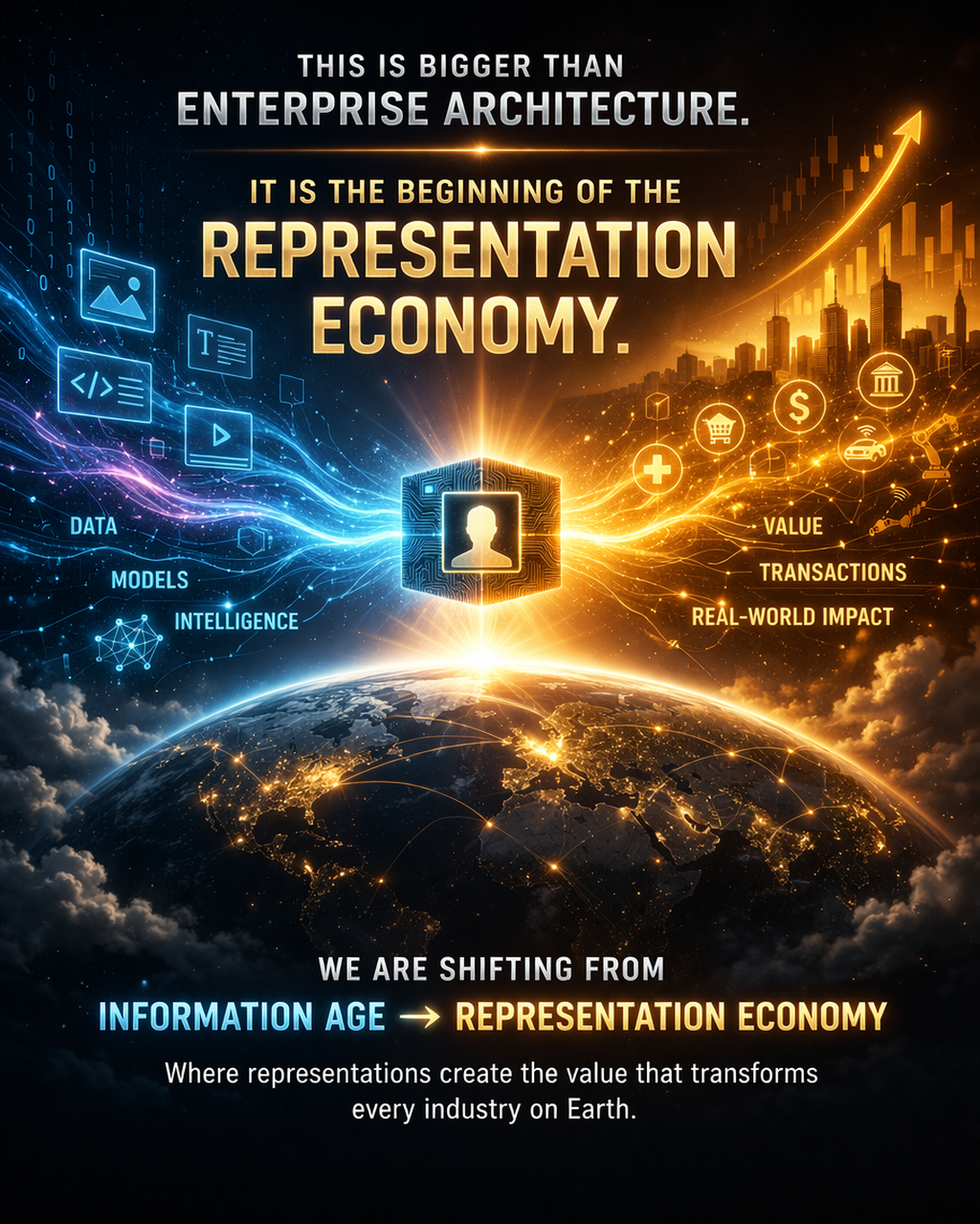
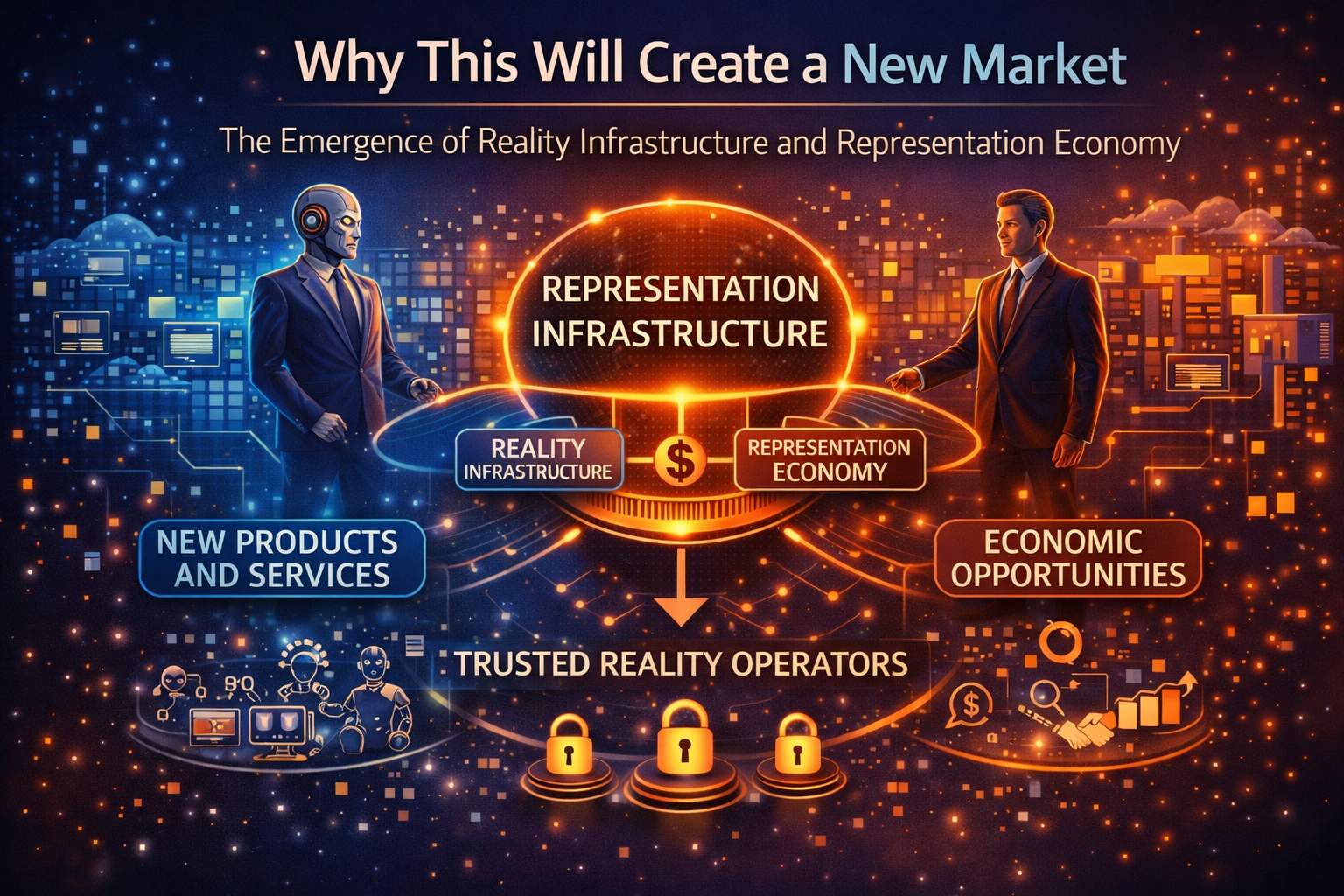
This emerging paradigm can be described as the Representation Economy.

In the Representation Economy, competitive advantage comes from the ability to make the invisible visible.

What Is the Representation Economy?

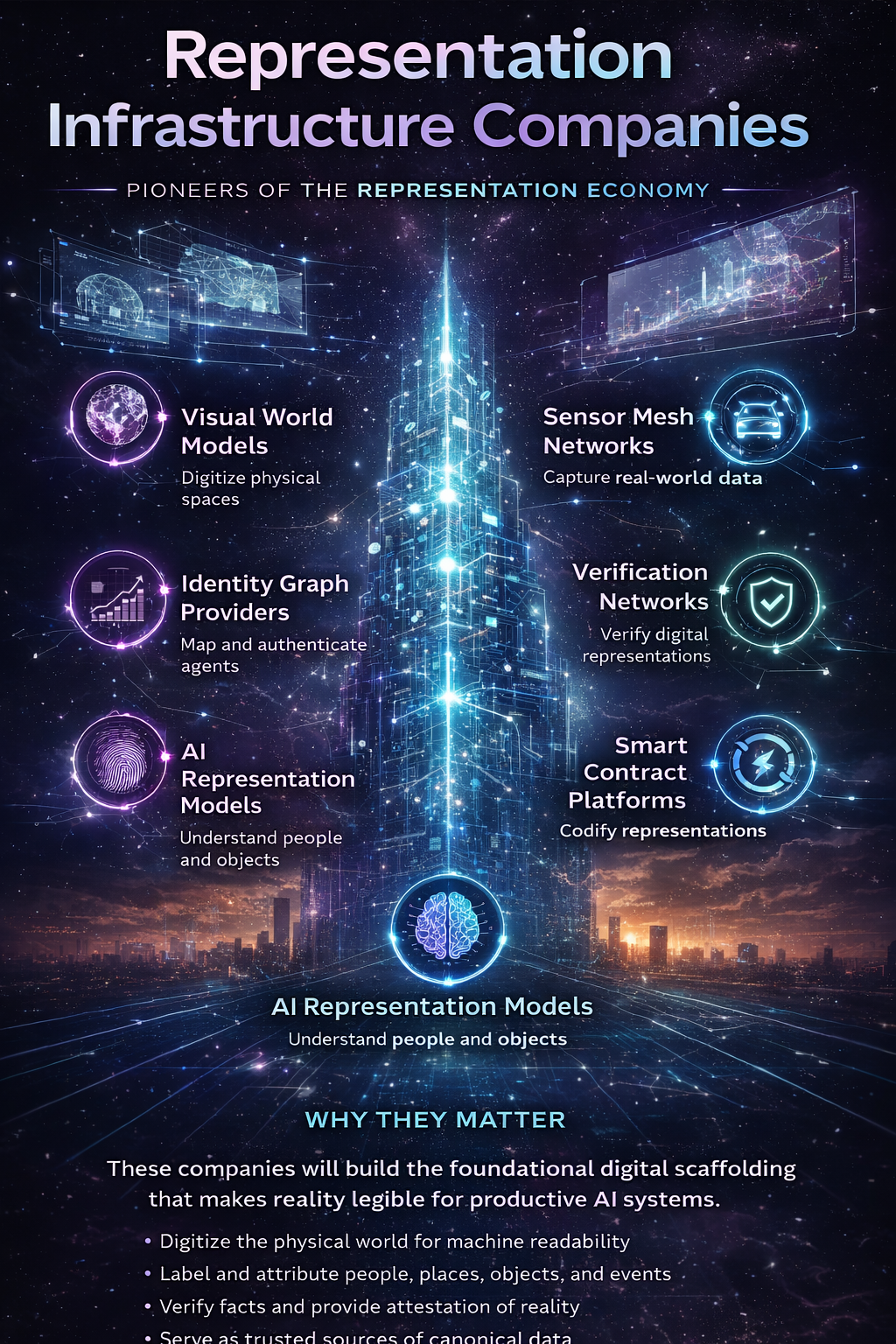
The Representation Economy describes a new phase of economic development in which competitive advantage comes from the ability of institutions to convert previously invisible aspects of reality into structured, machine-readable representations.

In earlier eras, economic power came from controlling physical infrastructure or information systems. In the AI era, value increasingly comes from the ability to represent reality itself — making people, assets, environments, behaviors, and systems legible to institutions and intelligent machines.

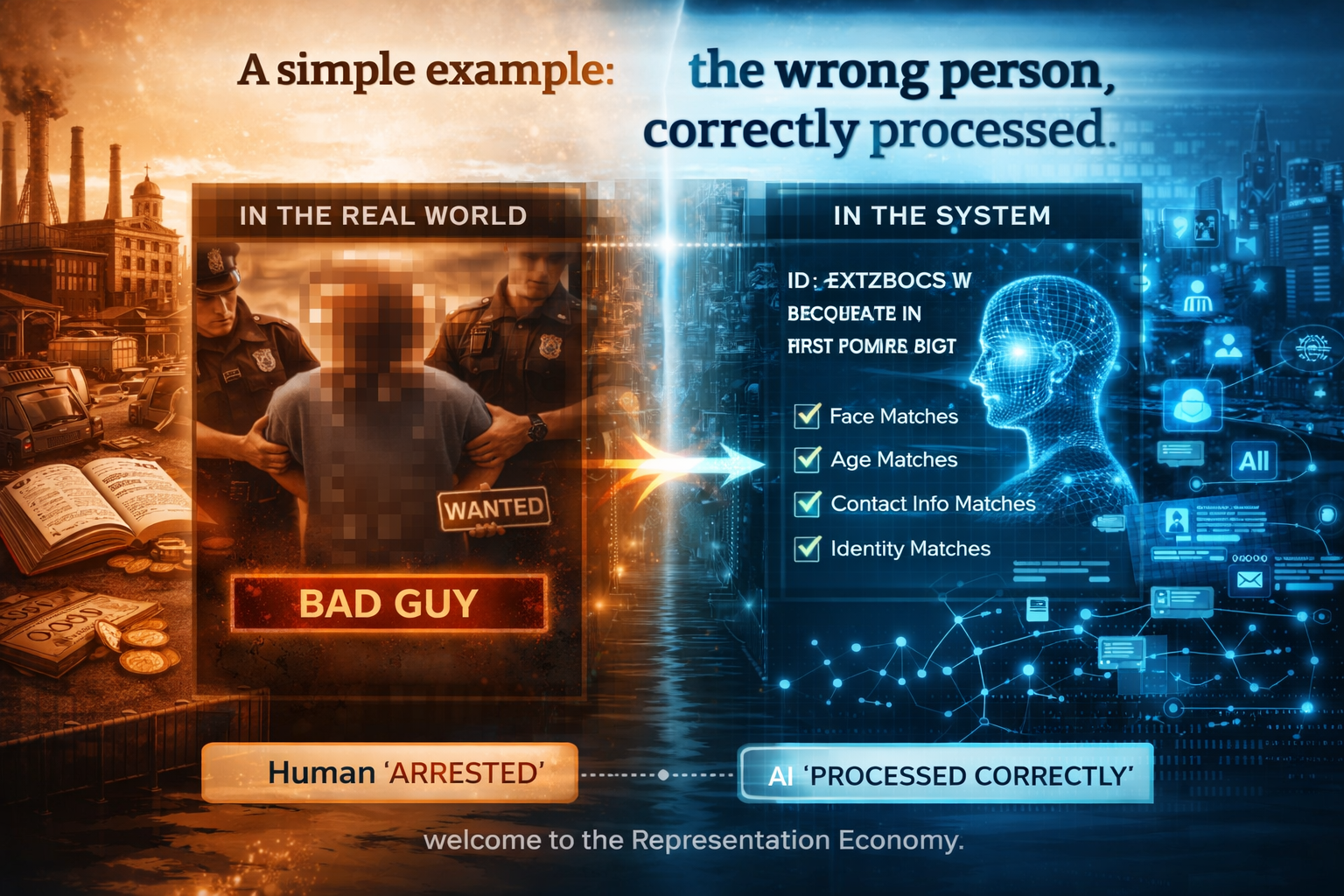
Once reality becomes representable, artificial intelligence systems can reason about it, optimize decisions, and support institutional action.

Why Representation Matters in the AI Era

Why Representation Matters in the AI Era

Artificial intelligence is often discussed as if it begins with models and algorithms.

It does not.

It begins with representation.

Before any system can reason, predict, recommend, optimize, or act, the relevant part of reality must first become legible to machines and institutions.

A farm must become measurable.
A patient must become observable.
A supply chain must become traceable.
A merchant must become identifiable.
A factory must become state-aware.
A city must become monitorable.

Only when reality becomes representable can intelligence operate on top of it.

This is why many AI initiatives struggle.

Organizations invest heavily in models, copilots, dashboards, and analytics tools while overlooking a more fundamental constraint: their institutions do not yet possess a clear representation of the world they are trying to optimize.

Artificial intelligence cannot reason effectively about what the institution cannot see clearly.

The Representation Economy is therefore not primarily about AI models.

It is about how institutions build the infrastructure that allows reality to become visible, interpretable, and actionable.

Why the Representation Economy Is Emerging Now

The Representation Economy is emerging because modern sensing technologies, digital infrastructure, and artificial intelligence systems now allow institutions to observe reality at unprecedented scale and resolution.

Sensors, satellite imagery, digital payments, connected devices, and platform activity continuously generate signals about how the world operates. When these signals are organized into structured representations, institutions gain the ability to reason about systems that were previously opaque.

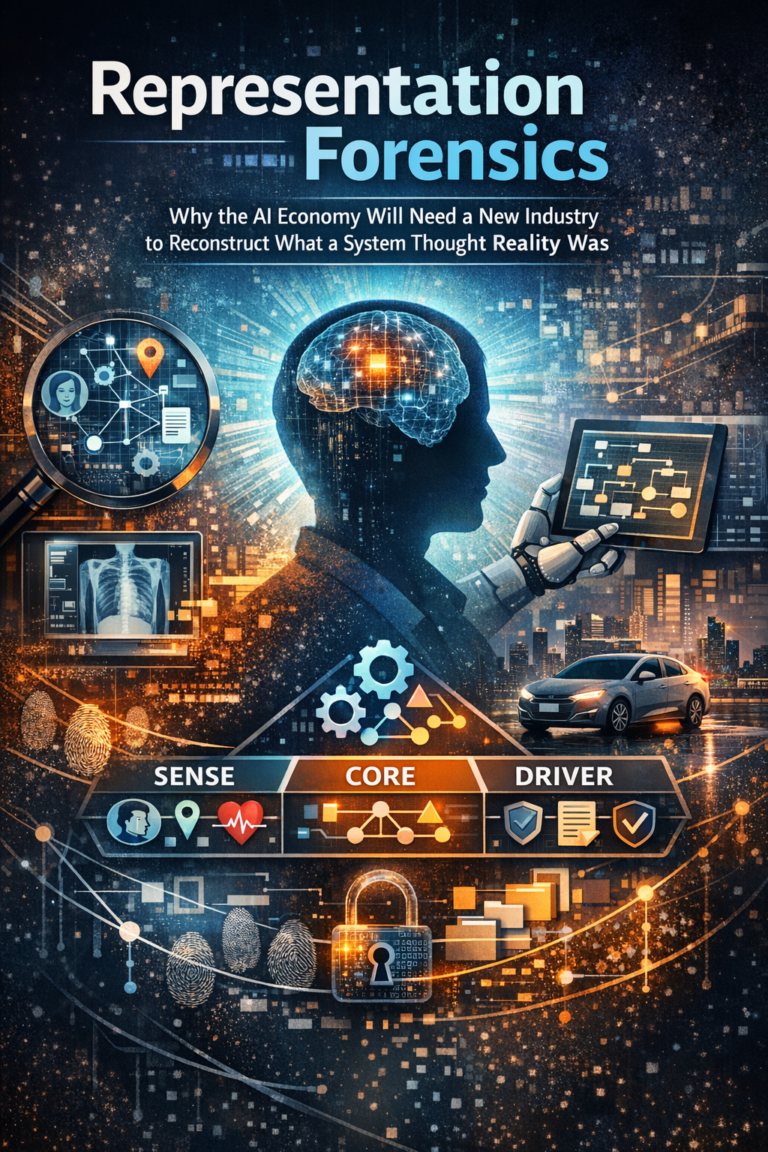
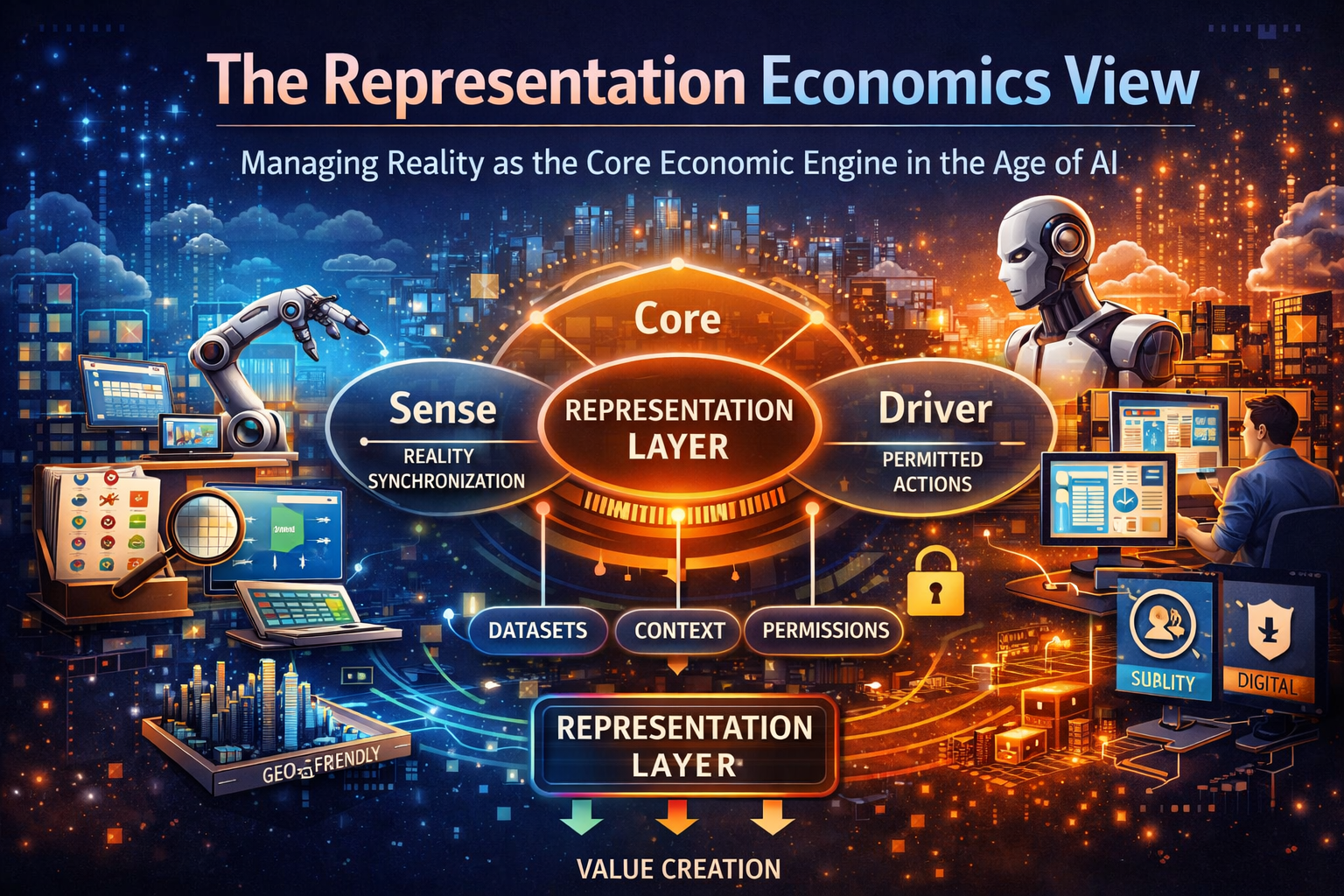
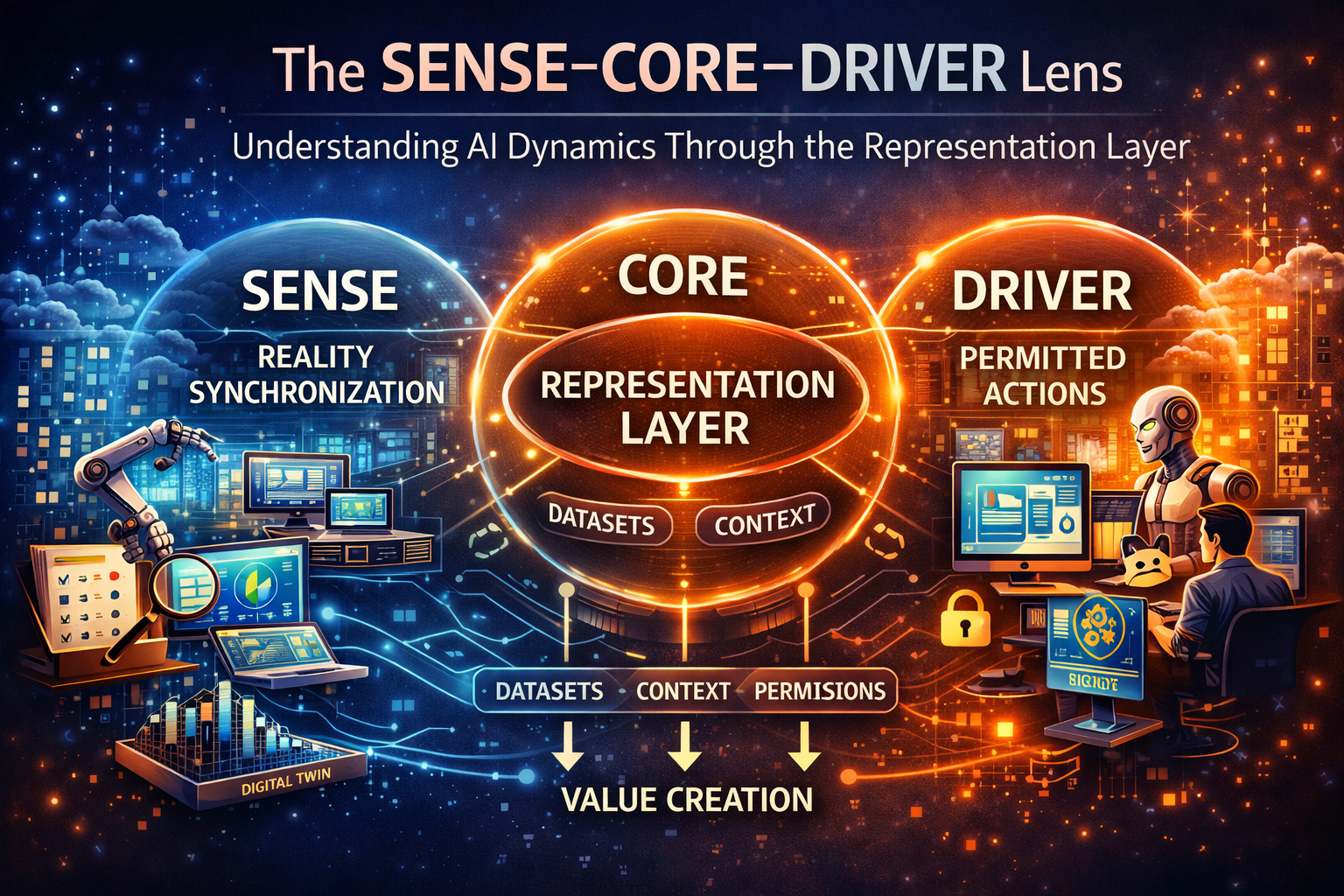
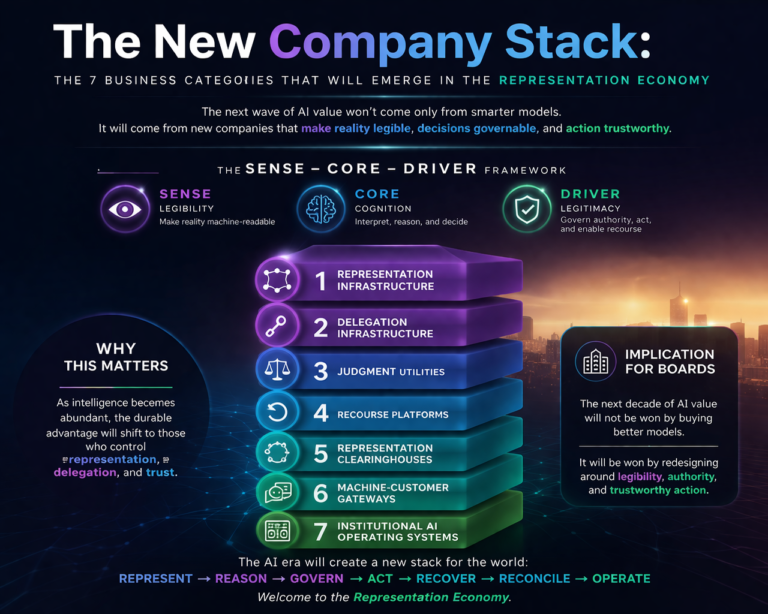
The Institutional Architecture of the Representation Economy: SENSE–CORE–DRIVER

The Institutional Architecture of the Representation Economy: SENSE–CORE–DRIVER

To understand how organizations turn visibility into value, we need to understand how intelligent institutions actually function.

Artificial intelligence systems operate inside a broader institutional architecture that determines how signals from the real world become decisions and actions.

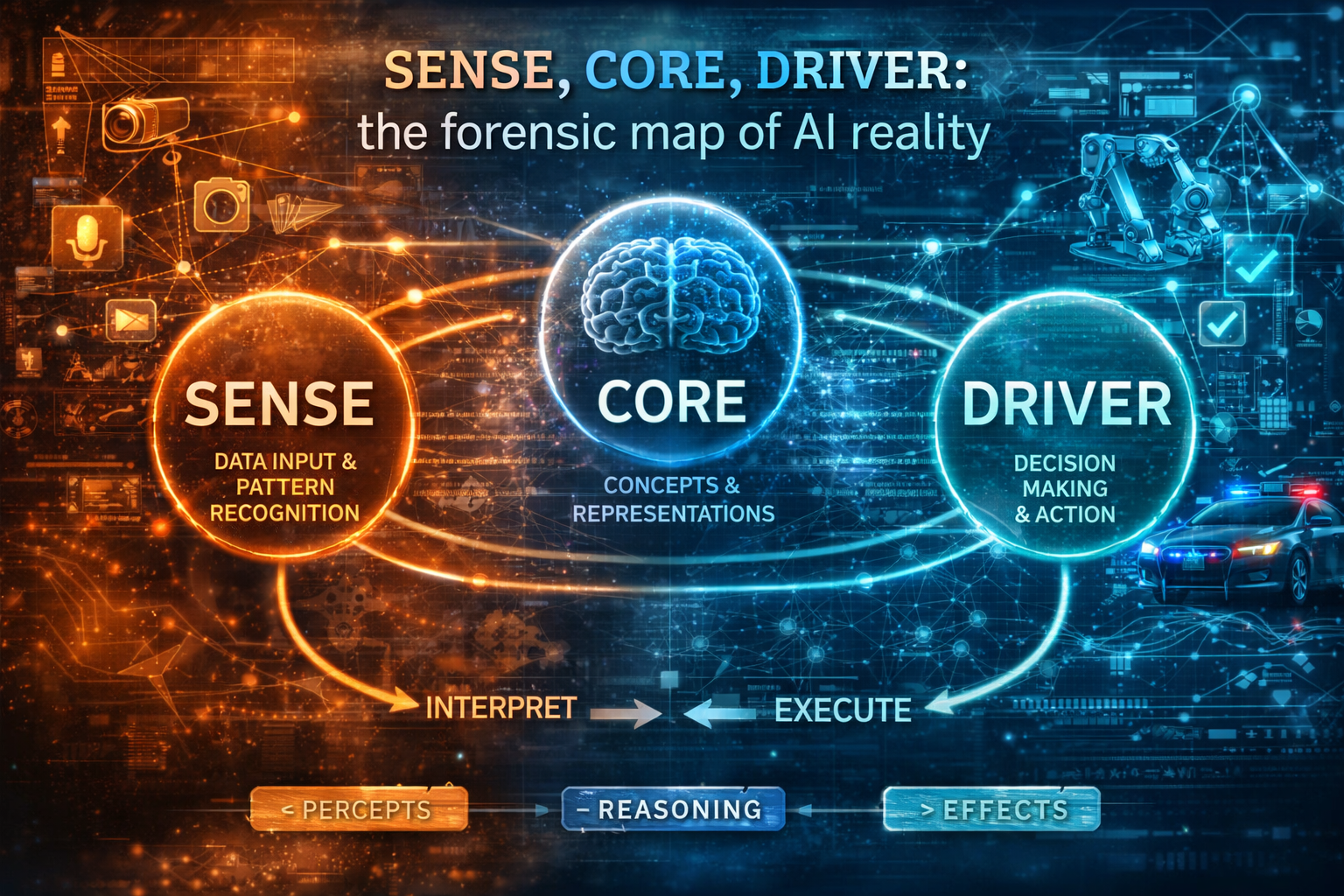
A useful way to describe this architecture is through a three-layer framework:

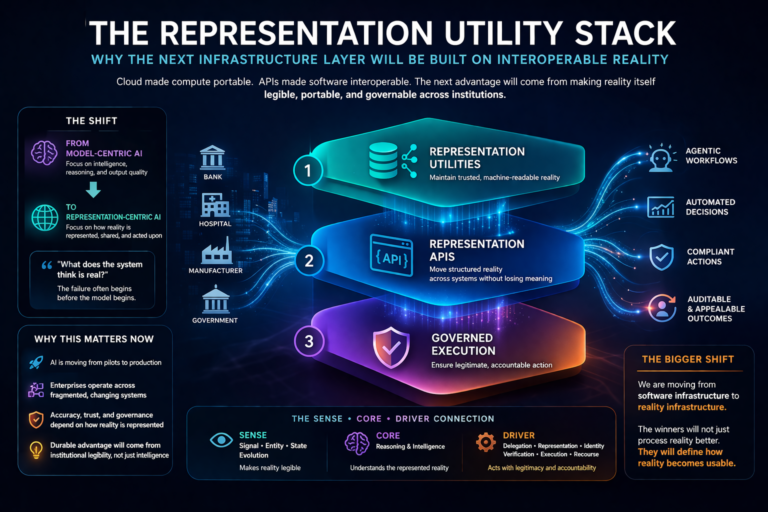
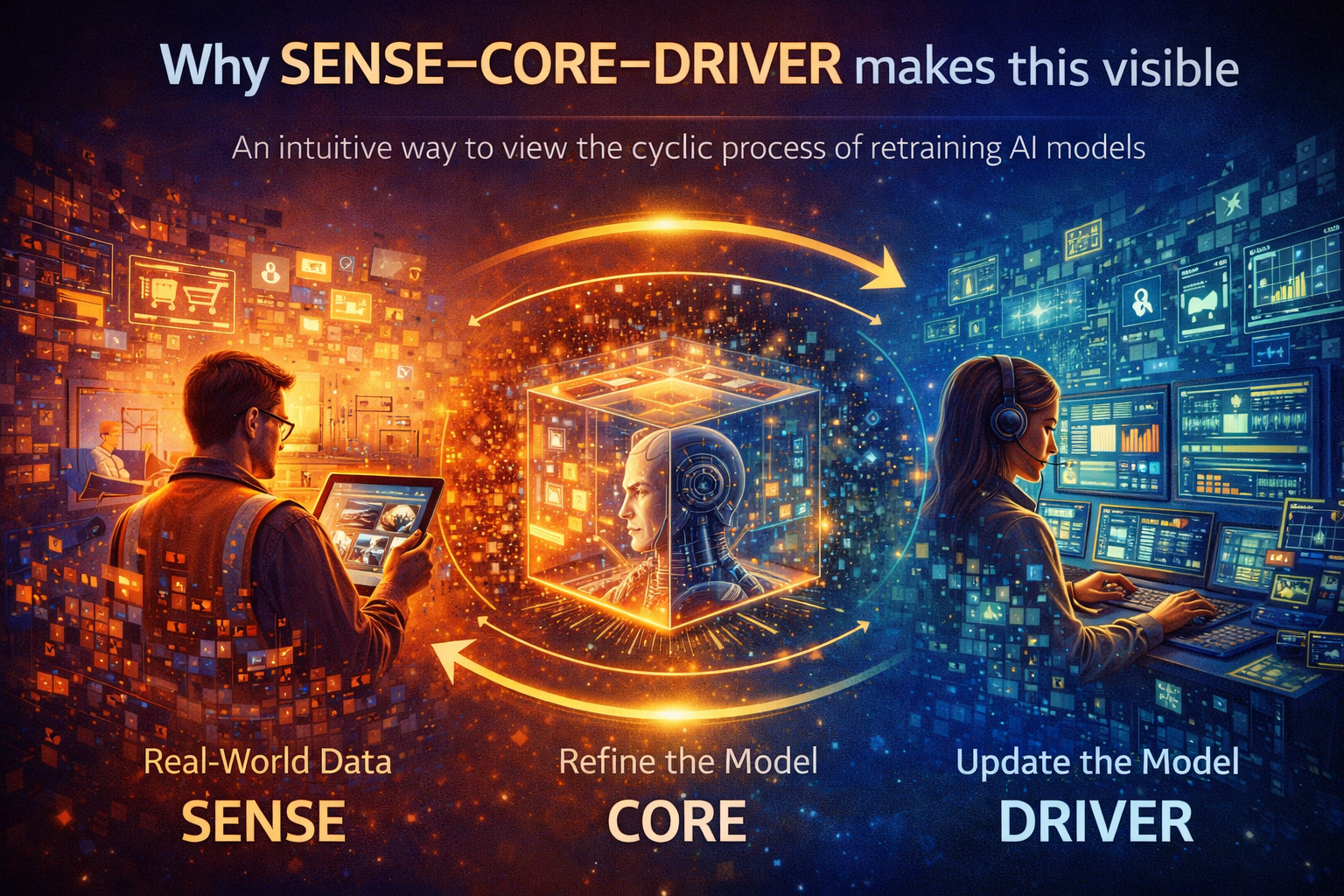
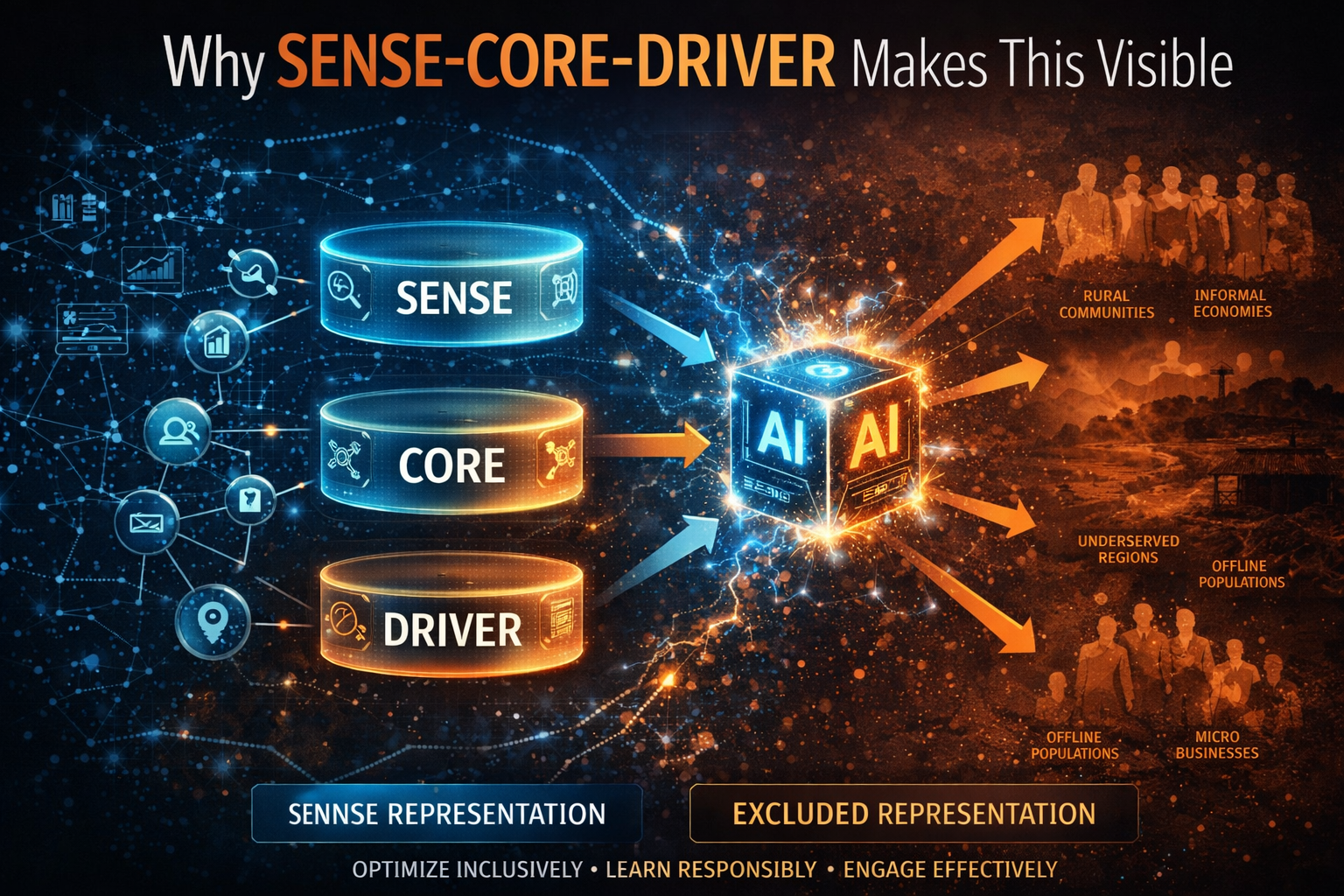
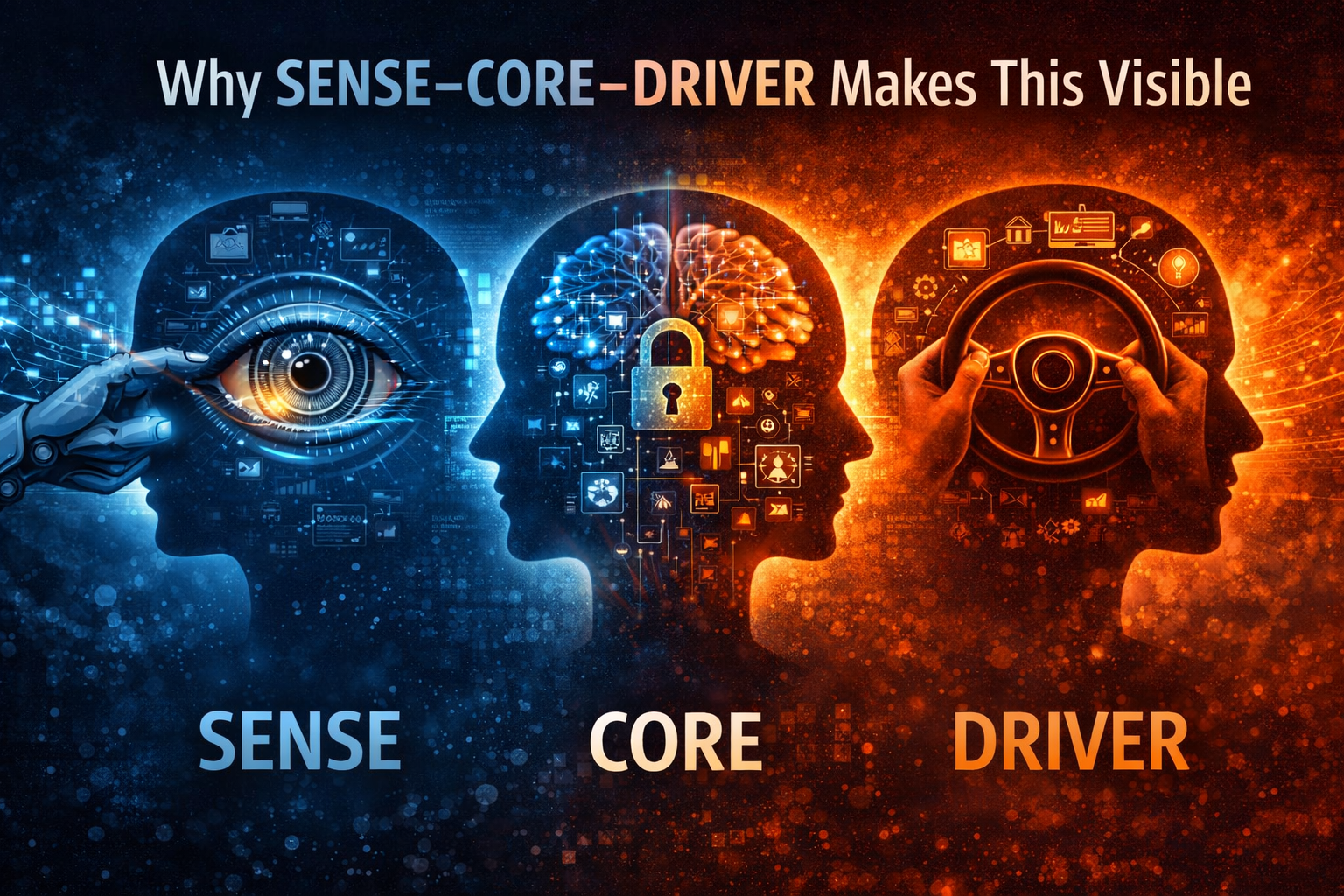
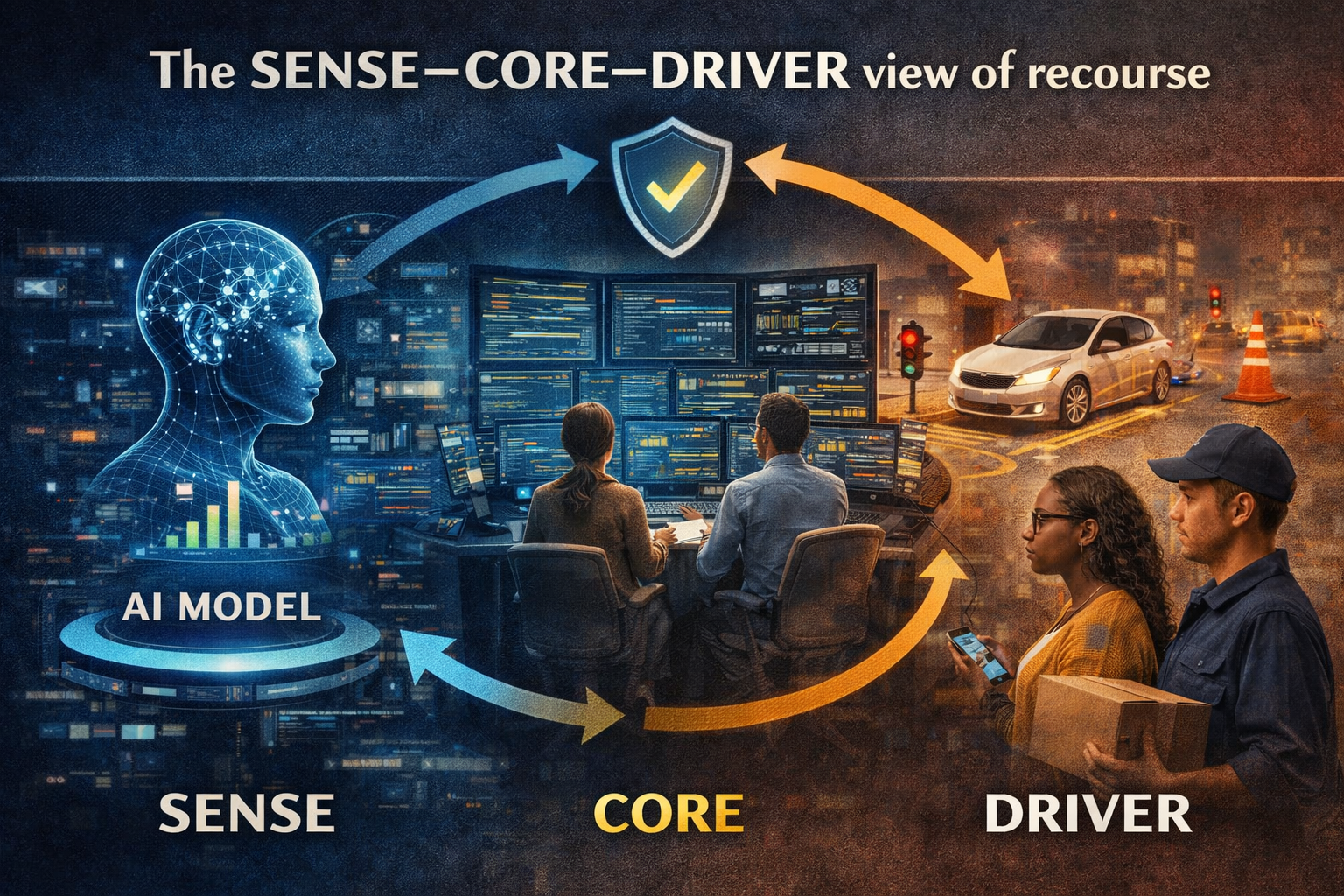
SENSE – CORE – DRIVER

This framework explains how institutions transform visibility into intelligence and intelligence into legitimate action.

It also explains why many AI initiatives fail: not because models are weak, but because organizations have not built the institutional architecture required for machine-legible reality, machine cognition, and governed execution.

SENSE: The Legibility Layer

In this framework, SENSE means:

Signal — detecting events, changes, and traces from the world

ENtity — attaching those signals to a persistent actor, object, location, or asset

State representation — building a structured model of the current condition of that entity

Evolution — updating that state over time as new signals arrive

This is the layer where reality becomes machine-legible.

Without SENSE, institutions do not truly see the world. They see fragments.

Signals exist, but they are disconnected. Data exists, but it lacks context. Observations exist, but they are not attached to stable entities.

A strong SENSE layer allows organizations to move from raw observation to structured visibility.

It enables institutions to know:

  • what is happening
  • to whom or to what it is happening
  • what condition that entity is in
  • how that condition is changing over time

The Representation Economy begins here.

Because economic value increasingly depends on whether reality can be represented with enough fidelity for machines and institutions to reason about it.

CORE: The Cognition Layer

Once representation exists, machine cognition can begin.

CORE means:

Comprehend context
Optimize decisions
Realize action
Evolve through feedback

CORE is the reasoning engine.

This is the layer where institutions interpret what SENSE has made visible.

CORE systems include:

  • machine learning models
  • predictive analytics
  • anomaly detection
  • simulation systems
  • digital twins
  • decision support engines
  • optimization algorithms

The CORE layer answers critical questions such as:

  • What pattern exists here?
  • What risk is emerging?
  • What is likely to happen next?
  • What decision should be made?

CORE transforms representation into intelligence.

However, CORE can only reason about what SENSE has made visible.

If the representation is incomplete or distorted, reasoning will also be flawed.

This is why many organizations that invest heavily in models still struggle to create value: they have sophisticated reasoning engines operating on weak representations of reality.

The Institutional Architecture of the Representation Economy: SENSE–CORE–DRIVER

DRIVER: The Legitimacy Layer

Once automated decisions begin, institutions must govern them.

DRIVER means:

Delegation — who authorized the system to act

Representation — what model of reality the system used

Identity — which entity was affected

Verification — how the decision is checked

Execution — how the action is carried out

Recourse — what happens if the system is wrong

This is the legitimacy layer of the AI economy.

DRIVER determines how intelligence becomes institutional action.

It defines:

  • authority boundaries
  • governance rules
  • operational workflows
  • accountability structures
  • human-machine collaboration

Without DRIVER, intelligence remains theoretical.

Organizations may generate insights, but their behavior does not change.

In the Representation Economy, DRIVER is what makes machine action governable, auditable, and legitimate.

Why Many AI Initiatives Fail

Why Many AI Initiatives Fail

The SENSE–CORE–DRIVER framework explains one of the most important realities of the AI era.

Many AI initiatives fail before intelligence even begins.

The common failure pattern looks like this:

  • the organization builds or adopts a model
  • the model produces insights
  • leadership sees impressive demonstrations
  • but operational behavior does not change

Why?

Because the organization invested in CORE while neglecting SENSE and DRIVER.

Without strong sensing systems, institutions cannot properly represent reality.

Without execution systems, insights cannot translate into operational decisions.

The institutions that succeed with AI design all three layers together.

They build systems that can:

  1. sense reality clearly
  2. reason about it intelligently
  3. act on it responsibly

That architecture is the foundation of the Representation Economy.

Example 1: Agriculture Becomes Legible

For centuries, farming depended largely on experience and intuition.

Weather uncertainty, soil conditions, pest activity, and crop stress were difficult to observe systematically.

Today that is changing.

Satellite imagery, IoT sensors, soil monitoring systems, and weather analytics are creating detailed representations of agricultural systems.

A farm can now be represented through:

  • soil moisture signals
  • crop health imagery
  • rainfall forecasts
  • temperature fluctuations
  • fertilizer patterns
  • market demand signals

Once this representation exists, AI can support better decisions about irrigation, planting cycles, crop protection, and yield forecasting.

The farm has not changed physically.

What has changed is the institution’s ability to see it.

Example 2: Small Merchants Become Economically Visible

Millions of small merchants around the world operate outside traditional financial systems.

They may have stable income and loyal customers but lack formal credit histories or collateral.

Historically, this made them invisible to financial institutions.

Digital payment systems are beginning to change that.

Transaction trails, digital sales records, and merchant platform activity create representations of economic behavior.

Once this representation exists, new possibilities emerge:

  • credit underwriting
  • risk assessment
  • micro-insurance
  • inventory financing
  • merchant analytics

In the Representation Economy, economic participation depends not only on productivity but also on legibility.

When institutions can see economic behavior more clearly, entirely new markets become possible.

Example 3: Factories Become Living Systems

Manufacturing offers another powerful illustration.

Traditional factories were managed through periodic reports and delayed metrics.

Managers often relied on static dashboards rather than continuous visibility.

Digital twins and industrial sensing technologies are changing that.

Factories can now be represented as dynamic systems where machines, production flows, and supply chains are continuously monitored.

This representation enables:

  • predictive maintenance
  • production optimization
  • energy efficiency improvements
  • supply chain coordination
  • quality monitoring

The factory becomes not just a production site but a living system that can be observed, simulated, and optimized in real time.

Example 4: Healthcare Becomes Continuous

Healthcare is also undergoing a representation transformation.

Traditionally, healthcare relied on episodic snapshots.

Patients visited clinics occasionally, and physicians made decisions based on limited observations.

Today wearable devices, remote monitoring systems, and digital health records are beginning to create continuous representations of patient health.

Heart rate patterns, sleep quality, glucose levels, and activity data all contribute to a richer picture of health.

This shift allows healthcare systems to move from reactive treatment toward proactive care.

Again, the key change is visibility.

When institutions can observe health conditions continuously, they can intervene earlier and make more informed decisions.

Where the Value Comes From

The Representation Economy creates value in several ways.

Better decisions
Richer representations reduce uncertainty and improve judgment.

Economic inclusion
People and assets previously invisible to institutions can now participate in formal systems.

New products and services
Insurance, credit, diagnostics, optimization tools, and predictive systems depend on accurate representation.

Lower coordination friction
Shared representations allow different actors in a system to align decisions.

New strategic control points
The institutions that control the representation layer often control how decisions are made.

For boards and executives, this has major implications.

The representation layer can become as strategically important as the operating system, the distribution channel, or the supply chain.

The Ethical Challenge of Representation

The Ethical Challenge of Representation

Making the invisible visible also introduces new responsibilities.

Representation is a form of power.

The way reality is represented influences how decisions are made.

If representations are biased, incomplete, or poorly designed, they can reinforce inequalities or misinterpret complex human situations.

Institutions must therefore treat representation infrastructure with the same seriousness as financial infrastructure or legal systems.

The goal is not simply to see more.

The goal is to see responsibly.

The Strategic Question for Leaders

Most leaders still ask:

“What AI model should we deploy?”

But the more important question is:

What parts of reality relevant to our mission remain invisible today?

Those invisible domains represent the largest untapped opportunities.

Once institutions identify them, they can build the infrastructure required to make those realities legible.

Once they become legible, intelligence and automation can follow.

The Future of the Representation Economy

Over the next decade, the Representation Economy will expand across nearly every sector of society.

Cities will become continuously monitored systems capable of optimizing mobility, energy use, and public services. Supply chains will become transparent networks where disruptions can be detected and addressed in real time. Financial systems will extend services to millions of previously invisible participants through richer economic representations.

As sensing infrastructure expands and machine reasoning becomes more powerful, institutions will increasingly compete not just on information processing but on how accurately they can represent reality itself.

The institutions that master this capability will define the next era of economic power.

The Institutions That Win Will See Better

Conclusion: The Institutions That Win Will See Better

Every major technological era expands how institutions perceive the world.

The industrial era expanded production.

The digital era expanded information processing.

The AI era will expand institutional perception.

The Representation Economy reflects this shift.

The next generation of competitive advantage will not come only from larger models or faster chips.

It will come from the ability to convert weak, fragmented, invisible aspects of reality into structured representations that institutions can understand and act upon.

This is why SENSE, CORE, and DRIVER matter.

SENSE makes reality legible.
CORE makes reality intelligible.
DRIVER makes action legitimate.

Together they form the architecture of intelligent institutions.

And in the Representation Economy, the organizations that master this architecture will not simply adopt AI.

They will redefine how value itself is created.

FAQ

What is the Representation Economy?
The Representation Economy is an emerging paradigm in which economic value is created by transforming previously invisible or fragmented aspects of reality into machine-readable representations that institutions can reason over.

Why does visibility matter in AI?

Artificial intelligence can only reason about what it can observe. Organizations that build stronger sensing systems gain better decision-making capabilities.

Why is representation important in AI?
AI systems can only reason about what is represented clearly. Weak representation leads to weak intelligence.

What does SENSE stand for?
SENSE stands for Signal, ENtity, State representation, and Evolution. It is the layer where reality becomes machine-legible.

What does CORE stand for?
CORE stands for Comprehend context, Optimize decisions, Realize action, and Evolve through feedback.

What does DRIVER stand for?
DRIVER stands for Delegation, Representation, Identity, Verification, Execution, and Recourse

What is the SENSE–CORE–DRIVER framework?

The SENSE–CORE–DRIVER architecture explains how AI systems operate inside institutions.

SENSE captures signals and builds machine-readable representations of reality.

CORE performs reasoning and decision making.

DRIVER governs how decisions are executed with authority and accountability.

Why do many AI projects fail?

Many AI initiatives fail because organizations focus only on algorithms (CORE) while ignoring the sensing infrastructure (SENSE) and governance systems (DRIVER).

What will define winning institutions in the AI era?

Winning institutions will be those that build the best visibility infrastructure—systems that continuously sense, represent, understand, and act on real-world information.

Glossary

Representation Economy

An emerging economic model in which competitive advantage comes from the ability to make real-world conditions visible, structured, and machine-readable. Organizations that represent reality more accurately can build better AI systems, decisions, and services.

Visibility Infrastructure

The technical and institutional systems that allow organizations to observe and capture signals from the real world. This includes sensors, data pipelines, event logs, APIs, identity systems, and contextual metadata.

Machine-Legible Reality

A condition where real-world events, entities, and states are captured in structured digital form so that software and AI systems can reason about them.

SENSE Layer

The institutional layer responsible for making reality visible to machines.

It includes:

  • Signal — detecting events, changes, and traces from the world

  • ENtity — attaching those signals to a persistent actor, object, location, or asset

  • State Representation — building a structured model of the entity’s condition

  • Evolution — updating that state as new signals arrive

This is the layer where reality becomes machine-legible.

CORE Layer

The reasoning layer where AI systems interpret signals and generate decisions.

It performs four functions:

  • Comprehend context

  • Optimize decisions

  • Realize actions

  • Evolve through feedback

CORE transforms representation into intelligence.

DRIVER Layer

The governance layer that determines how machine decisions are executed inside institutions.

It includes:

  • Delegation — who authorized the machine to act

  • Representation — what model of reality the system used

  • Identity — which entity is affected

  • Verification — how the decision is validated

  • Execution — how the action is carried out

  • Recourse — what happens if the system is wrong

DRIVER ensures AI operates with accountability and legitimacy.

Decision Infrastructure

The institutional systems that convert information into consistent operational decisions. In the AI era, decision infrastructure is becoming a core source of competitive advantage.

Sensing Economy

A phase of the AI economy where organizations compete on how effectively they can detect and interpret real-world signals before others do.

Decision Velocity

The speed at which an organization can sense changes, interpret them, and respond with action.

Institutional Intelligence

The collective ability of an organization to observe reality, reason about it, and act effectively at scale.

Further Read

Artificial Intelligence and Economic Impact

MIT Technology Review

Stanford AI Index Report

World Economic Forum — AI Transformation

AI Governance and Institutions

OECD AI Principles

NIST AI Risk Management Framework

Data Infrastructure and Digital Economy

World Bank — Data and Development

European Commission Data Strategy

AI and Organizational Transformation

Harvard Business Review — Artificial Intelligence

McKinsey Global Institute — AI and the Future of Work

To understand the broader economic and institutional transformation driven by artificial intelligence & Representation Economy, readers may explore the following resources.

AI Agents Need Institutions, Not Just Guardrails 

The Sensing Economy 

Why Most AI Project Fails 

Identity Infrastructure

The Representation Stack 

The Hardest Problem in AI 

AI Agents Need Institutions, Not Just Guardrails: The Governance Architecture of the Agent Economy

Artificial intelligence is entering a fundamentally new phase.

For the past decade, most discussions about AI focused on what models could know.

Could they summarize documents?
Could they answer questions?
Could they generate code?
Could they produce images or marketing content?

Those capabilities mattered because they demonstrated that machines could interpret and generate information.

But a much bigger transformation is now underway.

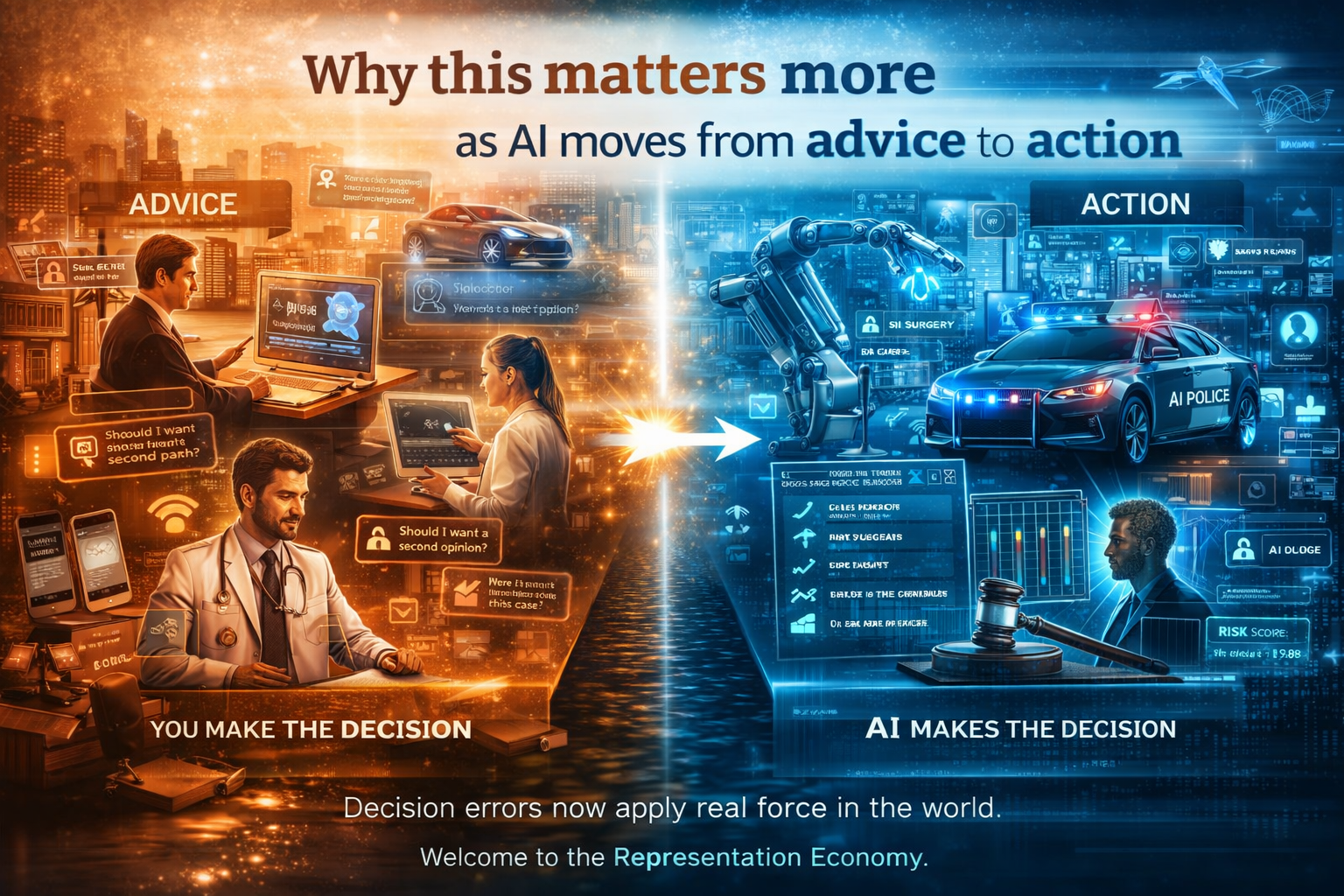
AI systems are no longer just generating outputs.

They are beginning to take actions.

AI agents can search enterprise systems, trigger workflows, update records, negotiate schedules, approve exceptions, recommend financial actions, interact with customers, and even coordinate with other agents.

In some cases, they can complete entire workflows with minimal human intervention.

This marks the beginning of what many analysts are calling the Agent Economy.

Yet this shift introduces a much deeper question than model capability.

What happens when machine intelligence begins acting inside real institutions?

At that point, the central issue is no longer intelligence alone.

It is governance.

Not governance as a compliance checklist.

Governance as institutional architecture.

Because when AI systems move from generating insights to executing decisions, the most important question becomes:

Can the institution surrounding the AI govern its behavior safely, responsibly, and economically?

This is why AI agents need institutions.

The Rise of the Agent Economy

The Rise of the Agent Economy

Traditional enterprise software works through explicit instruction.

A human clicks a button.
A workflow runs.
A rule executes.
A record changes.

This structure kept authority clear: humans decided, software executed.

AI agents fundamentally change this model.

Instead of executing predefined instructions, agents can receive goals.

From that goal they can:

  • break tasks into subtasks
  • search knowledge bases
  • call tools and APIs
  • interpret policies
  • revise plans dynamically
  • coordinate with other systems

In other words, AI agents can observe, reason, decide, and act.

That sounds like a technical improvement.

But institutionally, it represents something much bigger.

It means machines are beginning to participate inside operational decision loops.

And once machines participate in decision loops, governance becomes essential.

Why the Agent Economy Is Different

Why the Agent Economy Is Different

Imagine a telecommunications company handling customer complaints.

In the traditional system:

A human support representative reads the complaint.
The system suggests possible responses.
The human chooses an action.

In the agent-driven model:

An AI agent may:

  • read the complaint
  • analyze customer history
  • verify policy rules
  • offer a retention discount
  • update billing
  • schedule technical service
  • send a follow-up message

All without human intervention.

At first glance, this appears to be automation.

But institutionally, it is something far more significant.

Now the organization must answer questions such as:

Who authorized the agent to issue discounts?
Which policy version was used?
What happens if the agent misinterprets context?
Can the decision be audited?
Can a supervisor intervene?
Can the organization stop the agent instantly?
What happens when multiple agents interact in unpredictable ways?

These are institutional questions, not technical questions.

Yet most organizations are still deploying AI systems into governance structures designed for human-only workflows.

The result is predictable:

Intelligence is arriving faster than governance.

Intelligence Without Institutions Creates Fragile Systems

Intelligence Without Institutions Creates Fragile Systems

History repeatedly shows that technological power arrives before institutions mature enough to govern it.

Industrial machinery emerged before labor protections.
Financial innovation expanded faster than risk management frameworks.
The internet scaled globally before societies established durable rules around identity, privacy, and platform accountability.

Artificial intelligence is following the same pattern—only much faster.

This matters because AI agents fail differently from traditional software.

A typical software bug creates technical errors.

An AI agent failure can create organizational consequences.

For example:

A procurement agent might reorder inventory aggressively because it misinterpreted temporary demand patterns.

A financial agent might optimize short-term collections while damaging long-term customer relationships.

A fraud detection agent might escalate legitimate users due to biased signals in training data.

A scheduling agent might maximize efficiency in ways that unfairly disadvantage certain employees.

In each case, the problem is not simply that the model made an error.

The deeper issue is that the institution allowed a machine to act without the proper governance architecture.

That architecture requires clear representation, accountability, and authority boundaries.

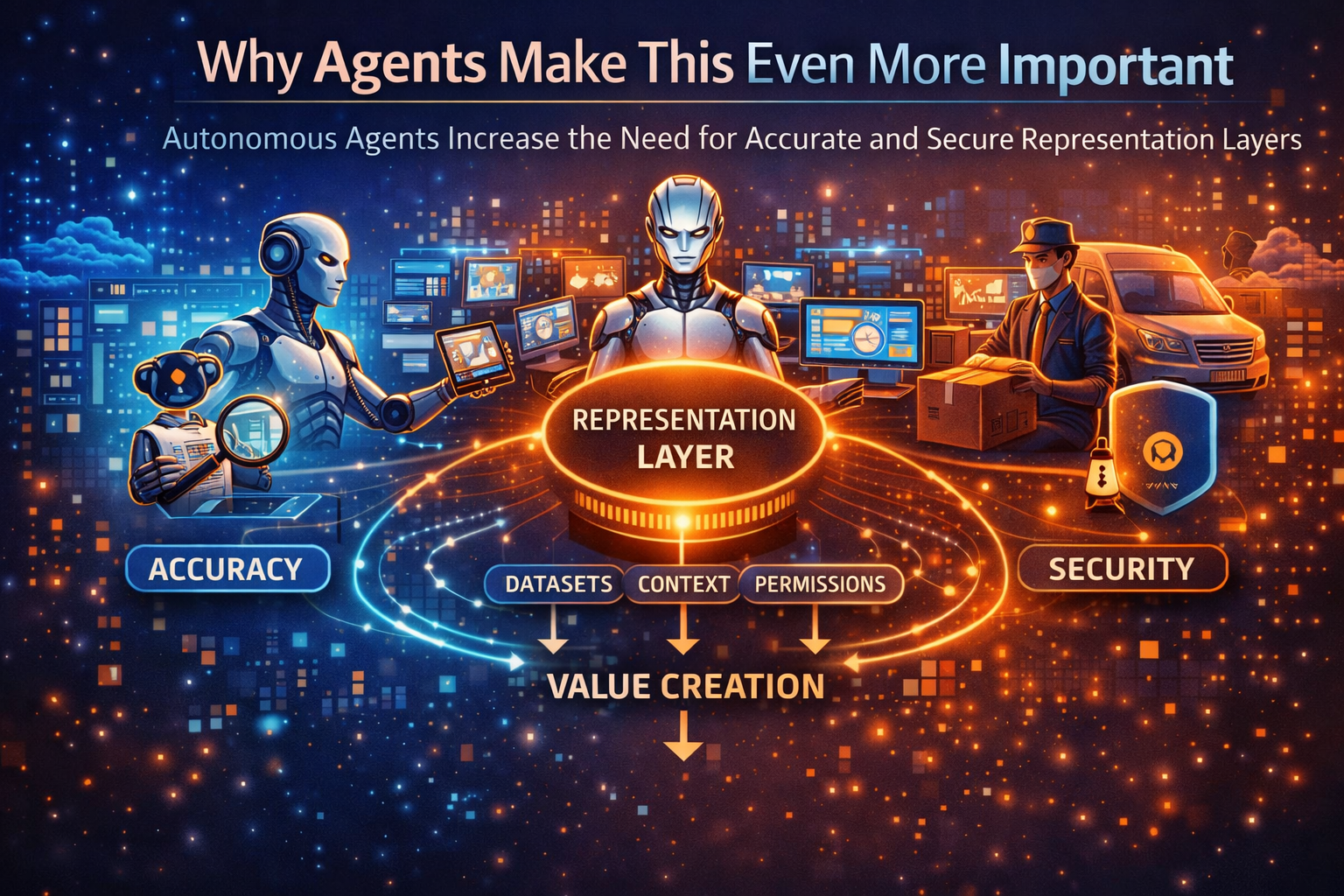
This is where the SENSE–CORE–DRIVER framework becomes essential.

The Governance Architecture: SENSE, CORE, DRIVER

The Governance Architecture: SENSE, CORE, DRIVER

A practical way to understand institutional governance for AI agents is to think in three layers.

These layers define how organizations translate machine intelligence into controlled institutional behavior.

SENSE: Can the Institution See Reality Clearly?

Every AI agent begins with perception.

Before reasoning can begin, the system must understand:

  • which entity it is dealing with
  • what the relevant context is
  • what policies apply
  • what permissions exist
  • what the current state of the system is

If the sensing layer is weak, the agent starts from distorted reality.

Consider a lending support system assisting relationship managers.

If customer identity is fragmented across systems, income records are incomplete, policy exceptions are hidden in emails, and transaction histories are inconsistent, the AI agent will not reason incorrectly—it will reason on incorrect reality.

This is why governance begins before the model starts thinking.

Institutions must first make reality legible.

This includes:

  • identity resolution systems
  • event logging
  • policy retrieval infrastructure
  • workflow visibility
  • permission mapping
  • context freshness monitoring

Without these capabilities, organizations do not have AI governance.

They have AI guesswork.

This idea connects closely with the concept explored in:

The Representation Stack: How Reality Becomes Identifiable, Legible, and Actionable in the AI Economy

and

Identity Infrastructure: The Missing Layer Between Signals and Representation in the AI Economy

Both show why institutions must first make reality machine-readable before intelligent action becomes possible.

CORE: Can the Agent Reason Within Institutional Logic?

Once an agent perceives reality, it must interpret it.

This reasoning layer includes:

  • planning and task decomposition
  • retrieval of knowledge and policies
  • contextual reasoning
  • exception handling
  • decision confidence estimation
  • escalation logic

Many organizations focus heavily on this layer.

They compare models, prompts, orchestration frameworks, and reasoning architectures.

But CORE alone does not create governance.

A highly intelligent system can still cause institutional harm if it reasons outside the organization’s authority structure.

Consider insurance claims processing.

An AI system might detect suspicious patterns with high accuracy.

But if the system cannot distinguish between:

“recommend investigation”
and
“deny claim”

then the system has crossed an institutional boundary.

Institutions must clearly define:

Which decisions agents can recommend
Which decisions they can approve
Which decisions require human oversight
Which decisions must never be automated

The true governance challenge is not simply:

Can the agent think?

The real question is:

Can the agent think within institutional authority boundaries?

This connects to the broader concept explored in:

Decision Integrity: Why Model Accuracy Is Not Enough in Enterprise AI

DRIVER: Can the Institution Control Real-World Action?

The DRIVER layer is where reasoning becomes action.

It includes the execution environment where agents interact with real systems.

Examples include:

  • API calls
  • workflow execution
  • financial transactions
  • notifications
  • database updates
  • account modifications

Many AI failures occur not because models misunderstand language but because execution authority is poorly controlled.

For example:

A refund agent without spending limits can create financial leakage.

A procurement agent without supplier restrictions can create contractual risk.

A customer service agent without escalation rules can create legal liability.

Driver governance must answer questions such as:

Which tools can the agent access?
Which actions are reversible?
What spending authority exists?
What approval thresholds are required?
What alerts trigger human intervention?
Where is the emergency kill switch?

Governance becomes real when institutions establish:

permissions, logging, monitoring, escalation paths, and safe shutdown mechanisms.

These capabilities are increasingly emphasized by global governance frameworks such as:

  • OECD AI Principles
  • NIST AI Risk Management Framework
  • EU AI Act
  • Singapore Model AI Governance Framework for Agentic AI
Why AI Agents Need Institutions, Not Just Guardrails

Why AI Agents Need Institutions, Not Just Guardrails

Many current discussions describe AI safety in terms of guardrails.

The concept is useful, but incomplete.

Guardrails imply a thin layer of control around a model.

Institutions are much deeper.

Institutions define:

  • authority
  • accountability
  • evidence
  • auditability
  • escalation mechanisms
  • dispute resolution
  • legitimacy of decisions

Human organizations rely on institutions for governance.

The same will increasingly apply to machine actors.

This is why the future of the agent economy will not be determined by the most powerful standalone model.

It will be determined by the strength of the institutions governing those models.

What Real Institutions for AI Agents Look Like

What Real Institutions for AI Agents Look Like

Organizations that successfully govern AI agents typically exhibit several characteristics.

Every agent has a clear identity.

The organization knows what the agent is, what systems it can access, and who owns it.

Authority boundaries are explicit.

The institution distinguishes between advisory, recommendation, approval, and execution.

Every action leaves evidence.

Agents produce logs showing decision context, policy references, and tool usage.

Accountability structures exist.

Each agent has business owners, engineering owners, and risk oversight.

Human supervision remains possible.

Humans can inspect decisions, intervene when necessary, and stop the system if needed.

Economic discipline is embedded.

Agents operate within cost limits, efficiency thresholds, and budget constraints.

Failure modes are designed in advance.

Agents narrow scope, escalate to humans, or halt when uncertainty exceeds defined thresholds.

These elements create institutional governance for autonomous systems.

The Global Governance Shift Has Already Begun

This topic is no longer theoretical.

Around the world, policymakers and institutions are beginning to address it.

The OECD is clarifying definitions of agentic AI and emphasizing accountability.

NIST’s AI Risk Management Framework treats governance as an organizational discipline rather than a technical feature.

The European Union’s AI Act introduces a risk-based regulatory framework for AI systems.

Singapore has launched governance guidance specifically addressing agentic AI systems capable of autonomous actions.

The direction is clear.

The question is no longer:

Should we govern AI?

The real question is:

What institutions must exist to govern machines that can act?

The Strategic Lesson for Leaders

Many organizations still believe they are purchasing AI capability.

In reality, they are entering a new phase of institutional design.

When AI agents act inside enterprises, organizations must decide:

How authority is delegated
How accountability is enforced
How evidence is recorded
How policy is interpreted
How economic value is measured

In other words, the challenge is no longer software adoption.

It is institutional architecture.

This shift aligns closely with the broader transformation described in:

Decision Scale: Why Competitive Advantage Is Moving from Labor Scale to Decision Scale

and

The Future Belongs to Decision-Intelligent Institutions

Both explore how AI changes the fundamental structure of organizations.

The Institutions That Govern Intelligence Will Define the AI Economy

Conclusion: The Institutions That Govern Intelligence Will Define the AI Economy

Artificial intelligence is no longer simply a tool.

It is becoming a participant in operational systems.

And whenever new actors enter complex systems, institutions must evolve.

The next decade will not be won by organizations that deploy AI the fastest.

It will be won by organizations that design the strongest governance architecture around machine intelligence.

Institutions that can:

sense reality clearly,
reason within policy boundaries,
and drive action safely.

This is the foundation of the agent economy.

SENSE.
CORE.
DRIVER.

Not just as a technical stack.

But as the governance architecture of intelligent institutions.

In the emerging AI economy, intelligence without institutions does not scale into advantage.

It scales into fragility.

The true leaders of the next decade will recognize that the missing governance layer is not a peripheral issue.

It is the system itself.

FAQ

What is an AI agent?

An AI agent is a system capable of perceiving its environment, reasoning about goals, and taking actions through tools or software systems.

Why do AI agents require governance?

AI agents can make operational decisions. Governance ensures those decisions align with organizational policies, authority boundaries, and accountability standards.

Why do AI agents need institutions?

AI agents need institutions because guardrails alone cannot manage complex decision-making environments. Institutions provide governance, accountability, dispute resolution, and operational oversight.

What is agentic AI?

Agentic AI refers to systems that exhibit autonomy, goal-directed behavior, and the ability to interact with tools and environments to accomplish tasks.

What is the Agent Economy?

The Agent Economy refers to an emerging economic system where AI agents perform tasks, make decisions, and execute workflows autonomously across digital and physical systems.

What are AI guardrails?

AI guardrails are safety mechanisms that restrict harmful outputs. However, they are limited because they do not provide full institutional governance.

What is the governance architecture for AI systems?

A governance architecture defines how AI systems observe reality, represent institutional knowledge, and execute actions safely. One model is the SENSE–CORE–DRIVER framework.

What is SENSE–CORE–DRIVER in AI governance?

It is a governance framework describing how institutions manage AI systems:

SENSE — perception and data visibility
CORE — reasoning and decision logic
DRIVER — execution and operational control

What are institutions in AI systems?

Institutions in AI refer to structured governance systems such as:

  • policy frameworks

  • decision authority layers

  • oversight bodies

  • dispute resolution mechanisms

  • accountability infrastructure

Glossary

Agent Economy
An economic environment where autonomous AI agents participate in workflows, decisions, and transactions.

Agentic AI
AI systems capable of autonomous planning and action.

AI Governance
Institutional structures that control how AI systems operate and make decisions.

Decision Integrity
Ensuring AI decisions remain aligned with organizational policy and accountability.

Institutional AI Architecture
Organizational structures that govern AI behavior across systems.

The Intelligence-Native Enterprise Doctrine

This article is part of a larger strategic body of work that defines how AI is transforming the structure of markets, institutions, and competitive advantage. To explore the full doctrine, read the following foundational essays:

  1. The AI Decade Will Reward Synchronization, Not Adoption
    Why enterprise AI strategy must shift from tools to operating models.
    https://www.raktimsingh.com/the-ai-decade-will-reward-synchronization-not-adoption-why-enterprise-ai-strategy-must-shift-from-tools-to-operating-models/
  2. The Third-Order AI Economy
    The category map boards must use to see the next Uber moment.
    https://www.raktimsingh.com/third-order-ai-economy/
  3. The Intelligence Company
    A new theory of the firm in the AI era — where decision quality becomes the scalable asset.
    https://www.raktimsingh.com/intelligence-company-new-theory-firm-ai/
  4. The Judgment Economy
    How AI is redefining industry structure — not just productivity.
    https://www.raktimsingh.com/judgment-economy-ai-industry-structure/
  5. Digital Transformation 3.0
    The rise of the intelligence-native enterprise.
    https://www.raktimsingh.com/digital-transformation-3-0-the-rise-of-the-intelligence-native-enterprise/
  6. Industry Structure in the AI Era
    Why judgment economies will redefine competitive advantage.
    https://www.raktimsingh.com/industry-structure-in-the-ai-era-why-judgment-economies-will-redefine-competitive-advantage/
  7. Why Most AI Projects Fail Before Intelligence Even Begins – Raktim Singh
  8. Identity Infrastructure: The Missing Layer Between Signals and Representation in the AI Economy – Raktim Singh
  9. The Representation Stack: How Reality Becomes Identifiable, Legible, and Actionable in the AI Economy – Raktim Singh
  10. The Hardest Problem in AI: Representing What Cannot Speak – Raktim Singh
  11. The Representation Economy: Why AI Institutions Must Run on SENSE, CORE, and DRIVER – Raktim Singh

Institutional Perspectives on Enterprise AI

Many of the structural ideas discussed here — intelligence-native operating models, control planes, decision integrity, and accountable autonomy — have also been explored in my institutional perspectives published via Infosys’ Emerging Technology Solutions platform.

For readers seeking deeper operational detail, I have written extensively on:

Together, these perspectives outline a unified view: Enterprise AI is not a collection of tools. It is a governed operating system for institutional intelligence — where economics, accountability, control, and decision integrity function as a coherent architecture.

References & Further Reading

OECD AI Principles

NIST AI Risk Management Framework

EU Artificial Intelligence Act

World Economic Forum
Governance of AI Agents Report

The Sensing Economy: Why the Next AI Race Will Be Won by Institutions That See Reality Better

Introduction: The Next AI Race Is No Longer Just About Intelligence

Most conversations about artificial intelligence still begin with the same question:

Which model is better?

Which model reasons better, writes better, sees better, costs less, or runs faster?

Those questions still matter. But they no longer explain where durable advantage will come from.

A different race is now unfolding beneath the model layer. It is a race to make reality visible.

AI cannot reason well about what an institution cannot properly see. A bank cannot intelligently serve a merchant it cannot clearly identify. A factory cannot optimize a machine it cannot continuously observe. A city cannot respond well to flooding it cannot measure in real time. A hospital cannot coordinate care effectively if the patient’s records are fragmented across systems.

In each case, the real bottleneck is not raw intelligence. It is visibility.

That is why the next AI race is increasingly about sensing infrastructure: the systems that capture signals from the real world, connect them to the right entities, maintain an up-to-date state, and make that reality usable for both machine reasoning and human decision-making.

This is the foundation of what I call the Sensing Economy.

In the industrial era, economic power came from controlling production. In the digital era, it came from controlling information flows. In the next era, increasing advantage will come from controlling the quality, freshness, and coverage of institutional visibility.

The winners will not simply have smarter models. They will have richer windows into reality.

That matters because many AI projects still fail before intelligence even begins. Gartner said in July 2024 that at least 30% of generative AI projects would be abandoned after proof of concept by the end of 2025 because of poor data quality, inadequate risk controls, escalating costs, or unclear business value. In February 2025, Gartner sharpened the point further: through 2026, organizations will abandon 60% of AI projects unsupported by AI-ready data. (Gartner)

That is not mainly a model problem.

It is a sensing problem.

Why This Article Matters to Boards and C-Suites

Most AI strategy conversations are still organized around procurement decisions:

Which model should we use?
Which vendor should we trust?
Should we buy, fine-tune, or build?

Those are necessary questions. But they are not the decisive questions.

The real strategic question is this:

What parts of reality can our institution actually see well enough to compute, coordinate, and govern?

That is a board-level question, because visibility shapes revenue quality, service quality, risk quality, resilience, and ultimately competitive advantage.

In other words, the future of AI will not be determined only by who has more intelligence. It will be determined by who has more legible reality.

The Hidden Truth About AI: Intelligence Starts After Visibility

The Hidden Truth About AI: Intelligence Starts After Visibility

In my broader architecture, successful intelligent institutions require three layers:

SENSE — how institutions make reality observable
CORE — how machines reason over represented reality
DRIVER — how institutions govern automated decisions

Most organizations are investing aggressively in CORE. They are buying model access, testing copilots, experimenting with agents, and comparing benchmarks.

But many are underinvesting in SENSE, which is the layer that makes reality legible before cognition even begins.

Without SENSE, AI works like a very talented analyst locked in a dark room.

It may have exceptional reasoning ability. But if the window is narrow, delayed, fragmented, dirty, or pointed at the wrong object, the conclusions will still be weak.

This is one reason so many organizations remain stuck between pilots and scaled impact. McKinsey’s 2025 State of AI research says that organizations are beginning to take steps that drive bottom-line impact, including redesigning workflows as they deploy generative AI, and that high performers are much more likely to redesign how work actually gets done. (McKinsey & Company)

In plain language: AI value does not come from models floating above the business. It comes from models connected to the actual reality of the business. (McKinsey & Company)

What Is the Sensing Economy?

What Is the Sensing Economy?

The Sensing Economy is an economy in which competitive advantage increasingly comes from the ability to:

  • capture real-world signals,
  • attach those signals to the correct entity,
  • build a living state representation,
  • update that state continuously,
  • and use that visibility for better decisions, coordination, and automation.

This is not limited to physical sensors in the narrow hardware sense.

A signal can be many things:

  • a satellite image,
  • a card transaction,
  • a device log,
  • a patient update,
  • a vehicle location ping,
  • a machine vibration reading,
  • a weather shift,
  • a document event,
  • a supply-chain milestone,
  • a customer behavior change.

The key question is not whether data exists somewhere.

The key question is whether an institution can convert scattered traces into a useful and current picture of reality.

That is the difference between having data and having visibility.

Why Visibility Matters More Now Than Ever

Why Visibility Matters More Now Than Ever

As foundation models become more widely available, intelligence itself becomes more accessible.

That means the source of differentiation will move.

It will move toward the quality of the inputs, context, identity resolution, and institutional visibility that surround those models.

Put simply:

When models commoditize, sight becomes strategic.

If two organizations use similarly capable AI models, the one that can see its customers, assets, workflows, and environments more clearly will usually make better decisions. It will detect change earlier. It will personalize more accurately. It will automate with fewer errors. It will recover faster when something breaks.

This shift is already visible across sectors.

NASA’s Earthdata resources show that satellite and Earth observation data can track land use, soil moisture, vegetation health, precipitation, and related signals that support agricultural decision-making and crop productivity. These capabilities help turn previously opaque geographies into more observable decision environments. (NASA Earthdata)

That is not just a science story.

It is an economic story.

When more reality becomes visible, more reality becomes computable.

Example 1: Agriculture — The Farm Becomes Legible

Example 1: Agriculture — The Farm Becomes Legible

Imagine two lenders trying to serve farmers.

The first lender uses a generic credit model with little local visibility. It knows almost nothing about the field, weather pattern, crop health, irrigation stress, or harvest history.

The second lender has stronger sensing infrastructure. It combines satellite signals, rainfall patterns, parcel-level identity, and historical production clues.

Which lender has the better AI?

Most people would instinctively say the one with the better model.

But in practice, the second lender may outperform even with a similar model, because it has a much better picture of reality.

FAO’s 2022 State of Food and Agriculture found that digital and automation technologies are spreading across agrifood systems, but adoption remains uneven and constrained by infrastructure, capabilities, and local conditions. That makes sensing capacity itself a source of advantage. (Open Knowledge FAO)

This is the Sensing Economy in action: value begins when a previously invisible farm becomes visible enough to serve.

Example 2: Small Merchants — The Merchant Exists Economically Only When the Institution Can See Them

Example 2: Small Merchants — The Merchant Exists Economically Only When the Institution Can See Them

In many emerging markets, the hardest problem is not advanced modeling. It is institutional invisibility.

A merchant may have real customers, real cash flow, real local trust, and real economic value. But if those signals are fragmented across devices, addresses, rails, and informal records, the institution cannot truly see the merchant.

The result is exclusion.

This is why identity infrastructure matters so much. The World Bank’s ID4D initiative says that approximately 850 million people lack official ID, and 3.3 billion do not have access to a government-recognized digital identity to transact securely online. (id4d.worldbank.org)

So the Sensing Economy is not only about efficiency.

It is also about inclusion.

When an institution gains the ability to identify and represent a person, merchant, or asset more reliably, it can finally begin to serve them.

That is why, especially in the Global South, the first AI advantage may not come from frontier models. It may come from making invisible actors visible.

Example 3: Manufacturing — The Factory Becomes a Living System

Example 3: Manufacturing — The Factory Becomes a Living System

Now consider manufacturing.

A factory may have ambitious AI plans. But if its machines are poorly instrumented, if maintenance logs are inconsistent, if production bottlenecks are not visible in real time, and if the plant lacks a reliable digital twin, then sophisticated AI will have little to work with.

Digital twins matter because they turn physical operations into continuously observable systems. The World Economic Forum describes digital twins as a technology that can improve productivity, predict maintenance needs, identify bottlenecks, and optimize industrial coordination. (World Economic Forum)

Again, the value is not that AI becomes magically smarter.

The value is that the institution gains a richer state representation of the factory.

That richer state is what allows intelligence to become operational.

From Raw Signals to State: The Real Work of SENSE

From Raw Signals to State: The Real Work of SENSE

This is the most misunderstood part of the AI stack.

People often assume that data is enough.

It is not.

For AI to become useful, institutions usually have to move through four steps.

  1. Capture Signals

Something in the world must leave a trace: a payment, scan, image, event, movement, or measurement.

  1. Resolve Identity

The institution must know what the signal belongs to: a customer, patient, parcel, machine, shipment, account, farm, or organization.

  1. Build State

The institution must turn many signals into a current picture of the entity’s condition.

  1. Update Continuously

The state must evolve as the world evolves.

This is what SENSE really does.

It does not merely store information. It builds a living map of reality.

This aligns directly with NIST’s AI Risk Management Framework, which emphasizes governance, context mapping, measurement, and ongoing management across the AI lifecycle, rather than judging AI only by isolated model performance. (NIST)

The Strategic Shift: From Data Economy to Sensing Economy

The data economy rewarded those who could collect, store, and process information.

The Sensing Economy rewards those who can create timely, trustworthy, decision-ready visibility.

That is a much more demanding challenge.

It means asking:

  • What can we see now that we could not see before?
  • What remains invisible?
  • Which entities are poorly resolved?
  • Where is our state stale, thin, or fragmented?
  • Which decisions are being made with partial visibility?
  • Where are we automating before we are truly observing?

These are not side questions for the IT team.

They are board-level strategy questions.

Because as AI becomes more embedded in operations, the quality of sensing will shape the quality of service, revenue, risk management, resilience, and trust.

Why This Matters for Nations, Not Just Firms

The Sensing Economy is not only a company issue. It is also a national competitiveness issue.

Digital public infrastructure increasingly matters because it improves visibility across society. UNDP describes digital public infrastructure as a set of foundational systems that enable secure and seamless interactions between people, businesses, and governments, including identity, payments, and data exchange. (UNDP)

That means the future AI race will be shaped partly by national choices around:

  • digital identity,
  • interoperable records,
  • payments infrastructure,
  • geospatial coverage,
  • connectivity,
  • trusted data exchange.

Countries and regions that build these foundations create better conditions for finance, healthcare, logistics, agriculture, and public services to become machine-legible.

So the Sensing Economy is not simply about better dashboards.

It is about building the visibility layer of modern economic life.

Why This Matters Especially in India and the Global South

In many advanced economies, AI debates are often dominated by privacy, model transparency, and frontier model competition.

Those are important.

But in much of the Global South, the earlier structural problem is different: invisibility.

Small merchants remain underrepresented. Workers remain weakly documented. Assets remain fragmented across records. Physical systems remain under-instrumented. Service continuity remains inconsistent.

That is why digital public infrastructure matters so much. India’s global push around digital public infrastructure, including digital identity, payments, and data exchange, reflects a broader recognition that visibility is not just a technical issue; it is a development issue and a competitiveness issue. India’s government said in March 2026 that it had signed cooperation arrangements with 24 countries around India Stack and digital public infrastructure. (pib.gov.in)

The deeper lesson is this:

AI adoption at scale depends on what societies make legible.

The Danger of Getting This Wrong

When institutions underbuild sensing, three things usually happen.

First, they overestimate the power of models.

Second, they automate on top of incomplete reality.

Third, they create systems that are fast but fragile.

This is especially dangerous in lending, healthcare, public services, industrial operations, logistics, and infrastructure.

The OECD’s AI Principles and its 2026 due diligence guidance both emphasize that trustworthy AI requires governance, monitoring, responsible processes, and proactive risk management around AI use, not just technical capability. (OECD)

In practical terms, poor sensing creates confident systems with weak grounding.

That is one of the most expensive failure patterns in enterprise AI.

What Leaders Should Do Now

If this is the Sensing Economy, then leaders should stop asking only, “What model should we use?”

They should also ask:

  • What parts of our business are still invisible?
  • Which critical entities do we identify poorly?
  • Where is our state representation too thin or stale?
  • Which decisions depend on data that arrives too late?
  • Where do we need instrumentation before automation?
  • What sensing advantage could become a long-term competitive moat?

These questions shift AI strategy from procurement to architecture.

They also align directly with intelligent institutions.

Before CORE can reason, SENSE must make reality visible.
Before DRIVER can govern, SENSE must make actions traceable and verifiable.

That is why sensing is not a peripheral data issue.

It is the opening move of institutional intelligence.

The Institutions That Win Will See Better

Conclusion Column: The Institutions That Win Will See Better

The most important idea in this article is simple:

AI does not begin with reasoning. It begins with visibility.

The next AI race will not be won only by the organizations with the largest models, the loudest demos, or the most aggressive experimentation budgets.

It will be won by institutions that can see reality more clearly, more continuously, and more usefully than others.

They will know more about the condition of the customer, machine, shipment, farm, patient, worker, asset, and environment. They will build stronger state representations. They will make better decisions. They will automate with greater confidence. And they will create more trustworthy systems because their intelligence is grounded in a richer picture of the world.

That is the real promise of the Sensing Economy.

Not smarter models floating above reality.

But smarter institutions built on top of it.

The Intelligence-Native Enterprise Doctrine

This article is part of a larger strategic body of work that defines how AI is transforming the structure of markets, institutions, and competitive advantage. To explore the full doctrine, read the following foundational essays:

  1. The AI Decade Will Reward Synchronization, Not Adoption
    Why enterprise AI strategy must shift from tools to operating models.
    https://www.raktimsingh.com/the-ai-decade-will-reward-synchronization-not-adoption-why-enterprise-ai-strategy-must-shift-from-tools-to-operating-models/
  2. The Third-Order AI Economy
    The category map boards must use to see the next Uber moment.
    https://www.raktimsingh.com/third-order-ai-economy/
  3. The Intelligence Company
    A new theory of the firm in the AI era — where decision quality becomes the scalable asset.
    https://www.raktimsingh.com/intelligence-company-new-theory-firm-ai/
  4. The Judgment Economy
    How AI is redefining industry structure — not just productivity.
    https://www.raktimsingh.com/judgment-economy-ai-industry-structure/
  5. Digital Transformation 3.0
    The rise of the intelligence-native enterprise.
    https://www.raktimsingh.com/digital-transformation-3-0-the-rise-of-the-intelligence-native-enterprise/
  6. Industry Structure in the AI Era
    Why judgment economies will redefine competitive advantage.
    https://www.raktimsingh.com/industry-structure-in-the-ai-era-why-judgment-economies-will-redefine-competitive-advantage/
  7. Why Most AI Projects Fail Before Intelligence Even Begins – Raktim Singh
  8. Identity Infrastructure: The Missing Layer Between Signals and Representation in the AI Economy – Raktim Singh
  9. The Representation Stack: How Reality Becomes Identifiable, Legible, and Actionable in the AI Economy – Raktim Singh
  10. The Hardest Problem in AI: Representing What Cannot Speak – Raktim Singh

Institutional Perspectives on Enterprise AI

Many of the structural ideas discussed here — intelligence-native operating models, control planes, decision integrity, and accountable autonomy — have also been explored in my institutional perspectives published via Infosys’ Emerging Technology Solutions platform.

For readers seeking deeper operational detail, I have written extensively on:

Together, these perspectives outline a unified view: Enterprise AI is not a collection of tools. It is a governed operating system for institutional intelligence — where economics, accountability, control, and decision integrity function as a coherent architecture.

FAQ

What is the Sensing Economy in simple terms?

The Sensing Economy is the emerging economic order in which advantage comes from the ability to see reality better: capturing signals, resolving identity, building state representations, and using that visibility to drive decisions and automation.

Why is the next AI race about visibility and not just models?

Because increasingly capable models are becoming accessible to many organizations. The differentiator shifts to who has better context, fresher signals, stronger identity systems, and richer operational visibility.

How is SENSE different from traditional data management?

Traditional data management often focuses on storage, reporting, and access. SENSE focuses on making real-world conditions legible in ways that support dynamic reasoning, traceability, and action.

Why does this matter for enterprise AI?

Enterprise AI fails when institutions cannot see the customer, asset, workflow, or environment clearly enough to support trustworthy reasoning and automation. Gartner and McKinsey findings both point to data readiness, workflow redesign, and strong foundations as central to scaling AI. (Gartner)

Why is the Sensing Economy especially relevant in the Global South?

Because the challenge in many developing contexts is not only computational capability. It is visibility: identity gaps, fragmented records, under-instrumented systems, and weak continuity of service.

What is the relationship between SENSE, CORE, and DRIVER?

SENSE makes reality observable. CORE reasons over represented reality. DRIVER governs automated decisions. Without SENSE, the other two layers become fragile.

What should boards ask about the Sensing Economy?

Boards should ask what their institution cannot yet see, where identity is fragmented, where state is stale, and where automation is happening before adequate observability exists.

Glossary

Sensing Economy
An economic environment in which competitive advantage increasingly comes from the ability to make reality visible and decision-ready.

SENSE
The layer of institutional architecture that captures signals, resolves identity, builds state representation, and updates it over time.

CORE
The cognition layer in which AI systems comprehend context, optimize decisions, realize action, and evolve through feedback.

DRIVER
The governance layer that defines delegation, representation, identity, verification, execution, and recourse for automated decisions.

Entity Resolution
The process of determining which person, asset, account, machine, shipment, or organization a signal belongs to.

State Representation
A structured and current picture of the condition of an entity, built from multiple signals over time.

Digital Public Infrastructure (DPI)
Foundational digital systems such as identity, payments, and data exchange that enable secure and seamless interaction across society. (UNDP)

Digital Twin
A virtual representation of a physical asset, system, or process that helps organizations simulate, monitor, and optimize real-world operations. (World Economic Forum)

AI-Ready Data
Data that is sufficiently available, reliable, contextualized, governed, and observable to support effective AI deployment. (Gartner)

Institutional Observability
The ability of an organization to see and continuously understand the changing state of customers, assets, operations, and environment

References and Further Reading

This article draws on current research and institutional guidance from Gartner on AI-ready data and project abandonment risk; McKinsey on workflow redesign and AI value capture; NASA Earthdata on agricultural observation; FAO on digital automation in agrifood systems; the World Bank’s ID4D initiative on identity gaps; the World Economic Forum on digital twins; NIST on AI risk management; UNDP on digital public infrastructure; and the OECD on trustworthy and responsible AI. (Gartner)

For further reading on your own site, this article should sit alongside your growing canon on the architecture of intelligent institutions, especially your articles on Enterprise AI Operating Model, Enterprise AI Runtime, Enterprise AI Control Plane, Decision Scale, The AI Dividend, and AI’s Agency Crisis.

Why Most AI Projects Fail Before Intelligence Even Begins

The hidden architecture problem: institutions must sense reality, represent entities, and govern automated decisions.

Most discussions about AI failure begin in the wrong place.

They begin with the model.

They ask whether the algorithm was good enough, whether the prompt was strong enough, whether the model hallucinated, or whether the organization should have used a larger model, a smaller model, or a different fine-tuning strategy.

Those questions matter.

But they often arrive too late.

Many AI projects fail before intelligence even begins.

They fail because the institution cannot properly observe reality, cannot reliably connect signals to the right entities, cannot build stable state representations, or cannot govern the consequences of automated decisions. In other words, the problem is often not intelligence. The problem is the architecture that must exist before intelligence can work. Gartner said in July 2024 that at least 30% of generative AI projects would be abandoned after proof of concept by the end of 2025 because of poor data quality, inadequate risk controls, escalating costs, or unclear business value. In February 2025, Gartner added an even sharper warning: through 2026, organizations will abandon 60% of AI projects unsupported by AI-ready data. (Gartner)

This is the core argument of this article:

Most AI projects fail not because models are weak, but because institutions lack the systems needed to make reality legible, decisions computable, and outcomes governable.

To explain that, we need a clearer architecture.

This article uses three layers:

  • SENSE — how institutions make reality observable
  • CORE — how machines reason about represented reality
  • DRIVER — how institutions govern automated decisions

These three layers together explain why some AI systems become powerful and trustworthy, while others collapse under fragmentation, ambiguity, or lack of control.

Key Insight

Most AI projects fail not because models are weak, but because institutions lack the infrastructure required before intelligence can work.

Three foundational layers determine success:

SENSE — the ability to observe reality through signals, identity, and state representation
CORE — the machine cognition layer that reasons over represented reality
DRIVER — governance infrastructure that authorizes, verifies, and controls automated decisions

Organizations that succeed in AI build all three layers.
Organizations that fail typically focus only on the CORE layer.

Why leaders misdiagnose AI failure

Why leaders misdiagnose AI failure

There is a simple reason executives misdiagnose AI failure.

AI is usually presented as an intelligence product.

It is sold through demos, assistants, copilots, dashboards, benchmarks, and model comparisons. That makes the model appear to be the center of the story.

In production, however, many AI systems fail for reasons that look far less glamorous:

  • the right signals were never captured
  • the signals could not be attached to the right entity
  • the state of the actor or asset was incomplete or stale
  • the decision could not be verified
  • no one knew who had authorized the system to act
  • there was no recourse when the system was wrong

McKinsey’s 2025 global AI survey reinforces this broader pattern: value creation correlates with workflow redesign, stronger data and technology foundations, and embedding AI into operating processes rather than treating it as a stand-alone model experiment. IBM’s enterprise research has likewise shown that many firms remain stuck in exploration and experimentation rather than scaled deployment. (McKinsey & Company)

The pattern is striking.

Organizations often fail before the reasoning layer has a chance to matter.

The architecture of failure: SENSE, CORE, DRIVER

The architecture of failure: SENSE, CORE, DRIVER

If we want to understand why AI fails, we need to understand the full lifecycle of an intelligent system.

SENSE: the legibility layer

Before machines can reason, institutions must first sense reality.

In this framework, SENSE means:

  • Signal — detecting events, changes, and traces from the world
  • ENtity — attaching those signals to a persistent actor, object, location, or asset
  • State representation — building a structured model of the current condition of that entity
  • Evolution — updating that state over time as new signals arrive

This is the layer where reality becomes machine-legible.

CORE: the cognition layer

Once representation exists, machine cognition can begin.

CORE means:

  • Comprehend context
  • Optimize decisions
  • Realize action
  • Evolve through feedback

CORE is the reasoning engine.

DRIVER: the governance layer

Once automated decisions begin, institutions must govern them.

DRIVER means:

  • Delegation — who authorized the system to act
  • Representation — what model of reality the system used
  • Identity — which entity was affected
  • Verification — how the decision is checked
  • Execution — how the action is carried out
  • Recourse — what happens if the system is wrong

This is the legitimacy layer of the AI economy.

When most AI projects fail, they typically fail because one or more of these three layers is weak.

Failure mode 1: the organization cannot properly sense reality

Failure mode 1: the organization cannot properly sense reality

This is the most underestimated failure mode.

Many AI projects start with the assumption that the institution already has the right data. But the world does not naturally produce AI-ready inputs. Reality must first be made observable.

A farm does not naturally emit a crop-risk profile.
A merchant does not naturally emit a credit model.
A river does not naturally emit a governance-ready pollution state.
A machine does not naturally emit a maintenance prediction.

Instead, reality produces signals:

  • sensor readings
  • transactions
  • telemetry
  • images
  • timestamps
  • document events
  • location trails
  • device logs

Only after those signals are captured, resolved to entities, and assembled into state can AI begin to reason.

This is why sensing infrastructure is becoming so important in agriculture, logistics, finance, and environmental systems. NASA’s Earth observation resources show that satellite systems can track agricultural variables such as precipitation, temperature, evapotranspiration, soil moisture, vegetation health, land use, and crop production. FAO’s 2022 State of Food and Agriculture also makes clear that digital and automation technologies are expanding across agrifood systems, but adoption remains uneven and infrastructure constraints still matter. (NASA Earthdata)

If the institution cannot sense the right reality, intelligence has nothing solid to work on.

Example: smallholder agriculture

Imagine a lending platform wants to serve a smallholder farmer.

If the institution has:

  • no field-level weather visibility
  • no crop-condition monitoring
  • no parcel-level identity
  • no history of yields or transactions

then the AI system does not fail because it lacks intelligence.

It fails because the institution lacks SENSE.

Failure mode 2: the institution cannot connect signals to the right entity

Failure mode 2: the institution cannot connect signals to the right entity

Signals alone are not enough.

A transaction event, a temperature reading, a sensor alert, or a location ping becomes useful only when the institution knows what it belongs to.

This is where many projects quietly break.

A hospital may have data, but weak patient identity linkage across systems.
A bank may have payment events, but fragmented merchant identity.
A logistics firm may have GPS trails, but poor shipment resolution.
A livestock system may have sensor readings, but weak animal identity and traceability.

Without stable entity resolution, signals remain fragments. They cannot accumulate into reliable memory. They cannot support traceable decisions. And they cannot create robust state representations.

This is why identity infrastructure matters so much. The World Bank’s ID4D program frames identification systems as a way to help people exercise rights and access better services and economic opportunities, especially as countries move toward digital economies and digital governments. UNDP similarly describes digital public infrastructure as the backbone of modern societies, enabling secure and seamless interactions through digital identity, payments, and data exchange. (UNDP)

This point is especially important in the Global South, where invisibility—not just privacy—has historically been the larger structural problem.

Example: informal merchants

A lending system may see thousands of payment events from a merchant network.

But unless those events are linked to stable merchant identities across devices, payment rails, and geographies, the system does not yet see a borrower.

It only sees disconnected events.

This is not a CORE failure.

It is a SENSE failure.

Failure mode 3: the state representation is too thin, static, or incomplete

Failure mode 3: the state representation is too thin, static, or incomplete

Even when signals exist and are linked to entities, organizations still need one more step:

They must build a state representation.

That means moving from “events happened” to “this is the current condition of the actor or asset.”

A state representation might be:

  • a patient health profile
  • a credit state for a merchant
  • a digital twin of a machine
  • a shipment status model
  • a farm production state
  • an environmental risk profile for a river basin

This is where the real transformation happens.

Signals become legible.

The institution no longer sees noise. It sees state.

And once state exists, CORE can operate.

Without state representation, AI systems remain event-driven but context-poor. They may react to anomalies, but they cannot reason well about trajectories, risk, or trade-offs. NIST’s AI Risk Management Framework emphasizes that trustworthy AI depends on context mapping, lifecycle management, testing, monitoring, and governance—not just on model performance in isolation. (OECD)

Example: machine maintenance

A factory collects vibration, heat, and performance logs from a machine.

That is useful.

But AI becomes powerful only when the organization turns those signals into a machine-state model:

  • wear level
  • fault probability
  • maintenance risk
  • remaining life trajectory

Without that state model, the system senses but does not truly understand.

Failure mode 4: the organization has CORE, but not DRIVER

Failure mode 4: the organization has CORE, but not DRIVER

This is where many AI pilots die in production.

The institution may have sensing and representation.
It may even have strong reasoning.

But if it lacks governance, it cannot move safely from prediction to action.

This is where DRIVER becomes essential.

Organizations need clear answers to six questions.

Delegation

Who allowed the system to act?

Representation

What model of reality was used?

Identity

Which actor or asset was affected?

Verification

How is the decision checked?

Execution

How is the action implemented?

Recourse

What happens when the system is wrong?

These are not abstract governance concerns. They determine whether AI can be trusted in real operations.

The OECD’s recent due diligence guidance for responsible AI highlights data quality reviews, responsible data governance, monitoring, maintenance, and governance processes as necessary for trustworthy deployment. That is directly aligned with the logic of DRIVER: AI that cannot be governed will not scale safely or sustainably. (OECD)

Example: AI in loan approvals

Imagine an AI-assisted lending system.

Even if the model is accurate, the institution still needs to know:

  • was the decision delegated to AI or only recommended by AI?
  • which borrower was evaluated?
  • what representation was used?
  • who checked the output?
  • how was the loan action executed?
  • what recourse exists if the borrower disputes the result?

If these answers are weak, the project may never move beyond pilot stage.

Again, the problem is not intelligence.

It is DRIVER failure.

Why many enterprises overinvest in CORE and underinvest in SENSE and DRIVER

Why many enterprises overinvest in CORE and underinvest in SENSE and DRIVER

This pattern is now widespread.

Organizations spend:

  • on copilots
  • on model access
  • on experimentation
  • on GPU discussions
  • on vendor evaluations

But they underinvest in:

  • sensing infrastructure
  • entity resolution
  • state representation
  • governance design
  • recourse mechanisms
  • execution control

This creates a familiar situation:

The institution can demo AI, but cannot operationalize it.

McKinsey’s 2025 survey found that high performers are more likely to redesign workflows and use AI to transform business processes rather than merely layering AI on top of existing structures. IBM’s enterprise reporting similarly shows that many firms remain in experimental phases while only a smaller group has moved toward active deployment at scale. (McKinsey & Company)

That is exactly what SENSE–CORE–DRIVER explains.

Organizations overfocus on intelligence and underbuild the surrounding architecture that makes intelligence useful.

Why this matters for the Global South

This architecture matters everywhere, but it becomes especially visible in lower- and middle-income contexts.

In many advanced economies, AI debates are dominated by privacy, explainability, and model risk.

Those are important.

But in many parts of the Global South, the prior problem is more basic:

  • actors remain invisible
  • records remain fragmented
  • service continuity is weak
  • identity systems are incomplete
  • physical systems are poorly instrumented

That means the highest-value AI opportunity may not begin with frontier models.

It may begin with SENSE infrastructure.

When institutions can sense previously invisible actors—small merchants, informal workers, livestock, water systems, local infrastructure—they expand who can participate in economic and administrative systems.

That is where representation, and later cognition, become possible.

This is one reason digital public infrastructure is so important. UNDP explicitly describes DPI as foundational digital systems that enable secure and seamless interaction across society, including identity, payments, and data exchange. (UNDP)

The strategic lesson for boards and C-suites

Boards should stop asking only:

How advanced is our model strategy?

They should also ask:

What reality can we sense?
What entities can we reliably represent?
How are automated decisions governed?

Those three questions correspond directly to:

  • SENSE
  • CORE
  • DRIVER

That is a much better way to assess enterprise AI readiness.

The organizations that win in the AI economy may not be the ones with the most sophisticated models in isolation.

They may be the ones that can:

  • sense reality more comprehensively
  • build richer state representations
  • govern automated decisions more responsibly

That is where durable advantage will come from.

Key Takeaways

• AI failures often occur before model intelligence becomes relevant
• Organizations frequently lack data observability and sensing infrastructure
• Fragmented identity systems prevent entity resolution
• Thin or static representations prevent AI from reasoning about reality
• Governance systems are required before AI decisions can scale
• Enterprise AI success requires SENSE → CORE → DRIVER architecture

AI fails before intelligence when institutions cannot make reality legible

Conclusion box: AI fails before intelligence when institutions cannot make reality legible

The most important lesson is this:

Most AI systems do not fail because intelligence is impossible.

They fail because the institution never built the preconditions for intelligence to matter.

Before reasoning, there must be sensing.
Before optimization, there must be representation.
Before automation, there must be governance.

That is why so many AI projects collapse early.

Not because the model is weak.

But because the organization cannot yet turn reality into a governable decision system.

The AI economy will not be shaped only by smarter models.

It will be shaped by institutions that can:

  • SENSE reality
  • use CORE to reason about it
  • apply DRIVER to govern the consequences

That is the real operating architecture of intelligent institutions.

And that is where the next generation of AI advantage will be won.

The future of AI will not be determined only by how well machines reason. It will be determined by whether institutions can sense reality, represent it, and govern what follows.

The AI economy will not ultimately be defined by better models alone. It will be defined by institutions that can sense reality, represent it clearly, and govern automated decisions responsibly.

To understand more, head to 


Glossary

SENSE
The legibility layer of intelligent systems: Signal, ENtity, State representation, Evolution.

CORE
The machine cognition loop: Comprehend context, Optimize decisions, Realize action, Evolve through feedback.

DRIVER
The institutional governance architecture for trustworthy AI decisions: Delegation, Representation, Identity, Verification, Execution, Recourse.

State representation
A structured, continuously updated model of the condition of an actor, asset, system, or environment.

Entity resolution
The process of linking multiple signals, records, or events to the same underlying actor or object.

Digital public infrastructure (DPI)
Foundational digital systems such as identity, payments, and data exchange that enable secure and inclusive participation across society. (UNDP)

AI-ready data
Data that is sufficiently clean, governed, observable, and fit for use in AI systems. (Gartner)

Legibility
The degree to which reality can be observed, represented, and acted upon by institutional systems.

FAQ

Why do most AI projects fail before intelligence even begins?
Because many organizations lack the infrastructure to sense reality properly, attach signals to entities, build stable state representations, and govern automated decisions. The problem often begins before model reasoning becomes the bottleneck. (Gartner)

What does SENSE mean in enterprise AI?
SENSE refers to Signal, ENtity, State representation, and Evolution. It is the layer that makes reality observable and machine-legible.

What is the difference between SENSE, CORE, and DRIVER?
SENSE makes reality observable, CORE enables machine reasoning, and DRIVER governs automated decisions.

Why is governance as important as the model in AI?
Because even accurate models can fail in real institutions if no one knows who authorized the system, what representation was used, how the decision was verified, how it was executed, or what recourse exists. (OECD)

Why does this matter in the Global South?
Because in many lower- and middle-income contexts, the more fundamental challenge is invisibility: weak identity systems, fragmented records, and limited sensing infrastructure. Building those layers can unlock participation, service delivery, and economic value. (UNDP)

What should boards ask instead of only focusing on model strategy?
Boards should ask what reality the institution can sense, what entities it can reliably represent, and how automated decisions are governed.

References and further reading

  • Gartner — abandonment of GenAI projects after proof of concept; AI-ready data risk. (Gartner)
  • McKinsey — The State of AI 2025 and workflow redesign / high-performer patterns. (McKinsey & Company)
  • IBM — enterprise AI adoption and experimentation patterns. (IBM Newsroom)
  • NIST — AI Risk Management Framework. (OECD)
  • OECD — due diligence guidance for responsible AI. (OECD)
  • UNDP — digital public infrastructure. (UNDP)
  • World Bank ID4D — digital identity and inclusion. (World Bank)
  • NASA Earthdata — agriculture and Earth observation. (NASA Earthdata)
  • FAO — digital agriculture and agrifood automation. (Open Knowledge FAO)

The Intelligence-Native Enterprise Doctrine

This article is part of a larger strategic body of work that defines how AI is transforming the structure of markets, institutions, and competitive advantage. To explore the full doctrine, read the following foundational essays:

  1. The AI Decade Will Reward Synchronization, Not Adoption
    Why enterprise AI strategy must shift from tools to operating models.
    https://www.raktimsingh.com/the-ai-decade-will-reward-synchronization-not-adoption-why-enterprise-ai-strategy-must-shift-from-tools-to-operating-models/
  2. The Third-Order AI Economy
    The category map boards must use to see the next Uber moment.
    https://www.raktimsingh.com/third-order-ai-economy/
  3. The Intelligence Company
    A new theory of the firm in the AI era — where decision quality becomes the scalable asset.
    https://www.raktimsingh.com/intelligence-company-new-theory-firm-ai/
  4. The Judgment Economy
    How AI is redefining industry structure — not just productivity.
    https://www.raktimsingh.com/judgment-economy-ai-industry-structure/
  5. Digital Transformation 3.0
    The rise of the intelligence-native enterprise.
    https://www.raktimsingh.com/digital-transformation-3-0-the-rise-of-the-intelligence-native-enterprise/
  6. Industry Structure in the AI Era
    Why judgment economies will redefine competitive advantage.
    https://www.raktimsingh.com/industry-structure-in-the-ai-era-why-judgment-economies-will-redefine-competitive-advantage/


Institutional Perspectives on Enterprise AI

Many of the structural ideas discussed here — intelligence-native operating models, control planes, decision integrity, and accountable autonomy — have also been explored in my institutional perspectives published via Infosys’ Emerging Technology Solutions platform.

For readers seeking deeper operational detail, I have written extensively on:

Together, these perspectives outline a unified view: Enterprise AI is not a collection of tools. It is a governed operating system for institutional intelligence — where economics, accountability, control, and decision integrity function as a coherent architecture.


The Enterprise AI Doctrine: From Decision Scale to Institutional Redesign

Over the past few months, I’ve been building a structured doctrine around Enterprise AI — not as a technology trend, but as an institutional redesign agenda.

It unfolds in layers:

🔹 1️ Decision Economics

→ Establishes the core thesis: advantage is shifting from scaling labor to scaling decision quality.

🔹 2️ Institutional Transformation

→ Argues that AI leadership is not about tooling — it is about institutional architecture.

🔹 3️ Sector-Level Redesign

→ Examines how this shift reshapes industry structure, economics, and competitive positioning.

🔹 4️ Economic Consequences

→ Explores how decision intelligence translates into measurable structural gains.

🔹 The Unifying Thesis

Together, these articles form a coherent framework:

  • Competitive advantage is moving from labor scale to decision scale
  • Institutions must evolve from services firms to intelligence institutions
  • AI must shift from isolated pilots to structurally governed, economically accountable enterprise systems

This is not AI adoption.

It is enterprise redesign.

Identity Infrastructure: The Missing Layer Between Signals and Representation in the AI Economy

Artificial intelligence does not operate on raw data alone. It operates on entities—customers, patients, merchants, machines, parcels, animals, and digital twins.

Yet most AI discussions jump directly from signals to models, overlooking the crucial layer that connects them: identity infrastructure.

This layer determines which signals belong to which entities, enabling AI systems to build stable representations, accumulate memory, verify decisions, and govern outcomes. As organizations transition from experimentation to operational AI, identity infrastructure is emerging as one of the most critical—but least understood—foundations of the modern AI economy.

Identity Infrastructure

Most conversations about artificial intelligence jump too quickly from data to models.

They assume that once signals exist, intelligence can begin.

That assumption is wrong.

Between signals and representation sits a layer that is far more important than most leaders realize: identity infrastructure.

This is the layer that answers a simple but foundational question:

Which entity does this signal belong to?

Without that answer, signals remain fragments. They do not accumulate into memory. They do not support traceability. They do not create accountability. And they cannot reliably power AI decisions.

That is why identity infrastructure is becoming one of the most important—and most underestimated—layers of the AI economy.

The World Bank’s Identification for Development initiative describes digital identification systems as enablers of access, service delivery, rights, and economic participation. UNDP, meanwhile, describes digital public infrastructure as foundational digital systems that enable secure and seamless interaction between people, businesses, and governments. (id4d.worldbank.org)

This is not a narrow digital identity discussion.

In the AI economy, identity goes far beyond people.

It includes:

  • customer identity
  • merchant identity
  • patient identity
  • machine identity
  • parcel identity
  • livestock identity
  • land parcel identity
  • geospatial identity
  • shipment identity
  • digital twins of physical systems

If signal infrastructure makes reality detectable, identity infrastructure makes it attributable.

And if representation makes reality legible, identity makes that legibility stable.

That is why identity infrastructure is the missing layer between signals and representation.

AI does not act on raw signals. It acts on entities.

AI does not act on raw signals. It acts on entities.

AI systems do not make decisions about “data” in the abstract.

They make decisions about entities.

A lending system does not decide on a spreadsheet. It decides on a borrower.

A hospital alerting system does not intervene on a sensor stream. It intervenes on a patient.

A logistics platform does not optimize a random telemetry feed. It optimizes a shipment, vehicle, or warehouse.

A livestock monitoring system does not flag temperature anomalies in the abstract. It flags a specific animal.

This is why signals alone are not enough.

A signal becomes economically useful only when it is attached to an entity that can be recognized across time, systems, and decisions.

That attachment is identity.

This is also why identity infrastructure is not merely an IT function.

In the AI economy, it becomes a condition for durable memory, traceability, and institutional trust. That is especially true as systems increasingly connect digital ID, payments, records, and operational data across wider public and commercial ecosystems. (id4d.worldbank.org)

The Representation Stack only works when identity is stable

The Representation Stack only works when identity is stable

To understand why identity matters so much, it helps to revisit the broader architecture.

The Representation Stack can be described in six layers:

  • reality
  • signal infrastructure
  • identity
  • representation
  • C.O.R.E. — machine cognition
  • D.R.I.V.E.R. — institutional governance

In this architecture, identity sits exactly where it should: between detection and representation.

Signals tell us that something happened.

Identity tells us to whom or to what it happened.

Representation then combines those signals into a structured model of reality.

Only after that can C.O.R.E. operate:

  • Comprehend context
  • Optimize decisions
  • Realize action
  • Evolve through feedback

C.O.R.E. is the machine cognition loop. It explains how AI systems turn represented reality into situational understanding, decisions, actions, and learning.

And only after that can D.R.I.V.E.R. ensure institutional legitimacy:

  • Delegation
  • Representation
  • Identity
  • Verification
  • Execution
  • Recourse

D.R.I.V.E.R. is the governance architecture of trustworthy AI decisions. It explains how institutions authorize, anchor, check, execute, and correct machine decisions.

If identity is missing or weak, the entire stack becomes unstable.

Signals remain disconnected. Representations become unreliable. Decisions become difficult to verify. Recourse becomes ambiguous.

So while signal infrastructure makes the world visible, identity infrastructure makes the world coherent.

Why identity infrastructure matters more than most organizations realize

Why identity infrastructure matters more than most organizations realize

Many organizations still think of identity as an IT issue or a compliance layer.

In the AI age, that view is too small.

Identity infrastructure is becoming a strategic economic layer.

Why?

Because identity determines whether an organization can:

  • connect signals across time
  • unify fragmented systems
  • build reliable histories
  • personalize responsibly
  • verify decisions
  • assign accountability
  • enable recourse

Without identity, AI becomes shallow.

It can detect patterns, but it cannot reliably anchor them to real-world entities.

That creates three major problems.

  1. Signals stay fragmented

Suppose a farmer uses multiple tools: one for weather, one for market prices, one for livestock health, and one for digital payments. If those systems cannot connect signals back to a stable farm or animal identity, the result is not intelligence. It is fragmentation.

  1. Representation becomes unreliable

If a hospital cannot confidently link device signals, medical records, medication history, and care context to a stable patient identity, it cannot create a reliable patient representation.

  1. Governance breaks down

If an AI decision affects someone, institutions must know exactly who or what was represented, verified, acted upon, and potentially harmed. Without identity, there is no durable basis for verification or recourse.

That is why identity is not just administrative plumbing.

It is a core condition for AI legitimacy.

The Global South makes this especially visible

The Global South makes this especially visible

Identity infrastructure matters everywhere, but it is especially important across the Global South, where invisibility has historically been a much larger problem than over-instrumentation.

In many advanced economies, identity debates are framed around privacy, surveillance, and authentication convenience.

Those issues matter.

But in many lower- and middle-income contexts, the more basic problem has been:

  • no formal identity
  • no service continuity
  • no digital transaction history
  • no stable way to link individuals, merchants, farms, assets, or entitlements across systems

That is why digital public infrastructure has become so strategically important.

UNDP describes DPI as the backbone of modern societies, enabling identity verification, digital payments, and trusted interactions between people, businesses, and governments. The World Bank similarly ties digital ID and DPI to inclusion, service delivery, and participation in the digital age. (UNDP)

This changes the meaning of identity in the AI economy.

Identity is not just a password problem.

It is a participation problem.

It determines who can be seen, served, financed, insured, tracked, protected, and governed.

That distinction matters enormously if one wants to understand where the next wave of AI value may emerge.

Identity is not only about people

Identity is not only about people

This is where the conversation becomes much more interesting.

When many people hear “identity infrastructure,” they think only about human identity.

But the AI economy requires identity systems across many kinds of entities.

Human identity

Patients, citizens, customers, workers, students, beneficiaries.

Asset identity

Machines, vehicles, warehouses, devices, sensors, parcels.

Biological identity

Animals, herds, disease records, food traceability chains.

Spatial identity

Land parcels, river basins, pollution zones, geospatial corridors.

Transactional identity

Merchants, accounts, supply chain events, payment trails.

Synthetic identity

Digital twins, virtual models, AI agents, software services.

This matters because the AI economy increasingly depends on decisions involving mixtures of human, physical, biological, and digital entities.

A system that wants to optimize food safety needs product identity and traceability.

A system that wants to improve livestock health needs stable animal identity.

A system that wants to manage pollution needs geospatial identity.

A system that wants to serve informal merchants needs merchant identity.

FAO has highlighted the role of digital technologies in livestock traceability and broader agrifood digitization, noting that traceability improves when animals and products are accurately identified and more data can be integrated across the chain. (Open Knowledge FAO)

This is why identity infrastructure is expanding beyond civil registration into a much broader architecture of economic and ecological legibility.

Three simple examples

Example 1: Livestock health

A farm installs sensors that track cattle movement, body temperature, and feeding behavior.

Those are signals.

But unless the system knows which cow each signal belongs to, there is no stable animal-level history, no disease progression model, no treatment continuity, and no reliable intervention.

Signal infrastructure can tell you that something is wrong somewhere.

Identity infrastructure tells you which animal is affected.

Only then can representation create an animal health profile. Only then can C.O.R.E. optimize action. Only then can D.R.I.V.E.R. support accountability.

This is why animal identification and traceability systems have become so important in modern agrifood systems. (Open Knowledge FAO)

Example 2: Informal merchants

A digital lending platform sees thousands of payment events from informal merchants.

Those are useful signals.

But signals alone do not create a borrower.

The platform needs merchant identity resolution across transactions, devices, payment flows, geographies, and behavioral patterns.

Without identity, the system sees payments.

With identity, it sees a merchant trajectory.

That changes everything. Credit scoring, service design, fraud detection, and recourse all become possible only when identity is stable enough to support representation.

This is exactly why digital identity and DPI are so central in development and financial inclusion conversations. (id4d.worldbank.org)

Example 3: Environmental monitoring

A city deploys sensors to monitor air quality and water contamination.

Those signals matter.

But unless they are attached to stable geospatial identities—river segments, air basins, zones, industrial corridors, neighborhoods—the system cannot assign responsibility or coordinate intervention.

Here identity is spatial, not personal.

But the function is the same: it anchors signals to governable entities.

UNEP has pointed to AI-enabled environmental monitoring, including large-scale air-quality data systems and real-time analysis, as an important part of sustainability and protection efforts. (UNEP – UN Environment Programme)
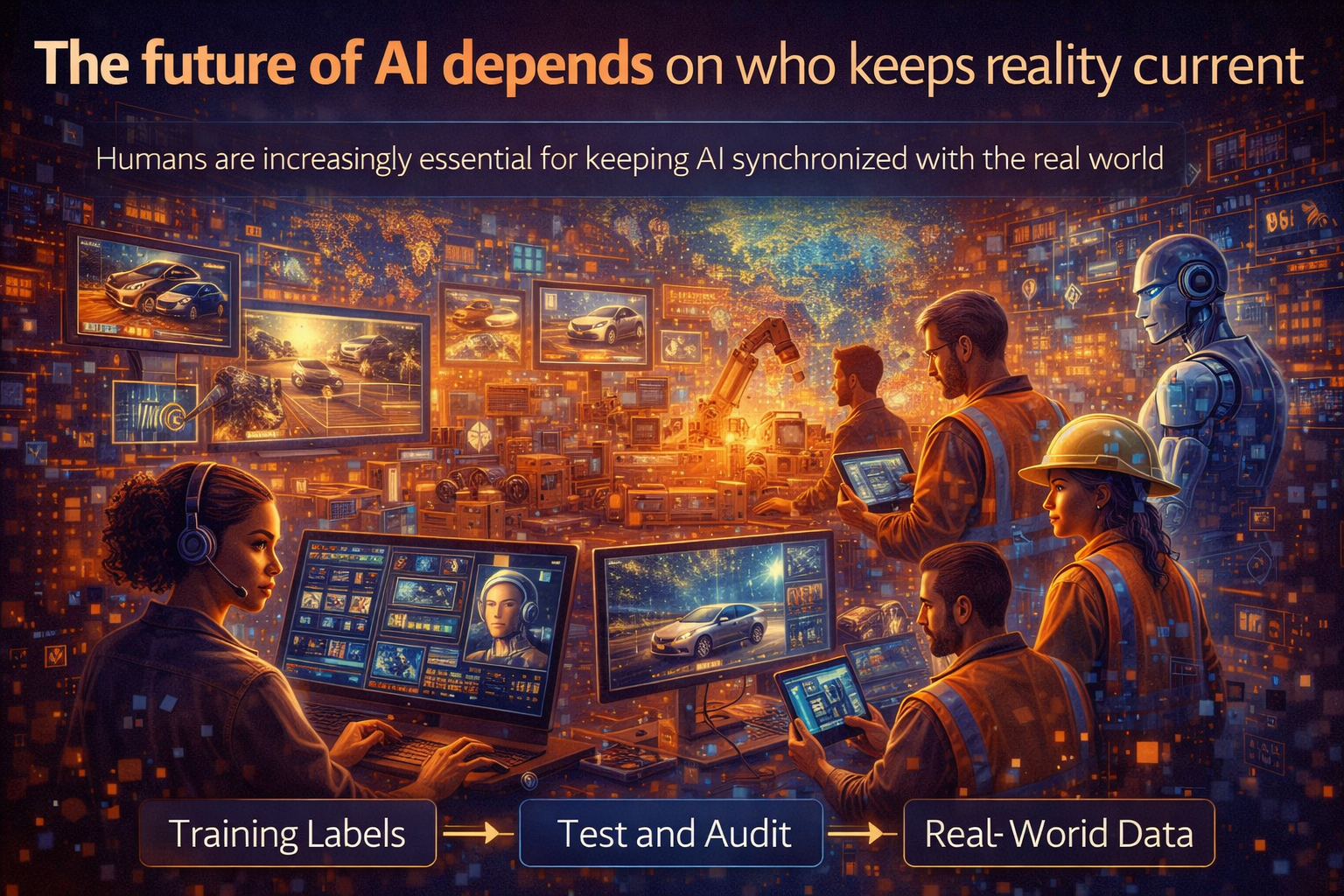
Why identity infrastructure is a board-level issue

This is not just a technical detail for architects.

It is a board-level issue because identity infrastructure shapes:

  • service access
  • operational traceability
  • risk visibility
  • fraud exposure
  • AI accountability
  • cross-system interoperability
  • economic participation

The companies that build durable identity layers can connect more signals, build more reliable representations, and create more defensible decision systems.

In the AI economy, that becomes a major source of advantage.

A company with stronger models but weak identity infrastructure will often underperform a company with decent models and strong entity-level coherence.

That is because AI performance in the real world is not only a function of reasoning quality.

It is also a function of entity stability.

C.O.R.E. and D.R.I.V.E.R. make the importance of identity even clearer

C.O.R.E. and D.R.I.V.E.R. make the importance of identity even clearer

The D.R.I.V.E.R. framework makes this even sharper.

If D.R.I.V.E.R. is the governance architecture required for trustworthy AI decisions, then identity sits at its center for a reason.

Let us restate it:

  • Delegation — who authorizes the AI to act?
  • Representation — what reality is being modeled?
  • Identity — which entity is affected?
  • Verification — how is the decision checked?
  • Execution — how is action carried out?
  • Recourse — what happens when the system is wrong?

Notice what happens if identity is weak.

Delegation becomes ambiguous. Representation becomes unstable. Verification lacks an anchor. Execution may target the wrong entity. Recourse becomes impossible or unfair.

This is why identity should not sit only in the lower stack.

It also belongs explicitly in governance.

Identity is both an infrastructural layer and an institutional layer.

That is one reason it will become so strategically important in the AI age.

The next AI leaders will build identity-rich systems

The next wave of AI advantage may not come only from firms that produce the most sophisticated models.

It may come from firms that build the strongest systems for attaching signals to stable, governable entities.

That means the strategic race is shifting toward:

  • identity-rich supply chains
  • traceable food and livestock systems
  • geospatially anchored environmental intelligence
  • durable customer and merchant identity systems
  • machine identity for autonomous operations
  • digital twins linked to real-world assets

This is where identity infrastructure stops looking like administration and starts looking like economic architecture.

And that is precisely where boards, CIOs, CTOs, public institutions, and infrastructure leaders should now pay much closer attention.

Core Insight

Identity infrastructure is the system that connects signals to entities, enabling AI systems to build stable representations, accumulate memory, and produce accountable decisions.

Key Takeaways

• AI systems do not act on raw data—they act on entities.
• Identity infrastructure links signals to real-world entities.
• Without identity, signals remain fragmented and AI decisions become unreliable.
• Identity infrastructure enables traceability, verification, and recourse.
• It is becoming a strategic layer of the AI economy.

identity is where visibility becomes continuity

Conclusion box: identity is where visibility becomes continuity

Signal infrastructure makes the world detectable.

Representation makes it legible.

But identity is what makes it continuous.

It is the missing layer between raw signals and usable representation.

Without identity, AI systems can sense, but they cannot remember well. They can detect anomalies, but they cannot accumulate reliable context. They can generate outputs, but they struggle to govern consequences.

That is why identity infrastructure is no longer a back-office issue.

It is becoming one of the foundational layers of the AI economy.

The next generation of intelligent institutions will not be built only on models, prompts, or agents.

They will be built on the ability to connect signals to entities, entities to representations, representations to cognition, and cognition to accountable action.

And that means one of the most important strategic questions in the AI age is no longer just:

How smart is the system?

It is:

How well does the system know who or what it is actually talking about?

That is the true importance of identity infrastructure.

The Intelligence-Native Enterprise Doctrine

This article is part of a larger strategic body of work that defines how AI is transforming the structure of markets, institutions, and competitive advantage. To explore the full doctrine, read the following foundational essays:

  1. The AI Decade Will Reward Synchronization, Not Adoption
    Why enterprise AI strategy must shift from tools to operating models.
    https://www.raktimsingh.com/the-ai-decade-will-reward-synchronization-not-adoption-why-enterprise-ai-strategy-must-shift-from-tools-to-operating-models/
  2. The Third-Order AI Economy
    The category map boards must use to see the next Uber moment.
    https://www.raktimsingh.com/third-order-ai-economy/
  3. The Intelligence Company
    A new theory of the firm in the AI era — where decision quality becomes the scalable asset.
    https://www.raktimsingh.com/intelligence-company-new-theory-firm-ai/
  4. The Judgment Economy
    How AI is redefining industry structure — not just productivity.
    https://www.raktimsingh.com/judgment-economy-ai-industry-structure/
  5. Digital Transformation 3.0
    The rise of the intelligence-native enterprise.
    https://www.raktimsingh.com/digital-transformation-3-0-the-rise-of-the-intelligence-native-enterprise/
  6. Industry Structure in the AI Era
    Why judgment economies will redefine competitive advantage.
    https://www.raktimsingh.com/industry-structure-in-the-ai-era-why-judgment-economies-will-redefine-competitive-advantage/

Institutional Perspectives on Enterprise AI

Many of the structural ideas discussed here — intelligence-native operating models, control planes, decision integrity, and accountable autonomy — have also been explored in my institutional perspectives published via Infosys’ Emerging Technology Solutions platform.

For readers seeking deeper operational detail, I have written extensively on:

Together, these perspectives outline a unified view: Enterprise AI is not a collection of tools. It is a governed operating system for institutional intelligence — where economics, accountability, control, and decision integrity function as a coherent architecture.

Glossary

Identity infrastructure
The systems that link signals to stable entities such as people, merchants, animals, assets, machines, parcels, or geospatial zones.

Representation Stack
The layered architecture through which reality becomes usable by AI: reality, signal infrastructure, identity, representation, cognition, and governance.

Signal infrastructure
The systems that capture traces of reality, such as sensors, satellites, enterprise telemetry, digital payments, mobile devices, and IoT networks.

Representation
A structured model of an entity or system created from signals, context, and history, enabling AI systems to reason over real-world conditions.

Machine-readable reality
The part of the world that has become visible to software through signals, digital identity, telemetry, or structured records.

C.O.R.E.
The machine cognition loop: Comprehend context, Optimize decisions, Realize action, Evolve through feedback.

D.R.I.V.E.R.
The institutional governance framework for trustworthy AI decisions: Delegation, Representation, Identity, Verification, Execution, Recourse.

Digital public infrastructure (DPI)
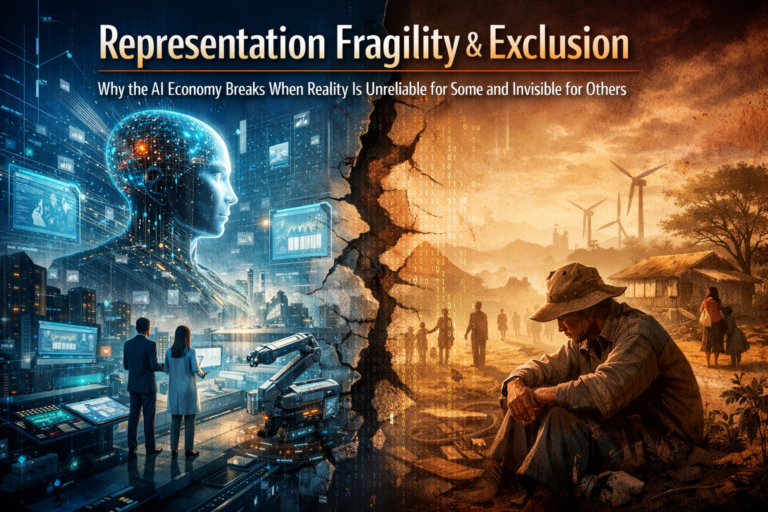
Foundational digital systems such as identity, payments, and data-sharing rails that enable secure and inclusive interaction across society. (UNDP)

Traceability
The ability to follow an entity, product, or event across systems and time through stable identification and linked records.

Representation
A structured model of an entity built from signals and historical context.

Entity identity
The persistent identifier associated with a person, asset, location, or digital system.

FAQ

What is identity infrastructure in AI?
Identity infrastructure in AI is the layer that links signals to stable entities such as people, assets, animals, parcels, or places. It allows AI systems to move from fragmented data to coherent, traceable representations.

Why is identity infrastructure important for AI systems?
Because AI systems do not act on raw signals alone. They act on entities. Without identity, signals remain fragmented, representation becomes unreliable, and governance becomes weak.

How does identity infrastructure fit into the Representation Stack?
Identity sits between signal infrastructure and representation. Signal infrastructure captures traces of reality, identity ties those traces to entities, and representation turns them into usable models for AI decision-making.

What is the difference between C.O.R.E. and D.R.I.V.E.R.?
C.O.R.E. explains how AI systems think: Comprehend context, Optimize decisions, Realize action, and Evolve through feedback. D.R.I.V.E.R. explains how institutions govern those decisions: Delegation, Representation, Identity, Verification, Execution, and Recourse.

Why does identity infrastructure matter in the Global South?
Because many lower- and middle-income contexts still face problems of invisibility—limited formal identity, fragmented records, and weak service continuity. Identity infrastructure helps make participation, service access, and accountability possible. (id4d.worldbank.org)

Which sectors are most affected by identity infrastructure?
Finance, healthcare, agriculture, food systems, logistics, environmental monitoring, public services, manufacturing, and any sector where signals must be linked to stable entities to support trustworthy decisions. (Open Knowledge FAO

What problems occur when identity infrastructure is weak?

Without strong identity infrastructure:

  • signals remain fragmented
    • AI models produce unreliable outputs
    • decision verification becomes difficult
    • accountability and recourse become unclear


References and further reading

The Representation Stack: How Reality Becomes Identifiable, Legible, and Actionable in the AI Economy

Artificial intelligence does not begin with models. It begins with visibility. Before machines can reason, they must first detect signals from the world, attach those signals to identifiable entities, and build structured representations of reality.

This layered architecture — what this article calls the Representation Stack — explains how reality becomes machine-readable, how AI systems generate decisions through C.O.R.E. (Comprehend, Optimize, Realize, Evolve), and how institutions govern those decisions through D.R.I.V.E.R. (Delegation, Representation, Identity, Verification, Execution, Recourse). Understanding this stack is becoming essential for enterprises, governments, and technology leaders building the next generation of intelligent systems.

What is the Representation Stack in AI?

The Representation Stack is the layered architecture that converts reality into machine-readable form. It includes signal infrastructure, identity systems, and structured representation, enabling AI cognition through C.O.R.E. and institutional governance through D.R.I.V.E.R.

The Representation Stack

Most discussions about artificial intelligence begin too late.

They begin with the model.

They begin with reasoning, generation, agents, orchestration, autonomy, and inference. They begin with what happens after data is already available, after an entity is already visible, after context has already been structured, and after the world has already been translated into machine-readable form.

But that is not where the AI economy truly begins.

The AI economy begins much earlier: at the moment when reality first becomes detectable, identifiable, representable, and therefore actionable.

That is why we need a more foundational idea: the Representation Stack.

The Representation Stack is the layered architecture through which raw reality becomes usable by AI systems and governable by institutions. It explains how people, animals, ecosystems, assets, infrastructure, and informal economic activity move from being invisible or weakly visible to becoming part of decision systems. It also explains why some parts of the world are easier to optimize than others, why some industries move faster than others, and why the next wave of AI value may come less from smarter models and more from stronger representation. This shift is increasingly visible in digital public infrastructure, identity systems, agricultural sensing, and Earth observation. (UNDP)

In simple terms:

AI cannot optimize what it cannot represent.

And representation does not appear magically. It must be built in layers.

That layered architecture is what this article calls the Representation Stack.

The core idea: AI does not start with intelligence. It starts with visibility.

The core idea: AI does not start with intelligence. It starts with visibility.

If you ask most executives where AI value comes from, many will answer with words like models, compute, copilots, or agents.

Those matter. But they are downstream layers.

A system cannot reason about a person, an animal, a field, a river, a machine, or a supply chain unless it can first observe signals about them, attach those signals to an identifiable entity, and assemble them into a coherent representation of the world. Only then can cognition, optimization, and action begin. That is why digital identity, Earth observation, mobile telemetry, IoT sensors, enterprise monitoring, and other forms of signal infrastructure are becoming so important. They are not peripheral to the AI economy. They are foundational. (Identification for Development)

This is the first major shift leaders need to understand:

The next AI economy will be shaped not only by better models, but by what parts of reality become visible to machines.

That is the strategic meaning of the Representation Stack.

Why we need a stack model at all

Why we need a stack model at all

“Representation” is often treated as if it were a single thing. It is not.

A hospital may have data, but not trustworthy patient identity linkage. A farm may have sensors, but not stable entity-level livestock identity. A city may have pollution measurements, but not the institutional machinery to turn those measurements into verified action. A bank may have transaction streams, but not enough representation of informal livelihoods to lend responsibly.

In all these cases, the problem is not simply a lack of AI. The problem is that one or more layers of representation are missing or weak.

That is why the Representation Stack matters. It breaks the problem into parts and shows why AI capability depends on the integrity of the layers below it.

Layer 1: Reality

The first layer is obvious, but often ignored: reality itself.

Reality includes people, animals, ecosystems, farms, warehouses, streets, pipelines, rivers, fisheries, informal merchants, elderly citizens, factory equipment, traffic systems, and countless other entities and processes.

Most of reality does not naturally present itself in structured, machine-usable form. It does not arrive with clean schemas, stable identifiers, or ready-made decision variables. In fact, large parts of the physical and social world remain weakly digitized. That is especially true in smallholder agriculture, informal economies, biodiversity monitoring, and public-service environments with uneven data systems. FAO’s work on agrifood automation makes this especially clear: the opportunity is enormous, but adoption is uneven and context matters deeply. (FAOHome)

So the Representation Stack begins with a humbling fact:

Reality exists first. Systems come later.

Layer 2: Signal infrastructure

The second layer is signal infrastructure — the systems that capture traces of reality.

This includes sensors, mobile devices, satellite imagery, enterprise telemetry, point-of-sale systems, wearables, digital payment rails, geospatial feeds, machine logs, cameras, edge devices, and public digital infrastructure.

Signal infrastructure is what makes reality detectable.

A dairy animal that does not “speak” digitally can still emit signals through body temperature, movement, milk output, feeding behavior, and health indicators. A field can emit signals through soil moisture, temperature, vegetation health, and rainfall patterns. A city can emit signals through traffic density, air quality, energy usage, and public service demand. NASA’s Earth observation resources show how satellites can track land use, soil moisture, temperature, and vegetation health for agriculture, while ESA and GEOGLAM illustrate how Earth observation supports crop monitoring, food security, and agricultural decision-making. (NASA Earthdata)

This is the first critical move in the AI economy:

from invisible reality to detectable signals.

Without signal infrastructure, nothing downstream matters.

Layer 3: Identity

This is the layer most discussions miss.

Signals alone are not enough. They must belong to something.

Identity answers a simple but essential question:

Which entity does this signal belong to?

If a livestock sensor reports abnormal movement, which animal is it referring to? If a digital payment stream shows transaction history, which merchant does it belong to? If a pollution sensor detects contamination, which river segment, industrial corridor, or municipality is implicated? If healthcare alerts show anomalies, which patient or household is being represented?

Without identity, signals remain fragmented. They cannot accumulate into longitudinal understanding. They cannot be traced, governed, or acted upon reliably.

This is why inclusive and trusted digital identification systems matter so much. The World Bank’s ID4D initiative explicitly frames identification systems as enablers of services, economic opportunity, and rights, and reports support for more than 60 countries and 550 million people through inclusive digital IDs and other digital public infrastructure. (Identification for Development)

But identity in the AI economy goes beyond human identity.

It includes asset identity, livestock identity, geospatial identity, machine identity, shipment identity, and, increasingly, digital twins of physical systems.

This is the second critical move:

from detectable signals to identifiable entities.

Layer 4: Representation

Once signals are attached to identities, they can be assembled into representations.

Representation is not just data collection. It is the creation of a usable model of reality.

A representation might describe a customer, a crop cycle, a herd, a warehouse, an urban zone, a machine, a watershed, or an ecosystem. It brings together signals, context, history, relationships, and states into a form that systems can reason over.

This is where reality becomes legible.

A bank does not lend to raw transaction logs. It lends to a represented borrower profile. A health system does not act on isolated sensor blips. It acts on a represented patient state. An agricultural platform does not optimize over scattered field measurements. It optimizes over a represented farm condition.

This is also where some of the biggest opportunities in the AI economy will emerge. New value is unlocked when previously underrepresented parts of reality become legible enough to support services, decisions, and markets. That is why digital public infrastructure, Earth observation, and digital automation in agriculture matter so much: they expand the representation surface of the world. (UNDP)

This is the third move:

from identifiable entities to legible representations.

Layer 5: C.O.R.E. — machine cognition

Layer 5: C.O.R.E. — machine cognition

Once representation exists, AI cognition can begin.

This is where C.O.R.E. comes in:

C — Comprehend context
O — Optimize decisions
R — Realize action
E — Evolve through feedback

C.O.R.E. is the machine cognition loop. It turns representation into understanding, options, actions, and learning.

But the key point is this:

C.O.R.E. only works if the lower layers are strong enough.

If signal infrastructure is weak, the system sees poorly. If identity is unstable, the system misattributes. If representation is thin, the system reasons badly. In other words, intelligence in the AI economy is downstream of visibility.

This is why so many AI deployments underperform. The model gets blamed, but the real weakness often lies lower in the stack

Layer 6: D.R.I.V.E.R. — institutional governance

If C.O.R.E. explains how AI thinks, D.R.I.V.E.R. explains how institutions govern that thinking:

D — Delegation
R — Representation
I — Intelligence
V — Verification
E — Execution
R — Recourse

This is the layer that determines whether AI decisions become legitimate, trustworthy, and institutionally usable.

Delegation asks who authorizes the system to act. Representation asks what exactly is being modeled and whose reality counts. Intelligence asks how signals are being interpreted into judgments. Verification asks how the system is checked. Execution asks how decisions are translated into action. Recourse asks what happens when the system is wrong.

This matters enormously because representation without governance becomes dangerous. A system that represents elderly vulnerability, livestock disease, environmental risk, or informal borrower profiles may create enormous value — but only if institutions can verify, constrain, and correct the system’s actions.

That is the final move:

from machine cognition to legitimate action.

A simple way to see the whole stack

A simple way to see the whole stack

Put together, the Representation Stack looks like this:

Reality becomes detectable through signal infrastructure.
Signals become attributable through identity.
Identities become legible through representation.
Representation becomes decision-making through C.O.R.E.
Decisions become institutionally trustworthy through D.R.I.V.E.R.

That is how reality becomes identifiable, legible, and actionable in the AI economy.

Simple examples that make the idea real

Simple examples that make the idea real

Smallholder agriculture

A smallholder field is part of reality. Satellite imagery, soil sensors, rainfall data, and mobile reporting create signal infrastructure. Land parcel IDs, farmer IDs, and geospatial boundaries create identity. Together, these produce a representation of crop condition, water stress, and expected output. AI can use C.O.R.E. to suggest irrigation timing, disease alerts, or credit-risk estimates. Institutions use D.R.I.V.E.R. to decide who can act, what must be verified, and what recourse exists if the system is wrong. NASA, ESA, and GEOGLAM all show how Earth observation is being used for agricultural monitoring and food security. (NASA Earthdata)

Elderly care

An older adult living alone is reality. Motion sensors, wearables, medication logs, call patterns, and room conditions form signal infrastructure. Patient or household identity links those signals over time. A representation emerges: sleep changes, reduced mobility, higher fall risk, missed medication, social isolation. C.O.R.E. helps the system comprehend context, optimize alerts, realize interventions, and improve with feedback. D.R.I.V.E.R. determines who is allowed to monitor, what is appropriate, how false alerts are verified, and what recourse exists for harmful or incorrect inferences. WHO notes that by 2030, one in six people in the world will be aged 60 or over, making this a structural and growing systems challenge. (World Health Organization)

Environmental monitoring

A watershed or city air basin is reality. Satellite feeds, sensor networks, historical pollution data, weather, and land-use data form signal infrastructure. Geospatial zones and monitoring boundaries create identity. That becomes a representation of emissions, pollution patterns, or ecological degradation. AI can detect anomalies, forecast deterioration, or prioritize interventions. D.R.I.V.E.R. becomes essential because public warnings, industrial accountability, and policy responses require delegation, verification, execution discipline, and recourse. UNEP highlights AI’s role in monitoring deforestation, emissions, pollution, and other environmental risks. (UNEP – UN Environment Programme)

Why this matters for enterprise strategy

This is not just a technical model. It is a board-level strategy lens.

Enterprises often ask:

“How do we deploy AI faster?”

The better question is:

“What parts of reality relevant to our customers, assets, communities, operations, or ecosystems are still poorly represented?”

That question changes everything.

It shifts attention from generic AI tools to strategic representation gaps.

In banking, the gap may be informal livelihoods.
In healthcare, it may be early signals of decline.
In agrifood, it may be field-level or animal-level visibility.
In climate and sustainability, it may be emissions, biodiversity, water, and supply-chain traceability.
In manufacturing, it may be machine state, process drift, or infrastructure deterioration.

The winners in the AI economy may not be those with access to the same model as everyone else. They may be those who build stronger Representation Stacks around the parts of reality others still see poorly.

That is a much more strategic way to think about AI advantage.

Why this matters for the Global South

Why this matters for the Global South

This is especially important across the Global South, where the challenge is often not overrepresentation but underrepresentation.

In many advanced economies, debates about AI and data emphasize privacy and surveillance. Those concerns matter. But in many lower- and middle-income contexts, the older problem has been invisibility: no formal records, no digital identity, no reliable service trails, no credit history, no environmental monitoring, and no structured visibility into communities or ecosystems.

That is why digital public infrastructure has become so central to inclusion and resilience. UNDP and the World Bank both frame DPI as foundational digital building blocks for inclusive, society-scale digital transformation, service delivery, and resilience. (UNDP)

This means representation in the AI economy is not only a technical issue.

It is also:

  • a development issue
  • an institutional issue
  • a governance issue
  • and a large economic opportunity

Conclusion box: the real AI race begins below the model

The Representation Stack clarifies something that many current AI debates miss.

AI does not begin with intelligence.

It begins with visibility.

Before systems can reason, they must detect.
Before they can detect meaningfully, they must identify.
Before they can optimize, they must represent.
Before they can act responsibly, they must be governed.

That is the stack.

And that is why the next AI economy will be shaped not only by the sophistication of models, but by the architecture through which reality becomes identifiable, legible, and actionable.

The strategic race ahead is not just to build smarter AI.

It is to build stronger Representation Stacks.

That is where new value will emerge.
That is where new institutions will be formed.
And that is where the next generation of AI advantage will be won.

AI will not be won by bigger models alone. It will be won by better representation.

FAQ

What is the Representation Stack in AI?

The Representation Stack is a layered architecture that explains how real-world entities become usable by artificial intelligence systems. It includes layers such as reality, signal infrastructure, identity, and representation, which enable AI cognition through the C.O.R.E. loop and institutional governance through the D.R.I.V.E.R. framework.

Why is the Representation Stack important for AI systems?

AI systems cannot reason about or act on entities that they cannot observe, identify, and represent. Weakness in signal infrastructure, identity systems, or representation layers often explains why AI deployments fail in real-world environments.

What comes before AI models in the Representation Stack?

Before AI models can generate decisions, three foundational layers must exist: signal infrastructure that captures data, identity systems that link signals to entities, and representation models that create structured views of reality.

What is C.O.R.E. in the AI architecture described in this article?

C.O.R.E. is the machine cognition loop used by AI systems:

Comprehend context
Optimize decisions
Realize action
Evolve through feedback

It describes how AI systems interpret represented information and convert it into decisions and learning.

What is the D.R.I.V.E.R. framework in AI governance?

D.R.I.V.E.R. is an institutional governance architecture that ensures AI decisions are trustworthy and accountable. It includes Delegation, Representation, Identity, Verification, Execution, and Recourse.

How does the Representation Stack apply to enterprise AI?

Enterprises create competitive advantage when they improve the representation of customers, assets, ecosystems, and operations. Strong representation enables better decision systems, new services, and improved governance.

Why does the Representation Stack matter for the Global South?

Many regions face a challenge of invisibility rather than excessive data. Weak identity systems, limited environmental monitoring, and poor infrastructure can prevent AI from representing reality accurately. Digital public infrastructure and sensing systems help close this gap.

Glossary

Representation Stack

A layered architecture through which real-world entities become visible and usable to AI systems, enabling machine cognition and institutional governance.

Machine-Readable Reality

The portion of the physical or social world that has become observable by software through sensors, telemetry, identity systems, imaging, or digital records.

Signal Infrastructure

Systems that capture traces of reality, including sensors, satellites, mobile devices, IoT networks, enterprise telemetry, and digital public infrastructure.

Identity Infrastructure

Systems that bind signals to stable entities such as people, assets, machines, animals, or locations, enabling traceability and long-term context.

Representation

A structured model of an entity or system created from signals and identity, enabling AI systems to reason about real-world conditions.

C.O.R.E. (Machine Cognition Loop)

A framework describing how AI systems transform representation into decisions: Comprehend context, Optimize decisions, Realize action, and Evolve through feedback.

D.R.I.V.E.R. (Institutional Governance Framework)

A governance architecture ensuring AI decisions are legitimate and accountable through Delegation, Representation, Identity, Verification, Execution, and Recourse.

Digital Public Infrastructure (DPI)

Foundational digital systems such as digital identity, payment platforms, and data-sharing rails that support inclusive digital services and economic participation.

Earth Observation

Satellite-based monitoring systems used to track environmental, agricultural, and geospatial conditions for decision-making.

The Intelligence-Native Enterprise Doctrine

This article is part of a larger strategic body of work that defines how AI is transforming the structure of markets, institutions, and competitive advantage. To explore the full doctrine, read the following foundational essays:

  1. The AI Decade Will Reward Synchronization, Not Adoption
    Why enterprise AI strategy must shift from tools to operating models.
    https://www.raktimsingh.com/the-ai-decade-will-reward-synchronization-not-adoption-why-enterprise-ai-strategy-must-shift-from-tools-to-operating-models/
  2. The Third-Order AI Economy
    The category map boards must use to see the next Uber moment.
    https://www.raktimsingh.com/third-order-ai-economy/
  3. The Intelligence Company
    A new theory of the firm in the AI era — where decision quality becomes the scalable asset.
    https://www.raktimsingh.com/intelligence-company-new-theory-firm-ai/
  4. The Judgment Economy
    How AI is redefining industry structure — not just productivity.
    https://www.raktimsingh.com/judgment-economy-ai-industry-structure/
  5. Digital Transformation 3.0
    The rise of the intelligence-native enterprise.
    https://www.raktimsingh.com/digital-transformation-3-0-the-rise-of-the-intelligence-native-enterprise/
  6. Industry Structure in the AI Era
    Why judgment economies will redefine competitive advantage.
    https://www.raktimsingh.com/industry-structure-in-the-ai-era-why-judgment-economies-will-redefine-competitive-advantage/
  7. The Representation Economy: Why AI Institutions Must Run on SENSE, CORE, and DRIVER – Raktim Singh

Institutional Perspectives on Enterprise AI

Many of the structural ideas discussed here — intelligence-native operating models, control planes, decision integrity, and accountable autonomy — have also been explored in my institutional perspectives published via Infosys’ Emerging Technology Solutions platform.

For readers seeking deeper operational detail, I have written extensively on:

Together, these perspectives outline a unified view: Enterprise AI is not a collection of tools. It is a governed operating system for institutional intelligence — where economics, accountability, control, and decision integrity function as a coherent architecture.

The Enterprise AI Doctrine: From Decision Scale to Institutional Redesign

Over the past few months, I’ve been building a structured doctrine around Enterprise AI — not as a technology trend, but as an institutional redesign agenda.

It unfolds in layers:

🔹 1️ Decision Economics

→ Establishes the core thesis: advantage is shifting from scaling labor to scaling decision quality.

🔹 2️ Institutional Transformation

→ Argues that AI leadership is not about tooling — it is about institutional architecture.

🔹 3️ Sector-Level Redesign

→ Examines how this shift reshapes industry structure, economics, and competitive positioning.

🔹 4️ Economic Consequences

→ Explores how decision intelligence translates into measurable structural gains.

🔹 The Unifying Thesis

Together, these articles form a coherent framework:

  • Competitive advantage is moving from labor scale to decision scale
  • Institutions must evolve from services firms to intelligence institutions
  • AI must shift from isolated pilots to structurally governed, economically accountable enterprise systems

This is not AI adoption.

It is enterprise redesign.

Digital Public Infrastructure

Digital Identity (World Bank ID4D)

Earth Observation for Agriculture (NASA)

FAO Digital Agriculture and Automation


The Hardest Problem in AI: Representing What Cannot Speak

Artificial intelligence is often described as a revolution in generation, prediction, and reasoning. We hear about better models, faster chips, larger context windows, smarter agents, and more autonomous workflows. Yet the hardest problem in AI is not simply making machines more intelligent.

It is making reality more representable.

That may sound abstract, but it is one of the most practical questions in the AI economy. AI can only work on what becomes legible to it.

If a system cannot properly represent an elderly person living alone, a polluted river, a stressed dairy animal, a fish pond losing oxygen, an informal worker without formal records, or a rural community outside the digital mainstream, then AI cannot help meaningfully.

It may still produce answers. But those answers will often be shallow, distorted, or operationally dangerous. (World Health Organization)

This is why the hardest problem in AI is not just reasoning. It is representation.

And this problem is much bigger than it appears.

Across the world, vast parts of reality are still poorly represented in digital form: older adults, informal labor, ecosystems, biodiversity, animal health, water systems, and communities that were never built into the data architecture of the digital age.

At the same time, digital public infrastructure, low-cost sensors, satellite imagery, mobile networks, and AI-enabled monitoring are expanding what can be seen, measured, and acted upon. The opportunity is enormous. So is the responsibility. (UNDP)

This is where two frameworks matter again and again:

C.O.R.E. — the machine cognition loop
D.R.V.R.the institutional legitimacy layer

These are not optional ideas. They are becoming central to how AI will create value safely and at scale.

What Is “Representing What Cannot Speak” in AI?

Representing what cannot speak in artificial intelligence refers to the creation of trustworthy digital representations of people, ecosystems, animals, environments, and systems that do not naturally produce structured data.

AI systems can only reason over realities that become machine-readable. The expansion of representation infrastructure—through sensors, digital public infrastructure, satellite observation, and edge computing—will therefore shape the next wave of the AI economy.

The next wave of the AI economy may best be described as the Representation Economy — an economy where value emerges from making previously invisible parts of reality legible to machines.

The real bottleneck is not intelligence. It is representation.

The real bottleneck is not intelligence. It is representation.

Most AI conversations quietly assume that the world is already available as data. That assumption is false.

Take a simple example. Imagine a bank wants to serve a street vendor or a small informal merchant. A conventional model may ask for income history, credit history, tax records, collateral, and repayment patterns. But what if those records do not exist in formal systems?

The problem is not that the model is weak. The problem is that the person is underrepresented in the digital system.

Now take a non-human example. Suppose an AI platform wants to reduce disease in cattle or detect stress in aquaculture ponds.

It cannot do that by merely “thinking harder.” It needs signal pathways: movement, temperature, feeding patterns, water chemistry, disease indicators, imaging, edge sensors, and local context. The first challenge is representation.

Only after representation comes decision quality. FAO has documented the spread of digital automation and sensing across livestock, aquaculture, crops, and forestry, but it also makes clear that adoption remains uneven and context-sensitive. (FAOHome)

The same logic applies to ecosystems. If a river, forest, air basin, or biodiversity corridor is poorly monitored, AI cannot govern it well. UNEP has highlighted AI’s role in monitoring deforestation, emissions, pollution, and environmental risk, while biodiversity assessments continue to emphasize major data and knowledge gaps. (UNEP – UN Environment Programme)

In other words, AI is only as real as the reality it can represent.

What “cannot speak” really means

What “cannot speak” really means

The phrase does not only mean silence in the literal sense. It refers to realities that do not naturally generate complete, machine-usable, decision-ready signals.

  1. People who are digitally underrepresented

This includes informal workers, rural households, elderly populations, and individuals outside formal records or strong service systems. WHO projects that by 2030, one in six people globally will be aged 60 or older, with the pace of ageing accelerating in developing regions. That means the representation challenge is not niche. It is structural. (World Health Organization)

  1. Non-human entities

Animals, fisheries, forests, soil, air, and water systems do not issue structured digital claims about their condition. Their needs must be inferred through sensing, models, proxies, and domain expertise.

  1. Systems that are physically dispersed

Many economically important realities are fragmented across geographies: farms, watersheds, supply chains, villages, wetlands, and ecological corridors. Their signals are scattered, noisy, and expensive to collect.

  1. Realities that are visible locally but invisible institutionally

A farmer may know a pond is stressed. A village may know a water source is degrading. A caregiver may know an older adult’s routine has changed. But unless that local knowledge becomes representable in machine-usable form, it remains invisible to larger decision systems.

This is where AI’s next frontier lies.

Why this matters more in the Global South

Why this matters more in the Global South

There is an important geographic nuance here.

In parts of Europe and some advanced economies, digital representation is often discussed through the lens of privacy, surveillance, and automated-decision risk.

Those concerns are valid. Article 22 of the GDPR gives people safeguards against decisions based solely on automated processing when those decisions have legal or similarly significant effects. (EUR-Lex)

But much of the Global South begins from a different historical condition: not overrepresentation, but underrepresentation.

For millions of people, the old problem was not “too much data about me.” It was “no one sees me, records me, serves me, finances me, insures me, or designs systems around my reality.”

That is one reason digital public infrastructure has become so consequential. UNDP frames DPI as a rights-centered and inclusive foundation for digital transformation, while the World Bank highlights its role in inclusion, payments, identity, resilience, and service delivery across dozens of countries. (UNDP)

That changes the moral and economic meaning of representation.

In one context, representation feels like surveillance.
In another, representation feels like recognition.

That distinction matters enormously for the future of AI, especially if one wants to understand where new value will be unlocked first.

C.O.R.E. only works when representation is real

C.O.R.E. only works when representation is real

This is why C.O.R.E. must be repeated clearly and consistently:

C — Comprehend context
O — Optimize decisions
R — Realize action
E — Evolve through feedback

C.O.R.E. is the machine cognition loop. It describes how AI systems transform signals into contextual understanding, into options, into action, and then into learning.

But here is the hard truth:

C.O.R.E. fails at the very first step if representation is weak.

How can an AI system comprehend context if the context has never been captured properly?

How can it optimize decisions for a fishery, a village clinic, an informal borrower, or an elderly person if the relevant state of the world is missing, noisy, or distorted? How can it realize action responsibly if it is acting on partial representation? How can it evolve through feedback if feedback itself is poorly instrumented?

So the hardest problem in AI is not merely building stronger C.O.R.E. loops.

It is building representation worthy of C.O.R.E.

The new source of value: representing the previously invisible

The new source of value: representing the previously invisible

This leads to a powerful economic idea.

The next wave of AI value will not come only from smarter foundation models. It will also come from expanding the representation surface of the world.

FAO documents rising use of digital and automation technologies in crops, livestock, aquaculture, and forestry, and its broader work continues to underscore the scale and importance of smallholder and family farming in the world food system. That means the representation opportunity remains vast. (FAOHome)

Think about what that means.

A company that helps represent cattle health in real time is not just selling a dashboard. It is creating a new layer of economic visibility.

A company that helps represent air quality in under-monitored cities is not just providing environmental software. It is making public risk legible.

A company that helps represent the needs and behavior patterns of older adults living independently is not just offering elder-care technology. It is making an entire demographic more visible to care systems, insurers, urban planners, and service providers.

This is how new markets are born.

First, a part of reality becomes representable.
Then, it becomes measurable.
Then, it becomes optimizable.
Then, new services, business models, and institutions emerge around it.

But representation without legitimacy becomes dangerous

But representation without legitimacy becomes dangerous

This is where D.R.V.R. must be repeated just as strongly as C.O.R.E.

D — Delegation
R — Representation
V — Verification
R — Recourse

If C.O.R.E. is the cognition loop, D.R.V.R. is the legitimacy layer.

An enterprise cannot simply say, “We now represent forests, rivers, cattle, elderly people, informal communities, or biodiversity risk,” and expect trust to appear automatically.

Society will ask four hard questions.

Delegation — Who gave you the right to represent this entity or population?
Representation — What exactly are you representing? Which signals count, and which do not?
Verification — How do we know your representation is accurate enough to be trusted?
Recourse — What happens when your representation is wrong, harmful, or incomplete?

These questions become especially important when AI systems trigger real actions: credit approvals, insurance pricing, medical alerts, public warnings, subsidy allocation, environmental intervention, compliance decisions, or service prioritization.

Without D.R.V.R., AI representation can become extractive, opaque, and unchallengeable. With D.R.V.R., it becomes institutionally usable.

That is why C.O.R.E. and D.R.V.R. must be repeated together.
C.O.R.E. gives AI capability.
D.R.V.R. gives AI legitimacy.

Simple examples that make this real

Example 1: Elderly care

An older adult living alone may not “speak” digitally in any consistent way. But patterns of motion, medication adherence, sleep disruption, missed calls, room temperature, and emergency history can help represent vulnerability.

C.O.R.E. helps the system comprehend context, optimize alerts, realize support, and evolve with feedback.

D.R.V.R. determines who is allowed to monitor, what data is justified, how false alarms are verified, and what recourse exists if the system gets it wrong. WHO’s ageing projections make clear that this challenge will only grow. (World Health Organization)

Example 2: Livestock and fisheries

Animals cannot file complaints or describe symptoms. Their representation must be inferred from sensors, behavior, imaging, environmental conditions, and expert context. FAO shows that such technologies are becoming more common across agrifood systems.

But if a representation system misreads animal health or pond conditions, who checks it, who is accountable, and how is action corrected? That is D.R.V.R. operating alongside C.O.R.E. (FAOHome)

Example 3: Air and water systems

A city cannot protect residents from polluted air or degrading water that it does not measure. UNEP and related environmental work show both the promise of AI-enabled monitoring and the scale of current data gaps.

Here again, C.O.R.E. can analyze and act only if representation exists. D.R.V.R. matters because public warnings, industrial accountability, and regulatory response require trusted data and recourse. (UNEP – UN Environment Programme)

This is why the hardest problem in AI is bigger than the model

The future AI economy will not be defined only by who has the largest model.

It will also be defined by who can most credibly represent the parts of reality that were previously invisible.

That may include older adults, smallholders, informal merchants, livestock systems, fisheries, soil and water conditions, air basins, biodiversity networks, and low-trust public-service environments.

This is not a side story in AI. It may become one of the main engines of value creation.

And once representation exists, another frontier opens: decision velocity. But decision velocity comes second. Representation comes first. You cannot optimize what you have not made legible.

The strategic message for enterprises and boards

For boards, CEOs, CIOs, CTOs, and public leaders, this creates a very different AI agenda.

Do not ask only:

“How do we deploy smarter AI?”

Also ask:

“What parts of reality relevant to our customers, communities, assets, supply chains, or ecosystems are still poorly represented?”

Then ask a second question:

“What would it take to build C.O.R.E. on top of that representation and D.R.V.R. around it?”

That is a much more serious way to think about AI strategy.

Because the biggest opportunities may not lie in building one more generic assistant. They may lie in building trusted representation systems for domains the digital economy still sees poorly.

The expansion of machine-readable reality is one of the most important shifts in the AI era. Sensors, satellites, digital infrastructure, and AI systems are turning previously invisible parts of the world into actionable data.

the next economy will be shaped by what becomes visible

Conclusion: the next economy will be shaped by what becomes visible

The real future of AI is not just text generation, image generation, or autonomous workflow execution.

It is the expansion of machine-readable reality.

But that expansion must not be reckless. It must be designed.

C.O.R.E. matters because AI must comprehend context, optimize decisions, realize action, and evolve through feedback.
D.R.V.R. matters because every serious representation system needs delegation, representation discipline, verification, and recourse.

The hardest problem in AI is not building a system that can talk.

It is building a system that can responsibly represent what cannot.

And the institutions, enterprises, and societies that solve that problem will not merely build better AI. They will reshape what becomes visible, valuable, governable, and investable in the next economy.

That is where the next wave of strategic advantage will come from.

The next AI economy will not be shaped only by the intelligence of machines.

It will be shaped by what parts of reality become visible to them.

Glossary

AI representation
The process of converting a person, entity, system, or environment into machine-usable signals, states, and relationships.

Machine-readable reality
Parts of the world that have become visible to software through sensors, records, digital identity, telemetry, imaging, or structured data.

C.O.R.E.
A machine cognition loop: Comprehend context, Optimize decisions, Realize action, Evolve through feedback.

D.R.V.R.
An institutional legitimacy layer: Delegation, Representation, Verification, Recourse.

Representation surface
The total area of reality that an institution or system can observe, interpret, and act upon.

Decision velocity
The speed and quality with which an organization can move from signal to decision to action once representation exists.

Digital public infrastructure
Foundational digital systems such as identity, payments, and data-sharing rails that enable broad participation and service delivery. (UNDP)

Recourse
The ability to challenge, reverse, correct, or appeal a machine-assisted decision.

FAQ

What does “representing what cannot speak” mean in AI?
It means creating trustworthy digital representations of people, animals, environments, or systems that do not naturally generate complete, structured, decision-ready signals on their own.

Why is this the hardest problem in AI?
Because AI can only reason over what becomes legible to it. If the underlying reality is missing, fragmented, or poorly represented, even advanced models will produce weak or misleading outcomes.

How do C.O.R.E. and D.R.V.R. fit into this?
C.O.R.E. is the machine cognition loop: comprehend, optimize, realize, evolve. D.R.V.R. is the institutional legitimacy layer: delegation, representation, verification, recourse.

Why is this especially important in the Global South?
In many regions, the historical challenge has been underrepresentation rather than overrepresentation. Digital public infrastructure can therefore expand inclusion, identity, payments, and service delivery where formal systems were weak or absent. (UNDP)

Which sectors are most affected?
Elder care, agriculture, livestock, fisheries, environmental monitoring, informal finance, public services, and any domain where important entities remain weakly represented today. (World Health Organization)

Why should boards care about this now?
Because the next wave of AI advantage may come less from generic model access and more from building trusted representation systems around customers, assets, ecosystems, and non-digital realities.

References and further reading

  • WHO, Ageing and Health (World Health Organization)
  • UNDP, Digital Public Infrastructure framework paper (UNDP)
  • World Bank, Creating Digital Public Infrastructure for Empowerment, Inclusion, and Resilience (World Bank)
  • FAO, The State of Food and Agriculture 2022 and related digital agriculture materials (FAOHome)
  • UNEP, How artificial intelligence is helping tackle environmental challenges (UNEP – UN Environment Programme)
  • IPBES biodiversity and monitoring materials (files.ipbes.net)
  • EUR-Lex, GDPR Article 22 on automated decision-making (EUR-Lex)

Enterprise AI Operating Model

Enterprise AI scale requires four interlocking planes:

Read about Enterprise AI Operating Model The Enterprise AI Operating Model: How organizations design, govern, and scale intelligence safely – Raktim Singh

  1. Read about Enterprise Control Tower The Enterprise AI Control Tower: Why Services-as-Software Is the Only Way to Run Autonomous AI at Scale – Raktim Singh
  2. Read about Decision Clarity The Shortest Path to Scalable Enterprise AI Autonomy Is Decision Clarity – Raktim Singh
  3. Read about The Enterprise AI Runbook Crisis The Enterprise AI Runbook Crisis: Why Model Churn Is Breaking Production AI—and What CIOs Must Fix in the Next 12 Months – Raktim Singh
  4. Read about Enterprise AI Economics Enterprise AI Economics & Cost Governance: Why Every AI Estate Needs an Economic Control Plane – Raktim Singh

Read about Who Owns Enterprise AI Who Owns Enterprise AI? Roles, Accountability, and Decision Rights in 2026 – Raktim Singh

Read about The Intelligence Reuse Index The Intelligence Reuse Index: Why Enterprise AI Advantage Has Shifted from Models to Reuse – Raktim Singh

The Representation Economy: Why AI Institutions Must Run on SENSE, CORE, and DRIVER – Raktim Singh

The Intelligence-Native Enterprise Doctrine

This article is part of a larger strategic body of work that defines how AI is transforming the structure of markets, institutions, and competitive advantage. To explore the full doctrine, read the following foundational essays:

  1. The AI Decade Will Reward Synchronization, Not Adoption
    Why enterprise AI strategy must shift from tools to operating models.
    https://www.raktimsingh.com/the-ai-decade-will-reward-synchronization-not-adoption-why-enterprise-ai-strategy-must-shift-from-tools-to-operating-models/
  2. The Third-Order AI Economy
    The category map boards must use to see the next Uber moment.
    https://www.raktimsingh.com/third-order-ai-economy/
  3. The Intelligence Company
    A new theory of the firm in the AI era — where decision quality becomes the scalable asset.
    https://www.raktimsingh.com/intelligence-company-new-theory-firm-ai/
  4. The Judgment Economy
    How AI is redefining industry structure — not just productivity.
    https://www.raktimsingh.com/judgment-economy-ai-industry-structure/
  5. Digital Transformation 3.0
    The rise of the intelligence-native enterprise.
    https://www.raktimsingh.com/digital-transformation-3-0-the-rise-of-the-intelligence-native-enterprise/
  6. Industry Structure in the AI Era
    Why judgment economies will redefine competitive advantage.
    https://www.raktimsingh.com/industry-structure-in-the-ai-era-why-judgment-economies-will-redefine-competitive-advantage/


Institutional Perspectives on Enterprise AI

Many of the structural ideas discussed here — intelligence-native operating models, control planes, decision integrity, and accountable autonomy — have also been explored in my institutional perspectives published via Infosys’ Emerging Technology Solutions platform.

For readers seeking deeper operational detail, I have written extensively on:

Together, these perspectives outline a unified view: Enterprise AI is not a collection of tools. It is a governed operating system for institutional intelligence — where economics, accountability, control, and decision integrity function as a coherent architecture

The Enterprise AI Social Contract: Why Institutions Must Redesign Trust When Machines Make Decisions

Artificial intelligence is rapidly transforming how institutions make decisions. In banks, hospitals, government agencies, and large enterprises, AI systems are no longer merely analyzing data—they are increasingly recommending actions, triggering workflows, and sometimes executing decisions themselves.

This shift creates a new challenge that most organizations are still unprepared for: how to preserve trust when machines begin shaping institutional outcomes.

The answer may lie in what can be called the Enterprise AI Social Contract—the set of governance principles that define how organizations disclose, explain, supervise, and remain accountable for decisions influenced by artificial intelligence.

In this article, I introduce the concept of the Enterprise AI Social Contract — a governance framework for institutions deploying artificial intelligence in decision-making roles.

The Enterprise AI Social Contract

Artificial intelligence is changing the nature of institutional decision-making.

For most of modern economic history, the relationship between people, institutions, and machines was relatively simple. Humans decided. Software supported. Machines executed. A bank officer approved the loan. A claims manager accepted or rejected the insurance file. A procurement manager selected the vendor. A customer service agent decided how far to go to resolve the complaint.

AI is beginning to break that arrangement.

Today, AI systems can classify claims, summarize medical notes, recommend treatment pathways, rank résumés, prioritize sales leads, route disputes, generate legal drafts, trigger workflows, choose suppliers, and increasingly act through tools, browsers, APIs, and enterprise systems.

OpenAI, Anthropic, and Microsoft have all publicly described or documented AI systems that can use tools or computers to perform multistep work, while Microsoft’s 2025 Work Trend Index argues that a new category of “Frontier Firms” is emerging around AI-native workflows and agents. (OpenAI)

That shift matters because trust in institutions was not designed for a world in which machine systems can meaningfully participate in real decisions. The deeper issue is no longer just whether an AI model is accurate.

It is whether the institution using that model can explain, govern, contest, reverse, and remain accountable for what the machine is allowed to decide. Global frameworks from NIST, OECD, UNESCO, and the European Union all point in the same direction: trustworthy AI requires transparency, accountability, human oversight, and meaningful ways to challenge outcomes. (NIST)

This is why enterprises now need a new idea:

The Enterprise AI Social Contract

The Enterprise AI Social Contract

The Enterprise AI Social Contract is the set of institutional promises an organization makes when AI begins to influence or make decisions that affect employees, customers, citizens, suppliers, partners, or markets.

In plain language, it means this:

If machines are going to participate in decisions, institutions must redesign trust around that reality.

This is not a branding exercise. It is not a policy slogan. It is an operating principle for the age of machine decision-making.

What makes this moment different

The defining shift in enterprise AI is not that machines can now generate language, images, or code. The defining shift is that they are increasingly able to rank, approve, deny, route, trigger, negotiate, and act.

That changes the nature of institutional power.

A chatbot that drafts an email is useful.
A system that recommends the next best action is influential.
A system that actually issues the refund, freezes the transaction, routes the complaint, shortlists the applicant, or triggers the procurement event has crossed into something much bigger: delegated authority.

That is the real threshold.

Most AI debates still focus on intelligence: bigger models, better reasoning, more memory, lower hallucination rates, stronger retrieval, better copilots.

Those issues matter. But they are not the deepest institutional issue.

The central issue is this: what happens to trust when institutions begin delegating parts of authority to machines?

Why the old trust model no longer works

Why the old trust model no longer works

Traditional enterprise trust rested on four assumptions.

First, there was usually a human in the loop with real authority.
Second, the logic of the decision was often embedded in policy, process, and training.
Third, escalation paths were visible.
Fourth, accountability was legible: a manager, committee, or institution could be named.

AI weakens each of these assumptions.

Imagine a retail bank using AI to pre-screen small-business loans. The bank may still say, “A human makes the final decision.”

But if the officer is reviewing hundreds of AI-ranked cases each day and overturns only a small fraction, then the practical decision-maker is no longer purely human. The institution has shifted from human decision-making supported by software to human supervision of machine judgment.

Or consider customer support. If an agentic system can autonomously resolve routine customer issues, issue credits, escalate complaints, and draft case notes, the important question is no longer only whether costs fall.

It is what governance sits underneath that autonomy. Gartner has publicly predicted that by 2028 at least 15% of day-to-day work decisions will be made autonomously through agentic AI, and that 33% of enterprise software applications will incorporate agentic AI capabilities by 2028. (Gartner)

The social contract breaks when institutions say, “Trust the system,” but cannot answer basic questions about delegation, review, reversal, and recourse.

The simplest test: when AI stops being a tool

The simplest test: when AI stops being a tool

A useful test is this:

If the AI output changes what happens to a person, a transaction, or a workflow, then the system is no longer just producing information. It is participating in institutional action.

Simple examples make this clear.

A résumé screener that ranks candidates changes who gets interviewed.
A fraud model that blocks a payment changes whether a customer can transact.
A hospital triage system changes who receives urgent attention first.
A procurement agent that selects vendors changes commercial outcomes.
A service bot that grants or denies refunds changes customer treatment.

In each case, the institution is not merely using AI. It is allowing AI to shape outcomes.

That is where the Enterprise AI Social Contract begins.

The four promises inside a real Enterprise AI Social Contract

The four promises inside a real Enterprise AI Social Contract

A serious social contract should contain four core promises.

  1. Disclosure: people should know when AI is materially involved

If an AI system is materially shaping a decision, the affected person should not have to guess. OECD principles emphasize transparency and responsible disclosure so that people understand when they are engaging with AI and can challenge outcomes where appropriate. (OECD)

This does not mean every interface needs a flashing warning label. It means institutions should be honest about meaningful AI involvement where it affects rights, money, access, safety, evaluation, eligibility, or opportunity.

  1. Explanation: the institution must be able to give a reason people can understand

Not every model is fully interpretable, and explainability has limits. But the social contract does not require perfect technical transparency. It requires something more practical: the institution must be able to state, in plain language, the basis of action.

For example, this is useful:
“Your claim was flagged because the system found inconsistencies between the invoice date, service code, and policy coverage.”

This is not useful:
“The model scored your case as high risk.”

The difference is institutional respect. One response gives a reason. The other hides behind a system.

  1. Recourse: people must have a way back

A trustworthy institution must provide a path to appeal, contest, escalate, or reverse an AI-shaped decision. UNESCO’s Recommendation on the Ethics of AI emphasizes human rights, dignity, fairness, transparency, oversight, and accountability, all of which support the need for meaningful recourse in practice. (UNESCO)

In real life, recourse means there is always a “way back” from machine action.

If the bank wrongly flags a customer for fraud, the customer needs a clear recovery path.
If the hiring screen misses a strong applicant, there should be review mechanisms.
If an AI support system closes a valid complaint, a human escalation path must exist.

Without recourse, trust becomes one-sided: the institution gains speed, while the individual absorbs the error.

  1. Accountability: the institution remains responsible

The most dangerous sentence in enterprise AI is: “The model did it.”

No regulator, board, customer, court, or employee will accept that as a sufficient answer. NIST’s AI RMF explicitly frames trustworthy AI in terms that include accountability, transparency, explainability, safety, security, privacy enhancement, and managed harmful bias. (NIST)

The institution remains accountable for the authority it delegates.

That is the heart of the social contract.

Why C.O.R.E. matters: the intelligence loop

Why C.O.R.E. matters: the intelligence loop

To understand why this contract matters, it helps to separate intelligence from governance.

Your C.O.R.E. framework explains the intelligence loop:

C — Comprehend context
AI absorbs signals: customer intent, transaction patterns, operational telemetry, policy constraints, and environmental conditions.

O — Optimize decisions
AI generates options, estimates tradeoffs, and ranks possible actions under constraints.

R — Realize action
AI executes through workflows, APIs, messages, approvals, routing logic, or enterprise systems.

E — Evolve through evidence
AI improves through outcomes, reversals, feedback, drift signals, and error patterns.

C.O.R.E. explains how institutional intelligence functions.

But intelligence alone does not create trust.

The moment the system moves from Optimize to Realize, the Enterprise AI Social Contract becomes unavoidable.

That is where many organizations still think too narrowly. They are focused on whether the model “works,” when the deeper question is whether the institution has designed the conditions under which that intelligence is allowed to act.

Why D.R.V.R. matters: the infrastructure beneath trust

Why D.R.V.R. matters: the infrastructure beneath trust

If C.O.R.E. explains how AI thinks and acts, D.R.V.R. explains the institutional infrastructure that makes that action legitimate.

A practical interpretation in this article’s context is:

D — Decision infrastructure
Rules, thresholds, authority boundaries, approval conditions, escalation paths, and decision rights.

R — Representation infrastructure
The systems that make reality legible to AI: policies, identities, permissions, obligations, customer context, operational state, and institutional intent.

V — Verification infrastructure
Logs, evidence, testing, evaluation, monitoring, audit trails, and proof that the system behaved within defined bounds.

R — Recourse and resource infrastructure
Appeal paths, rollback mechanisms, human override, stop controls, governance capacity, and the organizational resources needed to supervise AI safely.

This is the deeper lesson many enterprises still miss:

Trust does not come from the interface. It comes from the invisible institutional infrastructure beneath the interface.

Three simple examples that make the issue real

In banking

An AI system recommends whether to freeze a suspicious transaction. C.O.R.E. helps it read context, optimize the fraud judgment, act through the payment system, and learn from confirmed fraud outcomes.

But the social contract depends on D.R.V.R.

Who was allowed to freeze the payment?
What evidence was retained?
How fast can the customer challenge the action?
Who can override the system?
What happens if the model drifts and starts overblocking?

In healthcare

Suppose an AI system summarizes patient cases and suggests triage priority. Even if the clinician remains formally responsible, the AI is shaping urgency. If the hospital cannot explain the recommendation, measure error patterns, or preserve meaningful human override, trust will erode very quickly.

In hiring

An AI interview screener can save time. But if applicants do not know how the screen is being used, cannot challenge the result, and face a process that no one inside the company can clearly explain, then the institution may look efficient while feeling unfair.

In every case, the social contract is what converts technical capability into durable legitimacy.

Why this matters globally

This is not a niche issue for one geography or one sector. It is becoming a global operating requirement.

The OECD AI Principles were updated in 2024 and continue to frame trustworthy AI around human rights, democratic values, transparency, robustness, accountability, and responsible stewardship.

UNESCO’s AI ethics recommendation applies across all 194 member states. The NIST AI Risk Management Framework has become an important voluntary reference point for organizations trying to build trustworthy AI. The EU AI Act has established a broad risk-based legal framework, and Article 4 on AI literacy entered into application on 2 February 2025, requiring providers and deployers to ensure sufficient AI literacy among relevant staff. (OECD)

Across jurisdictions, the direction is clear: AI governance is moving from abstract ethics language to operational expectation.

That is precisely why board members and C-suites need to stop viewing AI trust as a side topic. It is becoming part of institutional design.

The strategic implication for boards and CEOs

The defining enterprise AI question of this decade is no longer:

How smart is the model?

It is:

What kind of institution do we become when machines participate in our decisions?

That question touches strategy, risk, operations, design, compliance, workforce architecture, customer trust, governance, and competitive advantage.

The institutions that win in enterprise AI will not simply deploy the most models. They will build the most trustworthy decision environments.

They will know:

  • what AI is allowed to decide
  • where humans must remain decisive
  • how recourse works
  • how machine actions are verified
  • how authority is bounded
  • how legitimacy is sustained at scale

That is why the real challenge of AI is not just building intelligent systems. It is redesigning institutions that can safely delegate decisions to them.

And that is the Enterprise AI Social Contract.

It is not a slogan.
It is not a compliance memo.
It is not a chatbot policy.

It is the foundation of institutional trust in the age of machine decisions.

the future belongs to institutions whose machines can be trusted

Conclusion: the future belongs to institutions whose machines can be trusted

For the next decade, trust will matter more than raw intelligence.

Enterprises that treat AI as merely a productivity layer will miss the deeper shift. As AI systems move from recommendation to action, the competitive question changes. It is no longer only about who has the best model. It is about who has built the strongest institutional architecture for delegated machine authority.

That is why the future of enterprise AI will belong not simply to the institutions with the smartest machines, but to the institutions whose machines can be trusted.

And the path to that future begins with a new social contract.

This social contract is not a standalone governance idea. It sits within a broader institutional architecture that includes the Enterprise AI Operating Model, the Enterprise AI Control Plane, the Enterprise AI Runtime, and the Enterprise AI Operating Stack. Together, these define how organizations govern, execute, monitor, and scale AI safely in production.

The Enterprise AI Social Contract is a framework for governing machine decision-making inside institutions. As AI systems move from providing insights to executing actions—such as approving loans, prioritizing patients, routing customer service cases, or selecting vendors—organizations must redesign trust architectures. This requires transparency, explainability, recourse, accountability, and institutional governance layers such as decision infrastructure, verification systems, and oversight mechanisms. Without this social contract, enterprises risk losing legitimacy even if their AI systems are technically accurate.

Glossary

Enterprise AI Social Contract
The set of institutional promises governing how AI may influence or make decisions that affect people, transactions, workflows, and markets.

Delegated Machine Authority
The authority an institution gives to AI systems when they are allowed to rank, approve, deny, route, trigger, or execute decisions.

Decision Governance
The structures, rules, review paths, and controls that govern how machine-assisted or machine-made decisions are authorized and supervised.

Recourse
The ability for an affected person or operator to challenge, reverse, escalate, or appeal an AI-shaped outcome.

C.O.R.E.
A framework for the intelligence loop in enterprise AI: Comprehend context, Optimize decisions, Realize action, Evolve through evidence.

D.R.V.R.
A framework for the institutional infrastructure beneath trustworthy AI: Decision infrastructure, Representation infrastructure, Verification infrastructure, and Recourse/resource infrastructure.

Enterprise AI Control Plane
The governance layer that defines what AI is allowed to do, under what conditions, with what boundaries, approvals, and monitoring.

Enterprise AI Runtime
The production layer where enterprise AI actually executes through systems, APIs, workflows, tools, and operational environments.

Legitimacy
The condition in which AI-enabled decisions are not only technically effective, but also institutionally explainable, contestable, and socially acceptable.

AI Literacy
The knowledge and capability required by staff and operators to understand, use, supervise, and govern AI responsibly in context.

FAQ

What is the Enterprise AI Social Contract?

It is the set of institutional promises that define how AI can participate in decisions while preserving trust, accountability, recourse, and human legitimacy.

Why is this different from ordinary AI governance?

Ordinary AI governance often focuses on models, risks, and policies. The Enterprise AI Social Contract goes further by asking what institutions owe people when machines begin shaping real outcomes.

Why does this matter now?

Because AI is moving beyond assistance into action. Agentic systems can increasingly perform multistep work, use tools, and influence operational decisions. (OpenAI)

Is human oversight still enough?

Not by itself. A nominal human in the loop does not guarantee accountability if the machine is effectively shaping the decision at scale. Institutions need stronger decision infrastructure, verification, and recourse.

What industries need this most?

Banking, insurance, healthcare, public sector, HR, retail, telecom, logistics, and any sector where AI affects eligibility, pricing, access, safety, hiring, claims, or customer treatment.

How do C.O.R.E. and D.R.V.R. help?

C.O.R.E. explains how AI thinks and acts. D.R.V.R. explains the institutional infrastructure that makes that action governable and trustworthy.

What is the board-level implication?

Boards must stop asking only whether AI improves productivity. They must also ask what authority is being delegated, how decisions are governed, and how trust is preserved.

What is the simplest sign that an organization needs this framework?

If AI can change what happens to a person, a transaction, or a workflow, the organization needs a real social contract for machine decisions.

Further Read 

  • NIST AI Risk Management Framework and AI RMF resources on trustworthy AI, governance, and risk management. (NIST)
  • OECD AI Principles, including the 2024 update on trustworthy AI and accountability. (OECD)
  • UNESCO Recommendation on the Ethics of Artificial Intelligence, including transparency, fairness, dignity, and human oversight. (UNESCO)
  • European Union AI Act materials, including the broader regulatory framework and AI literacy obligations. (Digital Strategy)
  • Microsoft 2025 Work Trend Index on Frontier Firms and AI-native organizational change. (Microsoft)
  • OpenAI and Anthropic materials on agentic systems and computer use. (OpenAI)
  • Gartner forecasts on agentic AI in enterprise software and autonomous work decisions. (Gartner)


Entrprise AI Operating Model

Enterprise AI scale requires four interlocking planes:

Read about Enterprise AI Operating Model The Enterprise AI Operating Model: How organizations design, govern, and scale intelligence safely – Raktim Singh

  1. Read about Enterprise Control Tower The Enterprise AI Control Tower: Why Services-as-Software Is the Only Way to Run Autonomous AI at Scale – Raktim Singh
  2. Read about Decision Clarity The Shortest Path to Scalable Enterprise AI Autonomy Is Decision Clarity – Raktim Singh
  3. Read about The Enterprise AI Runbook Crisis The Enterprise AI Runbook Crisis: Why Model Churn Is Breaking Production AI—and What CIOs Must Fix in the Next 12 Months – Raktim Singh
  4. Read about Enterprise AI Economics Enterprise AI Economics & Cost Governance: Why Every AI Estate Needs an Economic Control Plane – Raktim Singh

Read about Who Owns Enterprise AI Who Owns Enterprise AI? Roles, Accountability, and Decision Rights in 2026 – Raktim Singh

Read about The Intelligence Reuse Index The Intelligence Reuse Index: Why Enterprise AI Advantage Has Shifted from Models to Reuse – Raktim Singh

The Intelligence-Native Enterprise Doctrine

This article is part of a larger strategic body of work that defines how AI is transforming the structure of markets, institutions, and competitive advantage. To explore the full doctrine, read the following foundational essays:

  1. The AI Decade Will Reward Synchronization, Not Adoption
    Why enterprise AI strategy must shift from tools to operating models.
    https://www.raktimsingh.com/the-ai-decade-will-reward-synchronization-not-adoption-why-enterprise-ai-strategy-must-shift-from-tools-to-operating-models/
  2. The Third-Order AI Economy
    The category map boards must use to see the next Uber moment.
    https://www.raktimsingh.com/third-order-ai-economy/
  3. The Intelligence Company
    A new theory of the firm in the AI era — where decision quality becomes the scalable asset.
    https://www.raktimsingh.com/intelligence-company-new-theory-firm-ai/
  4. The Judgment Economy
    How AI is redefining industry structure — not just productivity.
    https://www.raktimsingh.com/judgment-economy-ai-industry-structure/
  5. Digital Transformation 3.0
    The rise of the intelligence-native enterprise.
    https://www.raktimsingh.com/digital-transformation-3-0-the-rise-of-the-intelligence-native-enterprise/
  6. Industry Structure in the AI Era
    Why judgment economies will redefine competitive advantage.
    https://www.raktimsingh.com/industry-structure-in-the-ai-era-why-judgment-economies-will-redefine-competitive-advantage/

Institutional Perspectives on Enterprise AI

Many of the structural ideas discussed here — intelligence-native operating models, control planes, decision integrity, and accountable autonomy — have also been explored in my institutional perspectives published via Infosys’ Emerging Technology Solutions platform.

For readers seeking deeper operational detail, I have written extensively on:

Together, these perspectives outline a unified view: Enterprise AI is not a collection of tools. It is a governed operating system for institutional intelligence — where economics, accountability, control, and decision integrity function as a coherent architecture.

The Industrialization of Intelligence: How AI Is Turning Cognition into a Production System

For most of modern economic history, technology industrialized physical labor. Factories scaled production, machines multiplied human effort, and automation accelerated output.

Artificial intelligence is now doing something far more profound: it is industrializing cognition itself.

Across enterprises, governments, and markets, AI systems are beginning to absorb signals, optimize decisions, execute actions, and improve through feedback—transforming decision-making into a scalable production process.

This shift marks the emergence of what can be called the industrialization of intelligence, where cognition becomes a structured, repeatable capability embedded inside institutional systems.

The Industrialization of Intelligence

For most of modern economic history, every major wave of progress has come from industrializing something humanity once did in a slower, more limited way.

The Industrial Revolution industrialized physical labor. Machines amplified muscle. Factories standardized production. Railways and shipping networks connected output to markets.

The digital revolution industrialized information. Software accelerated recordkeeping, coordination, search, communication, and transactions. Organizations could move data faster, cheaper, and more accurately than before.

Now another shift is underway.

Artificial intelligence is beginning to industrialize intelligence itself.

That does not mean machines have become human.

It means something more practical and more consequential: organizations can now begin to produce certain forms of judgment-like work with far greater scale, speed, repeatability, and lower marginal cost than before.

As AI capability rises, enterprise adoption spreads, and governance frameworks harden, the strategic question is no longer whether AI can generate impressive outputs.

The deeper question is whether institutions can redesign themselves around this new production system for cognition. Stanford’s 2025 AI Index reports that 78% of organizations reported using AI in 2024, up from 55% the prior year, while private investment in generative AI reached $33.9 billion globally in 2024. (Stanford HAI)

That is the deeper meaning of the industrialization of intelligence.

It is not just about chatbots, copilots, or model benchmarks. It is about the emergence of a new operating logic for firms, institutions, and markets.

What the industrialization of intelligence really means

What the industrialization of intelligence really means

In simple terms, the industrialization of intelligence means that tasks once dependent on scarce human cognition can increasingly be organized as repeatable, scalable, governed systems.

A useful way to understand this is through a familiar analogy.

A tailor can make one shirt carefully by hand. A factory can produce thousands of shirts with standard inputs, quality checks, process controls, and distribution channels. The factory does not eliminate design, craft, or judgment entirely. But it transforms production economics.

The same pattern is beginning to happen with cognition.

A senior claims officer in an insurance company can review one case at a time. A traditional workflow system can route documents from one queue to another. But an AI-enabled enterprise can begin to ingest signals, assemble context, interpret exceptions, compare options, recommend actions, trigger decisions within policy, and learn from outcomes across thousands or millions of cases.

That is not just automation.

That is cognition becoming systematized, distributed, reusable, and operationalized.

In other words, intelligence is beginning to move from an artisanal activity to an industrial capability.

Why this shift is happening now

Why this shift is happening now

This shift is happening now because three forces are converging.

First, AI capability and business usage have risen sharply. Stanford’s 2025 AI Index shows strong enterprise uptake and sharply rising investment, especially in generative AI. (Stanford HAI)

Second, firm-level adoption across economies is widening. The OECD reported in January 2026 that 20.2% of firms used AI in 2025, up from 14.2% in 2024 and 8.7% in 2023. In just two years, firm adoption more than doubled. (OECD)

Third, leaders increasingly see AI as a business transformation force, not a side experiment. The World Economic Forum’s 2025 Future of Jobs Report found that 86% of surveyed employers expect AI and information-processing technologies to transform their business by 2030. (World Economic Forum Reports)

When capability rises, adoption spreads, and strategic importance becomes widely recognized, a technology stops being an interesting tool and starts becoming infrastructure.

That is where AI now stands.

From labor systems to decision systems

From labor systems to decision systems

The industrial era was built around the scaling of labor.

The software era was built around the scaling of information.

The AI era is beginning to be built around the scaling of decision-making.

This is the shift many organizations still underestimate.

For decades, firms optimized supply chains, ERP systems, dashboards, CRM workflows, call centers, and digital channels.

But in most companies, decision-making itself remained bottlenecked by human attention. Pricing decisions, fraud decisions, service decisions, claims decisions, procurement decisions, underwriting decisions, and operational exception decisions all depended on scarce people interpreting context under pressure.

AI changes that equation.

It does not remove the need for human judgment at the highest levels. But it radically changes the economics of routine, semi-structured, and context-heavy decision work.

A bank can screen transactions continuously rather than sampling them periodically.
A retailer can adjust pricing and inventory more dynamically rather than waiting for weekly reviews.
A hospital can support triage decisions with live context rather than relying only on human recall and fragmented systems.
A logistics company can reroute shipments in response to disruption faster than any manual coordination chain could manage.

These are early signs of a larger pattern:

organizations are starting to build decision production systems.

This is where your broader concept of Decision Scale becomes strategically important. If the industrial era rewarded labor scale, and the digital era rewarded data scale, the AI era will increasingly reward the ability to produce large numbers of high-quality decisions with speed, consistency, and learning.

Why this is not just another automation story

Why this is not just another automation story

It is tempting to say this is merely a more advanced form of automation. That would be too narrow.

Traditional automation is strongest when the world is stable and the rules are clear.

If invoice type X arrives, route it to system Y.
If inventory falls below threshold Z, trigger reorder.

The industrialization of intelligence is different because it applies to environments where:

  • inputs are messy
  • context changes meaning
  • exceptions are common
  • language matters
  • tradeoffs matter
  • policy matters
  • consequences matter

A conventional script can follow rules.

An industrialized intelligence system can interpret a messy customer complaint, retrieve the right context, weigh likely options, check policy boundaries, recommend an action, escalate sensitive cases, and learn from the result.

That is a much more consequential shift.

Organizations need a better mental model than “AI tool” or “chatbot.” They need to understand that AI is enabling a new production system for judgment-like work.

The role of C.O.R.E. and D.R.V.R.

The role of C.O.R.E. and D.R.V.R.

To make this shift easier to understand, it helps to use two complementary lenses.

C.O.R.E. — the intelligence loop

C.O.R.E. explains how machine intelligence operates inside an institution:

C — Comprehend context
AI absorbs signals: customer intent, transaction patterns, operational telemetry, policy constraints, market conditions, and enterprise memory.

O — Optimize decisions
AI generates options, estimates tradeoffs, and ranks actions under uncertainty.

R — Realize action
AI executes through tools, APIs, workflows, tickets, messages, approvals, routing, and other operational systems.

E — Evolve through evidence
AI improves through feedback: outcomes, reversals, exceptions, error patterns, drift signals, and human corrections.

C.O.R.E. explains how intelligence behaves as a functional loop.

But intelligence alone does not transform institutions.

C.O.R.E. industrializes intelligence.D.R.V.R. makes that intelligence accountable.
C.O.R.E. industrializes intelligence.
D.R.V.R. makes that intelligence accountable.

D.R.V.R. — the institutional infrastructure

While C.O.R.E. explains how intelligence operates, D.R.V.R. explains what must exist underneath intelligence for it to operate reliably at scale inside real institutions.

D.R.V.R. defines the institutional infrastructure required for AI-driven decision systems to function responsibly in complex economic environments.

D — Delegation

Delegation answers the most important question in the AI economy:

What is the machine actually allowed to decide?

Not every task should be delegated.

Reordering low-value office supplies is not the same as denying insurance coverage.
Suggesting a meeting slot is not the same as freezing a bank account.
Routing a service request is not the same as determining legal liability.

Delegation infrastructure defines the authority boundary for machine decisions.
It determines whether AI systems can:

  • advise
  • recommend
  • approve
  • execute
  • escalate

In other words, delegation defines the architecture of machine authority.

Without clear delegation rules, organizations confuse capability with permission.

R — Representation

AI can only act on what becomes legible to it.

Representation infrastructure is the layer that translates messy, incomplete real-world conditions into machine-usable signals.

This includes:

  • identity resolution
  • data quality
  • event logging
  • documentation
  • taxonomy
  • workflow capture
  • sensor coverage
  • contextual metadata

This layer is far more important than many organizations realize.

If an agricultural system cannot represent soil variation, weather volatility, informal labor, or local market conditions, it will optimize the wrong things.

If a lending system cannot represent irregular income patterns or nontraditional economic behavior, it may misread real people and produce apparently “rational” but deeply flawed outcomes.

The AI economy will reward institutions that make reality legible fairly, not just efficiently.

V — Verification

Once AI begins making or triggering decisions, stakeholders need evidence.

Verification infrastructure proves that a system:

  • acted within policy
  • used approved context
  • respected thresholds
  • produced decisions that can be examined after the fact

This includes:

  • decision records
  • logs and audit trails
  • lineage tracking
  • testing and validation procedures
  • monitoring systems
  • policy traceability

Verification transforms organizational trust from assertion into evidence.

It turns:

“Trust us.”

into

“Here is the evidence.”

Global governance frameworks are already moving in this direction. For example, the NIST AI Risk Management Framework (AI RMF) treats governance as a cross-cutting function across the entire AI lifecycle.

R — Recourse

Every serious economic system needs a way back.

Recourse infrastructure provides mechanisms to:

  • challenge decisions
  • pause actions
  • unwind outcomes
  • reverse automated processes
  • remediate mistakes

This matters because many AI decisions create effects that are difficult to undo once executed.

Consider a few examples:

A customer wrongly flagged for fraud may lose temporary access to funds.
A small business loan incorrectly denied may cause a missed opportunity.
A job candidate filtered out by a flawed model may never even know they were excluded.

Recourse is not a legal afterthought.

It is core operating architecture for the AI economy.

D.R.V.R. describes the institutional infrastructure that makes AI governable—defining how decisions are delegated to machines, how reality becomes legible to them, how their behavior is verified, and how outcomes can be challenged or reversed.

C.O.R.E. industrializes intelligence.
D.R.V.R. makes that intelligence accountable.

This is the deeper lesson of the AI era:

C.O.R.E. explains how intelligence operates.
D.R.V.R. explains how intelligence becomes institutionally legitimate.

The industrialization of intelligence happens only when both layers work together.

The three building blocks of industrialized intelligence

To understand the shift more practically, it helps to break it into three building blocks.

  1. Intelligence becomes flow-based

In older systems, expertise was trapped in people, departments, and manual handoffs. In industrialized intelligence systems, cognition is organized as a flow.

Signals come in. Context is assembled. Models interpret the situation. Decision rules and orchestration layers govern what happens next. Actions are executed. Outcomes are fed back into the system.

This is why the idea of the Intelligence Supply Chain matters so much. It explains how cognition moves through an enterprise as an operational flow rather than staying trapped in isolated human bottlenecks.

  1. Intelligence becomes reusable

One of the hidden advantages of industrial systems is reuse.

A good factory does not reinvent the production line for every product. A good digital system does not rebuild the data layer for every workflow. Likewise, a mature AI organization does not build intelligence from scratch for every use case.

It reuses:

  • context patterns
  • retrieval pipelines
  • decision rules
  • orchestration logic
  • memory structures
  • policy constraints
  • audit mechanisms

This is why the real advantage in enterprise AI is shifting away from isolated models and toward reusable systems of intelligence. That logic also aligns directly with my concept of the Intelligence Reuse Index.

  1. Intelligence becomes governed

Industrialization without governance creates chaos.

Factories needed safety standards, quality control, inspection, and maintenance. Software platforms required security, permissions, uptime discipline, and compliance. The same is true for intelligence systems.

NIST’s AI Risk Management Framework emphasizes that organizations should embed trustworthiness and risk management into the design, development, use, and evaluation of AI systems. Meanwhile, the EU AI Act’s timeline shows that prohibited AI practices and AI literacy obligations began applying on February 2, 2025, and governance obligations for general-purpose AI models became applicable on August 2, 2025, after the Act entered into force on August 1, 2024. (Digital Strategy)

This matters because industrialized intelligence is not valuable if it is unreliable, unaccountable, or impossible to stop when things go wrong. (Digital Strategy)

What this looks like in the real world

The easiest way to make this concrete is through examples.

Banking

In a traditional bank, suspicious activity often moves through fragmented alerts, manual reviews, and delayed escalation. In an industrialized intelligence model, the bank continuously ingests transaction behavior, device context, customer history, sanctions logic, and anomaly patterns.

The system can prioritize cases, recommend actions, trigger holds under policy, route ambiguity to humans, and learn from false positives.

The result is not just “better fraud AI.” It is a more scalable system for producing risk decisions.

Healthcare

A hospital cannot industrialize clinical wisdom in the same way it industrializes billing workflows. But it can industrialize selected forms of operational cognition: triage support, coding assistance, documentation quality, scheduling prioritization, patient-flow recommendations, and administrative coordination.

Human care remains central; the surrounding decision environment becomes faster, more context-aware, and more adaptive.

Retail and supply chain

Retailers already run vast digital systems. The next step is not just more dashboards. It is systems that turn demand signals, weather, promotions, logistics constraints, returns, and pricing elasticity into continuous operational judgment.

That means better replenishment, better markdown timing, and better route coordination.

Again, the point is not “AI feature improvement.”

It is the industrialization of decisions.

What boards and CEOs should understand

Boards should pay attention because this shift changes the basis of competitive advantage.

In the past, firms won through labor scale, capital scale, distribution scale, or data scale.

In the AI era, many firms will increasingly compete on decision scale: the ability to run large numbers of high-quality decisions with speed, consistency, and learning.

That has several implications.

First, AI strategy is no longer just model strategy. It is operating model strategy.

Second, enterprise value will come less from isolated pilots and more from building reusable intelligence systems across functions.

Third, governance can no longer sit outside runtime. Policy, approval boundaries, auditability, reversibility, and control must be embedded directly into the flow of machine-supported action.

Fourth, talent strategy changes. The key teams are not only model builders. They include domain experts, workflow designers, policy owners, AI product leaders, assurance leaders, and executives who understand how authority should flow between humans and systems.

Most importantly, leaders should stop asking only whether they have adopted AI.

The more important question is:

Have we begun redesigning the institution for the industrialization of intelligence?

The strategic risks of misunderstanding the shift

There are at least three ways firms can get this wrong.

One is to treat AI only as a productivity overlay. That creates local gains but misses the operating transformation.

A second is to industrialize intelligence without governance. That may create short-term speed but long-term fragility, reputational risk, and compliance failure.

A third is to assume access to powerful models alone is enough. It is not. Models matter, but the durable advantage will belong to organizations that build the surrounding systems: context, orchestration, controls, feedback, and reuse.

That is why the industrialization of intelligence is ultimately not a model story.

It is a systems story.

The deeper economic meaning

Every industrial shift changes what becomes abundant and what becomes scarce.

Industrialization made manufactured goods cheaper.
Digitization made information cheaper.
AI is beginning to make certain forms of cognition cheaper.

When the cost of cognition falls, organizations do not simply do the same work faster. They redesign what work is possible. They expand the number of decisions they can make, the number of cases they can handle, the number of variations they can personalize, and the number of exceptions they can manage.

That is how a technical capability becomes an economic force.

And that is why the industrialization of intelligence may become one of the defining concepts of the next decade.

Conclusion: the next industrial system

The Industrial Revolution gave us the factory.
The digital revolution gave us the software platform.
The AI revolution is beginning to give us something new:

the production system for cognition.

This is what the industrialization of intelligence really means.

It means intelligence is no longer confined to a few experts, a few decisions, or a few high-cost moments. It is becoming embedded in flows, systems, and institutions. It is becoming more repeatable, more governable, more scalable, and more economically consequential.

The organizations that understand this early will not just deploy better AI tools.

They will redesign how judgment is produced.

And that may be one of the most important institutional shifts of the AI economy

What is the industrialization of intelligence?

The industrialization of intelligence is the shift by which organizations use AI to turn cognition into a repeatable, scalable, governed production system. It allows signals to become context, context to become reasoning, reasoning to become decisions, and decisions to become action and learning across the enterprise.

Glossary

Industrialization of Intelligence
The shift by which organizations begin to produce judgment-like work as a repeatable, scalable, governed system using AI.

Industrialized Cognition
Cognitive work that is systematized, reusable, and operationalized through enterprise AI systems.

Decision Scale
A form of competitive advantage based on the ability to produce large numbers of high-quality decisions with speed, consistency, and feedback.

Intelligence Supply Chain
The enterprise flow through which signals become context, reasoning, decisions, actions, and learning.

C.O.R.E.
A framework for the intelligence loop: Comprehend context, Optimize decisions, Realize action, Evolve through evidence.

D.R.V.R.
A framework for institutional infrastructure: Delegation, Representation, Verification, Recourse.

Decision Production System
A system that operationalizes judgment-like work across enterprise processes rather than leaving decisions trapped in isolated human bottlenecks.

Enterprise AI Runtime
The production environment where AI actually acts inside enterprise workflows, systems, policies, and controls.

Governed Autonomy
A model in which AI systems can act or recommend within clearly defined boundaries, controls, and escalation rules.

Industrialization of Intelligence
The transformation of cognition into a scalable, repeatable capability enabled by artificial intelligence systems embedded in institutions.

Decision Systems
AI-powered platforms that continuously absorb signals, evaluate alternatives, and execute actions across enterprise workflows.

C.O.R.E. Framework
An intelligence loop describing how AI systems operate:

  • Comprehend context

  • Optimize decisions

  • Realize action

  • Evolve through evidence

D.R.V.R. Infrastructure
The institutional infrastructure required for AI decision systems to operate reliably and safely at scale.

Decision Economy
An emerging economic paradigm where competitive advantage comes from superior decision-making systems rather than physical production.

Enterprise AI Architecture
The structural design that integrates models, data systems, governance mechanisms, and operational workflows.

FAQ

What is the industrialization of intelligence in simple terms?

It is the process by which organizations use AI to turn certain kinds of cognitive work into a scalable, repeatable, governed production system.

How is this different from traditional automation?

Traditional automation usually follows fixed rules in stable environments. The industrialization of intelligence applies to messy, context-heavy, language-rich, exception-filled situations where reasoning and governance matter.

Why does this matter for CEOs and boards?

Because AI is changing not just productivity, but the way institutions produce decisions. This affects growth, cost, resilience, customer experience, governance, and competitive advantage.

Is the industrialization of intelligence only for large tech firms?

No. It applies to banks, insurers, retailers, logistics firms, healthcare providers, telecom companies, manufacturers, and governments—any organization that repeatedly turns signals into decisions.

What role do humans still play?

Humans remain critical. They define policy, set authority boundaries, review sensitive cases, handle ambiguity, govern systems, and remain accountable for important outcomes.

How do C.O.R.E. and D.R.V.R. fit into this idea?

C.O.R.E. explains how intelligence operates as a loop. D.R.V.R. explains the institutional infrastructure required for that intelligence to be safe, legitimate, and scalable.

Why is governance so important here?

Because industrialized intelligence can create real-world consequences. Without delegation rules, accountability, verification, and regulatory alignment, speed can turn into fragility.

What is the strategic opportunity?

Organizations that redesign themselves around industrialized intelligence can create stronger decision systems, lower cognitive cost, faster adaptation, and more durable competitive advantage.

What is the industrialization of intelligence?

The industrialization of intelligence refers to the transformation of decision-making and cognitive processes into scalable, repeatable systems powered by artificial intelligence.

How is AI industrializing cognition?

AI industrializes cognition by enabling systems that continuously analyze signals, generate decisions, execute actions, and improve through feedback.

Why is this shift happening now?

The shift is occurring due to the convergence of four major factors:

  • Large-scale data availability
  • Massive computing infrastructure
  • Advanced AI models
  • Enterprise integration with operational systems

What is the C.O.R.E. framework in AI?

C.O.R.E. describes the operational loop of AI systems:

  • Comprehend context
  • Optimize decisions
  • Realize action
  • Evolve through evidence

What is D.R.V.R. infrastructure?

D.R.V.R. represents the institutional infrastructure required to support AI-driven decision systems safely and reliably across organizations.

Why is AI different from traditional automation?

Traditional automation mechanized tasks.
AI industrializes decision-making and reasoning, allowing institutions to scale intelligence itself.

References and further reading

For readers who want to explore the broader context behind this shift:

  • Stanford HAI, The 2025 AI Index Report — enterprise adoption and investment trends. (Stanford HAI)
  • OECD, AI use by individuals surges across the OECD as adoption by firms continues to expand — firm-level adoption trends across OECD economies. (OECD)
  • World Economic Forum, Future of Jobs Report 2025 — employer expectations about AI’s business transformation impact. (World Economic Forum Reports)
  • European Commission, AI Act — current implementation timeline and governance milestones. (Digital Strategy)
  • NIST, AI Risk Management Framework — trustworthiness and risk-management guidance for AI systems. (Digital Strategy)

The Intelligence-Native Enterprise Doctrine

This article is part of a larger strategic body of work that defines how AI is transforming the structure of markets, institutions, and competitive advantage. To explore the full doctrine, read the following foundational essays:

  1. The AI Decade Will Reward Synchronization, Not Adoption
    Why enterprise AI strategy must shift from tools to operating models.
    https://www.raktimsingh.com/the-ai-decade-will-reward-synchronization-not-adoption-why-enterprise-ai-strategy-must-shift-from-tools-to-operating-models/
  2. The Third-Order AI Economy
    The category map boards must use to see the next Uber moment.
    https://www.raktimsingh.com/third-order-ai-economy/
  3. The Intelligence Company
    A new theory of the firm in the AI era — where decision quality becomes the scalable asset.
    https://www.raktimsingh.com/intelligence-company-new-theory-firm-ai/
  4. The Judgment Economy
    How AI is redefining industry structure — not just productivity.
    https://www.raktimsingh.com/judgment-economy-ai-industry-structure/
  5. Digital Transformation 3.0
    The rise of the intelligence-native enterprise.
    https://www.raktimsingh.com/digital-transformation-3-0-the-rise-of-the-intelligence-native-enterprise/
  6. Industry Structure in the AI Era
    Why judgment economies will redefine competitive advantage.
    https://www.raktimsingh.com/industry-structure-in-the-ai-era-why-judgment-economies-will-redefine-competitive-advantage/

Institutional Perspectives on Enterprise AI

Many of the structural ideas discussed here — intelligence-native operating models, control planes, decision integrity, and accountable autonomy — have also been explored in my institutional perspectives published via Infosys’ Emerging Technology Solutions platform.

For readers seeking deeper operational detail, I have written extensively on:

Together, these perspectives outline a unified view: Enterprise AI is not a collection of tools. It is a governed operating system for institutional intelligence — where economics, accountability, control, and decision integrity function as a coherent architecture.

The Intelligence Supply Chain: How Organizations Industrialize Cognition in the AI Economy

For more than two centuries, economic power has belonged to organizations that mastered supply chains.

In the industrial era, the winners were the firms that controlled raw materials, factories, warehouses, shipping routes, and distribution networks.

Steel, oil, automobiles, electronics, and global retail all became dominant not simply because companies had good products, but because they built systems that could move inputs through production into reliable output at scale.

In the digital era, another kind of supply chain emerged: the information supply chain. The most powerful companies were those that learned how to capture, process, store, route, and monetize data better than everyone else. Databases, enterprise software, cloud infrastructure, search engines, ad platforms, and digital marketplaces all depended on the industrialization of information.

Now a third shift is beginning.

Organizations are starting to build supply chains for intelligence itself.

Artificial intelligence is not merely automating isolated tasks.

It is enabling firms to design systems that transform signals into context, context into reasoning, reasoning into decisions, decisions into actions, and actions into learning. The result is a new production logic for the economy.

Just as factories industrialized physical labor, AI is beginning to industrialize cognitive work.

This is the real significance of the current AI wave.

The most important AI story is no longer the chatbot, the model launch, or the benchmark jump. It is the emergence of a new institutional capability: the ability to produce decisions at scale with increasing speed, consistency, and adaptability.

That capability can be understood through a simple but powerful idea:

the intelligence supply chain.

And in the coming decade, this may become one of the defining infrastructures of the AI economy.

What is the Intelligence Supply Chain?

The Intelligence Supply Chain is the enterprise architecture that converts signals into context, context into reasoning, reasoning into decisions, decisions into action, and actions into learning. It allows organizations to industrialize cognition and operate AI systems reliably at scale.

Why this matters now

This shift is happening now because three forces are converging at the same time.

First, AI is becoming cheaper and more commercially viable. Stanford’s 2025 AI Index reports that corporate AI investment reached $252.3 billion in 2024, while private AI investment continued to grow strongly; the report also highlights rapidly falling inference costs and sharply rising enterprise usage. (Stanford HAI)

Second, firm-level adoption is now broad enough that AI is moving from experimentation to operating reality. OECD data published in January 2026 shows that 20.2% of firms reported using AI in 2025, up from 14.2% in 2024 and 8.7% in 2023. In other words, firm adoption more than doubled in two years. (OECD)

Third, governance is catching up to deployment.

The EU AI Act entered into force on August 1, 2024; prohibited practices and AI literacy obligations started applying on February 2, 2025, and governance obligations for general-purpose AI became applicable on August 2, 2025. Meanwhile, NIST’s AI Risk Management Framework continues to shape how organizations think about trustworthiness across design, development, deployment, and use. (Digital Strategy)

Put differently: capability is rising, cost is falling, adoption is spreading, and regulation is hardening.

That is exactly when AI stops being “a promising tool” and starts becoming infrastructure.

What is the intelligence supply chain?

What is the intelligence supply chain?

The intelligence supply chain is the set of systems, workflows, controls, and feedback loops through which an organization turns raw signals into useful action.

It is not just the model.

It is the full path through which intelligence is produced operationally:

  • signals are captured
  • context is assembled
  • reasoning is performed
  • decisions are orchestrated
  • actions are executed
  • outcomes are learned from
  • the system improves over time

A standalone chatbot is not an intelligence supply chain.

But consider a modern bank handling a disputed payment.

A complaint arrives. Systems retrieve transaction history, customer profile, device pattern, prior fraud signals, policy thresholds, and regional rules.

AI interprets the situation, compares possible paths, estimates risk, recommends a response, routes exceptions to a human when required, executes the permitted workflow, records the rationale, and incorporates the outcome into future handling.

That is no longer “AI assistance.”

That is industrialized cognition.

Or consider a retailer. AI ingests demand shifts, local weather, warehouse capacity, promotion calendars, shipping lead times, and return rates. It then recommends replenishment, adjusts pricing ranges, triggers inventory movement, and monitors what actually happened. Again, that is not simply “using AI.” It is building a system that manufactures operational judgment.

This is the deeper shift.

AI stops being a feature and becomes a flow system.

The six layers of the intelligence supply chain

The six layers of the intelligence supply chain

To understand the idea more clearly, it helps to think of the intelligence supply chain as six connected layers.

  1. Signal capture: the raw material of intelligence

Every supply chain starts with inputs.

In manufacturing, the inputs are steel, silicon, chemicals, fabric, or plastic. In the intelligence economy, the inputs are signals.

These signals include customer conversations, transactions, documents, emails, machine telemetry, supply chain events, market feeds, operational logs, images, approvals, claims, alerts, and sensor data.

A telecom operator may capture network alarms, device logs, customer complaints, and traffic spikes.
A hospital may capture symptoms, lab reports, medication history, and imaging notes.
A logistics provider may capture vehicle location, weather, order volume, route congestion, and warehouse status.

These are the raw materials from which cognition is produced.

If the signal layer is weak, the rest of the chain is weak. Many enterprise AI failures do not begin with poor models. They begin with fragmented systems, stale data, missing fields, inaccessible documents, or low-quality operational signals.

The supply chain starts before the prompt.

  1. Context assembly: turning data into situational awareness

Signals alone do not create understanding.

They must be assembled into context.

Context is what tells the system what matters in this specific case, at this moment, under these conditions.

It may include:

  • customer history
  • enterprise policy
  • role-based permissions
  • regulatory obligations
  • inventory constraints
  • contractual commitments
  • regional conditions
  • product rules
  • process stage
  • risk thresholds

A customer message saying “my order is delayed” means one thing if the item is a low-value fashion accessory, something very different if it is a critical medical device, and something else again if it is a replacement part for an industrial line.

Context converts scattered signals into situational awareness.

This is why many organizations that think they need “a better model” actually need something deeper: stronger retrieval, cleaner document systems, permission-aware knowledge access, better memory, and more reliable enterprise context.

  1. Reasoning: evaluating possibilities within boundaries

This is the layer most people associate with AI.

Here the system interprets the context, generates options, weighs tradeoffs, and proposes a course of action.

In financial services, the system may evaluate transaction anomalies, customer history, device behavior, sanctions rules, and fraud thresholds to determine whether a payment should proceed.
In insurance, it may compare policy terms, prior claims, incident description, repair estimates, and fraud patterns.
In retail, it may analyze demand shifts, pricing elasticity, shipping costs, and inventory exposure to recommend replenishment or markdown actions.

But enterprise reasoning must be bounded reasoning.

The model cannot simply generate plausible answers. It must operate within policy, process, confidence thresholds, legal constraints, escalation rules, and operational limits.

Reasoning without governance is experimentation.
Reasoning within enterprise boundaries becomes decision infrastructure.

  1. Decision orchestration: governing authority flow

This is one of the most misunderstood parts of enterprise AI.

A recommendation is not a decision.

A model may suggest a refund, a claim approval, an inventory transfer, a suspicious-activity block, or a service escalation. But the enterprise still needs a way to determine:

  • which recommendations are allowed to execute automatically
  • which require human approval
  • which violate a policy rule
  • which need a second model or second check
  • which must be escalated because the consequences are too sensitive

This is the orchestration layer of the intelligence supply chain.

Think of it as the air traffic control system for machine-supported judgment.

Without this layer, organizations do not have scalable intelligence. They have automated guesswork.

With it, they begin to build governed autonomy.

This is also where my broader doctrine around control planes, decision rights, and execution contracts becomes strategically important. The organization is not just automating work. It is deciding how authority flows between humans, models, policies, and systems.

  1. Execution: where intelligence becomes consequence

A supply chain creates value only when output moves into the world.

In the intelligence supply chain, that moment is execution.

Actions may include:

  • approving or rejecting a claim
  • updating a price
  • rerouting inventory
  • launching a workflow
  • blocking a transaction
  • creating a service ticket
  • scheduling a technician
  • drafting a customer response
  • escalating to compliance
  • triggering a procurement request

This is the point at which AI stops being analysis and becomes consequence.

And that is why execution must be governed carefully. Once systems act in real environments, organizations need reversibility, traceability, accountability, and clear operational boundaries.

This is precisely why current governance frameworks emphasize not only model capability, but trustworthy deployment and risk management across the system lifecycle. (NIST)

  1. Feedback and learning: the adaptive loop

No real supply chain is static. It must adjust to changing conditions.

The same is true here.

Organizations need to learn:

  • Did the recommendation work?
  • Did the human override it?
  • Was the escalation necessary?
  • Was the customer satisfied?
  • Did the action create downstream friction?
  • Were the rules too rigid or too loose?
  • Which contexts repeatedly produce error?

A bank may learn that a fraud rule over-flags elderly travelers making genuine international transactions.
A hospital may learn that triage support works well in routine cases but needs tighter review during seasonal surges.
A retailer may learn that local festivals distort demand forecasts unless regional event signals are introduced into the system.

Feedback transforms AI from a static feature into an adaptive institutional capability.

This is how the intelligence supply chain improves over time.

Why this is not just another automation story

Why this is not just another automation story

Traditional automation works best when the path is stable and the process is predefined.

If X happens, do Y.

The intelligence supply chain is different. It is built for a world in which:

  • inputs are messy
  • language matters
  • context changes the meaning
  • tradeoffs are real
  • exceptions are frequent
  • policies shape the answer
  • consequences must be managed

A conventional rule engine can move a form from one queue to another.

An intelligence supply chain can interpret a messy request, retrieve the right context, reason about tradeoffs, decide within policy, execute bounded action, and learn from the result.

That is not a small upgrade to workflow automation.

It is a new production logic for judgment.

Why the intelligence supply chain matters for strategy

Why the intelligence supply chain matters for strategy

Once cognition becomes industrialized, the basis of competitive advantage changes.

Historically, firms competed through:

  • manufacturing scale
  • capital efficiency
  • labor productivity
  • distribution reach
  • data advantage

In the AI era, a new form of advantage is emerging:

decision scale.

Organizations that build stronger intelligence supply chains will be able to run more high-quality decisions per day, across more contexts, with greater consistency and lower marginal cognitive cost.

That may include:

  • pricing decisions
  • credit decisions
  • fraud decisions
  • service-resolution decisions
  • inventory decisions
  • underwriting decisions
  • maintenance decisions
  • procurement decisions

Each decision may seem small in isolation. But across millions of interactions, their cumulative impact becomes structural.

This is how AI starts to reshape industry economics.

It is also why my concepts such as Decision Scale, The AI Dividend, The Intelligence Reuse Index, and The Future Belongs to Decision-Intelligent Institutions fit naturally around this article. The intelligence supply chain is the operational bridge between those strategic ideas.

The global implications

This is not only a Silicon Valley phenomenon.

Banks around the world are using AI-supported systems to detect fraud, prioritize investigations, and improve risk operations.

Healthcare providers are exploring AI-supported triage, documentation, and operational flow. Logistics companies are using AI to route shipments dynamically in response to demand, weather, and disruption.

Governments are testing AI-assisted service delivery and policy analysis across multiple jurisdictions. AI is becoming global operating infrastructure, not a local curiosity. (Stanford HAI)

The pattern is the same across regions:

Organizations that redesign operations around flows of intelligence begin to move faster, learn faster, and adapt faster.

At first, the shift looks subtle.

Then it becomes structural.

The strategic question for boards and CEOs

The defining executive question is no longer:

Should we adopt AI?

That question is already too late.

The more important question is:

How well does our organization produce decisions?

Companies that treat AI as a tool will gain pockets of efficiency.

Companies that build intelligence supply chains will redesign how decisions are created, governed, executed, and improved across the enterprise.

That difference may define the next generation of winners.

Because the future will not belong only to organizations with access to powerful models.

It will belong to organizations that know how to operationalize intelligence.

Key takeaway

The Intelligence Supply Chain is the enterprise system that converts signals into context, context into reasoning, reasoning into decisions, decisions into action, and action into learning. Organizations that industrialize cognition through such systems will gain decision scale — a new source of competitive advantage in the AI economy.

the next industrial system

Conclusion: the next industrial system

The industrial revolution gave the world the factory.
The digital revolution gave the world the software platform.
The AI revolution is giving the world something else:

the decision production system.

Organizations that understand this early will not merely deploy AI features. They will design institutions capable of turning signals into judgment, judgment into action, and action into institutional learning — continuously, responsibly, and at scale.

That is why the intelligence supply chain matters.

It is not just a technical architecture.
It is not just an enterprise AI pattern.
It is not just a workflow improvement.

It is the emerging infrastructure through which cognition becomes capability.

And in the coming decade, that capability may matter more than any individual model, prompt, or benchmark.

Because the real power of the AI economy will not come from intelligence alone.

It will come from the organizations that learn how to build intelligence supply chains.

Frequently Asked Questions (FAQ)

What is the Intelligence Supply Chain?

The Intelligence Supply Chain is the enterprise infrastructure that converts signals into context, context into reasoning, reasoning into decisions, and decisions into real-world actions. It enables organizations to operationalize artificial intelligence across business processes.

How is the Intelligence Supply Chain different from traditional automation?

Traditional automation typically follows fixed rules such as “if X happens, do Y.” The Intelligence Supply Chain supports complex decision-making where context, policies, risk considerations, and learning loops are required.

Why is the Intelligence Supply Chain important for enterprise AI?

Most AI projects fail because organizations deploy models without designing the surrounding operational infrastructure. The Intelligence Supply Chain provides the structure needed for AI systems to operate safely, consistently, and at scale.

How does the Intelligence Supply Chain create competitive advantage?

Organizations that build strong intelligence supply chains can run large volumes of decisions faster and more accurately than competitors. This capability creates advantages in pricing, risk management, supply chains, customer experience, and operational efficiency.

Which industries will benefit most from the Intelligence Supply Chain?

Industries that rely heavily on decision-making workflows are most likely to benefit. These include banking, insurance, healthcare, logistics, retail, telecommunications, manufacturing, and government services.

What role do humans play in the Intelligence Supply Chain?

Humans remain essential. They define policies, set governance rules, review high-risk decisions, monitor outcomes, and continuously improve the system. AI augments human decision-making rather than fully replacing it.

Is the Intelligence Supply Chain only relevant for large enterprises?

While large enterprises may adopt it earlier, the concept applies to organizations of all sizes. As AI tools become more accessible, even mid-sized firms will increasingly build simplified versions of intelligence supply chains.

How does governance fit into the Intelligence Supply Chain?

Governance defines the boundaries within which AI operates. It ensures that decisions remain compliant with regulations, aligned with organizational policies, and accountable to human oversight.

Glossary

Intelligence Supply Chain

The enterprise system through which organizations convert signals into context, context into reasoning, reasoning into decisions, decisions into action, and action into institutional learning. It represents the operational infrastructure that allows artificial intelligence to function reliably inside real organizational workflows.

Industrialized Cognition

The ability to produce judgment-like work repeatedly and at scale using AI systems integrated with enterprise data, policies, and workflows. Just as factories industrialized physical labor, AI systems industrialize cognitive work.

Signal Capture

The process of collecting raw inputs such as customer messages, transactions, documents, machine telemetry, operational events, and sensor data. These signals form the raw material for intelligent decision-making systems.

Context Assembly

The process of combining signals with enterprise knowledge, policies, historical records, permissions, and environmental conditions so that AI systems understand the situation correctly before generating decisions.

Reasoning Layer

The stage in which AI models evaluate possible actions, compare tradeoffs, estimate risk, and generate recommendations based on available context.

Decision Orchestration

The governance layer that determines how AI recommendations are converted into actual decisions. It defines when actions are automated, when humans must approve them, and when decisions must be escalated.

Execution Layer

The point at which AI-supported decisions trigger real-world actions such as approving claims, updating prices, routing shipments, scheduling technicians, or launching workflows.

Feedback Loop

The learning mechanism that captures outcomes from decisions and feeds them back into the system so that the intelligence supply chain improves over time.

Decision Scale

A new form of competitive advantage in which organizations can run large numbers of high-quality decisions rapidly and consistently across the enterprise using AI systems.

Enterprise AI Runtime

The production environment in which AI models operate within enterprise systems, workflows, governance controls, and operational processes.

Further Read 

Artificial Intelligence and Enterprise Adoption

Stanford Institute for Human-Centered Artificial Intelligence – AI Index Report

AI Governance and Risk Management

National Institute of Standards and Technology – AI Risk Management Framework

Global AI Policy and Regulation

European Commission – AI Act

Enterprise AI Adoption Research

OECD – AI Adoption and Economic Impact

AI Industry Trends and Market Analysis

McKinsey & Company – State of AI Reports

The Intelligence-Native Enterprise Doctrine

This article is part of a larger strategic body of work that defines how AI is transforming the structure of markets, institutions, and competitive advantage. To explore the full doctrine, read the following foundational essays:

  1. The AI Decade Will Reward Synchronization, Not Adoption
    Why enterprise AI strategy must shift from tools to operating models.
    https://www.raktimsingh.com/the-ai-decade-will-reward-synchronization-not-adoption-why-enterprise-ai-strategy-must-shift-from-tools-to-operating-models/
  2. The Third-Order AI Economy
    The category map boards must use to see the next Uber moment.
    https://www.raktimsingh.com/third-order-ai-economy/
  3. The Intelligence Company
    A new theory of the firm in the AI era — where decision quality becomes the scalable asset.
    https://www.raktimsingh.com/intelligence-company-new-theory-firm-ai/
  4. The Judgment Economy
    How AI is redefining industry structure — not just productivity.
    https://www.raktimsingh.com/judgment-economy-ai-industry-structure/
  5. Digital Transformation 3.0
    The rise of the intelligence-native enterprise.
    https://www.raktimsingh.com/digital-transformation-3-0-the-rise-of-the-intelligence-native-enterprise/
  6. Industry Structure in the AI Era
    Why judgment economies will redefine competitive advantage.
    https://www.raktimsingh.com/industry-structure-in-the-ai-era-why-judgment-economies-will-redefine-competitive-advantage/

Institutional Perspectives on Enterprise AI

Many of the structural ideas discussed here — intelligence-native operating models, control planes, decision integrity, and accountable autonomy — have also been explored in my institutional perspectives published via Infosys’ Emerging Technology Solutions platform.

For readers seeking deeper operational detail, I have written extensively on:

Together, these perspectives outline a unified view: Enterprise AI is not a collection of tools. It is a governed operating system for institutional intelligence — where economics, accountability, control, and decision integrity function as a coherent architecture.