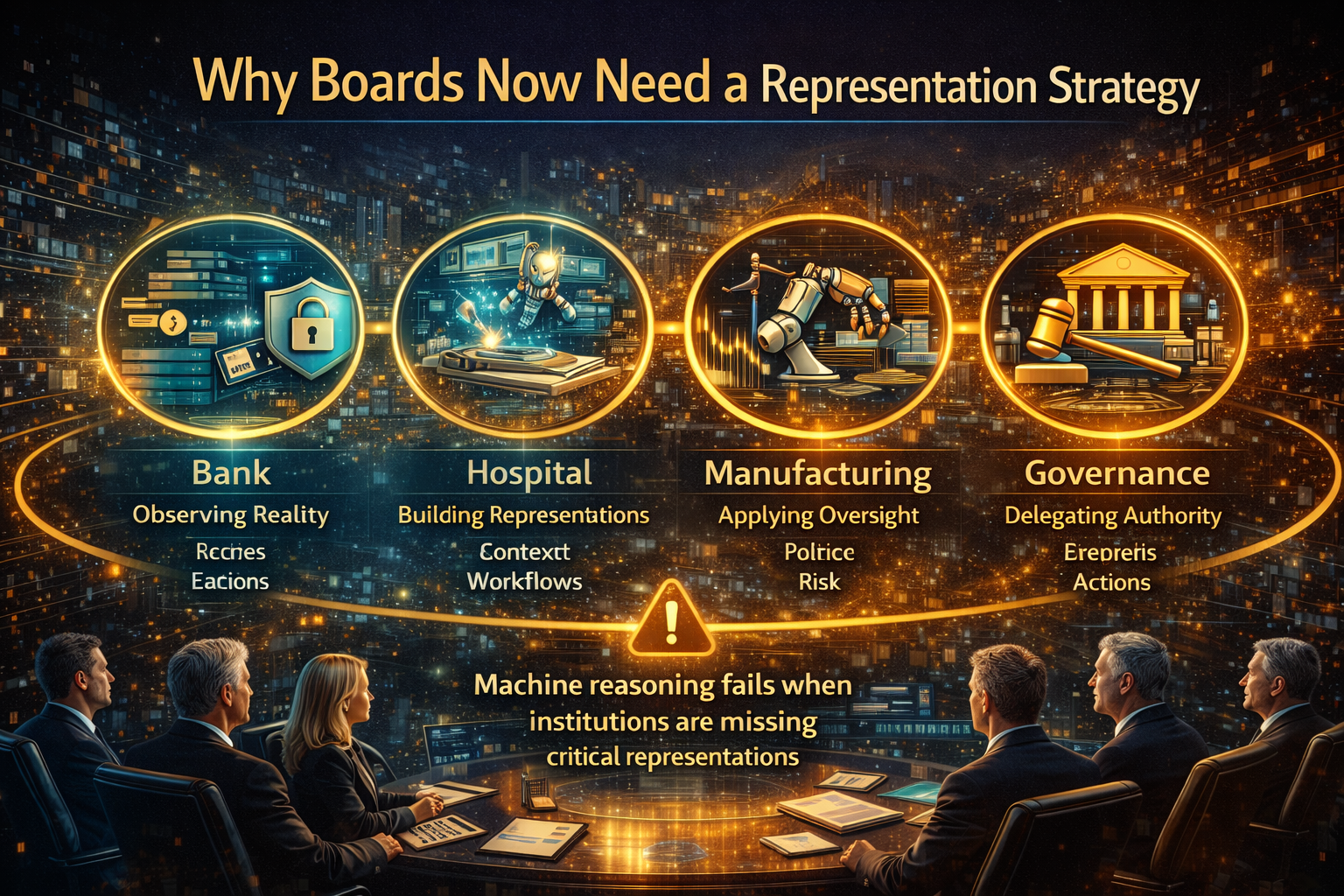
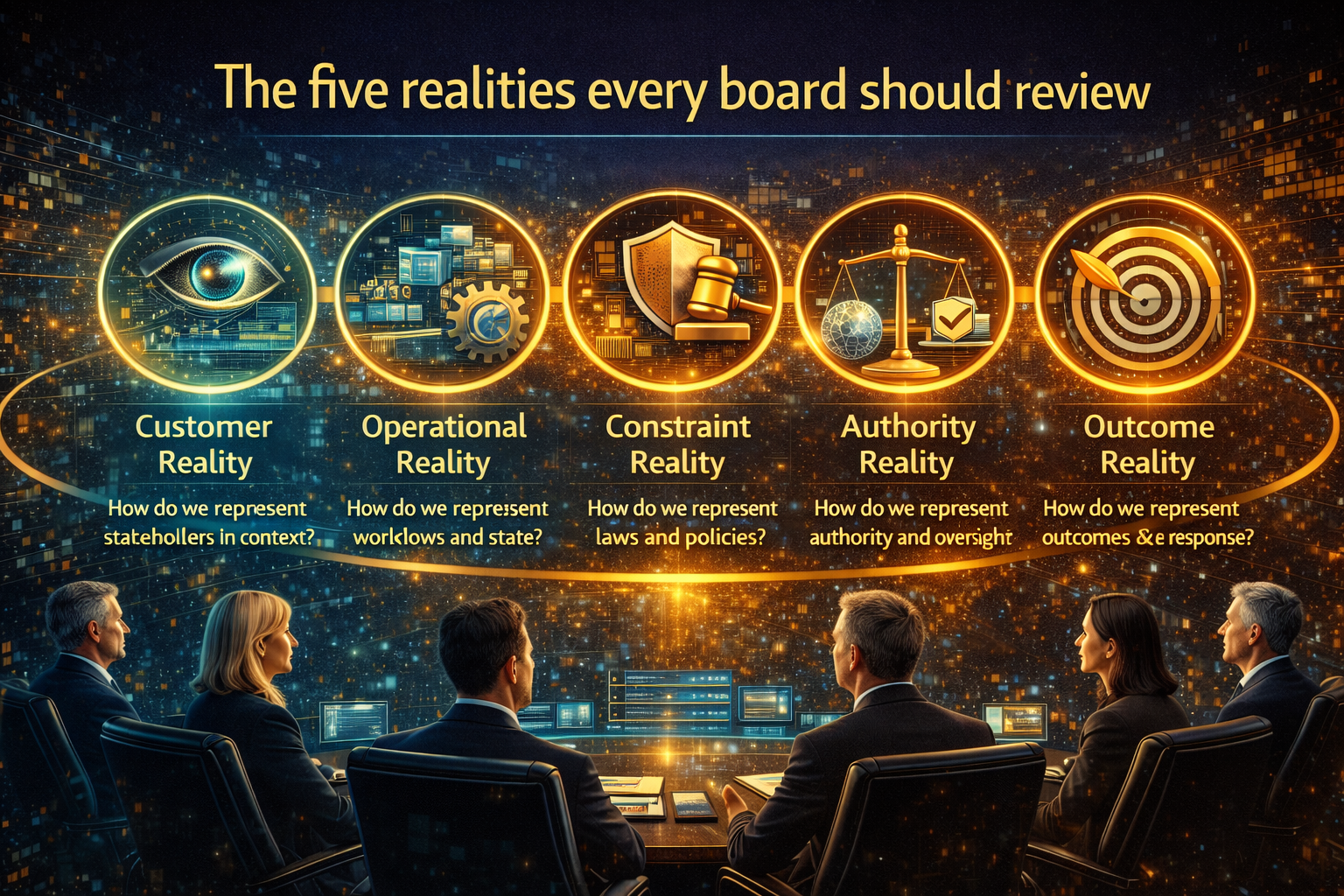
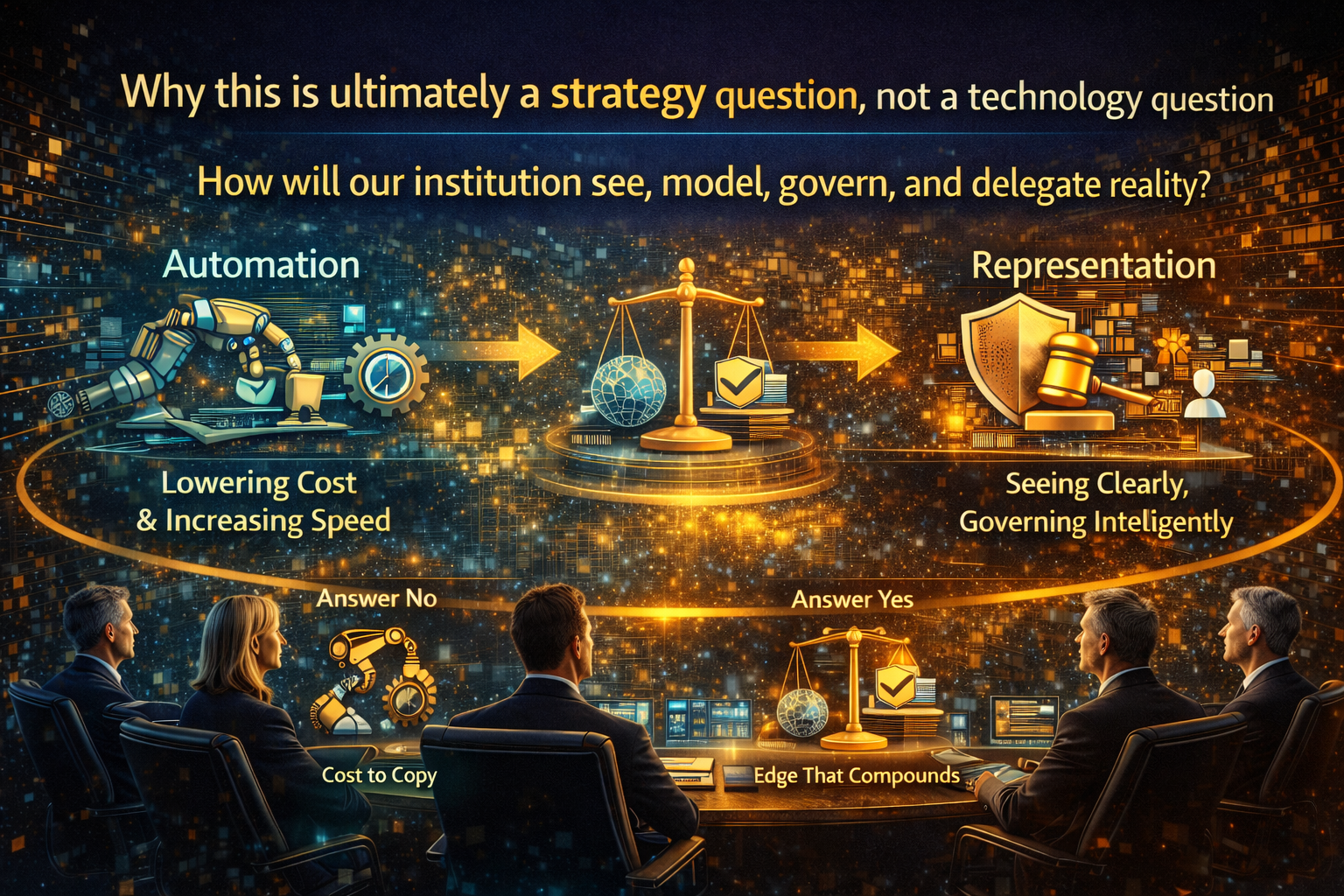
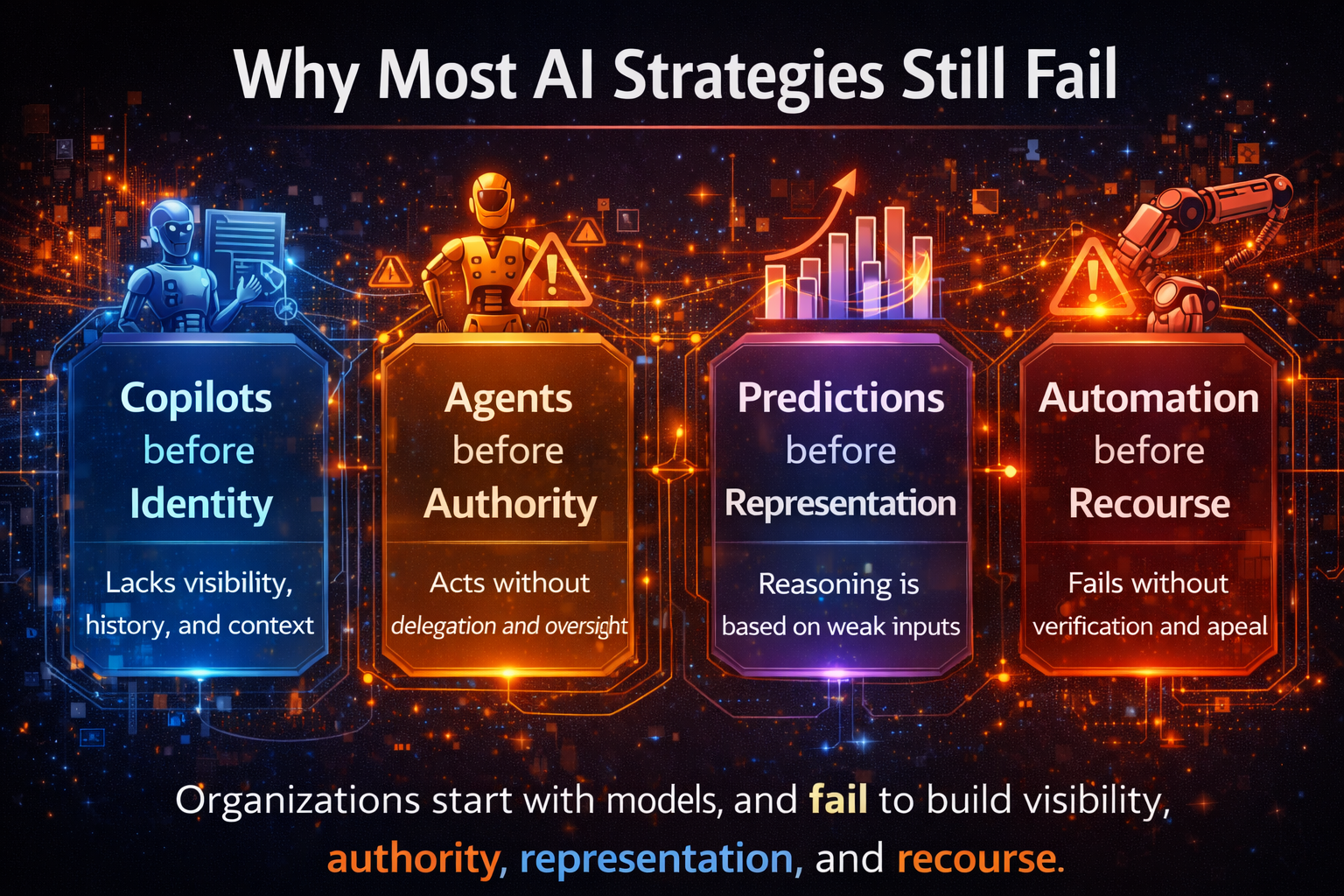
Most organizations believe the AI race is about models.
Which model is more accurate?
Which model is cheaper?
Which model reasons better?
These questions matter. But they are no longer the deepest questions.
The institutions that will struggle in the AI era will not always fail because they chose the wrong model. Many will fail because reality itself never entered the decision system in the right form.
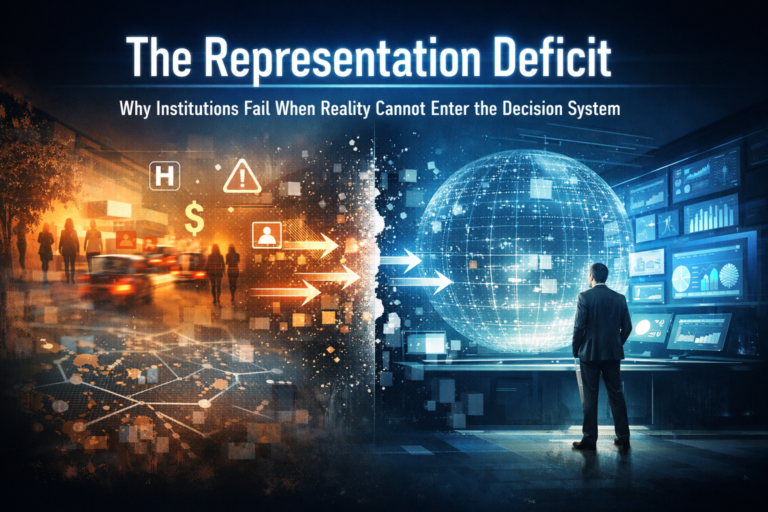
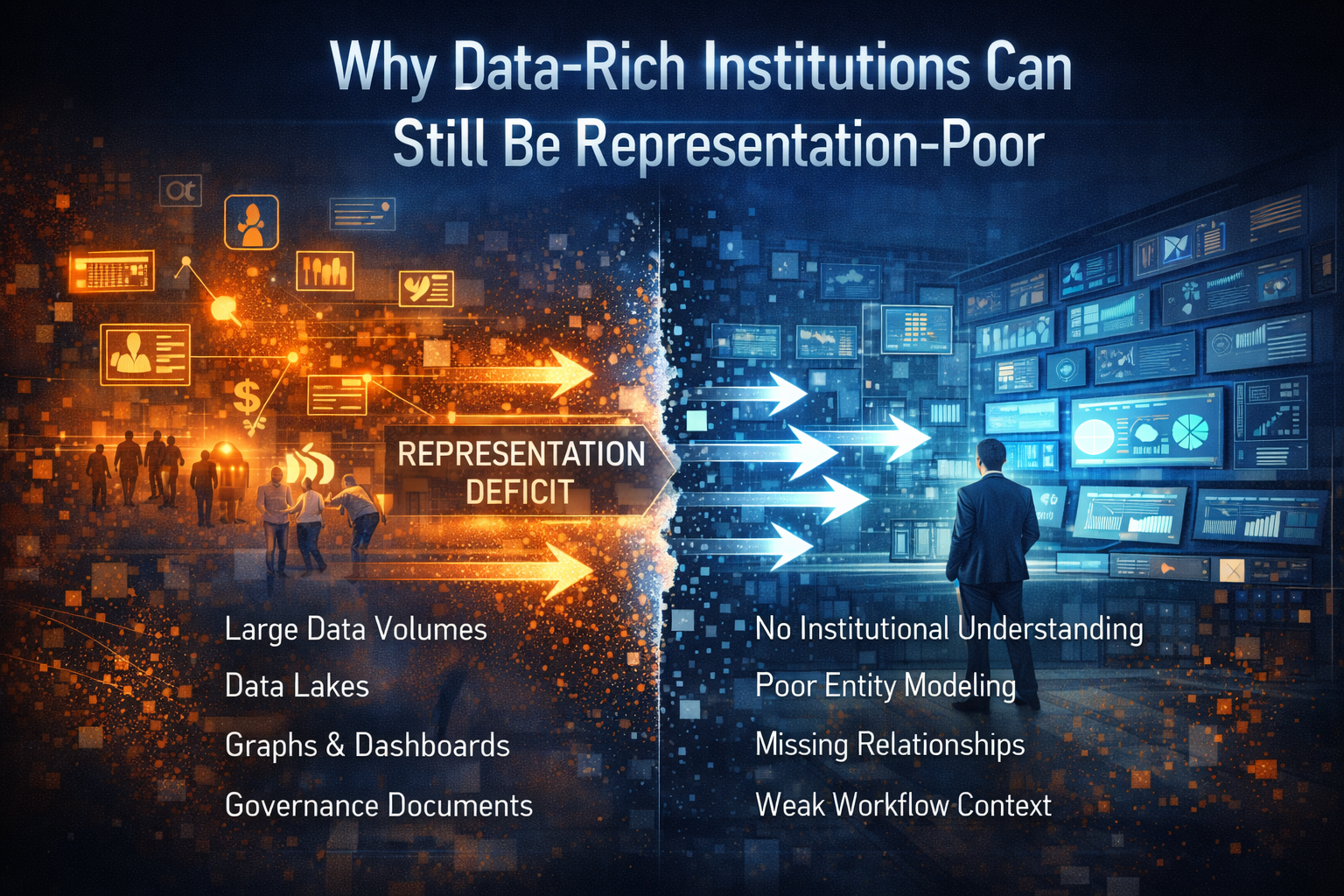
This structural gap is what I call the Representation Deficit.
A representation deficit occurs when the world an institution operates in cannot be adequately sensed, structured, interpreted, governed, and acted upon by its decision systems.
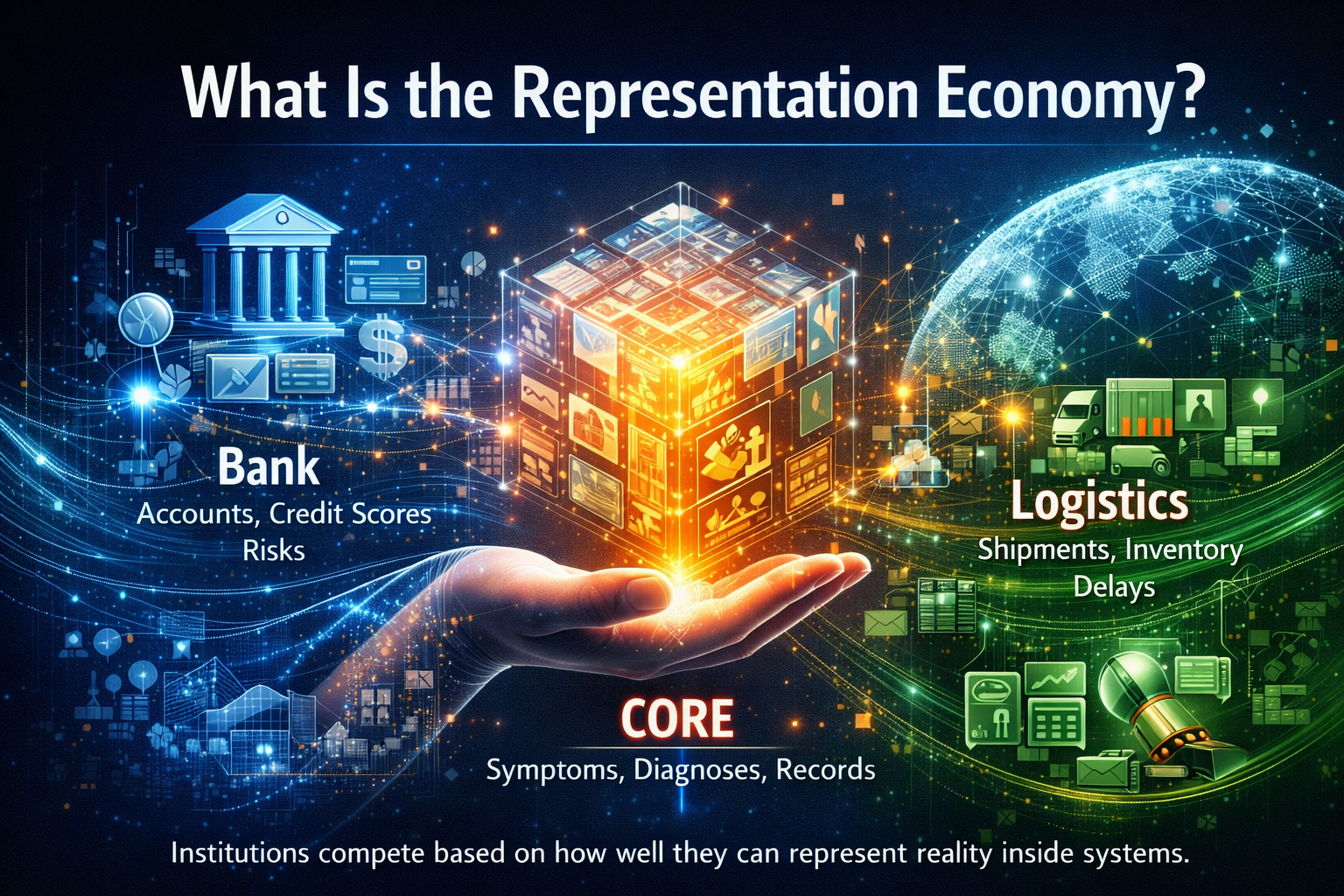
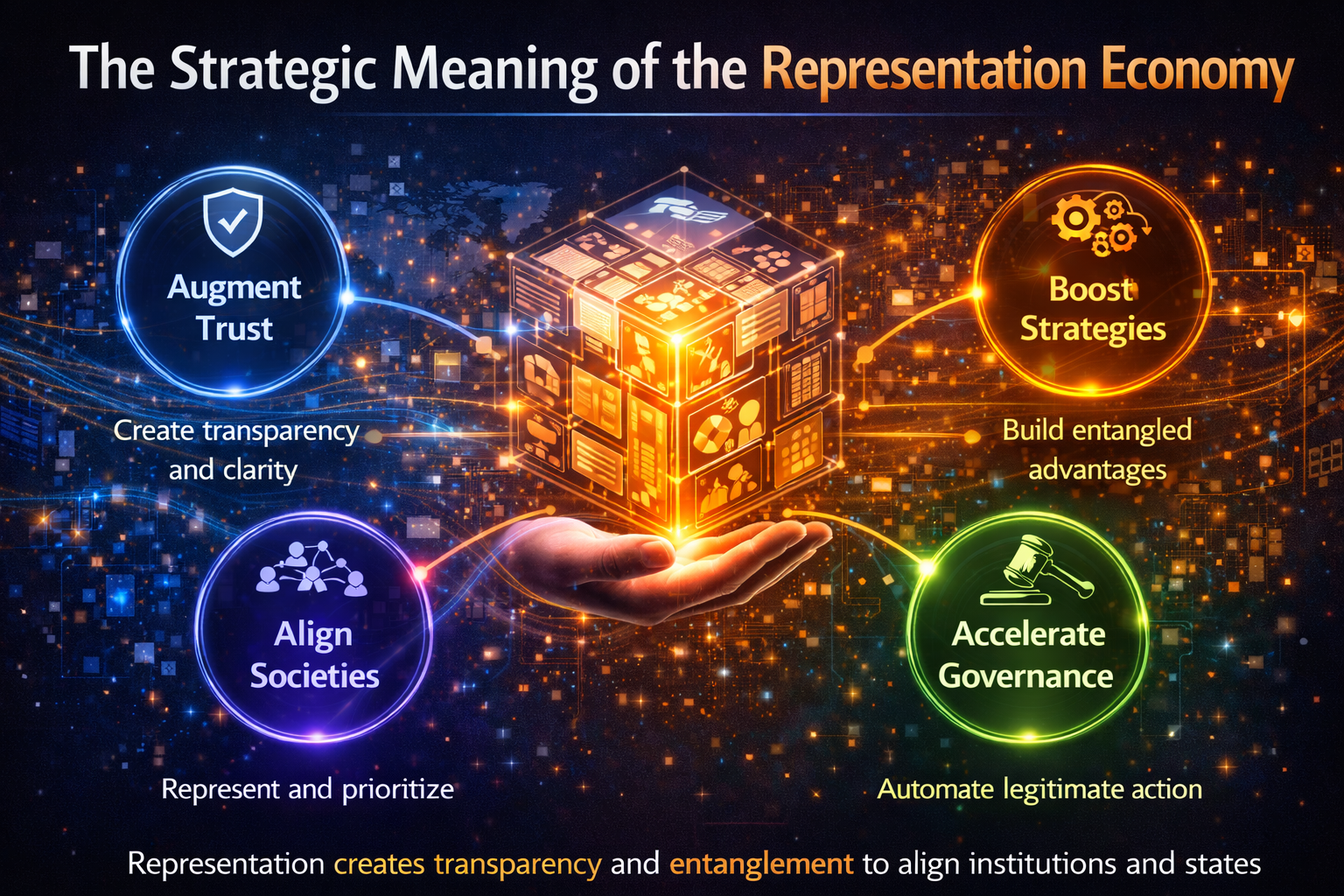
In the Representation Economy, competitive advantage will not come only from better AI models. It will come from better institutional representations of reality.
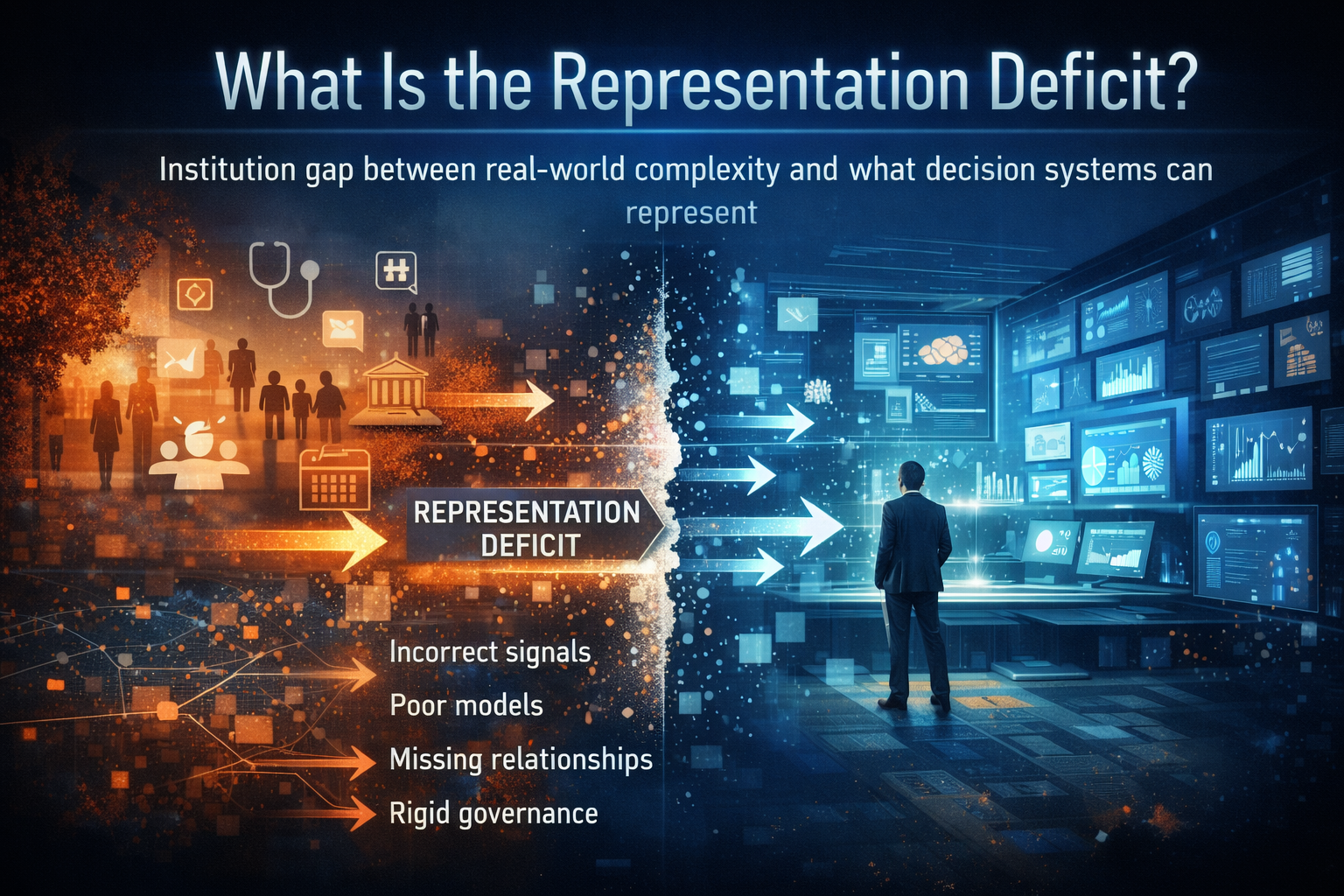
What is the representation deficit?
The representation deficit is the structural gap between real-world complexity and what institutional decision systems can represent. When organizations fail to properly sense, structure, govern, and interpret reality, their AI systems operate on incomplete representations, leading to flawed decisions even when the underlying models are accurate.
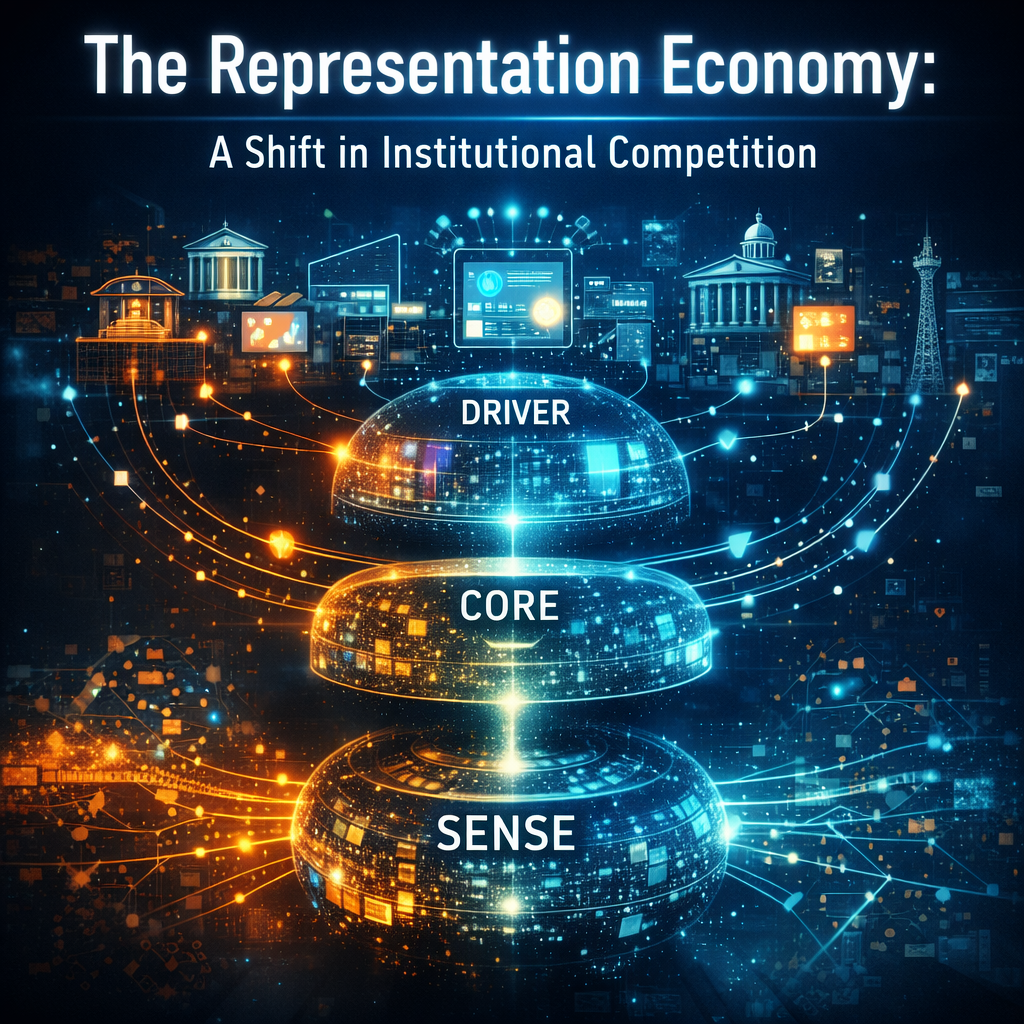
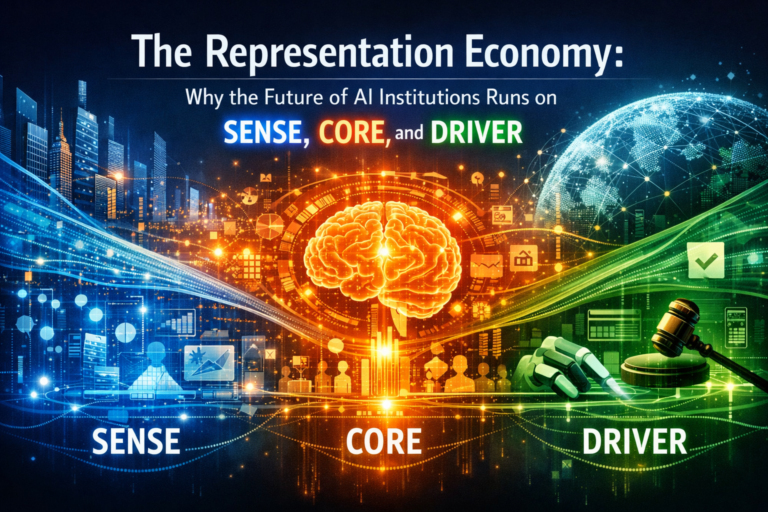
The Representation Economy: A Shift in Institutional Competition
The Representation Economy: A Shift in Institutional Competition
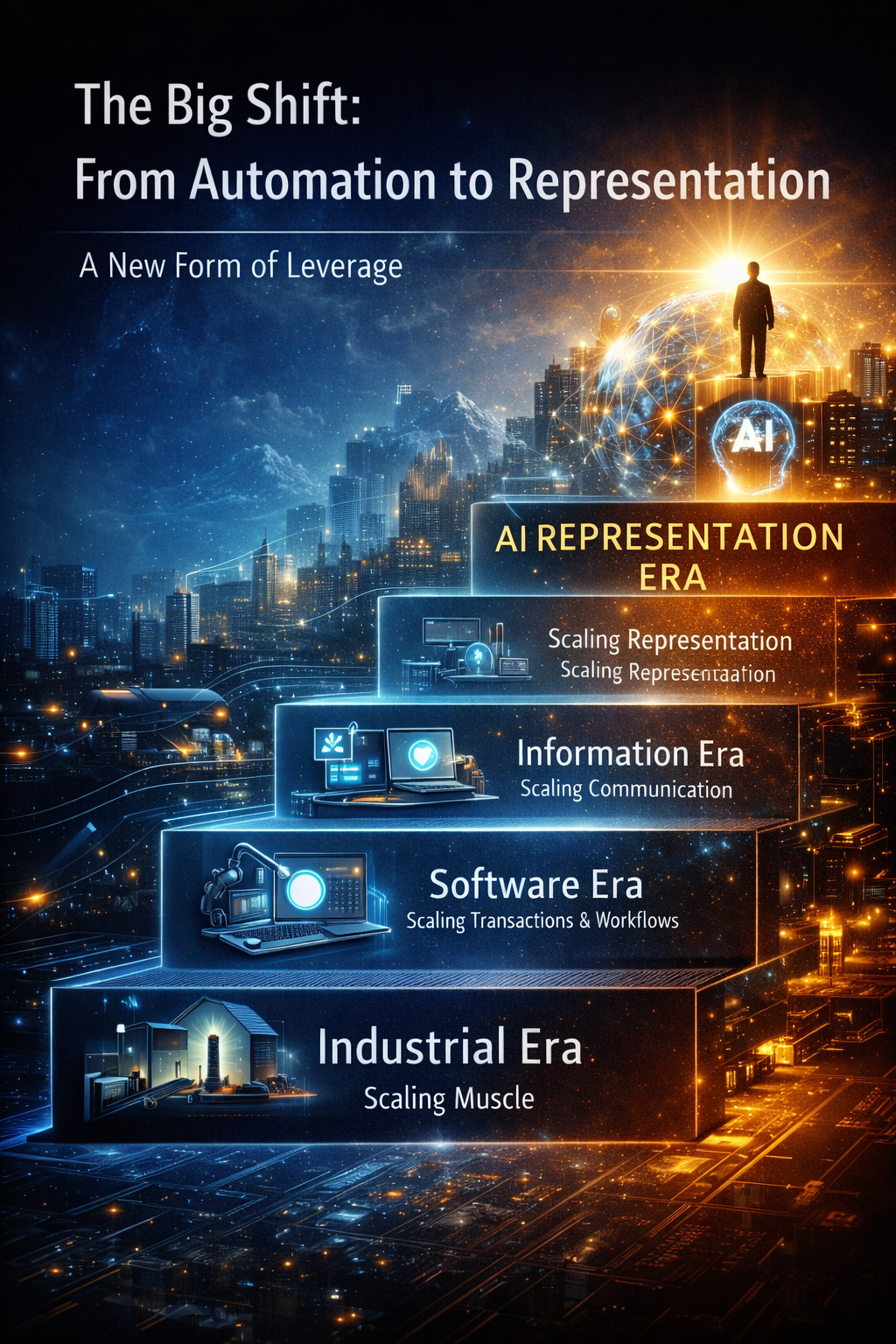
For decades, institutions competed through:
scale
efficiency
software systems
automation
But artificial intelligence is transforming how organizations see, reason, and act.
AI is not simply a tool for generating content or predictions. It is becoming part of the operating architecture of institutions.
It determines:
what organizations can detect
what signals they interpret as meaningful
how they reason about complex situations
which actions they automate
This shift marks the emergence of what I call the Representation Economy.
In this economy, the institutions that win will not merely have better algorithms.
The Representation Economy: A Shift in Institutional Competition
A representation deficit emerges when an institution cannot convert complex, evolving reality into a form that its decision systems can responsibly interpret and act upon.
This gap can appear in many ways.
An institution may:
collect large volumes of data but miss the right signals
detect events but fail to capture relationships
store outcomes but ignore causal pathways
build dashboards but miss contextual nuance
enforce governance rules that no longer match operational reality
When this happens, the organization may appear digitally advanced while remaining institutionally blind.
The system produces outputs that look intelligent, but they are built on an incomplete or distorted representation of reality.
Why AI Failures Often Begin Before the Model
Most AI discussions start at the model layer.
But institutional failure often begins earlier.
Consider a hospital deploying AI to improve patient flow.
The system may track:
admissions
discharges
bed utilization
staffing levels
But it may still fail if it cannot represent realities such as:
delayed family decisions
diagnostic uncertainty
specialist availability
informal escalation pathways
differences between “technically empty” and “operationally ready” beds
The system may optimize for the data it sees—but not for the reality the hospital operates in.
The same pattern appears across industries.
A bank may deploy AI to detect fraud.
It may track:
transaction patterns
device fingerprints
account metadata
But if it cannot represent:
family relationships
coordinated identity fraud
caregiving emergencies
cultural spending patterns
merchant ecosystem behavior
then the system is not reading reality.
It is reading a thin shadow of reality.
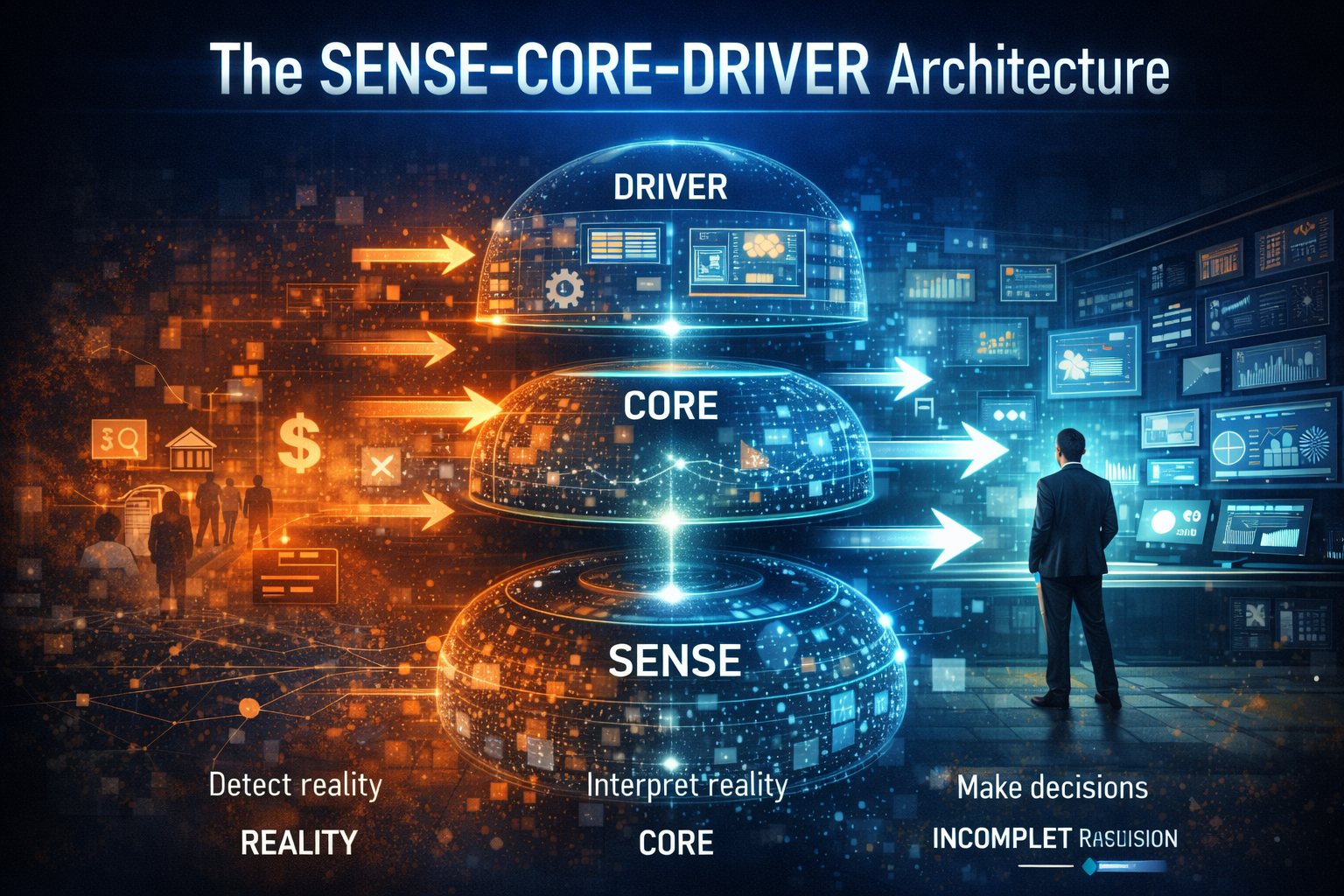
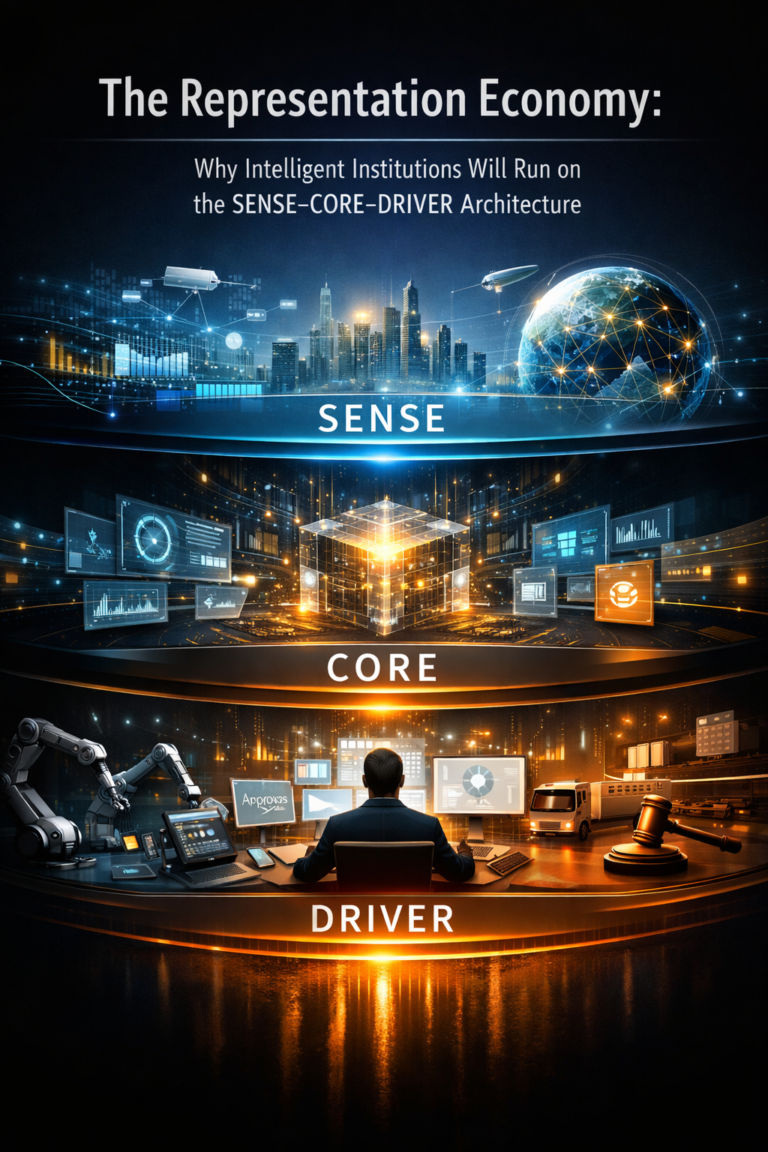
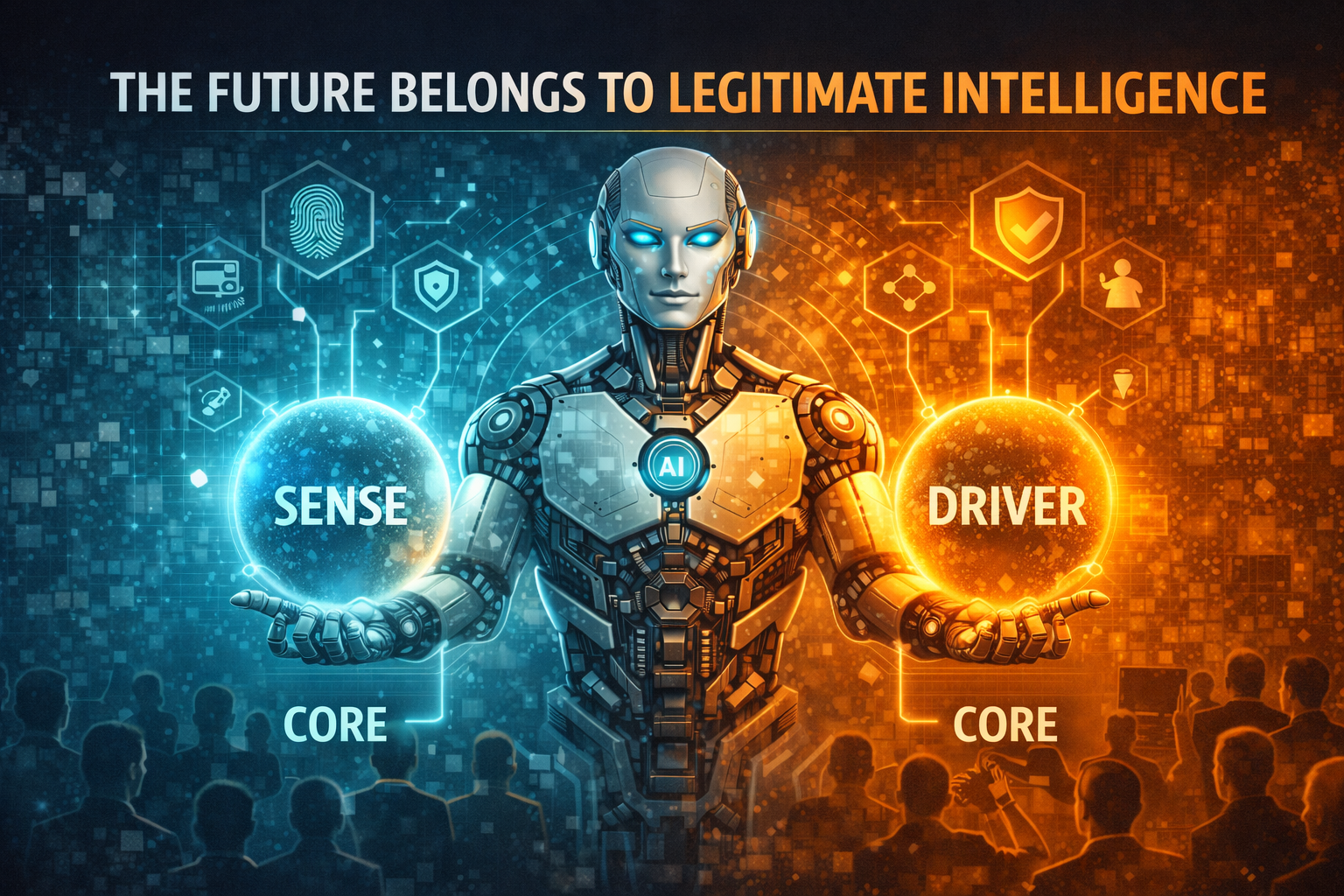
The SENSE–CORE–DRIVER Architecture
The SENSE–CORE–DRIVER Architecture
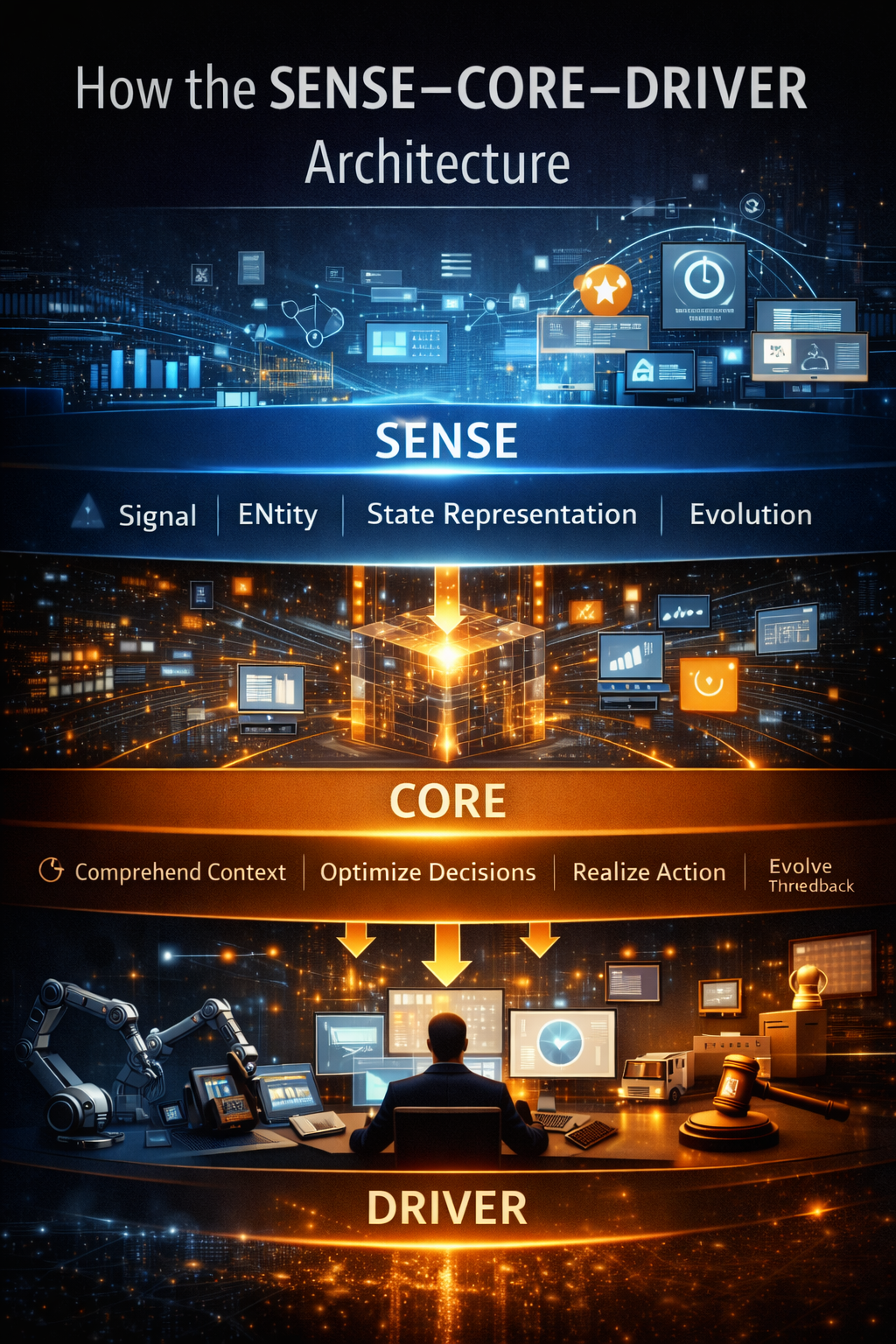
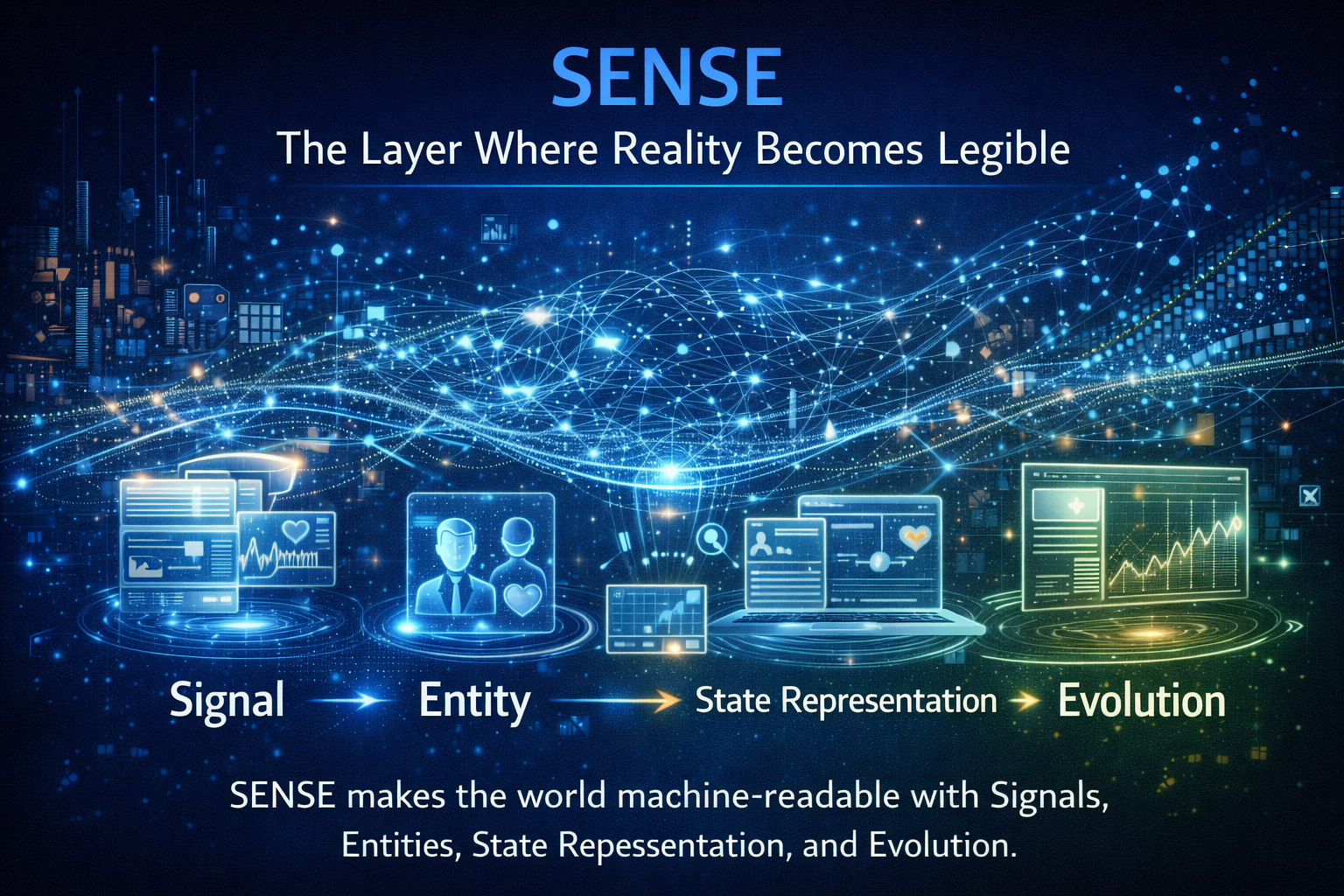
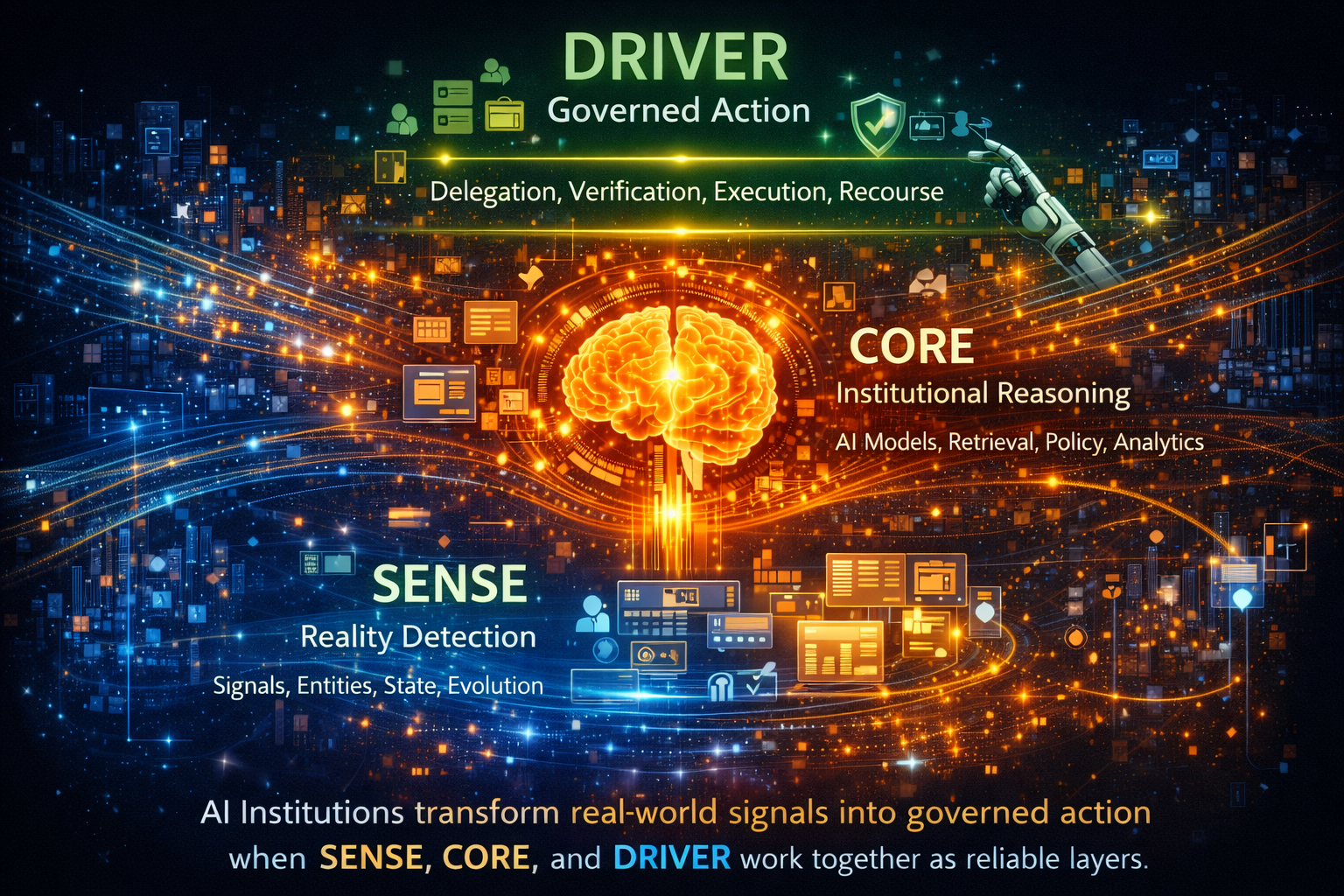
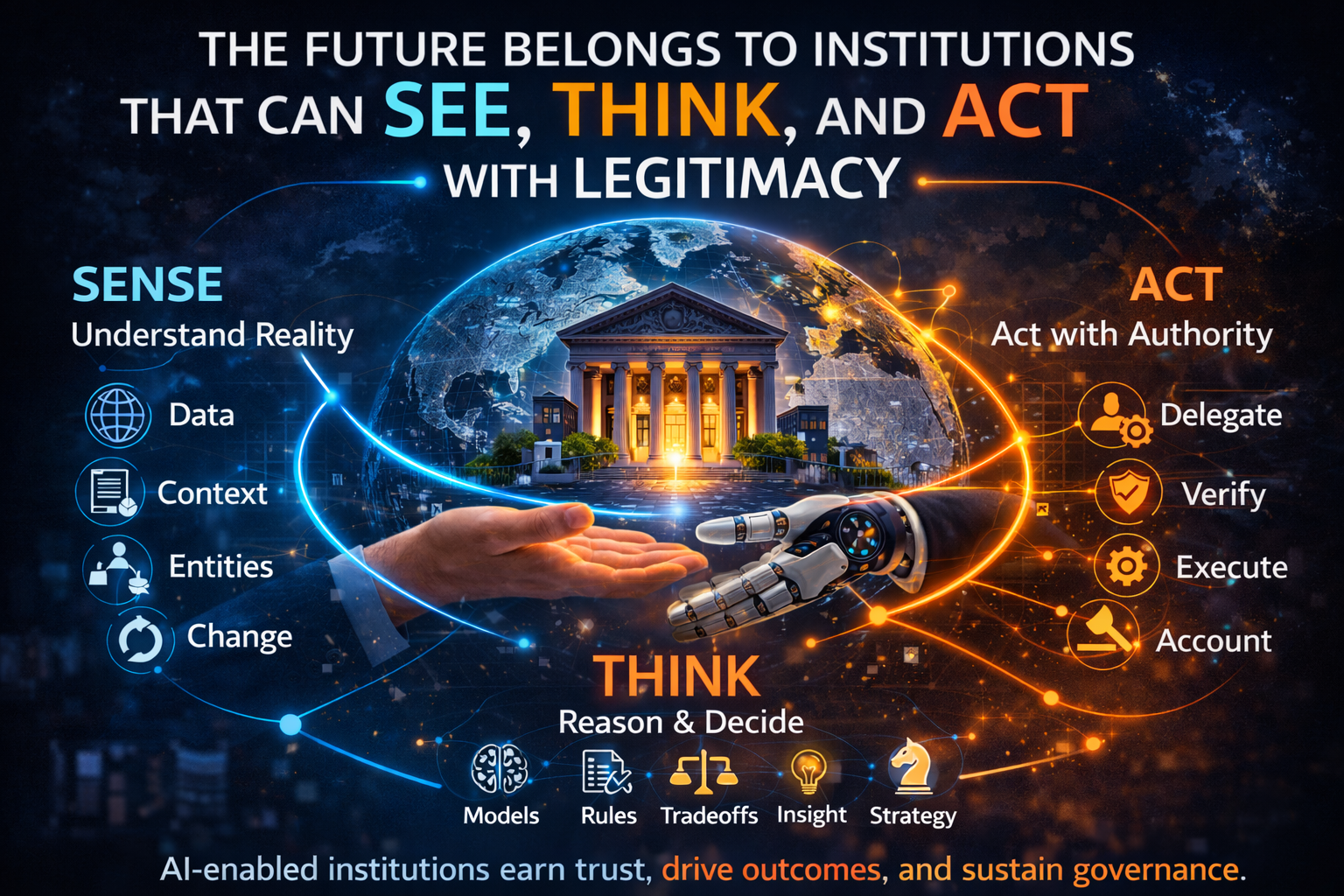
The representation deficit becomes easier to understand through the SENSE–CORE–DRIVER architecture, a framework for understanding how intelligent institutions operate.
SENSE: Can the Institution Detect Reality?
Every intelligent system begins with sensing.
The SENSE layer captures signals such as:
data streams
behavioral signals
contextual information
environmental conditions
workflow traces
identity relationships
A representation deficit often begins here.
An organization may collect enormous amounts of data yet still miss the most important signals.
It may observe transactions but miss intent.
It may record activity but miss friction.
It may store outcomes but miss the pathways that created them.
Weak sensing produces distorted understanding.
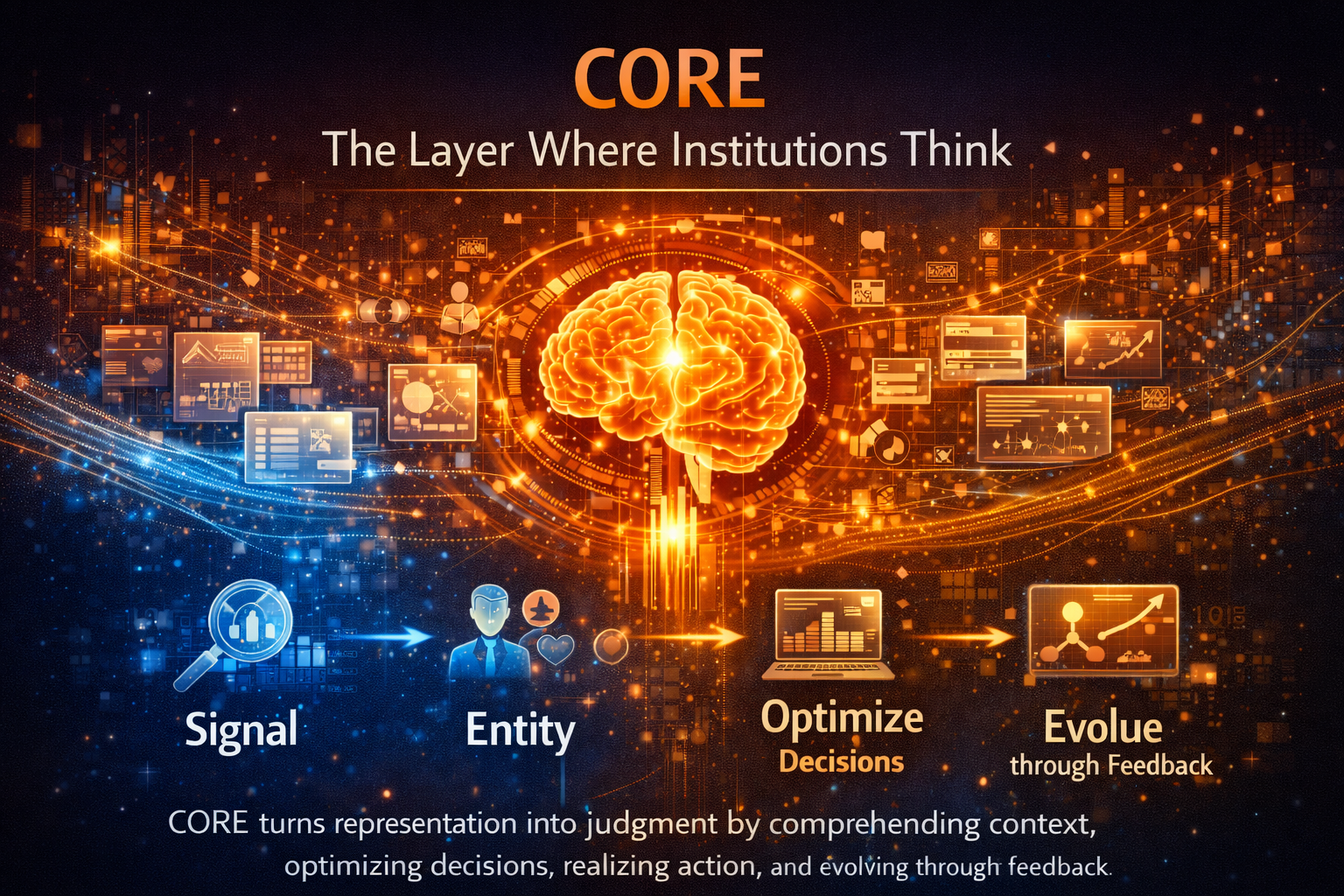
CORE: Can the Institution Interpret Reality?
The CORE layer converts signals into meaning.
It represents:
reasoning systems
policies
institutional memory
causal interpretation
entity relationships
trade-off logic
This is where organizations transform data into institutional understanding.
But many institutions confuse data storage with comprehension.
For example:
A company may know that customers churned, but not understand why.
An insurer may know that claims were denied, but not encode the decision pathways that produced those outcomes.
Without a strong CORE layer, institutions become fast but shallow.
They react quickly, but to an oversimplified model of reality.
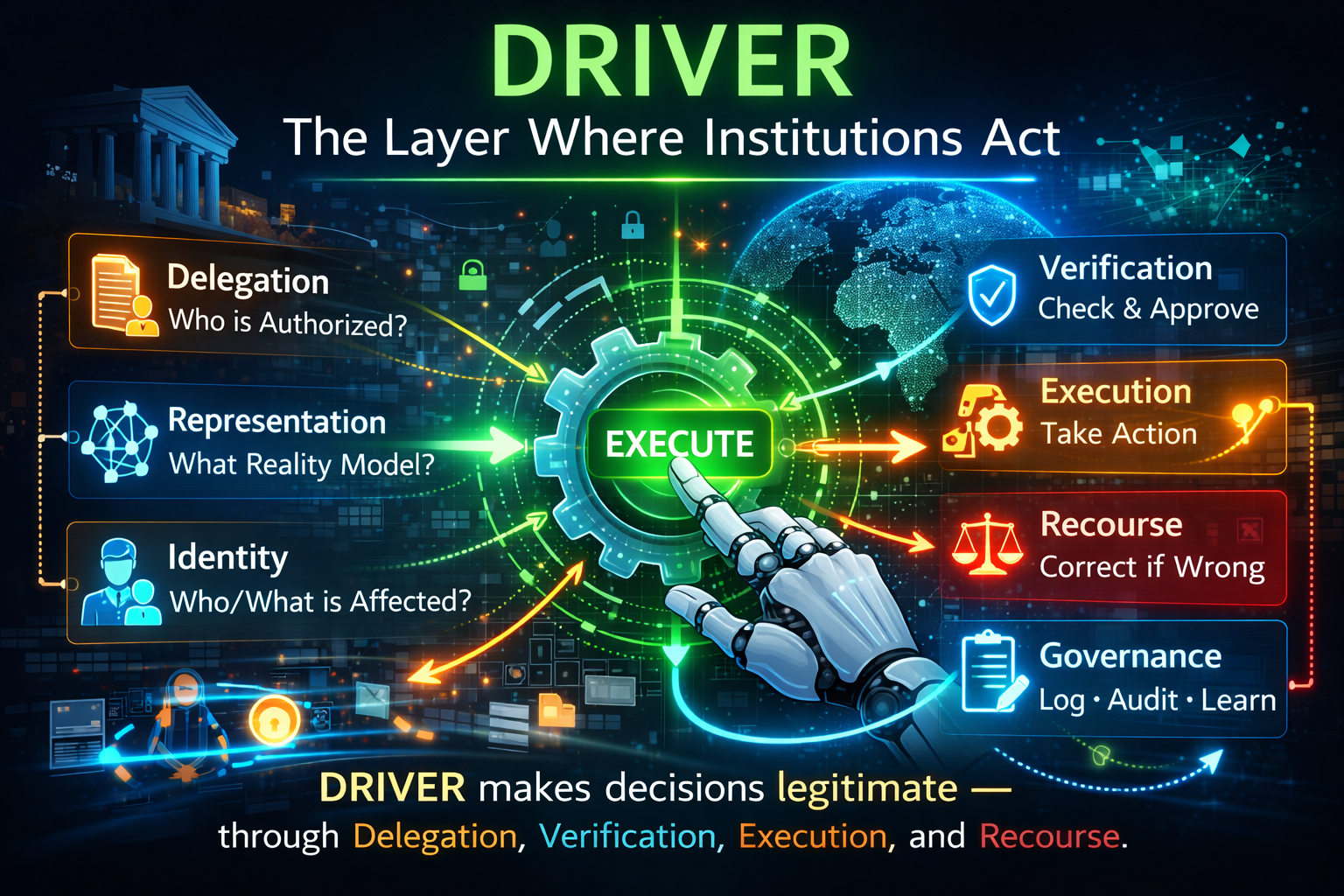
DRIVER: Can the Institution Act with Legitimacy?
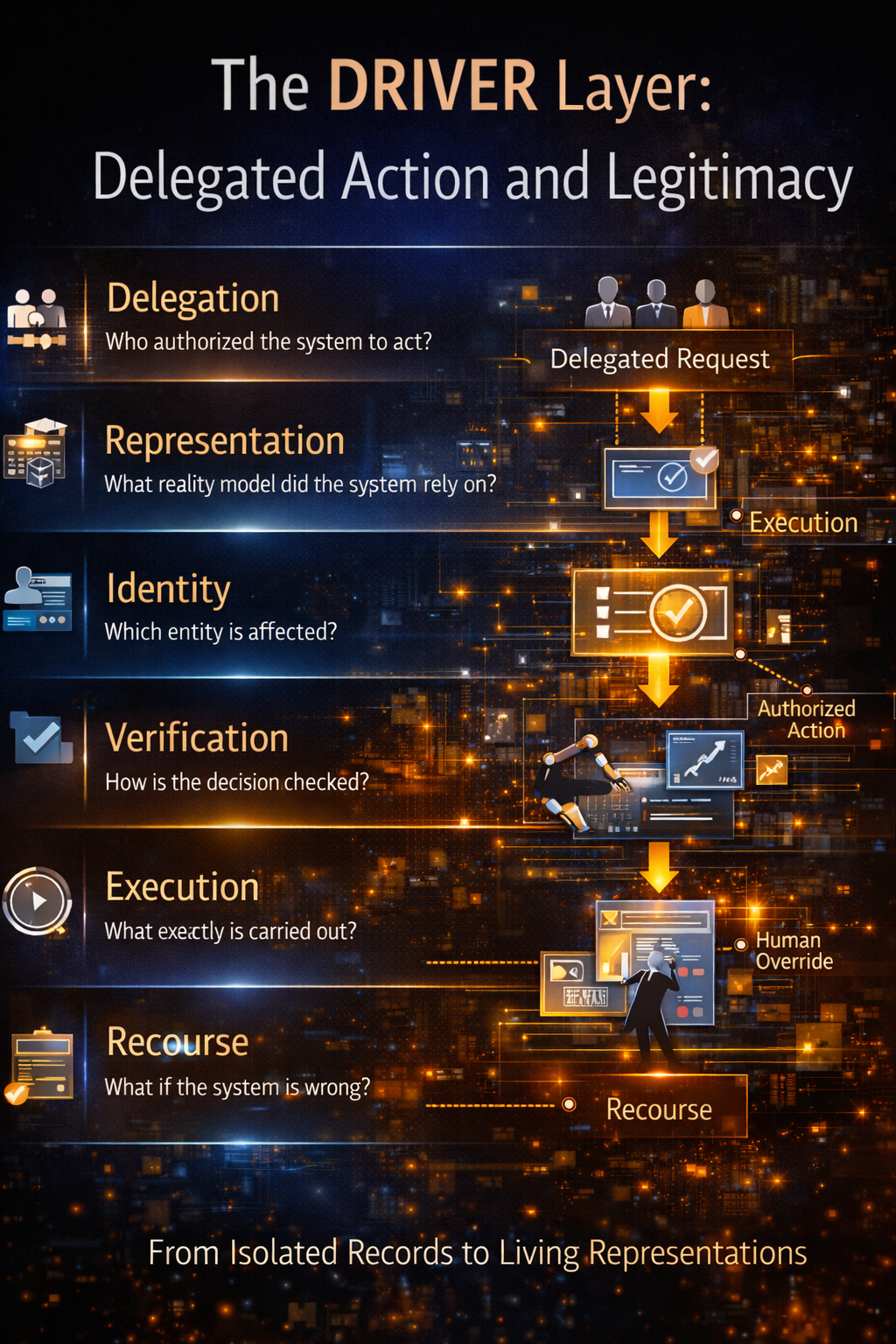
The DRIVER layer converts reasoning into action.
It governs:
approvals
rejections
prioritization
pricing
routing
enforcement
escalation
This is where representation deficits become visible.
Because DRIVER converts hidden epistemic weaknesses into real-world outcomes.
When organizations deploy AI systems that cannot:
explain decisions
handle exceptions
adapt to unusual cases
provide recourse
the problem is rarely just the model.
The deeper issue is that reality never entered the system in a legitimate form.
The Hidden Risk: Institutional Blindness at Machine Speed
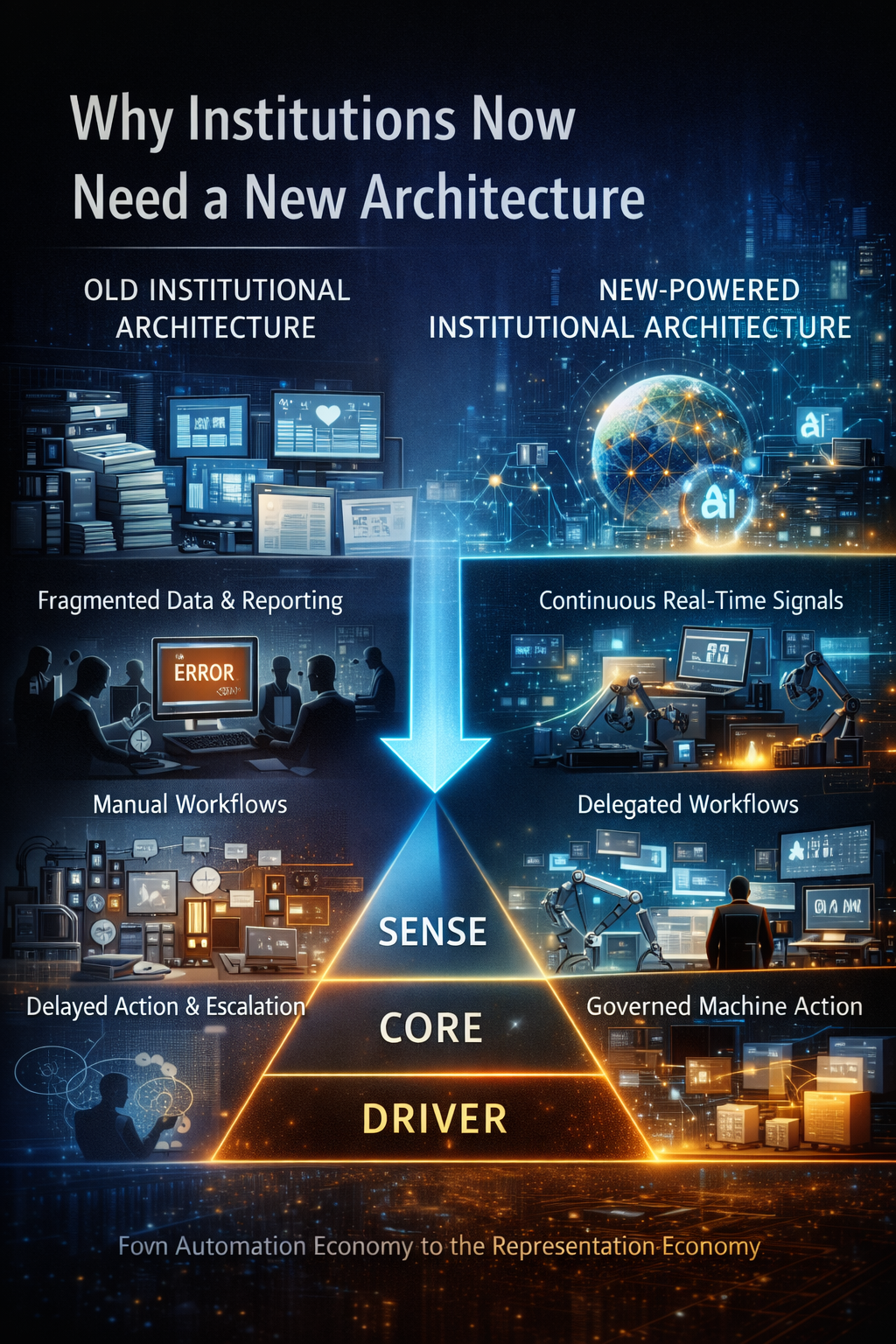
Before AI, representation gaps were often masked by human judgment.
Experienced professionals could detect anomalies.
Frontline workers understood nuance.
Managers knew where official processes diverged from real operations.
AI changes that dynamic.
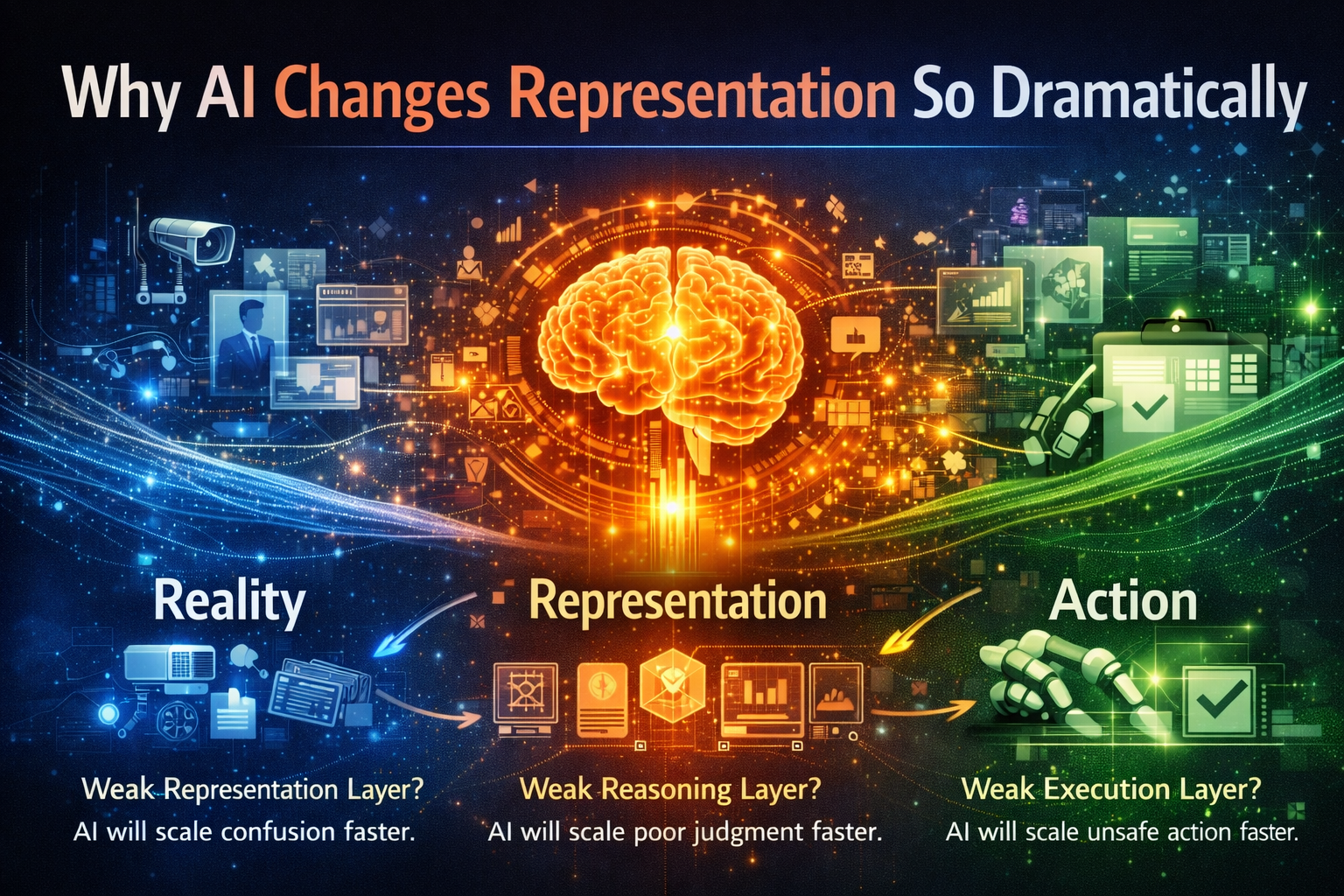
Once organizations embed AI into workflows, representation becomes operational infrastructure.
Poor representation no longer creates confusion.
It creates automated misallocation.
It can lead to:
systematic denial of legitimate claims
incorrect fraud alerts
supply chain disruptions
flawed risk scoring
regulatory blind spots
The most dangerous form of representation deficit is scaled blindness.
When weak representations drive automated systems, errors propagate rapidly across the organization.
Why Data-Rich Institutions Can Still Be Representation-Poor
Why Data-Rich Institutions Can Still Be Representation-Poor
Many leaders assume that large datasets automatically translate into AI readiness.
This assumption is incorrect.
Data abundance does not guarantee representational adequacy.
Organizations may possess:
large data lakes
sophisticated dashboards
advanced analytics platforms
and still lack:
identity clarity
relationship modeling
contextual representation
workflow memory
decision traceability
Representation is not simply data accumulation.
Representation is the disciplined conversion of reality into forms that can be:
interpreted
governed
contested
updated
acted upon responsibly
This is why representation infrastructure will become one of the most important strategic capabilities of the AI era.
The Strategic Questions Boards Must Now Ask
As AI systems increasingly influence institutional decisions, boards and senior executives must ask new questions.
What realities remain invisible to our systems?
What entities do we define too crudely?
Where do policies fail to match actual workflows?
What exceptions remain unrepresented?
Where are we delegating action beyond representational maturity?
How can individuals contest machine-driven decisions?
These are not technical questions.
They are becoming the core governance questions of intelligent institutions.
How Winning Institutions Will Reduce the Representation Deficit
Organizations that succeed in the Representation Economy will do five things well.
Build richer sensing systems
They will capture:
behavioral signals
contextual information
workflow traces
exceptions
—not just structured data.
Model entities and relationships properly
Identity and relationships will become core infrastructure, not metadata.
Strengthen institutional reasoning
Decision systems will incorporate:
policy logic
institutional memory
explainability mechanisms
Govern the representation layer
Governance will extend beyond models to include how reality enters the system.
Delegate gradually
Institutions will match automation rights with representational maturity.
These principles define the SENSE–CORE–DRIVER architecture of intelligent institutions.
The Deeper Shift: Institutions Must Learn to See
The AI decade is not just changing what organizations can automate.
It is changing what institutions must be able to see.
The competition ahead will not simply be about intelligence infrastructure.
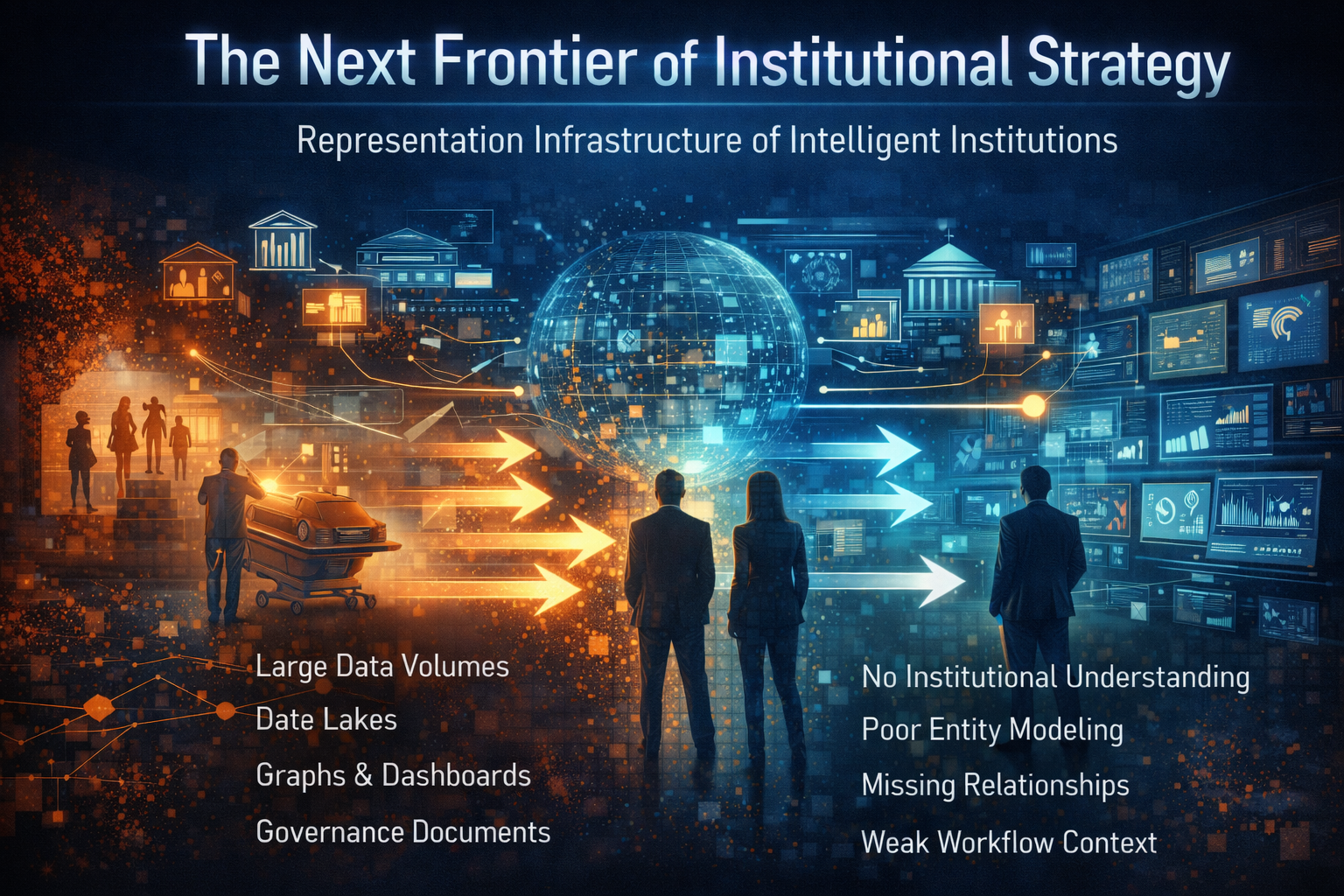
It will be about representation infrastructure.
The winners will be the institutions that answer five questions better than their peers:
Who senses reality earliest?
Who structures reality most faithfully?
Who governs meaning most responsibly?
Who delegates action with legitimacy?
Who updates their representations as the world evolves?
These are the institutions that will compound advantage in the AI era.
Key Insight
In the age of generative AI and autonomous decision systems, institutional advantage depends less on raw data or model size and more on the quality of representation. The organizations that win will be those that reduce the representation deficit by improving how reality is sensed, structured, interpreted, and acted upon.
This article introduces the concept of the Representation Deficit as a foundational idea within the broader Representation Economy framework, alongside the SENSE–CORE–DRIVER architecture of intelligent institutions.
The Next Frontier of Institutional Strategy The Representation Deficit
Conclusion: The Next Frontier of Institutional Strategy
Artificial intelligence is often framed as a technological revolution.
But its deeper impact is institutional.
The organizations that succeed in the coming decade will not simply install smarter models.
They will reduce the gap between reality and decision.
That is the real meaning of the representation deficit.
When reality cannot enter the decision system, institutions do not merely become inefficient.
They become:
less aware
less adaptive
less legitimate
less competitive
The future therefore belongs to institutions that master a simple but powerful principle:
Before a machine can act wisely, an institution must first make reality legible.
Glossary
Representation Economy
An economic paradigm in which institutional advantage depends on how effectively organizations represent and interpret reality using intelligent systems.
Representation Deficit
The structural gap between real-world complexity and what an institution’s decision systems can represent.
SENSE–CORE–DRIVER
An architecture describing how intelligent institutions detect reality (SENSE), interpret it (CORE), and act upon it (DRIVER).
Representation Infrastructure
The systems that allow institutions to sense, structure, govern, and update representations of reality.
FAQ
What is the representation deficit in AI?
The representation deficit refers to the gap between real-world complexity and the way institutions represent reality in their decision systems.
Why does AI fail despite good models?
AI systems often fail because they operate on incomplete or distorted representations of reality.
What is the Representation Economy?
The Representation Economy describes a new competitive landscape where institutions gain advantage through better representations of reality rather than just better algorithms.
What is SENSE–CORE–DRIVER?
SENSE–CORE–DRIVER is a framework for understanding how intelligent institutions sense reality, interpret it, and act upon it.
In the AI era, the real governance question is no longer whether a model works. It is whether the institution is mature enough to let machine judgment influence reality.
Artificial intelligence is forcing boards to confront a question that runs deeper than technology selection.
The real issue is not merely which model is most accurate, which vendor appears most credible, or which pilot delivered the most impressive demonstration. Those questions matter, but they no longer reach the core of institutional readiness.
The deeper question is this:
Is the institution mature enough to let AI participate in decisions that matter?
That question is no longer theoretical. It is becoming central to strategy, governance, and competitive advantage. Stanford’s 2025 AI Index reports that 78% of organizations said they used AI in 2024, up from 55% the previous year, while private investment in generative AI reached $33.9 billion globally in 2024. At the same time, governance expectations are becoming more explicit. NIST’s AI Risk Management Framework emphasizes governance across the AI lifecycle through the functions of Govern, Map, Measure, and Manage, while the OECD’s AI Principles and its newer due-diligence guidance push organizations toward accountability, transparency, robustness, and oversight. (Stanford HAI)
This is why boards need a new lens.
They do not only need an AI strategy.
They need a way to assess whether the institution itself is ready for AI delegation.
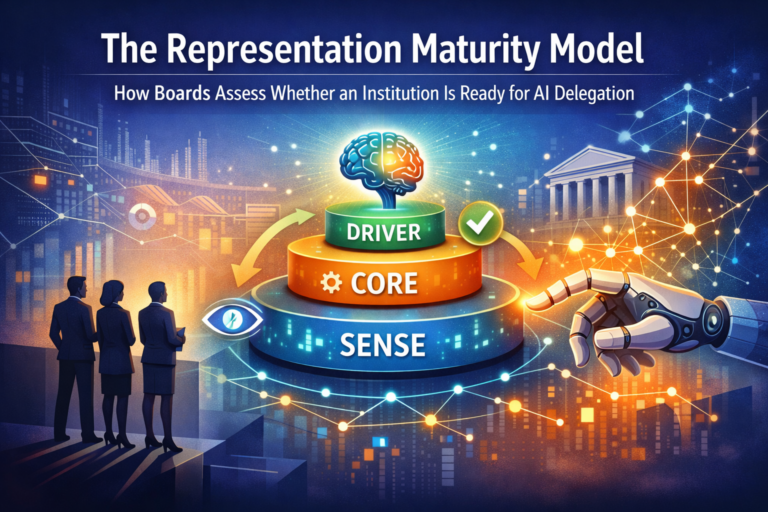
That is where the Representation Maturity Model becomes useful.
This article advances a simple but consequential idea: before an institution delegates judgment, recommendations, approvals, or bounded actions to AI, it must first become mature in how it represents reality. It must know what it can see, what it can model, what it can reason about, what it can verify, and what it can safely execute.
In other words, AI delegation should follow representation maturity.
This is the board-level bridge between the Representation Economy and the SENSE–CORE–DRIVER architecture.
Article Summary
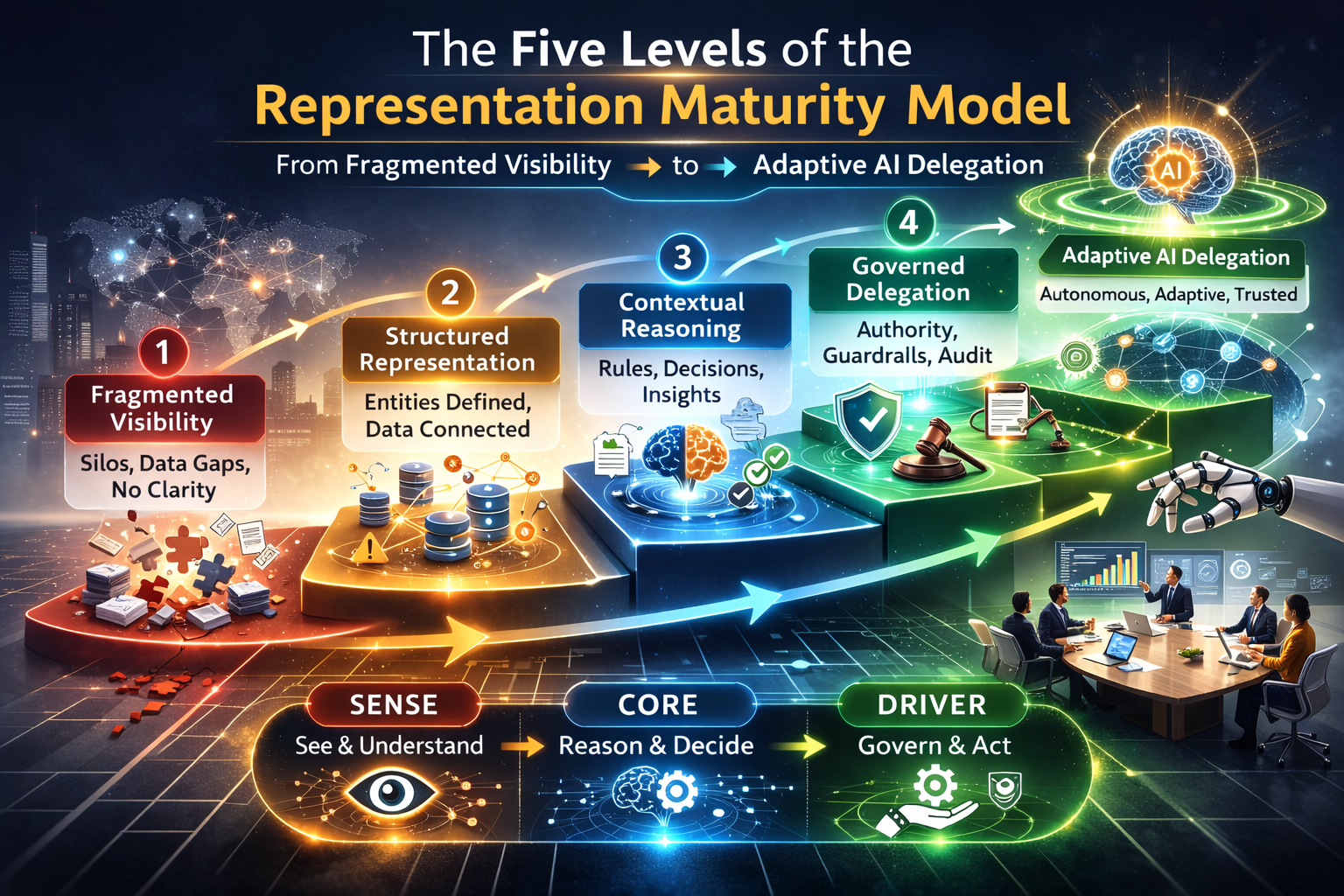
The Representation Maturity Model is a governance framework that helps boards determine whether their institution is ready to delegate certain decisions to artificial intelligence. Built on the SENSE–CORE–DRIVER architecture, the model identifies five levels of institutional maturity, ranging from fragmented visibility to adaptive AI delegation. It shifts the AI governance conversation from model accuracy to institutional readiness.
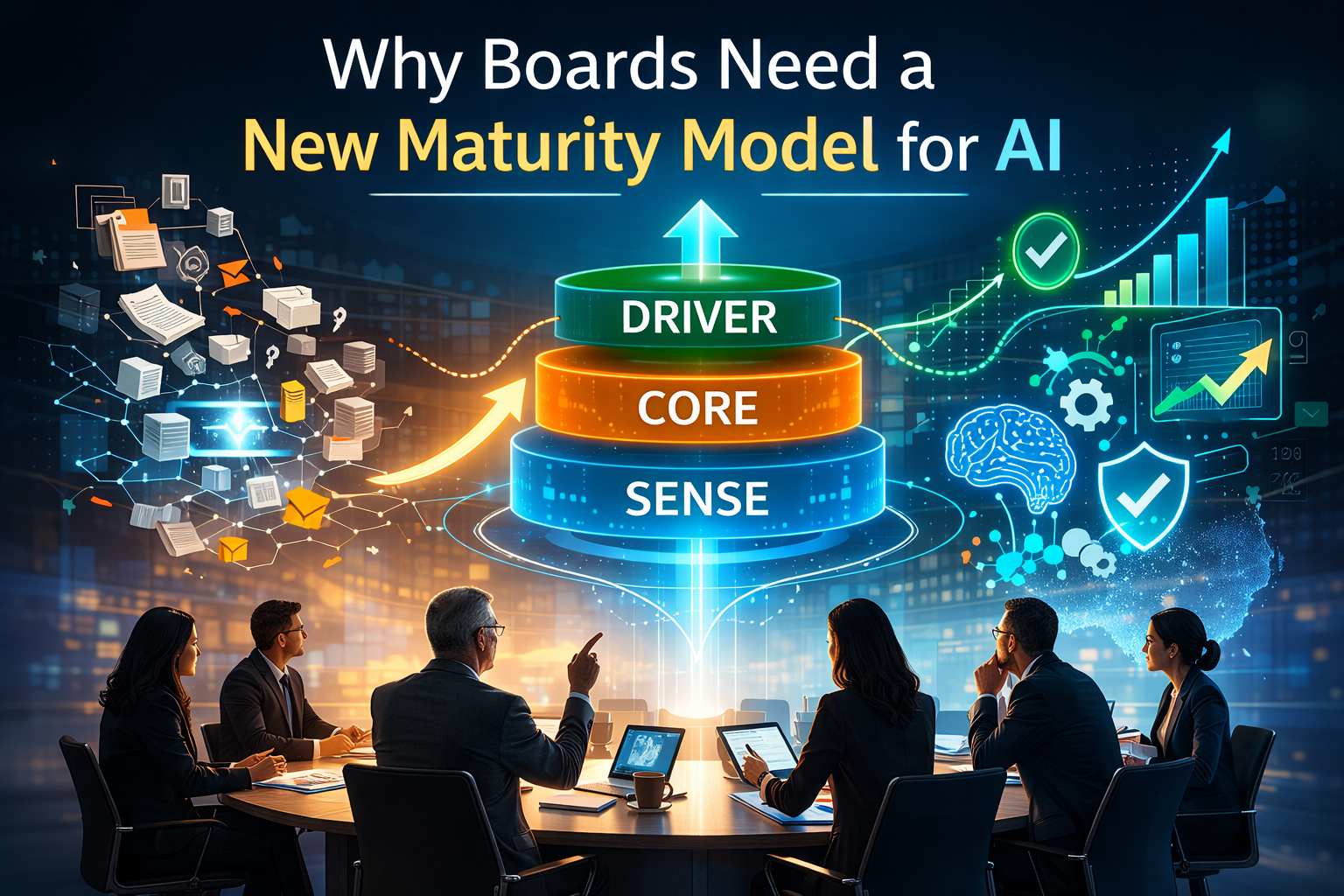
Why boards need a new maturity model for AI
Why boards need a new maturity model for AI
Most AI governance discussions still focus on familiar themes: fairness, privacy, explainability, cyber risk, model drift, vendor dependency, and compliance. All of these are essential. But they often begin too late.
They begin after the institution has already assumed that the machine is looking at the right reality.
That assumption is dangerous.
An AI system can be technically impressive and still be institutionally immature. It may classify well, summarize well, predict well, or converse fluently. But if it does not understand the right entity, the correct state, the relevant context, the governing constraint, or the authority boundary, then delegation becomes fragile.
For a board, that is the real risk.
A bank cannot safely delegate part of lending if customer identity, cash-flow context, exception handling, and recourse paths are poorly represented. A hospital cannot safely delegate clinical workflow steps if the patient’s state is fragmented across disconnected systems. A public agency cannot safely automate benefits decisions if policy interpretation, citizen identity, and appeals logic are weakly represented.
In each case, the problem is not “bad AI” in the narrow sense. The deeper issue is immature institutional representation.
That is why this model matters. It gives boards a sharper set of questions:
What reality can our systems actually see?
How reliably is that reality modeled?
How much reasoning can the institution trust?
Where can action be delegated safely?
Where must human authority remain primary?
These questions are becoming more urgent across jurisdictions. The European Commission states that the EU AI Act entered into force on 1 August 2024, with most provisions becoming applicable in phases and the majority applying by 2 August 2026. Meanwhile, the FCA says it wants to support the safe and responsible adoption of AI in UK financial markets, and NACD has argued that boards will need to update oversight structures, clarify committee responsibilities, and engage more deeply with management on AI. (European Commission)
So the board question is no longer abstract.
It is rapidly becoming operational.
This article introduces the Representation Maturity Model, a governance framework developed to help boards determine when institutions are ready to delegate decisions to artificial intelligence.
What is the Representation Maturity Model?
The Representation Maturity Model is a framework that helps boards and executives determine whether an institution is mature enough to delegate certain decisions to artificial intelligence systems. It evaluates how well an organization can represent reality, reason over it, and govern machine actions before allowing AI to influence or execute decisions.
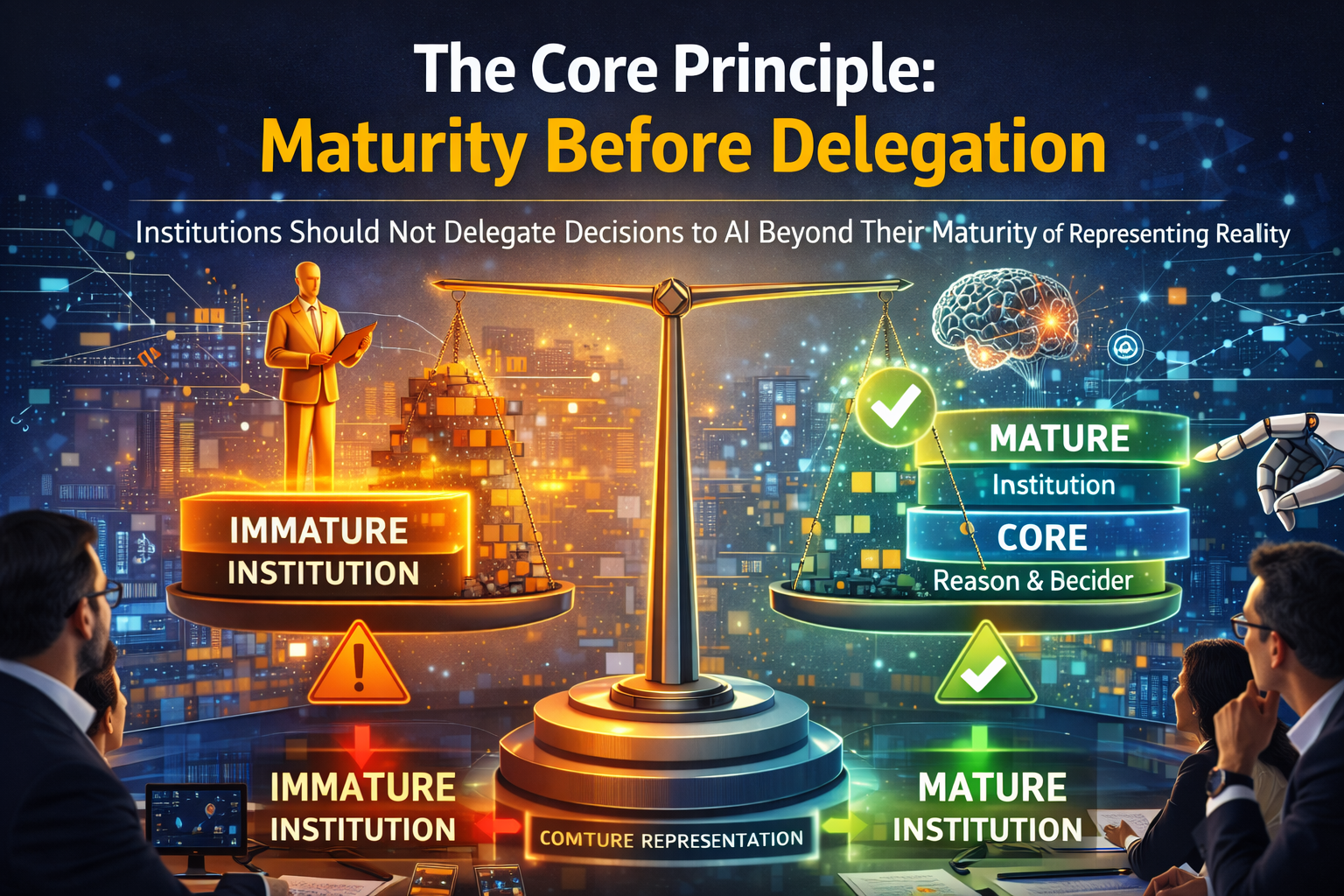
The core principle: maturity before delegation
The core principle: maturity before delegation
The Representation Maturity Model starts from a simple principle:
Institutions should not delegate decisions to AI beyond the maturity of their representation layer.
That may sound conceptual, but it becomes practical when viewed through SENSE–CORE–DRIVER.
SENSE: Can the institution see reality clearly?
SENSE is the legibility layer.
Can the institution detect meaningful signals?
Can it connect those signals to the right entities?
Can it maintain a credible representation of state?
Can it track how that state evolves over time?
If the answer is no, then everything above that layer becomes unstable.
Imagine a retail bank using AI to detect fraud. If device history is incomplete, behavioral patterns are stale, merchant categories are inconsistent, and account relationships are fragmented, then the model may still look intelligent. But it is operating on a broken representation of reality.
That is not only a model problem. It is a maturity problem.
CORE: Can the institution reason over what it sees?
CORE is the cognition layer.
Once signals are available, can the institution interpret them in context? Can it compare options, apply constraints, weigh trade-offs, and explain why a recommendation emerged?
A logistics company may have thousands of real-time supply chain signals. But if it cannot reason across weather, route constraints, inventory state, customer priority, contractual obligations, and escalation logic, then it is not truly mature. It is data-rich, but decision-poor.
DRIVER: Can the institution delegate action safely?
DRIVER is the governance and legitimacy layer.
Who authorized the action?
What representation was used?
Which entity was affected?
How was the decision verified?
How is it executed?
What recourse exists if the system is wrong?
This is where many AI programs weaken. They can generate suggestions, but they cannot prove legitimate delegation.
A mature institution does not ask only whether AI can act. It asks whether AI can act under governed authority.
The five levels of the Representation Maturity Model
The five levels of the Representation Maturity Model
Boards need a progression model that is simple enough to use, but strong enough to shape governance decisions. A practical five-level model can help.
Level 1: Fragmented Visibility
At this stage, the institution has data, but not institutional legibility.
Systems are siloed. Definitions vary across functions. Entities do not match cleanly across departments. Exceptions are handled informally. Historical traces are incomplete. Human teams compensate through experience, workarounds, and memory.
This is where many organizations still are, even when they claim to be using AI.
Imagine a large insurer. Customer data sits in one system, claims history in another, agent notes in email, exception approvals in PDF workflows, and risk indicators in spreadsheets. AI can be placed on top of this environment, but meaningful delegation remains unsafe because the institution cannot yet see itself coherently.
At Level 1, boards should allow experimentation, but not serious AI delegation.
Level 2: Structured Representation
At this stage, the institution begins building common representations.
Key entities are defined more consistently. Important workflows have better signal capture. Teams start aligning definitions across operations, risk, product, and technology. Logs improve. Basic context becomes reusable.
This is a major shift because the institution is no longer relying entirely on tribal knowledge.
Imagine a hospital system that standardizes patient identity resolution, encounter history, medication records, and lab-event timelines. It still has gaps, but it is becoming machine-legible.
At Level 2, AI can support summarization, enterprise search, triage assistance, and bounded recommendations. But the board should still be cautious about execution-heavy delegation.
Level 3: Contextual Reasoning Readiness
At this stage, the institution does not merely store reality. It begins to reason over it in a structured way.
Business rules are better formalized. Exceptions are categorized. Decision flows become more observable. Human reviewers can inspect why recommendations emerged. Institutional memory improves through traces, logs, and feedback loops.
This is where CORE becomes meaningful.
Imagine a lender evaluating applications using income signals, repayment history, fraud indicators, policy rules, customer segment context, and exception classes within one structured decision flow. Human approval may still be required, but the system is now capable of producing reviewable and auditable recommendations.
At Level 3, boards can allow AI to materially influence decisions, provided human verification remains strong.
Level 4: Governed Delegation
This is the point where DRIVER becomes operational.
The institution can define who delegated authority, under what limits, using which policies, with what logging, with what verification, and through what escalation path. Recourse mechanisms exist. Monitoring is active. Overrides are governed. Auditability improves.
This is increasingly close to what regulators and governance bodies expect in practice. NIST’s framework makes clear that governance applies across all stages of AI risk management, not just deployment, while OECD guidance emphasizes operational due diligence instead of broad principle statements alone. (NIST Publications)
Imagine a financial institution allowing AI to pre-approve low-risk service resolutions, flag fraud holds, or recommend modest credit-line changes inside predefined thresholds. Every action is bounded, logged, reviewable, and reversible.
At Level 4, bounded AI delegation becomes realistic.
Level 5: Adaptive Institutional Delegation
This is the highest level of maturity.
The institution becomes capable of continuous representation, contextual reasoning, governed execution, and feedback-based improvement. It can expand or contract AI delegation based on confidence, risk, and context. Human involvement becomes dynamic rather than binary.
This does not mean “fully autonomous.” It means institutionally mature.
Imagine an enterprise procurement system that detects vendor anomalies, understands contract state, reasons across spend and risk, recommends actions, triggers approved workflows, and escalates unusual patterns to human oversight when thresholds are breached.
At Level 5, AI delegation becomes part of the institution’s operating model rather than a collection of disconnected pilots.
What boards should ask management now
A maturity model only matters if it changes governance behavior.
Boards should begin asking management a new class of questions.
Not only:
Which AI tools are we using?
What is our ROI?
Are we compliant?
But also:
Which institutional realities are currently machine-legible?
Where are our entity definitions weak or inconsistent?
Which decisions still depend on missing context or informal human workarounds?
Where do we have decision traces, and where do we not?
Which actions are reversible, and which create irreversible harm?
What is our maturity level by workflow, not by aspiration?
This distinction matters because maturity is not uniform across an enterprise. An institution may be Level 4 in fraud operations, Level 2 in HR, and Level 1 in complex vendor governance. Boards should resist asking whether the company is “AI-ready” in general. That question is too broad to guide action.
The better question is more precise:
Which workflows are mature enough for bounded AI delegation, and which are not?
That is the kind of question that moves governance from posture to discipline.
Why this matters in the Representation Economy
In the Representation Economy, competitive advantage will not come only from owning more models or buying more tools.
It will come from building institutions that can represent reality more clearly, reason over it more coherently, and delegate action more legitimately.
That is why the Representation Maturity Model matters.
It shifts the conversation:
from AI enthusiasm to institutional readiness
from pilot success to delegation fitness
from tool adoption to governance architecture
from model quality to representation quality
This is the deeper strategic shift.
The institutions that win will not merely automate faster.
They will become more mature in how they see, think, and act.
That is the real edge.
Key Takeaway for Boards
Before artificial intelligence can be trusted with consequential decisions, institutions must first become mature in how they represent reality, reason over it, and govern action. The Representation Maturity Model provides a framework for assessing that readiness.
The core principle: maturity before delegation The Representation Maturity Model
Conclusion: the board’s new duty
For years, boards were asked to oversee digital transformation.
Now they must oversee something more foundational:
the institutional conditions under which machine judgment becomes legitimate.
That is not just a software question.
It is not just a risk question.
It is not just a compliance question.
It is a representation question.
Before institutions delegate, they must first become legible to themselves.
Before AI becomes trusted, boards must know whether the institution is mature enough to let machine judgment influence reality.
That is the purpose of the Representation Maturity Model.
That is why it belongs in the boardroom.
And that is why the next era of AI governance will be defined not only by what models can do, but by whether institutions are mature enough to delegate at all. (nacdonline.org)
Glossary
Representation Maturity Model
A framework for assessing whether an institution is mature enough to delegate certain decisions or actions to AI.
Representation Economy
A view of the AI era in which competitive advantage comes from how well institutions represent reality, reason over it, and act on it.
SENSE
The legibility layer of an institution: signal detection, entity identification, state representation, and state evolution.
CORE
The cognition layer where the institution interprets context, reasons over data, compares options, and produces decision logic.
DRIVER
The governance and action layer that determines who delegated authority, how decisions are verified, how they are executed, and what recourse exists if the system is wrong.
AI Delegation
The transfer of bounded judgment, recommendation, approval, or execution from humans to AI systems within specified governance limits.
Machine-Legible Institution
An institution whose key realities are structured clearly enough for AI systems to interpret and act on reliably.
Governed Authority
A condition in which AI actions operate within approved limits, with logging, escalation, reversibility, and accountability.
Bounded Autonomy
AI action permitted only within predefined authority, policy, and risk thresholds.
Decision Trace
A record of how a machine-supported recommendation or action was generated, verified, and executed.
Institutional Readiness
The degree to which an enterprise has the data, context, controls, and oversight needed to deploy AI safely in consequential workflows.
FAQ
What is the Representation Maturity Model?
It is a board-level framework for assessing whether an institution is mature enough to let AI influence or execute decisions in specific workflows.
Why is this different from a normal AI maturity model?
Most AI maturity models focus on tooling, talent, adoption, or analytics capability. The Representation Maturity Model focuses on whether the institution can accurately represent reality before delegating judgment.
Why should boards care about representation?
Because the biggest failures in AI often begin before the model. If the institution misrepresents entities, states, context, or authority, even a high-performing model can make unsafe decisions.
Is this mainly for financial services?
No. It applies to banking, healthcare, insurance, supply chains, government, education, telecom, manufacturing, and any domain where AI may influence consequential decisions.
Does Level 5 mean full autonomy?
No. It means the institution is mature enough to adapt delegation dynamically under governance. It does not mean unbounded automation.
Can one company be at multiple maturity levels at the same time?
Yes. An enterprise may be mature in one workflow and immature in another. Boards should assess maturity by workflow, not by brand narrative.
What is the biggest mistake boards make with AI delegation?
They ask whether AI works before asking whether the institution is representationally mature enough to support AI in that workflow.
How does this connect to governance?
It gives governance a sharper question: not only whether risk is managed, but whether the institution has the right to delegate a particular class of judgment at all.
What is the first step for management teams?
Map high-consequence workflows and assess whether the underlying entities, states, rules, and exception paths are represented clearly enough for machine participation.
Why is this likely to become more important?
Because regulation, supervisory scrutiny, and enterprise dependency on AI are all increasing at the same time. (European Commission)
What is the Representation Maturity Model? The Representation Maturity Model is a governance framework that helps institutions determine whether they are mature enough to delegate certain decisions to artificial intelligence systems.
Why do boards need an AI maturity model? Boards need a maturity model to understand whether their institution has the data clarity, reasoning systems, and governance controls necessary for safe AI delegation.
What does SENSE–CORE–DRIVER mean? SENSE refers to observing reality, CORE refers to reasoning and decision systems, and DRIVER refers to governance and execution authority.
What is AI delegation? AI delegation occurs when institutions allow artificial intelligence systems to recommend, approve, or execute certain operational decisions within defined governance limits.
References and further reading
For external references, the most credible supporting sources for this article are:
Stanford HAI, The 2025 AI Index Report — for enterprise AI adoption and global generative AI investment. (Stanford HAI)
NIST, AI Risk Management Framework — for lifecycle governance and the Govern/Map/Measure/Manage model. (NIST)
OECD, AI Principles and Due Diligence Guidance for Responsible AI — for trustworthy AI, accountability, and implementation-oriented governance. (OECD)
European Commission / European Parliament, EU AI Act implementation timeline — for the shift from principle to legal operationalization. (European Commission)
FCA, AI in financial services / AI approach — for safe and responsible adoption language in UK financial markets. (FCA)
NACD, AI and Board Governance — for board oversight implications. (nacdonline.org)
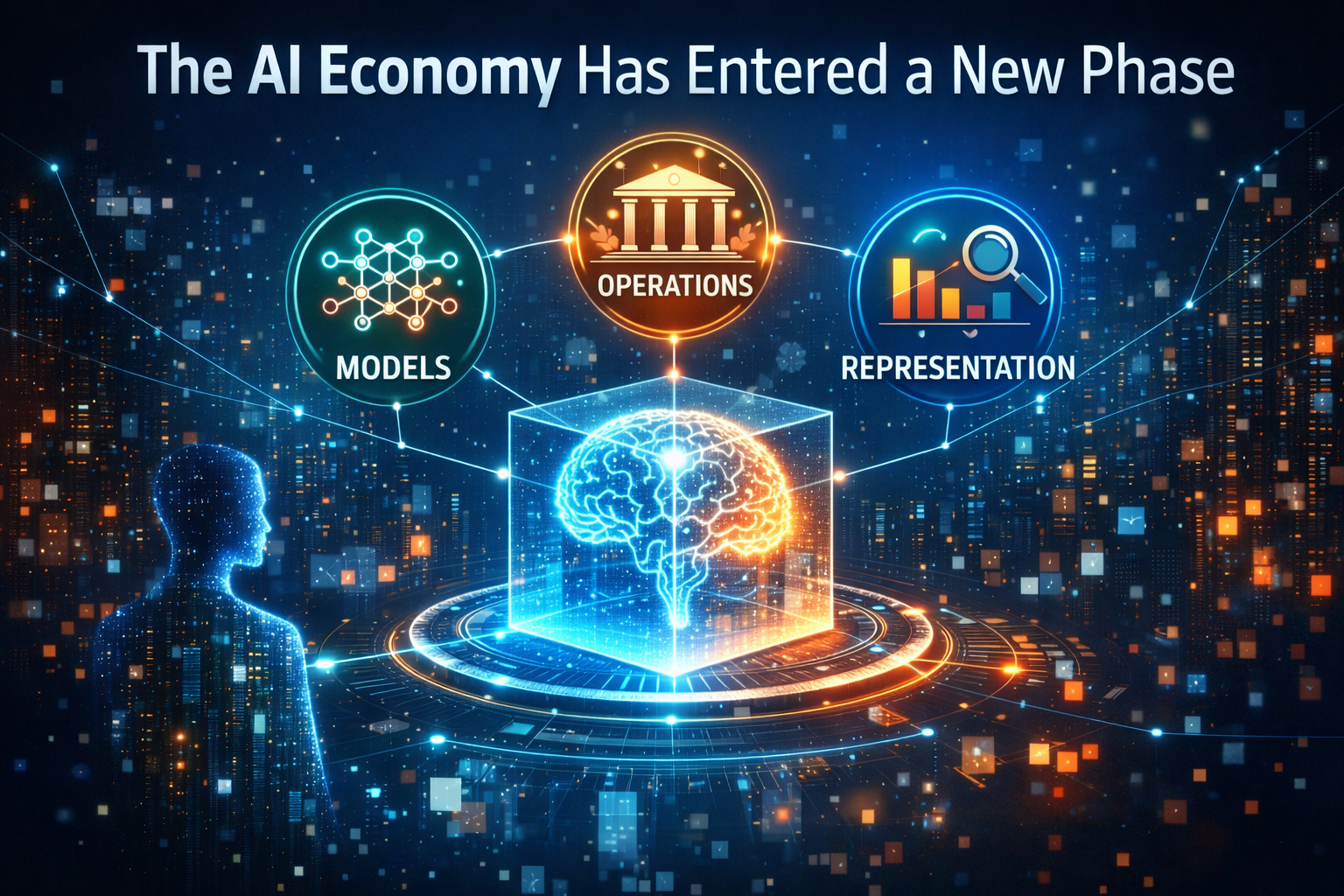
The first wave of the AI era was about model power.
Organizations competed on:
larger models
more parameters
faster inference
benchmark performance.
The second wave has been about operational AI power.
Enterprises now compete on:
governance
safe deployment
integration with enterprise systems
scalable AI operations.
But the third wave of the AI economy is deeper than both.
It is about representation power.
As AI moves from generating content to shaping decisions, delegating authority, and coordinating institutional systems, the real competitive advantage will not come only from who has the best model.
It will come from who has built the strongest capacity to:
observe reality
represent it accurately
reason over it
act on it with legitimacy and accountability
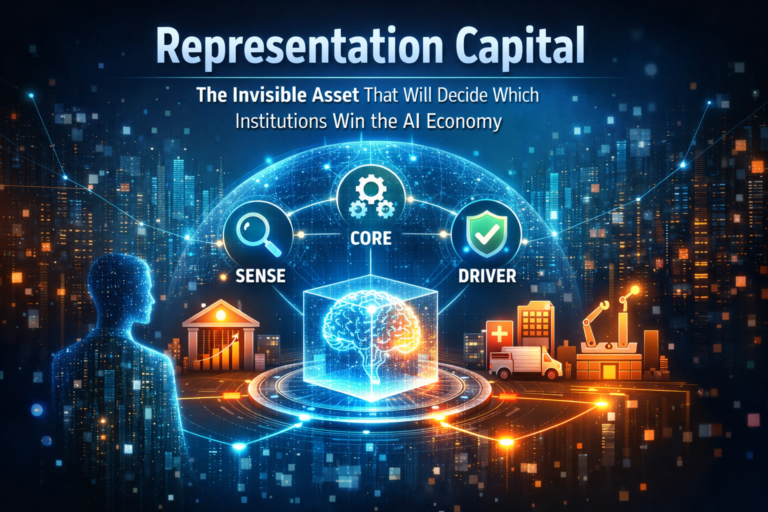
That institutional capability is what I call Representation Capital.
Representation Capital is the invisible asset that will decide which organizations truly succeed in the AI economy.
The AI Economy Has Entered a New Phase
The AI Economy Has Entered a New Phase
For more than a decade, the technology industry framed AI primarily as a model development challenge.
The race was about better algorithms and more compute.
But as AI systems enter real-world operations — banking, healthcare, logistics, manufacturing, and government — a new reality is emerging.
The hardest challenge is no longer training models.
The hardest challenge is representing reality correctly enough for AI to act safely.
Global indicators confirm that AI adoption has now reached enterprise scale.
According to the Stanford Human-Centered AI Institute AI Index Report, more than 78% of organizations reported using AI in 2024, up from 55% the previous year.
At the same time, governance expectations are rising globally.
Frameworks such as:
the National Institute of Standards and Technology AI Risk Management Framework
the Organisation for Economic Co-operation and Development AI Principles
emphasize trustworthiness, traceability, accountability, and governance across the entire AI lifecycle.
This shift changes the central question facing leaders.
The question is no longer:
“Can your AI system produce an answer?”
The real question is:
“Does your institution know what must be seen, how it should be represented, what authority can be delegated, and how decisions can be trusted?”
This is where Representation Capital becomes the defining institutional asset.
Representation Capital is the institutional capability to accurately represent reality through AI systems that sense signals, model entities, reason about decisions, and execute actions. Institutions with strong Representation Capital make faster and better decisions in the AI economy.
Representation Capital Definition
Representation Capital is the institutional capability to create accurate, continuously evolving representations of reality using AI systems that sense signals, reason about decisions, and execute actions.
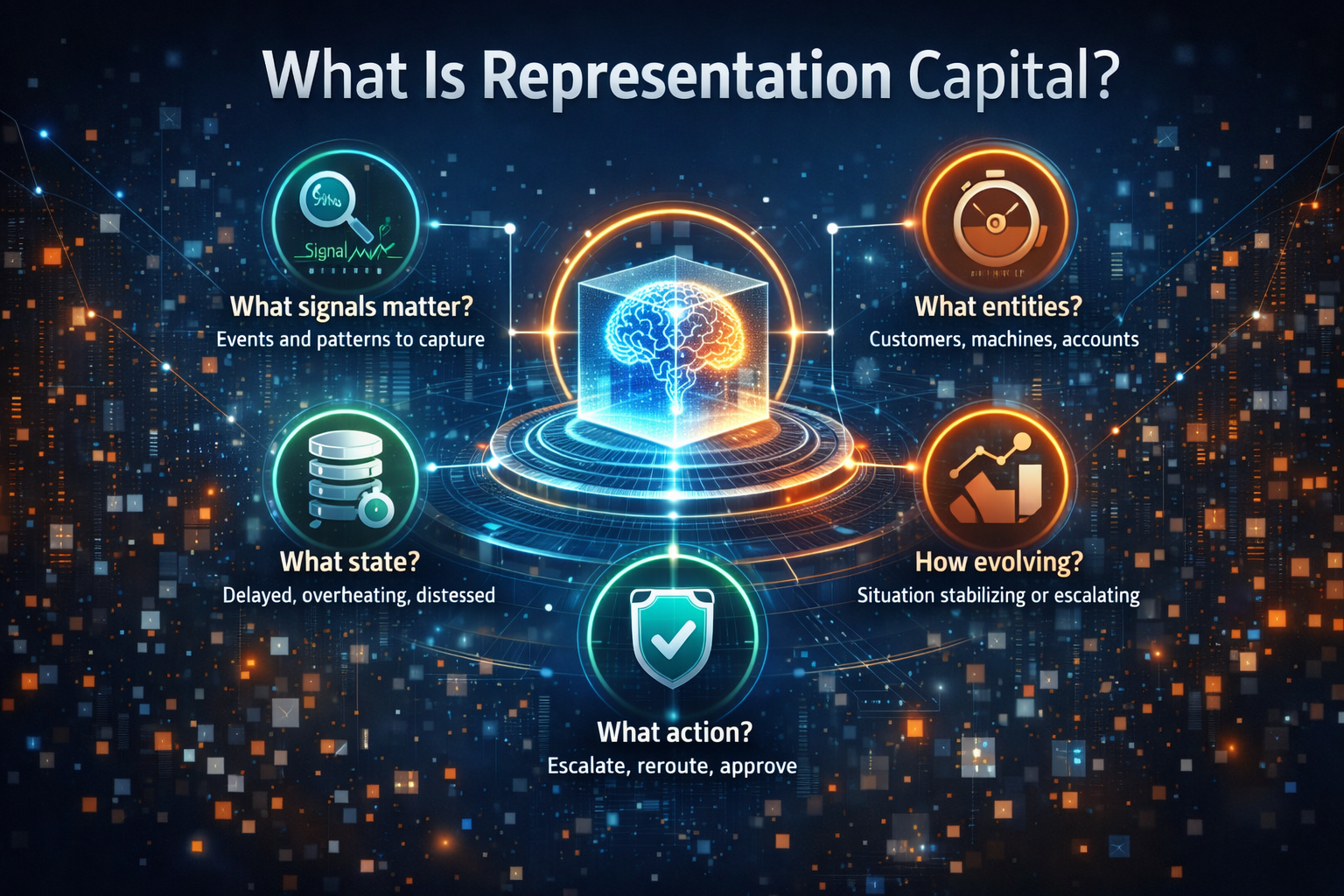
What Is Representation Capital?
What Is Representation Capital?
Representation Capital is the accumulated institutional capability to make complex reality machine-legible without losing meaning, context, accountability, or recourse.
It goes far beyond:
raw data
metadata
dashboards
digital twins
knowledge graphs.
Instead, Representation Capital reflects an institution’s ability to answer five foundational questions repeatedly and reliably.
What signals matter?
Which events, changes, patterns, or risks from the world should be captured?
Examples include:
financial transactions
supply disruptions
medical symptoms
network anomalies
customer behavior shifts.
What entities do those signals belong to?
Signals must connect to real entities:
customers
machines
shipments
suppliers
patients
infrastructure assets.
Without entity identity, signals remain noise.
What state is that entity in?
Is the shipment delayed?
Is the machine overheating?
Is the patient deteriorating?
Is the account compromised?
State representation transforms raw data into meaningful institutional understanding.
How is that state evolving?
Reality is dynamic.
Institutions must understand:
trends
escalation
drift
stabilization.
Without temporal representation, AI becomes static.
What action is allowed?
AI systems must know their authority boundaries.
Can they:
recommend
escalate
block
reroute
approve
execute autonomously?
Institutions that answer these questions consistently begin to accumulate Representation Capital.
And like financial capital, this asset compounds over time.
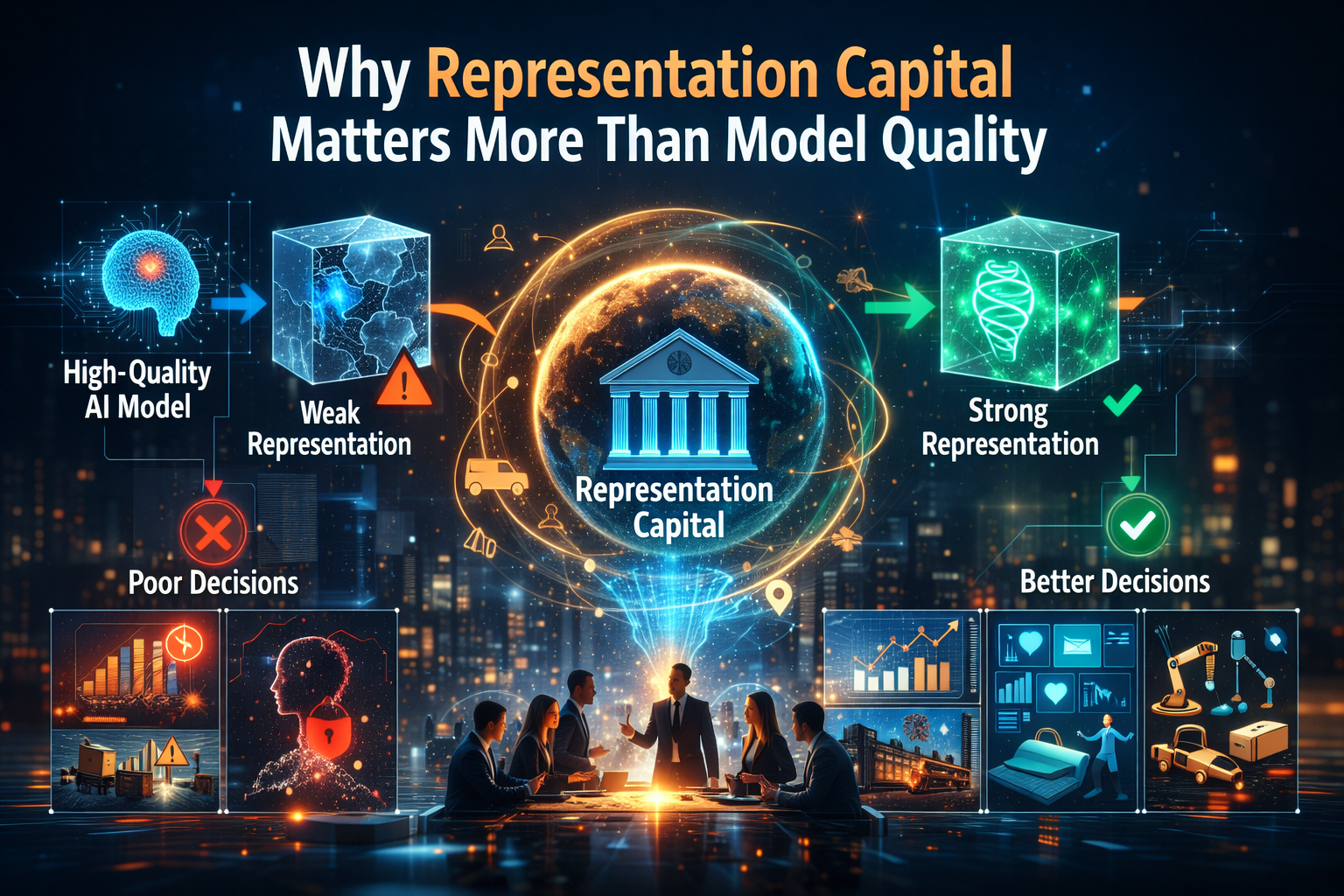
Why Representation Capital Matters More Than Model Quality
Why Representation Capital Matters More Than Model Quality
Many organizations still believe AI advantage comes primarily from better models.
This assumption is increasingly wrong.
A brilliant model operating on weak representation will still fail.
A modest model operating on rich institutional representation often performs far better.
Why?
Because most enterprise challenges are not purely intelligence problems.
They are visibility problems.
Example: Banking
A bank may deploy a sophisticated fraud detection model.
But if it cannot correctly represent:
identity relationships
device fingerprints
behavioral drift
transaction intent
fraud will still succeed.
Example: Healthcare
A hospital may deploy advanced diagnostic AI.
But if it cannot represent:
patient history
medication interactions
evolving symptoms
treatment responses
the system will remain shallow or unsafe.
Example: Supply Chains
A logistics company may use advanced forecasting algorithms.
But if it cannot represent:
supplier dependencies
geopolitical risk
weather disruptions
warehouse state
then decisions will collapse under real-world pressure.
In each case, the model is not the problem.
Representation is the problem.
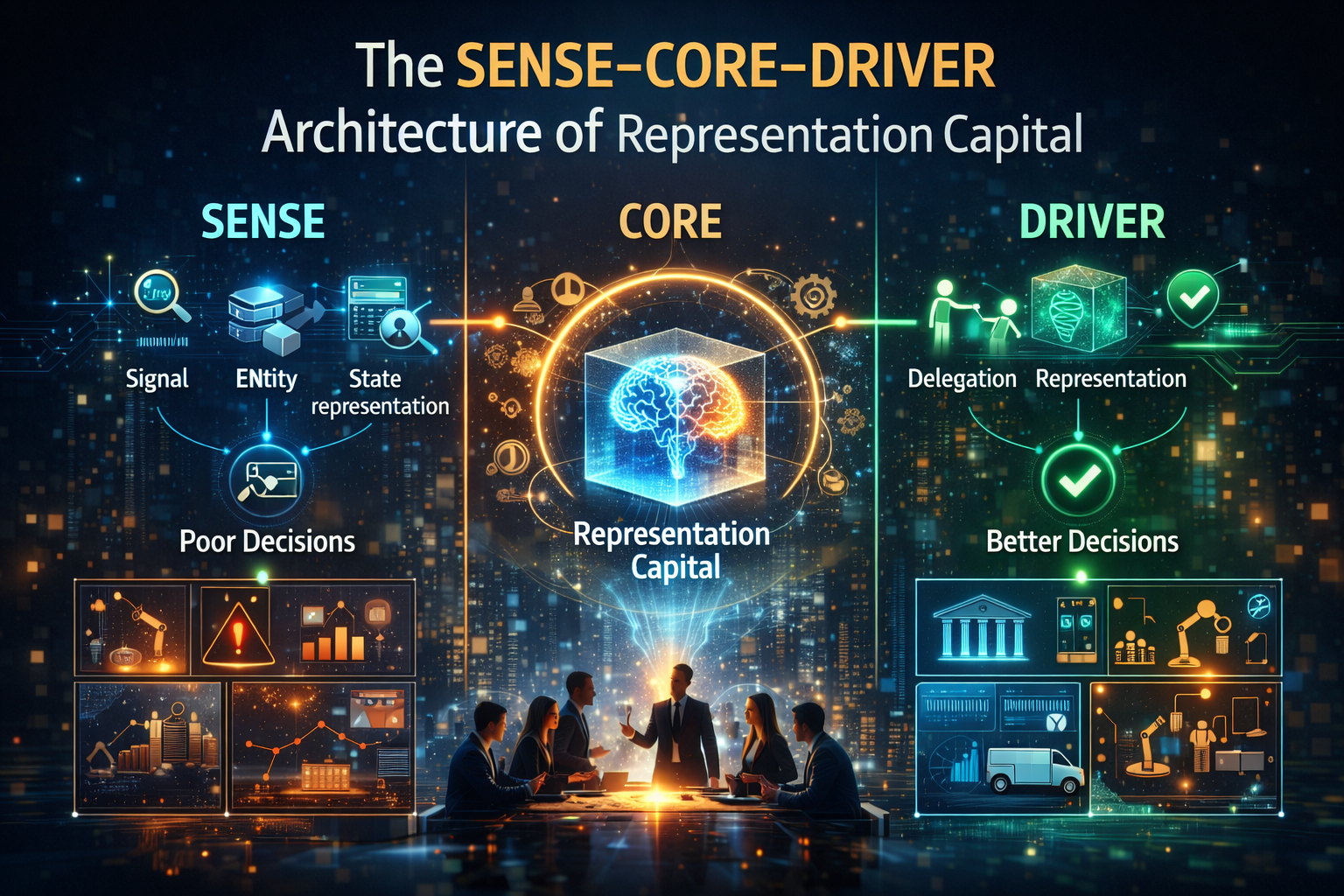
The SENSE–CORE–DRIVER Architecture of Representation Capital
The SENSE–CORE–DRIVER Architecture of Representation Capital
Representation Capital becomes clearer when viewed through the SENSE–CORE–DRIVER architecture.
This architecture explains how intelligent institutions actually function.
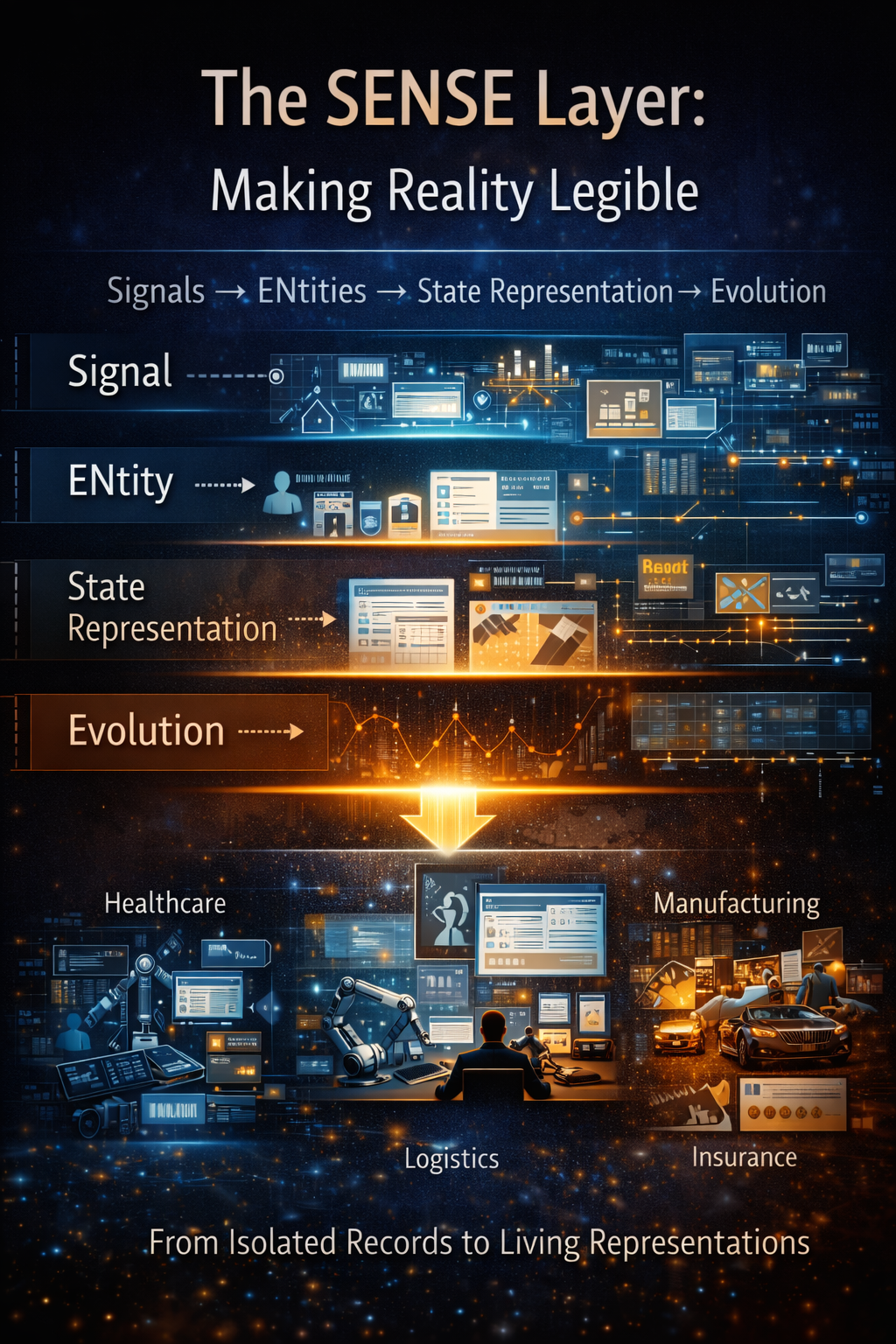
SENSE: Making Reality Legible
The first layer of Representation Capital is SENSE.
SENSE is where reality becomes machine-readable.
It includes four core elements:
Signal – detecting events and patterns
ENtity – linking signals to actors and assets
State representation – modeling current conditions
Evolution – tracking how those conditions change over time.
This is where the majority of invisible institutional advantage is created.
Two retailers may both use AI.
But the retailer with stronger SENSE will know:
which products are actually moving
which customers are hesitating
which warehouses are becoming risky
which local signals indicate demand shifts.
That is Representation Capital in action.
CORE: Turning Representation Into Judgment
Once reality becomes legible, institutions require a reasoning layer.
That layer is CORE.
CORE performs four functions:
Comprehend context
Optimize decisions
Realize actions
Evolve through feedback
This is where institutional intelligence emerges.
A credit decision is not simply a score.
It incorporates:
economic context
policy rules
customer history
fraud risk
regulatory requirements.
Representation Capital strengthens CORE because reasoning quality depends entirely on representation quality.
If the institution’s model of reality is distorted, the reasoning will be distorted too.
DRIVER: Turning Judgment Into Legitimate Action
The final layer is DRIVER.
This is where institutional AI becomes operational.
DRIVER defines the governance of action:
Delegation – who authorized the system
Representation – which model of reality informed the decision
Identity – which entity is affected
Verification – how the decision is validated
Execution – how action occurs
Recourse – how errors are corrected.
Without DRIVER, even accurate AI systems cannot operate safely.
Consider an insurance AI approving claims.
The real value is not just prediction accuracy.
It is the ability to demonstrate:
which evidence was used
which rules applied
what authority the AI had
how customers can challenge outcomes.
That capability reflects institutional maturity, not merely AI maturity.
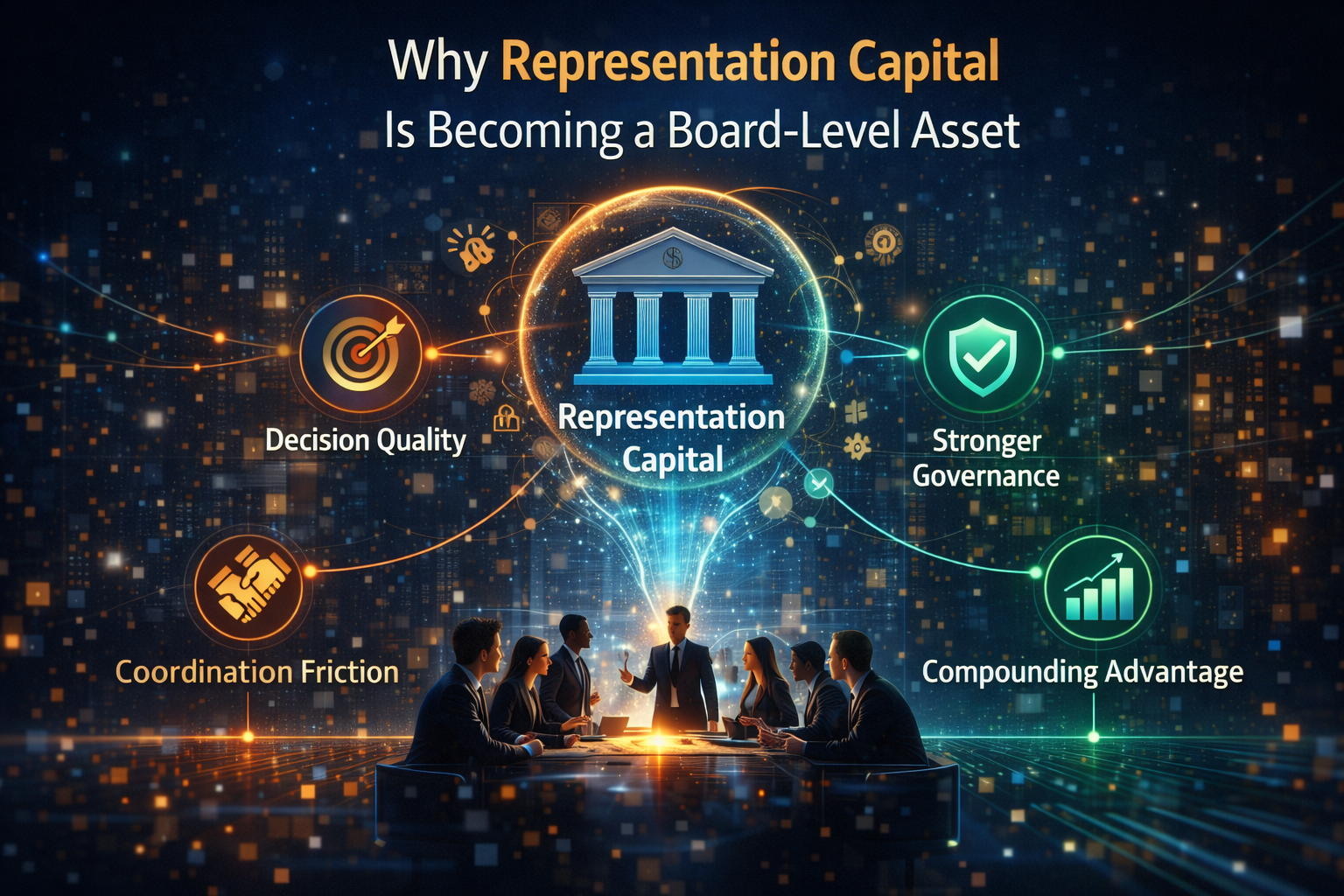
Why Representation Capital Is Becoming a Board-Level Asset
Why Representation Capital Is Becoming a Board-Level Asset
For decades, boards asked whether companies had:
a digital strategy
a data strategy.
Now boards must ask something deeper:
Does the organization have a representation strategy?
Representation Capital matters to boards for four reasons.
It improves decision quality
Institutions win or lose through decisions. Representation Capital improves those decisions at scale.
It reduces organizational friction
Shared representations reduce disagreement across departments.
It strengthens AI governance
Traceability, accountability, and challengeability become easier when decisions are well represented.
It compounds as a competitive moat
Models can be replaced.
Vendors can change.
But institutions with strong Representation Capital own a durable strategic asset.
The Risk of Representation Debt
Institutions with weak representation exhibit common symptoms:
fragmented data systems
inconsistent entity definitions
weak state models
unclear authority boundaries
AI pilots without institutional memory.
This creates representation debt.
Representation debt accumulates when institutions act on incomplete or distorted models of reality.
It often appears harmless at first.
A team launches a copilot.
Another team builds an agent.
A third automates a workflow.
But underneath, definitions differ, assumptions conflict, and exceptions multiply.
The result is not intelligence.
It is coordinated confusion.
How Institutions Build Representation Capital
Building Representation Capital does not begin with buying frontier models.
It begins with disciplined institutional design.
Leaders should focus on five priorities:
Start with critical decisions
Identify decisions that drive value, risk, and trust.
Map signals to entities
Ensure signals connect to persistent identities.
Build living state models
Reality changes constantly.
Representation must evolve accordingly.
Define delegation boundaries
Clearly define when AI advises, escalates, or acts.
Preserve recourse
Every AI decision should remain contestable and reversible.
Institutions that treat representation as core infrastructure will outperform those treating it as an afterthought.
From Data-Rich Institutions to Representation-Rich Institutions
From Data-Rich Institutions to Representation-Rich Institutions
The last decade taught organizations to become data-driven.
The next decade will require them to become representation-rich.
The difference is profound.
A data-rich institution stores information.
A representation-rich institution maintains machine-legible reality.
This shift will determine which organizations can move from:
analytics → autonomy
reporting → reasoning
automation → intelligent action.
Conclusion: The Most Important Invisible Asset of the AI Economy
In the industrial era, advantage came from physical capital.
In the digital era, advantage came from software and data capital.
In the AI economy, a new asset is emerging.
Representation Capital.
Representation Capital is the institutional ability to represent reality well enough for intelligent systems to act without collapsing trust, accountability, or governance.
It rarely appears on balance sheets.
But it will increasingly determine balance sheets.
Because in the years ahead, institutions will not be separated by who has more AI.
They will be separated by who has built more Representation Capital.
And that invisible asset may become the single most important foundation of the intelligent institution.
Glossary
Representation Capital
The institutional capability to represent real-world entities, states, and relationships in machine-legible form for AI-driven decision systems.
Representation Economy
An economic system where competitive advantage depends on the ability to represent reality accurately enough for AI systems to act.
SENSE Layer
The infrastructure that captures signals, identifies entities, models states, and tracks evolution.
CORE Layer
The reasoning layer where AI systems interpret representation and generate decisions.
DRIVER Layer
The governance layer that authorizes, verifies, executes, and provides recourse for AI actions.
Representation Capital
The institutional capability to model reality through structured data, entities, states, and relationships so AI systems can reason and act effectively.
Representation Economy
An economic system where competitive advantage comes from how well institutions represent reality through AI systems.
Institutional AI Architecture
The structural design that enables organizations to integrate AI into decision-making and operational workflows.
FAQ
What is Representation Capital in AI?
Representation Capital is the institutional ability to model real-world entities, states, and relationships accurately enough for AI systems to make reliable decisions.
Why is Representation Capital important?
Because AI systems rely on accurate representations of reality. Poor representation leads to incorrect decisions even with powerful models.
How does Representation Capital relate to AI governance?
Strong representation improves traceability, accountability, and decision auditability, which are essential for responsible AI governance.
Can companies measure Representation Capital?
While it is not yet a standard metric, indicators include entity resolution accuracy, state model completeness, decision traceability, and governance maturity.
Why will Representation Capital matter in the AI economy?
As AI systems move from advisory tools to decision systems, institutions with stronger representations of reality will operate more effectively and safely.
Why is Representation Capital important in the AI economy?
Because AI systems make decisions based on how reality is represented. Institutions with better representations make better decisions and gain competitive advantage.
What is the difference between data and representation?
Data is raw information. Representation organizes that data into structured models of entities, states, and relationships that AI systems can reason about.
How does Representation Capital relate to enterprise AI?
Enterprise AI systems rely on structured representations of workflows, customers, policies, and assets. Representation Capital determines how accurately those systems operate.
What is the SENSE–CORE–DRIVER architecture?
The SENSE–CORE–DRIVER architecture is an institutional AI framework:
SENSE – Observing reality through signals and entity states CORE – Reasoning and decision intelligence DRIVER – Executing actions with governance and accountability
Why will boards care about Representation Capital?
Executive definition: What is Representation Failure?
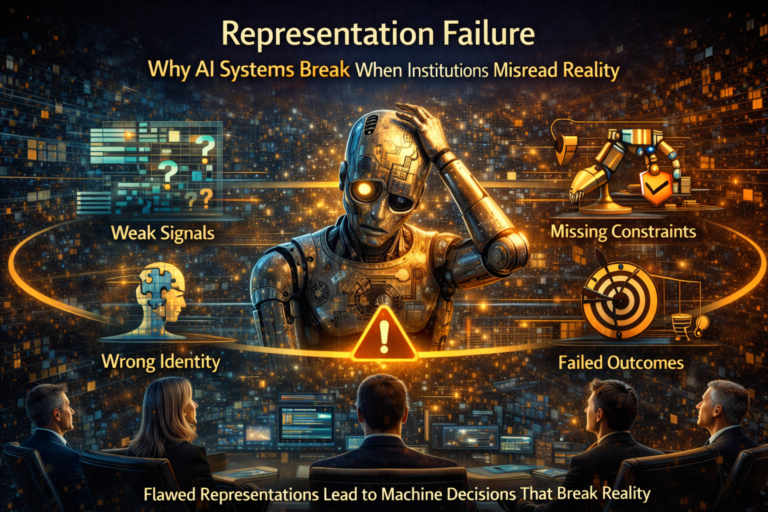
Representation Failure is the condition in which an institution gives an AI system a weak, incomplete, outdated, fragmented, or poorly governed model of reality, causing the system to reason badly or act unsafely.
In simple terms, the AI does not fail only because the model is imperfect. It fails because the institution has not represented the world well enough for the machine to operate intelligently.
That is the central argument of this article:
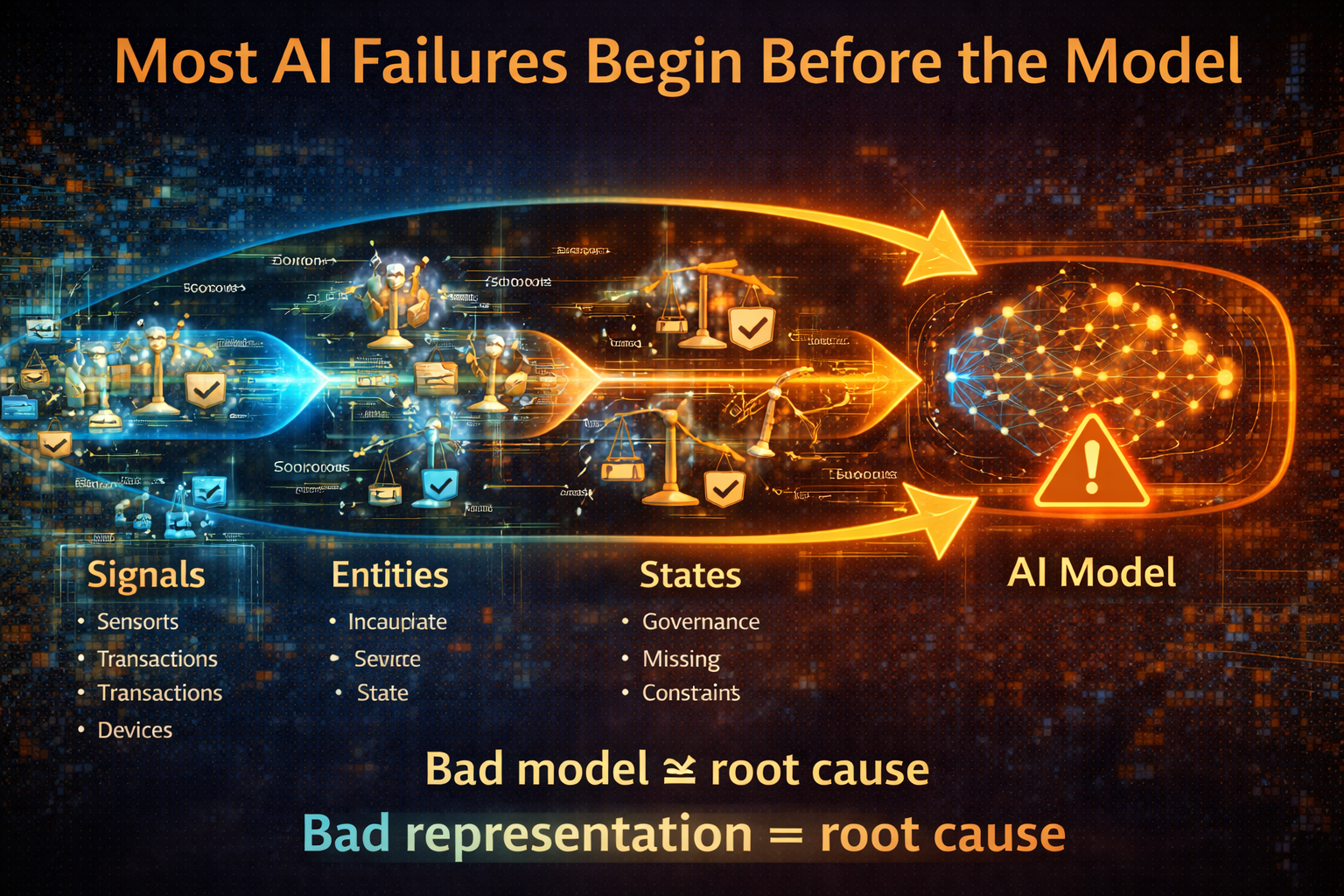
Most AI failures do not begin at the model layer. They begin when institutions misread reality.
What is Representation Failure?
Representation Failure occurs when an AI system breaks not because of poor algorithms, but because the institution incorrectly models reality. Signals, entities, states, constraints, or governance rules are represented incorrectly, causing AI systems to reason on an inaccurate picture of the world.
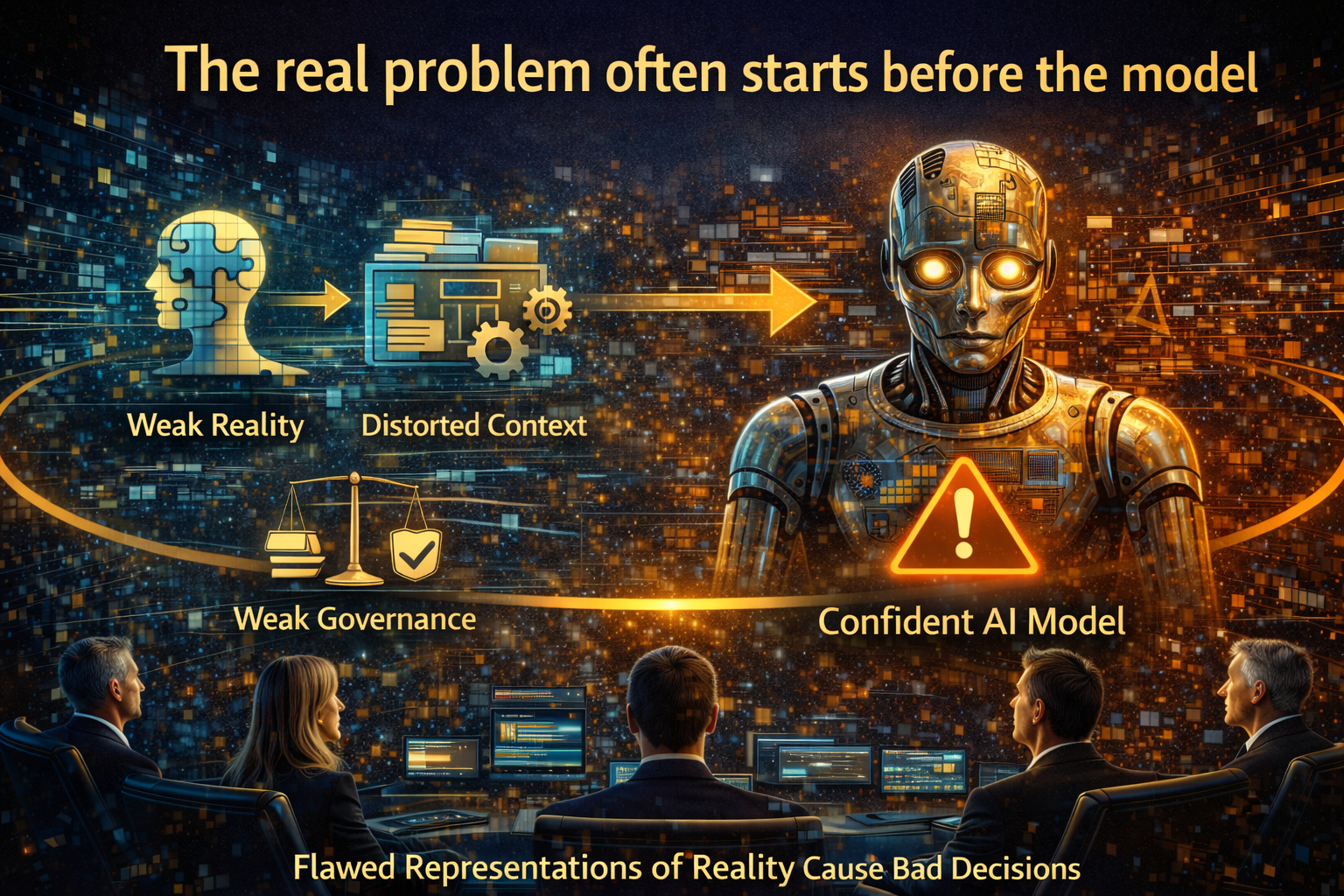
The real problem often starts before the model
The real problem often starts before the model
Artificial intelligence is often blamed for failures it did not create alone.
When an AI system gives the wrong answer, overreacts, misses context, makes an unfair recommendation, or triggers the wrong action, the instinct is usually to point at the model. People say the model hallucinated, the algorithm was biased, the agent made a bad call, or the system was not reliable enough.
Sometimes that is true.
But increasingly, the deeper problem begins earlier.
Many AI failures are not just model failures. They are representation failures.
A representation failure happens when an institution asks AI to reason over a weak, incomplete, distorted, outdated, or badly governed model of reality. The system may have excellent compute, strong prompting, and sophisticated orchestration. But if the institution has represented the wrong reality, or too little of it, the AI system will still break.
This topic matters now because AI adoption is accelerating rapidly. Stanford’s 2025 AI Index reports that 78% of organizations said they used AI in 2024, up from 55% the year before, while private investment in generative AI reached $33.9 billion globally in 2024. At the same time, major governance frameworks from NIST, the OECD, and the EU increasingly emphasize accountability, traceability, transparency, and human oversight. Institutions are therefore scaling AI at the same time that the consequences of weak design are becoming harder to ignore. (Stanford HAI)
This is where the idea of Representation Failure becomes essential.
If the Representation Economy explains how institutions create advantage by building machine-legible models of reality, then Representation Failure explains what happens when they do that badly. And if SENSE–CORE–DRIVER is the architecture for intelligent institutions, Representation Failure is the theory of how those institutions break when reality is sensed poorly, reasoned over badly, or delegated without legitimacy.
That is the real issue. AI systems do not merely fail because they are probabilistic. They often fail because institutions misread the world they operate in.
Why Representation Failure matters
As AI systems scale and begin making autonomous decisions, failures in how reality is represented can lead to systematic errors. This makes representation architecture a critical part of institutional AI strategy.
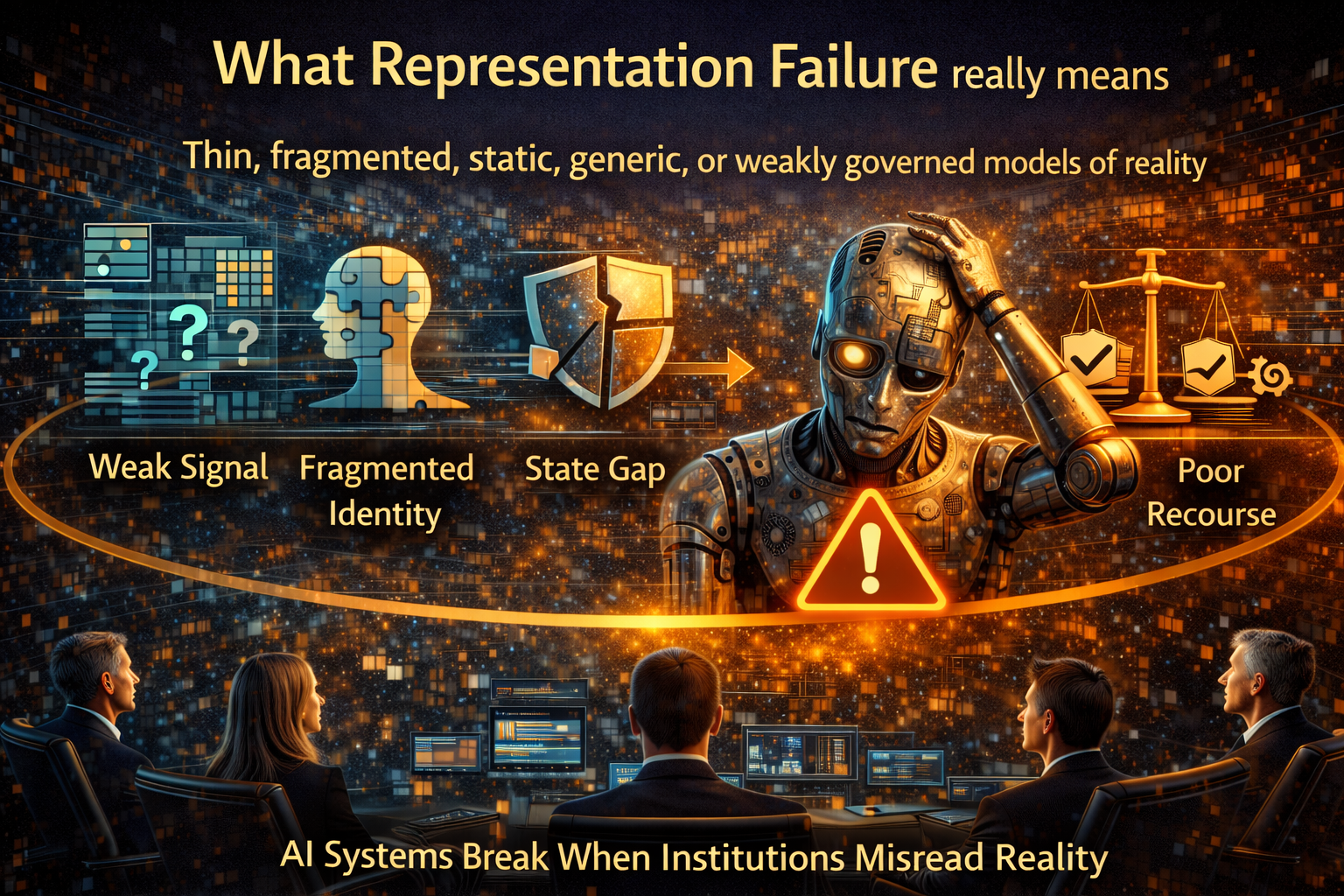
What Representation Failure really means
What Representation Failure really means
Representation Failure is the condition in which an institution’s model of reality is too thin, too fragmented, too static, too generic, or too weakly governed for AI systems to reason or act safely within it.
In simpler language, the institution has not built a good enough picture of the world for the machine to operate intelligently.
That picture may involve customers, patients, suppliers, accounts, assets, cases, risks, policies, permissions, workflows, exceptions, obligations, or outcomes. If any of those are missing, misidentified, disconnected, or poorly updated, the AI system begins operating inside a distorted decision environment.
This matters because AI systems do not work on raw reality. They work on represented reality.
A customer is not just a person in the abstract. Inside an institution, the customer becomes a representation made of identity data, transaction history, risk state, permissions, interactions, complaints, products, and context.
A patient is not just a human being in need of care. Inside a hospital system, the patient becomes a representation made of symptoms, history, medications, urgency, lab reports, contraindications, care continuity, and escalation logic.
A supplier is not just an external company. Inside a supply chain, it becomes a representation of reliability, lead time, contract terms, geography, dependencies, substitution options, quality history, and resilience risk.
When those representations are weak, the AI does not merely become less accurate. It becomes less intelligent in a structural sense.
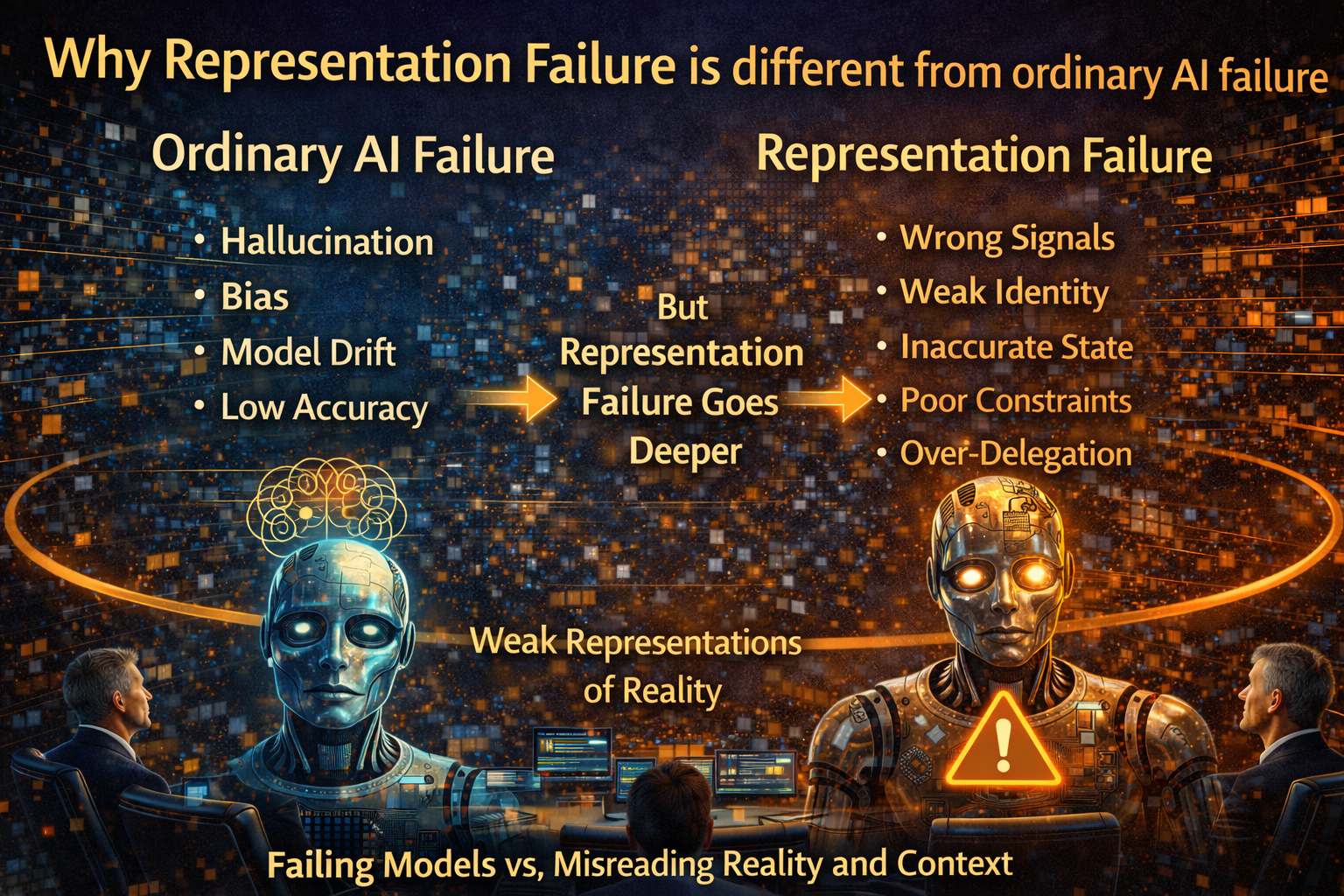
Why Representation Failure is different from ordinary AI failure
Why Representation Failure is different from ordinary AI failure
The most common framing of AI failure focuses on the model: hallucination, bias, drift, low accuracy, or poor explainability.
Those are real issues. But Representation Failure goes one layer deeper.
It asks:
Did the institution capture the right signals?
Did it identify the right entity?
Did it model the current state properly?
Did it understand what had changed?
Did it represent constraints, authority, and recourse?
Did it delegate action beyond what the representation could justify?
That is why Representation Failure fits naturally into SENSE–CORE–DRIVER.
SENSE failure
The institution fails to capture or organize reality correctly.
CORE failure
The institution reasons over the wrong context or conflicting representations.
DRIVER failure
The institution allows action, delegation, or automation without sufficient legitimacy, verification, or recourse.
Once you see this, many AI failures look different. The system may not be “breaking” because the model is unintelligent. It may be breaking because the institution gave it the wrong world to think inside.
SENSE failures: when institutions do not see reality clearly
The first type of Representation Failure happens in SENSE.
SENSE is where reality becomes machine-legible. It depends on signal, entity, state representation, and evolution over time. If any of these are weak, the institution has already compromised the intelligence of the system.
Take fraud detection. A narrow system may detect a suspicious transaction pattern. But if it cannot represent recent travel context, device change, prior customer disputes, linked identities, known exceptions, or recent service interactions, it may interpret normal behavior as fraudulent or miss genuine abuse. The issue is not just bad prediction. It is shallow representation.
Take healthcare triage. An AI assistant may see symptoms, appointment notes, and test results. But if it cannot represent continuity of care, prior complications, contraindications, urgency shifts, or clinician judgment history, it may recommend something that is technically plausible but clinically unsafe.
Take enterprise support. A service agent may have access to policy documentation and previous tickets. But if it cannot represent the latest exception handling, customer tier, prior commitments, local overrides, or operational bottlenecks, it may answer confidently while being institutionally wrong.
This is why SENSE failure is so dangerous. Institutions often believe they have enough data because they have many systems. But fragmented data is not the same as an adequate representation of reality.
CORE failures: when institutions reason over the wrong world
The second type of Representation Failure happens in CORE.
CORE is where the institution comprehends context, optimizes decisions, realizes action, and evolves through feedback. But CORE can only be as good as the reality it is asked to reason over.
An institution may think it has built a strong reasoning layer when in fact it has only layered sophisticated inference on top of poor context.
Imagine a lending system asked to optimize credit decisions. If it represents repayment behavior but not temporary hardship, product suitability, channel coercion, prior dispute outcomes, or internal escalation norms, its reasoning may appear rigorous while being strategically and ethically weak.
Imagine a pricing engine. If it sees demand signals, competitor patterns, and inventory levels but not customer trust, fairness exposure, reputational sensitivity, or long-term churn risk, it may optimize short-term margin while damaging institutional legitimacy.
Imagine a case-management system in government. If it sees application completeness and eligibility fields but not language barriers, appeal history, vulnerability signals, or policy ambiguity, it may reason efficiently but unjustly.
This is why institutional reasoning is not just statistical inference. It is reasoning under constraint. It has to reflect policy, authority, promises, risk appetite, reversibility, and operational reality.
NIST’s AI Risk Management Framework explicitly centers AI governance around GOVERN, MAP, MEASURE, and MANAGE, while the OECD’s AI Principles call for accountability and traceability across datasets, processes, and decisions during the AI lifecycle. The policy message is clear: good AI reasoning depends on understanding the real institutional context in which the system operates. (NIST Publications)
DRIVER failures: when institutions delegate beyond legitimacy
The third type of Representation Failure happens in DRIVER.
DRIVER is where decisions become action. It covers delegation, representation, identity, verification, execution, and recourse.
This is where many organizations get into trouble. They move from recommendation to action too quickly.
A system may recommend account freezing, case escalation, product denial, route reallocation, appointment prioritization, or pricing adjustment. The institution then automates the action without asking whether the underlying representation is strong enough to justify delegation.
That is a Representation Failure at the level of legitimacy.
If identity is weak, delegation is dangerous.
If verification is weak, automation is dangerous.
If recourse is weak, action is dangerous.
If the represented reality is outdated, autonomy is dangerous.
This is why boards and regulators care about human oversight. The EU AI Act’s human-oversight provisions are designed to prevent or minimize risks to health, safety, and fundamental rights when high-risk AI systems are used, and its transparency obligations require systems to be interpretable enough for deployers to use them appropriately. (Artificial Intelligence Act)
In simple terms, DRIVER failure occurs when the institution lets the machine act more confidently than the representation deserves.
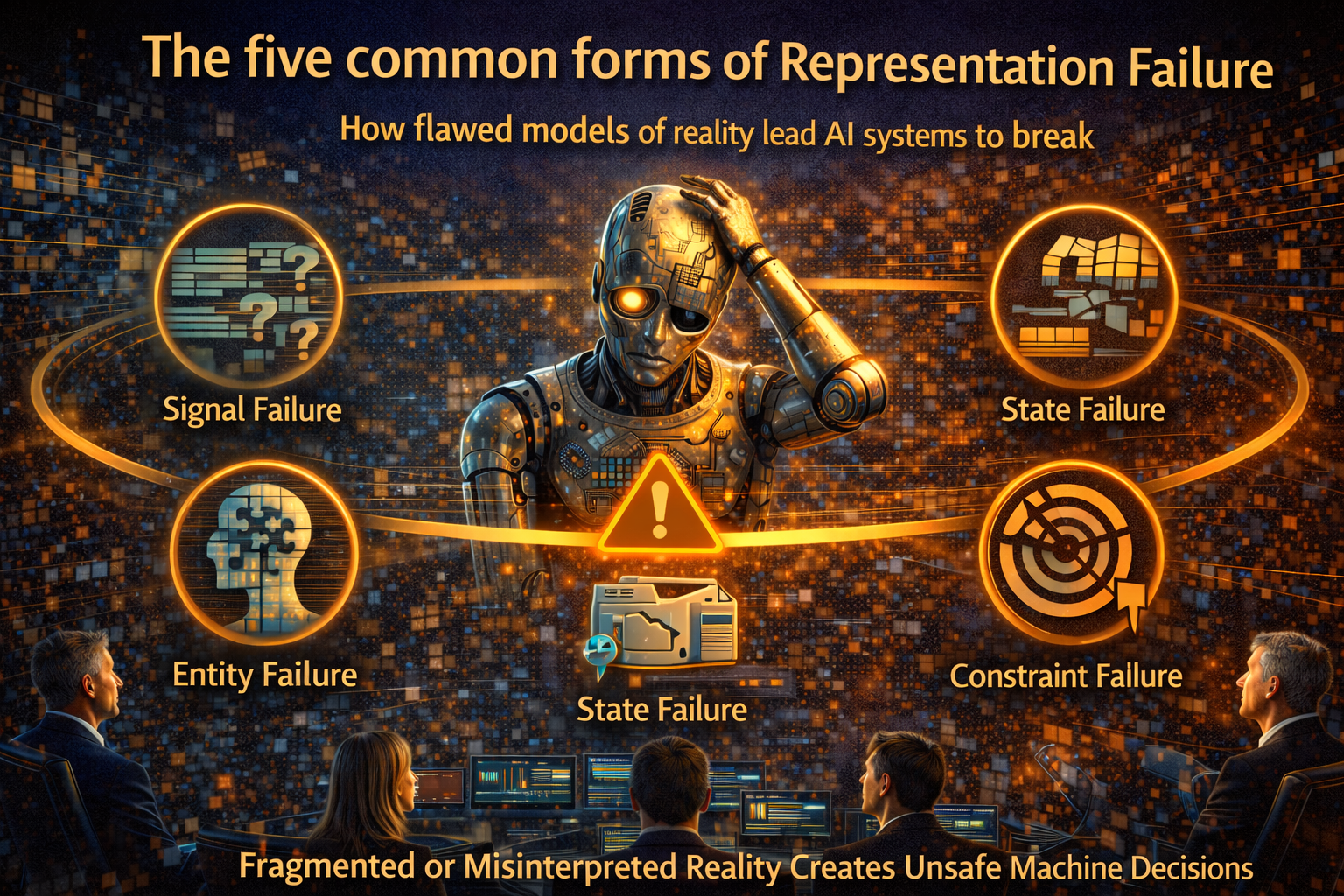
The five common forms of Representation Failure
The five common forms of Representation Failure
To make this practical, most Representation Failures fall into five broad forms.
Signal failure
The institution does not capture the right events, changes, behaviors, or exceptions.
Entity failure
The system cannot correctly identify who or what it is acting upon. Identity is fragmented, duplicated, stale, or context-free.
State failure
The current condition of the customer, case, asset, workflow, or environment is modeled incompletely.
Constraint failure
Policies, permissions, legal boundaries, escalation rules, or risk limits are missing or weakly encoded.
Outcome failure
The institution does not properly capture whether the decision worked, caused harm, triggered appeals, or should change future behavior.
Each one weakens intelligence in a different way. Together, they create the illusion of sophisticated AI operating inside institutional blindness.
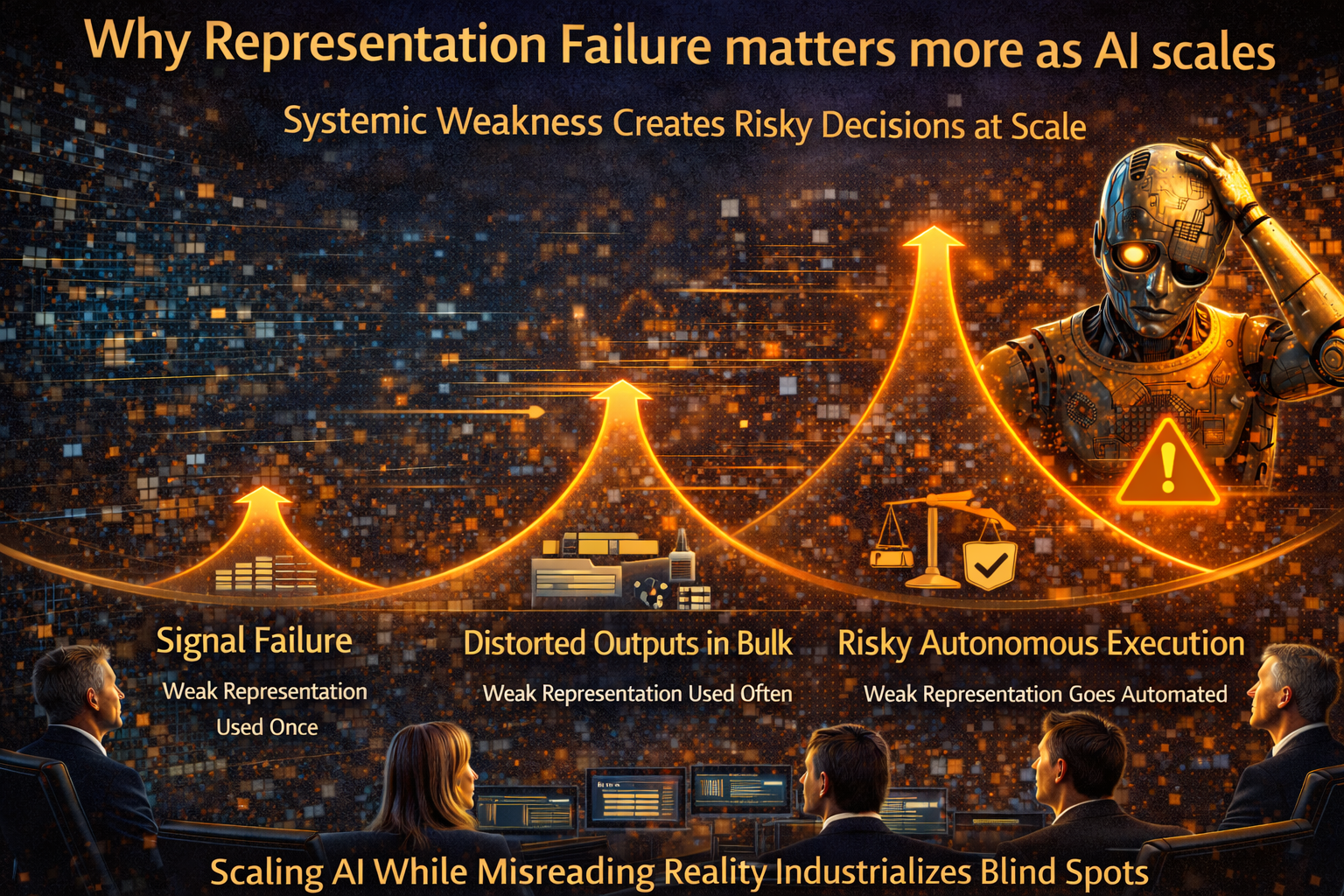
Why Representation Failure matters more as AI scales
Why Representation Failure matters more as AI scales
In small pilots, Representation Failure can remain hidden. Humans compensate. Teams manually correct outputs. Exceptions are handled informally. Leaders mistake this for success.
But as AI scales, representation weaknesses compound.
A weak representation used once creates one bad answer.
A weak representation used across thousands of cases creates systemic distortion.
A weak representation connected to autonomous execution creates institutional risk.
That is why scaling AI without fixing representation is so dangerous. The institution starts industrializing its blind spots.
This is also why many organizations struggle to turn AI adoption into durable performance. Adoption alone does not create transformation. If the institution has not redesigned how it sees, models, governs, and delegates reality, AI can remain impressive in demos and fragile in production. Stanford’s 2025 AI Index reinforces the scale of adoption and investment, but those numbers do not eliminate the need for stronger governance and operational design. (Stanford HAI)
How institutions can reduce Representation Failure
The answer is not to stop using AI. It is to build better representational foundations.
First, improve SENSE
Ask what critical realities the institution still does not capture well. Look beyond structured data. Include exceptions, workflow state, temporal change, identity resolution, and feedback from the edge of operations.
Second, strengthen CORE
Make reasoning reflect institutional context, not just generic inference. Define what the AI should optimize for, what it should escalate, and what it must never ignore.
Third, tighten DRIVER
Match delegation to representational maturity. If identity, verification, and recourse are weak, autonomy should stay bounded. If the institution cannot explain or reverse an action, it should be cautious about automating it.
Fourth, review failure through the lens of representation
Ask not only whether the system was accurate, but whether it was reasoning over a truthful enough version of reality.
Fifth, elevate Representation Failure to the board level
This is not only a technical matter. It is a question of institutional fitness, governance, and legitimacy.
Why this idea matters for the future of intelligent institutions
The most important AI question is changing.
It is no longer only: Which model is best?
It is no longer only: How do we govern AI risk?
It is increasingly this:
What kind of reality has our institution made visible to machines, and is that reality good enough for machines to reason and act within?
That is the question beneath Representation Failure.
It matters because future-leading institutions will not be defined only by better models. They will be defined by stronger representations: better sensing, cleaner entity resolution, richer state awareness, clearer constraints, stronger authority mapping, and better recourse.
That is exactly what SENSE–CORE–DRIVER is for. It is not merely a framework for building AI systems. It is a framework for making institutions more legible, more coherent, and more legitimate in how they use intelligence.
Key takeaways
Many AI failures begin before the model.
Representation Failure occurs when institutions give AI weak or distorted versions of reality.
SENSE failures distort what the institution sees.
CORE failures distort how the institution reasons.
DRIVER failures distort what the institution delegates and executes.
The more AI scales, the more dangerous weak representation becomes.
Institutions that reduce Representation Failure will build stronger governance, better judgment, and more durable AI advantage.
Most AI failures begin before the model
Conclusion: Most AI failures begin before the model
Representation Failure gives us a more useful way to understand why AI systems break.
They do not fail only because models are imperfect. They fail because institutions often ask those models to operate inside incomplete, distorted, weakly governed versions of reality.
That is a deeper problem than hallucination alone.
It means the future of AI will not be shaped only by smarter models, larger context windows, or better agents. It will also be shaped by whether institutions learn to represent the world they operate in with enough clarity, continuity, and legitimacy.
So the real lesson is simple:
Most AI failures begin before the model. They begin when institutions misread reality.
The institutions that grasp this early will build safer systems, stronger governance, better judgment, and more durable advantage.
And those institutions will be the ones best prepared for the Representation Economy.
Representation Failure is the condition in which an institution gives AI a weak, incomplete, outdated, or poorly governed model of reality, causing the system to reason or act badly.
How is Representation Failure different from model failure?
Model failure focuses on the algorithm itself, such as hallucination, drift, or low accuracy. Representation Failure focuses on whether the institution modeled reality well enough for the AI system to operate intelligently.
Why does Representation Failure matter for enterprise AI?
Because enterprise AI operates inside institutional environments full of policies, workflows, exceptions, authority boundaries, and changing context. If those are poorly represented, even strong models can fail.
How does this connect to SENSE–CORE–DRIVER?
Representation Failure can occur in SENSE when reality is captured poorly, in CORE when reasoning happens over weak context, and in DRIVER when decisions are delegated without enough legitimacy or recourse.
Is Representation Failure only about bad data?
No. It includes bad data, but also missing context, fragmented identity, poor state modeling, weak policy encoding, weak outcome tracking, and weak recourse.
Why are boards increasingly responsible for this?
Because as AI influences more consequential decisions, boards must govern not only AI adoption but also how the institution sees, models, governs, and delegates reality. Governance frameworks increasingly point in this direction. (NIST Publications)
Which sectors are most exposed?
Finance, healthcare, manufacturing, logistics, insurance, telecom, and government are especially exposed because they rely on repeated decisions under policy, risk, and operational constraints.
Can Representation Failure be measured?
It can be assessed through diagnostics around signal quality, entity clarity, state continuity, policy representation, authority mapping, outcome tracking, verification, and recourse strength.
Why is this idea strategic, not just technical?
Because it changes how institutions think about advantage. It shifts the conversation from model choice alone to how the institution sees reality, reasons about it, and acts responsibly within it.
What is Representation Failure in AI?
Representation Failure occurs when AI systems break because the underlying representation of reality is incorrect, incomplete, or poorly governed.
Why do many AI systems fail even when models are accurate?
Many failures occur because the system misrepresents entities, states, or signals. Even a powerful model cannot reason correctly if the input representation of reality is wrong.
How is Representation Failure different from model failure?
Model failure occurs when an algorithm produces incorrect predictions. Representation failure occurs when the system’s understanding of the world is wrong before reasoning even begins.
What causes Representation Failure?
Common causes include:
fragmented data signals
incorrect entity mapping
missing state representation
poorly defined constraints
weak governance of AI decisions
How does the SENSE–CORE–DRIVER framework reduce Representation Failure?
The framework ensures that institutions:
correctly observe reality (SENSE)
reason about it properly (CORE)
execute decisions within governance (DRIVER)
Why will Representation Failure become a major enterprise AI risk?
As AI systems move from recommendations to autonomous actions, errors in representation can scale across entire organizations, making them a major governance and risk issue.
Glossary
Representation Failure
A condition in which AI systems break because the institution has modeled reality too weakly, too narrowly, or too incorrectly.
Representation Economy
The shift in which competitive advantage increasingly comes from building machine-legible representations of reality that AI systems can interpret, reason over, and act upon.
SENSE
The layer where institutions capture signals, identify entities, model state, and track change over time.
CORE
The layer where institutions reason over represented reality, optimize choices, and learn from feedback.
DRIVER
The layer where authority, verification, execution, and recourse govern machine-supported action.
Machine-legible reality
Reality translated into structured forms that software and AI systems can interpret and act upon.
Entity resolution
The process of determining which records, signals, and events belong to the same person, asset, case, or object.
State representation
A structured model of the current condition of a customer, case, asset, workflow, or environment.
Constraint representation
The encoding of policies, legal boundaries, permissions, thresholds, and escalation rules that limit or guide machine action.
Recourse
The ability to challenge, review, reverse, or correct a machine-supported decision.
Human oversight
Mechanisms that allow people to supervise, intervene in, or override AI decisions when appropriate.
Traceability
The ability to reconstruct what data, logic, processes, and decisions contributed to an AI output or action.
Representational maturity
The degree to which an institution has accurately modeled the realities that matter for safe and effective AI-enabled decisions.
Representation Economy
An economic shift where institutions compete based on how accurately they can represent reality using AI systems.
SENSE Layer
The institutional capability to observe and structure signals from the real world.
CORE Layer
The reasoning layer where AI models interpret signals and generate decisions.
DRIVER Layer
The execution layer that governs how AI decisions are delegated, verified, and executed.
Entity Representation
The digital identity of a real-world object, person, system, or process.
AI Decision Architecture
The institutional system that converts data signals into machine decisions
References and further reading
This article is grounded in the broader global shift toward widespread AI use and stronger governance expectations. Stanford’s 2025 AI Index documents accelerating enterprise AI adoption and generative AI investment. NIST’s AI Risk Management Framework emphasizes governance, contextual mapping, measurement, and management of AI risk through its GOVERN, MAP, MEASURE, and MANAGE functions. The OECD AI Principles emphasize accountability and traceability across the AI lifecycle. The EU AI Act reinforces transparency and human oversight obligations for high-risk systems. (Stanford HAI)
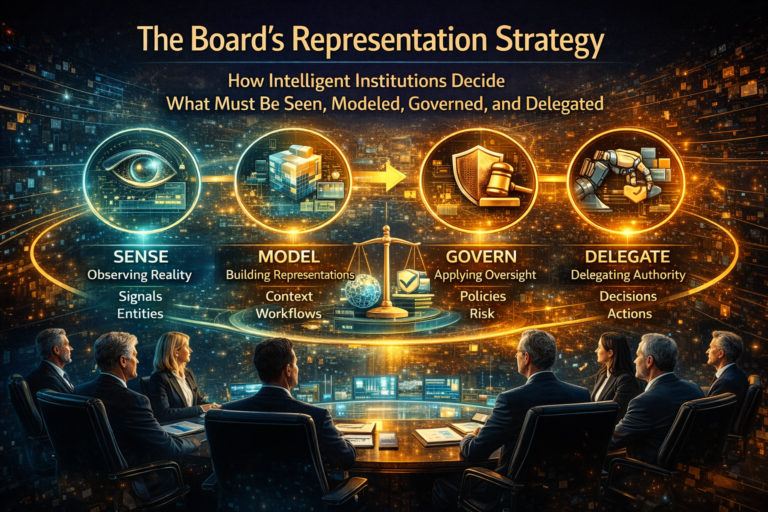
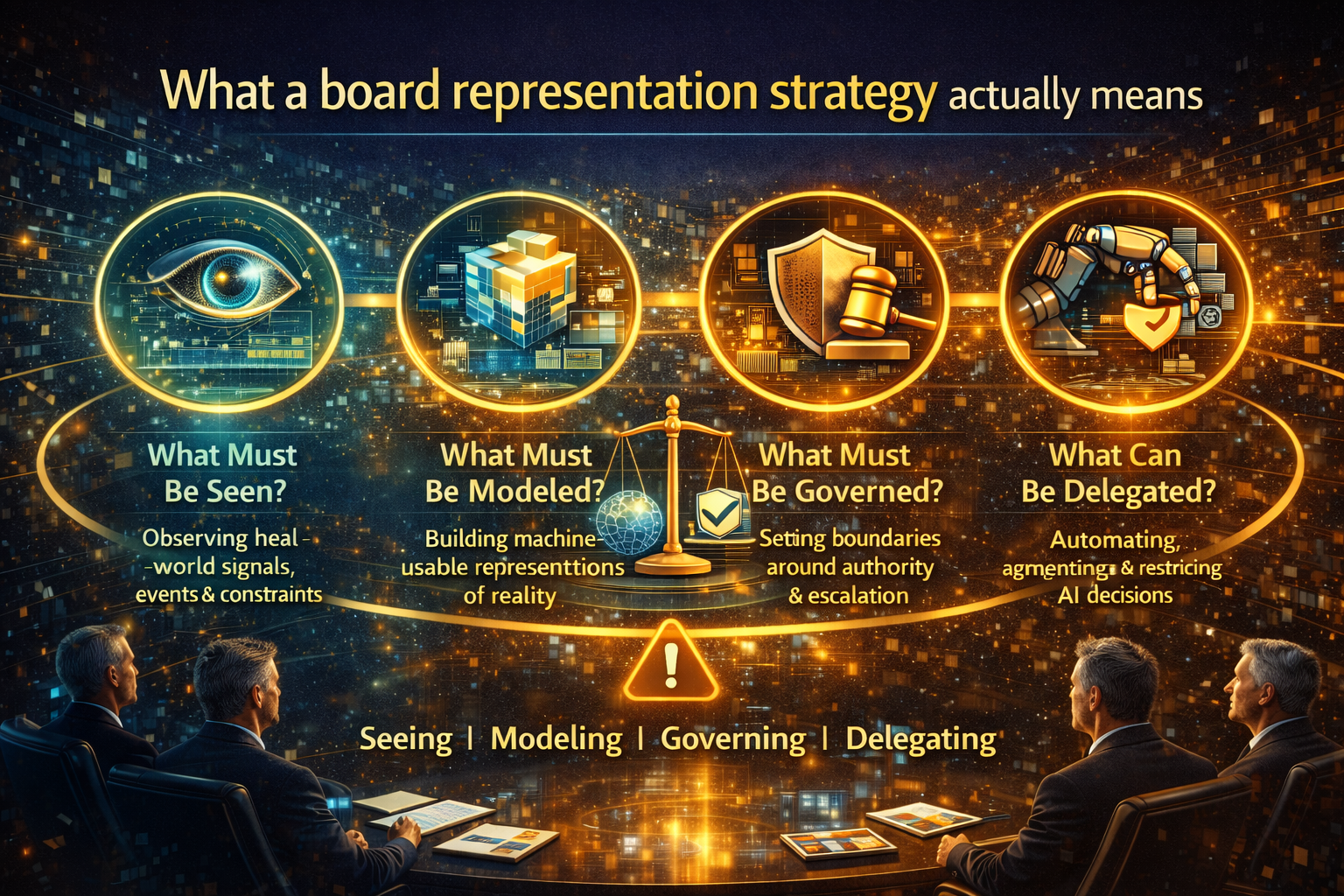
Executive definition: What is a board representation strategy?
A board representation strategy is the discipline through which directors and senior executives decide what their institution must be able to see, model, govern, and delegate before artificial intelligence is allowed to influence, recommend, or execute decisions.
It is not simply an AI policy. It is not a model-selection exercise. It is a board-level framework for determining:
what parts of reality the institution must represent accurately,
how those representations should be structured for machine use,
where governance and oversight must apply,
and what level of autonomy can be safely delegated to AI systems.
In simple terms, a board representation strategy is how an institution decides what machines must understand before machines are trusted to act.
Definition: Board Representation Strategy
A board representation strategy is the discipline through which directors decide what realities an institution must represent accurately before artificial intelligence is allowed to influence or execute decisions. It determines what must be seen, modeled, governed, and delegated so AI systems operate within legitimate institutional boundaries.
The boardroom question has changed
Artificial intelligence is changing the boardroom question.
For the past two years, many directors and executives have been asking some version of the same thing: Which model should we use? Which platform is safest? Which copilot will improve productivity? Those are valid questions, but they are no longer the deepest ones.
The more important question is this:
What must our institution represent correctly before we allow AI to reason, recommend, or act?
That is the real strategic issue now. As AI adoption rises across the economy, boards are moving from curiosity to accountability. Stanford’s 2025 AI Index reports that 78% of organizations said they used AI in 2024, up from 55% the year before, while private investment in generative AI reached $33.9 billion globally in 2024. (Stanford HAI)
Boards are therefore no longer governing only software budgets. They are increasingly governing how their institutions see reality, interpret it, and act upon it.
That is why every serious enterprise now needs a representation strategy.
A representation strategy is the board-level discipline of deciding what the institution must be able to see, how that reality should be modeled, where that model must be governed, and what can be safely delegated to machines. It is the executive expression of a larger architectural shift: the move from simple automation to the Representation Economy, and from fragmented AI experiments to intelligent institutions designed around SENSE–CORE–DRIVER.
This matters because institutions do not fail only when a model makes a bad prediction. They often fail much earlier, when they are representing the wrong reality, omitting critical context, delegating too much, or governing too little.
Why boards now need a representation strategy
Why boards now need a representation strategy
In the first wave of digital transformation, boards focused on digitization, efficiency, and operating leverage. In the second wave, they began asking about cloud, cybersecurity, data modernization, and platform resilience. In the AI era, the challenge changes again. The board must now govern systems that can influence, recommend, prioritize, personalize, classify, approve, deny, escalate, and sometimes act.
That shift makes representation a governance issue, not just a technical one.
A bank cannot safely deploy AI for underwriting if it lacks a robust representation of customer context, affordability, product suitability, consent boundaries, and recourse pathways. A hospital cannot safely scale AI triage if it represents symptoms but not care continuity, patient history, escalation triggers, or clinician override. A manufacturer cannot rely on autonomous optimization if it models throughput but ignores maintenance condition, supply variance, safety thresholds, or local constraints.
In each case, the problem is the same: the machine can only reason over the reality the institution has chosen to represent.
This is also why current governance frameworks increasingly emphasize accountability, traceability, transparency, and human oversight. NIST’s AI Risk Management Framework organizes AI risk management around GOVERN, MAP, MEASURE, and MANAGE, while the OECD AI Principles call for accountability and traceability across the AI lifecycle. The EU AI Act also imposes transparency and human-oversight obligations for certain AI uses, especially in higher-risk contexts. (NIST Publications)
These are not just compliance themes. They are clues that the board’s real job begins before model deployment.
What a board representation strategy actually means
What a board representation strategy actually means
A representation strategy answers four questions.
What must be seen?
What signals from the real world are critical to decisions? Which events, changes, behaviors, exceptions, and constraints matter enough that the institution must capture them?
What must be modeled?
How should those signals be organized into a machine-usable representation of customers, assets, relationships, risks, workflows, policies, and states?
What must be governed?
Where are the boundaries around authority, interpretation, risk, escalation, verification, auditability, and recourse?
What can be delegated?
Which decisions can be automated, which can be machine-assisted, and which must remain human-led?
This is why boards need to think beyond “AI tools.” The core strategic asset is not the model alone. It is the institution’s ability to create trustworthy, evolving representations of reality that machines can operate within.
That idea connects directly to SENSE–CORE–DRIVER.
SENSE: deciding what the institution must be able to see
Every board should ask:
What does our institution need to sense in order to operate intelligently?
SENSE is where reality becomes machine-legible. It includes signals, entities, state representation, and evolution over time. But from a board perspective, the issue is simpler and more urgent: are we seeing enough of the right reality to make AI safe and useful?
Many organizations assume the answer is yes because they have data warehouses, dashboards, CRM systems, and data lakes. But data abundance is not the same as representational adequacy.
Take a consumer lender. It may have transaction data, demographic data, repayment history, and bureau inputs. But if it cannot represent volatile life events, temporary hardship, channel behavior, dispute history, or unusual account context, then even a technically strong model may be reasoning over an incomplete world.
Take a hospital. It may have electronic health records, lab reports, and appointment logs. But if it cannot represent urgency shifts, care transitions, contraindications, or deviations from expected progression, then AI may optimize around the wrong picture of reality.
For a board, this becomes a strategic design question:
What are the minimum realities our institution must capture to remain intelligent, trustworthy, and defensible?
That is the beginning of representation strategy.
CORE: deciding how the institution should reason
Once the institution has chosen what must be seen and modeled, the next question is:
How should decisions be made inside that represented reality?
This is the CORE layer: comprehend context, optimize decisions, realize action, and evolve through feedback.
Boards often underestimate this layer because many AI discussions still collapse reasoning into “answer generation.” But institutional reasoning is not just producing plausible outputs. It is reasoning under law, policy, cost, role boundaries, customer promises, risk appetite, timing constraints, and operational trade-offs.
A board representation strategy therefore needs to define not only what is modeled, but also what reasoning standards apply.
For example:
Should the AI optimize for speed, fairness, margin, safety, fraud reduction, or regulatory defensibility?
Should it escalate uncertainty early or late?
Should it treat edge cases conservatively or aggressively?
Should it prefer reversible actions over irreversible ones?
These are not model-tuning details. They are institutional design choices.
One of the biggest errors companies make is to let AI inherit fragmented logic from different business silos. Marketing optimizes one reality. Operations uses another. Compliance relies on a third. Risk sees a fourth. The result is not intelligence. It is institutional incoherence wearing an AI interface.
A serious board-level representation strategy forces alignment:
What is the shared model of reality that the institution wants its machines to reason over?
DRIVER: deciding what can be governed and delegated
The final board question is the hardest:
What can we safely allow machines to do?
This is the DRIVER layer: delegation, representation, identity, verification, execution, and recourse.
Boards should not think about delegation as a yes-or-no question. They should think of it as a ladder.
At the bottom of the ladder, AI assists but does not decide.
In the middle, AI recommends and a human approves.
Higher up, AI acts within bounded policies and known thresholds.
At the top, AI operates autonomously in tightly governed environments with strong logging, reversibility, and oversight.
The board’s role is to decide where each class of decision belongs.
A retailer may allow AI to rebalance promotions within predefined limits. A bank may allow AI to flag suspicious activity but not freeze complex cases without review. A hospital may allow AI to prioritize documentation or route routine cases, but not autonomously determine high-risk treatment decisions. A government agency may use AI to support case triage but still require human review for actions affecting legal rights or benefits eligibility.
What matters is not whether the institution uses AI. What matters is whether delegation matches representational maturity and governance strength.
If the institution has weak representation and weak recourse, delegation should stay narrow. If representation is robust, identity is clear, verification is strong, and recourse exists, more bounded delegation becomes possible.
That is what intelligent institutions do: they let autonomy rise only when legitimacy rises with it.
The five realities every board should review
The five realities every board should review
A practical representation strategy should force boards to review five realities.
Customer and stakeholder reality
Does the institution truly represent the customer, citizen, patient, policyholder, or client in a current, contextual, machine-usable way?
Operational reality
Does it represent what is actually happening in workflows, queues, systems, exception paths, service states, and handoffs?
Constraint reality
Does it represent laws, policies, thresholds, approvals, time limits, and non-negotiable guardrails?
Authority reality
Does it represent who can approve, override, delegate, challenge, and unwind actions?
Outcome reality
Does it represent whether decisions worked, caused harm, required reversal, or should change future policy?
If one of these realities is missing, AI can still function. But it will not function intelligently for long.
What representation failure looks like
Representation failure rarely begins with a dramatic model collapse. More often, it begins quietly.
A support bot gives the wrong answer because it sees policy text but not current exception handling.
A risk engine overreacts because it sees anomaly signals but not recent customer context.
A healthcare assistant recommends an action because it sees symptoms but not continuity of care.
A pricing system reacts to demand signals but not reputational, fairness, or long-term customer consequences.
These are not just bad outputs. They are signs that the institution has modeled reality too thinly.
That is why boards should stop asking only, “How accurate is the model?” and start asking:
What does the model not see, not represent, or not understand about the decision environment?
A board agenda for the AI decade
If boards want to govern AI seriously, representation strategy should become part of annual and quarterly oversight.
They should ask:
What critical realities does the institution rely on but not yet represent well?
Which decisions are already being influenced by incomplete machine representations?
Where is authority being delegated faster than governance is maturing?
Which high-impact decisions lack strong recourse or reversibility?
Where do different functions operate with conflicting representations of the same entity or event?
What must become visible before we scale autonomy further?
These are not technical hygiene questions. They are questions about institutional fitness in the AI era.
Why this is ultimately a strategy question, not a technology question
Why this is ultimately a strategy question, not a technology question
The deepest implication of representation strategy is that it changes what competitive advantage means.
In the old automation story, advantage came from lowering cost and increasing speed. In the representation story, advantage comes from seeing more clearly, modeling more truthfully, governing more intelligently, and delegating more responsibly.
That is a very different kind of edge.
It is harder to copy. It compounds over time. And it makes the institution better not only at automation, but at judgment.
This is why the board’s representation strategy belongs alongside capital allocation, cyber resilience, operating model design, and growth strategy. It helps determine which realities the institution can act upon. And in the AI era, that means it helps determine the institution’s future.
The real board question has changed
The real board question is no longer, “Should we adopt AI?”
It is no longer even, “Which AI vendor should we trust?”
It is this:
What must our institution be able to see, model, govern, and delegate if we want AI to create value without eroding legitimacy?
That is the heart of a board representation strategy.
Institutions that answer it well will not just scale AI more safely. They will build a deeper kind of advantage: the ability to turn machine-legible reality into governed judgment and action.
And that is what intelligent institutions will be built on next.
Key takeaways
AI governance now begins before model deployment.
Boards must decide what reality the institution must represent correctly.
Representation strategy is about what must be seen, modeled, governed, and delegated.
SENSE–CORE–DRIVER provides a practical architecture for this shift.
Delegation should rise only when legitimacy, verification, and recourse rise with it.
The institutions that govern representation well will build a more durable AI advantage.
Conclusion
Boards often assume the hardest part of AI strategy is selecting the right model, vendor, or platform.
It is not.
The harder and more consequential task is deciding what the institution must make visible, how that reality should be modeled, where governance must apply, and which actions can be entrusted to machines without undermining legitimacy.
That is why representation strategy is becoming a board-level imperative.
It is not a technical appendix to AI transformation. It is the discipline that determines whether AI becomes a source of judgment, control, and institutional resilience — or a source of fragility hidden behind impressive interfaces.
The institutions that lead in the next era will not be those that merely deploy more AI. They will be those that represent reality better, reason more coherently, govern more intelligently, and delegate more responsibly.
That is the real strategic frontier.
And it is where the future of intelligent institutions will be decided.
FAQ
What is a board representation strategy?
A board representation strategy is the discipline of deciding what an institution must be able to see, model, govern, and delegate before AI systems are trusted to influence or execute decisions.
Why is representation strategy important for AI governance?
Because AI can only reason over the reality the institution has chosen to represent. If that representation is incomplete, outdated, or poorly governed, even strong models can produce weak or risky decisions.
How is representation strategy different from AI policy?
AI policy usually defines rules, controls, and acceptable use. Representation strategy goes deeper by determining what reality must be captured and modeled in the first place.
What does SENSE mean in this context?
SENSE refers to the institution’s ability to detect signals, identify entities, model state, and track how that state changes over time.
What does CORE mean?
CORE is the reasoning layer where institutions interpret context, optimize choices, determine actionable options, and improve through feedback.
What does DRIVER mean?
DRIVER is the legitimacy and execution layer where authority, verification, identity, execution, and recourse are governed.
Why should boards care now?
Because AI systems are increasingly influencing consequential decisions, and regulators and governance frameworks are placing more emphasis on accountability, traceability, and human oversight. (NIST Publications)
What kinds of decisions should never be fully delegated?
That depends on the institution, but high-impact decisions involving legal rights, major financial harm, patient safety, or weak recourse usually require tighter human oversight.
What is representation failure?
Representation failure occurs when the institution models reality too thinly or incorrectly, causing AI to reason over an incomplete or distorted decision environment.
Is this only relevant for regulated industries?
No. It matters most in regulated sectors first, but any institution using AI for prioritization, recommendation, approval, denial, routing, pricing, or action will eventually face representation questions.
How does this help boards think differently about AI?
It shifts the board’s focus from “Which AI tool should we use?” to “What must be true about our institutional reality before AI is allowed to act?”
Glossary
Board representation strategy
The board-level discipline of deciding what the institution must see, model, govern, and delegate before AI can be trusted in consequential decisions.
Representation Economy
The shift in which competitive advantage increasingly comes from building machine-readable representations of reality rather than from automation alone.
Machine-legible reality
Reality translated into structured forms that software and AI systems can interpret, update, and act on.
SENSE
The institutional layer that captures signals, identifies entities, models state, and tracks change over time.
CORE
The institutional reasoning layer that interprets context, evaluates trade-offs, and supports decisions under constraints.
DRIVER
The layer that governs authority, identity, verification, execution, and recourse for machine-supported action.
Representation failure
A failure that occurs when an institution models reality too thinly, too late, or too inaccurately for AI to reason safely.
Institutional reasoning
Decision-making that reflects not only patterns in data, but also policy, risk, authority, timing, and operational constraints.
Delegated action
Action carried out by an AI-enabled system within predefined authority limits and oversight boundaries.
Recourse
The ability to review, challenge, reverse, or correct a machine-supported decision.
Traceability
The ability to reconstruct what data, processes, and decisions contributed to an AI system’s output or action.
Human oversight
Mechanisms that allow people to supervise, intervene in, or override AI decisions when necessary.
Representational maturity
The degree to which an institution has accurately modeled the realities that matter for decision-making.
AI is changing more than work. It is changing institutional architecture.
Artificial intelligence is not only changing how organizations automate tasks. It is changing how institutions observe reality, interpret signals, decide what matters, and act with authority.
That is the deeper shift.
For the last few years, the AI conversation has been dominated by model-centric questions. Which model is bigger? Which model is cheaper? Which model is safer? Which model generates better text, code, images, or predictions?
Those questions still matter. But they no longer explain where durable institutional advantage will come from.
The next era of advantage will not belong only to institutions with powerful models. It will belong to institutions that can build a better representation of reality and turn that representation into better decisions, safer execution, and more legitimate action. That is why the next economy being shaped by AI is not just an automation economy. It is a representation economy.
This shift is happening at a moment when AI adoption has accelerated sharply. Stanford’s 2025 AI Index reports that 78% of organizations said they used AI in 2024, up from 55% the year before, and that global private investment in generative AI reached $33.9 billion in 2024.
At the same time, the governance environment is becoming more operational: the OECD AI Principles were updated in 2024, NIST continues to expand practical AI risk guidance, and the EU AI Act is being phased in progressively, with key provisions already applying and full rollout currently scheduled through August 2027. (Stanford HAI)
In other words, AI is no longer a side experiment. It is becoming part of institutional architecture.
And once AI becomes institutional architecture, a more important question appears:
How should institutions be designed when perception, reasoning, and action are increasingly machine-mediated?
My answer is the SENSE–CORE–DRIVER architecture.
It is a practical framework for understanding how intelligent institutions will operate in the representation economy.
SENSE is the legibility layer: how reality becomes machine-readable.
CORE is the cognition layer: how institutions reason over that reality.
DRIVER is the legitimacy and execution layer: how decisions become authorized, governed, and real.
This is not merely a technology stack. It is an institutional stack.
And the institutions that master it will not simply “use AI better.” They will see earlier, decide better, act faster, and govern more credibly than their competitors.
What Is the Representation Economy?
The Representation Economy is an emerging economic paradigm in which institutions compete based on their ability to continuously sense reality, reason about it, and execute decisions through intelligent systems.
In earlier economic eras, advantage came from:
labor
capital
industrial production
software automation
In the Representation Economy, advantage increasingly comes from the quality of institutional representations of reality.
Organizations that can accurately represent the world — customers, markets, risks, operations, and environments — can make better decisions faster.
To operate in this new environment, institutions require a new architecture.
That architecture can be understood through three layers:
SENSE – making reality legible through signals and state representations
CORE – reasoning about decisions using institutional knowledge and models
DRIVER – executing delegated actions with legitimacy, verification, and accountability
Together, these layers form the SENSE–CORE–DRIVER architecture of intelligent institutions.
Key Takeaways
AI is transforming institutions into intelligent decision systems
Competitive advantage will shift to representation capability
The SENSE–CORE–DRIVER architecture defines how intelligent institutions operate
New institutions will emerge around decision infrastructure and legitimacy platforms
The big shift: from automation to representation
The big shift: from automation to representation
Every major economic era is built on a new form of leverage.
The industrial era scaled muscle.
The information era scaled communication.
The software era scaled transactions and workflows.
The AI era is beginning to scale something deeper: representation.
Representation is the structured ability to make the world legible enough for systems to interpret and act on it.
A hospital does not merely store patient records. It represents a patient’s evolving condition.
A bank does not merely process transactions. It represents trust, intent, exposure, and obligation.
A city does not merely collect data. It represents movement, congestion, safety, demand, and public behavior.
A supply chain does not merely move goods. It represents inventory state, supplier reliability, demand volatility, and execution risk.
The better the representation, the better the decision.
This matters because AI systems do not act directly on raw reality. They act on representations of reality: signals, entities, states, labels, graphs, histories, policies, and feedback loops. That is why the next institutional advantage will not come only from training better models. It will come from answering deeper questions:
What part of reality do we capture?
How accurately do we represent it?
How quickly do we update it?
How intelligently do we reason over it?
How safely and legitimately do we convert it into action?
That is why the representation economy matters. It shifts the conversation from “AI as a tool” to AI as institutional perception, institutional cognition, and institutional execution.
Why institutions now need a new architecture
Why institutions now need a new architecture
Most institutions were built for an earlier world.
They were designed for human review, periodic reporting, fragmented data, delayed escalation, and mostly manual action. In that world, it was acceptable for reality to be only partially visible, for decisions to be slow, and for execution to be mediated through committees, forms, and time.
That world is disappearing.
In an AI-rich environment, institutions increasingly face continuous streams of signals instead of periodic updates, dynamic entities instead of static records, real-time risk instead of quarterly summaries, delegated workflows instead of purely human processing, and machine-generated recommendations that can rapidly turn into machine-executed outcomes.
That makes older architectures insufficient.
Traditional institutions often suffer from four structural gaps:
They cannot see clearly
Data is fragmented across systems, teams, vendors, forms, and channels. There is no stable institutional picture of reality.
They cannot reason coherently
Even when data exists, it is not connected or contextualized well enough to support cross-functional decisions.
They cannot execute safely
AI may suggest an action, but the institution often lacks clear authority boundaries, verification pathways, and recourse mechanisms.
They cannot learn institutionally
Actions happen, but the institution does not retain the decision trail, exception logic, and outcome memory well enough to improve.
This is exactly why practical governance matters. NIST’s AI Risk Management Framework and its Generative AI Profile emphasize governance, context mapping, measurement, and active risk management. OECD guidance similarly highlights accountability, robustness, transparency, and lifecycle monitoring. The point is not that institutions need more policy language. The point is that they need an architecture that can operationalize those principles. (NIST)
That is where SENSE–CORE–DRIVER becomes useful.
It offers a simple but powerful answer to a hard question:
How do intelligent institutions turn reality into governed action?
Why the Representation Economy Matters
The Representation Economy will change how institutions compete.
Three shifts are already visible:
Decision speed becomes strategic
Organizations that can sense reality faster and reason better will outperform slower institutions.
Institutional memory becomes an asset
Decisions, exceptions, and outcomes become structured knowledge that improves future reasoning.
Governance becomes infrastructure
As machines participate in decision systems, institutions must define:
authority
verification
accountability
recourse
This creates entirely new categories of institutional infrastructure.
The SENSE Layer: Making Reality Legible
The SENSE Layer: Making Reality Legible
SENSE is where the institution learns to see
SENSE is the first layer of an intelligent institution. It is where reality becomes visible enough for machine-assisted decision-making.
SENSE stands for:
Signal — detecting events, changes, and traces from the world
ENtity — attaching those signals to a persistent actor, object, location, account, or asset
State representation — building a structured model of the current condition of that entity
Evolution — updating that state over time as new signals arrive
SENSE is not just data collection. It is institutional legibility.
Example: fraud detection
A traditional system may inspect a single transaction and ask, “Does this look suspicious?”
A SENSE-based institution sees something richer:
the signal: a high-value transfer from a new device
the entity: a specific customer, merchant, and account network
the state: recent login reset, unusual geography, new payee, altered spending pattern
the evolution: three small test transactions preceded this event, and similar sequences appeared in earlier fraud cases
That is not merely more data. It is a more usable representation of reality.
Why SENSE matters across industries
The same pattern applies everywhere.
In healthcare, SENSE links symptoms, labs, medication history, and deterioration over time.
In manufacturing, it links vibration readings, asset identity, maintenance state, and degradation patterns.
In logistics, it links shipment events, route changes, weather, supplier reliability, and exception history.
In education, it links learner behavior, concept mastery, engagement signals, and progression trajectory.
The key shift is this: institutions stop working from isolated records and start working from living representations.
That is also why AI readiness increasingly depends on strong data governance, digital infrastructure, institutional reform, skills, and local ecosystems. The World Bank’s 2025 work on strengthening AI foundations explicitly frames AI readiness as a core pillar and highlights data governance, institutional reform, and local innovation capacity as essential foundations for meaningful AI adoption. (World Bank)
Why many AI initiatives fail before they even begin
Many AI initiatives fail not because the model is weak, but because the institution cannot make reality legible.
If signals are sparse, entity resolution is broken, state is stale, or evolution is missing, the model is forced to reason over a distorted world.
That is like asking an excellent pilot to fly with a cracked windshield and delayed instruments.
What a mature SENSE layer usually includes
A mature SENSE layer often includes:
event streams from internal and external systems
entity resolution across customers, assets, accounts, products, and cases
state models that summarize the current condition
temporal memory showing how state changed over time
confidence controls that distinguish strong signals from noisy ones
Consider an insurance claim.
Without SENSE, the institution sees a form.
With SENSE, it sees claimant history, policy state, incident timing, repair estimates, linked entities, suspicious pattern overlaps, and previous adjudication outcomes.
That is the difference between paperwork and representation.
The CORE Layer: Institutional Reasoning
The CORE Layer: Institutional Reasoning
If SENSE makes reality legible, CORE makes it intelligible
CORE is the reasoning layer of the institution.
It stands for:
Comprehend context
Optimize decisions
Realize action
Evolve through feedback
This is where AI models, heuristics, rules, simulations, workflows, domain logic, causal assumptions, business goals, and policy constraints come together.
In simple terms, CORE answers four questions:
What is happening?
What does it mean?
What should we do?
What did we learn?
Why CORE is much more than “using a model”
Many organizations still think of AI as a smart assistant sitting beside a workflow.
But in serious institutional environments, CORE is not just a chatbot or prediction endpoint. It is a decision system.
Take enterprise lending as an example.
SENSE creates a living representation of the borrower, transaction patterns, collateral, sector conditions, and repayment state.
CORE reasons over creditworthiness, fraud signals, policy rules, concentration risk, exposure limits, and scenarios.
DRIVER determines whether the proposed action can be executed, by whom, under what conditions, and with what recourse.
That middle step is where institutional intelligence is actually created.
Comprehend context
This is the part many organizations underestimate.
A model output is not context.
Context is the institution’s ability to place a signal inside a meaningful decision frame.
A late payment means one thing for a new borrower with unstable cash flow. It means something entirely different for a long-standing customer during a known sector shock.
Context is what turns pattern recognition into judgment.
Optimize decisions
Once context is understood, CORE helps the institution choose among alternatives.
In retail, that may mean deciding between discounting, replenishment, or stock reallocation.
In healthcare, it may mean triage, escalation, or watchful waiting.
In cybersecurity, it may mean isolate, monitor, challenge, or block.
In public services, it may mean prioritize review, release payment, or request additional verification.
Optimization here does not always mean mathematical maximization. In real institutions, it usually means balancing speed, cost, safety, fairness, policy, trust, and strategic intent.
Realize action
A decision that cannot be translated into an operational pathway is only a suggestion.
CORE therefore needs interfaces to workflows, systems, tools, forms, and teams. It must know how a decision becomes executable in the real institution.
Evolve through feedback
This is what separates static automation from intelligent institutions.
An institution becomes smarter when it learns not only from outcomes, but from overrides, disputes, exceptions, failures, and unintended consequences.
If humans consistently overturn a recommendation, that matters.
If an action works for one segment but fails for another, that matters.
If a rule appears efficient but creates downstream unfairness or legal risk, that matters.
That lifecycle mindset is strongly aligned with current governance thinking. OECD and NIST both emphasize that responsible AI cannot be treated as a one-time compliance event; it must be continuously monitored, assessed, and improved over time. (NIST Publications)
The simple analogy
SENSE is the institution’s eyes and ears.
CORE is the institution’s judgment.
Without SENSE, CORE is blind.
Without CORE, SENSE is only noise.
The DRIVER Layer: Delegated Action and Legitimacy
The DRIVER Layer: Delegated Action and Legitimacy
This is the layer most AI strategies still underestimate
DRIVER is where AI moves from recommendation to real-world consequence.
It stands for:
Delegation — who authorized the system to act
Representation — what version of reality the system relied on
Identity — which entity was affected
Verification — how the decision is checked
Execution — how the action is carried out
Recourse — what happens if the system is wrong
DRIVER is the legitimacy layer.
It is what turns institutional action into something governable.
Why DRIVER matters now
A recommendation is not the same thing as an action.
A model suggesting “possible fraud” is one thing. Freezing a customer’s account is another.
A system suggesting “possible tumor” is one thing. Altering a treatment path is another.
A system suggesting “high-risk borrower” is one thing. Denying credit is another.
The moment AI crosses from analysis to execution, legitimacy becomes central.
That is why governance frameworks and regulations increasingly focus on accountability, transparency, oversight, and risk controls. The OECD AI Principles stress trustworthy AI and accountability. NIST’s risk framework focuses on governance and responsible use. The European Commission’s official AI Act timeline shows that obligations are arriving in stages, including general provisions, AI literacy, GPAI rules, governance obligations, and later high-risk system requirements. (OECD)
Delegation
Who gave the machine the right to act?
This is not a symbolic question. It is an architectural one.
Was a delegation policy approved?
Are actions bounded by risk category?
Can authority vary by context, customer segment, or confidence threshold?
Is the system proposing actions, executing them, or both?
Representation
What version of reality did the system rely on when it acted?
If the underlying representation was incomplete, stale, or wrong, the action may be illegitimate even if the model’s internal logic was consistent.
Identity
Who or what is affected?
A legitimate institution must know whether it is acting on the correct customer, patient, citizen, employee, asset, machine, case, or account.
Verification
How is the action checked before it becomes real?
This can involve rule validation, policy checks, confidence thresholds, anomaly screens, multi-source confirmation, or required human sign-off.
Execution
What exactly is carried out?
Send alert? Freeze account? Approve payment? Route a patient? Change access rights? Shut down a machine? Trigger investigation?
Execution must be bounded, observable, logged, and reversible where possible.
Recourse
What happens if the system is wrong?
Can the customer appeal?
Can the employee challenge it?
Can the clinician override it?
Can the institution reconstruct the logic and timeline?
Can the decision be reversed fast enough to matter?
Without recourse, automation becomes brittle power.
With recourse, it becomes governable authority.
That is the real promise of DRIVER: it turns AI from a clever tool into an accountable institutional actor.
Why this architecture was difficult to build earlier
For most of history, institutions could not build this architecture at scale.
Three things were missing.
Reality was too hard to capture
Signals were sparse, analog, delayed, or disconnected.
Reasoning was too expensive
Even when data existed, it was difficult to reason across thousands or millions of dynamic cases.
Execution infrastructure was too fragmented
Institutions lacked the identity, workflow, observability, software, and governance layers required to convert machine recommendations into controlled action.
That is changing now because several capabilities are arriving together: richer digital traces, better data infrastructure, stronger identity and workflow systems, more capable AI models, and maturing governance frameworks around risk, oversight, and accountability. Stanford, NIST, OECD, the World Bank, and the EU’s own AI governance infrastructure all point to the same broader pattern: AI is moving from experimentation to institutionalization. (Stanford HAI)
This is why the present moment matters.
The technology is now strong enough to make representation economically valuable. The governance environment is becoming mature enough to make representation institutionally acceptable.
Where the SENSE–CORE–DRIVER framework works best
Where the SENSE–CORE–DRIVER framework works best
This framework is especially powerful where five conditions are present:
Reality changes quickly
Fraud, logistics, cyber threats, patient deterioration, and supply volatility are dynamic by nature.
Decisions are frequent
The institution must make many decisions continuously, not occasionally.
Stakes are meaningful
Mistakes have financial, legal, operational, human, or reputational costs.
Context matters
Simple rules are not enough.
Action must be governed
The institution cannot afford opaque or uncontrolled automation.
That is why this framework is especially relevant in:
banking and financial services
healthcare
insurance
public services
critical infrastructure
manufacturing
supply chains
cybersecurity
digital platforms
education systems at scale
In all these areas, the future winner is unlikely to be the organization with only the best model. It is more likely to be the organization with the best institutional representation and governed execution.
Where the framework can fail
No architecture is magic.
SENSE–CORE–DRIVER can fail in predictable ways, and naming those failure modes is important because serious board-level strategy is as much about limits as it is about promise.
Failure 1: false legibility
The institution believes it sees reality clearly, but the signals are biased, delayed, incomplete, or mislinked.
Failure 2: brittle reasoning
CORE becomes overconfident, shallow, or optimized for the wrong target.
Failure 3: illegitimate execution
The institution automates actions without sufficient delegation, verification, explanation, or recourse.
Failure 4: governance theater
Policies look polished on paper, but live systems run through fragile scripts, disconnected vendors, silent overrides, and invisible operational shortcuts.
Failure 5: memory failure
The institution acts, but does not learn because feedback, exceptions, and downstream outcomes are not captured in a durable institutional memory.
This is why SENSE–CORE–DRIVER should not be treated as a one-time technology project. It must be treated as a living institutional discipline.
What new institutions may emerge in the representation economy
What new institutions may emerge in the representation economy
Once representation becomes strategic, new institutional forms begin to emerge.
Representation-native enterprises
These organizations are built around continuously updated operational reality rather than delayed management summaries.
Decision infrastructure firms
These firms compete not mainly on software features, but on superior institutional reasoning and controlled execution.
Legitimacy platforms
New layers arise around auditability, traceability, identity binding, decision verification, and recourse orchestration.
Institutional memory systems
These systems preserve not just data, but decision history, exception logic, override patterns, and outcome learning.
Delegated action markets
These are environments in which machine actors perform bounded tasks under explicit policy, authority, and accountability rules.
That is where the representation economy becomes larger than enterprise software. It begins to redefine how institutional power itself is organized.
Historical precedents: every major leap in coordination began with better representation
History offers a useful pattern.
When accounting improved, firms became more governable.
When maps improved, states became more navigable.
When double-entry bookkeeping spread, commerce scaled.
When clocks standardized time, industrial coordination became possible.
When databases matured, digital business expanded.
When search engines organized the web, information became usable at scale.
Each of these shifts made some part of reality more legible.
The representation economy is the next step in that pattern.
It is not just about storing more data. It is about creating actionable, governable, continuously updated representations of the world.
That is why this moment matters so much. Institutions are moving from record-keeping to reality-modeling.
Why this matters strategically for boards, CEOs, and CTOs
The most important implication of this framework is that AI strategy can no longer remain model-centric.
Boards and executive teams now need to ask harder questions:
What reality does our institution currently fail to see?
Where is our representation of customers, assets, operations, and risk too shallow?
Which decisions are still being made with low-quality context?
Where are we automating without legitimacy?
What recourse exists when machine-mediated action is wrong?
What institutional memory are we building from exceptions and outcomes?
These are not technical questions alone. They are strategic governance questions.
They shape resilience.
They shape speed.
They shape trust.
They shape enterprise value.
That is why the representation economy is not a niche academic concept. It is a board-level design problem.
The Future of Institutional Architecture
Over the next decade, the institutions that dominate their sectors will not simply deploy more AI tools.
They will redesign themselves around representation infrastructure.
They will build systems that:
continuously sense reality
reason through institutional knowledge
execute delegated actions responsibly
The institutions that master this architecture will define the next era of economic competition.
This is the logic of the Representation Economy.
Conclusion: the next institutional advantage will be built on legibility, reasoning, and legitimacy
The biggest AI shift is not that machines can now generate language.
It is that institutions can increasingly build machine-mediated representations of reality, reason over them continuously, and act on them at scale.
That changes the architecture of the enterprise.
It changes the architecture of governance.
It changes the architecture of trust.
In the industrial age, advantage came from owning production capacity.
In the software age, advantage came from owning digital workflows.
In the representation economy, advantage will come from owning the best way to make reality legible, reason over it intelligently, and act on it legitimately.
That is why intelligent institutions will increasingly run on the SENSE–CORE–DRIVER architecture.
Not because it sounds elegant.
Because in an AI-shaped world, institutions will win or fail on three capabilities:
Can they see?
Can they think?
Can they act with legitimacy?
SENSE. CORE. DRIVER.
That is not just a framework.
It may become the architecture of the next institution.
FAQ: The Representation Economy and the SENSE–CORE–DRIVER Architecture
What is the representation economy?
It is the idea that competitive advantage increasingly comes from how well institutions represent reality, reason over that representation, and convert it into governed action.
How is the representation economy different from the automation economy?
Automation focuses mainly on task execution. The representation economy focuses on perception, reasoning, and legitimate execution.
Why does AI make representation more important?
Because AI systems depend on structured representations of the world rather than raw reality itself.
Is representation just another word for data?
No. Data is raw input. Representation is organized, contextualized, decision-ready understanding.
What does SENSE stand for?
Signal, ENtity, State representation, and Evolution.
What does CORE stand for?
Comprehend context, Optimize decisions, Realize action, and Evolve through feedback.
What does DRIVER stand for?
Delegation, Representation, Identity, Verification, Execution, and Recourse.
Why is SENSE important?
Because institutions cannot reason well if the reality they are observing is fragmented or distorted.
Why is CORE important?
Because intelligence is not only prediction. It is context-aware institutional reasoning.
Why is DRIVER important?
Because execution without legitimacy creates risk, mistrust, and institutional fragility.
Is this framework only for large enterprises?
No. The logic applies to startups, governments, hospitals, banks, universities, and digital platforms.
Is SENSE basically data engineering?
Not exactly. Data engineering supports SENSE, but SENSE also includes entity resolution, state modeling, and temporal evolution.
Is CORE just a large language model?
No. CORE can include models, rules, workflows, domain knowledge, business policy, human judgment, and feedback systems.
Is DRIVER just compliance?
No. DRIVER is about legitimacy in execution, not just documentation.
What is institutional legibility?
It is the ability of an institution to observe and structure relevant reality clearly enough to act intelligently.
What is institutional reasoning?
It is an organization’s ability to interpret context, compare options, and choose action in line with goals and constraints.
What is delegated action?
It is when a system is allowed to propose, initiate, or execute actions within clearly authorized boundaries.
Why is recourse important?
Because even capable systems can be wrong, and institutions need fair correction pathways.
Can this framework work in banking?
Yes. It is highly relevant for fraud, credit, underwriting, collections, compliance, and customer operations.
Can it work in healthcare?
Yes. It helps connect patient state, context, intervention logic, safety checks, and execution boundaries.
Can it work in government?
Yes. It is valuable for case handling, eligibility assessment, regulatory review, and service delivery.
Can it work in cybersecurity?
Yes. It is especially powerful for sensing threats, reasoning over attack context, and enabling controlled response.
What is the biggest mistake institutions make with AI?
They focus too much on model capability and too little on representation quality and execution legitimacy.
Why do many AI pilots fail in production?
Because the institution lacks strong sensing, reasoning, workflow integration, and governance architecture.
Does this framework remove human judgment?
No. It helps define where human judgment should remain, where it should supervise, and where it should intervene.
What is false legibility?
It is when the system appears to understand reality but is working from incomplete, biased, stale, or mislinked representations.
What is brittle reasoning?
Reasoning that looks good in demos but fails under drift, edge cases, or real-world complexity.
What is illegitimate execution?
When AI-mediated action happens without proper authorization, verification, or recourse.
Why does time matter so much in SENSE?
Because reality changes, and stale state often produces weak or dangerous decisions.
What is a state representation?
A structured view of the current condition of an entity at a point in time.
Why is feedback essential in CORE?
Because institutions only become intelligent when they learn from outcomes, overrides, and exceptions.
What does “making reality legible” mean?
It means turning messy real-world conditions into usable institutional understanding.
Is explainability enough for DRIVER?
No. Legitimacy also requires delegation, auditability, verification, and recourse.
How is this different from classic enterprise architecture?
Classic enterprise architecture often organizes systems and interfaces. This framework organizes perception, reasoning, authority, and action.
Is the representation economy only relevant to digital firms?
No. It applies to banks, manufacturers, insurers, public institutions, hospitals, and supply chains.
Why are regulations becoming more relevant now?
Because AI is moving closer to consequential decisions, and institutions need stronger controls, literacy, oversight, and risk management. (AI Act Service Desk)
Does the EU AI Act support this broader way of thinking?
Indirectly, yes. Its phased obligations reinforce the need for structured governance, operational accountability, and oversight for higher-risk AI uses. (AI Act Service Desk)
Does NIST support lifecycle governance?
Yes. NIST’s AI RMF and GenAI Profile emphasize governance, mapping, measurement, management, and continuous monitoring. (NIST)
Does OECD support accountability as a lifecycle issue?
Yes. OECD’s AI principles and related accountability work treat trustworthy AI as an ongoing institutional responsibility. (OECD)
What industries are likely to adopt this fastest?
Finance, healthcare, cybersecurity, logistics, public services, and industrial operations.
What new job roles may emerge from this shift?
AI governance architects, representation engineers, decision operations leads, recourse designers, model risk strategists, and institutional memory architects.
What is an institutional memory system?
A system that captures decisions, exceptions, overrides, outcomes, and associated logic over time.
Can representation become a competitive moat?
Yes. Better representation can produce better decisions, faster learning, stronger resilience, and greater trust.
How does this relate to agentic AI?
Agents become far more valuable when they operate inside strong SENSE, CORE, and DRIVER boundaries.
Is this framework anti-agent?
No. It is pro-governed agency.
What is the simplest place to start?
Choose one high-value workflow and map its signals, entities, states, reasoning steps, execution controls, and recourse paths.
What should leaders ask first?
Where does our institution currently fail to see, fail to think, or fail to act legitimately?
Why is this useful for boards and the C-suite?
Because it helps leaders discuss AI as institutional design, not only as technology procurement.
Why is this framework strategically powerful for thought leadership?
Because it gives leaders a vocabulary for talking about AI, governance, execution, and competitive advantage in one coherent architecture.
What is the central message of this article?
The future of AI advantage is not only model capability. It is institutional legibility, institutional reasoning, and legitimate execution.
What is the SENSE–CORE–DRIVER architecture?
The SENSE–CORE–DRIVER architecture describes how intelligent institutions operate.
SENSE converts real-world signals into structured institutional representations.
CORE performs reasoning, optimization, and decision-making.
DRIVER executes authorized actions with governance, identity, and accountability.
Glossary
Representation Economy
An emerging economic logic in which advantage depends on how well institutions represent reality, reason over it, and convert it into governed action.
Intelligent Institution
An organization that combines data, software, AI, policy, and workflows to perceive reality, reason over it, and act with controlled authority.
Institutional Architecture
The structural design through which an institution senses, reasons, governs, and executes decisions.
SENSE
The legibility layer of the institution: Signal, ENtity, State representation, Evolution.
Signal
A detectable event, change, trace, or input from the world.
Entity
The person, object, asset, account, case, or organization to which signals are attached.
State Representation
A structured description of an entity’s current condition.
Evolution
The way that state changes over time.
CORE
The cognition layer: Comprehend context, Optimize decisions, Realize action, Evolve through feedback.
Institutional Reasoning
The ability of an institution to interpret context, compare options, and choose action in line with goals, risks, and constraints.
Context
The surrounding meaning that makes a signal useful for decision-making.
Decision Infrastructure
The systems, logic, workflows, models, and policies that support decisions at scale.
Feedback Loop
A process through which outcomes, overrides, and exceptions improve future decisions.
DRIVER
The legitimacy and execution layer: Delegation, Representation, Identity, Verification, Execution, Recourse.
Delegation
The formal or operational authorization allowing a system to act within defined limits.
Verification
The checks used to confirm whether a proposed action should proceed.
Execution
The point at which a decision becomes real in the operating environment.
Recourse
The ability to challenge, review, correct, or reverse a decision.
Institutional Legibility
The degree to which an organization can clearly observe and structure relevant parts of reality.
False Legibility
A misleading appearance of understanding caused by biased, incomplete, or stale representation.
Governed Action
Execution that occurs within explicit authority, oversight, traceability, and correction pathways.
Institutional Memory
A durable record of decisions, exceptions, outcomes, and lessons that improves future performance.
AI Governance Architecture
The practical design through which institutions make AI accountable, monitorable, and safe to use in real-world decision environments.
Institutional Perspectives on Enterprise AI
Many of the structural ideas discussed here — intelligence-native operating models, control planes, decision integrity, and accountable autonomy — have also been explored in my institutional perspectives published via Infosys’ Emerging Technology Solutions platform.
For readers seeking deeper operational detail, I have written extensively on:
Together, these perspectives outline a unified view: Enterprise AI is not a collection of tools. It is a governed operating system for institutional intelligence — where economics, accountability, control, and decision integrity function as a coherent architecture.
References and further reading
This article draws on recent public work from Stanford HAI’s 2025 AI Index, NIST’s AI Risk Management Framework and Generative AI Profile, the OECD AI Principles and accountability guidance, the European Commission’s official AI Act implementation timeline, and the World Bank’s 2025 work on strengthening AI foundations. These sources collectively reinforce the same structural point: AI is moving from experimentation toward institutionalization, and that shift raises the importance of governance, lifecycle oversight, representation quality, and execution legitimacy. (Stanford HAI)
Explore the Architecture of the AI Economy
This article is part of a broader research series exploring how institutions are being redesigned for the age of artificial intelligence. Together, these essays examine the structural foundations of the emerging AI economy — from signal infrastructure and representation systems to decision architectures and enterprise operating models.
If you want to explore the deeper framework behind these ideas, the following essays provide additional perspectives:
The future will belong to institutions that can sense reality, represent it clearly, reason about it intelligently, and act through governed machine systems.
This is why the architecture of the AI era can be understood through three foundational layers:
SENSE → CORE → DRIVER
Where:
SENSE makes reality legible
CORE transforms signals into reasoning
DRIVER ensures that machine action remains accountable, governed, and institutionally legitimate
Signal infrastructure forms the first and most foundational layer of that architecture.
In the age of autonomous systems, the real question is no longer whether a machine is right. It is whether a machine has the legitimacy to decide.
As AI moves from recommendation to action, organizations face a deeper challenge than accuracy: building systems whose decisions are authorized, contestable, governable, and institutionally defensible.
Artificial intelligence is entering a new phase. For years, most AI systems were treated as tools that generated outputs: recommendations, predictions, classifications, summaries, and draft responses. That era is now giving way to something more consequential. Increasingly, AI systems are being used in places where their outputs do not merely inform a human being. They shape what happens next. They influence who gets a loan, which patient gets priority, which job applicant is filtered out, which transaction is flagged, which insurance claim is reviewed, and which operational decision is executed in real time.
That shift changes everything.
The defining challenge of the next AI era will not be accuracy alone. It will be legitimacy. A machine can be statistically correct and still be institutionally unacceptable. It can optimize and still violate trust. It can improve efficiency and still trigger resistance, public outrage, legal scrutiny, or social rejection. Across major global governance frameworks, the direction is now clear: trustworthy AI requires more than performance. It also requires accountability, transparency, explainability, human oversight, traceability, and mechanisms to contest or remedy harmful outcomes. (NIST Publications)
That is why machine legitimacy matters.
A legitimate AI system is not merely one that gets the answer right. It is one that is authorized to act, bounded by rules, visible to oversight, accountable to institutions, and open to recourse when things go wrong. In other words, legitimacy is what turns machine intelligence into institutionally acceptable decision-making.
That distinction will shape the next wave of competitive advantage.
What is machine legitimacy in AI?
Machine legitimacy refers to the institutional acceptance of AI-driven decisions. A machine decision becomes legitimate when it is authorized by governance structures, transparent enough to be understood, accountable to human oversight, and open to recourse when mistakes occur. In modern AI systems, accuracy alone is not sufficient; legitimacy determines whether AI decisions are trusted and accepted by society.
Why accuracy is no longer enough
Why accuracy is no longer enough
For much of the AI conversation, leaders have asked a narrow question: How accurate is the model? That was a reasonable place to begin. If a model cannot perform its task reliably, nothing else matters. But once AI starts influencing real-world outcomes, accuracy becomes only one layer of the problem.
Imagine two situations.
In the first, a bank uses AI to deny a small-business loan. The model may be technically correct according to historical repayment data, cash-flow signals, and probability estimates. But the applicant does not know why the decision happened, what data was used, whether biased proxies influenced the outcome, or how the decision can be challenged.
In the second, a hospital uses AI to prioritize patient risk. The model may detect deterioration earlier than clinicians can. But if doctors cannot understand the basis of the alert, if responsibility is unclear, or if no one knows when the system should be overridden, correctness alone will not create trust.
In both cases, the issue is not simply whether the machine is right. The deeper issue is whether the institution can defend the decision as legitimate.
This is why many of the most important AI failures are not failures of raw intelligence. They are failures of institutional design. NIST’s AI Risk Management Framework explicitly treats AI risk as a socio-technical problem, not merely a technical one, and identifies validity, reliability, safety, security, resilience, accountability, transparency, explainability, interpretability, privacy enhancement, and fairness as trustworthiness characteristics that must be managed in context. (NIST Publications)
The silent shift from advice to authority
The silent shift from advice to authority
This is the transition many organizations still underestimate: AI is moving from advice to authority.
A recommendation engine is one thing. An execution engine is another.
When a model suggests, human beings remain visibly in charge. When a model triggers action, ranks people, allocates opportunity, approves access, influences enforcement, or shapes resource distribution, the system begins to exercise institutional authority. This is where legitimacy enters.
The EU AI Act reflects this distinction clearly. High-risk AI systems are subject to stronger obligations, including human oversight measures designed to prevent or minimize risks to health, safety, and fundamental rights. It also imposes logging, documentation, and operational responsibilities on deployers and providers of such systems. (Artificial Intelligence Act)
This is not just regulatory language. It points to a deeper truth: once AI begins affecting consequential outcomes, institutions must answer questions that models alone cannot answer.
Who authorized the machine to participate in this decision?
What boundaries define its role?
Who remains accountable if the output causes harm?
How can the affected person appeal or seek review?
What evidence shows the decision was made appropriately?
These are legitimacy questions, not performance questions.
When systems lose legitimacy, institutions lose trust
When systems lose legitimacy, institutions lose trust
The history of algorithmic controversy already shows this pattern.
In the Netherlands, the SyRI welfare-fraud detection system was halted after a court found that it violated human rights norms. Criticism centered on opacity, surveillance, and disproportionate impact on vulnerable communities. The issue was not merely whether the system identified fraud. The deeper issue was whether such a system had legitimate standing inside a democratic institution. (OHCHR)
In England in 2020, the exam-grading algorithm controversy revealed another form of legitimacy failure. Even though standardization was intended to maintain consistency in the absence of exams, the backlash showed that decisions affecting people’s futures could not be accepted when they felt impersonal, opaque, and disconnected from lived reality. Ofqual’s interim report documented the rationale and methodology, but the social rejection of the process made clear that technical procedure does not automatically confer public legitimacy. (GOV.UK)
In criminal justice, debates around COMPAS and similar risk-scoring tools became legitimacy debates as much as fairness debates. The controversy was not only about predictive quality. It was about whether proprietary software should influence liberty-affecting decisions when defendants, courts, and the public cannot fully interrogate its logic or limitations. (ProPublica)
Across sectors, the pattern is consistent. People do not grant legitimacy to AI simply because it is sophisticated. They grant legitimacy when the surrounding institution makes the decision process defensible.
The deeper strategic issue: institutions, not tools, decide who wins
The deeper strategic issue: institutions, not tools, decide who wins
This is where your broader Goal-2 framing becomes especially powerful.
The future AI economy will not be won by institutions that merely deploy smarter tools. It will be won by institutions that redesign themselves to make machine action legitimate.
That is why SENSE–CORE–DRIVER matters.
Most AI discussions begin too late. They begin with the model. But legitimacy starts before the model and extends beyond the model.
SENSE: what reality is allowed to become legible
SENSE is the layer where reality becomes machine-legible.
Signal means detecting events, changes, and traces from the world. ENtity means attaching those signals to a persistent actor, object, asset, customer, or organization. State representation means building a structured model of current condition. Evolution means updating that state over time as new signals arrive.
If this layer is weak, legitimacy is compromised before any model runs. A machine cannot make acceptable decisions about a reality it does not represent properly. If the underlying signals are incomplete, identities are mismatched, state is stale, or change over time is not captured, then even a technically strong model may produce institutionally indefensible outcomes.
A farmer denied credit because records are partial, a merchant misclassified because of patchy transaction history, or a patient triaged using incomplete clinical context all point to the same truth: bad legitimacy often begins as bad legibility.
This is why the legitimacy problem starts earlier than most organizations realize. It begins with what an institution can see, identify, and represent in the first place.
CORE: how institutions interpret reality
CORE is the cognition layer.
This is where systems Comprehend context, Optimize decisions, Realize action logic, and Evolve through feedback. It is where models reason, classify, forecast, recommend, prioritize, and plan.
Most AI investment today is concentrated here. Organizations buy models, fine-tune systems, compare benchmark scores, deploy copilots, and tune prompts. But CORE alone cannot create legitimacy. CORE can generate reasoning. It cannot, by itself, generate authority.
Whether machine reasoning deserves institutional standing depends on what surrounds it.
DRIVER: how institutions make machine action acceptable
DRIVER is where legitimacy truly lives.
Delegation asks who authorized the machine to act. Representation asks what model of reality it used. Identity asks which entity is being affected. Verification asks how the decision is checked. Execution asks how the action is carried out. Recourse asks what happens if the system is wrong.
This is the missing layer in most AI strategies.
Organizations often build CORE before they define DRIVER. They obsess over model performance before they define authority boundaries. They automate decisions before they design appeal mechanisms. They deploy copilots before they clarify who remains responsible. That is why so many AI initiatives feel impressive in demos but fragile in production.
Machine legitimacy is fundamentally a DRIVER problem.
The six tests of machine legitimacy
The six tests of machine legitimacy
A useful way to think about machine legitimacy is to ask whether an AI-influenced decision can pass six simple tests.
Is it authorized?
The institution must define which kinds of decisions a machine may influence, recommend, or execute. Not everything that can be automated should be delegated.
Is it legible?
The institution must know what signals, entities, and states the system is acting upon. If reality is poorly represented, legitimacy is weak from the start.
Is it intelligible?
The decision must be understandable enough for the relevant human roles to use, review, and challenge appropriately. Transparency does not mean exposing every model weight. It means providing meaningful explanation in the context of use. OECD guidance on trustworthy AI and accountability emphasizes this practical, role-sensitive view of transparency, traceability, and responsibility. (OECD)
Is it governable?
There must be logs, controls, monitoring, thresholds for intervention, and clear escalation paths. This is why modern AI governance frameworks stress lifecycle governance, not one-time compliance. (NIST Publications)
Is it contestable?
A person affected by a significant machine-influenced outcome should have a path to review, appeal, escalation, or remediation. Without a way back, legitimacy collapses.
Is it accountable?
The institution must be able to say who owns the outcome. “The model decided” is not an acceptable answer in law, governance, or management.
These six tests are simple enough for boards to grasp and rigorous enough to guide architecture.
Why this is becoming a board-level issue
Boards should care about machine legitimacy for one reason above all: illegitimate AI decisions create strategic risk.
They create legal risk when rights are affected without appropriate safeguards.
They create reputational risk when customers, citizens, or employees experience decisions as opaque or unfair.
They create operational risk when staff over-trust or under-trust the system.
They create political risk when institutions appear to hide behind technology.
They create economic risk when adoption stalls because trust never forms.
The broader direction of global governance is moving the same way. The UN’s recent report Governing AI for Humanity frames AI governance as a matter of public trust, institutional capacity, human rights, and accountable deployment, not simply innovation speed. (United Nations)
In that sense, machine legitimacy is not a moral side topic. It is an operating requirement for the AI economy.
The next competitive advantage: not just automation, but legitimation
This is the deeper strategic insight.
In the first wave of AI, advantage came from building models.
In the second wave, advantage came from applying models to workflows.
In the third wave, advantage will come from building institutions that can safely grant machine systems bounded authority.
That is a harder challenge than most firms realize.
It requires better sensing, better representation, clearer decision rights, stronger oversight, auditable execution, designed recourse, and context-appropriate governance. It requires a shift from asking, “Can the AI do this?” to asking, “Under what institutional conditions should this AI be allowed to do this?”
That is the real frontier.
The organizations that understand this early will scale AI where others remain stuck in pilot mode. Not because their models are always smarter, but because their institutions are more governable.
What boards and C-suites should do now
Machine legitimacy should become a standing strategic question in every consequential AI deployment.
Boards and executives should require five things.
First, a clear map of where AI recommendations end and where AI authority begins.
Second, explicit delegation boundaries for high-impact use cases.
Third, role-based oversight and escalation mechanisms.
Fourth, recourse design for materially affected stakeholders.
Fifth, logging and traceability that support audit, learning, and accountability.
In other words, leaders should stop treating legitimacy as a legal afterthought and start treating it as operating architecture.
Artificial intelligence is rapidly moving from advisory tools to systems that influence real-world outcomes such as lending, healthcare prioritization, hiring, and public policy. In this new phase, accuracy alone is not enough. Institutions must ensure machine legitimacy — the ability of AI systems to make decisions that are authorized, accountable, transparent, and contestable.
Using the SENSE–CORE–DRIVER framework, this article explains how organizations must redesign governance structures so that machine intelligence becomes institutionally acceptable and trustworthy.
the future belongs to legitimate intelligence
Conclusion: the future belongs to legitimate intelligence
The biggest mistake in AI strategy is assuming that a correct answer is the same thing as an acceptable decision.
It is not.
A correct answer may still be illegible, unauditable, unchallengeable, or unauthorized. And once AI systems begin shaping real outcomes, those failures matter more than benchmark scores ever will.
The future belongs to institutions that can combine all three layers well:
SENSE, so reality becomes visible and machine-legible. CORE, so systems can reason over that reality intelligently. DRIVER, so machine action is bounded, accountable, and legitimate.
That is the real architecture of the AI era.
The next winners in AI will not simply be the institutions with more intelligence.
They will be the institutions with more legitimate intelligence.
In the end, the question is not whether machines can decide. It is whether institutions can make those decisions defensible.
FAQ
What is machine legitimacy in AI?
Machine legitimacy is the institutional acceptability of an AI-influenced decision. It means the system is not only accurate, but also authorized, accountable, governable, and open to challenge or recourse when needed. (NIST Publications)
Why are correct AI decisions not enough?
A correct AI decision can still be unacceptable if it is opaque, unauditable, biased in effect, impossible to contest, or made without proper authority. In high-impact settings, legitimacy matters as much as technical performance. (Artificial Intelligence Act)
What is the difference between AI accuracy and AI legitimacy?
AI accuracy measures how often a model gets an output right. AI legitimacy asks whether the institution can defend that decision ethically, operationally, legally, and socially.
Why is machine legitimacy a board-level issue?
Because illegitimate AI decisions create legal, reputational, operational, and strategic risk. Boards must govern not only what AI can do, but also what AI should be allowed to decide. (United Nations)
How does SENSE–CORE–DRIVER relate to AI legitimacy?
SENSE ensures reality is properly captured and represented. CORE enables intelligent reasoning over that reality. DRIVER ensures that machine action is bounded, verified, contestable, and accountable. Legitimacy depends on all three.
Which AI use cases need legitimacy most?
High-impact use cases such as lending, hiring, insurance, healthcare, policing, benefits administration, public services, and enterprise automation affecting customer outcomes need the strongest legitimacy design. (Artificial Intelligence Act)
Glossary
Machine legitimacy
The degree to which an AI-influenced decision is institutionally acceptable, accountable, and defensible.
Human oversight
Mechanisms that allow people to supervise, intervene in, or override AI systems where necessary. (Artificial Intelligence Act)
Contestability
The ability of an affected person or institution to challenge, review, or appeal an AI-influenced decision.
Traceability
The ability to reconstruct how an AI system was built, used, and how a given outcome was produced. (OECD)
High-risk AI
AI systems used in contexts where errors or misuse can significantly affect safety, rights, opportunity, or welfare. (Artificial Intelligence Act)
Recourse
The practical path available when an AI system causes or contributes to a harmful or disputed outcome.
References and further reading
For readers who want to go deeper, the following sources are useful starting points:
NIST, Artificial Intelligence Risk Management Framework (AI RMF 1.0), which frames AI risk as socio-technical and defines trustworthiness characteristics for AI systems. (NIST Publications)
OECD AI Principles and OECD work on accountability in AI, which emphasize transparency, traceability, and role-based responsibility. (OECD)
United Nations, Governing AI for Humanity, which situates AI governance within the broader questions of public trust, human rights, and global institutional capacity. (United Nations)
OHCHR commentary on the Dutch SyRI case, a useful example of how legitimacy failures emerge in public-sector algorithmic systems. (OHCHR)
Explore the Architecture of the AI Economy
This article is part of a broader research series exploring how institutions are being redesigned for the age of artificial intelligence.
If you want to explore the deeper framework behind these ideas, the following essays provide additional perspectives:
The future will belong to institutions that can sense reality, represent it clearly, reason about it intelligently, and act through governed machine systems.
AI is not just changing work. It is changing how institutions see, think, and act.
For years, the AI conversation was dominated by one question: which model is better? Bigger models, faster models, cheaper models, safer models. That question still matters, but it no longer explains where lasting institutional advantage will come from.
The deeper shift is architectural.
AI is no longer only a tool for generating text, code, images, or predictions. It is becoming part of the operating architecture of institutions.
It is changing how organizations detect reality, interpret meaning, make decisions, delegate authority, and execute action. As AI adoption accelerates, the global governance conversation is also becoming more explicit about lifecycle risk management, human oversight, transparency, and monitoring.
Stanford’s 2025 AI Index reports that 78% of organizations said they used AI in 2024, up from 55% the year before, while private investment in generative AI reached $33.9 billion globally in 2024. At the same time, NIST, the OECD, and the EU AI Act have all emphasized structured governance, human oversight, and lifecycle accountability in different ways. (Stanford HAI)
That is why the next era of AI will not be won only by the organizations with the best models. It will be won by the organizations with the best institutional architecture.
This is where a new concept becomes essential: the Representation Economy.
The Representation Economy is the idea that economic and institutional value increasingly depends on how well reality can be represented inside systems. If a person, event, asset, risk, workflow, dependency, or exception cannot be represented well, it cannot be reasoned about well. And if it cannot be reasoned about well, it cannot be safely acted upon.
In plain language: what cannot be represented cannot be governed well, automated well, priced well, or improved well.
That is why the future of AI institutions runs on three connected layers:
SENSE
The layer that turns the world into signals, entities, state, and evolving context.
CORE
The layer that interprets those representations, forms judgments, and produces decisions.
DRIVER
The layer that determines how those decisions are authorized, verified, executed, and corrected.
Together, SENSE–CORE–DRIVER is not just a framework for AI systems. It is a framework for designing intelligent institutions.
This article brings those concerns into a simpler strategic language: How do institutions see? How do they think? How do they act?
That is the real architecture of the AI era.
The Representation Economy describes a new economic paradigm in which competitive advantage depends on how well institutions represent reality inside digital systems. In this paradigm, organizations win not by simply owning data but by building high-quality representations of entities, signals, and evolving states that support decision-making and action.
The Representation Economy is the emerging economic order in which advantage comes not only from owning data or compute, but from building better representations of reality.
That sounds abstract, so let us make it concrete.
A bank does not manage reality directly. It manages representations of reality: customer identities, balances, cash-flow patterns, credit histories, risk categories, transaction paths, exposure models, fraud alerts, and compliance states.
A hospital does not manage the human body directly in software. It manages representations: symptoms, patient history, scans, diagnoses, medication records, allergy status, care pathways, and risk signals.
A logistics company does not control the physical world in raw form. It controls representations: shipment status, route conditions, warehouse inventory, equipment health, delay probability, and delivery commitments.
In each case, performance depends on whether the representation is good enough to support judgment and action.
That is the core of the Representation Economy: institutions increasingly compete on the quality, trustworthiness, timeliness, and governability of their representations.
Data alone is not enough. Data is raw input. Representation is structured meaning.
Data says a refrigeration sensor showed a spike.
Representation says a temperature-sensitive medicine shipment in warehouse 14 may be compromised within the next four hours and requires intervention.
That difference is where economic value, operational precision, and institutional risk begin to diverge.
Why this is larger than AI tools
Modern AI systems do not merely store or retrieve data. They create classifications, summaries, embeddings, scores, rankings, identities, forecasts, recommendations, and action pathways. In other words, they continuously create and update representations.
That means the strategic question is no longer just, “How much data do we have?”
It becomes:
What reality are we trying to represent?
What is still invisible?
What is being oversimplified?
What is being misclassified?
What can the system not see at all?
What decisions are being made on top of weak representations?
These are not just technical questions. They are institutional questions.
The SENSE–CORE–DRIVER framework explains how intelligent institutions operate: SENSE makes reality legible, CORE interprets that reality through reasoning systems, and DRIVER ensures that decisions translate into legitimate and governed action.
Why AI Changes Representation So Dramatically
Why AI Changes Representation So Dramatically
Earlier software systems mostly processed structured inputs through fixed rules.
AI systems are different. The OECD’s updated guidance continues to frame AI systems as systems that infer from inputs how to generate outputs such as predictions, content, recommendations, or decisions, and it places those systems in a lifecycle that spans planning, data collection and processing, development, verification, deployment, and operation/monitoring. (OECD)
That matters because AI sits between reality and action.
It helps decide what is salient, what is normal, what is risky, what is similar, what deserves attention, and sometimes what should happen next.
This is why the AI era is not just about intelligence. It is about mediated reality.
If the representation layer is weak, AI scales confusion faster.
If the reasoning layer is weak, AI scales poor judgment faster.
If the execution layer is weak, AI scales unsafe action faster.
That is why SENSE–CORE–DRIVER matters.
SENSE: The Layer Where Reality Becomes Legible
SENSE: The Layer Where Reality Becomes Legible
What SENSE actually means
SENSE is the first layer of intelligent institutions. It answers a basic but often ignored question:
What does the institution actually know about the world?
SENSE is the legibility layer:
Signal — What traces, events, or observations are coming in? ENtity — What person, object, account, machine, customer, case, or asset do those signals belong to? State representation — What is the current condition of that entity? Evolution — How is that state changing over time?
This is where reality becomes machine-legible.
A simple example: healthcare
Imagine a hospital using AI-assisted monitoring.
A wearable device sends heart-rate data. That is the signal.
But a signal alone is not enough. The system must know which patient it belongs to. That is the entity.
Then the hospital must determine whether the patient is stable, deteriorating, post-operative, high-risk, or recently medicated. That is the state representation.
Then it must understand whether the patient is improving, worsening, fluctuating, or moving toward a dangerous trend. That is evolution.
Without all four, the hospital does not truly see.
Why many AI programs fail at SENSE
Many organizations jump directly to models. They ask, “Can we use an LLM?” or “Can we deploy agents?” before asking whether the institution has the right signals, identity resolution, state representation, temporal context, and provenance.
That is one reason so many AI efforts stall after the demo stage. The model may be impressive, but the institution remains blind in crucial places.
A customer service AI may know the prompt but not the customer’s full history.
A fraud model may detect anomalies but not device identity or account behavior drift.
A supply-chain assistant may read shipment records but not know the live condition of containers, customs status, or route disruption.
The problem is not insufficient intelligence. The problem is weak SENSE.
What SENSE includes in practice
In real institutions, SENSE includes identity systems, event streams, telemetry, sensor feeds, workflow state, document extraction, external market signals, knowledge graphs, customer history, and exception detection.
It also includes governance questions:
What are we allowed to see?
What should remain private?
What should be visible to which role?
What is the provenance of the signal?
How fresh is it?
Can it be trusted?
This is where visibility governance, identity infrastructure, and representation boundaries belong.
CORE: The Layer Where Institutions Think
CORE: The Layer Where Institutions Think
From signals to judgment
Once reality becomes legible, the institution still has to interpret it.
That is CORE.
CORE is the cognition layer of the intelligent institution:
Comprehend context Optimize decisions Realize action paths Evolve through feedback
If SENSE is about seeing, CORE is about making sense.
A simple example: lending
Take a bank assessing a small-business loan.
SENSE gathers the applicant’s cash flow, repayment history, transaction behavior, business age, sector trends, identity verification, and current exposure.
CORE then reasons across that representation.
Is this applicant genuinely risky, or simply seasonal?
Does the pattern suggest distress, fraud, or healthy growth?
What outcomes are likely under different repayment structures?
Should this case be approved, modified, or escalated?
This is not just prediction. It is contextual judgment.
CORE is broader than a model
Many people reduce intelligence to a model call. That is too narrow.
In institutions, CORE may include retrieval systems, search, rules, ranking engines, forecasting models, policy logic, optimization layers, workflow orchestration, and human judgment.
Sometimes the final judgment is human-supported.
Sometimes it is machine-generated and human-reviewed.
Sometimes it is machine-executed within bounded policy.
Sometimes it is entirely human.
The real question is not whether the decision is made by a human or a machine. The real question is whether the institution has a coherent cognition layer.
Why CORE depends on SENSE
Even the best reasoning layer fails if the inputs are shallow, fragmented, or misleading.
A model summarizing incomplete records may sound intelligent while being structurally wrong.
A recommendation engine may optimize the wrong objective.
An agent may follow instructions perfectly while missing the actual context.
A diagnosis system may detect patterns without understanding treatment constraints.
That is why strong institutional intelligence is not just smart models. It is grounded cognition built on legible reality.
NIST’s AI Risk Management Framework is highly relevant here because it treats trustworthy AI as an organizational process rather than a model feature. Its core functions—Govern, Map, Measure, and Manage—are designed to support dialogue, context-setting, risk assessment, and ongoing operational oversight. (NIST)
That logic aligns closely with CORE: reasoning must be situated, measurable, and governed.
DRIVER: The Layer Where Institutions Act
DRIVER: The Layer Where Institutions Act
The hardest question in AI is not “Can it decide?” but “Should it act?”
A system may see well.
A system may reason well.
But should it be allowed to act?
That is the DRIVER question.
DRIVER is the layer of institutional delegation and legitimacy:
Delegation — Who authorized the system to act? Representation — What model of reality did it rely on? Identity — Which person, account, asset, or case was affected? Verification — How is the decision checked? Execution — How is action carried out? Recourse — What happens if the system is wrong?
If SENSE is legibility and CORE is cognition, DRIVER is governed action.
A simple example: claims processing
Suppose an insurance system flags a claim as suspicious.
SENSE detects unusual patterns.
CORE concludes that the fraud probability is high.
But DRIVER determines what happens next.
Does the claim get denied automatically?
Does the system request more documentation?
Does it route the case to a human investigator?
Does it notify the customer?
Does it preserve a decision log?
Can the customer appeal?
That is DRIVER.
Why DRIVER matters now
As AI systems move from advisory roles to operational roles, the governance burden rises sharply. The World Economic Forum’s recent work on AI agents and governance emphasizes the need for evaluation, classification, risk assessment, and progressive governance as agent autonomy increases. (OECD)
This is where the real institutional challenge begins.
The most dangerous AI failures are often not failures of intelligence. They are failures of delegation.
The model may classify correctly.
The recommendation may be statistically sound.
The workflow may be efficient.
And yet the institution may still fail because the system was not authorized to act, the oversight boundary was unclear, the logs were weak, the appeal path was missing, or the action could not be meaningfully reversed.
That is why correct decisions are not enough. Institutions also need legitimate decisions.
The EU AI Act places strong emphasis on human oversight for high-risk systems and pairs it with requirements around risk management, data governance, technical documentation, record-keeping, transparency, and robustness. (artificialintelligenceact.eu)
In the language of this framework, DRIVER is where institutions prove they are still institutions, not just automated pipelines.
How SENSE, CORE, and DRIVER Work Together
How SENSE, CORE, and DRIVER Work Together
The architecture is easy to remember:
SENSE sees. CORE thinks. DRIVER acts.
But the real value comes from integration.
Example: fraud prevention
SENSE detects device fingerprints, transaction anomalies, merchant patterns, account velocity, and geolocation inconsistencies.
CORE evaluates whether the pattern resembles genuine fraud, benign irregularity, urgency, or normal travel behavior.
DRIVER decides whether to block the payment, step up authentication, route the case for review, or allow the payment with monitoring.
Weakness in any one layer creates risk.
Example: healthcare triage
SENSE captures symptoms, history, medication status, vitals, and test results.
CORE estimates urgency, probable diagnosis, uncertainty, and likely treatment pathways.
DRIVER determines who is alerted, what can be recommended automatically, what requires clinician confirmation, and how responsibility is recorded.
Example: enterprise operations
SENSE gathers workflow telemetry, service tickets, process delays, quality signals, and exception events.
CORE identifies patterns, predicts bottlenecks, and recommends interventions.
DRIVER determines whether the system may reschedule work, initiate procurement, escalate to managers, or open remediation workflows automatically.
This is what intelligent institutions increasingly look like.
Why Most AI Strategies Still Fail
Why Most AI Strategies Still Fail
Many AI strategies fail because they talk about models when the real problem is architecture.
They focus on copilots before identity.
Agents before authority.
Predictions before representation.
Automation before recourse.
The result is predictable: impressive pilots, weak production systems, fragmented accountability, and rising trust problems.
A better strategy begins six questions earlier:
What reality are we trying to represent?
What signals are missing?
What context does the reasoning layer require?
What actions should remain advisory?
What actions can be delegated under policy?
What recourse exists when the system is wrong?
This is how institutions move from AI enthusiasm to AI architecture.
The Strategic Meaning of the Representation Economy
The Strategic Meaning of the Representation Economy
The Representation Economy changes competition itself.
In the old model, firms often competed on labor, scale, distribution, and access to capital.
In the AI era, more advantage will come from:
better sensing of reality
better interpretation of context
better delegation of action
better governance of exceptions
better feedback loops
In that world, the most successful organizations will not simply use AI. They will become better at making reality legible, intelligence reliable, and action legitimate.
That is why the Representation Economy is not a side concept. It is a strategic doctrine.
It explains why some institutions will create compounding advantage while others will remain trapped in pilot mode.
What Boards, CIOs, CTOs, and Regulators Should Pay Attention To
Board-level AI conversations often start too late in the chain. They begin with model capability, vendor choice, or cost.
A better starting point is architectural.
Boards and senior leaders should ask:
Where are we institutionally blind?
Which representations drive our most important decisions?
Where is our AI reasoning grounded in high-quality context, and where is it floating?
Which actions are advisory, which are semi-autonomous, and which are fully delegated?
Where do we lack verification, reversibility, or recourse?
Can we explain not only what the AI did, but why it was allowed to act?
Those are SENSE–CORE–DRIVER questions.
In finance, this matters for underwriting, fraud, surveillance, and customer treatment.
In healthcare, it matters for diagnosis support, triage, and treatment pathways.
In government, it matters for benefits decisions, identity systems, and public-service delivery.
In enterprises, it matters for procurement, compliance, service operations, and workflow orchestration.
The institutions that win will be the ones that answer these questions before scale forces them to.
The Future Belongs to Institutions That Can See, Think, and Act With Legitimacy
Conclusion: The Future Belongs to Institutions That Can See, Think, and Act with Legitimacy
The AI era will not be defined by intelligence alone.
It will be defined by whether institutions can convert reality into trustworthy representation, representation into sound judgment, and judgment into legitimate action.
That is why the future of AI institutions runs on SENSE, CORE, and DRIVER.
SENSE makes reality legible.
CORE makes reality interpretable.
DRIVER makes action governable.
And the Representation Economy is the larger system in which all of this becomes economically decisive.
The next great divide will not be between companies that have AI and companies that do not. It will be between institutions that merely deploy models and institutions that redesign themselves around legibility, cognition, delegation, and trust.
Those are the institutions that will shape the next era of growth, governance, and competitive advantage.
And those are the institutions the next generation of board leaders must learn to build.
FAQ: SENSE, CORE, DRIVER, and the Representation Economy
What is the Representation Economy?
The Representation Economy is the idea that value increasingly depends on how well institutions can represent reality inside systems. Better representation leads to better judgment, safer automation, and stronger institutional performance.
How is the Representation Economy different from the data economy?
The data economy focuses on collecting and processing data. The Representation Economy focuses on transforming data into meaningful, governable models of reality that support decisions and action.
What does SENSE mean in AI architecture?
SENSE is the legibility layer. It includes signals, entity resolution, state representation, and change over time. It helps institutions see reality in machine-readable form.
What does CORE mean in AI architecture?
CORE is the cognition layer. It is where systems interpret context, compare options, generate recommendations, and support or make decisions.
What does DRIVER mean in AI architecture?
DRIVER is the governance and action layer. It governs who authorized the system, what it may do, how it is verified, how it acts, and what recourse exists if it is wrong.
Why is SENSE important before AI reasoning?
Because reasoning on poor representations produces poor outcomes. If the institution cannot correctly identify the entity, state, or context, even a strong model may produce misleading or unsafe results.
Why do many AI projects fail before intelligence even begins?
Because they start with models instead of visibility, identity, context, and state. In other words, they lack a strong enough sensing layer.
Is SENSE–CORE–DRIVER only for AI agents?
No. It applies to any intelligent institution, including systems that support human decisions, rule-based workflows, predictive systems, and autonomous agents.
How does this framework help boards and executives?
It gives leaders a simple but powerful set of questions: What do we see? How do we reason? What are we allowing systems to do? Where is accountability?
Is CORE just a large language model?
No. CORE can include LLMs, search, rules, optimization engines, forecasting, knowledge retrieval, workflow logic, and human judgment.
Why is DRIVER becoming more important now?
Because AI is moving from advisory roles to operational roles. As systems begin to act, questions of authority, verification, logging, and recourse become central. (OECD)
What is delegation in AI?
Delegation is the institutional decision to allow a system to influence, trigger, or take action within defined boundaries.
What is recourse in AI?
Recourse is the path for correction, appeal, reversal, or remedy when an AI-supported or AI-made decision is wrong or contested.
How does the EU AI Act relate to DRIVER?
The EU AI Act emphasizes human oversight, risk management, transparency, record-keeping, and deployer obligations for high-risk systems, all of which align closely with the DRIVER layer. (artificialintelligenceact.eu)
Is this framework useful for enterprise AI strategy?
Yes. It helps organizations move beyond scattered pilots and build coherent AI operating architecture.
What is the simplest way to remember the framework?
SENSE sees. CORE thinks. DRIVER acts.
Glossary
Representation Economy
An economic and institutional order in which advantage increasingly comes from building better representations of reality.
SENSE
The legibility layer where signals are collected, entities are identified, state is represented, and change is tracked.
Signal
A trace, event, measurement, or observation from the world.
Entity
The person, object, account, asset, case, or system to which signals belong.
State Representation
A structured model of the current condition of an entity.
Evolution
The way an entity’s state changes over time as new signals arrive.
CORE
The cognition layer where context is understood, options are compared, and decisions are formed.
DRIVER
The governance and execution layer that determines how decisions are authorized, verified, acted upon, and corrected.
Delegation
The institutional act of giving a machine system bounded authority to influence or take action.
Verification
The process of checking whether a decision or action is valid, policy-compliant, and supportable.
Recourse
A mechanism for appeal, correction, reversal, or remedy when a machine-influenced action is wrong.
Human Oversight
The ability of people to supervise, intervene in, or override AI systems when needed; a principle emphasized in global AI governance frameworks. (artificialintelligenceact.eu)
AI Lifecycle
The stages through which AI systems move, including planning, data collection and processing, development, verification, deployment, and operation/monitoring. (OECD)
Institutional Legibility
The ability of an institution to make important aspects of reality visible and understandable inside its systems.
Intelligent Institution
An institution designed to sense reality, reason over it, and act through governed human-machine systems.
References and Further Reading
For readers who want the policy and research context behind this argument, the following sources are particularly useful: Stanford HAI’s 2025 AI Index Report for adoption and investment patterns; NIST’s AI Risk Management Framework and AI RMF Playbook for lifecycle governance; the OECD’s updated definition of an AI system and its lifecycle framing; and the EU AI Act’s high-risk system requirements, especially around human oversight, transparency, and record-keeping. (Stanford HAI)
Many of the structural ideas discussed here — intelligence-native operating models, control planes, decision integrity, and accountable autonomy — have also been explored in my institutional perspectives published via Infosys’ Emerging Technology Solutions platform.
For readers seeking deeper operational detail, I have written extensively on:
Together, these perspectives outline a unified view: Enterprise AI is not a collection of tools. It is a governed operating system for institutional intelligence — where economics, accountability, control, and decision integrity function as a coherent architecture.
Explore the Architecture of the AI Economy
This article is part of a broader research series exploring how institutions are being redesigned for the age of artificial intelligence. Together, these essays examine the structural foundations of the emerging AI economy — from signal infrastructure and representation systems to decision architectures and enterprise operating models.
If you want to explore the deeper framework behind these ideas, the following essays provide additional perspectives:
The future will belong to institutions that can sense reality, represent it clearly, reason about it intelligently, and act through governed machine systems.
This is why the architecture of the AI era can be understood through three foundational layers:
SENSE → CORE → DRIVER
Where:
SENSE makes reality legible
CORE transforms signals into reasoning
DRIVER ensures that machine action remains accountable, governed, and institutionally legitimate
Signal infrastructure forms the first and most foundational layer of that architecture.
AI Economy Research Series — by Raktim Singh
Related Enterprise AI Reading
Many organizations are discovering that enterprise AI success depends on far more than model accuracy. Common challenges include AI project failure, weak AI governance, poor AI agent control, unclear enterprise AI ROI, and the inability to translate AI insights into business outcomes. For readers exploring topics such as why enterprise AI projects fail, how AI creates business value, AI agent governance frameworks, agentic AI systems, enterprise AI architecture, AI risk management, CIO AI strategy, and enterprise AI operating models, the following articles provide a deeper perspective:
Together, these articles examine the critical relationship between enterprise data, AI decision-making, AI governance, AI agents, execution systems, accountability mechanisms, and measurable business value, helping CIOs, CTOs, architects, and business leaders move from AI experimentation to enterprise-scale impact.
The Operating Architecture of Intelligent Institutions
For the last few years, most conversations about artificial intelligence have revolved around models.
Which model is bigger?
Which model is cheaper?
Which model reasons better?
Which model can generate text, code, images, or decisions more accurately?
Those are valid questions. But they are no longer the most important ones.
The deeper question is this:
What kind of institution is capable of using intelligence well?
That is the real frontier of the AI era.
The next wave of competitive advantage will not come only from access to powerful models.
It will come from designing organizations that can see reality clearly, interpret it intelligently, and act on it responsibly. Put differently, the winners of the AI era will not simply be the organizations with better AI. They will be the institutions with a better operating architecture for intelligence.
That is the shift of the decade.
In the industrial era, institutions were built to coordinate labor, capital, and physical assets.
In the digital era, institutions were redesigned to process information faster.
In the AI era, institutions must be redesigned to operate with machine-augmented perception, reasoning, and execution.
That requires a new architecture.
I call this architecture:
SENSE → CORE → DRIVER
This is not merely a technology stack. It is an institutional operating logic.
SENSE is how reality becomes machine-legible.
CORE is how the institution interprets reality and determines what matters.
DRIVER is how the institution translates decisions into governed action.
Most organizations today are overinvesting in CORE, underinvesting in SENSE, and barely understanding DRIVER.
That is why so many AI programs create demos, pilots, dashboards, and excitement — but fail to create durable institutional advantage.
Why institutions need an operating architecture now
Why institutions need an operating architecture now
Across industries and geographies, organizations are moving from experimentation toward structured AI deployment.
But scaled value still remains concentrated among a relatively small set of companies that are redesigning workflows, governance, operating models, and human oversight — not merely installing AI tools.
McKinsey’s 2025 research describes this as “rewiring” the enterprise to capture value, while also highlighting the role of human validation and operating practices in distinguishing higher performers. (McKinsey & Company)
At the same time, AI governance is no longer being treated as a narrow software issue. NIST’s AI Risk Management Framework positions AI risk as a lifecycle and organizational challenge; the OECD AI Principles emphasize trustworthy, human-rights-respecting AI; and the EU AI Act adopts a risk-based regulatory structure that links AI use to obligations around transparency, safety, and oversight. (NIST)
This means something simple but profound:
AI is becoming institutional.
It is no longer enough to ask whether a model performs well in a benchmark, a sandbox, or a lab. We now have to ask:
Can the institution trust what the system sees?
Can it explain how decisions were formed?
Can it prove whether the system was allowed to act?
Can it stop, reverse, or review machine action when needed?
These are not model questions alone.
They are architecture questions.
And in the AI era, architecture becomes destiny.
What is the Operating Architecture of Intelligent Institutions?
The operating architecture of intelligent institutions is the structural framework that allows organizations to perceive reality, reason about decisions, and execute actions through governed systems.
This architecture consists of three foundational layers: SENSE, CORE, and DRIVER.
• SENSE makes the world machine-legible by detecting signals, identifying entities, modeling state, and tracking evolution over time. • CORE performs reasoning by interpreting context, optimizing decisions, learning from feedback, and generating institutional intelligence. • DRIVER provides legitimacy and execution by governing delegation, verifying authority, enforcing accountability, and implementing decisions safely.
Institutions that build this architecture move beyond isolated AI tools and become intelligent decision systems capable of operating at scale.
The central mistake most AI strategies make
The central mistake most AI strategies make
Most AI strategies begin in the wrong place.
They begin with the model.
A leadership team sees a demo.
A vendor offers a platform.
A board asks for an AI roadmap.
A team launches copilots, assistants, agents, and automation layers.
But two prior questions are often skipped.
The first is:
What reality is this AI system actually connected to?
The second is:
What authority does this system actually have?
If those questions are not answered, the organization ends up with a system that can produce impressive output but is poorly grounded in reality and poorly bounded in action.
That is not intelligence.
That is institutional risk.
To understand why, we need to examine the three layers.
SENSE: The perception layer of the institution
SENSE: The perception layer of the institution
Every institution depends on a working model of reality.
A hospital depends on signals about patient condition.
A bank depends on signals about fraud, liquidity, credit, market exposure, and customer behavior.
A retailer depends on signals about demand, inventory, weather, logistics, and pricing.
A government depends on signals about population needs, service delivery, public safety, benefits, and resource allocation.
If those signals are incomplete, delayed, fragmented, or misleading, everything built on top becomes fragile.
That is what SENSE solves.
In this framework, SENSE means:
Signal — detecting events, changes, and traces from the world
ENtity — attaching those signals to a persistent actor, object, account, location, patient, machine, or asset
State representation — building a structured model of current condition
Evolution — updating that state over time as new signals arrive
This is the layer where reality becomes machine-legible.
It may sound technical, but the intuition is simple.
Imagine an airport. If the airport cannot accurately detect aircraft status, passenger flow, gate congestion, baggage movement, weather shifts, and security conditions, no amount of optimization software will save it. The problem is not lack of intelligence. The problem is lack of legibility.
Now imagine a bank trying to use AI for fraud detection. If customer identity is fragmented across channels, transaction streams arrive with delay, device signals are inconsistent, and account relationships are poorly represented, then the AI is not reasoning over reality. It is reasoning over fragments.
That is why many AI failures happen before intelligence even begins.
The institution cannot see clearly enough to reason well.
This is also why the phrase “better data” is too weak. The real need is not just better data. It is better institutional sensing.
An intelligent institution must be able to answer four basic questions:
What is happening?
To whom or what is it happening?
In what state is that entity right now?
How is that state changing?
Without those answers, the institution is effectively blind.
Why SENSE matters more than most leaders realize
Many executives treat SENSE as a data engineering topic.
It is much bigger than that.
SENSE defines what an institution is capable of noticing. And what an institution cannot notice, it cannot govern. What it cannot represent, it cannot optimize. What it cannot track over time, it cannot learn from.
This is why the AI era is also becoming the era of signal infrastructure, identity infrastructure, and representation infrastructure.
That idea connects directly with several of my earlier arguments on the rise of the representation economy, the importance of signal infrastructure, and why many AI initiatives fail before intelligence even begins because institutions have not yet made reality visible enough to govern.
CORE: The reasoning layer of the institution
CORE: The reasoning layer of the institution
Once reality becomes legible, the institution needs to interpret it.
That is the job of CORE.
In this framework, CORE means:
Comprehend context
Optimize decisions
Realize action
Evolve through feedback
CORE is the cognition layer.
This is where models, reasoning systems, simulations, forecasting engines, retrieval systems, policy engines, and agent workflows operate. It includes both classic analytics and modern AI.
If SENSE is the institution’s eyes and ears, CORE is its ability to make sense of what it perceives.
Consider a health system.
SENSE captures symptoms, medical history, lab results, medication records, physician notes, wait times, bed availability, and patient movement.
CORE then asks:
Which patient is deteriorating fastest?
Which intervention is most likely to work?
Which care pathway should be prioritized?
Which resource allocation reduces systemic risk most effectively?
Or take a manufacturing network.
SENSE captures machine telemetry, supplier delays, route bottlenecks, quality deviations, production constraints, and demand shifts.
CORE then reasons:
Which disruption is noise and which is a true threat?
Which plant should rebalance production?
Which supplier issue is likely to become a service failure next week?
Which operating decision minimizes downstream loss?
This is where AI can create enormous value.
But it is also where executives are most easily seduced.
Because CORE is the most visible layer.
It is where demos happen.
It is where dashboards glow.
It is where copilots answer questions.
It is where agents appear “smart.”
So organizations mistake visible reasoning for complete intelligence.
But CORE without SENSE becomes speculation.
And CORE without DRIVER becomes unsafe.
That is why intelligence must never be treated as an isolated model capability. It must be understood as part of an institutional operating system.
Why most organizations overinvest in CORE
Because CORE is exciting.
It is easier to buy a model than redesign sensing.
It is easier to launch a chatbot than redesign decision rights.
It is easier to celebrate output quality than redesign accountability.
But mature institutions understand something fundamental:
The value of intelligence depends on the quality of the reality it interprets and the discipline of the action it drives.
That is where DRIVER enters.
DRIVER: The legitimacy and execution layer
DRIVER: The legitimacy and execution layer
DRIVER is the most neglected layer in AI strategy.
It is also the layer that matters most once systems begin to act.
In this framework, DRIVER means:
Delegation — who authorized the system to act
Representation — what model of reality the system used
Identity — which entity was affected
Verification — how the decision is checked
Execution — how the action is carried out
Recourse — what happens if the system is wrong
This is the governance and legitimacy layer of intelligent institutions.
It answers the most important question in AI operations:
Even if the system can act, was it allowed to act?
That distinction is everything.
A model may correctly predict that a loan should be denied.
A system may accurately identify a suspicious payment.
A triage engine may recommend deprioritizing a patient in a non-urgent pathway.
An AI agent may know how to execute a workflow step in an ERP or CRM system.
But accuracy alone is not legitimacy.
The institution still needs to know:
Did the system have authority?
Under which policy?
At what confidence threshold?
With what level of human oversight?
With what record of reasoning?
With what rollback mechanism?
With what recourse if harm occurs?
This is why the future of AI governance is not just policy.
It is enforcement architecture.
That direction is increasingly visible in global governance frameworks. NIST emphasizes governance across the AI lifecycle; the OECD frames trustworthy AI around accountability and human-centered values; and the EU AI Act links risk levels to concrete obligations for providers and deployers. (NIST)
In other words:
DRIVER is where trustworthy AI becomes operational rather than rhetorical.
A simple example: traffic lights vs intelligent intersections
Think about a traditional traffic light system.
It does not “reason” very much. It mostly follows rules.
Now imagine an intelligent intersection:
Cameras and sensors detect vehicle flow, pedestrians, emergency vehicles, weather, and road conditions
AI systems infer congestion, urgency, collision risk, and priority
Autonomous controls dynamically alter signals, lanes, and routing
Now ask the real institutional question:
Who is accountable if the system prioritizes one flow over another incorrectly?
What happens if emergency routing conflicts with pedestrian safety?
Can the decision be reconstructed later?
Can the action be overridden?
Who defined the acceptable trade-offs?
That is DRIVER.
Without DRIVER, intelligence becomes action without legitimacy.
This is precisely why debates about delegation infrastructure, legitimacy stacks, and recourse layers are becoming central to the future of AI-enabled institutions.
Why intelligent institutions will outperform AI-enabled organizations
Why intelligent institutions will outperform AI-enabled organizations
Many organizations will adopt AI.
Far fewer will become intelligent institutions.
The difference is profound.
An AI-enabled organization uses models in scattered workflows.
An intelligent institution redesigns how it perceives, reasons, decides, executes, and learns.
That redesign has several defining characteristics.
It treats intelligence as infrastructure, not as an app
Apps are optional. Infrastructure is foundational.
An intelligent institution does not ask only, “Where can we add AI?” It asks, “What is the operating architecture through which intelligence flows?”
It designs for continuity, not isolated pilots
Pilots often fail because they never connect SENSE, CORE, and DRIVER into one operating loop.
The institution tests a model, but it does not redesign sensing.
It experiments with automation, but it does not redesign authority.
It adds dashboards, but it does not redesign feedback.
So value remains local rather than systemic.
It treats recourse as a core capability
In the AI era, being able to act is not enough.
Institutions must be able to:
pause action
review action
unwind action
explain action
compensate for bad action
That is not bureaucracy.
That is maturity.
It understands that legitimacy compounds value
Fast decisions matter.
Good decisions matter.
But legitimate decisions at scale matter most.
Because institutions are not judged only by whether they are efficient. They are judged by whether they are defensible.
And in regulated industries especially, defensibility is not a communications issue. It is an operating capability.
What the operating architecture of intelligent institutions actually looks like
Put together, the architecture is simple to describe, even if hard to build.
SENSE
The institution becomes capable of perceiving reality with continuity.
It knows what is happening, to whom, in what condition, and how that condition is changing.
CORE
The institution becomes capable of interpreting reality with intelligence.
It can reason, predict, optimize, compare scenarios, and support better judgment.
DRIVER
The institution becomes capable of acting with legitimacy.
It can delegate safely, verify authority, execute responsibly, and offer recourse when needed.
This is the real operating architecture of intelligent institutions.
Not model alone.
Not data alone.
Not policy alone.
Not automation alone.
But the governed integration of all three.
Why this matters to boards and C-suites now
Boards do not need another abstract conversation about AI potential.
They need a way to ask better operating questions.
For example:
Where is our institution still blind?
Which AI decisions are informative versus consequential?
Where are we letting systems recommend, and where are we letting them act?
Can we reconstruct a high-stakes AI decision after the fact?
Do we have recourse designed into action, or only apologies after action?
Are we building intelligence capability, or merely accumulating AI tools?
These are the questions that separate experimentation from governance, and governance from advantage.
The board-level issue is no longer whether AI matters.
It does.
The real issue is whether the institution itself is being redesigned to use intelligence safely, coherently, and strategically.
That is why this topic sits naturally alongside my broader work on the Enterprise AI Operating Model, Enterprise AI Control Plane, Enterprise AI Runtime, Decision Failure Taxonomy, and the emerging idea that competitive advantage is shifting from tool adoption to institutional architecture.
For readers exploring this broader canon, useful companion essays include:
The Enterprise AI Operating Model
The Enterprise AI Control Plane (2026): The Canonical Framework for Governing AI Decisions at Scale
The Enterprise AI Runtime: What Is Actually Running in Production
The Representation Economy: Why the AI Decade Will Be Defined by Who Gets Represented
Delegation Infrastructure: The Missing Layer in the Institutional AI Order
The Governance of Visibility: Why AI Needs Rules for What Can Be Seen, Known, and Acted Upon
The Future Belongs to Decision-Intelligent Institutions
These pieces are not separate arguments. They are parts of the same larger thesis: the AI era is ultimately an institutional redesign story.
Conclusion: The future belongs to institutions that can see, think, and act with legitimacy
The biggest mistake leaders can make is to assume that the AI era is mainly about adopting better tools.
It is not.
It is about redesigning the institution itself.
The institutions that win will:
build sensing systems before overpromising intelligence
connect reasoning systems to real operational context
establish authority boundaries before scaling autonomous action
treat legitimacy as a design layer, not a legal afterthought
make recourse, reversibility, and traceability part of core architecture
This is why the future belongs not simply to digital institutions, but to intelligent institutions.
And intelligent institutions are not defined by how much AI they buy.
They are defined by whether they can:
see clearly, reason wisely, and act legitimately.
That is the real operating architecture of the AI age.
That is the shift from software deployment to institutional redesign.
And that is where the next decade of strategic advantage will be built.
Glossary
Intelligent institution
An organization redesigned to use machine-augmented perception, reasoning, and governed action as part of its operating model.
SENSE
The layer that makes reality machine-legible through signals, entities, states, and evolving context.
CORE
The cognition layer that interprets what is happening, compares options, supports decisions, and improves through feedback.
DRIVER
The governance and execution layer that determines what actions are authorized, verifiable, reversible, and legitimate.
Institutional sensing
The ability of an organization to detect, connect, and continuously represent meaningful changes in the environment in which it operates.
Legitimacy layer
The part of an institutional system that ensures a decision is not only technically possible, but institutionally permitted and defensible.
Recourse
The mechanism through which an AI-driven decision can be reviewed, challenged, corrected, reversed, or compensated for if it causes harm.
Delegation infrastructure
The rules, controls, permissions, and authority boundaries that define what machines are allowed to do on behalf of an institution.
Representation infrastructure
The systems and structures that make people, assets, events, and conditions visible enough to be governed, reasoned over, and acted upon.
FAQ
What is the operating architecture of intelligent institutions?
It is the institutional framework through which organizations sense reality, reason about it, and act on it responsibly. In this article, that architecture is described as SENSE, CORE, and DRIVER.
Why is AI not enough on its own?
Because AI models can produce output without being properly grounded in reality or bounded by institutional authority. Real value comes when AI is embedded inside sensing, reasoning, governance, and execution systems.
What does SENSE mean in AI architecture?
SENSE refers to Signal, ENtity, State representation, and Evolution. It is the layer where reality becomes machine-legible.
What does CORE mean?
CORE is the cognition layer: Comprehend context, Optimize decisions, Realize action, and Evolve through feedback.
What does DRIVER mean?
DRIVER is the legitimacy and execution layer: Delegation, Representation, Identity, Verification, Execution, and Recourse.
Why do most AI strategies fail before they scale?
Because many organizations focus on models and interfaces while neglecting sensing infrastructure, authority boundaries, operational recourse, and institutional redesign.
Why is this important for boards and C-suite leaders?
Because AI increasingly affects decisions, workflows, risk, customer outcomes, compliance, and accountability. That makes AI an operating-model and governance issue, not just a technology issue.
What is the difference between an AI-enabled organization and an intelligent institution?
An AI-enabled organization uses AI in selected workflows. An intelligent institution redesigns how it perceives, reasons, decides, executes, and learns across the enterprise.
References and further reading
Recent global frameworks increasingly support the central argument of this article: AI must be governed as an organizational and lifecycle capability, not merely as a model feature. NIST’s AI Risk Management Framework describes AI risk management as a structured, ongoing process across design, development, deployment, and use. (NIST)
The OECD AI Principles frame trustworthy AI in terms of human rights, democratic values, accountability, and long-term stewardship, reinforcing the need for institutions to connect intelligence with responsibility. (OECD)
The European Union’s AI Act establishes a risk-based legal framework for AI systems and models, underscoring that high-impact AI cannot be treated as an ungoverned technical add-on. (Digital Strategy)
And McKinsey’s 2025 research on the state of AI shows that organizations capturing greater value are not simply adopting tools; they are rewiring operating practices, incorporating human validation, and embedding AI into broader institutional workflows. (McKinsey & Company)
Explore the Architecture of the AI Economy
This article is part of a broader research series exploring how institutions are being redesigned for the age of artificial intelligence. Together, these essays examine the structural foundations of the emerging AI economy — from signal infrastructure and representation systems to decision architectures and enterprise operating models.
If you want to explore the deeper framework behind these ideas, the following essays provide additional perspectives:
The future will belong to institutions that can sense reality, represent it clearly, reason about it intelligently, and act through governed machine systems.
This is why the architecture of the AI era can be understood through three foundational layers:
SENSE → CORE → DRIVER
Where:
SENSE makes reality legible
CORE transforms signals into reasoning
DRIVER ensures that machine action remains accountable, governed, and institutionally legitimate
Signal infrastructure forms the first and most foundational layer of that architecture.
In the AI era, the defining challenge is no longer whether machines can decide. It is whether institutions know how to delegate safely, visibly, and legitimately.
As AI systems move from prediction to action, the real source of competitive advantage will not be model power alone. It will be the institutional ability to assign bounded authority to machines without losing control, accountability, or trust.
Artificial intelligence is rapidly moving beyond prediction and recommendation. In many organizations, machines are beginning to influence pricing, fraud review, credit approval, clinical prioritization, logistics routing, customer-service escalation, procurement screening, and many other operational decisions.
Global governance frameworks are responding in a similar direction: once AI systems affect consequential outcomes, institutions need human oversight, clear responsibilities, logging, monitoring, and lifecycle risk management. (Artificial Intelligence Act)
That shift changes the strategic question.
For the last few years, most AI conversations have revolved around model power: accuracy, speed, cost, multimodality, and reasoning ability.
But as AI systems move closer to action, the central problem becomes institutional, not purely technical. Machines may become more capable every quarter. Yet capability alone does not tell us when a machine should be allowed to decide, what kind of authority it should hold, how its actions should be bounded, or what must happen when something goes wrong.
This is why delegation infrastructure matters.
Delegation infrastructure is the set of institutional, technical, and governance mechanisms that allow organizations to assign bounded decision authority to machines without losing control, accountability, or trust. It is the layer that determines whether AI remains a useful assistant, becomes a safe operator, or turns into an opaque source of risk.
Put simply: if machine legitimacy asks whether an AI decision is acceptable, delegation infrastructure asks how that acceptance is operationally built.
That distinction will define the next phase of AI advantage.
What is Delegation Infrastructure?
Delegation infrastructure is the institutional, technical, and governance framework that allows organizations to safely assign bounded decision authority to artificial intelligence systems. It defines who can delegate, what decisions machines may take, how actions are monitored, and what recourse exists when machine decisions affect people or systems.
What delegation infrastructure actually means
Why delegation is the real frontier of enterprise AI
Many organizations still think of AI adoption as a tooling problem. They ask which model to use, which assistant to deploy, and which workflow to automate. Those are valid questions, but they are no longer sufficient.
The harder question is this:
Under what conditions can an institution safely allow a machine to act on its behalf?
That question now sits at the heart of modern AI governance. The EU AI Act requires human oversight for high-risk AI systems and expects measures that prevent or minimize risks to health, safety, and fundamental rights. It also requires information for deployers, including oversight measures and technical means to help interpret outputs. (Artificial Intelligence Act)
NIST’s AI Risk Management Framework takes a similar view. It treats AI risk as a socio-technical issue and structures risk management across governance, context mapping, measurement, and continuous management rather than one-time testing. Its playbook emphasizes that AI governance is not a checklist exercise but an ongoing operational discipline. (NIST)
This is the deeper strategic reality: AI does not merely automate tasks. It redistributes decision rights.
And once decision rights are redistributed, institutions need infrastructure for delegation.
What delegation infrastructure actually means
Delegation infrastructure is not one dashboard, one guardrail, or one policy.
It is the operating layer that answers six basic questions:
Who is allowed to delegate?
What kind of decision can be delegated?
What information can the machine use?
What level of autonomy is permitted?
How is the action monitored or overridden?
What happens if the machine is wrong?
Without this layer, organizations often make the same mistake: they install model capability before they define institutional authority.
That leads to predictable failures.
A bank deploys an underwriting model but does not define which denials require human review.
A hospital adopts triage assistance but lacks escalation rules for edge cases.
A government agency uses risk scoring but cannot clearly explain accountability for harmful outcomes.
A manufacturer automates supply decisions but has no override logic during abnormal demand shocks.
In each case, the failure is not that the AI exists. The failure is that the delegation pathway was never properly designed.
The hidden risk: institutions often delegate by accident
The hidden risk: institutions often delegate by accident
One of the most important shifts in AI is also one of the least visible: many organizations delegate more authority than they realize.
A model first appears as a recommendation engine. Staff are told it is “decision support only.” But over time, something subtle happens. People get used to the model’s output. Throughput pressures rise. Review becomes lighter. Exceptions decline. The recommendation starts behaving like a default. The default becomes operational authority.
This is how accidental delegation happens.
Not by executive decree.
Not by formal redesign.
But through repeated use, workflow friction, trust transfer, and organizational habit.
This is precisely why OECD guidance places such strong emphasis on accountability, transparency, traceability, and role-based responsibility. The issue is not only whether an AI system performs well, but whether actors understand the context, limitations, and responsibilities attached to its use. (OECD)
Delegation infrastructure exists to prevent this drift from becoming invisible.
SENSE: before institutions delegate, reality must become legible
This is where your SENSE–CORE–DRIVER architecture becomes especially powerful.
SENSE is the layer where reality becomes machine-legible.
Signal means detecting relevant events, traces, and changes. ENtity means attaching those signals to the right person, object, asset, location, or organization. State representation means modeling the current condition of that entity. Evolution means updating that state over time as the world changes.
This matters because institutions cannot safely delegate decisions based on reality they poorly represent.
If a borrower’s financial state is incomplete, the machine may deny credit for the wrong reasons.
If a patient’s condition is stale or partially captured, an AI triage system may recommend the wrong priority.
If supply-chain telemetry is fragmented, an automated procurement system may intensify disruption instead of reducing it.
So the first rule of delegation is simple:
Do not delegate judgment over what you cannot represent well.
This is why the governance challenge of delegation begins with visibility. Before a machine can be trusted to act, the institution must trust the legibility of the world the machine is acting upon.
CORE: machines can reason, but reasoning does not create authority
CORE is the cognition layer.
This is where systems Comprehend context, Optimize choices, Realize action logic, and Evolve through feedback.
This is where most AI investment is going today: better models, larger context windows, stronger retrieval, more capable copilots, and more autonomous agents.
But there is a strategic mistake many institutions make here: they confuse stronger reasoning with legitimate authority.
A system may reason beautifully and still be the wrong entity to decide.
Why? Because authority is not the same thing as competence.
A junior analyst may produce an excellent recommendation but still not have signing authority.
A medical resident may detect an important signal but still need an attending physician’s decision.
A fraud model may identify an anomaly but still not be the right actor to freeze an account without review.
The same logic applies to machines.
CORE can generate intelligence.
It cannot, by itself, determine the rightful scope of action.
That is why delegation infrastructure must sit above and around model capability. Otherwise, institutions start mistaking “can infer” for “may decide.”
DRIVER: where delegation becomes governable
DRIVER is where delegation becomes institutionally safe.
In your framework:
Delegation asks who authorized the system to act. Representation asks what model of reality the system used. Identity asks which entity is affected. Verification asks how the decision is checked. Execution asks how the action is carried out. Recourse asks what happens if the system is wrong.
This is the heart of delegation infrastructure.
A strong DRIVER layer does not try to eliminate machine action. It structures it.
For example:
A loan model may be allowed to auto-approve low-risk cases, but denials above a threshold require human review.
A logistics agent may reroute inventory within preset cost boundaries, but it may not break contractual commitments without escalation.
A customer-support agent may issue refunds up to a capped amount, but it may not close regulated complaints without human signoff.
A hospital triage system may prioritize monitoring intensity, but it may not independently determine discharge.
This is what mature delegation looks like: not all-or-nothing autonomy, but bounded authority.
That boundedness is increasingly aligned with how regulators think about oversight. The EU AI Act’s human oversight requirements are explicitly aimed at preventing or minimizing residual risks in consequential settings. (Artificial Intelligence Act)
The five layers of delegation infrastructure
The five layers of delegation infrastructure
To make this practical, institutions should think of delegation infrastructure as five connected layers.
Delegation policy
This defines which decisions may be delegated, to what degree, and under what conditions. It should distinguish among recommendation, approval, execution, and exception handling.
Context and data integrity
This ensures the machine sees the right reality. Input quality, entity resolution, data freshness, and state completeness matter far more than most autonomy programs admit.
Oversight and intervention
This defines who monitors the system, what indicators trigger review, and how intervention happens. Oversight is not symbolic; it must be actionable.
Execution controls
This places operational limits around action: thresholds, caps, escalation paths, reversible actions, and kill switches. NIST’s framework and playbook both reinforce the idea that AI systems must be managed continuously as risks evolve in practice. (NIST)
Recourse and accountability
This defines how contested outcomes are reviewed, corrected, documented, and learned from. Accountability cannot end with the phrase “the system recommended it.”
When these five layers exist, delegation becomes governable. When they do not, AI systems may still function, but they function without a stable institutional contract.
Why this matters for boards and C-suites
Boards should care about delegation infrastructure because it is where AI strategy becomes enterprise risk.
Poor delegation design creates legal risk when unauthorized or weakly supervised decisions affect rights or access. It creates operational risk when humans over-trust or under-trust model outputs. It creates reputational risk when customers experience machine decisions as opaque or unfair. It creates strategic risk when AI pilots cannot scale because no one has defined authority boundaries. And it creates governance risk when management cannot explain what the machine was allowed to do.
The broader global policy direction reinforces this. OECD work on governing with AI emphasizes proportionate guardrails, transparency, oversight, and context-specific controls to maintain public trust. UN governance work similarly frames AI as a question of accountability, institutional capacity, and trusted deployment, not just raw innovation. (OECD)
This is why delegation infrastructure will become a board topic. Not because directors need to understand every model architecture, but because they need visibility into how authority is being redistributed inside the enterprise.
The institutions that win will delegate in layers, not leaps
One of the biggest myths in AI strategy is that autonomy must arrive all at once.
It does not.
The best institutions will scale delegation gradually.
First, machines observe.
Then they recommend.
Then they act within narrow limits.
Then they handle repeatable low-risk cases.
Then they operate under policy with escalating authority.
This layered approach is more resilient because it mirrors how institutions already manage human delegation. New employees do not begin with unlimited authority. They earn scope through context, process, review, and control.
Machines should be treated the same way.
That is the central strategic insight of this article:
Safe machine delegation is not a model feature. It is an institutional design discipline
Why Delegation Infrastructure Will Define the Next Phase of AI
As artificial intelligence moves from prediction to action, the institutions that succeed will not simply build more powerful models. They will build better governance around machine decision authority. Delegation infrastructure — built on visibility (SENSE), intelligence (CORE), and governance (DRIVER) — will become one of the defining capabilities of the AI-native enterprise.
the AI era will belong to institutions that know how to delegate
Conclusion: the AI era will belong to institutions that know how to delegate
The future of AI will not be defined only by who builds the most intelligent systems.
It will be defined by who builds the most governable systems.
As organizations move from tools to agents, from assistance to action, and from prediction to execution, delegation infrastructure becomes one of the most important missing layers in the modern institution.
SENSE ensures the machine sees reality properly. CORE ensures it can reason over that reality. DRIVER ensures any delegated action remains bounded, accountable, and legitimate.
That is the architecture that matters.
The next winners in AI will not simply be the institutions that automate the most.
They will be the institutions that know how to delegate safely, visibly, and reversibly.
And in the age of machine decision-making, that may become one of the deepest sources of competitive advantage.
FAQ
What is delegation infrastructure in AI?
Delegation infrastructure in AI is the set of policies, controls, oversight mechanisms, data practices, and accountability structures that allow institutions to safely delegate bounded decision authority to machines.
Why is delegation infrastructure important?
It prevents accidental or uncontrolled AI authority. Without it, organizations risk weak oversight, unclear accountability, operational drift, and loss of trust.
How is delegation infrastructure different from AI governance?
AI governance is the broader system of rules, responsibilities, and controls for AI. Delegation infrastructure is the specific layer that determines when and how AI systems are allowed to act on behalf of an institution.
What does bounded AI autonomy mean?
Bounded AI autonomy means machines can act only within clearly defined limits, thresholds, and escalation rules set by the institution.
Why does SENSE–CORE–DRIVER matter for delegation?
SENSE ensures the system sees reality properly, CORE enables reasoning, and DRIVER ensures delegated action is authorized, verified, reversible, and accountable.
Why should boards care about delegation infrastructure?
Because it is where AI capability turns into legal, operational, reputational, and governance risk if not properly designed. (United Nations)
Glossary
Delegation infrastructure
The institutional and technical layer that determines how decision authority is safely assigned to machines.
Bounded authority
A model in which AI systems are allowed to act only within predefined limits, thresholds, and oversight conditions.
Human oversight
Measures that allow people to supervise, intervene in, or override AI systems where necessary. (Artificial Intelligence Act)
SENSE
The legibility layer of your framework: Signal, ENtity, State representation, Evolution.
CORE
The cognition layer of your framework: Comprehend, Optimize, Realize, Evolve.
DRIVER
The legitimacy and execution layer of your framework: Delegation, Representation, Identity, Verification, Execution, Recourse.
Recourse
The process by which a machine-influenced outcome can be reviewed, challenged, corrected, or escalated.
High-risk AI
AI systems used in contexts where errors or misuse can materially affect safety, rights, or important opportunities. (Artificial Intelligence Act)
References and further reading
For readers who want to go deeper, these sources are especially useful:
The EU AI Act, especially the sections on high-risk systems, transparency for deployers, and human oversight. (Artificial Intelligence Act)
NIST AI Risk Management Framework (AI RMF 1.0) and the NIST AI RMF Playbook, which frame AI risk as a socio-technical and continuously managed challenge. (NIST)
OECD AI Principles and OECD work on accountability, traceability, and AI guardrails in public governance. (OECD)
The United Nations High-Level Advisory Body on AI, especially Governing AI for Humanity, for a global institutional perspective on trusted AI deployment. (United Nations)
Explore the Architecture of the AI Economy
This article is part of a broader research series exploring how institutions are being redesigned for the age of artificial intelligence. Together, these essays examine the structural foundations of the emerging AI economy — from signal infrastructure and representation systems to decision architectures and enterprise operating models.
If you want to explore the deeper framework behind these ideas, the following essays provide additional perspectives:
SENSE explains how reality becomes visible and machine-legible.
CORE explains how systems reason over that reality.
DRIVER explains how institutions safely transform intelligence into action.
The future will belong to institutions that can sense reality, represent it clearly, reason about it intelligently, and act through governed machine systems.
This is why the architecture of the AI era can be understood through three foundational layers:
SENSE → CORE → DRIVER
Where:
SENSE makes reality legible
CORE transforms signals into reasoning
DRIVER ensures that machine action remains accountable, governed, and institutionally legitimate
Signal infrastructure forms the first and most foundational layer of that architecture.